Cambridge A Level Business (for first examination in 2016) 9609 — 2018 May/June Paper 1 · Variant 1
9609/11/M/J/18 · 40 marks · ≈45 min
The question paper and its mark scheme, free to read here and free to download. This is Cambridge’s own paper, exactly as it was sat.
Question paper4 pages


Mark scheme12 pages
Answers below. Sit the paper first if you are practising.
Paper as text
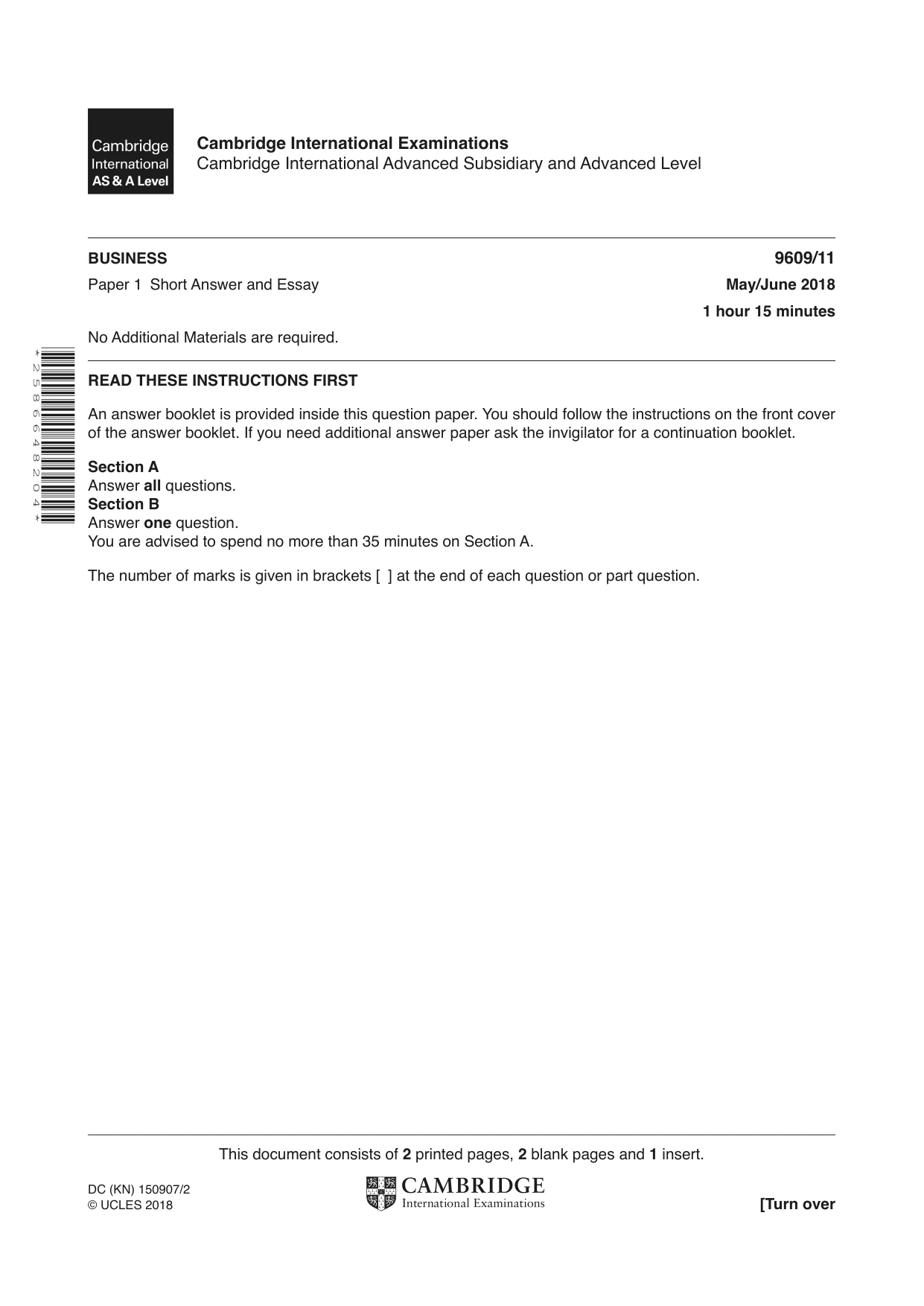
Question paper, page 1
* 2 5 8 6 6 4 8 2 0 4 * This document consists of 2 printed pages, 2 blank pages and 1 insert. DC (KN) 150907/2 © UCLES 2018 [Turn over Cambridge International Examinations Cambridge International Advanced Subsidiary and Advanced Level BUSINESS 9609/11 Paper 1 Short Answer and Essay May/June 2018 1 hour 15 minutes No Additional Materials are required. READ THESE INSTRUCTIONS FIRST An answer booklet is provided inside this question paper. You should follow the instructions on the front cover of the answer booklet. If you need additional answer paper ask the invigilator for a continuation booklet. Section A Answer all questions. Section B Answer one question. You are advised to spend no more than 35 minutes on Section A. The number of marks is given in brackets [ ] at the end of each question or part question.
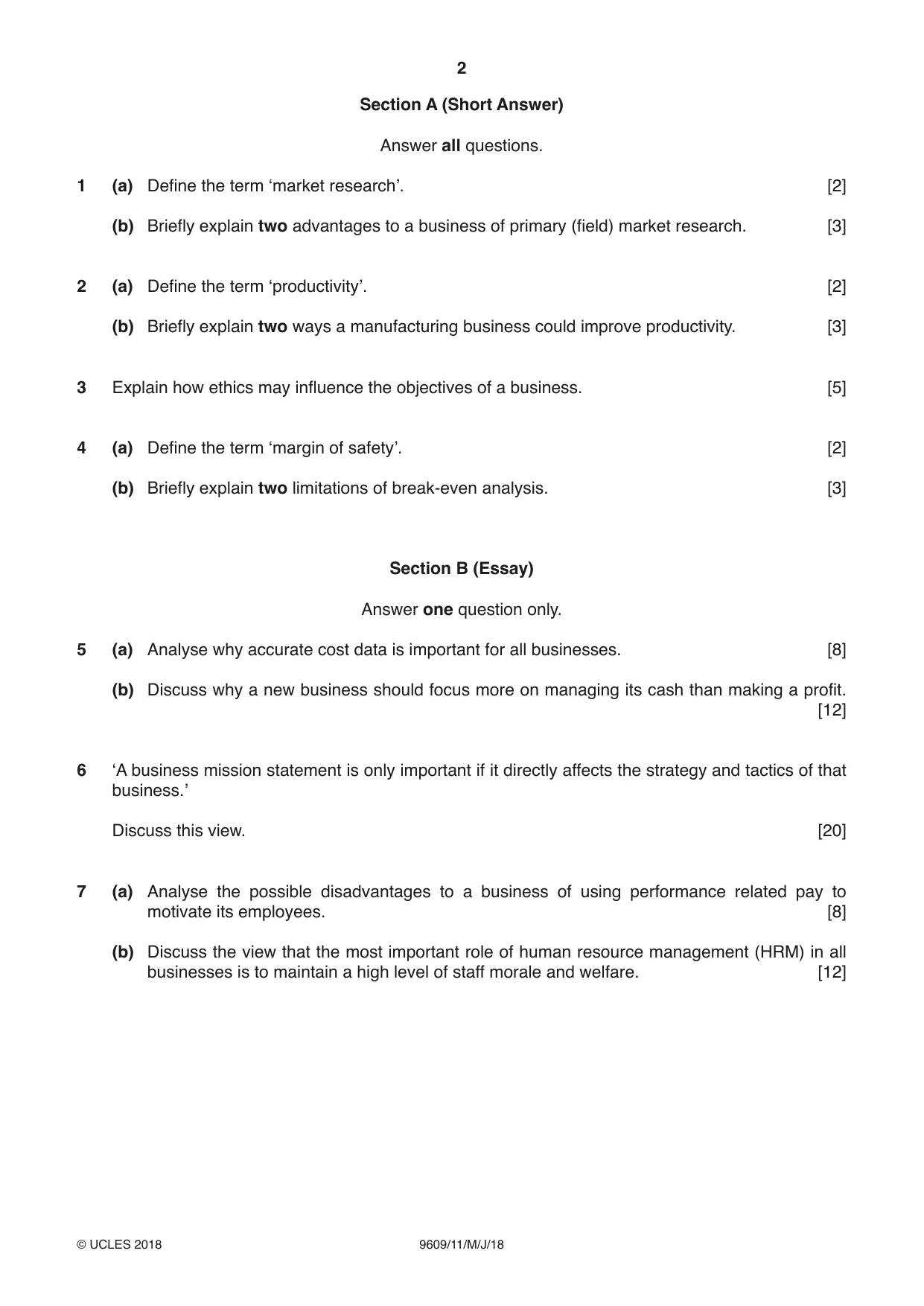
Question paper, page 2
2 9609/11/M/J/18 © UCLES 2018 Section A (Short Answer) Answer all questions. 1 (a) Define the term ‘market research’. [2] (b) Briefly explain two advantages to a business of primary (field) market research. [3] 2 (a) Define the term ‘productivity’. [2] (b) Briefly explain two ways a manufacturing business could improve productivity. [3] 3 Explain how ethics may influence the objectives of a business. [5] 4 (a) Define the term ‘margin of safety’. [2] (b) Briefly explain two limitations of break-even analysis. [3] Section B (Essay) Answer one question only. 5 (a) Analyse why accurate cost data is important for all businesses. [8] (b) Discuss why a new business should focus more on managing its cash than making a profit. [12] 6 ‘A business mission statement is only important if it directly affects the strategy and tactics of that business.’ Discuss this view. [20] 7 (a) Analyse the possible disadvantages to a business of using performance related pay to motivate its employees. [8] (b) Discuss the view that the most important role of human resource management (HRM) in all businesses is to maintain a high level of staff morale and welfare. [12]
Question paper, page 3
3 9609/11/M/J/18 © UCLES 2018 BLANK PAGE
Question paper, page 4
4 9609/11/M/J/18 © UCLES 2018 BLANK PAGE Permission to reproduce items where third-party owned material protected by copyright is included has been sought and cleared where possible. Every reasonable effort has been made by the publisher (UCLES) to trace copyright holders, but if any items requiring clearance have unwittingly been included, the publisher will be pleased to make amends at the earliest possible opportunity. To avoid the issue of disclosure of answer-related information to candidates, all copyright acknowledgements are reproduced online in the Cambridge International Examinations Copyright Acknowledgements Booklet. This is produced for each series of examinations and is freely available to download at www.cie.org.uk after the live examination series. Cambridge International Examinations is part of the Cambridge Assessment Group. Cambridge Assessment is the brand name of University of Cambridge Local Examinations Syndicate (UCLES), which is itself a department of the University of Cambridge.
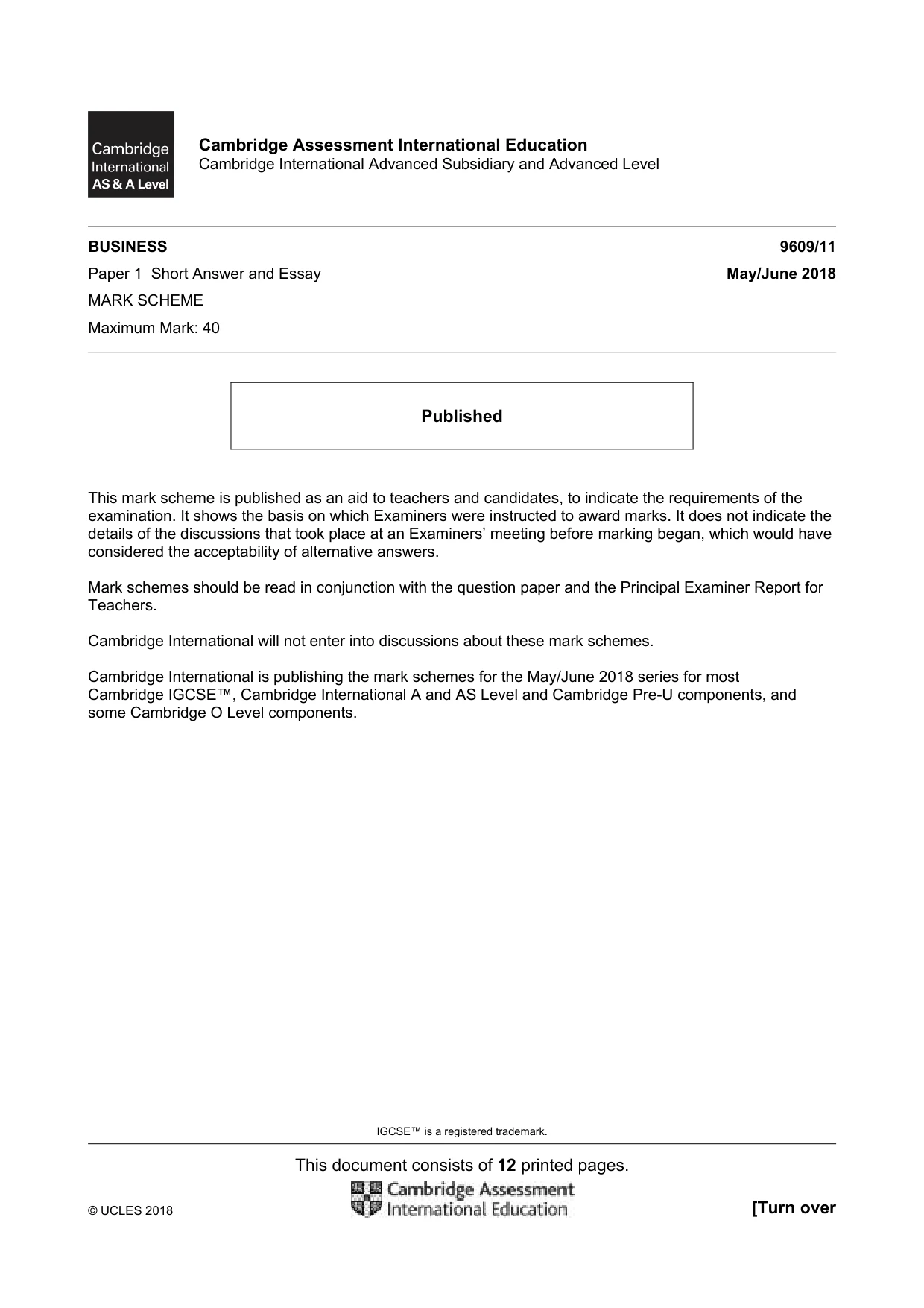
Mark scheme, page 1
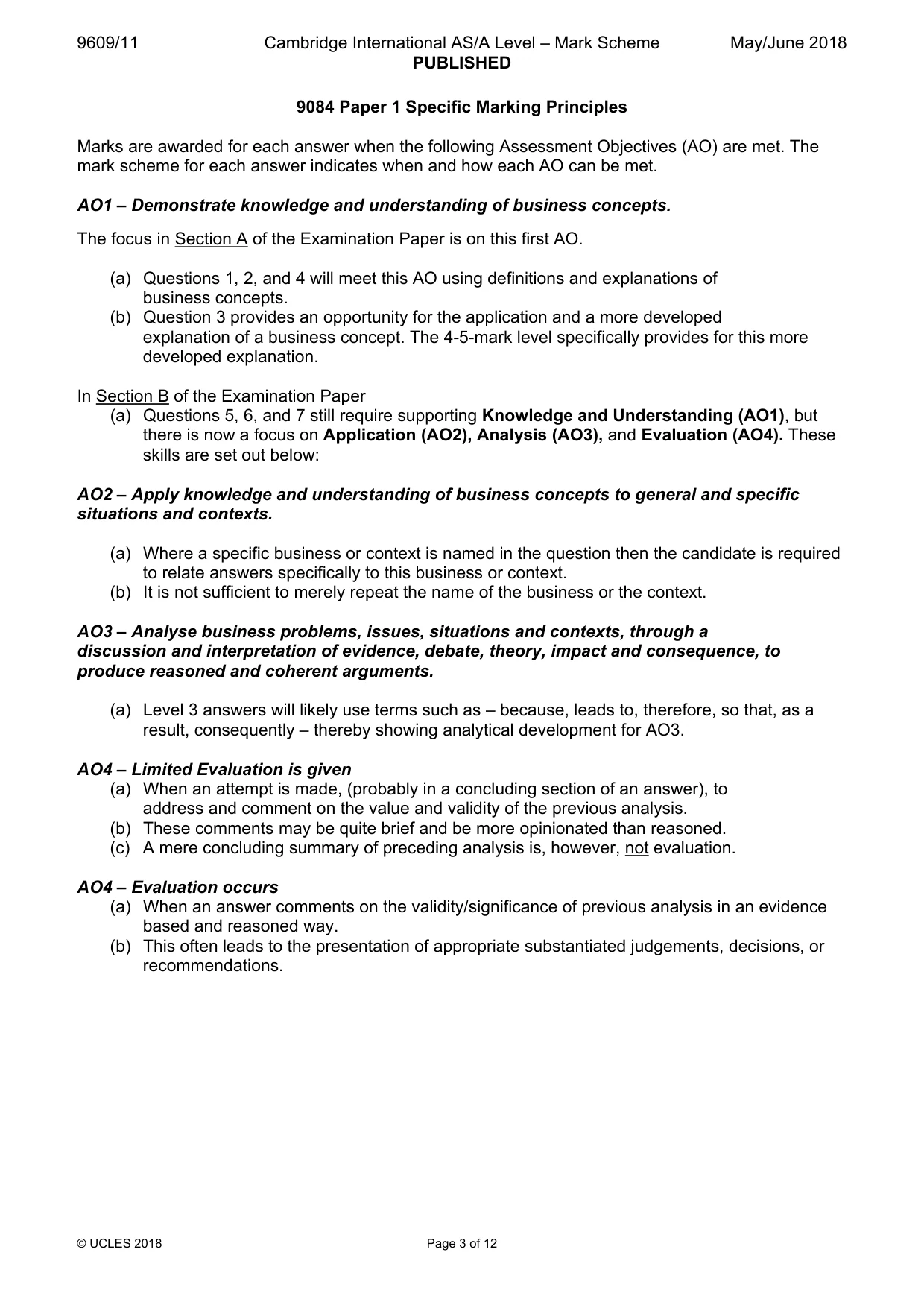
IGCSE™ is a registered trademark. This document consists of 12 printed pages. © UCLES 2018 [Turn over Cambridge Assessment International Education Cambridge International Advanced Subsidiary and Advanced Level BUSINESS 9609/11 Paper 1 Short Answer and Essay May/June 2018 MARK SCHEME Maximum Mark: 40 Published This mark scheme is published as an aid to teachers and candidates, to indicate the requirements of the examination. It shows the basis on which Examiners were instructed to award marks. It does not indicate the details of the discussions that took place at an Examiners’ meeting before marking began, which would have considered the acceptability of alternative answers. Mark schemes should be read in conjunction with the question paper and the Principal Examiner Report for Teachers. Cambridge International will not enter into discussions about these mark schemes. Cambridge International is publishing the mark schemes for the May/June 2018 series for most Cambridge IGCSE™, Cambridge International A and AS Level and Cambridge Pre-U components, and some Cambridge O Level components.
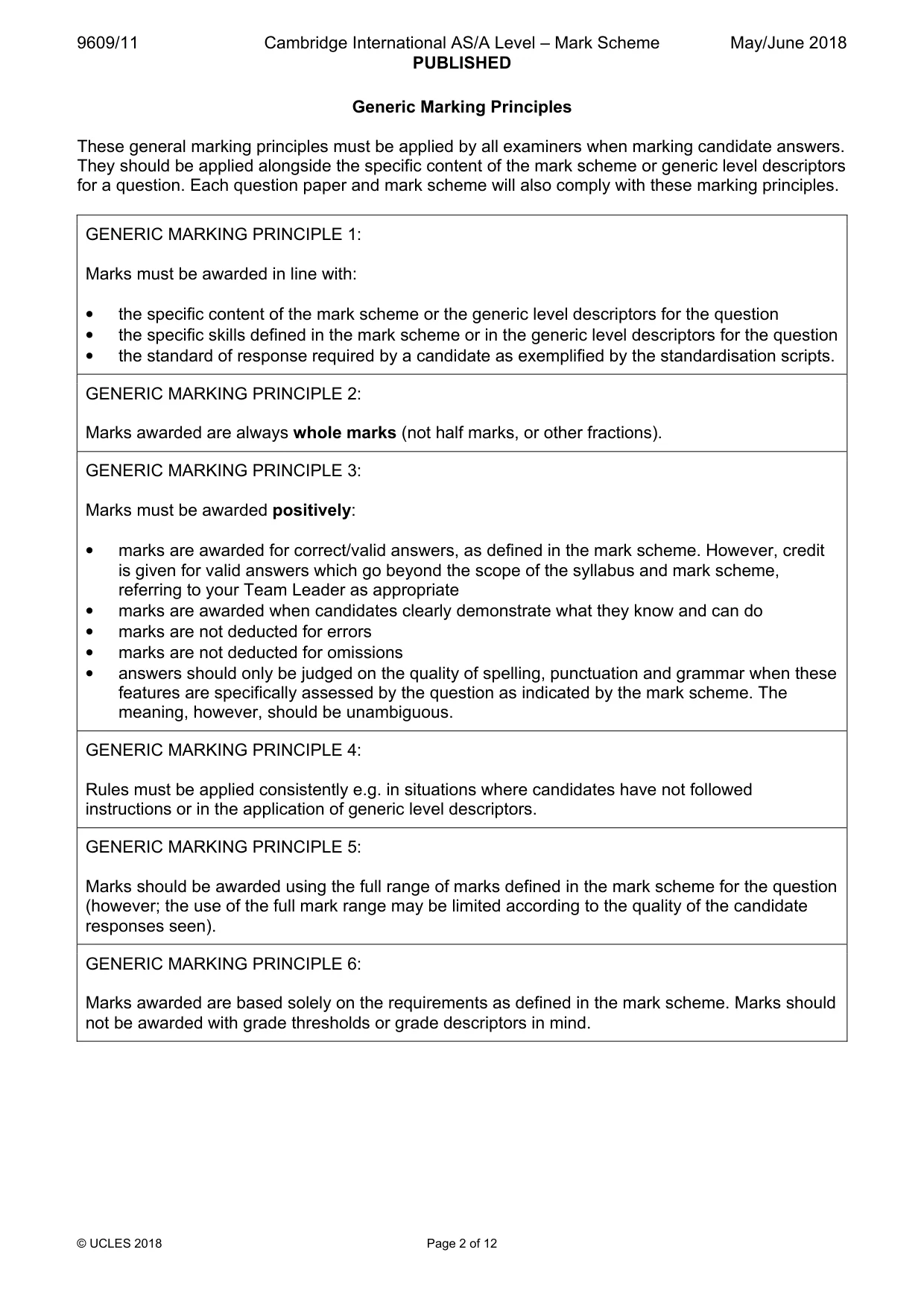
Mark scheme, page 2
9609/11 Cambridge International AS/A Level – Mark Scheme PUBLISHED May/June 2018 © UCLES 2018 Page 2 of 12 Generic Marking Principles These general marking principles must be applied by all examiners when marking candidate answers. They should be applied alongside the specific content of the mark scheme or generic level descriptors for a question. Each question paper and mark scheme will also comply with these marking principles. GENERIC MARKING PRINCIPLE 1: Marks must be awarded in line with: • the specific content of the mark scheme or the generic level descriptors for the question • the specific skills defined in the mark scheme or in the generic level descriptors for the question • the standard of response required by a candidate as exemplified by the standardisation scripts. GENERIC MARKING PRINCIPLE 2: Marks awarded are always whole marks (not half marks, or other fractions). GENERIC MARKING PRINCIPLE 3: Marks must be awarded positively: • marks are awarded for correct/valid answers, as defined in the mark scheme. However, credit is given for valid answers which go beyond the scope of the syllabus and mark scheme, referring to your Team Leader as appropriate • marks are awarded when candidates clearly demonstrate what they know and can do • marks are not deducted for errors • marks are not deducted for omissions • answers should only be judged on the quality of spelling, punctuation and grammar when these features are specifically assessed by the question as indicated by the mark scheme. The meaning, however, should be unambiguous. GENERIC MARKING PRINCIPLE 4: Rules must be applied consistently e.g. in situations where candidates have not followed instructions or in the application of generic level descriptors. GENERIC MARKING PRINCIPLE 5: Marks should be awarded using the full range of marks defined in the mark scheme for the question (however; the use of the full mark range may be limited according to the quality of the candidate responses seen). GENERIC MARKING PRINCIPLE 6: Marks awarded are based solely on the requirements as defined in the mark scheme. Marks should not be awarded with grade thresholds or grade descriptors in mind.
Mark scheme, page 3
9609/11 Cambridge International AS/A Level – Mark Scheme PUBLISHED May/June 2018 © UCLES 2018 Page 3 of 12 9084 Paper 1 Specific Marking Principles Marks are awarded for each answer when the following Assessment Objectives (AO) are met. The mark scheme for each answer indicates when and how each AO can be met. AO1 – Demonstrate knowledge and understanding of business concepts. The focus in Section A of the Examination Paper is on this first AO. (a) Questions 1, 2, and 4 will meet this AO using definitions and explanations of business concepts. (b) Question 3 provides an opportunity for the application and a more developed explanation of a business concept. The 4-5-mark level specifically provides for this more developed explanation. In Section B of the Examination Paper (a) Questions 5, 6, and 7 still require supporting Knowledge and Understanding (AO1), but there is now a focus on Application (AO2), Analysis (AO3), and Evaluation (AO4). These skills are set out below: AO2 – Apply knowledge and understanding of business concepts to general and specific situations and contexts. (a) Where a specific business or context is named in the question then the candidate is required to relate answers specifically to this business or context. (b) It is not sufficient to merely repeat the name of the business or the context. AO3 – Analyse business problems, issues, situations and contexts, through a discussion and interpretation of evidence, debate, theory, impact and consequence, to produce reasoned and coherent arguments. (a) Level 3 answers will likely use terms such as – because, leads to, therefore, so that, as a result, consequently – thereby showing analytical development for AO3. AO4 – Limited Evaluation is given (a) When an attempt is made, (probably in a concluding section of an answer), to address and comment on the value and validity of the previous analysis. (b) These comments may be quite brief and be more opinionated than reasoned. (c) A mere concluding summary of preceding analysis is, however, not evaluation. AO4 – Evaluation occurs (a) When an answer comments on the validity/significance of previous analysis in an evidence based and reasoned way. (b) This often leads to the presentation of appropriate substantiated judgements, decisions, or recommendations.
Mark scheme, page 4
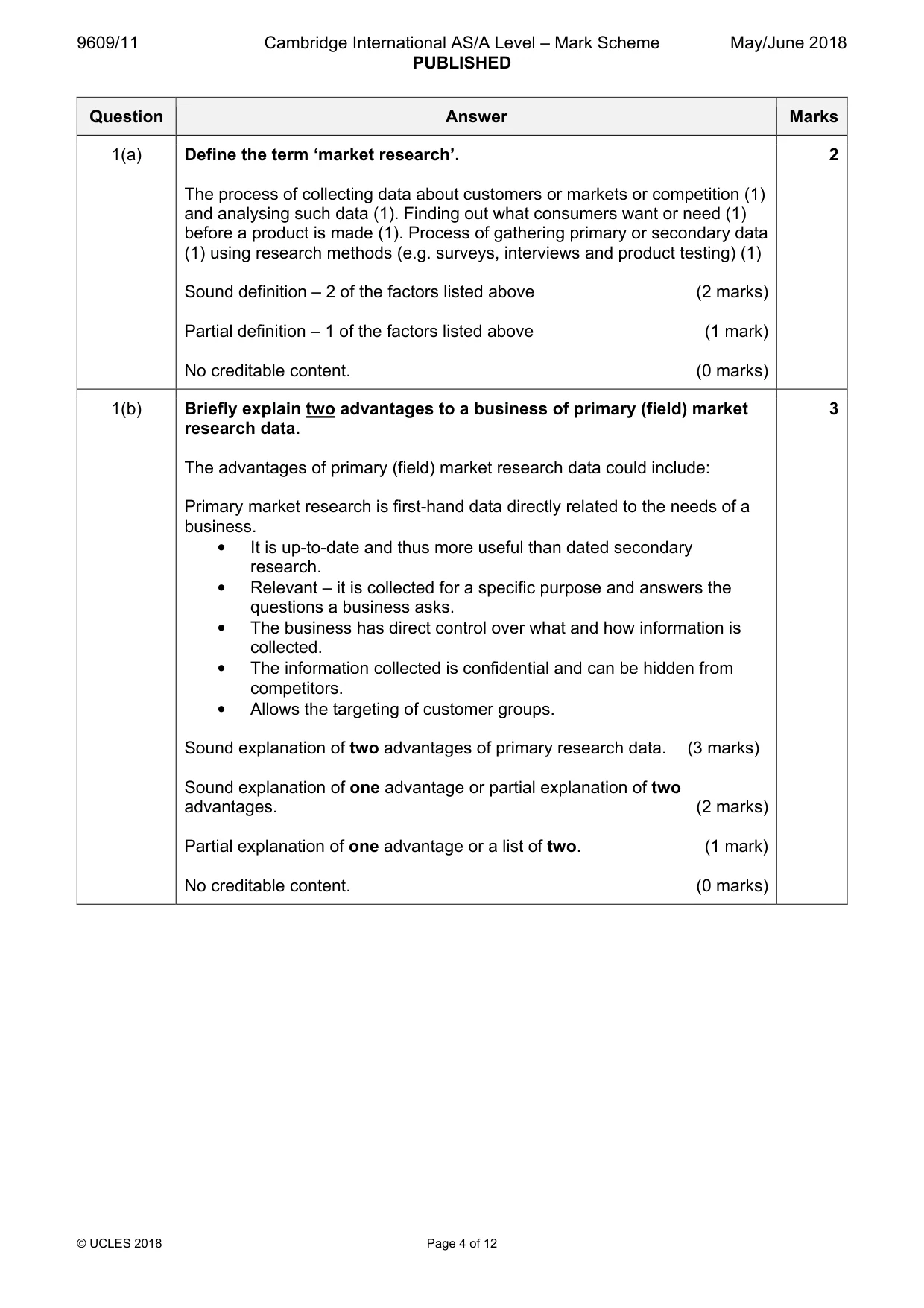
9609/11 Cambridge International AS/A Level – Mark Scheme PUBLISHED May/June 2018 © UCLES 2018 Page 4 of 12 Question Answer Marks 1(a) Define the term ‘market research’. The process of collecting data about customers or markets or competition (1) and analysing such data (1). Finding out what consumers want or need (1) before a product is made (1). Process of gathering primary or secondary data (1) using research methods (e.g. surveys, interviews and product testing) (1) Sound definition – 2 of the factors listed above (2 marks) Partial definition – 1 of the factors listed above (1 mark) No creditable content. (0 marks) 2 1(b) Briefly explain two advantages to a business of primary (field) market research data. The advantages of primary (field) market research data could include: Primary market research is first-hand data directly related to the needs of a business. • It is up-to-date and thus more useful than dated secondary research. • Relevant – it is collected for a specific purpose and answers the questions a business asks. • The business has direct control over what and how information is collected. • The information collected is confidential and can be hidden from competitors. • Allows the targeting of customer groups. Sound explanation of two advantages of primary research data. (3 marks) Sound explanation of one advantage or partial explanation of two advantages. (2 marks) Partial explanation of one advantage or a list of two. (1 mark) No creditable content. (0 marks) 3
Mark scheme, page 5
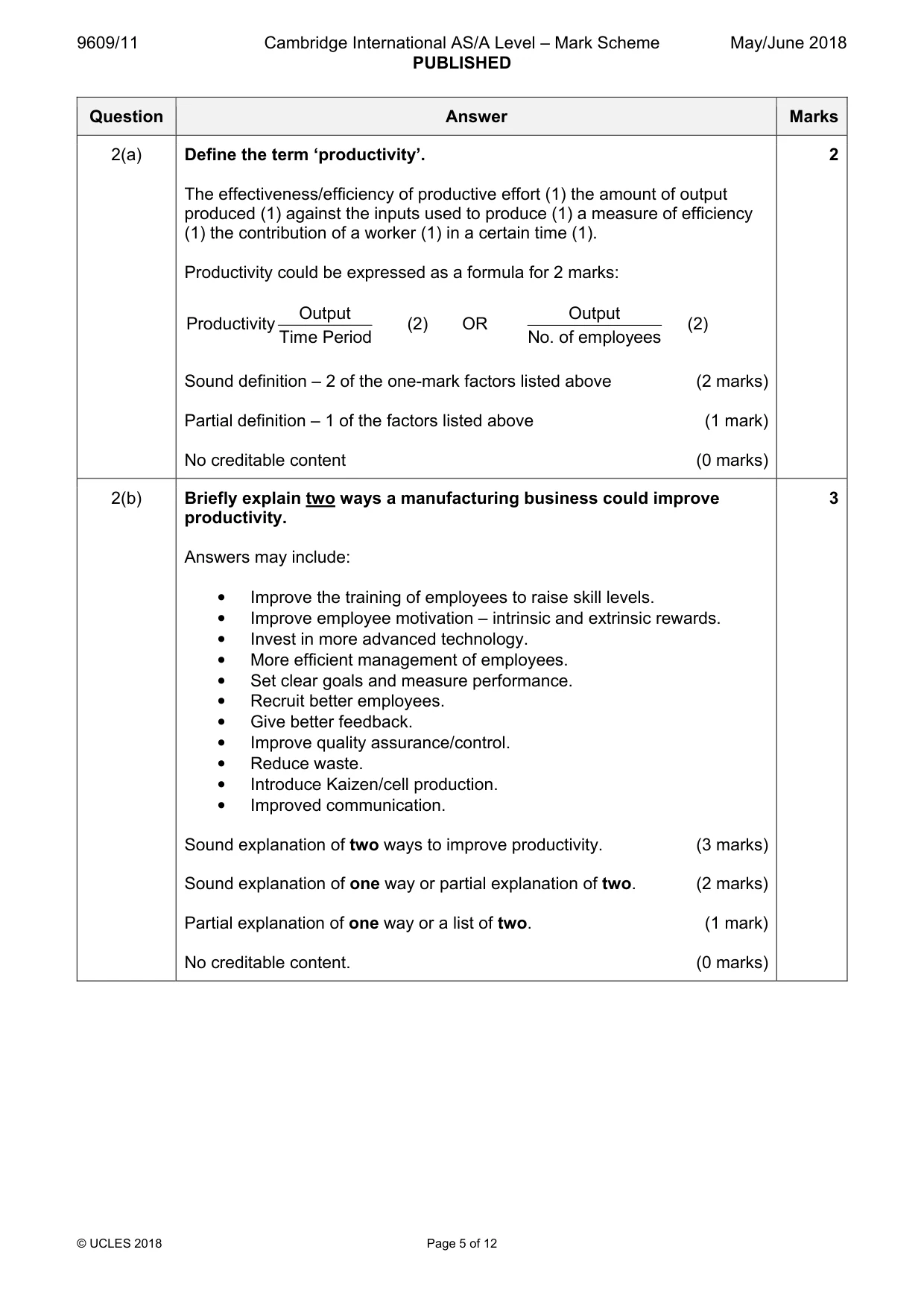
9609/11 Cambridge International AS/A Level – Mark Scheme PUBLISHED May/June 2018 © UCLES 2018 Page 5 of 12 Question Answer Marks 2(a) Define the term ‘productivity’. The effectiveness/efficiency of productive effort (1) the amount of output produced (1) against the inputs used to produce (1) a measure of efficiency (1) the contribution of a worker (1) in a certain time (1). Productivity could be expressed as a formula for 2 marks: Output Productivity Time Period (2) OR Output No. of employees (2) Sound definition – 2 of the one-mark factors listed above (2 marks) Partial definition – 1 of the factors listed above (1 mark) No creditable content (0 marks) 2 2(b) Briefly explain two ways a manufacturing business could improve productivity. Answers may include: • Improve the training of employees to raise skill levels. • Improve employee motivation – intrinsic and extrinsic rewards. • Invest in more advanced technology. • More efficient management of employees. • Set clear goals and measure performance. • Recruit better employees. • Give better feedback. • Improve quality assurance/control. • Reduce waste. • Introduce Kaizen/cell production. • Improved communication. Sound explanation of two ways to improve productivity. (3 marks) Sound explanation of one way or partial explanation of two. (2 marks) Partial explanation of one way or a list of two. (1 mark) No creditable content. (0 marks) 3
Mark scheme, page 6
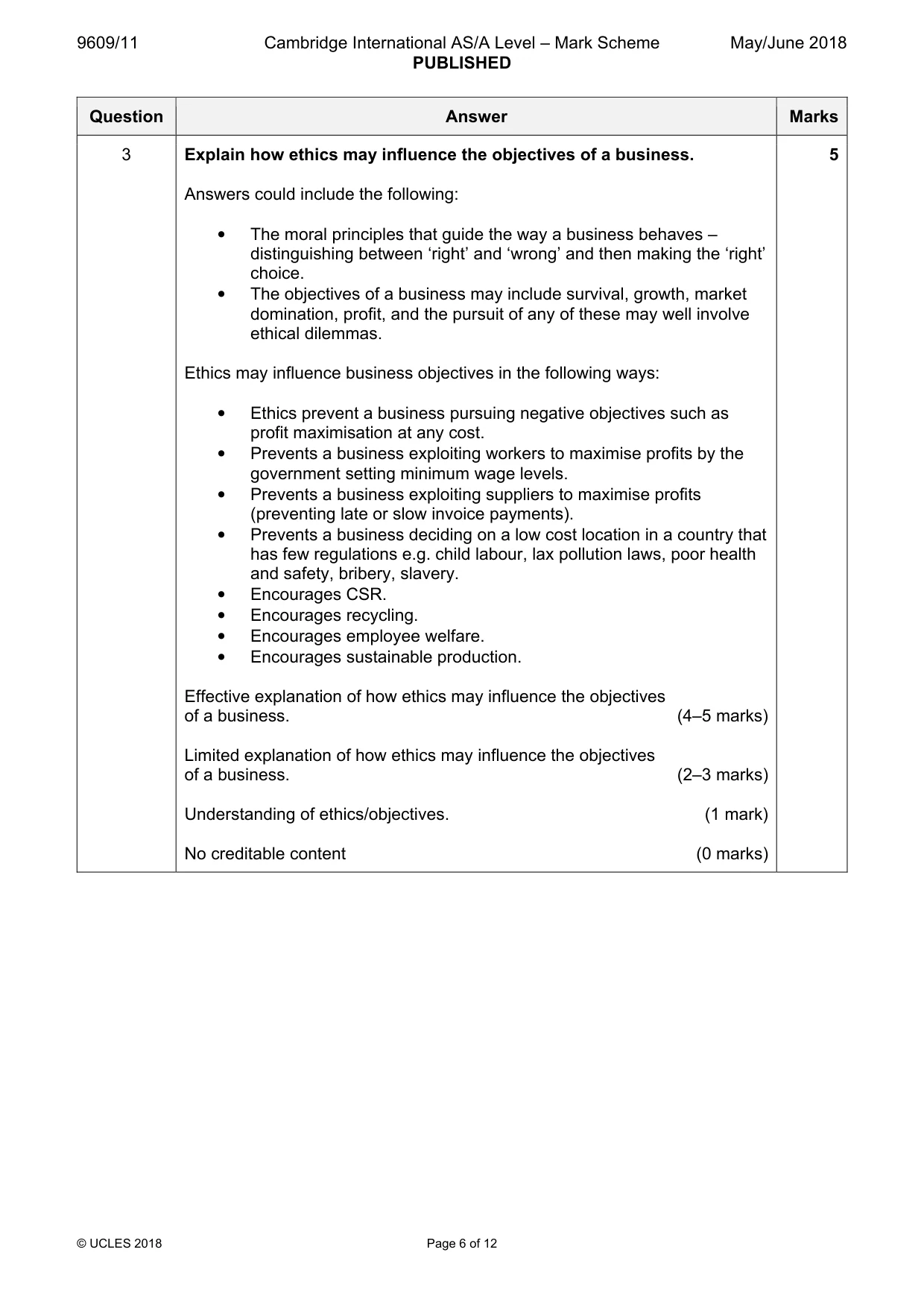
9609/11 Cambridge International AS/A Level – Mark Scheme PUBLISHED May/June 2018 © UCLES 2018 Page 6 of 12 Question Answer Marks 3 Explain how ethics may influence the objectives of a business. Answers could include the following: • The moral principles that guide the way a business behaves – distinguishing between ‘right’ and ‘wrong’ and then making the ‘right’ choice. • The objectives of a business may include survival, growth, market domination, profit, and the pursuit of any of these may well involve ethical dilemmas. Ethics may influence business objectives in the following ways: • Ethics prevent a business pursuing negative objectives such as profit maximisation at any cost. • Prevents a business exploiting workers to maximise profits by the government setting minimum wage levels. • Prevents a business exploiting suppliers to maximise profits (preventing late or slow invoice payments). • Prevents a business deciding on a low cost location in a country that has few regulations e.g. child labour, lax pollution laws, poor health and safety, bribery, slavery. • Encourages CSR. • Encourages recycling. • Encourages employee welfare. • Encourages sustainable production. Effective explanation of how ethics may influence the objectives of a business. (4–5 marks) Limited explanation of how ethics may influence the objectives of a business. (2–3 marks) Understanding of ethics/objectives. (1 mark) No creditable content (0 marks) 5
Mark scheme, page 7
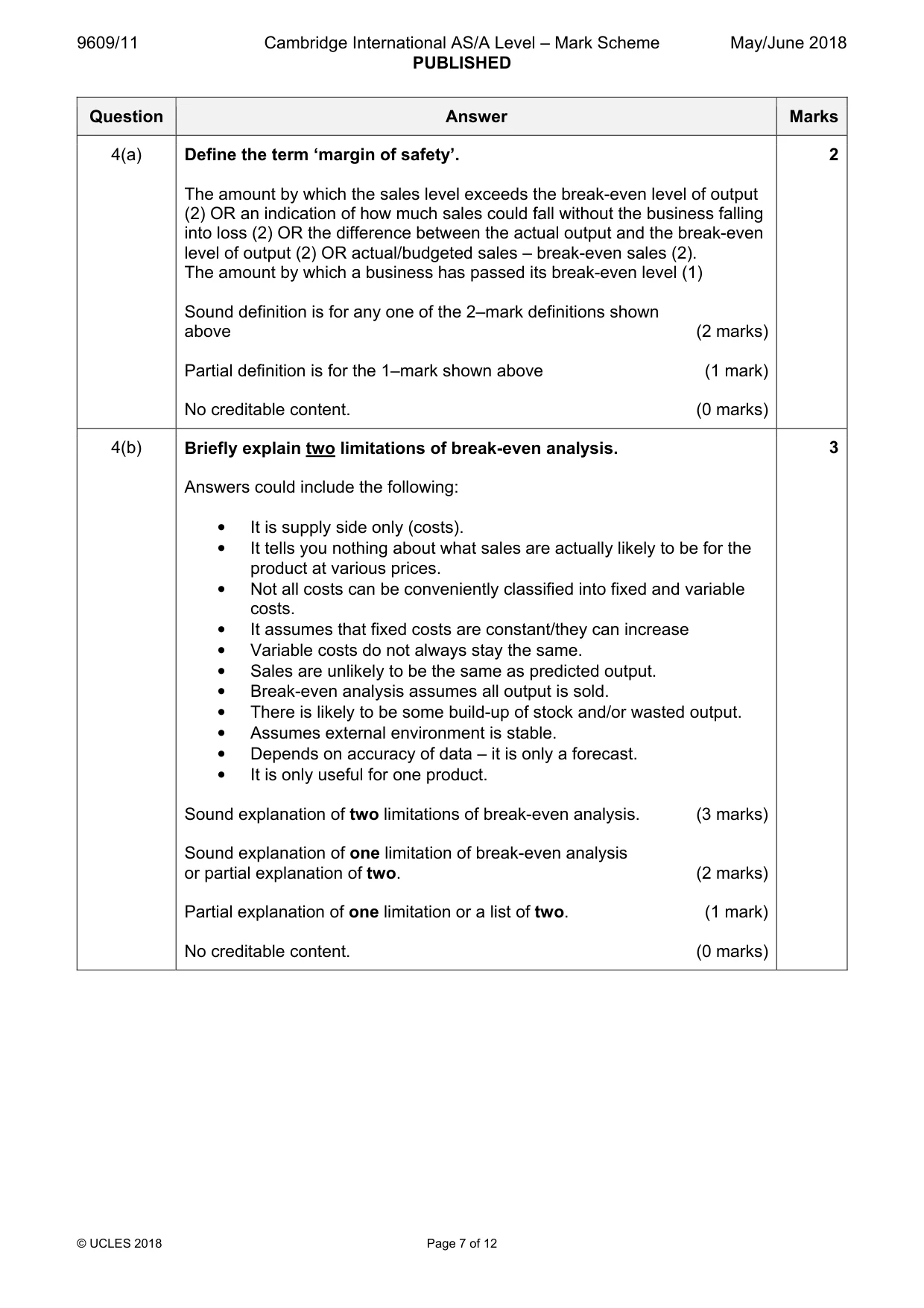
9609/11 Cambridge International AS/A Level – Mark Scheme PUBLISHED May/June 2018 © UCLES 2018 Page 7 of 12 Question Answer Marks 4(a) Define the term ‘margin of safety’. The amount by which the sales level exceeds the break-even level of output (2) OR an indication of how much sales could fall without the business falling into loss (2) OR the difference between the actual output and the break-even level of output (2) OR actual/budgeted sales – break-even sales (2). The amount by which a business has passed its break-even level (1) Sound definition is for any one of the 2–mark definitions shown above (2 marks) Partial definition is for the 1–mark shown above (1 mark) No creditable content. (0 marks) 2 4(b) Briefly explain two limitations of break-even analysis. Answers could include the following: • It is supply side only (costs). • It tells you nothing about what sales are actually likely to be for the product at various prices. • Not all costs can be conveniently classified into fixed and variable costs. • It assumes that fixed costs are constant/they can increase • Variable costs do not always stay the same. • Sales are unlikely to be the same as predicted output. • Break-even analysis assumes all output is sold. • There is likely to be some build-up of stock and/or wasted output. • Assumes external environment is stable. • Depends on accuracy of data – it is only a forecast. • It is only useful for one product. Sound explanation of two limitations of break-even analysis. (3 marks) Sound explanation of one limitation of break-even analysis or partial explanation of two. (2 marks) Partial explanation of one limitation or a list of two. (1 mark) No creditable content. (0 marks) 3
Mark scheme, page 8
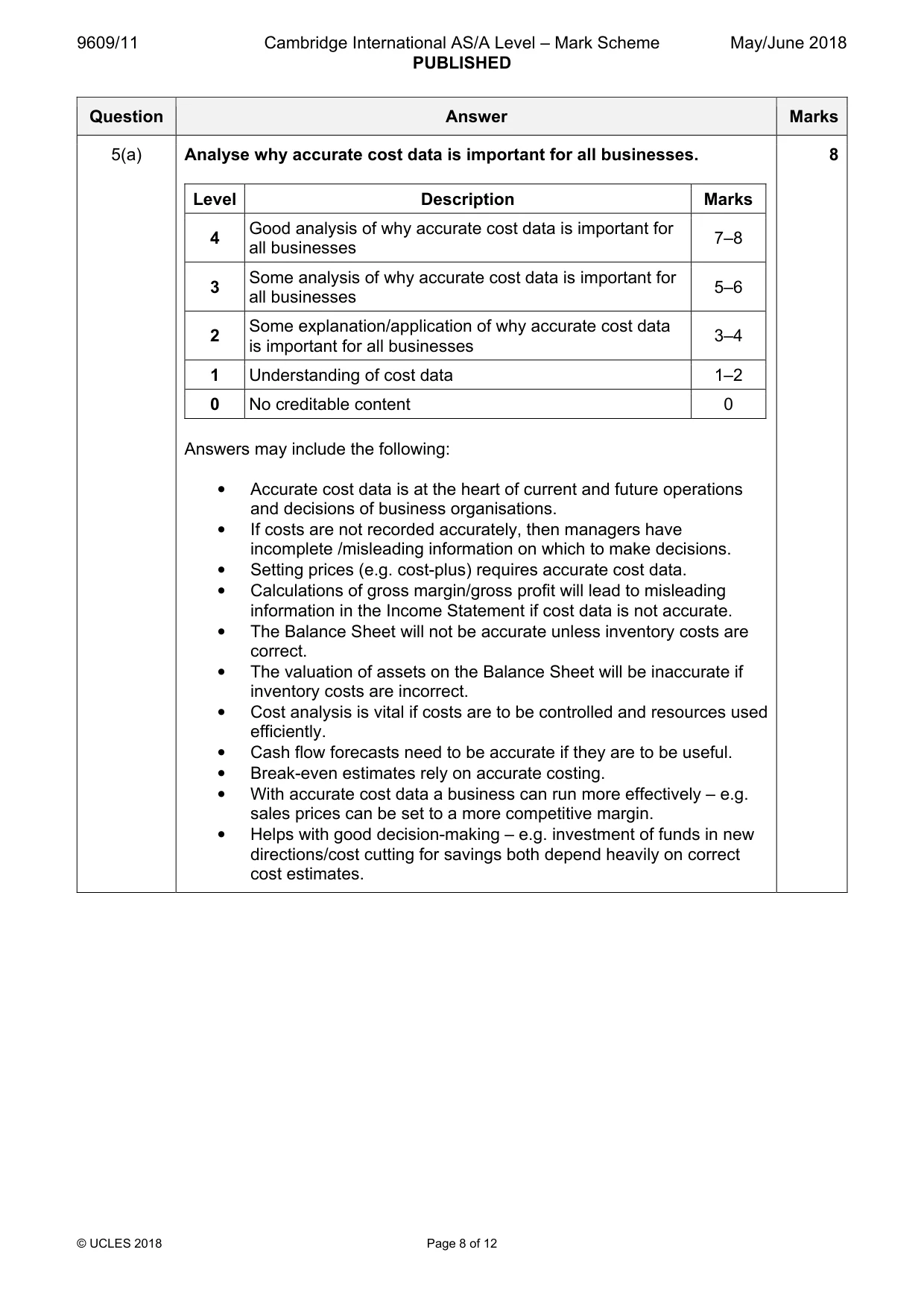
9609/11 Cambridge International AS/A Level – Mark Scheme PUBLISHED May/June 2018 © UCLES 2018 Page 8 of 12 Question Answer Marks 5(a) Analyse why accurate cost data is important for all businesses. Level Description Marks 4 Good analysis of why accurate cost data is important for all businesses 7–8 3 Some analysis of why accurate cost data is important for all businesses 5–6 2 Some explanation/application of why accurate cost data is important for all businesses 3–4 1 Understanding of cost data 1–2 0 No creditable content 0 Answers may include the following: • Accurate cost data is at the heart of current and future operations and decisions of business organisations. • If costs are not recorded accurately, then managers have incomplete /misleading information on which to make decisions. • Setting prices (e.g. cost-plus) requires accurate cost data. • Calculations of gross margin/gross profit will lead to misleading information in the Income Statement if cost data is not accurate. • The Balance Sheet will not be accurate unless inventory costs are correct. • The valuation of assets on the Balance Sheet will be inaccurate if inventory costs are incorrect. • Cost analysis is vital if costs are to be controlled and resources used efficiently. • Cash flow forecasts need to be accurate if they are to be useful. • Break-even estimates rely on accurate costing. • With accurate cost data a business can run more effectively – e.g. sales prices can be set to a more competitive margin. • Helps with good decision-making – e.g. investment of funds in new directions/cost cutting for savings both depend heavily on correct cost estimates. 8
Mark scheme, page 9
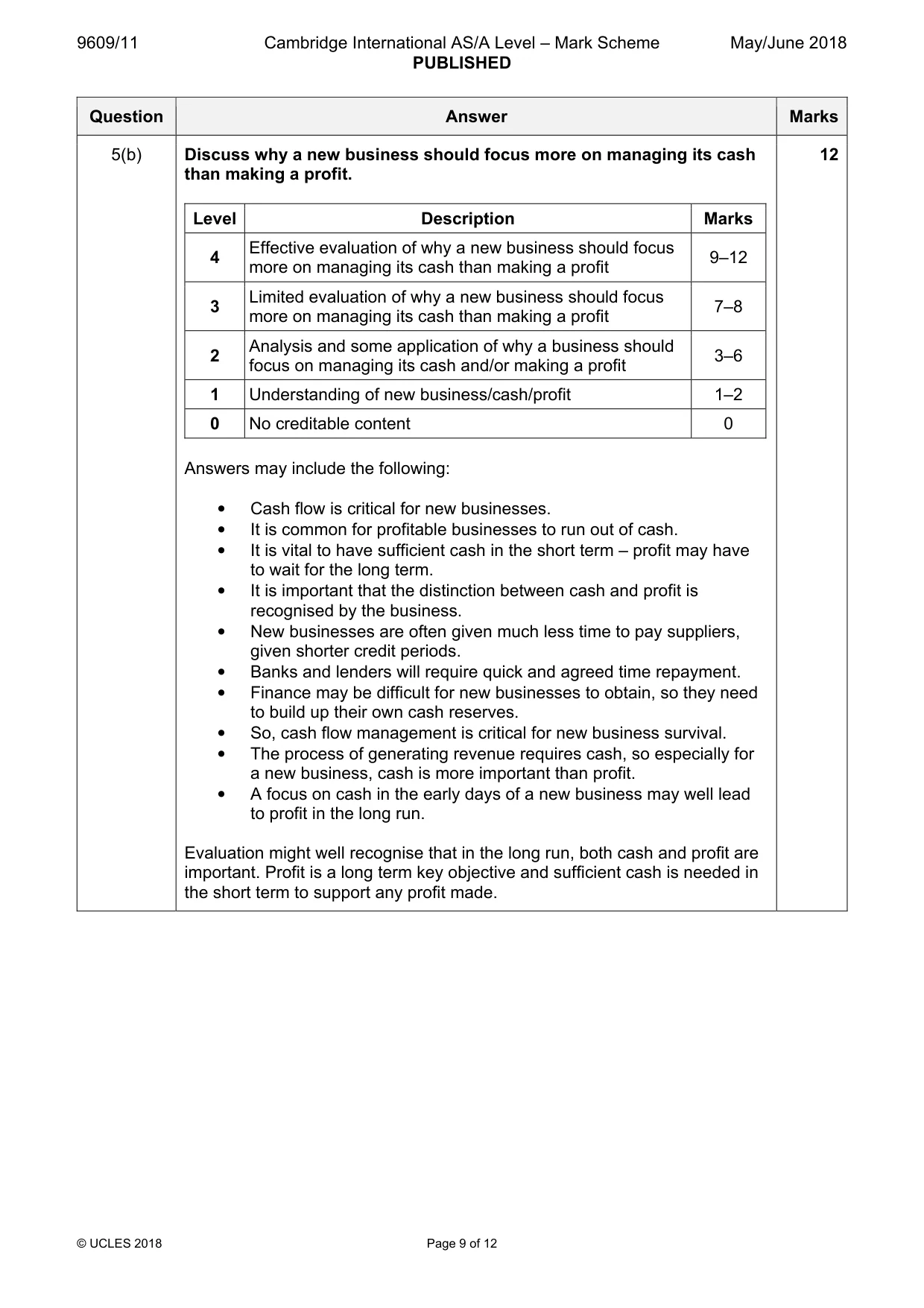
9609/11 Cambridge International AS/A Level – Mark Scheme PUBLISHED May/June 2018 © UCLES 2018 Page 9 of 12 Question Answer Marks 5(b) Discuss why a new business should focus more on managing its cash than making a profit. Level Description Marks 4 Effective evaluation of why a new business should focus more on managing its cash than making a profit 9–12 3 Limited evaluation of why a new business should focus more on managing its cash than making a profit 7–8 2 Analysis and some application of why a business should focus on managing its cash and/or making a profit 3–6 1 Understanding of new business/cash/profit 1–2 0 No creditable content 0 Answers may include the following: • Cash flow is critical for new businesses. • It is common for profitable businesses to run out of cash. • It is vital to have sufficient cash in the short term – profit may have to wait for the long term. • It is important that the distinction between cash and profit is recognised by the business. • New businesses are often given much less time to pay suppliers, given shorter credit periods. • Banks and lenders will require quick and agreed time repayment. • Finance may be difficult for new businesses to obtain, so they need to build up their own cash reserves. • So, cash flow management is critical for new business survival. • The process of generating revenue requires cash, so especially for a new business, cash is more important than profit. • A focus on cash in the early days of a new business may well lead to profit in the long run. Evaluation might well recognise that in the long run, both cash and profit are important. Profit is a long term key objective and sufficient cash is needed in the short term to support any profit made. 12
Mark scheme, page 10
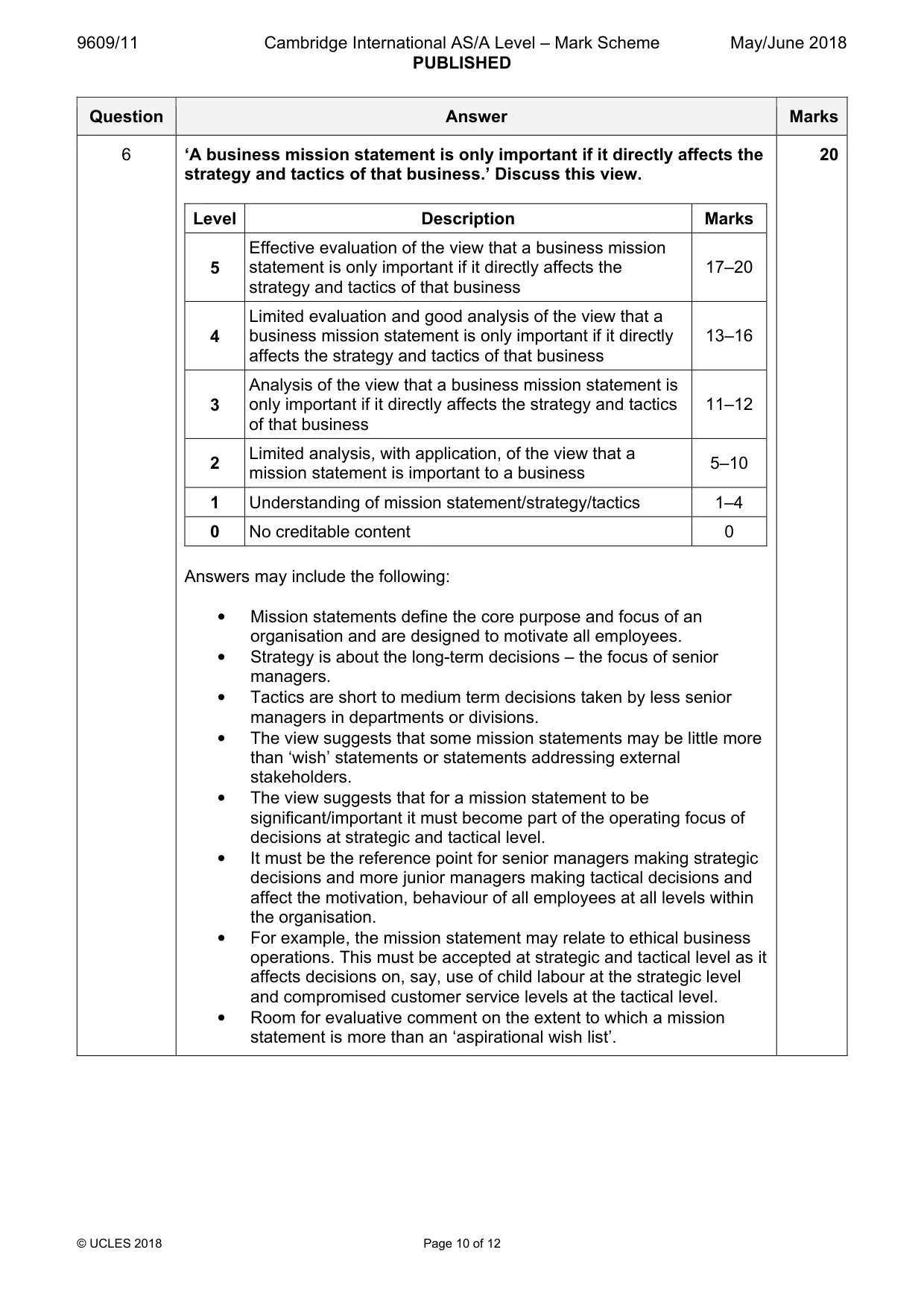
9609/11 Cambridge International AS/A Level – Mark Scheme PUBLISHED May/June 2018 © UCLES 2018 Page 10 of 12 Question Answer Marks 6 ‘A business mission statement is only important if it directly affects the strategy and tactics of that business.’ Discuss this view. Level Description Marks 5 Effective evaluation of the view that a business mission statement is only important if it directly affects the strategy and tactics of that business 17–20 4 Limited evaluation and good analysis of the view that a business mission statement is only important if it directly affects the strategy and tactics of that business 13–16 3 Analysis of the view that a business mission statement is only important if it directly affects the strategy and tactics of that business 11–12 2 Limited analysis, with application, of the view that a mission statement is important to a business 5–10 1 Understanding of mission statement/strategy/tactics 1–4 0 No creditable content 0 Answers may include the following: • Mission statements define the core purpose and focus of an organisation and are designed to motivate all employees. • Strategy is about the long-term decisions – the focus of senior managers. • Tactics are short to medium term decisions taken by less senior managers in departments or divisions. • The view suggests that some mission statements may be little more than ‘wish’ statements or statements addressing external stakeholders. • The view suggests that for a mission statement to be significant/important it must become part of the operating focus of decisions at strategic and tactical level. • It must be the reference point for senior managers making strategic decisions and more junior managers making tactical decisions and affect the motivation, behaviour of all employees at all levels within the organisation. • For example, the mission statement may relate to ethical business operations. This must be accepted at strategic and tactical level as it affects decisions on, say, use of child labour at the strategic level and compromised customer service levels at the tactical level. • Room for evaluative comment on the extent to which a mission statement is more than an ‘aspirational wish list’. 20
Mark scheme, page 11
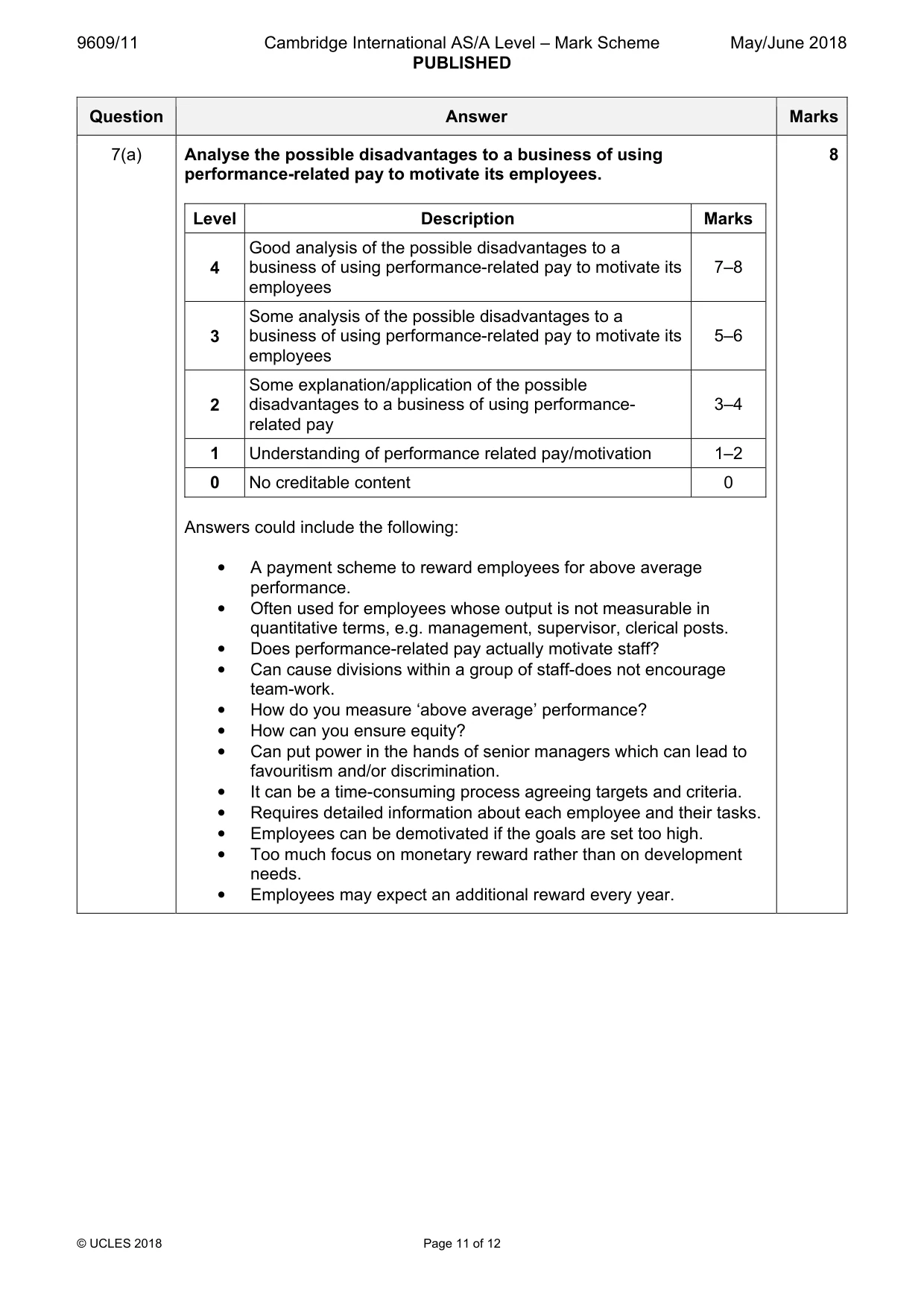
9609/11 Cambridge International AS/A Level – Mark Scheme PUBLISHED May/June 2018 © UCLES 2018 Page 11 of 12 Question Answer Marks 7(a) Analyse the possible disadvantages to a business of using performance-related pay to motivate its employees. Level Description Marks 4 Good analysis of the possible disadvantages to a business of using performance-related pay to motivate its employees 7–8 3 Some analysis of the possible disadvantages to a business of using performance-related pay to motivate its employees 5–6 2 Some explanation/application of the possible disadvantages to a business of using performance- related pay 3–4 1 Understanding of performance related pay/motivation 1–2 0 No creditable content 0 Answers could include the following: • A payment scheme to reward employees for above average performance. • Often used for employees whose output is not measurable in quantitative terms, e.g. management, supervisor, clerical posts. • Does performance-related pay actually motivate staff? • Can cause divisions within a group of staff-does not encourage team-work. • How do you measure ‘above average’ performance? • How can you ensure equity? • Can put power in the hands of senior managers which can lead to favouritism and/or discrimination. • It can be a time-consuming process agreeing targets and criteria. • Requires detailed information about each employee and their tasks. • Employees can be demotivated if the goals are set too high. • Too much focus on monetary reward rather than on development needs. • Employees may expect an additional reward every year. 8
Mark scheme, page 12
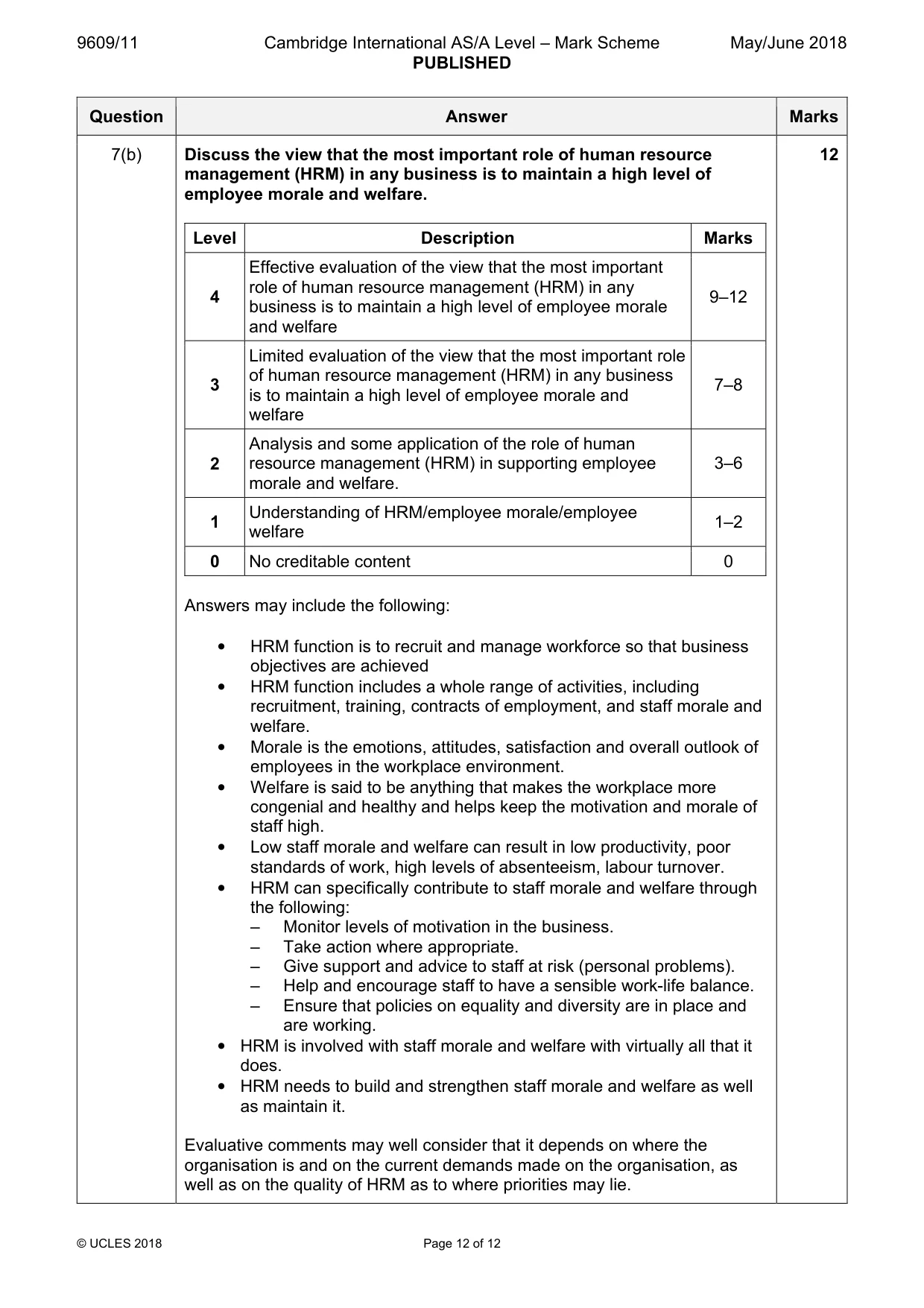
9609/11 Cambridge International AS/A Level – Mark Scheme PUBLISHED May/June 2018 © UCLES 2018 Page 12 of 12 Question Answer Marks 7(b) Discuss the view that the most important role of human resource management (HRM) in any business is to maintain a high level of employee morale and welfare. Level Description Marks 4 Effective evaluation of the view that the most important role of human resource management (HRM) in any business is to maintain a high level of employee morale and welfare 9–12 3 Limited evaluation of the view that the most important role of human resource management (HRM) in any business is to maintain a high level of employee morale and welfare 7–8 2 Analysis and some application of the role of human resource management (HRM) in supporting employee morale and welfare. 3–6 1 Understanding of HRM/employee morale/employee welfare 1–2 0 No creditable content 0 Answers may include the following: • HRM function is to recruit and manage workforce so that business objectives are achieved • HRM function includes a whole range of activities, including recruitment, training, contracts of employment, and staff morale and welfare. • Morale is the emotions, attitudes, satisfaction and overall outlook of employees in the workplace environment. • Welfare is said to be anything that makes the workplace more congenial and healthy and helps keep the motivation and morale of staff high. • Low staff morale and welfare can result in low productivity, poor standards of work, high levels of absenteeism, labour turnover. • HRM can specifically contribute to staff morale and welfare through the following: – Monitor levels of motivation in the business. – Take action where appropriate. – Give support and advice to staff at risk (personal problems). – Help and encourage staff to have a sensible work-life balance. – Ensure that policies on equality and diversity are in place and are working. • HRM is involved with staff morale and welfare with virtually all that it does. • HRM needs to build and strengthen staff morale and welfare as well as maintain it. Evaluative comments may well consider that it depends on where the organisation is and on the current demands made on the organisation, as well as on the quality of HRM as to where priorities may lie. 12
What you needed in this session
Cambridge’s own grade thresholds for 2018 May/June, Paper 1 · Variant 1. A higher threshold means an easier paper — the bar moves with how the cohort did.