Cambridge A Level Biology 9700 — 2013 Oct/Nov Paper 4 · Variant 3
9700/43/O/N/13 · 100 marks · ≈113 min
The question paper and its mark scheme, free to read here and free to download. This is Cambridge’s own paper, exactly as it was sat.
Question paper24 pages




Mark scheme12 pages
Answers below. Sit the paper first if you are practising.
Paper as text
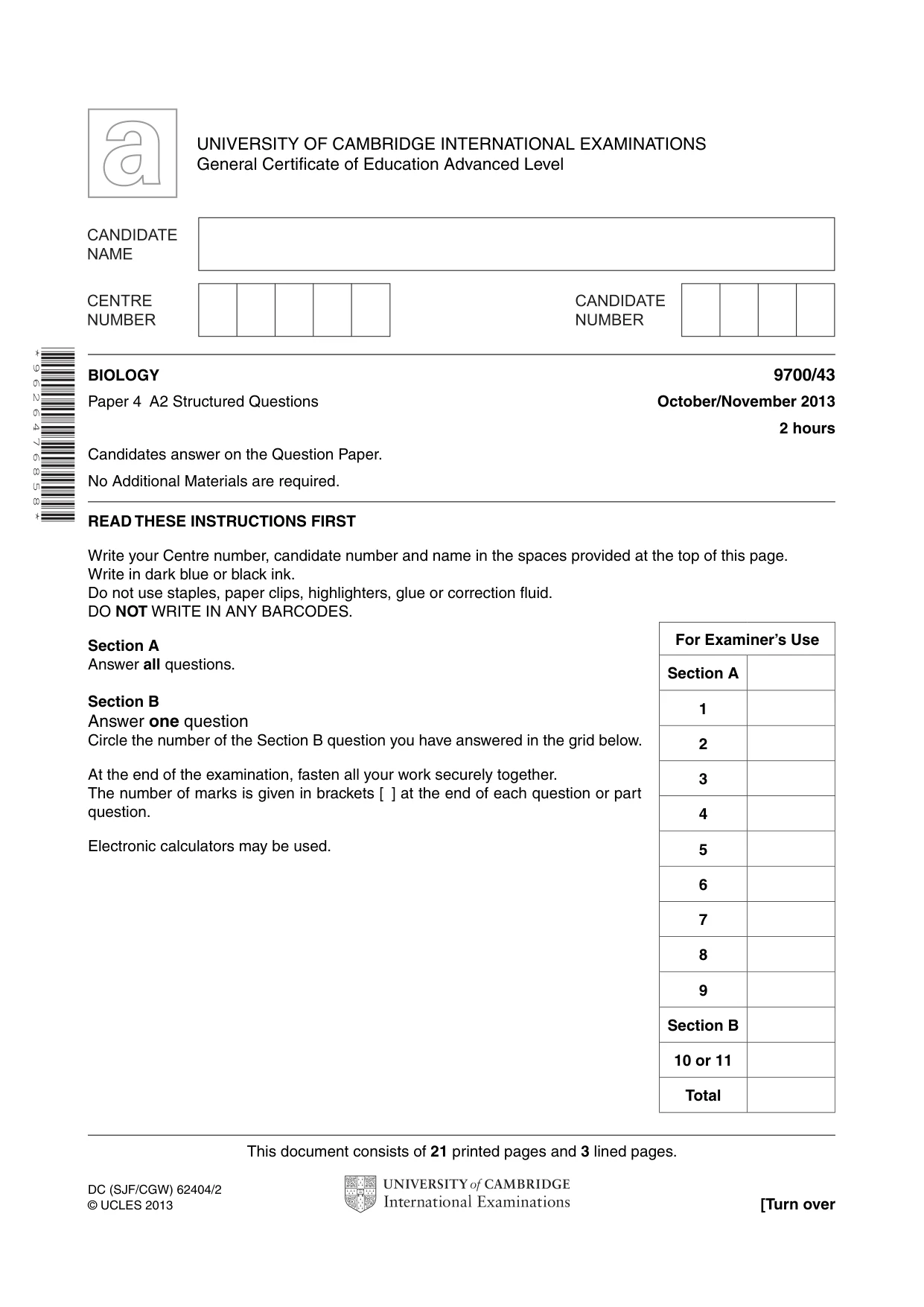
Question paper, page 1
This document consists of 21 printed pages and 3 lined pages. DC (SJF/CGW) 62404/2 © UCLES 2013 [Turn over UNIVERSITY OF CAMBRIDGE INTERNATIONAL EXAMINATIONS General Certificate of Education Advanced Level READ THESE INSTRUCTIONS FIRST Write your Centre number, candidate number and name in the spaces provided at the top of this page. Write in dark blue or black ink. Do not use staples, paper clips, highlighters, glue or correction fluid. DO NOT WRITE IN ANY BARCODES. Section A Answer all questions. Section B Answer one question Circle the number of the Section B question you have answered in the grid below. At the end of the examination, fasten all your work securely together. The number of marks is given in brackets [ ] at the end of each question or part question. Electronic calculators may be used. * 9 6 2 6 4 7 6 8 5 8 * BIOLOGY 9700/43 Paper 4 A2 Structured Questions October/November 2013 2 hours Candidates answer on the Question Paper. No Additional Materials are required. For Examiner’s Use Section A 1 2 3 4 5 6 7 8 9 Section B 10 or 11 Total
Question paper, page 2
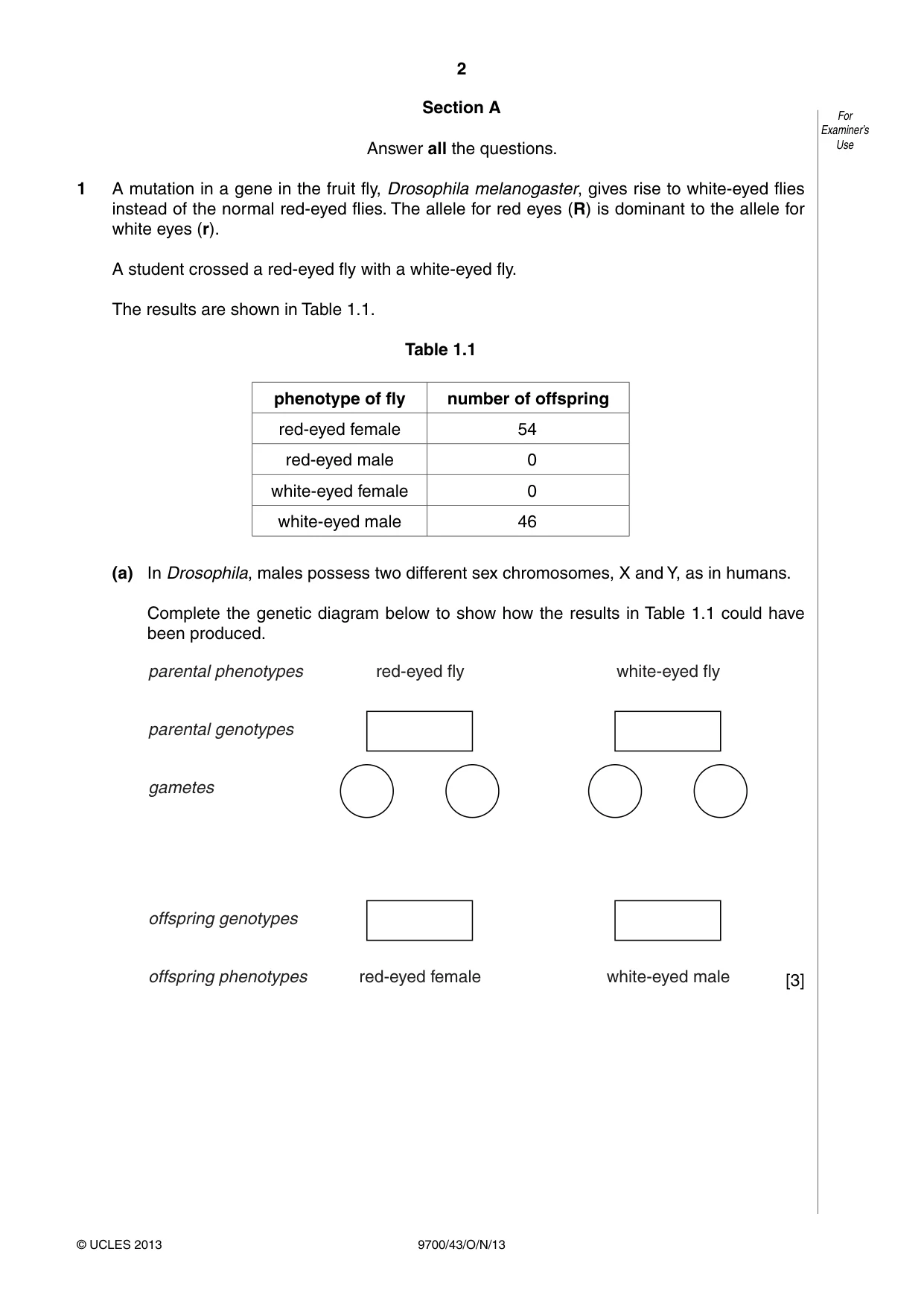
2 © UCLES 2013 9700/43/O/N/13 For Examiner’s Use Section A Answer all the questions. 1 A mutation in a gene in the fruit fly, Drosophila melanogaster, gives rise to white-eyed flies instead of the normal red-eyed flies. The allele for red eyes (R) is dominant to the allele for white eyes (r). A student crossed a red-eyed fly with a white-eyed fly. The results are shown in Table 1.1. Table 1.1 phenotype of fly number of offspring red-eyed female 54 red-eyed male 0 white-eyed female 0 white-eyed male 46 (a) In Drosophila, males possess two different sex chromosomes, X and Y, as in humans. Complete the genetic diagram below to show how the results in Table 1.1 could have been produced. red-eyed fly parental phenotypes parental genotypes gametes offspring genotypes offspring phenotypes white-eyed fly red-eyed female white-eyed male [3]
Question paper, page 3
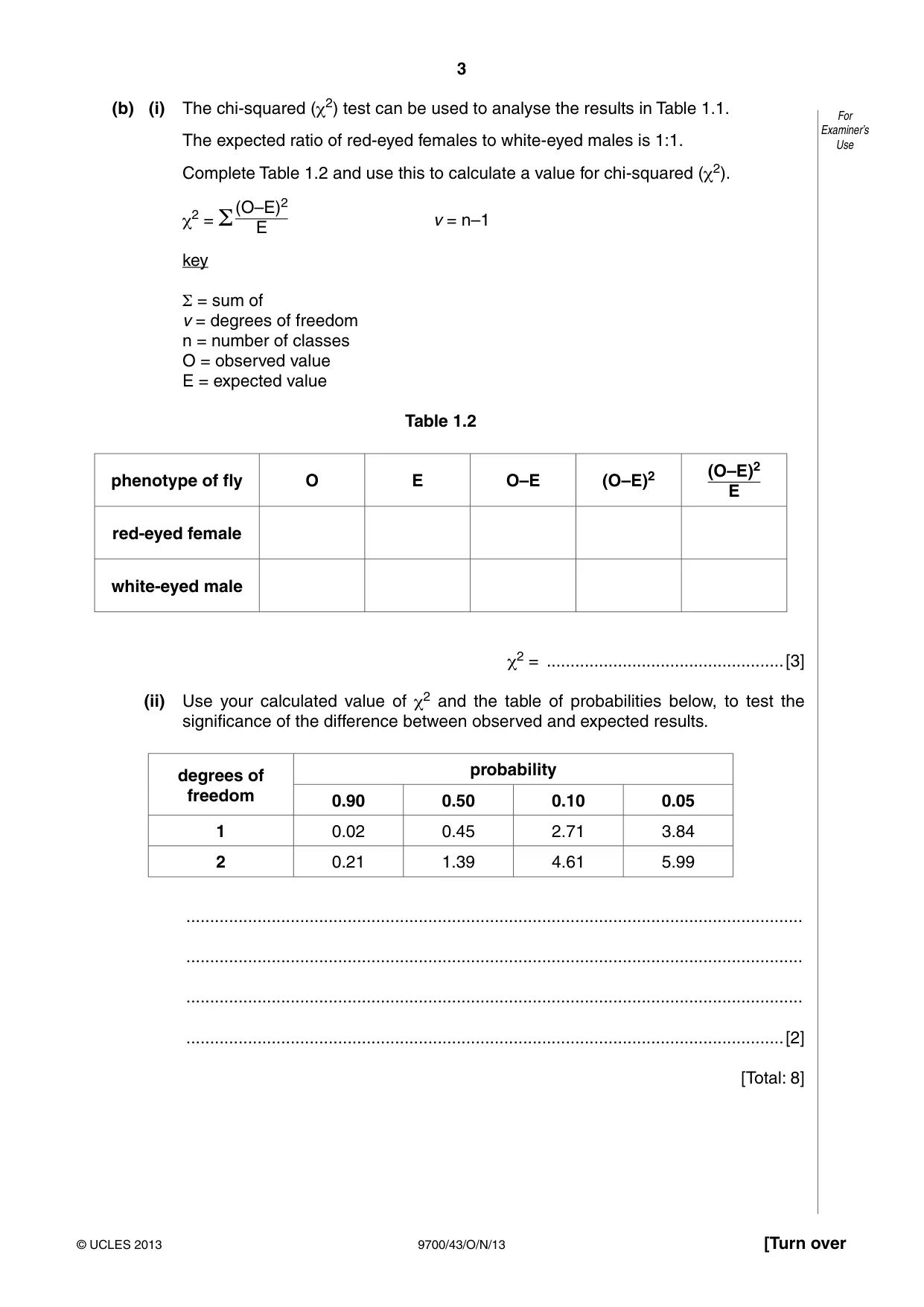
3 © UCLES 2013 [Turn over 9700/43/O/N/13 For Examiner’s Use (b) (i) The chi-squared (χ2) test can be used to analyse the results in Table 1.1. The expected ratio of red-eyed females to white-eyed males is 1:1. Complete Table 1.2 and use this to calculate a value for chi-squared (χ2). χ2 = Σ(O–E)2 E v = n–1 key Σ = sum of v = degrees of freedom n = number of classes O = observed value E = expected value Table 1.2 phenotype of fly O E O–E (O–E)2 (O–E)2 E red-eyed female white-eyed male χ2 = …[3] (ii) Use your calculated value of χ2 and the table of probabilities below, to test the significance of the difference between observed and expected results. degrees of freedom probability 0.90 0.50 0.10 0.05 1 0.02 0.45 2.71 3.84 2 0.21 1.39 4.61 5.99 … … … …[2] [Total: 8]
Question paper, page 4
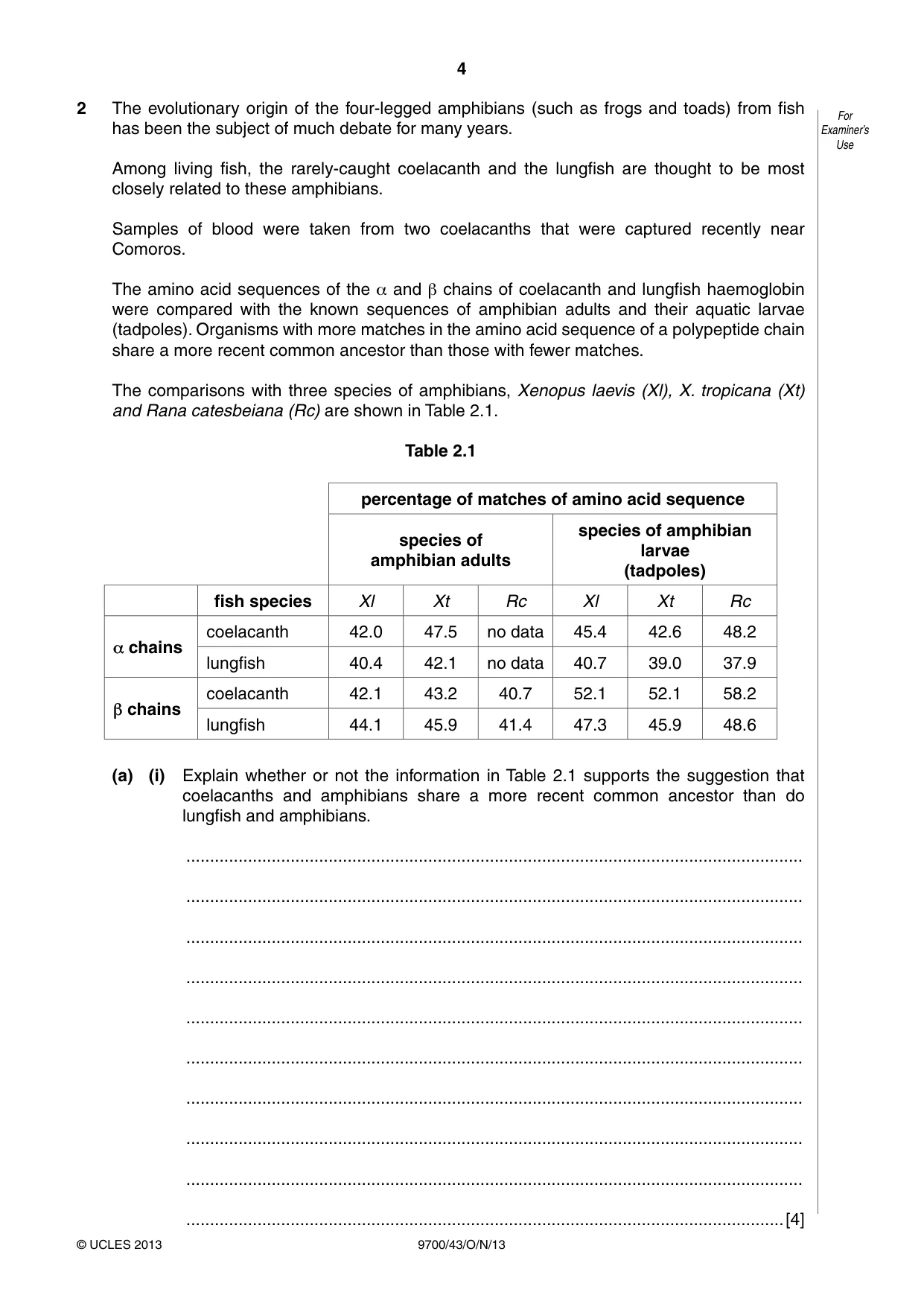
4 © UCLES 2013 9700/43/O/N/13 For Examiner’s Use 2 The evolutionary origin of the four-legged amphibians (such as frogs and toads) from fish has been the subject of much debate for many years. Among living fish, the rarely-caught coelacanth and the lungfish are thought to be most closely related to these amphibians. Samples of blood were taken from two coelacanths that were captured recently near Comoros. The amino acid sequences of the α and β chains of coelacanth and lungfish haemoglobin were compared with the known sequences of amphibian adults and their aquatic larvae (tadpoles). Organisms with more matches in the amino acid sequence of a polypeptide chain share a more recent common ancestor than those with fewer matches. The comparisons with three species of amphibians, Xenopus laevis (Xl), X. tropicana (Xt) and Rana catesbeiana (Rc) are shown in Table 2.1. Table 2.1 percentage of matches of amino acid sequence species of amphibian adults species of amphibian larvae (tadpoles) fish species Xl Xt Rc Xl Xt Rc α chains coelacanth 42.0 47.5 no data 45.4 42.6 48.2 lungfish 40.4 42.1 no data 40.7 39.0 37.9 β chains coelacanth 42.1 43.2 40.7 52.1 52.1 58.2 lungfish 44.1 45.9 41.4 47.3 45.9 48.6 (a) (i) Explain whether or not the information in Table 2.1 supports the suggestion that coelacanths and amphibians share a more recent common ancestor than do lungfish and amphibians. … … … … … … … … … …[4]
Question paper, page 5
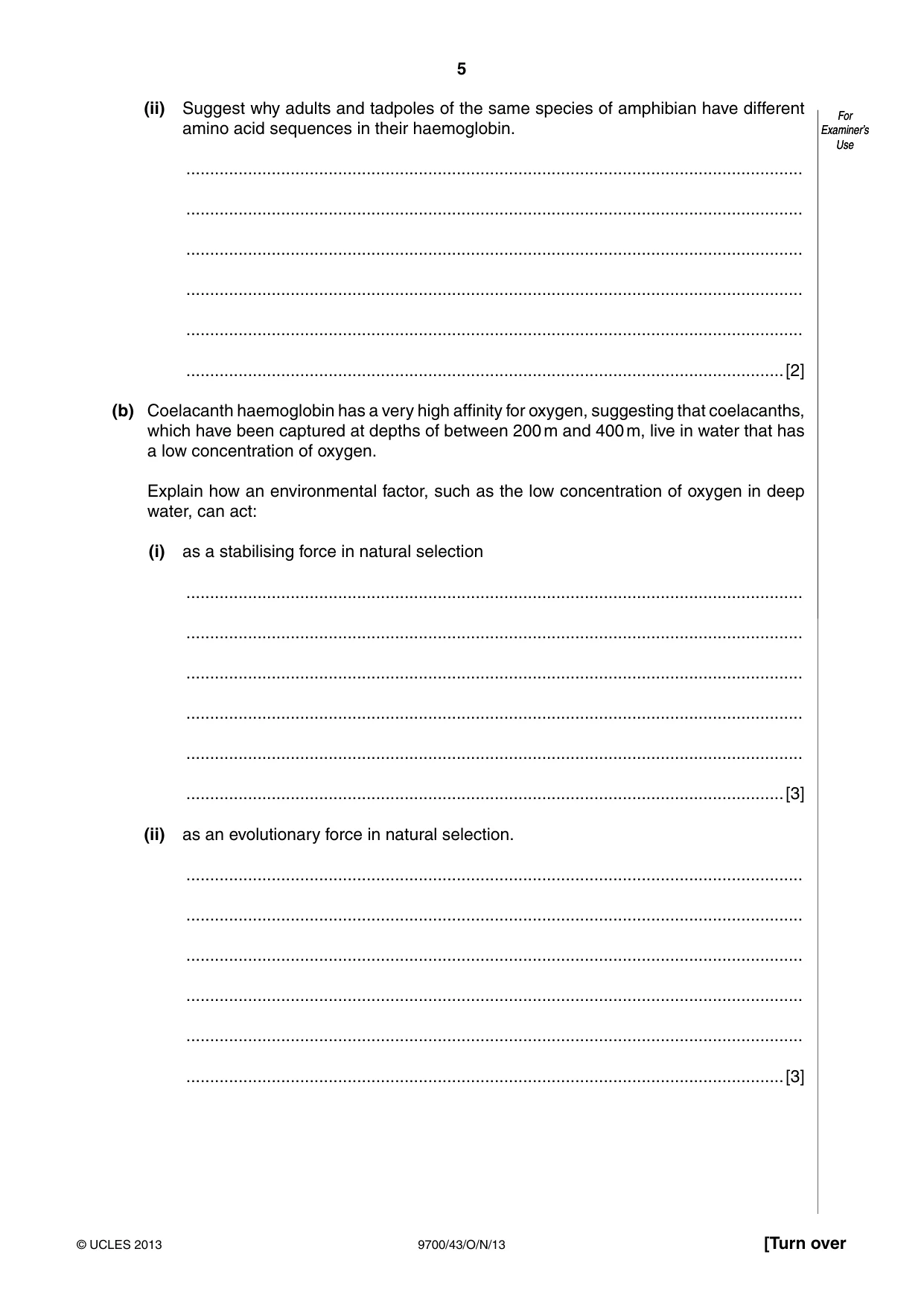
5 © UCLES 2013 [Turn over 9700/43/O/N/13 For Examiner’s Use For Examiner’s Use (ii) Suggest why adults and tadpoles of the same species of amphibian have different amino acid sequences in their haemoglobin. … … … … … …[2] (b) Coelacanth haemoglobin has a very high affinity for oxygen, suggesting that coelacanths, which have been captured at depths of between 200 m and 400 m, live in water that has a low concentration of oxygen. Explain how an environmental factor, such as the low concentration of oxygen in deep water, can act: (i) as a stabilising force in natural selection … … … … … …[3] (ii) as an evolutionary force in natural selection. … … … … … …[3]
Question paper, page 6
6 © UCLES 2013 9700/43/O/N/13 For Examiner’s Use (c) Explain the role of isolating mechanisms in the evolution of new species. … … … … … …[3] [Total: 15]
Question paper, page 7
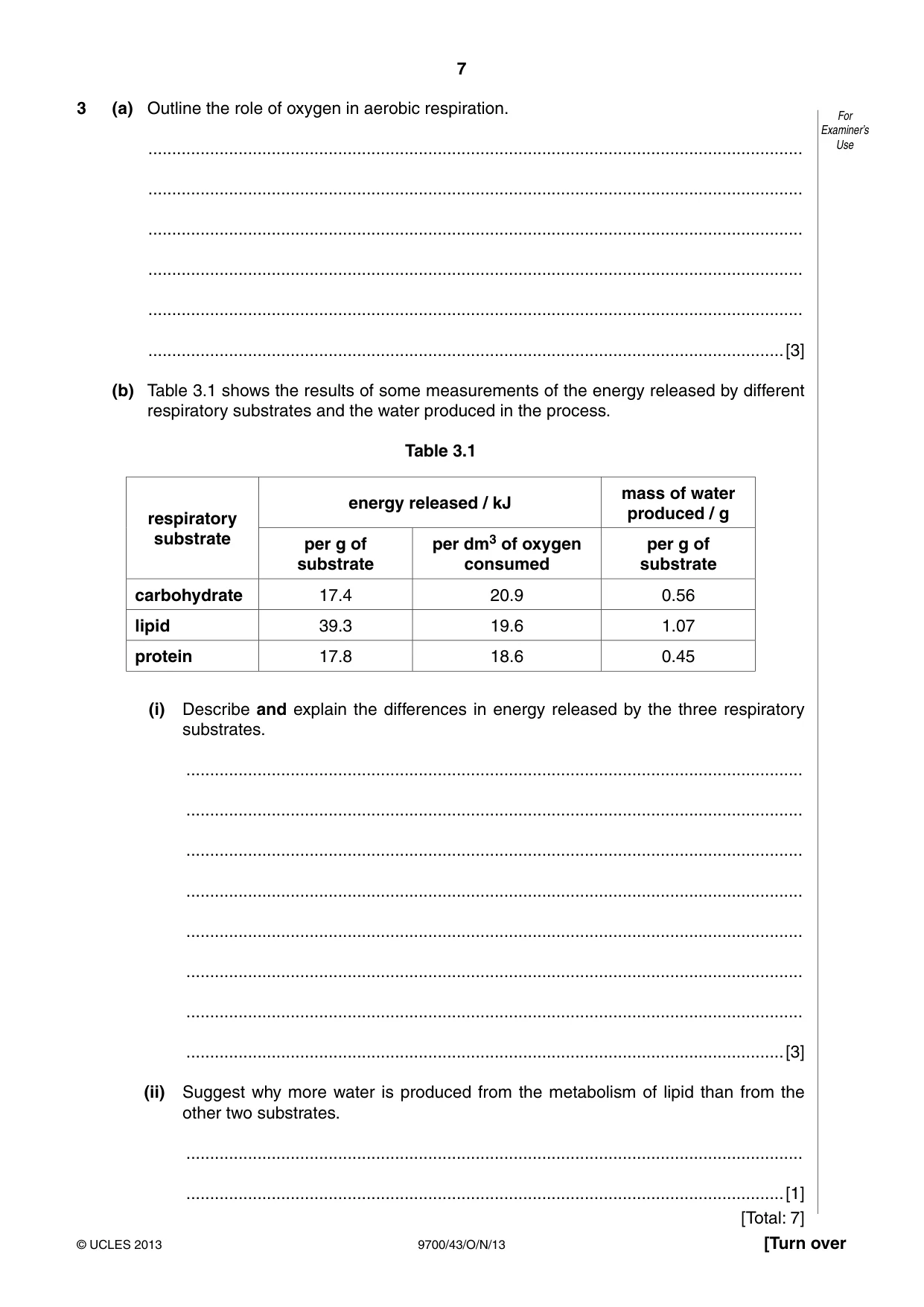
7 © UCLES 2013 [Turn over 9700/43/O/N/13 For Examiner’s Use 3 (a) Outline the role of oxygen in aerobic respiration. … … … … … …[3] (b) Table 3.1 shows the results of some measurements of the energy released by different respiratory substrates and the water produced in the process. Table 3.1 respiratory substrate energy released / kJ mass of water produced / g per g of substrate per dm3 of oxygen consumed per g of substrate carbohydrate 17.4 20.9 0.56 lipid 39.3 19.6 1.07 protein 17.8 18.6 0.45 (i) Describe and explain the differences in energy released by the three respiratory substrates. … … … … … … … …[3] (ii) Suggest why more water is produced from the metabolism of lipid than from the other two substrates. … …[1] [Total: 7]
Question paper, page 8
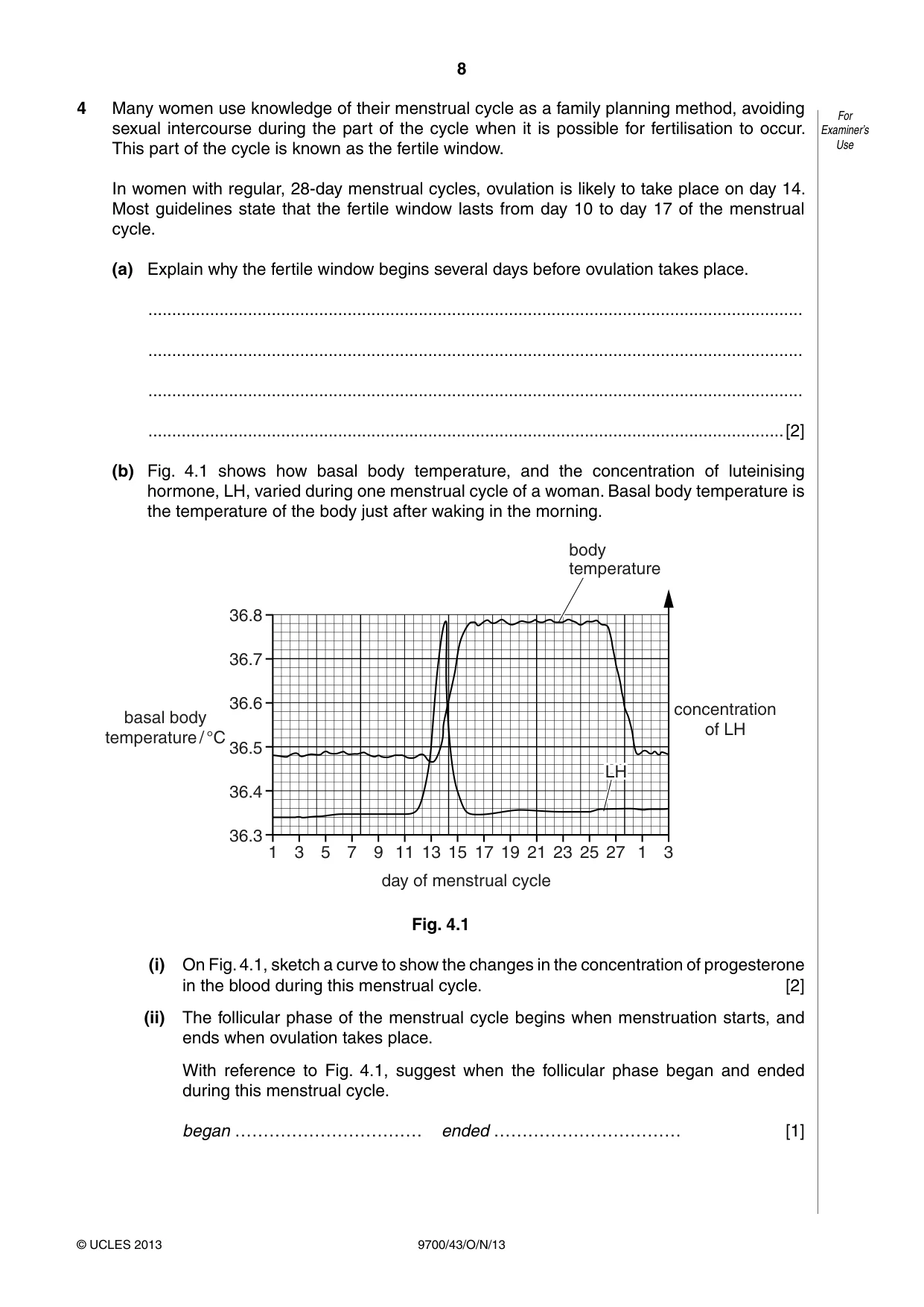
8 © UCLES 2013 9700/43/O/N/13 For Examiner’s Use 4 Many women use knowledge of their menstrual cycle as a family planning method, avoiding sexual intercourse during the part of the cycle when it is possible for fertilisation to occur. This part of the cycle is known as the fertile window. In women with regular, 28-day menstrual cycles, ovulation is likely to take place on day 14. Most guidelines state that the fertile window lasts from day 10 to day 17 of the menstrual cycle. (a) Explain why the fertile window begins several days before ovulation takes place. … … … …[2] (b) Fig. 4.1 shows how basal body temperature, and the concentration of luteinising hormone, LH, varied during one menstrual cycle of a woman. Basal body temperature is the temperature of the body just after waking in the morning. 36.8 36.7 36.6 basal body temperature / °C 36.5 36.4 36.3 1 5 9 3 7 11 13 17 day of menstrual cycle concentration of LH LH 21 15 19 23 25 1 27 3 LH body temperature Fig. 4.1 (i) On Fig. 4.1, sketch a curve to show the changes in the concentration of progesterone in the blood during this menstrual cycle. [2] (ii) The follicular phase of the menstrual cycle begins when menstruation starts, and ends when ovulation takes place. With reference to Fig. 4.1, suggest when the follicular phase began and ended during this menstrual cycle. began …………………………… ended …………………………… [1]
Question paper, page 9
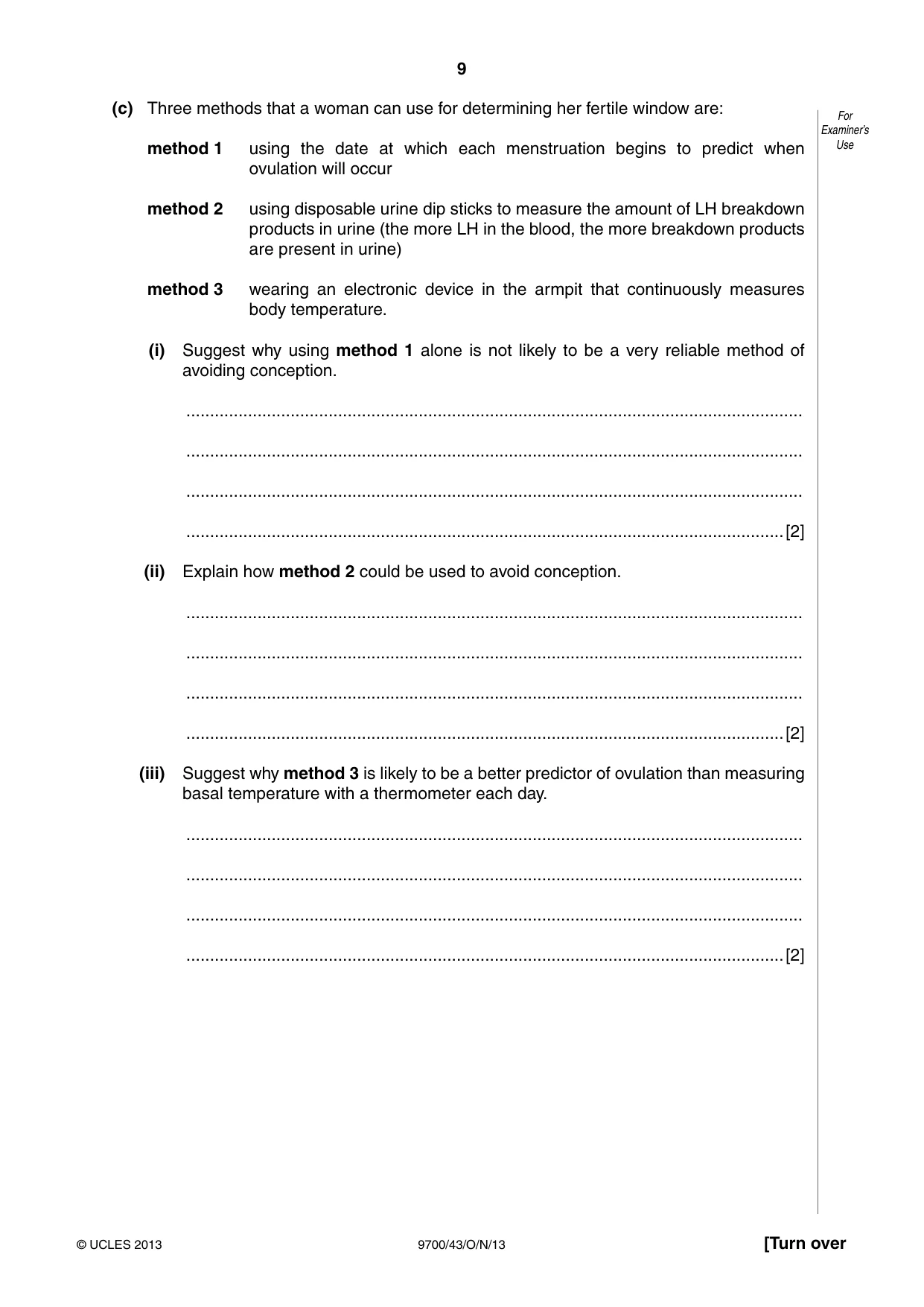
9 © UCLES 2013 [Turn over 9700/43/O/N/13 For Examiner’s Use (c) Three methods that a woman can use for determining her fertile window are: method 1 using the date at which each menstruation begins to predict when ovulation will occur method 2 using disposable urine dip sticks to measure the amount of LH breakdown products in urine (the more LH in the blood, the more breakdown products are present in urine) method 3 wearing an electronic device in the armpit that continuously measures body temperature. (i) Suggest why using method 1 alone is not likely to be a very reliable method of avoiding conception. … … … …[2] (ii) Explain how method 2 could be used to avoid conception. … … … …[2] (iii) Suggest why method 3 is likely to be a better predictor of ovulation than measuring basal temperature with a thermometer each day. … … … …[2]
Question paper, page 10
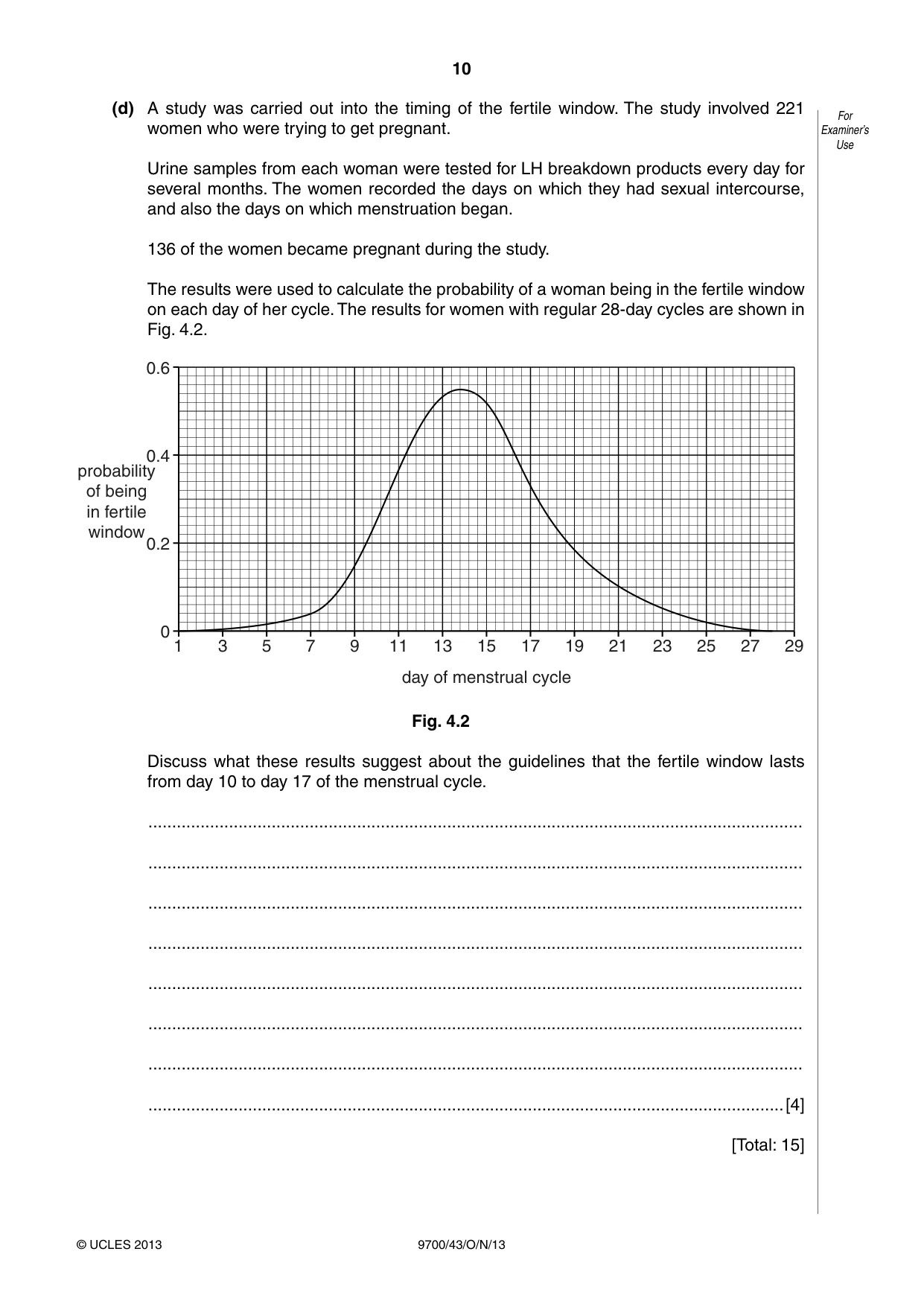
10 © UCLES 2013 9700/43/O/N/13 For Examiner’s Use (d) A study was carried out into the timing of the fertile window. The study involved 221 women who were trying to get pregnant. Urine samples from each woman were tested for LH breakdown products every day for several months. The women recorded the days on which they had sexual intercourse, and also the days on which menstruation began. 136 of the women became pregnant during the study. The results were used to calculate the probability of a woman being in the fertile window on each day of her cycle. The results for women with regular 28-day cycles are shown in Fig. 4.2. 3 0 0.2 0.4 0.6 5 7 9 1 11 13 15 day of menstrual cycle probability of being in fertile window 17 19 21 23 25 27 29 Fig. 4.2 Discuss what these results suggest about the guidelines that the fertile window lasts from day 10 to day 17 of the menstrual cycle. … … … … … … … …[4] [Total: 15]
Question paper, page 11
11 9700/43/O/N/13 © UCLES 2013 [Turn over Question 5 starts on page 12
Question paper, page 12
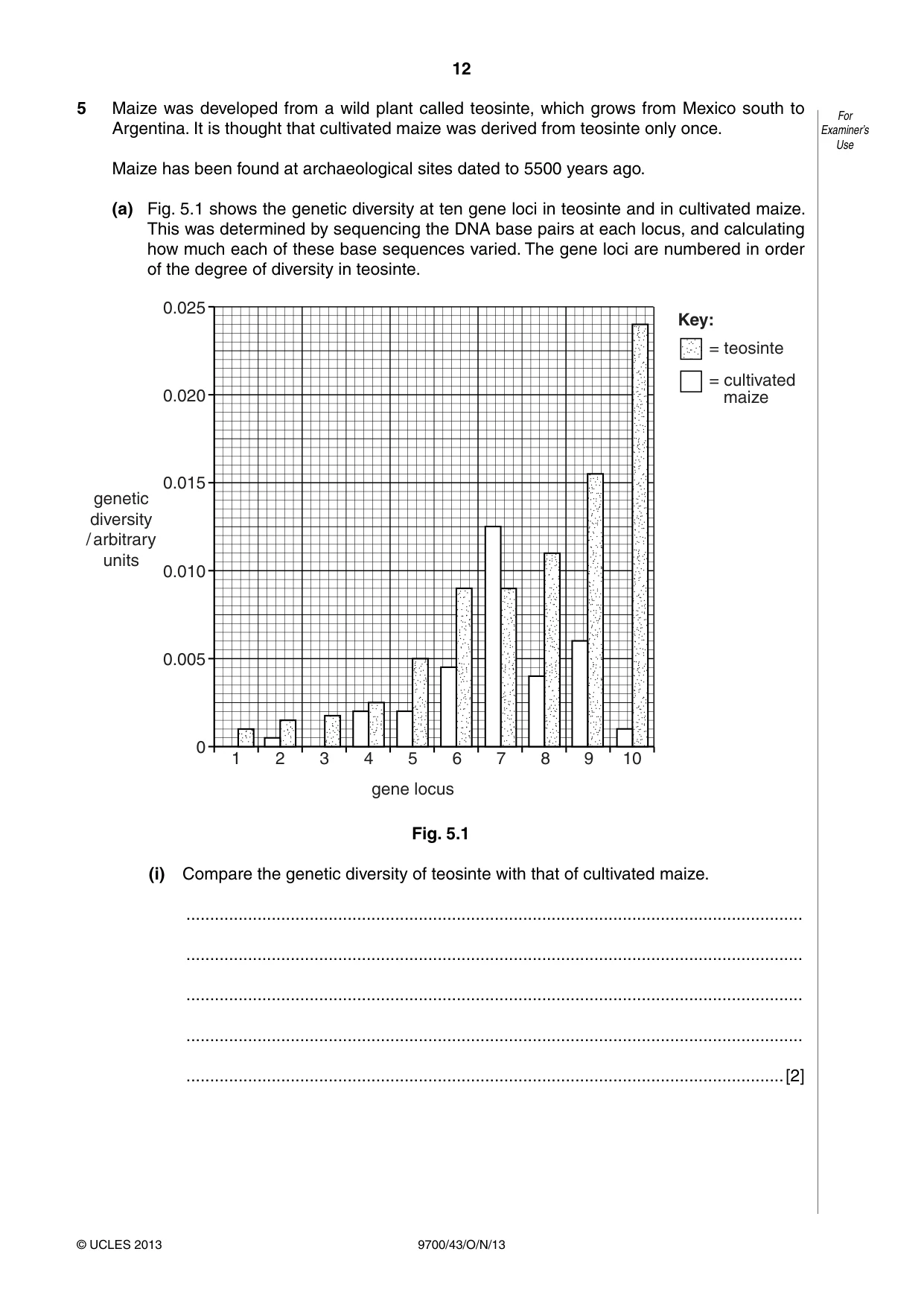
12 © UCLES 2013 9700/43/O/N/13 For Examiner’s Use 5 Maize was developed from a wild plant called teosinte, which grows from Mexico south to Argentina. It is thought that cultivated maize was derived from teosinte only once. Maize has been found at archaeological sites dated to 5500 years ago. (a) Fig. 5.1 shows the genetic diversity at ten gene loci in teosinte and in cultivated maize. This was determined by sequencing the DNA base pairs at each locus, and calculating how much each of these base sequences varied. The gene loci are numbered in order of the degree of diversity in teosinte. 0 0.005 1 2 3 4 5 gene locus genetic diversity / arbitrary units Key: = teosinte 6 7 8 9 10 0.010 0.015 0.020 0.025 = cultivated maize Fig. 5.1 (i) Compare the genetic diversity of teosinte with that of cultivated maize. … … … … …[2]
Question paper, page 13
13 © UCLES 2013 [Turn over 9700/43/O/N/13 For Examiner’s Use (ii) Suggest reasons for the differences in genetic diversity between teosinte and cultivated maize. … … … … … …[3] (iii) Explain how these data support the idea that wild relatives of crop plants, such as maize, should be conserved. … … … … …[2] (b) Most farmers today grow maize from seeds that have been produced by crossing two different homozygous parents. Explain why this is done. … … … … … …[3] [Total: 10]
Question paper, page 14
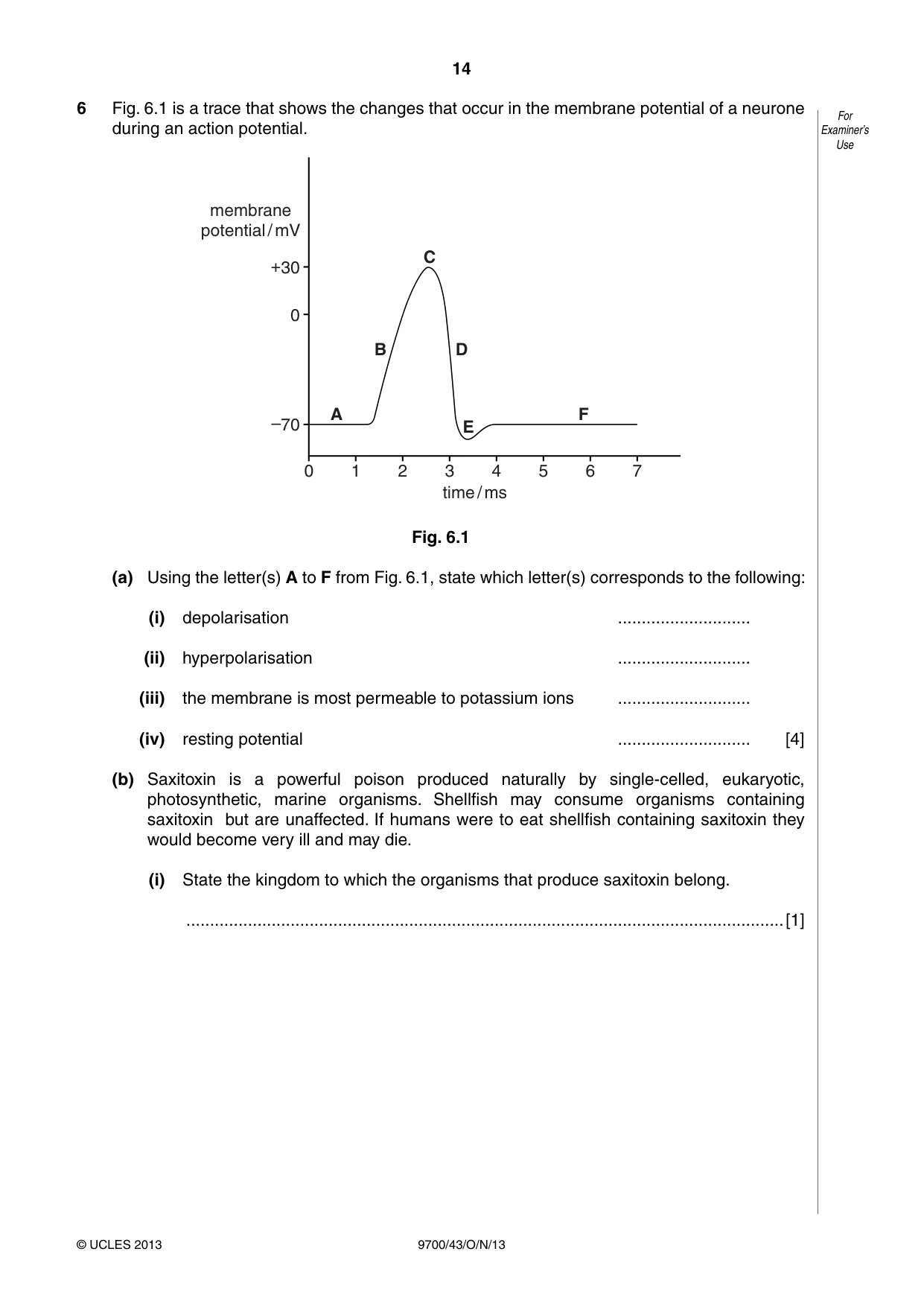
14 © UCLES 2013 9700/43/O/N/13 For Examiner’s Use 6 Fig. 6.1 is a trace that shows the changes that occur in the membrane potential of a neurone during an action potential. 0 1 2 –70 +30 membrane potential / mV 0 A F B D E C 3 4 time / ms 5 6 7 Fig. 6.1 (a) Using the letter(s) A to F from Fig. 6.1, state which letter(s) corresponds to the following: (i) depolarisation … (ii) hyperpolarisation … (iii) the membrane is most permeable to potassium ions … (iv) resting potential … [4] (b) Saxitoxin is a powerful poison produced naturally by single-celled, eukaryotic, photosynthetic, marine organisms. Shellfish may consume organisms containing saxitoxin but are unaffected. If humans were to eat shellfish containing saxitoxin they would become very ill and may die. (i) State the kingdom to which the organisms that produce saxitoxin belong. …[1]
Question paper, page 15
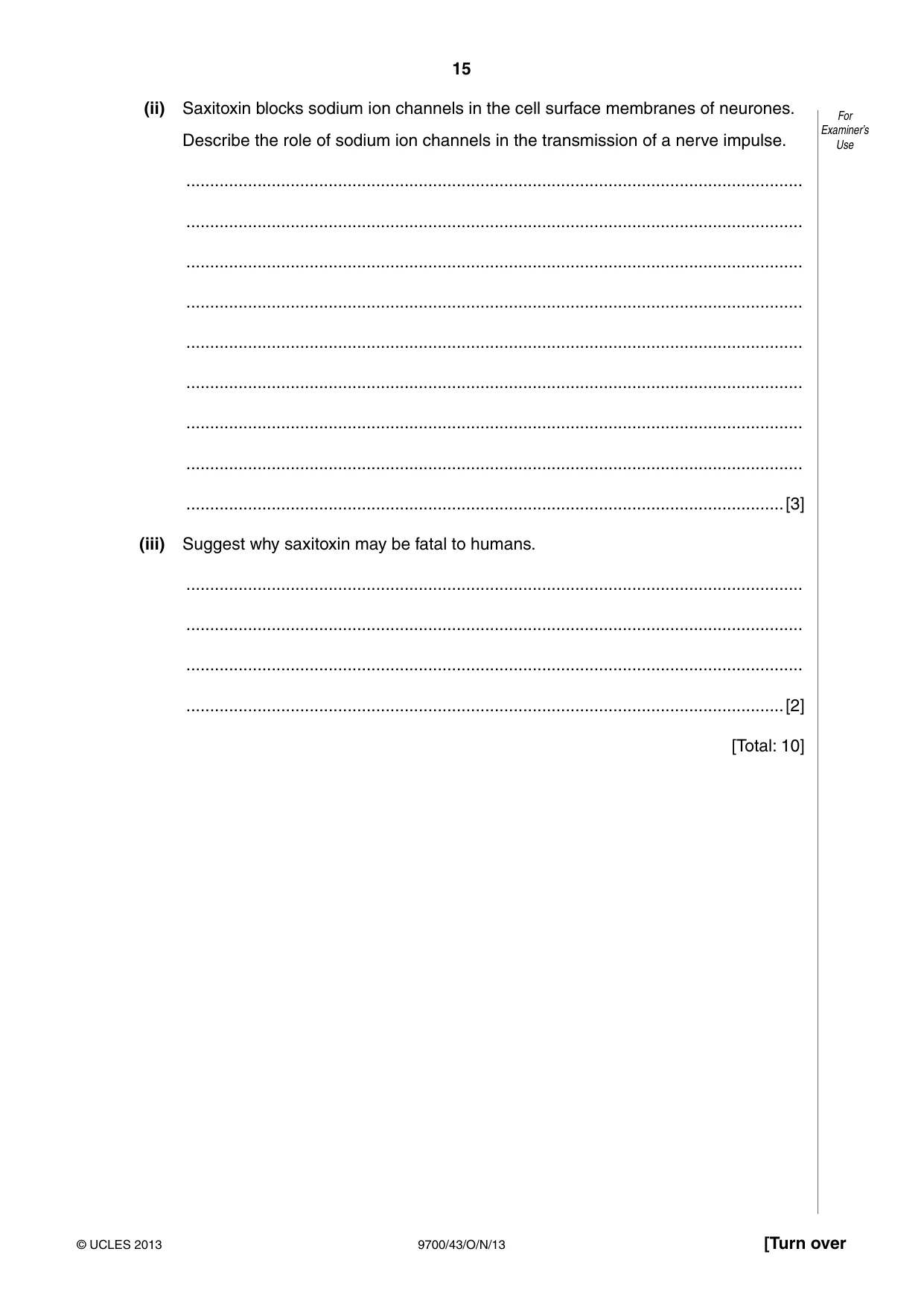
15 © UCLES 2013 [Turn over 9700/43/O/N/13 For Examiner’s Use (ii) Saxitoxin blocks sodium ion channels in the cell surface membranes of neurones. Describe the role of sodium ion channels in the transmission of a nerve impulse. … … … … … … … … …[3] (iii) Suggest why saxitoxin may be fatal to humans. … … … …[2] [Total: 10]
Question paper, page 16
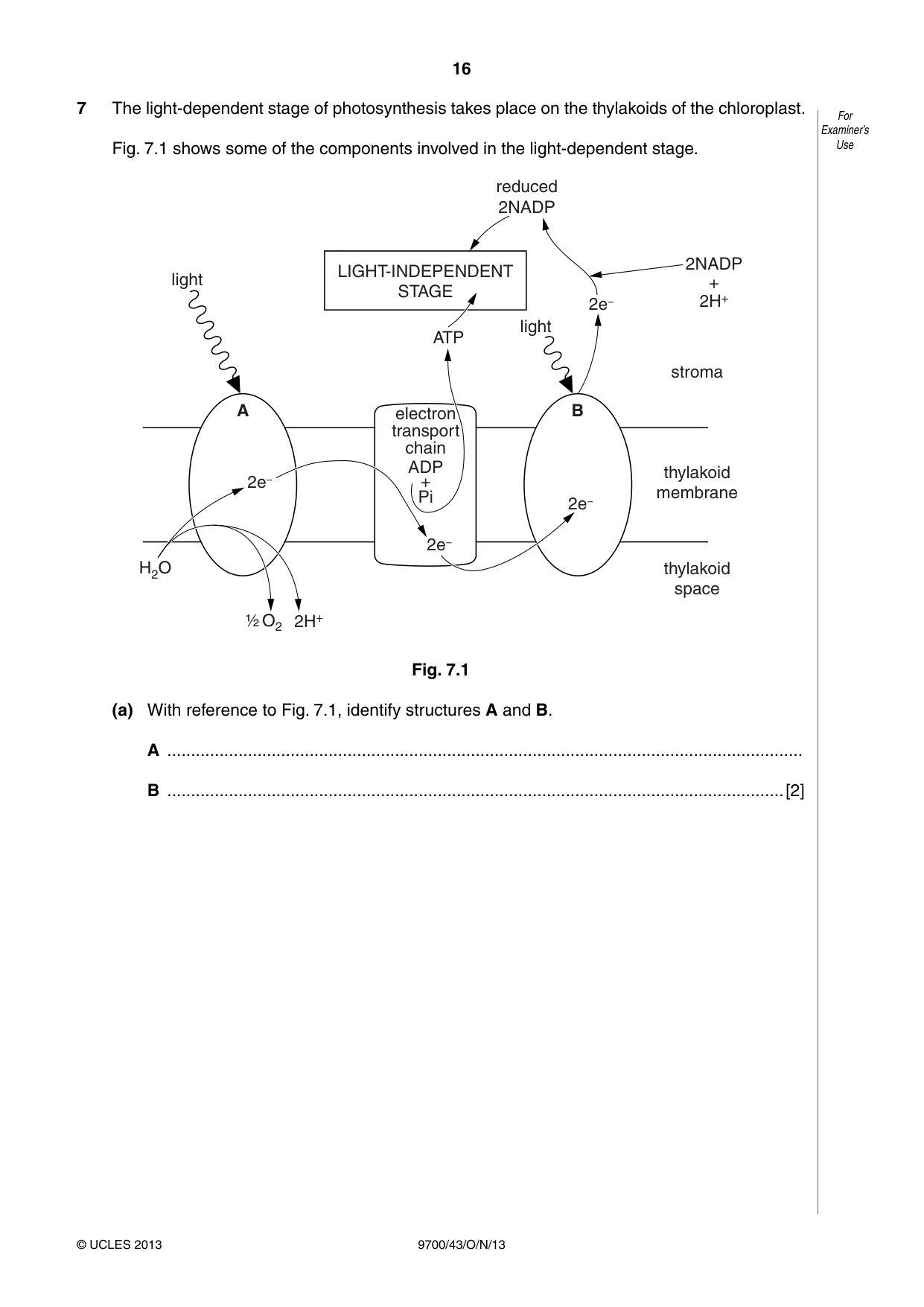
16 © UCLES 2013 9700/43/O/N/13 For Examiner’s Use 7 The light-dependent stage of photosynthesis takes place on the thylakoids of the chloroplast. Fig. 7.1 shows some of the components involved in the light-dependent stage. A H2O ½ O2 2H+ 2e– 2e– 2e– 2e– reduced 2NADP 2NADP + 2H+ B electron transport chain ATP light LIGHT-INDEPENDENT STAGE light stroma thylakoid membrane thylakoid space ADP + Pi Fig. 7.1 (a) With reference to Fig. 7.1, identify structures A and B. A … B …[2]
Question paper, page 17
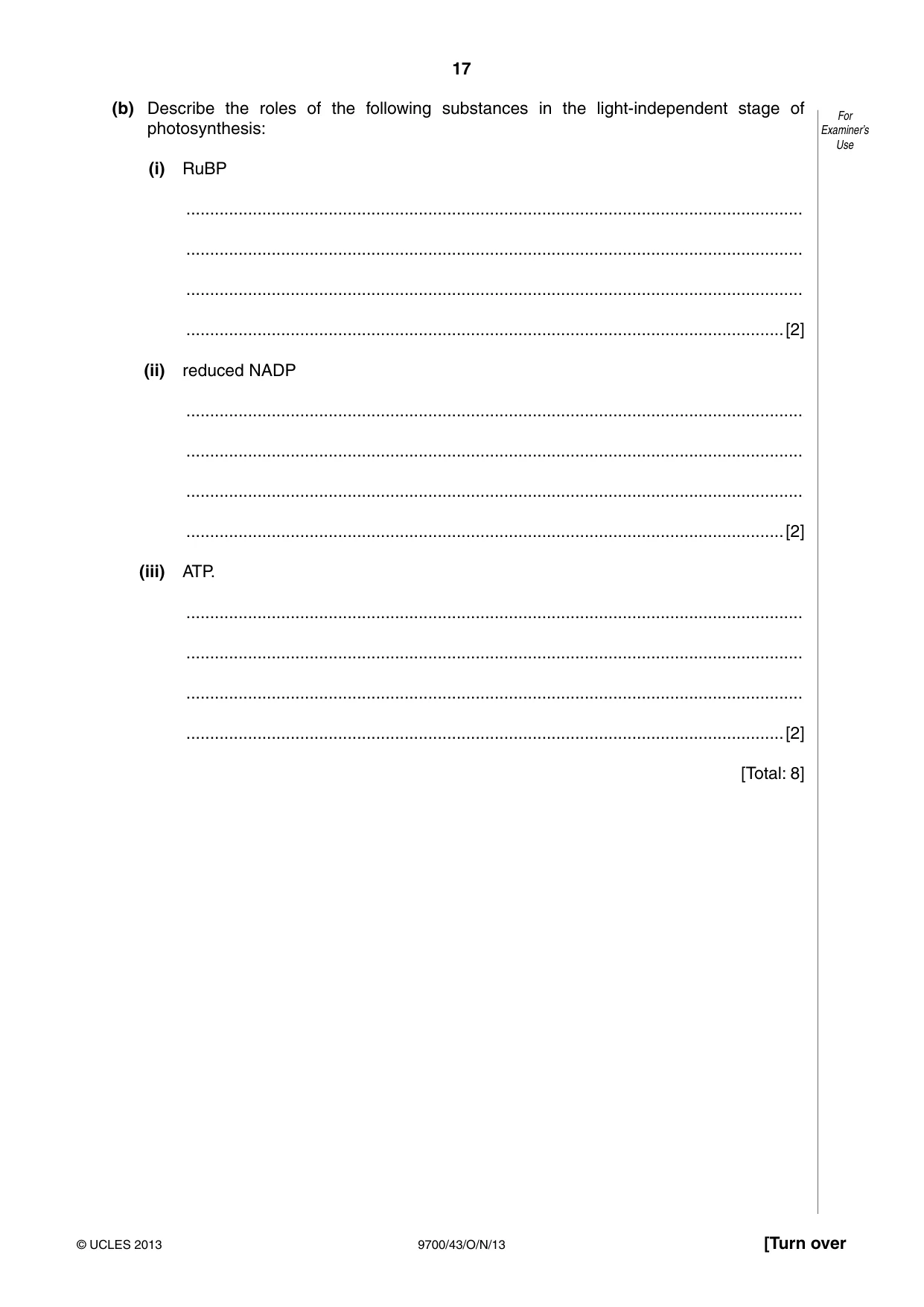
17 © UCLES 2013 [Turn over 9700/43/O/N/13 For Examiner’s Use (b) Describe the roles of the following substances in the light-independent stage of photosynthesis: (i) RuBP … … … …[2] (ii) reduced NADP … … … …[2] (iii) ATP. … … … …[2] [Total: 8]
Question paper, page 18
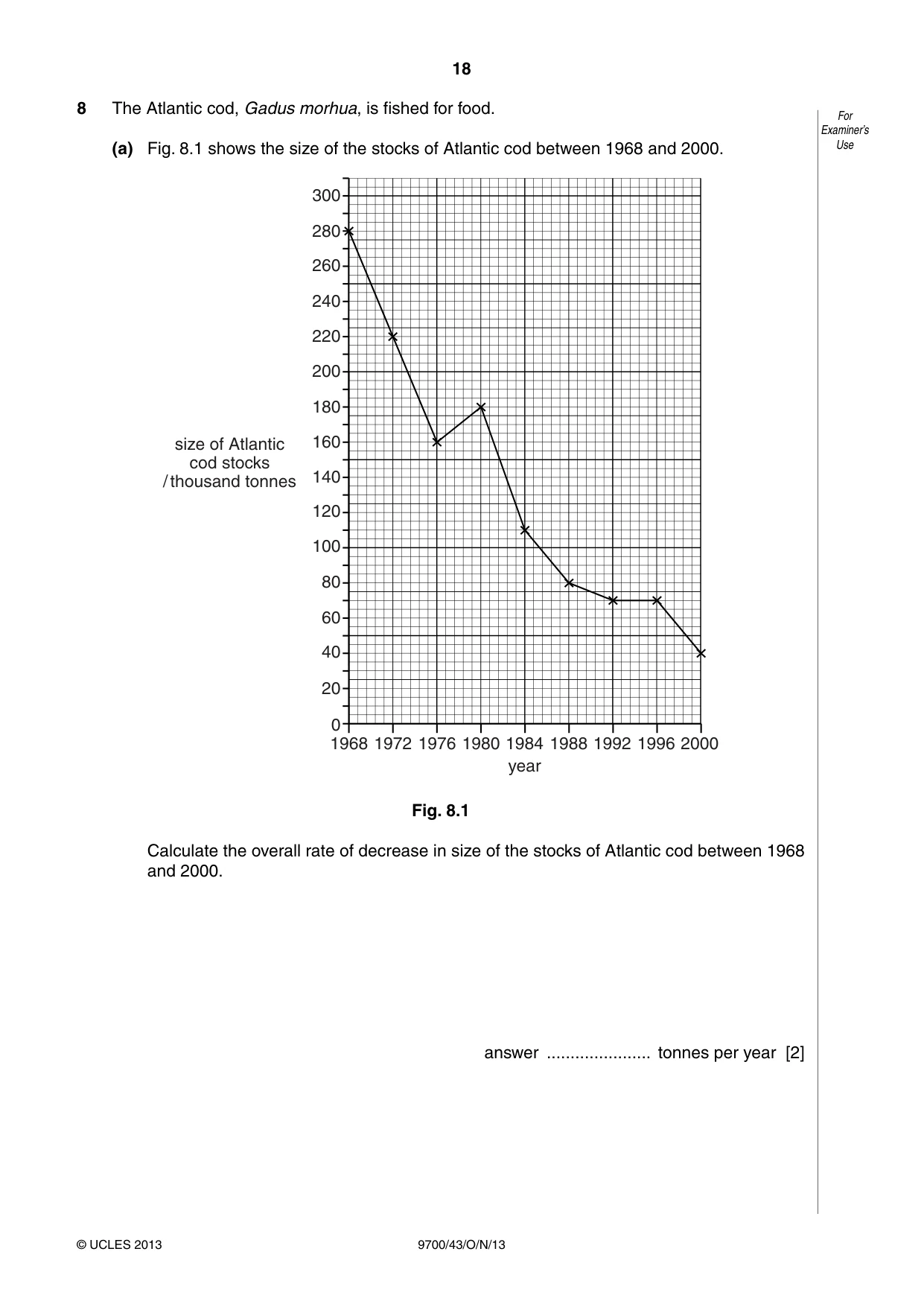
18 © UCLES 2013 9700/43/O/N/13 For Examiner’s Use 8 The Atlantic cod, Gadus morhua, is fished for food. (a) Fig. 8.1 shows the size of the stocks of Atlantic cod between 1968 and 2000. 0 20 40 60 1968 1972 1976 1980 1984 year 1988 1992 2000 1996 80 100 120 140 160 180 200 220 240 260 280 300 size of Atlantic cod stocks / thousand tonnes Fig. 8.1 Calculate the overall rate of decrease in size of the stocks of Atlantic cod between 1968 and 2000. answer … tonnes per year [2]
Question paper, page 19
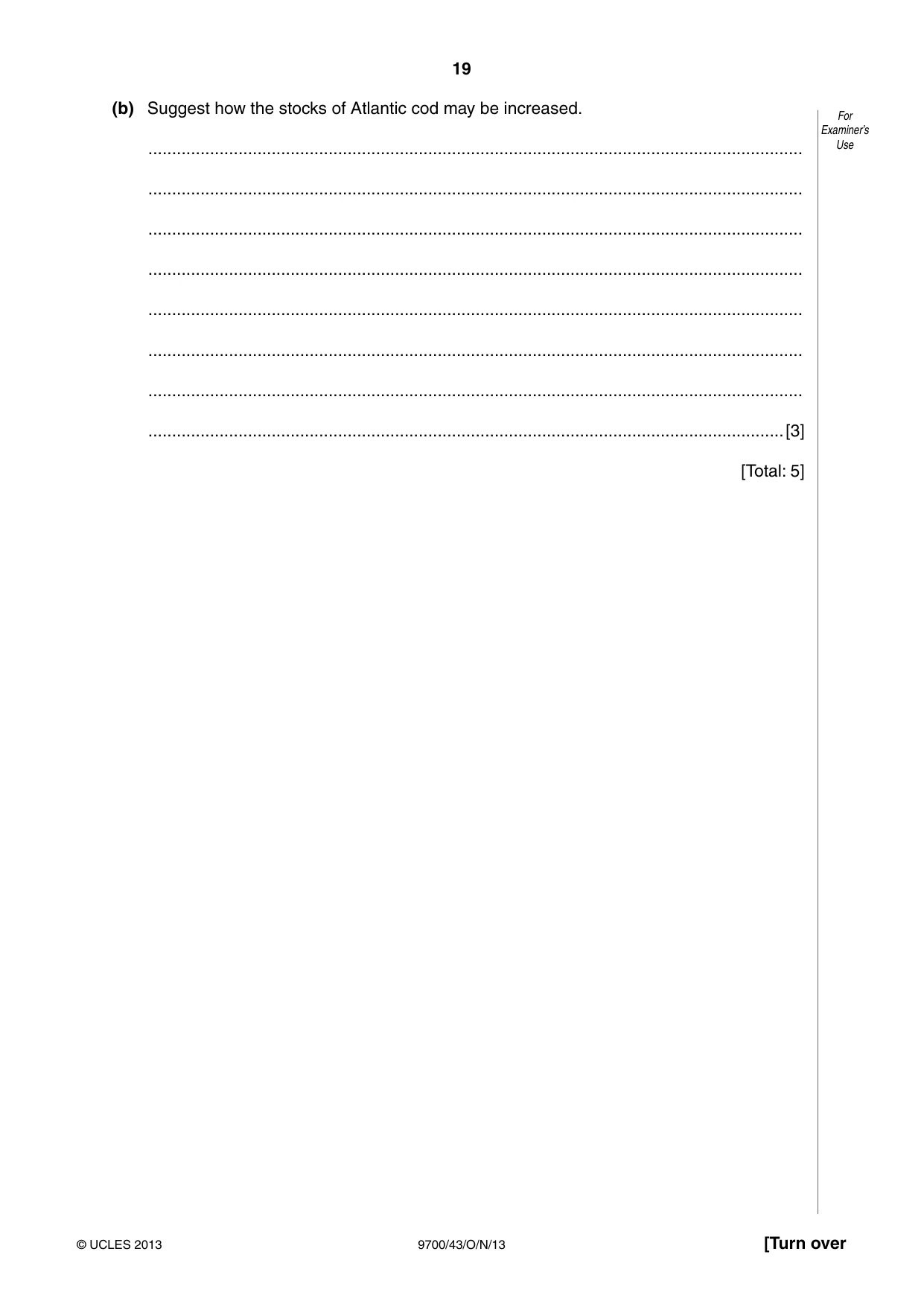
19 © UCLES 2013 [Turn over 9700/43/O/N/13 For Examiner’s Use (b) Suggest how the stocks of Atlantic cod may be increased. … … … … … … … …[3] [Total: 5]
Question paper, page 20
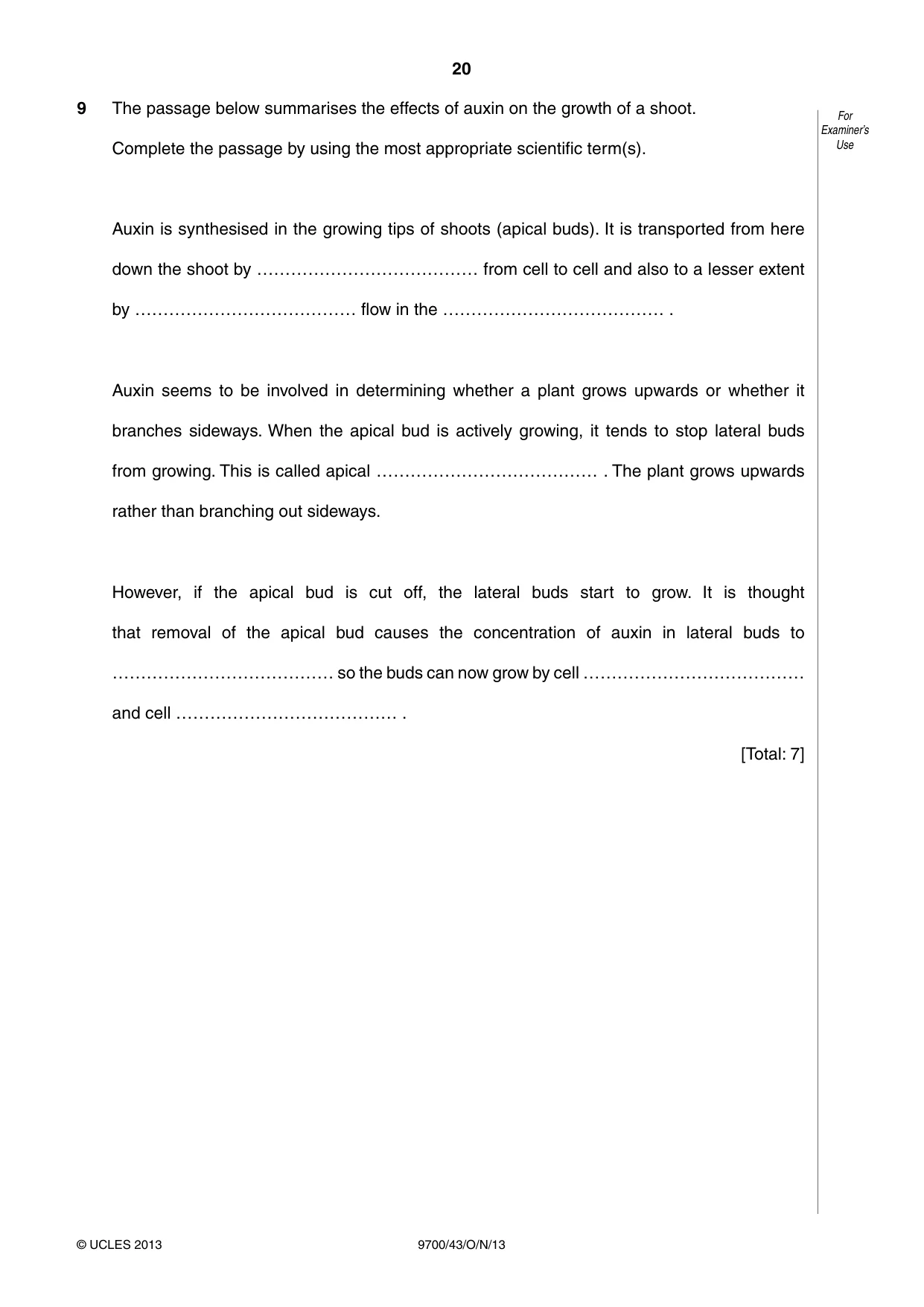
20 © UCLES 2013 9700/43/O/N/13 For Examiner’s Use 9 The passage below summarises the effects of auxin on the growth of a shoot. Complete the passage by using the most appropriate scientific term(s). Auxin is synthesised in the growing tips of shoots (apical buds). It is transported from here down the shoot by ………………………………… from cell to cell and also to a lesser extent by ………………………………… flow in the ………………………………… . Auxin seems to be involved in determining whether a plant grows upwards or whether it branches sideways. When the apical bud is actively growing, it tends to stop lateral buds from growing. This is called apical ………………………………… . The plant grows upwards rather than branching out sideways. However, if the apical bud is cut off, the lateral buds start to grow. It is thought that removal of the apical bud causes the concentration of auxin in lateral buds to ………………………………… so the buds can now grow by cell ………………………………… and cell ………………………………… . [Total: 7]
Question paper, page 21
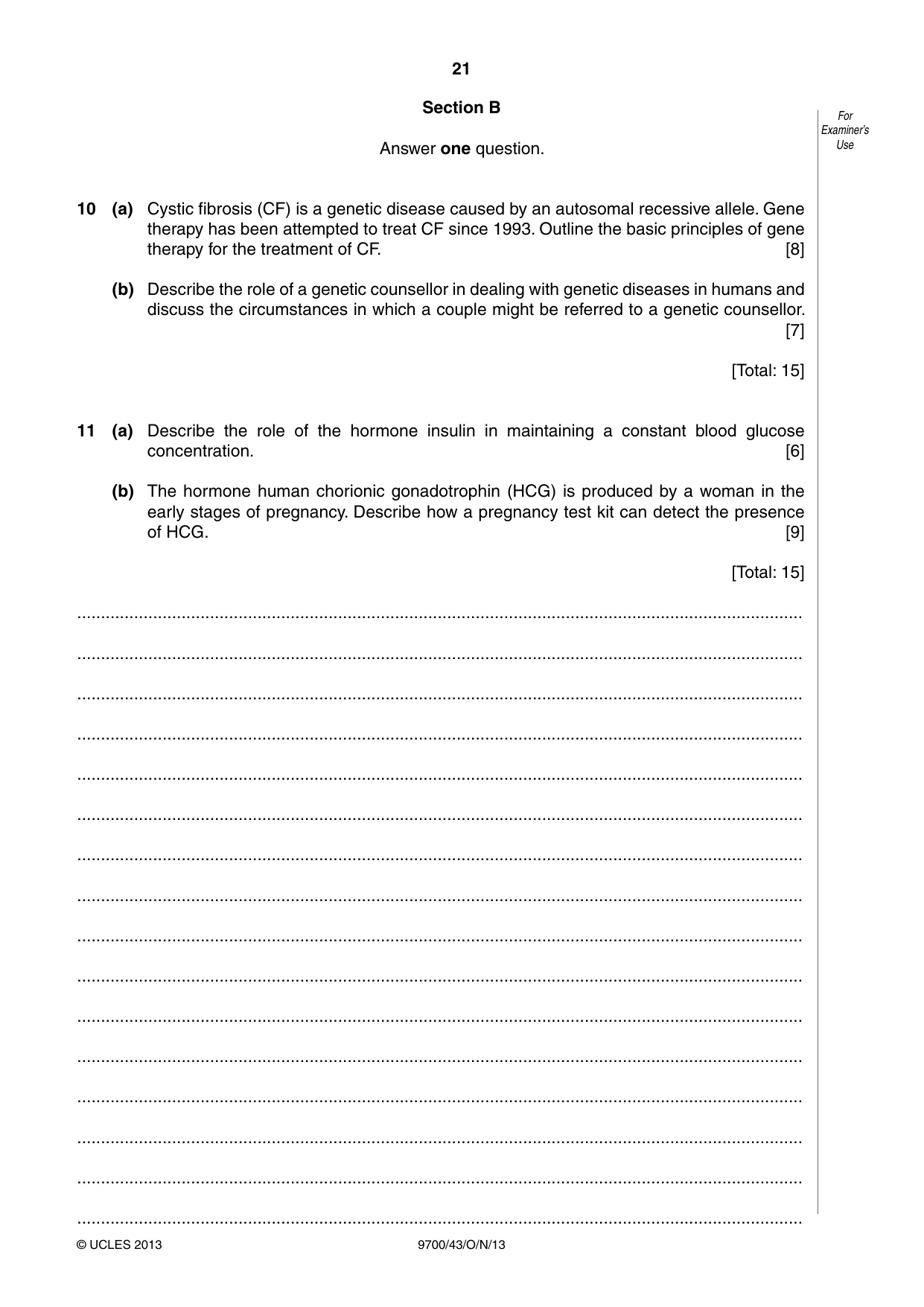
21 © UCLES 2013 9700/43/O/N/13 For Examiner’s Use Section B Answer one question. 10 (a) Cystic fibrosis (CF) is a genetic disease caused by an autosomal recessive allele. Gene therapy has been attempted to treat CF since 1993. Outline the basic principles of gene therapy for the treatment of CF. [8] (b) Describe the role of a genetic counsellor in dealing with genetic diseases in humans and discuss the circumstances in which a couple might be referred to a genetic counsellor. [7] [Total: 15] 11 (a) Describe the role of the hormone insulin in maintaining a constant blood glucose concentration. [6] (b) The hormone human chorionic gonadotrophin (HCG) is produced by a woman in the early stages of pregnancy. Describe how a pregnancy test kit can detect the presence of HCG. [9] [Total: 15] … … … … … … … … … … … … … … … …
Question paper, page 22
22 © UCLES 2013 9700/43/O/N/13 For Examiner’s Use … … … … … … … … … … … … … … … … … … … … … … … … … … … …
Question paper, page 23
23 © UCLES 2013 9700/43/O/N/13 For Examiner’s Use … … … … … … … … … … … … … … … … … … … … … … … … … … … …
Question paper, page 24
24 © UCLES 2013 9700/43/O/N/13 For Examiner’s Use … … … … … … … … … … … … … … … … … … … … … … … … … Permission to reproduce items where third-party owned material protected by copyright is included has been sought and cleared where possible. Every reasonable effort has been made by the publisher (UCLES) to trace copyright holders, but if any items requiring clearance have unwittingly been included, the publisher will be pleased to make amends at the earliest possible opportunity. University of Cambridge International Examinations is part of the Cambridge Assessment Group. Cambridge Assessment is the brand name of University of Cambridge Local Examinations Syndicate (UCLES), which is itself a department of the University of Cambridge.
Mark scheme, page 1
© Cambridge International Examinations 2013 CAMBRIDGE INTERNATIONAL EXAMINATIONS GCE Advanced Subsidiary Level and GCE Advanced Level MARK SCHEME for the October/November 2013 series 9700 BIOLOGY 9700/43 Paper 4 (A2 Structured Questions), maximum raw mark 100 This mark scheme is published as an aid to teachers and candidates, to indicate the requirements of the examination. It shows the basis on which Examiners were instructed to award marks. It does not indicate the details of the discussions that took place at an Examiners’ meeting before marking began, which would have considered the acceptability of alternative answers. Mark schemes should be read in conjunction with the question paper and the Principal Examiner Report for Teachers. Cambridge will not enter into discussions about these mark schemes. Cambridge is publishing the mark schemes for the October/November 2013 series for most IGCSE, GCE Advanced Level and Advanced Subsidiary Level components and some Ordinary Level components.
Mark scheme, page 2
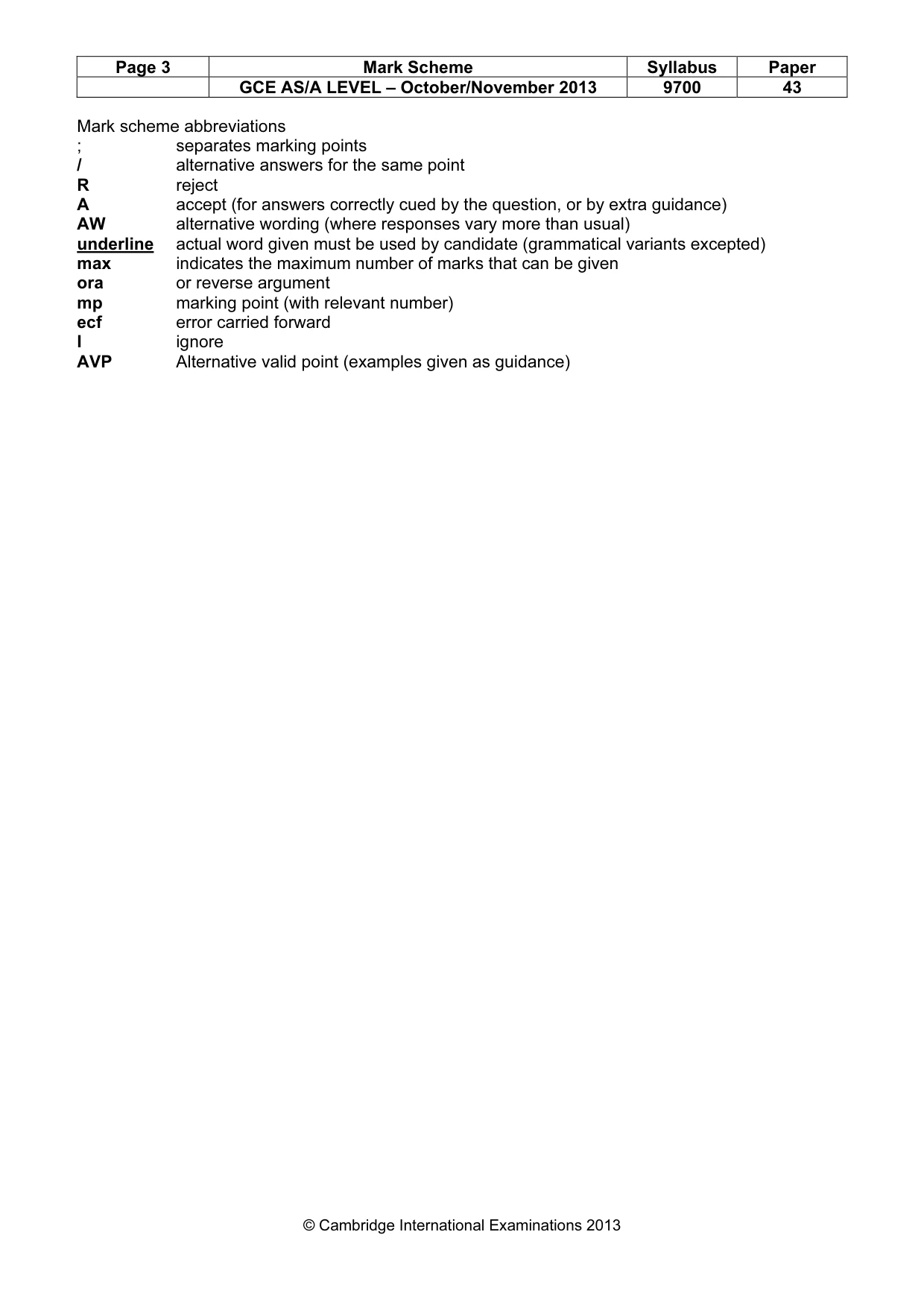
Page 3 Mark Scheme Syllabus Paper GCE AS/A LEVEL – October/November 2013 9700 43 © Cambridge International Examinations 2013 Mark scheme abbreviations ; separates marking points / alternative answers for the same point R reject A accept (for answers correctly cued by the question, or by extra guidance) AW alternative wording (where responses vary more than usual) underline actual word given must be used by candidate (grammatical variants excepted) max indicates the maximum number of marks that can be given ora or reverse argument mp marking point (with relevant number) ecf error carried forward I ignore AVP Alternative valid point (examples given as guidance)
Mark scheme, page 3
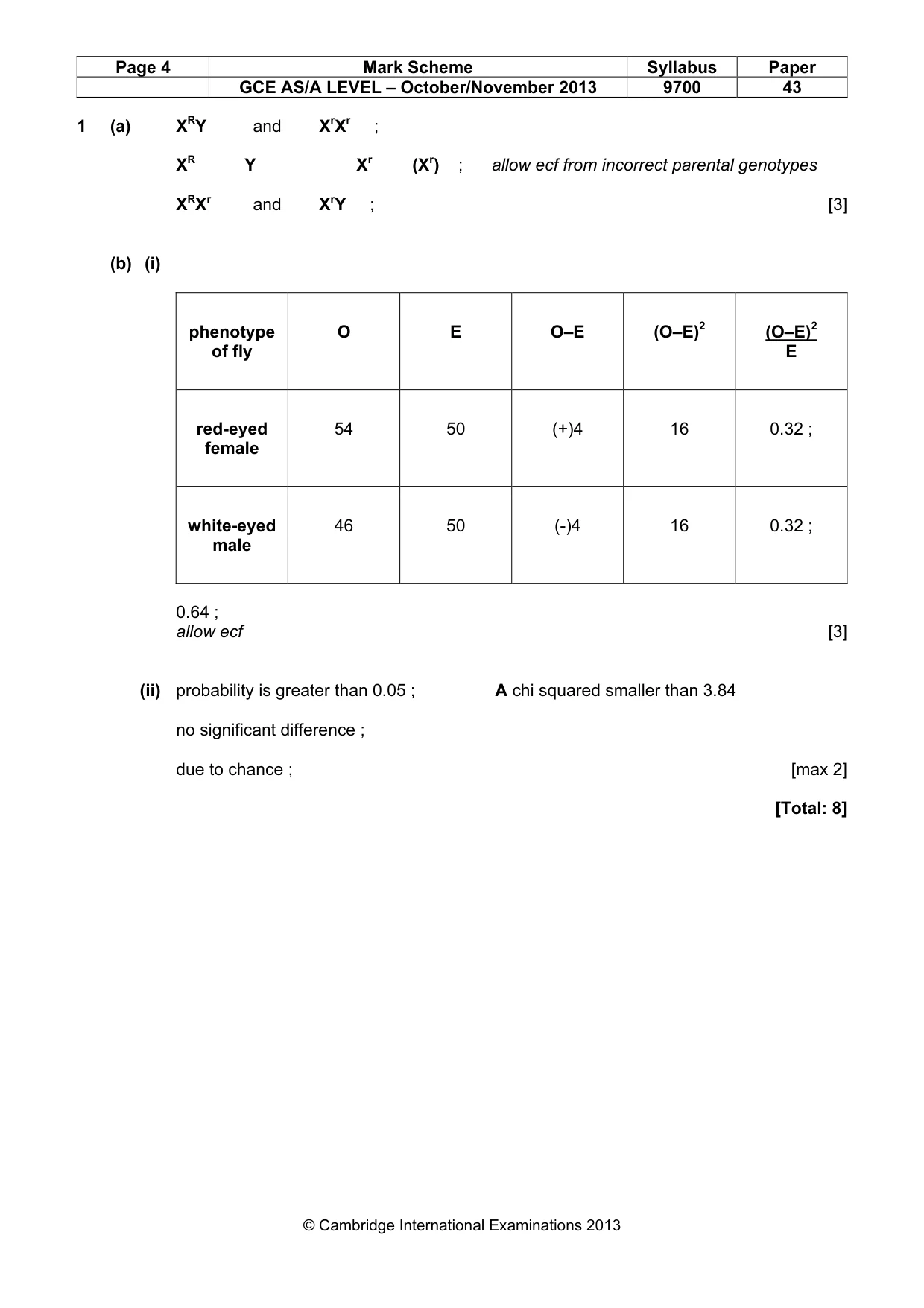
Page 4 Mark Scheme Syllabus Paper GCE AS/A LEVEL – October/November 2013 9700 43 © Cambridge International Examinations 2013 1 (a) XRY and XrXr ; XR Y Xr (Xr) ; allow ecf from incorrect parental genotypes XRXr and XrY ; [3] (b) (i) phenotype of fly O E O–E (O–E)2 (O–E)2 E red-eyed female 54 50 (+)4 16 0.32 ; white-eyed male 46 50 (-)4 16 0.32 ; 0.64 ; allow ecf [3] (ii) probability is greater than 0.05 ; A chi squared smaller than 3.84 no significant difference ; due to chance ; [max 2] [Total: 8]
Mark scheme, page 4
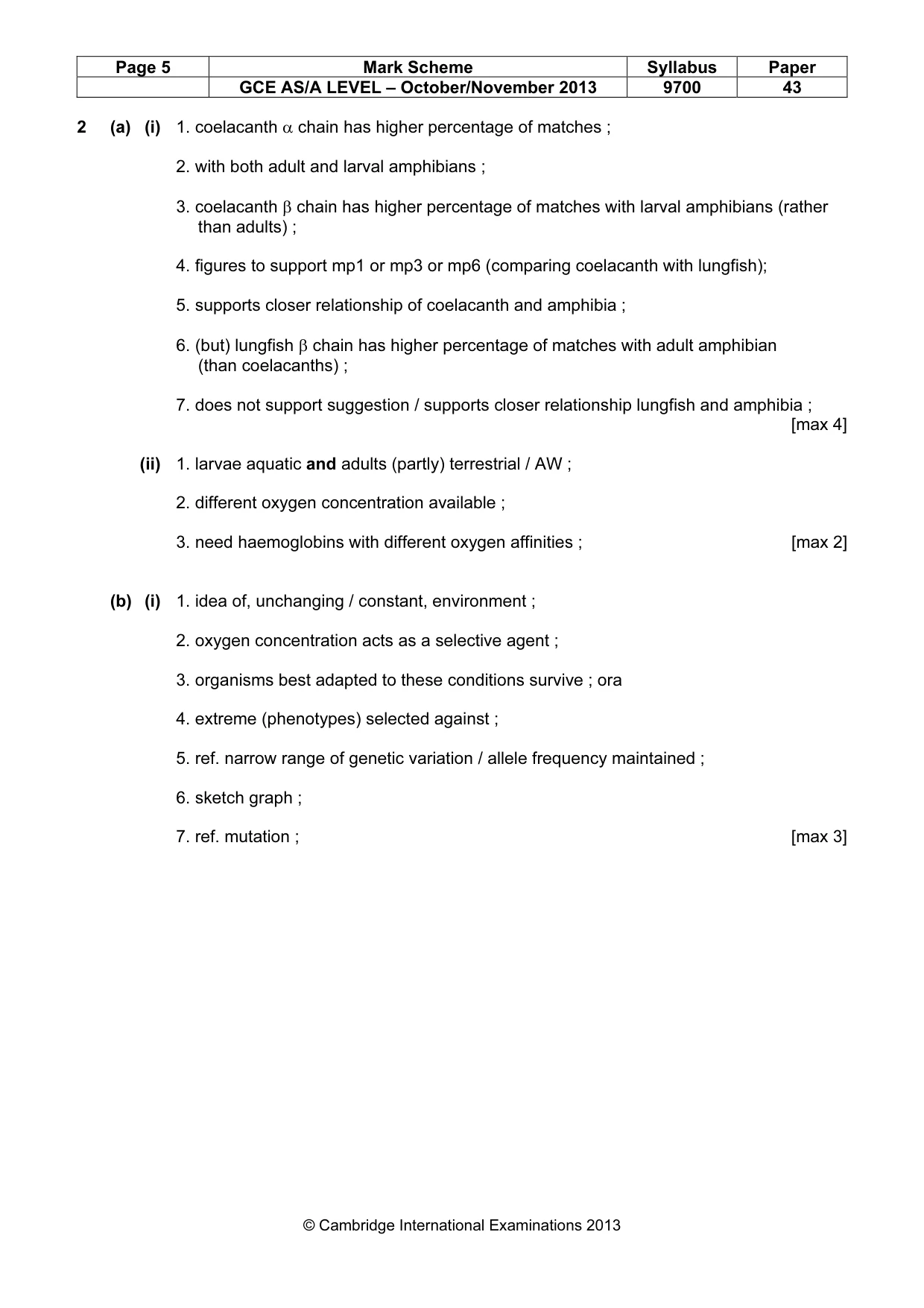
Page 5 Mark Scheme Syllabus Paper GCE AS/A LEVEL – October/November 2013 9700 43 © Cambridge International Examinations 2013 2 (a) (i) 1. coelacanth α chain has higher percentage of matches ; 2. with both adult and larval amphibians ; 3. coelacanth β chain has higher percentage of matches with larval amphibians (rather than adults) ; 4. figures to support mp1 or mp3 or mp6 (comparing coelacanth with lungfish); 5. supports closer relationship of coelacanth and amphibia ; 6. (but) lungfish β chain has higher percentage of matches with adult amphibian (than coelacanths) ; 7. does not support suggestion / supports closer relationship lungfish and amphibia ; [max 4] (ii) 1. larvae aquatic and adults (partly) terrestrial / AW ; 2. different oxygen concentration available ; 3. need haemoglobins with different oxygen affinities ; [max 2] (b) (i) 1. idea of, unchanging / constant, environment ; 2. oxygen concentration acts as a selective agent ; 3. organisms best adapted to these conditions survive ; ora 4. extreme (phenotypes) selected against ; 5. ref. narrow range of genetic variation / allele frequency maintained ; 6. sketch graph ; 7. ref. mutation ; [max 3]
Mark scheme, page 5
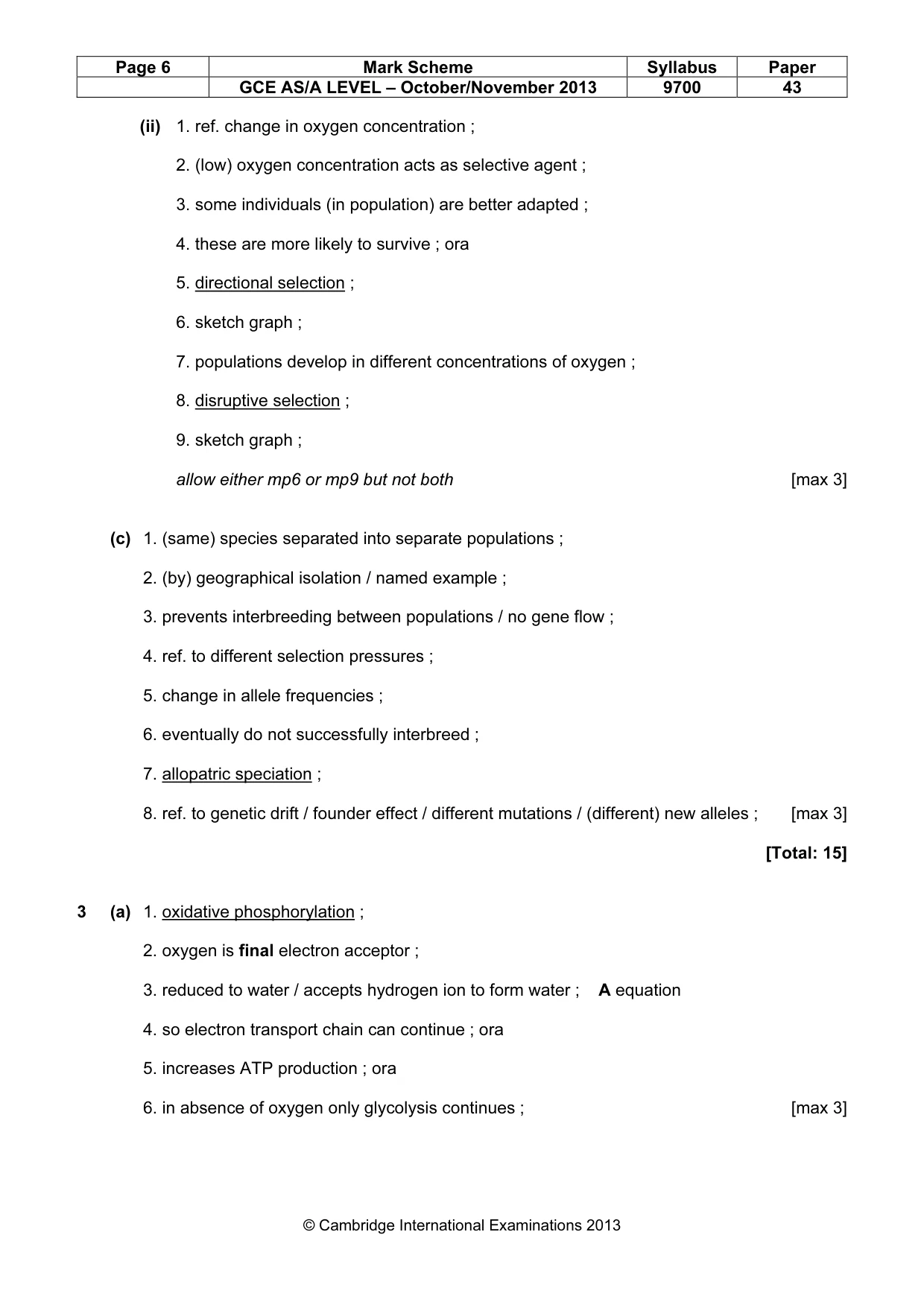
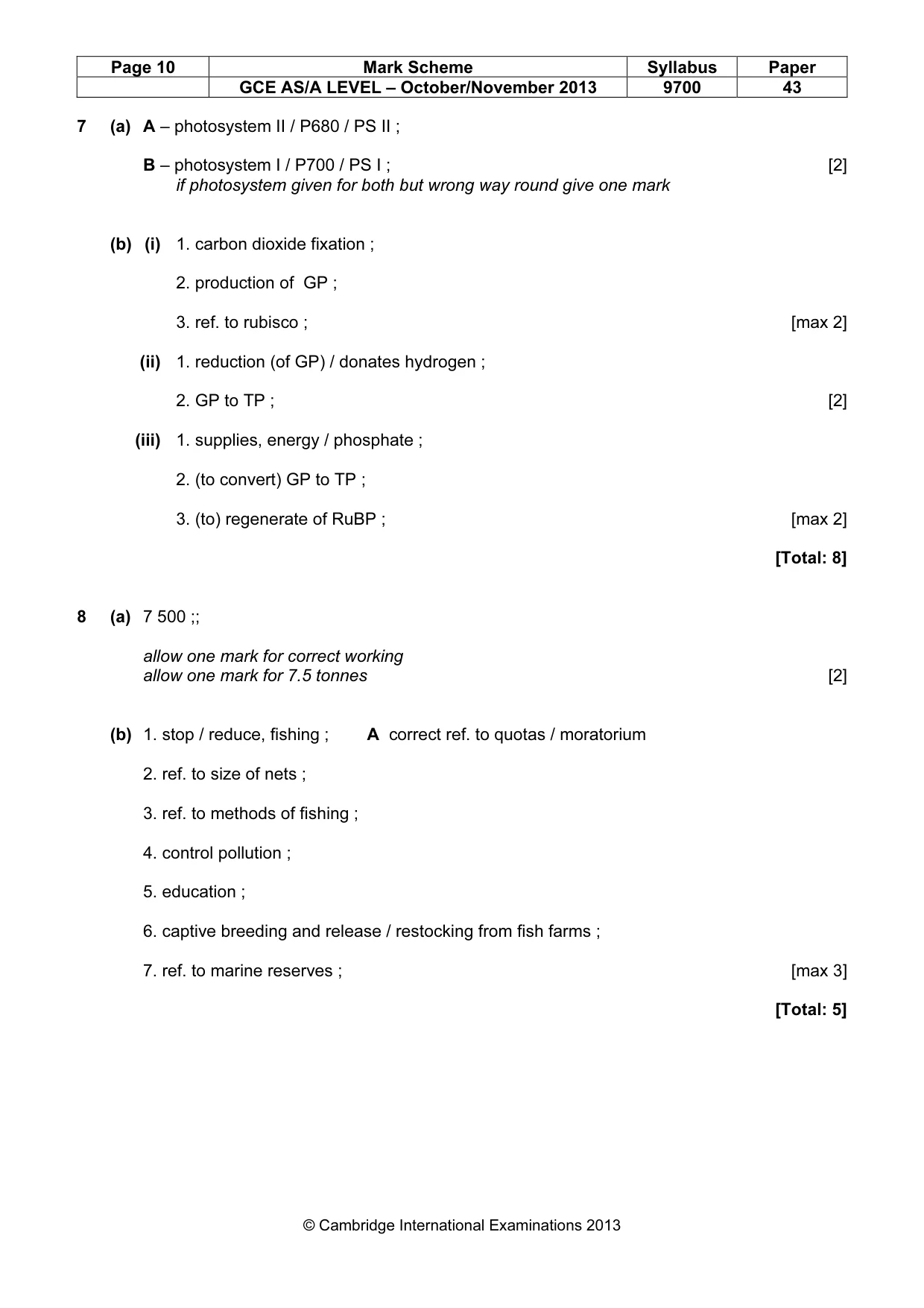
Page 6 Mark Scheme Syllabus Paper GCE AS/A LEVEL – October/November 2013 9700 43 © Cambridge International Examinations 2013 (ii) 1. ref. change in oxygen concentration ; 2. (low) oxygen concentration acts as selective agent ; 3. some individuals (in population) are better adapted ; 4. these are more likely to survive ; ora 5. directional selection ; 6. sketch graph ; 7. populations develop in different concentrations of oxygen ; 8. disruptive selection ; 9. sketch graph ; allow either mp6 or mp9 but not both [max 3] (c) 1. (same) species separated into separate populations ; 2. (by) geographical isolation / named example ; 3. prevents interbreeding between populations / no gene flow ; 4. ref. to different selection pressures ; 5. change in allele frequencies ; 6. eventually do not successfully interbreed ; 7. allopatric speciation ; 8. ref. to genetic drift / founder effect / different mutations / (different) new alleles ; [max 3] [Total: 15] 3 (a) 1. oxidative phosphorylation ; 2. oxygen is final electron acceptor ; 3. reduced to water / accepts hydrogen ion to form water ; A equation 4. so electron transport chain can continue ; ora 5. increases ATP production ; ora 6. in absence of oxygen only glycolysis continues ; [max 3]
Mark scheme, page 6
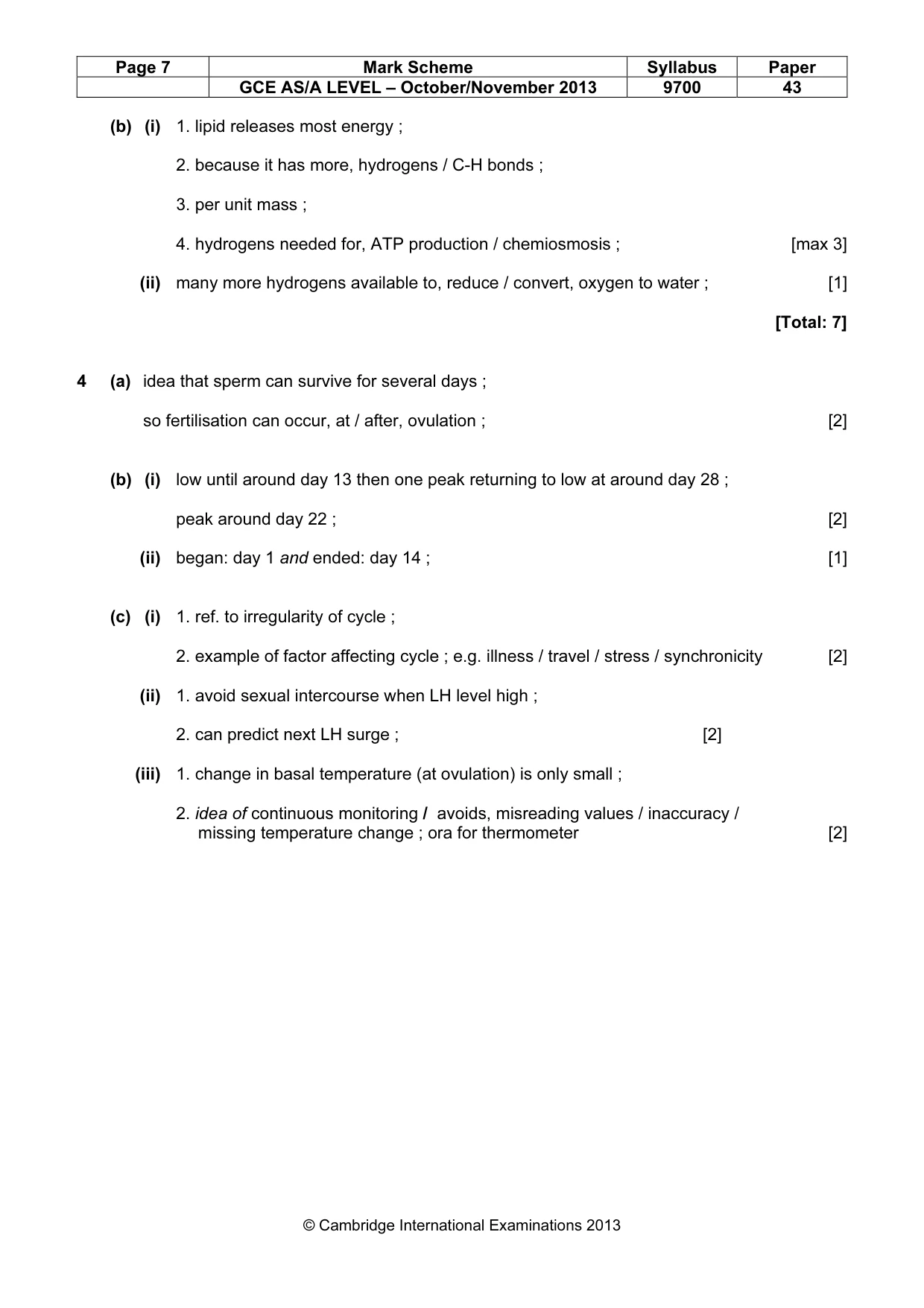
Page 7 Mark Scheme Syllabus Paper GCE AS/A LEVEL – October/November 2013 9700 43 © Cambridge International Examinations 2013 (b) (i) 1. lipid releases most energy ; 2. because it has more, hydrogens / C-H bonds ; 3. per unit mass ; 4. hydrogens needed for, ATP production / chemiosmosis ; [max 3] (ii) many more hydrogens available to, reduce / convert, oxygen to water ; [1] [Total: 7] 4 (a) idea that sperm can survive for several days ; so fertilisation can occur, at / after, ovulation ; [2] (b) (i) low until around day 13 then one peak returning to low at around day 28 ; peak around day 22 ; [2] (ii) began: day 1 and ended: day 14 ; [1] (c) (i) 1. ref. to irregularity of cycle ; 2. example of factor affecting cycle ; e.g. illness / travel / stress / synchronicity [2] (ii) 1. avoid sexual intercourse when LH level high ; 2. can predict next LH surge ; [2] (iii) 1. change in basal temperature (at ovulation) is only small ; 2. idea of continuous monitoring / avoids, misreading values / inaccuracy / missing temperature change ; ora for thermometer [2]
Mark scheme, page 7
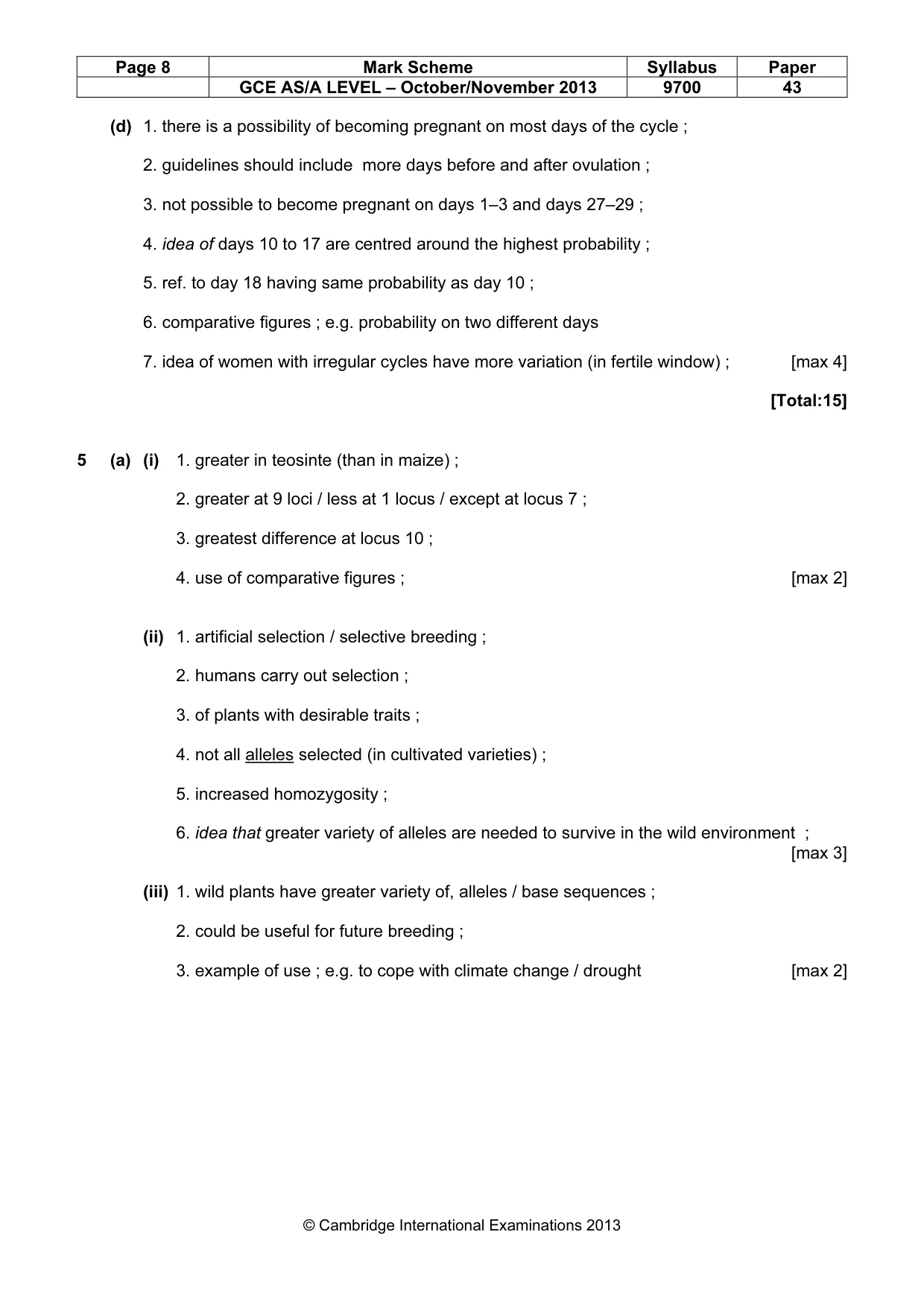
Page 8 Mark Scheme Syllabus Paper GCE AS/A LEVEL – October/November 2013 9700 43 © Cambridge International Examinations 2013 (d) 1. there is a possibility of becoming pregnant on most days of the cycle ; 2. guidelines should include more days before and after ovulation ; 3. not possible to become pregnant on days 1–3 and days 27–29 ; 4. idea of days 10 to 17 are centred around the highest probability ; 5. ref. to day 18 having same probability as day 10 ; 6. comparative figures ; e.g. probability on two different days 7. idea of women with irregular cycles have more variation (in fertile window) ; [max 4] [Total:15] 5 (a) (i) 1. greater in teosinte (than in maize) ; 2. greater at 9 loci / less at 1 locus / except at locus 7 ; 3. greatest difference at locus 10 ; 4. use of comparative figures ; [max 2] (ii) 1. artificial selection / selective breeding ; 2. humans carry out selection ; 3. of plants with desirable traits ; 4. not all alleles selected (in cultivated varieties) ; 5. increased homozygosity ; 6. idea that greater variety of alleles are needed to survive in the wild environment ; [max 3] (iii) 1. wild plants have greater variety of, alleles / base sequences ; 2. could be useful for future breeding ; 3. example of use ; e.g. to cope with climate change / drought [max 2]
Mark scheme, page 8
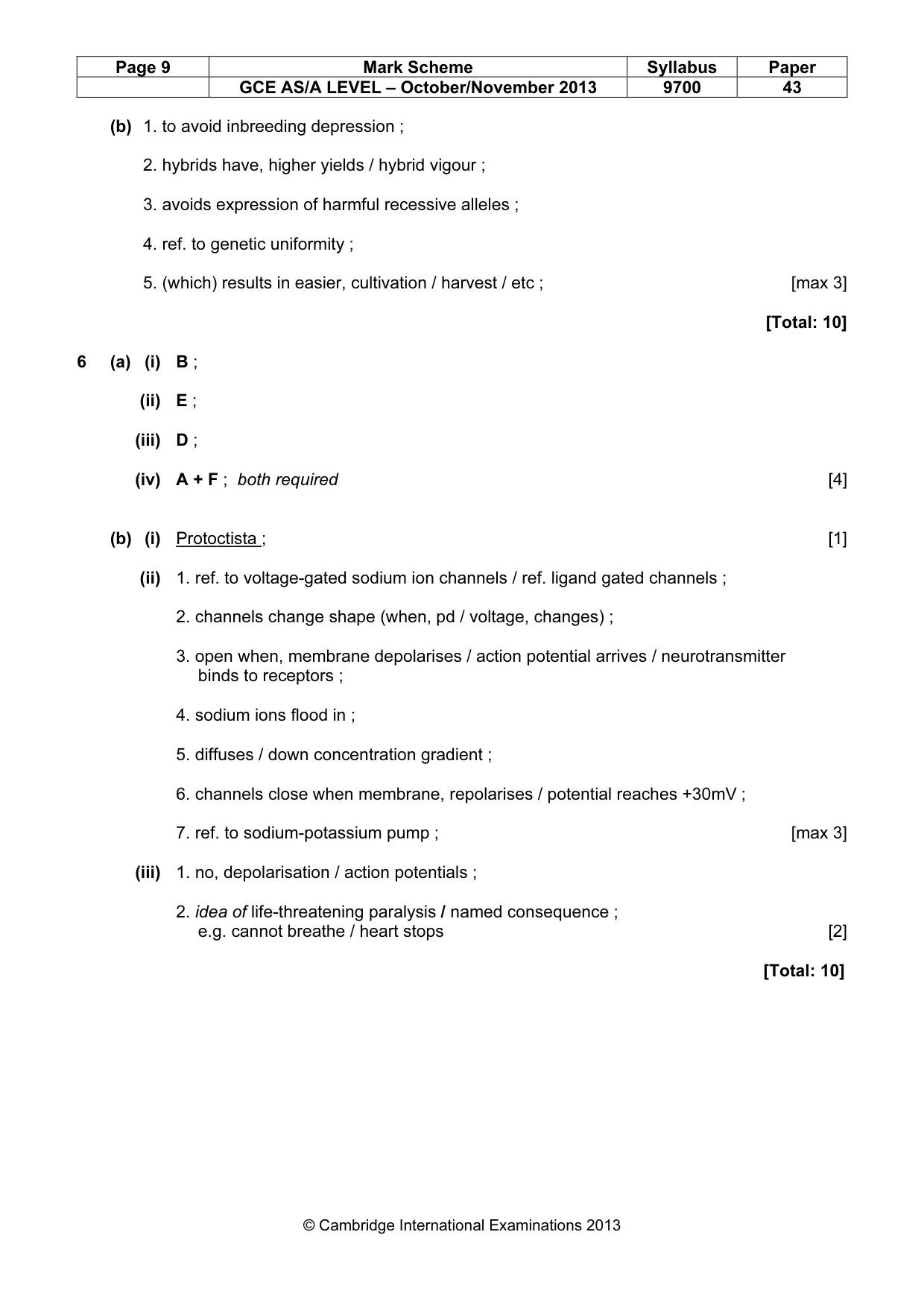
Page 9 Mark Scheme Syllabus Paper GCE AS/A LEVEL – October/November 2013 9700 43 © Cambridge International Examinations 2013 (b) 1. to avoid inbreeding depression ; 2. hybrids have, higher yields / hybrid vigour ; 3. avoids expression of harmful recessive alleles ; 4. ref. to genetic uniformity ; 5. (which) results in easier, cultivation / harvest / etc ; [max 3] [Total: 10] 6 (a) (i) B ; (ii) E ; (iii) D ; (iv) A + F ; both required [4] (b) (i) Protoctista ; [1] (ii) 1. ref. to voltage-gated sodium ion channels / ref. ligand gated channels ; 2. channels change shape (when, pd / voltage, changes) ; 3. open when, membrane depolarises / action potential arrives / neurotransmitter binds to receptors ; 4. sodium ions flood in ; 5. diffuses / down concentration gradient ; 6. channels close when membrane, repolarises / potential reaches +30mV ; 7. ref. to sodium-potassium pump ; [max 3] (iii) 1. no, depolarisation / action potentials ; 2. idea of life-threatening paralysis / named consequence ; e.g. cannot breathe / heart stops [2] [Total: 10]
Mark scheme, page 9
Page 10 Mark Scheme Syllabus Paper GCE AS/A LEVEL – October/November 2013 9700 43 © Cambridge International Examinations 2013 7 (a) A – photosystem II / P680 / PS II ; B – photosystem I / P700 / PS I ; [2] if photosystem given for both but wrong way round give one mark (b) (i) 1. carbon dioxide fixation ; 2. production of GP ; 3. ref. to rubisco ; [max 2] (ii) 1. reduction (of GP) / donates hydrogen ; 2. GP to TP ; [2] (iii) 1. supplies, energy / phosphate ; 2. (to convert) GP to TP ; 3. (to) regenerate of RuBP ; [max 2] [Total: 8] 8 (a) 7 500 ;; allow one mark for correct working allow one mark for 7.5 tonnes [2] (b) 1. stop / reduce, fishing ; A correct ref. to quotas / moratorium 2. ref. to size of nets ; 3. ref. to methods of fishing ; 4. control pollution ; 5. education ; 6. captive breeding and release / restocking from fish farms ; 7. ref. to marine reserves ; [max 3] [Total: 5]
Mark scheme, page 10
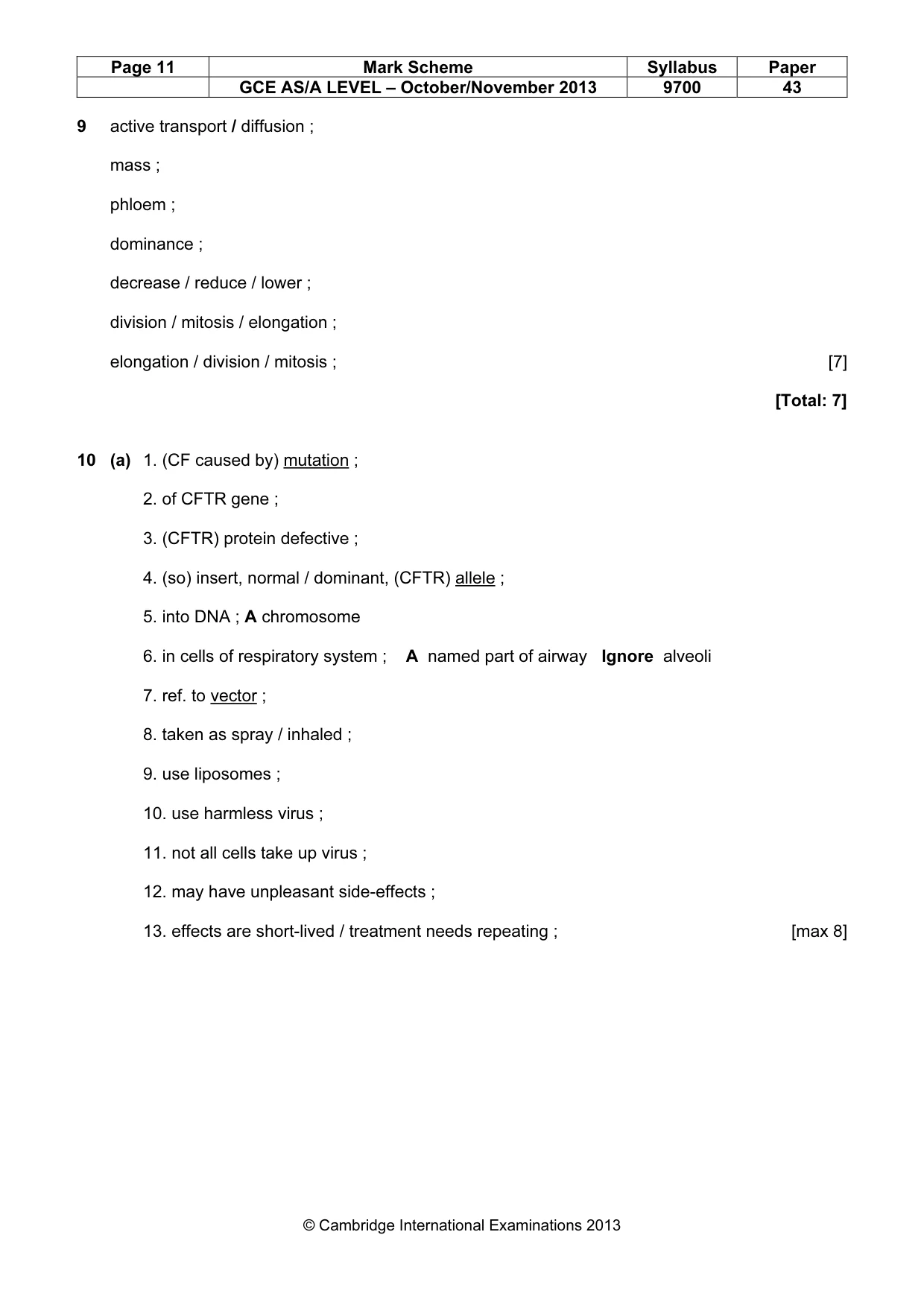
Page 11 Mark Scheme Syllabus Paper GCE AS/A LEVEL – October/November 2013 9700 43 © Cambridge International Examinations 2013 9 active transport / diffusion ; mass ; phloem ; dominance ; decrease / reduce / lower ; division / mitosis / elongation ; elongation / division / mitosis ; [7] [Total: 7] 10 (a) 1. (CF caused by) mutation ; 2. of CFTR gene ; 3. (CFTR) protein defective ; 4. (so) insert, normal / dominant, (CFTR) allele ; 5. into DNA ; A chromosome 6. in cells of respiratory system ; A named part of airway Ignore alveoli 7. ref. to vector ; 8. taken as spray / inhaled ; 9. use liposomes ; 10. use harmless virus ; 11. not all cells take up virus ; 12. may have unpleasant side-effects ; 13. effects are short-lived / treatment needs repeating ; [max 8]
Mark scheme, page 11
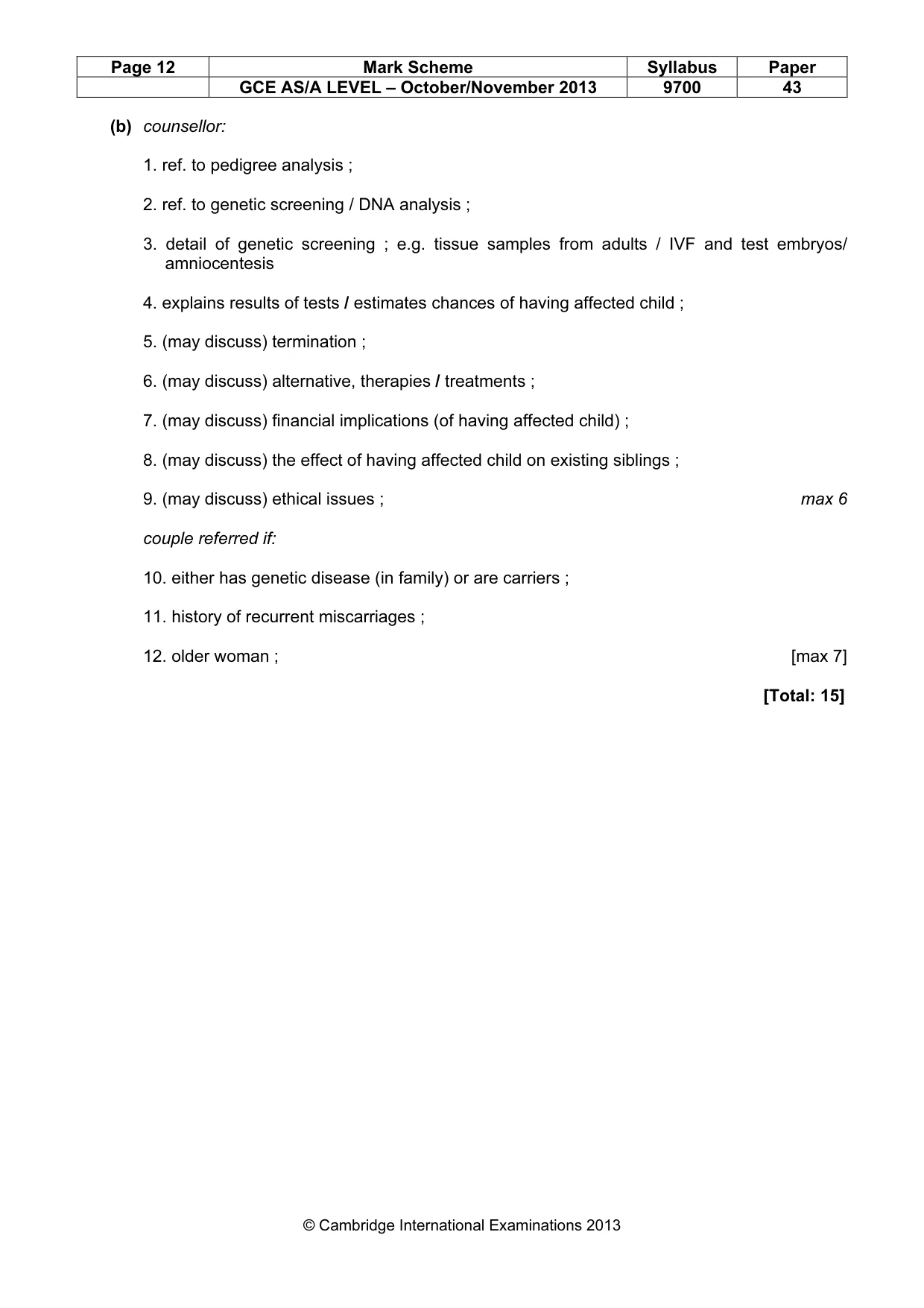
Page 12 Mark Scheme Syllabus Paper GCE AS/A LEVEL – October/November 2013 9700 43 © Cambridge International Examinations 2013 (b) counsellor: 1. ref. to pedigree analysis ; 2. ref. to genetic screening / DNA analysis ; 3. detail of genetic screening ; e.g. tissue samples from adults / IVF and test embryos/ amniocentesis 4. explains results of tests / estimates chances of having affected child ; 5. (may discuss) termination ; 6. (may discuss) alternative, therapies / treatments ; 7. (may discuss) financial implications (of having affected child) ; 8. (may discuss) the effect of having affected child on existing siblings ; 9. (may discuss) ethical issues ; max 6 couple referred if: 10. either has genetic disease (in family) or are carriers ; 11. history of recurrent miscarriages ; 12. older woman ; [max 7] [Total: 15]
Mark scheme, page 12
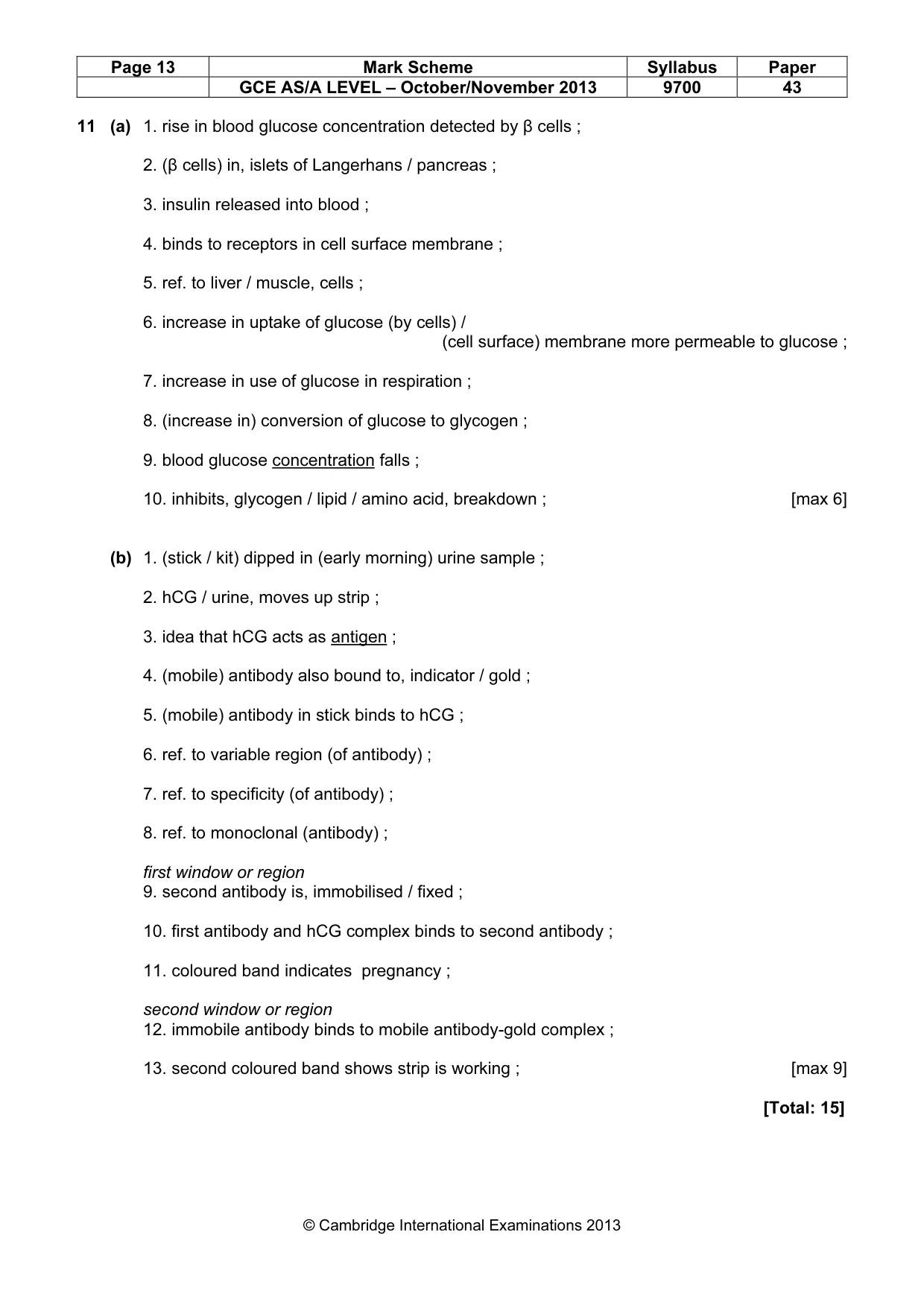
Page 13 Mark Scheme Syllabus Paper GCE AS/A LEVEL – October/November 2013 9700 43 © Cambridge International Examinations 2013 11 (a) 1. rise in blood glucose concentration detected by β cells ; 2. (β cells) in, islets of Langerhans / pancreas ; 3. insulin released into blood ; 4. binds to receptors in cell surface membrane ; 5. ref. to liver / muscle, cells ; 6. increase in uptake of glucose (by cells) / (cell surface) membrane more permeable to glucose ; 7. increase in use of glucose in respiration ; 8. (increase in) conversion of glucose to glycogen ; 9. blood glucose concentration falls ; 10. inhibits, glycogen / lipid / amino acid, breakdown ; [max 6] (b) 1. (stick / kit) dipped in (early morning) urine sample ; 2. hCG / urine, moves up strip ; 3. idea that hCG acts as antigen ; 4. (mobile) antibody also bound to, indicator / gold ; 5. (mobile) antibody in stick binds to hCG ; 6. ref. to variable region (of antibody) ; 7. ref. to specificity (of antibody) ; 8. ref. to monoclonal (antibody) ; first window or region 9. second antibody is, immobilised / fixed ; 10. first antibody and hCG complex binds to second antibody ; 11. coloured band indicates pregnancy ; second window or region 12. immobile antibody binds to mobile antibody-gold complex ; 13. second coloured band shows strip is working ; [max 9] [Total: 15]
What you needed in this session
Cambridge’s own grade thresholds for 2013 Oct/Nov, Paper 4 · Variant 3. A higher threshold means an easier paper — the bar moves with how the cohort did.