Cambridge A Level Biology 9700 — 2007 May/June Paper 3 · Variant 1
9700/31/M/J/07 · 40 marks · ≈45 min
The question paper and its mark scheme, free to read here and free to download. This is Cambridge’s own paper, exactly as it was sat.
Question paper12 pages





Mark scheme3 pages
Answers below. Sit the paper first if you are practising.
Paper as text
Question paper, page 1
This document consists of 9 printed pages and 3 blank pages. SP (CW/CGW) T26263/6 © UCLES 2007 [Turn over UNIVERSITY OF CAMBRIDGE INTERNATIONAL EXAMINATIONS General Certificate of Education Advanced Subsidiary Level and Advanced Level READ THESE INSTRUCTIONS FIRST Write your Centre number, candidate number and name on all the work you hand in. Write in dark blue or black pen. You may use a soft pencil for any diagrams, graphs or rough working. Do not use staples, paper clips, highlighters, glue or correction fluid. DO NOT WRITE IN ANY BARCODES. Answer all questions. At the end of the examination, fasten all your work securely together. The number of marks is given in brackets [ ] at the end of each question or part question. You are advised to spend one hour on each question. * 7 9 7 5 2 9 9 3 1 3 * BIOLOGY 9700/31 Paper 3 Advanced Practical Skills May/June 2007 2 hours Candidates answer on the Question Paper. Additional Materials: As listed in the Instructions to Supervisors. For Examiner’s Use 1 2 Total
Question paper, page 2
2 9700/31/M/J/07 For Examiner’s Use © UCLES 2007 You are reminded that you have only one hour for each question in the practical examination. You should read carefully through the whole of each question and then plan your use of the time to make sure that you finish all of the work that you would like to do. 1 You are required to investigate the effect of lead nitrate on the activity of the enzyme amylase. You are provided with a 1% solution of lead nitrate, labelled S1, a solution of starch, labelled S2 and a solution of amylase, labelled S3. You are also provided with a solution of iodine in potassium iodide, labelled iodine and a supply of distilled water. (a) Investigate the effect of amylase on starch in the absence of lead nitrate. • place 2 cm3 of distilled water in a test-tube. • add 2 cm3 of starch solution. • add 0.5 cm3 of amylase and start timing. • after five minutes add four drops of iodine solution and shake gently. Describe and explain your results. … … … … … …[2]
Question paper, page 3
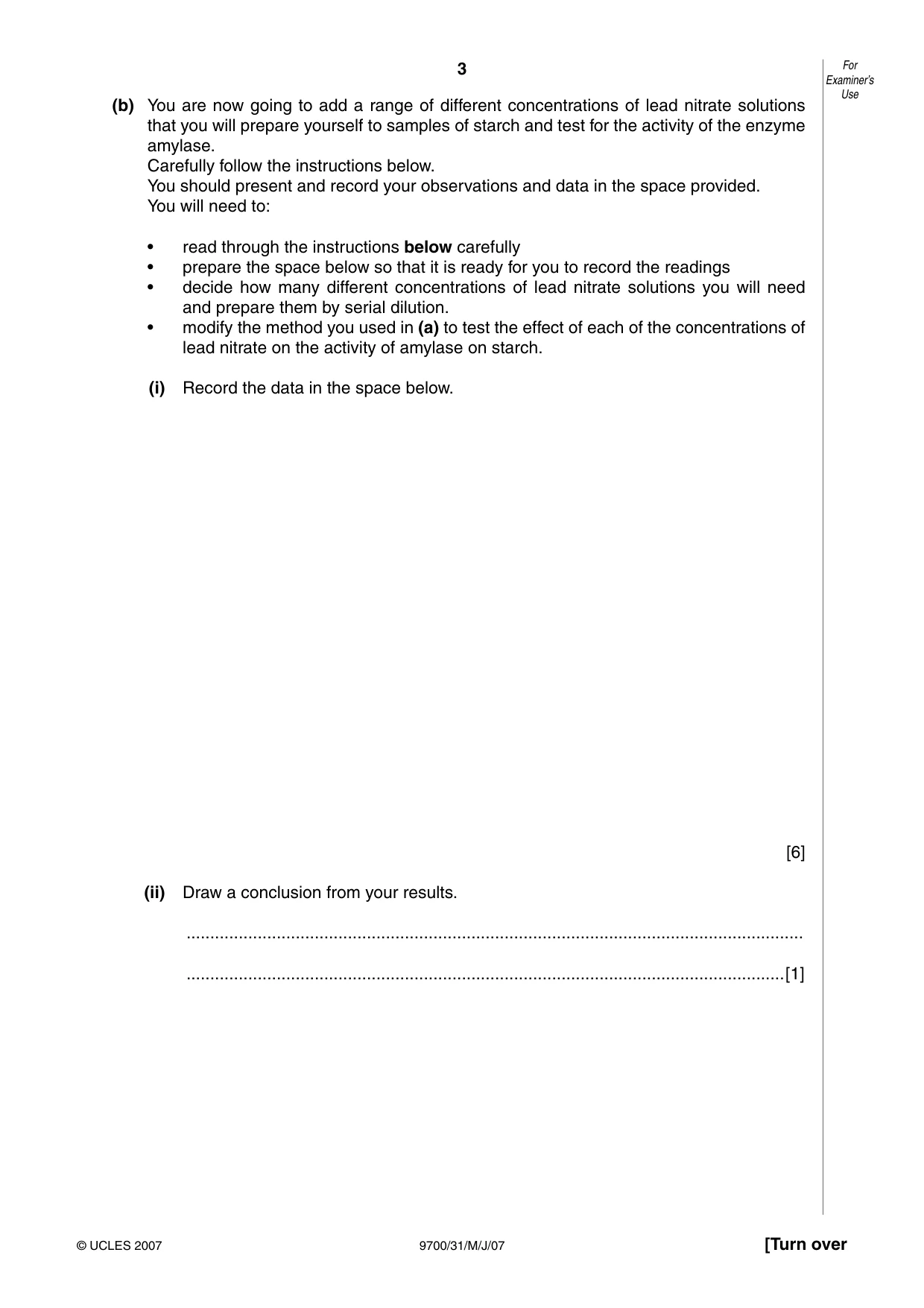
3 9700/31/M/J/07 [Turn over For Examiner’s Use © UCLES 2007 (b) You are now going to add a range of different concentrations of lead nitrate solutions that you will prepare yourself to samples of starch and test for the activity of the enzyme amylase. Carefully follow the instructions below. You should present and record your observations and data in the space provided. You will need to: • read through the instructions below carefully • prepare the space below so that it is ready for you to record the readings • decide how many different concentrations of lead nitrate solutions you will need and prepare them by serial dilution. • modify the method you used in (a) to test the effect of each of the concentrations of lead nitrate on the activity of amylase on starch. (i) Record the data in the space below. [6] (ii) Draw a conclusion from your results. … …[1]
Question paper, page 4
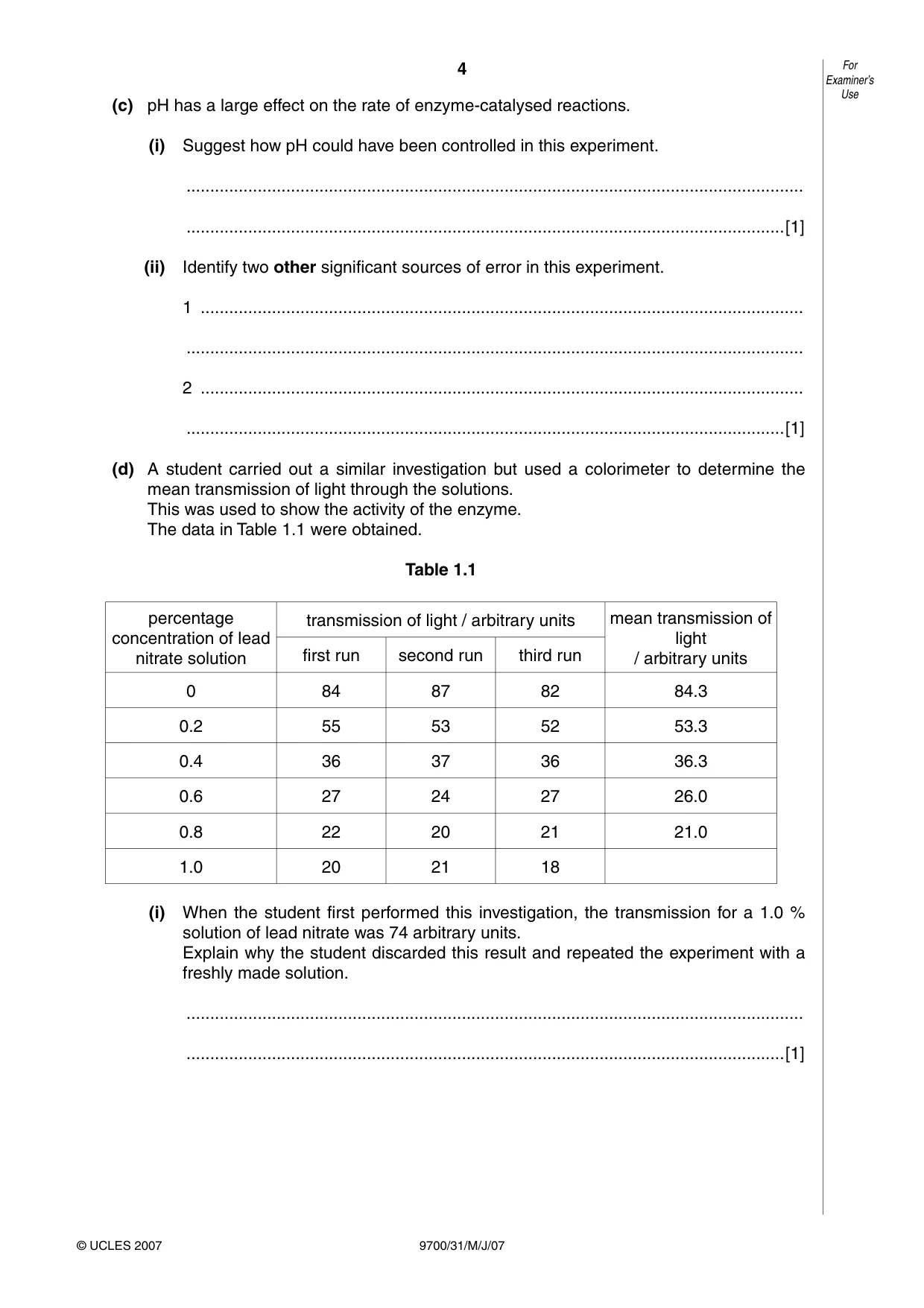
4 9700/31/M/J/07 For Examiner’s Use © UCLES 2007 (c) pH has a large effect on the rate of enzyme-catalysed reactions. (i) Suggest how pH could have been controlled in this experiment. … …[1] (ii) Identify two other significant sources of error in this experiment. 1 … … 2 … …[1] (d) A student carried out a similar investigation but used a colorimeter to determine the mean transmission of light through the solutions. This was used to show the activity of the enzyme. The data in Table 1.1 were obtained. Table 1.1 percentage concentration of lead nitrate solution transmission of light / arbitrary units mean transmission of light / arbitrary units first run second run third run 0 84 87 82 84.3 0.2 55 53 52 53.3 0.4 36 37 36 36.3 0.6 27 24 27 26.0 0.8 22 20 21 21.0 1.0 20 21 18 (i) When the student first performed this investigation, the transmission for a 1.0 % solution of lead nitrate was 74 arbitrary units. Explain why the student discarded this result and repeated the experiment with a freshly made solution. … …[1]
Question paper, page 5
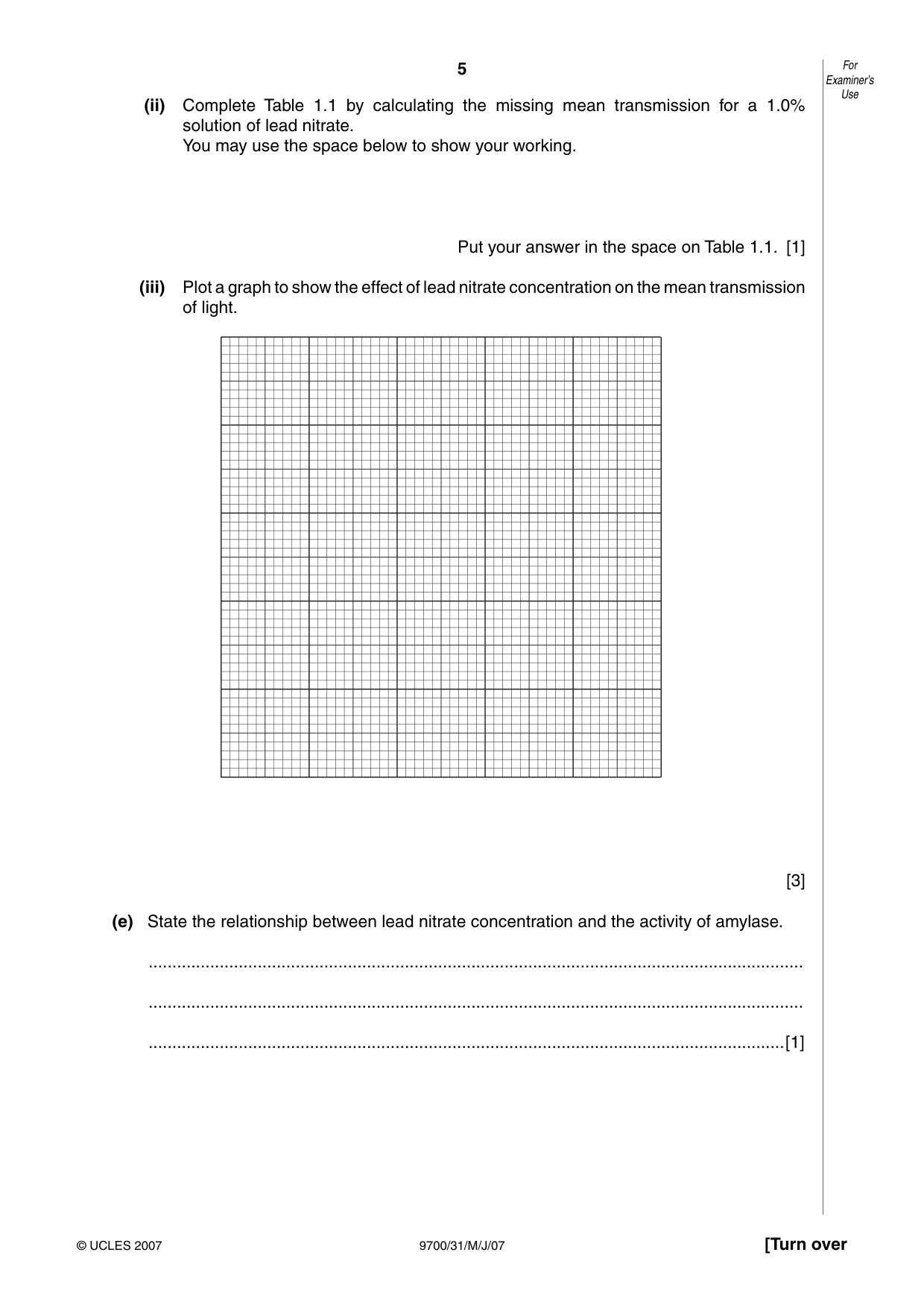
5 9700/31/M/J/07 [Turn over For Examiner’s Use © UCLES 2007 (ii) Complete Table 1.1 by calculating the missing mean transmission for a 1.0% solution of lead nitrate. You may use the space below to show your working. Put your answer in the space on Table 1.1. [1] (iii) Plot a graph to show the effect of lead nitrate concentration on the mean transmission of light. [3] (e) State the relationship between lead nitrate concentration and the activity of amylase. … … …[1]
Question paper, page 6
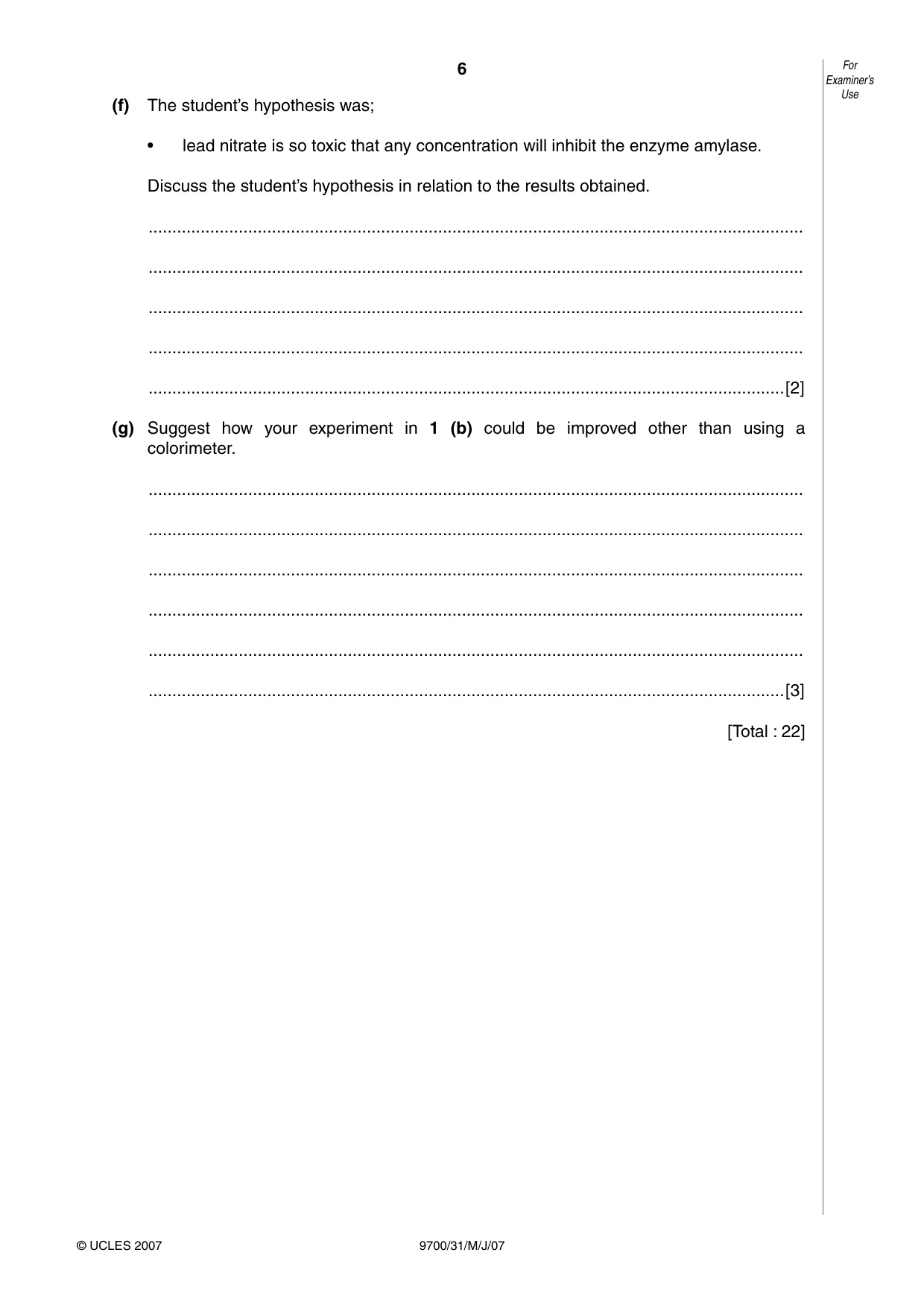
6 9700/31/M/J/07 For Examiner’s Use © UCLES 2007 (f) The student’s hypothesis was; • lead nitrate is so toxic that any concentration will inhibit the enzyme amylase. Discuss the student’s hypothesis in relation to the results obtained. … … … … …[2] (g) Suggest how your experiment in 1 (b) could be improved other than using a colorimeter. … … … … … …[3] [Total : 22]
Question paper, page 7
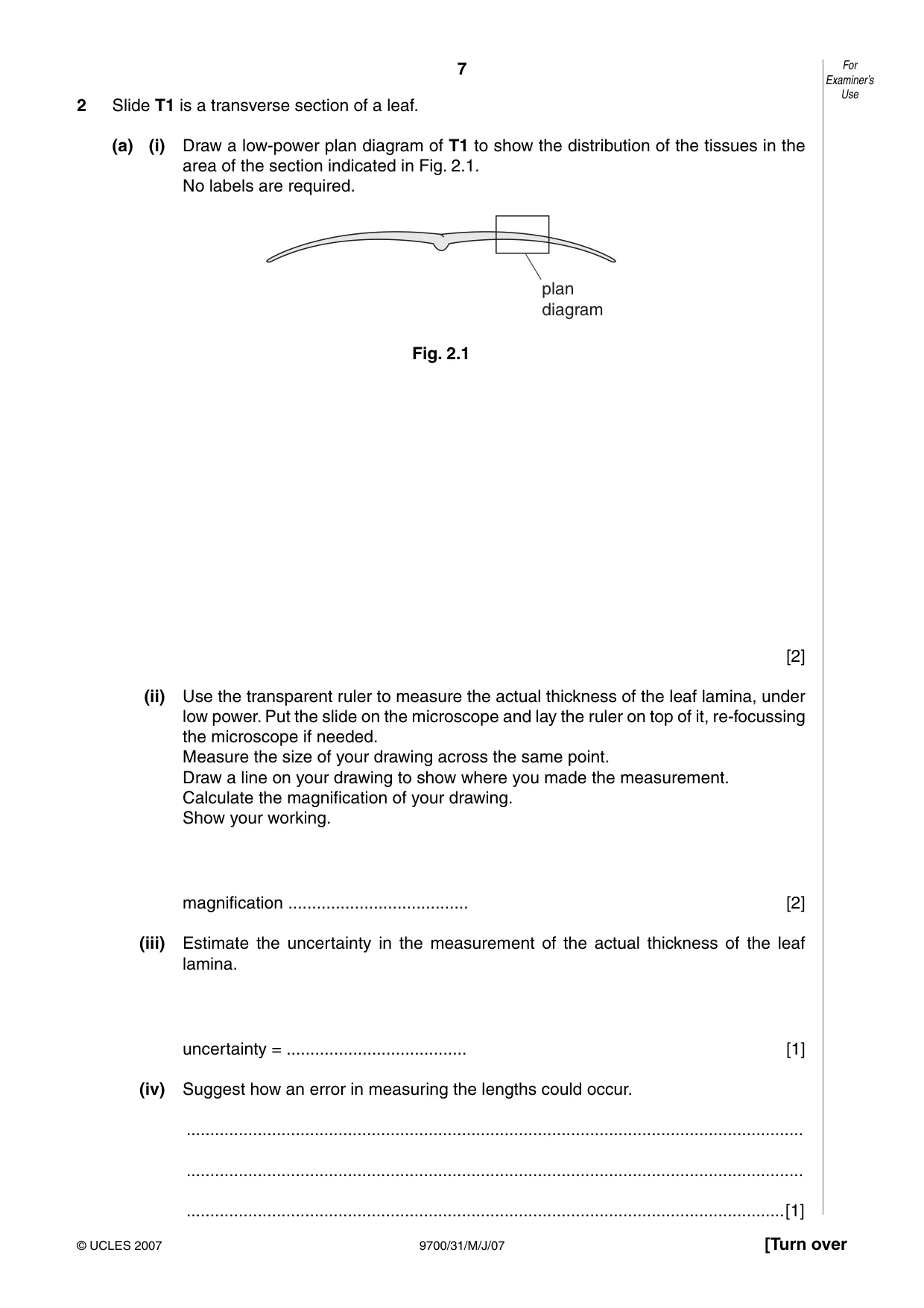
7 9700/31/M/J/07 [Turn over For Examiner’s Use © UCLES 2007 2 Slide T1 is a transverse section of a leaf. (a) (i) Draw a low-power plan diagram of T1 to show the distribution of the tissues in the area of the section indicated in Fig. 2.1. No labels are required. plan diagram Fig. 2.1 [2] (ii) Use the transparent ruler to measure the actual thickness of the leaf lamina, under low power. Put the slide on the microscope and lay the ruler on top of it, re-focussing the microscope if needed. Measure the size of your drawing across the same point. Draw a line on your drawing to show where you made the measurement. Calculate the magnification of your drawing. Show your working. magnification … [2] (iii) Estimate the uncertainty in the measurement of the actual thickness of the leaf lamina. uncertainty = … [1] (iv) Suggest how an error in measuring the lengths could occur. … … …[1]
Question paper, page 8
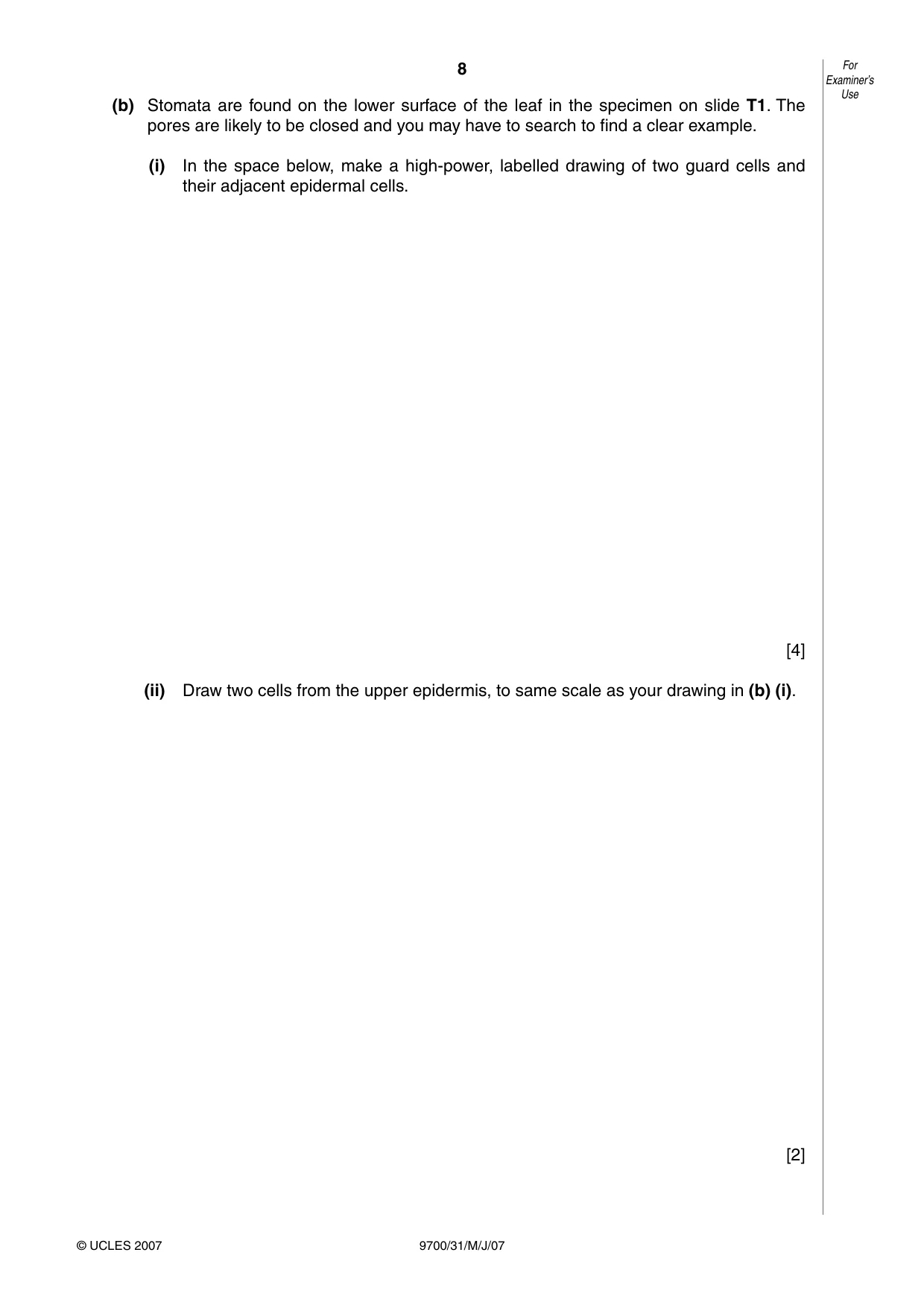
8 9700/31/M/J/07 For Examiner’s Use © UCLES 2007 (b) Stomata are found on the lower surface of the leaf in the specimen on slide T1. The pores are likely to be closed and you may have to search to find a clear example. (i) In the space below, make a high-power, labelled drawing of two guard cells and their adjacent epidermal cells. [4] (ii) Draw two cells from the upper epidermis, to same scale as your drawing in (b) (i). [2]
Question paper, page 9
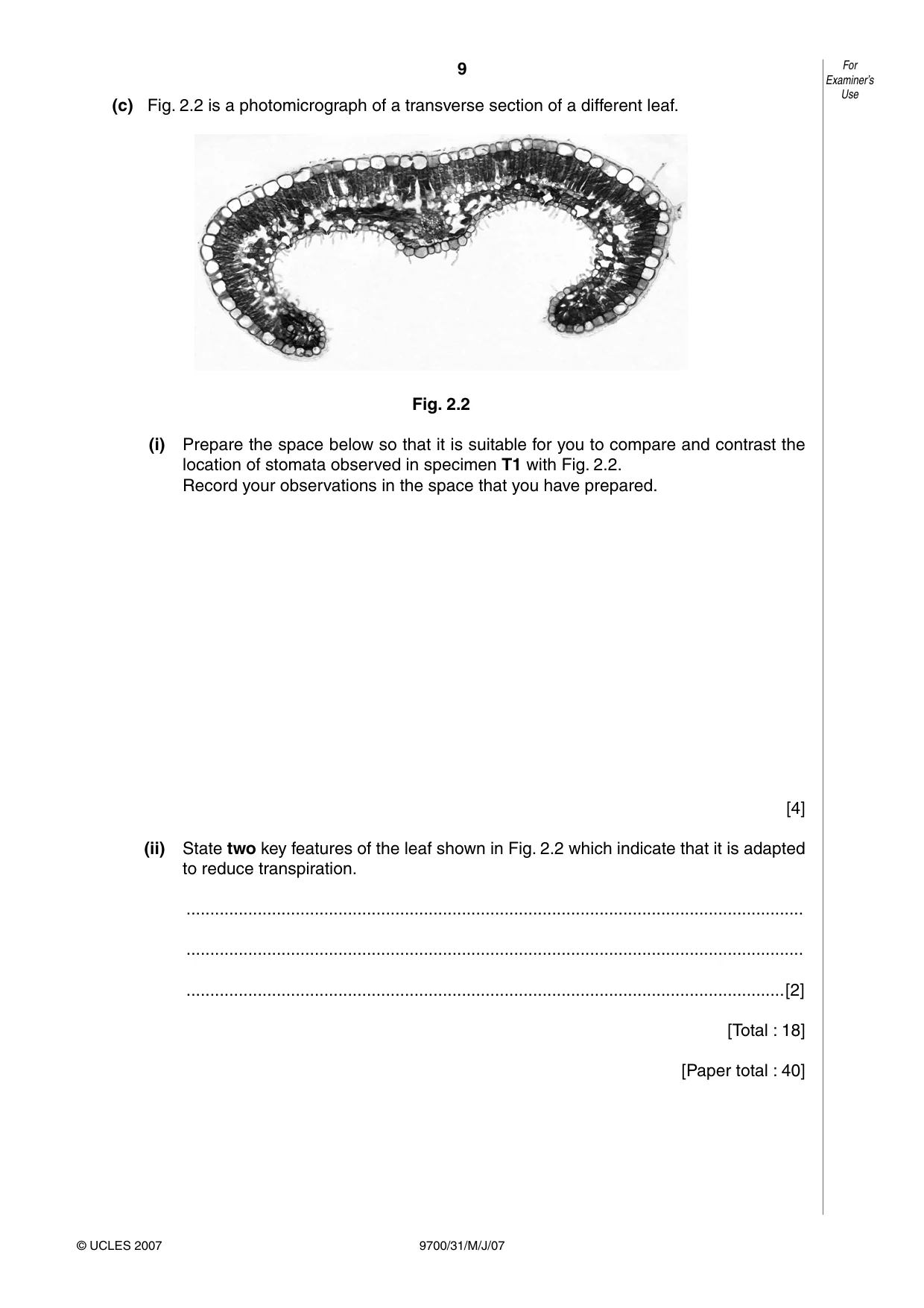
9 9700/31/M/J/07 For Examiner’s Use © UCLES 2007 (c) Fig. 2.2 is a photomicrograph of a transverse section of a different leaf. Fig. 2.2 (i) Prepare the space below so that it is suitable for you to compare and contrast the location of stomata observed in specimen T1 with Fig. 2.2. Record your observations in the space that you have prepared. [4] (ii) State two key features of the leaf shown in Fig. 2.2 which indicate that it is adapted to reduce transpiration. … … …[2] [Total : 18] [Paper total : 40]
Question paper, page 12
12 9700/31/M/J/07 BLANK PAGE Permission to reproduce items where third-party owned material protected by copyright is included has been sought and cleared where possible. Every reasonable effort has been made by the publisher (UCLES) to trace copyright holders, but if any items requiring clearance have unwittingly been included, the publisher will be pleased to make amends at the earliest possible opportunity. University of Cambridge International Examinations is part of the Cambridge Assessment Group. Cambridge Assessment is the brand name of University of Cambridge Local Examinations Syndicate (UCLES), which is itself a department of the University of Cambridge.
Mark scheme, page 1
UNIVERSITY OF CAMBRIDGE INTERNATIONAL EXAMINATIONS GCE Advanced Subsidiary Level and GCE Advanced Level MARK SCHEME for the May/June 2007 question paper 9700 BIOLOGY 9700/31 Paper 31 (Advanced Practical Skills 1), maximum raw mark 40 This mark scheme is published as an aid to teachers and candidates, to indicate the requirements of the examination. It shows the basis on which Examiners were instructed to award marks. It does not indicate the details of the discussions that took place at an Examiners’ meeting before marking began. All Examiners are instructed that alternative correct answers and unexpected approaches in candidates’ scripts must be given marks that fairly reflect the relevant knowledge and skills demonstrated. Mark schemes must be read in conjunction with the question papers and the report on the examination. • CIE will not enter into discussions or correspondence in connection with these mark schemes. CIE is publishing the mark schemes for the May/June 2007 question papers for most IGCSE, GCE Advanced Level and Advanced Subsidiary Level syllabuses and some Ordinary Level syllabuses.
Mark scheme, page 2
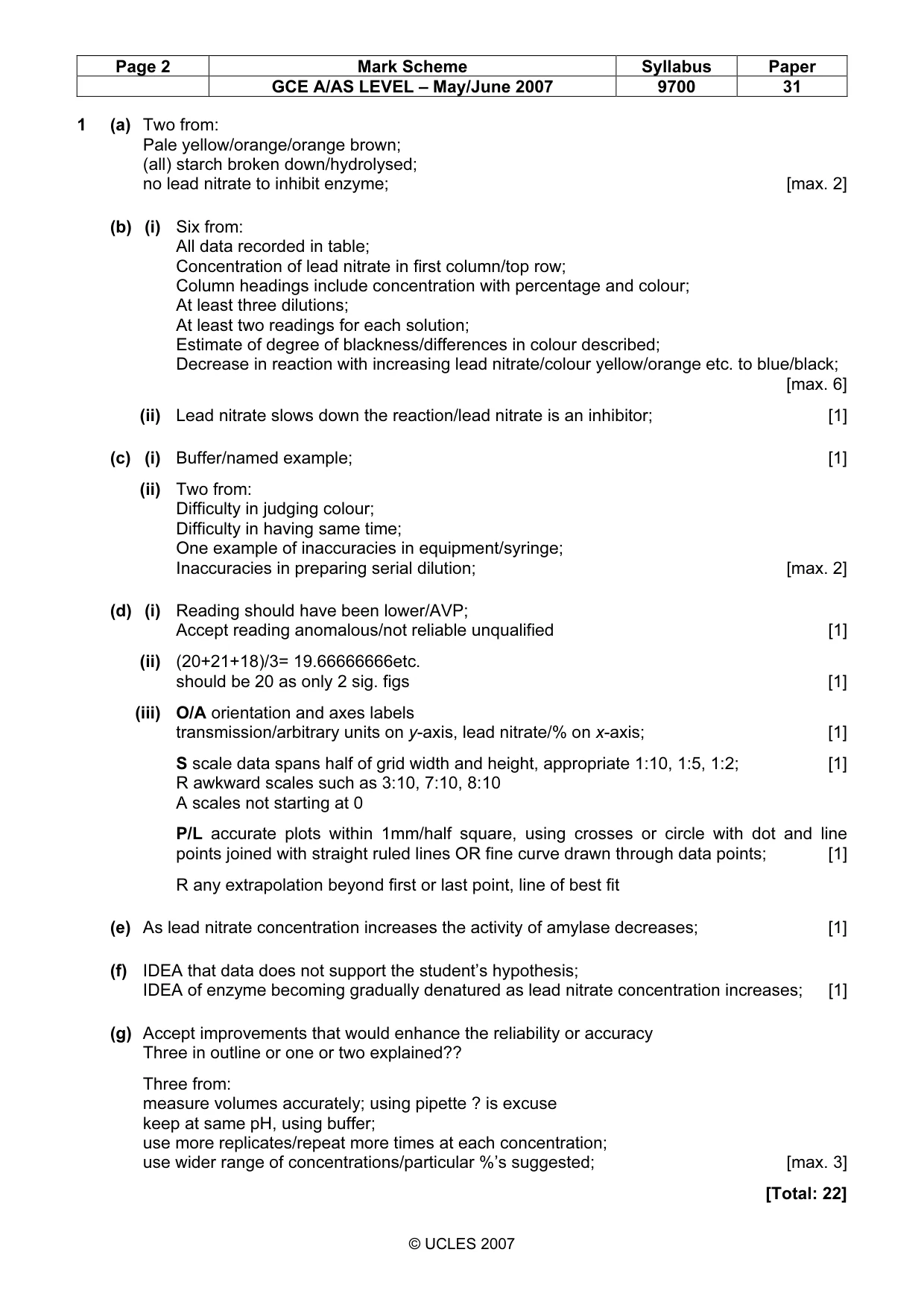
Page 2 Mark Scheme Syllabus Paper GCE A/AS LEVEL – May/June 2007 9700 31 © UCLES 2007 1 (a) Two from: Pale yellow/orange/orange brown; (all) starch broken down/hydrolysed; no lead nitrate to inhibit enzyme; [max. 2] (b) (i) Six from: All data recorded in table; Concentration of lead nitrate in first column/top row; Column headings include concentration with percentage and colour; At least three dilutions; At least two readings for each solution; Estimate of degree of blackness/differences in colour described; Decrease in reaction with increasing lead nitrate/colour yellow/orange etc. to blue/black; [max. 6] (ii) Lead nitrate slows down the reaction/lead nitrate is an inhibitor; [1] (c) (i) Buffer/named example; [1] (ii) Two from: Difficulty in judging colour; Difficulty in having same time; One example of inaccuracies in equipment/syringe; Inaccuracies in preparing serial dilution; [max. 2] (d) (i) Reading should have been lower/AVP; Accept reading anomalous/not reliable unqualified [1] (ii) (20+21+18)/3= 19.66666666etc. should be 20 as only 2 sig. figs [1] (iii) O/A orientation and axes labels transmission/arbitrary units on y-axis, lead nitrate/% on x-axis; [1] S scale data spans half of grid width and height, appropriate 1:10, 1:5, 1:2; [1] R awkward scales such as 3:10, 7:10, 8:10 A scales not starting at 0 P/L accurate plots within 1mm/half square, using crosses or circle with dot and line points joined with straight ruled lines OR fine curve drawn through data points; [1] R any extrapolation beyond first or last point, line of best fit (e) As lead nitrate concentration increases the activity of amylase decreases; [1] (f) IDEA that data does not support the student’s hypothesis; IDEA of enzyme becoming gradually denatured as lead nitrate concentration increases; [1] (g) Accept improvements that would enhance the reliability or accuracy Three in outline or one or two explained?? Three from: measure volumes accurately; using pipette ? is excuse keep at same pH, using buffer; use more replicates/repeat more times at each concentration; use wider range of concentrations/particular %’s suggested; [max. 3] [Total: 22]
Mark scheme, page 3
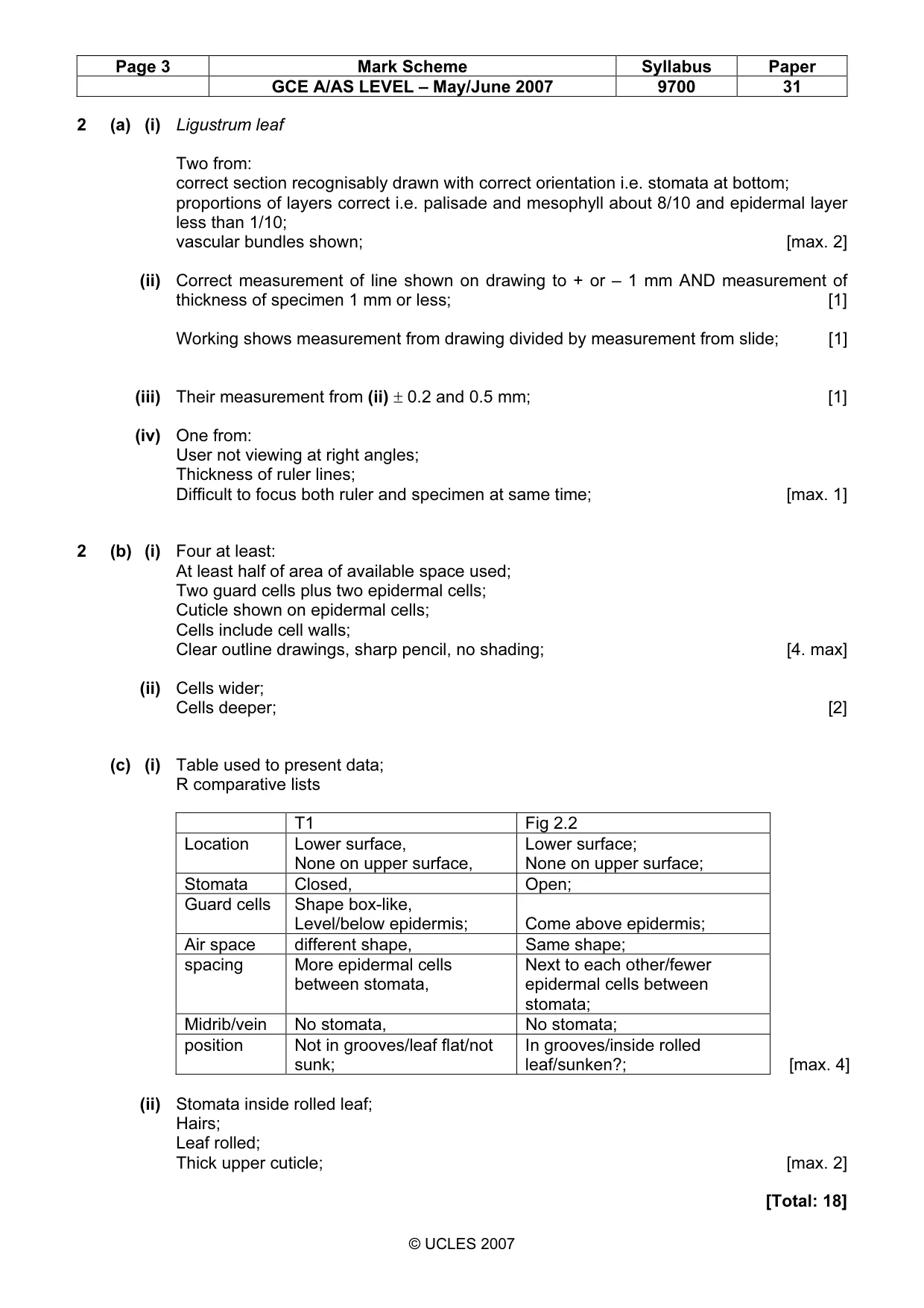
Page 3 Mark Scheme Syllabus Paper GCE A/AS LEVEL – May/June 2007 9700 31 © UCLES 2007 2 (a) (i) Ligustrum leaf Two from: correct section recognisably drawn with correct orientation i.e. stomata at bottom; proportions of layers correct i.e. palisade and mesophyll about 8/10 and epidermal layer less than 1/10; vascular bundles shown; [max. 2] (ii) Correct measurement of line shown on drawing to + or – 1 mm AND measurement of thickness of specimen 1 mm or less; [1] Working shows measurement from drawing divided by measurement from slide; [1] (iii) Their measurement from (ii) ± 0.2 and 0.5 mm; [1] (iv) One from: User not viewing at right angles; Thickness of ruler lines; Difficult to focus both ruler and specimen at same time; [max. 1] 2 (b) (i) Four at least: At least half of area of available space used; Two guard cells plus two epidermal cells; Cuticle shown on epidermal cells; Cells include cell walls; Clear outline drawings, sharp pencil, no shading; [4. max] (ii) Cells wider; Cells deeper; [2] (c) (i) Table used to present data; R comparative lists T1 Fig 2.2 Location Lower surface, None on upper surface, Lower surface; None on upper surface; Stomata Closed, Open; Guard cells Shape box-like, Level/below epidermis; Come above epidermis; Air space different shape, Same shape; spacing More epidermal cells between stomata, Next to each other/fewer epidermal cells between stomata; Midrib/vein No stomata, No stomata; position Not in grooves/leaf flat/not sunk; In grooves/inside rolled leaf/sunken?; [max. 4] (ii) Stomata inside rolled leaf; Hairs; Leaf rolled; Thick upper cuticle; [max. 2] [Total: 18]
What you needed in this session
Cambridge’s own grade thresholds for 2007 May/June, Paper 3 · Variant 1. A higher threshold means an easier paper — the bar moves with how the cohort did.