Cambridge A Level Applied Information and Communication Technology 9713 — 2012 Oct/Nov Paper 3 · Variant 3
9713/33/O/N/12 · 80 marks · ≈90 min
The question paper and its mark scheme, free to read here and free to download. This is Cambridge’s own paper, exactly as it was sat.
Question paper20 pages

Mark scheme8 pages
Answers below. Sit the paper first if you are practising.
Paper as text
Question paper, page 1
This document consists of 19 printed pages and 1 blank page. IB12 11_9713_33/2RP © UCLES 2012 [Turn over *5922296468* UNIVERSITY OF CAMBRIDGE INTERNATIONAL EXAMINATIONS General Certificate of Education Advanced Level APPLIED INFORMATION AND COMMUNICATION TECHNOLOGY 9713/33 Paper 3 October/November 2012 1 hour 15 minutes Candidates answer on the Question Paper. No additional materials are required. READ THESE INSTRUCTIONS FIRST Write your Centre number, candidate number and name on all the work you hand in. Write in dark blue or black pen. Do not use staples, paper clips, highlighters, glue or correction fluid. You may use a pencil for any diagrams, graphs or rough working. DO NOT WRITE IN ANY BARCODES. Answer all questions. The number of marks is given in brackets [ ] at the end of each question or part question. The businesses described in this paper are entirely fictitious.
Question paper, page 2
2 © UCLES 2012 9713/33/O/N/12 For Examiner's Use Scenario 1 Questions 1, 2 and 3 The ICT manager for South Island Railways (SIR) has different networks to manage including Local Area Networks (LANs) and Wide Area Networks (WANs). In order that staff at different stations can communicate, SIR makes use of a Virtual Private Network (VPN). When the networks were set up consideration had to be given to the ways that computers would communicate with the servers. SIR has a website which provides information that customers might find useful when planning a journey. Customers can also use this website to book tickets.
Question paper, page 3
3 © UCLES 2012 9713/33/O/N/12 [Turn over For Examiner's Use 1 (a) State one benefit and one drawback of each of the following communication methods. (i) Fibre Optic Cable Benefit Drawback (ii) Copper cable Benefit Drawback (iii) Wireless Benefit Drawback [6]
Question paper, page 4
4 © UCLES 2012 9713/33/O/N/12 For Examiner's Use (b) Describe the actions that take place when a data packet is sent through each of the following. (i) A firewall (ii) A switch [4] (c) Explain why SIR uses a VPN for staff communication. [2]
Question paper, page 5
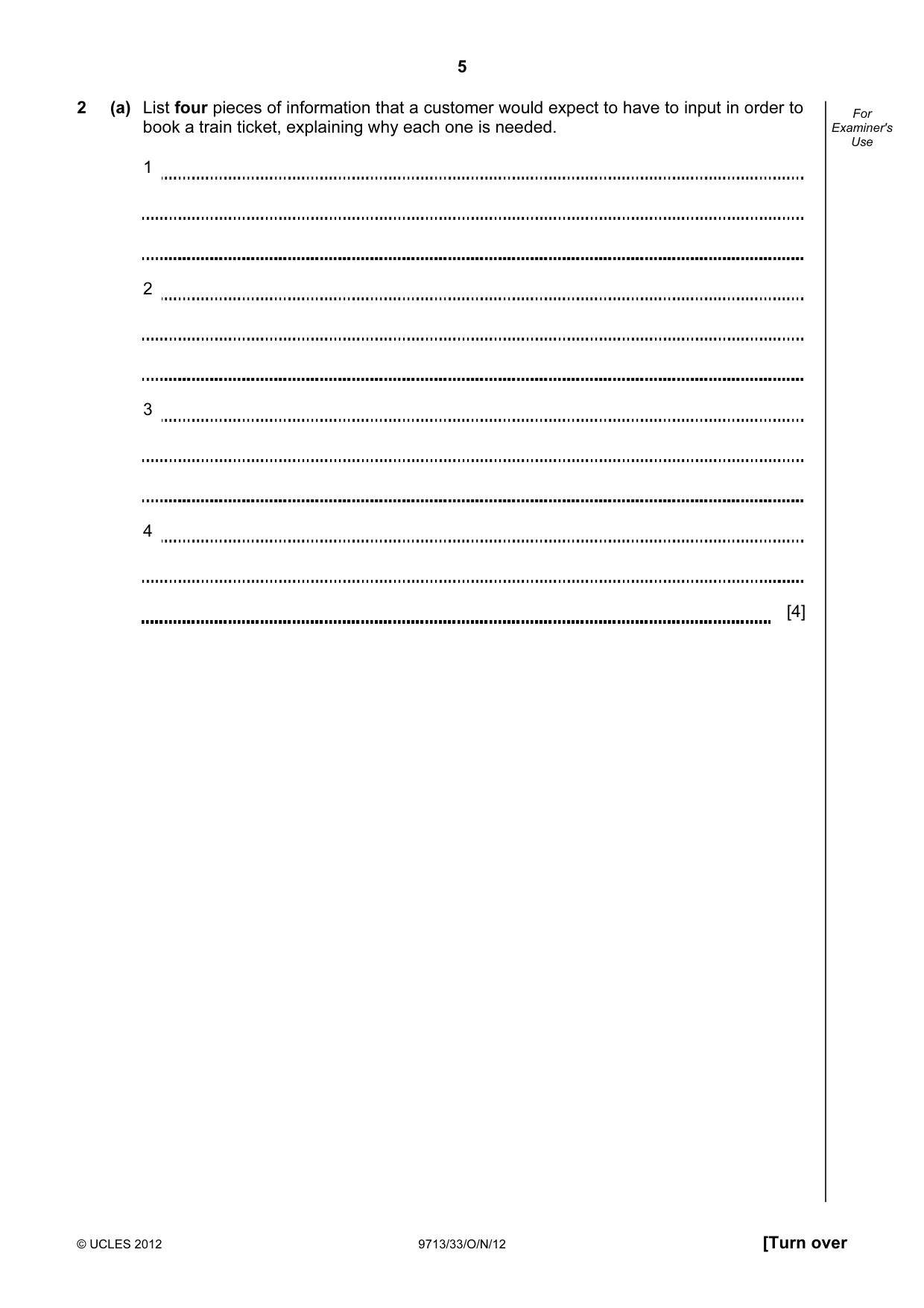
5 © UCLES 2012 9713/33/O/N/12 [Turn over For Examiner's Use 2 (a) List four pieces of information that a customer would expect to have to input in order to book a train ticket, explaining why each one is needed. 1 2 3 4 [4]
Question paper, page 6
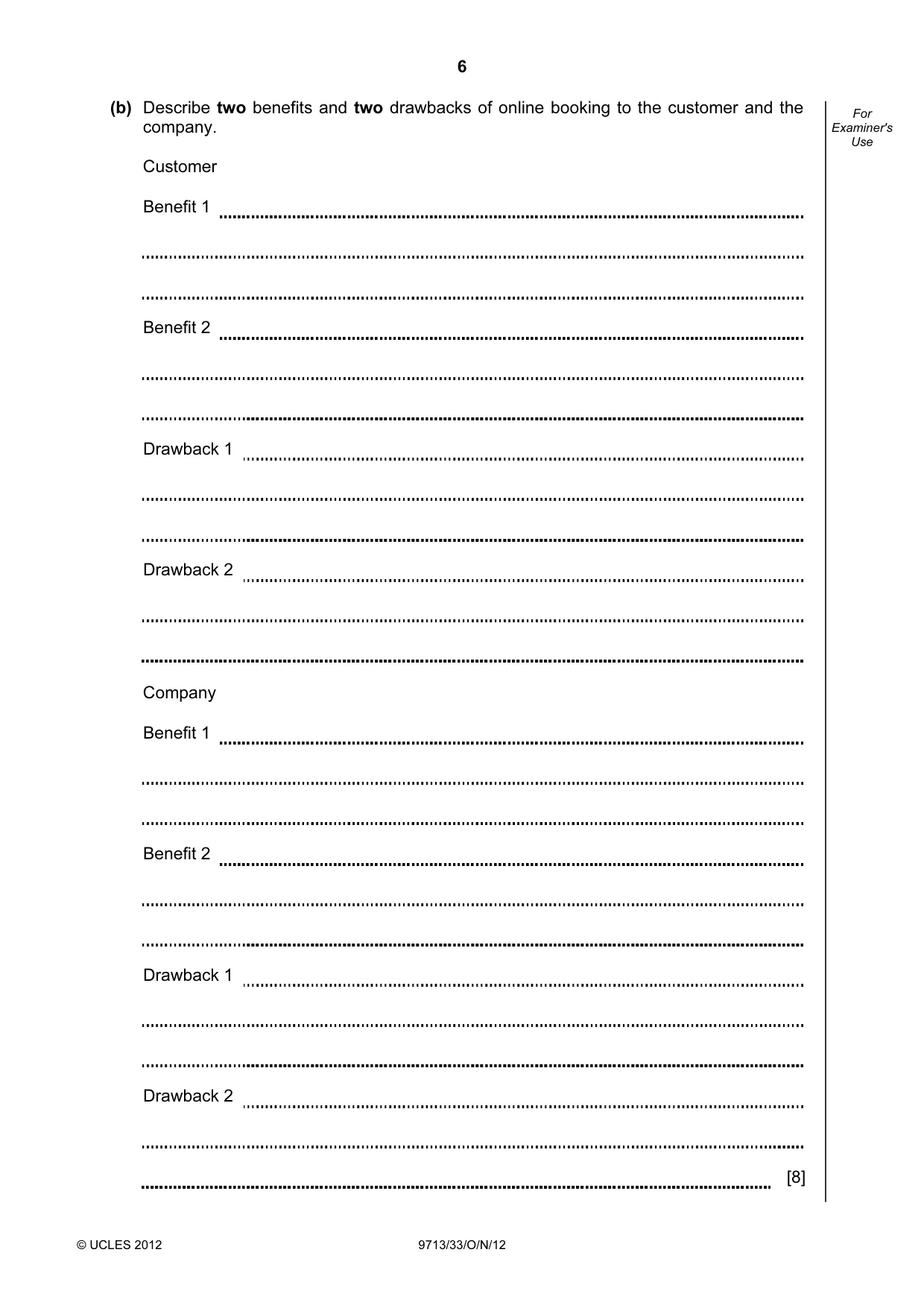
6 © UCLES 2012 9713/33/O/N/12 For Examiner's Use (b) Describe two benefits and two drawbacks of online booking to the customer and the company. Customer Benefit 1 Benefit 2 Drawback 1 Drawback 2 Company Benefit 1 Benefit 2 Drawback 1 Drawback 2 [8]
Question paper, page 7
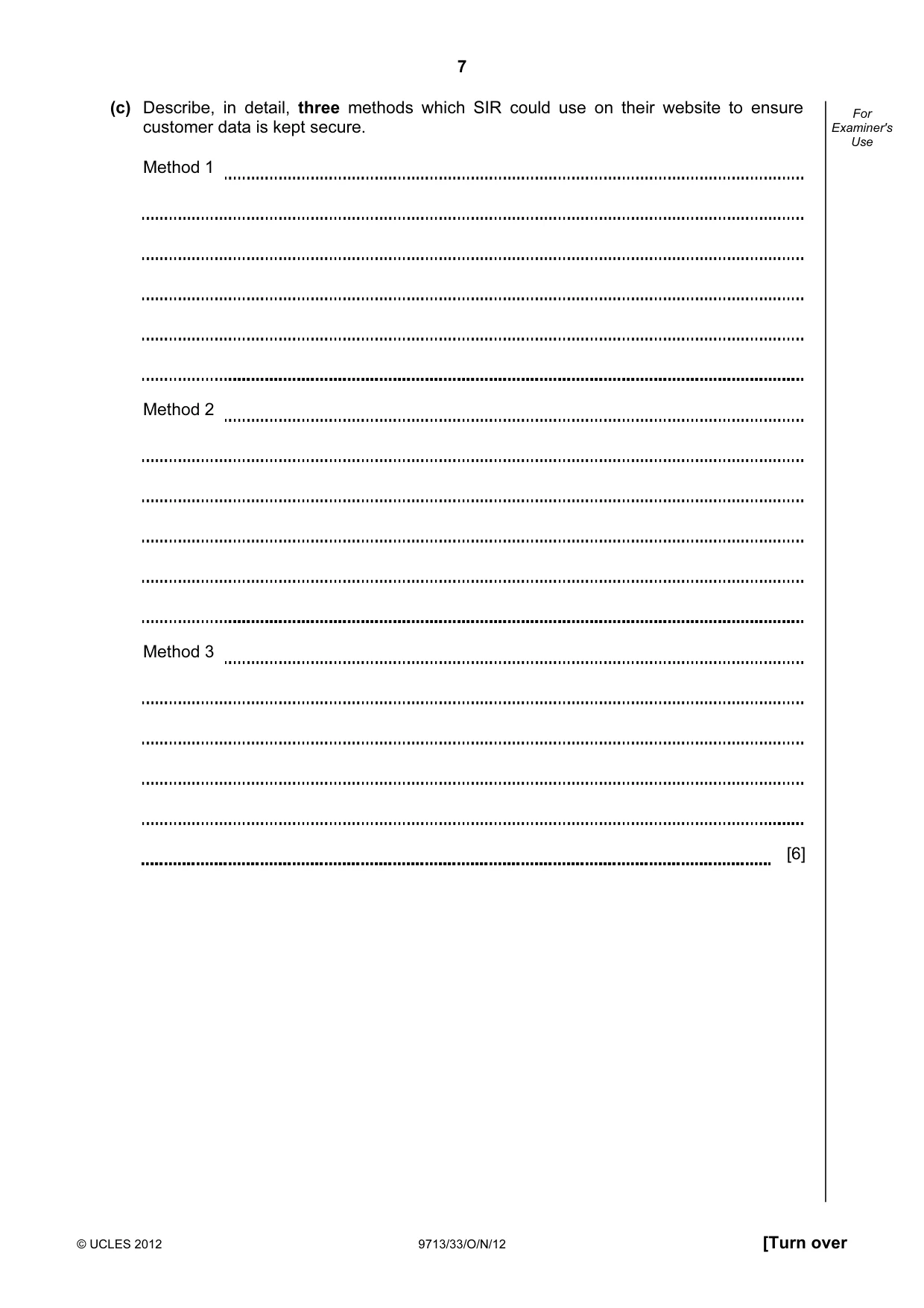
7 © UCLES 2012 9713/33/O/N/12 [Turn over For Examiner's Use (c) Describe, in detail, three methods which SIR could use on their website to ensure customer data is kept secure. Method 1 Method 2 Method 3 [6]
Question paper, page 8
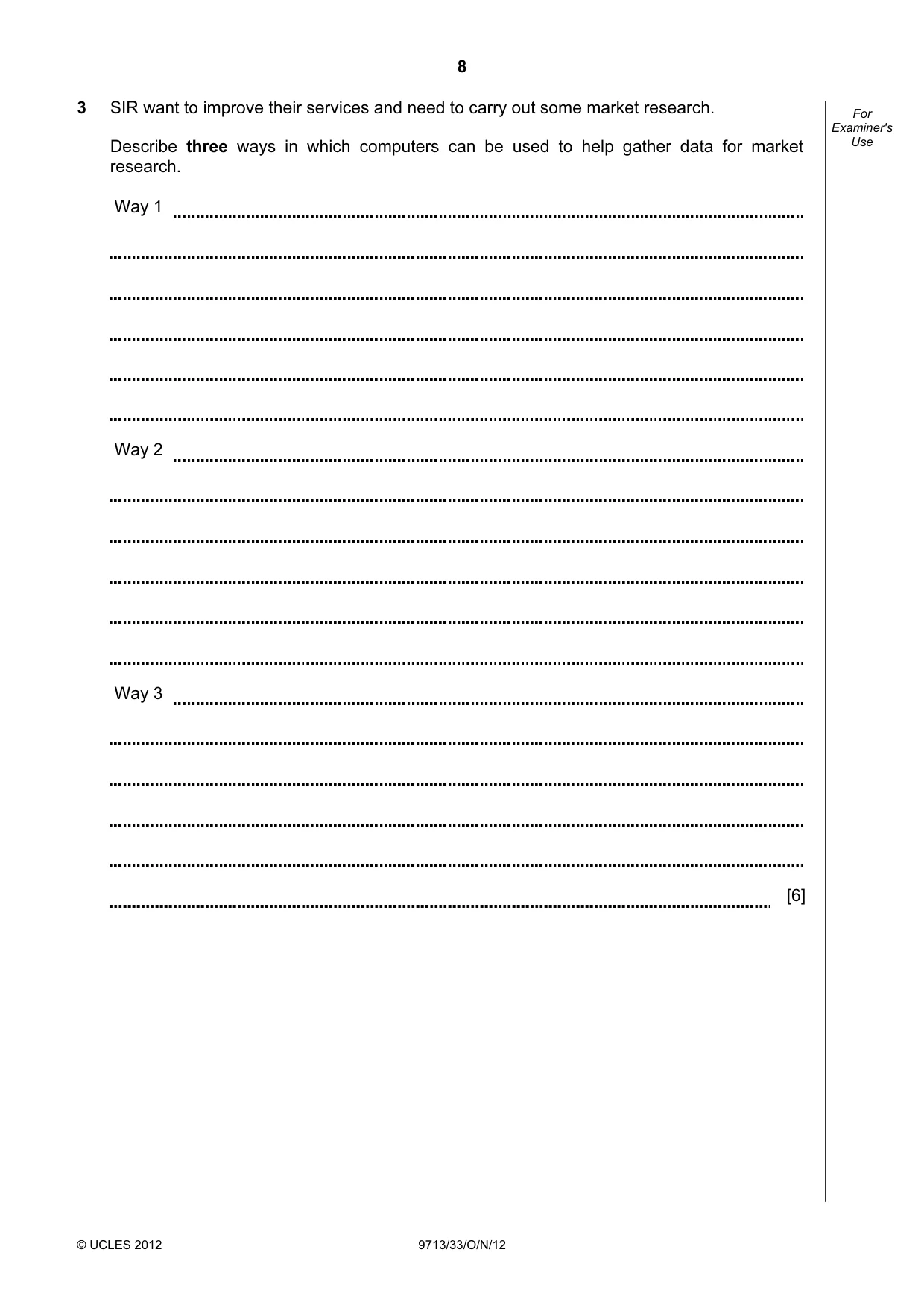
8 © UCLES 2012 9713/33/O/N/12 For Examiner's Use 3 SIR want to improve their services and need to carry out some market research. Describe three ways in which computers can be used to help gather data for market research. Way 1 Way 2 Way 3 [6]
Question paper, page 9
9 © UCLES 2012 9713/33/O/N/12 [Turn over For Examiner's Use Scenario 2 Questions 4, 5, 6 and 7 The government in Suntiki is concerned about the digital divide amongst its peoples. They are introducing a program of education for all people and want to encourage the more widespread use of computers. The government wants to provide online application systems for government-issued personal documents. They also want to manage income tax online.
Question paper, page 10
10 © UCLES 2012 9713/33/O/N/12 For Examiner's Use 4 (a) Explain what is meant by the ‘digital divide’. [2] (b) Describe three ways in which the digital divide affects the population. Way 1 Way 2 Way 3 [3]
Question paper, page 11
11 © UCLES 2012 9713/33/O/N/12 [Turn over For Examiner's Use 5 (a) Describe the benefits and drawbacks of using computers for teaching and learning. [8]
Question paper, page 12
12 © UCLES 2012 9713/33/O/N/12 For Examiner's Use (b) Explain how ICT systems can be used to monitor students’ progress. [6]
Question paper, page 13
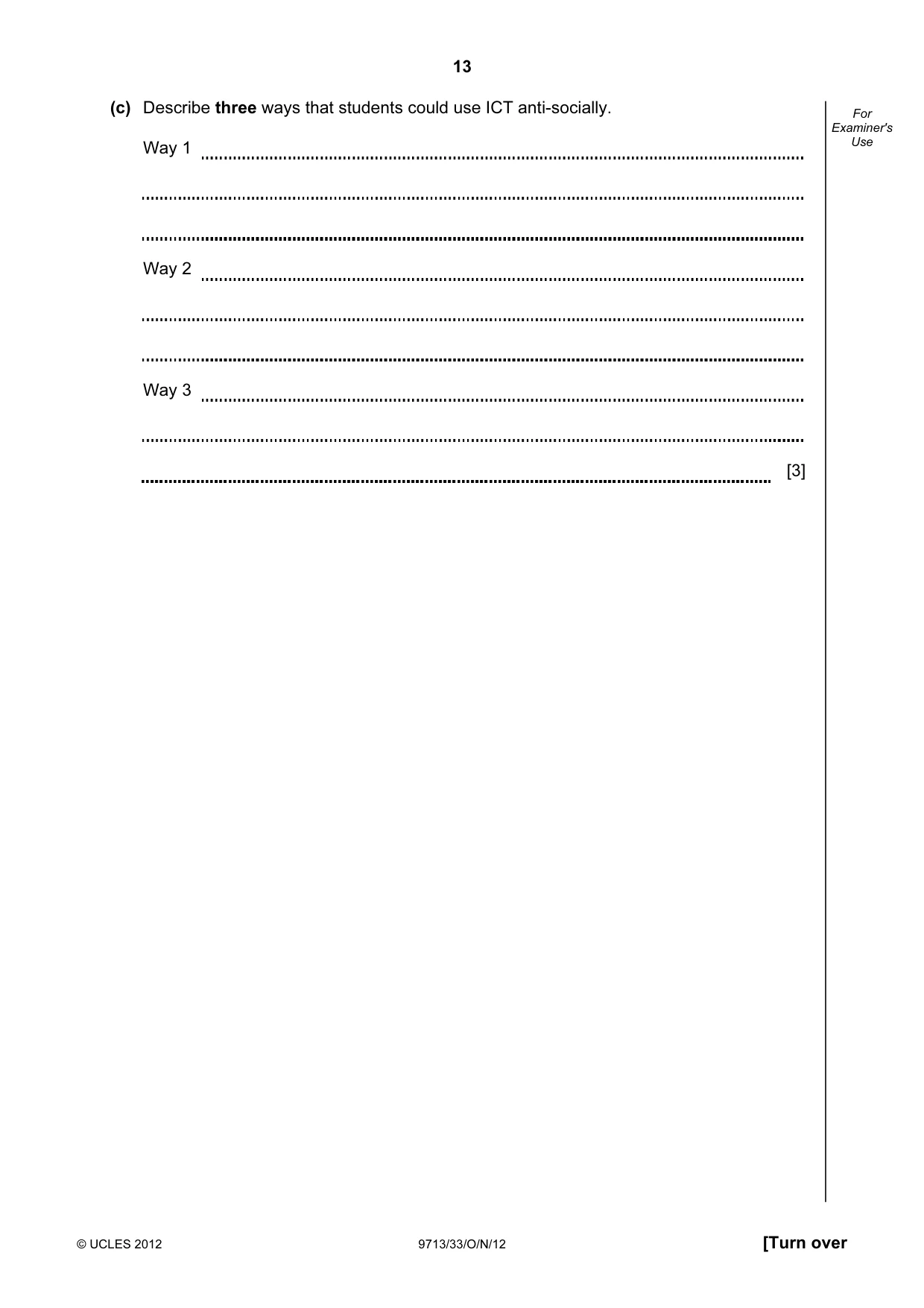
13 © UCLES 2012 9713/33/O/N/12 [Turn over For Examiner's Use (c) Describe three ways that students could use ICT anti-socially. Way 1 Way 2 Way 3 [3]
Question paper, page 14
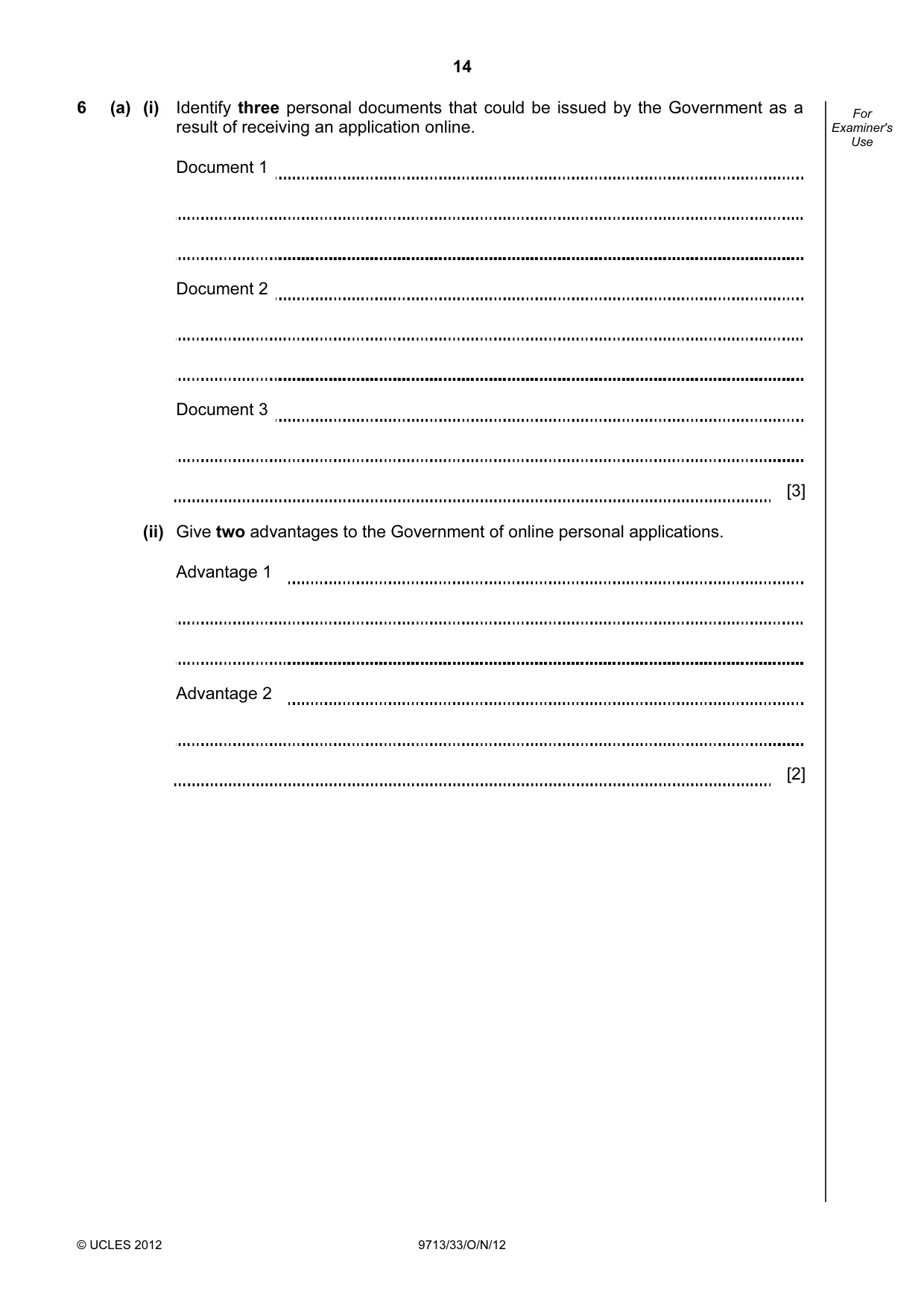
14 © UCLES 2012 9713/33/O/N/12 For Examiner's Use 6 (a) (i) Identify three personal documents that could be issued by the Government as a result of receiving an application online. Document 1 Document 2 Document 3 [3] (ii) Give two advantages to the Government of online personal applications. Advantage 1 Advantage 2 [2]
Question paper, page 15
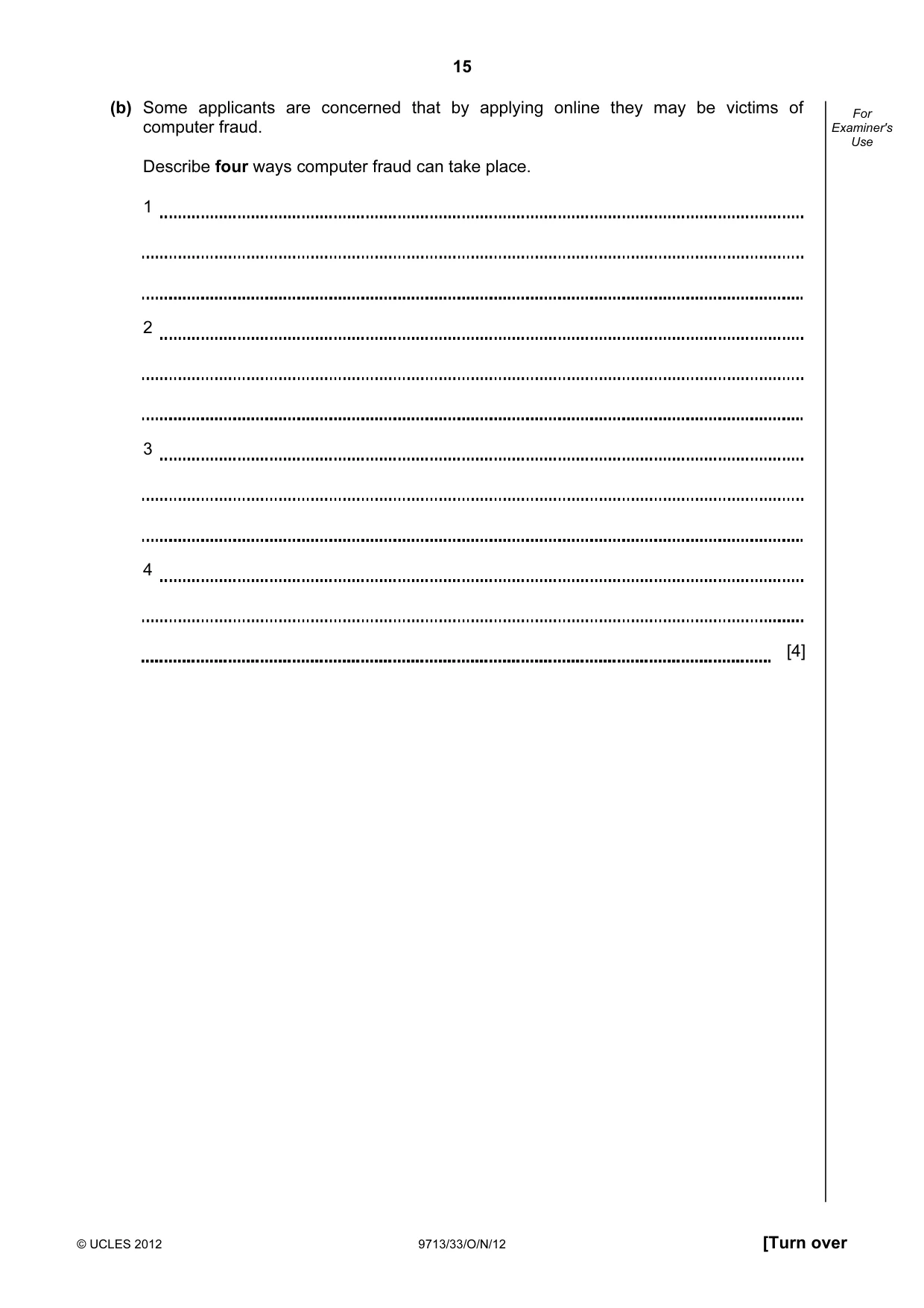
15 © UCLES 2012 9713/33/O/N/12 [Turn over For Examiner's Use (b) Some applicants are concerned that by applying online they may be victims of computer fraud. Describe four ways computer fraud can take place. 1 2 3 4 [4]
Question paper, page 16
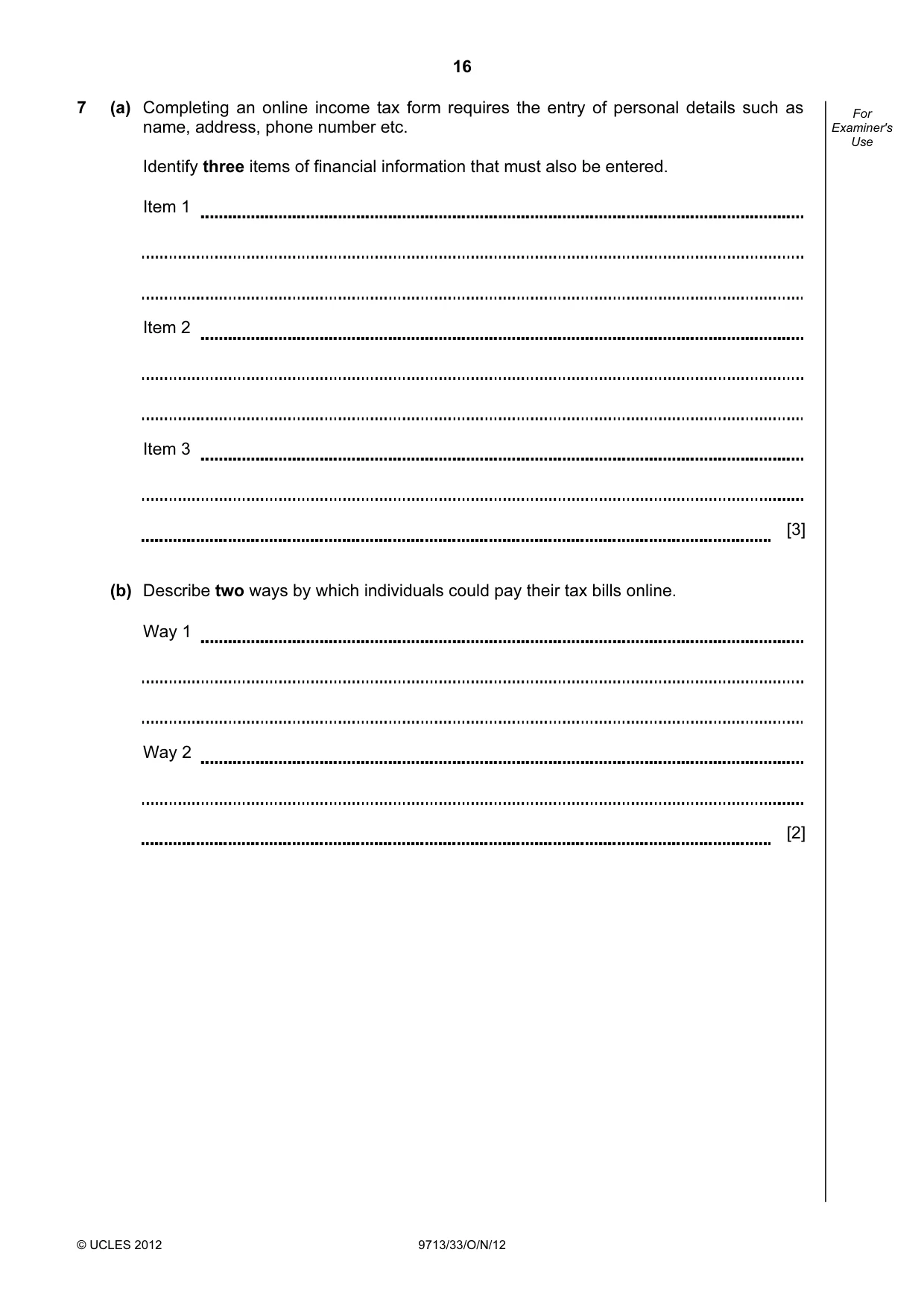
16 © UCLES 2012 9713/33/O/N/12 For Examiner's Use 7 (a) Completing an online income tax form requires the entry of personal details such as name, address, phone number etc. Identify three items of financial information that must also be entered. Item 1 Item 2 Item 3 [3] (b) Describe two ways by which individuals could pay their tax bills online. Way 1 Way 2 [2]
Question paper, page 17
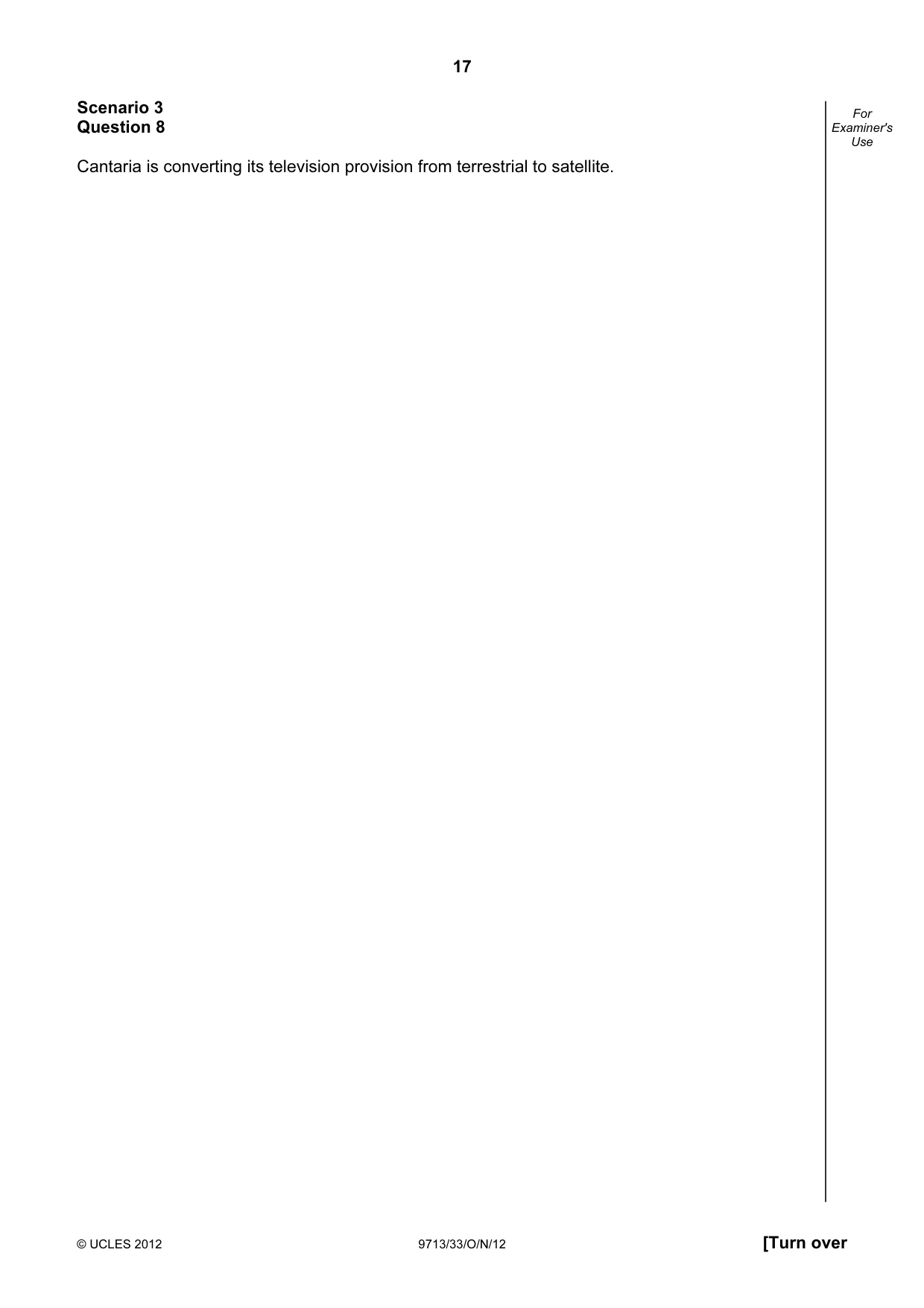
17 © UCLES 2012 9713/33/O/N/12 [Turn over For Examiner's Use Scenario 3 Question 8 Cantaria is converting its television provision from terrestrial to satellite.
Question paper, page 18
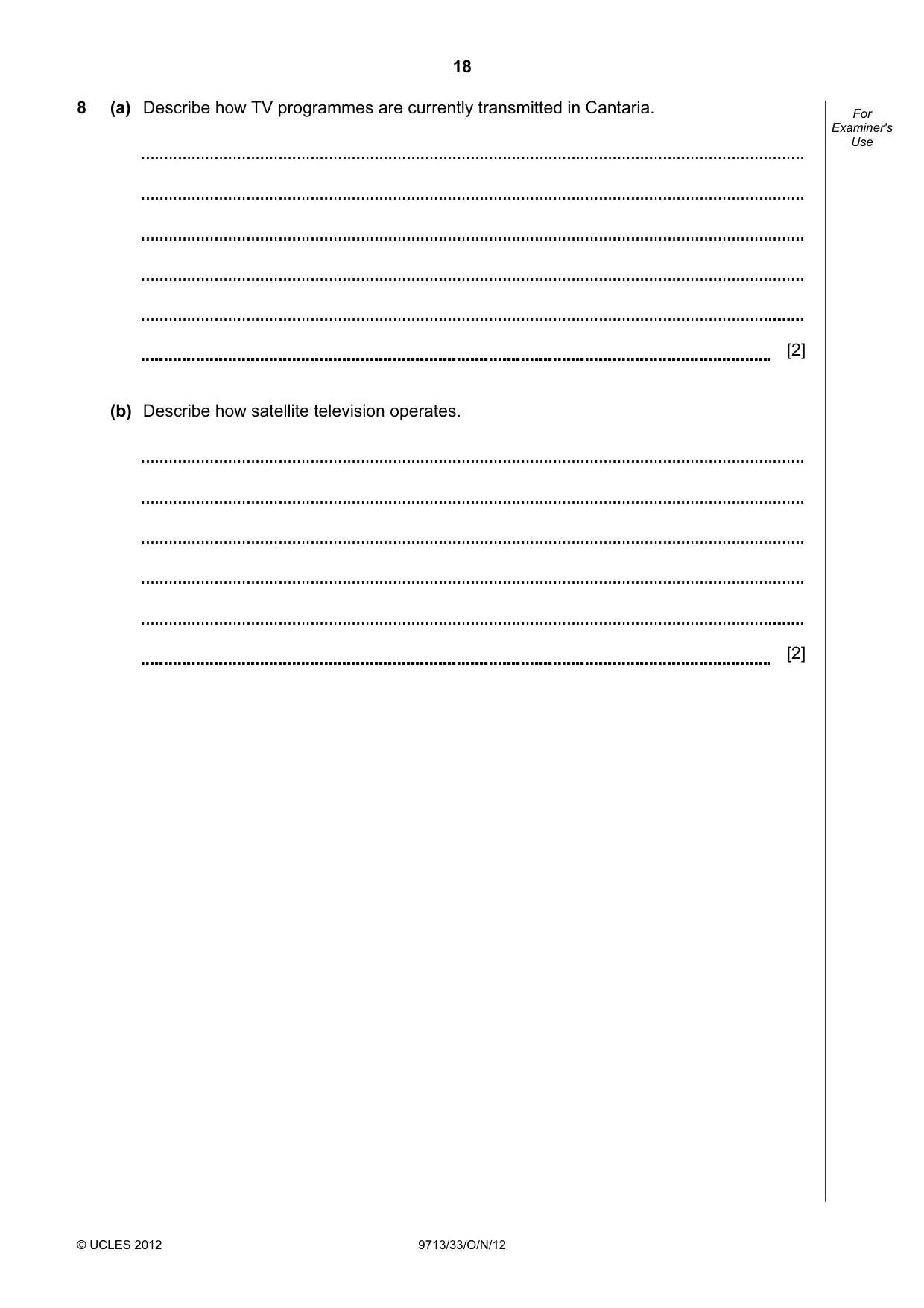
18 © UCLES 2012 9713/33/O/N/12 For Examiner's Use 8 (a) Describe how TV programmes are currently transmitted in Cantaria. [2] (b) Describe how satellite television operates. [2]
Question paper, page 19
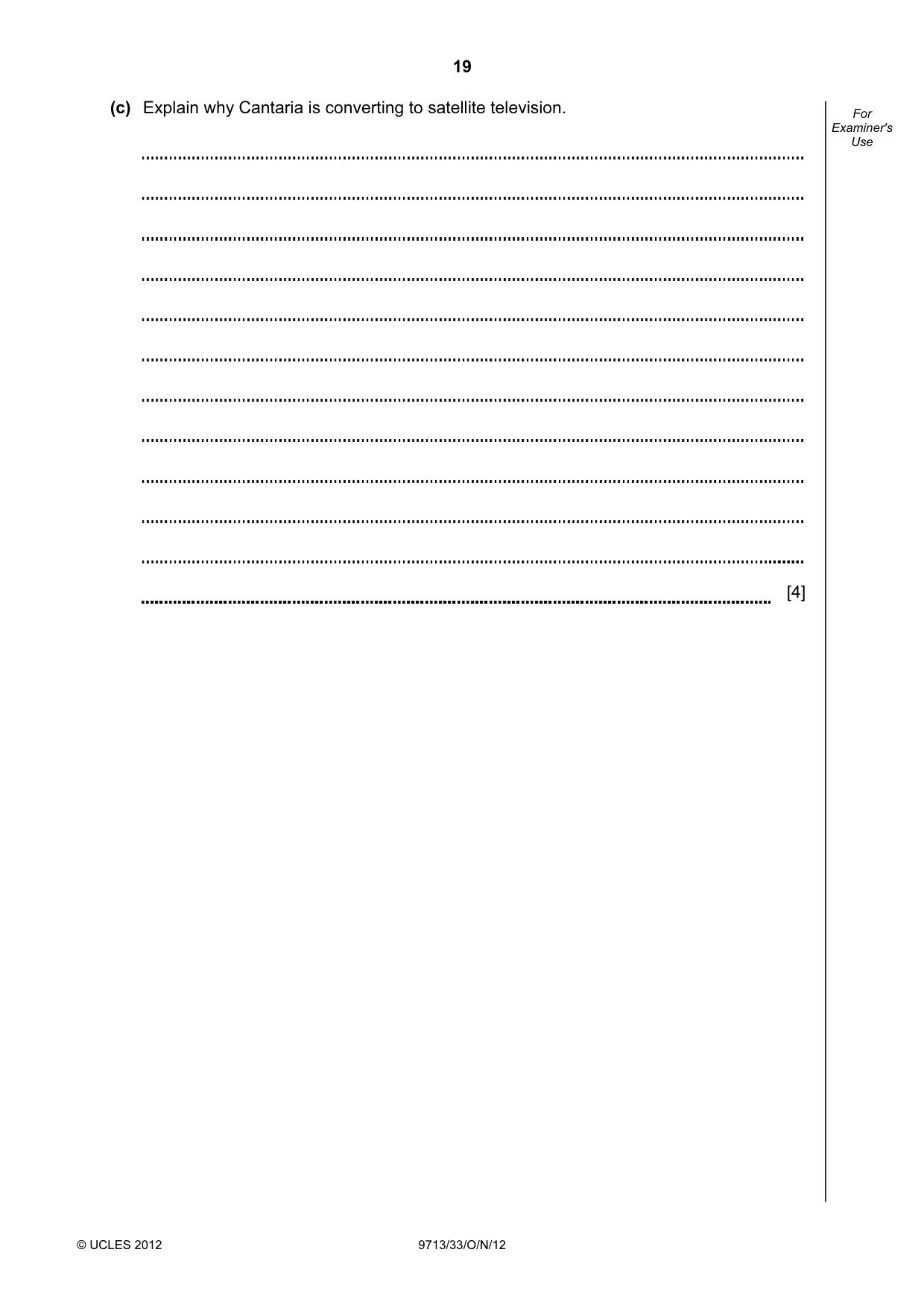
19 © UCLES 2012 9713/33/O/N/12 For Examiner's Use (c) Explain why Cantaria is converting to satellite television. [4]
Question paper, page 20
20 Permission to reproduce items where third-party owned material protected by copyright is included has been sought and cleared where possible. Every reasonable effort has been made by the publisher (UCLES) to trace copyright holders, but if any items requiring clearance have unwittingly been included, the publisher will be pleased to make amends at the earliest possible opportunity. University of Cambridge International Examinations is part of the Cambridge Assessment Group. Cambridge Assessment is the brand name of University of Cambridge Local Examinations Syndicate (UCLES), which is itself a department of the University of Cambridge. © UCLES 2012 9713/33/O/N/12 BLANK PAGE
Mark scheme, page 1
CAMBRIDGE INTERNATIONAL EXAMINATIONS GCE Advanced Subsidiary Level and GCE Advanced Level MARK SCHEME for the October/November 2012 series 9713 APPLIED ICT 9713/33 Paper 3 (Written B), maximum raw mark 80 This mark scheme is published as an aid to teachers and candidates, to indicate the requirements of the examination. It shows the basis on which Examiners were instructed to award marks. It does not indicate the details of the discussions that took place at an Examiners’ meeting before marking began, which would have considered the acceptability of alternative answers. Mark schemes should be read in conjunction with the question paper and the Principal Examiner Report for Teachers. Cambridge will not enter into discussions about these mark schemes. Cambridge is publishing the mark schemes for the October/November 2012 series for most IGCSE, GCE Advanced Level and Advanced Subsidiary Level components and some Ordinary Level components.
Mark scheme, page 2
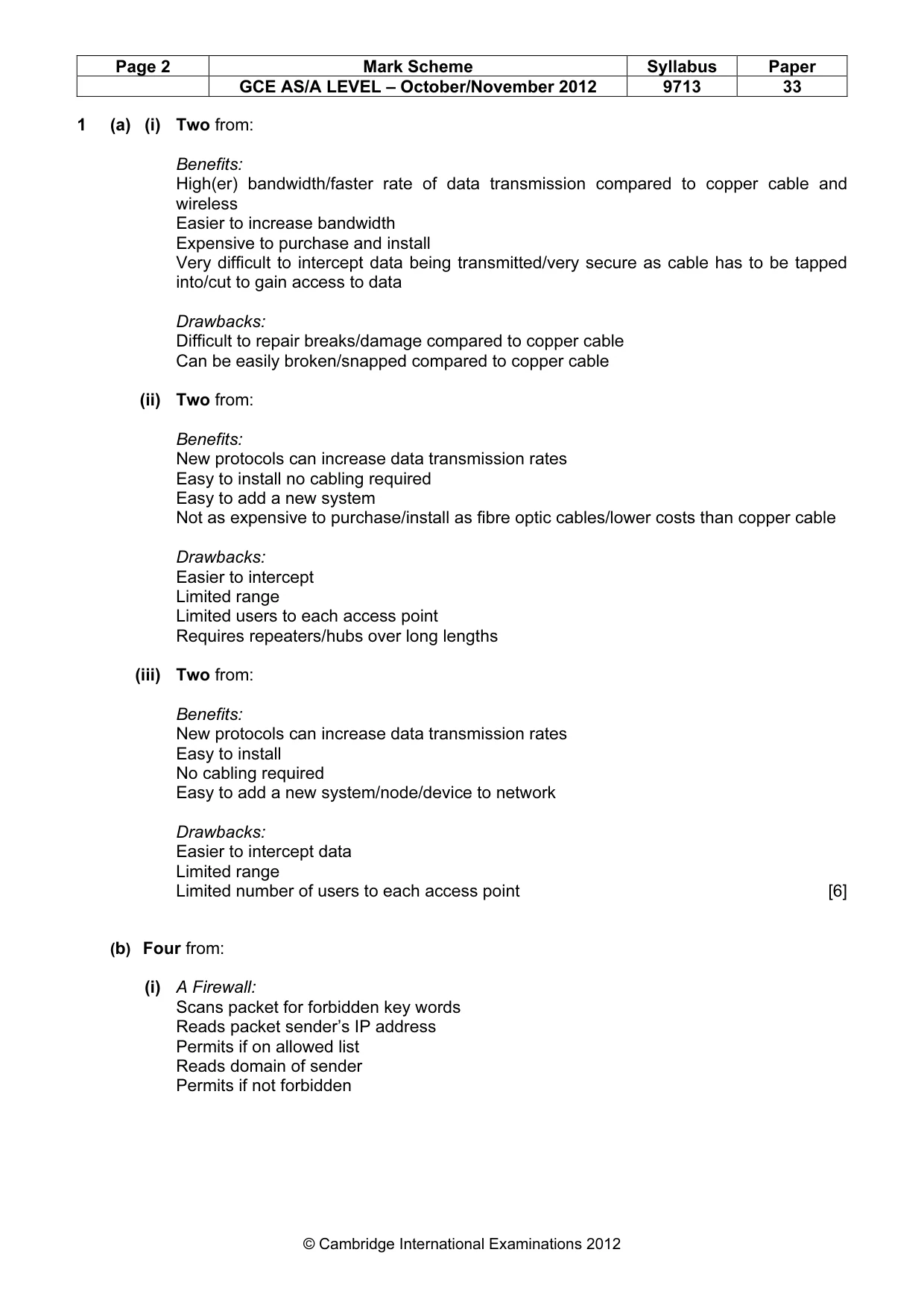
Page 2 Mark Scheme Syllabus Paper GCE AS/A LEVEL – October/November 2012 9713 33 © Cambridge International Examinations 2012 1 (a) (i) Two from: Benefits: High(er) bandwidth/faster rate of data transmission compared to copper cable and wireless Easier to increase bandwidth Expensive to purchase and install Very difficult to intercept data being transmitted/very secure as cable has to be tapped into/cut to gain access to data Drawbacks: Difficult to repair breaks/damage compared to copper cable Can be easily broken/snapped compared to copper cable (ii) Two from: Benefits: New protocols can increase data transmission rates Easy to install no cabling required Easy to add a new system Not as expensive to purchase/install as fibre optic cables/lower costs than copper cable Drawbacks: Easier to intercept Limited range Limited users to each access point Requires repeaters/hubs over long lengths (iii) Two from: Benefits: New protocols can increase data transmission rates Easy to install No cabling required Easy to add a new system/node/device to network Drawbacks: Easier to intercept data Limited range Limited number of users to each access point [6] (b) Four from: (i) A Firewall: Scans packet for forbidden key words Reads packet sender’s IP address Permits if on allowed list Reads domain of sender Permits if not forbidden
Mark scheme, page 3
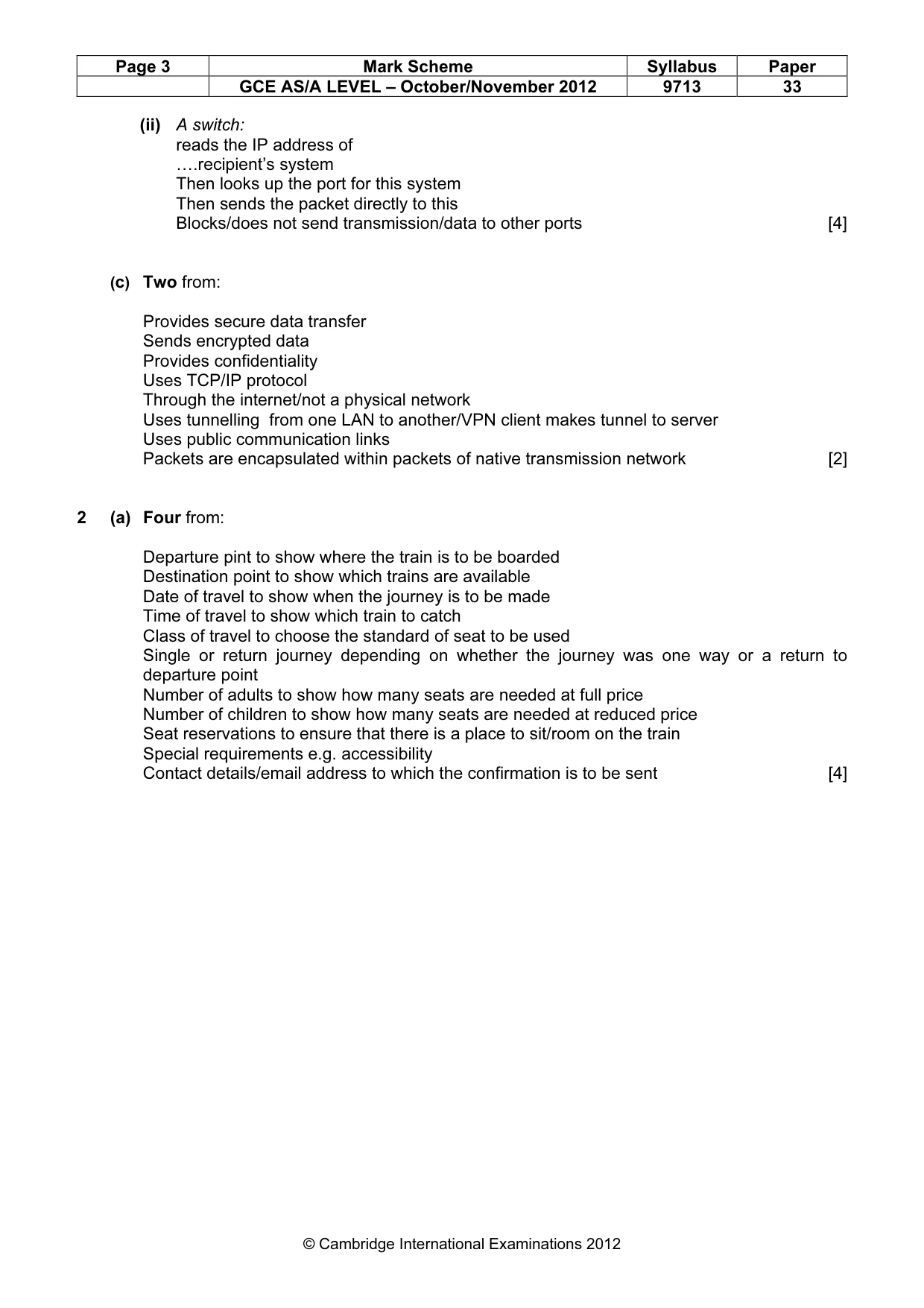
Page 3 Mark Scheme Syllabus Paper GCE AS/A LEVEL – October/November 2012 9713 33 © Cambridge International Examinations 2012 (ii) A switch: reads the IP address of ….recipient’s system Then looks up the port for this system Then sends the packet directly to this Blocks/does not send transmission/data to other ports [4] (c) Two from: Provides secure data transfer Sends encrypted data Provides confidentiality Uses TCP/IP protocol Through the internet/not a physical network Uses tunnelling from one LAN to another/VPN client makes tunnel to server Uses public communication links Packets are encapsulated within packets of native transmission network [2] 2 (a) Four from: Departure pint to show where the train is to be boarded Destination point to show which trains are available Date of travel to show when the journey is to be made Time of travel to show which train to catch Class of travel to choose the standard of seat to be used Single or return journey depending on whether the journey was one way or a return to departure point Number of adults to show how many seats are needed at full price Number of children to show how many seats are needed at reduced price Seat reservations to ensure that there is a place to sit/room on the train Special requirements e.g. accessibility Contact details/email address to which the confirmation is to be sent [4]
Mark scheme, page 4
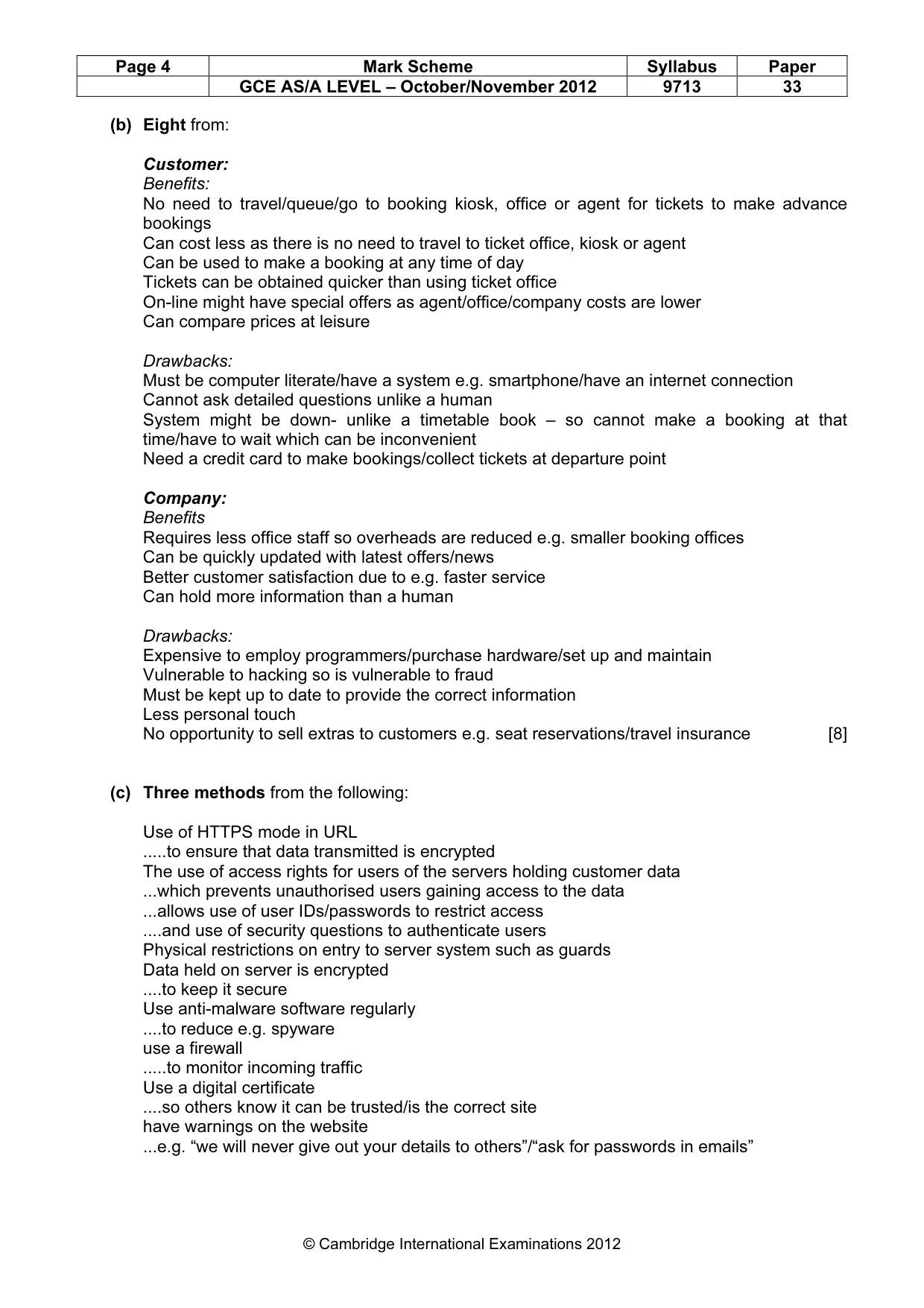
Page 4 Mark Scheme Syllabus Paper GCE AS/A LEVEL – October/November 2012 9713 33 © Cambridge International Examinations 2012 (b) Eight from: Customer: Benefits: No need to travel/queue/go to booking kiosk, office or agent for tickets to make advance bookings Can cost less as there is no need to travel to ticket office, kiosk or agent Can be used to make a booking at any time of day Tickets can be obtained quicker than using ticket office On-line might have special offers as agent/office/company costs are lower Can compare prices at leisure Drawbacks: Must be computer literate/have a system e.g. smartphone/have an internet connection Cannot ask detailed questions unlike a human System might be down- unlike a timetable book – so cannot make a booking at that time/have to wait which can be inconvenient Need a credit card to make bookings/collect tickets at departure point Company: Benefits Requires less office staff so overheads are reduced e.g. smaller booking offices Can be quickly updated with latest offers/news Better customer satisfaction due to e.g. faster service Can hold more information than a human Drawbacks: Expensive to employ programmers/purchase hardware/set up and maintain Vulnerable to hacking so is vulnerable to fraud Must be kept up to date to provide the correct information Less personal touch No opportunity to sell extras to customers e.g. seat reservations/travel insurance [8] (c) Three methods from the following: Use of HTTPS mode in URL …to ensure that data transmitted is encrypted The use of access rights for users of the servers holding customer data ...which prevents unauthorised users gaining access to the data ...allows use of user IDs/passwords to restrict access …and use of security questions to authenticate users Physical restrictions on entry to server system such as guards Data held on server is encrypted …to keep it secure Use anti-malware software regularly …to reduce e.g. spyware use a firewall …to monitor incoming traffic Use a digital certificate …so others know it can be trusted/is the correct site have warnings on the website ...e.g. “we will never give out your details to others”/“ask for passwords in emails”
Mark scheme, page 5
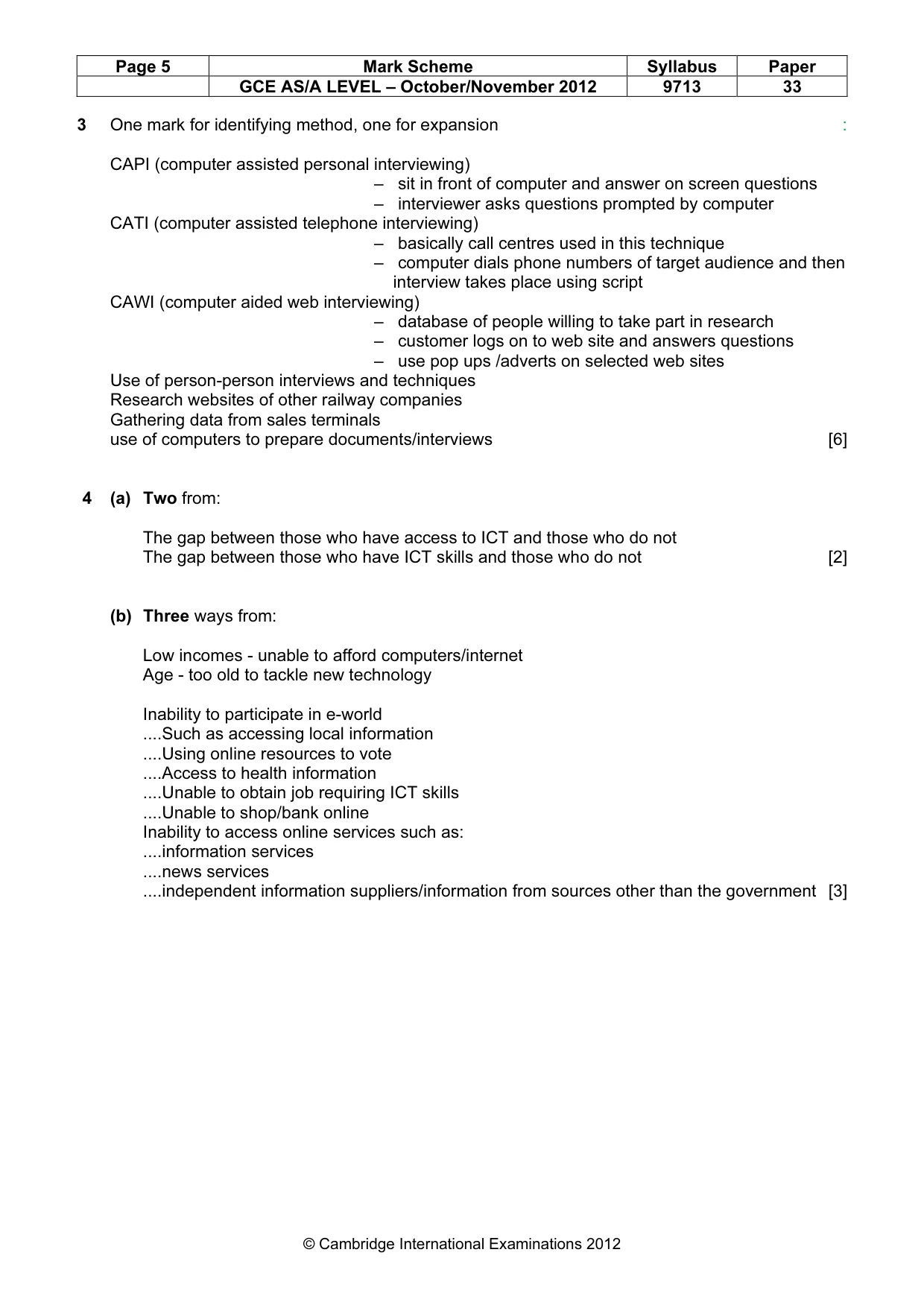
Page 5 Mark Scheme Syllabus Paper GCE AS/A LEVEL – October/November 2012 9713 33 © Cambridge International Examinations 2012 3 One mark for identifying method, one for expansion : CAPI (computer assisted personal interviewing) – sit in front of computer and answer on screen questions – interviewer asks questions prompted by computer CATI (computer assisted telephone interviewing) – basically call centres used in this technique – computer dials phone numbers of target audience and then interview takes place using script CAWI (computer aided web interviewing) – database of people willing to take part in research – customer logs on to web site and answers questions – use pop ups /adverts on selected web sites Use of person-person interviews and techniques Research websites of other railway companies Gathering data from sales terminals use of computers to prepare documents/interviews [6] 4 (a) Two from: The gap between those who have access to ICT and those who do not The gap between those who have ICT skills and those who do not [2] (b) Three ways from: Low incomes - unable to afford computers/internet Age - too old to tackle new technology Inability to participate in e-world …Such as accessing local information …Using online resources to vote …Access to health information …Unable to obtain job requiring ICT skills …Unable to shop/bank online Inability to access online services such as: …information services …news services …independent information suppliers/information from sources other than the government [3]
Mark scheme, page 6
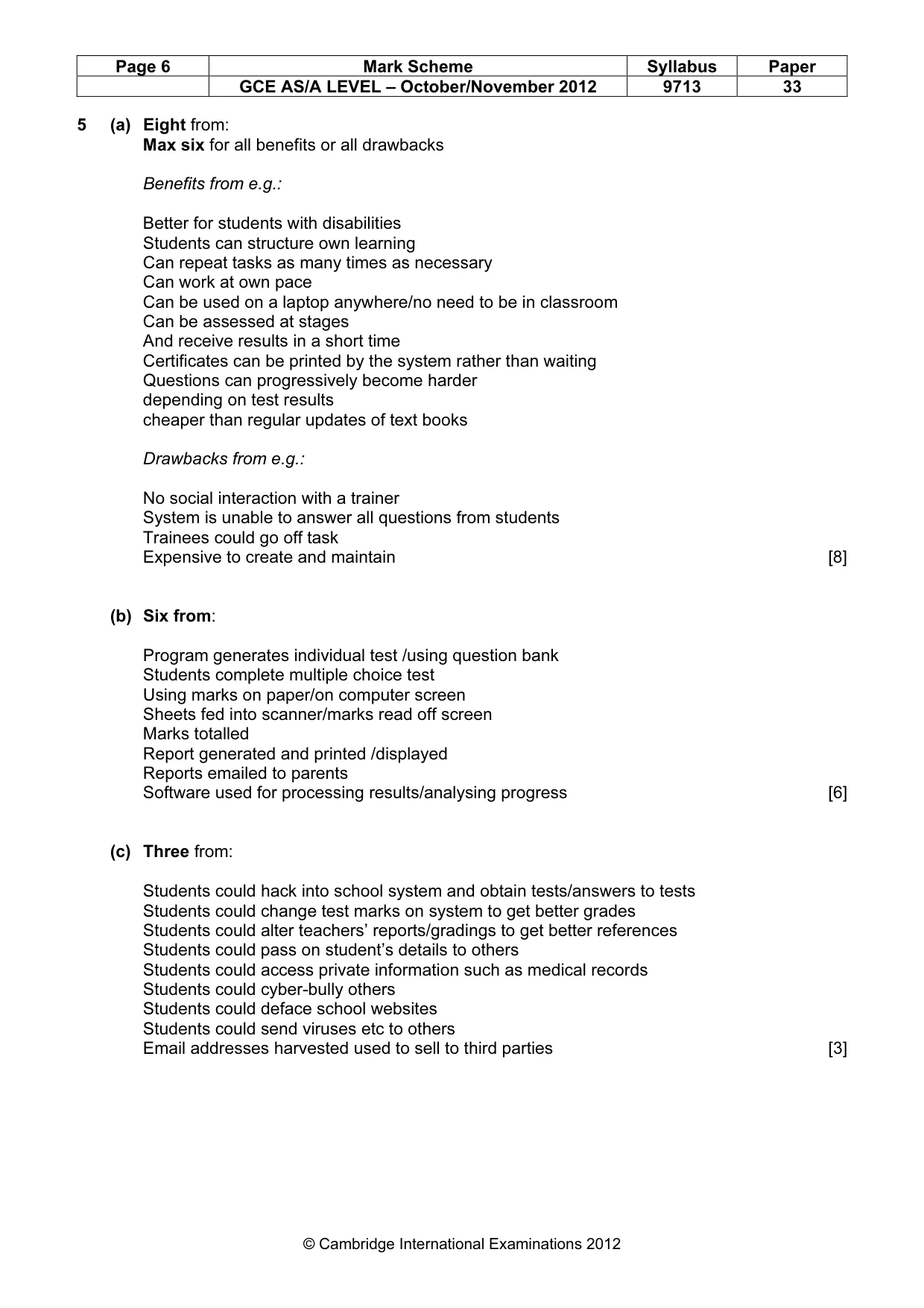
Page 6 Mark Scheme Syllabus Paper GCE AS/A LEVEL – October/November 2012 9713 33 © Cambridge International Examinations 2012 5 (a) Eight from: Max six for all benefits or all drawbacks Benefits from e.g.: Better for students with disabilities Students can structure own learning Can repeat tasks as many times as necessary Can work at own pace Can be used on a laptop anywhere/no need to be in classroom Can be assessed at stages And receive results in a short time Certificates can be printed by the system rather than waiting Questions can progressively become harder depending on test results cheaper than regular updates of text books Drawbacks from e.g.: No social interaction with a trainer System is unable to answer all questions from students Trainees could go off task Expensive to create and maintain [8] (b) Six from: Program generates individual test /using question bank Students complete multiple choice test Using marks on paper/on computer screen Sheets fed into scanner/marks read off screen Marks totalled Report generated and printed /displayed Reports emailed to parents Software used for processing results/analysing progress [6] (c) Three from: Students could hack into school system and obtain tests/answers to tests Students could change test marks on system to get better grades Students could alter teachers’ reports/gradings to get better references Students could pass on student’s details to others Students could access private information such as medical records Students could cyber-bully others Students could deface school websites Students could send viruses etc to others Email addresses harvested used to sell to third parties [3]
Mark scheme, page 7
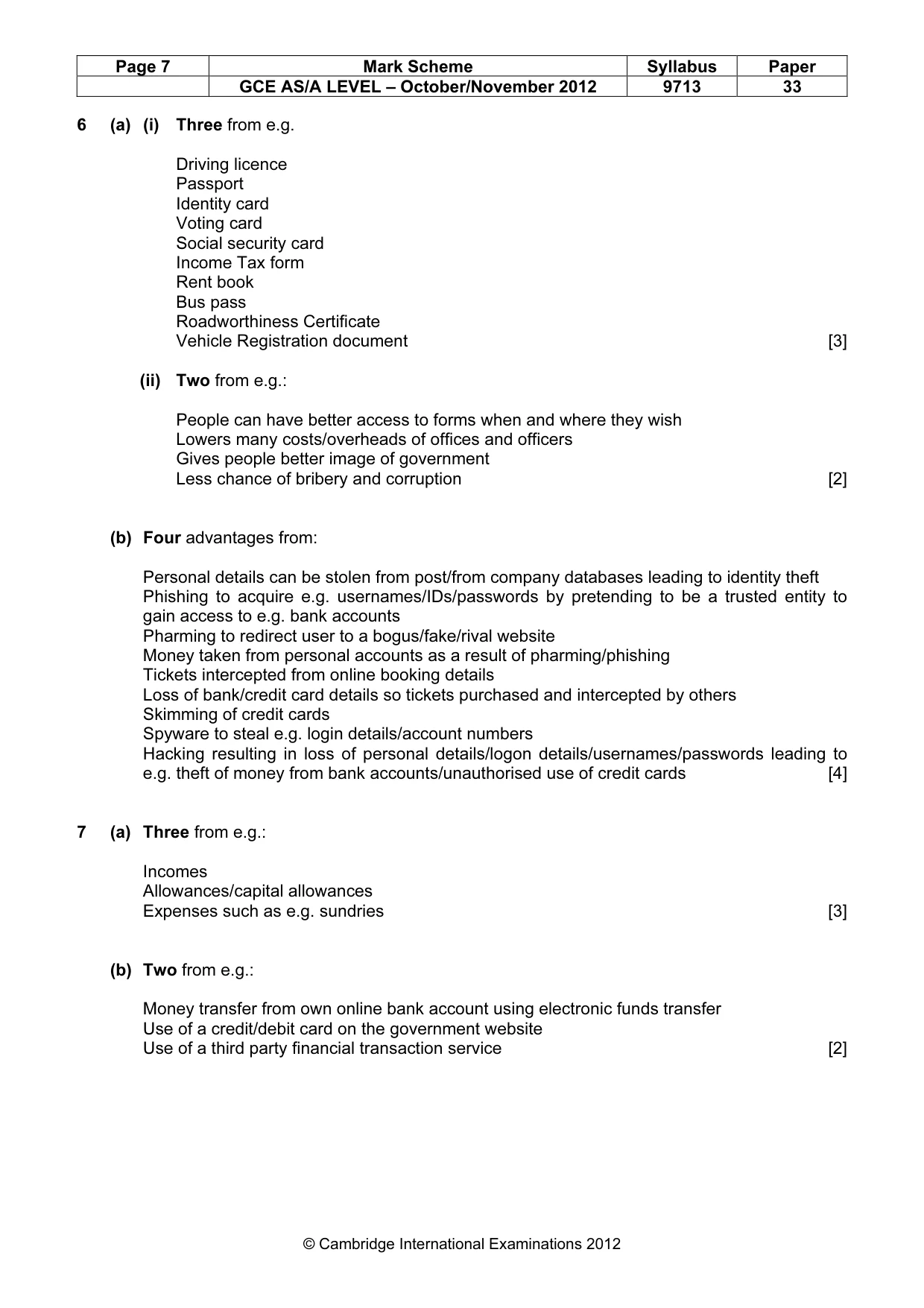
Page 7 Mark Scheme Syllabus Paper GCE AS/A LEVEL – October/November 2012 9713 33 © Cambridge International Examinations 2012 6 (a) (i) Three from e.g. Driving licence Passport Identity card Voting card Social security card Income Tax form Rent book Bus pass Roadworthiness Certificate Vehicle Registration document [3] (ii) Two from e.g.: People can have better access to forms when and where they wish Lowers many costs/overheads of offices and officers Gives people better image of government Less chance of bribery and corruption [2] (b) Four advantages from: Personal details can be stolen from post/from company databases leading to identity theft Phishing to acquire e.g. usernames/IDs/passwords by pretending to be a trusted entity to gain access to e.g. bank accounts Pharming to redirect user to a bogus/fake/rival website Money taken from personal accounts as a result of pharming/phishing Tickets intercepted from online booking details Loss of bank/credit card details so tickets purchased and intercepted by others Skimming of credit cards Spyware to steal e.g. login details/account numbers Hacking resulting in loss of personal details/logon details/usernames/passwords leading to e.g. theft of money from bank accounts/unauthorised use of credit cards [4] 7 (a) Three from e.g.: Incomes Allowances/capital allowances Expenses such as e.g. sundries [3] (b) Two from e.g.: Money transfer from own online bank account using electronic funds transfer Use of a credit/debit card on the government website Use of a third party financial transaction service [2]
Mark scheme, page 8
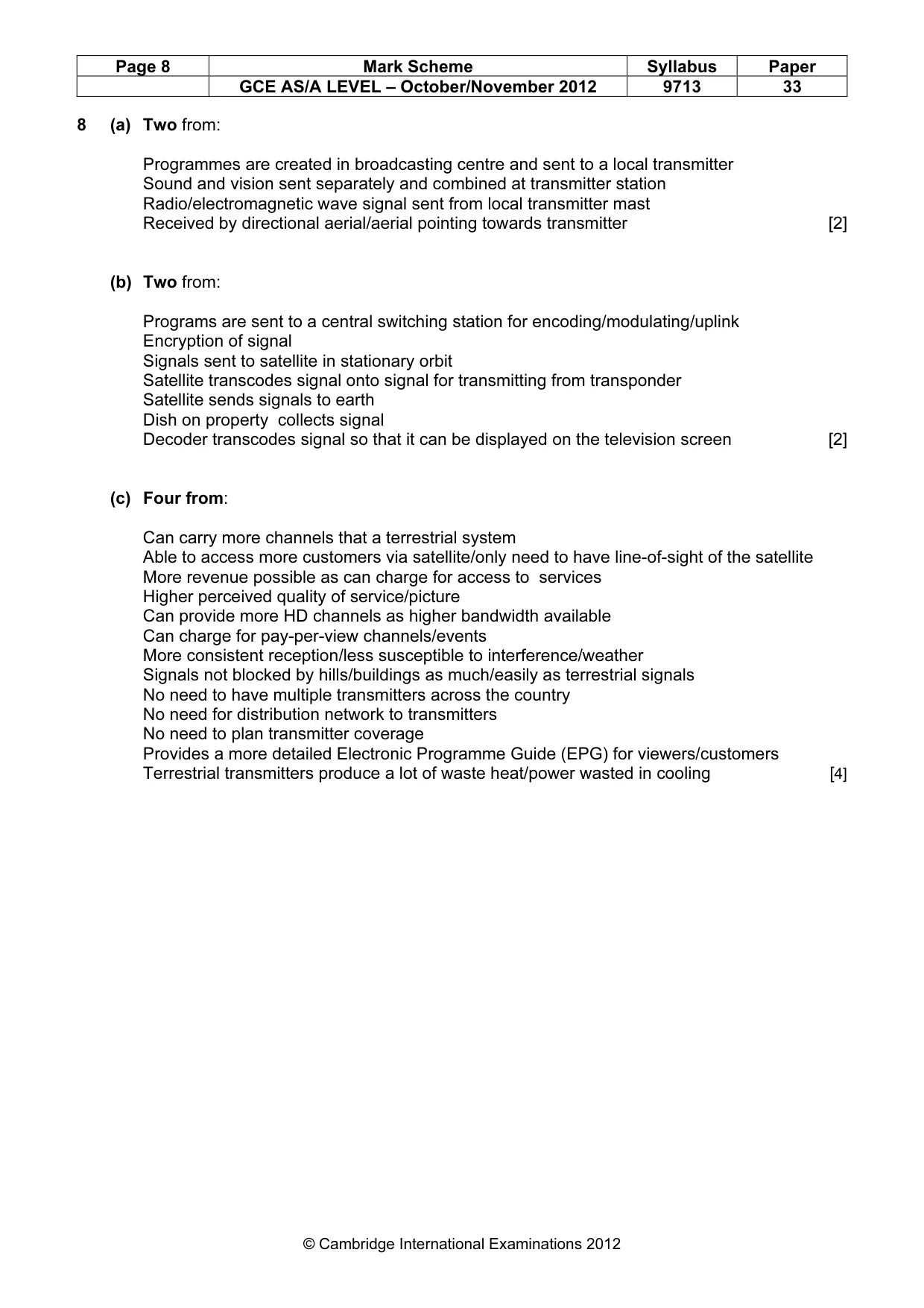
Page 8 Mark Scheme Syllabus Paper GCE AS/A LEVEL – October/November 2012 9713 33 © Cambridge International Examinations 2012 8 (a) Two from: Programmes are created in broadcasting centre and sent to a local transmitter Sound and vision sent separately and combined at transmitter station Radio/electromagnetic wave signal sent from local transmitter mast Received by directional aerial/aerial pointing towards transmitter [2] (b) Two from: Programs are sent to a central switching station for encoding/modulating/uplink Encryption of signal Signals sent to satellite in stationary orbit Satellite transcodes signal onto signal for transmitting from transponder Satellite sends signals to earth Dish on property collects signal Decoder transcodes signal so that it can be displayed on the television screen [2] (c) Four from: Can carry more channels that a terrestrial system Able to access more customers via satellite/only need to have line-of-sight of the satellite More revenue possible as can charge for access to services Higher perceived quality of service/picture Can provide more HD channels as higher bandwidth available Can charge for pay-per-view channels/events More consistent reception/less susceptible to interference/weather Signals not blocked by hills/buildings as much/easily as terrestrial signals No need to have multiple transmitters across the country No need for distribution network to transmitters No need to plan transmitter coverage Provides a more detailed Electronic Programme Guide (EPG) for viewers/customers Terrestrial transmitters produce a lot of waste heat/power wasted in cooling [4]
What you needed in this session
Cambridge’s own grade thresholds for 2012 Oct/Nov, Paper 3 · Variant 3. A higher threshold means an easier paper — the bar moves with how the cohort did.