Cambridge A Level Applied Information and Communication Technology 9713 — 2015 May/June Paper 3 · Variant 3
9713/33/M/J/15 · 80 marks · ≈90 min
The question paper and its mark scheme, free to read here and free to download. This is Cambridge’s own paper, exactly as it was sat.
Question paper16 pages







Mark scheme7 pages
Answers below. Sit the paper first if you are practising.
Paper as text
Question paper, page 1
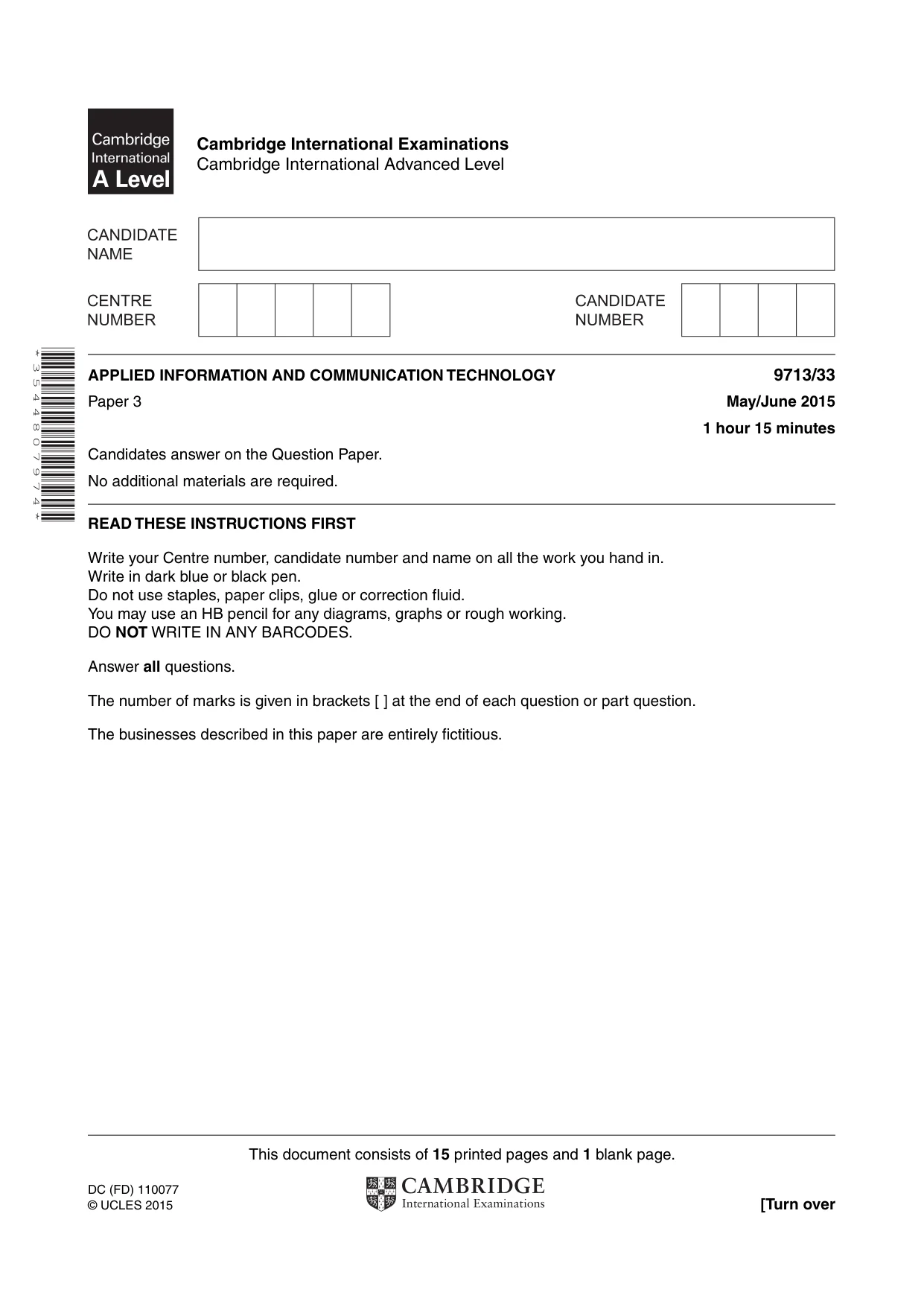
This document consists of 15 printed pages and 1 blank page. DC (FD) 110077 © UCLES 2015 [Turn over * 3 5 4 4 8 0 7 9 7 4 * APPLIED INFORMATION AND COMMUNICATION TECHNOLOGY 9713/33 Paper 3 May/June 2015 1 hour 15 minutes Candidates answer on the Question Paper. No additional materials are required. READ THESE INSTRUCTIONS FIRST Write your Centre number, candidate number and name on all the work you hand in. Write in dark blue or black pen. Do not use staples, paper clips, glue or correction fluid. You may use an HB pencil for any diagrams, graphs or rough working. DO NOT WRITE IN ANY BARCODES. Answer all questions. The number of marks is given in brackets [ ] at the end of each question or part question. The businesses described in this paper are entirely fictitious. Cambridge International Examinations Cambridge International Advanced Level
Question paper, page 2
2 9713/33/M/J/15 © UCLES 2015 Scenario 1 Questions 1, 2 and 3 Computer Assist is a company that provides computing facilities for disabled people. The computers allow disabled people to access the internet to view websites and to use commercial and government online services. The company provides additional, specialised hardware for its computers and specialised software is installed for use by disabled people.
Question paper, page 3
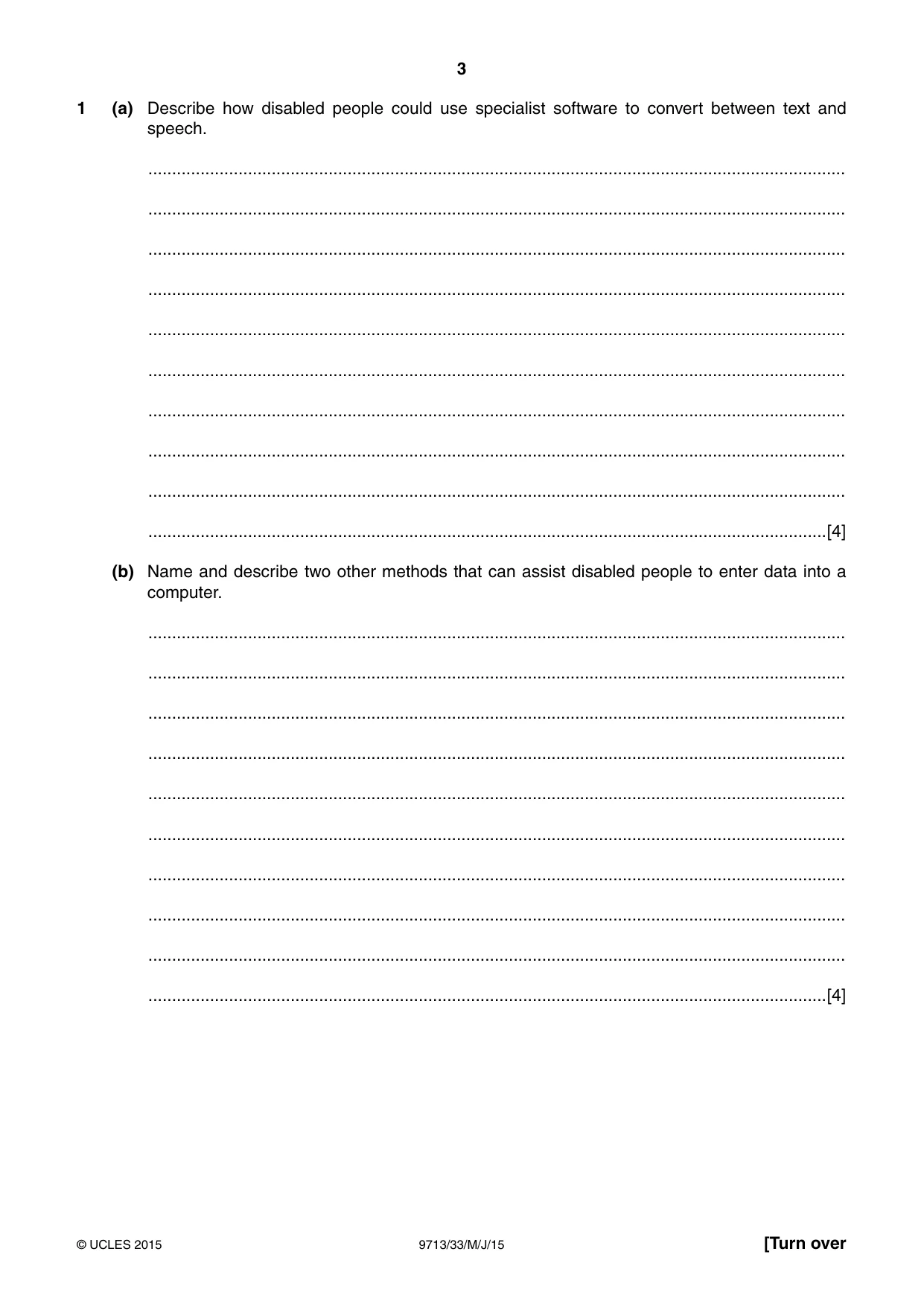
3 9713/33/M/J/15 © UCLES 2015 [Turn over 1 (a) Describe how disabled people could use specialist software to convert between text and speech. … … … … … … … … … …[4] (b) Name and describe two other methods that can assist disabled people to enter data into a computer. … … … … … … … … … …[4]
Question paper, page 4
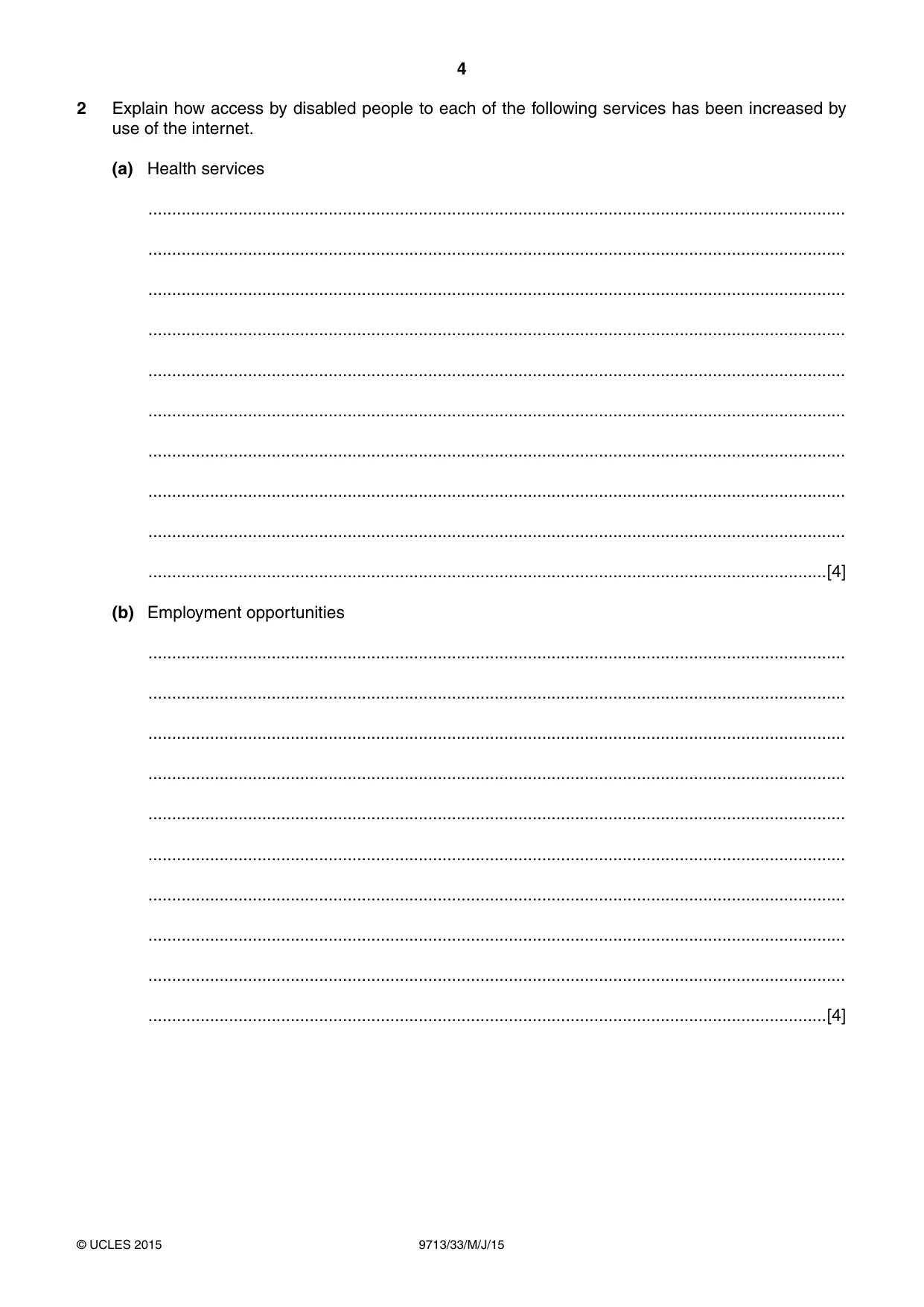
4 9713/33/M/J/15 © UCLES 2015 2 Explain how access by disabled people to each of the following services has been increased by use of the internet. (a) Health services … … … … … … … … … …[4] (b) Employment opportunities … … … … … … … … … …[4]
Question paper, page 5
5 9713/33/M/J/15 © UCLES 2015 [Turn over 3 Describe three features of some websites that could make it difficult for viewing by visually impaired people. 1 … … … … 2 … … … … 3 … … … …[6]
Question paper, page 6
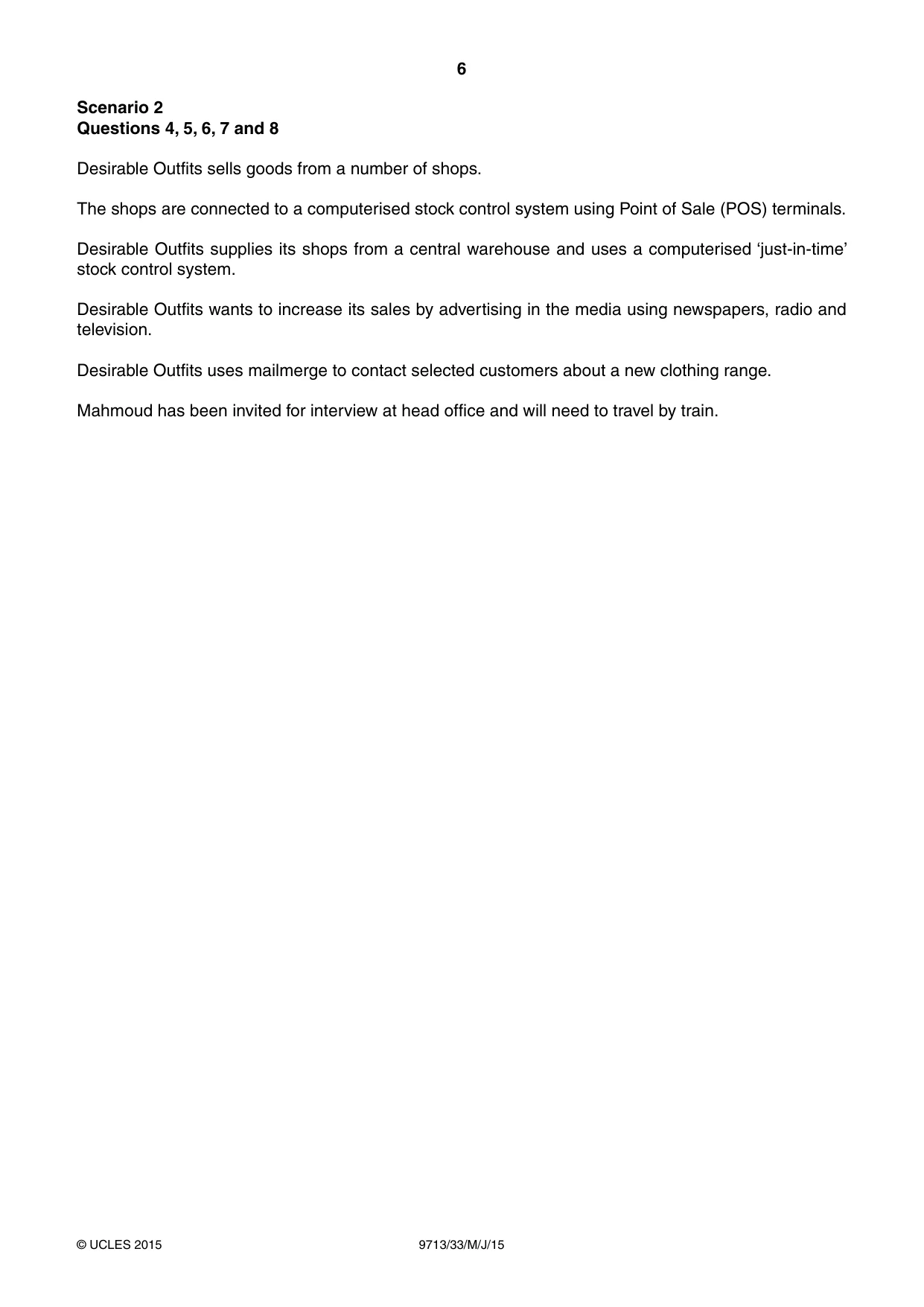
6 9713/33/M/J/15 © UCLES 2015 Scenario 2 Questions 4, 5, 6, 7 and 8 Desirable Outfits sells goods from a number of shops. The shops are connected to a computerised stock control system using Point of Sale (POS) terminals. Desirable Outfits supplies its shops from a central warehouse and uses a computerised ‘just-in-time’ stock control system. Desirable Outfits wants to increase its sales by advertising in the media using newspapers, radio and television. Desirable Outfits uses mailmerge to contact selected customers about a new clothing range. Mahmoud has been invited for interview at head office and will need to travel by train.
Question paper, page 7
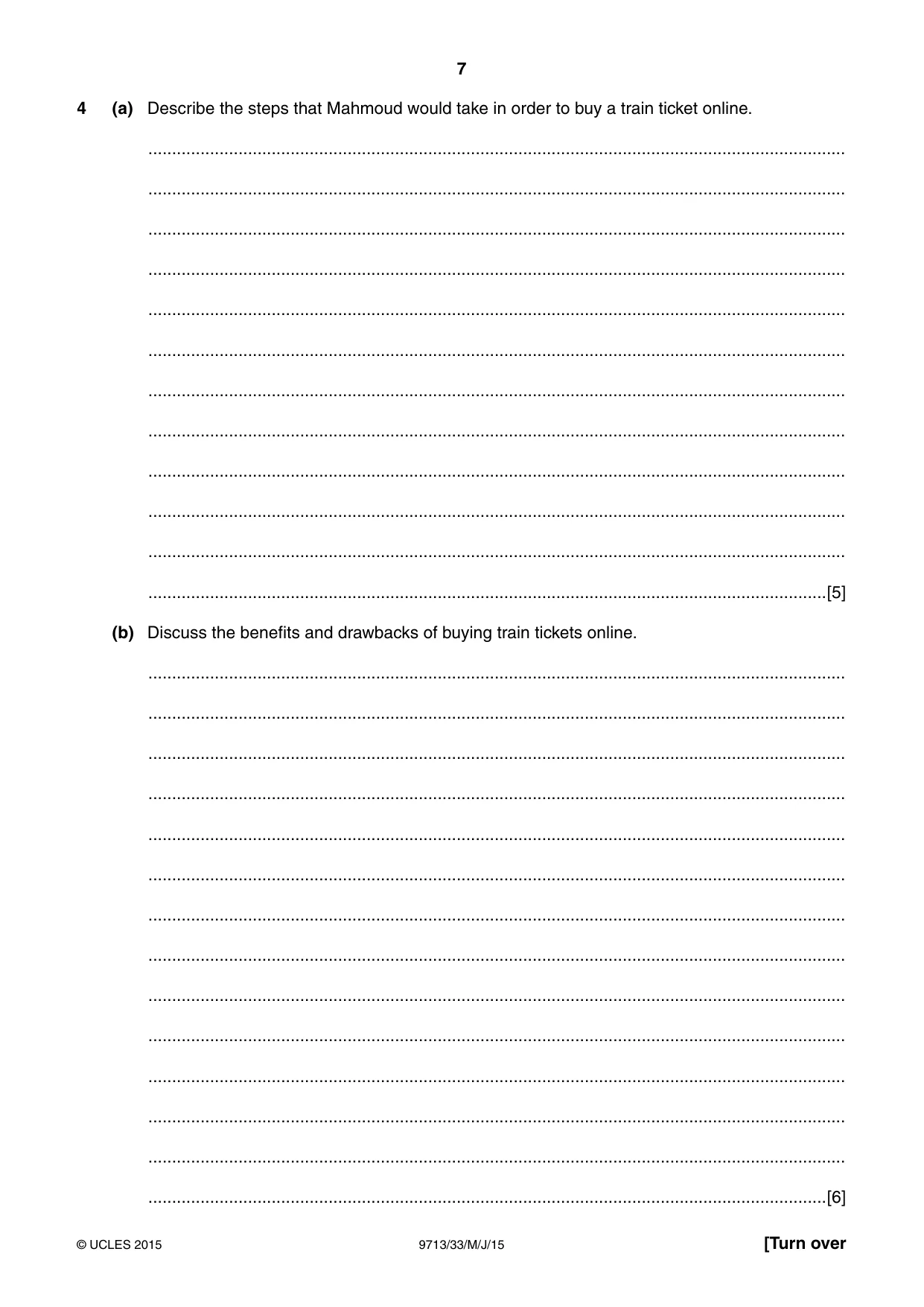
7 9713/33/M/J/15 © UCLES 2015 [Turn over 4 (a) Describe the steps that Mahmoud would take in order to buy a train ticket online. … … … … … … … … … … … …[5] (b) Discuss the benefits and drawbacks of buying train tickets online. … … … … … … … … … … … … … …[6]
Question paper, page 8
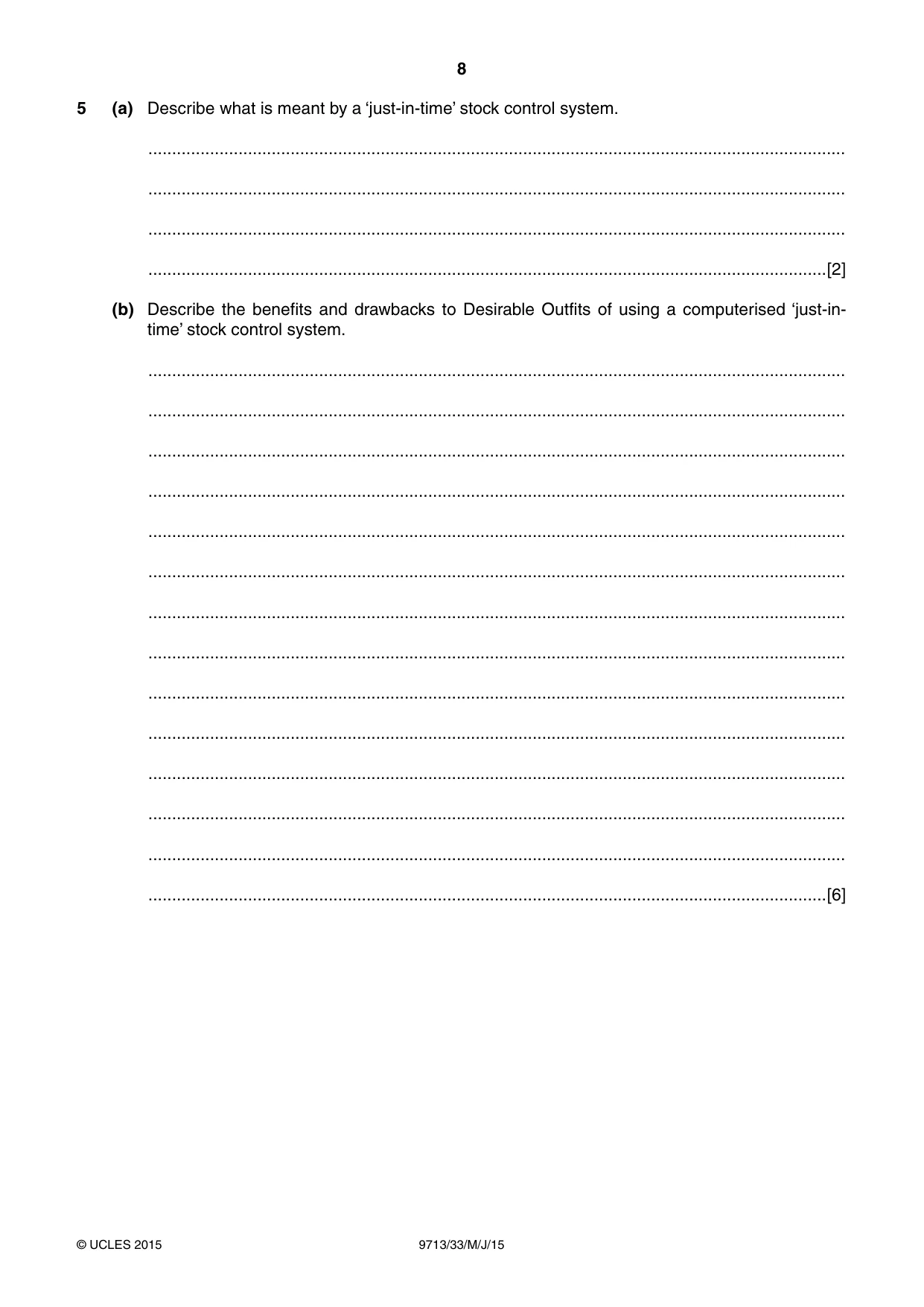
8 9713/33/M/J/15 © UCLES 2015 5 (a) Describe what is meant by a ‘just-in-time’ stock control system. … … … …[2] (b) Describe the benefits and drawbacks to Desirable Outfits of using a computerised ‘just-in- time’ stock control system. … … … … … … … … … … … … … …[6]
Question paper, page 9
9 9713/33/M/J/15 © UCLES 2015 [Turn over 6 Describe how variable fields are set up in the mailmerge to control the selection of customers who will receive the information about the new clothing range. … … … … … … … … … …[4]
Question paper, page 10
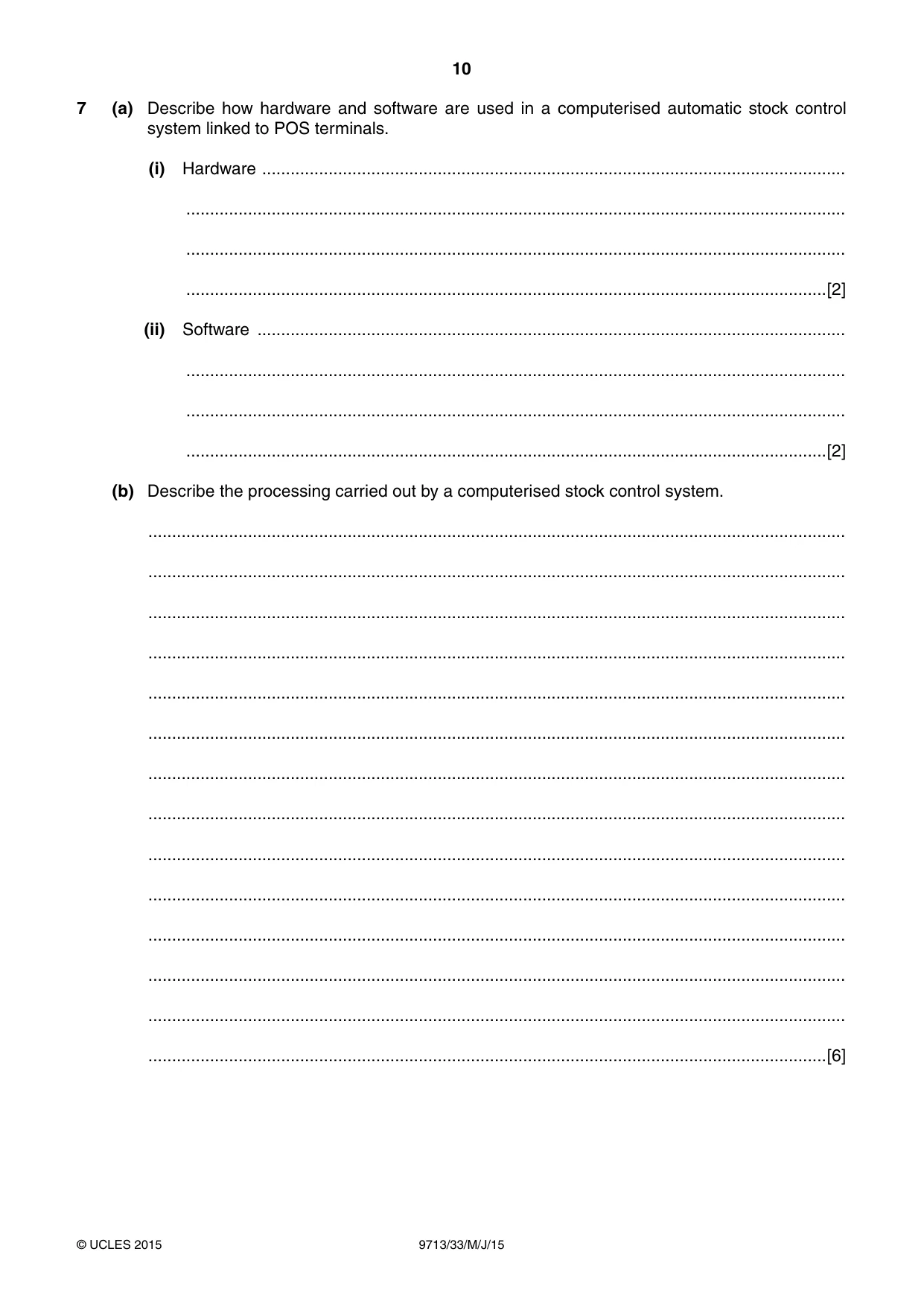
10 9713/33/M/J/15 © UCLES 2015 7 (a) Describe how hardware and software are used in a computerised automatic stock control system linked to POS terminals. (i) Hardware … … … …[2] (ii) Software … … … …[2] (b) Describe the processing carried out by a computerised stock control system. … … … … … … … … … … … … … …[6]
Question paper, page 11
11 9713/33/M/J/15 © UCLES 2015 [Turn over 8 Describe three ways that Desirable Outfits could carry out market research to find out the effectiveness of its advertising in the media. 1 … … … … 2 … … … … 3 … … … …[6]
Question paper, page 12
12 9713/33/M/J/15 © UCLES 2015 Scenario 3 Questions 9, 10, 11 and 12 Colin is a network administrator responsible for a company network that allows employees to access its facilities from within the company buildings and from outside. The company uses dedicated cabling within its buildings. The network is used by employees who work in the company buildings and there is an extranet for use by employees who work from home and when travelling on business. Various protocols are used to transfer data over a network. Colin uses Telnet and Secure Shell (SSH) for maintaining and administering the computers and servers on the network. Telnet and SSH are network protocols used in some client server systems.
Question paper, page 13
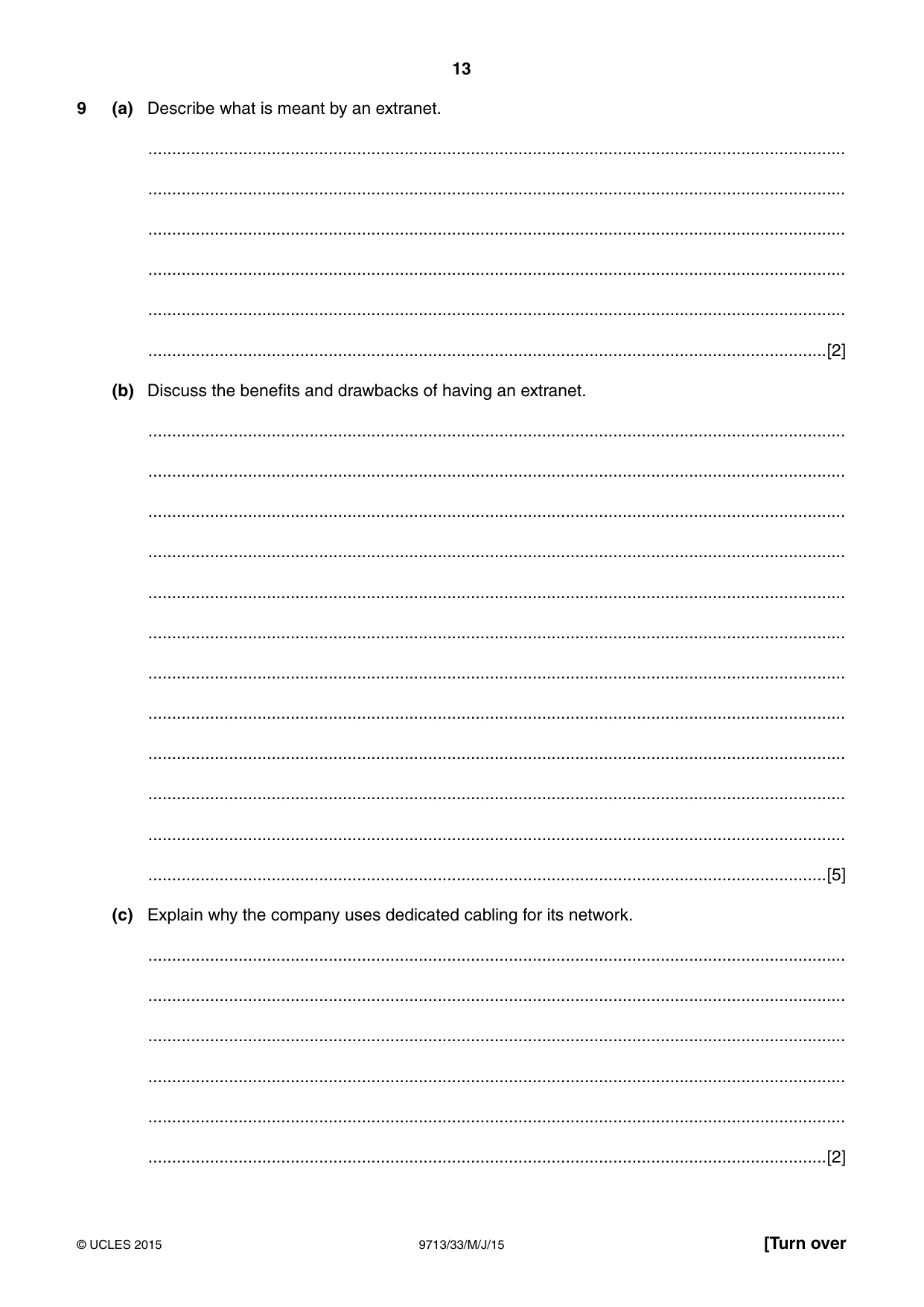
13 9713/33/M/J/15 © UCLES 2015 [Turn over 9 (a) Describe what is meant by an extranet. … … … … … …[2] (b) Discuss the benefits and drawbacks of having an extranet. … … … … … … … … … … … …[5] (c) Explain why the company uses dedicated cabling for its network. … … … … … …[2]
Question paper, page 14
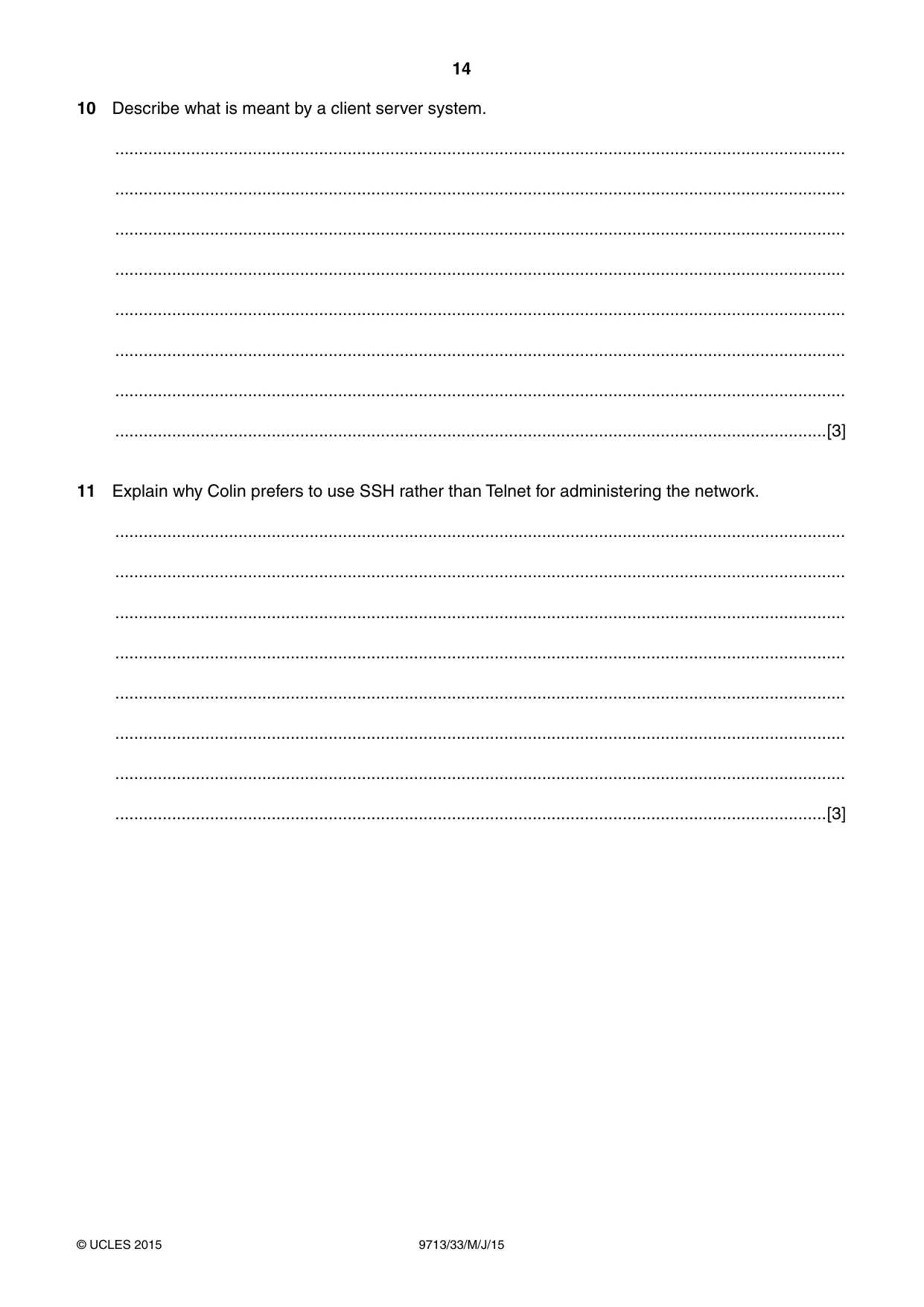
14 9713/33/M/J/15 © UCLES 2015 10 Describe what is meant by a client server system. … … … … … … … …[3] 11 Explain why Colin prefers to use SSH rather than Telnet for administering the network. … … … … … … … …[3]
Question paper, page 15
15 9713/33/M/J/15 © UCLES 2015 12 Name and describe the features of two protocols, other than SSH and Telnet, that could be used on the network to transfer data. … … … … … … … … … …[4]
Question paper, page 16
16 9713/33/M/J/15 © UCLES 2015 Permission to reproduce items where third-party owned material protected by copyright is included has been sought and cleared where possible. Every reasonable effort has been made by the publisher (UCLES) to trace copyright holders, but if any items requiring clearance have unwittingly been included, the publisher will be pleased to make amends at the earliest possible opportunity. To avoid the issue of disclosure of answer-related information to candidates, all copyright acknowledgements are reproduced online in the Cambridge International Examinations Copyright Acknowledgements Booklet. This is produced for each series of examinations and is freely available to download at www.cie.org.uk after the live examination series. Cambridge International Examinations is part of the Cambridge Assessment Group. Cambridge Assessment is the brand name of University of Cambridge Local Examinations Syndicate (UCLES), which is itself a department of the University of Cambridge. BLANK PAGE
Mark scheme, page 1
® IGCSE is the registered trademark of Cambridge International Examinations. CAMBRIDGE INTERNATIONAL EXAMINATIONS Cambridge International Advanced Level MARK SCHEME for the May/June 2015 series 9713 APPLIED INFORMATION & COMMUNICATION TECHNOLOGY 9713/33 Paper 3 (Written B), maximum raw mark 80 This mark scheme is published as an aid to teachers and candidates, to indicate the requirements of the examination. It shows the basis on which Examiners were instructed to award marks. It does not indicate the details of the discussions that took place at an Examiners’ meeting before marking began, which would have considered the acceptability of alternative answers. Mark schemes should be read in conjunction with the question paper and the Principal Examiner Report for Teachers. Cambridge will not enter into discussions about these mark schemes. Cambridge is publishing the mark schemes for the May/June 2015 series for most Cambridge IGCSE®, Cambridge International A and AS Level components and some Cambridge O Level components.
Mark scheme, page 2
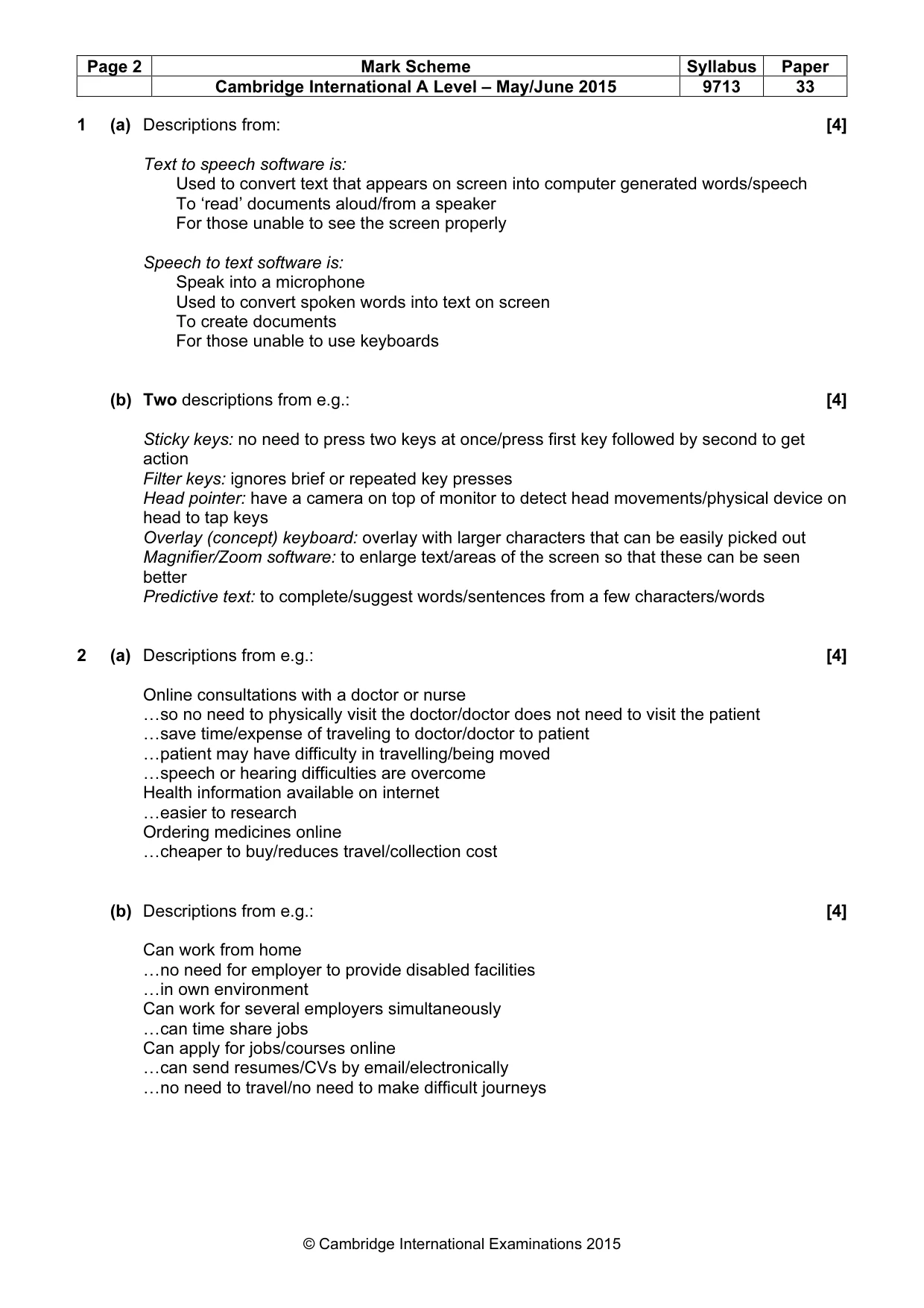
Page 2 Mark Scheme Syllabus Paper Cambridge International A Level – May/June 2015 9713 33 © Cambridge International Examinations 2015 1 (a) Descriptions from: [4] Text to speech software is: Used to convert text that appears on screen into computer generated words/speech To ‘read’ documents aloud/from a speaker For those unable to see the screen properly Speech to text software is: Speak into a microphone Used to convert spoken words into text on screen To create documents For those unable to use keyboards (b) Two descriptions from e.g.: [4] Sticky keys: no need to press two keys at once/press first key followed by second to get action Filter keys: ignores brief or repeated key presses Head pointer: have a camera on top of monitor to detect head movements/physical device on head to tap keys Overlay (concept) keyboard: overlay with larger characters that can be easily picked out Magnifier/Zoom software: to enlarge text/areas of the screen so that these can be seen better Predictive text: to complete/suggest words/sentences from a few characters/words 2 (a) Descriptions from e.g.: [4] Online consultations with a doctor or nurse …so no need to physically visit the doctor/doctor does not need to visit the patient …save time/expense of traveling to doctor/doctor to patient …patient may have difficulty in travelling/being moved …speech or hearing difficulties are overcome Health information available on internet …easier to research Ordering medicines online …cheaper to buy/reduces travel/collection cost (b) Descriptions from e.g.: [4] Can work from home …no need for employer to provide disabled facilities …in own environment Can work for several employers simultaneously …can time share jobs Can apply for jobs/courses online …can send resumes/CVs by email/electronically …no need to travel/no need to make difficult journeys
Mark scheme, page 3
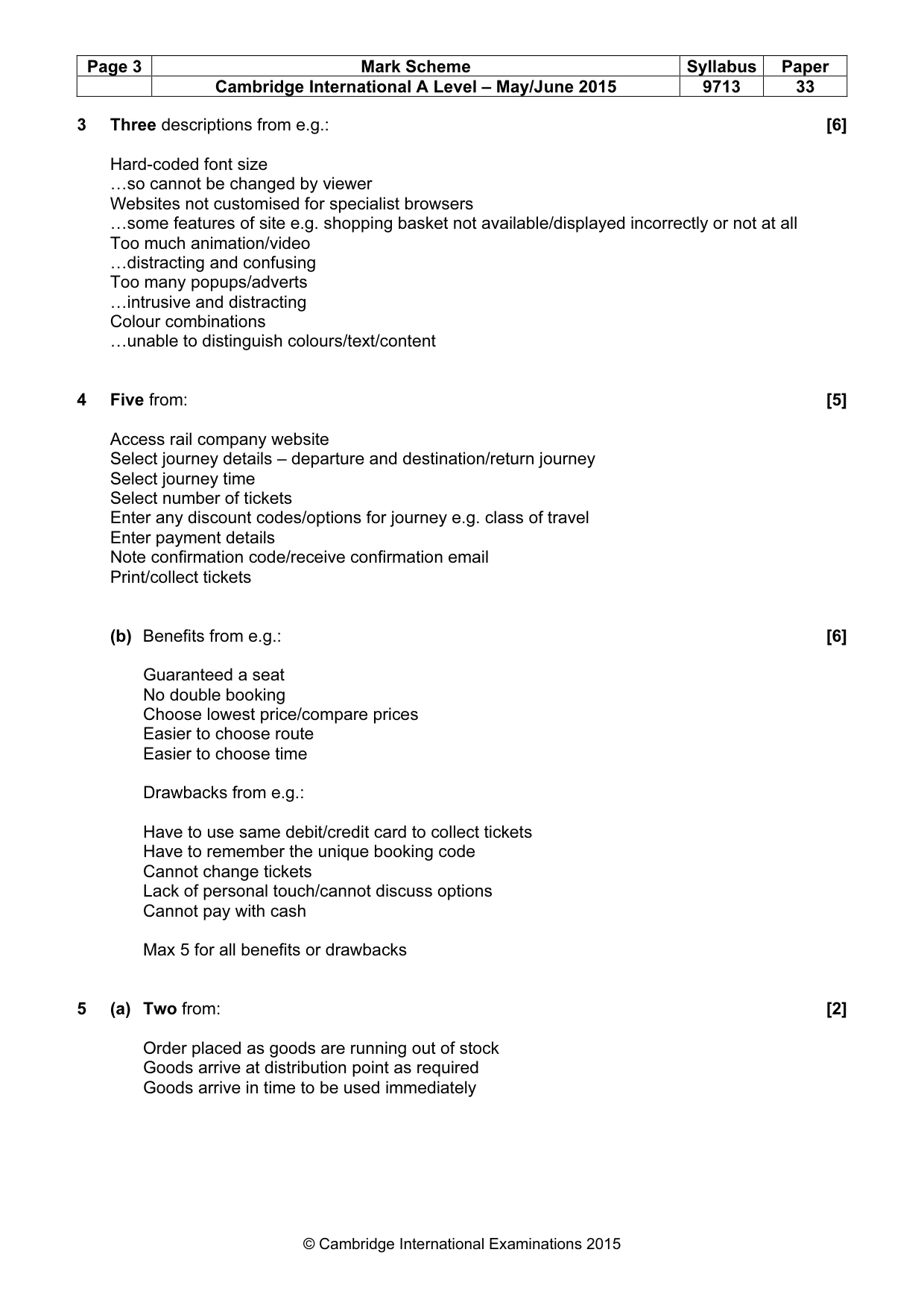
Page 3 Mark Scheme Syllabus Paper Cambridge International A Level – May/June 2015 9713 33 © Cambridge International Examinations 2015 3 Three descriptions from e.g.: [6] Hard-coded font size …so cannot be changed by viewer Websites not customised for specialist browsers …some features of site e.g. shopping basket not available/displayed incorrectly or not at all Too much animation/video …distracting and confusing Too many popups/adverts …intrusive and distracting Colour combinations …unable to distinguish colours/text/content 4 Five from: [5] Access rail company website Select journey details – departure and destination/return journey Select journey time Select number of tickets Enter any discount codes/options for journey e.g. class of travel Enter payment details Note confirmation code/receive confirmation email Print/collect tickets (b) Benefits from e.g.: [6] Guaranteed a seat No double booking Choose lowest price/compare prices Easier to choose route Easier to choose time Drawbacks from e.g.: Have to use same debit/credit card to collect tickets Have to remember the unique booking code Cannot change tickets Lack of personal touch/cannot discuss options Cannot pay with cash Max 5 for all benefits or drawbacks 5 (a) Two from: [2] Order placed as goods are running out of stock Goods arrive at distribution point as required Goods arrive in time to be used immediately
Mark scheme, page 4
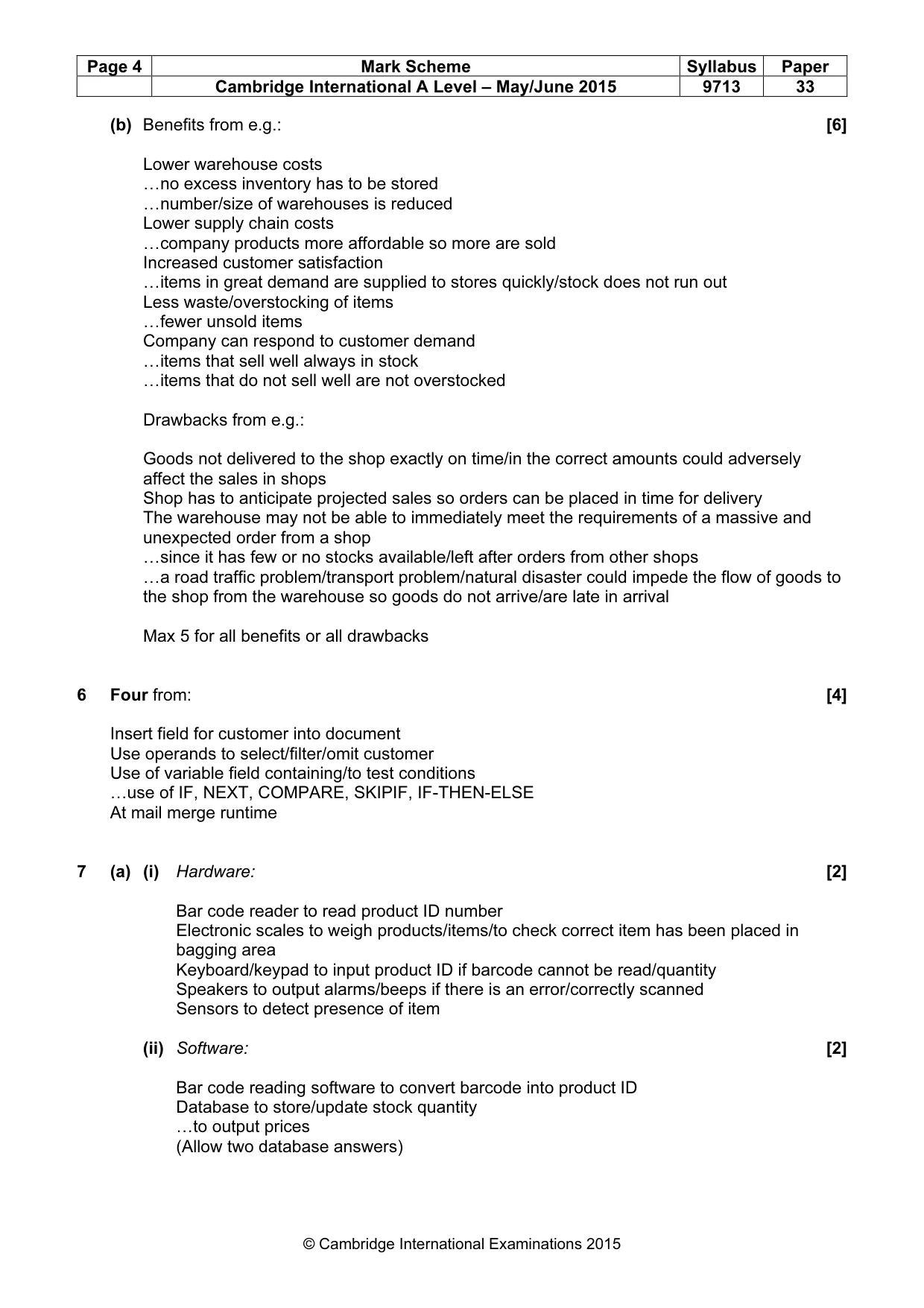
Page 4 Mark Scheme Syllabus Paper Cambridge International A Level – May/June 2015 9713 33 © Cambridge International Examinations 2015 (b) Benefits from e.g.: [6] Lower warehouse costs …no excess inventory has to be stored …number/size of warehouses is reduced Lower supply chain costs …company products more affordable so more are sold Increased customer satisfaction …items in great demand are supplied to stores quickly/stock does not run out Less waste/overstocking of items …fewer unsold items Company can respond to customer demand …items that sell well always in stock …items that do not sell well are not overstocked Drawbacks from e.g.: Goods not delivered to the shop exactly on time/in the correct amounts could adversely affect the sales in shops Shop has to anticipate projected sales so orders can be placed in time for delivery The warehouse may not be able to immediately meet the requirements of a massive and unexpected order from a shop …since it has few or no stocks available/left after orders from other shops …a road traffic problem/transport problem/natural disaster could impede the flow of goods to the shop from the warehouse so goods do not arrive/are late in arrival Max 5 for all benefits or all drawbacks 6 Four from: [4] Insert field for customer into document Use operands to select/filter/omit customer Use of variable field containing/to test conditions …use of IF, NEXT, COMPARE, SKIPIF, IF-THEN-ELSE At mail merge runtime 7 (a) (i) Hardware: [2] Bar code reader to read product ID number Electronic scales to weigh products/items/to check correct item has been placed in bagging area Keyboard/keypad to input product ID if barcode cannot be read/quantity Speakers to output alarms/beeps if there is an error/correctly scanned Sensors to detect presence of item (ii) Software: [2] Bar code reading software to convert barcode into product ID Database to store/update stock quantity …to output prices (Allow two database answers)
Mark scheme, page 5
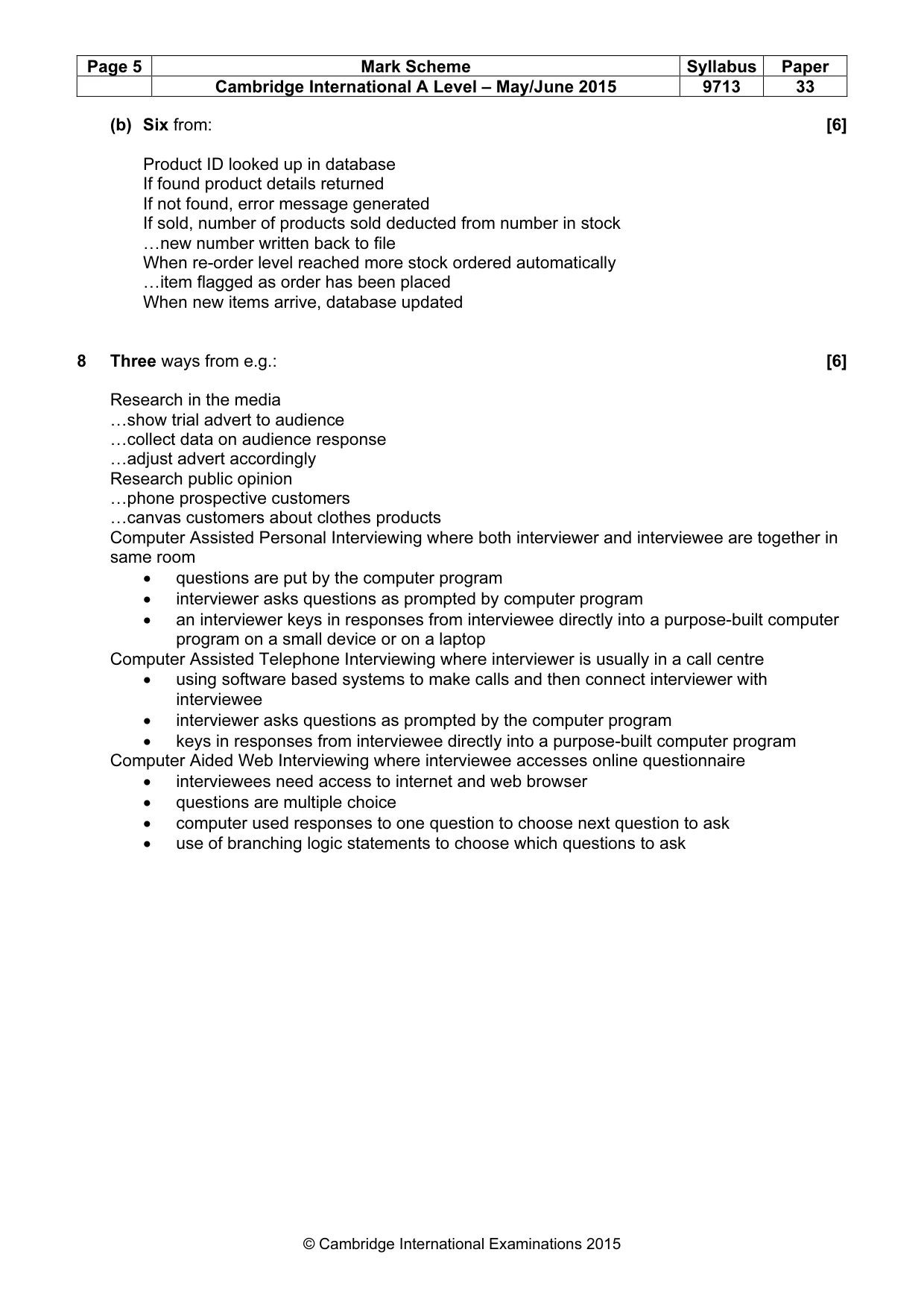
Page 5 Mark Scheme Syllabus Paper Cambridge International A Level – May/June 2015 9713 33 © Cambridge International Examinations 2015 (b) Six from: [6] Product ID looked up in database If found product details returned If not found, error message generated If sold, number of products sold deducted from number in stock …new number written back to file When re-order level reached more stock ordered automatically …item flagged as order has been placed When new items arrive, database updated 8 Three ways from e.g.: [6] Research in the media …show trial advert to audience …collect data on audience response …adjust advert accordingly Research public opinion …phone prospective customers …canvas customers about clothes products Computer Assisted Personal Interviewing where both interviewer and interviewee are together in same room • questions are put by the computer program • interviewer asks questions as prompted by computer program • an interviewer keys in responses from interviewee directly into a purpose-built computer program on a small device or on a laptop Computer Assisted Telephone Interviewing where interviewer is usually in a call centre • using software based systems to make calls and then connect interviewer with interviewee • interviewer asks questions as prompted by the computer program • keys in responses from interviewee directly into a purpose-built computer program Computer Aided Web Interviewing where interviewee accesses online questionnaire • interviewees need access to internet and web browser • questions are multiple choice • computer used responses to one question to choose next question to ask • use of branching logic statements to choose which questions to ask
Mark scheme, page 6
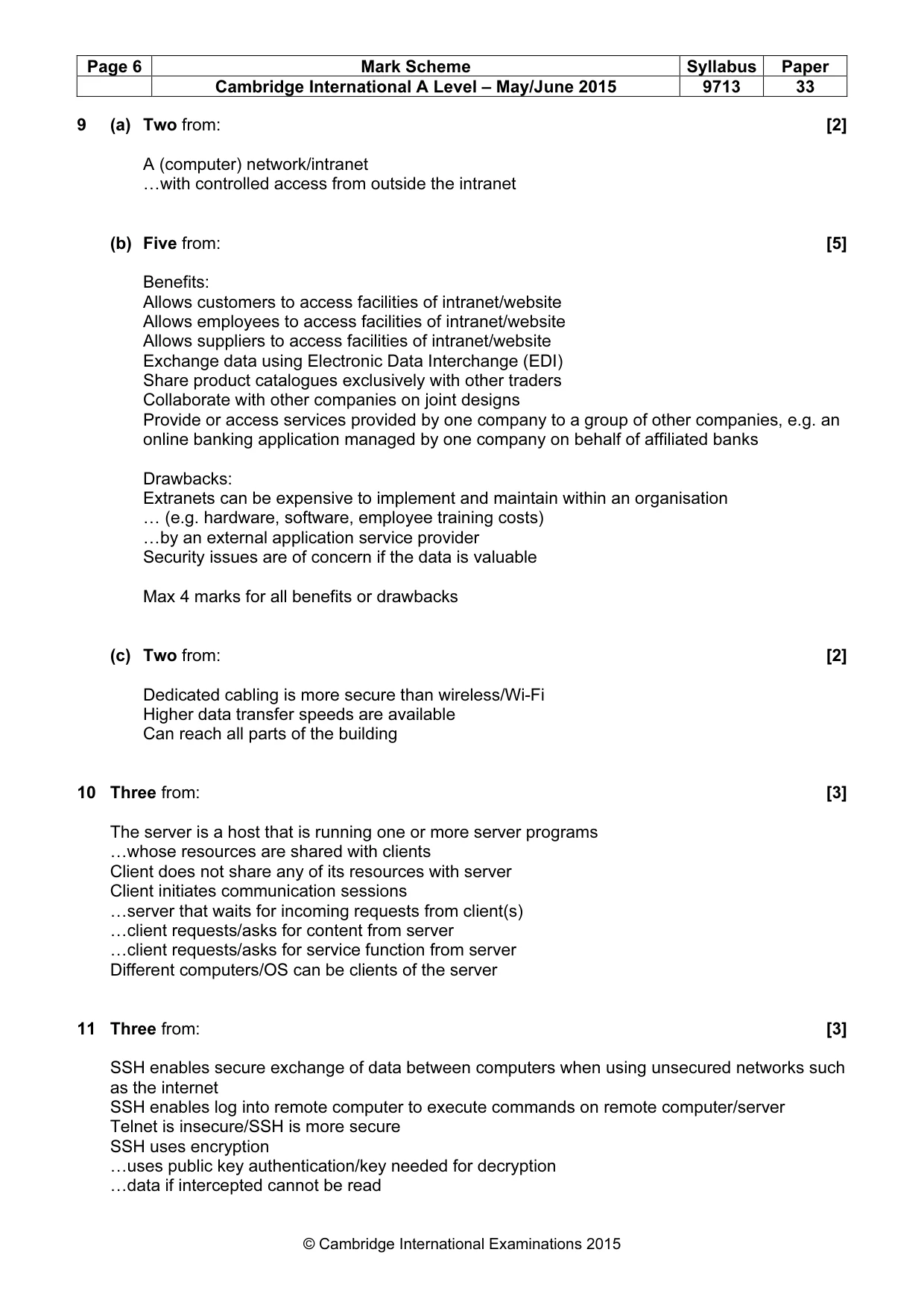
Page 6 Mark Scheme Syllabus Paper Cambridge International A Level – May/June 2015 9713 33 © Cambridge International Examinations 2015 9 (a) Two from: [2] A (computer) network/intranet …with controlled access from outside the intranet (b) Five from: [5] Benefits: Allows customers to access facilities of intranet/website Allows employees to access facilities of intranet/website Allows suppliers to access facilities of intranet/website Exchange data using Electronic Data Interchange (EDI) Share product catalogues exclusively with other traders Collaborate with other companies on joint designs Provide or access services provided by one company to a group of other companies, e.g. an online banking application managed by one company on behalf of affiliated banks Drawbacks: Extranets can be expensive to implement and maintain within an organisation … (e.g. hardware, software, employee training costs) …by an external application service provider Security issues are of concern if the data is valuable Max 4 marks for all benefits or drawbacks (c) Two from: [2] Dedicated cabling is more secure than wireless/Wi-Fi Higher data transfer speeds are available Can reach all parts of the building 10 Three from: [3] The server is a host that is running one or more server programs …whose resources are shared with clients Client does not share any of its resources with server Client initiates communication sessions …server that waits for incoming requests from client(s) …client requests/asks for content from server …client requests/asks for service function from server Different computers/OS can be clients of the server 11 Three from: [3] SSH enables secure exchange of data between computers when using unsecured networks such as the internet SSH enables log into remote computer to execute commands on remote computer/server Telnet is insecure/SSH is more secure SSH uses encryption …uses public key authentication/key needed for decryption …data if intercepted cannot be read
Mark scheme, page 7
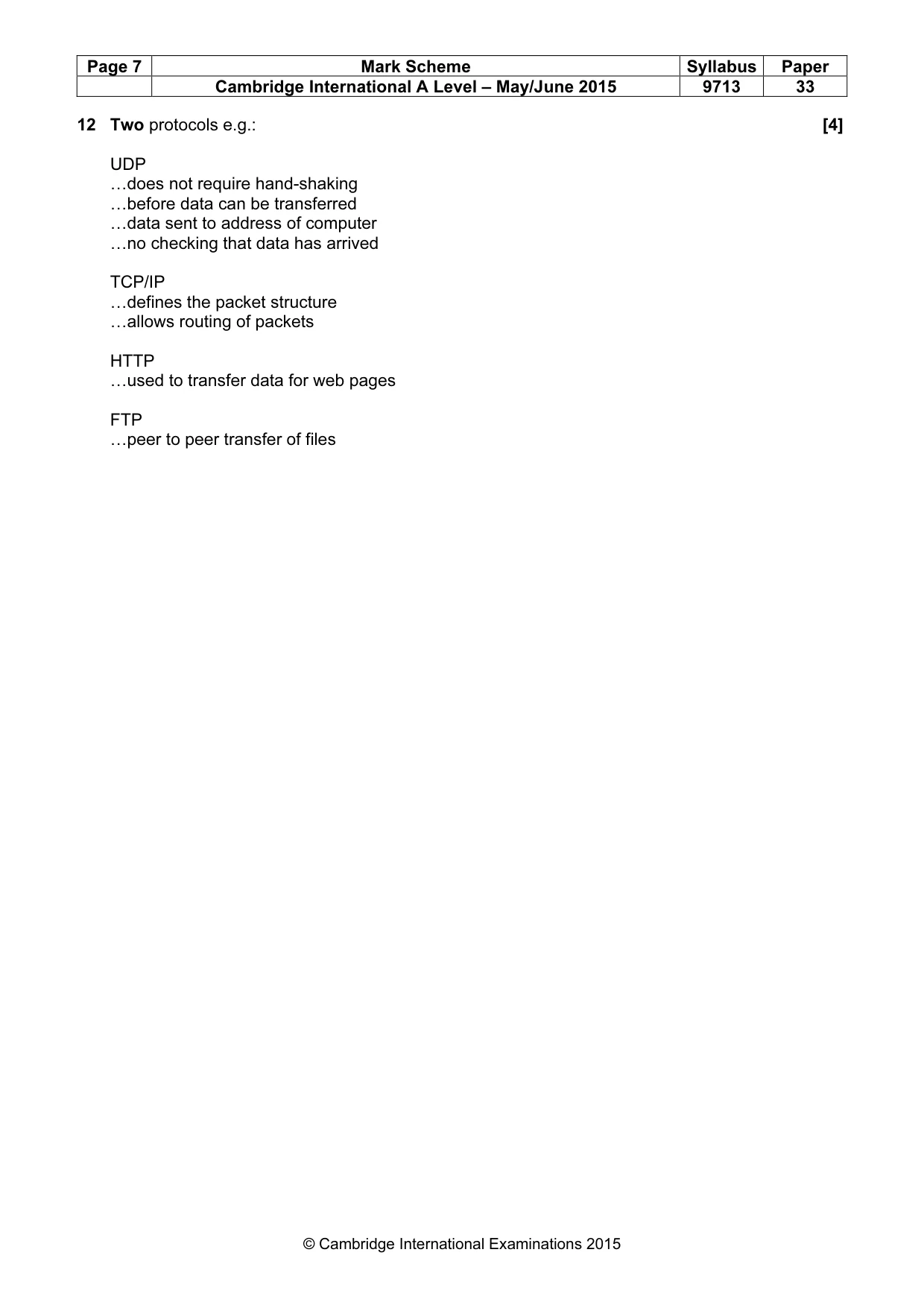
Page 7 Mark Scheme Syllabus Paper Cambridge International A Level – May/June 2015 9713 33 © Cambridge International Examinations 2015 12 Two protocols e.g.: [4] UDP …does not require hand-shaking …before data can be transferred …data sent to address of computer …no checking that data has arrived TCP/IP …defines the packet structure …allows routing of packets HTTP …used to transfer data for web pages FTP …peer to peer transfer of files
What you needed in this session
Cambridge’s own grade thresholds for 2015 May/June, Paper 3 · Variant 3. A higher threshold means an easier paper — the bar moves with how the cohort did.