Cambridge A Level Applied Information and Communication Technology 9713 — 2012 Oct/Nov Paper 3 · Variant 1
9713/31/O/N/12 · 80 marks · ≈90 min
The question paper and its mark scheme, free to read here and free to download. This is Cambridge’s own paper, exactly as it was sat.
Question paper20 pages












Mark scheme9 pages
Answers below. Sit the paper first if you are practising.


Paper as text
Question paper, page 1
This document consists of 20 printed pages. IB12 11_9713_31/2RP © UCLES 2012 [Turn over *4873177487* UNIVERSITY OF CAMBRIDGE INTERNATIONAL EXAMINATIONS General Certificate of Education Advanced Level APPLIED INFORMATION AND COMMUNICATION TECHNOLOGY 9713/31 Paper 3 October/November 2012 1 hour 15 minutes Candidates answer on the Question Paper. No additional materials are required. READ THESE INSTRUCTIONS FIRST Write your Centre number, candidate number and name on all the work you hand in. Write in dark blue or black pen. Do not use staples, paper clips, highlighters, glue or correction fluid. You may use a pencil for any diagrams, graphs or rough working. DO NOT WRITE IN ANY BARCODES. Answer all questions. The number of marks is given in brackets [ ] at the end of each question or part question. The businesses described in this paper are entirely fictitious.
Question paper, page 2
2 © UCLES 2012 9713/31/O/N/12 For Examiner's Use Scenario 1 Questions 1 and 2 José runs a car rental business. Cars can be picked up from one garage and returned to another. Each car is fitted with a Satellite Navigation system (Sat Nav).
Question paper, page 3
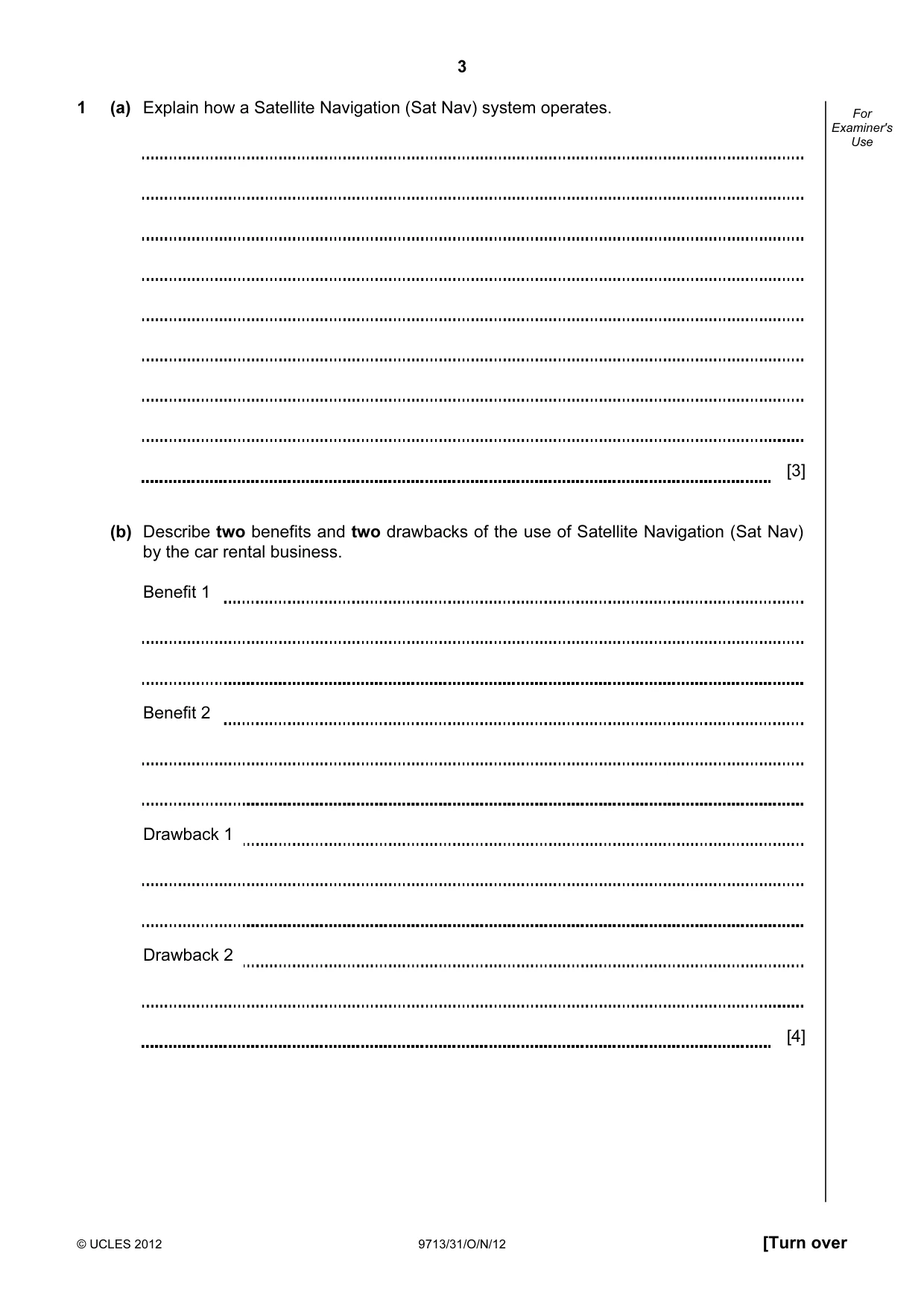
3 © UCLES 2012 9713/31/O/N/12 [Turn over For Examiner's Use 1 (a) Explain how a Satellite Navigation (Sat Nav) system operates. [3] (b) Describe two benefits and two drawbacks of the use of Satellite Navigation (Sat Nav) by the car rental business. Benefit 1 Benefit 2 Drawback 1 Drawback 2 [4]
Question paper, page 4
4 © UCLES 2012 9713/31/O/N/12 For Examiner's Use 2 José is thinking of introducing an intranet. (a) Describe three ways this would be of use to him. Way 1 Way 2 Way 3 [6]
Question paper, page 5
5 © UCLES 2012 9713/31/O/N/12 [Turn over For Examiner's Use (b) The intranet will be part of a Wide Area Network (WAN). Give two features of a WAN. Feature 1 Feature 2 [2]
Question paper, page 6
6 © UCLES 2012 9713/31/O/N/12 For Examiner's Use Scenario 2 Questions 3, 4 and 5 Peter likes watching films. Sometimes he watches a film on his home entertainment system. At other times he arranges visits to the cinema. He will use an online cinema booking system with a secure method of payment. He will collect the tickets from a kiosk at the cinema. The cinema booking system uses various methods to ensure the security of the personal data of its customers.
Question paper, page 7
7 © UCLES 2012 9713/31/O/N/12 [Turn over For Examiner's Use 3 Describe, in detail, four features of a home entertainment system. 1 2 3 4 [4]
Question paper, page 8
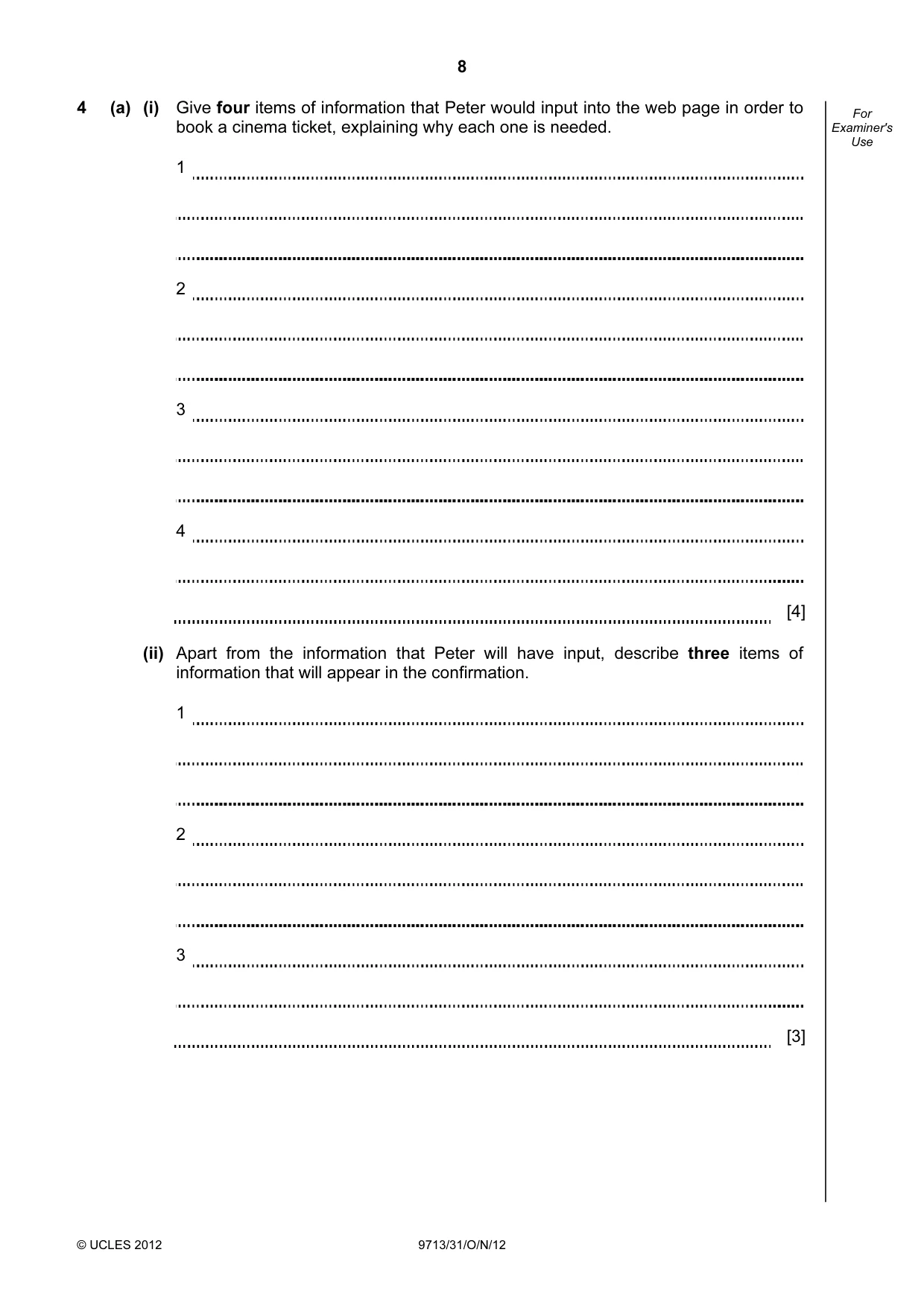
8 © UCLES 2012 9713/31/O/N/12 For Examiner's Use 4 (a) (i) Give four items of information that Peter would input into the web page in order to book a cinema ticket, explaining why each one is needed. 1 2 3 4 [4] (ii) Apart from the information that Peter will have input, describe three items of information that will appear in the confirmation. 1 2 3 [3]
Question paper, page 9
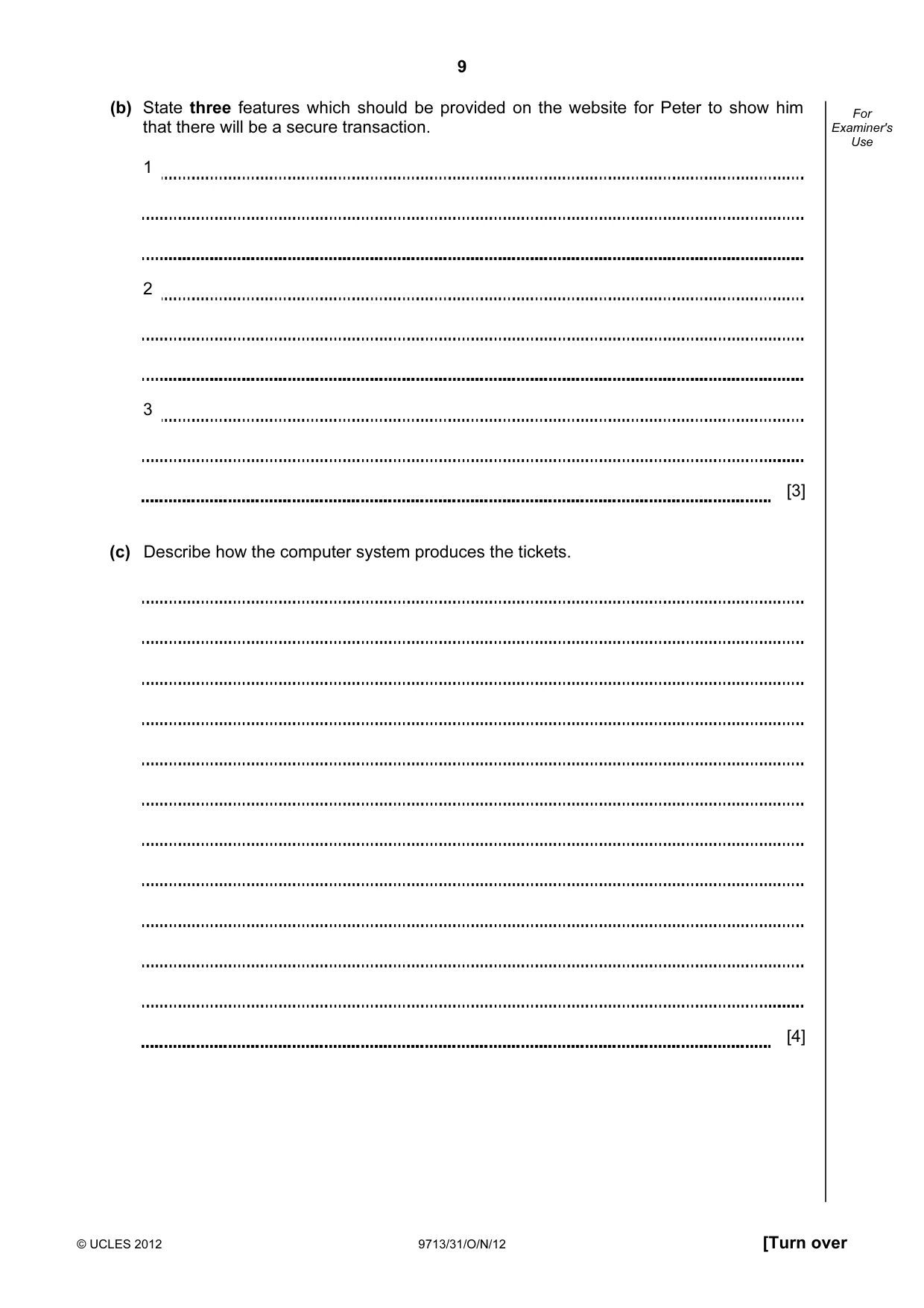
9 © UCLES 2012 9713/31/O/N/12 [Turn over For Examiner's Use (b) State three features which should be provided on the website for Peter to show him that there will be a secure transaction. 1 2 3 [3] (c) Describe how the computer system produces the tickets. [4]
Question paper, page 10
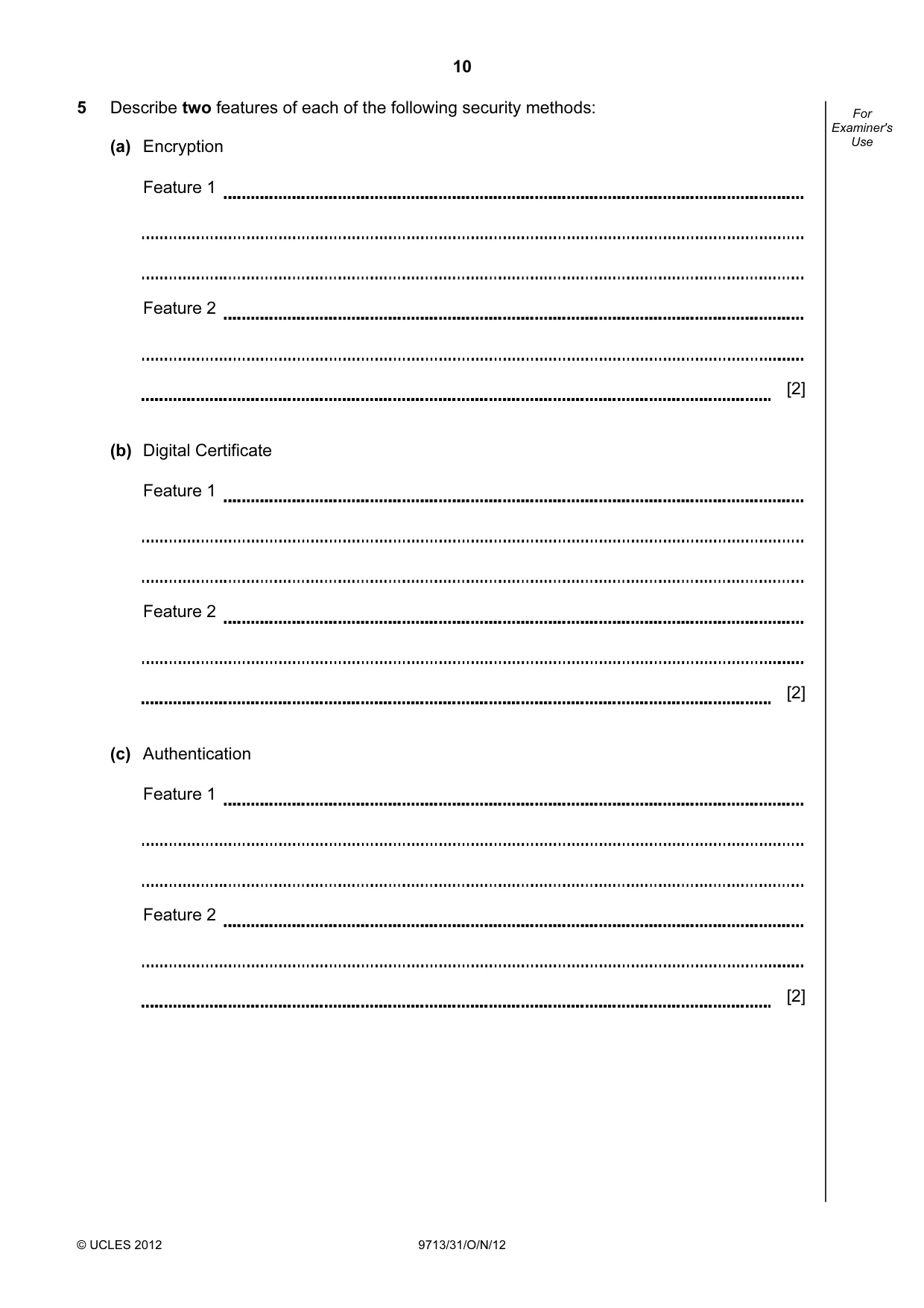
10 © UCLES 2012 9713/31/O/N/12 For Examiner's Use 5 Describe two features of each of the following security methods: (a) Encryption Feature 1 Feature 2 [2] (b) Digital Certificate Feature 1 Feature 2 [2] (c) Authentication Feature 1 Feature 2 [2]
Question paper, page 11
11 © UCLES 2012 9713/31/O/N/12 [Turn over For Examiner's Use Scenario 3 Question 6 Sarbjit is the director in charge of research at the International Medical Drug Corporation (IMDC). The corporation wishes to develop a new medical drug. Sarbjit carried out market research to find out how many people would use the drug. He had a choice of two types of market research: primary and secondary. Having had favourable feedback, the corporation decided to carry out the necessary scientific research to make the drug.
Question paper, page 12
12 © UCLES 2012 9713/31/O/N/12 For Examiner's Use 6 (a) Explain the difference between primary market research and secondary market research. [2] (b) Describe three ways in which primary market research can be carried out. 1 2 3 [6]
Question paper, page 13
13 © UCLES 2012 9713/31/O/N/12 [Turn over For Examiner's Use (c) (i) State the type of computer that would be used in the scientific research. [1] (ii) Describe how computer models would be used in the scientific research. [3]
Question paper, page 14
14 © UCLES 2012 9713/31/O/N/12 For Examiner's Use Scenario 4 Questions 7, 8, 9 and 10 A number of doctors in a medical centre use an expert system to help diagnose patients’ illnesses. The doctors would like to have a pharmacy with a computerised stock control system in the medical centre. The stock control software could be purpose-written or could be an off-the-shelf package. The pharmacy staff will need to be trained in the use of the new stock control system. The project, to set up a pharmacy within the medical centre, will be managed using project management software.
Question paper, page 15
15 © UCLES 2012 9713/31/O/N/12 [Turn over For Examiner's Use 7 (a) Describe how the knowledge engineer would have collected information for the knowledge base of the doctors’ expert system. [4]
Question paper, page 16
16 © UCLES 2012 9713/31/O/N/12 For Examiner's Use (b) Describe two items of information that a doctor will enter into the expert system. Item 1 Item 2 [2] (c) Describe two outputs from the expert system. Output 1 Output 2 [2]
Question paper, page 17
17 © UCLES 2012 9713/31/O/N/12 [Turn over For Examiner's Use 8 Discuss the advantages of choosing an off-the-shelf package compared with choosing purpose written software. [6]
Question paper, page 18
18 © UCLES 2012 9713/31/O/N/12 For Examiner's Use 9 (a) What is meant by each of the following? Computer aided instruction (CAI) Computer based learning (CBL) Computer aided assessment (CAA) [3]
Question paper, page 19
19 © UCLES 2012 9713/31/O/N/12 [Turn over For Examiner's Use (b) Describe in detail three benefits and three drawbacks of using ICT for the training of the pharmacy staff. (i) Benefits 1 2 3 [3] (ii) Drawbacks 1 2 3 [3]
Question paper, page 20
20 Permission to reproduce items where third-party owned material protected by copyright is included has been sought and cleared where possible. Every reasonable effort has been made by the publisher (UCLES) to trace copyright holders, but if any items requiring clearance have unwittingly been included, the publisher will be pleased to make amends at the earliest possible opportunity. University of Cambridge International Examinations is part of the Cambridge Assessment Group. Cambridge Assessment is the brand name of University of Cambridge Local Examinations Syndicate (UCLES), which is itself a department of the University of Cambridge. © UCLES 2012 9713/31/O/N/12 For Examiner's Use 10 (a) Describe how a Gantt chart would help manage the setting up of the pharmacy within the medical centre. [4] (b) Describe one other aspect of project management software. [2]
Mark scheme, page 1
CAMBRIDGE INTERNATIONAL EXAMINATIONS GCE Advanced Subsidiary Level and GCE Advanced Level MARK SCHEME for the October/November 2012 series 9713 APPLIED ICT 9713/31 Paper 3 (Written B), maximum raw mark 80 This mark scheme is published as an aid to teachers and candidates, to indicate the requirements of the examination. It shows the basis on which Examiners were instructed to award marks. It does not indicate the details of the discussions that took place at an Examiners’ meeting before marking began, which would have considered the acceptability of alternative answers. Mark schemes should be read in conjunction with the question paper and the Principal Examiner Report for Teachers. Cambridge will not enter into discussions about these mark schemes. Cambridge is publishing the mark schemes for the October/November 2012 series for most IGCSE, GCE Advanced Level and Advanced Subsidiary Level components and some Ordinary Level components.
Mark scheme, page 2
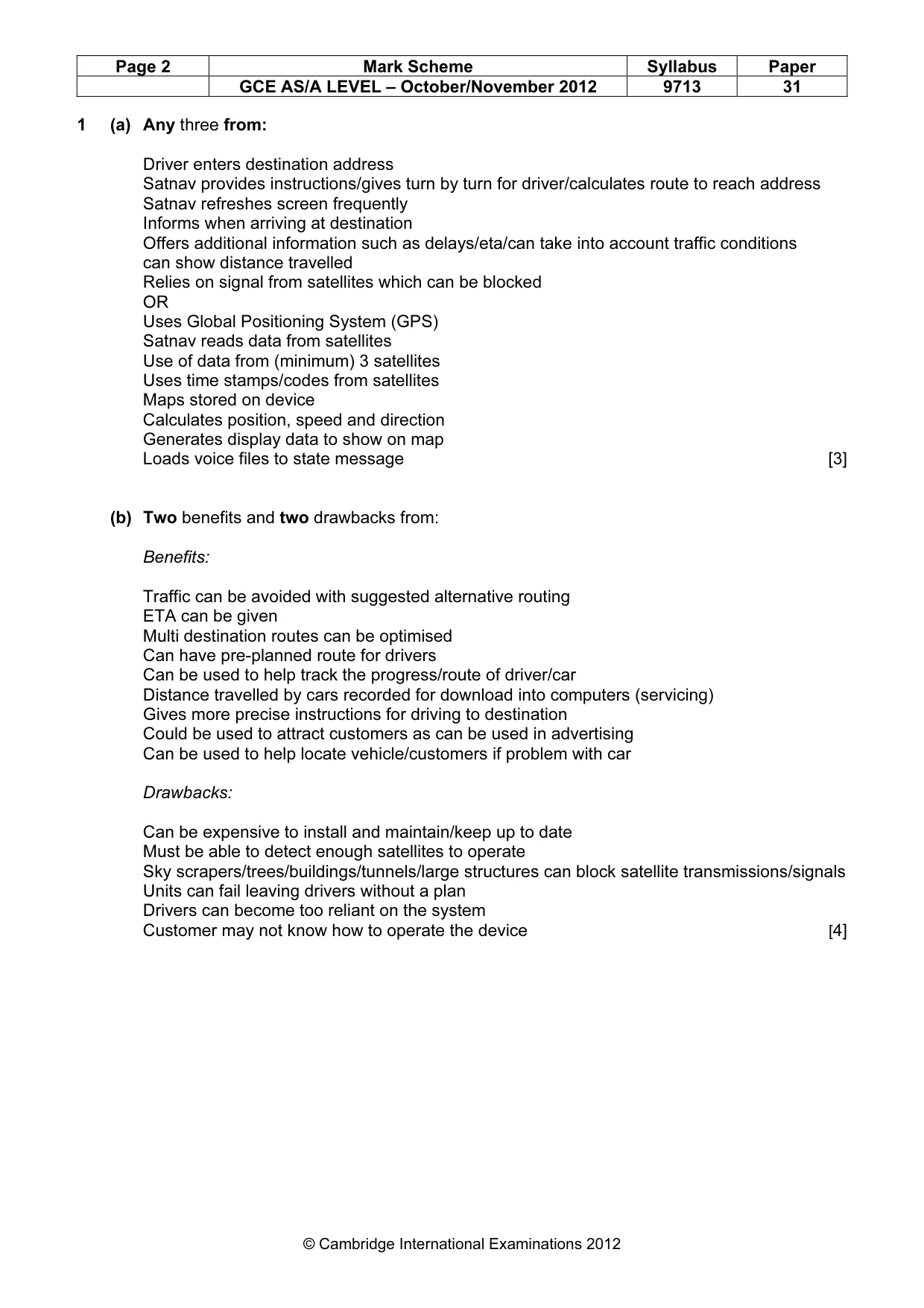
Page 2 Mark Scheme Syllabus Paper GCE AS/A LEVEL – October/November 2012 9713 31 © Cambridge International Examinations 2012 1 (a) Any three from: Driver enters destination address Satnav provides instructions/gives turn by turn for driver/calculates route to reach address Satnav refreshes screen frequently Informs when arriving at destination Offers additional information such as delays/eta/can take into account traffic conditions can show distance travelled Relies on signal from satellites which can be blocked OR Uses Global Positioning System (GPS) Satnav reads data from satellites Use of data from (minimum) 3 satellites Uses time stamps/codes from satellites Maps stored on device Calculates position, speed and direction Generates display data to show on map Loads voice files to state message [3] (b) Two benefits and two drawbacks from: Benefits: Traffic can be avoided with suggested alternative routing ETA can be given Multi destination routes can be optimised Can have pre-planned route for drivers Can be used to help track the progress/route of driver/car Distance travelled by cars recorded for download into computers (servicing) Gives more precise instructions for driving to destination Could be used to attract customers as can be used in advertising Can be used to help locate vehicle/customers if problem with car Drawbacks: Can be expensive to install and maintain/keep up to date Must be able to detect enough satellites to operate Sky scrapers/trees/buildings/tunnels/large structures can block satellite transmissions/signals Units can fail leaving drivers without a plan Drivers can become too reliant on the system Customer may not know how to operate the device [4]
Mark scheme, page 3
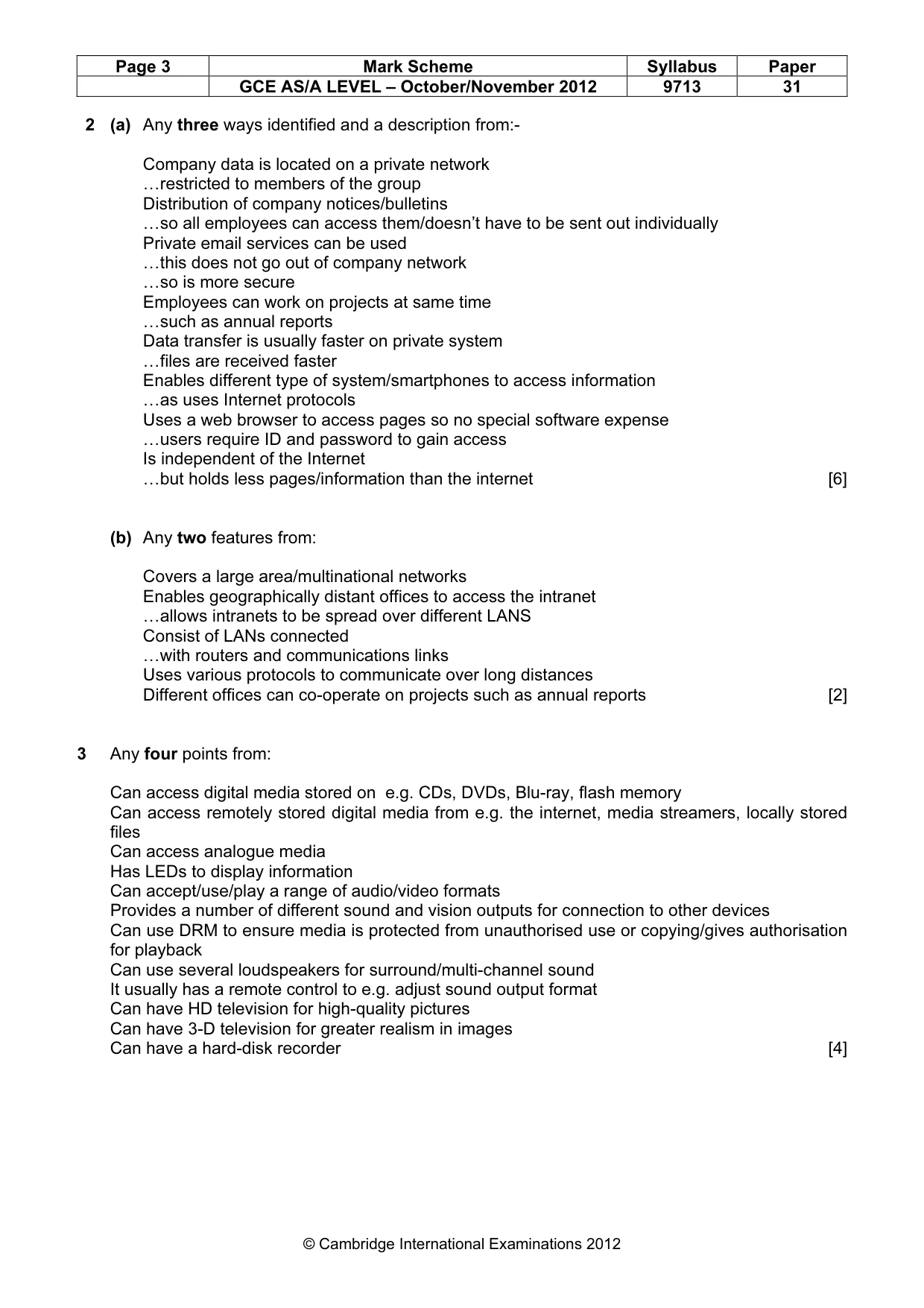
Page 3 Mark Scheme Syllabus Paper GCE AS/A LEVEL – October/November 2012 9713 31 © Cambridge International Examinations 2012 2 (a) Any three ways identified and a description from:- Company data is located on a private network …restricted to members of the group Distribution of company notices/bulletins …so all employees can access them/doesn’t have to be sent out individually Private email services can be used …this does not go out of company network …so is more secure Employees can work on projects at same time …such as annual reports Data transfer is usually faster on private system …files are received faster Enables different type of system/smartphones to access information …as uses Internet protocols Uses a web browser to access pages so no special software expense …users require ID and password to gain access Is independent of the Internet …but holds less pages/information than the internet [6] (b) Any two features from: Covers a large area/multinational networks Enables geographically distant offices to access the intranet …allows intranets to be spread over different LANS Consist of LANs connected …with routers and communications links Uses various protocols to communicate over long distances Different offices can co-operate on projects such as annual reports [2] 3 Any four points from: Can access digital media stored on e.g. CDs, DVDs, Blu-ray, flash memory Can access remotely stored digital media from e.g. the internet, media streamers, locally stored files Can access analogue media Has LEDs to display information Can accept/use/play a range of audio/video formats Provides a number of different sound and vision outputs for connection to other devices Can use DRM to ensure media is protected from unauthorised use or copying/gives authorisation for playback Can use several loudspeakers for surround/multi-channel sound It usually has a remote control to e.g. adjust sound output format Can have HD television for high-quality pictures Can have 3-D television for greater realism in images Can have a hard-disk recorder [4]
Mark scheme, page 4
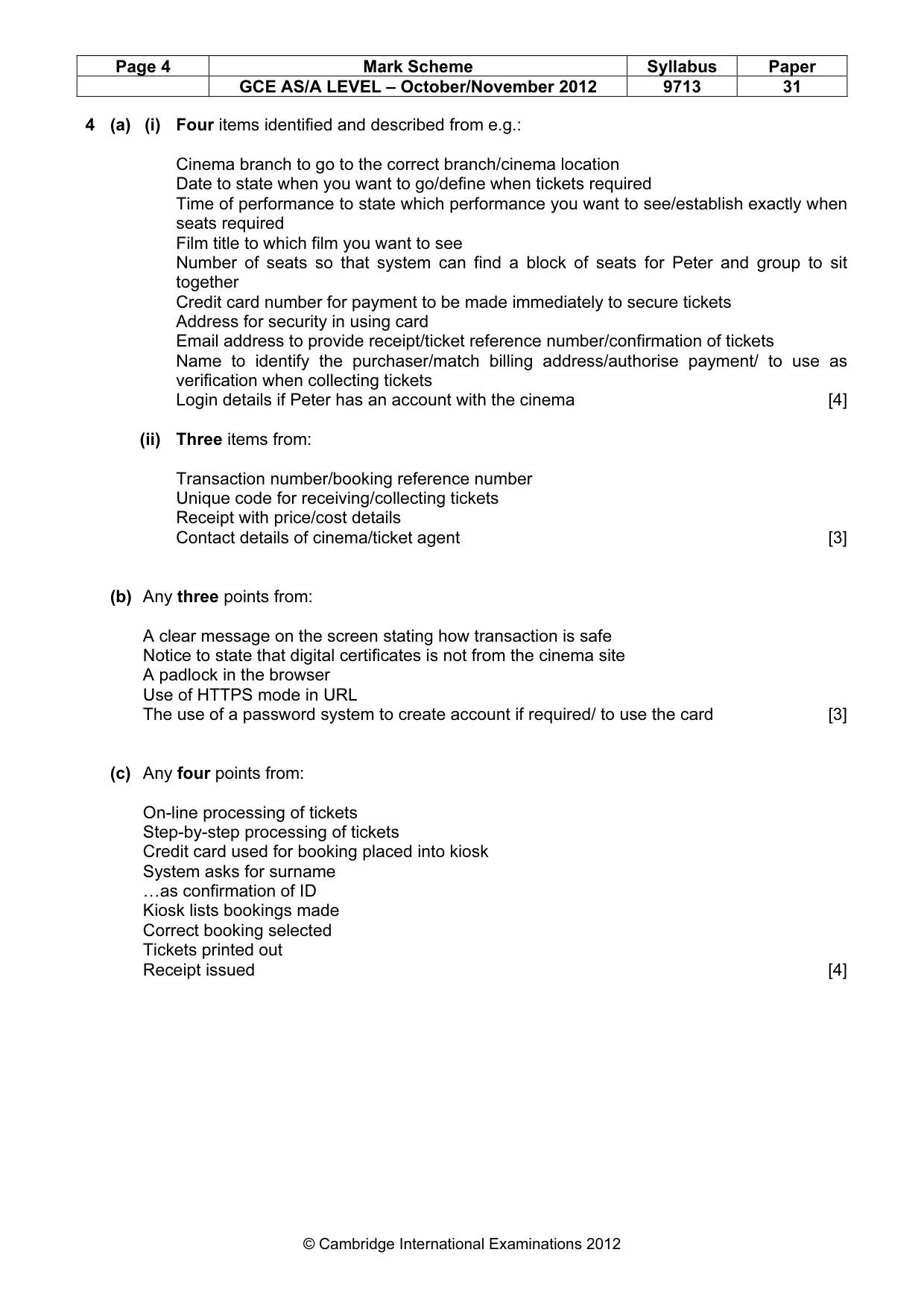
Page 4 Mark Scheme Syllabus Paper GCE AS/A LEVEL – October/November 2012 9713 31 © Cambridge International Examinations 2012 4 (a) (i) Four items identified and described from e.g.: Cinema branch to go to the correct branch/cinema location Date to state when you want to go/define when tickets required Time of performance to state which performance you want to see/establish exactly when seats required Film title to which film you want to see Number of seats so that system can find a block of seats for Peter and group to sit together Credit card number for payment to be made immediately to secure tickets Address for security in using card Email address to provide receipt/ticket reference number/confirmation of tickets Name to identify the purchaser/match billing address/authorise payment/ to use as verification when collecting tickets Login details if Peter has an account with the cinema [4] (ii) Three items from: Transaction number/booking reference number Unique code for receiving/collecting tickets Receipt with price/cost details Contact details of cinema/ticket agent [3] (b) Any three points from: A clear message on the screen stating how transaction is safe Notice to state that digital certificates is not from the cinema site A padlock in the browser Use of HTTPS mode in URL The use of a password system to create account if required/ to use the card [3] (c) Any four points from: On-line processing of tickets Step-by-step processing of tickets Credit card used for booking placed into kiosk System asks for surname …as confirmation of ID Kiosk lists bookings made Correct booking selected Tickets printed out Receipt issued [4]
Mark scheme, page 5
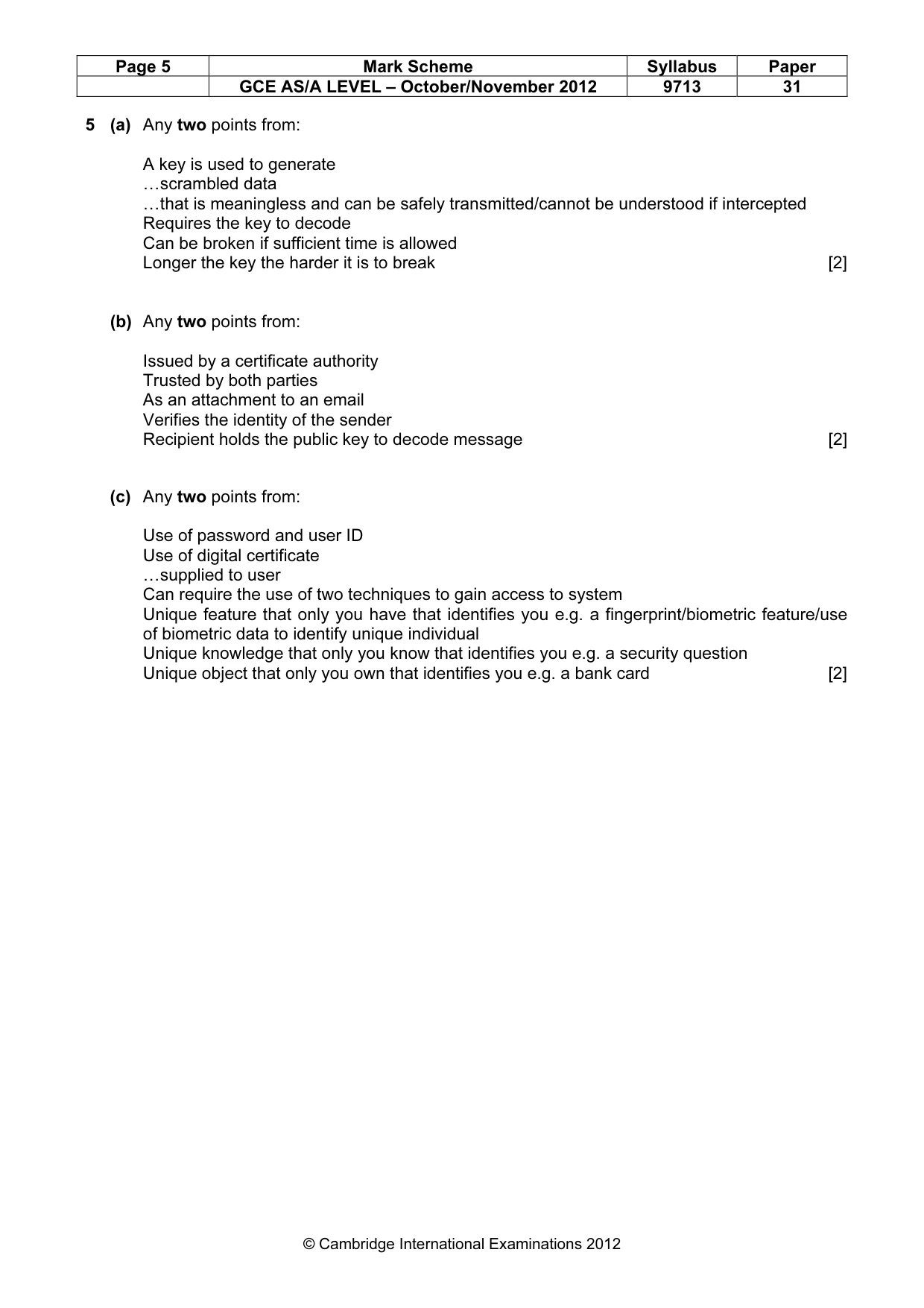
Page 5 Mark Scheme Syllabus Paper GCE AS/A LEVEL – October/November 2012 9713 31 © Cambridge International Examinations 2012 5 (a) Any two points from: A key is used to generate …scrambled data …that is meaningless and can be safely transmitted/cannot be understood if intercepted Requires the key to decode Can be broken if sufficient time is allowed Longer the key the harder it is to break [2] (b) Any two points from: Issued by a certificate authority Trusted by both parties As an attachment to an email Verifies the identity of the sender Recipient holds the public key to decode message [2] (c) Any two points from: Use of password and user ID Use of digital certificate …supplied to user Can require the use of two techniques to gain access to system Unique feature that only you have that identifies you e.g. a fingerprint/biometric feature/use of biometric data to identify unique individual Unique knowledge that only you know that identifies you e.g. a security question Unique object that only you own that identifies you e.g. a bank card [2]
Mark scheme, page 6
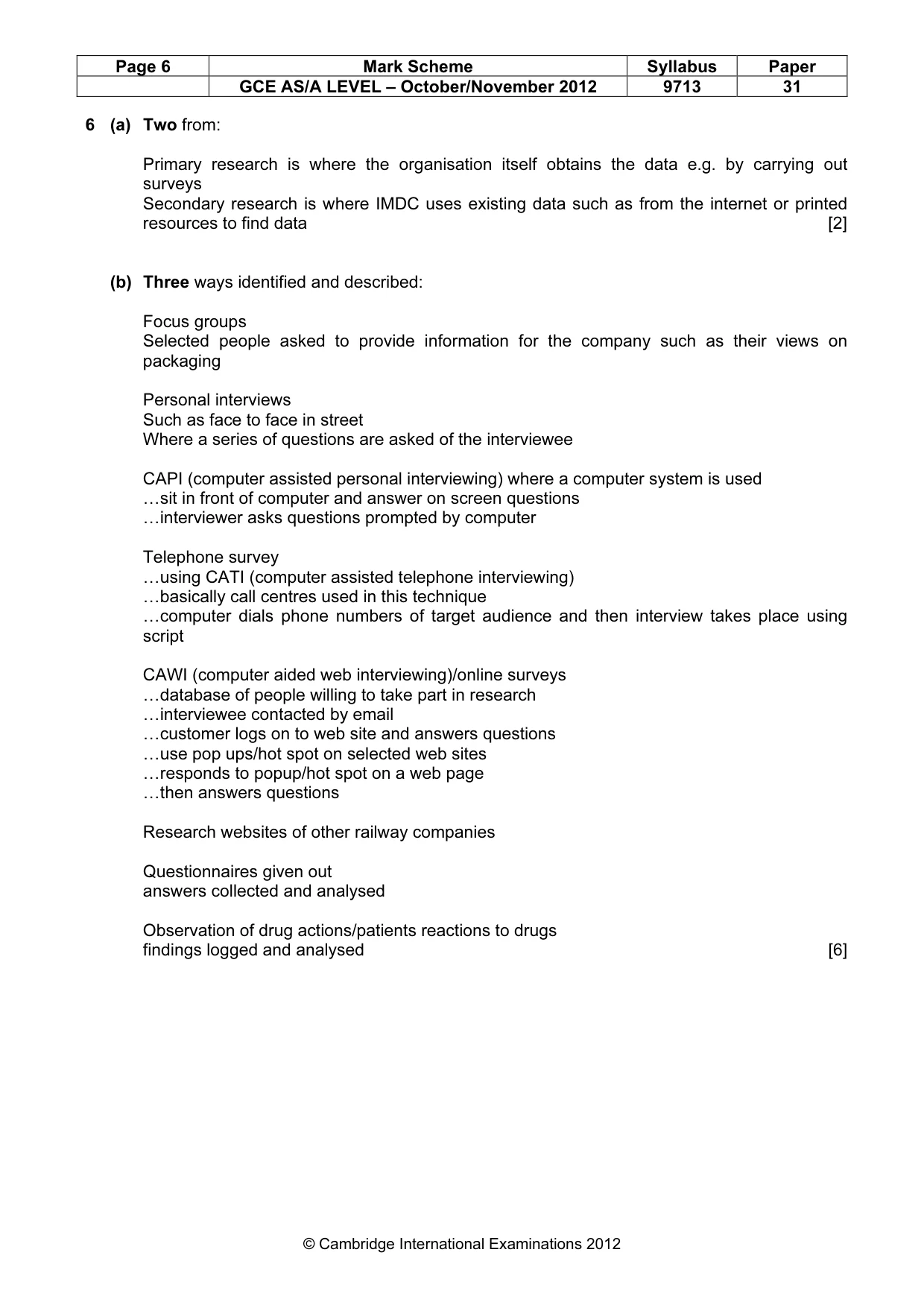
Page 6 Mark Scheme Syllabus Paper GCE AS/A LEVEL – October/November 2012 9713 31 © Cambridge International Examinations 2012 6 (a) Two from: Primary research is where the organisation itself obtains the data e.g. by carrying out surveys Secondary research is where IMDC uses existing data such as from the internet or printed resources to find data [2] (b) Three ways identified and described: Focus groups Selected people asked to provide information for the company such as their views on packaging Personal interviews Such as face to face in street Where a series of questions are asked of the interviewee CAPI (computer assisted personal interviewing) where a computer system is used …sit in front of computer and answer on screen questions …interviewer asks questions prompted by computer Telephone survey …using CATI (computer assisted telephone interviewing) …basically call centres used in this technique …computer dials phone numbers of target audience and then interview takes place using script CAWI (computer aided web interviewing)/online surveys …database of people willing to take part in research …interviewee contacted by email …customer logs on to web site and answers questions …use pop ups/hot spot on selected web sites …responds to popup/hot spot on a web page …then answers questions Research websites of other railway companies Questionnaires given out answers collected and analysed Observation of drug actions/patients reactions to drugs findings logged and analysed [6]
Mark scheme, page 7
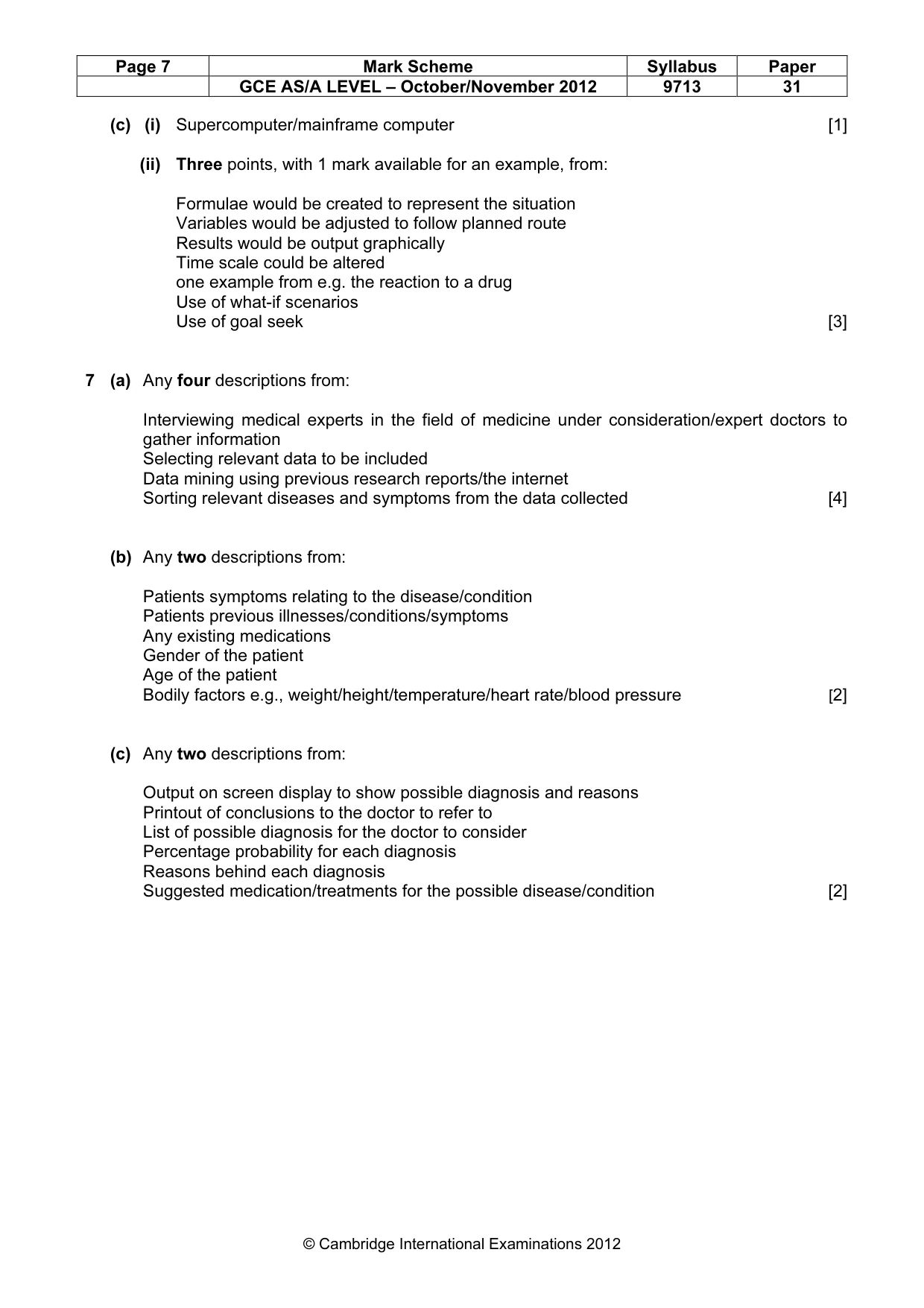
Page 7 Mark Scheme Syllabus Paper GCE AS/A LEVEL – October/November 2012 9713 31 © Cambridge International Examinations 2012 (c) (i) Supercomputer/mainframe computer [1] (ii) Three points, with 1 mark available for an example, from: Formulae would be created to represent the situation Variables would be adjusted to follow planned route Results would be output graphically Time scale could be altered one example from e.g. the reaction to a drug Use of what-if scenarios Use of goal seek [3] 7 (a) Any four descriptions from: Interviewing medical experts in the field of medicine under consideration/expert doctors to gather information Selecting relevant data to be included Data mining using previous research reports/the internet Sorting relevant diseases and symptoms from the data collected [4] (b) Any two descriptions from: Patients symptoms relating to the disease/condition Patients previous illnesses/conditions/symptoms Any existing medications Gender of the patient Age of the patient Bodily factors e.g., weight/height/temperature/heart rate/blood pressure [2] (c) Any two descriptions from: Output on screen display to show possible diagnosis and reasons Printout of conclusions to the doctor to refer to List of possible diagnosis for the doctor to consider Percentage probability for each diagnosis Reasons behind each diagnosis Suggested medication/treatments for the possible disease/condition [2]
Mark scheme, page 8
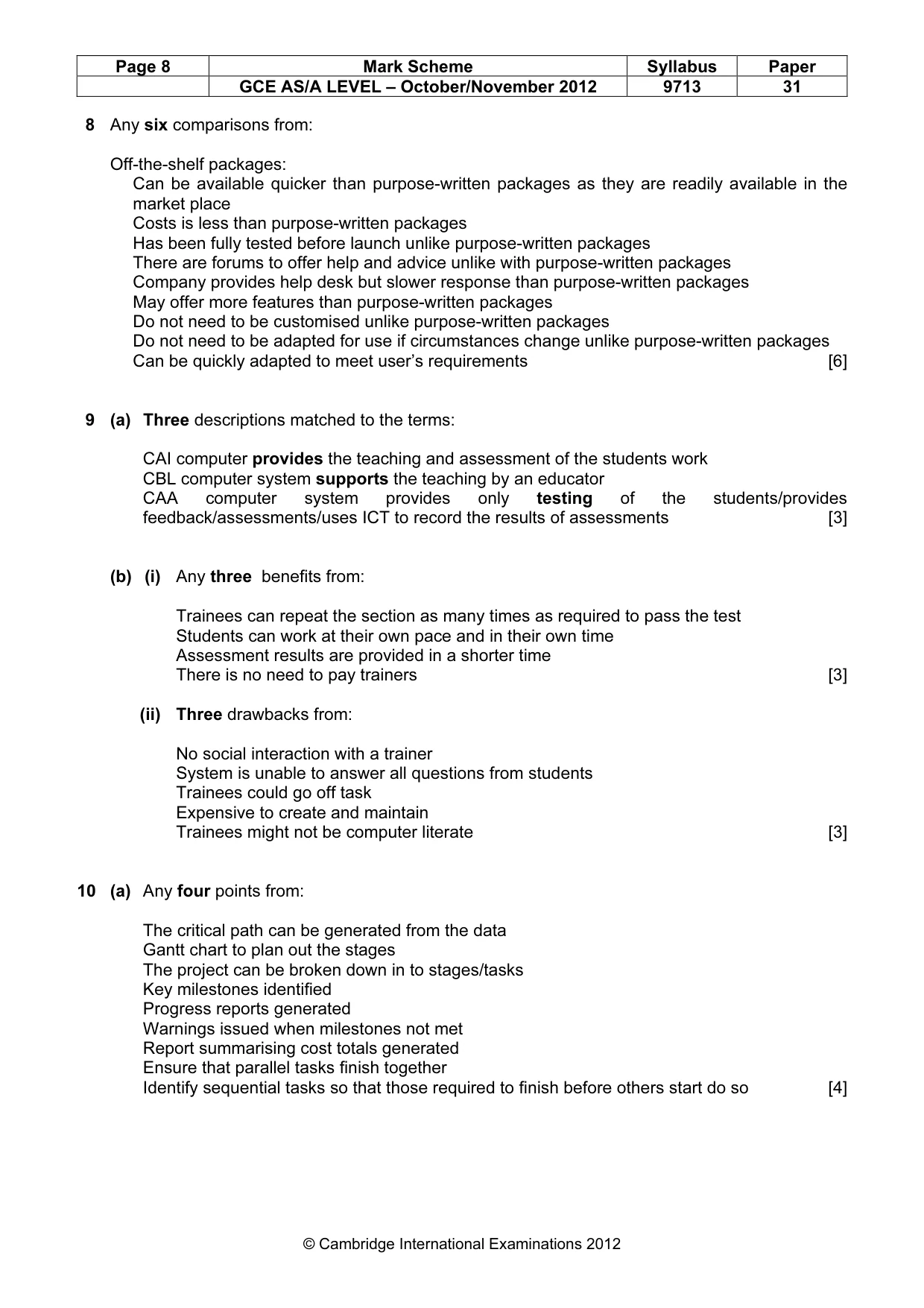
Page 8 Mark Scheme Syllabus Paper GCE AS/A LEVEL – October/November 2012 9713 31 © Cambridge International Examinations 2012 8 Any six comparisons from: Off-the-shelf packages: Can be available quicker than purpose-written packages as they are readily available in the market place Costs is less than purpose-written packages Has been fully tested before launch unlike purpose-written packages There are forums to offer help and advice unlike with purpose-written packages Company provides help desk but slower response than purpose-written packages May offer more features than purpose-written packages Do not need to be customised unlike purpose-written packages Do not need to be adapted for use if circumstances change unlike purpose-written packages Can be quickly adapted to meet user’s requirements [6] 9 (a) Three descriptions matched to the terms: CAI computer provides the teaching and assessment of the students work CBL computer system supports the teaching by an educator CAA computer system provides only testing of the students/provides feedback/assessments/uses ICT to record the results of assessments [3] (b) (i) Any three benefits from: Trainees can repeat the section as many times as required to pass the test Students can work at their own pace and in their own time Assessment results are provided in a shorter time There is no need to pay trainers [3] (ii) Three drawbacks from: No social interaction with a trainer System is unable to answer all questions from students Trainees could go off task Expensive to create and maintain Trainees might not be computer literate [3] 10 (a) Any four points from: The critical path can be generated from the data Gantt chart to plan out the stages The project can be broken down in to stages/tasks Key milestones identified Progress reports generated Warnings issued when milestones not met Report summarising cost totals generated Ensure that parallel tasks finish together Identify sequential tasks so that those required to finish before others start do so [4]
Mark scheme, page 9
Page 9 Mark Scheme Syllabus Paper GCE AS/A LEVEL – October/November 2012 9713 31 © Cambridge International Examinations 2012 (b) Any two descriptions from: Identifies those tasks that make up the critical path Eases management of task Better to work in modules As each element can be tested before release Allows allocation of resources (money/people) Can utilise calendars to show/arrange meetings [2]
What you needed in this session
Cambridge’s own grade thresholds for 2012 Oct/Nov, Paper 3 · Variant 1. A higher threshold means an easier paper — the bar moves with how the cohort did.