Cambridge A Level Applied Information and Communication Technology 9713 — 2015 Oct/Nov Paper 3 · Variant 3
9713/33/O/N/15 · 80 marks · ≈90 min
The question paper and its mark scheme, free to read here and free to download. This is Cambridge’s own paper, exactly as it was sat.
Question paper16 pages







Mark scheme6 pages
Answers below. Sit the paper first if you are practising.
Paper as text
Question paper, page 1
This document consists of 16 printed pages. DC (LM) 116413 © UCLES 2015 [Turn over Cambridge International Examinations Cambridge International Advanced Level * 9 9 1 8 0 7 9 0 5 7 * APPLIED INFORMATION AND COMMUNICATION TECHNOLOGY 9713/33 Paper 3 October/November 2015 1 hour 15 minutes Candidates answer on the Question Paper. No additional materials are required. READ THESE INSTRUCTIONS FIRST Write your Centre number, candidate number and name on all the work you hand in. Write in dark blue or black pen. Do not use staples, paper clips, glue or correction fluid. You may use an HB pencil for any diagrams, graphs or rough working. DO NOT WRITE IN ANY BARCODES. Answer all questions. The number of marks is given in brackets [ ] at the end of each question or part question. The businesses described in this paper are entirely fictitious.
Question paper, page 2
2 9713/33/O/N/15 © UCLES 2015 Scenario 1 Questions 1, 2, 3 and 4. Global Scientific is a company that manufactures industrial chemicals in a large factory. The company employs scientists to monitor the environmental conditions to ensure that the factory and the surrounding areas are kept safe from pollution from the industrial chemicals. The scientists collect data manually by going into the factory and out into the surrounding areas where they use laptops to record the data that they collect. The scientists also use sensors connected to their office computers to collect data. The data from the manual collection and from the sensors is sent to head office to be analysed and used in weekly reports.
Question paper, page 3
3 9713/33/O/N/15 © UCLES 2015 [Turn over 1 Describe how data logging could be used to monitor the environmental conditions around the factory. … … … … … … … … … … … … … … [6] 2 Describe how the functions available in a spreadsheet could be used to analyse the collected data. … … … … … … … … … … [4]
Question paper, page 4
4 9713/33/O/N/15 © UCLES 2015 3 Discuss the benefits and drawbacks of monitoring the environmental conditions in and around the factory by using a computer system rather than manual monitoring. … … … … … … … … … … … … … … … … … … … … [8]
Question paper, page 5
5 9713/33/O/N/15 © UCLES 2015 [Turn over 4 Describe how FTP could be used to transfer the data files between the computers at the factory and the head office. … … … … … … … … … … … … … … [6]
Question paper, page 6
6 9713/33/O/N/15 © UCLES 2015 Scenario 2 Questions 5, 6 and 7. NoRisk Bank plc holds the financial details of a large number of personal and commercial account holders. The bank allows account holders to manage their accounts online. Gupta is a network administrator responsible for the safety and security of the data held by NoRisk Bank plc. Gupta uses a number of different methods to try and keep the data associated with the accounts safe and secure. When logging in, the bank’s computer system requires account users to undergo authentication. Gupta also uses a range of anti-malware software to try to prevent the corruption and theft of the data.
Question paper, page 7
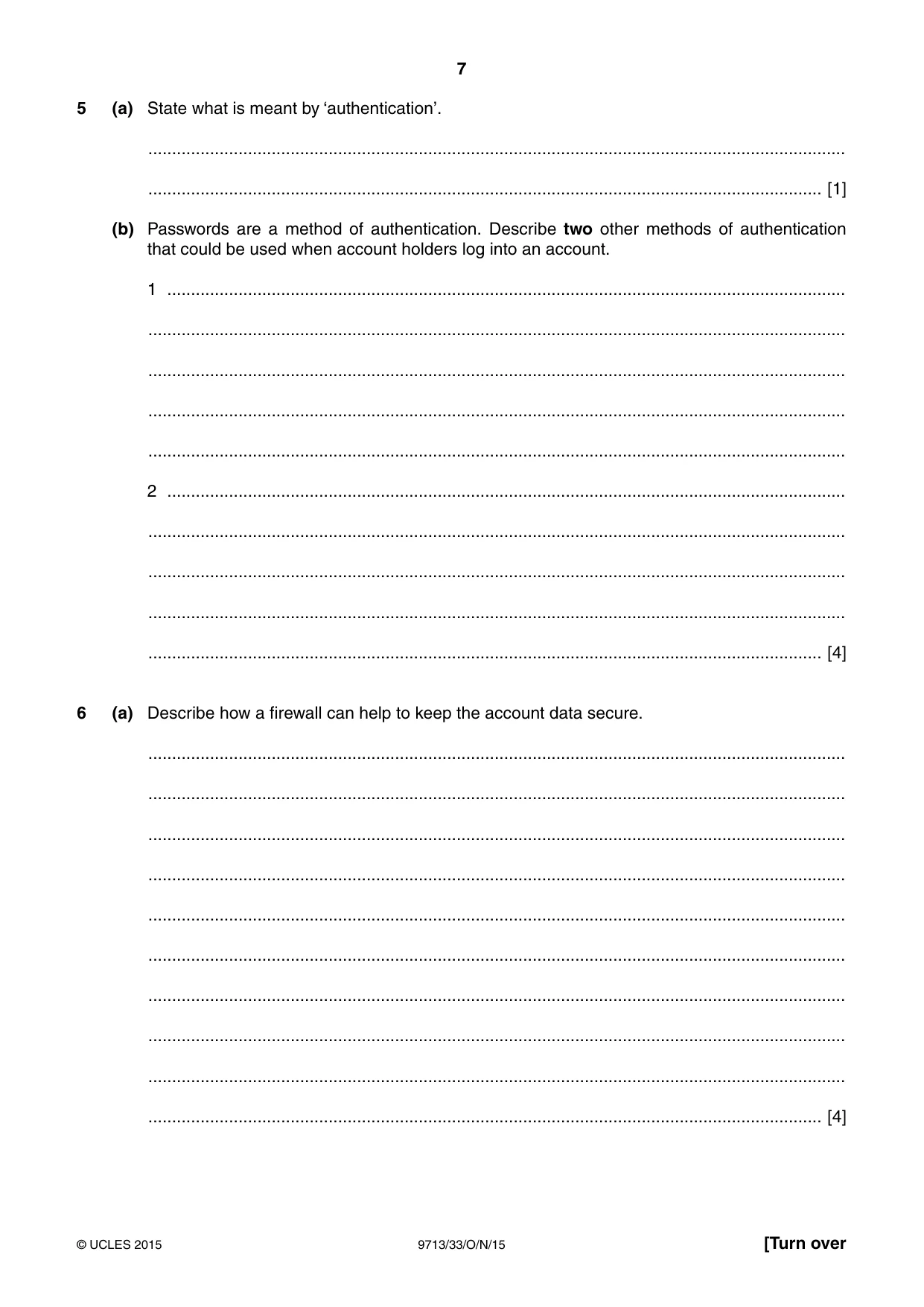
7 9713/33/O/N/15 © UCLES 2015 [Turn over 5 (a) State what is meant by ‘authentication’. … … [1] (b) Passwords are a method of authentication. Describe two other methods of authentication that could be used when account holders log into an account. 1 … … … … … 2 … … … … … [4] 6 (a) Describe how a firewall can help to keep the account data secure. … … … … … … … … … … [4]
Question paper, page 8
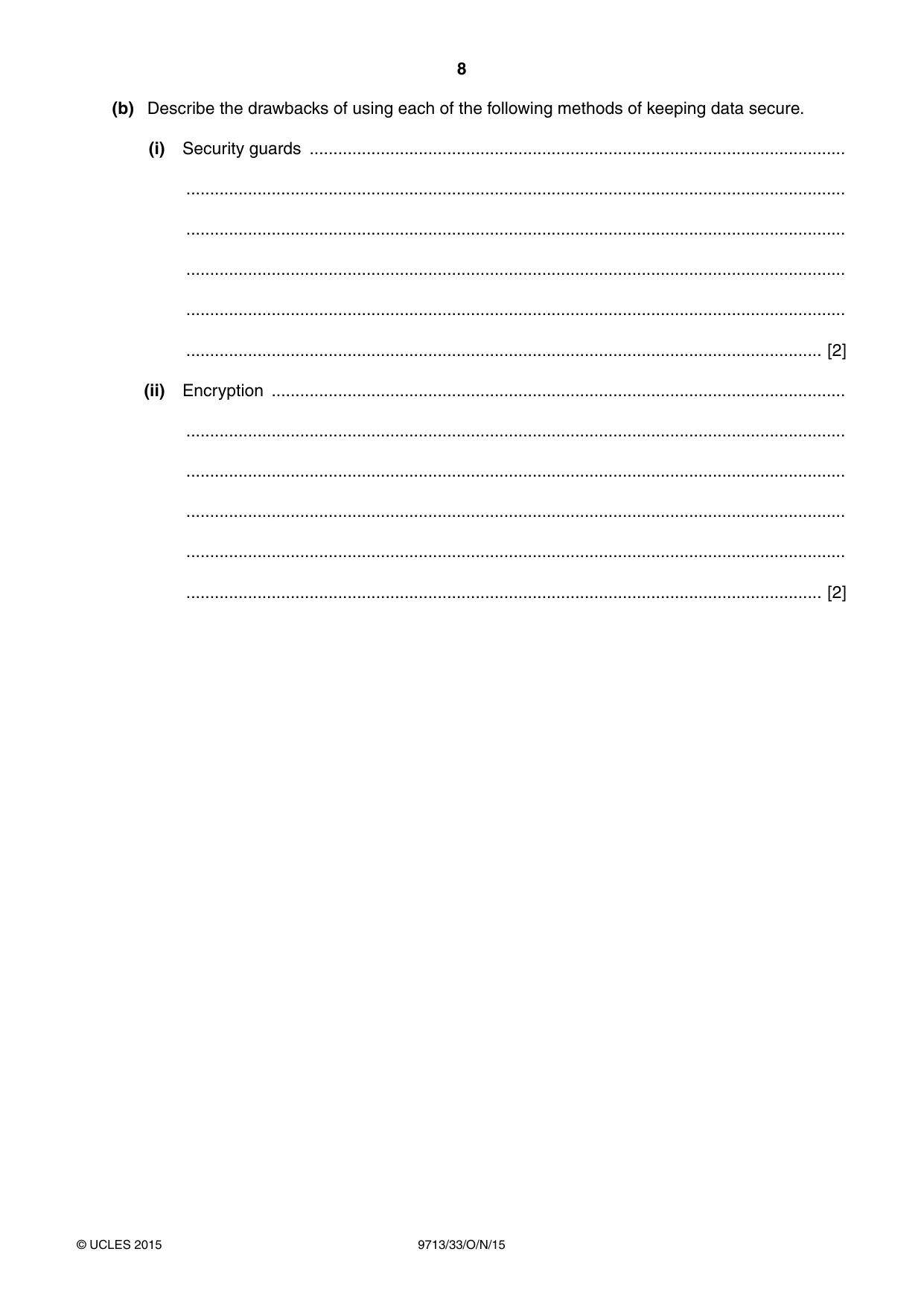
8 9713/33/O/N/15 © UCLES 2015 (b) Describe the drawbacks of using each of the following methods of keeping data secure. (i) Security guards … … … … … … [2] (ii) Encryption … … … … … … [2]
Question paper, page 9
9 9713/33/O/N/15 © UCLES 2015 [Turn over 7 Describe how Gupta would use each of the following anti-malware applications to keep data safe and secure. Anti-virus software … … … … … … Anti-spyware software … … … … … … Anti-popup software … … … … … … [6]
Question paper, page 10
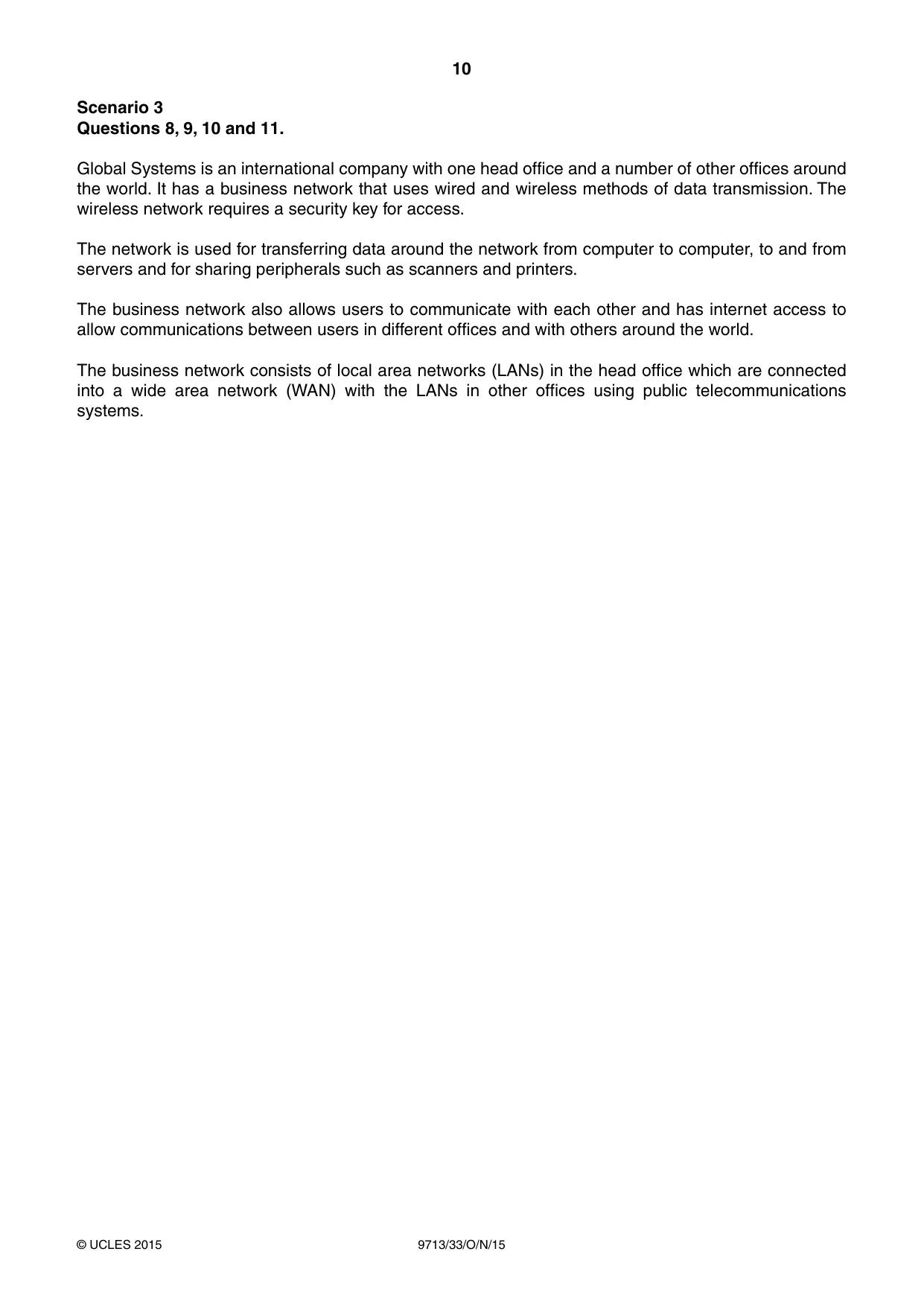
10 9713/33/O/N/15 © UCLES 2015 Scenario 3 Questions 8, 9, 10 and 11. Global Systems is an international company with one head office and a number of other offices around the world. It has a business network that uses wired and wireless methods of data transmission. The wireless network requires a security key for access. The network is used for transferring data around the network from computer to computer, to and from servers and for sharing peripherals such as scanners and printers. The business network also allows users to communicate with each other and has internet access to allow communications between users in different offices and with others around the world. The business network consists of local area networks (LANs) in the head office which are connected into a wide area network (WAN) with the LANs in other offices using public telecommunications systems.
Question paper, page 11
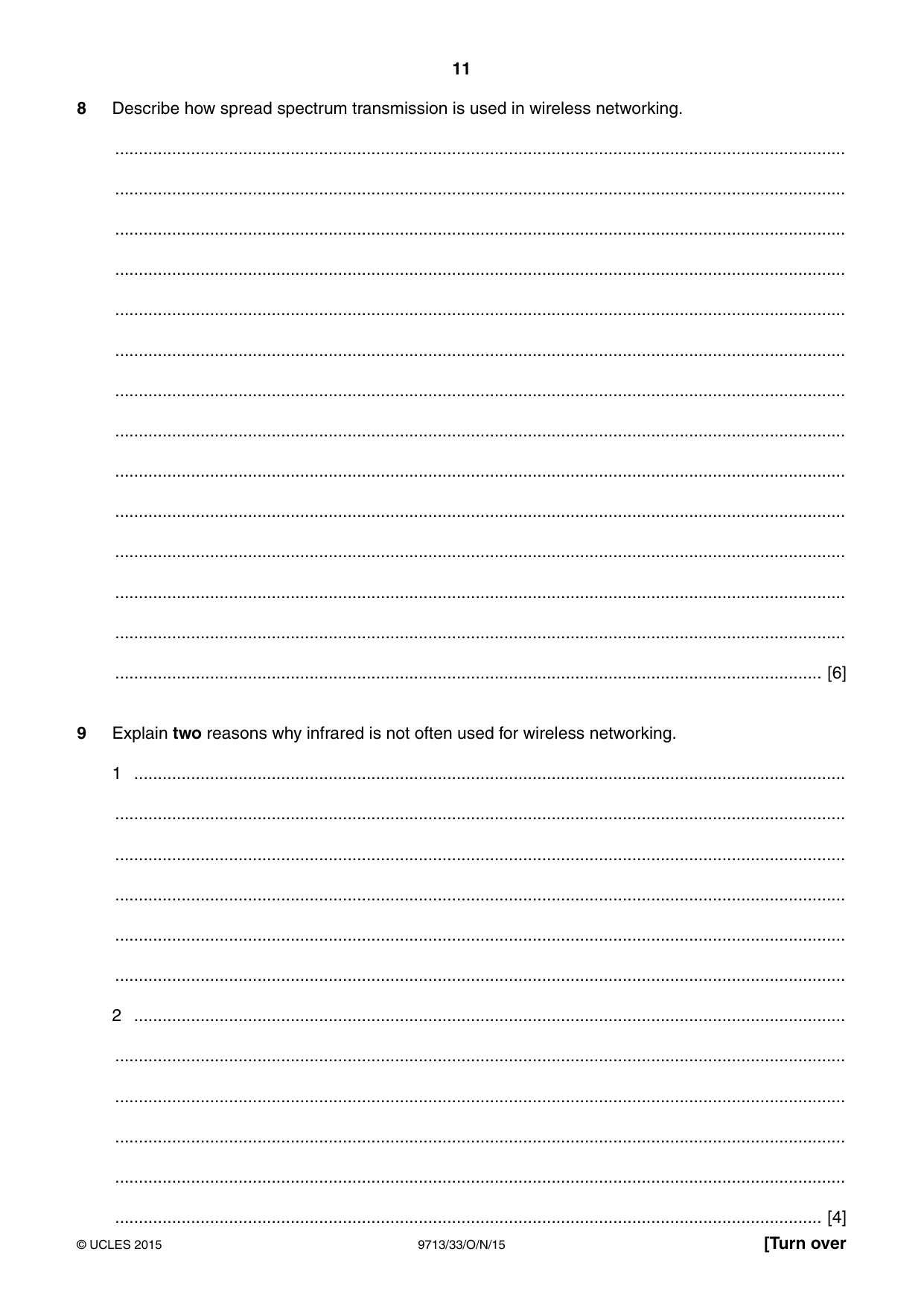
11 9713/33/O/N/15 © UCLES 2015 [Turn over 8 Describe how spread spectrum transmission is used in wireless networking. … … … … … … … … … … … … … … [6] 9 Explain two reasons why infrared is not often used for wireless networking. 1 … … … … … … 2 … … … … … … [4]
Question paper, page 12
12 9713/33/O/N/15 © UCLES 2015 10 Explain why wired equivalent privacy (WEP) should no longer be used to secure wireless networks. … … … … … … … … … … [4]
Question paper, page 13
13 9713/33/O/N/15 © UCLES 2015 [Turn over 11 Discuss the benefits and drawbacks of connecting the individual LANs into a WAN. … … … … … … … … … … … … … … … … … … … … [8]
Question paper, page 14
14 9713/33/O/N/15 © UCLES 2015 Scenario 4 Questions 12 and 13. Speedy Dropoff Co owns a number of trucks that it uses to deliver parcels in a large city. It keeps the trucks in a parking garage just outside the city. The company also has a maintenance garage where servicing of the trucks, repairs and diagnosing of engine faults is carried out. Engine fault diagnosis is carried out using an expert system. Rowena is the delivery manager of the company and uses route scheduling software to work out the shortest route that each truck should take to make its deliveries. She also wants the trucks to take the most economical routes.
Question paper, page 15
15 9713/33/O/N/15 © UCLES 2015 [Turn over 12 (a) Explain, with detailed descriptions of the components, what is meant by an “expert system”. … … … … … … … … … … … … … … [6] (b) Describe, apart from car fault diagnosis and route scheduling, two other uses of expert systems. 1 … … … … … … 2 … … … … … … [4]
Question paper, page 16
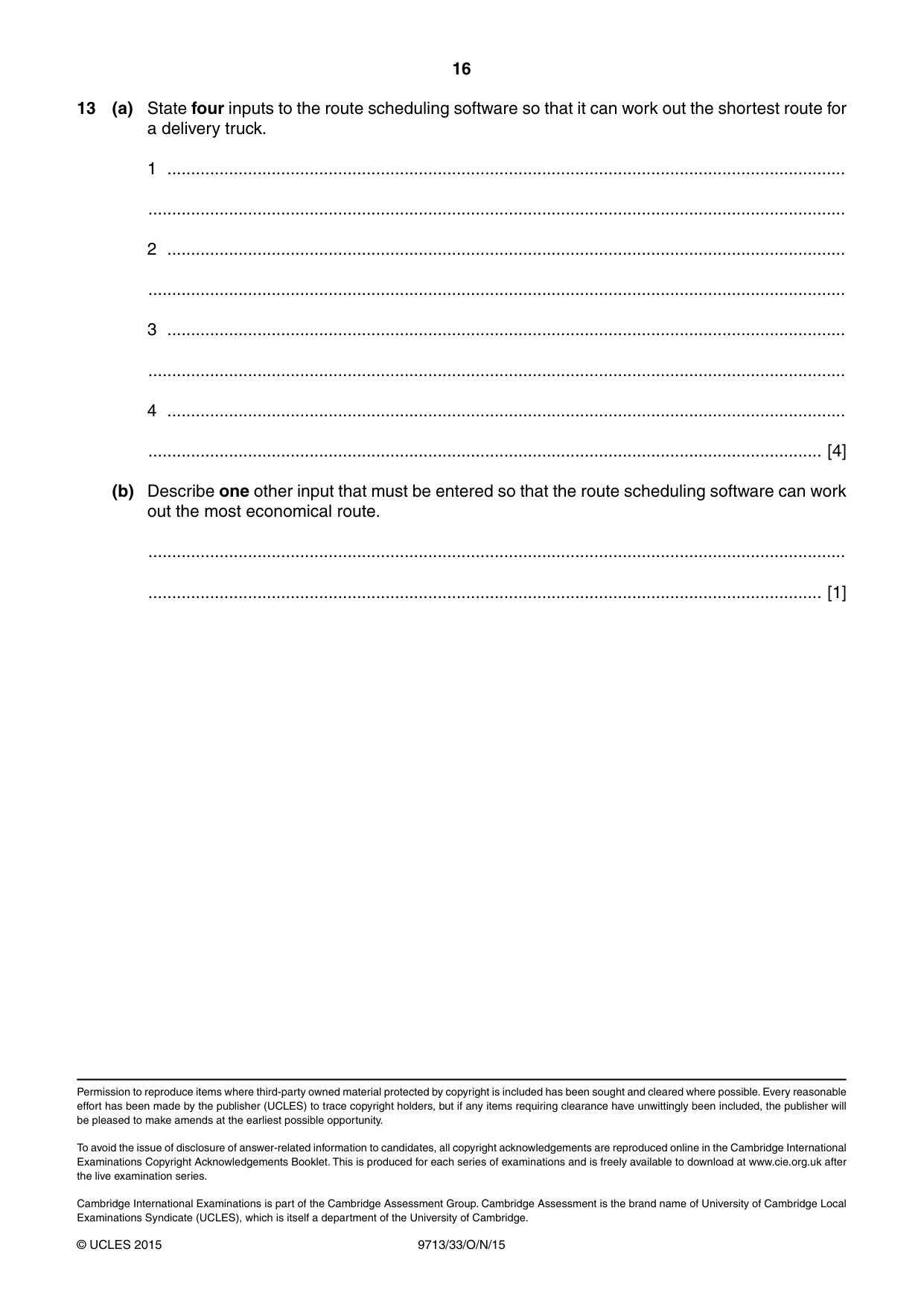
16 9713/33/O/N/15 © UCLES 2015 13 (a) State four inputs to the route scheduling software so that it can work out the shortest route for a delivery truck. 1 … … 2 … … 3 … … 4 … … [4] (b) Describe one other input that must be entered so that the route scheduling software can work out the most economical route. … … [1] Permission to reproduce items where third-party owned material protected by copyright is included has been sought and cleared where possible. Every reasonable effort has been made by the publisher (UCLES) to trace copyright holders, but if any items requiring clearance have unwittingly been included, the publisher will be pleased to make amends at the earliest possible opportunity. To avoid the issue of disclosure of answer-related information to candidates, all copyright acknowledgements are reproduced online in the Cambridge International Examinations Copyright Acknowledgements Booklet. This is produced for each series of examinations and is freely available to download at www.cie.org.uk after the live examination series. Cambridge International Examinations is part of the Cambridge Assessment Group. Cambridge Assessment is the brand name of University of Cambridge Local Examinations Syndicate (UCLES), which is itself a department of the University of Cambridge.
Mark scheme, page 1
® IGCSE is the registered trademark of Cambridge International Examinations. CAMBRIDGE INTERNATIONAL EXAMINATIONS Cambridge International Advanced Subsidiary and Advanced Level MARK SCHEME for the October/November 2015 series 9713 APPLIED INFORMATION AND COMMUNICATION TECHNOLOGY 9713/33 Paper 3 (Written B), maximum raw mark 80 This mark scheme is published as an aid to teachers and candidates, to indicate the requirements of the examination. It shows the basis on which Examiners were instructed to award marks. It does not indicate the details of the discussions that took place at an Examiners’ meeting before marking began, which would have considered the acceptability of alternative answers. Mark schemes should be read in conjunction with the question paper and the Principal Examiner Report for Teachers. Cambridge will not enter into discussions about these mark schemes. Cambridge is publishing the mark schemes for the October/November 2015 series for most Cambridge IGCSE®, Cambridge International A and AS Level components and some Cambridge O Level components.
Mark scheme, page 2
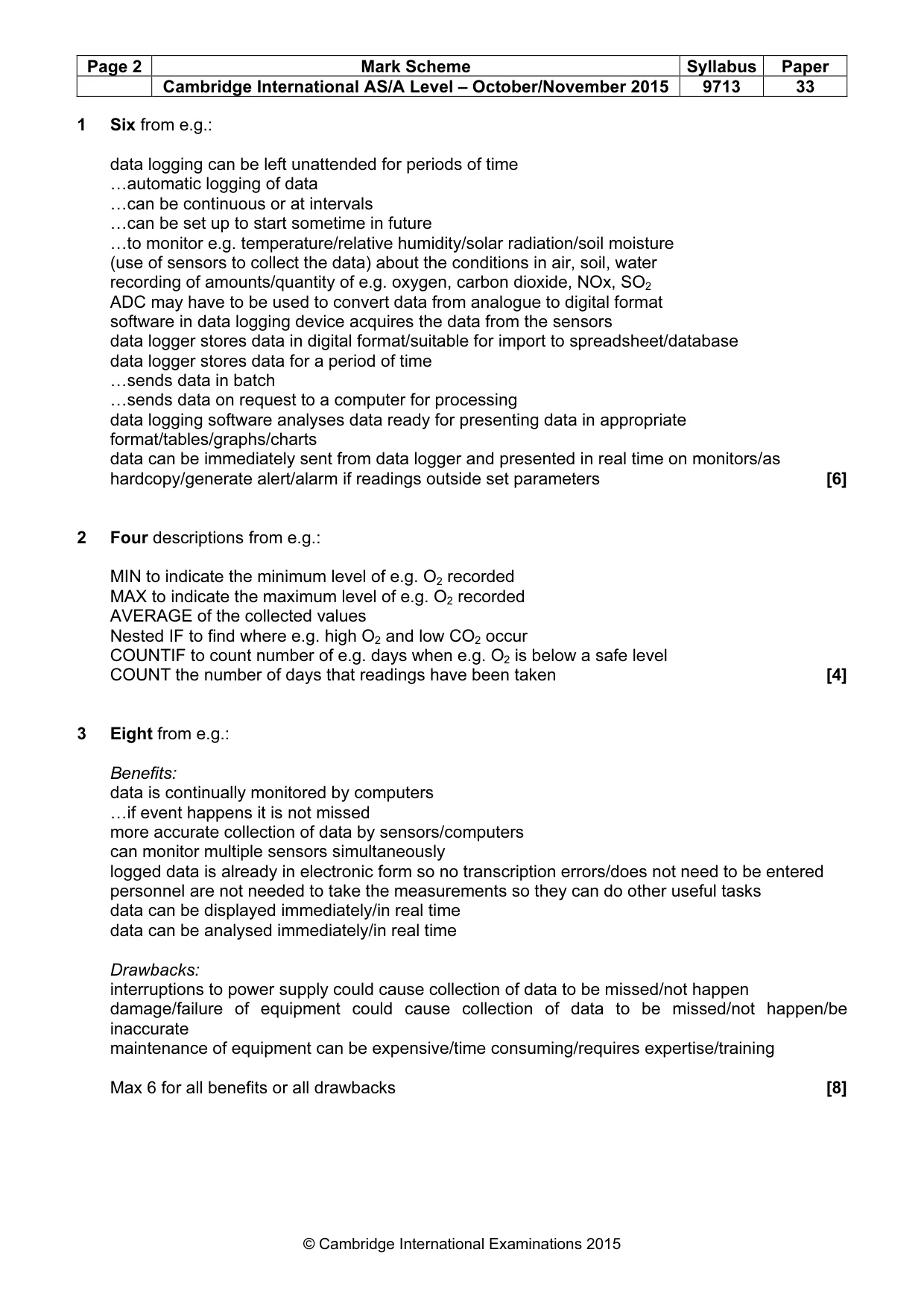
Page 2 Mark Scheme Syllabus Paper Cambridge International AS/A Level – October/November 2015 9713 33 © Cambridge International Examinations 2015 1 Six from e.g.: data logging can be left unattended for periods of time …automatic logging of data …can be continuous or at intervals …can be set up to start sometime in future …to monitor e.g. temperature/relative humidity/solar radiation/soil moisture (use of sensors to collect the data) about the conditions in air, soil, water recording of amounts/quantity of e.g. oxygen, carbon dioxide, NOx, SO2 ADC may have to be used to convert data from analogue to digital format software in data logging device acquires the data from the sensors data logger stores data in digital format/suitable for import to spreadsheet/database data logger stores data for a period of time …sends data in batch …sends data on request to a computer for processing data logging software analyses data ready for presenting data in appropriate format/tables/graphs/charts data can be immediately sent from data logger and presented in real time on monitors/as hardcopy/generate alert/alarm if readings outside set parameters [6] 2 Four descriptions from e.g.: MIN to indicate the minimum level of e.g. O2 recorded MAX to indicate the maximum level of e.g. O2 recorded AVERAGE of the collected values Nested IF to find where e.g. high O2 and low CO2 occur COUNTIF to count number of e.g. days when e.g. O2 is below a safe level COUNT the number of days that readings have been taken [4] 3 Eight from e.g.: Benefits: data is continually monitored by computers …if event happens it is not missed more accurate collection of data by sensors/computers can monitor multiple sensors simultaneously logged data is already in electronic form so no transcription errors/does not need to be entered personnel are not needed to take the measurements so they can do other useful tasks data can be displayed immediately/in real time data can be analysed immediately/in real time Drawbacks: interruptions to power supply could cause collection of data to be missed/not happen damage/failure of equipment could cause collection of data to be missed/not happen/be inaccurate maintenance of equipment can be expensive/time consuming/requires expertise/training Max 6 for all benefits or all drawbacks [8]
Mark scheme, page 3
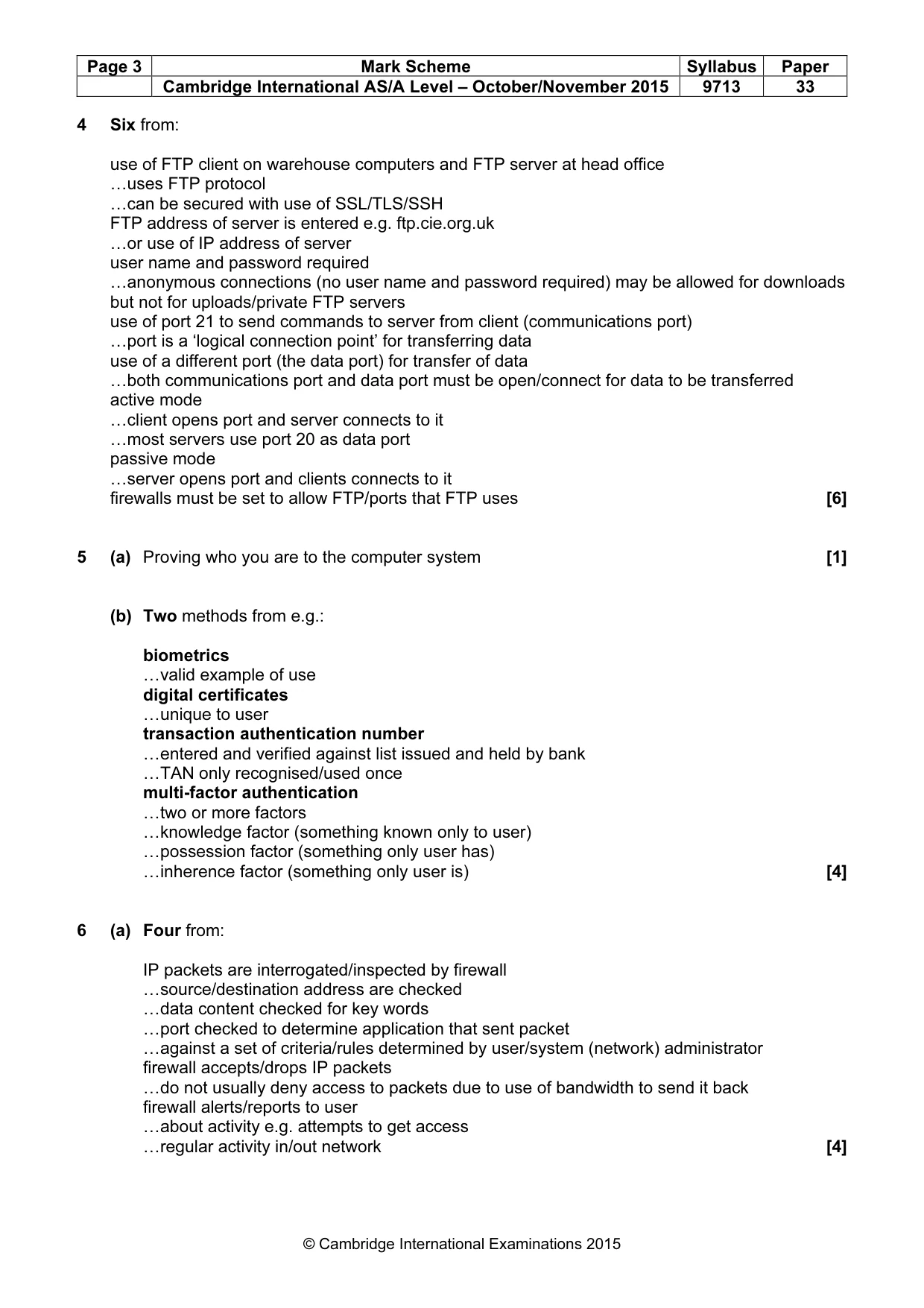
Page 3 Mark Scheme Syllabus Paper Cambridge International AS/A Level – October/November 2015 9713 33 © Cambridge International Examinations 2015 4 Six from: use of FTP client on warehouse computers and FTP server at head office …uses FTP protocol …can be secured with use of SSL/TLS/SSH FTP address of server is entered e.g. ftp.cie.org.uk …or use of IP address of server user name and password required …anonymous connections (no user name and password required) may be allowed for downloads but not for uploads/private FTP servers use of port 21 to send commands to server from client (communications port) …port is a ‘logical connection point’ for transferring data use of a different port (the data port) for transfer of data …both communications port and data port must be open/connect for data to be transferred active mode …client opens port and server connects to it …most servers use port 20 as data port passive mode …server opens port and clients connects to it firewalls must be set to allow FTP/ports that FTP uses [6] 5 (a) Proving who you are to the computer system [1] (b) Two methods from e.g.: biometrics …valid example of use digital certificates …unique to user transaction authentication number …entered and verified against list issued and held by bank …TAN only recognised/used once multi-factor authentication …two or more factors …knowledge factor (something known only to user) …possession factor (something only user has) …inherence factor (something only user is) [4] 6 (a) Four from: IP packets are interrogated/inspected by firewall …source/destination address are checked …data content checked for key words …port checked to determine application that sent packet …against a set of criteria/rules determined by user/system (network) administrator firewall accepts/drops IP packets …do not usually deny access to packets due to use of bandwidth to send it back firewall alerts/reports to user …about activity e.g. attempts to get access …regular activity in/out network [4]
Mark scheme, page 4
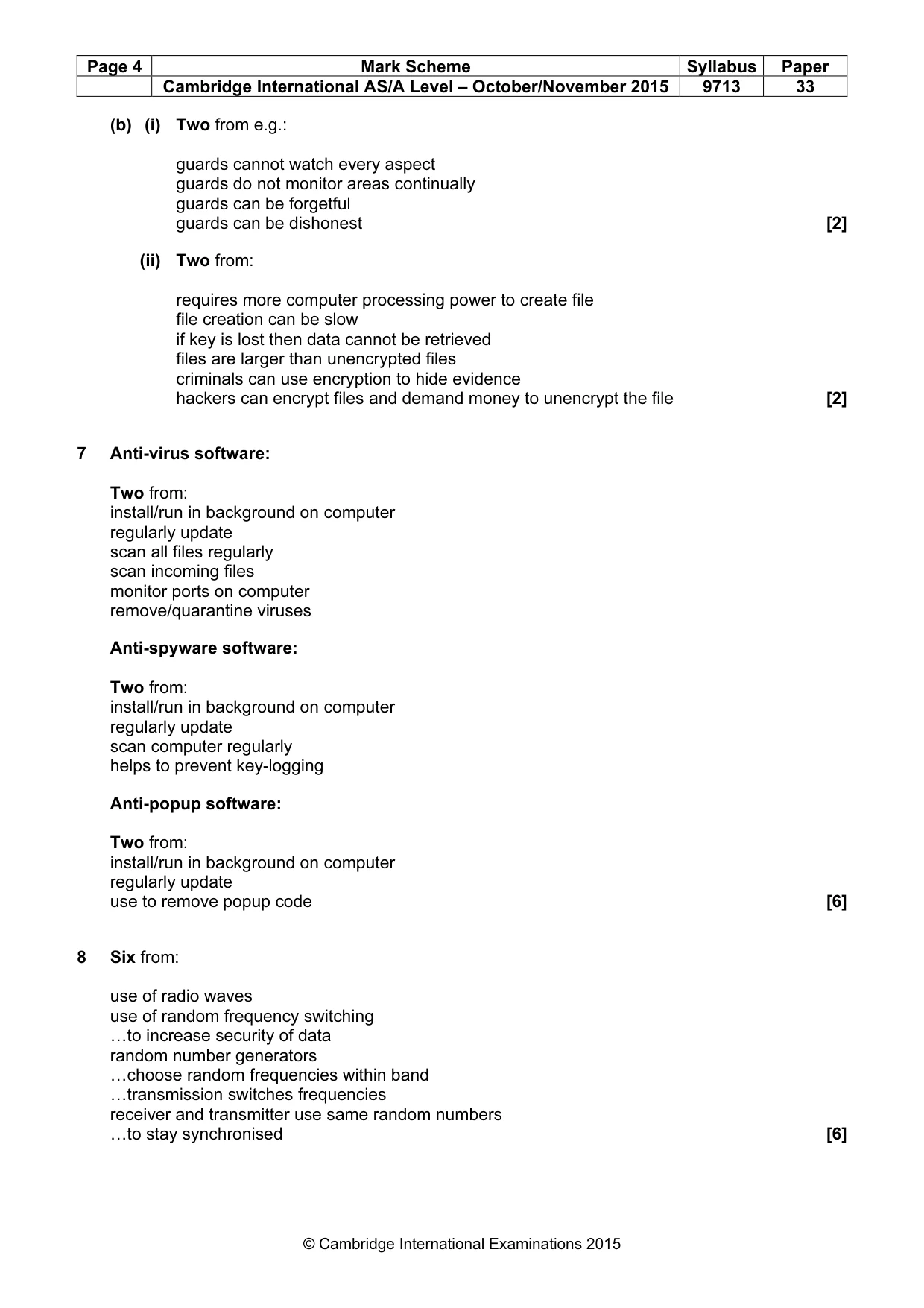
Page 4 Mark Scheme Syllabus Paper Cambridge International AS/A Level – October/November 2015 9713 33 © Cambridge International Examinations 2015 (b) (i) Two from e.g.: guards cannot watch every aspect guards do not monitor areas continually guards can be forgetful guards can be dishonest [2] (ii) Two from: requires more computer processing power to create file file creation can be slow if key is lost then data cannot be retrieved files are larger than unencrypted files criminals can use encryption to hide evidence hackers can encrypt files and demand money to unencrypt the file [2] 7 Anti-virus software: Two from: install/run in background on computer regularly update scan all files regularly scan incoming files monitor ports on computer remove/quarantine viruses Anti-spyware software: Two from: install/run in background on computer regularly update scan computer regularly helps to prevent key-logging Anti-popup software: Two from: install/run in background on computer regularly update use to remove popup code [6] 8 Six from: use of radio waves use of random frequency switching …to increase security of data random number generators …choose random frequencies within band …transmission switches frequencies receiver and transmitter use same random numbers …to stay synchronised [6]
Mark scheme, page 5
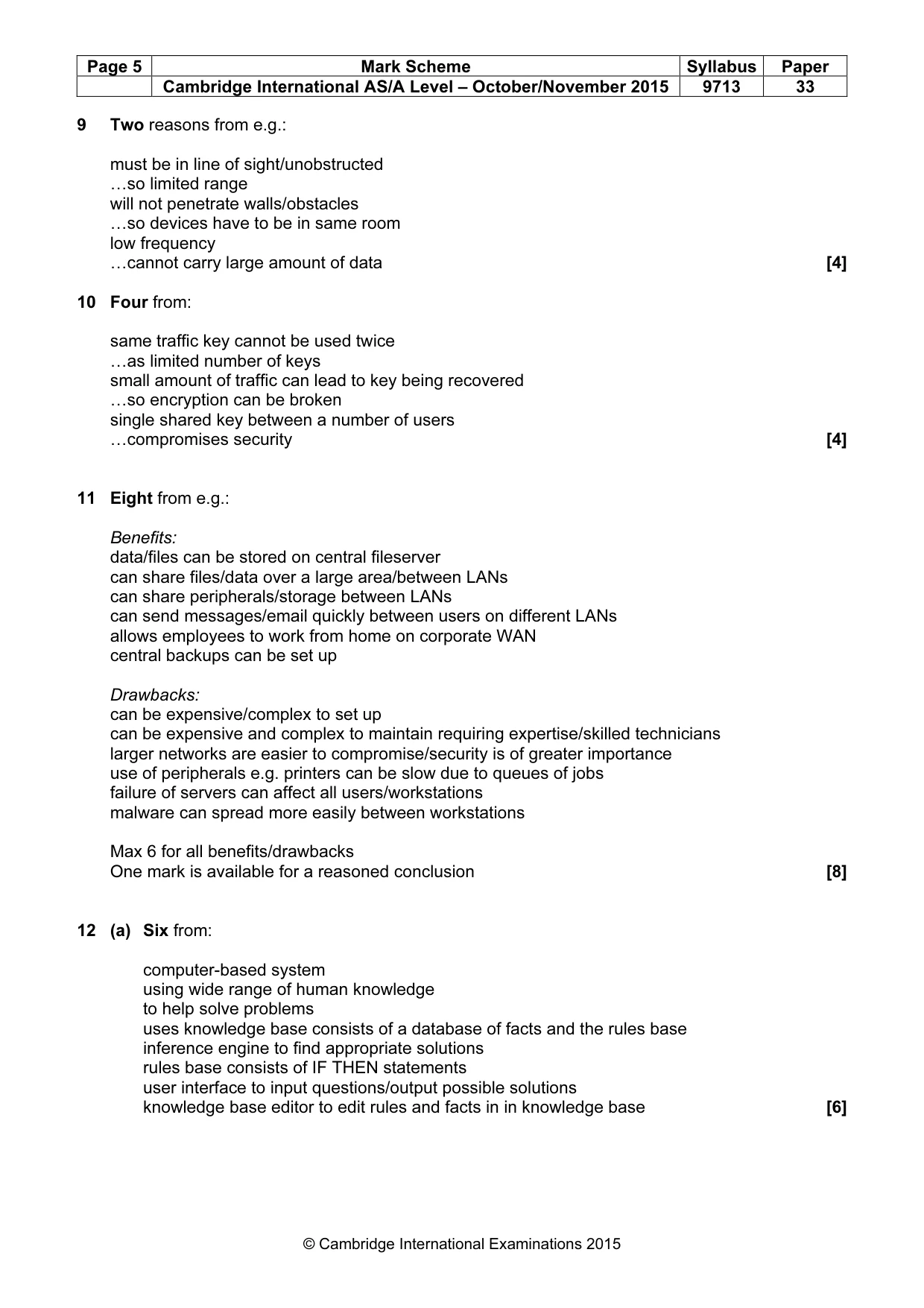
Page 5 Mark Scheme Syllabus Paper Cambridge International AS/A Level – October/November 2015 9713 33 © Cambridge International Examinations 2015 9 Two reasons from e.g.: must be in line of sight/unobstructed …so limited range will not penetrate walls/obstacles …so devices have to be in same room low frequency …cannot carry large amount of data [4] 10 Four from: same traffic key cannot be used twice …as limited number of keys small amount of traffic can lead to key being recovered …so encryption can be broken single shared key between a number of users …compromises security [4] 11 Eight from e.g.: Benefits: data/files can be stored on central fileserver can share files/data over a large area/between LANs can share peripherals/storage between LANs can send messages/email quickly between users on different LANs allows employees to work from home on corporate WAN central backups can be set up Drawbacks: can be expensive/complex to set up can be expensive and complex to maintain requiring expertise/skilled technicians larger networks are easier to compromise/security is of greater importance use of peripherals e.g. printers can be slow due to queues of jobs failure of servers can affect all users/workstations malware can spread more easily between workstations Max 6 for all benefits/drawbacks One mark is available for a reasoned conclusion [8] 12 (a) Six from: computer-based system using wide range of human knowledge to help solve problems uses knowledge base consists of a database of facts and the rules base inference engine to find appropriate solutions rules base consists of IF THEN statements user interface to input questions/output possible solutions knowledge base editor to edit rules and facts in in knowledge base [6]
Mark scheme, page 6
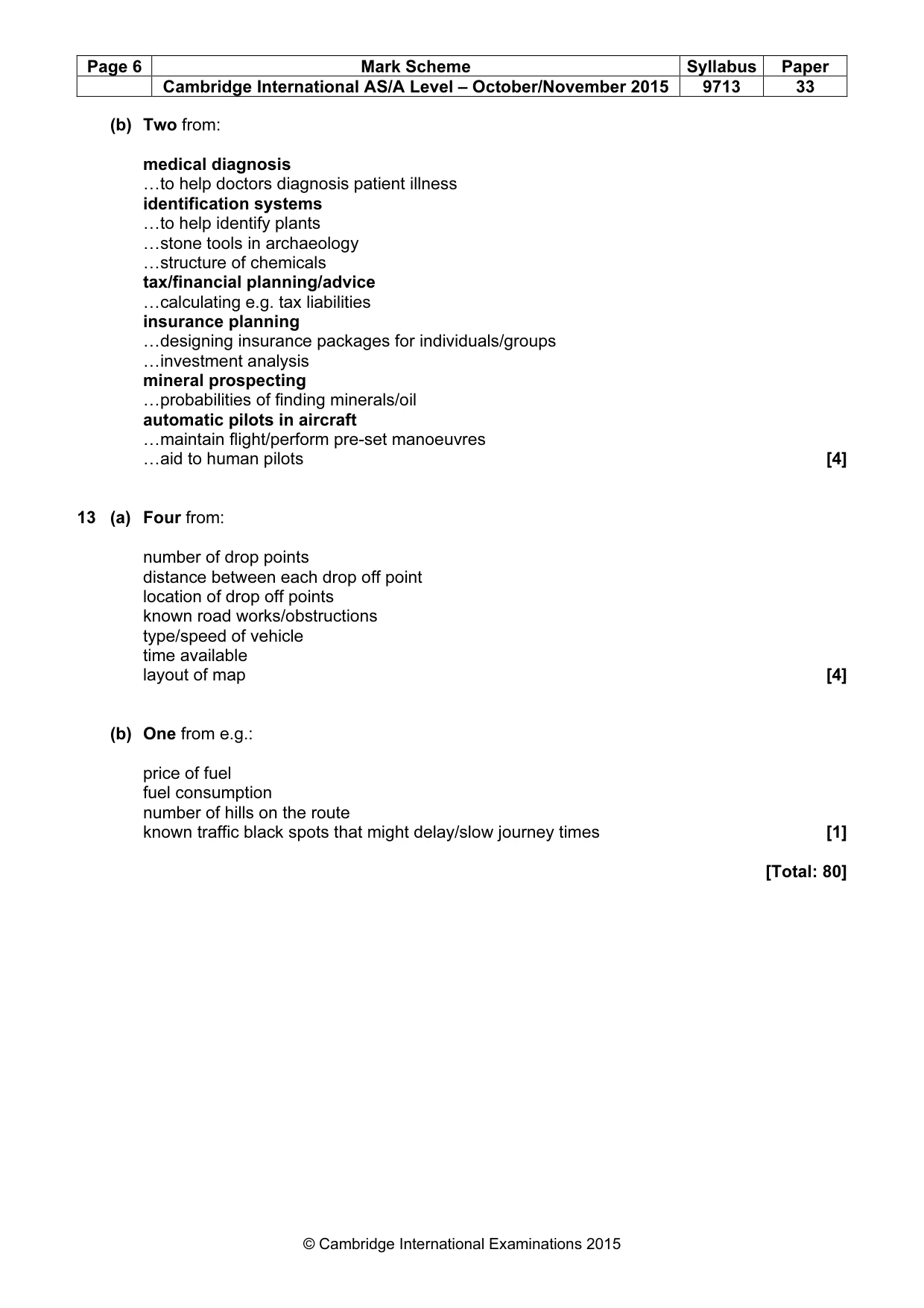
Page 6 Mark Scheme Syllabus Paper Cambridge International AS/A Level – October/November 2015 9713 33 © Cambridge International Examinations 2015 (b) Two from: medical diagnosis …to help doctors diagnosis patient illness identification systems …to help identify plants …stone tools in archaeology …structure of chemicals tax/financial planning/advice …calculating e.g. tax liabilities insurance planning …designing insurance packages for individuals/groups …investment analysis mineral prospecting …probabilities of finding minerals/oil automatic pilots in aircraft …maintain flight/perform pre-set manoeuvres …aid to human pilots [4] 13 (a) Four from: number of drop points distance between each drop off point location of drop off points known road works/obstructions type/speed of vehicle time available layout of map [4] (b) One from e.g.: price of fuel fuel consumption number of hills on the route known traffic black spots that might delay/slow journey times [1] [Total: 80]
What you needed in this session
Cambridge’s own grade thresholds for 2015 Oct/Nov, Paper 3 · Variant 3. A higher threshold means an easier paper — the bar moves with how the cohort did.