Cambridge A Level Applied Information and Communication Technology 9713 — 2016 May/June Paper 3 · Variant 1
9713/31/M/J/16 · 80 marks · ≈90 min
The question paper and its mark scheme, free to read here and free to download. This is Cambridge’s own paper, exactly as it was sat.
Question paper20 pages










Mark scheme7 pages
Answers below. Sit the paper first if you are practising.
Paper as text
Question paper, page 1
This document consists of 18 printed pages and 2 blank pages. DC (RW/CGW) 126908/3 R © UCLES 2016 [Turn over Cambridge International Examinations Cambridge International Advanced Level * 5 4 3 1 4 1 3 5 0 0 * APPLIED INFORMATION AND COMMUNICATION TECHNOLOGY 9713/31 Paper 3 May/June 2016 1 hour 15 minutes Candidates answer on the Question Paper. No additional materials are required. READ THESE INSTRUCTIONS FIRST Write your Centre number, candidate number and name on all the work you hand in. Write in dark blue or black pen. Do not use staples, paper clips, glue or correction fluid. You may use an HB pencil for any diagrams, graphs or rough working. DO NOT WRITE IN ANY BARCODES. Answer all questions. The number of marks is given in brackets [ ] at the end of each question or part question. The businesses described in this paper are entirely fictitious.
Question paper, page 2
2 9713/31/M/J/16 © UCLES 2016 Scenario 1 Questions 1, 2, 3, 4, 5, 6 and 7 A2Z is a company which specialises in developing new drugs for treating human illnesses. They use a supercomputer in their research. Daniel works as a publisher for the company and produces a monthly magazine. The magazine contains articles about the research being carried out both in the laboratories and at research sites around the world. Daniel employs a number of reporters to write the articles for the magazine. The reporters are expected to gather information from the scientists. The reporters are provided with a laptop. Articles may be produced in the offices or while travelling but have to be sent to Daniel in time for publication in both hardcopy and electronic formats.
Question paper, page 3
3 9713/31/M/J/16 © UCLES 2016 [Turn over 1 Give reasons why a reporter would use each of these input devices when preparing their articles. (i) A4 scanner … … … … … …[2] (ii) microphone … … … … … …[2] 2 Describe the limitations of using a laptop for creating an article and sending it to Daniel. … … … … … … … … … …[4]
Question paper, page 4
4 9713/31/M/J/16 © UCLES 2016 3 The resources gathered by the reporters are used by Daniel to produce the article as an automated document. Describe how Daniel would do this. … … … … … … … … … …[4] 4 The company prints the magazine using ‘computerised-plate making’. Describe the printing process, including the use of ‘computerised-plate making’. … … … … … … … … … …[4]
Question paper, page 5
5 9713/31/M/J/16 © UCLES 2016 [Turn over 5 The company decides to produce an electronic version of the magazine. Discuss the benefits and drawbacks of producing the magazine in electronic format. … … … … … … … … … …[4]
Question paper, page 6
6 9713/31/M/J/16 © UCLES 2016 6 A reporter, Victoria, wants to gather information by interviewing some of the scientists by telephone. Victoria will also use email to ask questions of other scientists. (a) Discuss the benefits and drawbacks of telephone interviewing. … … … … … … … … … … … … … …[6]
Question paper, page 7
7 9713/31/M/J/16 © UCLES 2016 [Turn over (b) Discuss the advantages and disadvantages of using email rather than face-to-face interviewing to gather information from the scientists. … … … … … … … … … … … … … …[6]
Question paper, page 8
8 9713/31/M/J/16 © UCLES 2016 7 (a) Describe what is meant by the term ‘supercomputer’. … … … … … …[2] (b) Describe how supercomputers are used in drug research. … … … … … … … … … …[4]
Question paper, page 9
9 9713/31/M/J/16 © UCLES 2016 [Turn over BLANK PAGE
Question paper, page 10
10 9713/31/M/J/16 © UCLES 2016 Scenario 2 Questions 8 and 9 SRCo is a scientific research company that employs a number of skilled technicians to support the scientists in its laboratories. The technicians may work in more than one laboratory depending on the needs of the scientists. The company has a human resources department that keeps a database. The database stores details of the technicians. The human resources department issues each technician with an identity badge. Jasmine works in the human resources department where her job is to create a new record in the database and issue a badge to a technician when they join the company.
Question paper, page 11
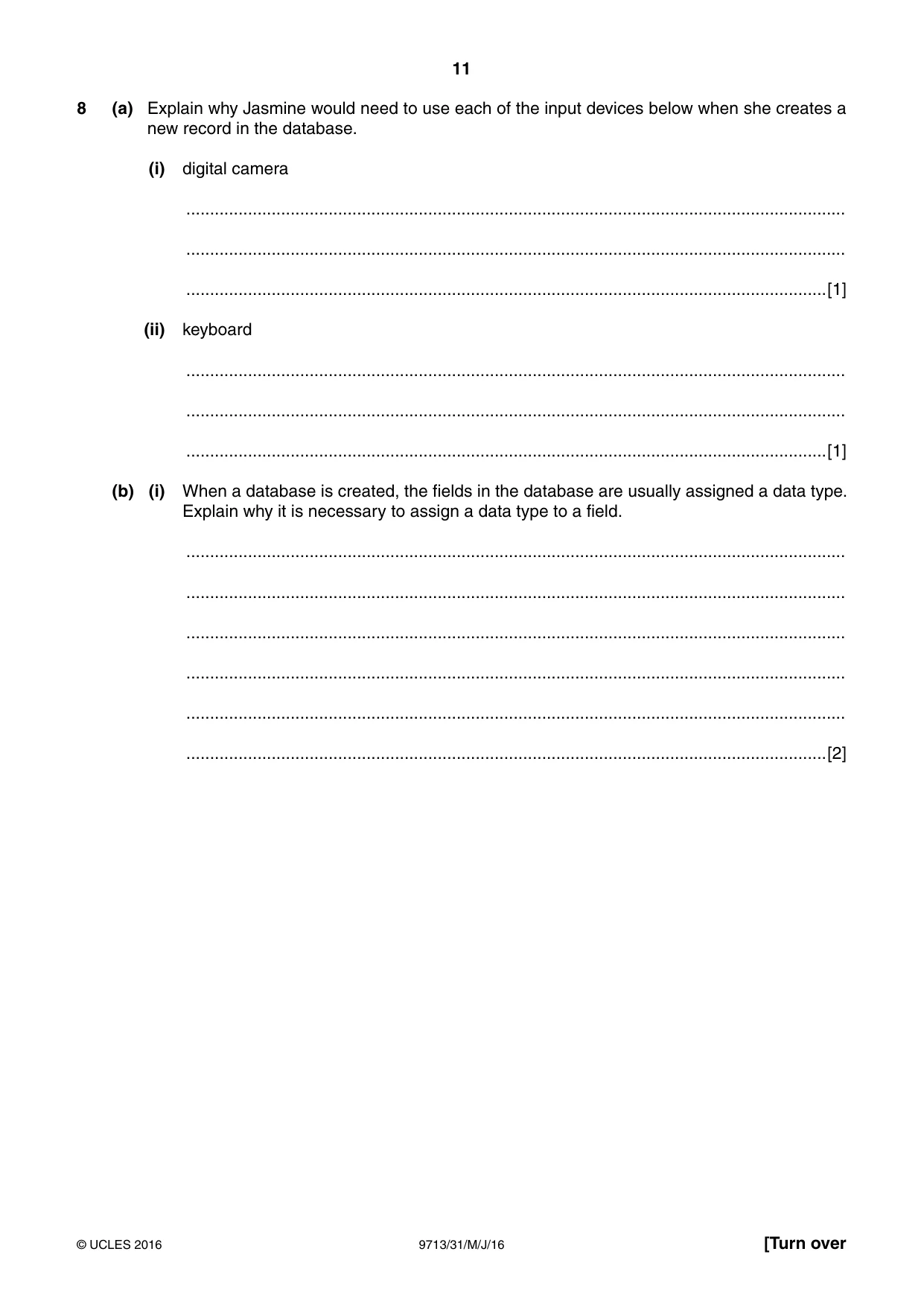
11 9713/31/M/J/16 © UCLES 2016 [Turn over 8 (a) Explain why Jasmine would need to use each of the input devices below when she creates a new record in the database. (i) digital camera … … …[1] (ii) keyboard … … …[1] (b) (i) When a database is created, the fields in the database are usually assigned a data type. Explain why it is necessary to assign a data type to a field. … … … … … …[2]
Question paper, page 12
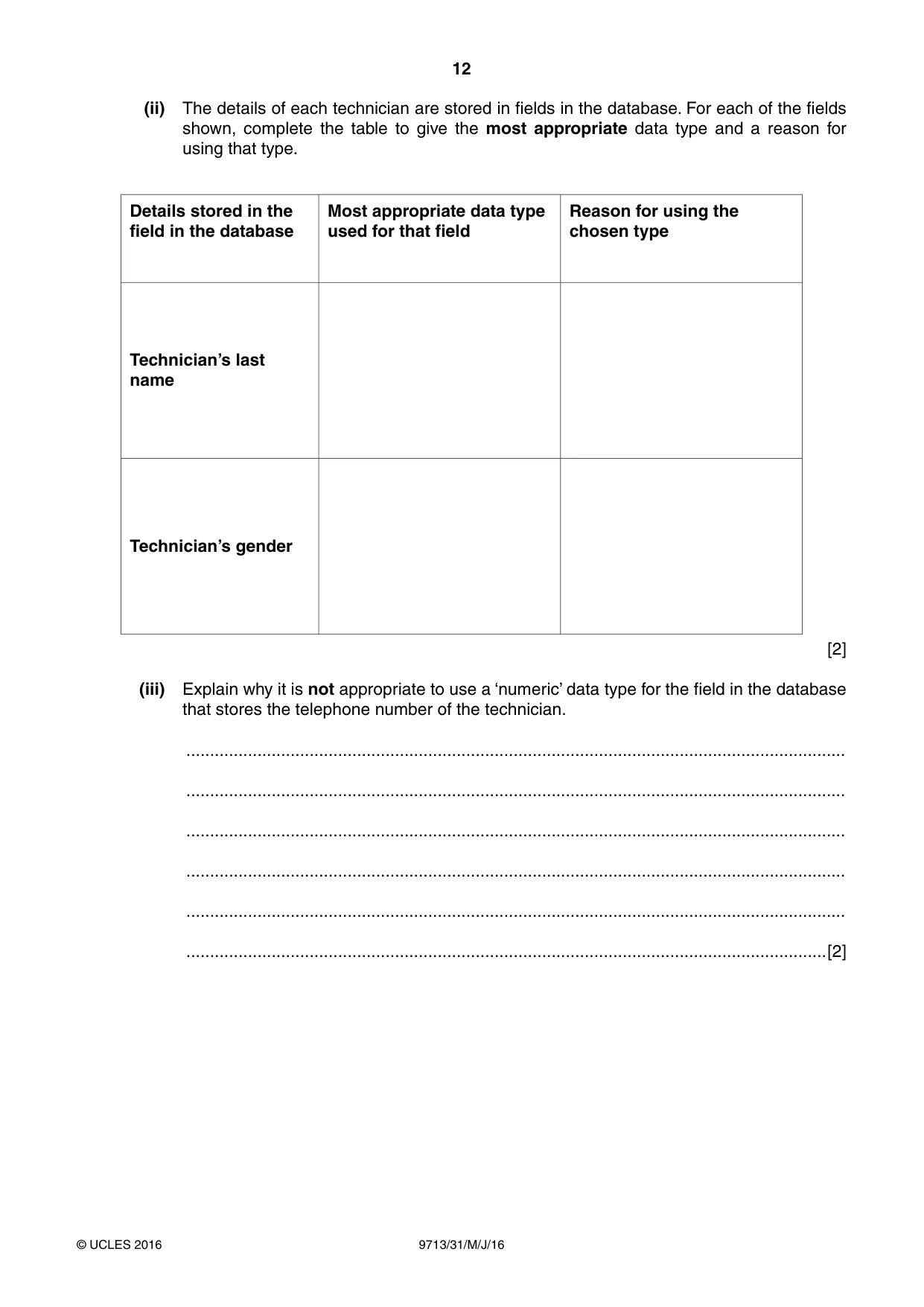
12 9713/31/M/J/16 © UCLES 2016 (ii) The details of each technician are stored in fields in the database. For each of the fields shown, complete the table to give the most appropriate data type and a reason for using that type. Details stored in the field in the database Most appropriate data type used for that field Reason for using the chosen type Technician’s last name Technician’s gender [2] (iii) Explain why it is not appropriate to use a ‘numeric’ data type for the field in the database that stores the telephone number of the technician. … … … … … …[2]
Question paper, page 13
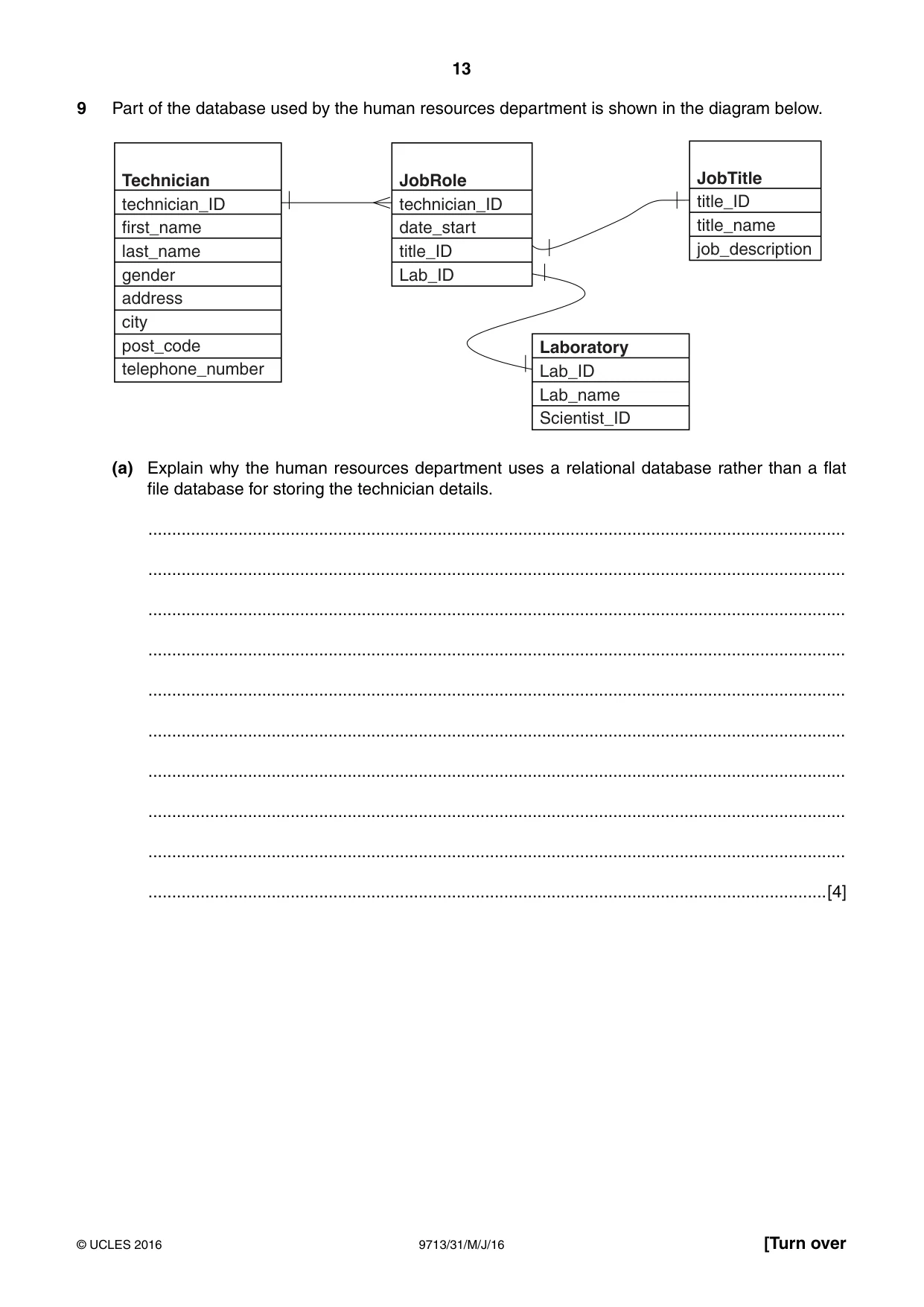
13 9713/31/M/J/16 © UCLES 2016 [Turn over 9 Part of the database used by the human resources department is shown in the diagram below. 7HFKQLFLDQ technician_ID first_name last_name gender address city post_code telephone_number -RE5ROH technician_ID date_start title_ID Lab_ID /DERUDWRU\ Lab_ID Lab_name Scientist_ID -RE7LWOH title_ID title_name job_description (a) Explain why the human resources department uses a relational database rather than a flat file database for storing the technician details. … … … … … … … … … …[4]
Question paper, page 14
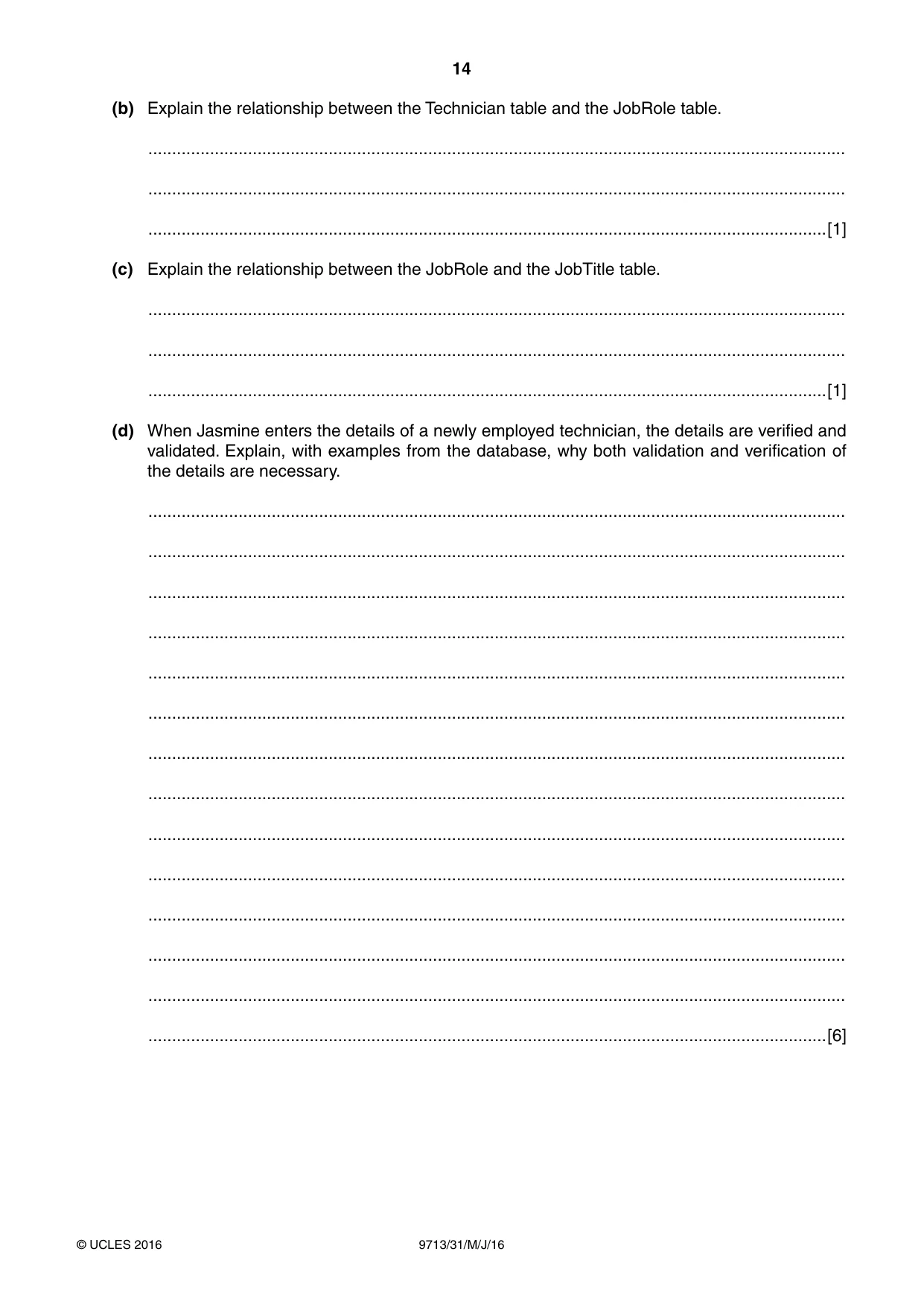
14 9713/31/M/J/16 © UCLES 2016 (b) Explain the relationship between the Technician table and the JobRole table. … … …[1] (c) Explain the relationship between the JobRole and the JobTitle table. … … …[1] (d) When Jasmine enters the details of a newly employed technician, the details are verified and validated. Explain, with examples from the database, why both validation and verification of the details are necessary. … … … … … … … … … … … … … …[6]
Question paper, page 15
15 9713/31/M/J/16 © UCLES 2016 [Turn over BLANK PAGE
Question paper, page 16
16 9713/31/M/J/16 © UCLES 2016 Scenario 3 Questions 10, 11 and 12 KemCo is a chemical company that develops, manufactures and markets fertilizers for growing crops. Colin, the marketing manager, uses computer-based financial models to assess whether or not the company should develop, manufacture and market a new fertilizer. The manufacturing process of the fertilizer is monitored and controlled by microprocessors. Once the fertilizer is ready to sell, Colin uses primary and secondary marketing techniques to help him market the fertilizer.
Question paper, page 17
17 9713/31/M/J/16 © UCLES 2016 [Turn over 10 Describe how Colin could use a financial model to assess whether or not it would be profitable to produce a new fertilizer. … … … … … … … … … … … … … …[6]
Question paper, page 18
18 9713/31/M/J/16 © UCLES 2016 11 The fertilizer manufacturing process is dependent on temperature and pH. Alkali is used to raise the pH of the fertilizer in the vessel. A diagram of the process is shown below. A microprocessor is connected to the sensors, valve and heater. Microprocessor Hopper with alkali Valve to let in more alkali Vessel with fertilizer pH sensor Temperature sensor Heater Describe how the microprocessor controls the conditions in the vessel. … … … … … … … … … … … … … … …
Question paper, page 19
19 9713/31/M/J/16 © UCLES 2016 [Turn over … … … … … …[8] Question 12 is on the next page.
Question paper, page 20
20 9713/31/M/J/16 © UCLES 2016 Permission to reproduce items where third-party owned material protected by copyright is included has been sought and cleared where possible. Every reasonable effort has been made by the publisher (UCLES) to trace copyright holders, but if any items requiring clearance have unwittingly been included, the publisher will be pleased to make amends at the earliest possible opportunity. To avoid the issue of disclosure of answer-related information to candidates, all copyright acknowledgements are reproduced online in the Cambridge International Examinations Copyright Acknowledgements Booklet. This is produced for each series of examinations and is freely available to download at www.cie.org.uk after the live examination series. Cambridge International Examinations is part of the Cambridge Assessment Group. Cambridge Assessment is the brand name of University of Cambridge Local Examinations Syndicate (UCLES), which is itself a department of the University of Cambridge. 12 (a) Explain the differences between primary and secondary research. … … … … … …[2] (b) Describe how Colin could use computer-based research techniques to carry out primary research. … … … … … … … … … … … … … …[6]
Mark scheme, page 1
® IGCSE is the registered trademark of Cambridge International Examinations. This document consists of 7 printed pages. © UCLES 2016 [Turn over Cambridge International Examinations Cambridge International Advanced Level APPLIED INFORMATION & COMMUNICATION TECHNOLOGY 9713/31 Paper 3 Written B May/June 2016 MARK SCHEME Maximum Mark: 80 Published This mark scheme is published as an aid to teachers and candidates, to indicate the requirements of the examination. It shows the basis on which Examiners were instructed to award marks. It does not indicate the details of the discussions that took place at an Examiners’ meeting before marking began, which would have considered the acceptability of alternative answers. Mark schemes should be read in conjunction with the question paper and the Principal Examiner Report for Teachers. Cambridge will not enter into discussions about these mark schemes. Cambridge is publishing the mark schemes for the May/June 2016 series for most Cambridge IGCSE®, Cambridge International A and AS Level components and some Cambridge O Level components.
Mark scheme, page 2
Page 2 Mark Scheme Syllabus Paper Cambridge International A Level – May/June 2016 9713 31 © Cambridge International Examinations 2016 1 (i) Two from: [2] Original source is only available in hardcopy …may need to use software to edit the digital copy of the source …may contain text that may be imported into article using OCR (ii) Two from: [2] …dictate article for future typing …record a voice memo/audio log about the article …use of speech-to-text/speech recognition …to record interviews for use in the article 2 Four limitations of laptops from: [4] Difficulties when viewing/creating the article on laptops which generally have smaller screens and keyboards presenting Image processing can be slower on laptops which usually have lower specification/ slower processors / less memory (RAM)/ smaller hard drive with slower access times for the same cost as e.g. desktop computer Laptops are inherently more vulnerable to damage and theft so more risk of loss of article Power management issues e.g. limited battery life so more difficult to manage when away from office Connecting to outside networks may require configuration skills/more technical skill to connect when away from office Repairs are more difficult than when away from office/traveling 3 Four from: [4] Ensure resources are all electronic Gather assets/resources into common/shared area Convert assets/resources into suitable format for inclusion into final document Create master document/template Use of copy/paste of resources into master document Use of hyperlinks embedded in the master document/template Use of embedded object linking to include remotely stored assets/resources 4 Four from: [4] Text and images/assets are brought together Media/plate held in precise position Plate wrapped around drum rotating on its axis/plate is put in cylinder and head move long axis/ plate on flat bed and laser is deflected by mirrors line by line Computer data used to control the laser/ultraviolet to produce image on plate/drum Separate plates are created for different colours Plate/drum uses to print onto paper
Mark scheme, page 3
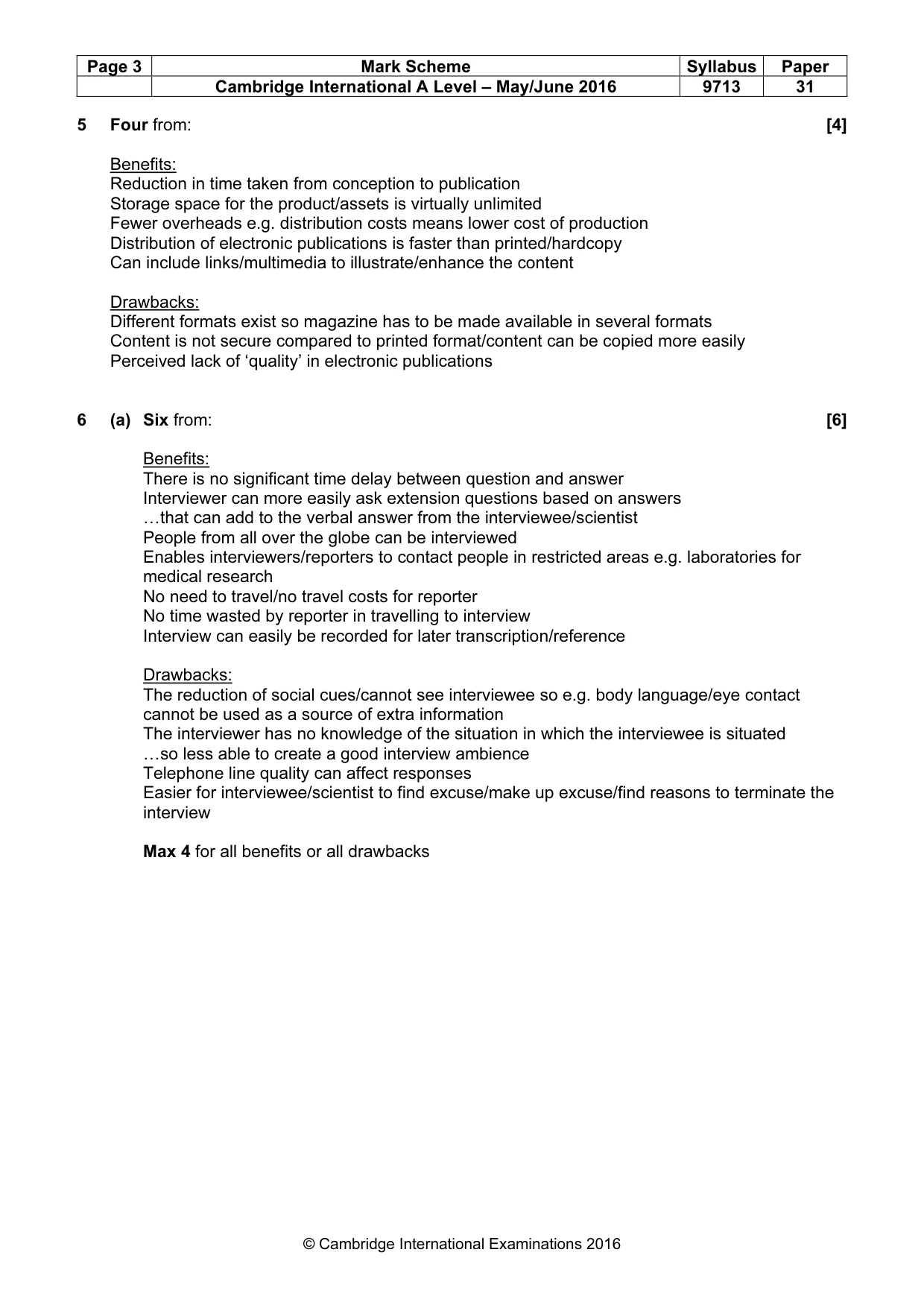
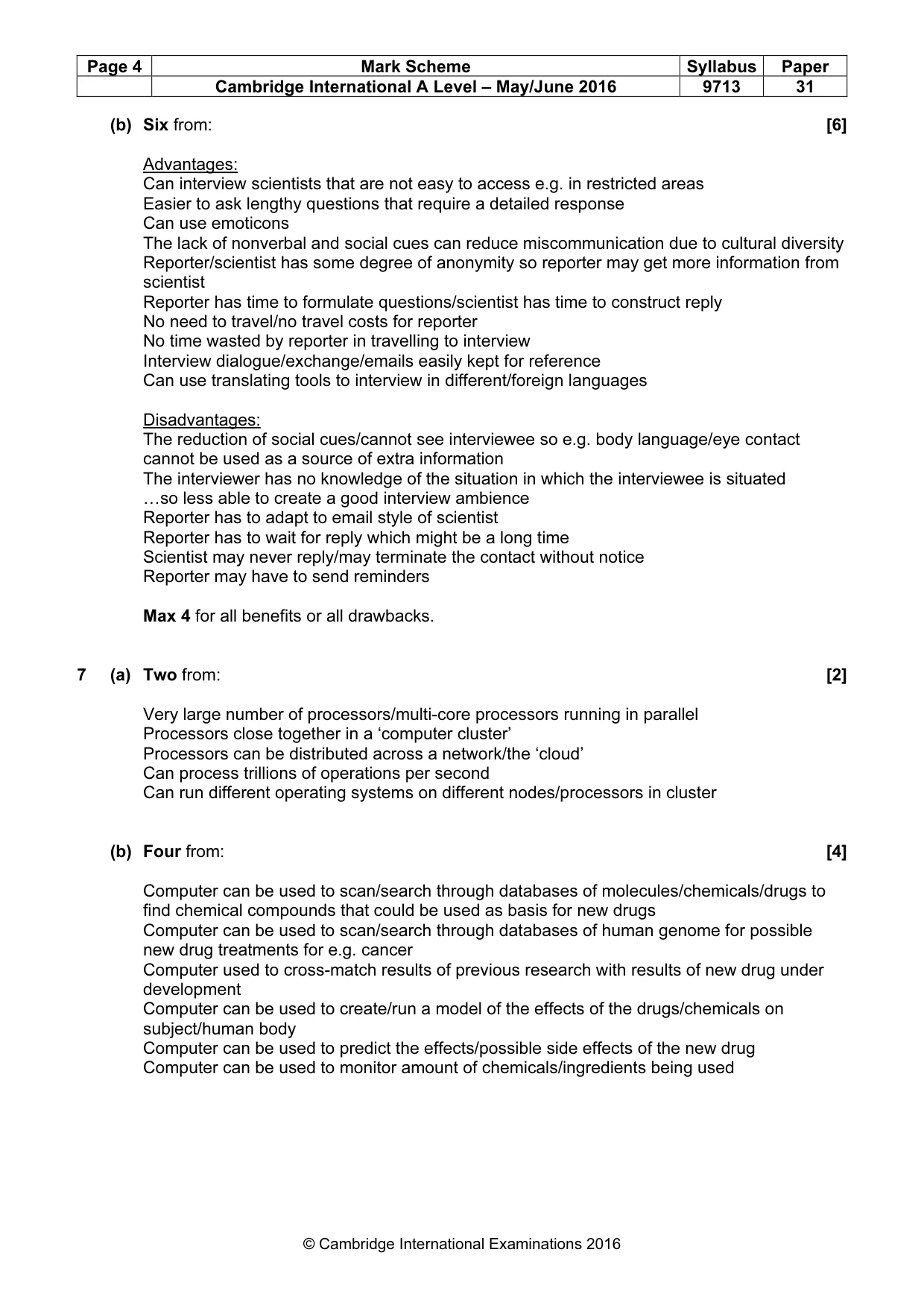
Page 3 Mark Scheme Syllabus Paper Cambridge International A Level – May/June 2016 9713 31 © Cambridge International Examinations 2016 5 Four from: [4] Benefits: Reduction in time taken from conception to publication Storage space for the product/assets is virtually unlimited Fewer overheads e.g. distribution costs means lower cost of production Distribution of electronic publications is faster than printed/hardcopy Can include links/multimedia to illustrate/enhance the content Drawbacks: Different formats exist so magazine has to be made available in several formats Content is not secure compared to printed format/content can be copied more easily Perceived lack of ‘quality’ in electronic publications 6 (a) Six from: [6] Benefits: There is no significant time delay between question and answer Interviewer can more easily ask extension questions based on answers …that can add to the verbal answer from the interviewee/scientist People from all over the globe can be interviewed Enables interviewers/reporters to contact people in restricted areas e.g. laboratories for medical research No need to travel/no travel costs for reporter No time wasted by reporter in travelling to interview Interview can easily be recorded for later transcription/reference Drawbacks: The reduction of social cues/cannot see interviewee so e.g. body language/eye contact cannot be used as a source of extra information The interviewer has no knowledge of the situation in which the interviewee is situated …so less able to create a good interview ambience Telephone line quality can affect responses Easier for interviewee/scientist to find excuse/make up excuse/find reasons to terminate the interview Max 4 for all benefits or all drawbacks
Mark scheme, page 4
Page 4 Mark Scheme Syllabus Paper Cambridge International A Level – May/June 2016 9713 31 © Cambridge International Examinations 2016 (b) Six from: [6] Advantages: Can interview scientists that are not easy to access e.g. in restricted areas Easier to ask lengthy questions that require a detailed response Can use emoticons The lack of nonverbal and social cues can reduce miscommunication due to cultural diversity Reporter/scientist has some degree of anonymity so reporter may get more information from scientist Reporter has time to formulate questions/scientist has time to construct reply No need to travel/no travel costs for reporter No time wasted by reporter in travelling to interview Interview dialogue/exchange/emails easily kept for reference Can use translating tools to interview in different/foreign languages Disadvantages: The reduction of social cues/cannot see interviewee so e.g. body language/eye contact cannot be used as a source of extra information The interviewer has no knowledge of the situation in which the interviewee is situated …so less able to create a good interview ambience Reporter has to adapt to email style of scientist Reporter has to wait for reply which might be a long time Scientist may never reply/may terminate the contact without notice Reporter may have to send reminders Max 4 for all benefits or all drawbacks. 7 (a) Two from: [2] Very large number of processors/multi-core processors running in parallel Processors close together in a ‘computer cluster’ Processors can be distributed across a network/the ‘cloud’ Can process trillions of operations per second Can run different operating systems on different nodes/processors in cluster (b) Four from: [4] Computer can be used to scan/search through databases of molecules/chemicals/drugs to find chemical compounds that could be used as basis for new drugs Computer can be used to scan/search through databases of human genome for possible new drug treatments for e.g. cancer Computer used to cross-match results of previous research with results of new drug under development Computer can be used to create/run a model of the effects of the drugs/chemicals on subject/human body Computer can be used to predict the effects/possible side effects of the new drug Computer can be used to monitor amount of chemicals/ingredients being used
Mark scheme, page 5
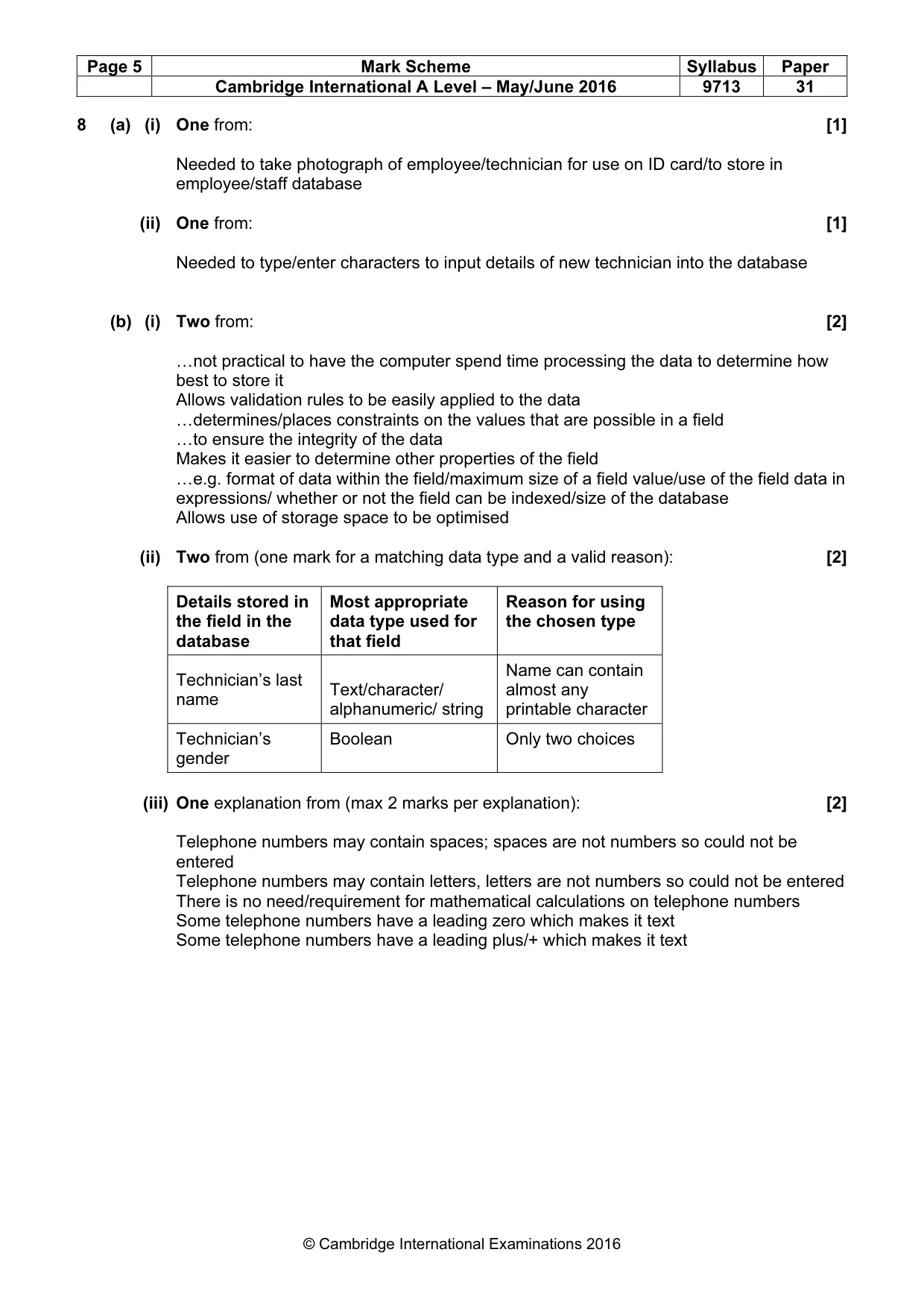
Page 5 Mark Scheme Syllabus Paper Cambridge International A Level – May/June 2016 9713 31 © Cambridge International Examinations 2016 8 (a) (i) One from: [1] Needed to take photograph of employee/technician for use on ID card/to store in employee/staff database (ii) One from: [1] Needed to type/enter characters to input details of new technician into the database (b) (i) Two from: [2] …not practical to have the computer spend time processing the data to determine how best to store it Allows validation rules to be easily applied to the data …determines/places constraints on the values that are possible in a field …to ensure the integrity of the data Makes it easier to determine other properties of the field …e.g. format of data within the field/maximum size of a field value/use of the field data in expressions/ whether or not the field can be indexed/size of the database Allows use of storage space to be optimised (ii) Two from (one mark for a matching data type and a valid reason): [2] Details stored in the field in the database Most appropriate data type used for that field Reason for using the chosen type Technician’s last name Text/character/ alphanumeric/ string Name can contain almost any printable character Technician’s gender Boolean Only two choices (iii) One explanation from (max 2 marks per explanation): [2] Telephone numbers may contain spaces; spaces are not numbers so could not be entered Telephone numbers may contain letters, letters are not numbers so could not be entered There is no need/requirement for mathematical calculations on telephone numbers Some telephone numbers have a leading zero which makes it text Some telephone numbers have a leading plus/+ which makes it text
Mark scheme, page 6
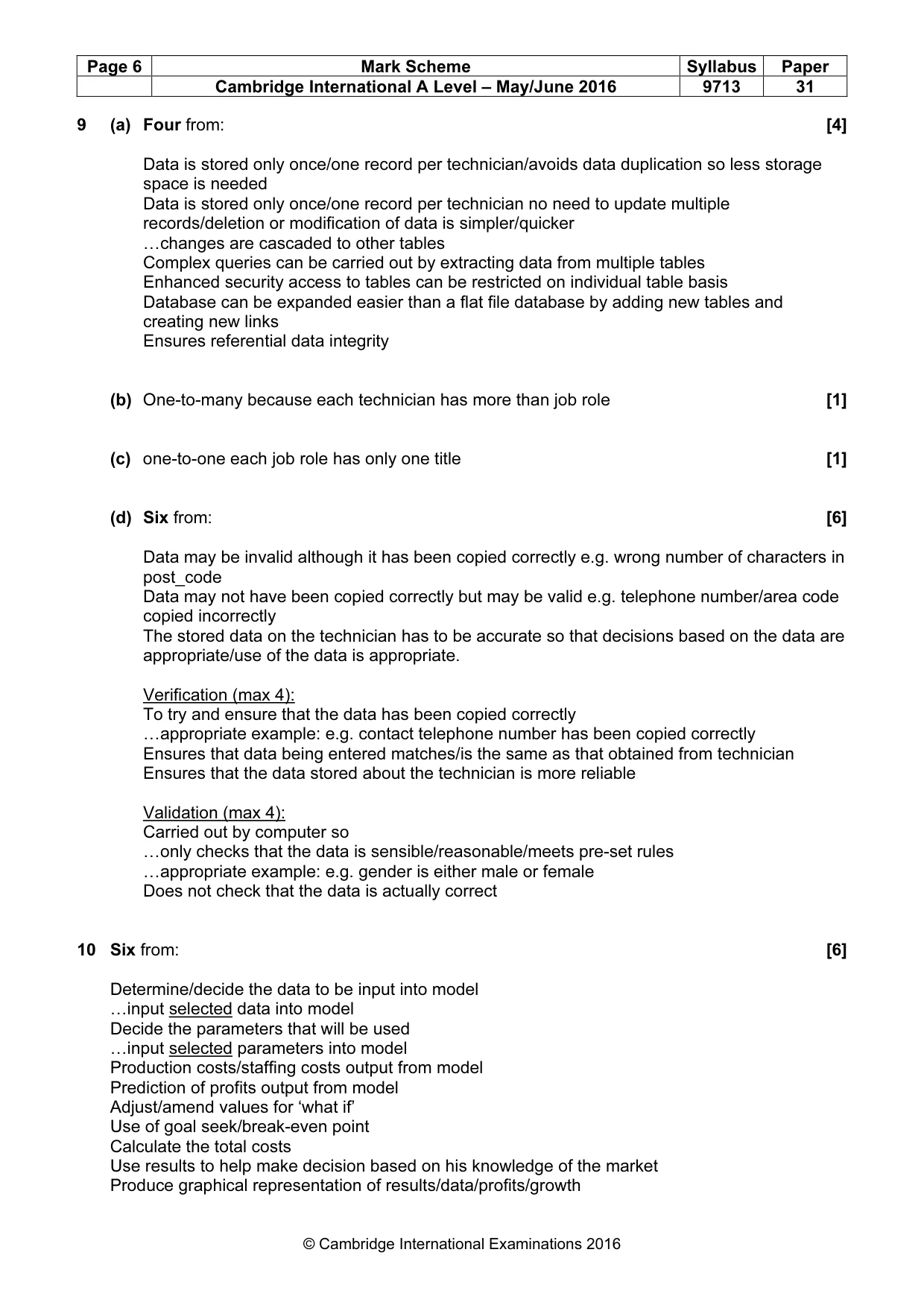
Page 6 Mark Scheme Syllabus Paper Cambridge International A Level – May/June 2016 9713 31 © Cambridge International Examinations 2016 9 (a) Four from: [4] Data is stored only once/one record per technician/avoids data duplication so less storage space is needed Data is stored only once/one record per technician no need to update multiple records/deletion or modification of data is simpler/quicker …changes are cascaded to other tables Complex queries can be carried out by extracting data from multiple tables Enhanced security access to tables can be restricted on individual table basis Database can be expanded easier than a flat file database by adding new tables and creating new links Ensures referential data integrity (b) One-to-many because each technician has more than job role [1] (c) one-to-one each job role has only one title [1] (d) Six from: [6] Data may be invalid although it has been copied correctly e.g. wrong number of characters in post_code Data may not have been copied correctly but may be valid e.g. telephone number/area code copied incorrectly The stored data on the technician has to be accurate so that decisions based on the data are appropriate/use of the data is appropriate. Verification (max 4): To try and ensure that the data has been copied correctly …appropriate example: e.g. contact telephone number has been copied correctly Ensures that data being entered matches/is the same as that obtained from technician Ensures that the data stored about the technician is more reliable Validation (max 4): Carried out by computer so …only checks that the data is sensible/reasonable/meets pre-set rules …appropriate example: e.g. gender is either male or female Does not check that the data is actually correct 10 Six from: [6] Determine/decide the data to be input into model …input selected data into model Decide the parameters that will be used …input selected parameters into model Production costs/staffing costs output from model Prediction of profits output from model Adjust/amend values for ‘what if’ Use of goal seek/break-even point Calculate the total costs Use results to help make decision based on his knowledge of the market Produce graphical representation of results/data/profits/growth
Mark scheme, page 7
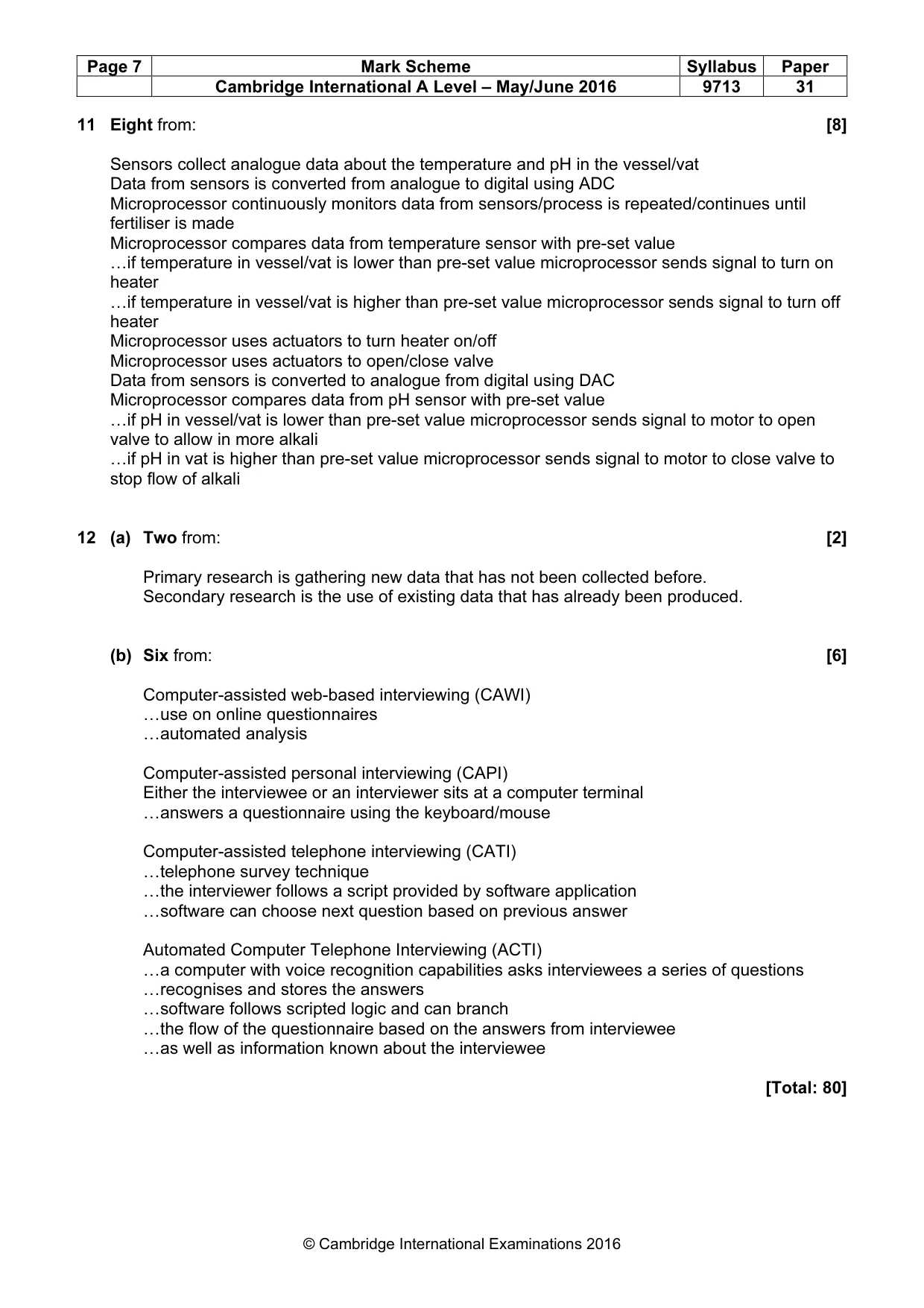
Page 7 Mark Scheme Syllabus Paper Cambridge International A Level – May/June 2016 9713 31 © Cambridge International Examinations 2016 11 Eight from: [8] Sensors collect analogue data about the temperature and pH in the vessel/vat Data from sensors is converted from analogue to digital using ADC Microprocessor continuously monitors data from sensors/process is repeated/continues until fertiliser is made Microprocessor compares data from temperature sensor with pre-set value …if temperature in vessel/vat is lower than pre-set value microprocessor sends signal to turn on heater …if temperature in vessel/vat is higher than pre-set value microprocessor sends signal to turn off heater Microprocessor uses actuators to turn heater on/off Microprocessor uses actuators to open/close valve Data from sensors is converted to analogue from digital using DAC Microprocessor compares data from pH sensor with pre-set value …if pH in vessel/vat is lower than pre-set value microprocessor sends signal to motor to open valve to allow in more alkali …if pH in vat is higher than pre-set value microprocessor sends signal to motor to close valve to stop flow of alkali 12 (a) Two from: [2] Primary research is gathering new data that has not been collected before. Secondary research is the use of existing data that has already been produced. (b) Six from: [6] Computer-assisted web-based interviewing (CAWI) …use on online questionnaires …automated analysis Computer-assisted personal interviewing (CAPI) Either the interviewee or an interviewer sits at a computer terminal …answers a questionnaire using the keyboard/mouse Computer-assisted telephone interviewing (CATI) …telephone survey technique …the interviewer follows a script provided by software application …software can choose next question based on previous answer Automated Computer Telephone Interviewing (ACTI) …a computer with voice recognition capabilities asks interviewees a series of questions …recognises and stores the answers …software follows scripted logic and can branch …the flow of the questionnaire based on the answers from interviewee …as well as information known about the interviewee [Total: 80]
What you needed in this session
Cambridge’s own grade thresholds for 2016 May/June, Paper 3 · Variant 1. A higher threshold means an easier paper — the bar moves with how the cohort did.