Cambridge A Level Applied Information and Communication Technology 9713 — 2012 May/June Paper 1 · Variant 2
9713/12/M/J/12 · 80 marks · ≈90 min
The question paper and its mark scheme, free to read here and free to download. This is Cambridge’s own paper, exactly as it was sat.
Question paper20 pages





Mark scheme7 pages
Answers below. Sit the paper first if you are practising.
Paper as text
Question paper, page 1
This document consists of 18 printed pages and 2 blank pages. IB12 06_9713_12/FP © UCLES 2012 [Turn over *1328926259* UNIVERSITY OF CAMBRIDGE INTERNATIONAL EXAMINATIONS General Certificate of Education Advanced Level APPLIED INFORMATION AND COMMUNICATION TECHNOLOGY 9713/12 Paper 1 May/June 2012 1 hour 15 minutes Candidates answer on the Question Paper. No additional materials are required. READ THESE INSTRUCTIONS FIRST Write your Centre number, candidate number and name on all the work you hand in. Write in dark blue or black pen. Do not use staples, paper clips, highlighters, glue or correction fluid. You may use a pencil for any diagrams, graphs or rough working. DO NOT WRITE IN ANY BARCODES. Answer all questions. The number of marks is given in brackets [ ] at the end of each question or part question. The businesses described in this paper are entirely fictitious.
Question paper, page 2
2 © UCLES 2012 9713/12/M/J/12 For Examiner's Use Scenario 1 Questions 1, 2 and 3 Computer Export Sales is a rapidly expanding computer manufacturer based in Northern Europe. Joshua is the manager of a large department of sales staff. Rajvinder is a member of the sales staff. The sales staff make most of their sales by phoning potential customers and trying to persuade them to buy their computers. Joshua has been informed by his directors that it would save the company money if some of the sales staff were to work from home. Rajvinder has agreed to work from home. At the moment when she completes a sale Rajvinder sends a sales agreement to the customer to sign. The customer then posts it back to Joshua. In future, Joshua will fax a copy of this document to Rajvinder for her records. Joshua is undecided about whether to use an electronic faxing system or provide a fax machine for Rajvinder to use at home. One of the drawbacks to a sales person of working from home will be the increase in costs. For example, the sales person will need to pay to have their central heating on during the day because it can get very cold in winter.
Question paper, page 3
3 © UCLES 2012 9713/12/M/J/12 [Turn over For Examiner's Use 1 Give three reasons why the company contacts potential customers by phone rather than advertising on a website. 1 2 3 [3] 2 Describe how microprocessor control is used in a central heating system. [5]
Question paper, page 4
4 © UCLES 2012 9713/12/M/J/12 For Examiner's Use 3 (a) Describe three personal characteristics that the sales staff would need to have before Joshua would recommend them to work from home. 1 2 3 [3] (b) Other than heating costs, describe three drawbacks to Rajvinder of working from home rather than working in the office. 1 2 3 [3]
Question paper, page 5
5 © UCLES 2012 9713/12/M/J/12 [Turn over For Examiner's Use (c) Describe three benefits to the company of sales staff working from home rather than working in the office. 1 2 3 [3] (d) Describe three benefits to the company of using electronic faxing rather than traditional, manual faxing. 1 2 3 [3]
Question paper, page 6
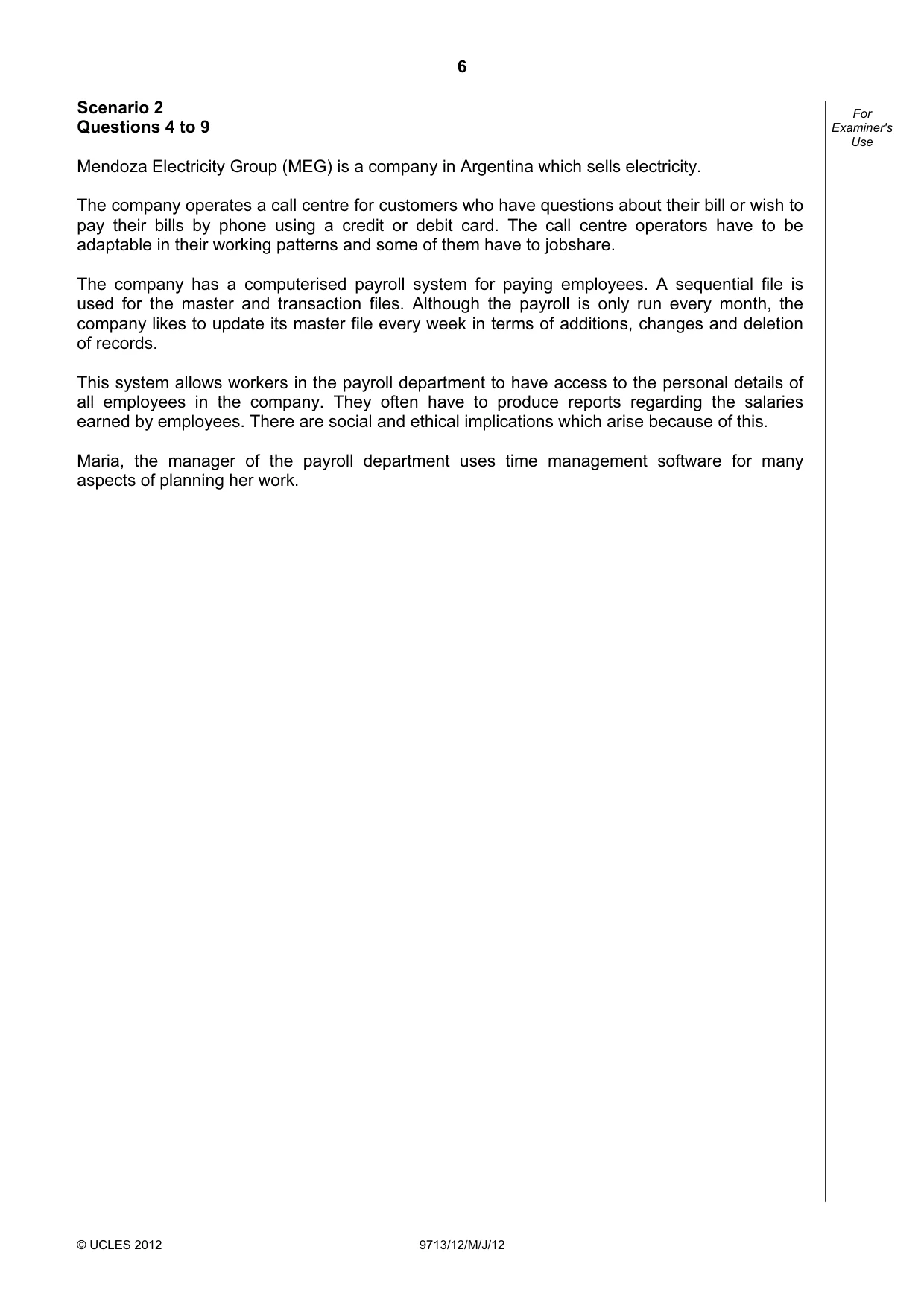
6 © UCLES 2012 9713/12/M/J/12 For Examiner's Use Scenario 2 Questions 4 to 9 Mendoza Electricity Group (MEG) is a company in Argentina which sells electricity. The company operates a call centre for customers who have questions about their bill or wish to pay their bills by phone using a credit or debit card. The call centre operators have to be adaptable in their working patterns and some of them have to jobshare. The company has a computerised payroll system for paying employees. A sequential file is used for the master and transaction files. Although the payroll is only run every month, the company likes to update its master file every week in terms of additions, changes and deletion of records. This system allows workers in the payroll department to have access to the personal details of all employees in the company. They often have to produce reports regarding the salaries earned by employees. There are social and ethical implications which arise because of this. Maria, the manager of the payroll department uses time management software for many aspects of planning her work.
Question paper, page 7
7 © UCLES 2012 9713/12/M/J/12 [Turn over For Examiner's Use 4 When a person applies to be a customer of MEG, an application form has to be completed on paper so that their details can be entered on to the computer system. Using features of the form as examples, explain the benefits of a well designed application form. [4]
Question paper, page 8
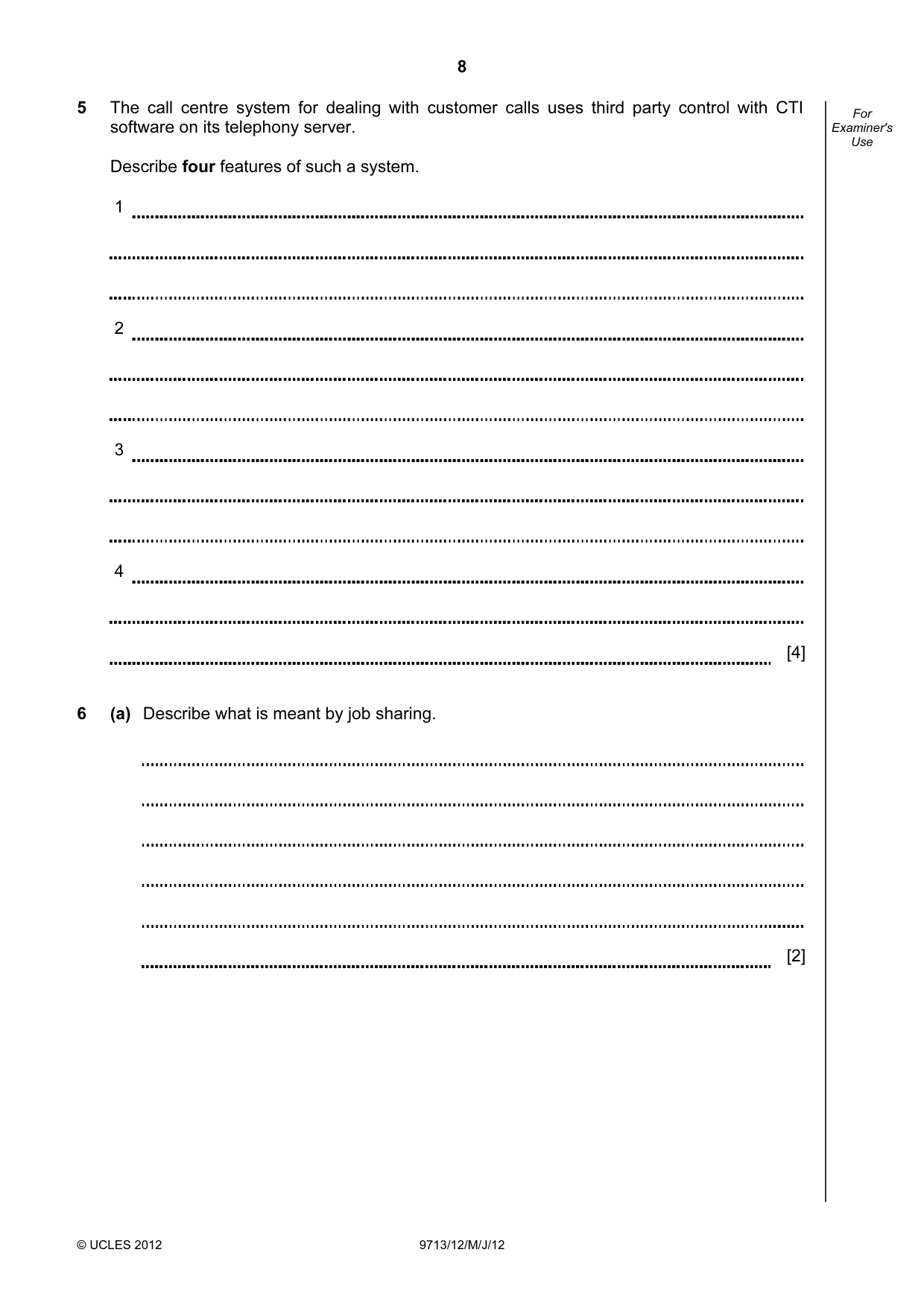
8 © UCLES 2012 9713/12/M/J/12 For Examiner's Use 5 The call centre system for dealing with customer calls uses third party control with CTI software on its telephony server. Describe four features of such a system. 1 2 3 4 [4] 6 (a) Describe what is meant by job sharing. [2]
Question paper, page 9
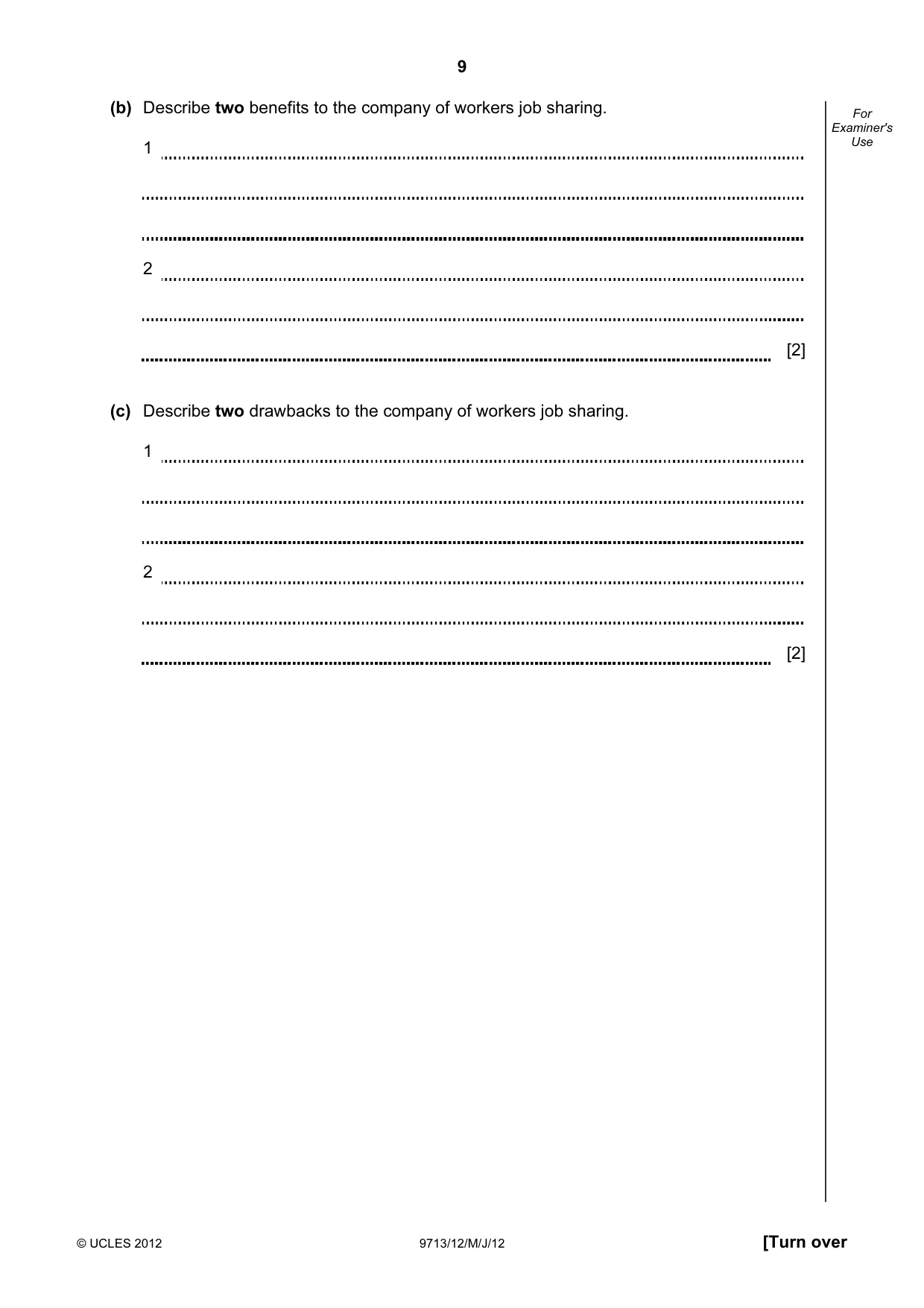
9 © UCLES 2012 9713/12/M/J/12 [Turn over For Examiner's Use (b) Describe two benefits to the company of workers job sharing. 1 2 [2] (c) Describe two drawbacks to the company of workers job sharing. 1 2 [2]
Question paper, page 10
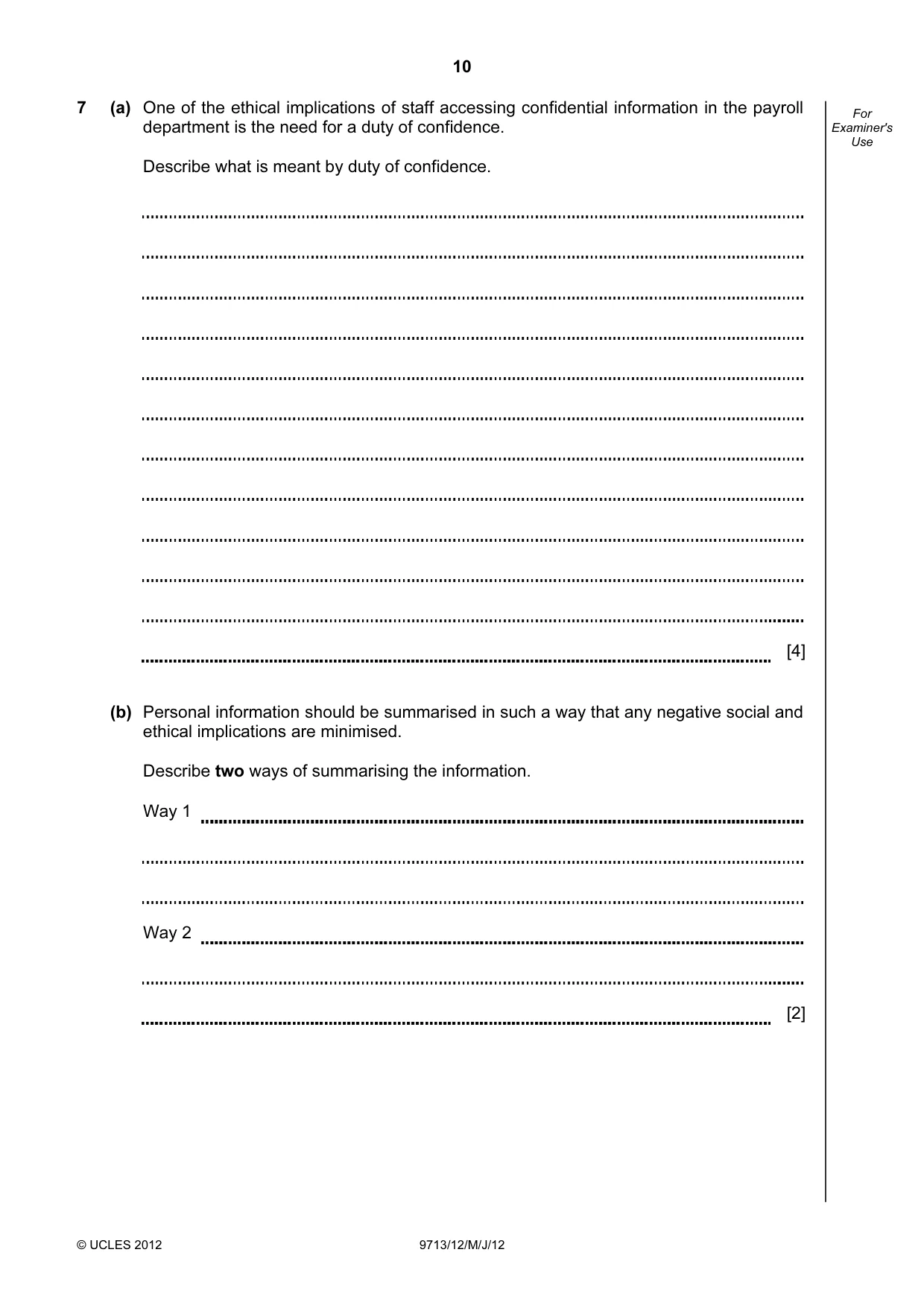
10 © UCLES 2012 9713/12/M/J/12 For Examiner's Use 7 (a) One of the ethical implications of staff accessing confidential information in the payroll department is the need for a duty of confidence. Describe what is meant by duty of confidence. [4] (b) Personal information should be summarised in such a way that any negative social and ethical implications are minimised. Describe two ways of summarising the information. Way 1 Way 2 [2]
Question paper, page 11
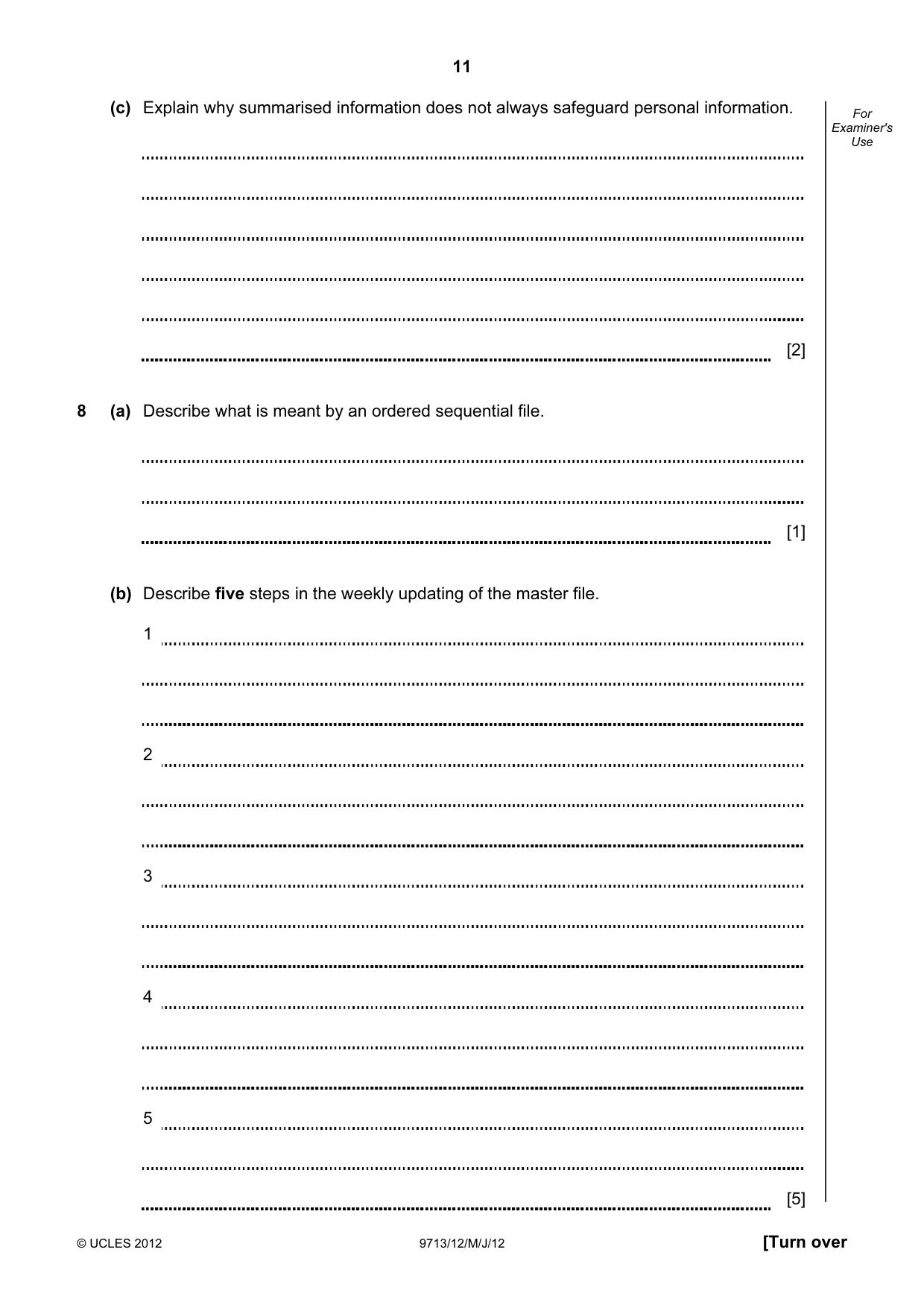
11 © UCLES 2012 9713/12/M/J/12 [Turn over For Examiner's Use (c) Explain why summarised information does not always safeguard personal information. [2] 8 (a) Describe what is meant by an ordered sequential file. [1] (b) Describe five steps in the weekly updating of the master file. 1 2 3 4 5 [5]
Question paper, page 12
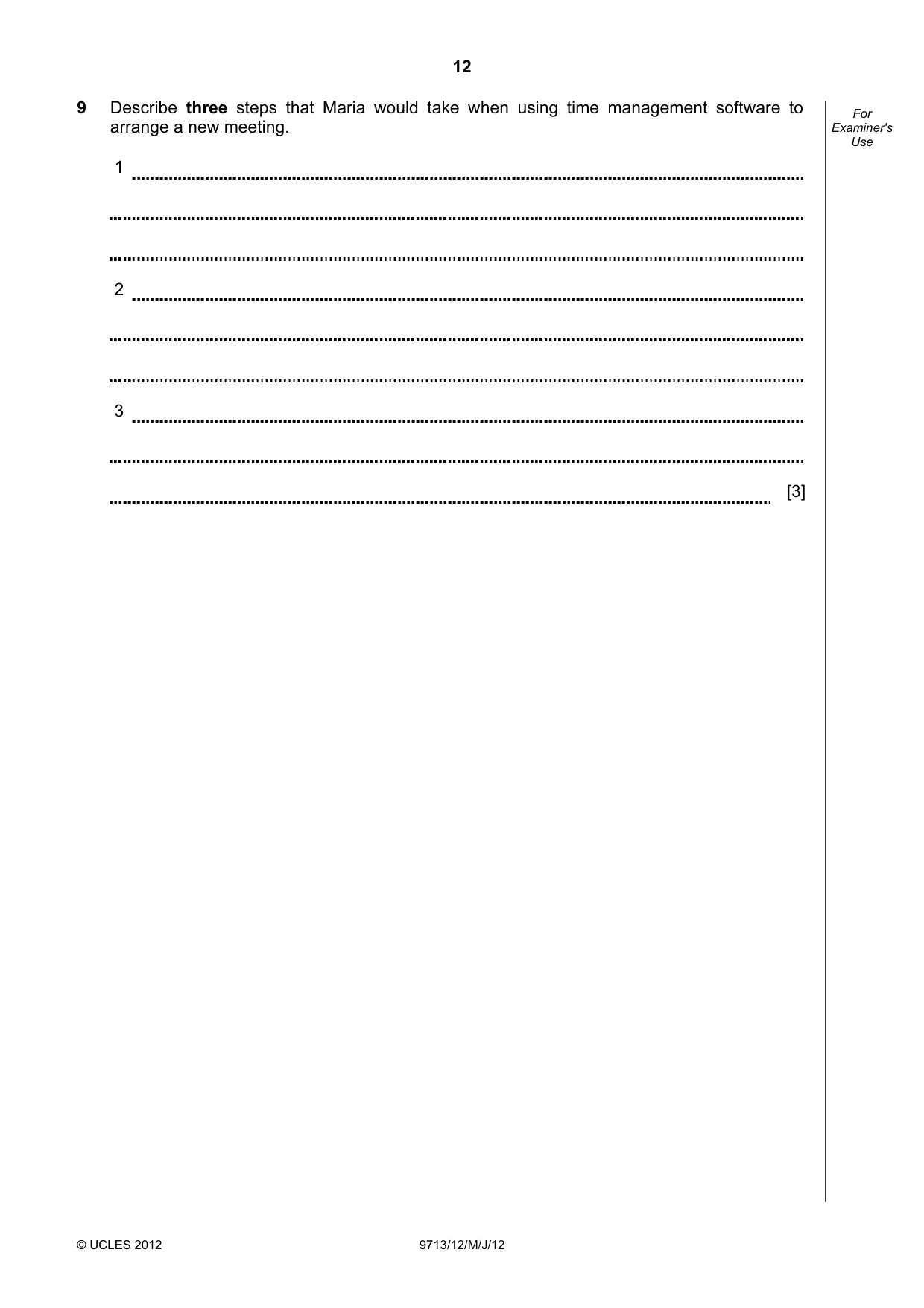
12 © UCLES 2012 9713/12/M/J/12 For Examiner's Use 9 Describe three steps that Maria would take when using time management software to arrange a new meeting. 1 2 3 [3]
Question paper, page 13
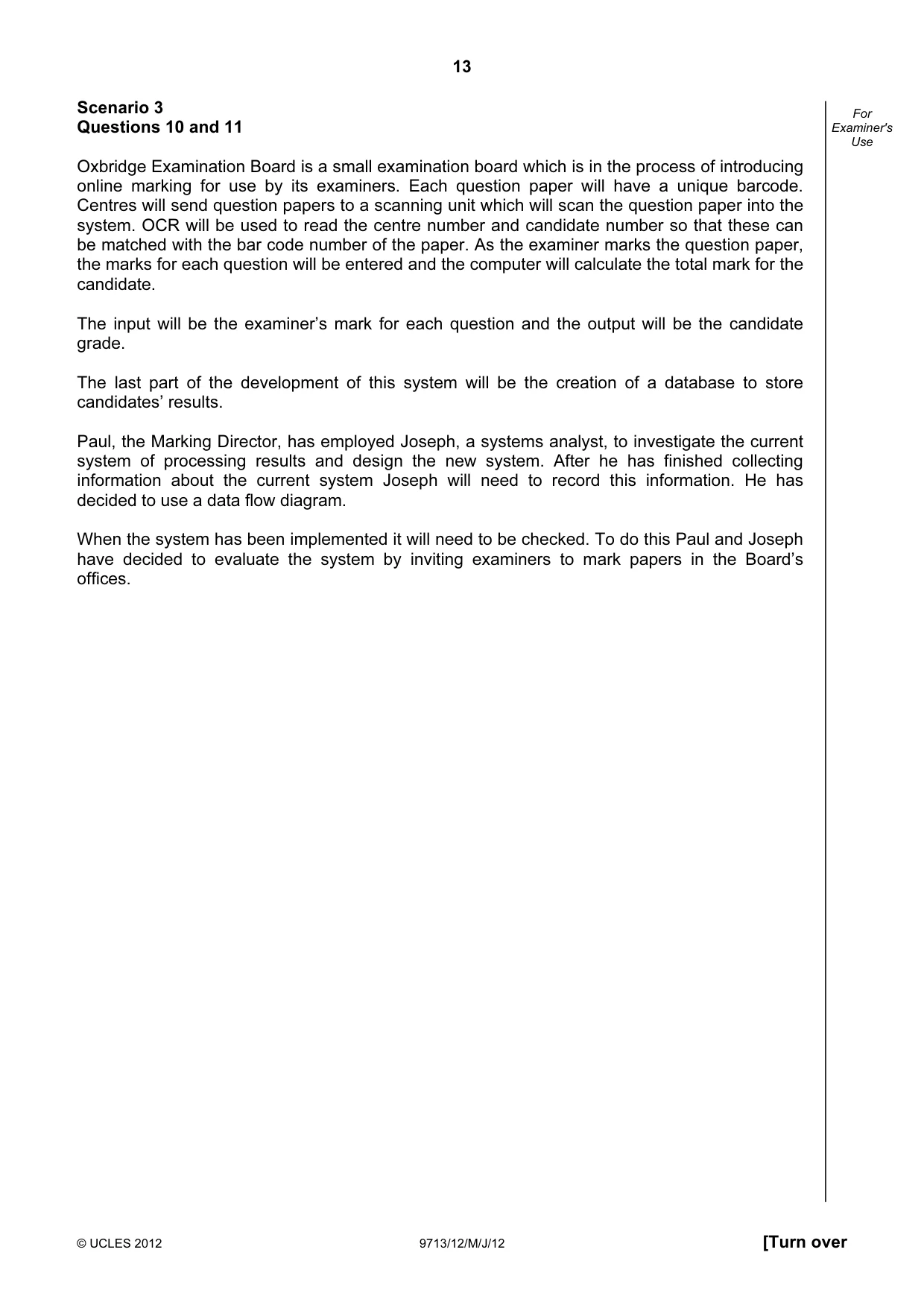
13 © UCLES 2012 9713/12/M/J/12 [Turn over For Examiner's Use Scenario 3 Questions 10 and 11 Oxbridge Examination Board is a small examination board which is in the process of introducing online marking for use by its examiners. Each question paper will have a unique barcode. Centres will send question papers to a scanning unit which will scan the question paper into the system. OCR will be used to read the centre number and candidate number so that these can be matched with the bar code number of the paper. As the examiner marks the question paper, the marks for each question will be entered and the computer will calculate the total mark for the candidate. The input will be the examiner’s mark for each question and the output will be the candidate grade. The last part of the development of this system will be the creation of a database to store candidates’ results. Paul, the Marking Director, has employed Joseph, a systems analyst, to investigate the current system of processing results and design the new system. After he has finished collecting information about the current system Joseph will need to record this information. He has decided to use a data flow diagram. When the system has been implemented it will need to be checked. To do this Paul and Joseph have decided to evaluate the system by inviting examiners to mark papers in the Board’s offices.
Question paper, page 14
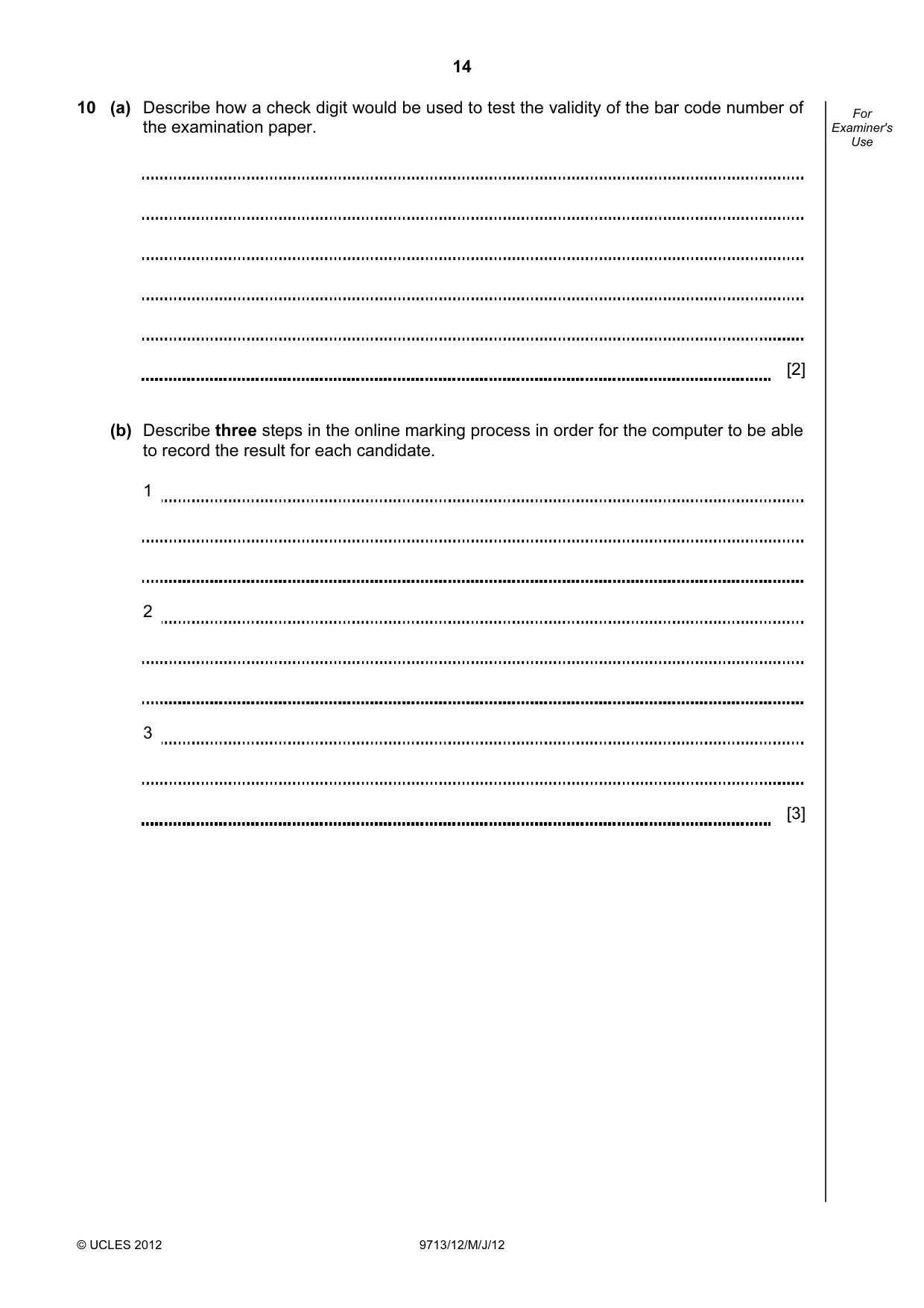
14 © UCLES 2012 9713/12/M/J/12 For Examiner's Use 10 (a) Describe how a check digit would be used to test the validity of the bar code number of the examination paper. [2] (b) Describe three steps in the online marking process in order for the computer to be able to record the result for each candidate. 1 2 3 [3]
Question paper, page 15
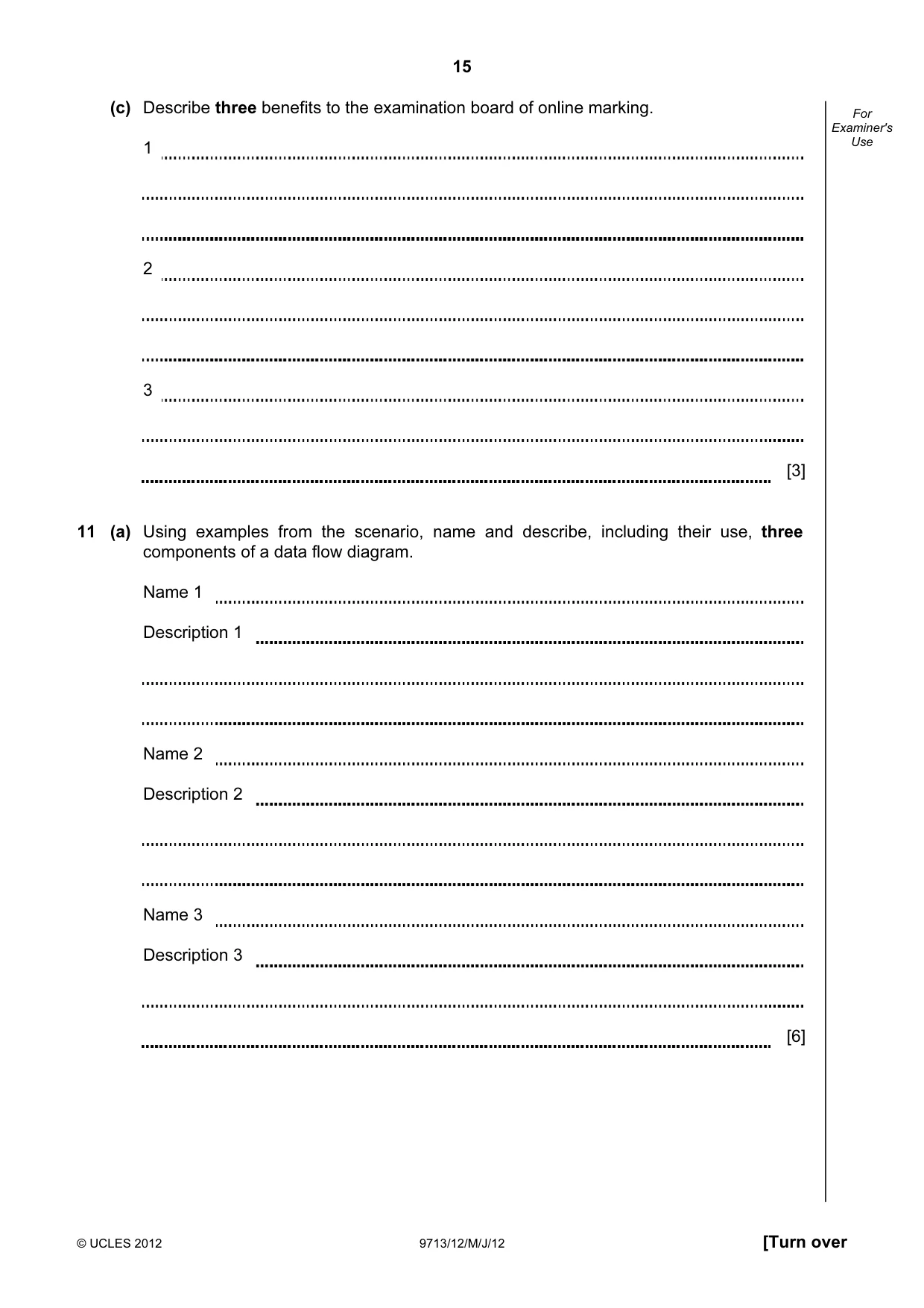
15 © UCLES 2012 9713/12/M/J/12 [Turn over For Examiner's Use (c) Describe three benefits to the examination board of online marking. 1 2 3 [3] 11 (a) Using examples from the scenario, name and describe, including their use, three components of a data flow diagram. Name 1 Description 1 Name 2 Description 2 Name 3 Description 3 [6]
Question paper, page 16
16 © UCLES 2012 9713/12/M/J/12 For Examiner's Use (b) Having completed the analysis phase, Joseph needs to design the file structure. Give a reason why each of the following aspects of file structure needs to be designed. Field name Field type Field length Validation rules Key field [5]
Question paper, page 17
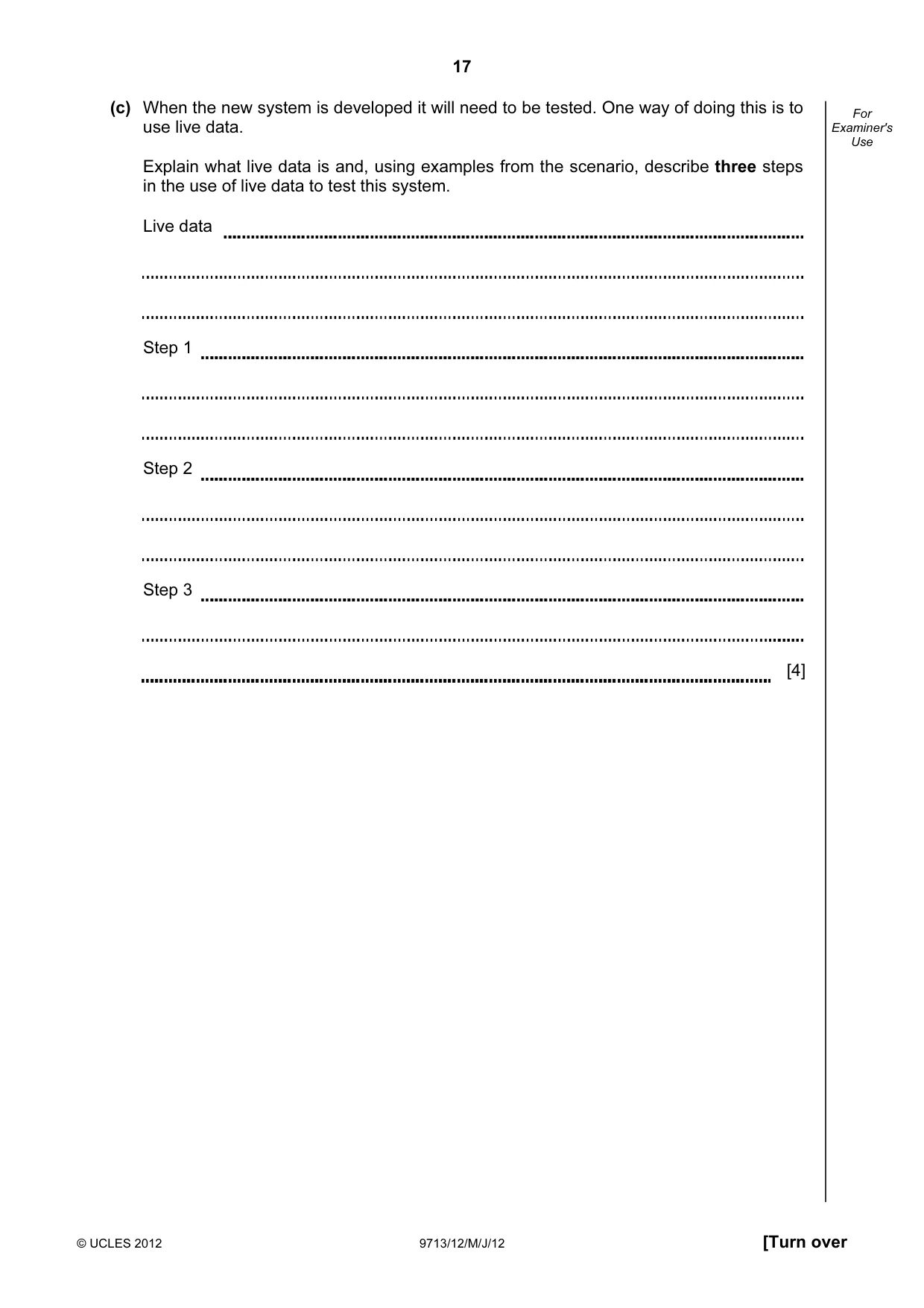
17 © UCLES 2012 9713/12/M/J/12 [Turn over For Examiner's Use (c) When the new system is developed it will need to be tested. One way of doing this is to use live data. Explain what live data is and, using examples from the scenario, describe three steps in the use of live data to test this system. Live data Step 1 Step 2 Step 3 [4]
Question paper, page 18
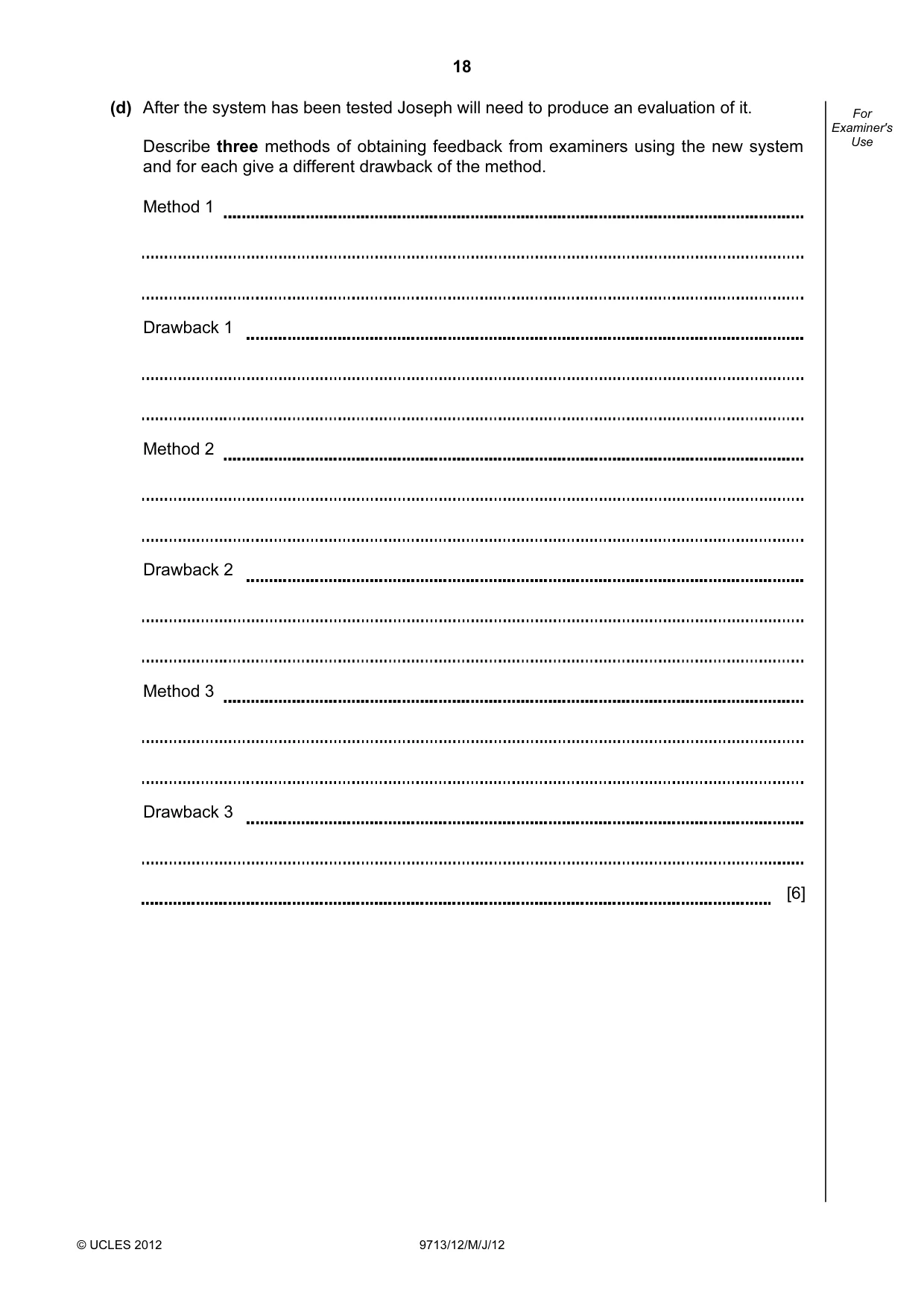
18 © UCLES 2012 9713/12/M/J/12 For Examiner's Use (d) After the system has been tested Joseph will need to produce an evaluation of it. Describe three methods of obtaining feedback from examiners using the new system and for each give a different drawback of the method. Method 1 Drawback 1 Method 2 Drawback 2 Method 3 Drawback 3 [6]
Question paper, page 19
19 © UCLES 2012 9713/12/M/J/12 BLANK PAGE
Question paper, page 20
20 Permission to reproduce items where third-party owned material protected by copyright is included has been sought and cleared where possible. Every reasonable effort has been made by the publisher (UCLES) to trace copyright holders, but if any items requiring clearance have unwittingly been included, the publisher will be pleased to make amends at the earliest possible opportunity. University of Cambridge International Examinations is part of the Cambridge Assessment Group. Cambridge Assessment is the brand name of University of Cambridge Local Examinations Syndicate (UCLES), which is itself a department of the University of Cambridge. © UCLES 2012 9713/12/M/J/12 BLANK PAGE
Mark scheme, page 1
UNIVERSITY OF CAMBRIDGE INTERNATIONAL EXAMINATIONS GCE Advanced Subsidiary Level and GCE Advanced Level MARK SCHEME for the May/June 2012 question paper for the guidance of teachers 9713 APPLIED INFORMATION AND COMMUNICATION TECHNOLOGY 9713/12 Paper 1 (Written A), maximum raw mark 80 This mark scheme is published as an aid to teachers and candidates, to indicate the requirements of the examination. It shows the basis on which Examiners were instructed to award marks. It does not indicate the details of the discussions that took place at an Examiners’ meeting before marking began, which would have considered the acceptability of alternative answers. Mark schemes must be read in conjunction with the question papers and the report on the examination. • Cambridge will not enter into discussions or correspondence in connection with these mark schemes. Cambridge is publishing the mark schemes for the May/June 2012 question papers for most IGCSE, GCE Advanced Level and Advanced Subsidiary Level syllabuses and some Ordinary Level syllabuses.
Mark scheme, page 2
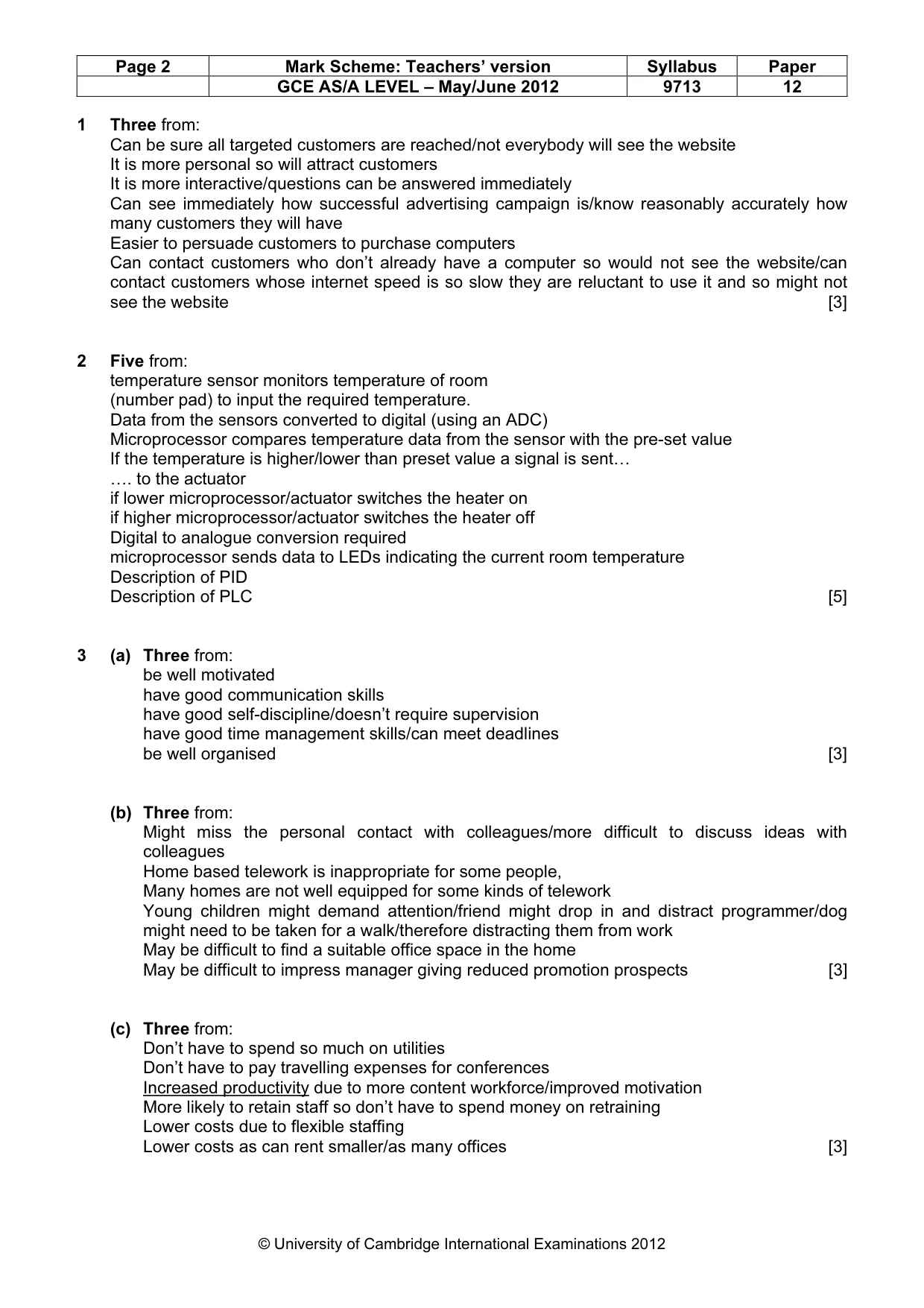
Page 2 Mark Scheme: Teachers’ version Syllabus Paper GCE AS/A LEVEL – May/June 2012 9713 12 © University of Cambridge International Examinations 2012 1 Three from: Can be sure all targeted customers are reached/not everybody will see the website It is more personal so will attract customers It is more interactive/questions can be answered immediately Can see immediately how successful advertising campaign is/know reasonably accurately how many customers they will have Easier to persuade customers to purchase computers Can contact customers who don’t already have a computer so would not see the website/can contact customers whose internet speed is so slow they are reluctant to use it and so might not see the website [3] 2 Five from: temperature sensor monitors temperature of room (number pad) to input the required temperature. Data from the sensors converted to digital (using an ADC) Microprocessor compares temperature data from the sensor with the pre-set value If the temperature is higher/lower than preset value a signal is sent… …. to the actuator if lower microprocessor/actuator switches the heater on if higher microprocessor/actuator switches the heater off Digital to analogue conversion required microprocessor sends data to LEDs indicating the current room temperature Description of PID Description of PLC [5] 3 (a) Three from: be well motivated have good communication skills have good self-discipline/doesn’t require supervision have good time management skills/can meet deadlines be well organised [3] (b) Three from: Might miss the personal contact with colleagues/more difficult to discuss ideas with colleagues Home based telework is inappropriate for some people, Many homes are not well equipped for some kinds of telework Young children might demand attention/friend might drop in and distract programmer/dog might need to be taken for a walk/therefore distracting them from work May be difficult to find a suitable office space in the home May be difficult to impress manager giving reduced promotion prospects [3] (c) Three from: Don’t have to spend so much on utilities Don’t have to pay travelling expenses for conferences Increased productivity due to more content workforce/improved motivation More likely to retain staff so don’t have to spend money on retraining Lower costs due to flexible staffing Lower costs as can rent smaller/as many offices [3]
Mark scheme, page 3
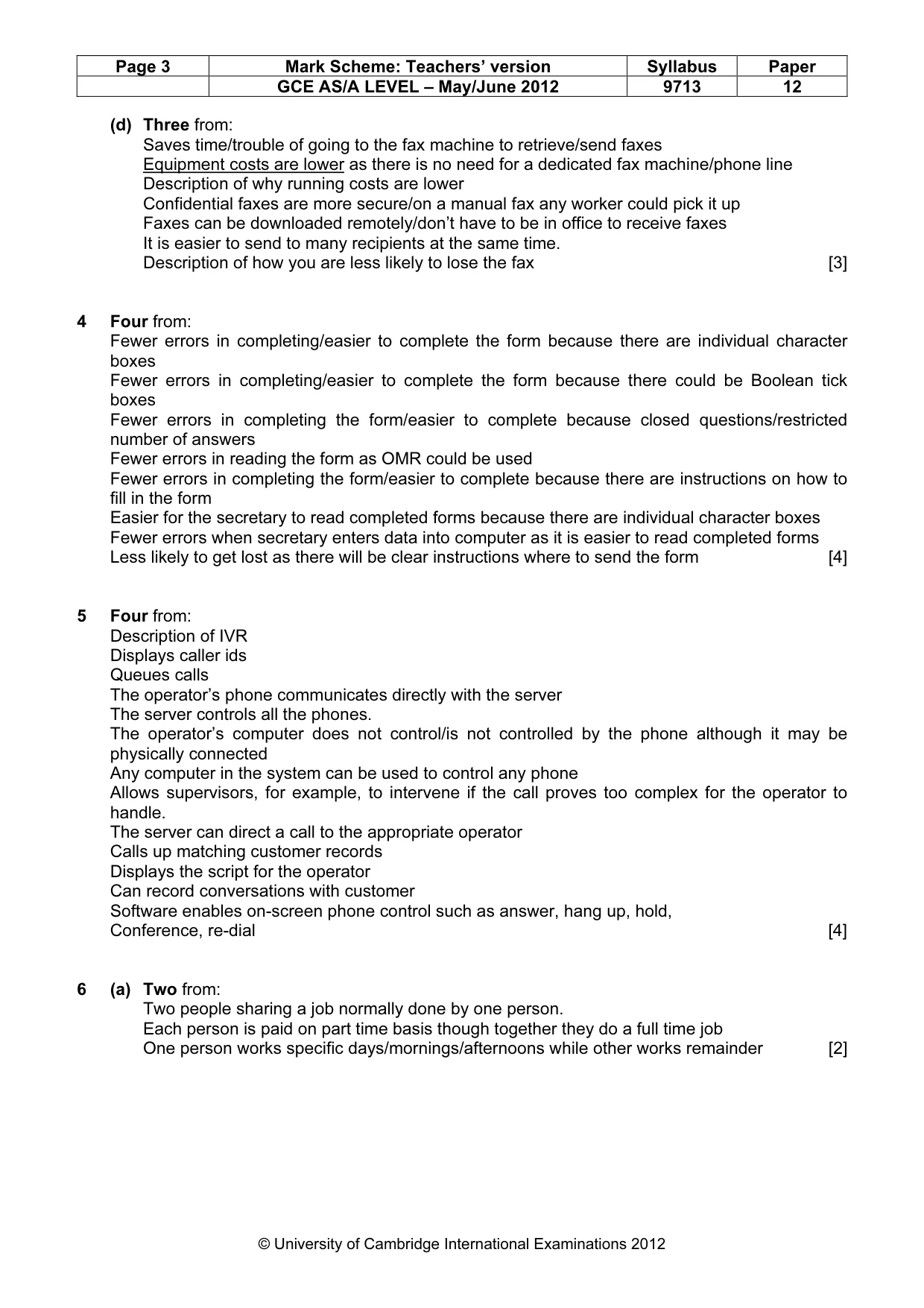
Page 3 Mark Scheme: Teachers’ version Syllabus Paper GCE AS/A LEVEL – May/June 2012 9713 12 © University of Cambridge International Examinations 2012 (d) Three from: Saves time/trouble of going to the fax machine to retrieve/send faxes Equipment costs are lower as there is no need for a dedicated fax machine/phone line Description of why running costs are lower Confidential faxes are more secure/on a manual fax any worker could pick it up Faxes can be downloaded remotely/don’t have to be in office to receive faxes It is easier to send to many recipients at the same time. Description of how you are less likely to lose the fax [3] 4 Four from: Fewer errors in completing/easier to complete the form because there are individual character boxes Fewer errors in completing/easier to complete the form because there could be Boolean tick boxes Fewer errors in completing the form/easier to complete because closed questions/restricted number of answers Fewer errors in reading the form as OMR could be used Fewer errors in completing the form/easier to complete because there are instructions on how to fill in the form Easier for the secretary to read completed forms because there are individual character boxes Fewer errors when secretary enters data into computer as it is easier to read completed forms Less likely to get lost as there will be clear instructions where to send the form [4] 5 Four from: Description of IVR Displays caller ids Queues calls The operator’s phone communicates directly with the server The server controls all the phones. The operator’s computer does not control/is not controlled by the phone although it may be physically connected Any computer in the system can be used to control any phone Allows supervisors, for example, to intervene if the call proves too complex for the operator to handle. The server can direct a call to the appropriate operator Calls up matching customer records Displays the script for the operator Can record conversations with customer Software enables on-screen phone control such as answer, hang up, hold, Conference, re-dial [4] 6 (a) Two from: Two people sharing a job normally done by one person. Each person is paid on part time basis though together they do a full time job One person works specific days/mornings/afternoons while other works remainder [2]
Mark scheme, page 4
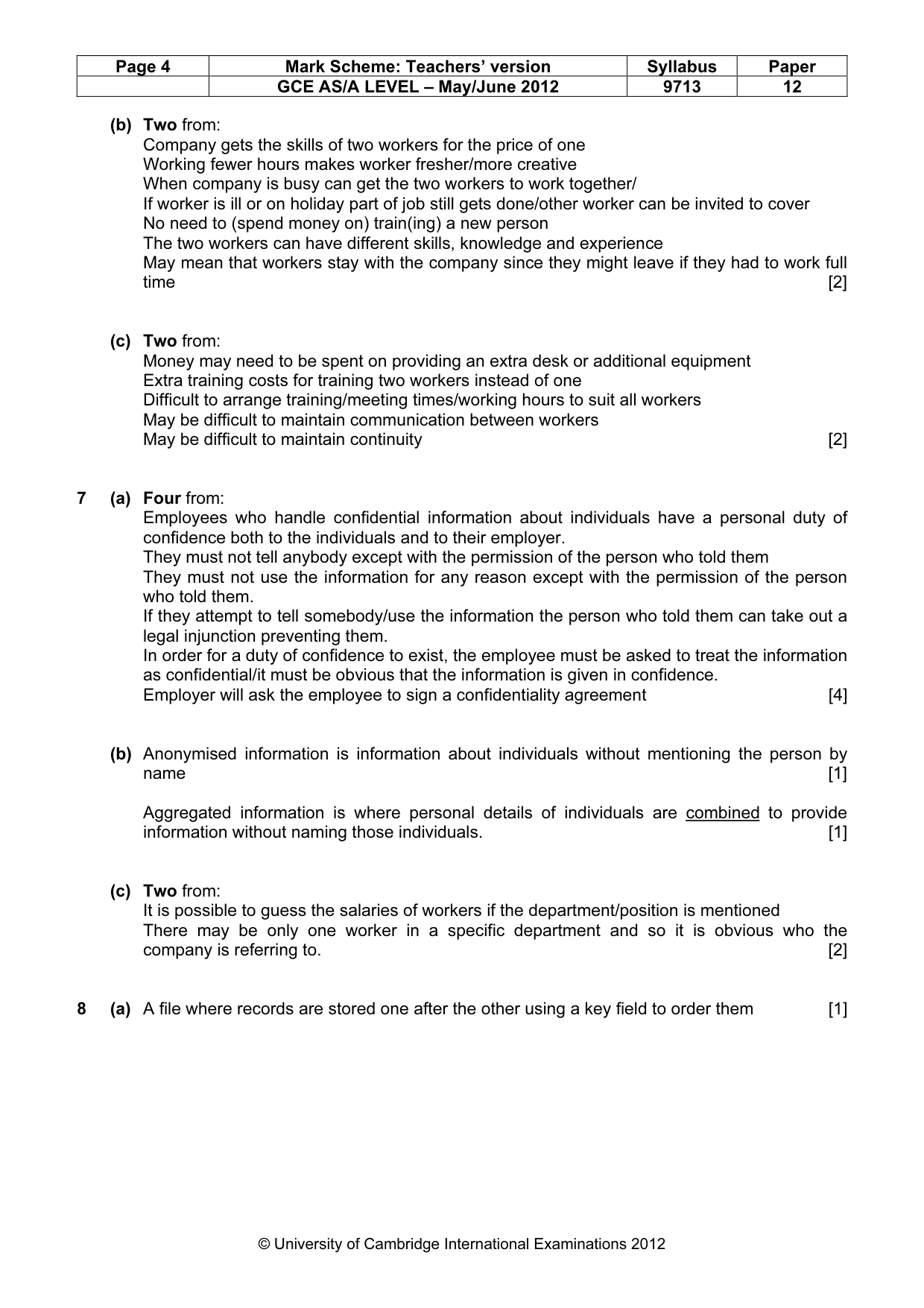
Page 4 Mark Scheme: Teachers’ version Syllabus Paper GCE AS/A LEVEL – May/June 2012 9713 12 © University of Cambridge International Examinations 2012 (b) Two from: Company gets the skills of two workers for the price of one Working fewer hours makes worker fresher/more creative When company is busy can get the two workers to work together/ If worker is ill or on holiday part of job still gets done/other worker can be invited to cover No need to (spend money on) train(ing) a new person The two workers can have different skills, knowledge and experience May mean that workers stay with the company since they might leave if they had to work full time [2] (c) Two from: Money may need to be spent on providing an extra desk or additional equipment Extra training costs for training two workers instead of one Difficult to arrange training/meeting times/working hours to suit all workers May be difficult to maintain communication between workers May be difficult to maintain continuity [2] 7 (a) Four from: Employees who handle confidential information about individuals have a personal duty of confidence both to the individuals and to their employer. They must not tell anybody except with the permission of the person who told them They must not use the information for any reason except with the permission of the person who told them. If they attempt to tell somebody/use the information the person who told them can take out a legal injunction preventing them. In order for a duty of confidence to exist, the employee must be asked to treat the information as confidential/it must be obvious that the information is given in confidence. Employer will ask the employee to sign a confidentiality agreement [4] (b) Anonymised information is information about individuals without mentioning the person by name [1] Aggregated information is where personal details of individuals are combined to provide information without naming those individuals. [1] (c) Two from: It is possible to guess the salaries of workers if the department/position is mentioned There may be only one worker in a specific department and so it is obvious who the company is referring to. [2] 8 (a) A file where records are stored one after the other using a key field to order them [1]
Mark scheme, page 5
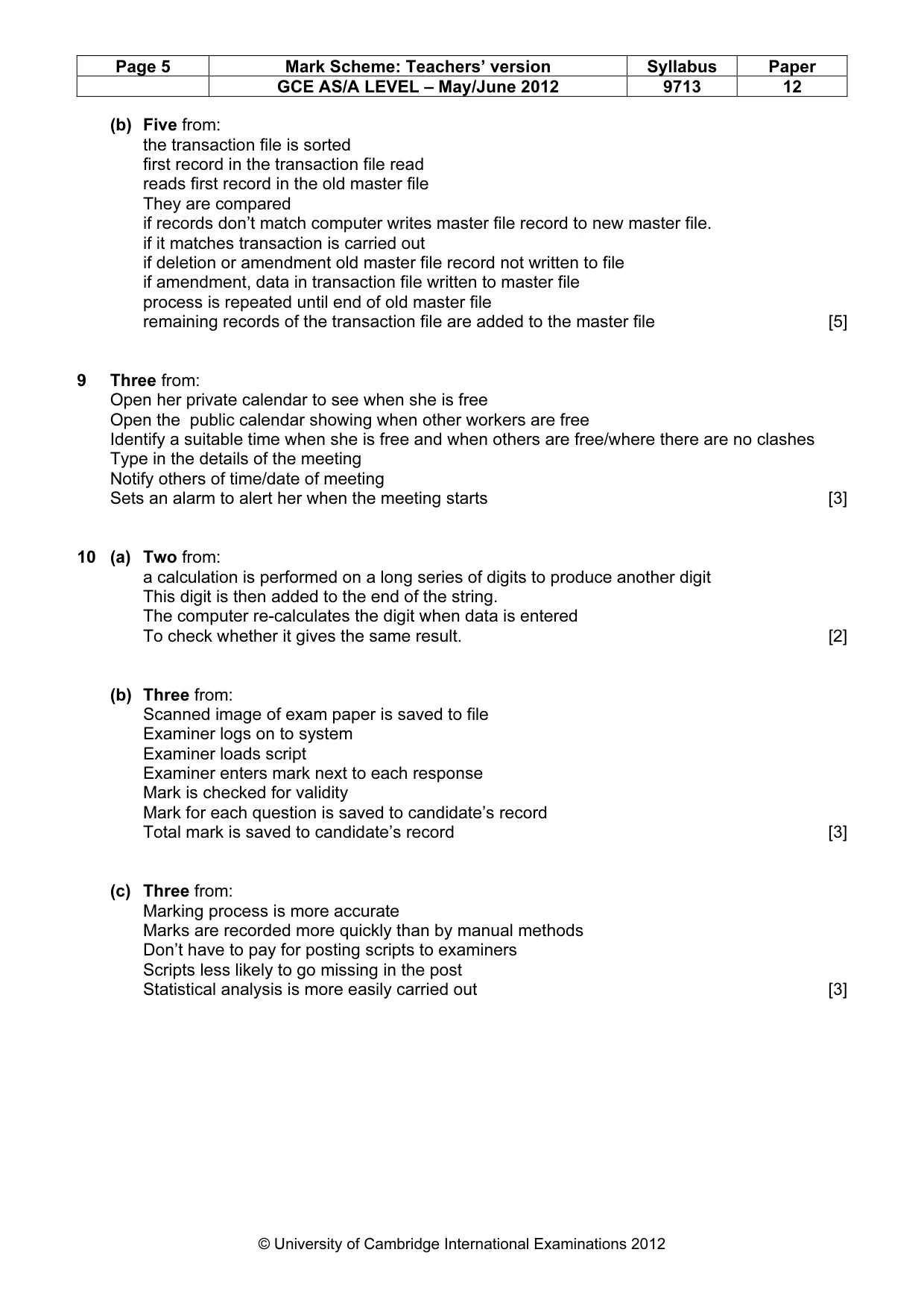
Page 5 Mark Scheme: Teachers’ version Syllabus Paper GCE AS/A LEVEL – May/June 2012 9713 12 © University of Cambridge International Examinations 2012 (b) Five from: the transaction file is sorted first record in the transaction file read reads first record in the old master file They are compared if records don’t match computer writes master file record to new master file. if it matches transaction is carried out if deletion or amendment old master file record not written to file if amendment, data in transaction file written to master file process is repeated until end of old master file remaining records of the transaction file are added to the master file [5] 9 Three from: Open her private calendar to see when she is free Open the public calendar showing when other workers are free Identify a suitable time when she is free and when others are free/where there are no clashes Type in the details of the meeting Notify others of time/date of meeting Sets an alarm to alert her when the meeting starts [3] 10 (a) Two from: a calculation is performed on a long series of digits to produce another digit This digit is then added to the end of the string. The computer re-calculates the digit when data is entered To check whether it gives the same result. [2] (b) Three from: Scanned image of exam paper is saved to file Examiner logs on to system Examiner loads script Examiner enters mark next to each response Mark is checked for validity Mark for each question is saved to candidate’s record Total mark is saved to candidate’s record [3] (c) Three from: Marking process is more accurate Marks are recorded more quickly than by manual methods Don’t have to pay for posting scripts to examiners Scripts less likely to go missing in the post Statistical analysis is more easily carried out [3]
Mark scheme, page 6
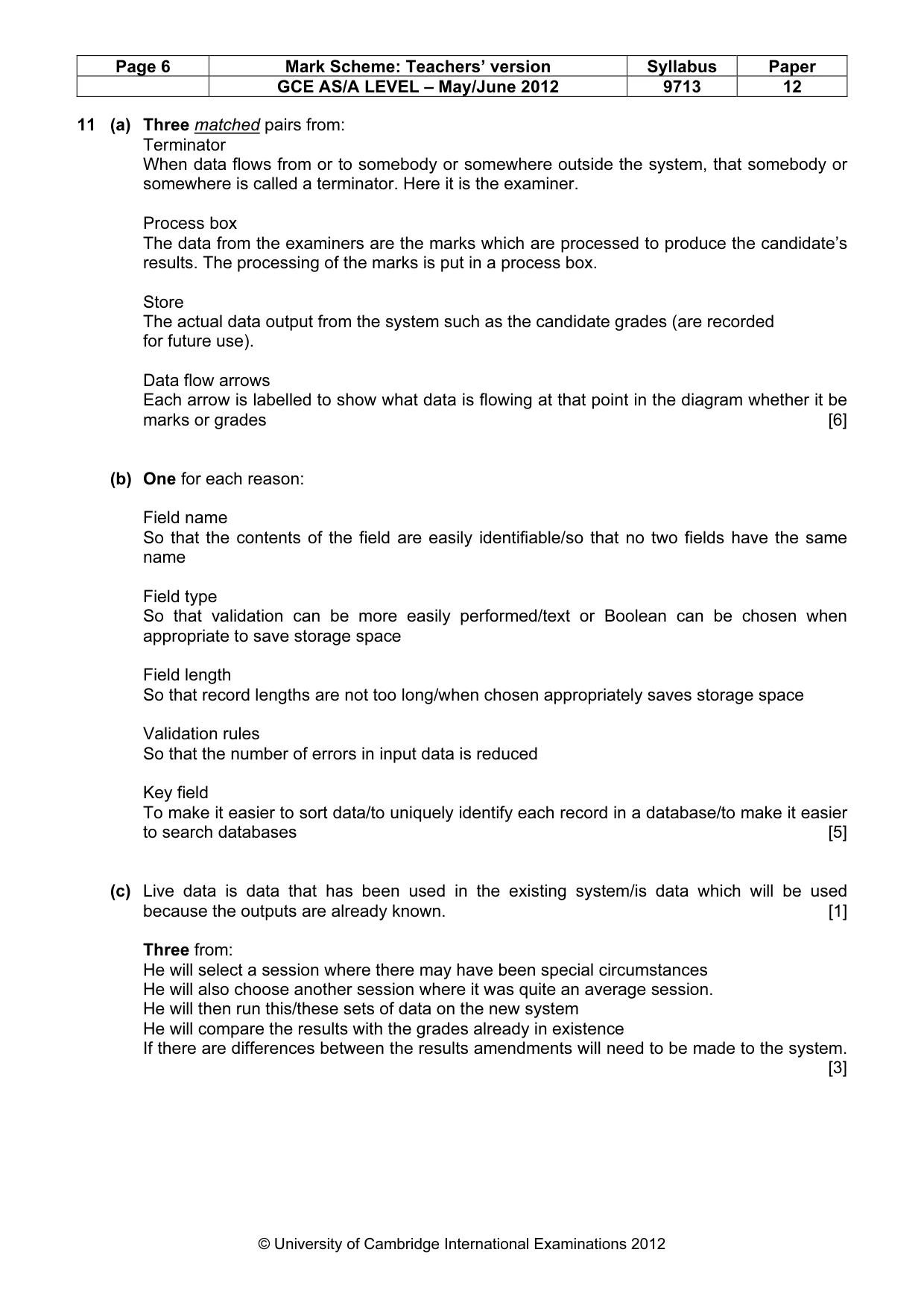
Page 6 Mark Scheme: Teachers’ version Syllabus Paper GCE AS/A LEVEL – May/June 2012 9713 12 © University of Cambridge International Examinations 2012 11 (a) Three matched pairs from: Terminator When data flows from or to somebody or somewhere outside the system, that somebody or somewhere is called a terminator. Here it is the examiner. Process box The data from the examiners are the marks which are processed to produce the candidate’s results. The processing of the marks is put in a process box. Store The actual data output from the system such as the candidate grades (are recorded for future use). Data flow arrows Each arrow is labelled to show what data is flowing at that point in the diagram whether it be marks or grades [6] (b) One for each reason: Field name So that the contents of the field are easily identifiable/so that no two fields have the same name Field type So that validation can be more easily performed/text or Boolean can be chosen when appropriate to save storage space Field length So that record lengths are not too long/when chosen appropriately saves storage space Validation rules So that the number of errors in input data is reduced Key field To make it easier to sort data/to uniquely identify each record in a database/to make it easier to search databases [5] (c) Live data is data that has been used in the existing system/is data which will be used because the outputs are already known. [1] Three from: He will select a session where there may have been special circumstances He will also choose another session where it was quite an average session. He will then run this/these sets of data on the new system He will compare the results with the grades already in existence If there are differences between the results amendments will need to be made to the system. [3]
Mark scheme, page 7
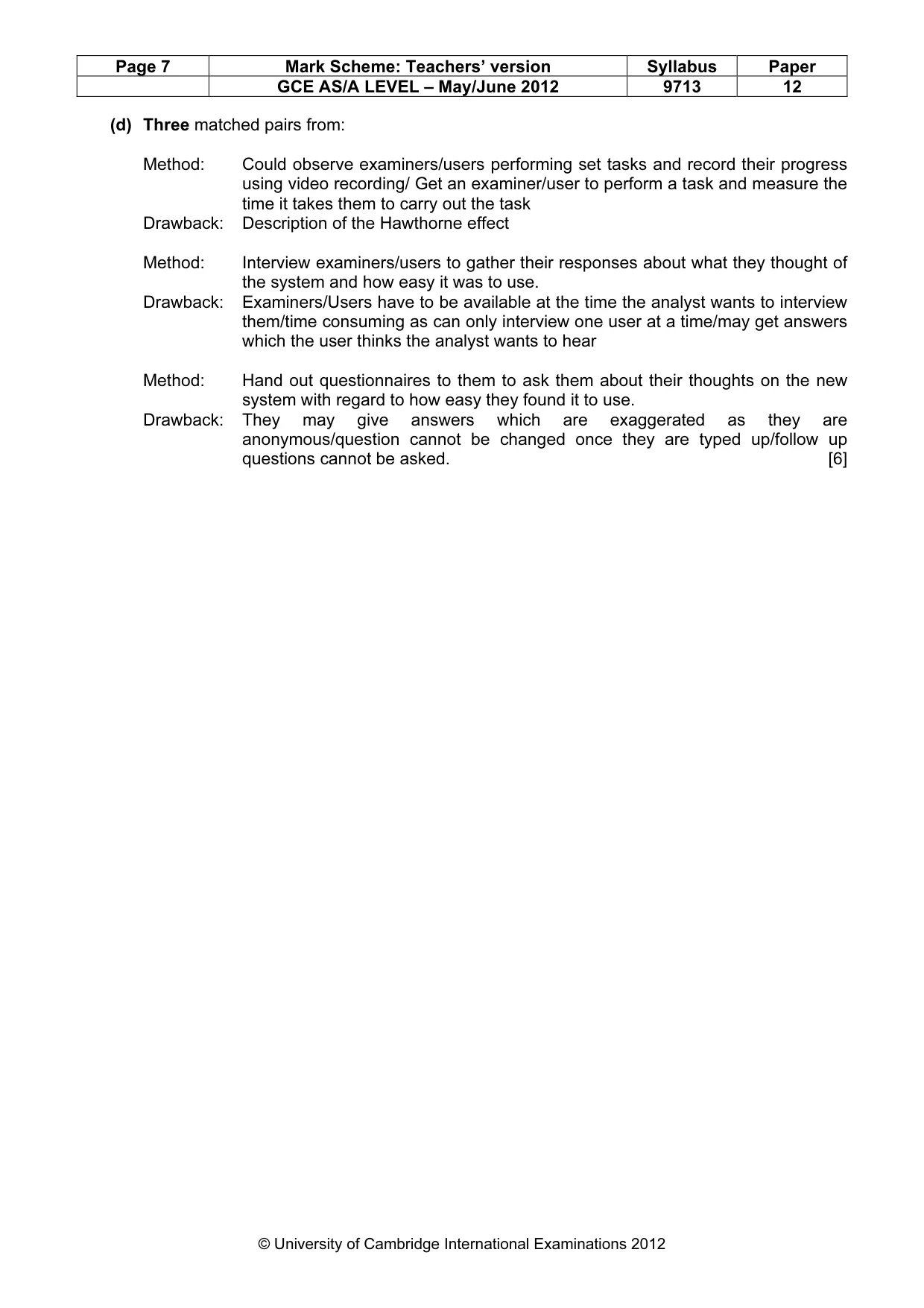
Page 7 Mark Scheme: Teachers’ version Syllabus Paper GCE AS/A LEVEL – May/June 2012 9713 12 © University of Cambridge International Examinations 2012 (d) Three matched pairs from: Method: Could observe examiners/users performing set tasks and record their progress using video recording/ Get an examiner/user to perform a task and measure the time it takes them to carry out the task Drawback: Description of the Hawthorne effect Method: Interview examiners/users to gather their responses about what they thought of the system and how easy it was to use. Drawback: Examiners/Users have to be available at the time the analyst wants to interview them/time consuming as can only interview one user at a time/may get answers which the user thinks the analyst wants to hear Method: Hand out questionnaires to them to ask them about their thoughts on the new system with regard to how easy they found it to use. Drawback: They may give answers which are exaggerated as they are anonymous/question cannot be changed once they are typed up/follow up questions cannot be asked. [6]
What you needed in this session
Cambridge’s own grade thresholds for 2012 May/June, Paper 1 · Variant 2. A higher threshold means an easier paper — the bar moves with how the cohort did.