Cambridge A Level Applied Information and Communication Technology 9713 — 2016 Feb/March Paper 1 · Variant 2
9713/12/F/M/16 · 80 marks · ≈90 min
The question paper and its mark scheme, free to read here and free to download. This is Cambridge’s own paper, exactly as it was sat.
Question paper20 pages












Mark scheme7 pages
Answers below. Sit the paper first if you are practising.

Paper as text
Question paper, page 1
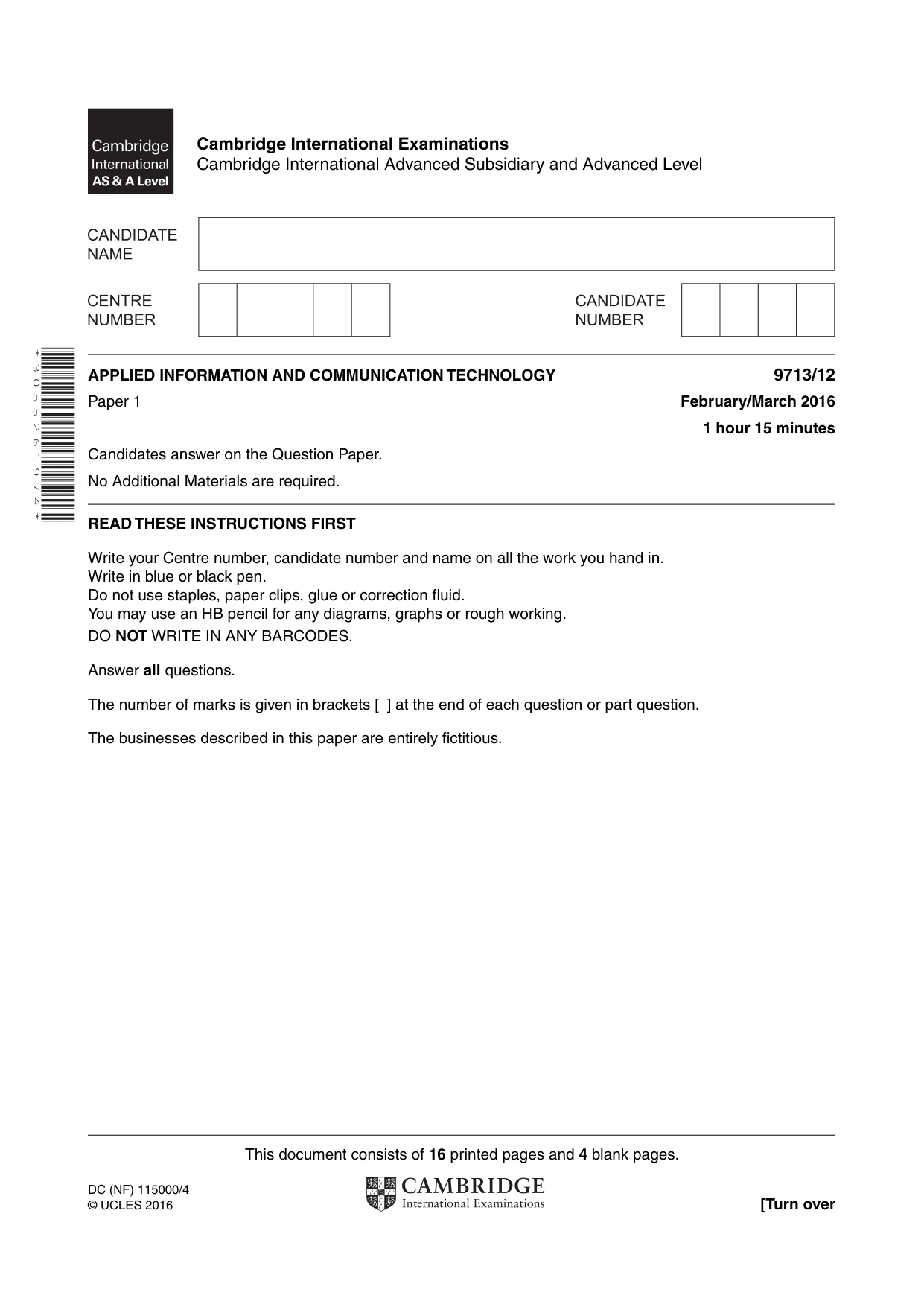
This document consists of 16 printed pages and 4 blank pages. DC (NF) 115000/4 © UCLES 2016 [Turn over Cambridge International Examinations Cambridge International Advanced Subsidiary and Advanced Level * 3 0 5 5 2 6 1 9 7 4 * APPLIED INFORMATION AND COMMUNICATION TECHNOLOGY 9713/12 Paper 1 February/March 2016 1 hour 15 minutes Candidates answer on the Question Paper. No Additional Materials are required. READ THESE INSTRUCTIONS FIRST Write your Centre number, candidate number and name on all the work you hand in. Write in blue or black pen. Do not use staples, paper clips, glue or correction fluid. You may use an HB pencil for any diagrams, graphs or rough working. DO NOT WRITE IN ANY BARCODES. Answer all questions. The number of marks is given in brackets [ ] at the end of each question or part question. The businesses described in this paper are entirely fictitious.
Question paper, page 2
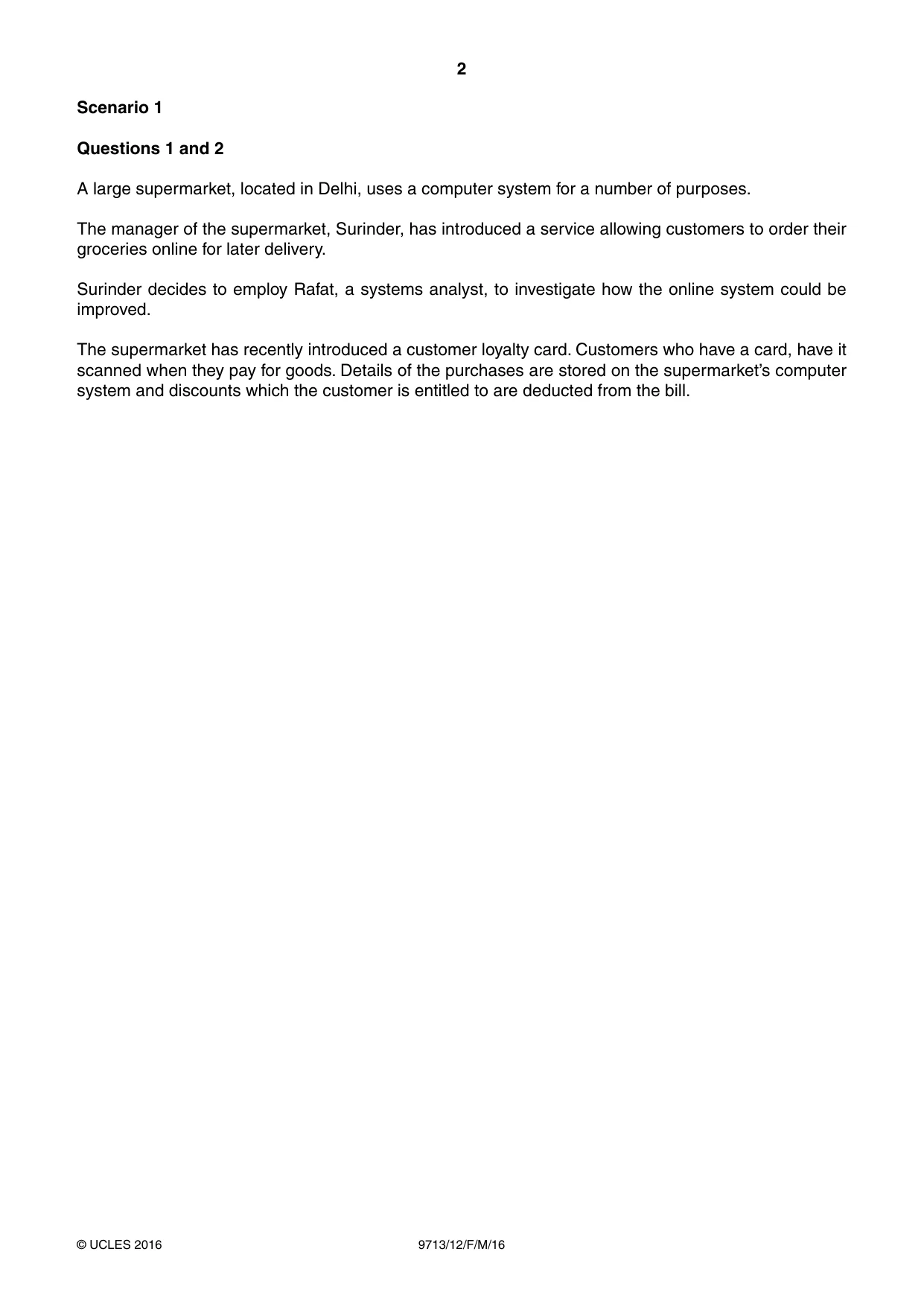
2 9713/12/F/M/16 © UCLES 2016 Scenario 1 Questions 1 and 2 A large supermarket, located in Delhi, uses a computer system for a number of purposes. The manager of the supermarket, Surinder, has introduced a service allowing customers to order their groceries online for later delivery. Surinder decides to employ Rafat, a systems analyst, to investigate how the online system could be improved. The supermarket has recently introduced a customer loyalty card. Customers who have a card, have it scanned when they pay for goods. Details of the purchases are stored on the supermarket’s computer system and discounts which the customer is entitled to are deducted from the bill.
Question paper, page 3
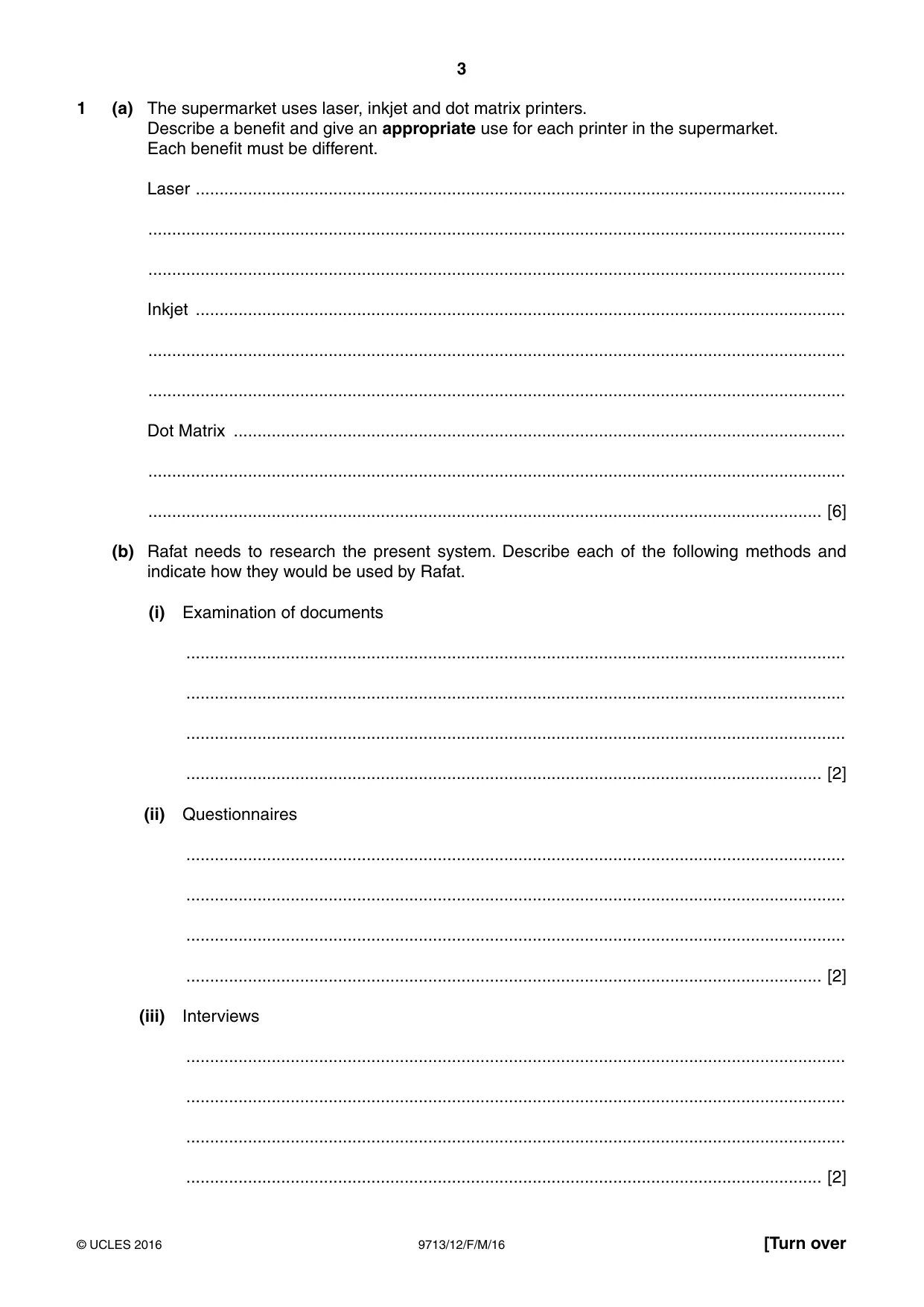
3 9713/12/F/M/16 © UCLES 2016 [Turn over 1 (a) The supermarket uses laser, inkjet and dot matrix printers. Describe a benefit and give an appropriate use for each printer in the supermarket. Each benefit must be different. Laser … … … Inkjet … … … Dot Matrix … … … [6] (b) Rafat needs to research the present system. Describe each of the following methods and indicate how they would be used by Rafat. (i) Examination of documents … … … … [2] (ii) Questionnaires … … … … [2] (iii) Interviews … … … … [2]
Question paper, page 4
4 9713/12/F/M/16 © UCLES 2016 (c) Part of Rafat’s job is to produce technical documentation for the updated system. Describe the contents of the technical documentation. … … … … … … … … … … … … … … [6]
Question paper, page 5
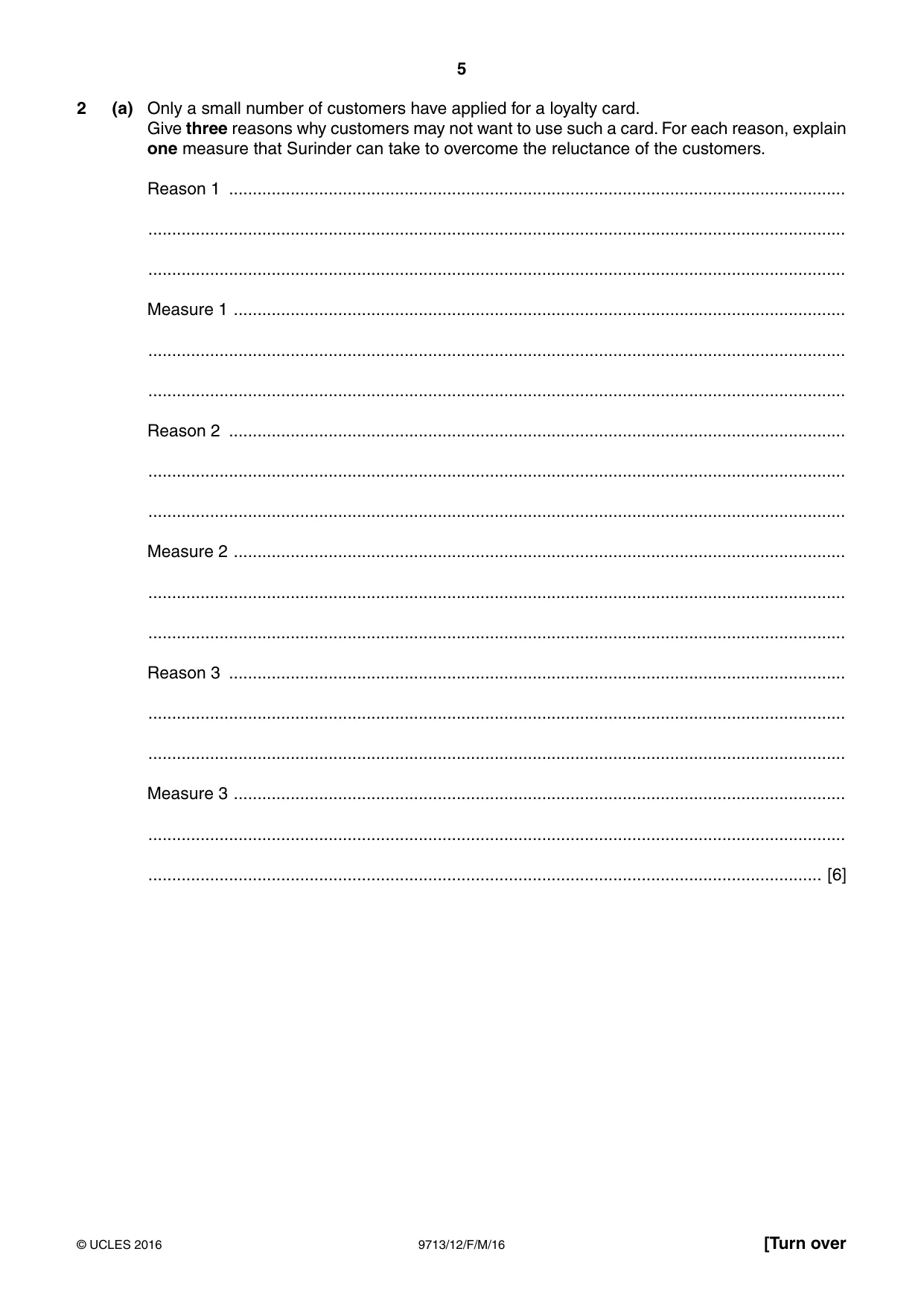
5 9713/12/F/M/16 © UCLES 2016 [Turn over 2 (a) Only a small number of customers have applied for a loyalty card. Give three reasons why customers may not want to use such a card. For each reason, explain one measure that Surinder can take to overcome the reluctance of the customers. Reason 1 … … … Measure 1 … … … Reason 2 … … … Measure 2 … … … Reason 3 … … … Measure 3 … … … [6]
Question paper, page 6
6 9713/12/F/M/16 © UCLES 2016 (b) A large amount of data is created by the computer system used in the supermarket. Explain how this data can be used to help Surinder manage the store. … … … … … … … … … … … … … … [6]
Question paper, page 7
7 9713/12/F/M/16 © UCLES 2016 [Turn over BLANK PAGE
Question paper, page 8
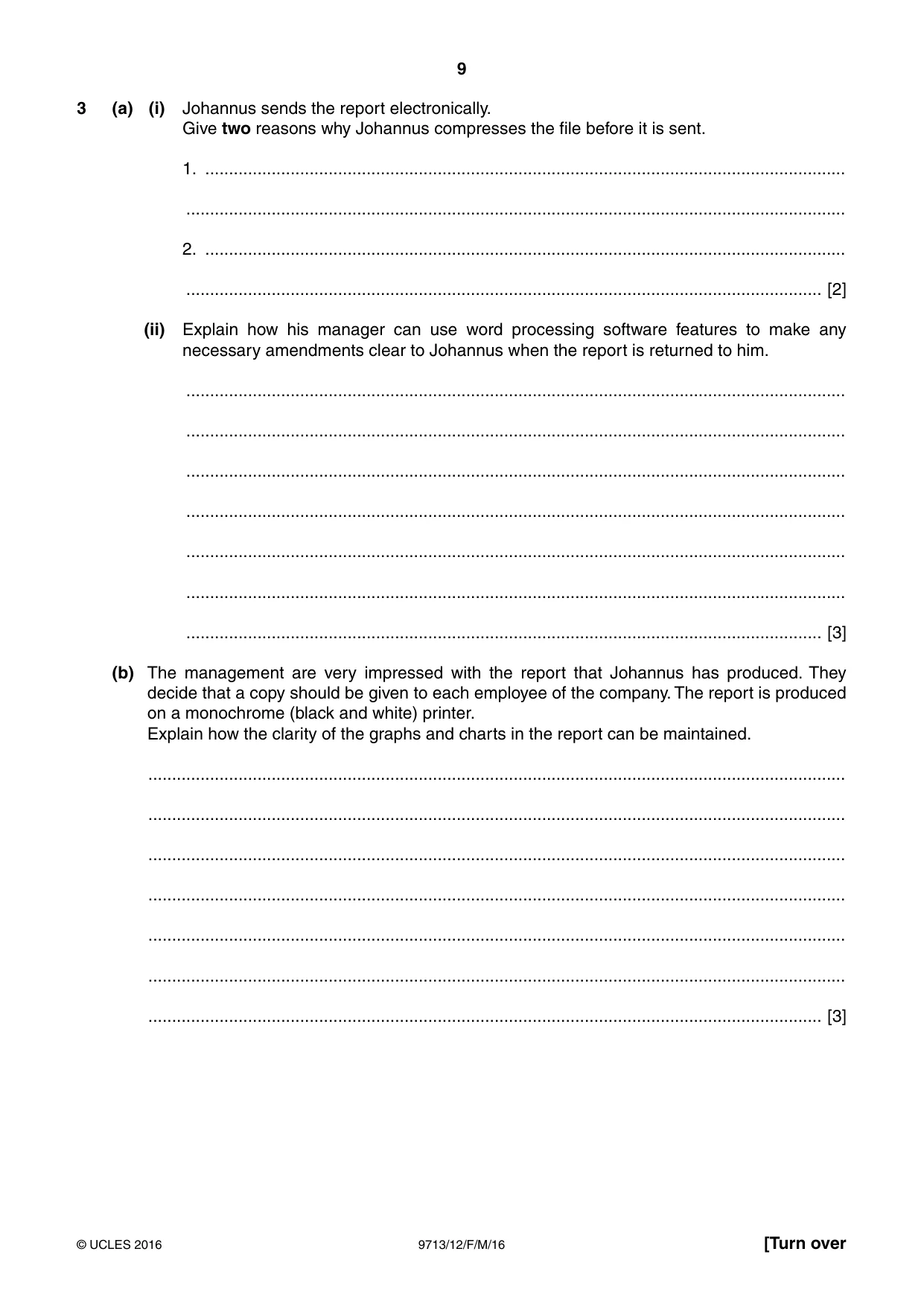
8 9713/12/F/M/16 © UCLES 2016 Scenario 2 Question 3 Johannus is writing a report for the management of the publishing company which he works for. The information he produces needs to be wide-ranging and presented in such a way that it is easily understood. When Johannus has finished his report he decides to send it to his department manager for her comments before submitting it to the management of the company.
Question paper, page 9
9 9713/12/F/M/16 © UCLES 2016 [Turn over 3 (a) (i) Johannus sends the report electronically. Give two reasons why Johannus compresses the file before it is sent. 1. … … 2. … … [2] (ii) Explain how his manager can use word processing software features to make any necessary amendments clear to Johannus when the report is returned to him. … … … … … … … [3] (b) The management are very impressed with the report that Johannus has produced. They decide that a copy should be given to each employee of the company. The report is produced on a monochrome (black and white) printer. Explain how the clarity of the graphs and charts in the report can be maintained. … … … … … … … [3]
Question paper, page 10
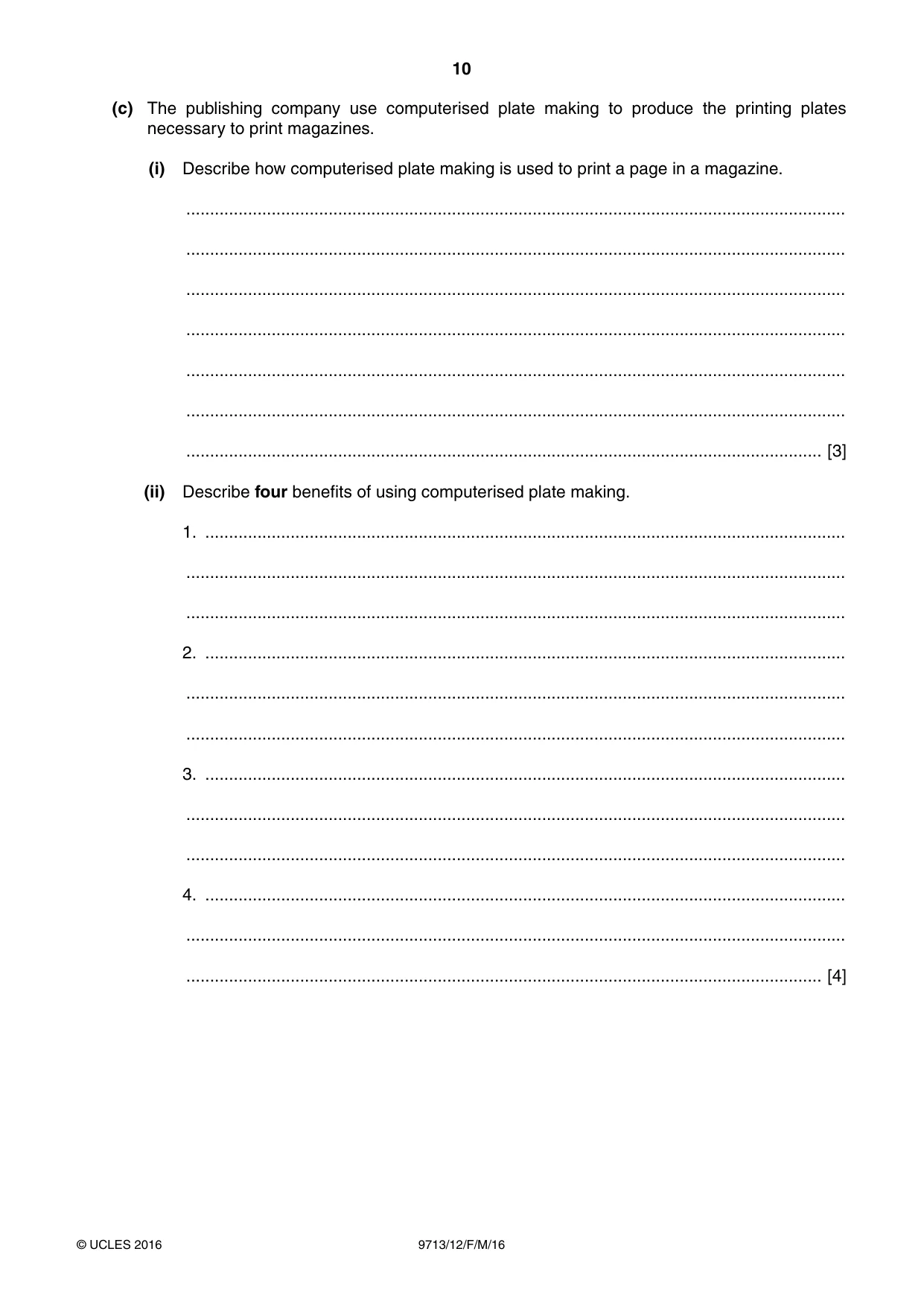
10 9713/12/F/M/16 © UCLES 2016 (c) The publishing company use computerised plate making to produce the printing plates necessary to print magazines. (i) Describe how computerised plate making is used to print a page in a magazine. … … … … … … … [3] (ii) Describe four benefits of using computerised plate making. 1. … … … 2. … … … 3. … … … 4. … … … [4]
Question paper, page 11
11 9713/12/F/M/16 © UCLES 2016 [Turn over BLANK PAGE
Question paper, page 12
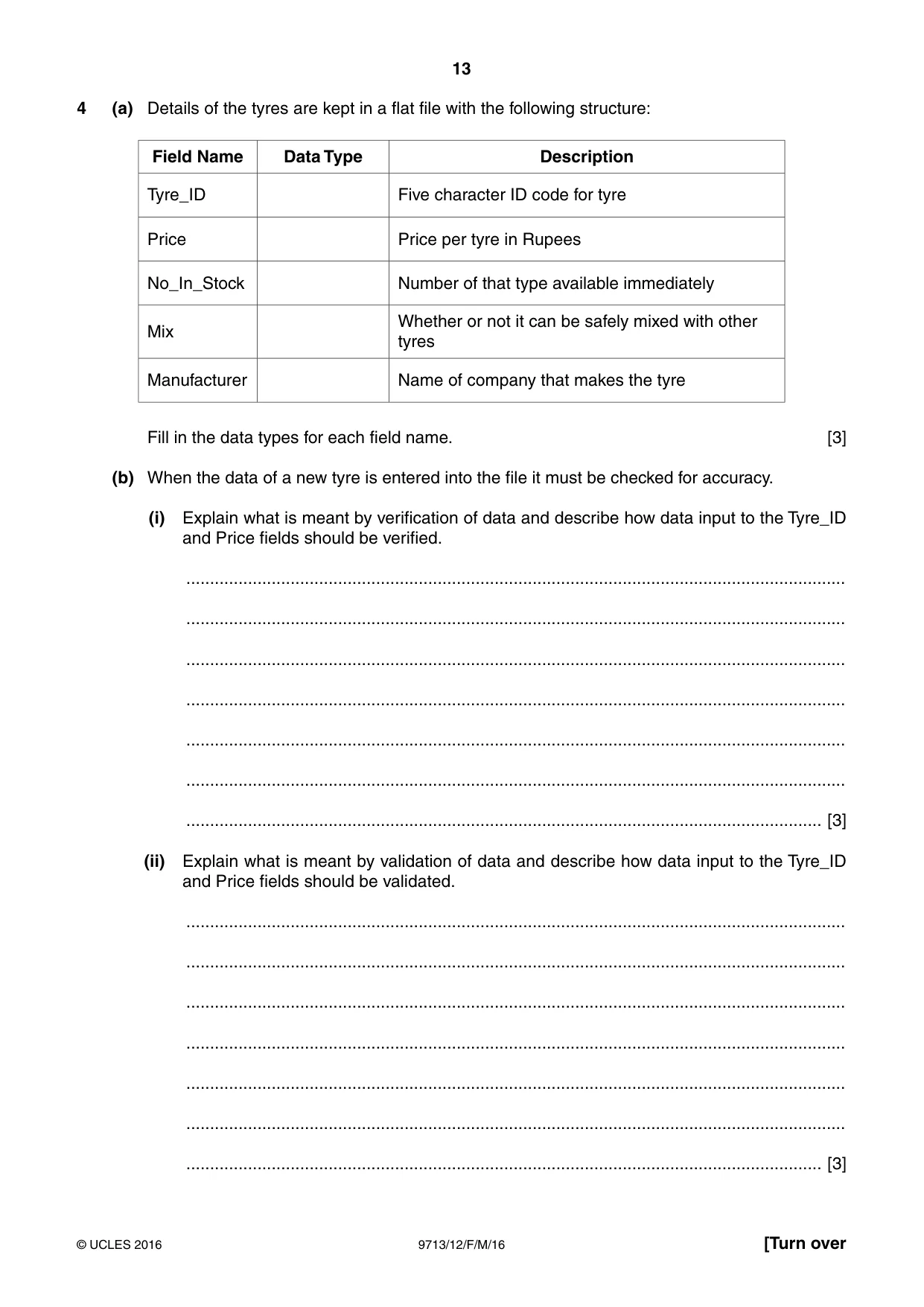
12 9713/12/F/M/16 © UCLES 2016 Scenario 3 Questions 4 and 5 NWtyre is a business which deals with replacing car tyres on vehicles. There are many hundreds of different tyres which vary in a number of ways, including price. Each tyre has an ID code consisting of two letters followed by three digits. The letters are the first two letters of the make of car for which the tyre was designed and the three digits are added to make the ID code unique for that tyre type. NWtyre are considering using robots to change the tyres on vehicles.
Question paper, page 13
13 9713/12/F/M/16 © UCLES 2016 [Turn over 4 (a) Details of the tyres are kept in a flat file with the following structure: Field Name Data Type Description Tyre_ID Five character ID code for tyre Price Price per tyre in Rupees No_In_Stock Number of that type available immediately Mix Whether or not it can be safely mixed with other tyres Manufacturer Name of company that makes the tyre Fill in the data types for each field name. [3] (b) When the data of a new tyre is entered into the file it must be checked for accuracy. (i) Explain what is meant by verification of data and describe how data input to the Tyre_ID and Price fields should be verified. … … … … … … … [3] (ii) Explain what is meant by validation of data and describe how data input to the Tyre_ID and Price fields should be validated. … … … … … … … [3]
Question paper, page 14
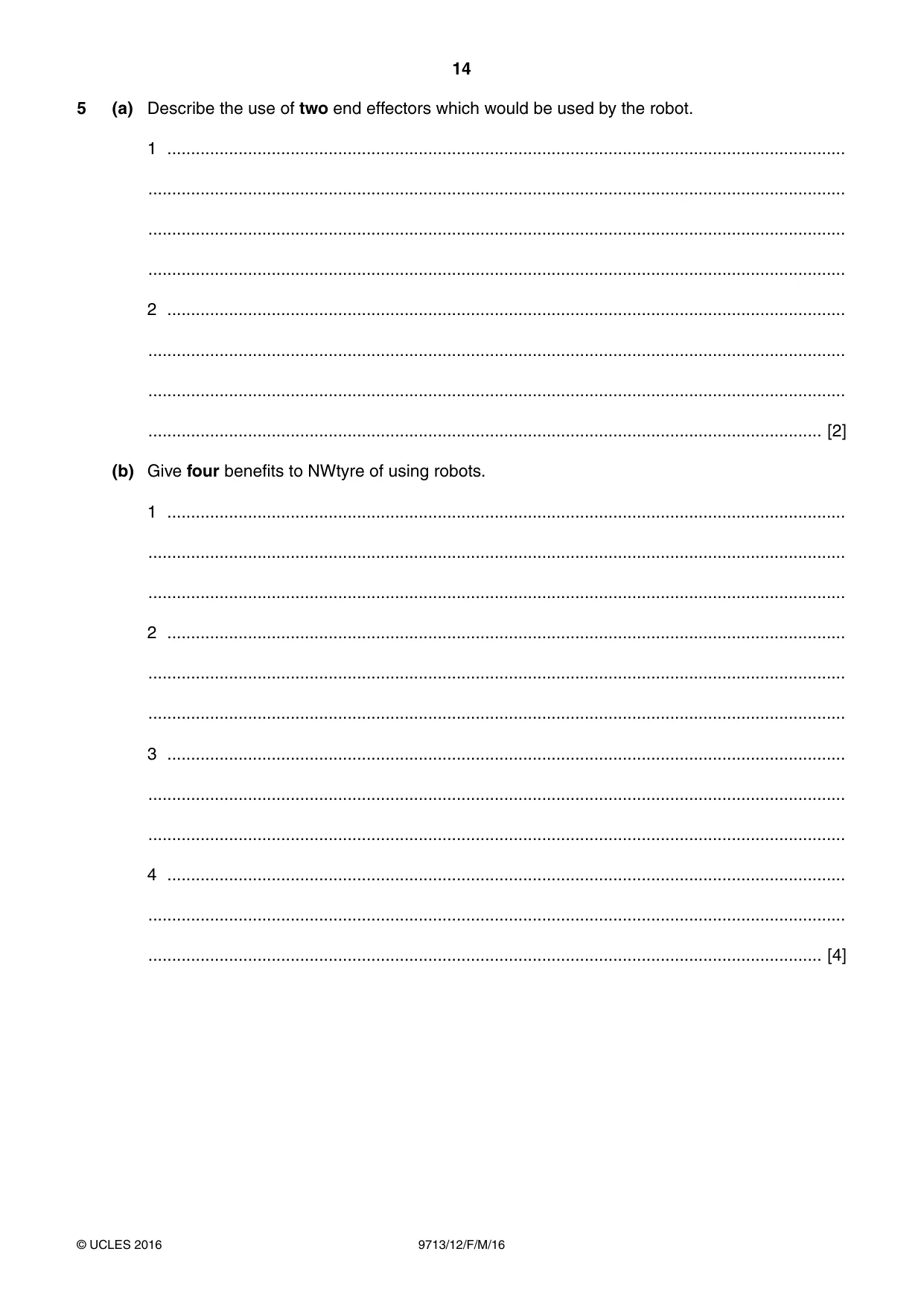
14 9713/12/F/M/16 © UCLES 2016 5 (a) Describe the use of two end effectors which would be used by the robot. 1 … … … … 2 … … … … [2] (b) Give four benefits to NWtyre of using robots. 1 … … … 2 … … … 3 … … … 4 … … … [4]
Question paper, page 15
15 9713/12/F/M/16 © UCLES 2016 [Turn over BLANK PAGE
Question paper, page 16
16 9713/12/F/M/16 © UCLES 2016 Scenario 4 Question 6 Soydelight is a restaurant which has a small range of dishes made from soya beans. Customers order their food at the counter where an assistant uses a touchscreen to input each order.
Question paper, page 17
17 9713/12/F/M/16 © UCLES 2016 [Turn over 6 (a) Explain why the assistant enters customer orders using a touchscreen instead of other input devices. … … … … … … … … … … … … … … [6]
Question paper, page 18
18 9713/12/F/M/16 © UCLES 2016 (b) A spreadsheet is designed to show when a supplier should be contacted so that more of a particular item can be ordered. A B C D E F G H 1 Item Number_In_Stock Minimum Supplier Contact Supplier 2 Soyburger 975 400 105 =IF(B2<C2,VLOOKUP(D2,G$2:H$4,2,FALSE),“No order”) 105 Soyplies 3 Soyfish 269 200 105 245 Veggie Ltd 4 Bread rolls 1284 600 361 361 Breadisus 5 Tomato 432 150 245 6 Lettuce 95 50 245 Explain the purpose of the different parts of the formula in cell E2. … … … … … … … … … … … … … … [6]
Question paper, page 19
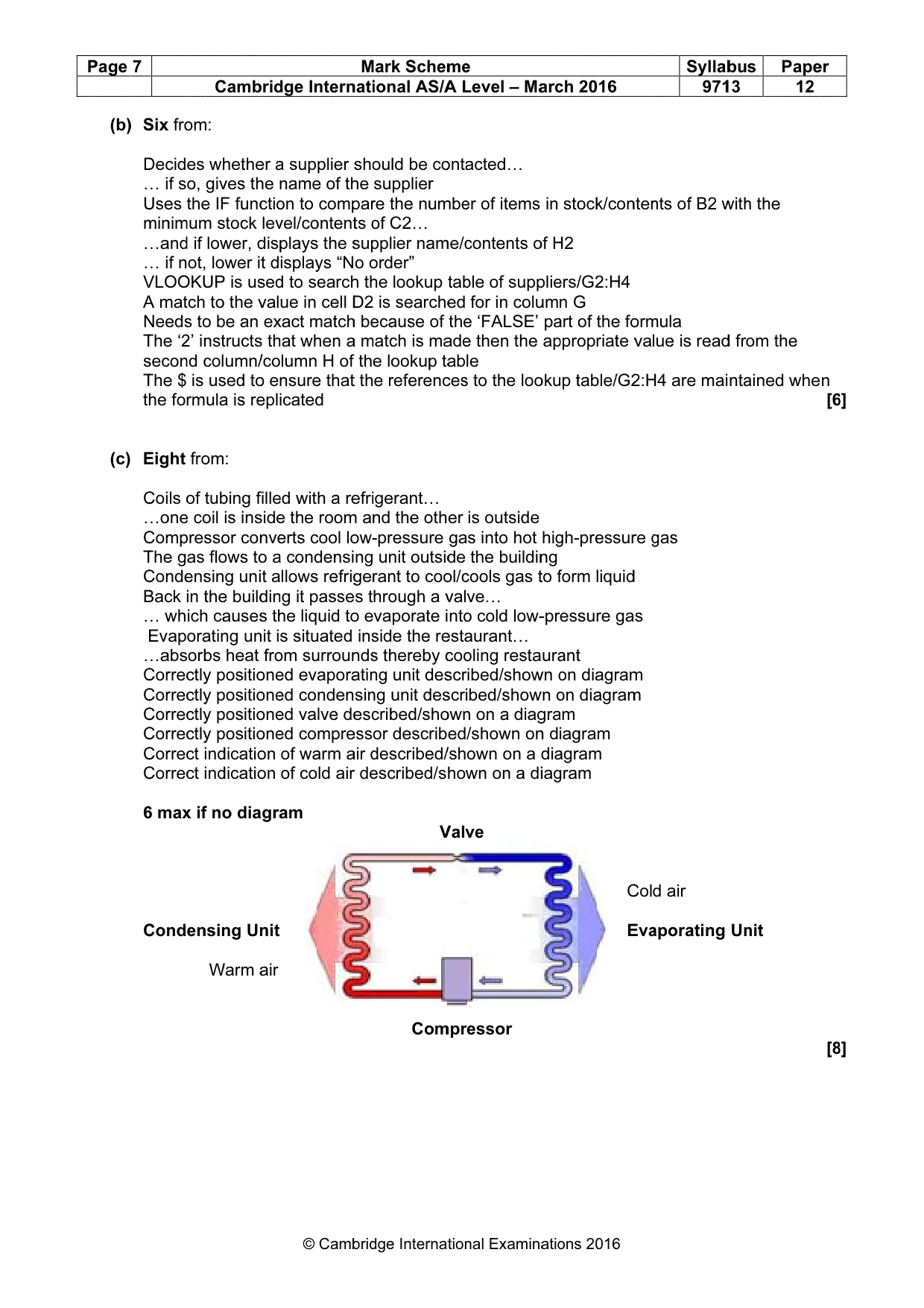
19 9713/12/F/M/16 © UCLES 2016 (c) The restaurant is kept cool by a microprocessor-controlled air conditioning system. With the aid of a labelled diagram, explain how this type of system works. … … … … … … … … … … … … … … [8]
Question paper, page 20
20 9713/12/F/M/16 © UCLES 2016 BLANK PAGE Permission to reproduce items where third-party owned material protected by copyright is included has been sought and cleared where possible. Every reasonable effort has been made by the publisher (UCLES) to trace copyright holders, but if any items requiring clearance have unwittingly been included, the publisher will be pleased to make amends at the earliest possible opportunity. To avoid the issue of disclosure of answer-related information to candidates, all copyright acknowledgements are reproduced online in the Cambridge International Examinations Copyright Acknowledgements Booklet. This is produced for each series of examinations and is freely available to download at www.cie.org.uk after the live examination series. Cambridge International Examinations is part of the Cambridge Assessment Group. Cambridge Assessment is the brand name of University of Cambridge Local Examinations Syndicate (UCLES), which is itself a department of the University of Cambridge.
Mark scheme, page 1
® IGCSE is the registered trademark of Cambridge International Examinations. CAMBRIDGE INTERNATIONAL EXAMINATIONS Cambridge International Advanced Subsidiary and Advanced Level MARK SCHEME for the March 2016 series 9713 APPLIED INFORMATION AND COMMUNICATION TECHNOLOGY 9713/12 Paper 1 (Written A), maximum raw mark 80 This mark scheme is published as an aid to teachers and candidates, to indicate the requirements of the examination. It shows the basis on which Examiners were instructed to award marks. It does not indicate the details of the discussions that took place at an Examiners’ meeting before marking began, which would have considered the acceptability of alternative answers. Mark schemes should be read in conjunction with the question paper and the Principal Examiner Report for Teachers. Cambridge will not enter into discussions about these mark schemes. Cambridge is publishing the mark schemes for the March 2016 series for most Cambridge IGCSE® and Cambridge International A and AS Level components.
Mark scheme, page 2
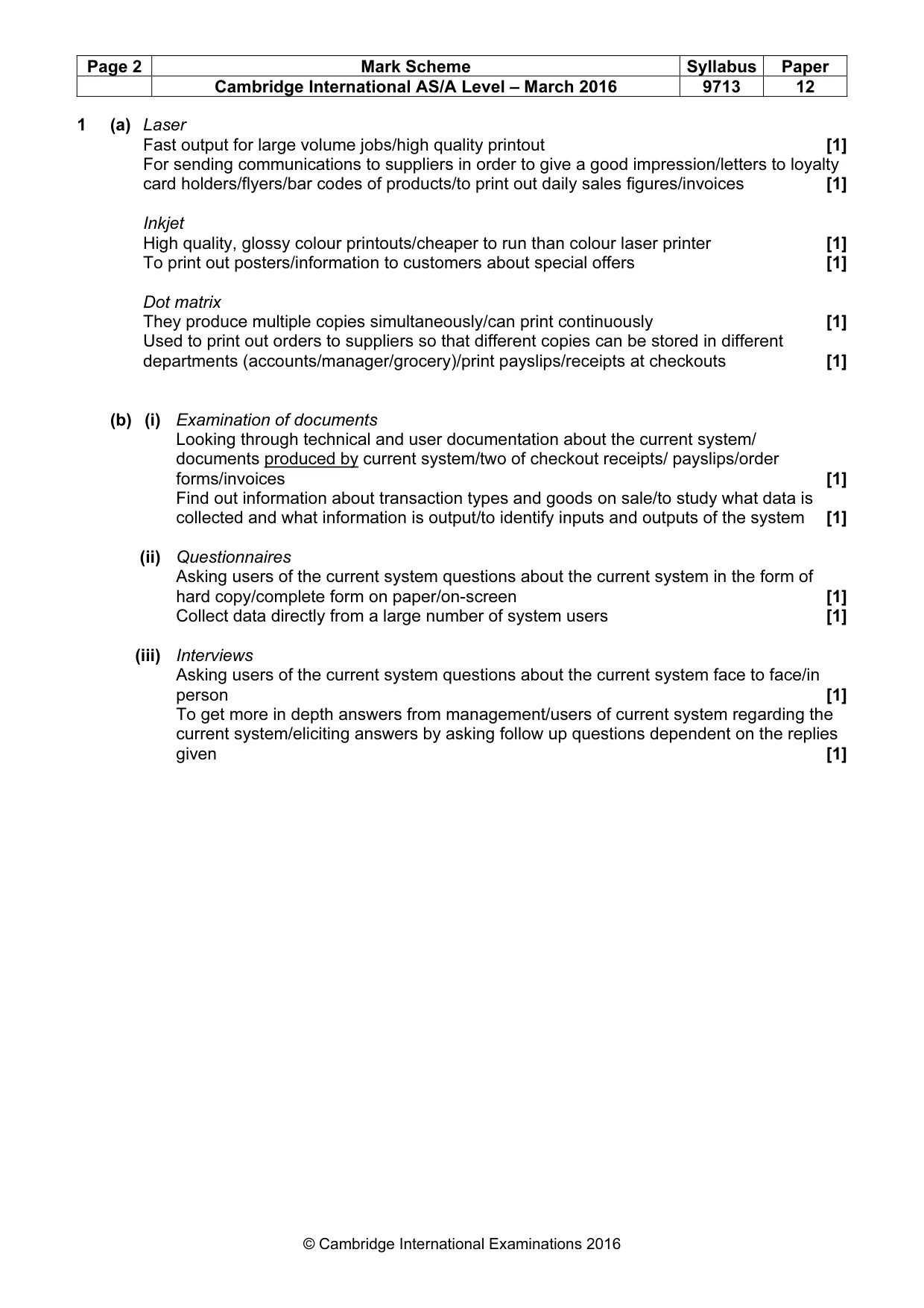
Page 2 Mark Scheme Syllabus Paper Cambridge International AS/A Level – March 2016 9713 12 © Cambridge International Examinations 2016 1 (a) Laser Fast output for large volume jobs/high quality printout [1] For sending communications to suppliers in order to give a good impression/letters to loyalty card holders/flyers/bar codes of products/to print out daily sales figures/invoices [1] Inkjet High quality, glossy colour printouts/cheaper to run than colour laser printer [1] To print out posters/information to customers about special offers [1] Dot matrix They produce multiple copies simultaneously/can print continuously [1] Used to print out orders to suppliers so that different copies can be stored in different departments (accounts/manager/grocery)/print payslips/receipts at checkouts [1] (b) (i) Examination of documents Looking through technical and user documentation about the current system/ documents produced by current system/two of checkout receipts/ payslips/order forms/invoices [1] Find out information about transaction types and goods on sale/to study what data is collected and what information is output/to identify inputs and outputs of the system [1] (ii) Questionnaires Asking users of the current system questions about the current system in the form of hard copy/complete form on paper/on-screen [1] Collect data directly from a large number of system users [1] (iii) Interviews Asking users of the current system questions about the current system face to face/in person [1] To get more in depth answers from management/users of current system regarding the current system/eliciting answers by asking follow up questions dependent on the replies given [1]
Mark scheme, page 3
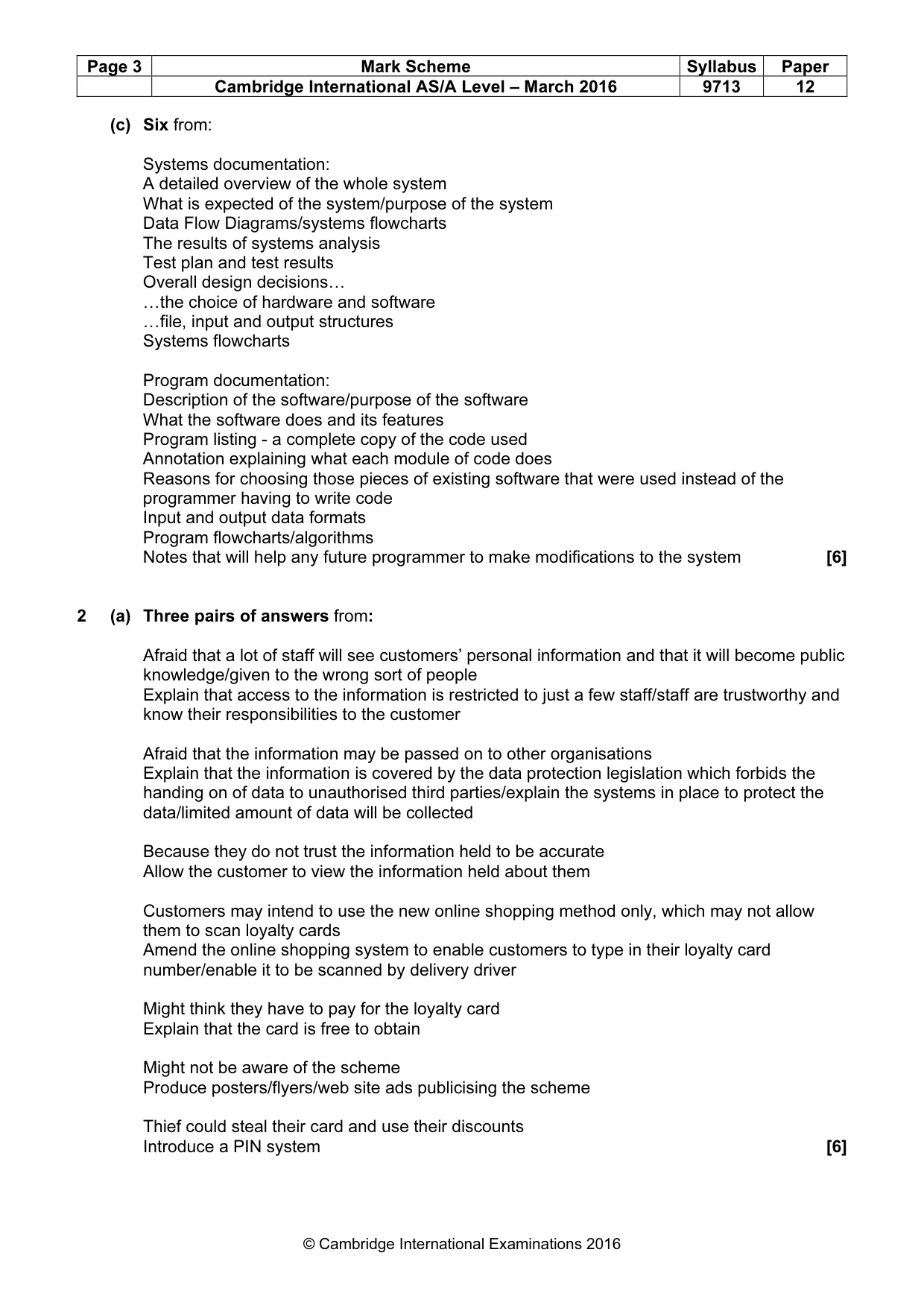
Page 3 Mark Scheme Syllabus Paper Cambridge International AS/A Level – March 2016 9713 12 © Cambridge International Examinations 2016 (c) Six from: Systems documentation: A detailed overview of the whole system What is expected of the system/purpose of the system Data Flow Diagrams/systems flowcharts The results of systems analysis Test plan and test results Overall design decisions… …the choice of hardware and software …file, input and output structures Systems flowcharts Program documentation: Description of the software/purpose of the software What the software does and its features Program listing - a complete copy of the code used Annotation explaining what each module of code does Reasons for choosing those pieces of existing software that were used instead of the programmer having to write code Input and output data formats Program flowcharts/algorithms Notes that will help any future programmer to make modifications to the system [6] 2 (a) Three pairs of answers from: Afraid that a lot of staff will see customers’ personal information and that it will become public knowledge/given to the wrong sort of people Explain that access to the information is restricted to just a few staff/staff are trustworthy and know their responsibilities to the customer Afraid that the information may be passed on to other organisations Explain that the information is covered by the data protection legislation which forbids the handing on of data to unauthorised third parties/explain the systems in place to protect the data/limited amount of data will be collected Because they do not trust the information held to be accurate Allow the customer to view the information held about them Customers may intend to use the new online shopping method only, which may not allow them to scan loyalty cards Amend the online shopping system to enable customers to type in their loyalty card number/enable it to be scanned by delivery driver Might think they have to pay for the loyalty card Explain that the card is free to obtain Might not be aware of the scheme Produce posters/flyers/web site ads publicising the scheme Thief could steal their card and use their discounts Introduce a PIN system [6]
Mark scheme, page 4
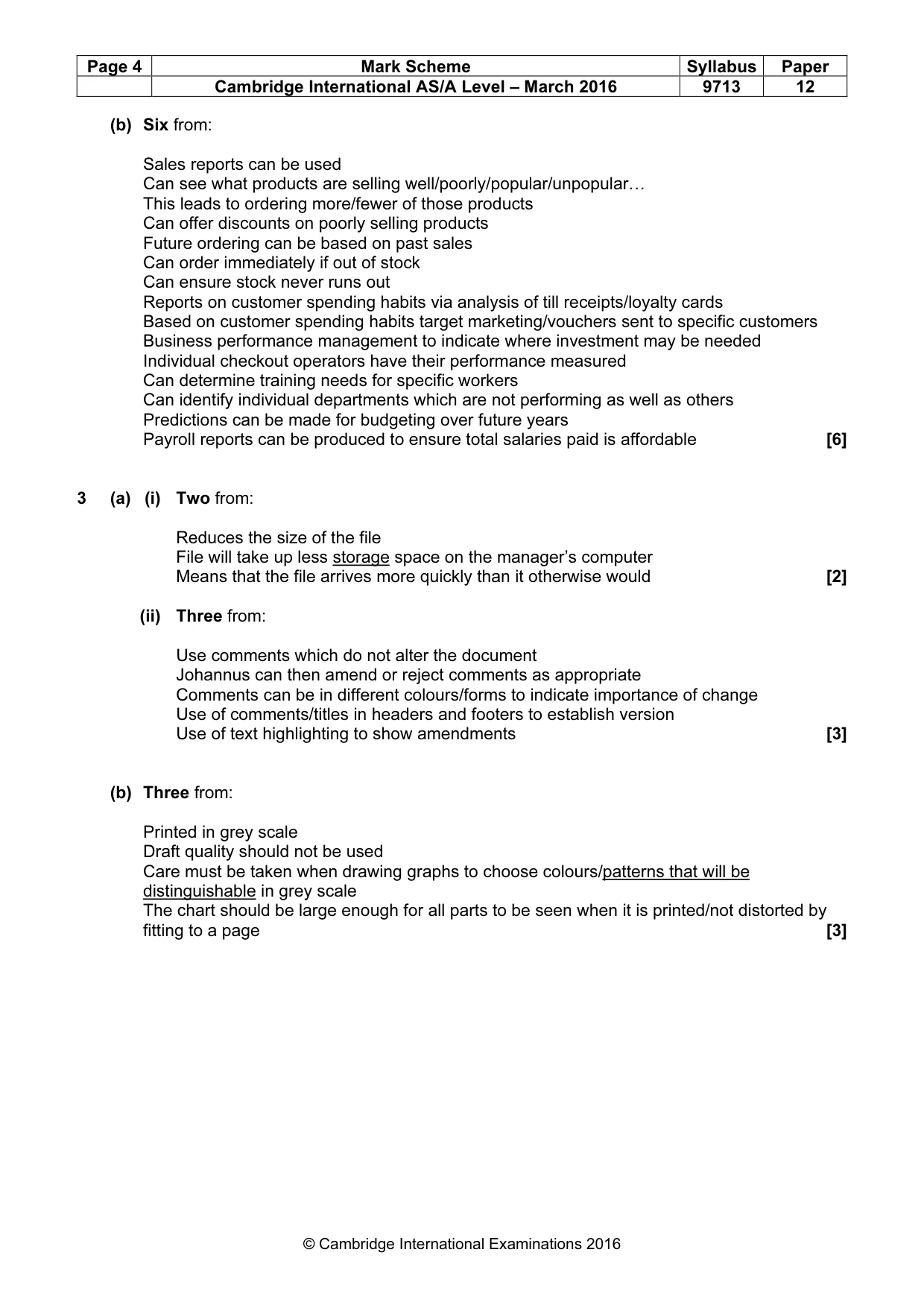
Page 4 Mark Scheme Syllabus Paper Cambridge International AS/A Level – March 2016 9713 12 © Cambridge International Examinations 2016 (b) Six from: Sales reports can be used Can see what products are selling well/poorly/popular/unpopular… This leads to ordering more/fewer of those products Can offer discounts on poorly selling products Future ordering can be based on past sales Can order immediately if out of stock Can ensure stock never runs out Reports on customer spending habits via analysis of till receipts/loyalty cards Based on customer spending habits target marketing/vouchers sent to specific customers Business performance management to indicate where investment may be needed Individual checkout operators have their performance measured Can determine training needs for specific workers Can identify individual departments which are not performing as well as others Predictions can be made for budgeting over future years Payroll reports can be produced to ensure total salaries paid is affordable [6] 3 (a) (i) Two from: Reduces the size of the file File will take up less storage space on the manager’s computer Means that the file arrives more quickly than it otherwise would [2] (ii) Three from: Use comments which do not alter the document Johannus can then amend or reject comments as appropriate Comments can be in different colours/forms to indicate importance of change Use of comments/titles in headers and footers to establish version Use of text highlighting to show amendments [3] (b) Three from: Printed in grey scale Draft quality should not be used Care must be taken when drawing graphs to choose colours/patterns that will be distinguishable in grey scale The chart should be large enough for all parts to be seen when it is printed/not distorted by fitting to a page [3]
Mark scheme, page 5
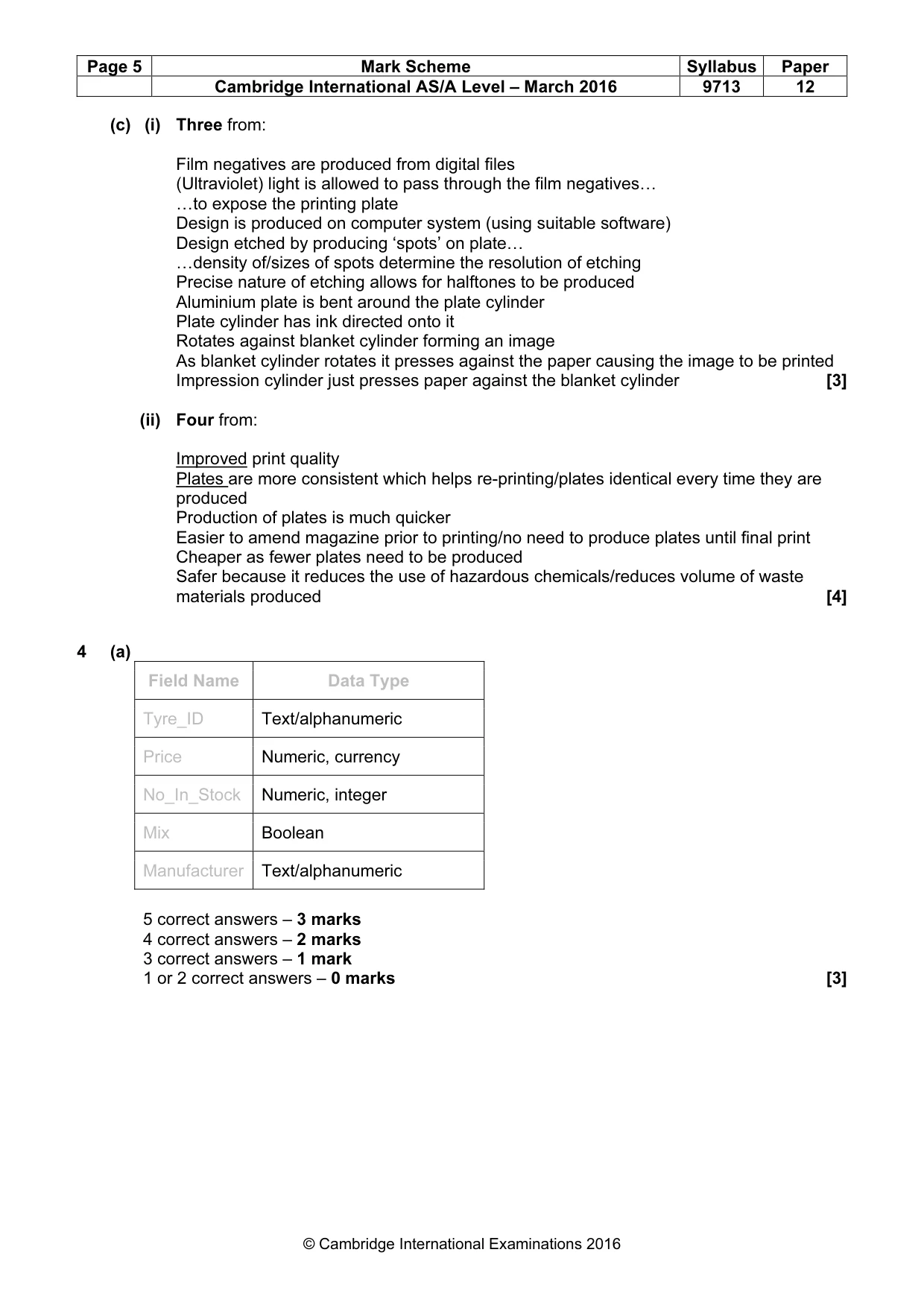
Page 5 Mark Scheme Syllabus Paper Cambridge International AS/A Level – March 2016 9713 12 © Cambridge International Examinations 2016 (c) (i) Three from: Film negatives are produced from digital files (Ultraviolet) light is allowed to pass through the film negatives… …to expose the printing plate Design is produced on computer system (using suitable software) Design etched by producing ‘spots’ on plate… …density of/sizes of spots determine the resolution of etching Precise nature of etching allows for halftones to be produced Aluminium plate is bent around the plate cylinder Plate cylinder has ink directed onto it Rotates against blanket cylinder forming an image As blanket cylinder rotates it presses against the paper causing the image to be printed Impression cylinder just presses paper against the blanket cylinder [3] (ii) Four from: Improved print quality Plates are more consistent which helps re-printing/plates identical every time they are produced Production of plates is much quicker Easier to amend magazine prior to printing/no need to produce plates until final print Cheaper as fewer plates need to be produced Safer because it reduces the use of hazardous chemicals/reduces volume of waste materials produced [4] 4 (a) Field Name Data Type Tyre_ID Text/alphanumeric Price Numeric, currency No_In_Stock Numeric, integer Mix Boolean Manufacturer Text/alphanumeric 5 correct answers – 3 marks 4 correct answers – 2 marks 3 correct answers – 1 mark 1 or 2 correct answers – 0 marks [3]
Mark scheme, page 6
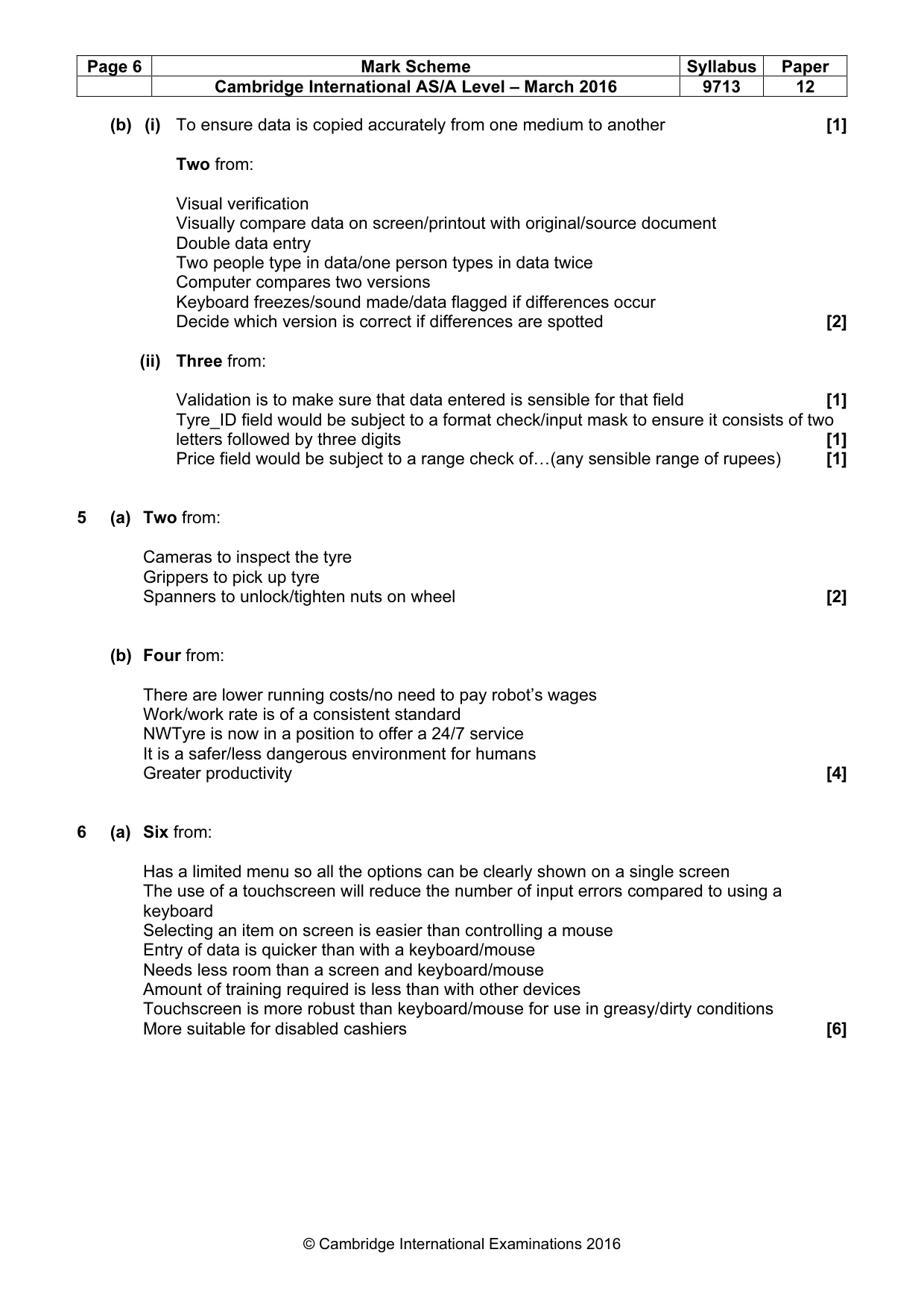
Page 6 Mark Scheme Syllabus Paper Cambridge International AS/A Level – March 2016 9713 12 © Cambridge International Examinations 2016 (b) (i) To ensure data is copied accurately from one medium to another [1] Two from: Visual verification Visually compare data on screen/printout with original/source document Double data entry Two people type in data/one person types in data twice Computer compares two versions Keyboard freezes/sound made/data flagged if differences occur Decide which version is correct if differences are spotted [2] (ii) Three from: Validation is to make sure that data entered is sensible for that field [1] Tyre_ID field would be subject to a format check/input mask to ensure it consists of two letters followed by three digits [1] Price field would be subject to a range check of…(any sensible range of rupees) [1] 5 (a) Two from: Cameras to inspect the tyre Grippers to pick up tyre Spanners to unlock/tighten nuts on wheel [2] (b) Four from: There are lower running costs/no need to pay robot’s wages Work/work rate is of a consistent standard NWTyre is now in a position to offer a 24/7 service It is a safer/less dangerous environment for humans Greater productivity [4] 6 (a) Six from: Has a limited menu so all the options can be clearly shown on a single screen The use of a touchscreen will reduce the number of input errors compared to using a keyboard Selecting an item on screen is easier than controlling a mouse Entry of data is quicker than with a keyboard/mouse Needs less room than a screen and keyboard/mouse Amount of training required is less than with other devices Touchscreen is more robust than keyboard/mouse for use in greasy/dirty conditions More suitable for disabled cashiers [6]
Mark scheme, page 7
P Pag ( ( ge (b) (c) 7 ) S D … U m … … V A N T s T th E C … C T C B … E … C C C C C C 6 C Six Dec … i Use min …a … i VLO A m Nee The sec The he Eig Coi …o Com The Con Bac … w Ev …a Cor Cor Cor Cor Cor Cor 6 m Con x fro cid f s es nim and f n OO mat eds e ‘2 con e $ fo ght ls o one mp e g nde ck wh ap abs rrec rrec rrec rrec rrec rrec max nd om es o, the mum d if ot, OKU tch s to 2’ in nd c is rm fro of t e co pres as ens in t ich ora sorb ctly ctly ctly ctly ct i ct i x if en C m: wh giv e IF m s low lo UP to o b nst col us ula om tub oil sso flo sin the h ca atin bs y p y p y p y p ind ind f no nsin W Cam het ves F fu stoc we owe P is o th be a truc um sed a is : bing is i or c ows g u e b aus ng he pos pos pos pos dica dica o d ng Warm mb the s th unc ck r, d er it us e v an cts mn/ d to s re g f ins con s to uni uild ses un eat sitio sitio sitio sitio atio atio dia Un m a brid er a he ctio lev disp t d sed val ex s th /co o e epl fille side nve o a t a din s th nit i fro one one one one on on gra nit air dge a s na on vel/ pla isp d to ue xac hat lum nsu ica ed w e th erts a co allow ng i he s s om ed ed ed ed of of am e In © up me to /co ays play o s in ct m wh mn ure ated wit he s c ond ws t p liq situ su ev co va co wa co m nte Ca plie e of co onte s th ys ea ce mat hen H e th d h a roo coo den s re pas uid uate urro ap nd lve mp arm ld ern amb er s f th mp ent he s “N rch ell D tch n a of hat a re om ol lo nsi efrig sse d to ed oun ora en e de pre m a air M nati brid sho he par ts o sup o o h th D2 h be a m th t th efri m an ow- ng ger s t o e ins nds atin sin esc ess air d r de Mar ion dge oul su re t of C ppl ord he is eca matc e lo e r ige nd -pr un ran hro va sid s th ng ng u crib or des esc k S nal e In ld b pp the C2 ier der” loo se aus ch oo refe eran the res nit nt t oug po e t her un un bed de scr crib Sch AS nter be lier e nu 2… r na ” oku ear se is kup ere nt… e o su ou o c gh rat the reb it d it d d/s esc ribe bed Co hem S/A rnat co r um am up che of ma p ta enc … oth re tsid coo a v te i e re by c des des sho rib ed/ d/s V om me A L tion onta mbe me/c tab ed the ade ab ces er ga de ol/c val nto esta coo scr scri own ed /sh how Valv mpr e Lev nal act er o con ble fo e ‘F e th le s to is as i th coo ve o c aur olin ribe ibe n o /sh ow wn ve res vel Ex ted of i nte of r in FA hen o th ou nto e b ols … cold ran ng ed/ ed/s n a how wn o n on so – xam d… tem ents f su n co LS n th he l tsid o h bui ga d lo nt… res sho sho a d wn on n a or Ma mina ms s o upp olu SE’ he loo de ot ldin as t ow- … sta ow ow iag on a a di arc atio in of H plie um pa ap oku hig ng to f -pr ura wn o wn o gra n d dia iag ch ons sto H2 ers/ n G art o ppro up t gh- form ess ant on on am iag agr gra 20 s 20 ock /G2 G of t opr tab -pre m l sur t dia dia gra ram m 16 016 k/c 2:H the riat ble/ ess liqu re agr agr m m 6 6 con H4 e fo te v /G2 sur uid ga ram ram C E nten orm val 2:H re g d s m m Col Eva nts mul lue H4 gas d a apo S of a e is are s air ora Syl 9 f B2 s re e m atin llab 971 2 w ead mai ng bu 13 with d fr nta Un s h th om ain nit P he m th ed Pa 1 he w pe 2 he er n [6 [8 6] 8]
What you needed in this session
Cambridge’s own grade thresholds for 2016 Feb/March, Paper 1 · Variant 2. A higher threshold means an easier paper — the bar moves with how the cohort did.