Cambridge A Level Applied Information and Communication Technology 9713 — 2017 Feb/March Paper 1 · Variant 2
9713/12/F/M/17 · 80 marks · ≈90 min
The question paper and its mark scheme, free to read here and free to download. This is Cambridge’s own paper, exactly as it was sat.
Question paper16 pages
Mark scheme8 pages
Answers below. Sit the paper first if you are practising.
Paper as text
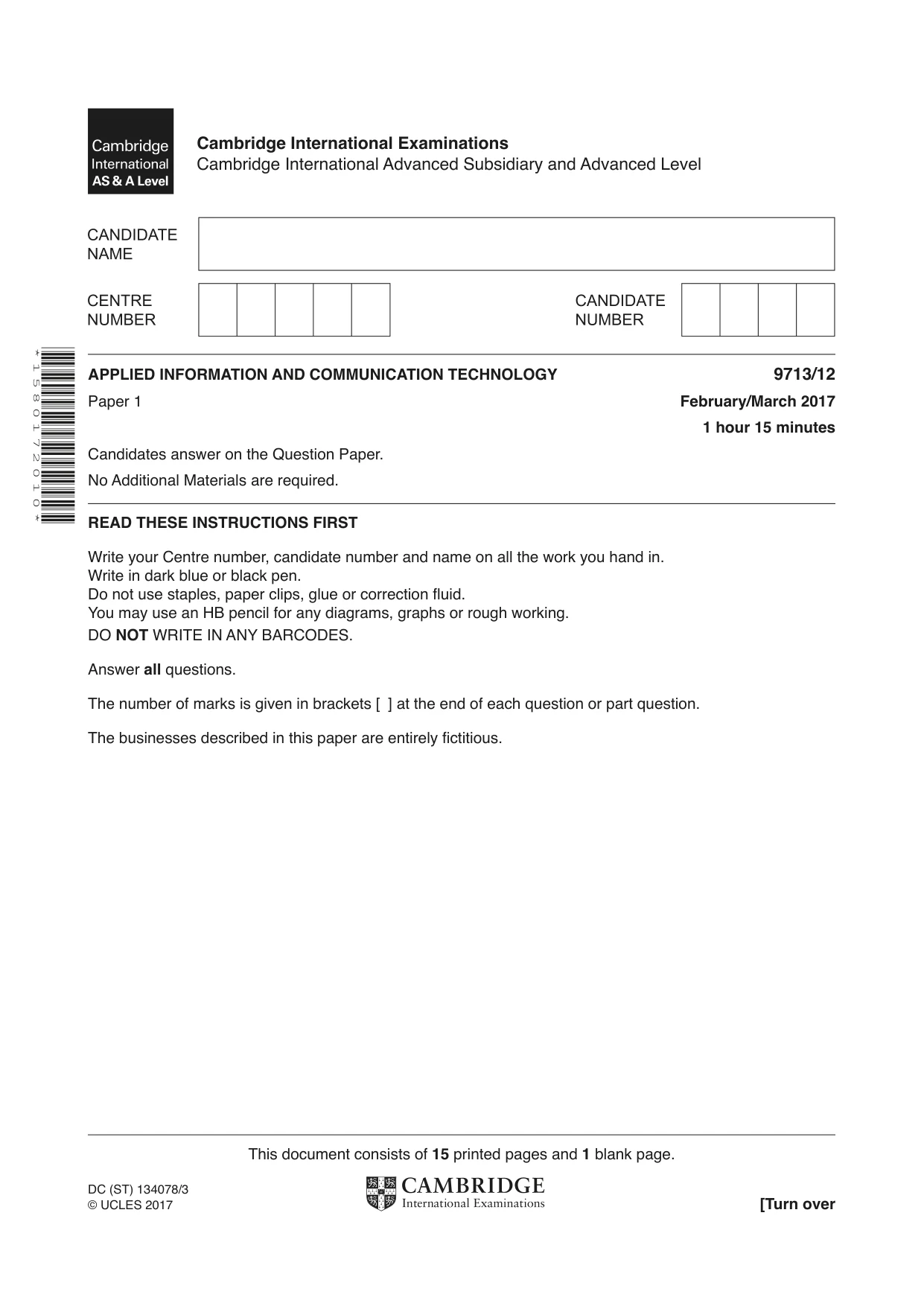
Question paper, page 1
This document consists of 15 printed pages and 1 blank page. DC (ST) 134078/3 © UCLES 2017 [Turn over Cambridge International Examinations Cambridge International Advanced Subsidiary and Advanced Level * 1 5 8 0 1 7 2 0 1 0 * APPLIED INFORMATION AND COMMUNICATION TECHNOLOGY 9713/12 Paper 1 February/March 2017 1 hour 15 minutes Candidates answer on the Question Paper. No Additional Materials are required. READ THESE INSTRUCTIONS FIRST Write your Centre number, candidate number and name on all the work you hand in. Write in dark blue or black pen. Do not use staples, paper clips, glue or correction fluid. You may use an HB pencil for any diagrams, graphs or rough working. DO NOT WRITE IN ANY BARCODES. Answer all questions. The number of marks is given in brackets [ ] at the end of each question or part question. The businesses described in this paper are entirely fictitious.
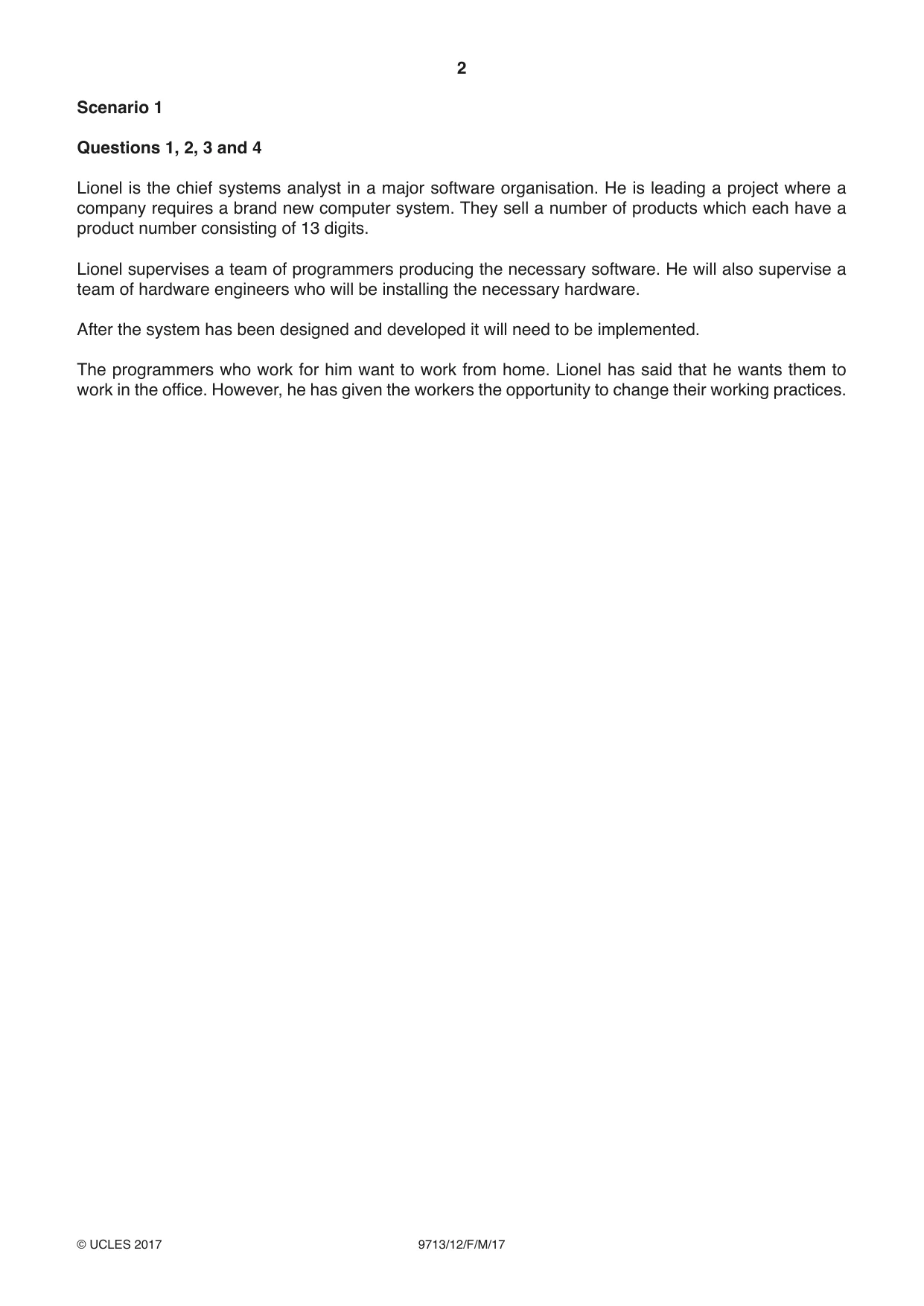
Question paper, page 2
2 9713/12/F/M/17 © UCLES 2017 Scenario 1 Questions 1, 2, 3 and 4 Lionel is the chief systems analyst in a major software organisation. He is leading a project where a company requires a brand new computer system. They sell a number of products which each have a product number consisting of 13 digits. Lionel supervises a team of programmers producing the necessary software. He will also supervise a team of hardware engineers who will be installing the necessary hardware. After the system has been designed and developed it will need to be implemented. The programmers who work for him want to work from home. Lionel has said that he wants them to work in the office. However, he has given the workers the opportunity to change their working practices.
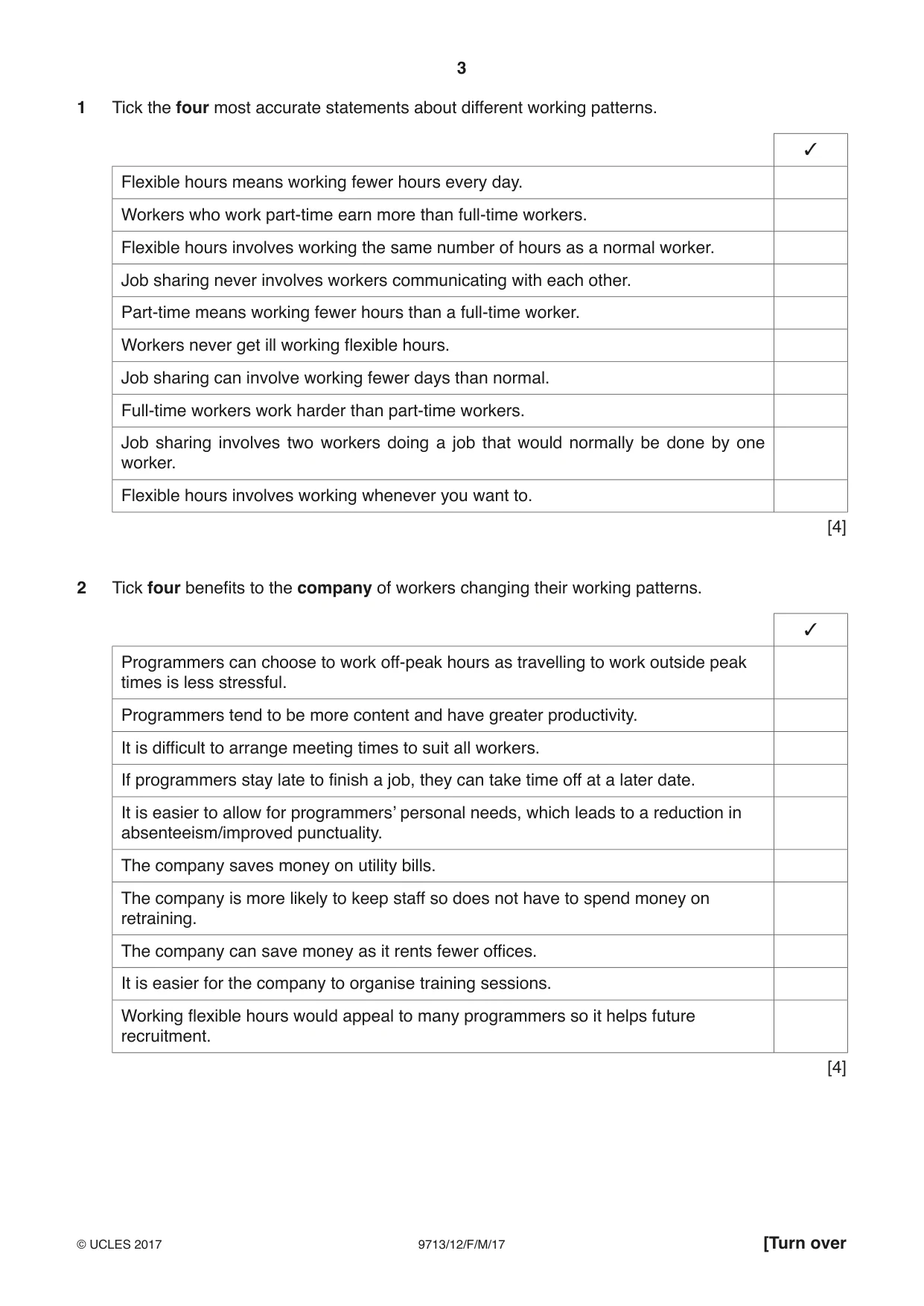
Question paper, page 3
3 9713/12/F/M/17 © UCLES 2017 [Turn over 1 Tick the four most accurate statements about different working patterns. 3 Flexible hours means working fewer hours every day. Workers who work part-time earn more than full-time workers. Flexible hours involves working the same number of hours as a normal worker. Job sharing never involves workers communicating with each other. Part-time means working fewer hours than a full-time worker. Workers never get ill working flexible hours. Job sharing can involve working fewer days than normal. Full-time workers work harder than part-time workers. Job sharing involves two workers doing a job that would normally be done by one worker. Flexible hours involves working whenever you want to. [4] 2 Tick four benefits to the company of workers changing their working patterns. 3 Programmers can choose to work off-peak hours as travelling to work outside peak times is less stressful. Programmers tend to be more content and have greater productivity. It is difficult to arrange meeting times to suit all workers. If programmers stay late to finish a job, they can take time off at a later date. It is easier to allow for programmers’ personal needs, which leads to a reduction in absenteeism/improved punctuality. The company saves money on utility bills. The company is more likely to keep staff so does not have to spend money on retraining. The company can save money as it rents fewer offices. It is easier for the company to organise training sessions. Working flexible hours would appeal to many programmers so it helps future recruitment. [4]
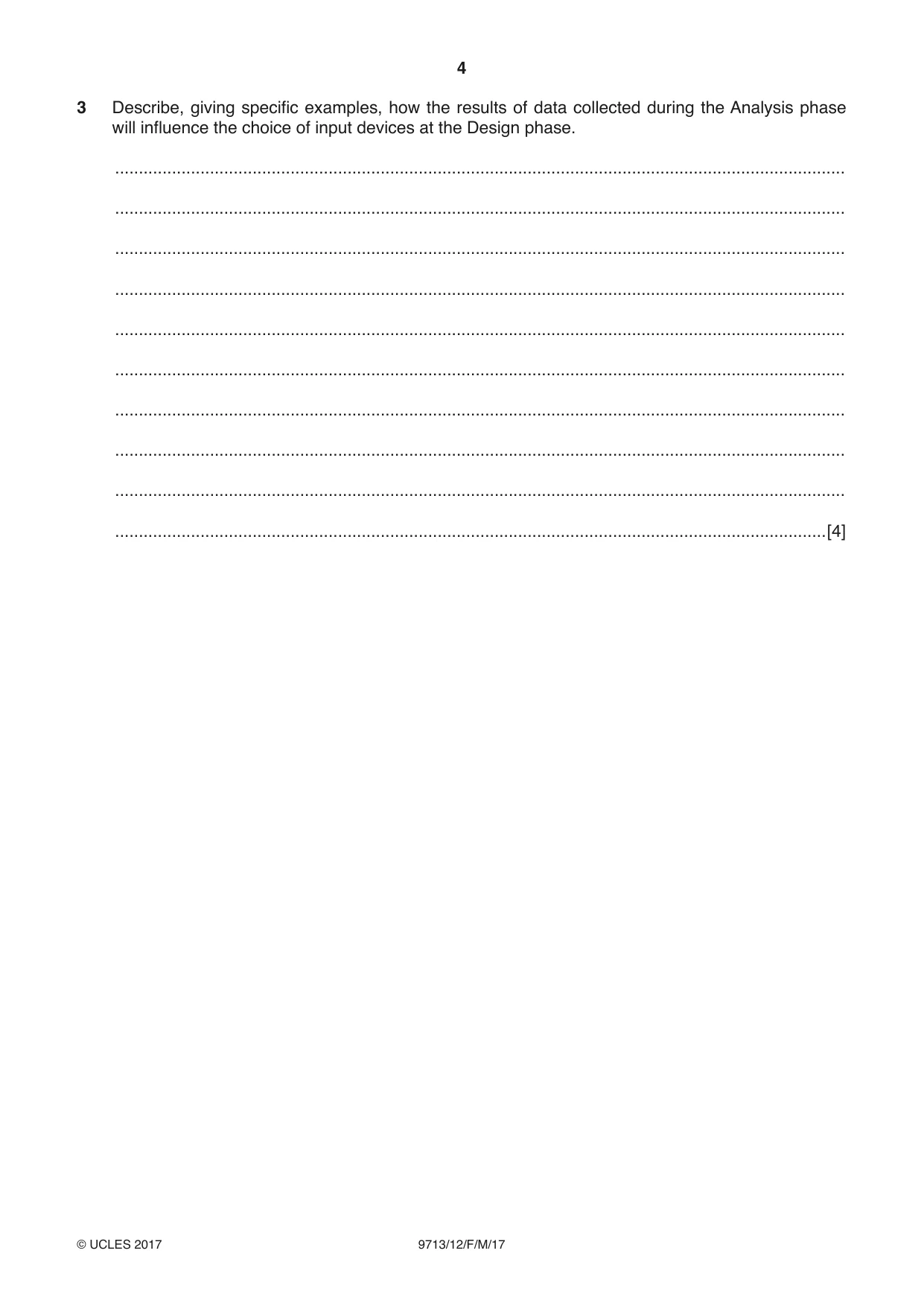
Question paper, page 4
4 9713/12/F/M/17 © UCLES 2017 3 Describe, giving specific examples, how the results of data collected during the Analysis phase will influence the choice of input devices at the Design phase. … … … … … … … … … …[4]
Question paper, page 5
5 9713/12/F/M/17 © UCLES 2017 [Turn over 4 Compare and contrast the different methods which could be used to implement the new system. … … … … … … … … … … … … … … … … … … … …[8]
Question paper, page 6
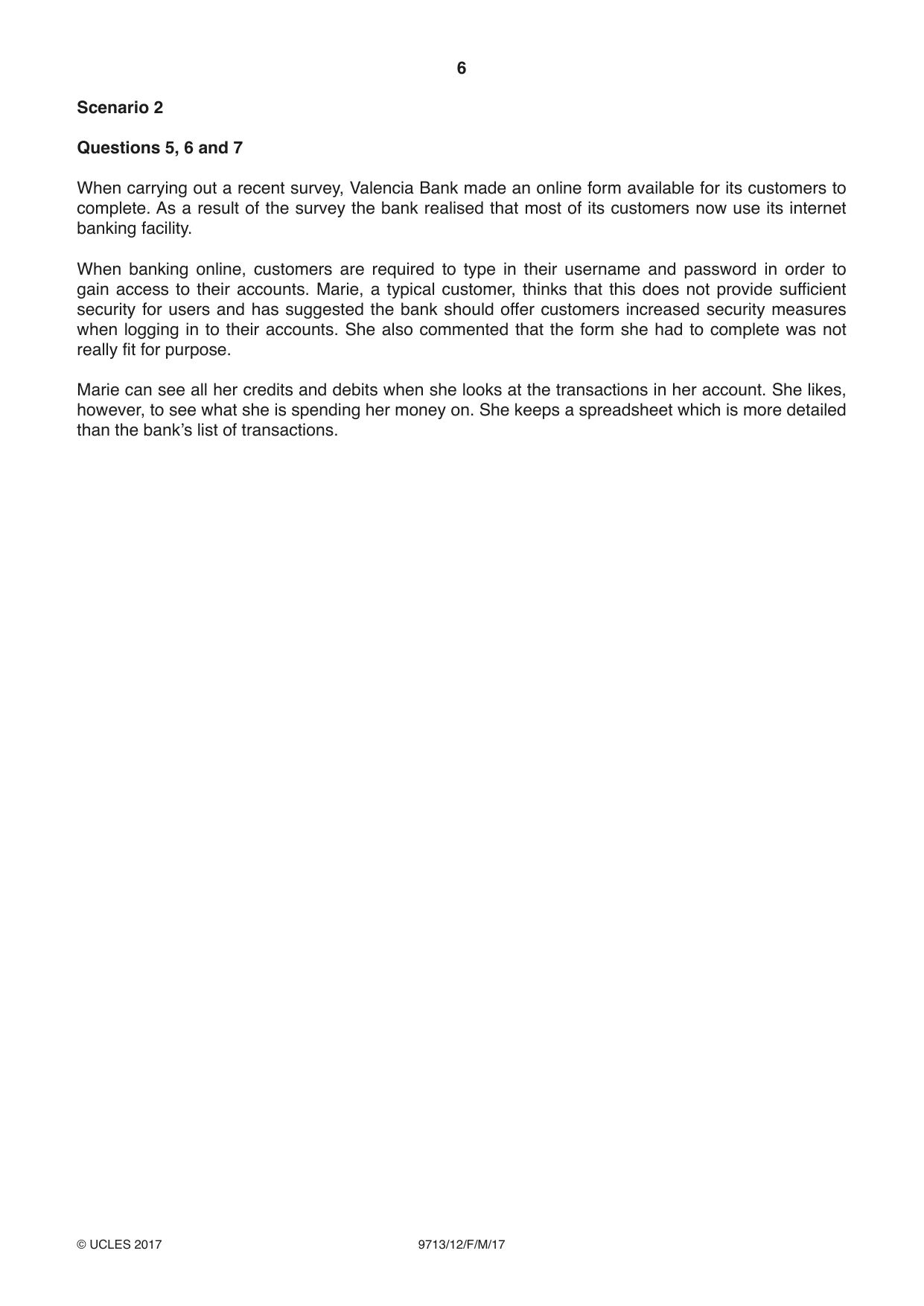
6 9713/12/F/M/17 © UCLES 2017 Scenario 2 Questions 5, 6 and 7 When carrying out a recent survey, Valencia Bank made an online form available for its customers to complete. As a result of the survey the bank realised that most of its customers now use its internet banking facility. When banking online, customers are required to type in their username and password in order to gain access to their accounts. Marie, a typical customer, thinks that this does not provide sufficient security for users and has suggested the bank should offer customers increased security measures when logging in to their accounts. She also commented that the form she had to complete was not really fit for purpose. Marie can see all her credits and debits when she looks at the transactions in her account. She likes, however, to see what she is spending her money on. She keeps a spreadsheet which is more detailed than the bank’s list of transactions.
Question paper, page 7
7 9713/12/F/M/17 © UCLES 2017 [Turn over 5 Apart from considering the views of users, describe the factors that Valencia Bank should have taken into account when designing the online form for the survey. … … … … … … … … … … … …[5] 6 (a) Describe the increased security measures Valencia Bank could offer to customers to improve security of their data. … … … … … … … … … … … …[5]
Question paper, page 8
8 9713/12/F/M/17 © UCLES 2017 (b) Discuss the effectiveness of the measures Valencia Bank could employ when customers log in to their accounts. … … … … … … … … … … … … … … … … … … … …[8]
Question paper, page 9
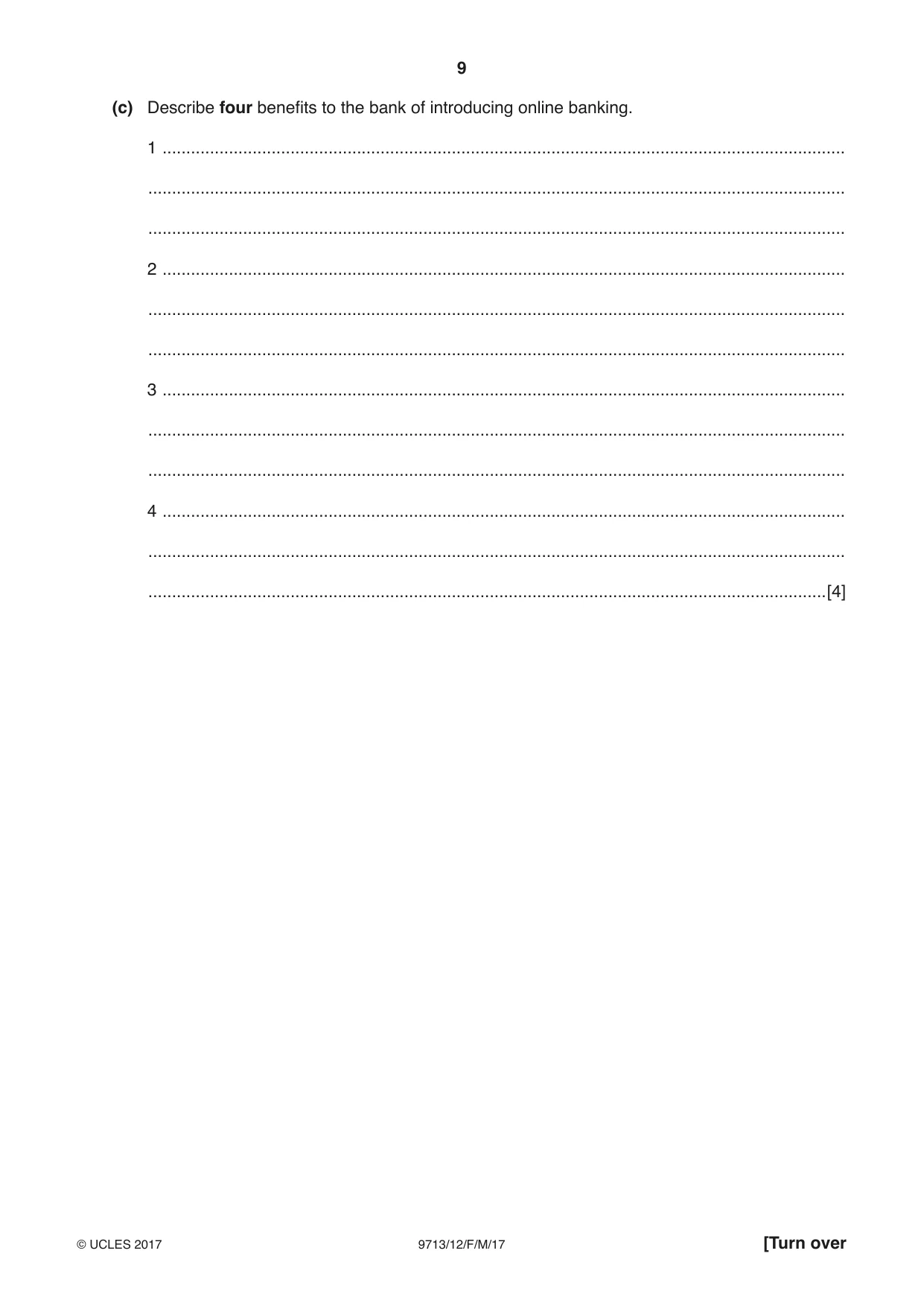
9 9713/12/F/M/17 © UCLES 2017 [Turn over (c) Describe four benefits to the bank of introducing online banking. 1 … … … 2 … … … 3 … … … 4 … … …[4]
Question paper, page 10
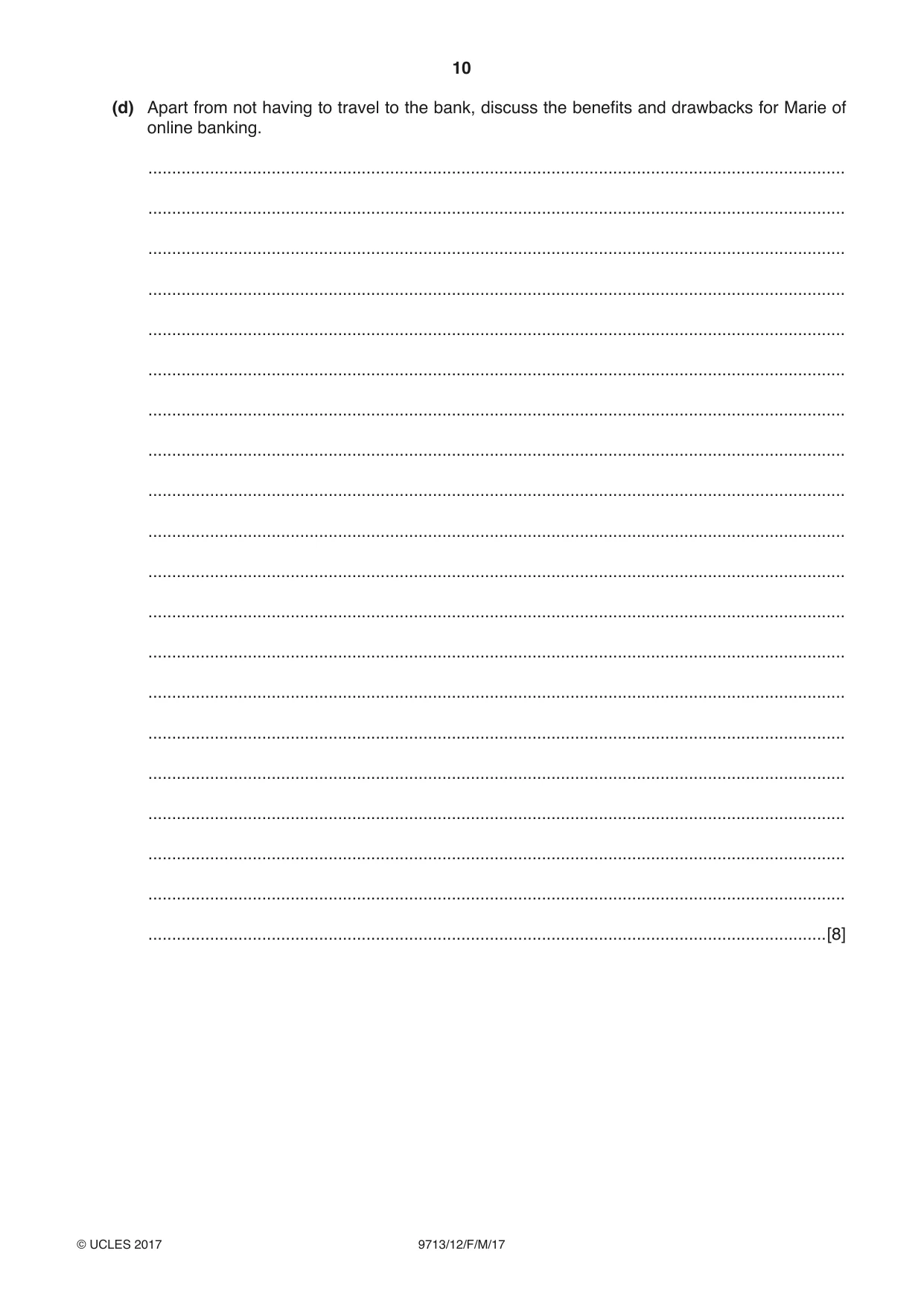
10 9713/12/F/M/17 © UCLES 2017 (d) Apart from not having to travel to the bank, discuss the benefits and drawbacks for Marie of online banking. … … … … … … … … … … … … … … … … … … … …[8]
Question paper, page 11
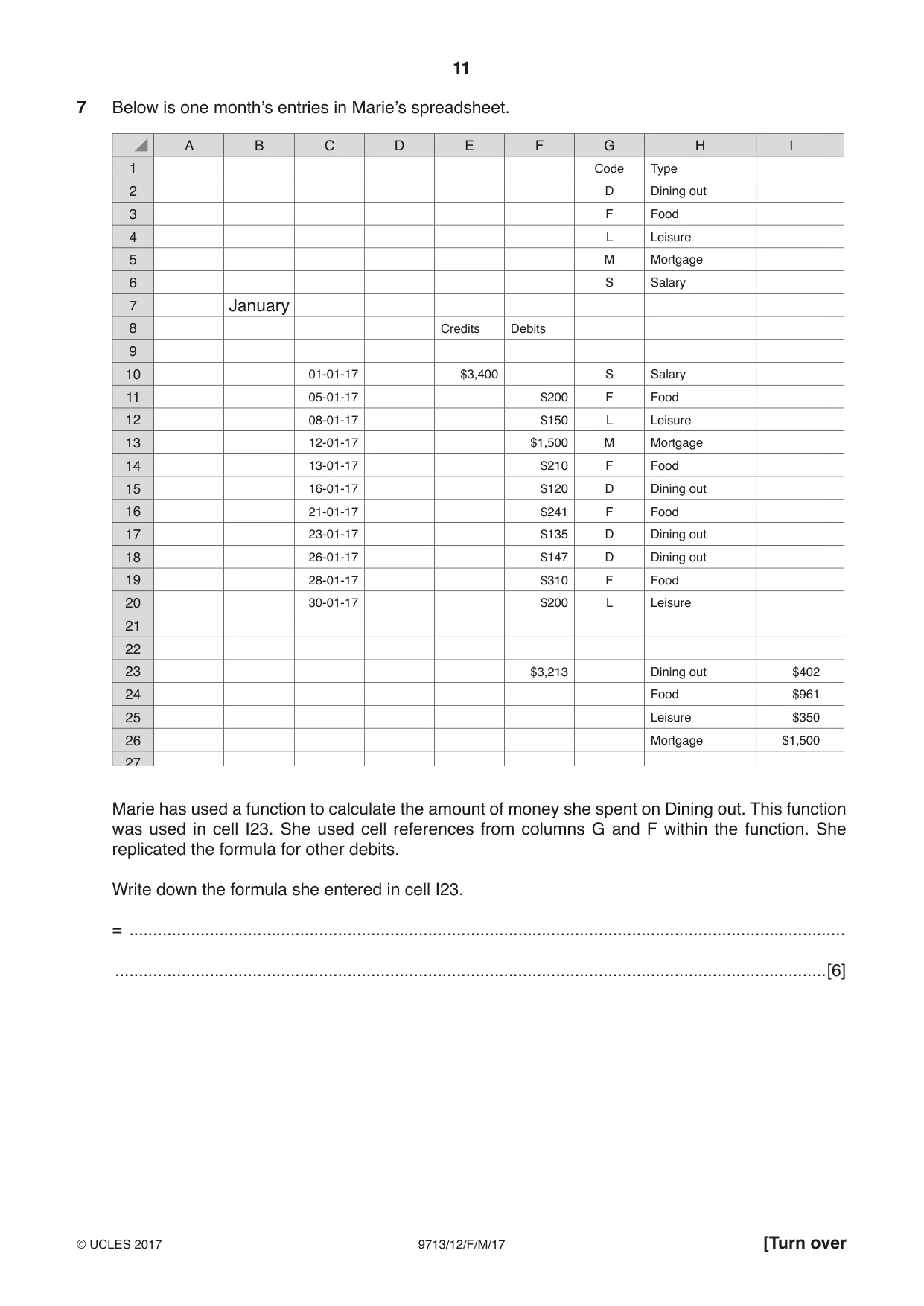
11 9713/12/F/M/17 © UCLES 2017 [Turn over 7 Below is one month’s entries in Marie’s spreadsheet. A B C D E F G H I 1 Code Type 2 D Dining out 3 F Food 4 L Leisure 5 M Mortgage 6 S Salary 7 January 8 Credits Debits 9 10 01-01-17 $3,400 S Salary 11 05-01-17 $200 F Food 12 08-01-17 $150 L Leisure 13 12-01-17 $1,500 M Mortgage 14 13-01-17 $210 F Food 15 16-01-17 $120 D Dining out 16 21-01-17 $241 F Food 17 23-01-17 $135 D Dining out 18 26-01-17 $147 D Dining out 19 28-01-17 $310 F Food 20 30-01-17 $200 L Leisure 21 22 23 $3,213 Dining out $402 24 Food $961 25 Leisure $350 26 Mortgage $1,500 27 Marie has used a function to calculate the amount of money she spent on Dining out. This function was used in cell I23. She used cell references from columns G and F within the function. She replicated the formula for other debits. Write down the formula she entered in cell I23. = … …[6]
Question paper, page 12
12 9713/12/F/M/17 © UCLES 2017 Scenario 3 Questions 8, 9 and 10 BRS, a United Kingdom (UK)-based company, has an overseas call centre offering its customers technical support. Each customer has a user ID and password. The company has recently taken the decision to relocate the call centre back to the UK.
Question paper, page 13
13 9713/12/F/M/17 © UCLES 2017 [Turn over 8 (a) Describe how three different ICT devices are used by each telephony operator in the call centre. 1 … … … 2 … … … 3 … … …[3] (b) Before a call reaches a telephony operator, the system uses Interactive Voice Response (IVR) to process the call. Describe the IVR process after it receives a customer call. … … … … … … … … … … … … … … …[6]
Question paper, page 14
14 9713/12/F/M/17 © UCLES 2017 9 (a) Describe four actions that can cause health issues for the telephony operators. Include a different health issue in each of your answers. 1 … … … 2 … … … 3 … … … 4 … … …[4] (b) Describe three ways in which safety issues can arise in the telephony operator’s work space. Each issue must be different. 1 … … … 2 … … … 3 … … …[3]
Question paper, page 15
15 9713/12/F/M/17 © UCLES 2017 10 Discuss the benefits and drawbacks to the company of locating the call centre overseas, including reasons why the company wants to move it back to the UK. … … … … … … … … … … … … … … … … … … … …[8]
Question paper, page 16
16 9713/12/F/M/17 © UCLES 2017 Permission to reproduce items where third-party owned material protected by copyright is included has been sought and cleared where possible. Every reasonable effort has been made by the publisher (UCLES) to trace copyright holders, but if any items requiring clearance have unwittingly been included, the publisher will be pleased to make amends at the earliest possible opportunity. To avoid the issue of disclosure of answer-related information to candidates, all copyright acknowledgements are reproduced online in the Cambridge International Examinations Copyright Acknowledgements Booklet. This is produced for each series of examinations and is freely available to download at www.cie.org.uk after the live examination series. Cambridge International Examinations is part of the Cambridge Assessment Group. Cambridge Assessment is the brand name of University of Cambridge Local Examinations Syndicate (UCLES), which is itself a department of the University of Cambridge. BLANK PAGE
Mark scheme, page 1
® IGCSE is a registered trademark. This document consists of 8 printed pages. © UCLES 2017 [Turn over Cambridge International Examinations Cambridge International Advanced Subsidiary and Advanced Level APPLIED INFORMATION & COMMUNICATION TECHNOLOGY 9713/12 Paper 1 Written A March 2017 MARK SCHEME Maximum Mark: 80 Published This mark scheme is published as an aid to teachers and candidates, to indicate the requirements of the examination. It shows the basis on which Examiners were instructed to award marks. It does not indicate the details of the discussions that took place at an Examiners’ meeting before marking began, which would have considered the acceptability of alternative answers. Mark schemes should be read in conjunction with the question paper and the Principal Examiner Report for Teachers. Cambridge will not enter into discussions about these mark schemes. Cambridge is publishing the mark schemes for the March 2017 series for most Cambridge IGCSE®, Cambridge International A and AS Level components and some Cambridge O Level components.
Mark scheme, page 2
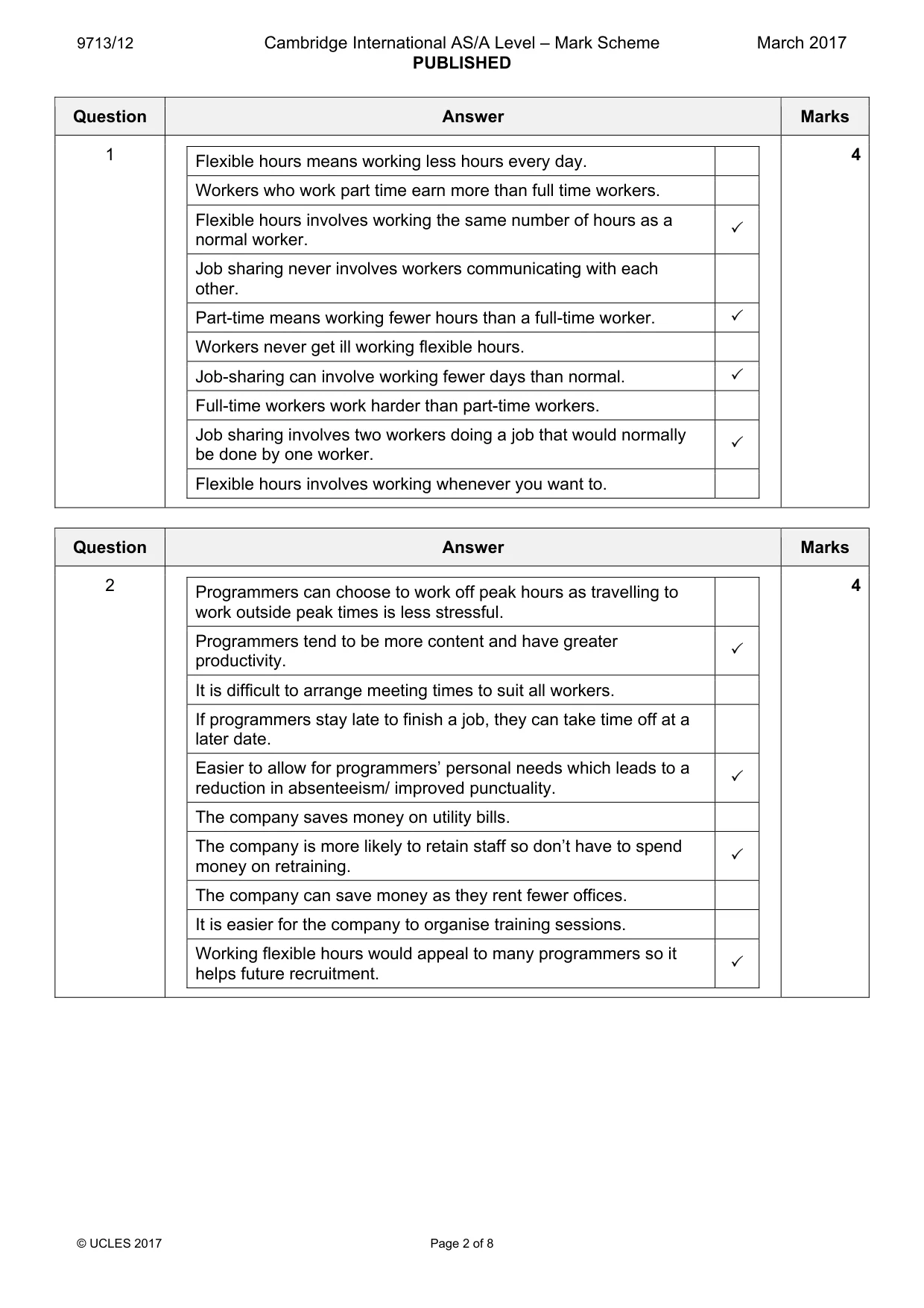
9713/12 Cambridge International AS/A Level – Mark Scheme PUBLISHED March 2017 © UCLES 2017 Page 2 of 8 Question Answer Marks 1 Flexible hours means working less hours every day. Workers who work part time earn more than full time workers. Flexible hours involves working the same number of hours as a normal worker. 3 Job sharing never involves workers communicating with each other. Part-time means working fewer hours than a full-time worker. 3 Workers never get ill working flexible hours. Job-sharing can involve working fewer days than normal. 3 Full-time workers work harder than part-time workers. Job sharing involves two workers doing a job that would normally be done by one worker. 3 Flexible hours involves working whenever you want to. 4 Question Answer Marks 2 Programmers can choose to work off peak hours as travelling to work outside peak times is less stressful. Programmers tend to be more content and have greater productivity. 3 It is difficult to arrange meeting times to suit all workers. If programmers stay late to finish a job, they can take time off at a later date. Easier to allow for programmers’ personal needs which leads to a reduction in absenteeism/ improved punctuality. 3 The company saves money on utility bills. The company is more likely to retain staff so don’t have to spend money on retraining. 3 The company can save money as they rent fewer offices. It is easier for the company to organise training sessions. Working flexible hours would appeal to many programmers so it helps future recruitment. 3 4
Mark scheme, page 3
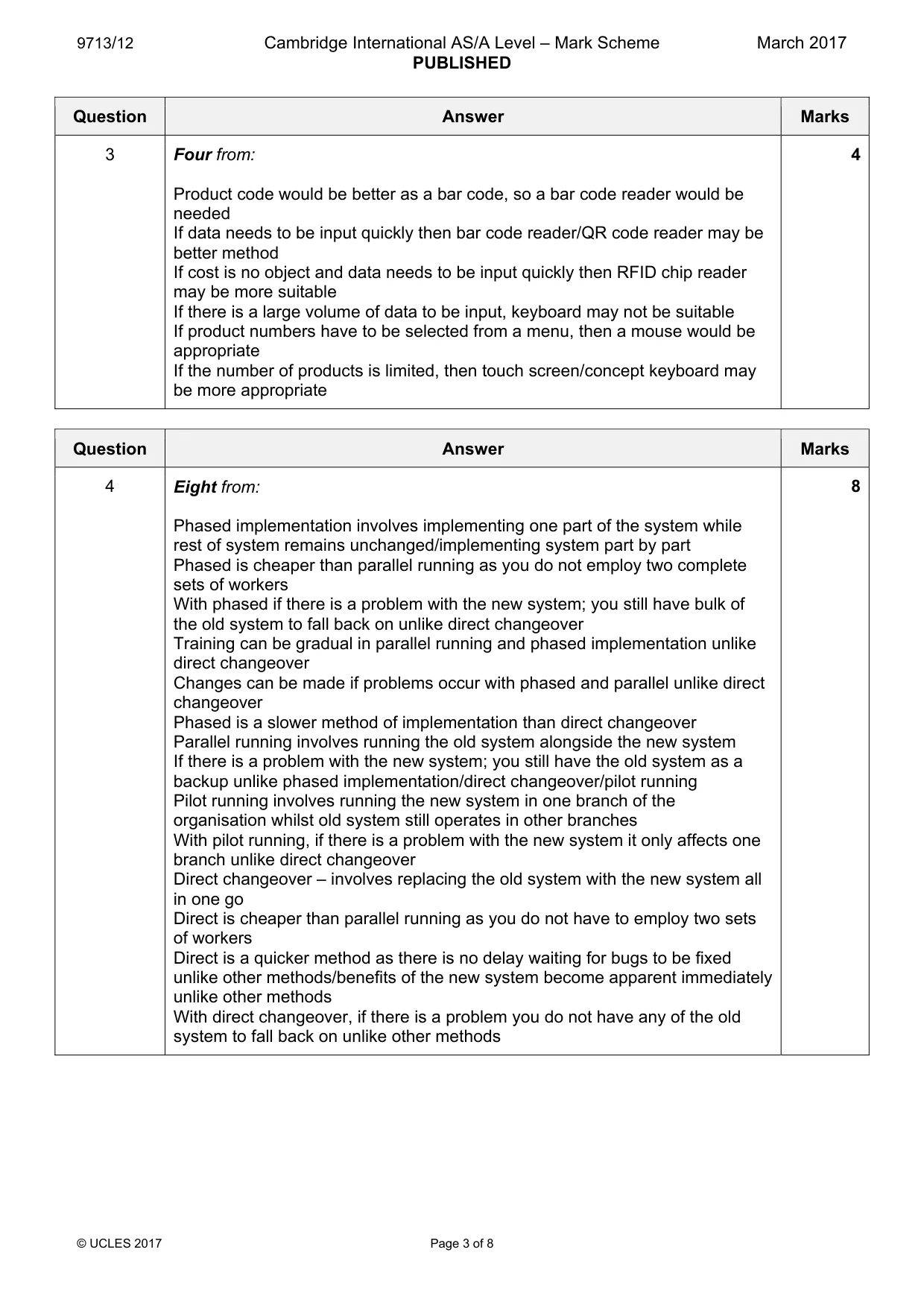
9713/12 Cambridge International AS/A Level – Mark Scheme PUBLISHED March 2017 © UCLES 2017 Page 3 of 8 Question Answer Marks 3 Four from: Product code would be better as a bar code, so a bar code reader would be needed If data needs to be input quickly then bar code reader/QR code reader may be better method If cost is no object and data needs to be input quickly then RFID chip reader may be more suitable If there is a large volume of data to be input, keyboard may not be suitable If product numbers have to be selected from a menu, then a mouse would be appropriate If the number of products is limited, then touch screen/concept keyboard may be more appropriate 4 Question Answer Marks 4 Eight from: Phased implementation involves implementing one part of the system while rest of system remains unchanged/implementing system part by part Phased is cheaper than parallel running as you do not employ two complete sets of workers With phased if there is a problem with the new system; you still have bulk of the old system to fall back on unlike direct changeover Training can be gradual in parallel running and phased implementation unlike direct changeover Changes can be made if problems occur with phased and parallel unlike direct changeover Phased is a slower method of implementation than direct changeover Parallel running involves running the old system alongside the new system If there is a problem with the new system; you still have the old system as a backup unlike phased implementation/direct changeover/pilot running Pilot running involves running the new system in one branch of the organisation whilst old system still operates in other branches With pilot running, if there is a problem with the new system it only affects one branch unlike direct changeover Direct changeover – involves replacing the old system with the new system all in one go Direct is cheaper than parallel running as you do not have to employ two sets of workers Direct is a quicker method as there is no delay waiting for bugs to be fixed unlike other methods/benefits of the new system become apparent immediately unlike other methods With direct changeover, if there is a problem you do not have any of the old system to fall back on unlike other methods 8
Mark scheme, page 4
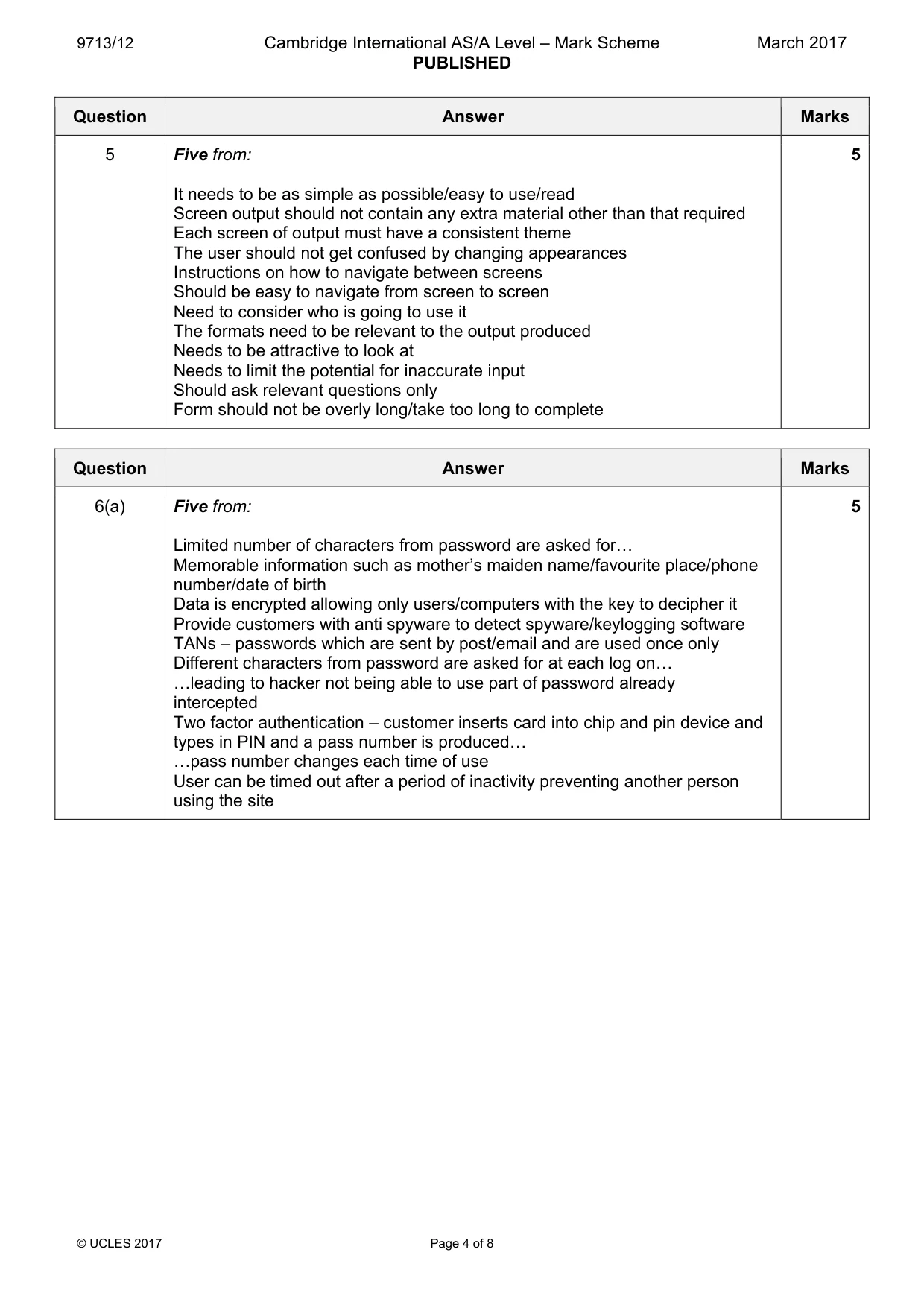
9713/12 Cambridge International AS/A Level – Mark Scheme PUBLISHED March 2017 © UCLES 2017 Page 4 of 8 Question Answer Marks 5 Five from: It needs to be as simple as possible/easy to use/read Screen output should not contain any extra material other than that required Each screen of output must have a consistent theme The user should not get confused by changing appearances Instructions on how to navigate between screens Should be easy to navigate from screen to screen Need to consider who is going to use it The formats need to be relevant to the output produced Needs to be attractive to look at Needs to limit the potential for inaccurate input Should ask relevant questions only Form should not be overly long/take too long to complete 5 Question Answer Marks 6(a) Five from: Limited number of characters from password are asked for« Memorable information such as mother’s maiden name/favourite place/phone number/date of birth Data is encrypted allowing only users/computers with the key to decipher it Provide customers with anti spyware to detect spyware/keylogging software TANs – passwords which are sent by post/email and are used once only Different characters from password are asked for at each log on« «leading to hacker not being able to use part of password already intercepted Two factor authentication – customer inserts card into chip and pin device and types in PIN and a pass number is produced« «pass number changes each time of use User can be timed out after a period of inactivity preventing another person using the site 5
Mark scheme, page 5
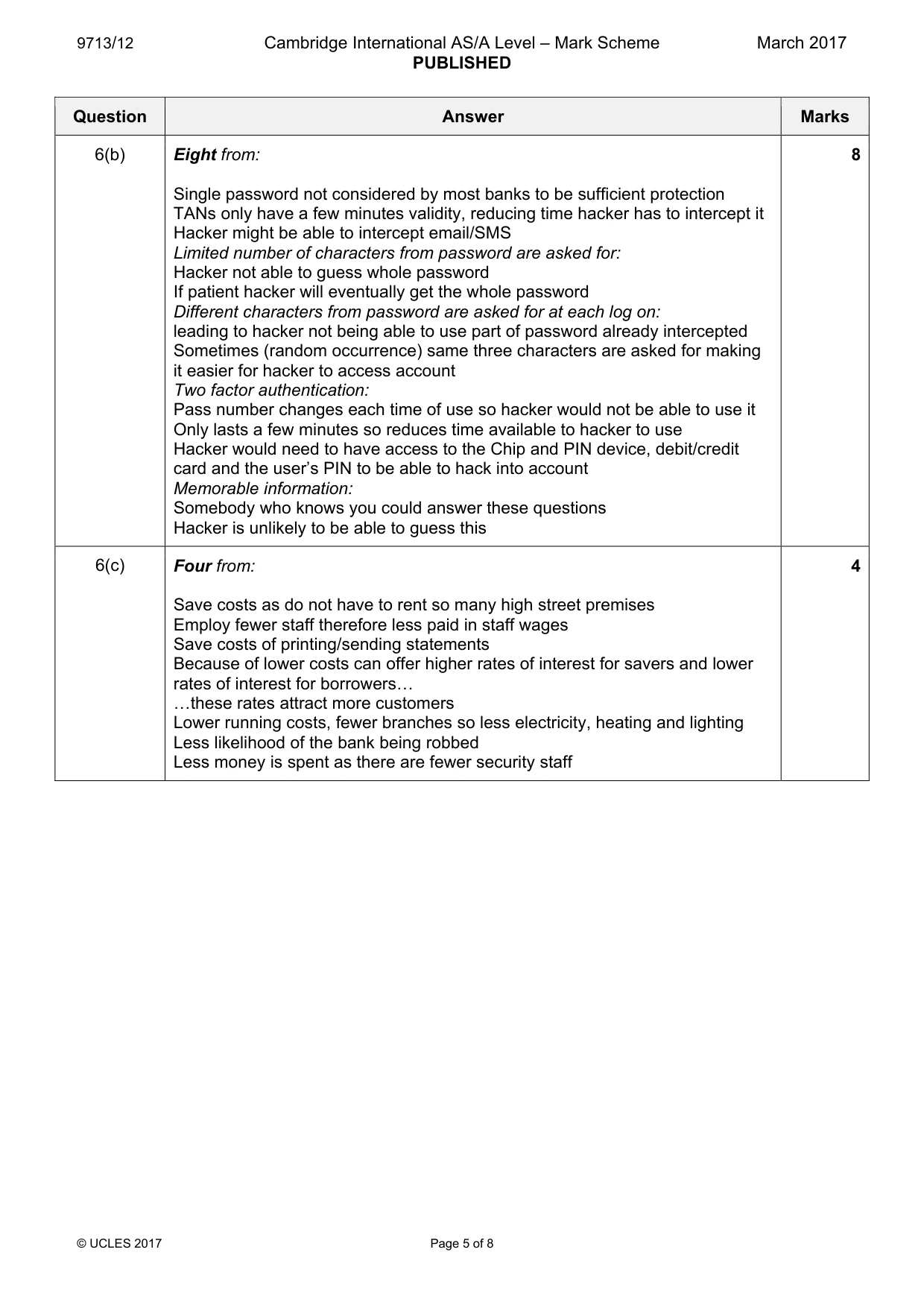
9713/12 Cambridge International AS/A Level – Mark Scheme PUBLISHED March 2017 © UCLES 2017 Page 5 of 8 Question Answer Marks 6(b) Eight from: Single password not considered by most banks to be sufficient protection TANs only have a few minutes validity, reducing time hacker has to intercept it Hacker might be able to intercept email/SMS Limited number of characters from password are asked for: Hacker not able to guess whole password If patient hacker will eventually get the whole password Different characters from password are asked for at each log on: leading to hacker not being able to use part of password already intercepted Sometimes (random occurrence) same three characters are asked for making it easier for hacker to access account Two factor authentication: Pass number changes each time of use so hacker would not be able to use it Only lasts a few minutes so reduces time available to hacker to use Hacker would need to have access to the Chip and PIN device, debit/credit card and the user’s PIN to be able to hack into account Memorable information: Somebody who knows you could answer these questions Hacker is unlikely to be able to guess this 8 6(c) Four from: Save costs as do not have to rent so many high street premises Employ fewer staff therefore less paid in staff wages Save costs of printing/sending statements Because of lower costs can offer higher rates of interest for savers and lower rates of interest for borrowers« «these rates attract more customers Lower running costs, fewer branches so less electricity, heating and lighting Less likelihood of the bank being robbed Less money is spent as there are fewer security staff 4
Mark scheme, page 6
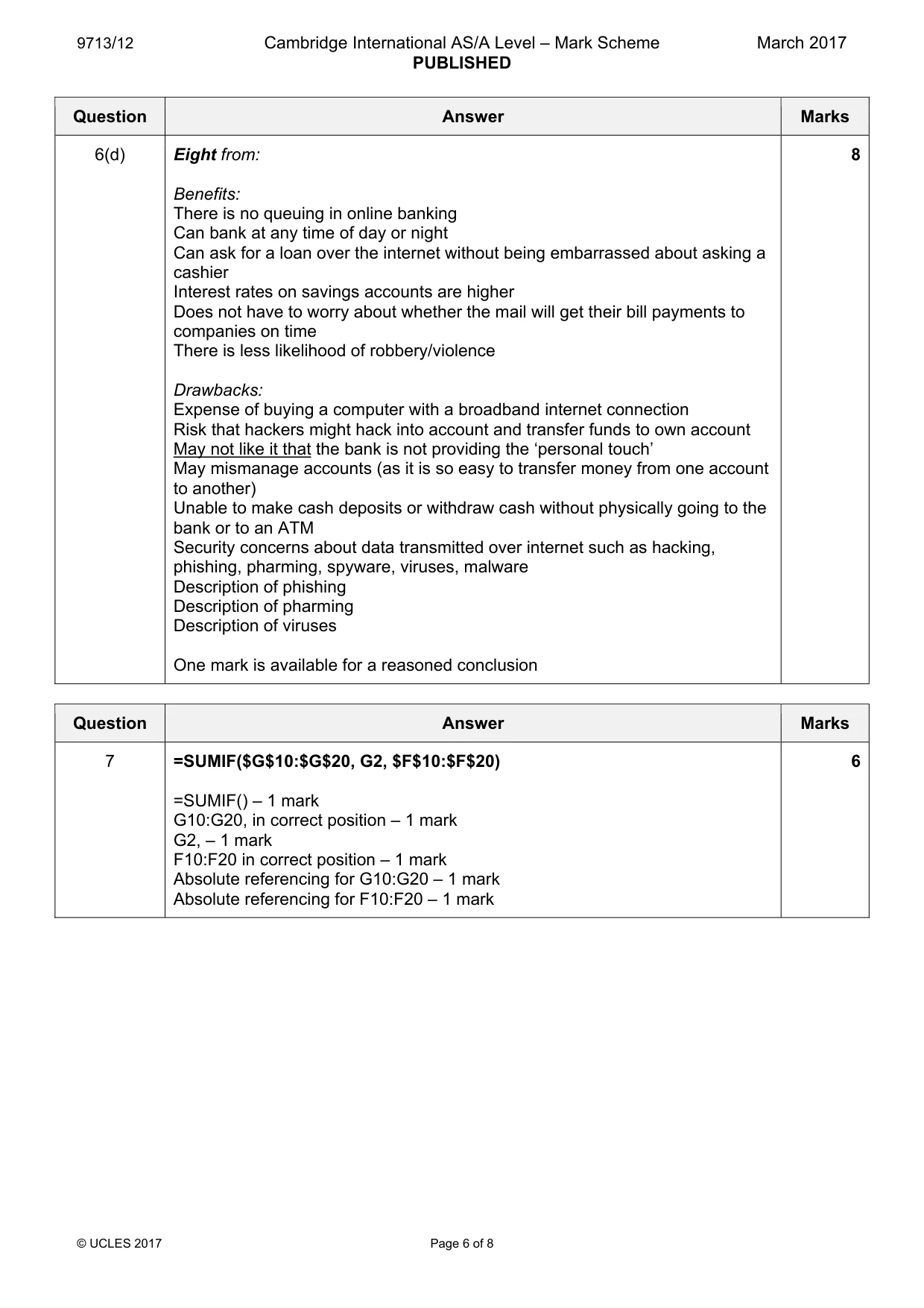
9713/12 Cambridge International AS/A Level – Mark Scheme PUBLISHED March 2017 © UCLES 2017 Page 6 of 8 Question Answer Marks 6(d) Eight from: Benefits: There is no queuing in online banking Can bank at any time of day or night Can ask for a loan over the internet without being embarrassed about asking a cashier Interest rates on savings accounts are higher Does not have to worry about whether the mail will get their bill payments to companies on time There is less likelihood of robbery/violence Drawbacks: Expense of buying a computer with a broadband internet connection Risk that hackers might hack into account and transfer funds to own account May not like it that the bank is not providing the ‘personal touch’ May mismanage accounts (as it is so easy to transfer money from one account to another) Unable to make cash deposits or withdraw cash without physically going to the bank or to an ATM Security concerns about data transmitted over internet such as hacking, phishing, pharming, spyware, viruses, malware Description of phishing Description of pharming Description of viruses One mark is available for a reasoned conclusion 8 Question Answer Marks 7 =SUMIF($G$10:$G$20, G2, $F$10:$F$20) =SUMIF() – 1 mark G10:G20, in correct position – 1 mark G2, – 1 mark F10:F20 in correct position – 1 mark Absolute referencing for G10:G20 – 1 mark Absolute referencing for F10:F20 – 1 mark 6
Mark scheme, page 7
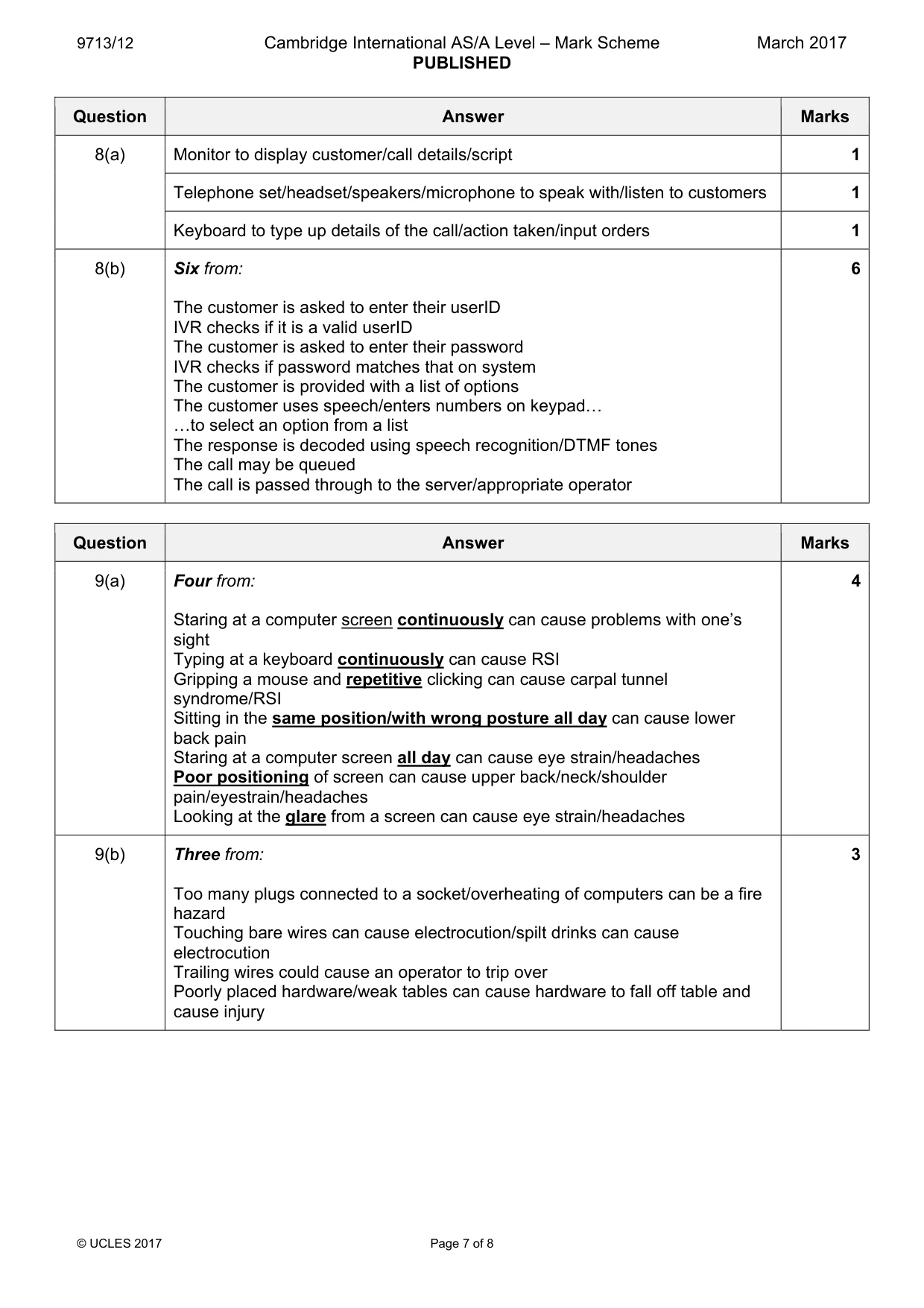
9713/12 Cambridge International AS/A Level – Mark Scheme PUBLISHED March 2017 © UCLES 2017 Page 7 of 8 Question Answer Marks 8(a) Monitor to display customer/call details/script 1 Telephone set/headset/speakers/microphone to speak with/listen to customers 1 Keyboard to type up details of the call/action taken/input orders 1 8(b) Six from: The customer is asked to enter their userID IVR checks if it is a valid userID The customer is asked to enter their password IVR checks if password matches that on system The customer is provided with a list of options The customer uses speech/enters numbers on keypad« «to select an option from a list The response is decoded using speech recognition/DTMF tones The call may be queued The call is passed through to the server/appropriate operator 6 Question Answer Marks 9(a) Four from: Staring at a computer screen continuously can cause problems with one’s sight Typing at a keyboard continuously can cause RSI Gripping a mouse and repetitive clicking can cause carpal tunnel syndrome/RSI Sitting in the same position/with wrong posture all day can cause lower back pain Staring at a computer screen all day can cause eye strain/headaches Poor positioning of screen can cause upper back/neck/shoulder pain/eyestrain/headaches Looking at the glare from a screen can cause eye strain/headaches 4 9(b) Three from: Too many plugs connected to a socket/overheating of computers can be a fire hazard Touching bare wires can cause electrocution/spilt drinks can cause electrocution Trailing wires could cause an operator to trip over Poorly placed hardware/weak tables can cause hardware to fall off table and cause injury 3
Mark scheme, page 8
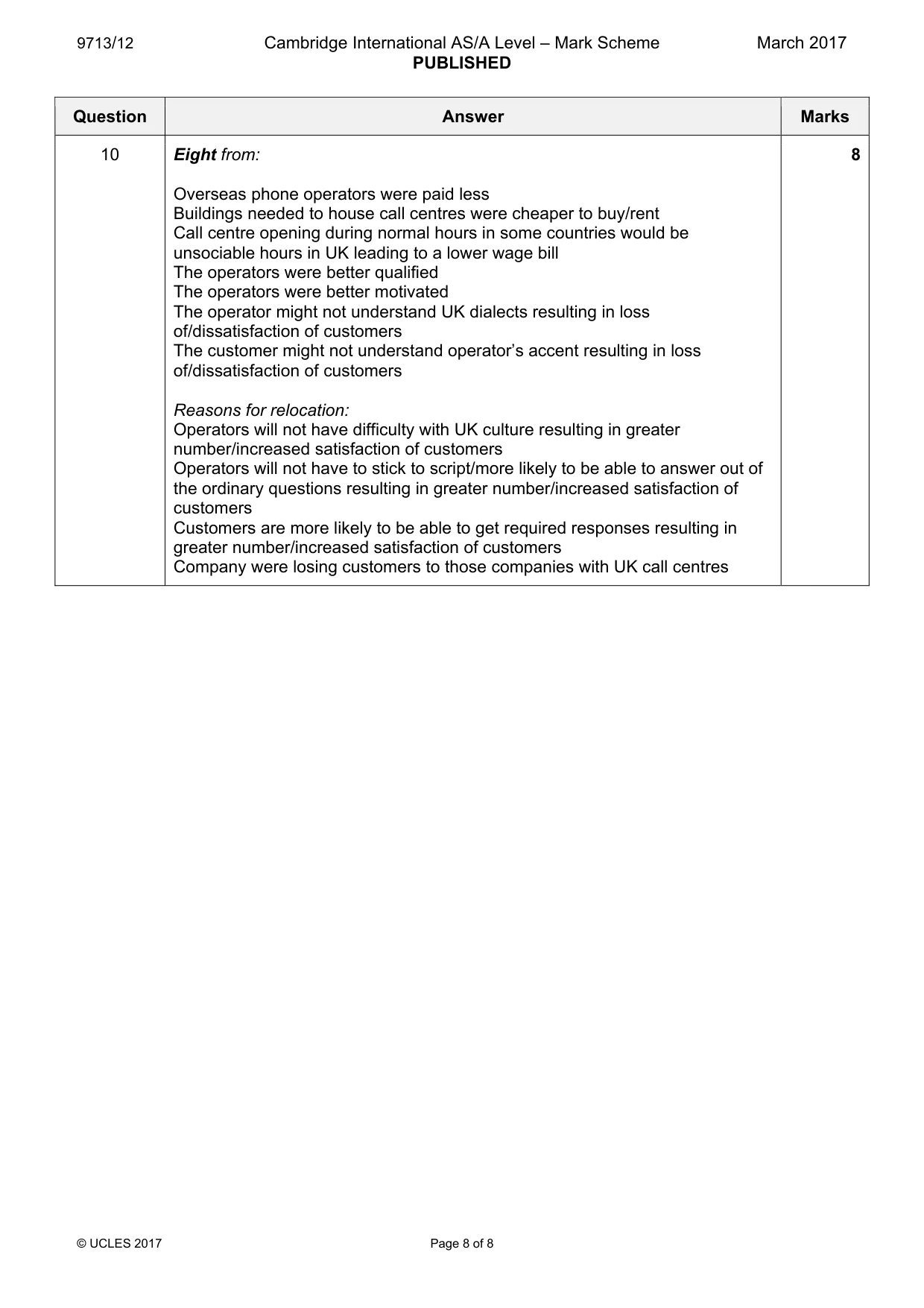
9713/12 Cambridge International AS/A Level – Mark Scheme PUBLISHED March 2017 © UCLES 2017 Page 8 of 8 Question Answer Marks 10 Eight from: Overseas phone operators were paid less Buildings needed to house call centres were cheaper to buy/rent Call centre opening during normal hours in some countries would be unsociable hours in UK leading to a lower wage bill The operators were better qualified The operators were better motivated The operator might not understand UK dialects resulting in loss of/dissatisfaction of customers The customer might not understand operator’s accent resulting in loss of/dissatisfaction of customers Reasons for relocation: Operators will not have difficulty with UK culture resulting in greater number/increased satisfaction of customers Operators will not have to stick to script/more likely to be able to answer out of the ordinary questions resulting in greater number/increased satisfaction of customers Customers are more likely to be able to get required responses resulting in greater number/increased satisfaction of customers Company were losing customers to those companies with UK call centres 8
What you needed in this session
Cambridge’s own grade thresholds for 2017 Feb/March, Paper 1 · Variant 2. A higher threshold means an easier paper — the bar moves with how the cohort did.