Cambridge A Level Accounting 9706 — 2009 May/June Paper 4 · Variant 1
9706/41/M/J/09 · 120 marks · ≈135 min
The question paper and its mark scheme, free to read here and free to download. This is Cambridge’s own paper, exactly as it was sat.
Question paper8 pages
Mark scheme5 pages
Answers below. Sit the paper first if you are practising.
Paper as text
Question paper, page 1
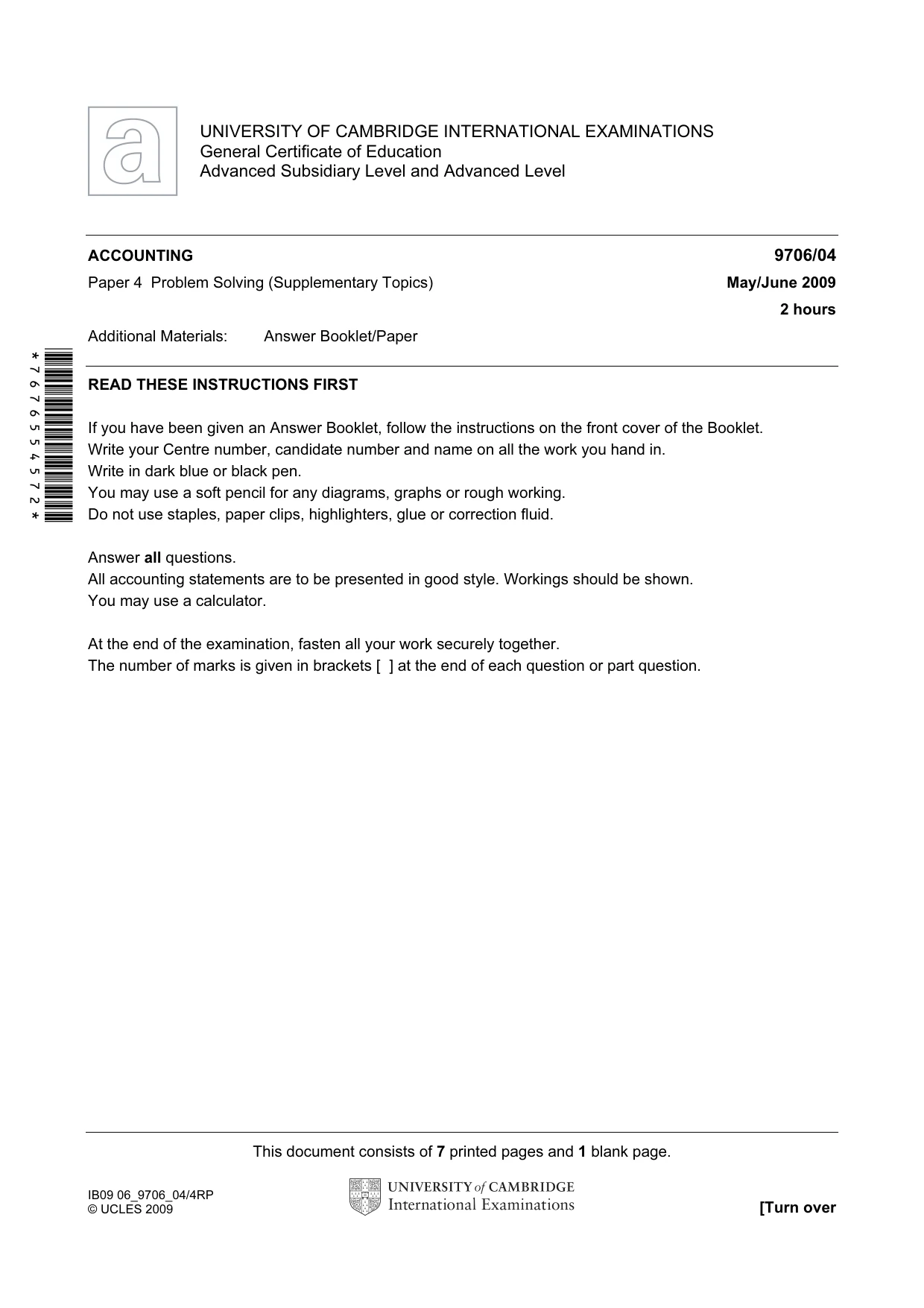
This document consists of 7 printed pages and 1 blank page. IB09 06_9706_04/4RP © UCLES 2009 [Turn over *7676554572* UNIVERSITY OF CAMBRIDGE INTERNATIONAL EXAMINATIONS General Certificate of Education Advanced Subsidiary Level and Advanced Level ACCOUNTING 9706/04 Paper 4 Problem Solving (Supplementary Topics) May/June 2009 2 hours Additional Materials: Answer Booklet/Paper READ THESE INSTRUCTIONS FIRST If you have been given an Answer Booklet, follow the instructions on the front cover of the Booklet. Write your Centre number, candidate number and name on all the work you hand in. Write in dark blue or black pen. You may use a soft pencil for any diagrams, graphs or rough working. Do not use staples, paper clips, highlighters, glue or correction fluid. Answer all questions. All accounting statements are to be presented in good style. Workings should be shown. You may use a calculator. At the end of the examination, fasten all your work securely together. The number of marks is given in brackets [ ] at the end of each question or part question.
Question paper, page 2
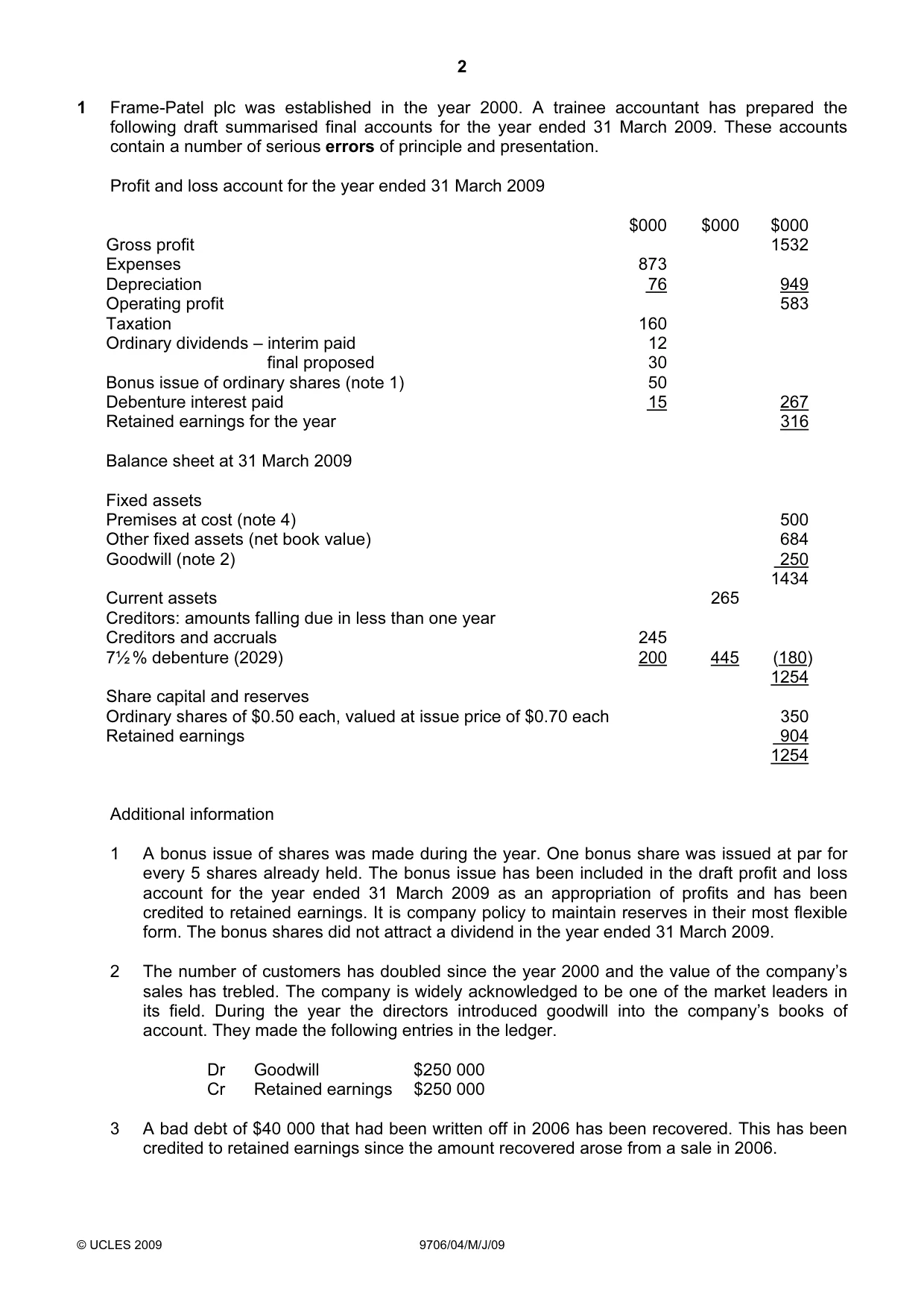
2 © UCLES 2009 9706/04/M/J/09 1 Frame-Patel plc was established in the year 2000. A trainee accountant has prepared the following draft summarised final accounts for the year ended 31 March 2009. These accounts contain a number of serious errors of principle and presentation. Profit and loss account for the year ended 31 March 2009 $000 $000 $000 Gross profit 1532 Expenses 873 Depreciation 76 949 Operating profit 583 Taxation 160 Ordinary dividends – interim paid 12 final proposed 30 Bonus issue of ordinary shares (note 1) 50 Debenture interest paid 15 267 Retained earnings for the year 316 Balance sheet at 31 March 2009 Fixed assets Premises at cost (note 4) 500 Other fixed assets (net book value) 684 Goodwill (note 2) 250 1434 Current assets 265 Creditors: amounts falling due in less than one year Creditors and accruals 245 7½ % debenture (2029) 200 445 (180) 1254 Share capital and reserves Ordinary shares of $0.50 each, valued at issue price of $0.70 each 350 Retained earnings 904 1254 Additional information 1 A bonus issue of shares was made during the year. One bonus share was issued at par for every 5 shares already held. The bonus issue has been included in the draft profit and loss account for the year ended 31 March 2009 as an appropriation of profits and has been credited to retained earnings. It is company policy to maintain reserves in their most flexible form. The bonus shares did not attract a dividend in the year ended 31 March 2009. 2 The number of customers has doubled since the year 2000 and the value of the company’s sales has trebled. The company is widely acknowledged to be one of the market leaders in its field. During the year the directors introduced goodwill into the company’s books of account. They made the following entries in the ledger. Dr Goodwill $250 000 Cr Retained earnings $250 000 3 A bad debt of $40 000 that had been written off in 2006 has been recovered. This has been credited to retained earnings since the amount recovered arose from a sale in 2006.
Question paper, page 3
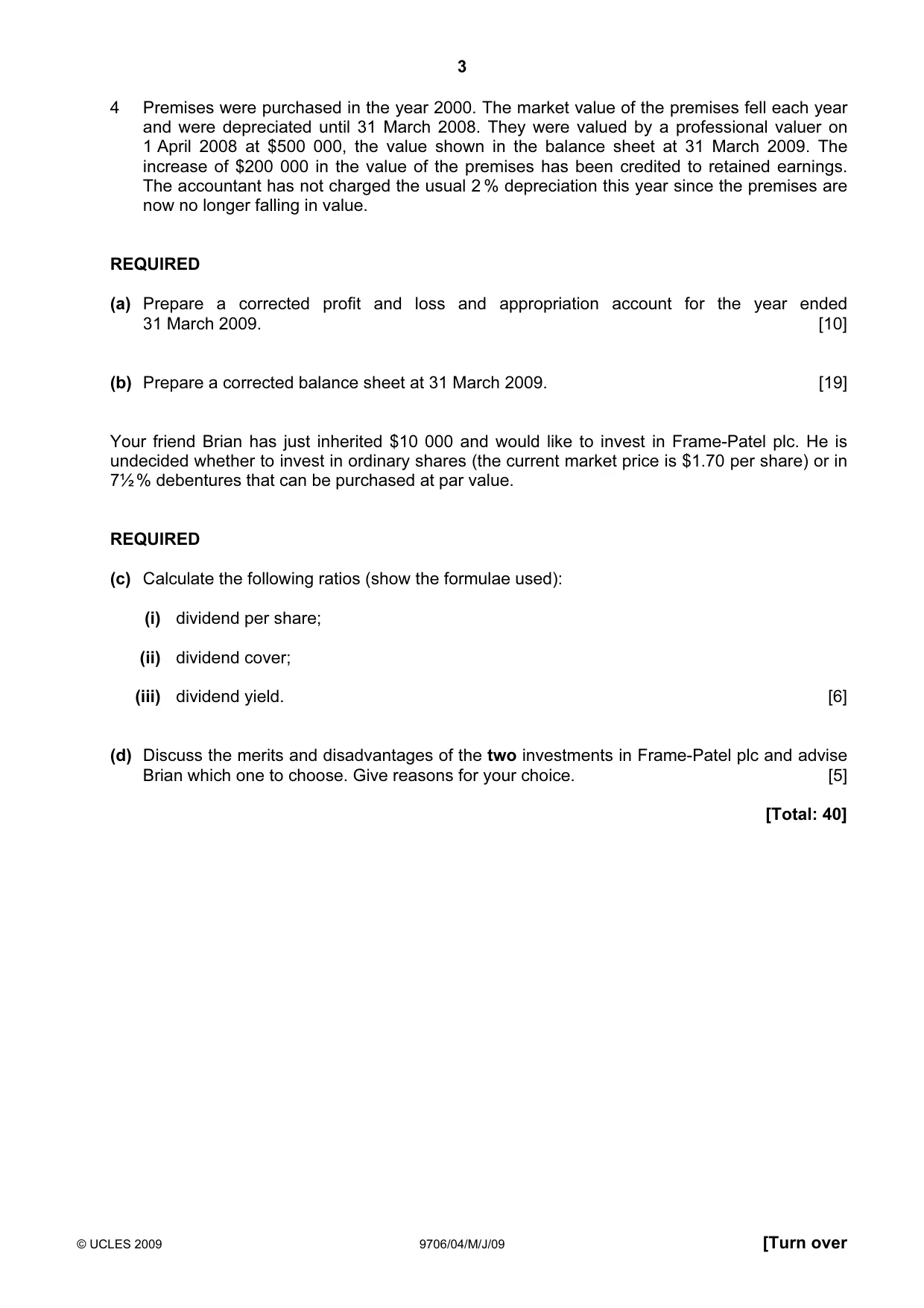
3 © UCLES 2009 9706/04/M/J/09 [Turn over 4 Premises were purchased in the year 2000. The market value of the premises fell each year and were depreciated until 31 March 2008. They were valued by a professional valuer on 1 April 2008 at $500 000, the value shown in the balance sheet at 31 March 2009. The increase of $200 000 in the value of the premises has been credited to retained earnings. The accountant has not charged the usual 2 % depreciation this year since the premises are now no longer falling in value. REQUIRED (a) Prepare a corrected profit and loss and appropriation account for the year ended 31 March 2009. [10] (b) Prepare a corrected balance sheet at 31 March 2009. [19] Your friend Brian has just inherited $10 000 and would like to invest in Frame-Patel plc. He is undecided whether to invest in ordinary shares (the current market price is $1.70 per share) or in 7½ % debentures that can be purchased at par value. REQUIRED (c) Calculate the following ratios (show the formulae used): (i) dividend per share; (ii) dividend cover; (iii) dividend yield. [6] (d) Discuss the merits and disadvantages of the two investments in Frame-Patel plc and advise Brian which one to choose. Give reasons for your choice. [5] [Total: 40]
Question paper, page 4
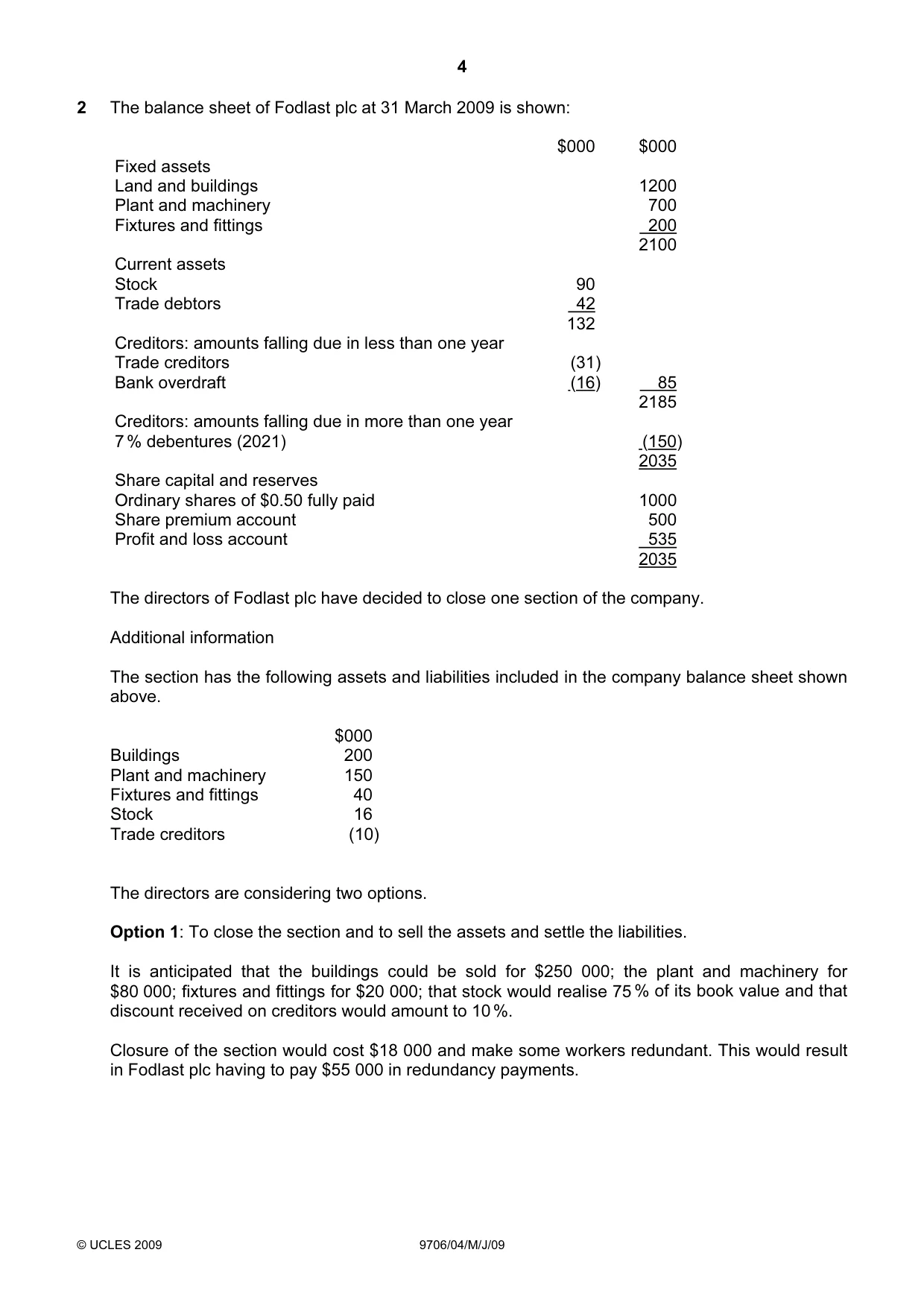
4 © UCLES 2009 9706/04/M/J/09 2 The balance sheet of Fodlast plc at 31 March 2009 is shown: $000 $000 Fixed assets Land and buildings 1200 Plant and machinery 700 Fixtures and fittings 200 2100 Current assets Stock 90 Trade debtors 42 132 Creditors: amounts falling due in less than one year Trade creditors (31) Bank overdraft (16) 85 2185 Creditors: amounts falling due in more than one year 7 % debentures (2021) (150) 2035 Share capital and reserves Ordinary shares of $0.50 fully paid 1000 Share premium account 500 Profit and loss account 535 2035 The directors of Fodlast plc have decided to close one section of the company. Additional information The section has the following assets and liabilities included in the company balance sheet shown above. $000 Buildings 200 Plant and machinery 150 Fixtures and fittings 40 Stock 16 Trade creditors (10) The directors are considering two options. Option 1: To close the section and to sell the assets and settle the liabilities. It is anticipated that the buildings could be sold for $250 000; the plant and machinery for $80 000; fixtures and fittings for $20 000; that stock would realise 75 % of its book value and that discount received on creditors would amount to 10 %. Closure of the section would cost $18 000 and make some workers redundant. This would result in Fodlast plc having to pay $55 000 in redundancy payments.
Question paper, page 5
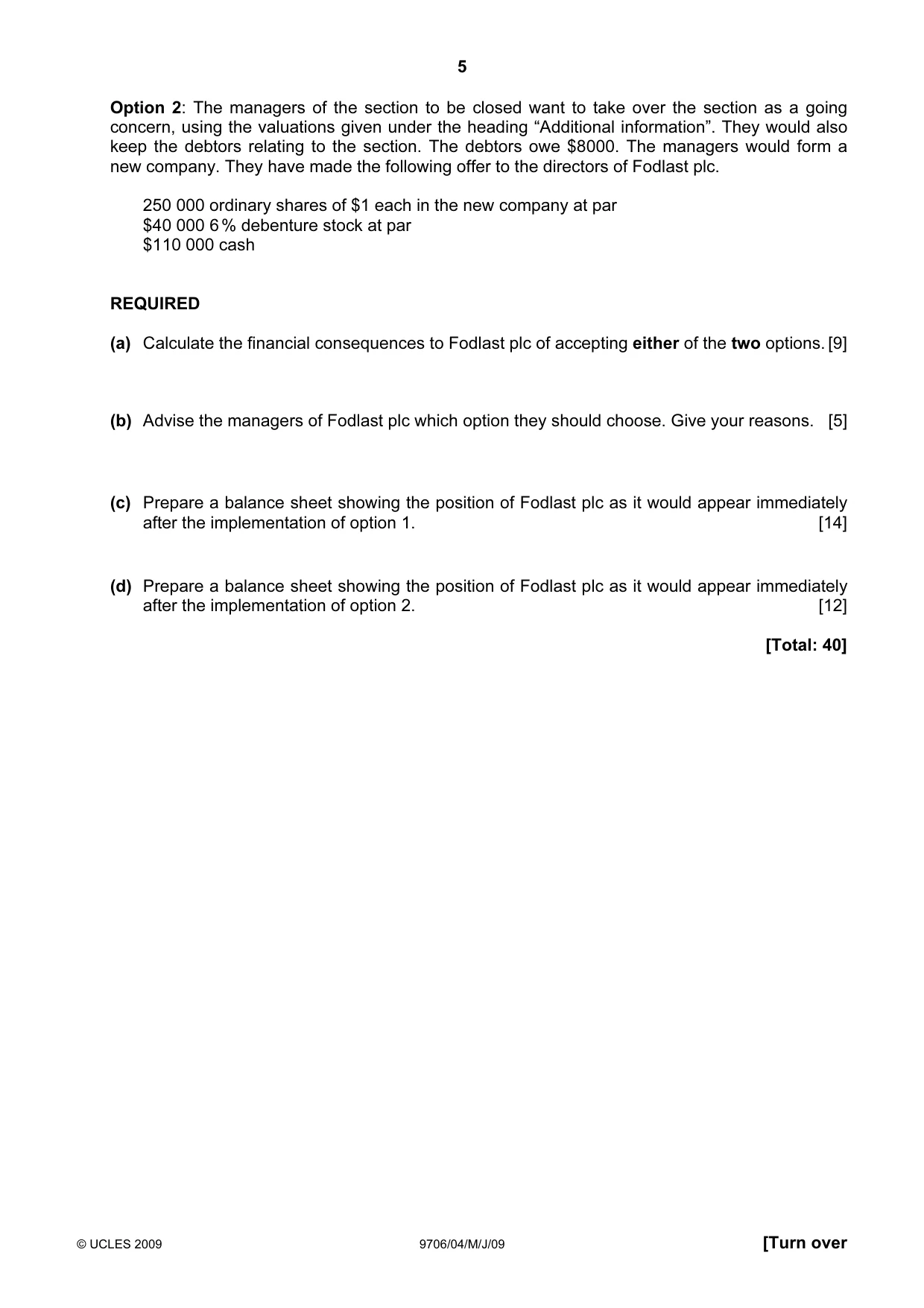
5 © UCLES 2009 9706/04/M/J/09 [Turn over Option 2: The managers of the section to be closed want to take over the section as a going concern, using the valuations given under the heading “Additional information”. They would also keep the debtors relating to the section. The debtors owe $8000. The managers would form a new company. They have made the following offer to the directors of Fodlast plc. 250 000 ordinary shares of $1 each in the new company at par $40 000 6 % debenture stock at par $110 000 cash REQUIRED (a) Calculate the financial consequences to Fodlast plc of accepting either of the two options. [9] (b) Advise the managers of Fodlast plc which option they should choose. Give your reasons. [5] (c) Prepare a balance sheet showing the position of Fodlast plc as it would appear immediately after the implementation of option 1. [14] (d) Prepare a balance sheet showing the position of Fodlast plc as it would appear immediately after the implementation of option 2. [12] [Total: 40]
Question paper, page 6
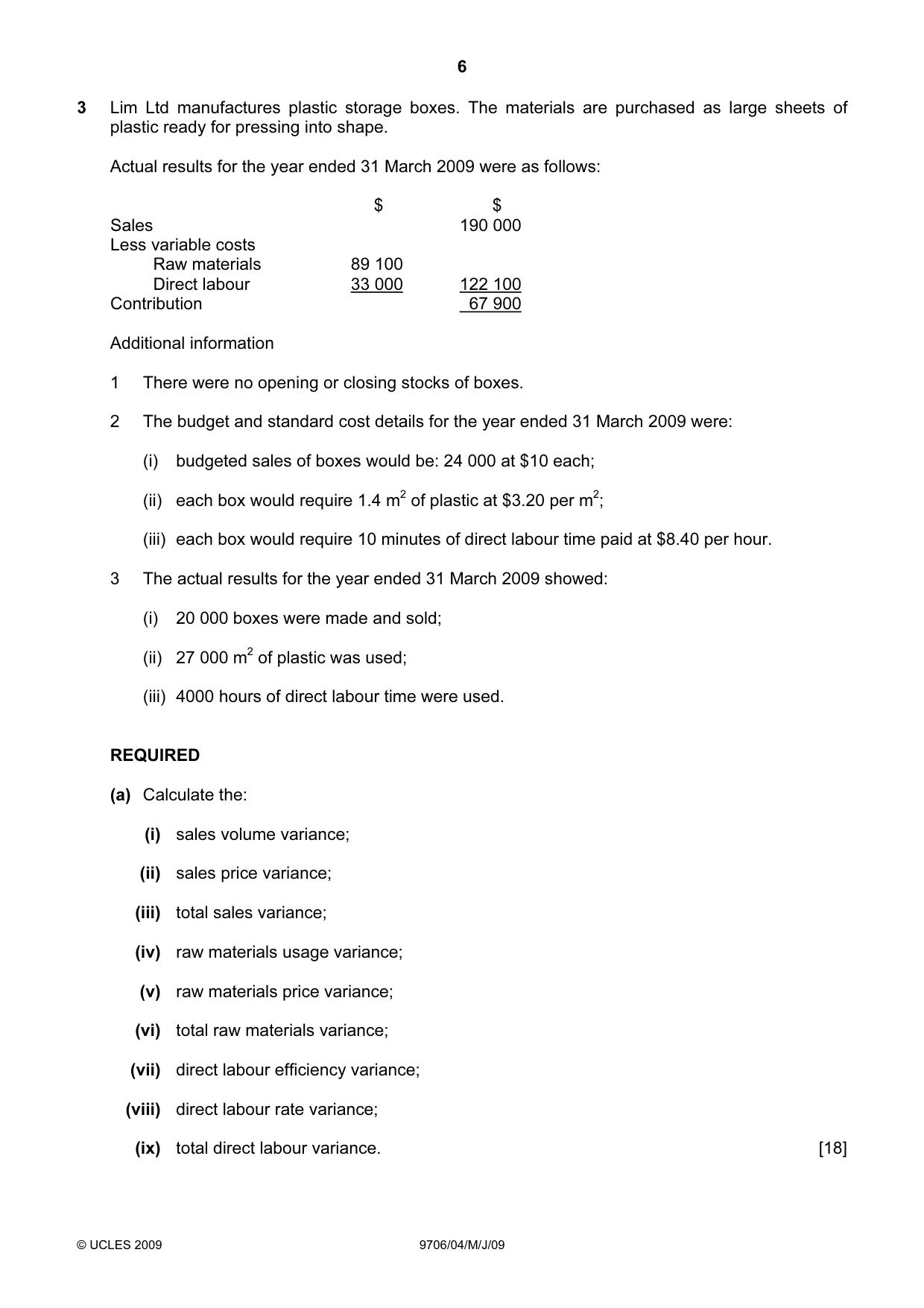
6 © UCLES 2009 9706/04/M/J/09 3 Lim Ltd manufactures plastic storage boxes. The materials are purchased as large sheets of plastic ready for pressing into shape. Actual results for the year ended 31 March 2009 were as follows: $ $ Sales 190 000 Less variable costs Raw materials 89 100 Direct labour 33 000 122 100 Contribution 67 900 Additional information 1 There were no opening or closing stocks of boxes. 2 The budget and standard cost details for the year ended 31 March 2009 were: (i) budgeted sales of boxes would be: 24 000 at $10 each; (ii) each box would require 1.4 m2 of plastic at $3.20 per m2; (iii) each box would require 10 minutes of direct labour time paid at $8.40 per hour. 3 The actual results for the year ended 31 March 2009 showed: (i) 20 000 boxes were made and sold; (ii) 27 000 m2 of plastic was used; (iii) 4000 hours of direct labour time were used. REQUIRED (a) Calculate the: (i) sales volume variance; (ii) sales price variance; (iii) total sales variance; (iv) raw materials usage variance; (v) raw materials price variance; (vi) total raw materials variance; (vii) direct labour efficiency variance; (viii) direct labour rate variance; (ix) total direct labour variance. [18]
Question paper, page 7
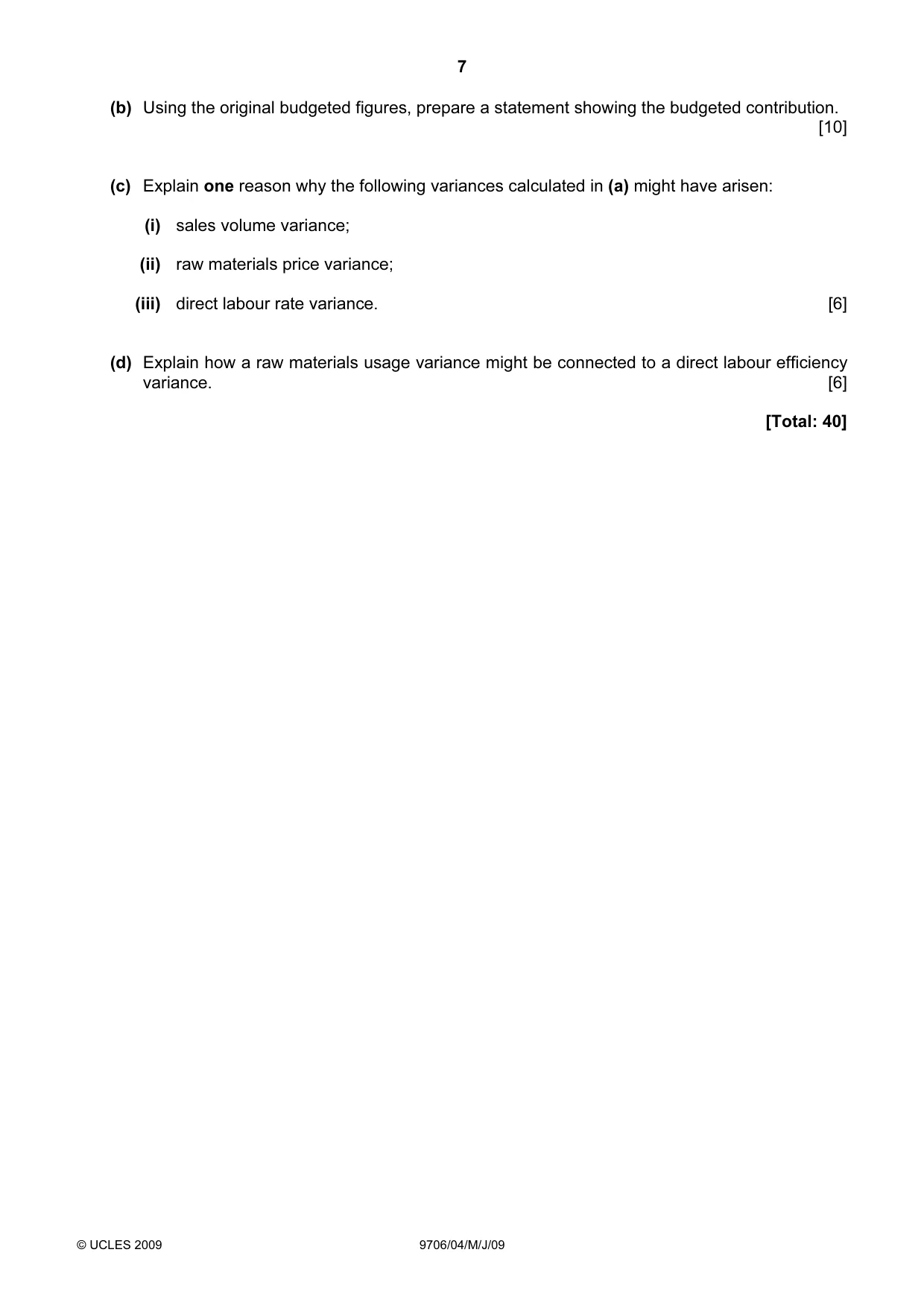
7 © UCLES 2009 9706/04/M/J/09 (b) Using the original budgeted figures, prepare a statement showing the budgeted contribution. [10] (c) Explain one reason why the following variances calculated in (a) might have arisen: (i) sales volume variance; (ii) raw materials price variance; (iii) direct labour rate variance. [6] (d) Explain how a raw materials usage variance might be connected to a direct labour efficiency variance. [6] [Total: 40]
Question paper, page 8
8 BLANK PAGE Permission to reproduce items where third-party owned material protected by copyright is included has been sought and cleared where possible. Every reasonable effort has been made by the publisher (UCLES) to trace copyright holders, but if any items requiring clearance have unwittingly been included, the publisher will be pleased to make amends at the earliest possible opportunity. University of Cambridge International Examinations is part of the Cambridge Assessment Group. Cambridge Assessment is the brand name of University of Cambridge Local Examinations Syndicate (UCLES), which is itself a department of the University of Cambridge. 9706/04/M/J/09
Mark scheme, page 1
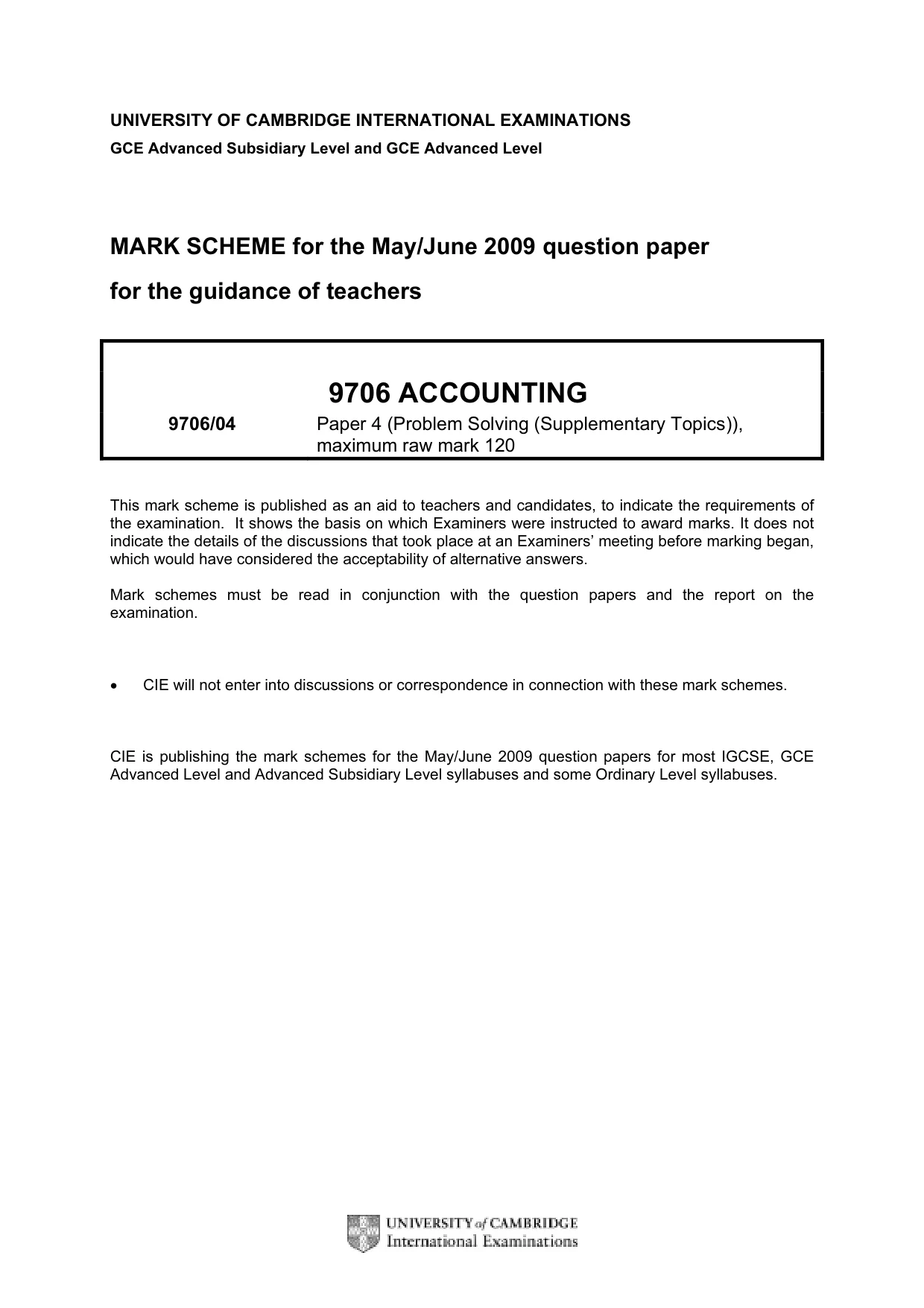
UNIVERSITY OF CAMBRIDGE INTERNATIONAL EXAMINATIONS GCE Advanced Subsidiary Level and GCE Advanced Level MARK SCHEME for the May/June 2009 question paper for the guidance of teachers 9706 ACCOUNTING 9706/04 Paper 4 (Problem Solving (Supplementary Topics)), maximum raw mark 120 This mark scheme is published as an aid to teachers and candidates, to indicate the requirements of the examination. It shows the basis on which Examiners were instructed to award marks. It does not indicate the details of the discussions that took place at an Examiners’ meeting before marking began, which would have considered the acceptability of alternative answers. Mark schemes must be read in conjunction with the question papers and the report on the examination. • CIE will not enter into discussions or correspondence in connection with these mark schemes. CIE is publishing the mark schemes for the May/June 2009 question papers for most IGCSE, GCE Advanced Level and Advanced Subsidiary Level syllabuses and some Ordinary Level syllabuses.
Mark scheme, page 2
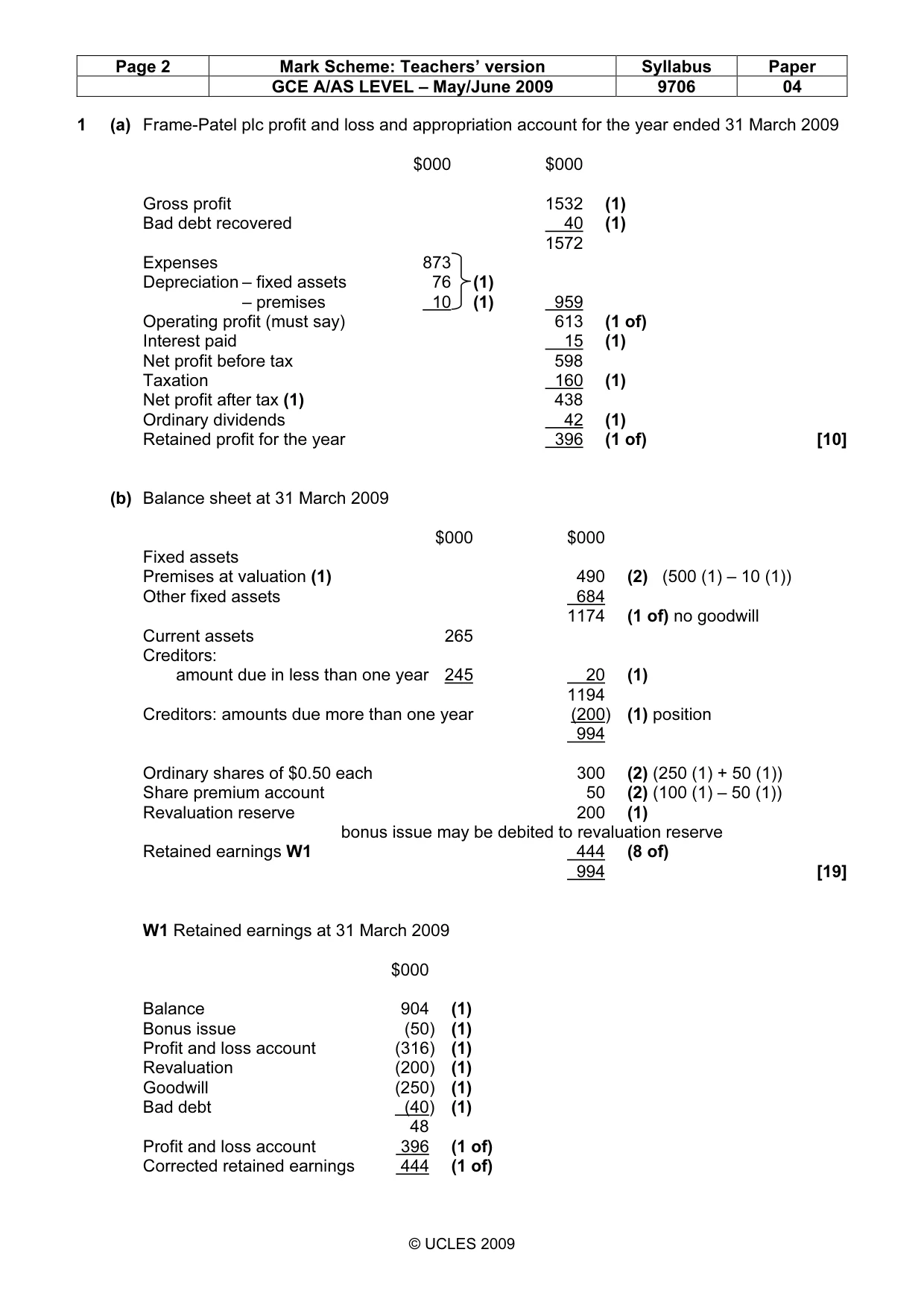
Page 2 Mark Scheme: Teachers’ version Syllabus Paper GCE A/AS LEVEL – May/June 2009 9706 04 © UCLES 2009 1 (a) Frame-Patel plc profit and loss and appropriation account for the year ended 31 March 2009 $000 $000 Gross profit 1532 (1) Bad debt recovered 40 (1) 1572 Expenses 873 Depreciation – fixed assets 76 (1) – premises 10 (1) 959 Operating profit (must say) 613 (1 of) Interest paid 15 (1) Net profit before tax 598 Taxation 160 (1) Net profit after tax (1) 438 Ordinary dividends 42 (1) Retained profit for the year 396 (1 of) [10] (b) Balance sheet at 31 March 2009 $000 $000 Fixed assets Premises at valuation (1) 490 (2) (500 (1) – 10 (1)) Other fixed assets 684 1174 (1 of) no goodwill Current assets 265 Creditors: amount due in less than one year 245 20 (1) 1194 Creditors: amounts due more than one year (200) (1) position 994 Ordinary shares of $0.50 each 300 (2) (250 (1) + 50 (1)) Share premium account 50 (2) (100 (1) – 50 (1)) Revaluation reserve 200 (1) bonus issue may be debited to revaluation reserve Retained earnings W1 444 (8 of) 994 [19] W1 Retained earnings at 31 March 2009 $000 Balance 904 (1) Bonus issue (50) (1) Profit and loss account (316) (1) Revaluation (200) (1) Goodwill (250) (1) Bad debt (40) (1) 48 Profit and loss account 396 (1 of) Corrected retained earnings 444 (1 of)
Mark scheme, page 3
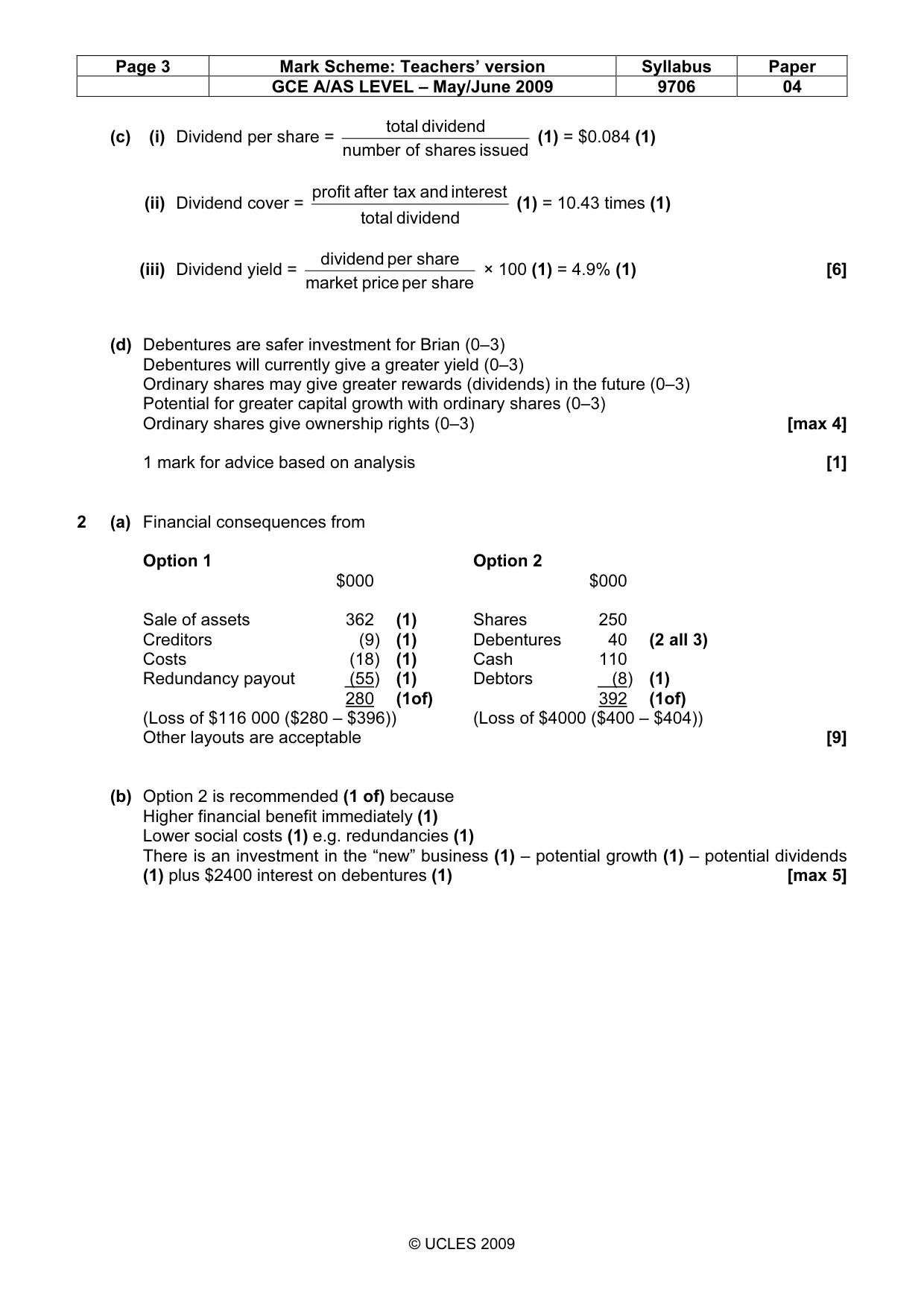
Page 3 Mark Scheme: Teachers’ version Syllabus Paper GCE A/AS LEVEL – May/June 2009 9706 04 © UCLES 2009 (c) (i) Dividend per share = issued shares of number dividend total (1) = $0.084 (1) (ii) Dividend cover = dividend total interest and tax after profit (1) = 10.43 times (1) (iii) Dividend yield = share per price market share per dividend × 100 (1) = 4.9% (1) [6] (d) Debentures are safer investment for Brian (0–3) Debentures will currently give a greater yield (0–3) Ordinary shares may give greater rewards (dividends) in the future (0–3) Potential for greater capital growth with ordinary shares (0–3) Ordinary shares give ownership rights (0–3) [max 4] 1 mark for advice based on analysis [1] 2 (a) Financial consequences from Option 1 Option 2 $000 $000 Sale of assets 362 (1) Shares 250 Creditors (9) (1) Debentures 40 (2 all 3) Costs (18) (1) Cash 110 Redundancy payout (55) (1) Debtors (8) (1) 280 (1of) 392 (1of) (Loss of $116 000 ($280 – $396)) (Loss of $4000 ($400 – $404)) Other layouts are acceptable [9] (b) Option 2 is recommended (1 of) because Higher financial benefit immediately (1) Lower social costs (1) e.g. redundancies (1) There is an investment in the “new” business (1) – potential growth (1) – potential dividends (1) plus $2400 interest on debentures (1) [max 5]
Mark scheme, page 4
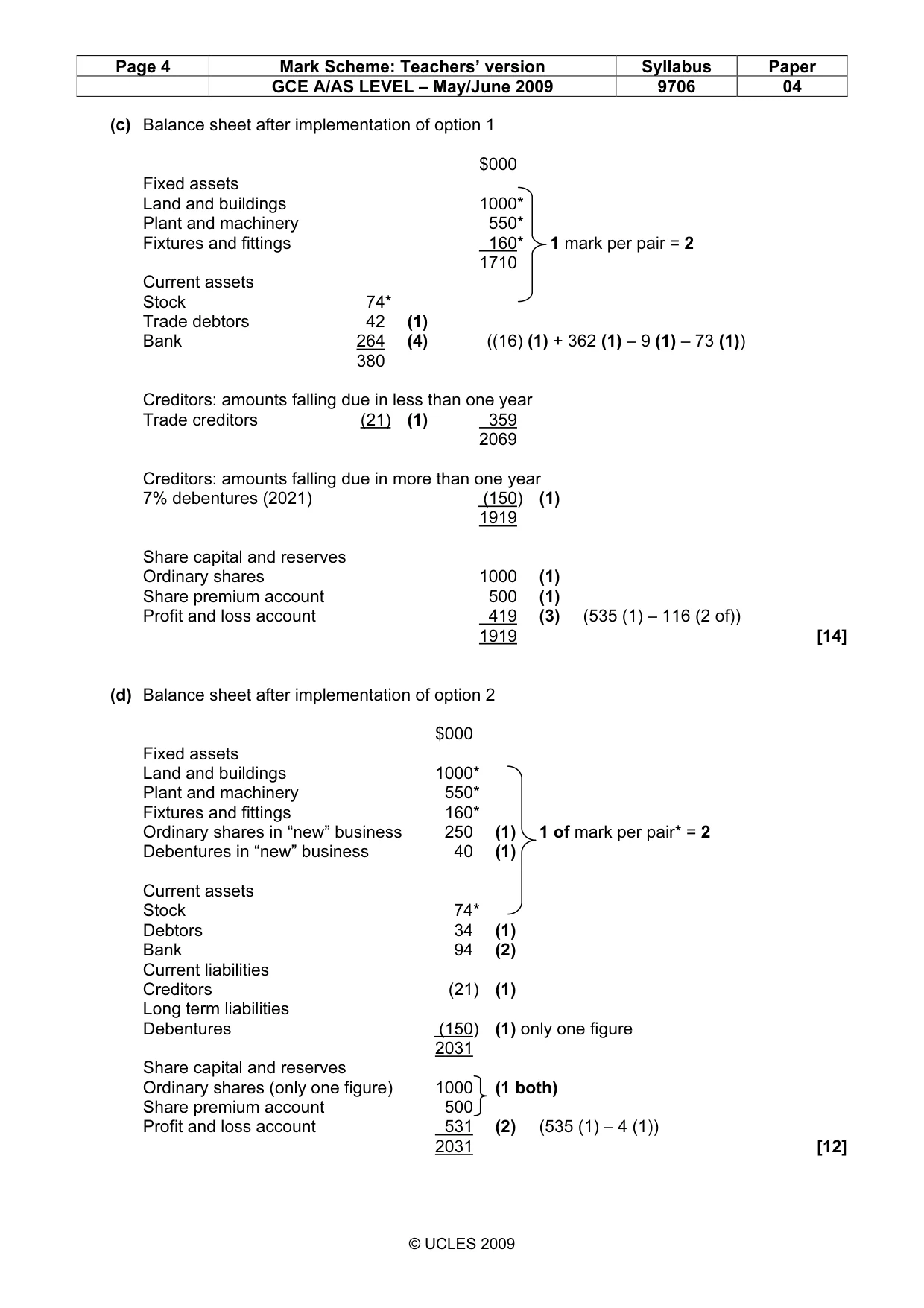
Page 4 Mark Scheme: Teachers’ version Syllabus Paper GCE A/AS LEVEL – May/June 2009 9706 04 © UCLES 2009 (c) Balance sheet after implementation of option 1 $000 Fixed assets Land and buildings 1000* Plant and machinery 550* Fixtures and fittings 160* 1 mark per pair = 2 1710 Current assets Stock 74* Trade debtors 42 (1) Bank 264 (4) ((16) (1) + 362 (1) – 9 (1) – 73 (1)) 380 Creditors: amounts falling due in less than one year Trade creditors (21) (1) 359 2069 Creditors: amounts falling due in more than one year 7% debentures (2021) (150) (1) 1919 Share capital and reserves Ordinary shares 1000 (1) Share premium account 500 (1) Profit and loss account 419 (3) (535 (1) – 116 (2 of)) 1919 [14] (d) Balance sheet after implementation of option 2 $000 Fixed assets Land and buildings 1000* Plant and machinery 550* Fixtures and fittings 160* Ordinary shares in “new” business 250 (1) 1 of mark per pair* = 2 Debentures in “new” business 40 (1) Current assets Stock 74* Debtors 34 (1) Bank 94 (2) Current liabilities Creditors (21) (1) Long term liabilities Debentures (150) (1) only one figure 2031 Share capital and reserves Ordinary shares (only one figure) 1000 (1 both) Share premium account 500 Profit and loss account 531 (2) (535 (1) – 4 (1)) 2031 [12]
Mark scheme, page 5
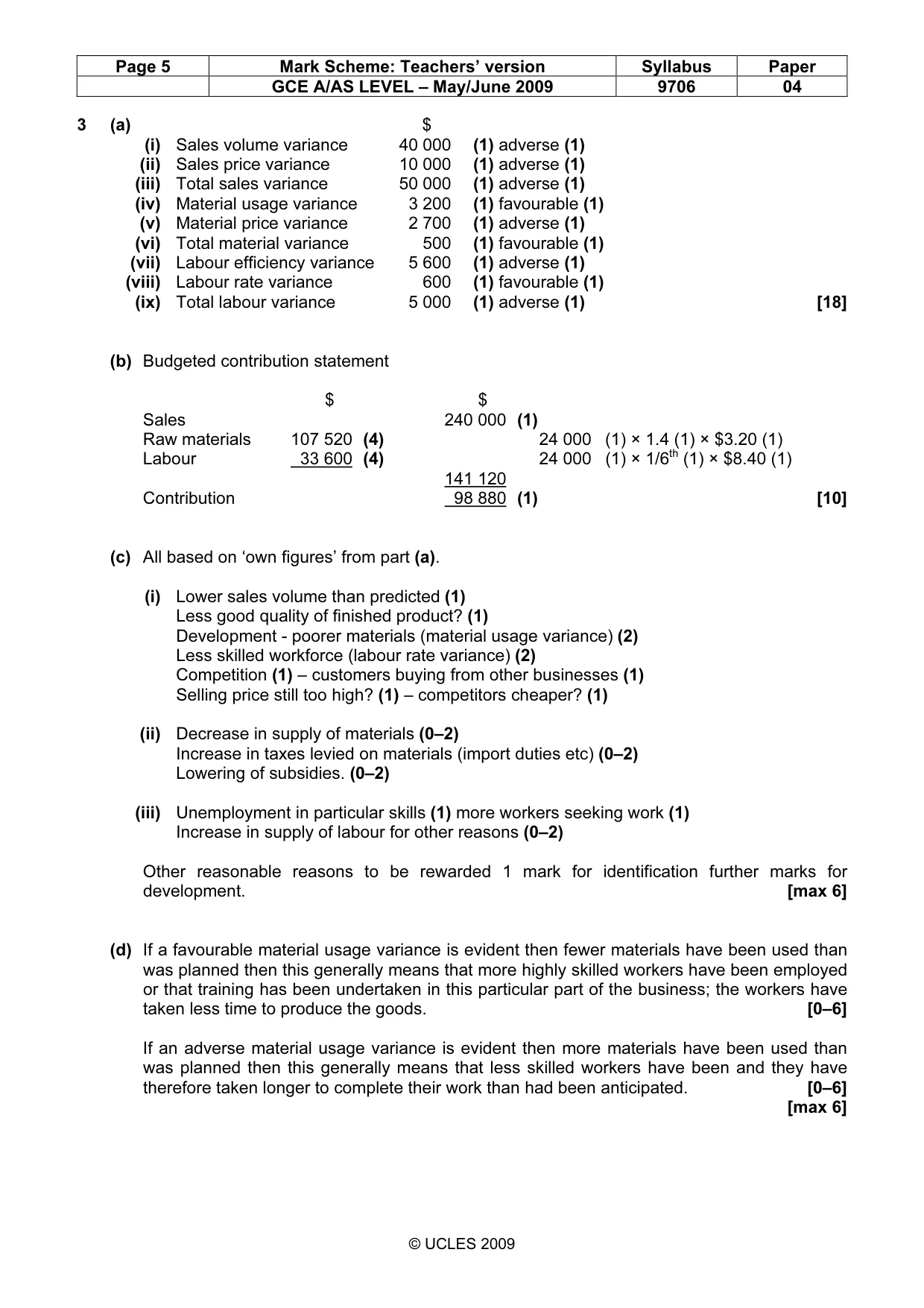
Page 5 Mark Scheme: Teachers’ version Syllabus Paper GCE A/AS LEVEL – May/June 2009 9706 04 © UCLES 2009 3 (a) $ (i) Sales volume variance 40 000 (1) adverse (1) (ii) Sales price variance 10 000 (1) adverse (1) (iii) Total sales variance 50 000 (1) adverse (1) (iv) Material usage variance 3 200 (1) favourable (1) (v) Material price variance 2 700 (1) adverse (1) (vi) Total material variance 500 (1) favourable (1) (vii) Labour efficiency variance 5 600 (1) adverse (1) (viii) Labour rate variance 600 (1) favourable (1) (ix) Total labour variance 5 000 (1) adverse (1) [18] (b) Budgeted contribution statement $ $ Sales 240 000 (1) Raw materials 107 520 (4) 24 000 (1) × 1.4 (1) × $3.20 (1) Labour 33 600 (4) 24 000 (1) × 1/6th (1) × $8.40 (1) 141 120 Contribution 98 880 (1) [10] (c) All based on ‘own figures’ from part (a). (i) Lower sales volume than predicted (1) Less good quality of finished product? (1) Development - poorer materials (material usage variance) (2) Less skilled workforce (labour rate variance) (2) Competition (1) – customers buying from other businesses (1) Selling price still too high? (1) – competitors cheaper? (1) (ii) Decrease in supply of materials (0–2) Increase in taxes levied on materials (import duties etc) (0–2) Lowering of subsidies. (0–2) (iii) Unemployment in particular skills (1) more workers seeking work (1) Increase in supply of labour for other reasons (0–2) Other reasonable reasons to be rewarded 1 mark for identification further marks for development. [max 6] (d) If a favourable material usage variance is evident then fewer materials have been used than was planned then this generally means that more highly skilled workers have been employed or that training has been undertaken in this particular part of the business; the workers have taken less time to produce the goods. [0–6] If an adverse material usage variance is evident then more materials have been used than was planned then this generally means that less skilled workers have been and they have therefore taken longer to complete their work than had been anticipated. [0–6] [max 6]
What you needed in this session
Cambridge’s own grade thresholds for 2009 May/June, Paper 4 · Variant 1. A higher threshold means an easier paper — the bar moves with how the cohort did.