Cambridge A Level Accounting 9706 — 2008 Oct/Nov Paper 4 · Variant 1
9706/41/O/N/08 · 120 marks · ≈135 min
The question paper and its mark scheme, free to read here and free to download. This is Cambridge’s own paper, exactly as it was sat.
Question paper8 pages

Mark scheme5 pages
Answers below. Sit the paper first if you are practising.
Paper as text
Question paper, page 1
This document consists of 7 printed pages and 1 blank page. IB08 11_9706_04/6RP © UCLES 2008 [Turn over *1071140321* UNIVERSITY OF CAMBRIDGE INTERNATIONAL EXAMINATIONS General Certificate of Education Advanced Subsidiary Level and Advanced Level ACCOUNTING 9706/04 Paper 4 Problem Solving (Supplementary Topics) October/November 2008 2 hours Additional Materials: Answer Booklet/Paper READ THESE INSTRUCTIONS FIRST If you have been given an Answer Booklet, follow the instructions on the front cover of the Booklet. Write your Centre number, candidate number and name on all the work you hand in. Write in dark blue or black pen. You may use a soft pencil for any diagrams, graphs or rough working. Do not use staples, paper clips, highlighters, glue or correction fluid. Answer all questions. All accounting statements are to be presented in good style. Workings should be shown. You may use a calculator. At the end of the examination, fasten all your work securely together. The number of marks is given in brackets [ ] at the end of each question or part question.
Question paper, page 2
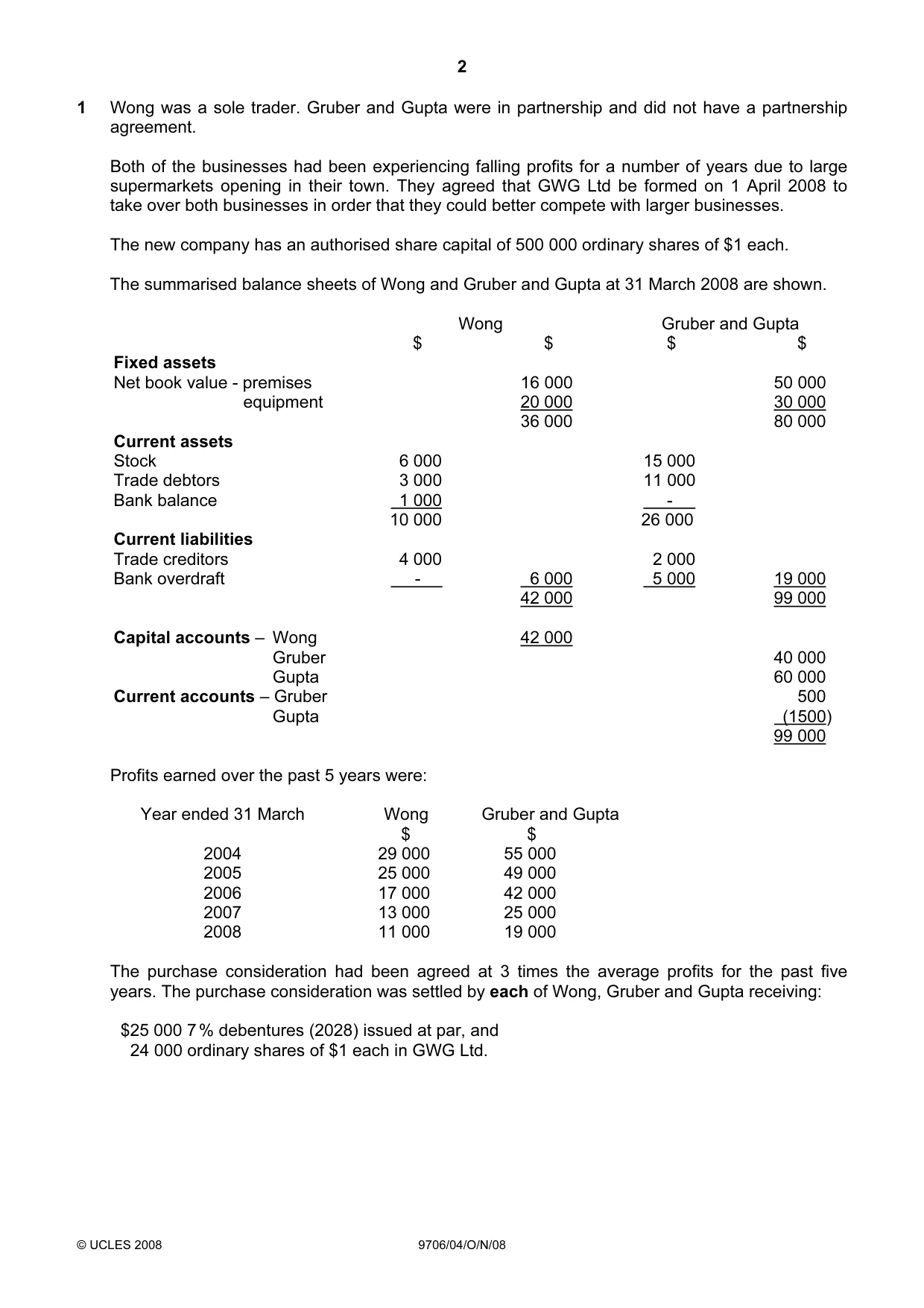
2 © UCLES 2008 9706/04/O/N/08 1 Wong was a sole trader. Gruber and Gupta were in partnership and did not have a partnership agreement. Both of the businesses had been experiencing falling profits for a number of years due to large supermarkets opening in their town. They agreed that GWG Ltd be formed on 1 April 2008 to take over both businesses in order that they could better compete with larger businesses. The new company has an authorised share capital of 500 000 ordinary shares of $1 each. The summarised balance sheets of Wong and Gruber and Gupta at 31 March 2008 are shown. Wong Gruber and Gupta $ $ $ $ Fixed assets Net book value - premises 16 000 50 000 equipment 20 000 30 000 36 000 80 000 Current assets Stock 6 000 15 000 Trade debtors 3 000 11 000 Bank balance 1 000 - 10 000 26 000 Current liabilities Trade creditors 4 000 2 000 Bank overdraft - 6 000 5 000 19 000 42 000 99 000 Capital accounts – Wong 42 000 Gruber 40 000 Gupta 60 000 Current accounts – Gruber 500 Gupta (1500) 99 000 Profits earned over the past 5 years were: Year ended 31 March Wong Gruber and Gupta $ $ 2004 29 000 55 000 2005 25 000 49 000 2006 17 000 42 000 2007 13 000 25 000 2008 11 000 19 000 The purchase consideration had been agreed at 3 times the average profits for the past five years. The purchase consideration was settled by each of Wong, Gruber and Gupta receiving: $25 000 7 % debentures (2028) issued at par, and 24 000 ordinary shares of $1 each in GWG Ltd.
Question paper, page 3
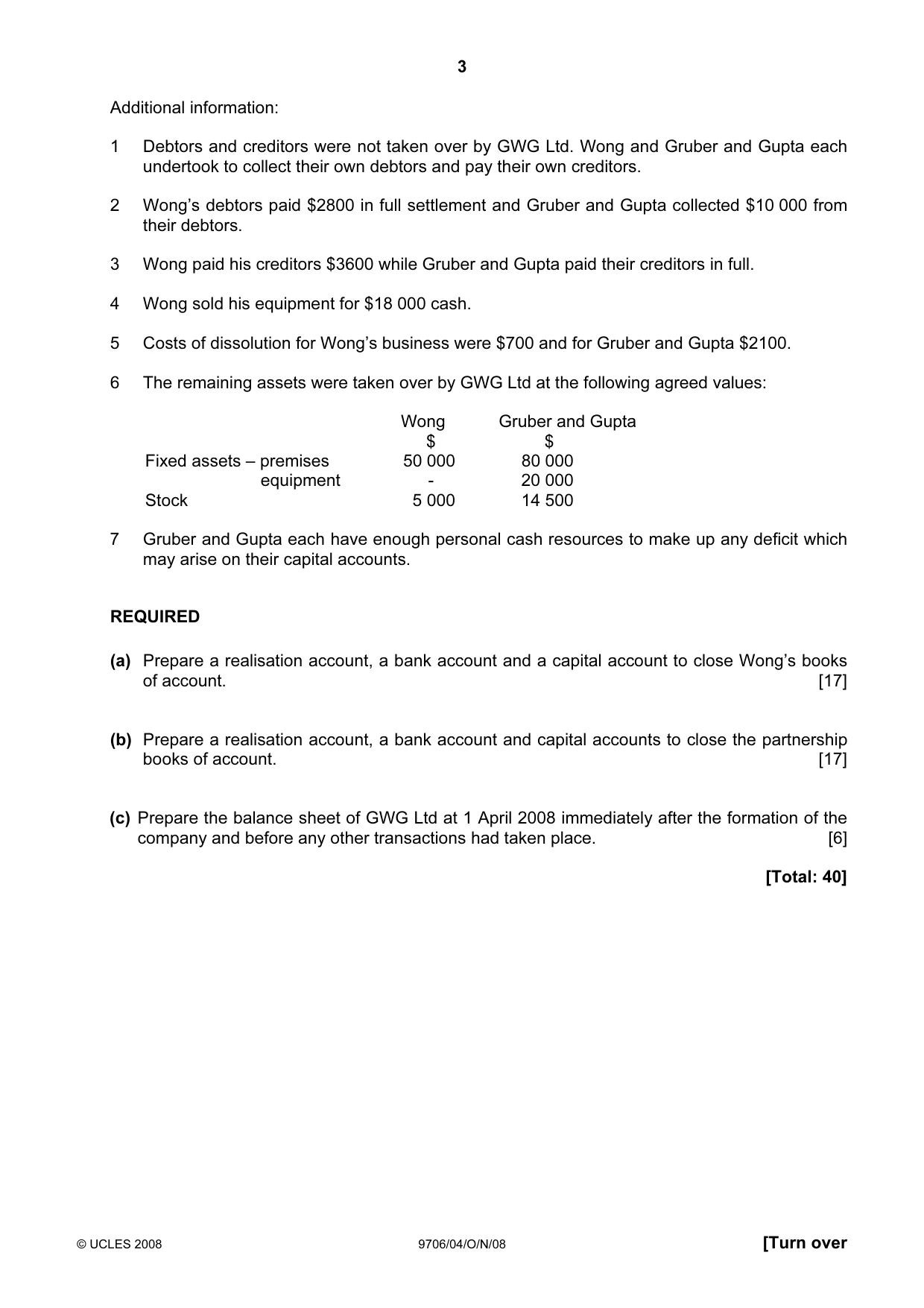
3 © UCLES 2008 9706/04/O/N/08 [Turn over Additional information: 1 Debtors and creditors were not taken over by GWG Ltd. Wong and Gruber and Gupta each undertook to collect their own debtors and pay their own creditors. 2 Wong’s debtors paid $2800 in full settlement and Gruber and Gupta collected $10 000 from their debtors. 3 Wong paid his creditors $3600 while Gruber and Gupta paid their creditors in full. 4 Wong sold his equipment for $18 000 cash. 5 Costs of dissolution for Wong’s business were $700 and for Gruber and Gupta $2100. 6 The remaining assets were taken over by GWG Ltd at the following agreed values: Wong Gruber and Gupta $ $ Fixed assets – premises 50 000 80 000 equipment - 20 000 Stock 5 000 14 500 7 Gruber and Gupta each have enough personal cash resources to make up any deficit which may arise on their capital accounts. REQUIRED (a) Prepare a realisation account, a bank account and a capital account to close Wong’s books of account. [17] (b) Prepare a realisation account, a bank account and capital accounts to close the partnership books of account. [17] (c) Prepare the balance sheet of GWG Ltd at 1 April 2008 immediately after the formation of the company and before any other transactions had taken place. [6] [Total: 40]
Question paper, page 4
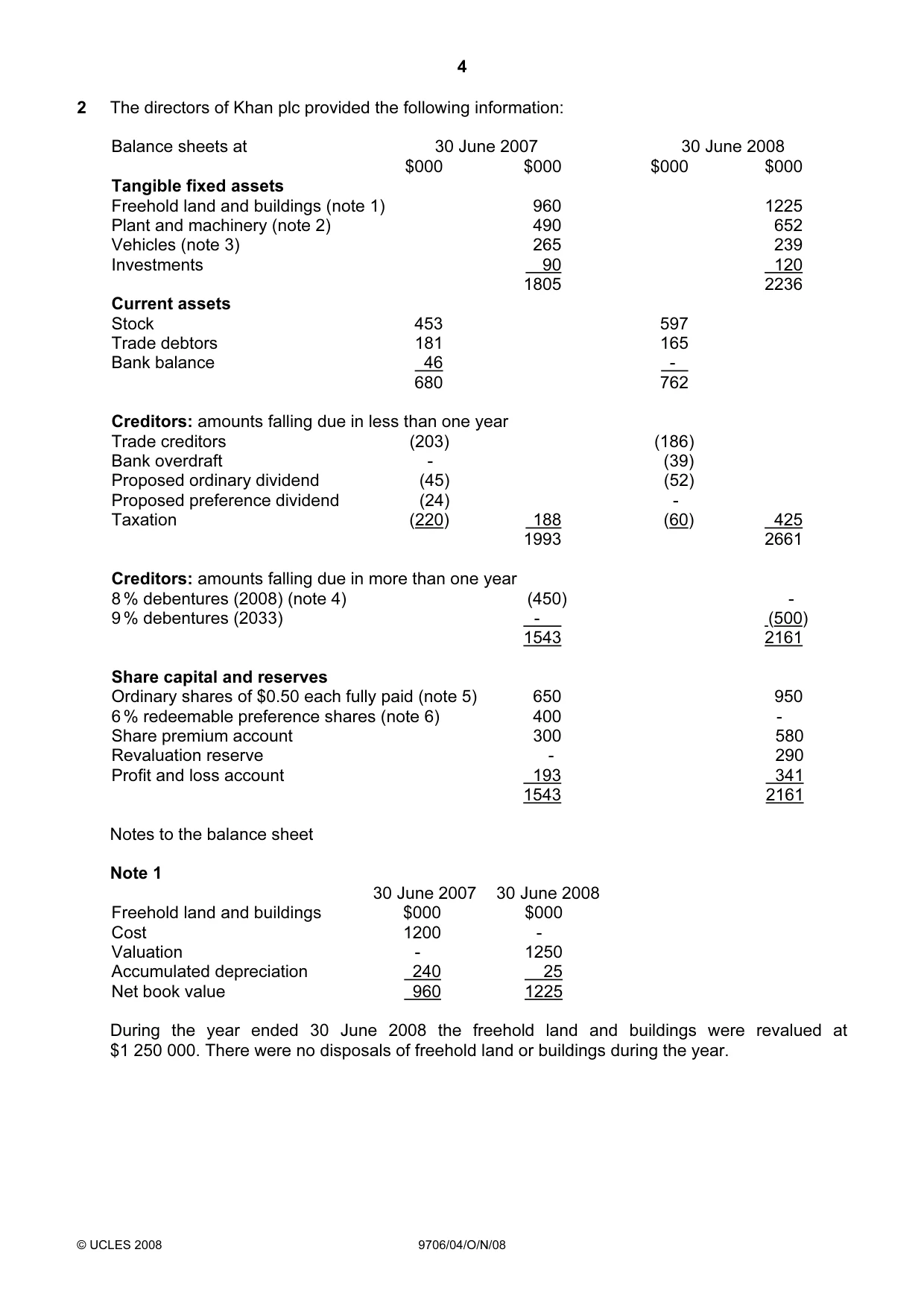
4 © UCLES 2008 9706/04/O/N/08 2 The directors of Khan plc provided the following information: Notes to the balance sheet Note 1 30 June 2007 30 June 2008 Freehold land and buildings $000 $000 Cost 1200 - Valuation - 1250 Accumulated depreciation 240 25 Net book value 960 1225 During the year ended 30 June 2008 the freehold land and buildings were revalued at $1 250 000. There were no disposals of freehold land or buildings during the year. Balance sheets at 30 June 2007 30 June 2008 $000 $000 $000 $000 Tangible fixed assets Freehold land and buildings (note 1) 960 1225 Plant and machinery (note 2) 490 652 Vehicles (note 3) 265 239 Investments 90 120 1805 2236 Current assets Stock 453 597 Trade debtors 181 165 Bank balance 46 - 680 762 Creditors: amounts falling due in less than one year Trade creditors (203) (186) Bank overdraft - (39) Proposed ordinary dividend (45) (52) Proposed preference dividend (24) - Taxation (220) 188 (60) 425 1993 2661 Creditors: amounts falling due in more than one year 8 % debentures (2008) (note 4) (450) - 9 % debentures (2033) - (500) 1543 2161 Share capital and reserves Ordinary shares of $0.50 each fully paid (note 5) 650 950 6 % redeemable preference shares (note 6) 400 - Share premium account 300 580 Revaluation reserve - 290 Profit and loss account 193 341 1543 2161
Question paper, page 5
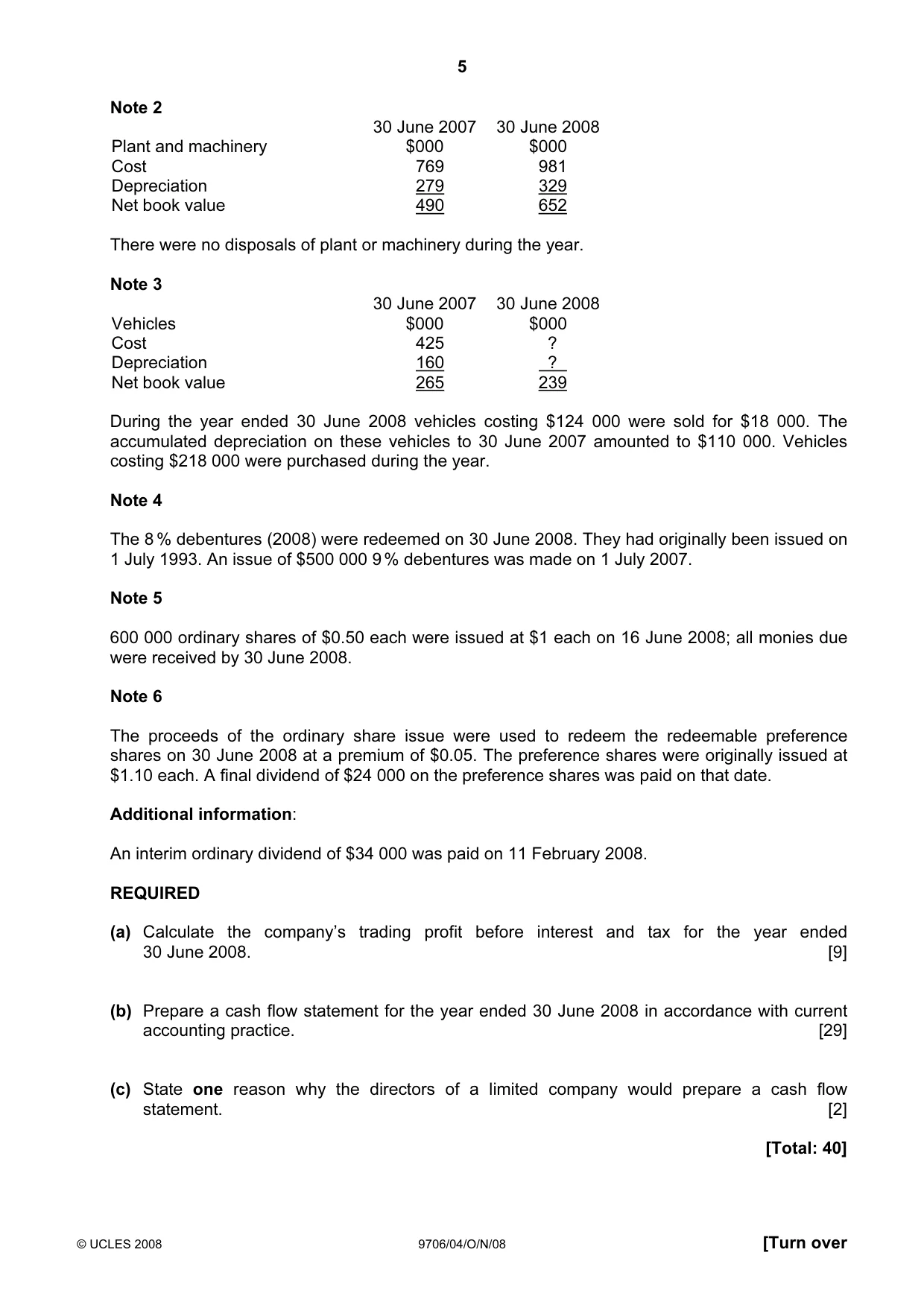
5 © UCLES 2008 9706/04/O/N/08 [Turn over Note 2 30 June 2007 30 June 2008 Plant and machinery $000 $000 Cost 769 981 Depreciation 279 329 Net book value 490 652 There were no disposals of plant or machinery during the year. Note 3 30 June 2007 30 June 2008 Vehicles $000 $000 Cost 425 ? Depreciation 160 ? Net book value 265 239 During the year ended 30 June 2008 vehicles costing $124 000 were sold for $18 000. The accumulated depreciation on these vehicles to 30 June 2007 amounted to $110 000. Vehicles costing $218 000 were purchased during the year. Note 4 The 8 % debentures (2008) were redeemed on 30 June 2008. They had originally been issued on 1 July 1993. An issue of $500 000 9 % debentures was made on 1 July 2007. Note 5 600 000 ordinary shares of $0.50 each were issued at $1 each on 16 June 2008; all monies due were received by 30 June 2008. Note 6 The proceeds of the ordinary share issue were used to redeem the redeemable preference shares on 30 June 2008 at a premium of $0.05. The preference shares were originally issued at $1.10 each. A final dividend of $24 000 on the preference shares was paid on that date. Additional information: An interim ordinary dividend of $34 000 was paid on 11 February 2008. REQUIRED (a) Calculate the company’s trading profit before interest and tax for the year ended 30 June 2008. [9] (b) Prepare a cash flow statement for the year ended 30 June 2008 in accordance with current accounting practice. [29] (c) State one reason why the directors of a limited company would prepare a cash flow statement. [2] [Total: 40]
Question paper, page 6
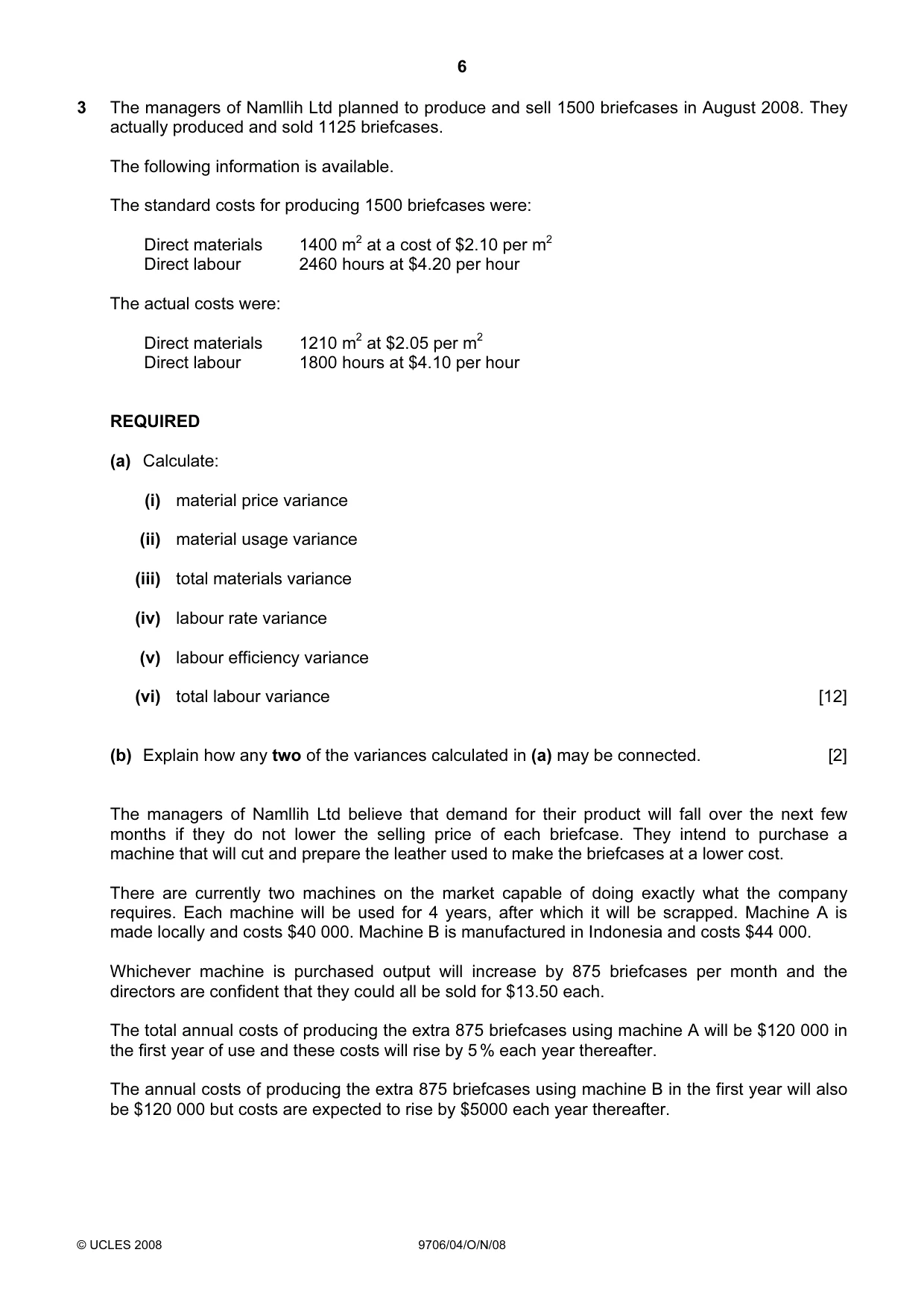
6 © UCLES 2008 9706/04/O/N/08 3 The managers of Namllih Ltd planned to produce and sell 1500 briefcases in August 2008. They actually produced and sold 1125 briefcases. The following information is available. The standard costs for producing 1500 briefcases were: Direct materials 1400 m2 at a cost of $2.10 per m2 Direct labour 2460 hours at $4.20 per hour The actual costs were: Direct materials 1210 m2 at $2.05 per m2 Direct labour 1800 hours at $4.10 per hour REQUIRED (a) Calculate: (i) material price variance (ii) material usage variance (iii) total materials variance (iv) labour rate variance (v) labour efficiency variance (vi) total labour variance [12] (b) Explain how any two of the variances calculated in (a) may be connected. [2] The managers of Namllih Ltd believe that demand for their product will fall over the next few months if they do not lower the selling price of each briefcase. They intend to purchase a machine that will cut and prepare the leather used to make the briefcases at a lower cost. There are currently two machines on the market capable of doing exactly what the company requires. Each machine will be used for 4 years, after which it will be scrapped. Machine A is made locally and costs $40 000. Machine B is manufactured in Indonesia and costs $44 000. Whichever machine is purchased output will increase by 875 briefcases per month and the directors are confident that they could all be sold for $13.50 each. The total annual costs of producing the extra 875 briefcases using machine A will be $120 000 in the first year of use and these costs will rise by 5 % each year thereafter. The annual costs of producing the extra 875 briefcases using machine B in the first year will also be $120 000 but costs are expected to rise by $5000 each year thereafter.
Question paper, page 7
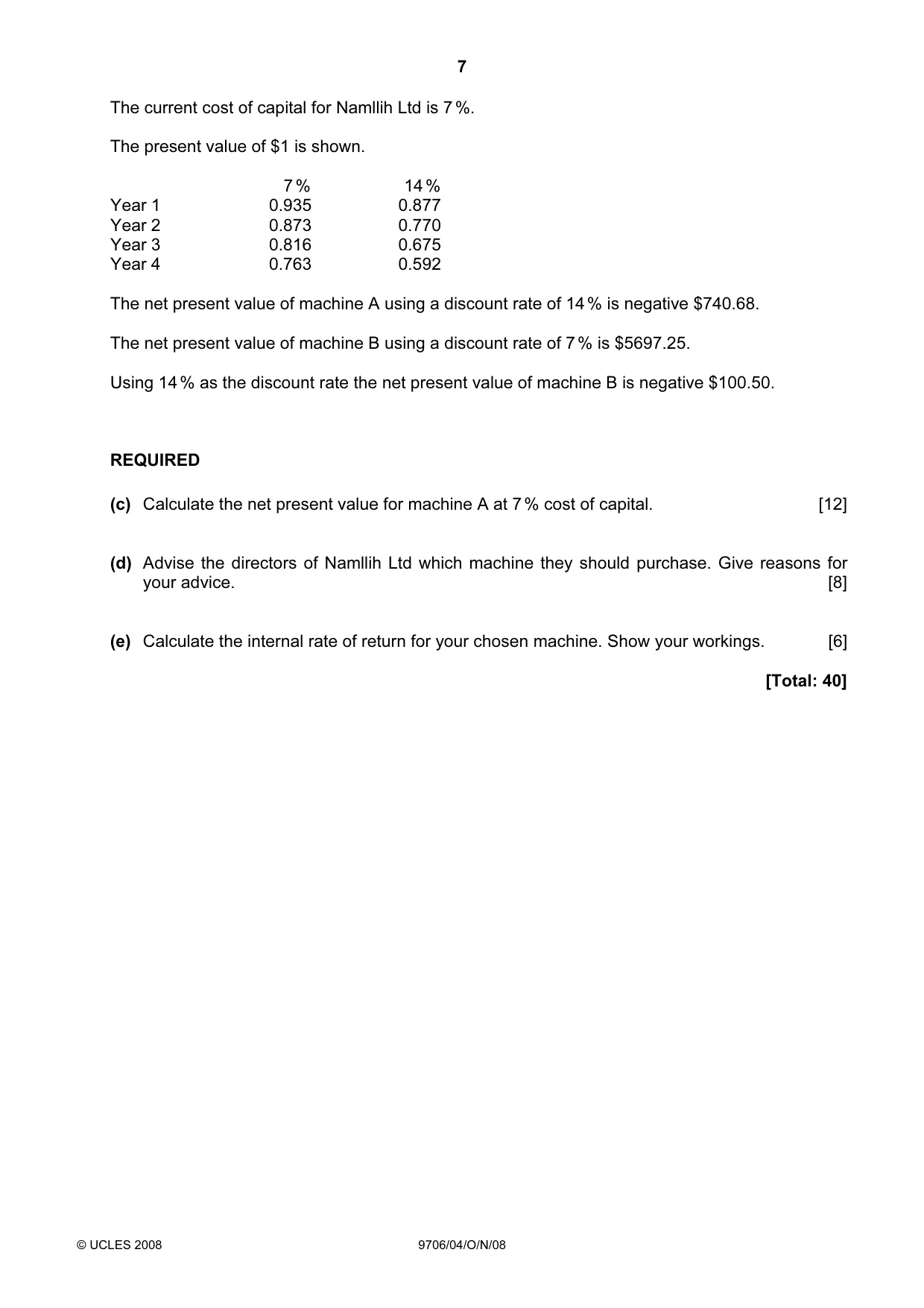
7 © UCLES 2008 9706/04/O/N/08 The current cost of capital for Namllih Ltd is 7 %. The present value of $1 is shown. 7 % 14 % Year 1 0.935 0.877 Year 2 0.873 0.770 Year 3 0.816 0.675 Year 4 0.763 0.592 The net present value of machine A using a discount rate of 14 % is negative $740.68. The net present value of machine B using a discount rate of 7 % is $5697.25. Using 14 % as the discount rate the net present value of machine B is negative $100.50. REQUIRED (c) Calculate the net present value for machine A at 7 % cost of capital. [12] (d) Advise the directors of Namllih Ltd which machine they should purchase. Give reasons for your advice. [8] (e) Calculate the internal rate of return for your chosen machine. Show your workings. [6] [Total: 40]
Question paper, page 8
8 BLANK PAGE Permission to reproduce items where third-party owned material protected by copyright is included has been sought and cleared where possible. Every reasonable effort has been made by the publisher (UCLES) to trace copyright holders, but if any items requiring clearance have unwittingly been included, the publisher will be pleased to make amends at the earliest possible opportunity. University of Cambridge International Examinations is part of the Cambridge Assessment Group. Cambridge Assessment is the brand name of University of Cambridge Local Examinations Syndicate (UCLES), which is itself a department of the University of Cambridge. 9706/04/O/N/08
Mark scheme, page 1
UNIVERSITY OF CAMBRIDGE INTERNATIONAL EXAMINATIONS GCE Advanced Subsidiary Level and GCE Advanced Level MARK SCHEME for the October/November 2008 question paper 9706 ACCOUNTING 9706/04 Paper 4 (Problem Solving – Supplement), maximum raw mark 120 This mark scheme is published as an aid to teachers and candidates, to indicate the requirements of the examination. It shows the basis on which Examiners were instructed to award marks. It does not indicate the details of the discussions that took place at an Examiners’ meeting before marking began. All Examiners are instructed that alternative correct answers and unexpected approaches in candidates’ scripts must be given marks that fairly reflect the relevant knowledge and skills demonstrated. Mark schemes must be read in conjunction with the question papers and the report on the examination. • CIE will not enter into discussions or correspondence in connection with these mark schemes. CIE is publishing the mark schemes for the October/November 2008 question papers for most IGCSE, GCE Advanced Level and Advanced Subsidiary Level syllabuses and some Ordinary Level syllabuses.
Mark scheme, page 2
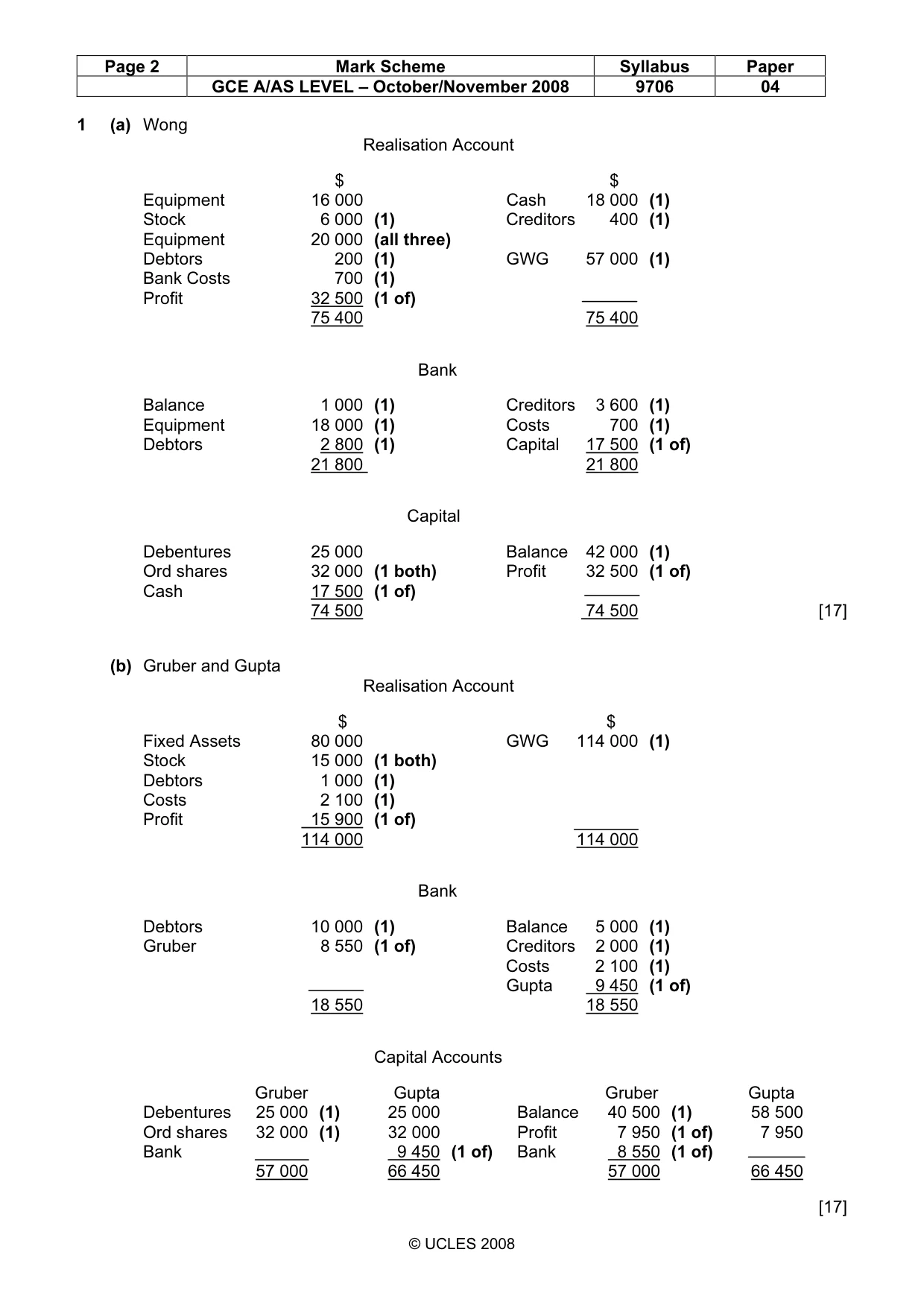
Page 2 Mark Scheme Syllabus Paper GCE A/AS LEVEL – October/November 2008 9706 04 © UCLES 2008 1 (a) Wong Realisation Account $ $ Equipment 16 000 Cash 18 000 (1) Stock 6 000 (1) Creditors 400 (1) Equipment 20 000 (all three) Debtors 200 (1) GWG 57 000 (1) Bank Costs 700 (1) Profit 32 500 (1 of) 75 400 75 400 Bank Balance 1 000 (1) Creditors 3 600 (1) Equipment 18 000 (1) Costs 700 (1) Debtors 2 800 (1) Capital 17 500 (1 of) 21 800 21 800 Capital Debentures 25 000 Balance 42 000 (1) Ord shares 32 000 (1 both) Profit 32 500 (1 of) Cash 17 500 (1 of) 74 500 74 500 [17] (b) Gruber and Gupta Realisation Account $ $ Fixed Assets 80 000 GWG 114 000 (1) Stock 15 000 (1 both) Debtors 1 000 (1) Costs 2 100 (1) Profit 15 900 (1 of) 114 000 114 000 Bank Debtors 10 000 (1) Balance 5 000 (1) Gruber 8 550 (1 of) Creditors 2 000 (1) Costs 2 100 (1) Gupta 9 450 (1 of) 18 550 18 550 Capital Accounts Gruber Gupta Gruber Gupta Debentures 25 000 (1) 25 000 Balance 40 500 (1) 58 500 Ord shares 32 000 (1) 32 000 Profit 7 950 (1 of) 7 950 Bank 9 450 (1 of) Bank 8 550 (1 of) 57 000 66 450 57 000 66 450 [17]
Mark scheme, page 3
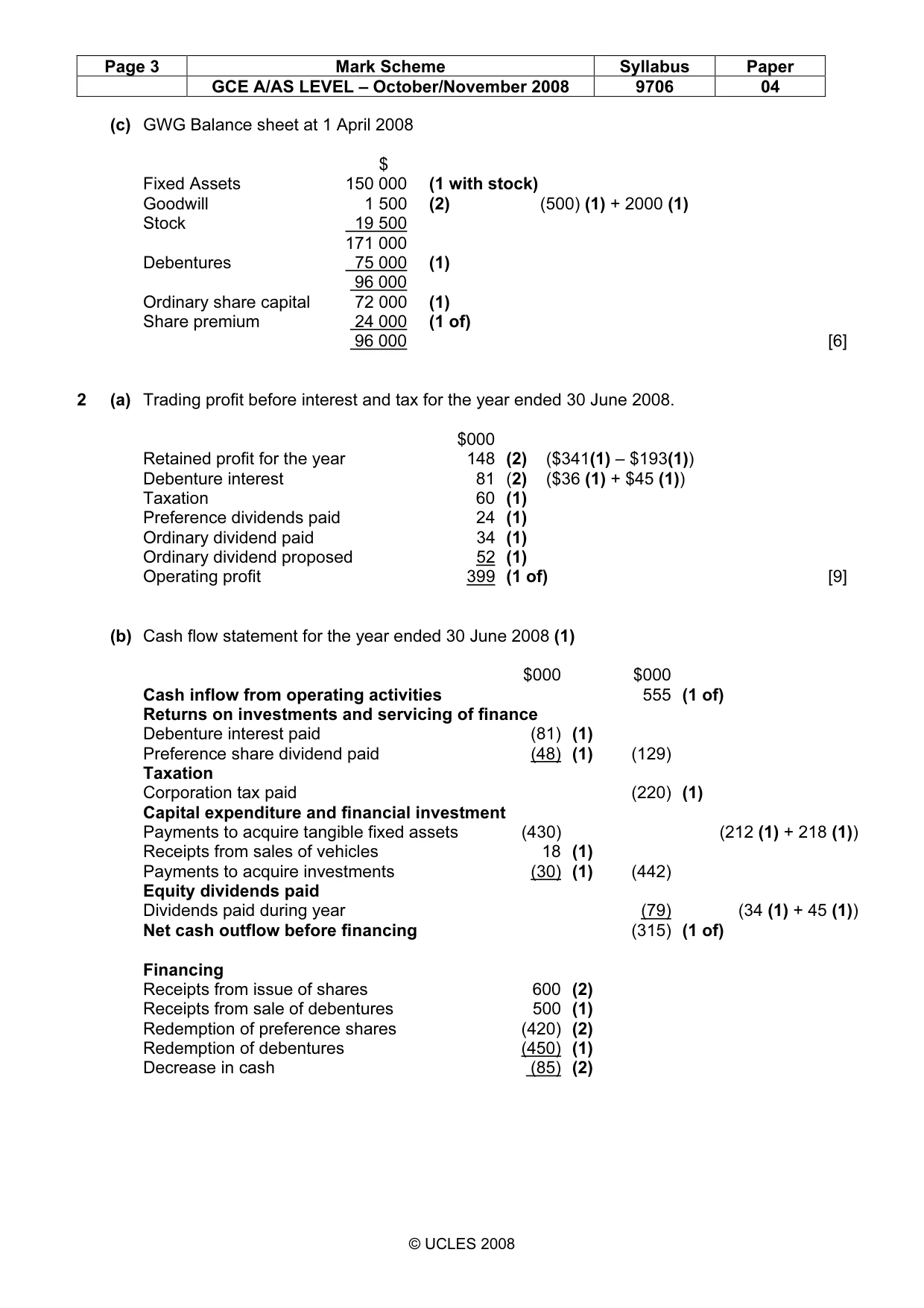
Page 3 Mark Scheme Syllabus Paper GCE A/AS LEVEL – October/November 2008 9706 04 © UCLES 2008 (c) GWG Balance sheet at 1 April 2008 $ Fixed Assets 150 000 (1 with stock) Goodwill 1 500 (2) (500) (1) + 2000 (1) Stock 19 500 171 000 Debentures 75 000 (1) 96 000 Ordinary share capital 72 000 (1) Share premium 24 000 (1 of) 96 000 [6] 2 (a) Trading profit before interest and tax for the year ended 30 June 2008. $000 Retained profit for the year 148 (2) ($341(1) – $193(1)) Debenture interest 81 (2) ($36 (1) + $45 (1)) Taxation 60 (1) Preference dividends paid 24 (1) Ordinary dividend paid 34 (1) Ordinary dividend proposed 52 (1) Operating profit 399 (1 of) [9] (b) Cash flow statement for the year ended 30 June 2008 (1) $000 $000 Cash inflow from operating activities 555 (1 of) Returns on investments and servicing of finance Debenture interest paid (81) (1) Preference share dividend paid (48) (1) (129) Taxation Corporation tax paid (220) (1) Capital expenditure and financial investment Payments to acquire tangible fixed assets (430) (212 (1) + 218 (1)) Receipts from sales of vehicles 18 (1) Payments to acquire investments (30) (1) (442) Equity dividends paid Dividends paid during year (79) (34 (1) + 45 (1)) Net cash outflow before financing (315) (1 of) Financing Receipts from issue of shares 600 (2) Receipts from sale of debentures 500 (1) Redemption of preference shares (420) (2) Redemption of debentures (450) (1) Decrease in cash (85) (2)
Mark scheme, page 4
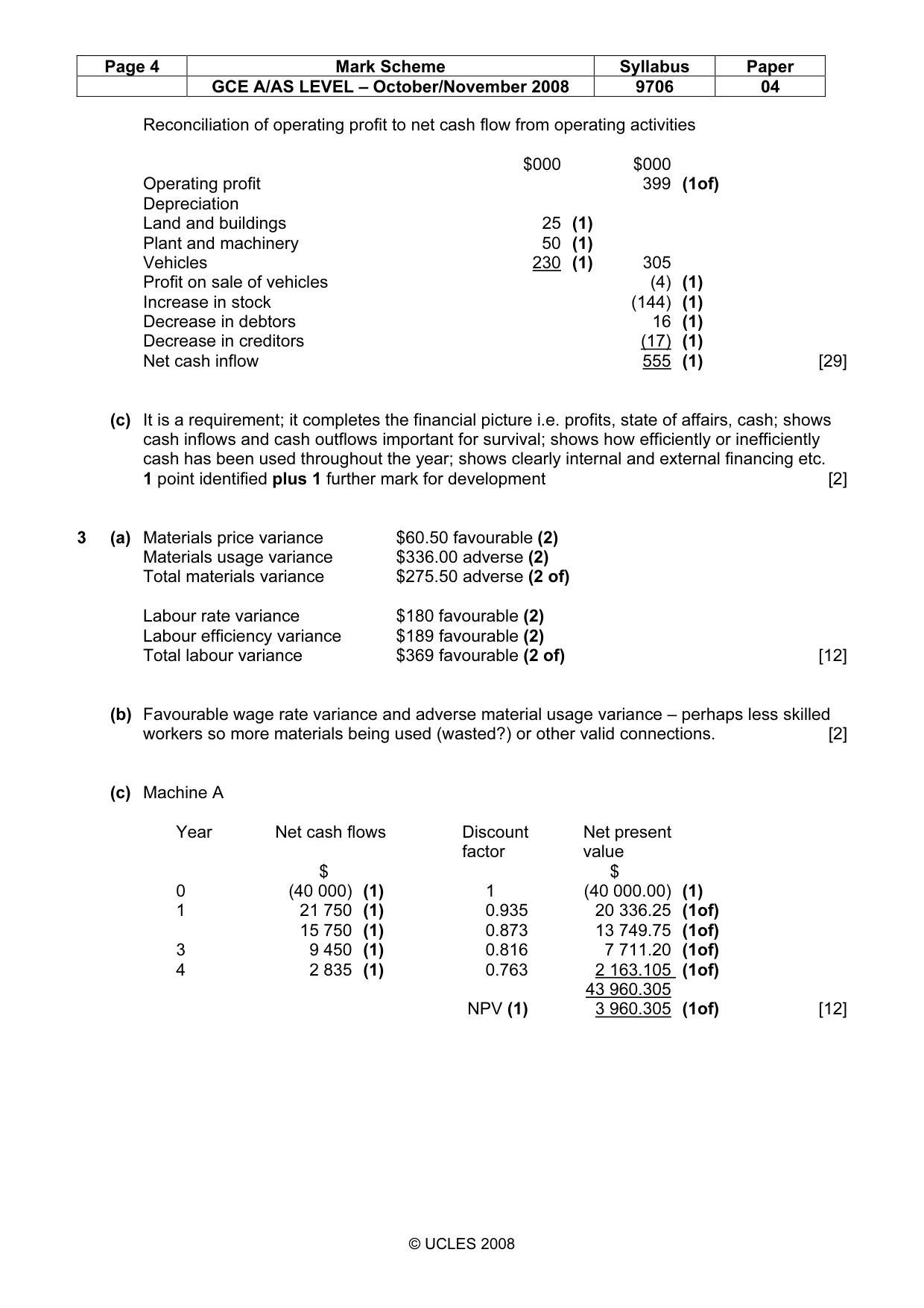
Page 4 Mark Scheme Syllabus Paper GCE A/AS LEVEL – October/November 2008 9706 04 © UCLES 2008 Reconciliation of operating profit to net cash flow from operating activities $000 $000 Operating profit 399 (1of) Depreciation Land and buildings 25 (1) Plant and machinery 50 (1) Vehicles 230 (1) 305 Profit on sale of vehicles (4) (1) Increase in stock (144) (1) Decrease in debtors 16 (1) Decrease in creditors (17) (1) Net cash inflow 555 (1) [29] (c) It is a requirement; it completes the financial picture i.e. profits, state of affairs, cash; shows cash inflows and cash outflows important for survival; shows how efficiently or inefficiently cash has been used throughout the year; shows clearly internal and external financing etc. 1 point identified plus 1 further mark for development [2] 3 (a) Materials price variance $60.50 favourable (2) Materials usage variance $336.00 adverse (2) Total materials variance $275.50 adverse (2 of) Labour rate variance $180 favourable (2) Labour efficiency variance $189 favourable (2) Total labour variance $369 favourable (2 of) [12] (b) Favourable wage rate variance and adverse material usage variance – perhaps less skilled workers so more materials being used (wasted?) or other valid connections. [2] (c) Machine A Year Net cash flows Discount Net present factor value $ $ 0 (40 000) (1) 1 (40 000.00) (1) 1 21 750 (1) 0.935 20 336.25 (1of) 15 750 (1) 0.873 13 749.75 (1of) 3 9 450 (1) 0.816 7 711.20 (1of) 4 2 835 (1) 0.763 2 163.105 (1of) 43 960.305 NPV (1) 3 960.305 (1of) [12]
Mark scheme, page 5
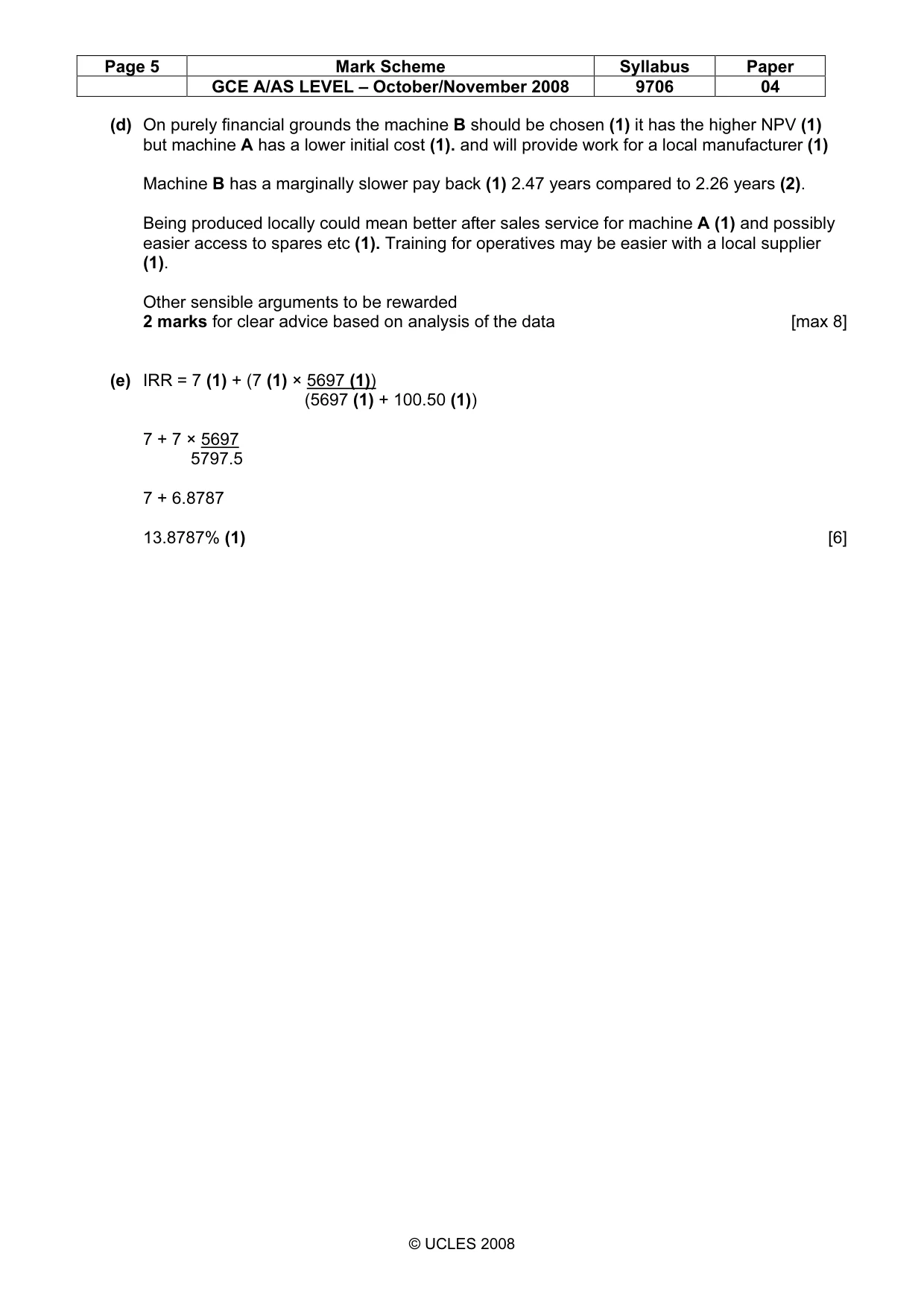
Page 5 Mark Scheme Syllabus Paper GCE A/AS LEVEL – October/November 2008 9706 04 © UCLES 2008 (d) On purely financial grounds the machine B should be chosen (1) it has the higher NPV (1) but machine A has a lower initial cost (1). and will provide work for a local manufacturer (1) Machine B has a marginally slower pay back (1) 2.47 years compared to 2.26 years (2). Being produced locally could mean better after sales service for machine A (1) and possibly easier access to spares etc (1). Training for operatives may be easier with a local supplier (1). Other sensible arguments to be rewarded 2 marks for clear advice based on analysis of the data [max 8] (e) IRR = 7 (1) + (7 (1) × 5697 (1)) (5697 (1) + 100.50 (1)) 7 + 7 × 5697 5797.5 7 + 6.8787 13.8787% (1) [6]
What you needed in this session
Cambridge’s own grade thresholds for 2008 Oct/Nov, Paper 4 · Variant 1. A higher threshold means an easier paper — the bar moves with how the cohort did.