Cambridge A Level Accounting 9706 — 2008 May/June Paper 4 · Variant 1
9706/41/M/J/08 · 120 marks · ≈135 min
The question paper and its mark scheme, free to read here and free to download. This is Cambridge’s own paper, exactly as it was sat.
Question paper8 pages
Mark scheme5 pages
Answers below. Sit the paper first if you are practising.
Paper as text
Question paper, page 1
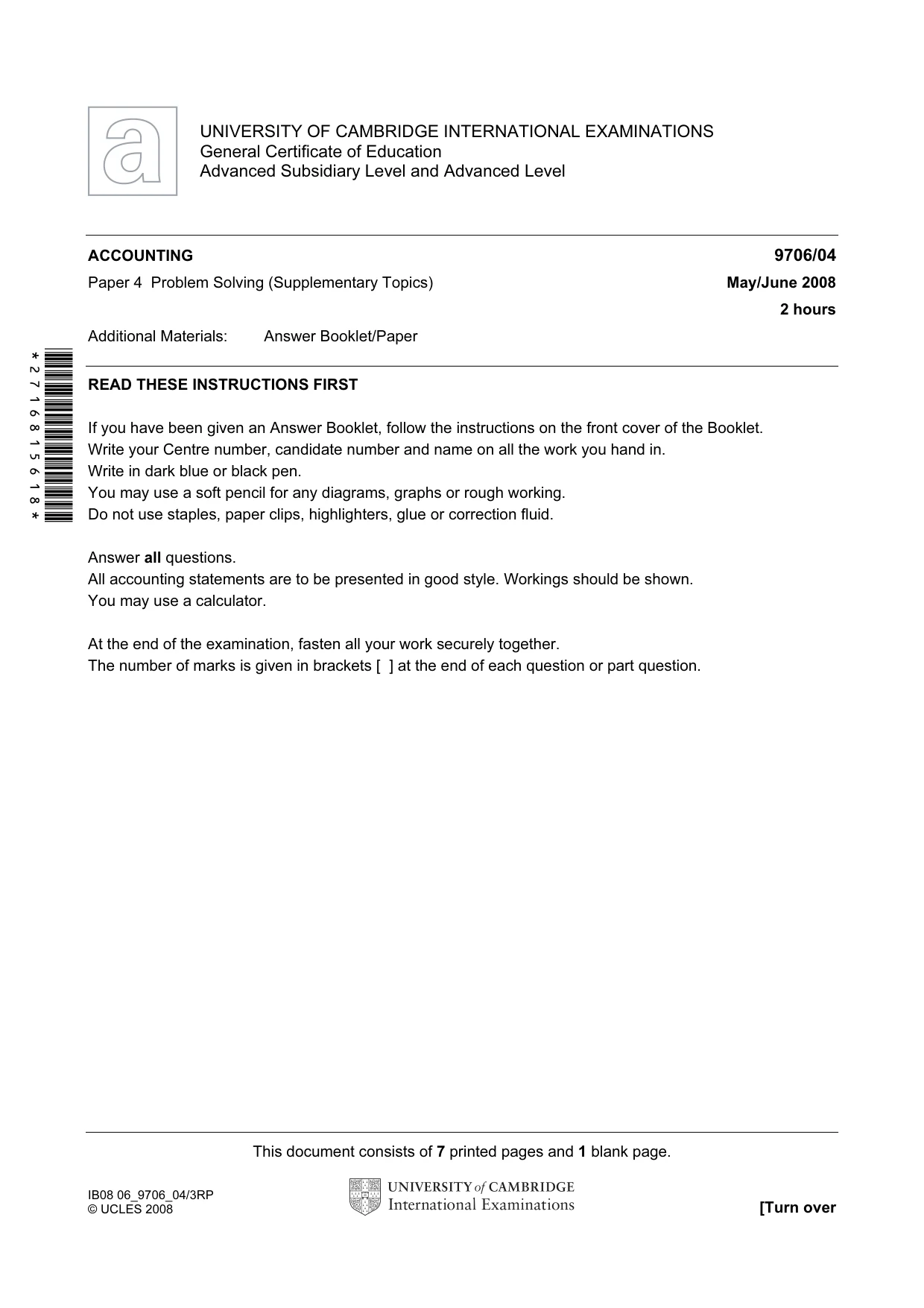
This document consists of 7 printed pages and 1 blank page. IB08 06_9706_04/3RP © UCLES 2008 [Turn over *2716815618* UNIVERSITY OF CAMBRIDGE INTERNATIONAL EXAMINATIONS General Certificate of Education Advanced Subsidiary Level and Advanced Level ACCOUNTING 9706/04 Paper 4 Problem Solving (Supplementary Topics) May/June 2008 2 hours Additional Materials: Answer Booklet/Paper READ THESE INSTRUCTIONS FIRST If you have been given an Answer Booklet, follow the instructions on the front cover of the Booklet. Write your Centre number, candidate number and name on all the work you hand in. Write in dark blue or black pen. You may use a soft pencil for any diagrams, graphs or rough working. Do not use staples, paper clips, highlighters, glue or correction fluid. Answer all questions. All accounting statements are to be presented in good style. Workings should be shown. You may use a calculator. At the end of the examination, fasten all your work securely together. The number of marks is given in brackets [ ] at the end of each question or part question.
Question paper, page 2
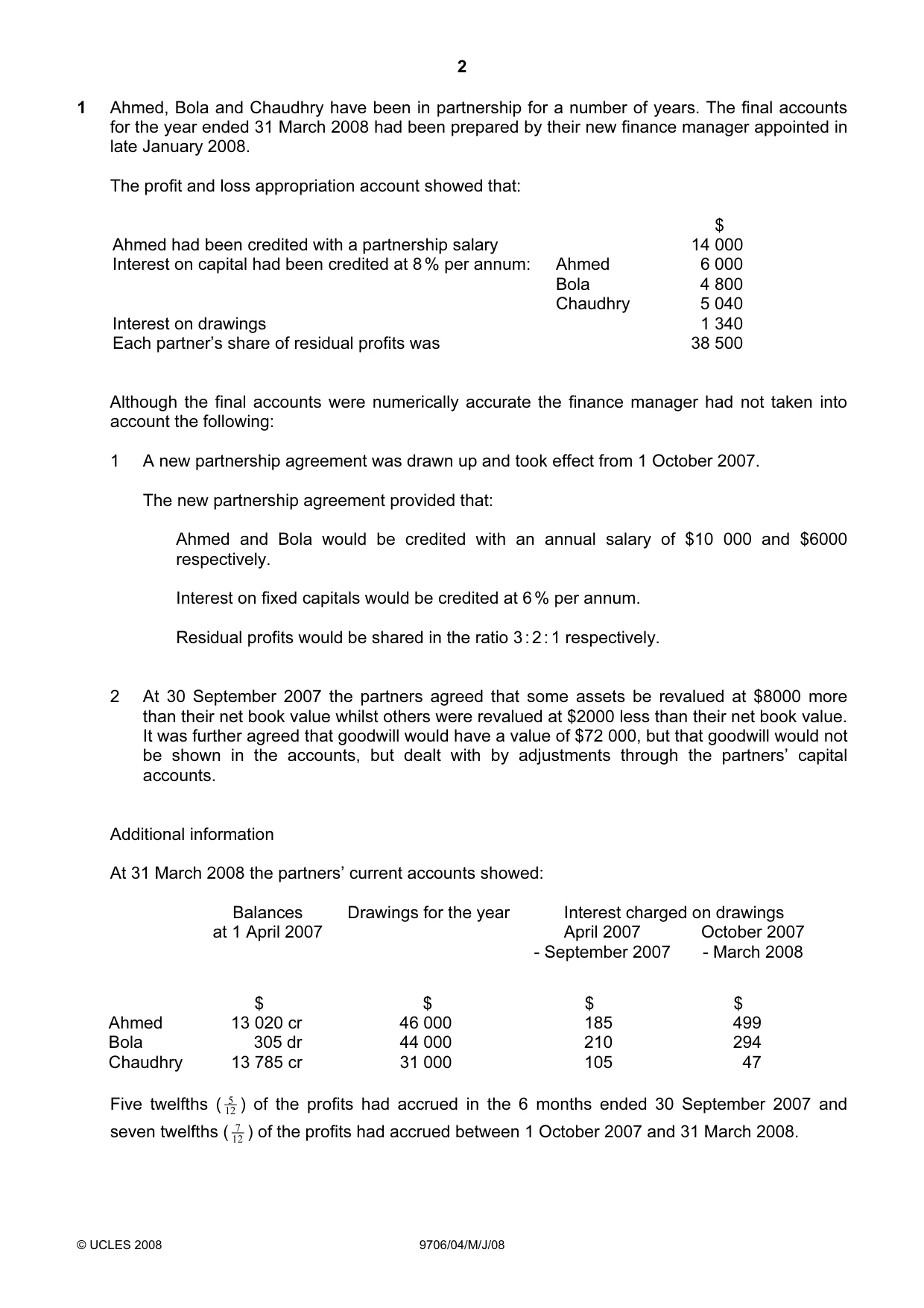
2 © UCLES 2008 9706/04/M/J/08 1 Ahmed, Bola and Chaudhry have been in partnership for a number of years. The final accounts for the year ended 31 March 2008 had been prepared by their new finance manager appointed in late January 2008. The profit and loss appropriation account showed that: $ Ahmed had been credited with a partnership salary 14 000 Interest on capital had been credited at 8 % per annum: Ahmed 6 000 Bola 4 800 Chaudhry 5 040 Interest on drawings 1 340 Each partner’s share of residual profits was 38 500 Although the final accounts were numerically accurate the finance manager had not taken into account the following: 1 A new partnership agreement was drawn up and took effect from 1 October 2007. The new partnership agreement provided that: Ahmed and Bola would be credited with an annual salary of $10 000 and $6000 respectively. Interest on fixed capitals would be credited at 6 % per annum. Residual profits would be shared in the ratio 3 : 2 : 1 respectively. 2 At 30 September 2007 the partners agreed that some assets be revalued at $8000 more than their net book value whilst others were revalued at $2000 less than their net book value. It was further agreed that goodwill would have a value of $72 000, but that goodwill would not be shown in the accounts, but dealt with by adjustments through the partners’ capital accounts. Additional information At 31 March 2008 the partners’ current accounts showed: Balances Drawings for the year Interest charged on drawings at 1 April 2007 April 2007 October 2007 - September 2007 - March 2008 $ $ $ $ Ahmed 13 020 cr 46 000 185 499 Bola 305 dr 44 000 210 294 Chaudhry 13 785 cr 31 000 105 47 Five twelfths ( 12 5 ) of the profits had accrued in the 6 months ended 30 September 2007 and seven twelfths ( 12 7 ) of the profits had accrued between 1 October 2007 and 31 March 2008.
Question paper, page 3
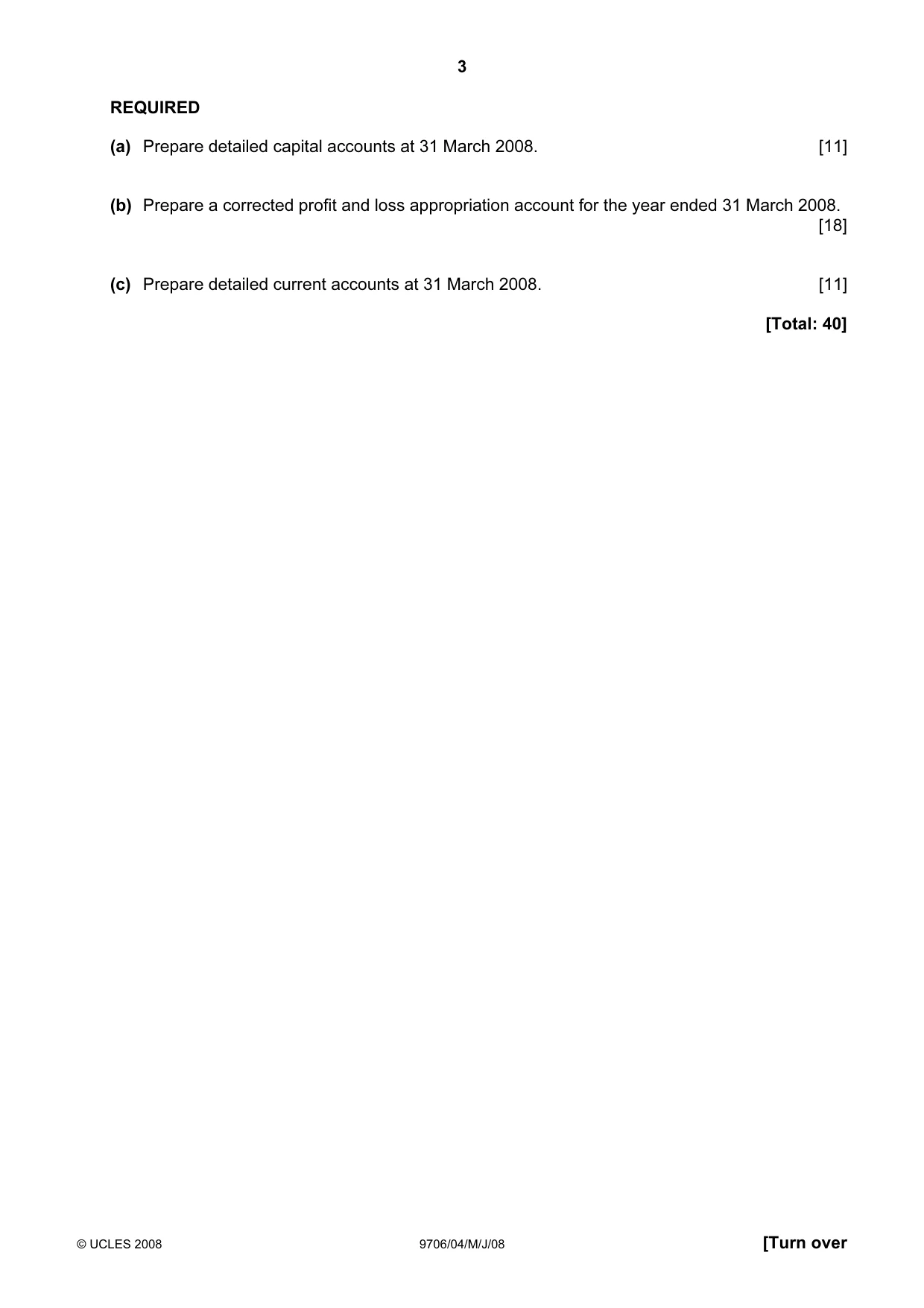
3 © UCLES 2008 9706/04/M/J/08 [Turn over REQUIRED (a) Prepare detailed capital accounts at 31 March 2008. [11] (b) Prepare a corrected profit and loss appropriation account for the year ended 31 March 2008. [18] (c) Prepare detailed current accounts at 31 March 2008. [11] [Total: 40]
Question paper, page 4
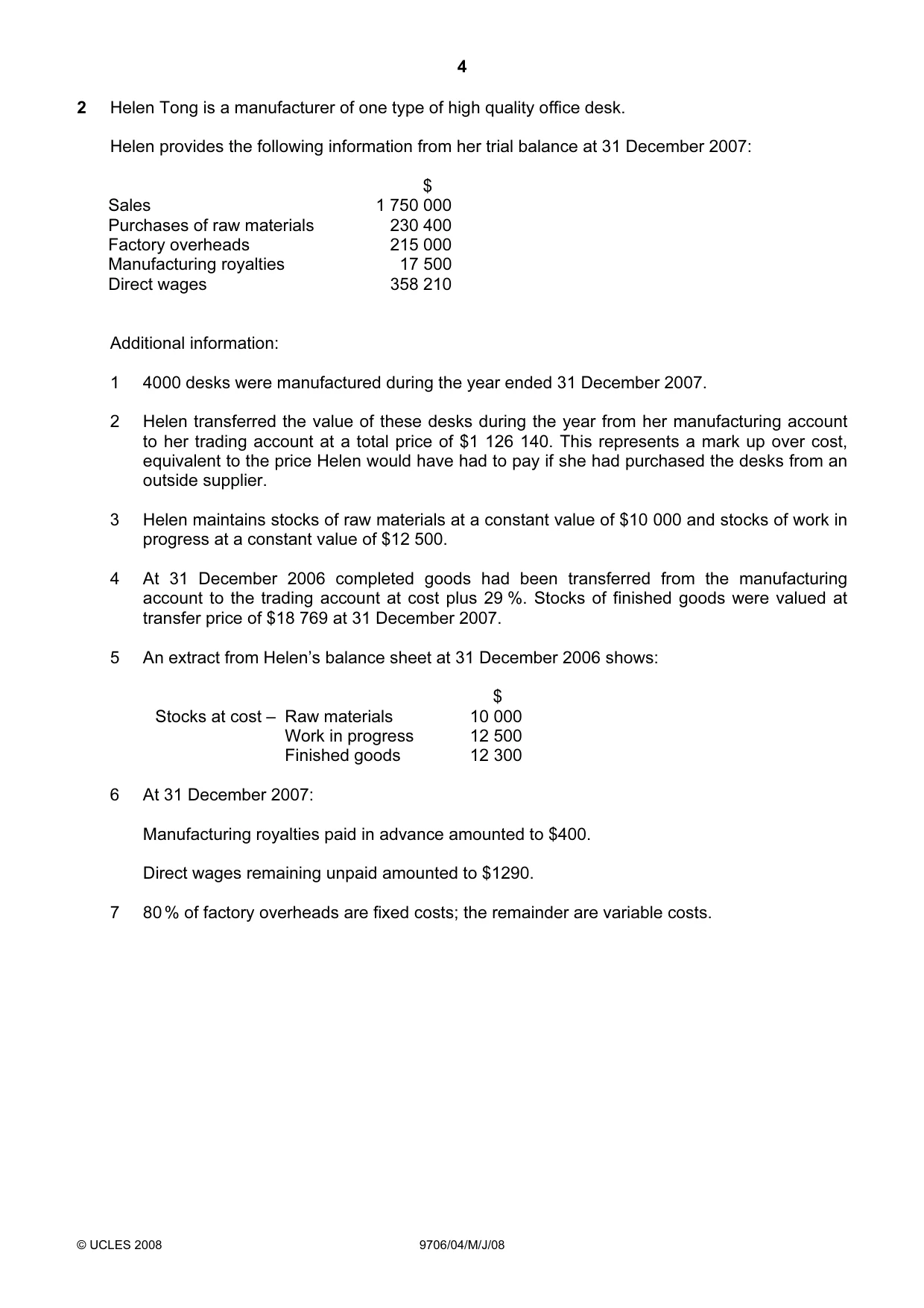
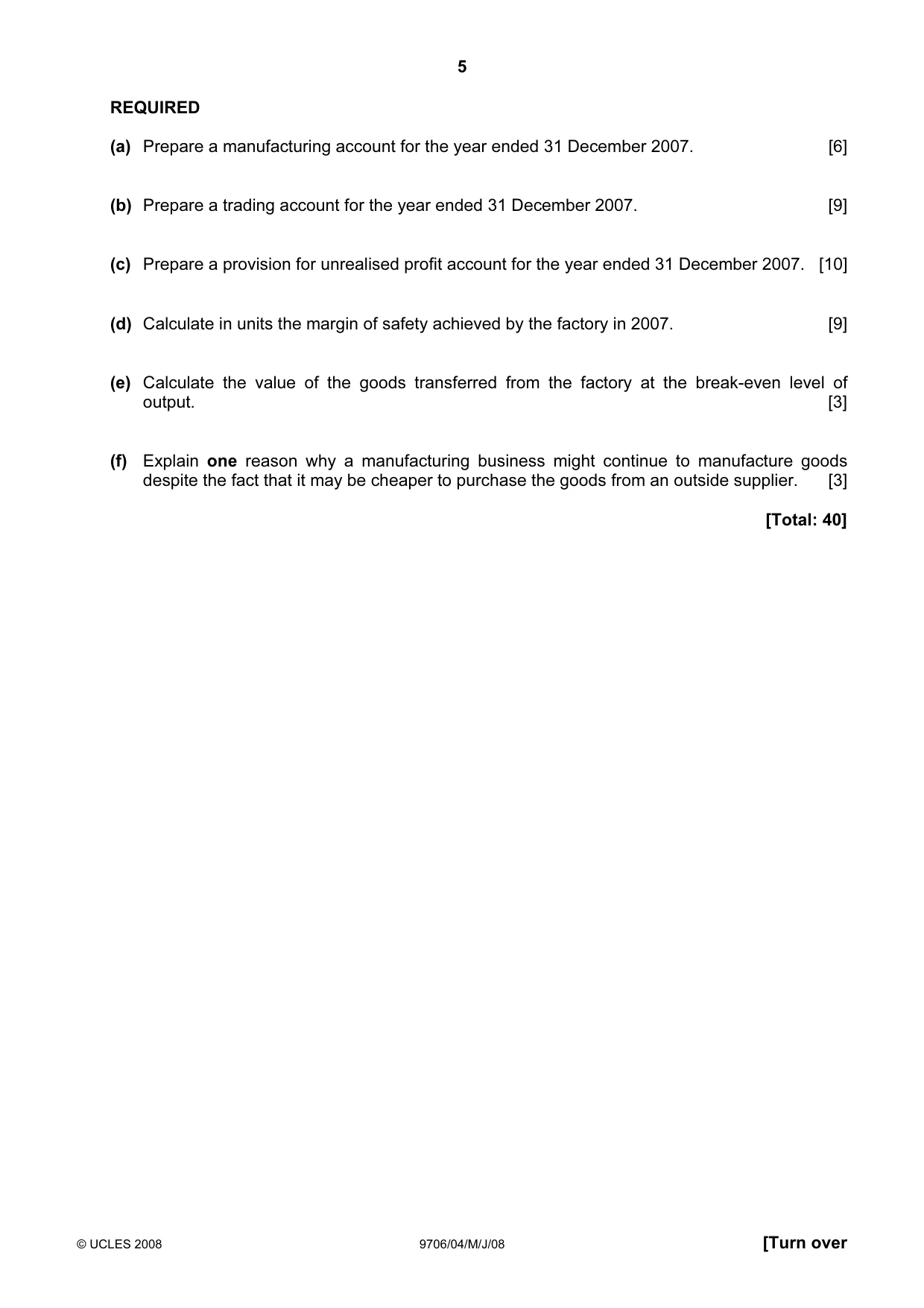
4 © UCLES 2008 9706/04/M/J/08 2 Helen Tong is a manufacturer of one type of high quality office desk. Helen provides the following information from her trial balance at 31 December 2007: $ Sales 1 750 000 Purchases of raw materials 230 400 Factory overheads 215 000 Manufacturing royalties 17 500 Direct wages 358 210 Additional information: 1 4000 desks were manufactured during the year ended 31 December 2007. 2 Helen transferred the value of these desks during the year from her manufacturing account to her trading account at a total price of $1 126 140. This represents a mark up over cost, equivalent to the price Helen would have had to pay if she had purchased the desks from an outside supplier. 3 Helen maintains stocks of raw materials at a constant value of $10 000 and stocks of work in progress at a constant value of $12 500. 4 At 31 December 2006 completed goods had been transferred from the manufacturing account to the trading account at cost plus 29 %. Stocks of finished goods were valued at transfer price of $18 769 at 31 December 2007. 5 An extract from Helen’s balance sheet at 31 December 2006 shows: $ Stocks at cost – Raw materials 10 000 Work in progress 12 500 Finished goods 12 300 6 At 31 December 2007: Manufacturing royalties paid in advance amounted to $400. Direct wages remaining unpaid amounted to $1290. 7 80 % of factory overheads are fixed costs; the remainder are variable costs.
Question paper, page 5
5 © UCLES 2008 9706/04/M/J/08 [Turn over REQUIRED (a) Prepare a manufacturing account for the year ended 31 December 2007. [6] (b) Prepare a trading account for the year ended 31 December 2007. [9] (c) Prepare a provision for unrealised profit account for the year ended 31 December 2007. [10] (d) Calculate in units the margin of safety achieved by the factory in 2007. [9] (e) Calculate the value of the goods transferred from the factory at the break-even level of output. [3] (f) Explain one reason why a manufacturing business might continue to manufacture goods despite the fact that it may be cheaper to purchase the goods from an outside supplier. [3] [Total: 40]
Question paper, page 6
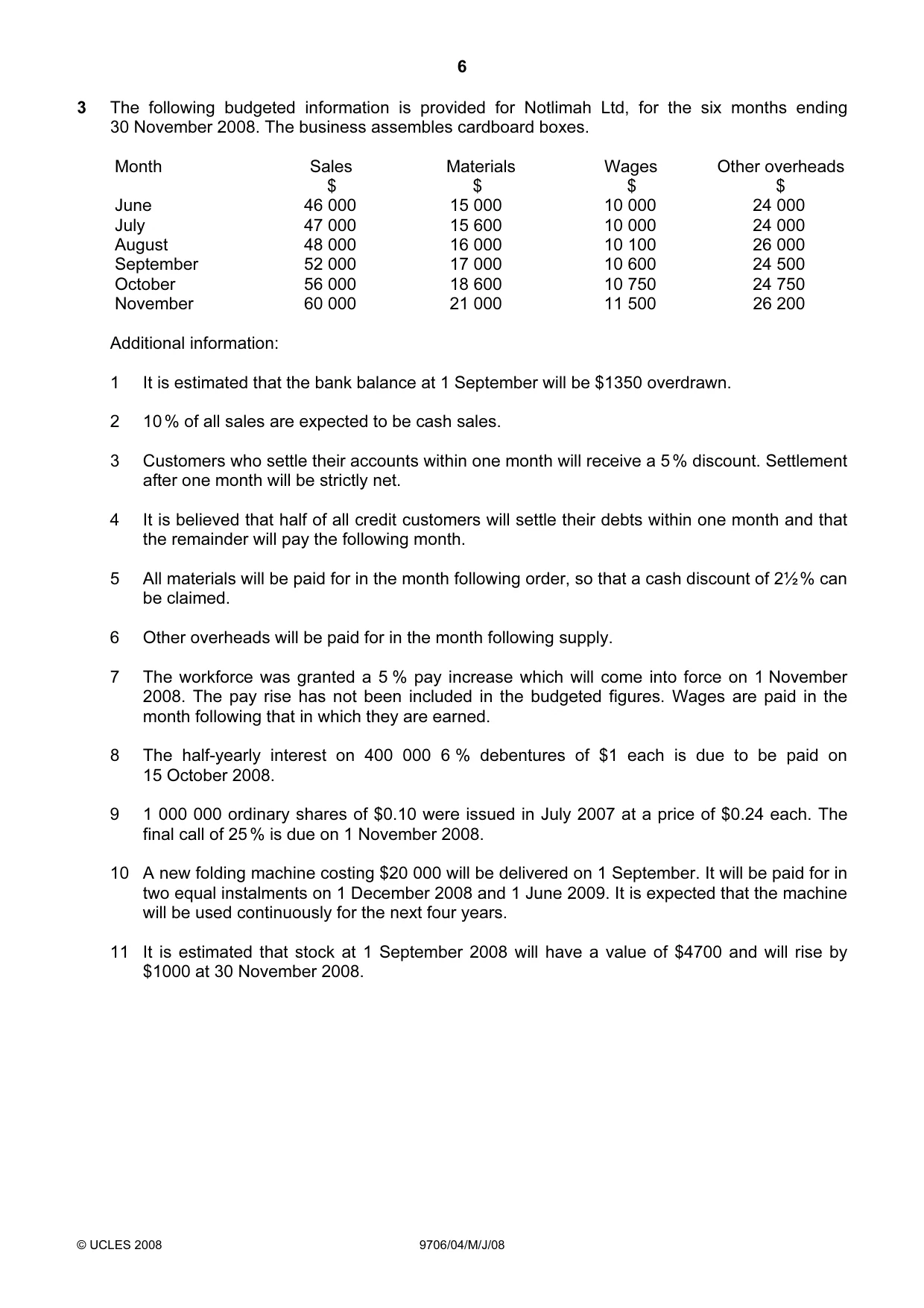
6 © UCLES 2008 9706/04/M/J/08 3 The following budgeted information is provided for Notlimah Ltd, for the six months ending 30 November 2008. The business assembles cardboard boxes. Month Sales Materials Wages Other overheads $ $ $ $ June 46 000 15 000 10 000 24 000 July 47 000 15 600 10 000 24 000 August 48 000 16 000 10 100 26 000 September 52 000 17 000 10 600 24 500 October 56 000 18 600 10 750 24 750 November 60 000 21 000 11 500 26 200 Additional information: 1 It is estimated that the bank balance at 1 September will be $1350 overdrawn. 2 10 % of all sales are expected to be cash sales. 3 Customers who settle their accounts within one month will receive a 5 % discount. Settlement after one month will be strictly net. 4 It is believed that half of all credit customers will settle their debts within one month and that the remainder will pay the following month. 5 All materials will be paid for in the month following order, so that a cash discount of 2½ % can be claimed. 6 Other overheads will be paid for in the month following supply. 7 The workforce was granted a 5 % pay increase which will come into force on 1 November 2008. The pay rise has not been included in the budgeted figures. Wages are paid in the month following that in which they are earned. 8 The half-yearly interest on 400 000 6 % debentures of $1 each is due to be paid on 15 October 2008. 9 1 000 000 ordinary shares of $0.10 were issued in July 2007 at a price of $0.24 each. The final call of 25 % is due on 1 November 2008. 10 A new folding machine costing $20 000 will be delivered on 1 September. It will be paid for in two equal instalments on 1 December 2008 and 1 June 2009. It is expected that the machine will be used continuously for the next four years. 11 It is estimated that stock at 1 September 2008 will have a value of $4700 and will rise by $1000 at 30 November 2008.
Question paper, page 7
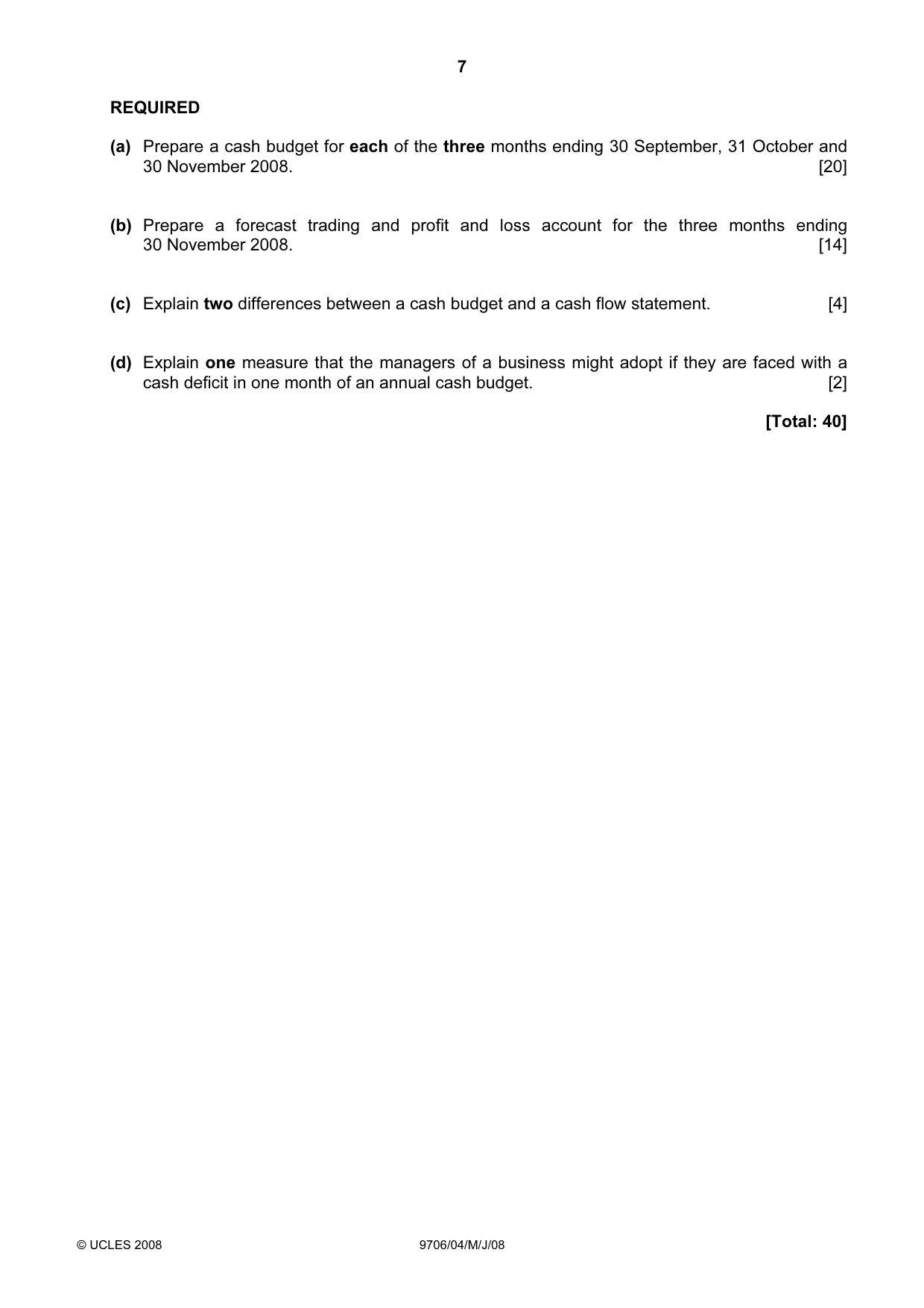
7 © UCLES 2008 9706/04/M/J/08 REQUIRED (a) Prepare a cash budget for each of the three months ending 30 September, 31 October and 30 November 2008. [20] (b) Prepare a forecast trading and profit and loss account for the three months ending 30 November 2008. [14] (c) Explain two differences between a cash budget and a cash flow statement. [4] (d) Explain one measure that the managers of a business might adopt if they are faced with a cash deficit in one month of an annual cash budget. [2] [Total: 40]
Question paper, page 8
8 BLANK PAGE Permission to reproduce items where third-party owned material protected by copyright is included has been sought and cleared where possible. Every reasonable effort has been made by the publisher (UCLES) to trace copyright holders, but if any items requiring clearance have unwittingly been included, the publisher will be pleased to make amends at the earliest possible opportunity. University of Cambridge International Examinations is part of the Cambridge Assessment Group. Cambridge Assessment is the brand name of University of Cambridge Local Examinations Syndicate (UCLES), which is itself a department of the University of Cambridge. 9706/04/M/J/08
Mark scheme, page 1
UNIVERSITY OF CAMBRIDGE INTERNATIONAL EXAMINATIONS GCE Advanced Subsidiary Level and GCE Advanced Level MARK SCHEME for the May/June 2008 question paper 9706 ACCOUNTING 9706/04 Paper 4 (Problem Solving – Supplement), maximum raw mark 120 This mark scheme is published as an aid to teachers and candidates, to indicate the requirements of the examination. It shows the basis on which Examiners were instructed to award marks. It does not indicate the details of the discussions that took place at an Examiners’ meeting before marking began. All Examiners are instructed that alternative correct answers and unexpected approaches in candidates’ scripts must be given marks that fairly reflect the relevant knowledge and skills demonstrated. Mark schemes must be read in conjunction with the question papers and the report on the examination. • CIE will not enter into discussions or correspondence in connection with these mark schemes. CIE is publishing the mark schemes for the May/June 2008 question papers for most IGCSE, GCE Advanced Level and Advanced Subsidiary Level syllabuses and some Ordinary Level syllabuses.
Mark scheme, page 2
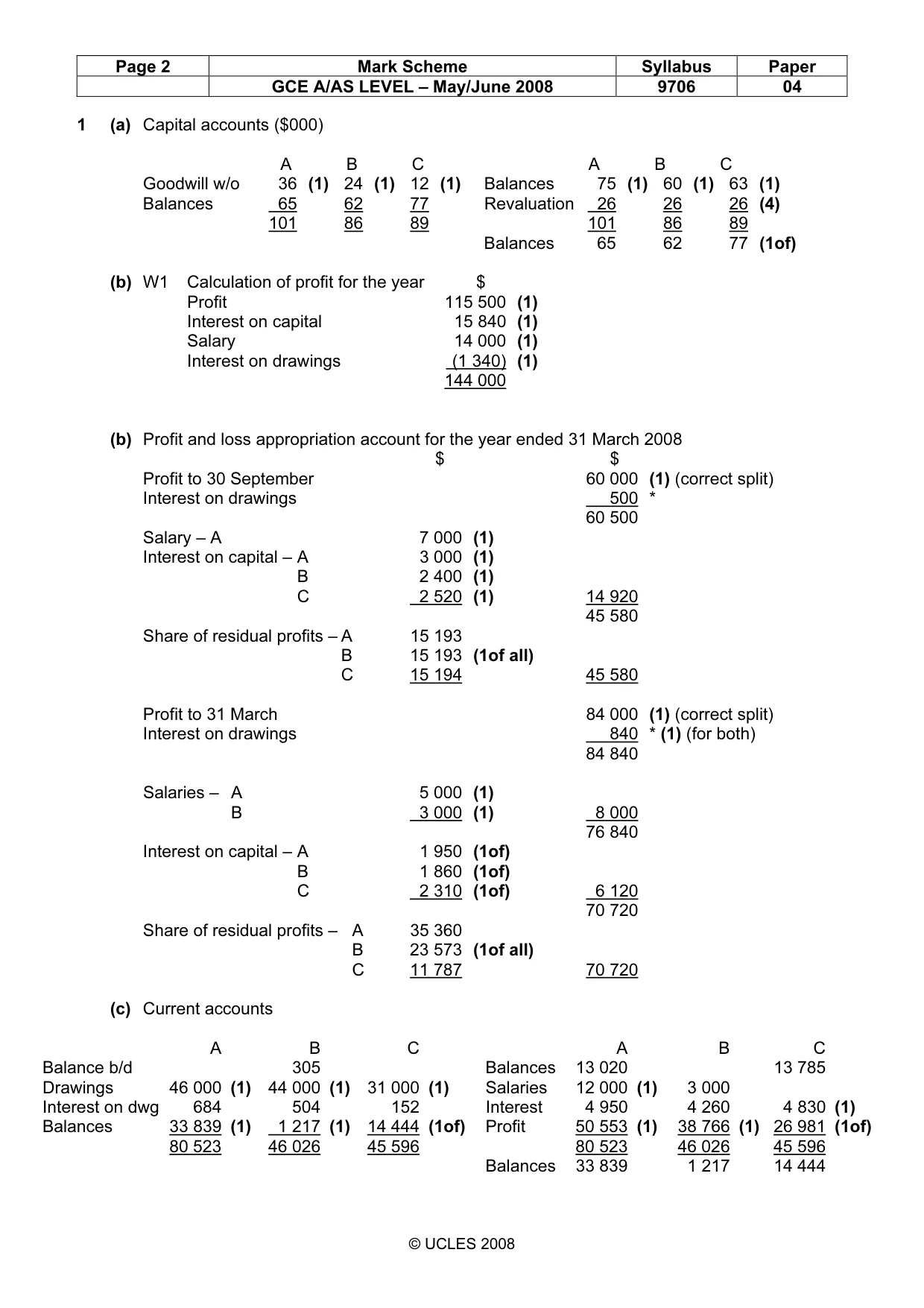
Page 2 Mark Scheme Syllabus Paper GCE A/AS LEVEL – May/June 2008 9706 04 © UCLES 2008 1 (a) Capital accounts ($000) A B C A B C Goodwill w/o 36 (1) 24 (1) 12 (1) Balances 75 (1) 60 (1) 63 (1) Balances 65 62 77 Revaluation 26 26 26 (4) 101 86 89 101 86 89 Balances 65 62 77 (1of) (b) W1 Calculation of profit for the year $ Profit 115 500 (1) Interest on capital 15 840 (1) Salary 14 000 (1) Interest on drawings (1 340) (1) 144 000 (b) Profit and loss appropriation account for the year ended 31 March 2008 $ $ Profit to 30 September 60 000 (1) (correct split) Interest on drawings 500 * 60 500 Salary – A 7 000 (1) Interest on capital – A 3 000 (1) B 2 400 (1) C 2 520 (1) 14 920 45 580 Share of residual profits – A 15 193 B 15 193 (1of all) C 15 194 45 580 Profit to 31 March 84 000 (1) (correct split) Interest on drawings 840 * (1) (for both) 84 840 Salaries – A 5 000 (1) B 3 000 (1) 8 000 76 840 Interest on capital – A 1 950 (1of) B 1 860 (1of) C 2 310 (1of) 6 120 70 720 Share of residual profits – A 35 360 B 23 573 (1of all) C 11 787 70 720 (c) Current accounts A B C A B C Balance b/d 305 Balances 13 020 13 785 Drawings 46 000 (1) 44 000 (1) 31 000 (1) Salaries 12 000 (1) 3 000 Interest on dwg 684 504 152 Interest 4 950 4 260 4 830 (1) Balances 33 839 (1) 1 217 (1) 14 444 (1of) Profit 50 553 (1) 38 766 (1) 26 981 (1of) 80 523 46 026 45 596 80 523 46 026 45 596 Balances 33 839 1 217 14 444
Mark scheme, page 3
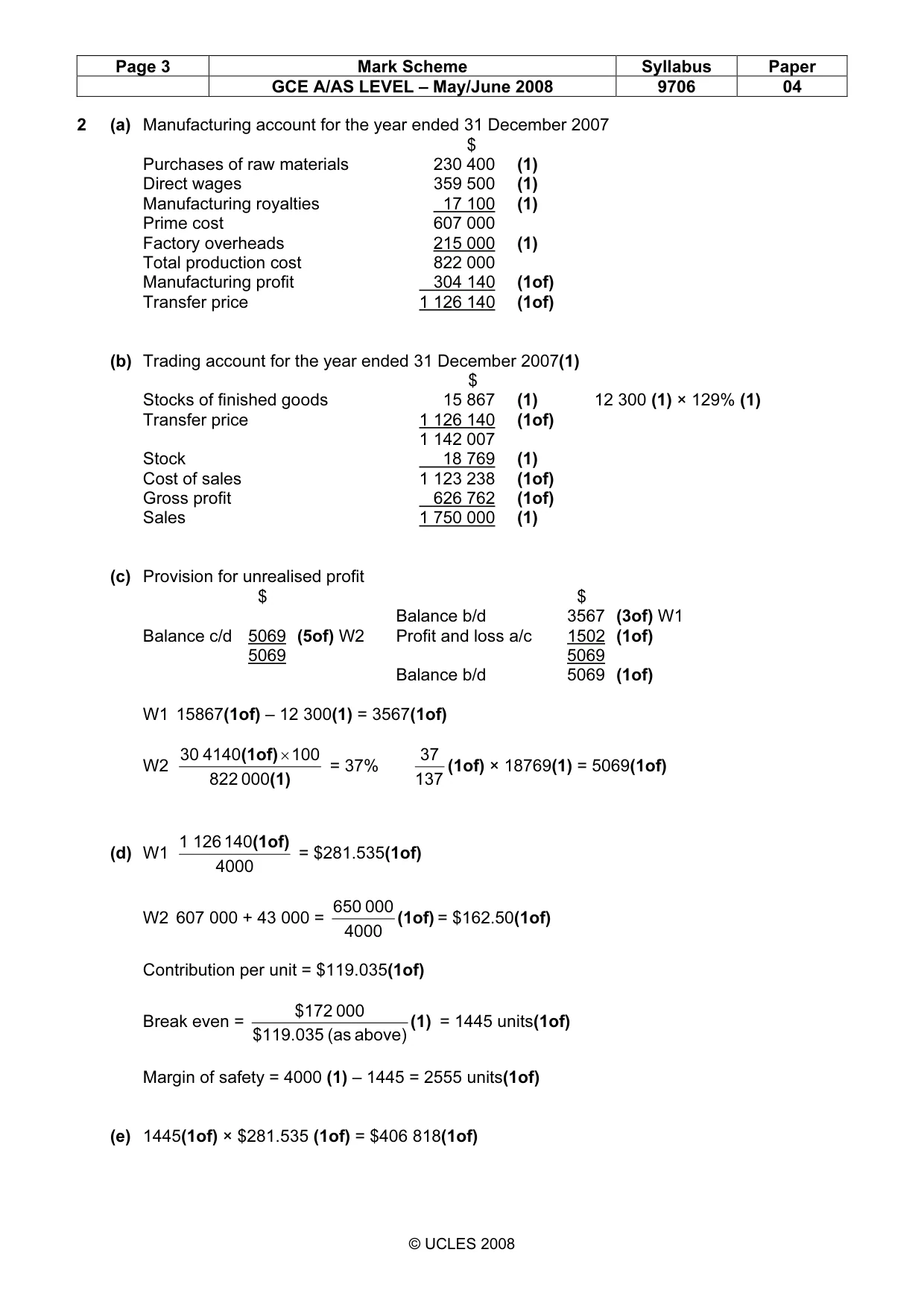
Page 3 Mark Scheme Syllabus Paper GCE A/AS LEVEL – May/June 2008 9706 04 © UCLES 2008 2 (a) Manufacturing account for the year ended 31 December 2007 $ Purchases of raw materials 230 400 (1) Direct wages 359 500 (1) Manufacturing royalties 17 100 (1) Prime cost 607 000 Factory overheads 215 000 (1) Total production cost 822 000 Manufacturing profit 304 140 (1of) Transfer price 1 126 140 (1of) (b) Trading account for the year ended 31 December 2007(1) $ Stocks of finished goods 15 867 (1) 12 300 (1) × 129% (1) Transfer price 1 126 140 (1of) 1 142 007 Stock 18 769 (1) Cost of sales 1 123 238 (1of) Gross profit 626 762 (1of) Sales 1 750 000 (1) (c) Provision for unrealised profit $ $ Balance b/d 3567 (3of) W1 Balance c/d 5069 (5of) W2 Profit and loss a/c 1502 (1of) 5069 5069 Balance b/d 5069 (1of) W1 15867(1of) – 12 300(1) = 3567(1of) W2 (1) (1of) 000 822 100 4140 30 × = 37% 137 37 (1of) × 18769(1) = 5069(1of) (d) W1 4000 140 126 1 (1of) = $281.535(1of) W2 607 000 + 43 000 = (1of) 4000 000 650 = $162.50(1of) Contribution per unit = $119.035(1of) Break even = (1) above) (as $119.035 000 $172 = 1445 units(1of) Margin of safety = 4000 (1) – 1445 = 2555 units(1of) (e) 1445(1of) × $281.535 (1of) = $406 818(1of)
Mark scheme, page 4
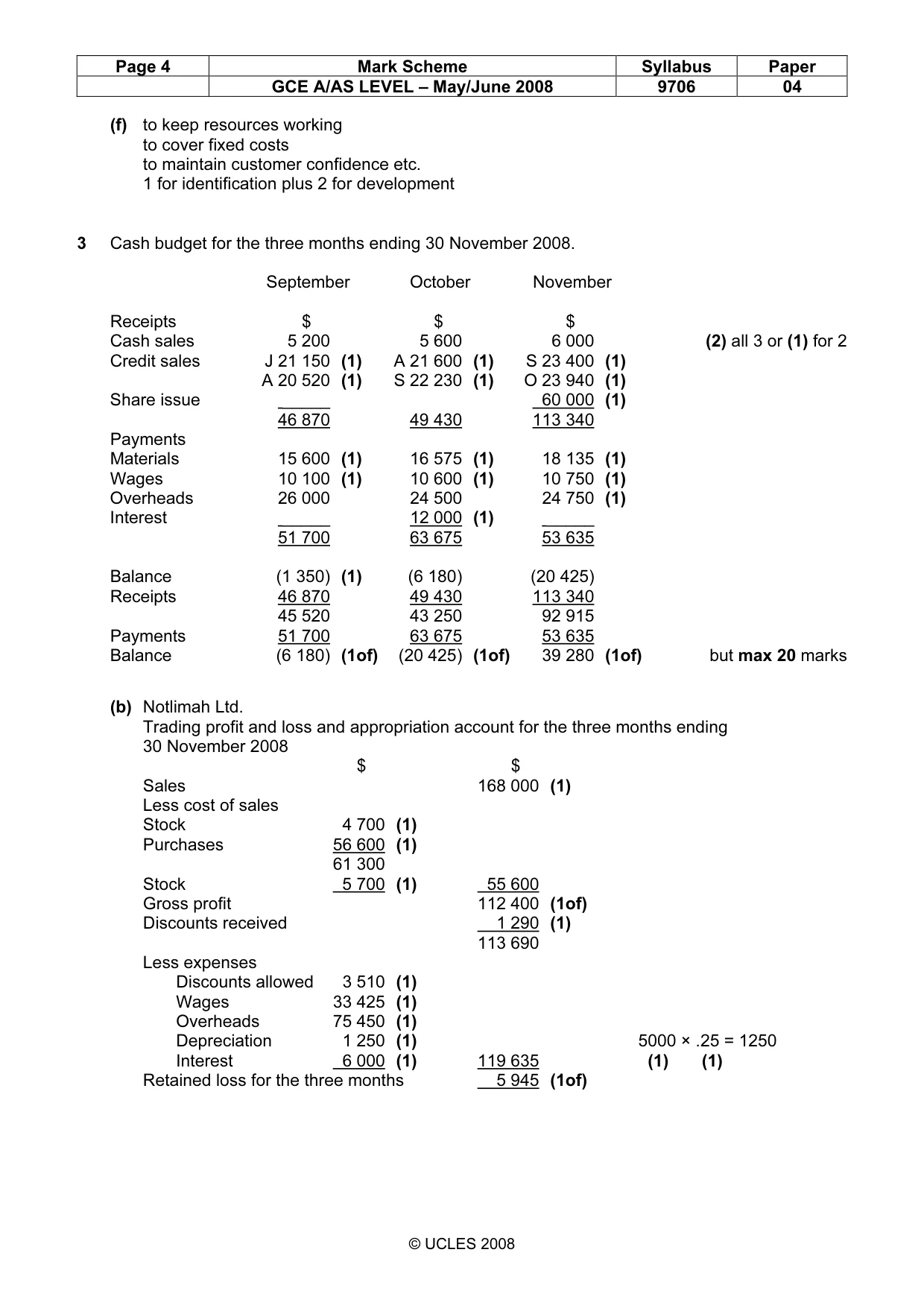
Page 4 Mark Scheme Syllabus Paper GCE A/AS LEVEL – May/June 2008 9706 04 © UCLES 2008 (f) to keep resources working to cover fixed costs to maintain customer confidence etc. 1 for identification plus 2 for development 3 Cash budget for the three months ending 30 November 2008. September October November Receipts $ $ $ Cash sales 5 200 5 600 6 000 (2) all 3 or (1) for 2 Credit sales J 21 150 (1) A 21 600 (1) S 23 400 (1) A 20 520 (1) S 22 230 (1) O 23 940 (1) Share issue _____ 60 000 (1) 46 870 49 430 113 340 Payments Materials 15 600 (1) 16 575 (1) 18 135 (1) Wages 10 100 (1) 10 600 (1) 10 750 (1) Overheads 26 000 24 500 24 750 (1) Interest _____ 12 000 (1) _____ 51 700 63 675 53 635 Balance (1 350) (1) (6 180) (20 425) Receipts 46 870 49 430 113 340 45 520 43 250 92 915 Payments 51 700 63 675 53 635 Balance (6 180) (1of) (20 425) (1of) 39 280 (1of) but max 20 marks (b) Notlimah Ltd. Trading profit and loss and appropriation account for the three months ending 30 November 2008 $ $ Sales 168 000 (1) Less cost of sales Stock 4 700 (1) Purchases 56 600 (1) 61 300 Stock 5 700 (1) 55 600 Gross profit 112 400 (1of) Discounts received 1 290 (1) 113 690 Less expenses Discounts allowed 3 510 (1) Wages 33 425 (1) Overheads 75 450 (1) Depreciation 1 250 (1) 5000 × .25 = 1250 Interest 6 000 (1) 119 635 (1) (1) Retained loss for the three months 5 945 (1of)
Mark scheme, page 5
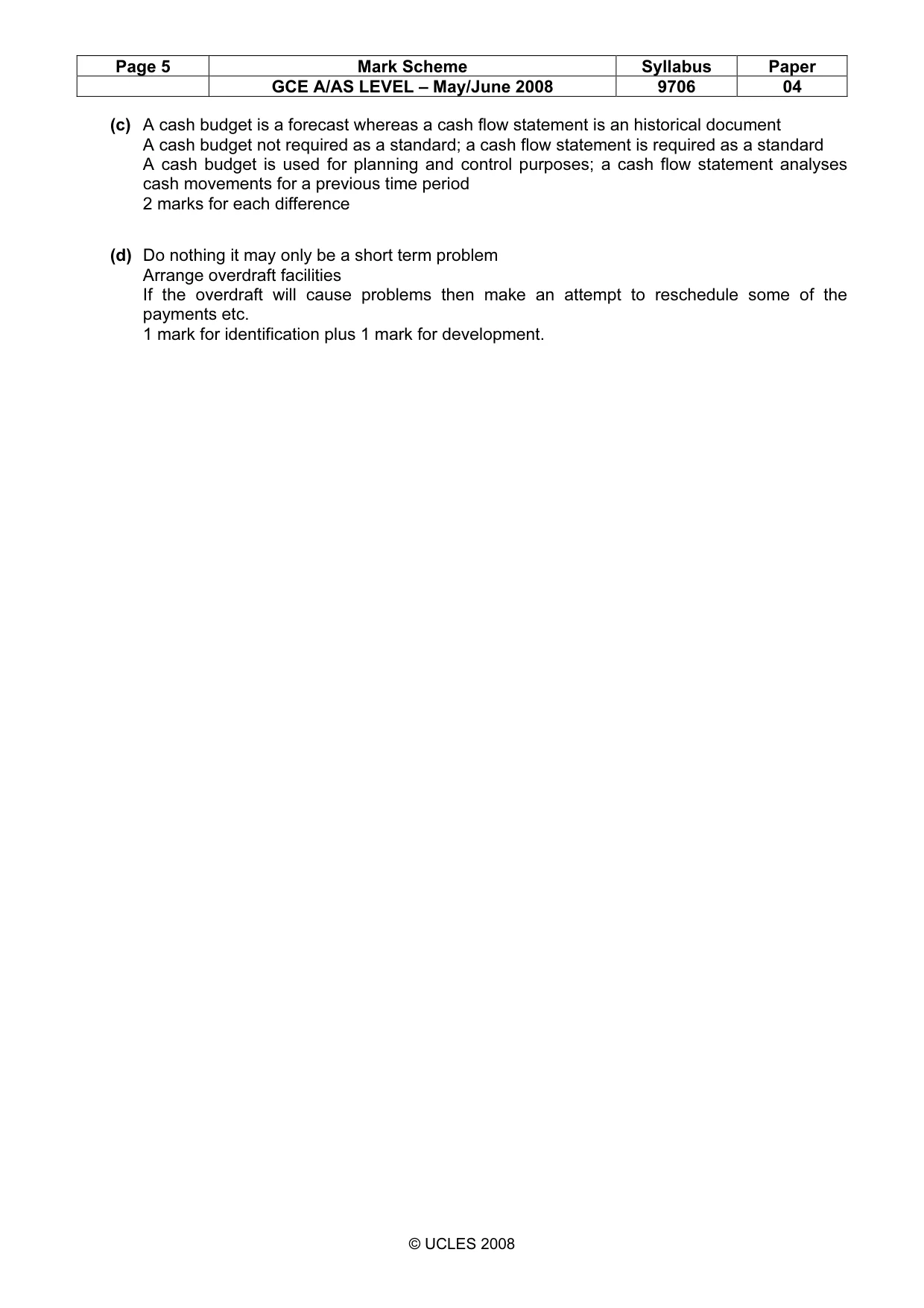
Page 5 Mark Scheme Syllabus Paper GCE A/AS LEVEL – May/June 2008 9706 04 © UCLES 2008 (c) A cash budget is a forecast whereas a cash flow statement is an historical document A cash budget not required as a standard; a cash flow statement is required as a standard A cash budget is used for planning and control purposes; a cash flow statement analyses cash movements for a previous time period 2 marks for each difference (d) Do nothing it may only be a short term problem Arrange overdraft facilities If the overdraft will cause problems then make an attempt to reschedule some of the payments etc. 1 mark for identification plus 1 mark for development.
What you needed in this session
Cambridge’s own grade thresholds for 2008 May/June, Paper 4 · Variant 1. A higher threshold means an easier paper — the bar moves with how the cohort did.