Cambridge A Level Accounting 9706 — 2007 Oct/Nov Paper 4 · Variant 1
9706/41/O/N/07 · 120 marks · ≈135 min
The question paper and its mark scheme, free to read here and free to download. This is Cambridge’s own paper, exactly as it was sat.
Question paper8 pages

Mark scheme8 pages
Answers below. Sit the paper first if you are practising.
Paper as text
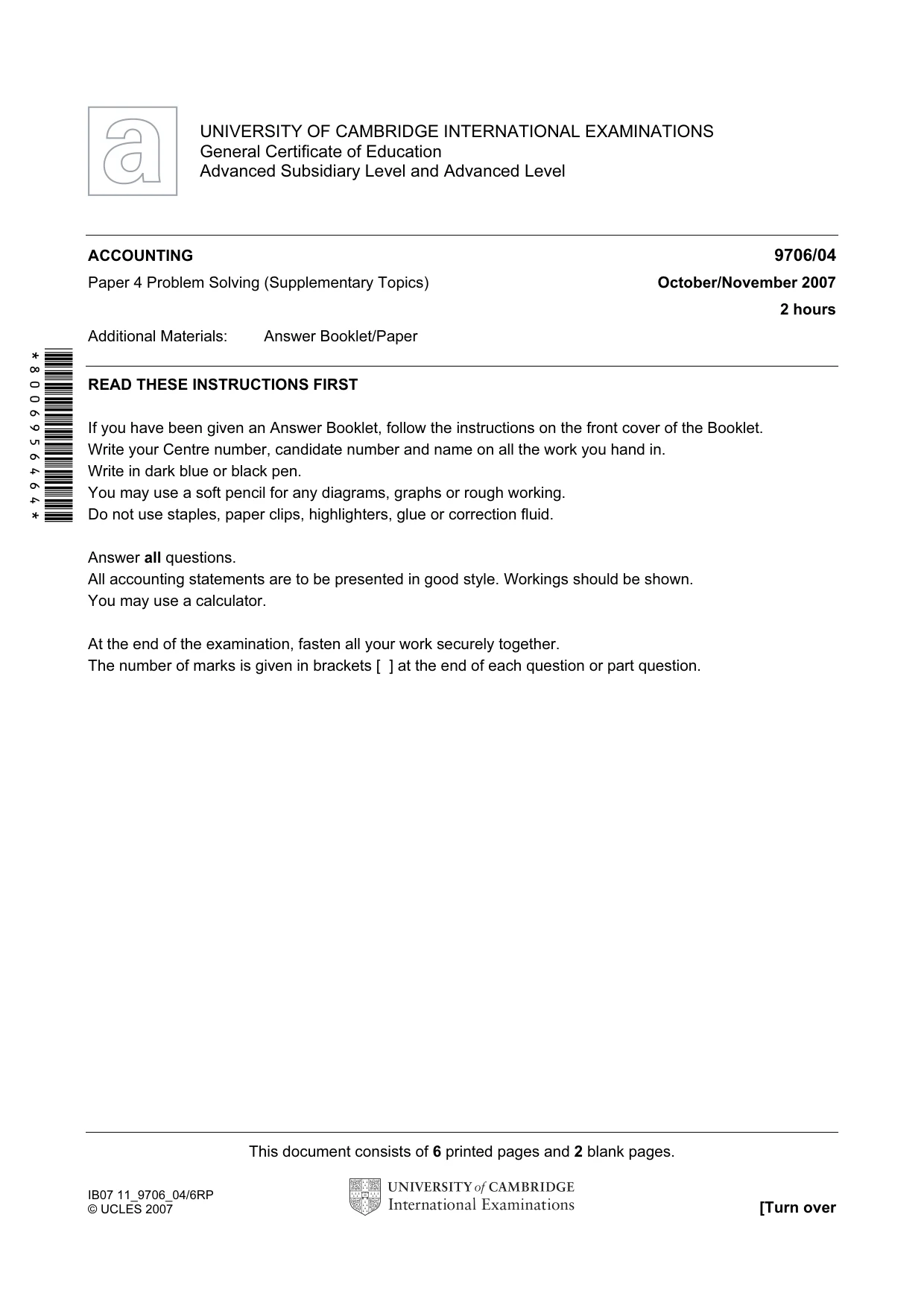
Question paper, page 1
This document consists of 6 printed pages and 2 blank pages. IB07 11_9706_04/6RP © UCLES 2007 [Turn over *8006956464* UNIVERSITY OF CAMBRIDGE INTERNATIONAL EXAMINATIONS General Certificate of Education Advanced Subsidiary Level and Advanced Level ACCOUNTING 9706/04 Paper 4 Problem Solving (Supplementary Topics) October/November 2007 2 hours Additional Materials: Answer Booklet/Paper READ THESE INSTRUCTIONS FIRST If you have been given an Answer Booklet, follow the instructions on the front cover of the Booklet. Write your Centre number, candidate number and name on all the work you hand in. Write in dark blue or black pen. You may use a soft pencil for any diagrams, graphs or rough working. Do not use staples, paper clips, highlighters, glue or correction fluid. Answer all questions. All accounting statements are to be presented in good style. Workings should be shown. You may use a calculator. At the end of the examination, fasten all your work securely together. The number of marks is given in brackets [ ] at the end of each question or part question.
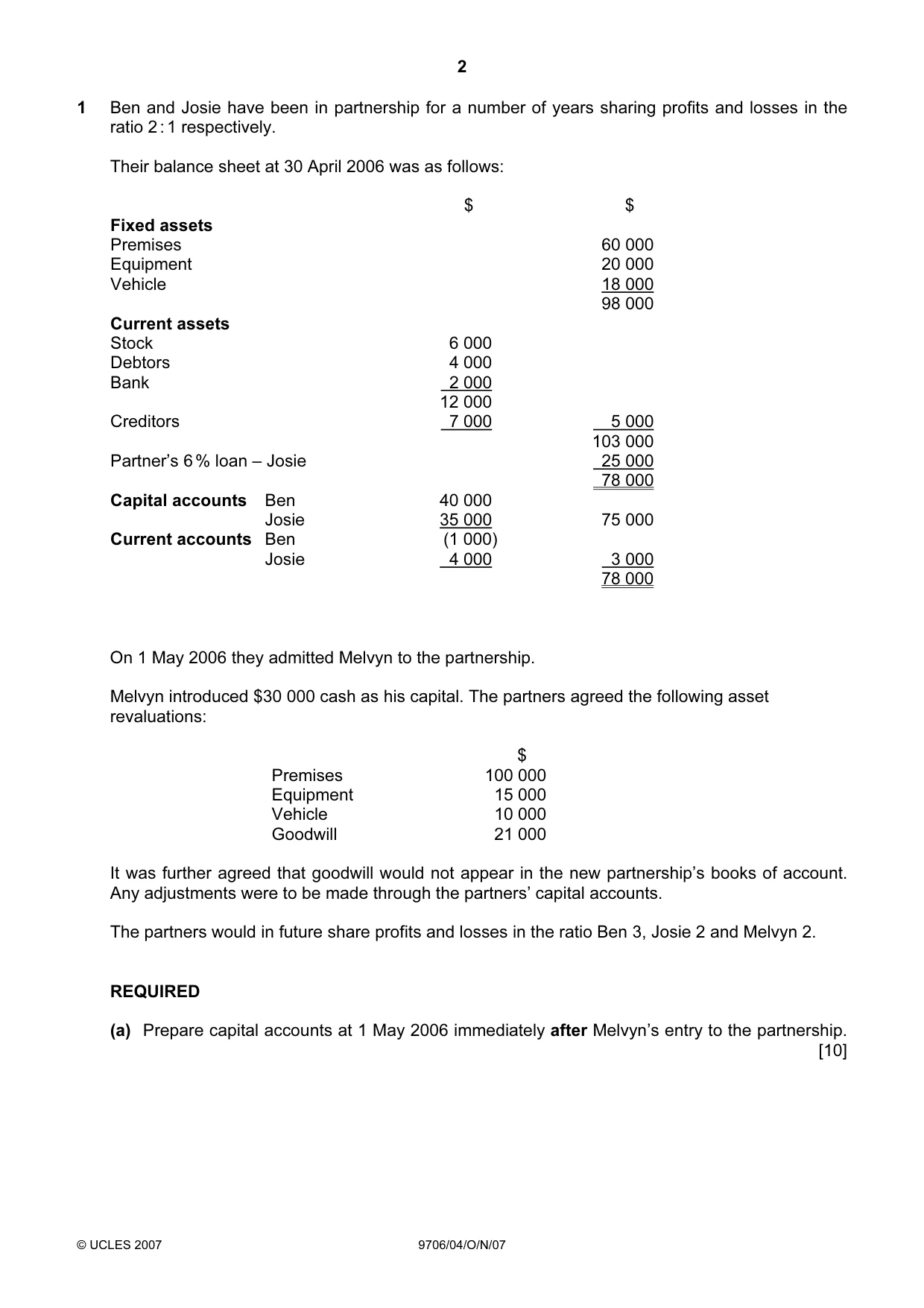
Question paper, page 2
2 © UCLES 2007 9706/04/O/N/07 1 Ben and Josie have been in partnership for a number of years sharing profits and losses in the ratio 2 : 1 respectively. Their balance sheet at 30 April 2006 was as follows: $ $ Fixed assets Premises 60 000 Equipment 20 000 Vehicle 18 000 98 000 Current assets Stock 6 000 Debtors 4 000 Bank 2 000 12 000 Creditors 7 000 5 000 103 000 Partner’s 6 % loan – Josie 25 000 78 000 Capital accounts Ben 40 000 Josie 35 000 75 000 Current accounts Ben (1 000) Josie 4 000 3 000 78 000 On 1 May 2006 they admitted Melvyn to the partnership. Melvyn introduced $30 000 cash as his capital. The partners agreed the following asset revaluations: $ Premises 100 000 Equipment 15 000 Vehicle 10 000 Goodwill 21 000 It was further agreed that goodwill would not appear in the new partnership’s books of account. Any adjustments were to be made through the partners’ capital accounts. The partners would in future share profits and losses in the ratio Ben 3, Josie 2 and Melvyn 2. REQUIRED (a) Prepare capital accounts at 1 May 2006 immediately after Melvyn’s entry to the partnership. [10]
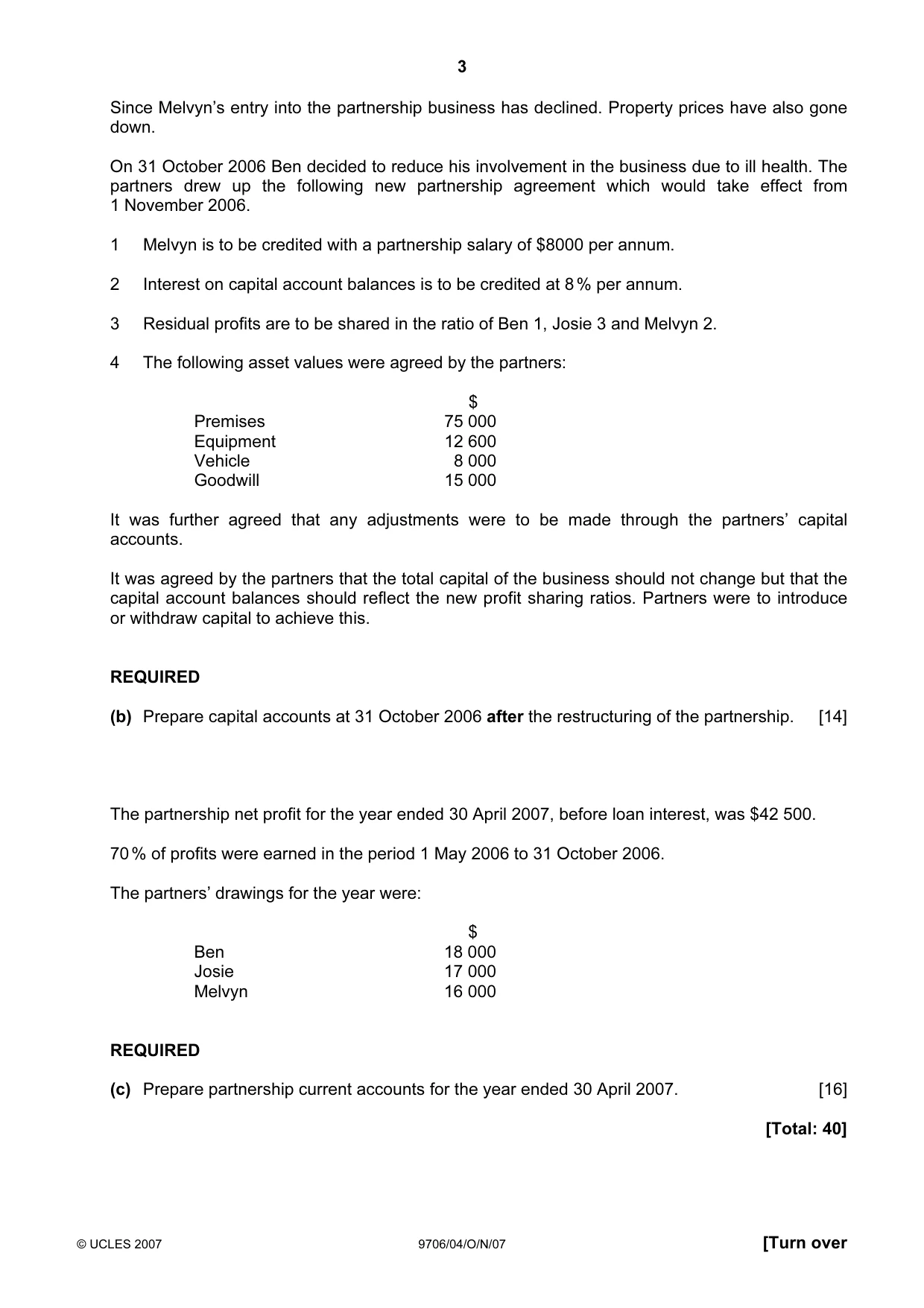
Question paper, page 3
3 © UCLES 2007 9706/04/O/N/07 [Turn over Since Melvyn’s entry into the partnership business has declined. Property prices have also gone down. On 31 October 2006 Ben decided to reduce his involvement in the business due to ill health. The partners drew up the following new partnership agreement which would take effect from 1 November 2006. 1 Melvyn is to be credited with a partnership salary of $8000 per annum. 2 Interest on capital account balances is to be credited at 8 % per annum. 3 Residual profits are to be shared in the ratio of Ben 1, Josie 3 and Melvyn 2. 4 The following asset values were agreed by the partners: $ Premises 75 000 Equipment 12 600 Vehicle 8 000 Goodwill 15 000 It was further agreed that any adjustments were to be made through the partners’ capital accounts. It was agreed by the partners that the total capital of the business should not change but that the capital account balances should reflect the new profit sharing ratios. Partners were to introduce or withdraw capital to achieve this. REQUIRED (b) Prepare capital accounts at 31 October 2006 after the restructuring of the partnership. [14] The partnership net profit for the year ended 30 April 2007, before loan interest, was $42 500. 70 % of profits were earned in the period 1 May 2006 to 31 October 2006. The partners’ drawings for the year were: $ Ben 18 000 Josie 17 000 Melvyn 16 000 REQUIRED (c) Prepare partnership current accounts for the year ended 30 April 2007. [16] [Total: 40]
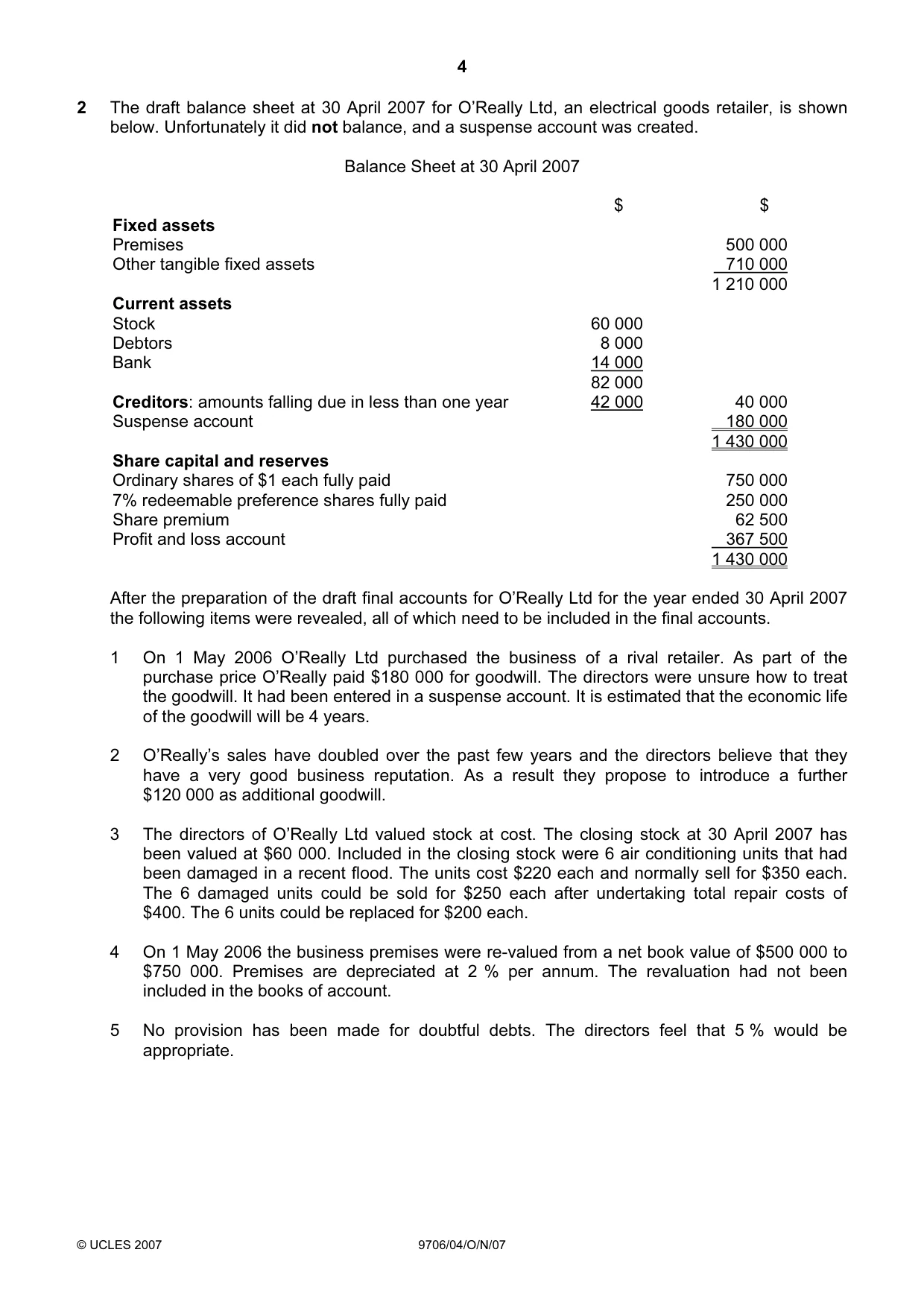
Question paper, page 4
4 © UCLES 2007 9706/04/O/N/07 2 The draft balance sheet at 30 April 2007 for O’Really Ltd, an electrical goods retailer, is shown below. Unfortunately it did not balance, and a suspense account was created. Balance Sheet at 30 April 2007 $ $ Fixed assets Premises 500 000 Other tangible fixed assets 710 000 1 210 000 Current assets Stock 60 000 Debtors 8 000 Bank 14 000 82 000 Creditors: amounts falling due in less than one year 42 000 40 000 Suspense account 180 000 1 430 000 Share capital and reserves Ordinary shares of $1 each fully paid 750 000 7% redeemable preference shares fully paid 250 000 Share premium 62 500 Profit and loss account 367 500 1 430 000 After the preparation of the draft final accounts for O’Really Ltd for the year ended 30 April 2007 the following items were revealed, all of which need to be included in the final accounts. 1 On 1 May 2006 O’Really Ltd purchased the business of a rival retailer. As part of the purchase price O’Really paid $180 000 for goodwill. The directors were unsure how to treat the goodwill. It had been entered in a suspense account. It is estimated that the economic life of the goodwill will be 4 years. 2 O’Really’s sales have doubled over the past few years and the directors believe that they have a very good business reputation. As a result they propose to introduce a further $120 000 as additional goodwill. 3 The directors of O’Really Ltd valued stock at cost. The closing stock at 30 April 2007 has been valued at $60 000. Included in the closing stock were 6 air conditioning units that had been damaged in a recent flood. The units cost $220 each and normally sell for $350 each. The 6 damaged units could be sold for $250 each after undertaking total repair costs of $400. The 6 units could be replaced for $200 each. 4 On 1 May 2006 the business premises were re-valued from a net book value of $500 000 to $750 000. Premises are depreciated at 2 % per annum. The revaluation had not been included in the books of account. 5 No provision has been made for doubtful debts. The directors feel that 5 % would be appropriate.
Question paper, page 5
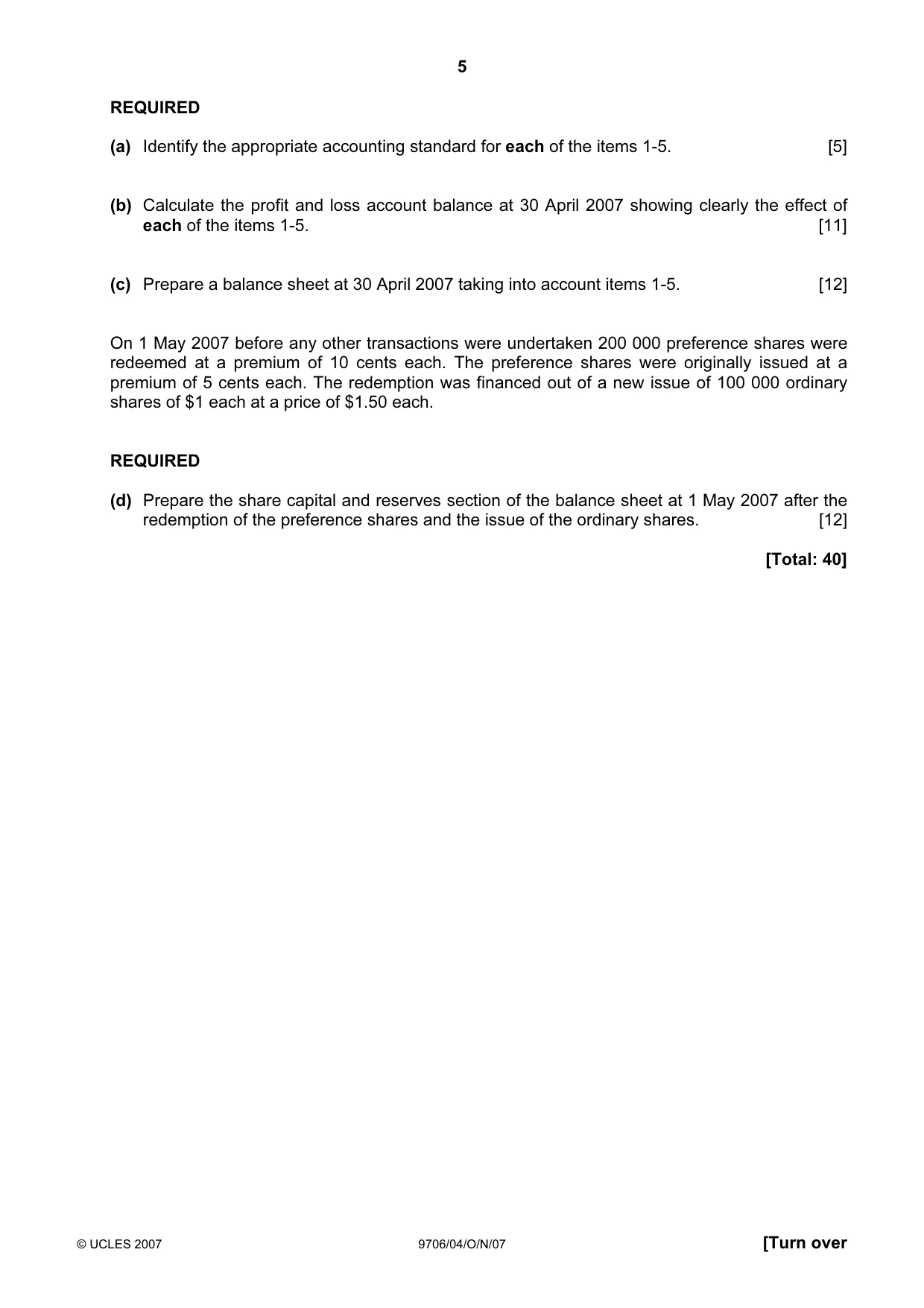
5 © UCLES 2007 9706/04/O/N/07 [Turn over REQUIRED (a) Identify the appropriate accounting standard for each of the items 1-5. [5] (b) Calculate the profit and loss account balance at 30 April 2007 showing clearly the effect of each of the items 1-5. [11] (c) Prepare a balance sheet at 30 April 2007 taking into account items 1-5. [12] On 1 May 2007 before any other transactions were undertaken 200 000 preference shares were redeemed at a premium of 10 cents each. The preference shares were originally issued at a premium of 5 cents each. The redemption was financed out of a new issue of 100 000 ordinary shares of $1 each at a price of $1.50 each. REQUIRED (d) Prepare the share capital and reserves section of the balance sheet at 1 May 2007 after the redemption of the preference shares and the issue of the ordinary shares. [12] [Total: 40]
Question paper, page 6
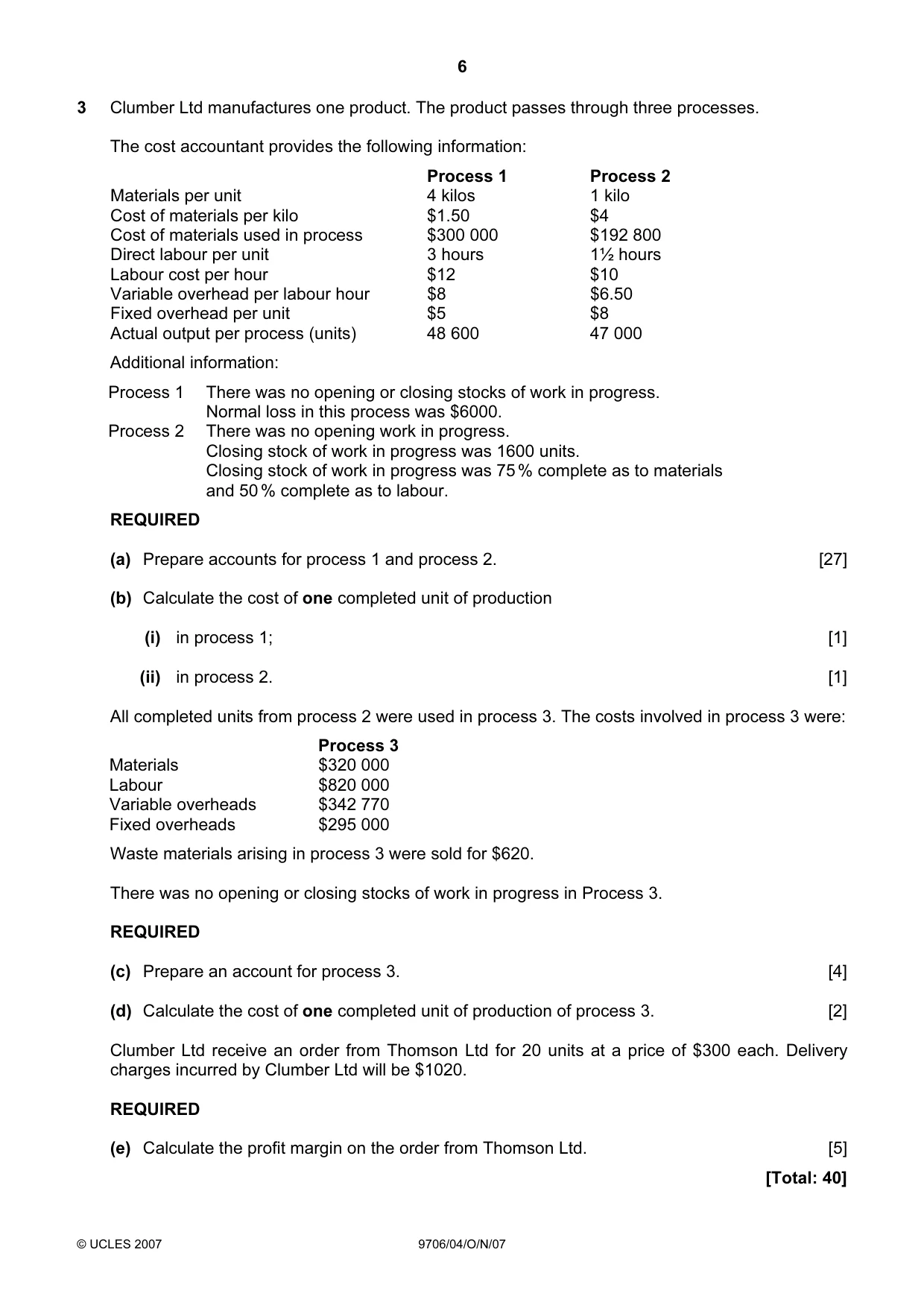
6 © UCLES 2007 9706/04/O/N/07 3 Clumber Ltd manufactures one product. The product passes through three processes. The cost accountant provides the following information: Process 1 Process 2 Materials per unit 4 kilos 1 kilo Cost of materials per kilo $1.50 $4 Cost of materials used in process $300 000 $192 800 Direct labour per unit 3 hours 1½ hours Labour cost per hour $12 $10 Variable overhead per labour hour $8 $6.50 Fixed overhead per unit $5 $8 Actual output per process (units) 48 600 47 000 Additional information: Process 1 There was no opening or closing stocks of work in progress. Normal loss in this process was $6000. Process 2 There was no opening work in progress. Closing stock of work in progress was 1600 units. Closing stock of work in progress was 75 % complete as to materials and 50 % complete as to labour. REQUIRED (a) Prepare accounts for process 1 and process 2. [27] (b) Calculate the cost of one completed unit of production (i) in process 1; [1] (ii) in process 2. [1] All completed units from process 2 were used in process 3. The costs involved in process 3 were: Process 3 Materials $320 000 Labour $820 000 Variable overheads $342 770 Fixed overheads $295 000 Waste materials arising in process 3 were sold for $620. There was no opening or closing stocks of work in progress in Process 3. REQUIRED (c) Prepare an account for process 3. [4] (d) Calculate the cost of one completed unit of production of process 3. [2] Clumber Ltd receive an order from Thomson Ltd for 20 units at a price of $300 each. Delivery charges incurred by Clumber Ltd will be $1020. REQUIRED (e) Calculate the profit margin on the order from Thomson Ltd. [5] [Total: 40]
Question paper, page 8
8 BLANK PAGE Permission to reproduce items where third-party owned material protected by copyright is included has been sought and cleared where possible. Every reasonable effort has been made by the publisher (UCLES) to trace copyright holders, but if any items requiring clearance have unwittingly been included, the publisher will be pleased to make amends at the earliest possible opportunity. University of Cambridge International Examinations is part of the Cambridge Assessment Group. Cambridge Assessment is the brand name of University of Cambridge Local Examinations Syndicate (UCLES), which is itself a department of the University of Cambridge. 9706/04/O/N/07
Mark scheme, page 1
UNIVERSITY OF CAMBRIDGE INTERNATIONAL EXAMINATIONS GCE Advanced Subsidiary Level and GCE Advanced Level MARK SCHEME for the October/November 2007 question paper 9706 ACCOUNTING 9706/04 Paper 4 (Problem Solving (Supplement)), maximum raw mark 120 This mark scheme is published as an aid to teachers and candidates, to indicate the requirements of the examination. It shows the basis on which Examiners were instructed to award marks. It does not indicate the details of the discussions that took place at an Examiners’ meeting before marking began. All Examiners are instructed that alternative correct answers and unexpected approaches in candidates’ scripts must be given marks that fairly reflect the relevant knowledge and skills demonstrated. Mark schemes must be read in conjunction with the question papers and the report on the examination. • CIE will not enter into discussions or correspondence in connection with these mark schemes. CIE is publishing the mark schemes for the October/November 2007 question papers for most IGCSE, GCE Advanced Level and Advanced Subsidiary Level syllabuses and some Ordinary Level syllabuses.
Mark scheme, page 2
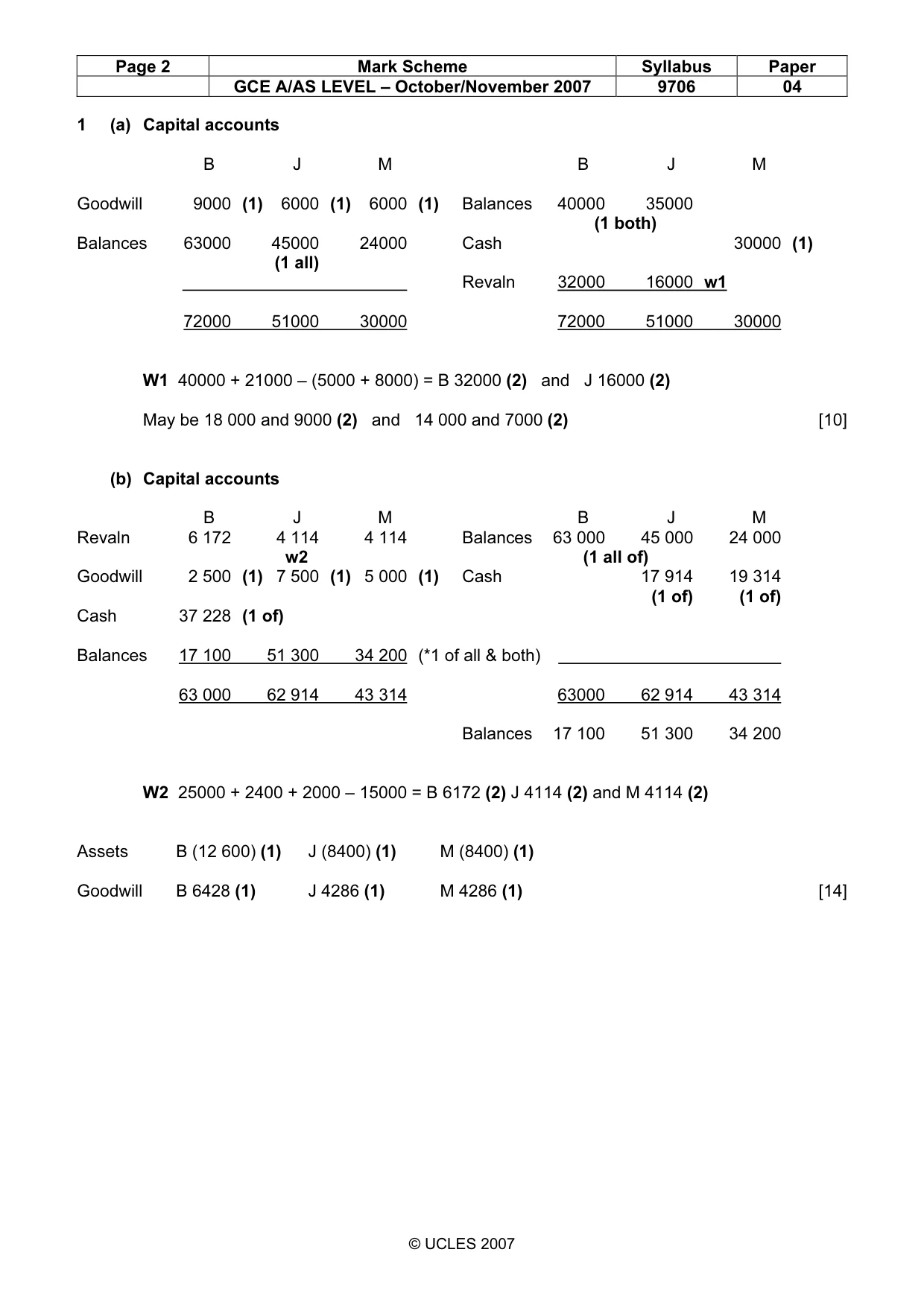
Page 2 Mark Scheme Syllabus Paper GCE A/AS LEVEL – October/November 2007 9706 04 © UCLES 2007 1 (a) Capital accounts B J M B J M Goodwill 9000 (1) 6000 (1) 6000 (1) Balances 40000 35000 (1 both) Balances 63000 45000 24000 Cash 30000 (1) (1 all) Revaln 32000 16000 w1 72000 51000 30000 72000 51000 30000 W1 40000 + 21000 – (5000 + 8000) = B 32000 (2) and J 16000 (2) May be 18 000 and 9000 (2) and 14 000 and 7000 (2) [10] (b) Capital accounts B J M B J M Revaln 6 172 4 114 4 114 Balances 63 000 45 000 24 000 w2 (1 all of) Goodwill 2 500 (1) 7 500 (1) 5 000 (1) Cash 17 914 19 314 (1 of) (1 of) Cash 37 228 (1 of) Balances 17 100 51 300 34 200 (*1 of all & both) 63 000 62 914 43 314 63000 62 914 43 314 Balances 17 100 51 300 34 200 W2 25000 + 2400 + 2000 – 15000 = B 6172 (2) J 4114 (2) and M 4114 (2) Assets B (12 600) (1) J (8400) (1) M (8400) (1) Goodwill B 6428 (1) J 4286 (1) M 4286 (1) [14]
Mark scheme, page 3
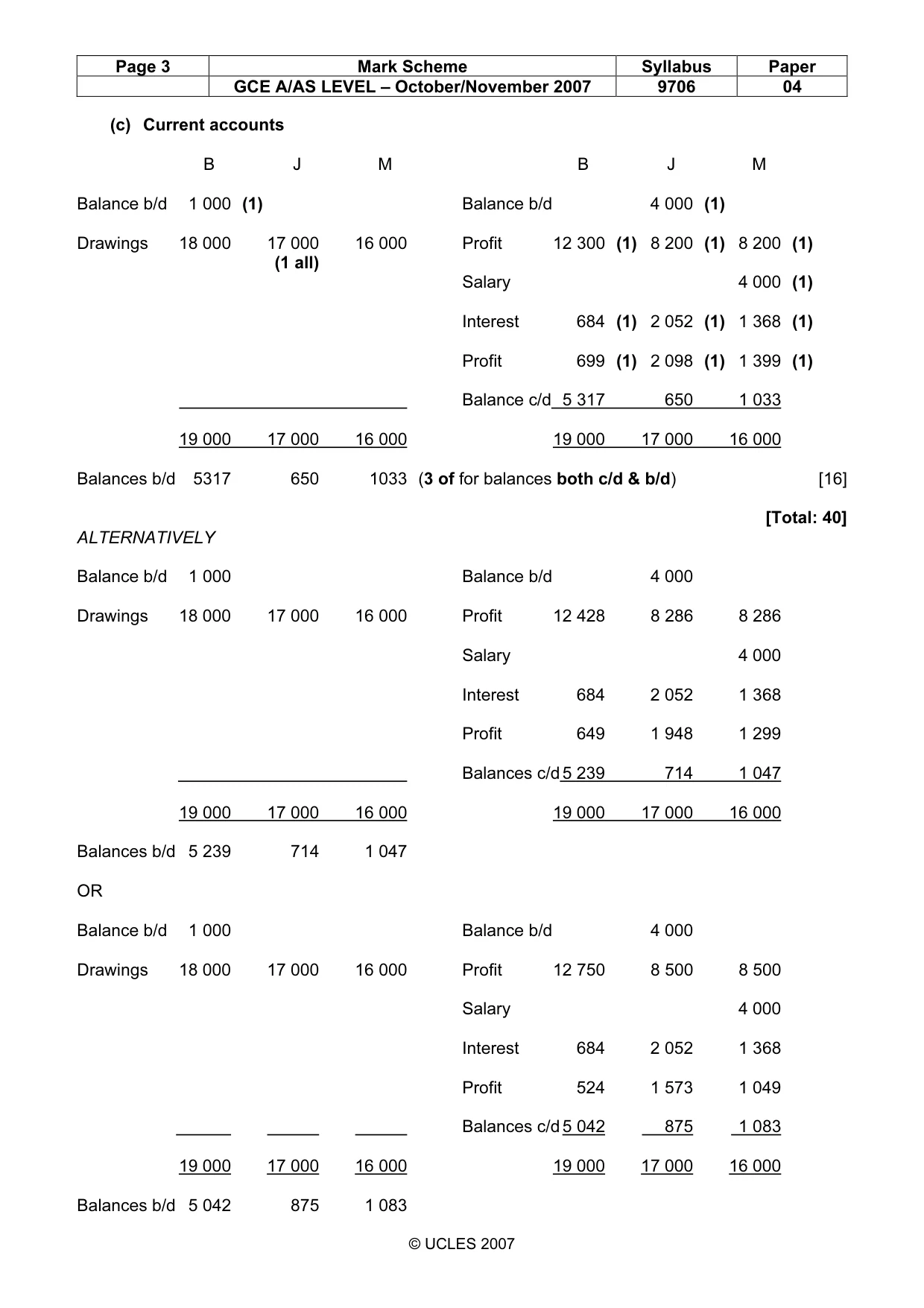
Page 3 Mark Scheme Syllabus Paper GCE A/AS LEVEL – October/November 2007 9706 04 © UCLES 2007 (c) Current accounts B J M B J M Balance b/d 1 000 (1) Balance b/d 4 000 (1) Drawings 18 000 17 000 16 000 Profit 12 300 (1) 8 200 (1) 8 200 (1) (1 all) Salary 4 000 (1) Interest 684 (1) 2 052 (1) 1 368 (1) Profit 699 (1) 2 098 (1) 1 399 (1) Balance c/d 5 317 650 1 033 19 000 17 000 16 000 19 000 17 000 16 000 Balances b/d 5317 650 1033 (3 of for balances both c/d & b/d) [16] [Total: 40] ALTERNATIVELY Balance b/d 1 000 Balance b/d 4 000 Drawings 18 000 17 000 16 000 Profit 12 428 8 286 8 286 Salary 4 000 Interest 684 2 052 1 368 Profit 649 1 948 1 299 Balances c/d 5 239 714 1 047 19 000 17 000 16 000 19 000 17 000 16 000 Balances b/d 5 239 714 1 047 OR Balance b/d 1 000 Balance b/d 4 000 Drawings 18 000 17 000 16 000 Profit 12 750 8 500 8 500 Salary 4 000 Interest 684 2 052 1 368 Profit 524 1 573 1 049 Balances c/d 5 042 875 1 083 19 000 17 000 16 000 19 000 17 000 16 000 Balances b/d 5 042 875 1 083
Mark scheme, page 4
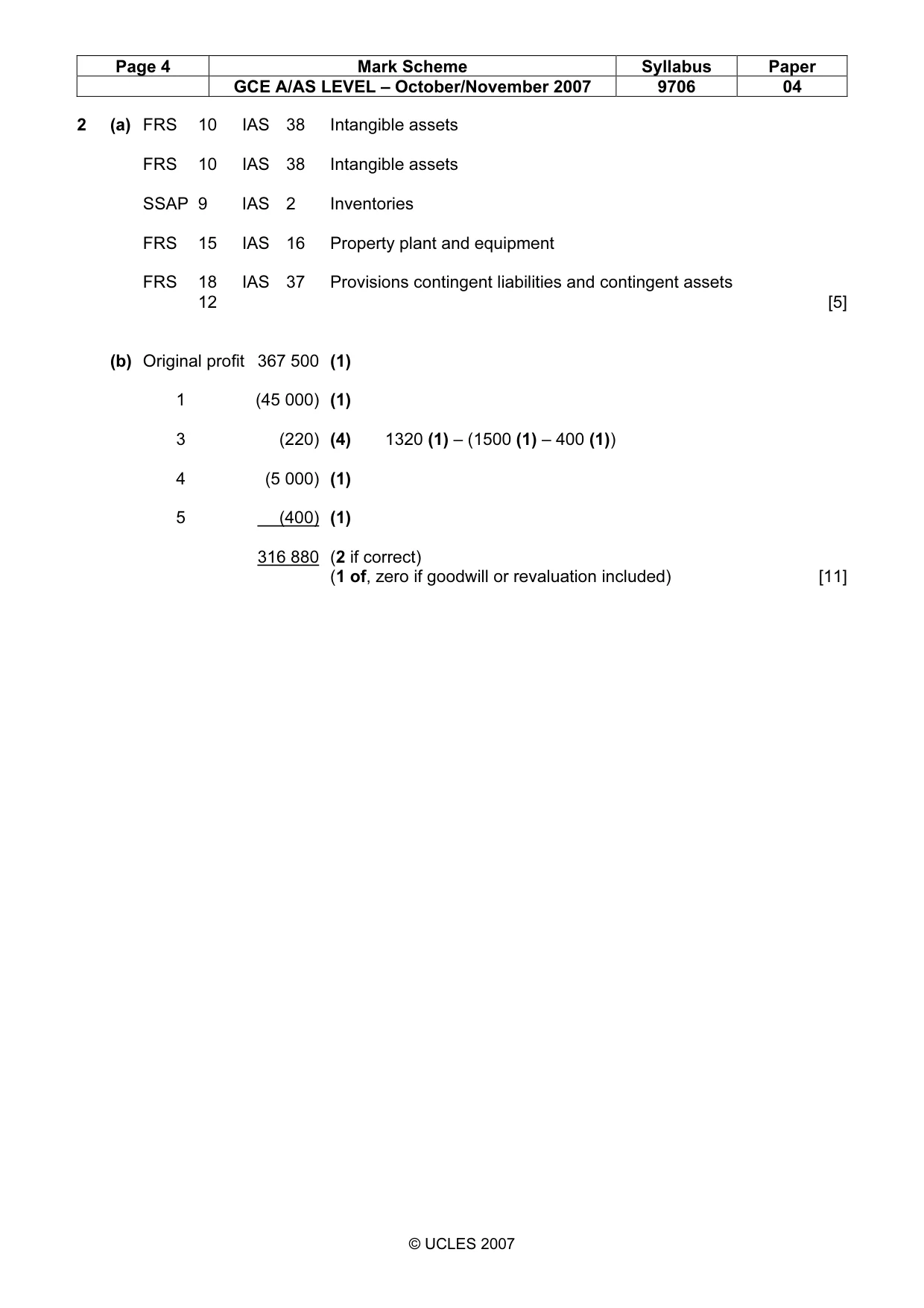
Page 4 Mark Scheme Syllabus Paper GCE A/AS LEVEL – October/November 2007 9706 04 © UCLES 2007 2 (a) FRS 10 IAS 38 Intangible assets FRS 10 IAS 38 Intangible assets SSAP 9 IAS 2 Inventories FRS 15 IAS 16 Property plant and equipment FRS 18 IAS 37 Provisions contingent liabilities and contingent assets 12 [5] (b) Original profit 367 500 (1) 1 (45 000) (1) 3 (220) (4) 1320 (1) – (1500 (1) – 400 (1)) 4 (5 000) (1) 5 (400) (1) 316 880 (2 if correct) (1 of, zero if goodwill or revaluation included) [11]
Mark scheme, page 5
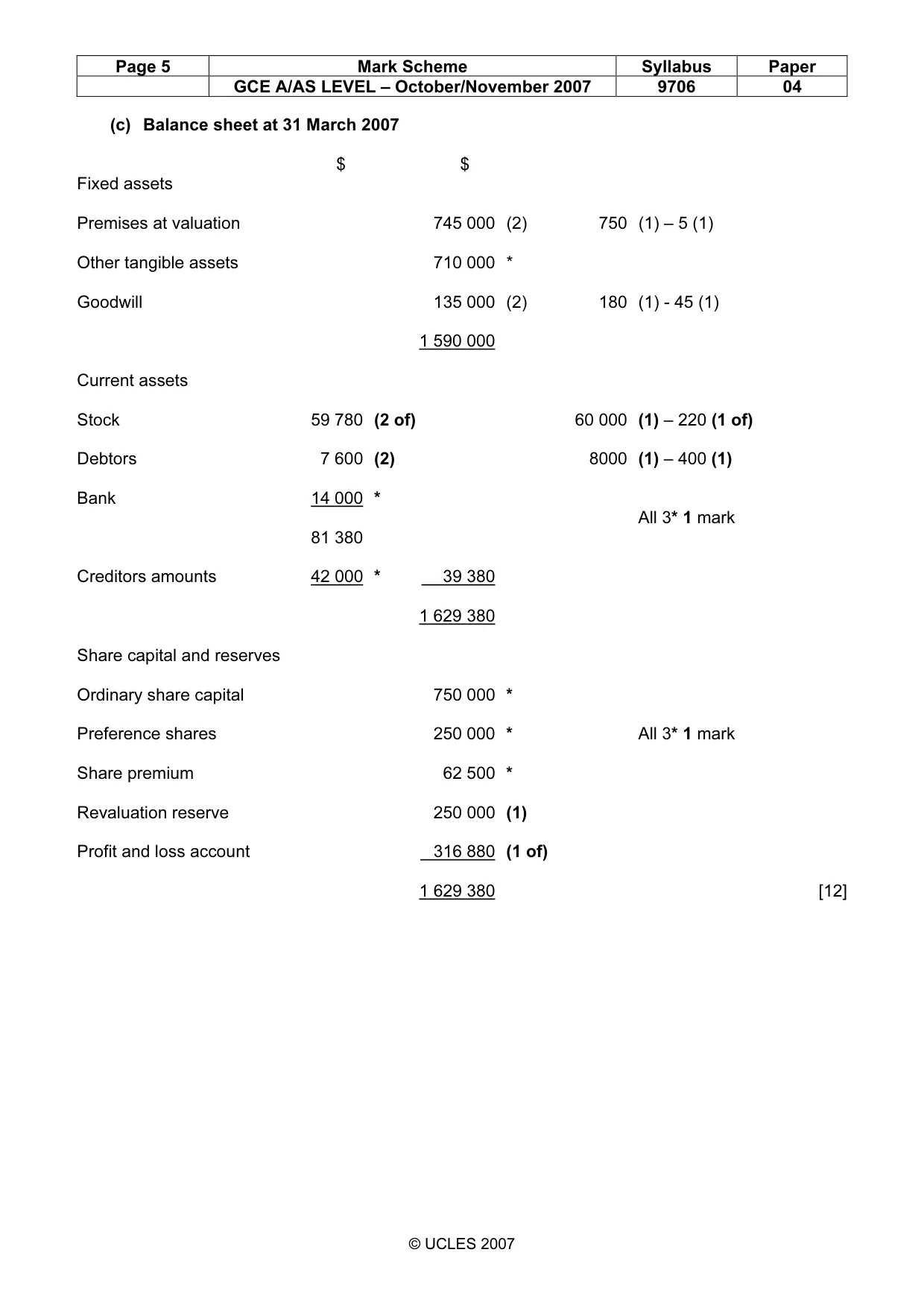
Page 5 Mark Scheme Syllabus Paper GCE A/AS LEVEL – October/November 2007 9706 04 © UCLES 2007 (c) Balance sheet at 31 March 2007 $ $ Fixed assets Premises at valuation 745 000 (2) 750 (1) – 5 (1) Other tangible assets 710 000 * Goodwill 135 000 (2) 180 (1) - 45 (1) 1 590 000 Current assets Stock 59 780 (2 of) 60 000 (1) – 220 (1 of) Debtors 7 600 (2) 8000 (1) – 400 (1) Bank 14 000 * All 3* 1 mark 81 380 Creditors amounts 42 000 * 39 380 1 629 380 Share capital and reserves Ordinary share capital 750 000 * Preference shares 250 000 * All 3* 1 mark Share premium 62 500 * Revaluation reserve 250 000 (1) Profit and loss account 316 880 (1 of) 1 629 380 [12]
Mark scheme, page 6
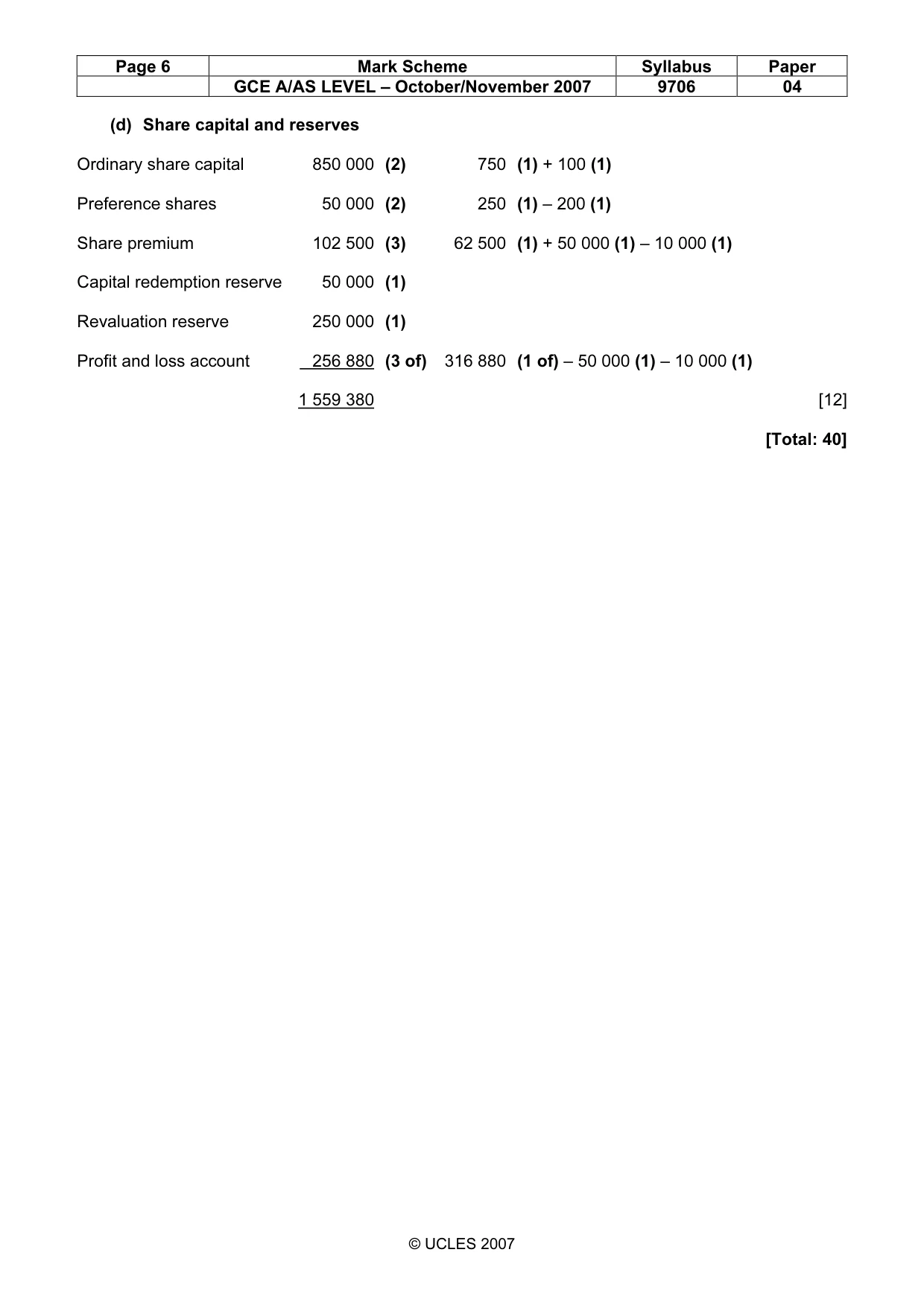
Page 6 Mark Scheme Syllabus Paper GCE A/AS LEVEL – October/November 2007 9706 04 © UCLES 2007 (d) Share capital and reserves Ordinary share capital 850 000 (2) 750 (1) + 100 (1) Preference shares 50 000 (2) 250 (1) – 200 (1) Share premium 102 500 (3) 62 500 (1) + 50 000 (1) – 10 000 (1) Capital redemption reserve 50 000 (1) Revaluation reserve 250 000 (1) Profit and loss account 256 880 (3 of) 316 880 (1 of) – 50 000 (1) – 10 000 (1) 1 559 380 [12] [Total: 40]
Mark scheme, page 7
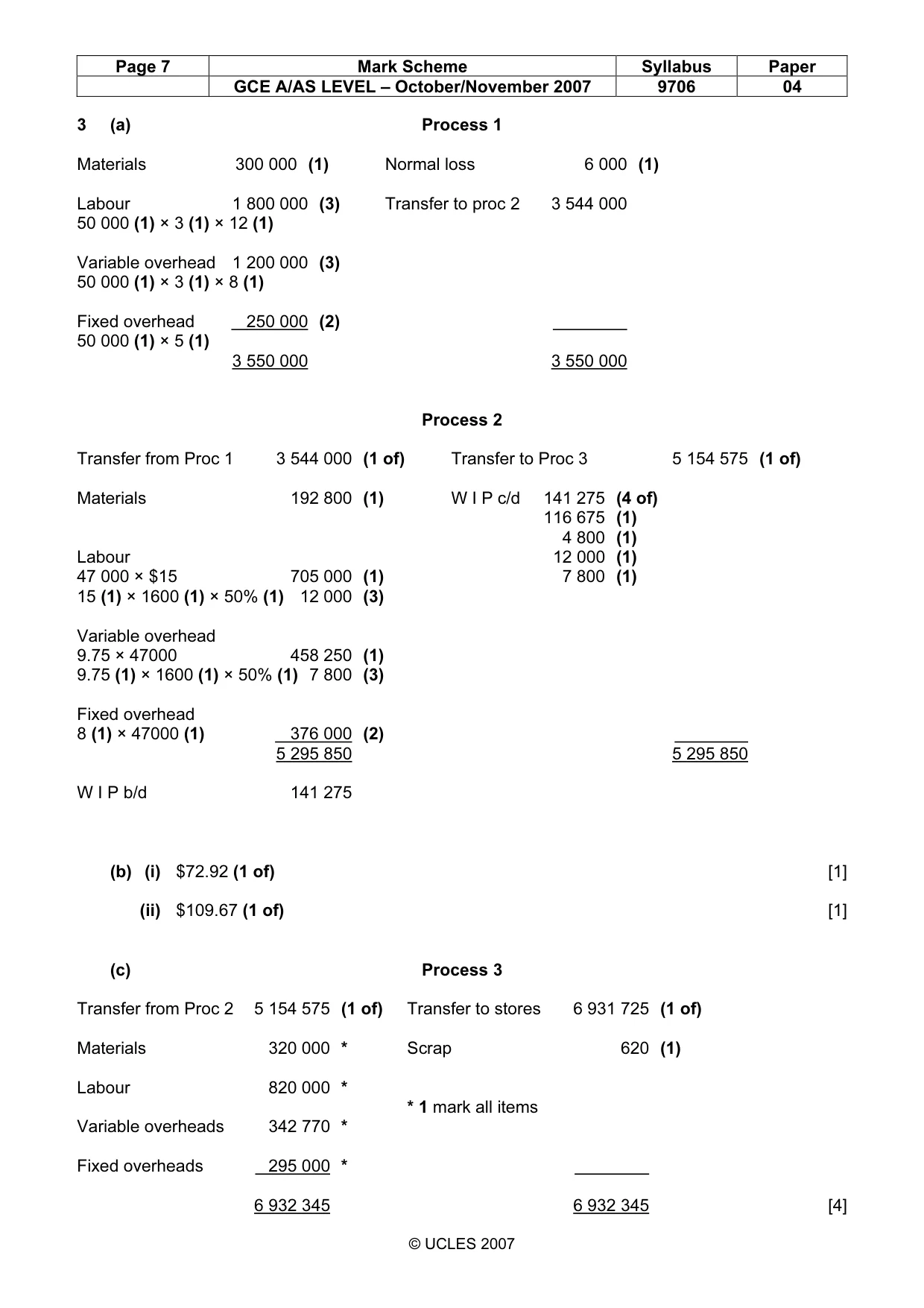
Page 7 Mark Scheme Syllabus Paper GCE A/AS LEVEL – October/November 2007 9706 04 © UCLES 2007 3 (a) Process 1 Materials 300 000 (1) Normal loss 6 000 (1) Labour 1 800 000 (3) Transfer to proc 2 3 544 000 50 000 (1) × 3 (1) × 12 (1) Variable overhead 1 200 000 (3) 50 000 (1) × 3 (1) × 8 (1) Fixed overhead 250 000 (2) 50 000 (1) × 5 (1) 3 550 000 3 550 000 Process 2 Transfer from Proc 1 3 544 000 (1 of) Transfer to Proc 3 5 154 575 (1 of) Materials 192 800 (1) W I P c/d 141 275 (4 of) 116 675 (1) 4 800 (1) Labour 12 000 (1) 47 000 × $15 705 000 (1) 7 800 (1) 15 (1) × 1600 (1) × 50% (1) 12 000 (3) Variable overhead 9.75 × 47000 458 250 (1) 9.75 (1) × 1600 (1) × 50% (1) 7 800 (3) Fixed overhead 8 (1) × 47000 (1) 376 000 (2) 5 295 850 5 295 850 W I P b/d 141 275 (b) (i) $72.92 (1 of) [1] (ii) $109.67 (1 of) [1] (c) Process 3 Transfer from Proc 2 5 154 575 (1 of) Transfer to stores 6 931 725 (1 of) Materials 320 000 * Scrap 620 (1) Labour 820 000 * * 1 mark all items Variable overheads 342 770 * Fixed overheads 295 000 * 6 932 345 6 932 345 [4]
Mark scheme, page 8
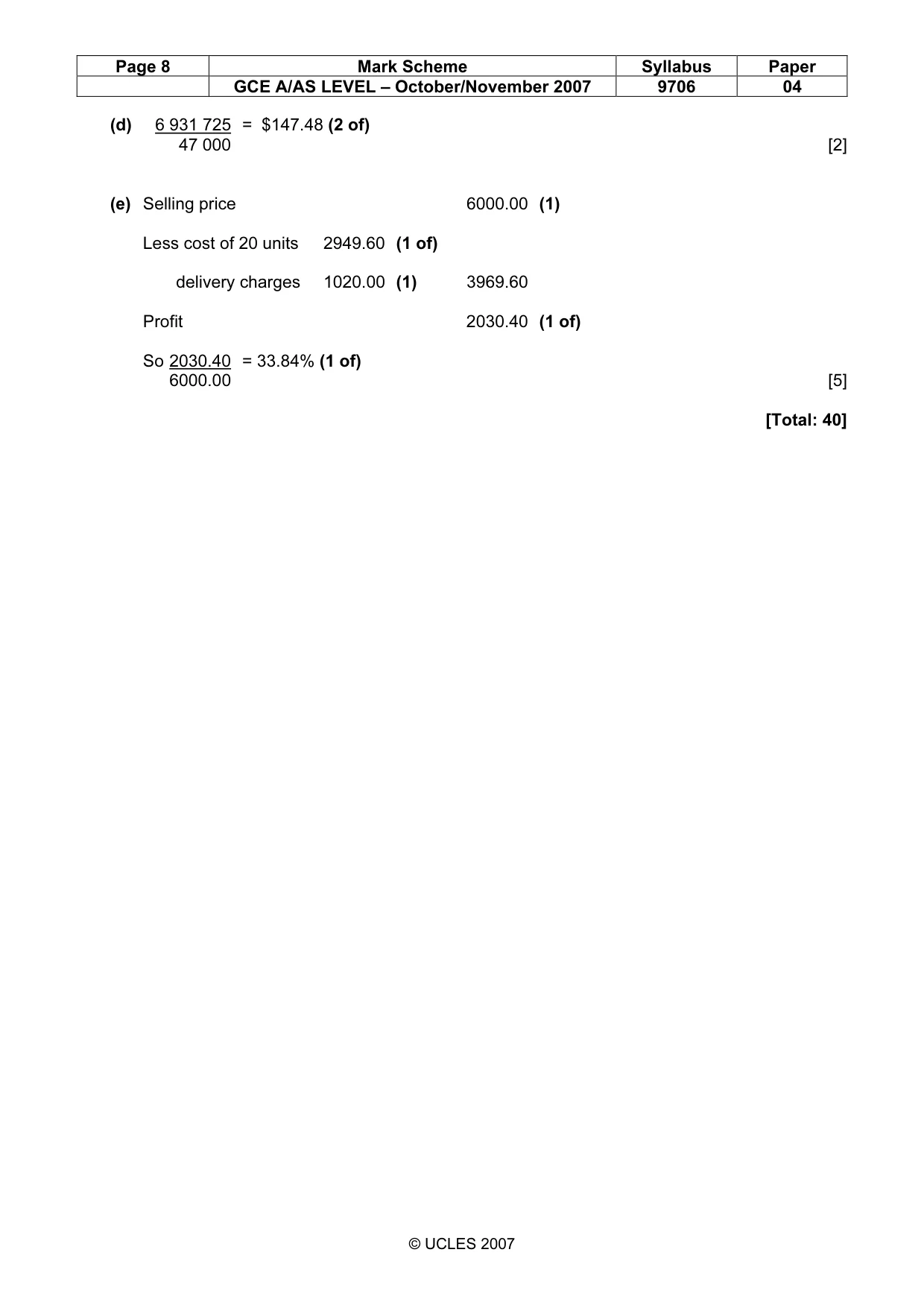
Page 8 Mark Scheme Syllabus Paper GCE A/AS LEVEL – October/November 2007 9706 04 © UCLES 2007 (d) 6 931 725 = $147.48 (2 of) 47 000 [2] (e) Selling price 6000.00 (1) Less cost of 20 units 2949.60 (1 of) delivery charges 1020.00 (1) 3969.60 Profit 2030.40 (1 of) So 2030.40 = 33.84% (1 of) 6000.00 [5] [Total: 40]
What you needed in this session
Cambridge’s own grade thresholds for 2007 Oct/Nov, Paper 4 · Variant 1. A higher threshold means an easier paper — the bar moves with how the cohort did.