Cambridge A Level Accounting 9706 — 2007 May/June Paper 4 · Variant 1
9706/41/M/J/07 · 120 marks · ≈135 min
The question paper and its mark scheme, free to read here and free to download. This is Cambridge’s own paper, exactly as it was sat.
Question paper8 pages
Mark scheme7 pages
Answers below. Sit the paper first if you are practising.
Paper as text
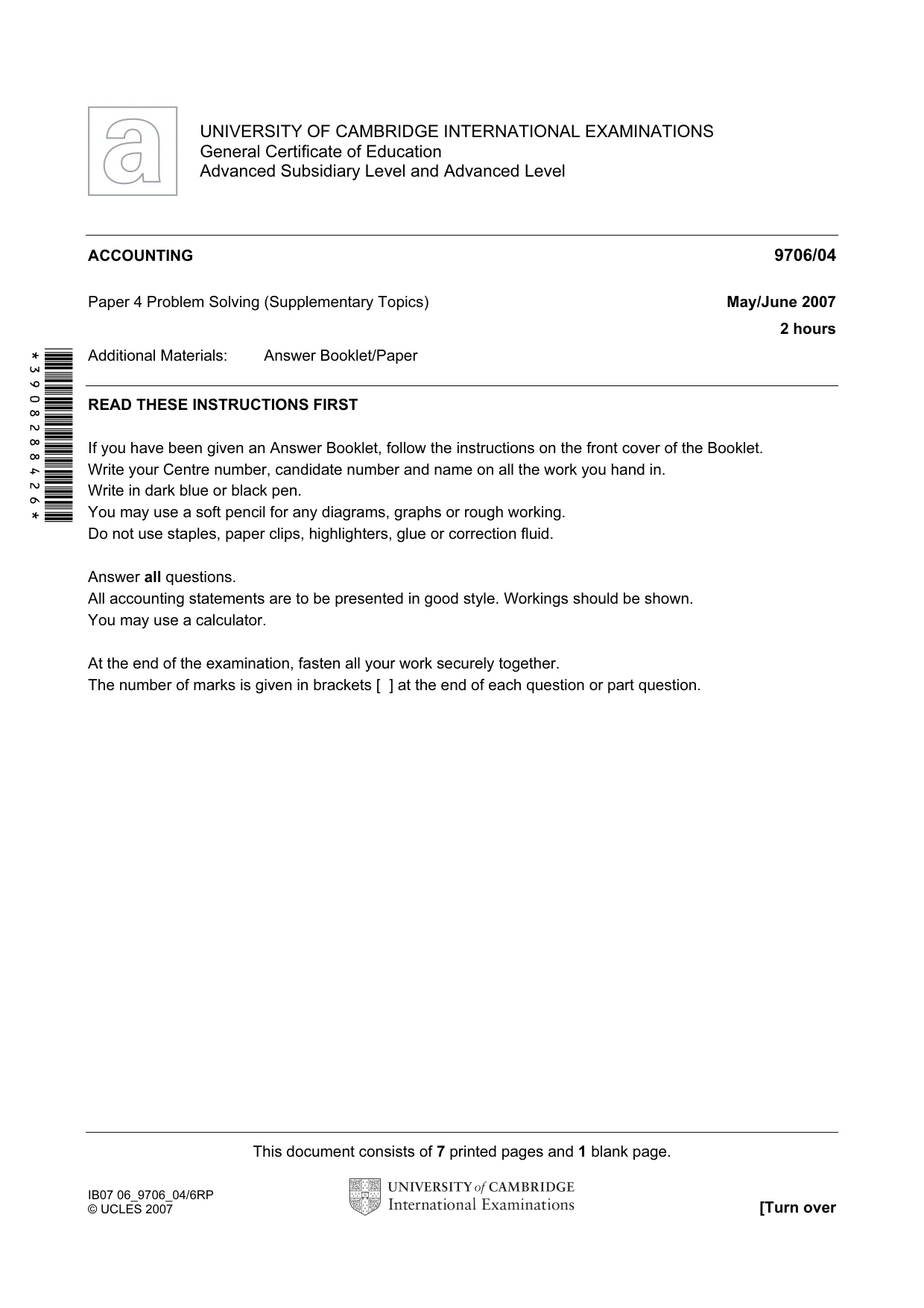
Question paper, page 1
This document consists of 7 printed pages and 1 blank page. IB07 06_9706_04/6RP © UCLES 2007 [Turn over *3908288426* UNIVERSITY OF CAMBRIDGE INTERNATIONAL EXAMINATIONS General Certificate of Education Advanced Subsidiary Level and Advanced Level ACCOUNTING 9706/04 Paper 4 Problem Solving (Supplementary Topics) May/June 2007 2 hours Additional Materials: Answer Booklet/Paper READ THESE INSTRUCTIONS FIRST If you have been given an Answer Booklet, follow the instructions on the front cover of the Booklet. Write your Centre number, candidate number and name on all the work you hand in. Write in dark blue or black pen. You may use a soft pencil for any diagrams, graphs or rough working. Do not use staples, paper clips, highlighters, glue or correction fluid. Answer all questions. All accounting statements are to be presented in good style. Workings should be shown. You may use a calculator. At the end of the examination, fasten all your work securely together. The number of marks is given in brackets [ ] at the end of each question or part question.
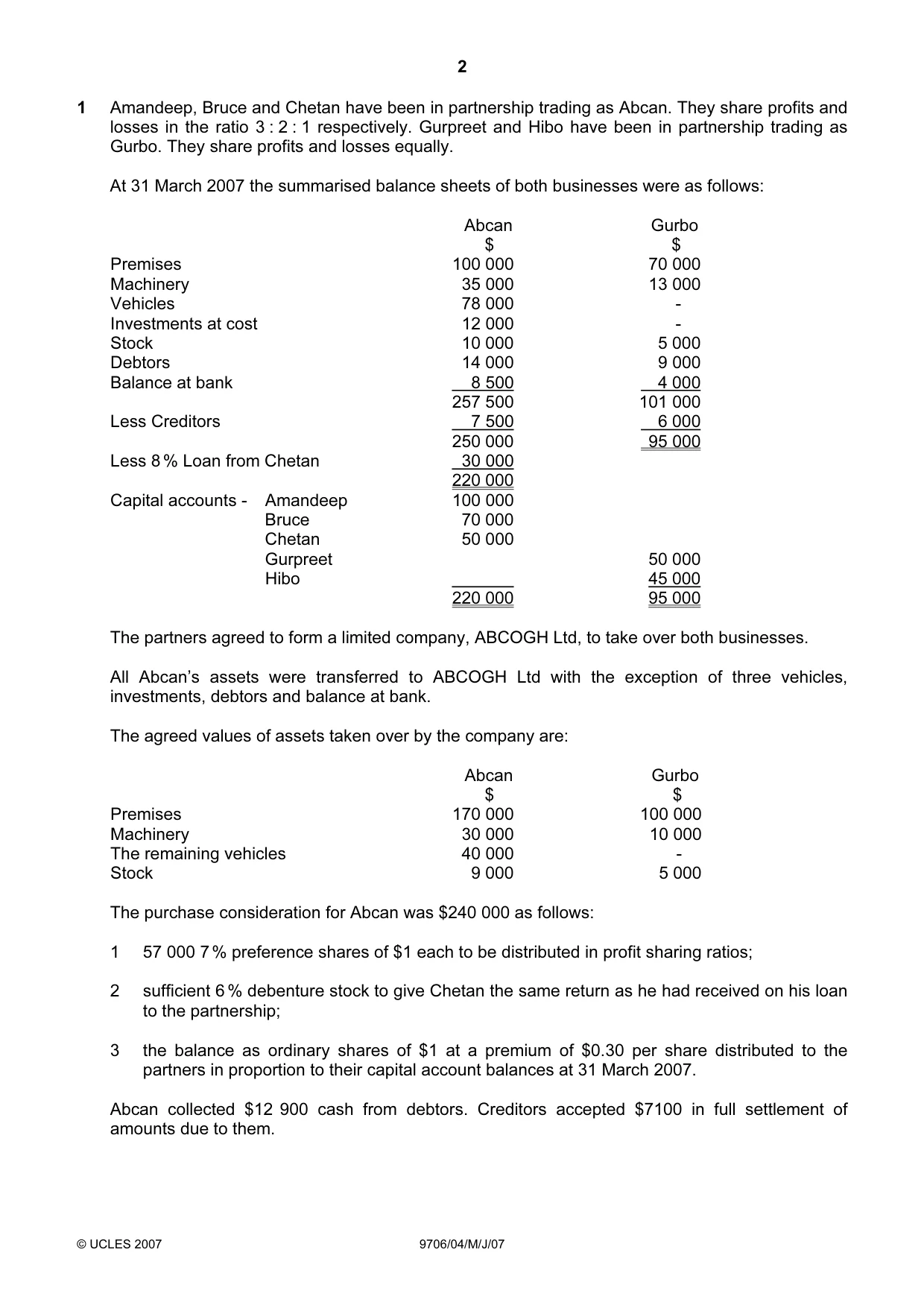
Question paper, page 2
2 © UCLES 2007 9706/04/M/J/07 1 Amandeep, Bruce and Chetan have been in partnership trading as Abcan. They share profits and losses in the ratio 3 : 2 : 1 respectively. Gurpreet and Hibo have been in partnership trading as Gurbo. They share profits and losses equally. At 31 March 2007 the summarised balance sheets of both businesses were as follows: Abcan Gurbo $ $ Premises 100 000 70 000 Machinery 35 000 13 000 Vehicles 78 000 - Investments at cost 12 000 - Stock 10 000 5 000 Debtors 14 000 9 000 Balance at bank 8 500 4 000 257 500 101 000 Less Creditors 7 500 6 000 250 000 95 000 Less 8 % Loan from Chetan 30 000 220 000 Capital accounts - Amandeep 100 000 Bruce 70 000 Chetan 50 000 Gurpreet 50 000 Hibo 45 000 220 000 95 000 The partners agreed to form a limited company, ABCOGH Ltd, to take over both businesses. All Abcan’s assets were transferred to ABCOGH Ltd with the exception of three vehicles, investments, debtors and balance at bank. The agreed values of assets taken over by the company are: Abcan Gurbo $ $ Premises 170 000 100 000 Machinery 30 000 10 000 The remaining vehicles 40 000 - Stock 9 000 5 000 The purchase consideration for Abcan was $240 000 as follows: 1 57 000 7 % preference shares of $1 each to be distributed in profit sharing ratios; 2 sufficient 6 % debenture stock to give Chetan the same return as he had received on his loan to the partnership; 3 the balance as ordinary shares of $1 at a premium of $0.30 per share distributed to the partners in proportion to their capital account balances at 31 March 2007. Abcan collected $12 900 cash from debtors. Creditors accepted $7100 in full settlement of amounts due to them.
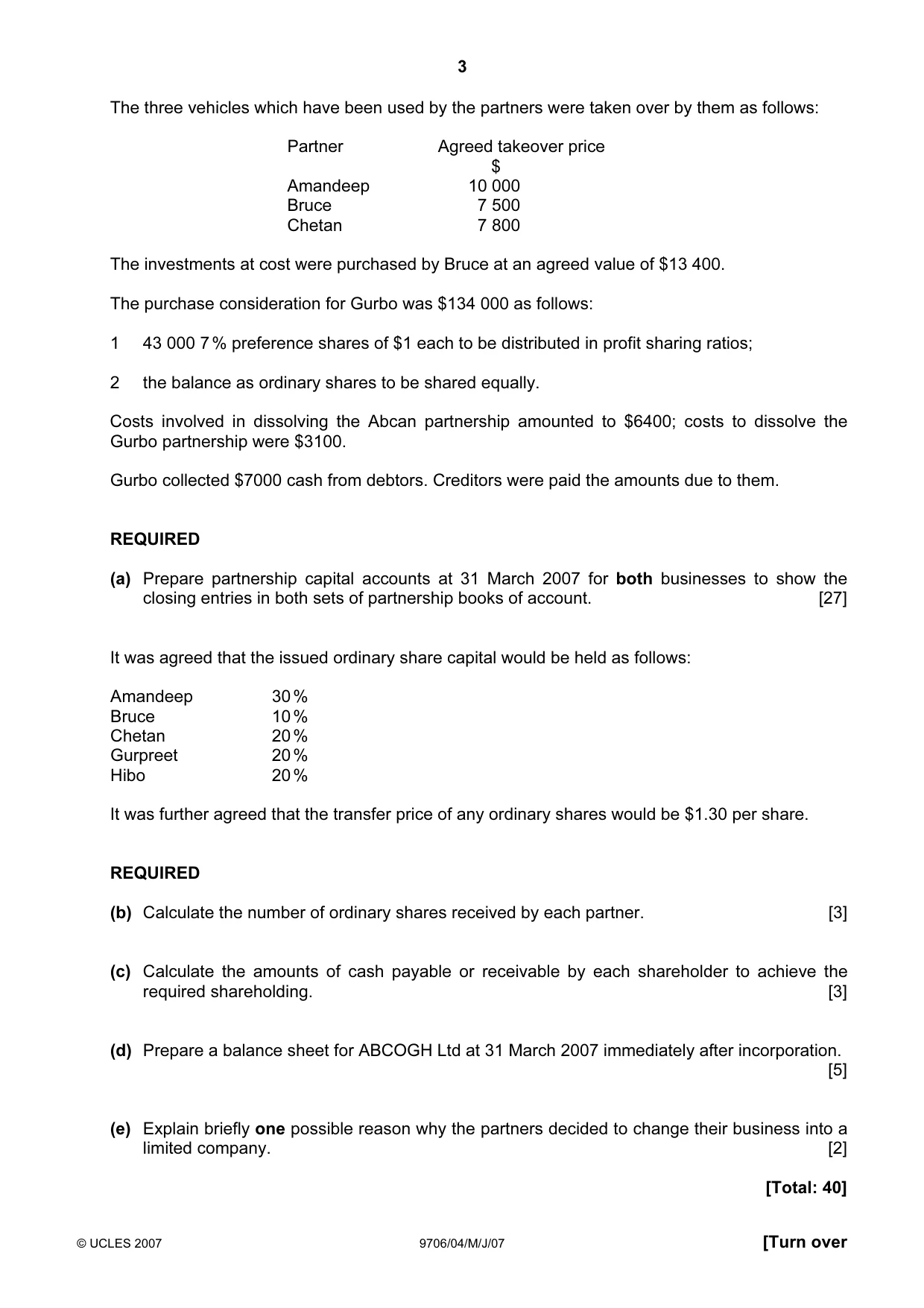
Question paper, page 3
3 © UCLES 2007 9706/04/M/J/07 [Turn over The three vehicles which have been used by the partners were taken over by them as follows: Partner Agreed takeover price $ Amandeep 10 000 Bruce 7 500 Chetan 7 800 The investments at cost were purchased by Bruce at an agreed value of $13 400. The purchase consideration for Gurbo was $134 000 as follows: 1 43 000 7 % preference shares of $1 each to be distributed in profit sharing ratios; 2 the balance as ordinary shares to be shared equally. Costs involved in dissolving the Abcan partnership amounted to $6400; costs to dissolve the Gurbo partnership were $3100. Gurbo collected $7000 cash from debtors. Creditors were paid the amounts due to them. REQUIRED (a) Prepare partnership capital accounts at 31 March 2007 for both businesses to show the closing entries in both sets of partnership books of account. [27] It was agreed that the issued ordinary share capital would be held as follows: Amandeep 30 % Bruce 10 % Chetan 20 % Gurpreet 20 % Hibo 20 % It was further agreed that the transfer price of any ordinary shares would be $1.30 per share. REQUIRED (b) Calculate the number of ordinary shares received by each partner. [3] (c) Calculate the amounts of cash payable or receivable by each shareholder to achieve the required shareholding. [3] (d) Prepare a balance sheet for ABCOGH Ltd at 31 March 2007 immediately after incorporation. [5] (e) Explain briefly one possible reason why the partners decided to change their business into a limited company. [2] [Total: 40]
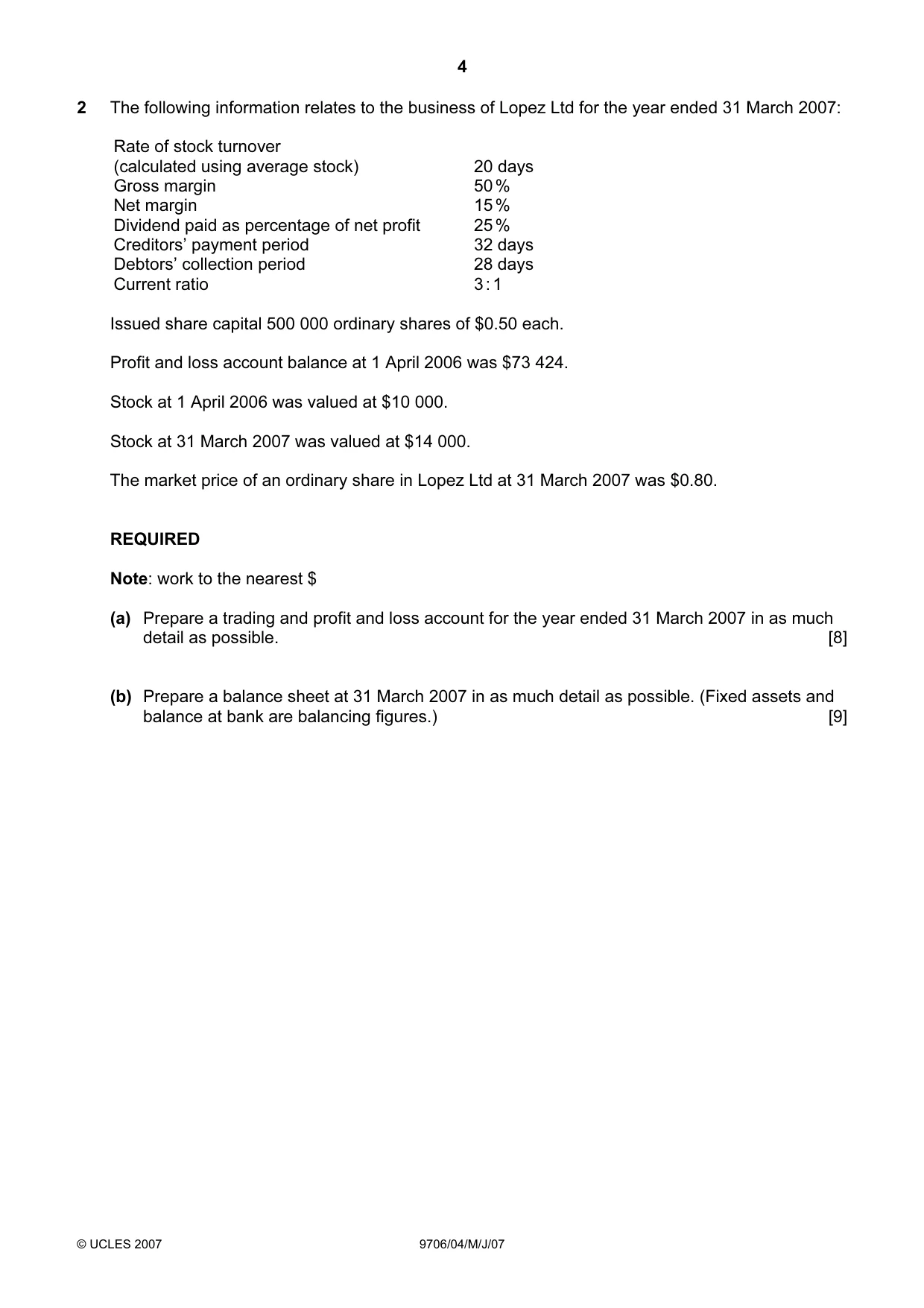
Question paper, page 4
4 © UCLES 2007 9706/04/M/J/07 2 The following information relates to the business of Lopez Ltd for the year ended 31 March 2007: Rate of stock turnover (calculated using average stock) 20 days Gross margin 50 % Net margin 15 % Dividend paid as percentage of net profit 25 % Creditors’ payment period 32 days Debtors’ collection period 28 days Current ratio 3 : 1 Issued share capital 500 000 ordinary shares of $0.50 each. Profit and loss account balance at 1 April 2006 was $73 424. Stock at 1 April 2006 was valued at $10 000. Stock at 31 March 2007 was valued at $14 000. The market price of an ordinary share in Lopez Ltd at 31 March 2007 was $0.80. REQUIRED Note: work to the nearest $ (a) Prepare a trading and profit and loss account for the year ended 31 March 2007 in as much detail as possible. [8] (b) Prepare a balance sheet at 31 March 2007 in as much detail as possible. (Fixed assets and balance at bank are balancing figures.) [9]
Question paper, page 5
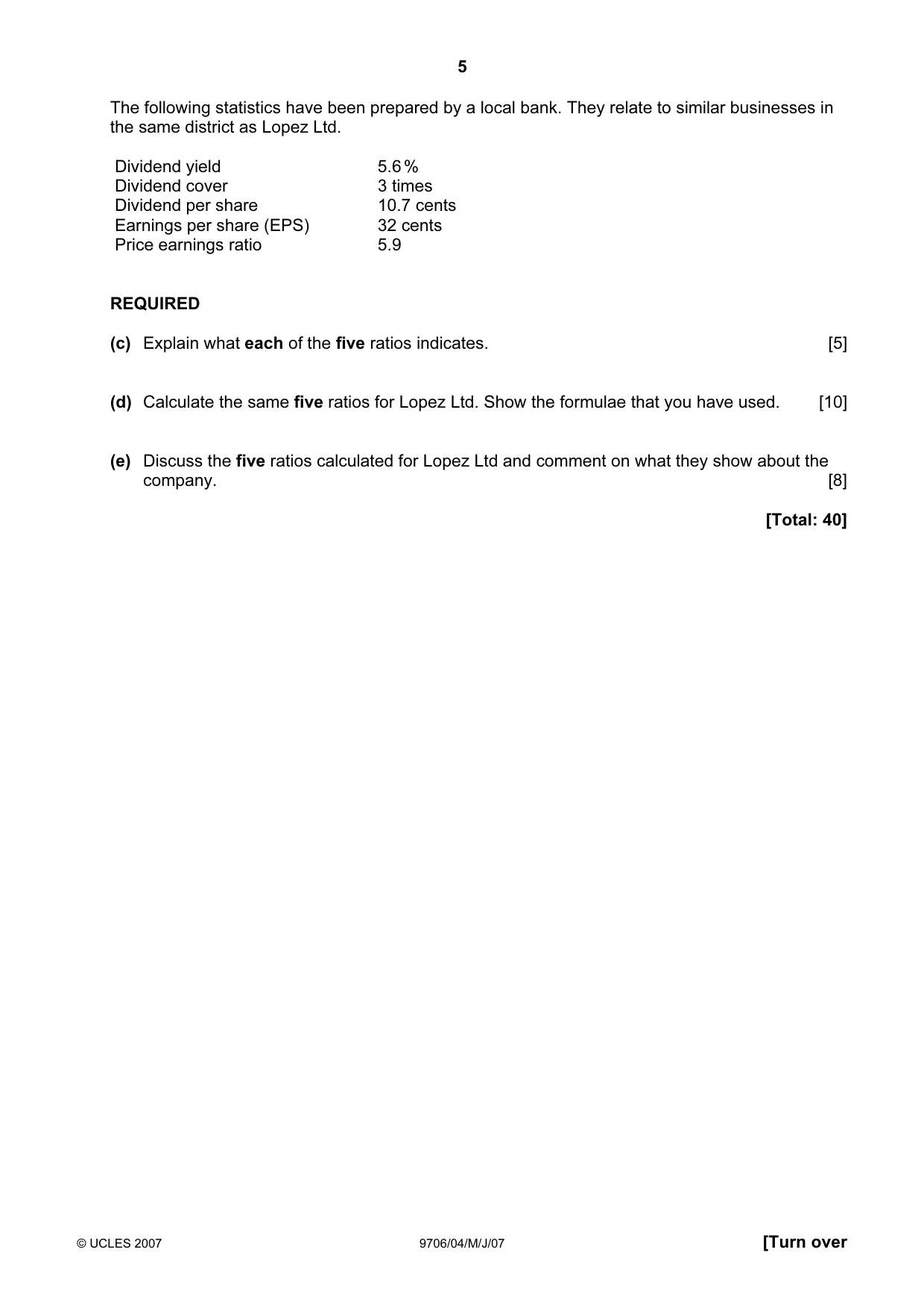
5 © UCLES 2007 9706/04/M/J/07 [Turn over The following statistics have been prepared by a local bank. They relate to similar businesses in the same district as Lopez Ltd. Dividend yield 5.6 % Dividend cover 3 times Dividend per share 10.7 cents Earnings per share (EPS) 32 cents Price earnings ratio 5.9 REQUIRED (c) Explain what each of the five ratios indicates. [5] (d) Calculate the same five ratios for Lopez Ltd. Show the formulae that you have used. [10] (e) Discuss the five ratios calculated for Lopez Ltd and comment on what they show about the company. [8] [Total: 40]
Question paper, page 6
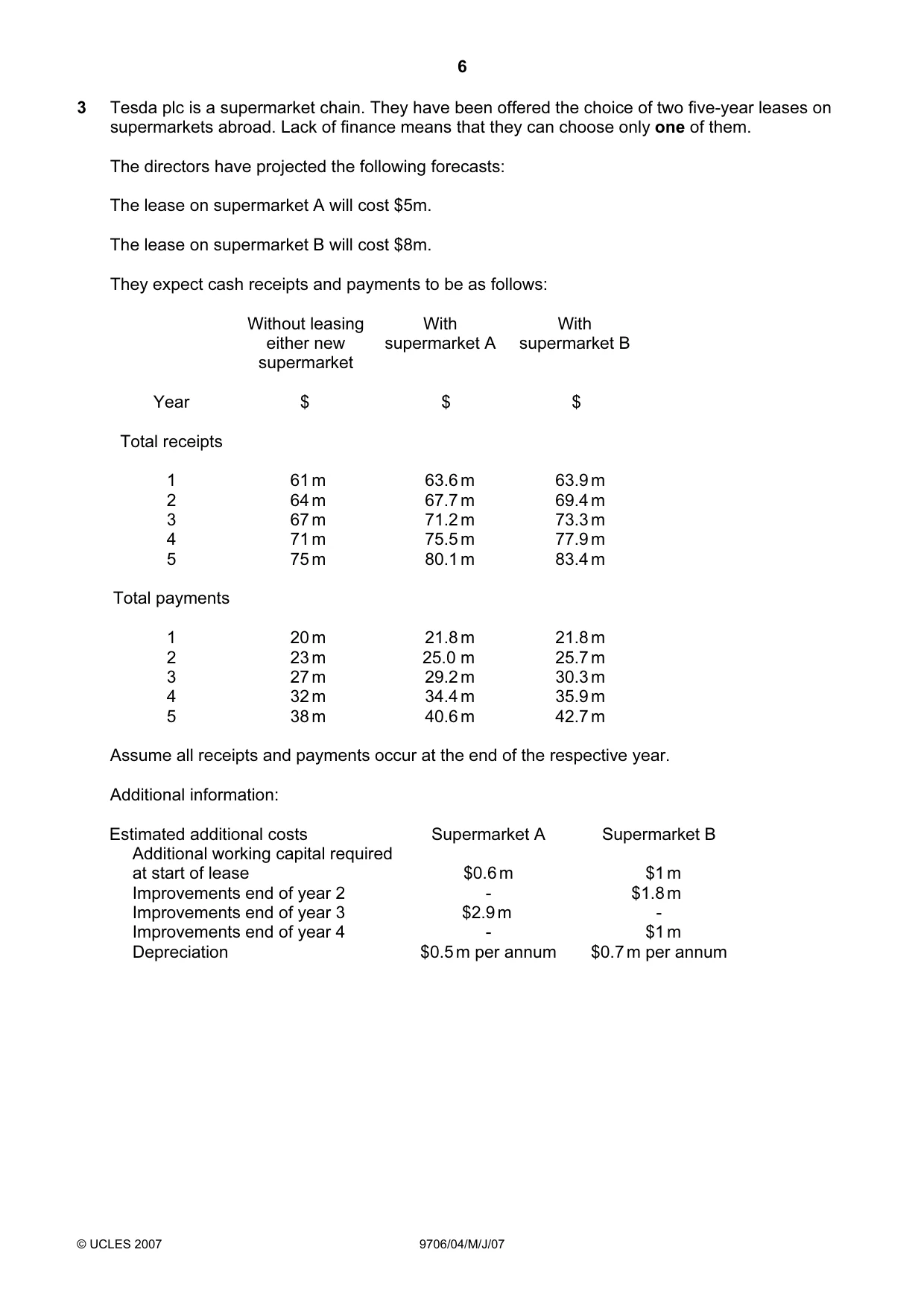
6 © UCLES 2007 9706/04/M/J/07 3 Tesda plc is a supermarket chain. They have been offered the choice of two five-year leases on supermarkets abroad. Lack of finance means that they can choose only one of them. The directors have projected the following forecasts: The lease on supermarket A will cost $5m. The lease on supermarket B will cost $8m. They expect cash receipts and payments to be as follows: Without leasing either new supermarket With supermarket A With supermarket B Year $ $ $ Total receipts 1 61 m 63.6 m 63.9 m 2 64 m 67.7 m 69.4 m 3 67 m 71.2 m 73.3 m 4 71 m 75.5 m 77.9 m 5 75 m 80.1 m 83.4 m Total payments 1 20 m 21.8 m 21.8 m 2 23 m 25.0 m 25.7 m 3 27 m 29.2 m 30.3 m 4 32 m 34.4 m 35.9 m 5 38 m 40.6 m 42.7 m Assume all receipts and payments occur at the end of the respective year. Additional information: Estimated additional costs Supermarket A Supermarket B Additional working capital required at start of lease $0.6 m $1 m Improvements end of year 2 - $1.8 m Improvements end of year 3 $2.9 m - Improvements end of year 4 - $1 m Depreciation $0.5 m per annum $0.7 m per annum
Question paper, page 7
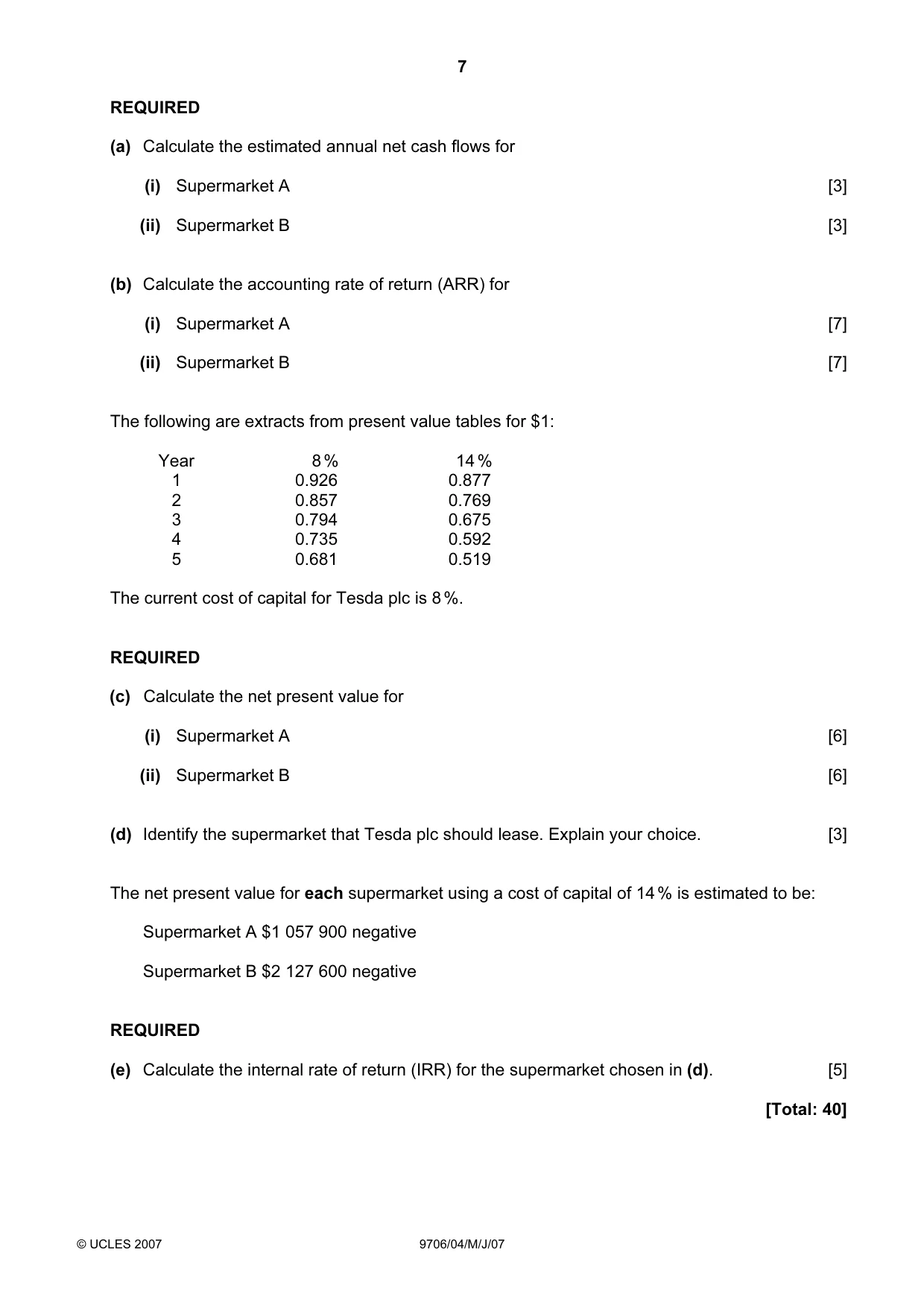
7 © UCLES 2007 9706/04/M/J/07 REQUIRED (a) Calculate the estimated annual net cash flows for (i) Supermarket A [3] (ii) Supermarket B [3] (b) Calculate the accounting rate of return (ARR) for (i) Supermarket A [7] (ii) Supermarket B [7] The following are extracts from present value tables for $1: Year 8 % 14 % 1 0.926 0.877 2 0.857 0.769 3 0.794 0.675 4 0.735 0.592 5 0.681 0.519 The current cost of capital for Tesda plc is 8 %. REQUIRED (c) Calculate the net present value for (i) Supermarket A [6] (ii) Supermarket B [6] (d) Identify the supermarket that Tesda plc should lease. Explain your choice. [3] The net present value for each supermarket using a cost of capital of 14 % is estimated to be: Supermarket A $1 057 900 negative Supermarket B $2 127 600 negative REQUIRED (e) Calculate the internal rate of return (IRR) for the supermarket chosen in (d). [5] [Total: 40]
Question paper, page 8
8 BLANK PAGE Permission to reproduce items where third-party owned material protected by copyright is included has been sought and cleared where possible. Every reasonable effort has been made by the publisher (UCLES) to trace copyright holders, but if any items requiring clearance have unwittingly been included, the publisher will be pleased to make amends at the earliest possible opportunity. University of Cambridge International Examinations is part of the Cambridge Assessment Group. Cambridge Assessment is the brand name of University of Cambridge Local Examinations Syndicate (UCLES), which is itself a department of the University of Cambridge. 9706/04/M/J/07
Mark scheme, page 1
UNIVERSITY OF CAMBRIDGE INTERNATIONAL EXAMINATIONS GCE Advanced Subsidiary Level and GCE Advanced Level MARK SCHEME for the May/June 2007 question paper 9706 ACCOUNTING 9706/04 Paper 4 (Problem Solving (Supplement)), maximum raw mark 120 This mark scheme is published as an aid to teachers and candidates, to indicate the requirements of the examination. It shows the basis on which Examiners were instructed to award marks. It does not indicate the details of the discussions that took place at an Examiners’ meeting before marking began. All Examiners are instructed that alternative correct answers and unexpected approaches in candidates’ scripts must be given marks that fairly reflect the relevant knowledge and skills demonstrated. Mark schemes must be read in conjunction with the question papers and the report on the examination. • CIE will not enter into discussions or correspondence in connection with these mark schemes. CIE is publishing the mark schemes for the May/June 2007 question papers for most IGCSE, GCE Advanced Level and Advanced Subsidiary Level syllabuses and some Ordinary Level syllabuses.
Mark scheme, page 2
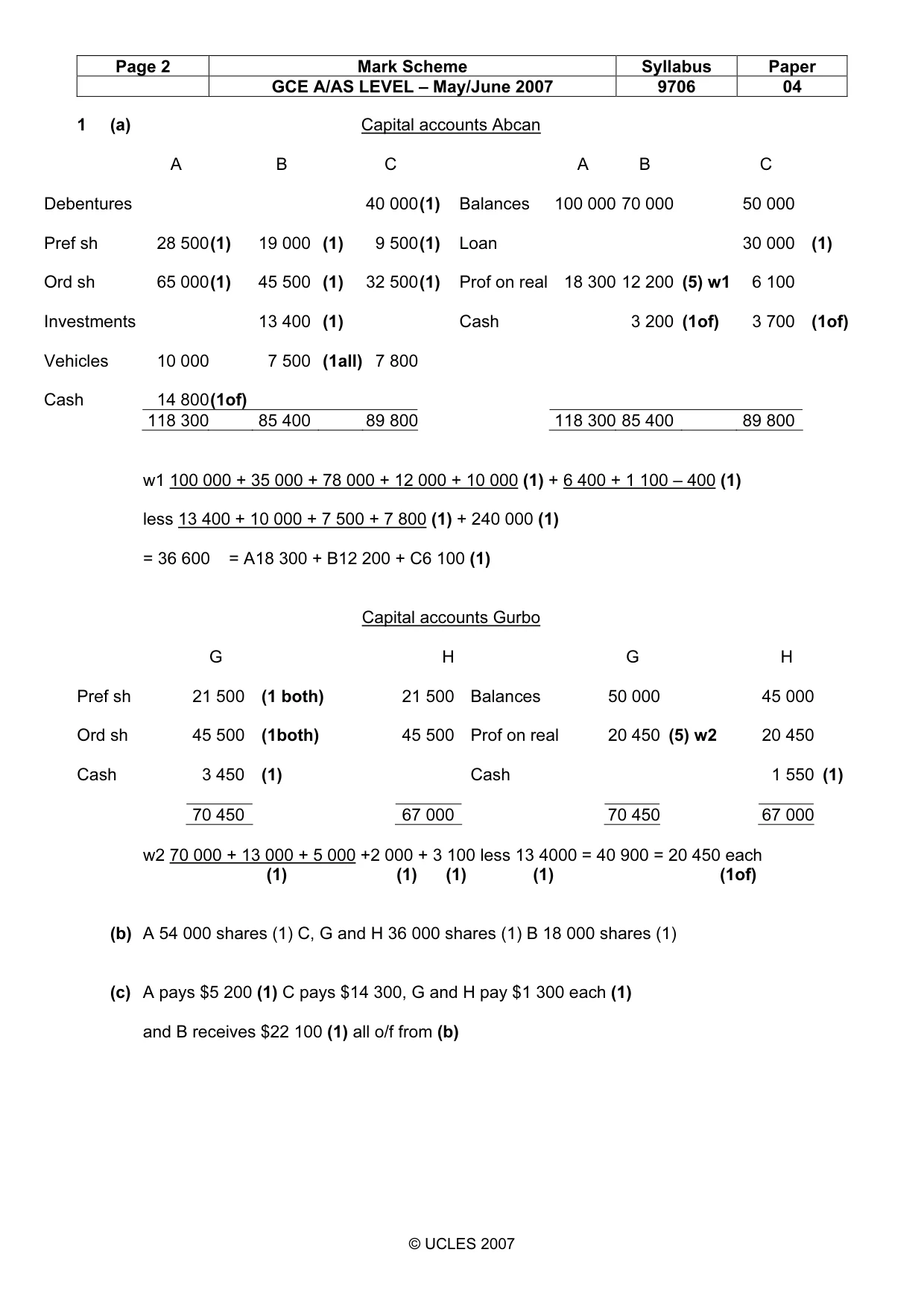
Page 2 Mark Scheme Syllabus Paper GCE A/AS LEVEL – May/June 2007 9706 04 © UCLES 2007 1 (a) Capital accounts Abcan A B C A B C Debentures 40 000(1) Balances 100 000 70 000 50 000 Pref sh 28 500(1) 19 000 (1) 9 500(1) Loan 30 000 (1) Ord sh 65 000(1) 45 500 (1) 32 500(1) Prof on real 18 300 12 200 (5) w1 6 100 Investments 13 400 (1) Cash 3 200 (1of) 3 700 (1of) Vehicles 10 000 7 500 (1all) 7 800 Cash 14 800(1of) 118 300 85 400 89 800 118 300 85 400 89 800 w1 100 000 + 35 000 + 78 000 + 12 000 + 10 000 (1) + 6 400 + 1 100 – 400 (1) less 13 400 + 10 000 + 7 500 + 7 800 (1) + 240 000 (1) = 36 600 = A18 300 + B12 200 + C6 100 (1) Capital accounts Gurbo G H G H Pref sh 21 500 (1 both) 21 500 Balances 50 000 45 000 Ord sh 45 500 (1both) 45 500 Prof on real 20 450 (5) w2 20 450 Cash 3 450 (1) Cash 1 550 (1) 70 450 67 000 70 450 67 000 w2 70 000 + 13 000 + 5 000 +2 000 + 3 100 less 13 4000 = 40 900 = 20 450 each (1) (1) (1) (1) (1of) (b) A 54 000 shares (1) C, G and H 36 000 shares (1) B 18 000 shares (1) (c) A pays $5 200 (1) C pays $14 300, G and H pay $1 300 each (1) and B receives $22 100 (1) all o/f from (b)
Mark scheme, page 3
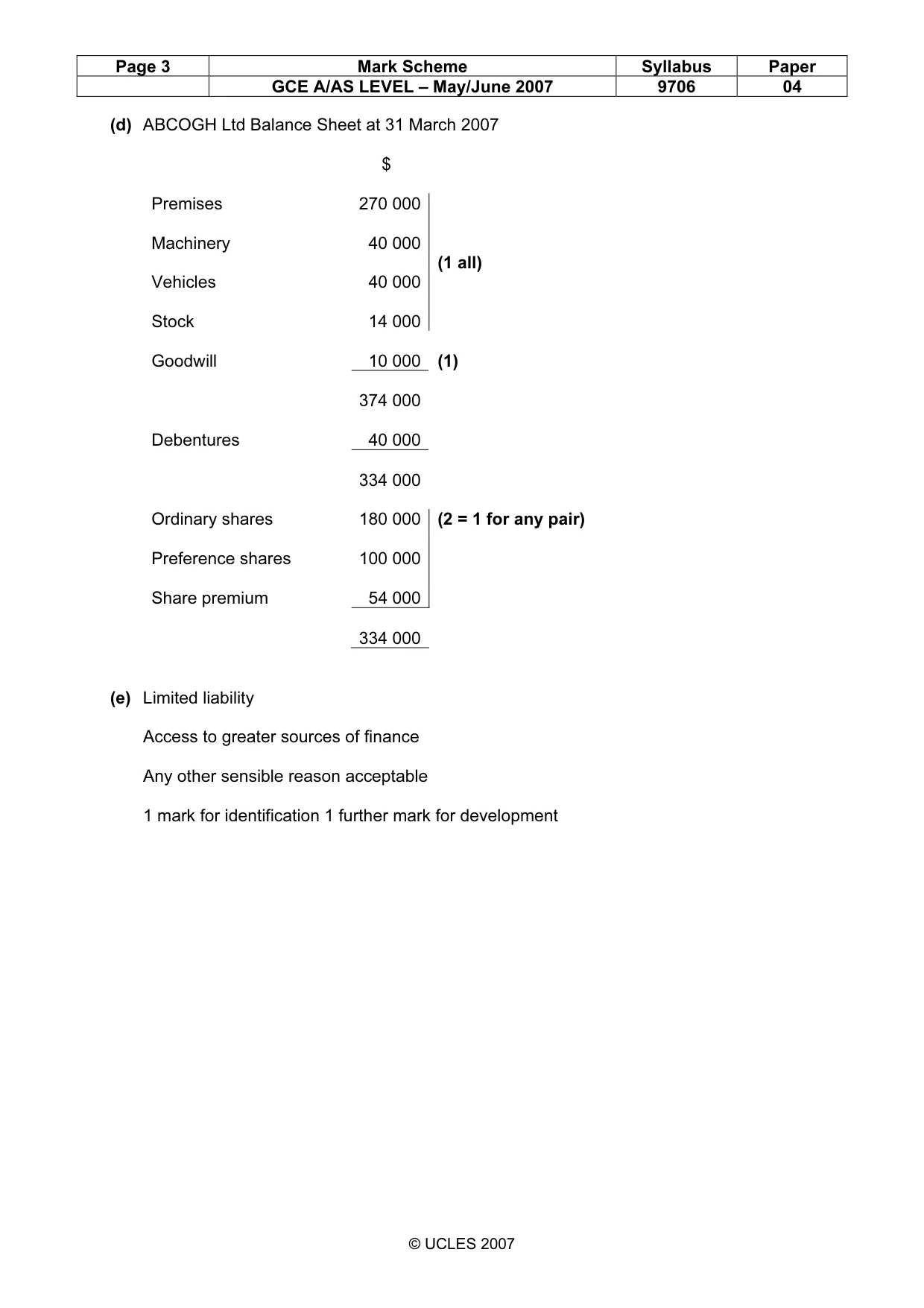
Page 3 Mark Scheme Syllabus Paper GCE A/AS LEVEL – May/June 2007 9706 04 © UCLES 2007 (d) ABCOGH Ltd Balance Sheet at 31 March 2007 $ Premises 270 000 Machinery 40 000 (1 all) Vehicles 40 000 Stock 14 000 Goodwill 10 000 (1) 374 000 Debentures 40 000 334 000 Ordinary shares 180 000 (2 = 1 for any pair) Preference shares 100 000 Share premium 54 000 334 000 (e) Limited liability Access to greater sources of finance Any other sensible reason acceptable 1 mark for identification 1 further mark for development
Mark scheme, page 4
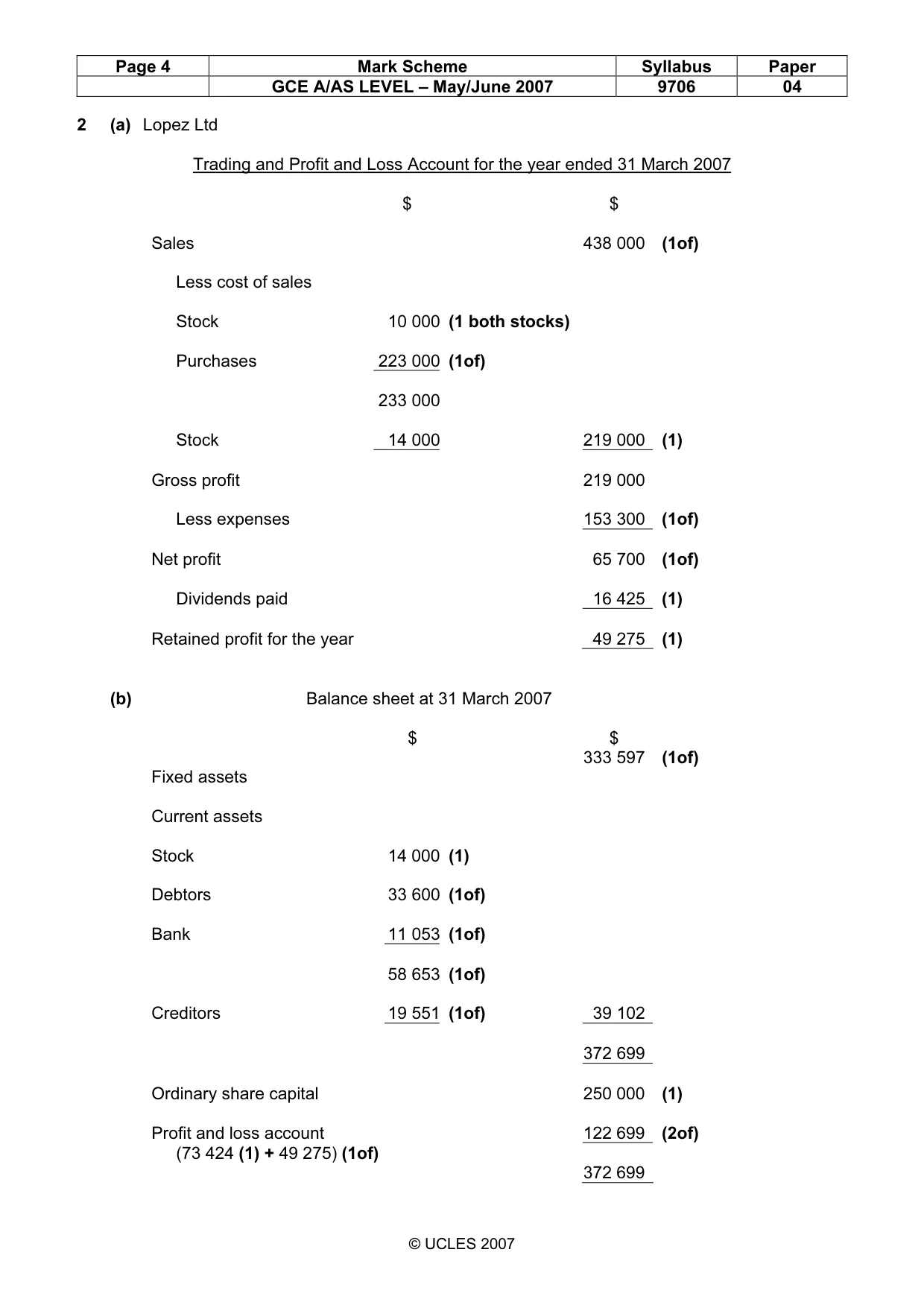
Page 4 Mark Scheme Syllabus Paper GCE A/AS LEVEL – May/June 2007 9706 04 © UCLES 2007 2 (a) Lopez Ltd Trading and Profit and Loss Account for the year ended 31 March 2007 $ $ Sales 438 000 (1of) Less cost of sales Stock 10 000 (1 both stocks) Purchases 223 000 (1of) 233 000 Stock 14 000 219 000 (1) Gross profit 219 000 Less expenses 153 300 (1of) Net profit 65 700 (1of) Dividends paid 16 425 (1) Retained profit for the year 49 275 (1) (b) Balance sheet at 31 March 2007 $ $ 333 597 (1of) Fixed assets Current assets Stock 14 000 (1) Debtors 33 600 (1of) Bank 11 053 (1of) 58 653 (1of) Creditors 19 551 (1of) 39 102 372 699 Ordinary share capital 250 000 (1) Profit and loss account 122 699 (2of) (73 424 (1) + 49 275) (1of) 372 699
Mark scheme, page 5
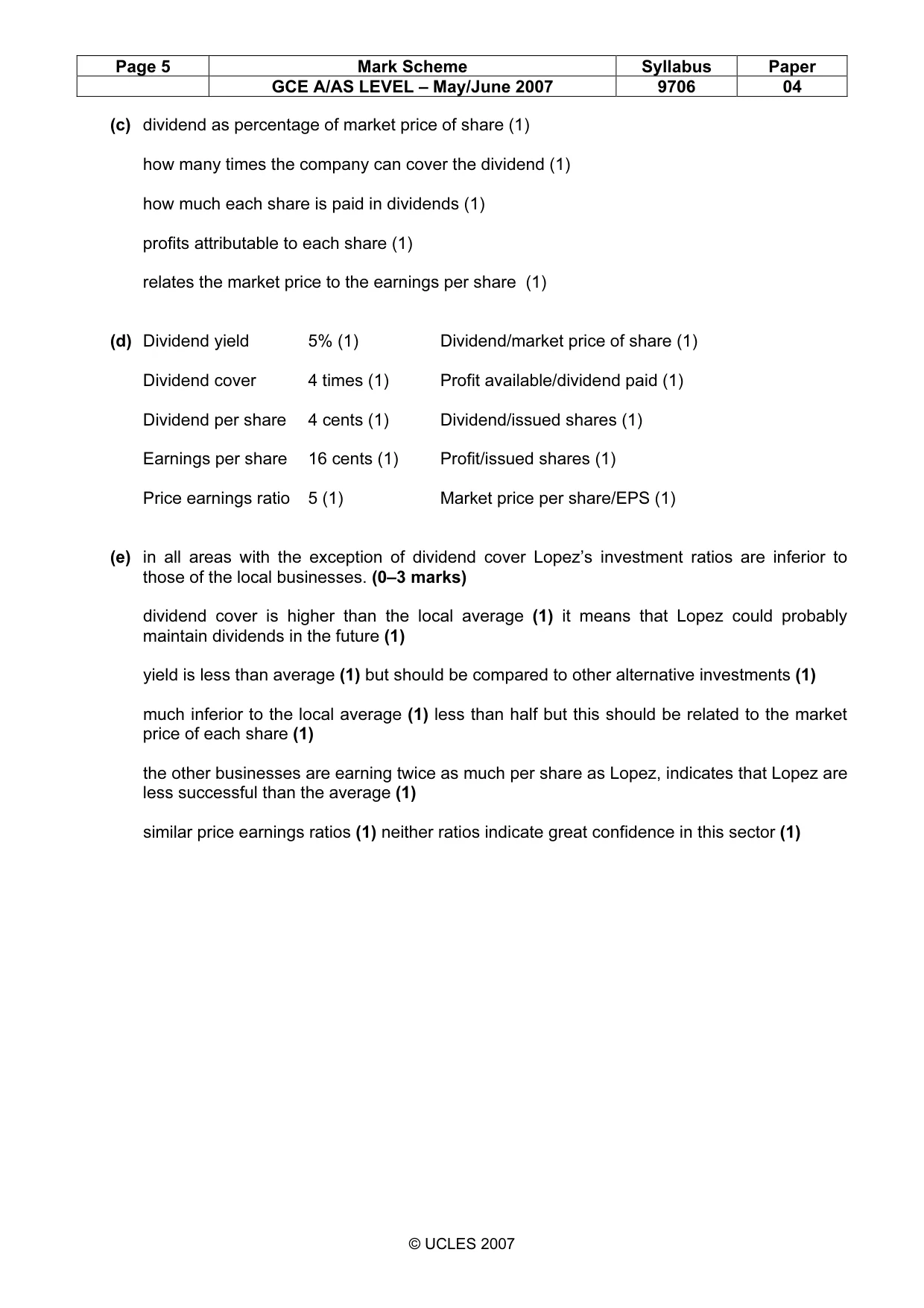
Page 5 Mark Scheme Syllabus Paper GCE A/AS LEVEL – May/June 2007 9706 04 © UCLES 2007 (c) dividend as percentage of market price of share (1) how many times the company can cover the dividend (1) how much each share is paid in dividends (1) profits attributable to each share (1) relates the market price to the earnings per share (1) (d) Dividend yield 5% (1) Dividend/market price of share (1) Dividend cover 4 times (1) Profit available/dividend paid (1) Dividend per share 4 cents (1) Dividend/issued shares (1) Earnings per share 16 cents (1) Profit/issued shares (1) Price earnings ratio 5 (1) Market price per share/EPS (1) (e) in all areas with the exception of dividend cover Lopez’s investment ratios are inferior to those of the local businesses. (0–3 marks) dividend cover is higher than the local average (1) it means that Lopez could probably maintain dividends in the future (1) yield is less than average (1) but should be compared to other alternative investments (1) much inferior to the local average (1) less than half but this should be related to the market price of each share (1) the other businesses are earning twice as much per share as Lopez, indicates that Lopez are less successful than the average (1) similar price earnings ratios (1) neither ratios indicate great confidence in this sector (1)
Mark scheme, page 6
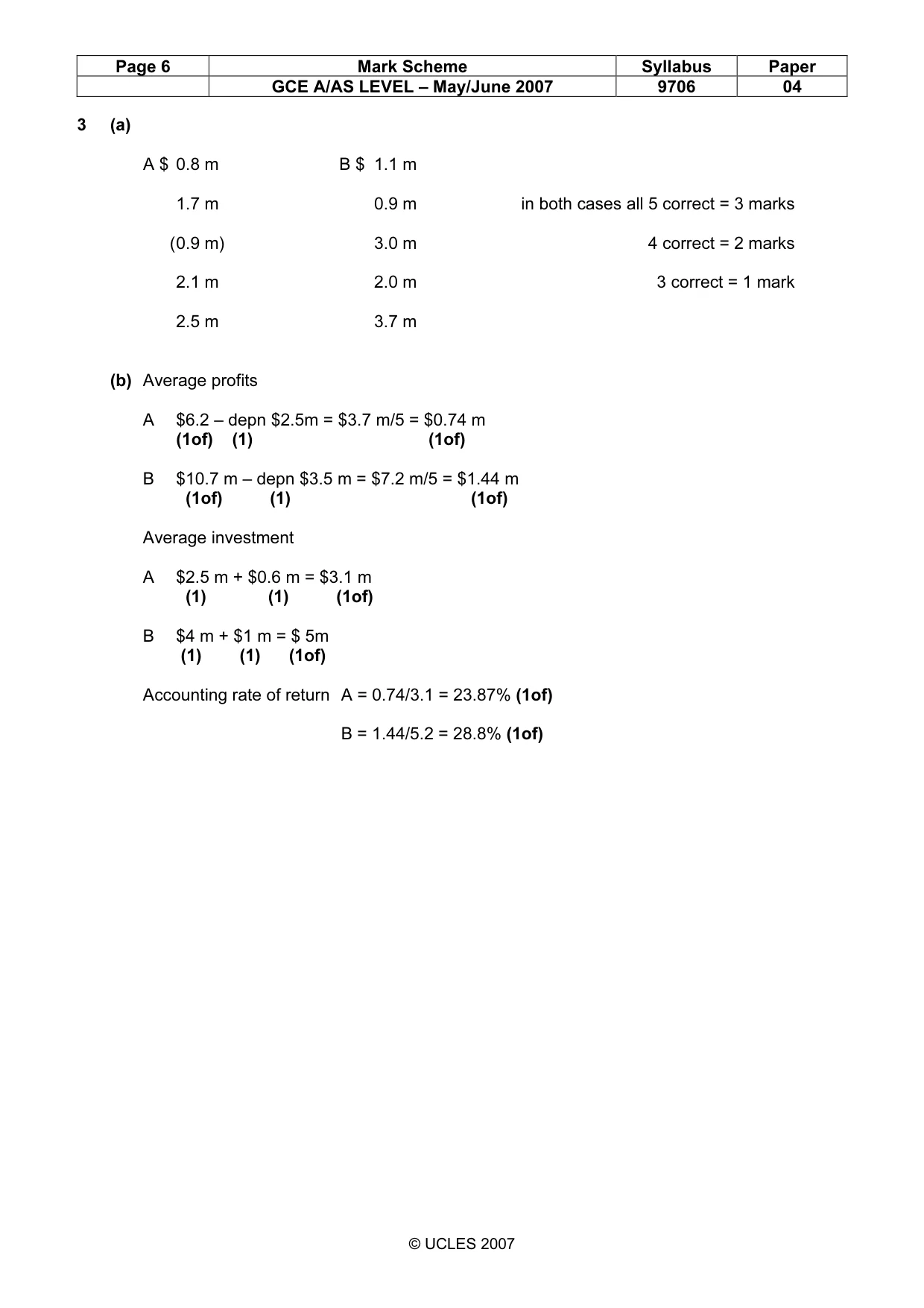
Page 6 Mark Scheme Syllabus Paper GCE A/AS LEVEL – May/June 2007 9706 04 © UCLES 2007 3 (a) A $ 0.8 m B $ 1.1 m 1.7 m 0.9 m in both cases all 5 correct = 3 marks ( 0.9 m) 3.0 m 4 correct = 2 marks 2.1 m 2.0 m 3 correct = 1 mark 2.5 m 3.7 m (b) Average profits A $6.2 – depn $2.5m = $3.7 m/5 = $0.74 m (1of) (1) (1of) B $10.7 m – depn $3.5 m = $7.2 m/5 = $1.44 m (1of) (1) (1of) Average investment A $2.5 m + $0.6 m = $3.1 m (1) (1) (1of) B $4 m + $1 m = $ 5m (1) (1) (1of) Accounting rate of return A = 0.74/3.1 = 23.87% (1of) B = 1.44/5.2 = 28.8% (1of)
Mark scheme, page 7
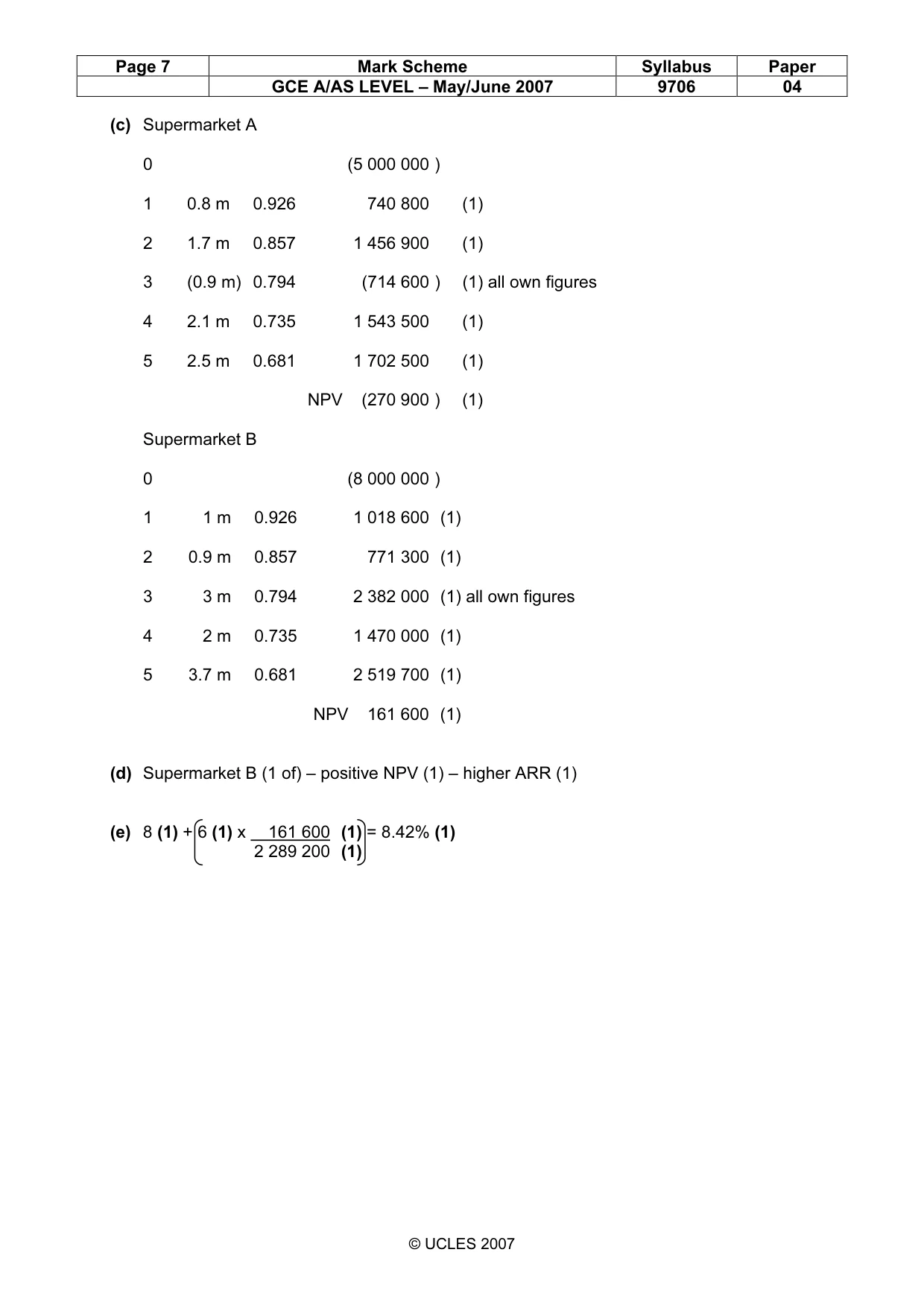
Page 7 Mark Scheme Syllabus Paper GCE A/AS LEVEL – May/June 2007 9706 04 © UCLES 2007 (c) Supermarket A 0 (5 000 000 ) 1 0.8 m 0.926 740 800 (1) 2 1.7 m 0.857 1 456 900 (1) 3 (0.9 m) 0.794 (714 600 ) (1) all own figures 4 2.1 m 0.735 1 543 500 (1) 5 2.5 m 0.681 1 702 500 (1) NPV (270 900 ) (1) Supermarket B 0 (8 000 000 ) 1 1 m 0.926 1 018 600 (1) 2 0.9 m 0.857 771 300 (1) 3 3 m 0.794 2 382 000 (1) all own figures 4 2 m 0.735 1 470 000 (1) 5 3.7 m 0.681 2 519 700 (1) NPV 161 600 (1) (d) Supermarket B (1 of) – positive NPV (1) – higher ARR (1) (e) 8 (1) + 6 (1) x 161 600 (1) = 8.42% (1) 2 289 200 (1)
What you needed in this session
Cambridge’s own grade thresholds for 2007 May/June, Paper 4 · Variant 1. A higher threshold means an easier paper — the bar moves with how the cohort did.