Cambridge A Level Accounting 9706 — 2006 Oct/Nov Paper 4 · Variant 1
9706/41/O/N/06 · 120 marks · ≈135 min
The question paper and its mark scheme, free to read here and free to download. This is Cambridge’s own paper, exactly as it was sat.
Question paper8 pages
Mark scheme7 pages
Answers below. Sit the paper first if you are practising.
Paper as text
Question paper, page 1
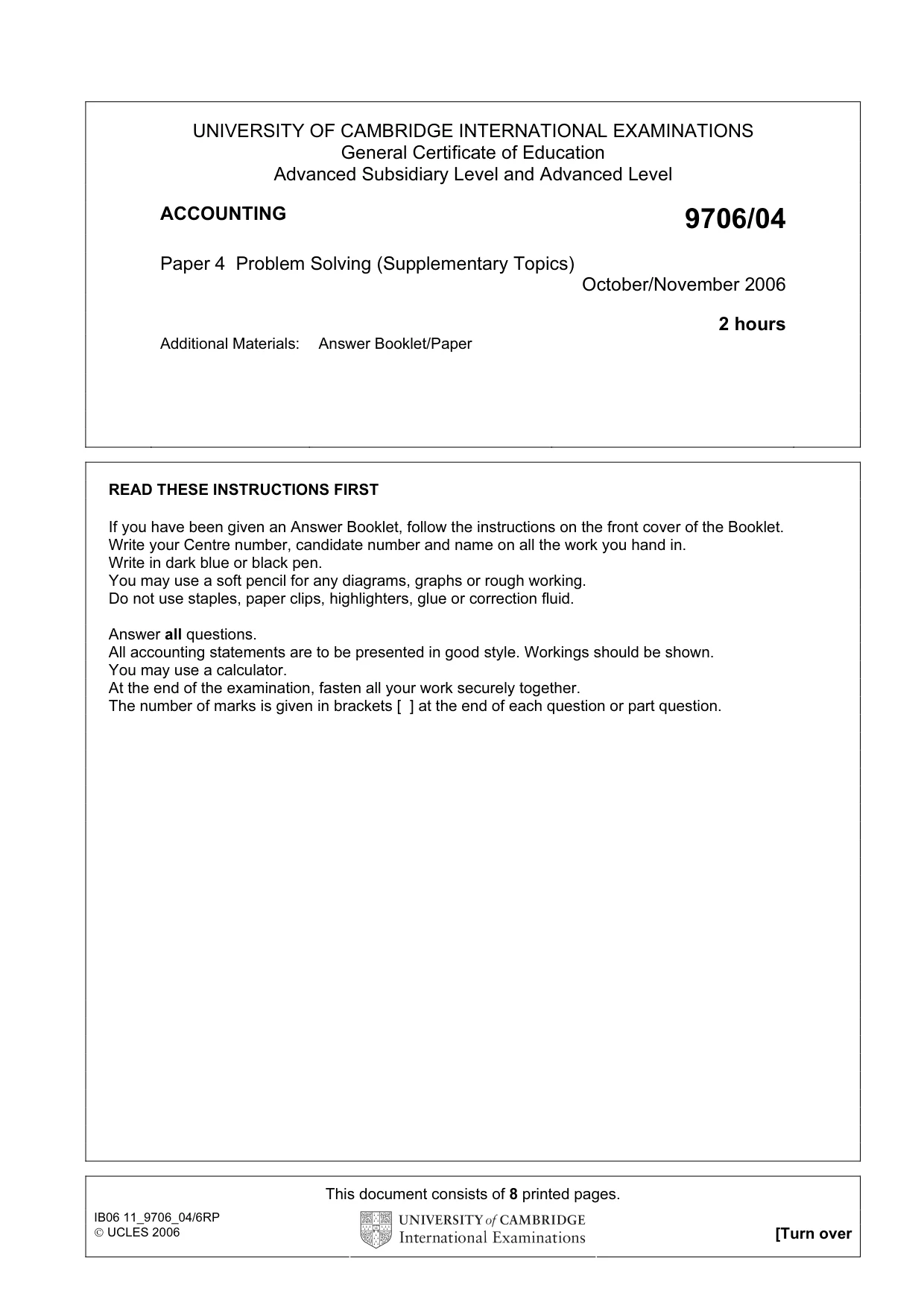
UNIVERSITY OF CAMBRIDGE INTERNATIONAL EXAMINATIONS General Certificate of Education Advanced Subsidiary Level and Advanced Level ACCOUNTING 9706/04 Paper 4 Problem Solving (Supplementary Topics) October/November 2006 2 hours Additional Materials: Answer Booklet/Paper READ THESE INSTRUCTIONS FIRST If you have been given an Answer Booklet, follow the instructions on the front cover of the Booklet. Write your Centre number, candidate number and name on all the work you hand in. Write in dark blue or black pen. You may use a soft pencil for any diagrams, graphs or rough working. Do not use staples, paper clips, highlighters, glue or correction fluid. Answer all questions. All accounting statements are to be presented in good style. Workings should be shown. You may use a calculator. At the end of the examination, fasten all your work securely together. The number of marks is given in brackets [ ] at the end of each question or part question. This document consists of 8 printed pages. IB06 11_9706_04/6RP UCLES 2006 [Turn over
Question paper, page 2
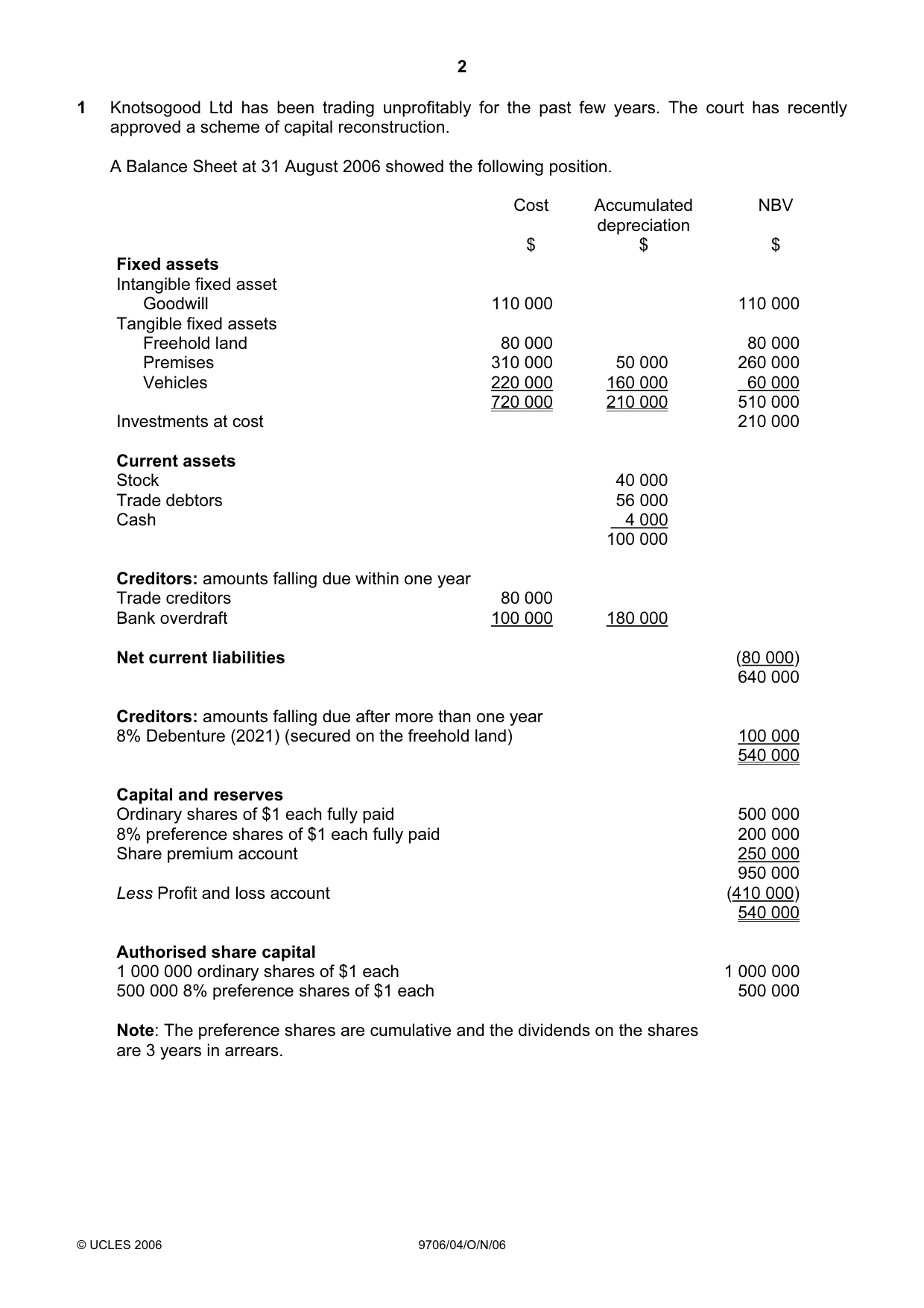
2 © UCLES 2006 9706/04/O/N/06 1 Knotsogood Ltd has been trading unprofitably for the past few years. The court has recently approved a scheme of capital reconstruction. A Balance Sheet at 31 August 2006 showed the following position. Cost Accumulated depreciation NBV $ $ $ Fixed assets Intangible fixed asset Goodwill 110 000 110 000 Tangible fixed assets Freehold land 80 000 80 000 Premises 310 000 50 000 260 000 Vehicles 220 000 160 000 60 000 720 000 210 000 510 000 Investments at cost 210 000 Current assets Stock 40 000 Trade debtors 56 000 Cash 4 000 100 000 Creditors: amounts falling due within one year Trade creditors 80 000 Bank overdraft 100 000 180 000 Net current liabilities (80 000) 640 000 Creditors: amounts falling due after more than one year 8% Debenture (2021) (secured on the freehold land) 100 000 540 000 Capital and reserves Ordinary shares of $1 each fully paid 500 000 8% preference shares of $1 each fully paid 200 000 Share premium account 250 000 950 000 Less Profit and loss account (410 000) 540 000 Authorised share capital 1 000 000 ordinary shares of $1 each 1 000 000 500 000 8% preference shares of $1 each 500 000 Note: The preference shares are cumulative and the dividends on the shares are 3 years in arrears.
Question paper, page 3
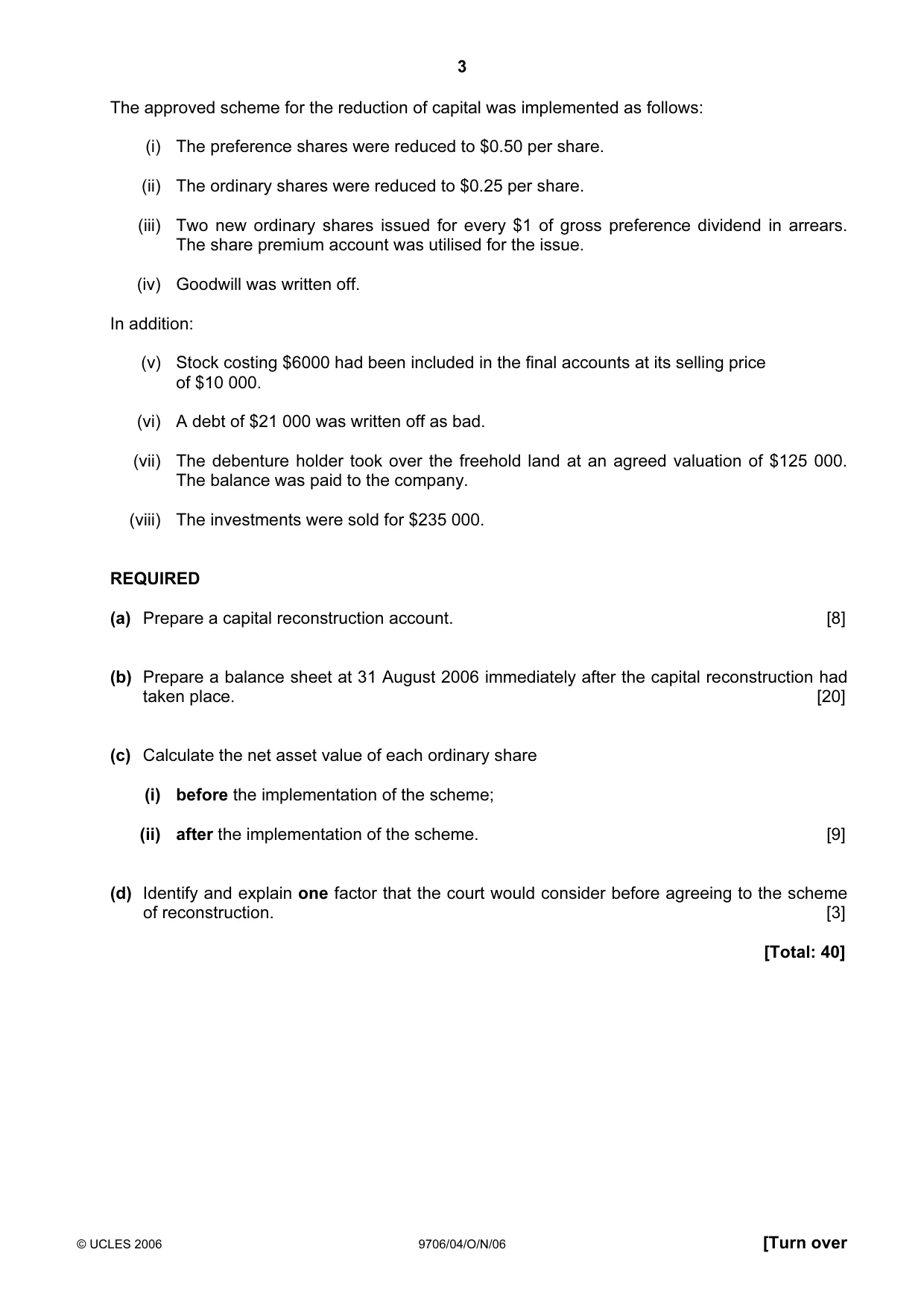
3 © UCLES 2006 9706/04/O/N/06 [Turn over The approved scheme for the reduction of capital was implemented as follows: (i) The preference shares were reduced to $0.50 per share. (ii) The ordinary shares were reduced to $0.25 per share. (iii) Two new ordinary shares issued for every $1 of gross preference dividend in arrears. The share premium account was utilised for the issue. (iv) Goodwill was written off. In addition: (v) Stock costing $6000 had been included in the final accounts at its selling price of $10 000. (vi) A debt of $21 000 was written off as bad. (vii) The debenture holder took over the freehold land at an agreed valuation of $125 000. The balance was paid to the company. (viii) The investments were sold for $235 000. REQUIRED (a) Prepare a capital reconstruction account. [8] (b) Prepare a balance sheet at 31 August 2006 immediately after the capital reconstruction had taken place. [20] (c) Calculate the net asset value of each ordinary share (i) before the implementation of the scheme; (ii) after the implementation of the scheme. [9] (d) Identify and explain one factor that the court would consider before agreeing to the scheme of reconstruction. [3] [Total: 40]
Question paper, page 4
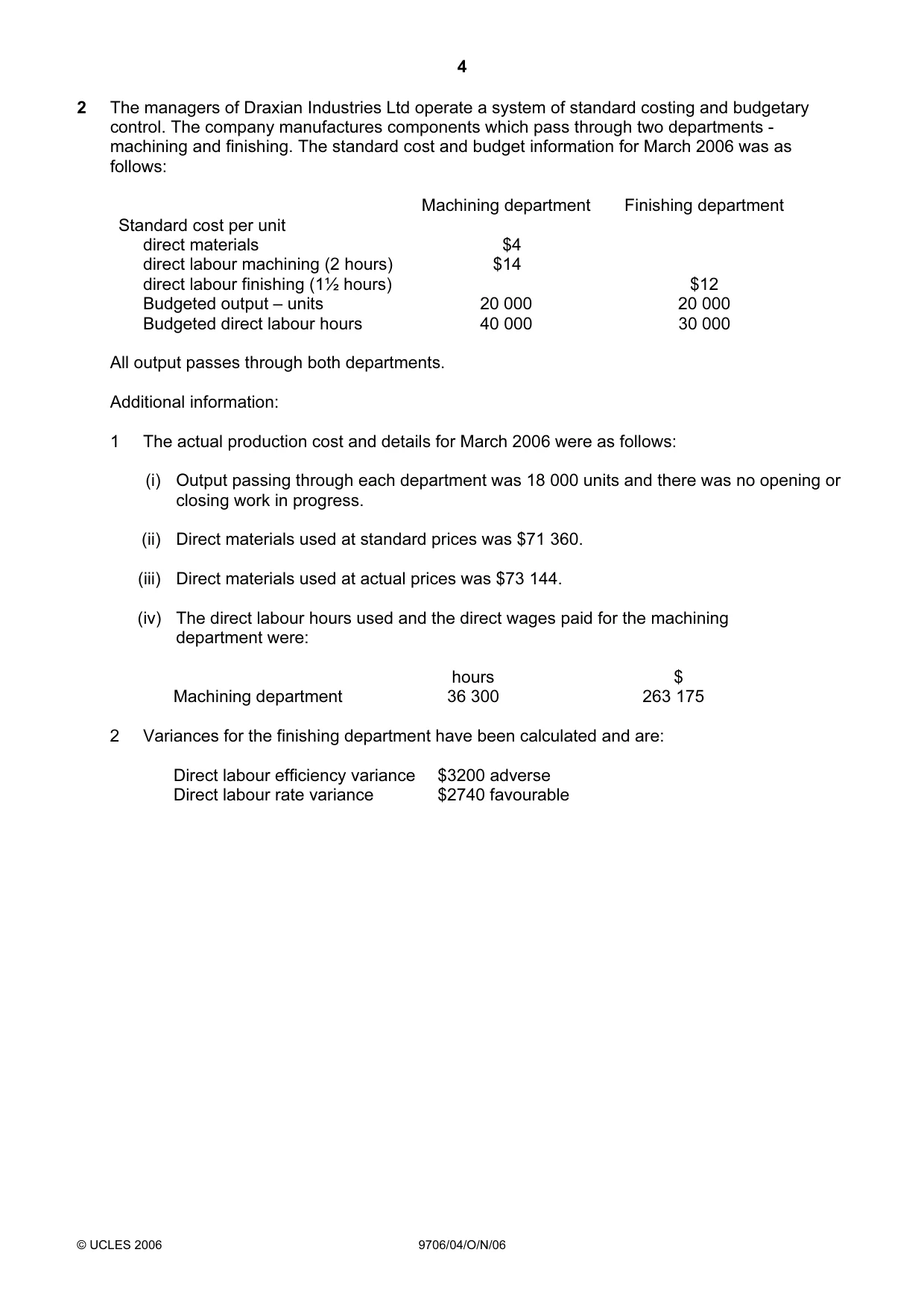
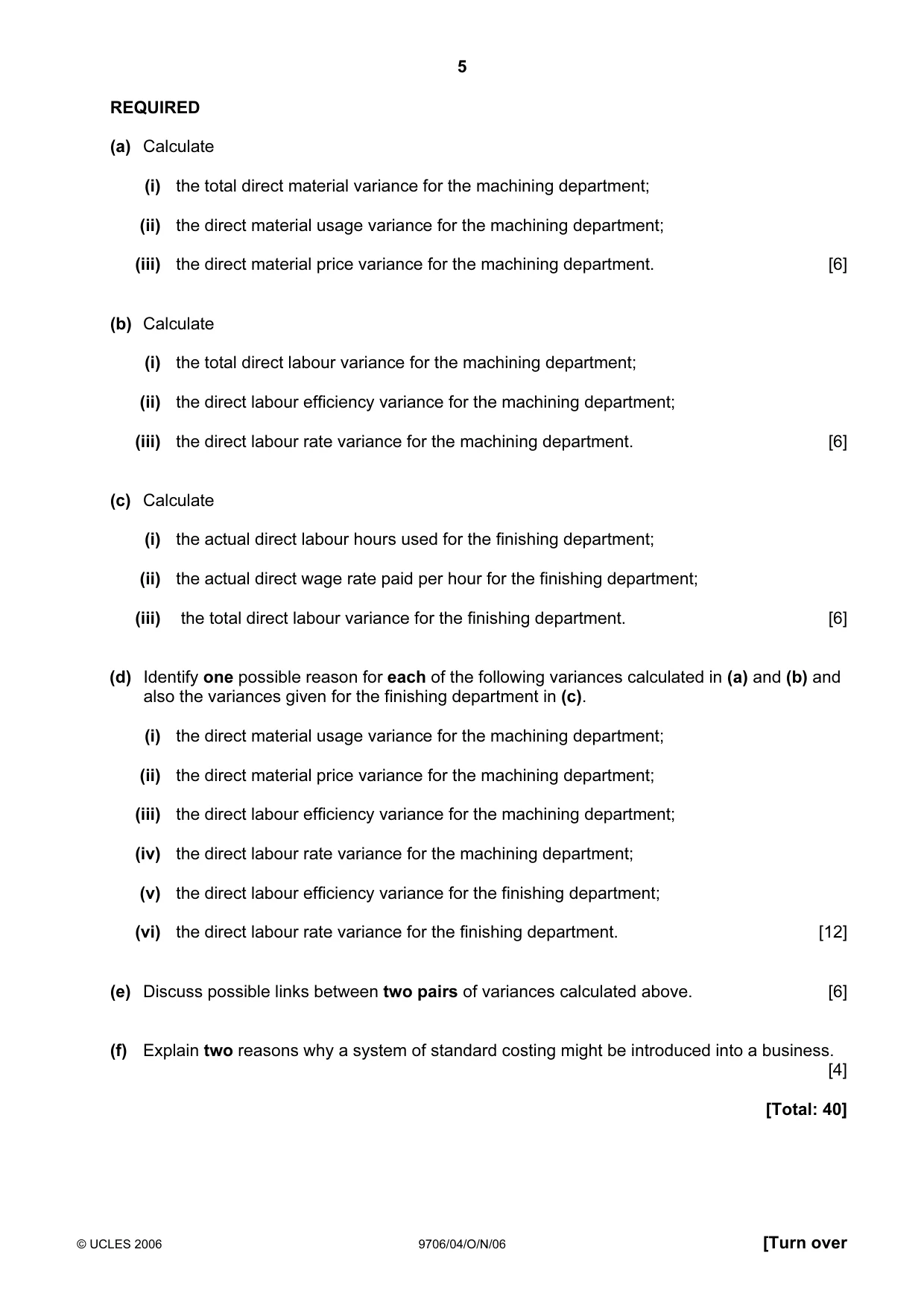
4 © UCLES 2006 9706/04/O/N/06 2 The managers of Draxian Industries Ltd operate a system of standard costing and budgetary control. The company manufactures components which pass through two departments - machining and finishing. The standard cost and budget information for March 2006 was as follows: Machining department Finishing department Standard cost per unit direct materials $4 direct labour machining (2 hours) $14 direct labour finishing (1½ hours) $12 Budgeted output – units 20 000 20 000 Budgeted direct labour hours 40 000 30 000 All output passes through both departments. Additional information: 1 The actual production cost and details for March 2006 were as follows: (i) Output passing through each department was 18 000 units and there was no opening or closing work in progress. (ii) Direct materials used at standard prices was $71 360. (iii) Direct materials used at actual prices was $73 144. (iv) The direct labour hours used and the direct wages paid for the machining department were: hours $ Machining department 36 300 263 175 2 Variances for the finishing department have been calculated and are: Direct labour efficiency variance $3200 adverse Direct labour rate variance $2740 favourable
Question paper, page 5
5 © UCLES 2006 9706/04/O/N/06 [Turn over REQUIRED (a) Calculate (i) the total direct material variance for the machining department; (ii) the direct material usage variance for the machining department; (iii) the direct material price variance for the machining department. [6] (b) Calculate (i) the total direct labour variance for the machining department; (ii) the direct labour efficiency variance for the machining department; (iii) the direct labour rate variance for the machining department. [6] (c) Calculate (i) the actual direct labour hours used for the finishing department; (ii) the actual direct wage rate paid per hour for the finishing department; (iii) the total direct labour variance for the finishing department. [6] (d) Identify one possible reason for each of the following variances calculated in (a) and (b) and also the variances given for the finishing department in (c). (i) the direct material usage variance for the machining department; (ii) the direct material price variance for the machining department; (iii) the direct labour efficiency variance for the machining department; (iv) the direct labour rate variance for the machining department; (v) the direct labour efficiency variance for the finishing department; (vi) the direct labour rate variance for the finishing department. [12] (e) Discuss possible links between two pairs of variances calculated above. [6] (f) Explain two reasons why a system of standard costing might be introduced into a business. [4] [Total: 40]
Question paper, page 6
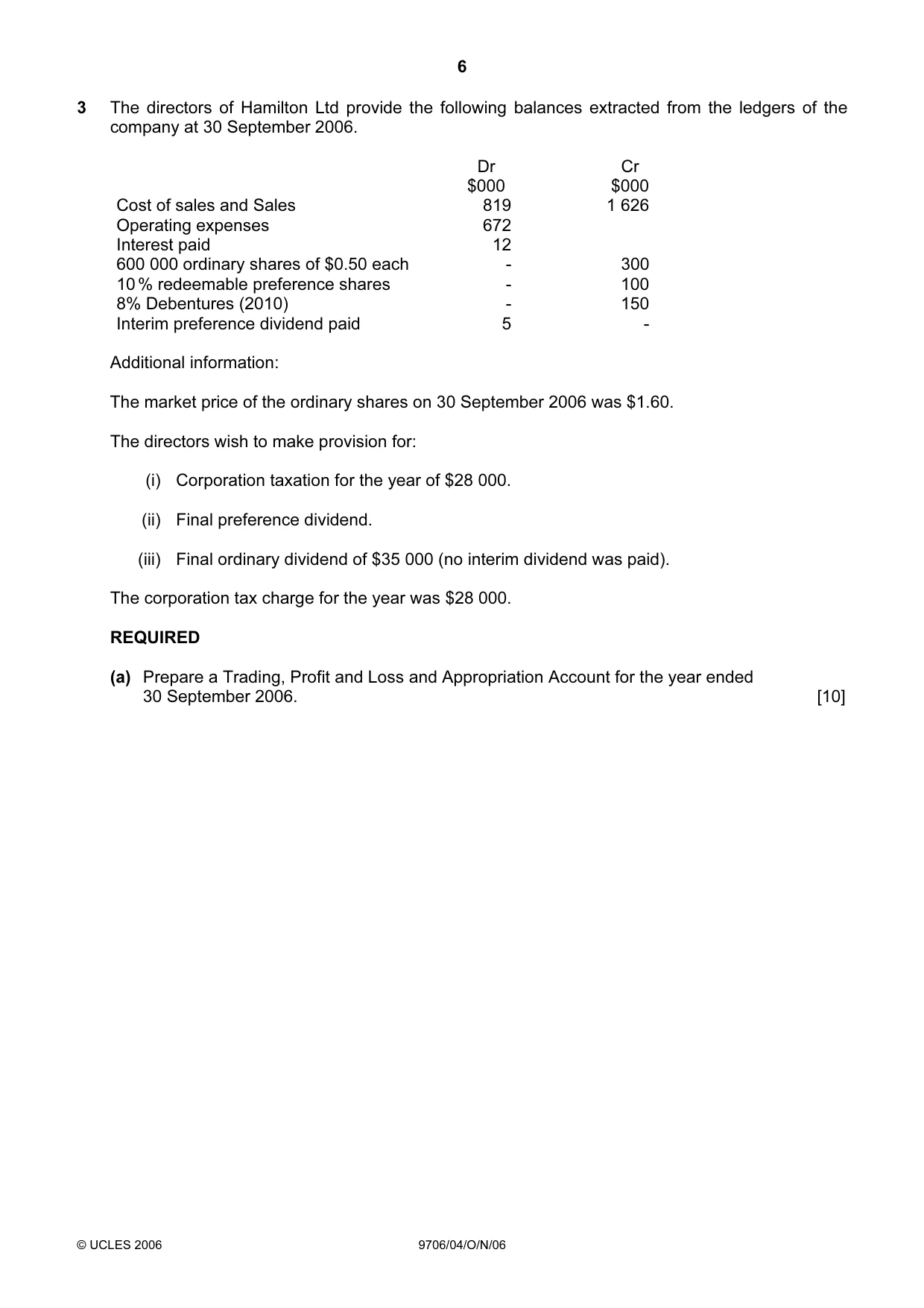
6 © UCLES 2006 9706/04/O/N/06 3 The directors of Hamilton Ltd provide the following balances extracted from the ledgers of the company at 30 September 2006. Dr Cr $000 $000 Cost of sales and Sales 819 1 626 Operating expenses 672 Interest paid 12 600 000 ordinary shares of $0.50 each - 300 10 % redeemable preference shares - 100 8% Debentures (2010) - 150 Interim preference dividend paid 5 - Additional information: The market price of the ordinary shares on 30 September 2006 was $1.60. The directors wish to make provision for: (i) Corporation taxation for the year of $28 000. (ii) Final preference dividend. (iii) Final ordinary dividend of $35 000 (no interim dividend was paid). The corporation tax charge for the year was $28 000. REQUIRED (a) Prepare a Trading, Profit and Loss and Appropriation Account for the year ended 30 September 2006. [10]
Question paper, page 7
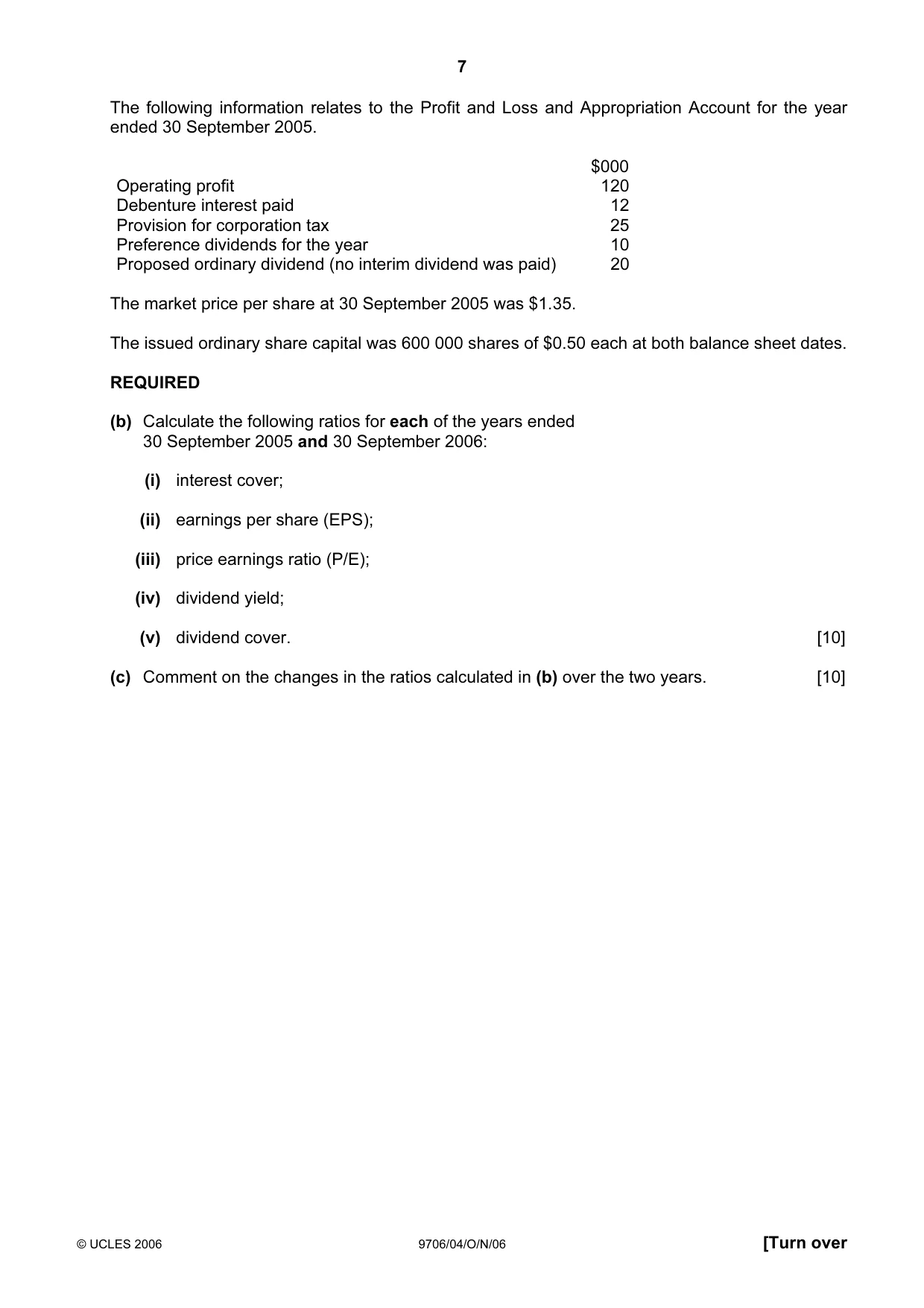
7 © UCLES 2006 9706/04/O/N/06 [Turn over The following information relates to the Profit and Loss and Appropriation Account for the year ended 30 September 2005. $000 Operating profit 120 Debenture interest paid 12 Provision for corporation tax 25 Preference dividends for the year 10 Proposed ordinary dividend (no interim dividend was paid) 20 The market price per share at 30 September 2005 was $1.35. The issued ordinary share capital was 600 000 shares of $0.50 each at both balance sheet dates. REQUIRED (b) Calculate the following ratios for each of the years ended 30 September 2005 and 30 September 2006: (i) interest cover; (ii) earnings per share (EPS); (iii) price earnings ratio (P/E); (iv) dividend yield; (v) dividend cover. [10] (c) Comment on the changes in the ratios calculated in (b) over the two years. [10]
Question paper, page 8
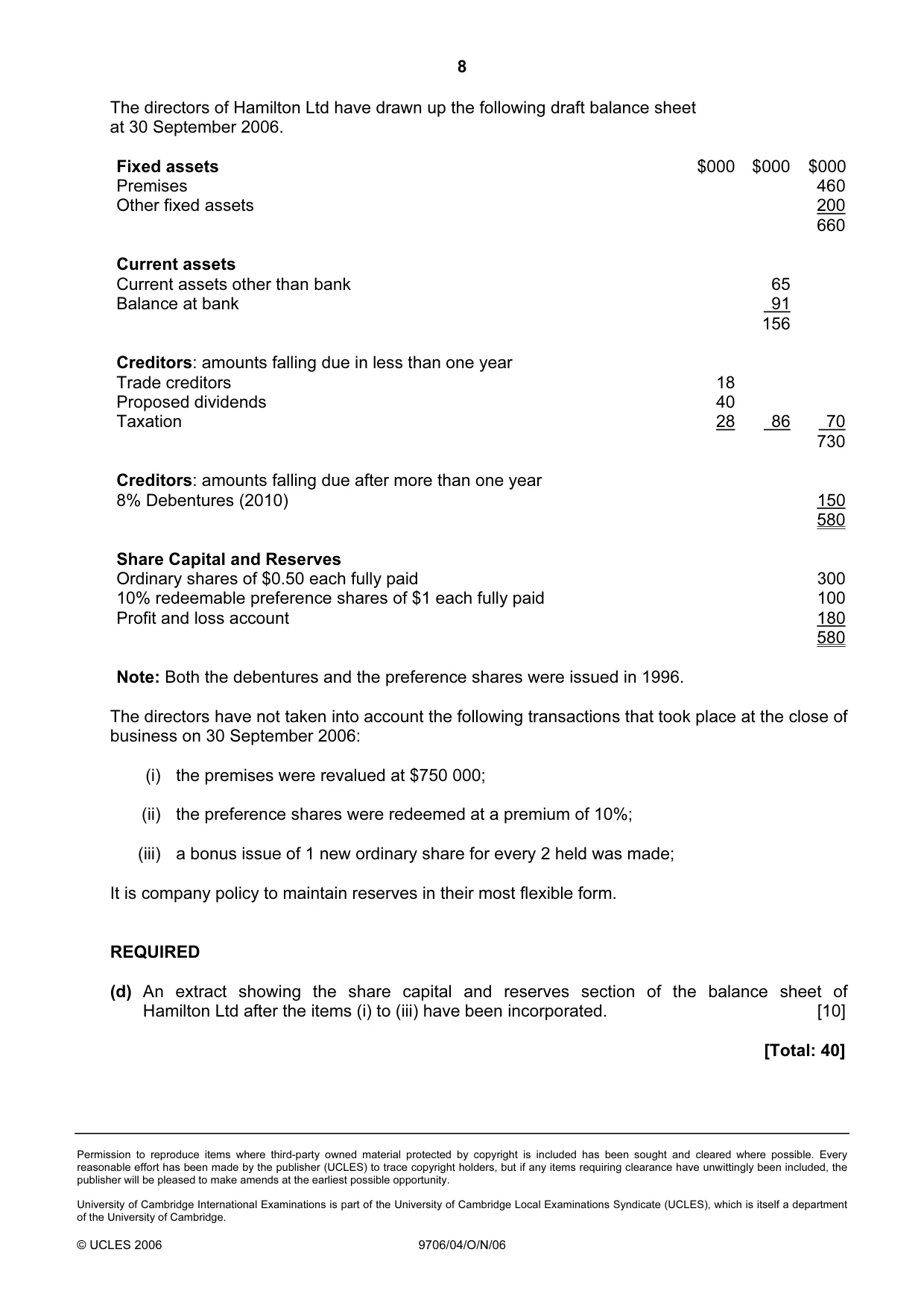
8 Permission to reproduce items where third-party owned material protected by copyright is included has been sought and cleared where possible. Every reasonable effort has been made by the publisher (UCLES) to trace copyright holders, but if any items requiring clearance have unwittingly been included, the publisher will be pleased to make amends at the earliest possible opportunity. University of Cambridge International Examinations is part of the University of Cambridge Local Examinations Syndicate (UCLES), which is itself a department of the University of Cambridge. © UCLES 2006 9706/04/O/N/06 The directors of Hamilton Ltd have drawn up the following draft balance sheet at 30 September 2006. Fixed assets $000 $000 $000 Premises 460 Other fixed assets 200 660 Current assets Current assets other than bank 65 Balance at bank 91 156 Creditors: amounts falling due in less than one year Trade creditors 18 Proposed dividends 40 Taxation 28 86 70 730 Creditors: amounts falling due after more than one year 8% Debentures (2010) 150 580 Share Capital and Reserves Ordinary shares of $0.50 each fully paid 300 10% redeemable preference shares of $1 each fully paid 100 Profit and loss account 180 580 Note: Both the debentures and the preference shares were issued in 1996. The directors have not taken into account the following transactions that took place at the close of business on 30 September 2006: (i) the premises were revalued at $750 000; (ii) the preference shares were redeemed at a premium of 10%; (iii) a bonus issue of 1 new ordinary share for every 2 held was made; It is company policy to maintain reserves in their most flexible form. REQUIRED (d) An extract showing the share capital and reserves section of the balance sheet of Hamilton Ltd after the items (i) to (iii) have been incorporated. [10] [Total: 40]
Mark scheme, page 1
UNIVERSITY OF CAMBRIDGE INTERNATIONAL EXAMINATIONS GCE Advanced Subsidiary Level and GCE Advanced Level MARK SCHEME for the October/November 2006 question paper 9706 ACCOUNTING 9706/04 Paper 4 (Problem Solving (supplement)), maximum raw mark 120 This mark scheme is published as an aid to teachers and students, to indicate the requirements of the examination. It shows the basis on which Examiners were instructed to award marks. It does not indicate the details of the discussions that took place at an Examiners’ meeting before marking began. All Examiners are instructed that alternative correct answers and unexpected approaches in candidates’ scripts must be given marks that fairly reflect the relevant knowledge and skills demonstrated. Mark schemes must be read in conjunction with the question papers and the report on the examination. The grade thresholds for various grades are published in the report on the examination for most IGCSE, GCE Advanced Level and Advanced Subsidiary Level syllabuses. • CIE will not enter into discussions or correspondence in connection with these mark schemes. CIE is publishing the mark schemes for the October/November 2006 question papers for most IGCSE, GCE Advanced Level and Advanced Subsidiary Level syllabuses and some Ordinary Level syllabuses.
Mark scheme, page 2
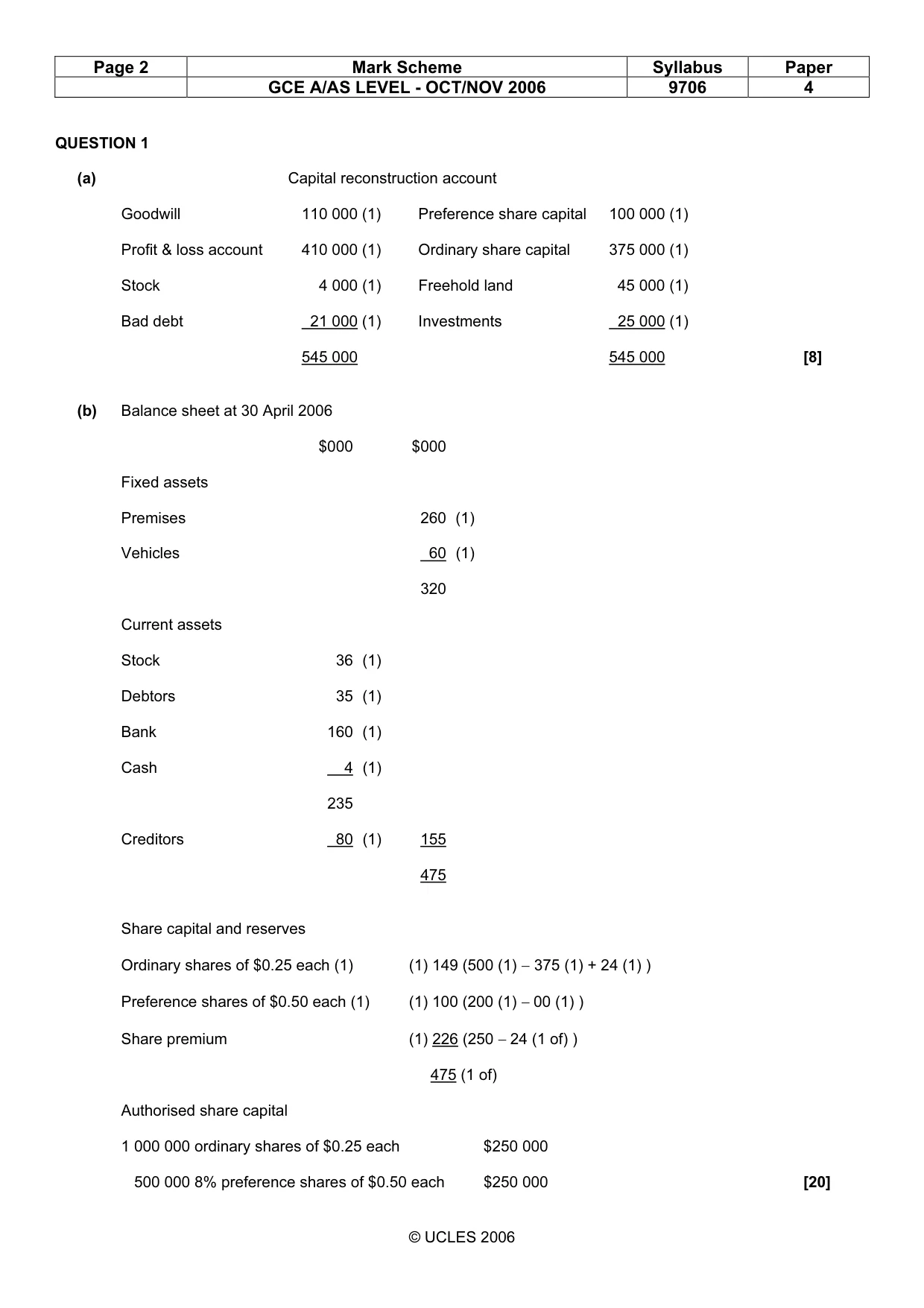
Page 2 Mark Scheme Syllabus Paper GCE A/AS LEVEL - OCT/NOV 2006 9706 4 © UCLES 2006 QUESTION 1 (a) Capital reconstruction account Goodwill 110 000 (1) Preference share capital 100 000 (1) Profit & loss account 410 000 (1) Ordinary share capital 375 000 (1) Stock 4 000 (1) Freehold land 45 000 (1) Bad debt 21 000 (1) Investments 25 000 (1) 545 000 (1) 545 000 (1) [8] (b) Balance sheet at 30 April 2006 $000 $000 Fixed assets Premises 260 (1) Vehicles 60 (1) 320 Current assets Stock 36 (1) Debtors 35 (1) Bank 160 (1) Cash 4 (1) 235 Creditors 80 (1) 155 475 Share capital and reserves Ordinary shares of $0.25 each (1) (1) 149 (500 (1) − 375 (1) + 24 (1) ) Preference shares of $0.50 each (1) (1) 100 (200 (1) − 00 (1) ) Share premium (1) 226 (250 − 24 (1 of) ) 475 (1 of) Authorised share capital 1 000 000 ordinary shares of $0.25 each $250 000 500 000 8% preference shares of $0.50 each $250 000 [20]
Mark scheme, page 3
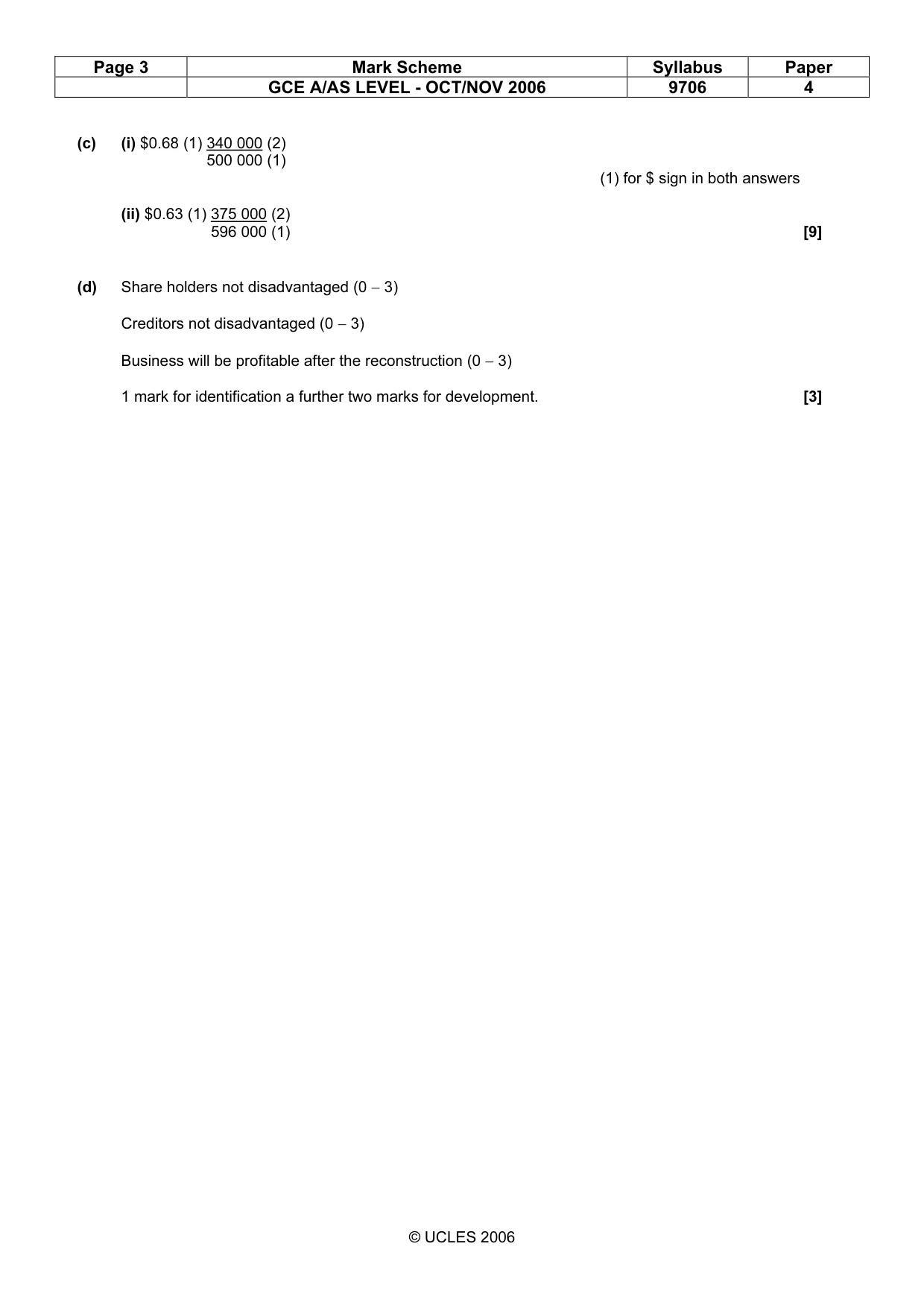
Page 3 Mark Scheme Syllabus Paper GCE A/AS LEVEL - OCT/NOV 2006 9706 4 © UCLES 2006 (c) (i) $0.68 (1) 340 000 (2) 500 000 (1) (1) for $ sign in both answers (ii) $0.63 (1) 375 000 (2) 596 000 (1) [9] (d) Share holders not disadvantaged (0 − 3) Creditors not disadvantaged (0 − 3) Business will be profitable after the reconstruction (0 − 3) 1 mark for identification a further two marks for development. [3]
Mark scheme, page 4
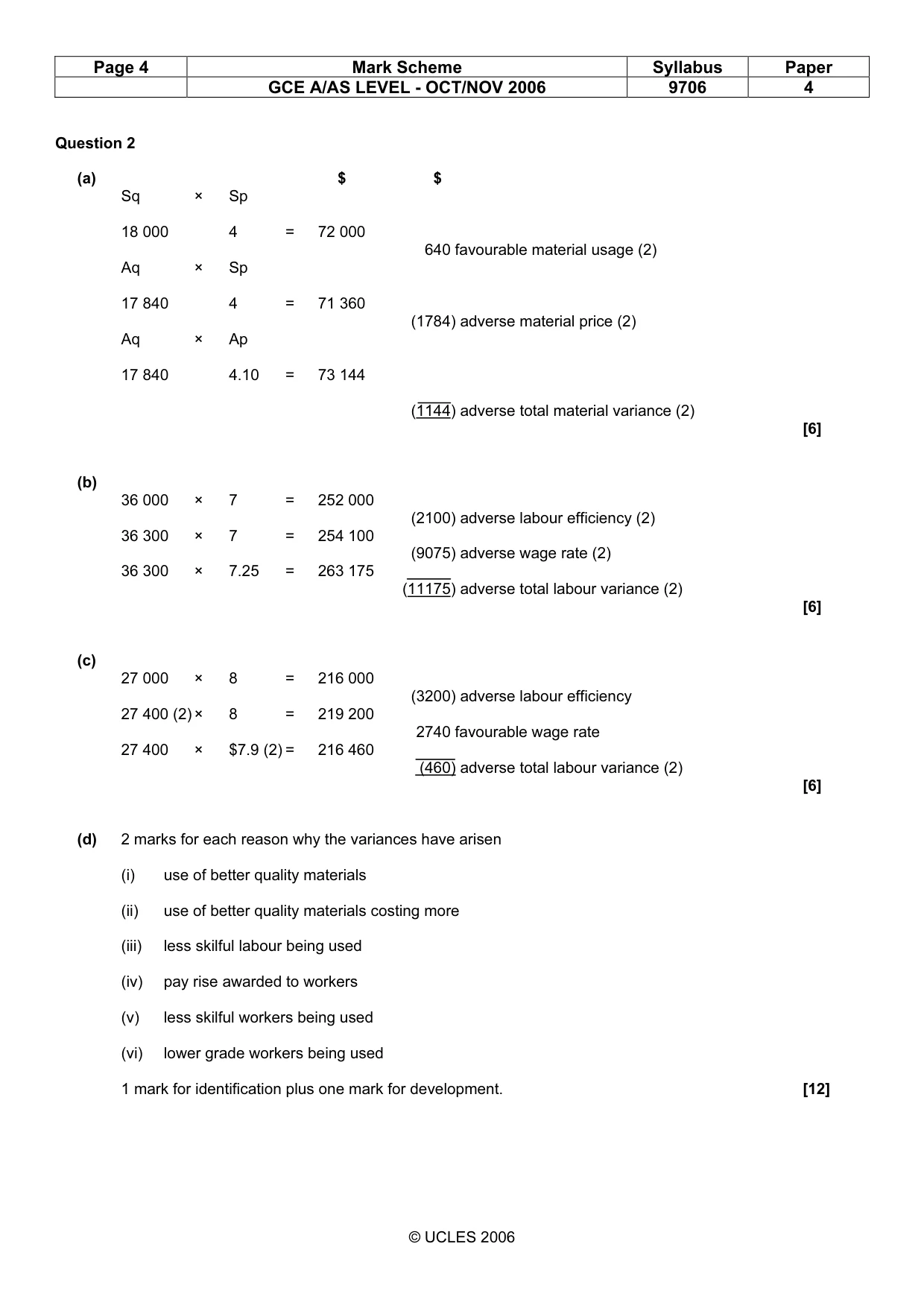
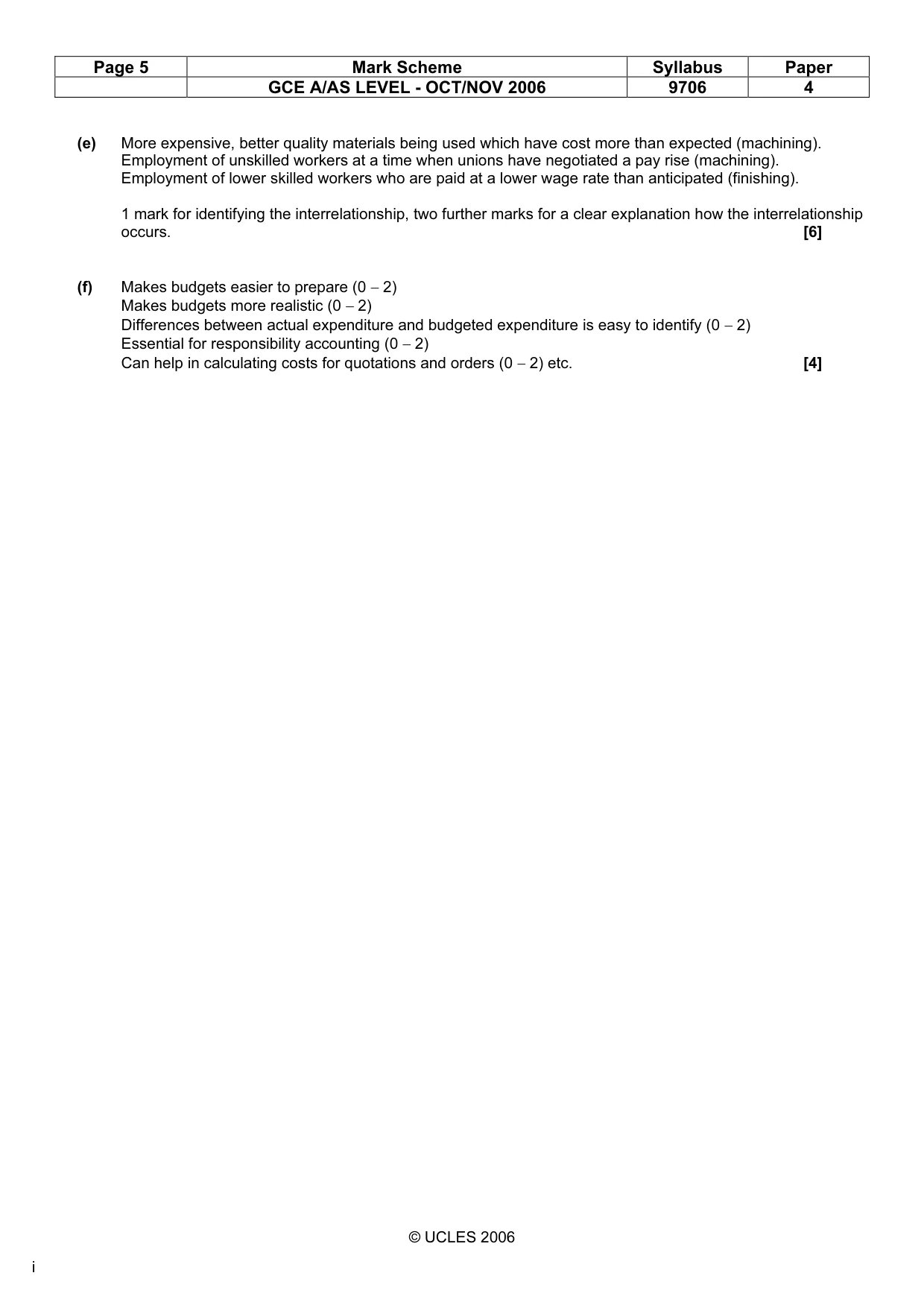
Page 4 Mark Scheme Syllabus Paper GCE A/AS LEVEL - OCT/NOV 2006 9706 4 © UCLES 2006 Question 2 (a) $ $ Sq × Sp 18 000 4 = 72 000 640 favourable material usage (2) Aq × Sp 17 840 4 = 71 360 (1784) adverse material price (2) Aq × Ap 17 840 4.10 = 73 144 (1144) adverse total material variance (2) [6] (b) 36 000 × 7 = 252 000 (2100) adverse labour efficiency (2) 36 300 × 7 = 254 100 (9075) adverse wage rate (2) 36 300 × 7.25 = 263 175 (11175) adverse total labour variance (2) [6] (c) 27 000 × 8 = 216 000 (3200) adverse labour efficiency 27 400 (2) × 8 = 219 200 2740 favourable wage rate 27 400 × $7.9 (2) = 216 460 (460) adverse total labour variance (2) [6] (d) 2 marks for each reason why the variances have arisen (i) use of better quality materials (ii) use of better quality materials costing more (iii) less skilful labour being used (iv) pay rise awarded to workers (v) less skilful workers being used (vi) lower grade workers being used 1 mark for identification plus one mark for development. [12]
Mark scheme, page 5
Page 5 Mark Scheme Syllabus Paper GCE A/AS LEVEL - OCT/NOV 2006 9706 4 © UCLES 2006 (e) More expensive, better quality materials being used which have cost more than expected (machining). Employment of unskilled workers at a time when unions have negotiated a pay rise (machining). Employment of lower skilled workers who are paid at a lower wage rate than anticipated (finishing). 1 mark for identifying the interrelationship, two further marks for a clear explanation how the interrelationship occurs. [6] (f) Makes budgets easier to prepare (0 − 2) Makes budgets more realistic (0 − 2) Differences between actual expenditure and budgeted expenditure is easy to identify (0 − 2) Essential for responsibility accounting (0 − 2) Can help in calculating costs for quotations and orders (0 − 2) etc. [4] i
Mark scheme, page 6
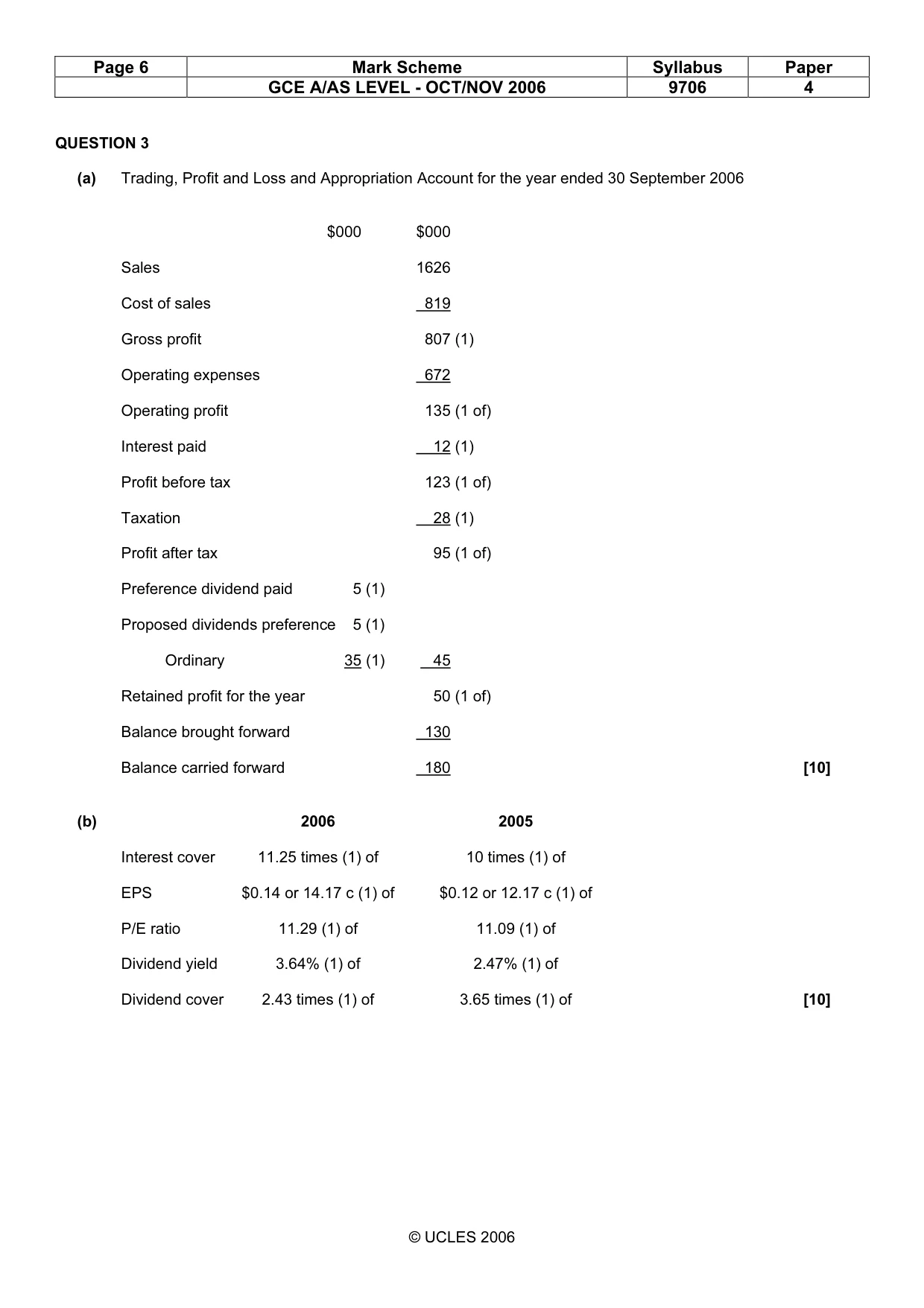
Page 6 Mark Scheme Syllabus Paper GCE A/AS LEVEL - OCT/NOV 2006 9706 4 © UCLES 2006 QUESTION 3 (a) Trading, Profit and Loss and Appropriation Account for the year ended 30 September 2006 $000 $000 Sales 1626 Cost of sales 819 Gross profit 807 (1) Operating expenses 672 Operating profit 135 (1 of) Interest paid 12 (1) Profit before tax 123 (1 of) Taxation 28 (1) Profit after tax 95 (1 of) Preference dividend paid 5 (1) Proposed dividends preference 5 (1) Ordinary 35 (1) 45 Retained profit for the year 50 (1 of) Balance brought forward 130 Balance carried forward 180 [10] (b) 2006 2005 Interest cover 11.25 times (1) of 10 times (1) of EPS $0.14 or 14.17 c (1) of $0.12 or 12.17 c (1) of P/E ratio 11.29 (1) of 11.09 (1) of Dividend yield 3.64% (1) of 2.47% (1) of Dividend cover 2.43 times (1) of 3.65 times (1) of [10]
Mark scheme, page 7
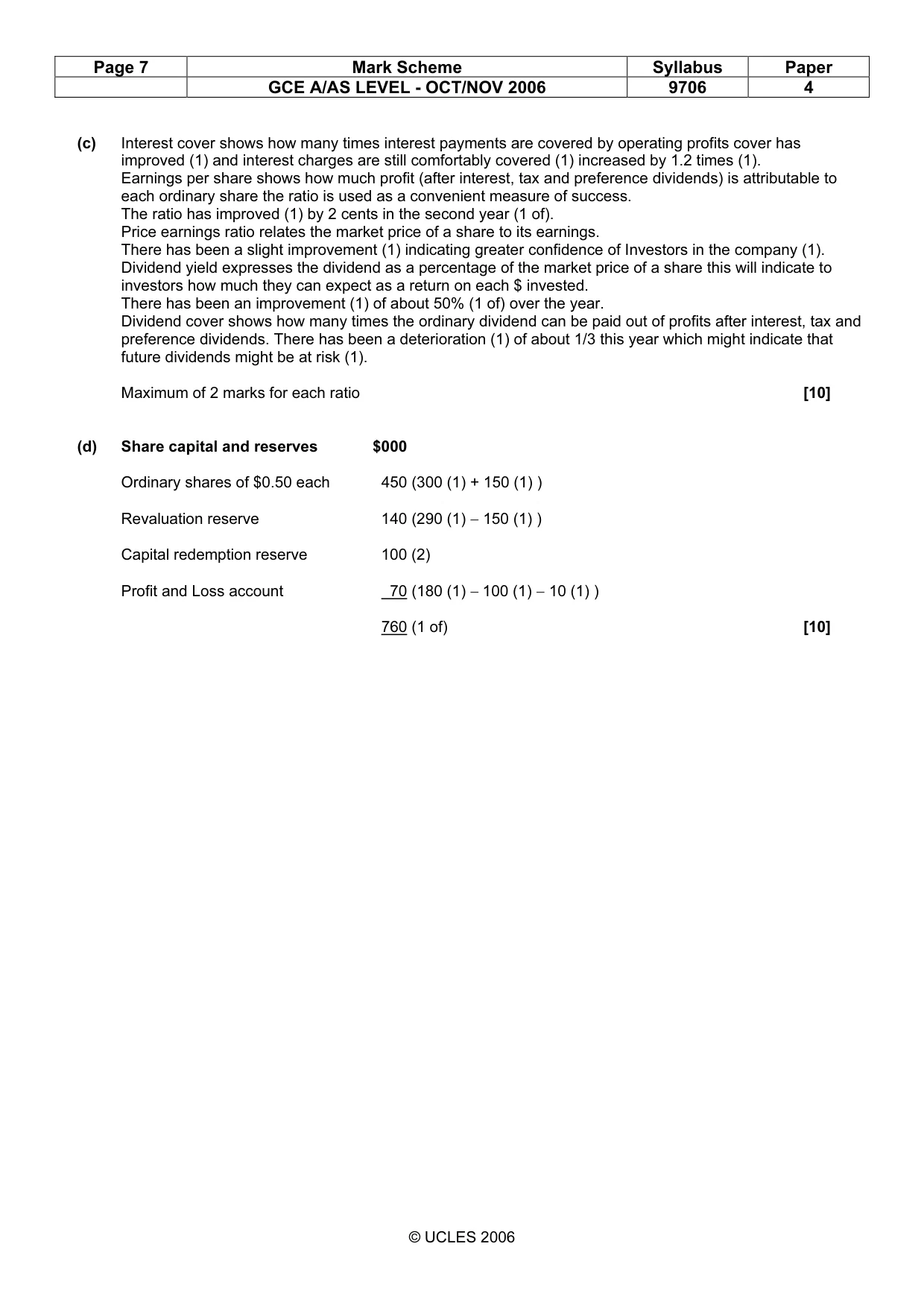
Page 7 Mark Scheme Syllabus Paper GCE A/AS LEVEL - OCT/NOV 2006 9706 4 © UCLES 2006 (c) Interest cover shows how many times interest payments are covered by operating profits cover has improved (1) and interest charges are still comfortably covered (1) increased by 1.2 times (1). Earnings per share shows how much profit (after interest, tax and preference dividends) is attributable to each ordinary share the ratio is used as a convenient measure of success. The ratio has improved (1) by 2 cents in the second year (1 of). Price earnings ratio relates the market price of a share to its earnings. There has been a slight improvement (1) indicating greater confidence of Investors in the company (1). Dividend yield expresses the dividend as a percentage of the market price of a share this will indicate to investors how much they can expect as a return on each $ invested. There has been an improvement (1) of about 50% (1 of) over the year. Dividend cover shows how many times the ordinary dividend can be paid out of profits after interest, tax and preference dividends. There has been a deterioration (1) of about 1/3 this year which might indicate that future dividends might be at risk (1). Maximum of 2 marks for each ratio [10] (d) Share capital and reserves $000 Ordinary shares of $0.50 each 450 (300 (1) + 150 (1) ) Revaluation reserve 140 (290 (1) − 150 (1) ) Capital redemption reserve 100 (2) Profit and Loss account 70 (180 (1) − 100 (1) − 10 (1) ) 760 (1 of) [10]
What you needed in this session
Cambridge’s own grade thresholds for 2006 Oct/Nov, Paper 4 · Variant 1. A higher threshold means an easier paper — the bar moves with how the cohort did.