Cambridge A Level Accounting 9706 — 2006 May/June Paper 4 · Variant 1
9706/41/M/J/06 · 120 marks · ≈135 min
The question paper and its mark scheme, free to read here and free to download. This is Cambridge’s own paper, exactly as it was sat.
Question paper8 pages

Mark scheme6 pages
Answers below. Sit the paper first if you are practising.
Paper as text
Question paper, page 1
UNIVERSITY OF CAMBRIDGE INTERNATIONAL EXAMINATIONS General Certificate of Education Advanced Subsidiary Level and Advanced Level ACCOUNTING 9706/04 Paper 4 Problem Solving (Supplementary Topics) May/June 2006 2 hours Additional Materials: Answer Booklet/Paper READ THESE INSTRUCTIONS FIRST If you have been given an Answer Booklet, follow the instructions on the front cover of the Booklet. Write your Centre number, candidate number and name on all the work you hand in. Write in dark blue or black pen. You may use a soft pencil for any diagrams, graphs or rough working. Do not use staples, paper clips, highlighters, glue or correction fluid. Answer all questions. All accounting statements are to be presented in good style. Workings should be shown. You may use a calculator. At the end of the examination, fasten all your work securely together. The number of marks is given in brackets [ ] at the end of each question or part question. This document consists of 6 printed pages and 2 blank pages. IB06 06_9706_04/6RP UCLES 2006 [Turn over
Question paper, page 2
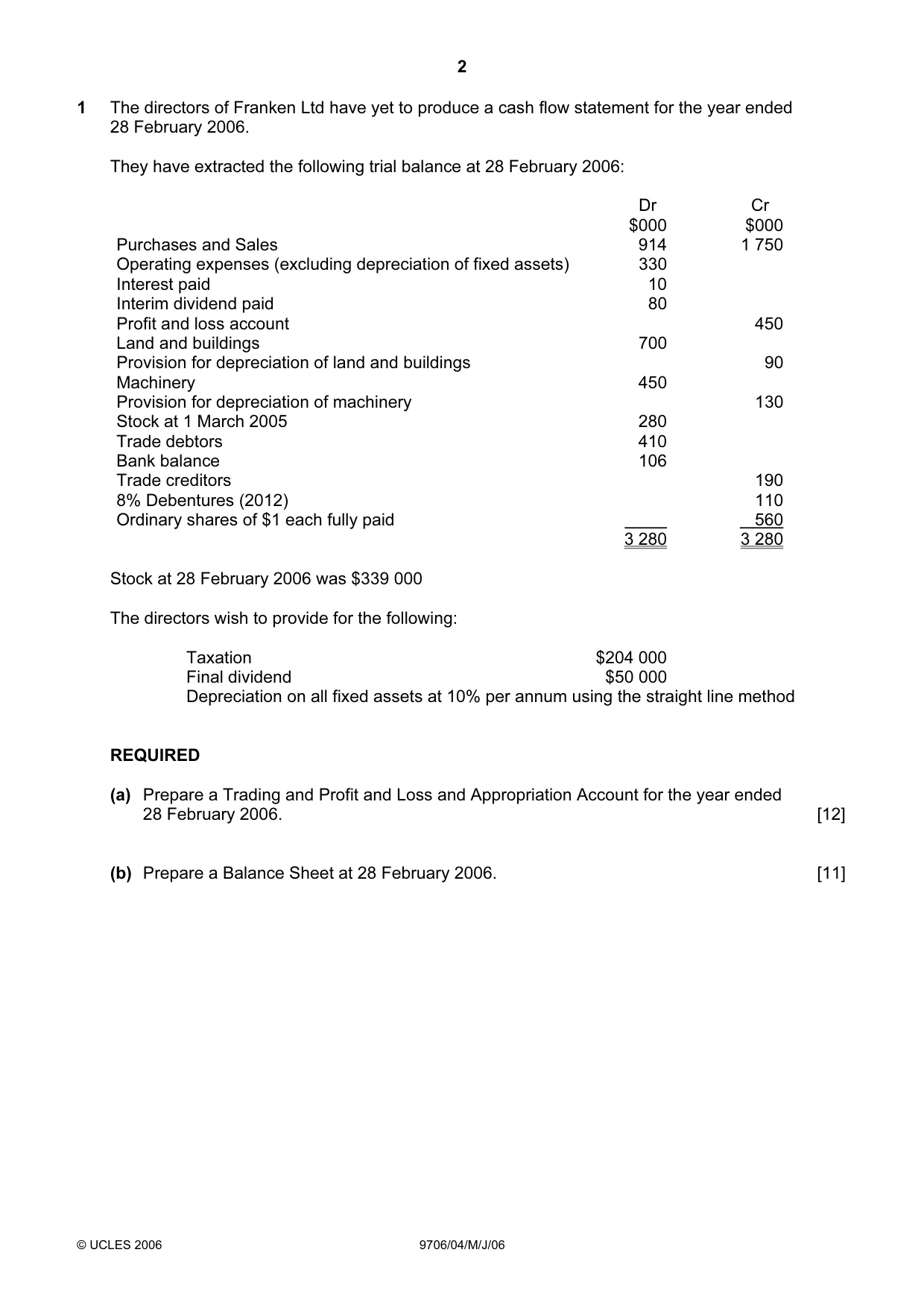
2 © UCLES 2006 9706/04/M/J/06 1 The directors of Franken Ltd have yet to produce a cash flow statement for the year ended 28 February 2006. They have extracted the following trial balance at 28 February 2006: Dr Cr $000 $000 Purchases and Sales 914 1 750 Operating expenses (excluding depreciation of fixed assets) 330 Interest paid 10 Interim dividend paid 80 Profit and loss account 450 Land and buildings 700 Provision for depreciation of land and buildings 90 Machinery 450 Provision for depreciation of machinery 130 Stock at 1 March 2005 280 Trade debtors 410 Bank balance 106 Trade creditors 190 8% Debentures (2012) 110 Ordinary shares of $1 each fully paid 560 3 280 3 280 Stock at 28 February 2006 was $339 000 The directors wish to provide for the following: Taxation $204 000 Final dividend $50 000 Depreciation on all fixed assets at 10% per annum using the straight line method REQUIRED (a) Prepare a Trading and Profit and Loss and Appropriation Account for the year ended 28 February 2006. [12] (b) Prepare a Balance Sheet at 28 February 2006. [11]
Question paper, page 3
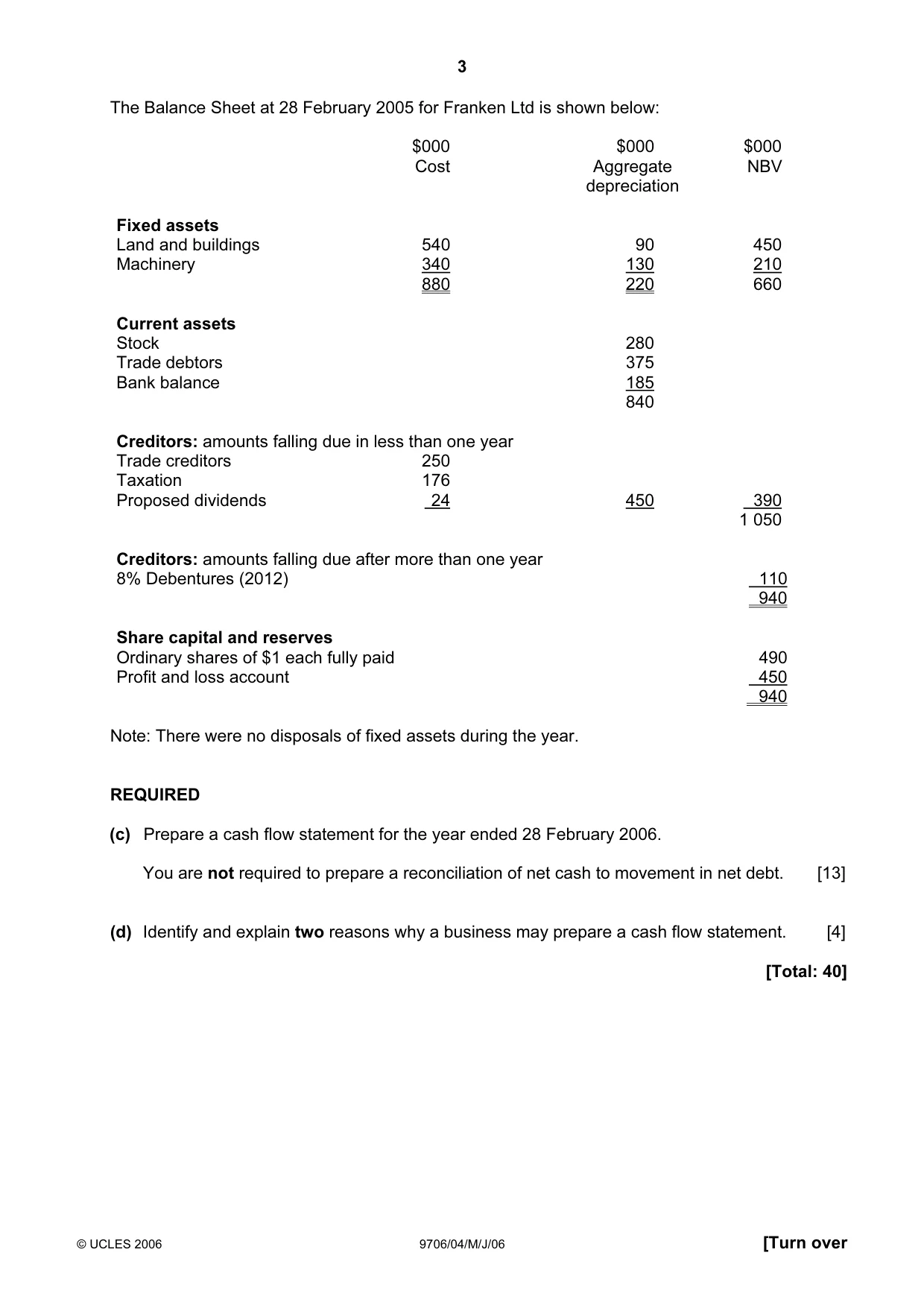
3 © UCLES 2006 9706/04/M/J/06 [Turn over The Balance Sheet at 28 February 2005 for Franken Ltd is shown below: $000 $000 $000 Cost Aggregate NBV depreciation Fixed assets Land and buildings 540 90 450 Machinery 340 130 210 880 220 660 Current assets Stock 280 Trade debtors 375 Bank balance 185 840 Creditors: amounts falling due in less than one year Trade creditors 250 Taxation 176 Proposed dividends 24 450 390 1 050 Creditors: amounts falling due after more than one year 8% Debentures (2012) 110 940 Share capital and reserves Ordinary shares of $1 each fully paid 490 Profit and loss account 450 940 Note: There were no disposals of fixed assets during the year. REQUIRED (c) Prepare a cash flow statement for the year ended 28 February 2006. You are not required to prepare a reconciliation of net cash to movement in net debt. [13] (d) Identify and explain two reasons why a business may prepare a cash flow statement. [4] [Total: 40]
Question paper, page 4
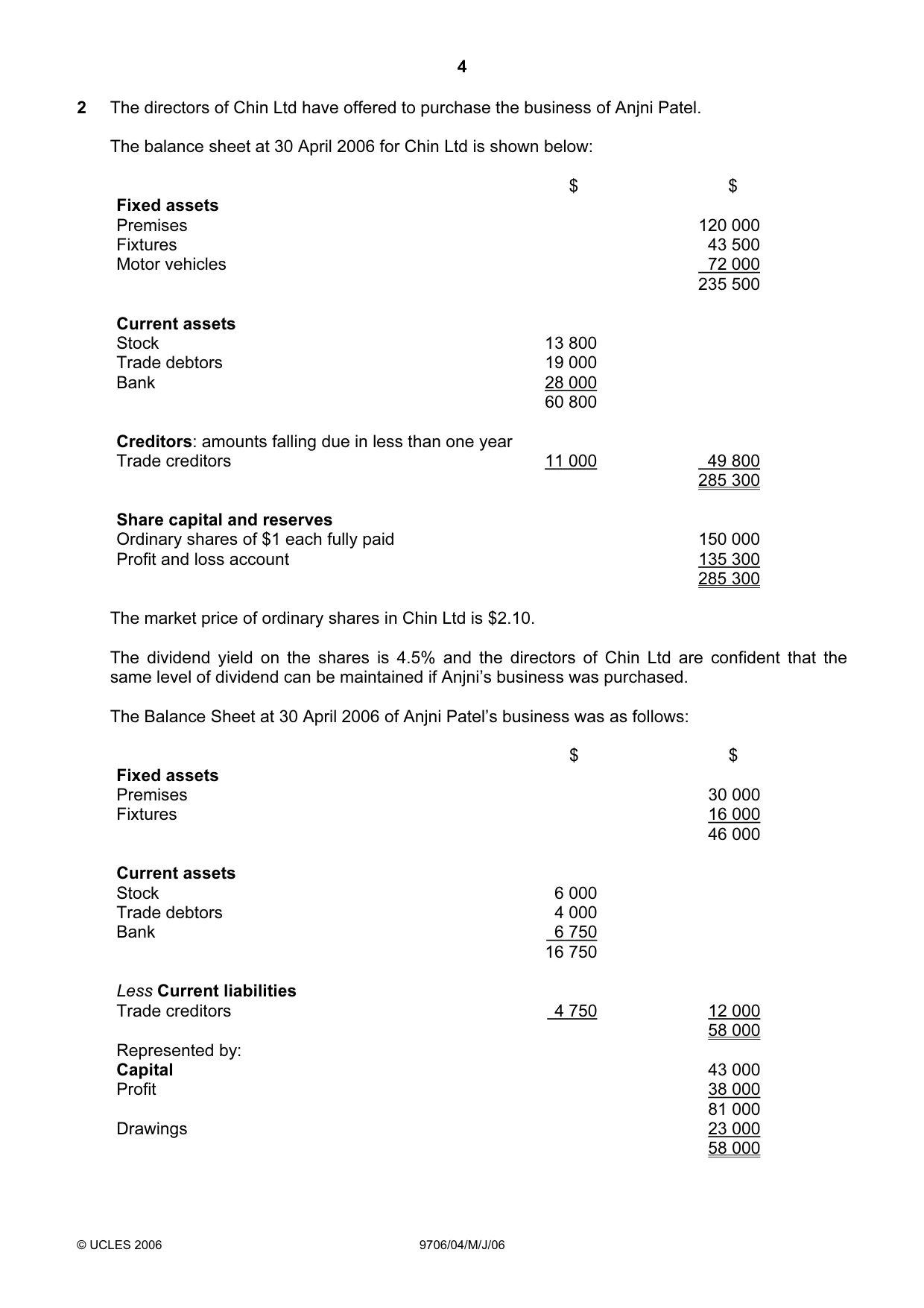
4 © UCLES 2006 9706/04/M/J/06 2 The directors of Chin Ltd have offered to purchase the business of Anjni Patel. The balance sheet at 30 April 2006 for Chin Ltd is shown below: $ $ Fixed assets Premises 120 000 Fixtures 43 500 Motor vehicles 72 000 235 500 Current assets Stock 13 800 Trade debtors 19 000 Bank 28 000 60 800 Creditors: amounts falling due in less than one year Trade creditors 11 000 49 800 285 300 Share capital and reserves Ordinary shares of $1 each fully paid 150 000 Profit and loss account 135 300 285 300 The market price of ordinary shares in Chin Ltd is $2.10. The dividend yield on the shares is 4.5% and the directors of Chin Ltd are confident that the same level of dividend can be maintained if Anjni’s business was purchased. The Balance Sheet at 30 April 2006 of Anjni Patel’s business was as follows: $ $ Fixed assets Premises 30 000 Fixtures 16 000 46 000 Current assets Stock 6 000 Trade debtors 4 000 Bank 6 750 16 750 Less Current liabilities Trade creditors 4 750 12 000 Represented by: 58 000 Capital 43 000 Profit 38 000 81 000 Drawings 23 000 58 000
Question paper, page 5
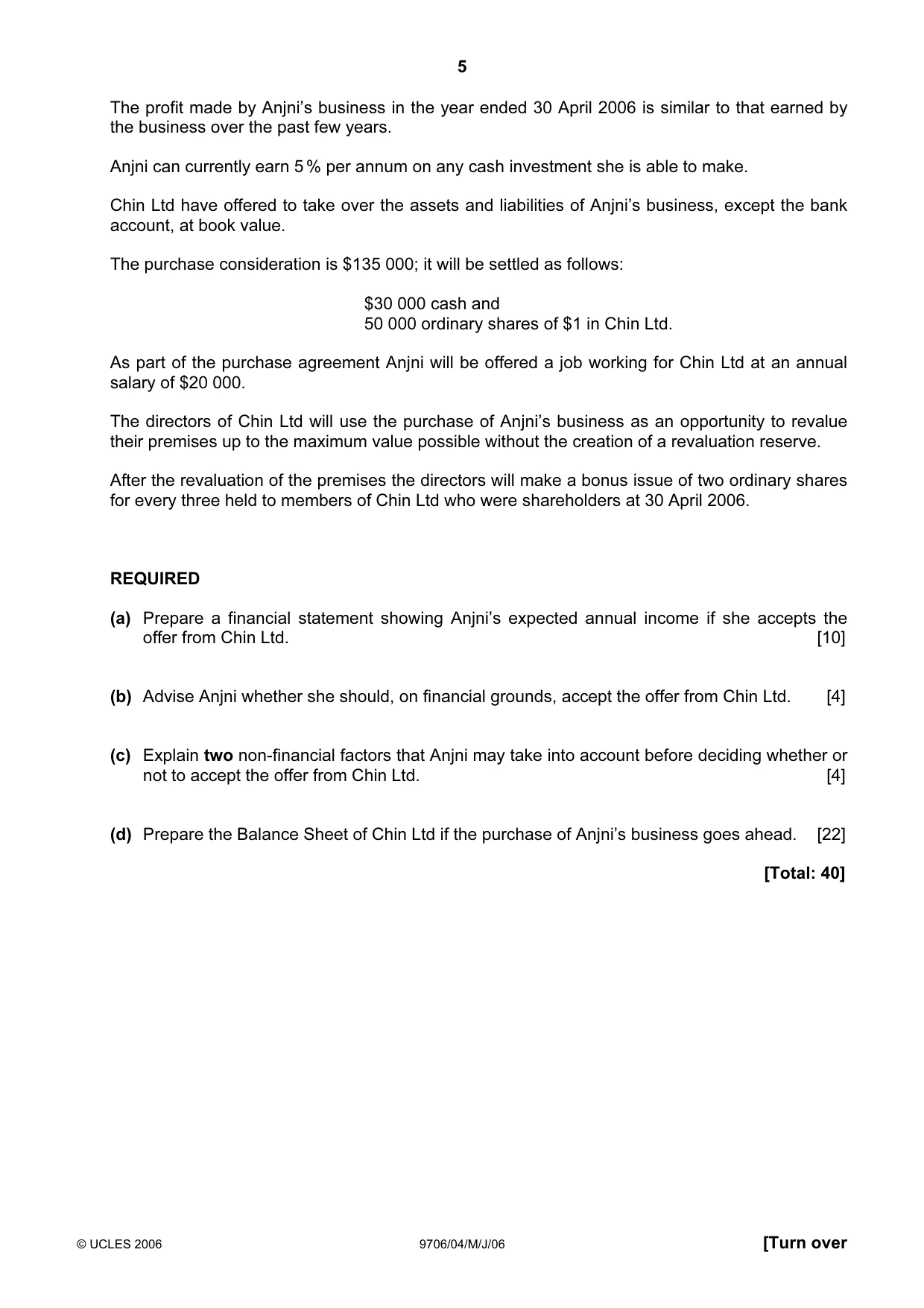
5 © UCLES 2006 9706/04/M/J/06 [Turn over The profit made by Anjni’s business in the year ended 30 April 2006 is similar to that earned by the business over the past few years. Anjni can currently earn 5 % per annum on any cash investment she is able to make. Chin Ltd have offered to take over the assets and liabilities of Anjni’s business, except the bank account, at book value. The purchase consideration is $135 000; it will be settled as follows: $30 000 cash and 50 000 ordinary shares of $1 in Chin Ltd. As part of the purchase agreement Anjni will be offered a job working for Chin Ltd at an annual salary of $20 000. The directors of Chin Ltd will use the purchase of Anjni’s business as an opportunity to revalue their premises up to the maximum value possible without the creation of a revaluation reserve. After the revaluation of the premises the directors will make a bonus issue of two ordinary shares for every three held to members of Chin Ltd who were shareholders at 30 April 2006. REQUIRED (a) Prepare a financial statement showing Anjni’s expected annual income if she accepts the offer from Chin Ltd. [10] (b) Advise Anjni whether she should, on financial grounds, accept the offer from Chin Ltd. [4] (c) Explain two non-financial factors that Anjni may take into account before deciding whether or not to accept the offer from Chin Ltd. [4] (d) Prepare the Balance Sheet of Chin Ltd if the purchase of Anjni’s business goes ahead. [22] [Total: 40]
Question paper, page 6
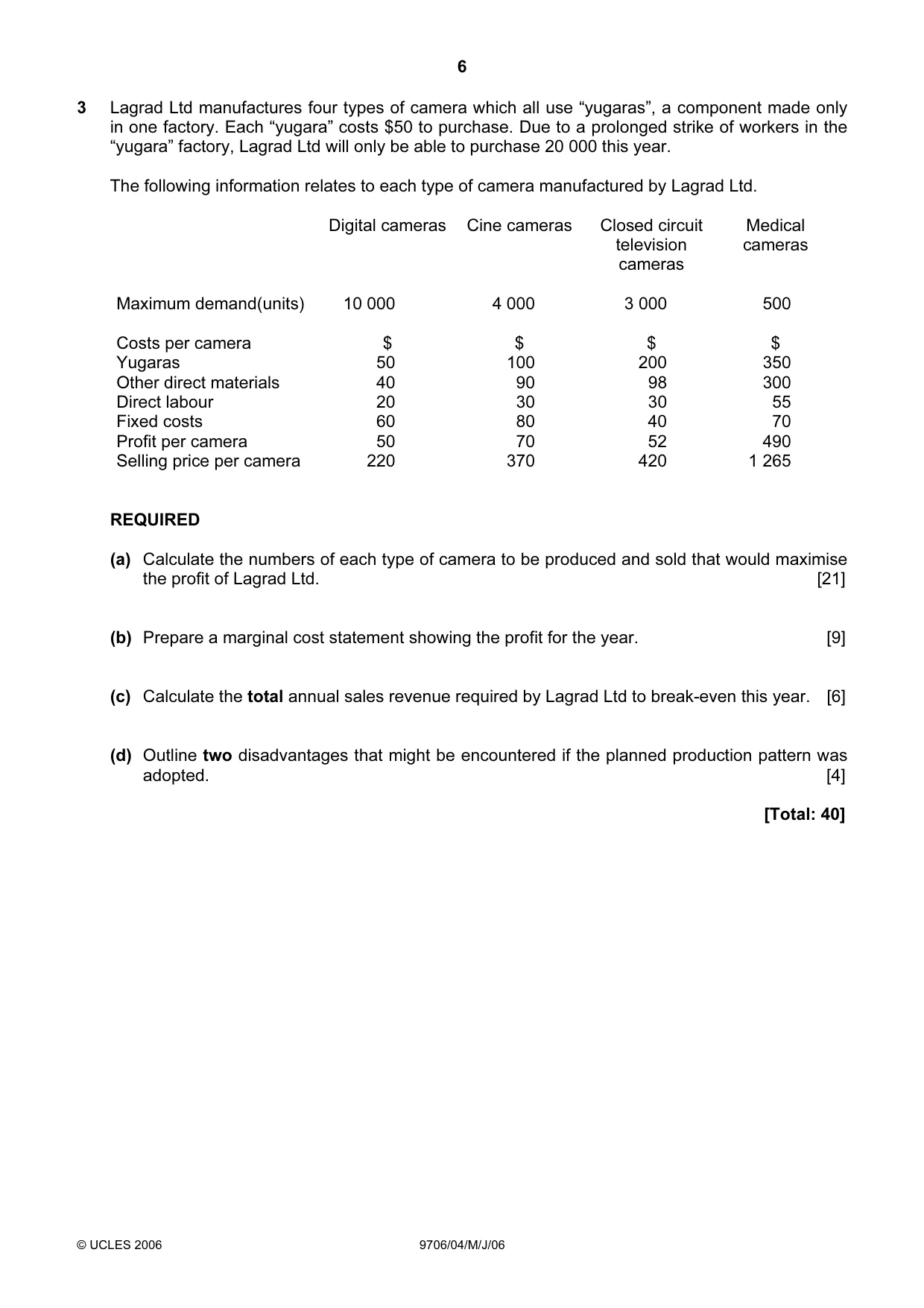
6 © UCLES 2006 9706/04/M/J/06 3 Lagrad Ltd manufactures four types of camera which all use “yugaras”, a component made only in one factory. Each “yugara” costs $50 to purchase. Due to a prolonged strike of workers in the “yugara” factory, Lagrad Ltd will only be able to purchase 20 000 this year. The following information relates to each type of camera manufactured by Lagrad Ltd. Digital cameras Cine cameras Closed circuit television cameras Medical cameras Maximum demand(units) 10 000 4 000 3 000 500 Costs per camera $ $ $ $ Yugaras 50 100 200 350 Other direct materials 40 90 98 300 Direct labour 20 30 30 55 Fixed costs 60 80 40 70 Profit per camera 50 70 52 490 Selling price per camera 220 370 420 1 265 REQUIRED (a) Calculate the numbers of each type of camera to be produced and sold that would maximise the profit of Lagrad Ltd. [21] (b) Prepare a marginal cost statement showing the profit for the year. [9] (c) Calculate the total annual sales revenue required by Lagrad Ltd to break-even this year. [6] (d) Outline two disadvantages that might be encountered if the planned production pattern was adopted. [4] [Total: 40]
Question paper, page 8
8 BLANK PAGE Permission to reproduce items where third-party owned material protected by copyright is included has been sought and cleared where possible. Every reasonable effort has been made by the publisher (UCLES) to trace copyright holders, but if any items requiring clearance have unwittingly been included, the publisher will be pleased to make amends at the earliest possible opportunity. University of Cambridge International Examinations is part of the University of Cambridge Local Examinations Syndicate (UCLES), which is itself a department of the University of Cambridge. 9706/04/M/J/06
Mark scheme, page 1
UNIVERSITY OF CAMBRIDGE INTERNATIONAL EXAMINATIONS GCE Advanced Level MARK SCHEME for the May/June 2006 question paper 9706 ACCOUNTING 9706/04 Paper 4 Maximum raw mark 120 This mark scheme is published as an aid to teachers and students, to indicate the requirements of the examination. It shows the basis on which Examiners were initially instructed to award marks. It does not indicate the details of the discussions that took place at an Examiners’ meeting before marking began. Any substantial changes to the mark scheme that arose from these discussions will be recorded in the published Report on the Examination. All Examiners are instructed that alternative correct answers and unexpected approaches in candidates’ scripts must be given marks that fairly reflect the relevant knowledge and skills demonstrated. Mark schemes must be read in conjunction with the question papers and the Report on the Examination. The minimum marks in these components needed for various grades were previously published with these mark schemes, but are now instead included in the Report on the Examination for this session. • CIE will not enter into discussion or correspondence in connection with these mark schemes. CIE is publishing the mark schemes for the May/June 2006 question papers for most IGCSE and GCE Advanced Level and Advanced Subsidiary Level syllabuses and some Ordinary Level syllabuses.
Mark scheme, page 2
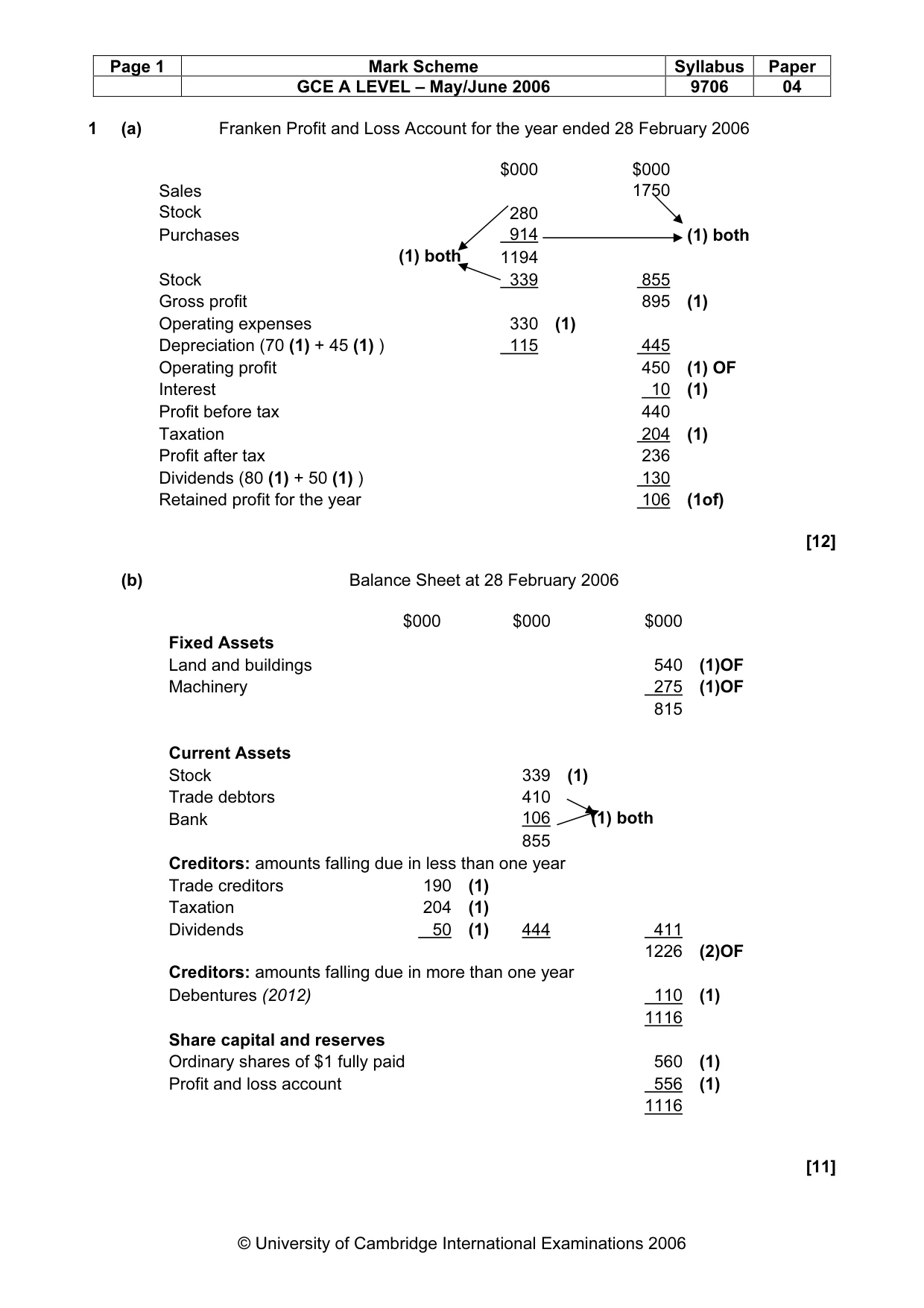
Page 1 Mark Scheme Syllabus Paper GCE A LEVEL – May/June 2006 9706 04 © University of Cambridge International Examinations 2006 1 (a) Franken Profit and Loss Account for the year ended 28 February 2006 [12] (b) Balance Sheet at 28 February 2006 $000 $000 $000 Fixed Assets Land and buildings 540 (1)OF Machinery 275 (1)OF 815 Current Assets Stock 339 (1) Trade debtors 410 Bank 106 (1) both 855 Creditors: amounts falling due in less than one year Trade creditors 190 (1) Taxation 204 (1) Dividends 50 (1) 444 411 1226 (2)OF Creditors: amounts falling due in more than one year Debentures (2012) 110 (1) 1116 Share capital and reserves Ordinary shares of $1 fully paid 560 (1) Profit and loss account 556 (1) 1116 [11] $000 $000 Sales 1750 Stock 280 Purchases 914 (1) both (1) both 1194 Stock 339 855 Gross profit 895 (1) Operating expenses 330 (1) Depreciation (70 (1) + 45 (1) ) 115 445 Operating profit 450 (1) OF Interest 10 (1) Profit before tax 440 Taxation 204 (1) Profit after tax 236 Dividends (80 (1) + 50 (1) ) 130 Retained profit for the year 106 (1of)
Mark scheme, page 3
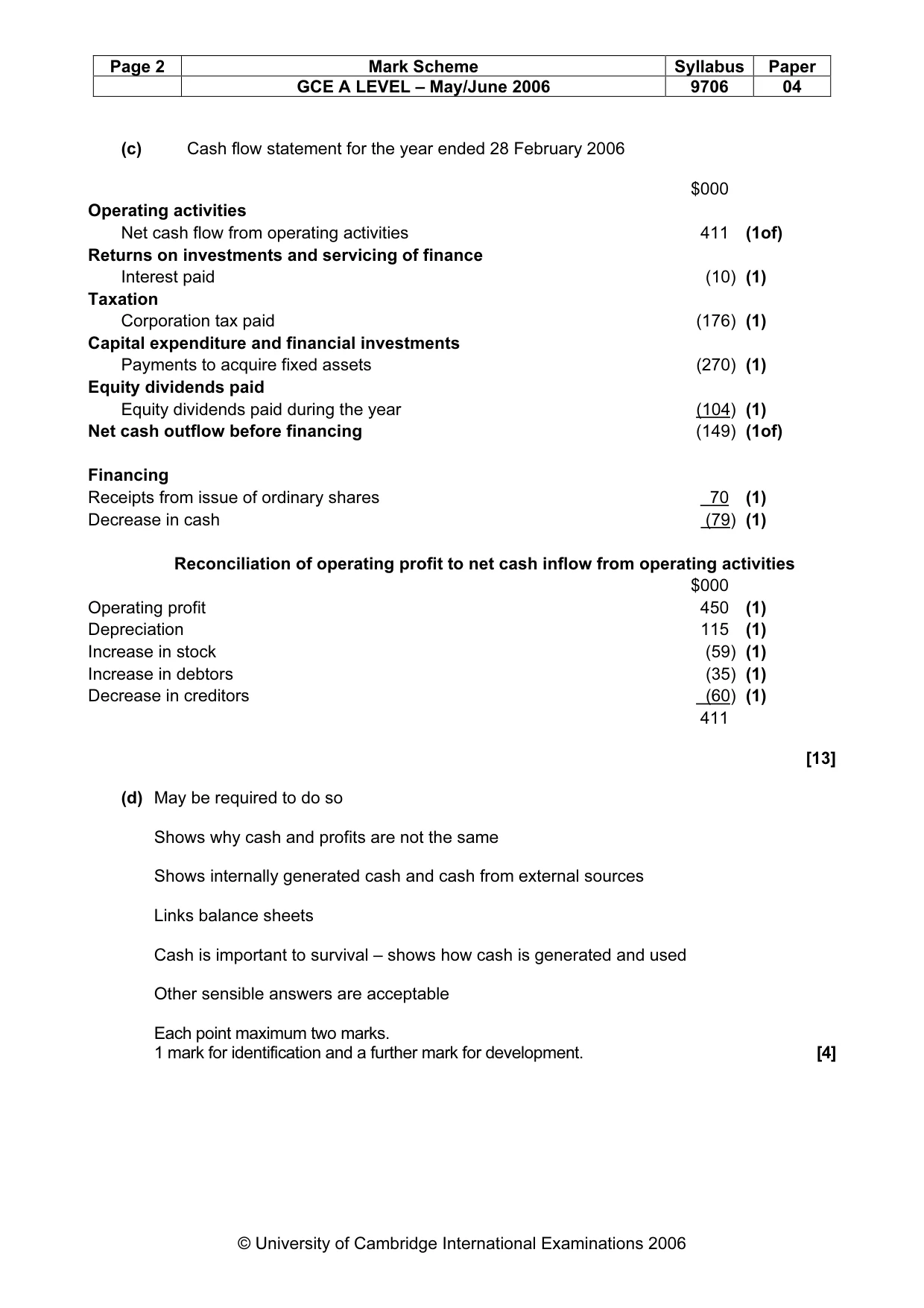
Page 2 Mark Scheme Syllabus Paper GCE A LEVEL – May/June 2006 9706 04 © University of Cambridge International Examinations 2006 (c) Cash flow statement for the year ended 28 February 2006 $000 Operating activities Net cash flow from operating activities 411 (1of) Returns on investments and servicing of finance Interest paid (10) (1) Taxation Corporation tax paid (176) (1) Capital expenditure and financial investments Payments to acquire fixed assets (270) (1) Equity dividends paid Equity dividends paid during the year (104) (1) Net cash outflow before financing (149) (1of) Financing Receipts from issue of ordinary shares 70 (1) Decrease in cash (79) (1) Reconciliation of operating profit to net cash inflow from operating activities $000 Operating profit 450 (1) Depreciation 115 (1) Increase in stock (59) (1) Increase in debtors (35) (1) Decrease in creditors (60) (1) 411 [13] (d) May be required to do so Shows why cash and profits are not the same Shows internally generated cash and cash from external sources Links balance sheets Cash is important to survival – shows how cash is generated and used Other sensible answers are acceptable Each point maximum two marks. 1 mark for identification and a further mark for development. [4]
Mark scheme, page 4
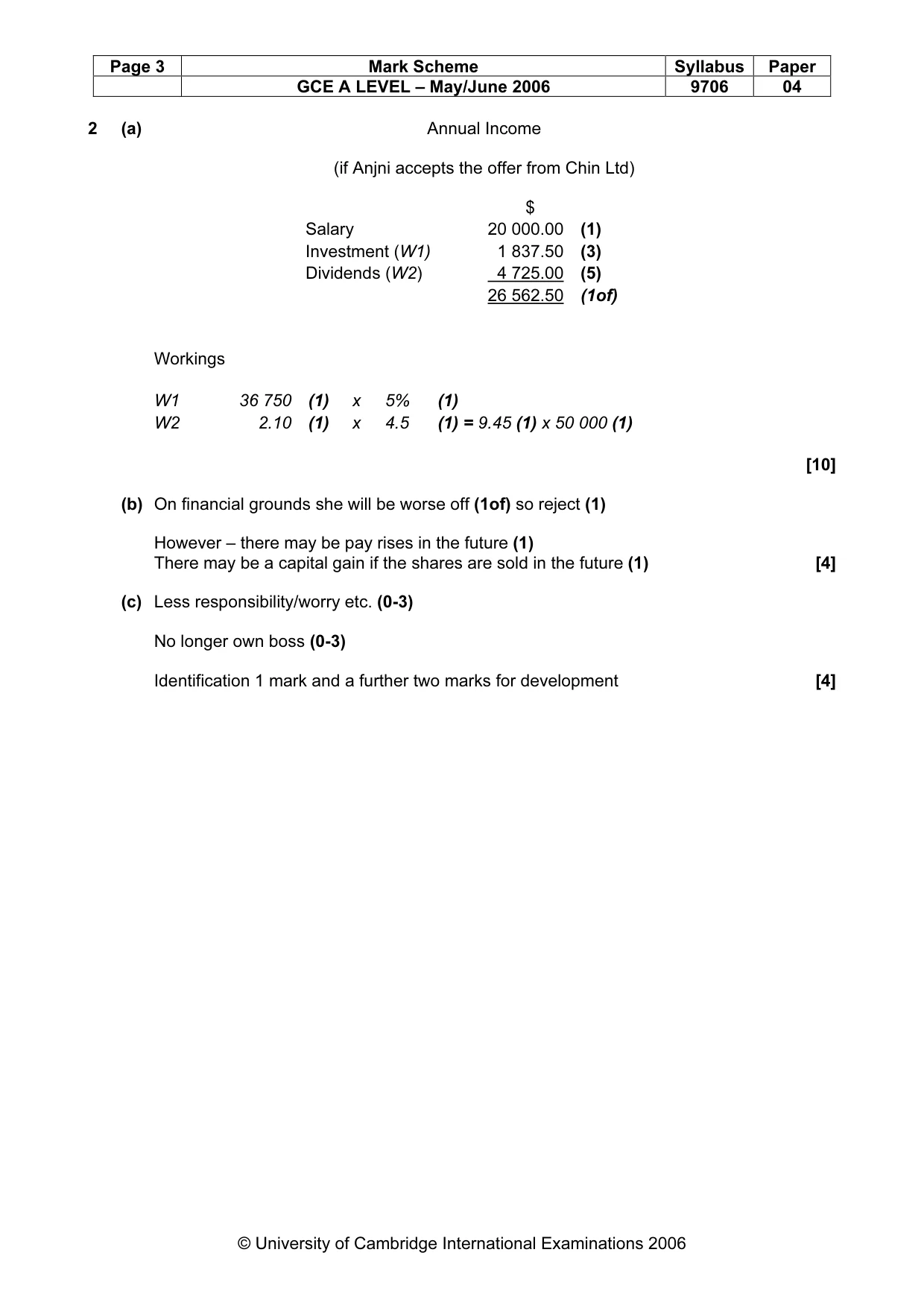
Page 3 Mark Scheme Syllabus Paper GCE A LEVEL – May/June 2006 9706 04 © University of Cambridge International Examinations 2006 2 (a) Annual Income (if Anjni accepts the offer from Chin Ltd) $ Salary 20 000.00 (1) Investment (W1) 1 837.50 (3) Dividends (W2) 4 725.00 (5) 26 562.50 (1of) Workings W1 36 750 (1) x 5% (1) W2 2.10 (1) x 4.5 (1) = 9.45 (1) x 50 000 (1) [10] (b) On financial grounds she will be worse off (1of) so reject (1) However – there may be pay rises in the future (1) There may be a capital gain if the shares are sold in the future (1) [4] (c) Less responsibility/worry etc. (0-3) No longer own boss (0-3) Identification 1 mark and a further two marks for development [4]
Mark scheme, page 5
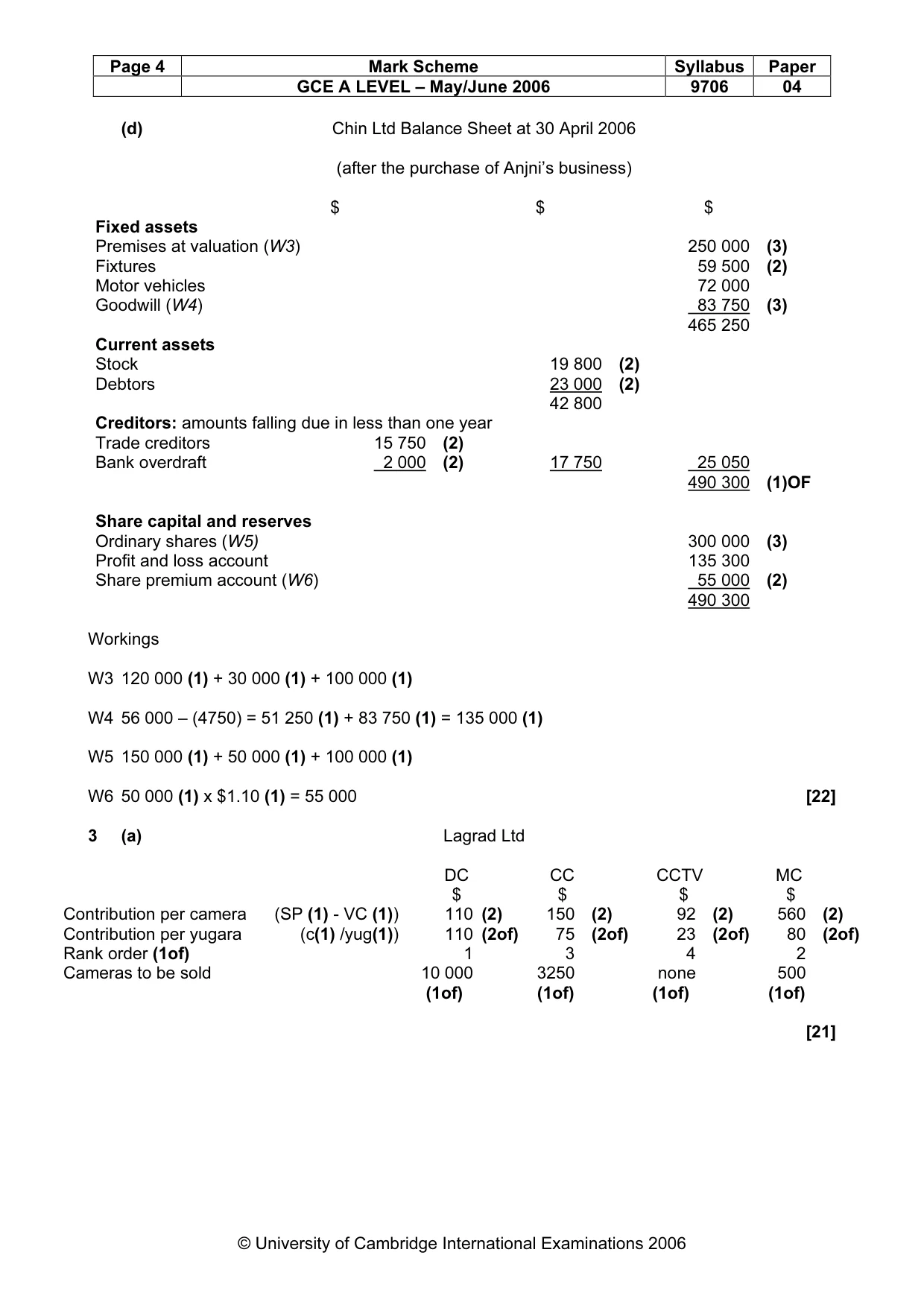
Page 4 Mark Scheme Syllabus Paper GCE A LEVEL – May/June 2006 9706 04 © University of Cambridge International Examinations 2006 (d) Chin Ltd Balance Sheet at 30 April 2006 (after the purchase of Anjni’s business) $ $ $ Fixed assets Premises at valuation (W3) 250 000 (3) Fixtures 59 500 (2) Motor vehicles 72 000 Goodwill (W4) 83 750 (3) 465 250 Current assets Stock 19 800 (2) Debtors 23 000 (2) 42 800 Creditors: amounts falling due in less than one year Trade creditors 15 750 (2) Bank overdraft 2 000 (2) 17 750 25 050 490 300 (1)OF Share capital and reserves Ordinary shares (W5) 300 000 (3) Profit and loss account 135 300 Share premium account (W6) 55 000 (2) 490 300 Workings W3 120 000 (1) + 30 000 (1) + 100 000 (1) W4 56 000 – (4750) = 51 250 (1) + 83 750 (1) = 135 000 (1) W5 150 000 (1) + 50 000 (1) + 100 000 (1) W6 50 000 (1) x $1.10 (1) = 55 000 [22] 3 (a) Lagrad Ltd DC CC CCTV MC $ $ $ $ Contribution per camera (SP (1) - VC (1)) 110 (2) 150 (2) 92 (2) 560 (2) Contribution per yugara (c(1) /yug(1)) 110 (2of) 75 (2of) 23 (2of) 80 (2of) Rank order (1of) 1 3 4 2 Cameras to be sold 10 000 3250 none 500 (1of) (1of) (1of) (1of) [21]
Mark scheme, page 6
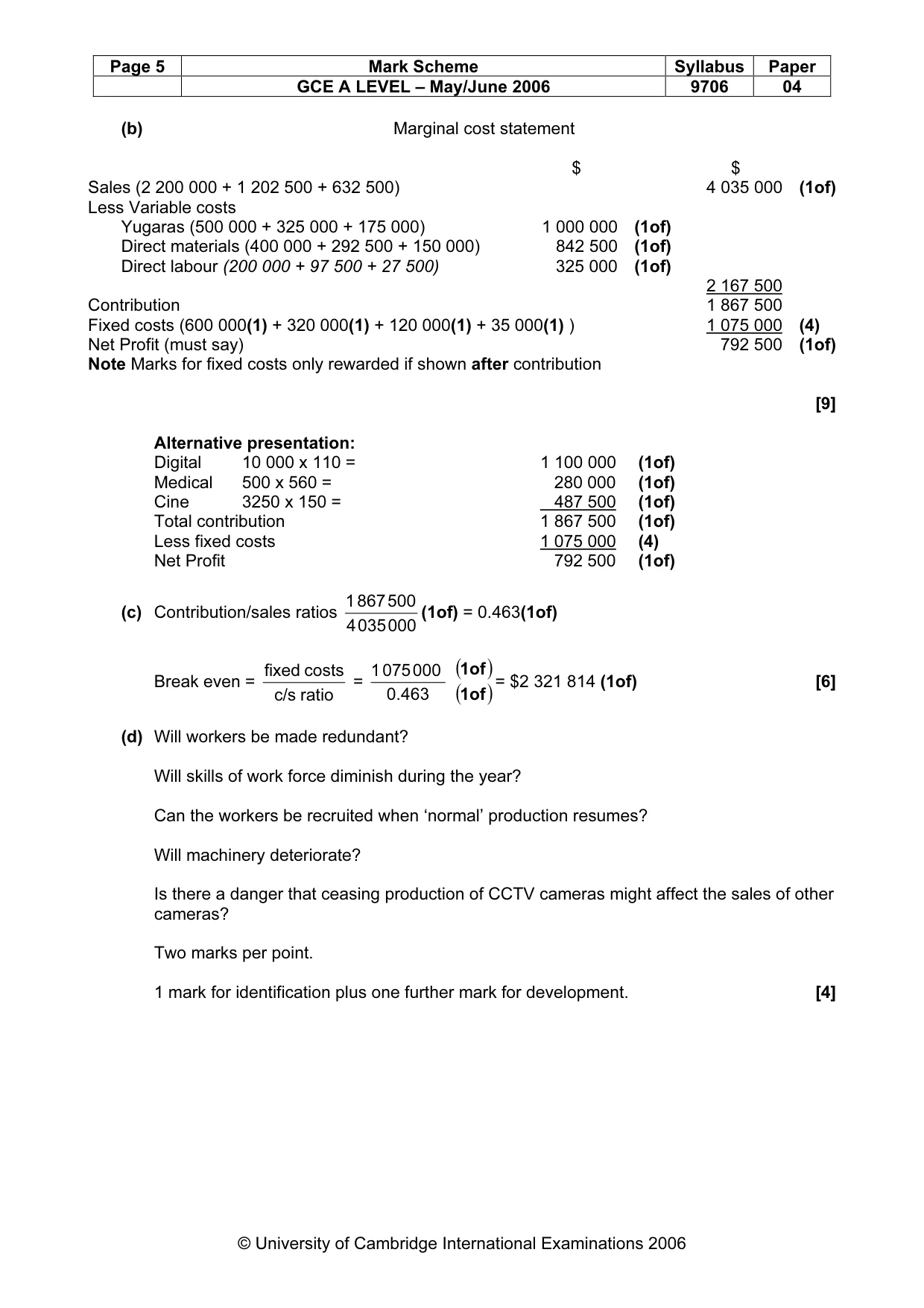
Page 5 Mark Scheme Syllabus Paper GCE A LEVEL – May/June 2006 9706 04 © University of Cambridge International Examinations 2006 (b) Marginal cost statement $ $ Sales (2 200 000 + 1 202 500 + 632 500) 4 035 000 (1of) Less Variable costs Yugaras (500 000 + 325 000 + 175 000) 1 000 000 (1of) Direct materials (400 000 + 292 500 + 150 000) 842 500 (1of) Direct labour (200 000 + 97 500 + 27 500) 325 000 (1of) 2 167 500 Contribution 1 867 500 Fixed costs (600 000(1) + 320 000(1) + 120 000(1) + 35 000(1) ) 1 075 000 (4) Net Profit (must say) 792 500 (1of) Note Marks for fixed costs only rewarded if shown after contribution [9] Alternative presentation: Digital 10 000 x 110 = 1 100 000 (1of) Medical 500 x 560 = 280 000 (1of) Cine 3250 x 150 = 487 500 (1of) Total contribution 1 867 500 (1of) Less fixed costs 1 075 000 (4) Net Profit 792 500 (1of) (c) Contribution/sales ratios 000 035 4 500 867 1 (1of) = 0.463(1of) Break even = ratio c/s costs fixed = 463 . 0 000 075 1 ( ) ( ) 1of 1of = $2 321 814 (1of) [6] (d) Will workers be made redundant? Will skills of work force diminish during the year? Can the workers be recruited when ‘normal’ production resumes? Will machinery deteriorate? Is there a danger that ceasing production of CCTV cameras might affect the sales of other cameras? Two marks per point. 1 mark for identification plus one further mark for development. [4]
What you needed in this session
Cambridge’s own grade thresholds for 2006 May/June, Paper 4 · Variant 1. A higher threshold means an easier paper — the bar moves with how the cohort did.