Cambridge A Level Accounting 9706 — 2005 Oct/Nov Paper 4 · Variant 1
9706/41/O/N/05
The question paper and its mark scheme, free to read here and free to download. This is Cambridge’s own paper, exactly as it was sat.
Question paper8 pages
Mark scheme6 pages
Answers below. Sit the paper first if you are practising.
Paper as text
Question paper, page 1
This document consists of 7 printed pages and 1 blank page. SP (NH) T08260/4 © UCLES 2005 [Turn over UNIVERSITY OF CAMBRIDGE INTERNATIONAL EXAMINATIONS General Certificate of Education Advanced Subsidiary Level and Advanced Level ACCOUNTING 9706/04 Paper 4 Problem Solving (Supplementary Topics) October/November 2005 2 hours Additional Materials: Answer Booklet/Paper READ THESE INSTRUCTIONS FIRST If you have been given an Answer Booklet, follow the instructions on the front cover of the Booklet. Write your Centre number, candidate number and name on all the work you hand in. Write in dark blue or black pen on both sides of the paper. You may use a soft pencil for any diagrams, graphs or rough working. Do not use staples, paper clips, highlighters, glue or correction fluid. Answer all questions. At the end of the examination, fasten all your work securely together. The questions in this paper carry equal marks. All accounting statements are to be presented in good style. Workings should be shown. You may use a calculator. The number of marks is given in brackets [ ] at the end of each question or part question.
Question paper, page 2
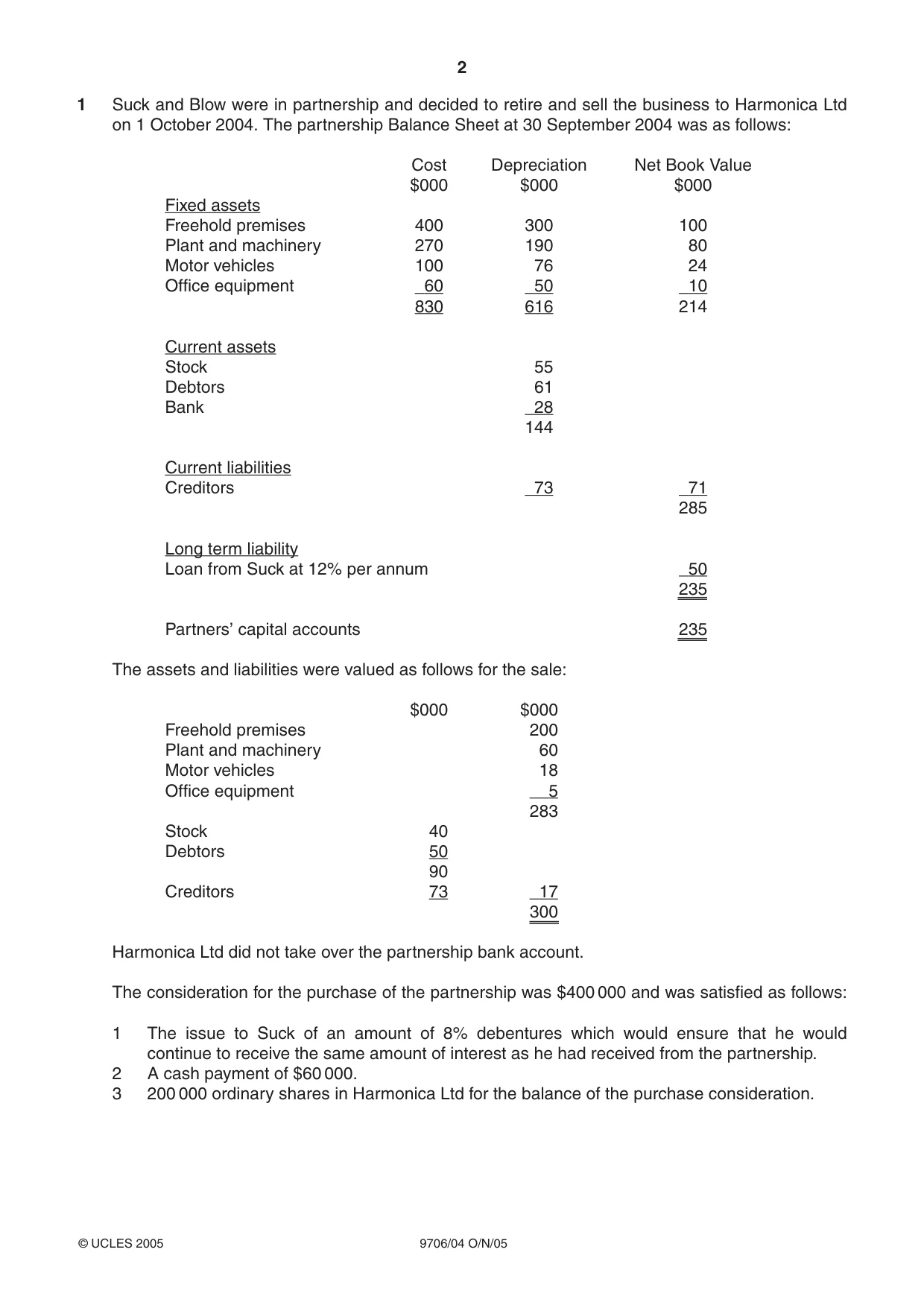
2 © UCLES 2005 9706/04 O/N/05 1 Suck and Blow were in partnership and decided to retire and sell the business to Harmonica Ltd on 1 October 2004. The partnership Balance Sheet at 30 September 2004 was as follows: Cost Depreciation Net Book Value $000 $000 $000 Fixed assets Freehold premises 400 300 100 Plant and machinery 270 190 80 Motor vehicles 100 76 24 Office equipment 60 50 10 830 616 214 Current assets Stock 55 Debtors 61 Bank 28 144 Current liabilities Creditors 73 71 285 Long term liability Loan from Suck at 12% per annum 50 235 Partners’ capital accounts 235 The assets and liabilities were valued as follows for the sale: $000 $000 Freehold premises 200 Plant and machinery 60 Motor vehicles 18 Office equipment 5 283 Stock 40 Debtors 50 90 Creditors 73 17 300 Harmonica Ltd did not take over the partnership bank account. The consideration for the purchase of the partnership was $400 000 and was satisfied as follows: 1 The issue to Suck of an amount of 8% debentures which would ensure that he would continue to receive the same amount of interest as he had received from the partnership. 2 A cash payment of $60 000. 3 200 000 ordinary shares in Harmonica Ltd for the balance of the purchase consideration.
Question paper, page 3
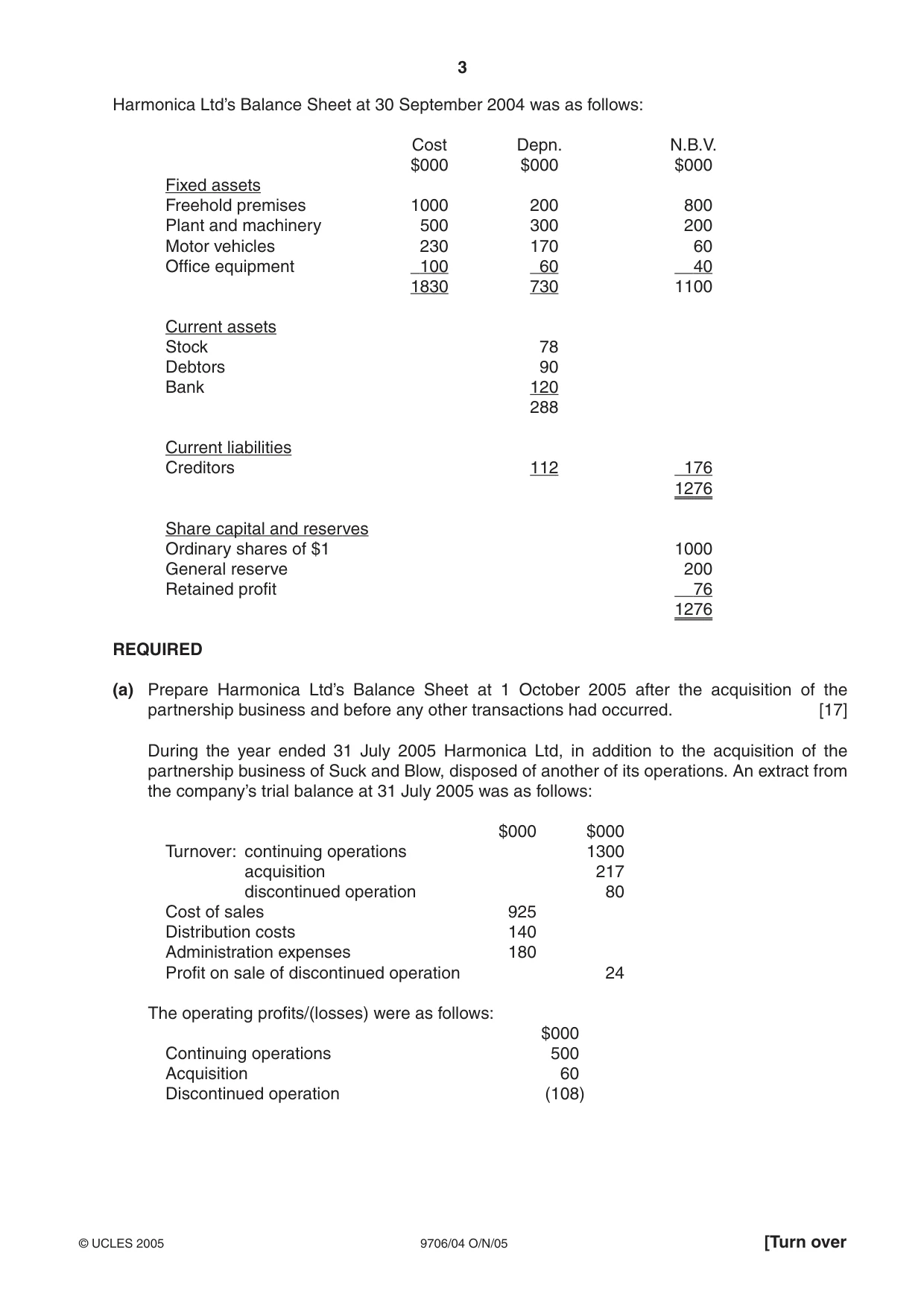
3 © UCLES 2005 9706/04 O/N/05 [Turn over Harmonica Ltd’s Balance Sheet at 30 September 2004 was as follows: Cost Depn. N.B.V. $000 $000 $000 Fixed assets Freehold premises 1000 200 800 Plant and machinery 500 300 200 Motor vehicles 230 170 60 Office equipment 100 60 40 1830 730 1100 Current assets Stock 78 Debtors 90 Bank 120 288 Current liabilities Creditors 112 176 1276 Share capital and reserves Ordinary shares of $1 1000 General reserve 200 Retained profit 76 1276 REQUIRED (a) Prepare Harmonica Ltd’s Balance Sheet at 1 October 2005 after the acquisition of the partnership business and before any other transactions had occurred. [17] During the year ended 31 July 2005 Harmonica Ltd, in addition to the acquisition of the partnership business of Suck and Blow, disposed of another of its operations. An extract from the company’s trial balance at 31 July 2005 was as follows: $000 $000 Turnover: continuing operations 1300 acquisition 217 discontinued operation 80 Cost of sales 925 Distribution costs 140 Administration expenses 180 Profit on sale of discontinued operation 24 The operating profits/(losses) were as follows: $000 Continuing operations 500 Acquisition 60 Discontinued operation (108)
Question paper, page 4
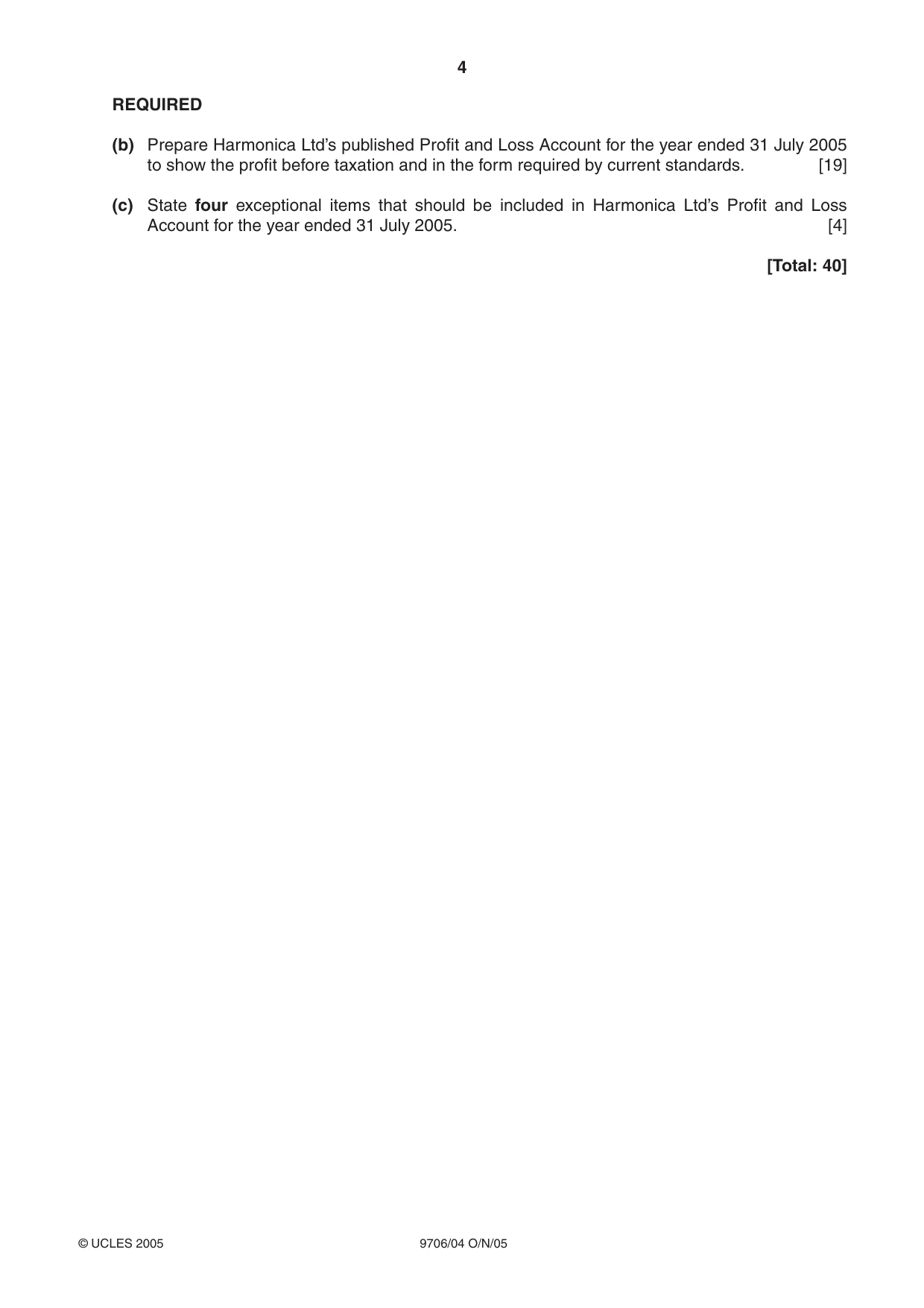
4 © UCLES 2005 9706/04 O/N/05 REQUIRED (b) Prepare Harmonica Ltd’s published Profit and Loss Account for the year ended 31 July 2005 to show the profit before taxation and in the form required by current standards. [19] (c) State four exceptional items that should be included in Harmonica Ltd’s Profit and Loss Account for the year ended 31 July 2005. [4] [Total: 40]
Question paper, page 5
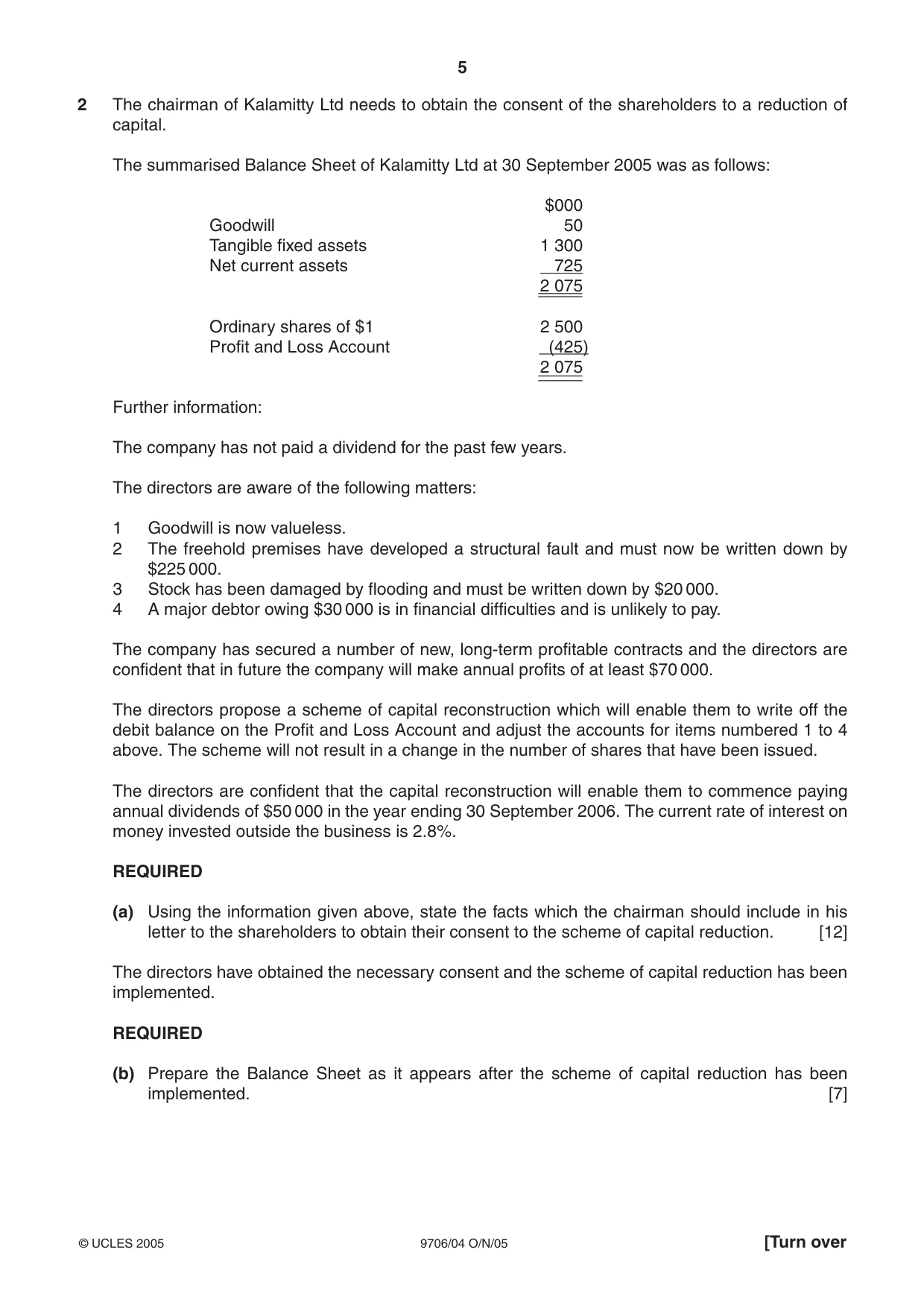
5 © UCLES 2005 9706/04 O/N/05 [Turn over 2 The chairman of Kalamitty Ltd needs to obtain the consent of the shareholders to a reduction of capital. The summarised Balance Sheet of Kalamitty Ltd at 30 September 2005 was as follows: $000 Goodwill 50 Tangible fixed assets 1 300 Net current assets 725 2 075 Ordinary shares of $1 2 500 Profit and Loss Account (425) 2 075 Further information: The company has not paid a dividend for the past few years. The directors are aware of the following matters: 1 Goodwill is now valueless. 2 The freehold premises have developed a structural fault and must now be written down by $225 000. 3 Stock has been damaged by flooding and must be written down by $20 000. 4 A major debtor owing $30 000 is in financial difficulties and is unlikely to pay. The company has secured a number of new, long-term profitable contracts and the directors are confident that in future the company will make annual profits of at least $70 000. The directors propose a scheme of capital reconstruction which will enable them to write off the debit balance on the Profit and Loss Account and adjust the accounts for items numbered 1 to 4 above. The scheme will not result in a change in the number of shares that have been issued. The directors are confident that the capital reconstruction will enable them to commence paying annual dividends of $50 000 in the year ending 30 September 2006. The current rate of interest on money invested outside the business is 2.8%. REQUIRED (a) Using the information given above, state the facts which the chairman should include in his letter to the shareholders to obtain their consent to the scheme of capital reduction. [12] The directors have obtained the necessary consent and the scheme of capital reduction has been implemented. REQUIRED (b) Prepare the Balance Sheet as it appears after the scheme of capital reduction has been implemented. [7]
Question paper, page 6
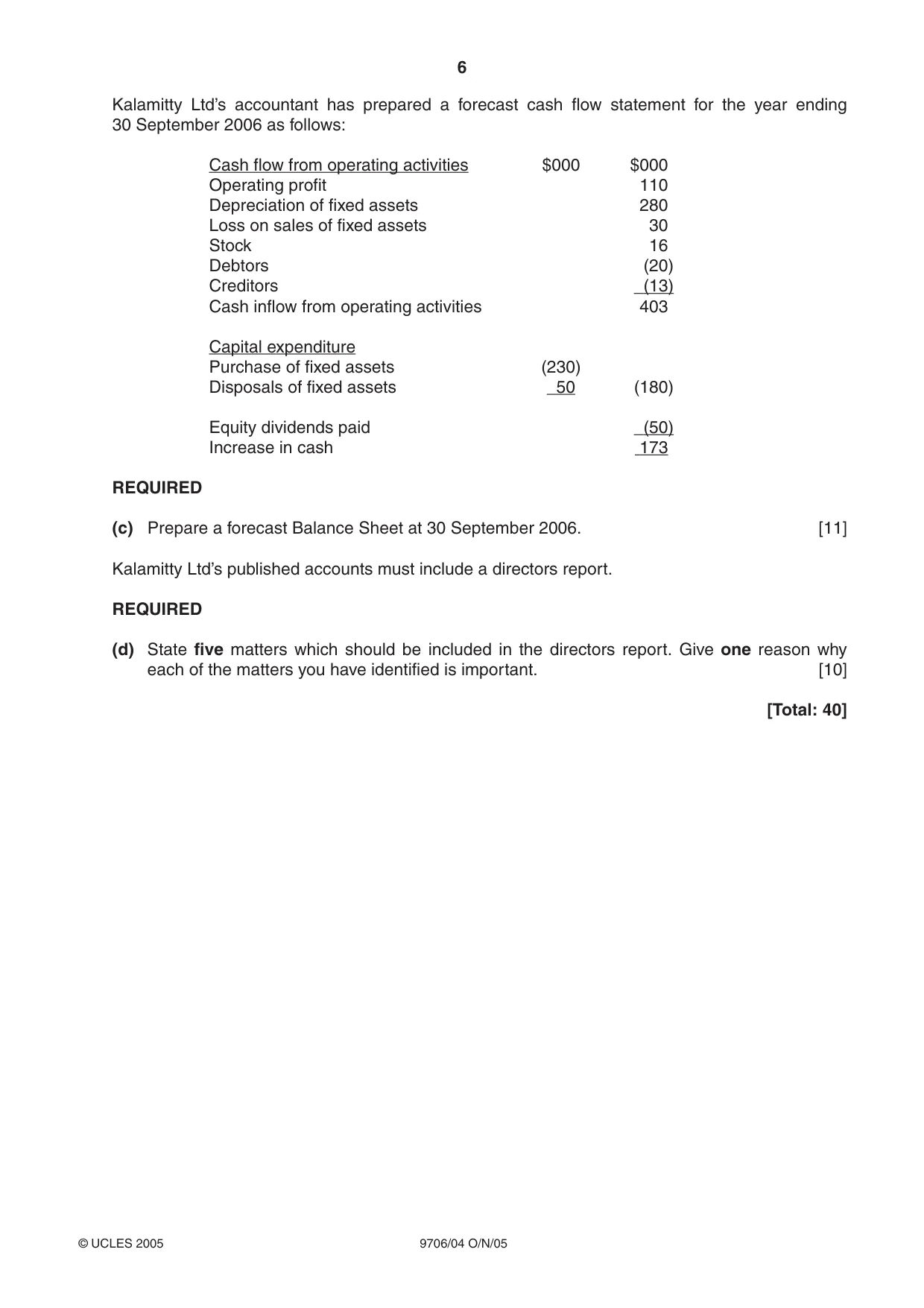
6 © UCLES 2005 9706/04 O/N/05 Kalamitty Ltd’s accountant has prepared a forecast cash flow statement for the year ending 30 September 2006 as follows: Cash flow from operating activities $000 $000 Operating profit 110 Depreciation of fixed assets 280 Loss on sales of fixed assets 30 Stock 16 Debtors (20) Creditors (13) Cash inflow from operating activities 403 Capital expenditure Purchase of fixed assets (230) Disposals of fixed assets 50 (180) Equity dividends paid (50) Increase in cash 173 REQUIRED (c) Prepare a forecast Balance Sheet at 30 September 2006. [11] Kalamitty Ltd’s published accounts must include a directors report. REQUIRED (d) State five matters which should be included in the directors report. Give one reason why each of the matters you have identified is important. [10] [Total: 40]
Question paper, page 7
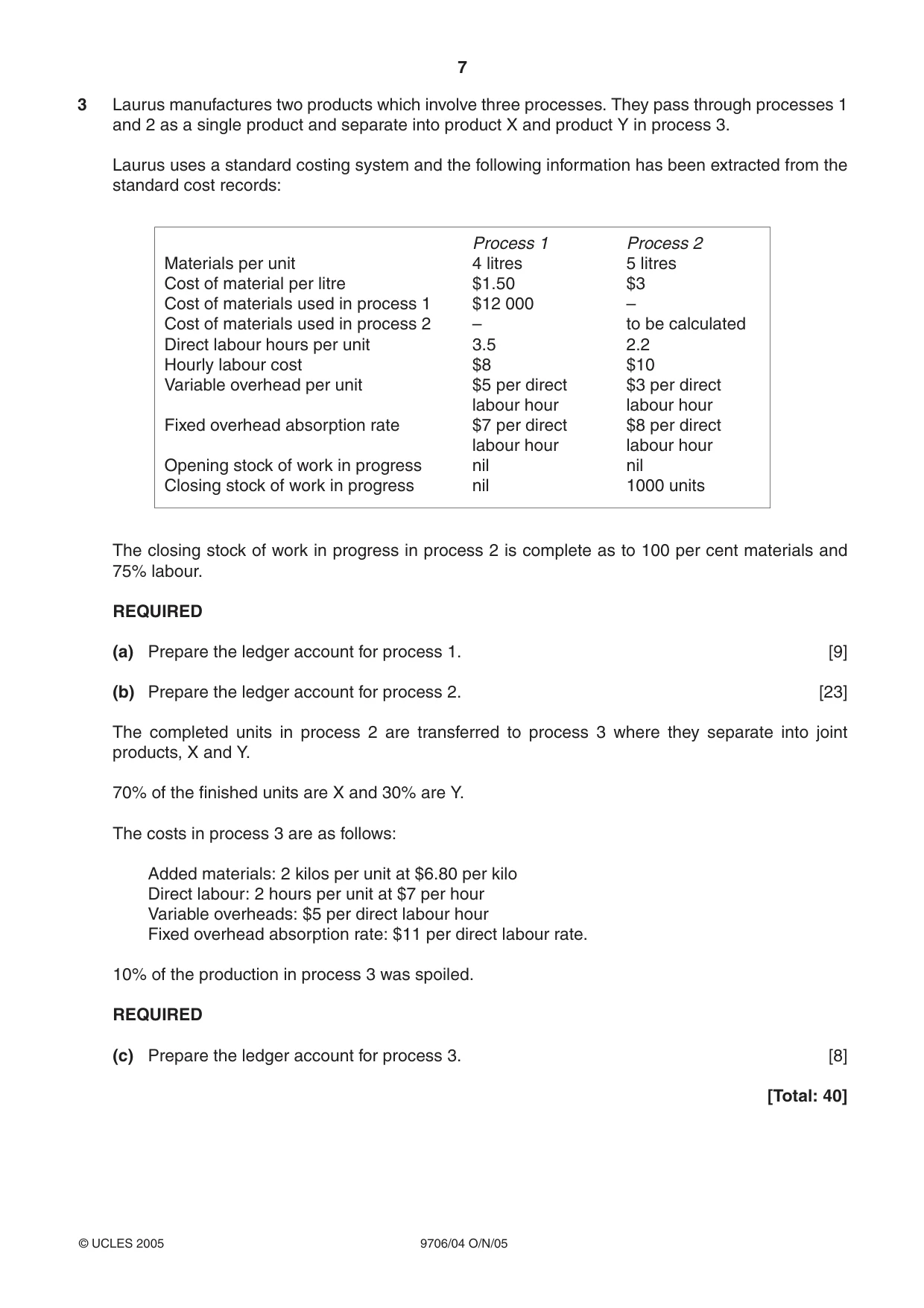
7 © UCLES 2005 9706/04 O/N/05 3 Laurus manufactures two products which involve three processes. They pass through processes 1 and 2 as a single product and separate into product X and product Y in process 3. Laurus uses a standard costing system and the following information has been extracted from the standard cost records: The closing stock of work in progress in process 2 is complete as to 100 per cent materials and 75% labour. REQUIRED (a) Prepare the ledger account for process 1. [9] (b) Prepare the ledger account for process 2. [23] The completed units in process 2 are transferred to process 3 where they separate into joint products, X and Y. 70% of the finished units are X and 30% are Y. The costs in process 3 are as follows: Added materials: 2 kilos per unit at $6.80 per kilo Direct labour: 2 hours per unit at $7 per hour Variable overheads: $5 per direct labour hour Fixed overhead absorption rate: $11 per direct labour rate. 10% of the production in process 3 was spoiled. REQUIRED (c) Prepare the ledger account for process 3. [8] [Total: 40] Process 1 Process 2 Materials per unit 4 litres 5 litres Cost of material per litre $1.50 $3 Cost of materials used in process 1 $12 000 – Cost of materials used in process 2 – to be calculated Direct labour hours per unit 3.5 2.2 Hourly labour cost $8 $10 Variable overhead per unit $5 per direct $3 per direct labour hour labour hour Fixed overhead absorption rate $7 per direct $8 per direct labour hour labour hour Opening stock of work in progress nil nil Closing stock of work in progress nil 1000 units
Question paper, page 8
8 9706/04 O/N/05 BLANK PAGE Permission to reproduce items where third-party owned material protected by copyright is included has been sought and cleared where possible. Every reasonable effort has been made by the publisher (UCLES) to trace copyright holders, but if any items requiring clearance have unwittingly been included, the publisher will be pleased to make amends at the earliest possible opportunity. University of Cambridge International Examinations is part of the University of Cambridge Local Examinations Syndicate (UCLES), which is itself a department of the University of Cambridge.
Mark scheme, page 1
UNIVERSITY OF CAMBRIDGE INTERNATIONAL EXAMINATIONS GCE Advanced Subsidiary and Advanced Level MARK SCHEME for the November 2005 question paper 9706 ACCOUNTING 9706/04 Paper 4, maximum mark 120 This mark scheme is published as an aid to teachers and students, to indicate the requirements of the examination. It shows the basis on which Examiners were initially instructed to award marks. It does not indicate the details of the discussions that took place at an Examiners’ meeting before marking began. Any substantial changes to the mark scheme that arose from these discussions will be recorded in the published Report on the Examination. All Examiners are instructed that alternative correct answers and unexpected approaches in candidates’ scripts must be given marks that fairly reflect the relevant knowledge and skills demonstrated. Mark schemes must be read in conjunction with the question papers and the Report on the Examination. The minimum marks in these components needed for various grades were previously published with these mark schemes, but are now instead included in the Report on the Examination for this session. • CIE will not enter into discussion or correspondence in connection with these mark schemes. CIE is publishing the mark schemes for the November 2005 question papers for most IGCSE and GCE Advanced Level and Advanced Subsidiary Level syllabuses and some Ordinary Level syllabuses.
Mark scheme, page 2
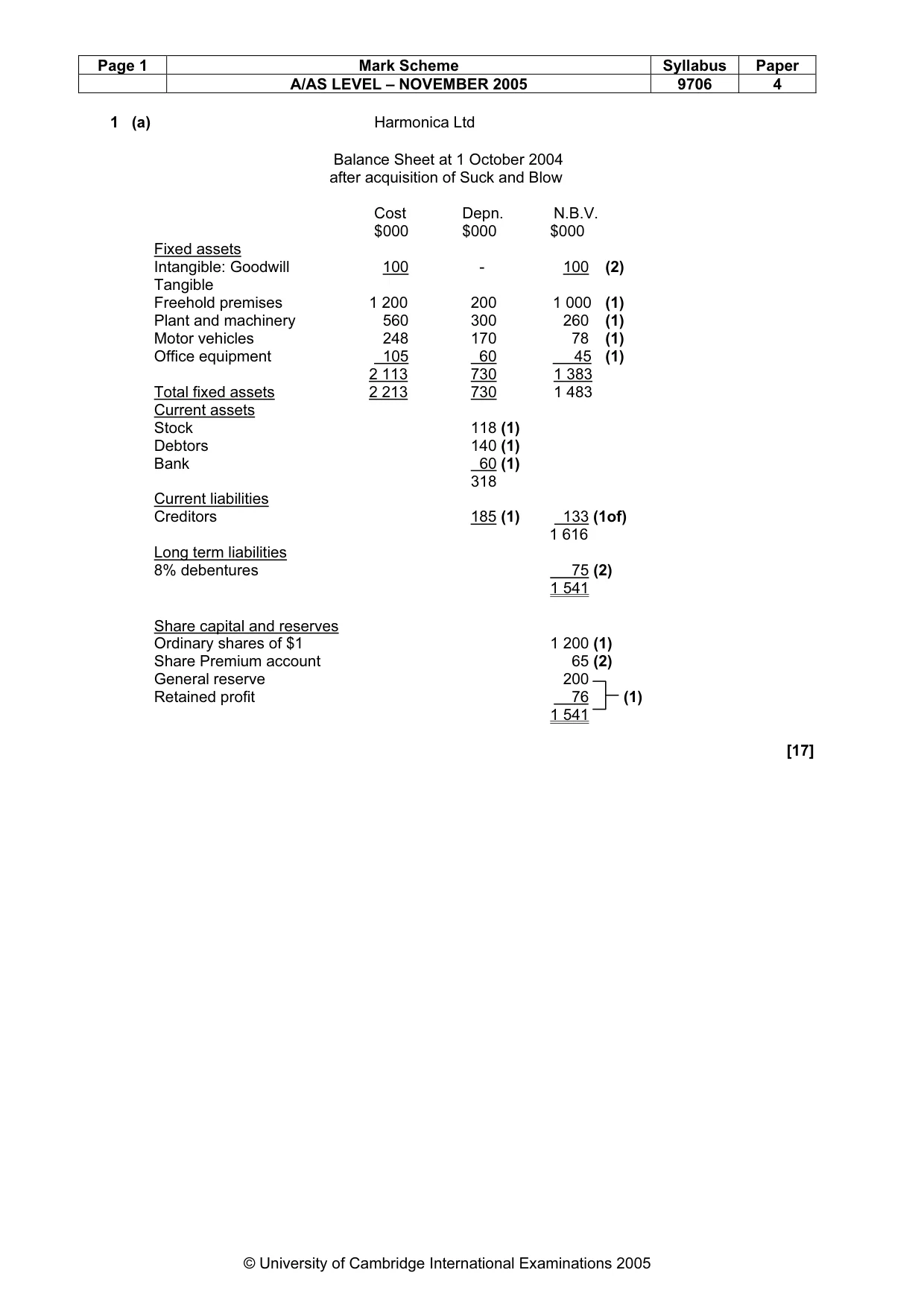
Page 1 Mark Scheme Syllabus Paper A/AS LEVEL – NOVEMBER 2005 9706 4 © University of Cambridge International Examinations 2005 1 (a) Harmonica Ltd Balance Sheet at 1 October 2004 after acquisition of Suck and Blow Cost Depn. N.B.V. $000 $000 $000 Fixed assets Intangible: Goodwill 100 - 100 (2) Tangible Freehold premises 1 200 200 1 000 (1) Plant and machinery 560 300 260 (1) Motor vehicles 248 170 78 (1) Office equipment 105 60 45 (1) 2 113 730 1 383 Total fixed assets 2 213 730 1 483 Current assets Stock 118 (1) Debtors 140 (1) Bank 60 (1) 318 Current liabilities Creditors 185 (1) 133 (1of) 1 616 Long term liabilities 8% debentures 75 (2) 1 541 Share capital and reserves Ordinary shares of $1 1 200 (1) Share Premium account 65 (2) General reserve 200 Retained profit 76 (1) 1 541 [17]
Mark scheme, page 3
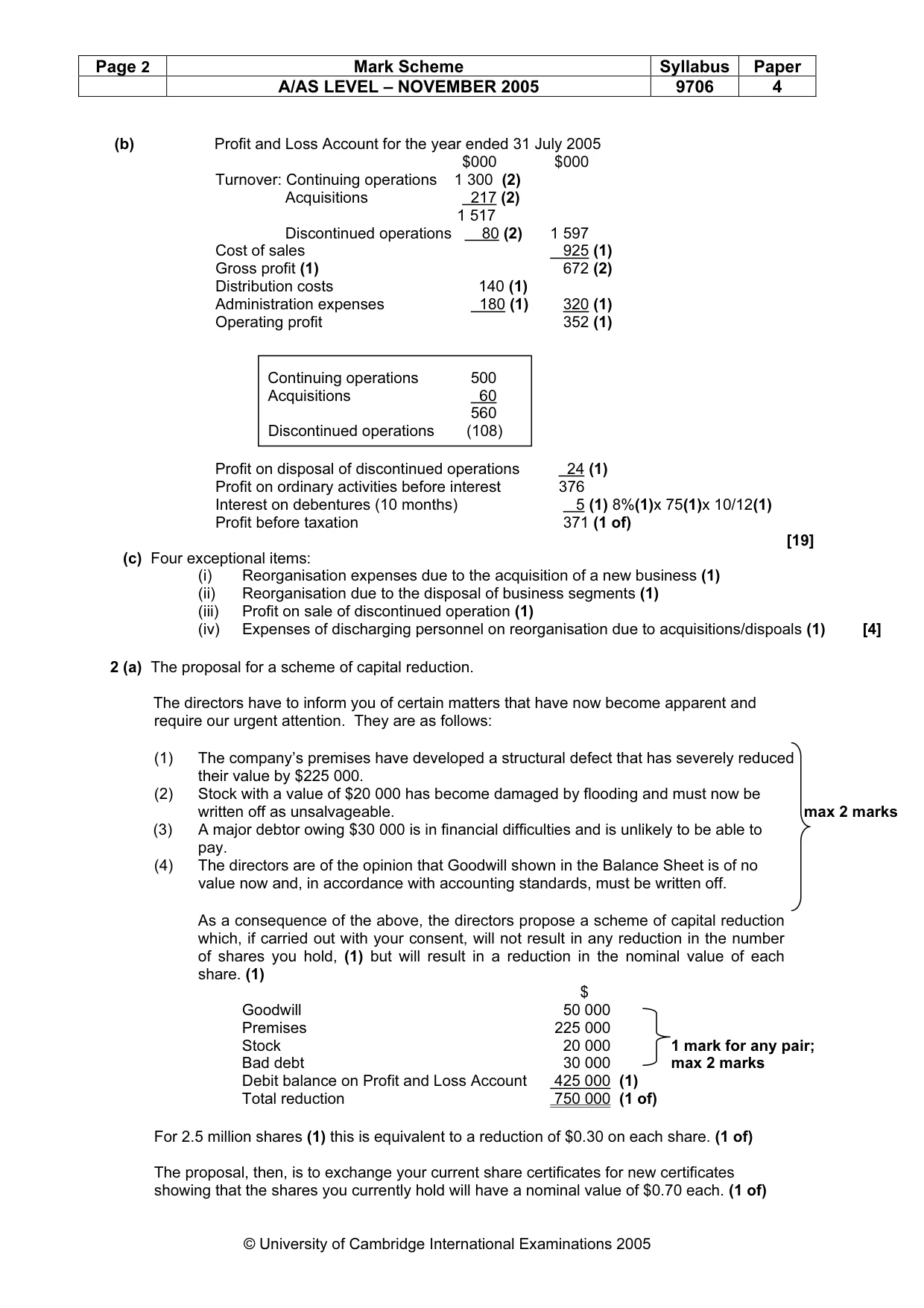
Page 2 Mark Scheme Syllabus Paper A/AS LEVEL – NOVEMBER 2005 9706 4 © University of Cambridge International Examinations 2005 (b) Profit and Loss Account for the year ended 31 July 2005 $000 $000 Turnover: Continuing operations 1 300 (2) Acquisitions 217 (2) 1 517 Discontinued operations 80 (2) 1 597 Cost of sales 925 (1) Gross profit (1) 672 (2) Distribution costs 140 (1) Administration expenses 180 (1) 320 (1) Operating profit 352 (1) Continuing operations 500 Acquisitions 60 560 Discontinued operations (108) Profit on disposal of discontinued operations 24 (1) Profit on ordinary activities before interest 376 Interest on debentures (10 months) 5 (1) 8%(1)x 75(1)x 10/12(1) Profit before taxation 371 (1 of) [19] (c) Four exceptional items: (i) Reorganisation expenses due to the acquisition of a new business (1) (ii) Reorganisation due to the disposal of business segments (1) (iii) Profit on sale of discontinued operation (1) (iv) Expenses of discharging personnel on reorganisation due to acquisitions/dispoals (1) [4] 2 (a) The proposal for a scheme of capital reduction. The directors have to inform you of certain matters that have now become apparent and require our urgent attention. They are as follows: (1) The company’s premises have developed a structural defect that has severely reduced their value by $225 000. (2) Stock with a value of $20 000 has become damaged by flooding and must now be written off as unsalvageable. max 2 marks (3) A major debtor owing $30 000 is in financial difficulties and is unlikely to be able to pay. (4) The directors are of the opinion that Goodwill shown in the Balance Sheet is of no value now and, in accordance with accounting standards, must be written off. As a consequence of the above, the directors propose a scheme of capital reduction which, if carried out with your consent, will not result in any reduction in the number of shares you hold, (1) but will result in a reduction in the nominal value of each share. (1) $ Goodwill 50 000 Premises 225 000 Stock 20 000 1 mark for any pair; Bad debt 30 000 max 2 marks Debit balance on Profit and Loss Account 425 000 (1) Total reduction 750 000 (1 of) For 2.5 million shares (1) this is equivalent to a reduction of $0.30 on each share. (1 of) The proposal, then, is to exchange your current share certificates for new certificates showing that the shares you currently hold will have a nominal value of $0.70 each. (1 of)
Mark scheme, page 4
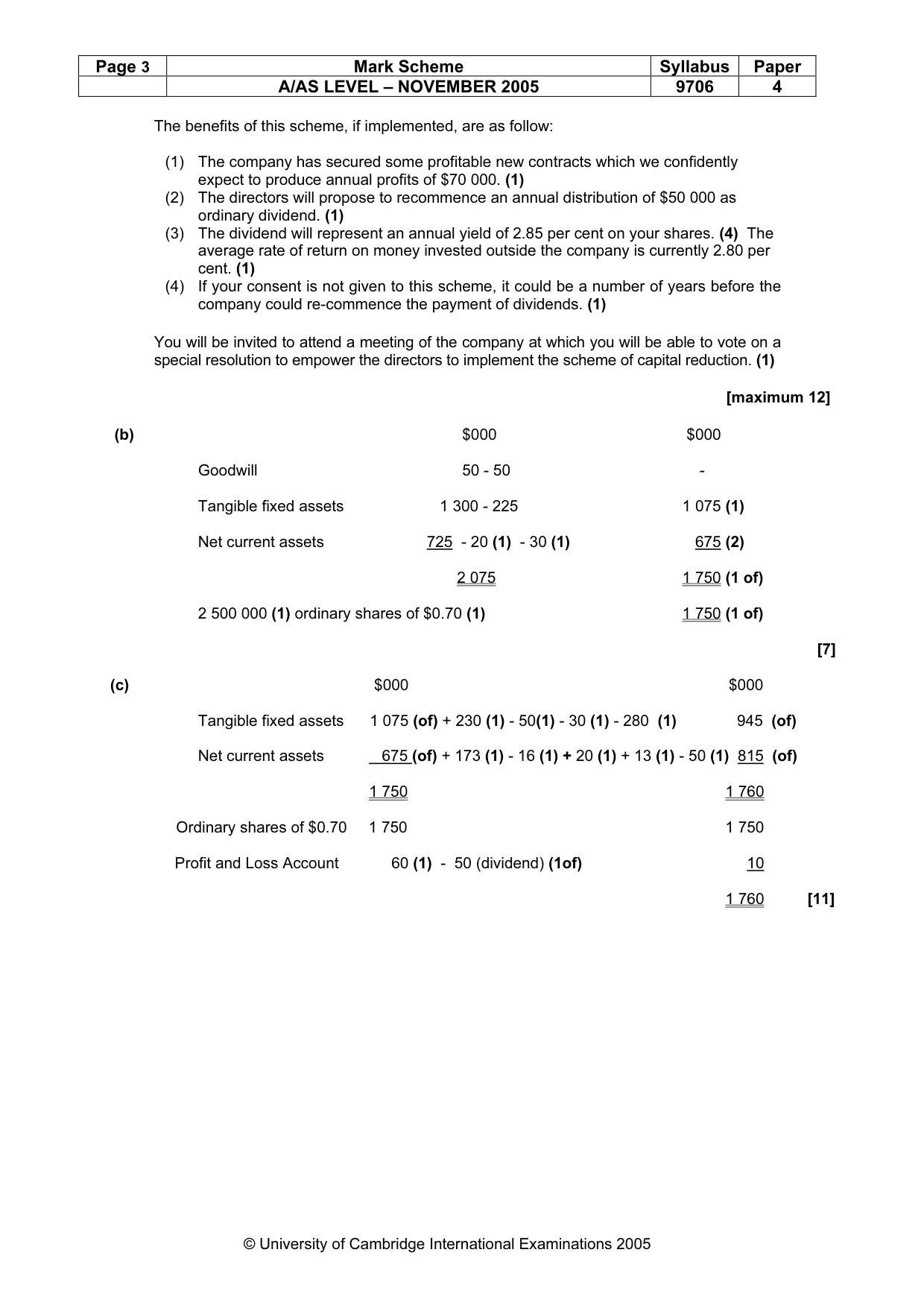
Page 3 Mark Scheme Syllabus Paper A/AS LEVEL – NOVEMBER 2005 9706 4 © University of Cambridge International Examinations 2005 The benefits of this scheme, if implemented, are as follow: (1) The company has secured some profitable new contracts which we confidently expect to produce annual profits of $70 000. (1) (2) The directors will propose to recommence an annual distribution of $50 000 as ordinary dividend. (1) (3) The dividend will represent an annual yield of 2.85 per cent on your shares. (4) The average rate of return on money invested outside the company is currently 2.80 per cent. (1) (4) If your consent is not given to this scheme, it could be a number of years before the company could re-commence the payment of dividends. (1) You will be invited to attend a meeting of the company at which you will be able to vote on a special resolution to empower the directors to implement the scheme of capital reduction. (1) [maximum 12] (b) $000 $000 Goodwill 50 - 50 - Tangible fixed assets 1 300 - 225 1 075 (1) Net current assets 725 - 20 (1) - 30 (1) 675 (2) 2 075 1 750 (1 of) 2 500 000 (1) ordinary shares of $0.70 (1) 1 750 (1 of) [7] (c) $000 $000 Tangible fixed assets 1 075 (of) + 230 (1) - 50(1) - 30 (1) - 280 (1) 945 (of) Net current assets 675 (of) + 173 (1) - 16 (1) + 20 (1) + 13 (1) - 50 (1) 815 (of) 1 750 1 760 Ordinary shares of $0.70 1 750 1 750 Profit and Loss Account 60 (1) - 50 (dividend) (1of) 10 1 760 [11]
Mark scheme, page 5
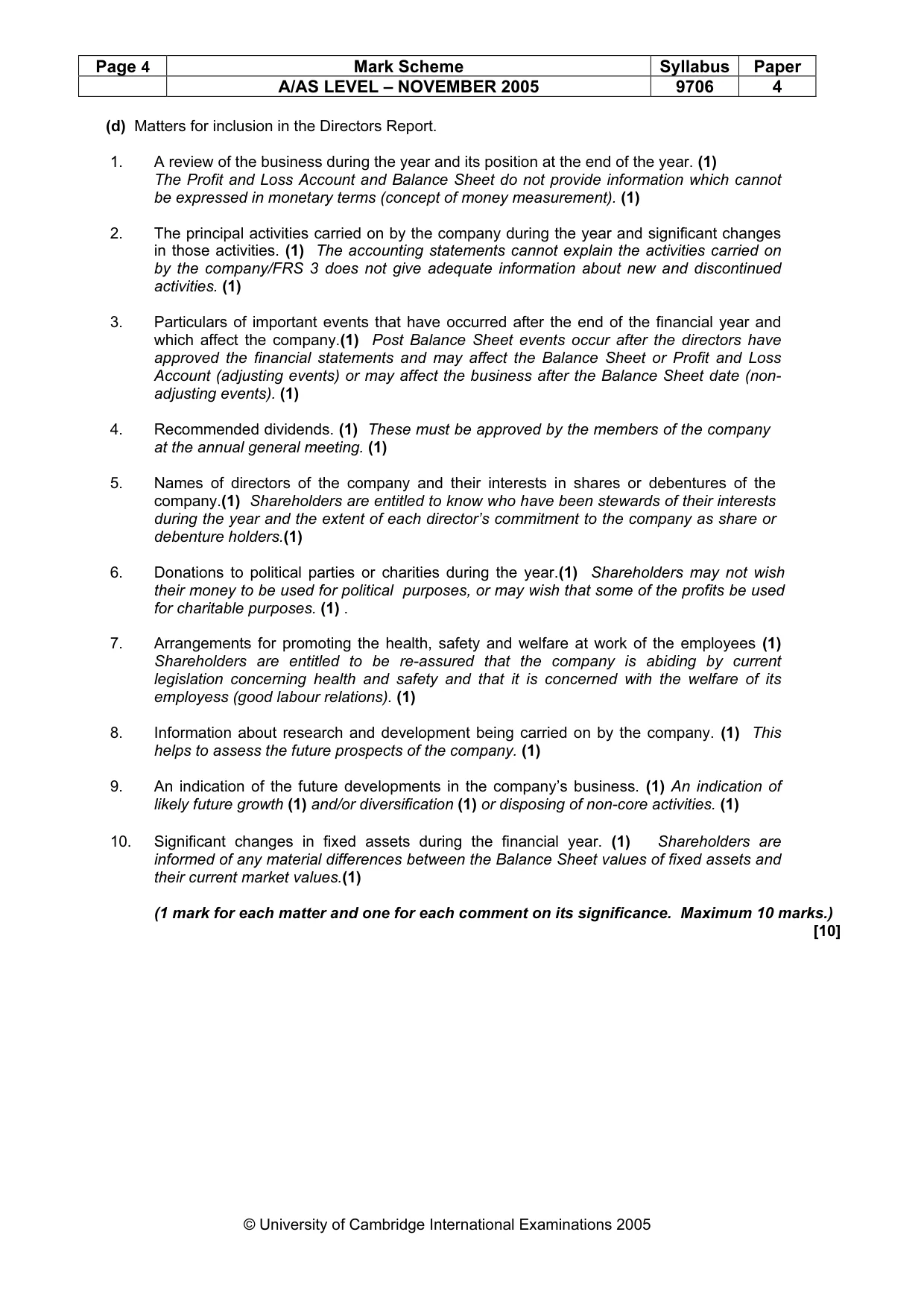
Page 4 Mark Scheme Syllabus Paper A/AS LEVEL – NOVEMBER 2005 9706 4 © University of Cambridge International Examinations 2005 (d) Matters for inclusion in the Directors Report. 1. A review of the business during the year and its position at the end of the year. (1) The Profit and Loss Account and Balance Sheet do not provide information which cannot be expressed in monetary terms (concept of money measurement). (1) 2. The principal activities carried on by the company during the year and significant changes in those activities. (1) The accounting statements cannot explain the activities carried on by the company/FRS 3 does not give adequate information about new and discontinued activities. (1) 3. Particulars of important events that have occurred after the end of the financial year and which affect the company.(1) Post Balance Sheet events occur after the directors have approved the financial statements and may affect the Balance Sheet or Profit and Loss Account (adjusting events) or may affect the business after the Balance Sheet date (non- adjusting events). (1) 4. Recommended dividends. (1) These must be approved by the members of the company at the annual general meeting. (1) 5. Names of directors of the company and their interests in shares or debentures of the company.(1) Shareholders are entitled to know who have been stewards of their interests during the year and the extent of each director’s commitment to the company as share or debenture holders.(1) 6. Donations to political parties or charities during the year.(1) Shareholders may not wish their money to be used for political purposes, or may wish that some of the profits be used for charitable purposes. (1) . 7. Arrangements for promoting the health, safety and welfare at work of the employees (1) Shareholders are entitled to be re-assured that the company is abiding by current legislation concerning health and safety and that it is concerned with the welfare of its employess (good labour relations). (1) 8. Information about research and development being carried on by the company. (1) This helps to assess the future prospects of the company. (1) 9. An indication of the future developments in the company’s business. (1) An indication of likely future growth (1) and/or diversification (1) or disposing of non-core activities. (1) 10. Significant changes in fixed assets during the financial year. (1) Shareholders are informed of any material differences between the Balance Sheet values of fixed assets and their current market values.(1) (1 mark for each matter and one for each comment on its significance. Maximum 10 marks.) [10]
Mark scheme, page 6
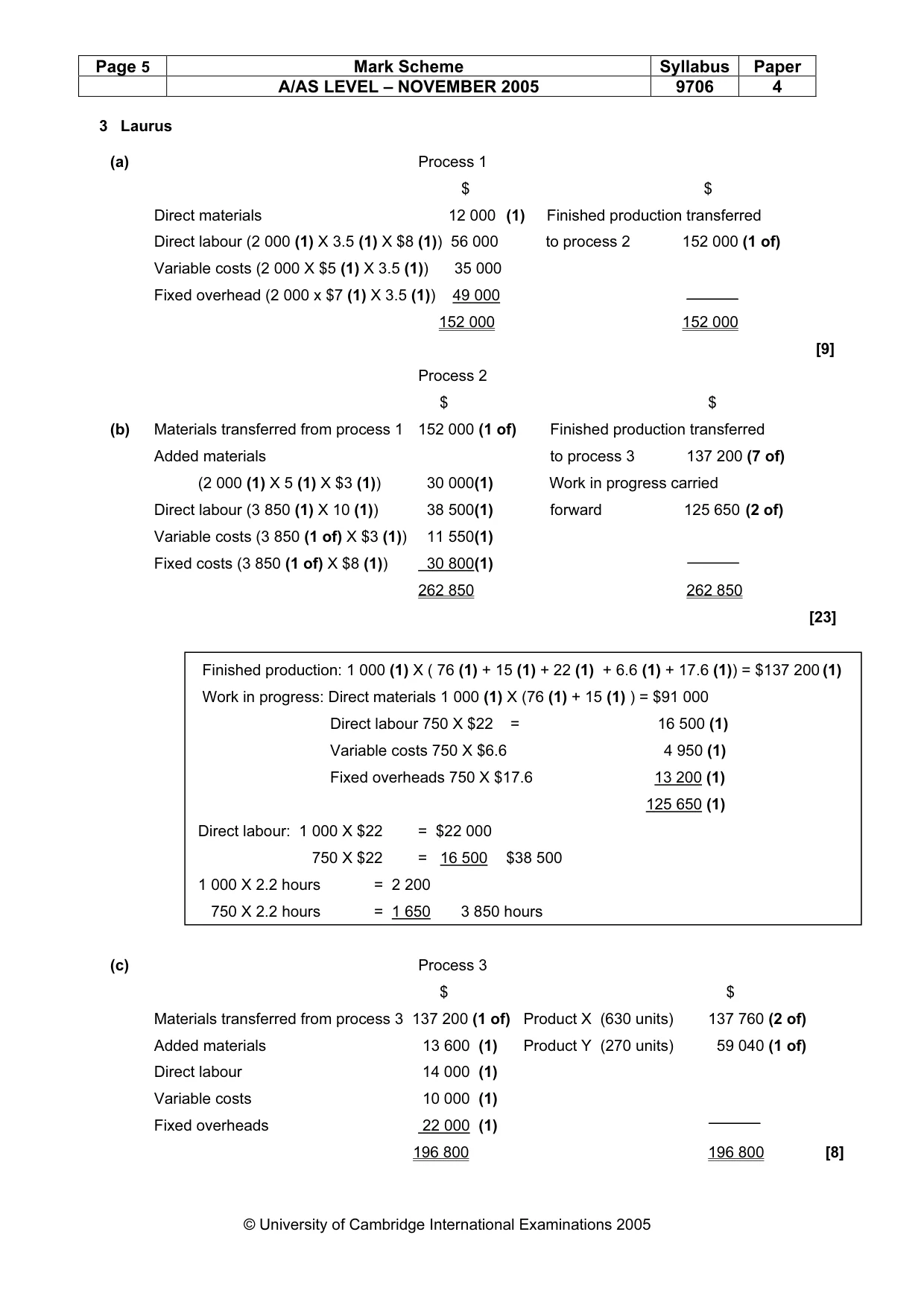
Page 5 Mark Scheme Syllabus Paper A/AS LEVEL – NOVEMBER 2005 9706 4 © University of Cambridge International Examinations 2005 3 Laurus (a) Process 1 $ $ Direct materials 12 000 (1) Finished production transferred Direct labour (2 000 (1) X 3.5 (1) X $8 (1)) 56 000 to process 2 152 000 (1 of) Variable costs (2 000 X $5 (1) X 3.5 (1)) 35 000 Fixed overhead (2 000 x $7 (1) X 3.5 (1)) 49 000 152 000 152 000 [9] Process 2 $ $ (b) Materials transferred from process 1 152 000 (1 of) Finished production transferred Added materials to process 3 137 200 (7 of) (2 000 (1) X 5 (1) X $3 (1)) 30 000(1) Work in progress carried Direct labour (3 850 (1) X 10 (1)) 38 500(1) forward 125 650 (2 of) Variable costs (3 850 (1 of) X $3 (1)) 11 550(1) Fixed costs (3 850 (1 of) X $8 (1)) 30 800(1) 262 850 262 850 [23] Finished production: 1 000 (1) X ( 76 (1) + 15 (1) + 22 (1) + 6.6 (1) + 17.6 (1)) = $137 200 (1) Work in progress: Direct materials 1 000 (1) X (76 (1) + 15 (1) ) = $91 000 Direct labour 750 X $22 = 16 500 (1) Variable costs 750 X $6.6 4 950 (1) Fixed overheads 750 X $17.6 13 200 (1) 125 650 (1) Direct labour: 1 000 X $22 = $22 000 750 X $22 = 16 500 $38 500 1 000 X 2.2 hours = 2 200 750 X 2.2 hours = 1 650 3 850 hours (c) Process 3 $ $ Materials transferred from process 3 137 200 (1 of) Product X (630 units) 137 760 (2 of) Added materials 13 600 (1) Product Y (270 units) 59 040 (1 of) Direct labour 14 000 (1) Variable costs 10 000 (1) Fixed overheads 22 000 (1) 196 800 196 800 [8]