Cambridge A Level Accounting 9706 — 2005 May/June Paper 4 · Variant 1
9706/41/M/J/05
The question paper and its mark scheme, free to read here and free to download. This is Cambridge’s own paper, exactly as it was sat.
Question paper8 pages

Mark scheme8 pages
Answers below. Sit the paper first if you are practising.
Paper as text
Question paper, page 1
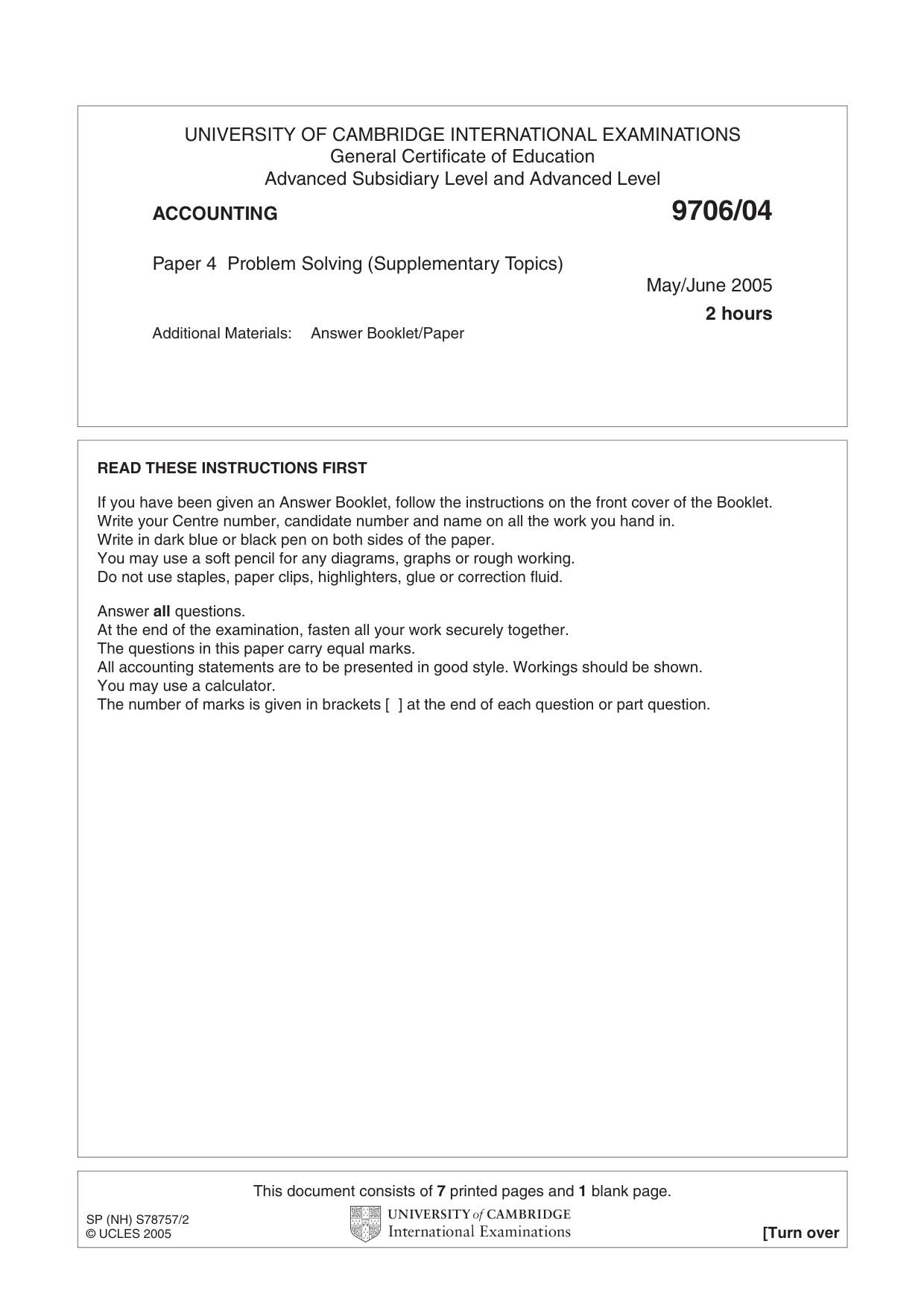
This document consists of 7 printed pages and 1 blank page. SP (NH) S78757/2 © UCLES 2005 [Turn over UNIVERSITY OF CAMBRIDGE INTERNATIONAL EXAMINATIONS General Certificate of Education Advanced Subsidiary Level and Advanced Level ACCOUNTING 9706/04 Paper 4 Problem Solving (Supplementary Topics) May/June 2005 2 hours Additional Materials: Answer Booklet/Paper READ THESE INSTRUCTIONS FIRST If you have been given an Answer Booklet, follow the instructions on the front cover of the Booklet. Write your Centre number, candidate number and name on all the work you hand in. Write in dark blue or black pen on both sides of the paper. You may use a soft pencil for any diagrams, graphs or rough working. Do not use staples, paper clips, highlighters, glue or correction fluid. Answer all questions. At the end of the examination, fasten all your work securely together. The questions in this paper carry equal marks. All accounting statements are to be presented in good style. Workings should be shown. You may use a calculator. The number of marks is given in brackets [ ] at the end of each question or part question.
Question paper, page 2
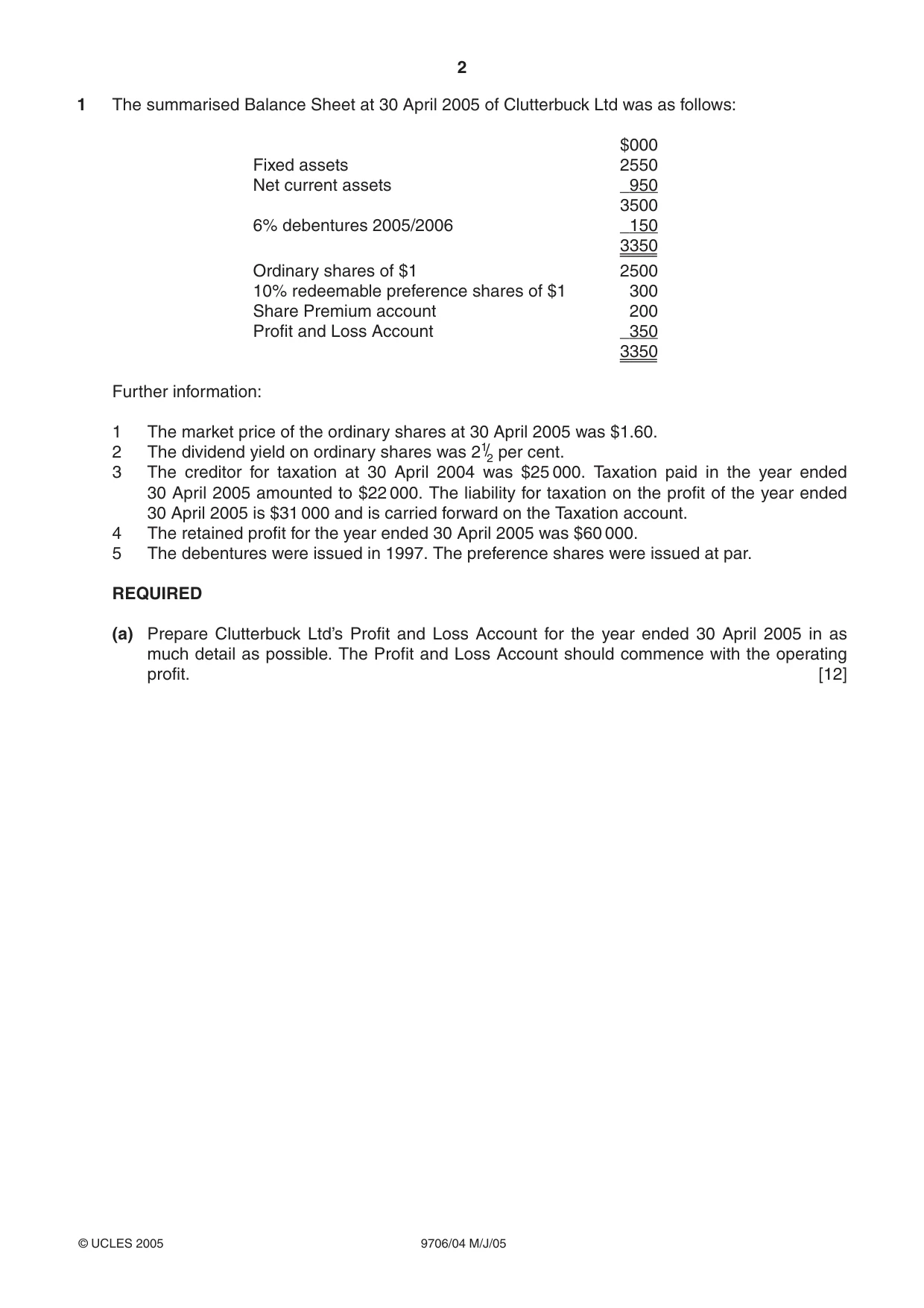
2 © UCLES 2005 9706/04 M/J/05 1 The summarised Balance Sheet at 30 April 2005 of Clutterbuck Ltd was as follows: $000 Fixed assets 2550 Net current assets 950 3500 6% debentures 2005/2006 150 3350 Ordinary shares of $1 2500 10% redeemable preference shares of $1 300 Share Premium account 200 Profit and Loss Account 350 3350 Further information: 1 The market price of the ordinary shares at 30 April 2005 was $1.60. 2 The dividend yield on ordinary shares was 21/2 per cent. 3 The creditor for taxation at 30 April 2004 was $25 000. Taxation paid in the year ended 30 April 2005 amounted to $22 000. The liability for taxation on the profit of the year ended 30 April 2005 is $31 000 and is carried forward on the Taxation account. 4 The retained profit for the year ended 30 April 2005 was $60 000. 5 The debentures were issued in 1997. The preference shares were issued at par. REQUIRED (a) Prepare Clutterbuck Ltd’s Profit and Loss Account for the year ended 30 April 2005 in as much detail as possible. The Profit and Loss Account should commence with the operating profit. [12]
Question paper, page 3
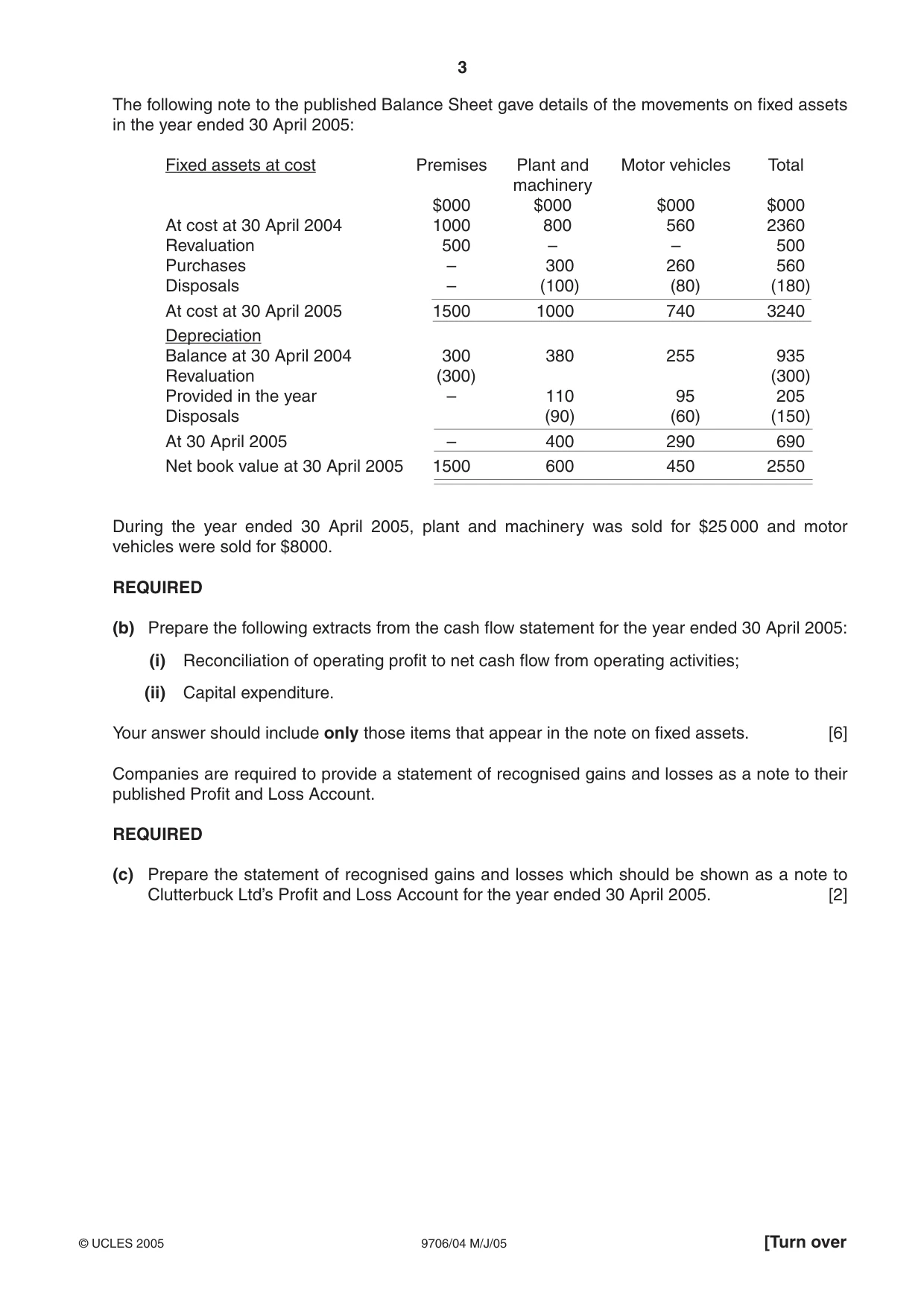
3 © UCLES 2005 9706/04 M/J/05 [Turn over The following note to the published Balance Sheet gave details of the movements on fixed assets in the year ended 30 April 2005: Fixed assets at cost Premises Plant and Motor vehicles Total machinery $000 $000 $000 $000 At cost at 30 April 2004 1000 800 560 2360 Revaluation 500 – – 500 Purchases – 300 260 560 Disposals – (100) (80) (180) At cost at 30 April 2005 1500 1000 740 3240 Depreciation Balance at 30 April 2004 300 380 255 935 Revaluation (300) (300) Provided in the year – 110 95 205 Disposals (90) (60) (150) At 30 April 2005 – 400 290 690 Net book value at 30 April 2005 1500 600 450 2550 During the year ended 30 April 2005, plant and machinery was sold for $25 000 and motor vehicles were sold for $8000. REQUIRED (b) Prepare the following extracts from the cash flow statement for the year ended 30 April 2005: (i) Reconciliation of operating profit to net cash flow from operating activities; (ii) Capital expenditure. Your answer should include only those items that appear in the note on fixed assets. [6] Companies are required to provide a statement of recognised gains and losses as a note to their published Profit and Loss Account. REQUIRED (c) Prepare the statement of recognised gains and losses which should be shown as a note to Clutterbuck Ltd’s Profit and Loss Account for the year ended 30 April 2005. [2]
Question paper, page 4
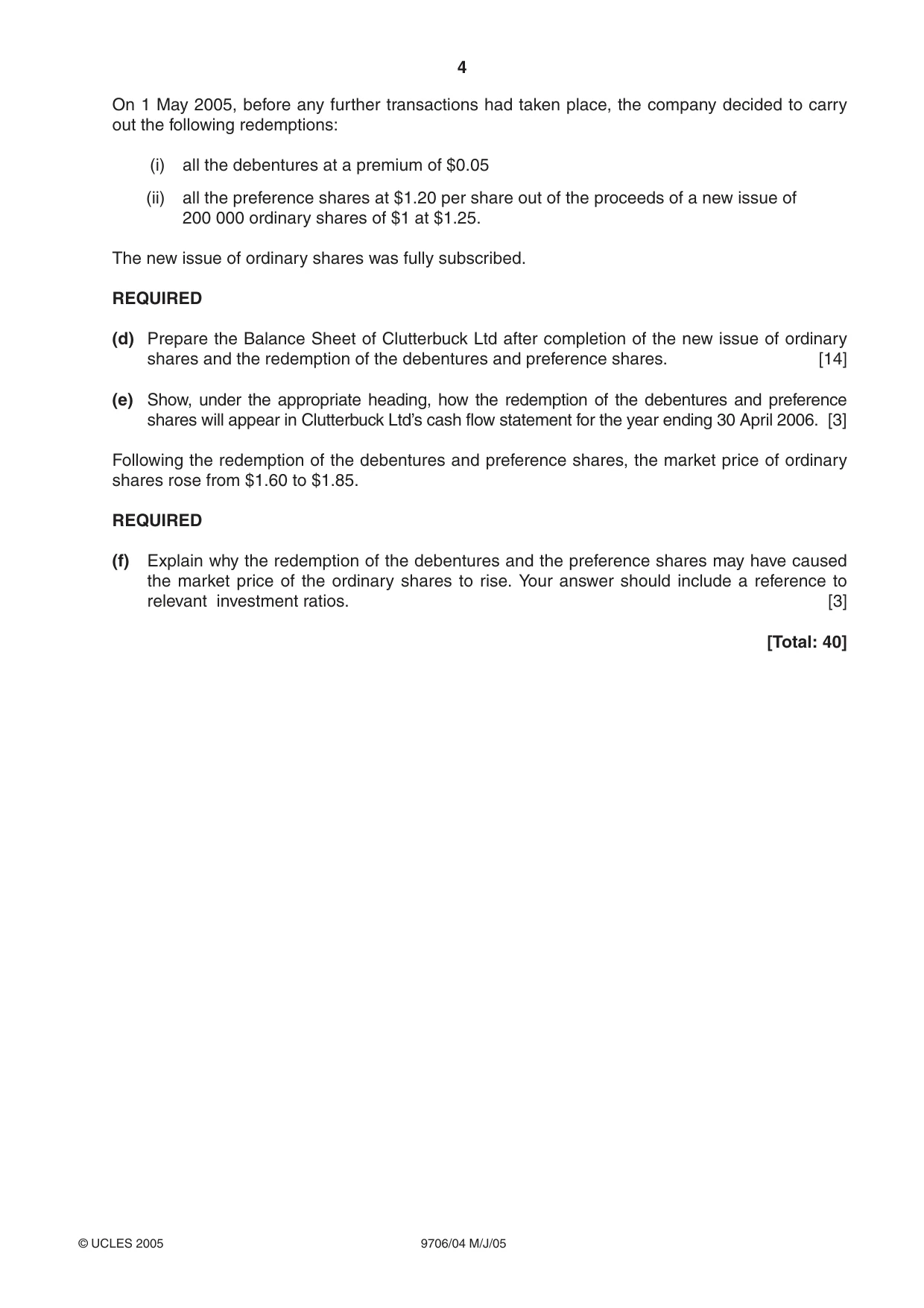
4 © UCLES 2005 9706/04 M/J/05 On 1 May 2005, before any further transactions had taken place, the company decided to carry out the following redemptions: (i) all the debentures at a premium of $0.05 (ii) all the preference shares at $1.20 per share out of the proceeds of a new issue of 200 000 ordinary shares of $1 at $1.25. The new issue of ordinary shares was fully subscribed. REQUIRED (d) Prepare the Balance Sheet of Clutterbuck Ltd after completion of the new issue of ordinary shares and the redemption of the debentures and preference shares. [14] (e) Show, under the appropriate heading, how the redemption of the debentures and preference shares will appear in Clutterbuck Ltd’s cash flow statement for the year ending 30 April 2006. [3] Following the redemption of the debentures and preference shares, the market price of ordinary shares rose from $1.60 to $1.85. REQUIRED (f) Explain why the redemption of the debentures and the preference shares may have caused the market price of the ordinary shares to rise. Your answer should include a reference to relevant investment ratios. [3] [Total: 40]
Question paper, page 5
5 9706/04 M/J/05 [Turn over BLANK PAGE Question 2 is on the following page.
Question paper, page 6
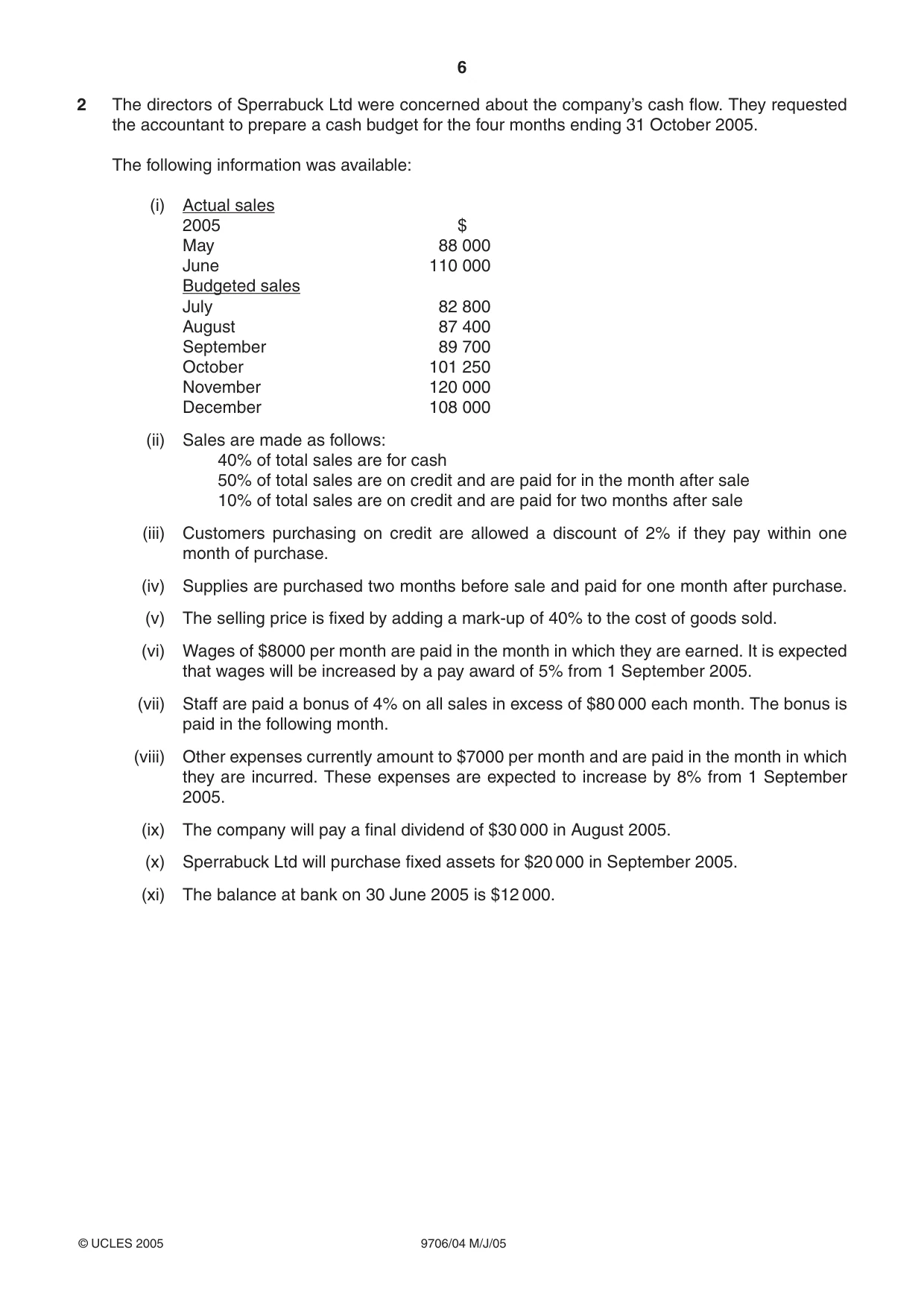
6 © UCLES 2005 9706/04 M/J/05 2 The directors of Sperrabuck Ltd were concerned about the company’s cash flow. They requested the accountant to prepare a cash budget for the four months ending 31 October 2005. The following information was available: (i) Actual sales 2005 $ May 88 000 June 110 000 Budgeted sales July 82 800 August 87 400 September 89 700 October 101 250 November 120 000 December 108 000 (ii) Sales are made as follows: 40% of total sales are for cash 50% of total sales are on credit and are paid for in the month after sale 10% of total sales are on credit and are paid for two months after sale (iii) Customers purchasing on credit are allowed a discount of 2% if they pay within one month of purchase. (iv) Supplies are purchased two months before sale and paid for one month after purchase. (v) The selling price is fixed by adding a mark-up of 40% to the cost of goods sold. (vi) Wages of $8000 per month are paid in the month in which they are earned. It is expected that wages will be increased by a pay award of 5% from 1 September 2005. (vii) Staff are paid a bonus of 4% on all sales in excess of $80 000 each month. The bonus is paid in the following month. (viii) Other expenses currently amount to $7000 per month and are paid in the month in which they are incurred. These expenses are expected to increase by 8% from 1 September 2005. (ix) The company will pay a final dividend of $30 000 in August 2005. (x) Sperrabuck Ltd will purchase fixed assets for $20 000 in September 2005. (xi) The balance at bank on 30 June 2005 is $12 000.
Question paper, page 7
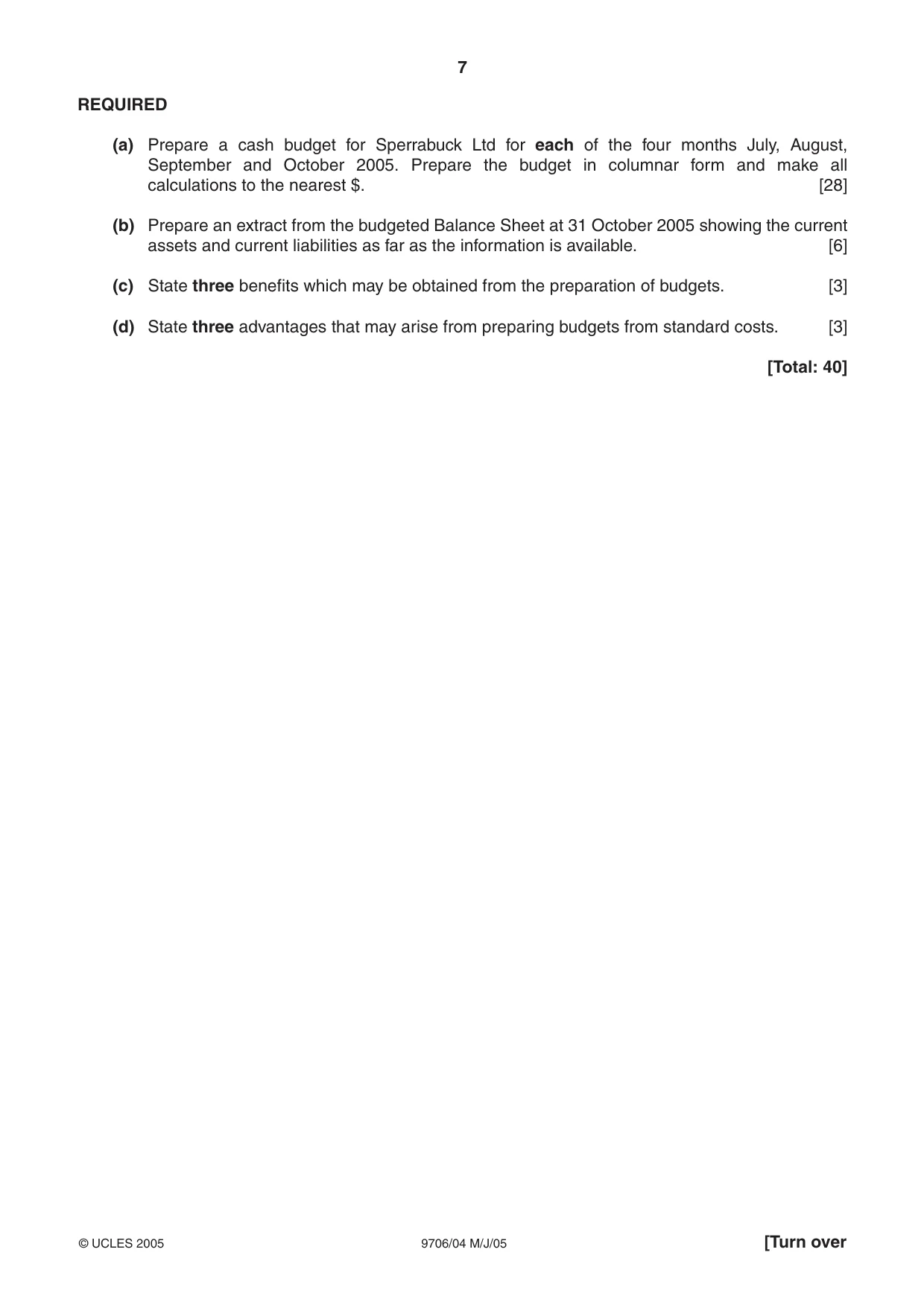
7 © UCLES 2005 9706/04 M/J/05 [Turn over REQUIRED (a) Prepare a cash budget for Sperrabuck Ltd for each of the four months July, August, September and October 2005. Prepare the budget in columnar form and make all calculations to the nearest $. [28] (b) Prepare an extract from the budgeted Balance Sheet at 31 October 2005 showing the current assets and current liabilities as far as the information is available. [6] (c) State three benefits which may be obtained from the preparation of budgets. [3] (d) State three advantages that may arise from preparing budgets from standard costs. [3] [Total: 40]
Question paper, page 8
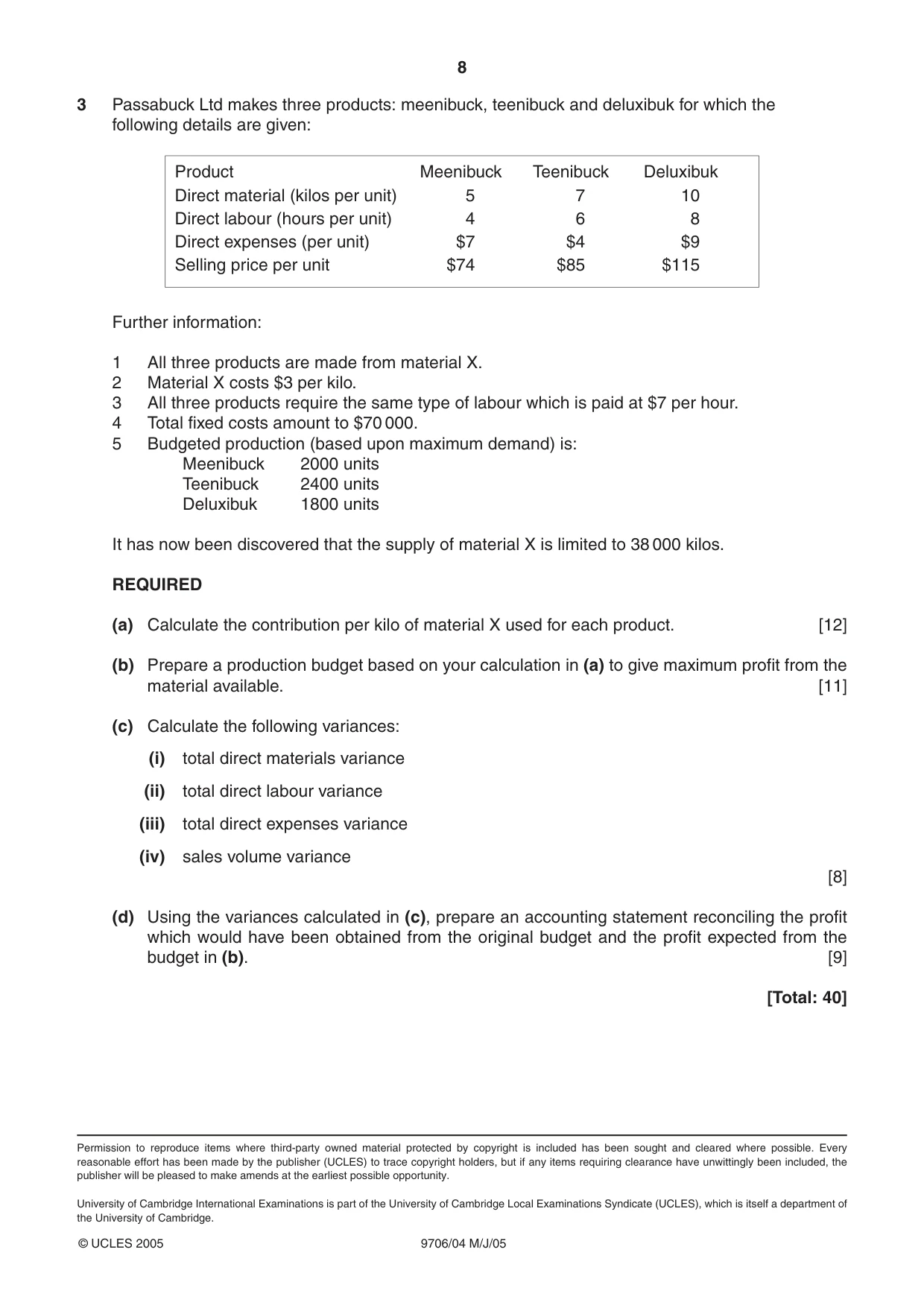
8 © UCLES 2005 9706/04 M/J/05 3 Passabuck Ltd makes three products: meenibuck, teenibuck and deluxibuk for which the following details are given: Further information: 1 All three products are made from material X. 2 Material X costs $3 per kilo. 3 All three products require the same type of labour which is paid at $7 per hour. 4 Total fixed costs amount to $70 000. 5 Budgeted production (based upon maximum demand) is: Meenibuck 2000 units Teenibuck 2400 units Deluxibuk 1800 units It has now been discovered that the supply of material X is limited to 38 000 kilos. REQUIRED (a) Calculate the contribution per kilo of material X used for each product. [12] (b) Prepare a production budget based on your calculation in (a) to give maximum profit from the material available. [11] (c) Calculate the following variances: (i) total direct materials variance (ii) total direct labour variance (iii) total direct expenses variance (iv) sales volume variance [8] (d) Using the variances calculated in (c), prepare an accounting statement reconciling the profit which would have been obtained from the original budget and the profit expected from the budget in (b). [9] [Total: 40] Product Meenibuck Teenibuck Deluxibuk Direct material (kilos per unit) 5 7 10 Direct labour (hours per unit) 4 6 8 Direct expenses (per unit) $7 $4 $9 Selling price per unit $74 $85 $115 Permission to reproduce items where third-party owned material protected by copyright is included has been sought and cleared where possible. Every reasonable effort has been made by the publisher (UCLES) to trace copyright holders, but if any items requiring clearance have unwittingly been included, the publisher will be pleased to make amends at the earliest possible opportunity. University of Cambridge International Examinations is part of the University of Cambridge Local Examinations Syndicate (UCLES), which is itself a department of the University of Cambridge.
Mark scheme, page 1
UNIVERSITY OF CAMBRIDGE INTERNATIONAL EXAMINATIONS GCE Advanced Level MARK SCHEME for the June 2005 question paper 9706 ACCOUNTING 9706/04 Paper 4 Problem Solving (Supplementary Topics), maximum raw mark 120 This mark scheme is published as an aid to teachers and students, to indicate the requirements of the examination. It shows the basis on which Examiners were initially instructed to award marks. It does not indicate the details of the discussions that took place at an Examiners’ meeting before marking began. Any substantial changes to the mark scheme that arose from these discussions will be recorded in the published Report on the Examination. All Examiners are instructed that alternative correct answers and unexpected approaches in candidates’ scripts must be given marks that fairly reflect the relevant knowledge and skills demonstrated. Mark schemes must be read in conjunction with the question papers and the Report on the Examination. • CIE will not enter into discussion or correspondence in connection with these mark schemes. CIE is publishing the mark schemes for the June 2005 question papers for most IGCSE and GCE Advanced Level and Advanced Subsidiary Level syllabuses and some Ordinary Level syllabuses.
Mark scheme, page 2
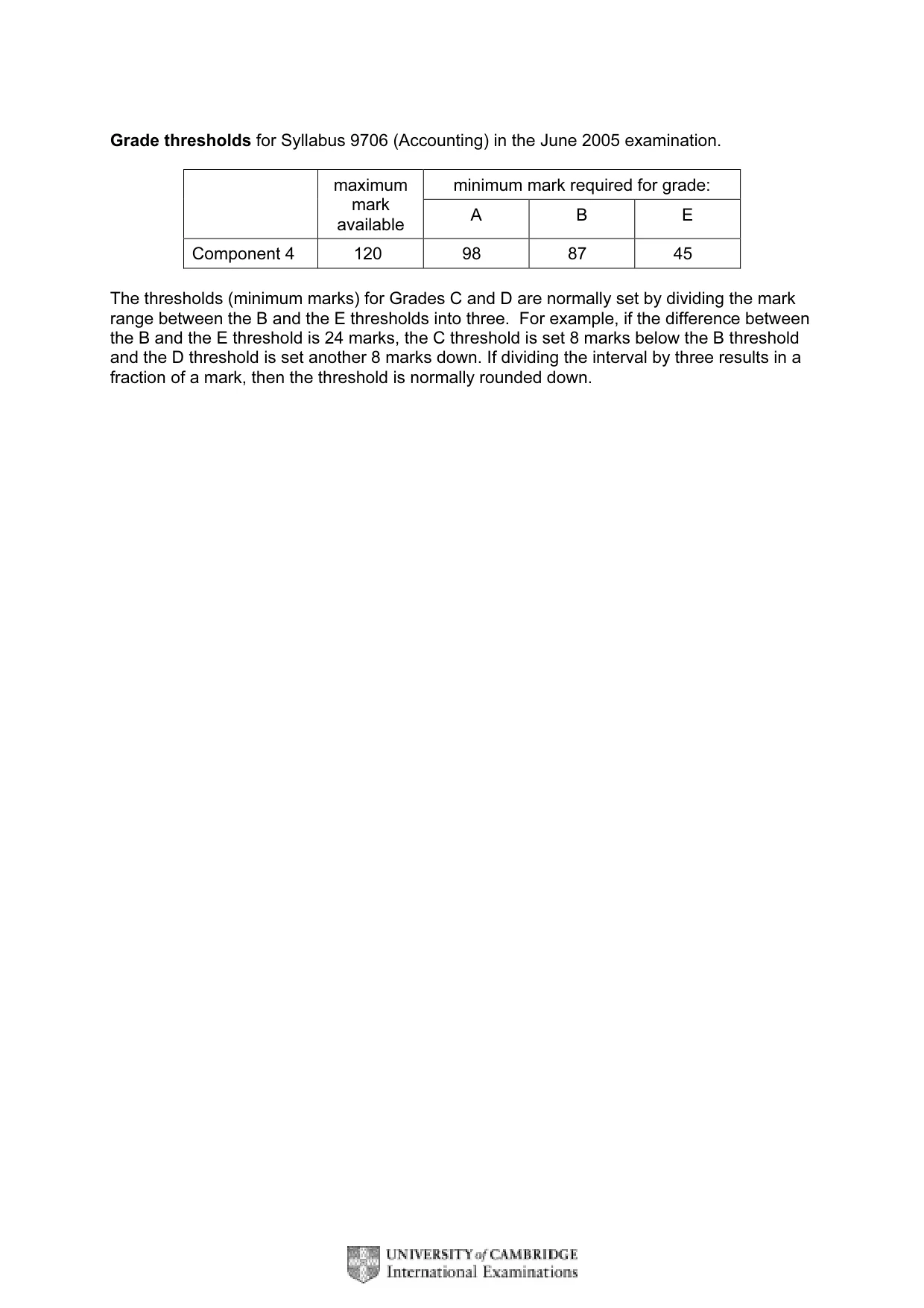
Grade thresholds for Syllabus 9706 (Accounting) in the June 2005 examination. minimum mark required for grade: maximum mark available A B E Component 4 120 98 87 45 The thresholds (minimum marks) for Grades C and D are normally set by dividing the mark range between the B and the E thresholds into three. For example, if the difference between the B and the E threshold is 24 marks, the C threshold is set 8 marks below the B threshold and the D threshold is set another 8 marks down. If dividing the interval by three results in a fraction of a mark, then the threshold is normally rounded down.
Mark scheme, page 3
June 2005 GCE A LEVEL MARK SCHEME MAXIMUM MARK: 120 SYLLABUS/COMPONENT: 9706/04 ACCOUNTING Paper 4 Problem Solving (Supplementary Topics)
Mark scheme, page 4
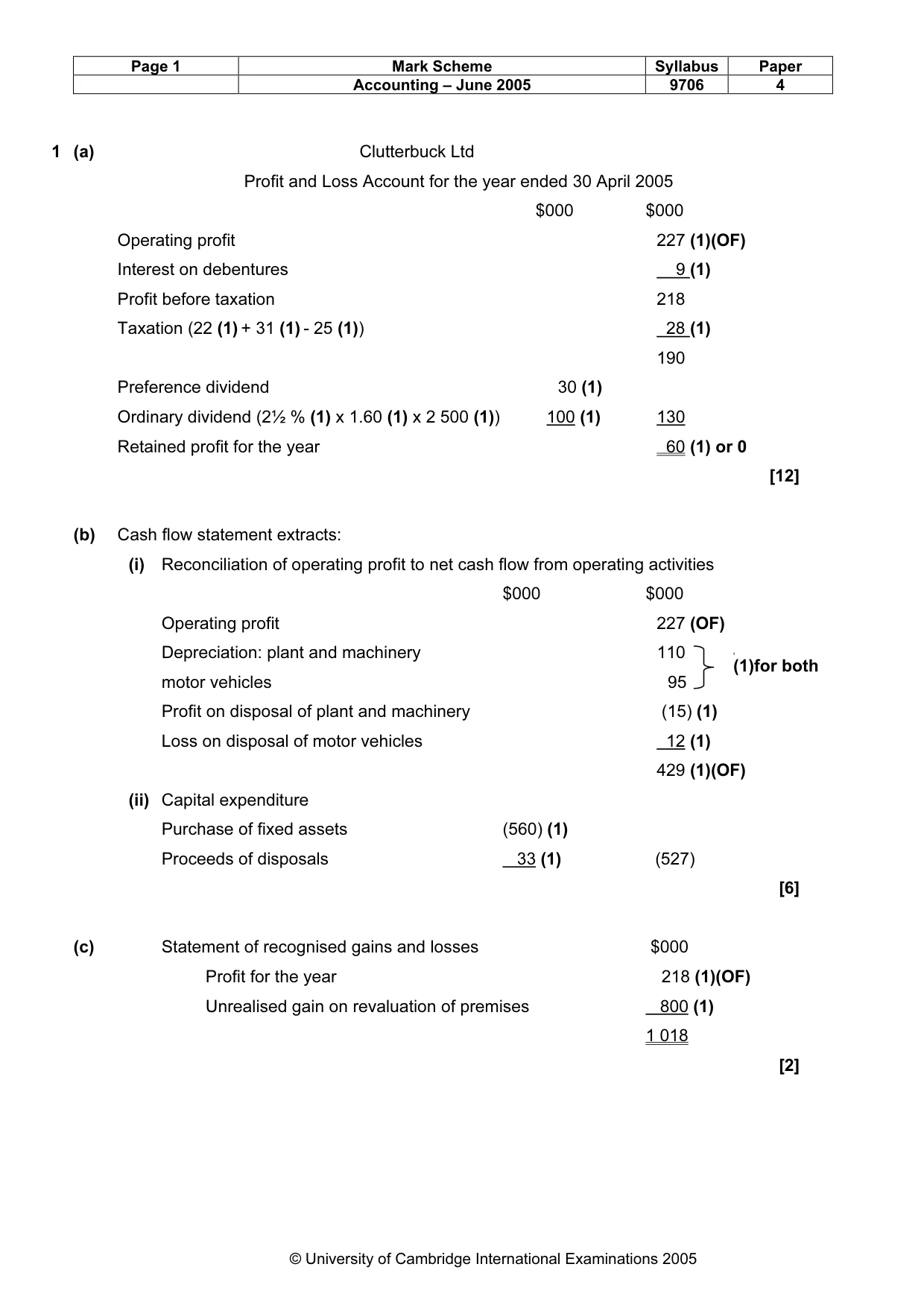
Page 1 Mark Scheme Syllabus Paper Accounting – June 2005 9706 4 © University of Cambridge International Examinations 2005 1 (a) Clutterbuck Ltd Profit and Loss Account for the year ended 30 April 2005 $000 $000 Operating profit 227 (1)(OF) Interest on debentures 9 (1) Profit before taxation 218 Taxation (22 (1) + 31 (1) - 25 (1)) 28 (1) 190 Preference dividend 30 (1) Ordinary dividend (2½ % (1) x 1.60 (1) x 2 500 (1)) 100 (1) 130 Retained profit for the year 60 (1) or 0 [12] (b) Cash flow statement extracts: (i) Reconciliation of operating profit to net cash flow from operating activities $000 $000 Operating profit 227 (OF) Depreciation: plant and machinery 110 motor vehicles 95 Profit on disposal of plant and machinery (15) (1) Loss on disposal of motor vehicles 12 (1) 429 (1)(OF) (ii) Capital expenditure Purchase of fixed assets (560) (1) Proceeds of disposals 33 (1) (527) [6] (c) Statement of recognised gains and losses $000 Profit for the year 218 (1)(OF) Unrealised gain on revaluation of premises 800 (1) 1 018 [2] 3 (1)for both
Mark scheme, page 5
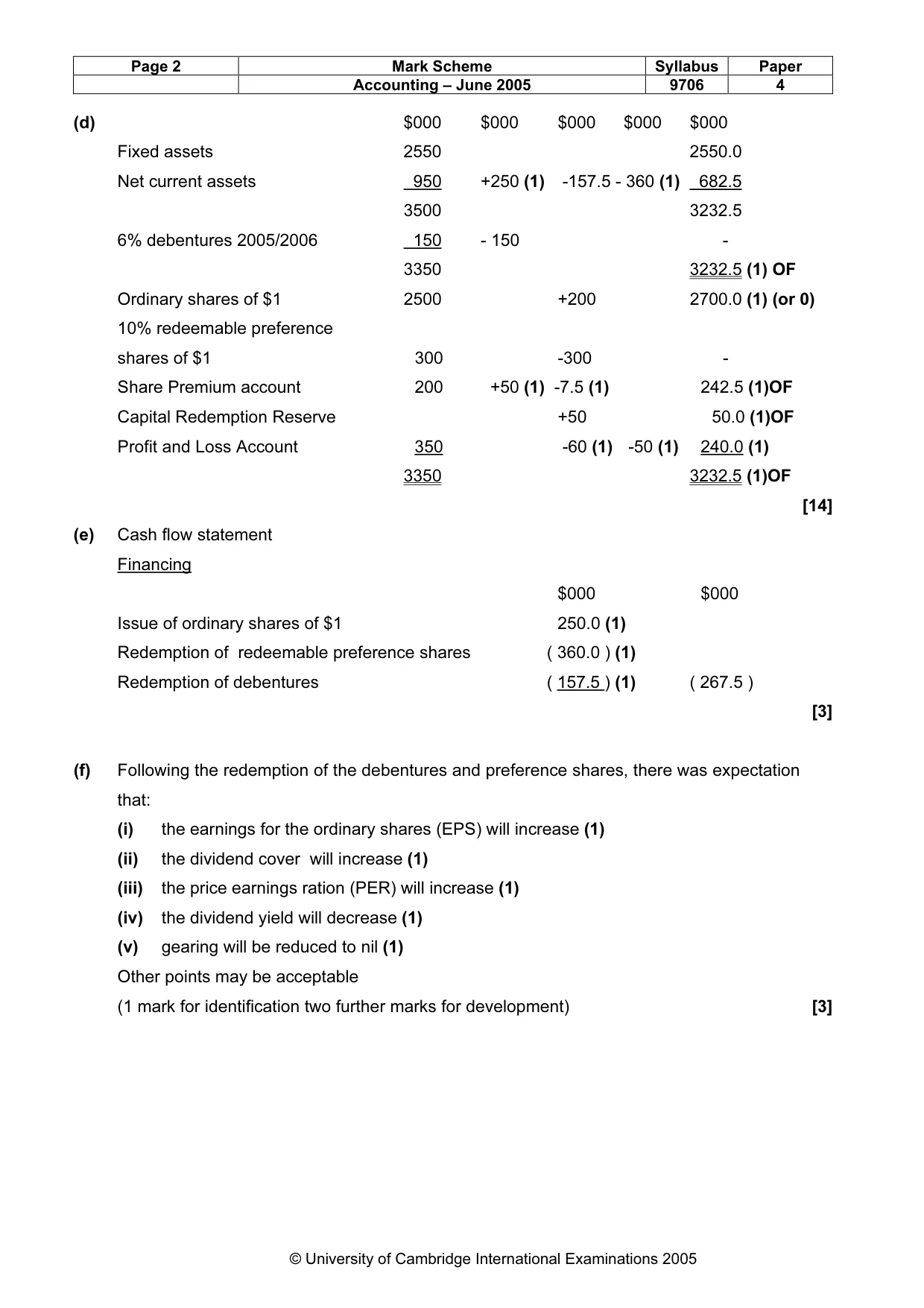
Page 2 Mark Scheme Syllabus Paper Accounting – June 2005 9706 4 © University of Cambridge International Examinations 2005 (d) $000 $000 $000 $000 $000 Fixed assets 2550 2550.0 Net current assets 950 +250 (1) -157.5 - 360 (1) 682.5 3500 3232.5 6% debentures 2005/2006 150 - 150 - 3350 3232.5 (1) OF Ordinary shares of $1 2500 +200 2700.0 (1) (or 0) 10% redeemable preference shares of $1 300 -300 - Share Premium account 200 +50 (1) -7.5 (1) 242.5 (1)OF Capital Redemption Reserve +50 50.0 (1)OF Profit and Loss Account 350 -60 (1) -50 (1) 240.0 (1) 3350 3232.5 (1)OF [14] (e) Cash flow statement Financing $000 $000 Issue of ordinary shares of $1 250.0 (1) Redemption of redeemable preference shares ( 360.0 ) (1) Redemption of debentures ( 157.5 ) (1) ( 267.5 ) [3] (f) Following the redemption of the debentures and preference shares, there was expectation that: (i) the earnings for the ordinary shares (EPS) will increase (1) (ii) the dividend cover will increase (1) (iii) the price earnings ration (PER) will increase (1) (iv) the dividend yield will decrease (1) (v) gearing will be reduced to nil (1) Other points may be acceptable (1 mark for identification two further marks for development) [3]
Mark scheme, page 6
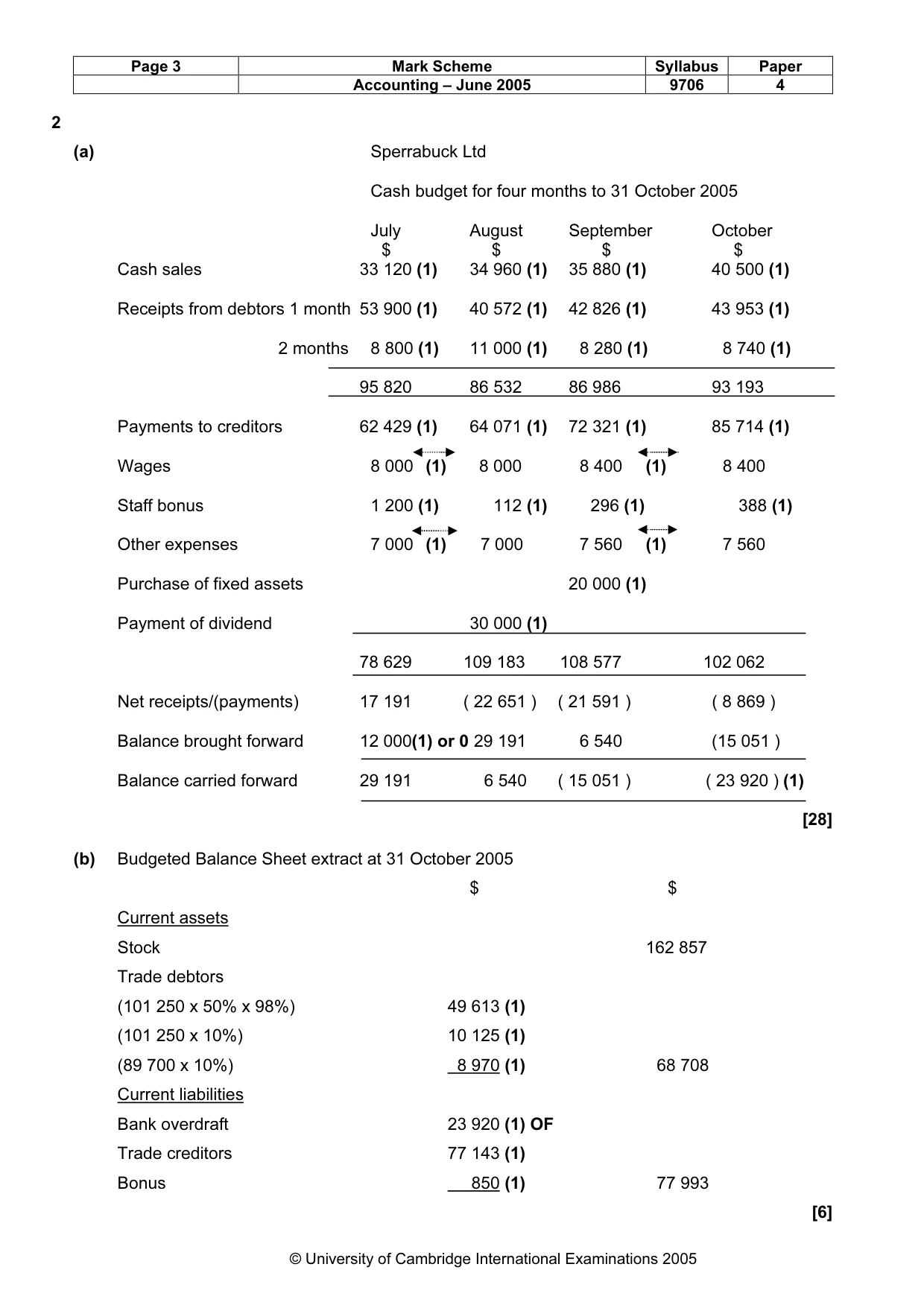
Page 3 Mark Scheme Syllabus Paper Accounting – June 2005 9706 4 © University of Cambridge International Examinations 2005 2 (a) Sperrabuck Ltd Cash budget for four months to 31 October 2005 July August September October $ $ $ $ Cash sales 33 120 (1) 34 960 (1) 35 880 (1) 40 500 (1) Receipts from debtors 1 month 53 900 (1) 40 572 (1) 42 826 (1) 43 953 (1) 2 months 8 800 (1) 11 000 (1) 8 280 (1) 8 740 (1) 95 820 86 532 86 986 93 193 Payments to creditors 62 429 (1) 64 071 (1) 72 321 (1) 85 714 (1) Wages 8 000 (1) 8 000 8 400 (1) 8 400 Staff bonus 1 200 (1) 112 (1) 296 (1) 388 (1) Other expenses 7 000 (1) 7 000 7 560 (1) 7 560 Purchase of fixed assets 20 000 (1) Payment of dividend 30 000 (1) 78 629 109 183 108 577 102 062 Net receipts/(payments) 17 191 ( 22 651 ) ( 21 591 ) ( 8 869 ) Balance brought forward 12 000(1) or 0 29 191 6 540 (15 051 ) Balance carried forward 29 191 6 540 ( 15 051 ) ( 23 920 ) (1) [28] (b) Budgeted Balance Sheet extract at 31 October 2005 $ $ Current assets Stock 162 857 Trade debtors (101 250 x 50% x 98%) 49 613 (1) (101 250 x 10%) 10 125 (1) (89 700 x 10%) 8 970 (1) 68 708 Current liabilities Bank overdraft 23 920 (1) OF Trade creditors 77 143 (1) Bonus 850 (1) 77 993 [6]
Mark scheme, page 7
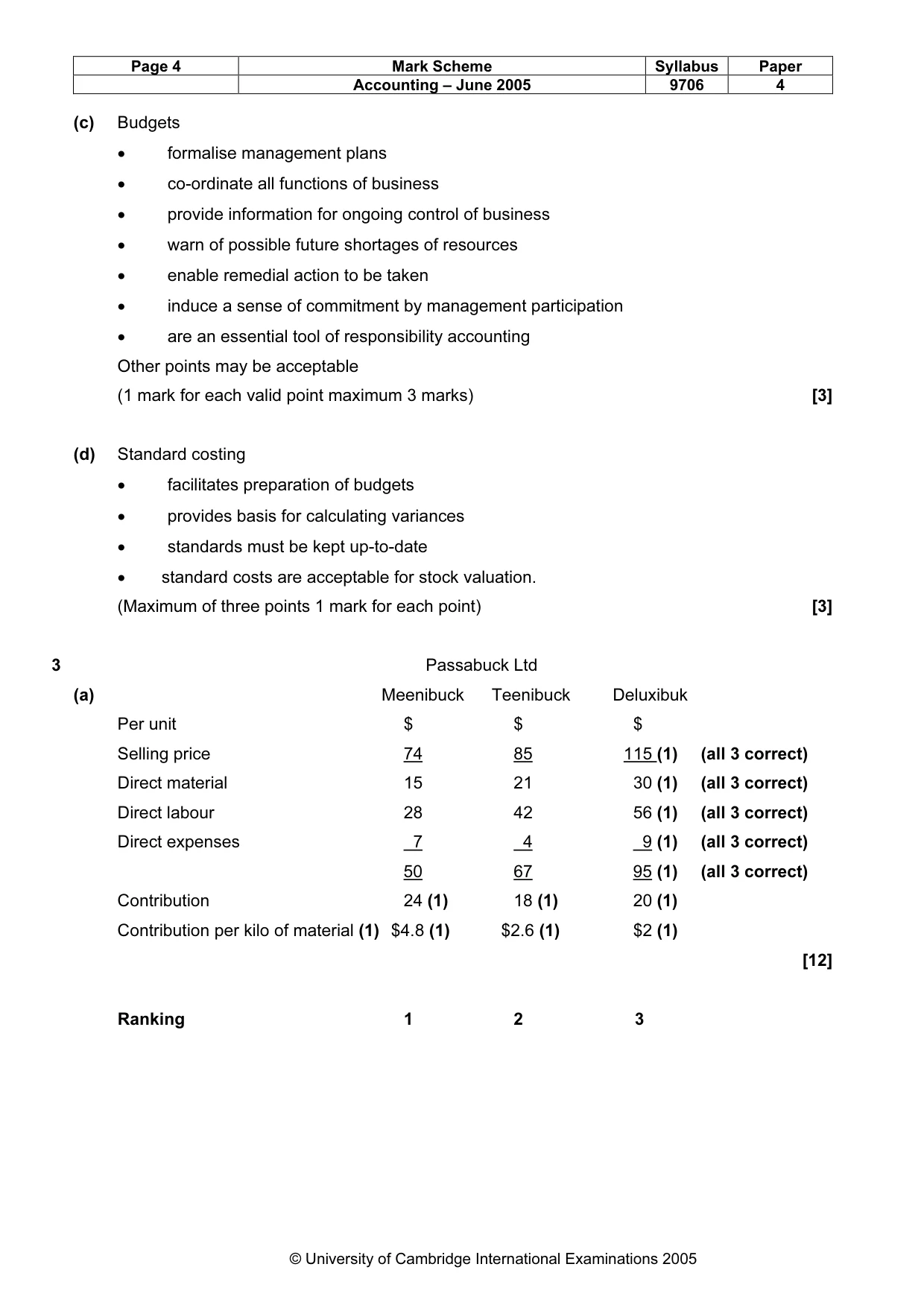
Page 4 Mark Scheme Syllabus Paper Accounting – June 2005 9706 4 © University of Cambridge International Examinations 2005 (c) Budgets • formalise management plans • co-ordinate all functions of business • provide information for ongoing control of business • warn of possible future shortages of resources • enable remedial action to be taken • induce a sense of commitment by management participation • are an essential tool of responsibility accounting Other points may be acceptable (1 mark for each valid point maximum 3 marks) [3] (d) Standard costing • facilitates preparation of budgets • provides basis for calculating variances • standards must be kept up-to-date • standard costs are acceptable for stock valuation. (Maximum of three points 1 mark for each point) [3] 3 Passabuck Ltd (a) Meenibuck Teenibuck Deluxibuk Per unit $ $ $ Selling price 74 85 115 (1) (all 3 correct) Direct material 15 21 30 (1) (all 3 correct) Direct labour 28 42 56 (1) (all 3 correct) Direct expenses 7 4 9 (1) (all 3 correct) 50 67 95 (1) (all 3 correct) Contribution 24 (1) 18 (1) 20 (1) Contribution per kilo of material (1) $4.8 (1) $2.6 (1) $2 (1) [12] Ranking 1 2 3
Mark scheme, page 8
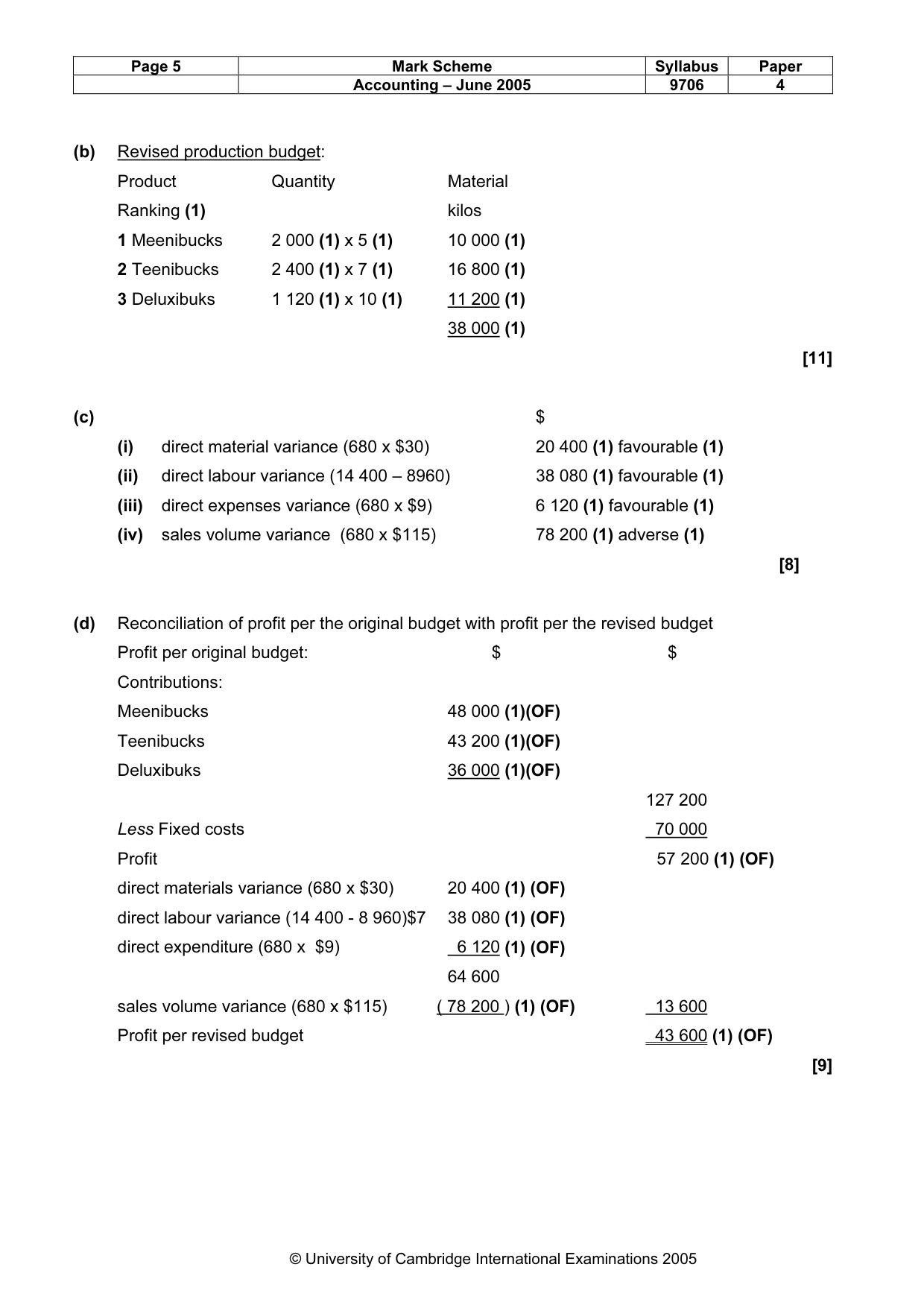
Page 5 Mark Scheme Syllabus Paper Accounting – June 2005 9706 4 © University of Cambridge International Examinations 2005 (b) Revised production budget: Product Quantity Material Ranking (1) kilos 1 Meenibucks 2 000 (1) x 5 (1) 10 000 (1) 2 Teenibucks 2 400 (1) x 7 (1) 16 800 (1) 3 Deluxibuks 1 120 (1) x 10 (1) 11 200 (1) 38 000 (1) [11] (c) $ (i) direct material variance (680 x $30) 20 400 (1) favourable (1) (ii) direct labour variance (14 400 – 8960) 38 080 (1) favourable (1) (iii) direct expenses variance (680 x $9) 6 120 (1) favourable (1) (iv) sales volume variance (680 x $115) 78 200 (1) adverse (1) [8] (d) Reconciliation of profit per the original budget with profit per the revised budget Profit per original budget: $ $ Contributions: Meenibucks 48 000 (1)(OF) Teenibucks 43 200 (1)(OF) Deluxibuks 36 000 (1)(OF) 127 200 Less Fixed costs 70 000 Profit 57 200 (1) (OF) direct materials variance (680 x $30) 20 400 (1) (OF) direct labour variance (14 400 - 8 960)$7 38 080 (1) (OF) direct expenditure (680 x $9) 6 120 (1) (OF) 64 600 sales volume variance (680 x $115) ( 78 200 ) (1) (OF) 13 600 Profit per revised budget 43 600 (1) (OF) [9]