Cambridge A Level Accounting 9706 — 2004 May/June Paper 4 · Variant 1
9706/41/M/J/04
The question paper and its mark scheme, free to read here and free to download. This is Cambridge’s own paper, exactly as it was sat.
Question paper8 pages


Mark scheme
No mark scheme is in the library for this paper.
Paper as text
Question paper, page 1
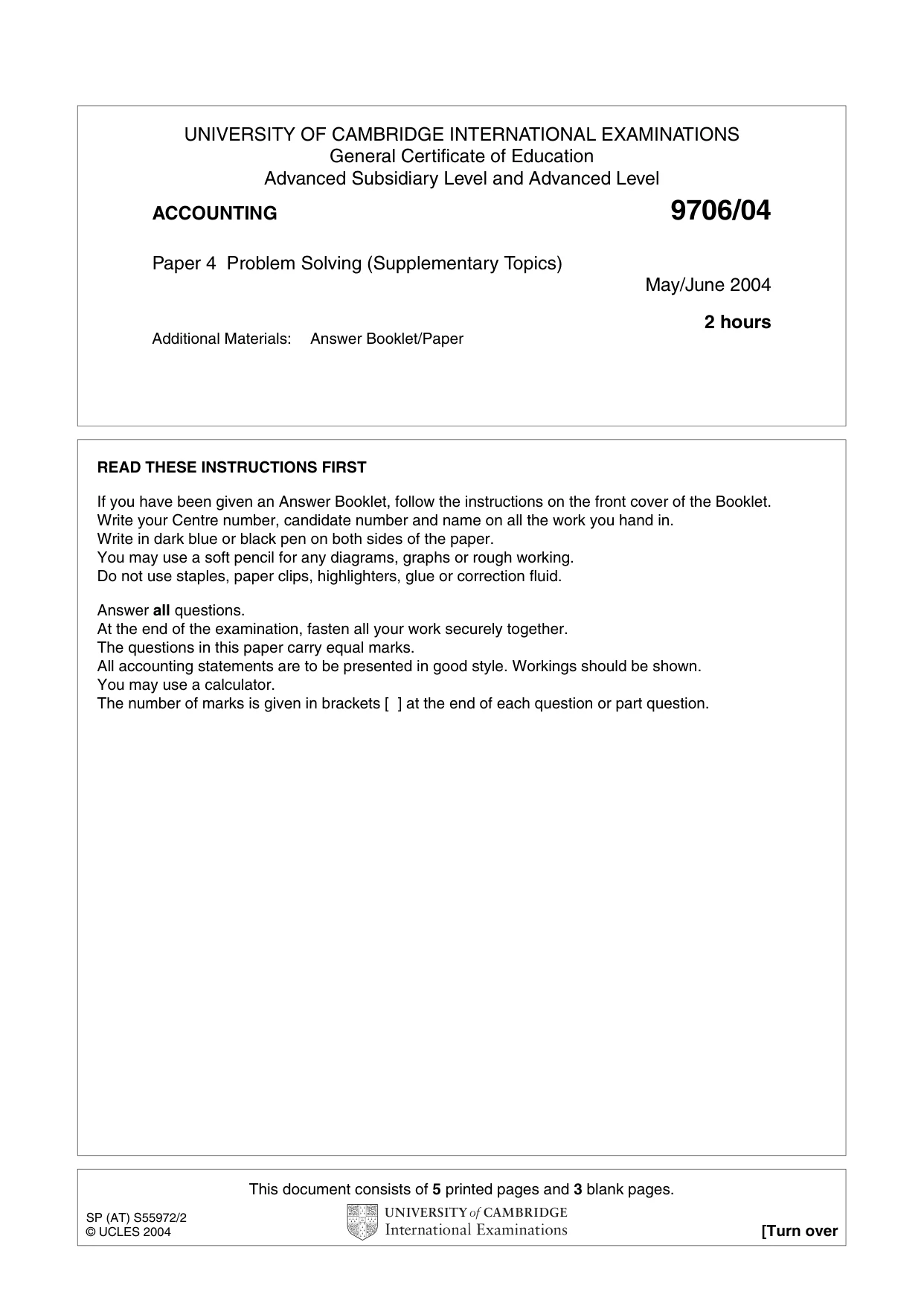
This document consists of 5 printed pages and 3 blank pages. SP (AT) S55972/2 © UCLES 2004 [Turn over UNIVERSITY OF CAMBRIDGE INTERNATIONAL EXAMINATIONS General Certificate of Education Advanced Subsidiary Level and Advanced Level ACCOUNTING 9706/04 Paper 4 Problem Solving (Supplementary Topics) May/June 2004 2 hours Additional Materials: Answer Booklet/Paper READ THESE INSTRUCTIONS FIRST If you have been given an Answer Booklet, follow the instructions on the front cover of the Booklet. Write your Centre number, candidate number and name on all the work you hand in. Write in dark blue or black pen on both sides of the paper. You may use a soft pencil for any diagrams, graphs or rough working. Do not use staples, paper clips, highlighters, glue or correction fluid. Answer all questions. At the end of the examination, fasten all your work securely together. The questions in this paper carry equal marks. All accounting statements are to be presented in good style. Workings should be shown. You may use a calculator. The number of marks is given in brackets [ ] at the end of each question or part question.
Question paper, page 2
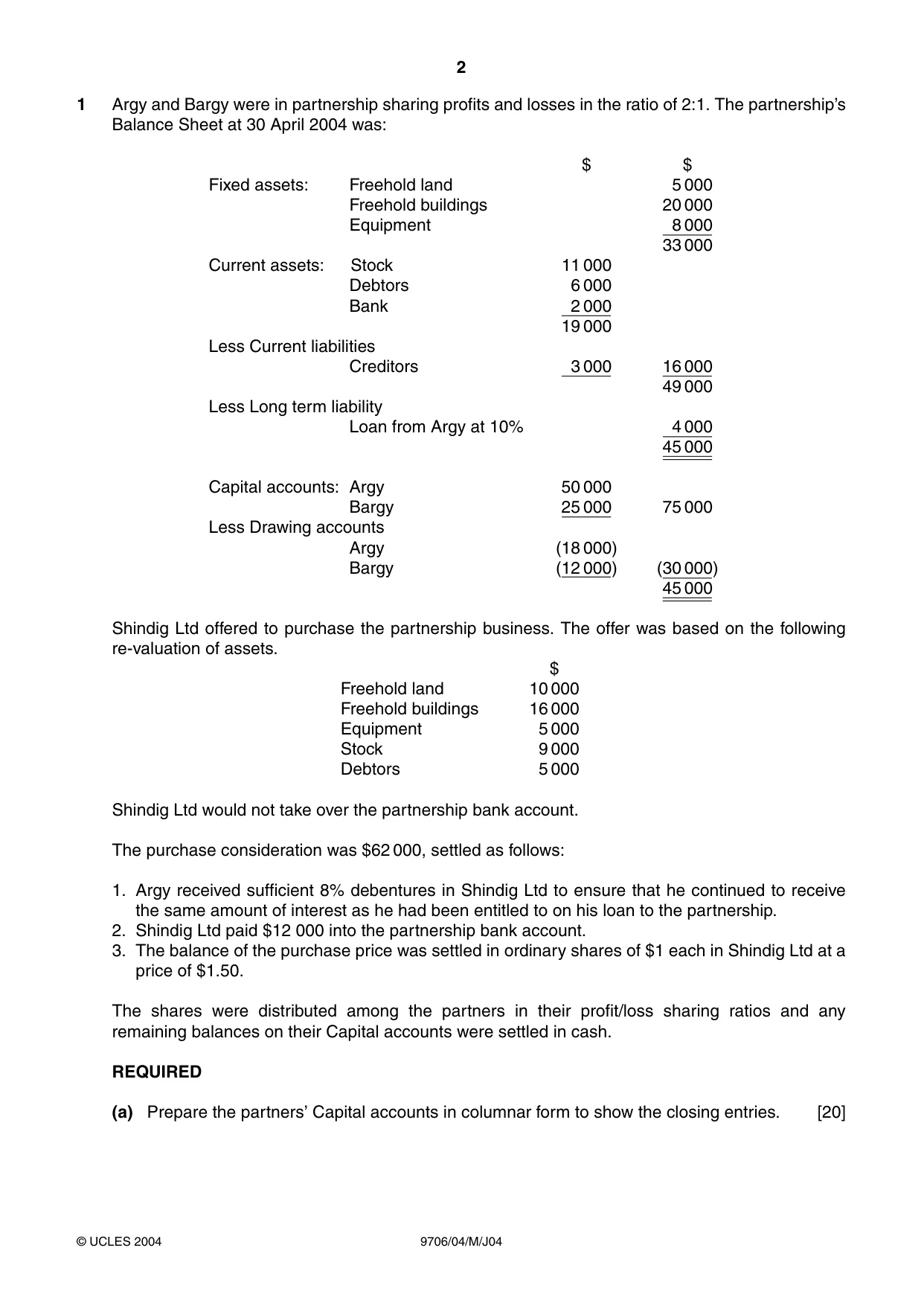
2 9706/04/M/J04 1 Argy and Bargy were in partnership sharing profits and losses in the ratio of 2:1. The partnership’s Balance Sheet at 30 April 2004 was: $ $ Fixed assets: Freehold land 5 000 Freehold buildings 20 000 Equipment 8 000 33 000 Current assets: Stock 11 000 Debtors 6 000 Bank 2 000 19 000 Less Current liabilities Creditors 3 000 16 000 49 000 Less Long term liability Loan from Argy at 10% 4 000 45 000 Capital accounts: Argy 50 000 Bargy 25 000 75 000 Less Drawing accounts Argy (18 000) Bargy (12 000) (30 000) 45 000 Shindig Ltd offered to purchase the partnership business. The offer was based on the following re-valuation of assets. $ Freehold land 10 000 Freehold buildings 16 000 Equipment 5 000 Stock 9 000 Debtors 5 000 Shindig Ltd would not take over the partnership bank account. The purchase consideration was $62 000, settled as follows: 1. Argy received sufficient 8% debentures in Shindig Ltd to ensure that he continued to receive the same amount of interest as he had been entitled to on his loan to the partnership. 2. Shindig Ltd paid $12 000 into the partnership bank account. 3. The balance of the purchase price was settled in ordinary shares of $1 each in Shindig Ltd at a price of $1.50. The shares were distributed among the partners in their profit/loss sharing ratios and any remaining balances on their Capital accounts were settled in cash. REQUIRED (a) Prepare the partners’ Capital accounts in columnar form to show the closing entries. [20] © UCLES 2004
Question paper, page 3
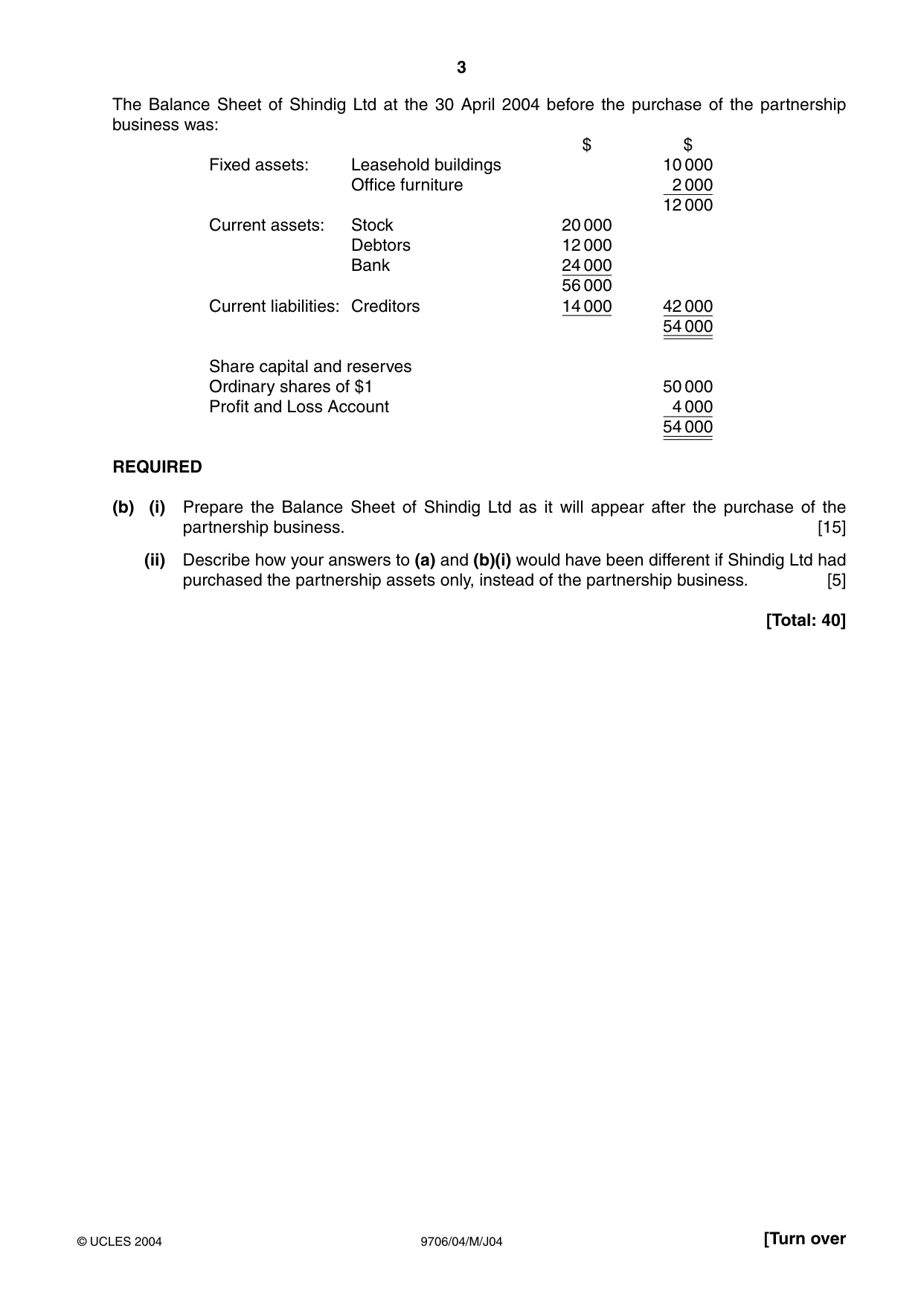
3 9706/04/M/J04 [Turn over The Balance Sheet of Shindig Ltd at the 30 April 2004 before the purchase of the partnership business was: $ $ Fixed assets: Leasehold buildings 10 000 Office furniture 2 000 12 000 Current assets: Stock 20 000 Debtors 12 000 Bank 24 000 56 000 Current liabilities: Creditors 14 000 42 000 54 000 Share capital and reserves Ordinary shares of $1 50 000 Profit and Loss Account 4 000 54 000 REQUIRED (b) (i) Prepare the Balance Sheet of Shindig Ltd as it will appear after the purchase of the partnership business. [15] (ii) Describe how your answers to (a) and (b)(i) would have been different if Shindig Ltd had purchased the partnership assets only, instead of the partnership business. [5] [Total: 40] © UCLES 2004
Question paper, page 4
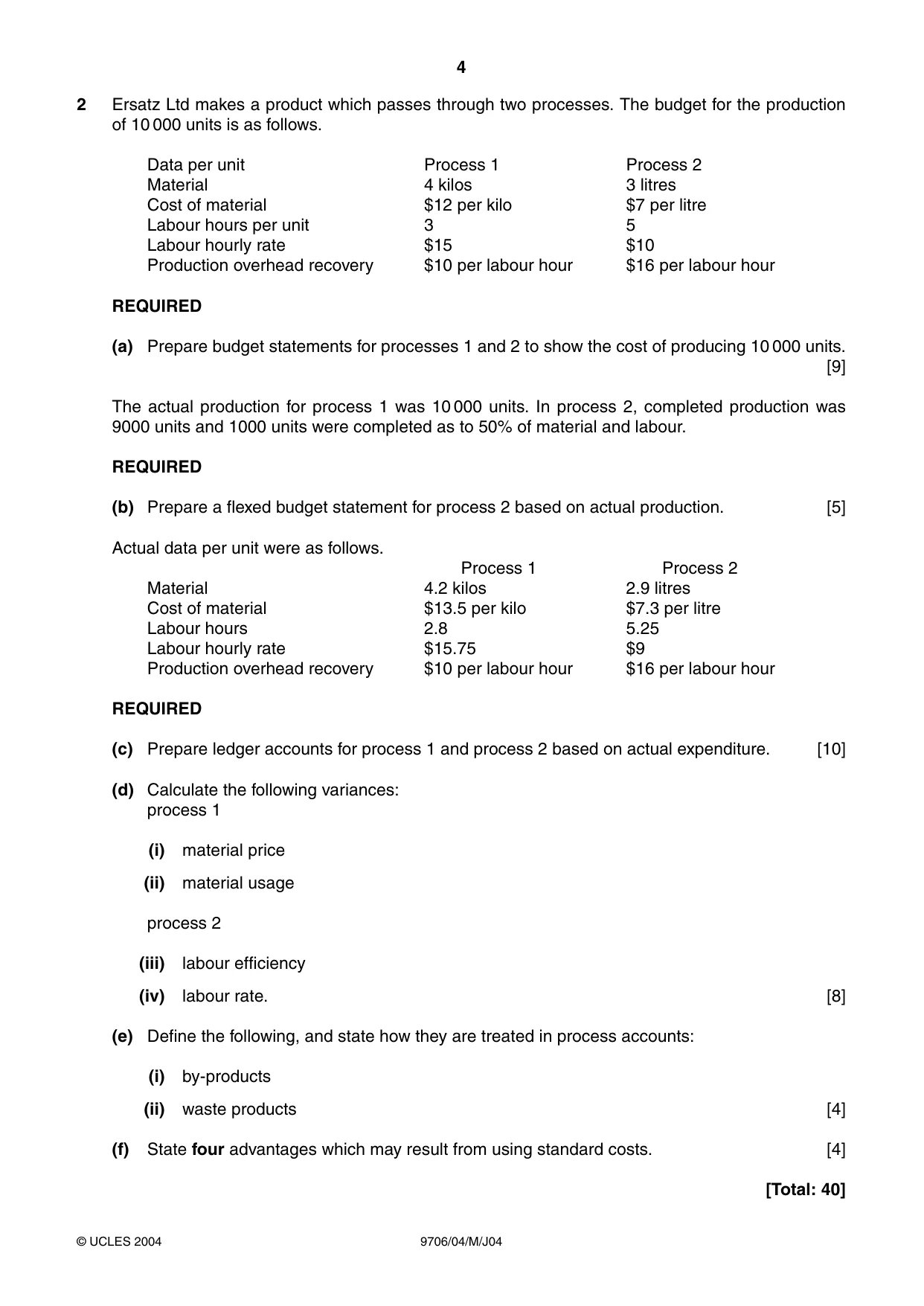
4 9706/04/M/J04 2 Ersatz Ltd makes a product which passes through two processes. The budget for the production of 10 000 units is as follows. Data per unit Process 1 Process 2 Material 4 kilos 3 litres Cost of material $12 per kilo $7 per litre Labour hours per unit 3 5 Labour hourly rate $15 $10 Production overhead recovery $10 per labour hour $16 per labour hour REQUIRED (a) Prepare budget statements for processes 1 and 2 to show the cost of producing 10 000 units. [9] The actual production for process 1 was 10 000 units. In process 2, completed production was 9000 units and 1000 units were completed as to 50% of material and labour. REQUIRED (b) Prepare a flexed budget statement for process 2 based on actual production. [5] Actual data per unit were as follows. Process 1 Process 2 Material 4.2 kilos 2.9 litres Cost of material $13.5 per kilo $7.3 per litre Labour hours 2.8 5.25 Labour hourly rate $15.75 $9 Production overhead recovery $10 per labour hour $16 per labour hour REQUIRED (c) Prepare ledger accounts for process 1 and process 2 based on actual expenditure. [10] (d) Calculate the following variances: process 1 (i) material price (ii) material usage process 2 (iii) labour efficiency (iv) labour rate. [8] (e) Define the following, and state how they are treated in process accounts: (i) by-products (ii) waste products [4] (f) State four advantages which may result from using standard costs. [4] [Total: 40] © UCLES 2004
Question paper, page 5
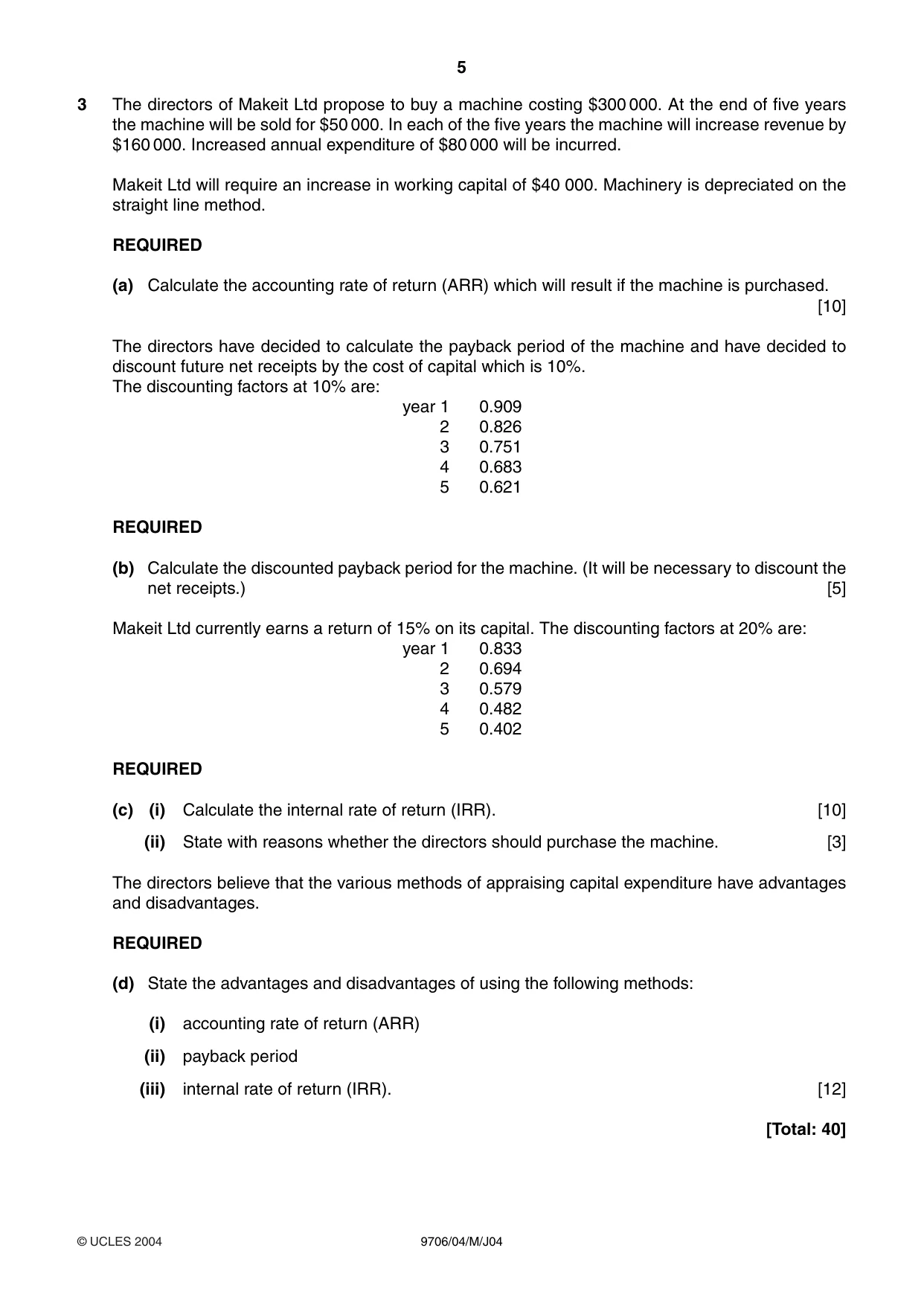
© UCLES 2004 5 9706/04/M/J04 3 The directors of Makeit Ltd propose to buy a machine costing $300 000. At the end of five years the machine will be sold for $50 000. In each of the five years the machine will increase revenue by $160 000. Increased annual expenditure of $80 000 will be incurred. Makeit Ltd will require an increase in working capital of $40 000. Machinery is depreciated on the straight line method. REQUIRED (a) Calculate the accounting rate of return (ARR) which will result if the machine is purchased. [10] The directors have decided to calculate the payback period of the machine and have decided to discount future net receipts by the cost of capital which is 10%. The discounting factors at 10% are: year 1 0.909 2 0.826 3 0.751 4 0.683 5 0.621 REQUIRED (b) Calculate the discounted payback period for the machine. (It will be necessary to discount the net receipts.) [5] Makeit Ltd currently earns a return of 15% on its capital. The discounting factors at 20% are: year 1 0.833 2 0.694 3 0.579 4 0.482 5 0.402 REQUIRED (c) (i) Calculate the internal rate of return (IRR). [10] (ii) State with reasons whether the directors should purchase the machine. [3] The directors believe that the various methods of appraising capital expenditure have advantages and disadvantages. REQUIRED (d) State the advantages and disadvantages of using the following methods: (i) accounting rate of return (ARR) (ii) payback period (iii) internal rate of return (IRR). [12] [Total: 40]
Question paper, page 8
8 9706/04/M/J04 BLANK PAGE University of Cambridge International Examinations is part of the University of Cambridge Local Examinations Syndicate (UCLES) which is itself a department of the University of Cambridge.