Cambridge A Level Accounting 9706 — 2002 Oct/Nov Paper 4 · Variant 1
9706/41/O/N/02
The question paper and its mark scheme, free to read here and free to download. This is Cambridge’s own paper, exactly as it was sat.
Question paper8 pages


Mark scheme7 pages
Answers below. Sit the paper first if you are practising.
Paper as text
Question paper, page 1
This question paper consists of 6 printed pages and 2 blank pages. SP (SLC) S21155/2 © CIE 2002 [Turn over CAMBRIDGE INTERNATIONAL EXAMINATIONS General Certificate of Education Advanced Level ACCOUNTING 9706/4 PAPER 4 Problem Solving (Extension Topics) OCTOBER/NOVEMBER SESSION 2002 2 hours Additional materials: Answer paper TIME 2 hours INSTRUCTIONS TO CANDIDATES Write your name, Centre number and candidate number in the spaces provided on the answer paper/ answer booklet. Answer all questions. Write your answers on the separate answer paper provided. If you use more than one sheet of paper, fasten the sheets together. INFORMATION FOR CANDIDATES The questions in this paper carry equal marks. The number of marks is given in brackets [ ] at the end of each question or part question. All accounting statements are to be presented in good style. Workings should be shown. You may use a calculator.
Question paper, page 2
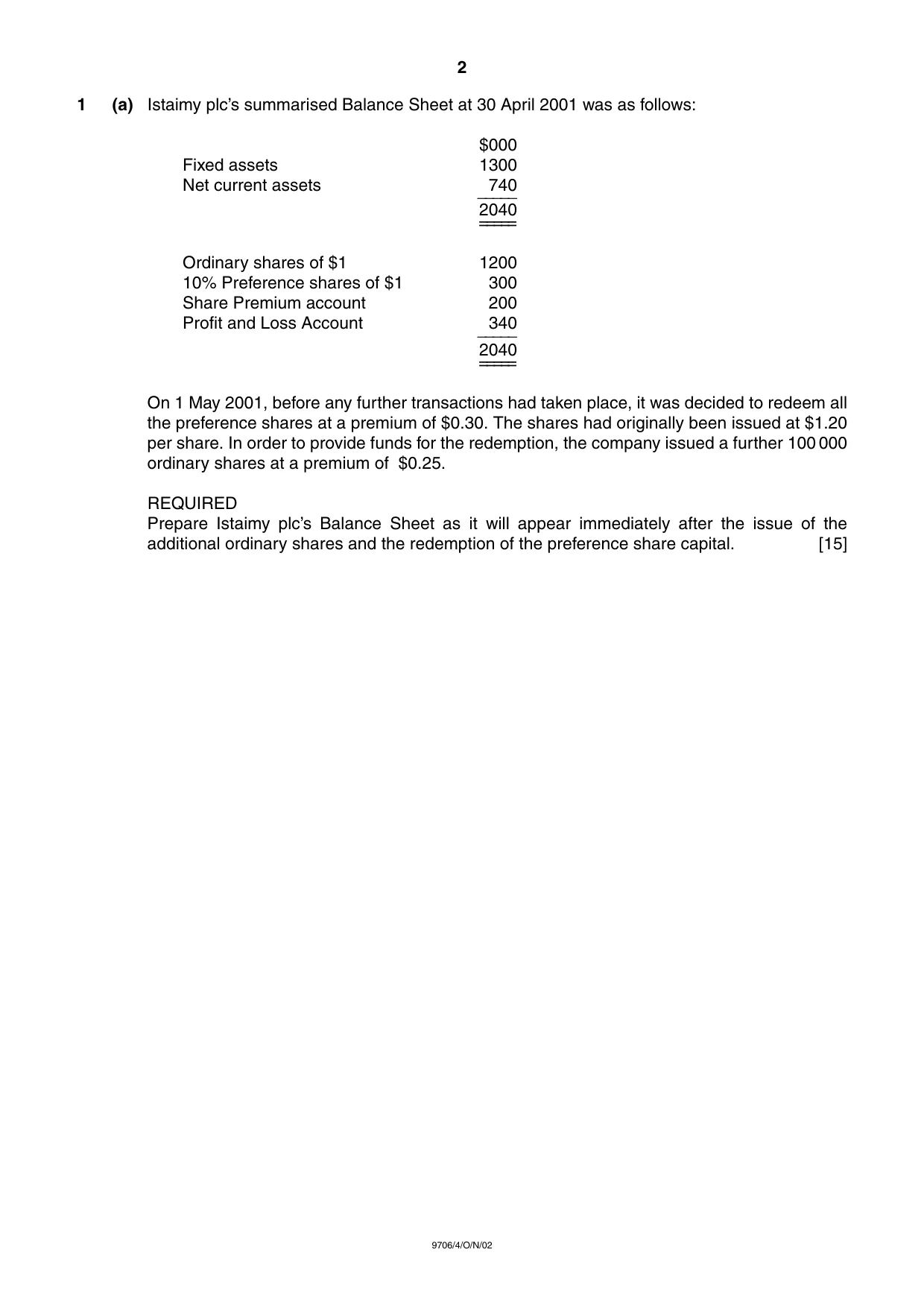
2 9706/4/O/N/02 1 (a) Istaimy plc’s summarised Balance Sheet at 30 April 2001 was as follows: $000 Fixed assets 1300 Net current assets 740 _____ 2040 ===== Ordinary shares of $1 1200 10% Preference shares of $1 300 Share Premium account 200 Profit and Loss Account 340 _____ 2040 ===== On 1 May 2001, before any further transactions had taken place, it was decided to redeem all the preference shares at a premium of $0.30. The shares had originally been issued at $1.20 per share. In order to provide funds for the redemption, the company issued a further 100 000 ordinary shares at a premium of $0.25. REQUIRED Prepare Istaimy plc’s Balance Sheet as it will appear immediately after the issue of the additional ordinary shares and the redemption of the preference share capital. [15]
Question paper, page 3
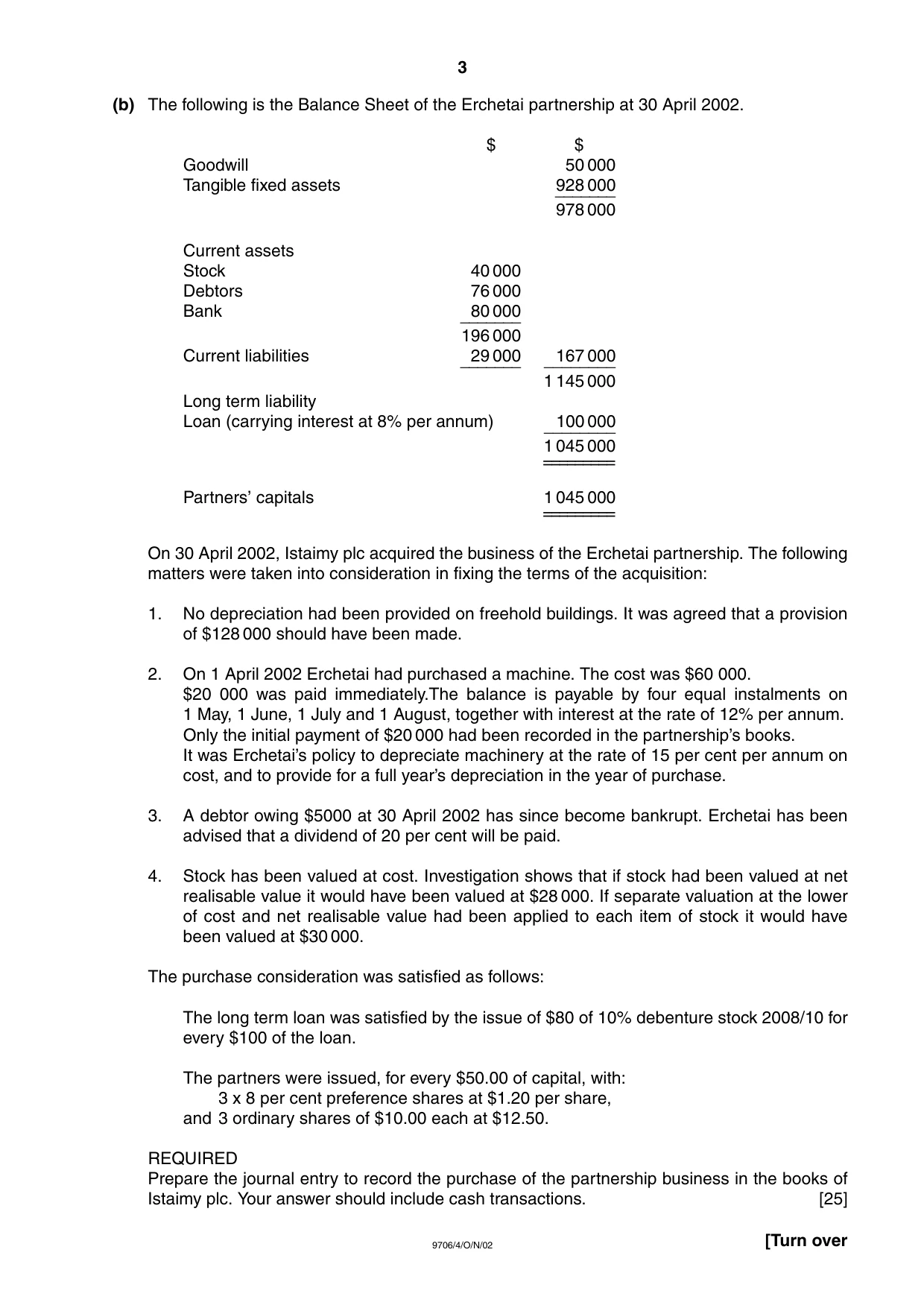
3 9706/4/O/N/02 [Turn over (b) The following is the Balance Sheet of the Erchetai partnership at 30 April 2002. $ $ Goodwill 50 000 Tangible fixed assets 928 000 _______ 978 000 Current assets Stock 40 000 Debtors 76 000 Bank 80 000 _______ 196 000 Current liabilities 29 000 167 000 _______ ________ 1 145 000 Long term liability Loan (carrying interest at 8% per annum) 100 000 ________ 1 045 000 ========= Partners’ capitals 1 045 000 ========= On 30 April 2002, Istaimy plc acquired the business of the Erchetai partnership. The following matters were taken into consideration in fixing the terms of the acquisition: 1. No depreciation had been provided on freehold buildings. It was agreed that a provision of $128 000 should have been made. 2. On 1 April 2002 Erchetai had purchased a machine. The cost was $60 000. $20 000 was paid immediately.The balance is payable by four equal instalments on 1 May, 1 June, 1 July and 1 August, together with interest at the rate of 12% per annum. Only the initial payment of $20 000 had been recorded in the partnership’s books. It was Erchetai’s policy to depreciate machinery at the rate of 15 per cent per annum on cost, and to provide for a full year’s depreciation in the year of purchase. 3. A debtor owing $5000 at 30 April 2002 has since become bankrupt. Erchetai has been advised that a dividend of 20 per cent will be paid. 4. Stock has been valued at cost. Investigation shows that if stock had been valued at net realisable value it would have been valued at $28 000. If separate valuation at the lower of cost and net realisable value had been applied to each item of stock it would have been valued at $30 000. The purchase consideration was satisfied as follows: The long term loan was satisfied by the issue of $80 of 10% debenture stock 2008/10 for every $100 of the loan. The partners were issued, for every $50.00 of capital, with: 3 x 8 per cent preference shares at $1.20 per share, and 3 ordinary shares of $10.00 each at $12.50. REQUIRED Prepare the journal entry to record the purchase of the partnership business in the books of Istaimy plc. Your answer should include cash transactions. [25]
Question paper, page 4
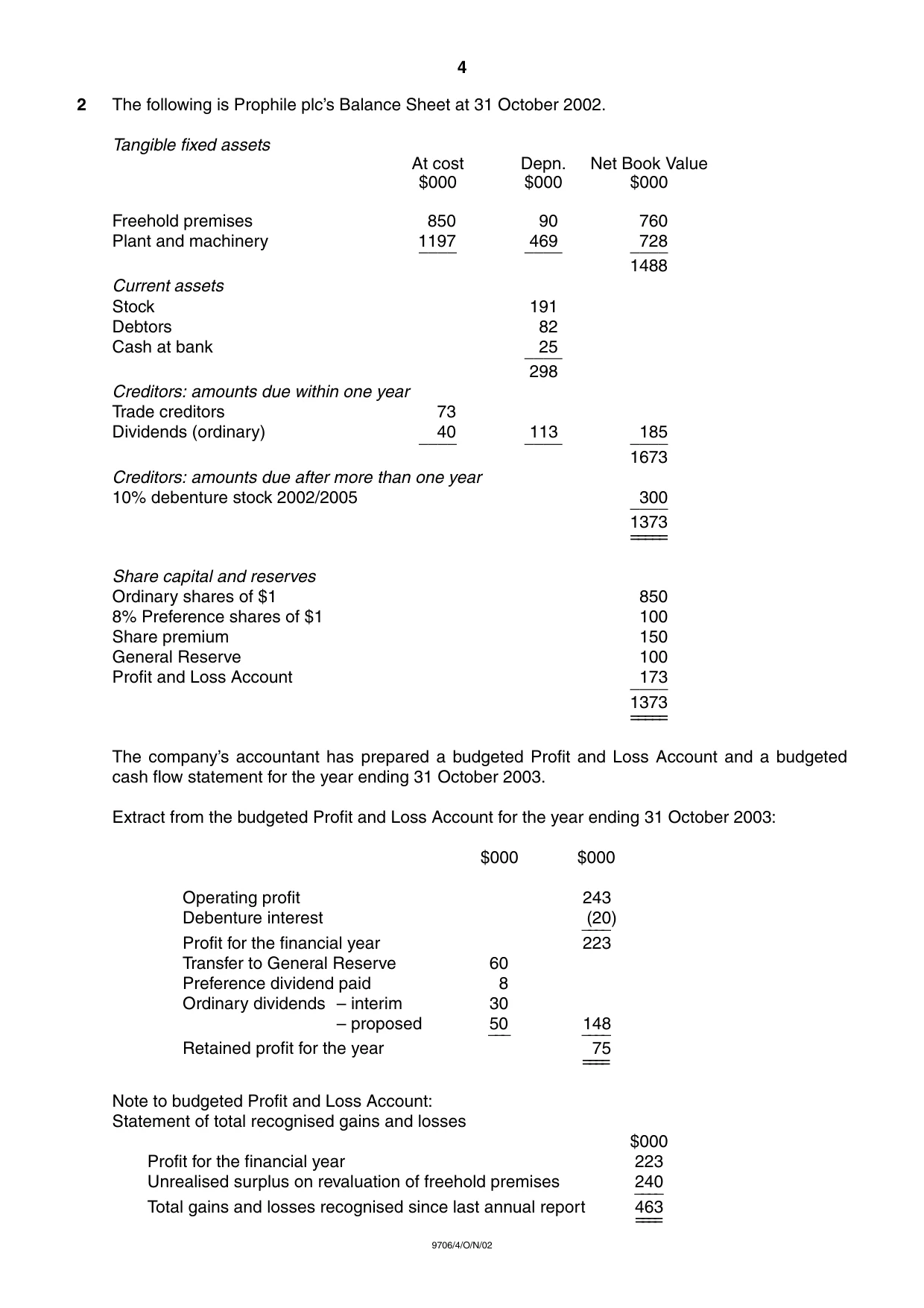
4 9706/4/O/N/02 2 The following is Prophile plc’s Balance Sheet at 31 October 2002. Tangible fixed assets At cost Depn. Net Book Value $000 $000 $000 Freehold premises 850 90 760 Plant and machinery 1197 469 728 ____ ____ ____ 1488 Current assets Stock 191 Debtors 82 Cash at bank 25 ____ 298 Creditors: amounts due within one year Trade creditors 73 Dividends (ordinary) 40 113 185 ____ ____ ____ 1673 Creditors: amounts due after more than one year 10% debenture stock 2002/2005 300 ____ 1373 ===== Share capital and reserves Ordinary shares of $1 850 8% Preference shares of $1 100 Share premium 150 General Reserve 100 Profit and Loss Account 173 ____ 1373 ===== The company’s accountant has prepared a budgeted Profit and Loss Account and a budgeted cash flow statement for the year ending 31 October 2003. Extract from the budgeted Profit and Loss Account for the year ending 31 October 2003: $000 $000 Operating profit 243 Debenture interest (20) ____ Profit for the financial year 223 Transfer to General Reserve 60 Preference dividend paid 8 Ordinary dividends – interim 30 – proposed 50 148 ___ ____ Retained profit for the year 75 ==== Note to budgeted Profit and Loss Account: Statement of total recognised gains and losses $000 Profit for the financial year 223 Unrealised surplus on revaluation of freehold premises 240 ____ Total gains and losses recognised since last annual report 463 ====
Question paper, page 5
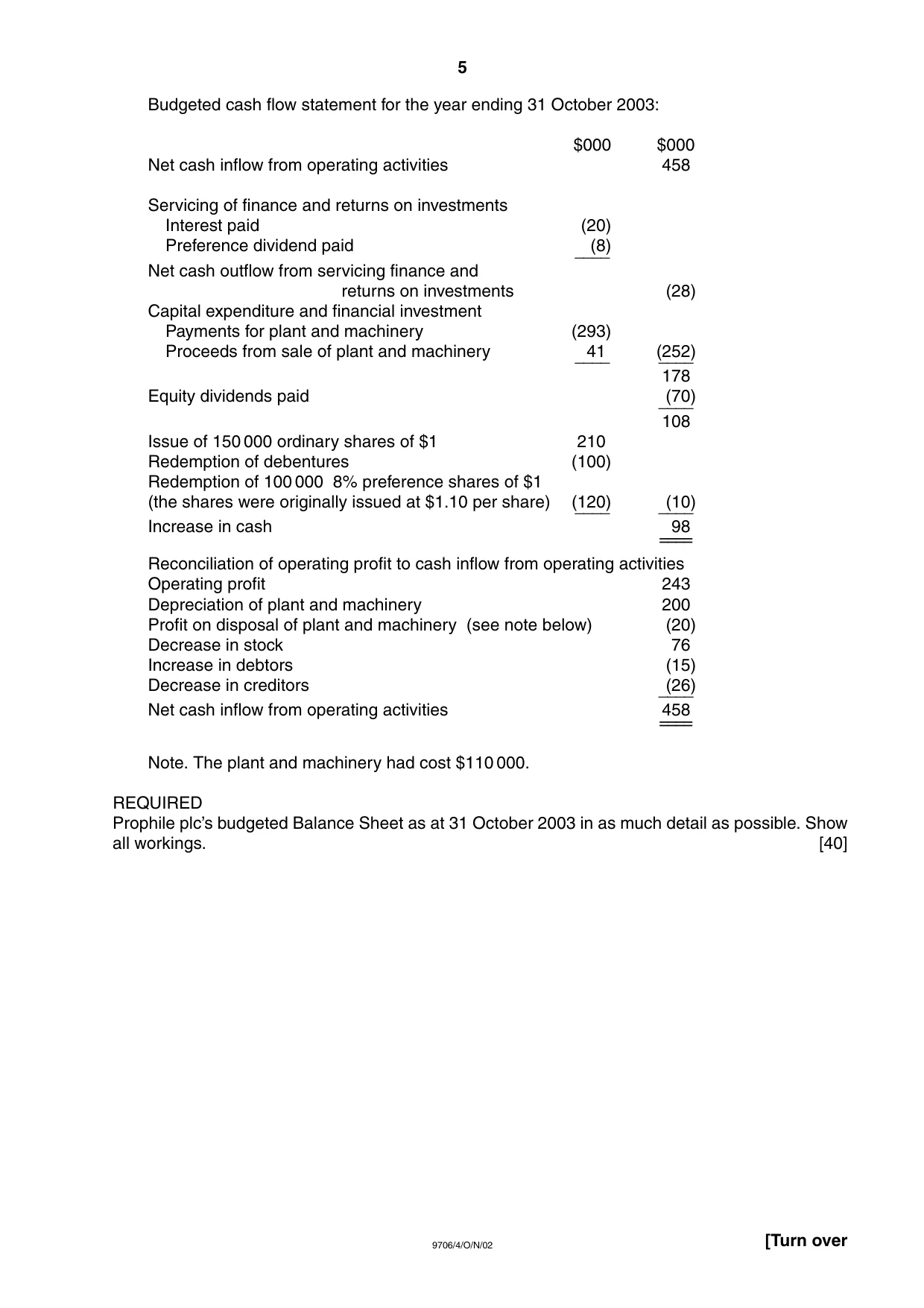
5 9706/4/O/N/02 [Turn over Budgeted cash flow statement for the year ending 31 October 2003: $000 $000 Net cash inflow from operating activities 458 Servicing of finance and returns on investments Interest paid (20) Preference dividend paid (8) ____ Net cash outflow from servicing finance and returns on investments (28) Capital expenditure and financial investment Payments for plant and machinery (293) Proceeds from sale of plant and machinery 41 (252) ____ ____ 178 Equity dividends paid (70) ____ 108 Issue of 150 000 ordinary shares of $1 210 Redemption of debentures (100) Redemption of 100 000 8% preference shares of $1 (the shares were originally issued at $1.10 per share) (120) (10) ____ ____ Increase in cash 98 ==== Reconciliation of operating profit to cash inflow from operating activities Operating profit 243 Depreciation of plant and machinery 200 Profit on disposal of plant and machinery (see note below) (20) Decrease in stock 76 Increase in debtors (15) Decrease in creditors (26) ____ Net cash inflow from operating activities 458 ==== Note. The plant and machinery had cost $110 000. REQUIRED Prophile plc’s budgeted Balance Sheet as at 31 October 2003 in as much detail as possible. Show all workings. [40]
Question paper, page 6
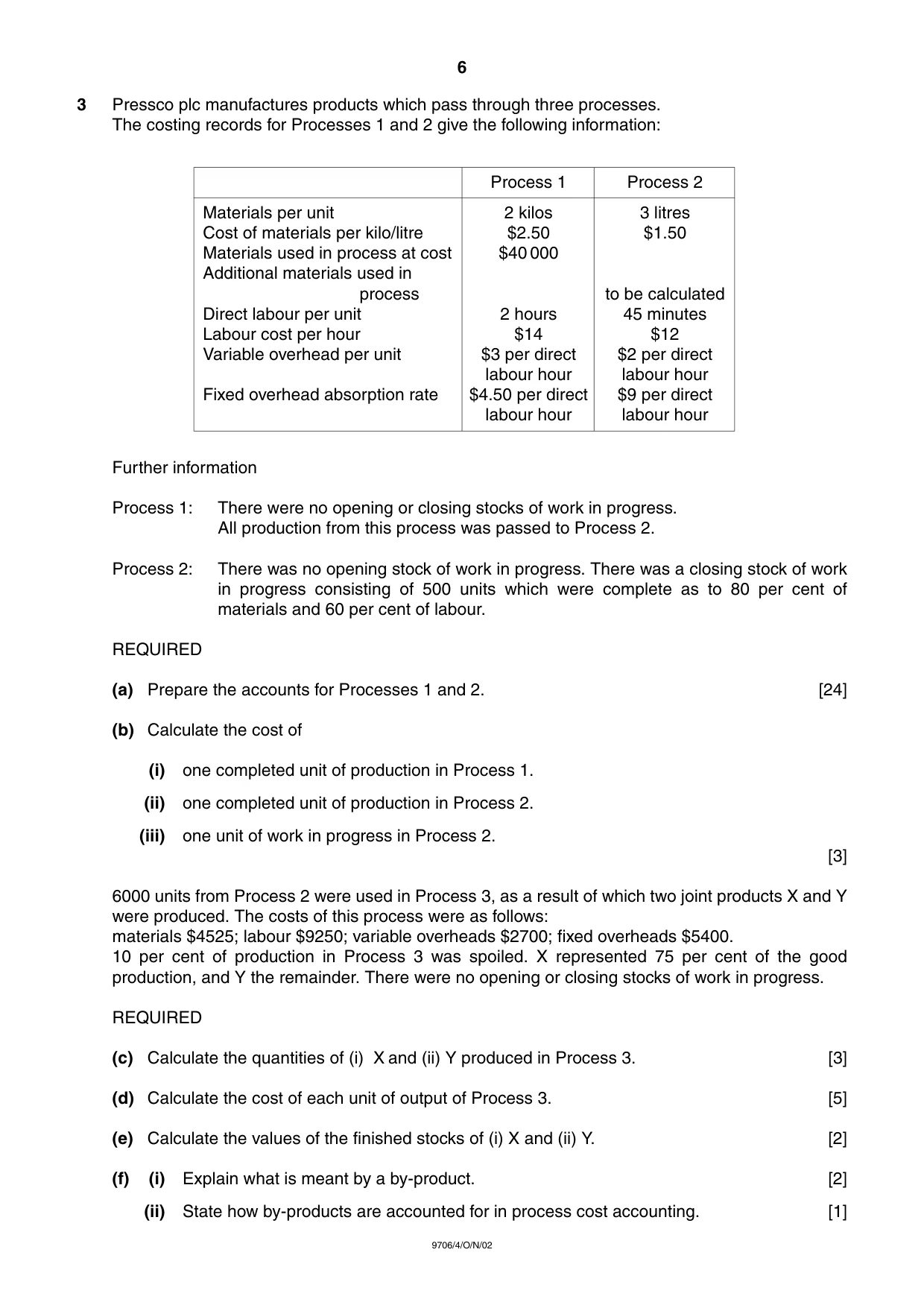
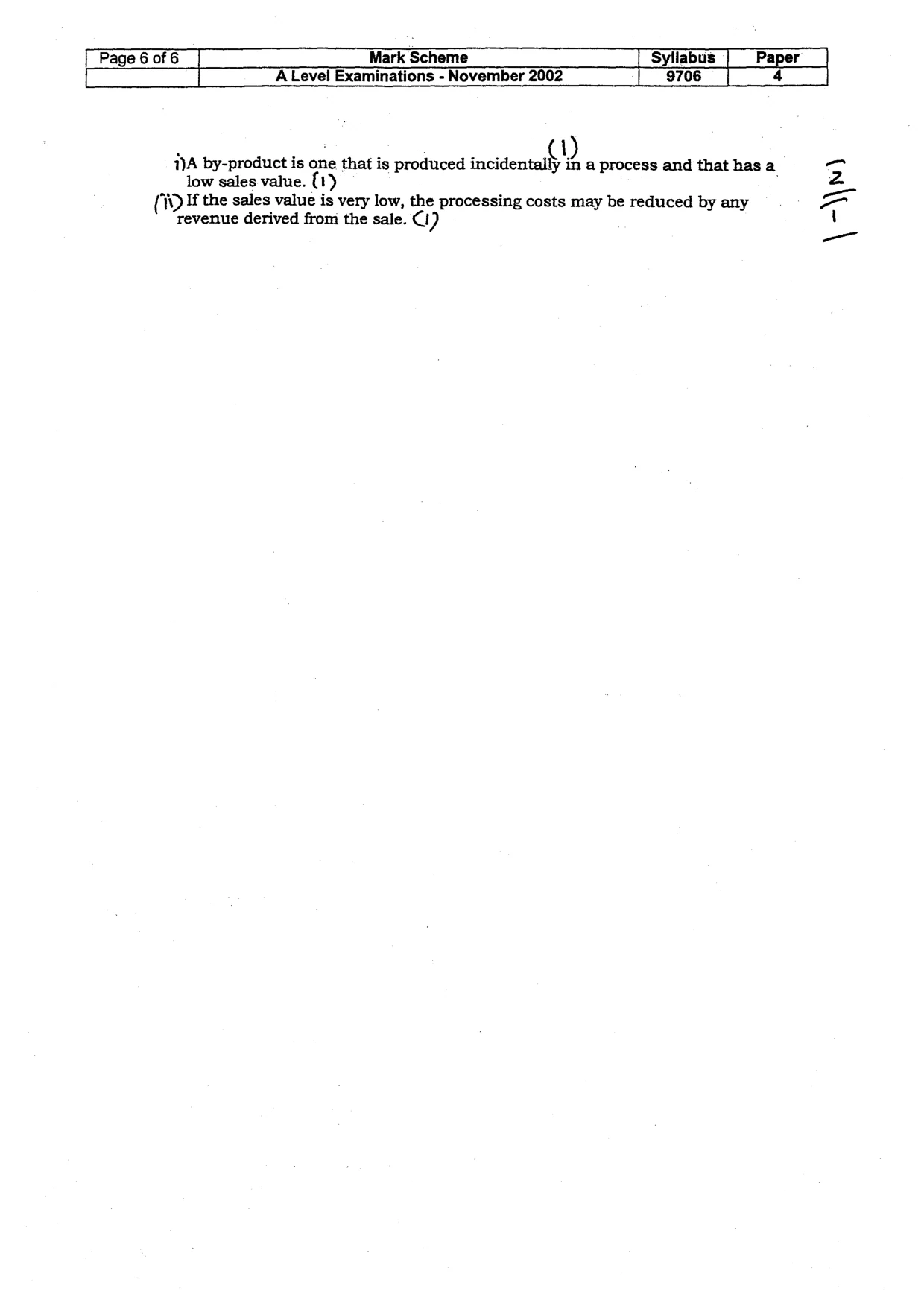
6 9706/4/O/N/02 3 Pressco plc manufactures products which pass through three processes. The costing records for Processes 1 and 2 give the following information: Further information Process 1: There were no opening or closing stocks of work in progress. All production from this process was passed to Process 2. Process 2: There was no opening stock of work in progress. There was a closing stock of work in progress consisting of 500 units which were complete as to 80 per cent of materials and 60 per cent of labour. REQUIRED (a) Prepare the accounts for Processes 1 and 2. [24] (b) Calculate the cost of (i) one completed unit of production in Process 1. (ii) one completed unit of production in Process 2. (iii) one unit of work in progress in Process 2. [3] 6000 units from Process 2 were used in Process 3, as a result of which two joint products X and Y were produced. The costs of this process were as follows: materials $4525; labour $9250; variable overheads $2700; fixed overheads $5400. 10 per cent of production in Process 3 was spoiled. X represented 75 per cent of the good production, and Y the remainder. There were no opening or closing stocks of work in progress. REQUIRED (c) Calculate the quantities of (i) X and (ii) Y produced in Process 3. [3] (d) Calculate the cost of each unit of output of Process 3. [5] (e) Calculate the values of the finished stocks of (i) X and (ii) Y. [2] (f) (i) Explain what is meant by a by-product. [2] (ii) State how by-products are accounted for in process cost accounting. [1] Process 1 Process 2 Materials per unit 2 kilos 3 litres Cost of materials per kilo/litre $2.50 $1.50 Materials used in process at cost $40 000 Additional materials used in process to be calculated Direct labour per unit 2 hours 45 minutes Labour cost per hour $14 $12 Variable overhead per unit $3 per direct $2 per direct labour hour labour hour Fixed overhead absorption rate $4.50 per direct $9 per direct labour hour labour hour
Mark scheme, page 1
CAMBRIDGE INTERNATIONAL EXAMINATIONS NOVEMBER 2002 GCE ADVANCED LEVEL 4 UNIversITY of CAMBRIDGE & Local Examinations Syndicate
Mark scheme, page 2
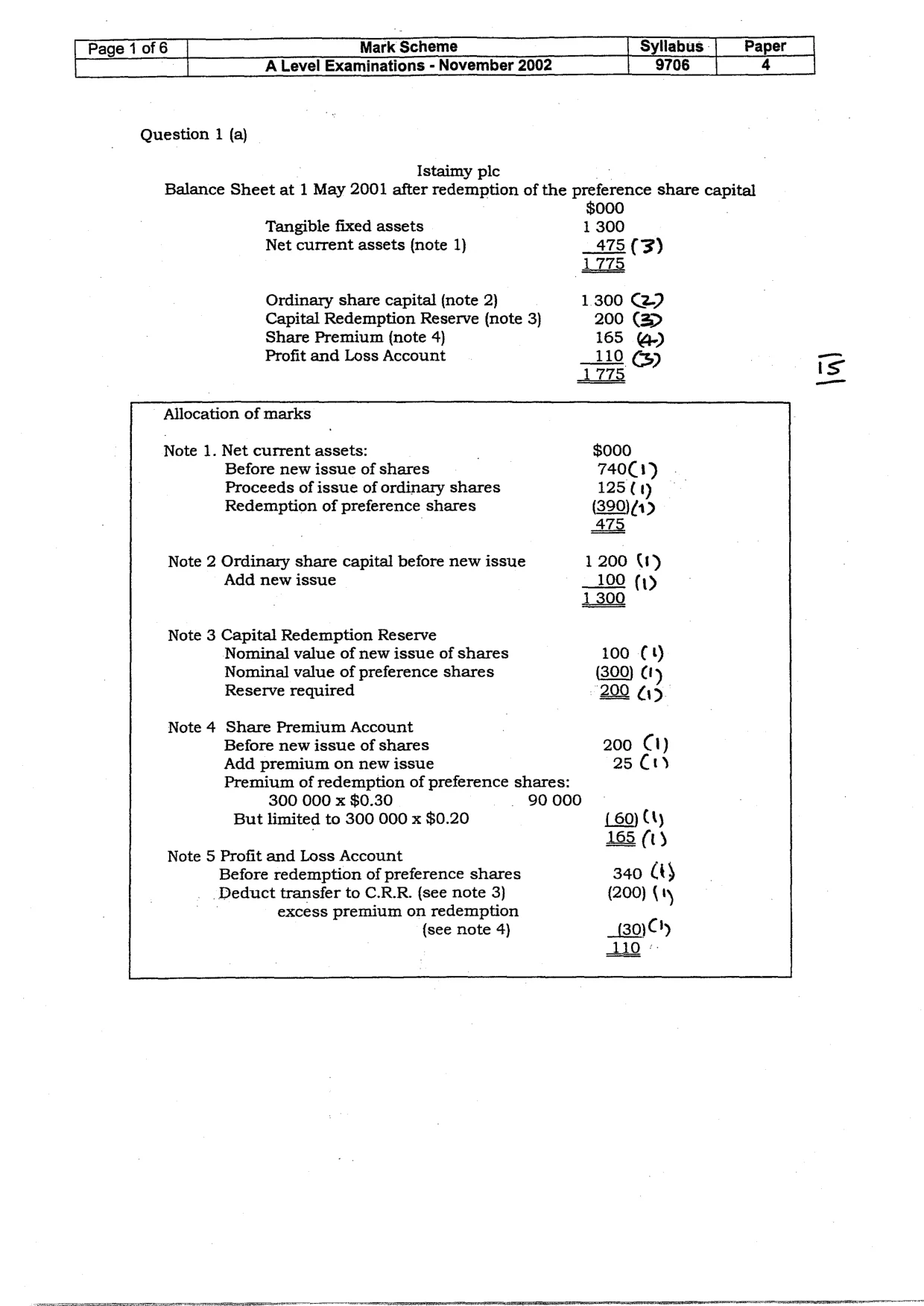
Page 1 of 6 Mark Scheme Syllabus | Paper A Level Examinations - November 2002 9706 [ 4 Question 1 (a) Istaimy ple Balance Sheet at 1 May 2001 after redemption of the preference share capital $000 Tangible fixed assets 1300 Net current assets (note 1) 475 (3) 1775 Ordinary share capital (note 2) 1300 C2) Capital Redemption Reserve (note 3) 200 (=> Share Premium (note 4) 165 @-) Profit and Loss Account 110 @) ie —_— Allocation of marks Note 1. Net current assets: $000 Before new issue of shares 7401) Proceeds of issue of ordinary shares 125 (1) Redemption of preference shares (390)(4> ATS Note 2 Ordinary share capital before new issue 1200 (1) Add new issue 100 (\> 1300 Note 3 Capital Redemption Reserve Nominal value of new issue of shares 100 (') Nominal value of preference shares (300) ay Reserve required 200 (> Note 4 Share Premium Account Before new issue of shares 200 C1) Add premium on new issue 25 Ct) Premium of redemption of preference shares: 300 000 x $0.30 90 000 But limited to 300 000 x $0.20 (60) Cy 165 (1) Note 5 Profit and Loss Account Before redemption of preference shares 340 ay Deduct transfer to C.R.R. (see note 3) (200) (ty excess premium on redemption {see note 4) _(30)Cy “9
Mark scheme, page 3
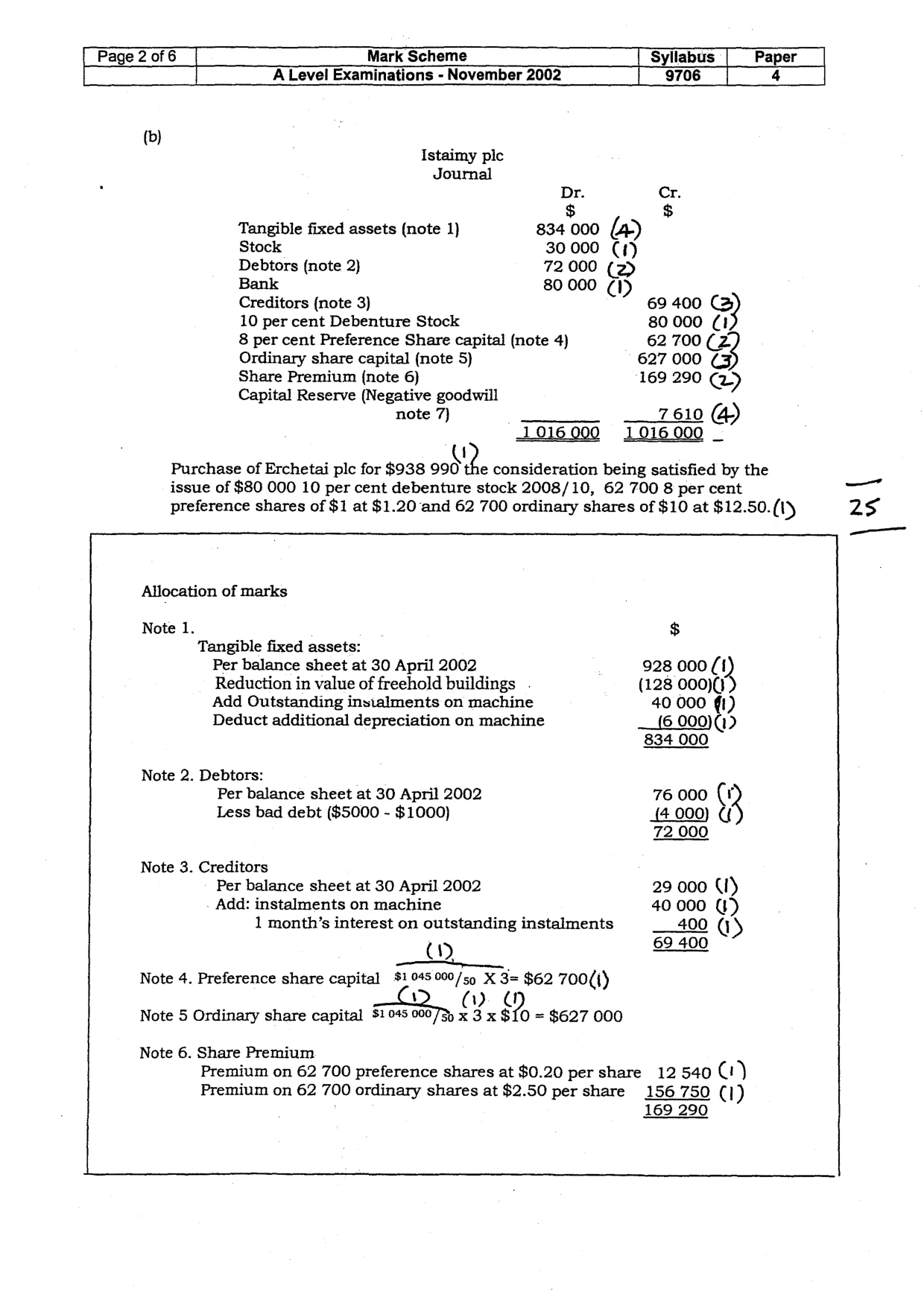
Page 2 of 6 Mark Scheme Syllabus Paper ALevel Examinations - November 2002 9706 4 (b) Istaimy plc Journal . Dr. Cr. $ $ Tangible fixed assets (note 1) 834 000 &é& Stock 30000 (14) Debtors (note 2) 72 000 (2) Bank 80 000 (1) Creditors (note 3) 69 400 (€) 10 per cent Debenture Stock 80000 (1 8 per cent Preference Share capital (note 4) 62 700 (Z Ordinary share capital (note 5) 627 000 CZ Share Premium (note 6) 169 290 wo Capital Reserve (Negative goodwill note 7} —____ ____7610 @) ; =L.016000 1016000 _ Purchase of Erchetai ple for $938 oo ‘Re consideration being satisfied by the issue of $80 000 10 per cent debenture stock 2008/10, 62 700 8 per cent — preference shares of $1 at $1.20 and 62 700 ordinary shares of $10 at $12.50. (1) 25 _— Allocation of marks Note 1. $ Tangible fixed assets: Per balance sheet at 30 April 2002 928 000 (I Reduction in value of freehold buildings (128 000) Add Outstanding insialments on machine 40 000 fi) Deduct additional depreciation on machine (6 000)(1> 834 000 Note 2. Debtors: Per balance sheet at 30 April 2002 76 000 IG Less bad debt ($5000 - $1000) (4.000) 72 000 Note 3. Creditors Per balance sheet at 30 April 2002 29 000 (I) Add: instalments on machine 40 000 () 1 month’s interest on outstanding instalments 400 Q@ 69 400 () — Note 4. Preference share capital $1045 000/5) X 3= $62 700(1) s ) ¢ Note 5 Ordinary share capital $1045 000 &y x &% = $627 000 Note 6. Share Premium Premium on 62 700 preference shares at $0.20 per share 12540 a) Premium on 62 700 ordinary shares at $2.50 per share 156 750 ql) 169 290
Mark scheme, page 4
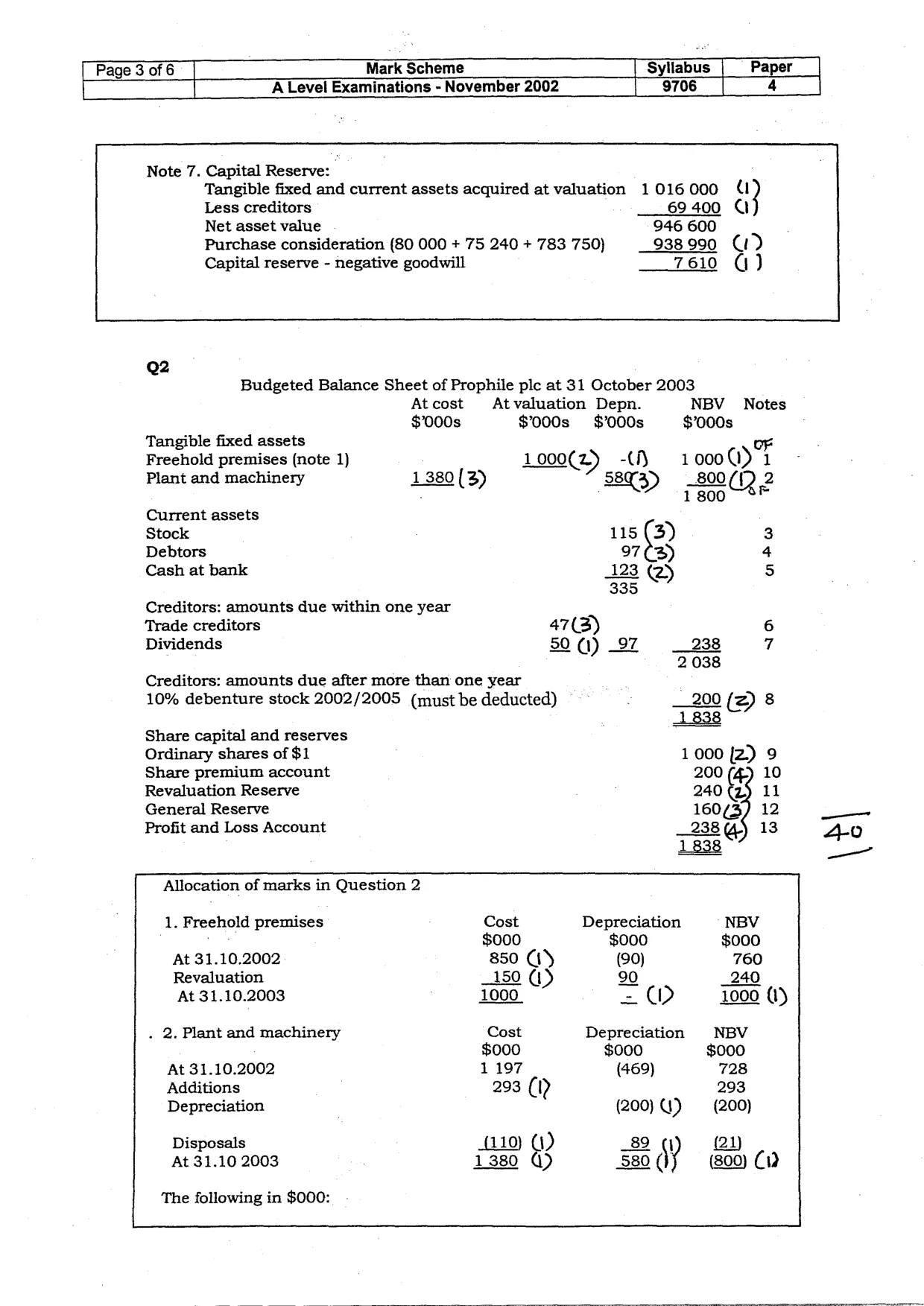
Syllabus Page 3 of 6 Mark Scheme Paper A Level Examinations - November 2002 9706 4 Note 7. Capital Reserve: Tangible fixed and current assets acquired at valuation 1016 000 &} Less creditors 69 400 G Net asset value 946 600 Purchase consideration (80 000 + 75 240 + 783 750) 938990 (I) Capital reserve - negative goodwill 7610 q) Q2 Budgeted Balance Sheet of Prophile plc at 31 October 2003 Atcost Atvaluation Depn. NBV_ Notes $000s $000s $’000s $’000s Tangible fixed assets oF Freehold premises (note 1) 1000(z) -{/) 1000 O71 Plant and machine: 1380 581 800 2 " (3) BD 1800 Qe Current assets Stock 115 (3) 3 Debtors 97(3) 4 Cash at bank 123 (e>) 5 335 Creditors: amounts due within one year Trade creditors 47(3) 6 Dividends 50 (1) _97 238 7 2038 Creditors: amounts due after more than one year 10% debenture stock 2002/2005 (must be deducted) 200 () 8 1838 Share capital and reserves Ordinary shares of $1 1000 [2) 9 Share premium account 200 (4) 10 Revaluation Reserve 240 (2) 11 General Reserve 160(3) 12 Profit and Loss Account 2384) 13 —— Allocation of marks in Question 2 1. Freehold premises Cost Depreciation NBV $000 $000 $000 At 31.10.2002 850 Ci) (90) 760 Revaluation 150 (1) 90 240 At 31.10.2003 1000 - (D 1000 (1) . 2, Plant and machinery Cost Depreciation NBV $000 $000 $000 At 31.10.2002 1197 (469) 728 Additions 293 (1) 293 Depreciation (200) Q) — (200) Disposals (110) (1) _89 (21) At 31.10 2003 1380 Q) 580 dy (800) C1) The following in $000:
Mark scheme, page 5
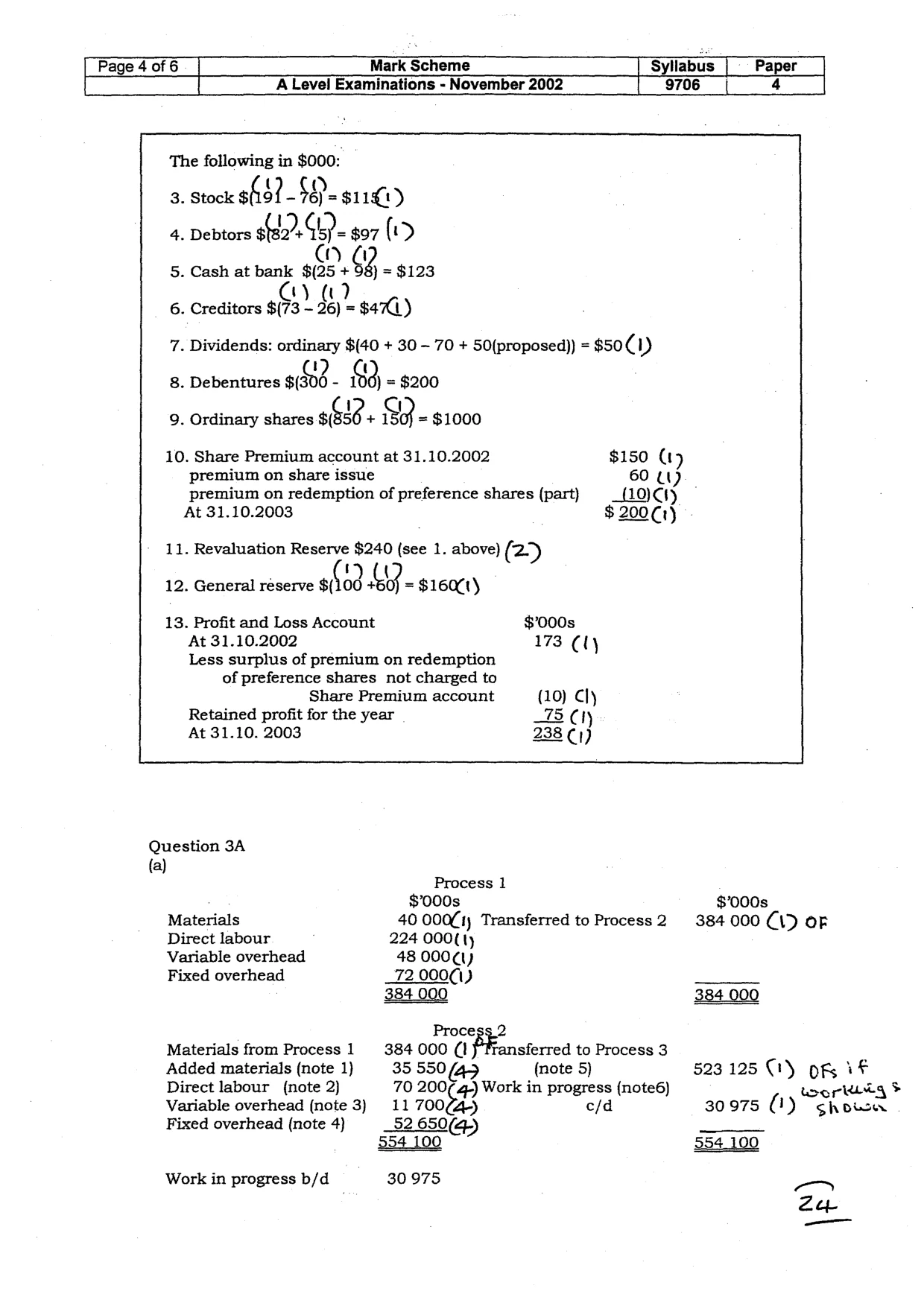
Page 4 of 6 Mark Scheme Syllabus Paper L A Level Examinations - November 2002 9706 | 4 The following in $000: [> 3. Stock eS? - ee =$11¢1) | 4. Debtors 8296p = $97 (> ay (2 5. Cash at bank $(25 + 98) = $123 yo) 6. Creditors $(73 - 26) = $47) 7. Dividends: ordinary $(40 + 30 - 70 + 50(proposed)) = $50¢ b 1) t 8. Debentures 3400 - {Q, = $200 1 9. Ordinary shares G26 + iP) = $1000 10. Share Premium account at 31.10.2002 $150 (1 ) premium on share issue 60 WI) premium on redemption of preference shares (part) (10)C1) At 31.10.2003 $ 200(1) 11. Revaluation Reserve $240 (see 1. above) (2 12. General reserve shod AY. $1600) 13. Profit and Loss Account At 31.10.2002 Less surplus of premium on redemption of preference shares not charged to Share Premium account Retained profit for the year At 31.10. 2003 $000s 173 (ly (10) Cl) 75 (1) 238 (1) Question 3A (a) Process 1 $000s Materials Direct labour 224 000( ty Variable overhead 48 000C1) Fixed overhead 72 00001) 384.000 Materials from Process 1 Added materials (note 1) 35 550/45 Direct labour (note 2) Variable overhead (note 3) 11 700(4-) Fixed overhead (note 4) 52 650(4-) 4 1 Work in progress b/d 30975 40 000(1) Transferred to Process 2 $’000s Process 2 384 000 C1 PRensterrea to Process 3 (note 5) 70 200¢ 4-) Work in progress (note6) c/d 30975 (1) 384 000 C1) OF 523125 (1) of iF
Mark scheme, page 6
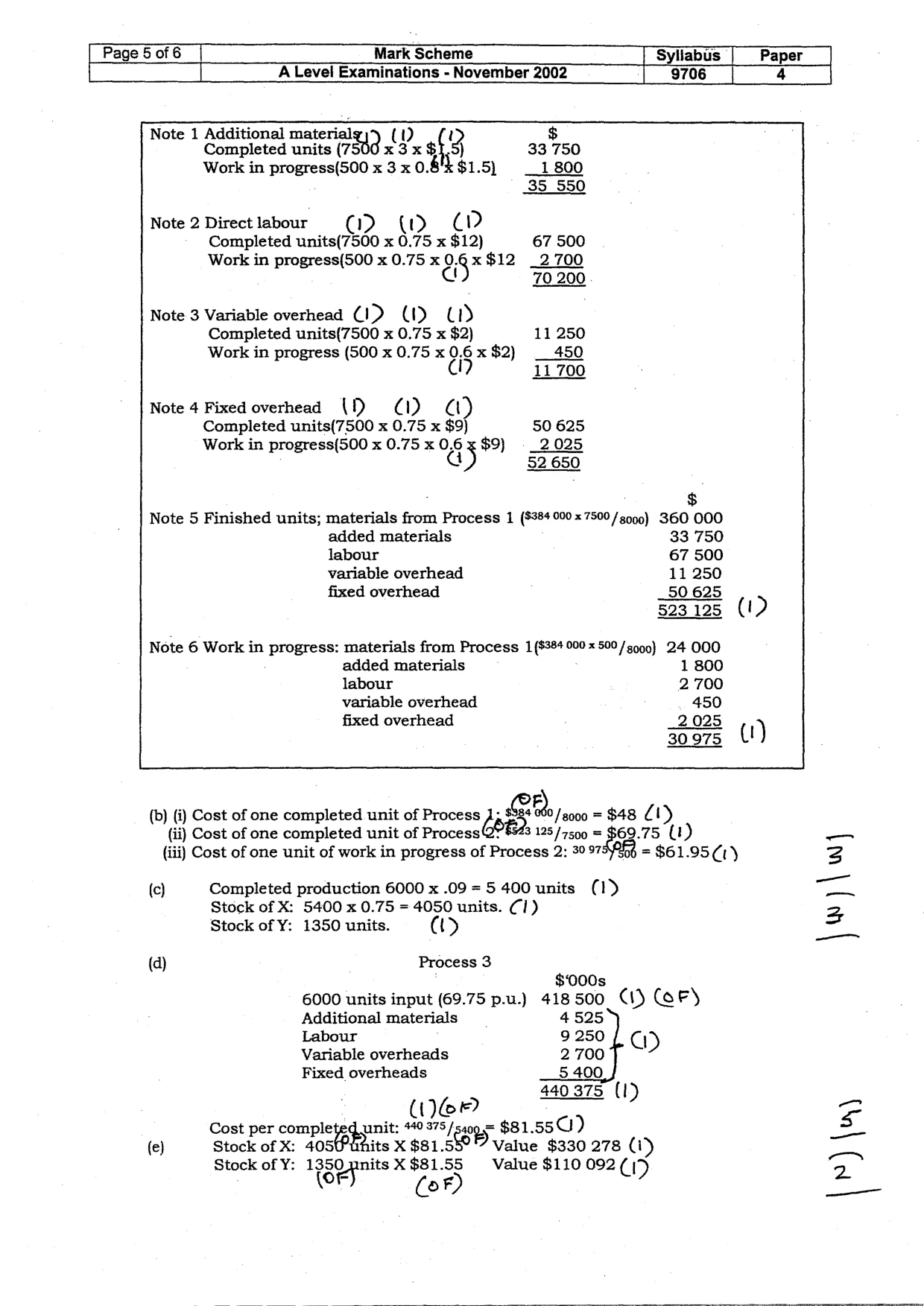
Page 5 of 6 Mark Scheme Syllabus Paper A Level Examinations - November 2002 9706 4 [ Note 1 Additional materialgy9 Ww oft $ Completed units (7500 x3 x sf ) 33 750 Work in progress(500 x 3x 0.8 K $1.5) 1800 35 550 Note 2 Direct labour a) (Db ¢ D Completed units(7500 x 0.75 x $12) 67 S00 Work in progress(500 x 0.75 x 08% $12 _2700 q 70 200 Note 3 Variable overhead CID (1D (1D Completed units(7500 x 0.75 x $2) 11250 Work in progress (500 x 0.75 x 0.6 x $2) 450 cl) 11700 Note 4 Fixed overhead (D) (1) a) Completed units(7500 x 0.75 x $9) 50 625 Work in progress(500 x 0.75 x 0,6 x$9) _2025 ay 52 650 $ Note 5 Finished units; materials from Process 1 ($384 000 x 7500 /g999) 360 000 added materials 33 750 labour 67 500 variable overhead 11 250 fixed overhead 50 625 523125 (I) Note 6 Work in progress: materials from Process 1 ($384 000 x 500 /g999) 24 000 added materials 1 800 labour 2700 variable overhead 450 fixed overhead 2025 30975 (!) (b) (i) Cost of one completed unit of Process (ii) Cost of one completed unit of Process QY Kae = $48 C1) 8 125 /7500 = $69.75 (1) (iii) Cost of one unit of work in progress of Process 2: 30 97 = $61.95(1) (c) Completed production 6000 x .09=5 400 units ( 1D Stock of X: 5400 x 0.75 = 4050 units. C]) Stock of Y: 1350 units. (d>) (d) Process 3 $000s 6000 units input (69.75 p.u.) 418500 C1) (oF) Additional materials 4525 Labour 9250 ep) Variable overheads 2700 Fixed overheads 5 400, Cost per comple: (e) Stock of X: 4051 Stock of Y: 1980 nits X $81.55 440 375 (1) (jew) unit: 40 875 /s499,= $81.55 C)) its X $81.56 Value $330 278 @ Value $110 092 ap 2 (oF) \w)\ wy \") \)
Mark scheme, page 7
Page 6 of 6 Mark Scheme Syllabus Paper__| A Level Examinations - November 2002 | 9706 4 ] 1)A by-product is one that is produced incidental in a process and that hasa sz low sales value. (1) 2 (0 If the sales value is very low, the processing costs may be reduced by any = revenue derived fromi the sale. Cl) \ \