Cambridge A Level Accounting 9706 — 2002 May/June Paper 4 · Variant 1
9706/41/M/J/02
The question paper and its mark scheme, free to read here and free to download. This is Cambridge’s own paper, exactly as it was sat.
Question paper8 pages


Mark scheme6 pages
Answers below. Sit the paper first if you are practising.
Paper as text
Question paper, page 1
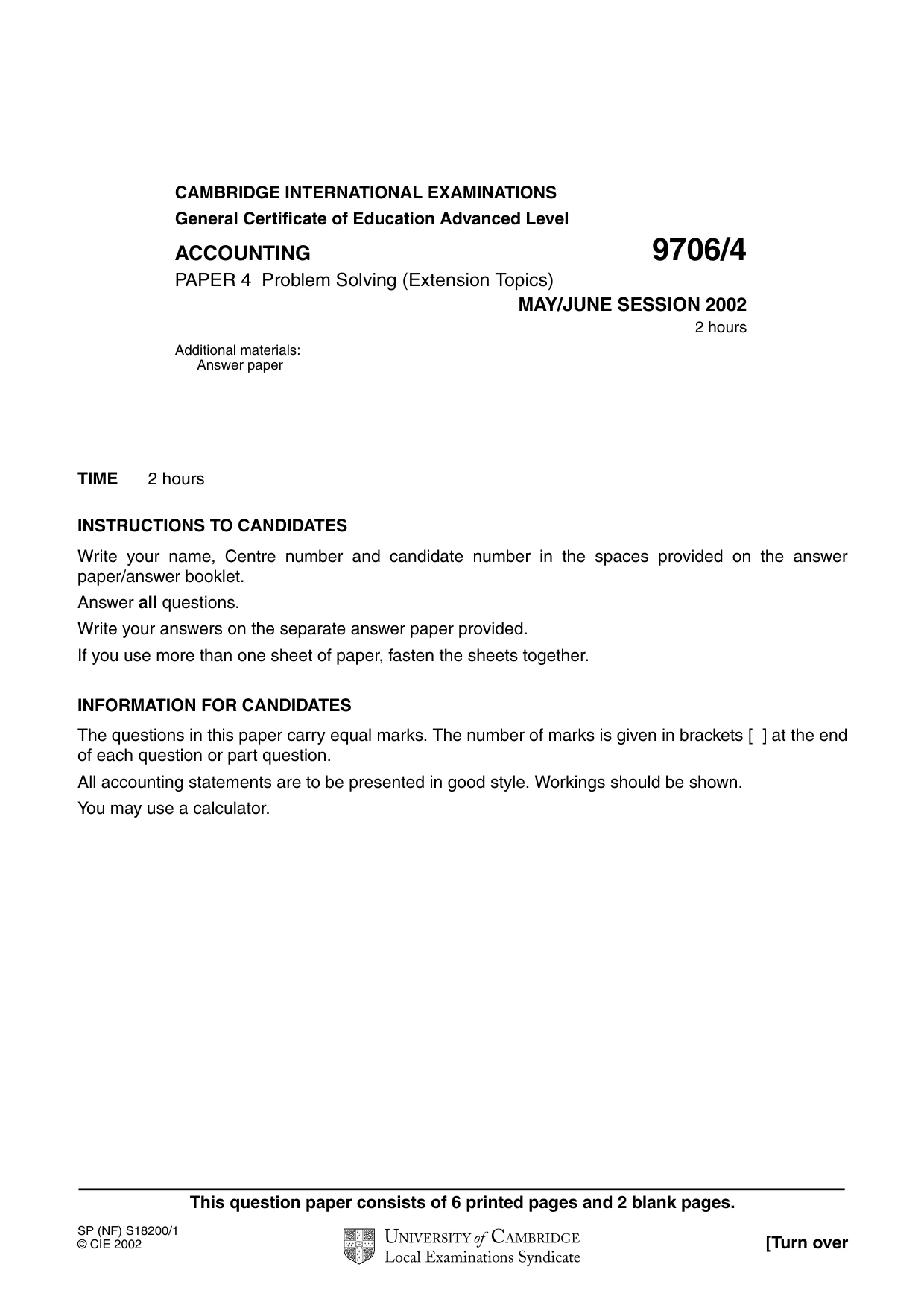
This question paper consists of 6 printed pages and 2 blank pages. SP (NF) S18200/1 © CIE 2002 [Turn over CAMBRIDGE INTERNATIONAL EXAMINATIONS General Certificate of Education Advanced Level ACCOUNTING 9706/4 PAPER 4 Problem Solving (Extension Topics) MAY/JUNE SESSION 2002 2 hours Additional materials: Answer paper TIME 2 hours INSTRUCTIONS TO CANDIDATES Write your name, Centre number and candidate number in the spaces provided on the answer paper/answer booklet. Answer all questions. Write your answers on the separate answer paper provided. If you use more than one sheet of paper, fasten the sheets together. INFORMATION FOR CANDIDATES The questions in this paper carry equal marks. The number of marks is given in brackets [ ] at the end of each question or part question. All accounting statements are to be presented in good style. Workings should be shown. You may use a calculator.
Question paper, page 3
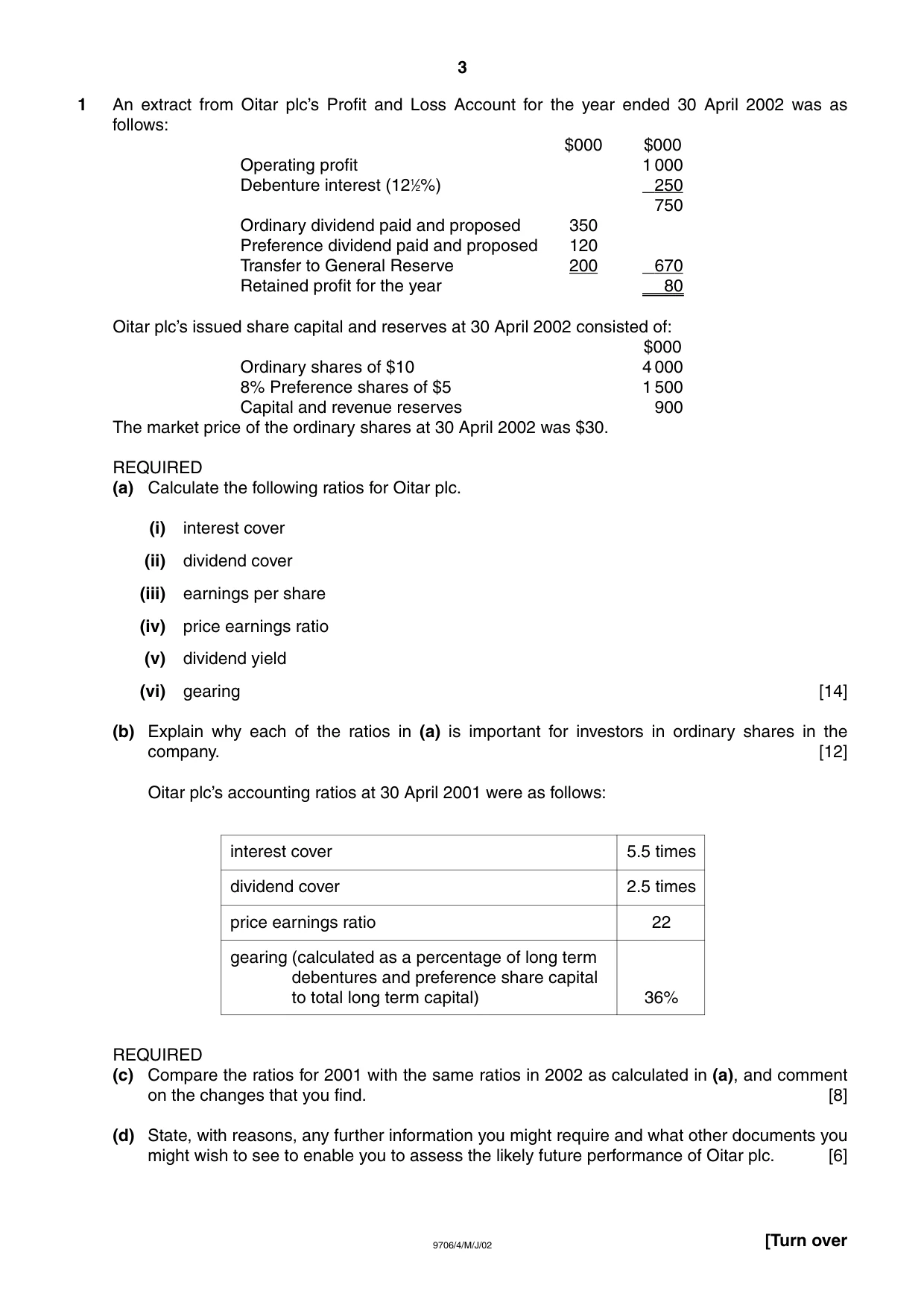
3 9706/4/M/J/02 [Turn over 1 An extract from Oitar plc’s Profit and Loss Account for the year ended 30 April 2002 was as follows: $000 $000 Operating profit 1 000 Debenture interest (121⁄2%) 250 750 Ordinary dividend paid and proposed 350 Preference dividend paid and proposed 120 Transfer to General Reserve 200 670 Retained profit for the year 80 Oitar plc’s issued share capital and reserves at 30 April 2002 consisted of: $000 Ordinary shares of $10 4 000 8% Preference shares of $5 1 500 Capital and revenue reserves 900 The market price of the ordinary shares at 30 April 2002 was $30. REQUIRED (a) Calculate the following ratios for Oitar plc. (i) interest cover (ii) dividend cover (iii) earnings per share (iv) price earnings ratio (v) dividend yield (vi) gearing [14] (b) Explain why each of the ratios in (a) is important for investors in ordinary shares in the company. [12] Oitar plc’s accounting ratios at 30 April 2001 were as follows: REQUIRED (c) Compare the ratios for 2001 with the same ratios in 2002 as calculated in (a), and comment on the changes that you find. [8] (d) State, with reasons, any further information you might require and what other documents you might wish to see to enable you to assess the likely future performance of Oitar plc. [6] interest cover 5.5 times dividend cover 2.5 times price earnings ratio 22 gearing (calculated as a percentage of long term debentures and preference share capital to total long term capital) 36%
Question paper, page 4
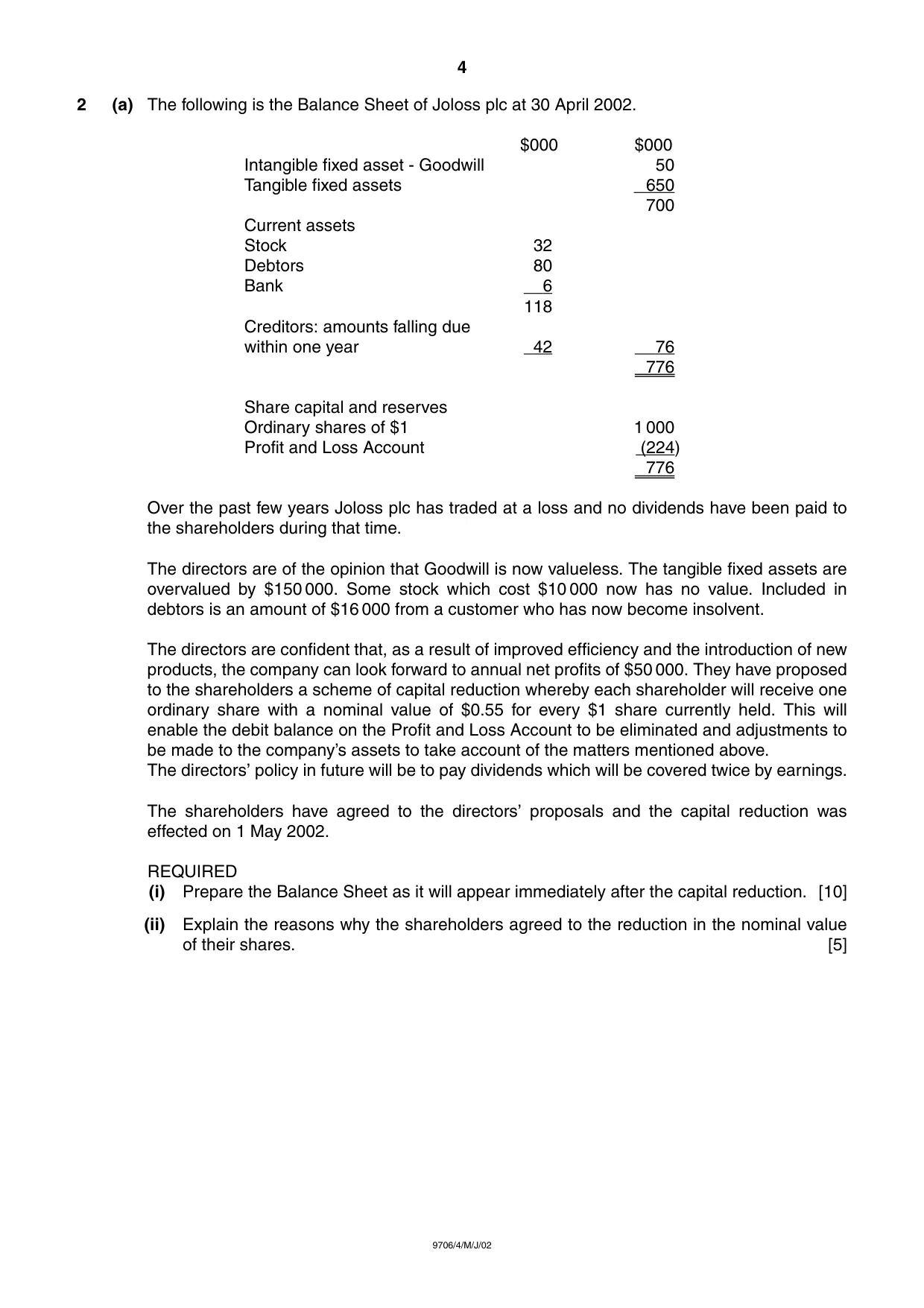
4 9706/4/M/J/02 2 (a) The following is the Balance Sheet of Joloss plc at 30 April 2002. $000 $000 Intangible fixed asset - Goodwill 50 Tangible fixed assets 650 700 Current assets Stock 32 Debtors 80 Bank 6 118 Creditors: amounts falling due within one year 42 76 776 Share capital and reserves Ordinary shares of $1 1 000 Profit and Loss Account (224) 776 Over the past few years Joloss plc has traded at a loss and no dividends have been paid to the shareholders during that time. The directors are of the opinion that Goodwill is now valueless. The tangible fixed assets are overvalued by $150 000. Some stock which cost $10 000 now has no value. Included in debtors is an amount of $16 000 from a customer who has now become insolvent. The directors are confident that, as a result of improved efficiency and the introduction of new products, the company can look forward to annual net profits of $50 000. They have proposed to the shareholders a scheme of capital reduction whereby each shareholder will receive one ordinary share with a nominal value of $0.55 for every $1 share currently held. This will enable the debit balance on the Profit and Loss Account to be eliminated and adjustments to be made to the company’s assets to take account of the matters mentioned above. The directors’ policy in future will be to pay dividends which will be covered twice by earnings. The shareholders have agreed to the directors’ proposals and the capital reduction was effected on 1 May 2002. REQUIRED (i) Prepare the Balance Sheet as it will appear immediately after the capital reduction. [10] (ii) Explain the reasons why the shareholders agreed to the reduction in the nominal value of their shares. [5]
Question paper, page 5
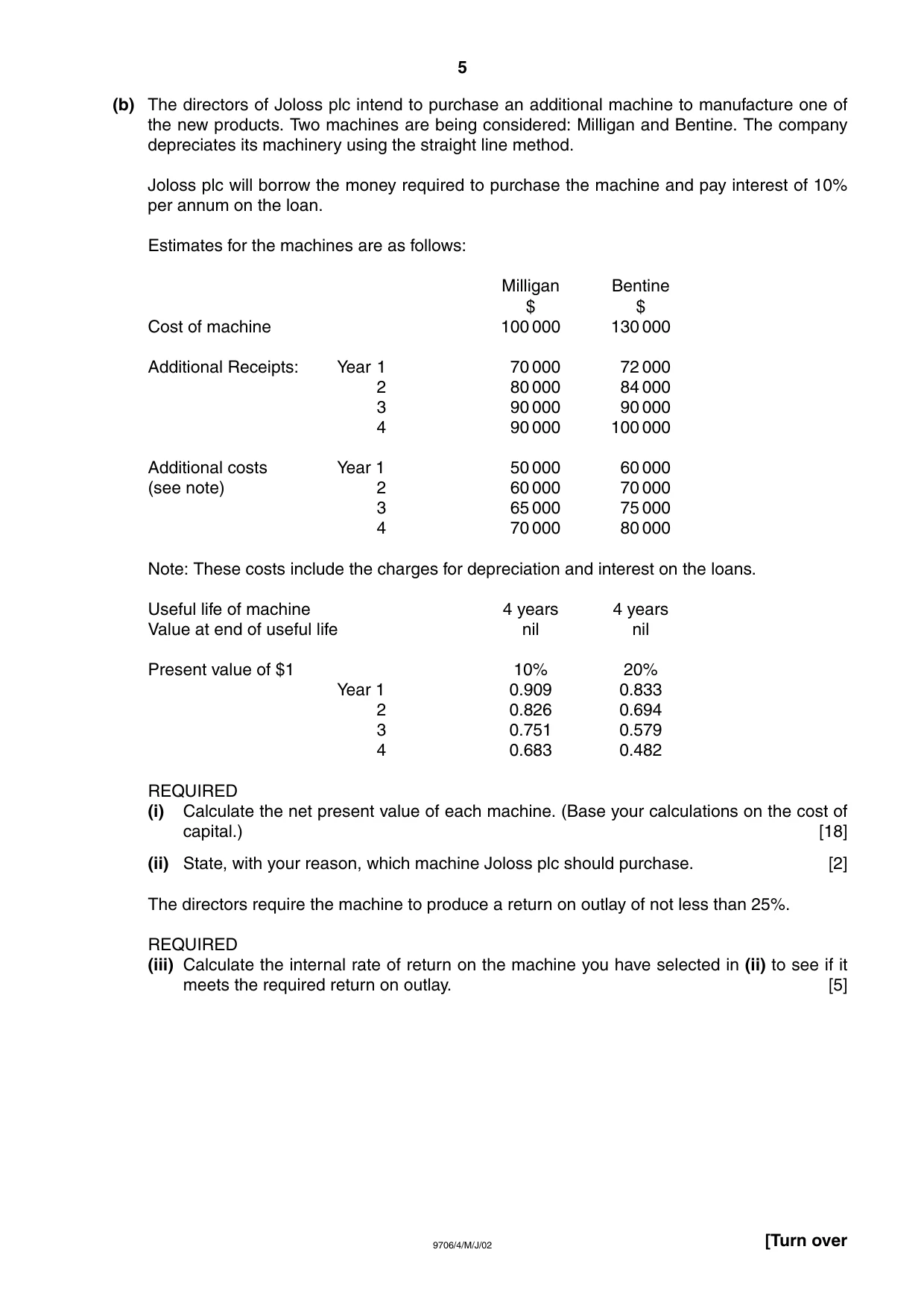
5 9706/4/M/J/02 [Turn over (b) The directors of Joloss plc intend to purchase an additional machine to manufacture one of the new products. Two machines are being considered: Milligan and Bentine. The company depreciates its machinery using the straight line method. Joloss plc will borrow the money required to purchase the machine and pay interest of 10% per annum on the loan. Estimates for the machines are as follows: Milligan Bentine $ $ Cost of machine 100 000 130 000 Additional Receipts: Year 1 70 000 72 000 2 80 000 84 000 3 90 000 90 000 4 90 000 100 000 Additional costs Year 1 50 000 60 000 (see note) 2 60 000 70 000 3 65 000 75 000 4 70 000 80 000 Note: These costs include the charges for depreciation and interest on the loans. Useful life of machine 4 years 4 years Value at end of useful life nil nil Present value of $1 10% 20% Year 1 0.909 0.833 2 0.826 0.694 3 0.751 0.579 4 0.683 0.482 REQUIRED (i) Calculate the net present value of each machine. (Base your calculations on the cost of capital.) [18] (ii) State, with your reason, which machine Joloss plc should purchase. [2] The directors require the machine to produce a return on outlay of not less than 25%. REQUIRED (iii) Calculate the internal rate of return on the machine you have selected in (ii) to see if it meets the required return on outlay. [5]
Question paper, page 6
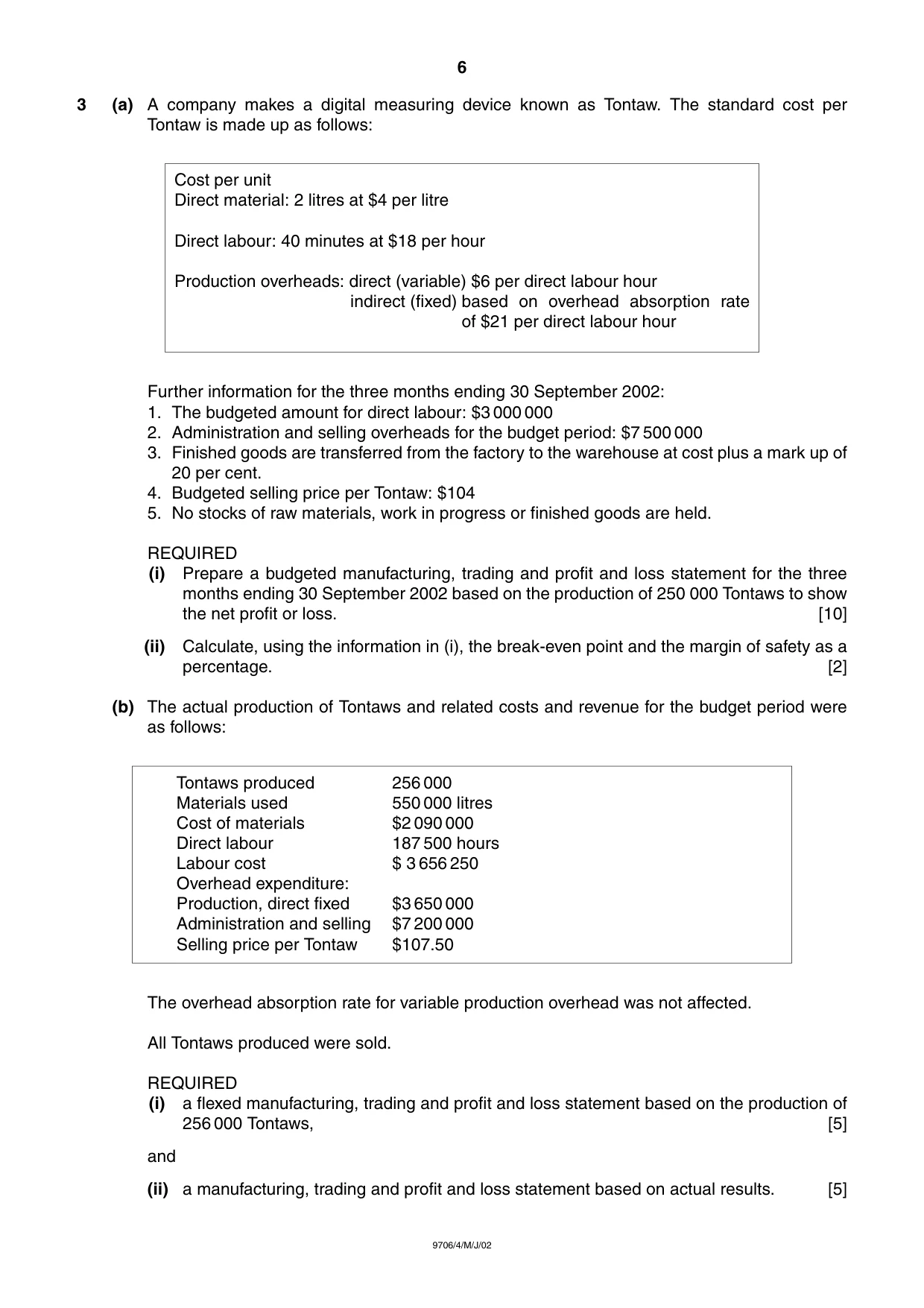
6 9706/4/M/J/02 3 (a) A company makes a digital measuring device known as Tontaw. The standard cost per Tontaw is made up as follows: Further information for the three months ending 30 September 2002: 1. The budgeted amount for direct labour: $3 000 000 2. Administration and selling overheads for the budget period: $7 500 000 3. Finished goods are transferred from the factory to the warehouse at cost plus a mark up of 20 per cent. 4. Budgeted selling price per Tontaw: $104 5. No stocks of raw materials, work in progress or finished goods are held. REQUIRED (i) Prepare a budgeted manufacturing, trading and profit and loss statement for the three months ending 30 September 2002 based on the production of 250 000 Tontaws to show the net profit or loss. [10] (ii) Calculate, using the information in (i), the break-even point and the margin of safety as a percentage. [2] (b) The actual production of Tontaws and related costs and revenue for the budget period were as follows: The overhead absorption rate for variable production overhead was not affected. All Tontaws produced were sold. REQUIRED (i) a flexed manufacturing, trading and profit and loss statement based on the production of 256 000 Tontaws, [5] and (ii) a manufacturing, trading and profit and loss statement based on actual results. [5] Tontaws produced 256 000 Materials used 550 000 litres Cost of materials $2 090 000 Direct labour 187 500 hours Labour cost $ 3 656 250 Overhead expenditure: Production, direct fixed $3 650 000 Administration and selling $7 200 000 Selling price per Tontaw $107.50 Cost per unit Direct material: 2 litres at $4 per litre Direct labour: 40 minutes at $18 per hour Production overheads: direct (variable) $6 per direct labour hour indirect (fixed) based on overhead absorption rate of $21 per direct labour hour
Question paper, page 7
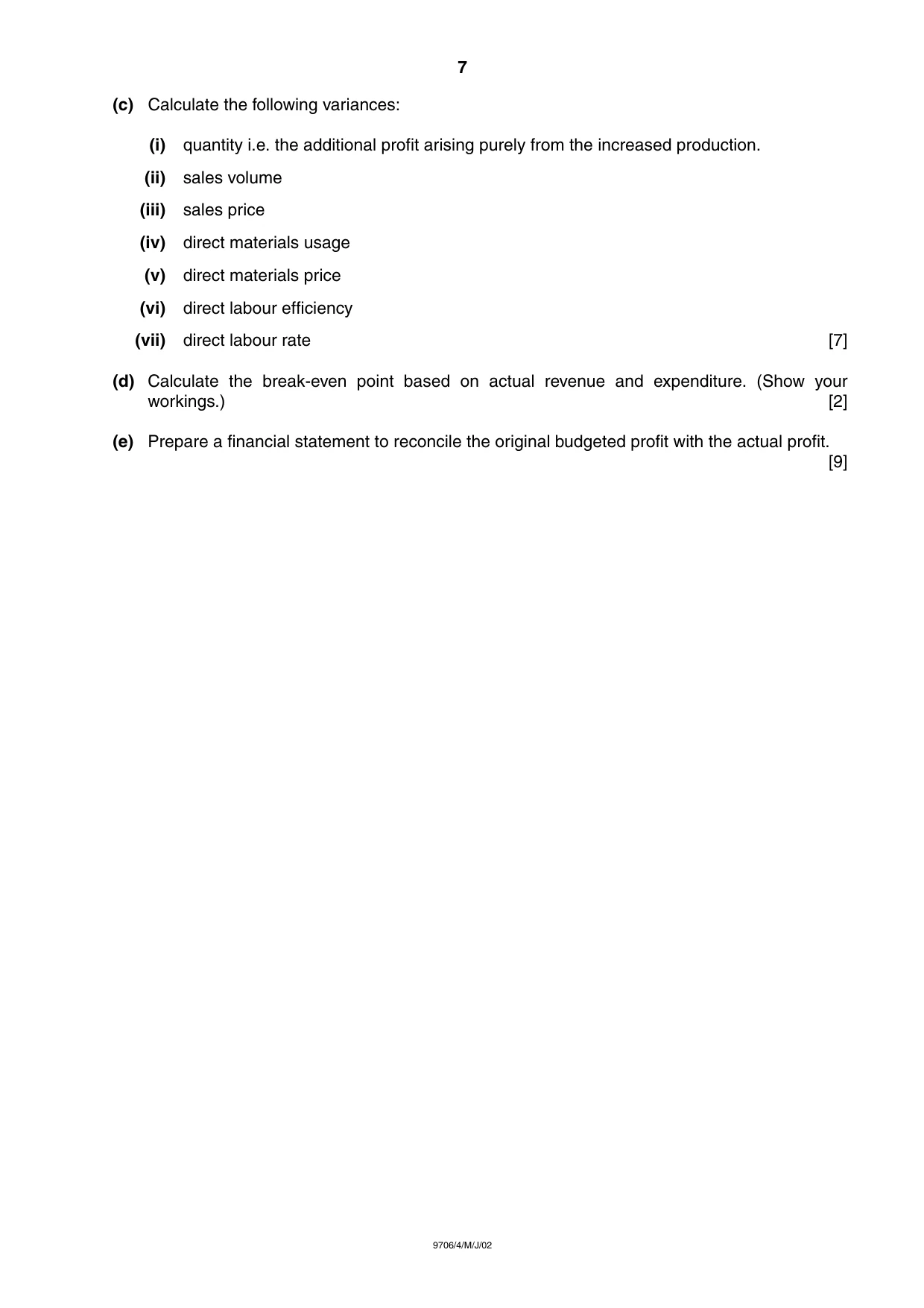
7 9706/4/M/J/02 (c) Calculate the following variances: (i) quantity i.e. the additional profit arising purely from the increased production. (ii) sales volume (iii) sales price (iv) direct materials usage (v) direct materials price (vi) direct labour efficiency (vii) direct labour rate [7] (d) Calculate the break-even point based on actual revenue and expenditure. (Show your workings.) [2] (e) Prepare a financial statement to reconcile the original budgeted profit with the actual profit. [9]
Mark scheme, page 1
CAMBRIDGE UNTERNATIONAL EXAMINATIONS JUNE 2002 GCE ADVANCED SUBSIDIARY AND ADVANCED LEVEL MARK SCHEME SYLLABUS/COMPONENT : 9706/4 ACCOUNTING RE University of CAMBRIDGE 3 Local Examinations Syndicate
Mark scheme, page 2
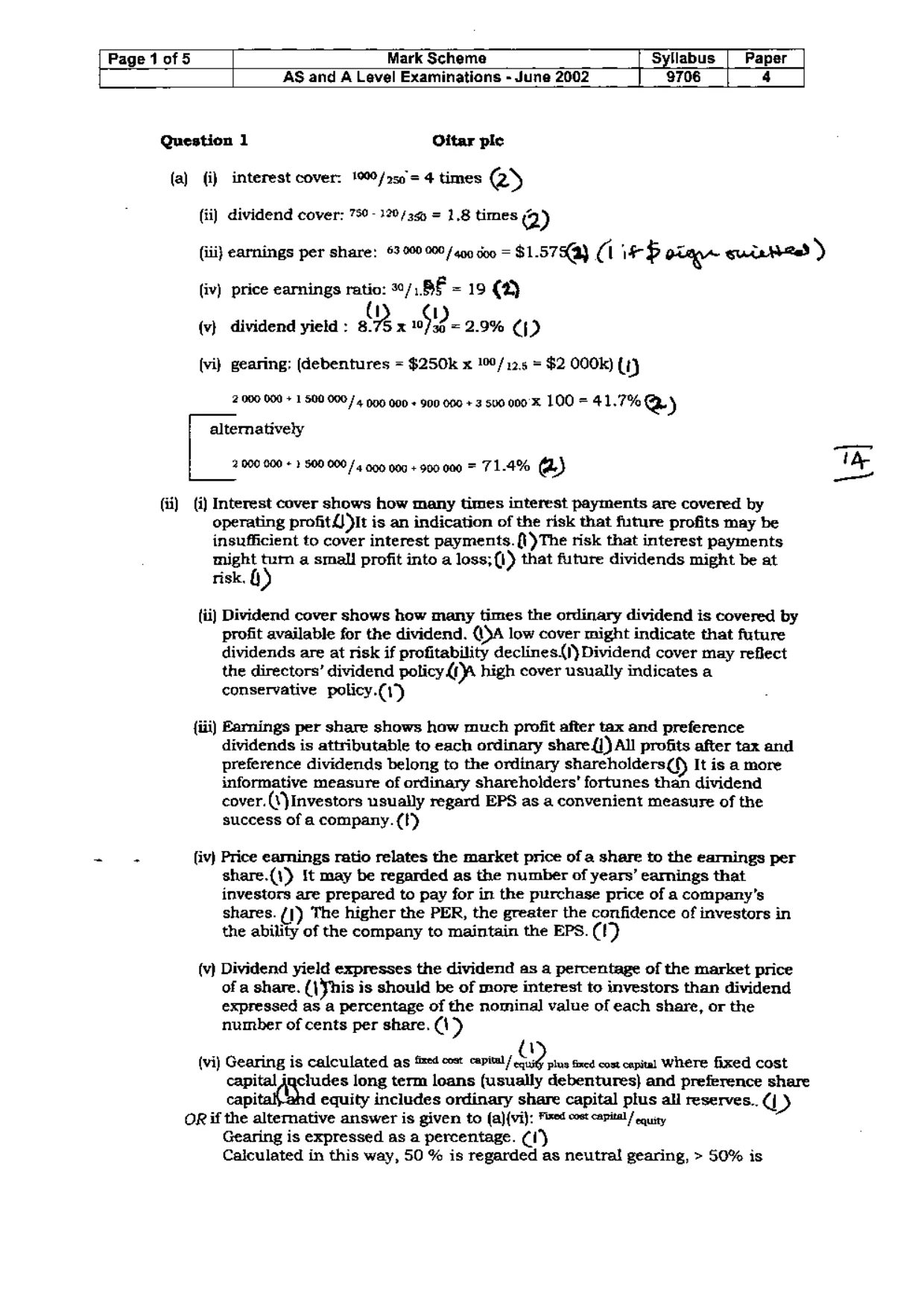
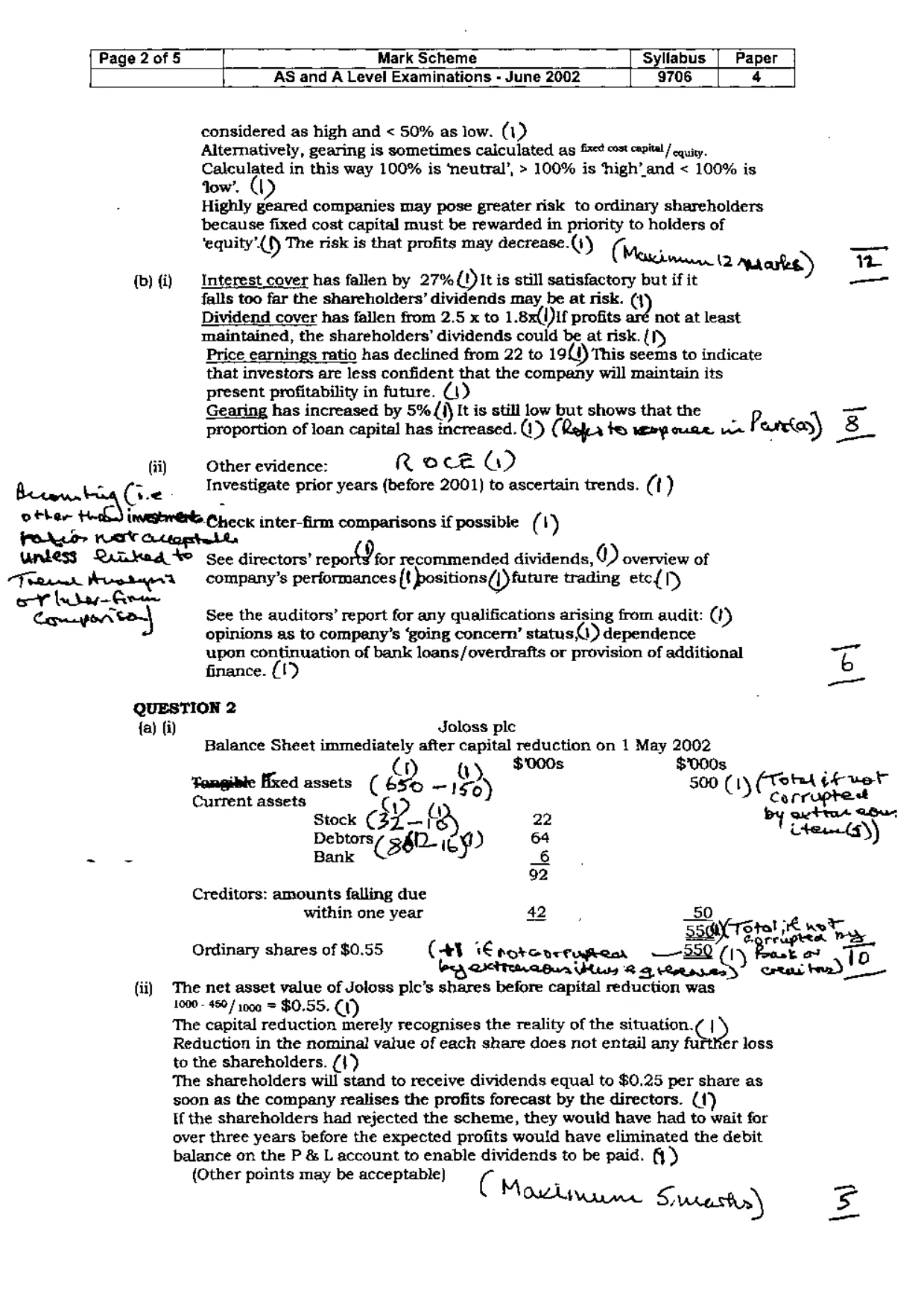
[Page 1 of 5 l Mark Scheme Syllabus Paper AS and A Level Examinations - June 2002 9706 [| 4 | Question 1 Oitar ple (a) (i) interest cover: 19/250 = 4 times @)> (ii) dividend cover: 75¢ - 120/34) = 1,8 times Q) (iii} earnings per share: 63 000 900 / 499 goo = $1.57} a web ota SUirhed 5 (iv) price earnings ratio: 3°/ BF =19 (® I (v} dividend yield : fh x woo! =2.9% (jf) {vi} gearing: (debentures = $250k x 190/12.5 = $2 000k) Ww 2.000 000 + 1500 0004 p09 000 « 900 000 + 3 sv0 000°% 100 = 41.7% @.) alternatively 2.000 000 + > $09 000 /4 a90 000 + 900 000 = 71.4% @® —_— i —_— i) (i) Interest cover shows how many times interest payments are covered by operating profit{) }It is an indication of the risk that future profits may be insufficient to cover interest payments. Q)The risk that interest payments might turn a small profit into a loss; (I) that future dividends might be at risk, a) (ii) Dividend cover shows how many times the ordinary dividend is covered by profit available for the dividend. aa low cover might indicate that future dividends are at risk if profitability declines) Dividend cover may reflect the directors’ dividend policy (1A high cover usually indicates a conservative policy.(1) {iii) Earnings per share shows how much profit after tax and preference dividends is attributable to each ordinary share {|) All profits after tax and preference dividends belong to the ordinary shareholders(f} It is a more informative measure of ordinary shareholders’ fortunes than dividend cover. (\}Investors usually regard EPS as a convenient measure of the success of a company. (1) (iv) Price earnings ratio relates the market price of a share to the earnings per share.(\) !t may be regarded as the number of years’ earnings that investors are prepared to pay for in the purchase price of a company’s shares. (|) The higher the PER, the greater the confidence of investors in the ability of the company to maintain the EPS. (1) (v) Dividend yield expresses the dividend as a percentage of the market price ofa share. Uyhis is should be of more interest to investors than dividend expressed as a percentage of the nominal value of each share, or the number of cents per share. (1 >) 1 (vi) Gearing is calculated as ‘med cost capital /, ao) plus fixed cost capital Where fixed cost capital jgcludes long term loans (usually debentures} and preference share capit id equity includes ordinary share capital plus all reserves.. @ OR if the alternative answer is given to (a){vi): Fd cost capital / equity Gearing is expressed as a percentage. (i) Calculated in this way, 50 % is regarded as neutral gearing, > 50% is
Mark scheme, page 3
Page 2 of § Syllabus Paper 9706 4 {b) (i) (ii ) considered as high and < SO% as low. a) Alternatively, gearing is sometimes calculated as fixed cost capital / cquity. Calculated in this way 100% is ‘neutral’, > 100% is ‘high’ and < 100% is tow’. (I Highly geared companies may pose greater risk to ordinary shareholders because fixed cost capital must be rewarded in priority to holders of equity’) The risk is that profits may decrease.(4) . _ ) (Mescisnanar 2 Adare) ra Interest cover has fallen by 27%/(1)It is still satisfactory but if it _— falls too far the shareholders’ dividends may be at risk. (} Dividend cover has fallen from 2.5 x to 1.8x(I)if profits not at least maintained, the shareholders’ dividends could be at risk. { Price earnings ratio has declined from 22 to 194) This seems to indicate that investors are less confident that the company will maintain its present profitability in future. ())> Gearing has increased by 5% iy It is still low but shows that the — proportion of loan capital has increased. (1) (Reber fe wenpoune We Pasretoxs) & Other evidence: Roce ) A - G e Investigate prior years (before 2001) to ascertain trends. al t ) ° ther inmahrérts (heck inter-firm comparisons if possible ( ') Poke ware wuntess Qacakad 4° See directors’ reports) for recommended dividends, ® overview of OT ek 4 company’s performances (I bositions(|) future trading etc{ dD oF be day Gre Ce porite| See the auditors’ report for any qualifications arising from audit: [O) opinions as to company’s ‘going concern’ status.) dependence upon continuation of bank loans/overdrafts or provision of additional Cc finance. {!) — QUESTION 2 fa) (i) Joloss ple Balance Sheet immediately after capital reduction on 1 May 2002 0) Q), $'000s $000s ewe ‘ We Fongibte Fixed assets ( 6350 150) 500 ia} Spinco rrent assets gj a 8 Stock ( 3 —{ 8) 22 ea : Debtors DL ) 64 ~ - Bank (3 8 ey 6 92 Creditors: amounts falling due within one year 42 50 ~ 35d To i a SEAN TSO ER eae (i) Ordinary shares of $0.55 CAV eotcareugrea ——-550'/ ot Qt Te abus Uius 8 teases ) wrens ten) OL The net asset value of Joloss ple’s shares before capital reduction was 1000 - 480 / 1000 = $0.55. C1) The capital reduction merely recognises the reality of the situation.¢ | Reduction in the nominal value of each share does not entail any further loss to the shareholders. (1) ‘The shareholders will stand to receive dividends equal to $0.25 per share as soon as the company realises the profits forecast by the directors. (1) If the shareholders had rejected the scheme, they would have had to wait for over three years before the expected profits would have eliminated the debit balance on the P & L account to enable dividends to be paid. (|) (Other points may be acceptable) C M . _
Mark scheme, page 4
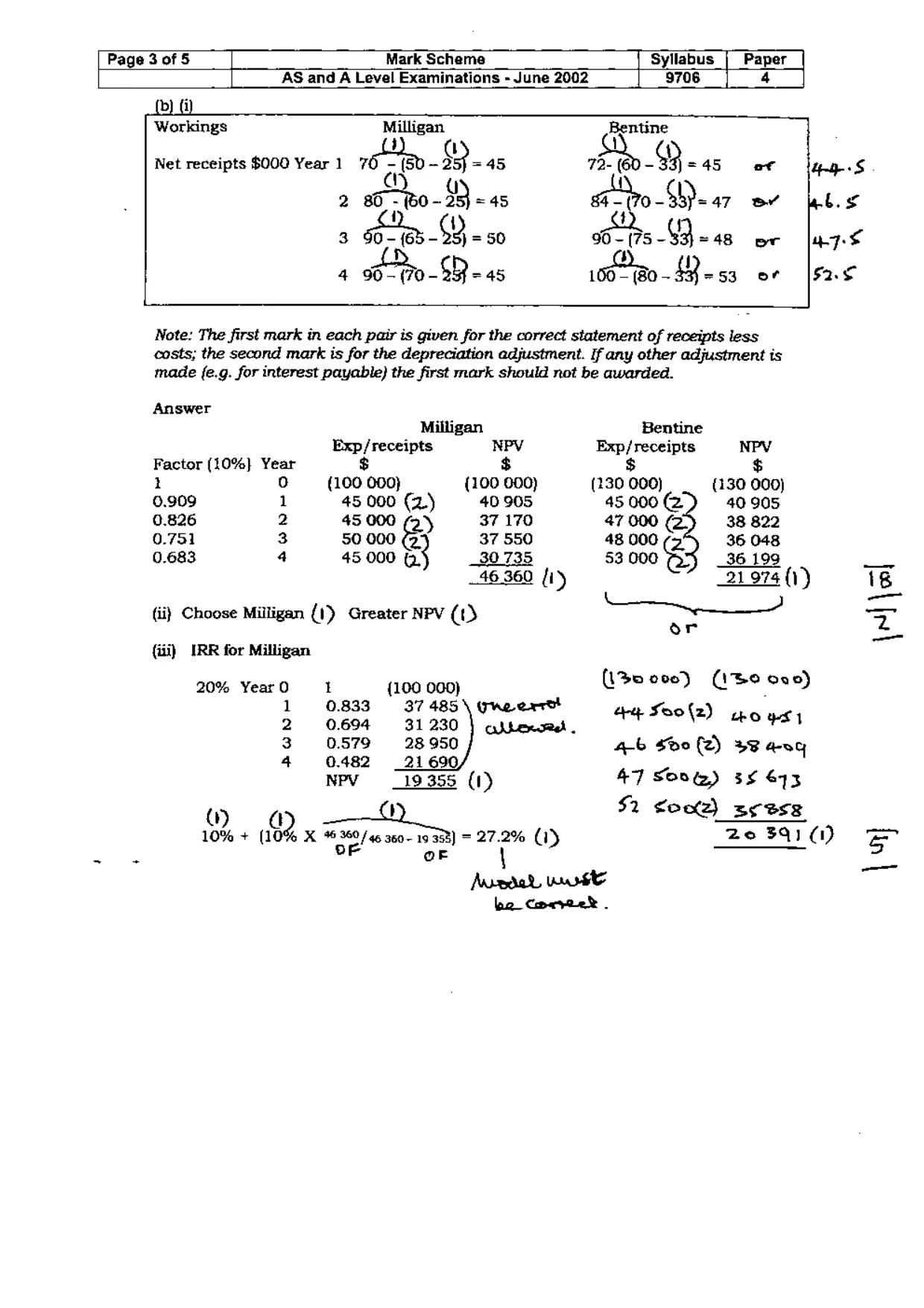
Page 3 of 5 Mark Scheme Syllabus | Paper [ AS and A Level Examinations - June 2002 | 9706 4 Milligan Bentine ne $9. 45 2 sto - $3 - 45 3 5-59 «50 4 967 (70-OR = 45 Net receipts $000 Year 1 B- Q . 45 of ods -B =48) pr + (80 - a =S3 oF BY Note: The first mark in each pair is given for the correct statement of receipts less costs; the second mark is for the depreciation adjustment. If any other adjustment is made (e.g. for interest payable) the first mark should not be awarded. Answer Milligan Exp/receipts NPV Factor (10%} Year $ $ t 0 — (100 000) (100 000) 0.909 1 45 000 (2) 40 905 0.826 2 45 000 (2) 37 170 0.751 3 50 000 & 37 550 0.683 4 45 000 3 30735 46 360 {1} (i) Choose Milligan {1) Greater NPV ({) (iii) IRR for Milligan 20% YearO {100 000) 1 0.833 37 485\ gweerret 2 0694 31230 | ajhenced. 3 0.579 28950 4 0.482 _21699 NPV 19 355 (1) G 1 =, wy + BR X 46360 /46 a60- 19 388) = 27.2% (1 OF oF \ Bentine Exp/receipts NPV $ $ (230 000) (130 000) 45000(@2) 40905 47000 (2) 38 822 48000(55 36048 53 000 36199 21.974 (1) Vd or (130 000) (170 ond) +4 Foo{2) wo ys, ab Sd0 (2) 33 4-0 47 Sov) 3s 73 $2 <onz) srese ze 39) (1) Aveda Ws lag Comerced . | e \nl\ \ 9}
Mark scheme, page 5
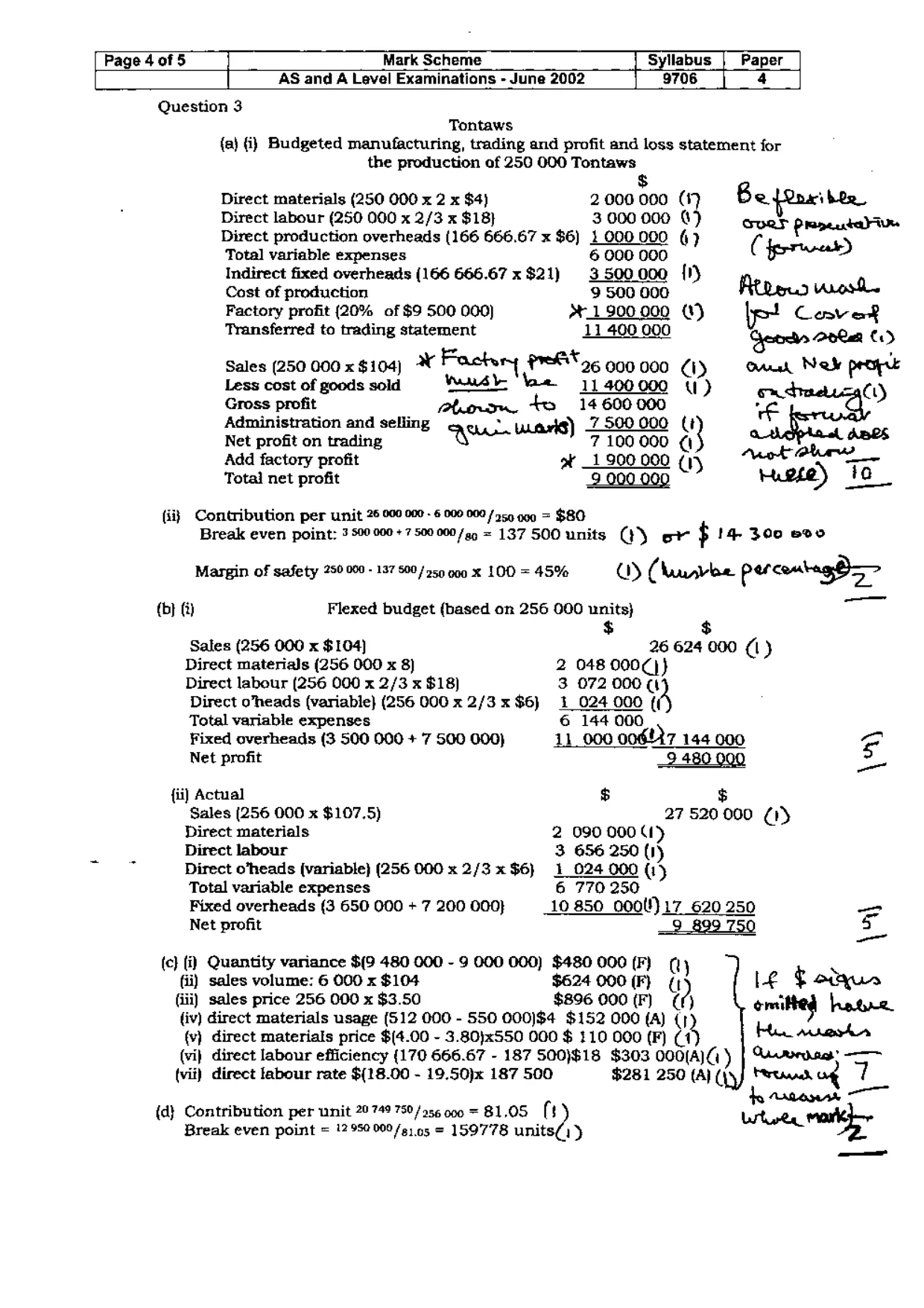
Page 4 of 5 Mark Scheme Syllabus Paper AS and A Level Examinations - June 2002 9706. | 4 ~~ Question 3 Tontaws (a) (i) Budgeted manufacturing, trading and profit and loss statement for the production of 250 000 Tontaws Direct materials (250 000 x 2 x $4) Direct labour (250 000 x 2/3 x $18} Total variable expenses Indirect fixed overheads (166 666.67 x $21) $ 2000 000 (17 Be jooxibee 3.000 000 ) Direct production overheads (166 666.67 x $6) 1000000 () 6 000 000 Cfprruncat) 3500000 {1} Got Prpeutad ius Cost of production 9 500 000 Redes wsrosi. Factory profit (20% of $9 500 000) ox.1900900 (1) > Cov eak Transferred to trading statement 11 400 000 Geos epee Oo) Sales (250 000 x $104) Factory PET 56 000000 (i) mad Nek propes Less cost of goods sold Ws) ‘ee 11 400.000 > on a(t) Gross profit Ptoran, 4 14600000 . Administration and selling > wrarkg) -7500000 (t Net profit on trading Qe ) 7 100 000 (1 Anes Add factory profit ot 1900000 () “Wet Obes __ Total net profit Huete) jo (ij Contribution per unit 26 000 000 - 6 000 009/955 990 = $80 Break even point: 3500 000 + 7 500 000/aq = 137 500 units (}) et $ 14 300 edo Margin of safety 250 000 - 137 500/259 999 x 100 = 45% U) Chuusrbe percontag®=—> (b} (3) Flexed budget (based on 256 000 units} $ $ Sales (256 000 x $104) 26 624 000 (1) Direct materials (256 000 x 8) 2 048 000C) Direct labour (256 000 x 2/3 x $18) 3 072 000 4 Direct o’heads (variable) (256 000 x 2/3 x $6) 1 024 000 Total variable expenses 6 144000 Fixed overheads (3 500 000 + 7 SOO 000) 11 000 006427 144 000 eS Net profit -9.480 090 2 {ii) Actual $ $ Sales (256 000 x $107.5) 27 520 000 (1) Direct materials 2 090 000 (> Direct labour 3 656 250 (I Direct o*heads (variable) (256 000 x 2/3 x $6} 1_024 000 (1) Total variable expenses 6 770 250 Fixed overheads (3 650 000 + 7 200 000} 10 850 ooot!} 17 _ 620 250 —= Net profit 9899 750 (¢} () Quantity variance $(9 480 000 - 9 000 000) $480 000 (F) (1 (i) sales volume: 6 000 x $104 $624 000 (F} (1 le gots (iii) sales price 256 000 x $3.50 $896 000 (F) (0) emitted hegee (iv) direct materials usage (512 000 - 550 000)$4 $152 000 (A) (; (v) direct materials price $(4.00 - 3.80)x550 000 $ 110 000 (F) (1 bee arerkn (wi) direct labour efficiency (170 666.67 - 187 S00}$18 $303 OOO{A)(, ) | rasa: —— (vii) direct labour rate $(18.00 - 19.50}x 187 500 (d} Contribution per unit 20749 750/956 000 = 81.05 ft Break even point = 17950 000/195 = 159778 units()) $281 250 (A} ( Premed Og 7
Mark scheme, page 6
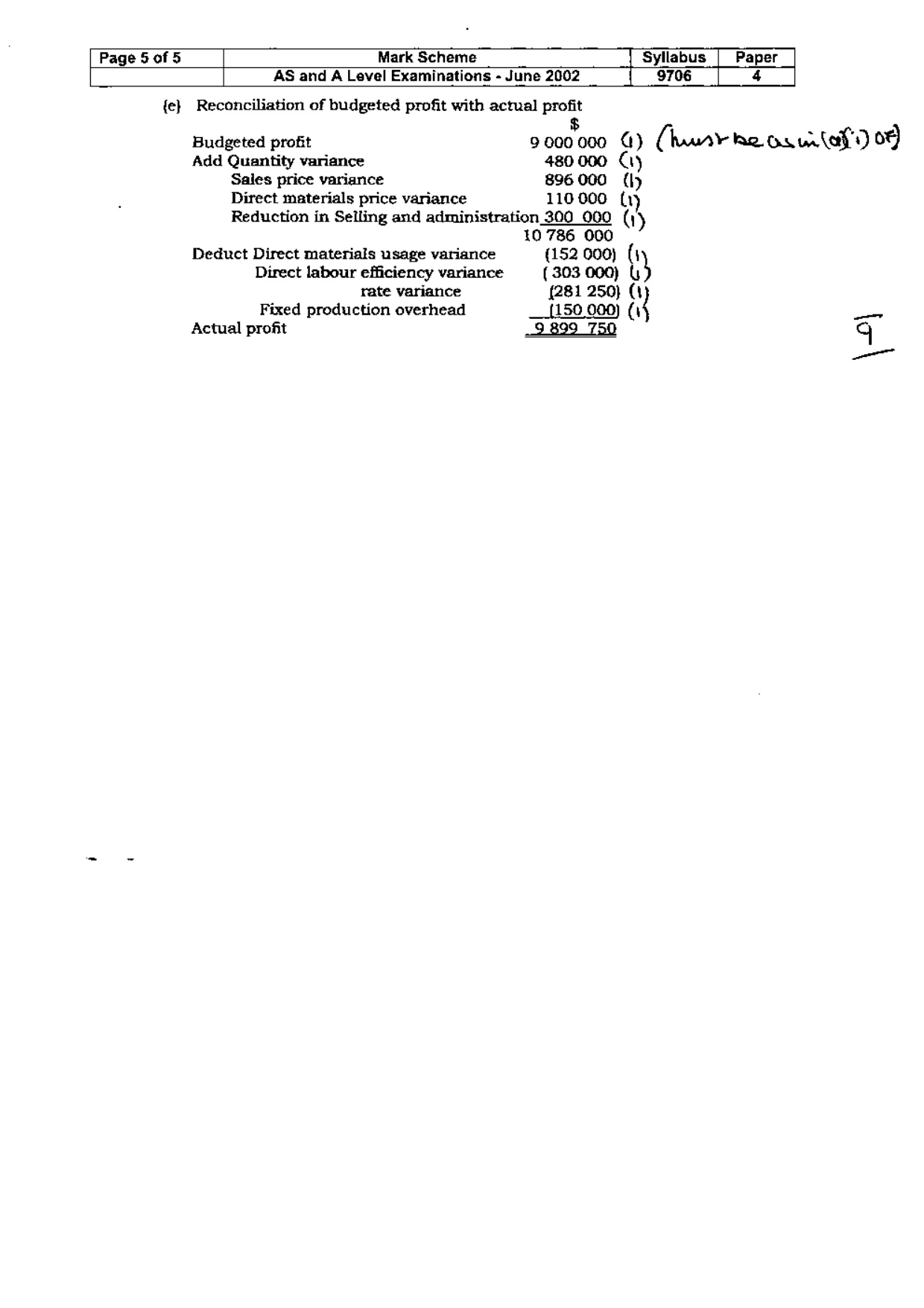
Page 5 of 5 Mark Scheme ‘| Syllabus | Paper AS and A Level Examinations - June 2002 { 9706 4 fe} Reconciliation of budgeted profit with actual profit $ . . 9000000 G) Chany ne Oo) of Budgeted profit Add Quantity variance 480000 (1) Sales price variance 896.000 (I) Direct materials price variance 110 000 ay Reduction in Selling and administration 300 000 (1) 10 786 000 Deduct Direct materials usage variance (152 000) (i Direct labour efficiency variance (303 000) rate variance {281 250} (1 Fixed production overhead {150 000) a — Actual profit 9.899 750 —