Cambridge IGCSE Twenty-First Century Science 0608 — 2013 Oct/Nov Paper 1 · Variant 1
0608/11/O/N/13 · 40 marks · ≈45 min
The question paper and its mark scheme, free to read here and free to download. This is Cambridge’s own paper, exactly as it was sat.
Question paper16 pages


Mark scheme2 pages
Answers below. Sit the paper first if you are practising.
Paper as text
Question paper, page 1
This document consists of 14 printed pages and 2 blank pages. IB13 11_0608_01/5RP © UCLES 2013 [Turn over *8820708717* UNIVERSITY OF CAMBRIDGE INTERNATIONAL EXAMINATIONS International General Certificate of Secondary Education TWENTY FIRST CENTURY SCIENCE (CORE) 0608/01 Paper 1 Multiple Choice October/November 2013 1 hour Additional Materials: Multiple Choice Answer Sheet Soft clean eraser Soft pencil (type B or HB is recommended) READ THESE INSTRUCTIONS FIRST Write in soft pencil. Do not use staples, paper clips, highlighters, glue or correction fluid. Write your name, Centre number and candidate number on the Answer Sheet in the spaces provided unless this has been done for you. DO NOT WRITE IN ANY BARCODES. There are forty questions on this paper. Answer all questions. For each question there are four possible answers A, B, C and D. Choose the one you consider correct and record your choice in soft pencil on the separate Answer Sheet. Read the instructions on the Answer Sheet very carefully. Each correct answer will score one mark. A mark will not be deducted for a wrong answer. Any rough working should be done in this booklet. Electronic calculators may be used. www.XtremePapers.com
Question paper, page 2
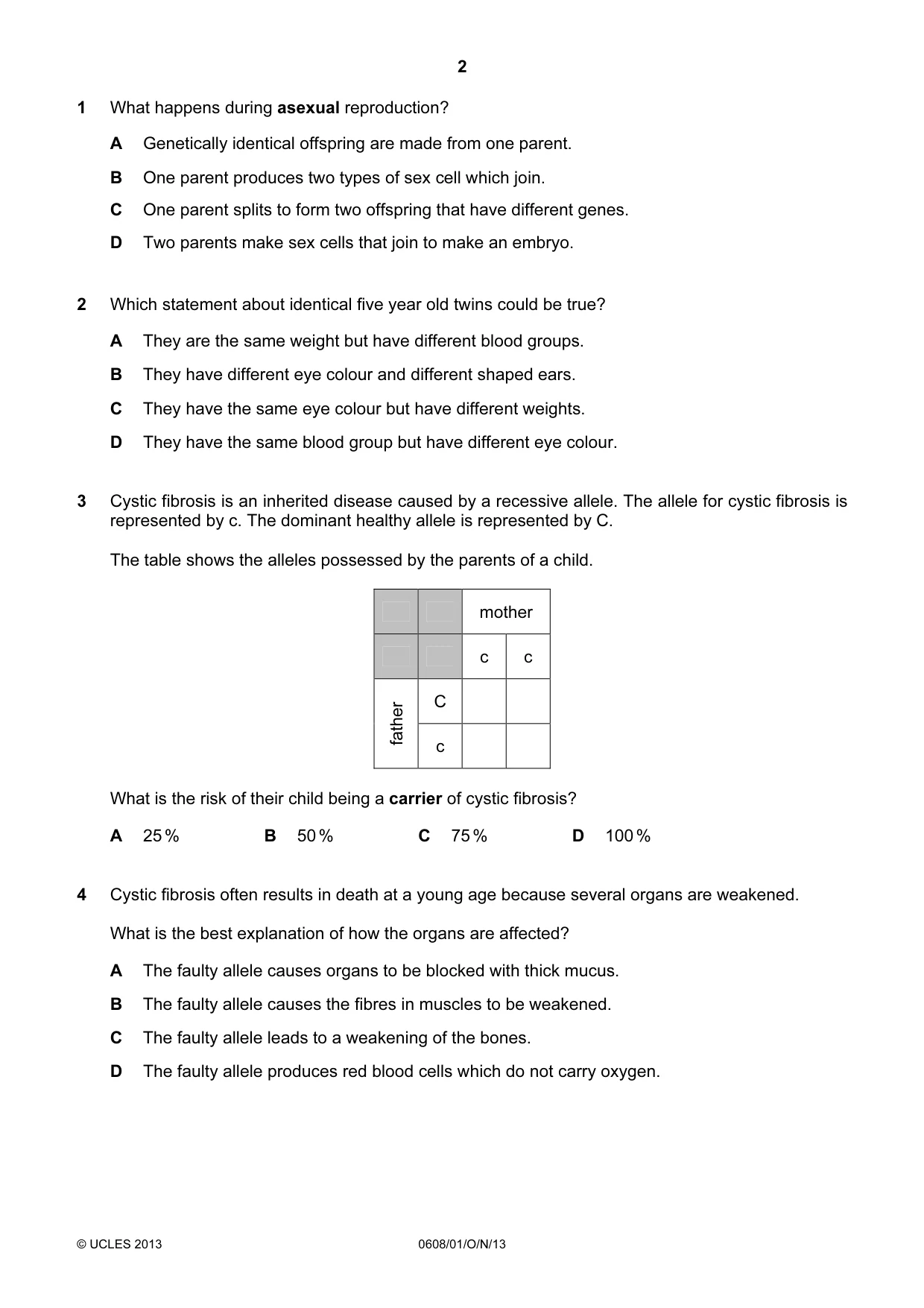
2 © UCLES 2013 0608/01/O/N/13 1 What happens during asexual reproduction? A Genetically identical offspring are made from one parent. B One parent produces two types of sex cell which join. C One parent splits to form two offspring that have different genes. D Two parents make sex cells that join to make an embryo. 2 Which statement about identical five year old twins could be true? A They are the same weight but have different blood groups. B They have different eye colour and different shaped ears. C They have the same eye colour but have different weights. D They have the same blood group but have different eye colour. 3 Cystic fibrosis is an inherited disease caused by a recessive allele. The allele for cystic fibrosis is represented by c. The dominant healthy allele is represented by C. The table shows the alleles possessed by the parents of a child. mother c c C father c What is the risk of their child being a carrier of cystic fibrosis? A 25 % B 50 % C 75 % D 100 % 4 Cystic fibrosis often results in death at a young age because several organs are weakened. What is the best explanation of how the organs are affected? A The faulty allele causes organs to be blocked with thick mucus. B The faulty allele causes the fibres in muscles to be weakened. C The faulty allele leads to a weakening of the bones. D The faulty allele produces red blood cells which do not carry oxygen.
Question paper, page 3
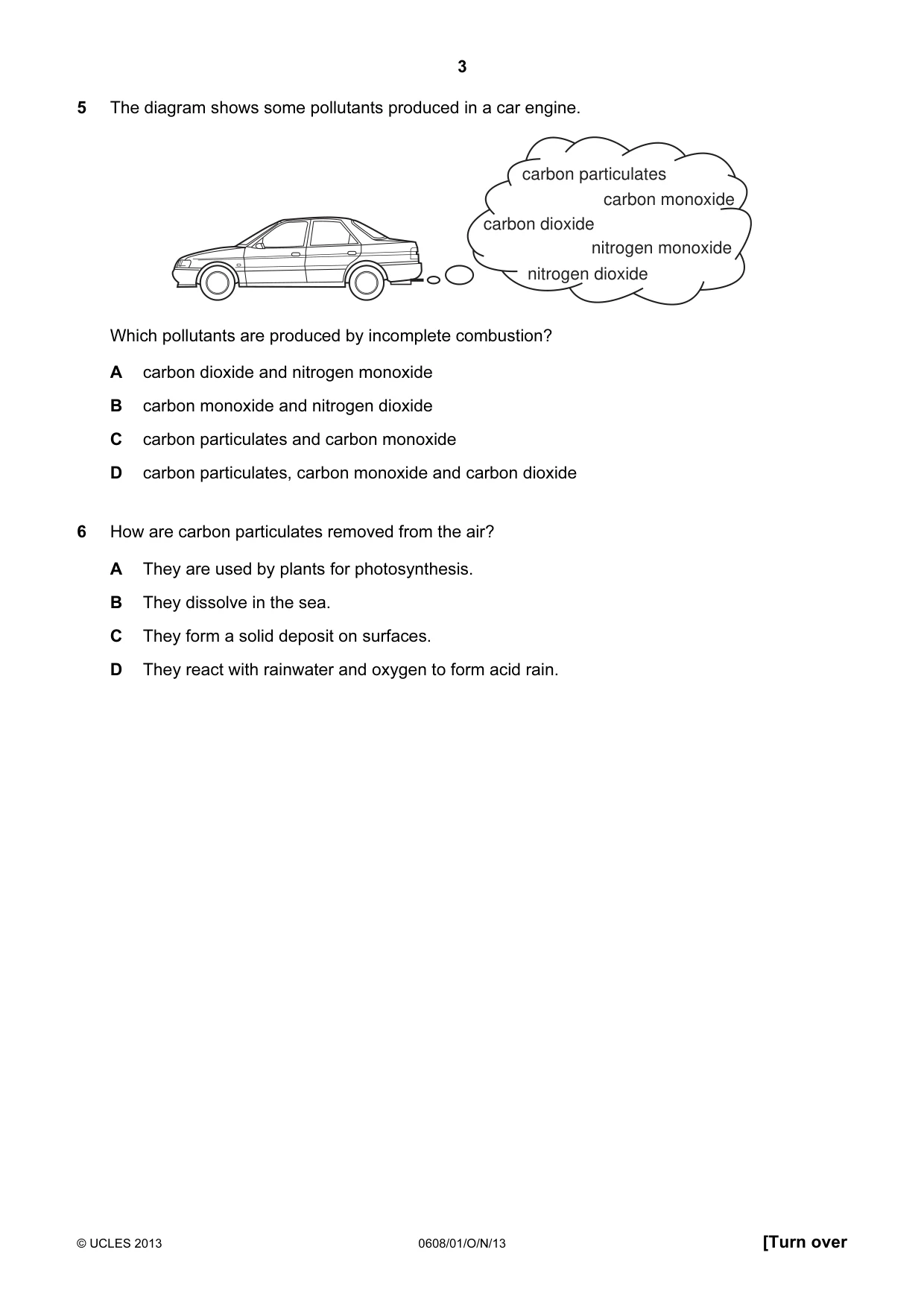
3 © UCLES 2013 0608/01/O/N/13 [Turn over 5 The diagram shows some pollutants produced in a car engine. carbon particulates carbon monoxide carbon dioxide nitrogen monoxide nitrogen dioxide Which pollutants are produced by incomplete combustion? A carbon dioxide and nitrogen monoxide B carbon monoxide and nitrogen dioxide C carbon particulates and carbon monoxide D carbon particulates, carbon monoxide and carbon dioxide 6 How are carbon particulates removed from the air? A They are used by plants for photosynthesis. B They dissolve in the sea. C They form a solid deposit on surfaces. D They react with rainwater and oxygen to form acid rain.
Question paper, page 4
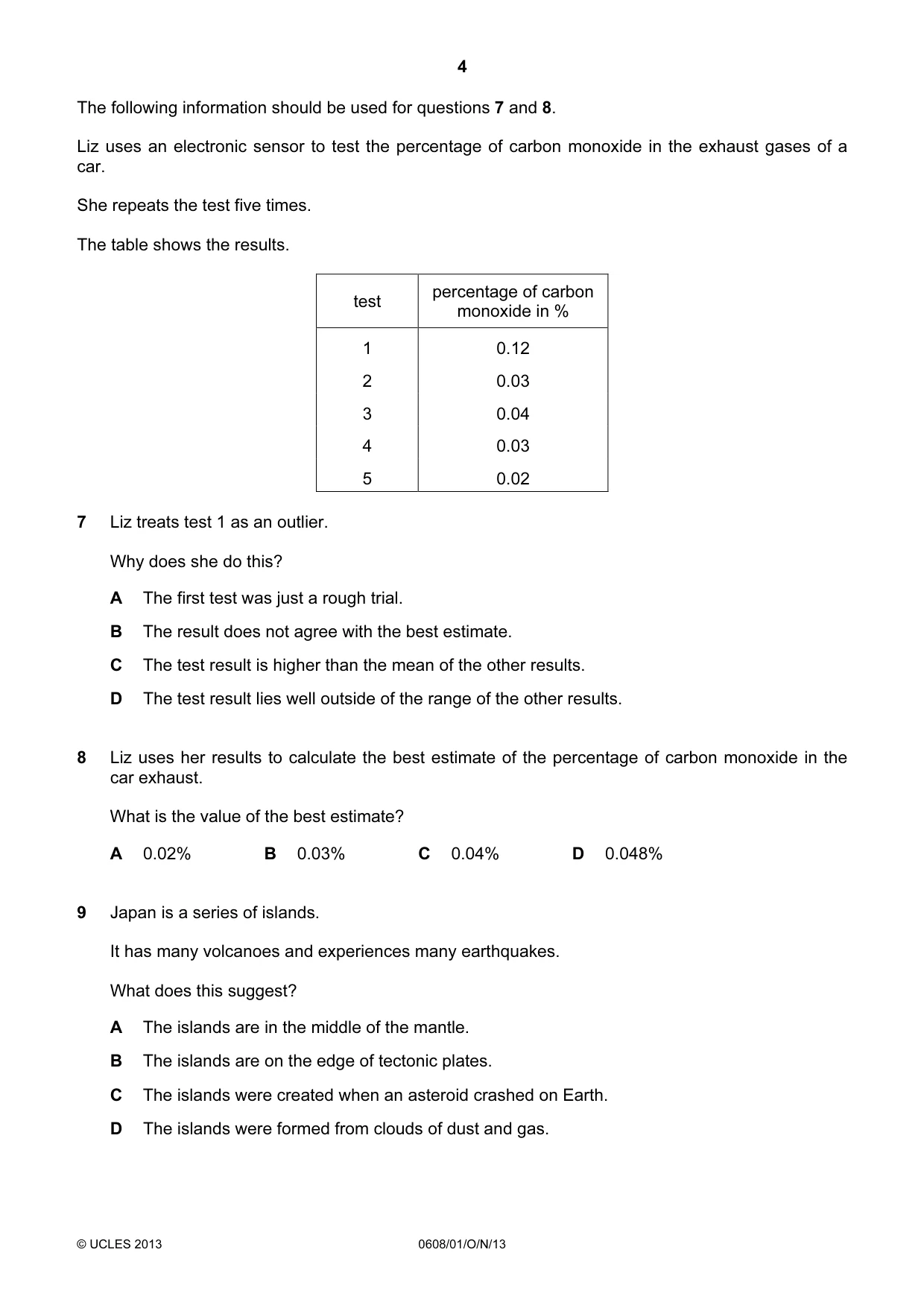
4 © UCLES 2013 0608/01/O/N/13 The following information should be used for questions 7 and 8. Liz uses an electronic sensor to test the percentage of carbon monoxide in the exhaust gases of a car. She repeats the test five times. The table shows the results. test percentage of carbon monoxide in % 1 0.12 2 0.03 3 0.04 4 0.03 5 0.02 7 Liz treats test 1 as an outlier. Why does she do this? A The first test was just a rough trial. B The result does not agree with the best estimate. C The test result is higher than the mean of the other results. D The test result lies well outside of the range of the other results. 8 Liz uses her results to calculate the best estimate of the percentage of carbon monoxide in the car exhaust. What is the value of the best estimate? A 0.02% B 0.03% C 0.04% D 0.048% 9 Japan is a series of islands. It has many volcanoes and experiences many earthquakes. What does this suggest? A The islands are in the middle of the mantle. B The islands are on the edge of tectonic plates. C The islands were created when an asteroid crashed on Earth. D The islands were formed from clouds of dust and gas.
Question paper, page 5
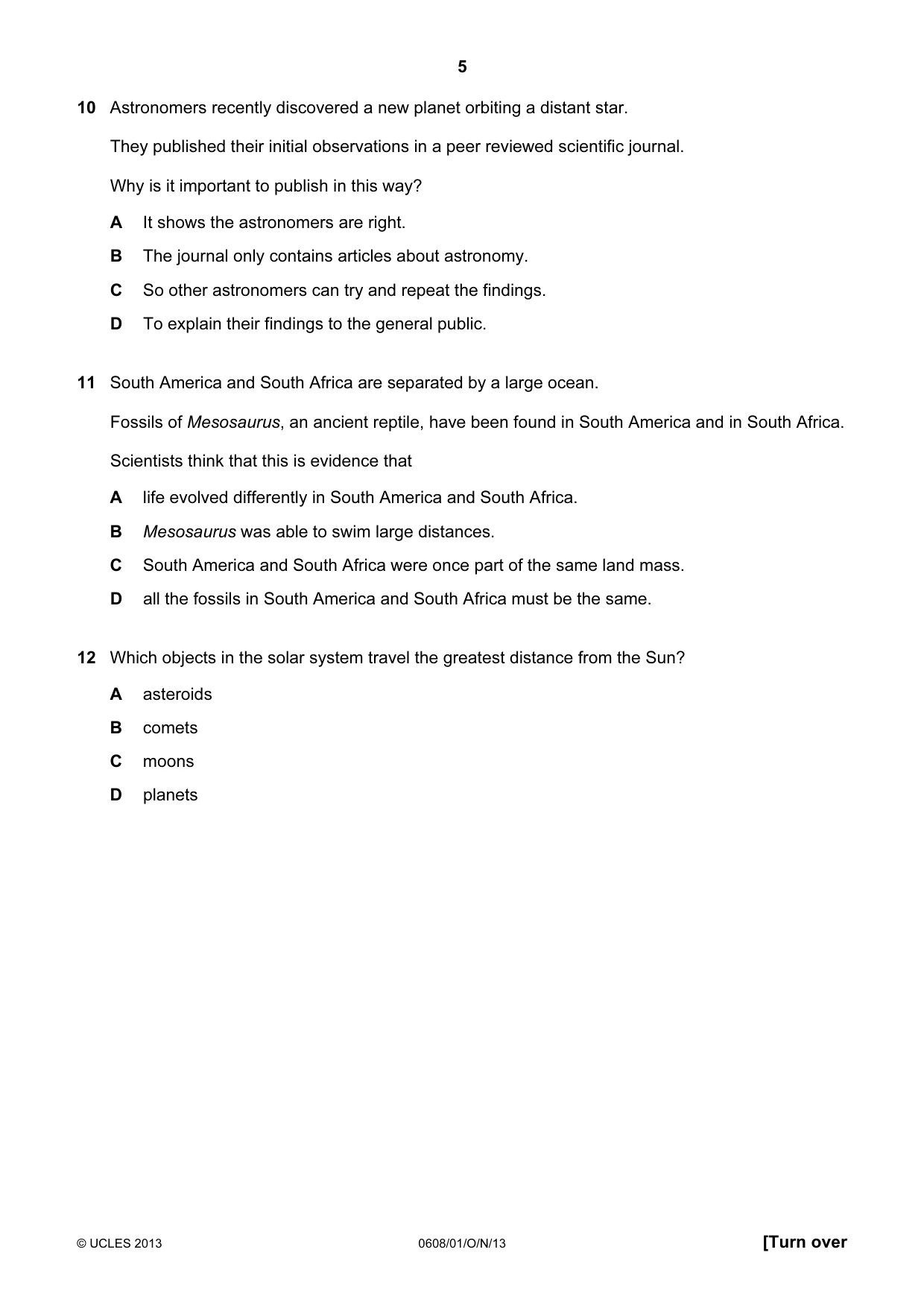
5 © UCLES 2013 0608/01/O/N/13 [Turn over 10 Astronomers recently discovered a new planet orbiting a distant star. They published their initial observations in a peer reviewed scientific journal. Why is it important to publish in this way? A It shows the astronomers are right. B The journal only contains articles about astronomy. C So other astronomers can try and repeat the findings. D To explain their findings to the general public. 11 South America and South Africa are separated by a large ocean. Fossils of Mesosaurus, an ancient reptile, have been found in South America and in South Africa. Scientists think that this is evidence that A life evolved differently in South America and South Africa. B Mesosaurus was able to swim large distances. C South America and South Africa were once part of the same land mass. D all the fossils in South America and South Africa must be the same. 12 Which objects in the solar system travel the greatest distance from the Sun? A asteroids B comets C moons D planets
Question paper, page 6
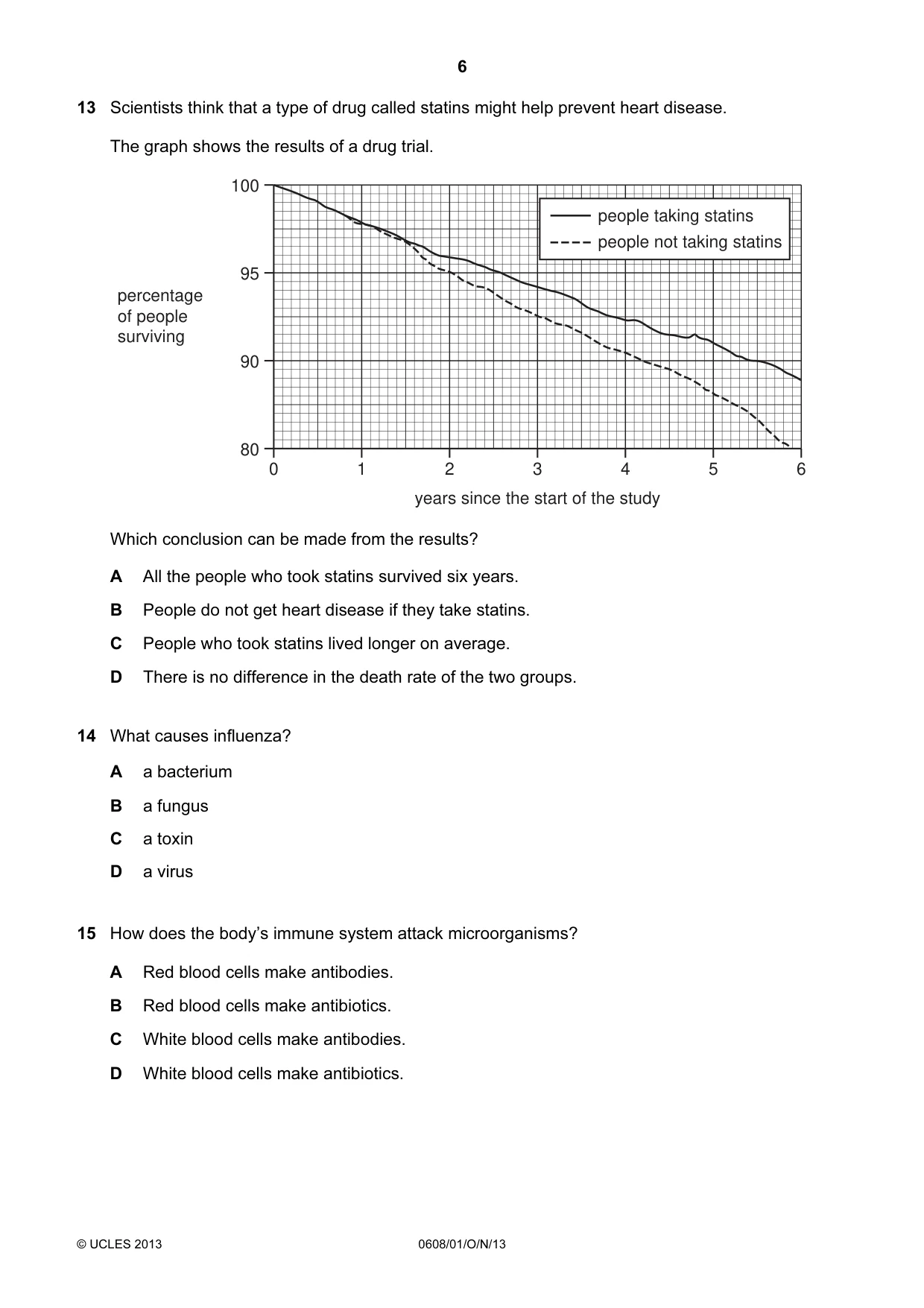
6 © UCLES 2013 0608/01/O/N/13 13 Scientists think that a type of drug called statins might help prevent heart disease. The graph shows the results of a drug trial. 0 1 2 3 years since the start of the study 4 5 6 100 95 90 80 percentage of people surviving people taking statins people not taking statins Which conclusion can be made from the results? A All the people who took statins survived six years. B People do not get heart disease if they take statins. C People who took statins lived longer on average. D There is no difference in the death rate of the two groups. 14 What causes influenza? A a bacterium B a fungus C a toxin D a virus 15 How does the body’s immune system attack microorganisms? A Red blood cells make antibodies. B Red blood cells make antibiotics. C White blood cells make antibodies. D White blood cells make antibiotics.
Question paper, page 7
7 © UCLES 2013 0608/01/O/N/13 [Turn over 16 Blood is carried away from the heart in arteries and back to the heart in veins. The pressure of the blood in arteries is much higher than in veins. Which features of veins are correct? A thick walls and no valves B thick walls and valves C thin walls and no valves D thin walls and valves 17 Anand is shopping for a new winter coat. He knows that natural and synthetic materials can be used to make coats. Which material is synthetic? A cotton B nylon C silk D wool 18 Joshua and his friends are going on a climbing holiday. Joshua buys a new rope before he goes. The rope is made of nylon fibres. What is the most important property of the fibres? A density B hardness C tensile strength D stiffness
Question paper, page 8
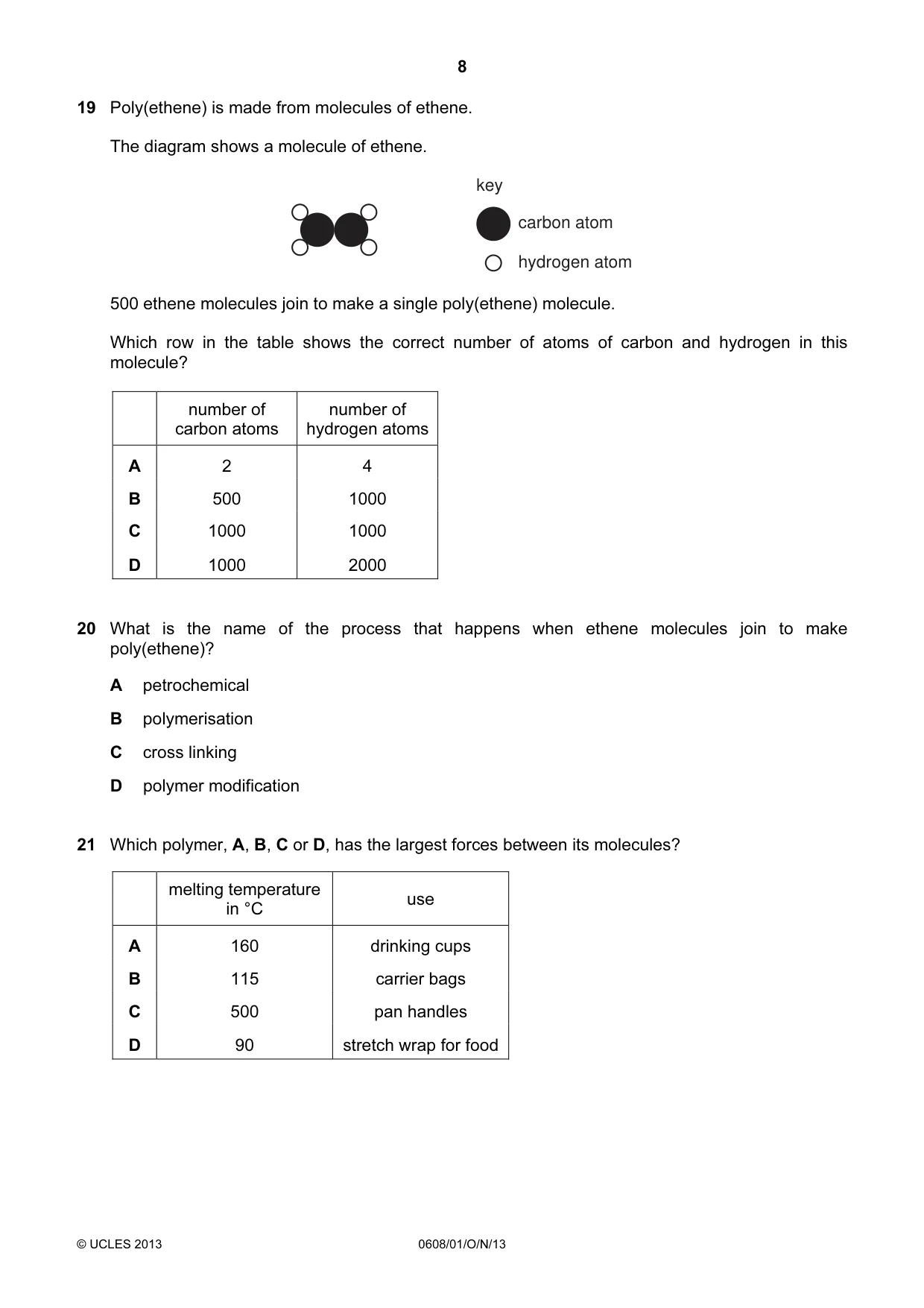
8 © UCLES 2013 0608/01/O/N/13 19 Poly(ethene) is made from molecules of ethene. The diagram shows a molecule of ethene. key carbon atom hydrogen atom 500 ethene molecules join to make a single poly(ethene) molecule. Which row in the table shows the correct number of atoms of carbon and hydrogen in this molecule? number of carbon atoms number of hydrogen atoms A 2 4 B 500 1000 C 1000 1000 D 1000 2000 20 What is the name of the process that happens when ethene molecules join to make poly(ethene)? A petrochemical B polymerisation C cross linking D polymer modification 21 Which polymer, A, B, C or D, has the largest forces between its molecules? melting temperature in °C use A 160 drinking cups B 115 carrier bags C 500 pan handles D 90 stretch wrap for food
Question paper, page 9
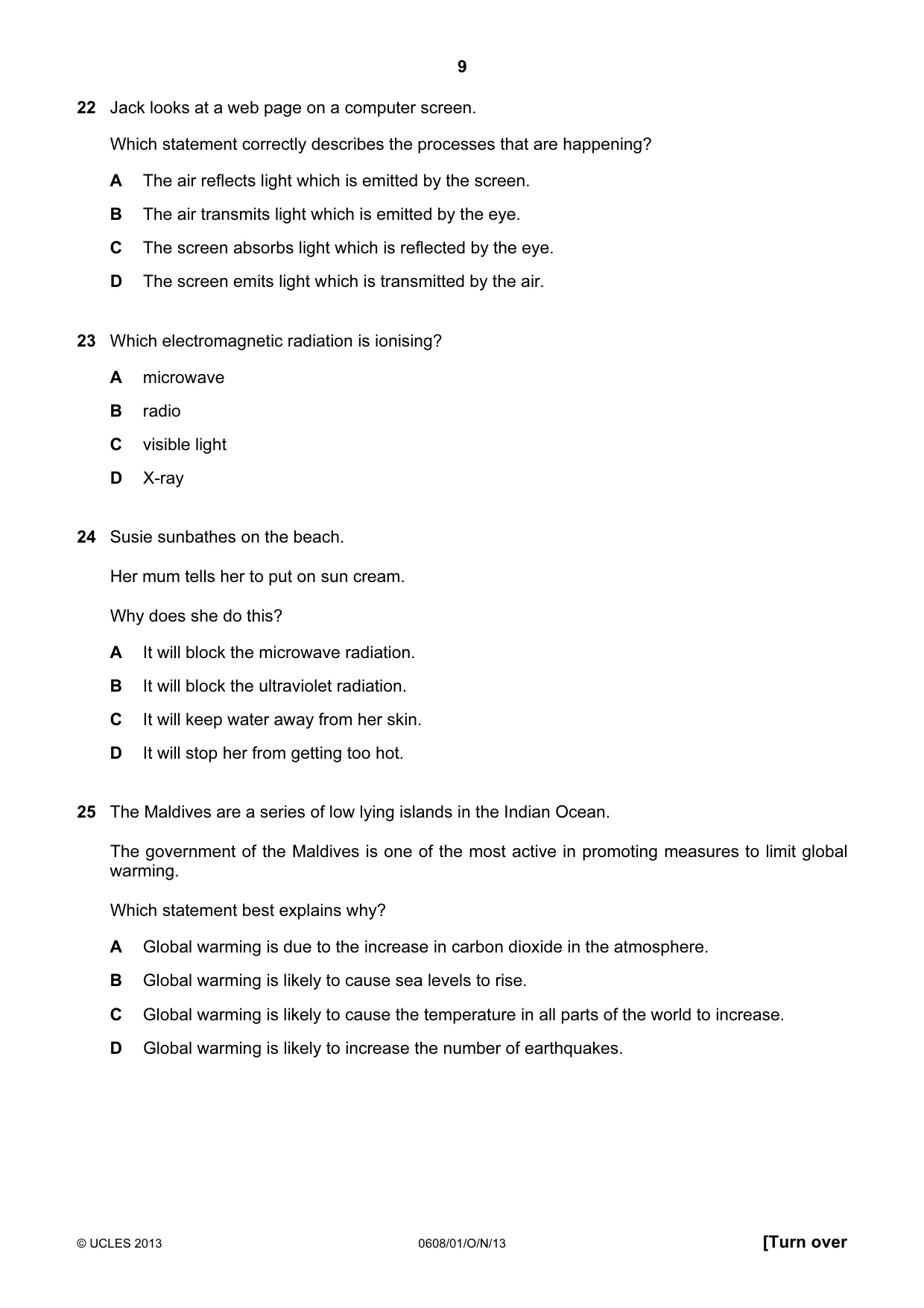
9 © UCLES 2013 0608/01/O/N/13 [Turn over 22 Jack looks at a web page on a computer screen. Which statement correctly describes the processes that are happening? A The air reflects light which is emitted by the screen. B The air transmits light which is emitted by the eye. C The screen absorbs light which is reflected by the eye. D The screen emits light which is transmitted by the air. 23 Which electromagnetic radiation is ionising? A microwave B radio C visible light D X-ray 24 Susie sunbathes on the beach. Her mum tells her to put on sun cream. Why does she do this? A It will block the microwave radiation. B It will block the ultraviolet radiation. C It will keep water away from her skin. D It will stop her from getting too hot. 25 The Maldives are a series of low lying islands in the Indian Ocean. The government of the Maldives is one of the most active in promoting measures to limit global warming. Which statement best explains why? A Global warming is due to the increase in carbon dioxide in the atmosphere. B Global warming is likely to cause sea levels to rise. C Global warming is likely to cause the temperature in all parts of the world to increase. D Global warming is likely to increase the number of earthquakes.
Question paper, page 10
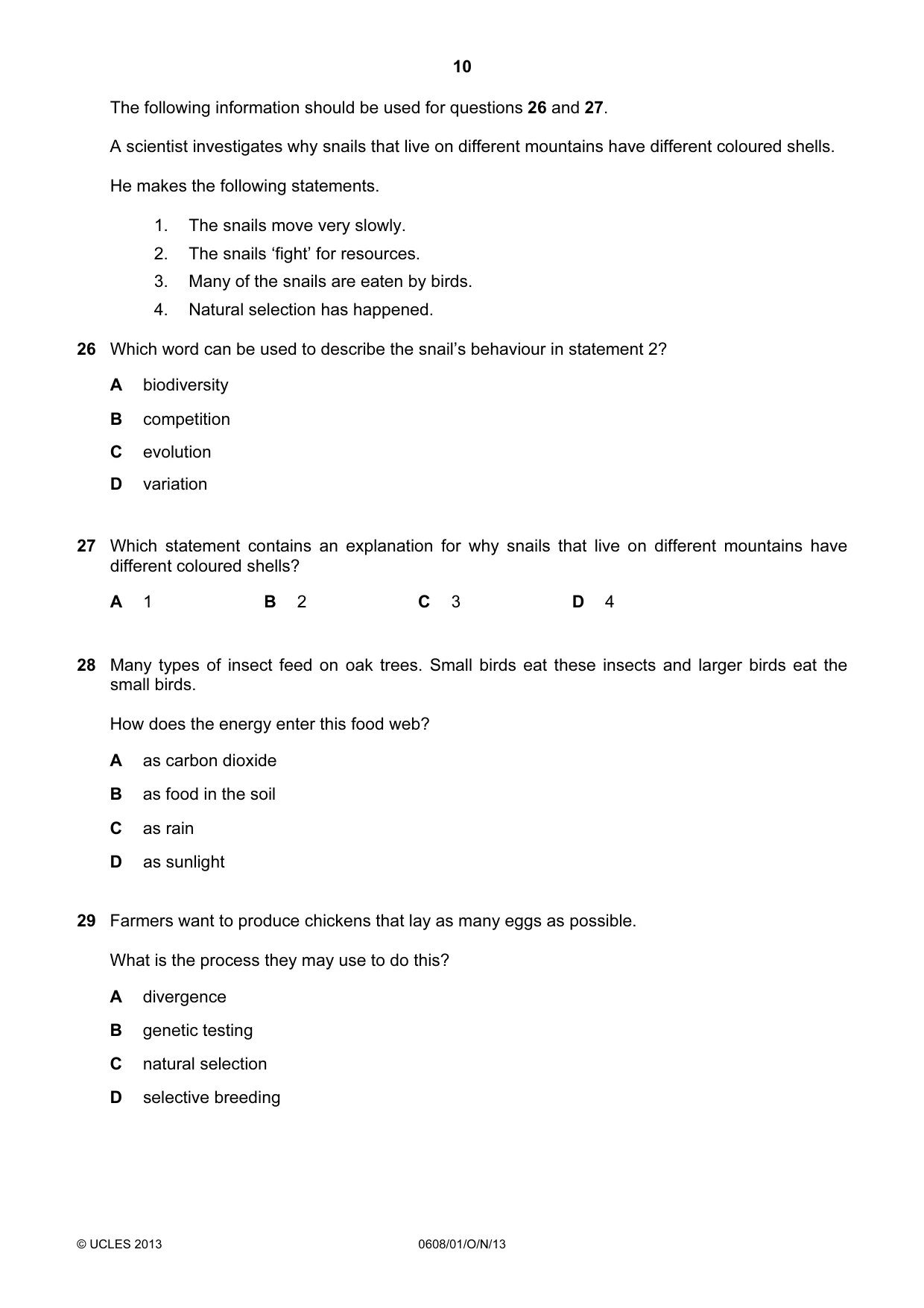
10 © UCLES 2013 0608/01/O/N/13 The following information should be used for questions 26 and 27. A scientist investigates why snails that live on different mountains have different coloured shells. He makes the following statements. 1. The snails move very slowly. 2. The snails ‘fight’ for resources. 3. Many of the snails are eaten by birds. 4. Natural selection has happened. 26 Which word can be used to describe the snail’s behaviour in statement 2? A biodiversity B competition C evolution D variation 27 Which statement contains an explanation for why snails that live on different mountains have different coloured shells? A 1 B 2 C 3 D 4 28 Many types of insect feed on oak trees. Small birds eat these insects and larger birds eat the small birds. How does the energy enter this food web? A as carbon dioxide B as food in the soil C as rain D as sunlight 29 Farmers want to produce chickens that lay as many eggs as possible. What is the process they may use to do this? A divergence B genetic testing C natural selection D selective breeding
Question paper, page 11
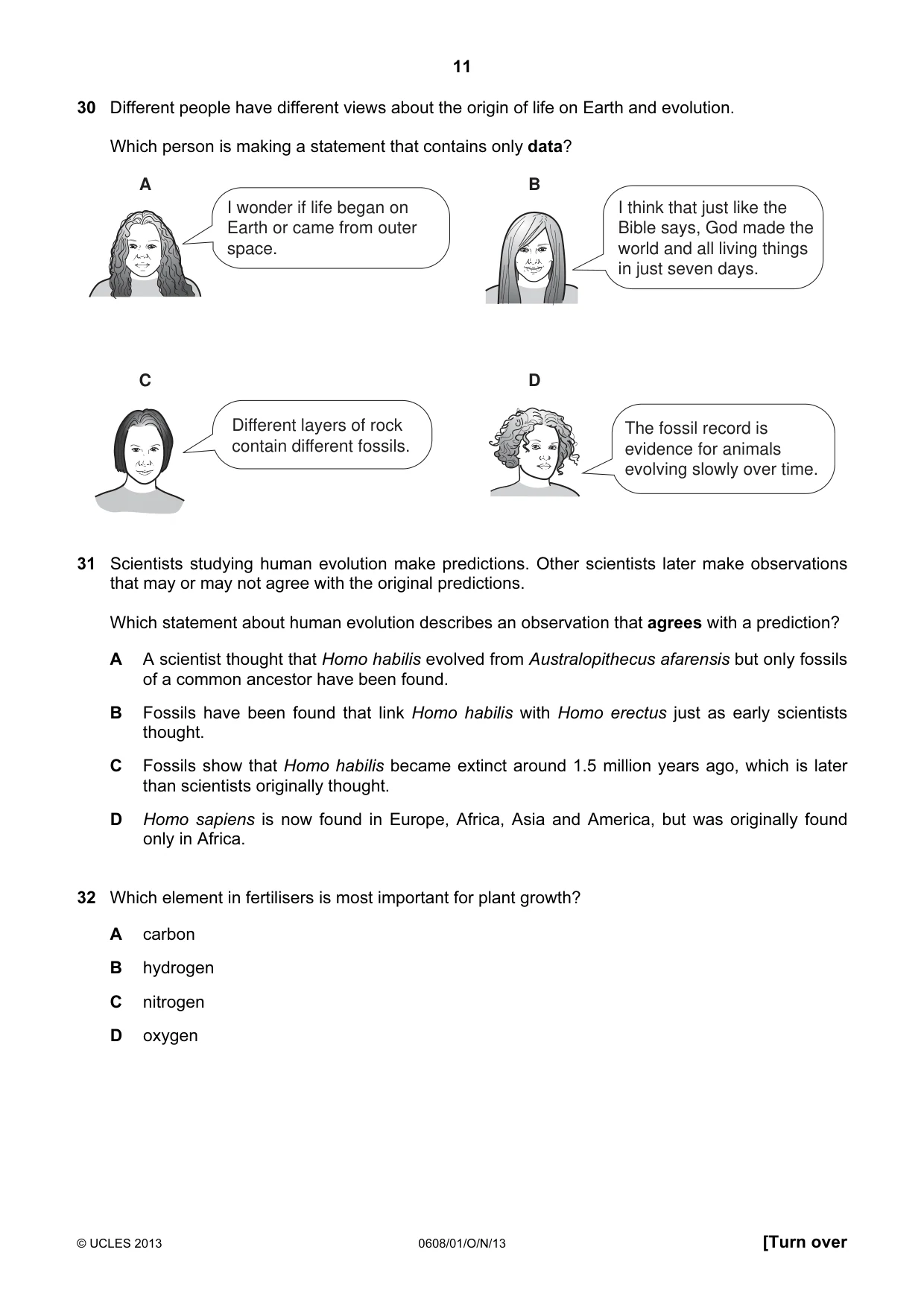
11 © UCLES 2013 0608/01/O/N/13 [Turn over 30 Different people have different views about the origin of life on Earth and evolution. Which person is making a statement that contains only data? Different layers of rock contain different fossils. I wonder if life began on Earth or came from outer space. The fossil record is evidence for animals evolving slowly over time. A D B C I think that just like the Bible says, God made the world and all living things in just seven days. 31 Scientists studying human evolution make predictions. Other scientists later make observations that may or may not agree with the original predictions. Which statement about human evolution describes an observation that agrees with a prediction? A A scientist thought that Homo habilis evolved from Australopithecus afarensis but only fossils of a common ancestor have been found. B Fossils have been found that link Homo habilis with Homo erectus just as early scientists thought. C Fossils show that Homo habilis became extinct around 1.5 million years ago, which is later than scientists originally thought. D Homo sapiens is now found in Europe, Africa, Asia and America, but was originally found only in Africa. 32 Which element in fertilisers is most important for plant growth? A carbon B hydrogen C nitrogen D oxygen
Question paper, page 12
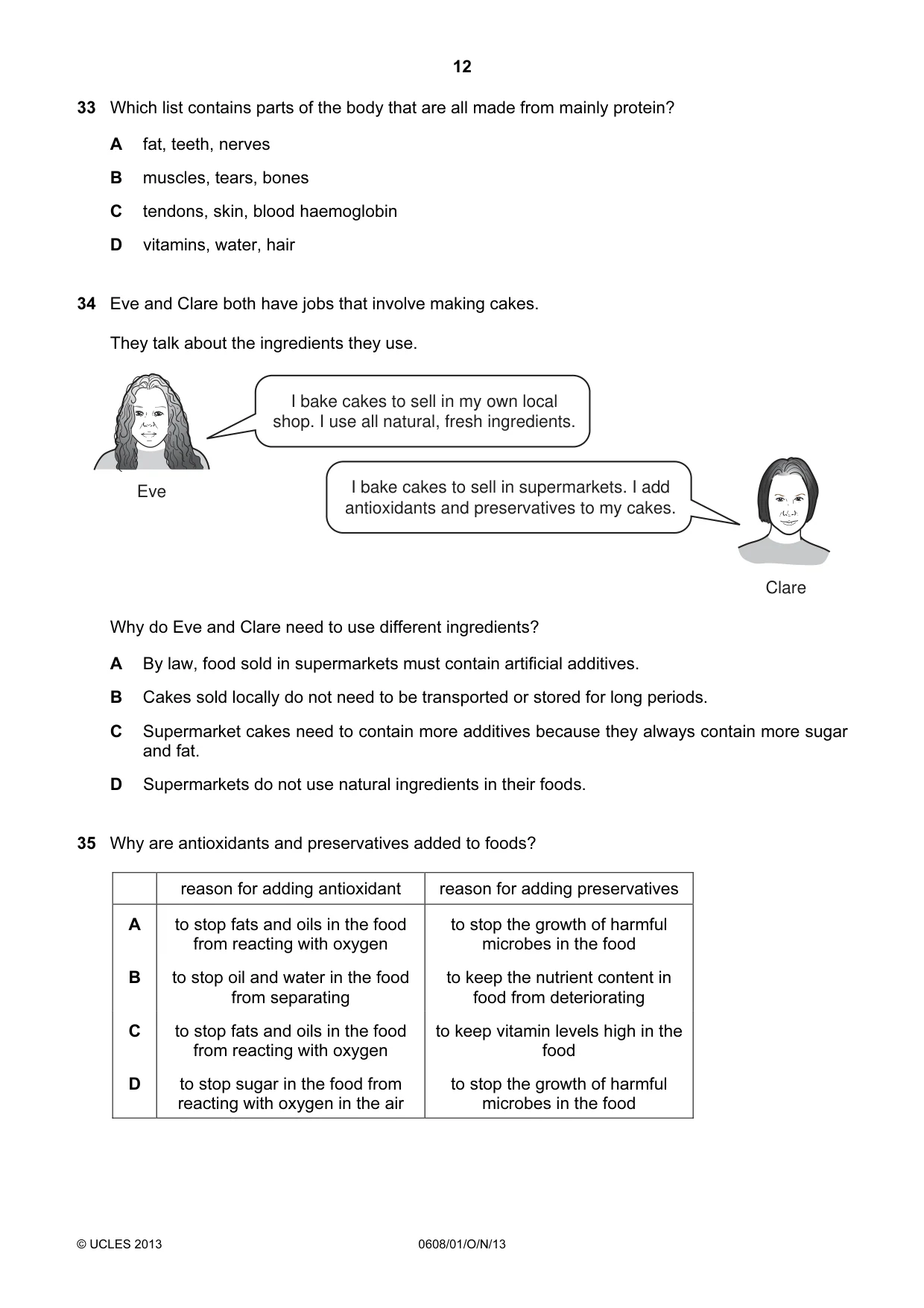
12 © UCLES 2013 0608/01/O/N/13 33 Which list contains parts of the body that are all made from mainly protein? A fat, teeth, nerves B muscles, tears, bones C tendons, skin, blood haemoglobin D vitamins, water, hair 34 Eve and Clare both have jobs that involve making cakes. They talk about the ingredients they use. I bake cakes to sell in my own local shop. I use all natural, fresh ingredients. Eve Clare I bake cakes to sell in supermarkets. I add antioxidants and preservatives to my cakes. Why do Eve and Clare need to use different ingredients? A By law, food sold in supermarkets must contain artificial additives. B Cakes sold locally do not need to be transported or stored for long periods. C Supermarket cakes need to contain more additives because they always contain more sugar and fat. D Supermarkets do not use natural ingredients in their foods. 35 Why are antioxidants and preservatives added to foods? reason for adding antioxidant reason for adding preservatives A to stop fats and oils in the food from reacting with oxygen to stop the growth of harmful microbes in the food B to stop oil and water in the food from separating to keep the nutrient content in food from deteriorating C to stop fats and oils in the food from reacting with oxygen to keep vitamin levels high in the food D to stop sugar in the food from reacting with oxygen in the air to stop the growth of harmful microbes in the food
Question paper, page 13
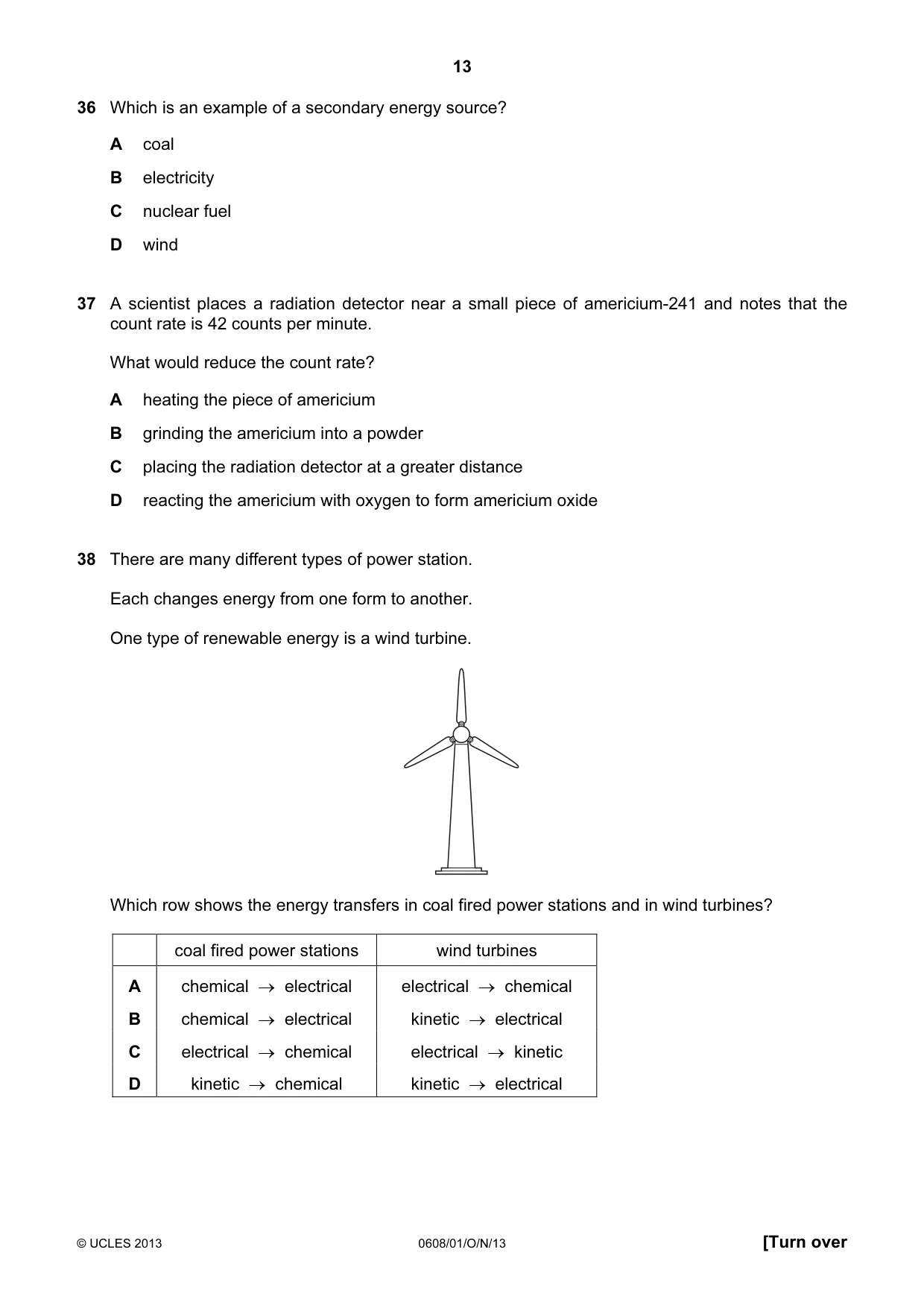
13 © UCLES 2013 0608/01/O/N/13 [Turn over 36 Which is an example of a secondary energy source? A coal B electricity C nuclear fuel D wind 37 A scientist places a radiation detector near a small piece of americium-241 and notes that the count rate is 42 counts per minute. What would reduce the count rate? A heating the piece of americium B grinding the americium into a powder C placing the radiation detector at a greater distance D reacting the americium with oxygen to form americium oxide 38 There are many different types of power station. Each changes energy from one form to another. One type of renewable energy is a wind turbine. Which row shows the energy transfers in coal fired power stations and in wind turbines? coal fired power stations wind turbines A chemical → electrical electrical → chemical B chemical → electrical kinetic → electrical C electrical → chemical electrical → kinetic D kinetic → chemical kinetic → electrical
Question paper, page 14
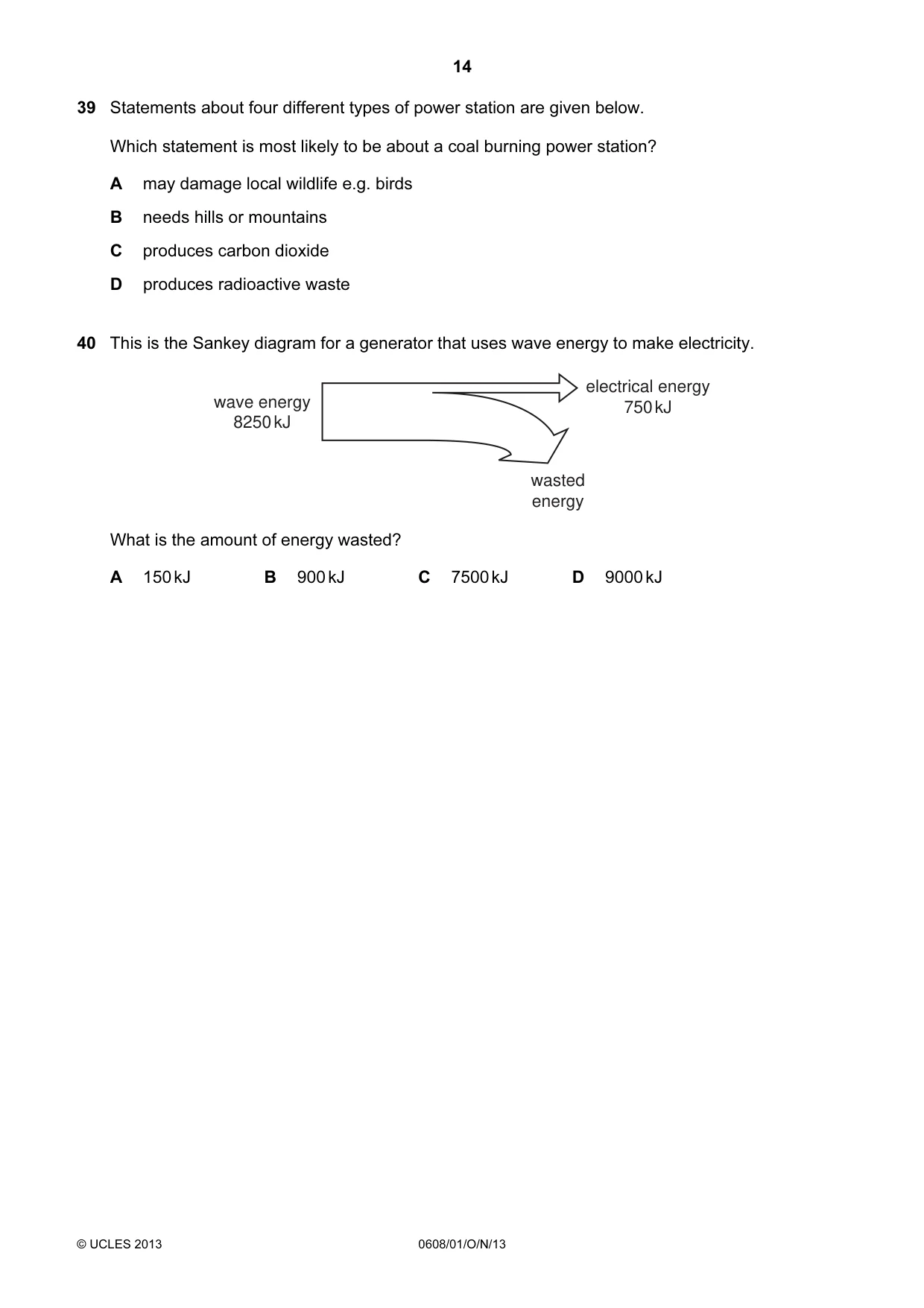
14 © UCLES 2013 0608/01/O/N/13 39 Statements about four different types of power station are given below. Which statement is most likely to be about a coal burning power station? A may damage local wildlife e.g. birds B needs hills or mountains C produces carbon dioxide D produces radioactive waste 40 This is the Sankey diagram for a generator that uses wave energy to make electricity. wave energy 8250 kJ electrical energy 750 kJ wasted energy What is the amount of energy wasted? A 150 kJ B 900 kJ C 7500 kJ D 9000 kJ
Question paper, page 15
15 © UCLES 2013 0608/01/O/N/13 BLANK PAGE
Question paper, page 16
16 Permission to reproduce items where third-party owned material protected by copyright is included has been sought and cleared where possible. Every reasonable effort has been made by the publisher (UCLES) to trace copyright holders, but if any items requiring clearance have unwittingly been included, the publisher will be pleased to make amends at the earliest possible opportunity. University of Cambridge International Examinations is part of the Cambridge Assessment Group. Cambridge Assessment is the brand name of University of Cambridge Local Examinations Syndicate (UCLES), which is itself a department of the University of Cambridge. © UCLES 2013 0608/01/O/N/13 BLANK PAGE
Mark scheme, page 1
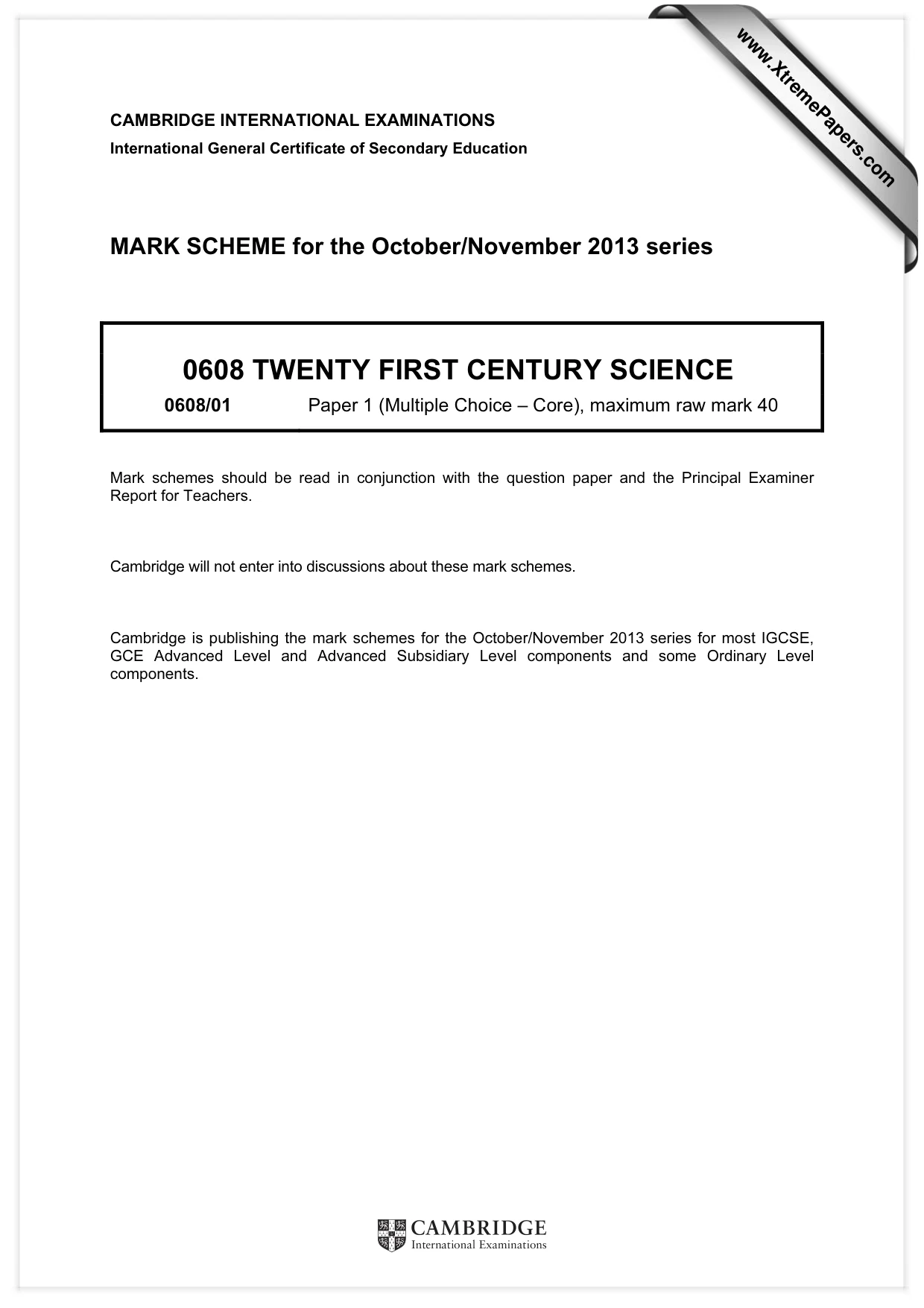
CAMBRIDGE INTERNATIONAL EXAMINATIONS International General Certificate of Secondary Education MARK SCHEME for the October/November 2013 series 0608 TWENTY FIRST CENTURY SCIENCE 0608/01 Paper 1 (Multiple Choice – Core), maximum raw mark 40 Mark schemes should be read in conjunction with the question paper and the Principal Examiner Report for Teachers. Cambridge will not enter into discussions about these mark schemes. Cambridge is publishing the mark schemes for the October/November 2013 series for most IGCSE, GCE Advanced Level and Advanced Subsidiary Level components and some Ordinary Level components. www.XtremePapers.com
Mark scheme, page 2
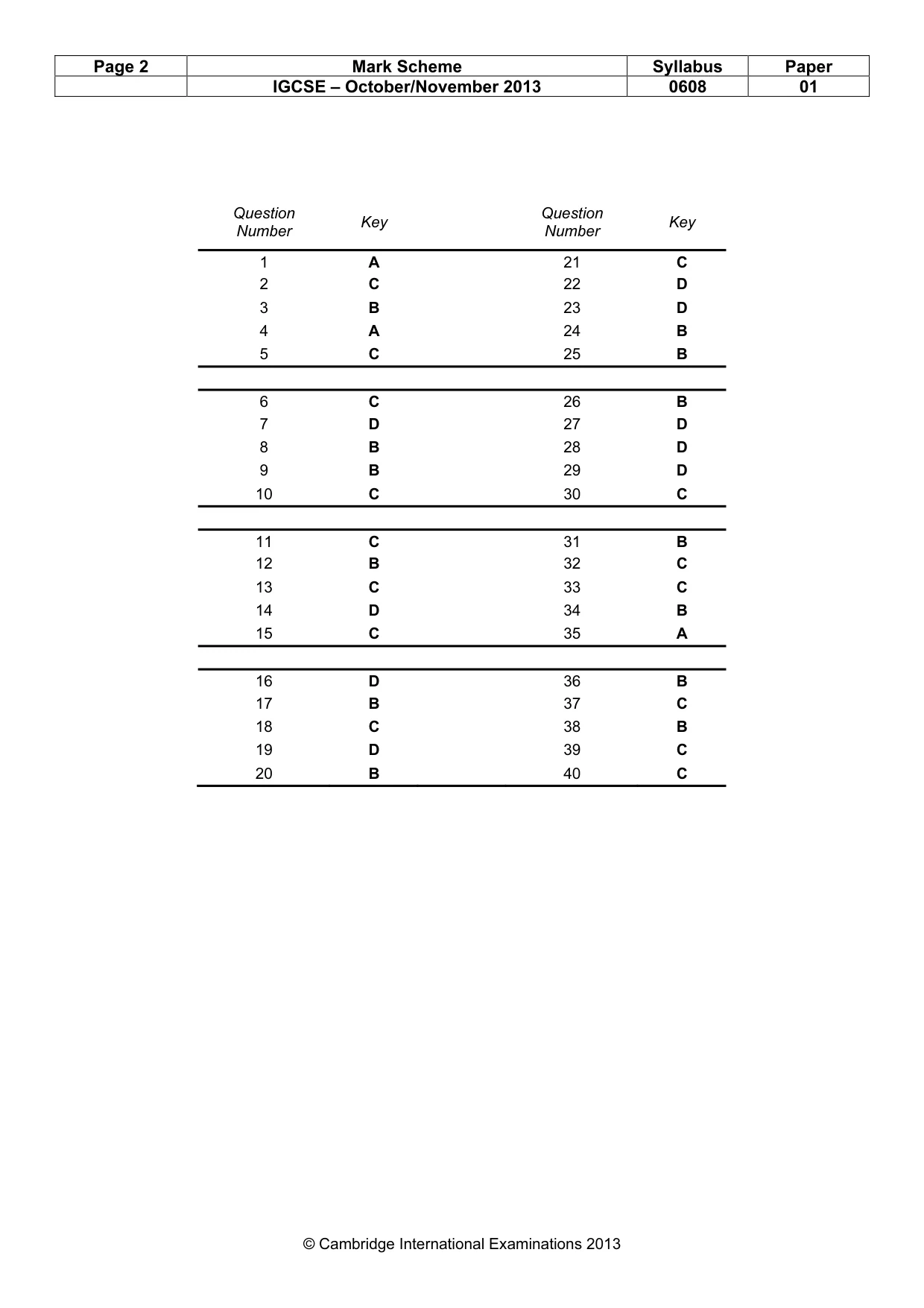
Page 2 Mark Scheme Syllabus Paper IGCSE – October/November 2013 0608 01 © Cambridge International Examinations 2013 Question Number Key Question Number Key 1 A 21 C 2 C 22 D 3 B 23 D 4 A 24 B 5 C 25 B 6 C 26 B 7 D 27 D 8 B 28 D 9 B 29 D 10 C 30 C 11 C 31 B 12 B 32 C 13 C 33 C 14 D 34 B 15 C 35 A 16 D 36 B 17 B 37 C 18 C 38 B 19 D 39 C 20 B 40 C
What you needed in this session
Cambridge’s own grade thresholds for 2013 Oct/Nov, Paper 1 · Variant 1. A higher threshold means an easier paper — the bar moves with how the cohort did.