Cambridge IGCSE Twenty-First Century Science 0608 — 2012 Oct/Nov Paper 1 · Variant 1
0608/11/O/N/12 · 40 marks · ≈45 min
The question paper and its mark scheme, free to read here and free to download. This is Cambridge’s own paper, exactly as it was sat.
Question paper16 pages


Mark scheme2 pages
Answers below. Sit the paper first if you are practising.
Paper as text
Question paper, page 1
This document consists of 14 printed pages and 2 blank pages. IB12 11_0608_01/5RP © UCLES 2012 [Turn over *2810828214* UNIVERSITY OF CAMBRIDGE INTERNATIONAL EXAMINATIONS International General Certificate of Secondary Education TWENTY FIRST CENTURY SCIENCE (CORE) 0608/01 Paper 1 Multiple Choice October/November 2012 1 hour Additional Materials: Multiple Choice Answer Sheet Soft clean eraser Soft pencil (type B or HB is recommended) READ THESE INSTRUCTIONS FIRST Write in soft pencil. Do not use staples, paper clips, highlighters, glue or correction fluid. Write your name, Centre number and candidate number on the Answer Sheet in the spaces provided unless this has been done for you. There are forty questions on this paper. Answer all questions. For each question there are four possible answers A, B, C and D. Choose the one you consider correct and record your choice in soft pencil on the separate Answer Sheet. Read the instructions on the Answer Sheet very carefully. Each correct answer will score one mark. A mark will not be deducted for a wrong answer. Any rough working should be done in this booklet. You may use a calculator. www.XtremePapers.com
Question paper, page 2
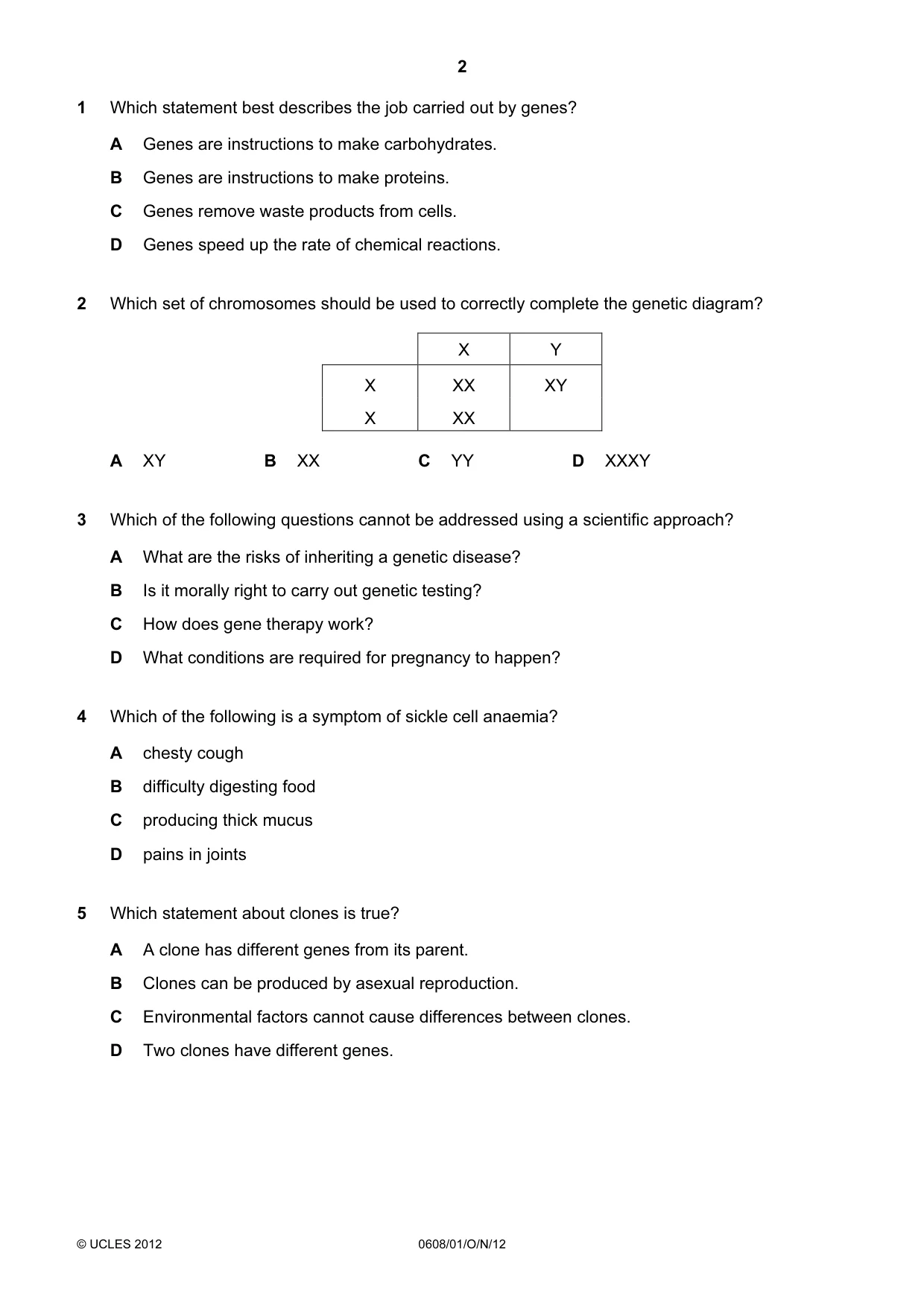
2 © UCLES 2012 0608/01/O/N/12 1 Which statement best describes the job carried out by genes? A Genes are instructions to make carbohydrates. B Genes are instructions to make proteins. C Genes remove waste products from cells. D Genes speed up the rate of chemical reactions. 2 Which set of chromosomes should be used to correctly complete the genetic diagram? X Y X XX XY X XX A XY B XX C YY D XXXY 3 Which of the following questions cannot be addressed using a scientific approach? A What are the risks of inheriting a genetic disease? B Is it morally right to carry out genetic testing? C How does gene therapy work? D What conditions are required for pregnancy to happen? 4 Which of the following is a symptom of sickle cell anaemia? A chesty cough B difficulty digesting food C producing thick mucus D pains in joints 5 Which statement about clones is true? A A clone has different genes from its parent. B Clones can be produced by asexual reproduction. C Environmental factors cannot cause differences between clones. D Two clones have different genes.
Question paper, page 3
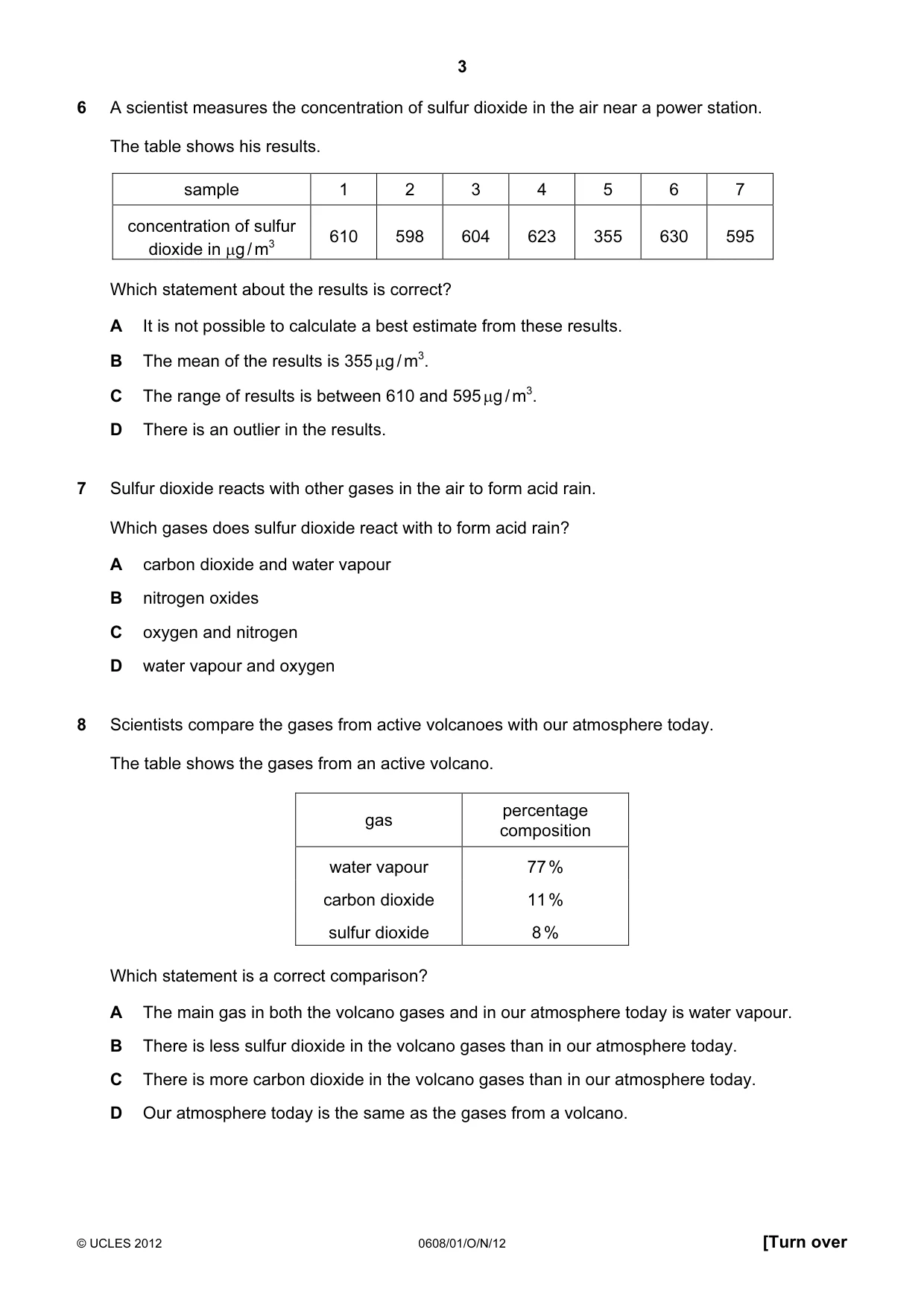
3 © UCLES 2012 0608/01/O/N/12 [Turn over 6 A scientist measures the concentration of sulfur dioxide in the air near a power station. The table shows his results. sample 1 2 3 4 5 6 7 concentration of sulfur dioxide in µg / m3 610 598 604 623 355 630 595 Which statement about the results is correct? A It is not possible to calculate a best estimate from these results. B The mean of the results is 355 µg / m3. C The range of results is between 610 and 595 µg / m3. D There is an outlier in the results. 7 Sulfur dioxide reacts with other gases in the air to form acid rain. Which gases does sulfur dioxide react with to form acid rain? A carbon dioxide and water vapour B nitrogen oxides C oxygen and nitrogen D water vapour and oxygen 8 Scientists compare the gases from active volcanoes with our atmosphere today. The table shows the gases from an active volcano. gas percentage composition water vapour 77 % carbon dioxide 11 % sulfur dioxide 8 % Which statement is a correct comparison? A The main gas in both the volcano gases and in our atmosphere today is water vapour. B There is less sulfur dioxide in the volcano gases than in our atmosphere today. C There is more carbon dioxide in the volcano gases than in our atmosphere today. D Our atmosphere today is the same as the gases from a volcano.
Question paper, page 4
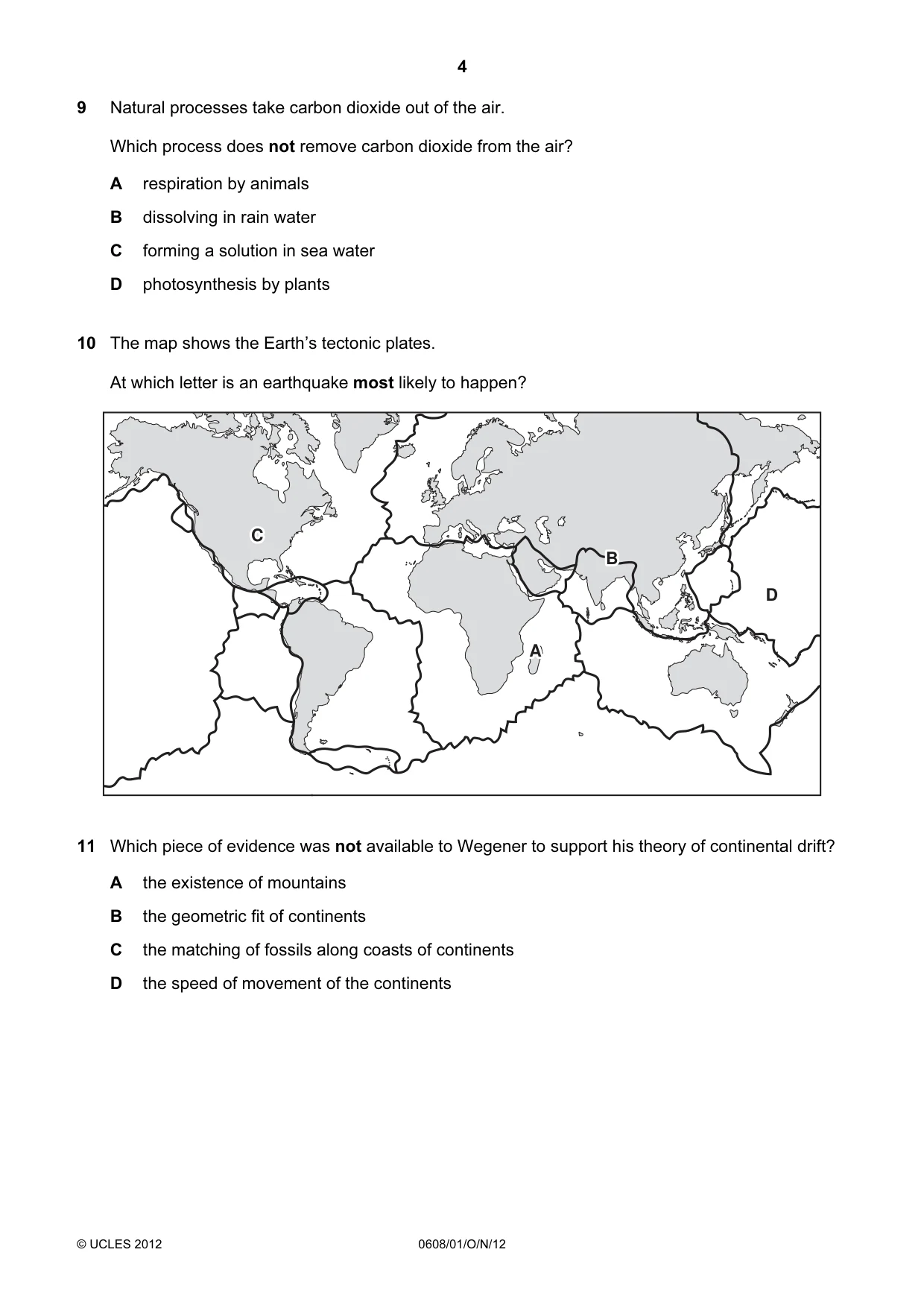
4 © UCLES 2012 0608/01/O/N/12 9 Natural processes take carbon dioxide out of the air. Which process does not remove carbon dioxide from the air? A respiration by animals B dissolving in rain water C forming a solution in sea water D photosynthesis by plants 10 The map shows the Earth’s tectonic plates. At which letter is an earthquake most likely to happen? D C B A 11 Which piece of evidence was not available to Wegener to support his theory of continental drift? A the existence of mountains B the geometric fit of continents C the matching of fossils along coasts of continents D the speed of movement of the continents
Question paper, page 5
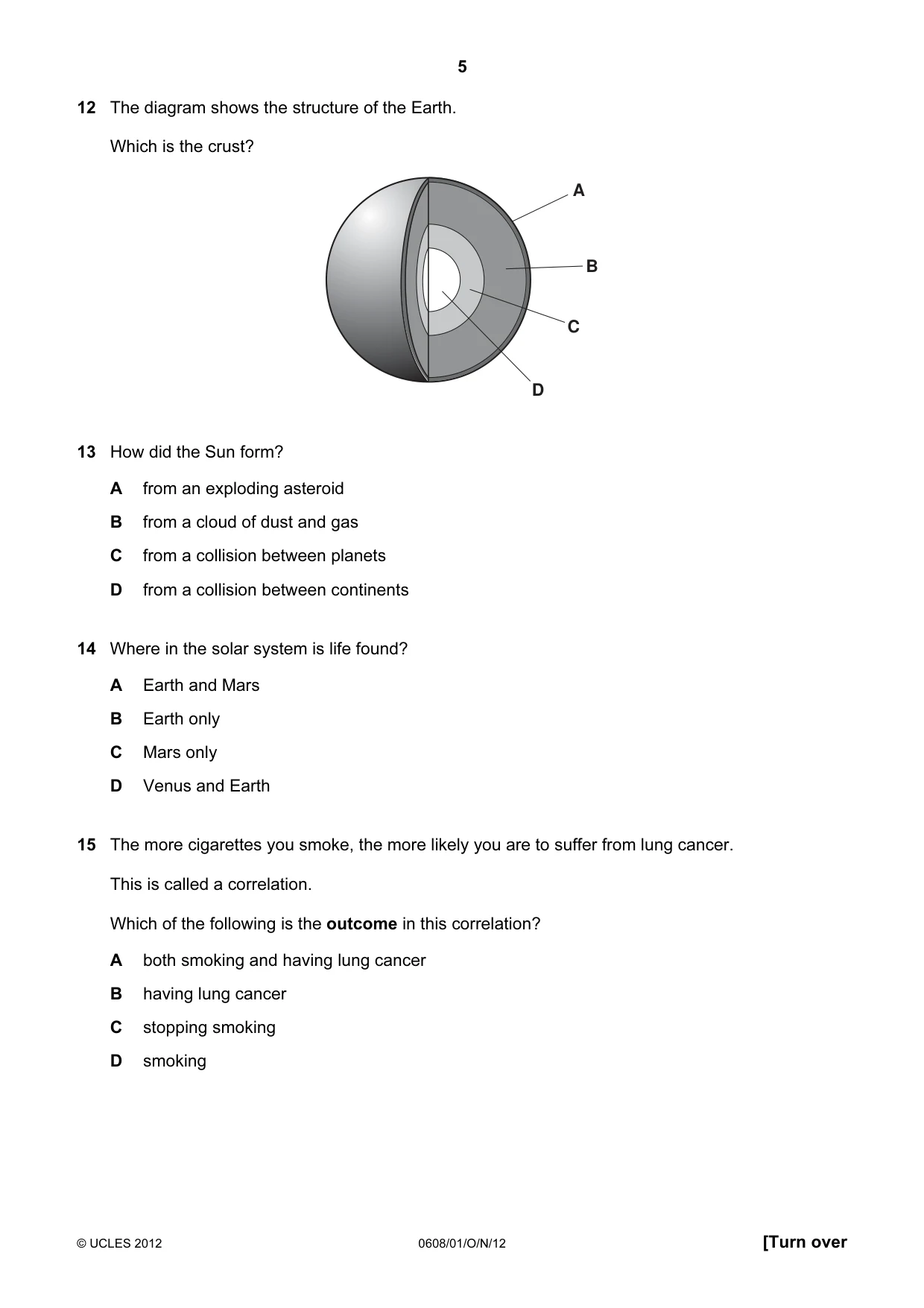
5 © UCLES 2012 0608/01/O/N/12 [Turn over 12 The diagram shows the structure of the Earth. Which is the crust? A B C D 13 How did the Sun form? A from an exploding asteroid B from a cloud of dust and gas C from a collision between planets D from a collision between continents 14 Where in the solar system is life found? A Earth and Mars B Earth only C Mars only D Venus and Earth 15 The more cigarettes you smoke, the more likely you are to suffer from lung cancer. This is called a correlation. Which of the following is the outcome in this correlation? A both smoking and having lung cancer B having lung cancer C stopping smoking D smoking
Question paper, page 6
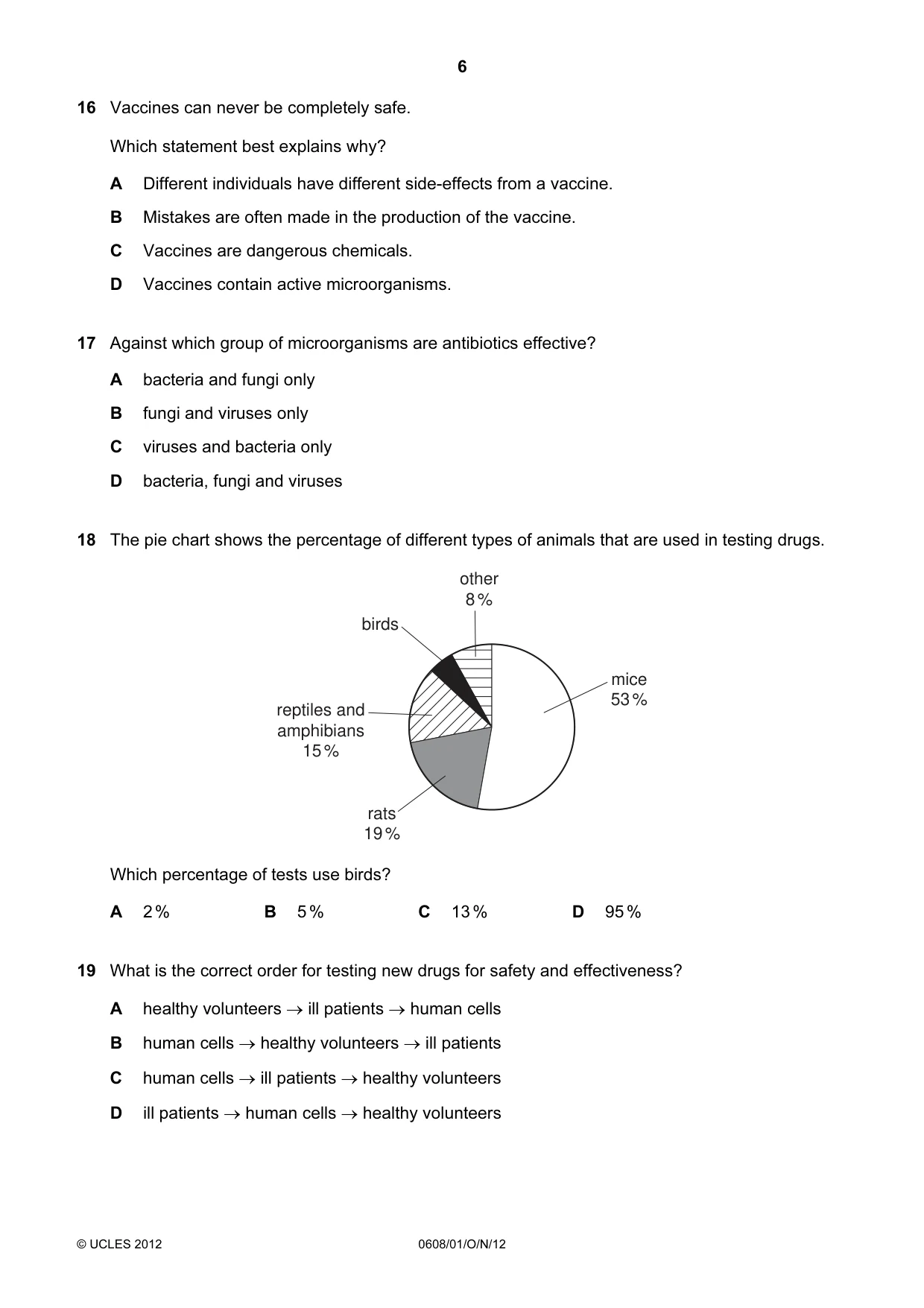
6 © UCLES 2012 0608/01/O/N/12 16 Vaccines can never be completely safe. Which statement best explains why? A Different individuals have different side-effects from a vaccine. B Mistakes are often made in the production of the vaccine. C Vaccines are dangerous chemicals. D Vaccines contain active microorganisms. 17 Against which group of microorganisms are antibiotics effective? A bacteria and fungi only B fungi and viruses only C viruses and bacteria only D bacteria, fungi and viruses 18 The pie chart shows the percentage of different types of animals that are used in testing drugs. mice 53 % rats 19 % other 8 % reptiles and amphibians 15 % birds Which percentage of tests use birds? A 2 % B 5 % C 13 % D 95 % 19 What is the correct order for testing new drugs for safety and effectiveness? A healthy volunteers → ill patients → human cells B human cells → healthy volunteers → ill patients C human cells → ill patients → healthy volunteers D ill patients → human cells → healthy volunteers
Question paper, page 7
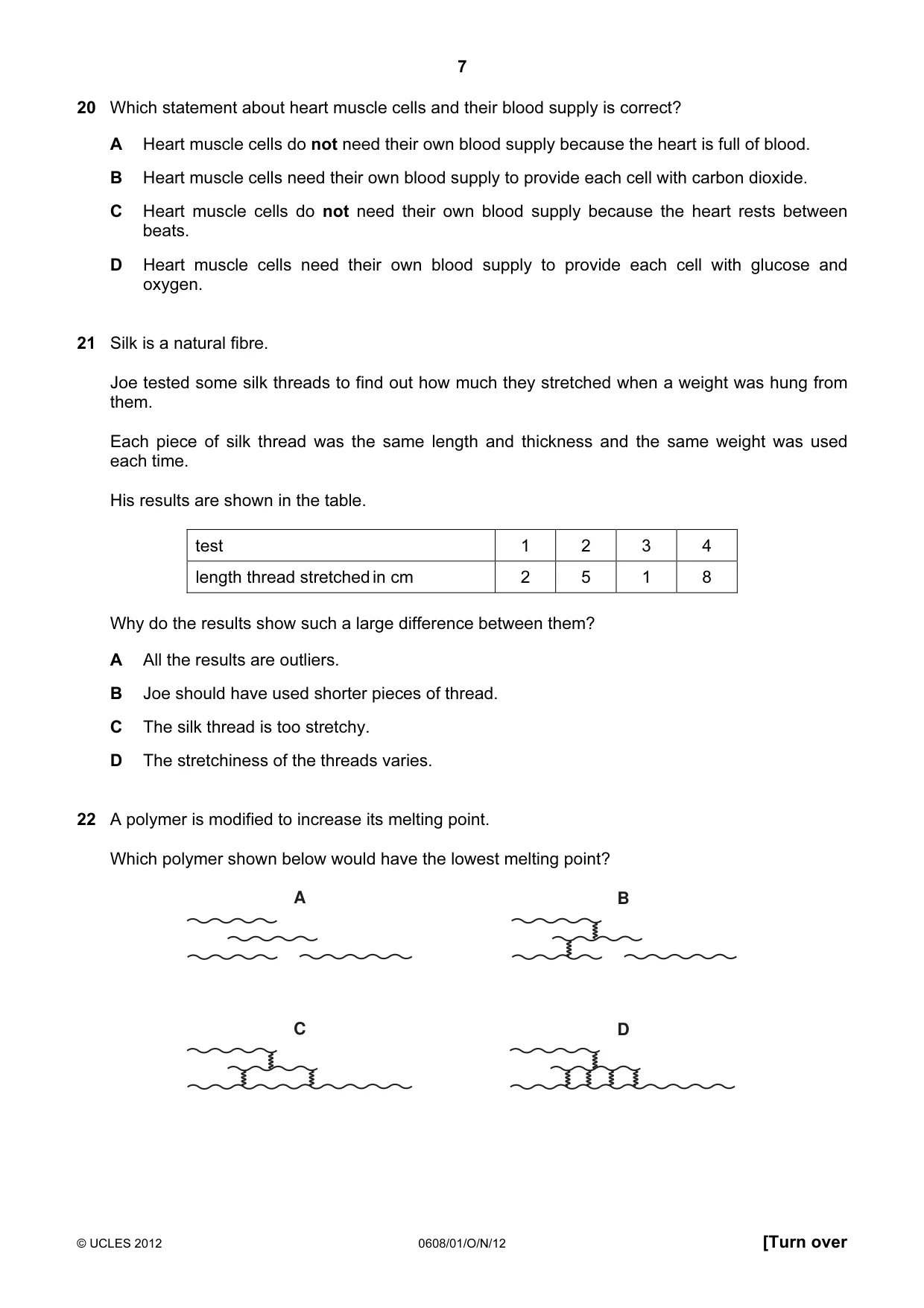
7 © UCLES 2012 0608/01/O/N/12 [Turn over 20 Which statement about heart muscle cells and their blood supply is correct? A Heart muscle cells do not need their own blood supply because the heart is full of blood. B Heart muscle cells need their own blood supply to provide each cell with carbon dioxide. C Heart muscle cells do not need their own blood supply because the heart rests between beats. D Heart muscle cells need their own blood supply to provide each cell with glucose and oxygen. 21 Silk is a natural fibre. Joe tested some silk threads to find out how much they stretched when a weight was hung from them. Each piece of silk thread was the same length and thickness and the same weight was used each time. His results are shown in the table. test 1 2 3 4 length thread stretched in cm 2 5 1 8 Why do the results show such a large difference between them? A All the results are outliers. B Joe should have used shorter pieces of thread. C The silk thread is too stretchy. D The stretchiness of the threads varies. 22 A polymer is modified to increase its melting point. Which polymer shown below would have the lowest melting point? A B C D
Question paper, page 8
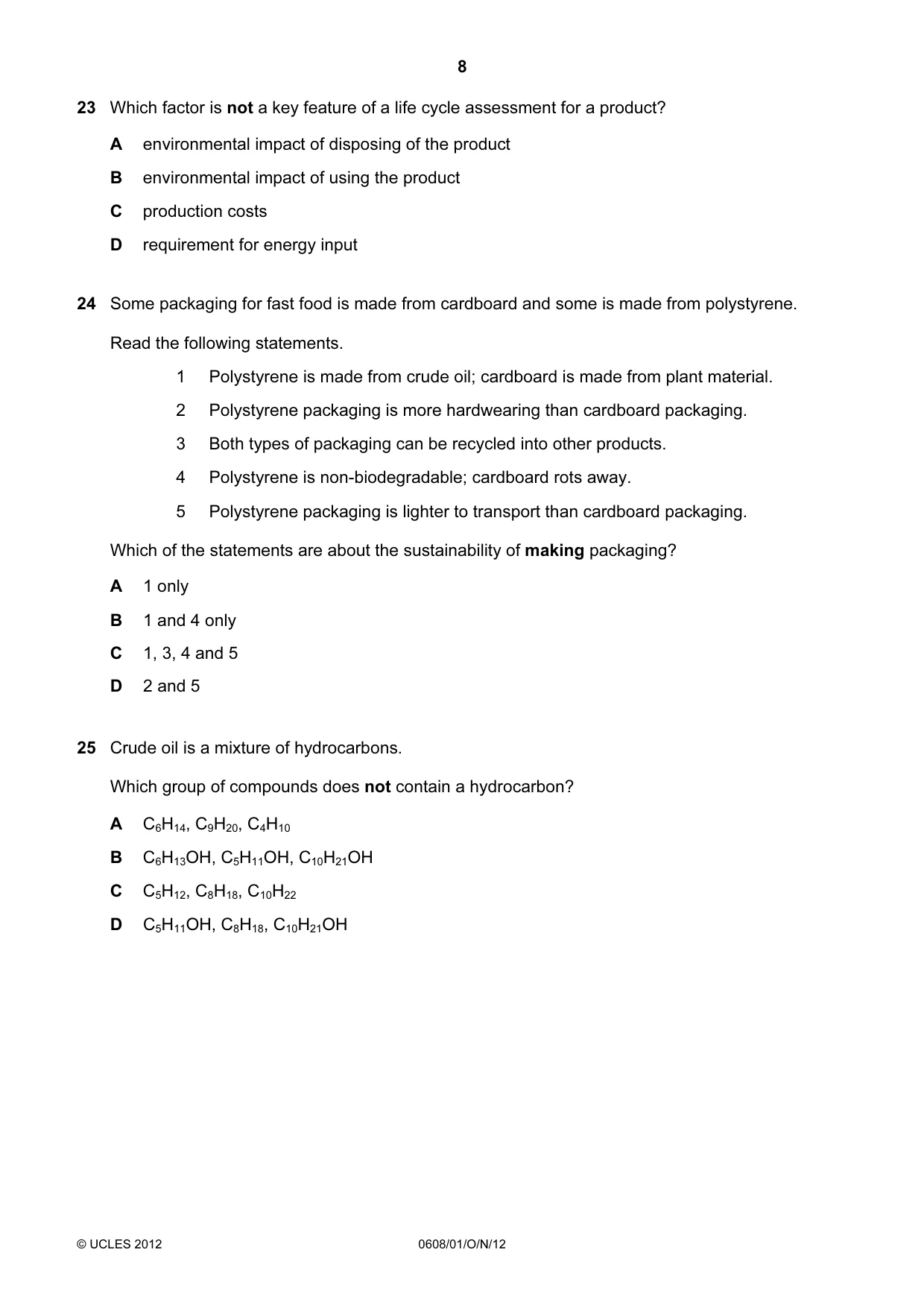
8 © UCLES 2012 0608/01/O/N/12 23 Which factor is not a key feature of a life cycle assessment for a product? A environmental impact of disposing of the product B environmental impact of using the product C production costs D requirement for energy input 24 Some packaging for fast food is made from cardboard and some is made from polystyrene. Read the following statements. 1 Polystyrene is made from crude oil; cardboard is made from plant material. 2 Polystyrene packaging is more hardwearing than cardboard packaging. 3 Both types of packaging can be recycled into other products. 4 Polystyrene is non-biodegradable; cardboard rots away. 5 Polystyrene packaging is lighter to transport than cardboard packaging. Which of the statements are about the sustainability of making packaging? A 1 only B 1 and 4 only C 1, 3, 4 and 5 D 2 and 5 25 Crude oil is a mixture of hydrocarbons. Which group of compounds does not contain a hydrocarbon? A C6H14, C9H20, C4H10 B C6H13OH, C5H11OH, C10H21OH C C5H12, C8H18, C10H22 D C5H11OH, C8H18, C10H21OH
Question paper, page 9
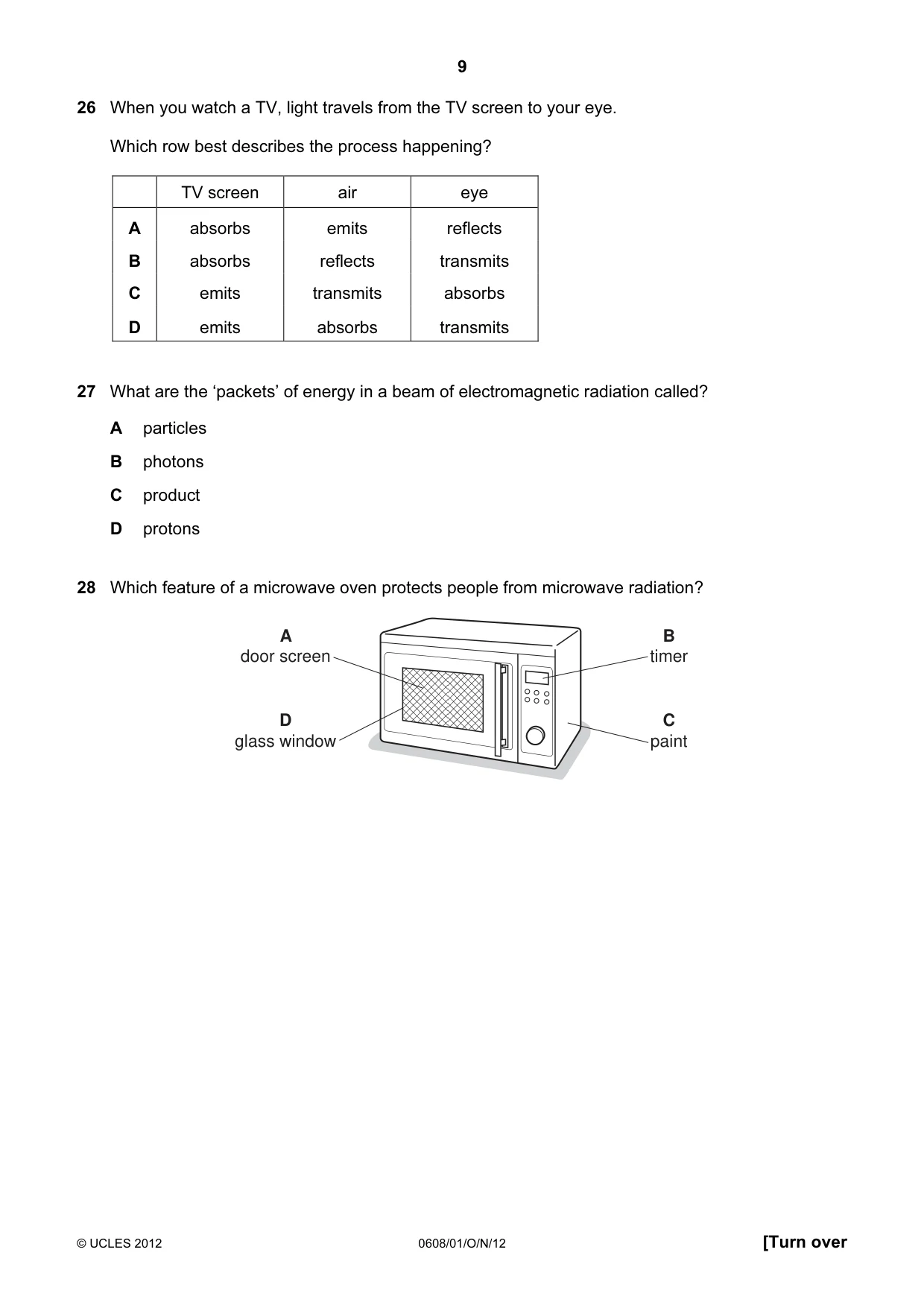
9 © UCLES 2012 0608/01/O/N/12 [Turn over 26 When you watch a TV, light travels from the TV screen to your eye. Which row best describes the process happening? TV screen air eye A absorbs emits reflects B absorbs reflects transmits C emits transmits absorbs D emits absorbs transmits 27 What are the ‘packets’ of energy in a beam of electromagnetic radiation called? A particles B photons C product D protons 28 Which feature of a microwave oven protects people from microwave radiation? A door screen D glass window B timer C paint
Question paper, page 10
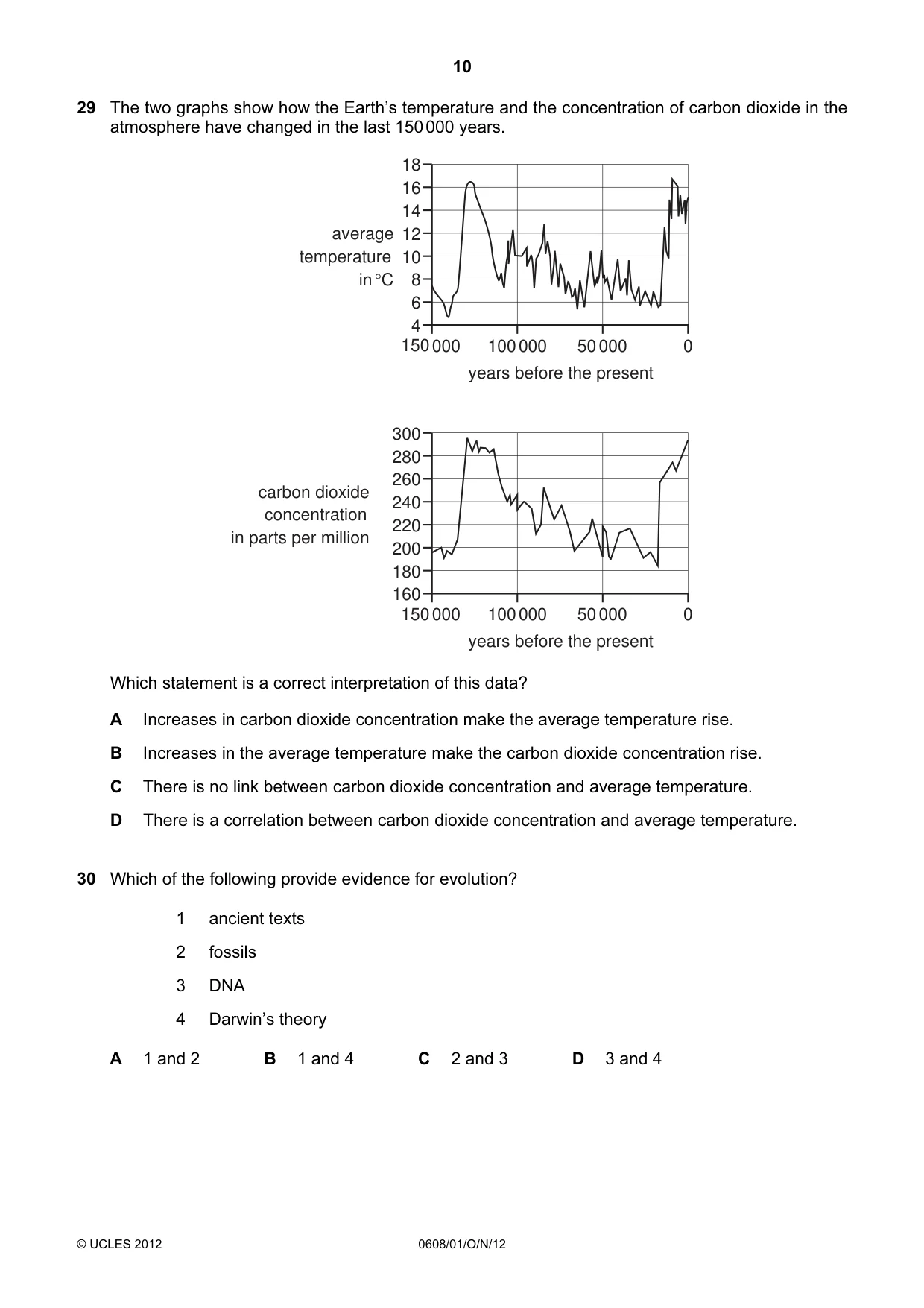
10 © UCLES 2012 0608/01/O/N/12 29 The two graphs show how the Earth’s temperature and the concentration of carbon dioxide in the atmosphere have changed in the last 150 000 years. 18 16 14 12 10 8 6 4 150 000 100 000 50 000 years before the present 0 average temperature in °C 300 280 260 240 220 200 180 160 150 000 100 000 50 000 years before the present 0 carbon dioxide concentration in parts per million Which statement is a correct interpretation of this data? A Increases in carbon dioxide concentration make the average temperature rise. B Increases in the average temperature make the carbon dioxide concentration rise. C There is no link between carbon dioxide concentration and average temperature. D There is a correlation between carbon dioxide concentration and average temperature. 30 Which of the following provide evidence for evolution? 1 ancient texts 2 fossils 3 DNA 4 Darwin’s theory A 1 and 2 B 1 and 4 C 2 and 3 D 3 and 4
Question paper, page 11
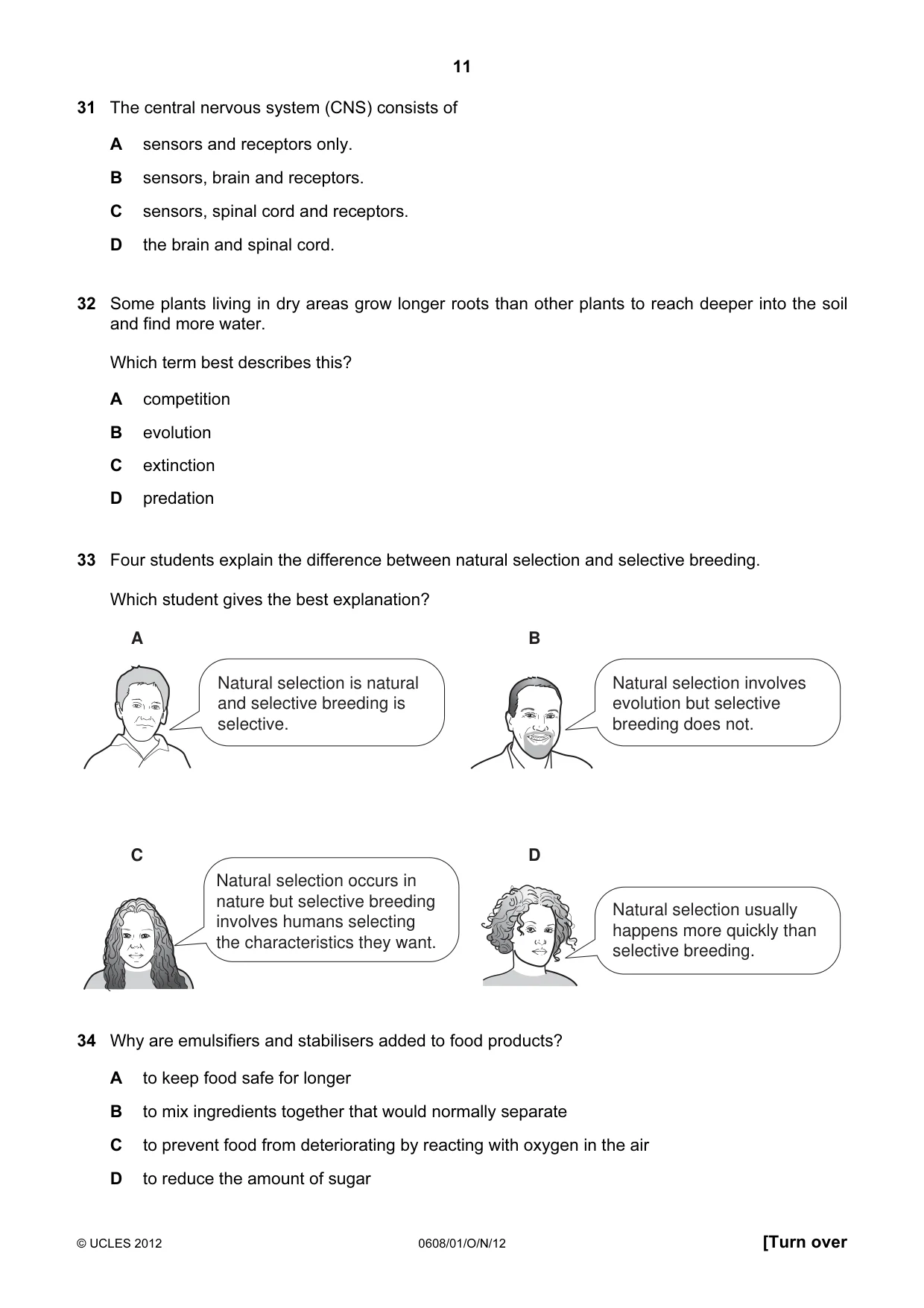
11 © UCLES 2012 0608/01/O/N/12 [Turn over 31 The central nervous system (CNS) consists of A sensors and receptors only. B sensors, brain and receptors. C sensors, spinal cord and receptors. D the brain and spinal cord. 32 Some plants living in dry areas grow longer roots than other plants to reach deeper into the soil and find more water. Which term best describes this? A competition B evolution C extinction D predation 33 Four students explain the difference between natural selection and selective breeding. Which student gives the best explanation? Natural selection occurs in nature but selective breeding involves humans selecting the characteristics they want. Natural selection is natural and selective breeding is selective. Natural selection usually happens more quickly than selective breeding. A D B C Natural selection involves evolution but selective breeding does not. 34 Why are emulsifiers and stabilisers added to food products? A to keep food safe for longer B to mix ingredients together that would normally separate C to prevent food from deteriorating by reacting with oxygen in the air D to reduce the amount of sugar
Question paper, page 12
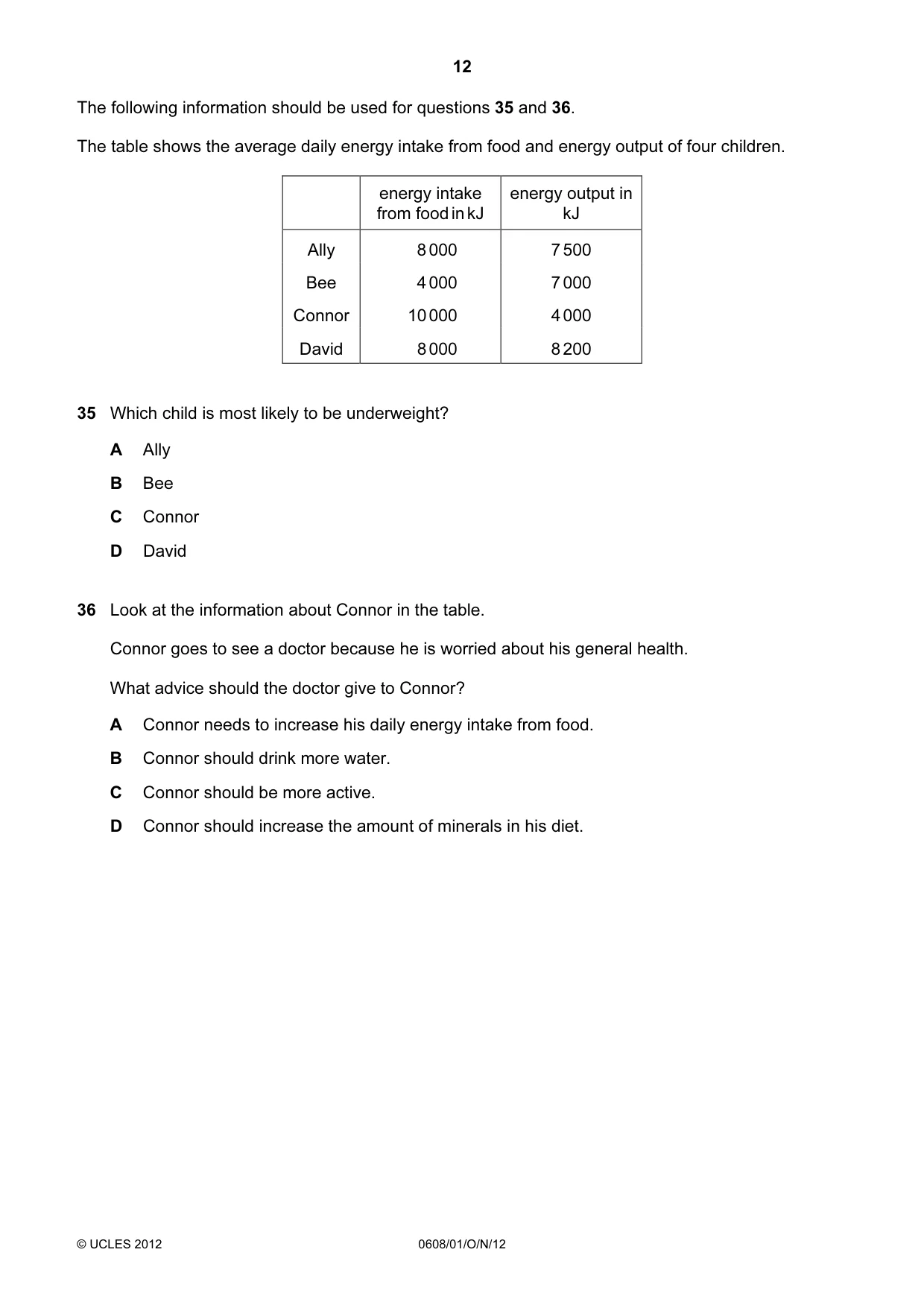
12 © UCLES 2012 0608/01/O/N/12 The following information should be used for questions 35 and 36. The table shows the average daily energy intake from food and energy output of four children. energy intake from food in kJ energy output in kJ Ally 8 000 7 500 Bee 4 000 7 000 Connor 10 000 4 000 David 8 000 8 200 35 Which child is most likely to be underweight? A Ally B Bee C Connor D David 36 Look at the information about Connor in the table. Connor goes to see a doctor because he is worried about his general health. What advice should the doctor give to Connor? A Connor needs to increase his daily energy intake from food. B Connor should drink more water. C Connor should be more active. D Connor should increase the amount of minerals in his diet.
Question paper, page 13
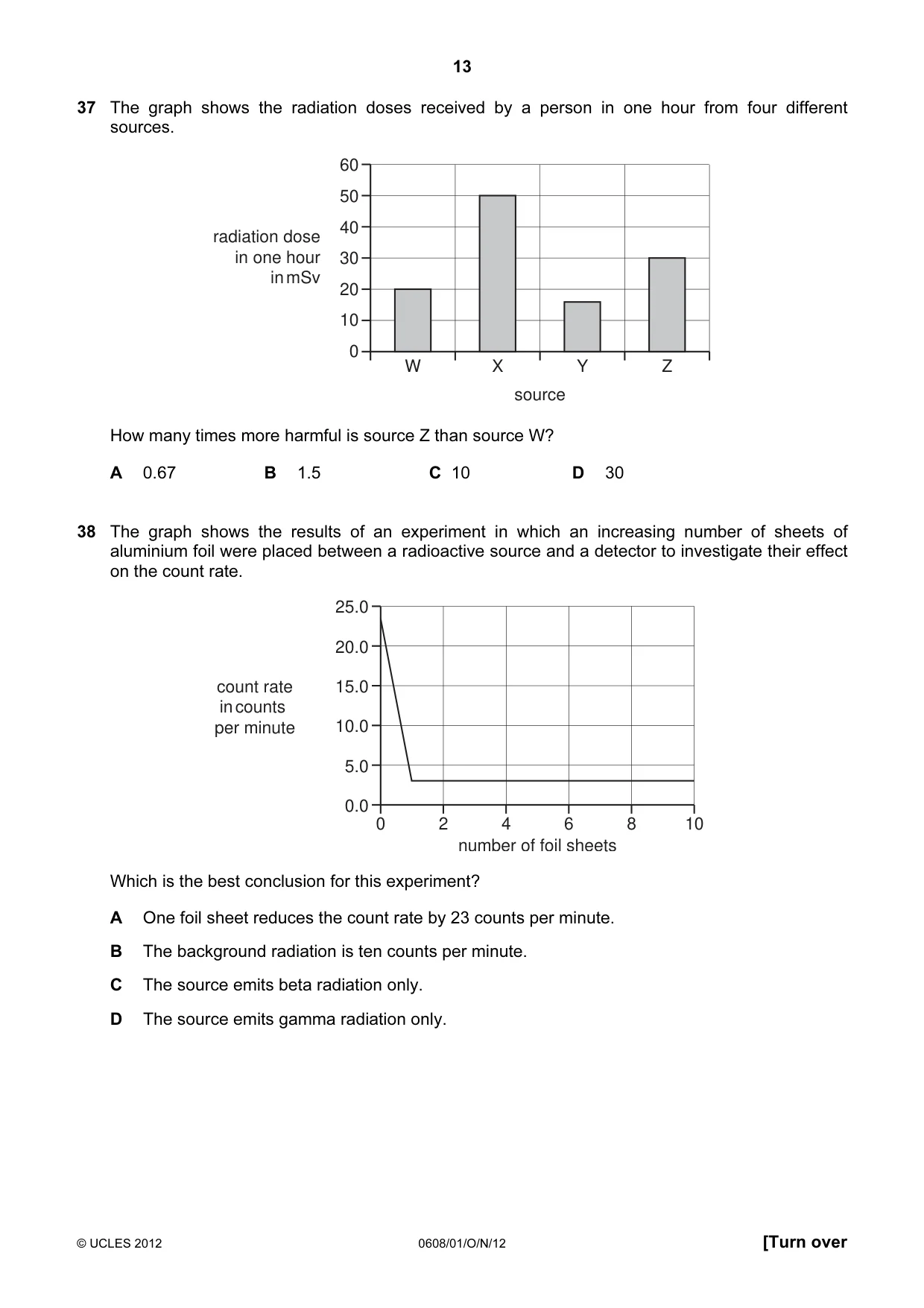
13 © UCLES 2012 0608/01/O/N/12 [Turn over 37 The graph shows the radiation doses received by a person in one hour from four different sources. 60 50 40 30 20 10 0 radiation dose in one hour in mSv W X Y source Z How many times more harmful is source Z than source W? A 0.67 B 1.5 C 10 D 30 38 The graph shows the results of an experiment in which an increasing number of sheets of aluminium foil were placed between a radioactive source and a detector to investigate their effect on the count rate. 25.0 20.0 15.0 10.0 5.0 0.0 count rate in counts per minute number of foil sheets 0 2 4 6 8 10 Which is the best conclusion for this experiment? A One foil sheet reduces the count rate by 23 counts per minute. B The background radiation is ten counts per minute. C The source emits beta radiation only. D The source emits gamma radiation only.
Question paper, page 14
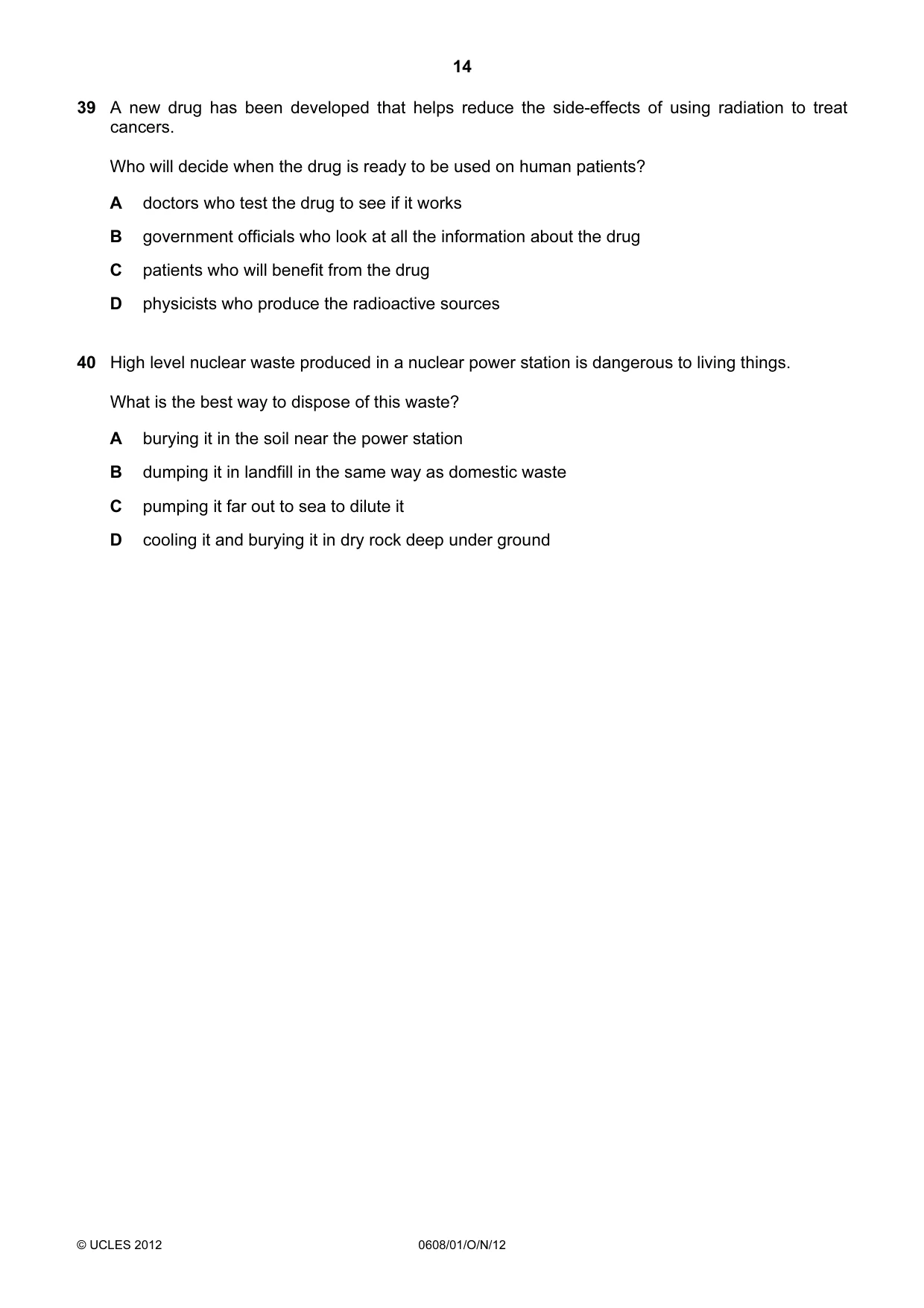
14 © UCLES 2012 0608/01/O/N/12 39 A new drug has been developed that helps reduce the side-effects of using radiation to treat cancers. Who will decide when the drug is ready to be used on human patients? A doctors who test the drug to see if it works B government officials who look at all the information about the drug C patients who will benefit from the drug D physicists who produce the radioactive sources 40 High level nuclear waste produced in a nuclear power station is dangerous to living things. What is the best way to dispose of this waste? A burying it in the soil near the power station B dumping it in landfill in the same way as domestic waste C pumping it far out to sea to dilute it D cooling it and burying it in dry rock deep under ground
Question paper, page 15
15 © UCLES 2012 0608/01/O/N/12 BLANK PAGE
Question paper, page 16
16 Permission to reproduce items where third-party owned material protected by copyright is included has been sought and cleared where possible. Every reasonable effort has been made by the publisher (UCLES) to trace copyright holders, but if any items requiring clearance have unwittingly been included, the publisher will be pleased to make amends at the earliest possible opportunity. University of Cambridge International Examinations is part of the Cambridge Assessment Group. Cambridge Assessment is the brand name of University of Cambridge Local Examinations Syndicate (UCLES), which is itself a department of the University of Cambridge. © UCLES 2012 0608/01/O/N/12 BLANK PAGE
Mark scheme, page 1
CAMBRIDGE INTERNATIONAL EXAMINATIONS International General Certificate of Secondary Education MARK SCHEME for the October/November 2012 series 0608 TWENTY FIRST CENTURY SCIENCE 0608/01 Paper 1 (Multiple Choice), maximum raw mark 40 Mark schemes should be read in conjunction with the question paper and the Principal Examiner Report for Teachers. Cambridge will not enter into discussions about these mark schemes. Cambridge is publishing the mark schemes for the October/November 2012 series for most IGCSE, GCE Advanced Level and Advanced Subsidiary Level components and some Ordinary Level components. www.XtremePapers.com
Mark scheme, page 2
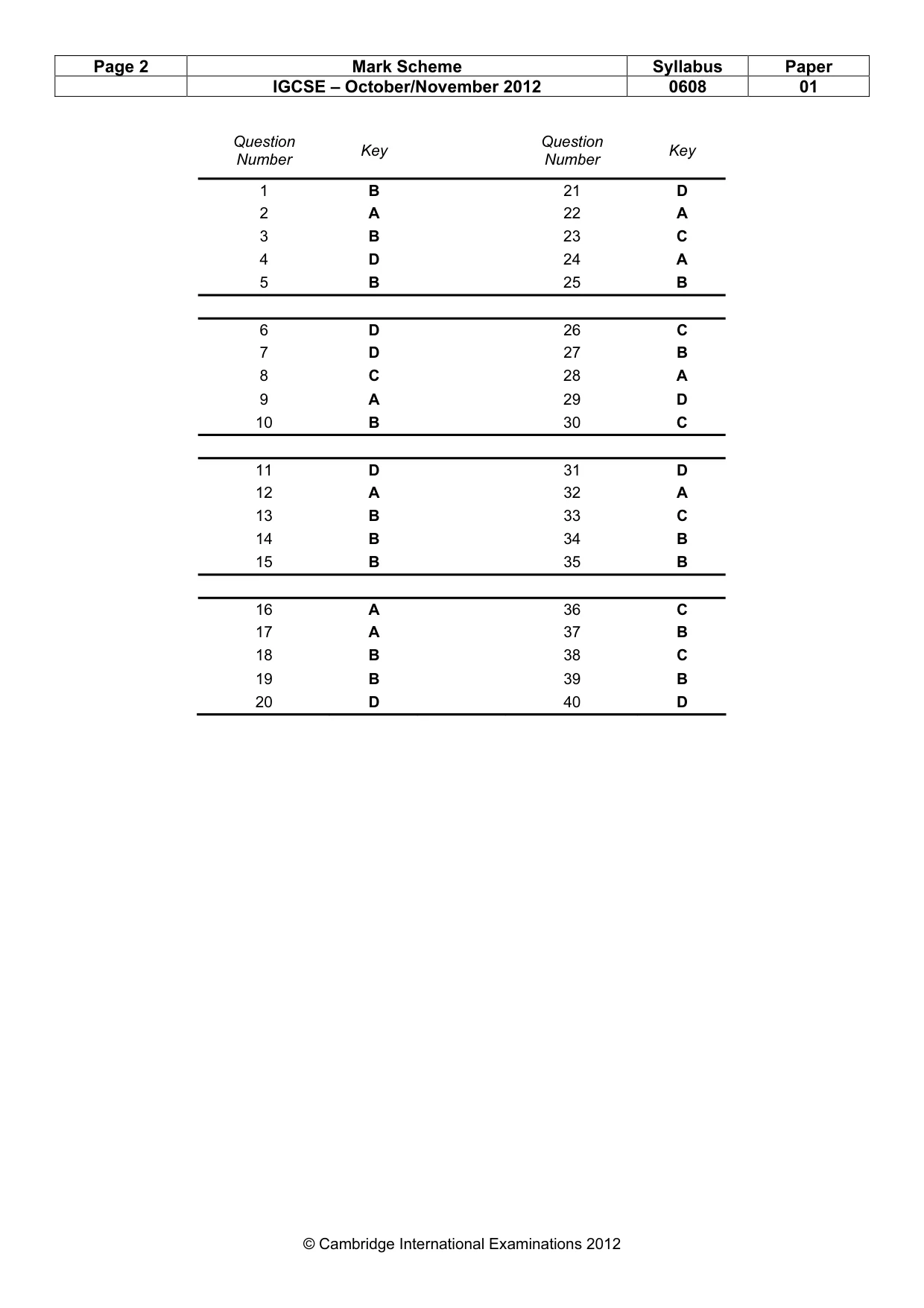
Page 2 Mark Scheme Syllabus Paper IGCSE – October/November 2012 0608 01 © Cambridge International Examinations 2012 Question Number Key Question Number Key 1 B 21 D 2 A 22 A 3 B 23 C 4 D 24 A 5 B 25 B 6 D 26 C 7 D 27 B 8 C 28 A 9 A 29 D 10 B 30 C 11 D 31 D 12 A 32 A 13 B 33 C 14 B 34 B 15 B 35 B 16 A 36 C 17 A 37 B 18 B 38 C 19 B 39 B 20 D 40 D
What you needed in this session
Cambridge’s own grade thresholds for 2012 Oct/Nov, Paper 1 · Variant 1. A higher threshold means an easier paper — the bar moves with how the cohort did.