Cambridge IGCSE Twenty-First Century Science 0608 — 2010 May/June Paper 1 · Variant 1
0608/11/M/J/10 · 40 marks · ≈45 min
The question paper and its mark scheme, free to read here and free to download. This is Cambridge’s own paper, exactly as it was sat.
Question paper16 pages


Mark scheme2 pages
Answers below. Sit the paper first if you are practising.
Paper as text
Question paper, page 1
This document consists of 13 printed pages and 3 blank pages. IB10 06_0608_01/RP © UCLES 2010 [Turn over *2371878210* UNIVERSITY OF CAMBRIDGE INTERNATIONAL EXAMINATIONS International General Certificate of Secondary Education TWENTY FIRST CENTURY SCIENCE (CORE) 0608/01 Paper 1 Multiple Choice May/June 2010 1 hour Additional Materials: Multiple Choice Answer Sheet Soft clean eraser Soft pencil (type B or HB is recommended) READ THESE INSTRUCTIONS FIRST Write in soft pencil. Do not use staples, paper clips, highlighters, glue or correction fluid. Write your name, Centre number and candidate number on the Answer Sheet in the spaces provided unless this has been done for you. There are forty questions on this paper. Answer all questions. For each question there are four possible answers A, B, C and D. Choose the one you consider correct and record your choice in soft pencil on the separate Answer Sheet. Read the instructions on the Answer Sheet very carefully. Each correct answer will score one mark. A mark will not be deducted for a wrong answer. Any rough working should be done in this booklet. You may use a calculator. www.XtremePapers.com
Question paper, page 2
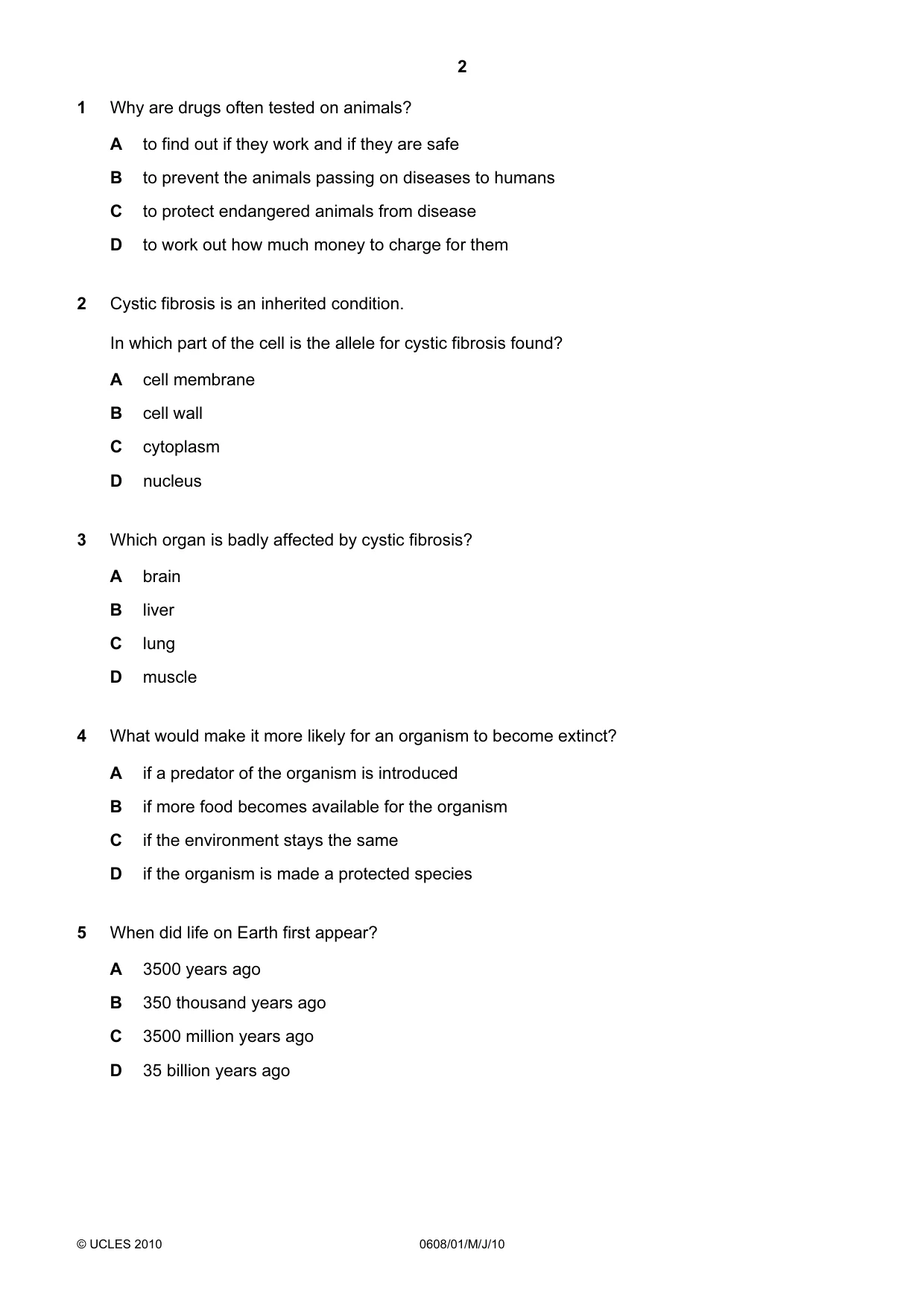
2 © UCLES 2010 0608/01/M/J/10 1 Why are drugs often tested on animals? A to find out if they work and if they are safe B to prevent the animals passing on diseases to humans C to protect endangered animals from disease D to work out how much money to charge for them 2 Cystic fibrosis is an inherited condition. In which part of the cell is the allele for cystic fibrosis found? A cell membrane B cell wall C cytoplasm D nucleus 3 Which organ is badly affected by cystic fibrosis? A brain B liver C lung D muscle 4 What would make it more likely for an organism to become extinct? A if a predator of the organism is introduced B if more food becomes available for the organism C if the environment stays the same D if the organism is made a protected species 5 When did life on Earth first appear? A 3500 years ago B 350 thousand years ago C 3500 million years ago D 35 billion years ago
Question paper, page 3
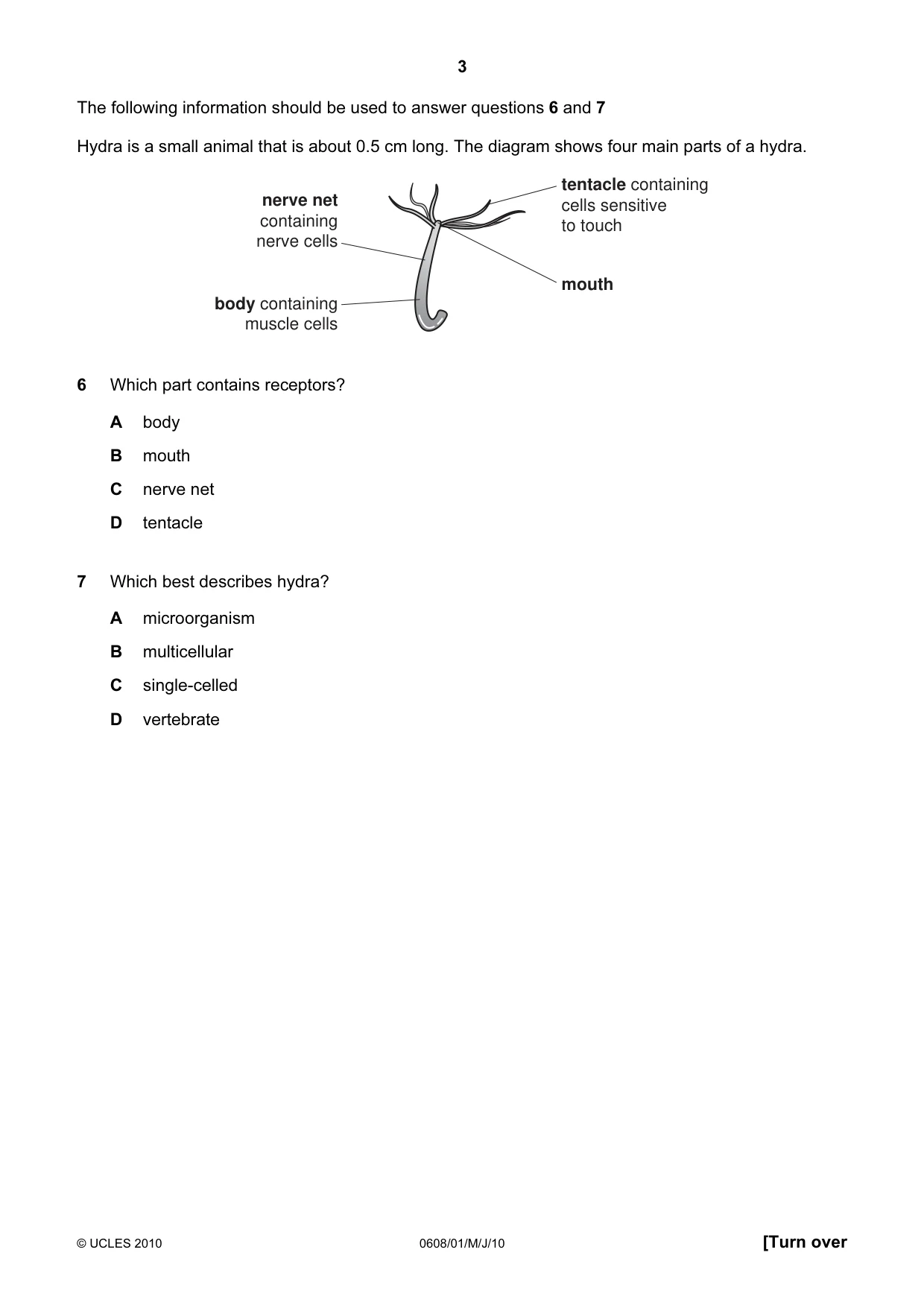
3 © UCLES 2010 0608/01/M/J/10 [Turn over The following information should be used to answer questions 6 and 7 Hydra is a small animal that is about 0.5 cm long. The diagram shows four main parts of a hydra. tentacle containing cells sensitive to touch mouth body containing muscle cells nerve net containing nerve cells 6 Which part contains receptors? A body B mouth C nerve net D tentacle 7 Which best describes hydra? A microorganism B multicellular C single-celled D vertebrate
Question paper, page 4
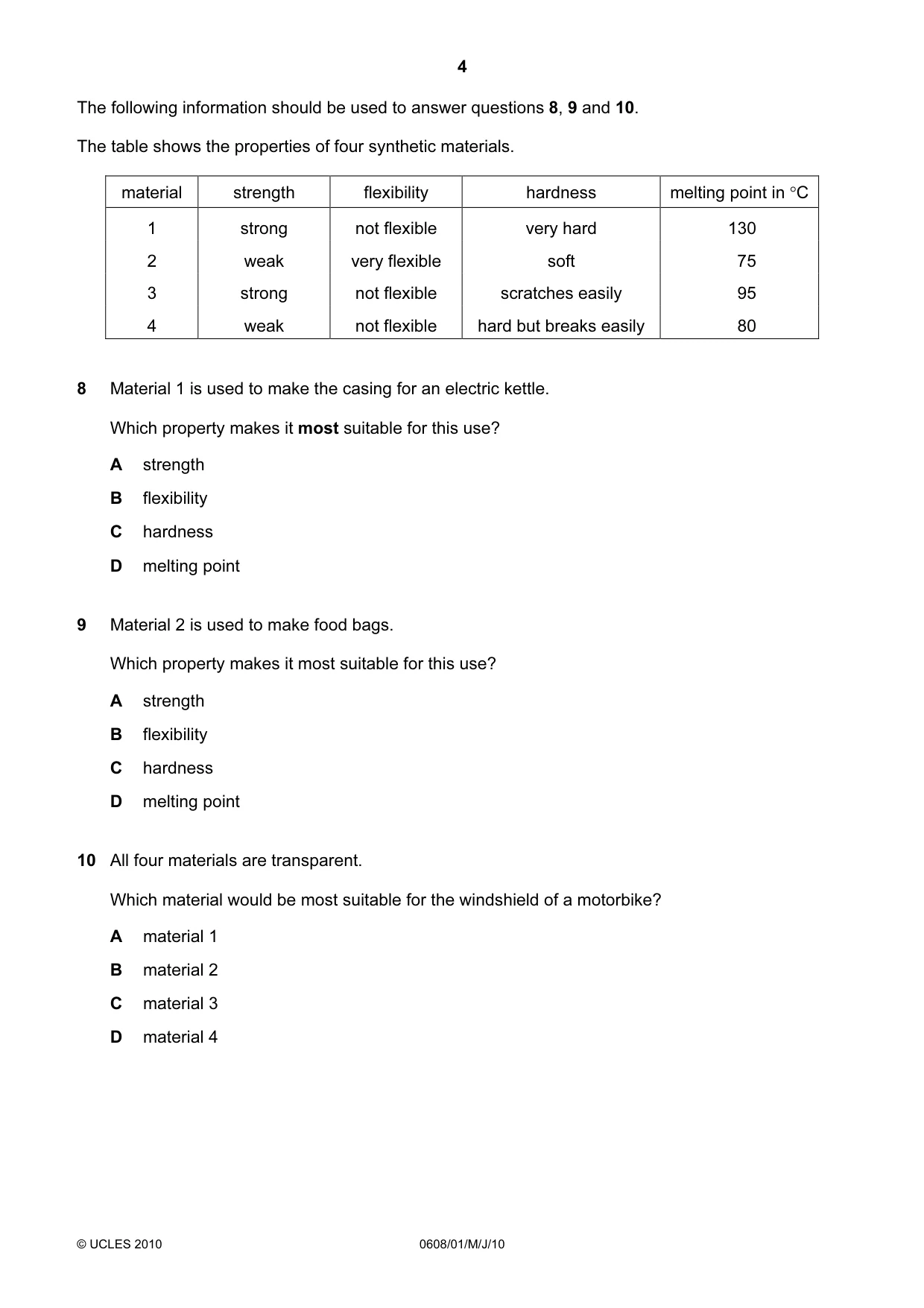
4 © UCLES 2010 0608/01/M/J/10 The following information should be used to answer questions 8, 9 and 10. The table shows the properties of four synthetic materials. material strength flexibility hardness melting point in °C 1 strong not flexible very hard 130 2 weak very flexible soft 75 3 strong not flexible scratches easily 95 4 weak not flexible hard but breaks easily 80 8 Material 1 is used to make the casing for an electric kettle. Which property makes it most suitable for this use? A strength B flexibility C hardness D melting point 9 Material 2 is used to make food bags. Which property makes it most suitable for this use? A strength B flexibility C hardness D melting point 10 All four materials are transparent. Which material would be most suitable for the windshield of a motorbike? A material 1 B material 2 C material 3 D material 4
Question paper, page 5
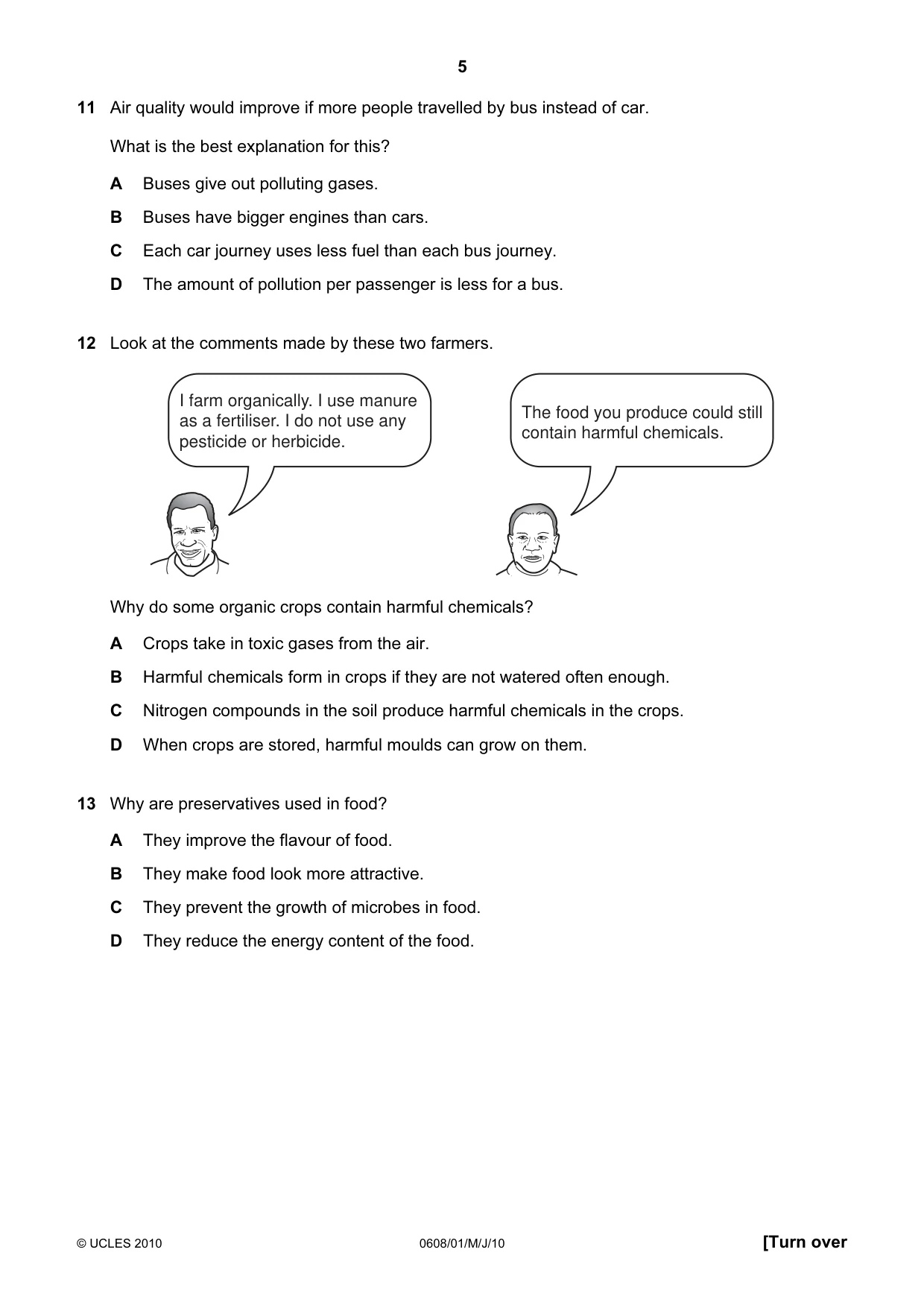
5 © UCLES 2010 0608/01/M/J/10 [Turn over 11 Air quality would improve if more people travelled by bus instead of car. What is the best explanation for this? A Buses give out polluting gases. B Buses have bigger engines than cars. C Each car journey uses less fuel than each bus journey. D The amount of pollution per passenger is less for a bus. 12 Look at the comments made by these two farmers. I farm organically. I use manure as a fertiliser. I do not use any pesticide or herbicide. The food you produce could still contain harmful chemicals. Why do some organic crops contain harmful chemicals? A Crops take in toxic gases from the air. B Harmful chemicals form in crops if they are not watered often enough. C Nitrogen compounds in the soil produce harmful chemicals in the crops. D When crops are stored, harmful moulds can grow on them. 13 Why are preservatives used in food? A They improve the flavour of food. B They make food look more attractive. C They prevent the growth of microbes in food. D They reduce the energy content of the food.
Question paper, page 6
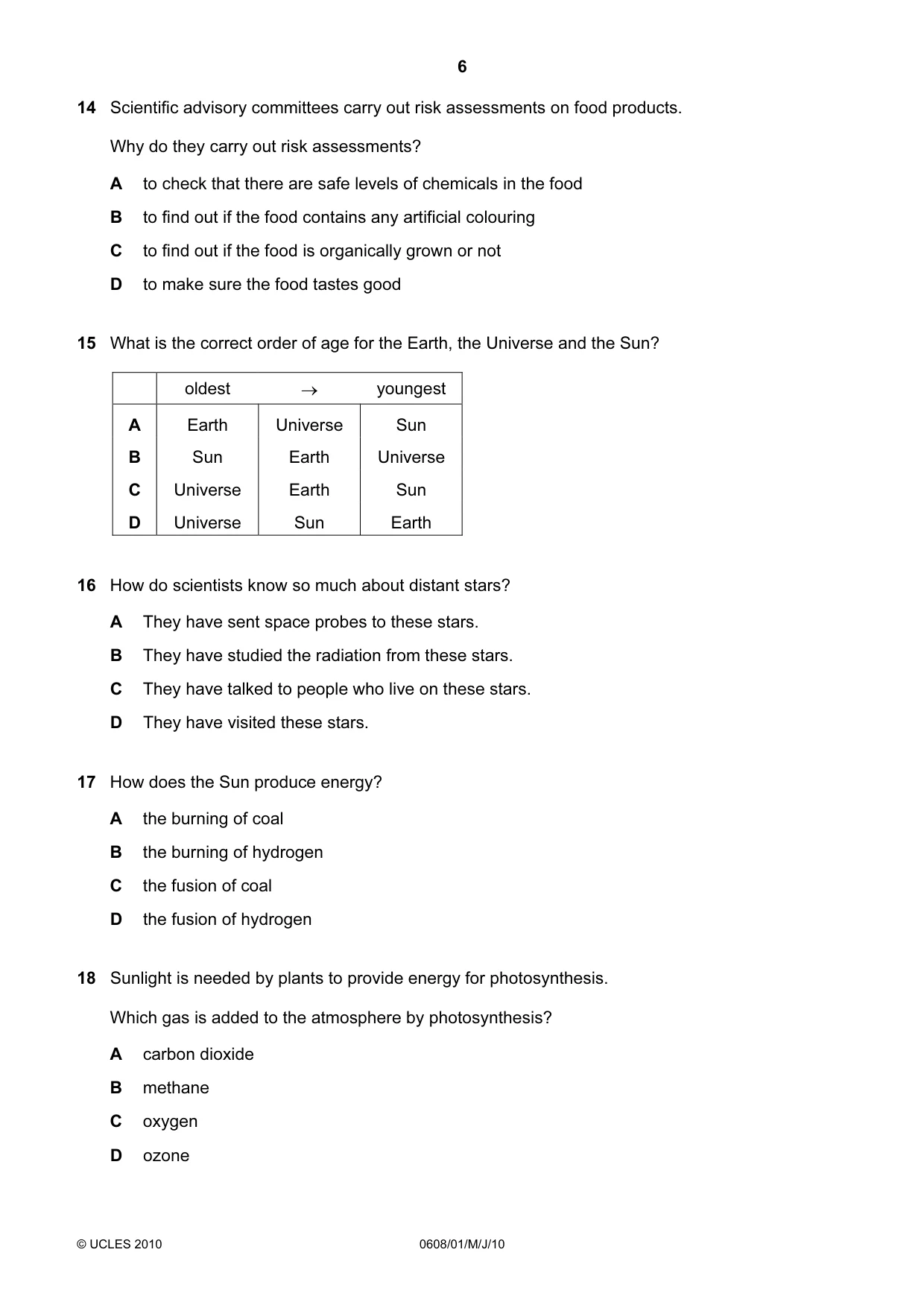
6 © UCLES 2010 0608/01/M/J/10 14 Scientific advisory committees carry out risk assessments on food products. Why do they carry out risk assessments? A to check that there are safe levels of chemicals in the food B to find out if the food contains any artificial colouring C to find out if the food is organically grown or not D to make sure the food tastes good 15 What is the correct order of age for the Earth, the Universe and the Sun? oldest → youngest A Earth Universe Sun B Sun Earth Universe C Universe Earth Sun D Universe Sun Earth 16 How do scientists know so much about distant stars? A They have sent space probes to these stars. B They have studied the radiation from these stars. C They have talked to people who live on these stars. D They have visited these stars. 17 How does the Sun produce energy? A the burning of coal B the burning of hydrogen C the fusion of coal D the fusion of hydrogen 18 Sunlight is needed by plants to provide energy for photosynthesis. Which gas is added to the atmosphere by photosynthesis? A carbon dioxide B methane C oxygen D ozone
Question paper, page 7
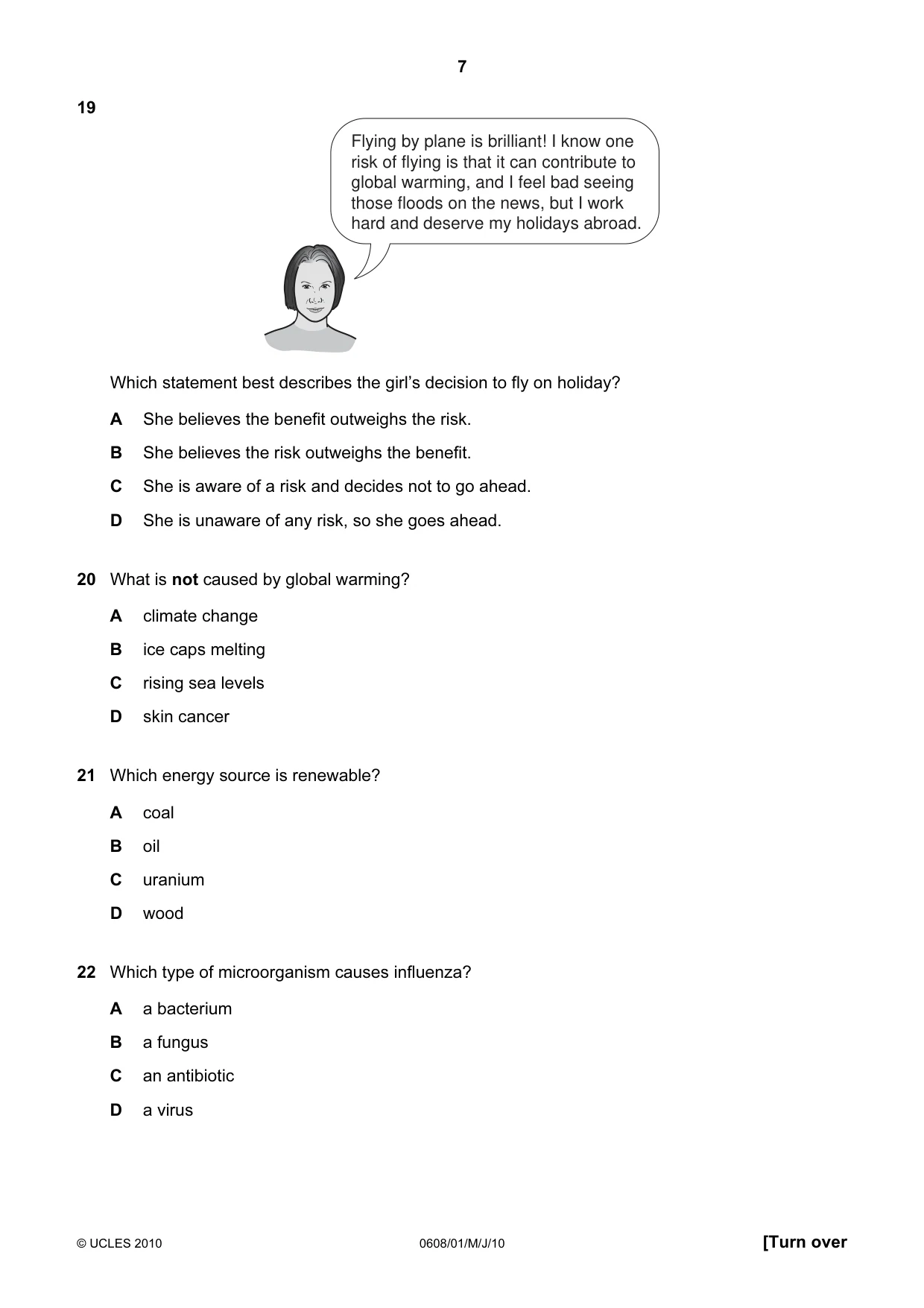
7 © UCLES 2010 0608/01/M/J/10 [Turn over 19 Flying by plane is brilliant! I know one risk of flying is that it can contribute to global warming, and I feel bad seeing those floods on the news, but I work hard and deserve my holidays abroad. Which statement best describes the girl’s decision to fly on holiday? A She believes the benefit outweighs the risk. B She believes the risk outweighs the benefit. C She is aware of a risk and decides not to go ahead. D She is unaware of any risk, so she goes ahead. 20 What is not caused by global warming? A climate change B ice caps melting C rising sea levels D skin cancer 21 Which energy source is renewable? A coal B oil C uranium D wood 22 Which type of microorganism causes influenza? A a bacterium B a fungus C an antibiotic D a virus
Question paper, page 8
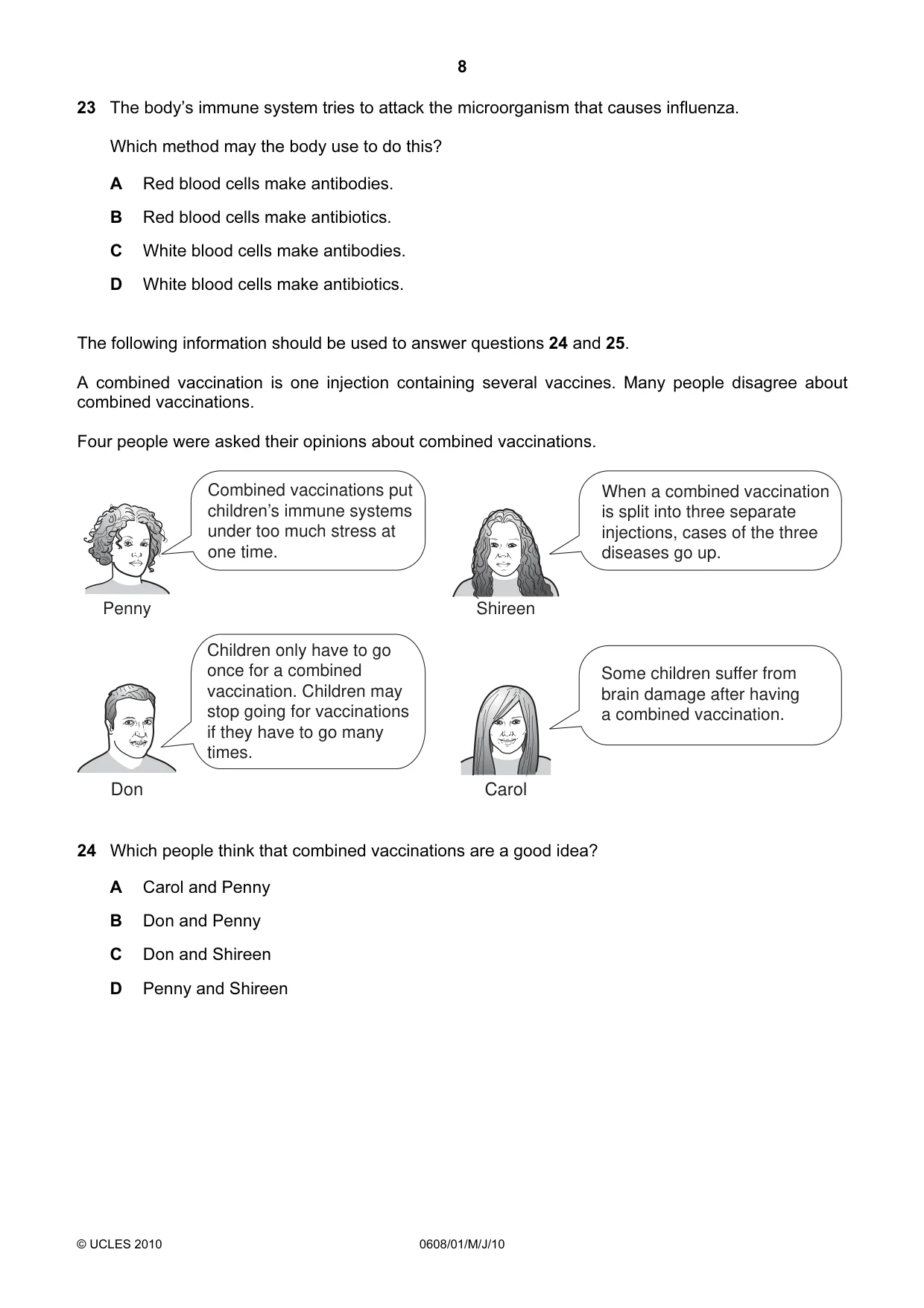
8 © UCLES 2010 0608/01/M/J/10 23 The body’s immune system tries to attack the microorganism that causes influenza. Which method may the body use to do this? A Red blood cells make antibodies. B Red blood cells make antibiotics. C White blood cells make antibodies. D White blood cells make antibiotics. The following information should be used to answer questions 24 and 25. A combined vaccination is one injection containing several vaccines. Many people disagree about combined vaccinations. Four people were asked their opinions about combined vaccinations. Penny Don Shireen Carol Combined vaccinations put children’s immune systems under too much stress at one time. When a combined vaccination is split into three separate injections, cases of the three diseases go up. Children only have to go once for a combined vaccination. Children may stop going for vaccinations if they have to go many times. Some children suffer from brain damage after having a combined vaccination. 24 Which people think that combined vaccinations are a good idea? A Carol and Penny B Don and Penny C Don and Shireen D Penny and Shireen
Question paper, page 9
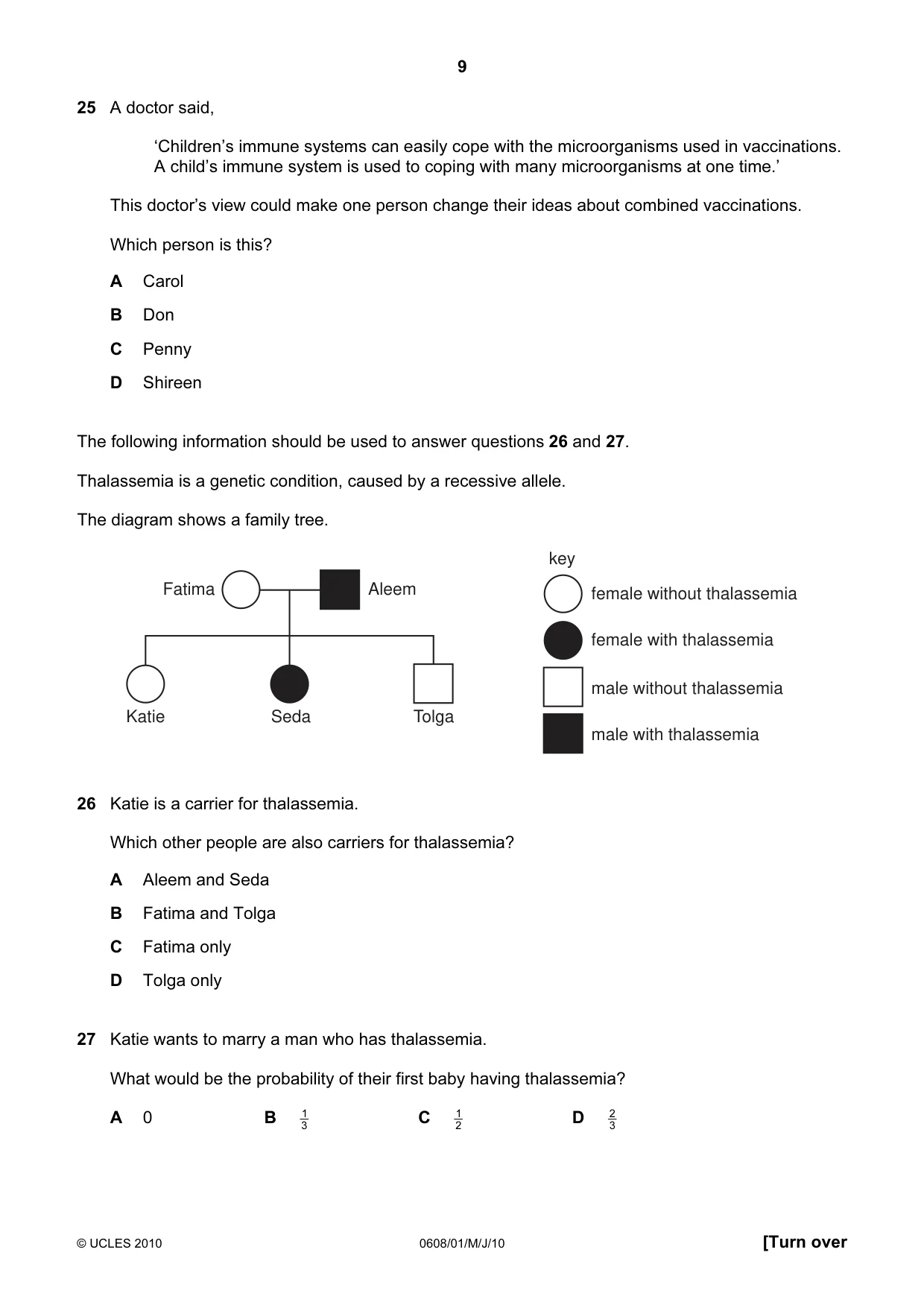
9 © UCLES 2010 0608/01/M/J/10 [Turn over 25 A doctor said, ‘Children’s immune systems can easily cope with the microorganisms used in vaccinations. A child’s immune system is used to coping with many microorganisms at one time.’ This doctor’s view could make one person change their ideas about combined vaccinations. Which person is this? A Carol B Don C Penny D Shireen The following information should be used to answer questions 26 and 27. Thalassemia is a genetic condition, caused by a recessive allele. The diagram shows a family tree. Fatima Aleem key female without thalassemia female with thalassemia male without thalassemia male with thalassemia Katie Seda Tolga 26 Katie is a carrier for thalassemia. Which other people are also carriers for thalassemia? A Aleem and Seda B Fatima and Tolga C Fatima only D Tolga only 27 Katie wants to marry a man who has thalassemia. What would be the probability of their first baby having thalassemia? A 0 B 3 1 C 2 1 D 3 2
Question paper, page 10
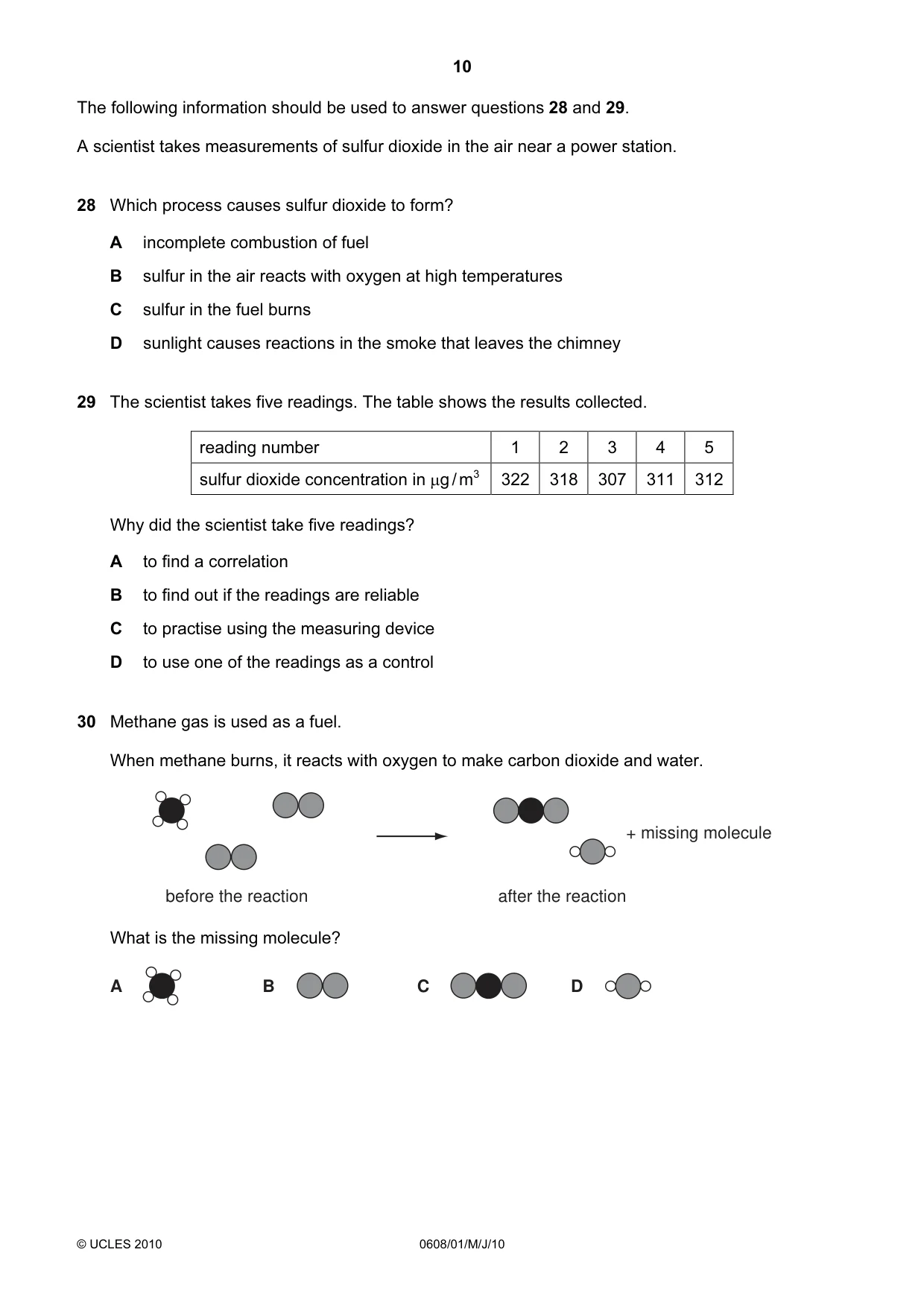
10 © UCLES 2010 0608/01/M/J/10 The following information should be used to answer questions 28 and 29. A scientist takes measurements of sulfur dioxide in the air near a power station. 28 Which process causes sulfur dioxide to form? A incomplete combustion of fuel B sulfur in the air reacts with oxygen at high temperatures C sulfur in the fuel burns D sunlight causes reactions in the smoke that leaves the chimney 29 The scientist takes five readings. The table shows the results collected. reading number 1 2 3 4 5 sulfur dioxide concentration in µg / m3 322 318 307 311 312 Why did the scientist take five readings? A to find a correlation B to find out if the readings are reliable C to practise using the measuring device D to use one of the readings as a control 30 Methane gas is used as a fuel. When methane burns, it reacts with oxygen to make carbon dioxide and water. before the reaction after the reaction + missing molecule What is the missing molecule? A B C D
Question paper, page 11
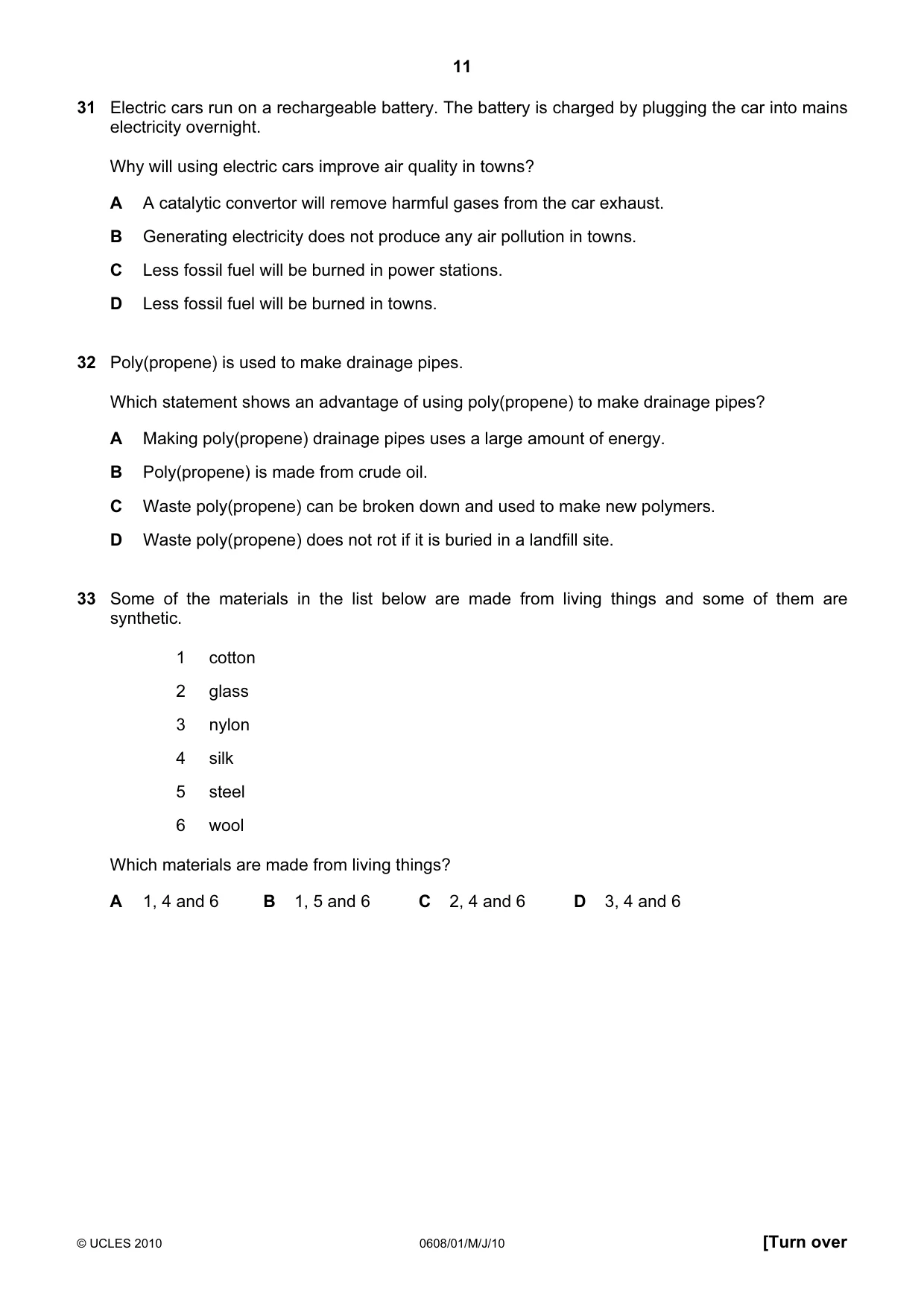
11 © UCLES 2010 0608/01/M/J/10 [Turn over 31 Electric cars run on a rechargeable battery. The battery is charged by plugging the car into mains electricity overnight. Why will using electric cars improve air quality in towns? A A catalytic convertor will remove harmful gases from the car exhaust. B Generating electricity does not produce any air pollution in towns. C Less fossil fuel will be burned in power stations. D Less fossil fuel will be burned in towns. 32 Poly(propene) is used to make drainage pipes. Which statement shows an advantage of using poly(propene) to make drainage pipes? A Making poly(propene) drainage pipes uses a large amount of energy. B Poly(propene) is made from crude oil. C Waste poly(propene) can be broken down and used to make new polymers. D Waste poly(propene) does not rot if it is buried in a landfill site. 33 Some of the materials in the list below are made from living things and some of them are synthetic. 1 cotton 2 glass 3 nylon 4 silk 5 steel 6 wool Which materials are made from living things? A 1, 4 and 6 B 1, 5 and 6 C 2, 4 and 6 D 3, 4 and 6
Question paper, page 12
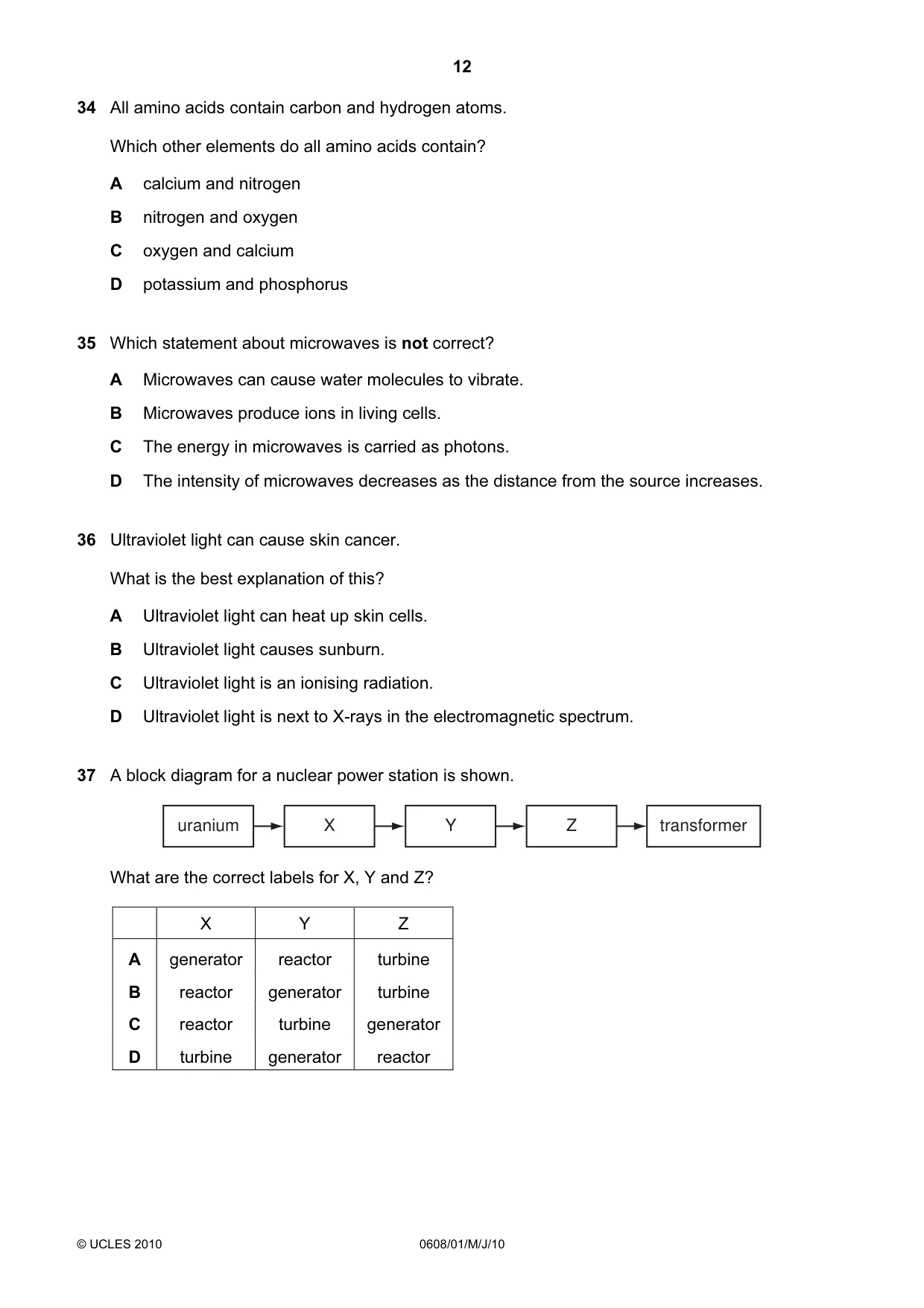
12 © UCLES 2010 0608/01/M/J/10 34 All amino acids contain carbon and hydrogen atoms. Which other elements do all amino acids contain? A calcium and nitrogen B nitrogen and oxygen C oxygen and calcium D potassium and phosphorus 35 Which statement about microwaves is not correct? A Microwaves can cause water molecules to vibrate. B Microwaves produce ions in living cells. C The energy in microwaves is carried as photons. D The intensity of microwaves decreases as the distance from the source increases. 36 Ultraviolet light can cause skin cancer. What is the best explanation of this? A Ultraviolet light can heat up skin cells. B Ultraviolet light causes sunburn. C Ultraviolet light is an ionising radiation. D Ultraviolet light is next to X-rays in the electromagnetic spectrum. 37 A block diagram for a nuclear power station is shown. uranium X Y Z transformer What are the correct labels for X, Y and Z? X Y Z A generator reactor turbine B reactor generator turbine C reactor turbine generator D turbine generator reactor
Question paper, page 13
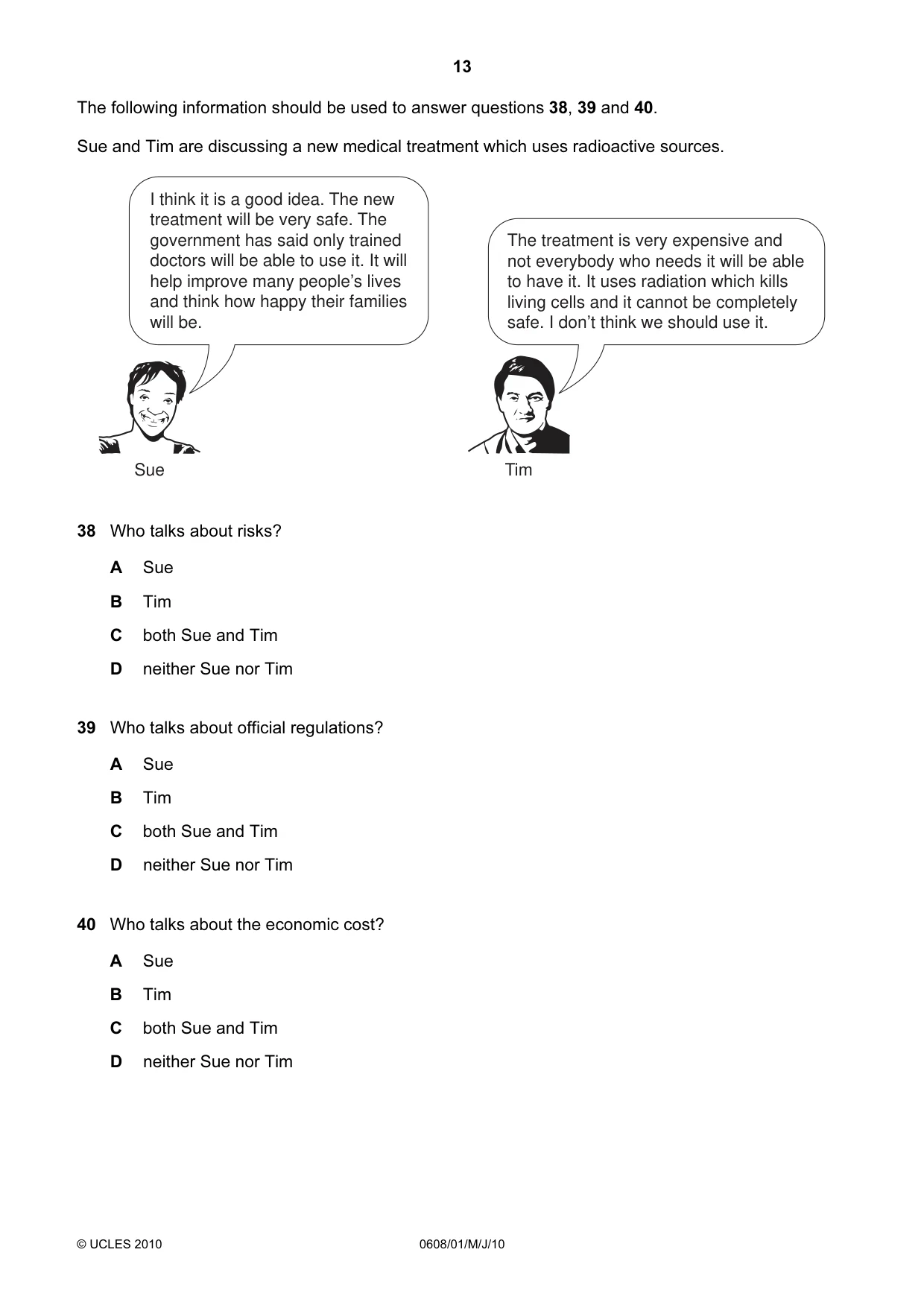
13 © UCLES 2010 0608/01/M/J/10 The following information should be used to answer questions 38, 39 and 40. Sue and Tim are discussing a new medical treatment which uses radioactive sources. Sue Tim I think it is a good idea. The new treatment will be very safe. The government has said only trained doctors will be able to use it. It will help improve many people’s lives and think how happy their families will be. The treatment is very expensive and not everybody who needs it will be able to have it. It uses radiation which kills living cells and it cannot be completely safe. I don’t think we should use it. 38 Who talks about risks? A Sue B Tim C both Sue and Tim D neither Sue nor Tim 39 Who talks about official regulations? A Sue B Tim C both Sue and Tim D neither Sue nor Tim 40 Who talks about the economic cost? A Sue B Tim C both Sue and Tim D neither Sue nor Tim
Question paper, page 14
14 © UCLES 2010 0608/01/M/J/10 BLANK PAGE
Question paper, page 15
15 © UCLES 2010 0608/01/M/J/10 BLANK PAGE
Question paper, page 16
16 Permission to reproduce items where third-party owned material protected by copyright is included has been sought and cleared where possible. Every reasonable effort has been made by the publisher (UCLES) to trace copyright holders, but if any items requiring clearance have unwittingly been included, the publisher will be pleased to make amends at the earliest possible opportunity. University of Cambridge International Examinations is part of the Cambridge Assessment Group. Cambridge Assessment is the brand name of University of Cambridge Local Examinations Syndicate (UCLES), which is itself a department of the University of Cambridge. © UCLES 2010 0608/01/M/J/10 BLANK PAGE
Mark scheme, page 1
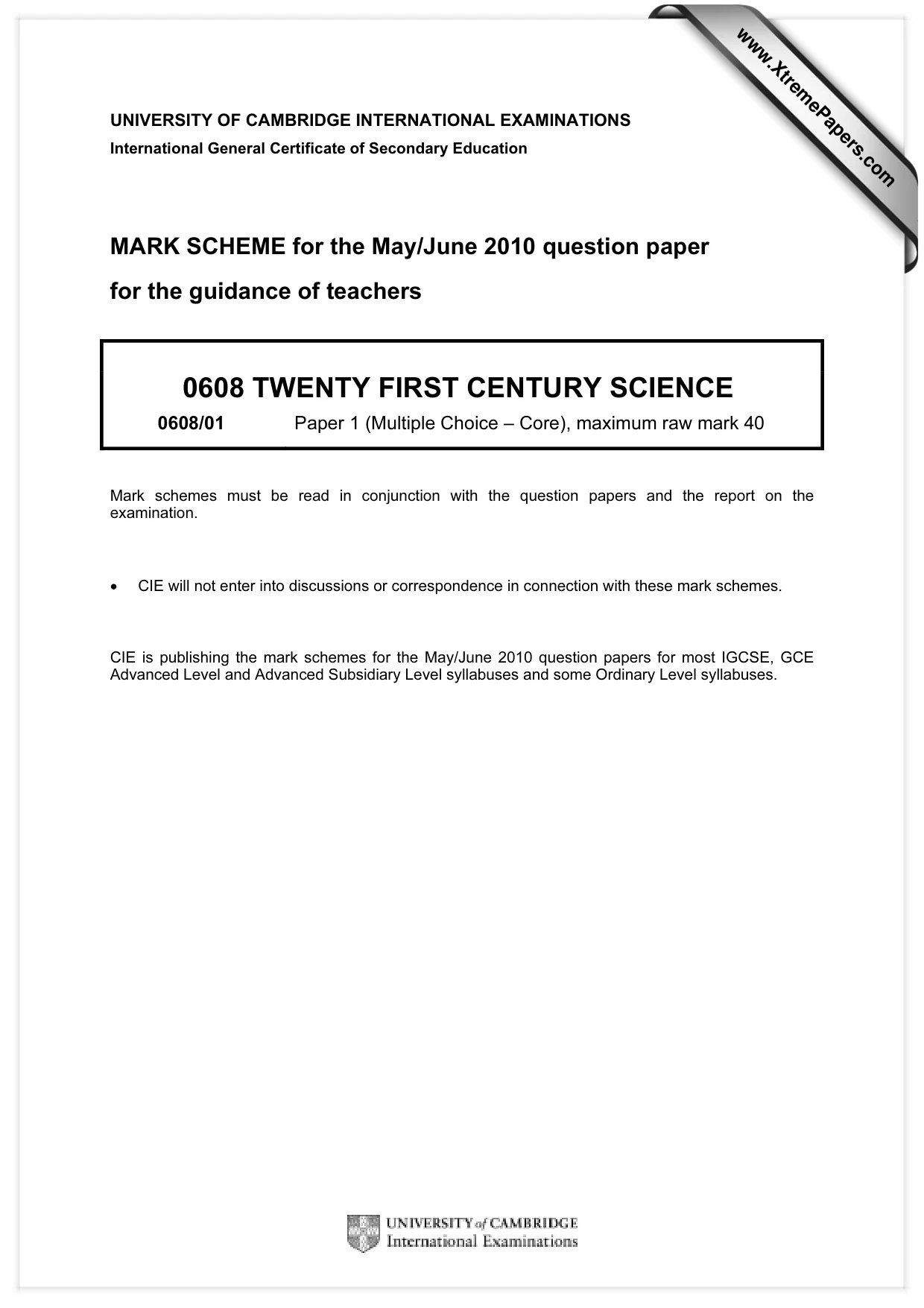
UNIVERSITY OF CAMBRIDGE INTERNATIONAL EXAMINATIONS International General Certificate of Secondary Education MARK SCHEME for the May/June 2010 question paper for the guidance of teachers 0608 TWENTY FIRST CENTURY SCIENCE 0608/01 Paper 1 (Multiple Choice – Core), maximum raw mark 40 Mark schemes must be read in conjunction with the question papers and the report on the examination. • CIE will not enter into discussions or correspondence in connection with these mark schemes. CIE is publishing the mark schemes for the May/June 2010 question papers for most IGCSE, GCE Advanced Level and Advanced Subsidiary Level syllabuses and some Ordinary Level syllabuses. www.XtremePapers.com
Mark scheme, page 2
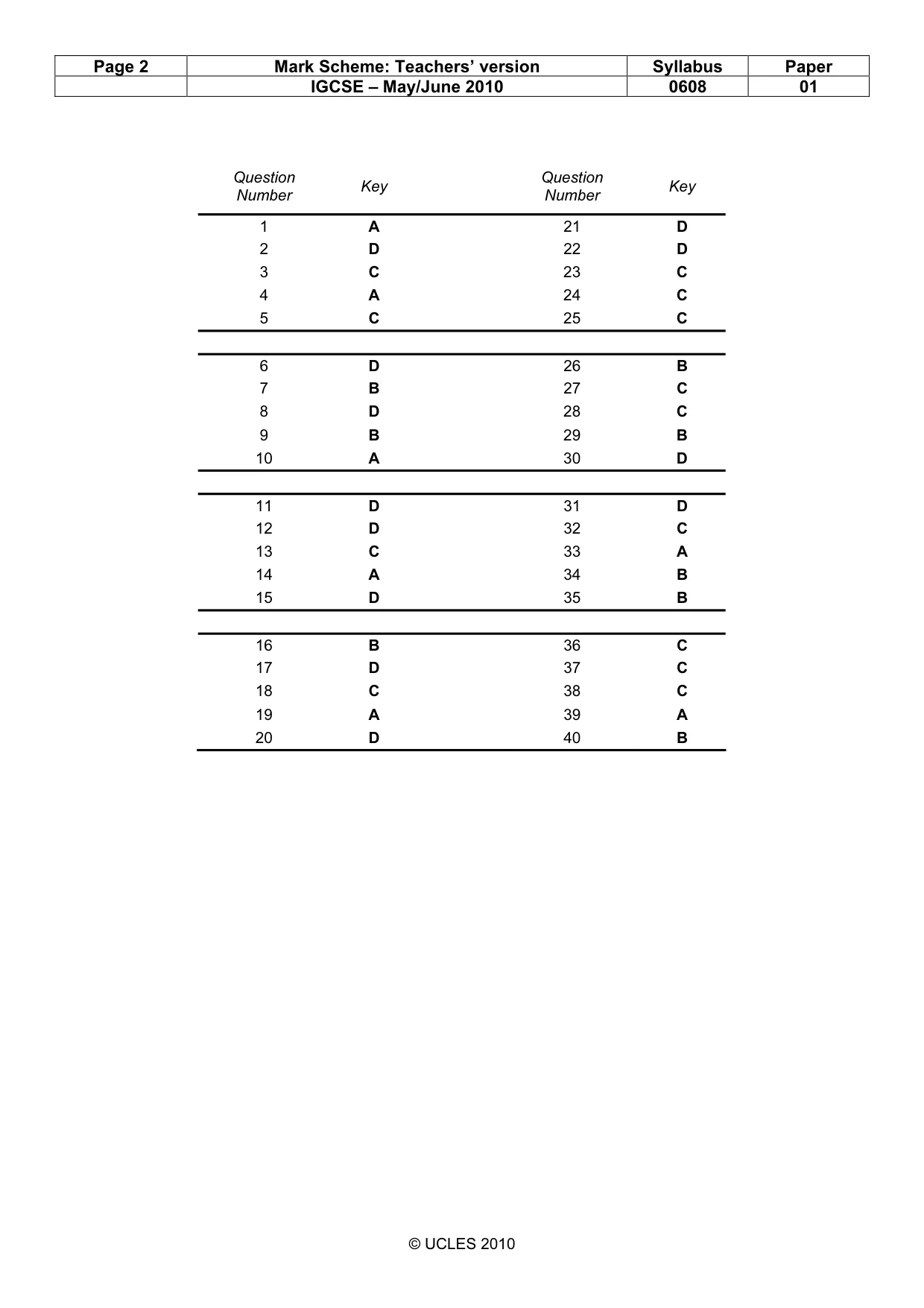
Page 2 Mark Scheme: Teachers’ version Syllabus Paper IGCSE – May/June 2010 0608 01 © UCLES 2010 Question Number Key Question Number Key 1 A 21 D 2 D 22 D 3 C 23 C 4 A 24 C 5 C 25 C 6 D 26 B 7 B 27 C 8 D 28 C 9 B 29 B 10 A 30 D 11 D 31 D 12 D 32 C 13 C 33 A 14 A 34 B 15 D 35 B 16 B 36 C 17 D 37 C 18 C 38 C 19 A 39 A 20 D 40 B
What you needed in this session
Cambridge’s own grade thresholds for 2010 May/June, Paper 1 · Variant 1. A higher threshold means an easier paper — the bar moves with how the cohort did.