Cambridge IGCSE Twenty-First Century Science 0608 — 2013 May/June Paper 1 · Variant 1
0608/11/M/J/13 · 40 marks · ≈45 min
The question paper and its mark scheme, free to read here and free to download. This is Cambridge’s own paper, exactly as it was sat.
Question paper16 pages

Mark scheme2 pages
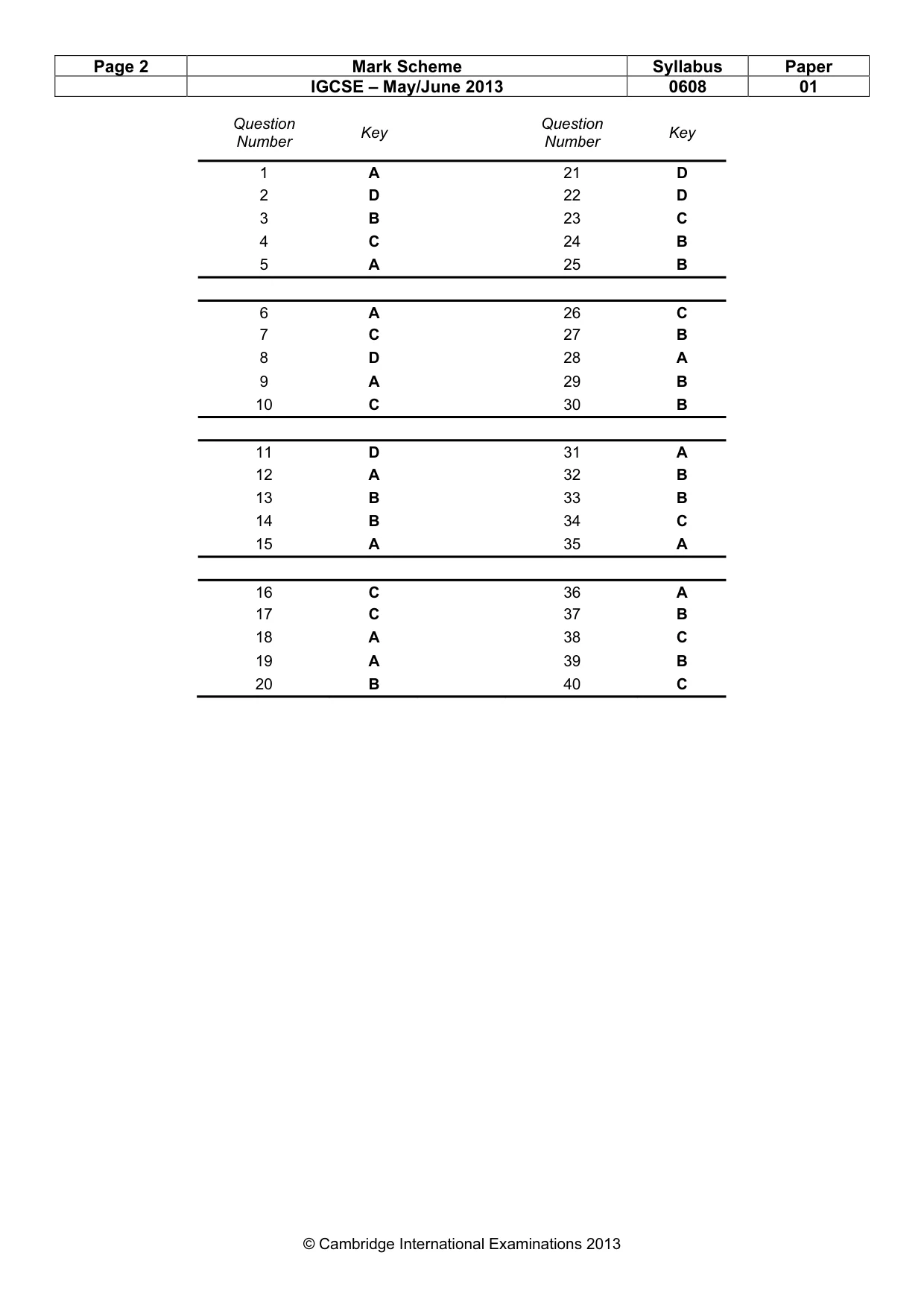
Answers below. Sit the paper first if you are practising.
Paper as text
Question paper, page 1
This document consists of 15 printed pages and 1 blank page. IB13 06_0608_01/3RP © UCLES 2013 [Turn over *6406544334* UNIVERSITY OF CAMBRIDGE INTERNATIONAL EXAMINATIONS International General Certificate of Secondary Education TWENTY FIRST CENTURY SCIENCE (CORE) 0608/01 Paper 1 Multiple Choice May/June 2013 1 hour Additional Materials: Multiple Choice Answer Sheet Soft clean eraser Soft pencil (type B or HB is recommended) READ THESE INSTRUCTIONS FIRST Write in soft pencil. Do not use staples, paper clips, highlighters, glue or correction fluid. Write your name, Centre number and candidate number on the Answer Sheet in the spaces provided unless this has been done for you. DO NOT WRITE IN ANY BARCODES. There are forty questions on this paper. Answer all questions. For each question there are four possible answers A, B, C and D. Choose the one you consider correct and record your choice in soft pencil on the separate Answer Sheet. Read the instructions on the Answer Sheet very carefully. Each correct answer will score one mark. A mark will not be deducted for a wrong answer. Any rough working should be done in this booklet. Electronic calculators may be used. www.XtremePapers.com
Question paper, page 2
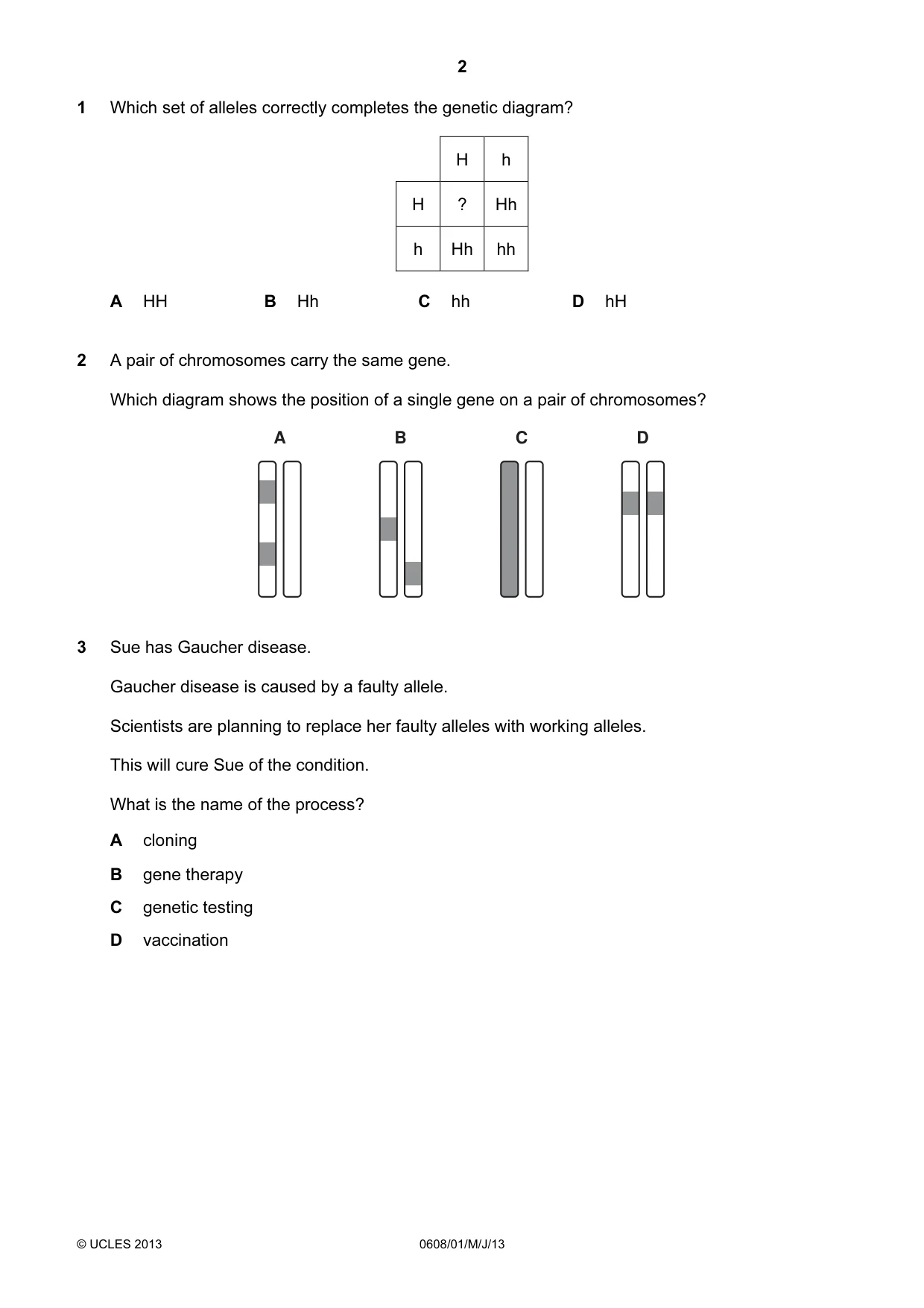
2 © UCLES 2013 0608/01/M/J/13 1 Which set of alleles correctly completes the genetic diagram? H h H ? Hh h Hh hh A HH B Hh C hh D hH 2 A pair of chromosomes carry the same gene. Which diagram shows the position of a single gene on a pair of chromosomes? A B C D 3 Sue has Gaucher disease. Gaucher disease is caused by a faulty allele. Scientists are planning to replace her faulty alleles with working alleles. This will cure Sue of the condition. What is the name of the process? A cloning B gene therapy C genetic testing D vaccination
Question paper, page 3
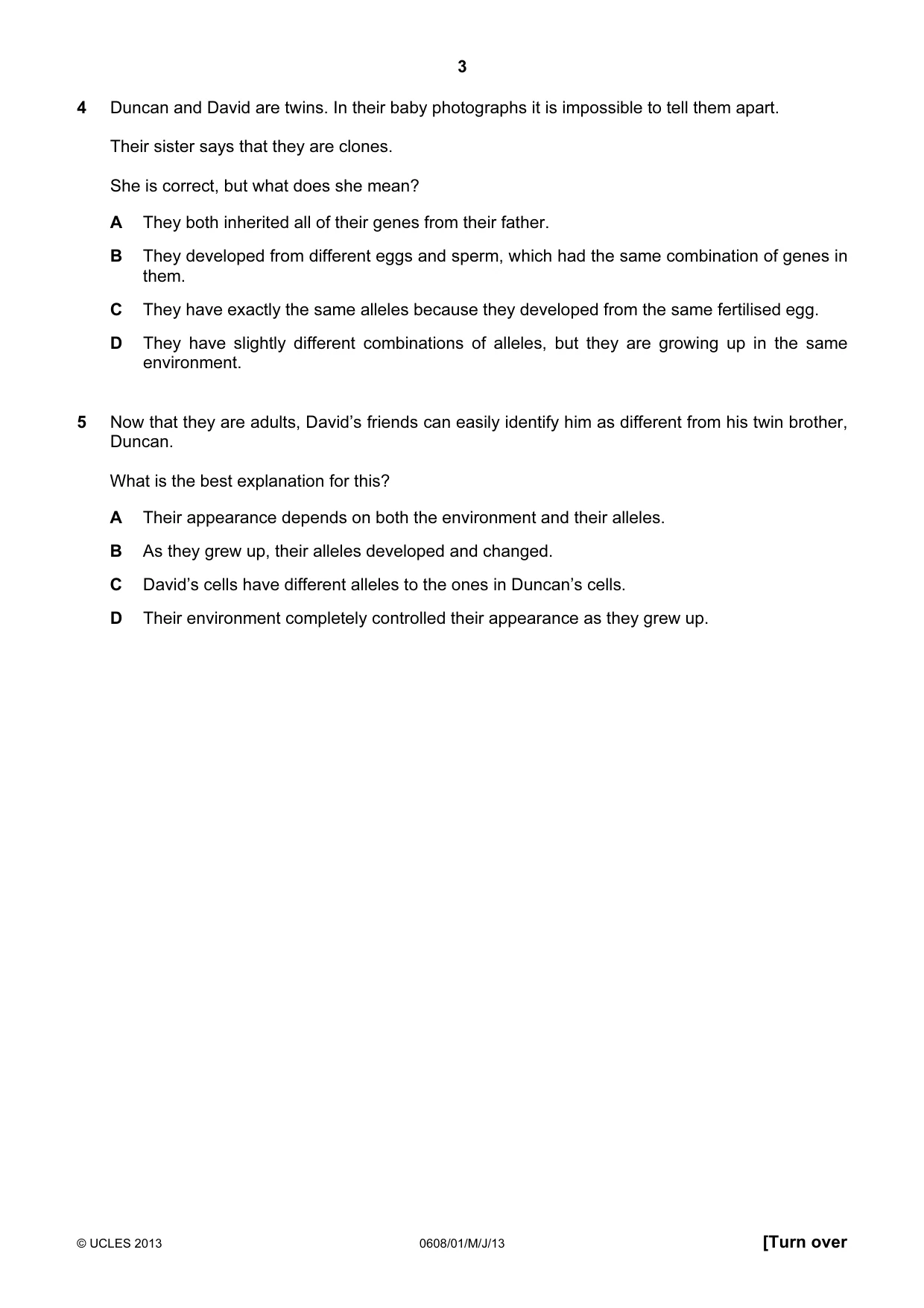
3 © UCLES 2013 0608/01/M/J/13 [Turn over 4 Duncan and David are twins. In their baby photographs it is impossible to tell them apart. Their sister says that they are clones. She is correct, but what does she mean? A They both inherited all of their genes from their father. B They developed from different eggs and sperm, which had the same combination of genes in them. C They have exactly the same alleles because they developed from the same fertilised egg. D They have slightly different combinations of alleles, but they are growing up in the same environment. 5 Now that they are adults, David’s friends can easily identify him as different from his twin brother, Duncan. What is the best explanation for this? A Their appearance depends on both the environment and their alleles. B As they grew up, their alleles developed and changed. C David’s cells have different alleles to the ones in Duncan’s cells. D Their environment completely controlled their appearance as they grew up.
Question paper, page 4
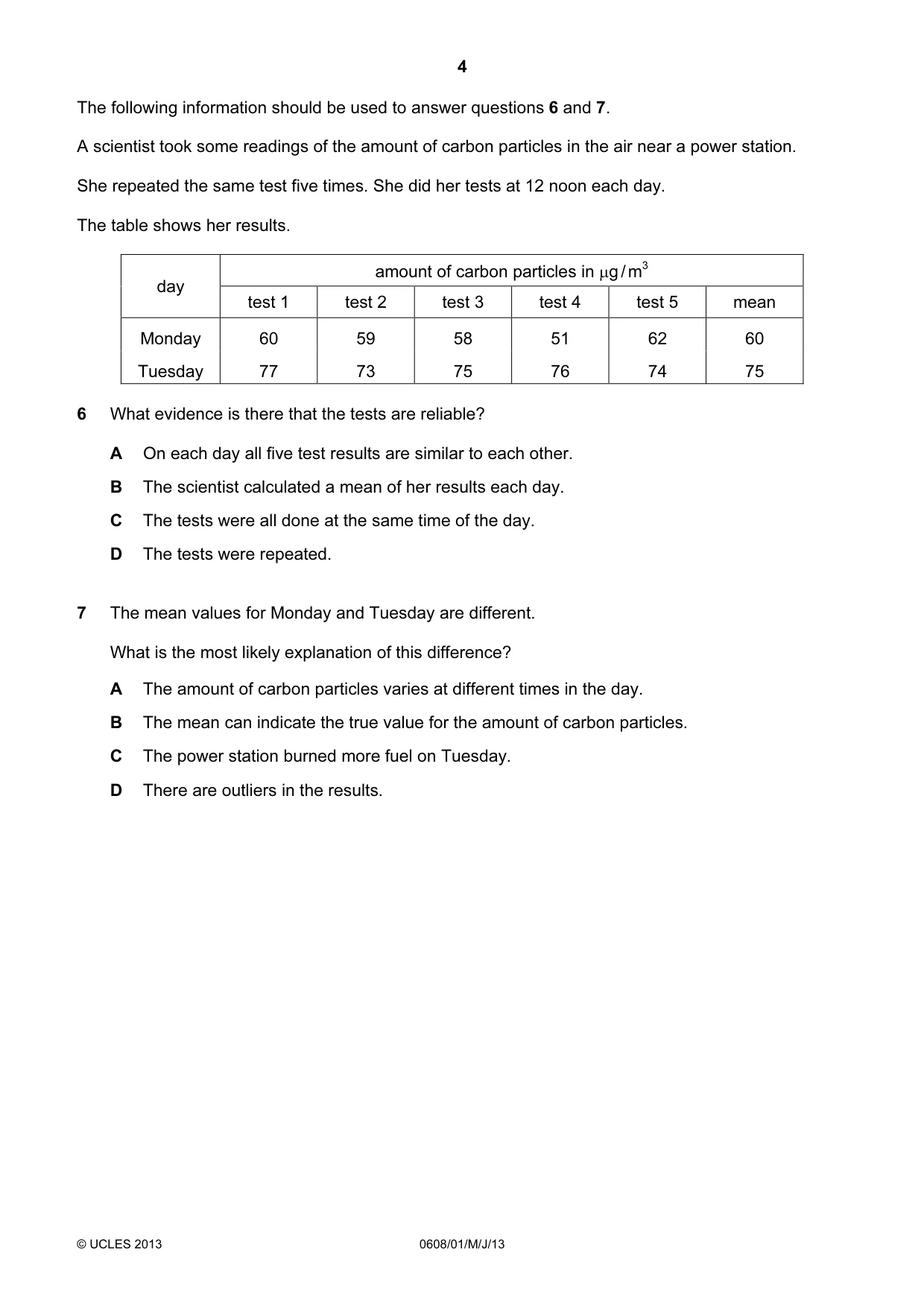
4 © UCLES 2013 0608/01/M/J/13 The following information should be used to answer questions 6 and 7. A scientist took some readings of the amount of carbon particles in the air near a power station. She repeated the same test five times. She did her tests at 12 noon each day. The table shows her results. amount of carbon particles in µg / m3 day test 1 test 2 test 3 test 4 test 5 mean Monday 60 59 58 51 62 60 Tuesday 77 73 75 76 74 75 6 What evidence is there that the tests are reliable? A On each day all five test results are similar to each other. B The scientist calculated a mean of her results each day. C The tests were all done at the same time of the day. D The tests were repeated. 7 The mean values for Monday and Tuesday are different. What is the most likely explanation of this difference? A The amount of carbon particles varies at different times in the day. B The mean can indicate the true value for the amount of carbon particles. C The power station burned more fuel on Tuesday. D There are outliers in the results.
Question paper, page 5
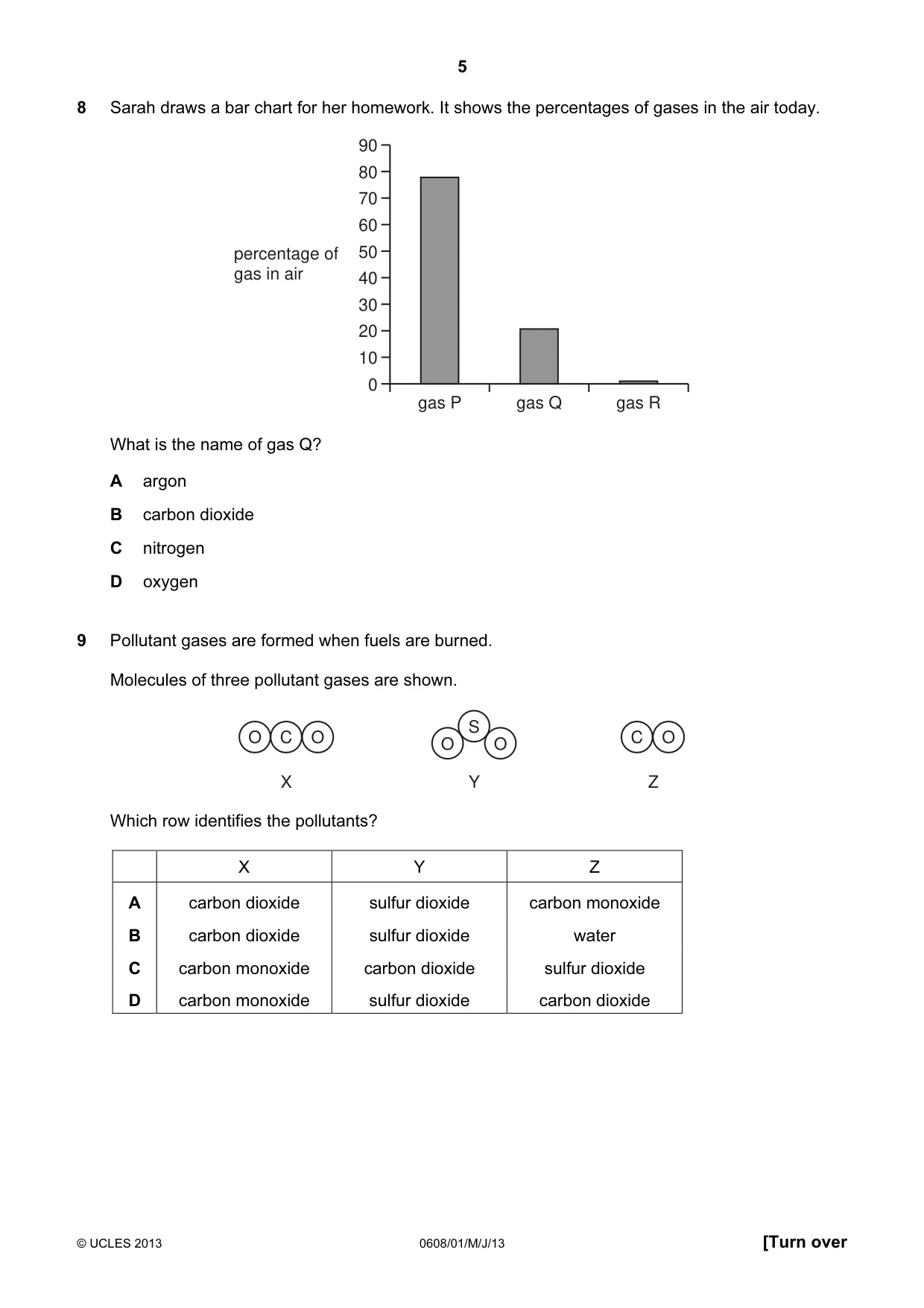
5 © UCLES 2013 0608/01/M/J/13 [Turn over 8 Sarah draws a bar chart for her homework. It shows the percentages of gases in the air today. gas P gas Q gas R 90 80 70 60 50 40 30 20 10 0 percentage of gas in air What is the name of gas Q? A argon B carbon dioxide C nitrogen D oxygen 9 Pollutant gases are formed when fuels are burned. Molecules of three pollutant gases are shown. C X O O O O O C Z S Y Which row identifies the pollutants? X Y Z A carbon dioxide sulfur dioxide carbon monoxide B carbon dioxide sulfur dioxide water C carbon monoxide carbon dioxide sulfur dioxide D carbon monoxide sulfur dioxide carbon dioxide
Question paper, page 6
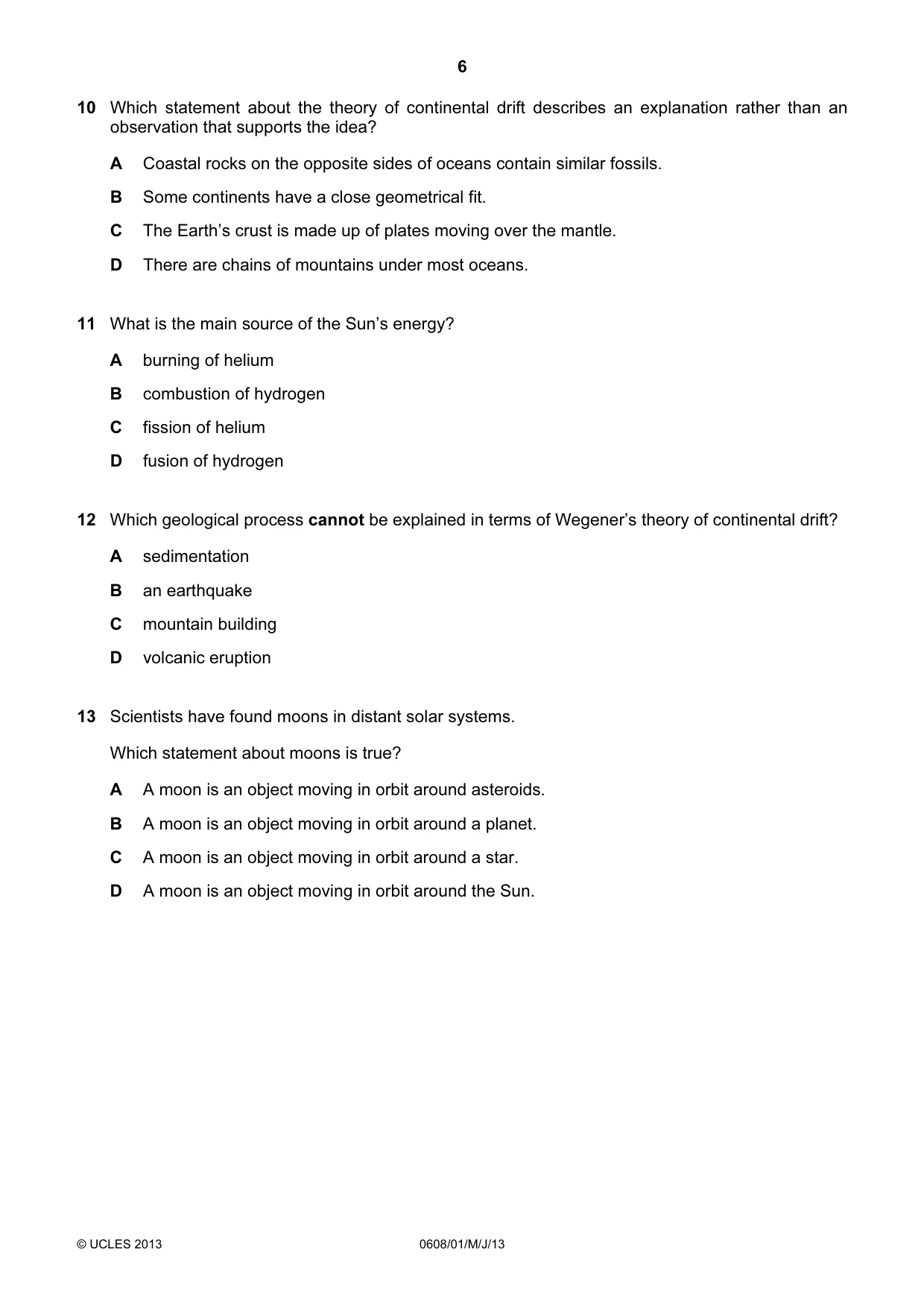
6 © UCLES 2013 0608/01/M/J/13 10 Which statement about the theory of continental drift describes an explanation rather than an observation that supports the idea? A Coastal rocks on the opposite sides of oceans contain similar fossils. B Some continents have a close geometrical fit. C The Earth’s crust is made up of plates moving over the mantle. D There are chains of mountains under most oceans. 11 What is the main source of the Sun’s energy? A burning of helium B combustion of hydrogen C fission of helium D fusion of hydrogen 12 Which geological process cannot be explained in terms of Wegener’s theory of continental drift? A sedimentation B an earthquake C mountain building D volcanic eruption 13 Scientists have found moons in distant solar systems. Which statement about moons is true? A A moon is an object moving in orbit around asteroids. B A moon is an object moving in orbit around a planet. C A moon is an object moving in orbit around a star. D A moon is an object moving in orbit around the Sun.
Question paper, page 7
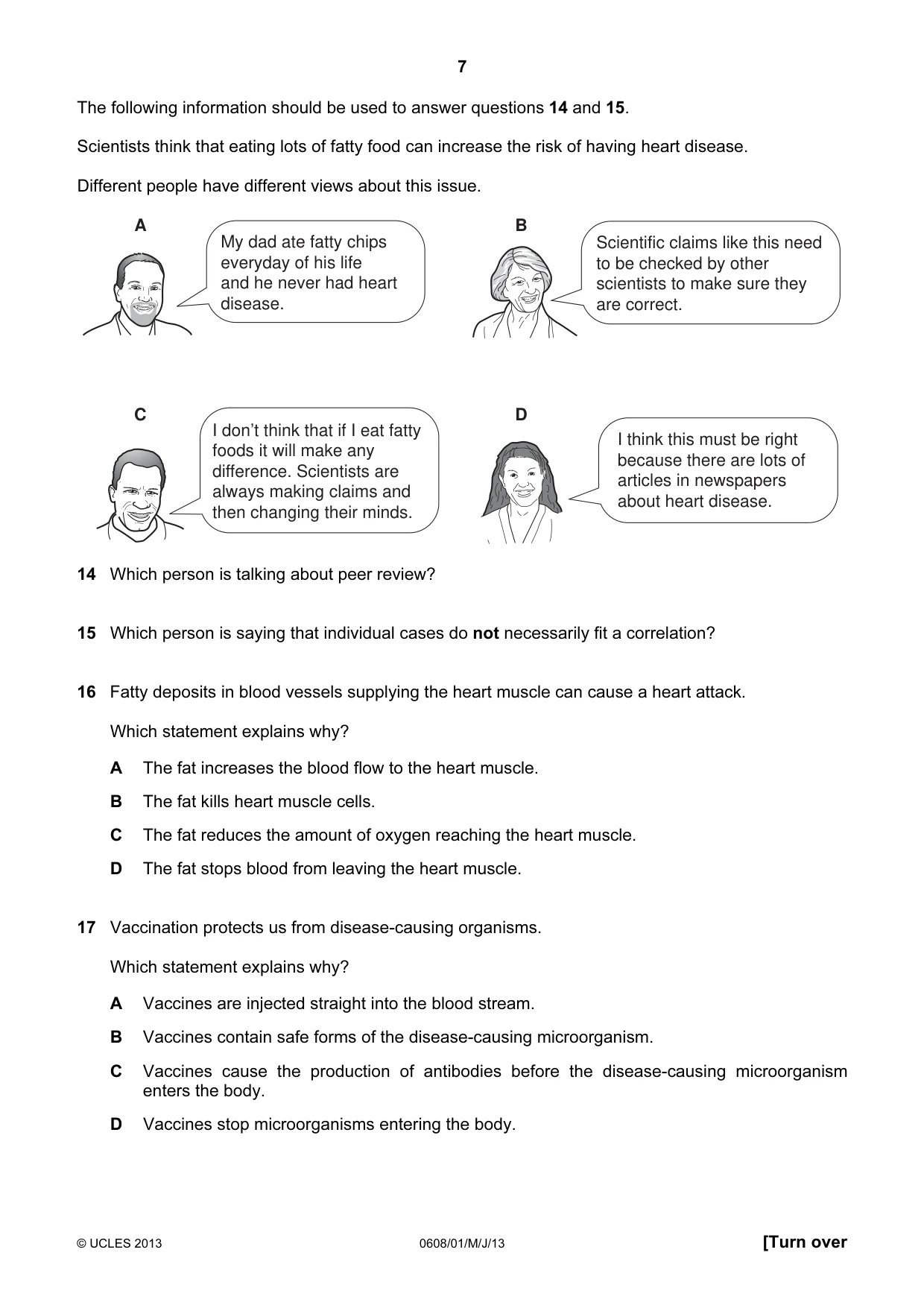
7 © UCLES 2013 0608/01/M/J/13 [Turn over The following information should be used to answer questions 14 and 15. Scientists think that eating lots of fatty food can increase the risk of having heart disease. Different people have different views about this issue. I don’t think that if I eat fatty foods it will make any difference. Scientists are always making claims and then changing their minds. My dad ate fatty chips everyday of his life and he never had heart disease. I think this must be right because there are lots of articles in newspapers about heart disease. A D B C Scientific claims like this need to be checked by other scientists to make sure they are correct. 14 Which person is talking about peer review? 15 Which person is saying that individual cases do not necessarily fit a correlation? 16 Fatty deposits in blood vessels supplying the heart muscle can cause a heart attack. Which statement explains why? A The fat increases the blood flow to the heart muscle. B The fat kills heart muscle cells. C The fat reduces the amount of oxygen reaching the heart muscle. D The fat stops blood from leaving the heart muscle. 17 Vaccination protects us from disease-causing organisms. Which statement explains why? A Vaccines are injected straight into the blood stream. B Vaccines contain safe forms of the disease-causing microorganism. C Vaccines cause the production of antibodies before the disease-causing microorganism enters the body. D Vaccines stop microorganisms entering the body.
Question paper, page 8
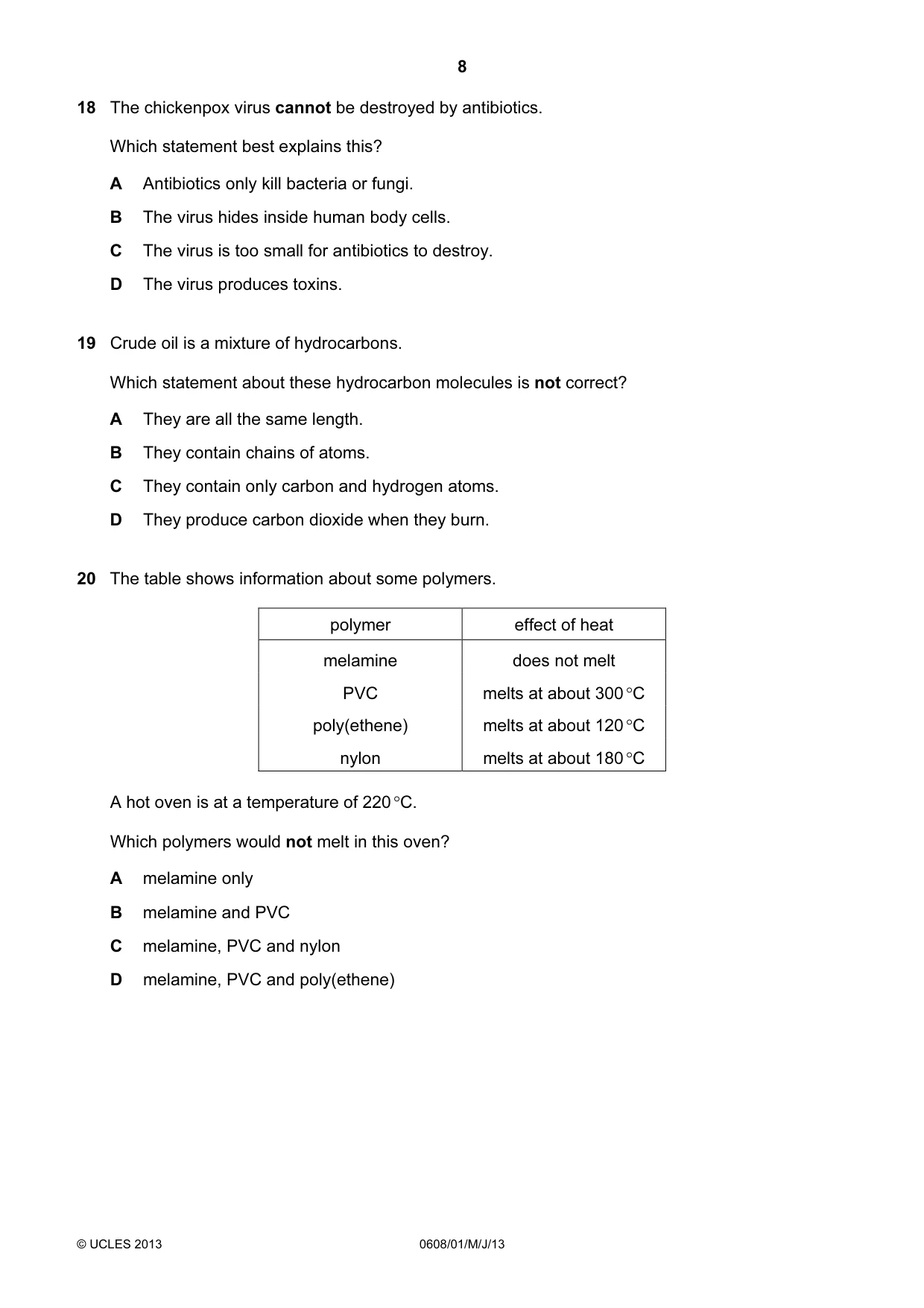
8 © UCLES 2013 0608/01/M/J/13 18 The chickenpox virus cannot be destroyed by antibiotics. Which statement best explains this? A Antibiotics only kill bacteria or fungi. B The virus hides inside human body cells. C The virus is too small for antibiotics to destroy. D The virus produces toxins. 19 Crude oil is a mixture of hydrocarbons. Which statement about these hydrocarbon molecules is not correct? A They are all the same length. B They contain chains of atoms. C They contain only carbon and hydrogen atoms. D They produce carbon dioxide when they burn. 20 The table shows information about some polymers. polymer effect of heat melamine does not melt PVC melts at about 300 °C poly(ethene) melts at about 120 °C nylon melts at about 180 °C A hot oven is at a temperature of 220 °C. Which polymers would not melt in this oven? A melamine only B melamine and PVC C melamine, PVC and nylon D melamine, PVC and poly(ethene)
Question paper, page 9
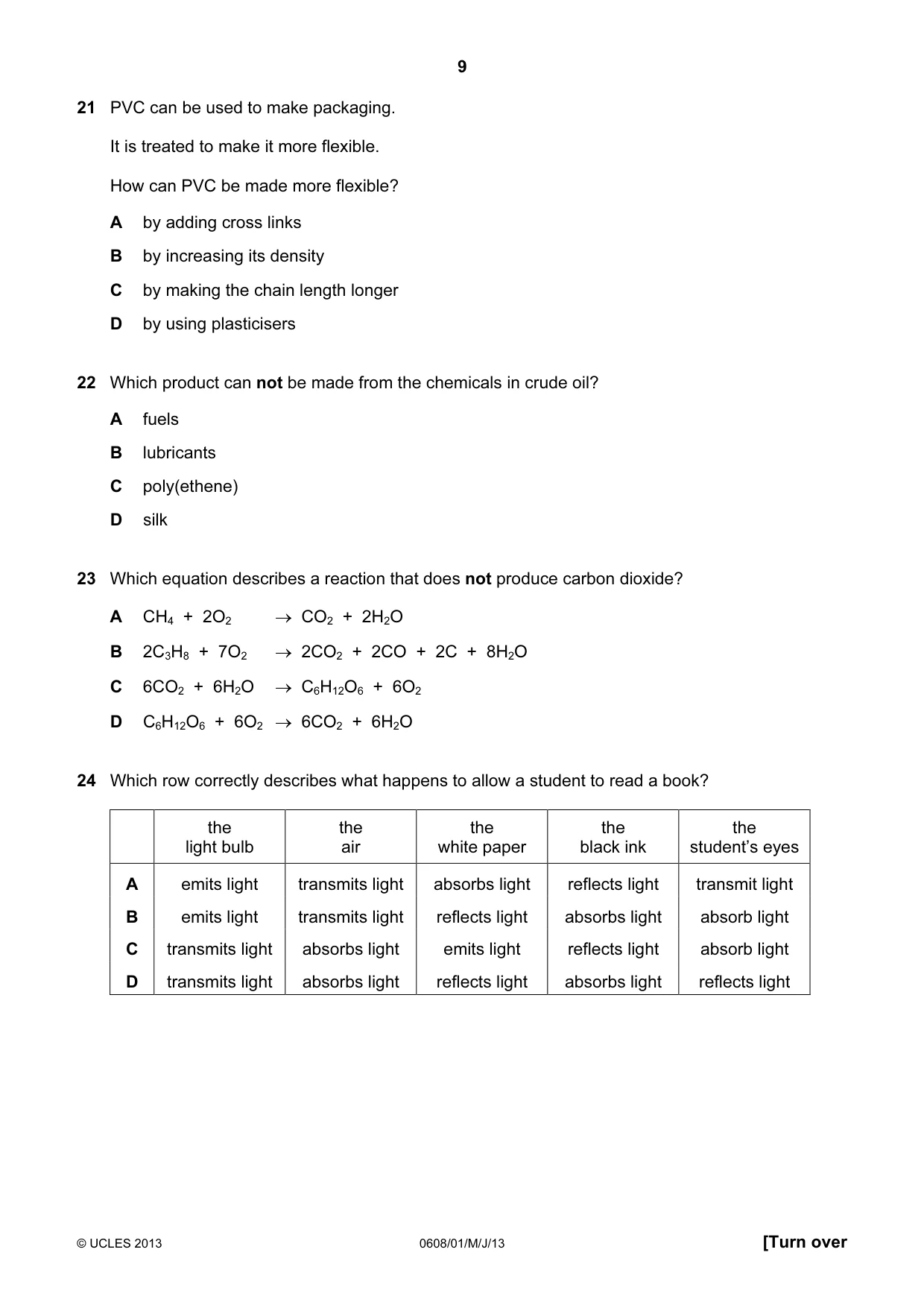
9 © UCLES 2013 0608/01/M/J/13 [Turn over 21 PVC can be used to make packaging. It is treated to make it more flexible. How can PVC be made more flexible? A by adding cross links B by increasing its density C by making the chain length longer D by using plasticisers 22 Which product can not be made from the chemicals in crude oil? A fuels B lubricants C poly(ethene) D silk 23 Which equation describes a reaction that does not produce carbon dioxide? A CH4 + 2O2 → CO2 + 2H2O B 2C3H8 + 7O2 → 2CO2 + 2CO + 2C + 8H2O C 6CO2 + 6H2O → C6H12O6 + 6O2 D C6H12O6 + 6O2 → 6CO2 + 6H2O 24 Which row correctly describes what happens to allow a student to read a book? the light bulb the air the white paper the black ink the student’s eyes A emits light transmits light absorbs light reflects light transmit light B emits light transmits light reflects light absorbs light absorb light C transmits light absorbs light emits light reflects light absorb light D transmits light absorbs light reflects light absorbs light reflects light
Question paper, page 10
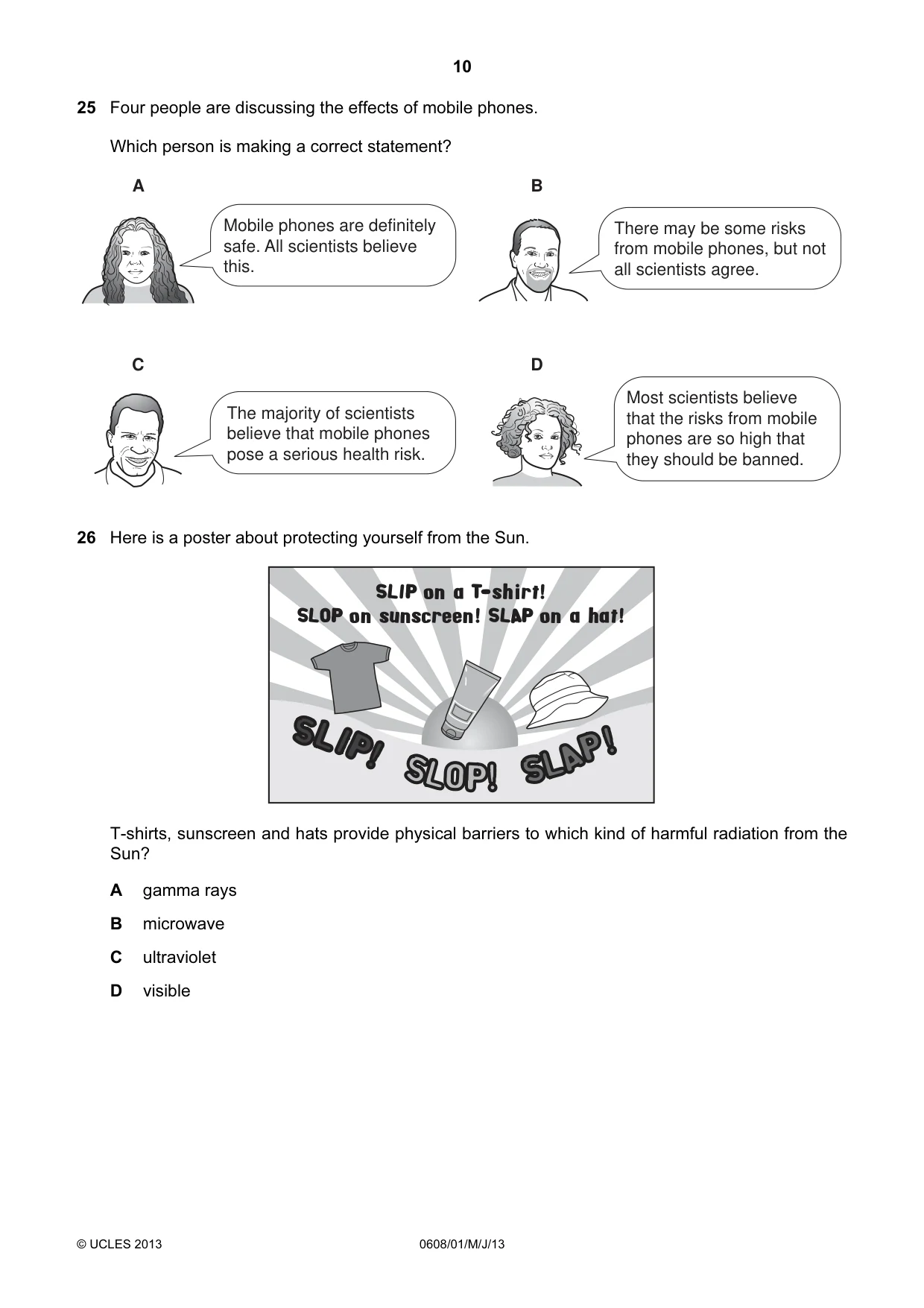
10 © UCLES 2013 0608/01/M/J/13 25 Four people are discussing the effects of mobile phones. Which person is making a correct statement? The majority of scientists believe that mobile phones pose a serious health risk. Mobile phones are definitely safe. All scientists believe this. Most scientists believe that the risks from mobile phones are so high that they should be banned. A D B C There may be some risks from mobile phones, but not all scientists agree. 26 Here is a poster about protecting yourself from the Sun. SLIP on a T-shirt! SLOP on sunscreen! SLAP on a hat! S L I P! S L O P ! S LAP ! T-shirts, sunscreen and hats provide physical barriers to which kind of harmful radiation from the Sun? A gamma rays B microwave C ultraviolet D visible
Question paper, page 11
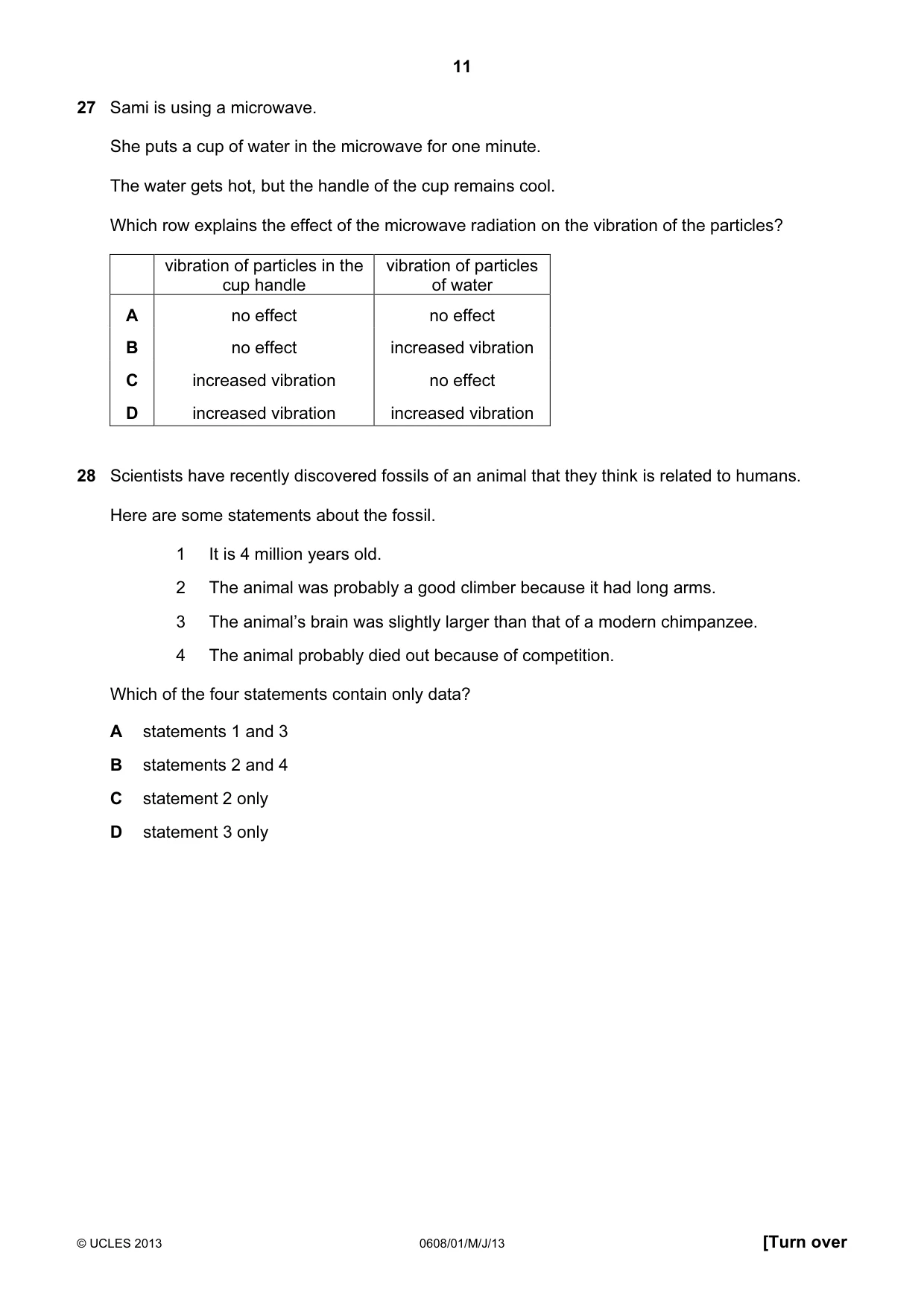
11 © UCLES 2013 0608/01/M/J/13 [Turn over 27 Sami is using a microwave. She puts a cup of water in the microwave for one minute. The water gets hot, but the handle of the cup remains cool. Which row explains the effect of the microwave radiation on the vibration of the particles? vibration of particles in the cup handle vibration of particles of water A no effect no effect B no effect increased vibration C increased vibration no effect D increased vibration increased vibration 28 Scientists have recently discovered fossils of an animal that they think is related to humans. Here are some statements about the fossil. 1 It is 4 million years old. 2 The animal was probably a good climber because it had long arms. 3 The animal’s brain was slightly larger than that of a modern chimpanzee. 4 The animal probably died out because of competition. Which of the four statements contain only data? A statements 1 and 3 B statements 2 and 4 C statement 2 only D statement 3 only
Question paper, page 12
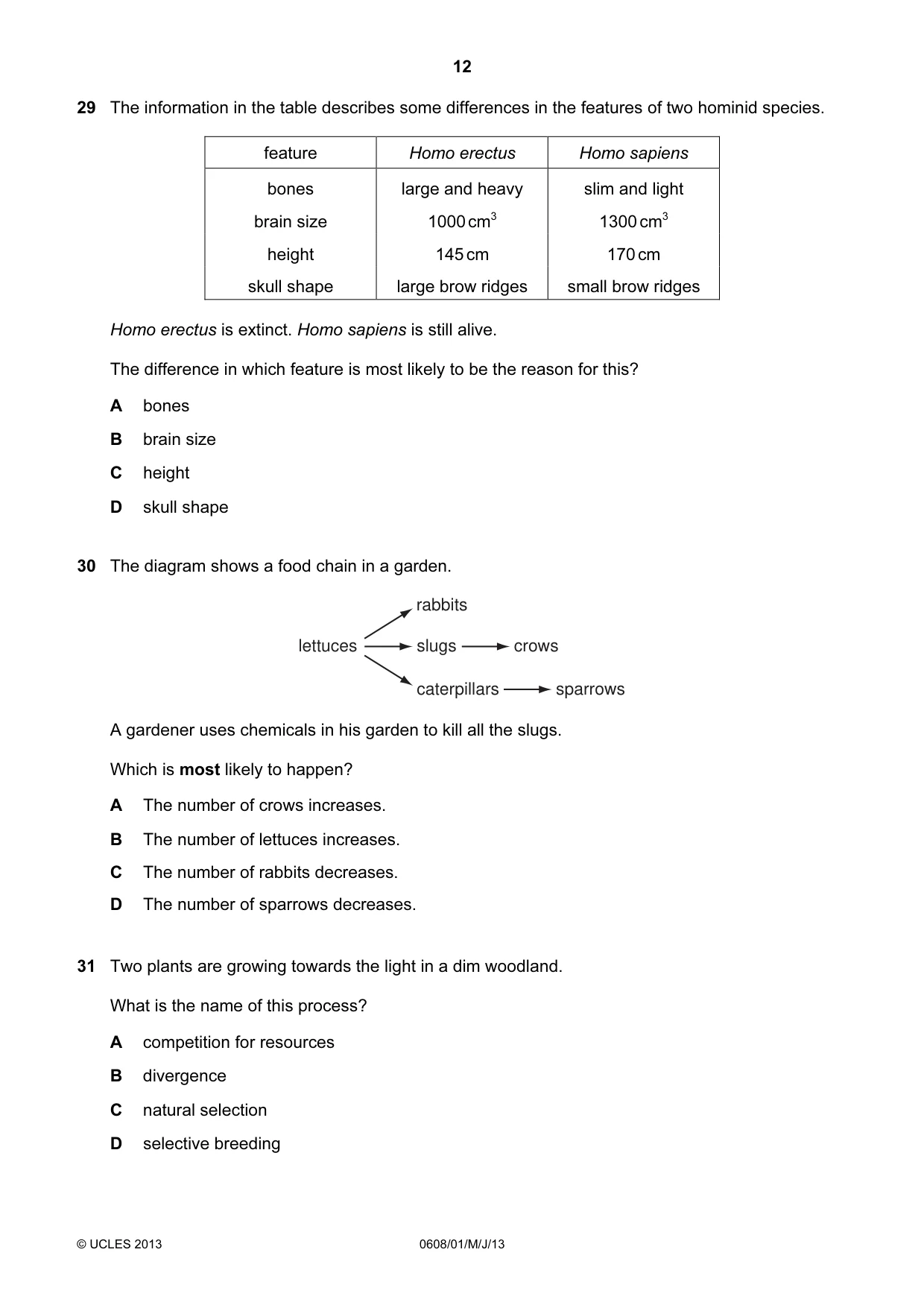
12 © UCLES 2013 0608/01/M/J/13 29 The information in the table describes some differences in the features of two hominid species. feature Homo erectus Homo sapiens bones large and heavy slim and light brain size 1000 cm3 1300 cm3 height 145 cm 170 cm skull shape large brow ridges small brow ridges Homo erectus is extinct. Homo sapiens is still alive. The difference in which feature is most likely to be the reason for this? A bones B brain size C height D skull shape 30 The diagram shows a food chain in a garden. lettuces slugs caterpillars rabbits crows sparrows A gardener uses chemicals in his garden to kill all the slugs. Which is most likely to happen? A The number of crows increases. B The number of lettuces increases. C The number of rabbits decreases. D The number of sparrows decreases. 31 Two plants are growing towards the light in a dim woodland. What is the name of this process? A competition for resources B divergence C natural selection D selective breeding
Question paper, page 13
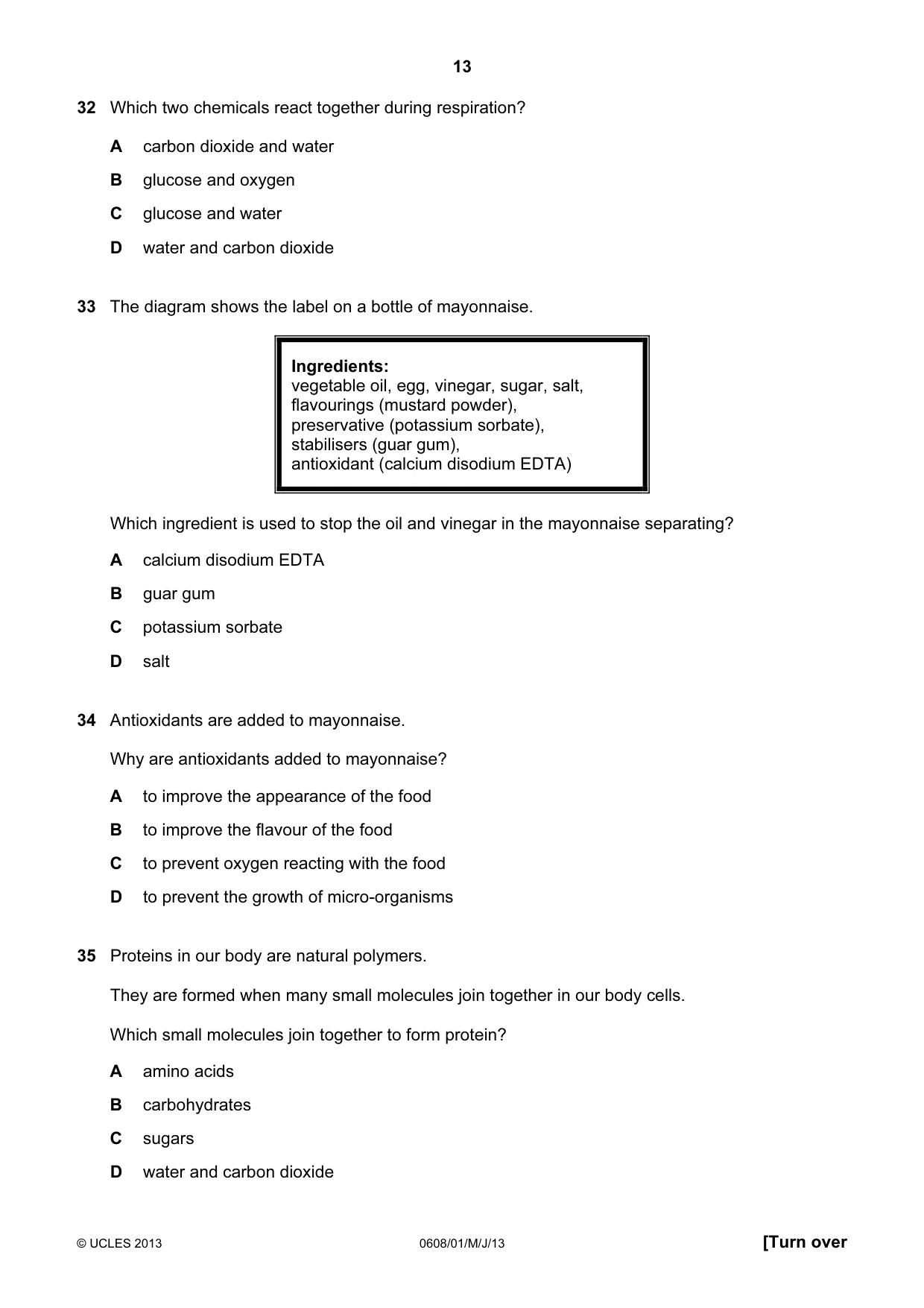
13 © UCLES 2013 0608/01/M/J/13 [Turn over 32 Which two chemicals react together during respiration? A carbon dioxide and water B glucose and oxygen C glucose and water D water and carbon dioxide 33 The diagram shows the label on a bottle of mayonnaise. Ingredients: vegetable oil, egg, vinegar, sugar, salt, flavourings (mustard powder), preservative (potassium sorbate), stabilisers (guar gum), antioxidant (calcium disodium EDTA) Which ingredient is used to stop the oil and vinegar in the mayonnaise separating? A calcium disodium EDTA B guar gum C potassium sorbate D salt 34 Antioxidants are added to mayonnaise. Why are antioxidants added to mayonnaise? A to improve the appearance of the food B to improve the flavour of the food C to prevent oxygen reacting with the food D to prevent the growth of micro-organisms 35 Proteins in our body are natural polymers. They are formed when many small molecules join together in our body cells. Which small molecules join together to form protein? A amino acids B carbohydrates C sugars D water and carbon dioxide
Question paper, page 14
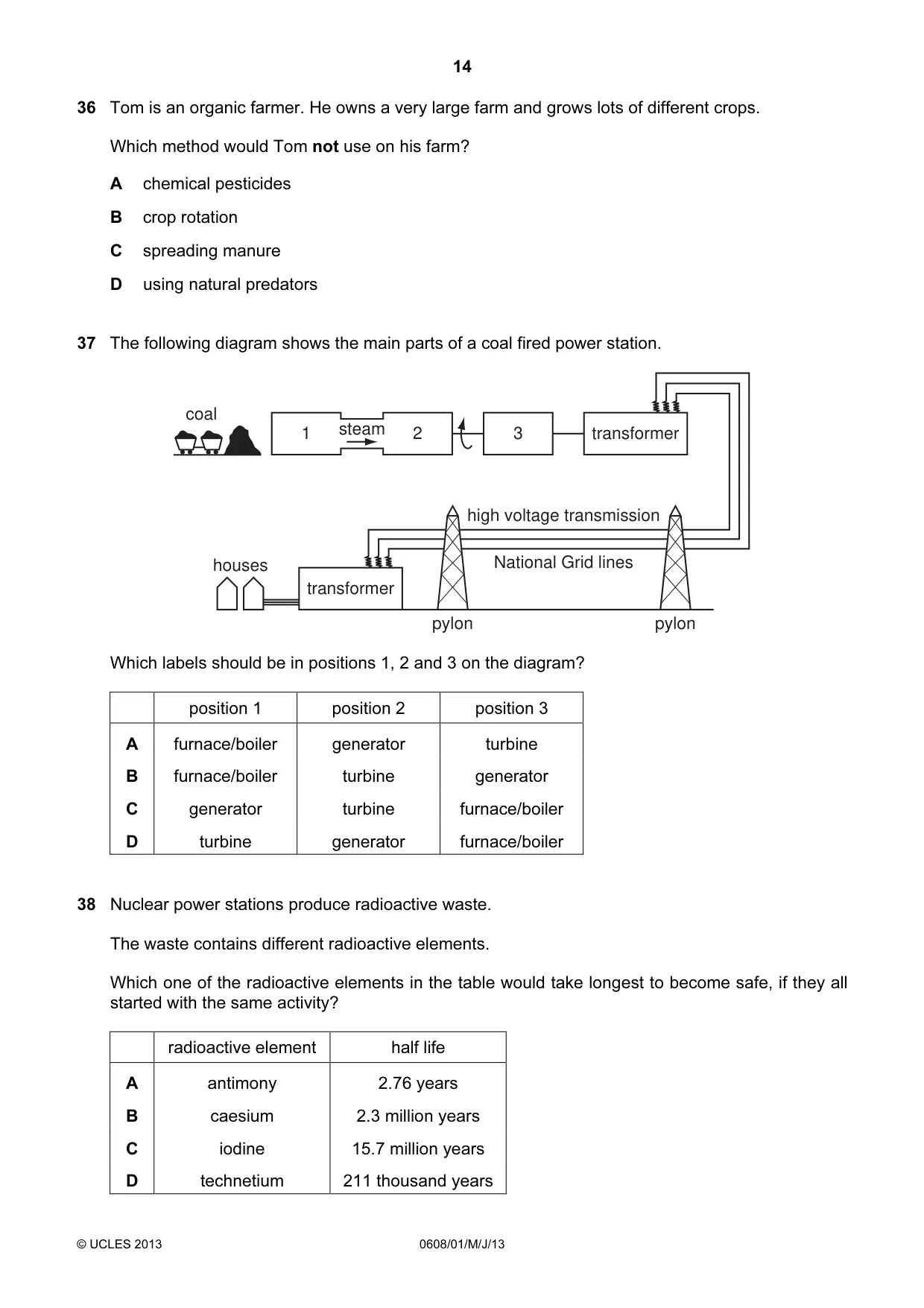
14 © UCLES 2013 0608/01/M/J/13 36 Tom is an organic farmer. He owns a very large farm and grows lots of different crops. Which method would Tom not use on his farm? A chemical pesticides B crop rotation C spreading manure D using natural predators 37 The following diagram shows the main parts of a coal fired power station. transformer transformer 3 2 1 steam high voltage transmission National Grid lines houses pylon pylon coal Which labels should be in positions 1, 2 and 3 on the diagram? position 1 position 2 position 3 A furnace/boiler generator turbine B furnace/boiler turbine generator C generator turbine furnace/boiler D turbine generator furnace/boiler 38 Nuclear power stations produce radioactive waste. The waste contains different radioactive elements. Which one of the radioactive elements in the table would take longest to become safe, if they all started with the same activity? radioactive element half life A antimony 2.76 years B caesium 2.3 million years C iodine 15.7 million years D technetium 211 thousand years
Question paper, page 15
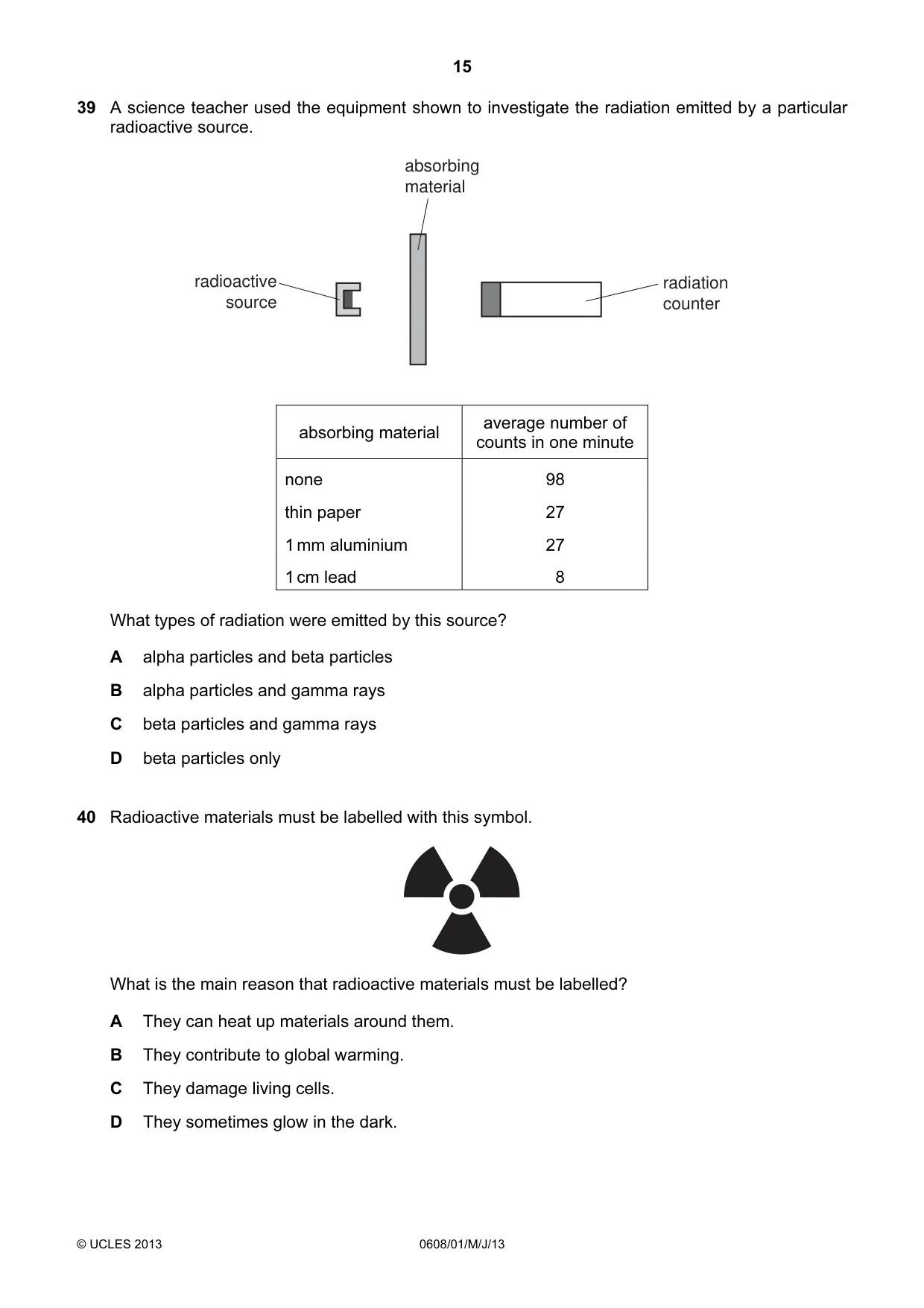
15 © UCLES 2013 0608/01/M/J/13 39 A science teacher used the equipment shown to investigate the radiation emitted by a particular radioactive source. radiation counter absorbing material radioactive source absorbing material average number of counts in one minute none 98 thin paper 27 1 mm aluminium 27 1 cm lead 8 What types of radiation were emitted by this source? A alpha particles and beta particles B alpha particles and gamma rays C beta particles and gamma rays D beta particles only 40 Radioactive materials must be labelled with this symbol. What is the main reason that radioactive materials must be labelled? A They can heat up materials around them. B They contribute to global warming. C They damage living cells. D They sometimes glow in the dark.
Question paper, page 16
16 Permission to reproduce items where third-party owned material protected by copyright is included has been sought and cleared where possible. Every reasonable effort has been made by the publisher (UCLES) to trace copyright holders, but if any items requiring clearance have unwittingly been included, the publisher will be pleased to make amends at the earliest possible opportunity. University of Cambridge International Examinations is part of the Cambridge Assessment Group. Cambridge Assessment is the brand name of University of Cambridge Local Examinations Syndicate (UCLES), which is itself a department of the University of Cambridge. © UCLES 2013 0608/01/M/J/13 BLANK PAGE
Mark scheme, page 1
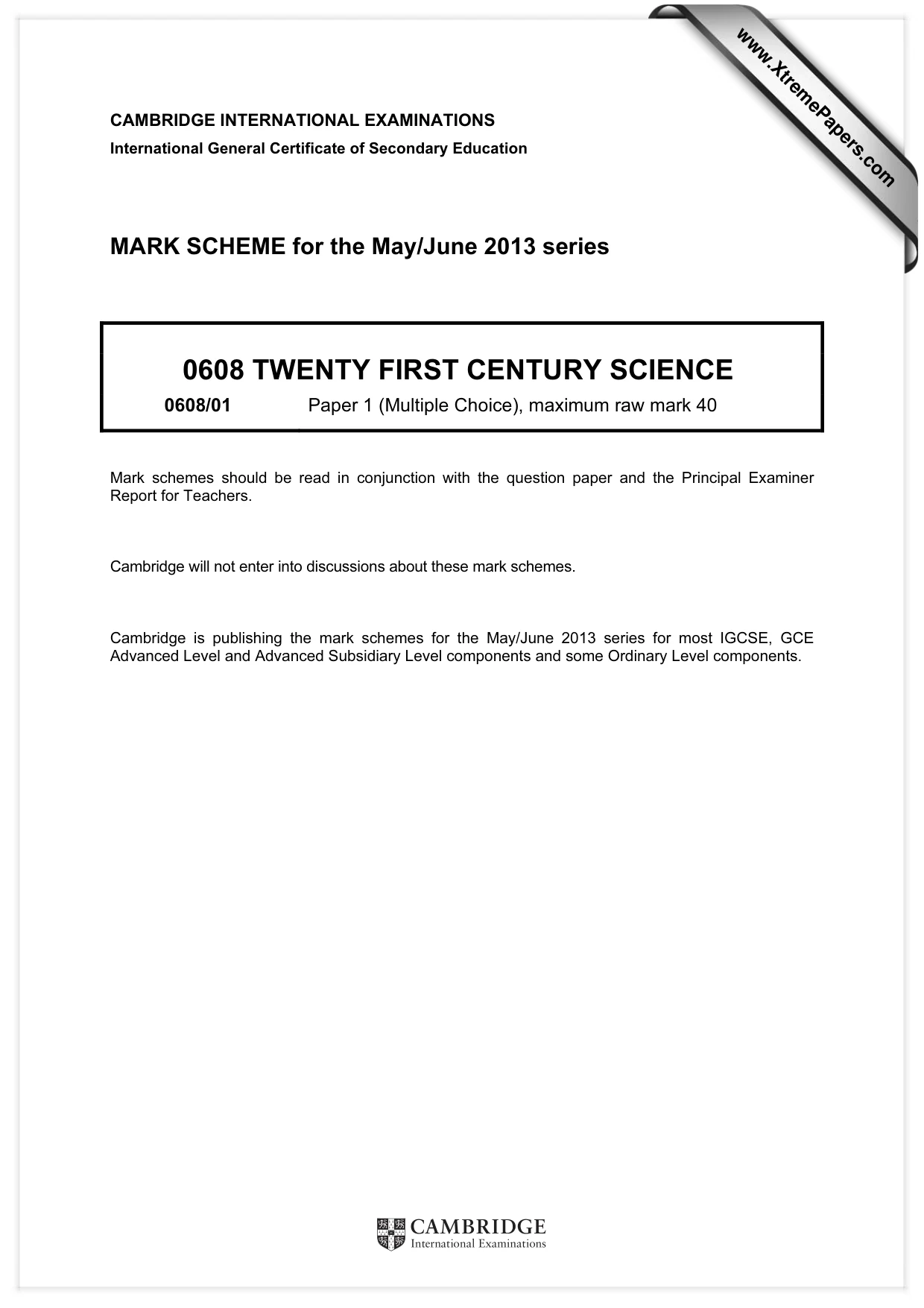
CAMBRIDGE INTERNATIONAL EXAMINATIONS International General Certificate of Secondary Education MARK SCHEME for the May/June 2013 series 0608 TWENTY FIRST CENTURY SCIENCE 0608/01 Paper 1 (Multiple Choice), maximum raw mark 40 Mark schemes should be read in conjunction with the question paper and the Principal Examiner Report for Teachers. Cambridge will not enter into discussions about these mark schemes. Cambridge is publishing the mark schemes for the May/June 2013 series for most IGCSE, GCE Advanced Level and Advanced Subsidiary Level components and some Ordinary Level components. www.XtremePapers.com
Mark scheme, page 2
Page 2 Mark Scheme Syllabus Paper IGCSE – May/June 2013 0608 01 © Cambridge International Examinations 2013 Question Number Key Question Number Key 1 A 21 D 2 D 22 D 3 B 23 C 4 C 24 B 5 A 25 B 6 A 26 C 7 C 27 B 8 D 28 A 9 A 29 B 10 C 30 B 11 D 31 A 12 A 32 B 13 B 33 B 14 B 34 C 15 A 35 A 16 C 36 A 17 C 37 B 18 A 38 C 19 A 39 B 20 B 40 C
What you needed in this session
Cambridge’s own grade thresholds for 2013 May/June, Paper 1 · Variant 1. A higher threshold means an easier paper — the bar moves with how the cohort did.