Cambridge IGCSE Travel and Tourism 0471 — 2024 May/June Paper 1 · Variant 1
0471/11/M/J/24 · 80 marks · 90 min
The question paper and its mark scheme, free to read here and free to download. This is Cambridge’s own paper, exactly as it was sat.
Question paper12 pages



Mark scheme17 pages
Answers below. Sit the paper first if you are practising.

Paper as text
Question paper, page 1
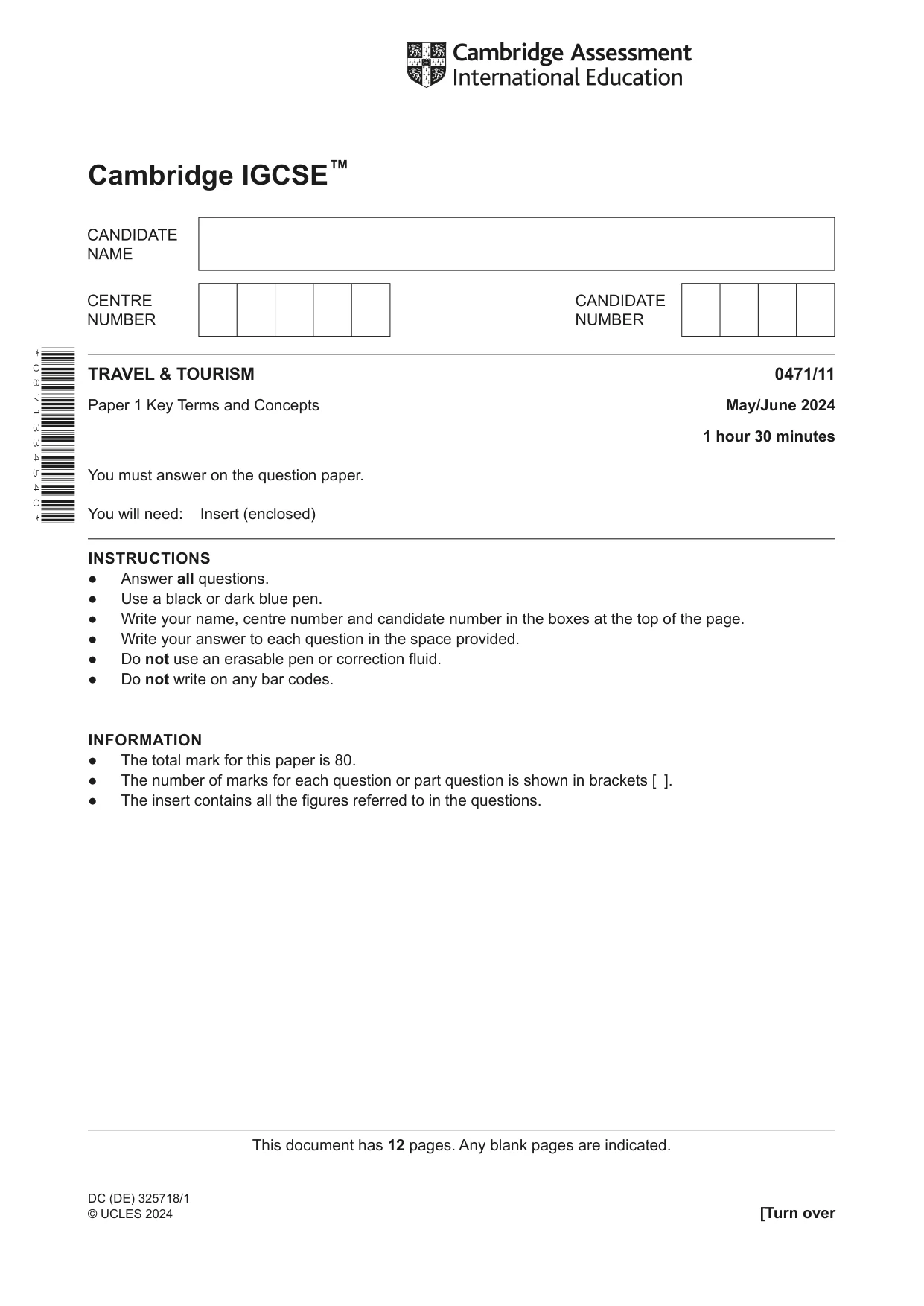
This document has 12 pages. Any blank pages are indicated. [Turn over * 0 8 7 1 3 3 4 5 4 0 * Cambridge IGCSE™ DC (DE) 325718/1 © UCLES 2024 TRAVEL & TOURISM 0471/11 Paper 1 Key Terms and Concepts May/June 2024 1 hour 30 minutes You must answer on the question paper. You will need: Insert (enclosed) INSTRUCTIONS ● Answer all questions. ● Use a black or dark blue pen. ● Write your name, centre number and candidate number in the boxes at the top of the page. ● Write your answer to each question in the space provided. ● Do not use an erasable pen or correction fluid. ● Do not write on any bar codes. INFORMATION ● The total mark for this paper is 80. ● The number of marks for each question or part question is shown in brackets [ ]. ● The insert contains all the figures referred to in the questions.
Question paper, page 2
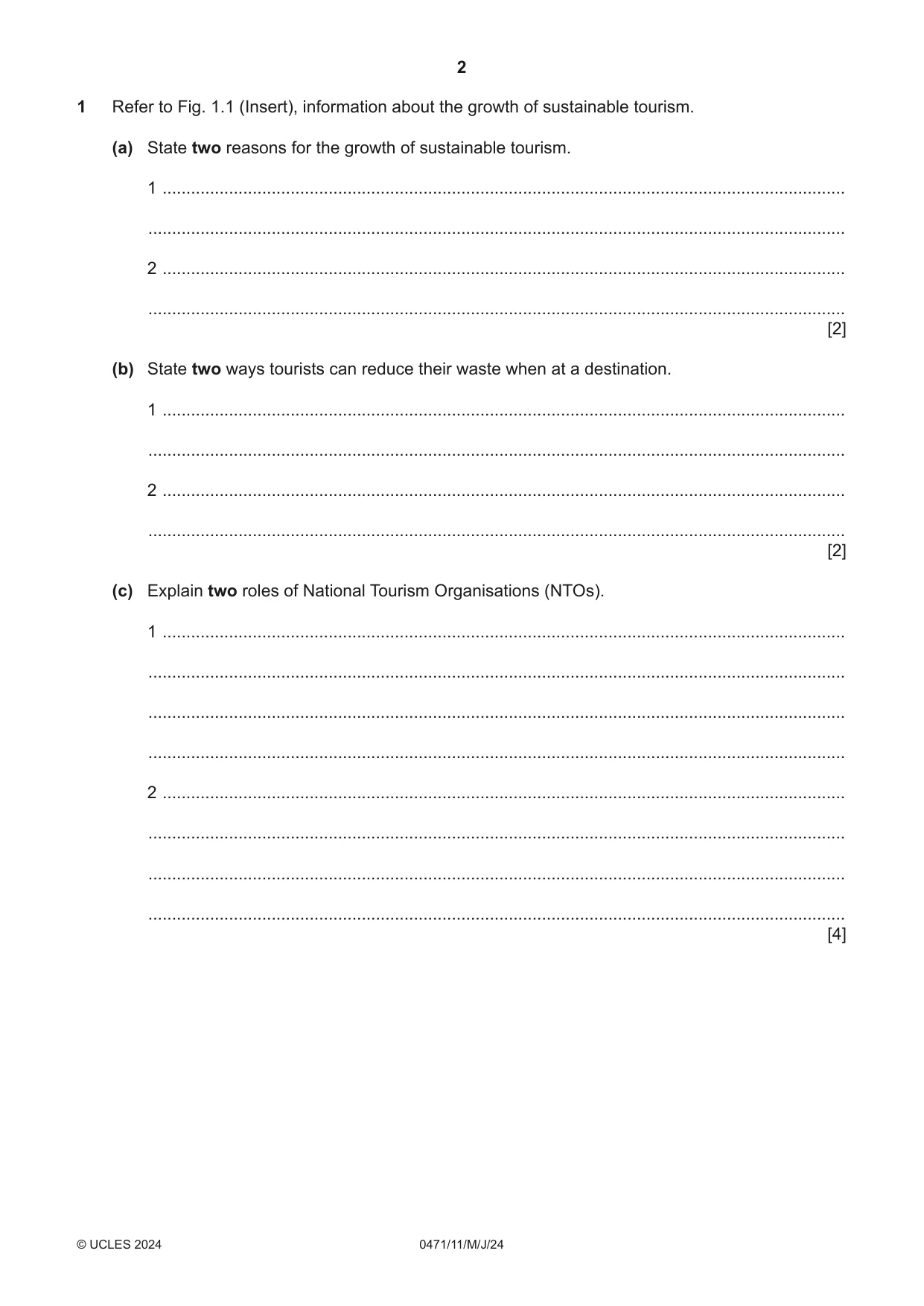
2 0471/11/M/J/24 © UCLES 2024 1 Refer to Fig. 1.1 (Insert), information about the growth of sustainable tourism. (a) State two reasons for the growth of sustainable tourism. 1 … … 2 … … [2] (b) State two ways tourists can reduce their waste when at a destination. 1 … … 2 … … [2] (c) Explain two roles of National Tourism Organisations (NTOs). 1 … … … … 2 … … … … [4]
Question paper, page 3
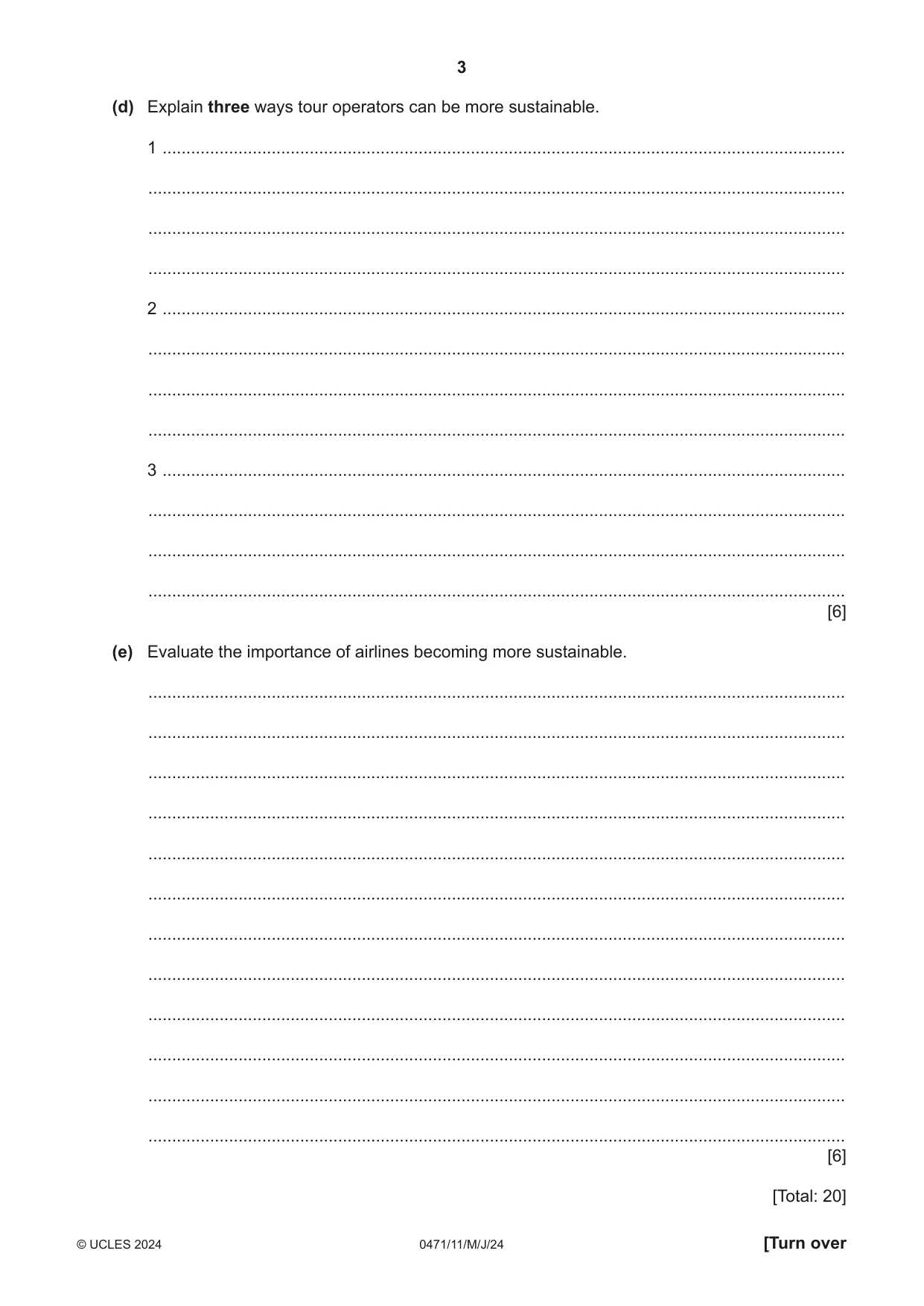
3 0471/11/M/J/24 © UCLES 2024 [Turn over (d) Explain three ways tour operators can be more sustainable. 1 … … … … 2 … … … … 3 … … … … [6] (e) Evaluate the importance of airlines becoming more sustainable. … … … … … … … … … … … … [6] [Total: 20]
Question paper, page 4
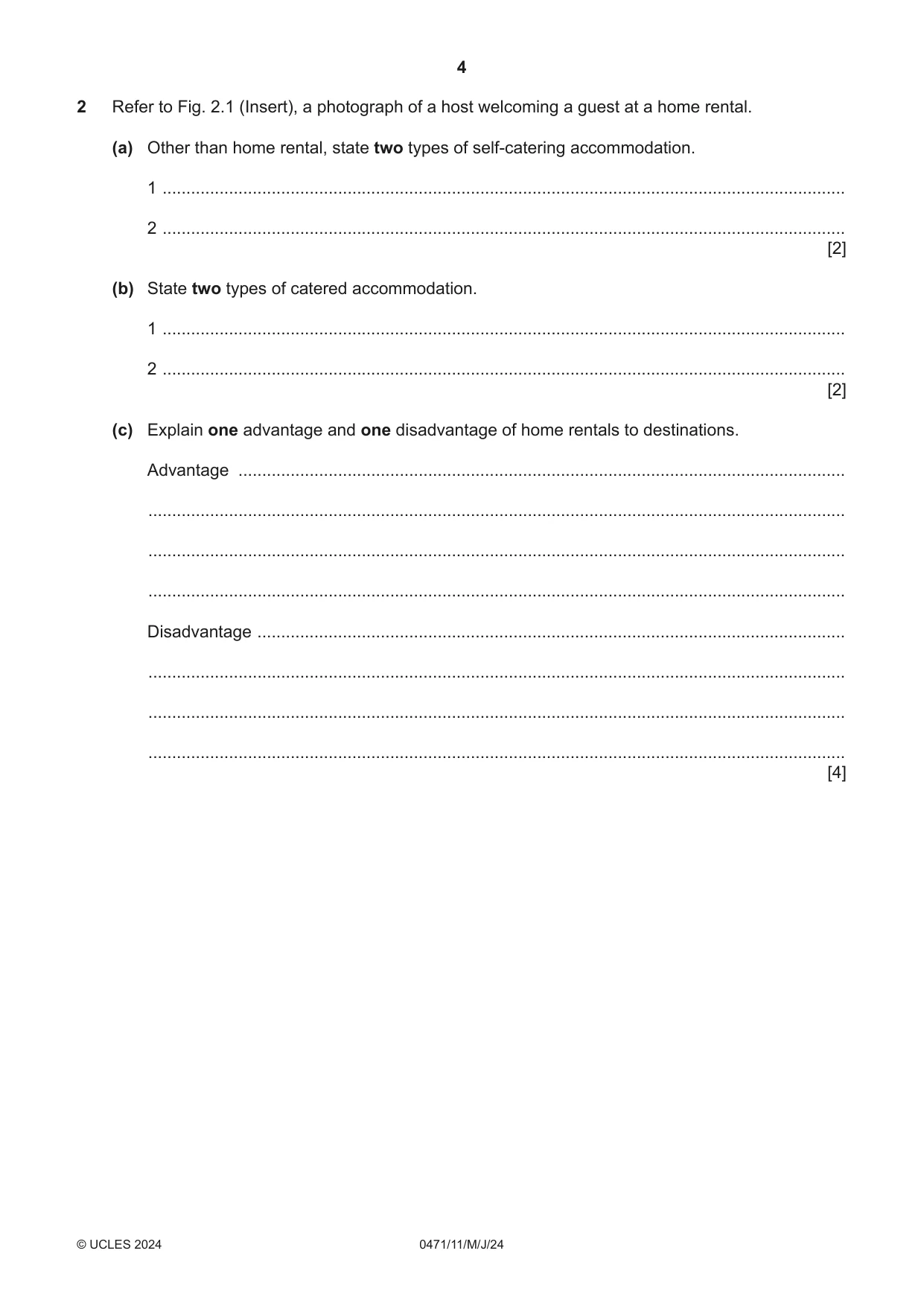
4 0471/11/M/J/24 © UCLES 2024 2 Refer to Fig. 2.1 (Insert), a photograph of a host welcoming a guest at a home rental. (a) Other than home rental, state two types of self-catering accommodation. 1 … 2 … [2] (b) State two types of catered accommodation. 1 … 2 … [2] (c) Explain one advantage and one disadvantage of home rentals to destinations. Advantage … … … … Disadvantage … … … … [4]
Question paper, page 5
5 0471/11/M/J/24 © UCLES 2024 [Turn over (d) Explain three reasons for the appeal of self-catering accommodation. 1 … … … … 2 … … … … 3 … … … … [6] (e) Evaluate the impact of seasonality on accommodation providers. … … … … … … … … … … … … [6] [Total: 20]
Question paper, page 6
6 0471/11/M/J/24 © UCLES 2024 3 Refer to Fig. 3.1 (Insert), information about The World Expo 2020. (a) State two main reasons why people travel. 1 … 2 … [2] (b) State two types of destinations. 1 … 2 … [2] (c) Explain two ways events benefit from offering virtual visits. 1 … … … … 2 … … … … [4]
Question paper, page 7
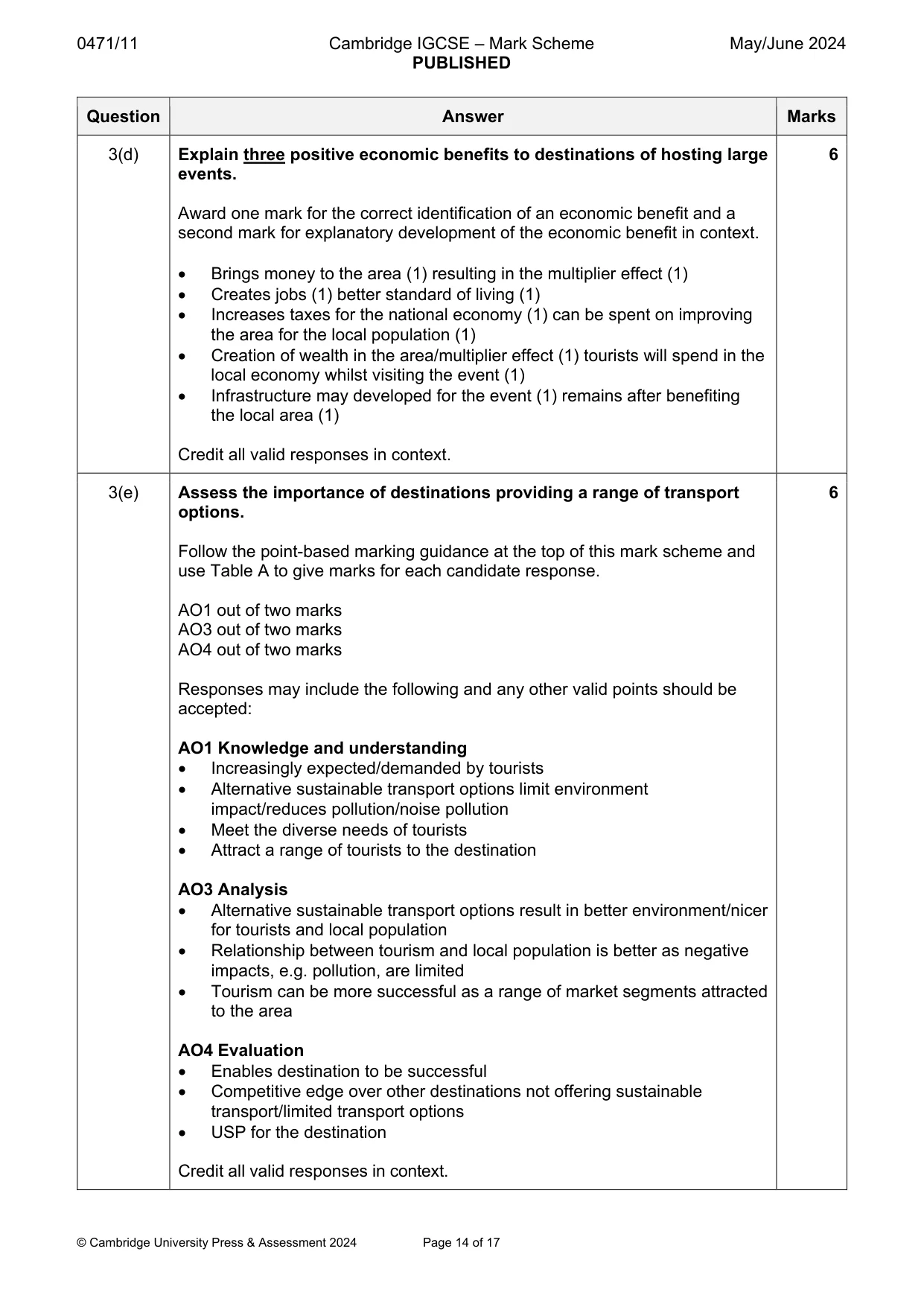
7 0471/11/M/J/24 © UCLES 2024 [Turn over (d) Explain three positive economic benefits to destinations of hosting large events. 1 … … … … 2 … … … … 3 … … … … [6] (e) Assess the importance of destinations providing a range of transport options. … … … … … … … … … … … … [6] [Total: 20]
Question paper, page 8
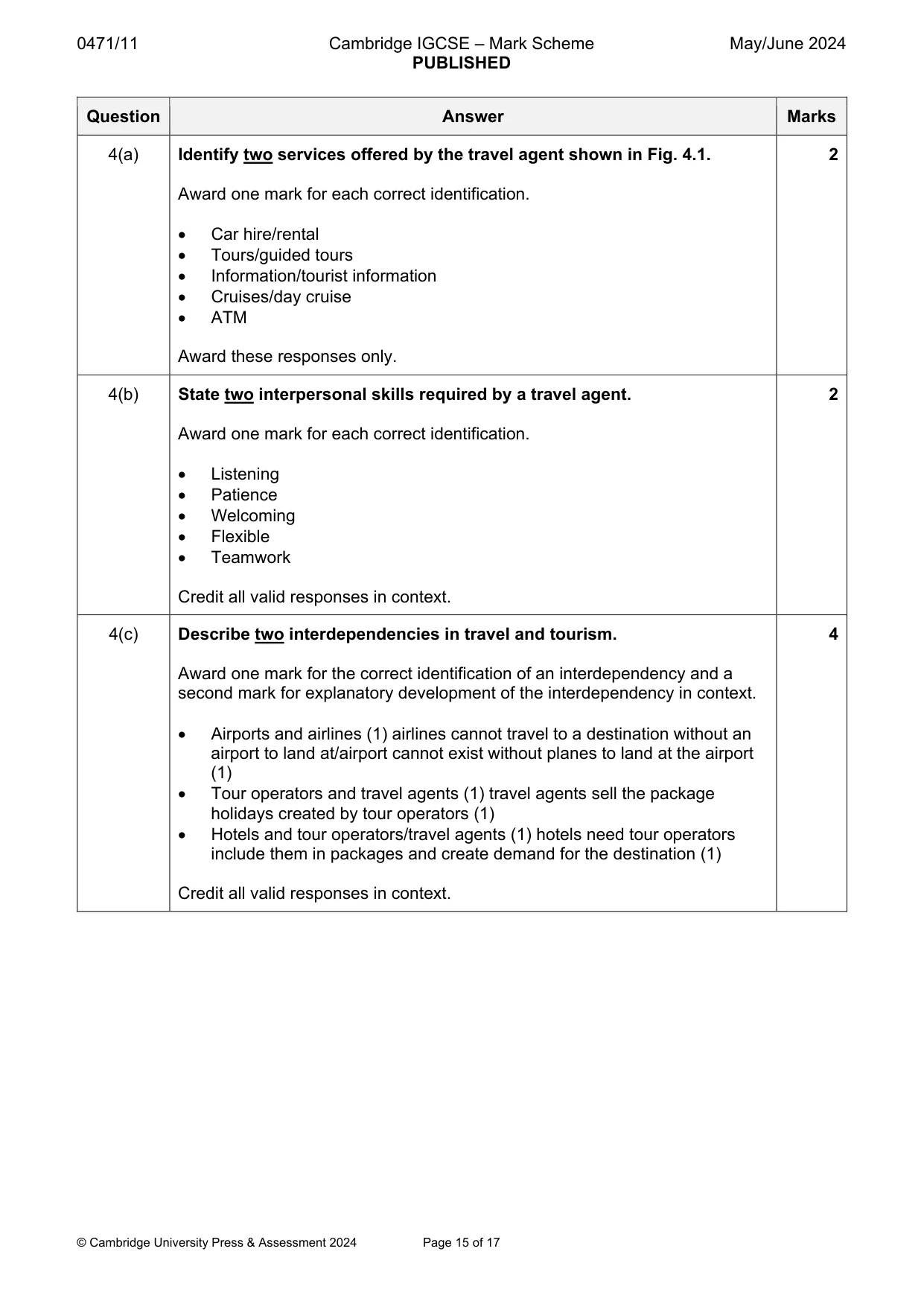
8 0471/11/M/J/24 © UCLES 2024 4 Refer to Fig. 4.1 (Insert), a photograph of a travel agent in Greece. (a) Identify two services offered by the travel agent shown in Fig. 4.1. 1 … 2 … [2] (b) State two interpersonal skills required by a travel agent. 1 … 2 … [2] (c) Describe two interdependencies in travel and tourism. 1 … … … … 2 … … … … [4]
Question paper, page 9
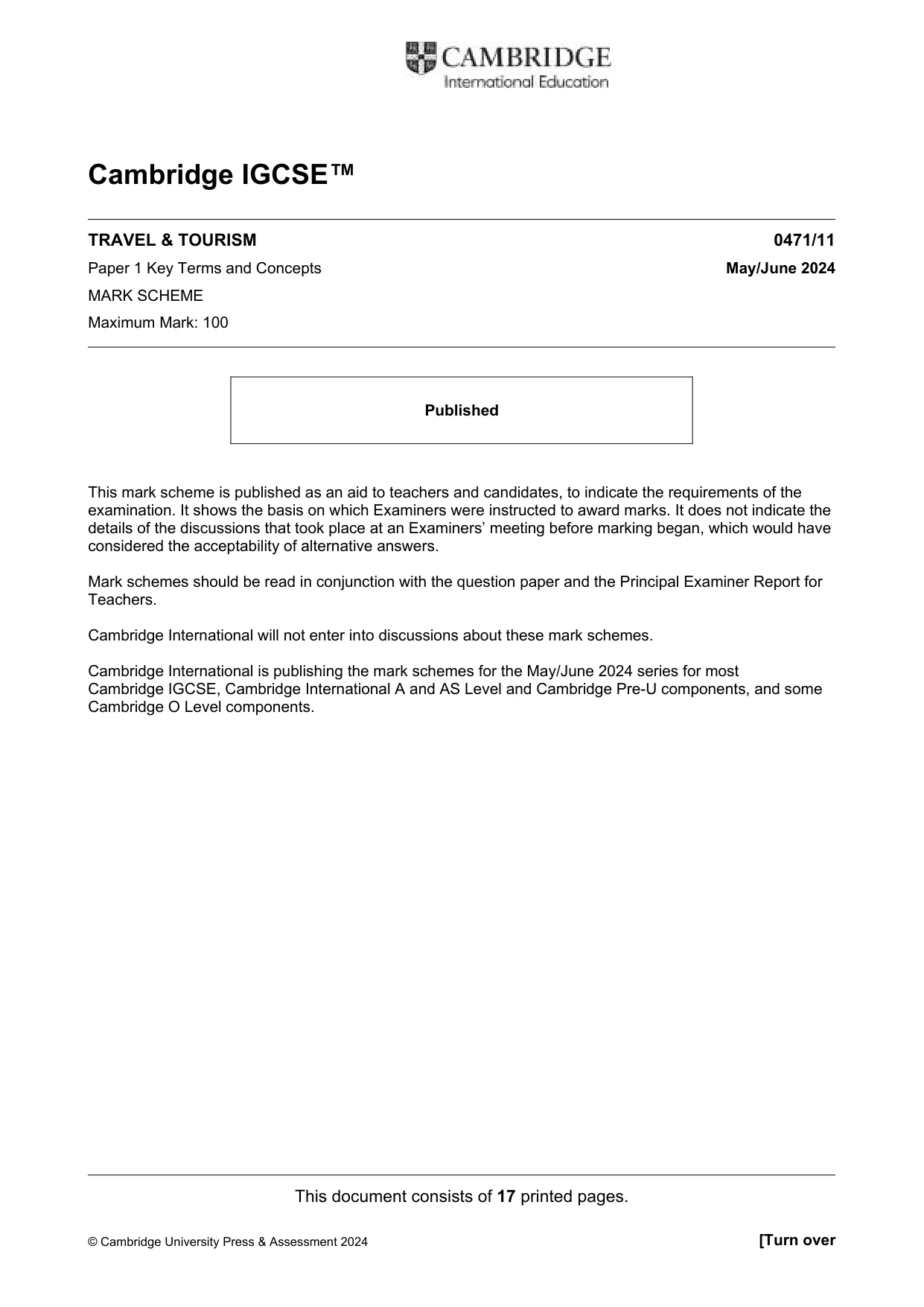
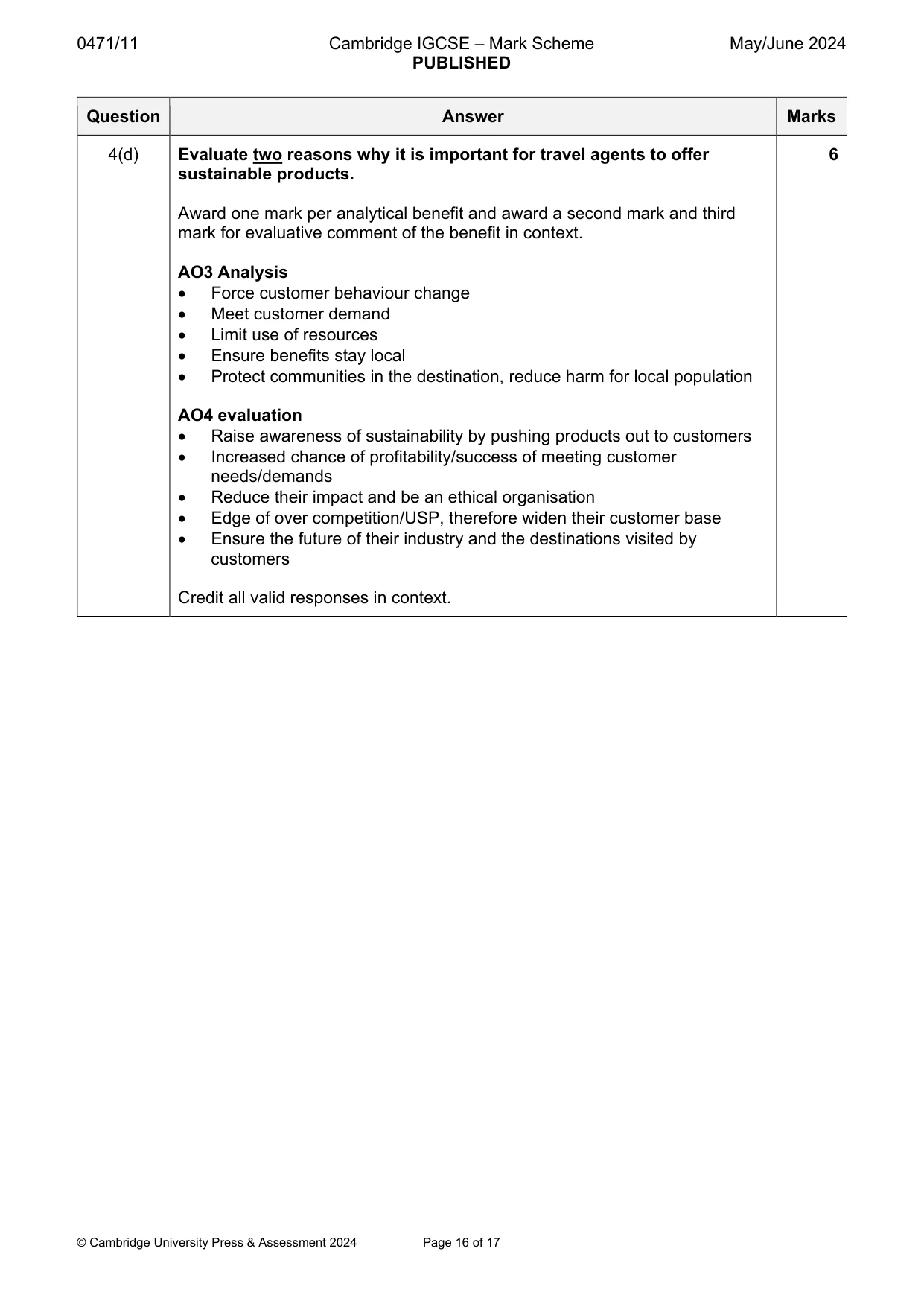
9 0471/11/M/J/24 © UCLES 2024 (d) Evaluate two reasons why it is important for travel agents to offer sustainable products. 1 … … … … … … 2 … … … … … … [6] (e) Evaluate the benefit of dynamic packaging to tourists. … … … … … … … … … … … … [6] [Total: 20]
Question paper, page 10
10 0471/11/M/J/24 © UCLES 2024 BLANK PAGE
Question paper, page 11
11 0471/11/M/J/24 © UCLES 2024 BLANK PAGE
Question paper, page 12
12 0471/11/M/J/24 © UCLES 2024 The boundaries and names shown, the designations used and the presentation of material on any maps contained in this question paper/insert do not imply official endorsement or acceptance by Cambridge Assessment International Education concerning the legal status of any country, territory, or area or any of its authorities, or of the delimitation of its frontiers or boundaries. Permission to reproduce items where third-party owned material protected by copyright is included has been sought and cleared where possible. Every reasonable effort has been made by the publisher (UCLES) to trace copyright holders, but if any items requiring clearance have unwittingly been included, the publisher will be pleased to make amends at the earliest possible opportunity. To avoid the issue of disclosure of answer-related information to candidates, all copyright acknowledgements are reproduced online in the Cambridge Assessment International Education Copyright Acknowledgements Booklet. This is produced for each series of examinations and is freely available to download at www.cambridgeinternational.org after the live examination series. Cambridge Assessment International Education is part of Cambridge Assessment. Cambridge Assessment is the brand name of the University of Cambridge Local Examinations Syndicate (UCLES), which is a department of the University of Cambridge. BLANK PAGE
Mark scheme, page 1
This document consists of 17 printed pages. © Cambridge University Press & Assessment 2024 [Turn over Cambridge IGCSE™ TRAVEL & TOURISM 0471/11 Paper 1 Key Terms and Concepts May/June 2024 MARK SCHEME Maximum Mark: 100 Published This mark scheme is published as an aid to teachers and candidates, to indicate the requirements of the examination. It shows the basis on which Examiners were instructed to award marks. It does not indicate the details of the discussions that took place at an Examiners’ meeting before marking began, which would have considered the acceptability of alternative answers. Mark schemes should be read in conjunction with the question paper and the Principal Examiner Report for Teachers. Cambridge International will not enter into discussions about these mark schemes. Cambridge International is publishing the mark schemes for the May/June 2024 series for most Cambridge IGCSE, Cambridge International A and AS Level and Cambridge Pre-U components, and some Cambridge O Level components.
Mark scheme, page 2
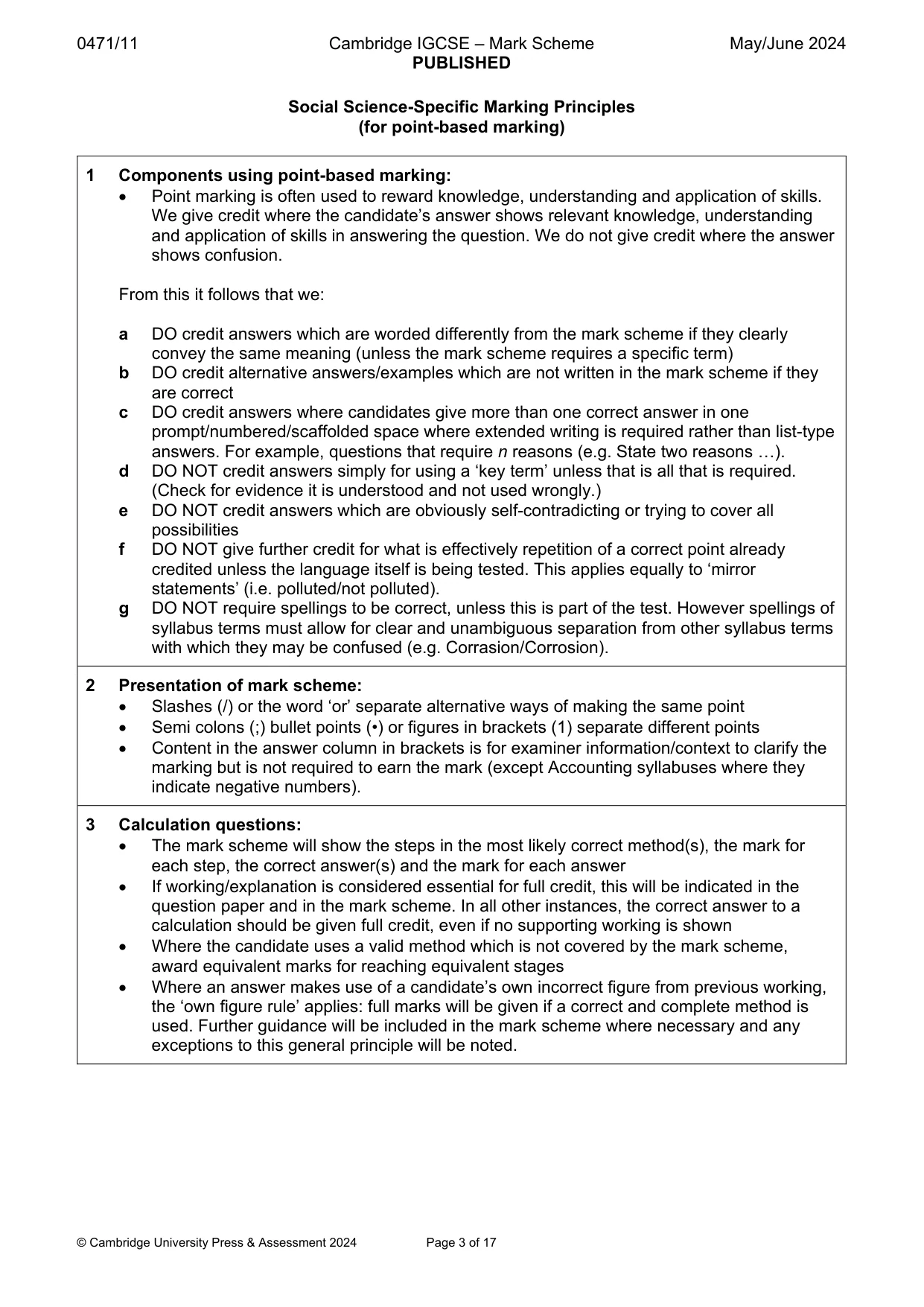
0471/11 Cambridge IGCSE – Mark Scheme PUBLISHED May/June 2024 © Cambridge University Press & Assessment 2024 Page 2 of 17 Generic Marking Principles These general marking principles must be applied by all examiners when marking candidate answers. They should be applied alongside the specific content of the mark scheme or generic level descriptions for a question. Each question paper and mark scheme will also comply with these marking principles. GENERIC MARKING PRINCIPLE 1: Marks must be awarded in line with: the specific content of the mark scheme or the generic level descriptors for the question the specific skills defined in the mark scheme or in the generic level descriptors for the question the standard of response required by a candidate as exemplified by the standardisation scripts. GENERIC MARKING PRINCIPLE 2: Marks awarded are always whole marks (not half marks, or other fractions). GENERIC MARKING PRINCIPLE 3: Marks must be awarded positively: marks are awarded for correct/valid answers, as defined in the mark scheme. However, credit is given for valid answers which go beyond the scope of the syllabus and mark scheme, referring to your Team Leader as appropriate marks are awarded when candidates clearly demonstrate what they know and can do marks are not deducted for errors marks are not deducted for omissions answers should only be judged on the quality of spelling, punctuation and grammar when these features are specifically assessed by the question as indicated by the mark scheme. The meaning, however, should be unambiguous. GENERIC MARKING PRINCIPLE 4: Rules must be applied consistently, e.g. in situations where candidates have not followed instructions or in the application of generic level descriptors. GENERIC MARKING PRINCIPLE 5: Marks should be awarded using the full range of marks defined in the mark scheme for the question (however; the use of the full mark range may be limited according to the quality of the candidate responses seen). GENERIC MARKING PRINCIPLE 6: Marks awarded are based solely on the requirements as defined in the mark scheme. Marks should not be awarded with grade thresholds or grade descriptors in mind.
Mark scheme, page 3
0471/11 Cambridge IGCSE – Mark Scheme PUBLISHED May/June 2024 © Cambridge University Press & Assessment 2024 Page 3 of 17 Social Science-Specific Marking Principles (for point-based marking) 1 Components using point-based marking: Point marking is often used to reward knowledge, understanding and application of skills. We give credit where the candidate’s answer shows relevant knowledge, understanding and application of skills in answering the question. We do not give credit where the answer shows confusion. From this it follows that we: a DO credit answers which are worded differently from the mark scheme if they clearly convey the same meaning (unless the mark scheme requires a specific term) b DO credit alternative answers/examples which are not written in the mark scheme if they are correct c DO credit answers where candidates give more than one correct answer in one prompt/numbered/scaffolded space where extended writing is required rather than list-type answers. For example, questions that require n reasons (e.g. State two reasons …). d DO NOT credit answers simply for using a ‘key term’ unless that is all that is required. (Check for evidence it is understood and not used wrongly.) e DO NOT credit answers which are obviously self-contradicting or trying to cover all possibilities f DO NOT give further credit for what is effectively repetition of a correct point already credited unless the language itself is being tested. This applies equally to ‘mirror statements’ (i.e. polluted/not polluted). g DO NOT require spellings to be correct, unless this is part of the test. However spellings of syllabus terms must allow for clear and unambiguous separation from other syllabus terms with which they may be confused (e.g. Corrasion/Corrosion). 2 Presentation of mark scheme: Slashes (/) or the word ‘or’ separate alternative ways of making the same point Semi colons (;) bullet points (•) or figures in brackets (1) separate different points Content in the answer column in brackets is for examiner information/context to clarify the marking but is not required to earn the mark (except Accounting syllabuses where they indicate negative numbers). 3 Calculation questions: The mark scheme will show the steps in the most likely correct method(s), the mark for each step, the correct answer(s) and the mark for each answer If working/explanation is considered essential for full credit, this will be indicated in the question paper and in the mark scheme. In all other instances, the correct answer to a calculation should be given full credit, even if no supporting working is shown Where the candidate uses a valid method which is not covered by the mark scheme, award equivalent marks for reaching equivalent stages Where an answer makes use of a candidate’s own incorrect figure from previous working, the ‘own figure rule’ applies: full marks will be given if a correct and complete method is used. Further guidance will be included in the mark scheme where necessary and any exceptions to this general principle will be noted.
Mark scheme, page 4
0471/11 Cambridge IGCSE – Mark Scheme PUBLISHED May/June 2024 © Cambridge University Press & Assessment 2024 Page 4 of 17 4 Annotation: For point marking, ticks can be used to indicate correct answers and crosses can be used to indicate wrong answers. There is no direct relationship between ticks and marks. Ticks have no defined meaning for levels of response marking For levels of response marking, the level awarded should be annotated on the script Other annotations will be used by examiners as agreed during standardisation, and the meaning will be understood by all examiners who marked that paper.
Mark scheme, page 5
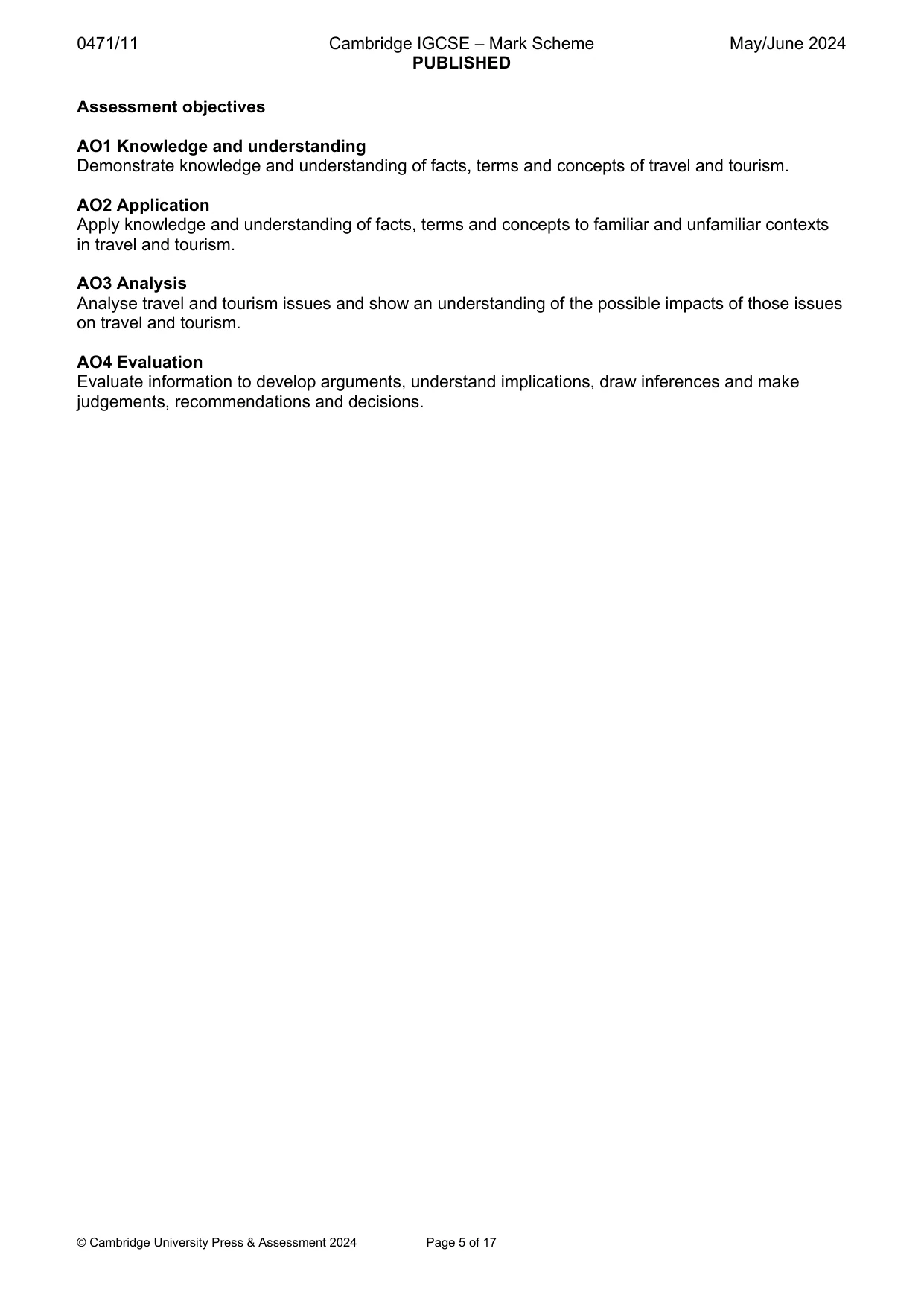
0471/11 Cambridge IGCSE – Mark Scheme PUBLISHED May/June 2024 © Cambridge University Press & Assessment 2024 Page 5 of 17 Assessment objectives AO1 Knowledge and understanding Demonstrate knowledge and understanding of facts, terms and concepts of travel and tourism. AO2 Application Apply knowledge and understanding of facts, terms and concepts to familiar and unfamiliar contexts in travel and tourism. AO3 Analysis Analyse travel and tourism issues and show an understanding of the possible impacts of those issues on travel and tourism. AO4 Evaluation Evaluate information to develop arguments, understand implications, draw inferences and make judgements, recommendations and decisions.
Mark scheme, page 6
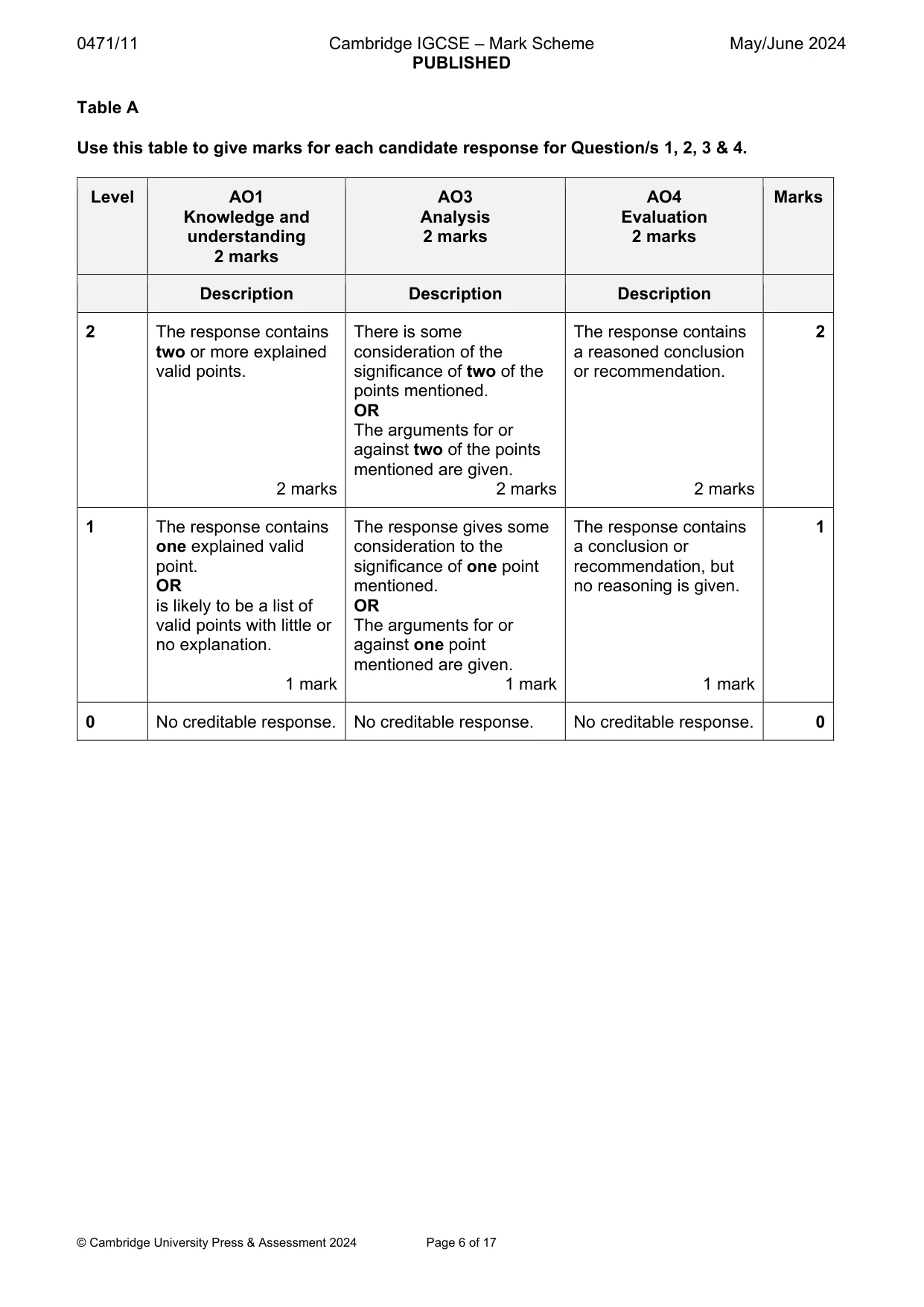
0471/11 Cambridge IGCSE – Mark Scheme PUBLISHED May/June 2024 © Cambridge University Press & Assessment 2024 Page 6 of 17 Table A Use this table to give marks for each candidate response for Question/s 1, 2, 3 & 4. Level AO1 Knowledge and understanding 2 marks AO3 Analysis 2 marks AO4 Evaluation 2 marks Marks Description Description Description 2 The response contains two or more explained valid points. 2 marks There is some consideration of the significance of two of the points mentioned. OR The arguments for or against two of the points mentioned are given. 2 marks The response contains a reasoned conclusion or recommendation. 2 marks 2 1 The response contains one explained valid point. OR is likely to be a list of valid points with little or no explanation. 1 mark The response gives some consideration to the significance of one point mentioned. OR The arguments for or against one point mentioned are given. 1 mark The response contains a conclusion or recommendation, but no reasoning is given. 1 mark 1 0 No creditable response. No creditable response. No creditable response. 0
Mark scheme, page 7
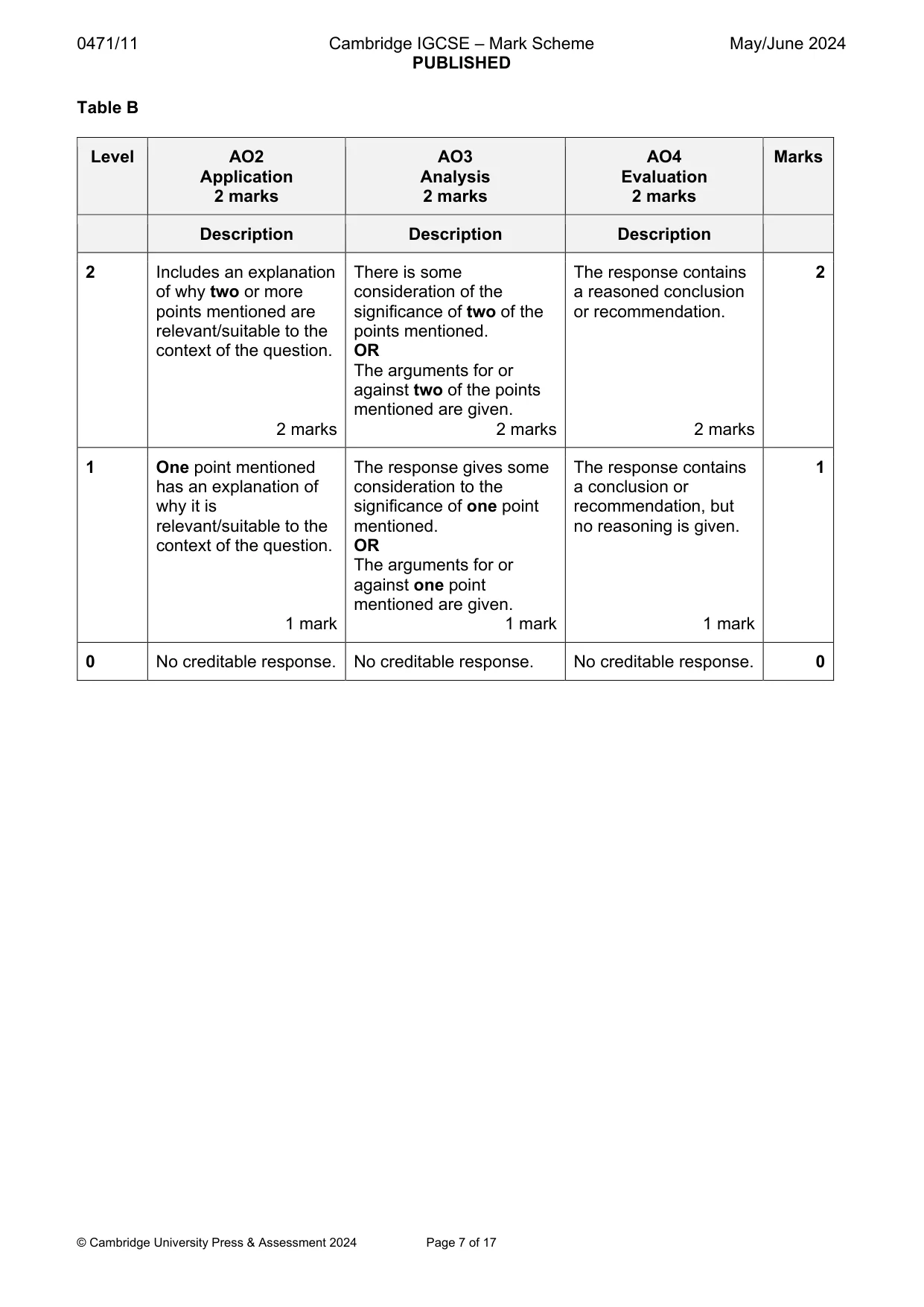
0471/11 Cambridge IGCSE – Mark Scheme PUBLISHED May/June 2024 © Cambridge University Press & Assessment 2024 Page 7 of 17 Table B Level AO2 Application 2 marks AO3 Analysis 2 marks AO4 Evaluation 2 marks Marks Description Description Description 2 Includes an explanation of why two or more points mentioned are relevant/suitable to the context of the question. 2 marks There is some consideration of the significance of two of the points mentioned. OR The arguments for or against two of the points mentioned are given. 2 marks The response contains a reasoned conclusion or recommendation. 2 marks 2 1 One point mentioned has an explanation of why it is relevant/suitable to the context of the question. 1 mark The response gives some consideration to the significance of one point mentioned. OR The arguments for or against one point mentioned are given. 1 mark The response contains a conclusion or recommendation, but no reasoning is given. 1 mark 1 0 No creditable response. No creditable response. No creditable response. 0
Mark scheme, page 8
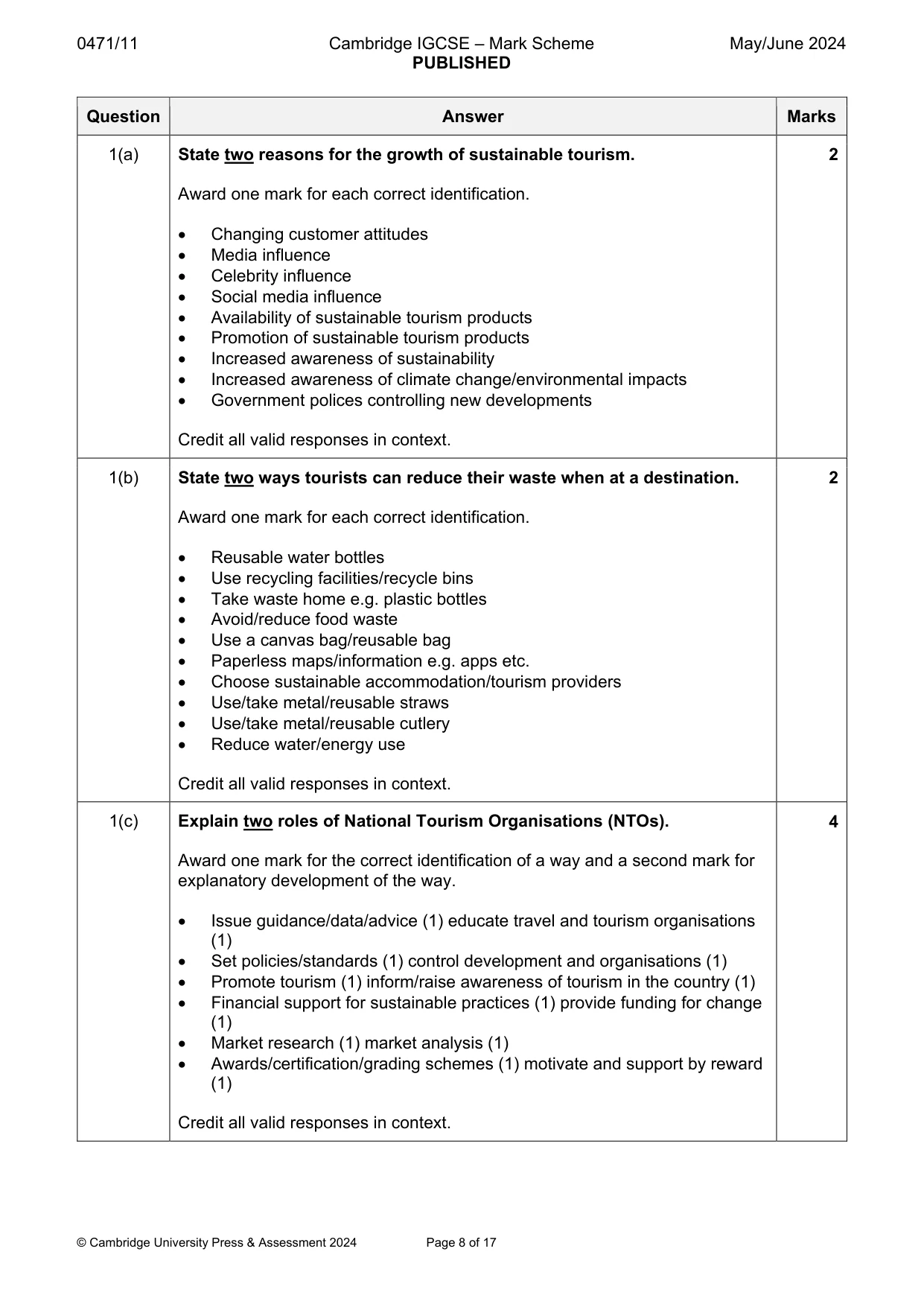
0471/11 Cambridge IGCSE – Mark Scheme PUBLISHED May/June 2024 © Cambridge University Press & Assessment 2024 Page 8 of 17 Question Answer Marks 1(a) State two reasons for the growth of sustainable tourism. Award one mark for each correct identification. Changing customer attitudes Media influence Celebrity influence Social media influence Availability of sustainable tourism products Promotion of sustainable tourism products Increased awareness of sustainability Increased awareness of climate change/environmental impacts Government polices controlling new developments Credit all valid responses in context. 2 1(b) State two ways tourists can reduce their waste when at a destination. Award one mark for each correct identification. Reusable water bottles Use recycling facilities/recycle bins Take waste home e.g. plastic bottles Avoid/reduce food waste Use a canvas bag/reusable bag Paperless maps/information e.g. apps etc. Choose sustainable accommodation/tourism providers Use/take metal/reusable straws Use/take metal/reusable cutlery Reduce water/energy use Credit all valid responses in context. 2 1(c) Explain two roles of National Tourism Organisations (NTOs). Award one mark for the correct identification of a way and a second mark for explanatory development of the way. Issue guidance/data/advice (1) educate travel and tourism organisations (1) Set policies/standards (1) control development and organisations (1) Promote tourism (1) inform/raise awareness of tourism in the country (1) Financial support for sustainable practices (1) provide funding for change (1) Market research (1) market analysis (1) Awards/certification/grading schemes (1) motivate and support by reward (1) Credit all valid responses in context. 4
Mark scheme, page 9
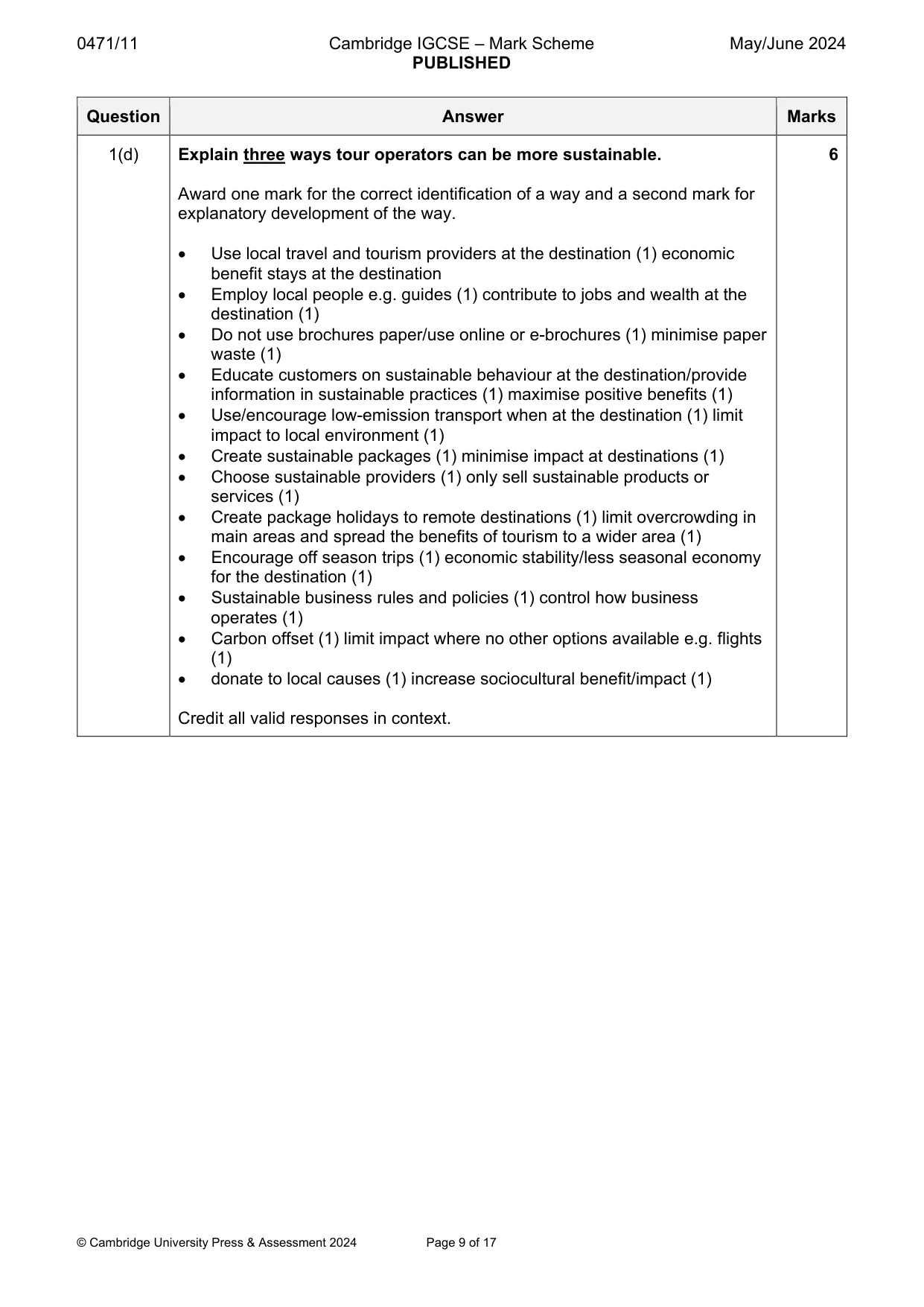
0471/11 Cambridge IGCSE – Mark Scheme PUBLISHED May/June 2024 © Cambridge University Press & Assessment 2024 Page 9 of 17 Question Answer Marks 1(d) Explain three ways tour operators can be more sustainable. Award one mark for the correct identification of a way and a second mark for explanatory development of the way. Use local travel and tourism providers at the destination (1) economic benefit stays at the destination Employ local people e.g. guides (1) contribute to jobs and wealth at the destination (1) Do not use brochures paper/use online or e-brochures (1) minimise paper waste (1) Educate customers on sustainable behaviour at the destination/provide information in sustainable practices (1) maximise positive benefits (1) Use/encourage low-emission transport when at the destination (1) limit impact to local environment (1) Create sustainable packages (1) minimise impact at destinations (1) Choose sustainable providers (1) only sell sustainable products or services (1) Create package holidays to remote destinations (1) limit overcrowding in main areas and spread the benefits of tourism to a wider area (1) Encourage off season trips (1) economic stability/less seasonal economy for the destination (1) Sustainable business rules and policies (1) control how business operates (1) Carbon offset (1) limit impact where no other options available e.g. flights (1) donate to local causes (1) increase sociocultural benefit/impact (1) Credit all valid responses in context. 6
Mark scheme, page 10
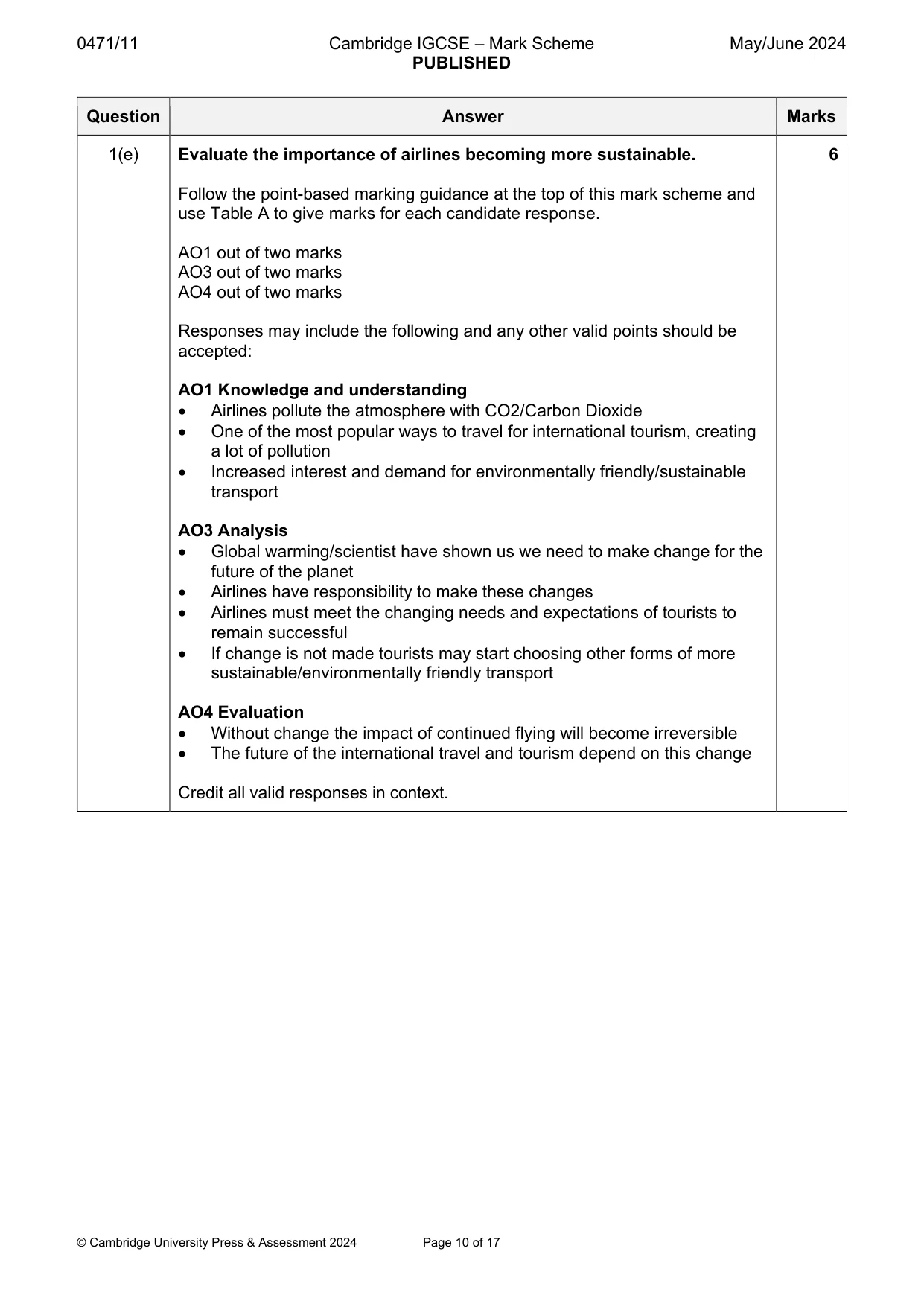
0471/11 Cambridge IGCSE – Mark Scheme PUBLISHED May/June 2024 © Cambridge University Press & Assessment 2024 Page 10 of 17 Question Answer Marks 1(e) Evaluate the importance of airlines becoming more sustainable. Follow the point-based marking guidance at the top of this mark scheme and use Table A to give marks for each candidate response. AO1 out of two marks AO3 out of two marks AO4 out of two marks Responses may include the following and any other valid points should be accepted: AO1 Knowledge and understanding Airlines pollute the atmosphere with CO2/Carbon Dioxide One of the most popular ways to travel for international tourism, creating a lot of pollution Increased interest and demand for environmentally friendly/sustainable transport AO3 Analysis Global warming/scientist have shown us we need to make change for the future of the planet Airlines have responsibility to make these changes Airlines must meet the changing needs and expectations of tourists to remain successful If change is not made tourists may start choosing other forms of more sustainable/environmentally friendly transport AO4 Evaluation Without change the impact of continued flying will become irreversible The future of the international travel and tourism depend on this change Credit all valid responses in context. 6
Mark scheme, page 11
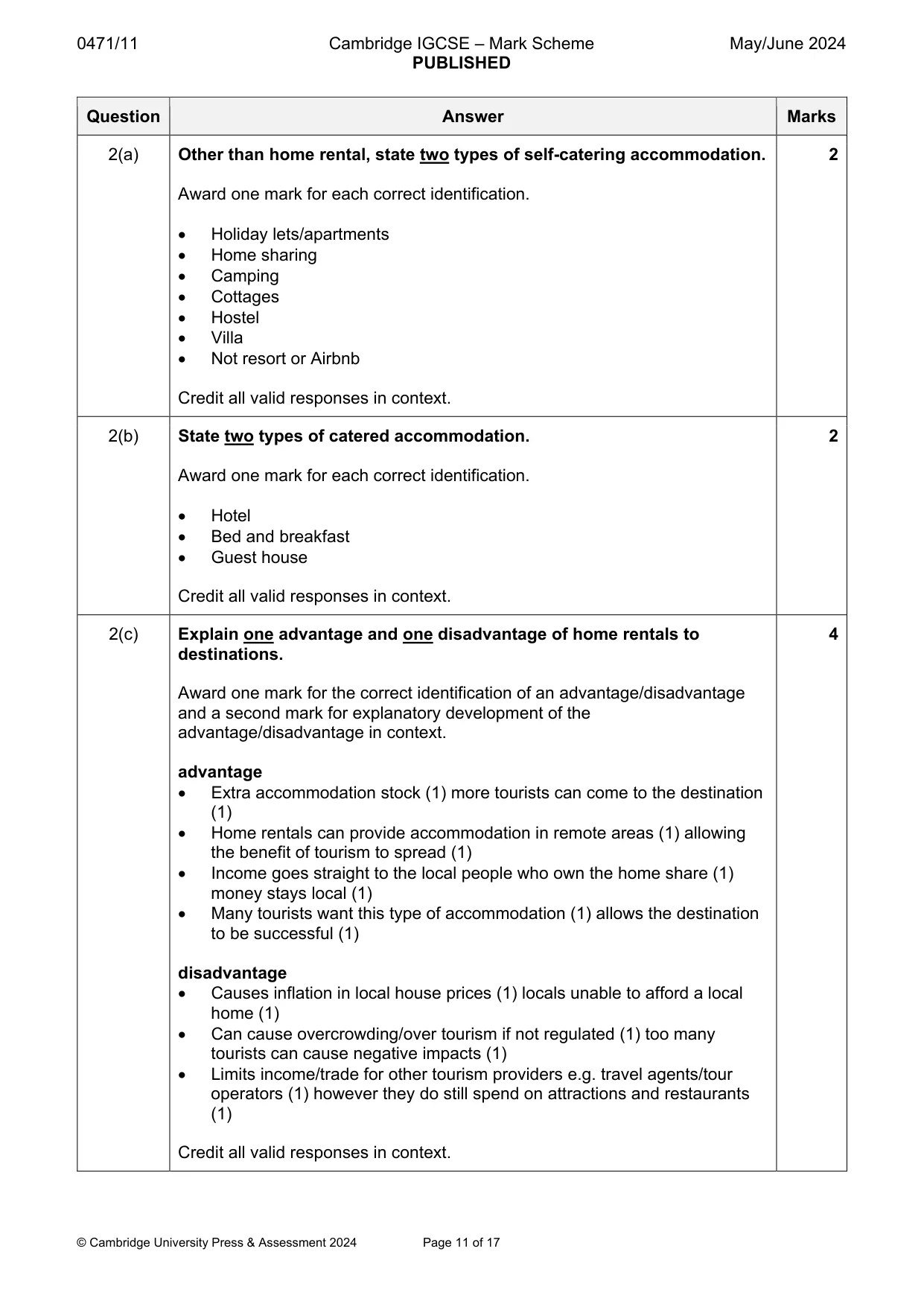
0471/11 Cambridge IGCSE – Mark Scheme PUBLISHED May/June 2024 © Cambridge University Press & Assessment 2024 Page 11 of 17 Question Answer Marks 2(a) Other than home rental, state two types of self-catering accommodation. Award one mark for each correct identification. Holiday lets/apartments Home sharing Camping Cottages Hostel Villa Not resort or Airbnb Credit all valid responses in context. 2 2(b) State two types of catered accommodation. Award one mark for each correct identification. Hotel Bed and breakfast Guest house Credit all valid responses in context. 2 2(c) Explain one advantage and one disadvantage of home rentals to destinations. Award one mark for the correct identification of an advantage/disadvantage and a second mark for explanatory development of the advantage/disadvantage in context. advantage Extra accommodation stock (1) more tourists can come to the destination (1) Home rentals can provide accommodation in remote areas (1) allowing the benefit of tourism to spread (1) Income goes straight to the local people who own the home share (1) money stays local (1) Many tourists want this type of accommodation (1) allows the destination to be successful (1) disadvantage Causes inflation in local house prices (1) locals unable to afford a local home (1) Can cause overcrowding/over tourism if not regulated (1) too many tourists can cause negative impacts (1) Limits income/trade for other tourism providers e.g. travel agents/tour operators (1) however they do still spend on attractions and restaurants (1) Credit all valid responses in context. 4
Mark scheme, page 12
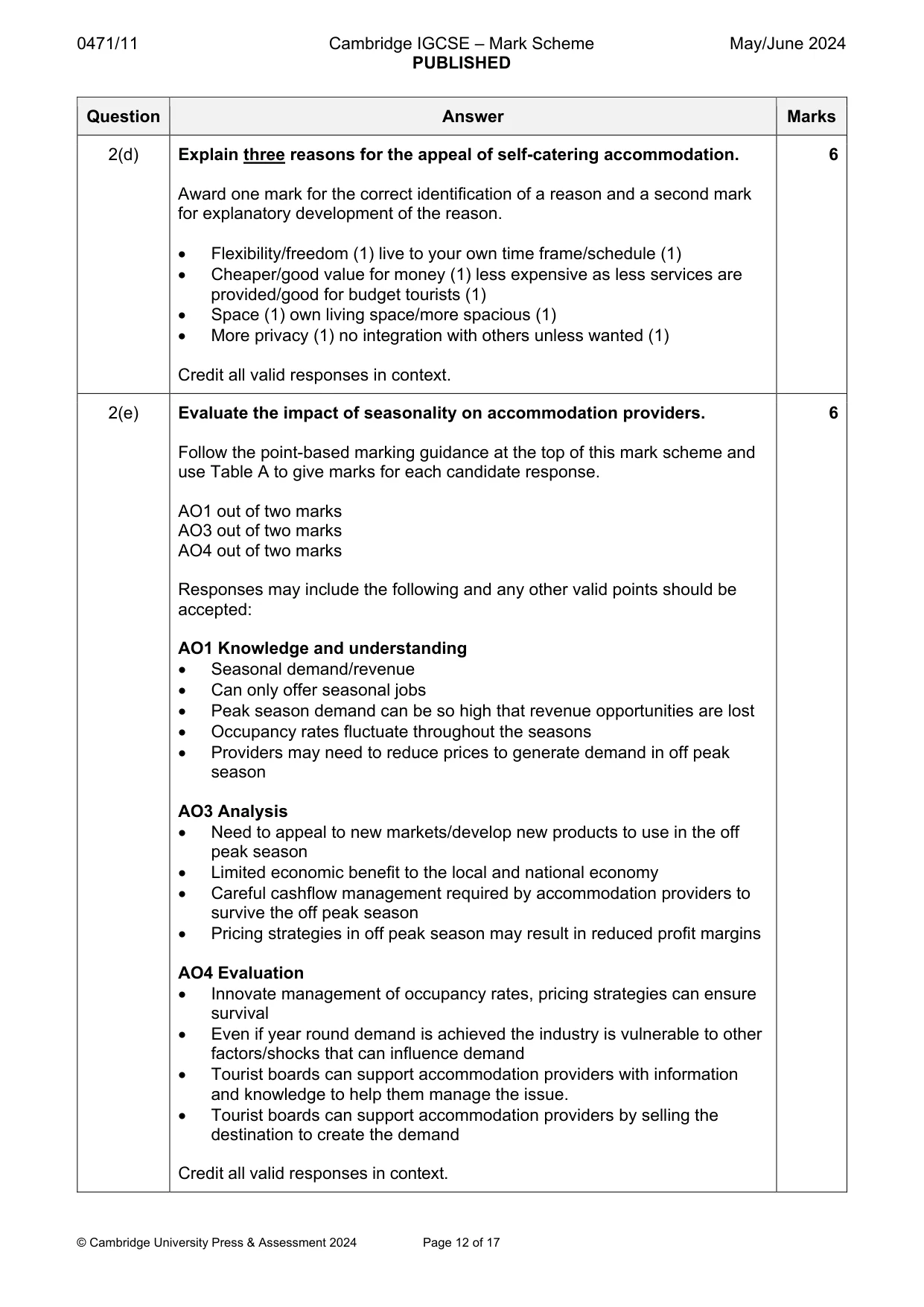
0471/11 Cambridge IGCSE – Mark Scheme PUBLISHED May/June 2024 © Cambridge University Press & Assessment 2024 Page 12 of 17 Question Answer Marks 2(d) Explain three reasons for the appeal of self-catering accommodation. Award one mark for the correct identification of a reason and a second mark for explanatory development of the reason. Flexibility/freedom (1) live to your own time frame/schedule (1) Cheaper/good value for money (1) less expensive as less services are provided/good for budget tourists (1) Space (1) own living space/more spacious (1) More privacy (1) no integration with others unless wanted (1) Credit all valid responses in context. 6 2(e) Evaluate the impact of seasonality on accommodation providers. Follow the point-based marking guidance at the top of this mark scheme and use Table A to give marks for each candidate response. AO1 out of two marks AO3 out of two marks AO4 out of two marks Responses may include the following and any other valid points should be accepted: AO1 Knowledge and understanding Seasonal demand/revenue Can only offer seasonal jobs Peak season demand can be so high that revenue opportunities are lost Occupancy rates fluctuate throughout the seasons Providers may need to reduce prices to generate demand in off peak season AO3 Analysis Need to appeal to new markets/develop new products to use in the off peak season Limited economic benefit to the local and national economy Careful cashflow management required by accommodation providers to survive the off peak season Pricing strategies in off peak season may result in reduced profit margins AO4 Evaluation Innovate management of occupancy rates, pricing strategies can ensure survival Even if year round demand is achieved the industry is vulnerable to other factors/shocks that can influence demand Tourist boards can support accommodation providers with information and knowledge to help them manage the issue. Tourist boards can support accommodation providers by selling the destination to create the demand Credit all valid responses in context. 6
Mark scheme, page 13
0471/11 Cambridge IGCSE – Mark Scheme PUBLISHED May/June 2024 © Cambridge University Press & Assessment 2024 Page 13 of 17 Question Answer Marks 3(a) State two main reasons why people travel. Award one mark for each correct identification. Leisure Visiting Friends and family/VFR Business/MICE Special interest/medical/religious/adventure/cultural/sports/health and wellbeing Credit all valid responses in context. 2 3(b) State two types of destinations. Award one mark for each correct identification. Beach Coastal Island Purpose-built resort Integrated resort Ski resort Eco resort Rural/countryside Mountains Lakes Urban/town/city Credit all valid responses in context. 2 3(c) Explain two ways events benefit from offering virtual visits. Award one mark for the correct identification of a benefit and a second mark for explanatory development of the benefit in context. Dynamic (1) makes the event more resilient to future changes/shocks (1) More people can access the event (1) increases changes of success (1) Meeting customer expectations (1) good customer service (1) Credit all valid responses in context. 4
Mark scheme, page 14
0471/11 Cambridge IGCSE – Mark Scheme PUBLISHED May/June 2024 © Cambridge University Press & Assessment 2024 Page 14 of 17 Question Answer Marks 3(d) Explain three positive economic benefits to destinations of hosting large events. Award one mark for the correct identification of an economic benefit and a second mark for explanatory development of the economic benefit in context. Brings money to the area (1) resulting in the multiplier effect (1) Creates jobs (1) better standard of living (1) Increases taxes for the national economy (1) can be spent on improving the area for the local population (1) Creation of wealth in the area/multiplier effect (1) tourists will spend in the local economy whilst visiting the event (1) Infrastructure may developed for the event (1) remains after benefiting the local area (1) Credit all valid responses in context. 6 3(e) Assess the importance of destinations providing a range of transport options. Follow the point-based marking guidance at the top of this mark scheme and use Table A to give marks for each candidate response. AO1 out of two marks AO3 out of two marks AO4 out of two marks Responses may include the following and any other valid points should be accepted: AO1 Knowledge and understanding Increasingly expected/demanded by tourists Alternative sustainable transport options limit environment impact/reduces pollution/noise pollution Meet the diverse needs of tourists Attract a range of tourists to the destination AO3 Analysis Alternative sustainable transport options result in better environment/nicer for tourists and local population Relationship between tourism and local population is better as negative impacts, e.g. pollution, are limited Tourism can be more successful as a range of market segments attracted to the area AO4 Evaluation Enables destination to be successful Competitive edge over other destinations not offering sustainable transport/limited transport options USP for the destination Credit all valid responses in context. 6
Mark scheme, page 15
0471/11 Cambridge IGCSE – Mark Scheme PUBLISHED May/June 2024 © Cambridge University Press & Assessment 2024 Page 15 of 17 Question Answer Marks 4(a) Identify two services offered by the travel agent shown in Fig. 4.1. Award one mark for each correct identification. Car hire/rental Tours/guided tours Information/tourist information Cruises/day cruise ATM Award these responses only. 2 4(b) State two interpersonal skills required by a travel agent. Award one mark for each correct identification. Listening Patience Welcoming Flexible Teamwork Credit all valid responses in context. 2 4(c) Describe two interdependencies in travel and tourism. Award one mark for the correct identification of an interdependency and a second mark for explanatory development of the interdependency in context. Airports and airlines (1) airlines cannot travel to a destination without an airport to land at/airport cannot exist without planes to land at the airport (1) Tour operators and travel agents (1) travel agents sell the package holidays created by tour operators (1) Hotels and tour operators/travel agents (1) hotels need tour operators include them in packages and create demand for the destination (1) Credit all valid responses in context. 4
Mark scheme, page 16
0471/11 Cambridge IGCSE – Mark Scheme PUBLISHED May/June 2024 © Cambridge University Press & Assessment 2024 Page 16 of 17 Question Answer Marks 4(d) Evaluate two reasons why it is important for travel agents to offer sustainable products. Award one mark per analytical benefit and award a second mark and third mark for evaluative comment of the benefit in context. AO3 Analysis Force customer behaviour change Meet customer demand Limit use of resources Ensure benefits stay local Protect communities in the destination, reduce harm for local population AO4 evaluation Raise awareness of sustainability by pushing products out to customers Increased chance of profitability/success of meeting customer needs/demands Reduce their impact and be an ethical organisation Edge of over competition/USP, therefore widen their customer base Ensure the future of their industry and the destinations visited by customers Credit all valid responses in context. 6
Mark scheme, page 17
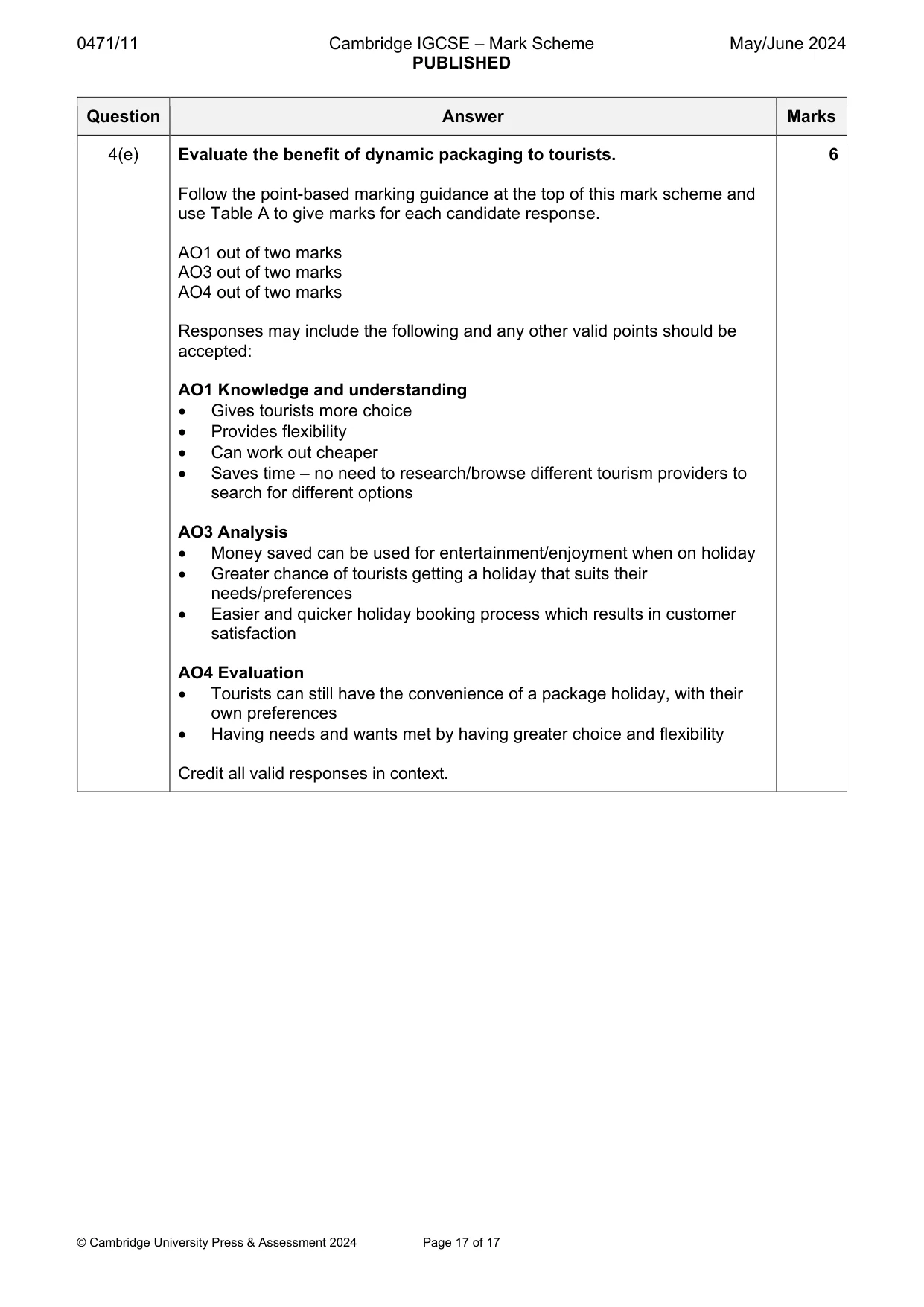
0471/11 Cambridge IGCSE – Mark Scheme PUBLISHED May/June 2024 © Cambridge University Press & Assessment 2024 Page 17 of 17 Question Answer Marks 4(e) Evaluate the benefit of dynamic packaging to tourists. Follow the point-based marking guidance at the top of this mark scheme and use Table A to give marks for each candidate response. AO1 out of two marks AO3 out of two marks AO4 out of two marks Responses may include the following and any other valid points should be accepted: AO1 Knowledge and understanding Gives tourists more choice Provides flexibility Can work out cheaper Saves time – no need to research/browse different tourism providers to search for different options AO3 Analysis Money saved can be used for entertainment/enjoyment when on holiday Greater chance of tourists getting a holiday that suits their needs/preferences Easier and quicker holiday booking process which results in customer satisfaction AO4 Evaluation Tourists can still have the convenience of a package holiday, with their own preferences Having needs and wants met by having greater choice and flexibility Credit all valid responses in context. 6
What you needed in this session
Cambridge’s own grade thresholds for 2024 May/June, Paper 1 · Variant 1. A higher threshold means an easier paper — the bar moves with how the cohort did.