Cambridge IGCSE Travel and Tourism 0471 — 2021 Oct/Nov Paper 2 · Variant 2
0471/22/O/N/21 · 100 marks · ≈113 min
The question paper and its mark scheme, free to read here and free to download. This is Cambridge’s own paper, exactly as it was sat.
Question paper16 pages



Mark scheme12 pages
Answers below. Sit the paper first if you are practising.
Paper as text
Question paper, page 1
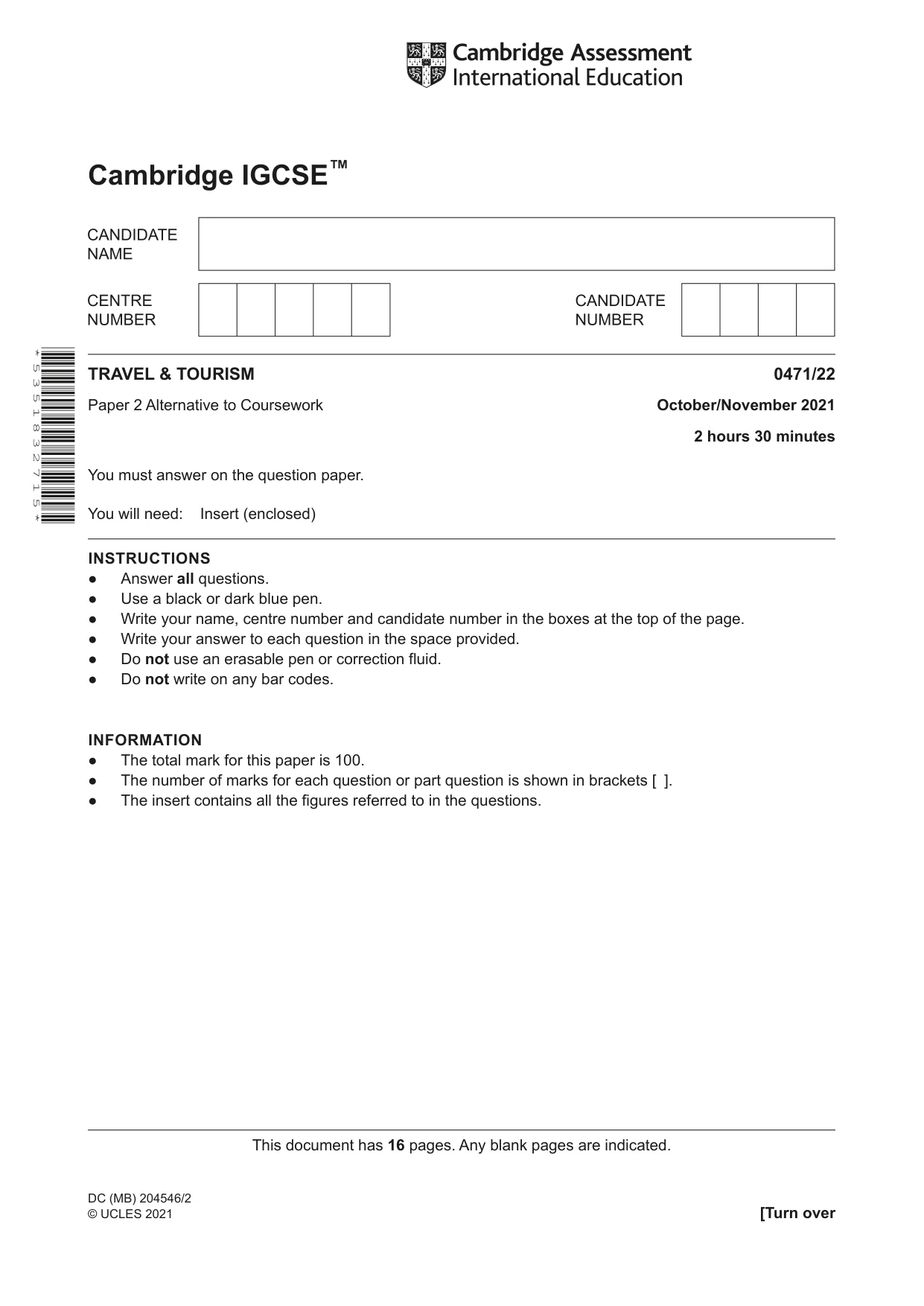
This document has 16 pages. Any blank pages are indicated. Cambridge IGCSE™ * 5 3 5 1 8 3 2 7 1 5 * TRAVEL & TOURISM 0471/22 Paper 2 Alternative to Coursework October/November 2021 2 hours 30 minutes You must answer on the question paper. You will need: Insert (enclosed) INSTRUCTIONS ● Answer all questions. ● Use a black or dark blue pen. ● Write your name, centre number and candidate number in the boxes at the top of the page. ● Write your answer to each question in the space provided. ● Do not use an erasable pen or correction fluid. ● Do not write on any bar codes. INFORMATION ● The total mark for this paper is 100. ● The number of marks for each question or part question is shown in brackets [ ]. ● The insert contains all the figures referred to in the questions. DC (MB) 204546/2 © UCLES 2021 [Turn over
Question paper, page 2
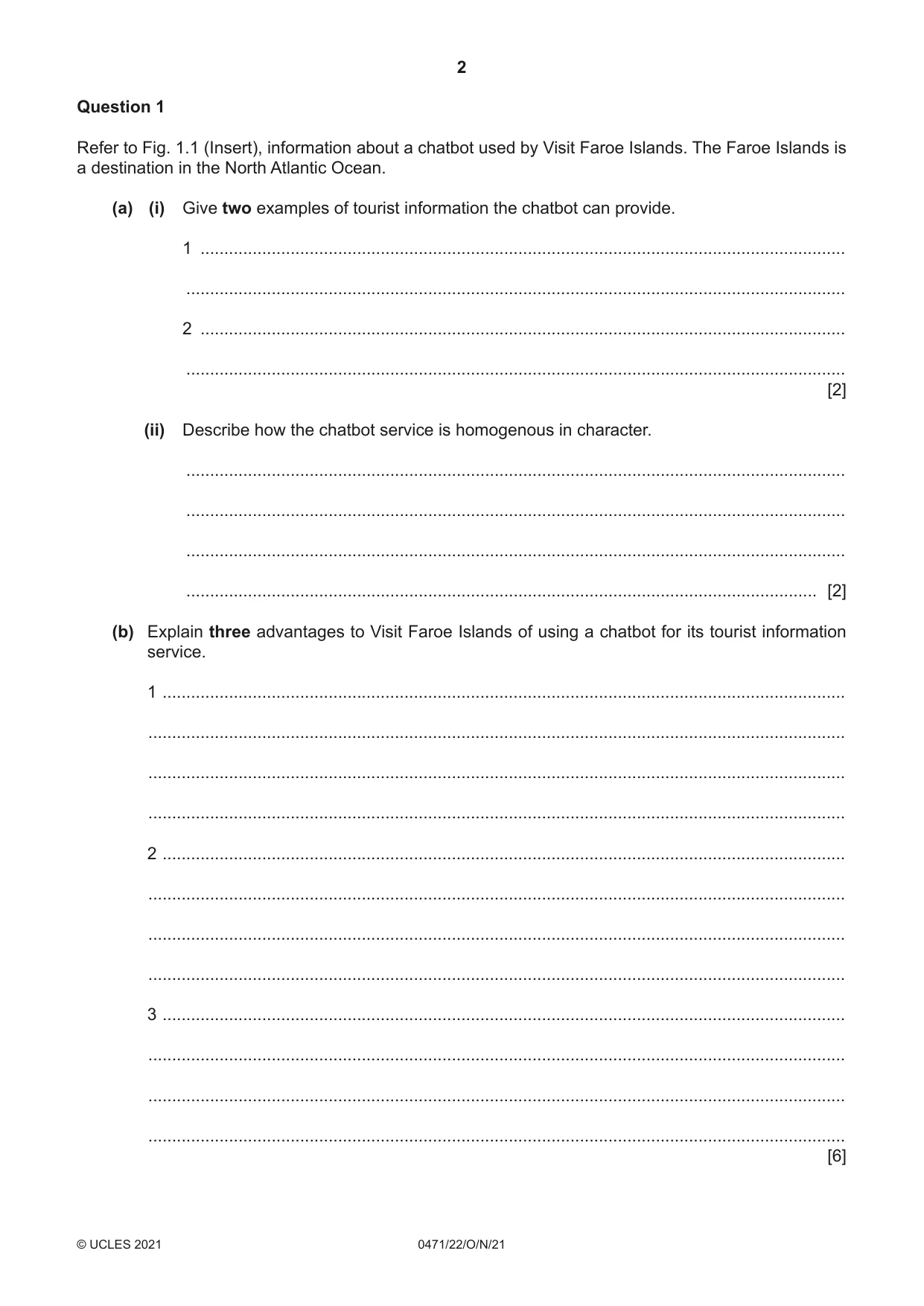
2 0471/22/O/N/21 © UCLES 2021 Question 1 Refer to Fig. 1.1 (Insert), information about a chatbot used by Visit Faroe Islands. The Faroe Islands is a destination in the North Atlantic Ocean. (a) (i) Give two examples of tourist information the chatbot can provide. 1 … … 2 … … [2] (ii) Describe how the chatbot service is homogenous in character. … … … … [2] (b) Explain three advantages to Visit Faroe Islands of using a chatbot for its tourist information service. 1 … … … … 2 … … … … 3 … … … … [6]
Question paper, page 3
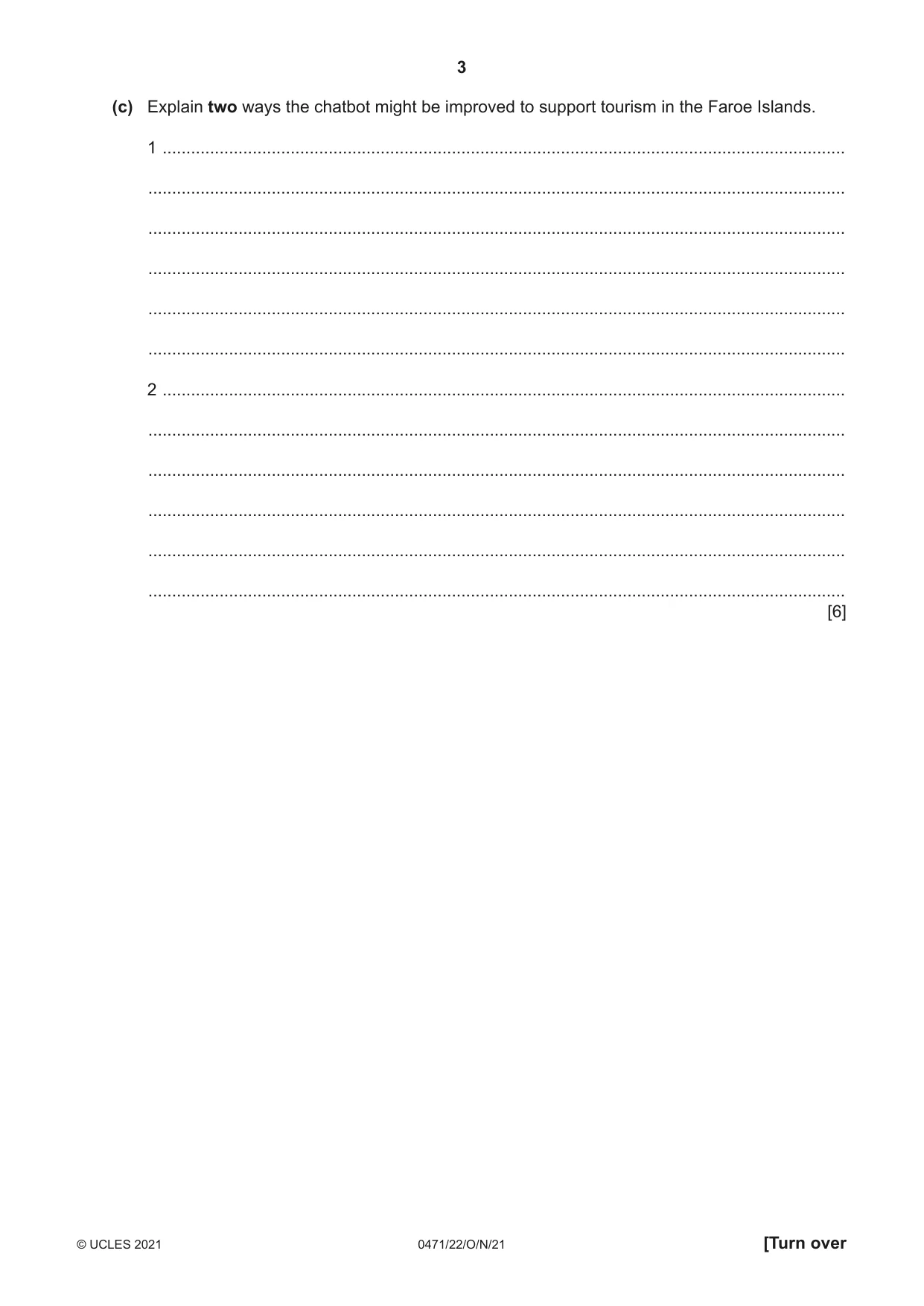
3 0471/22/O/N/21 © UCLES 2021 [Turn over (c) Explain two ways the chatbot might be improved to support tourism in the Faroe Islands. 1 … … … … … … 2 … … … … … … [6]
Question paper, page 4
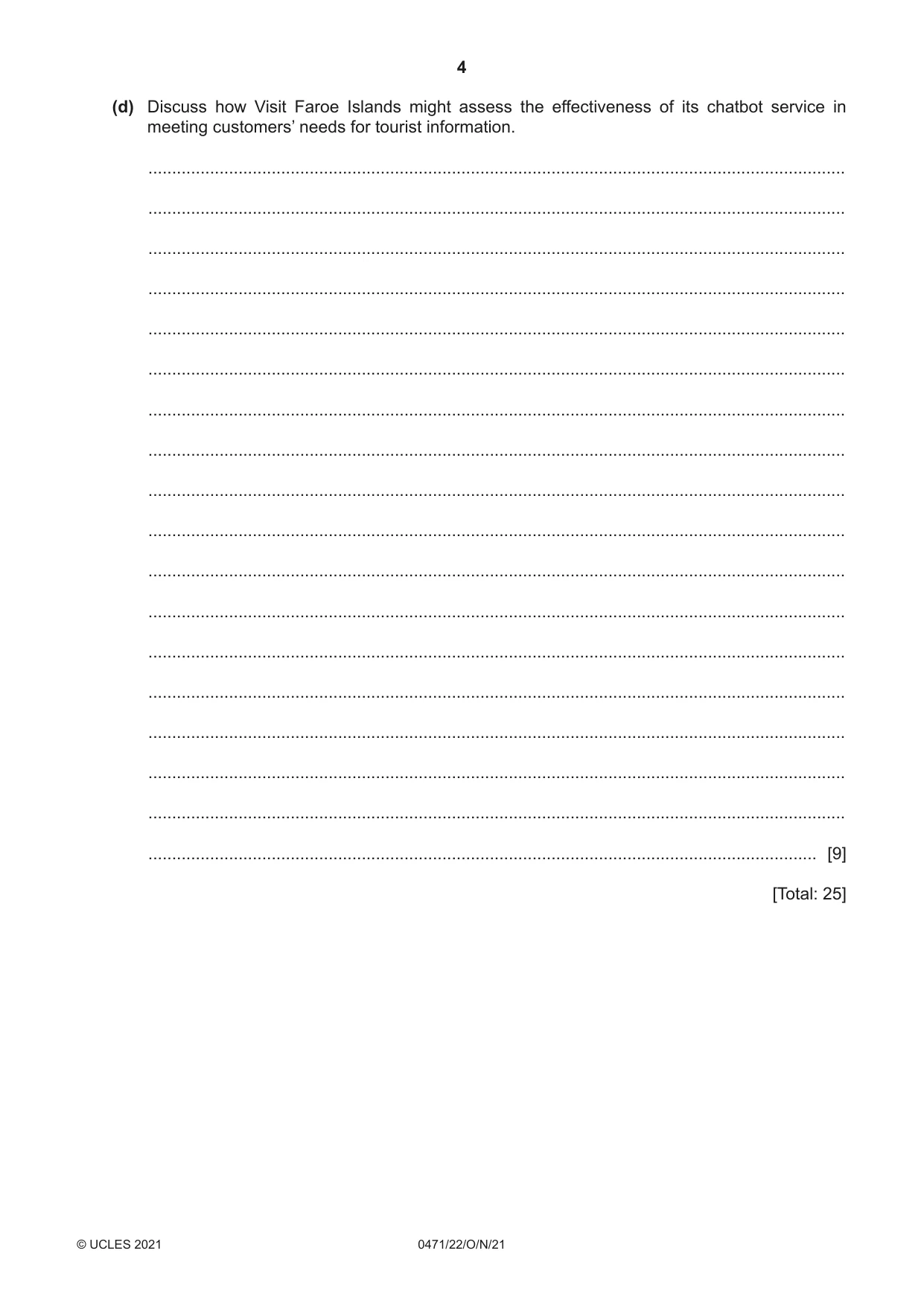
4 0471/22/O/N/21 © UCLES 2021 (d) Discuss how Visit Faroe Islands might assess the effectiveness of its chatbot service in meeting customers’ needs for tourist information. … … … … … … … … … … … … … … … … … … [9] [Total: 25]
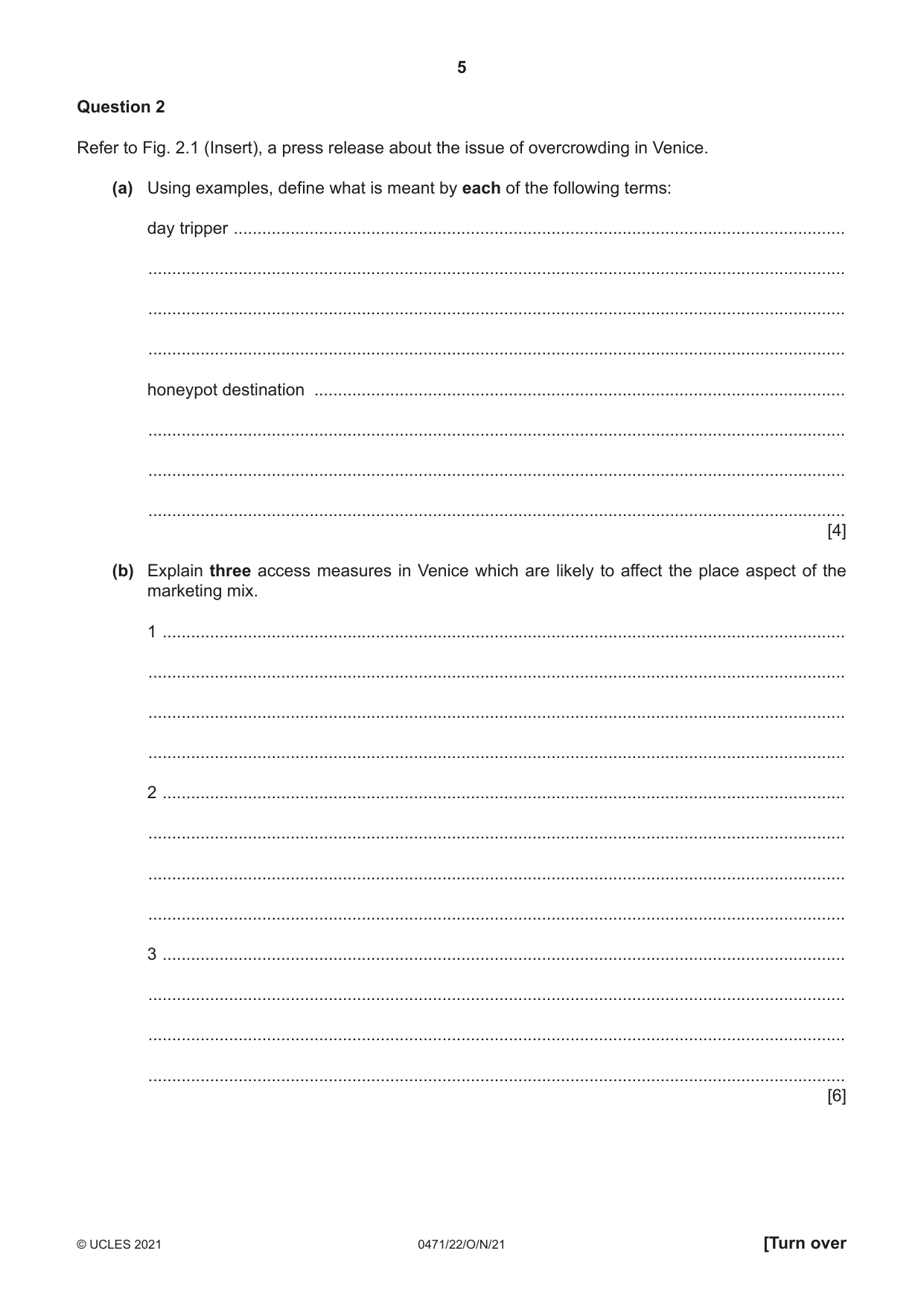
Question paper, page 5
5 0471/22/O/N/21 © UCLES 2021 [Turn over Question 2 Refer to Fig. 2.1 (Insert), a press release about the issue of overcrowding in Venice. (a) Using examples, define what is meant by each of the following terms: day tripper … … … … honeypot destination … … … … [4] (b) Explain three access measures in Venice which are likely to affect the place aspect of the marketing mix. 1 … … … … 2 … … … … 3 … … … … [6]
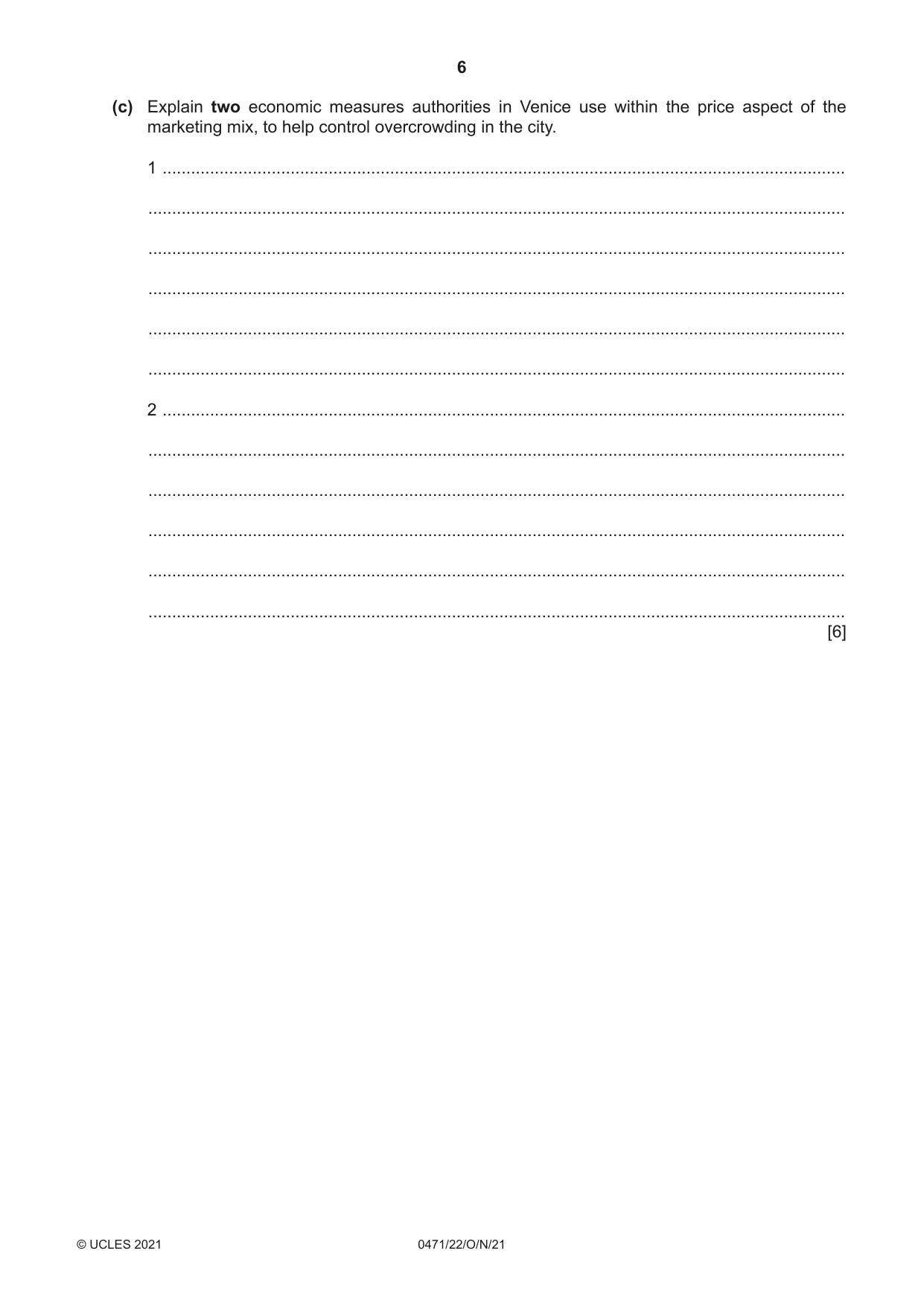
Question paper, page 6
6 0471/22/O/N/21 © UCLES 2021 (c) Explain two economic measures authorities in Venice use within the price aspect of the marketing mix, to help control overcrowding in the city. 1 … … … … … … 2 … … … … … … [6]
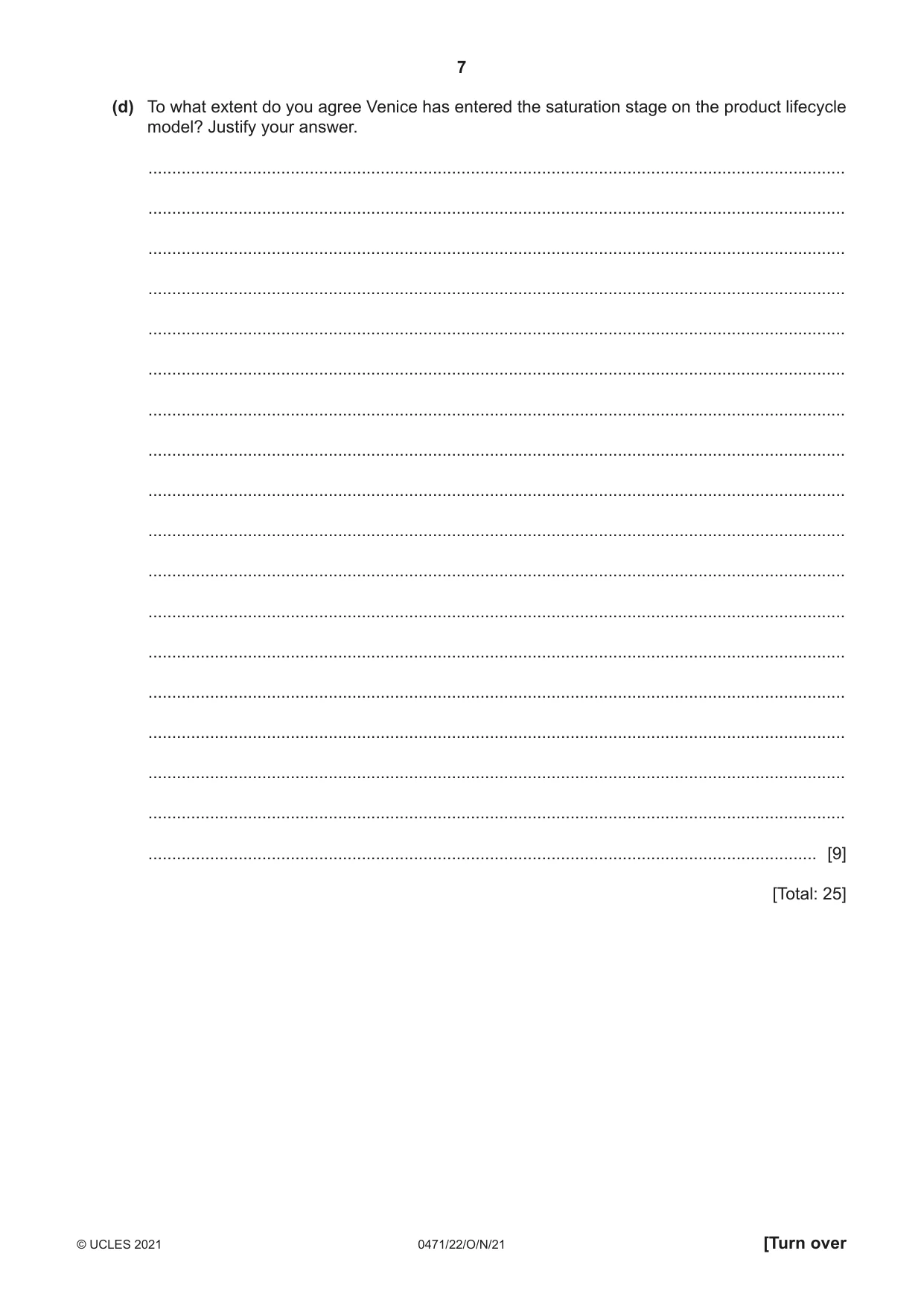
Question paper, page 7
7 0471/22/O/N/21 © UCLES 2021 [Turn over (d) To what extent do you agree Venice has entered the saturation stage on the product lifecycle model? Justify your answer. … … … … … … … … … … … … … … … … … … [9] [Total: 25]
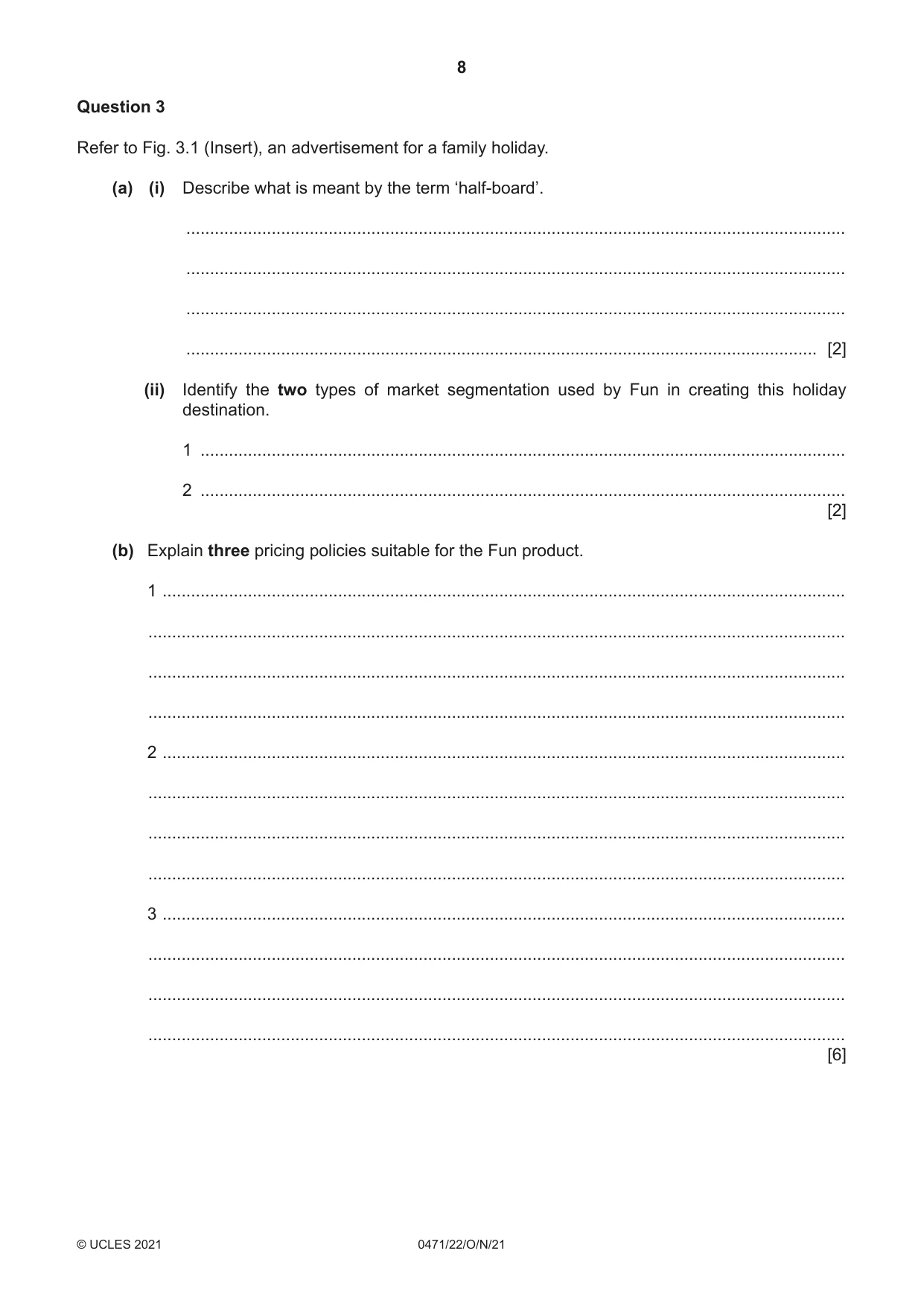
Question paper, page 8
8 0471/22/O/N/21 © UCLES 2021 Question 3 Refer to Fig. 3.1 (Insert), an advertisement for a family holiday. (a) (i) Describe what is meant by the term ʻhalf-boardʼ. … … … … [2] (ii) Identify the two types of market segmentation used by Fun in creating this holiday destination. 1 … 2 … [2] (b) Explain three pricing policies suitable for the Fun product. 1 … … … … 2 … … … … 3 … … … … [6]
Question paper, page 9
9 0471/22/O/N/21 © UCLES 2021 [Turn over (c) Explain two likely benefits for customers of using a travel agent to book this holiday. 1 … … … … … … 2 … … … … … … [6]
Question paper, page 10
10 0471/22/O/N/21 © UCLES 2021 (d) Evaluate the effectiveness of the advertisement in Fig. 3.1 using the AIDA principle. … … … … … … … … … … … … … … … … … … [9] [Total: 25]
Question paper, page 11
11 0471/22/O/N/21 © UCLES 2021 [Turn over Question 4 Refer to Fig. 4.1 (Insert), information about advertising via a national tourism website. (a) Describe two likely functions of a Destination Marketing Organisation. 1 … … … … 2 … … … … [4] (b) Explain three reasons why potential visitors to a destination are likely to use the national tourism website of the country they are planning to visit. 1 … … … … 2 … … … … 3 … … … … [6]
Question paper, page 12
12 0471/22/O/N/21 © UCLES 2021 (c) Explain two benefits to the provider of producing e-marketing materials. 1 … … … … … … 2 … … … … … … [6]
Question paper, page 13
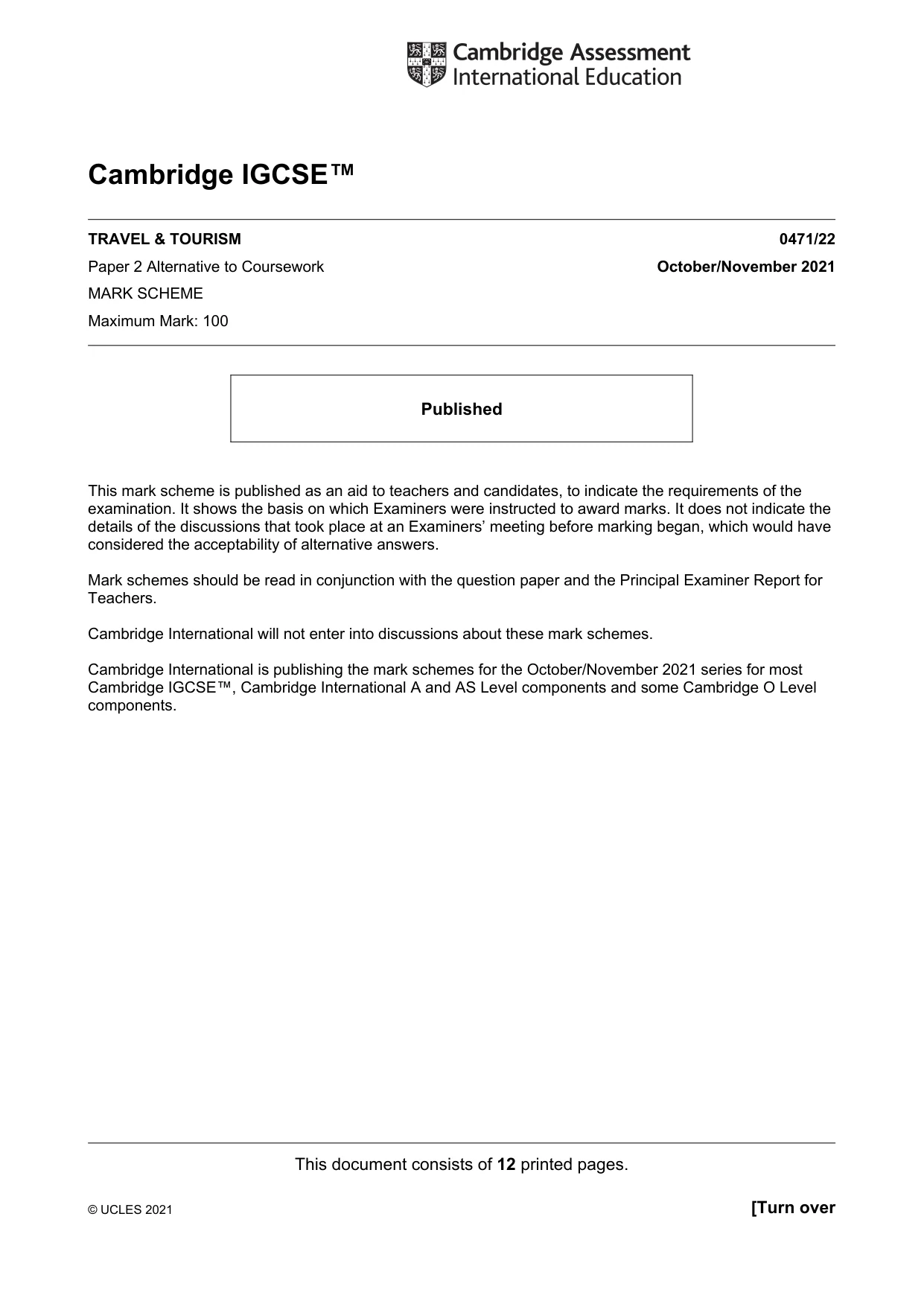
13 0471/22/O/N/21 © UCLES 2021 (d) Evaluate the ways national tourism boards might develop their tourism product portfolio. … … … … … … … … … … … … … … … … … … [9] [Total: 25]
Question paper, page 14
14 0471/22/O/N/21 © UCLES 2021 BLANK PAGE
Question paper, page 15
15 0471/22/O/N/21 © UCLES 2021 BLANK PAGE
Question paper, page 16
16 0471/22/O/N/21 © UCLES 2021 BLANK PAGE The boundaries and names shown, the designations used and the presentation of material on any maps contained in this question paper/insert do not imply official endorsement or acceptance by Cambridge Assessment International Education concerning the legal status of any country, territory, or area or any of its authorities, or of the delimitation of its frontiers or boundaries. Permission to reproduce items where third-party owned material protected by copyright is included has been sought and cleared where possible. Every reasonable effort has been made by the publisher (UCLES) to trace copyright holders, but if any items requiring clearance have unwittingly been included, the publisher will be pleased to make amends at the earliest possible opportunity. To avoid the issue of disclosure of answer-related information to candidates, all copyright acknowledgements are reproduced online in the Cambridge Assessment International Education Copyright Acknowledgements Booklet. This is produced for each series of examinations and is freely available to download at www.cambridgeinternational.org after the live examination series. Cambridge Assessment International Education is part of the Cambridge Assessment Group. Cambridge Assessment is the brand name of the University of Cambridge Local Examinations Syndicate (UCLES), which itself is a department of the University of Cambridge.
Mark scheme, page 1
This document consists of 12 printed pages. © UCLES 2021 [Turn over Cambridge IGCSE™ TRAVEL & TOURISM 0471/22 Paper 2 Alternative to Coursework October/November 2021 MARK SCHEME Maximum Mark: 100 Published This mark scheme is published as an aid to teachers and candidates, to indicate the requirements of the examination. It shows the basis on which Examiners were instructed to award marks. It does not indicate the details of the discussions that took place at an Examiners’ meeting before marking began, which would have considered the acceptability of alternative answers. Mark schemes should be read in conjunction with the question paper and the Principal Examiner Report for Teachers. Cambridge International will not enter into discussions about these mark schemes. Cambridge International is publishing the mark schemes for the October/November 2021 series for most Cambridge IGCSE™, Cambridge International A and AS Level components and some Cambridge O Level components.
Mark scheme, page 2
0471/22 Cambridge IGCSE – Mark Scheme PUBLISHED October/November 2021 © UCLES 2021 Page 2 of 12 Generic Marking Principles These general marking principles must be applied by all examiners when marking candidate answers. They should be applied alongside the specific content of the mark scheme or generic level descriptors for a question. Each question paper and mark scheme will also comply with these marking principles. GENERIC MARKING PRINCIPLE 1: Marks must be awarded in line with: • the specific content of the mark scheme or the generic level descriptors for the question • the specific skills defined in the mark scheme or in the generic level descriptors for the question • the standard of response required by a candidate as exemplified by the standardisation scripts. GENERIC MARKING PRINCIPLE 2: Marks awarded are always whole marks (not half marks, or other fractions). GENERIC MARKING PRINCIPLE 3: Marks must be awarded positively: • marks are awarded for correct/valid answers, as defined in the mark scheme. However, credit is given for valid answers which go beyond the scope of the syllabus and mark scheme, referring to your Team Leader as appropriate • marks are awarded when candidates clearly demonstrate what they know and can do • marks are not deducted for errors • marks are not deducted for omissions • answers should only be judged on the quality of spelling, punctuation and grammar when these features are specifically assessed by the question as indicated by the mark scheme. The meaning, however, should be unambiguous. GENERIC MARKING PRINCIPLE 4: Rules must be applied consistently, e.g. in situations where candidates have not followed instructions or in the application of generic level descriptors. GENERIC MARKING PRINCIPLE 5: Marks should be awarded using the full range of marks defined in the mark scheme for the question (however; the use of the full mark range may be limited according to the quality of the candidate responses seen). GENERIC MARKING PRINCIPLE 6: Marks awarded are based solely on the requirements as defined in the mark scheme. Marks should not be awarded with grade thresholds or grade descriptors in mind.
Mark scheme, page 3
0471/22 Cambridge IGCSE – Mark Scheme PUBLISHED October/November 2021 © UCLES 2021 Page 3 of 12 Social Science-Specific Marking Principles (for point-based marking) 1 Components using point-based marking: • Point marking is often used to reward knowledge, understanding and application of skills. We give credit where the candidate’s answer shows relevant knowledge, understanding and application of skills in answering the question. We do not give credit where the answer shows confusion. From this it follows that we: a DO credit answers which are worded differently from the mark scheme if they clearly convey the same meaning (unless the mark scheme requires a specific term) b DO credit alternative answers/examples which are not written in the mark scheme if they are correct c DO credit answers where candidates give more than one correct answer in one prompt/numbered/scaffolded space where extended writing is required rather than list-type answers. For example, questions that require n reasons (e.g. State two reasons …). d DO NOT credit answers simply for using a ‘key term’ unless that is all that is required. (Check for evidence it is understood and not used wrongly.) e DO NOT credit answers which are obviously self-contradicting or trying to cover all possibilities f DO NOT give further credit for what is effectively repetition of a correct point already credited unless the language itself is being tested. This applies equally to ‘mirror statements’ (i.e. polluted/not polluted). g DO NOT require spellings to be correct, unless this is part of the test. However spellings of syllabus terms must allow for clear and unambiguous separation from other syllabus terms with which they may be confused (e.g. Corrasion/Corrosion) 2 Presentation of mark scheme: • Slashes (/) or the word ‘or’ separate alternative ways of making the same point. • Semi colons (;) bullet points (•) or figures in brackets [1] separate different points. • Content in the answer column in brackets is for examiner information/context to clarify the marking but is not required to earn the mark (except Accounting syllabuses where they indicate negative numbers). 3 Annotation: • For point marking, ticks can be used to indicate correct answers and crosses can be used to indicate wrong answers. There is no direct relationship between ticks and marks. Ticks have no defined meaning for levels of response marking. • For levels of response marking, the level awarded should be annotated on the script. • Other annotations will be used by examiners as agreed during standardisation, and the meaning will be understood by all examiners who marked that paper.
Mark scheme, page 4
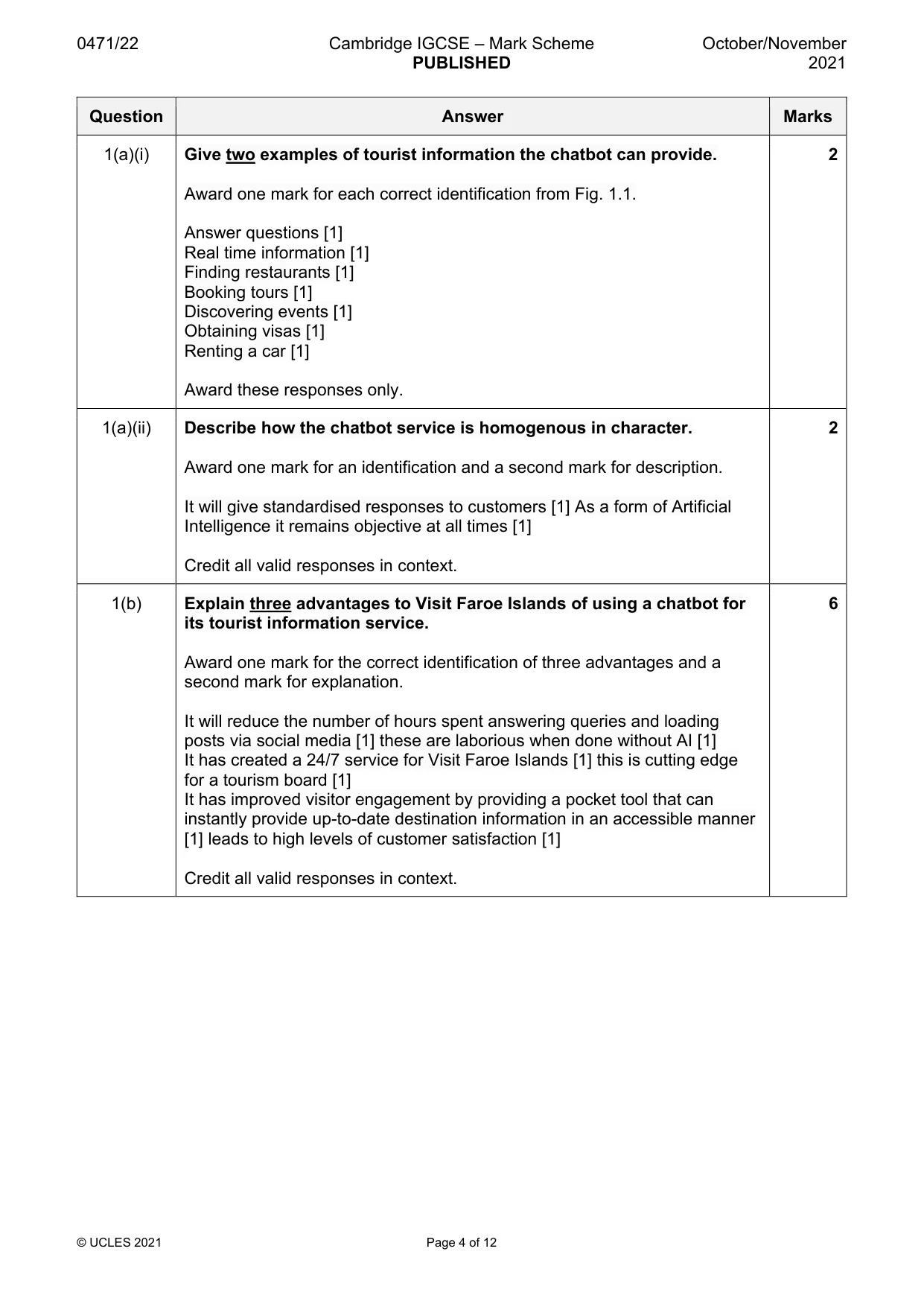
0471/22 Cambridge IGCSE – Mark Scheme PUBLISHED October/November 2021 © UCLES 2021 Page 4 of 12 Question Answer Marks 1(a)(i) Give two examples of tourist information the chatbot can provide. Award one mark for each correct identification from Fig. 1.1. Answer questions [1] Real time information [1] Finding restaurants [1] Booking tours [1] Discovering events [1] Obtaining visas [1] Renting a car [1] Award these responses only. 2 1(a)(ii) Describe how the chatbot service is homogenous in character. Award one mark for an identification and a second mark for description. It will give standardised responses to customers [1] As a form of Artificial Intelligence it remains objective at all times [1] Credit all valid responses in context. 2 1(b) Explain three advantages to Visit Faroe Islands of using a chatbot for its tourist information service. Award one mark for the correct identification of three advantages and a second mark for explanation. It will reduce the number of hours spent answering queries and loading posts via social media [1] these are laborious when done without AI [1] It has created a 24/7 service for Visit Faroe Islands [1] this is cutting edge for a tourism board [1] It has improved visitor engagement by providing a pocket tool that can instantly provide up-to-date destination information in an accessible manner [1] leads to high levels of customer satisfaction [1] Credit all valid responses in context. 6
Mark scheme, page 5
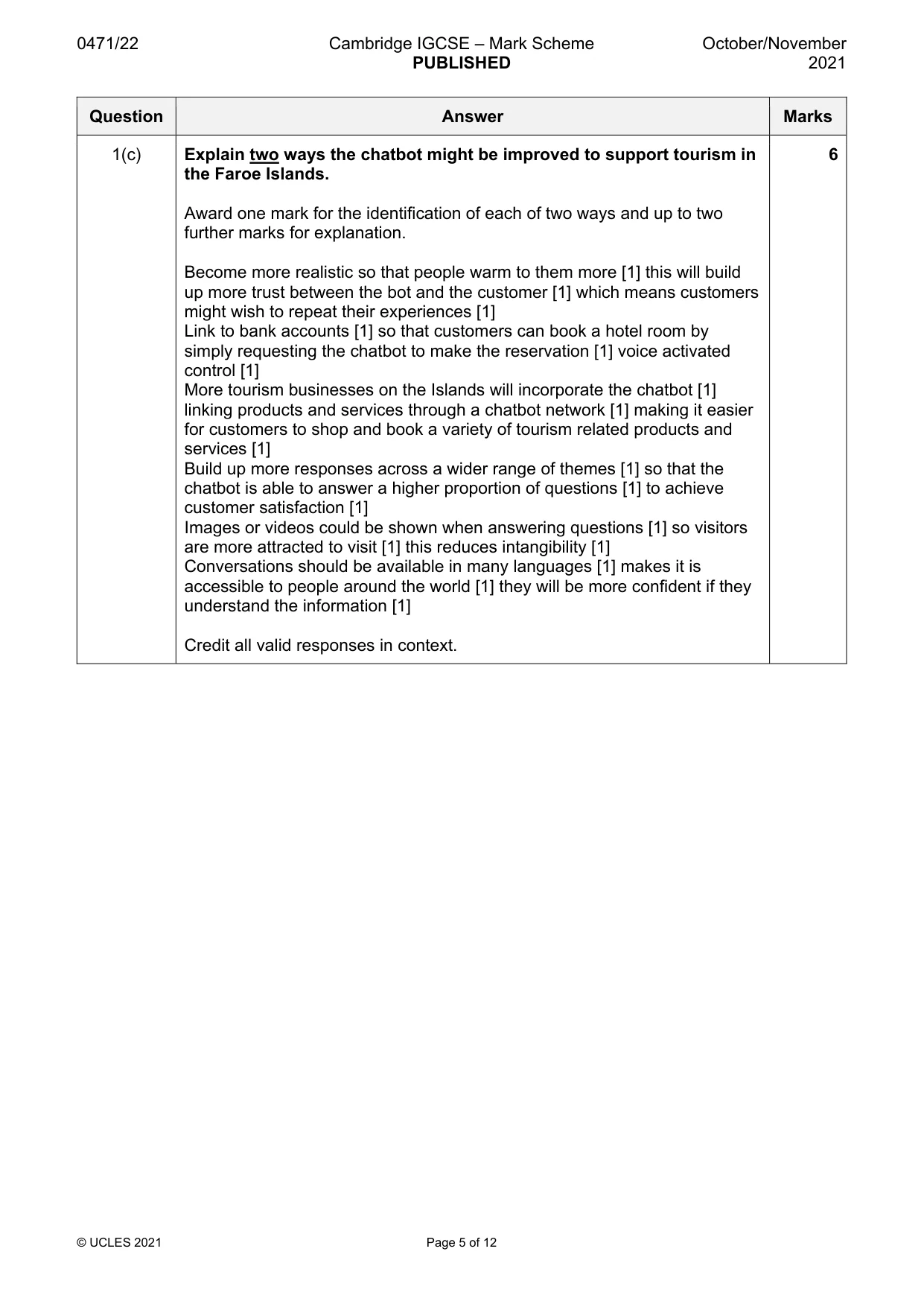
0471/22 Cambridge IGCSE – Mark Scheme PUBLISHED October/November 2021 © UCLES 2021 Page 5 of 12 Question Answer Marks 1(c) Explain two ways the chatbot might be improved to support tourism in the Faroe Islands. Award one mark for the identification of each of two ways and up to two further marks for explanation. Become more realistic so that people warm to them more [1] this will build up more trust between the bot and the customer [1] which means customers might wish to repeat their experiences [1] Link to bank accounts [1] so that customers can book a hotel room by simply requesting the chatbot to make the reservation [1] voice activated control [1] More tourism businesses on the Islands will incorporate the chatbot [1] linking products and services through a chatbot network [1] making it easier for customers to shop and book a variety of tourism related products and services [1] Build up more responses across a wider range of themes [1] so that the chatbot is able to answer a higher proportion of questions [1] to achieve customer satisfaction [1] Images or videos could be shown when answering questions [1] so visitors are more attracted to visit [1] this reduces intangibility [1] Conversations should be available in many languages [1] makes it is accessible to people around the world [1] they will be more confident if they understand the information [1] Credit all valid responses in context. 6
Mark scheme, page 6
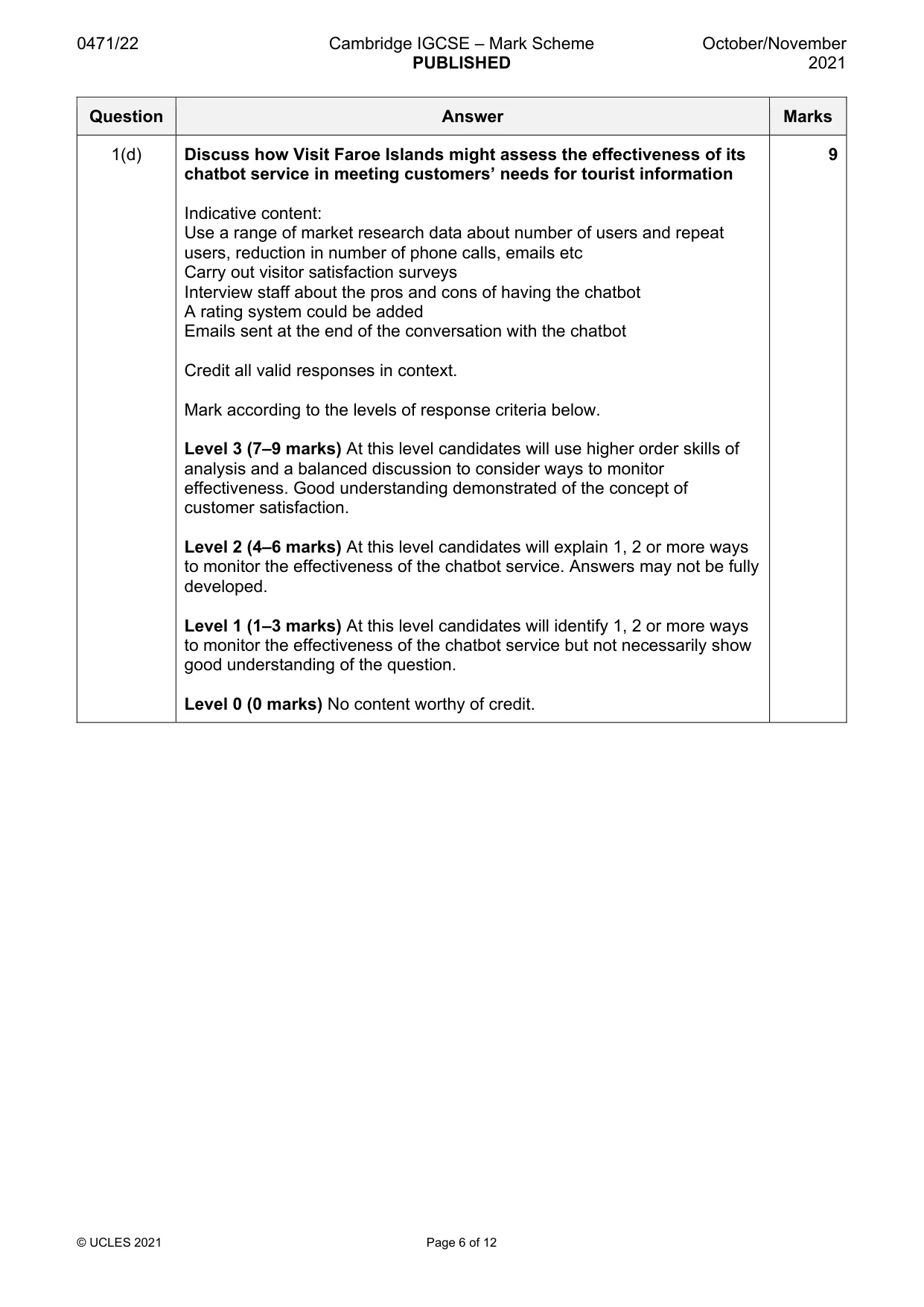
0471/22 Cambridge IGCSE – Mark Scheme PUBLISHED October/November 2021 © UCLES 2021 Page 6 of 12 Question Answer Marks 1(d) Discuss how Visit Faroe Islands might assess the effectiveness of its chatbot service in meeting customers’ needs for tourist information Indicative content: Use a range of market research data about number of users and repeat users, reduction in number of phone calls, emails etc Carry out visitor satisfaction surveys Interview staff about the pros and cons of having the chatbot A rating system could be added Emails sent at the end of the conversation with the chatbot Credit all valid responses in context. Mark according to the levels of response criteria below. Level 3 (7–9 marks) At this level candidates will use higher order skills of analysis and a balanced discussion to consider ways to monitor effectiveness. Good understanding demonstrated of the concept of customer satisfaction. Level 2 (4–6 marks) At this level candidates will explain 1, 2 or more ways to monitor the effectiveness of the chatbot service. Answers may not be fully developed. Level 1 (1–3 marks) At this level candidates will identify 1, 2 or more ways to monitor the effectiveness of the chatbot service but not necessarily show good understanding of the question. Level 0 (0 marks) No content worthy of credit. 9
Mark scheme, page 7
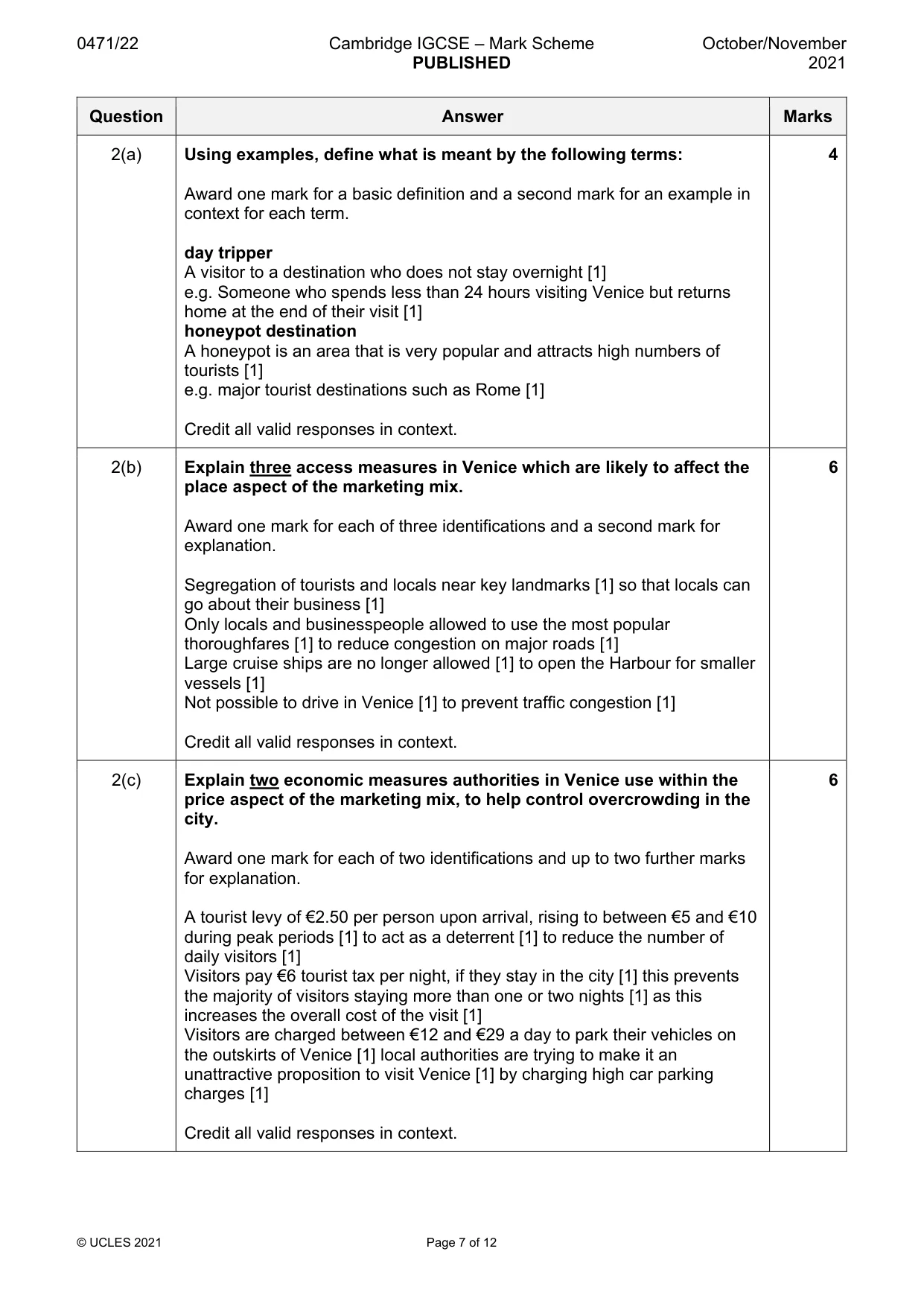
0471/22 Cambridge IGCSE – Mark Scheme PUBLISHED October/November 2021 © UCLES 2021 Page 7 of 12 Question Answer Marks 2(a) Using examples, define what is meant by the following terms: Award one mark for a basic definition and a second mark for an example in context for each term. day tripper A visitor to a destination who does not stay overnight [1] e.g. Someone who spends less than 24 hours visiting Venice but returns home at the end of their visit [1] honeypot destination A honeypot is an area that is very popular and attracts high numbers of tourists [1] e.g. major tourist destinations such as Rome [1] Credit all valid responses in context. 4 2(b) Explain three access measures in Venice which are likely to affect the place aspect of the marketing mix. Award one mark for each of three identifications and a second mark for explanation. Segregation of tourists and locals near key landmarks [1] so that locals can go about their business [1] Only locals and businesspeople allowed to use the most popular thoroughfares [1] to reduce congestion on major roads [1] Large cruise ships are no longer allowed [1] to open the Harbour for smaller vessels [1] Not possible to drive in Venice [1] to prevent traffic congestion [1] Credit all valid responses in context. 6 2(c) Explain two economic measures authorities in Venice use within the price aspect of the marketing mix, to help control overcrowding in the city. Award one mark for each of two identifications and up to two further marks for explanation. A tourist levy of €2.50 per person upon arrival, rising to between €5 and €10 during peak periods [1] to act as a deterrent [1] to reduce the number of daily visitors [1] Visitors pay €6 tourist tax per night, if they stay in the city [1] this prevents the majority of visitors staying more than one or two nights [1] as this increases the overall cost of the visit [1] Visitors are charged between €12 and €29 a day to park their vehicles on the outskirts of Venice [1] local authorities are trying to make it an unattractive proposition to visit Venice [1] by charging high car parking charges [1] Credit all valid responses in context. 6
Mark scheme, page 8
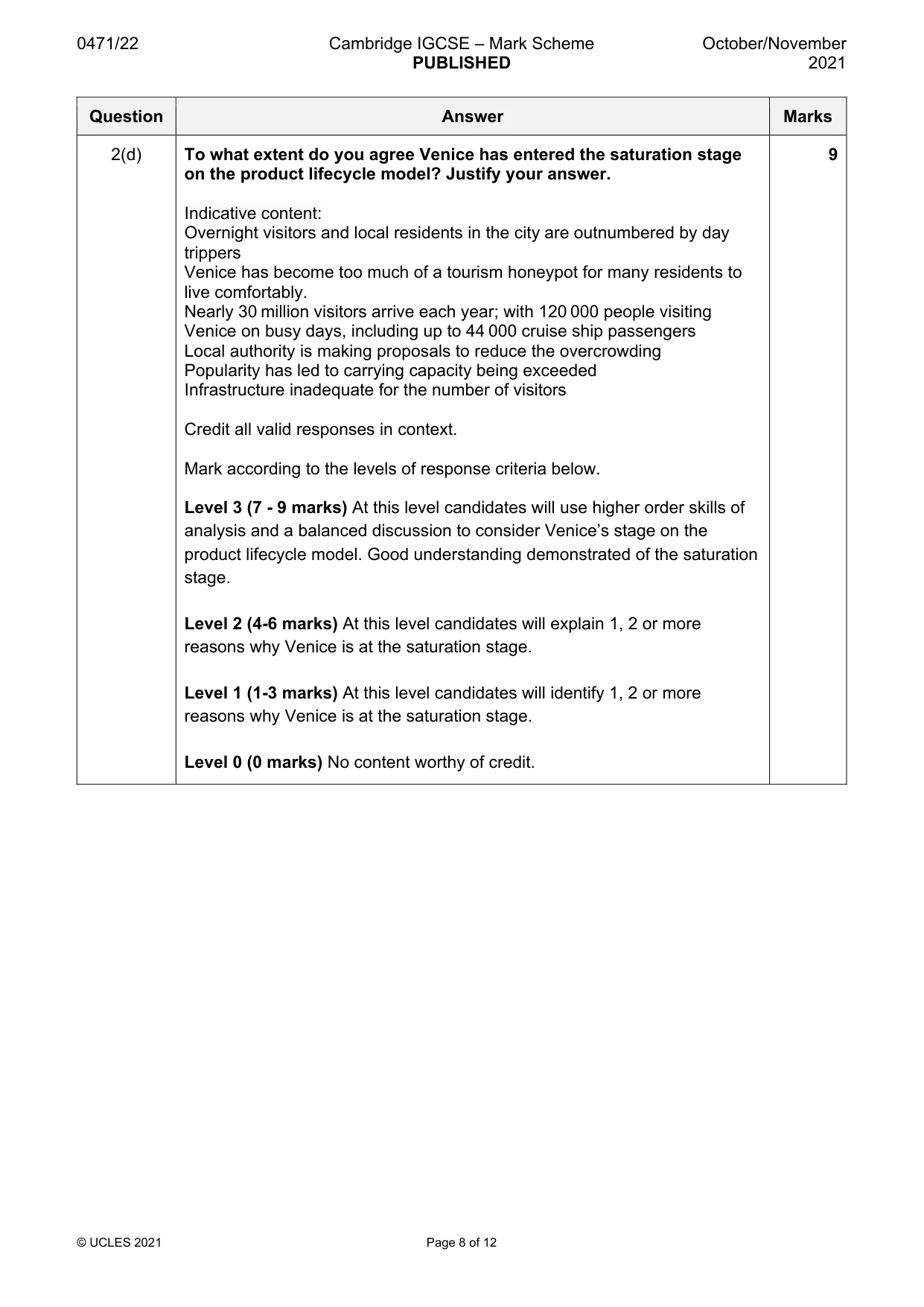
0471/22 Cambridge IGCSE – Mark Scheme PUBLISHED October/November 2021 © UCLES 2021 Page 8 of 12 Question Answer Marks 2(d) To what extent do you agree Venice has entered the saturation stage on the product lifecycle model? Justify your answer. Indicative content: Overnight visitors and local residents in the city are outnumbered by day trippers Venice has become too much of a tourism honeypot for many residents to live comfortably. Nearly 30 million visitors arrive each year; with 120 000 people visiting Venice on busy days, including up to 44 000 cruise ship passengers Local authority is making proposals to reduce the overcrowding Popularity has led to carrying capacity being exceeded Infrastructure inadequate for the number of visitors Credit all valid responses in context. Mark according to the levels of response criteria below. Level 3 (7 - 9 marks) At this level candidates will use higher order skills of analysis and a balanced discussion to consider Venice’s stage on the product lifecycle model. Good understanding demonstrated of the saturation stage. Level 2 (4-6 marks) At this level candidates will explain 1, 2 or more reasons why Venice is at the saturation stage. Level 1 (1-3 marks) At this level candidates will identify 1, 2 or more reasons why Venice is at the saturation stage. Level 0 (0 marks) No content worthy of credit. 9
Mark scheme, page 9
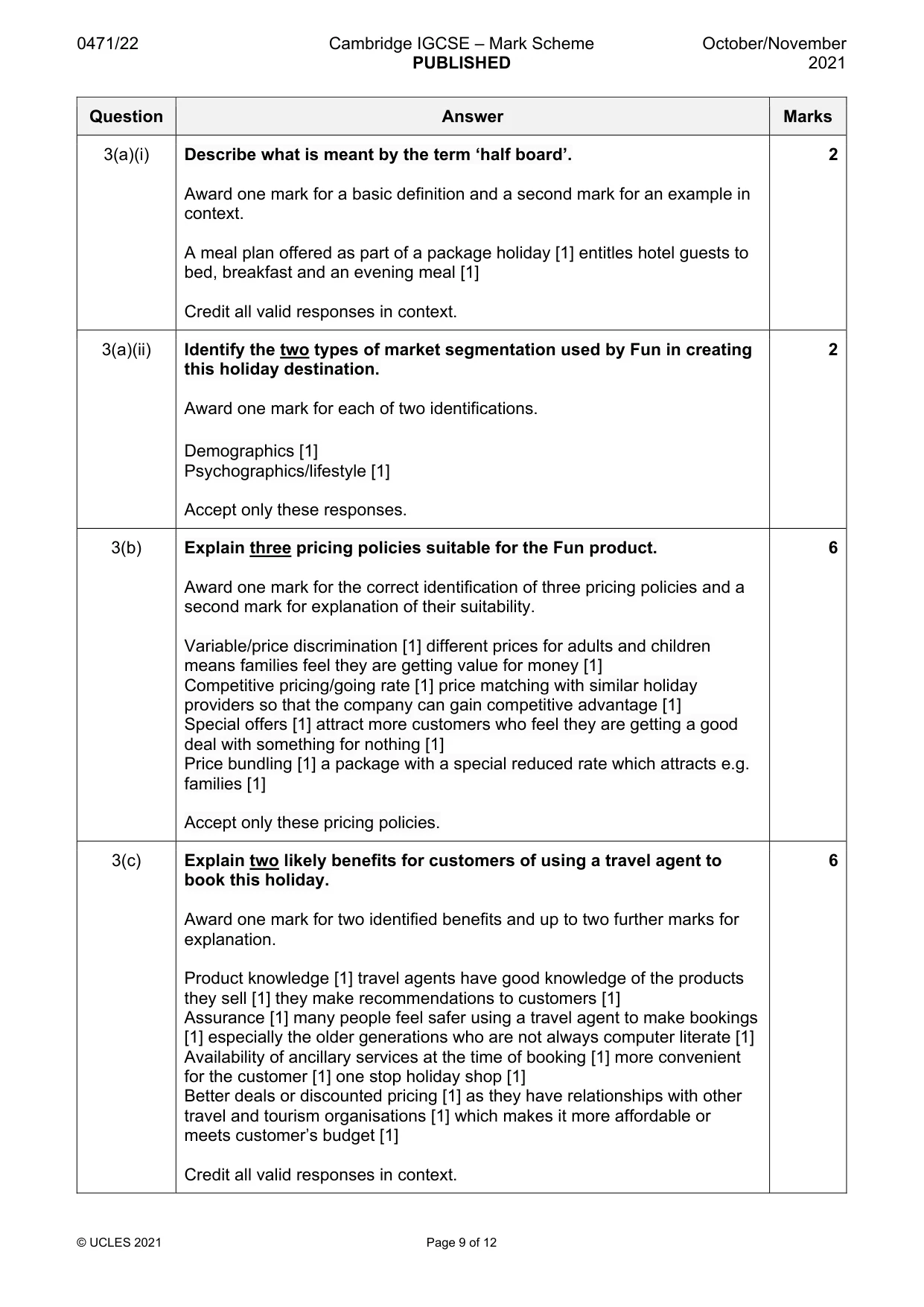
0471/22 Cambridge IGCSE – Mark Scheme PUBLISHED October/November 2021 © UCLES 2021 Page 9 of 12 Question Answer Marks 3(a)(i) Describe what is meant by the term ‘half board’. Award one mark for a basic definition and a second mark for an example in context. A meal plan offered as part of a package holiday [1] entitles hotel guests to bed, breakfast and an evening meal [1] Credit all valid responses in context. 2 3(a)(ii) Identify the two types of market segmentation used by Fun in creating this holiday destination. Award one mark for each of two identifications. Demographics [1] Psychographics/lifestyle [1] Accept only these responses. 2 3(b) Explain three pricing policies suitable for the Fun product. Award one mark for the correct identification of three pricing policies and a second mark for explanation of their suitability. Variable/price discrimination [1] different prices for adults and children means families feel they are getting value for money [1] Competitive pricing/going rate [1] price matching with similar holiday providers so that the company can gain competitive advantage [1] Special offers [1] attract more customers who feel they are getting a good deal with something for nothing [1] Price bundling [1] a package with a special reduced rate which attracts e.g. families [1] Accept only these pricing policies. 6 3(c) Explain two likely benefits for customers of using a travel agent to book this holiday. Award one mark for two identified benefits and up to two further marks for explanation. Product knowledge [1] travel agents have good knowledge of the products they sell [1] they make recommendations to customers [1] Assurance [1] many people feel safer using a travel agent to make bookings [1] especially the older generations who are not always computer literate [1] Availability of ancillary services at the time of booking [1] more convenient for the customer [1] one stop holiday shop [1] Better deals or discounted pricing [1] as they have relationships with other travel and tourism organisations [1] which makes it more affordable or meets customer’s budget [1] Credit all valid responses in context. 6
Mark scheme, page 10
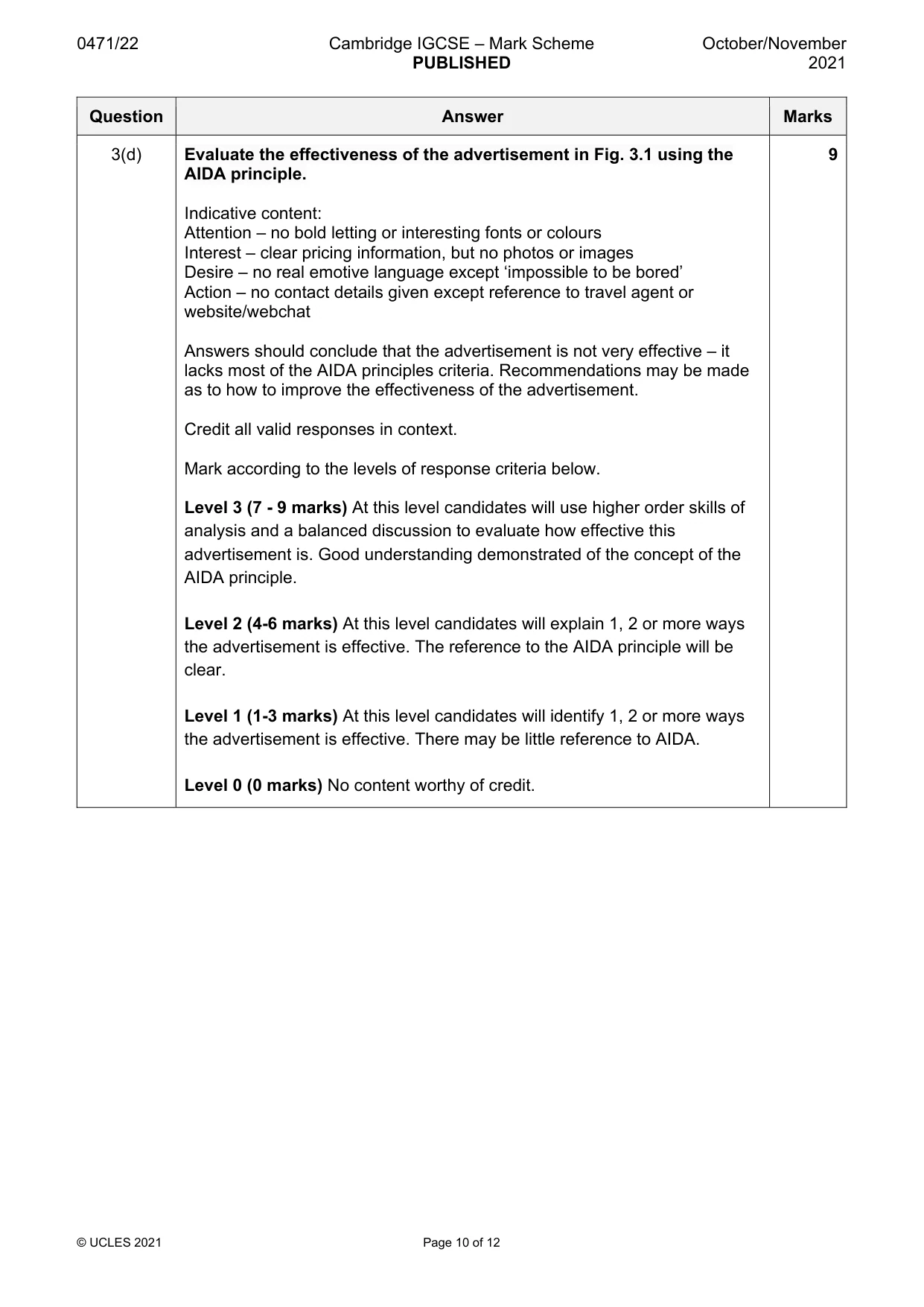
0471/22 Cambridge IGCSE – Mark Scheme PUBLISHED October/November 2021 © UCLES 2021 Page 10 of 12 Question Answer Marks 3(d) Evaluate the effectiveness of the advertisement in Fig. 3.1 using the AIDA principle. Indicative content: Attention – no bold letting or interesting fonts or colours Interest – clear pricing information, but no photos or images Desire – no real emotive language except ‘impossible to be bored’ Action – no contact details given except reference to travel agent or website/webchat Answers should conclude that the advertisement is not very effective – it lacks most of the AIDA principles criteria. Recommendations may be made as to how to improve the effectiveness of the advertisement. Credit all valid responses in context. Mark according to the levels of response criteria below. Level 3 (7 - 9 marks) At this level candidates will use higher order skills of analysis and a balanced discussion to evaluate how effective this advertisement is. Good understanding demonstrated of the concept of the AIDA principle. Level 2 (4-6 marks) At this level candidates will explain 1, 2 or more ways the advertisement is effective. The reference to the AIDA principle will be clear. Level 1 (1-3 marks) At this level candidates will identify 1, 2 or more ways the advertisement is effective. There may be little reference to AIDA. Level 0 (0 marks) No content worthy of credit. 9
Mark scheme, page 11
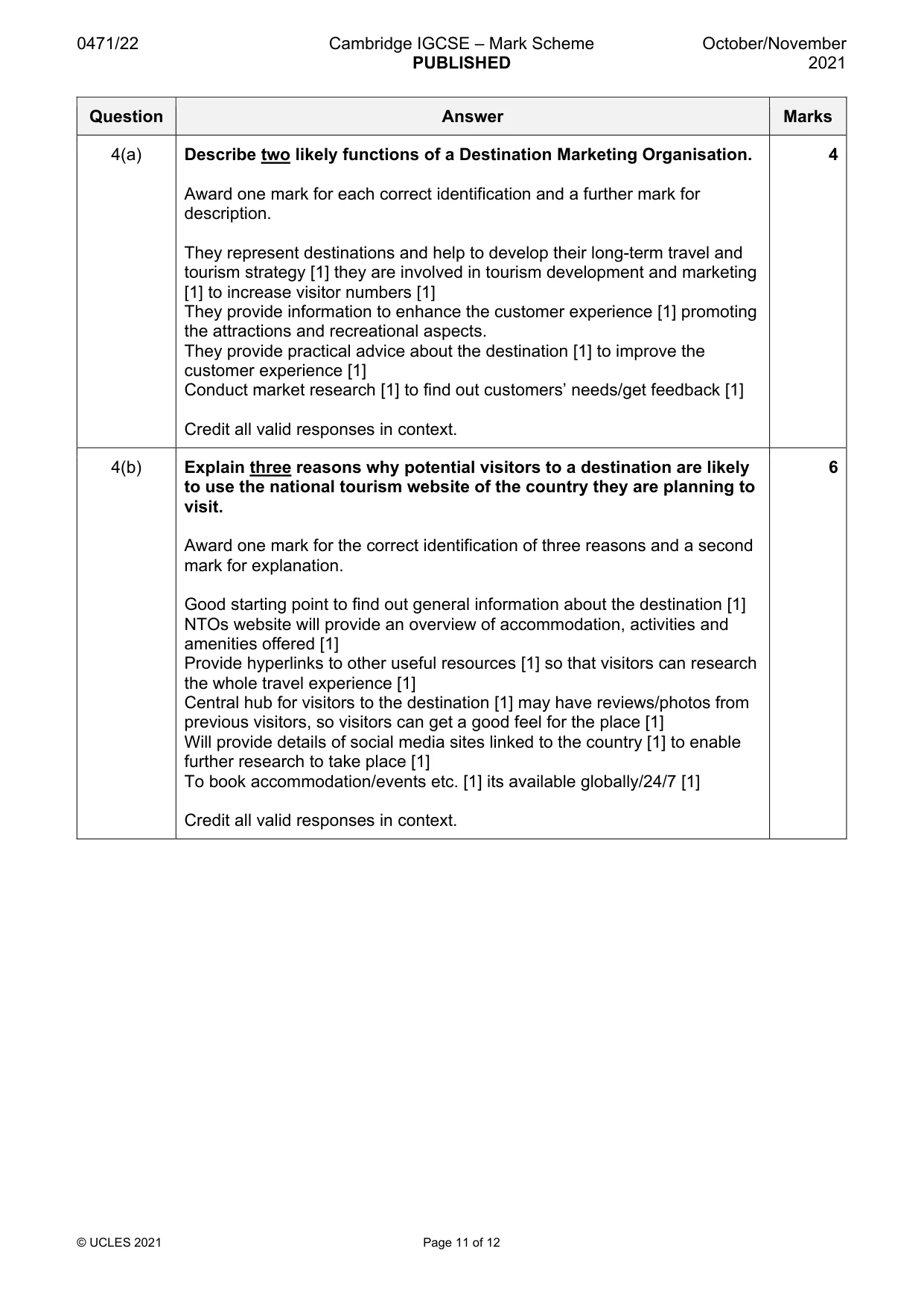
0471/22 Cambridge IGCSE – Mark Scheme PUBLISHED October/November 2021 © UCLES 2021 Page 11 of 12 Question Answer Marks 4(a) Describe two likely functions of a Destination Marketing Organisation. Award one mark for each correct identification and a further mark for description. They represent destinations and help to develop their long-term travel and tourism strategy [1] they are involved in tourism development and marketing [1] to increase visitor numbers [1] They provide information to enhance the customer experience [1] promoting the attractions and recreational aspects. They provide practical advice about the destination [1] to improve the customer experience [1] Conduct market research [1] to find out customers’ needs/get feedback [1] Credit all valid responses in context. 4 4(b) Explain three reasons why potential visitors to a destination are likely to use the national tourism website of the country they are planning to visit. Award one mark for the correct identification of three reasons and a second mark for explanation. Good starting point to find out general information about the destination [1] NTOs website will provide an overview of accommodation, activities and amenities offered [1] Provide hyperlinks to other useful resources [1] so that visitors can research the whole travel experience [1] Central hub for visitors to the destination [1] may have reviews/photos from previous visitors, so visitors can get a good feel for the place [1] Will provide details of social media sites linked to the country [1] to enable further research to take place [1] To book accommodation/events etc. [1] its available globally/24/7 [1] Credit all valid responses in context. 6
Mark scheme, page 12
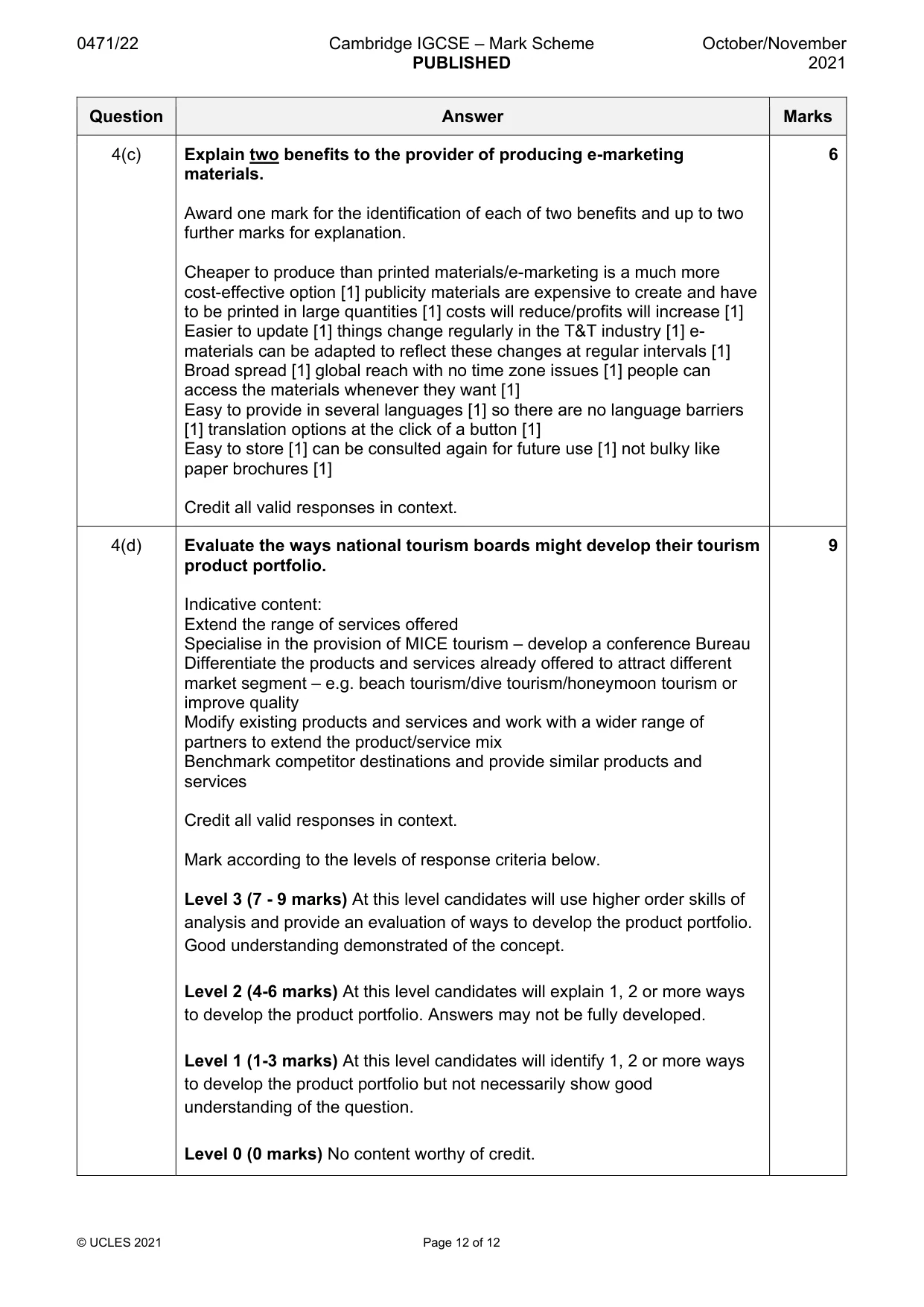
0471/22 Cambridge IGCSE – Mark Scheme PUBLISHED October/November 2021 © UCLES 2021 Page 12 of 12 Question Answer Marks 4(c) Explain two benefits to the provider of producing e-marketing materials. Award one mark for the identification of each of two benefits and up to two further marks for explanation. Cheaper to produce than printed materials/e-marketing is a much more cost-effective option [1] publicity materials are expensive to create and have to be printed in large quantities [1] costs will reduce/profits will increase [1] Easier to update [1] things change regularly in the T&T industry [1] e- materials can be adapted to reflect these changes at regular intervals [1] Broad spread [1] global reach with no time zone issues [1] people can access the materials whenever they want [1] Easy to provide in several languages [1] so there are no language barriers [1] translation options at the click of a button [1] Easy to store [1] can be consulted again for future use [1] not bulky like paper brochures [1] Credit all valid responses in context. 6 4(d) Evaluate the ways national tourism boards might develop their tourism product portfolio. Indicative content: Extend the range of services offered Specialise in the provision of MICE tourism – develop a conference Bureau Differentiate the products and services already offered to attract different market segment – e.g. beach tourism/dive tourism/honeymoon tourism or improve quality Modify existing products and services and work with a wider range of partners to extend the product/service mix Benchmark competitor destinations and provide similar products and services Credit all valid responses in context. Mark according to the levels of response criteria below. Level 3 (7 - 9 marks) At this level candidates will use higher order skills of analysis and provide an evaluation of ways to develop the product portfolio. Good understanding demonstrated of the concept. Level 2 (4-6 marks) At this level candidates will explain 1, 2 or more ways to develop the product portfolio. Answers may not be fully developed. Level 1 (1-3 marks) At this level candidates will identify 1, 2 or more ways to develop the product portfolio but not necessarily show good understanding of the question. Level 0 (0 marks) No content worthy of credit. 9
What you needed in this session
Cambridge’s own grade thresholds for 2021 Oct/Nov, Paper 2 · Variant 2. A higher threshold means an easier paper — the bar moves with how the cohort did.