Cambridge IGCSE Travel and Tourism 0471 — 2021 Oct/Nov Paper 2 · Variant 1
0471/21/O/N/21 · 100 marks · ≈113 min
The question paper and its mark scheme, free to read here and free to download. This is Cambridge’s own paper, exactly as it was sat.
Question paper16 pages




Mark scheme12 pages
Answers below. Sit the paper first if you are practising.
Paper as text
Question paper, page 1
This document has 16 pages. Any blank pages are indicated. DC (SLM) 220826 © UCLES 2021 [Turn over * 6 0 4 3 3 4 7 5 3 9 * TRAVEL & TOURISM 0471/21 Paper 2 Alternative to Coursework October/November 2021 2 hours 30 minutes You must answer on the question paper. You will need: Insert (enclosed) INSTRUCTIONS ● Answer all questions. ● Use a black or dark blue pen. ● Write your name, centre number and candidate number in the boxes at the top of the page. ● Write your answer to each question in the space provided. ● Do not use an erasable pen or correction fluid. ● Do not write on any bar codes. INFORMATION ● The total mark for this paper is 100. ● The number of marks for each question or part question is shown in brackets [ ]. ● The insert contains all the figures referred to in the questions. Cambridge IGCSE™
Question paper, page 2
2 0471/21/O/N/21 © UCLES 2021 Question 1 Refer to Fig. 1.1 (Insert), an advertisement for a holiday to Sri Lanka, an island destination in the Indian Ocean. (a) Describe two components included in this package holiday. 1 … … … … 2 … … … … [4] (b) Explain three reasons for the likely appeal of Sri Lanka to leisure tourists. 1 … … … … 2 … … … … 3 … … … … [6]
Question paper, page 3
3 0471/21/O/N/21 © UCLES 2021 [Turn over (c) Explain two benefits to the provider of using a website as a distribution channel for this holiday. 1 … … … … … … 2 … … … … … … [6]
Question paper, page 4
4 0471/21/O/N/21 © UCLES 2021 (d) Discuss why the characteristics of travel and tourism products and services might lead to limited availability of these tours. … … … … … … … … … … … … … … … … … … [9] [Total: 25]
Question paper, page 5
5 0471/21/O/N/21 © UCLES 2021 [Turn over Question 2 Refer to Fig. 2.1 (Insert), information about the cruise industry. (a) Identify four characteristics of a typical cruise passenger, according to the research data. 1 … 2 … 3 … 4 … [4] (b) Explain three reasons why the travel industry collects statistical research data. 1 … … … … 2 … … … … 3 … … … … [6]
Question paper, page 6
6 0471/21/O/N/21 © UCLES 2021 (c) Explain two reasons why prestige pricing might not be a suitable pricing policy for all cruise holidays. 1 … … … … … … 2 … … … … … … [6]
Question paper, page 7
7 0471/21/O/N/21 © UCLES 2021 [Turn over (d) Evaluate how effectively cruise lines have adapted their marketing mix for younger passengers (the millennials). … … … … … … … … … … … … … … … … … … [9] [Total: 25]
Question paper, page 8
8 0471/21/O/N/21 © UCLES 2021 Question 3 Refer to Fig. 3.1 (Insert), the results of a SWOT analysis of the Philippines as a tourist destination. The Philippines is a south east Asian country, comprising more than 7000 islands in the Pacific Ocean. (a) Explain why SWOT analysis is a useful tool for travel and tourism organisations. … … … … … … … … [4] (b) Explain, using the results of the SWOT analysis in Fig. 3.1, three factors of place which may currently prevent tourists from wanting to visit the Philippines. 1 … … … … 2 … … … … 3 … … … … [6]
Question paper, page 9
9 0471/21/O/N/21 © UCLES 2021 [Turn over (c) Explain how tourism providers in the Philippines can benefit from each of the following opportunities: increased demand for accommodation … … … … increased number of international visitors … … … … diversified tourism packages … … … … [6]
Question paper, page 10
10 0471/21/O/N/21 © UCLES 2021 (d) Assess the importance of marketing and promotion to the Philippines after negative travel advisory guidance has been issued to tourists. … … … … … … … … … … … … … … … … … … [9] [Total: 25]
Question paper, page 11
11 0471/21/O/N/21 © UCLES 2021 [Turn over Question 4 Refer to Fig. 4.1 (Insert), information about the 2019 China–New Zealand ‘Year of Tourism’. (a) Describe two ways the ‘Year of Tourism’ marketing campaign can be used to create a brand image for tourism between China and New Zealand. 1 … … … … 2 … … … … [4] (b) Explain three likely reasons why New Zealand chose China as its marketing partner for the ‘Year of Tourism’. 1 … … … … 2 … … … … 3 … … … … [6]
Question paper, page 12
12 0471/21/O/N/21 © UCLES 2021 (c) Explain two likely benefits for tourism businesses in New Zealand of using the ‘China Toolkit’ as a trade promotion technique. 1 … … … … … … 2 … … … … … … [6]
Question paper, page 13
13 0471/21/O/N/21 © UCLES 2021 (d) Evaluate the importance to Tourism New Zealand of following the stages of a promotional campaign for the ‘Year of Tourism’. … … … … … … … … … … … … … … … … … … [9] [Total: 25]
Question paper, page 14
14 0471/21/O/N/21 © UCLES 2021 BLANK PAGE
Question paper, page 15
15 0471/21/O/N/21 © UCLES 2021 BLANK PAGE
Question paper, page 16
16 0471/21/O/N/21 © UCLES 2021 BLANK PAGE The boundaries and names shown, the designations used and the presentation of material on any maps contained in this question paper/insert do not imply official endorsement or acceptance by Cambridge Assessment International Education concerning the legal status of any country, territory, or area or any of its authorities, or of the delimitation of its frontiers or boundaries. Permission to reproduce items where third-party owned material protected by copyright is included has been sought and cleared where possible. Every reasonable effort has been made by the publisher (UCLES) to trace copyright holders, but if any items requiring clearance have unwittingly been included, the publisher will be pleased to make amends at the earliest possible opportunity. To avoid the issue of disclosure of answer-related information to candidates, all copyright acknowledgements are reproduced online in the Cambridge Assessment International Education Copyright Acknowledgements Booklet. This is produced for each series of examinations and is freely available to download at www.cambridgeinternational.org after the live examination series. Cambridge Assessment International Education is part of the Cambridge Assessment Group. Cambridge Assessment is the brand name of the University of Cambridge Local Examinations Syndicate (UCLES), which itself is a department of the University of Cambridge.
Mark scheme, page 1
This document consists of 12 printed pages. © UCLES 2021 [Turn over Cambridge IGCSE™ TRAVEL & TOURISM 0471/21 Paper 2 Alternative to Coursework October/November 2021 MARK SCHEME Maximum Mark: 100 Published This mark scheme is published as an aid to teachers and candidates, to indicate the requirements of the examination. It shows the basis on which Examiners were instructed to award marks. It does not indicate the details of the discussions that took place at an Examiners’ meeting before marking began, which would have considered the acceptability of alternative answers. Mark schemes should be read in conjunction with the question paper and the Principal Examiner Report for Teachers. Cambridge International will not enter into discussions about these mark schemes. Cambridge International is publishing the mark schemes for the October/November 2021 series for most Cambridge IGCSE™, Cambridge International A and AS Level components and some Cambridge O Level components.
Mark scheme, page 2
0471/21 Cambridge IGCSE – Mark Scheme PUBLISHED October/November 2021 © UCLES 2021 Page 2 of 12 Generic Marking Principles These general marking principles must be applied by all examiners when marking candidate answers. They should be applied alongside the specific content of the mark scheme or generic level descriptors for a question. Each question paper and mark scheme will also comply with these marking principles. GENERIC MARKING PRINCIPLE 1: Marks must be awarded in line with: • the specific content of the mark scheme or the generic level descriptors for the question • the specific skills defined in the mark scheme or in the generic level descriptors for the question • the standard of response required by a candidate as exemplified by the standardisation scripts. GENERIC MARKING PRINCIPLE 2: Marks awarded are always whole marks (not half marks, or other fractions). GENERIC MARKING PRINCIPLE 3: Marks must be awarded positively: • marks are awarded for correct/valid answers, as defined in the mark scheme. However, credit is given for valid answers which go beyond the scope of the syllabus and mark scheme, referring to your Team Leader as appropriate • marks are awarded when candidates clearly demonstrate what they know and can do • marks are not deducted for errors • marks are not deducted for omissions • answers should only be judged on the quality of spelling, punctuation and grammar when these features are specifically assessed by the question as indicated by the mark scheme. The meaning, however, should be unambiguous. GENERIC MARKING PRINCIPLE 4: Rules must be applied consistently, e.g. in situations where candidates have not followed instructions or in the application of generic level descriptors. GENERIC MARKING PRINCIPLE 5: Marks should be awarded using the full range of marks defined in the mark scheme for the question (however; the use of the full mark range may be limited according to the quality of the candidate responses seen). GENERIC MARKING PRINCIPLE 6: Marks awarded are based solely on the requirements as defined in the mark scheme. Marks should not be awarded with grade thresholds or grade descriptors in mind.
Mark scheme, page 3
0471/21 Cambridge IGCSE – Mark Scheme PUBLISHED October/November 2021 © UCLES 2021 Page 3 of 12 Social Science-Specific Marking Principles (for point-based marking) 1 Components using point-based marking: • Point marking is often used to reward knowledge, understanding and application of skills. We give credit where the candidate’s answer shows relevant knowledge, understanding and application of skills in answering the question. We do not give credit where the answer shows confusion. From this it follows that we: a DO credit answers which are worded differently from the mark scheme if they clearly convey the same meaning (unless the mark scheme requires a specific term) b DO credit alternative answers/examples which are not written in the mark scheme if they are correct c DO credit answers where candidates give more than one correct answer in one prompt/numbered/scaffolded space where extended writing is required rather than list-type answers. For example, questions that require n reasons (e.g. State two reasons …). d DO NOT credit answers simply for using a ‘key term’ unless that is all that is required. (Check for evidence it is understood and not used wrongly.) e DO NOT credit answers which are obviously self-contradicting or trying to cover all possibilities f DO NOT give further credit for what is effectively repetition of a correct point already credited unless the language itself is being tested. This applies equally to ‘mirror statements’ (i.e. polluted/not polluted). g DO NOT require spellings to be correct, unless this is part of the test. However spellings of syllabus terms must allow for clear and unambiguous separation from other syllabus terms with which they may be confused (e.g. Corrasion/Corrosion) 2 Presentation of mark scheme: • Slashes (/) or the word ‘or’ separate alternative ways of making the same point. • Semi colons (;) bullet points (•) or figures in brackets [1] separate different points. • Content in the answer column in brackets is for examiner information/context to clarify the marking but is not required to earn the mark (except Accounting syllabuses where they indicate negative numbers). 3 Annotation: • For point marking, ticks can be used to indicate correct answers and crosses can be used to indicate wrong answers. There is no direct relationship between ticks and marks. Ticks have no defined meaning for levels of response marking. • For levels of response marking, the level awarded should be annotated on the script. • Other annotations will be used by examiners as agreed during standardisation, and the meaning will be understood by all examiners who marked that paper.
Mark scheme, page 4
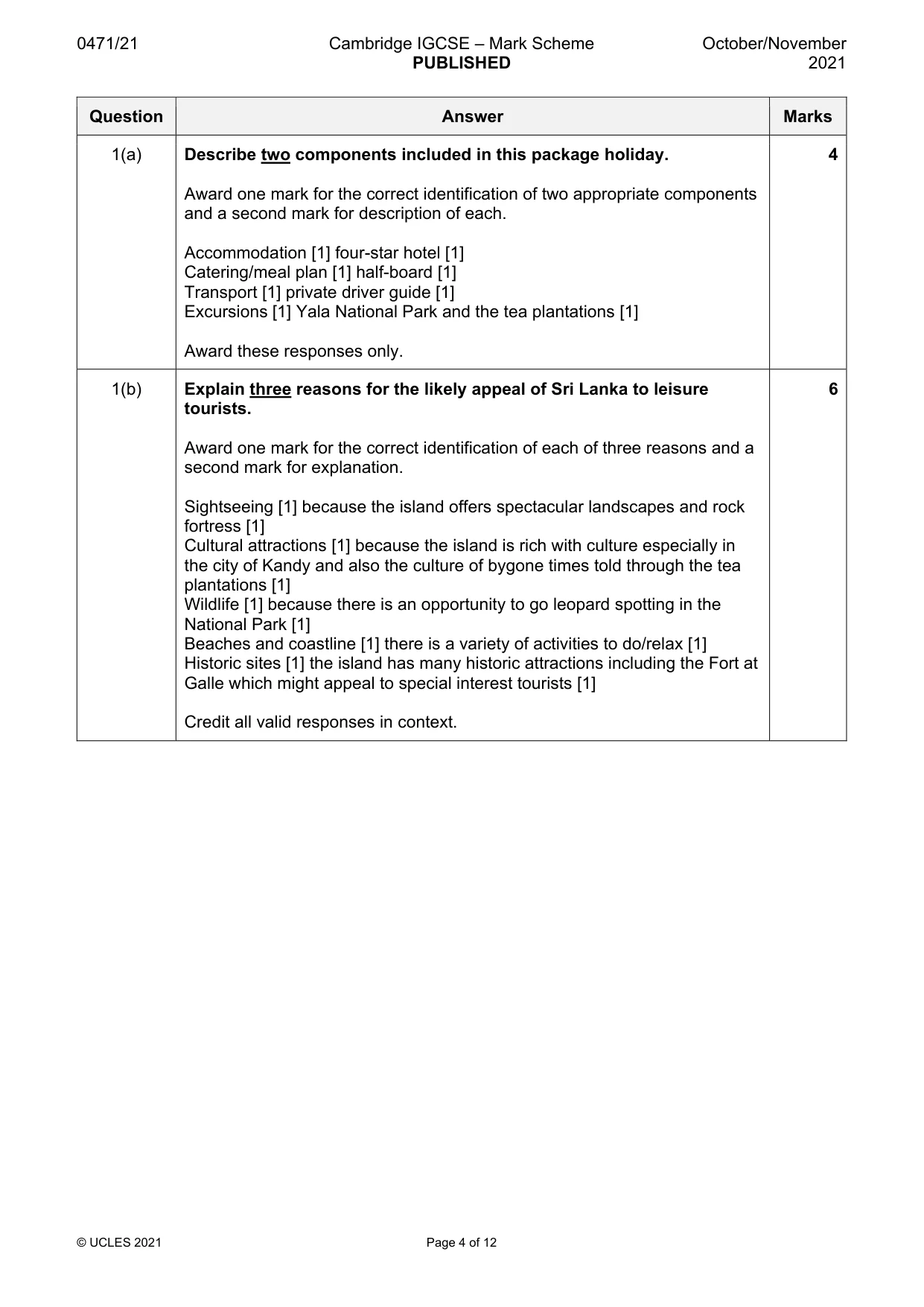
0471/21 Cambridge IGCSE – Mark Scheme PUBLISHED October/November 2021 © UCLES 2021 Page 4 of 12 Question Answer Marks 1(a) Describe two components included in this package holiday. Award one mark for the correct identification of two appropriate components and a second mark for description of each. Accommodation [1] four-star hotel [1] Catering/meal plan [1] half-board [1] Transport [1] private driver guide [1] Excursions [1] Yala National Park and the tea plantations [1] Award these responses only. 4 1(b) Explain three reasons for the likely appeal of Sri Lanka to leisure tourists. Award one mark for the correct identification of each of three reasons and a second mark for explanation. Sightseeing [1] because the island offers spectacular landscapes and rock fortress [1] Cultural attractions [1] because the island is rich with culture especially in the city of Kandy and also the culture of bygone times told through the tea plantations [1] Wildlife [1] because there is an opportunity to go leopard spotting in the National Park [1] Beaches and coastline [1] there is a variety of activities to do/relax [1] Historic sites [1] the island has many historic attractions including the Fort at Galle which might appeal to special interest tourists [1] Credit all valid responses in context. 6
Mark scheme, page 5
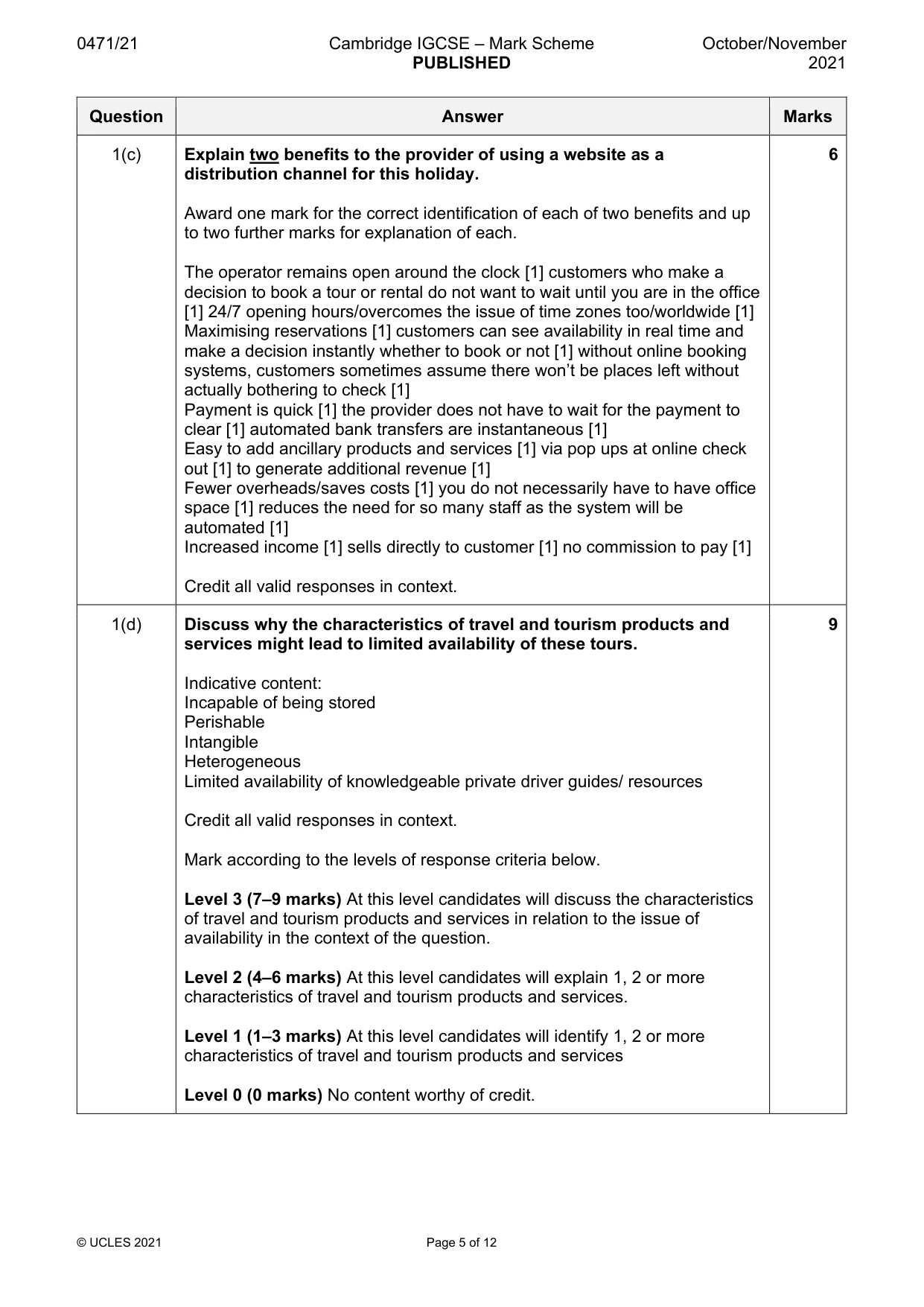
0471/21 Cambridge IGCSE – Mark Scheme PUBLISHED October/November 2021 © UCLES 2021 Page 5 of 12 Question Answer Marks 1(c) Explain two benefits to the provider of using a website as a distribution channel for this holiday. Award one mark for the correct identification of each of two benefits and up to two further marks for explanation of each. The operator remains open around the clock [1] customers who make a decision to book a tour or rental do not want to wait until you are in the office [1] 24/7 opening hours/overcomes the issue of time zones too/worldwide [1] Maximising reservations [1] customers can see availability in real time and make a decision instantly whether to book or not [1] without online booking systems, customers sometimes assume there won’t be places left without actually bothering to check [1] Payment is quick [1] the provider does not have to wait for the payment to clear [1] automated bank transfers are instantaneous [1] Easy to add ancillary products and services [1] via pop ups at online check out [1] to generate additional revenue [1] Fewer overheads/saves costs [1] you do not necessarily have to have office space [1] reduces the need for so many staff as the system will be automated [1] Increased income [1] sells directly to customer [1] no commission to pay [1] Credit all valid responses in context. 6 1(d) Discuss why the characteristics of travel and tourism products and services might lead to limited availability of these tours. Indicative content: Incapable of being stored Perishable Intangible Heterogeneous Limited availability of knowledgeable private driver guides/ resources Credit all valid responses in context. Mark according to the levels of response criteria below. Level 3 (7–9 marks) At this level candidates will discuss the characteristics of travel and tourism products and services in relation to the issue of availability in the context of the question. Level 2 (4–6 marks) At this level candidates will explain 1, 2 or more characteristics of travel and tourism products and services. Level 1 (1–3 marks) At this level candidates will identify 1, 2 or more characteristics of travel and tourism products and services Level 0 (0 marks) No content worthy of credit. 9
Mark scheme, page 6
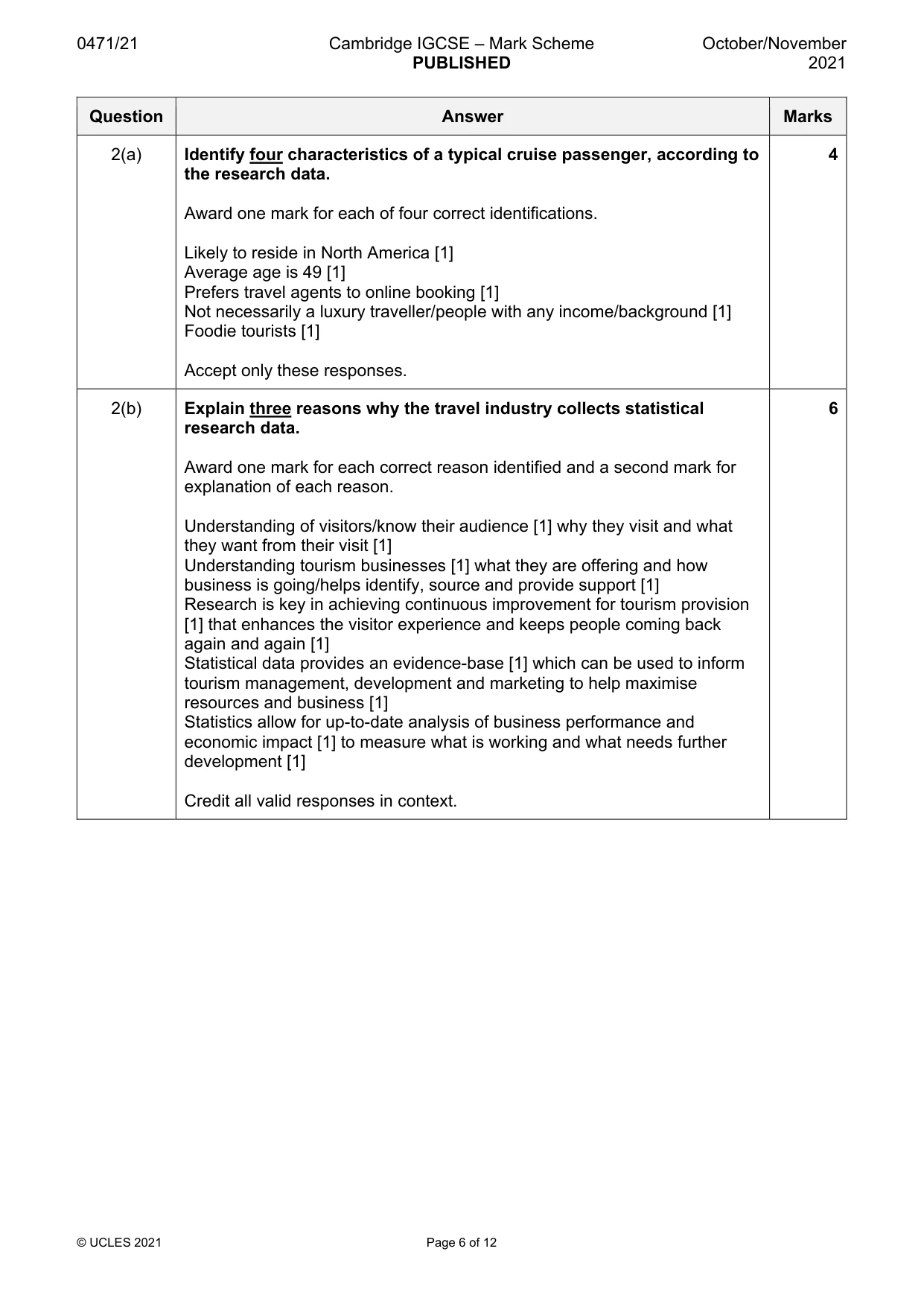
0471/21 Cambridge IGCSE – Mark Scheme PUBLISHED October/November 2021 © UCLES 2021 Page 6 of 12 Question Answer Marks 2(a) Identify four characteristics of a typical cruise passenger, according to the research data. Award one mark for each of four correct identifications. Likely to reside in North America [1] Average age is 49 [1] Prefers travel agents to online booking [1] Not necessarily a luxury traveller/people with any income/background [1] Foodie tourists [1] Accept only these responses. 4 2(b) Explain three reasons why the travel industry collects statistical research data. Award one mark for each correct reason identified and a second mark for explanation of each reason. Understanding of visitors/know their audience [1] why they visit and what they want from their visit [1] Understanding tourism businesses [1] what they are offering and how business is going/helps identify, source and provide support [1] Research is key in achieving continuous improvement for tourism provision [1] that enhances the visitor experience and keeps people coming back again and again [1] Statistical data provides an evidence-base [1] which can be used to inform tourism management, development and marketing to help maximise resources and business [1] Statistics allow for up-to-date analysis of business performance and economic impact [1] to measure what is working and what needs further development [1] Credit all valid responses in context. 6
Mark scheme, page 7
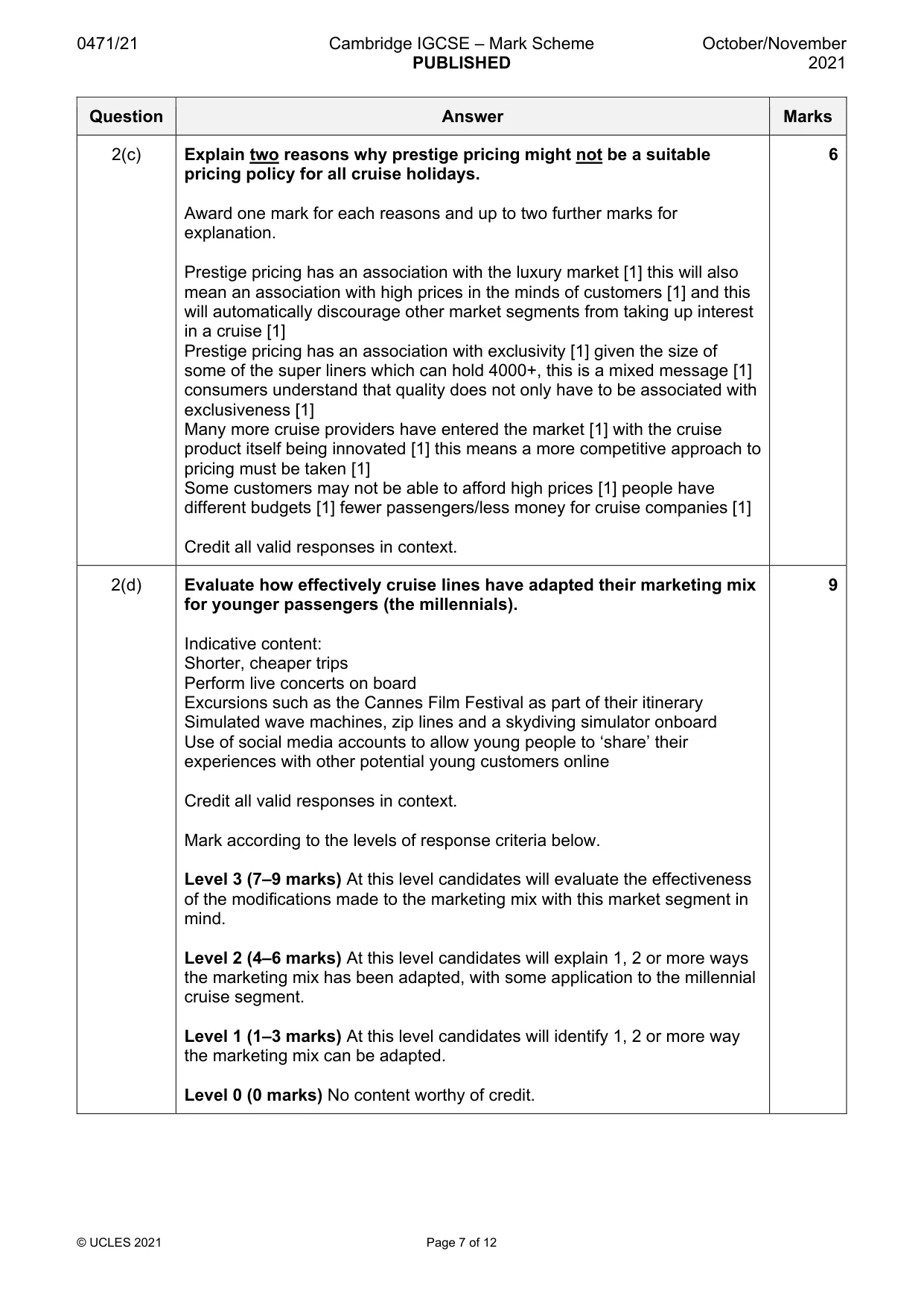
0471/21 Cambridge IGCSE – Mark Scheme PUBLISHED October/November 2021 © UCLES 2021 Page 7 of 12 Question Answer Marks 2(c) Explain two reasons why prestige pricing might not be a suitable pricing policy for all cruise holidays. Award one mark for each reasons and up to two further marks for explanation. Prestige pricing has an association with the luxury market [1] this will also mean an association with high prices in the minds of customers [1] and this will automatically discourage other market segments from taking up interest in a cruise [1] Prestige pricing has an association with exclusivity [1] given the size of some of the super liners which can hold 4000+, this is a mixed message [1] consumers understand that quality does not only have to be associated with exclusiveness [1] Many more cruise providers have entered the market [1] with the cruise product itself being innovated [1] this means a more competitive approach to pricing must be taken [1] Some customers may not be able to afford high prices [1] people have different budgets [1] fewer passengers/less money for cruise companies [1] Credit all valid responses in context. 6 2(d) Evaluate how effectively cruise lines have adapted their marketing mix for younger passengers (the millennials). Indicative content: Shorter, cheaper trips Perform live concerts on board Excursions such as the Cannes Film Festival as part of their itinerary Simulated wave machines, zip lines and a skydiving simulator onboard Use of social media accounts to allow young people to ‘share’ their experiences with other potential young customers online Credit all valid responses in context. Mark according to the levels of response criteria below. Level 3 (7–9 marks) At this level candidates will evaluate the effectiveness of the modifications made to the marketing mix with this market segment in mind. Level 2 (4–6 marks) At this level candidates will explain 1, 2 or more ways the marketing mix has been adapted, with some application to the millennial cruise segment. Level 1 (1–3 marks) At this level candidates will identify 1, 2 or more way the marketing mix can be adapted. Level 0 (0 marks) No content worthy of credit. 9
Mark scheme, page 8
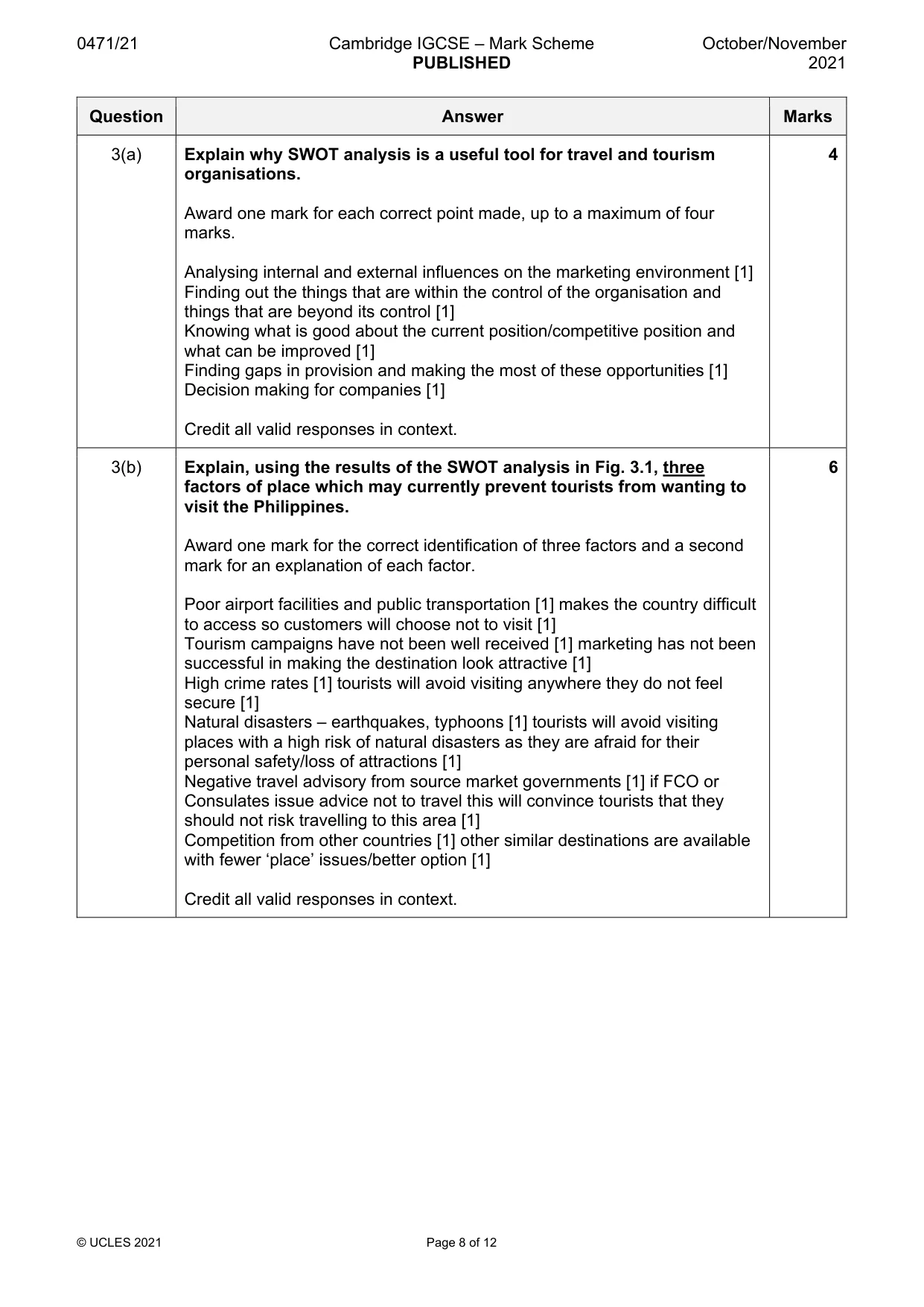
0471/21 Cambridge IGCSE – Mark Scheme PUBLISHED October/November 2021 © UCLES 2021 Page 8 of 12 Question Answer Marks 3(a) Explain why SWOT analysis is a useful tool for travel and tourism organisations. Award one mark for each correct point made, up to a maximum of four marks. Analysing internal and external influences on the marketing environment [1] Finding out the things that are within the control of the organisation and things that are beyond its control [1] Knowing what is good about the current position/competitive position and what can be improved [1] Finding gaps in provision and making the most of these opportunities [1] Decision making for companies [1] Credit all valid responses in context. 4 3(b) Explain, using the results of the SWOT analysis in Fig. 3.1, three factors of place which may currently prevent tourists from wanting to visit the Philippines. Award one mark for the correct identification of three factors and a second mark for an explanation of each factor. Poor airport facilities and public transportation [1] makes the country difficult to access so customers will choose not to visit [1] Tourism campaigns have not been well received [1] marketing has not been successful in making the destination look attractive [1] High crime rates [1] tourists will avoid visiting anywhere they do not feel secure [1] Natural disasters – earthquakes, typhoons [1] tourists will avoid visiting places with a high risk of natural disasters as they are afraid for their personal safety/loss of attractions [1] Negative travel advisory from source market governments [1] if FCO or Consulates issue advice not to travel this will convince tourists that they should not risk travelling to this area [1] Competition from other countries [1] other similar destinations are available with fewer ‘place’ issues/better option [1] Credit all valid responses in context. 6
Mark scheme, page 9
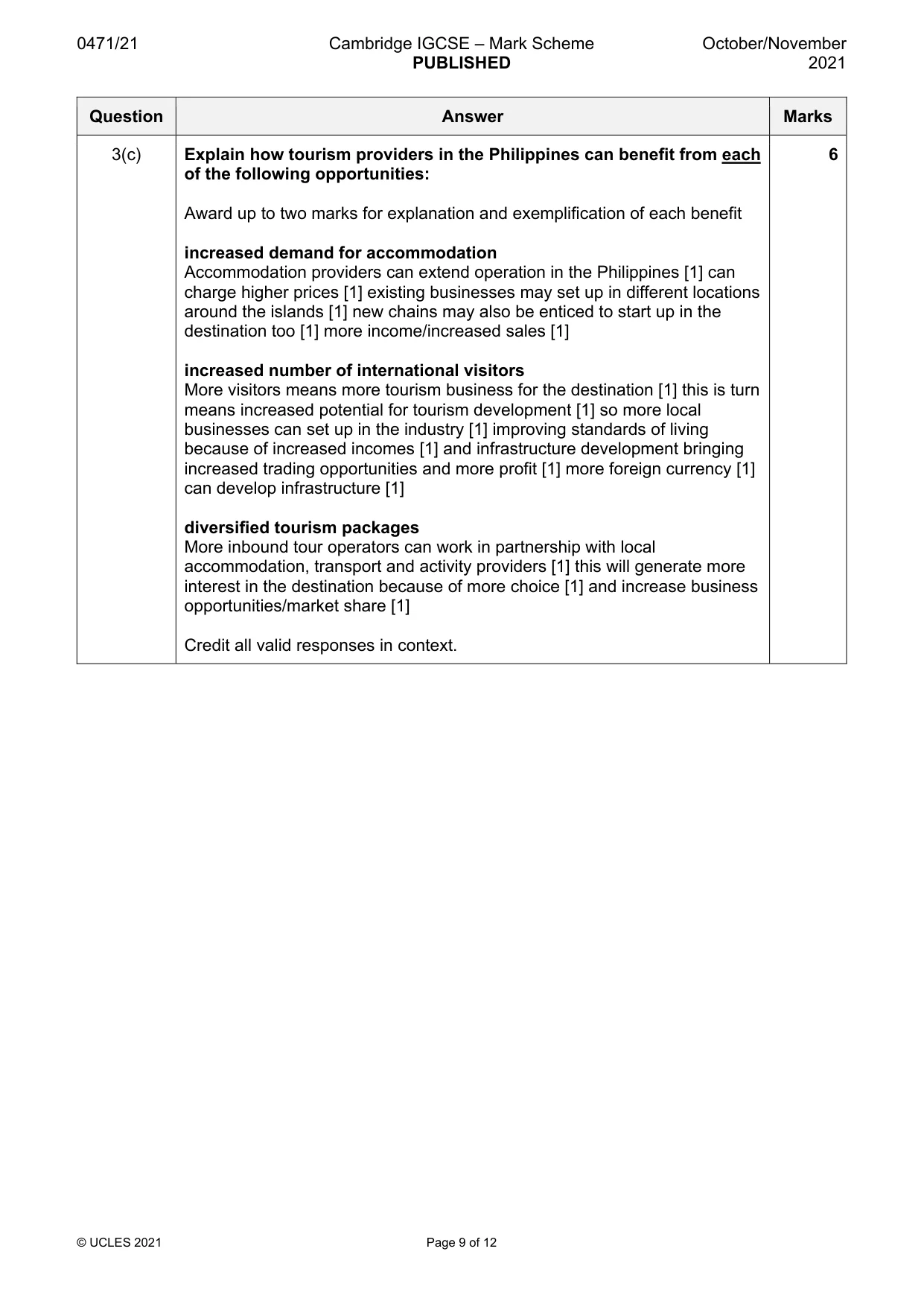
0471/21 Cambridge IGCSE – Mark Scheme PUBLISHED October/November 2021 © UCLES 2021 Page 9 of 12 Question Answer Marks 3(c) Explain how tourism providers in the Philippines can benefit from each of the following opportunities: Award up to two marks for explanation and exemplification of each benefit increased demand for accommodation Accommodation providers can extend operation in the Philippines [1] can charge higher prices [1] existing businesses may set up in different locations around the islands [1] new chains may also be enticed to start up in the destination too [1] more income/increased sales [1] increased number of international visitors More visitors means more tourism business for the destination [1] this is turn means increased potential for tourism development [1] so more local businesses can set up in the industry [1] improving standards of living because of increased incomes [1] and infrastructure development bringing increased trading opportunities and more profit [1] more foreign currency [1] can develop infrastructure [1] diversified tourism packages More inbound tour operators can work in partnership with local accommodation, transport and activity providers [1] this will generate more interest in the destination because of more choice [1] and increase business opportunities/market share [1] Credit all valid responses in context. 6
Mark scheme, page 10
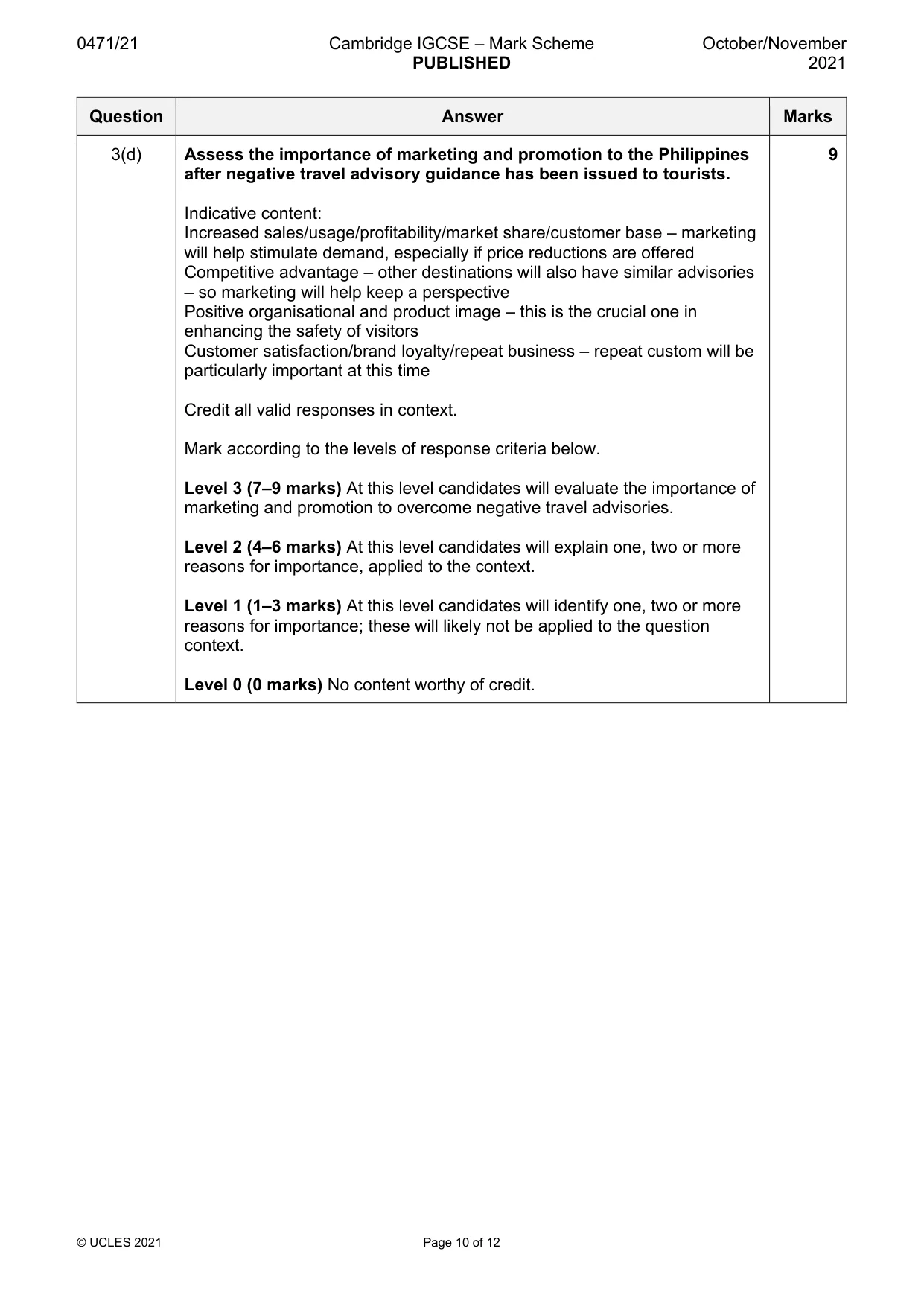
0471/21 Cambridge IGCSE – Mark Scheme PUBLISHED October/November 2021 © UCLES 2021 Page 10 of 12 Question Answer Marks 3(d) Assess the importance of marketing and promotion to the Philippines after negative travel advisory guidance has been issued to tourists. Indicative content: Increased sales/usage/profitability/market share/customer base – marketing will help stimulate demand, especially if price reductions are offered Competitive advantage – other destinations will also have similar advisories – so marketing will help keep a perspective Positive organisational and product image – this is the crucial one in enhancing the safety of visitors Customer satisfaction/brand loyalty/repeat business – repeat custom will be particularly important at this time Credit all valid responses in context. Mark according to the levels of response criteria below. Level 3 (7–9 marks) At this level candidates will evaluate the importance of marketing and promotion to overcome negative travel advisories. Level 2 (4–6 marks) At this level candidates will explain one, two or more reasons for importance, applied to the context. Level 1 (1–3 marks) At this level candidates will identify one, two or more reasons for importance; these will likely not be applied to the question context. Level 0 (0 marks) No content worthy of credit. 9
Mark scheme, page 11
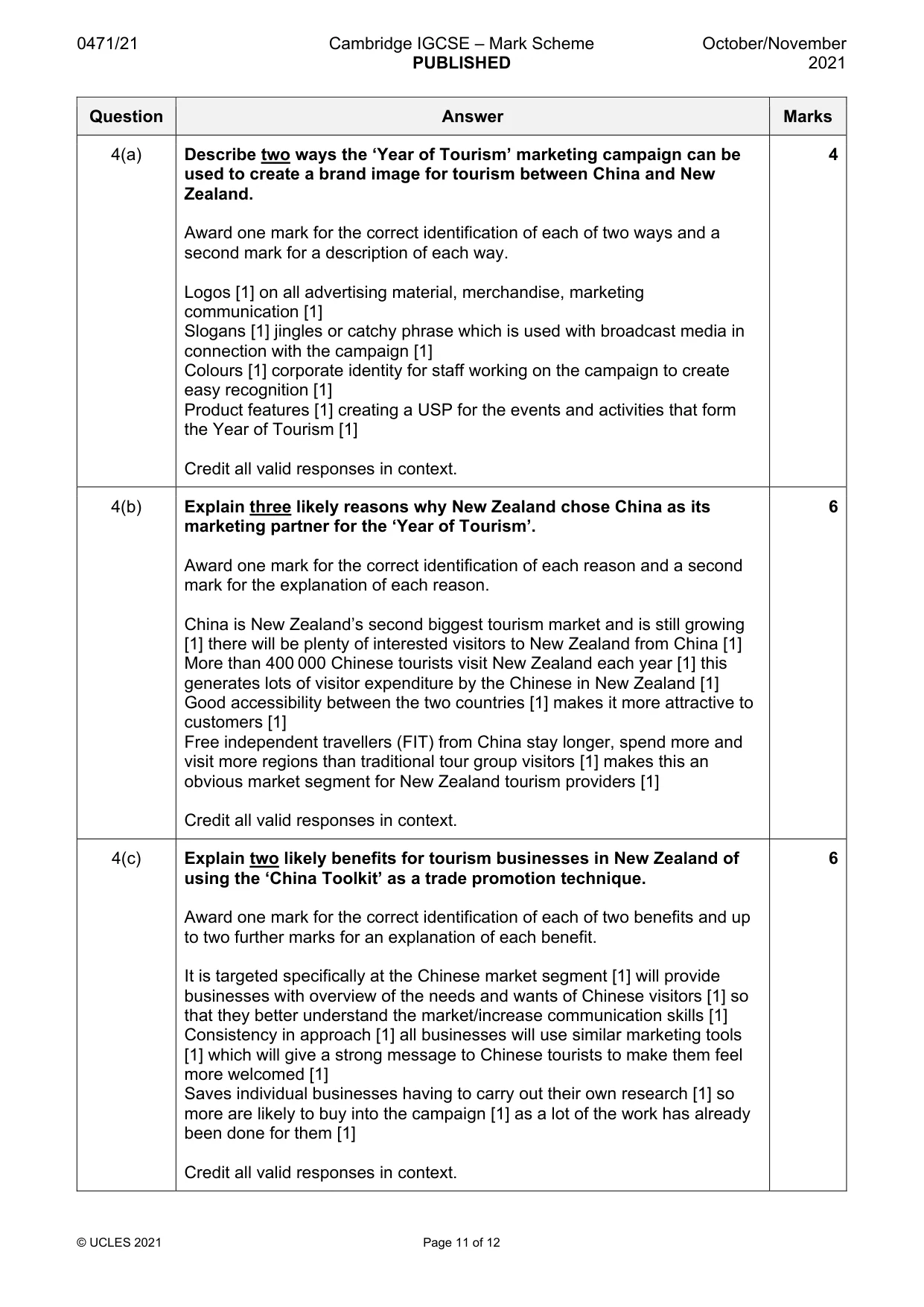
0471/21 Cambridge IGCSE – Mark Scheme PUBLISHED October/November 2021 © UCLES 2021 Page 11 of 12 Question Answer Marks 4(a) Describe two ways the ‘Year of Tourism’ marketing campaign can be used to create a brand image for tourism between China and New Zealand. Award one mark for the correct identification of each of two ways and a second mark for a description of each way. Logos [1] on all advertising material, merchandise, marketing communication [1] Slogans [1] jingles or catchy phrase which is used with broadcast media in connection with the campaign [1] Colours [1] corporate identity for staff working on the campaign to create easy recognition [1] Product features [1] creating a USP for the events and activities that form the Year of Tourism [1] Credit all valid responses in context. 4 4(b) Explain three likely reasons why New Zealand chose China as its marketing partner for the ‘Year of Tourism’. Award one mark for the correct identification of each reason and a second mark for the explanation of each reason. China is New Zealand’s second biggest tourism market and is still growing [1] there will be plenty of interested visitors to New Zealand from China [1] More than 400 000 Chinese tourists visit New Zealand each year [1] this generates lots of visitor expenditure by the Chinese in New Zealand [1] Good accessibility between the two countries [1] makes it more attractive to customers [1] Free independent travellers (FIT) from China stay longer, spend more and visit more regions than traditional tour group visitors [1] makes this an obvious market segment for New Zealand tourism providers [1] Credit all valid responses in context. 6 4(c) Explain two likely benefits for tourism businesses in New Zealand of using the ‘China Toolkit’ as a trade promotion technique. Award one mark for the correct identification of each of two benefits and up to two further marks for an explanation of each benefit. It is targeted specifically at the Chinese market segment [1] will provide businesses with overview of the needs and wants of Chinese visitors [1] so that they better understand the market/increase communication skills [1] Consistency in approach [1] all businesses will use similar marketing tools [1] which will give a strong message to Chinese tourists to make them feel more welcomed [1] Saves individual businesses having to carry out their own research [1] so more are likely to buy into the campaign [1] as a lot of the work has already been done for them [1] Credit all valid responses in context. 6
Mark scheme, page 12
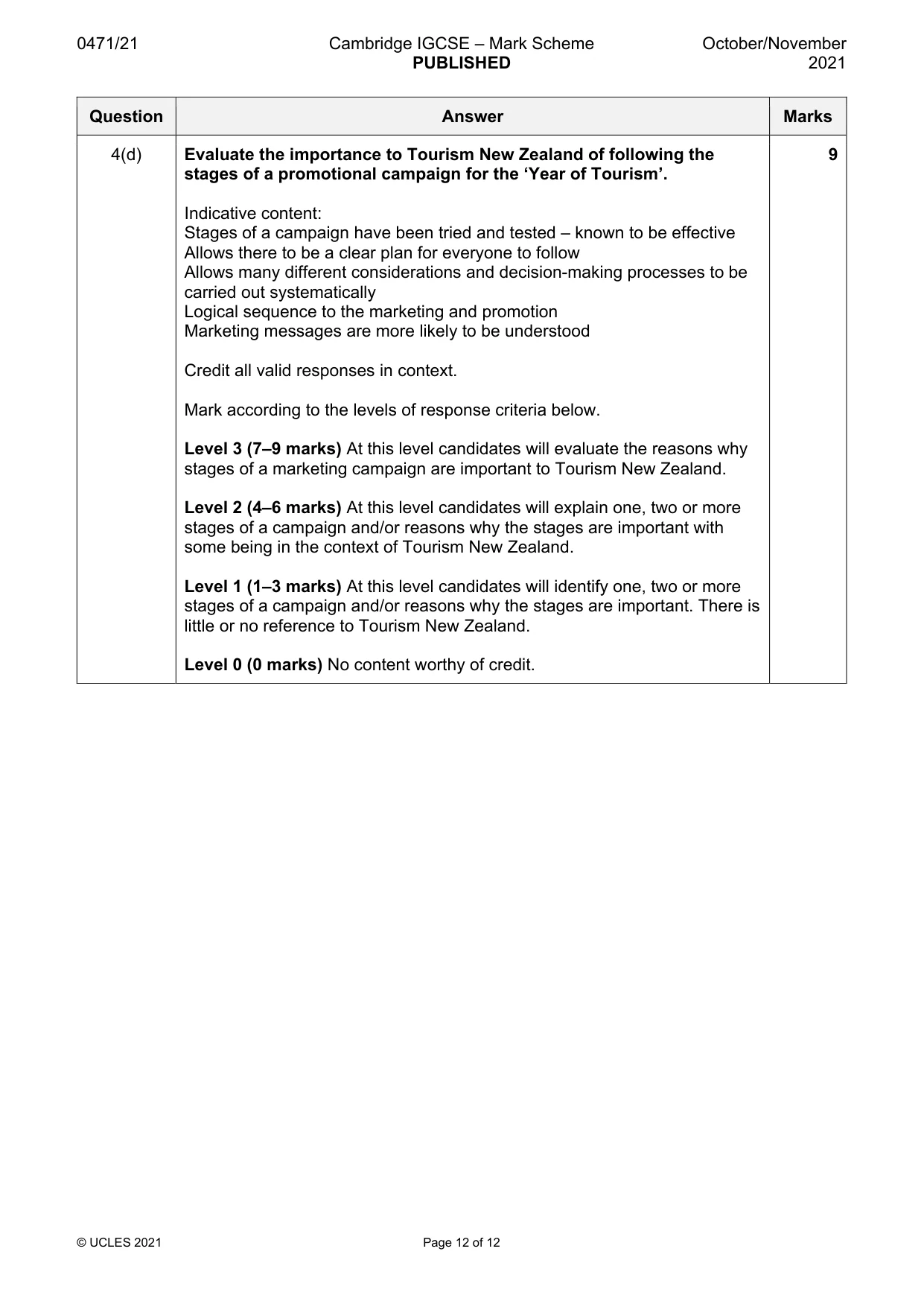
0471/21 Cambridge IGCSE – Mark Scheme PUBLISHED October/November 2021 © UCLES 2021 Page 12 of 12 Question Answer Marks 4(d) Evaluate the importance to Tourism New Zealand of following the stages of a promotional campaign for the ‘Year of Tourism’. Indicative content: Stages of a campaign have been tried and tested – known to be effective Allows there to be a clear plan for everyone to follow Allows many different considerations and decision-making processes to be carried out systematically Logical sequence to the marketing and promotion Marketing messages are more likely to be understood Credit all valid responses in context. Mark according to the levels of response criteria below. Level 3 (7–9 marks) At this level candidates will evaluate the reasons why stages of a marketing campaign are important to Tourism New Zealand. Level 2 (4–6 marks) At this level candidates will explain one, two or more stages of a campaign and/or reasons why the stages are important with some being in the context of Tourism New Zealand. Level 1 (1–3 marks) At this level candidates will identify one, two or more stages of a campaign and/or reasons why the stages are important. There is little or no reference to Tourism New Zealand. Level 0 (0 marks) No content worthy of credit. 9
What you needed in this session
Cambridge’s own grade thresholds for 2021 Oct/Nov, Paper 2 · Variant 1. A higher threshold means an easier paper — the bar moves with how the cohort did.