Cambridge IGCSE Travel and Tourism 0471 — 2021 May/June Paper 2 · Variant 3
0471/23/M/J/21 · 100 marks · ≈113 min
The question paper and its mark scheme, free to read here and free to download. This is Cambridge’s own paper, exactly as it was sat.
Question paper16 pages



Mark scheme11 pages
Answers below. Sit the paper first if you are practising.
Paper as text
Question paper, page 1
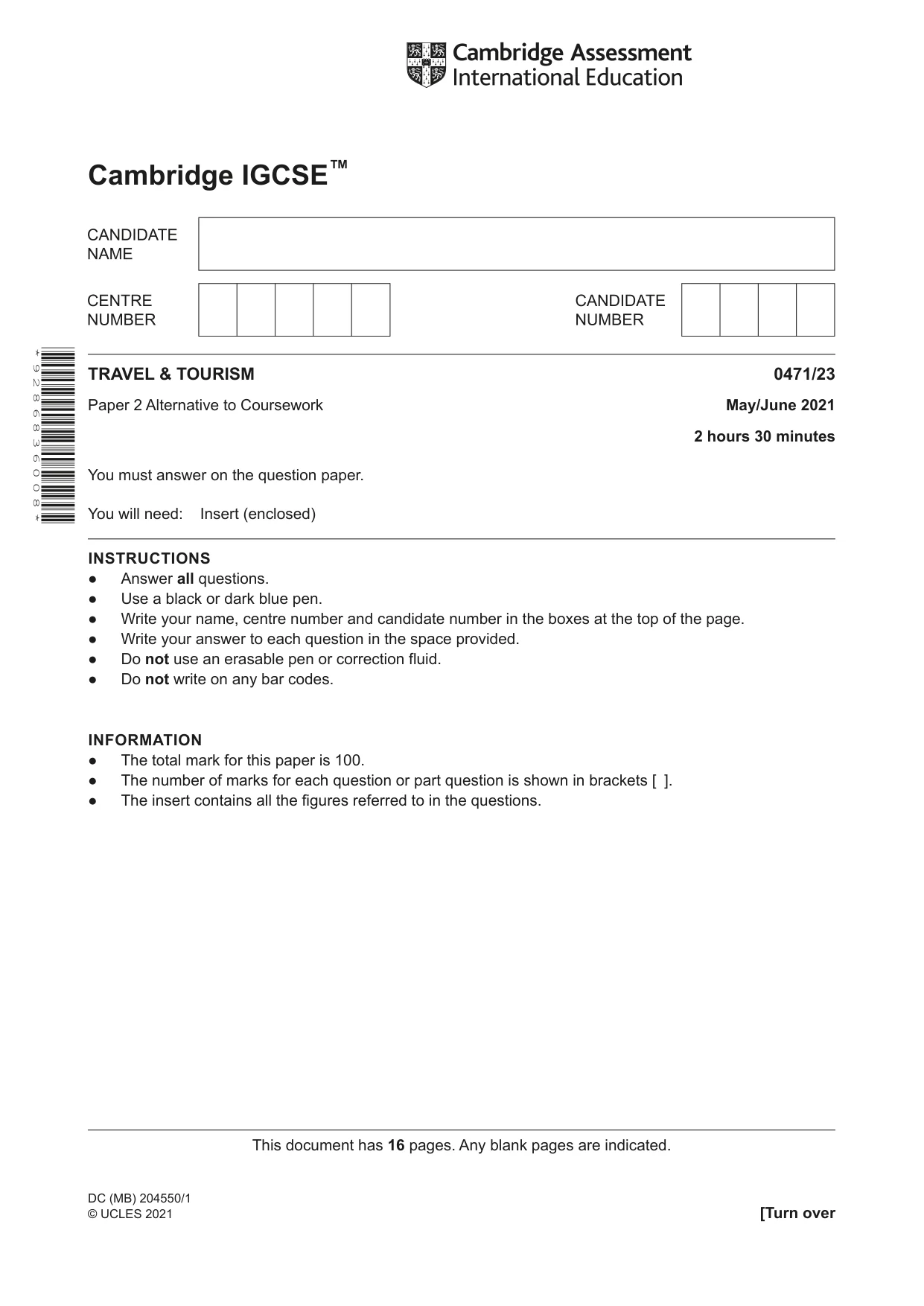
This document has 16 pages. Any blank pages are indicated. Cambridge IGCSE™ TRAVEL & TOURISM 0471/23 Paper 2 Alternative to Coursework May/June 2021 2 hours 30 minutes You must answer on the question paper. You will need: Insert (enclosed) INSTRUCTIONS ● Answer all questions. ● Use a black or dark blue pen. ● Write your name, centre number and candidate number in the boxes at the top of the page. ● Write your answer to each question in the space provided. ● Do not use an erasable pen or correction fluid. ● Do not write on any bar codes. INFORMATION ● The total mark for this paper is 100. ● The number of marks for each question or part question is shown in brackets [ ]. ● The insert contains all the figures referred to in the questions. * 9 2 8 6 8 3 6 0 0 8 * DC (MB) 204550/1 © UCLES 2021 [Turn over
Question paper, page 2
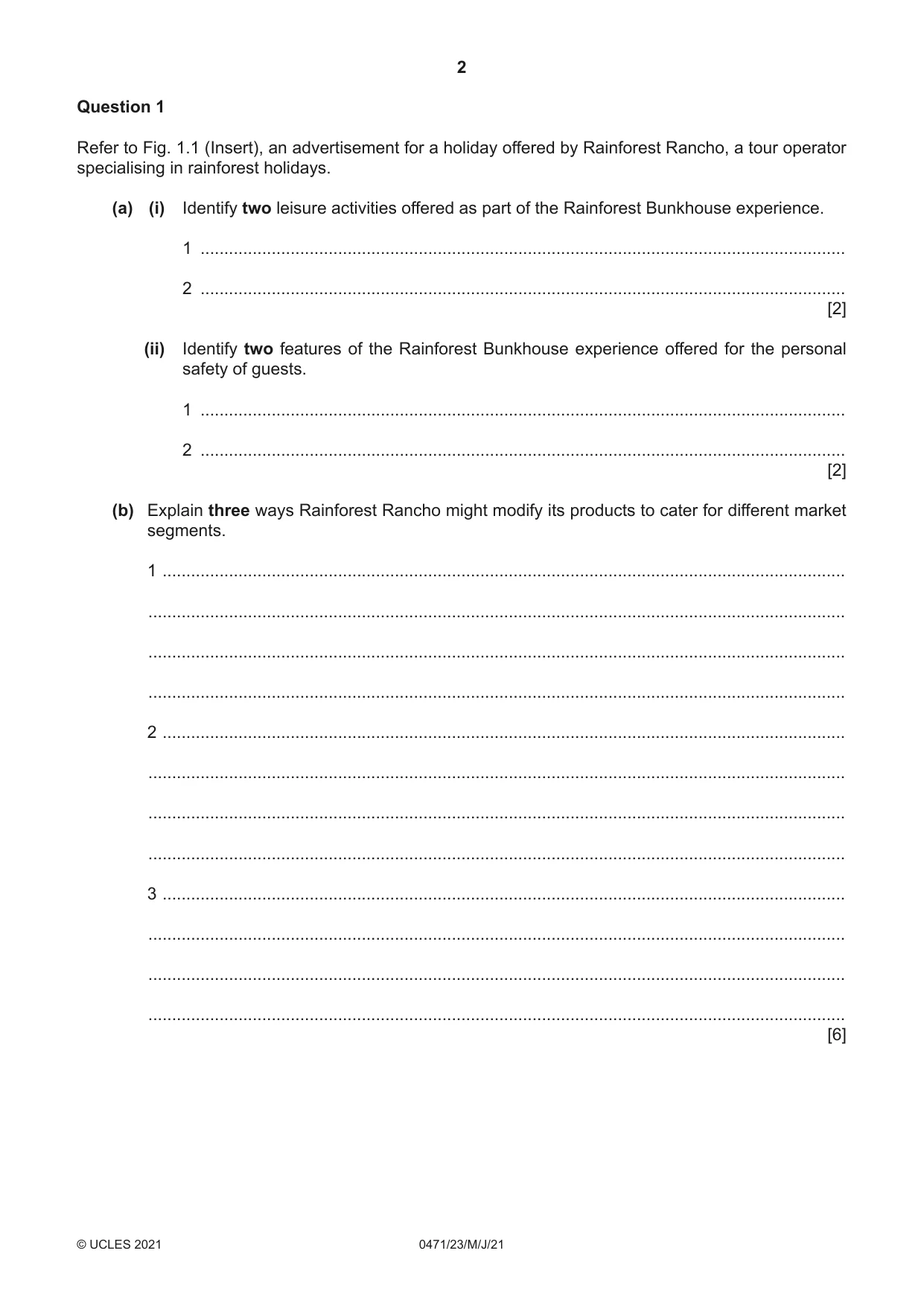
2 0471/23/M/J/21 © UCLES 2021 Question 1 Refer to Fig. 1.1 (Insert), an advertisement for a holiday offered by Rainforest Rancho, a tour operator specialising in rainforest holidays. (a) (i) Identify two leisure activities offered as part of the Rainforest Bunkhouse experience. 1 … 2 … [2] (ii) Identify two features of the Rainforest Bunkhouse experience offered for the personal safety of guests. 1 … 2 … [2] (b) Explain three ways Rainforest Rancho might modify its products to cater for different market segments. 1 … … … … 2 … … … … 3 … … … … [6]
Question paper, page 3
3 0471/23/M/J/21 © UCLES 2021 [Turn over (c) Explain two factors likely to affect the price paid by customers of Rainforest Rancho. 1 … … … … … … 2 … … … … … … [6]
Question paper, page 4
4 0471/23/M/J/21 © UCLES 2021 (d) Discuss the advantages to customers of direct selling. … … … … … … … … … … … … … … … … … … [9] [Total: 25]
Question paper, page 5
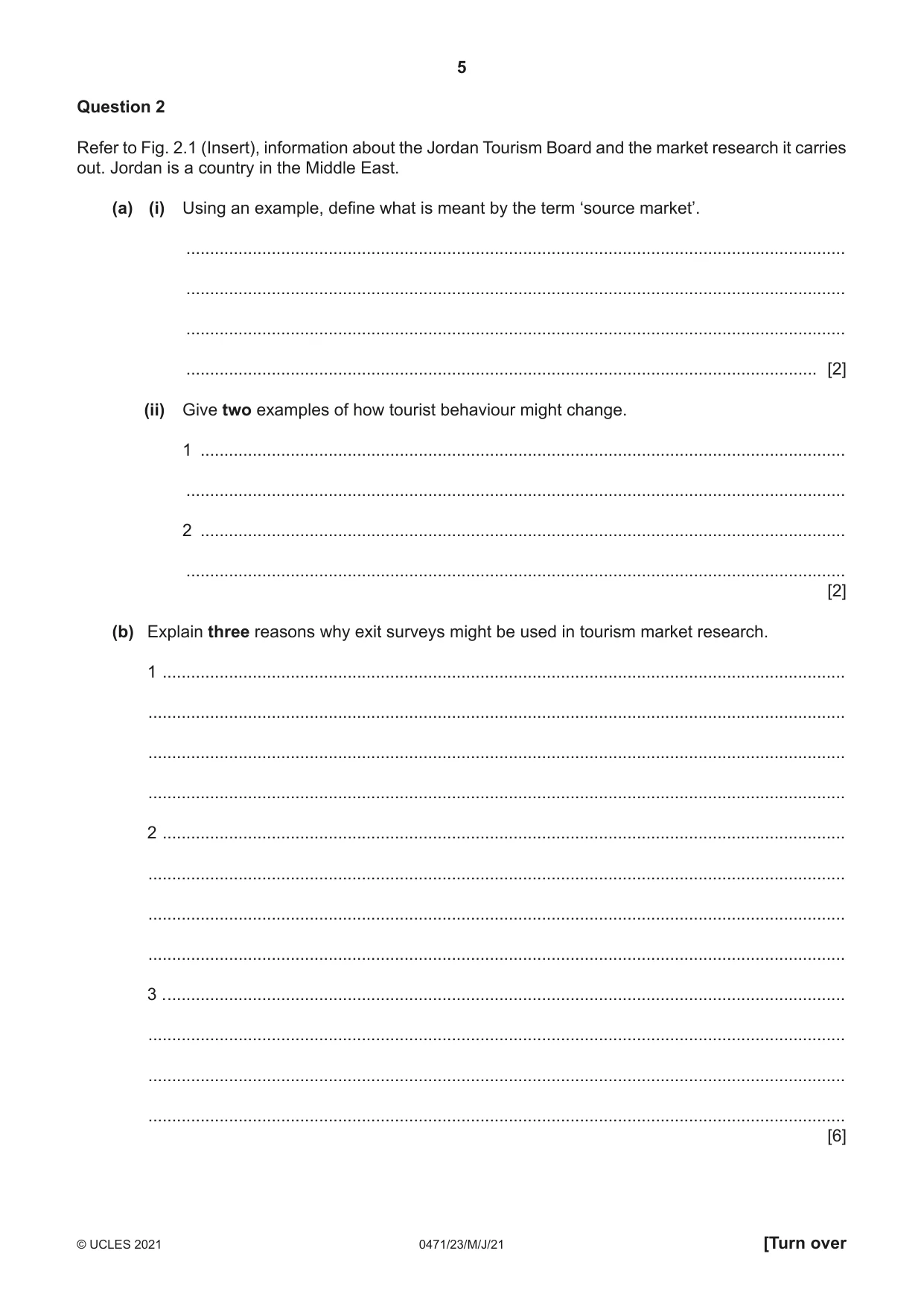
5 0471/23/M/J/21 © UCLES 2021 [Turn over Question 2 Refer to Fig. 2.1 (Insert), information about the Jordan Tourism Board and the market research it carries out. Jordan is a country in the Middle East. (a) (i) Using an example, define what is meant by the term ʻsource marketʼ. … … … … [2] (ii) Give two examples of how tourist behaviour might change. 1 … … 2 … … [2] (b) Explain three reasons why exit surveys might be used in tourism market research. 1 … … … … 2 … … … … 3 . … … … … [6]
Question paper, page 6
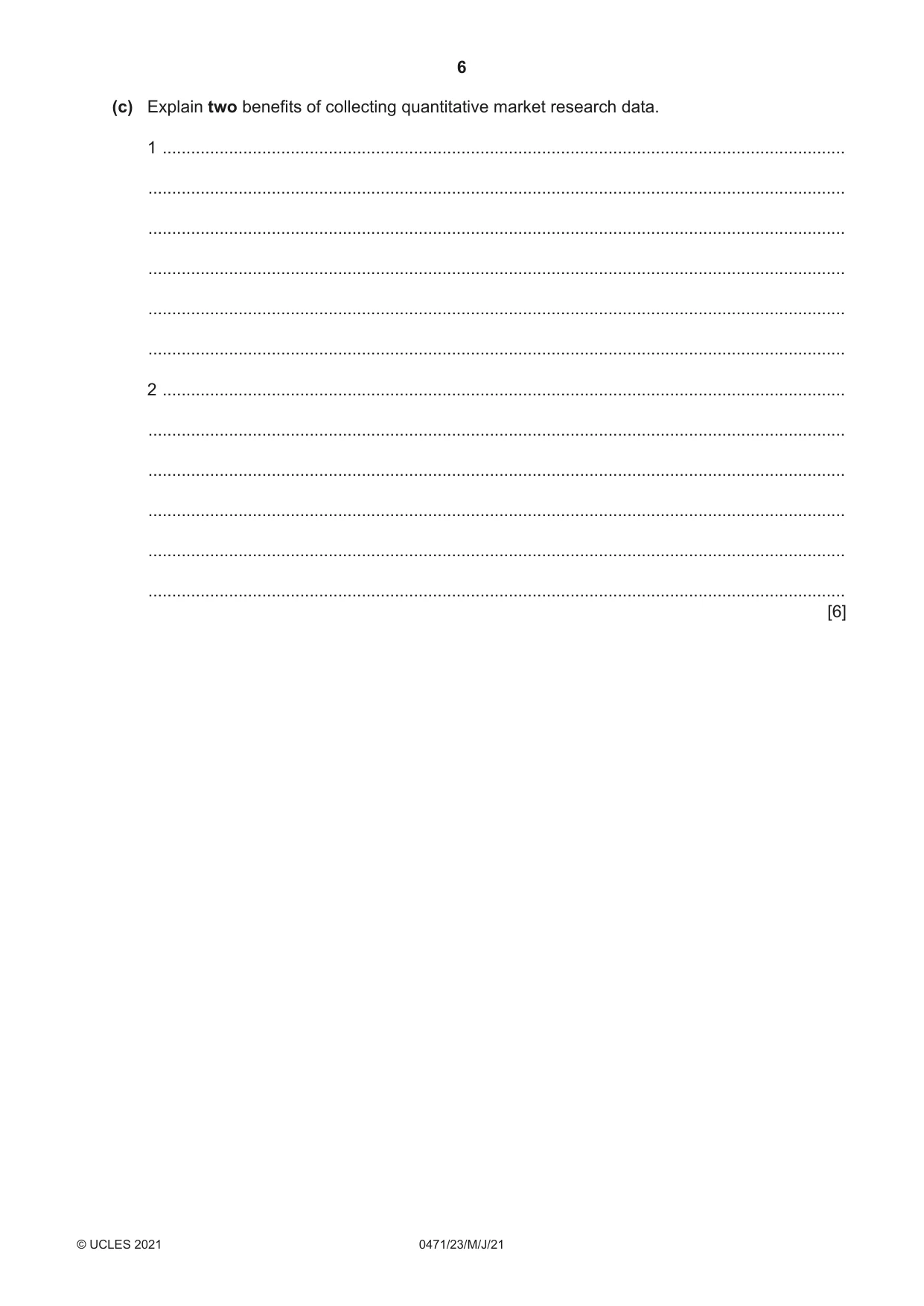
6 0471/23/M/J/21 © UCLES 2021 (c) Explain two benefits of collecting quantitative market research data. 1 … … … … … … 2 … … … … … … [6]
Question paper, page 7
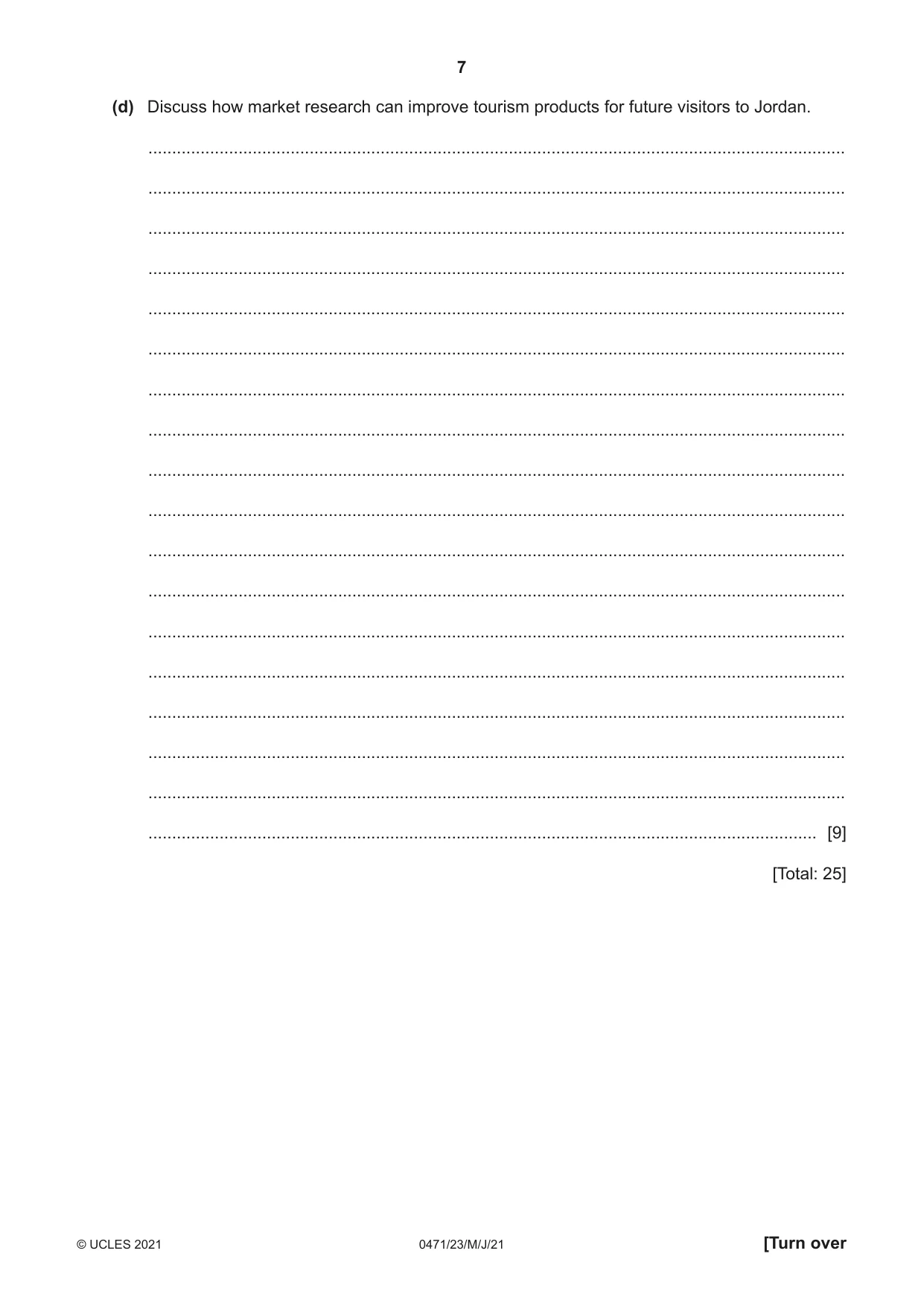
7 0471/23/M/J/21 © UCLES 2021 [Turn over (d) Discuss how market research can improve tourism products for future visitors to Jordan. … … … … … … … … … … … … … … … … … … [9] [Total: 25]
Question paper, page 8
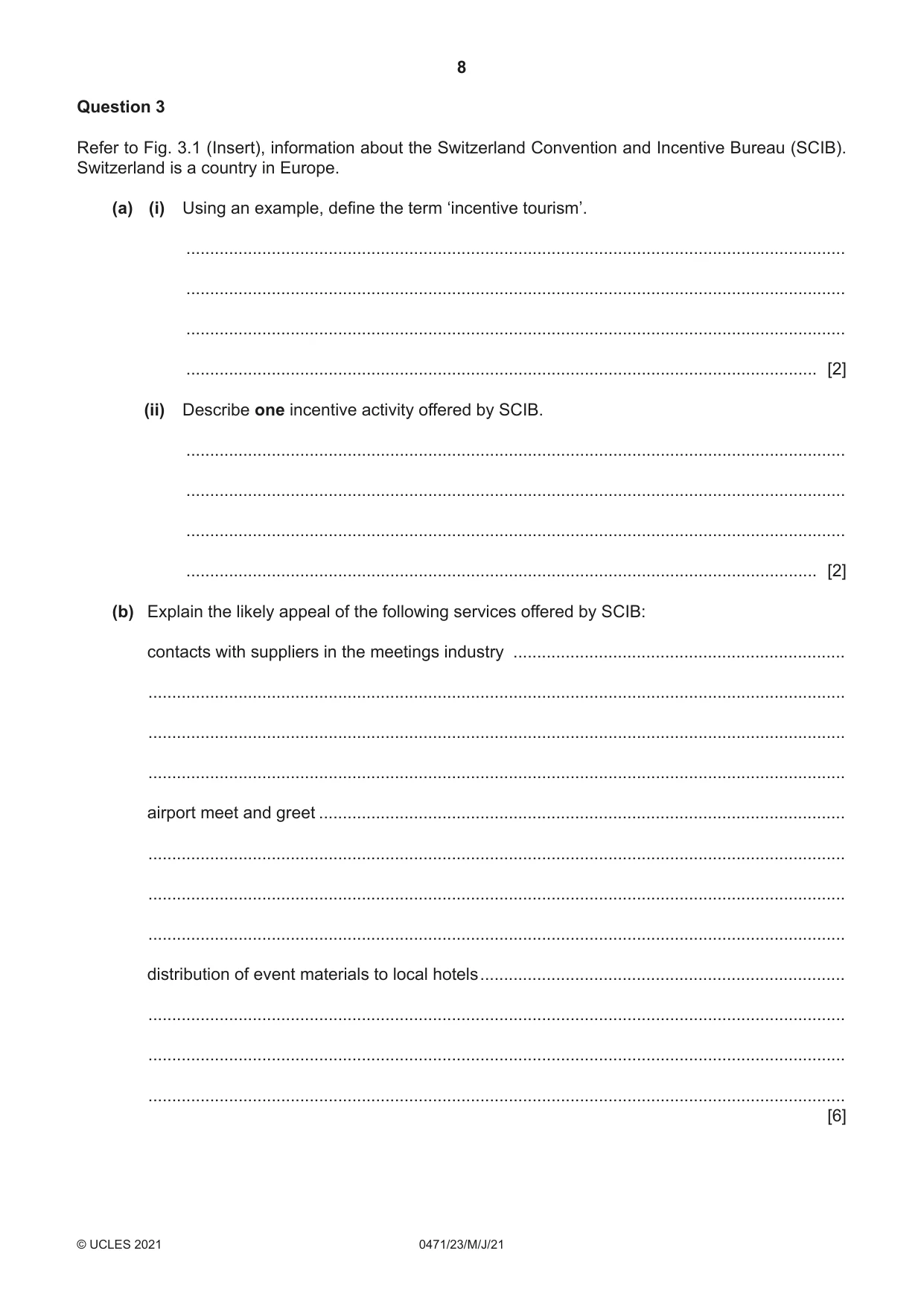
8 0471/23/M/J/21 © UCLES 2021 Question 3 Refer to Fig. 3.1 (Insert), information about the Switzerland Convention and Incentive Bureau (SCIB). Switzerland is a country in Europe. (a) (i) Using an example, define the term ʻincentive tourismʼ. … … … … [2] (ii) Describe one incentive activity offered by SCIB. … … … … [2] (b) Explain the likely appeal of the following services offered by SCIB: contacts with suppliers in the meetings industry … … … … airport meet and greet … … … … distribution of event materials to local hotels … … … … [6]
Question paper, page 9
9 0471/23/M/J/21 © UCLES 2021 [Turn over (c) Explain three reasons why Switzerland is described as an accessible destination. 1 … … … … 2 … … … … 3 … … … … [6]
Question paper, page 10
10 0471/23/M/J/21 © UCLES 2021 (d) Discuss how changing its marketing mix might help SCIB attract more visitors. … … … … … … … … … … … … … … … … … … [9] [Total: 25]
Question paper, page 11
11 0471/23/M/J/21 © UCLES 2021 [Turn over Question 4 Refer to Fig. 4.1 (Insert), information about tourism in Chongqing, a city in China. (a) (i) Using an example, define what is meant by the term ʻdomestic visitorsʼ. … … … … [2] (ii) State two pieces of data that might have been used to measure the rate of tourism growth in Chongqing. 1 … 2 … [2] (b) Explain three reasons for the appeal of Chongqing as a tourist destination. 1 … … … … 2 … … … … 3 … … … … [6]
Question paper, page 12
12 0471/23/M/J/21 © UCLES 2021 (c) Explain two ways that smart technology might benefit tourists to the city. 1 … … … … … … 2 … … … … … … [6]
Question paper, page 13
13 0471/23/M/J/21 © UCLES 2021 (d) State Chongqing’s position as a destination on the product lifecycle model. Justify your answer. Position on the product lifecycle model … Justification … … … … … … … … … … … … … … … … [9] [Total: 25]
Question paper, page 14
14 0471/23/M/J/21 © UCLES 2021 BLANK PAGE
Question paper, page 15
15 0471/23/M/J/21 © UCLES 2021 BLANK PAGE
Question paper, page 16
16 0471/23/M/J/21 © UCLES 2021 BLANK PAGE The boundaries and names shown, the designations used and the presentation of material on any maps contained in this question paper/insert do not imply official endorsement or acceptance by Cambridge Assessment International Education concerning the legal status of any country, territory, or area or any of its authorities, or of the delimitation of its frontiers or boundaries. Permission to reproduce items where third-party owned material protected by copyright is included has been sought and cleared where possible. Every reasonable effort has been made by the publisher (UCLES) to trace copyright holders, but if any items requiring clearance have unwittingly been included, the publisher will be pleased to make amends at the earliest possible opportunity. To avoid the issue of disclosure of answer-related information to candidates, all copyright acknowledgements are reproduced online in the Cambridge Assessment International Education Copyright Acknowledgements Booklet. This is produced for each series of examinations and is freely available to download at www.cambridgeinternational.org after the live examination series. Cambridge Assessment International Education is part of the Cambridge Assessment Group. Cambridge Assessment is the brand name of the University of Cambridge Local Examinations Syndicate (UCLES), which itself is a department of the University of Cambridge.
Mark scheme, page 1
This document consists of 11 printed pages. © UCLES 2021 [Turn over Cambridge IGCSE™ TRAVEL AND TOURISM 0471/23 Paper 2 Alternative to Coursework May/June 2021 MARK SCHEME Maximum Mark: 100 Published This mark scheme is published as an aid to teachers and candidates, to indicate the requirements of the examination. It shows the basis on which Examiners were instructed to award marks. It does not indicate the details of the discussions that took place at an Examiners’ meeting before marking began, which would have considered the acceptability of alternative answers. Mark schemes should be read in conjunction with the question paper and the Principal Examiner Report for Teachers. Cambridge International will not enter into discussions about these mark schemes. Cambridge International is publishing the mark schemes for the May/June 2021 series for most Cambridge IGCSE™, Cambridge International A and AS Level components and some Cambridge O Level components.
Mark scheme, page 2
0471/23 Cambridge IGCSE – Mark Scheme PUBLISHED May/June 2021 © UCLES 2021 Page 2 of 11 Generic Marking Principles These general marking principles must be applied by all examiners when marking candidate answers. They should be applied alongside the specific content of the mark scheme or generic level descriptors for a question. Each question paper and mark scheme will also comply with these marking principles. GENERIC MARKING PRINCIPLE 1: Marks must be awarded in line with: • the specific content of the mark scheme or the generic level descriptors for the question • the specific skills defined in the mark scheme or in the generic level descriptors for the question • the standard of response required by a candidate as exemplified by the standardisation scripts. GENERIC MARKING PRINCIPLE 2: Marks awarded are always whole marks (not half marks, or other fractions). GENERIC MARKING PRINCIPLE 3: Marks must be awarded positively: • marks are awarded for correct/valid answers, as defined in the mark scheme. However, credit is given for valid answers which go beyond the scope of the syllabus and mark scheme, referring to your Team Leader as appropriate • marks are awarded when candidates clearly demonstrate what they know and can do • marks are not deducted for errors • marks are not deducted for omissions • answers should only be judged on the quality of spelling, punctuation and grammar when these features are specifically assessed by the question as indicated by the mark scheme. The meaning, however, should be unambiguous. GENERIC MARKING PRINCIPLE 4: Rules must be applied consistently, e.g. in situations where candidates have not followed instructions or in the application of generic level descriptors. GENERIC MARKING PRINCIPLE 5: Marks should be awarded using the full range of marks defined in the mark scheme for the question (however; the use of the full mark range may be limited according to the quality of the candidate responses seen). GENERIC MARKING PRINCIPLE 6: Marks awarded are based solely on the requirements as defined in the mark scheme. Marks should not be awarded with grade thresholds or grade descriptors in mind.
Mark scheme, page 3
0471/23 Cambridge IGCSE – Mark Scheme PUBLISHED May/June 2021 © UCLES 2021 Page 3 of 11 Social Science-Specific Marking Principles (for point-based marking) 1 Components using point-based marking: • Point marking is often used to reward knowledge, understanding and application of skills. We give credit where the candidate’s answer shows relevant knowledge, understanding and application of skills in answering the question. We do not give credit where the answer shows confusion. From this it follows that we: a DO credit answers which are worded differently from the mark scheme if they clearly convey the same meaning (unless the mark scheme requires a specific term) b DO credit alternative answers/examples which are not written in the mark scheme if they are correct c DO credit answers where candidates give more than one correct answer in one prompt/numbered/scaffolded space where extended writing is required rather than list-type answers. For example, questions that require n reasons (e.g. State two reasons …). d DO NOT credit answers simply for using a ‘key term’ unless that is all that is required. (Check for evidence it is understood and not used wrongly.) e DO NOT credit answers which are obviously self-contradicting or trying to cover all possibilities f DO NOT give further credit for what is effectively repetition of a correct point already credited unless the language itself is being tested. This applies equally to ‘mirror statements’ (i.e. polluted/not polluted). g DO NOT require spellings to be correct, unless this is part of the test. However spellings of syllabus terms must allow for clear and unambiguous separation from other syllabus terms with which they may be confused (e.g. Corrasion/Corrosion) 2 Presentation of mark scheme: • Slashes (/) or the word ‘or’ separate alternative ways of making the same point. • Semi colons (;) bullet points (•) or figures in brackets (1) separate different points. • Content in the answer column in brackets is for examiner information/context to clarify the marking but is not required to earn the mark (except Accounting syllabuses where they indicate negative numbers). 3 Annotation: • For point marking, ticks can be used to indicate correct answers and crosses can be used to indicate wrong answers. There is no direct relationship between ticks and marks. Ticks have no defined meaning for levels of response marking. • For levels of response marking, the level awarded should be annotated on the script. • Other annotations will be used by examiners as agreed during standardisation, and the meaning will be understood by all examiners who marked that paper.
Mark scheme, page 4
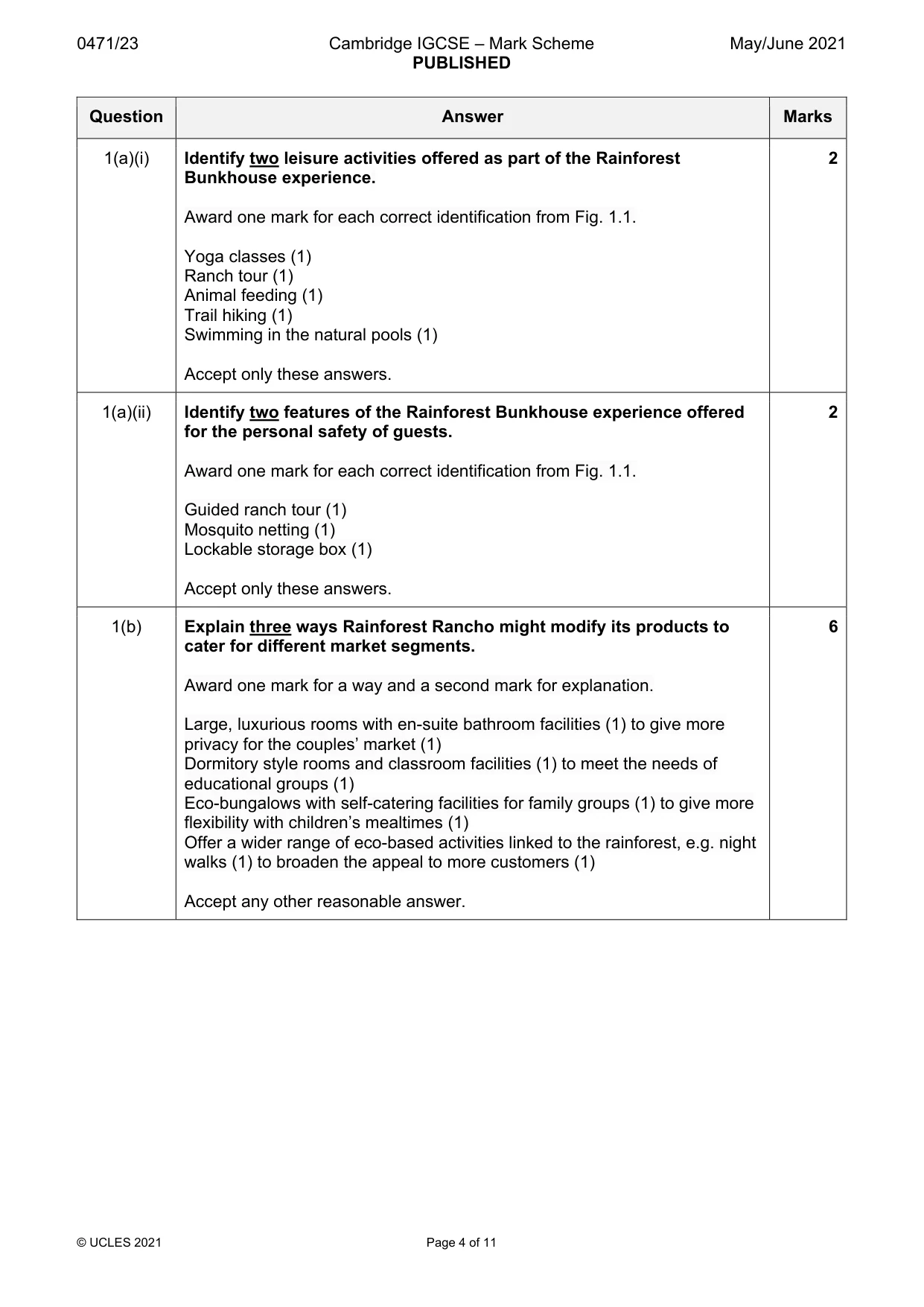
0471/23 Cambridge IGCSE – Mark Scheme PUBLISHED May/June 2021 © UCLES 2021 Page 4 of 11 Question Answer Marks 1(a)(i) Identify two leisure activities offered as part of the Rainforest Bunkhouse experience. Award one mark for each correct identification from Fig. 1.1. Yoga classes (1) Ranch tour (1) Animal feeding (1) Trail hiking (1) Swimming in the natural pools (1) Accept only these answers. 2 1(a)(ii) Identify two features of the Rainforest Bunkhouse experience offered for the personal safety of guests. Award one mark for each correct identification from Fig. 1.1. Guided ranch tour (1) Mosquito netting (1) Lockable storage box (1) Accept only these answers. 2 1(b) Explain three ways Rainforest Rancho might modify its products to cater for different market segments. Award one mark for a way and a second mark for explanation. Large, luxurious rooms with en-suite bathroom facilities (1) to give more privacy for the couples’ market (1) Dormitory style rooms and classroom facilities (1) to meet the needs of educational groups (1) Eco-bungalows with self-catering facilities for family groups (1) to give more flexibility with children’s mealtimes (1) Offer a wider range of eco-based activities linked to the rainforest, e.g. night walks (1) to broaden the appeal to more customers (1) Accept any other reasonable answer. 6
Mark scheme, page 5
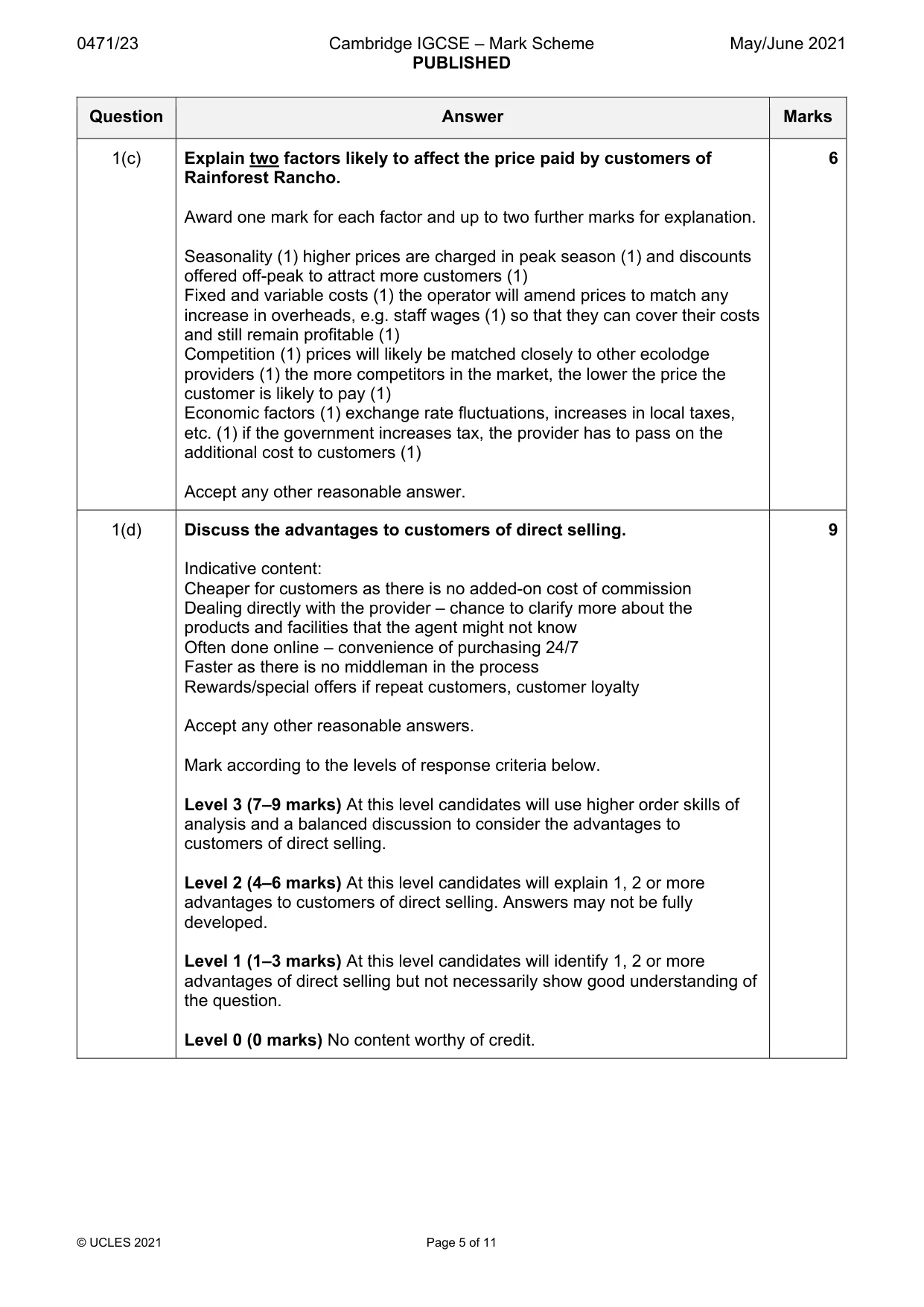
0471/23 Cambridge IGCSE – Mark Scheme PUBLISHED May/June 2021 © UCLES 2021 Page 5 of 11 Question Answer Marks 1(c) Explain two factors likely to affect the price paid by customers of Rainforest Rancho. Award one mark for each factor and up to two further marks for explanation. Seasonality (1) higher prices are charged in peak season (1) and discounts offered off-peak to attract more customers (1) Fixed and variable costs (1) the operator will amend prices to match any increase in overheads, e.g. staff wages (1) so that they can cover their costs and still remain profitable (1) Competition (1) prices will likely be matched closely to other ecolodge providers (1) the more competitors in the market, the lower the price the customer is likely to pay (1) Economic factors (1) exchange rate fluctuations, increases in local taxes, etc. (1) if the government increases tax, the provider has to pass on the additional cost to customers (1) Accept any other reasonable answer. 6 1(d) Discuss the advantages to customers of direct selling. Indicative content: Cheaper for customers as there is no added-on cost of commission Dealing directly with the provider – chance to clarify more about the products and facilities that the agent might not know Often done online – convenience of purchasing 24/7 Faster as there is no middleman in the process Rewards/special offers if repeat customers, customer loyalty Accept any other reasonable answers. Mark according to the levels of response criteria below. Level 3 (7–9 marks) At this level candidates will use higher order skills of analysis and a balanced discussion to consider the advantages to customers of direct selling. Level 2 (4–6 marks) At this level candidates will explain 1, 2 or more advantages to customers of direct selling. Answers may not be fully developed. Level 1 (1–3 marks) At this level candidates will identify 1, 2 or more advantages of direct selling but not necessarily show good understanding of the question. Level 0 (0 marks) No content worthy of credit. 9
Mark scheme, page 6
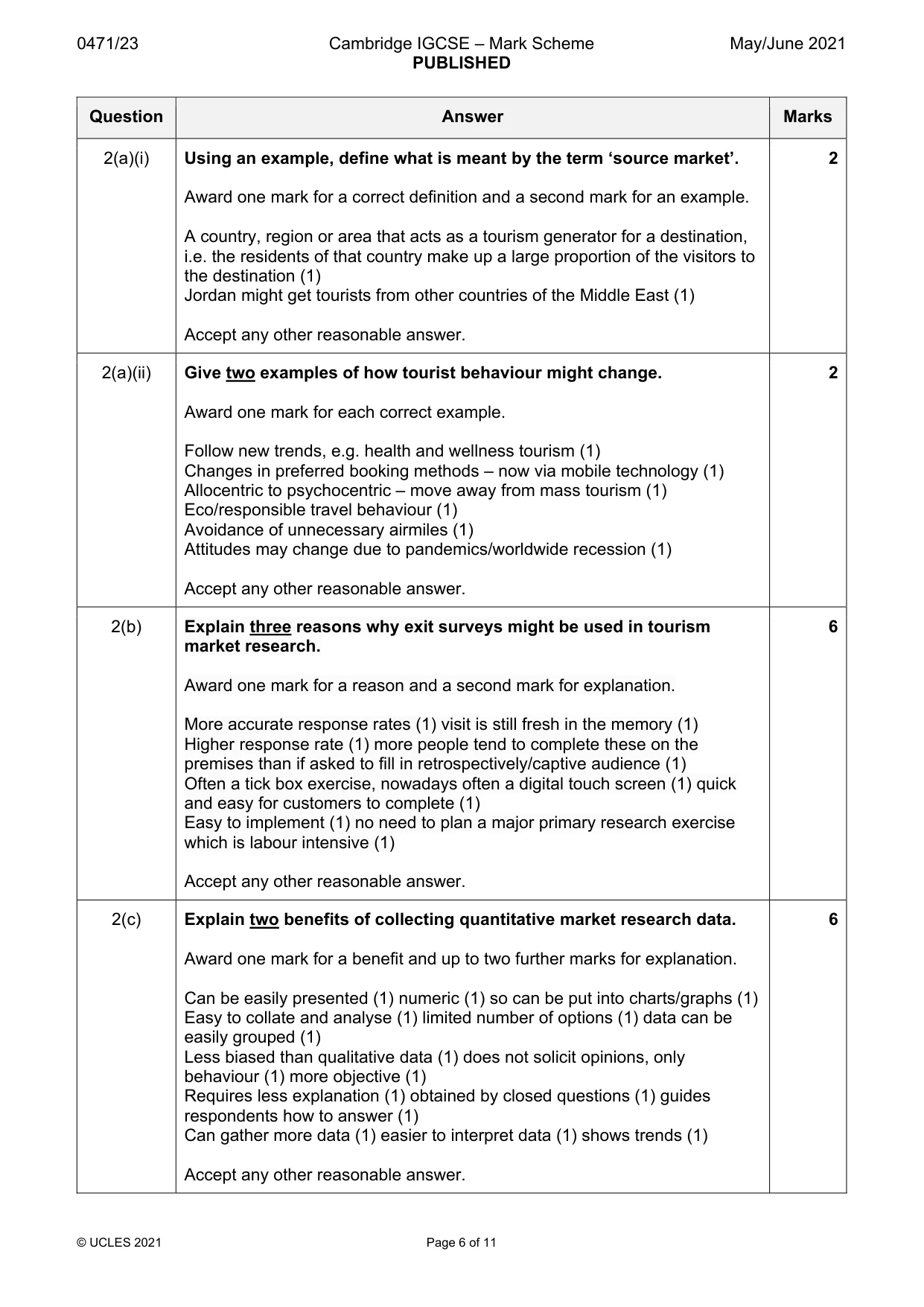
0471/23 Cambridge IGCSE – Mark Scheme PUBLISHED May/June 2021 © UCLES 2021 Page 6 of 11 Question Answer Marks 2(a)(i) Using an example, define what is meant by the term ‘source market’. Award one mark for a correct definition and a second mark for an example. A country, region or area that acts as a tourism generator for a destination, i.e. the residents of that country make up a large proportion of the visitors to the destination (1) Jordan might get tourists from other countries of the Middle East (1) Accept any other reasonable answer. 2 2(a)(ii) Give two examples of how tourist behaviour might change. Award one mark for each correct example. Follow new trends, e.g. health and wellness tourism (1) Changes in preferred booking methods – now via mobile technology (1) Allocentric to psychocentric – move away from mass tourism (1) Eco/responsible travel behaviour (1) Avoidance of unnecessary airmiles (1) Attitudes may change due to pandemics/worldwide recession (1) Accept any other reasonable answer. 2 2(b) Explain three reasons why exit surveys might be used in tourism market research. Award one mark for a reason and a second mark for explanation. More accurate response rates (1) visit is still fresh in the memory (1) Higher response rate (1) more people tend to complete these on the premises than if asked to fill in retrospectively/captive audience (1) Often a tick box exercise, nowadays often a digital touch screen (1) quick and easy for customers to complete (1) Easy to implement (1) no need to plan a major primary research exercise which is labour intensive (1) Accept any other reasonable answer. 6 2(c) Explain two benefits of collecting quantitative market research data. Award one mark for a benefit and up to two further marks for explanation. Can be easily presented (1) numeric (1) so can be put into charts/graphs (1) Easy to collate and analyse (1) limited number of options (1) data can be easily grouped (1) Less biased than qualitative data (1) does not solicit opinions, only behaviour (1) more objective (1) Requires less explanation (1) obtained by closed questions (1) guides respondents how to answer (1) Can gather more data (1) easier to interpret data (1) shows trends (1) Accept any other reasonable answer. 6
Mark scheme, page 7
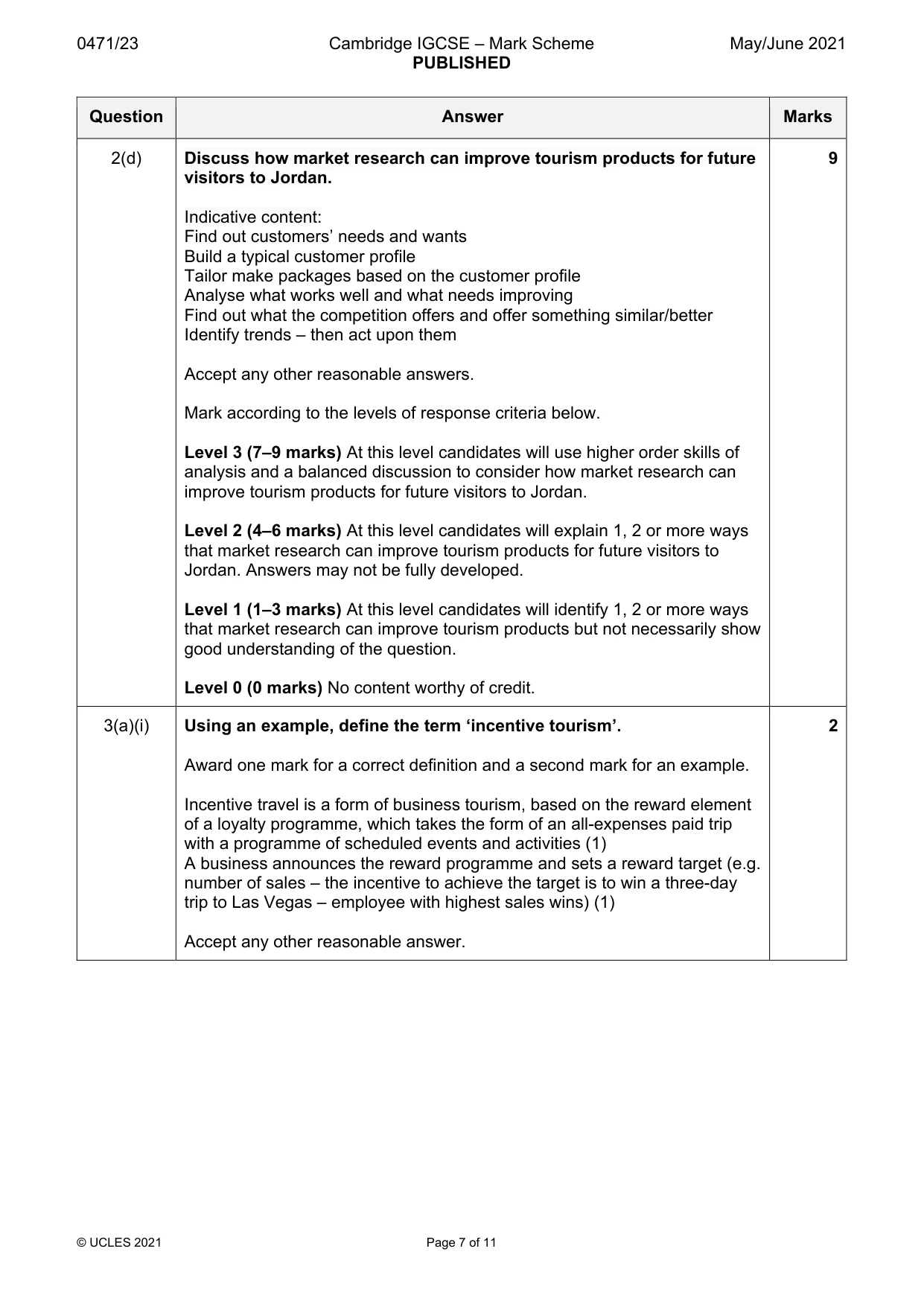
0471/23 Cambridge IGCSE – Mark Scheme PUBLISHED May/June 2021 © UCLES 2021 Page 7 of 11 Question Answer Marks 2(d) Discuss how market research can improve tourism products for future visitors to Jordan. Indicative content: Find out customers’ needs and wants Build a typical customer profile Tailor make packages based on the customer profile Analyse what works well and what needs improving Find out what the competition offers and offer something similar/better Identify trends – then act upon them Accept any other reasonable answers. Mark according to the levels of response criteria below. Level 3 (7–9 marks) At this level candidates will use higher order skills of analysis and a balanced discussion to consider how market research can improve tourism products for future visitors to Jordan. Level 2 (4–6 marks) At this level candidates will explain 1, 2 or more ways that market research can improve tourism products for future visitors to Jordan. Answers may not be fully developed. Level 1 (1–3 marks) At this level candidates will identify 1, 2 or more ways that market research can improve tourism products but not necessarily show good understanding of the question. Level 0 (0 marks) No content worthy of credit. 9 3(a)(i) Using an example, define the term ‘incentive tourism’. Award one mark for a correct definition and a second mark for an example. Incentive travel is a form of business tourism, based on the reward element of a loyalty programme, which takes the form of an all-expenses paid trip with a programme of scheduled events and activities (1) A business announces the reward programme and sets a reward target (e.g. number of sales – the incentive to achieve the target is to win a three-day trip to Las Vegas – employee with highest sales wins) (1) Accept any other reasonable answer. 2
Mark scheme, page 8
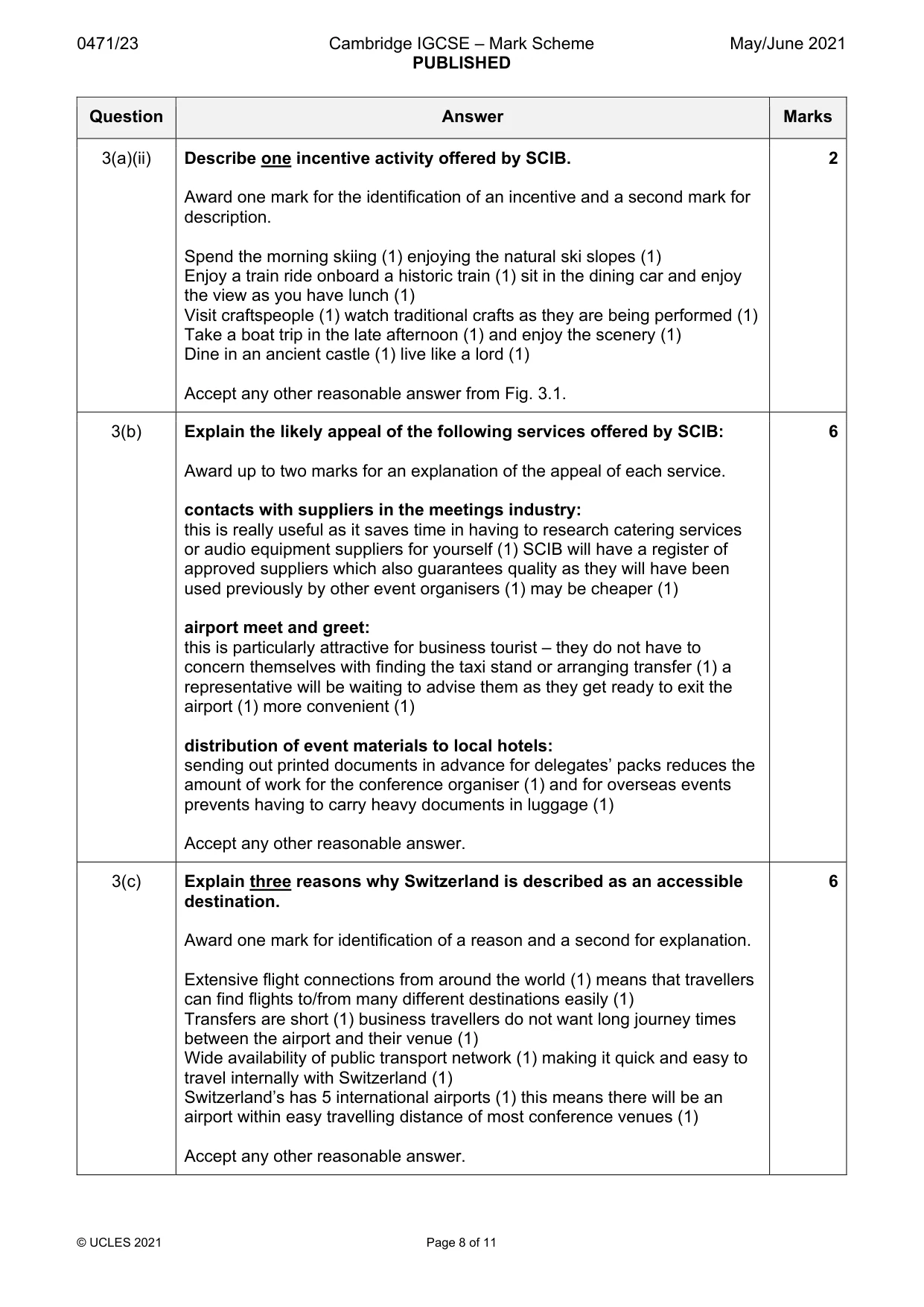
0471/23 Cambridge IGCSE – Mark Scheme PUBLISHED May/June 2021 © UCLES 2021 Page 8 of 11 Question Answer Marks 3(a)(ii) Describe one incentive activity offered by SCIB. Award one mark for the identification of an incentive and a second mark for description. Spend the morning skiing (1) enjoying the natural ski slopes (1) Enjoy a train ride onboard a historic train (1) sit in the dining car and enjoy the view as you have lunch (1) Visit craftspeople (1) watch traditional crafts as they are being performed (1) Take a boat trip in the late afternoon (1) and enjoy the scenery (1) Dine in an ancient castle (1) live like a lord (1) Accept any other reasonable answer from Fig. 3.1. 2 3(b) Explain the likely appeal of the following services offered by SCIB: Award up to two marks for an explanation of the appeal of each service. contacts with suppliers in the meetings industry: this is really useful as it saves time in having to research catering services or audio equipment suppliers for yourself (1) SCIB will have a register of approved suppliers which also guarantees quality as they will have been used previously by other event organisers (1) may be cheaper (1) airport meet and greet: this is particularly attractive for business tourist – they do not have to concern themselves with finding the taxi stand or arranging transfer (1) a representative will be waiting to advise them as they get ready to exit the airport (1) more convenient (1) distribution of event materials to local hotels: sending out printed documents in advance for delegates’ packs reduces the amount of work for the conference organiser (1) and for overseas events prevents having to carry heavy documents in luggage (1) Accept any other reasonable answer. 6 3(c) Explain three reasons why Switzerland is described as an accessible destination. Award one mark for identification of a reason and a second for explanation. Extensive flight connections from around the world (1) means that travellers can find flights to/from many different destinations easily (1) Transfers are short (1) business travellers do not want long journey times between the airport and their venue (1) Wide availability of public transport network (1) making it quick and easy to travel internally with Switzerland (1) Switzerland’s has 5 international airports (1) this means there will be an airport within easy travelling distance of most conference venues (1) Accept any other reasonable answer. 6
Mark scheme, page 9
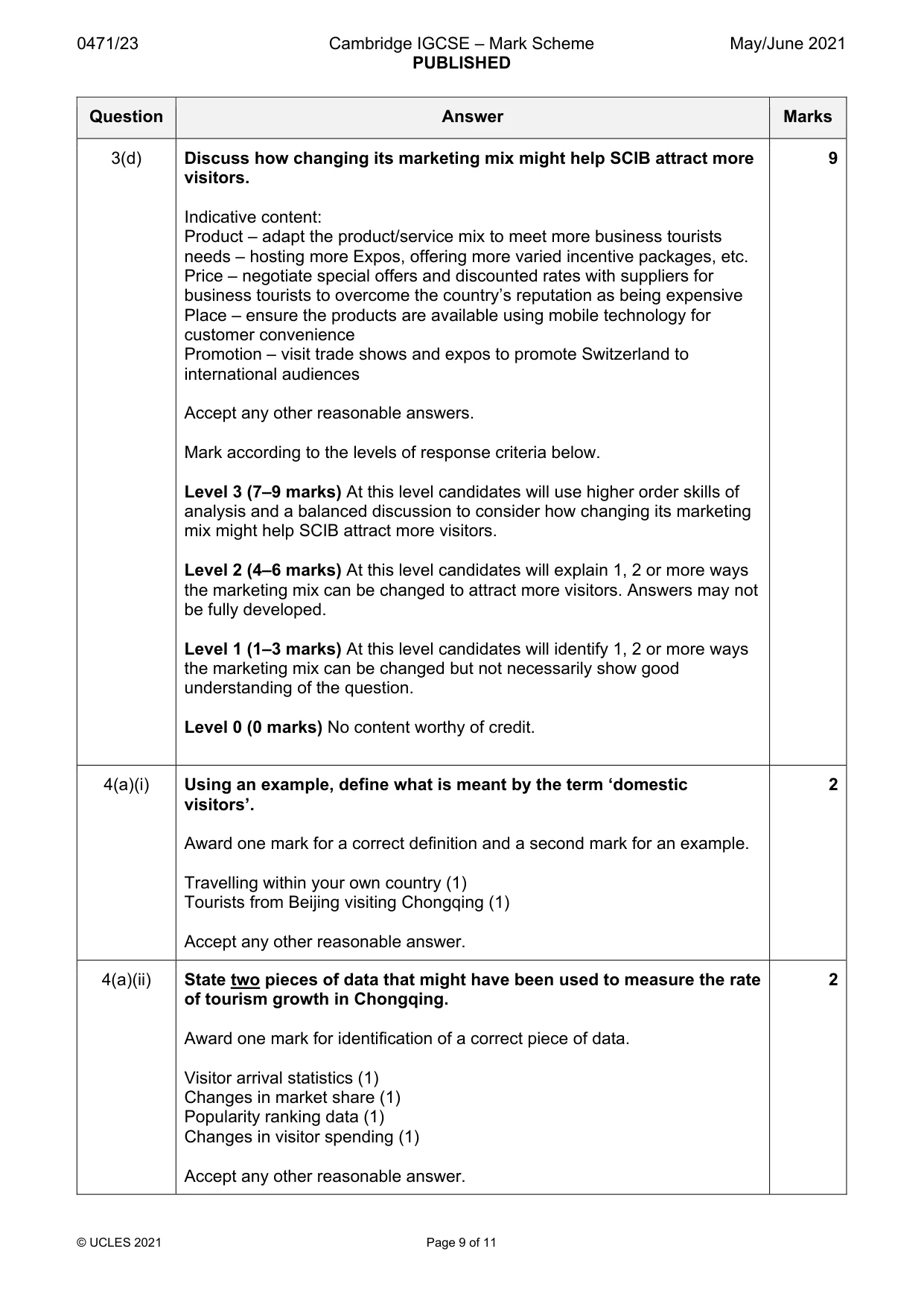
0471/23 Cambridge IGCSE – Mark Scheme PUBLISHED May/June 2021 © UCLES 2021 Page 9 of 11 Question Answer Marks 3(d) Discuss how changing its marketing mix might help SCIB attract more visitors. Indicative content: Product – adapt the product/service mix to meet more business tourists needs – hosting more Expos, offering more varied incentive packages, etc. Price – negotiate special offers and discounted rates with suppliers for business tourists to overcome the country’s reputation as being expensive Place – ensure the products are available using mobile technology for customer convenience Promotion – visit trade shows and expos to promote Switzerland to international audiences Accept any other reasonable answers. Mark according to the levels of response criteria below. Level 3 (7–9 marks) At this level candidates will use higher order skills of analysis and a balanced discussion to consider how changing its marketing mix might help SCIB attract more visitors. Level 2 (4–6 marks) At this level candidates will explain 1, 2 or more ways the marketing mix can be changed to attract more visitors. Answers may not be fully developed. Level 1 (1–3 marks) At this level candidates will identify 1, 2 or more ways the marketing mix can be changed but not necessarily show good understanding of the question. Level 0 (0 marks) No content worthy of credit. 9 4(a)(i) Using an example, define what is meant by the term ‘domestic visitors’. Award one mark for a correct definition and a second mark for an example. Travelling within your own country (1) Tourists from Beijing visiting Chongqing (1) Accept any other reasonable answer. 2 4(a)(ii) State two pieces of data that might have been used to measure the rate of tourism growth in Chongqing. Award one mark for identification of a correct piece of data. Visitor arrival statistics (1) Changes in market share (1) Popularity ranking data (1) Changes in visitor spending (1) Accept any other reasonable answer. 2
Mark scheme, page 10
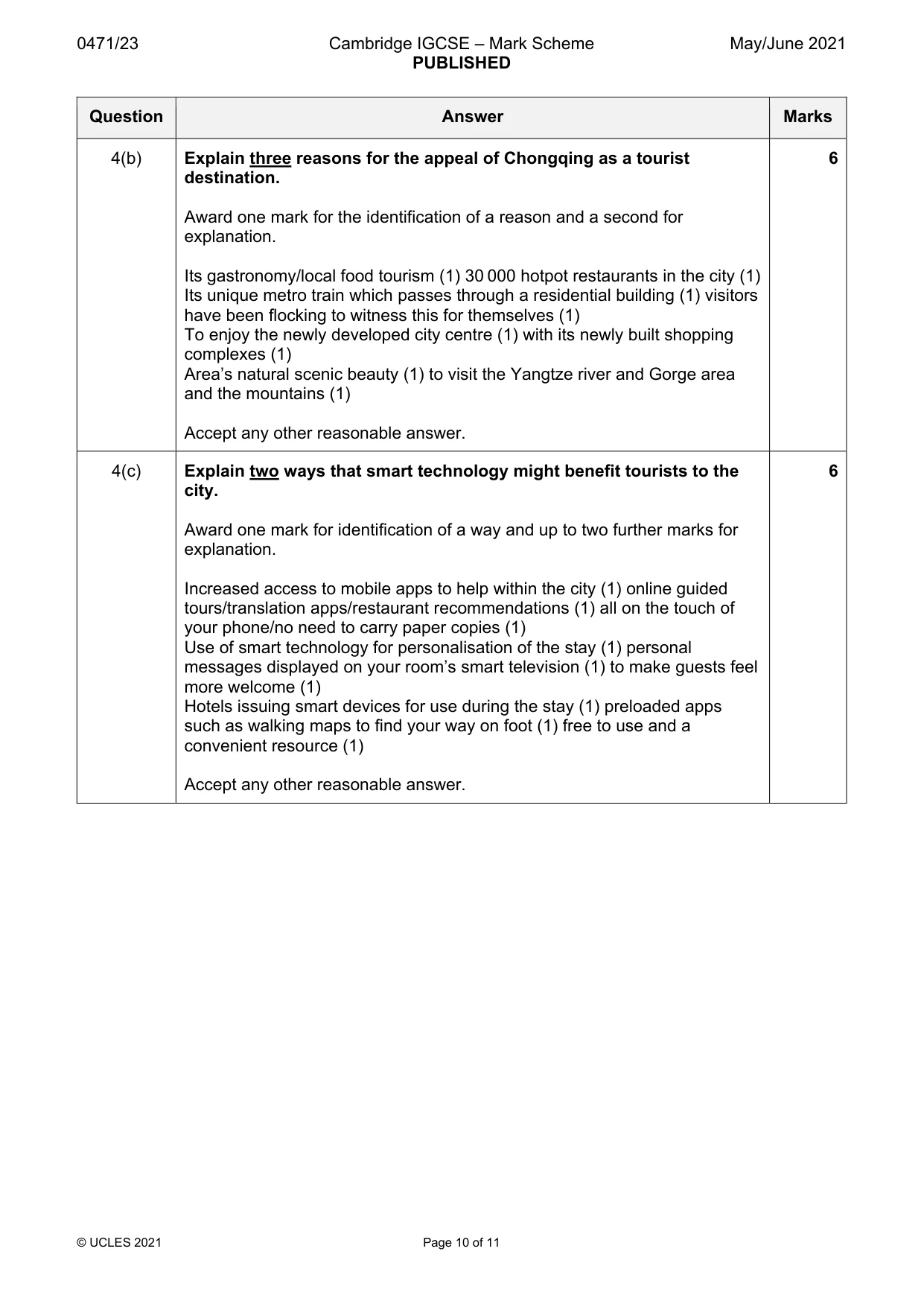
0471/23 Cambridge IGCSE – Mark Scheme PUBLISHED May/June 2021 © UCLES 2021 Page 10 of 11 Question Answer Marks 4(b) Explain three reasons for the appeal of Chongqing as a tourist destination. Award one mark for the identification of a reason and a second for explanation. Its gastronomy/local food tourism (1) 30 000 hotpot restaurants in the city (1) Its unique metro train which passes through a residential building (1) visitors have been flocking to witness this for themselves (1) To enjoy the newly developed city centre (1) with its newly built shopping complexes (1) Area’s natural scenic beauty (1) to visit the Yangtze river and Gorge area and the mountains (1) Accept any other reasonable answer. 6 4(c) Explain two ways that smart technology might benefit tourists to the city. Award one mark for identification of a way and up to two further marks for explanation. Increased access to mobile apps to help within the city (1) online guided tours/translation apps/restaurant recommendations (1) all on the touch of your phone/no need to carry paper copies (1) Use of smart technology for personalisation of the stay (1) personal messages displayed on your room’s smart television (1) to make guests feel more welcome (1) Hotels issuing smart devices for use during the stay (1) preloaded apps such as walking maps to find your way on foot (1) free to use and a convenient resource (1) Accept any other reasonable answer. 6
Mark scheme, page 11
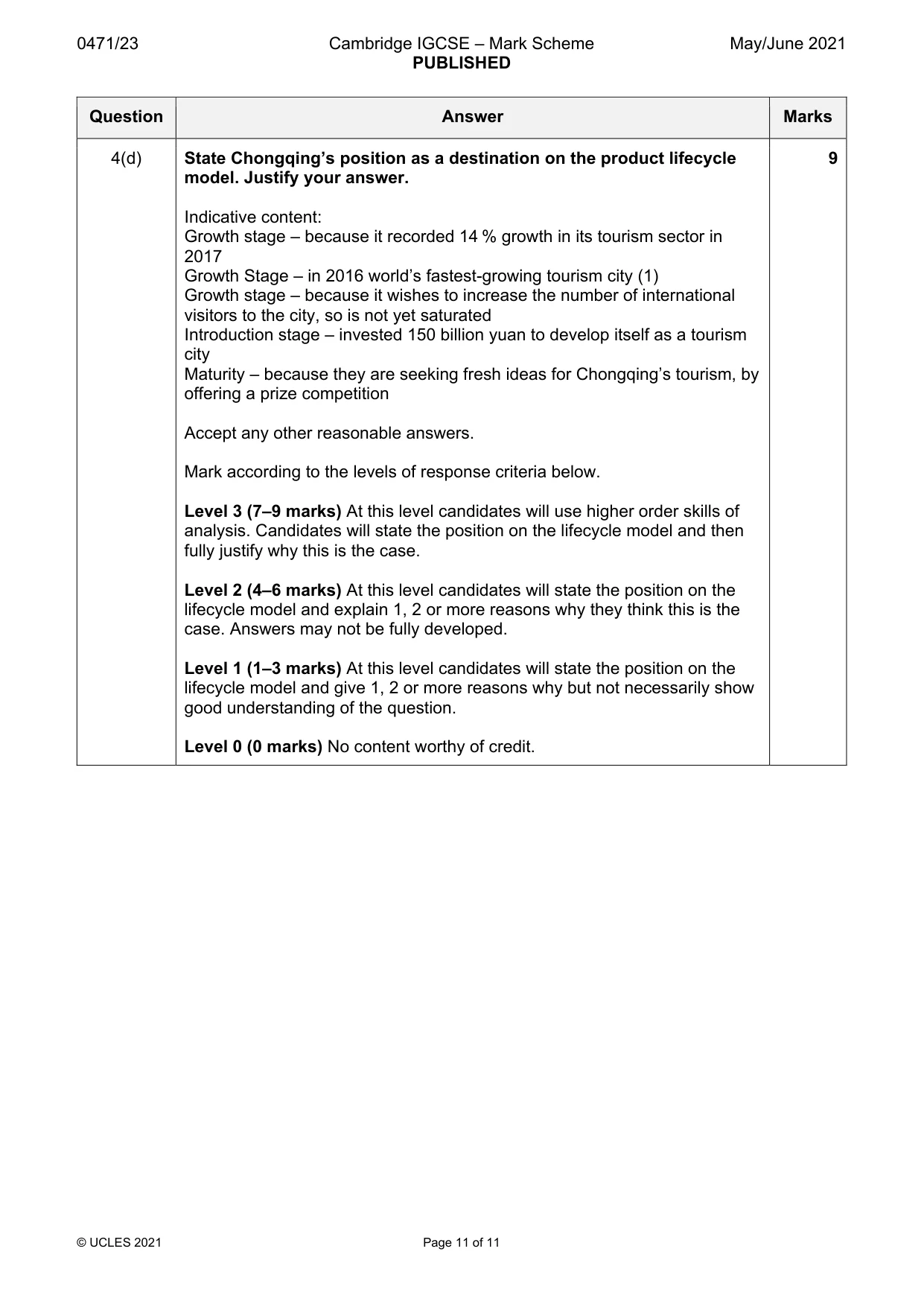
0471/23 Cambridge IGCSE – Mark Scheme PUBLISHED May/June 2021 © UCLES 2021 Page 11 of 11 Question Answer Marks 4(d) State Chongqing’s position as a destination on the product lifecycle model. Justify your answer. Indicative content: Growth stage – because it recorded 14 % growth in its tourism sector in 2017 Growth Stage – in 2016 world’s fastest-growing tourism city (1) Growth stage – because it wishes to increase the number of international visitors to the city, so is not yet saturated Introduction stage – invested 150 billion yuan to develop itself as a tourism city Maturity – because they are seeking fresh ideas for Chongqing’s tourism, by offering a prize competition Accept any other reasonable answers. Mark according to the levels of response criteria below. Level 3 (7–9 marks) At this level candidates will use higher order skills of analysis. Candidates will state the position on the lifecycle model and then fully justify why this is the case. Level 2 (4–6 marks) At this level candidates will state the position on the lifecycle model and explain 1, 2 or more reasons why they think this is the case. Answers may not be fully developed. Level 1 (1–3 marks) At this level candidates will state the position on the lifecycle model and give 1, 2 or more reasons why but not necessarily show good understanding of the question. Level 0 (0 marks) No content worthy of credit. 9
What you needed in this session
Cambridge’s own grade thresholds for 2021 May/June, Paper 2 · Variant 3. A higher threshold means an easier paper — the bar moves with how the cohort did.