Cambridge IGCSE Travel and Tourism 0471 — 2021 May/June Paper 2 · Variant 2
0471/22/M/J/21 · 100 marks · ≈113 min
The question paper and its mark scheme, free to read here and free to download. This is Cambridge’s own paper, exactly as it was sat.
Question paper16 pages



Mark scheme11 pages
Answers below. Sit the paper first if you are practising.
Paper as text
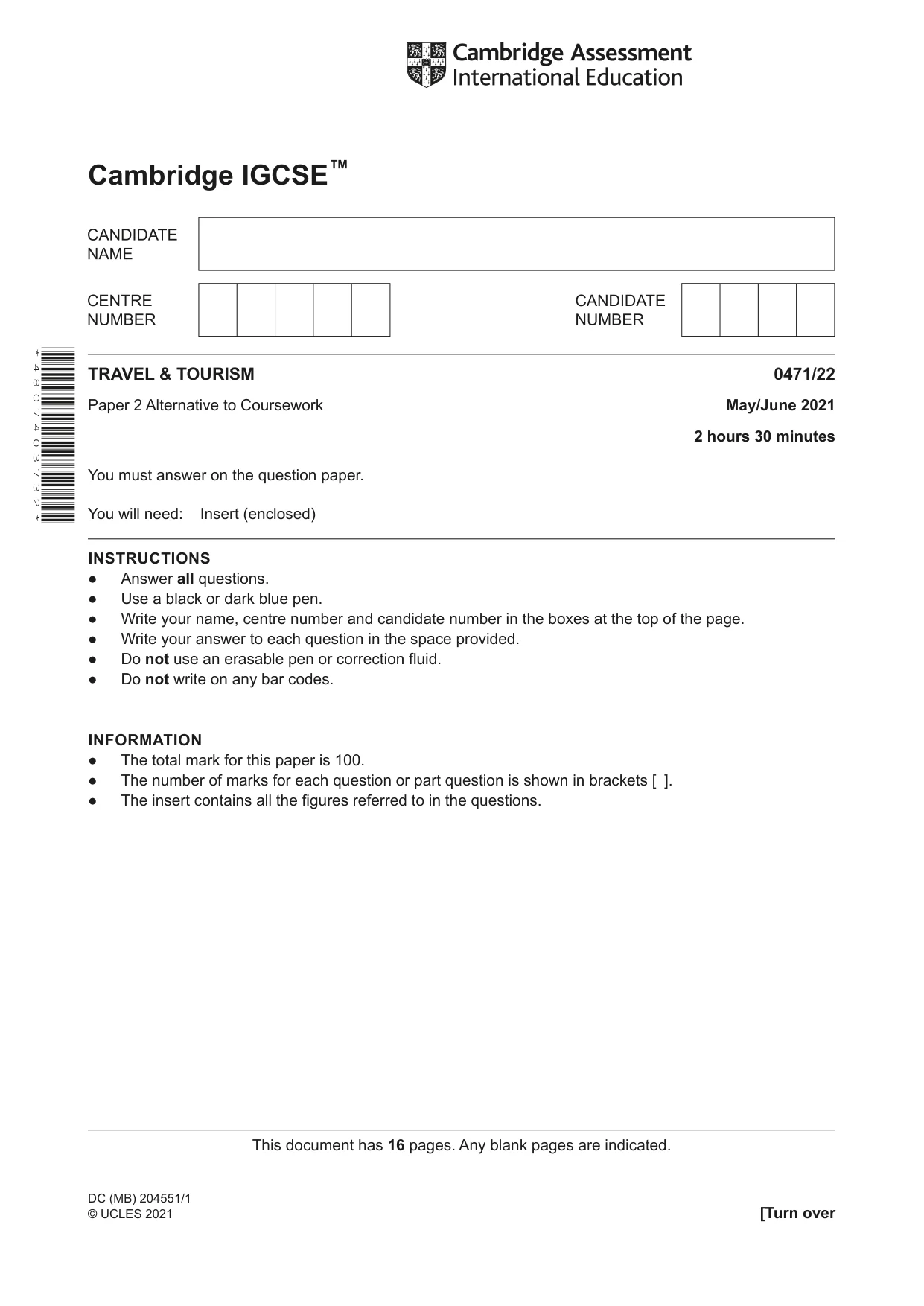
Question paper, page 1
This document has 16 pages. Any blank pages are indicated. Cambridge IGCSE™ TRAVEL & TOURISM 0471/22 Paper 2 Alternative to Coursework May/June 2021 2 hours 30 minutes You must answer on the question paper. You will need: Insert (enclosed) INSTRUCTIONS ● Answer all questions. ● Use a black or dark blue pen. ● Write your name, centre number and candidate number in the boxes at the top of the page. ● Write your answer to each question in the space provided. ● Do not use an erasable pen or correction fluid. ● Do not write on any bar codes. INFORMATION ● The total mark for this paper is 100. ● The number of marks for each question or part question is shown in brackets [ ]. ● The insert contains all the figures referred to in the questions. * 4 8 0 7 4 0 3 7 3 2 * DC (MB) 204551/1 © UCLES 2021 [Turn over
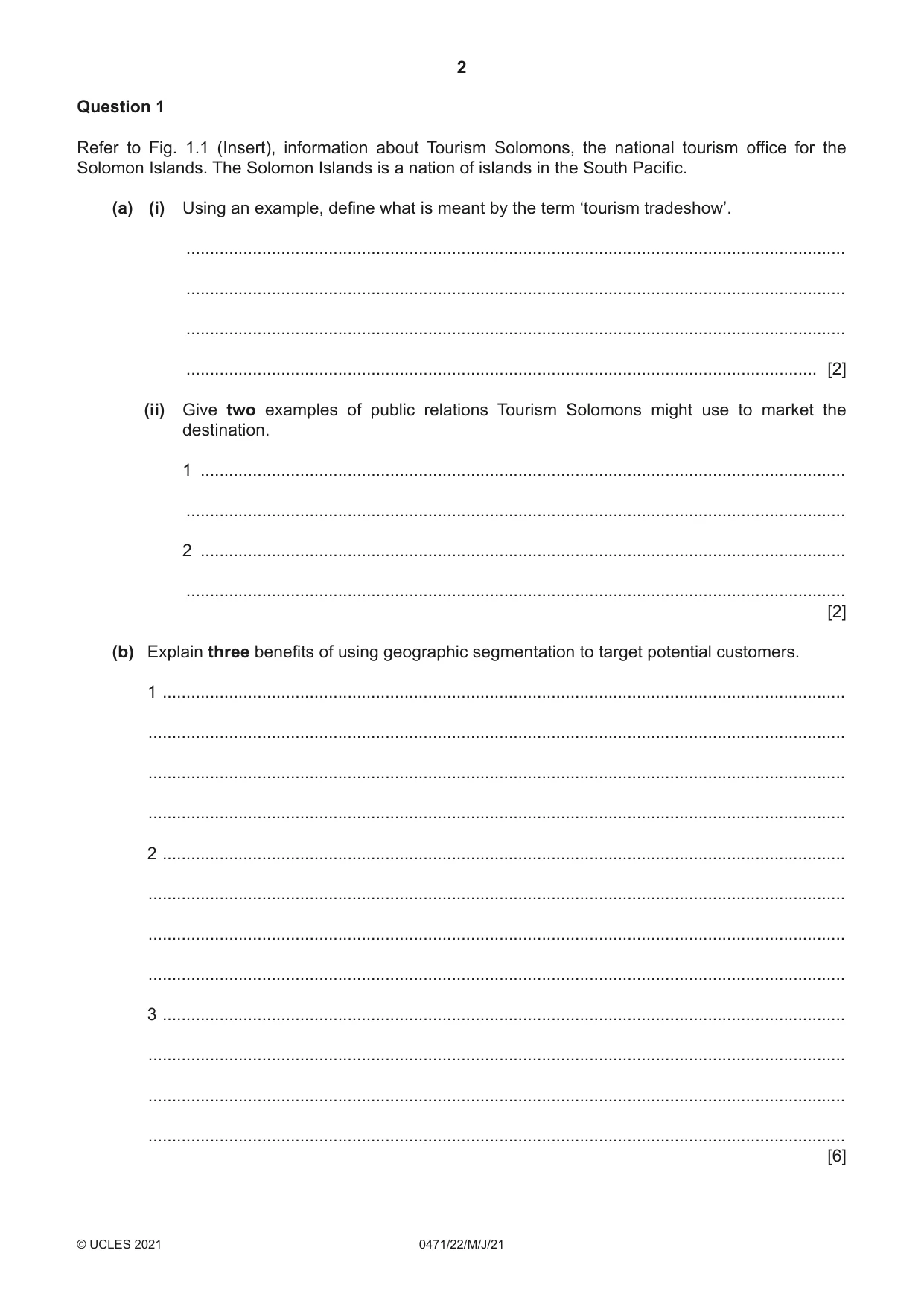
Question paper, page 2
2 0471/22/M/J/21 © UCLES 2021 Question 1 Refer to Fig. 1.1 (Insert), information about Tourism Solomons, the national tourism office for the Solomon Islands. The Solomon Islands is a nation of islands in the South Pacific. (a) (i) Using an example, define what is meant by the term ʻtourism tradeshowʼ. … … … … [2] (ii) Give two examples of public relations Tourism Solomons might use to market the destination. 1 … … 2 … … [2] (b) Explain three benefits of using geographic segmentation to target potential customers. 1 … … … … 2 … … … … 3 … … … … [6]
Question paper, page 3
3 0471/22/M/J/21 © UCLES 2021 [Turn over (c) Explain two likely reasons for the relaunch of the cruise product to the Solomon Islands. 1 … … … … … … 2 … … … … … … [6]
Question paper, page 4
4 0471/22/M/J/21 © UCLES 2021 (d) Discuss how tourism in the Solomon Islands might benefit from those working in tourism learning more about the destination. … … … … … … … … … … … … … … … … … … [9] [Total: 25]
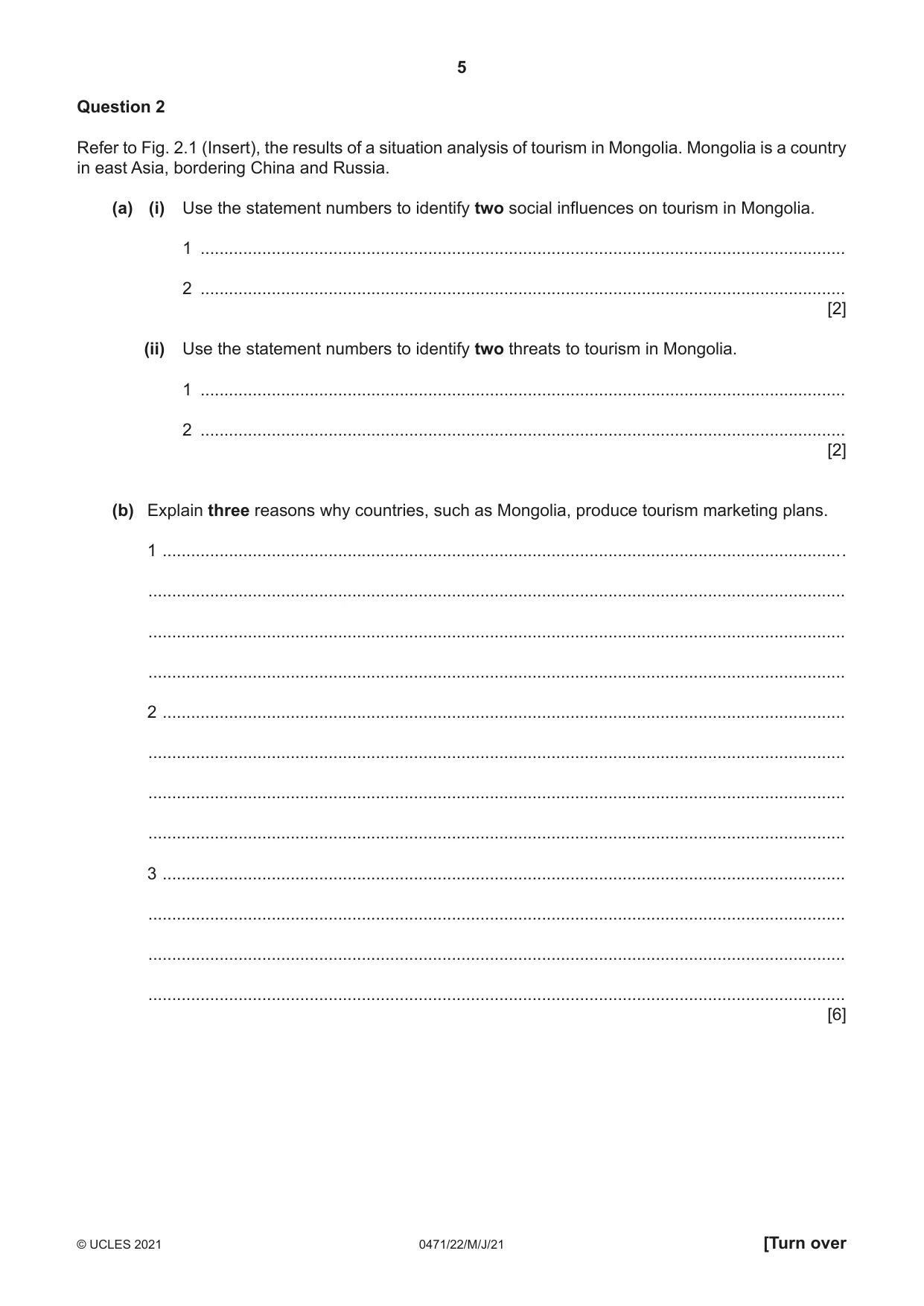
Question paper, page 5
5 0471/22/M/J/21 © UCLES 2021 [Turn over Question 2 Refer to Fig. 2.1 (Insert), the results of a situation analysis of tourism in Mongolia. Mongolia is a country in east Asia, bordering China and Russia. (a) (i) Use the statement numbers to identify two social influences on tourism in Mongolia. 1 … 2 … [2] (ii) Use the statement numbers to identify two threats to tourism in Mongolia. 1 … 2 … [2] (b) Explain three reasons why countries, such as Mongolia, produce tourism marketing plans. 1 … … … … 2 … … … … 3 … … … … [6]
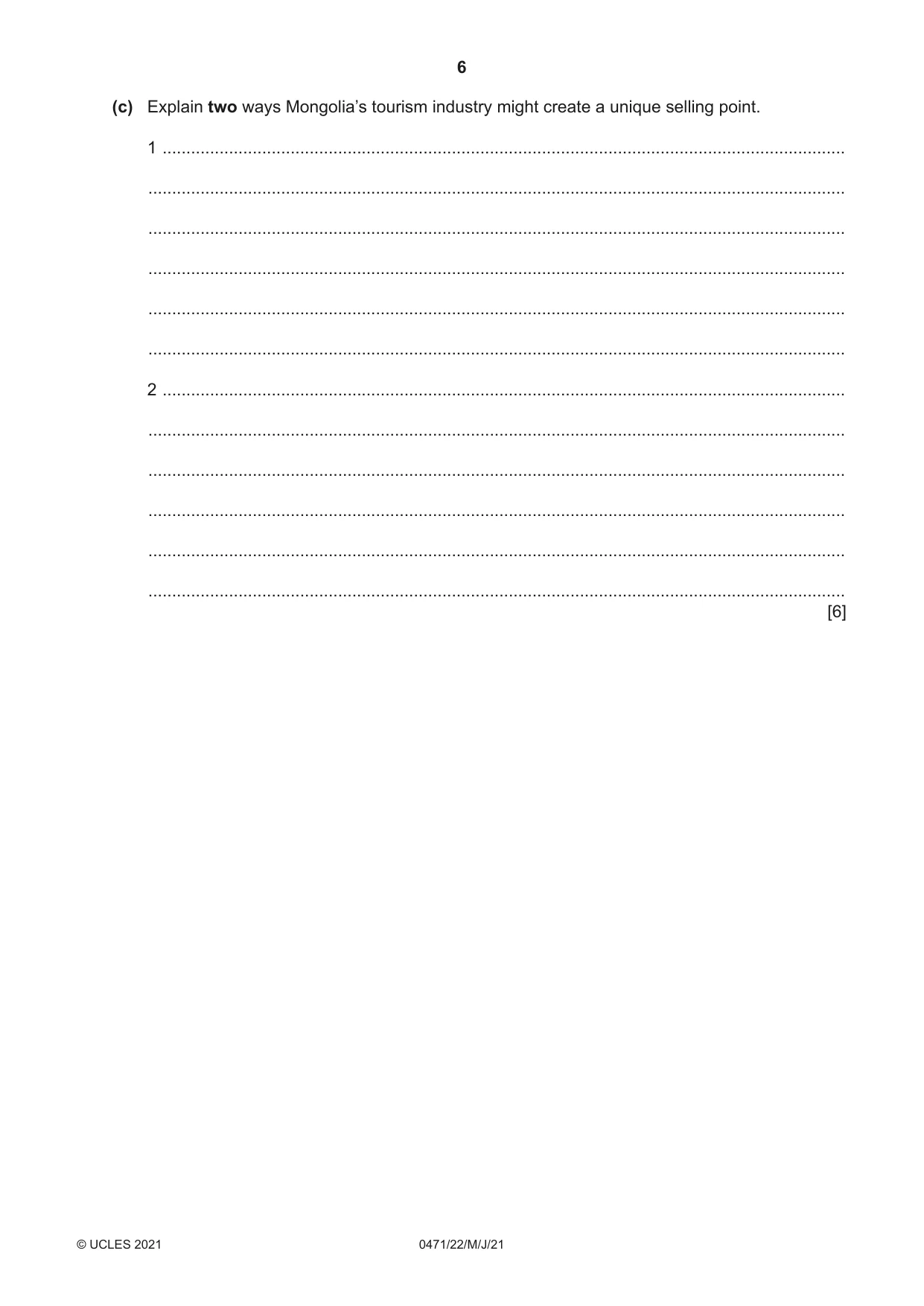
Question paper, page 6
6 0471/22/M/J/21 © UCLES 2021 (c) Explain two ways Mongolia’s tourism industry might create a unique selling point. 1 … … … … … … 2 … … … … … … [6]
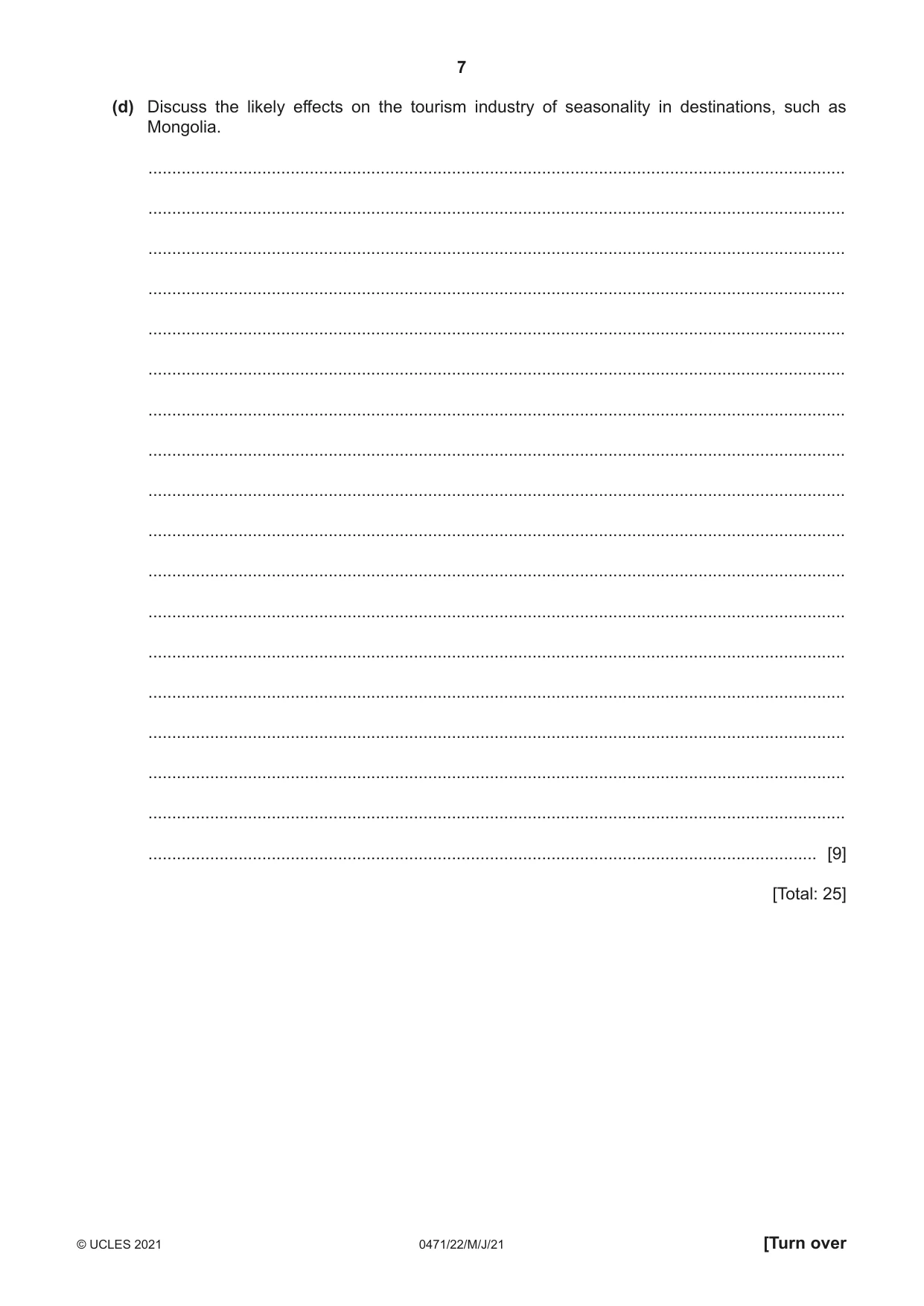
Question paper, page 7
7 0471/22/M/J/21 © UCLES 2021 [Turn over (d) Discuss the likely effects on the tourism industry of seasonality in destinations, such as Mongolia. … … … … … … … … … … … … … … … … … … [9] [Total: 25]
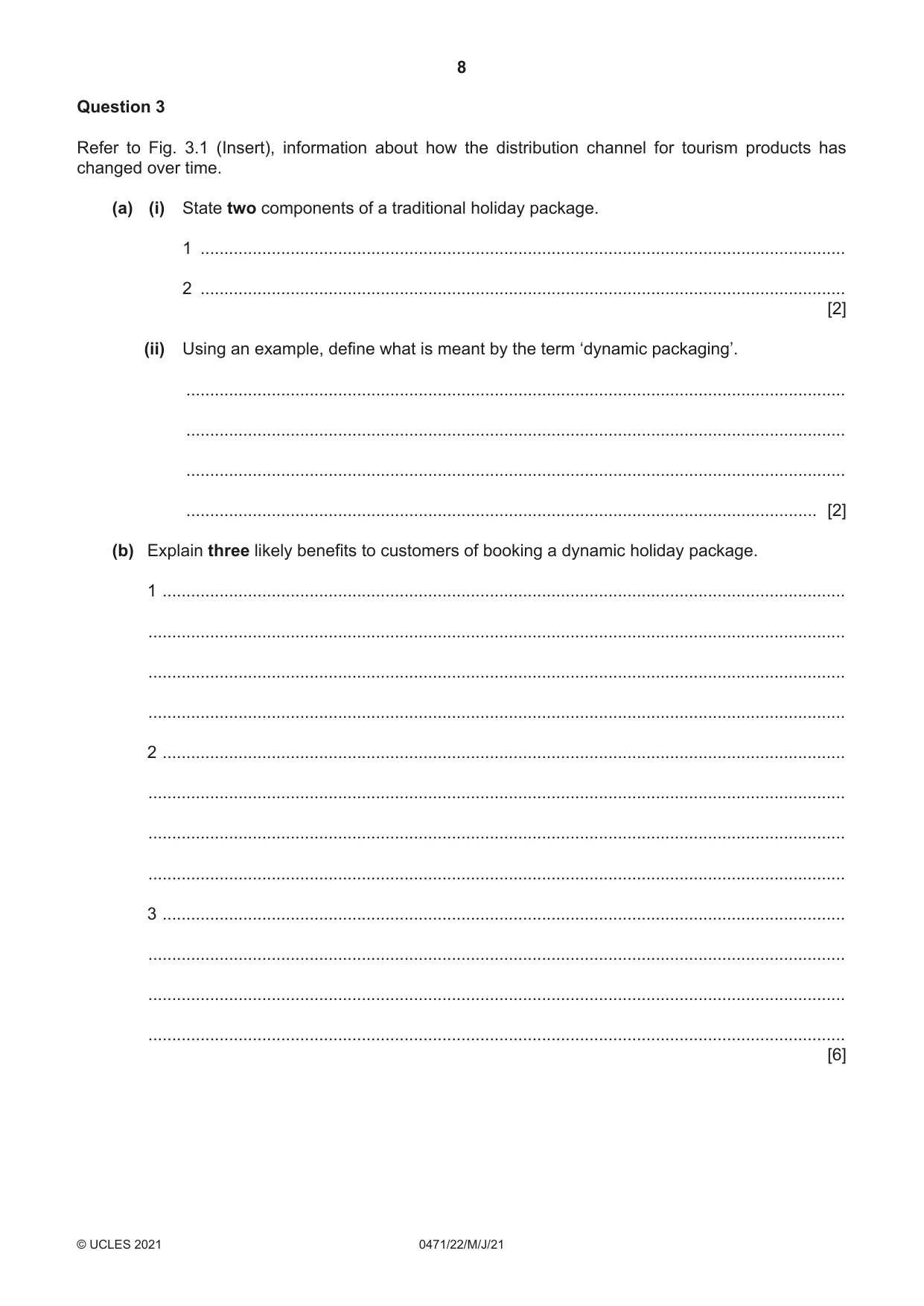
Question paper, page 8
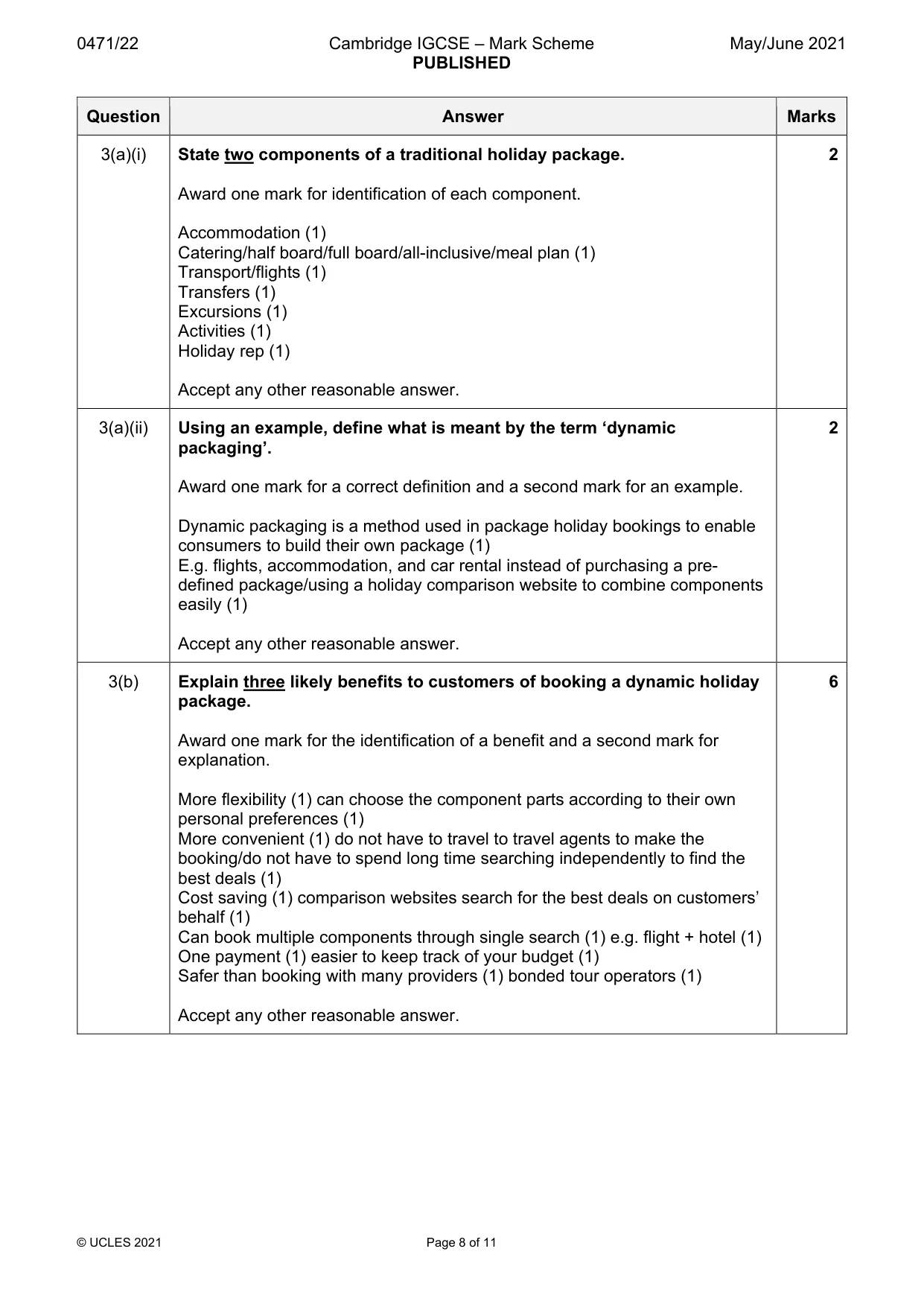
8 0471/22/M/J/21 © UCLES 2021 Question 3 Refer to Fig. 3.1 (Insert), information about how the distribution channel for tourism products has changed over time. (a) (i) State two components of a traditional holiday package. 1 … 2 … [2] (ii) Using an example, define what is meant by the term ʻdynamic packagingʼ. … … … … [2] (b) Explain three likely benefits to customers of booking a dynamic holiday package. 1 … … … … 2 … … … … 3 … … … … [6]
Question paper, page 9
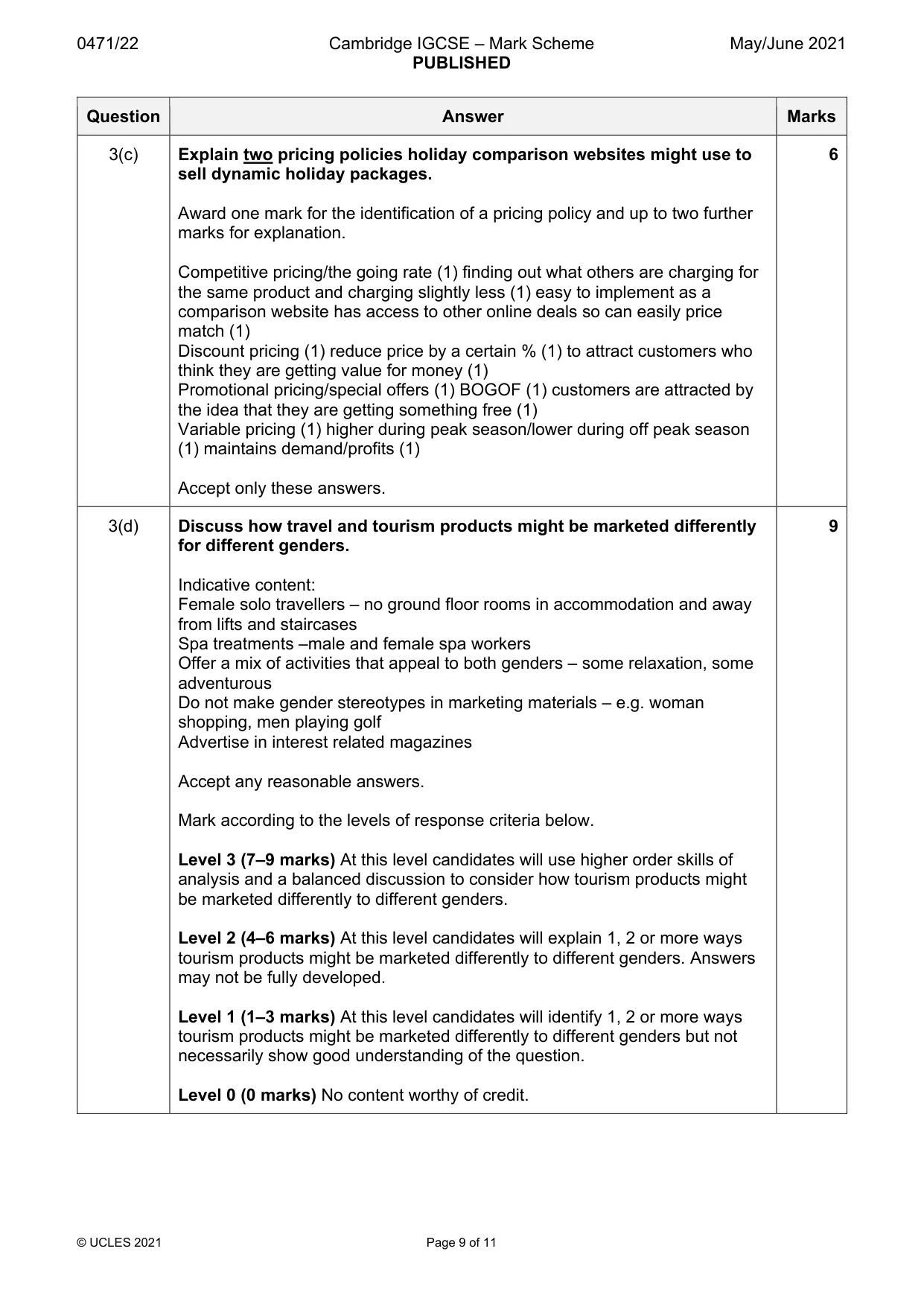
9 0471/22/M/J/21 © UCLES 2021 [Turn over (c) Explain two pricing policies holiday comparison websites might use to sell dynamic holiday packages. 1 … … … … … … 2 … … … … … … [6]
Question paper, page 10
10 0471/22/M/J/21 © UCLES 2021 (d) Discuss how travel and tourism products might be marketed differently for different genders. … … … … … … … … … … … … … … … … … … [9] [Total: 25]
Question paper, page 11
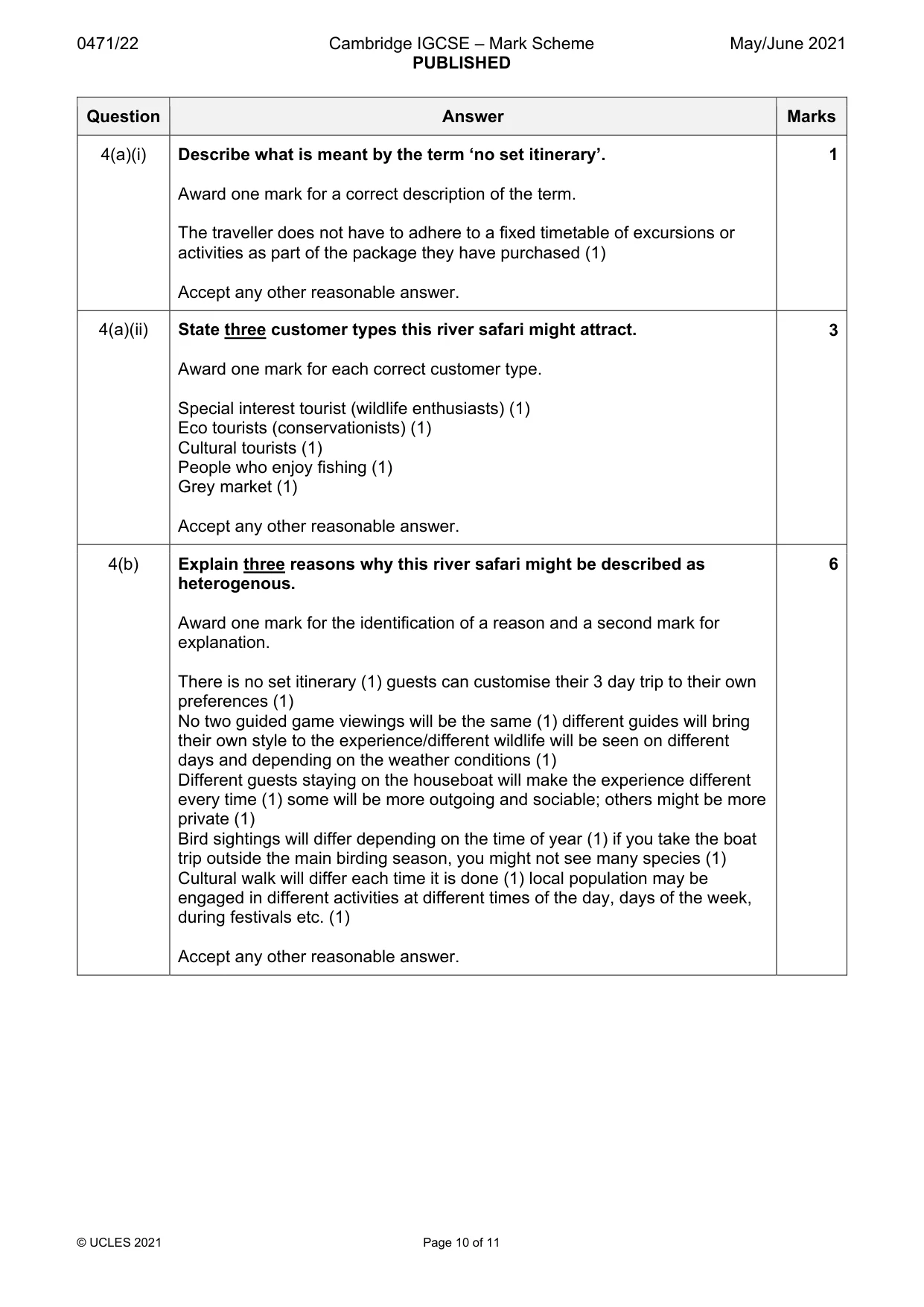
11 0471/22/M/J/21 © UCLES 2021 [Turn over Question 4 Refer to Fig. 4.1 (Insert), an advertisement for a river safari holiday in the Chobe National Park. Chobe is located in Botswana in Africa. (a) (i) Describe what is meant by the term ʻno set itineraryʼ. … … [1] (ii) State three customer types this river safari might attract. 1 … 2 … 3 … [3] (b) Explain three reasons why this river safari might be described as heterogenous. 1 … … … … 2 … … … … 3 … … … … [6]
Question paper, page 12
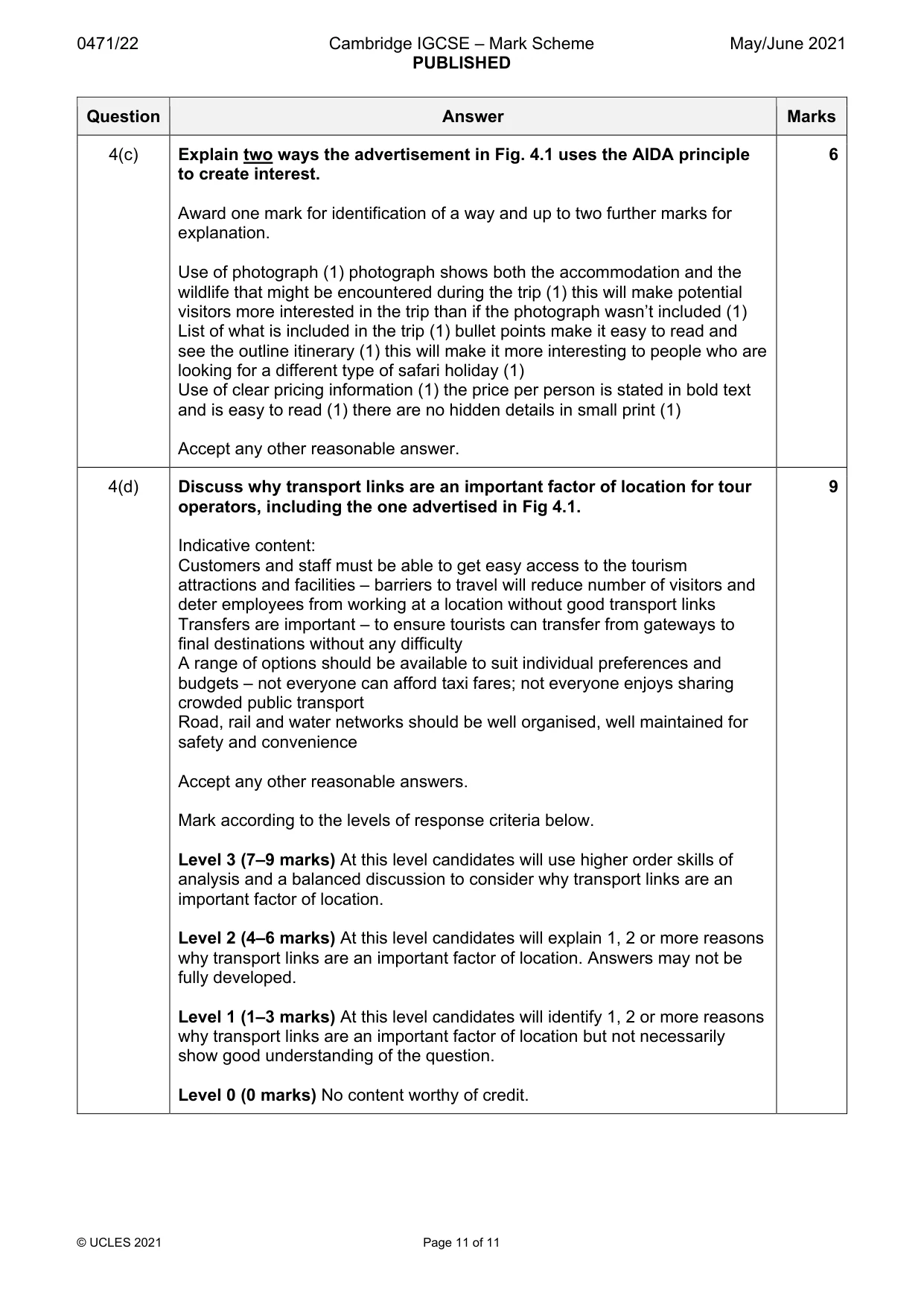
12 0471/22/M/J/21 © UCLES 2021 (c) Explain two ways the advertisement in Fig. 4.1 uses the AIDA principle to create interest. 1 … … … … … … 2 … … … … … … [6]
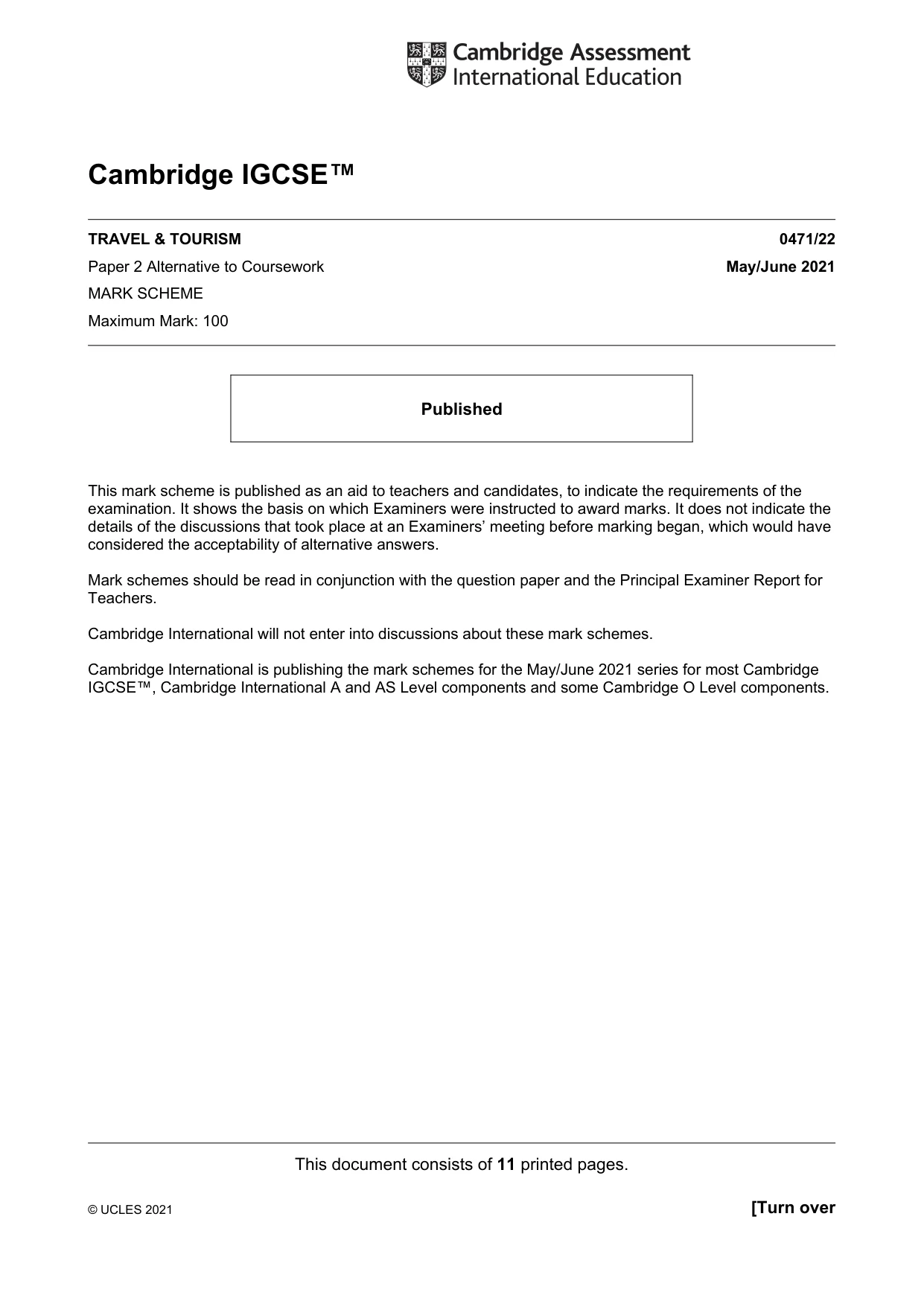
Question paper, page 13
13 0471/22/M/J/21 © UCLES 2021 (d) Discuss why transport links are an important factor of location for tour operators, including the one advertised in Fig. 4.1. … … … … … … … … … … … … … … … … … … [9] [Total: 25]
Question paper, page 14
14 0471/22/M/J/21 © UCLES 2021 BLANK PAGE
Question paper, page 15
15 0471/22/M/J/21 © UCLES 2021 BLANK PAGE
Question paper, page 16
16 0471/22/M/J/21 © UCLES 2021 BLANK PAGE The boundaries and names shown, the designations used and the presentation of material on any maps contained in this question paper/insert do not imply official endorsement or acceptance by Cambridge Assessment International Education concerning the legal status of any country, territory, or area or any of its authorities, or of the delimitation of its frontiers or boundaries. Permission to reproduce items where third-party owned material protected by copyright is included has been sought and cleared where possible. Every reasonable effort has been made by the publisher (UCLES) to trace copyright holders, but if any items requiring clearance have unwittingly been included, the publisher will be pleased to make amends at the earliest possible opportunity. To avoid the issue of disclosure of answer-related information to candidates, all copyright acknowledgements are reproduced online in the Cambridge Assessment International Education Copyright Acknowledgements Booklet. This is produced for each series of examinations and is freely available to download at www.cambridgeinternational.org after the live examination series. Cambridge Assessment International Education is part of the Cambridge Assessment Group. Cambridge Assessment is the brand name of the University of Cambridge Local Examinations Syndicate (UCLES), which itself is a department of the University of Cambridge.
Mark scheme, page 1
This document consists of 11 printed pages. © UCLES 2021 [Turn over Cambridge IGCSE™ TRAVEL & TOURISM 0471/22 Paper 2 Alternative to Coursework May/June 2021 MARK SCHEME Maximum Mark: 100 Published This mark scheme is published as an aid to teachers and candidates, to indicate the requirements of the examination. It shows the basis on which Examiners were instructed to award marks. It does not indicate the details of the discussions that took place at an Examiners’ meeting before marking began, which would have considered the acceptability of alternative answers. Mark schemes should be read in conjunction with the question paper and the Principal Examiner Report for Teachers. Cambridge International will not enter into discussions about these mark schemes. Cambridge International is publishing the mark schemes for the May/June 2021 series for most Cambridge IGCSE™, Cambridge International A and AS Level components and some Cambridge O Level components.
Mark scheme, page 2
0471/22 Cambridge IGCSE – Mark Scheme PUBLISHED May/June 2021 © UCLES 2021 Page 2 of 11 Generic Marking Principles These general marking principles must be applied by all examiners when marking candidate answers. They should be applied alongside the specific content of the mark scheme or generic level descriptors for a question. Each question paper and mark scheme will also comply with these marking principles. GENERIC MARKING PRINCIPLE 1: Marks must be awarded in line with: • the specific content of the mark scheme or the generic level descriptors for the question • the specific skills defined in the mark scheme or in the generic level descriptors for the question • the standard of response required by a candidate as exemplified by the standardisation scripts. GENERIC MARKING PRINCIPLE 2: Marks awarded are always whole marks (not half marks, or other fractions). GENERIC MARKING PRINCIPLE 3: Marks must be awarded positively: • marks are awarded for correct/valid answers, as defined in the mark scheme. However, credit is given for valid answers which go beyond the scope of the syllabus and mark scheme, referring to your Team Leader as appropriate • marks are awarded when candidates clearly demonstrate what they know and can do • marks are not deducted for errors • marks are not deducted for omissions • answers should only be judged on the quality of spelling, punctuation and grammar when these features are specifically assessed by the question as indicated by the mark scheme. The meaning, however, should be unambiguous. GENERIC MARKING PRINCIPLE 4: Rules must be applied consistently, e.g. in situations where candidates have not followed instructions or in the application of generic level descriptors. GENERIC MARKING PRINCIPLE 5: Marks should be awarded using the full range of marks defined in the mark scheme for the question (however; the use of the full mark range may be limited according to the quality of the candidate responses seen). GENERIC MARKING PRINCIPLE 6: Marks awarded are based solely on the requirements as defined in the mark scheme. Marks should not be awarded with grade thresholds or grade descriptors in mind.
Mark scheme, page 3
0471/22 Cambridge IGCSE – Mark Scheme PUBLISHED May/June 2021 © UCLES 2021 Page 3 of 11 Social Science-Specific Marking Principles (for point-based marking) 1 Components using point-based marking: • Point marking is often used to reward knowledge, understanding and application of skills. We give credit where the candidate’s answer shows relevant knowledge, understanding and application of skills in answering the question. We do not give credit where the answer shows confusion. From this it follows that we: a DO credit answers which are worded differently from the mark scheme if they clearly convey the same meaning (unless the mark scheme requires a specific term) b DO credit alternative answers/examples which are not written in the mark scheme if they are correct c DO credit answers where candidates give more than one correct answer in one prompt/numbered/scaffolded space where extended writing is required rather than list-type answers. For example, questions that require n reasons (e.g. State two reasons …). d DO NOT credit answers simply for using a ‘key term’ unless that is all that is required. (Check for evidence it is understood and not used wrongly.) e DO NOT credit answers which are obviously self-contradicting or trying to cover all possibilities f DO NOT give further credit for what is effectively repetition of a correct point already credited unless the language itself is being tested. This applies equally to ‘mirror statements’ (i.e. polluted/not polluted). g DO NOT require spellings to be correct, unless this is part of the test. However spellings of syllabus terms must allow for clear and unambiguous separation from other syllabus terms with which they may be confused (e.g. Corrasion/Corrosion) 2 Presentation of mark scheme: • Slashes (/) or the word ‘or’ separate alternative ways of making the same point. • Semi colons (;) bullet points (•) or figures in brackets (1) separate different points. • Content in the answer column in brackets is for examiner information/context to clarify the marking but is not required to earn the mark (except Accounting syllabuses where they indicate negative numbers). 3 Annotation: • For point marking, ticks can be used to indicate correct answers and crosses can be used to indicate wrong answers. There is no direct relationship between ticks and marks. Ticks have no defined meaning for levels of response marking. • For levels of response marking, the level awarded should be annotated on the script. • Other annotations will be used by examiners as agreed during standardisation, and the meaning will be understood by all examiners who marked that paper.
Mark scheme, page 4
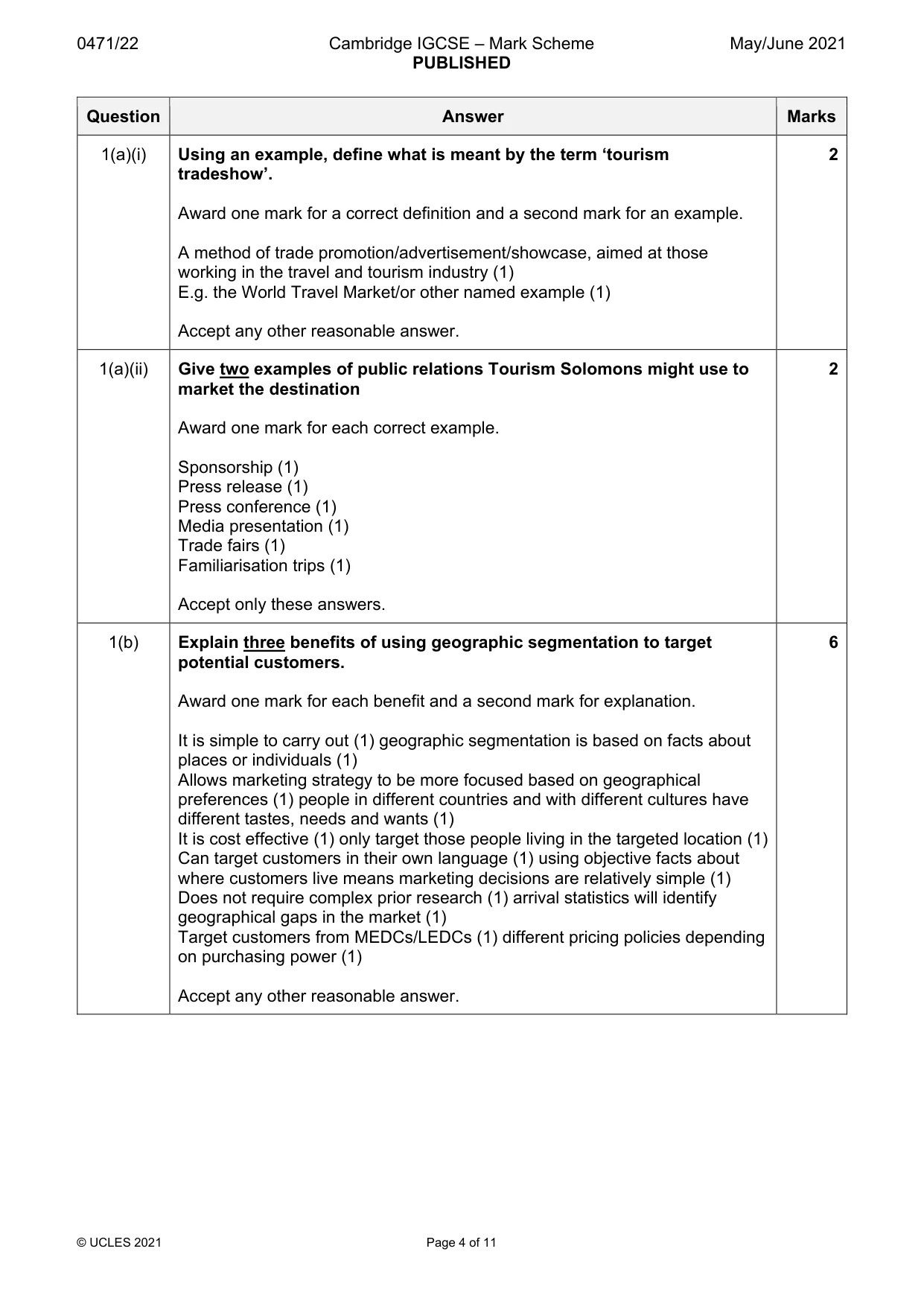
0471/22 Cambridge IGCSE – Mark Scheme PUBLISHED May/June 2021 © UCLES 2021 Page 4 of 11 Question Answer Marks 1(a)(i) Using an example, define what is meant by the term ‘tourism tradeshow’. Award one mark for a correct definition and a second mark for an example. A method of trade promotion/advertisement/showcase, aimed at those working in the travel and tourism industry (1) E.g. the World Travel Market/or other named example (1) Accept any other reasonable answer. 2 1(a)(ii) Give two examples of public relations Tourism Solomons might use to market the destination Award one mark for each correct example. Sponsorship (1) Press release (1) Press conference (1) Media presentation (1) Trade fairs (1) Familiarisation trips (1) Accept only these answers. 2 1(b) Explain three benefits of using geographic segmentation to target potential customers. Award one mark for each benefit and a second mark for explanation. It is simple to carry out (1) geographic segmentation is based on facts about places or individuals (1) Allows marketing strategy to be more focused based on geographical preferences (1) people in different countries and with different cultures have different tastes, needs and wants (1) It is cost effective (1) only target those people living in the targeted location (1) Can target customers in their own language (1) using objective facts about where customers live means marketing decisions are relatively simple (1) Does not require complex prior research (1) arrival statistics will identify geographical gaps in the market (1) Target customers from MEDCs/LEDCs (1) different pricing policies depending on purchasing power (1) Accept any other reasonable answer. 6
Mark scheme, page 5
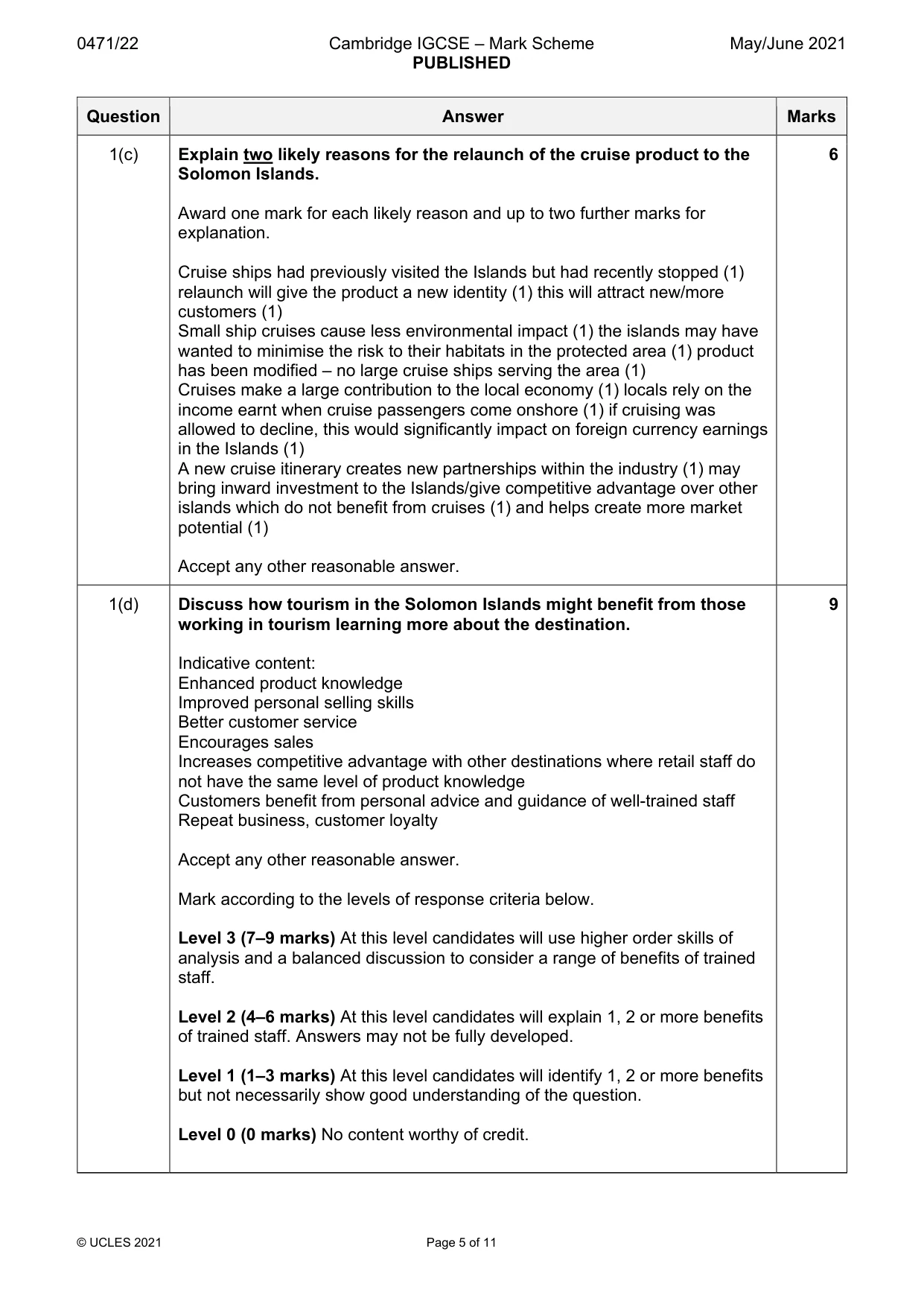
0471/22 Cambridge IGCSE – Mark Scheme PUBLISHED May/June 2021 © UCLES 2021 Page 5 of 11 Question Answer Marks 1(c) Explain two likely reasons for the relaunch of the cruise product to the Solomon Islands. Award one mark for each likely reason and up to two further marks for explanation. Cruise ships had previously visited the Islands but had recently stopped (1) relaunch will give the product a new identity (1) this will attract new/more customers (1) Small ship cruises cause less environmental impact (1) the islands may have wanted to minimise the risk to their habitats in the protected area (1) product has been modified – no large cruise ships serving the area (1) Cruises make a large contribution to the local economy (1) locals rely on the income earnt when cruise passengers come onshore (1) if cruising was allowed to decline, this would significantly impact on foreign currency earnings in the Islands (1) A new cruise itinerary creates new partnerships within the industry (1) may bring inward investment to the Islands/give competitive advantage over other islands which do not benefit from cruises (1) and helps create more market potential (1) Accept any other reasonable answer. 6 1(d) Discuss how tourism in the Solomon Islands might benefit from those working in tourism learning more about the destination. Indicative content: Enhanced product knowledge Improved personal selling skills Better customer service Encourages sales Increases competitive advantage with other destinations where retail staff do not have the same level of product knowledge Customers benefit from personal advice and guidance of well-trained staff Repeat business, customer loyalty Accept any other reasonable answer. Mark according to the levels of response criteria below. Level 3 (7–9 marks) At this level candidates will use higher order skills of analysis and a balanced discussion to consider a range of benefits of trained staff. Level 2 (4–6 marks) At this level candidates will explain 1, 2 or more benefits of trained staff. Answers may not be fully developed. Level 1 (1–3 marks) At this level candidates will identify 1, 2 or more benefits but not necessarily show good understanding of the question. Level 0 (0 marks) No content worthy of credit. 9
Mark scheme, page 6
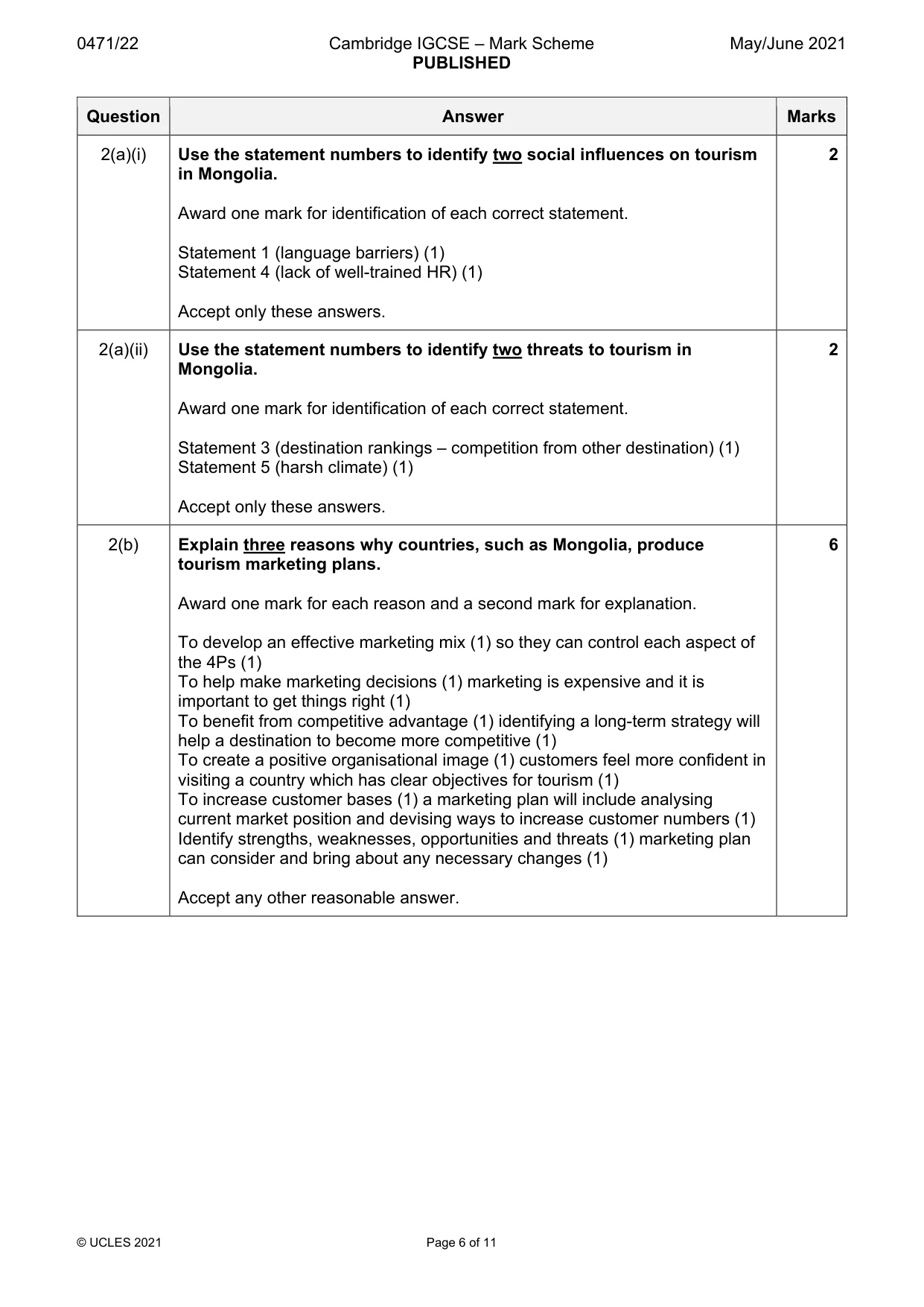
0471/22 Cambridge IGCSE – Mark Scheme PUBLISHED May/June 2021 © UCLES 2021 Page 6 of 11 Question Answer Marks 2(a)(i) Use the statement numbers to identify two social influences on tourism in Mongolia. Award one mark for identification of each correct statement. Statement 1 (language barriers) (1) Statement 4 (lack of well-trained HR) (1) Accept only these answers. 2 2(a)(ii) Use the statement numbers to identify two threats to tourism in Mongolia. Award one mark for identification of each correct statement. Statement 3 (destination rankings – competition from other destination) (1) Statement 5 (harsh climate) (1) Accept only these answers. 2 2(b) Explain three reasons why countries, such as Mongolia, produce tourism marketing plans. Award one mark for each reason and a second mark for explanation. To develop an effective marketing mix (1) so they can control each aspect of the 4Ps (1) To help make marketing decisions (1) marketing is expensive and it is important to get things right (1) To benefit from competitive advantage (1) identifying a long-term strategy will help a destination to become more competitive (1) To create a positive organisational image (1) customers feel more confident in visiting a country which has clear objectives for tourism (1) To increase customer bases (1) a marketing plan will include analysing current market position and devising ways to increase customer numbers (1) Identify strengths, weaknesses, opportunities and threats (1) marketing plan can consider and bring about any necessary changes (1) Accept any other reasonable answer. 6
Mark scheme, page 7
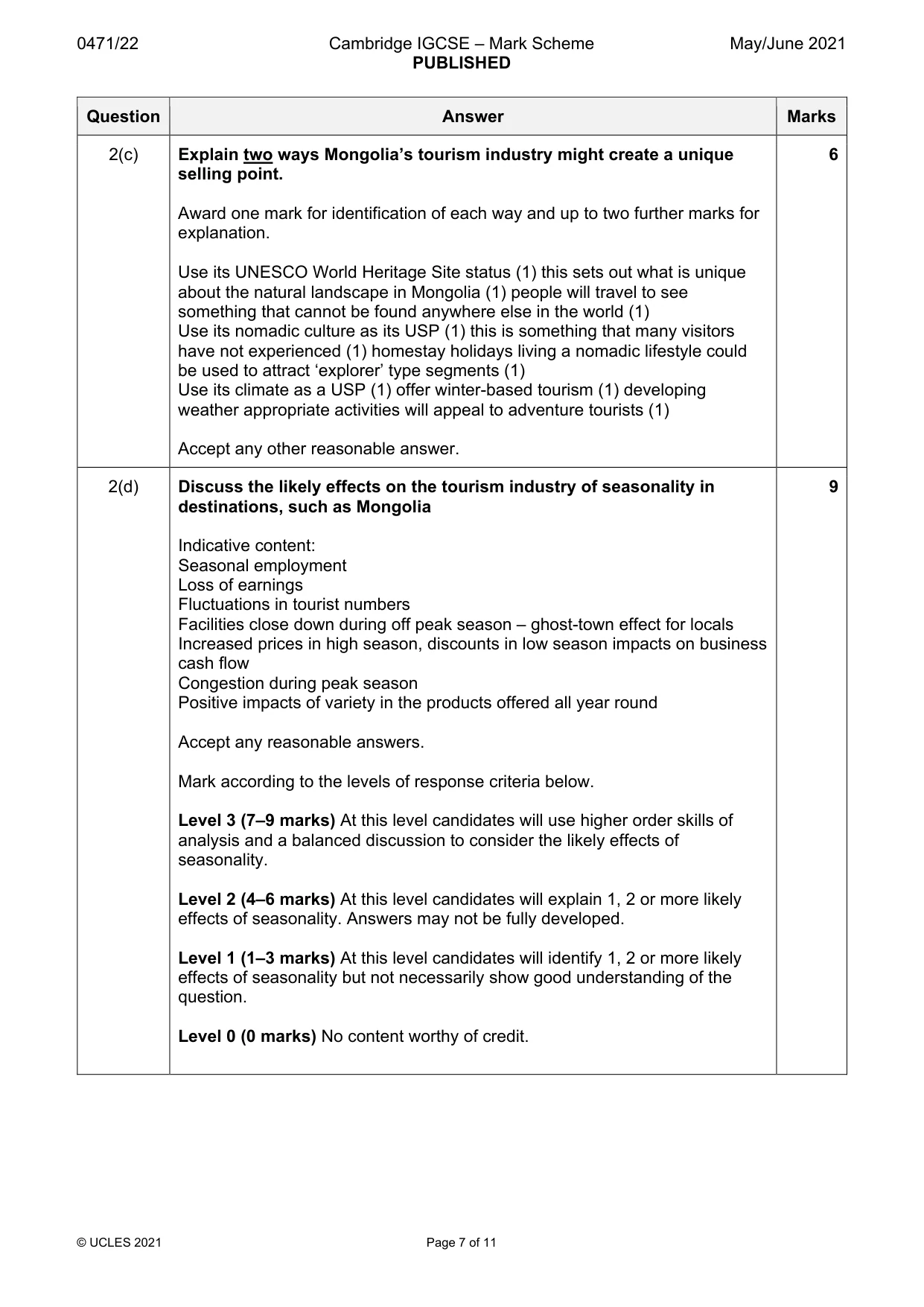
0471/22 Cambridge IGCSE – Mark Scheme PUBLISHED May/June 2021 © UCLES 2021 Page 7 of 11 Question Answer Marks 2(c) Explain two ways Mongolia’s tourism industry might create a unique selling point. Award one mark for identification of each way and up to two further marks for explanation. Use its UNESCO World Heritage Site status (1) this sets out what is unique about the natural landscape in Mongolia (1) people will travel to see something that cannot be found anywhere else in the world (1) Use its nomadic culture as its USP (1) this is something that many visitors have not experienced (1) homestay holidays living a nomadic lifestyle could be used to attract ‘explorer’ type segments (1) Use its climate as a USP (1) offer winter-based tourism (1) developing weather appropriate activities will appeal to adventure tourists (1) Accept any other reasonable answer. 6 2(d) Discuss the likely effects on the tourism industry of seasonality in destinations, such as Mongolia Indicative content: Seasonal employment Loss of earnings Fluctuations in tourist numbers Facilities close down during off peak season – ghost-town effect for locals Increased prices in high season, discounts in low season impacts on business cash flow Congestion during peak season Positive impacts of variety in the products offered all year round Accept any reasonable answers. Mark according to the levels of response criteria below. Level 3 (7–9 marks) At this level candidates will use higher order skills of analysis and a balanced discussion to consider the likely effects of seasonality. Level 2 (4–6 marks) At this level candidates will explain 1, 2 or more likely effects of seasonality. Answers may not be fully developed. Level 1 (1–3 marks) At this level candidates will identify 1, 2 or more likely effects of seasonality but not necessarily show good understanding of the question. Level 0 (0 marks) No content worthy of credit. 9
Mark scheme, page 8
0471/22 Cambridge IGCSE – Mark Scheme PUBLISHED May/June 2021 © UCLES 2021 Page 8 of 11 Question Answer Marks 3(a)(i) State two components of a traditional holiday package. Award one mark for identification of each component. Accommodation (1) Catering/half board/full board/all-inclusive/meal plan (1) Transport/flights (1) Transfers (1) Excursions (1) Activities (1) Holiday rep (1) Accept any other reasonable answer. 2 3(a)(ii) Using an example, define what is meant by the term ‘dynamic packaging’. Award one mark for a correct definition and a second mark for an example. Dynamic packaging is a method used in package holiday bookings to enable consumers to build their own package (1) E.g. flights, accommodation, and car rental instead of purchasing a pre- defined package/using a holiday comparison website to combine components easily (1) Accept any other reasonable answer. 2 3(b) Explain three likely benefits to customers of booking a dynamic holiday package. Award one mark for the identification of a benefit and a second mark for explanation. More flexibility (1) can choose the component parts according to their own personal preferences (1) More convenient (1) do not have to travel to travel agents to make the booking/do not have to spend long time searching independently to find the best deals (1) Cost saving (1) comparison websites search for the best deals on customers’ behalf (1) Can book multiple components through single search (1) e.g. flight + hotel (1) One payment (1) easier to keep track of your budget (1) Safer than booking with many providers (1) bonded tour operators (1) Accept any other reasonable answer. 6
Mark scheme, page 9
0471/22 Cambridge IGCSE – Mark Scheme PUBLISHED May/June 2021 © UCLES 2021 Page 9 of 11 Question Answer Marks 3(c) Explain two pricing policies holiday comparison websites might use to sell dynamic holiday packages. Award one mark for the identification of a pricing policy and up to two further marks for explanation. Competitive pricing/the going rate (1) finding out what others are charging for the same product and charging slightly less (1) easy to implement as a comparison website has access to other online deals so can easily price match (1) Discount pricing (1) reduce price by a certain % (1) to attract customers who think they are getting value for money (1) Promotional pricing/special offers (1) BOGOF (1) customers are attracted by the idea that they are getting something free (1) Variable pricing (1) higher during peak season/lower during off peak season (1) maintains demand/profits (1) Accept only these answers. 6 3(d) Discuss how travel and tourism products might be marketed differently for different genders. Indicative content: Female solo travellers – no ground floor rooms in accommodation and away from lifts and staircases Spa treatments –male and female spa workers Offer a mix of activities that appeal to both genders – some relaxation, some adventurous Do not make gender stereotypes in marketing materials – e.g. woman shopping, men playing golf Advertise in interest related magazines Accept any reasonable answers. Mark according to the levels of response criteria below. Level 3 (7–9 marks) At this level candidates will use higher order skills of analysis and a balanced discussion to consider how tourism products might be marketed differently to different genders. Level 2 (4–6 marks) At this level candidates will explain 1, 2 or more ways tourism products might be marketed differently to different genders. Answers may not be fully developed. Level 1 (1–3 marks) At this level candidates will identify 1, 2 or more ways tourism products might be marketed differently to different genders but not necessarily show good understanding of the question. Level 0 (0 marks) No content worthy of credit. 9
Mark scheme, page 10
0471/22 Cambridge IGCSE – Mark Scheme PUBLISHED May/June 2021 © UCLES 2021 Page 10 of 11 Question Answer Marks 4(a)(i) Describe what is meant by the term ‘no set itinerary’. Award one mark for a correct description of the term. The traveller does not have to adhere to a fixed timetable of excursions or activities as part of the package they have purchased (1) Accept any other reasonable answer. 1 4(a)(ii) State three customer types this river safari might attract. Award one mark for each correct customer type. Special interest tourist (wildlife enthusiasts) (1) Eco tourists (conservationists) (1) Cultural tourists (1) People who enjoy fishing (1) Grey market (1) Accept any other reasonable answer. 3 4(b) Explain three reasons why this river safari might be described as heterogenous. Award one mark for the identification of a reason and a second mark for explanation. There is no set itinerary (1) guests can customise their 3 day trip to their own preferences (1) No two guided game viewings will be the same (1) different guides will bring their own style to the experience/different wildlife will be seen on different days and depending on the weather conditions (1) Different guests staying on the houseboat will make the experience different every time (1) some will be more outgoing and sociable; others might be more private (1) Bird sightings will differ depending on the time of year (1) if you take the boat trip outside the main birding season, you might not see many species (1) Cultural walk will differ each time it is done (1) local population may be engaged in different activities at different times of the day, days of the week, during festivals etc. (1) Accept any other reasonable answer. 6
Mark scheme, page 11
0471/22 Cambridge IGCSE – Mark Scheme PUBLISHED May/June 2021 © UCLES 2021 Page 11 of 11 Question Answer Marks 4(c) Explain two ways the advertisement in Fig. 4.1 uses the AIDA principle to create interest. Award one mark for identification of a way and up to two further marks for explanation. Use of photograph (1) photograph shows both the accommodation and the wildlife that might be encountered during the trip (1) this will make potential visitors more interested in the trip than if the photograph wasn’t included (1) List of what is included in the trip (1) bullet points make it easy to read and see the outline itinerary (1) this will make it more interesting to people who are looking for a different type of safari holiday (1) Use of clear pricing information (1) the price per person is stated in bold text and is easy to read (1) there are no hidden details in small print (1) Accept any other reasonable answer. 6 4(d) Discuss why transport links are an important factor of location for tour operators, including the one advertised in Fig 4.1. Indicative content: Customers and staff must be able to get easy access to the tourism attractions and facilities – barriers to travel will reduce number of visitors and deter employees from working at a location without good transport links Transfers are important – to ensure tourists can transfer from gateways to final destinations without any difficulty A range of options should be available to suit individual preferences and budgets – not everyone can afford taxi fares; not everyone enjoys sharing crowded public transport Road, rail and water networks should be well organised, well maintained for safety and convenience Accept any other reasonable answers. Mark according to the levels of response criteria below. Level 3 (7–9 marks) At this level candidates will use higher order skills of analysis and a balanced discussion to consider why transport links are an important factor of location. Level 2 (4–6 marks) At this level candidates will explain 1, 2 or more reasons why transport links are an important factor of location. Answers may not be fully developed. Level 1 (1–3 marks) At this level candidates will identify 1, 2 or more reasons why transport links are an important factor of location but not necessarily show good understanding of the question. Level 0 (0 marks) No content worthy of credit. 9
What you needed in this session
Cambridge’s own grade thresholds for 2021 May/June, Paper 2 · Variant 2. A higher threshold means an easier paper — the bar moves with how the cohort did.