Cambridge IGCSE Travel and Tourism 0471 — 2019 Oct/Nov Paper 2 · Variant 2
0471/22/O/N/19 · 100 marks · ≈113 min
The question paper and its mark scheme, free to read here and free to download. This is Cambridge’s own paper, exactly as it was sat.
Question paper16 pages



Mark scheme11 pages
Answers below. Sit the paper first if you are practising.
Paper as text
Question paper, page 1
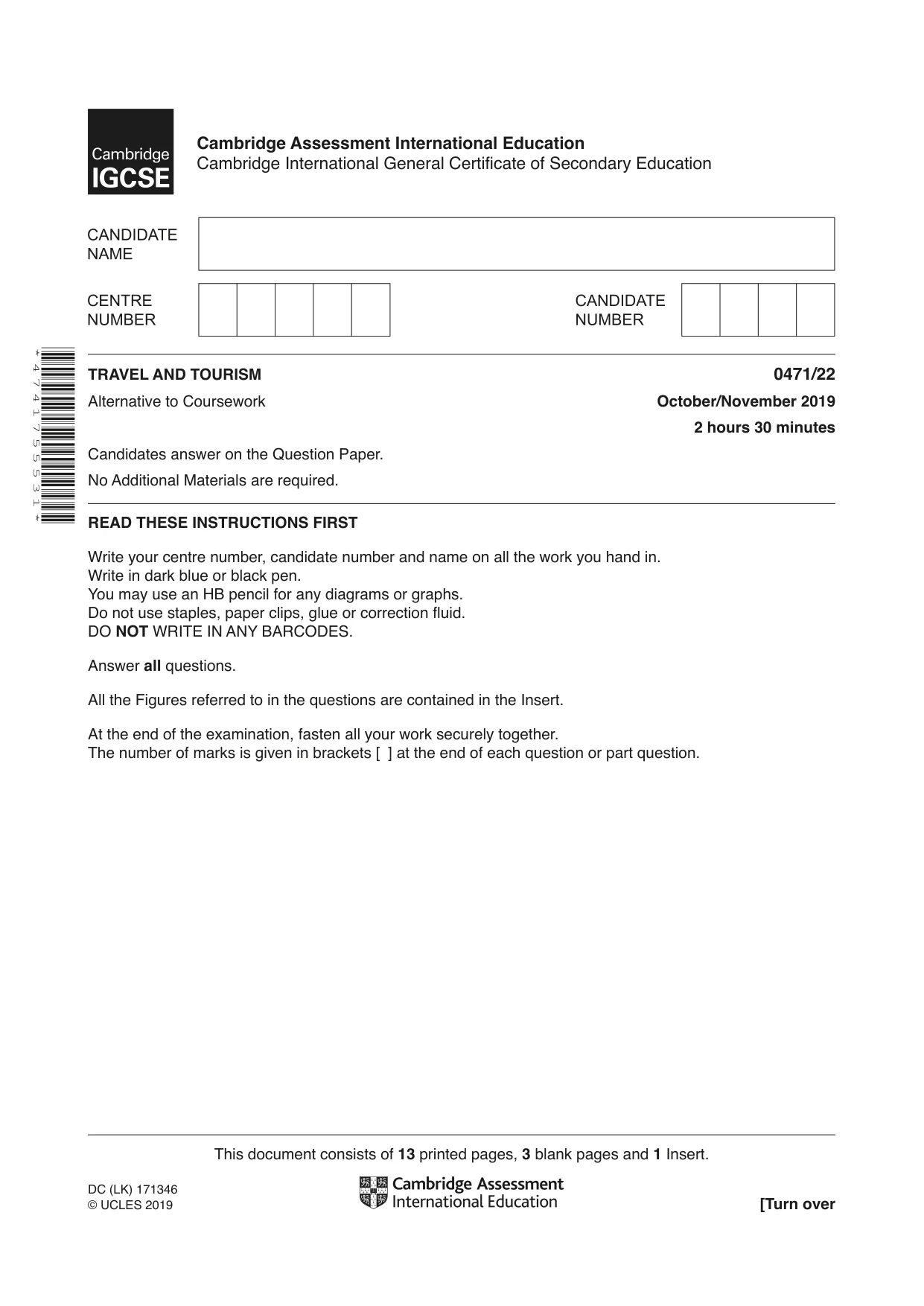
This document consists of 13 printed pages, 3 blank pages and 1 Insert. DC (LK) 171346 © UCLES 2019 [Turn over * 4 7 4 1 7 5 5 5 3 1 * TRAVEL AND TOURISM 0471/22 Alternative to Coursework October/November 2019 2 hours 30 minutes Candidates answer on the Question Paper. No Additional Materials are required. READ THESE INSTRUCTIONS FIRST Write your centre number, candidate number and name on all the work you hand in. Write in dark blue or black pen. You may use an HB pencil for any diagrams or graphs. Do not use staples, paper clips, glue or correction fluid. DO NOT WRITE IN ANY BARCODES. Answer all questions. All the Figures referred to in the questions are contained in the Insert. At the end of the examination, fasten all your work securely together. The number of marks is given in brackets [ ] at the end of each question or part question. Cambridge Assessment International Education Cambridge International General Certificate of Secondary Education
Question paper, page 2
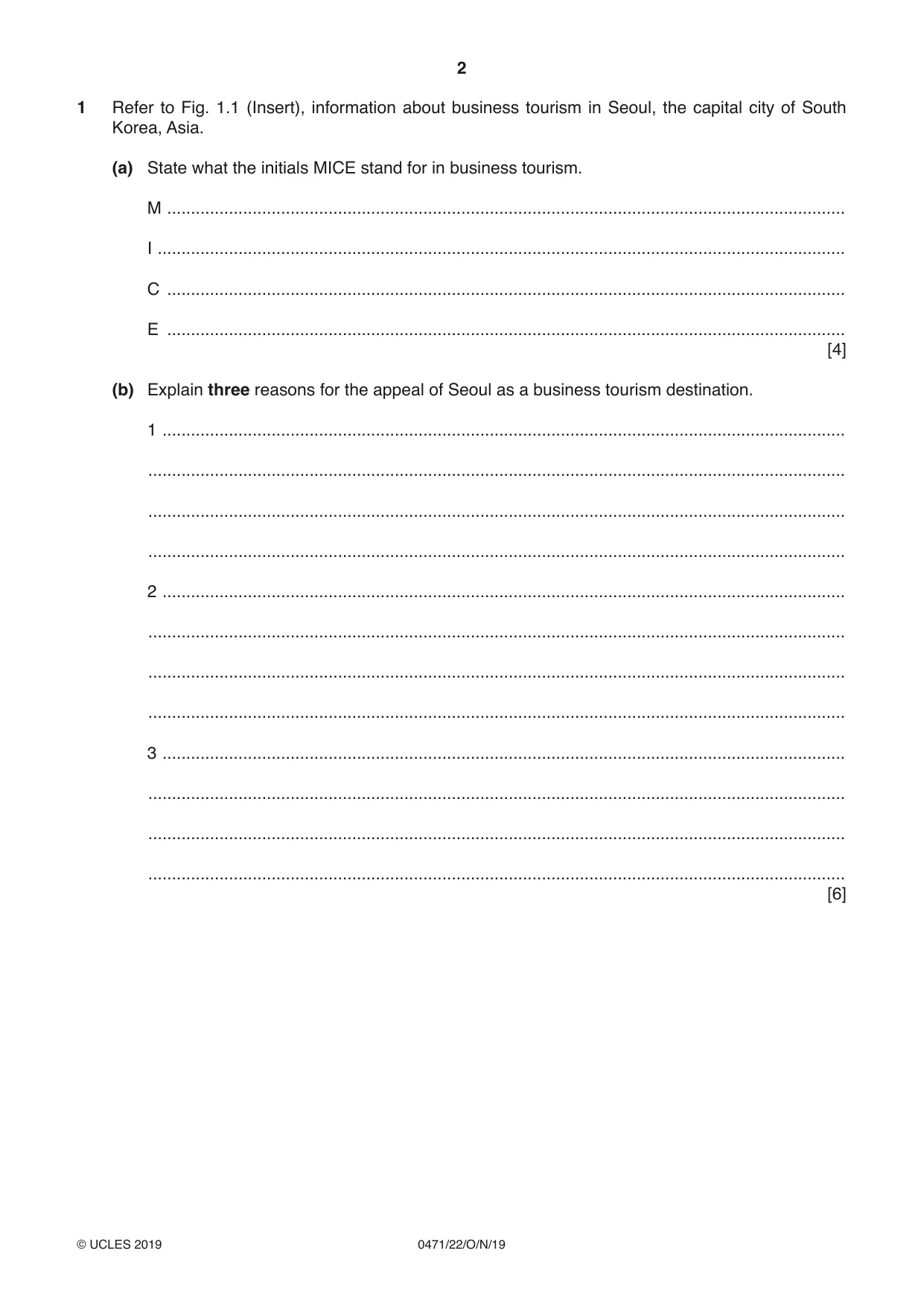
2 0471/22/O/N/19 © UCLES 2019 1 Refer to Fig. 1.1 (Insert), information about business tourism in Seoul, the capital city of South Korea, Asia. (a) State what the initials MICE stand for in business tourism. M … I … C … E … [4] (b) Explain three reasons for the appeal of Seoul as a business tourism destination. 1 … … … … 2 … … … … 3 … … … … [6]
Question paper, page 3
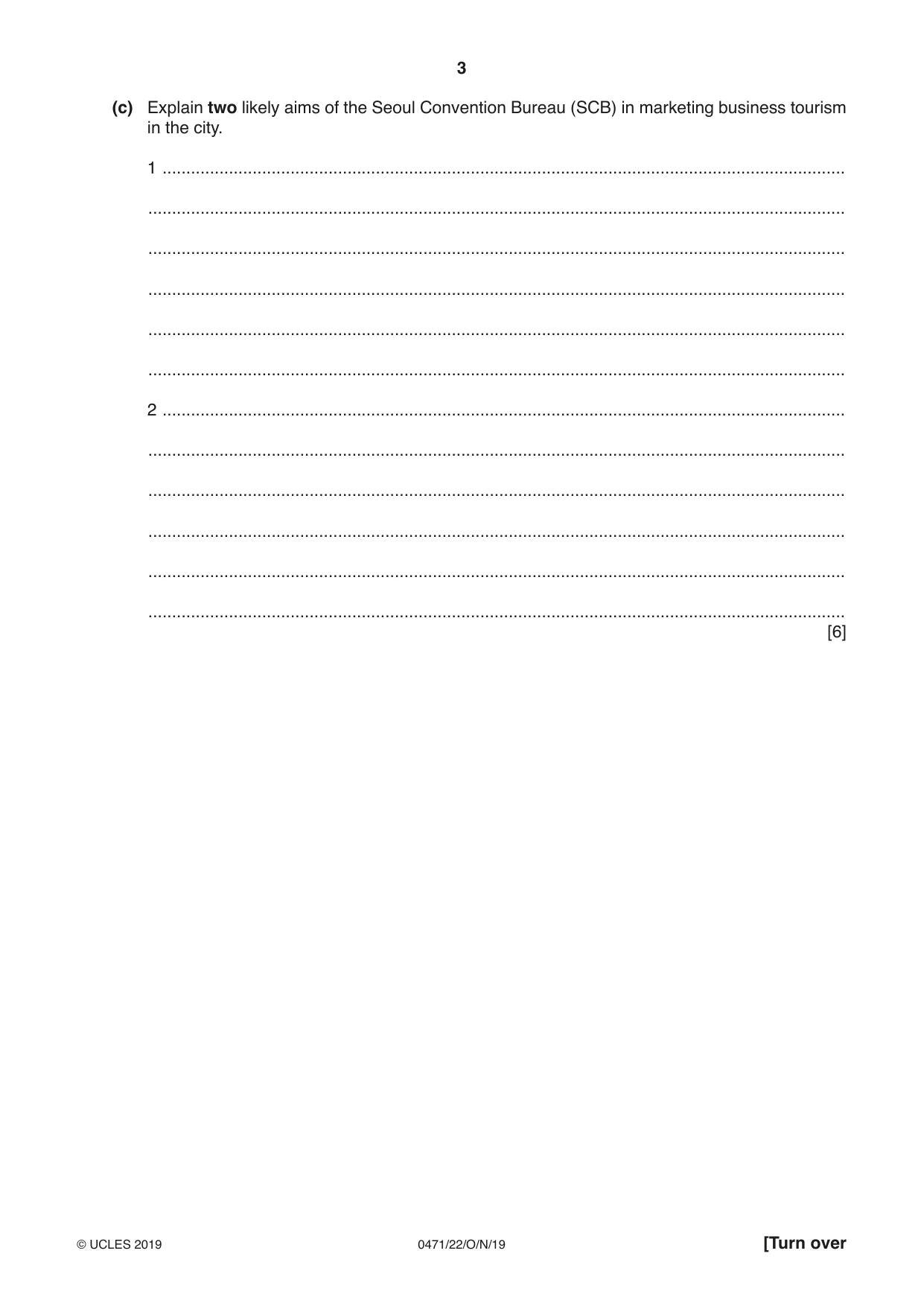
3 0471/22/O/N/19 © UCLES 2019 [Turn over (c) Explain two likely aims of the Seoul Convention Bureau (SCB) in marketing business tourism in the city. 1 … … … … … … 2 … … … … … … [6]
Question paper, page 4
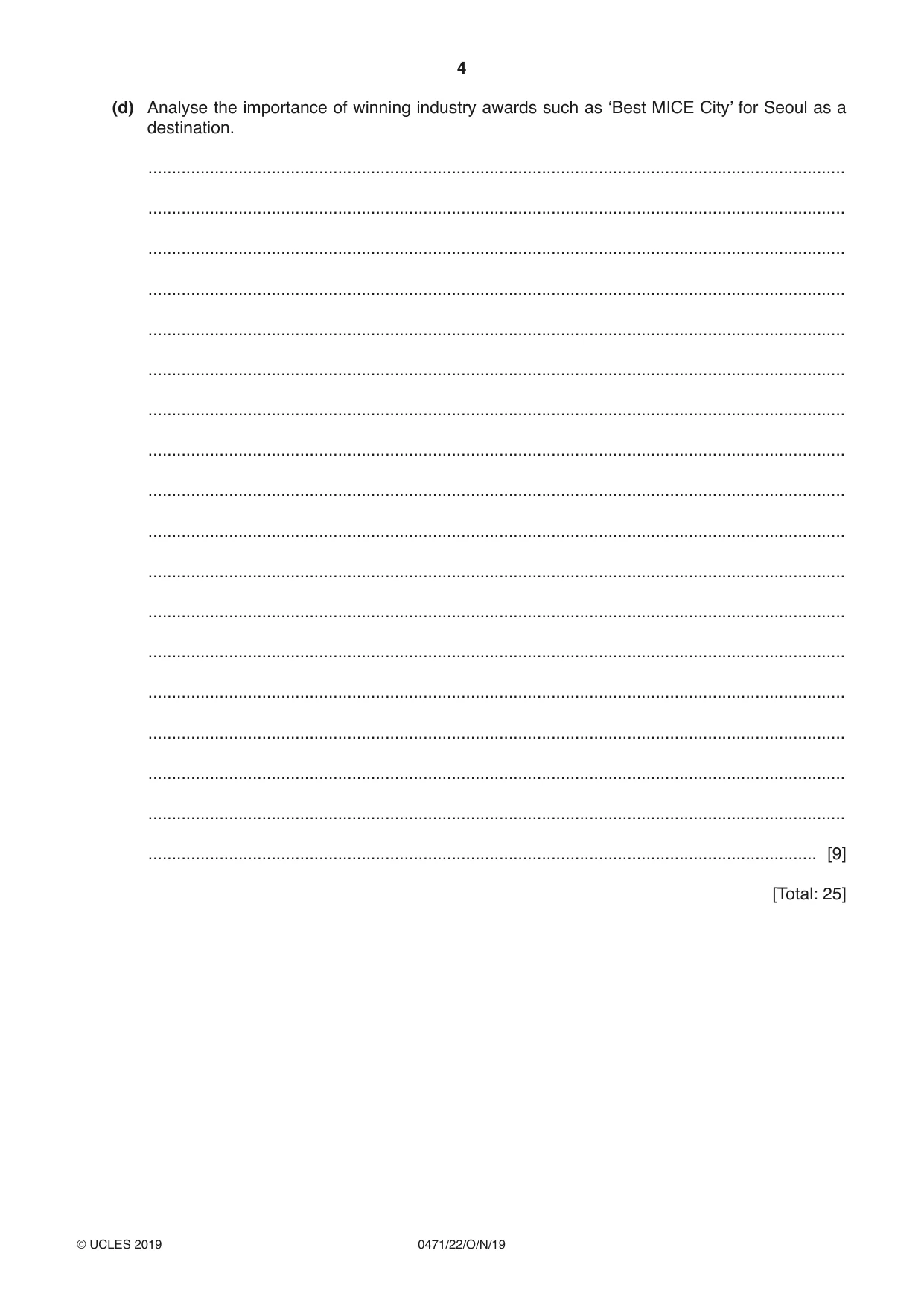
4 0471/22/O/N/19 © UCLES 2019 (d) Analyse the importance of winning industry awards such as ‘Best MICE City’ for Seoul as a destination. … … … … … … … … … … … … … … … … … … [9] [Total: 25]
Question paper, page 5
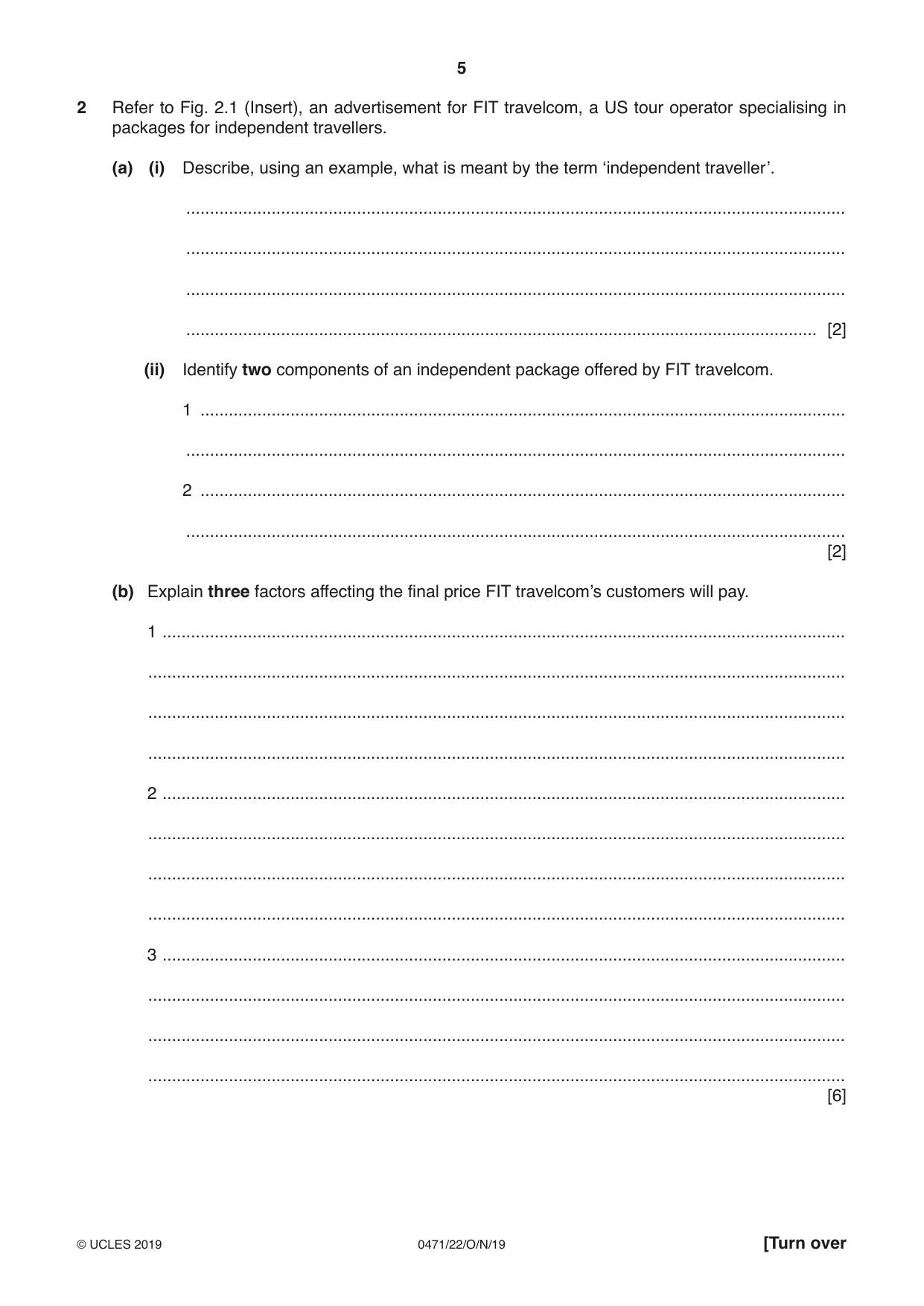
5 0471/22/O/N/19 © UCLES 2019 [Turn over 2 Refer to Fig. 2.1 (Insert), an advertisement for FIT travelcom, a US tour operator specialising in packages for independent travellers. (a) (i) Describe, using an example, what is meant by the term ‘independent traveller’. … … … … [2] (ii) Identify two components of an independent package offered by FIT travelcom. 1 … … 2 … … [2] (b) Explain three factors affecting the final price FIT travelcom’s customers will pay. 1 … … … … 2 … … … … 3 … … … … [6]
Question paper, page 6
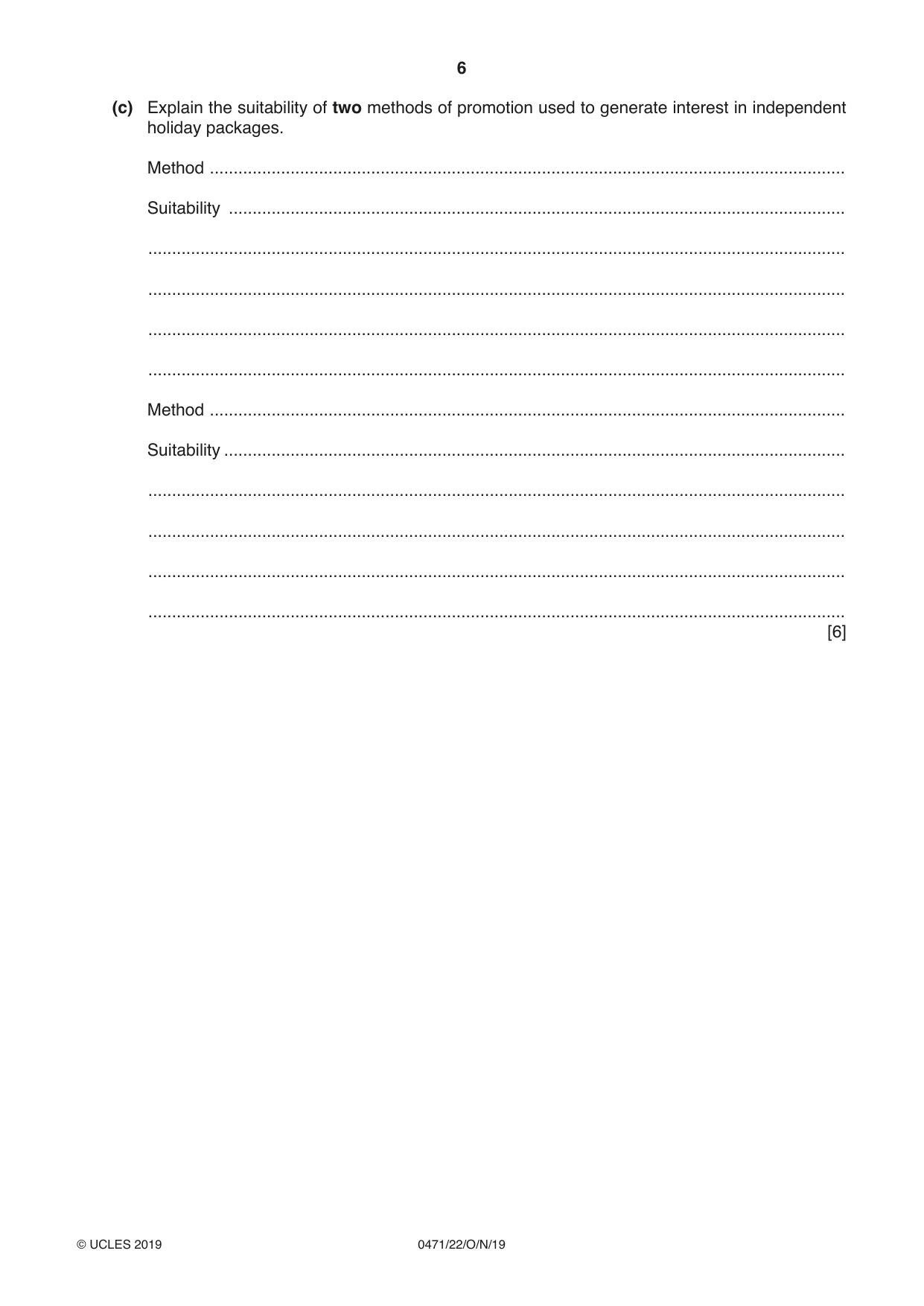
6 0471/22/O/N/19 © UCLES 2019 (c) Explain the suitability of two methods of promotion used to generate interest in independent holiday packages. Method … Suitability … … … … … Method … Suitability … … … … … [6]
Question paper, page 7
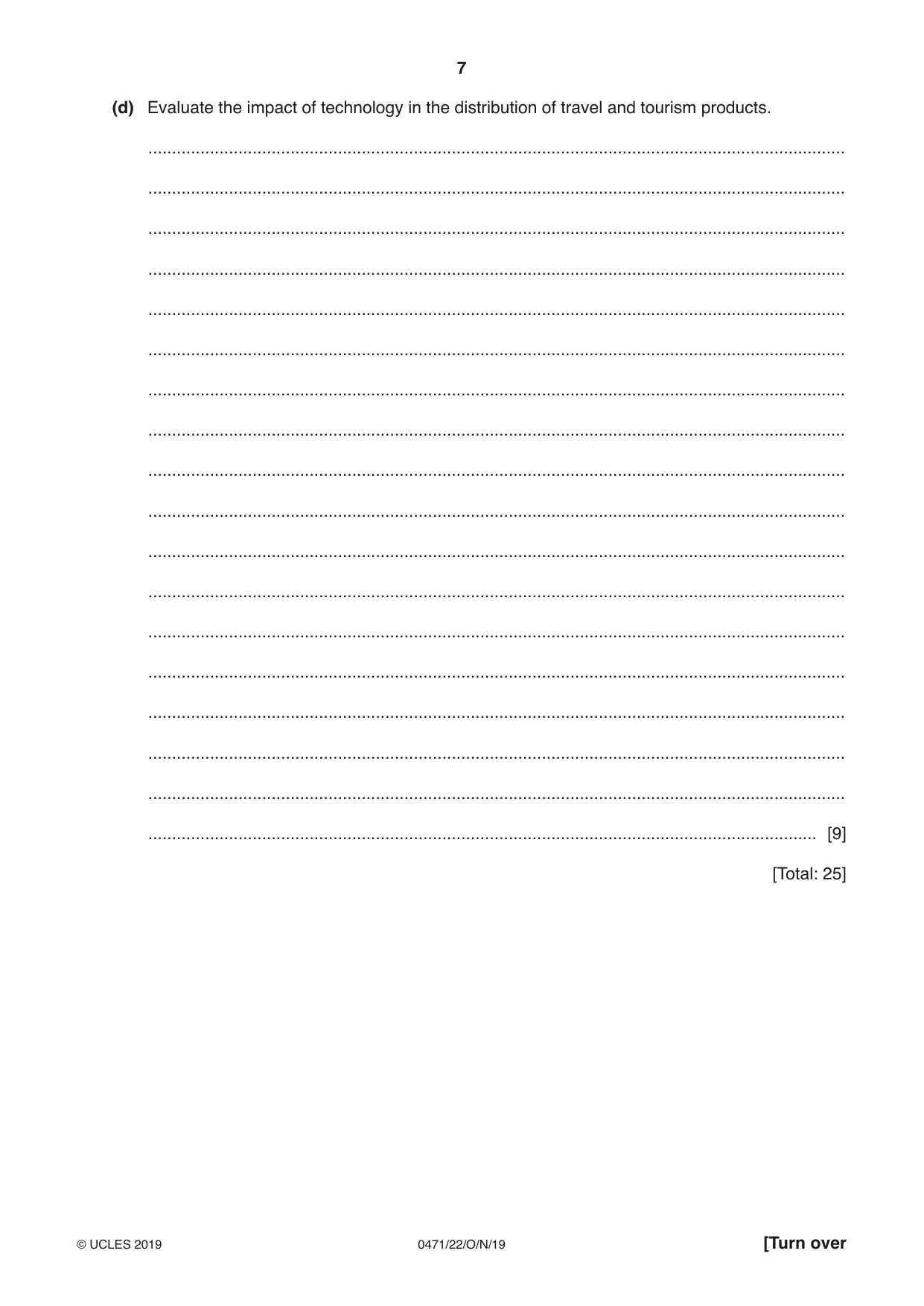
7 0471/22/O/N/19 © UCLES 2019 [Turn over (d) Evaluate the impact of technology in the distribution of travel and tourism products. … … … … … … … … … … … … … … … … … … [9] [Total: 25]
Question paper, page 8
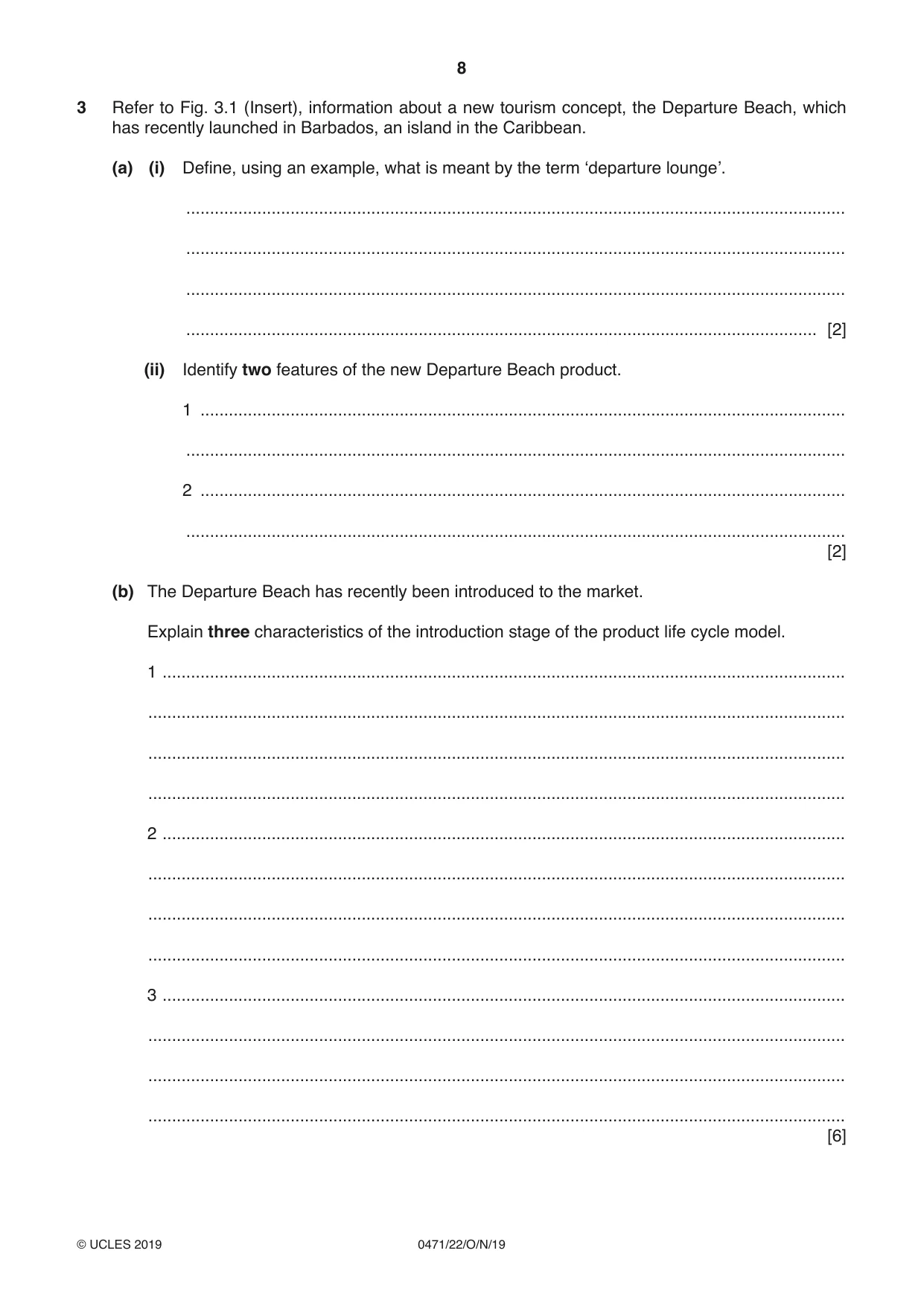
8 0471/22/O/N/19 © UCLES 2019 3 Refer to Fig. 3.1 (Insert), information about a new tourism concept, the Departure Beach, which has recently launched in Barbados, an island in the Caribbean. (a) (i) Define, using an example, what is meant by the term ‘departure lounge’. … … … … [2] (ii) Identify two features of the new Departure Beach product. 1 … … 2 … … [2] (b) The Departure Beach has recently been introduced to the market. Explain three characteristics of the introduction stage of the product life cycle model. 1 … … … … 2 … … … … 3 … … … … [6]
Question paper, page 9
9 0471/22/O/N/19 © UCLES 2019 [Turn over (c) Explain two pricing policies that might have been used to determine the prices charged for using the Departure Beach. 1 … … … … … … 2 … … … … … … [6]
Question paper, page 10
10 0471/22/O/N/19 © UCLES 2019 (d) Discuss how other travel and tourism providers might develop alternative products and services to meet the needs of different market segments. … … … … … … … … … … … … … … … … … … [9] [Total: 25]
Question paper, page 11
11 0471/22/O/N/19 © UCLES 2019 [Turn over 4 Refer to Fig. 4.1 (Insert), information about the marketing environment for Canada, North America. (a) (i) Give two examples of primary market research techniques that can be used to gain visitor feedback. 1 … 2 … [2] (ii) State two likely sources of secondary market research data tourism authorities in Canada might use. 1 … 2 … [2] (b) Explain three reasons why it is important for tourist destinations to create a positive image and reputation. 1 … … … … 2 … … … … 3 … … … … [6]
Question paper, page 12
12 0471/22/O/N/19 © UCLES 2019 (c) Explain two ways airlines can use public relations to generate more sales. 1 … … … … … … 2 … … … … … … [6]
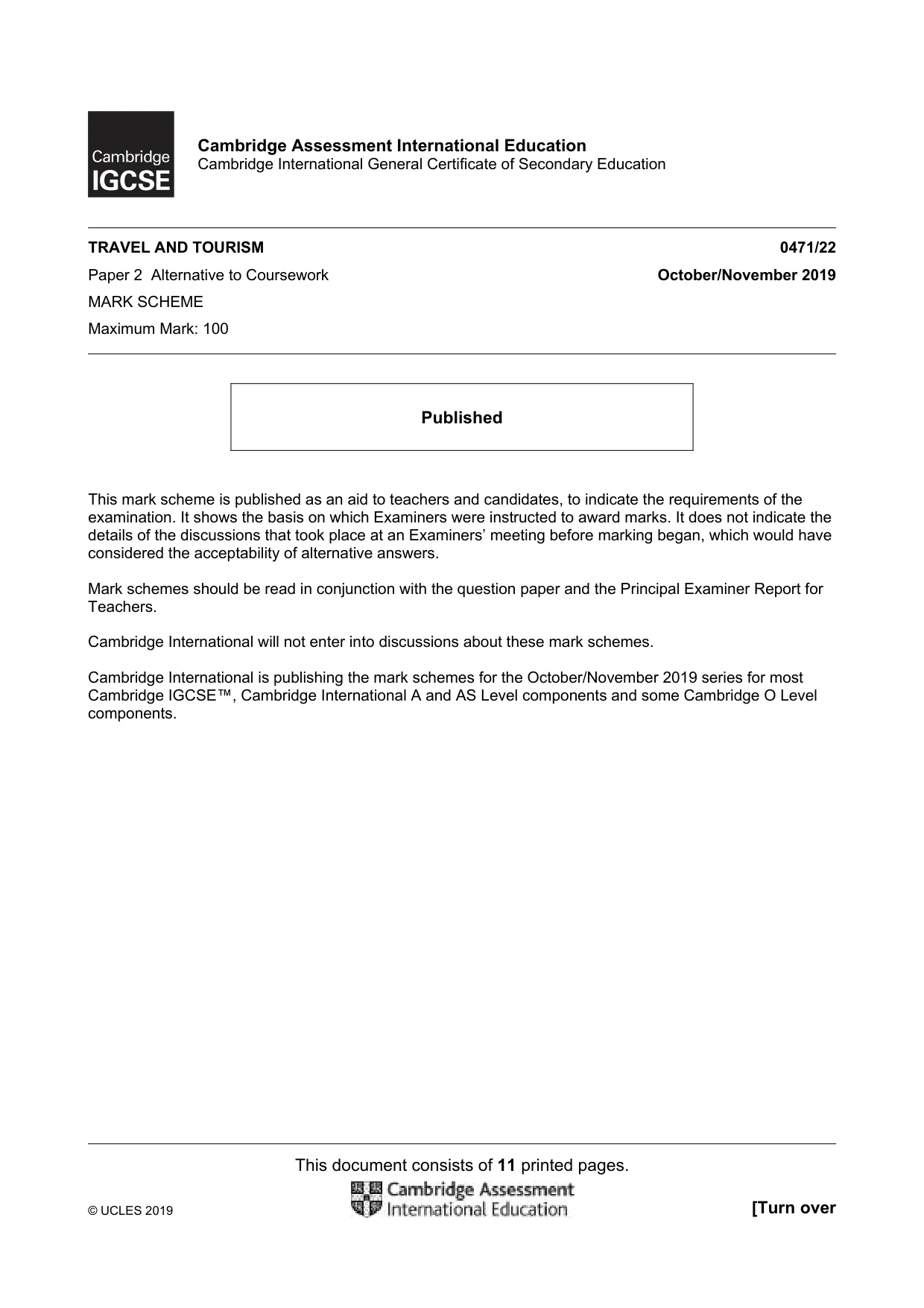
Question paper, page 13
13 0471/22/O/N/19 © UCLES 2019 (d) Discuss the importance to Canada of having competitive advantage over other destinations. … … … … … … … … … … … … … … … … … … [9] [Total: 25]
Question paper, page 14
14 0471/22/O/N/19 © UCLES 2019 BLANK PAGE
Question paper, page 15
15 0471/22/O/N/19 © UCLES 2019 BLANK PAGE
Question paper, page 16
16 0471/22/O/N/19 © UCLES 2019 Permission to reproduce items where third-party owned material protected by copyright is included has been sought and cleared where possible. Every reasonable effort has been made by the publisher (UCLES) to trace copyright holders, but if any items requiring clearance have unwittingly been included, the publisher will be pleased to make amends at the earliest possible opportunity. To avoid the issue of disclosure of answer-related information to candidates, all copyright acknowledgements are reproduced online in the Cambridge Assessment International Education Copyright Acknowledgements Booklet. This is produced for each series of examinations and is freely available to download at www.cambridgeinternational.org after the live examination series. Cambridge Assessment International Education is part of the Cambridge Assessment Group. Cambridge Assessment is the brand name of the University of Cambridge Local Examinations Syndicate (UCLES), which itself is a department of the University of Cambridge. BLANK PAGE
Mark scheme, page 1
This document consists of 11 printed pages. © UCLES 2019 [Turn over Cambridge Assessment International Education Cambridge International General Certificate of Secondary Education TRAVEL AND TOURISM 0471/22 Paper 2 Alternative to Coursework October/November 2019 MARK SCHEME Maximum Mark: 100 Published This mark scheme is published as an aid to teachers and candidates, to indicate the requirements of the examination. It shows the basis on which Examiners were instructed to award marks. It does not indicate the details of the discussions that took place at an Examiners’ meeting before marking began, which would have considered the acceptability of alternative answers. Mark schemes should be read in conjunction with the question paper and the Principal Examiner Report for Teachers. Cambridge International will not enter into discussions about these mark schemes. Cambridge International is publishing the mark schemes for the October/November 2019 series for most Cambridge IGCSE™, Cambridge International A and AS Level components and some Cambridge O Level components.
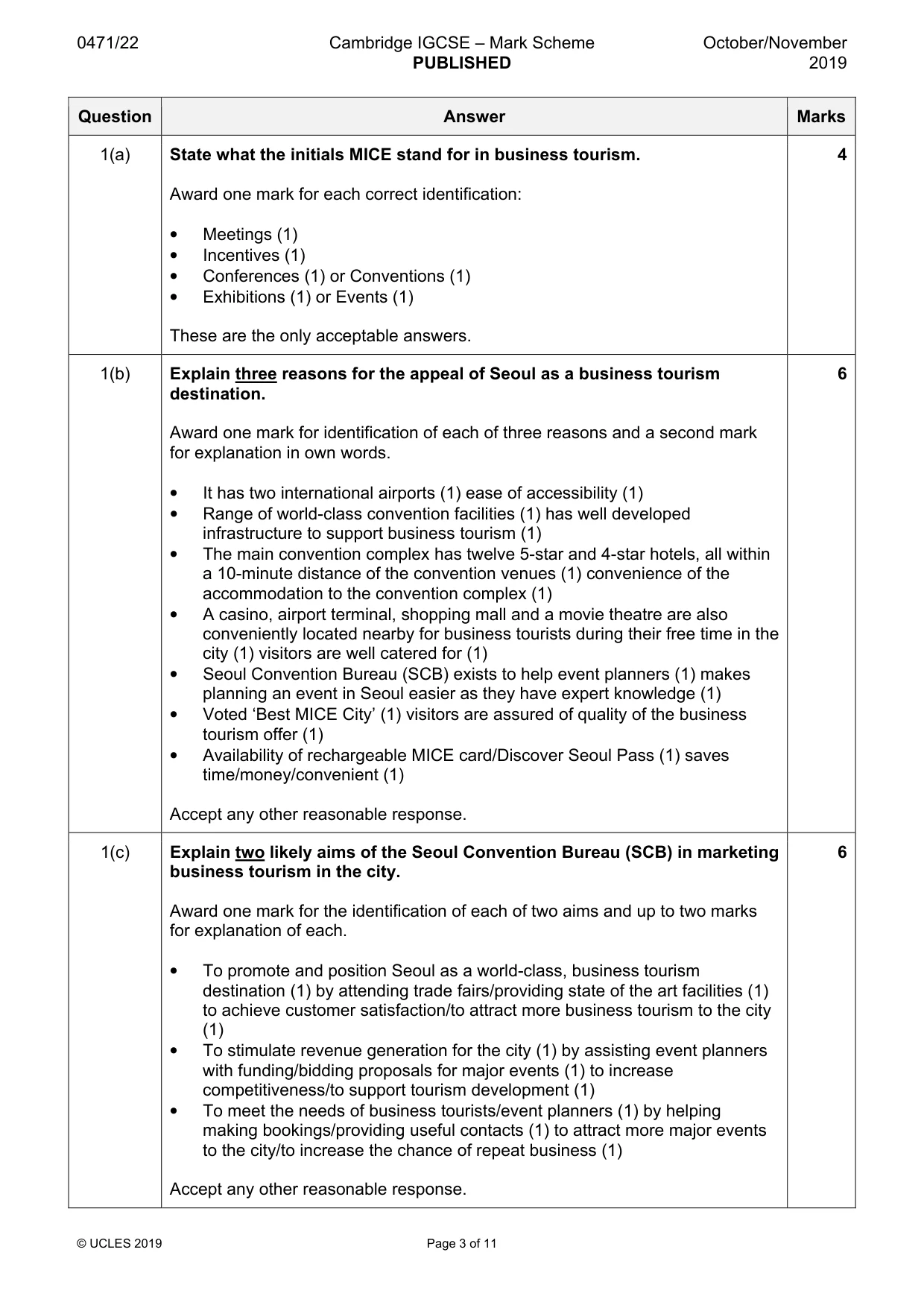
Mark scheme, page 2
0471/22 Cambridge IGCSE – Mark Scheme PUBLISHED October/November 2019 © UCLES 2019 Page 2 of 11 Generic Marking Principles These general marking principles must be applied by all examiners when marking candidate answers. They should be applied alongside the specific content of the mark scheme or generic level descriptors for a question. Each question paper and mark scheme will also comply with these marking principles. GENERIC MARKING PRINCIPLE 1: Marks must be awarded in line with: • the specific content of the mark scheme or the generic level descriptors for the question • the specific skills defined in the mark scheme or in the generic level descriptors for the question • the standard of response required by a candidate as exemplified by the standardisation scripts. GENERIC MARKING PRINCIPLE 2: Marks awarded are always whole marks (not half marks, or other fractions). GENERIC MARKING PRINCIPLE 3: Marks must be awarded positively: • marks are awarded for correct/valid answers, as defined in the mark scheme. However, credit is given for valid answers which go beyond the scope of the syllabus and mark scheme, referring to your Team Leader as appropriate • marks are awarded when candidates clearly demonstrate what they know and can do • marks are not deducted for errors • marks are not deducted for omissions • answers should only be judged on the quality of spelling, punctuation and grammar when these features are specifically assessed by the question as indicated by the mark scheme. The meaning, however, should be unambiguous. GENERIC MARKING PRINCIPLE 4: Rules must be applied consistently e.g. in situations where candidates have not followed instructions or in the application of generic level descriptors. GENERIC MARKING PRINCIPLE 5: Marks should be awarded using the full range of marks defined in the mark scheme for the question (however; the use of the full mark range may be limited according to the quality of the candidate responses seen). GENERIC MARKING PRINCIPLE 6: Marks awarded are based solely on the requirements as defined in the mark scheme. Marks should not be awarded with grade thresholds or grade descriptors in mind.
Mark scheme, page 3
0471/22 Cambridge IGCSE – Mark Scheme PUBLISHED October/November 2019 © UCLES 2019 Page 3 of 11 Question Answer Marks 1(a) State what the initials MICE stand for in business tourism. Award one mark for each correct identification: • Meetings (1) • Incentives (1) • Conferences (1) or Conventions (1) • Exhibitions (1) or Events (1) These are the only acceptable answers. 4 1(b) Explain three reasons for the appeal of Seoul as a business tourism destination. Award one mark for identification of each of three reasons and a second mark for explanation in own words. • It has two international airports (1) ease of accessibility (1) • Range of world-class convention facilities (1) has well developed infrastructure to support business tourism (1) • The main convention complex has twelve 5-star and 4-star hotels, all within a 10-minute distance of the convention venues (1) convenience of the accommodation to the convention complex (1) • A casino, airport terminal, shopping mall and a movie theatre are also conveniently located nearby for business tourists during their free time in the city (1) visitors are well catered for (1) • Seoul Convention Bureau (SCB) exists to help event planners (1) makes planning an event in Seoul easier as they have expert knowledge (1) • Voted ‘Best MICE City’ (1) visitors are assured of quality of the business tourism offer (1) • Availability of rechargeable MICE card/Discover Seoul Pass (1) saves time/money/convenient (1) Accept any other reasonable response. 6 1(c) Explain two likely aims of the Seoul Convention Bureau (SCB) in marketing business tourism in the city. Award one mark for the identification of each of two aims and up to two marks for explanation of each. • To promote and position Seoul as a world-class, business tourism destination (1) by attending trade fairs/providing state of the art facilities (1) to achieve customer satisfaction/to attract more business tourism to the city (1) • To stimulate revenue generation for the city (1) by assisting event planners with funding/bidding proposals for major events (1) to increase competitiveness/to support tourism development (1) • To meet the needs of business tourists/event planners (1) by helping making bookings/providing useful contacts (1) to attract more major events to the city/to increase the chance of repeat business (1) Accept any other reasonable response. 6
Mark scheme, page 4
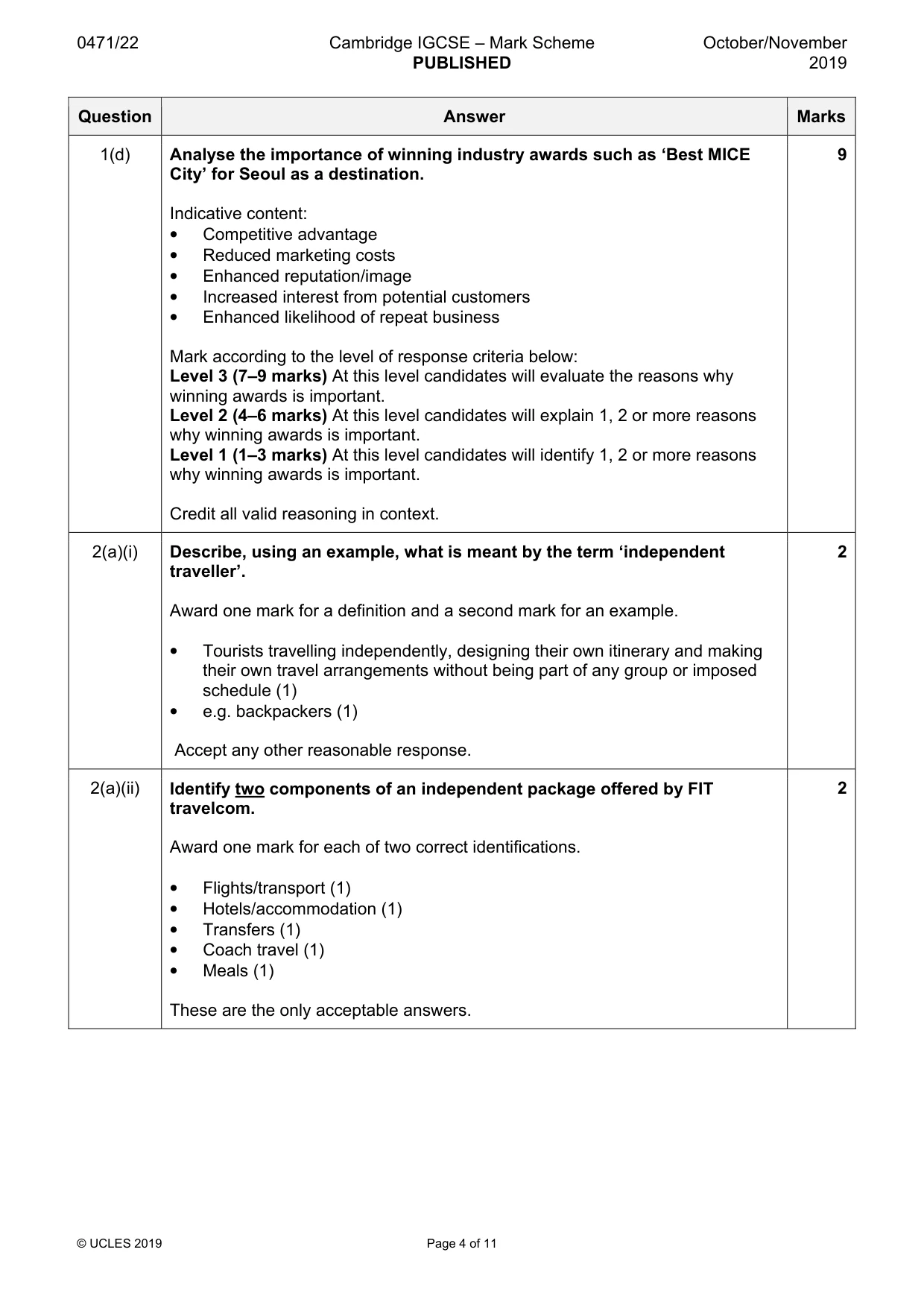
0471/22 Cambridge IGCSE – Mark Scheme PUBLISHED October/November 2019 © UCLES 2019 Page 4 of 11 Question Answer Marks 1(d) Analyse the importance of winning industry awards such as ‘Best MICE City’ for Seoul as a destination. Indicative content: • Competitive advantage • Reduced marketing costs • Enhanced reputation/image • Increased interest from potential customers • Enhanced likelihood of repeat business Mark according to the level of response criteria below: Level 3 (7–9 marks) At this level candidates will evaluate the reasons why winning awards is important. Level 2 (4–6 marks) At this level candidates will explain 1, 2 or more reasons why winning awards is important. Level 1 (1–3 marks) At this level candidates will identify 1, 2 or more reasons why winning awards is important. Credit all valid reasoning in context. 9 2(a)(i) Describe, using an example, what is meant by the term ‘independent traveller’. Award one mark for a definition and a second mark for an example. • Tourists travelling independently, designing their own itinerary and making their own travel arrangements without being part of any group or imposed schedule (1) • e.g. backpackers (1) Accept any other reasonable response. 2 2(a)(ii) Identify two components of an independent package offered by FIT travelcom. Award one mark for each of two correct identifications. • Flights/transport (1) • Hotels/accommodation (1) • Transfers (1) • Coach travel (1) • Meals (1) These are the only acceptable answers. 2
Mark scheme, page 5
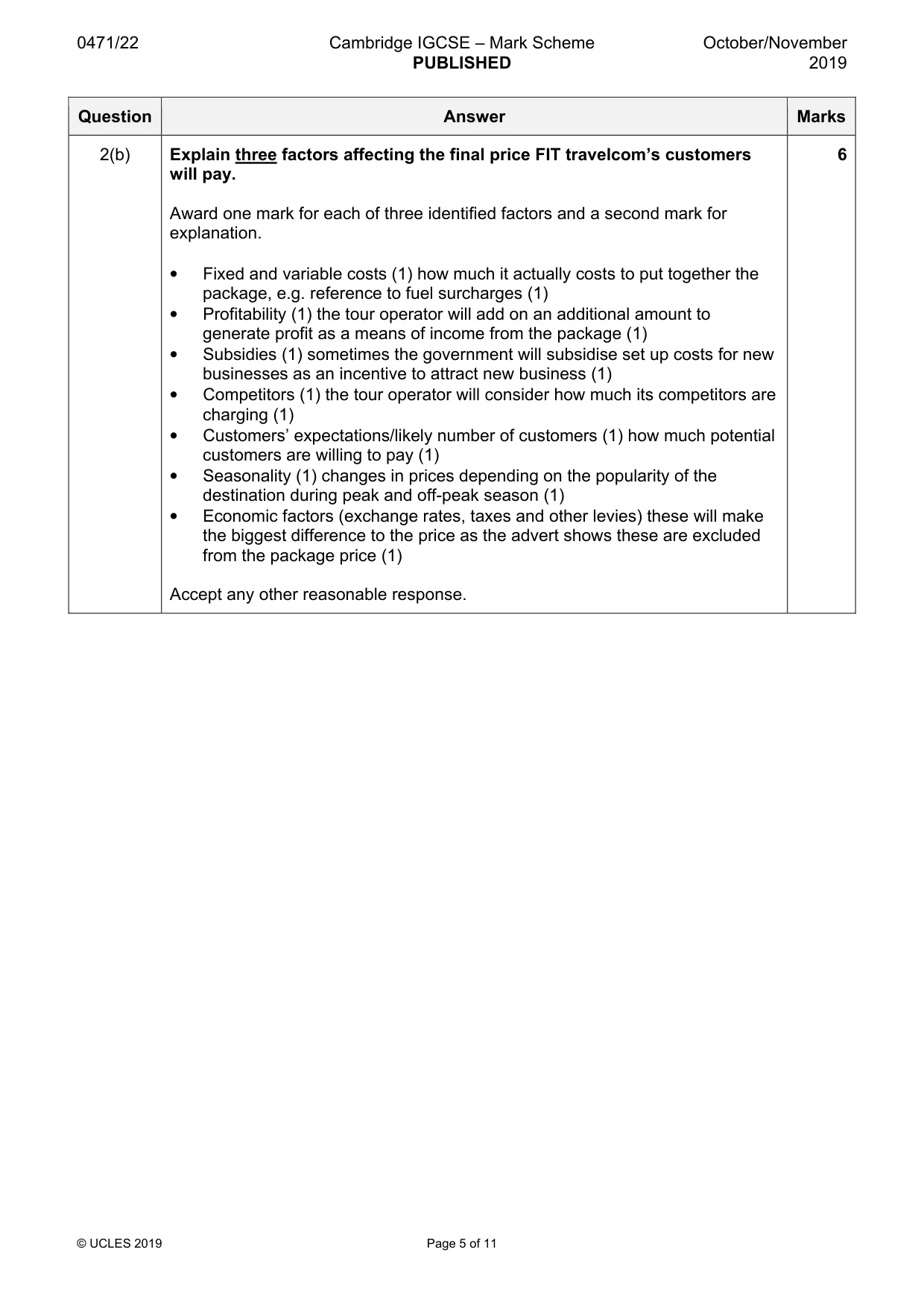
0471/22 Cambridge IGCSE – Mark Scheme PUBLISHED October/November 2019 © UCLES 2019 Page 5 of 11 Question Answer Marks 2(b) Explain three factors affecting the final price FIT travelcom’s customers will pay. Award one mark for each of three identified factors and a second mark for explanation. • Fixed and variable costs (1) how much it actually costs to put together the package, e.g. reference to fuel surcharges (1) • Profitability (1) the tour operator will add on an additional amount to generate profit as a means of income from the package (1) • Subsidies (1) sometimes the government will subsidise set up costs for new businesses as an incentive to attract new business (1) • Competitors (1) the tour operator will consider how much its competitors are charging (1) • Customers’ expectations/likely number of customers (1) how much potential customers are willing to pay (1) • Seasonality (1) changes in prices depending on the popularity of the destination during peak and off-peak season (1) • Economic factors (exchange rates, taxes and other levies) these will make the biggest difference to the price as the advert shows these are excluded from the package price (1) Accept any other reasonable response. 6
Mark scheme, page 6
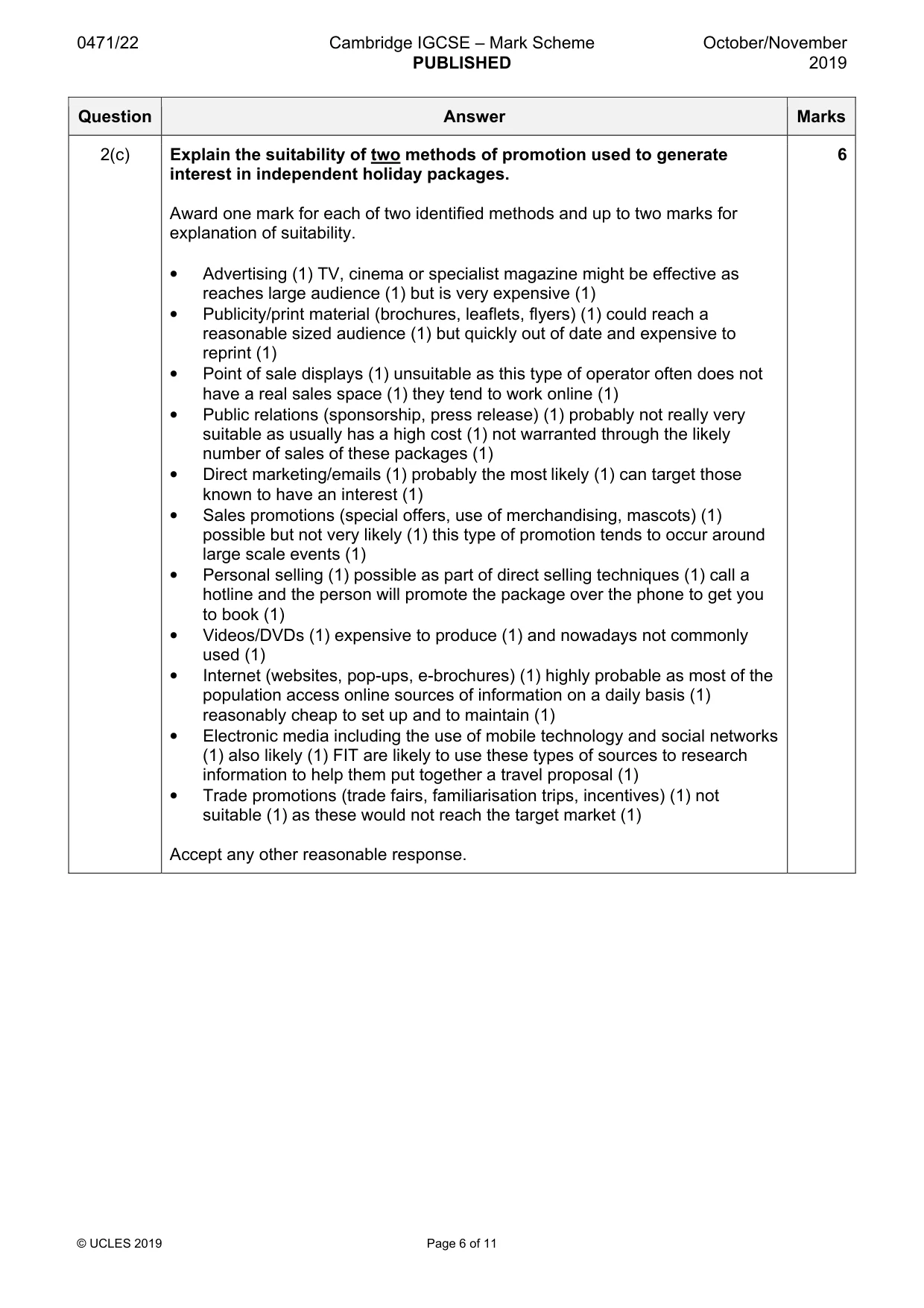
0471/22 Cambridge IGCSE – Mark Scheme PUBLISHED October/November 2019 © UCLES 2019 Page 6 of 11 Question Answer Marks 2(c) Explain the suitability of two methods of promotion used to generate interest in independent holiday packages. Award one mark for each of two identified methods and up to two marks for explanation of suitability. • Advertising (1) TV, cinema or specialist magazine might be effective as reaches large audience (1) but is very expensive (1) • Publicity/print material (brochures, leaflets, flyers) (1) could reach a reasonable sized audience (1) but quickly out of date and expensive to reprint (1) • Point of sale displays (1) unsuitable as this type of operator often does not have a real sales space (1) they tend to work online (1) • Public relations (sponsorship, press release) (1) probably not really very suitable as usually has a high cost (1) not warranted through the likely number of sales of these packages (1) • Direct marketing/emails (1) probably the most likely (1) can target those known to have an interest (1) • Sales promotions (special offers, use of merchandising, mascots) (1) possible but not very likely (1) this type of promotion tends to occur around large scale events (1) • Personal selling (1) possible as part of direct selling techniques (1) call a hotline and the person will promote the package over the phone to get you to book (1) • Videos/DVDs (1) expensive to produce (1) and nowadays not commonly used (1) • Internet (websites, pop-ups, e-brochures) (1) highly probable as most of the population access online sources of information on a daily basis (1) reasonably cheap to set up and to maintain (1) • Electronic media including the use of mobile technology and social networks (1) also likely (1) FIT are likely to use these types of sources to research information to help them put together a travel proposal (1) • Trade promotions (trade fairs, familiarisation trips, incentives) (1) not suitable (1) as these would not reach the target market (1) Accept any other reasonable response. 6
Mark scheme, page 7
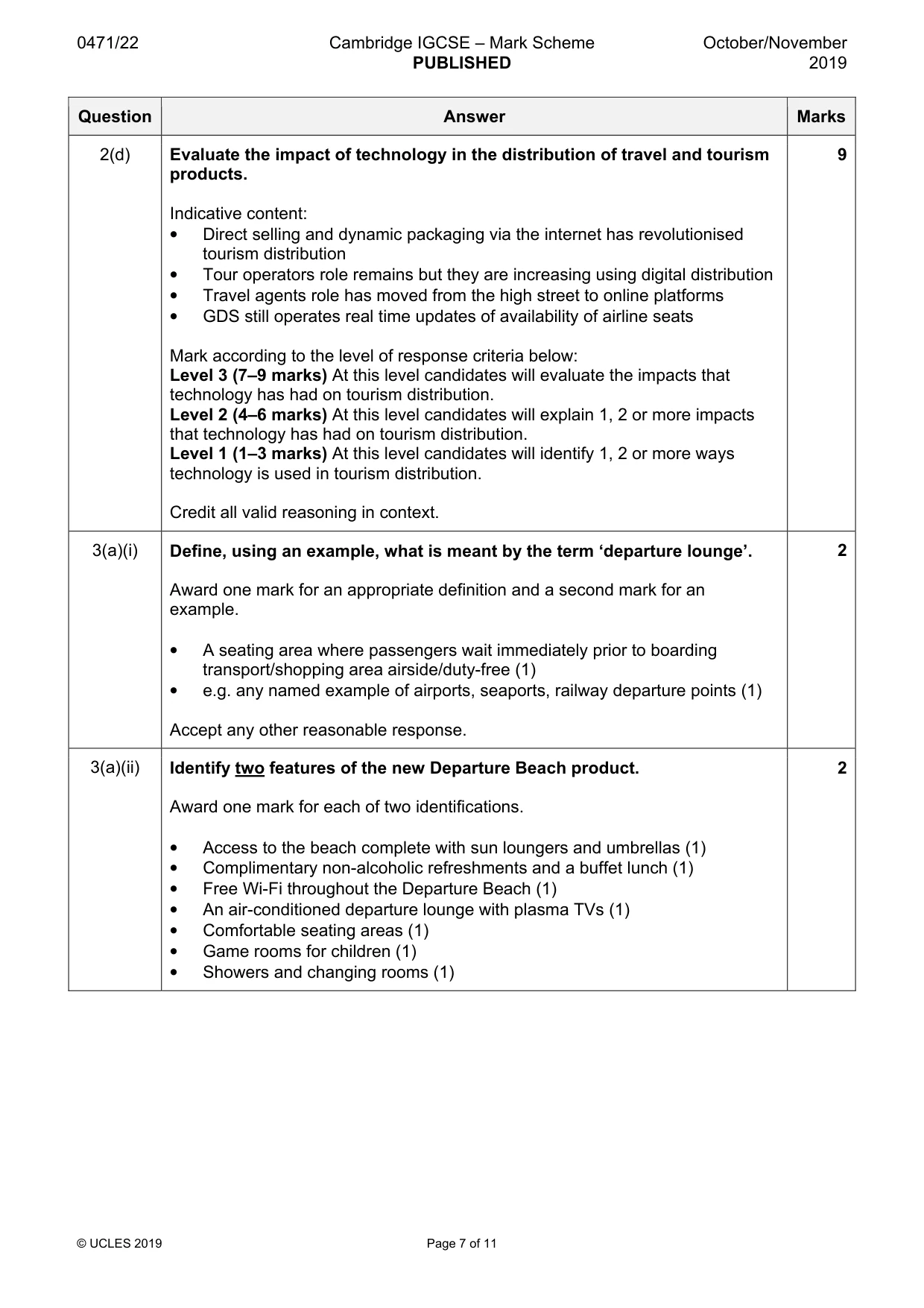
0471/22 Cambridge IGCSE – Mark Scheme PUBLISHED October/November 2019 © UCLES 2019 Page 7 of 11 Question Answer Marks 2(d) Evaluate the impact of technology in the distribution of travel and tourism products. Indicative content: • Direct selling and dynamic packaging via the internet has revolutionised tourism distribution • Tour operators role remains but they are increasing using digital distribution • Travel agents role has moved from the high street to online platforms • GDS still operates real time updates of availability of airline seats Mark according to the level of response criteria below: Level 3 (7–9 marks) At this level candidates will evaluate the impacts that technology has had on tourism distribution. Level 2 (4–6 marks) At this level candidates will explain 1, 2 or more impacts that technology has had on tourism distribution. Level 1 (1–3 marks) At this level candidates will identify 1, 2 or more ways technology is used in tourism distribution. Credit all valid reasoning in context. 9 3(a)(i) Define, using an example, what is meant by the term ‘departure lounge’. Award one mark for an appropriate definition and a second mark for an example. • A seating area where passengers wait immediately prior to boarding transport/shopping area airside/duty-free (1) • e.g. any named example of airports, seaports, railway departure points (1) Accept any other reasonable response. 2 3(a)(ii) Identify two features of the new Departure Beach product. Award one mark for each of two identifications. • Access to the beach complete with sun loungers and umbrellas (1) • Complimentary non-alcoholic refreshments and a buffet lunch (1) • Free Wi-Fi throughout the Departure Beach (1) • An air-conditioned departure lounge with plasma TVs (1) • Comfortable seating areas (1) • Game rooms for children (1) • Showers and changing rooms (1) 2
Mark scheme, page 8
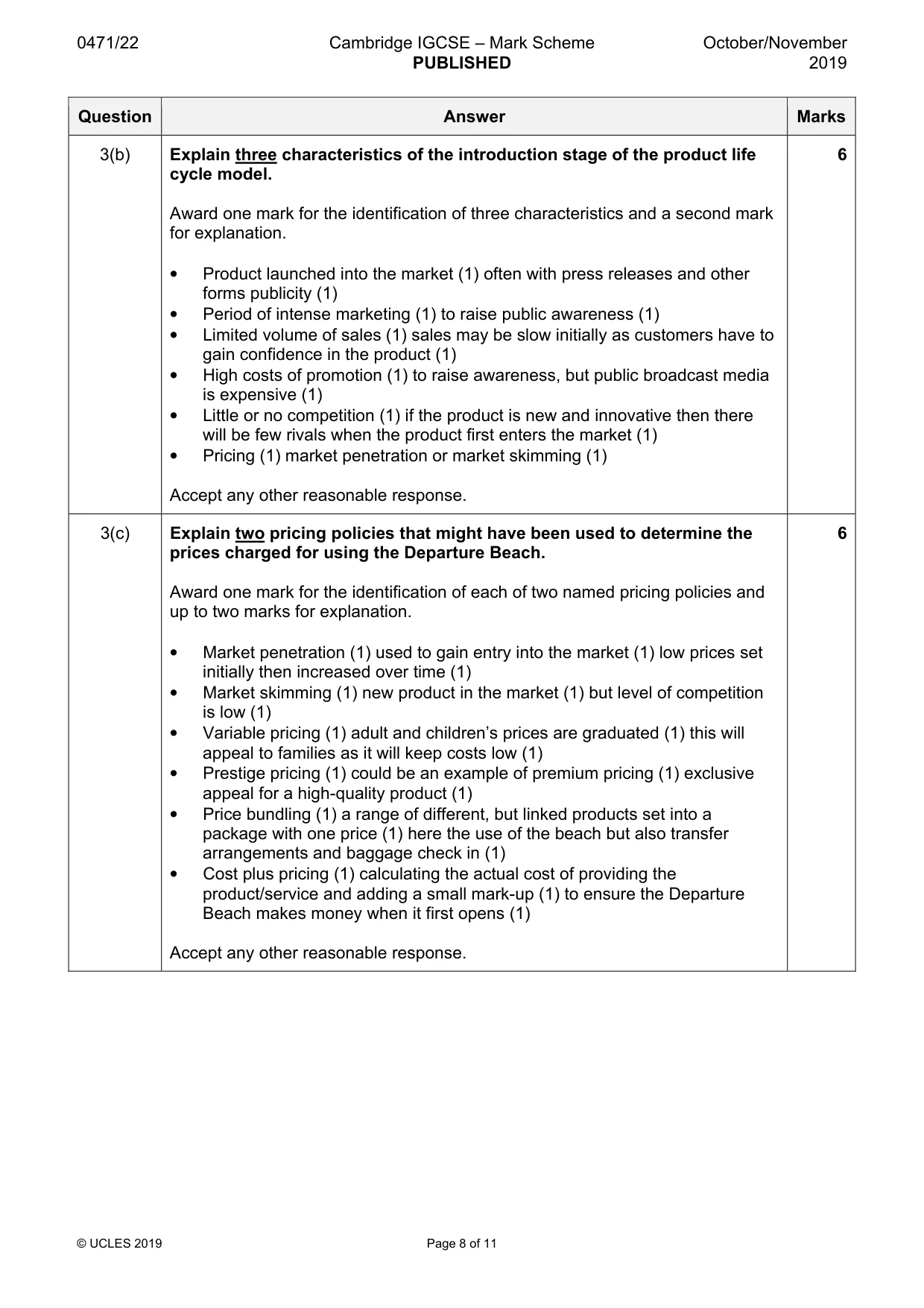
0471/22 Cambridge IGCSE – Mark Scheme PUBLISHED October/November 2019 © UCLES 2019 Page 8 of 11 Question Answer Marks 3(b) Explain three characteristics of the introduction stage of the product life cycle model. Award one mark for the identification of three characteristics and a second mark for explanation. • Product launched into the market (1) often with press releases and other forms publicity (1) • Period of intense marketing (1) to raise public awareness (1) • Limited volume of sales (1) sales may be slow initially as customers have to gain confidence in the product (1) • High costs of promotion (1) to raise awareness, but public broadcast media is expensive (1) • Little or no competition (1) if the product is new and innovative then there will be few rivals when the product first enters the market (1) • Pricing (1) market penetration or market skimming (1) Accept any other reasonable response. 6 3(c) Explain two pricing policies that might have been used to determine the prices charged for using the Departure Beach. Award one mark for the identification of each of two named pricing policies and up to two marks for explanation. • Market penetration (1) used to gain entry into the market (1) low prices set initially then increased over time (1) • Market skimming (1) new product in the market (1) but level of competition is low (1) • Variable pricing (1) adult and children’s prices are graduated (1) this will appeal to families as it will keep costs low (1) • Prestige pricing (1) could be an example of premium pricing (1) exclusive appeal for a high-quality product (1) • Price bundling (1) a range of different, but linked products set into a package with one price (1) here the use of the beach but also transfer arrangements and baggage check in (1) • Cost plus pricing (1) calculating the actual cost of providing the product/service and adding a small mark-up (1) to ensure the Departure Beach makes money when it first opens (1) Accept any other reasonable response. 6
Mark scheme, page 9
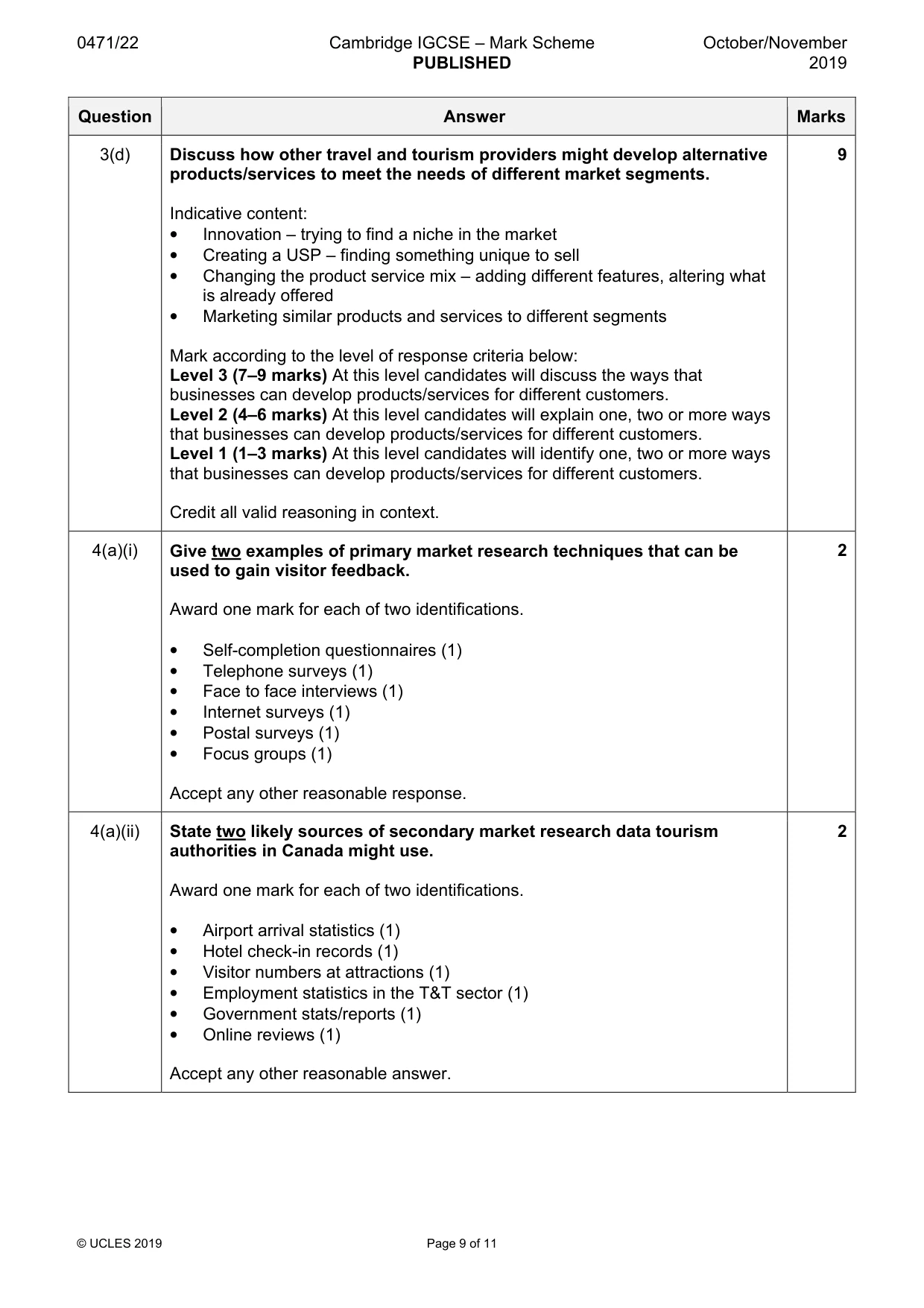
0471/22 Cambridge IGCSE – Mark Scheme PUBLISHED October/November 2019 © UCLES 2019 Page 9 of 11 Question Answer Marks 3(d) Discuss how other travel and tourism providers might develop alternative products/services to meet the needs of different market segments. Indicative content: • Innovation – trying to find a niche in the market • Creating a USP – finding something unique to sell • Changing the product service mix – adding different features, altering what is already offered • Marketing similar products and services to different segments Mark according to the level of response criteria below: Level 3 (7–9 marks) At this level candidates will discuss the ways that businesses can develop products/services for different customers. Level 2 (4–6 marks) At this level candidates will explain one, two or more ways that businesses can develop products/services for different customers. Level 1 (1–3 marks) At this level candidates will identify one, two or more ways that businesses can develop products/services for different customers. Credit all valid reasoning in context. 9 4(a)(i) Give two examples of primary market research techniques that can be used to gain visitor feedback. Award one mark for each of two identifications. • Self-completion questionnaires (1) • Telephone surveys (1) • Face to face interviews (1) • Internet surveys (1) • Postal surveys (1) • Focus groups (1) Accept any other reasonable response. 2 4(a)(ii) State two likely sources of secondary market research data tourism authorities in Canada might use. Award one mark for each of two identifications. • Airport arrival statistics (1) • Hotel check-in records (1) • Visitor numbers at attractions (1) • Employment statistics in the T&T sector (1) • Government stats/reports (1) • Online reviews (1) Accept any other reasonable answer. 2
Mark scheme, page 10
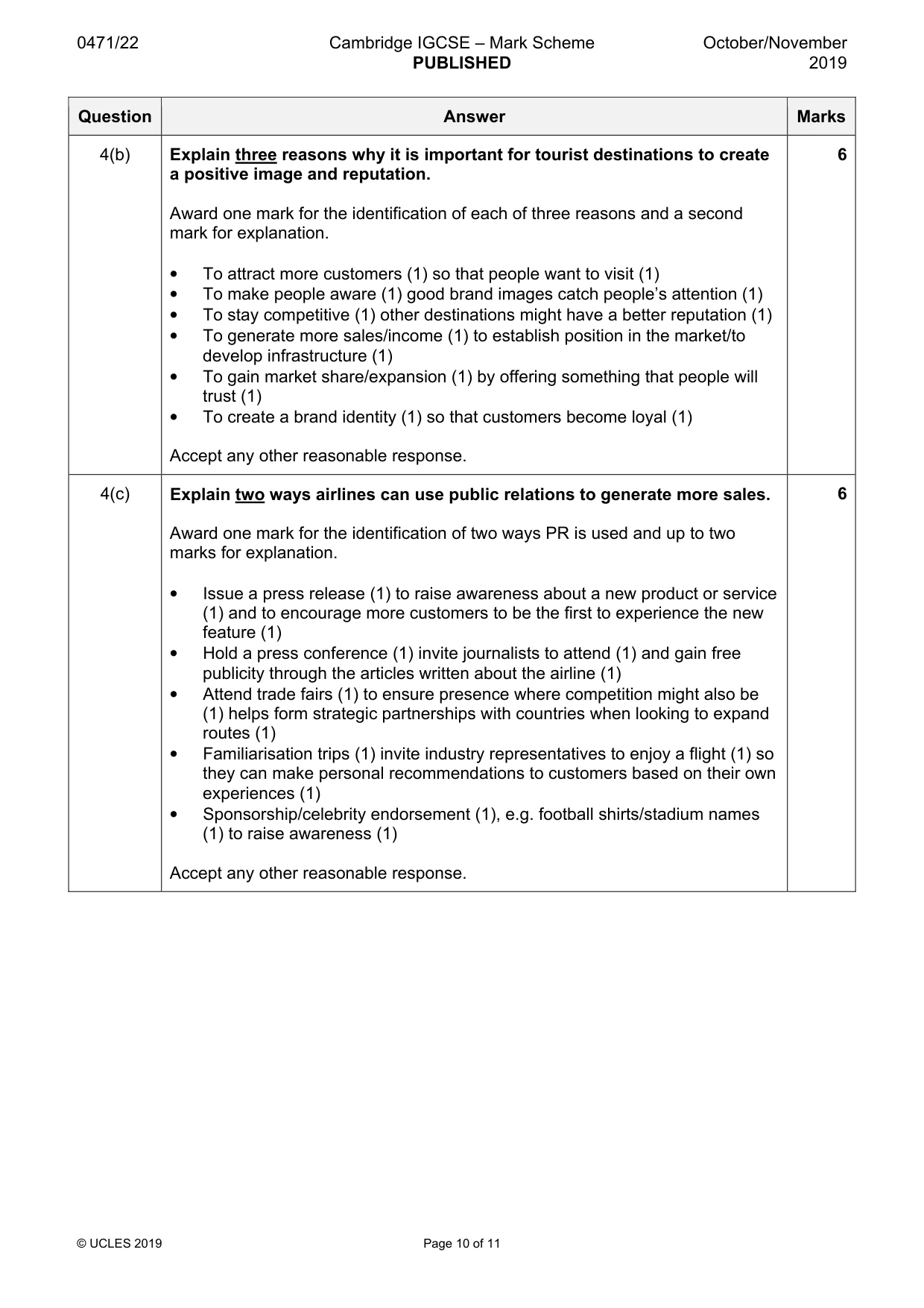
0471/22 Cambridge IGCSE – Mark Scheme PUBLISHED October/November 2019 © UCLES 2019 Page 10 of 11 Question Answer Marks 4(b) Explain three reasons why it is important for tourist destinations to create a positive image and reputation. Award one mark for the identification of each of three reasons and a second mark for explanation. • To attract more customers (1) so that people want to visit (1) • To make people aware (1) good brand images catch people’s attention (1) • To stay competitive (1) other destinations might have a better reputation (1) • To generate more sales/income (1) to establish position in the market/to develop infrastructure (1) • To gain market share/expansion (1) by offering something that people will trust (1) • To create a brand identity (1) so that customers become loyal (1) Accept any other reasonable response. 6 4(c) Explain two ways airlines can use public relations to generate more sales. Award one mark for the identification of two ways PR is used and up to two marks for explanation. • Issue a press release (1) to raise awareness about a new product or service (1) and to encourage more customers to be the first to experience the new feature (1) • Hold a press conference (1) invite journalists to attend (1) and gain free publicity through the articles written about the airline (1) • Attend trade fairs (1) to ensure presence where competition might also be (1) helps form strategic partnerships with countries when looking to expand routes (1) • Familiarisation trips (1) invite industry representatives to enjoy a flight (1) so they can make personal recommendations to customers based on their own experiences (1) • Sponsorship/celebrity endorsement (1), e.g. football shirts/stadium names (1) to raise awareness (1) Accept any other reasonable response. 6
Mark scheme, page 11
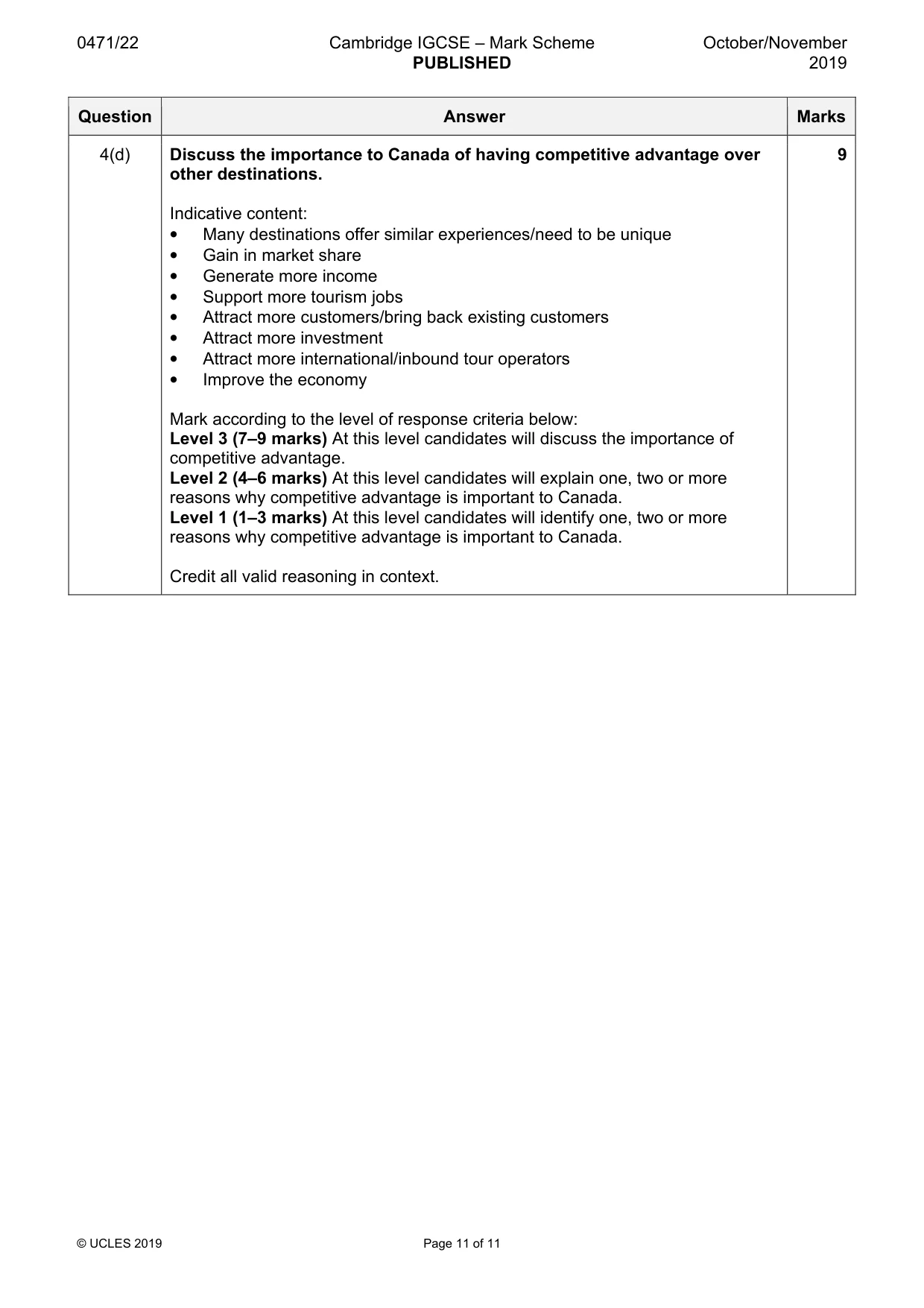
0471/22 Cambridge IGCSE – Mark Scheme PUBLISHED October/November 2019 © UCLES 2019 Page 11 of 11 Question Answer Marks 4(d) Discuss the importance to Canada of having competitive advantage over other destinations. Indicative content: • Many destinations offer similar experiences/need to be unique • Gain in market share • Generate more income • Support more tourism jobs • Attract more customers/bring back existing customers • Attract more investment • Attract more international/inbound tour operators • Improve the economy Mark according to the level of response criteria below: Level 3 (7–9 marks) At this level candidates will discuss the importance of competitive advantage. Level 2 (4–6 marks) At this level candidates will explain one, two or more reasons why competitive advantage is important to Canada. Level 1 (1–3 marks) At this level candidates will identify one, two or more reasons why competitive advantage is important to Canada. Credit all valid reasoning in context. 9
What you needed in this session
Cambridge’s own grade thresholds for 2019 Oct/Nov, Paper 2 · Variant 2. A higher threshold means an easier paper — the bar moves with how the cohort did.