Cambridge IGCSE Travel and Tourism 0471 — 2019 Oct/Nov Paper 2 · Variant 1
0471/21/O/N/19 · 100 marks · ≈113 min
The question paper and its mark scheme, free to read here and free to download. This is Cambridge’s own paper, exactly as it was sat.
Question paper16 pages



Mark scheme10 pages
Answers below. Sit the paper first if you are practising.
Paper as text
Question paper, page 1
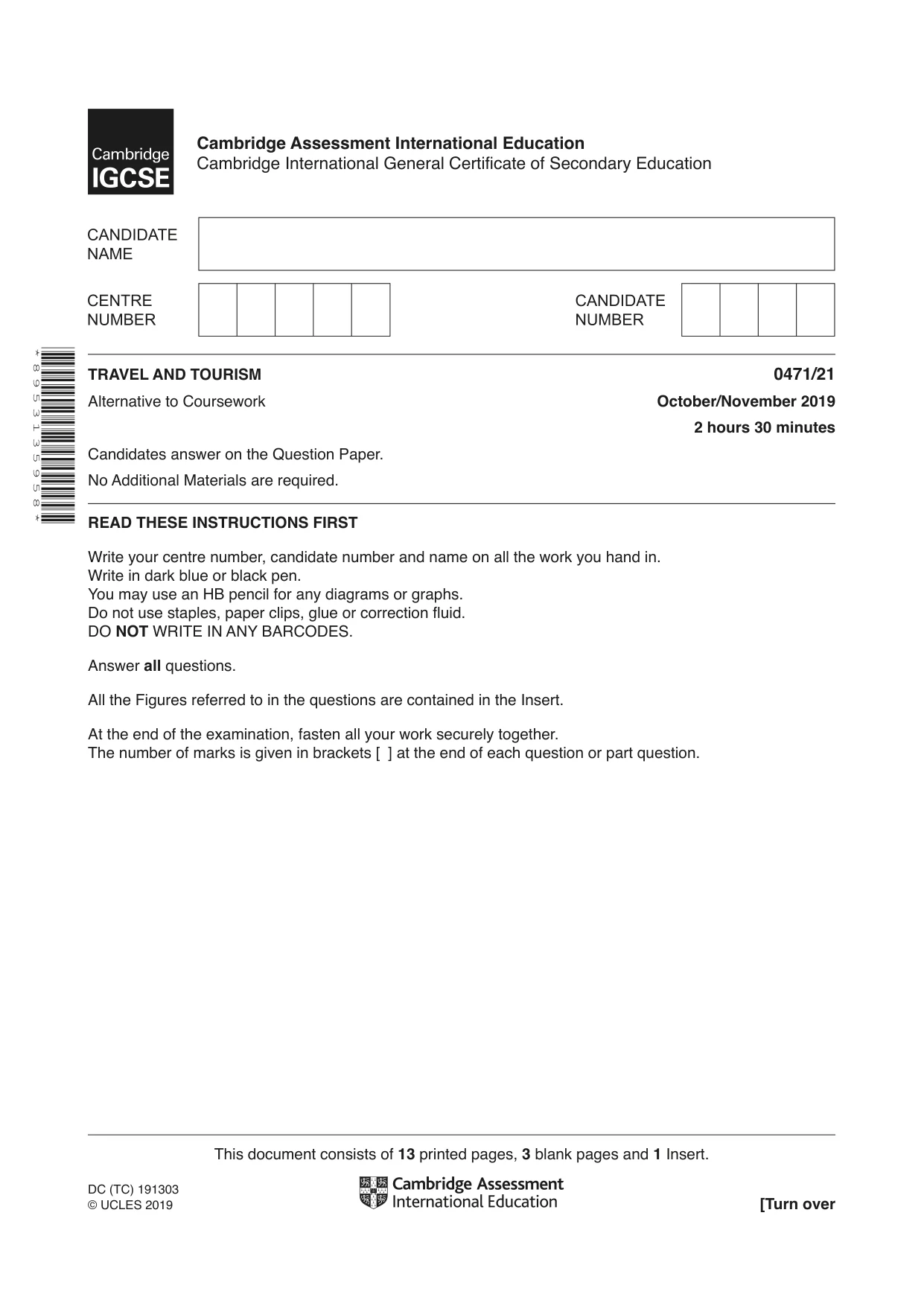
* 8 9 5 3 1 3 5 9 5 8 * Cambridge Assessment International Education Cambridge International General Certificate of Secondary Education This document consists of 13 printed pages, 3 blank pages and 1 Insert. DC (TC) 191303 © UCLES 2019 [Turn over TRAVEL AND TOURISM 0471/21 Alternative to Coursework October/November 2019 2 hours 30 minutes Candidates answer on the Question Paper. No Additional Materials are required. READ THESE INSTRUCTIONS FIRST Write your centre number, candidate number and name on all the work you hand in. Write in dark blue or black pen. You may use an HB pencil for any diagrams or graphs. Do not use staples, paper clips, glue or correction fluid. DO NOT WRITE IN ANY BARCODES. Answer all questions. All the Figures referred to in the questions are contained in the Insert. At the end of the examination, fasten all your work securely together. The number of marks is given in brackets [ ] at the end of each question or part question.
Question paper, page 2
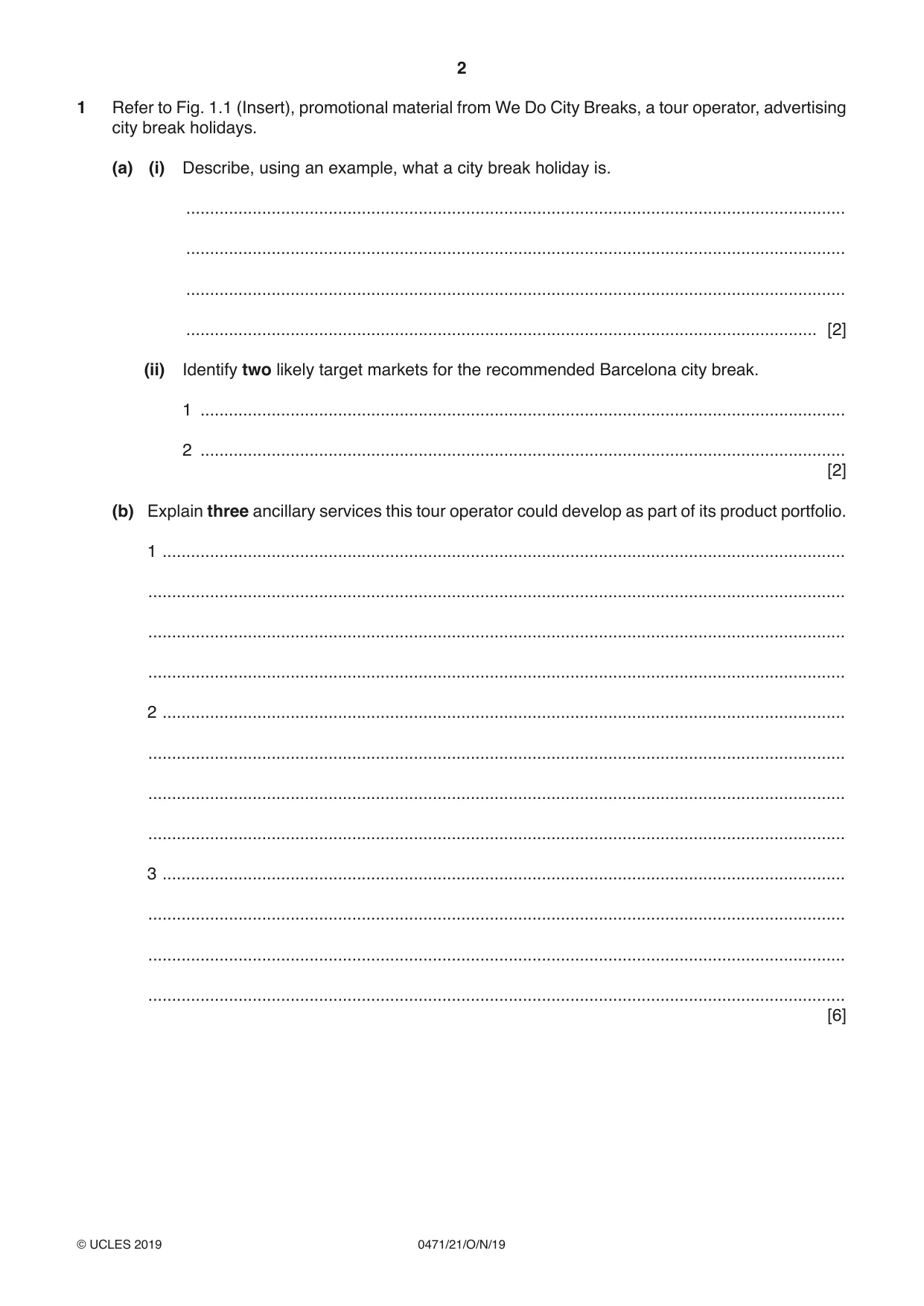
2 0471/21/O/N/19 © UCLES 2019 1 Refer to Fig. 1.1 (Insert), promotional material from We Do City Breaks, a tour operator, advertising city break holidays. (a) (i) Describe, using an example, what a city break holiday is. … … … … [2] (ii) Identify two likely target markets for the recommended Barcelona city break. 1 … 2 … [2] (b) Explain three ancillary services this tour operator could develop as part of its product portfolio. 1 … … … … 2 … … … … 3 … … … … [6]
Question paper, page 3
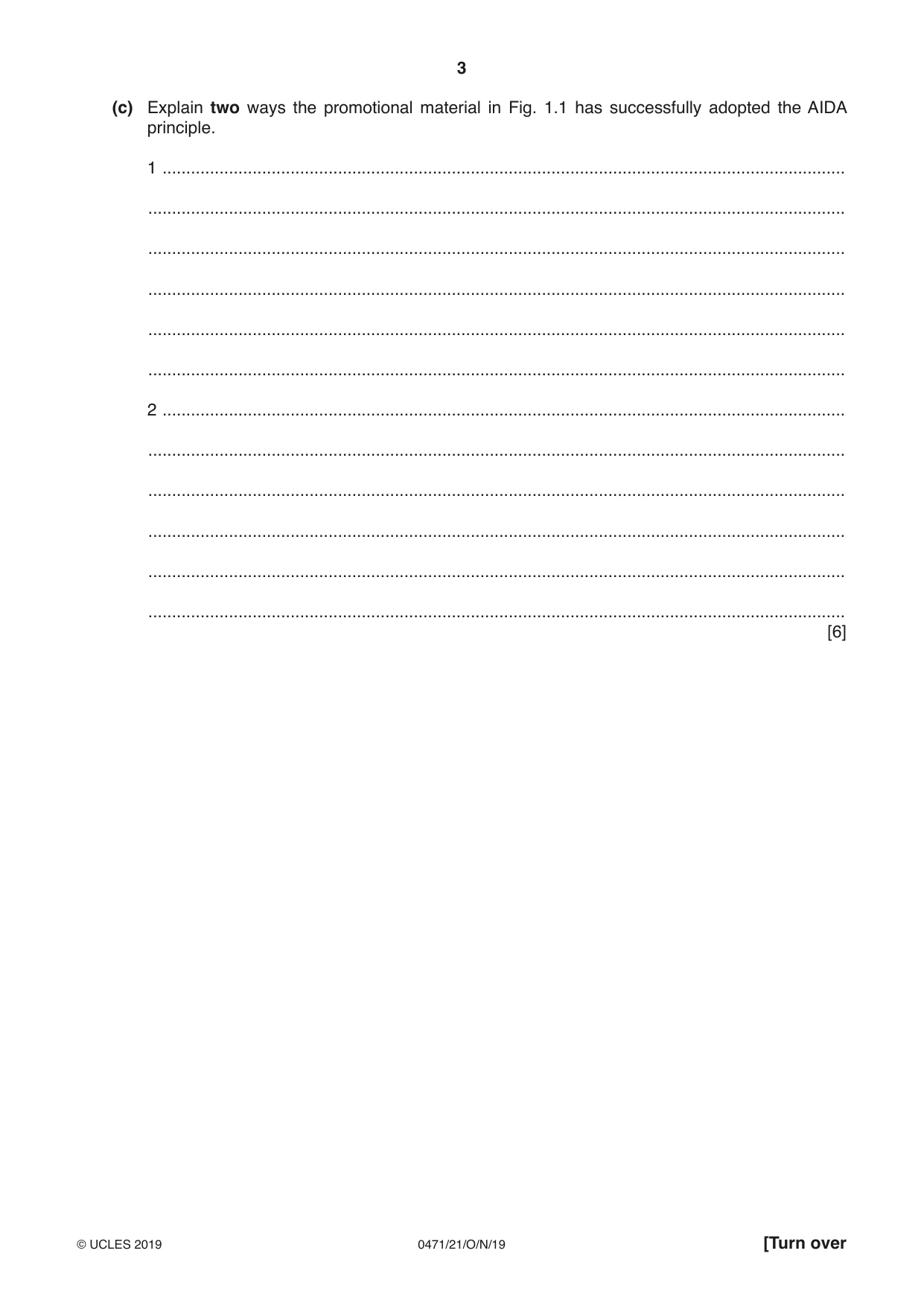
3 0471/21/O/N/19 © UCLES 2019 [Turn over (c) Explain two ways the promotional material in Fig. 1.1 has successfully adopted the AIDA principle. 1 … … … … … … 2 … … … … … … [6]
Question paper, page 4
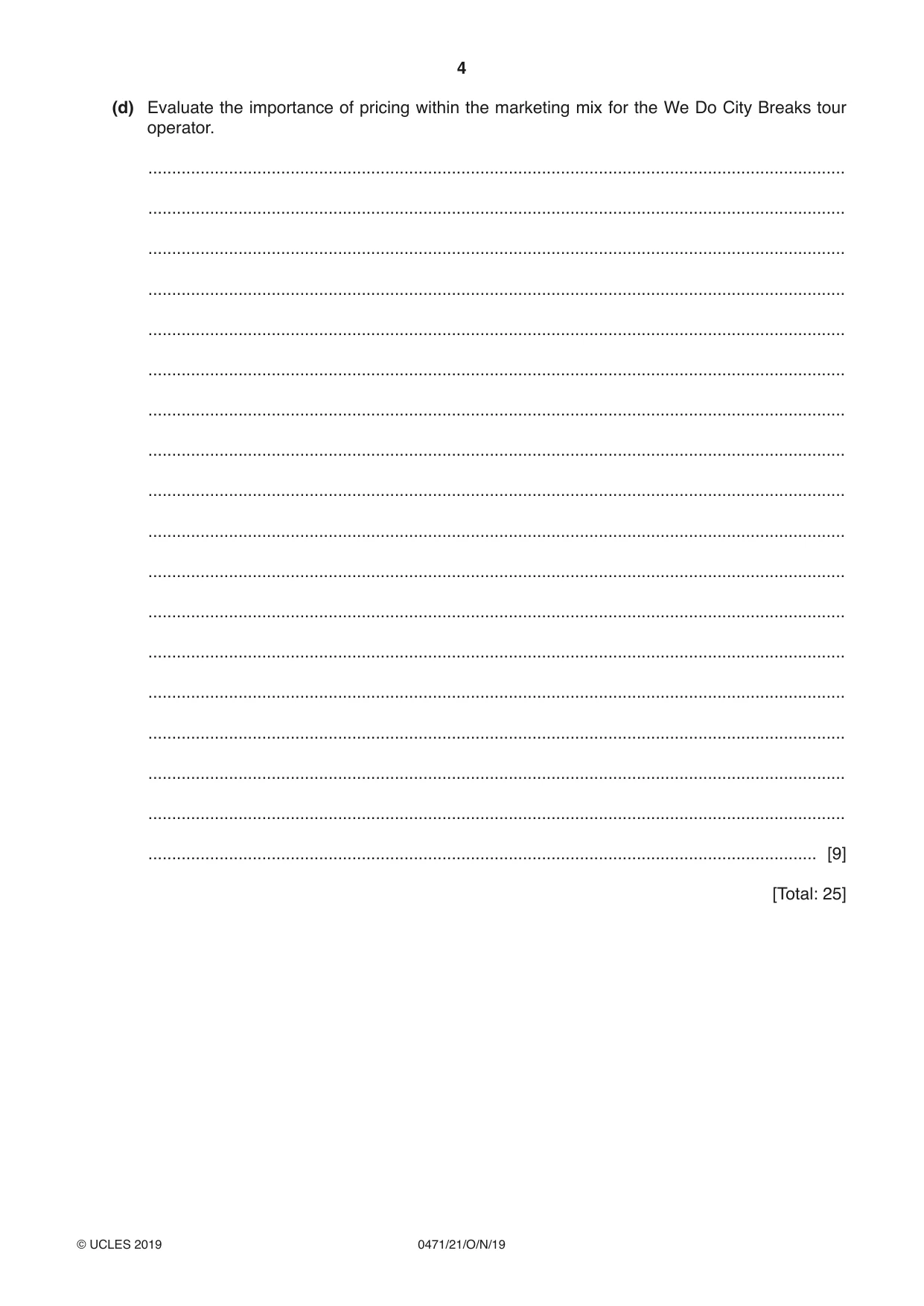
4 0471/21/O/N/19 © UCLES 2019 (d) Evaluate the importance of pricing within the marketing mix for the We Do City Breaks tour operator. … … … … … … … … … … … … … … … … … … [9] [Total: 25]
Question paper, page 5
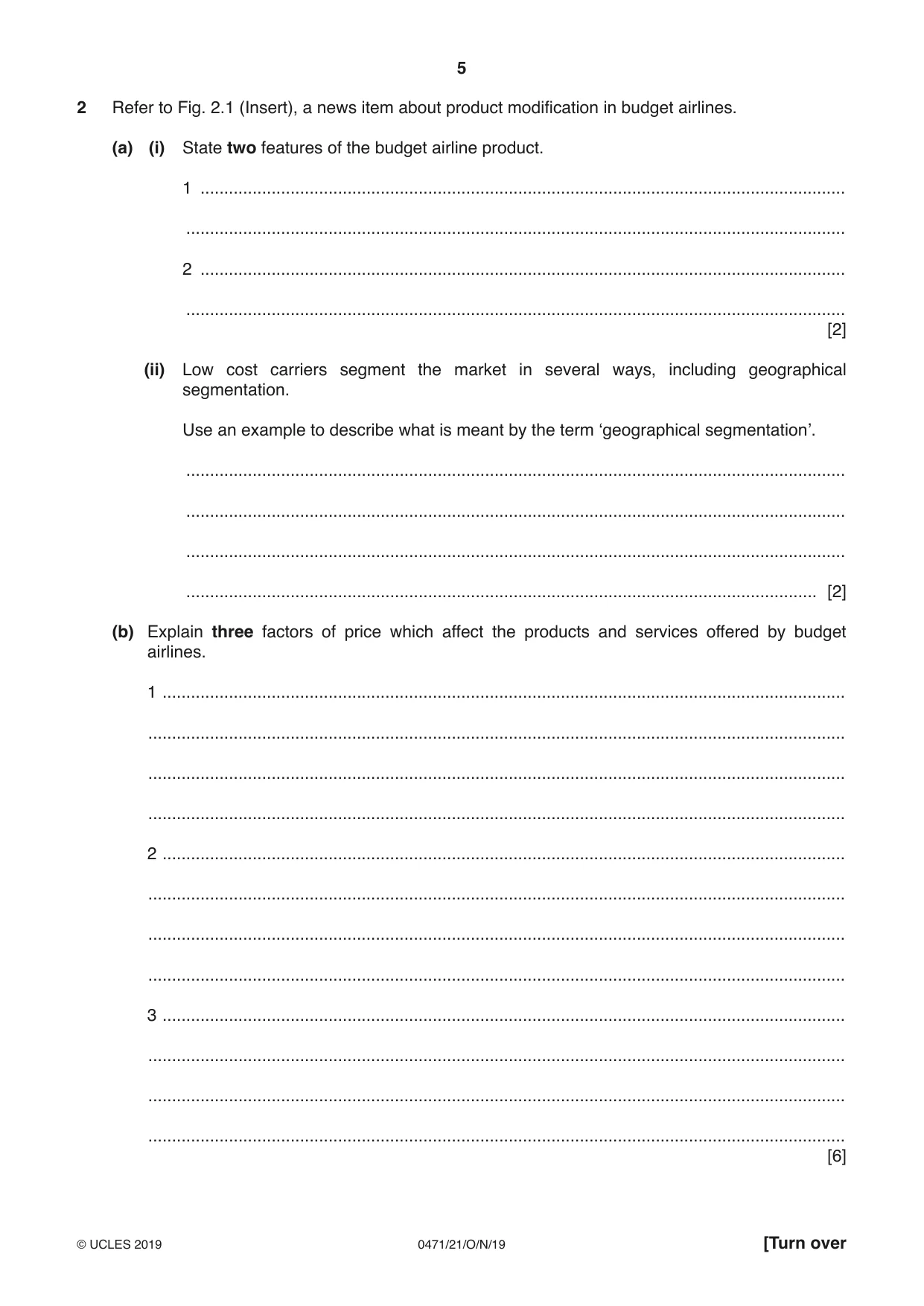
5 0471/21/O/N/19 © UCLES 2019 [Turn over 2 Refer to Fig. 2.1 (Insert), a news item about product modification in budget airlines. (a) (i) State two features of the budget airline product. 1 … … 2 … … [2] (ii) Low cost carriers segment the market in several ways, including geographical segmentation. Use an example to describe what is meant by the term ‘geographical segmentation’. … … … … [2] (b) Explain three factors of price which affect the products and services offered by budget airlines. 1 … … … … 2 … … … … 3 … … … … [6]
Question paper, page 6
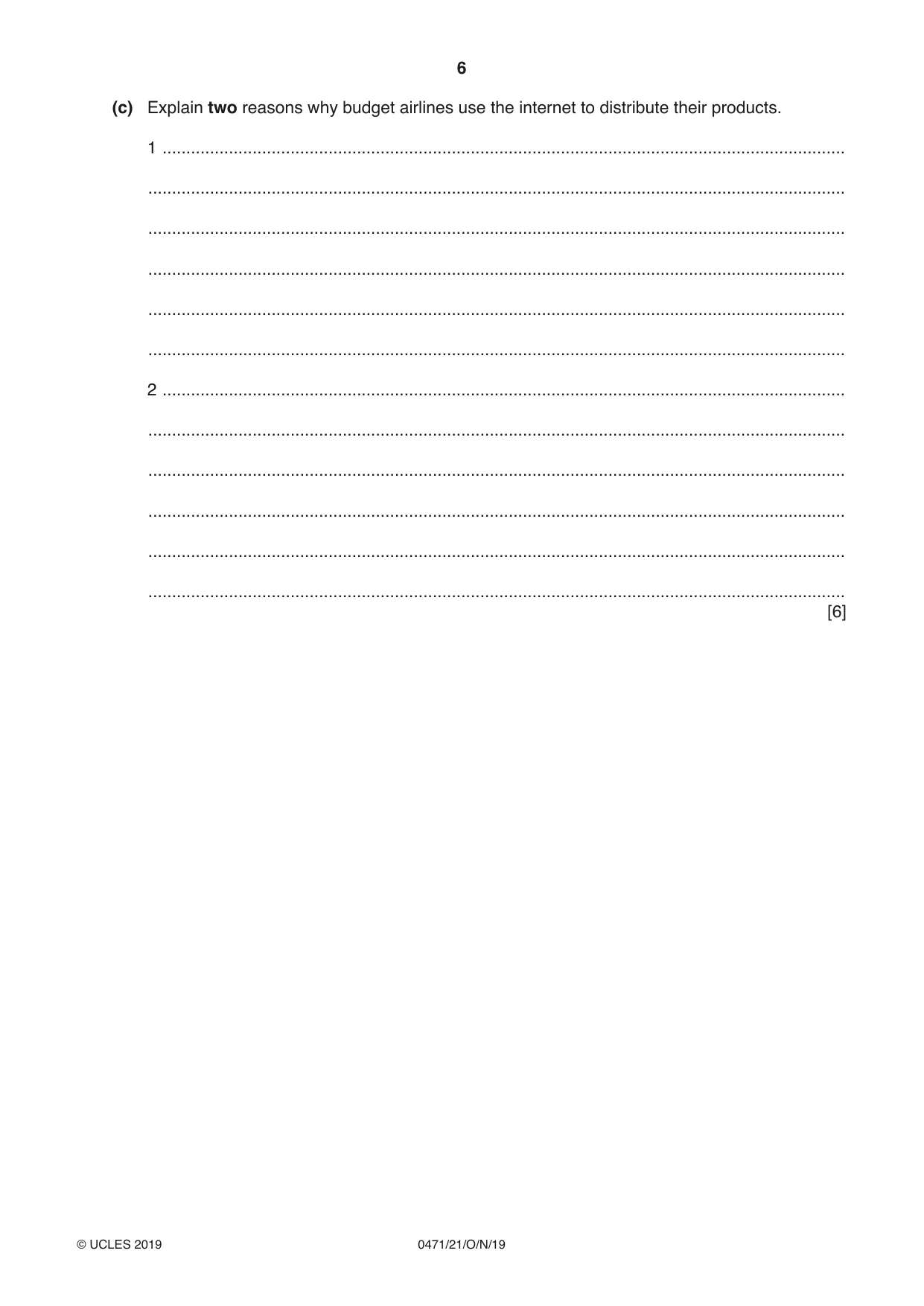
6 0471/21/O/N/19 © UCLES 2019 (c) Explain two reasons why budget airlines use the internet to distribute their products. 1 … … … … … … 2 … … … … … … [6]
Question paper, page 7
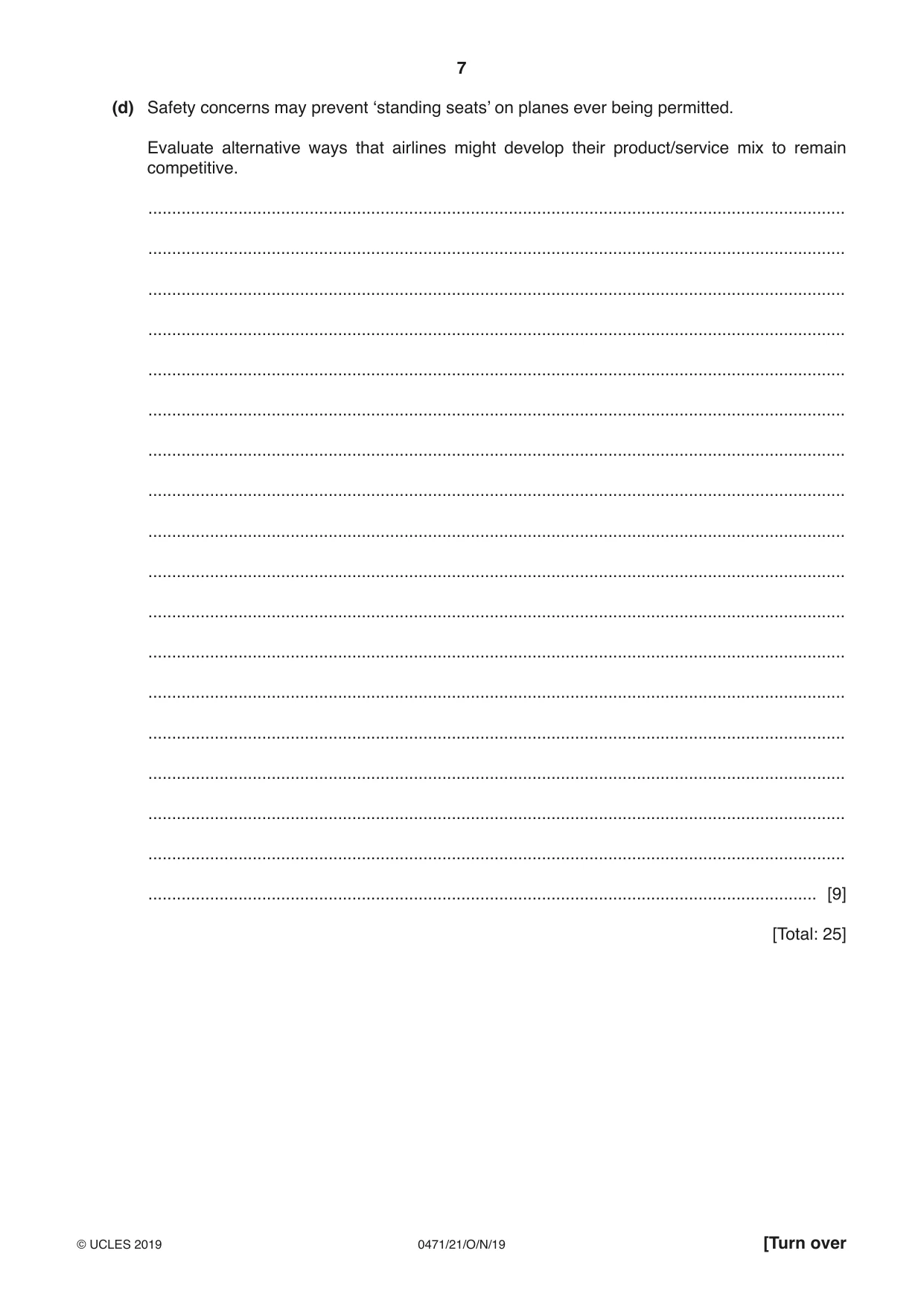
7 0471/21/O/N/19 © UCLES 2019 [Turn over (d) Safety concerns may prevent ‘standing seats’ on planes ever being permitted. Evaluate alternative ways that airlines might develop their product/service mix to remain competitive. … … … … … … … … … … … … … … … … … … [9] [Total: 25]
Question paper, page 8
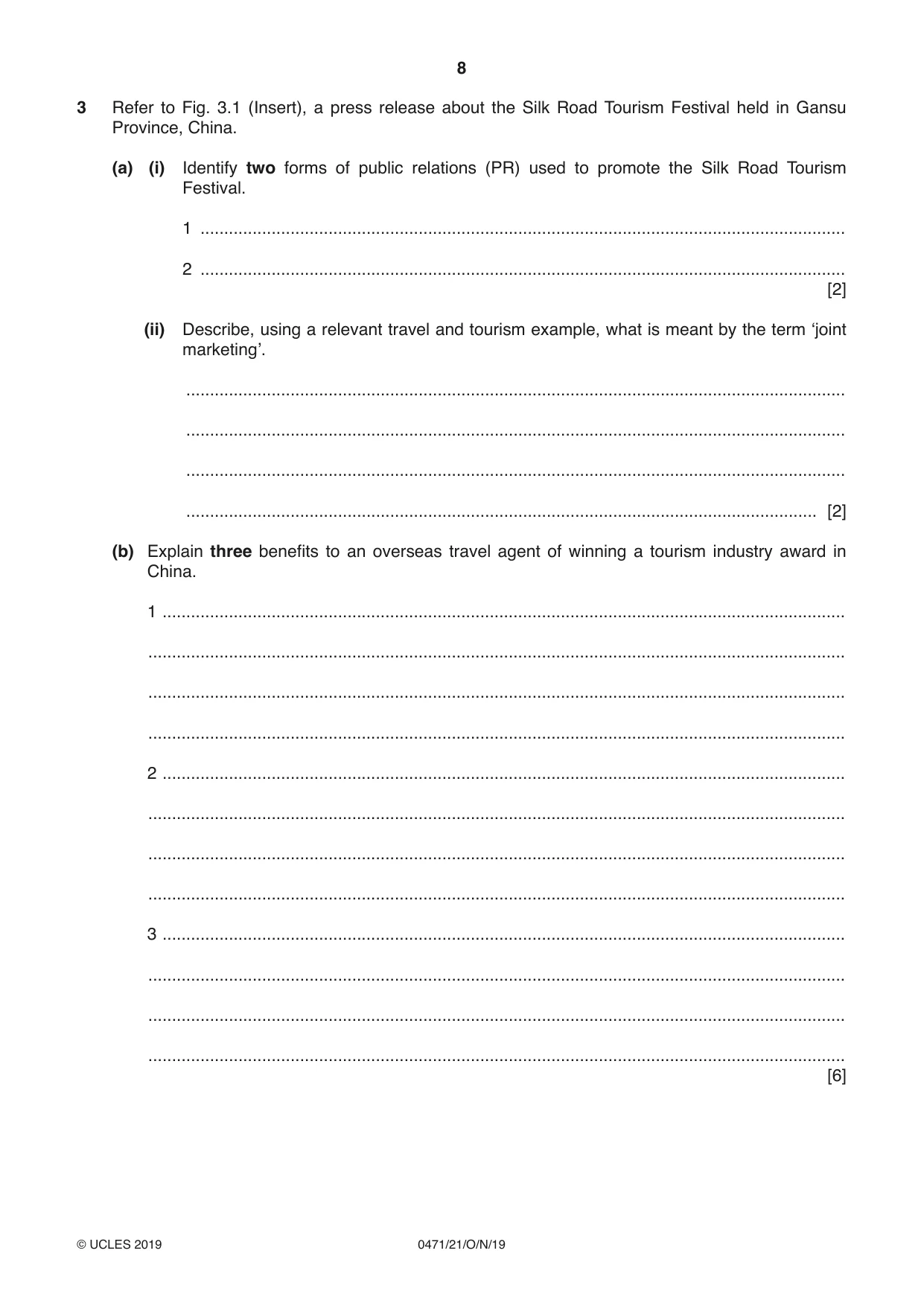
8 0471/21/O/N/19 © UCLES 2019 3 Refer to Fig. 3.1 (Insert), a press release about the Silk Road Tourism Festival held in Gansu Province, China. (a) (i) Identify two forms of public relations (PR) used to promote the Silk Road Tourism Festival. 1 … 2 … [2] (ii) Describe, using a relevant travel and tourism example, what is meant by the term ‘joint marketing’. … … … … [2] (b) Explain three benefits to an overseas travel agent of winning a tourism industry award in China. 1 … … … … 2 … … … … 3 … … … … [6]
Question paper, page 9
9 0471/21/O/N/19 © UCLES 2019 [Turn over (c) Explain two ways an international tourism festival, such as the Silk Road Tourism Festival, can lead to repeat visits by tourists. 1 … … … … … … 2 … … … … … … [6]
Question paper, page 10
10 0471/21/O/N/19 © UCLES 2019 (d) Discuss why the characteristics of a festival make it more like a service than a product. … … … … … … … … … … … … … … … … … … [9] [Total: 25]
Question paper, page 11
11 0471/21/O/N/19 © UCLES 2019 [Turn over 4 Refer to Fig. 4.1 (Insert), information about tourism in Australia. (a) Describe two likely methods of promotion used by Tourism Australia. 1 … … … … 2 … … … … [4] (b) Explain three reasons why tourism organisations carry out market research. 1 … … … … 2 … … … … 3 … … … … [6]
Question paper, page 12
12 0471/21/O/N/19 © UCLES 2019 (c) Explain two ways Tourism Australia might use information about its key source markets. 1 … … … … … … 2 … … … … … … [6]
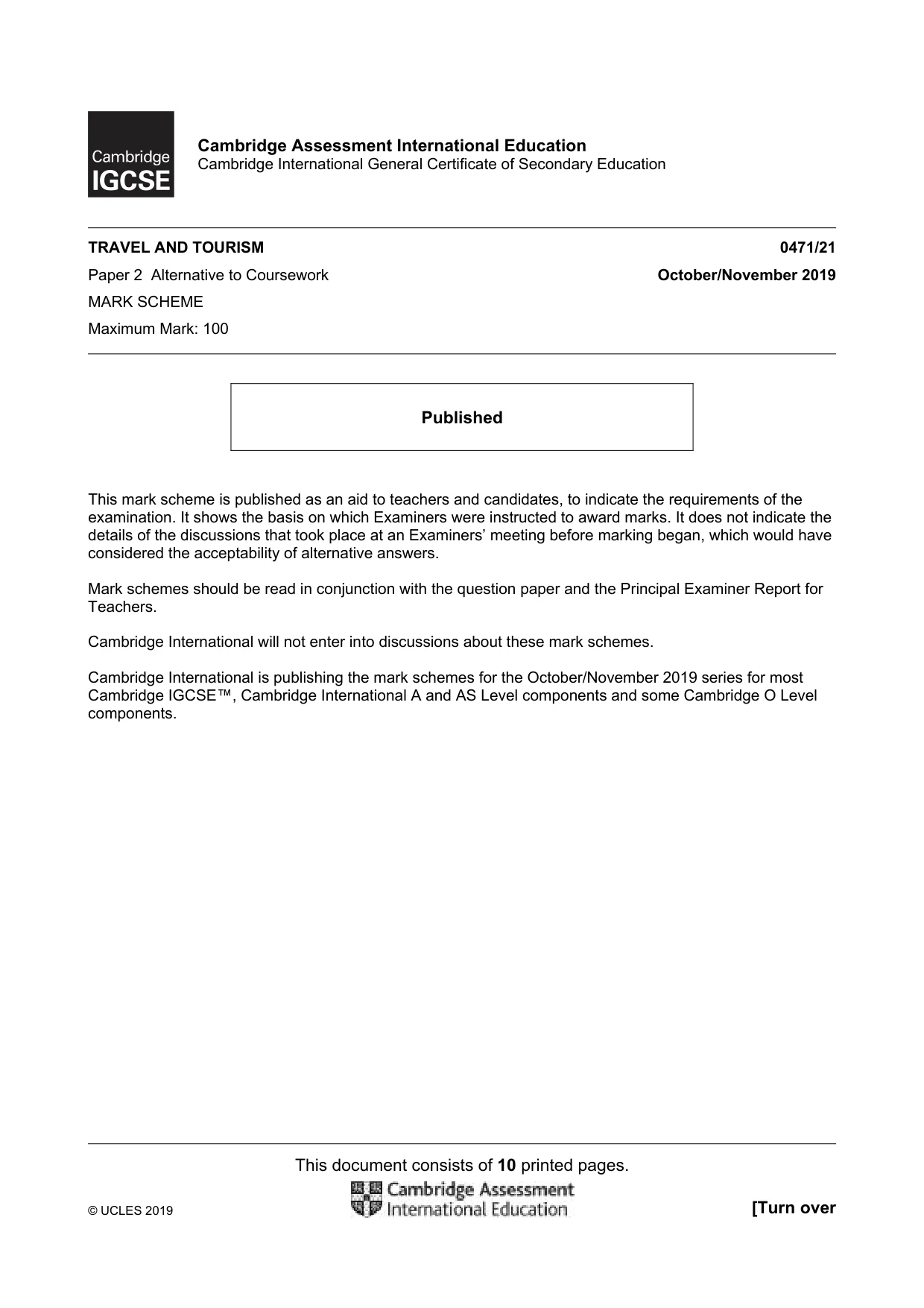
Question paper, page 13
13 0471/21/O/N/19 © UCLES 2019 (d) Use the product life cycle model to evaluate the current market position of Australia as a destination, based on the market research data in Fig. 4.1. … … … … … … … … … … … … … … … … … … [9] [Total: 25]
Question paper, page 14
14 0471/21/O/N/19 © UCLES 2019 BLANK PAGE
Question paper, page 15
15 0471/21/O/N/19 © UCLES 2019 BLANK PAGE
Question paper, page 16
16 0471/21/O/N/19 © UCLES 2019 Permission to reproduce items where third-party owned material protected by copyright is included has been sought and cleared where possible. Every reasonable effort has been made by the publisher (UCLES) to trace copyright holders, but if any items requiring clearance have unwittingly been included, the publisher will be pleased to make amends at the earliest possible opportunity. To avoid the issue of disclosure of answer-related information to candidates, all copyright acknowledgements are reproduced online in the Cambridge Assessment International Education Copyright Acknowledgements Booklet. This is produced for each series of examinations and is freely available to download at www.cambridgeinternational.org after the live examination series. Cambridge Assessment International Education is part of the Cambridge Assessment Group. Cambridge Assessment is the brand name of the University of Cambridge Local Examinations Syndicate (UCLES), which itself is a department of the University of Cambridge. BLANK PAGE
Mark scheme, page 1
This document consists of 10 printed pages. © UCLES 2019 [Turn over Cambridge Assessment International Education Cambridge International General Certificate of Secondary Education TRAVEL AND TOURISM 0471/21 Paper 2 Alternative to Coursework October/November 2019 MARK SCHEME Maximum Mark: 100 Published This mark scheme is published as an aid to teachers and candidates, to indicate the requirements of the examination. It shows the basis on which Examiners were instructed to award marks. It does not indicate the details of the discussions that took place at an Examiners’ meeting before marking began, which would have considered the acceptability of alternative answers. Mark schemes should be read in conjunction with the question paper and the Principal Examiner Report for Teachers. Cambridge International will not enter into discussions about these mark schemes. Cambridge International is publishing the mark schemes for the October/November 2019 series for most Cambridge IGCSE™, Cambridge International A and AS Level components and some Cambridge O Level components.
Mark scheme, page 2
0471/21 Cambridge IGCSE – Mark Scheme PUBLISHED October/November 2019 © UCLES 2019 Page 2 of 10 Generic Marking Principles These general marking principles must be applied by all examiners when marking candidate answers. They should be applied alongside the specific content of the mark scheme or generic level descriptors for a question. Each question paper and mark scheme will also comply with these marking principles. GENERIC MARKING PRINCIPLE 1: Marks must be awarded in line with: • the specific content of the mark scheme or the generic level descriptors for the question • the specific skills defined in the mark scheme or in the generic level descriptors for the question • the standard of response required by a candidate as exemplified by the standardisation scripts. GENERIC MARKING PRINCIPLE 2: Marks awarded are always whole marks (not half marks, or other fractions). GENERIC MARKING PRINCIPLE 3: Marks must be awarded positively: • marks are awarded for correct/valid answers, as defined in the mark scheme. However, credit is given for valid answers which go beyond the scope of the syllabus and mark scheme, referring to your Team Leader as appropriate • marks are awarded when candidates clearly demonstrate what they know and can do • marks are not deducted for errors • marks are not deducted for omissions • answers should only be judged on the quality of spelling, punctuation and grammar when these features are specifically assessed by the question as indicated by the mark scheme. The meaning, however, should be unambiguous. GENERIC MARKING PRINCIPLE 4: Rules must be applied consistently e.g. in situations where candidates have not followed instructions or in the application of generic level descriptors. GENERIC MARKING PRINCIPLE 5: Marks should be awarded using the full range of marks defined in the mark scheme for the question (however; the use of the full mark range may be limited according to the quality of the candidate responses seen). GENERIC MARKING PRINCIPLE 6: Marks awarded are based solely on the requirements as defined in the mark scheme. Marks should not be awarded with grade thresholds or grade descriptors in mind.
Mark scheme, page 3
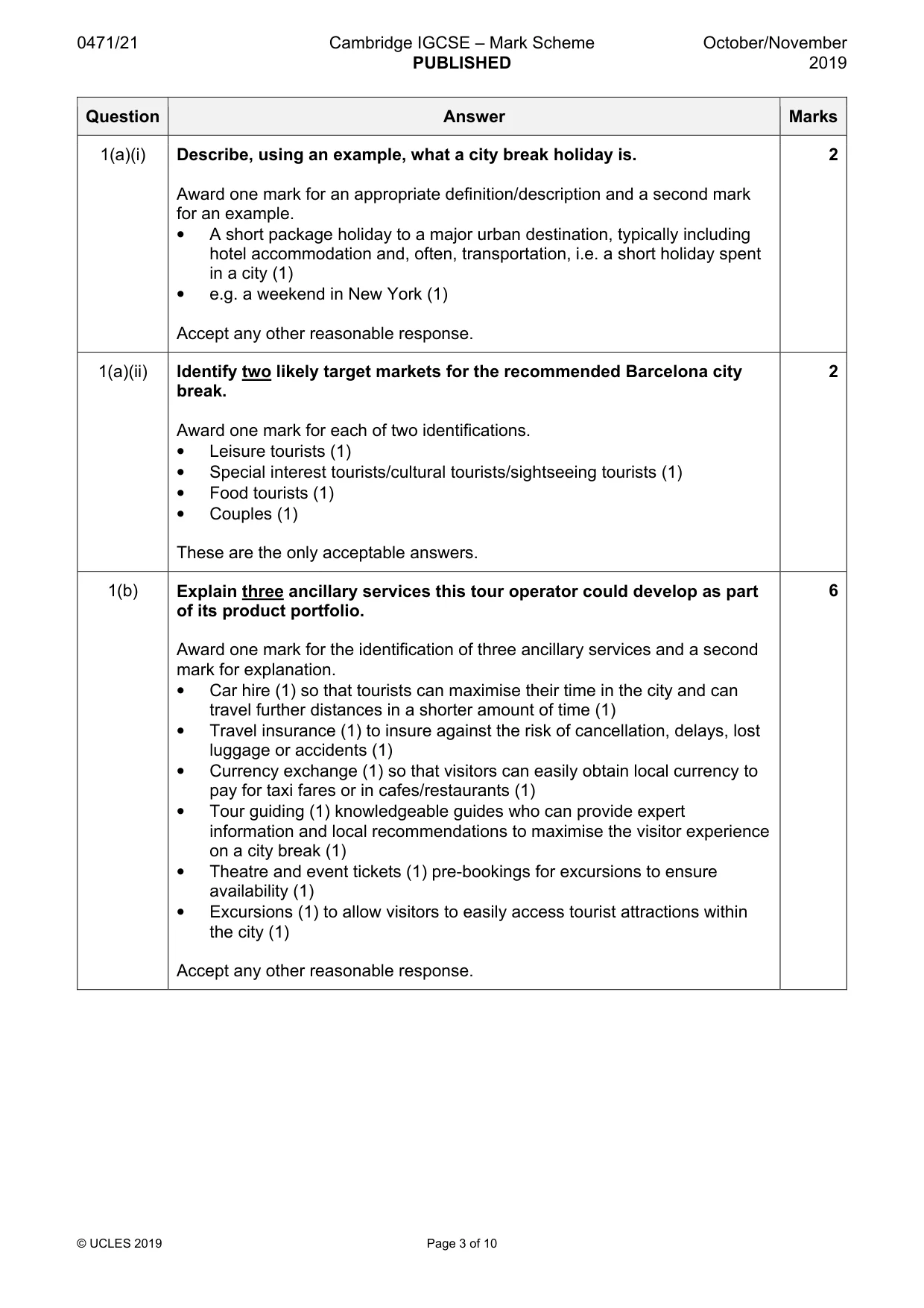
0471/21 Cambridge IGCSE – Mark Scheme PUBLISHED October/November 2019 © UCLES 2019 Page 3 of 10 Question Answer Marks 1(a)(i) Describe, using an example, what a city break holiday is. Award one mark for an appropriate definition/description and a second mark for an example. • A short package holiday to a major urban destination, typically including hotel accommodation and, often, transportation, i.e. a short holiday spent in a city (1) • e.g. a weekend in New York (1) Accept any other reasonable response. 2 1(a)(ii) Identify two likely target markets for the recommended Barcelona city break. Award one mark for each of two identifications. • Leisure tourists (1) • Special interest tourists/cultural tourists/sightseeing tourists (1) • Food tourists (1) • Couples (1) These are the only acceptable answers. 2 1(b) Explain three ancillary services this tour operator could develop as part of its product portfolio. Award one mark for the identification of three ancillary services and a second mark for explanation. • Car hire (1) so that tourists can maximise their time in the city and can travel further distances in a shorter amount of time (1) • Travel insurance (1) to insure against the risk of cancellation, delays, lost luggage or accidents (1) • Currency exchange (1) so that visitors can easily obtain local currency to pay for taxi fares or in cafes/restaurants (1) • Tour guiding (1) knowledgeable guides who can provide expert information and local recommendations to maximise the visitor experience on a city break (1) • Theatre and event tickets (1) pre-bookings for excursions to ensure availability (1) • Excursions (1) to allow visitors to easily access tourist attractions within the city (1) Accept any other reasonable response. 6
Mark scheme, page 4
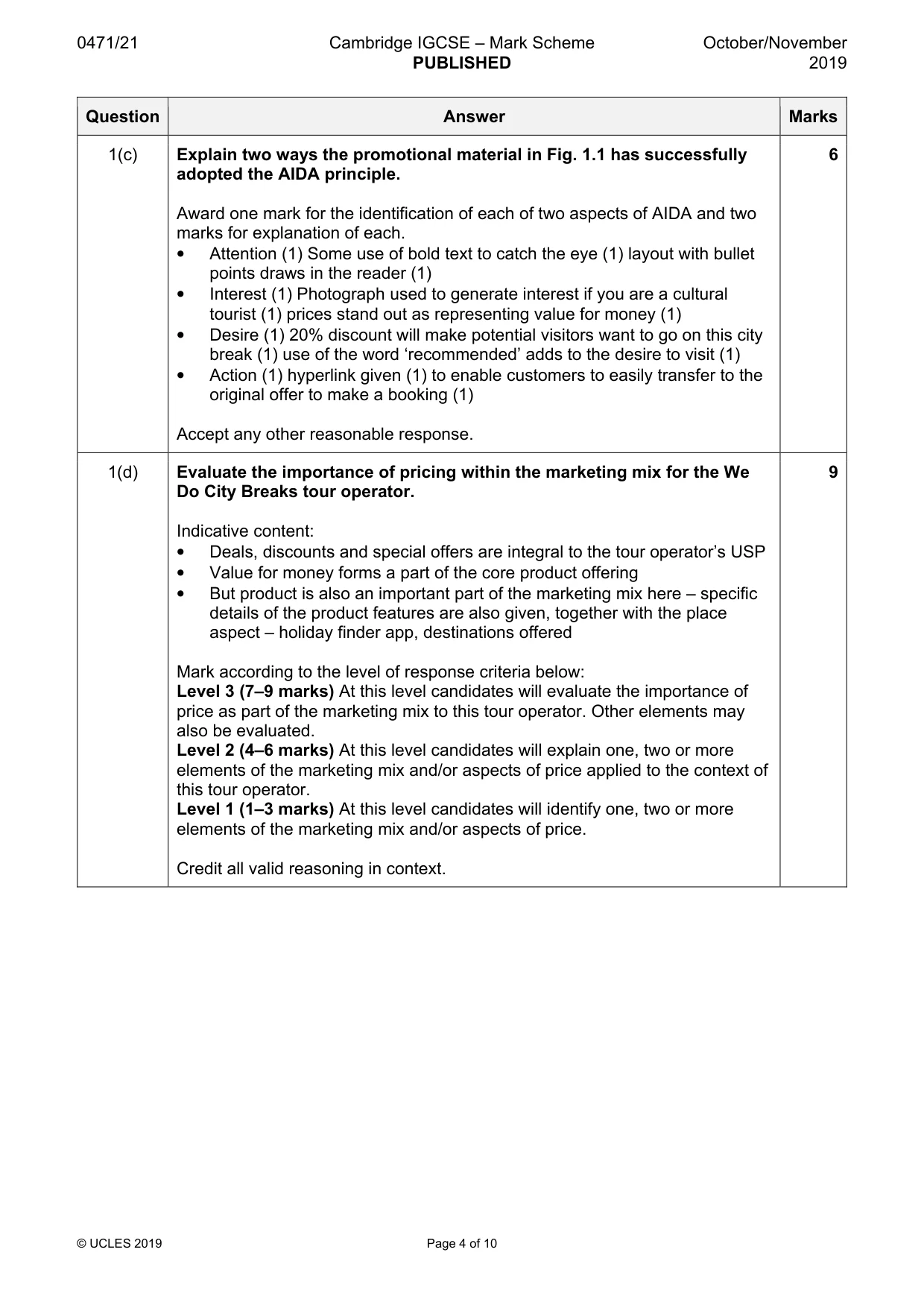
0471/21 Cambridge IGCSE – Mark Scheme PUBLISHED October/November 2019 © UCLES 2019 Page 4 of 10 Question Answer Marks 1(c) Explain two ways the promotional material in Fig. 1.1 has successfully adopted the AIDA principle. Award one mark for the identification of each of two aspects of AIDA and two marks for explanation of each. • Attention (1) Some use of bold text to catch the eye (1) layout with bullet points draws in the reader (1) • Interest (1) Photograph used to generate interest if you are a cultural tourist (1) prices stand out as representing value for money (1) • Desire (1) 20% discount will make potential visitors want to go on this city break (1) use of the word ‘recommended’ adds to the desire to visit (1) • Action (1) hyperlink given (1) to enable customers to easily transfer to the original offer to make a booking (1) Accept any other reasonable response. 6 1(d) Evaluate the importance of pricing within the marketing mix for the We Do City Breaks tour operator. Indicative content: • Deals, discounts and special offers are integral to the tour operator’s USP • Value for money forms a part of the core product offering • But product is also an important part of the marketing mix here – specific details of the product features are also given, together with the place aspect – holiday finder app, destinations offered Mark according to the level of response criteria below: Level 3 (7–9 marks) At this level candidates will evaluate the importance of price as part of the marketing mix to this tour operator. Other elements may also be evaluated. Level 2 (4–6 marks) At this level candidates will explain one, two or more elements of the marketing mix and/or aspects of price applied to the context of this tour operator. Level 1 (1–3 marks) At this level candidates will identify one, two or more elements of the marketing mix and/or aspects of price. Credit all valid reasoning in context. 9
Mark scheme, page 5
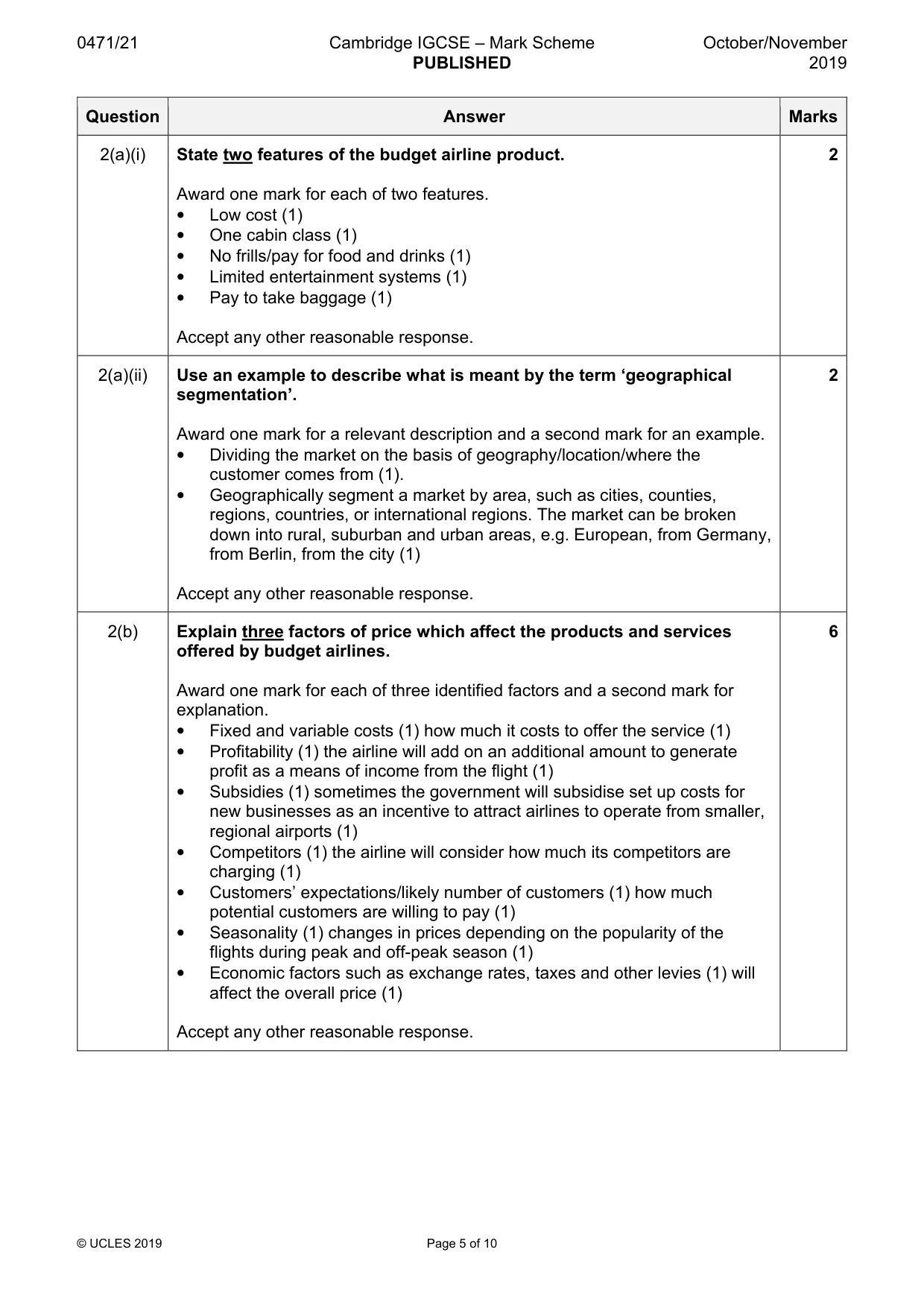
0471/21 Cambridge IGCSE – Mark Scheme PUBLISHED October/November 2019 © UCLES 2019 Page 5 of 10 Question Answer Marks 2(a)(i) State two features of the budget airline product. Award one mark for each of two features. • Low cost (1) • One cabin class (1) • No frills/pay for food and drinks (1) • Limited entertainment systems (1) • Pay to take baggage (1) Accept any other reasonable response. 2 2(a)(ii) Use an example to describe what is meant by the term ‘geographical segmentation’. Award one mark for a relevant description and a second mark for an example. • Dividing the market on the basis of geography/location/where the customer comes from (1). • Geographically segment a market by area, such as cities, counties, regions, countries, or international regions. The market can be broken down into rural, suburban and urban areas, e.g. European, from Germany, from Berlin, from the city (1) Accept any other reasonable response. 2 2(b) Explain three factors of price which affect the products and services offered by budget airlines. Award one mark for each of three identified factors and a second mark for explanation. • Fixed and variable costs (1) how much it costs to offer the service (1) • Profitability (1) the airline will add on an additional amount to generate profit as a means of income from the flight (1) • Subsidies (1) sometimes the government will subsidise set up costs for new businesses as an incentive to attract airlines to operate from smaller, regional airports (1) • Competitors (1) the airline will consider how much its competitors are charging (1) • Customers’ expectations/likely number of customers (1) how much potential customers are willing to pay (1) • Seasonality (1) changes in prices depending on the popularity of the flights during peak and off-peak season (1) • Economic factors such as exchange rates, taxes and other levies (1) will affect the overall price (1) Accept any other reasonable response. 6
Mark scheme, page 6
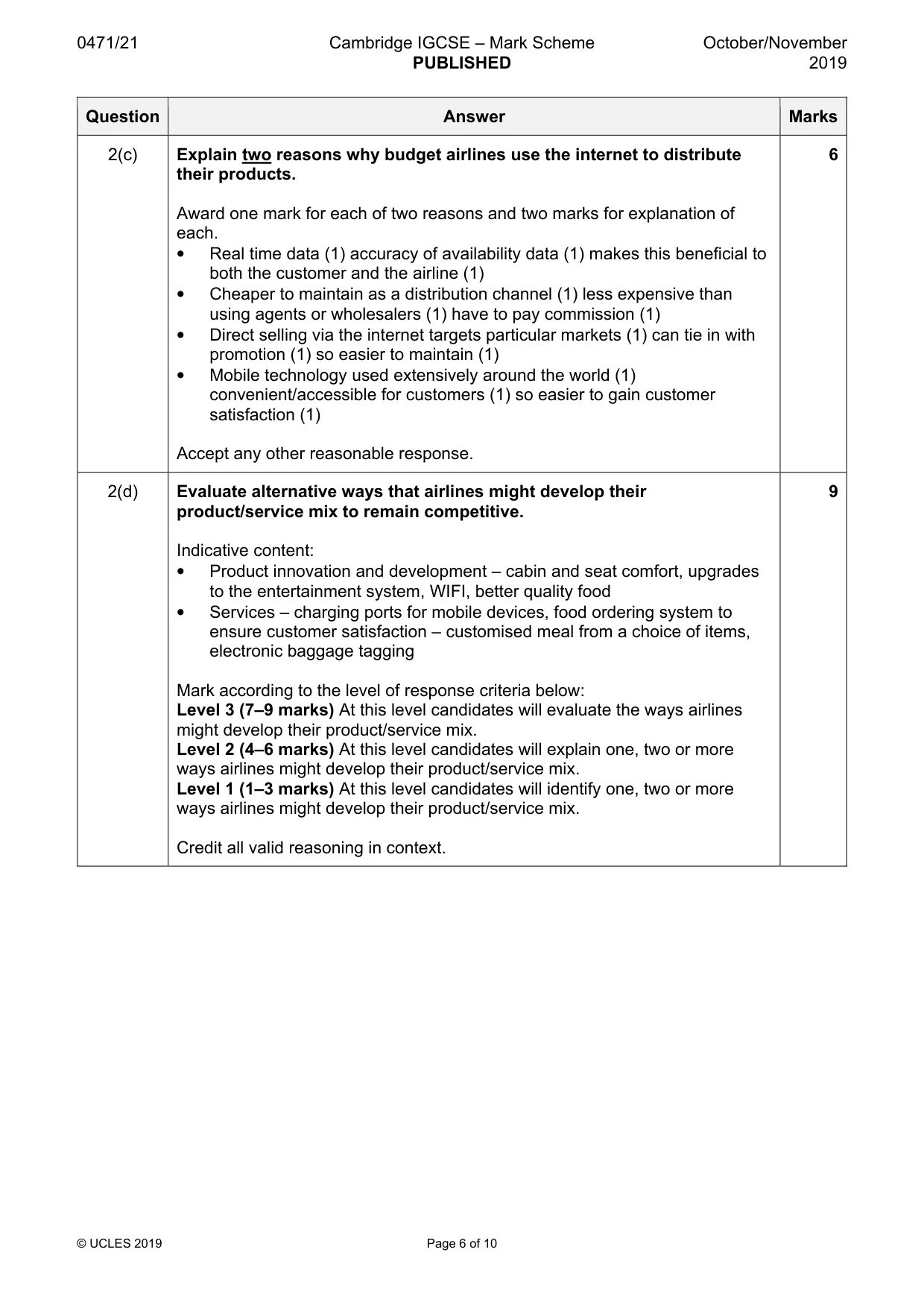
0471/21 Cambridge IGCSE – Mark Scheme PUBLISHED October/November 2019 © UCLES 2019 Page 6 of 10 Question Answer Marks 2(c) Explain two reasons why budget airlines use the internet to distribute their products. Award one mark for each of two reasons and two marks for explanation of each. • Real time data (1) accuracy of availability data (1) makes this beneficial to both the customer and the airline (1) • Cheaper to maintain as a distribution channel (1) less expensive than using agents or wholesalers (1) have to pay commission (1) • Direct selling via the internet targets particular markets (1) can tie in with promotion (1) so easier to maintain (1) • Mobile technology used extensively around the world (1) convenient/accessible for customers (1) so easier to gain customer satisfaction (1) Accept any other reasonable response. 6 2(d) Evaluate alternative ways that airlines might develop their product/service mix to remain competitive. Indicative content: • Product innovation and development – cabin and seat comfort, upgrades to the entertainment system, WIFI, better quality food • Services – charging ports for mobile devices, food ordering system to ensure customer satisfaction – customised meal from a choice of items, electronic baggage tagging Mark according to the level of response criteria below: Level 3 (7–9 marks) At this level candidates will evaluate the ways airlines might develop their product/service mix. Level 2 (4–6 marks) At this level candidates will explain one, two or more ways airlines might develop their product/service mix. Level 1 (1–3 marks) At this level candidates will identify one, two or more ways airlines might develop their product/service mix. Credit all valid reasoning in context. 9
Mark scheme, page 7
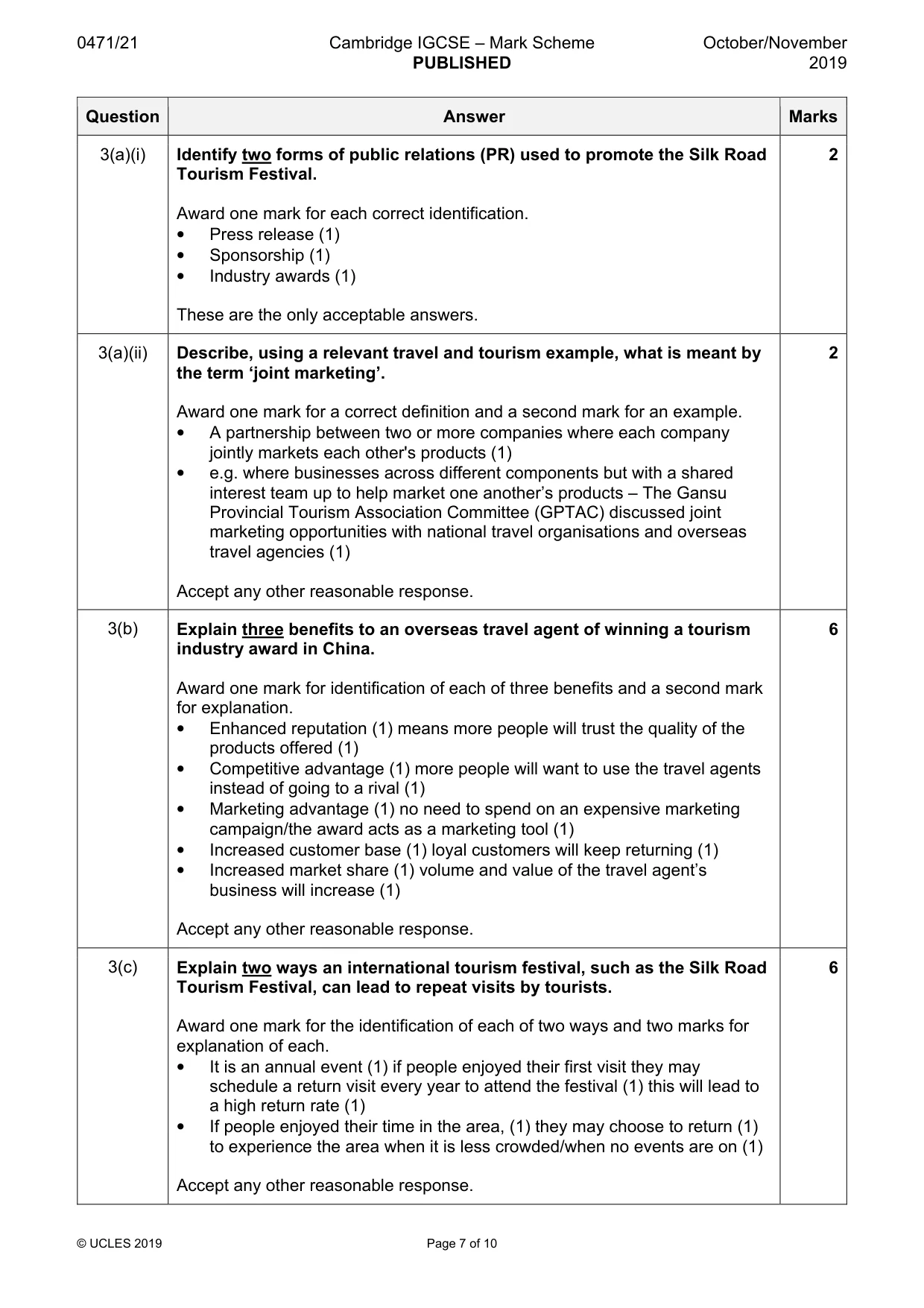
0471/21 Cambridge IGCSE – Mark Scheme PUBLISHED October/November 2019 © UCLES 2019 Page 7 of 10 Question Answer Marks 3(a)(i) Identify two forms of public relations (PR) used to promote the Silk Road Tourism Festival. Award one mark for each correct identification. • Press release (1) • Sponsorship (1) • Industry awards (1) These are the only acceptable answers. 2 3(a)(ii) Describe, using a relevant travel and tourism example, what is meant by the term ‘joint marketing’. Award one mark for a correct definition and a second mark for an example. • A partnership between two or more companies where each company jointly markets each other's products (1) • e.g. where businesses across different components but with a shared interest team up to help market one another’s products – The Gansu Provincial Tourism Association Committee (GPTAC) discussed joint marketing opportunities with national travel organisations and overseas travel agencies (1) Accept any other reasonable response. 2 3(b) Explain three benefits to an overseas travel agent of winning a tourism industry award in China. Award one mark for identification of each of three benefits and a second mark for explanation. • Enhanced reputation (1) means more people will trust the quality of the products offered (1) • Competitive advantage (1) more people will want to use the travel agents instead of going to a rival (1) • Marketing advantage (1) no need to spend on an expensive marketing campaign/the award acts as a marketing tool (1) • Increased customer base (1) loyal customers will keep returning (1) • Increased market share (1) volume and value of the travel agent’s business will increase (1) Accept any other reasonable response. 6 3(c) Explain two ways an international tourism festival, such as the Silk Road Tourism Festival, can lead to repeat visits by tourists. Award one mark for the identification of each of two ways and two marks for explanation of each. • It is an annual event (1) if people enjoyed their first visit they may schedule a return visit every year to attend the festival (1) this will lead to a high return rate (1) • If people enjoyed their time in the area, (1) they may choose to return (1) to experience the area when it is less crowded/when no events are on (1) Accept any other reasonable response. 6
Mark scheme, page 8
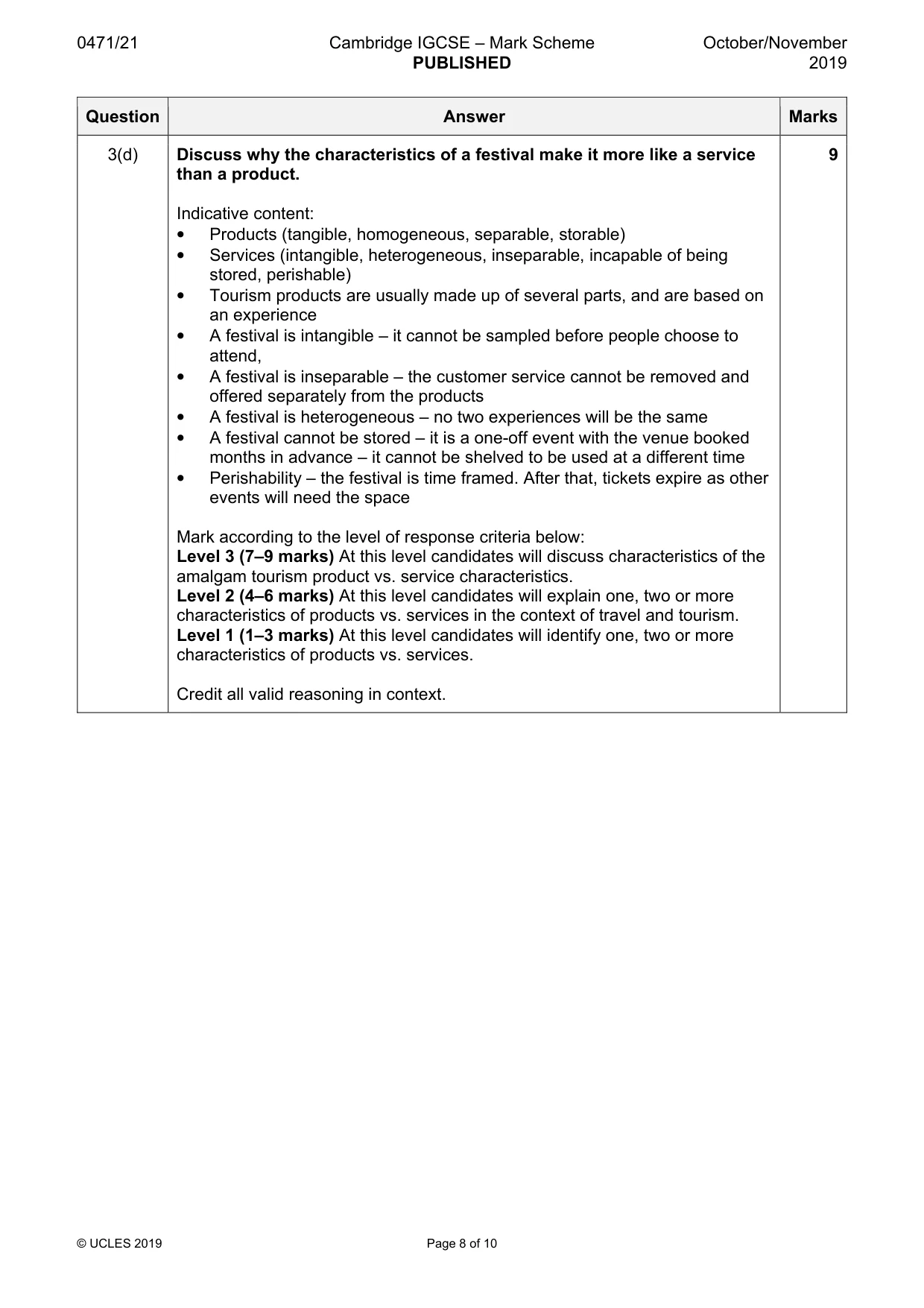
0471/21 Cambridge IGCSE – Mark Scheme PUBLISHED October/November 2019 © UCLES 2019 Page 8 of 10 Question Answer Marks 3(d) Discuss why the characteristics of a festival make it more like a service than a product. Indicative content: • Products (tangible, homogeneous, separable, storable) • Services (intangible, heterogeneous, inseparable, incapable of being stored, perishable) • Tourism products are usually made up of several parts, and are based on an experience • A festival is intangible – it cannot be sampled before people choose to attend, • A festival is inseparable – the customer service cannot be removed and offered separately from the products • A festival is heterogeneous – no two experiences will be the same • A festival cannot be stored – it is a one-off event with the venue booked months in advance – it cannot be shelved to be used at a different time • Perishability – the festival is time framed. After that, tickets expire as other events will need the space Mark according to the level of response criteria below: Level 3 (7–9 marks) At this level candidates will discuss characteristics of the amalgam tourism product vs. service characteristics. Level 2 (4–6 marks) At this level candidates will explain one, two or more characteristics of products vs. services in the context of travel and tourism. Level 1 (1–3 marks) At this level candidates will identify one, two or more characteristics of products vs. services. Credit all valid reasoning in context. 9
Mark scheme, page 9
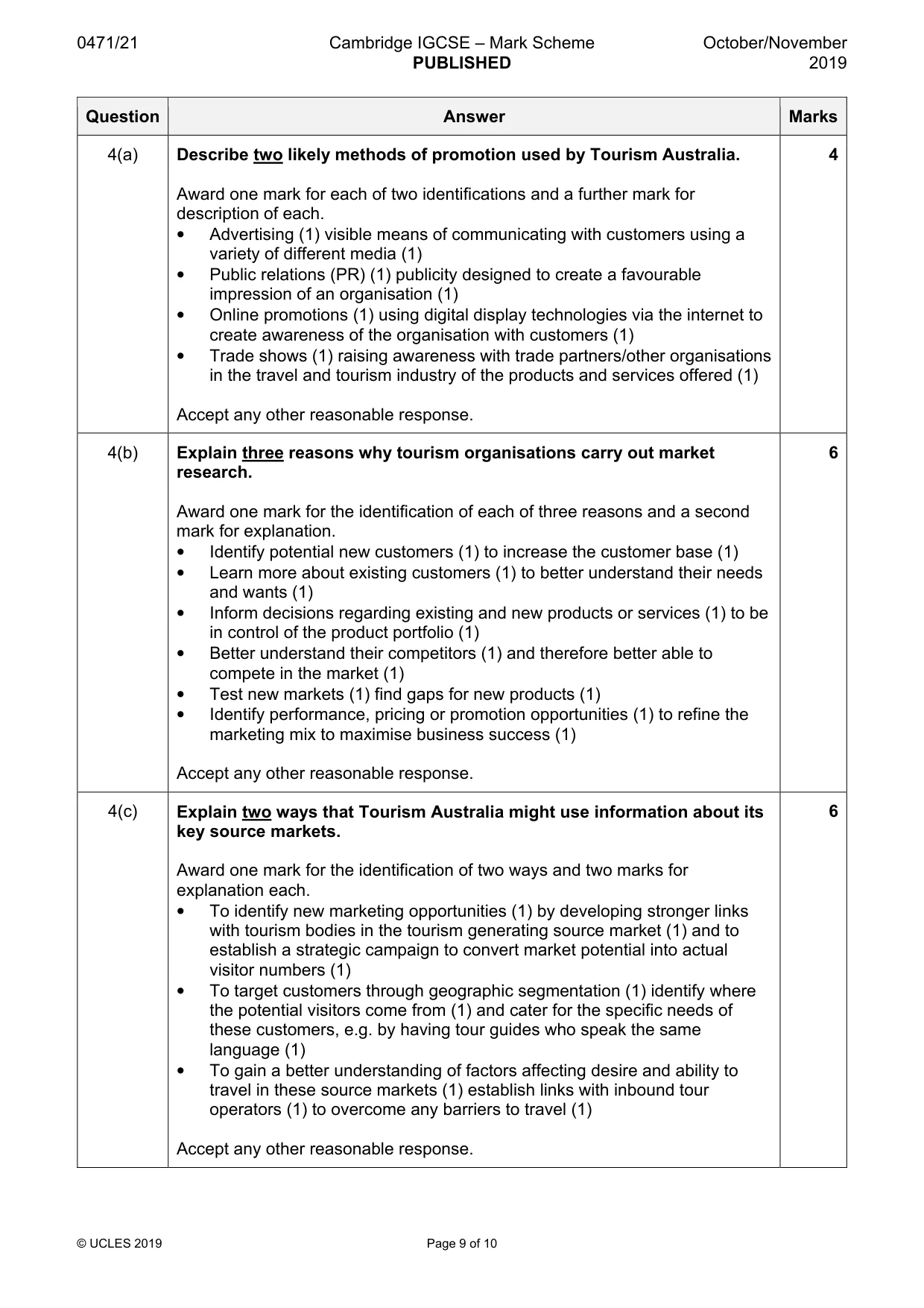
0471/21 Cambridge IGCSE – Mark Scheme PUBLISHED October/November 2019 © UCLES 2019 Page 9 of 10 Question Answer Marks 4(a) Describe two likely methods of promotion used by Tourism Australia. Award one mark for each of two identifications and a further mark for description of each. • Advertising (1) visible means of communicating with customers using a variety of different media (1) • Public relations (PR) (1) publicity designed to create a favourable impression of an organisation (1) • Online promotions (1) using digital display technologies via the internet to create awareness of the organisation with customers (1) • Trade shows (1) raising awareness with trade partners/other organisations in the travel and tourism industry of the products and services offered (1) Accept any other reasonable response. 4 4(b) Explain three reasons why tourism organisations carry out market research. Award one mark for the identification of each of three reasons and a second mark for explanation. • Identify potential new customers (1) to increase the customer base (1) • Learn more about existing customers (1) to better understand their needs and wants (1) • Inform decisions regarding existing and new products or services (1) to be in control of the product portfolio (1) • Better understand their competitors (1) and therefore better able to compete in the market (1) • Test new markets (1) find gaps for new products (1) • Identify performance, pricing or promotion opportunities (1) to refine the marketing mix to maximise business success (1) Accept any other reasonable response. 6 4(c) Explain two ways that Tourism Australia might use information about its key source markets. Award one mark for the identification of two ways and two marks for explanation each. • To identify new marketing opportunities (1) by developing stronger links with tourism bodies in the tourism generating source market (1) and to establish a strategic campaign to convert market potential into actual visitor numbers (1) • To target customers through geographic segmentation (1) identify where the potential visitors come from (1) and cater for the specific needs of these customers, e.g. by having tour guides who speak the same language (1) • To gain a better understanding of factors affecting desire and ability to travel in these source markets (1) establish links with inbound tour operators (1) to overcome any barriers to travel (1) Accept any other reasonable response. 6
Mark scheme, page 10
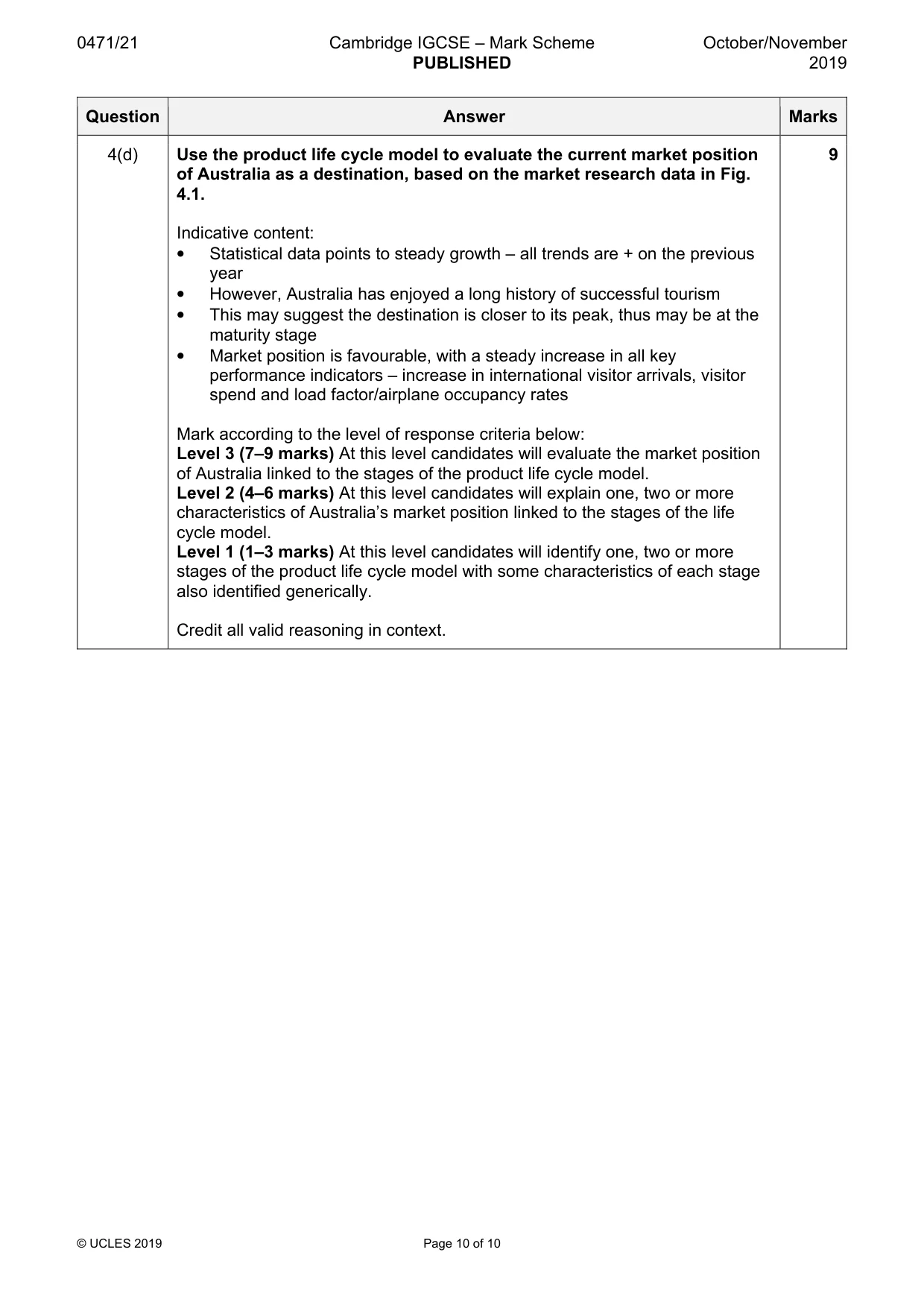
0471/21 Cambridge IGCSE – Mark Scheme PUBLISHED October/November 2019 © UCLES 2019 Page 10 of 10 Question Answer Marks 4(d) Use the product life cycle model to evaluate the current market position of Australia as a destination, based on the market research data in Fig. 4.1. Indicative content: • Statistical data points to steady growth – all trends are + on the previous year • However, Australia has enjoyed a long history of successful tourism • This may suggest the destination is closer to its peak, thus may be at the maturity stage • Market position is favourable, with a steady increase in all key performance indicators – increase in international visitor arrivals, visitor spend and load factor/airplane occupancy rates Mark according to the level of response criteria below: Level 3 (7–9 marks) At this level candidates will evaluate the market position of Australia linked to the stages of the product life cycle model. Level 2 (4–6 marks) At this level candidates will explain one, two or more characteristics of Australia’s market position linked to the stages of the life cycle model. Level 1 (1–3 marks) At this level candidates will identify one, two or more stages of the product life cycle model with some characteristics of each stage also identified generically. Credit all valid reasoning in context. 9
What you needed in this session
Cambridge’s own grade thresholds for 2019 Oct/Nov, Paper 2 · Variant 1. A higher threshold means an easier paper — the bar moves with how the cohort did.