Cambridge IGCSE Travel and Tourism 0471 — 2019 May/June Paper 2 · Variant 3
0471/23/M/J/19 · 100 marks · ≈113 min
The question paper and its mark scheme, free to read here and free to download. This is Cambridge’s own paper, exactly as it was sat.
Question paper16 pages



Mark scheme10 pages
Answers below. Sit the paper first if you are practising.
Paper as text
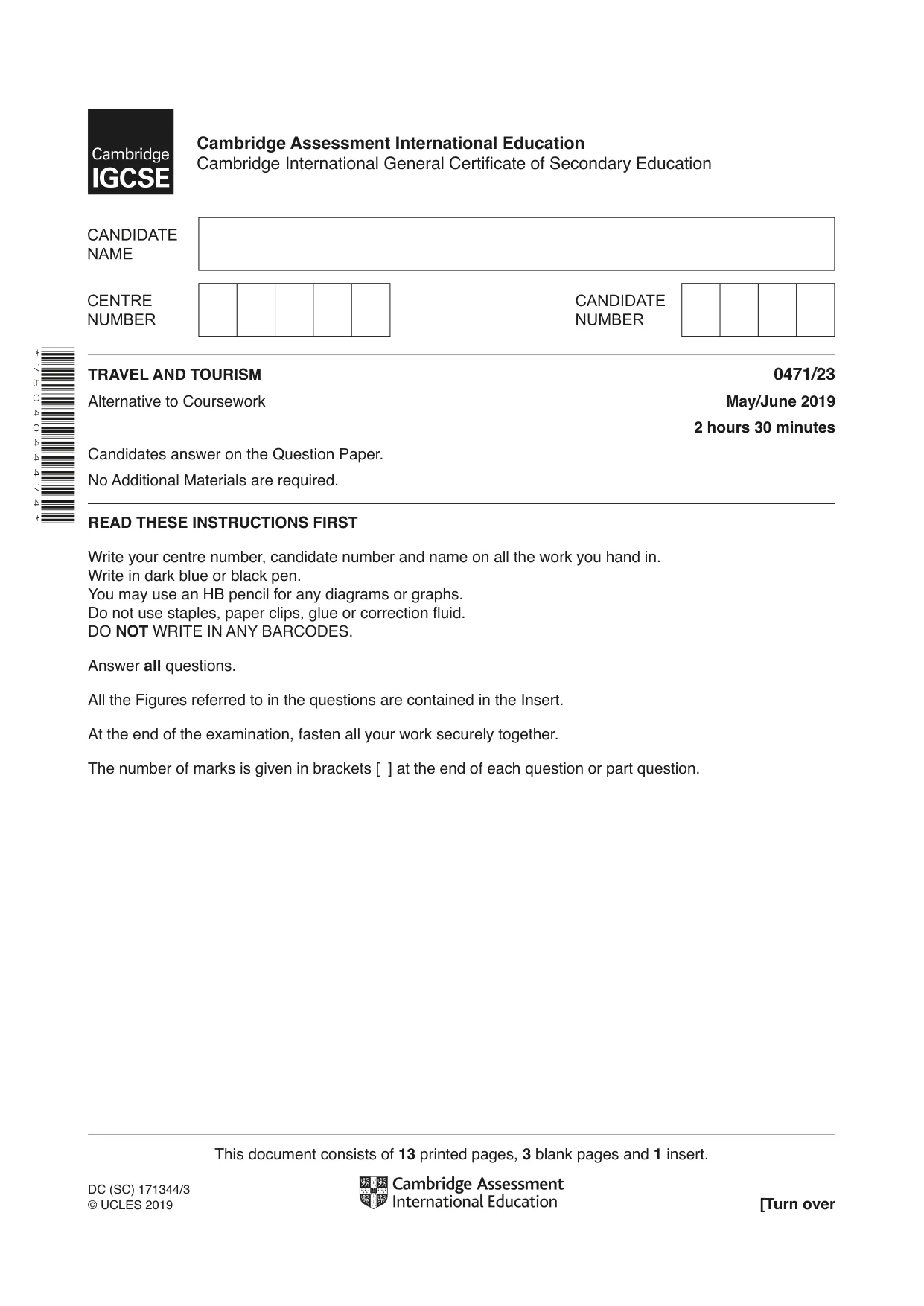
Question paper, page 1
This document consists of 13 printed pages, 3 blank pages and 1 insert. DC (SC) 171344/3 © UCLES 2019 [Turn over * 7 5 0 4 0 4 4 4 7 4 * TRAVEL AND TOURISM 0471/23 Alternative to Coursework May/June 2019 2 hours 30 minutes Candidates answer on the Question Paper. No Additional Materials are required. READ THESE INSTRUCTIONS FIRST Write your centre number, candidate number and name on all the work you hand in. Write in dark blue or black pen. You may use an HB pencil for any diagrams or graphs. Do not use staples, paper clips, glue or correction fluid. DO NOT WRITE IN ANY BARCODES. Answer all questions. All the Figures referred to in the questions are contained in the Insert. At the end of the examination, fasten all your work securely together. The number of marks is given in brackets [ ] at the end of each question or part question. Cambridge Assessment International Education Cambridge International General Certificate of Secondary Education
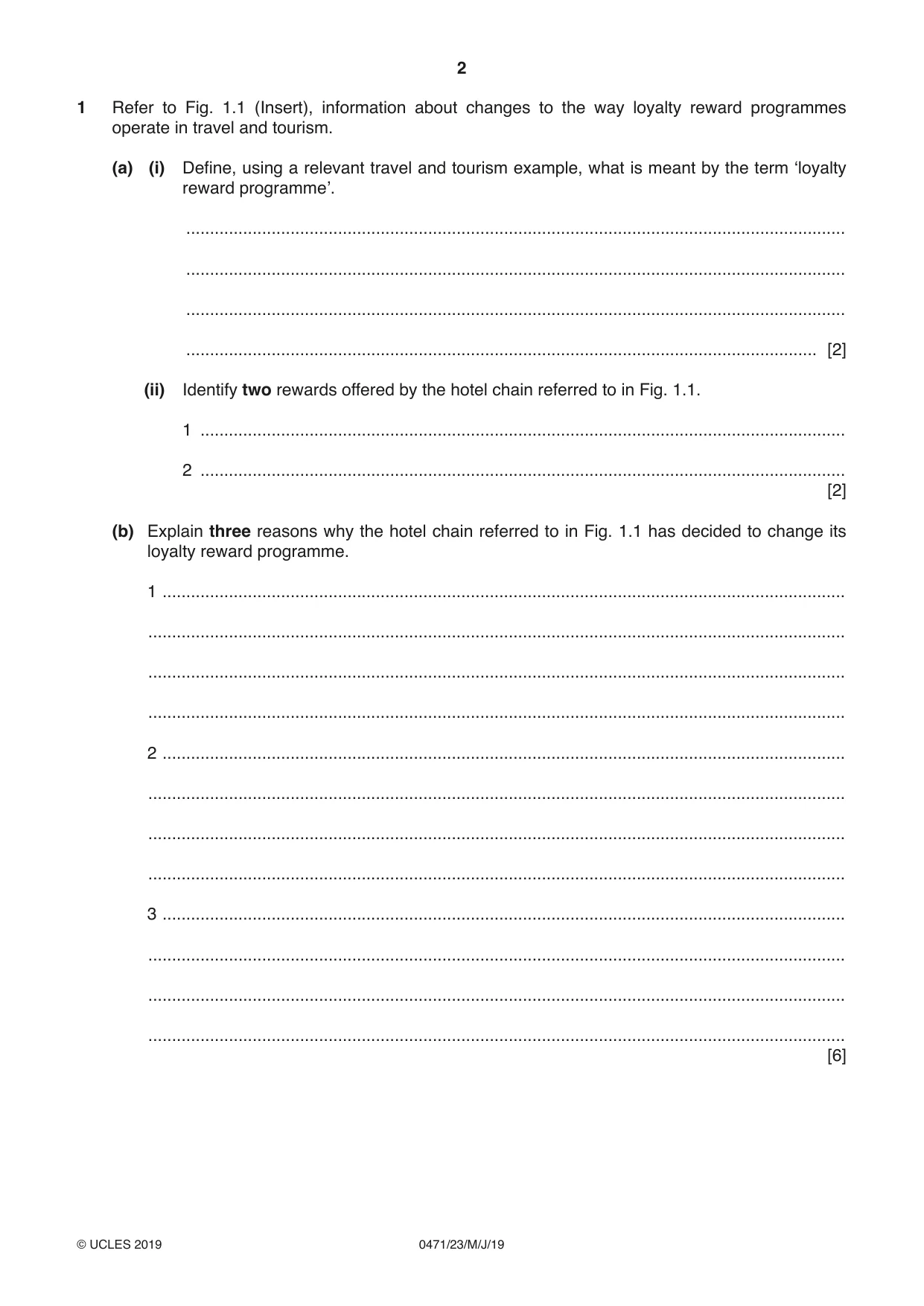
Question paper, page 2
2 0471/23/M/J/19 © UCLES 2019 1 Refer to Fig. 1.1 (Insert), information about changes to the way loyalty reward programmes operate in travel and tourism. (a) (i) Define, using a relevant travel and tourism example, what is meant by the term ‘loyalty reward programme’. … … … … [2] (ii) Identify two rewards offered by the hotel chain referred to in Fig. 1.1. 1 … 2 … [2] (b) Explain three reasons why the hotel chain referred to in Fig. 1.1 has decided to change its loyalty reward programme. 1 … … … … 2 … … … … 3 … … … … [6]
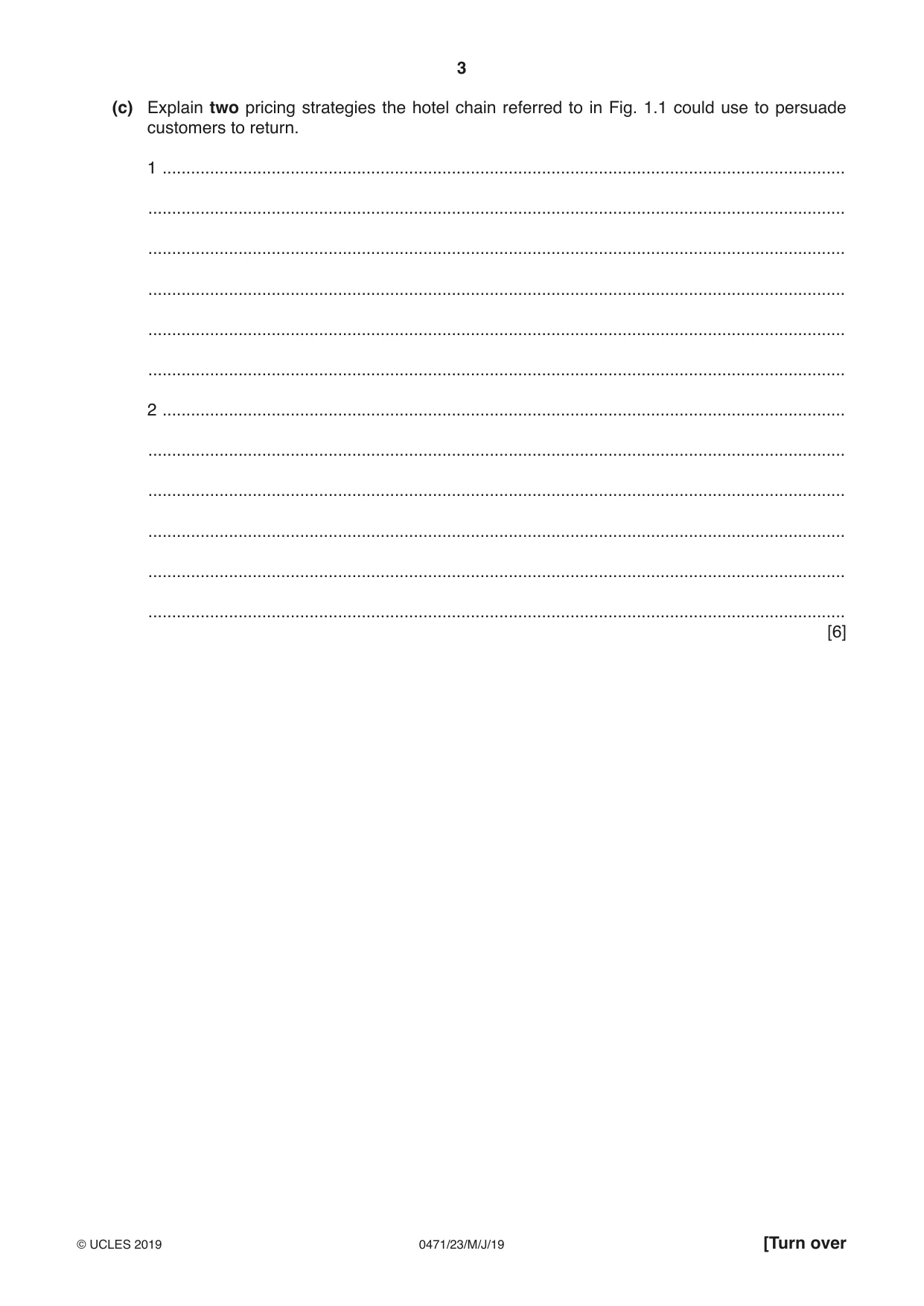
Question paper, page 3
3 0471/23/M/J/19 © UCLES 2019 [Turn over (c) Explain two pricing strategies the hotel chain referred to in Fig. 1.1 could use to persuade customers to return. 1 … … … … … … 2 … … … … … … [6]
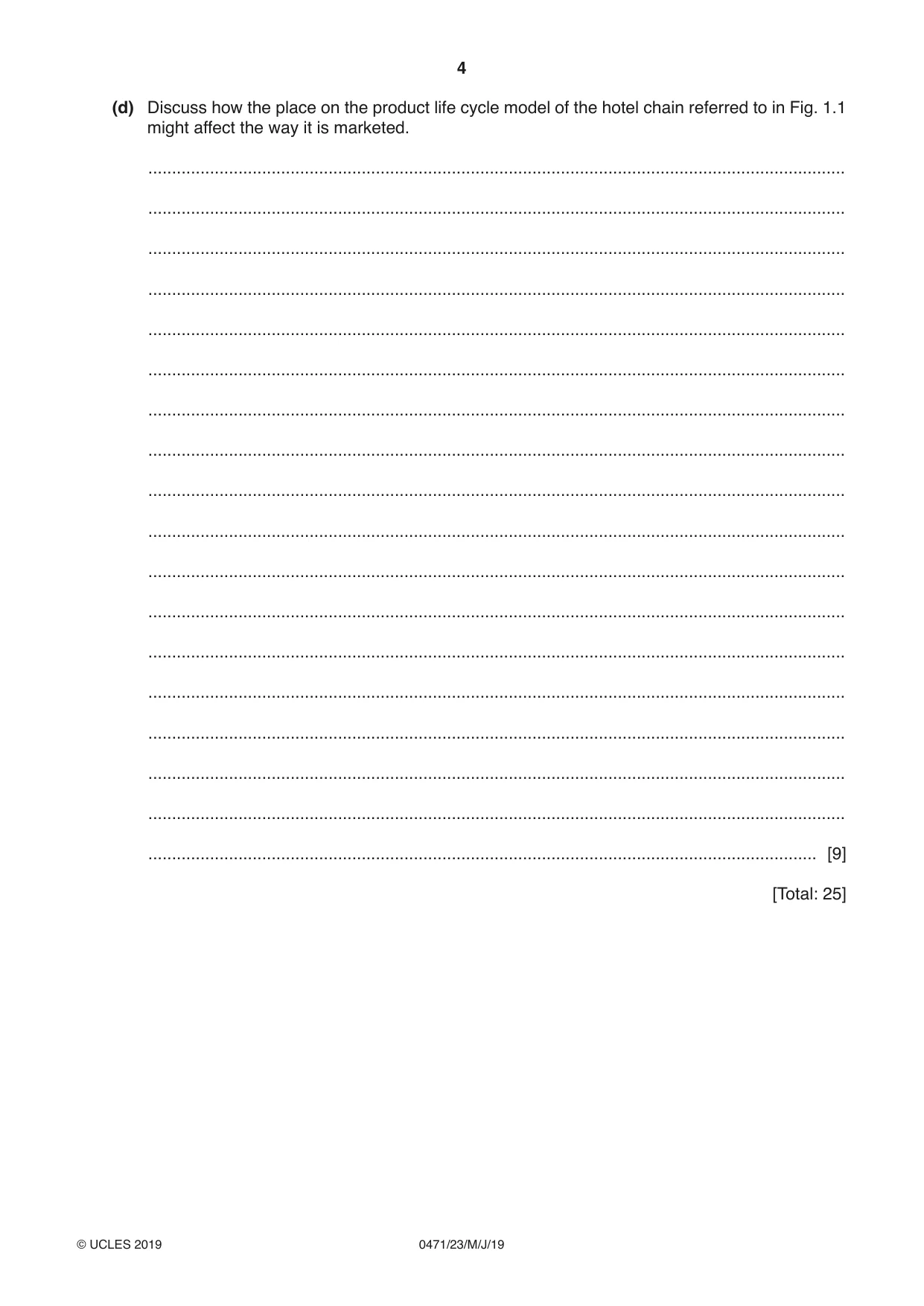
Question paper, page 4
4 0471/23/M/J/19 © UCLES 2019 (d) Discuss how the place on the product life cycle model of the hotel chain referred to in Fig. 1.1 might affect the way it is marketed. … … … … … … … … … … … … … … … … … … [9] [Total: 25]
Question paper, page 5
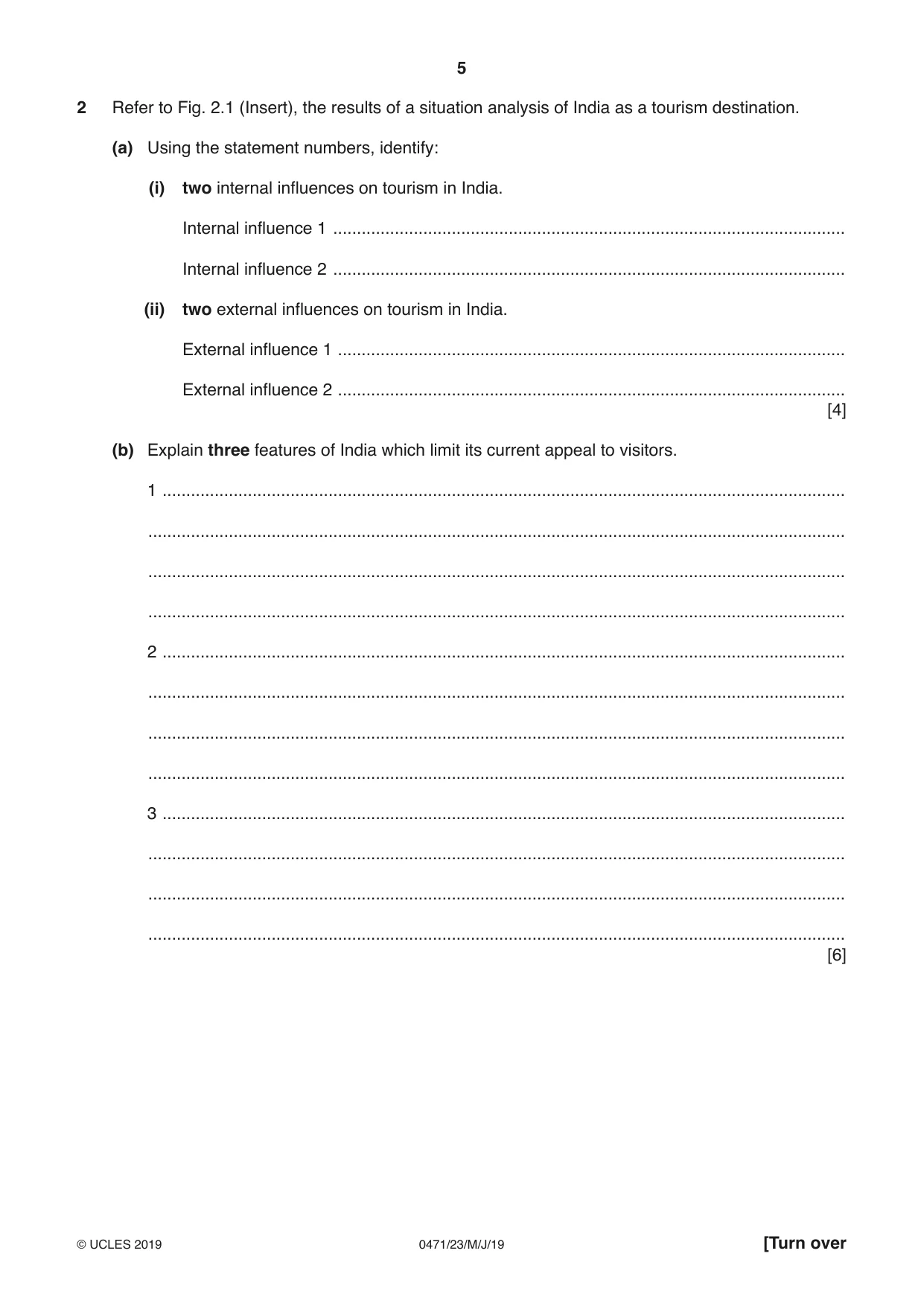
5 0471/23/M/J/19 © UCLES 2019 [Turn over 2 Refer to Fig. 2.1 (Insert), the results of a situation analysis of India as a tourism destination. (a) Using the statement numbers, identify: (i) two internal influences on tourism in India. Internal influence 1 … Internal influence 2 … (ii) two external influences on tourism in India. External influence 1 … External influence 2 … [4] (b) Explain three features of India which limit its current appeal to visitors. 1 … … … … 2 … … … … 3 … … … … [6]
Question paper, page 6
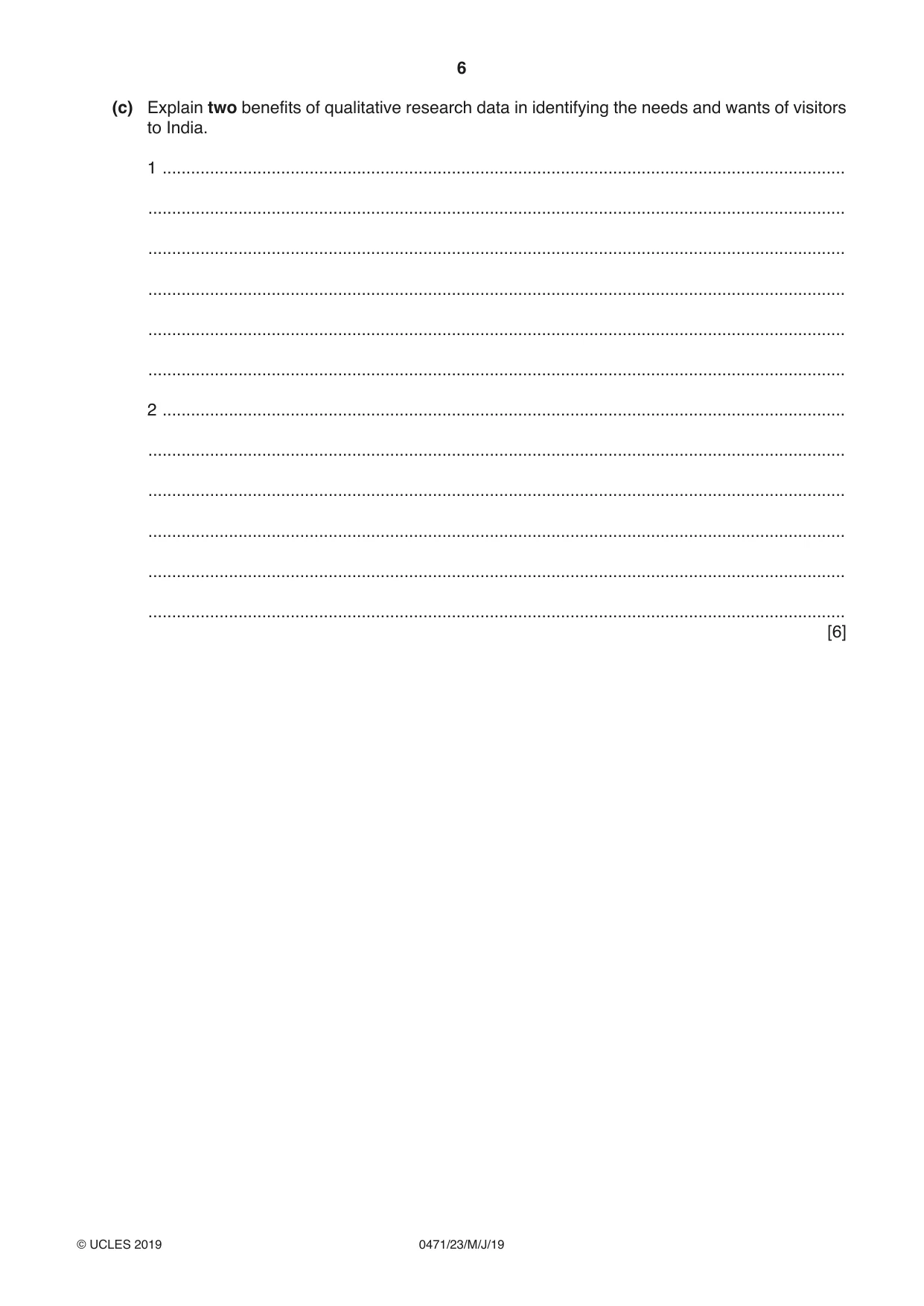
6 0471/23/M/J/19 © UCLES 2019 (c) Explain two benefits of qualitative research data in identifying the needs and wants of visitors to India. 1 … … … … … … 2 … … … … … … [6]
Question paper, page 7
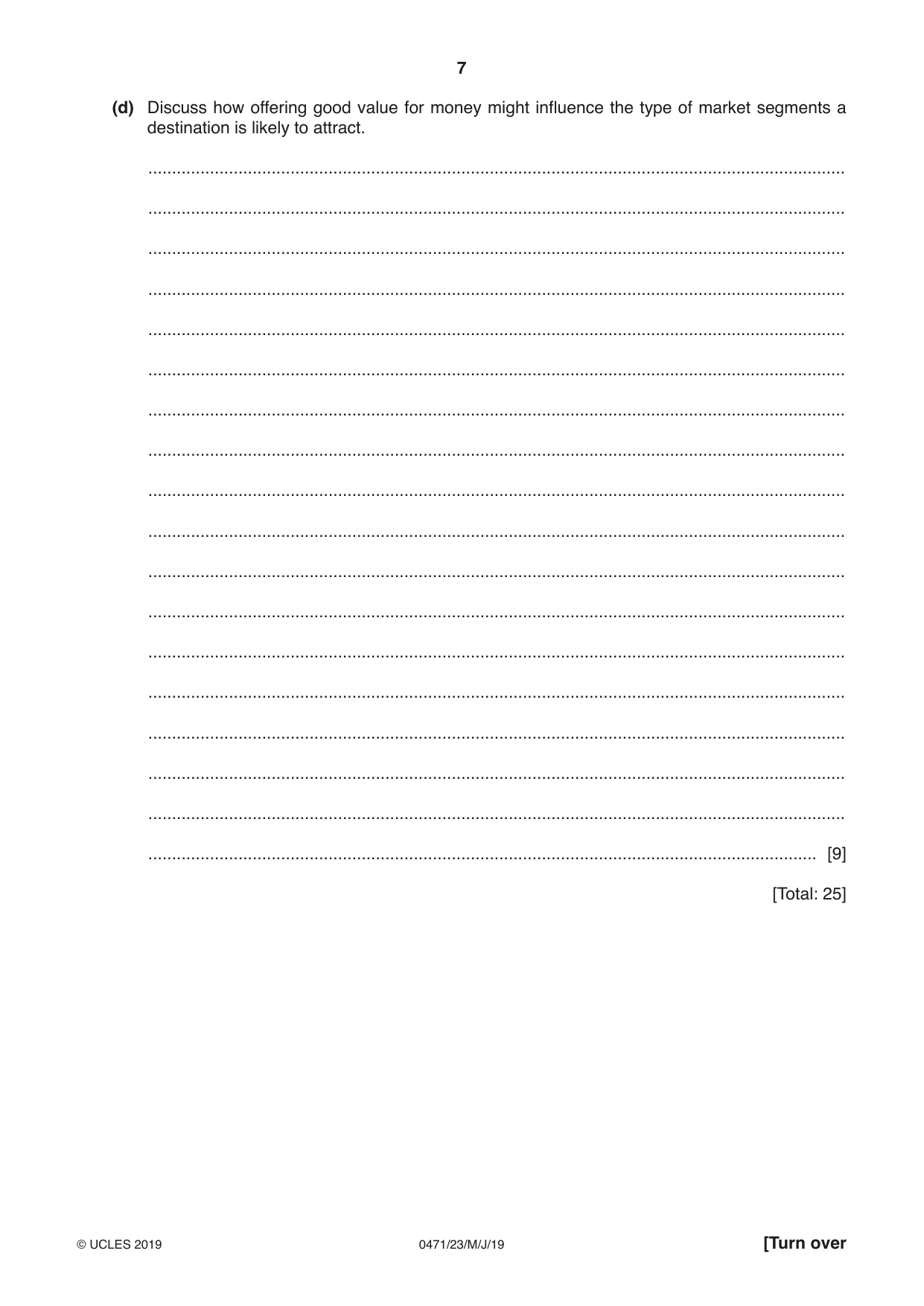
7 0471/23/M/J/19 © UCLES 2019 [Turn over (d) Discuss how offering good value for money might influence the type of market segments a destination is likely to attract. … … … … … … … … … … … … … … … … … … [9] [Total: 25]
Question paper, page 8
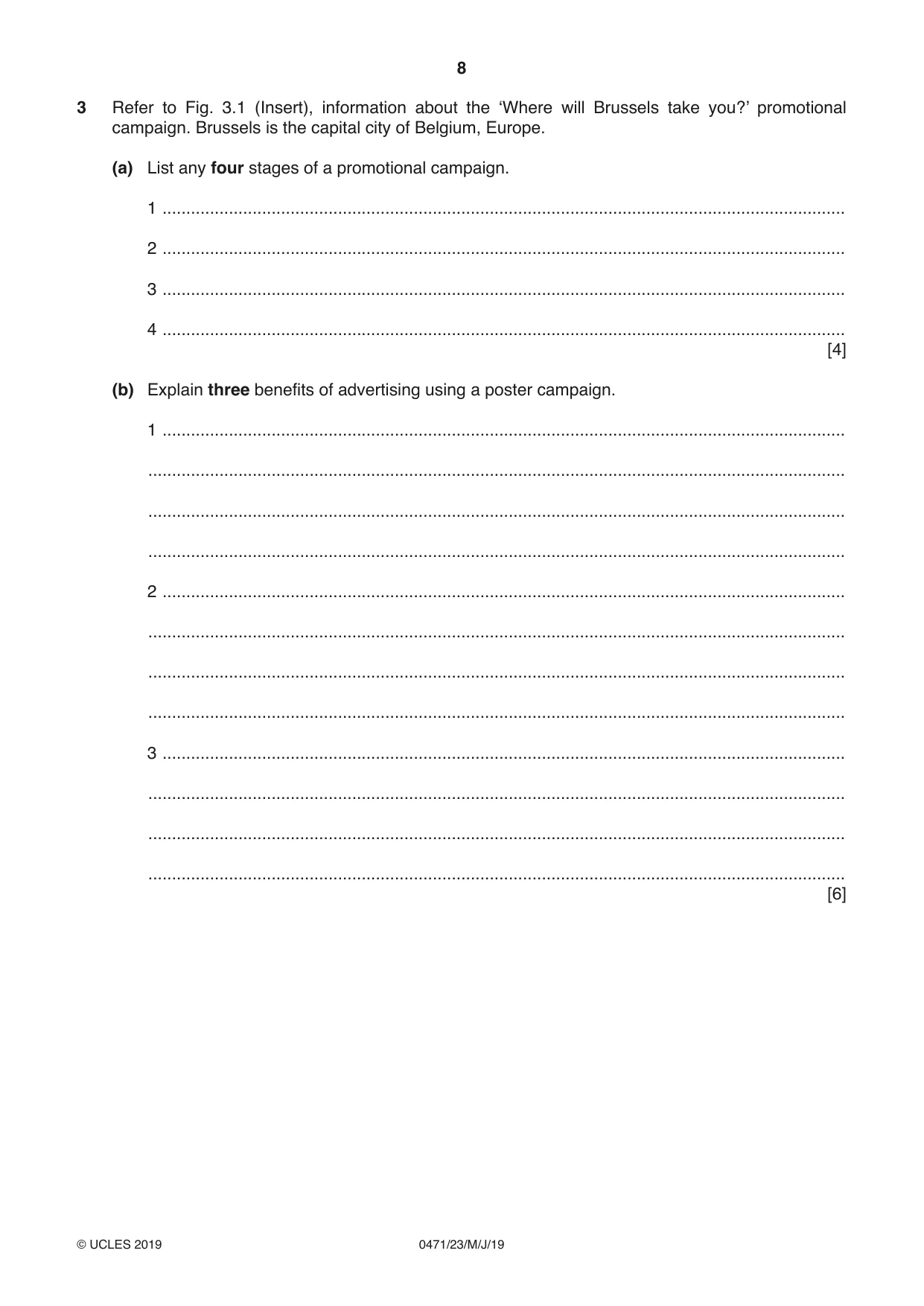
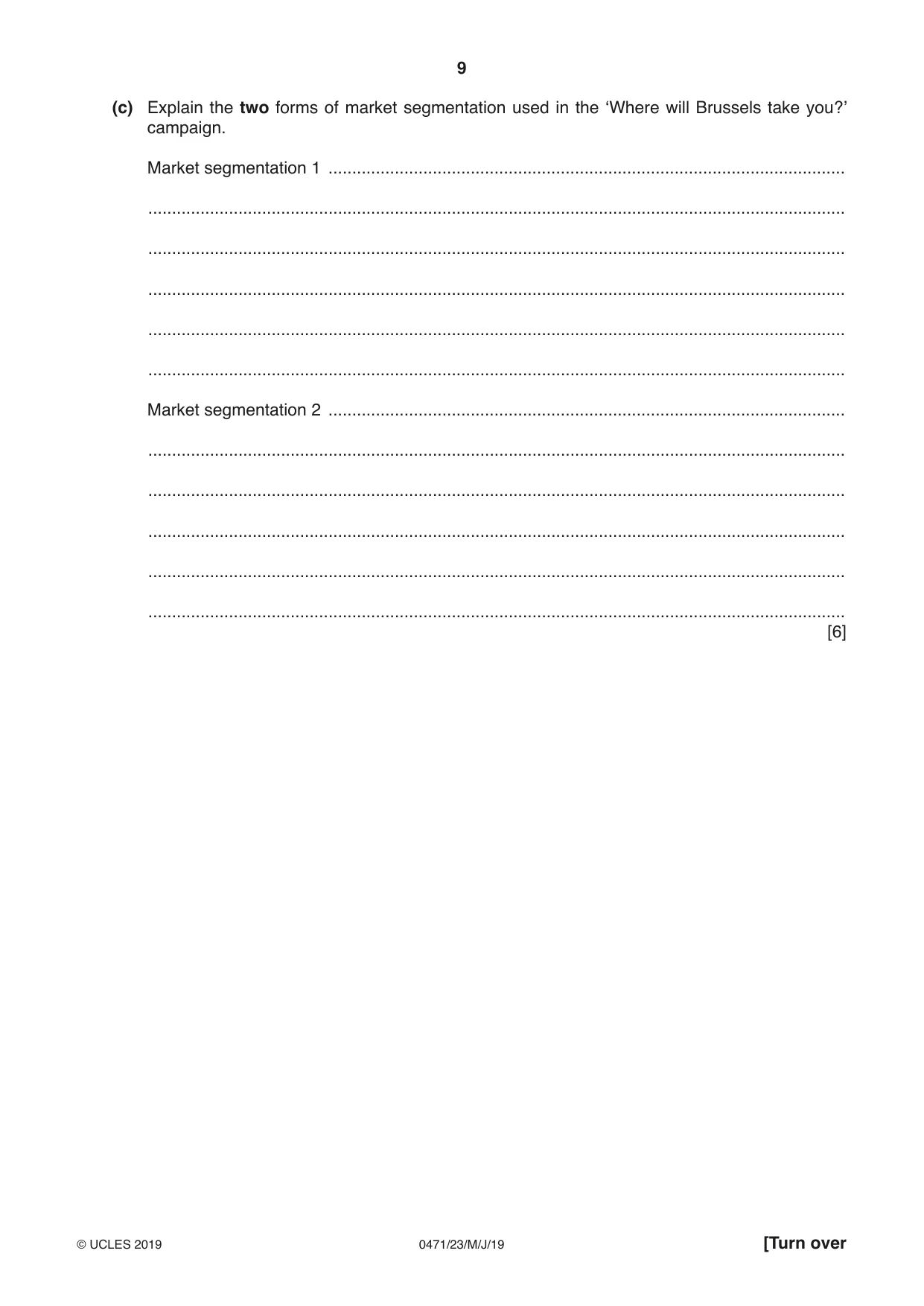
8 0471/23/M/J/19 © UCLES 2019 3 Refer to Fig. 3.1 (Insert), information about the ‘Where will Brussels take you?’ promotional campaign. Brussels is the capital city of Belgium, Europe. (a) List any four stages of a promotional campaign. 1 … 2 … 3 … 4 … [4] (b) Explain three benefits of advertising using a poster campaign. 1 … … … … 2 … … … … 3 … … … … [6]
Question paper, page 9
9 0471/23/M/J/19 © UCLES 2019 [Turn over (c) Explain the two forms of market segmentation used in the ‘Where will Brussels take you?’ campaign. Market segmentation 1 … … … … … … Market segmentation 2 … … … … … … [6]
Question paper, page 10
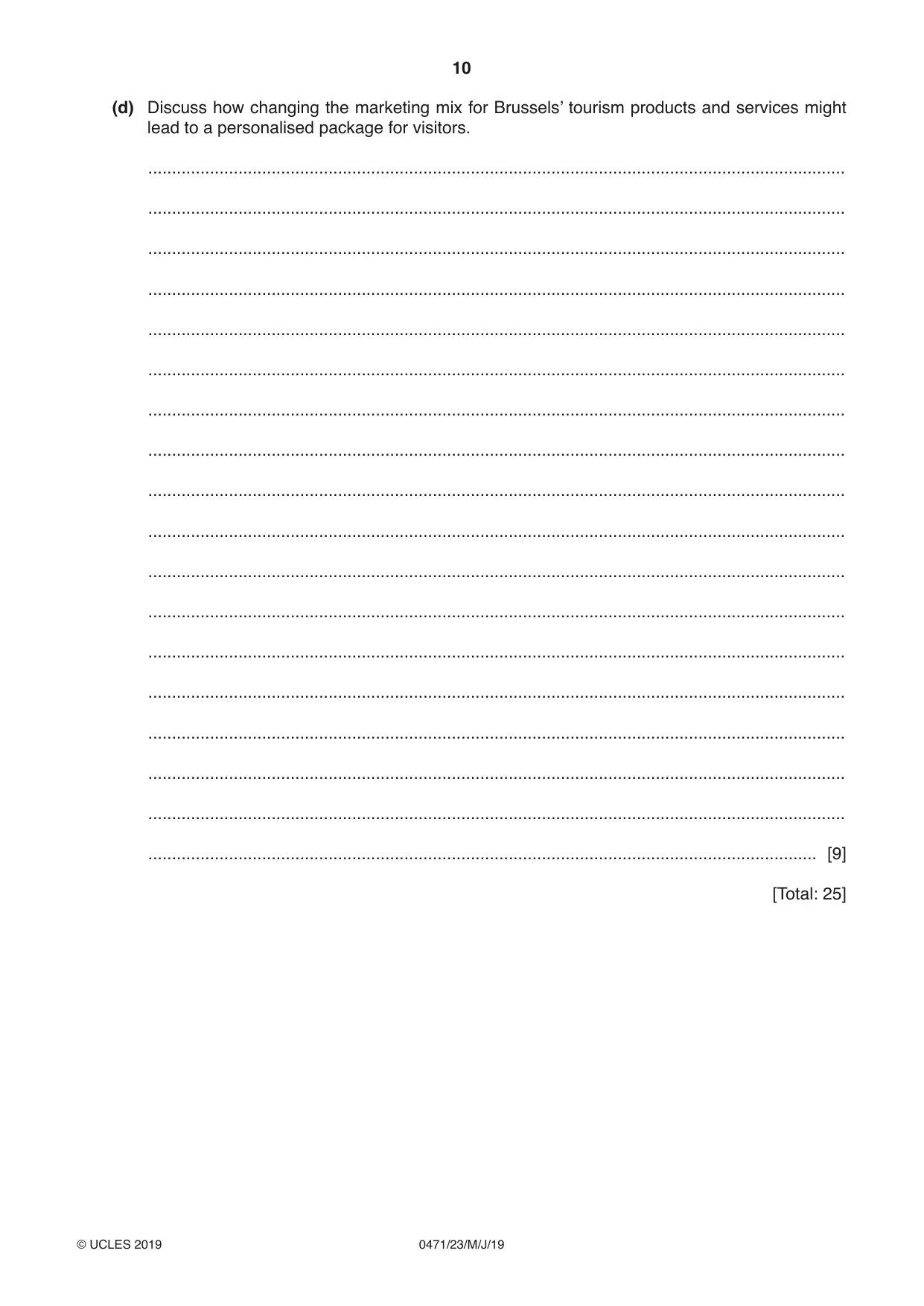
10 0471/23/M/J/19 © UCLES 2019 (d) Discuss how changing the marketing mix for Brussels’ tourism products and services might lead to a personalised package for visitors. … … … … … … … … … … … … … … … … … … [9] [Total: 25]
Question paper, page 11
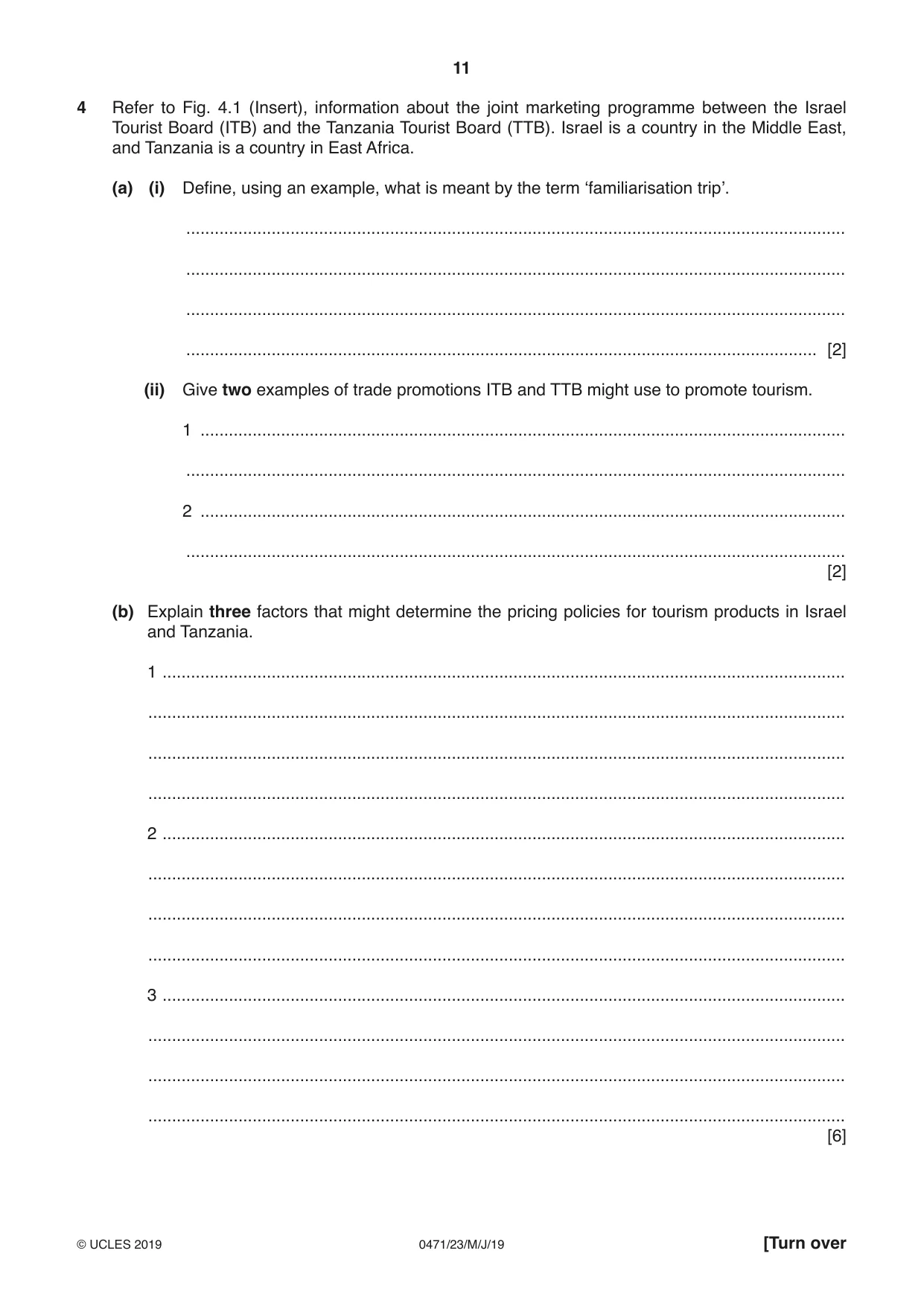
11 0471/23/M/J/19 © UCLES 2019 [Turn over 4 Refer to Fig. 4.1 (Insert), information about the joint marketing programme between the Israel Tourist Board (ITB) and the Tanzania Tourist Board (TTB). Israel is a country in the Middle East, and Tanzania is a country in East Africa. (a) (i) Define, using an example, what is meant by the term ‘familiarisation trip’. … … … … [2] (ii) Give two examples of trade promotions ITB and TTB might use to promote tourism. 1 … … 2 … … [2] (b) Explain three factors that might determine the pricing policies for tourism products in Israel and Tanzania. 1 … … … … 2 … … … … 3 … … … … [6]
Question paper, page 12
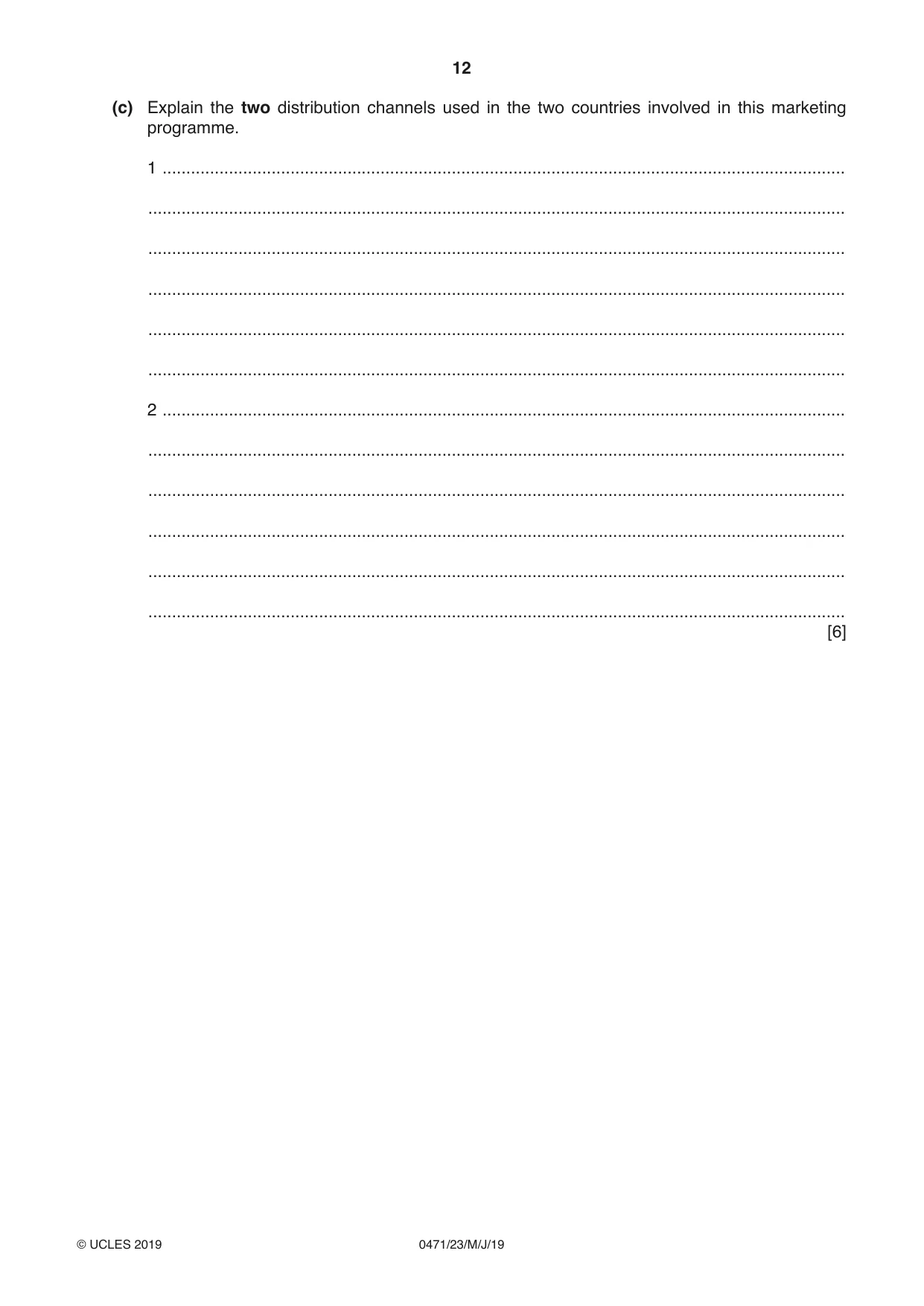
12 0471/23/M/J/19 © UCLES 2019 (c) Explain the two distribution channels used in the two countries involved in this marketing programme. 1 … … … … … … 2 … … … … … … [6]
Question paper, page 13
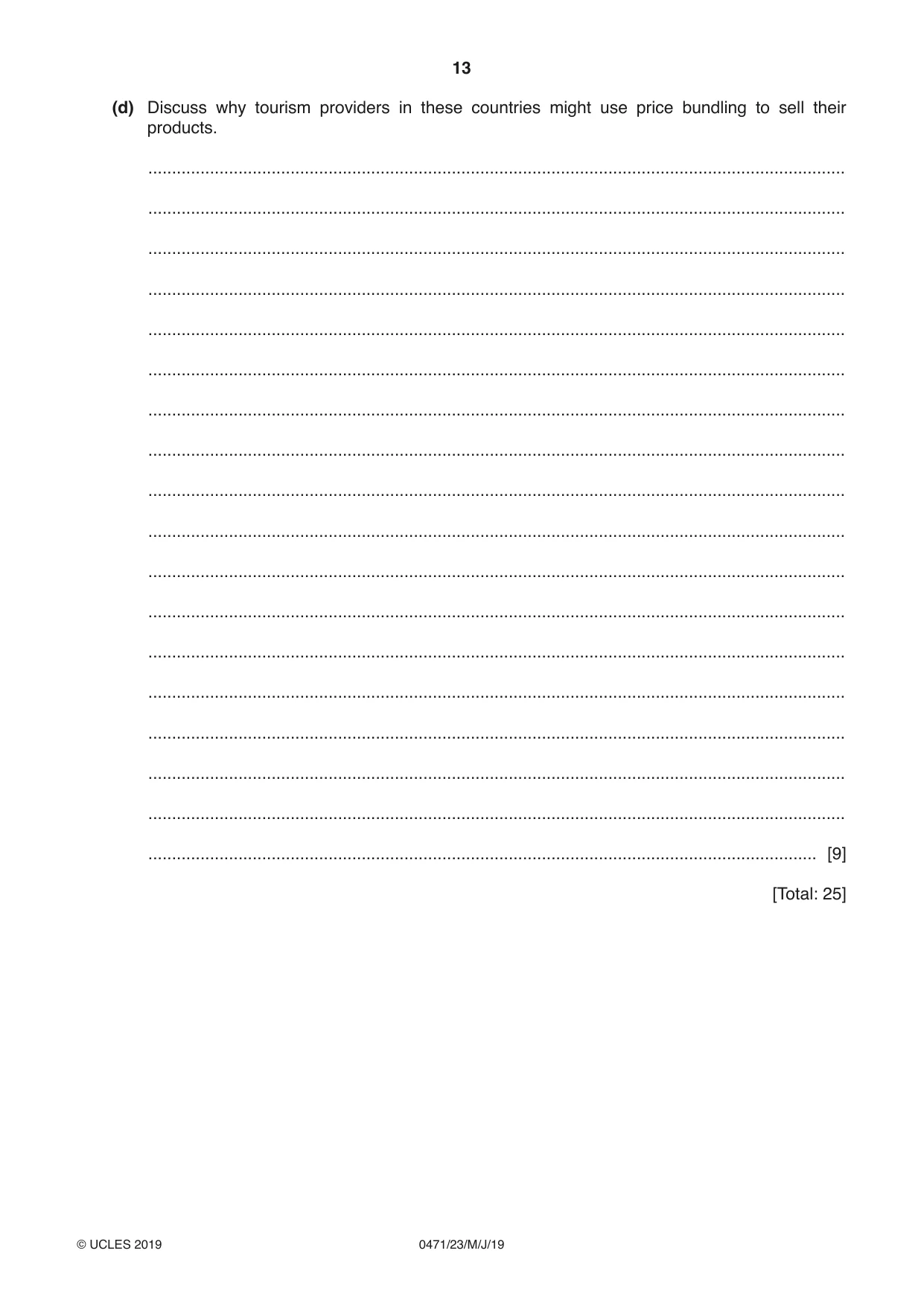
13 0471/23/M/J/19 © UCLES 2019 (d) Discuss why tourism providers in these countries might use price bundling to sell their products. … … … … … … … … … … … … … … … … … … [9] [Total: 25]
Question paper, page 14
14 0471/23/M/J/19 © UCLES 2019 BLANK PAGE
Question paper, page 15
15 0471/23/M/J/19 © UCLES 2019 BLANK PAGE
Question paper, page 16
16 0471/23/M/J/19 © UCLES 2019 Permission to reproduce items where third-party owned material protected by copyright is included has been sought and cleared where possible. Every reasonable effort has been made by the publisher (UCLES) to trace copyright holders, but if any items requiring clearance have unwittingly been included, the publisher will be pleased to make amends at the earliest possible opportunity. To avoid the issue of disclosure of answer-related information to candidates, all copyright acknowledgements are reproduced online in the Cambridge Assessment International Education Copyright Acknowledgements Booklet. This is produced for each series of examinations and is freely available to download at www.cambridgeinternational.org after the live examination series. Cambridge Assessment International Education is part of the Cambridge Assessment Group. Cambridge Assessment is the brand name of the University of Cambridge Local Examinations Syndicate (UCLES), which itself is a department of the University of Cambridge. BLANK PAGE
Mark scheme, page 1
This document consists of 10 printed pages. © UCLES 2019 [Turn over Cambridge Assessment International Education Cambridge International General Certificate of Secondary Education TRAVEL & TOURISM 0471/23 Paper 2 Alternative to Coursework May/June 2019 MARK SCHEME Maximum Mark: 100 Published This mark scheme is published as an aid to teachers and candidates, to indicate the requirements of the examination. It shows the basis on which Examiners were instructed to award marks. It does not indicate the details of the discussions that took place at an Examiners’ meeting before marking began, which would have considered the acceptability of alternative answers. Mark schemes should be read in conjunction with the question paper and the Principal Examiner Report for Teachers. Cambridge International will not enter into discussions about these mark schemes. Cambridge International is publishing the mark schemes for the May/June 2019 series for most Cambridge IGCSE™, Cambridge International A and AS Level and Cambridge Pre-U components, and some Cambridge O Level components.
Mark scheme, page 2
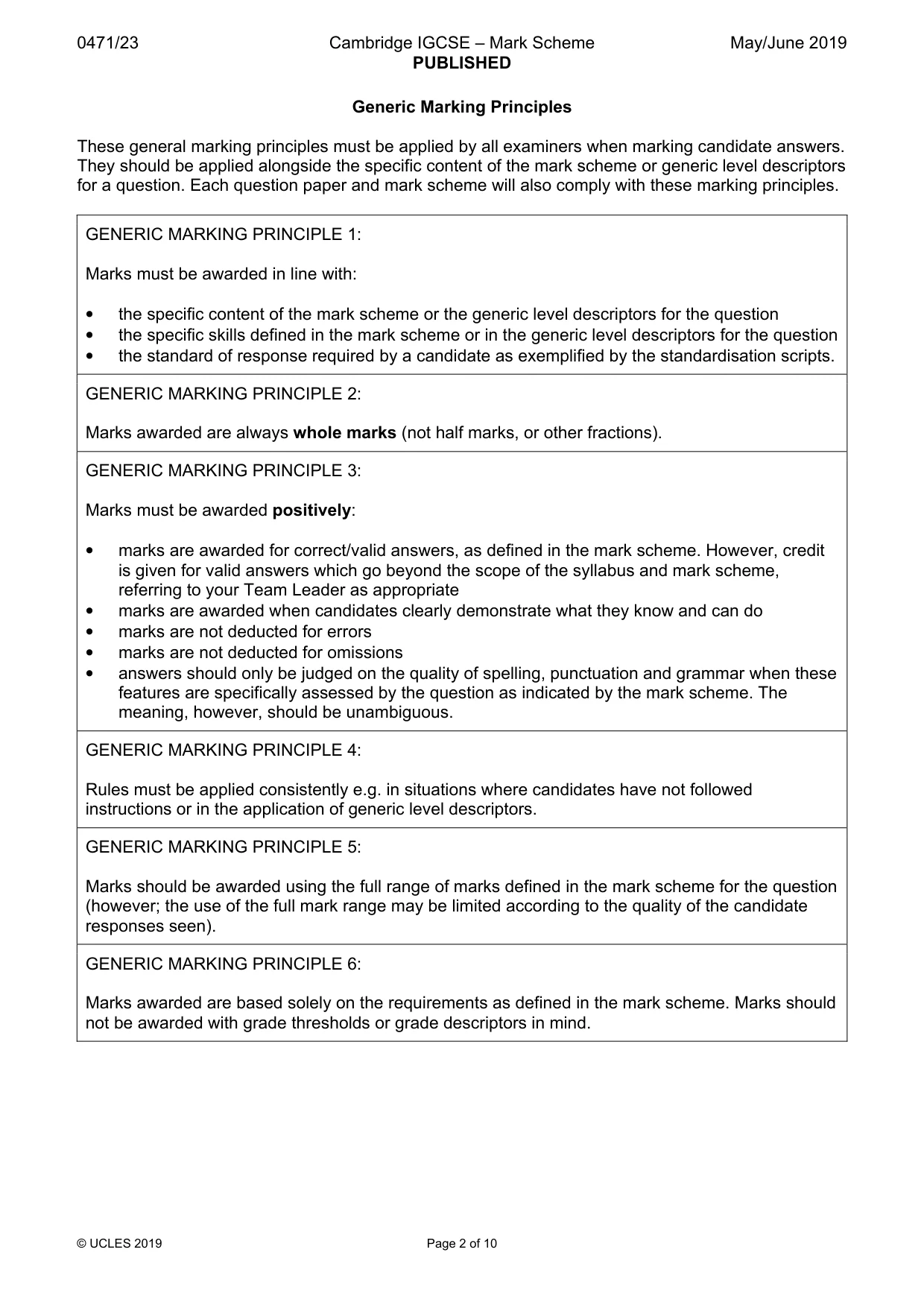
0471/23 Cambridge IGCSE – Mark Scheme PUBLISHED May/June 2019 © UCLES 2019 Page 2 of 10 Generic Marking Principles These general marking principles must be applied by all examiners when marking candidate answers. They should be applied alongside the specific content of the mark scheme or generic level descriptors for a question. Each question paper and mark scheme will also comply with these marking principles. GENERIC MARKING PRINCIPLE 1: Marks must be awarded in line with: • the specific content of the mark scheme or the generic level descriptors for the question • the specific skills defined in the mark scheme or in the generic level descriptors for the question • the standard of response required by a candidate as exemplified by the standardisation scripts. GENERIC MARKING PRINCIPLE 2: Marks awarded are always whole marks (not half marks, or other fractions). GENERIC MARKING PRINCIPLE 3: Marks must be awarded positively: • marks are awarded for correct/valid answers, as defined in the mark scheme. However, credit is given for valid answers which go beyond the scope of the syllabus and mark scheme, referring to your Team Leader as appropriate • marks are awarded when candidates clearly demonstrate what they know and can do • marks are not deducted for errors • marks are not deducted for omissions • answers should only be judged on the quality of spelling, punctuation and grammar when these features are specifically assessed by the question as indicated by the mark scheme. The meaning, however, should be unambiguous. GENERIC MARKING PRINCIPLE 4: Rules must be applied consistently e.g. in situations where candidates have not followed instructions or in the application of generic level descriptors. GENERIC MARKING PRINCIPLE 5: Marks should be awarded using the full range of marks defined in the mark scheme for the question (however; the use of the full mark range may be limited according to the quality of the candidate responses seen). GENERIC MARKING PRINCIPLE 6: Marks awarded are based solely on the requirements as defined in the mark scheme. Marks should not be awarded with grade thresholds or grade descriptors in mind.
Mark scheme, page 3
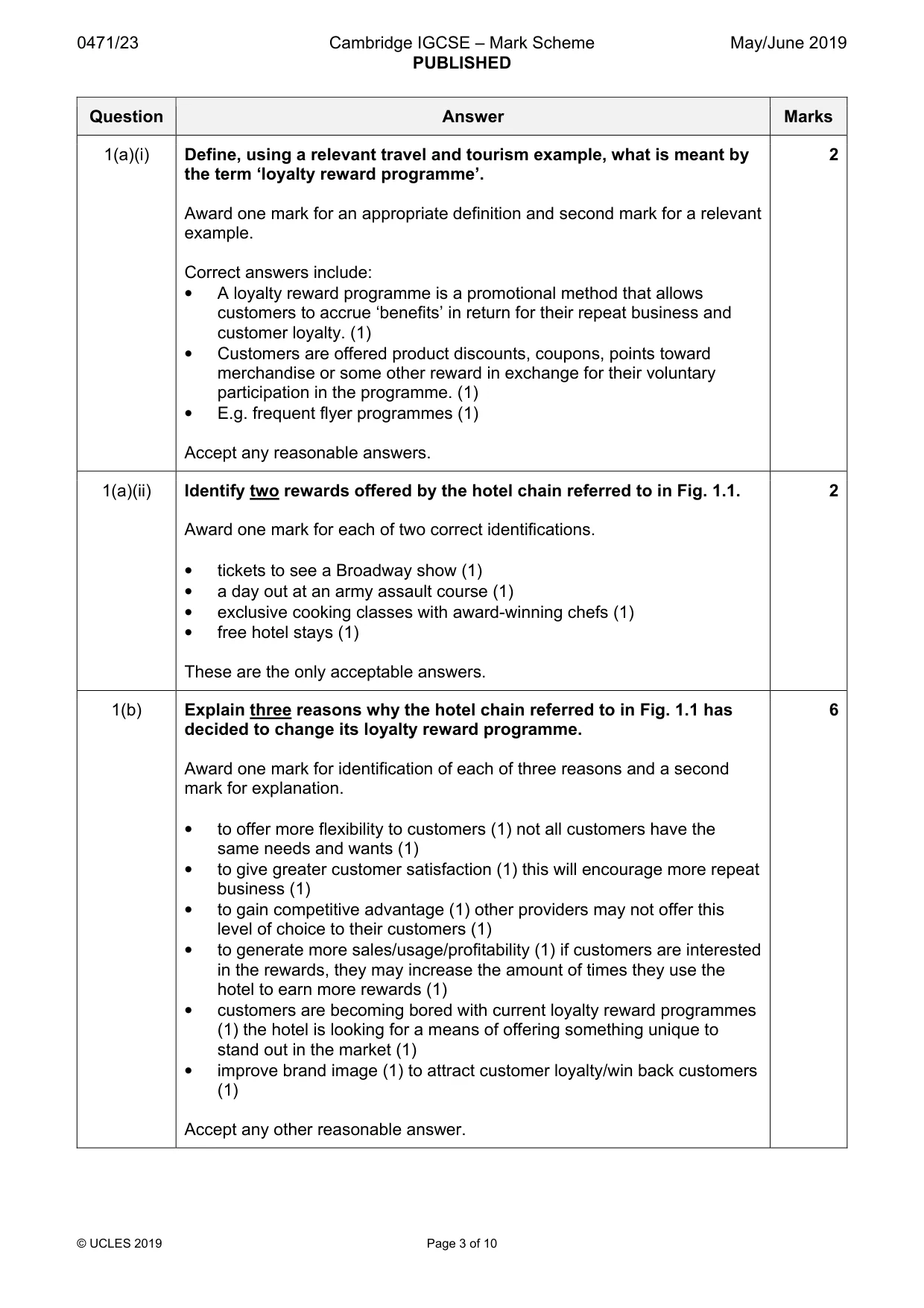
0471/23 Cambridge IGCSE – Mark Scheme PUBLISHED May/June 2019 © UCLES 2019 Page 3 of 10 Question Answer Marks 1(a)(i) Define, using a relevant travel and tourism example, what is meant by the term ‘loyalty reward programme’. Award one mark for an appropriate definition and second mark for a relevant example. Correct answers include: • A loyalty reward programme is a promotional method that allows customers to accrue ‘benefits’ in return for their repeat business and customer loyalty. (1) • Customers are offered product discounts, coupons, points toward merchandise or some other reward in exchange for their voluntary participation in the programme. (1) • E.g. frequent flyer programmes (1) Accept any reasonable answers. 2 1(a)(ii) Identify two rewards offered by the hotel chain referred to in Fig. 1.1. Award one mark for each of two correct identifications. • tickets to see a Broadway show (1) • a day out at an army assault course (1) • exclusive cooking classes with award-winning chefs (1) • free hotel stays (1) These are the only acceptable answers. 2 1(b) Explain three reasons why the hotel chain referred to in Fig. 1.1 has decided to change its loyalty reward programme. Award one mark for identification of each of three reasons and a second mark for explanation. • to offer more flexibility to customers (1) not all customers have the same needs and wants (1) • to give greater customer satisfaction (1) this will encourage more repeat business (1) • to gain competitive advantage (1) other providers may not offer this level of choice to their customers (1) • to generate more sales/usage/profitability (1) if customers are interested in the rewards, they may increase the amount of times they use the hotel to earn more rewards (1) • customers are becoming bored with current loyalty reward programmes (1) the hotel is looking for a means of offering something unique to stand out in the market (1) • improve brand image (1) to attract customer loyalty/win back customers (1) Accept any other reasonable answer. 6
Mark scheme, page 4
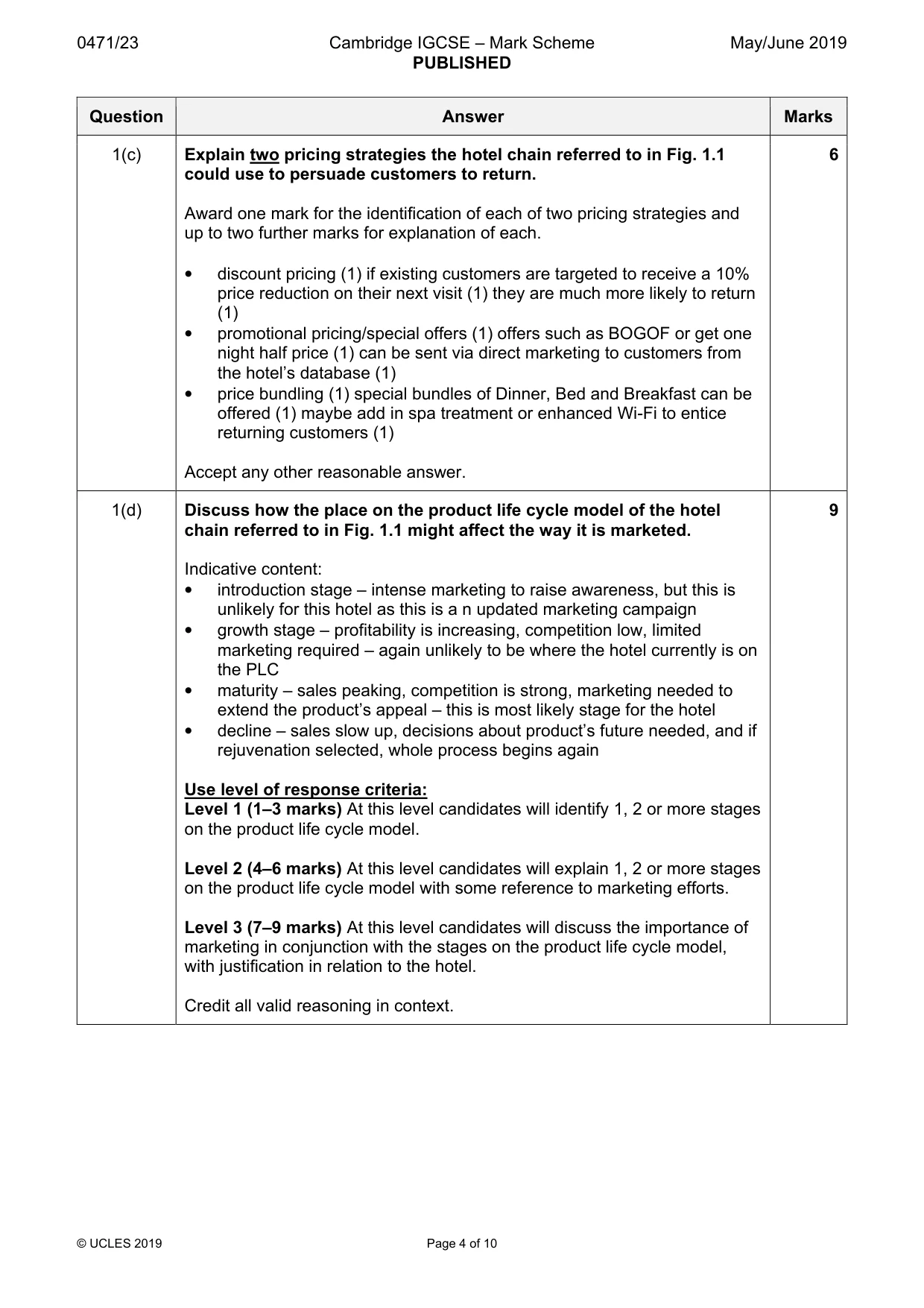
0471/23 Cambridge IGCSE – Mark Scheme PUBLISHED May/June 2019 © UCLES 2019 Page 4 of 10 Question Answer Marks 1(c) Explain two pricing strategies the hotel chain referred to in Fig. 1.1 could use to persuade customers to return. Award one mark for the identification of each of two pricing strategies and up to two further marks for explanation of each. • discount pricing (1) if existing customers are targeted to receive a 10% price reduction on their next visit (1) they are much more likely to return (1) • promotional pricing/special offers (1) offers such as BOGOF or get one night half price (1) can be sent via direct marketing to customers from the hotel’s database (1) • price bundling (1) special bundles of Dinner, Bed and Breakfast can be offered (1) maybe add in spa treatment or enhanced Wi-Fi to entice returning customers (1) Accept any other reasonable answer. 6 1(d) Discuss how the place on the product life cycle model of the hotel chain referred to in Fig. 1.1 might affect the way it is marketed. Indicative content: • introduction stage – intense marketing to raise awareness, but this is unlikely for this hotel as this is a n updated marketing campaign • growth stage – profitability is increasing, competition low, limited marketing required – again unlikely to be where the hotel currently is on the PLC • maturity – sales peaking, competition is strong, marketing needed to extend the product’s appeal – this is most likely stage for the hotel • decline – sales slow up, decisions about product’s future needed, and if rejuvenation selected, whole process begins again Use level of response criteria: Level 1 (1–3 marks) At this level candidates will identify 1, 2 or more stages on the product life cycle model. Level 2 (4–6 marks) At this level candidates will explain 1, 2 or more stages on the product life cycle model with some reference to marketing efforts. Level 3 (7–9 marks) At this level candidates will discuss the importance of marketing in conjunction with the stages on the product life cycle model, with justification in relation to the hotel. Credit all valid reasoning in context. 9
Mark scheme, page 5
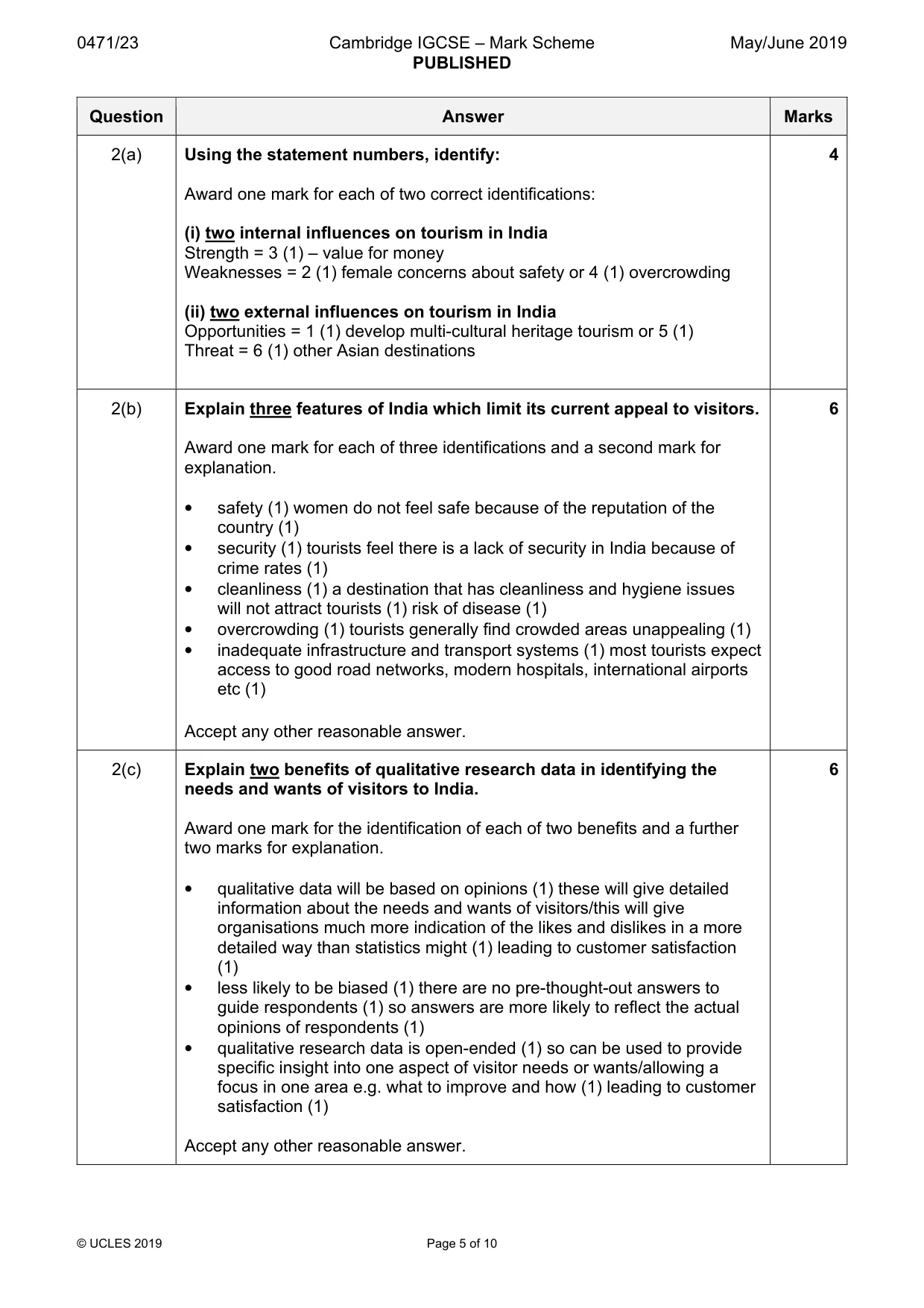
0471/23 Cambridge IGCSE – Mark Scheme PUBLISHED May/June 2019 © UCLES 2019 Page 5 of 10 Question Answer Marks 2(a) Using the statement numbers, identify: Award one mark for each of two correct identifications: (i) two internal influences on tourism in India Strength = 3 (1) – value for money Weaknesses = 2 (1) female concerns about safety or 4 (1) overcrowding (ii) two external influences on tourism in India Opportunities = 1 (1) develop multi-cultural heritage tourism or 5 (1) Threat = 6 (1) other Asian destinations 4 2(b) Explain three features of India which limit its current appeal to visitors. Award one mark for each of three identifications and a second mark for explanation. • safety (1) women do not feel safe because of the reputation of the country (1) • security (1) tourists feel there is a lack of security in India because of crime rates (1) • cleanliness (1) a destination that has cleanliness and hygiene issues will not attract tourists (1) risk of disease (1) • overcrowding (1) tourists generally find crowded areas unappealing (1) • inadequate infrastructure and transport systems (1) most tourists expect access to good road networks, modern hospitals, international airports etc (1) Accept any other reasonable answer. 6 2(c) Explain two benefits of qualitative research data in identifying the needs and wants of visitors to India. Award one mark for the identification of each of two benefits and a further two marks for explanation. • qualitative data will be based on opinions (1) these will give detailed information about the needs and wants of visitors/this will give organisations much more indication of the likes and dislikes in a more detailed way than statistics might (1) leading to customer satisfaction (1) • less likely to be biased (1) there are no pre-thought-out answers to guide respondents (1) so answers are more likely to reflect the actual opinions of respondents (1) • qualitative research data is open-ended (1) so can be used to provide specific insight into one aspect of visitor needs or wants/allowing a focus in one area e.g. what to improve and how (1) leading to customer satisfaction (1) Accept any other reasonable answer. 6
Mark scheme, page 6
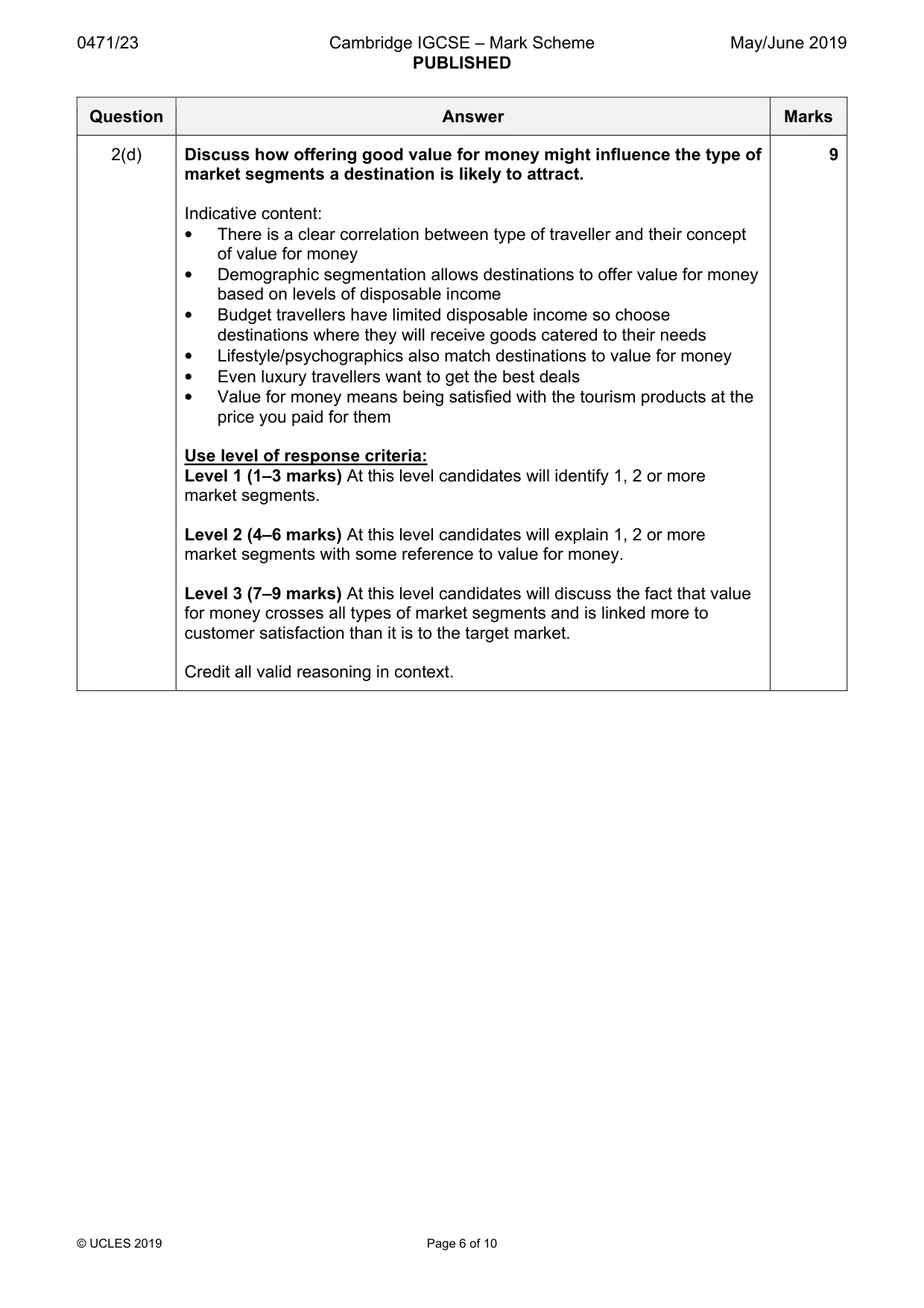
0471/23 Cambridge IGCSE – Mark Scheme PUBLISHED May/June 2019 © UCLES 2019 Page 6 of 10 Question Answer Marks 2(d) Discuss how offering good value for money might influence the type of market segments a destination is likely to attract. Indicative content: • There is a clear correlation between type of traveller and their concept of value for money • Demographic segmentation allows destinations to offer value for money based on levels of disposable income • Budget travellers have limited disposable income so choose destinations where they will receive goods catered to their needs • Lifestyle/psychographics also match destinations to value for money • Even luxury travellers want to get the best deals • Value for money means being satisfied with the tourism products at the price you paid for them Use level of response criteria: Level 1 (1–3 marks) At this level candidates will identify 1, 2 or more market segments. Level 2 (4–6 marks) At this level candidates will explain 1, 2 or more market segments with some reference to value for money. Level 3 (7–9 marks) At this level candidates will discuss the fact that value for money crosses all types of market segments and is linked more to customer satisfaction than it is to the target market. Credit all valid reasoning in context. 9
Mark scheme, page 7
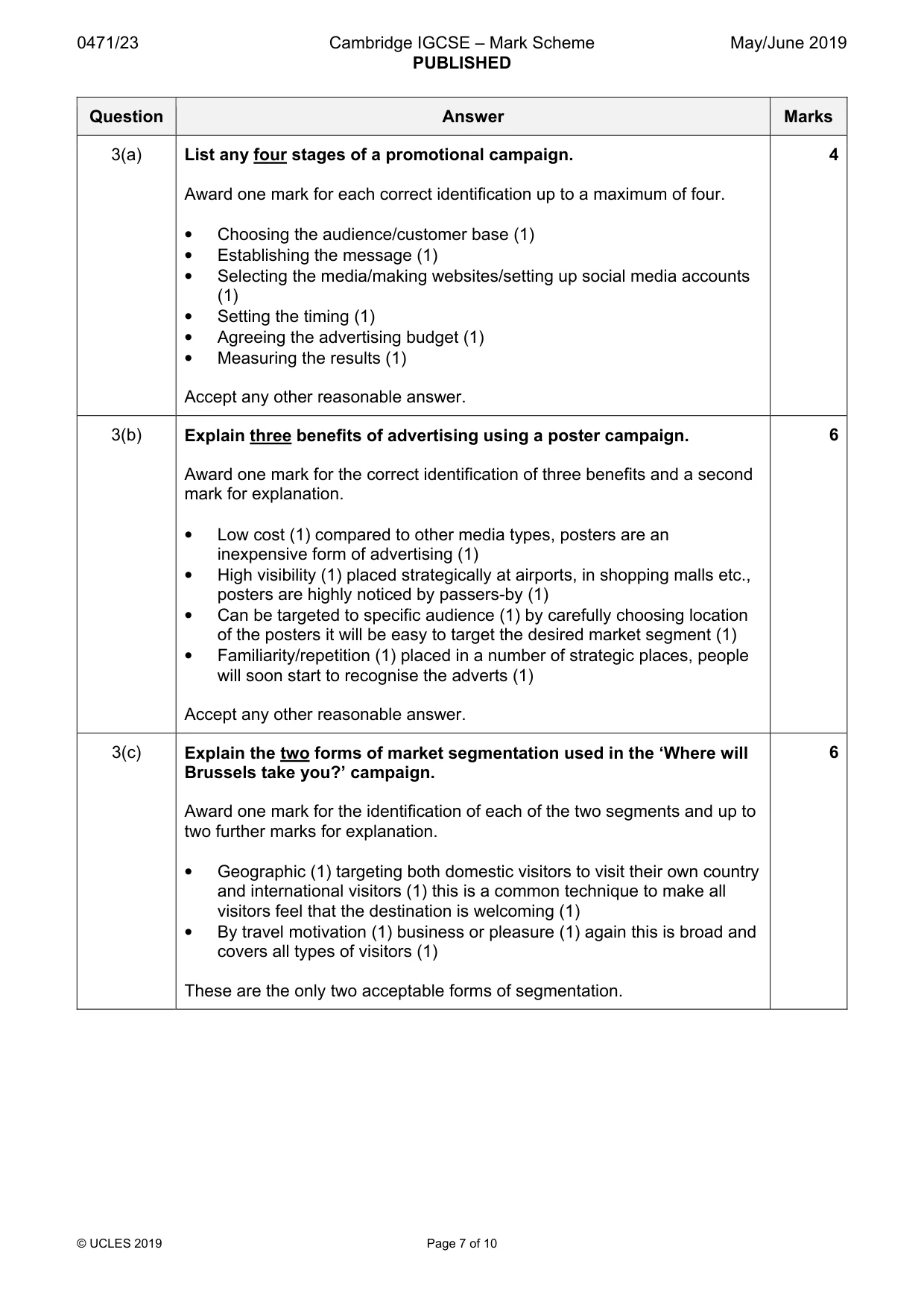
0471/23 Cambridge IGCSE – Mark Scheme PUBLISHED May/June 2019 © UCLES 2019 Page 7 of 10 Question Answer Marks 3(a) List any four stages of a promotional campaign. Award one mark for each correct identification up to a maximum of four. • Choosing the audience/customer base (1) • Establishing the message (1) • Selecting the media/making websites/setting up social media accounts (1) • Setting the timing (1) • Agreeing the advertising budget (1) • Measuring the results (1) Accept any other reasonable answer. 4 3(b) Explain three benefits of advertising using a poster campaign. Award one mark for the correct identification of three benefits and a second mark for explanation. • Low cost (1) compared to other media types, posters are an inexpensive form of advertising (1) • High visibility (1) placed strategically at airports, in shopping malls etc., posters are highly noticed by passers-by (1) • Can be targeted to specific audience (1) by carefully choosing location of the posters it will be easy to target the desired market segment (1) • Familiarity/repetition (1) placed in a number of strategic places, people will soon start to recognise the adverts (1) Accept any other reasonable answer. 6 3(c) Explain the two forms of market segmentation used in the ‘Where will Brussels take you?’ campaign. Award one mark for the identification of each of the two segments and up to two further marks for explanation. • Geographic (1) targeting both domestic visitors to visit their own country and international visitors (1) this is a common technique to make all visitors feel that the destination is welcoming (1) • By travel motivation (1) business or pleasure (1) again this is broad and covers all types of visitors (1) These are the only two acceptable forms of segmentation. 6
Mark scheme, page 8
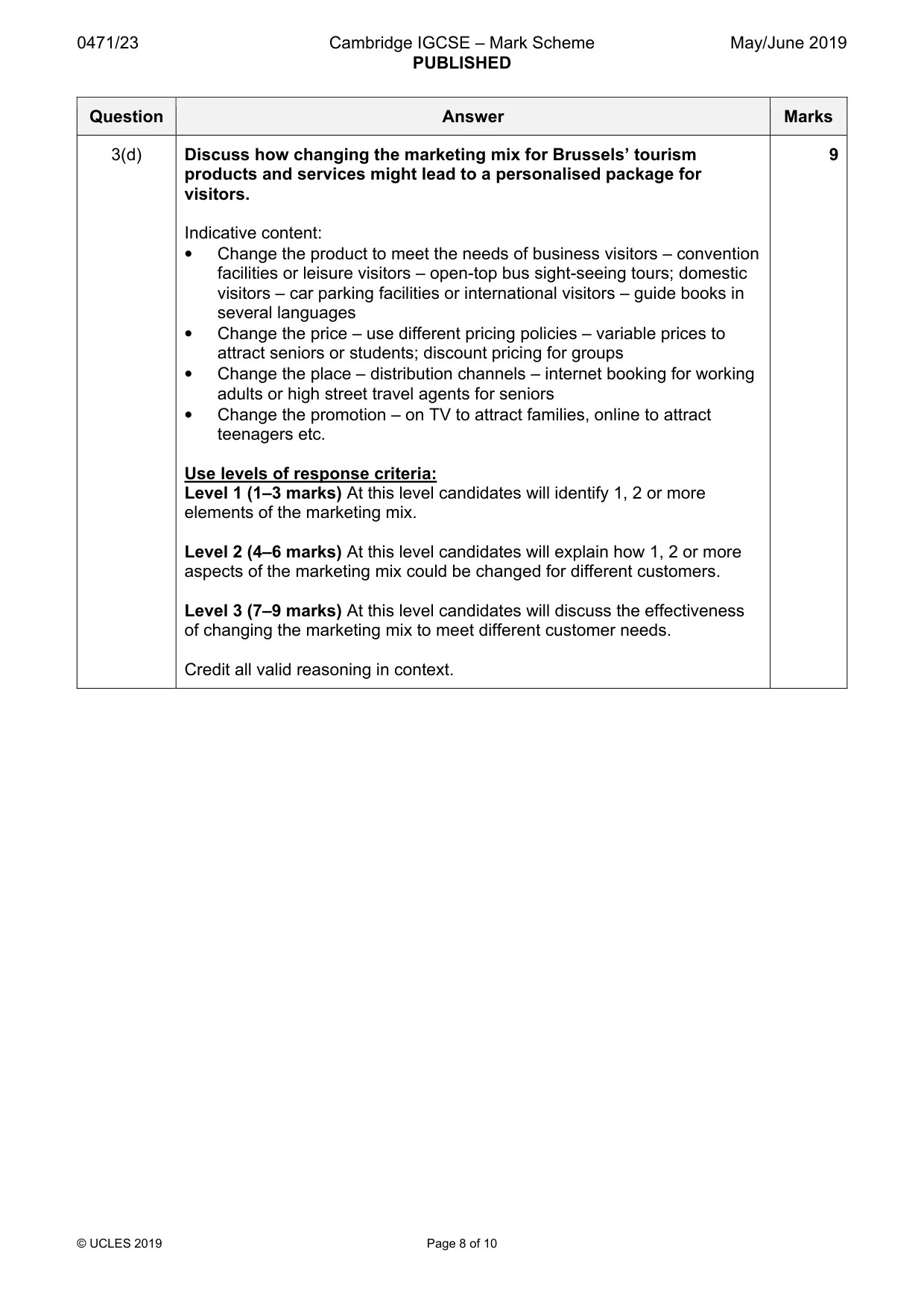
0471/23 Cambridge IGCSE – Mark Scheme PUBLISHED May/June 2019 © UCLES 2019 Page 8 of 10 Question Answer Marks 3(d) Discuss how changing the marketing mix for Brussels’ tourism products and services might lead to a personalised package for visitors. Indicative content: • Change the product to meet the needs of business visitors – convention facilities or leisure visitors – open-top bus sight-seeing tours; domestic visitors – car parking facilities or international visitors – guide books in several languages • Change the price – use different pricing policies – variable prices to attract seniors or students; discount pricing for groups • Change the place – distribution channels – internet booking for working adults or high street travel agents for seniors • Change the promotion – on TV to attract families, online to attract teenagers etc. Use levels of response criteria: Level 1 (1–3 marks) At this level candidates will identify 1, 2 or more elements of the marketing mix. Level 2 (4–6 marks) At this level candidates will explain how 1, 2 or more aspects of the marketing mix could be changed for different customers. Level 3 (7–9 marks) At this level candidates will discuss the effectiveness of changing the marketing mix to meet different customer needs. Credit all valid reasoning in context. 9
Mark scheme, page 9
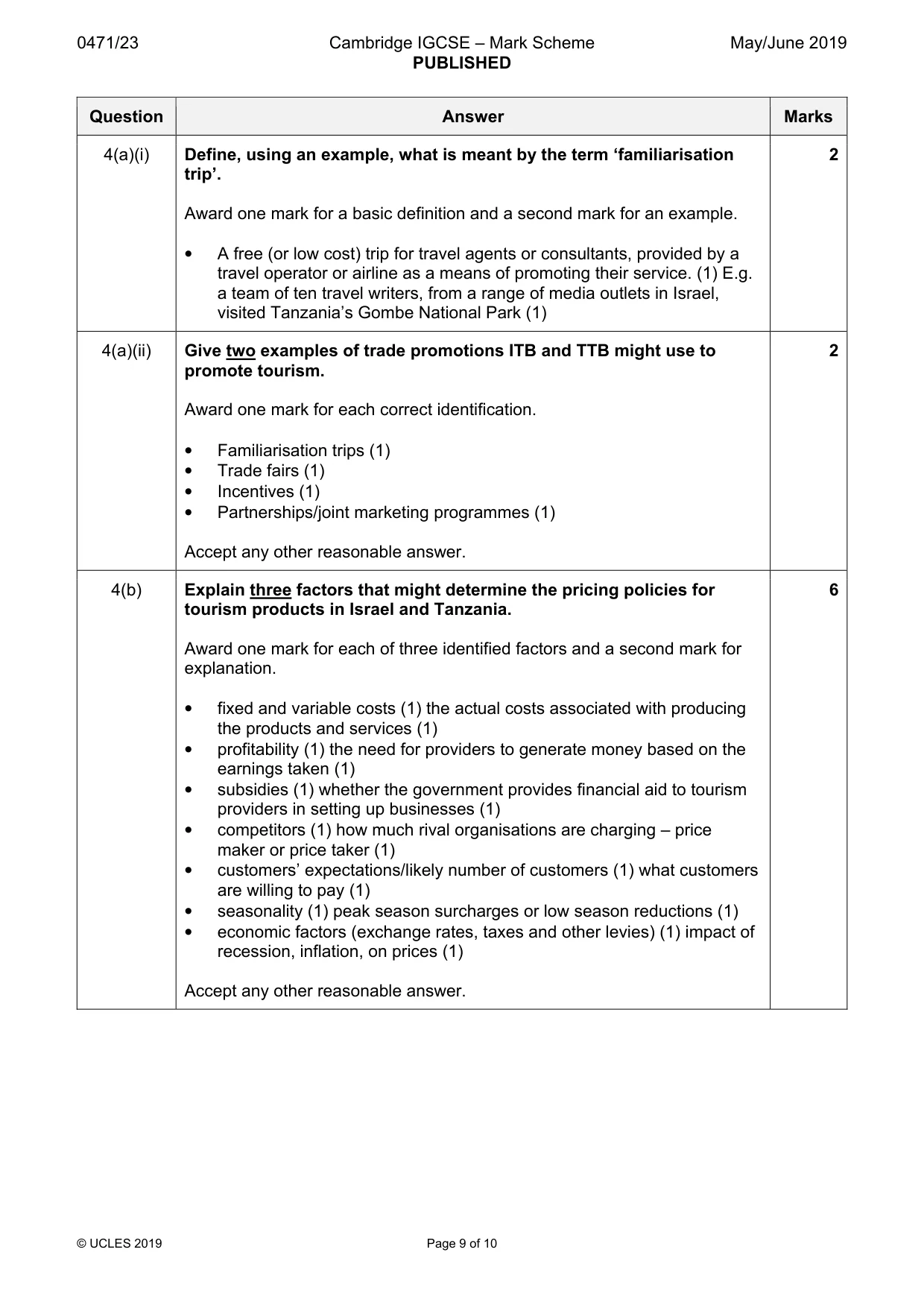
0471/23 Cambridge IGCSE – Mark Scheme PUBLISHED May/June 2019 © UCLES 2019 Page 9 of 10 Question Answer Marks 4(a)(i) Define, using an example, what is meant by the term ‘familiarisation trip’. Award one mark for a basic definition and a second mark for an example. • A free (or low cost) trip for travel agents or consultants, provided by a travel operator or airline as a means of promoting their service. (1) E.g. a team of ten travel writers, from a range of media outlets in Israel, visited Tanzania’s Gombe National Park (1) 2 4(a)(ii) Give two examples of trade promotions ITB and TTB might use to promote tourism. Award one mark for each correct identification. • Familiarisation trips (1) • Trade fairs (1) • Incentives (1) • Partnerships/joint marketing programmes (1) Accept any other reasonable answer. 2 4(b) Explain three factors that might determine the pricing policies for tourism products in Israel and Tanzania. Award one mark for each of three identified factors and a second mark for explanation. • fixed and variable costs (1) the actual costs associated with producing the products and services (1) • profitability (1) the need for providers to generate money based on the earnings taken (1) • subsidies (1) whether the government provides financial aid to tourism providers in setting up businesses (1) • competitors (1) how much rival organisations are charging – price maker or price taker (1) • customers’ expectations/likely number of customers (1) what customers are willing to pay (1) • seasonality (1) peak season surcharges or low season reductions (1) • economic factors (exchange rates, taxes and other levies) (1) impact of recession, inflation, on prices (1) Accept any other reasonable answer. 6
Mark scheme, page 10
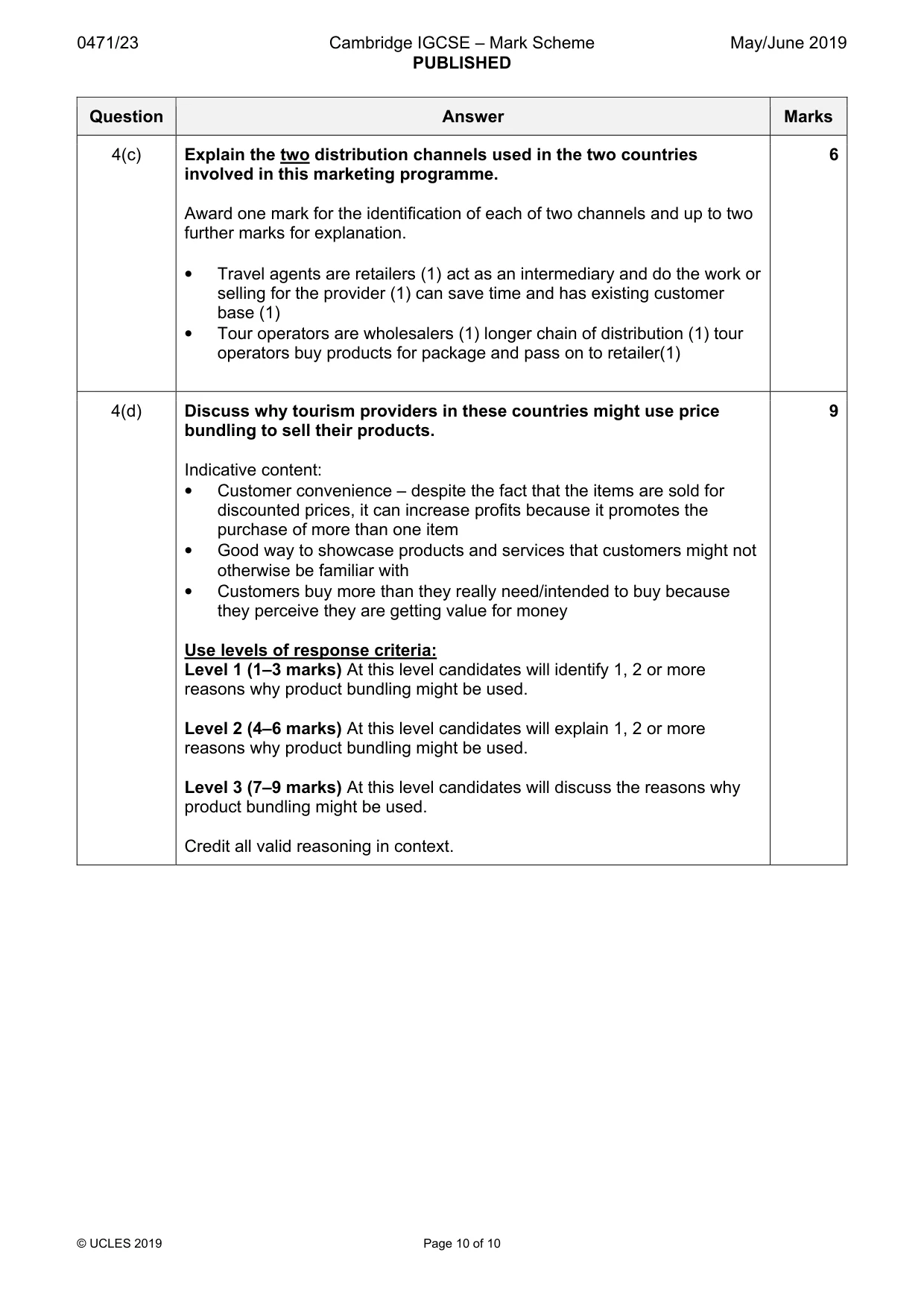
0471/23 Cambridge IGCSE – Mark Scheme PUBLISHED May/June 2019 © UCLES 2019 Page 10 of 10 Question Answer Marks 4(c) Explain the two distribution channels used in the two countries involved in this marketing programme. Award one mark for the identification of each of two channels and up to two further marks for explanation. • Travel agents are retailers (1) act as an intermediary and do the work or selling for the provider (1) can save time and has existing customer base (1) • Tour operators are wholesalers (1) longer chain of distribution (1) tour operators buy products for package and pass on to retailer(1) 6 4(d) Discuss why tourism providers in these countries might use price bundling to sell their products. Indicative content: • Customer convenience – despite the fact that the items are sold for discounted prices, it can increase profits because it promotes the purchase of more than one item • Good way to showcase products and services that customers might not otherwise be familiar with • Customers buy more than they really need/intended to buy because they perceive they are getting value for money Use levels of response criteria: Level 1 (1–3 marks) At this level candidates will identify 1, 2 or more reasons why product bundling might be used. Level 2 (4–6 marks) At this level candidates will explain 1, 2 or more reasons why product bundling might be used. Level 3 (7–9 marks) At this level candidates will discuss the reasons why product bundling might be used. Credit all valid reasoning in context. 9
What you needed in this session
Cambridge’s own grade thresholds for 2019 May/June, Paper 2 · Variant 3. A higher threshold means an easier paper — the bar moves with how the cohort did.