Cambridge IGCSE Travel and Tourism 0471 — 2019 May/June Paper 2 · Variant 2
0471/22/M/J/19 · 100 marks · ≈113 min
The question paper and its mark scheme, free to read here and free to download. This is Cambridge’s own paper, exactly as it was sat.
Question paper16 pages



Mark scheme12 pages
Answers below. Sit the paper first if you are practising.
Paper as text
Question paper, page 1
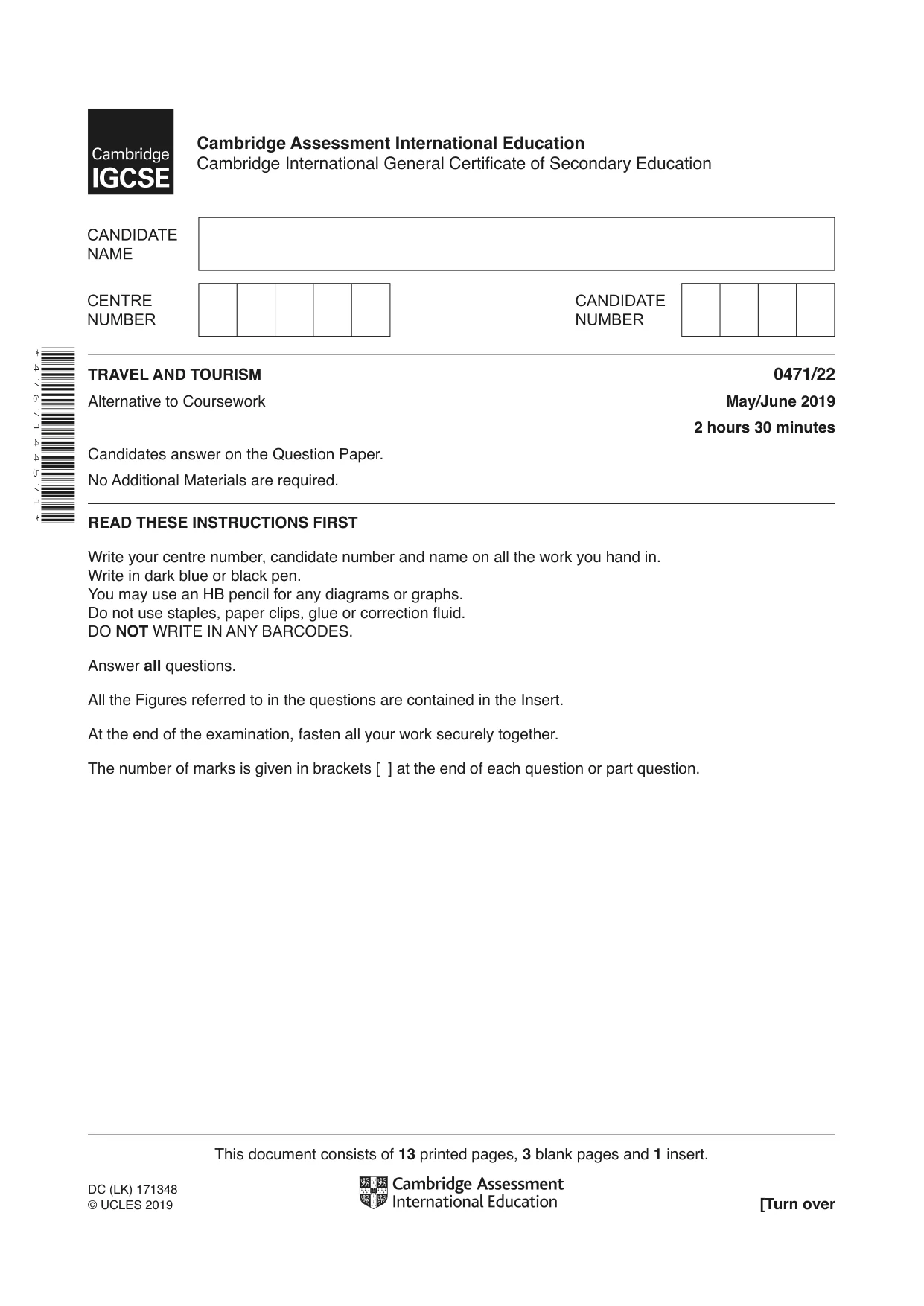
This document consists of 13 printed pages, 3 blank pages and 1 insert. DC (LK) 171348 © UCLES 2019 [Turn over * 4 7 6 7 1 4 4 5 7 1 * TRAVEL AND TOURISM 0471/22 Alternative to Coursework May/June 2019 2 hours 30 minutes Candidates answer on the Question Paper. No Additional Materials are required. READ THESE INSTRUCTIONS FIRST Write your centre number, candidate number and name on all the work you hand in. Write in dark blue or black pen. You may use an HB pencil for any diagrams or graphs. Do not use staples, paper clips, glue or correction fluid. DO NOT WRITE IN ANY BARCODES. Answer all questions. All the Figures referred to in the questions are contained in the Insert. At the end of the examination, fasten all your work securely together. The number of marks is given in brackets [ ] at the end of each question or part question. Cambridge Assessment International Education Cambridge International General Certificate of Secondary Education
Question paper, page 2
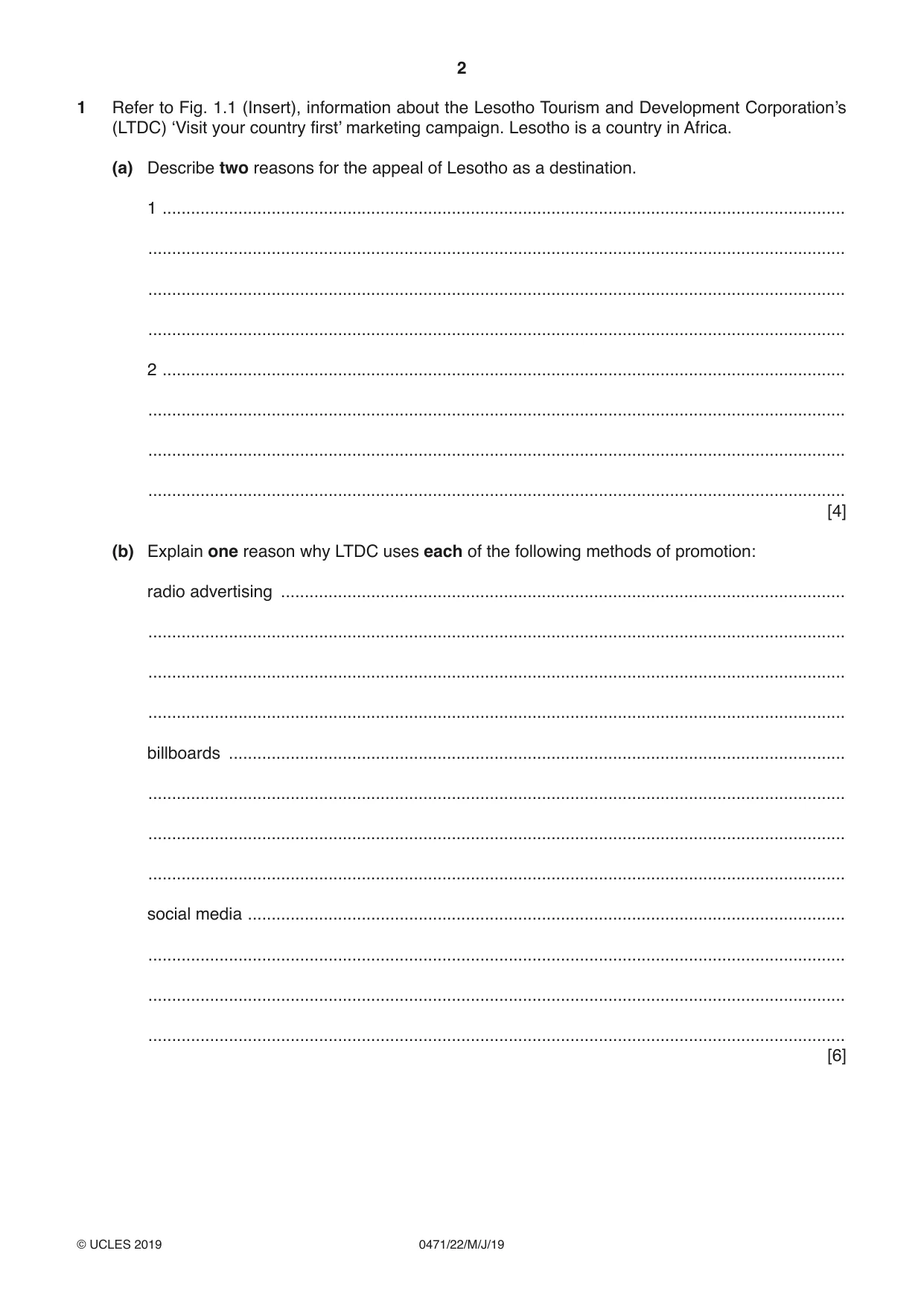
2 0471/22/M/J/19 © UCLES 2019 1 Refer to Fig. 1.1 (Insert), information about the Lesotho Tourism and Development Corporation’s (LTDC) ‘Visit your country first’ marketing campaign. Lesotho is a country in Africa. (a) Describe two reasons for the appeal of Lesotho as a destination. 1 … … … … 2 … … … … [4] (b) Explain one reason why LTDC uses each of the following methods of promotion: radio advertising … … … … billboards … … … … social media … … … … [6]
Question paper, page 3
3 0471/22/M/J/19 © UCLES 2019 [Turn over (c) Explain two likely reasons why domestic tourism is a key market segment for many destinations. 1 … … … … … … 2 … … … … … … [6]
Question paper, page 4
4 0471/22/M/J/19 © UCLES 2019 (d) Discuss how marketing and promotion can help Lesotho become more competitive as a destination. … … … … … … … … … … … … … … … … … … [9] [Total: 25]
Question paper, page 5
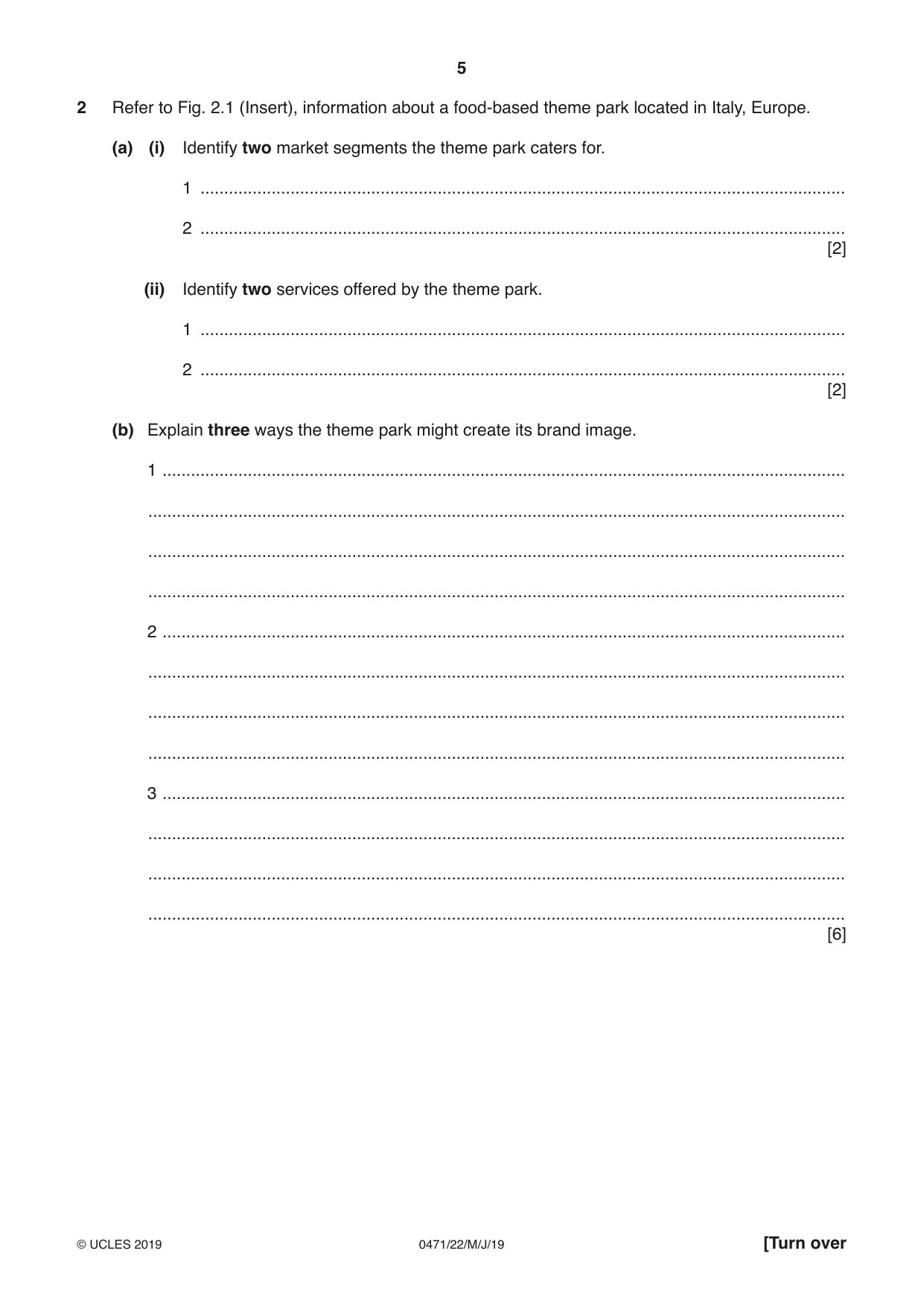
5 0471/22/M/J/19 © UCLES 2019 [Turn over 2 Refer to Fig. 2.1 (Insert), information about a food-based theme park located in Italy, Europe. (a) (i) Identify two market segments the theme park caters for. 1 … 2 … [2] (ii) Identify two services offered by the theme park. 1 … 2 … [2] (b) Explain three ways the theme park might create its brand image. 1 … … … … 2 … … … … 3 … … … … [6]
Question paper, page 6
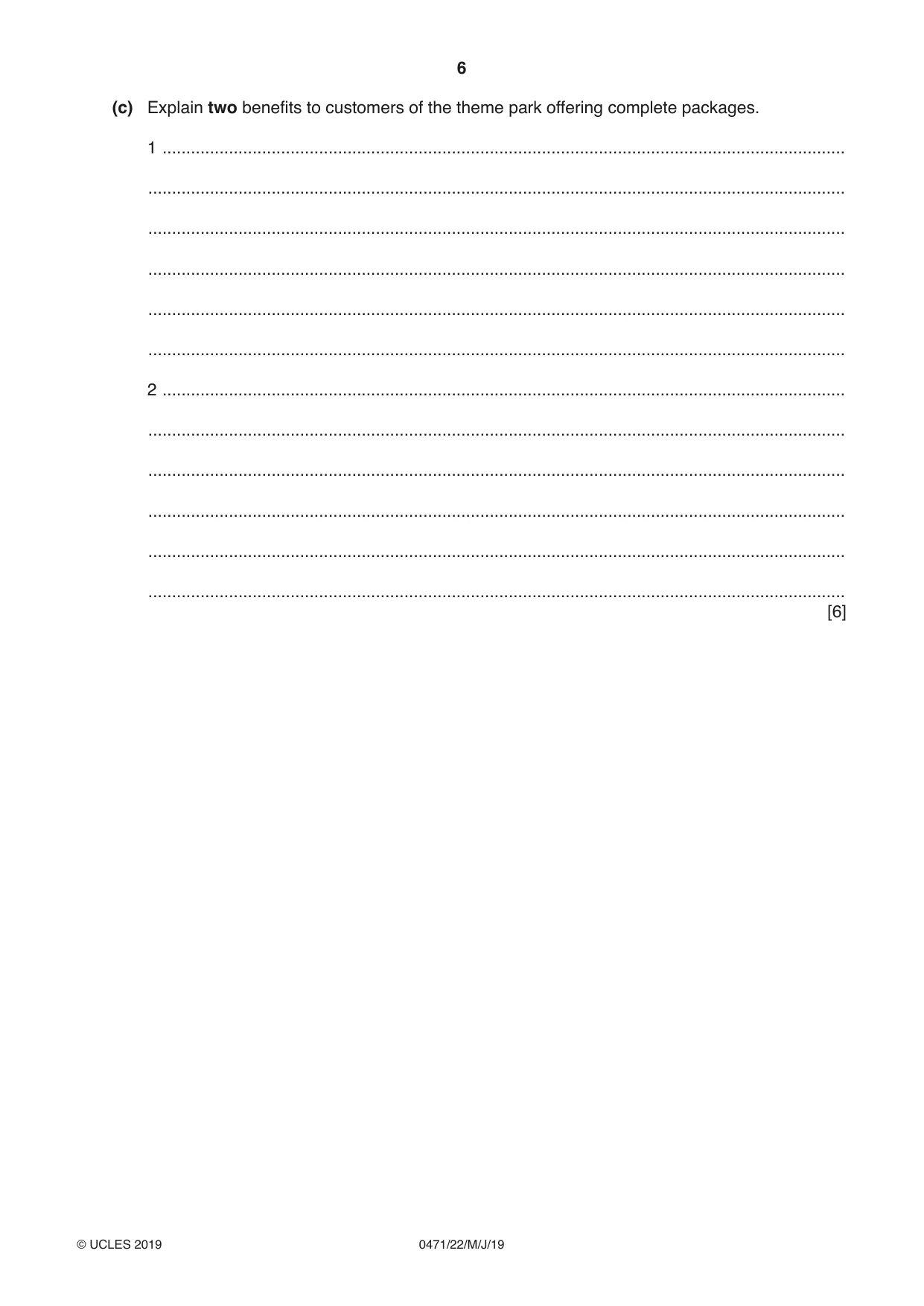
6 0471/22/M/J/19 © UCLES 2019 (c) Explain two benefits to customers of the theme park offering complete packages. 1 … … … … … … 2 … … … … … … [6]
Question paper, page 7
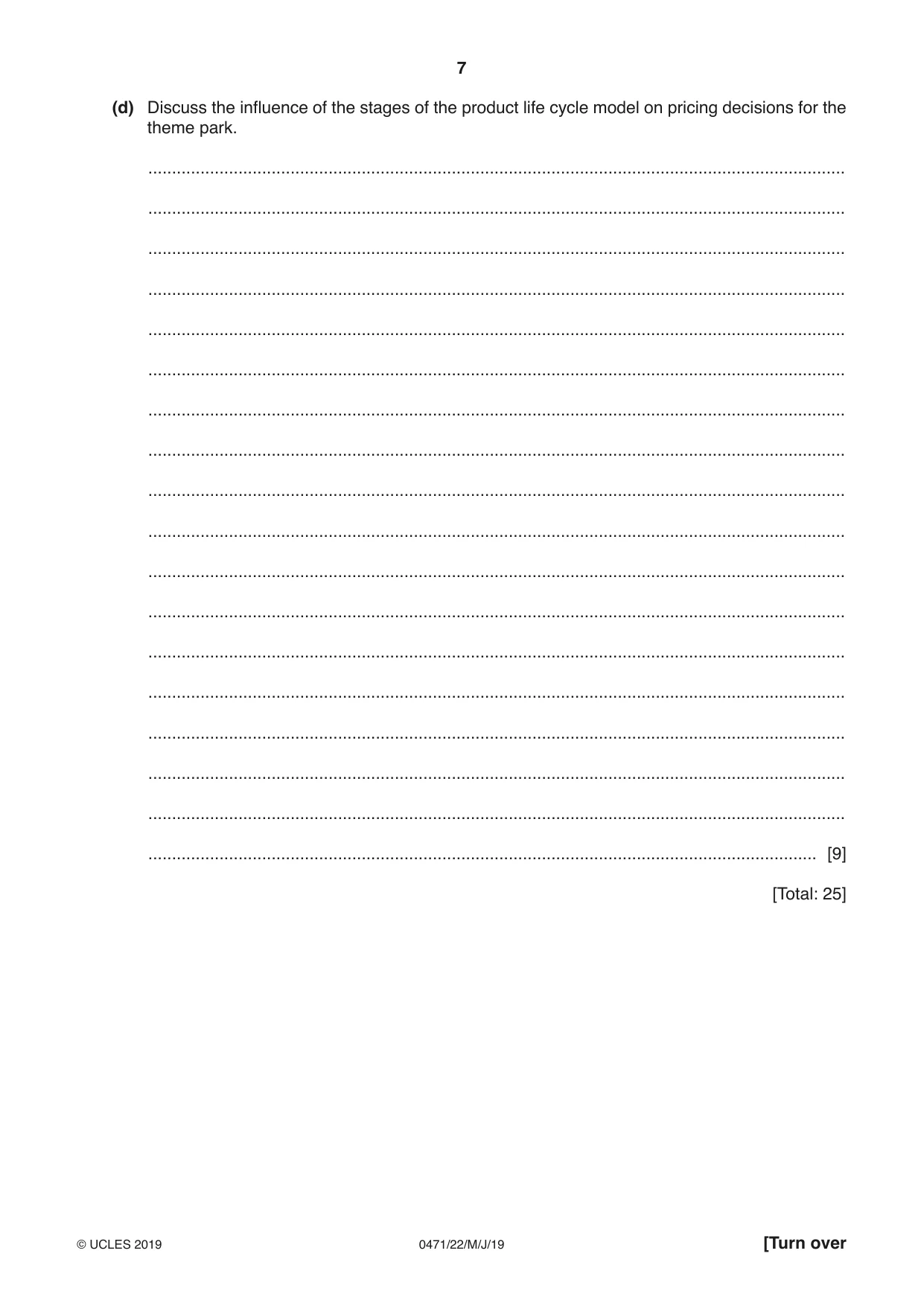
7 0471/22/M/J/19 © UCLES 2019 [Turn over (d) Discuss the influence of the stages of the product life cycle model on pricing decisions for the theme park. … … … … … … … … … … … … … … … … … … [9] [Total: 25]
Question paper, page 8
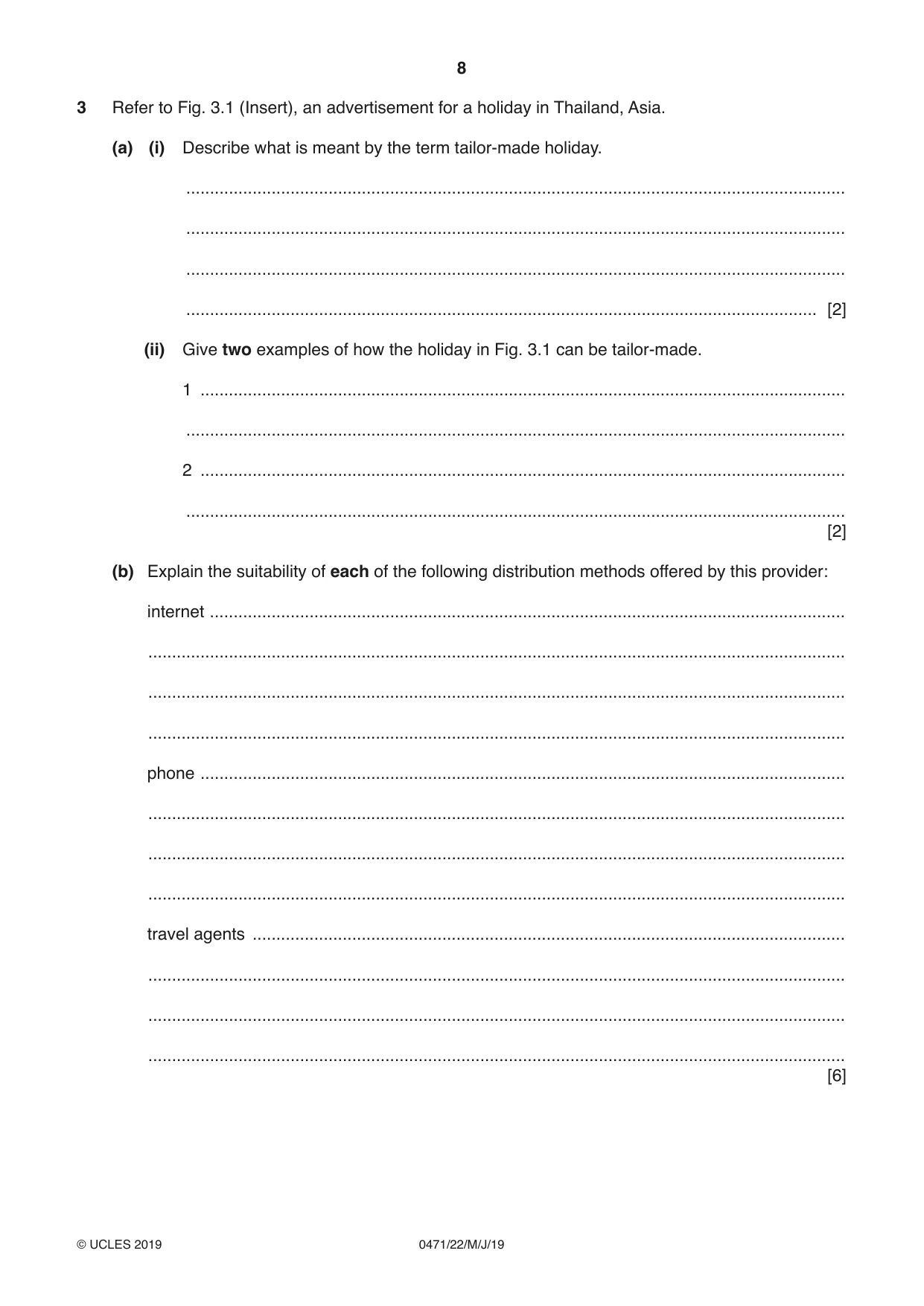
8 0471/22/M/J/19 © UCLES 2019 3 Refer to Fig. 3.1 (Insert), an advertisement for a holiday in Thailand, Asia. (a) (i) Describe what is meant by the term tailor-made holiday. … … … … [2] (ii) Give two examples of how the holiday in Fig. 3.1 can be tailor-made. 1 … … 2 … … [2] (b) Explain the suitability of each of the following distribution methods offered by this provider: internet … … … … phone … … … … travel agents … … … … [6]
Question paper, page 9
9 0471/22/M/J/19 © UCLES 2019 [Turn over (c) Explain two benefits to the customer of the promotional pricing techniques used by the provider in Fig. 3.1. 1 … … … … … … 2 … … … … … … [6]
Question paper, page 10
10 0471/22/M/J/19 © UCLES 2019 (d) Use the AIDA principle to analyse the effectiveness of the advertisement shown in Fig. 3.1. … … … … … … … … … … … … … … … … … … [9] [Total: 25]
Question paper, page 11
11 0471/22/M/J/19 © UCLES 2019 [Turn over 4 Refer to Fig. 4.1 (Insert), information about market research carried out by Visit Napa County, the tourist authority for Napa County, a destination in California, USA. (a) (i) Identify the following: one example of quantitative research data used by Visit Napa County … … one example of secondary market research used by Visit Napa County … … [2] (ii) Describe how random sampling is carried out. … … … … [2] (b) Explain three likely needs of a day-tripper. 1 … … … … 2 … … … … 3 … … … … [6]
Question paper, page 12
12 0471/22/M/J/19 © UCLES 2019 (c) Explain two benefits to a travel and tourism provider of creating a visitor profile. 1 … … … … … … 2 … … … … … … [6]
Question paper, page 13
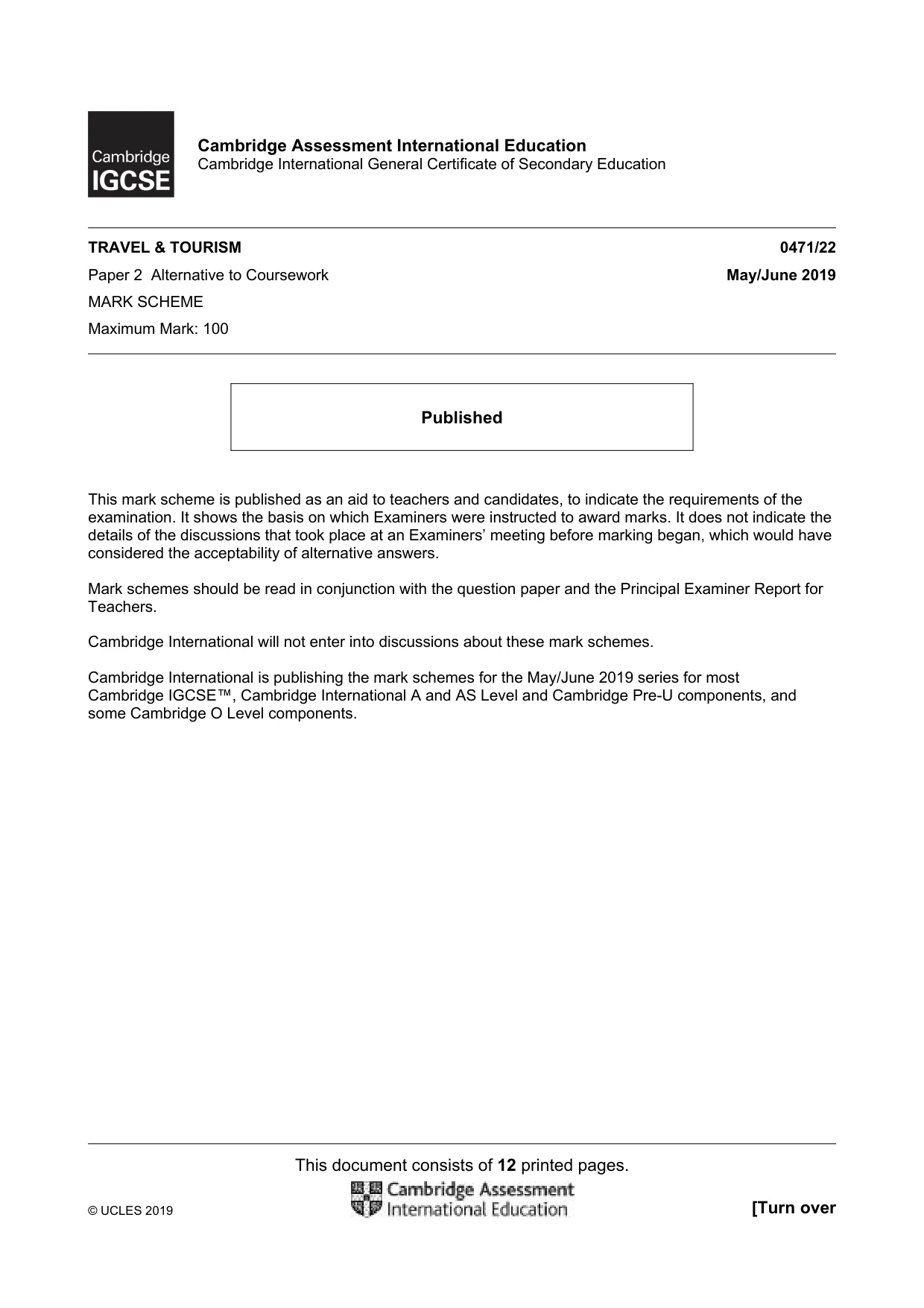
13 0471/22/M/J/19 © UCLES 2019 (d) Discuss the advantages and disadvantages to tourist authorities of carrying out market research. … … … … … … … … … … … … … … … … … … [9] [Total: 25]
Question paper, page 14
14 0471/22/M/J/19 © UCLES 2019 BLANK PAGE
Question paper, page 15
15 0471/22/M/J/19 © UCLES 2019 BLANK PAGE
Question paper, page 16
16 0471/22/M/J/19 © UCLES 2019 Permission to reproduce items where third-party owned material protected by copyright is included has been sought and cleared where possible. Every reasonable effort has been made by the publisher (UCLES) to trace copyright holders, but if any items requiring clearance have unwittingly been included, the publisher will be pleased to make amends at the earliest possible opportunity. To avoid the issue of disclosure of answer-related information to candidates, all copyright acknowledgements are reproduced online in the Cambridge Assessment International Education Copyright Acknowledgements Booklet. This is produced for each series of examinations and is freely available to download at www.cambridgeinternational.org after the live examination series. Cambridge Assessment International Education is part of the Cambridge Assessment Group. Cambridge Assessment is the brand name of the University of Cambridge Local Examinations Syndicate (UCLES), which itself is a department of the University of Cambridge. BLANK PAGE
Mark scheme, page 1
This document consists of 12 printed pages. © UCLES 2019 [Turn over Cambridge Assessment International Education Cambridge International General Certificate of Secondary Education TRAVEL & TOURISM 0471/22 Paper 2 Alternative to Coursework May/June 2019 MARK SCHEME Maximum Mark: 100 Published This mark scheme is published as an aid to teachers and candidates, to indicate the requirements of the examination. It shows the basis on which Examiners were instructed to award marks. It does not indicate the details of the discussions that took place at an Examiners’ meeting before marking began, which would have considered the acceptability of alternative answers. Mark schemes should be read in conjunction with the question paper and the Principal Examiner Report for Teachers. Cambridge International will not enter into discussions about these mark schemes. Cambridge International is publishing the mark schemes for the May/June 2019 series for most Cambridge IGCSE™, Cambridge International A and AS Level and Cambridge Pre-U components, and some Cambridge O Level components.
Mark scheme, page 2
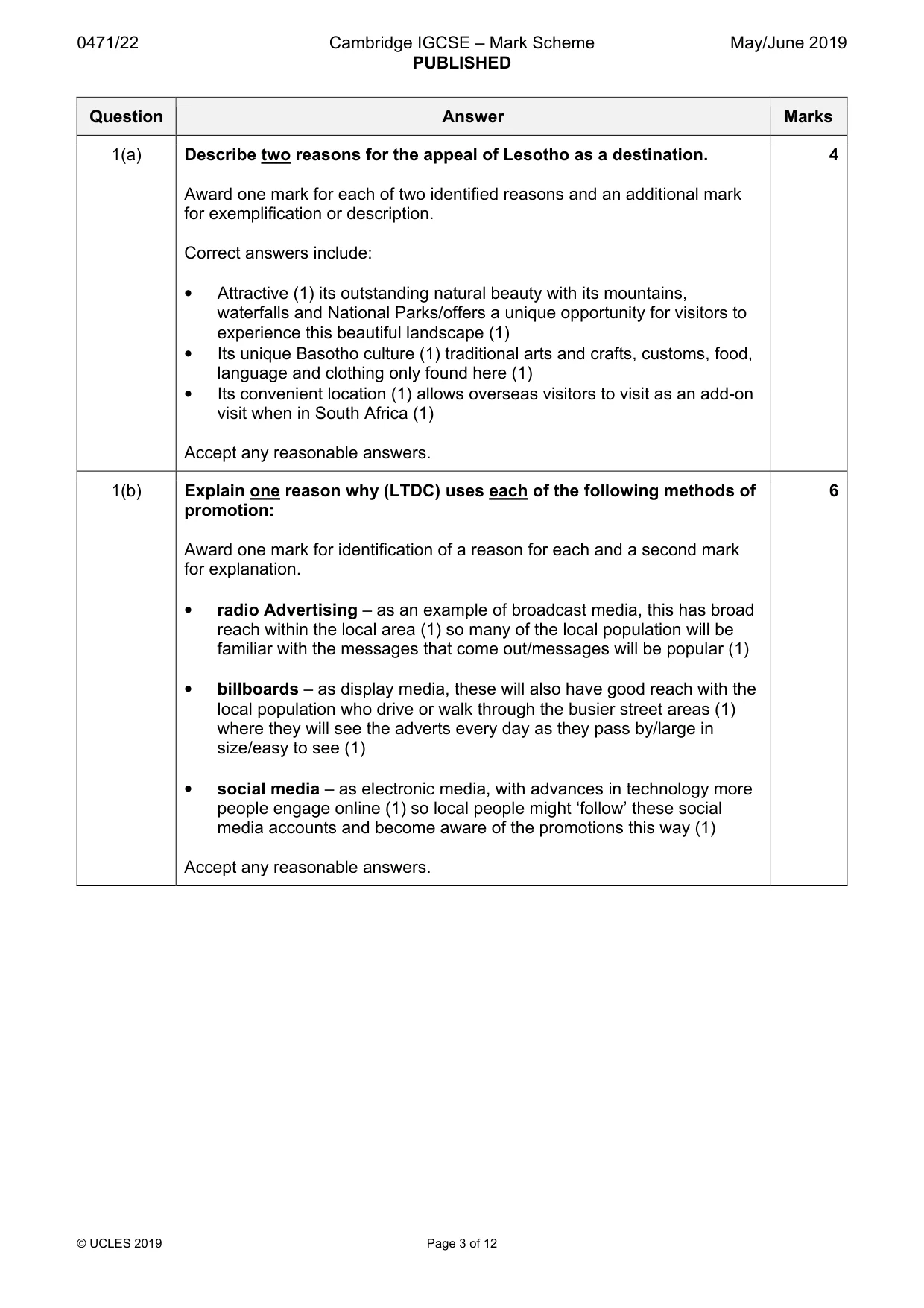
0471/22 Cambridge IGCSE – Mark Scheme PUBLISHED May/June 2019 © UCLES 2019 Page 2 of 12 Generic Marking Principles These general marking principles must be applied by all examiners when marking candidate answers. They should be applied alongside the specific content of the mark scheme or generic level descriptors for a question. Each question paper and mark scheme will also comply with these marking principles. GENERIC MARKING PRINCIPLE 1: Marks must be awarded in line with: • the specific content of the mark scheme or the generic level descriptors for the question • the specific skills defined in the mark scheme or in the generic level descriptors for the question • the standard of response required by a candidate as exemplified by the standardisation scripts. GENERIC MARKING PRINCIPLE 2: Marks awarded are always whole marks (not half marks, or other fractions). GENERIC MARKING PRINCIPLE 3: Marks must be awarded positively: • marks are awarded for correct/valid answers, as defined in the mark scheme. However, credit is given for valid answers which go beyond the scope of the syllabus and mark scheme, referring to your Team Leader as appropriate • marks are awarded when candidates clearly demonstrate what they know and can do • marks are not deducted for errors • marks are not deducted for omissions • answers should only be judged on the quality of spelling, punctuation and grammar when these features are specifically assessed by the question as indicated by the mark scheme. The meaning, however, should be unambiguous. GENERIC MARKING PRINCIPLE 4: Rules must be applied consistently e.g. in situations where candidates have not followed instructions or in the application of generic level descriptors. GENERIC MARKING PRINCIPLE 5: Marks should be awarded using the full range of marks defined in the mark scheme for the question (however; the use of the full mark range may be limited according to the quality of the candidate responses seen). GENERIC MARKING PRINCIPLE 6: Marks awarded are based solely on the requirements as defined in the mark scheme. Marks should not be awarded with grade thresholds or grade descriptors in mind.
Mark scheme, page 3
0471/22 Cambridge IGCSE – Mark Scheme PUBLISHED May/June 2019 © UCLES 2019 Page 3 of 12 Question Answer Marks 1(a) Describe two reasons for the appeal of Lesotho as a destination. Award one mark for each of two identified reasons and an additional mark for exemplification or description. Correct answers include: • Attractive (1) its outstanding natural beauty with its mountains, waterfalls and National Parks/offers a unique opportunity for visitors to experience this beautiful landscape (1) • Its unique Basotho culture (1) traditional arts and crafts, customs, food, language and clothing only found here (1) • Its convenient location (1) allows overseas visitors to visit as an add-on visit when in South Africa (1) Accept any reasonable answers. 4 1(b) Explain one reason why (LTDC) uses each of the following methods of promotion: Award one mark for identification of a reason for each and a second mark for explanation. • radio Advertising – as an example of broadcast media, this has broad reach within the local area (1) so many of the local population will be familiar with the messages that come out/messages will be popular (1) • billboards – as display media, these will also have good reach with the local population who drive or walk through the busier street areas (1) where they will see the adverts every day as they pass by/large in size/easy to see (1) • social media – as electronic media, with advances in technology more people engage online (1) so local people might ‘follow’ these social media accounts and become aware of the promotions this way (1) Accept any reasonable answers. 6
Mark scheme, page 4
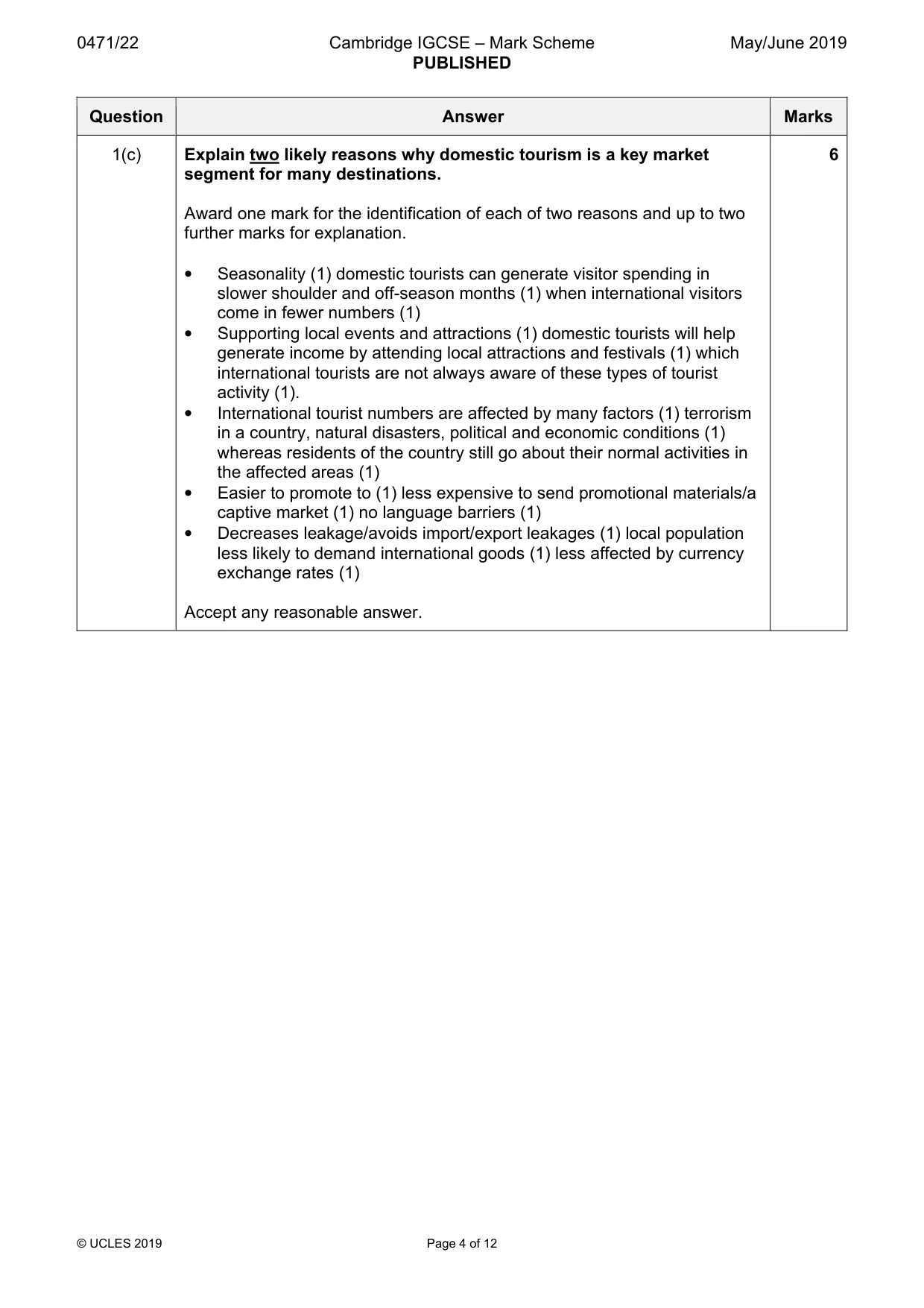
0471/22 Cambridge IGCSE – Mark Scheme PUBLISHED May/June 2019 © UCLES 2019 Page 4 of 12 Question Answer Marks 1(c) Explain two likely reasons why domestic tourism is a key market segment for many destinations. Award one mark for the identification of each of two reasons and up to two further marks for explanation. • Seasonality (1) domestic tourists can generate visitor spending in slower shoulder and off-season months (1) when international visitors come in fewer numbers (1) • Supporting local events and attractions (1) domestic tourists will help generate income by attending local attractions and festivals (1) which international tourists are not always aware of these types of tourist activity (1). • International tourist numbers are affected by many factors (1) terrorism in a country, natural disasters, political and economic conditions (1) whereas residents of the country still go about their normal activities in the affected areas (1) • Easier to promote to (1) less expensive to send promotional materials/a captive market (1) no language barriers (1) • Decreases leakage/avoids import/export leakages (1) local population less likely to demand international goods (1) less affected by currency exchange rates (1) Accept any reasonable answer. 6
Mark scheme, page 5
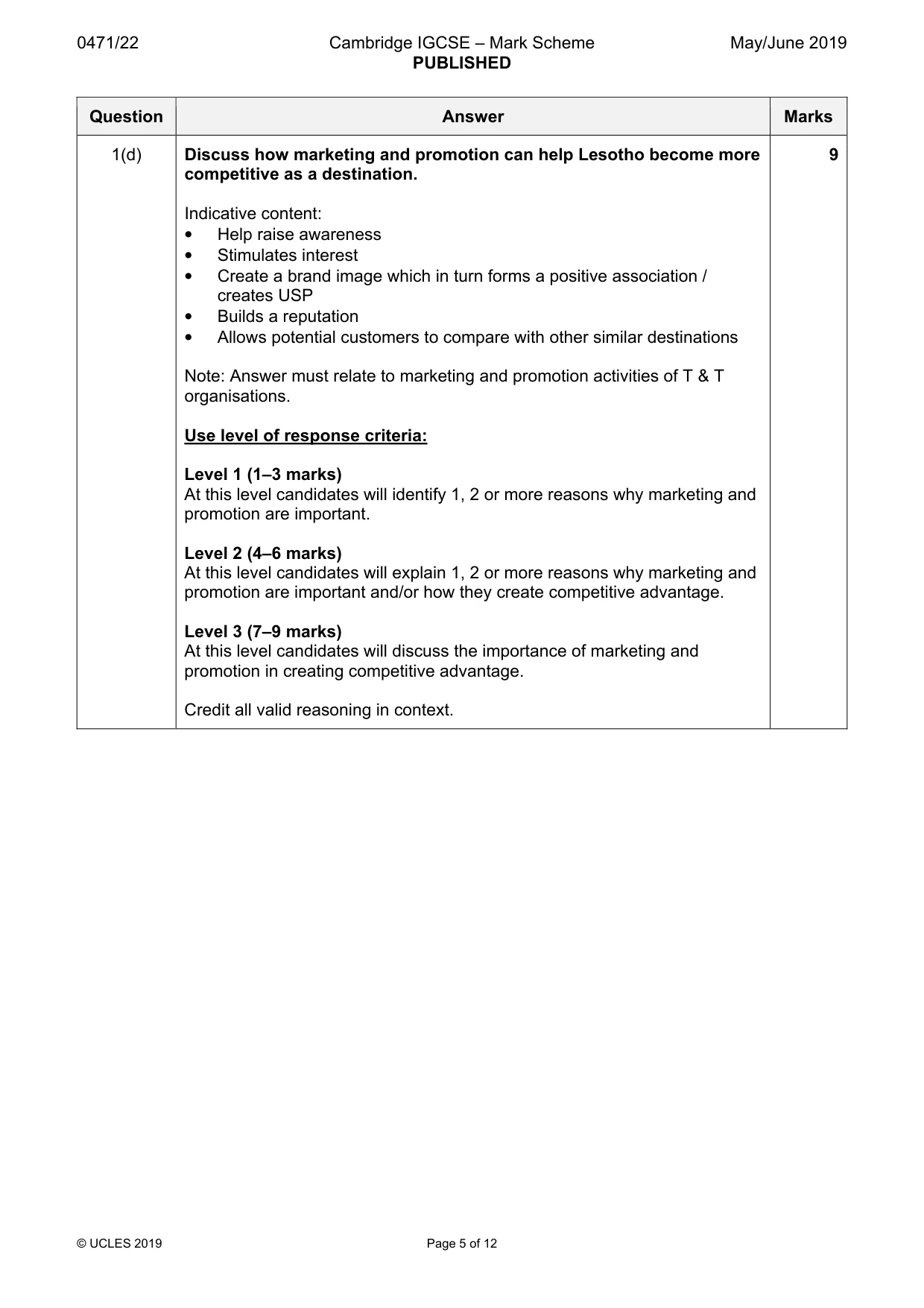
0471/22 Cambridge IGCSE – Mark Scheme PUBLISHED May/June 2019 © UCLES 2019 Page 5 of 12 Question Answer Marks 1(d) Discuss how marketing and promotion can help Lesotho become more competitive as a destination. Indicative content: • Help raise awareness • Stimulates interest • Create a brand image which in turn forms a positive association / creates USP • Builds a reputation • Allows potential customers to compare with other similar destinations Note: Answer must relate to marketing and promotion activities of T & T organisations. Use level of response criteria: Level 1 (1–3 marks) At this level candidates will identify 1, 2 or more reasons why marketing and promotion are important. Level 2 (4–6 marks) At this level candidates will explain 1, 2 or more reasons why marketing and promotion are important and/or how they create competitive advantage. Level 3 (7–9 marks) At this level candidates will discuss the importance of marketing and promotion in creating competitive advantage. Credit all valid reasoning in context. 9
Mark scheme, page 6
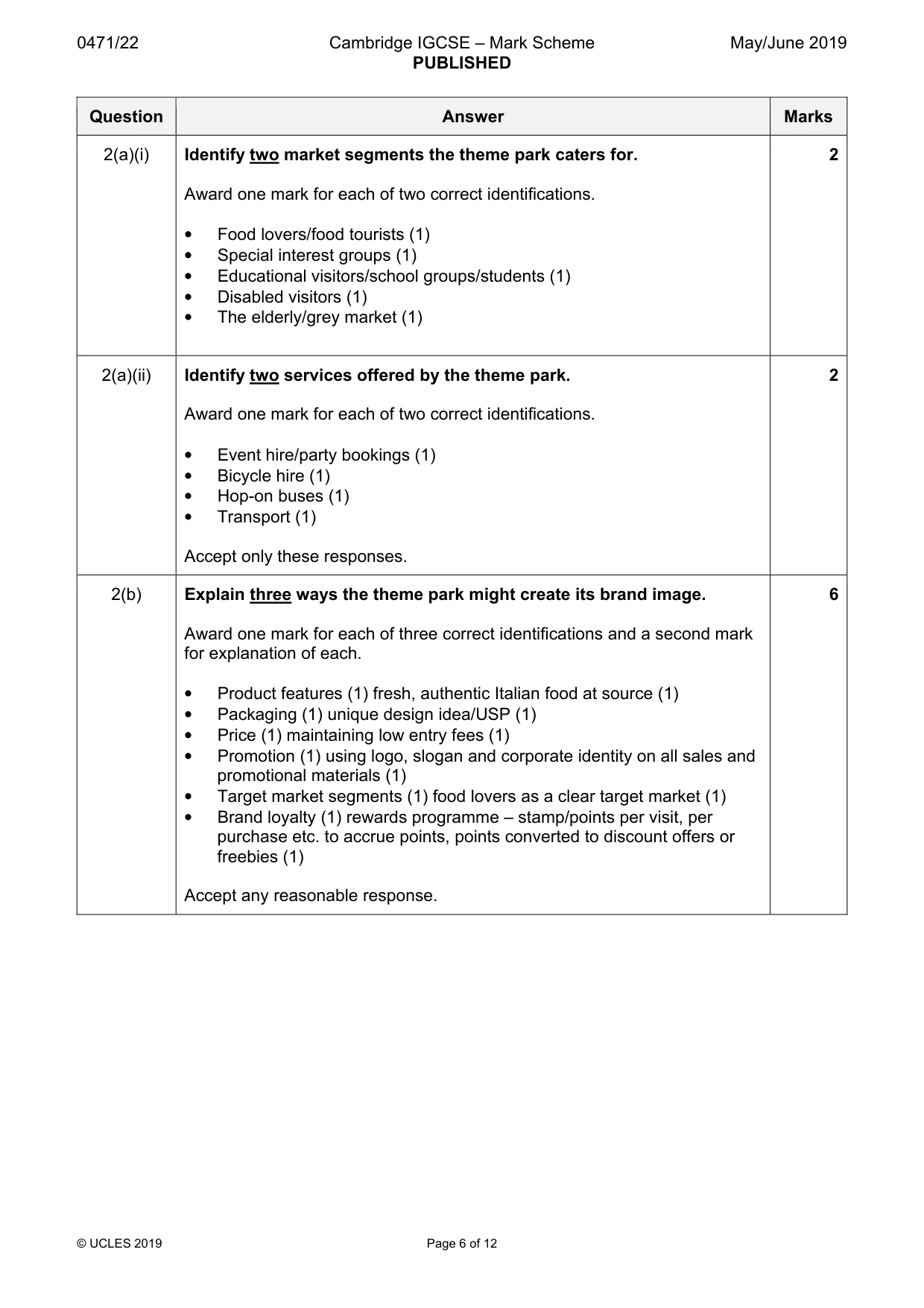
0471/22 Cambridge IGCSE – Mark Scheme PUBLISHED May/June 2019 © UCLES 2019 Page 6 of 12 Question Answer Marks 2(a)(i) Identify two market segments the theme park caters for. Award one mark for each of two correct identifications. • Food lovers/food tourists (1) • Special interest groups (1) • Educational visitors/school groups/students (1) • Disabled visitors (1) • The elderly/grey market (1) 2 2(a)(ii) Identify two services offered by the theme park. Award one mark for each of two correct identifications. • Event hire/party bookings (1) • Bicycle hire (1) • Hop-on buses (1) • Transport (1) Accept only these responses. 2 2(b) Explain three ways the theme park might create its brand image. Award one mark for each of three correct identifications and a second mark for explanation of each. • Product features (1) fresh, authentic Italian food at source (1) • Packaging (1) unique design idea/USP (1) • Price (1) maintaining low entry fees (1) • Promotion (1) using logo, slogan and corporate identity on all sales and promotional materials (1) • Target market segments (1) food lovers as a clear target market (1) • Brand loyalty (1) rewards programme – stamp/points per visit, per purchase etc. to accrue points, points converted to discount offers or freebies (1) Accept any reasonable response. 6
Mark scheme, page 7
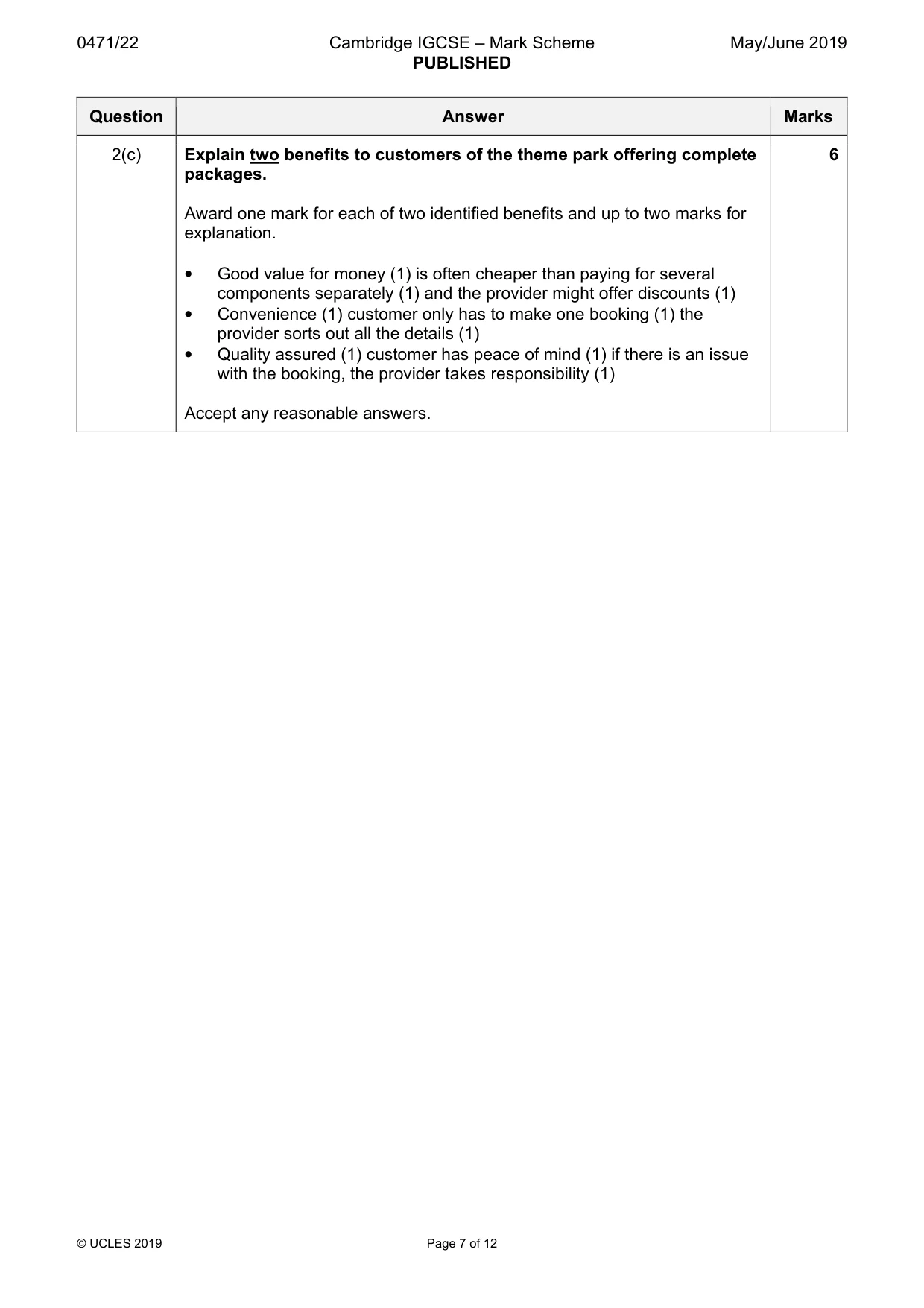
0471/22 Cambridge IGCSE – Mark Scheme PUBLISHED May/June 2019 © UCLES 2019 Page 7 of 12 Question Answer Marks 2(c) Explain two benefits to customers of the theme park offering complete packages. Award one mark for each of two identified benefits and up to two marks for explanation. • Good value for money (1) is often cheaper than paying for several components separately (1) and the provider might offer discounts (1) • Convenience (1) customer only has to make one booking (1) the provider sorts out all the details (1) • Quality assured (1) customer has peace of mind (1) if there is an issue with the booking, the provider takes responsibility (1) Accept any reasonable answers. 6
Mark scheme, page 8
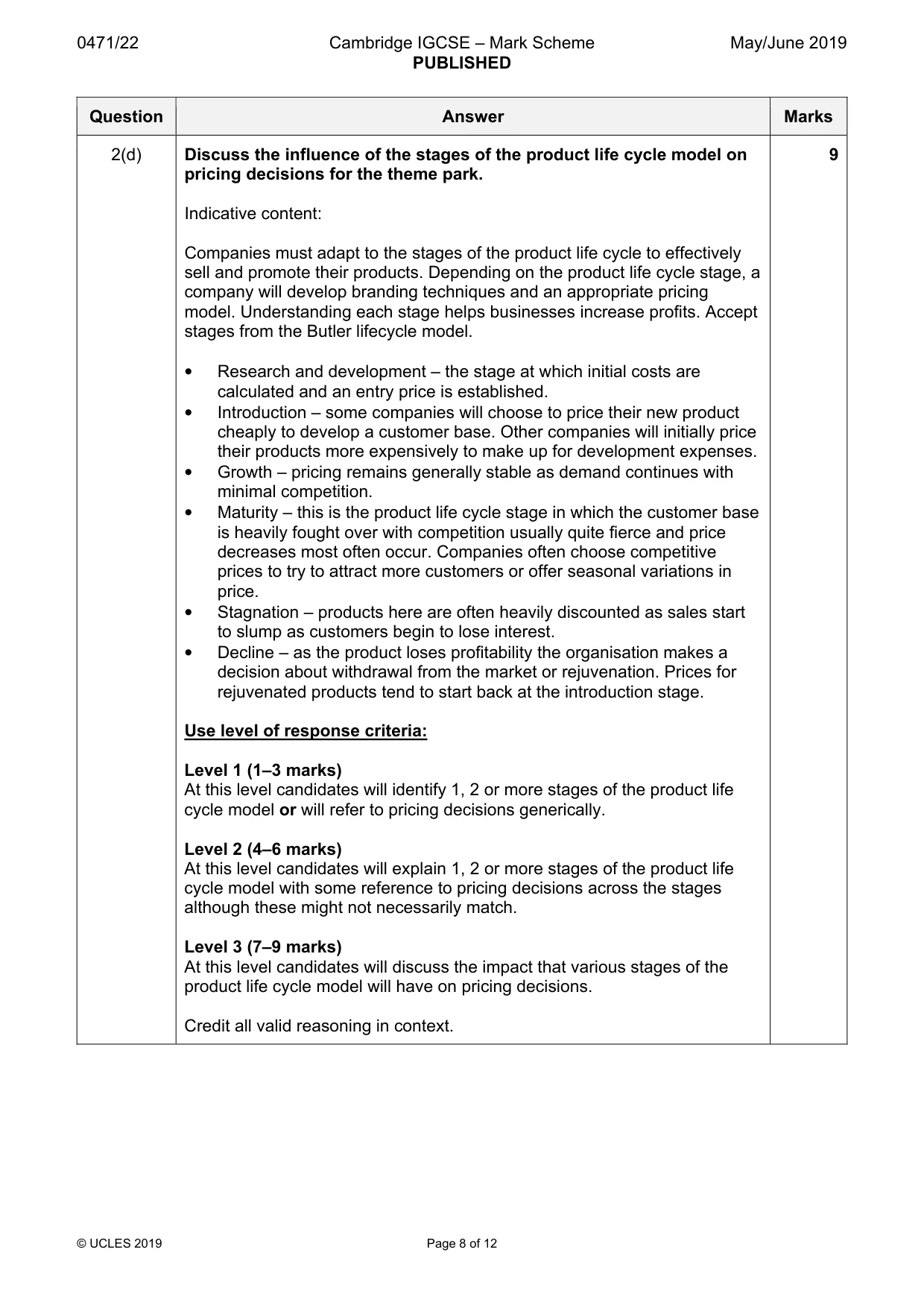
0471/22 Cambridge IGCSE – Mark Scheme PUBLISHED May/June 2019 © UCLES 2019 Page 8 of 12 Question Answer Marks 2(d) Discuss the influence of the stages of the product life cycle model on pricing decisions for the theme park. Indicative content: Companies must adapt to the stages of the product life cycle to effectively sell and promote their products. Depending on the product life cycle stage, a company will develop branding techniques and an appropriate pricing model. Understanding each stage helps businesses increase profits. Accept stages from the Butler lifecycle model. • Research and development – the stage at which initial costs are calculated and an entry price is established. • Introduction – some companies will choose to price their new product cheaply to develop a customer base. Other companies will initially price their products more expensively to make up for development expenses. • Growth – pricing remains generally stable as demand continues with minimal competition. • Maturity – this is the product life cycle stage in which the customer base is heavily fought over with competition usually quite fierce and price decreases most often occur. Companies often choose competitive prices to try to attract more customers or offer seasonal variations in price. • Stagnation – products here are often heavily discounted as sales start to slump as customers begin to lose interest. • Decline – as the product loses profitability the organisation makes a decision about withdrawal from the market or rejuvenation. Prices for rejuvenated products tend to start back at the introduction stage. Use level of response criteria: Level 1 (1–3 marks) At this level candidates will identify 1, 2 or more stages of the product life cycle model or will refer to pricing decisions generically. Level 2 (4–6 marks) At this level candidates will explain 1, 2 or more stages of the product life cycle model with some reference to pricing decisions across the stages although these might not necessarily match. Level 3 (7–9 marks) At this level candidates will discuss the impact that various stages of the product life cycle model will have on pricing decisions. Credit all valid reasoning in context. 9
Mark scheme, page 9
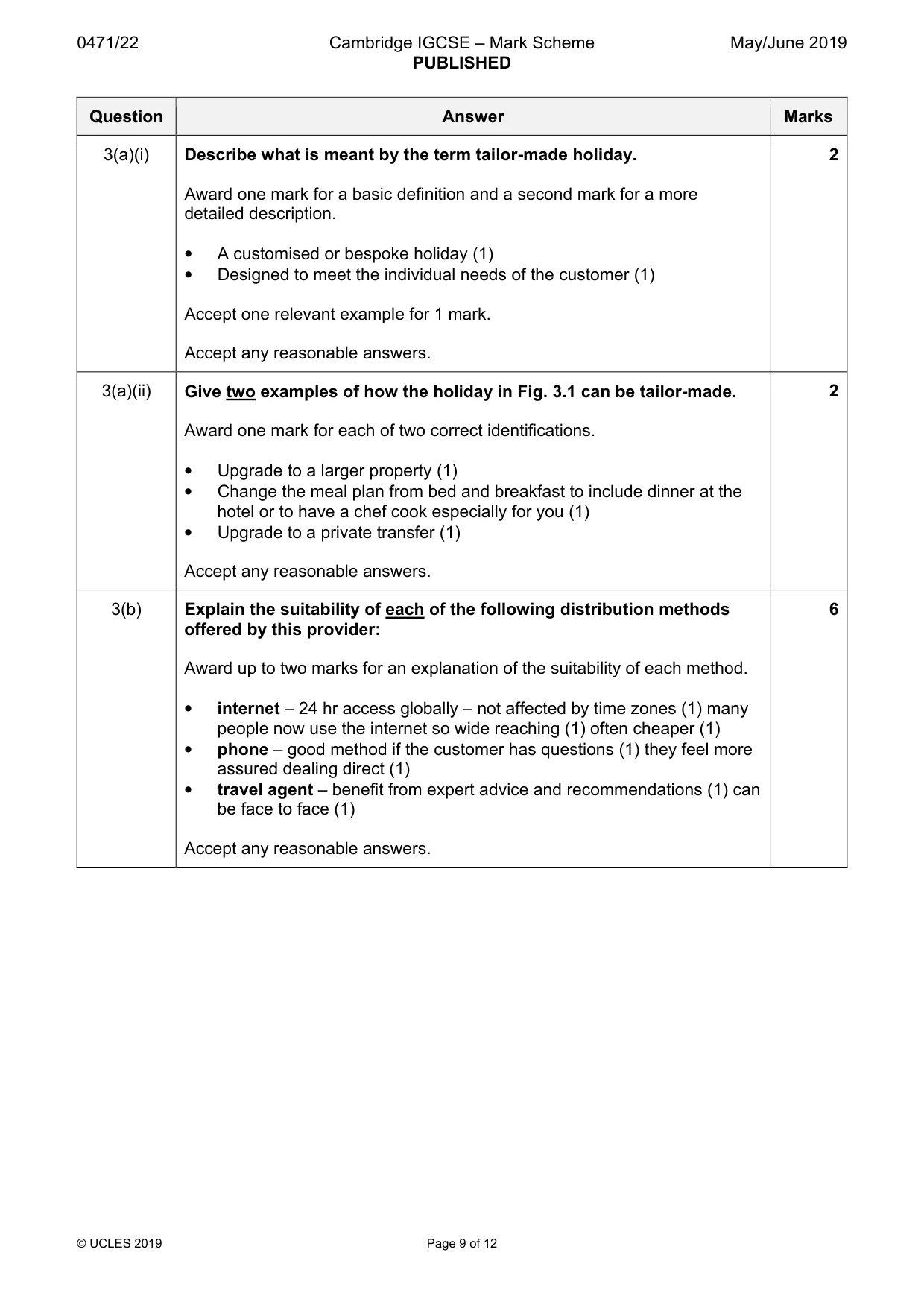
0471/22 Cambridge IGCSE – Mark Scheme PUBLISHED May/June 2019 © UCLES 2019 Page 9 of 12 Question Answer Marks 3(a)(i) Describe what is meant by the term tailor-made holiday. Award one mark for a basic definition and a second mark for a more detailed description. • A customised or bespoke holiday (1) • Designed to meet the individual needs of the customer (1) Accept one relevant example for 1 mark. Accept any reasonable answers. 2 3(a)(ii) Give two examples of how the holiday in Fig. 3.1 can be tailor-made. Award one mark for each of two correct identifications. • Upgrade to a larger property (1) • Change the meal plan from bed and breakfast to include dinner at the hotel or to have a chef cook especially for you (1) • Upgrade to a private transfer (1) Accept any reasonable answers. 2 3(b) Explain the suitability of each of the following distribution methods offered by this provider: Award up to two marks for an explanation of the suitability of each method. • internet – 24 hr access globally – not affected by time zones (1) many people now use the internet so wide reaching (1) often cheaper (1) • phone – good method if the customer has questions (1) they feel more assured dealing direct (1) • travel agent – benefit from expert advice and recommendations (1) can be face to face (1) Accept any reasonable answers. 6
Mark scheme, page 10
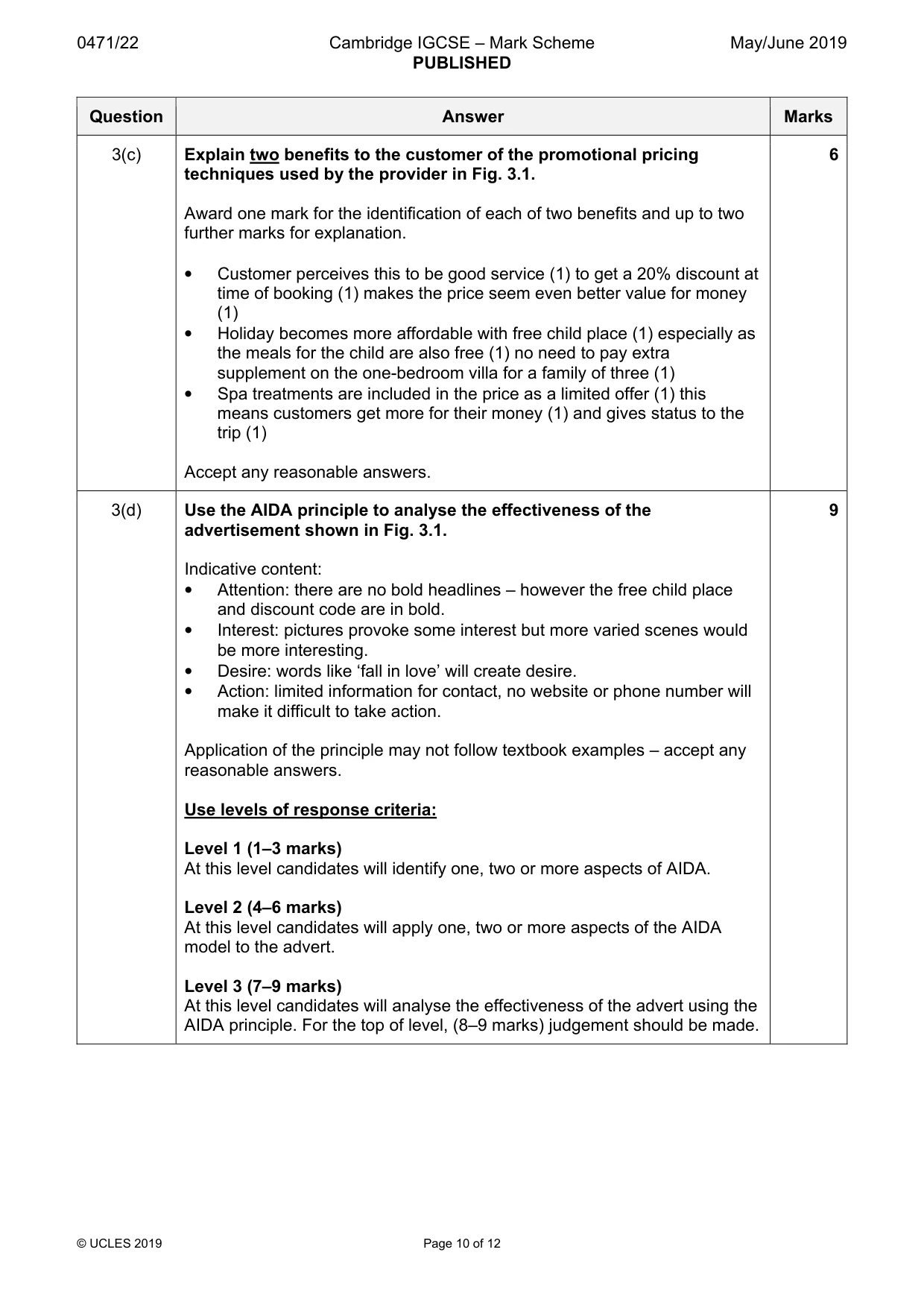
0471/22 Cambridge IGCSE – Mark Scheme PUBLISHED May/June 2019 © UCLES 2019 Page 10 of 12 Question Answer Marks 3(c) Explain two benefits to the customer of the promotional pricing techniques used by the provider in Fig. 3.1. Award one mark for the identification of each of two benefits and up to two further marks for explanation. • Customer perceives this to be good service (1) to get a 20% discount at time of booking (1) makes the price seem even better value for money (1) • Holiday becomes more affordable with free child place (1) especially as the meals for the child are also free (1) no need to pay extra supplement on the one-bedroom villa for a family of three (1) • Spa treatments are included in the price as a limited offer (1) this means customers get more for their money (1) and gives status to the trip (1) Accept any reasonable answers. 6 3(d) Use the AIDA principle to analyse the effectiveness of the advertisement shown in Fig. 3.1. Indicative content: • Attention: there are no bold headlines – however the free child place and discount code are in bold. • Interest: pictures provoke some interest but more varied scenes would be more interesting. • Desire: words like ‘fall in love’ will create desire. • Action: limited information for contact, no website or phone number will make it difficult to take action. Application of the principle may not follow textbook examples – accept any reasonable answers. Use levels of response criteria: Level 1 (1–3 marks) At this level candidates will identify one, two or more aspects of AIDA. Level 2 (4–6 marks) At this level candidates will apply one, two or more aspects of the AIDA model to the advert. Level 3 (7–9 marks) At this level candidates will analyse the effectiveness of the advert using the AIDA principle. For the top of level, (8–9 marks) judgement should be made. 9
Mark scheme, page 11
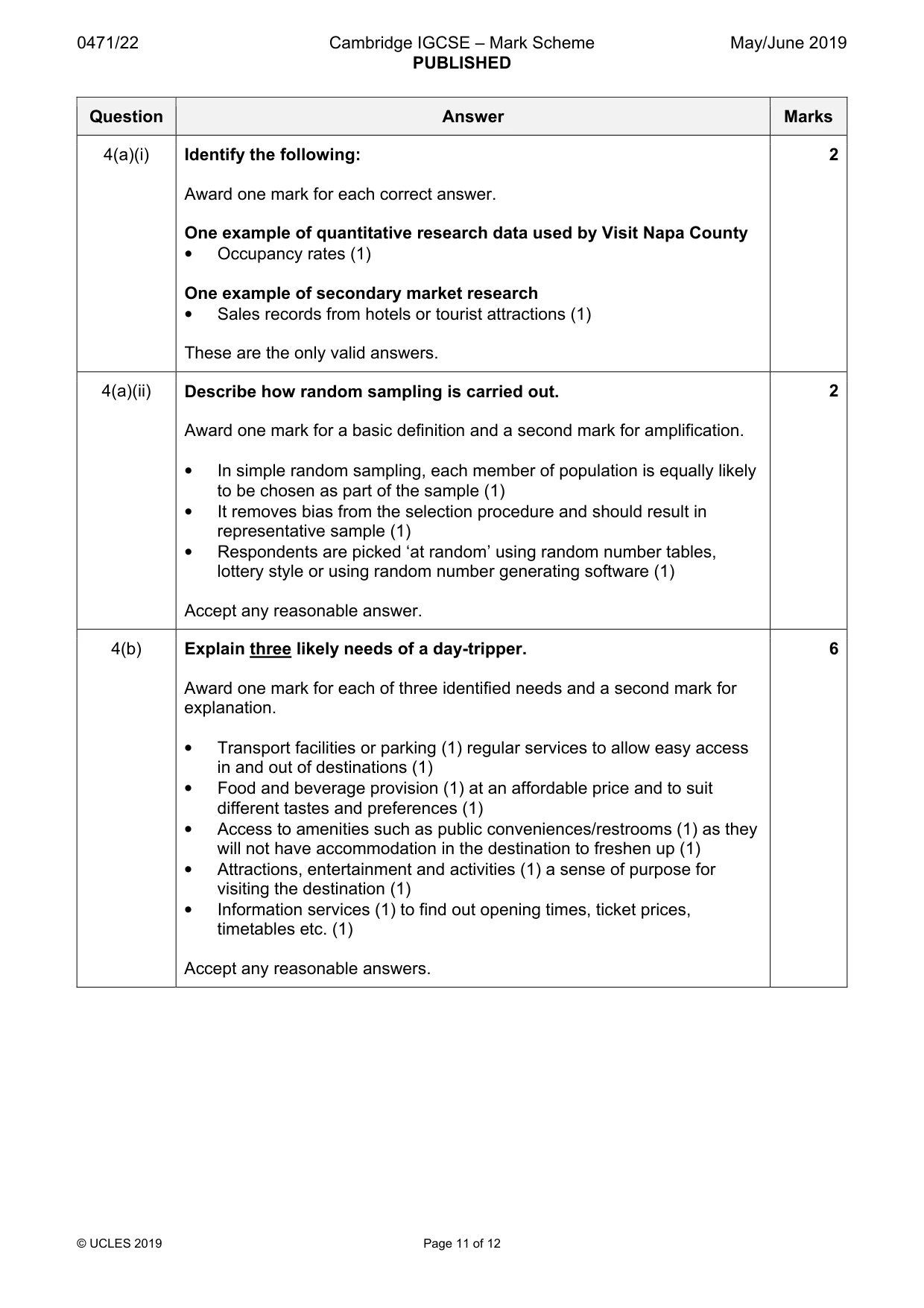
0471/22 Cambridge IGCSE – Mark Scheme PUBLISHED May/June 2019 © UCLES 2019 Page 11 of 12 Question Answer Marks 4(a)(i) Identify the following: Award one mark for each correct answer. One example of quantitative research data used by Visit Napa County • Occupancy rates (1) One example of secondary market research • Sales records from hotels or tourist attractions (1) These are the only valid answers. 2 4(a)(ii) Describe how random sampling is carried out. Award one mark for a basic definition and a second mark for amplification. • In simple random sampling, each member of population is equally likely to be chosen as part of the sample (1) • It removes bias from the selection procedure and should result in representative sample (1) • Respondents are picked ‘at random’ using random number tables, lottery style or using random number generating software (1) Accept any reasonable answer. 2 4(b) Explain three likely needs of a day-tripper. Award one mark for each of three identified needs and a second mark for explanation. • Transport facilities or parking (1) regular services to allow easy access in and out of destinations (1) • Food and beverage provision (1) at an affordable price and to suit different tastes and preferences (1) • Access to amenities such as public conveniences/restrooms (1) as they will not have accommodation in the destination to freshen up (1) • Attractions, entertainment and activities (1) a sense of purpose for visiting the destination (1) • Information services (1) to find out opening times, ticket prices, timetables etc. (1) Accept any reasonable answers. 6
Mark scheme, page 12
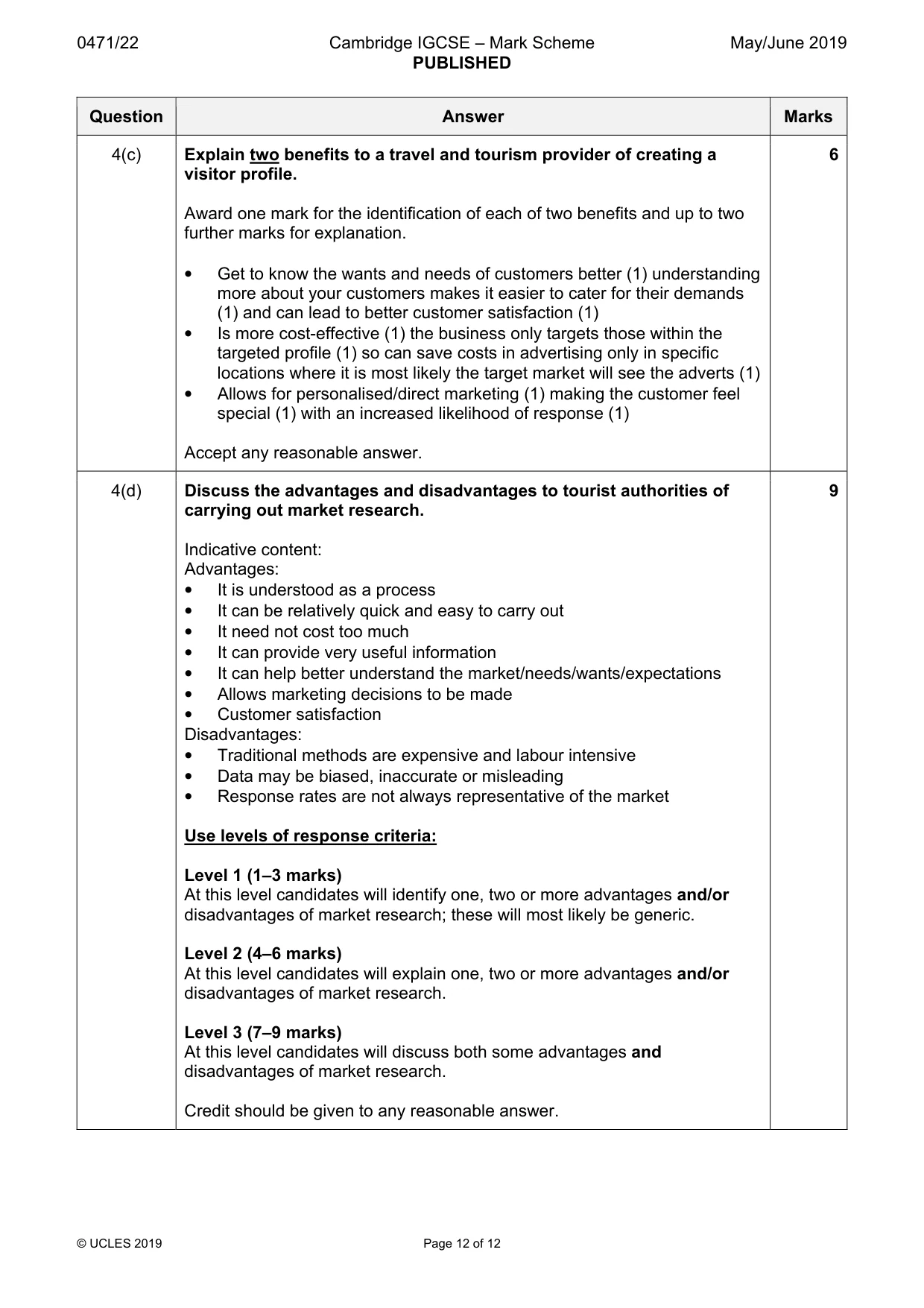
0471/22 Cambridge IGCSE – Mark Scheme PUBLISHED May/June 2019 © UCLES 2019 Page 12 of 12 Question Answer Marks 4(c) Explain two benefits to a travel and tourism provider of creating a visitor profile. Award one mark for the identification of each of two benefits and up to two further marks for explanation. • Get to know the wants and needs of customers better (1) understanding more about your customers makes it easier to cater for their demands (1) and can lead to better customer satisfaction (1) • Is more cost-effective (1) the business only targets those within the targeted profile (1) so can save costs in advertising only in specific locations where it is most likely the target market will see the adverts (1) • Allows for personalised/direct marketing (1) making the customer feel special (1) with an increased likelihood of response (1) Accept any reasonable answer. 6 4(d) Discuss the advantages and disadvantages to tourist authorities of carrying out market research. Indicative content: Advantages: • It is understood as a process • It can be relatively quick and easy to carry out • It need not cost too much • It can provide very useful information • It can help better understand the market/needs/wants/expectations • Allows marketing decisions to be made • Customer satisfaction Disadvantages: • Traditional methods are expensive and labour intensive • Data may be biased, inaccurate or misleading • Response rates are not always representative of the market Use levels of response criteria: Level 1 (1–3 marks) At this level candidates will identify one, two or more advantages and/or disadvantages of market research; these will most likely be generic. Level 2 (4–6 marks) At this level candidates will explain one, two or more advantages and/or disadvantages of market research. Level 3 (7–9 marks) At this level candidates will discuss both some advantages and disadvantages of market research. Credit should be given to any reasonable answer. 9
What you needed in this session
Cambridge’s own grade thresholds for 2019 May/June, Paper 2 · Variant 2. A higher threshold means an easier paper — the bar moves with how the cohort did.