Cambridge IGCSE Travel and Tourism 0471 — 2017 Oct/Nov Paper 2 · Variant 2
0471/22/O/N/17 · 100 marks · ≈113 min
The question paper and its mark scheme, free to read here and free to download. This is Cambridge’s own paper, exactly as it was sat.
Question paper16 pages



Mark scheme11 pages
Answers below. Sit the paper first if you are practising.
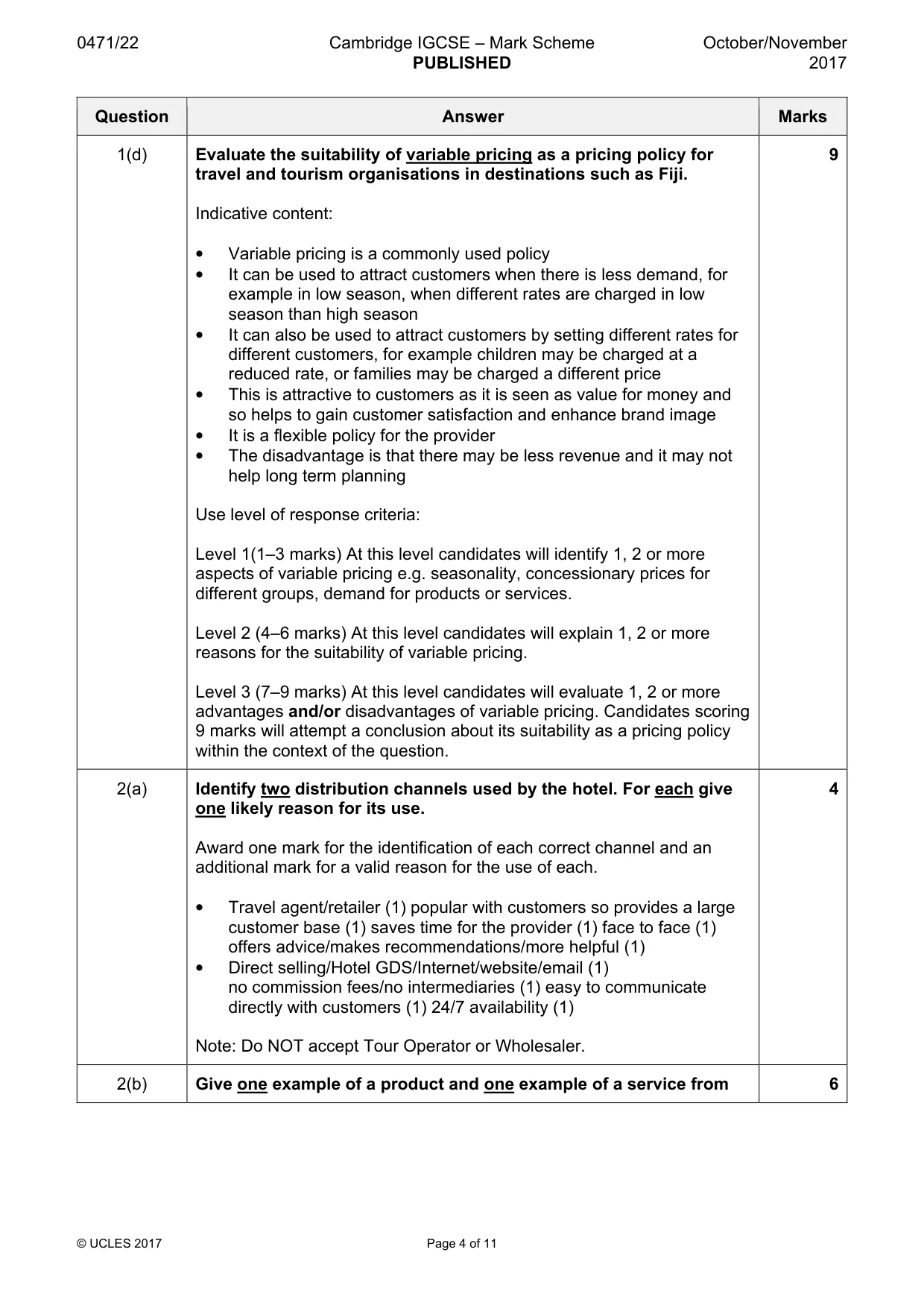
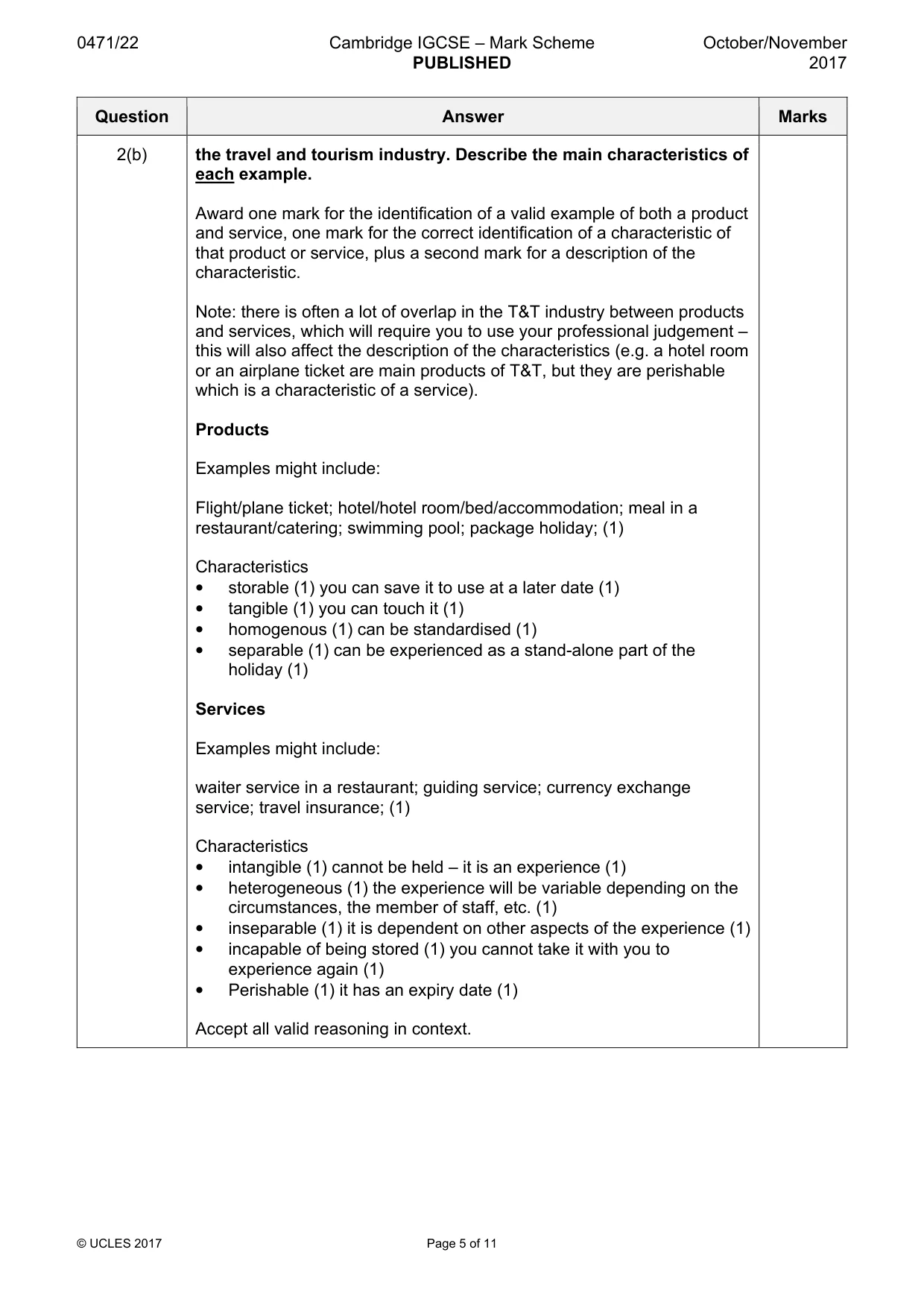
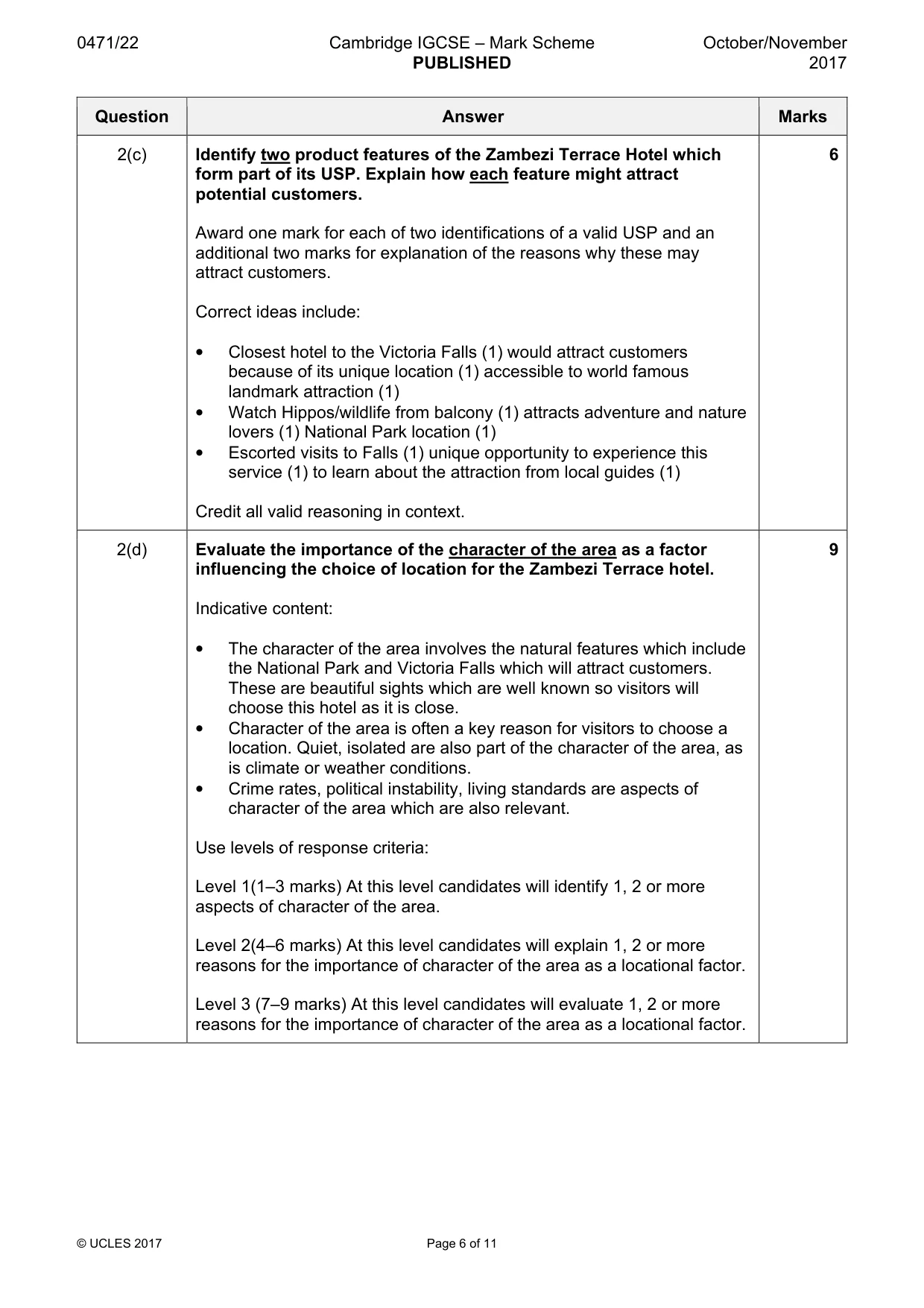
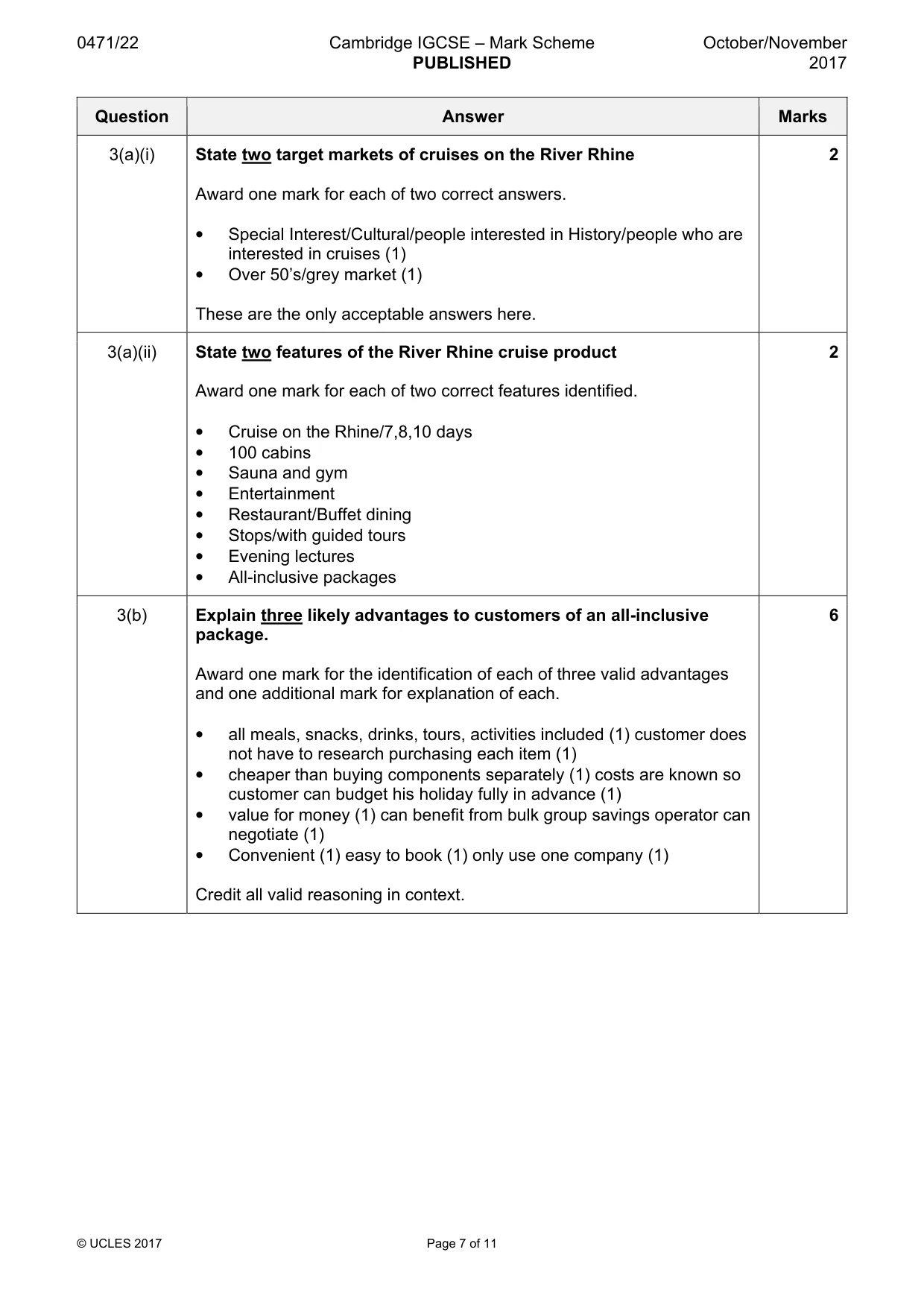
Paper as text
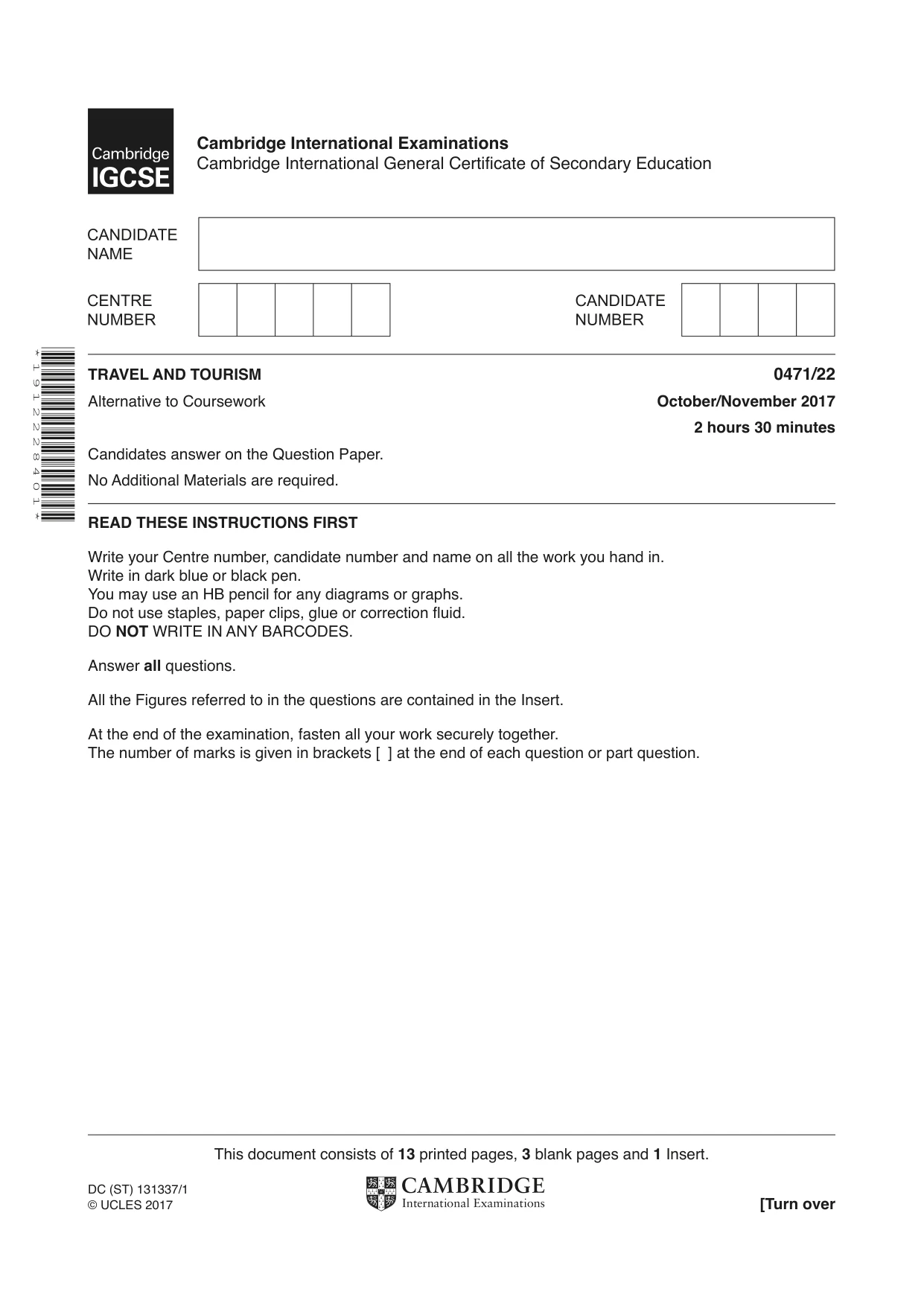
Question paper, page 1
This document consists of 13 printed pages, 3 blank pages and 1 Insert. DC (ST) 131337/1 © UCLES 2017 [Turn over Cambridge International Examinations Cambridge International General Certificate of Secondary Education * 1 9 1 2 2 2 8 4 0 1 * TRAVEL AND TOURISM 0471/22 Alternative to Coursework October/November 2017 2 hours 30 minutes Candidates answer on the Question Paper. No Additional Materials are required. READ THESE INSTRUCTIONS FIRST Write your Centre number, candidate number and name on all the work you hand in. Write in dark blue or black pen. You may use an HB pencil for any diagrams or graphs. Do not use staples, paper clips, glue or correction fluid. DO NOT WRITE IN ANY BARCODES. Answer all questions. All the Figures referred to in the questions are contained in the Insert. At the end of the examination, fasten all your work securely together. The number of marks is given in brackets [ ] at the end of each question or part question.
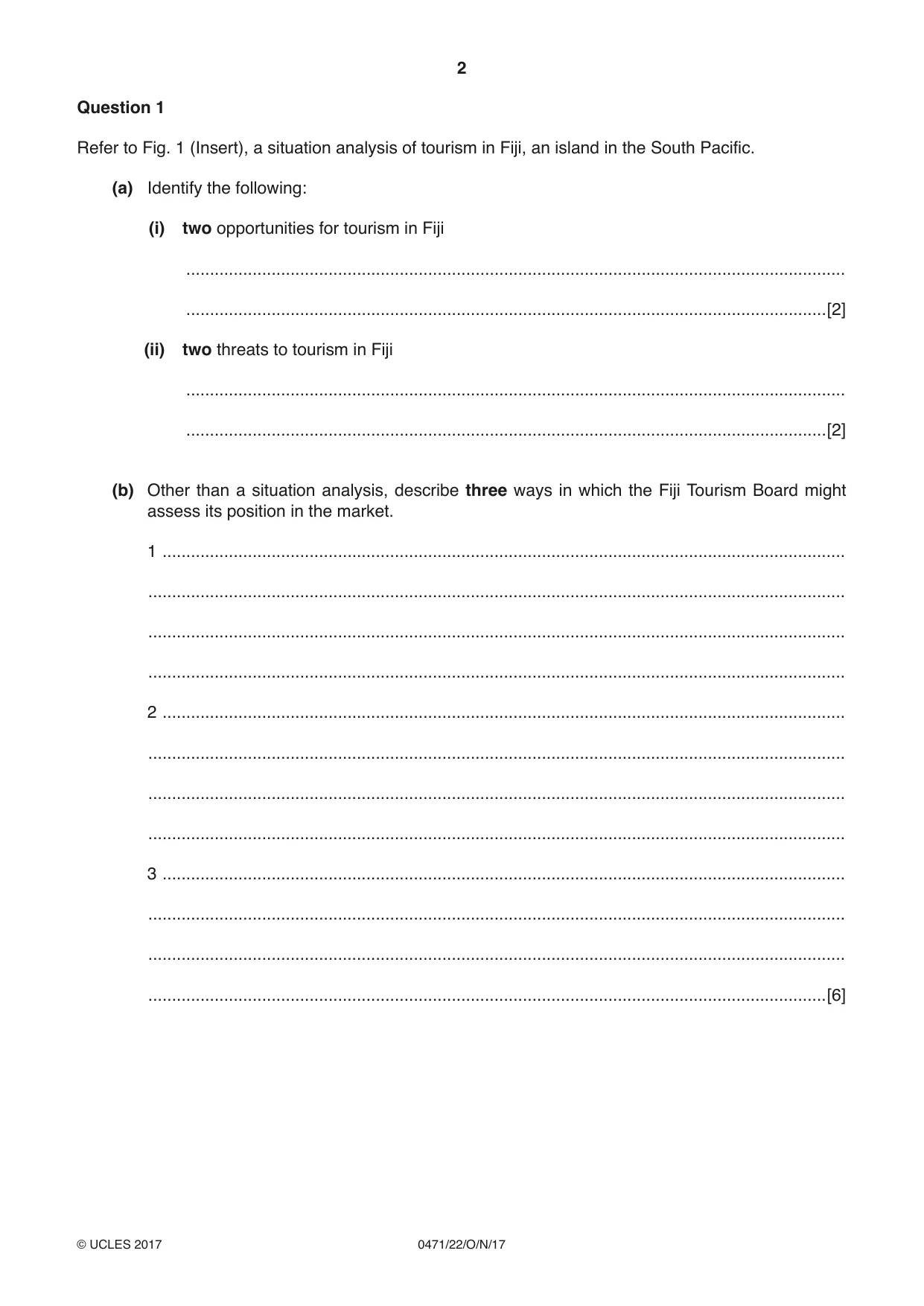
Question paper, page 2
2 0471/22/O/N/17 © UCLES 2017 Question 1 Refer to Fig. 1 (Insert), a situation analysis of tourism in Fiji, an island in the South Pacific. (a) Identify the following: (i) two opportunities for tourism in Fiji … …[2] (ii) two threats to tourism in Fiji … …[2] (b) Other than a situation analysis, describe three ways in which the Fiji Tourism Board might assess its position in the market. 1 … … … … 2 … … … … 3 … … … …[6]
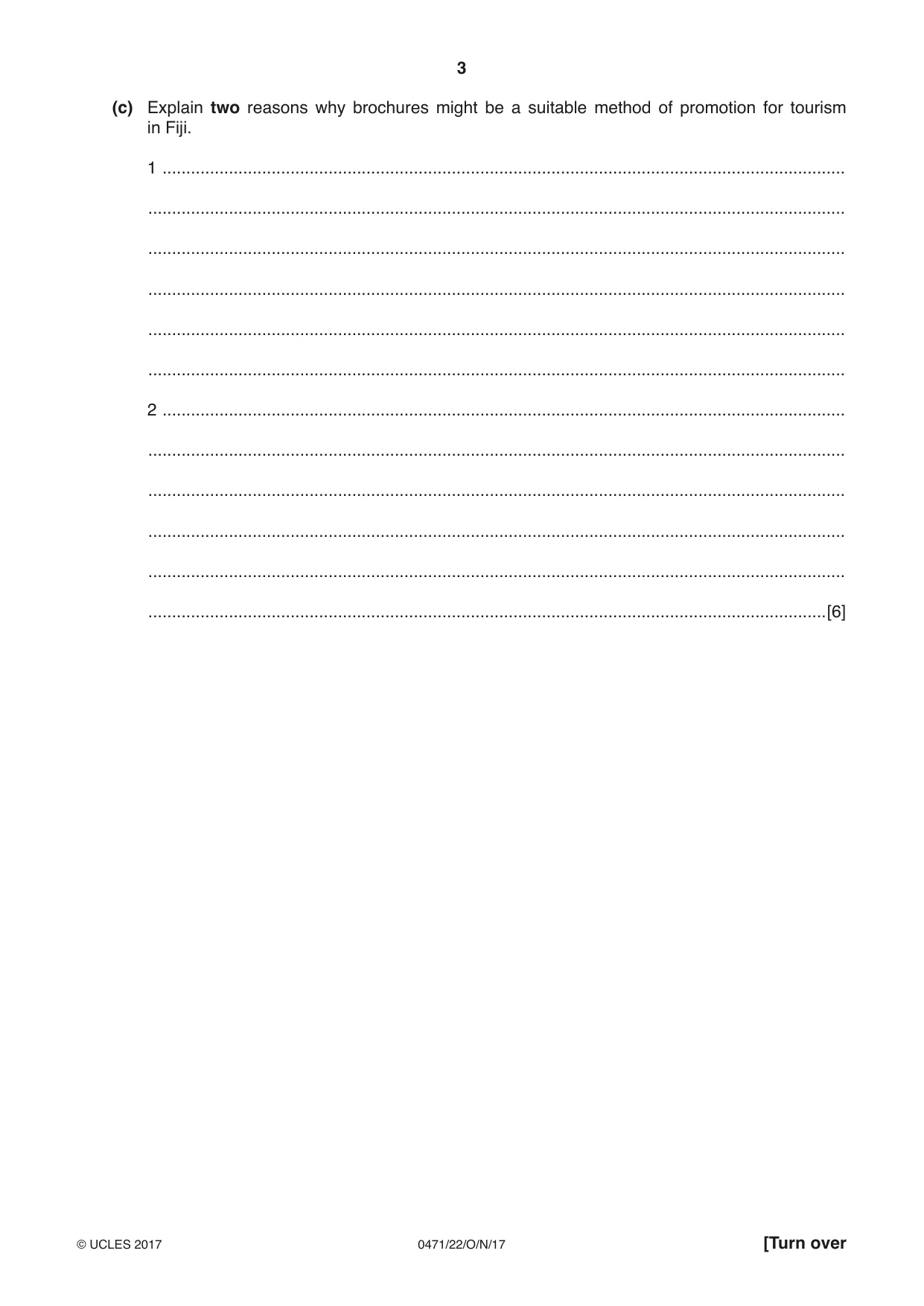
Question paper, page 3
3 0471/22/O/N/17 © UCLES 2017 [Turn over (c) Explain two reasons why brochures might be a suitable method of promotion for tourism in Fiji. 1 … … … … … … 2 … … … … … …[6]
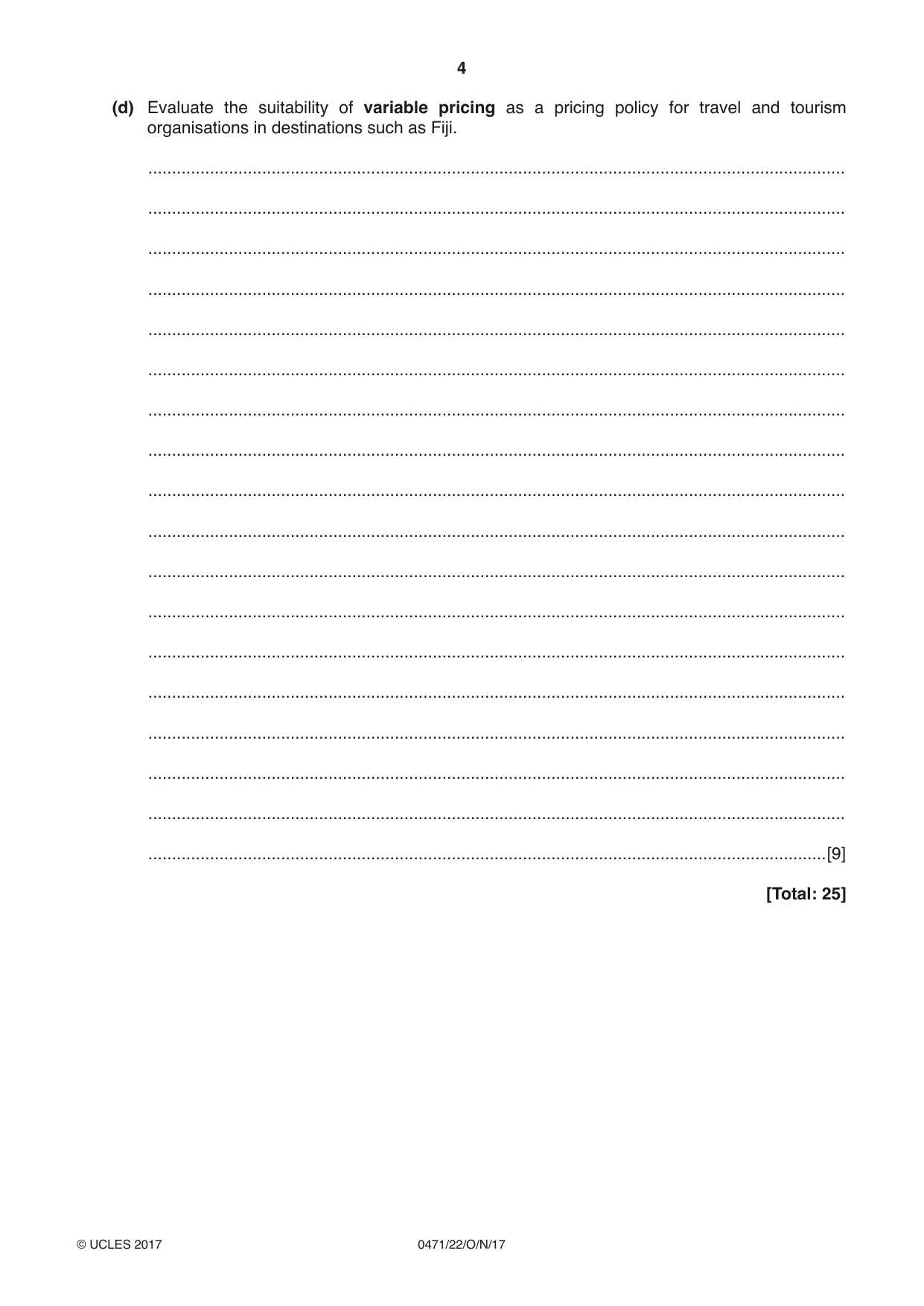
Question paper, page 4
4 0471/22/O/N/17 © UCLES 2017 (d) Evaluate the suitability of variable pricing as a pricing policy for travel and tourism organisations in destinations such as Fiji. … … … … … … … … … … … … … … … … … …[9] [Total: 25]
Question paper, page 5
5 0471/22/O/N/17 © UCLES 2017 [Turn over Question 2 Refer to Fig. 2 (Insert), an advertisement for Zambezi Terrace, a hotel in Zambia, a country in Africa. (a) Identify two distribution channels used by the hotel. For each channel give one likely reason for its use. Distribution channel … Reason … … … Distribution channel … Reason … … …[4] (b) Give one example of a product and one example of a service from the travel and tourism industry. Describe the main characteristics of each example. Product … Characteristics … … … … Service … Characteristics … … … …[6]
Question paper, page 6
6 0471/22/O/N/17 © UCLES 2017 (c) The Zambezi Terrace hotel advertisement in Fig. 2 (Insert) uses its unique selling point (USP) to create a brand image. Identify two product features of the Zambezi Terrace hotel which form part of its USP. Explain how each feature might attract potential customers. 1 … … … … … … 2 … … … … … …[6]
Question paper, page 7
7 0471/22/O/N/17 © UCLES 2017 [Turn over (d) Evaluate the importance of the character of the area as a factor influencing the choice of location for the Zambezi Terrace hotel. … … … … … … … … … … … … … … … … … …[9] [Total: 25]
Question paper, page 8
8 0471/22/O/N/17 © UCLES 2017 Question 3 Refer to Fig. 3 (Insert), information about cruises on the River Rhine in Germany, a country in western Europe. (a) State the following: (i) two target markets of cruises on the River Rhine 1 … 2 …[2] (ii) two features of the River Rhine cruise product 1 … 2 …[2] (b) Explain three likely advantages to customers of an all-inclusive package. 1 … … … … 2 … … … … 3 … … … …[6]
Question paper, page 9
9 0471/22/O/N/17 © UCLES 2017 [Turn over (c) Explain how each of the following factors may affect the final price charged to customers of cruises on the River Rhine: • fixed costs … … … … … … • competitors … … … … … …[6]
Question paper, page 10
10 0471/22/O/N/17 © UCLES 2017 (d) Discuss how the providers of River Rhine cruises might develop their marketing mix to increase customer numbers. … … … … … … … … … … … … … … … … … …[9] [Total: 25]
Question paper, page 11
11 0471/22/O/N/17 © UCLES 2017 [Turn over Question 4 Refer to Fig. 4 (Insert), information about the Torres Hiking Centre, an accommodation provider in Chile, a country in South America. (a) Explain two ways in which the Torres Hiking Centre product is suitable for adventure tourists. 1 … … … … 2 … … … …[4] (b) Give three reasons why marketing and promotion are important to travel and tourism organisations. 1 … … … … 2 … … … … 3 … … … …[6]
Question paper, page 12
12 0471/22/O/N/17 © UCLES 2017 (c) Explain two ways the Torres Hiking Centre could develop its product/service mix. 1 … … … … … … 2 … … … … … …[6]
Question paper, page 13
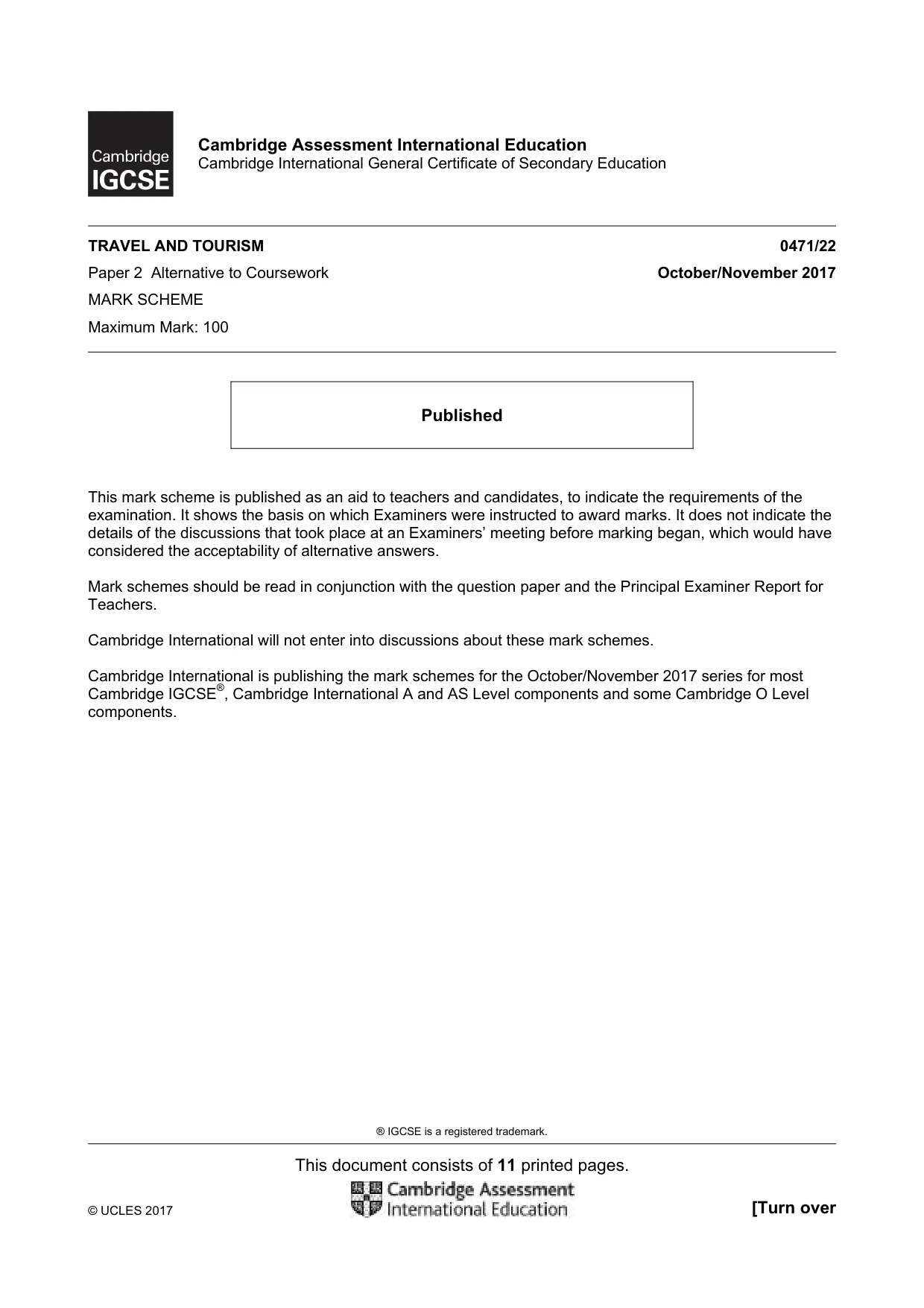
13 0471/22/O/N/17 © UCLES 2017 (d) Discuss the importance of target market segments for a travel and tourism organisation, such as Torres Hiking Centre, when producing effective promotional materials. … … … … … … … … … … … … … … … … … …[9] [Total: 25]
Question paper, page 14
14 0471/22/O/N/17 © UCLES 2017 BLANK PAGE
Question paper, page 15
15 0471/22/O/N/17 © UCLES 2017 BLANK PAGE
Question paper, page 16
16 0471/22/O/N/17 © UCLES 2017 Permission to reproduce items where third-party owned material protected by copyright is included has been sought and cleared where possible. Every reasonable effort has been made by the publisher (UCLES) to trace copyright holders, but if any items requiring clearance have unwittingly been included, the publisher will be pleased to make amends at the earliest possible opportunity. To avoid the issue of disclosure of answer-related information to candidates, all copyright acknowledgements are reproduced online in the Cambridge International Examinations Copyright Acknowledgements Booklet. This is produced for each series of examinations and is freely available to download at www.cie.org.uk after the live examination series. Cambridge International Examinations is part of the Cambridge Assessment Group. Cambridge Assessment is the brand name of University of Cambridge Local Examinations Syndicate (UCLES), which is itself a department of the University of Cambridge. BLANK PAGE
Mark scheme, page 1
® IGCSE is a registered trademark. This document consists of 11 printed pages. © UCLES 2017 [Turn over Cambridge Assessment International Education Cambridge International General Certificate of Secondary Education TRAVEL AND TOURISM 0471/22 Paper 2 Alternative to Coursework October/November 2017 MARK SCHEME Maximum Mark: 100 Published This mark scheme is published as an aid to teachers and candidates, to indicate the requirements of the examination. It shows the basis on which Examiners were instructed to award marks. It does not indicate the details of the discussions that took place at an Examiners’ meeting before marking began, which would have considered the acceptability of alternative answers. Mark schemes should be read in conjunction with the question paper and the Principal Examiner Report for Teachers. Cambridge International will not enter into discussions about these mark schemes. Cambridge International is publishing the mark schemes for the October/November 2017 series for most Cambridge IGCSE®, Cambridge International A and AS Level components and some Cambridge O Level components.
Mark scheme, page 2
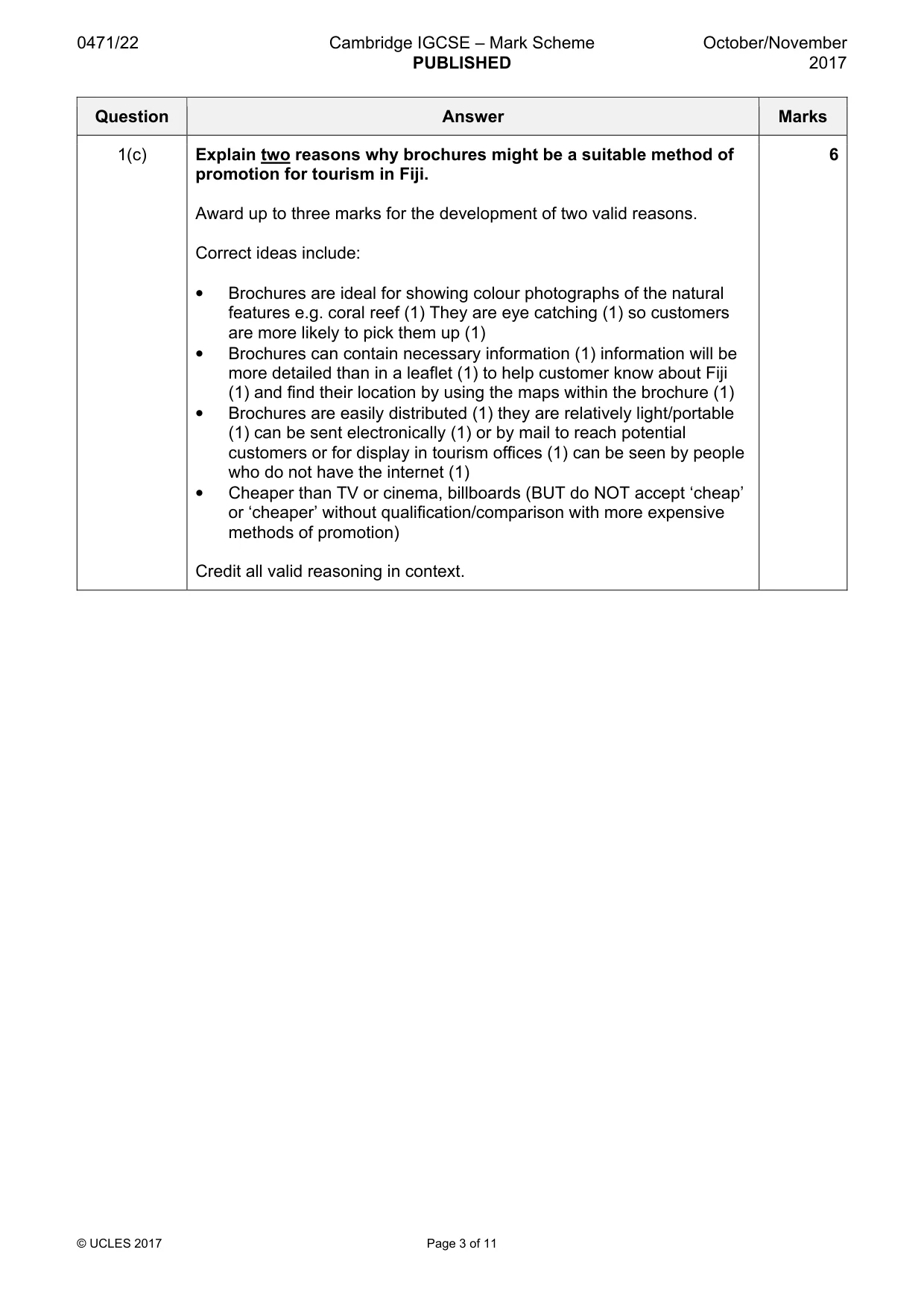
0471/22 Cambridge IGCSE – Mark Scheme PUBLISHED October/November 2017 © UCLES 2017 Page 2 of 11 Question Answer Marks 1(a)(i) Identify two opportunities for tourism in Fiji Award one mark for each of two valid answers – any from: 1 Good levels of education and training to help prepare the workforce 2 The Government regards tourism as an important sector of the economy 3 Fiji has the second largest stretch of coral reef in the world 7 There are many potential customers for Fijian tourism in China, Japan and South Korea 2 1(a)(ii) Identify two threats to tourism in Fiji Award one mark for each of two valid answers – any from: 4 Inflation affects the profits of tourism providers in Fiji 5 Natural disasters such as cyclones sometimes deter tourists. 6 There is political instability in Fiji 2 1(b) Other than a situation analysis, describe three ways in which the Fiji Tourism Board might assess its position in the market. Award one mark for an identified way of assessing the market, plus a second mark for amplification of how this facilitates an assessment of the market position. Correct ideas include: • Market research (1) to ascertain how well the destination is performing (1) • Primary research/surveys/questionnaires/observations/focus groups (1) find out customers views (1) • Secondary research/published reports/statistics (1) use existing data to analyse trends of competition (1) • SWOT (1) assess the external and internal influences to understand market position (1) • PEST (1) assess external influences to understand impacts (1) • Product life cycle (1) to determine future prospects of products and services (1) • Competitor analysis (1) to understand the extent of competition in the market (1) • Marketing mix (1) to understand how changes to the mix might benefit the marketing environment (1) • Evaluation of sales/visitor numbers (1) as evidence of demand (1) 6
Mark scheme, page 3
0471/22 Cambridge IGCSE – Mark Scheme PUBLISHED October/November 2017 © UCLES 2017 Page 3 of 11 Question Answer Marks 1(c) Explain two reasons why brochures might be a suitable method of promotion for tourism in Fiji. Award up to three marks for the development of two valid reasons. Correct ideas include: • Brochures are ideal for showing colour photographs of the natural features e.g. coral reef (1) They are eye catching (1) so customers are more likely to pick them up (1) • Brochures can contain necessary information (1) information will be more detailed than in a leaflet (1) to help customer know about Fiji (1) and find their location by using the maps within the brochure (1) • Brochures are easily distributed (1) they are relatively light/portable (1) can be sent electronically (1) or by mail to reach potential customers or for display in tourism offices (1) can be seen by people who do not have the internet (1) • Cheaper than TV or cinema, billboards (BUT do NOT accept ‘cheap’ or ‘cheaper’ without qualification/comparison with more expensive methods of promotion) Credit all valid reasoning in context. 6
Mark scheme, page 4
0471/22 Cambridge IGCSE – Mark Scheme PUBLISHED October/November 2017 © UCLES 2017 Page 4 of 11 Question Answer Marks 1(d) Evaluate the suitability of variable pricing as a pricing policy for travel and tourism organisations in destinations such as Fiji. Indicative content: • Variable pricing is a commonly used policy • It can be used to attract customers when there is less demand, for example in low season, when different rates are charged in low season than high season • It can also be used to attract customers by setting different rates for different customers, for example children may be charged at a reduced rate, or families may be charged a different price • This is attractive to customers as it is seen as value for money and so helps to gain customer satisfaction and enhance brand image • It is a flexible policy for the provider • The disadvantage is that there may be less revenue and it may not help long term planning Use level of response criteria: Level 1(1–3 marks) At this level candidates will identify 1, 2 or more aspects of variable pricing e.g. seasonality, concessionary prices for different groups, demand for products or services. Level 2 (4–6 marks) At this level candidates will explain 1, 2 or more reasons for the suitability of variable pricing. Level 3 (7–9 marks) At this level candidates will evaluate 1, 2 or more advantages and/or disadvantages of variable pricing. Candidates scoring 9 marks will attempt a conclusion about its suitability as a pricing policy within the context of the question. 9 2(a) Identify two distribution channels used by the hotel. For each give one likely reason for its use. Award one mark for the identification of each correct channel and an additional mark for a valid reason for the use of each. • Travel agent/retailer (1) popular with customers so provides a large customer base (1) saves time for the provider (1) face to face (1) offers advice/makes recommendations/more helpful (1) • Direct selling/Hotel GDS/Internet/website/email (1) no commission fees/no intermediaries (1) easy to communicate directly with customers (1) 24/7 availability (1) Note: Do NOT accept Tour Operator or Wholesaler. 4 2(b) Give one example of a product and one example of a service from 6
Mark scheme, page 5
0471/22 Cambridge IGCSE – Mark Scheme PUBLISHED October/November 2017 © UCLES 2017 Page 5 of 11 Question Answer Marks 2(b) the travel and tourism industry. Describe the main characteristics of each example. Award one mark for the identification of a valid example of both a product and service, one mark for the correct identification of a characteristic of that product or service, plus a second mark for a description of the characteristic. Note: there is often a lot of overlap in the T&T industry between products and services, which will require you to use your professional judgement – this will also affect the description of the characteristics (e.g. a hotel room or an airplane ticket are main products of T&T, but they are perishable which is a characteristic of a service). Products Examples might include: Flight/plane ticket; hotel/hotel room/bed/accommodation; meal in a restaurant/catering; swimming pool; package holiday; (1) Characteristics • storable (1) you can save it to use at a later date (1) • tangible (1) you can touch it (1) • homogenous (1) can be standardised (1) • separable (1) can be experienced as a stand-alone part of the holiday (1) Services Examples might include: waiter service in a restaurant; guiding service; currency exchange service; travel insurance; (1) Characteristics • intangible (1) cannot be held – it is an experience (1) • heterogeneous (1) the experience will be variable depending on the circumstances, the member of staff, etc. (1) • inseparable (1) it is dependent on other aspects of the experience (1) • incapable of being stored (1) you cannot take it with you to experience again (1) • Perishable (1) it has an expiry date (1) Accept all valid reasoning in context.
Mark scheme, page 6
0471/22 Cambridge IGCSE – Mark Scheme PUBLISHED October/November 2017 © UCLES 2017 Page 6 of 11 Question Answer Marks 2(c) Identify two product features of the Zambezi Terrace Hotel which form part of its USP. Explain how each feature might attract potential customers. Award one mark for each of two identifications of a valid USP and an additional two marks for explanation of the reasons why these may attract customers. Correct ideas include: • Closest hotel to the Victoria Falls (1) would attract customers because of its unique location (1) accessible to world famous landmark attraction (1) • Watch Hippos/wildlife from balcony (1) attracts adventure and nature lovers (1) National Park location (1) • Escorted visits to Falls (1) unique opportunity to experience this service (1) to learn about the attraction from local guides (1) Credit all valid reasoning in context. 6 2(d) Evaluate the importance of the character of the area as a factor influencing the choice of location for the Zambezi Terrace hotel. Indicative content: • The character of the area involves the natural features which include the National Park and Victoria Falls which will attract customers. These are beautiful sights which are well known so visitors will choose this hotel as it is close. • Character of the area is often a key reason for visitors to choose a location. Quiet, isolated are also part of the character of the area, as is climate or weather conditions. • Crime rates, political instability, living standards are aspects of character of the area which are also relevant. Use levels of response criteria: Level 1(1–3 marks) At this level candidates will identify 1, 2 or more aspects of character of the area. Level 2(4–6 marks) At this level candidates will explain 1, 2 or more reasons for the importance of character of the area as a locational factor. Level 3 (7–9 marks) At this level candidates will evaluate 1, 2 or more reasons for the importance of character of the area as a locational factor. 9
Mark scheme, page 7
0471/22 Cambridge IGCSE – Mark Scheme PUBLISHED October/November 2017 © UCLES 2017 Page 7 of 11 Question Answer Marks 3(a)(i) State two target markets of cruises on the River Rhine Award one mark for each of two correct answers. • Special Interest/Cultural/people interested in History/people who are interested in cruises (1) • Over 50’s/grey market (1) These are the only acceptable answers here. 2 3(a)(ii) State two features of the River Rhine cruise product Award one mark for each of two correct features identified. • Cruise on the Rhine/7,8,10 days • 100 cabins • Sauna and gym • Entertainment • Restaurant/Buffet dining • Stops/with guided tours • Evening lectures • All-inclusive packages 2 3(b) Explain three likely advantages to customers of an all-inclusive package. Award one mark for the identification of each of three valid advantages and one additional mark for explanation of each. • all meals, snacks, drinks, tours, activities included (1) customer does not have to research purchasing each item (1) • cheaper than buying components separately (1) costs are known so customer can budget his holiday fully in advance (1) • value for money (1) can benefit from bulk group savings operator can negotiate (1) • Convenient (1) easy to book (1) only use one company (1) Credit all valid reasoning in context. 6
Mark scheme, page 8
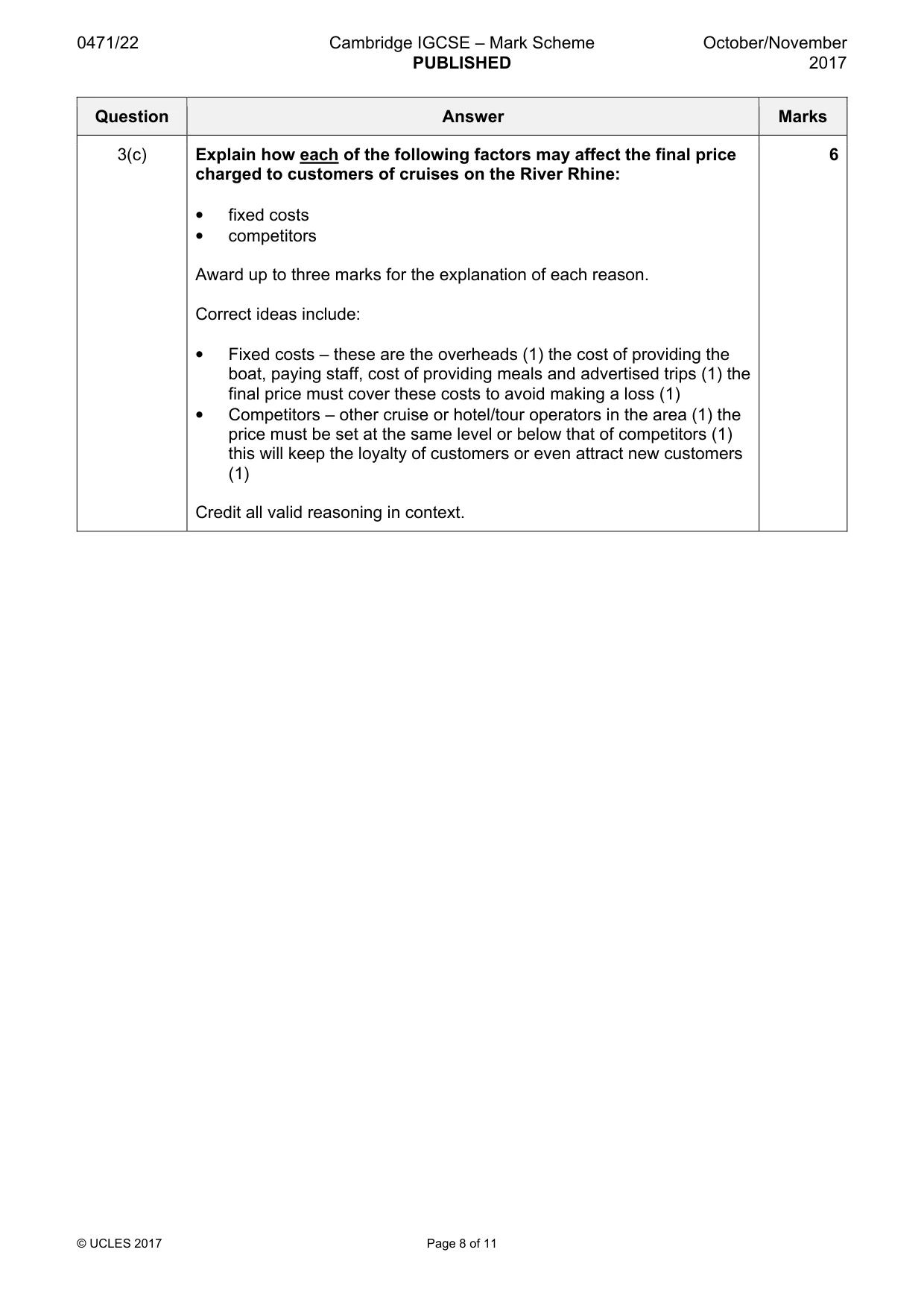
0471/22 Cambridge IGCSE – Mark Scheme PUBLISHED October/November 2017 © UCLES 2017 Page 8 of 11 Question Answer Marks 3(c) Explain how each of the following factors may affect the final price charged to customers of cruises on the River Rhine: • fixed costs • competitors Award up to three marks for the explanation of each reason. Correct ideas include: • Fixed costs – these are the overheads (1) the cost of providing the boat, paying staff, cost of providing meals and advertised trips (1) the final price must cover these costs to avoid making a loss (1) • Competitors – other cruise or hotel/tour operators in the area (1) the price must be set at the same level or below that of competitors (1) this will keep the loyalty of customers or even attract new customers (1) Credit all valid reasoning in context. 6
Mark scheme, page 9
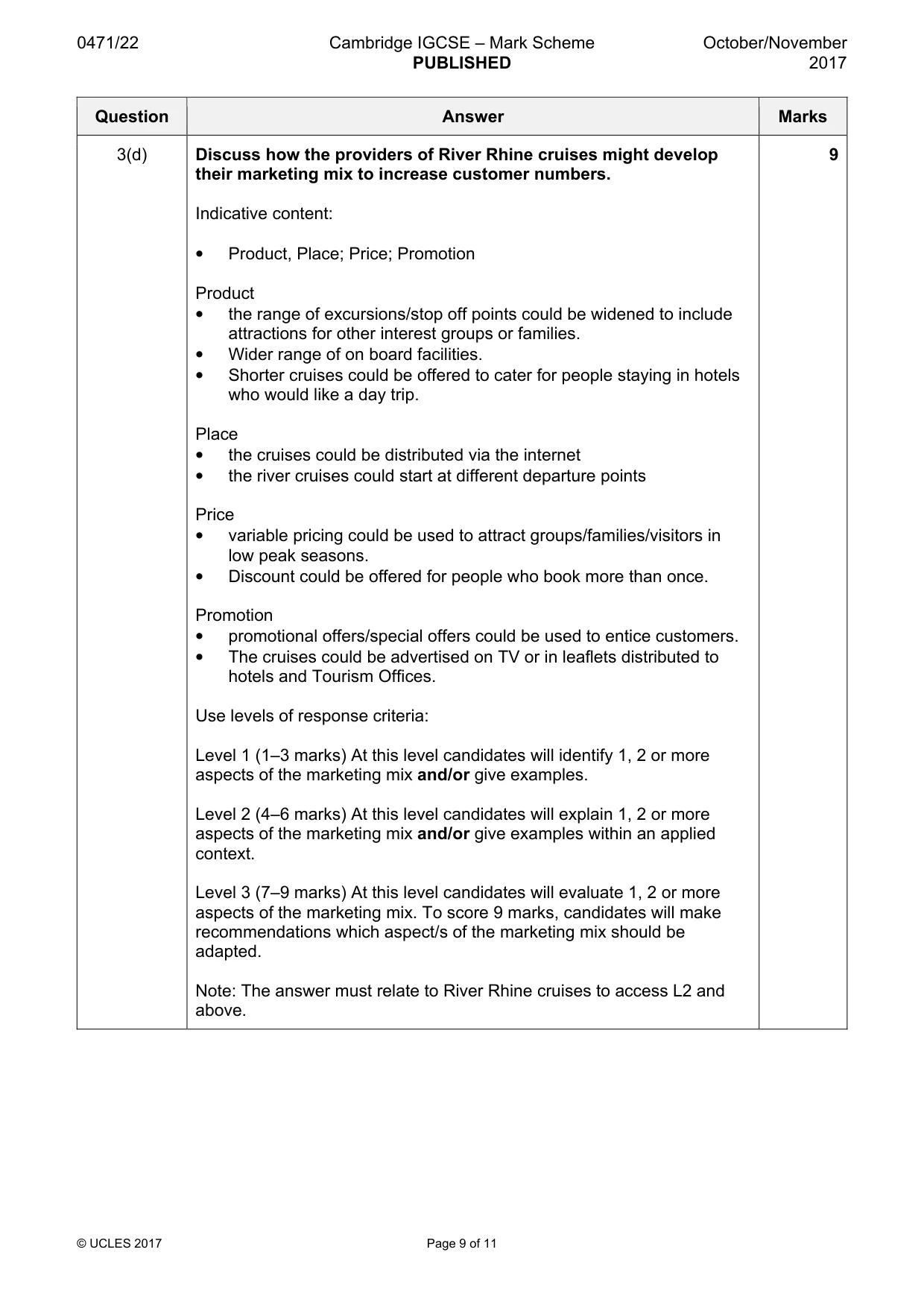
0471/22 Cambridge IGCSE – Mark Scheme PUBLISHED October/November 2017 © UCLES 2017 Page 9 of 11 Question Answer Marks 3(d) Discuss how the providers of River Rhine cruises might develop their marketing mix to increase customer numbers. Indicative content: • Product, Place; Price; Promotion Product • the range of excursions/stop off points could be widened to include attractions for other interest groups or families. • Wider range of on board facilities. • Shorter cruises could be offered to cater for people staying in hotels who would like a day trip. Place • the cruises could be distributed via the internet • the river cruises could start at different departure points Price • variable pricing could be used to attract groups/families/visitors in low peak seasons. • Discount could be offered for people who book more than once. Promotion • promotional offers/special offers could be used to entice customers. • The cruises could be advertised on TV or in leaflets distributed to hotels and Tourism Offices. Use levels of response criteria: Level 1 (1–3 marks) At this level candidates will identify 1, 2 or more aspects of the marketing mix and/or give examples. Level 2 (4–6 marks) At this level candidates will explain 1, 2 or more aspects of the marketing mix and/or give examples within an applied context. Level 3 (7–9 marks) At this level candidates will evaluate 1, 2 or more aspects of the marketing mix. To score 9 marks, candidates will make recommendations which aspect/s of the marketing mix should be adapted. Note: The answer must relate to River Rhine cruises to access L2 and above. 9
Mark scheme, page 10
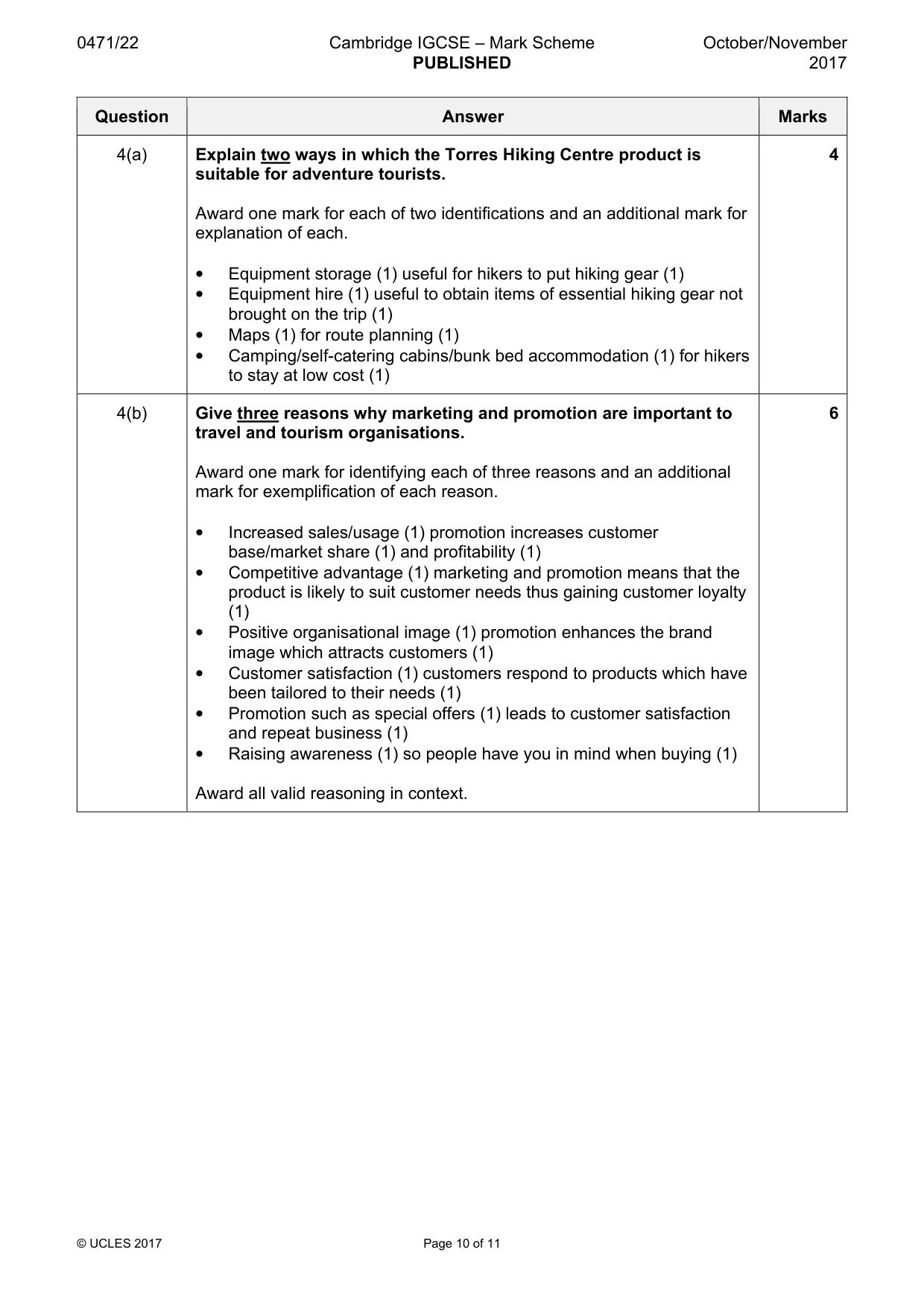
0471/22 Cambridge IGCSE – Mark Scheme PUBLISHED October/November 2017 © UCLES 2017 Page 10 of 11 Question Answer Marks 4(a) Explain two ways in which the Torres Hiking Centre product is suitable for adventure tourists. Award one mark for each of two identifications and an additional mark for explanation of each. • Equipment storage (1) useful for hikers to put hiking gear (1) • Equipment hire (1) useful to obtain items of essential hiking gear not brought on the trip (1) • Maps (1) for route planning (1) • Camping/self-catering cabins/bunk bed accommodation (1) for hikers to stay at low cost (1) 4 4(b) Give three reasons why marketing and promotion are important to travel and tourism organisations. Award one mark for identifying each of three reasons and an additional mark for exemplification of each reason. • Increased sales/usage (1) promotion increases customer base/market share (1) and profitability (1) • Competitive advantage (1) marketing and promotion means that the product is likely to suit customer needs thus gaining customer loyalty (1) • Positive organisational image (1) promotion enhances the brand image which attracts customers (1) • Customer satisfaction (1) customers respond to products which have been tailored to their needs (1) • Promotion such as special offers (1) leads to customer satisfaction and repeat business (1) • Raising awareness (1) so people have you in mind when buying (1) Award all valid reasoning in context. 6
Mark scheme, page 11
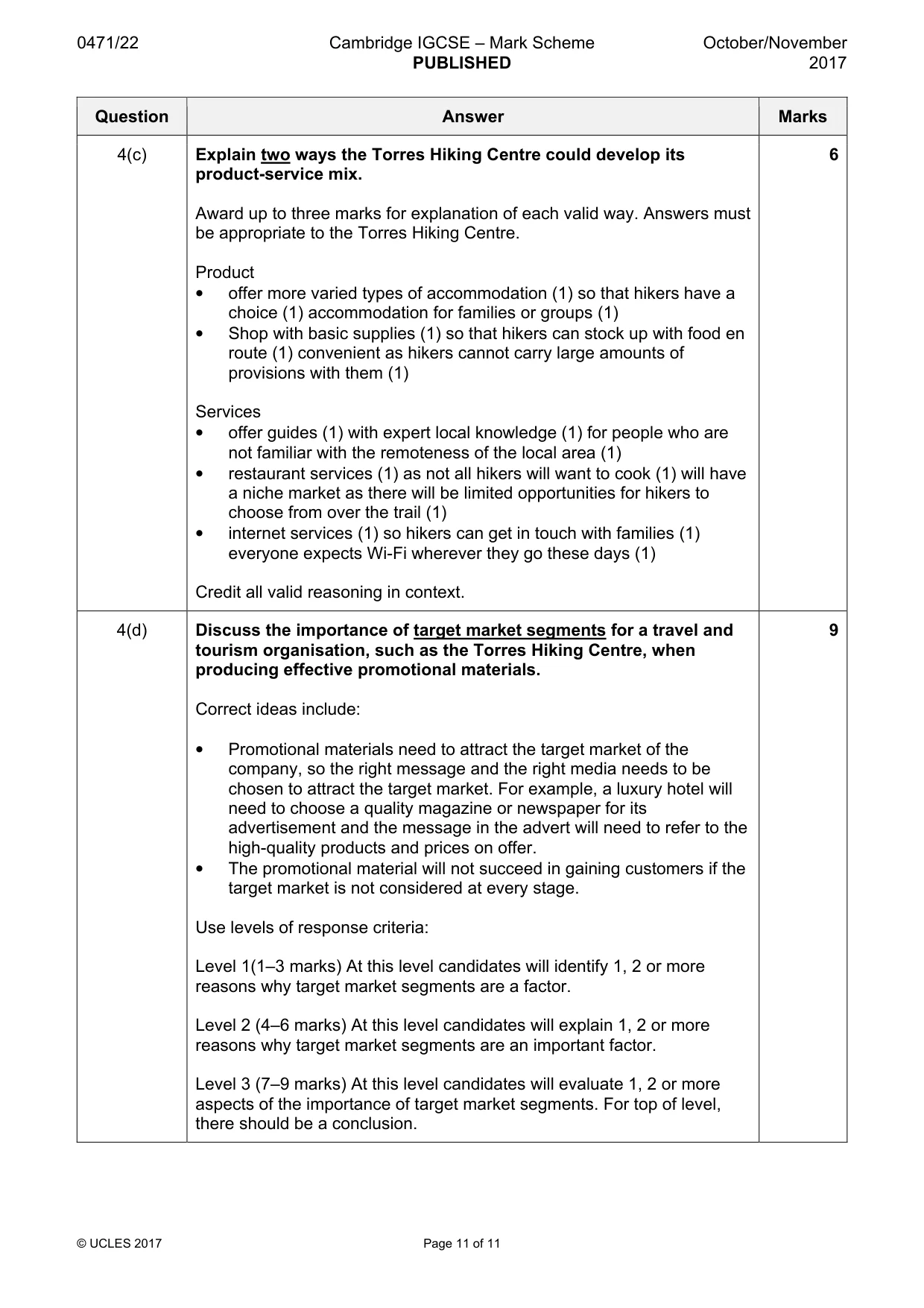
0471/22 Cambridge IGCSE – Mark Scheme PUBLISHED October/November 2017 © UCLES 2017 Page 11 of 11 Question Answer Marks 4(c) Explain two ways the Torres Hiking Centre could develop its product-service mix. Award up to three marks for explanation of each valid way. Answers must be appropriate to the Torres Hiking Centre. Product • offer more varied types of accommodation (1) so that hikers have a choice (1) accommodation for families or groups (1) • Shop with basic supplies (1) so that hikers can stock up with food en route (1) convenient as hikers cannot carry large amounts of provisions with them (1) Services • offer guides (1) with expert local knowledge (1) for people who are not familiar with the remoteness of the local area (1) • restaurant services (1) as not all hikers will want to cook (1) will have a niche market as there will be limited opportunities for hikers to choose from over the trail (1) • internet services (1) so hikers can get in touch with families (1) everyone expects Wi-Fi wherever they go these days (1) Credit all valid reasoning in context. 6 4(d) Discuss the importance of target market segments for a travel and tourism organisation, such as the Torres Hiking Centre, when producing effective promotional materials. Correct ideas include: • Promotional materials need to attract the target market of the company, so the right message and the right media needs to be chosen to attract the target market. For example, a luxury hotel will need to choose a quality magazine or newspaper for its advertisement and the message in the advert will need to refer to the high-quality products and prices on offer. • The promotional material will not succeed in gaining customers if the target market is not considered at every stage. Use levels of response criteria: Level 1(1–3 marks) At this level candidates will identify 1, 2 or more reasons why target market segments are a factor. Level 2 (4–6 marks) At this level candidates will explain 1, 2 or more reasons why target market segments are an important factor. Level 3 (7–9 marks) At this level candidates will evaluate 1, 2 or more aspects of the importance of target market segments. For top of level, there should be a conclusion. 9
What you needed in this session
Cambridge’s own grade thresholds for 2017 Oct/Nov, Paper 2 · Variant 2. A higher threshold means an easier paper — the bar moves with how the cohort did.