Cambridge IGCSE Travel and Tourism 0471 — 2017 Oct/Nov Paper 2 · Variant 1
0471/21/O/N/17 · 100 marks · ≈113 min
The question paper and its mark scheme, free to read here and free to download. This is Cambridge’s own paper, exactly as it was sat.
Question paper16 pages



Mark scheme9 pages
Answers below. Sit the paper first if you are practising.
Paper as text
Question paper, page 1
This document consists of 13 printed pages, 3 blank pages and 1 Insert. DC (SC) 143355 © UCLES 2017 [Turn over * 8 3 3 6 2 1 7 3 5 0 * TRAVEL AND TOURISM 0471/21 Alternative to Coursework October/November 2017 2 hours 30 minutes Candidates answer on the Question Paper. No Additional Materials are required. READ THESE INSTRUCTIONS FIRST Write your Centre number, candidate number and name on all the work you hand in. Write in dark blue or black pen. You may use an HB pencil for any diagrams or graphs. Do not use staples, paper clips, glue or correction fluid. DO NOT WRITE IN ANY BARCODES. Answer all questions. All the Figures referred to in the questions are contained in the Insert. At the end of the examination, fasten all your work securely together. The number of marks is given in brackets [ ] at the end of each question or part question. Cambridge International Examinations Cambridge International General Certificate of Secondary Education
Question paper, page 2
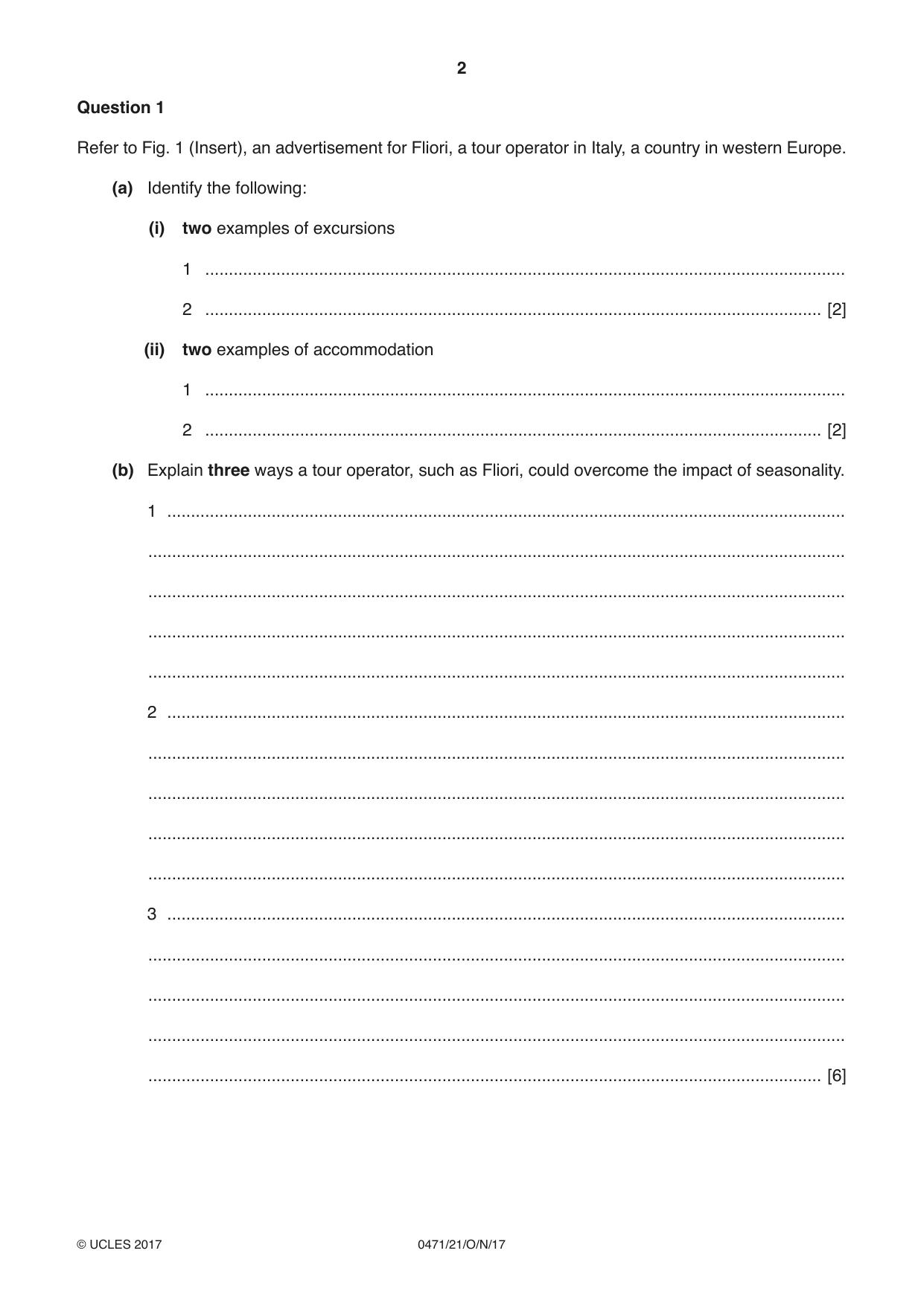
2 0471/21/O/N/17 © UCLES 2017 Question 1 Refer to Fig. 1 (Insert), an advertisement for Fliori, a tour operator in Italy, a country in western Europe. (a) Identify the following: (i) two examples of excursions 1 … 2 … [2] (ii) two examples of accommodation 1 … 2 … [2] (b) Explain three ways a tour operator, such as Fliori, could overcome the impact of seasonality. 1 … … … … … 2 … … … … … 3 … … … … … [6]
Question paper, page 3
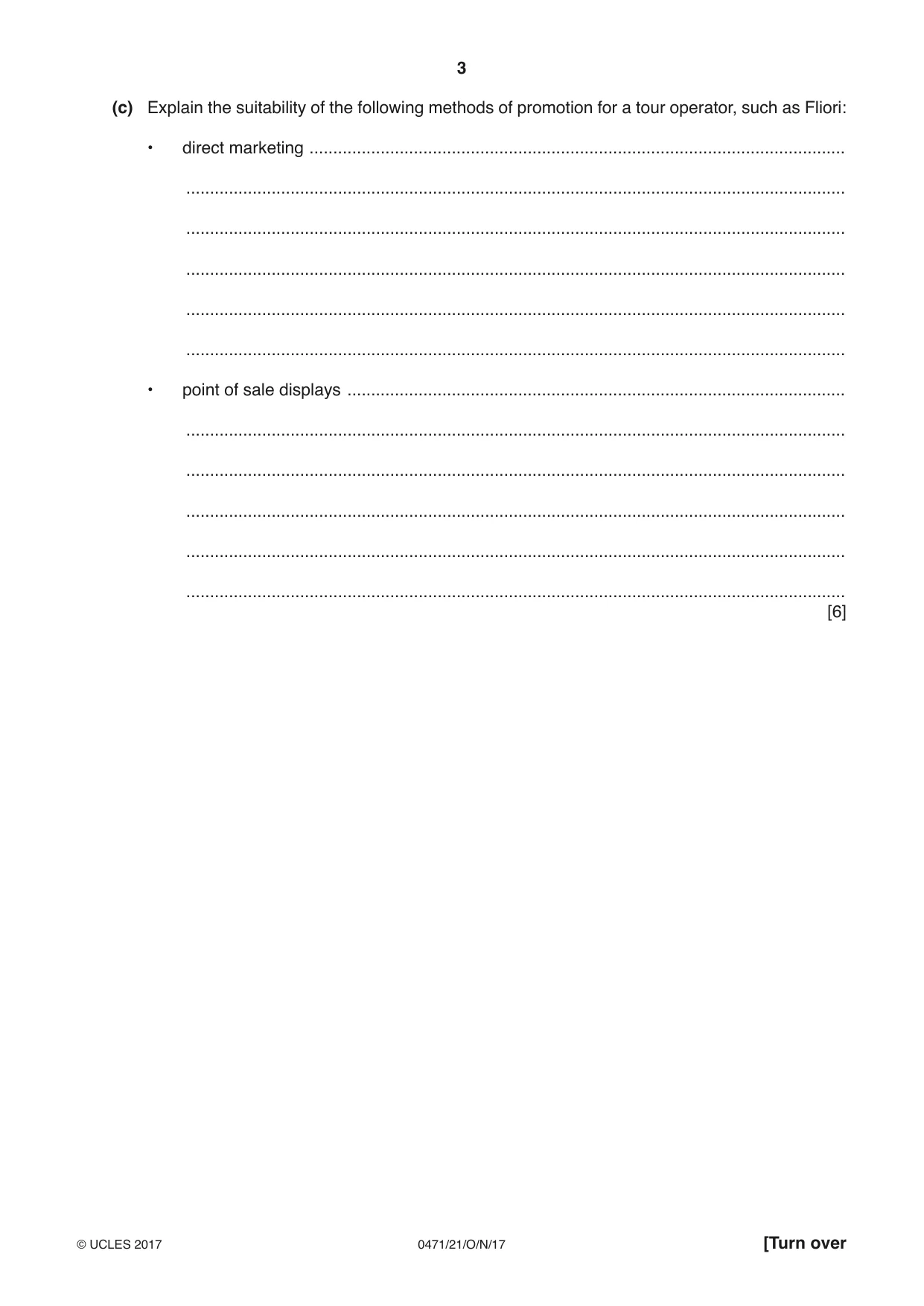
3 0471/21/O/N/17 © UCLES 2017 [Turn over (c) Explain the suitability of the following methods of promotion for a tour operator, such as Fliori: • direct marketing … … … … … … • point of sale displays … … … … … … [6]
Question paper, page 4
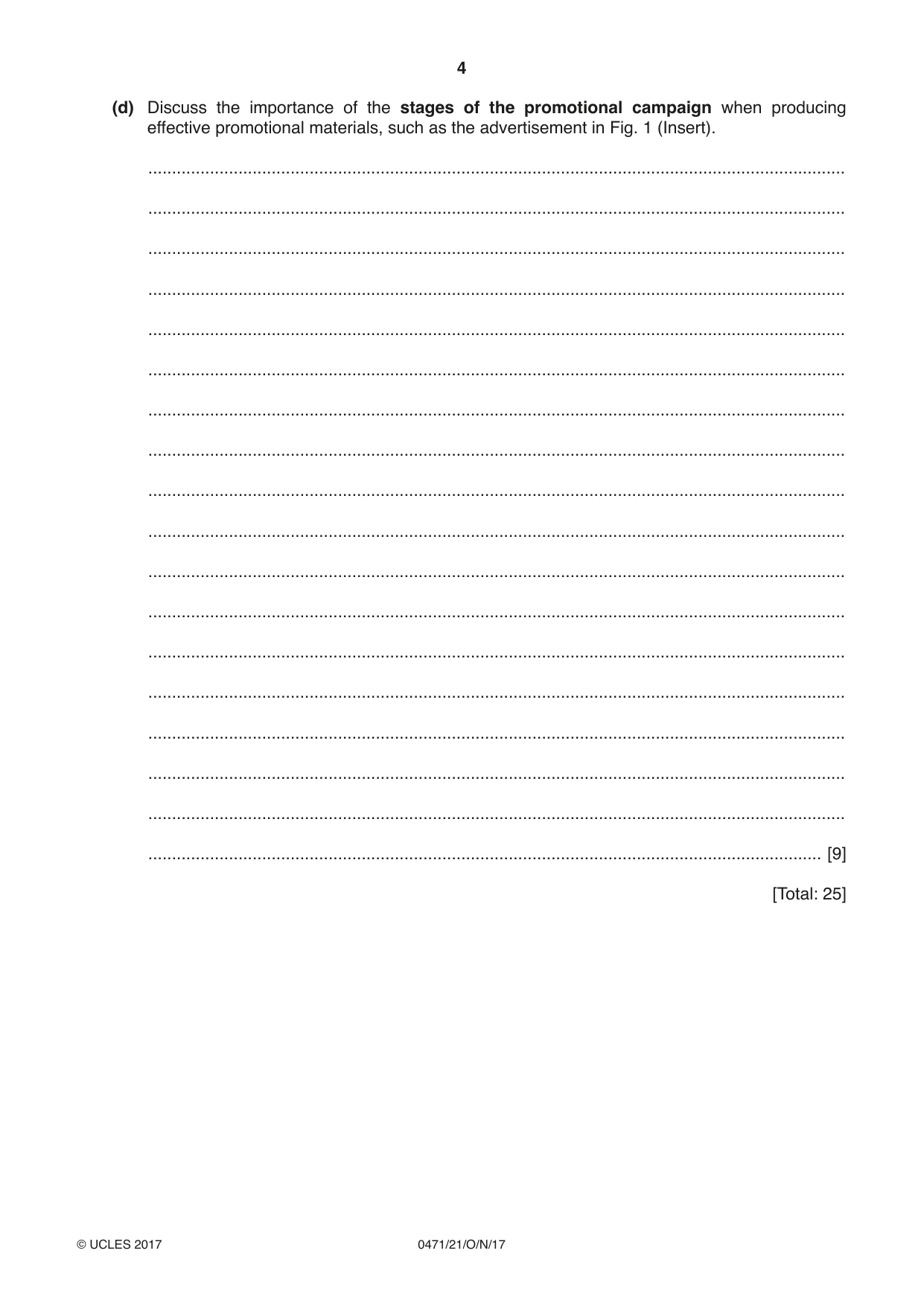
4 0471/21/O/N/17 © UCLES 2017 (d) Discuss the importance of the stages of the promotional campaign when producing effective promotional materials, such as the advertisement in Fig. 1 (Insert). … … … … … … … … … … … … … … … … … … [9] [Total: 25]
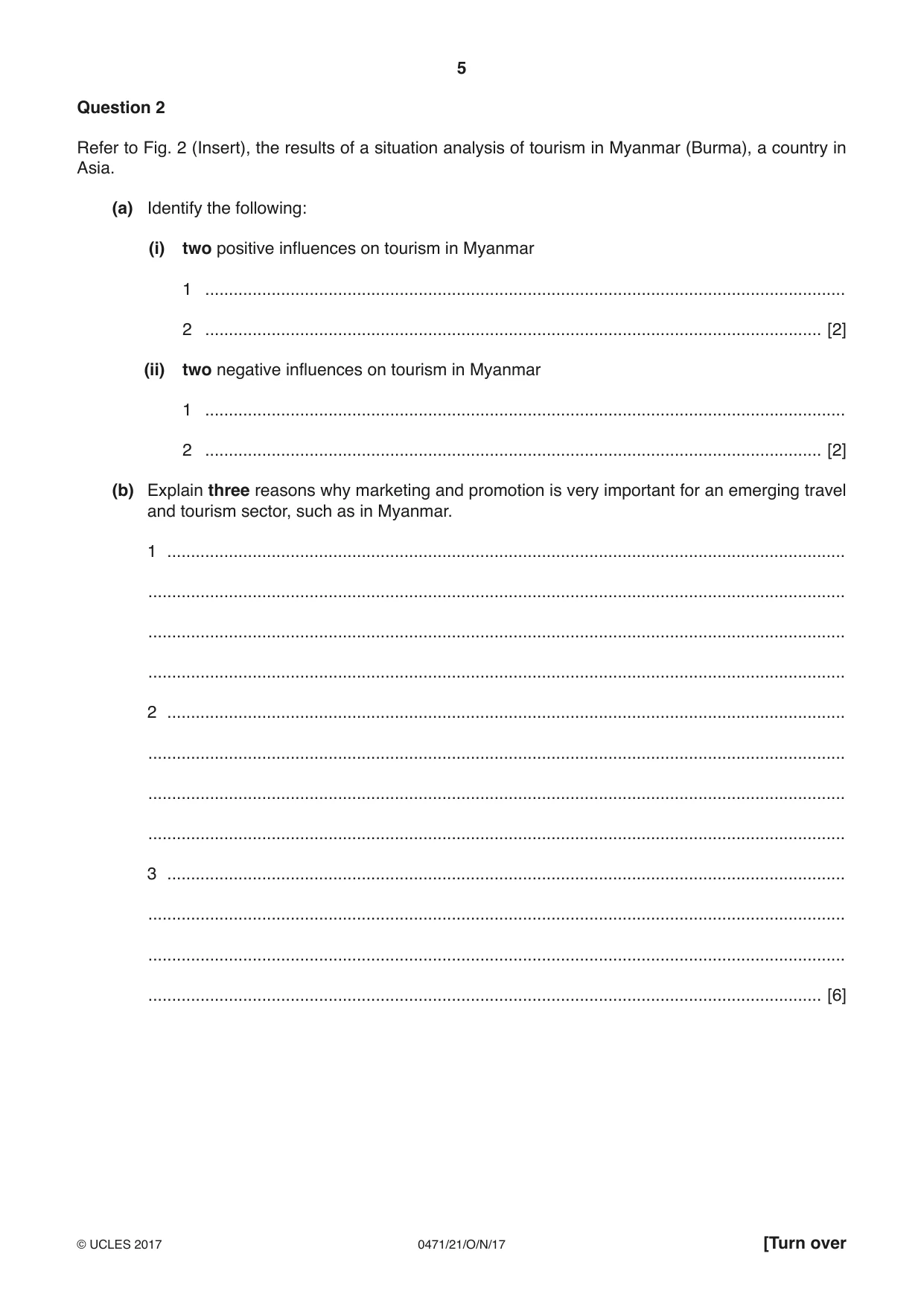
Question paper, page 5
5 0471/21/O/N/17 © UCLES 2017 [Turn over Question 2 Refer to Fig. 2 (Insert), the results of a situation analysis of tourism in Myanmar (Burma), a country in Asia. (a) Identify the following: (i) two positive influences on tourism in Myanmar 1 … 2 … [2] (ii) two negative influences on tourism in Myanmar 1 … 2 … [2] (b) Explain three reasons why marketing and promotion is very important for an emerging travel and tourism sector, such as in Myanmar. 1 … … … … 2 … … … … 3 … … … … [6]
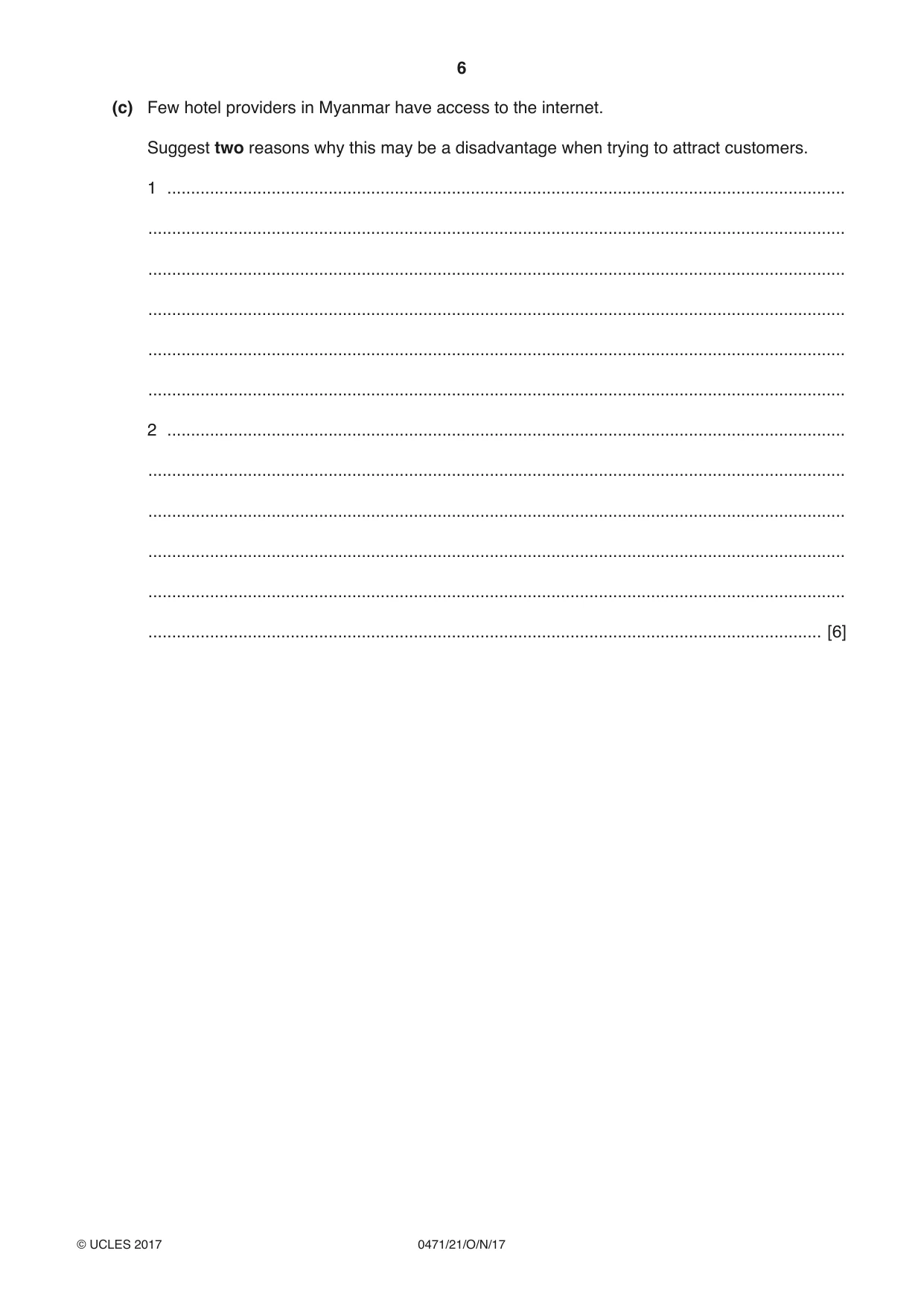
Question paper, page 6
6 0471/21/O/N/17 © UCLES 2017 (c) Few hotel providers in Myanmar have access to the internet. Suggest two reasons why this may be a disadvantage when trying to attract customers. 1 … … … … … … 2 … … … … … … [6]
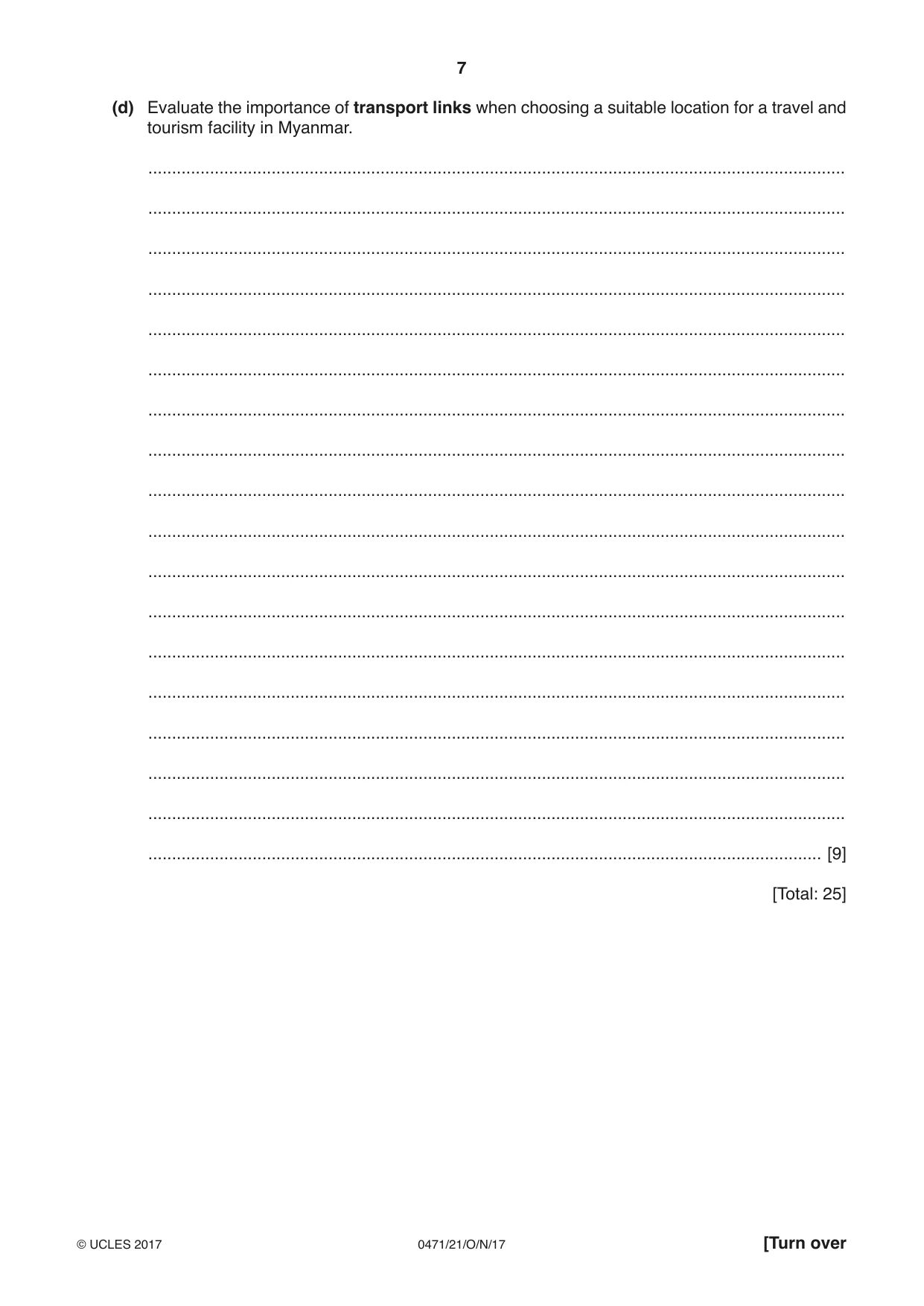
Question paper, page 7
7 0471/21/O/N/17 © UCLES 2017 [Turn over (d) Evaluate the importance of transport links when choosing a suitable location for a travel and tourism facility in Myanmar. … … … … … … … … … … … … … … … … … … [9] [Total: 25]
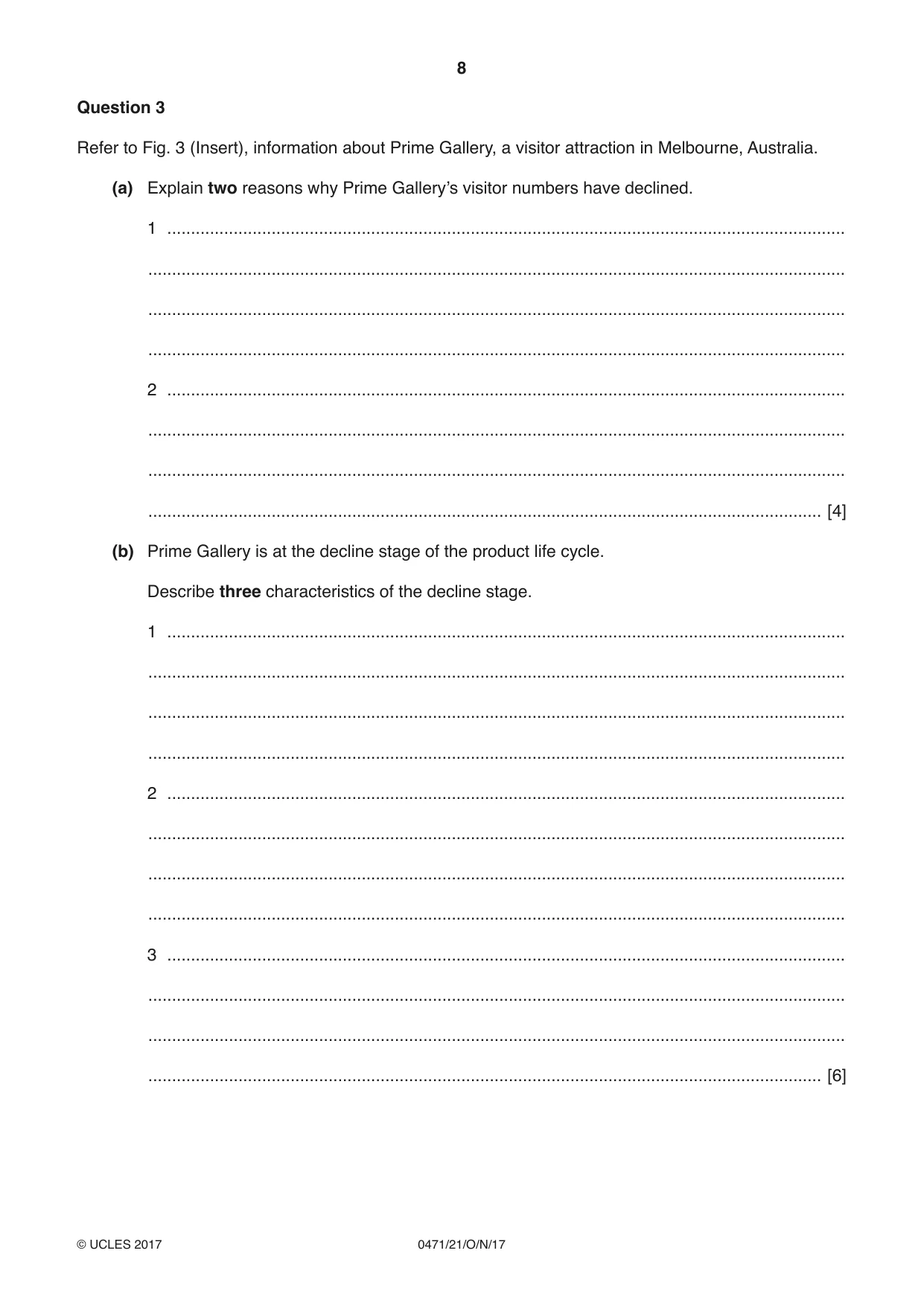
Question paper, page 8
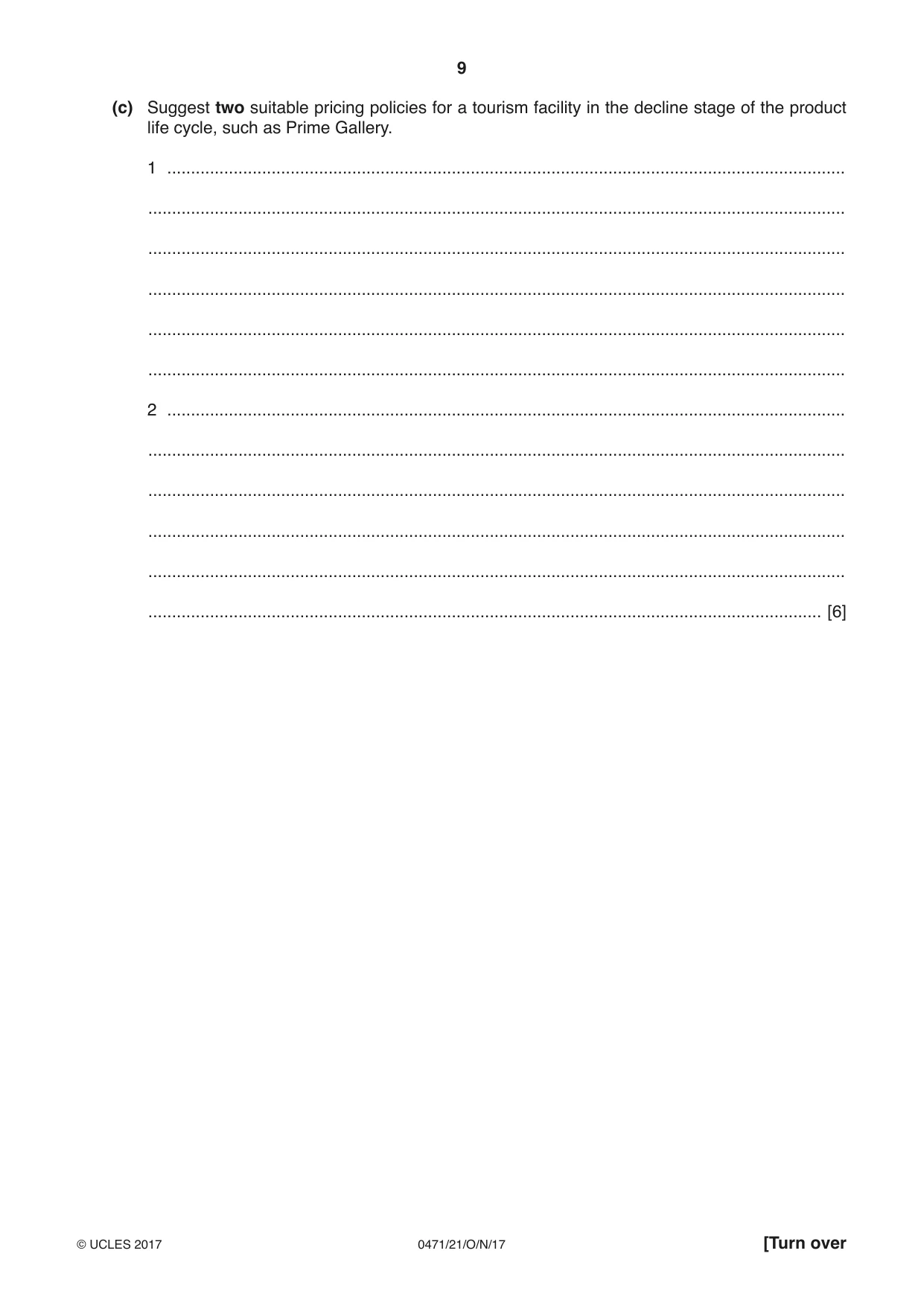
8 0471/21/O/N/17 © UCLES 2017 Question 3 Refer to Fig. 3 (Insert), information about Prime Gallery, a visitor attraction in Melbourne, Australia. (a) Explain two reasons why Prime Gallery’s visitor numbers have declined. 1 … … … … 2 … … … … [4] (b) Prime Gallery is at the decline stage of the product life cycle. Describe three characteristics of the decline stage. 1 … … … … 2 … … … … 3 … … … … [6]
Question paper, page 9
9 0471/21/O/N/17 © UCLES 2017 [Turn over (c) Suggest two suitable pricing policies for a tourism facility in the decline stage of the product life cycle, such as Prime Gallery. 1 … … … … … … 2 … … … … … … [6]
Question paper, page 10
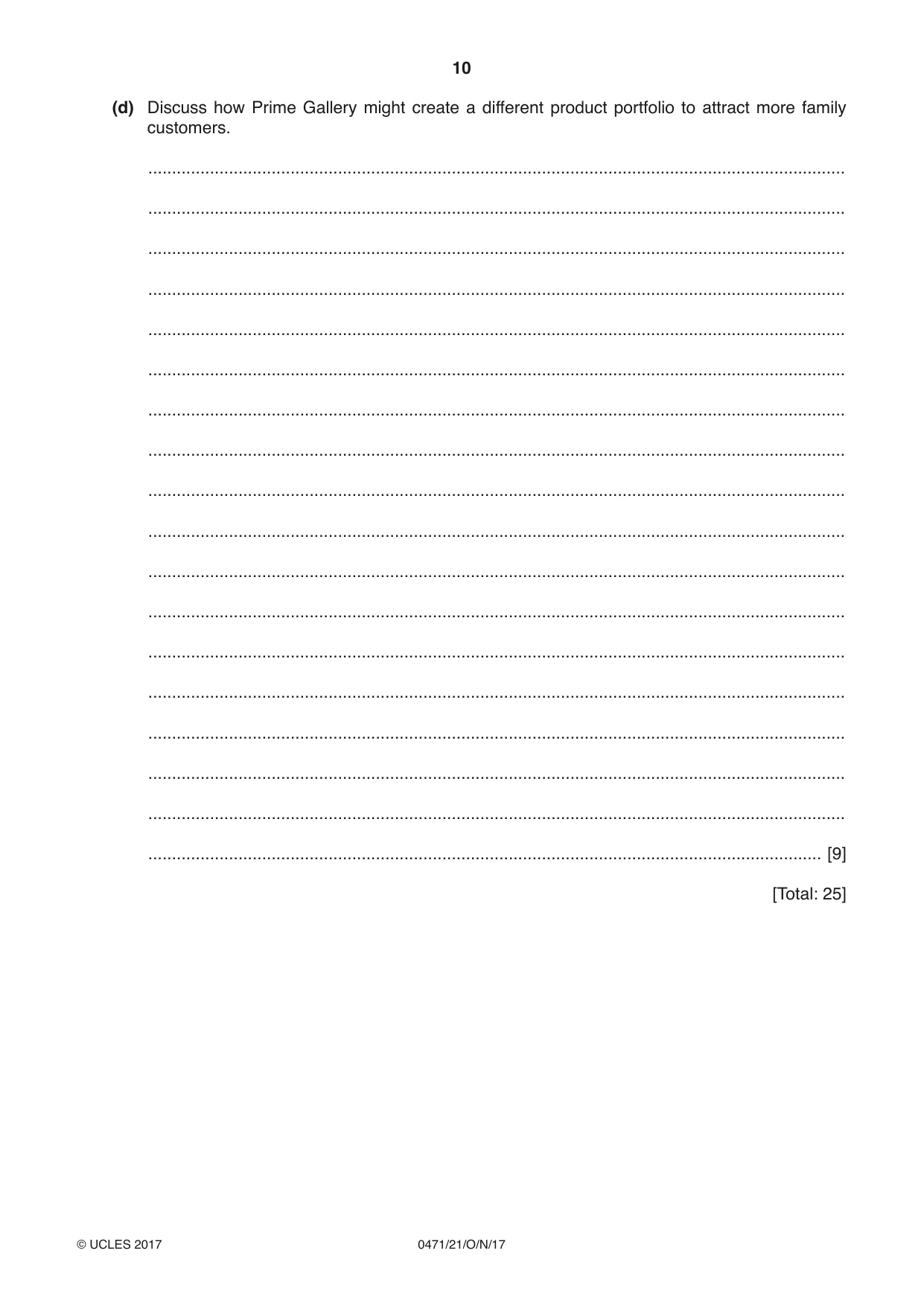
10 0471/21/O/N/17 © UCLES 2017 (d) Discuss how Prime Gallery might create a different product portfolio to attract more family customers. … … … … … … … … … … … … … … … … … … [9] [Total: 25]
Question paper, page 11
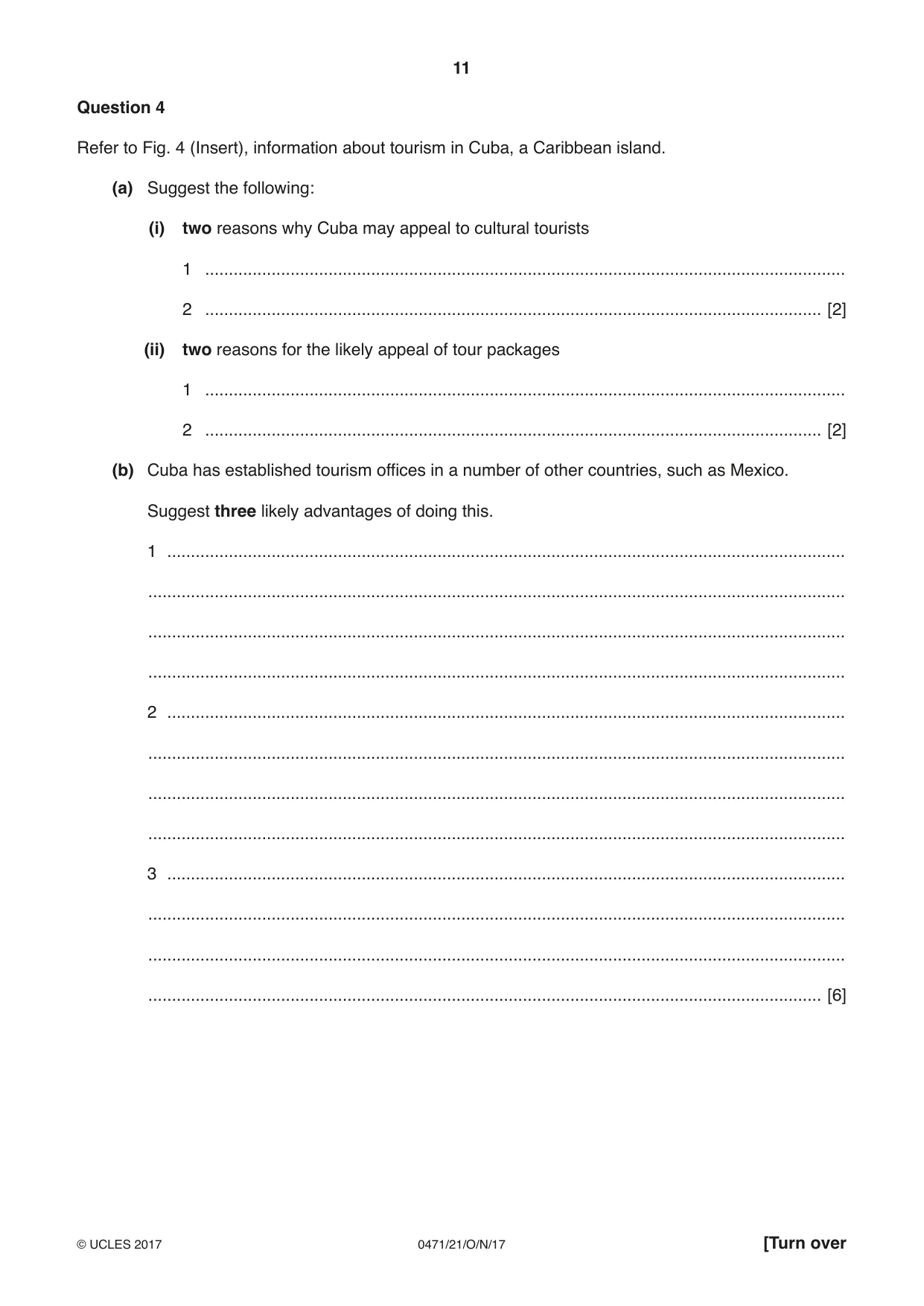
11 0471/21/O/N/17 © UCLES 2017 [Turn over Question 4 Refer to Fig. 4 (Insert), information about tourism in Cuba, a Caribbean island. (a) Suggest the following: (i) two reasons why Cuba may appeal to cultural tourists 1 … 2 … [2] (ii) two reasons for the likely appeal of tour packages 1 … 2 … [2] (b) Cuba has established tourism offices in a number of other countries, such as Mexico. Suggest three likely advantages of doing this. 1 … … … … 2 … … … … 3 … … … … [6]
Question paper, page 12
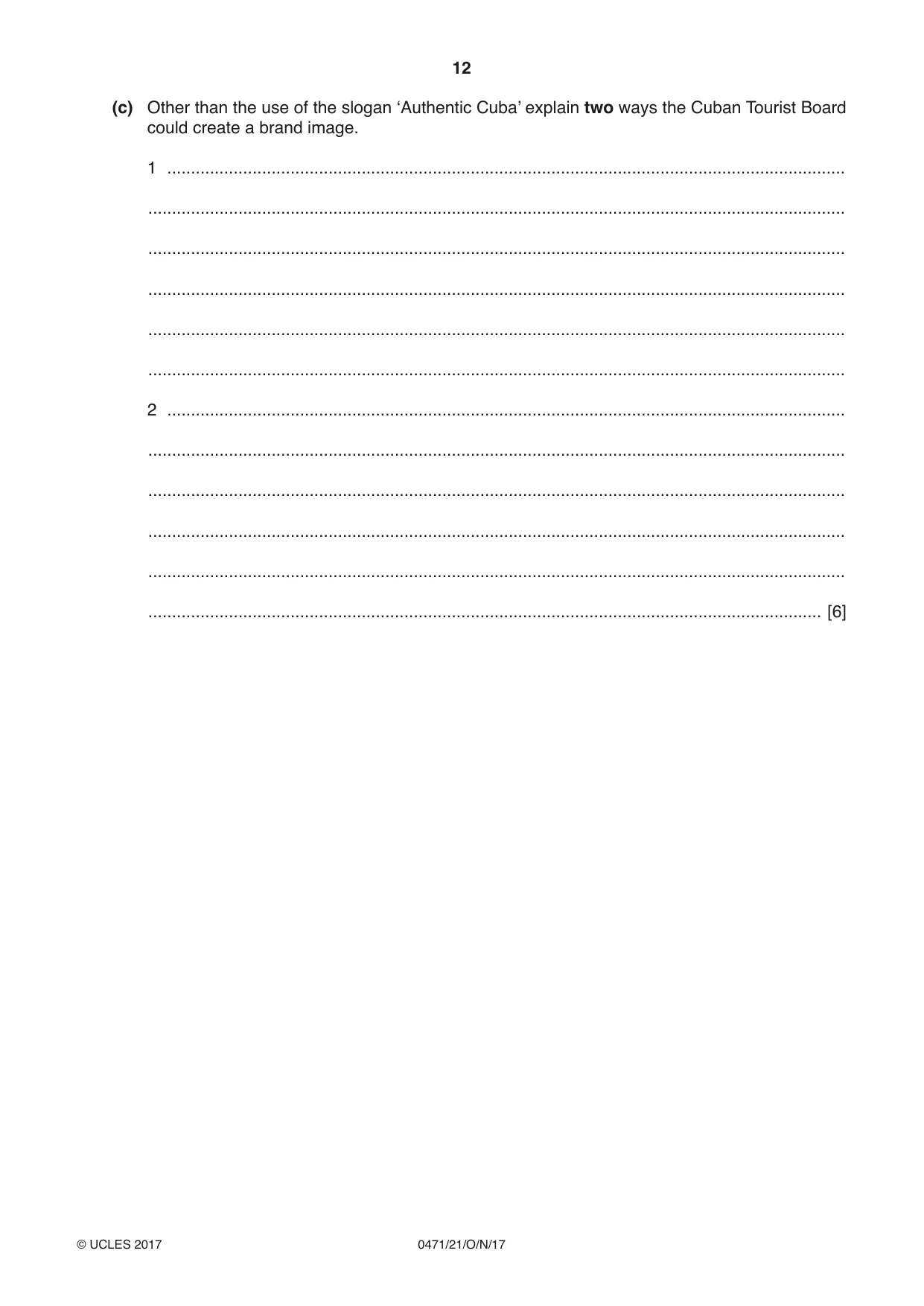
12 0471/21/O/N/17 © UCLES 2017 (c) Other than the use of the slogan ‘Authentic Cuba’ explain two ways the Cuban Tourist Board could create a brand image. 1 … … … … … … 2 … … … … … … [6]
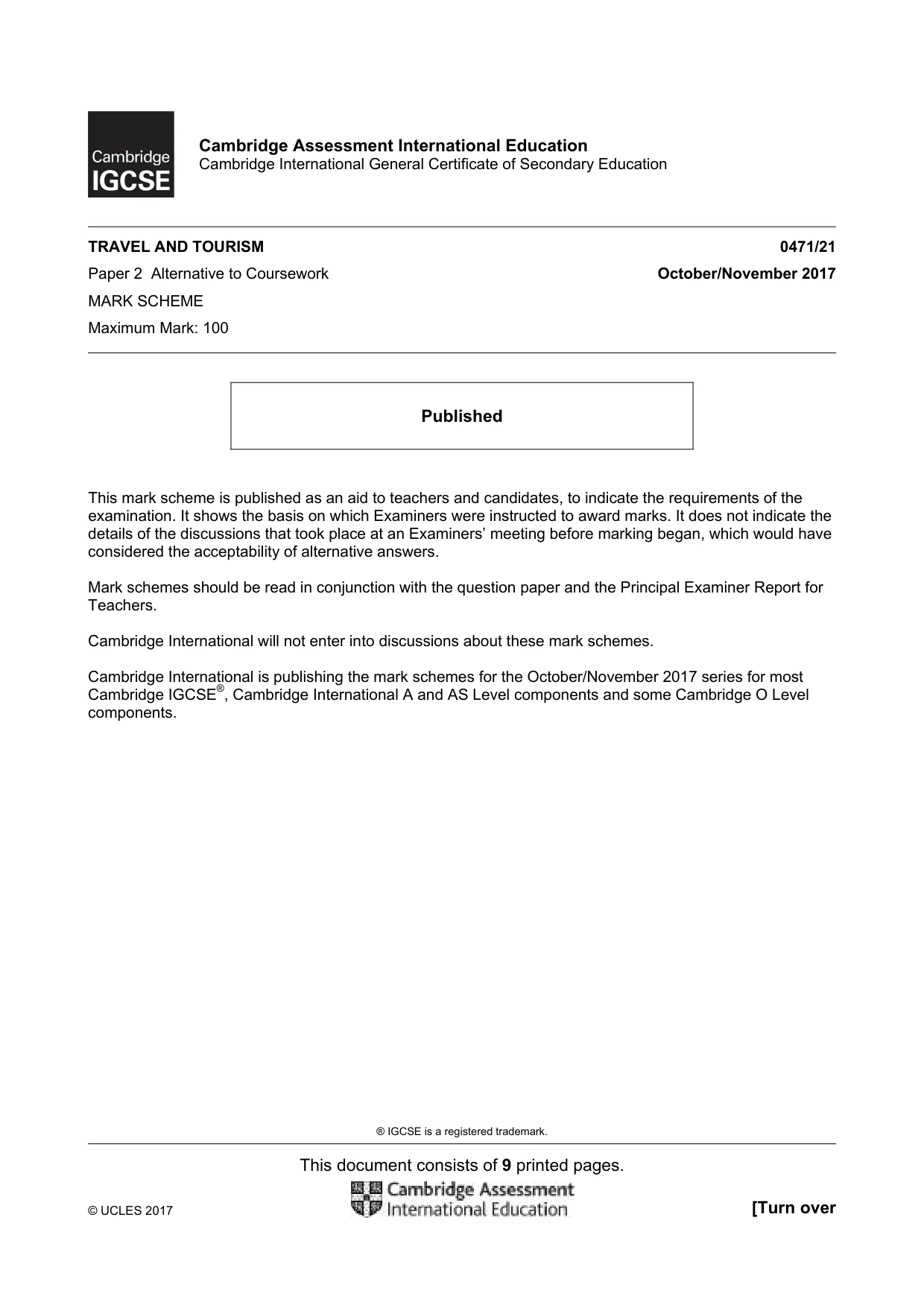
Question paper, page 13
13 0471/21/O/N/17 © UCLES 2017 (d) Discuss how travel and tourism providers in Cuba could develop the marketing mix to increase the number of visitors from Europe. … … … … … … … … … … … … … … … … … … [9] [Total: 25]
Question paper, page 14
14 0471/21/O/N/17 © UCLES 2017 BLANK PAGE
Question paper, page 15
15 0471/21/O/N/17 © UCLES 2017 BLANK PAGE
Question paper, page 16
16 0471/21/O/N/17 © UCLES 2017 BLANK PAGE Permission to reproduce items where third-party owned material protected by copyright is included has been sought and cleared where possible. Every reasonable effort has been made by the publisher (UCLES) to trace copyright holders, but if any items requiring clearance have unwittingly been included, the publisher will be pleased to make amends at the earliest possible opportunity. To avoid the issue of disclosure of answer-related information to candidates, all copyright acknowledgements are reproduced online in the Cambridge International Examinations Copyright Acknowledgements Booklet. This is produced for each series of examinations and is freely available to download at www.cie.org.uk after the live examination series. Cambridge International Examinations is part of the Cambridge Assessment Group. Cambridge Assessment is the brand name of University of Cambridge Local Examinations Syndicate (UCLES), which is itself a department of the University of Cambridge.
Mark scheme, page 1
® IGCSE is a registered trademark. This document consists of 9 printed pages. © UCLES 2017 [Turn over Cambridge Assessment International Education Cambridge International General Certificate of Secondary Education TRAVEL AND TOURISM 0471/21 Paper 2 Alternative to Coursework October/November 2017 MARK SCHEME Maximum Mark: 100 Published This mark scheme is published as an aid to teachers and candidates, to indicate the requirements of the examination. It shows the basis on which Examiners were instructed to award marks. It does not indicate the details of the discussions that took place at an Examiners’ meeting before marking began, which would have considered the acceptability of alternative answers. Mark schemes should be read in conjunction with the question paper and the Principal Examiner Report for Teachers. Cambridge International will not enter into discussions about these mark schemes. Cambridge International is publishing the mark schemes for the October/November 2017 series for most Cambridge IGCSE®, Cambridge International A and AS Level components and some Cambridge O Level components.
Mark scheme, page 2
0471/21 Cambridge IGCSE – Mark Scheme PUBLISHED October/November 2017 © UCLES 2017 Page 2 of 9 Question Answer Marks 1(a)(i) Identify two examples of excursions Award one mark for each of two valid answers: • Cruise to Capri • Tour of Pompeii • Tour of Sorrento 2 1(a)(ii) Identify two examples of accommodation Award one mark for each of two valid answers: • 3 star hotel • 4 star hotel • Self-catering apartment 2 1(b) Explain three ways a tour operator, such as Fliori, could overcome the impact of seasonality. Award one mark for an identification of each of three ways and up to one additional mark for explanation of each. Correct ideas include: • By pricing policy (1) discount or promotional pricing (1) attracts customers in low season (1) • Promotion (1) advertising or other methods of promotion (1) to raise awareness in less popular times of year (1) • Diversify (1) widen target market or product features (1) to appeal to different customers (1) Award all valid reasoning in context. 6 1(c) Explain the suitability of the following methods of promotion for a tour operator, such as Fliori: Award one mark for the explanation of each method and up to two additional marks for development: Correct ideas include: Direct marketing • sending promotional materials to customers on existing database (1) Not wasteful as targeting likely customers (1) doesn’t attract new customers (1) Point of sale displays • the material is placed near a checkout (1) gets noticed but will be seen by a lot of people who are unlikely to be interested (1) may help word of mouth and brand image to spread (1) Credit all valid reasoning in context. 6
Mark scheme, page 3
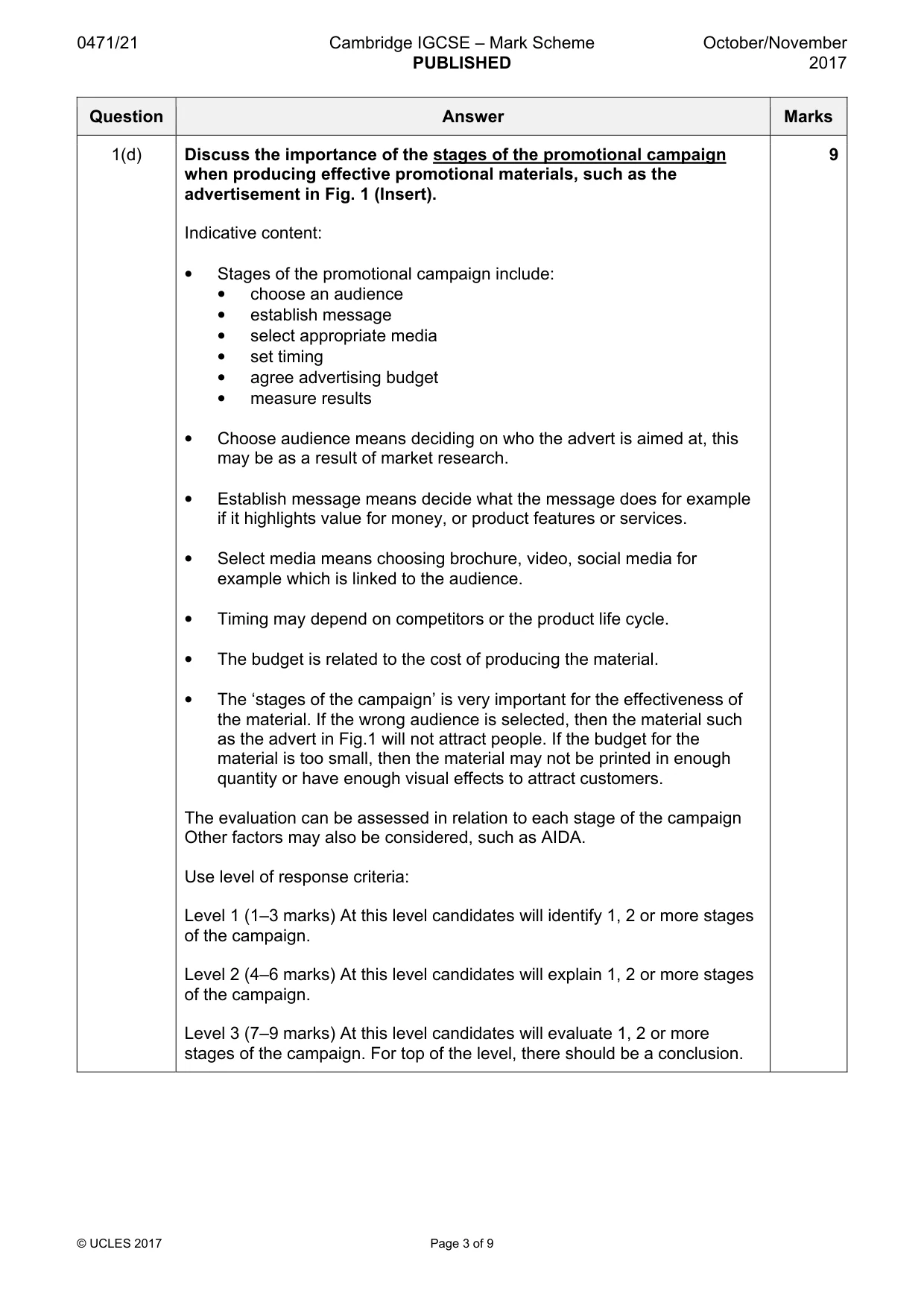
0471/21 Cambridge IGCSE – Mark Scheme PUBLISHED October/November 2017 © UCLES 2017 Page 3 of 9 Question Answer Marks 1(d) Discuss the importance of the stages of the promotional campaign when producing effective promotional materials, such as the advertisement in Fig. 1 (Insert). Indicative content: • Stages of the promotional campaign include: • choose an audience • establish message • select appropriate media • set timing • agree advertising budget • measure results • Choose audience means deciding on who the advert is aimed at, this may be as a result of market research. • Establish message means decide what the message does for example if it highlights value for money, or product features or services. • Select media means choosing brochure, video, social media for example which is linked to the audience. • Timing may depend on competitors or the product life cycle. • The budget is related to the cost of producing the material. • The ‘stages of the campaign’ is very important for the effectiveness of the material. If the wrong audience is selected, then the material such as the advert in Fig.1 will not attract people. If the budget for the material is too small, then the material may not be printed in enough quantity or have enough visual effects to attract customers. The evaluation can be assessed in relation to each stage of the campaign Other factors may also be considered, such as AIDA. Use level of response criteria: Level 1 (1–3 marks) At this level candidates will identify 1, 2 or more stages of the campaign. Level 2 (4–6 marks) At this level candidates will explain 1, 2 or more stages of the campaign. Level 3 (7–9 marks) At this level candidates will evaluate 1, 2 or more stages of the campaign. For top of the level, there should be a conclusion. 9
Mark scheme, page 4
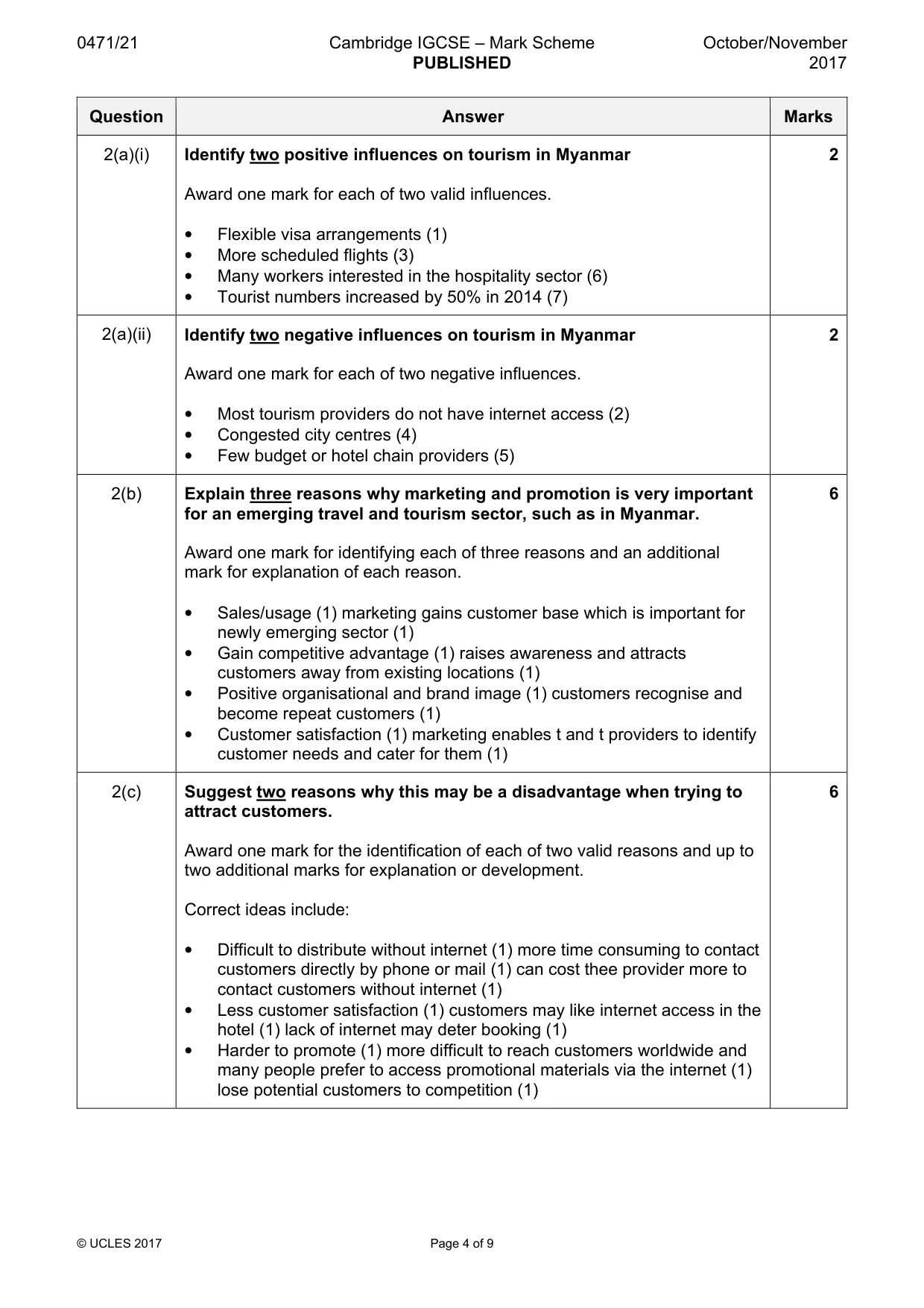
0471/21 Cambridge IGCSE – Mark Scheme PUBLISHED October/November 2017 © UCLES 2017 Page 4 of 9 Question Answer Marks 2(a)(i) Identify two positive influences on tourism in Myanmar Award one mark for each of two valid influences. • Flexible visa arrangements (1) • More scheduled flights (3) • Many workers interested in the hospitality sector (6) • Tourist numbers increased by 50% in 2014 (7) 2 2(a)(ii) Identify two negative influences on tourism in Myanmar Award one mark for each of two negative influences. • Most tourism providers do not have internet access (2) • Congested city centres (4) • Few budget or hotel chain providers (5) 2 2(b) Explain three reasons why marketing and promotion is very important for an emerging travel and tourism sector, such as in Myanmar. Award one mark for identifying each of three reasons and an additional mark for explanation of each reason. • Sales/usage (1) marketing gains customer base which is important for newly emerging sector (1) • Gain competitive advantage (1) raises awareness and attracts customers away from existing locations (1) • Positive organisational and brand image (1) customers recognise and become repeat customers (1) • Customer satisfaction (1) marketing enables t and t providers to identify customer needs and cater for them (1) 6 2(c) Suggest two reasons why this may be a disadvantage when trying to attract customers. Award one mark for the identification of each of two valid reasons and up to two additional marks for explanation or development. Correct ideas include: • Difficult to distribute without internet (1) more time consuming to contact customers directly by phone or mail (1) can cost thee provider more to contact customers without internet (1) • Less customer satisfaction (1) customers may like internet access in the hotel (1) lack of internet may deter booking (1) • Harder to promote (1) more difficult to reach customers worldwide and many people prefer to access promotional materials via the internet (1) lose potential customers to competition (1) 6
Mark scheme, page 5
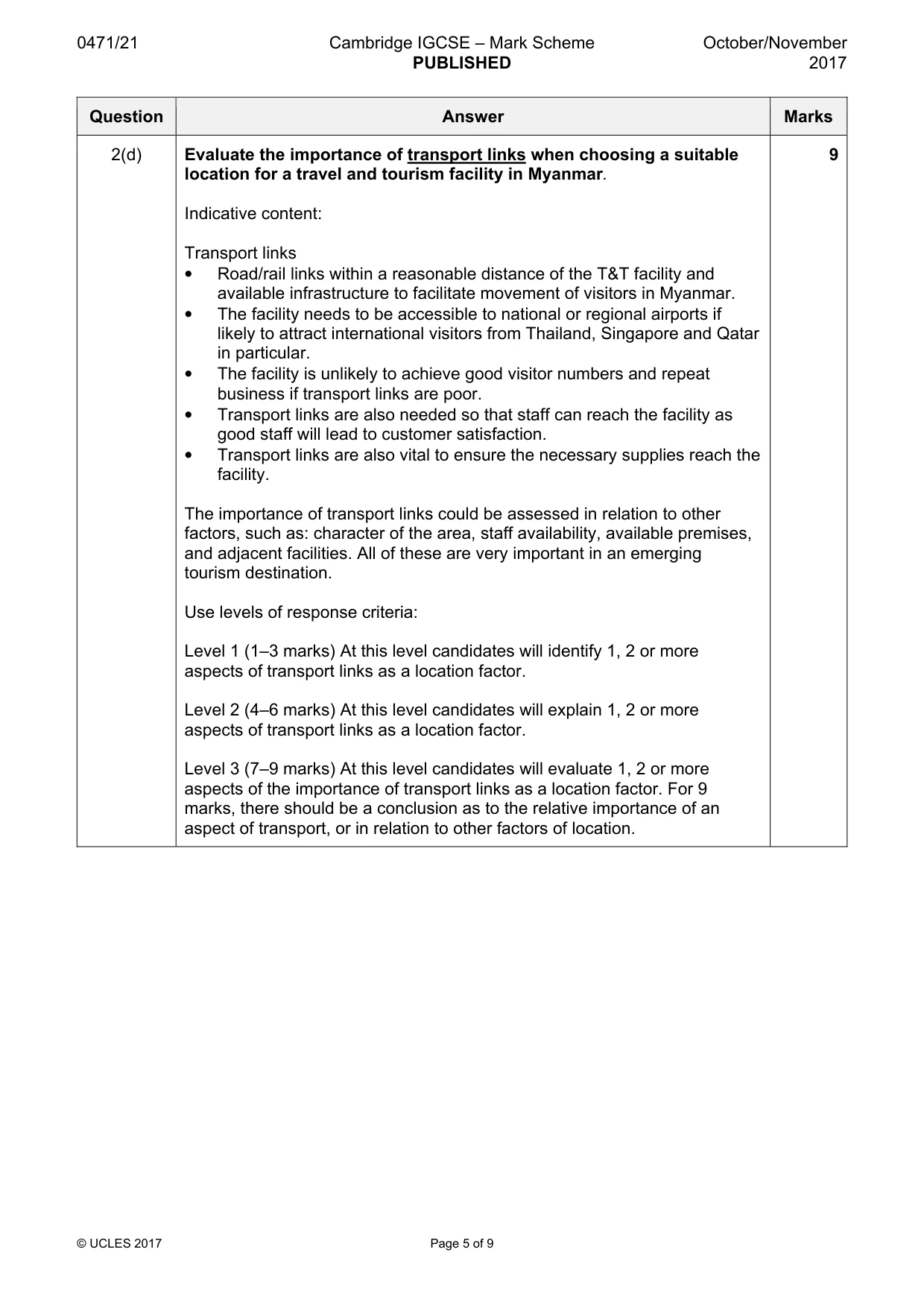
0471/21 Cambridge IGCSE – Mark Scheme PUBLISHED October/November 2017 © UCLES 2017 Page 5 of 9 Question Answer Marks 2(d) Evaluate the importance of transport links when choosing a suitable location for a travel and tourism facility in Myanmar. Indicative content: Transport links • Road/rail links within a reasonable distance of the T&T facility and available infrastructure to facilitate movement of visitors in Myanmar. • The facility needs to be accessible to national or regional airports if likely to attract international visitors from Thailand, Singapore and Qatar in particular. • The facility is unlikely to achieve good visitor numbers and repeat business if transport links are poor. • Transport links are also needed so that staff can reach the facility as good staff will lead to customer satisfaction. • Transport links are also vital to ensure the necessary supplies reach the facility. The importance of transport links could be assessed in relation to other factors, such as: character of the area, staff availability, available premises, and adjacent facilities. All of these are very important in an emerging tourism destination. Use levels of response criteria: Level 1 (1–3 marks) At this level candidates will identify 1, 2 or more aspects of transport links as a location factor. Level 2 (4–6 marks) At this level candidates will explain 1, 2 or more aspects of transport links as a location factor. Level 3 (7–9 marks) At this level candidates will evaluate 1, 2 or more aspects of the importance of transport links as a location factor. For 9 marks, there should be a conclusion as to the relative importance of an aspect of transport, or in relation to other factors of location. 9
Mark scheme, page 6
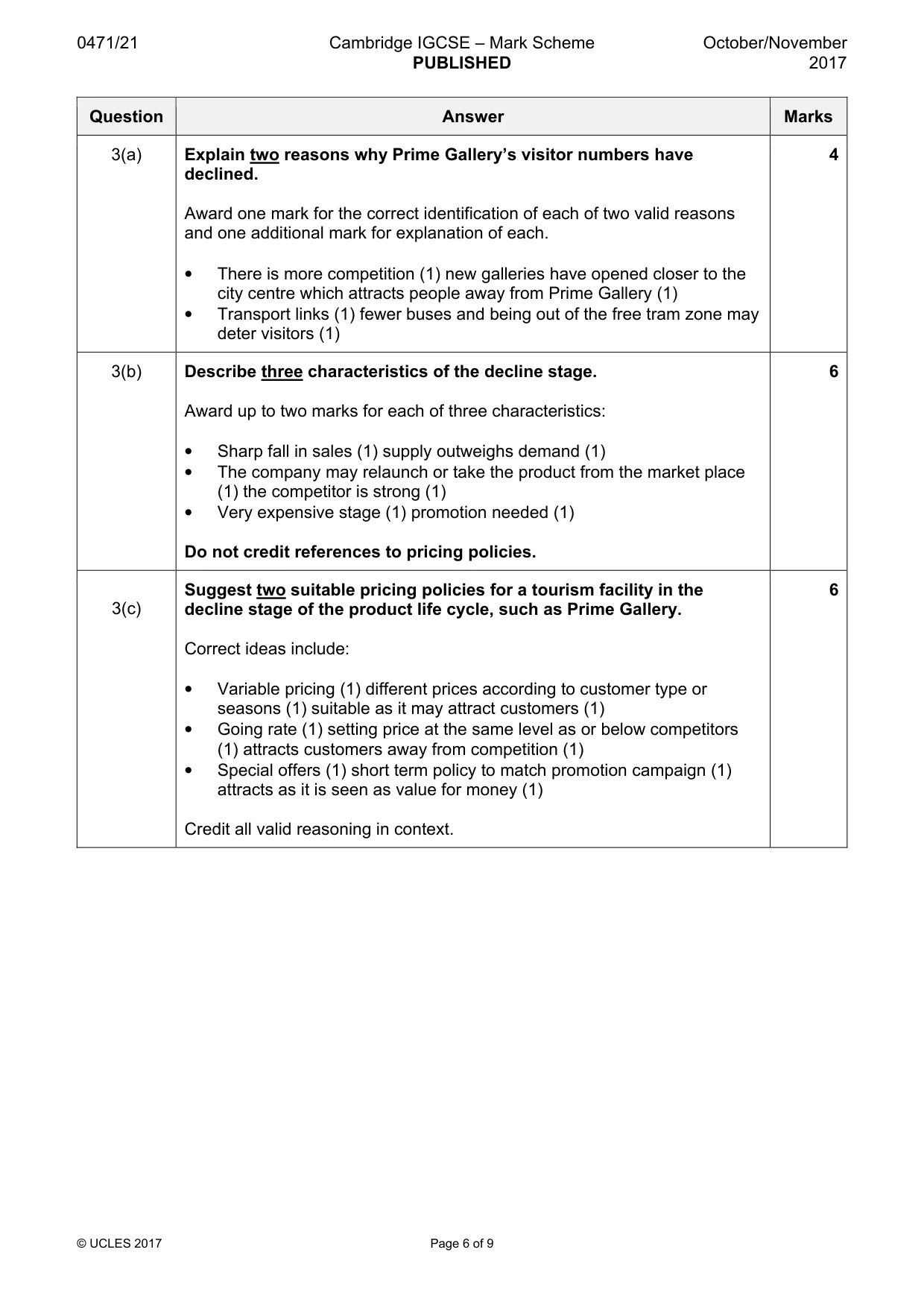
0471/21 Cambridge IGCSE – Mark Scheme PUBLISHED October/November 2017 © UCLES 2017 Page 6 of 9 Question Answer Marks 3(a) Explain two reasons why Prime Gallery’s visitor numbers have declined. Award one mark for the correct identification of each of two valid reasons and one additional mark for explanation of each. • There is more competition (1) new galleries have opened closer to the city centre which attracts people away from Prime Gallery (1) • Transport links (1) fewer buses and being out of the free tram zone may deter visitors (1) 4 3(b) Describe three characteristics of the decline stage. Award up to two marks for each of three characteristics: • Sharp fall in sales (1) supply outweighs demand (1) • The company may relaunch or take the product from the market place (1) the competitor is strong (1) • Very expensive stage (1) promotion needed (1) Do not credit references to pricing policies. 6 3(c) Suggest two suitable pricing policies for a tourism facility in the decline stage of the product life cycle, such as Prime Gallery. Correct ideas include: • Variable pricing (1) different prices according to customer type or seasons (1) suitable as it may attract customers (1) • Going rate (1) setting price at the same level as or below competitors (1) attracts customers away from competition (1) • Special offers (1) short term policy to match promotion campaign (1) attracts as it is seen as value for money (1) Credit all valid reasoning in context. 6
Mark scheme, page 7
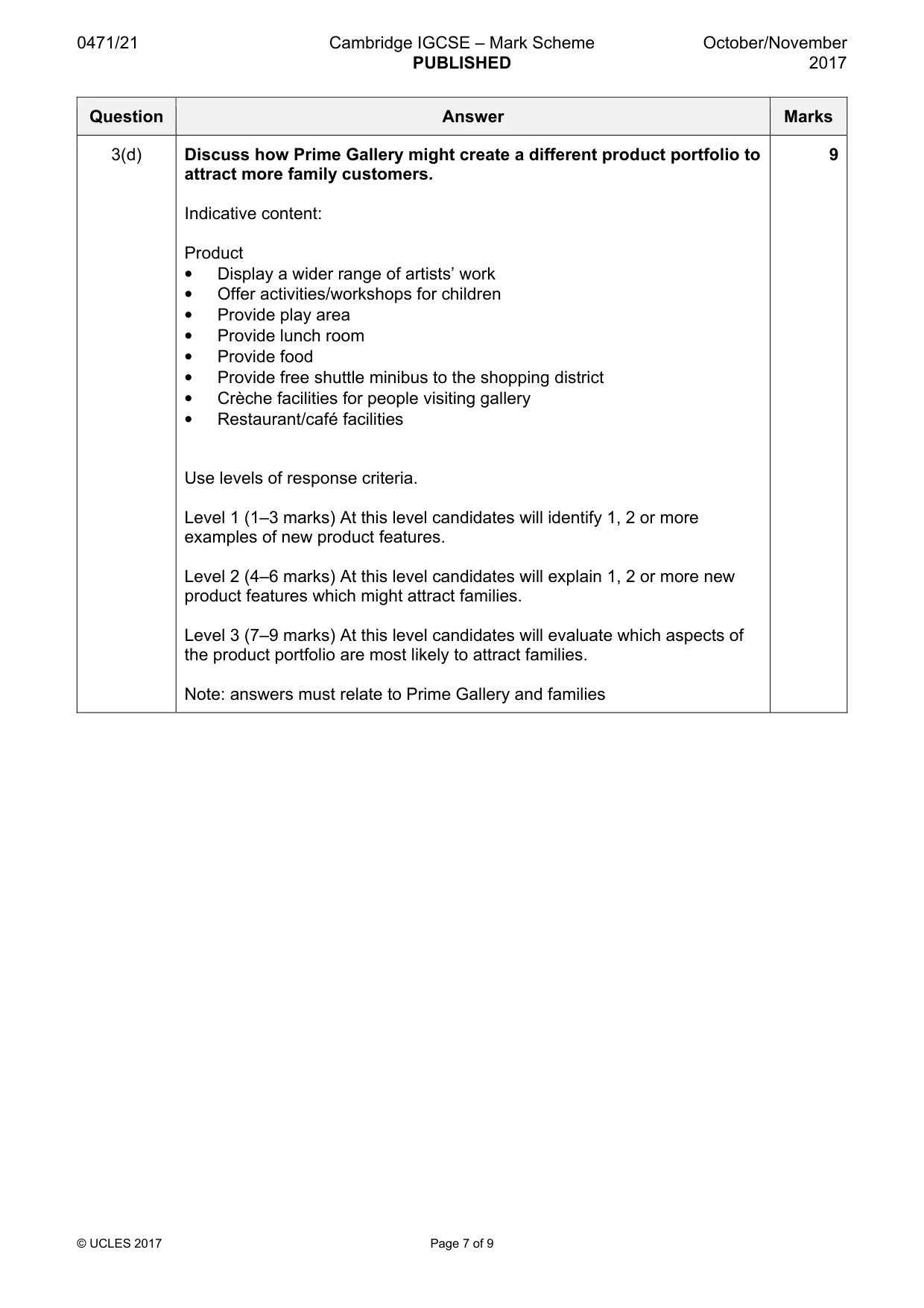
0471/21 Cambridge IGCSE – Mark Scheme PUBLISHED October/November 2017 © UCLES 2017 Page 7 of 9 Question Answer Marks 3(d) Discuss how Prime Gallery might create a different product portfolio to attract more family customers. Indicative content: Product • Display a wider range of artists’ work • Offer activities/workshops for children • Provide play area • Provide lunch room • Provide food • Provide free shuttle minibus to the shopping district • Crèche facilities for people visiting gallery • Restaurant/café facilities Use levels of response criteria. Level 1 (1–3 marks) At this level candidates will identify 1, 2 or more examples of new product features. Level 2 (4–6 marks) At this level candidates will explain 1, 2 or more new product features which might attract families. Level 3 (7–9 marks) At this level candidates will evaluate which aspects of the product portfolio are most likely to attract families. Note: answers must relate to Prime Gallery and families 9
Mark scheme, page 8
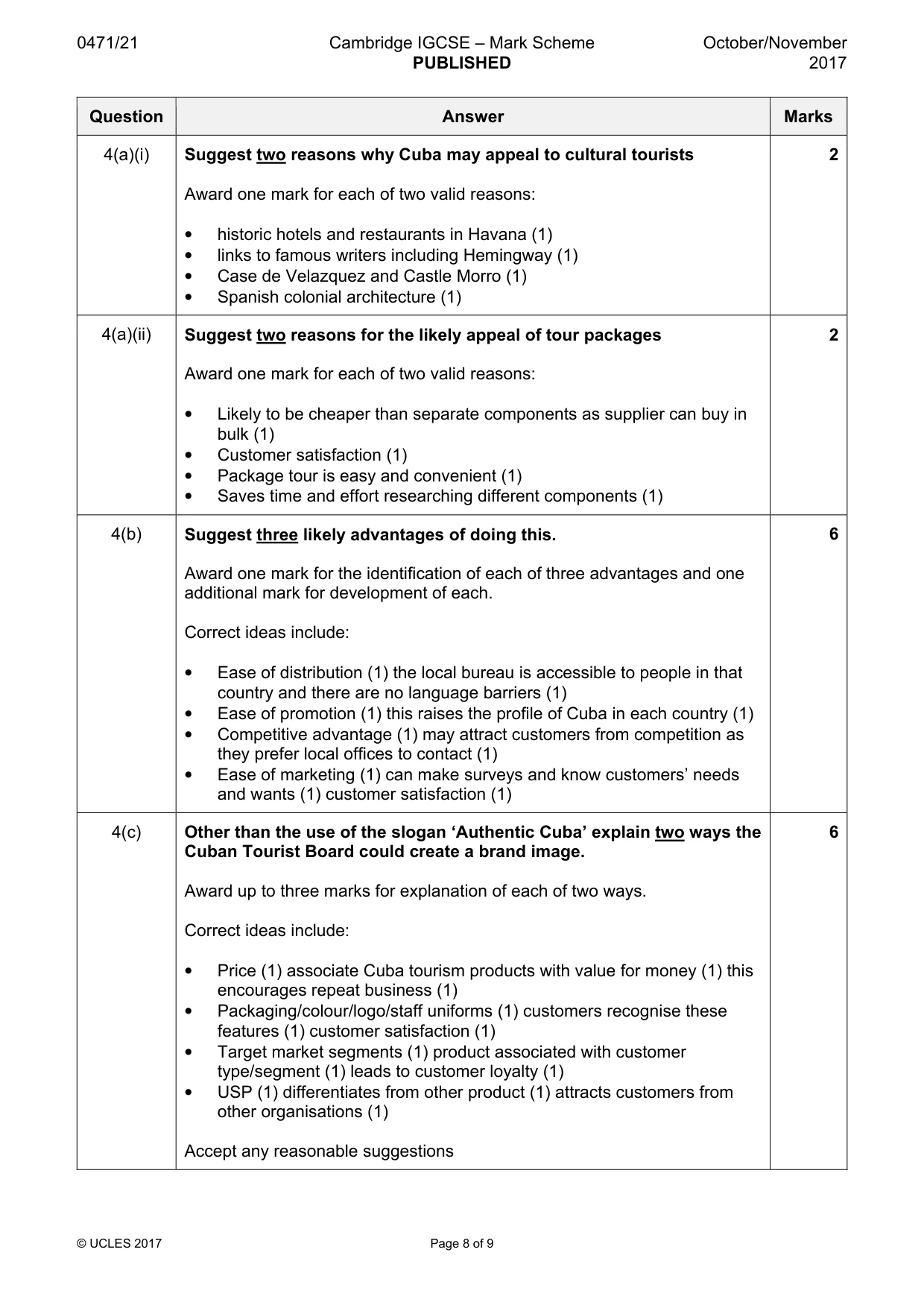
0471/21 Cambridge IGCSE – Mark Scheme PUBLISHED October/November 2017 © UCLES 2017 Page 8 of 9 Question Answer Marks 4(a)(i) Suggest two reasons why Cuba may appeal to cultural tourists Award one mark for each of two valid reasons: • historic hotels and restaurants in Havana (1) • links to famous writers including Hemingway (1) • Case de Velazquez and Castle Morro (1) • Spanish colonial architecture (1) 2 4(a)(ii) Suggest two reasons for the likely appeal of tour packages Award one mark for each of two valid reasons: • Likely to be cheaper than separate components as supplier can buy in bulk (1) • Customer satisfaction (1) • Package tour is easy and convenient (1) • Saves time and effort researching different components (1) 2 4(b) Suggest three likely advantages of doing this. Award one mark for the identification of each of three advantages and one additional mark for development of each. Correct ideas include: • Ease of distribution (1) the local bureau is accessible to people in that country and there are no language barriers (1) • Ease of promotion (1) this raises the profile of Cuba in each country (1) • Competitive advantage (1) may attract customers from competition as they prefer local offices to contact (1) • Ease of marketing (1) can make surveys and know customers’ needs and wants (1) customer satisfaction (1) 6 4(c) Other than the use of the slogan ‘Authentic Cuba’ explain two ways the Cuban Tourist Board could create a brand image. Award up to three marks for explanation of each of two ways. Correct ideas include: • Price (1) associate Cuba tourism products with value for money (1) this encourages repeat business (1) • Packaging/colour/logo/staff uniforms (1) customers recognise these features (1) customer satisfaction (1) • Target market segments (1) product associated with customer type/segment (1) leads to customer loyalty (1) • USP (1) differentiates from other product (1) attracts customers from other organisations (1) Accept any reasonable suggestions 6
Mark scheme, page 9
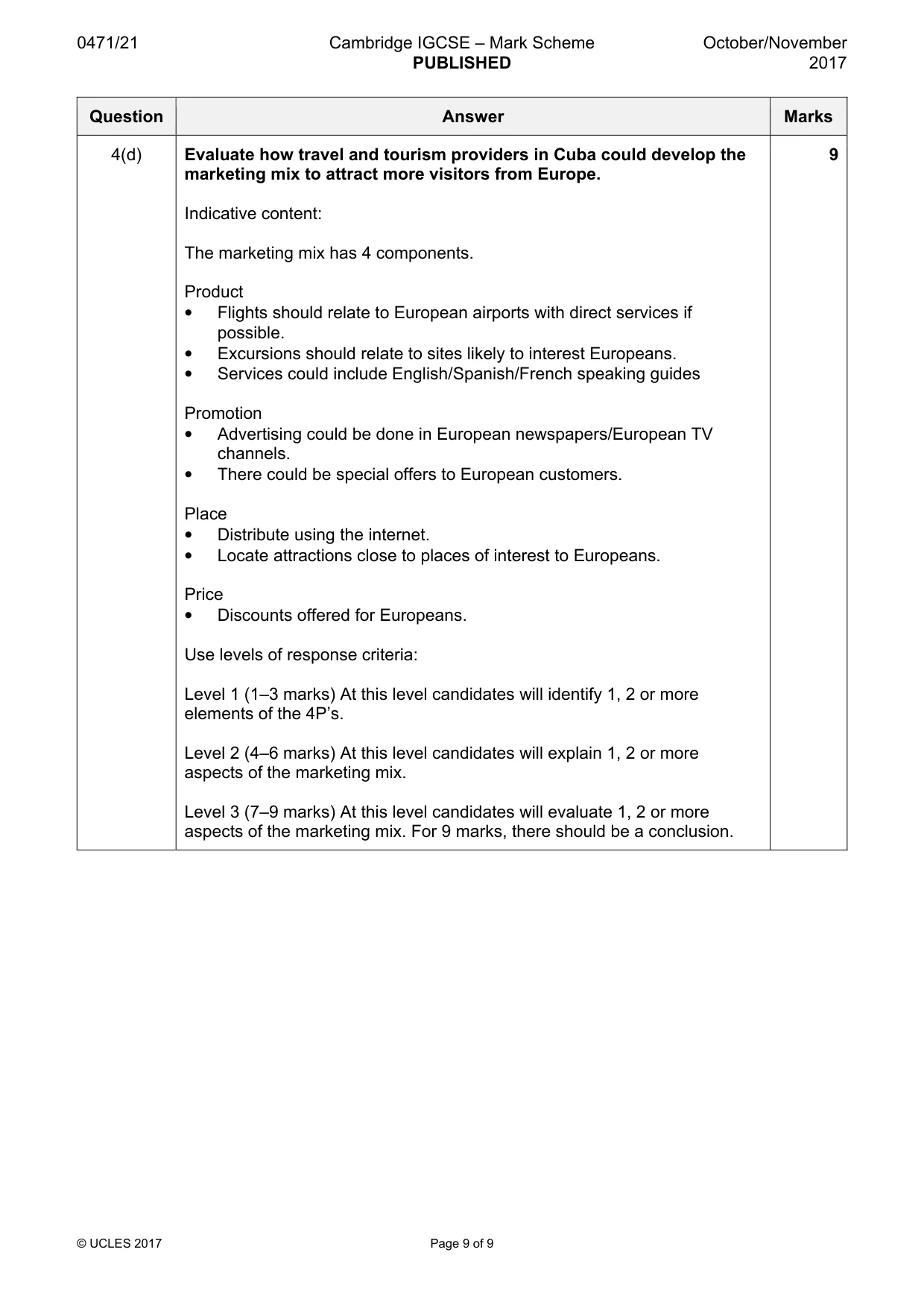
0471/21 Cambridge IGCSE – Mark Scheme PUBLISHED October/November 2017 © UCLES 2017 Page 9 of 9 Question Answer Marks 4(d) Evaluate how travel and tourism providers in Cuba could develop the marketing mix to attract more visitors from Europe. Indicative content: The marketing mix has 4 components. Product • Flights should relate to European airports with direct services if possible. • Excursions should relate to sites likely to interest Europeans. • Services could include English/Spanish/French speaking guides Promotion • Advertising could be done in European newspapers/European TV channels. • There could be special offers to European customers. Place • Distribute using the internet. • Locate attractions close to places of interest to Europeans. Price • Discounts offered for Europeans. Use levels of response criteria: Level 1 (1–3 marks) At this level candidates will identify 1, 2 or more elements of the 4P’s. Level 2 (4–6 marks) At this level candidates will explain 1, 2 or more aspects of the marketing mix. Level 3 (7–9 marks) At this level candidates will evaluate 1, 2 or more aspects of the marketing mix. For 9 marks, there should be a conclusion. 9
What you needed in this session
Cambridge’s own grade thresholds for 2017 Oct/Nov, Paper 2 · Variant 1. A higher threshold means an easier paper — the bar moves with how the cohort did.