Cambridge IGCSE Thai - First Language 0518 — 2019 May/June Paper 2 · Variant 1
0518/21/M/J/19 · 50 marks · ≈56 min
The question paper and its mark scheme, free to read here and free to download. This is Cambridge’s own paper, exactly as it was sat.
Question paper12 pages
Mark scheme14 pages
Answers below. Sit the paper first if you are practising.
Paper as text
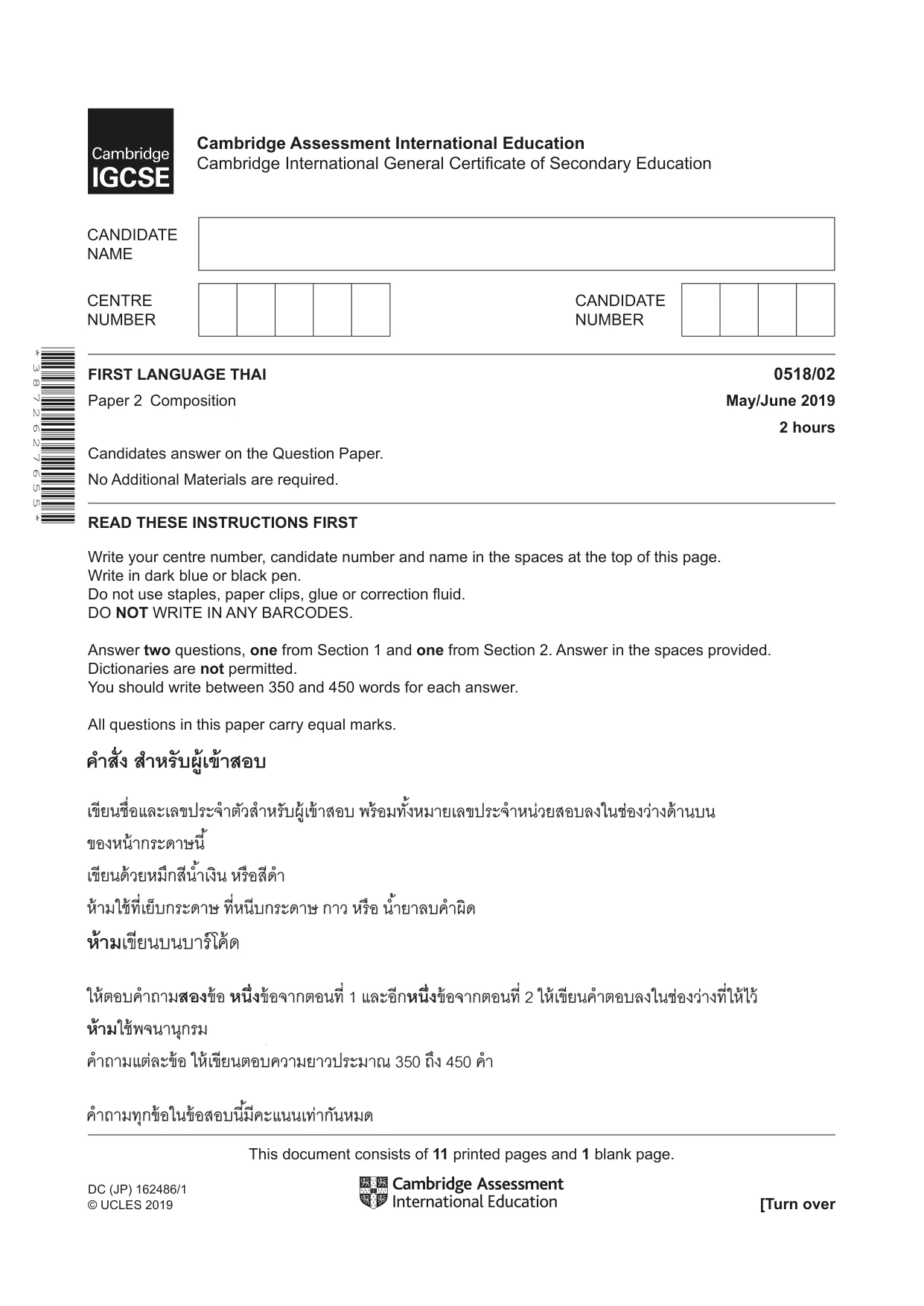
Question paper, page 1
This document consists of 11 printed pages and 1 blank page. DC (JP) 162486/1 © UCLES 2019 [Turn over Cambridge Assessment International Education Cambridge International General Certificate of Secondary Education * 3 8 7 2 6 2 7 6 5 5 * FIRST LANGUAGE THAI 0518/02 Paper 2 Composition May/June 2019 2 hours Candidates answer on the Question Paper. No Additional Materials are required. READ THESE INSTRUCTIONS FIRST Write your centre number, candidate number and name in the spaces at the top of this page. Write in dark blue or black pen. Do not use staples, paper clips, glue or correction fluid. DO NOT WRITE IN ANY BARCODES. Answer two questions, one from Section 1 and one from Section 2. Answer in the spaces provided. Dictionaries are not permitted. You should write between 350 and 450 words for each answer. All questions in this paper carry equal marks.
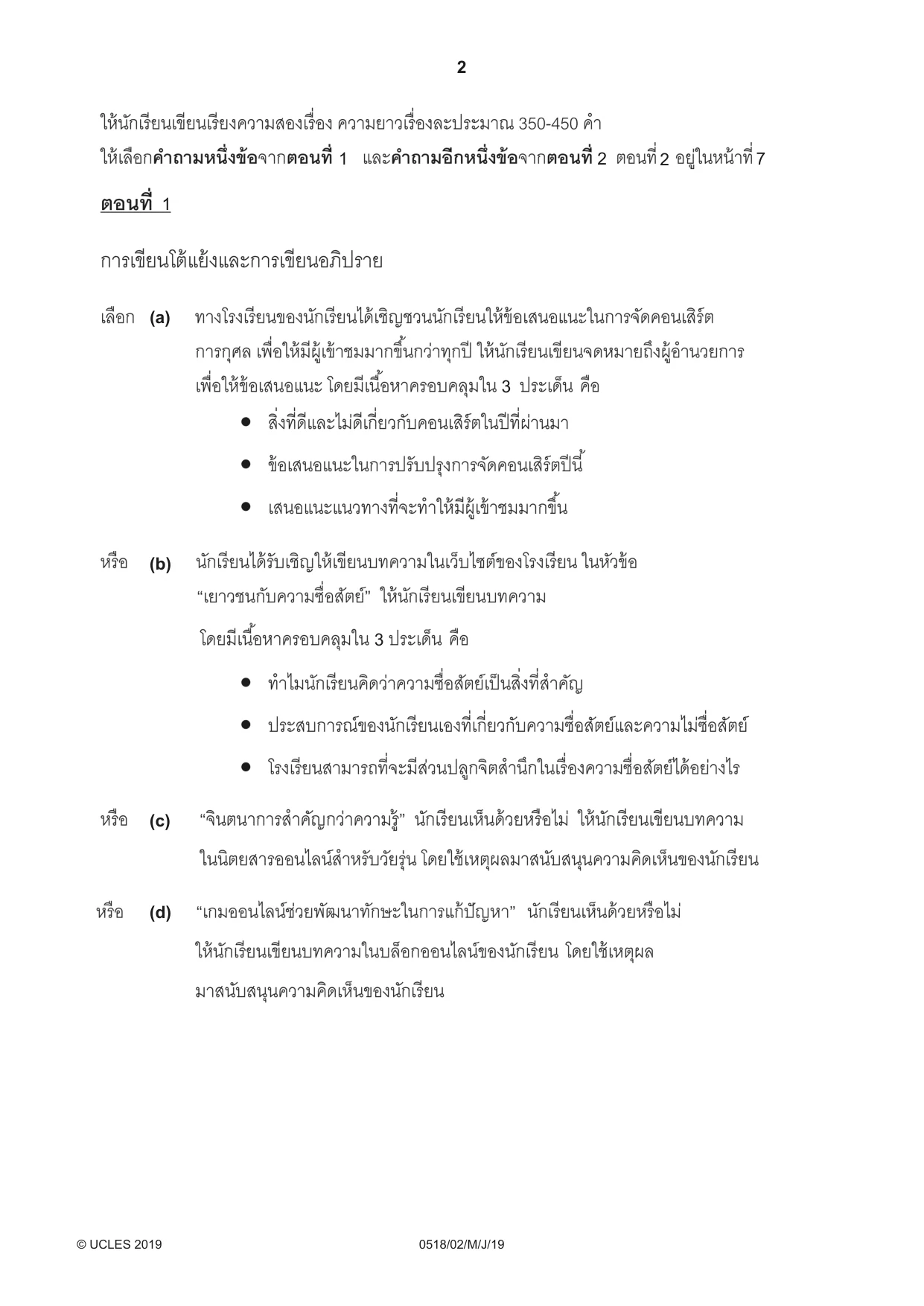
Question paper, page 2
2 0518/02/M/J/19 © UCLES 2019 1 2 2 7 1 3 3 (a) (b) (c) (d)
Question paper, page 3
3 0518/02/M/J/19 © UCLES 2019 [Turn over … … … … … … … … … … … … … … … … … … … … … … … … … …
Question paper, page 4
4 0518/02/M/J/19 © UCLES 2019 … … … … … … … … … … … … … … … … … … … … … … … … … … … …
Question paper, page 5
5 0518/02/M/J/19 © UCLES 2019 [Turn over … … … … … … … … … … … … … … … … … … … … … … … … … … … …
Question paper, page 6
6 0518/02/M/J/19 © UCLES 2019 … … … … … … … … … … … … … … … … … … … … … … … … … … … [25]
Question paper, page 7
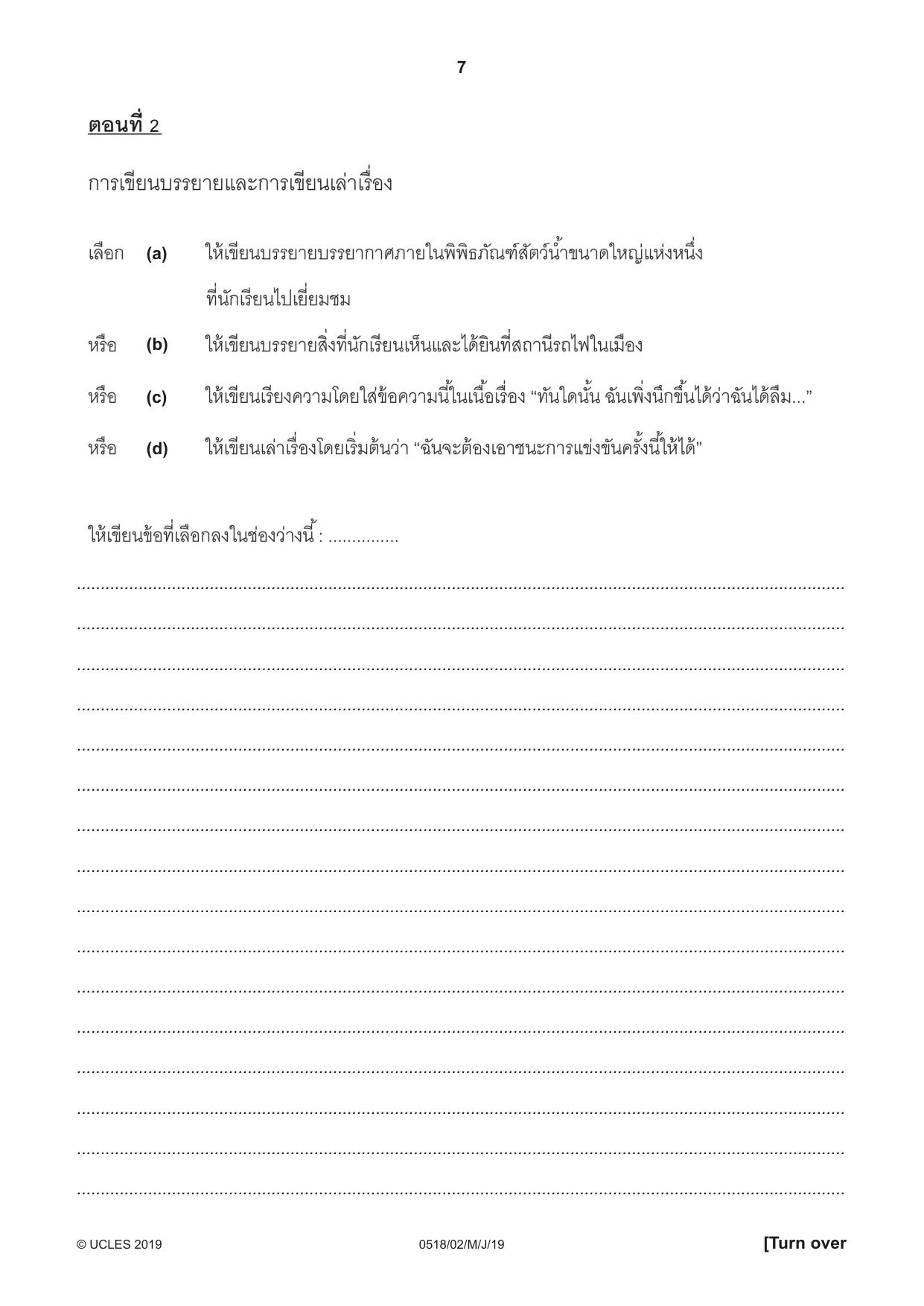
7 0518/02/M/J/19 © UCLES 2019 [Turn over … … … … … … … … … … … … … … … … (a) (b) (c) (d) 2
Question paper, page 8
8 0518/02/M/J/19 © UCLES 2019 … … … … … … … … … … … … … … … … … … … … … … … … … … … …
Question paper, page 9
9 0518/02/M/J/19 © UCLES 2019 [Turn over … … … … … … … … … … … … … … … … … … … … … … … … … … … …
Question paper, page 10
10 0518/02/M/J/19 © UCLES 2019 … … … … … … … … … … … … … … … … … … … … … … … … … … … …
Question paper, page 11
11 0518/02/M/J/19 © UCLES 2019 … … … … … … … … … … … … … … … … … … … … … … … … … … … [25]
Question paper, page 12
12 0518/02/M/J/19 © UCLES 2019 Permission to reproduce items where third-party owned material protected by copyright is included has been sought and cleared where possible. Every reasonable effort has been made by the publisher (UCLES) to trace copyright holders, but if any items requiring clearance have unwittingly been included, the publisher will be pleased to make amends at the earliest possible opportunity. To avoid the issue of disclosure of answer-related information to candidates, all copyright acknowledgements are reproduced online in the Cambridge Assessment International Education Copyright Acknowledgements Booklet. This is produced for each series of examinations and is freely available to download at www. cambridgeinternational.org after the live examination series. Cambridge Assessment International Education is part of the Cambridge Assessment Group. Cambridge Assessment is the brand name of the University of Cambridge Local Examinations Syndicate (UCLES), which itself is a department of the University of Cambridge. BLANK PAGE
Mark scheme, page 1
This document consists of 14 printed pages. © UCLES 2019 [Turn over Cambridge Assessment International Education Cambridge International General Certificate of Secondary Education FIRST LANGUAGE THAI 0518/02 Paper 2 Composition May/June 2019 MARK SCHEME Maximum Mark: 50 Published This mark scheme is published as an aid to teachers and candidates, to indicate the requirements of the examination. It shows the basis on which Examiners were instructed to award marks. It does not indicate the details of the discussions that took place at an Examiners’ meeting before marking began, which would have considered the acceptability of alternative answers. Mark schemes should be read in conjunction with the question paper and the Principal Examiner Report for Teachers. Cambridge International will not enter into discussions about these mark schemes. Cambridge International is publishing the mark schemes for the May/June 2019 series for most Cambridge IGCSE™, Cambridge International A and AS Level and Cambridge Pre-U components, and some Cambridge O Level components.
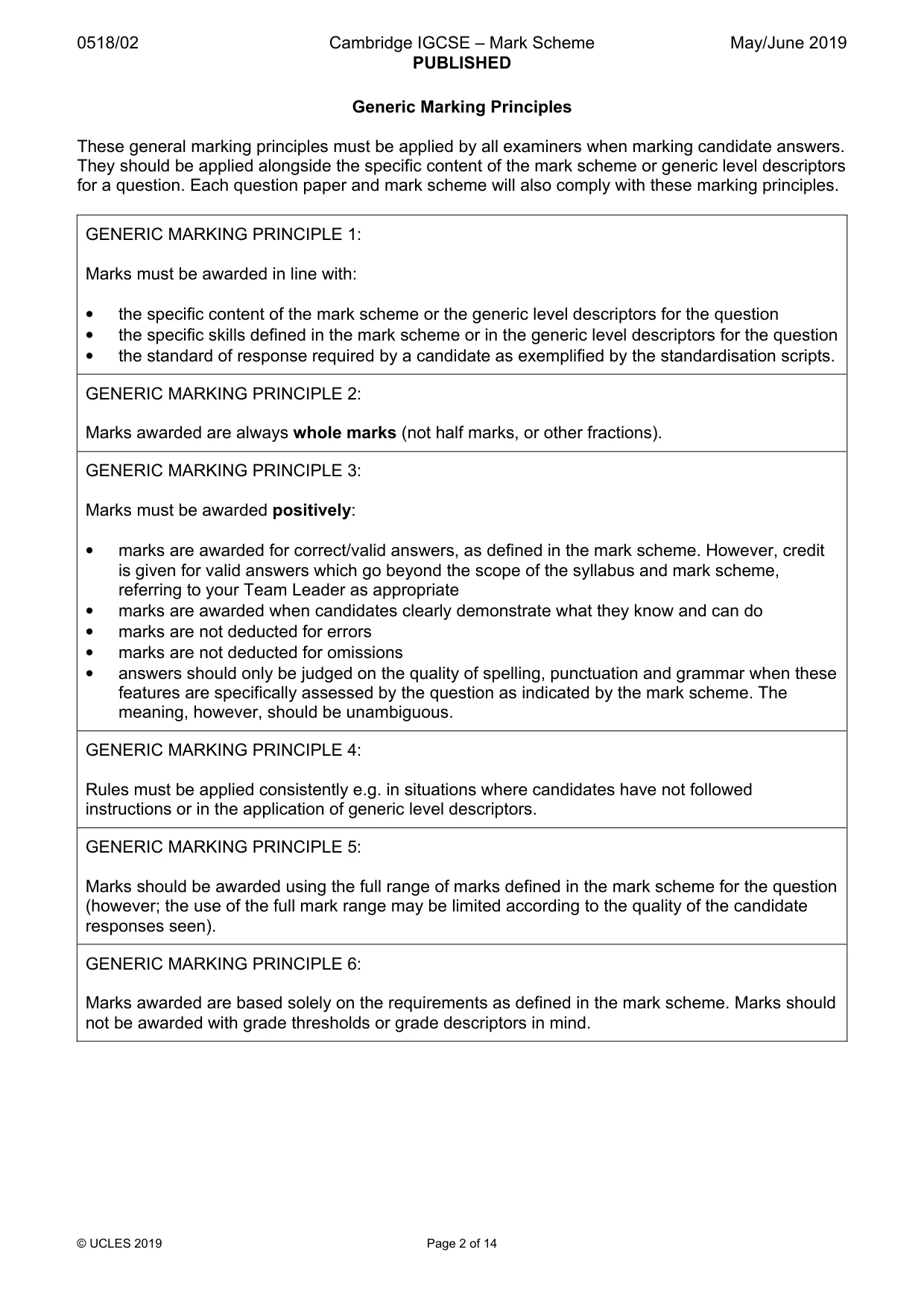
Mark scheme, page 2
0518/02 Cambridge IGCSE – Mark Scheme PUBLISHED May/June 2019 © UCLES 2019 Page 2 of 14 Generic Marking Principles These general marking principles must be applied by all examiners when marking candidate answers. They should be applied alongside the specific content of the mark scheme or generic level descriptors for a question. Each question paper and mark scheme will also comply with these marking principles. GENERIC MARKING PRINCIPLE 1: Marks must be awarded in line with: • the specific content of the mark scheme or the generic level descriptors for the question • the specific skills defined in the mark scheme or in the generic level descriptors for the question • the standard of response required by a candidate as exemplified by the standardisation scripts. GENERIC MARKING PRINCIPLE 2: Marks awarded are always whole marks (not half marks, or other fractions). GENERIC MARKING PRINCIPLE 3: Marks must be awarded positively: • marks are awarded for correct/valid answers, as defined in the mark scheme. However, credit is given for valid answers which go beyond the scope of the syllabus and mark scheme, referring to your Team Leader as appropriate • marks are awarded when candidates clearly demonstrate what they know and can do • marks are not deducted for errors • marks are not deducted for omissions • answers should only be judged on the quality of spelling, punctuation and grammar when these features are specifically assessed by the question as indicated by the mark scheme. The meaning, however, should be unambiguous. GENERIC MARKING PRINCIPLE 4: Rules must be applied consistently e.g. in situations where candidates have not followed instructions or in the application of generic level descriptors. GENERIC MARKING PRINCIPLE 5: Marks should be awarded using the full range of marks defined in the mark scheme for the question (however; the use of the full mark range may be limited according to the quality of the candidate responses seen). GENERIC MARKING PRINCIPLE 6: Marks awarded are based solely on the requirements as defined in the mark scheme. Marks should not be awarded with grade thresholds or grade descriptors in mind.
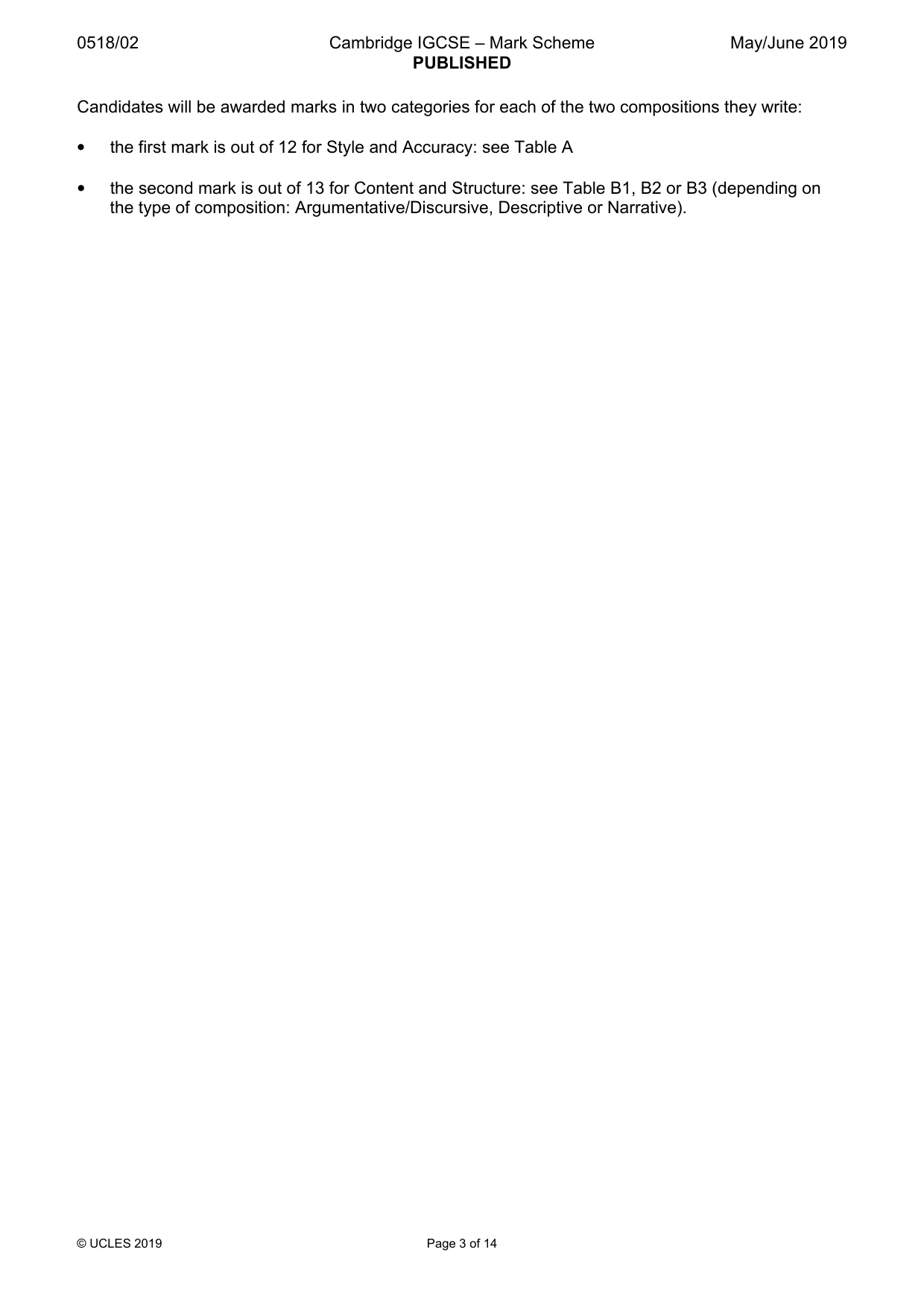
Mark scheme, page 3
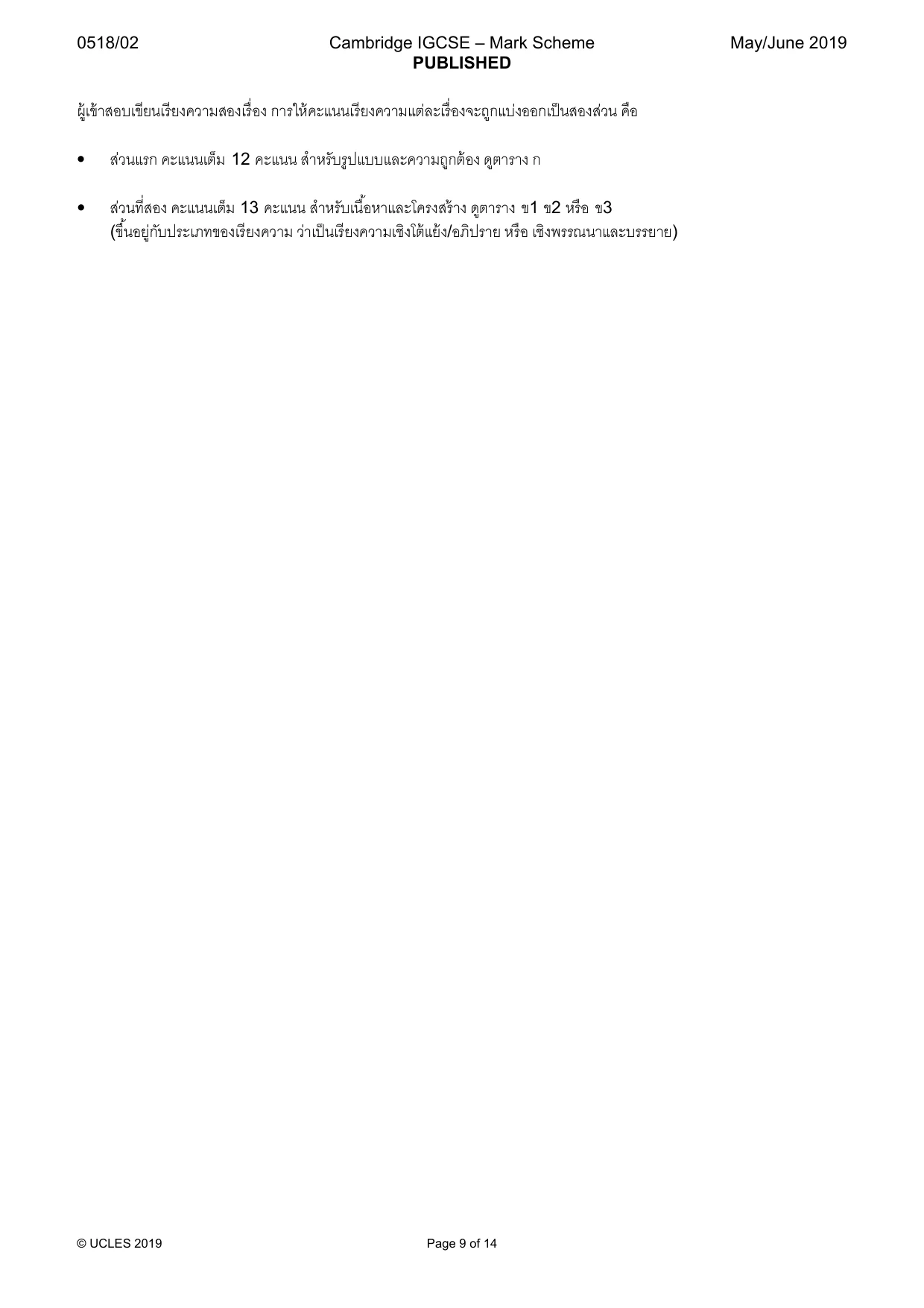
0518/02 Cambridge IGCSE – Mark Scheme PUBLISHED May/June 2019 © UCLES 2019 Page 3 of 14 Candidates will be awarded marks in two categories for each of the two compositions they write: • the first mark is out of 12 for Style and Accuracy: see Table A • the second mark is out of 13 for Content and Structure: see Table B1, B2 or B3 (depending on the type of composition: Argumentative/Discursive, Descriptive or Narrative).
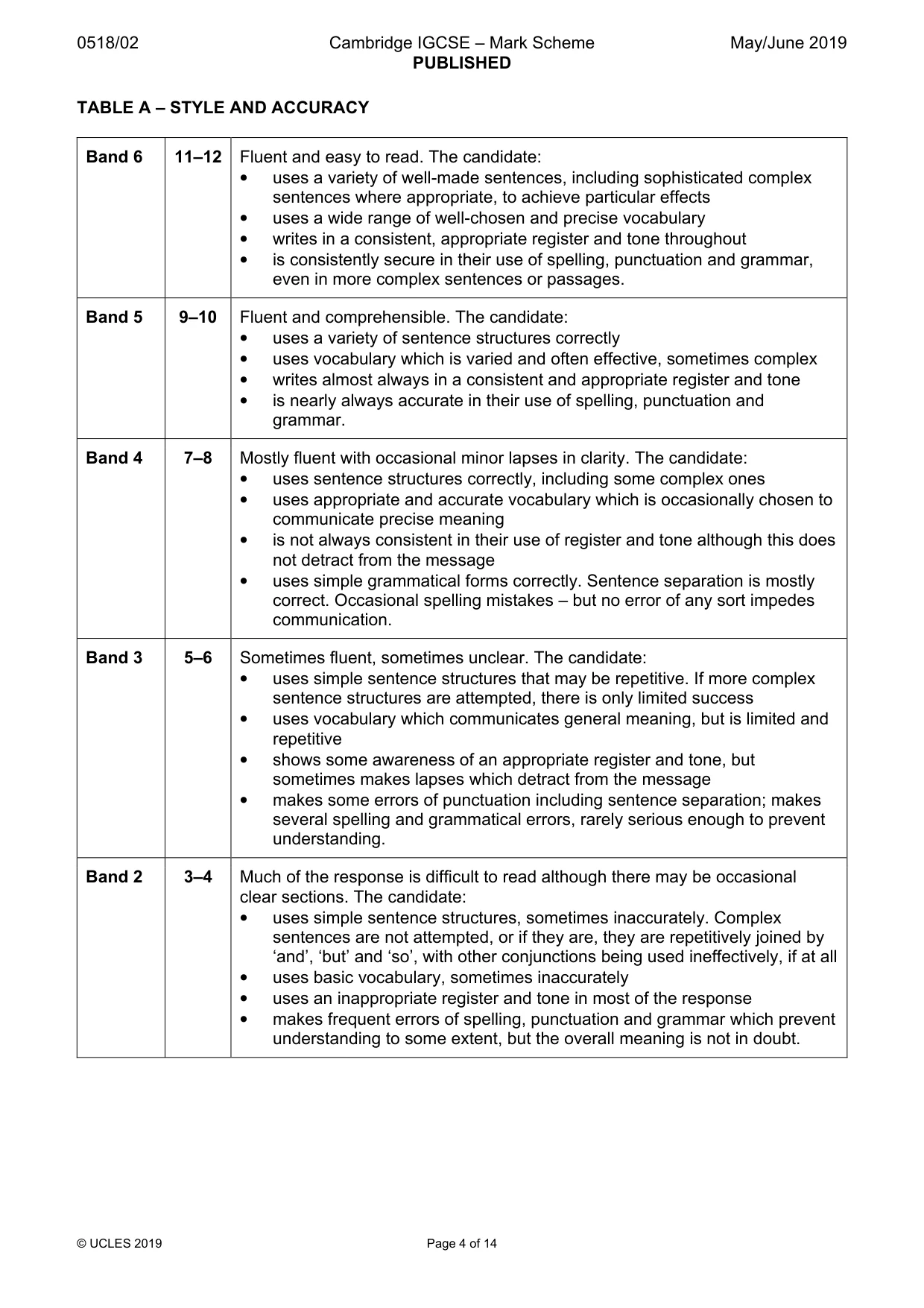
Mark scheme, page 4
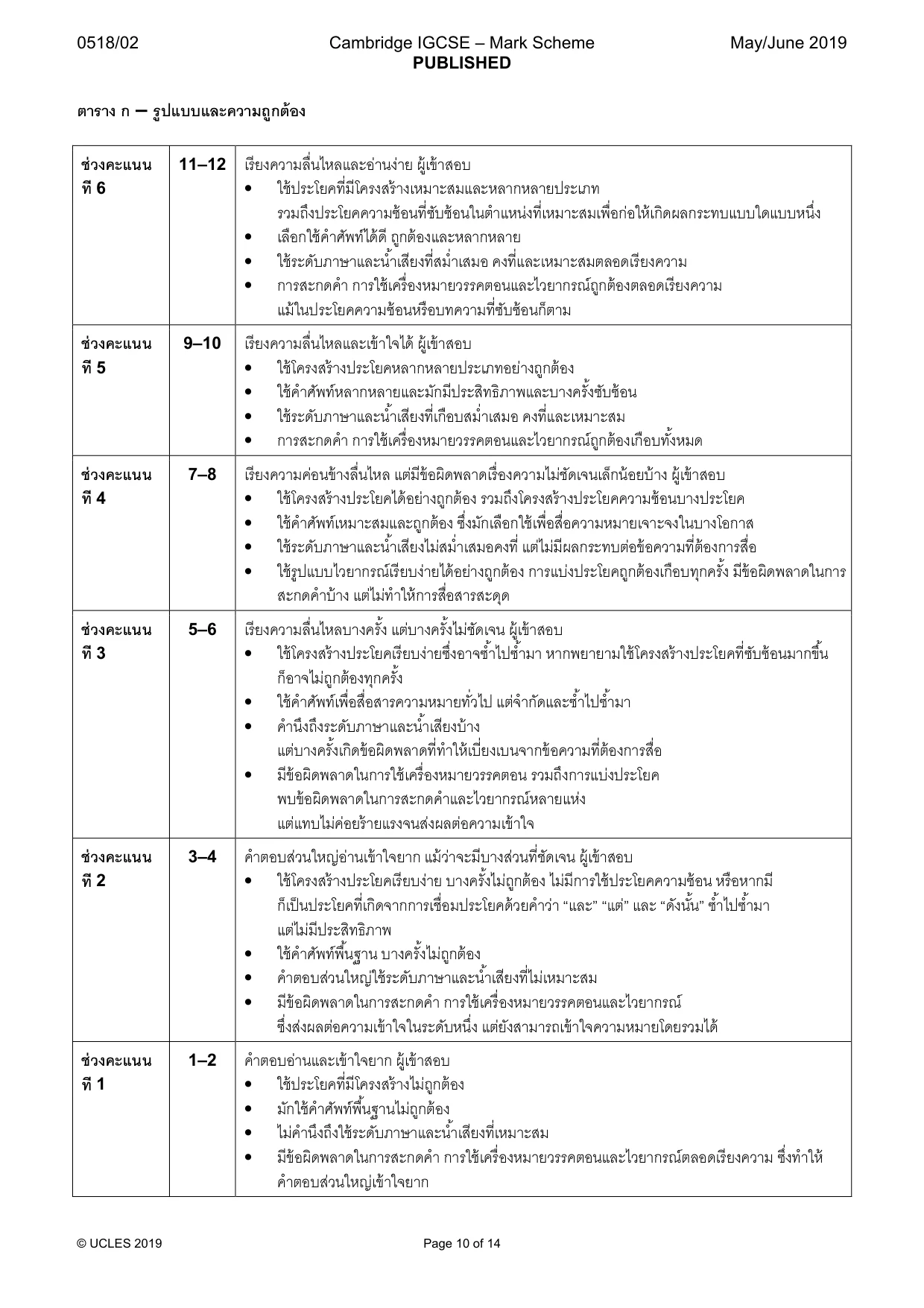
0518/02 Cambridge IGCSE – Mark Scheme PUBLISHED May/June 2019 © UCLES 2019 Page 4 of 14 TABLE A – STYLE AND ACCURACY Band 6 11–12 Fluent and easy to read. The candidate: • uses a variety of well-made sentences, including sophisticated complex sentences where appropriate, to achieve particular effects • uses a wide range of well-chosen and precise vocabulary • writes in a consistent, appropriate register and tone throughout • is consistently secure in their use of spelling, punctuation and grammar, even in more complex sentences or passages. Band 5 9–10 Fluent and comprehensible. The candidate: • uses a variety of sentence structures correctly • uses vocabulary which is varied and often effective, sometimes complex • writes almost always in a consistent and appropriate register and tone • is nearly always accurate in their use of spelling, punctuation and grammar. Band 4 7–8 Mostly fluent with occasional minor lapses in clarity. The candidate: • uses sentence structures correctly, including some complex ones • uses appropriate and accurate vocabulary which is occasionally chosen to communicate precise meaning • is not always consistent in their use of register and tone although this does not detract from the message • uses simple grammatical forms correctly. Sentence separation is mostly correct. Occasional spelling mistakes – but no error of any sort impedes communication. Band 3 5–6 Sometimes fluent, sometimes unclear. The candidate: • uses simple sentence structures that may be repetitive. If more complex sentence structures are attempted, there is only limited success • uses vocabulary which communicates general meaning, but is limited and repetitive • shows some awareness of an appropriate register and tone, but sometimes makes lapses which detract from the message • makes some errors of punctuation including sentence separation; makes several spelling and grammatical errors, rarely serious enough to prevent understanding. Band 2 3–4 Much of the response is difficult to read although there may be occasional clear sections. The candidate: • uses simple sentence structures, sometimes inaccurately. Complex sentences are not attempted, or if they are, they are repetitively joined by ‘and’, ‘but’ and ‘so’, with other conjunctions being used ineffectively, if at all • uses basic vocabulary, sometimes inaccurately • uses an inappropriate register and tone in most of the response • makes frequent errors of spelling, punctuation and grammar which prevent understanding to some extent, but the overall meaning is not in doubt.
Mark scheme, page 5
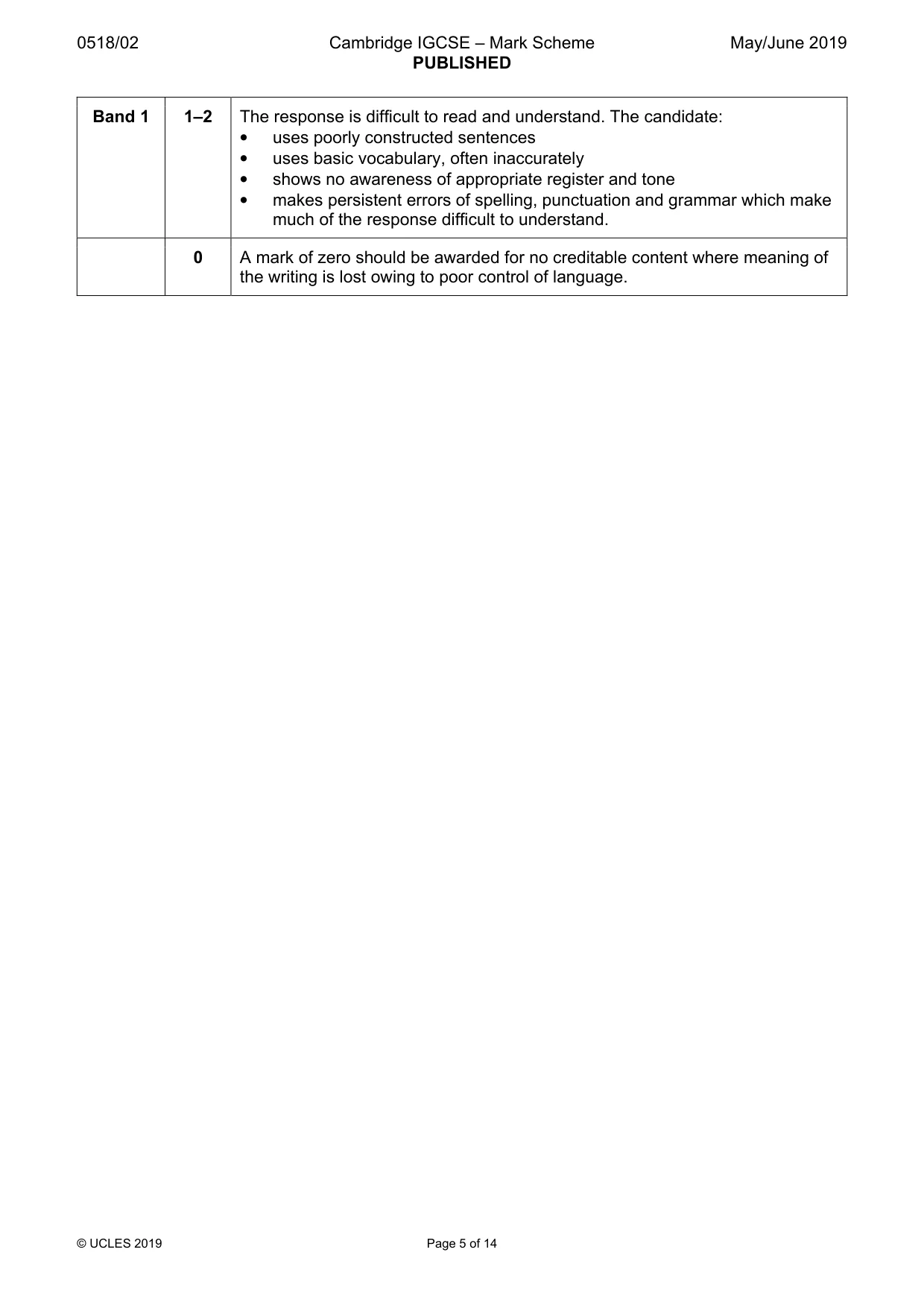
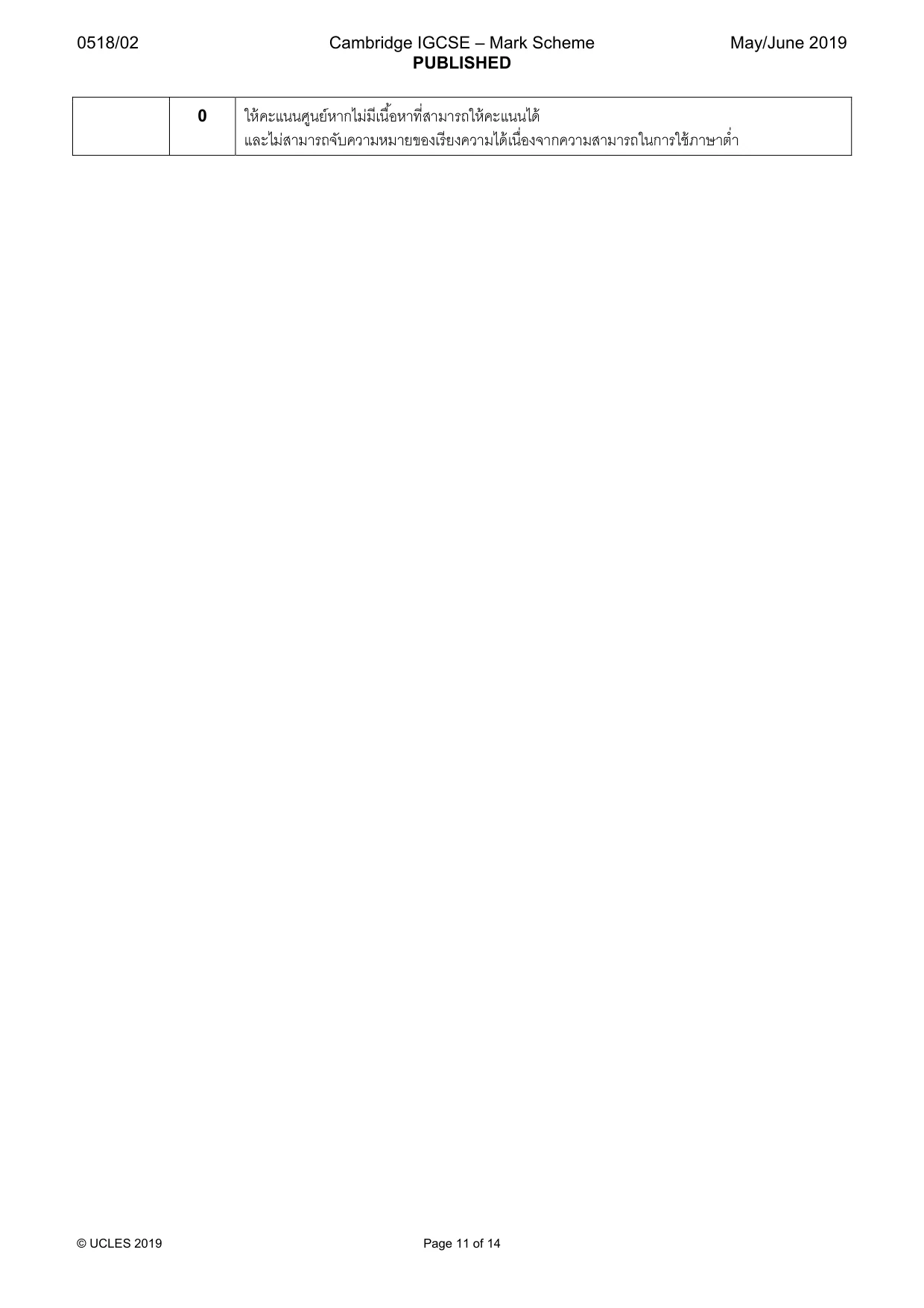
0518/02 Cambridge IGCSE – Mark Scheme PUBLISHED May/June 2019 © UCLES 2019 Page 5 of 14 Band 1 1–2 The response is difficult to read and understand. The candidate: • uses poorly constructed sentences • uses basic vocabulary, often inaccurately • shows no awareness of appropriate register and tone • makes persistent errors of spelling, punctuation and grammar which make much of the response difficult to understand. 0 A mark of zero should be awarded for no creditable content where meaning of the writing is lost owing to poor control of language.
Mark scheme, page 6
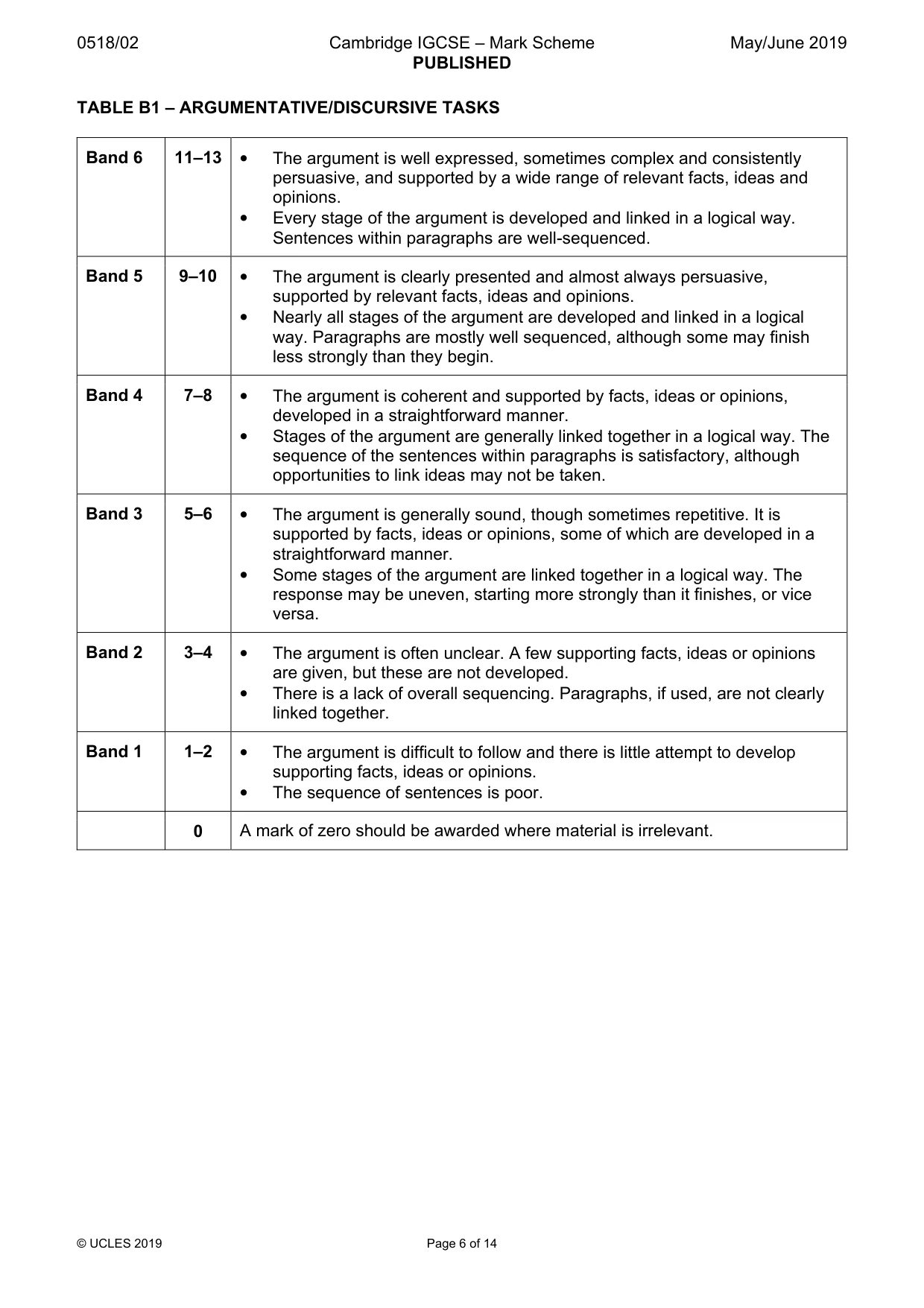
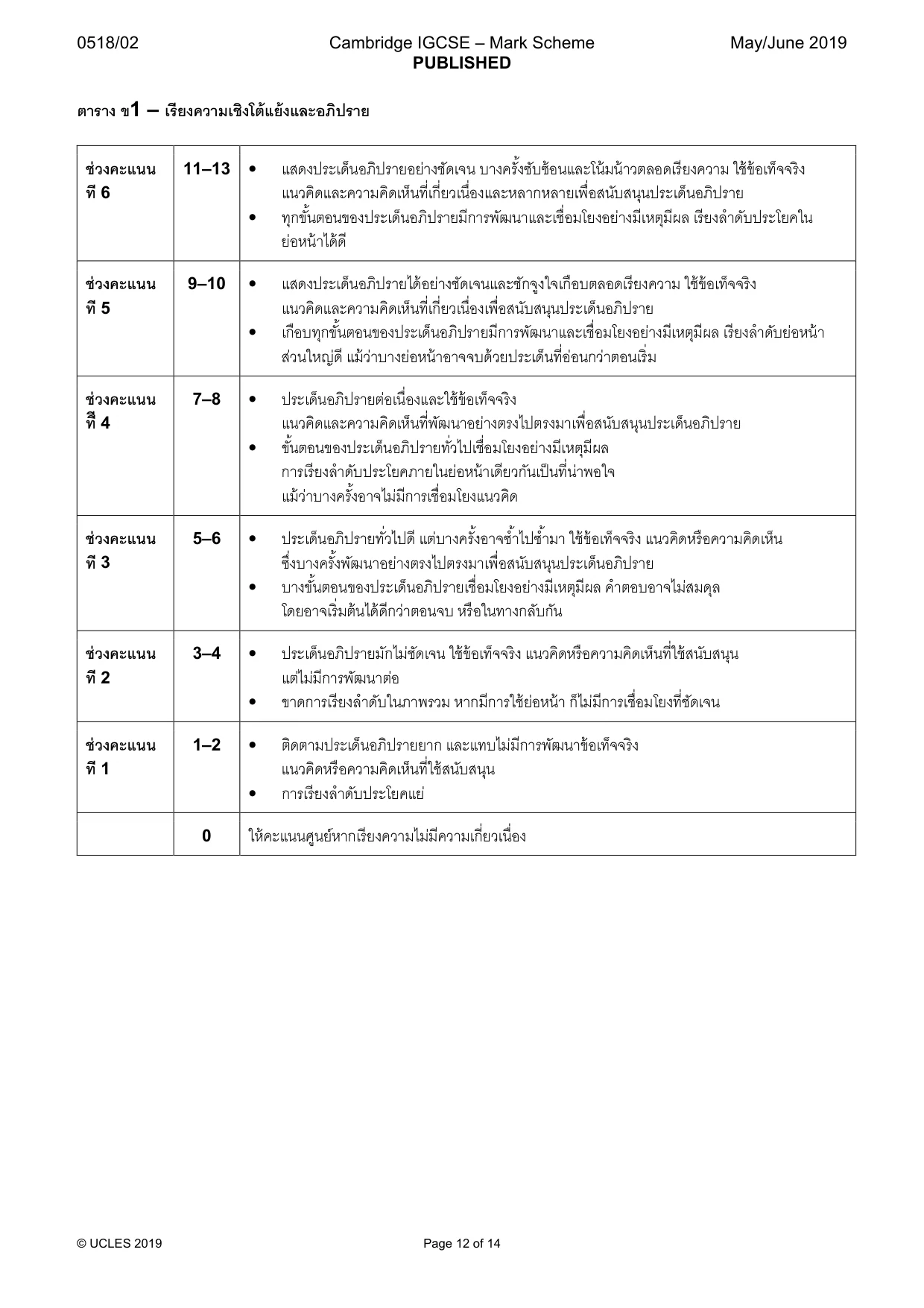
0518/02 Cambridge IGCSE – Mark Scheme PUBLISHED May/June 2019 © UCLES 2019 Page 6 of 14 TABLE B1 – ARGUMENTATIVE/DISCURSIVE TASKS Band 6 11–13 • The argument is well expressed, sometimes complex and consistently persuasive, and supported by a wide range of relevant facts, ideas and opinions. • Every stage of the argument is developed and linked in a logical way. Sentences within paragraphs are well-sequenced. Band 5 9–10 • The argument is clearly presented and almost always persuasive, supported by relevant facts, ideas and opinions. • Nearly all stages of the argument are developed and linked in a logical way. Paragraphs are mostly well sequenced, although some may finish less strongly than they begin. Band 4 7–8 • The argument is coherent and supported by facts, ideas or opinions, developed in a straightforward manner. • Stages of the argument are generally linked together in a logical way. The sequence of the sentences within paragraphs is satisfactory, although opportunities to link ideas may not be taken. Band 3 5–6 • The argument is generally sound, though sometimes repetitive. It is supported by facts, ideas or opinions, some of which are developed in a straightforward manner. • Some stages of the argument are linked together in a logical way. The response may be uneven, starting more strongly than it finishes, or vice versa. Band 2 3–4 • The argument is often unclear. A few supporting facts, ideas or opinions are given, but these are not developed. • There is a lack of overall sequencing. Paragraphs, if used, are not clearly linked together. Band 1 1–2 • The argument is difficult to follow and there is little attempt to develop supporting facts, ideas or opinions. • The sequence of sentences is poor. 0 A mark of zero should be awarded where material is irrelevant.
Mark scheme, page 7
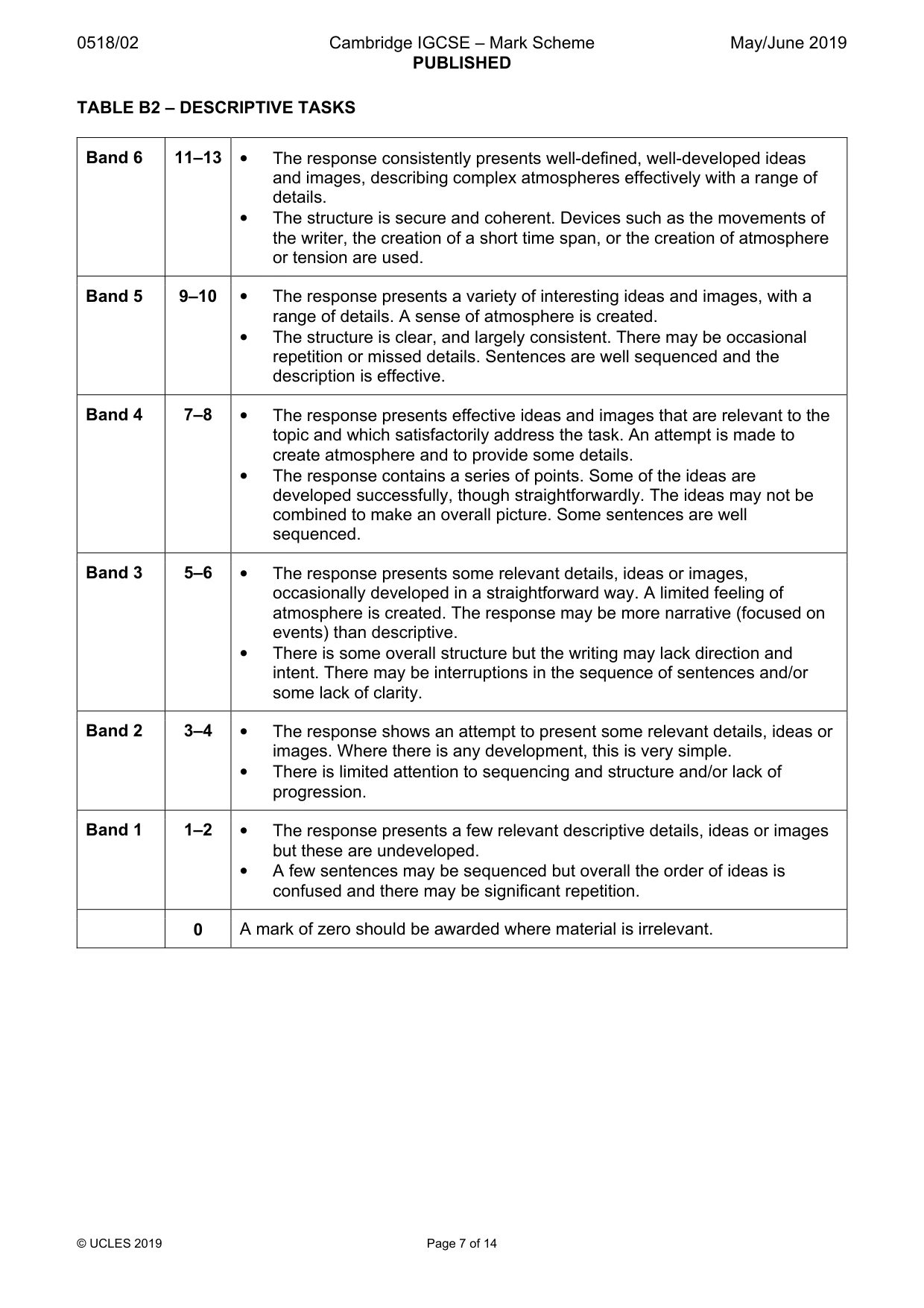
0518/02 Cambridge IGCSE – Mark Scheme PUBLISHED May/June 2019 © UCLES 2019 Page 7 of 14 TABLE B2 – DESCRIPTIVE TASKS Band 6 11–13 • The response consistently presents well-defined, well-developed ideas and images, describing complex atmospheres effectively with a range of details. • The structure is secure and coherent. Devices such as the movements of the writer, the creation of a short time span, or the creation of atmosphere or tension are used. Band 5 9–10 • The response presents a variety of interesting ideas and images, with a range of details. A sense of atmosphere is created. • The structure is clear, and largely consistent. There may be occasional repetition or missed details. Sentences are well sequenced and the description is effective. Band 4 7–8 • The response presents effective ideas and images that are relevant to the topic and which satisfactorily address the task. An attempt is made to create atmosphere and to provide some details. • The response contains a series of points. Some of the ideas are developed successfully, though straightforwardly. The ideas may not be combined to make an overall picture. Some sentences are well sequenced. Band 3 5–6 • The response presents some relevant details, ideas or images, occasionally developed in a straightforward way. A limited feeling of atmosphere is created. The response may be more narrative (focused on events) than descriptive. • There is some overall structure but the writing may lack direction and intent. There may be interruptions in the sequence of sentences and/or some lack of clarity. Band 2 3–4 • The response shows an attempt to present some relevant details, ideas or images. Where there is any development, this is very simple. • There is limited attention to sequencing and structure and/or lack of progression. Band 1 1–2 • The response presents a few relevant descriptive details, ideas or images but these are undeveloped. • A few sentences may be sequenced but overall the order of ideas is confused and there may be significant repetition. 0 A mark of zero should be awarded where material is irrelevant.
Mark scheme, page 8
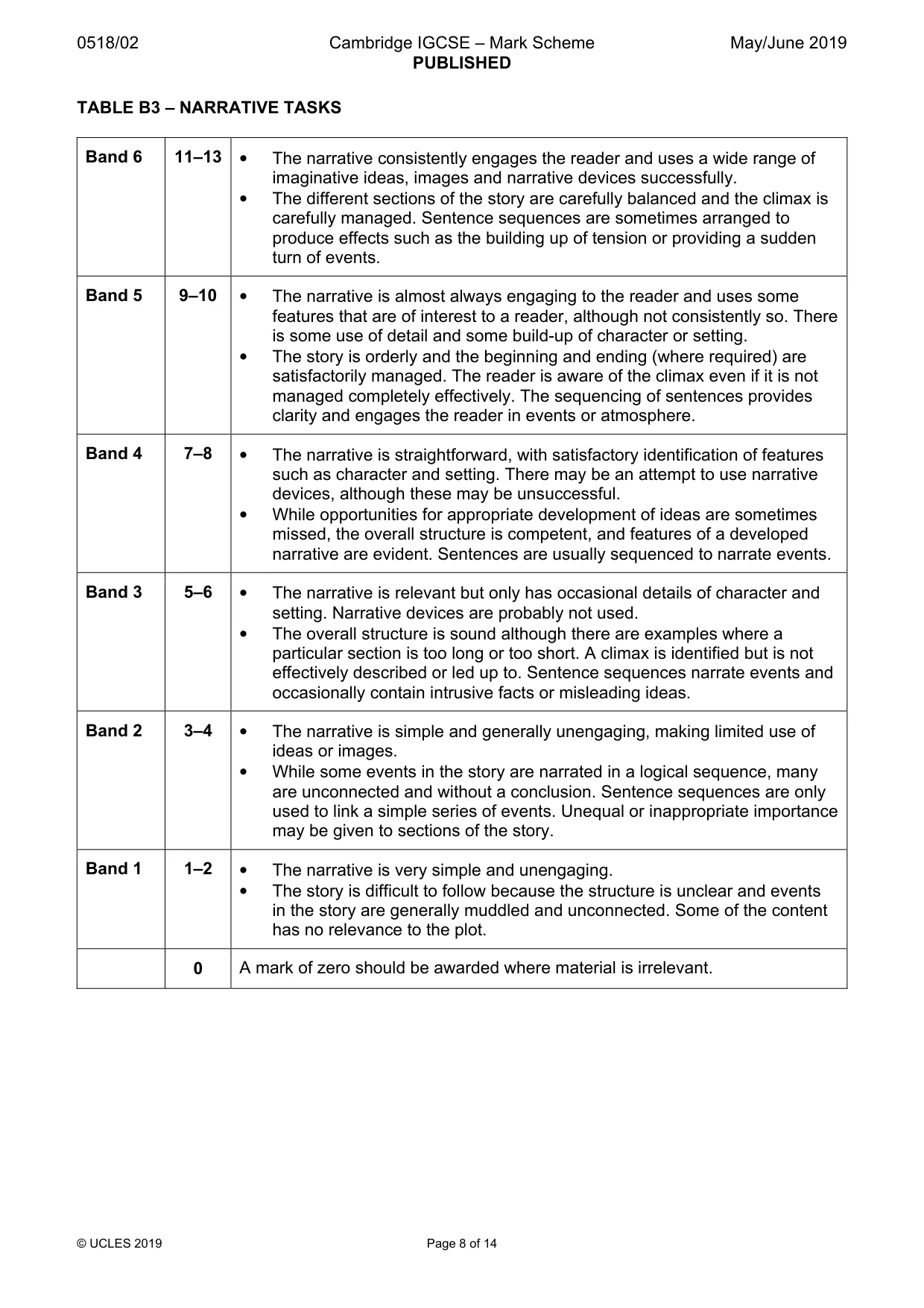
0518/02 Cambridge IGCSE – Mark Scheme PUBLISHED May/June 2019 © UCLES 2019 Page 8 of 14 TABLE B3 – NARRATIVE TASKS Band 6 11–13 • The narrative consistently engages the reader and uses a wide range of imaginative ideas, images and narrative devices successfully. • The different sections of the story are carefully balanced and the climax is carefully managed. Sentence sequences are sometimes arranged to produce effects such as the building up of tension or providing a sudden turn of events. Band 5 9–10 • The narrative is almost always engaging to the reader and uses some features that are of interest to a reader, although not consistently so. There is some use of detail and some build-up of character or setting. • The story is orderly and the beginning and ending (where required) are satisfactorily managed. The reader is aware of the climax even if it is not managed completely effectively. The sequencing of sentences provides clarity and engages the reader in events or atmosphere. Band 4 7–8 • The narrative is straightforward, with satisfactory identification of features such as character and setting. There may be an attempt to use narrative devices, although these may be unsuccessful. • While opportunities for appropriate development of ideas are sometimes missed, the overall structure is competent, and features of a developed narrative are evident. Sentences are usually sequenced to narrate events. Band 3 5–6 • The narrative is relevant but only has occasional details of character and setting. Narrative devices are probably not used. • The overall structure is sound although there are examples where a particular section is too long or too short. A climax is identified but is not effectively described or led up to. Sentence sequences narrate events and occasionally contain intrusive facts or misleading ideas. Band 2 3–4 • The narrative is simple and generally unengaging, making limited use of ideas or images. • While some events in the story are narrated in a logical sequence, many are unconnected and without a conclusion. Sentence sequences are only used to link a simple series of events. Unequal or inappropriate importance may be given to sections of the story. Band 1 1–2 • The narrative is very simple and unengaging. • The story is difficult to follow because the structure is unclear and events in the story are generally muddled and unconnected. Some of the content has no relevance to the plot. 0 A mark of zero should be awarded where material is irrelevant.
Mark scheme, page 9
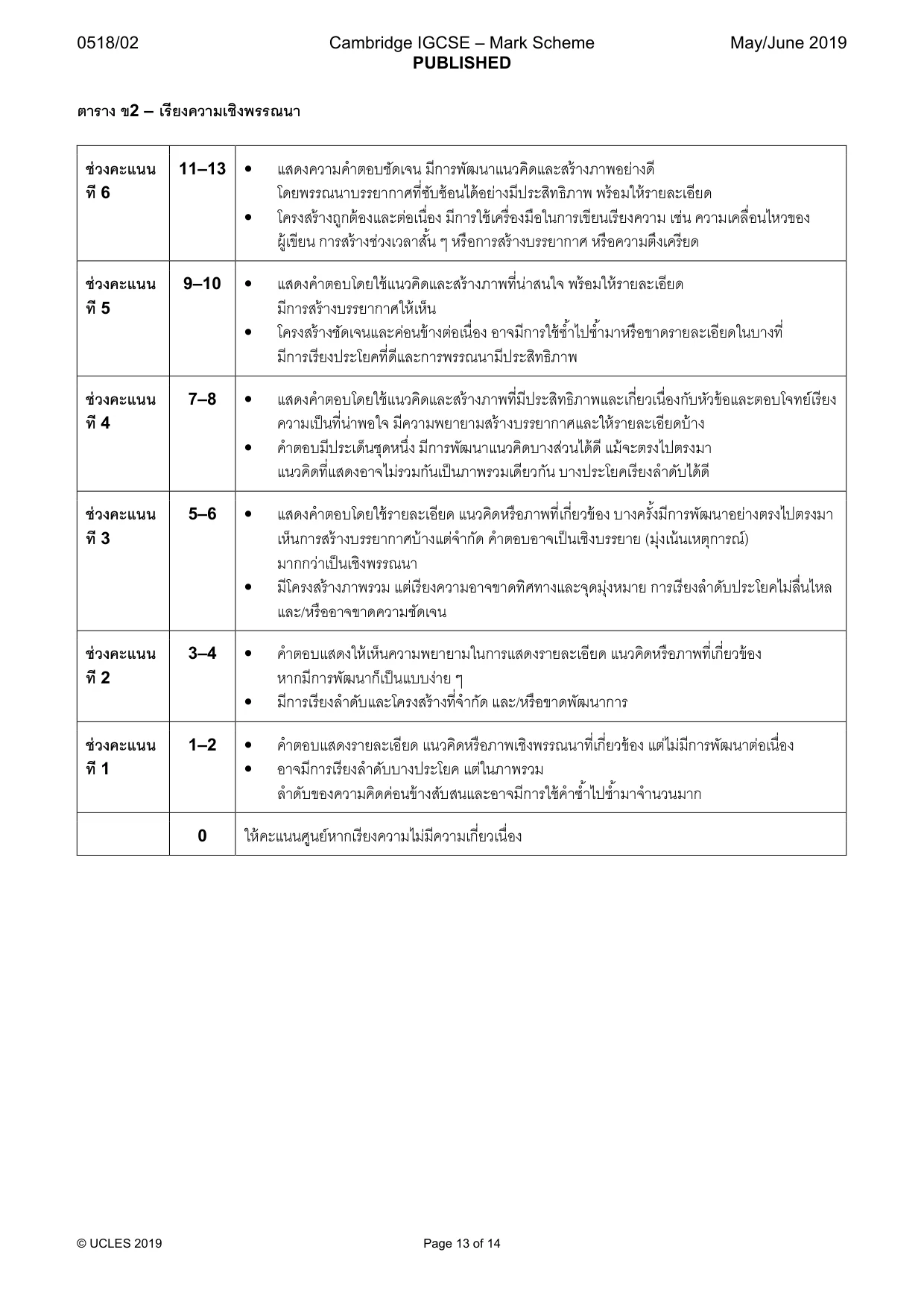
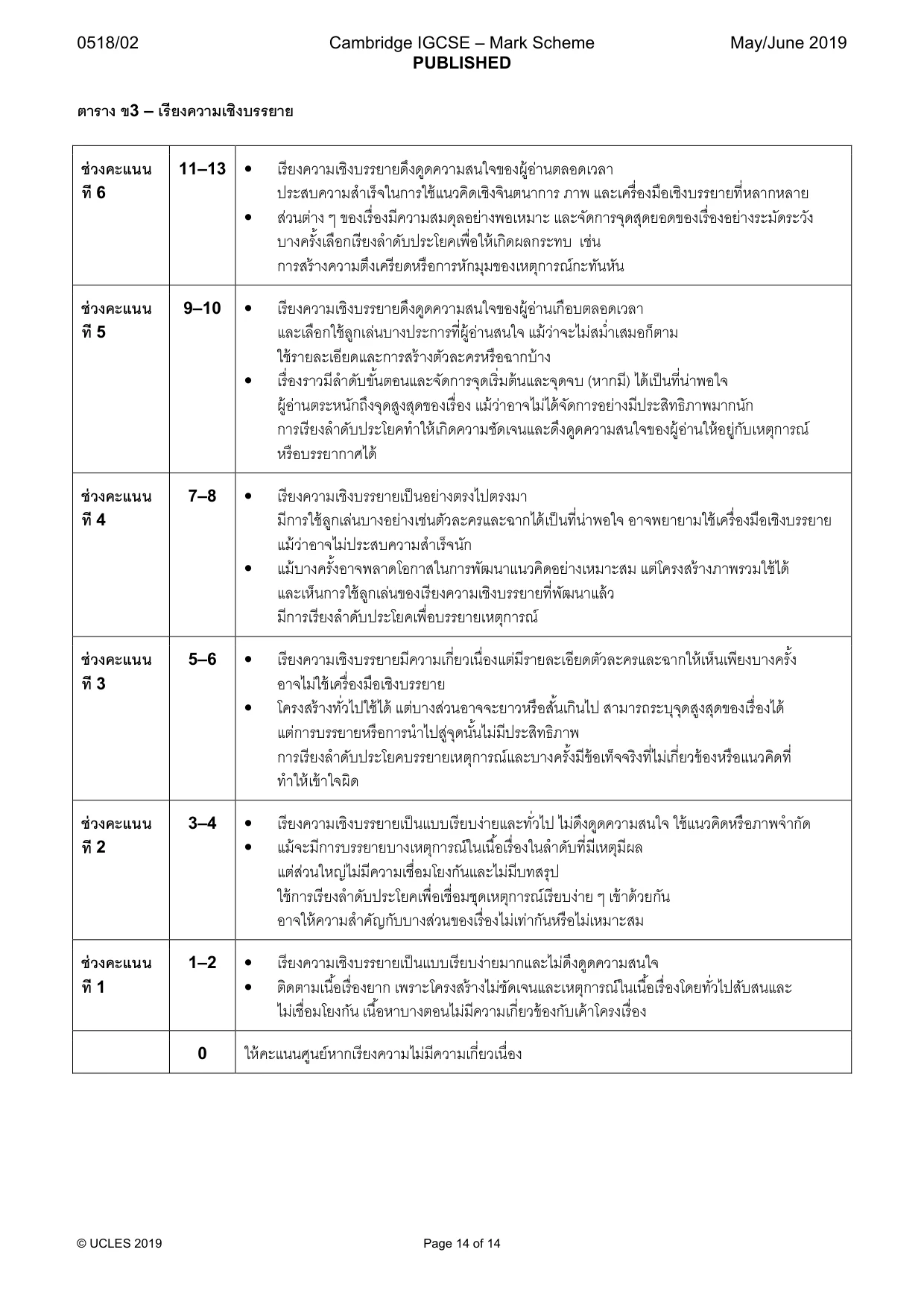
0518/02 Cambridge IGCSE – Mark Scheme PUBLISHED May/June 2019 © UCLES 2019 Page 9 of 14 ผู้เข้าสอบเขียนเรียงความสองเรืÉอง การให้คะแนนเรียงความแต่ละเรืÉองจะถูกแบ่งออกเป็นสองส่วน คือ • ส่วนแรก คะแนนเต็ม 12 คะแนน สําหรับรูปแบบและความถูกต้อง ดูตาราง ก • ส่วนทีÉสอง คะแนนเต็ม 13 คะแนน สําหรับเนืÊอหาและโครงสร้าง ดูตาราง ข1 ข2 หรือ ข3 (ขึÊนอยู่กับประเภทของเรียงความ ว่าเป็นเรียงความเชิงโต้แย้ง/อภิปราย หรือ เชิงพรรณนาและบรรยาย)
Mark scheme, page 10
0518/02 Cambridge IGCSE – Mark Scheme PUBLISHED May/June 2019 © UCLES 2019 Page 10 of 14 ตาราง ก – รูปแบบและความถูกต้อง ช่วงคะแนน ที 6 11–12 เรียงความลืÉนไหลและอ่านง่าย ผู้เข้าสอบ • ใช้ประโยคทีÉมีโครงสร้างเหมาะสมและหลากหลายประเภท รวมถึงประโยคความซ้อนทีÉซับซ้อนในตําแหน่งทีÉเหมาะสมเพืÉอก่อให้เกิดผลกระทบแบบใดแบบหนึÉง • เลือกใช้คําศัพท์ได้ดี ถูกต้องและหลากหลาย • ใช้ระดับภาษาและนํÊาเสียงทีÉสมํÉาเสมอ คงทีÉและเหมาะสมตลอดเรียงความ • การสะกดคํา การใช้เครืÉองหมายวรรคตอนและไวยากรณ์ถูกต้องตลอดเรียงความ แม้ในประโยคความซ้อนหรือบทความทีÉซับซ้อนก็ตาม ช่วงคะแนน ที 5 9–10 เรียงความลืÉนไหลและเข้าใจได้ ผู้เข้าสอบ • ใช้โครงสร้างประโยคหลากหลายประเภทอย่างถูกต้อง • ใช้คําศัพท์หลากหลายและมักมีประสิทธิภาพและบางครัÊงซับซ้อน • ใช้ระดับภาษาและนํÊาเสียงทีÉเกือบสมํÉาเสมอ คงทีÉและเหมาะสม • การสะกดคํา การใช้เครืÉองหมายวรรคตอนและไวยากรณ์ถูกต้องเกือบทัÊงหมด ช่วงคะแนน ที 4 7–8 เรียงความค่อนข้างลืÉนไหล แต่มีข้อผิดพลาดเรืÉองความไม่ชัดเจนเล็กน้อยบ้าง ผู้เข้าสอบ • ใช้โครงสร้างประโยคได้อย่างถูกต้อง รวมถึงโครงสร้างประโยคความซ้อนบางประโยค • ใช้คําศัพท์เหมาะสมและถูกต้อง ซึÉงมักเลือกใช้เพืÉอสืÉอความหมายเจาะจงในบางโอกาส • ใช้ระดับภาษาและนํÊาเสียงไม่สมํÉาเสมอคงทีÉ แต่ไม่มีผลกระทบต่อข้อความทีÉต้องการสืÉอ • ใช้รูปแบบไวยากรณ์เรียบง่ายได้อย่างถูกต้อง การแบ่งประโยคถูกต้องเกือบทุกครัÊง มีข้อผิดพลาดในการ สะกดคําบ้าง แต่ไม่ทําให้การสืÉอสารสะดุด ช่วงคะแนน ที 3 5–6 เรียงความลืÉนไหลบางครัÊง แต่บางครัÊงไม่ชัดเจน ผู้เข้าสอบ • ใช้โครงสร้างประโยคเรียบง่ายซึÉงอาจซํÊาไปซํÊามา หากพยายามใช้โครงสร้างประโยคทีÉซับซ้อนมากขึÊน ก็อาจไม่ถูกต้องทุกครัÊง • ใช้คําศัพท์เพืÉอสืÉอสารความหมายทัÉวไป แต่จํากัดและซํÊาไปซํÊามา • คํานึงถึงระดับภาษาและนํÊาเสียงบ้าง แต่บางครัÊงเกิดข้อผิดพลาดทีÉทําให้เบีÉยงเบนจากข้อความทีÉต้องการสืÉอ • มีข้อผิดพลาดในการใช้เครืÉองหมายวรรคตอน รวมถึงการแบ่งประโยค พบข้อผิดพลาดในการสะกดคําและไวยากรณ์หลายแห่ง แต่แทบไม่ค่อยร้ายแรงจนส่งผลต่อความเข้าใจ ช่วงคะแนน ที 2 3–4 คําตอบส่วนใหญ่อ่านเข้าใจยาก แม้ว่าจะมีบางส่วนทีÉชัดเจน ผู้เข้าสอบ • ใช้โครงสร้างประโยคเรียบง่าย บางครัÊงไม่ถูกต้อง ไม่มีการใช้ประโยคความซ้อน หรือหากมี ก็เป็นประโยคทีÉเกิดจากการเชืÉอมประโยคด้วยคําว่า “และ” “แต่” และ “ดังนัÊน” ซํÊาไปซํÊามา แต่ไม่มีประสิทธิภาพ • ใช้คําศัพท์พืÊนฐาน บางครัÊงไม่ถูกต้อง • คําตอบส่วนใหญ่ใช้ระดับภาษาและนํÊาเสียงทีÉไม่เหมาะสม • มีข้อผิดพลาดในการสะกดคํา การใช้เครืÉองหมายวรรคตอนและไวยากรณ์ ซึÉงส่งผลต่อความเข้าใจในระดับหนึÉง แต่ยังสามารถเข้าใจความหมายโดยรวมได้ ช่วงคะแนน ที 1 1–2 คําตอบอ่านและเข้าใจยาก ผู้เข้าสอบ • ใช้ประโยคทีÉมีโครงสร้างไม่ถูกต้อง • มักใช้คําศัพท์พืÊนฐานไม่ถูกต้อง • ไม่คํานึงถึงใช้ระดับภาษาและนํÊาเสียงทีÉเหมาะสม • มีข้อผิดพลาดในการสะกดคํา การใช้เครืÉองหมายวรรคตอนและไวยากรณ์ตลอดเรียงความ ซึÉงทําให้ คําตอบส่วนใหญ่เข้าใจยาก
Mark scheme, page 11
0518/02 Cambridge IGCSE – Mark Scheme PUBLISHED May/June 2019 © UCLES 2019 Page 11 of 14 0 ให้คะแนนศูนย์หากไม่มีเนืÊอหาทีÉสามารถให้คะแนนได้ และไม่สามารถจับความหมายของเรียงความได้เนืÉองจากความสามารถในการใช้ภาษาตํÉา
Mark scheme, page 12
0518/02 Cambridge IGCSE – Mark Scheme PUBLISHED May/June 2019 © UCLES 2019 Page 12 of 14 ตาราง ข1 – เรียงความเชิงโต้แย้งและอภิปราย ช่วงคะแนน ที 6 11–13 • แสดงประเด็นอภิปรายอย่างชัดเจน บางครัÊงซับซ้อนและโน้มน้าวตลอดเรียงความ ใช้ข้อเท็จจริง แนวคิดและความคิดเห็นทีÉเกีÉยวเนืÉองและหลากหลายเพืÉอสนับสนุนประเด็นอภิปราย • ทุกขัÊนตอนของประเด็นอภิปรายมีการพัฒนาและเชืÉอมโยงอย่างมีเหตุมีผล เรียงลําดับประโยคใน ย่อหน้าได้ดี ช่วงคะแนน ที 5 9–10 • แสดงประเด็นอภิปรายได้อย่างชัดเจนและชักจูงใจเกือบตลอดเรียงความ ใช้ข้อเท็จจริง แนวคิดและความคิดเห็นทีÉเกีÉยวเนืÉองเพืÉอสนับสนุนประเด็นอภิปราย • เกือบทุกขัÊนตอนของประเด็นอภิปรายมีการพัฒนาและเชืÉอมโยงอย่างมีเหตุมีผล เรียงลําดับย่อหน้า ส่วนใหญ่ดี แม้ว่าบางย่อหน้าอาจจบด้วยประเด็นทีÉอ่อนกว่าตอนเริÉม ช่วงคะแนน ทีี 4 7–8 • ประเด็นอภิปรายต่อเนืÉองและใช้ข้อเท็จจริง แนวคิดและความคิดเห็นทีÉพัฒนาอย่างตรงไปตรงมาเพืÉอสนับสนุนประเด็นอภิปราย • ขัÊนตอนของประเด็นอภิปรายทัÉวไปเชืÉอมโยงอย่างมีเหตุมีผล การเรียงลําดับประโยคภายในย่อหน้าเดียวกันเป็นทีÉน่าพอใจ แม้ว่าบางครัÊงอาจไม่มีการเชืÉอมโยงแนวคิด ช่วงคะแนน ที 3 5–6 • ประเด็นอภิปรายทัÉวไปดี แต่บางครัÊงอาจซํÊาไปซํÊามา ใช้ข้อเท็จจริง แนวคิดหรือความคิดเห็น ซึÉงบางครัÊงพัฒนาอย่างตรงไปตรงมาเพืÉอสนับสนุนประเด็นอภิปราย • บางขัÊนตอนของประเด็นอภิปรายเชืÉอมโยงอย่างมีเหตุมีผล คําตอบอาจไม่สมดุล โดยอาจเริÉมต้นได้ดีกว่าตอนจบ หรือในทางกลับกัน ช่วงคะแนน ที 2 3–4 • ประเด็นอภิปรายมักไม่ชัดเจน ใช้ข้อเท็จจริง แนวคิดหรือความคิดเห็นทีÉใช้สนับสนุน แต่ไม่มีการพัฒนาต่อ • ขาดการเรียงลําดับในภาพรวม หากมีการใช้ย่อหน้า ก็ไม่มีการเชืÉอมโยงทีÉชัดเจน ช่วงคะแนน ที 1 1–2 • ติดตามประเด็นอภิปรายยาก และแทบไม่มีการพัฒนาข้อเท็จจริง แนวคิดหรือความคิดเห็นทีÉใช้สนับสนุน • การเรียงลําดับประโยคแย่ 0 ให้คะแนนศูนย์หากเรียงความไม่มีความเกีÉยวเนืÉอง
Mark scheme, page 13
0518/02 Cambridge IGCSE – Mark Scheme PUBLISHED May/June 2019 © UCLES 2019 Page 13 of 14 ตาราง ข2 – เรียงความเชิงพรรณนา ช่วงคะแนน ที 6 11–13 • แสดงความคําตอบชัดเจน มีการพัฒนาแนวคิดและสร้างภาพอย่างดี โดยพรรณนาบรรยากาศทีÉซับซ้อนได้อย่างมีประสิทธิภาพ พร้อมให้รายละเอียด • โครงสร้างถูกต้องและต่อเนืÉอง มีการใช้เครืÉองมือในการเขียนเรียงความ เช่น ความเคลืÉอนไหวของ ผู้เขียน การสร้างช่วงเวลาสัÊน ๆ หรือการสร้างบรรยากาศ หรือความตึงเครียด ช่วงคะแนน ที 5 9–10 • แสดงคําตอบโดยใช้แนวคิดและสร้างภาพทีÉน่าสนใจ พร้อมให้รายละเอียด มีการสร้างบรรยากาศให้เห็น • โครงสร้างชัดเจนและค่อนข้างต่อเนืÉอง อาจมีการใช้ซํÊาไปซํÊามาหรือขาดรายละเอียดในบางทีÉ มีการเรียงประโยคทีÉดีและการพรรณนามีประสิทธิภาพ ช่วงคะแนน ที 4 7–8 • แสดงคําตอบโดยใช้แนวคิดและสร้างภาพทีÉมีประสิทธิภาพและเกีÉยวเนืÉองกับหัวข้อและตอบโจทย์เรียง ความเป็นทีÉน่าพอใจ มีความพยายามสร้างบรรยากาศและให้รายละเอียดบ้าง • คําตอบมีประเด็นชุดหนึÉง มีการพัฒนาแนวคิดบางส่วนได้ดี แม้จะตรงไปตรงมา แนวคิดทีÉแสดงอาจไม่รวมกันเป็นภาพรวมเดียวกัน บางประโยคเรียงลําดับได้ดี ช่วงคะแนน ที 3 5–6 • แสดงคําตอบโดยใช้รายละเอียด แนวคิดหรือภาพทีÉเกีÉยวข้อง บางครัÊงมีการพัฒนาอย่างตรงไปตรงมา เห็นการสร้างบรรยากาศบ้างแต่จํากัด คําตอบอาจเป็นเชิงบรรยาย (มุ่งเน้นเหตุการณ์) มากกว่าเป็นเชิงพรรณนา • มีโครงสร้างภาพรวม แต่เรียงความอาจขาดทิศทางและจุดมุ่งหมาย การเรียงลําดับประโยคไม่ลืÉนไหล และ/หรืออาจขาดความชัดเจน ช่วงคะแนน ที 2 3–4 • คําตอบแสดงให้เห็นความพยายามในการแสดงรายละเอียด แนวคิดหรือภาพทีÉเกีÉยวข้อง หากมีการพัฒนาก็เป็นแบบง่าย ๆ • มีการเรียงลําดับและโครงสร้างทีÉจํากัด และ/หรือขาดพัฒนาการ ช่วงคะแนน ที 1 1–2 • คําตอบแสดงรายละเอียด แนวคิดหรือภาพเชิงพรรณนาทีÉเกีÉยวข้อง แต่ไม่มีการพัฒนาต่อเนืÉอง • อาจมีการเรียงลําดับบางประโยค แต่ในภาพรวม ลําดับของความคิดค่อนข้างสับสนและอาจมีการใช้คําซํÊาไปซํÊามาจํานวนมาก 0 ให้คะแนนศูนย์หากเรียงความไม่มีความเกีÉยวเนืÉอง
Mark scheme, page 14
0518/02 Cambridge IGCSE – Mark Scheme PUBLISHED May/June 2019 © UCLES 2019 Page 14 of 14 ตาราง ข3 – เรียงความเชิงบรรยาย ช่วงคะแนน ที 6 11–13 • เรียงความเชิงบรรยายดึงดูดความสนใจของผู้อ่านตลอดเวลา ประสบความสําเร็จในการใช้แนวคิดเชิงจินตนาการ ภาพ และเครืÉองมือเชิงบรรยายทีÉหลากหลาย • ส่วนต่าง ๆ ของเรืÉองมีความสมดุลอย่างพอเหมาะ และจัดการจุดสุดยอดของเรืÉองอย่างระมัดระวัง บางครัÊงเลือกเรียงลําดับประโยคเพืÉอให้เกิดผลกระทบ เช่น การสร้างความตึงเครียดหรือการหักมุมของเหตุการณ์กะทันหัน ช่วงคะแนน ที 5 9–10 • เรียงความเชิงบรรยายดึงดูดความสนใจของผู้อ่านเกือบตลอดเวลา และเลือกใช้ลูกเล่นบางประการทีÉผู้อ่านสนใจ แม้ว่าจะไม่สมํÉาเสมอก็ตาม ใช้รายละเอียดและการสร้างตัวละครหรือฉากบ้าง • เรืÉองราวมีลําดับขัÊนตอนและจัดการจุดเริÉมต้นและจุดจบ (หากมี) ได้เป็นทีÉน่าพอใจ ผู้อ่านตระหนักถึงจุดสูงสุดของเรืÉอง แม้ว่าอาจไม่ได้จัดการอย่างมีประสิทธิภาพมากนัก การเรียงลําดับประโยคทําให้เกิดความชัดเจนและดึงดูดความสนใจของผู้อ่านให้อยู่กับเหตุการณ์ หรือบรรยากาศได้ ช่วงคะแนน ที 4 7–8 • เรียงความเชิงบรรยายเป็นอย่างตรงไปตรงมา มีการใช้ลูกเล่นบางอย่างเช่นตัวละครและฉากได้เป็นทีÉน่าพอใจ อาจพยายามใช้เครืÉองมือเชิงบรรยาย แม้ว่าอาจไม่ประสบความสําเร็จนัก • แม้บางครัÊงอาจพลาดโอกาสในการพัฒนาแนวคิดอย่างเหมาะสม แต่โครงสร้างภาพรวมใช้ได้ และเห็นการใช้ลูกเล่นของเรียงความเชิงบรรยายทีÉพัฒนาแล้ว มีการเรียงลําดับประโยคเพืÉอบรรยายเหตุการณ์ ช่วงคะแนน ที 3 5–6 • เรียงความเชิงบรรยายมีความเกีÉยวเนืÉองแต่มีรายละเอียดตัวละครและฉากให้เห็นเพียงบางครัÊง อาจไม่ใช้เครืÉองมือเชิงบรรยาย • โครงสร้างทัÉวไปใช้ได้ แต่บางส่วนอาจจะยาวหรือสัÊนเกินไป สามารถระบุจุดสูงสุดของเรืÉองได้ แต่การบรรยายหรือการนําไปสู่จุดนัÊนไม่มีประสิทธิภาพ การเรียงลําดับประโยคบรรยายเหตุการณ์และบางครัÊงมีข้อเท็จจริงทีÉไม่เกีÉยวข้องหรือแนวคิดทีÉ ทําให้เข้าใจผิด ช่วงคะแนน ที 2 3–4 • เรียงความเชิงบรรยายเป็นแบบเรียบง่ายและทัÉวไป ไม่ดึงดูดความสนใจ ใช้แนวคิดหรือภาพจํากัด • แม้จะมีการบรรยายบางเหตุการณ์ในเนืÊอเรืÉองในลําดับทีÉมีเหตุมีผล แต่ส่วนใหญ่ไม่มีความเชืÉอมโยงกันและไม่มีบทสรุป ใช้การเรียงลําดับประโยคเพืÉอเชืÉอมชุดเหตุการณ์เรียบง่าย ๆ เข้าด้วยกัน อาจให้ความสําคัญกับบางส่วนของเรืÉองไม่เท่ากันหรือไม่เหมาะสม ช่วงคะแนน ที 1 1–2 • เรียงความเชิงบรรยายเป็นแบบเรียบง่ายมากและไม่ดึงดูดความสนใจ • ติดตามเนืÊอเรืÉองยาก เพราะโครงสร้างไม่ชัดเจนและเหตุการณ์ในเนืÊอเรืÉองโดยทัÉวไปสับสนและ ไม่เชืÉอมโยงกัน เนืÊอหาบางตอนไม่มีความเกีÉยวข้องกับเค้าโครงเรืÉอง 0 ให้คะแนนศูนย์หากเรียงความไม่มีความเกีÉยวเนืÉอง
What you needed in this session
Cambridge’s own grade thresholds for 2019 May/June, Paper 2 · Variant 1. A higher threshold means an easier paper — the bar moves with how the cohort did.