Cambridge IGCSE Thai - First Language 0518 — 2017 May/June Paper 2 · Variant 1
0518/21/M/J/17 · 60 marks · ≈68 min
The question paper and its mark scheme, free to read here and free to download. This is Cambridge’s own paper, exactly as it was sat.
Question paper8 pages
Mark scheme6 pages
Answers below. Sit the paper first if you are practising.
Paper as text
Question paper, page 1
This document consists of 6 printed pages and 2 blank pages. DC (LK/SG) 131314/1 © UCLES 2017 [Turn over Cambridge International Examinations Cambridge International General Certificate of Secondary Education * 7 4 6 9 8 1 4 8 1 1 * FIRST LANGUAGE THAI 0518/02 Paper 2 Reading and Directed Writing May/June 2017 2 hours 15 minutes Additional Materials: Answer Booklet/Paper READ THESE INSTRUCTIONS FIRST If you have been given an Answer Booklet, follow the instructions on the front cover of the Booklet. Write your Centre number, candidate number and name on all the work you hand in. Write in dark blue or black pen. Do not use staples, paper clips, glue or correction fluid. DO NOT WRITE IN ANY BARCODES. Answer all questions. Dictionaries are not permitted. At the end of the examination, fasten all your work securely together. The number of marks is given in brackets [ ] at the end of each question or part question. คําสัง สําหรับผู้เข้าสอบ เขียนชือและเลขประจําตัวสําหรับผู้เข้าสอบ พร้อมทังหมายเลขประจําหน่วยสอบ ลงในช่องว่างทีให้ไว้ในสมุดเขียนคําตอบหรือกระดาษคําตอบทุกแผ่น เขียนด้วยหมึกสีนําเงิน หรือหมึกดํา ห้ามใช้ทีเย็บกระดาษ ทีหนีบกระดาษ กาว หรือ นํายาลบคําผิด ห้ามเขียนบนบาร์โค้ด ต้องทําทุกข้อ ไม่มีให้เลือก ห้ามใช้พจนานุกรม หากนักเรียนใช้กระดาษตอบมากกว่าหนึงแผ่น ต้องผูกกระดาษทุกแผ่นเข้าด้วยกัน คะแนนสําหรับข้อสอบแต่ละข้ออยู่ในวงเล็บ ท้ายข้อสอบนัน ๆ
Question paper, page 2
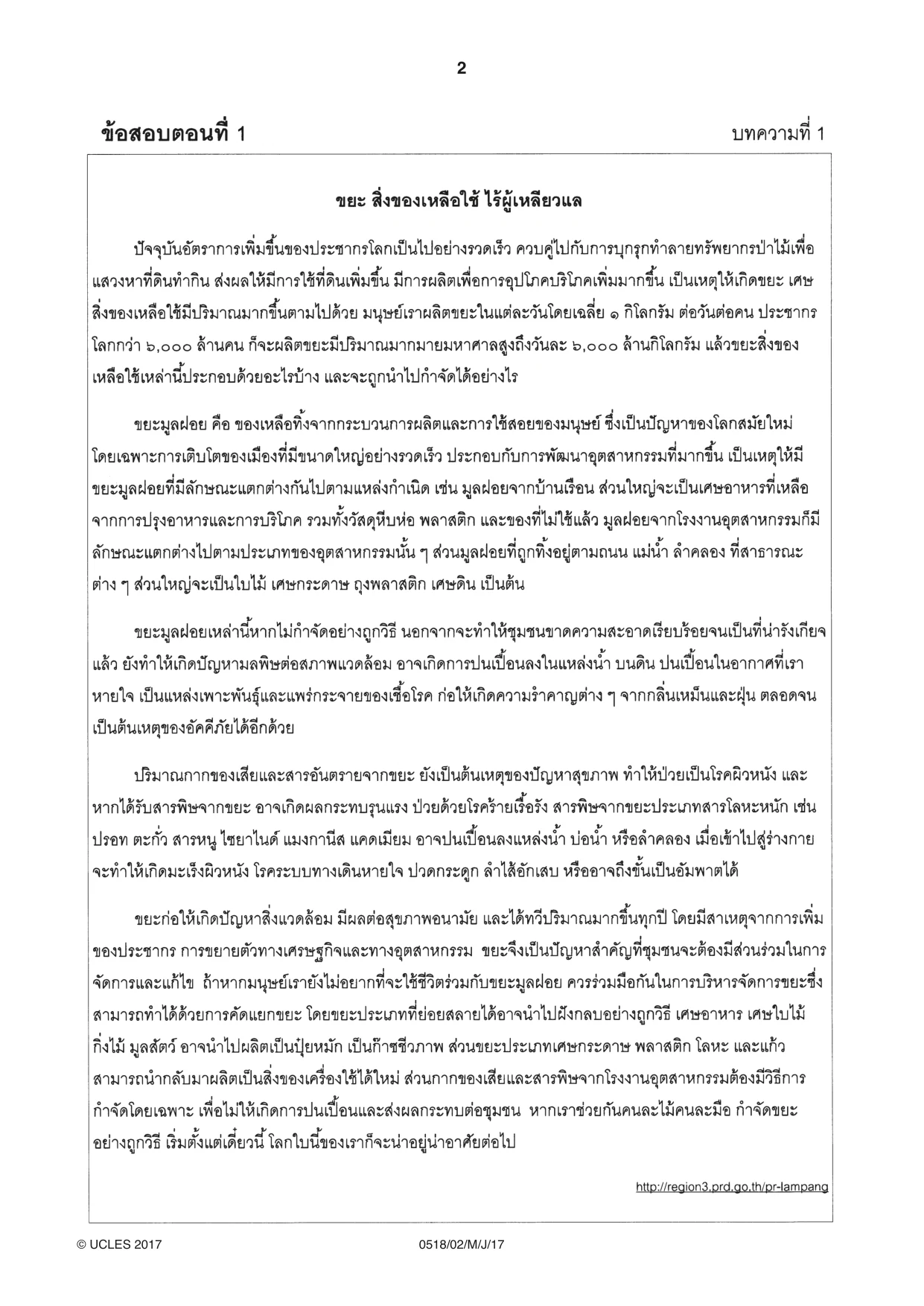
4 ; qdaaaunaun 1 unaann 1 age Aruaavaals Liginagoua a taquudaainraviatuseseernslaniluluedssenia paudlurtunrsyngninaremdnennatiatgiie uananntiauviaiy dona dines tAuitiadu finrenoWenrsguinerflnadiaaintu dhumeiihionay ve Asvoun@elitiananntumalliae ayweionanueluuiarTulanede o Alandy slaTuslany Useaine Tannth »,000 &waw flasnfnausdhRannannaraammagideduar o,000 Mufilaniy uonesdenes at 8H Lond’eh ect wiaelHiuaniidssnaudwarletin uarazqninluindaliedaels “ ro? = » cdg ~, ' auzyaclon Aa daUMaAaTNVINNIZUIUNsHAMUALNI HiaanyaINYyyE Faflutywrvestanade lad . ao oda woe « - ~ a dg va Tonamremaiulavaiiasniawialuqadwsaatta UsenaununrsWanrgqaarunssunnindu uma hid seryadaanianuncumndaiullouudaiiia du yadausintiuiey duluqjesihuavaisnimae snmeauparnrasuacnaistnn suvieaqiuva wardsin uacrasn lauds yarlawanlssuqaarunsauid Anunuzumneislumuussinnaeagaarnsaniy 7 doujadaehiqnivedawuauy usin diaaes Aarsrsue loin 7 douluqjaciihwlult wwnszar qawarasin vdiu udu iP nT re oer a. Sie sie tnze at ausyadaumariwainlinrdaatngnts wansinasiiquaunmannacenGertauuiunrsaies ve qs a x = i ne 7 i ude toi Wiiodiywiuatilaamwmmoadan arefanisuudeuadluundan udu dudeulwernane miele Muundanrewuguazuninssvevastaten raliiaanuirarcyens 7 vannaumduuardy naanwy usiumquasdarnalaanian | Uanuminvaaeuararsduaneainig: daduiumquasdywrqaniw niwidlaaiulsatiouis was | ue, = . a’ =. ~ winlafuansiwa rinses DIUNANANTENUTWUIN doadantemireaizat aneniwainiesiussunnarstaucutin id ‘ < 4; a oP ee do Bates use azta aneuy laeTluel uvanria unsuilesn erarudleuasuusan vet viadrnaes dladivugéenie | | | ari Wihiousiiiious feareuumraauwrele voanszqn arladniau vaaaraieduiluduw ala aarnelbatywauonden Auasaqunwmauiie war lAnivewrnaindiuynd lasaangqainnrsiin - ~ = eo ol j seauseins NrsveNEAMasAMAUacMNQaa Nay wUAafutlymardaynqavesasidauion lun . Me Pe ee ae Lt og ae 4 Famrsuacuily fowinanywdhierdlawnnestindouiuassqarday easianiarulumsiwidanisaesty ° - ol . j annnsanTadounrsAauanuey lasvecussinnndasaartlAaranriudenauadragnss emer iw lu Feld yadad erainlnamiuilevdin dufretonw dousesussinniawnssar waraiin lave wazutia | ow a s.8 Pt wet = ws clevet aansminduanaailuasnasesasls laud dauninvesideuararsiwa inl uqaarnssuiasiaan ow ayy am Pr . a » Pre Anvalauvawie Waltham sutlawuasdnansenuctaquau winrdeiuauarliauasila nware A mat vat at a Zotac let, t BUWNYNIG NANA I Tanlufivaunfasiadura tmusdealyl http://region3. prc h/pr-lampan © UCLES 2017 0518/02/M/J/17,
Question paper, page 3
3 0518/02/M/J/17 © UCLES 2017 [Turn over
Question paper, page 4
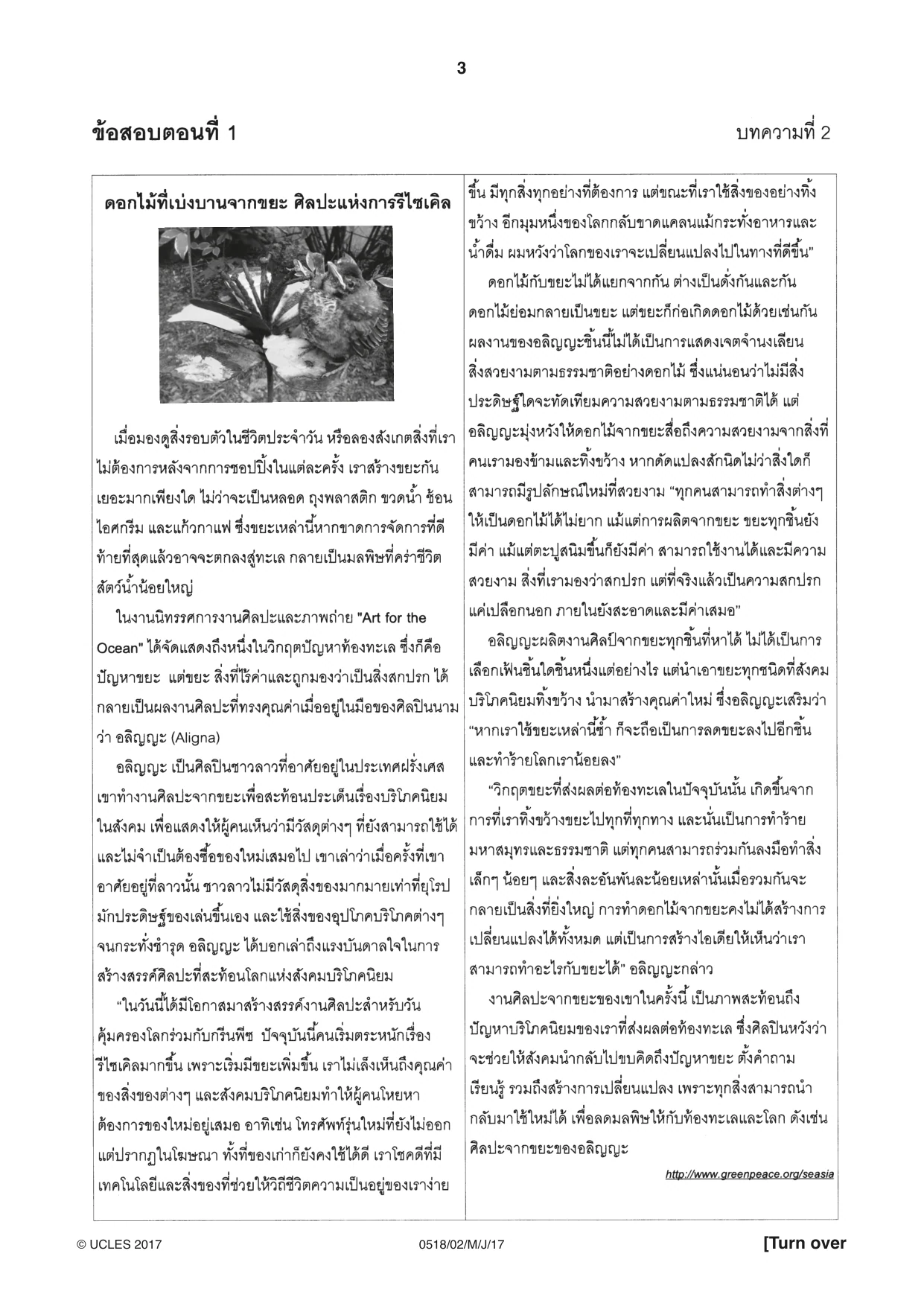
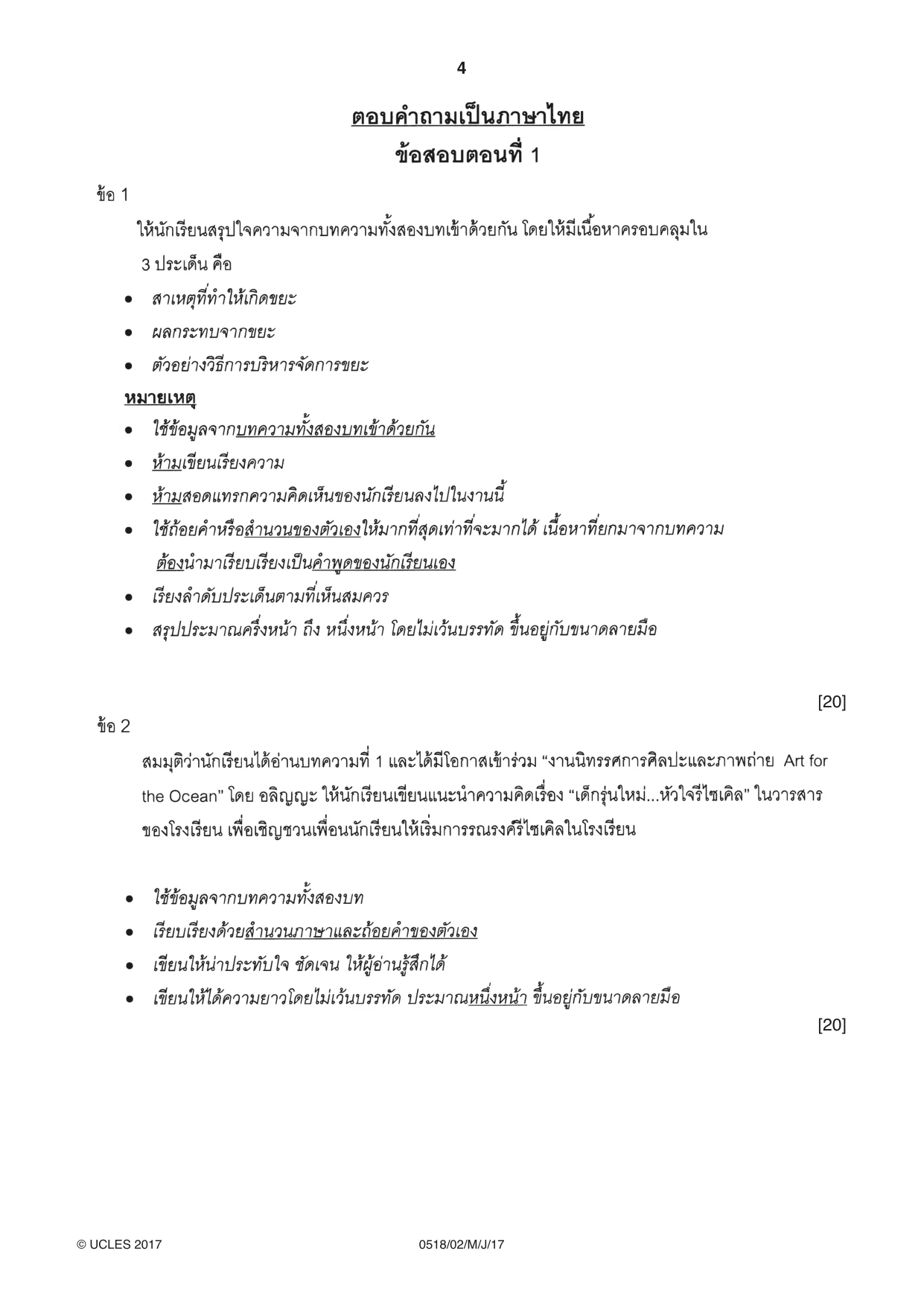
to 4 ° o aauAIOINiiunrwitns v a VAAAUAAUN 1 5 , ‘WiihGeuagllaanaainunaniiaasuminmoariy ladiiiienarauaquly 3 usziau Aa arungnrir tious nANsENUaINUES siaaei winisiiwisdanisdEle UNILUA lifeyavinunarininaayund rei dtd NIVEWLFENAQIN x 2g, we a wausaaunsnarnAaturawnGeuad ly lua wil lidesArvtad wouresioes bniganinasuonla euivienn a nunAady Pare ee : “a fouhwnizuuteniuawoavasunigeues ot ow s. aie Gena durlssmuaraniuaas ‘ : ; a ae aquussaruAnu fa view Taellaituusaia uegiuawionareiia [20] anNAInINGewlAd una 1 wasléflenrainien “squiinssanrsAalcuacnrwere Art for the Ocean” lag aaquayy WhinGewiemuustiranuaatas “vingulun...talealnAa” luvisans darlaGau MatqyrumMauinGeawWiGunrsscusaed Aa lula 2 litayavinunadiuniaeun a a FUUFEN AIA NW IW IY MAL HOLA VOID 2 Gewlihuseiuls gay bigewzanls “ + rn Pe “ Gewhildarwuenaiaglaisuussyia Usex ounitewy Iuegiuawna eile [20] © UCLES 2017 0518/02/M/J/17,
Question paper, page 5
5 0518/02/M/J/17 © UCLES 2017 [Turn over BLANK PAGE
Question paper, page 6
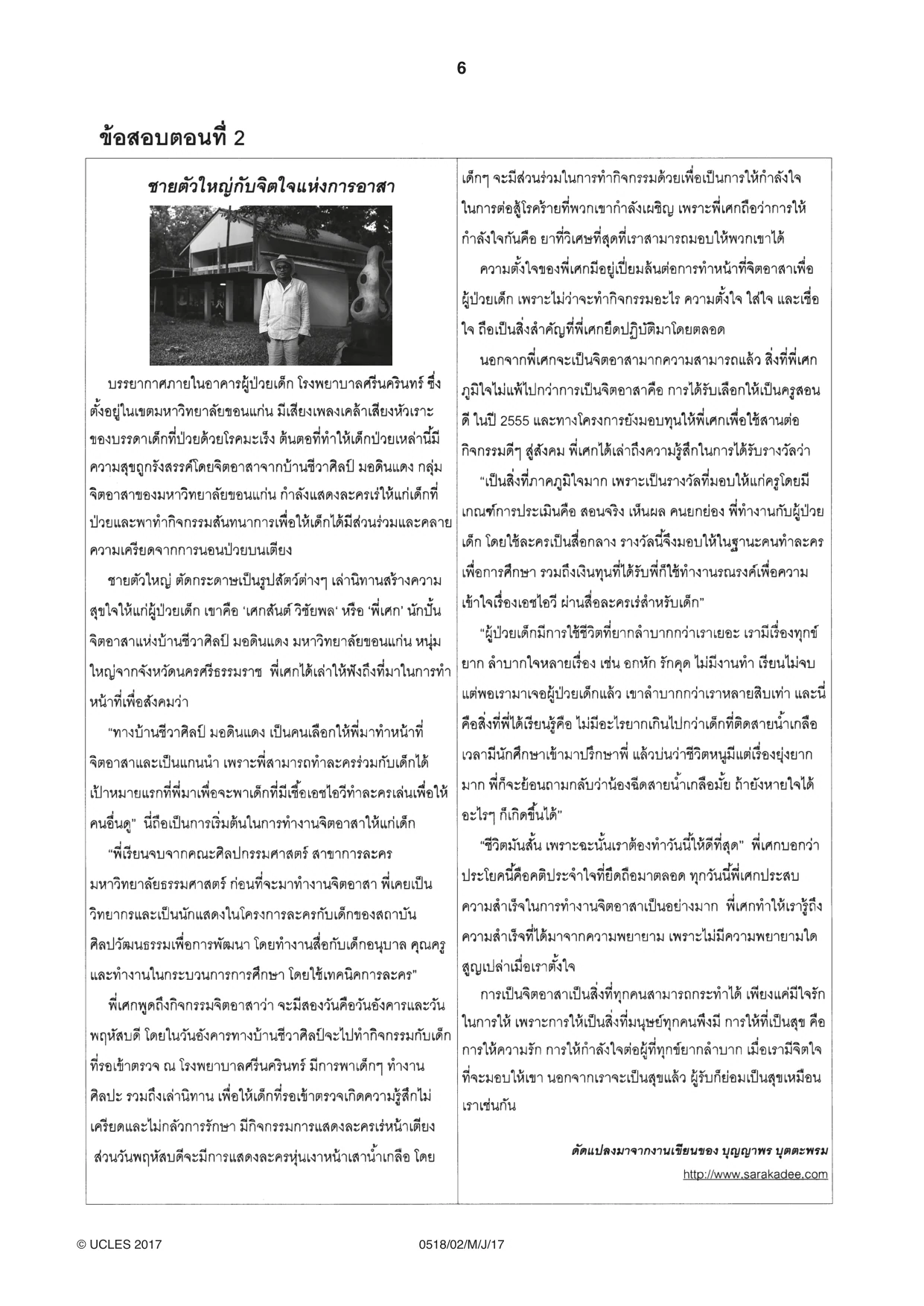
a daaaunaun 2 | neaalnginuaalaustenisarar urmimameluerarstitlandn fanenuradtuetunt 4a deed lummminendeseuur Hasswasadadentar: sesursaudniilaedarlennets Aunatintnaniounerdst prNqugniasAMananararaininuasAall vatuuns nn Anenavesunendusauuriu frdauaasazendiuriint thuuarwaifansudunuanaielnantas AIULATHAAINN ANI BUUIAES musalug) sianszormnilugldinioiney wdriinwuatwadin qalaWiuritloudin une vandud Suwa’ vide Aen’ windy Anerauvetiwaa Aad) vaiuuns wwvanedesauury wyw ‘qlaandewiounsmtassuas Aanl&dietatlunia utinfiledennd a in Pa eee eee Sh, pete nh dzele nates e smntiouaiaaall veatuuns dhuauaantinwovutin Anmraquarifuuma wareiaansamazasiauiuanlas yy dol ad eda aie done Hhuansumniniaumeren winhateadleiinazancduiielh audug” TdeflunsGuculunisiwwameraliunin “WGuuausinausAaunssMaas arainisacas nwvnendussUeaad neunasnie wane Maui Anurnsuavifluiinuanslulasinrsavasniuvnuasanry | AenlTausssuWenawann Taurerudertudineyura AuAz |wazvneaulunszuamanisanin laa iinafianiazas” fuanyndsiansananeravh avilaetuaedudsnuarty | nqpaud lau tutudenrsmratinwtiaaaailasluviAanssuriuwin fredtaneas ou leeweunadtuetun’ Sinewiding teu Haile saufadrinwu Welhniaednrrainnrgantai tetuaua:laindanrsinw dianssuniaudasacasiutinies AruTungvauaasiinisuansazasyuuiinadunde law © UCLES 2017 dauiauuaraart | Wine sefidaudaulunieifansdoumedlunrs Windle umadiaglernemwonimdanicy waeianiedina th ata fhadlatute niagara wuranventiwanata prnusilanasfuaniterdauducamsiutintaaeraaie |Eulounsn lainavinfiansmuerls avudle lela varie ta Houludsdrdqyifantinljumantaunaaa uensanfuanasthanaraunnavuaanzaude deinen | gilaalutlundamadaaerarte nis lAsuaanwuduagaou Mull 2555 uacmnlarsnedsueunulxiuaniite tia rusia Aansandy qatvan Rian lAatenaagantunslAiuersiad “fhudefimragiilannn mneilureiaiueuliuriaginedt Linurinoalssiiiute aouste uluna auundes Arinequtuéiloe | in Tneiaznsiludanars anviaiaaeutiluguzauiinazas WlanrsAnwn ruts GuyutlaulAliieueussdienay | dinladosedlet toudaazanidauiuan’ | “plandinginasWFatennduinndurwies aiGesynt juan dnunnlawarutes du onsin faa buidewin Gaulalau ‘ Bele Za & ° ‘ . a uoiwalsNasadtaenude awinnduswarauiv warts —_I ae ala et ett AB ityindaigndepanestaimt AM MALAGaUzAe idle: lswnifiulundudnniinarwwunas ae ¥ Pe ee ne ee | varihindnwtinwnenwii UAILWINDIAUYNUMLTAIEIN | deauy, Pare ae re non Wfaztioumundudtiasiaaredundare faewwlala aad avila Aimaula | | Hatudu moverttarteniniualange” Ainuand usvluntAeniulsydrlatingienrnaan yntulmuanissau pnudrdalumainenaneraiiuedsaan funnies prnndadeilianaananmentian mare baifiaaameneata qquusrdlenssts nrafhAneraniludeiynauamnsnnasivlh ieauaitlan Tunas mene Walluadehyueqnauiadl me tiidluga Ae nnetina in maldingslanietiinniuandauin dewriants faewoution wanainiaresifuqauds Huftewfuqamiten wraduriy Saulawanainsiuiisuves yyQins Yanewsy http://www, sarakadee.com | | 0518/02/M/J/17,
Question paper, page 7
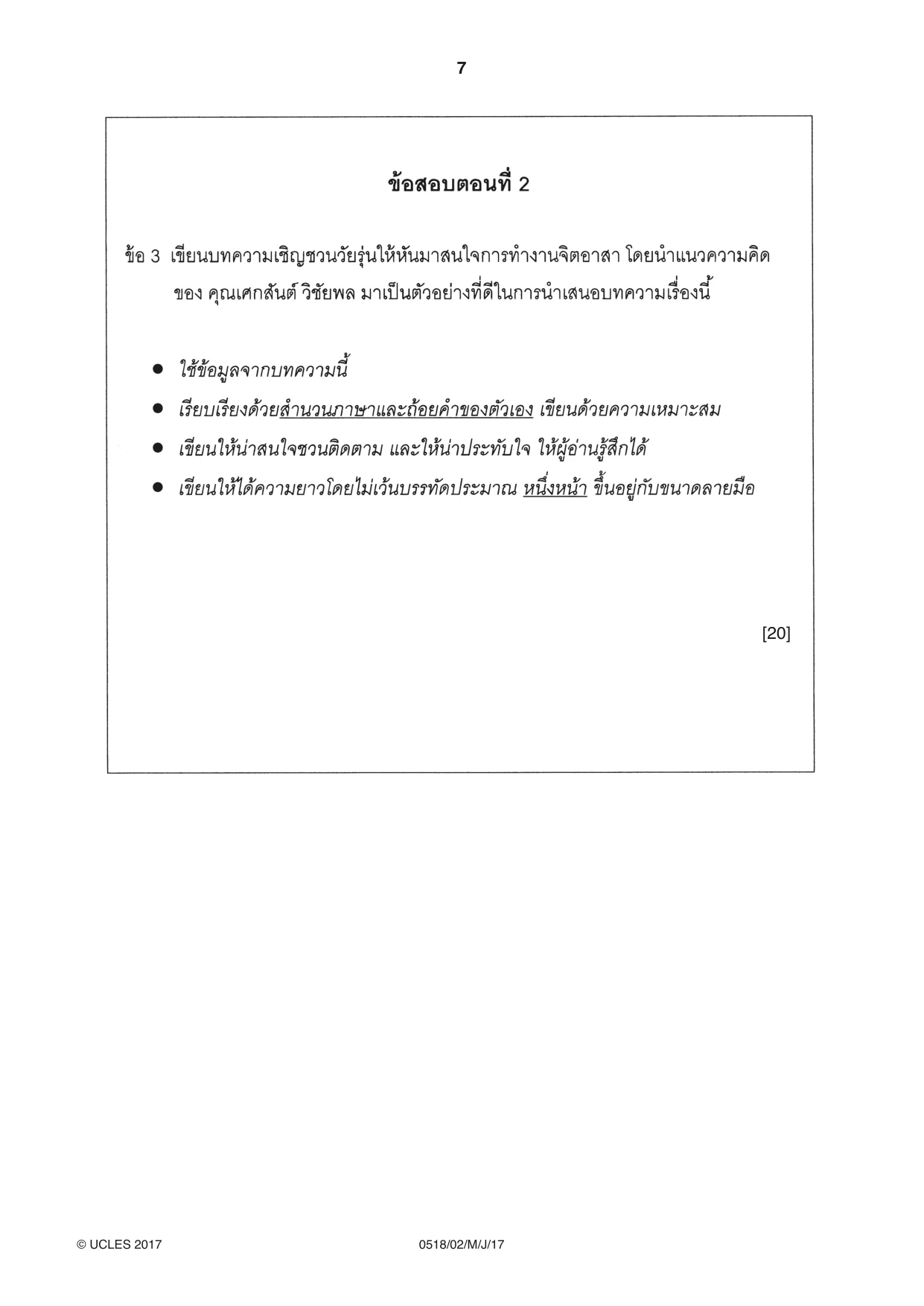
a daaaunaun 2 fo 3 Geuunandquauiaqulituniaulaniiwwanea landward Nan os Fle Man elm ols ° aot van anuandusl Ftewa wuilusoadwhalunisiniauaunariisast yey a lafayadinunagiais GeuiFeno A WIWA IW UAL HOLA VATION MEWAIATIUUNIZAN Gen aulevouiaan uaslidausenile ligeugan ly - » 1 ~ Fe oe 4 Geulilenanenaiagliduussviauseaios wisi YWAGNUILMAINA [20] © UCLES 2017 0518/02/M/J/17,
Question paper, page 8
8 0518/02/M/J/17 © UCLES 2017 Permission to reproduce items where third-party owned material protected by copyright is included has been sought and cleared where possible. Every reasonable effort has been made by the publisher (UCLES) to trace copyright holders, but if any items requiring clearance have unwittingly been included, the publisher will be pleased to make amends at the earliest possible opportunity. To avoid the issue of disclosure of answer-related information to candidates, all copyright acknowledgements are reproduced online in the Cambridge International Examinations Copyright Acknowledgements Booklet. This is produced for each series of examinations and is freely available to download at www.cie.org.uk after the live examination series. Cambridge International Examinations is part of the Cambridge Assessment Group. Cambridge Assessment is the brand name of University of Cambridge Local Examinations Syndicate (UCLES), which is itself a department of the University of Cambridge. BLANK PAGE
Mark scheme, page 1
® IGCSE is a registered trademark. This document consists of 6 printed pages. © UCLES 2017 [Turn over Cambridge International Examinations Cambridge International General Certificate of Secondary Education FIRST LANGUAGE THAI 0518/02 Paper 2 Reading and Directed Writing May/June 2017 MARK SCHEME Maximum Mark: 60 Published This mark scheme is published as an aid to teachers and candidates, to indicate the requirements of the examination. It shows the basis on which Examiners were instructed to award marks. It does not indicate the details of the discussions that took place at an Examiners’ meeting before marking began, which would have considered the acceptability of alternative answers. Mark schemes should be read in conjunction with the question paper and the Principal Examiner Report for Teachers. Cambridge will not enter into discussions about these mark schemes. Cambridge is publishing the mark schemes for the May/June 2017 series for most Cambridge IGCSE®, Cambridge International A and AS Level and Cambridge Pre-U components, and some Cambridge O Level components.
Mark scheme, page 2
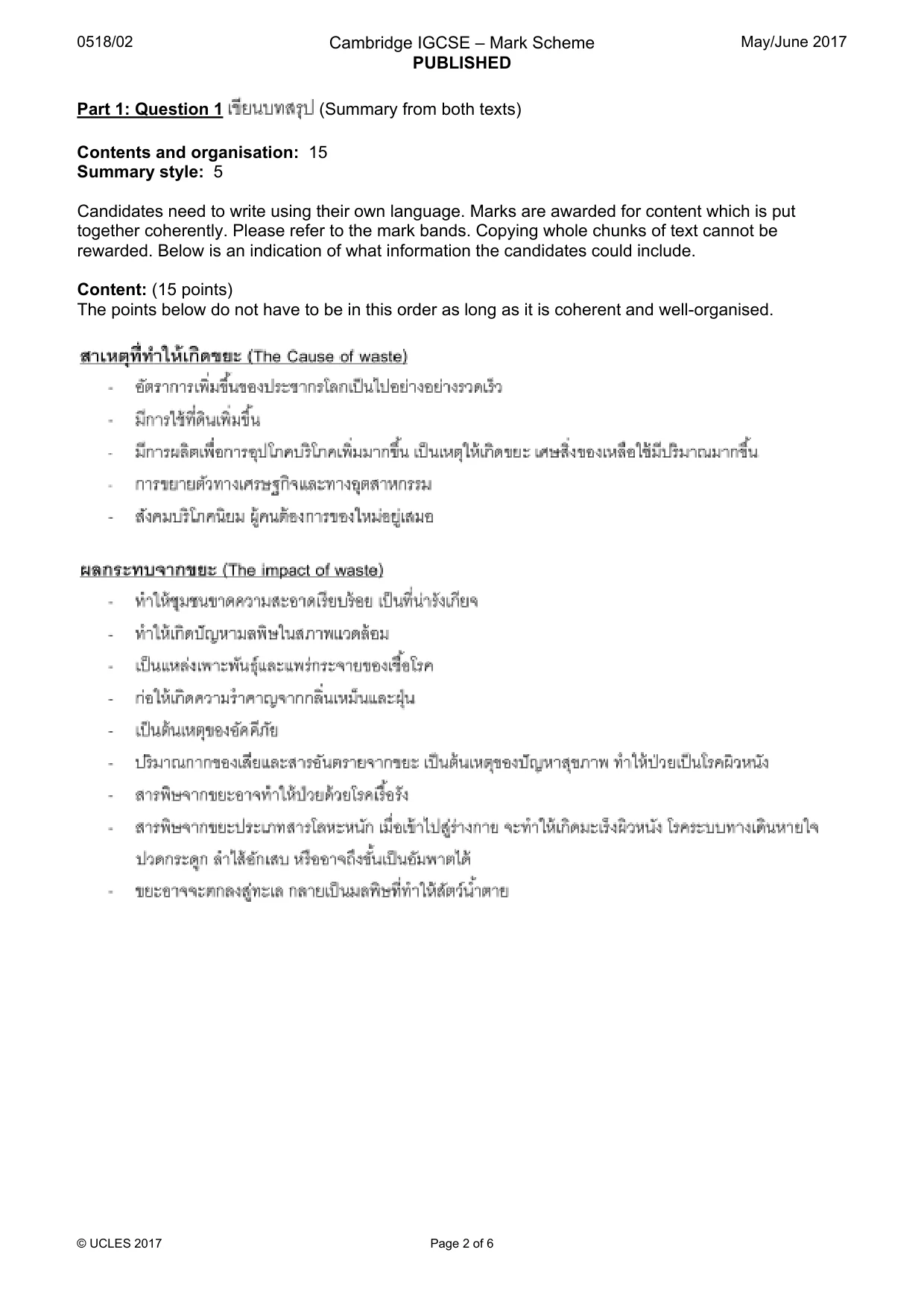
0518/02 Cambridge IGCSE – Mark Scheme PUBLISHED May/June 2017 © UCLES 2017 Page 2 of 6 Part 1: Question 1 (Summary from both texts) Contents and organisation: 15 Summary style: 5 Candidates need to write using their own language. Marks are awarded for content which is put together coherently. Please refer to the mark bands. Copying whole chunks of text cannot be rewarded. Below is an indication of what information the candidates could include. Content: (15 points) The points below do not have to be in this order as long as it is coherent and well-organised.
Mark scheme, page 3
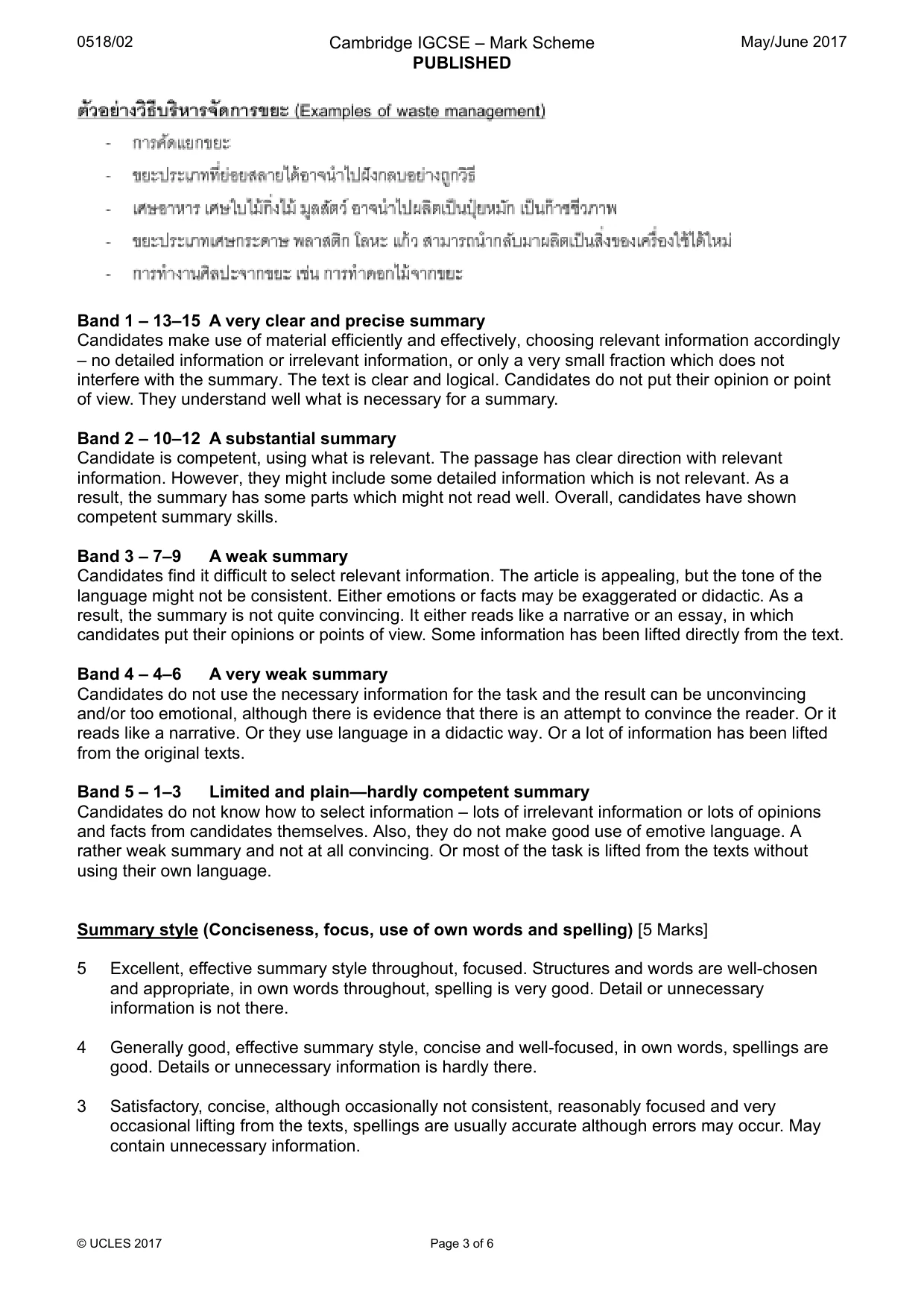
0518/02 Cambridge IGCSE – Mark Scheme PUBLISHED May/June 2017 © UCLES 2017 Page 3 of 6 Band 1 – 13–15 A very clear and precise summary Candidates make use of material efficiently and effectively, choosing relevant information accordingly – no detailed information or irrelevant information, or only a very small fraction which does not interfere with the summary. The text is clear and logical. Candidates do not put their opinion or point of view. They understand well what is necessary for a summary. Band 2 – 10–12 A substantial summary Candidate is competent, using what is relevant. The passage has clear direction with relevant information. However, they might include some detailed information which is not relevant. As a result, the summary has some parts which might not read well. Overall, candidates have shown competent summary skills. Band 3 – 7–9 A weak summary Candidates find it difficult to select relevant information. The article is appealing, but the tone of the language might not be consistent. Either emotions or facts may be exaggerated or didactic. As a result, the summary is not quite convincing. It either reads like a narrative or an essay, in which candidates put their opinions or points of view. Some information has been lifted directly from the text. Band 4 – 4–6 A very weak summary Candidates do not use the necessary information for the task and the result can be unconvincing and/or too emotional, although there is evidence that there is an attempt to convince the reader. Or it reads like a narrative. Or they use language in a didactic way. Or a lot of information has been lifted from the original texts. Band 5 – 1–3 Limited and plain—hardly competent summary Candidates do not know how to select information – lots of irrelevant information or lots of opinions and facts from candidates themselves. Also, they do not make good use of emotive language. A rather weak summary and not at all convincing. Or most of the task is lifted from the texts without using their own language. Summary style (Conciseness, focus, use of own words and spelling) [5 Marks] 5 Excellent, effective summary style throughout, focused. Structures and words are well-chosen and appropriate, in own words throughout, spelling is very good. Detail or unnecessary information is not there. 4 Generally good, effective summary style, concise and well-focused, in own words, spellings are good. Details or unnecessary information is hardly there. 3 Satisfactory, concise, although occasionally not consistent, reasonably focused and very occasional lifting from the texts, spellings are usually accurate although errors may occur. May contain unnecessary information.
Mark scheme, page 4
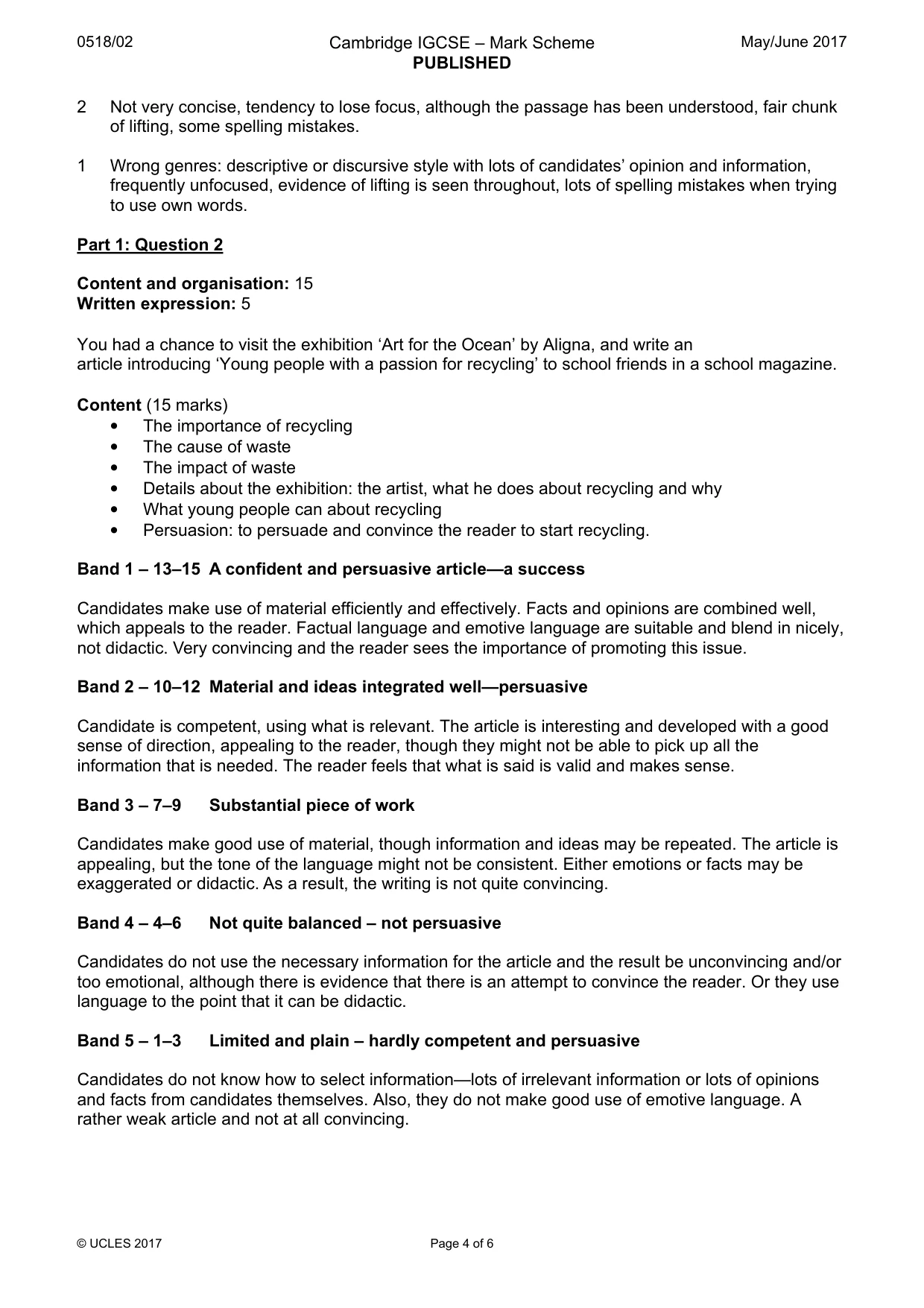
0518/02 Cambridge IGCSE – Mark Scheme PUBLISHED May/June 2017 © UCLES 2017 Page 4 of 6 2 Not very concise, tendency to lose focus, although the passage has been understood, fair chunk of lifting, some spelling mistakes. 1 Wrong genres: descriptive or discursive style with lots of candidates’ opinion and information, frequently unfocused, evidence of lifting is seen throughout, lots of spelling mistakes when trying to use own words. Part 1: Question 2 Content and organisation: 15 Written expression: 5 You had a chance to visit the exhibition ‘Art for the Ocean’ by Aligna, and write an article introducing ‘Young people with a passion for recycling’ to school friends in a school magazine. Content (15 marks) • The importance of recycling • The cause of waste • The impact of waste • Details about the exhibition: the artist, what he does about recycling and why • What young people can about recycling • Persuasion: to persuade and convince the reader to start recycling. Band 1 – 13–15 A confident and persuasive article—a success Candidates make use of material efficiently and effectively. Facts and opinions are combined well, which appeals to the reader. Factual language and emotive language are suitable and blend in nicely, not didactic. Very convincing and the reader sees the importance of promoting this issue. Band 2 – 10–12 Material and ideas integrated well—persuasive Candidate is competent, using what is relevant. The article is interesting and developed with a good sense of direction, appealing to the reader, though they might not be able to pick up all the information that is needed. The reader feels that what is said is valid and makes sense. Band 3 – 7–9 Substantial piece of work Candidates make good use of material, though information and ideas may be repeated. The article is appealing, but the tone of the language might not be consistent. Either emotions or facts may be exaggerated or didactic. As a result, the writing is not quite convincing. Band 4 – 4–6 Not quite balanced – not persuasive Candidates do not use the necessary information for the article and the result be unconvincing and/or too emotional, although there is evidence that there is an attempt to convince the reader. Or they use language to the point that it can be didactic. Band 5 – 1–3 Limited and plain – hardly competent and persuasive Candidates do not know how to select information—lots of irrelevant information or lots of opinions and facts from candidates themselves. Also, they do not make good use of emotive language. A rather weak article and not at all convincing.
Mark scheme, page 5
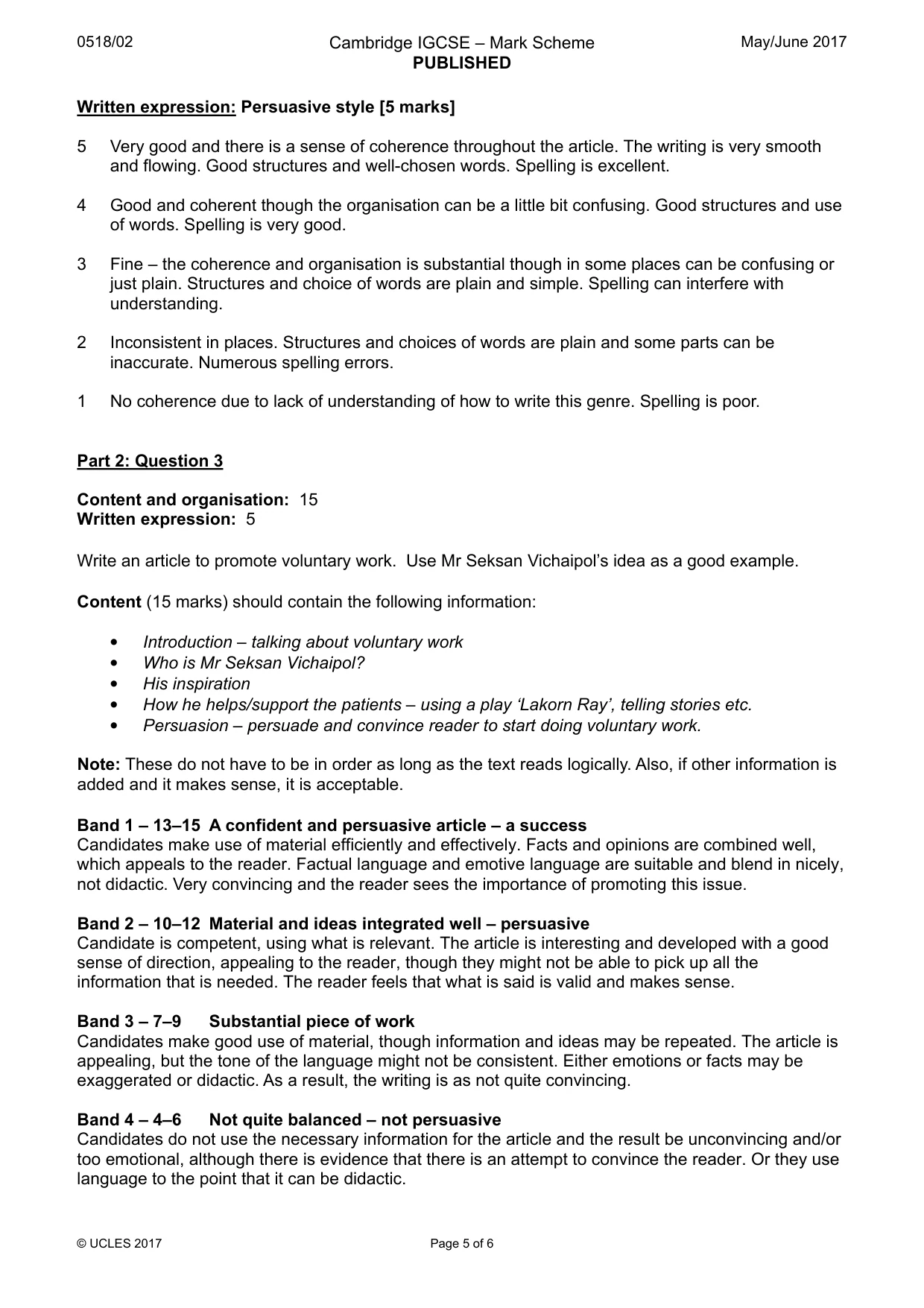
0518/02 Cambridge IGCSE – Mark Scheme PUBLISHED May/June 2017 © UCLES 2017 Page 5 of 6 Written expression: Persuasive style [5 marks] 5 Very good and there is a sense of coherence throughout the article. The writing is very smooth and flowing. Good structures and well-chosen words. Spelling is excellent. 4 Good and coherent though the organisation can be a little bit confusing. Good structures and use of words. Spelling is very good. 3 Fine – the coherence and organisation is substantial though in some places can be confusing or just plain. Structures and choice of words are plain and simple. Spelling can interfere with understanding. 2 Inconsistent in places. Structures and choices of words are plain and some parts can be inaccurate. Numerous spelling errors. 1 No coherence due to lack of understanding of how to write this genre. Spelling is poor. Part 2: Question 3 Content and organisation: 15 Written expression: 5 Write an article to promote voluntary work. Use Mr Seksan Vichaipol’s idea as a good example. Content (15 marks) should contain the following information: • Introduction – talking about voluntary work • Who is Mr Seksan Vichaipol? • His inspiration • How he helps/support the patients – using a play ‘Lakorn Ray’, telling stories etc. • Persuasion – persuade and convince reader to start doing voluntary work. Note: These do not have to be in order as long as the text reads logically. Also, if other information is added and it makes sense, it is acceptable. Band 1 – 13–15 A confident and persuasive article – a success Candidates make use of material efficiently and effectively. Facts and opinions are combined well, which appeals to the reader. Factual language and emotive language are suitable and blend in nicely, not didactic. Very convincing and the reader sees the importance of promoting this issue. Band 2 – 10–12 Material and ideas integrated well – persuasive Candidate is competent, using what is relevant. The article is interesting and developed with a good sense of direction, appealing to the reader, though they might not be able to pick up all the information that is needed. The reader feels that what is said is valid and makes sense. Band 3 – 7–9 Substantial piece of work Candidates make good use of material, though information and ideas may be repeated. The article is appealing, but the tone of the language might not be consistent. Either emotions or facts may be exaggerated or didactic. As a result, the writing is as not quite convincing. Band 4 – 4–6 Not quite balanced – not persuasive Candidates do not use the necessary information for the article and the result be unconvincing and/or too emotional, although there is evidence that there is an attempt to convince the reader. Or they use language to the point that it can be didactic.
Mark scheme, page 6
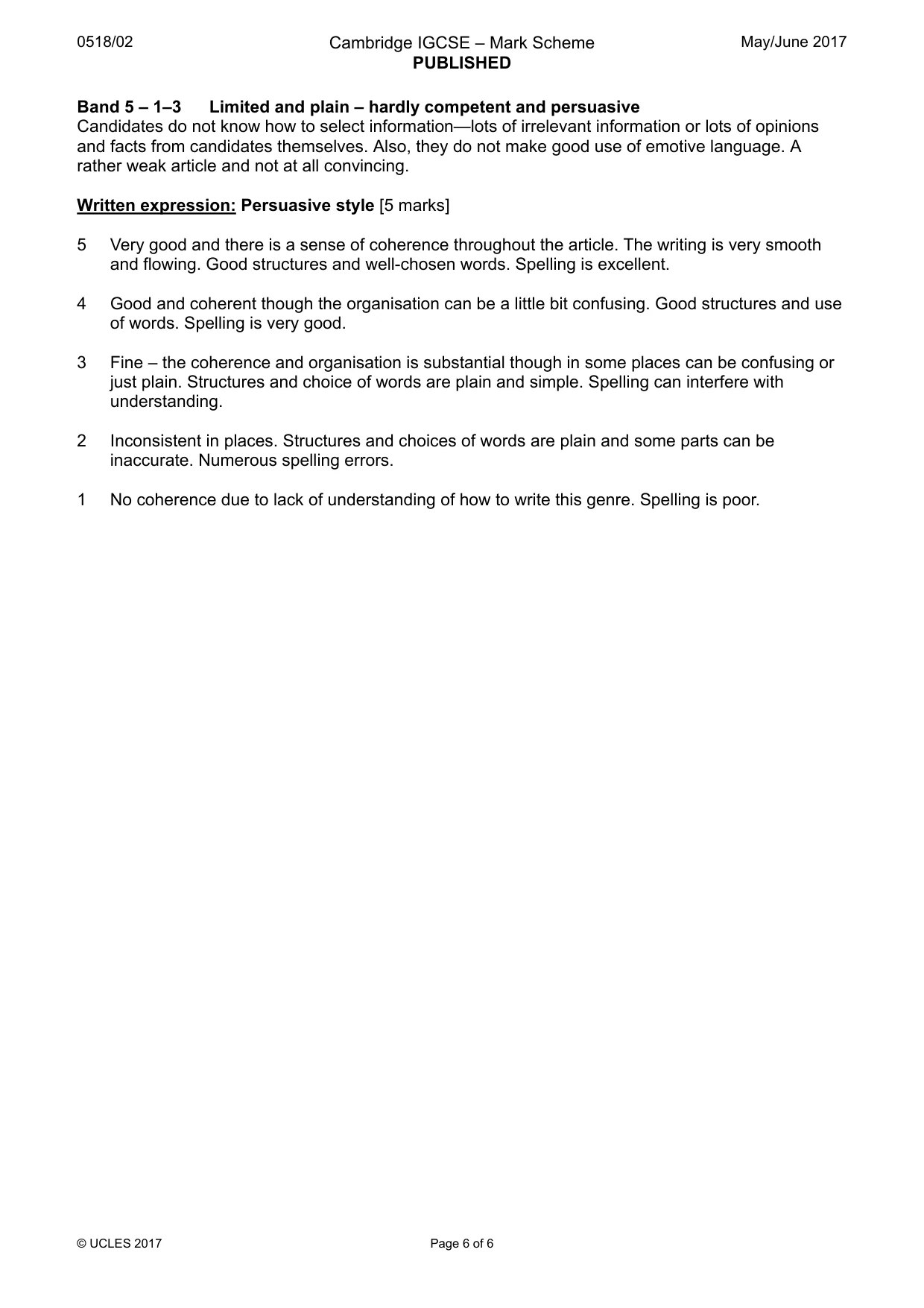
0518/02 Cambridge IGCSE – Mark Scheme PUBLISHED May/June 2017 © UCLES 2017 Page 6 of 6 Band 5 – 1–3 Limited and plain – hardly competent and persuasive Candidates do not know how to select information—lots of irrelevant information or lots of opinions and facts from candidates themselves. Also, they do not make good use of emotive language. A rather weak article and not at all convincing. Written expression: Persuasive style [5 marks] 5 Very good and there is a sense of coherence throughout the article. The writing is very smooth and flowing. Good structures and well-chosen words. Spelling is excellent. 4 Good and coherent though the organisation can be a little bit confusing. Good structures and use of words. Spelling is very good. 3 Fine – the coherence and organisation is substantial though in some places can be confusing or just plain. Structures and choice of words are plain and simple. Spelling can interfere with understanding. 2 Inconsistent in places. Structures and choices of words are plain and some parts can be inaccurate. Numerous spelling errors. 1 No coherence due to lack of understanding of how to write this genre. Spelling is poor.
What you needed in this session
Cambridge’s own grade thresholds for 2017 May/June, Paper 2 · Variant 1. A higher threshold means an easier paper — the bar moves with how the cohort did.