Cambridge IGCSE Thai - First Language 0518 — 2008 May/June Paper 2 · Variant 1
0518/21/M/J/08 · 60 marks · ≈68 min
The question paper and its mark scheme, free to read here and free to download. This is Cambridge’s own paper, exactly as it was sat.
Question paper8 pages
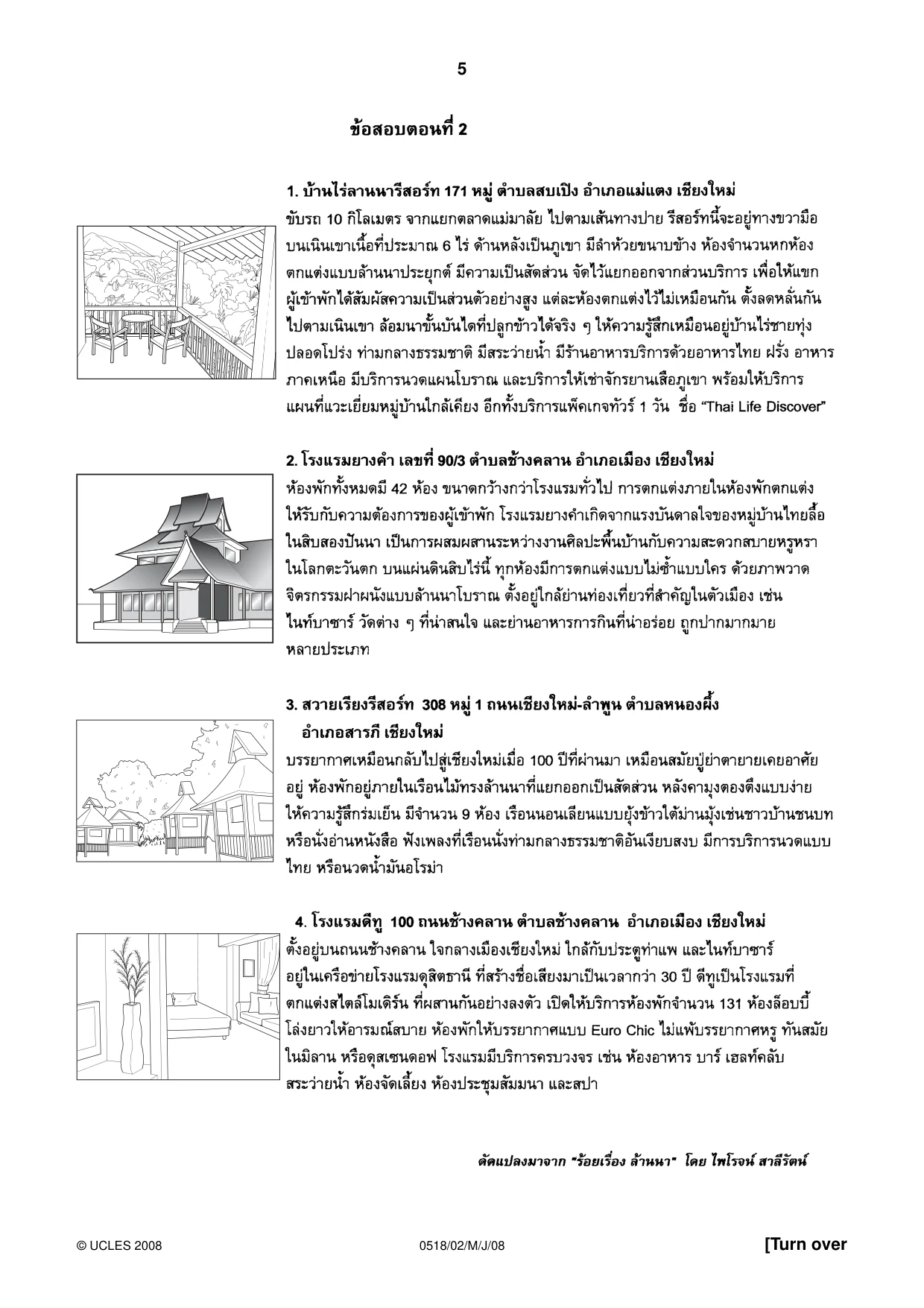
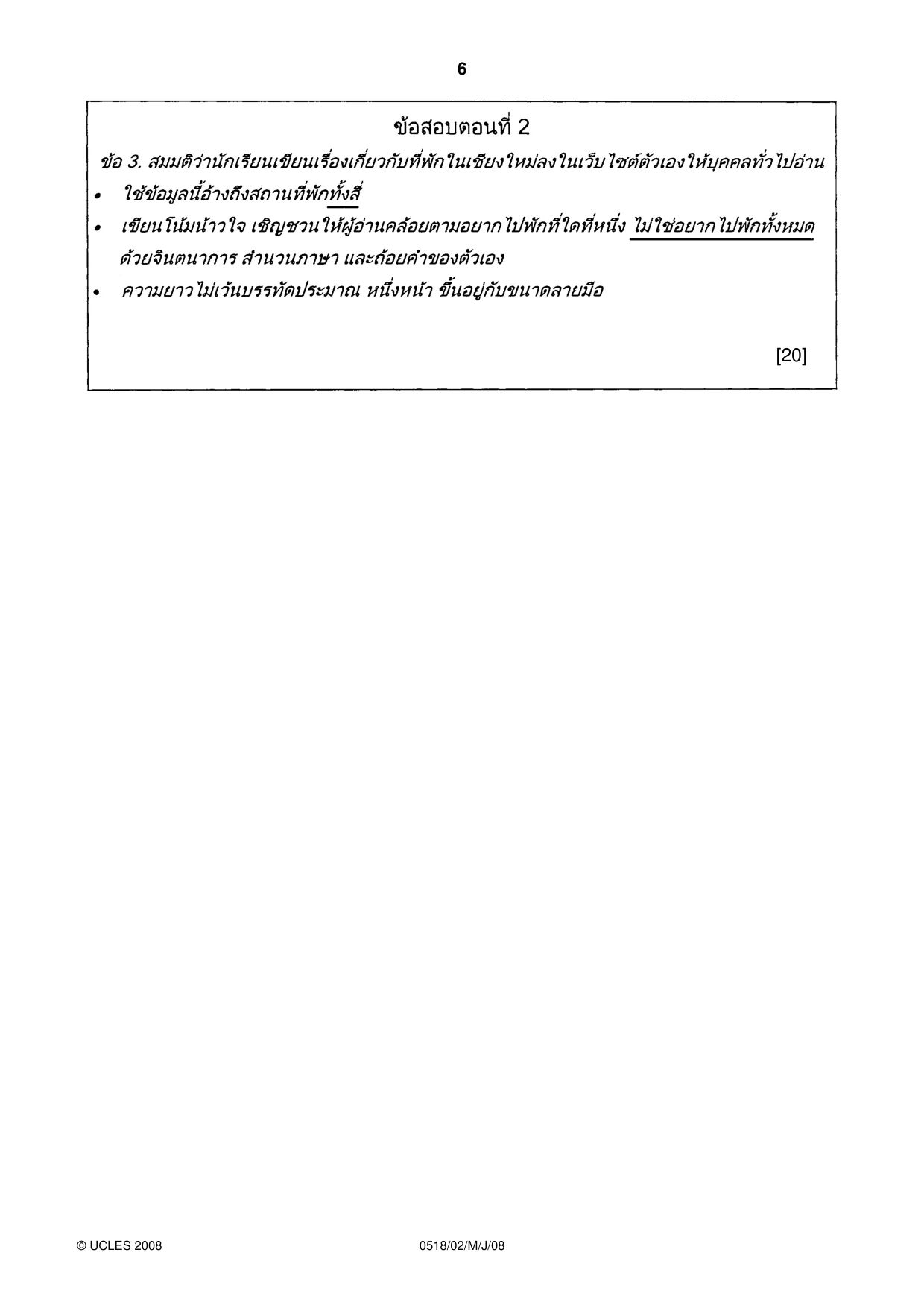

Mark scheme6 pages
Answers below. Sit the paper first if you are practising.
Paper as text
Question paper, page 1
This document consists of 6 printed pages and 2 blank pages. SP (NF/CGW/TL) T53726/3 © UCLES 2008 [Turn over UNIVERSITY OF CAMBRIDGE INTERNATIONAL EXAMINATIONS International General Certificate of Secondary Education READ THESE INSTRUCTIONS FIRST If you have been given an Answer Booklet, follow the instructions on the front cover of the Booklet. Write your Centre number, candidate number and name on all the work you hand in. Write in dark blue or black pen. Do not use staples, paper clips, highlighters, glue or correction fluid. Answer all questions. Dictionaries are not permitted. At the end of the examination, fasten all your work securely together. The number of marks is given in brackets [ ] at the end of each question or part question. * 9 8 1 7 8 3 7 3 9 4 * FIRST LANGUAGE THAI 0518/02 Paper 2 Reading and Directed Writing May/June 2008 2 hours 15 minutes Additional Materials: Answer Booklet/Paper www.XtremePapers.com
Question paper, page 2
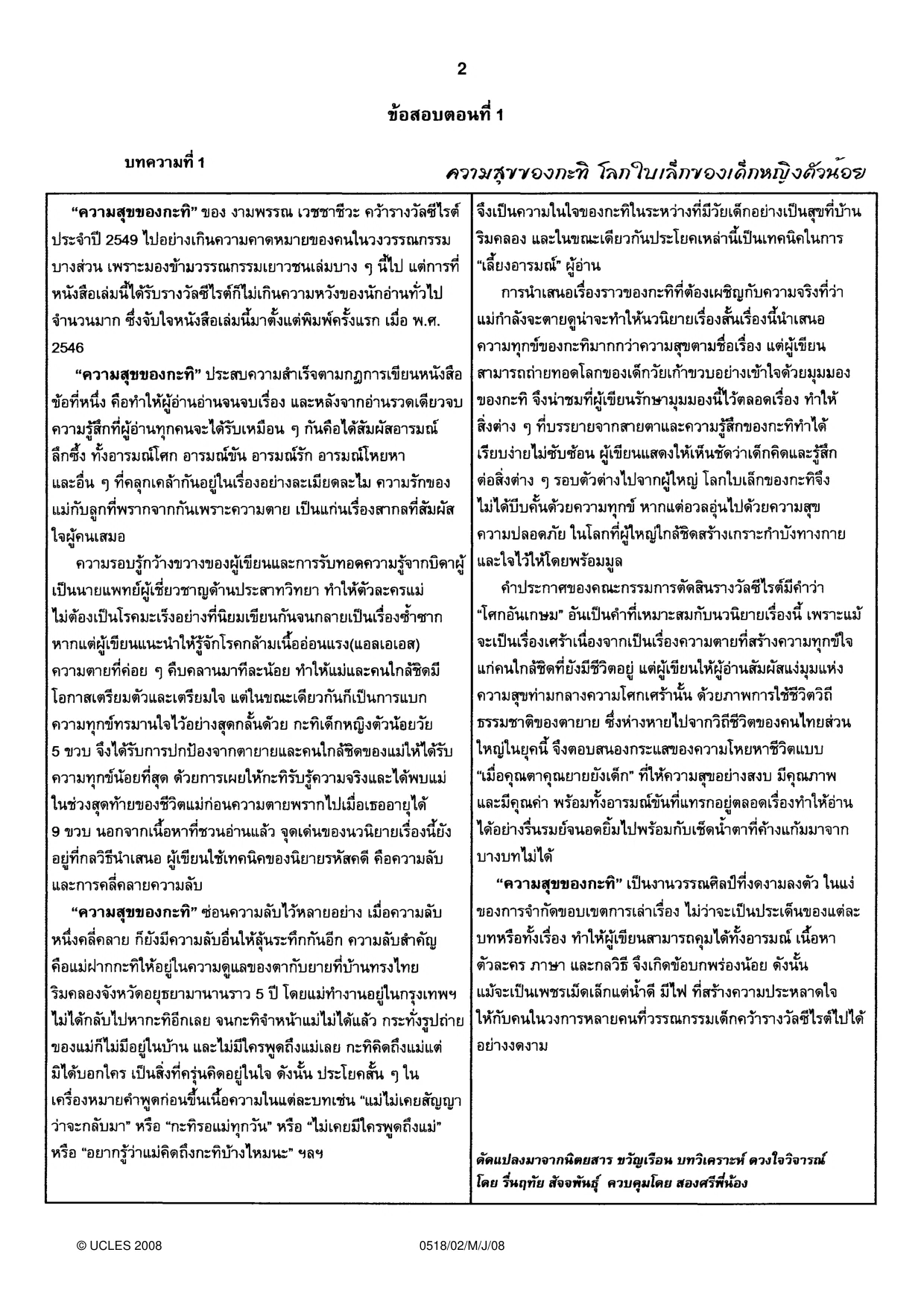
2 a Joaauaaun 1 a unarian 1 “aniaquaasneh” vas naw ODD: AHTwiad led sedi) 2549 ‘Wadrafinenumanwuasaulurassonssy UWA IWTIEVATWITINNTTWITIVWLANU 4 Ma uainasii wibaGardutldsumsiad loaf lai finerumiovastndwahl Annawan SsdulewbeFaduianeoudiawadoum ule wa. 2546 “anquvasnen” Ussauanumisamangnrsieunivaa tofnts farilideudmeusutias uarnasainduTaanaU annudinfidéannaus: asunion 9 huAalaauriaarsuol Anais Yoarsuallan ovsunkiy arswolsn arsuaflwem uardu 9 finaniadriuadlutasatnsacifinna:'la anwinuas wivugnfinnnaintinwnenname \uurinGassnanduda lajamaaa anusaugnhsrwvasiionuamsiunananagoniedy unwunnddideangd alsin ylwmrazesual ‘bidoailulsnucdisathavifiundeutuaunewuludasdiann set vee Pe aan winudiidienuusdaliganlsandaitadonusa(uaaiaias) amumevidas 9 Aunatuaniactan voldusiuacnulndiad Tomaotuumuasiotuale udluumeieatuAiunrsuun amanninsanlaTatnsganaudae nefiinwnga@datenie 5 10u SeleFuMaUndasminmeruacaulndsavasullw lat anunntilantiqa soumaneliinefisugenaesouas laws luthagavhwvas#iauiiauenumewnnludasaayls 9 vu Mandinilamfmma ude gausuroswrierwitastcss agjfinatiume Hivuldinnfiavasiawaiand Manrway warms way “anaqunasnefi” saunnuaulinawatins Wennwdy wilsefinain Adsienadudulvquseviniudn anvauinagy Aauaidhnne Alvar luanaquavesmiumnumhunsstng FunaasdowinaysuwwUTN 5 0 lasuairnsuadlunzanws ‘ldnduluwinefiénay ounzfidwuallallduda nsevoguene vasuiflidogluiny ua: laifilaswadiousian nzfiimfsualud Meuanleas uasfinguAnadlule data uselundy 9 la infoomanudyarioudurfonmaluudacuncdy “ualaimeayan naenduay’ vio “nzfizauinniw wie “Laine laayatisuai" waa “anny nuimatanshihnslwaus” yas © UCLES 2008 ATAAVVOINEA TANVUIANVOUANYBIDIGI“OS Faluarululavasneflusen ifs nanadraduquiin Sunaas uacluvncuatlseluamariiiunatialuns “@usorswal damn mahianadassvemnsAfidouniyiuanwddein with@sarmugieerltwainadesmudastihueua anamnivesnefannnhenwaumatatses woigition maniathenaalanvandninmyuadiailatuaysves veonehi dovrmufididuninnaasasitliaaoatios wiht facia 4 fusinevinmumuaanasinuasnshinile Goudwlidudon disuuaasliiiutoninfiauaszan dawadine 9 soumrdirwiiainglng lanluinvasnefits ‘Liléiududauenaynd minudaraduludaunriwgy arunlaaasiy lulantidlnglndiaad annem uarlalililauwiaaya Anisemevasamenssamisdagus IAF LAAT Tandwwnwar duiludnfimnseniuuainwdass wneud anfugonhmosviniugosnnumunaheanimntle urinulndtandeitinad usigiiowliyeudurioudasuvis argurnanarsealanerdii MomwmalssiaIa mawMavawmew SvwmelivniaPiavasawlnsdn Anqilugndt Jenoumnosnscusvosanalnumdiquuy “\Goqamanenudadn Alvenueuadvasu demmw waciqmen wiourvarsuokiufunsnadasaniasyiaienn Wath dusutauantin lndauntutorroaidrauriusnain uum “annqunasnefi” iuswasmufialfisasiuasda laud vasmrsiievauvaniaardas baidnasiluussauvasusias unwiaragas rhiligiduumansagalldsersuot fam @azas mw uaenaid Safintounniastay Foun udazuilmasiadinustha TW Aahsenlsenarela Wiitueuluaemasnawaufasnsandinetinsiad alle advasy Gaudaanoiniauars wignion unianedl arslaiersal 4 ~ os Eaa Taw Suqrin doors aruqulay aasatiios 0518/02/M/J/08
Question paper, page 3
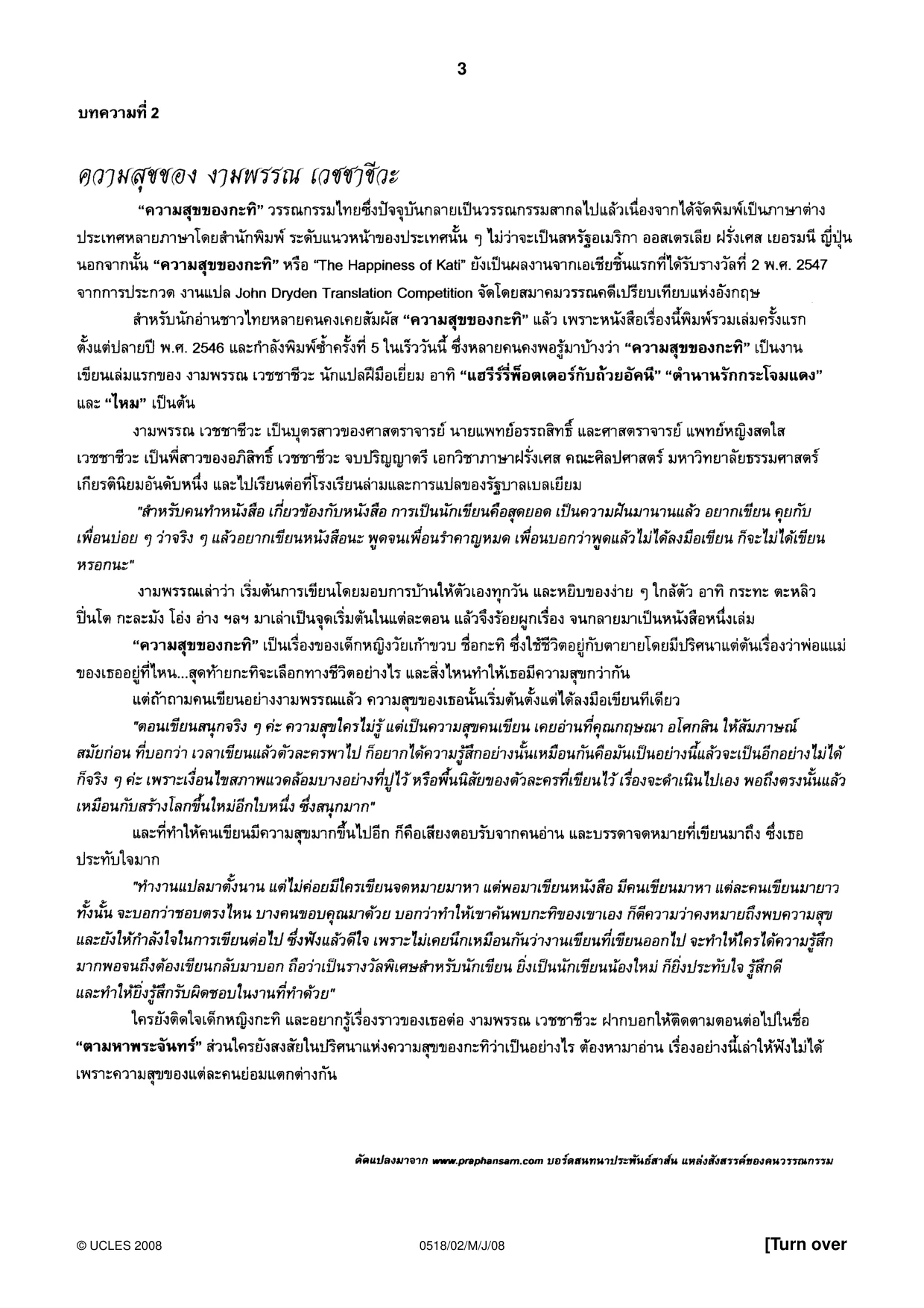
3 0518/02/M/J/08 © UCLES 2008 [Turn over
Question paper, page 4
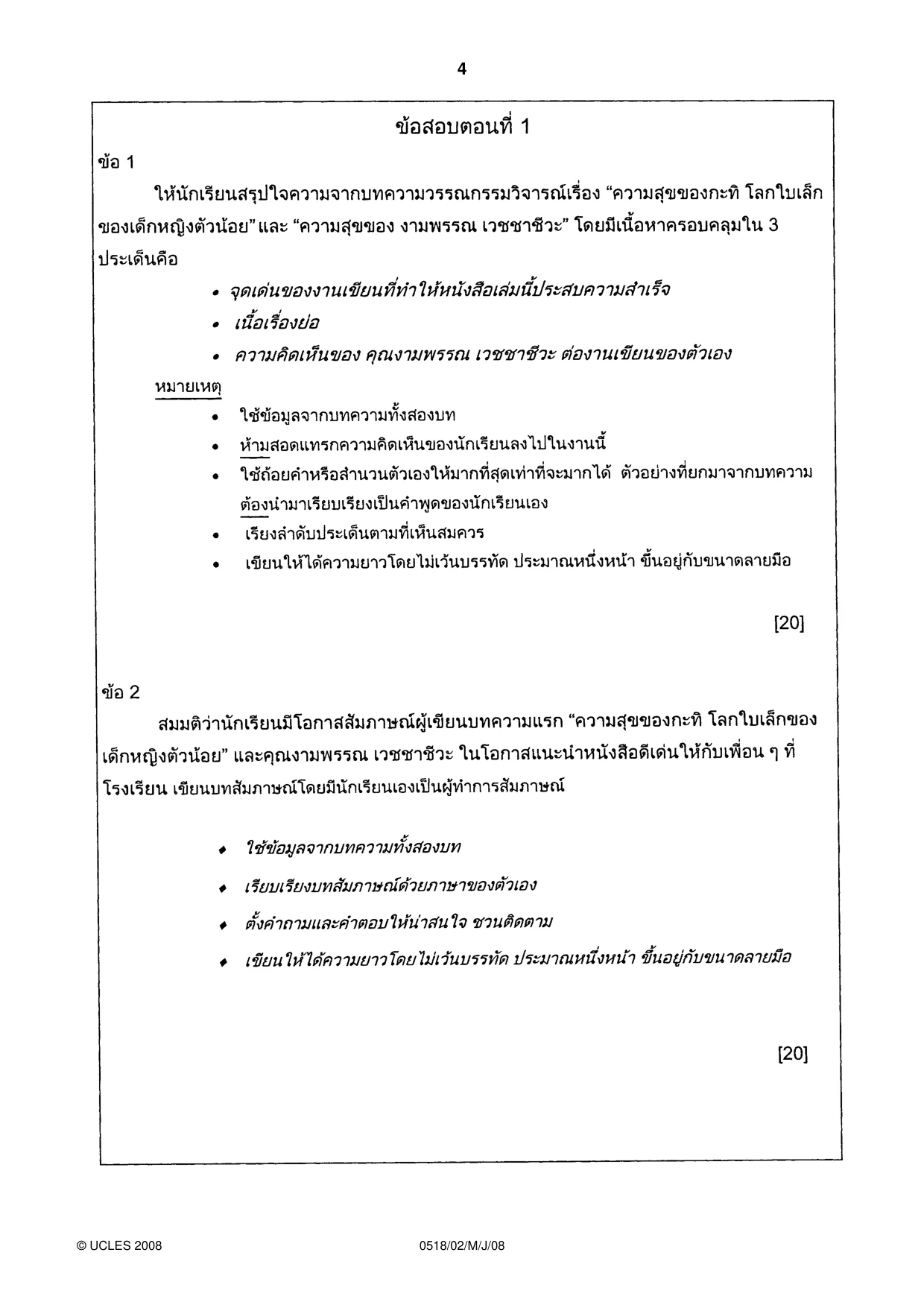
dadaunaun 1 da1 UiinSauag laarainunariassanssutasalisas “Ar duaasneh Tanludn davanudvaAritag” way “AINAUUAY VINWSSM VIII” Tnuiidaviasaunquiu 3 useisdufia ° galauvaveudeuryir limbanaui/seauarudnse ¢ wladavda © ATIUAMMUYAY NAVIINNISA LIYWIF Ie av Mi TuyvaI Wad UNITE © Addayacinunanuviedasun . MudanunsnannAaiusaninguuasaltusui © IddaudavadaudriasWhniniidawiiiennnls soadaiumnanunany Faniwrsausuiudmavaniniseuas © Busdaduilseiumufniuaues © eu W dare tae hiduussvia Usenet duadivawiaaruiio [20] da 2 Auudininguuillamaddunraldiisuunariusn “anwuduvainei Tanluranvas Wnudidolaw” warqmwwwssm aera Auianrduuslinivaadiu vAuion 9 7 TsvlSuu Muuundunrallavsiinseuaniugvanrsdunnal ¢ IedayaainunArUInAaIUN ¢ Beusevunduniolsen uw yaaa 6 oA uad may DiuraU le wIUAAA TA ¢ (euld daring bituussiia Vsernivu) Guagivvuma oie [20] © UCLES 2008 0518/02/M/J/08
Question paper, page 5
5 0518/02/M/J/08 © UCLES 2008 [Turn over
Question paper, page 6
diadaunaun 2 da 3. aud ninseufeusauAgoiuivin tases inlay ludy losis nay tiyanavy Wa7u - Iddvayatsrvtvanuivaied © eutintsa1s Syysu Tifa undaumuagrn Wrinhlavinds li tdagon Wrinvenua HISFUNUINAT ATUIUNIY] MALOU IVAINUDY - armen biduussvavsana uitends Guaysuvumarudia [20] © UCLES 2008 0518/02/M/J/08
Question paper, page 8
8 0518/02/M/J/08 BLANK PAGE Copyright Acknowledgements: Question 1 © Kwanreun Magazine, August/September 2006. Question 2 © www.praphansam.com Permission to reproduce items where third-party owned material protected by copyright is included has been sought and cleared where possible. Every reasonable effort has been made by the publisher (UCLES) to trace copyright holders, but if any items requiring clearance have unwittingly been included, the publisher will be pleased to make amends at the earliest possible opportunity. University of Cambridge International Examinations is part of the Cambridge Assessment Group. Cambridge Assessment is the brand name of University of Cambridge Local Examinations Syndicate (UCLES), which is itself a department of the University of Cambridge.
Mark scheme, page 1
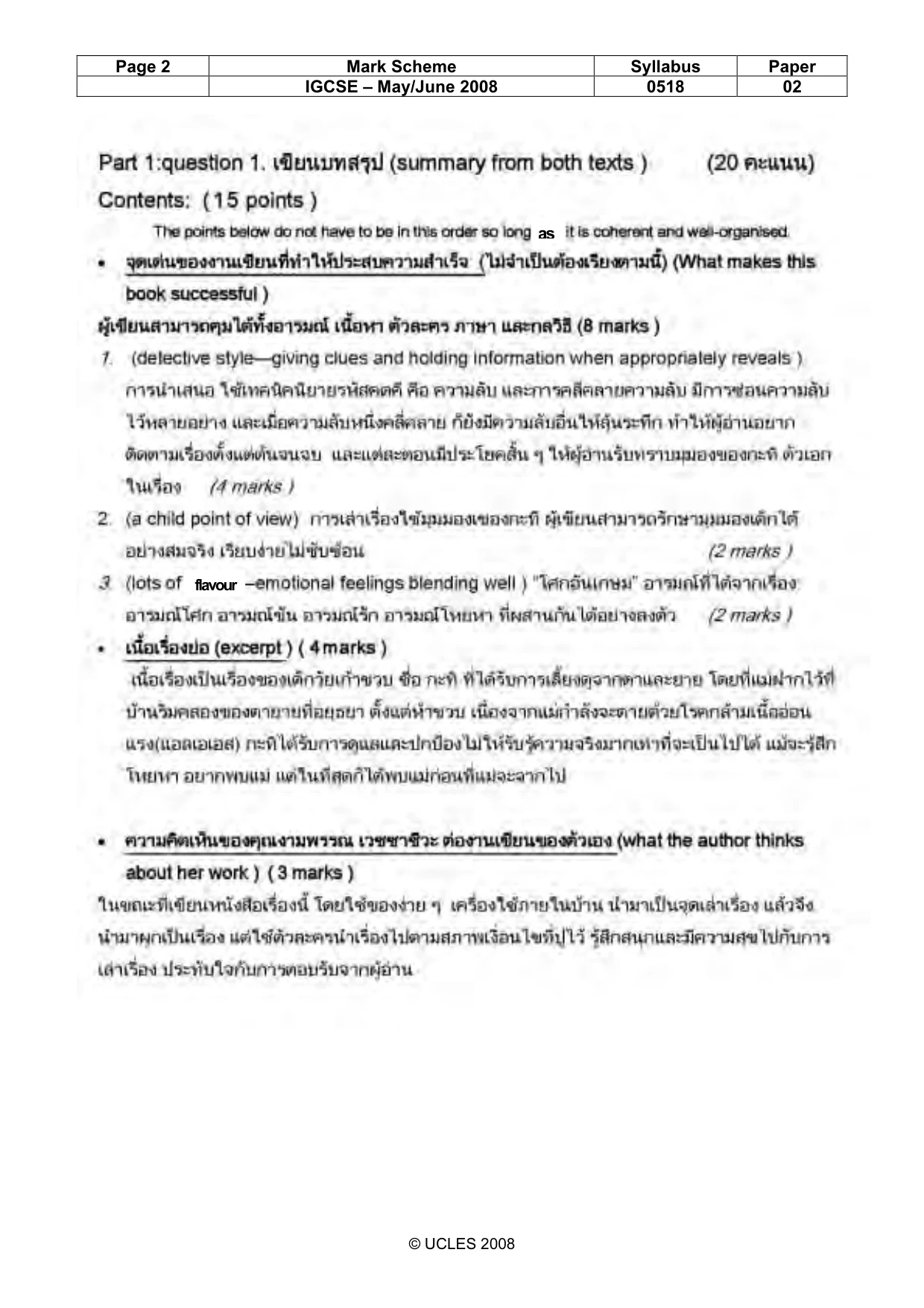
UNIVERSITY OF CAMBRIDGE INTERNATIONAL EXAMINATIONS International General Certificate of Secondary Education MARK SCHEME for the May/June 2008 question paper 0518 FIRST LANGUAGE THAI 0518/02 Paper 2 (Reading and Directed Writing), maximum raw mark 60 This mark scheme is published as an aid to teachers and candidates, to indicate the requirements of the examination. It shows the basis on which Examiners were instructed to award marks. It does not indicate the details of the discussions that took place at an Examiners’ meeting before marking began. All Examiners are instructed that alternative correct answers and unexpected approaches in candidates’ scripts must be given marks that fairly reflect the relevant knowledge and skills demonstrated. Mark schemes must be read in conjunction with the question papers and the report on the examination. • CIE will not enter into discussions or correspondence in connection with these mark schemes. CIE is publishing the mark schemes for the May/June 2008 question papers for most IGCSE, GCE Advanced Level and Advanced Subsidiary Level syllabuses and some Ordinary Level syllabuses. www.XtremePapers.com
Mark scheme, page 2
Page 2 Mark Scheme Syllabus Paper IGCSE – May/June 2008 0518 02 © UCLES 2008 flavour as
Mark scheme, page 3
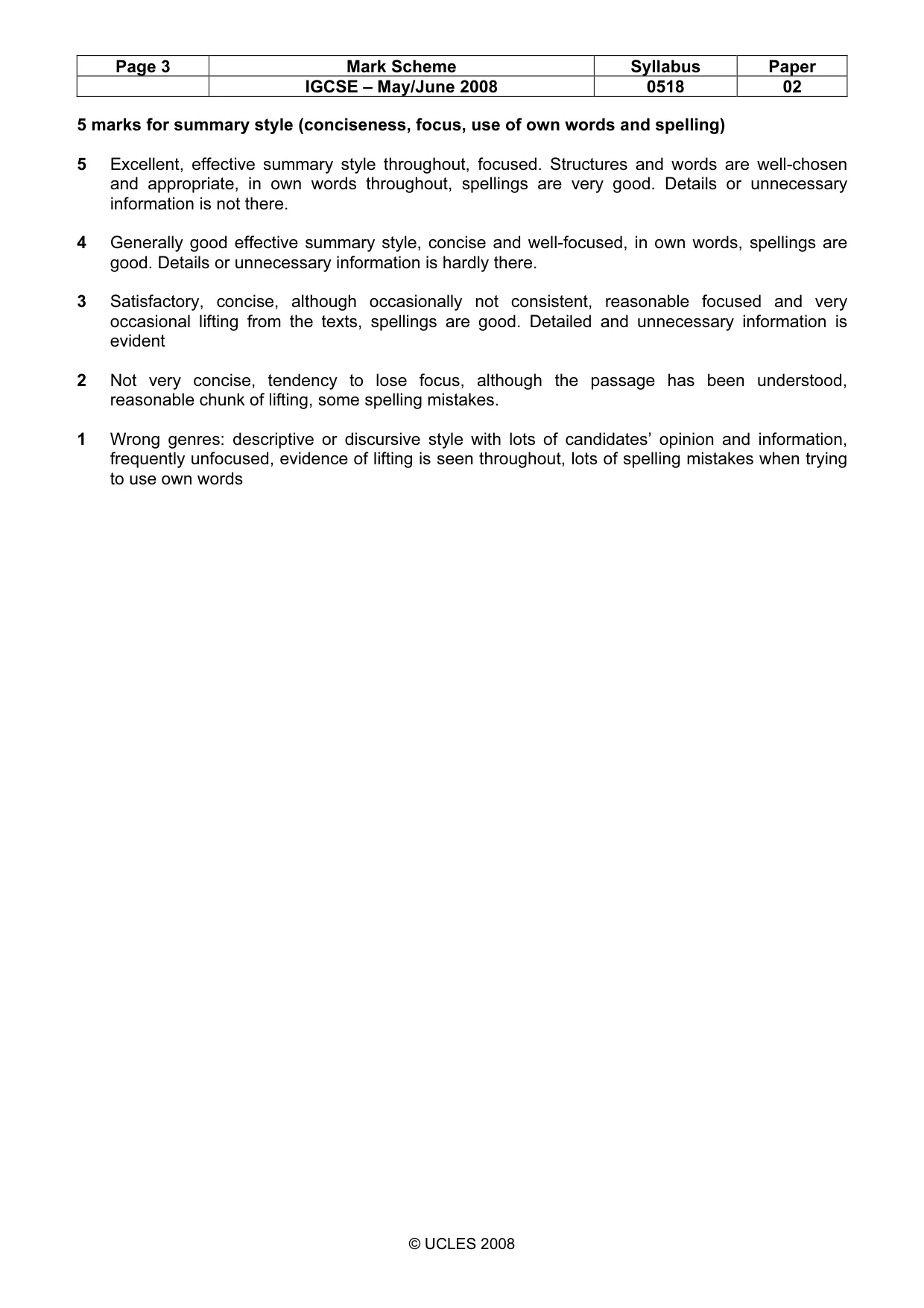
Page 3 Mark Scheme Syllabus Paper IGCSE – May/June 2008 0518 02 © UCLES 2008 5 marks for summary style (conciseness, focus, use of own words and spelling) 5 Excellent, effective summary style throughout, focused. Structures and words are well-chosen and appropriate, in own words throughout, spellings are very good. Details or unnecessary information is not there. 4 Generally good effective summary style, concise and well-focused, in own words, spellings are good. Details or unnecessary information is hardly there. 3 Satisfactory, concise, although occasionally not consistent, reasonable focused and very occasional lifting from the texts, spellings are good. Detailed and unnecessary information is evident 2 Not very concise, tendency to lose focus, although the passage has been understood, reasonable chunk of lifting, some spelling mistakes. 1 Wrong genres: descriptive or discursive style with lots of candidates’ opinion and information, frequently unfocused, evidence of lifting is seen throughout, lots of spelling mistakes when trying to use own words
Mark scheme, page 4
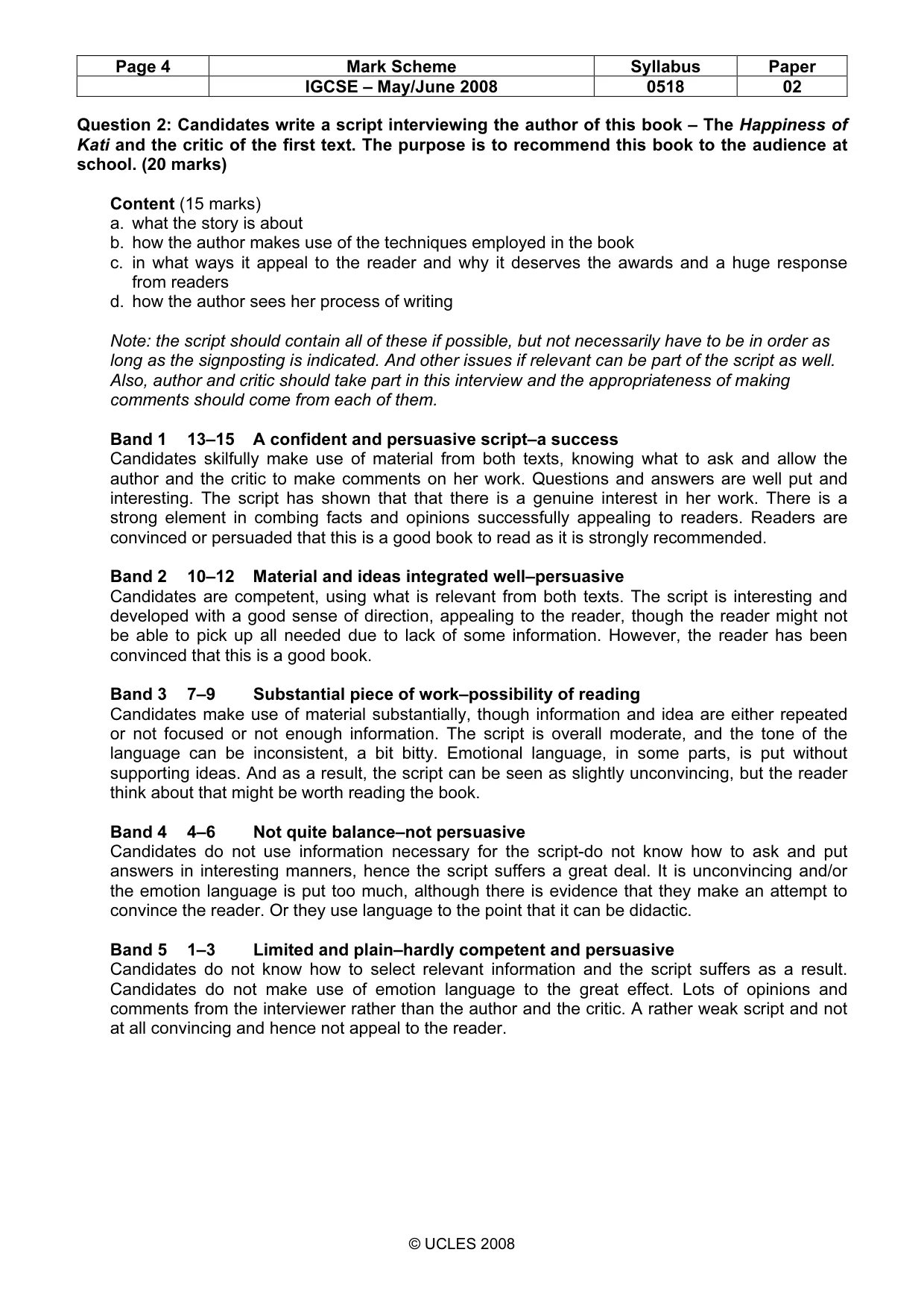
Page 4 Mark Scheme Syllabus Paper IGCSE – May/June 2008 0518 02 © UCLES 2008 Question 2: Candidates write a script interviewing the author of this book – The Happiness of Kati and the critic of the first text. The purpose is to recommend this book to the audience at school. (20 marks) Content (15 marks) a. what the story is about b. how the author makes use of the techniques employed in the book c. in what ways it appeal to the reader and why it deserves the awards and a huge response from readers d. how the author sees her process of writing Note: the script should contain all of these if possible, but not necessarily have to be in order as long as the signposting is indicated. And other issues if relevant can be part of the script as well. Also, author and critic should take part in this interview and the appropriateness of making comments should come from each of them. Band 1 13–15 A confident and persuasive script–a success Candidates skilfully make use of material from both texts, knowing what to ask and allow the author and the critic to make comments on her work. Questions and answers are well put and interesting. The script has shown that that there is a genuine interest in her work. There is a strong element in combing facts and opinions successfully appealing to readers. Readers are convinced or persuaded that this is a good book to read as it is strongly recommended. Band 2 10–12 Material and ideas integrated well–persuasive Candidates are competent, using what is relevant from both texts. The script is interesting and developed with a good sense of direction, appealing to the reader, though the reader might not be able to pick up all needed due to lack of some information. However, the reader has been convinced that this is a good book. Band 3 7–9 Substantial piece of work–possibility of reading Candidates make use of material substantially, though information and idea are either repeated or not focused or not enough information. The script is overall moderate, and the tone of the language can be inconsistent, a bit bitty. Emotional language, in some parts, is put without supporting ideas. And as a result, the script can be seen as slightly unconvincing, but the reader think about that might be worth reading the book. Band 4 4–6 Not quite balance–not persuasive Candidates do not use information necessary for the script-do not know how to ask and put answers in interesting manners, hence the script suffers a great deal. It is unconvincing and/or the emotion language is put too much, although there is evidence that they make an attempt to convince the reader. Or they use language to the point that it can be didactic. Band 5 1–3 Limited and plain–hardly competent and persuasive Candidates do not know how to select relevant information and the script suffers as a result. Candidates do not make use of emotion language to the great effect. Lots of opinions and comments from the interviewer rather than the author and the critic. A rather weak script and not at all convincing and hence not appeal to the reader.
Mark scheme, page 5
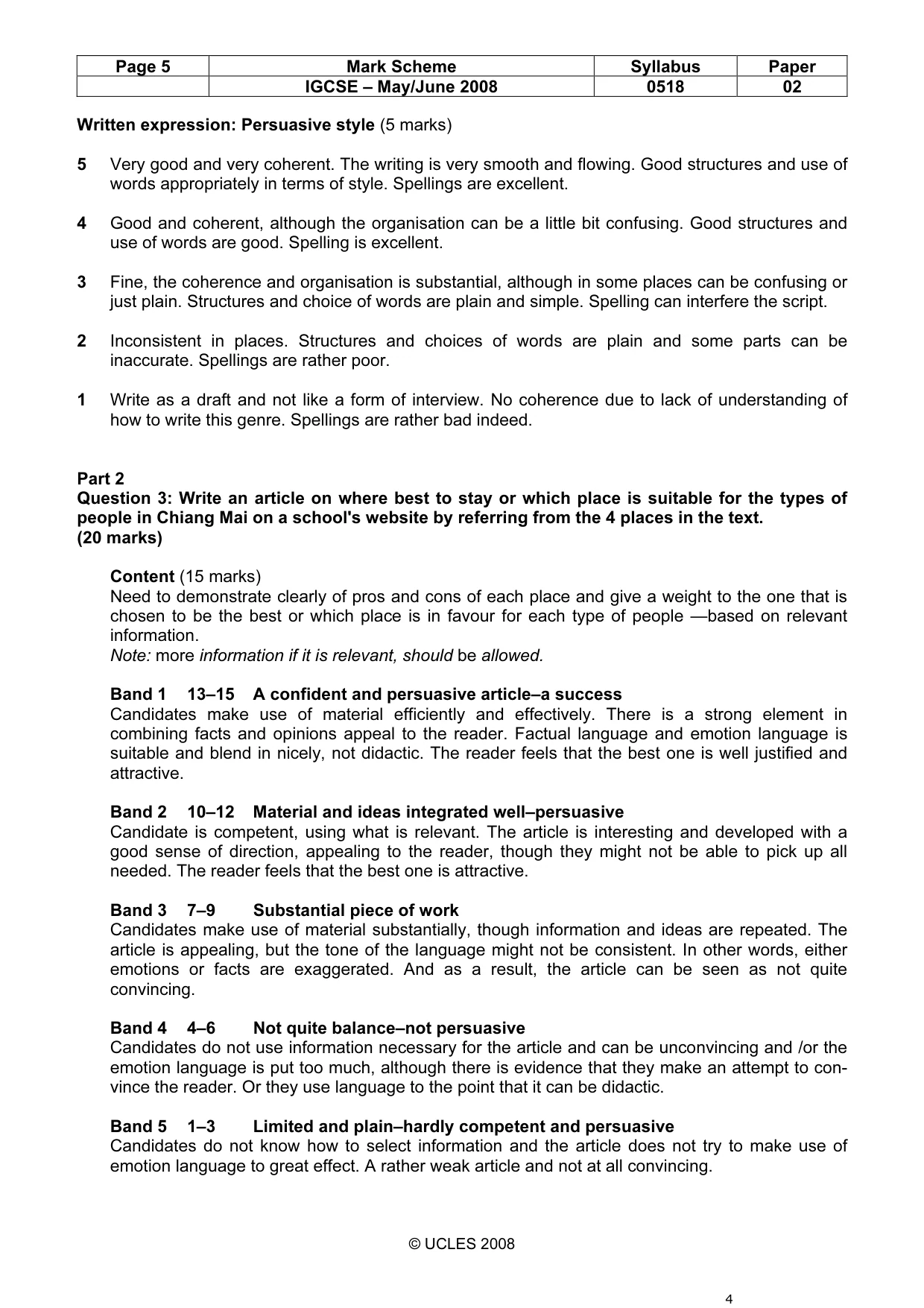
Page 5 Mark Scheme Syllabus Paper IGCSE – May/June 2008 0518 02 © UCLES 2008 Written expression: Persuasive style (5 marks) 5 Very good and very coherent. The writing is very smooth and flowing. Good structures and use of words appropriately in terms of style. Spellings are excellent. 4 Good and coherent, although the organisation can be a little bit confusing. Good structures and use of words are good. Spelling is excellent. 3 Fine, the coherence and organisation is substantial, although in some places can be confusing or just plain. Structures and choice of words are plain and simple. Spelling can interfere the script. 2 Inconsistent in places. Structures and choices of words are plain and some parts can be inaccurate. Spellings are rather poor. 1 Write as a draft and not like a form of interview. No coherence due to lack of understanding of how to write this genre. Spellings are rather bad indeed. Part 2 Question 3: Write an article on where best to stay or which place is suitable for the types of people in Chiang Mai on a school's website by referring from the 4 places in the text. (20 marks) Content (15 marks) Need to demonstrate clearly of pros and cons of each place and give a weight to the one that is chosen to be the best or which place is in favour for each type of people —based on relevant information. Note: more information if it is relevant, should be allowed. Band 1 13–15 A confident and persuasive article–a success Candidates make use of material efficiently and effectively. There is a strong element in combining facts and opinions appeal to the reader. Factual language and emotion language is suitable and blend in nicely, not didactic. The reader feels that the best one is well justified and attractive. Band 2 10–12 Material and ideas integrated well–persuasive Candidate is competent, using what is relevant. The article is interesting and developed with a good sense of direction, appealing to the reader, though they might not be able to pick up all needed. The reader feels that the best one is attractive. Band 3 7–9 Substantial piece of work Candidates make use of material substantially, though information and ideas are repeated. The article is appealing, but the tone of the language might not be consistent. In other words, either emotions or facts are exaggerated. And as a result, the article can be seen as not quite convincing. Band 4 4–6 Not quite balance–not persuasive Candidates do not use information necessary for the article and can be unconvincing and /or the emotion language is put too much, although there is evidence that they make an attempt to con- vince the reader. Or they use language to the point that it can be didactic. Band 5 1–3 Limited and plain–hardly competent and persuasive Candidates do not know how to select information and the article does not try to make use of emotion language to great effect. A rather weak article and not at all convincing. 4
Mark scheme, page 6
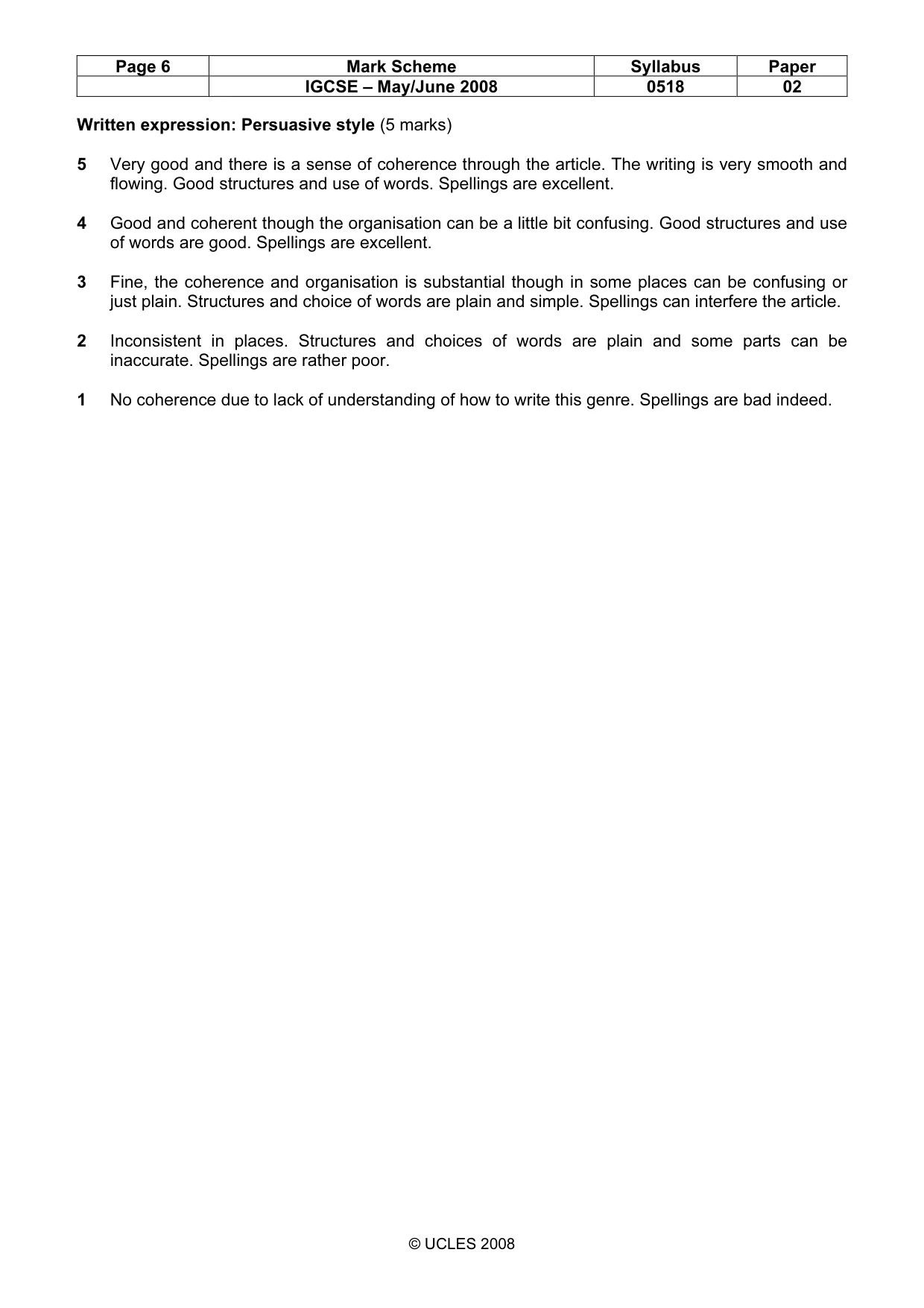
Page 6 Mark Scheme Syllabus Paper IGCSE – May/June 2008 0518 02 © UCLES 2008 Written expression: Persuasive style (5 marks) 5 Very good and there is a sense of coherence through the article. The writing is very smooth and flowing. Good structures and use of words. Spellings are excellent. 4 Good and coherent though the organisation can be a little bit confusing. Good structures and use of words are good. Spellings are excellent. 3 Fine, the coherence and organisation is substantial though in some places can be confusing or just plain. Structures and choice of words are plain and simple. Spellings can interfere the article. 2 Inconsistent in places. Structures and choices of words are plain and some parts can be inaccurate. Spellings are rather poor. 1 No coherence due to lack of understanding of how to write this genre. Spellings are bad indeed.
What you needed in this session
Cambridge’s own grade thresholds for 2008 May/June, Paper 2 · Variant 1. A higher threshold means an easier paper — the bar moves with how the cohort did.