Cambridge IGCSE Thai - First Language 0518 — 2006 May/June Paper 2 · Variant 1
0518/21/M/J/06 · 60 marks · ≈68 min
The question paper and its mark scheme, free to read here and free to download. This is Cambridge’s own paper, exactly as it was sat.
Question paper8 pages

Mark scheme6 pages
Answers below. Sit the paper first if you are practising.
Paper as text
Question paper, page 1
This document consists of 7 printed pages and 1 blank page. SP (CW/TL) T12260/2 © UCLES 2006 [Turn over UNIVERSITY OF CAMBRIDGE INTERNATIONAL EXAMINATIONS International General Certificate of Secondary Education FIRST LANGUAGE THAI 0518/02 Paper 2 Reading and Directed Writing May/June 2006 2 hours 15 minutes Additional Materials: Answer Booklet/Paper READ THESE INSTRUCTIONS FIRST If you have been given an Answer Booklet, follow the instructions on the front cover of the Booklet. Write your Centre number, candidate number and name on all the work you hand in. Write in dark blue or black pen. Do not use staples, paper clips, highlighters, glue or correction fluid. Answer all questions. Dictionaries are not permitted. At the end of the examination, fasten all your work securely together. The number of marks is given in brackets [ ] at the end of each question or part question. www.XtremePapers.com
Question paper, page 2
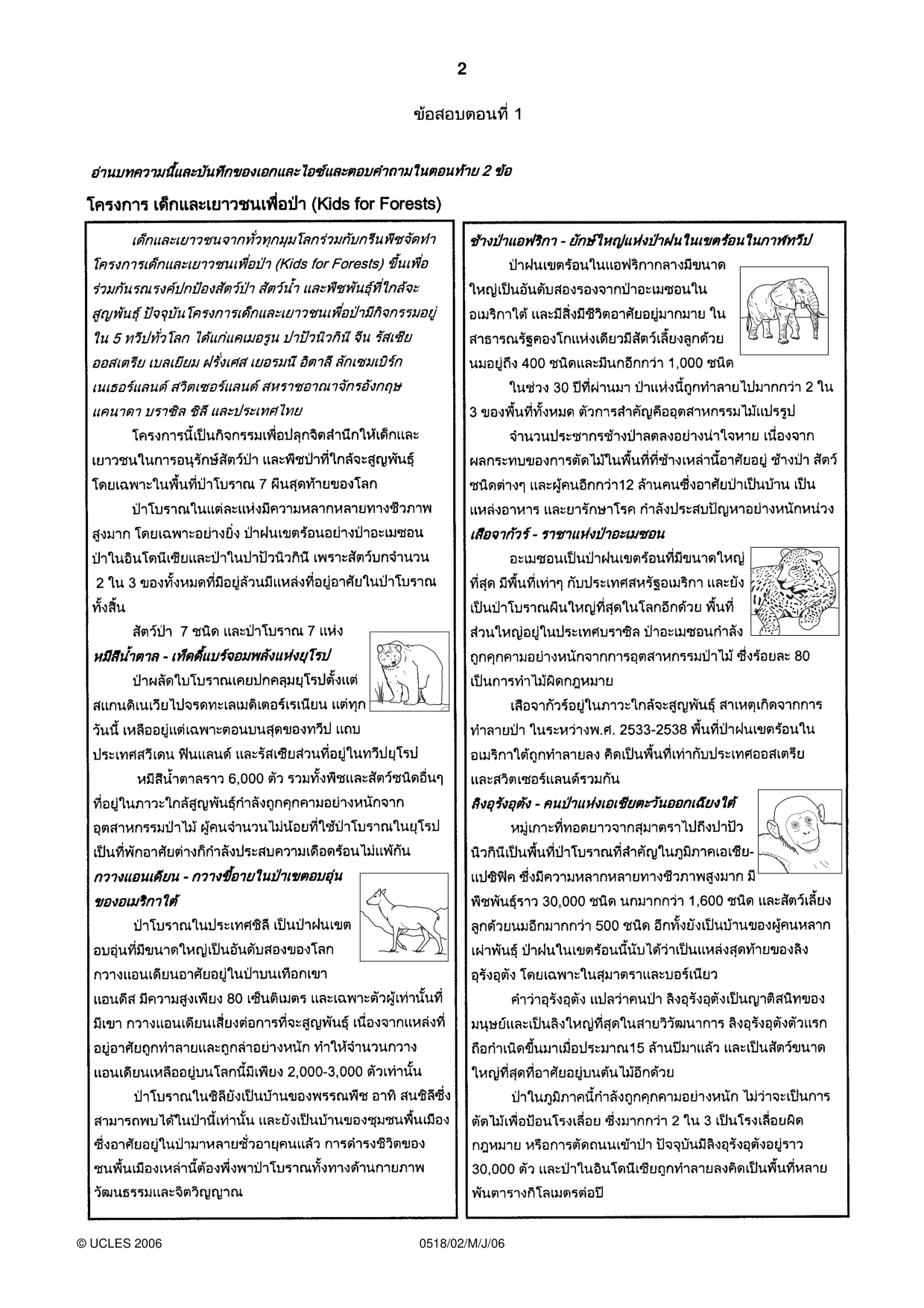
© UCLES 2006 dadaunaut 1 druunnruituacduiinvavionua:laduacnoudion tunaunw 2 do Tasenns Winuaxisautilaih (Kids for Forests) inuanurmusinvannyatansoununtunadany Tasunradnuanur2auinar (Kids for Forests) duiwta sourtusesvdUntavdn th dntils uaenanugn indoe gaynug foguu Tasen ndinuanengumatiihonssuoy qu 5 niuyiatan Wununwiasu vrifanoAd Su ste aomaty wade Wdued wast dard Anwudsn iusatuaud Anvotuaud ausrwaIM nono unurn? us719Aa BA uacseane ine Tasomsilifutonssuaugndnardin idinuar wneulunsaysnsdatih vaca ndeeguiug Touran udusitusien 7 duqavnweastan Urtusrarluudiacuvsllavunainuaenwsanw qounn Tautawrvadineds undungouadwioswareu ihuduladisuvasdurhidhAd waiedntunsawu 2.3 vavvieuuntfoydoudunartadardutudrtusin vivdu amit 7 wie wasitusim 7 uy watiliora - iahluuSoounsouroyTod thndaluTusintauinaqueyTsusous aAunudiulae asanciamAimasisiiion usinn Futl Aaadushianenauvudavamad wou Useimadtiou Nuuaud warsaiBudouviad luntuy tad wilatianrasya 6,000 #19 sauvtvintacdntadndug fay unie Indgeyyiugnrasgnananadwuinein qnaunsandr aus hited thus uytsl WuiWnordusiwirduussaunrunfontou biuwau nr quauson - nada tusuynougu vavausinre thtusimudssinaga Huthnuian auguvifiauriauqifududumosvaytan na wuaudieuarduay utauuiianiar Naudia Jaruduiviuy 80 udiuas lavtamedaqivintud fran nowuauimuudusianrsviaeqaniug wlavsrnundedi ada dugnynaiuuacgnaradwuin i Wisin uauiuumAoaguuTantisivius 2,000-3,000 dainty dhTusnausadotuiruvawssaviy am ausads anunsawulséudriivintn uardethusaspautuisos dyorduad hms yaryauudy mseinseFinwas suviudlasimaridostowihtusimvemdaumunw Fouusssnuarsioiqym Prvituan3m - inf luqjudohdutuntoutuninsy Thduiaagauuuananrinaviawin qj Tududuaavsavaininasiwvaulu |WIN Uacilavisinorduaduinnw WwW arsvsmignoyTnunduaiansausgneiae unaday 400 wauarifundnnd 1,000 vin Quaiay 30 Hidqunn dhuvatignviraw anno 2 lu 3 vaviludiiymun anasdaacudaananssy uss suaudseainsdwihanavadwurtenw tavern nansenusaynasiin Li uAudindhwmariorduad deh and dasa uasdaudnnin2 dueaudsardudthal iu waves uacersnytisa mdvulseauilyuradwuiinuiy Waging - s1¢ un asuigau azwaautuhdutaazauriiauin ua Yiqa Silufiving Auulseineavsgow3m uactls WulhtusimAulunifiqatutandndae dud aoulugiod ludsemeusrsa thaviweauniay gnqnanuadreuinsinnrsqnansswilr al Bydauay 80 Wunrsvidbihanguanie Woviirdad unis tndasqqulug aavaqifiasinnas ynanuil Wusewiqww.4. 2533-2538 fufieluindaulu aan gnynaquas Aniururiauussindaadingy Waratoimasuaudsuin Avahamn - autudnagenciusontvelst win ThAtituriudd Tusa luginraarde- winanunrainauinsTseile W8#la Boflarwuainvaunwsaniwguuan #1 Wawugs 30,000 sila unuinns 1,600 aia uardndiaus ansauunSnuanni 500 win Snvivdatusruvaslaunarn Wowiug thru tuangouthinladatuundsdavinuuasas advady Tautawi uquinsacuasiiley Arhadsagy udatnauth Avqtoqiuuqrwaadnyas uuyduasiDuaeluaifiqaludrwtiauins Avatvaredausn forrindunidodseannts duitinudd uacifludatoura Anifidatorduaduucdtw Liind ihundinradrirasgnanmwadawnin Wiirexttums Ga biWailoutsaaou inn 2 Wu 3 utsudauAn Agua wsamrsdanuuidady Daquuslaygsogeivags17 30,000 #9 vari uduladidugnvnauavantudusinaw Wumswitamoassiall 0518/02/M/J/06
Question paper, page 3
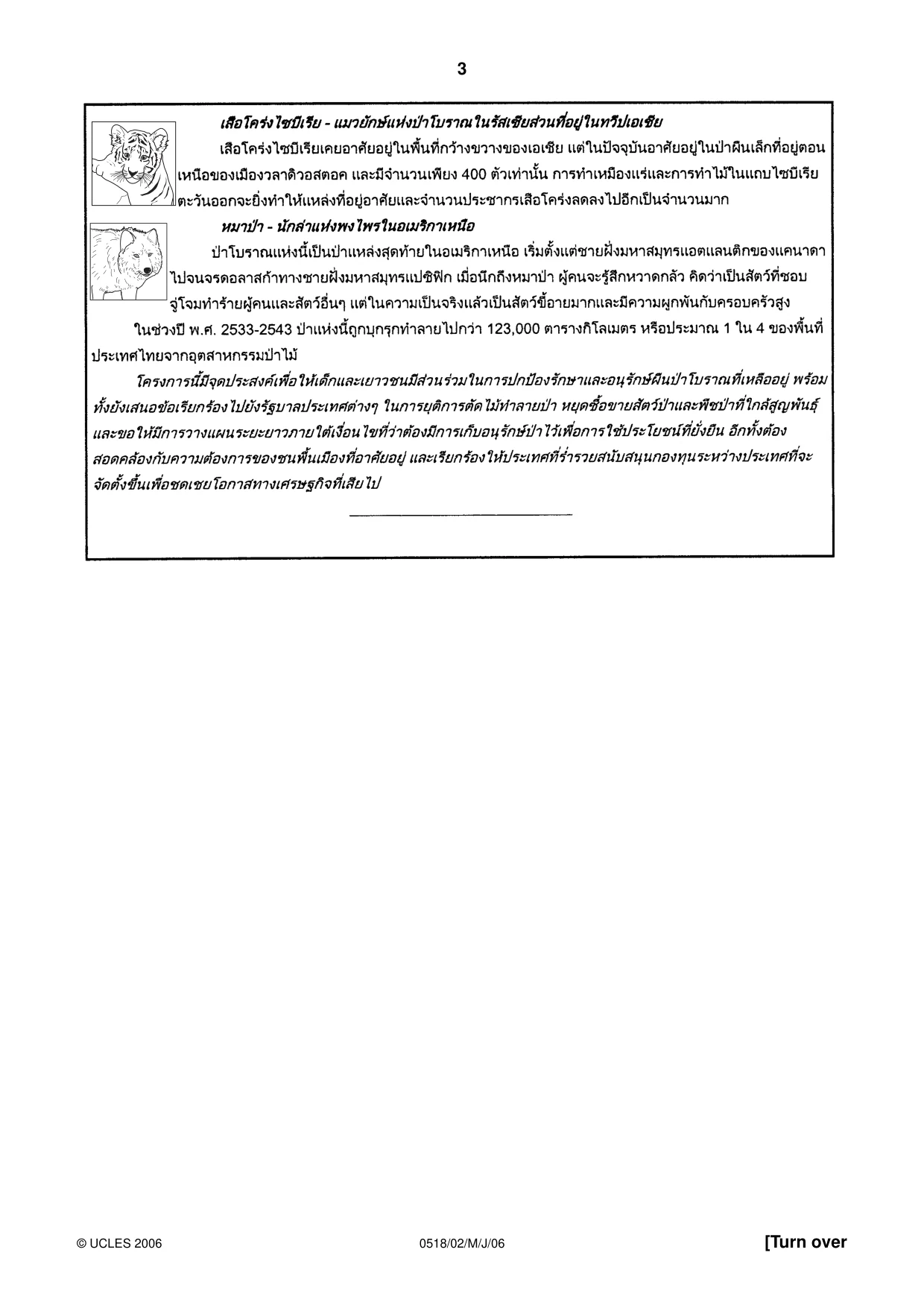
3 0518/02/M/J/06 © UCLES 2006 [Turn over
Question paper, page 4
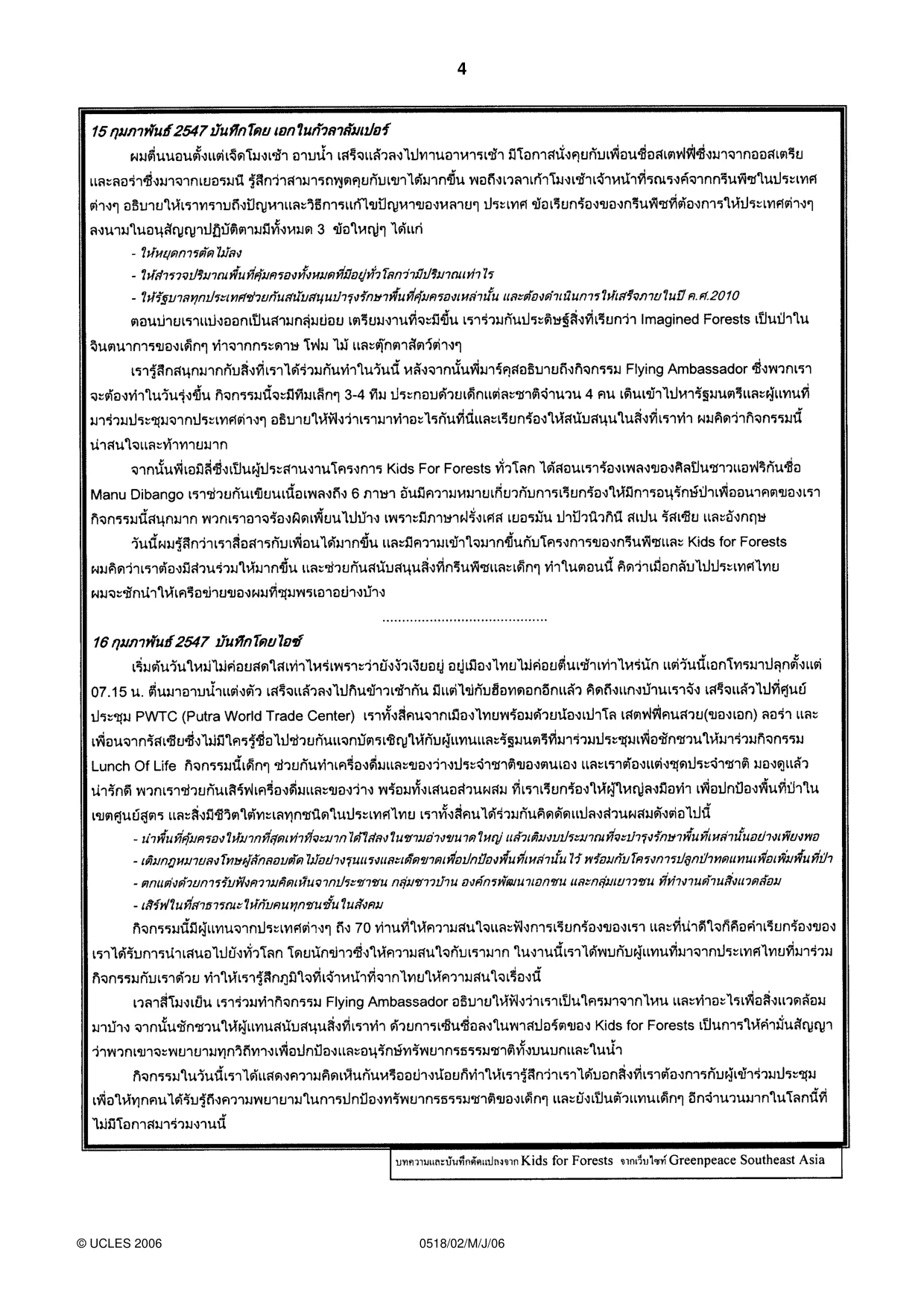
15 nuninus 2547 dusintaw ion lurrarduvat nuduuaudousiSatueds ous wFaudras nua ITamiaivquriumougoaiddonainaoainsy lacaadndenrsinwasutl FanhaunsnynquaAueanndy watsaudrbddwlfismsdoinnsuia used sineq ABLE Mis ns we yMUarténrsud laiynruayarey Useine osuntowwansunaisioyms wWuseimesin4 ava uayduyuufiamuivievaa 3 doug un - binganisia liv = Wdrszov suru mu sidunsavionunviagn sans surauny ts - Liggurannisunddroruattvayusrziny audduasonna nit uassoverutunrs iasonw lull 07.2010 aauuisiuisaantiuaundudoy munvutesidu isnsoustuilsedug@eviauni Imagined Forests tutu Sunuanrsyawdng Vas1nNszATw TW “LI uaxsinardateiw9 inganaynuanuavtisT adoutuinwad wavaimiurnsqdadunutivfonsay Flying Ambassador #ywants7 ardawiutuqedu Aanssutlosiivanény 3-4 fin Usenaudruiinusars As ua 4 AU aut Wraguuntuacqunud wrsaudsequernussineisia| DBL sna: sAuriduacdundos Watluayuuasmisrn nuAieditonssud draw louasviamein ainiumionadetuduseaaueuiasens Kids For Forests vi7Tan Waousrfoswanvavtalusruansiuda Manu Dibango is1dwiuduuttawasty 6.1107 SudlarumnufiuaiunrsiundayWiinrsaysnsaawianvass1 Aanssudaynuin wantsraradasAniuw ui wsrefinadaeieda wantin untltoaAd au Jadu uacdongy Fudnuganiusdasrsiulawlanindu larlanuid lonindurulassnsuasnsuilma: Kids for Forests ANAntUsrtosilauswWnandu nasdquAualuayudevinsunauaciing vitlunoud Anilandy usemene nuaednurWiasadwaasnuiguwsiaradwi 16 nuninus 2547 vurintau lod Gudusulwi bidauanlai usware det Guay adular ne aidaududwinvsin usjudiantnawansous 07.15 u. Aunmaruntrusied sf audrarWAusrasiau duo liAusonnandnudd Aniounsruisrde tSoudr luviquel sau PWTC (Putra World Trade Center) wsavindeuarnifios muwsaudauosTa tAnwiflaudoe(vasian) aos wae lous insaidudy bit lasso WeauiuuoninsBy WrudunuuartguuntirsuulseqatnyuWnsaAenssy Lunch Of Life Aonssutliding doutuviesosduarvasinusesi a wuosmuios UacisrovuivyaussdrgA Navquar dagn wontsrdaurMaswiaFavduavuoriy wiowvisiatuadqunay Aiswsunsos Wd asiavn Woundosiudiaw lunqutigns uacdvildia insiannaila uuseime ine tarvisdaw lad auiuandaulavdunaudesia Ud - da tudiduasov hu nigoniieanin id lday luau wena ua) ududwourserrtaeva in mura ntuad wren - ungminuavtawsanaausia lad rwquuseuacmayiatountovturinantu lt wiauiutasenasventnaunutanntuny = anunueunisiutvaruAatusinuseriau nauaratiu avdnswaunand uacnauerryU Miwruduamousdon - EW ufo sce Dihvaunnguduludons Aanssuilsqunusinusemesiney fo 70 Wau Marmaulouasilymsisunsorvass7 Warfuaalafiaraasuntasuas isTlASumardua ludaviaTan Taina Warmaularuiswin AunutlisT Awurudunutainuseime nevis Aansaufuisadtan viv wisagangd evisalavisrn ne Winrau lesavil raratuoidu (91d 9uvinAensay Flying Ambassador asuwiiWyiusuulnswain a uaevinas lala wandon sna sinudnsau Waunuauayuaeiiswh dounrsisudaaslunradasnuay Kids for Forests Wunasieniuadgiqn JewantaneewurwUyNdmsiouniasuavaysnsnswurnssssuaravuuUNAL tus fansaludutlisy dudasarAaniuruntaad loufivialisganiisTidvandeitsrdioomsAudihsauseas Wa Wiynau dsugteanne ww lumsuntomswurnssssy Wivonding wasdatudounuiing Sndaunwnnutanih UifiTamansdueud © UCLES 2006 0518/02/M/J/06
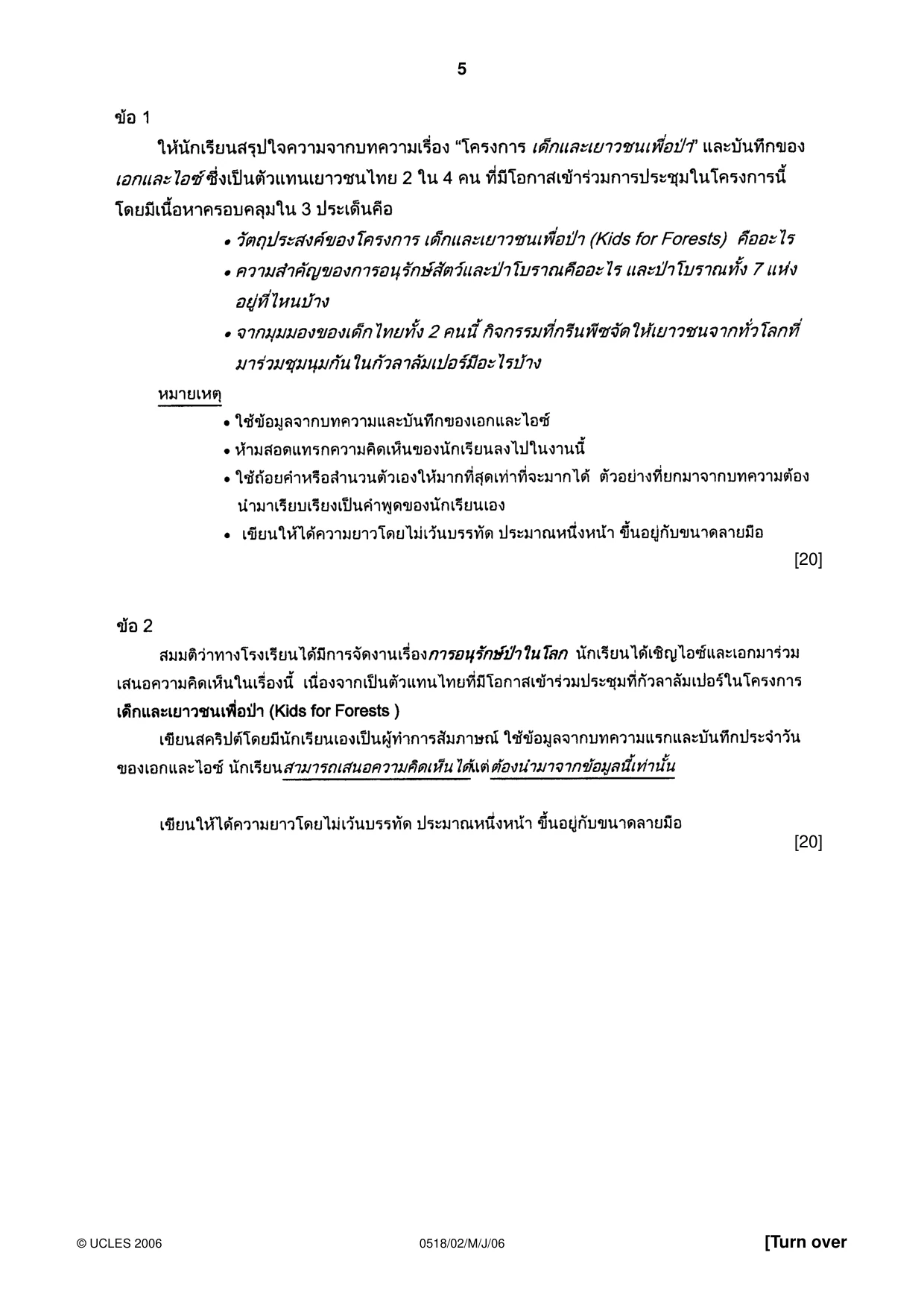
Question paper, page 5
5 0518/02/M/J/06 © UCLES 2006 [Turn over [20] [20]
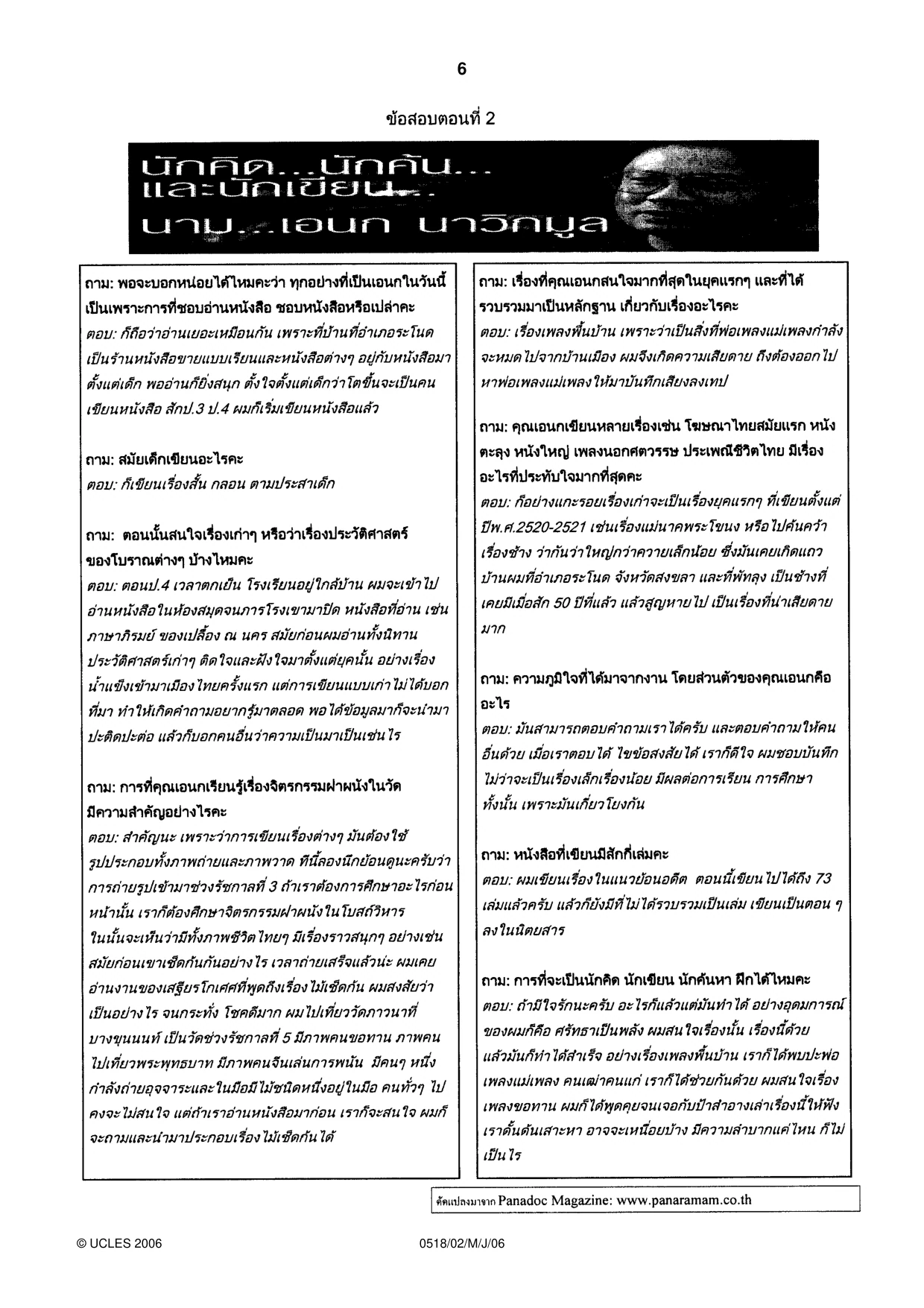
Question paper, page 6
6 dadaunaun 2 LUMARM. ..UIMAILUL. HAa=UMIa su. . uns. mum UNDMSA mu: woazuanyule wah ynadrAituountusud Wuovniemsiigoudumisda saumlsfavtaularia: nau: Kova uweansouru wremhundunasetua Wusumivdavuuusouuacnivaadae$ agnuntvaan7 shousidin naarurbeayn do lodouniniTatuscaiuau oumtoda Anil.3 v4 wutudountbosauda anu: adiuiinideuar laa: nau; fduutavdu naou nranlseausn ou: nauttuaulodosring wtaddawlseTienand gavTusiasineg Uw lana: nau: naur.4 arandu TruseuadIndvru wad i arunuvda luvavaynounrs tsuw iia uilvaavioru itu mwrAsud vavulaay as uns alenaunsorureinm Usedheransinrg fin Touacie toarhoucigaitu atiqiiau drudestarudiay nuadousn usin radeuuuunralldvan wh vi hiner furaaan wa Wivoyauriocw7 uhauesia udoivanaudurraraniusntud ls mau: nistiqnuauntuuzdoastasnssunany win ferudrdicyadwlin: nay: diftyus nsiedinrndeusovewg sustov Is gusenaunon wd an In7IA Wilaaviindouguentys7 nrmandundwsoman 3 dusidavnisAnyas sau will isafidavlinw saan sain wile lu Wan79 tutuastutiivonw 83a neg ihsousrayng add atorauyugarunuady ls ard maroudrus WAL aruvuyondgus tneanyatousoy uhsartu waves uals unsere Tanti warhihnurtannua uavyuuun Musadadenran 5 Innauvaniu nwa Liviawsennsuin Lnnausuaunrsnitu fauq wily Ardudqwqoarseuae luflad llehauttvad lufla auviag WW aves aula unidusiaqunivaauriou isifacaule wart sea unc nin senaultay ah Baru le anu: Fowdqnuounsulonindgnugausn uaed Al sousmanuflunanga uafiudavar say nau: Gouna insieduiuaofinainavulnavnray senna ain uidlay walFuhaaruduary Hosavaan it wowainaviahway Tu wurimaevavniy nw: ANOUNeUMAIEosay Teme neaeushn wily azay uilelng) Wasuandanrssy Useiwel fin ne fidas av sdlseviu eanindiqan: nau: Kathwunssansaunrantusavynusng mIeusous 1w.A.2520-2521 iduSovusiurawsetyuy nia WAuat aver datusytugintarndniay Pohuneniaunr trunuiisunasetun dontaaovar uaciivinay Wudiih inudiiladn 50 Blue udrgqynr ly iusovvnduare wan Om: IMAM oA hiss Taud us vasAnuoUNa avs mau: Juaursonaumianns Wasy uacnaueow TAU Suse davsinau id ladodvde ld fds auvautuyin hivraatusondnsauae daasianraieu nine? roku insreatuiier torn orm: miyfathduudlantiauar nau: wauteutovTuuuwauatia noutdunu tide 73 lauudoasy udoiei ta lisousaniuay Peutunau 7 avlunauars anu: nasfloeithuinan Unido Und Ana ue: nau: Hid lesnusasy as lsfiudqunsiun dt adwanunisal savnurifa dinsuduwde suiautosaviu Savio udalufina Wdetuse adrwFounaviusru sah linulewa inaviulinay auareuun sf dereructe nudtu Today inavvaniu Aue ldyanuouManuinda wan Soul tite isduduiaien arsaeintouty fara 1AM 11a Wuls frusinainein Panadoc Magazine: www.panaramam.co.th © UCLES 2006 0518/02/M/J/06
Question paper, page 7
7 da 3 aud ninseudeuunarw dAviavarsuay Tsviseu Pouhunuanuaun urinya Lug UcYnMAMAUAAsy TUSTIN INE Iedayarinundunial yatusedhdqudy arviuauls uacvsory71unrsvin Mu . ¢ Muusdwaruqunt) uasiaunrvaierua © aruenhiduussnavsani uivuud Guayivewmawsio [20] © UCLES 2006 0518/02/M/J/06
Question paper, page 8
8 0518/02/M/J/06 BLANK PAGE Permission to reproduce items where third-party owned material protected by copyright is included has been sought and cleared where possible. Every reasonable effort has been made by the publisher (UCLES) to trace copyright holders, but if any items requiring clearance have unwittingly been included, the publisher will be pleased to make amends at the earliest possible opportunity. University of Cambridge International Examinations is part of the University of Cambridge Local Examinations Syndicate (UCLES), which is itself a department of the University of Cambridge.
Mark scheme, page 1
UNIVERSITY OF CAMBRIDGE INTERNATIONAL EXAMINATIONS International General Certificate of Secondary Education MARK SCHEME for the May/June 2006 question paper 0518 FIRST LANGUAGE THAI 0518/02 Paper 2 maximum mark 60 This mark scheme is published as an aid to teachers and students, to indicate the requirements of the examination. It shows the basis on which Examiners were initially instructed to award marks. It does not indicate the details of the discussions that took place at an Examiners’ meeting before marking began. Any substantial changes to the mark scheme that arose from these discussions will be recorded in the published Report on the Examination. All Examiners are instructed that alternative correct answers and unexpected approaches in candidates’ scripts must be given marks that fairly reflect the relevant knowledge and skills demonstrated. Mark schemes must be read in conjunction with the question papers and the Report on the Examination. The minimum marks in these components needed for various grades were previously published with these mark schemes, but are now instead included in the Report on the Examination for this session. • CIE will not enter into discussion or correspondence in connection with these mark schemes. CIE is publishing the mark schemes for the May/June 2006 question papers for most IGCSE and GCE Advanced Level and Advanced Subsidiary Level syllabuses and some Ordinary Level syllabuses. www.XtremePapers.com
Mark scheme, page 2
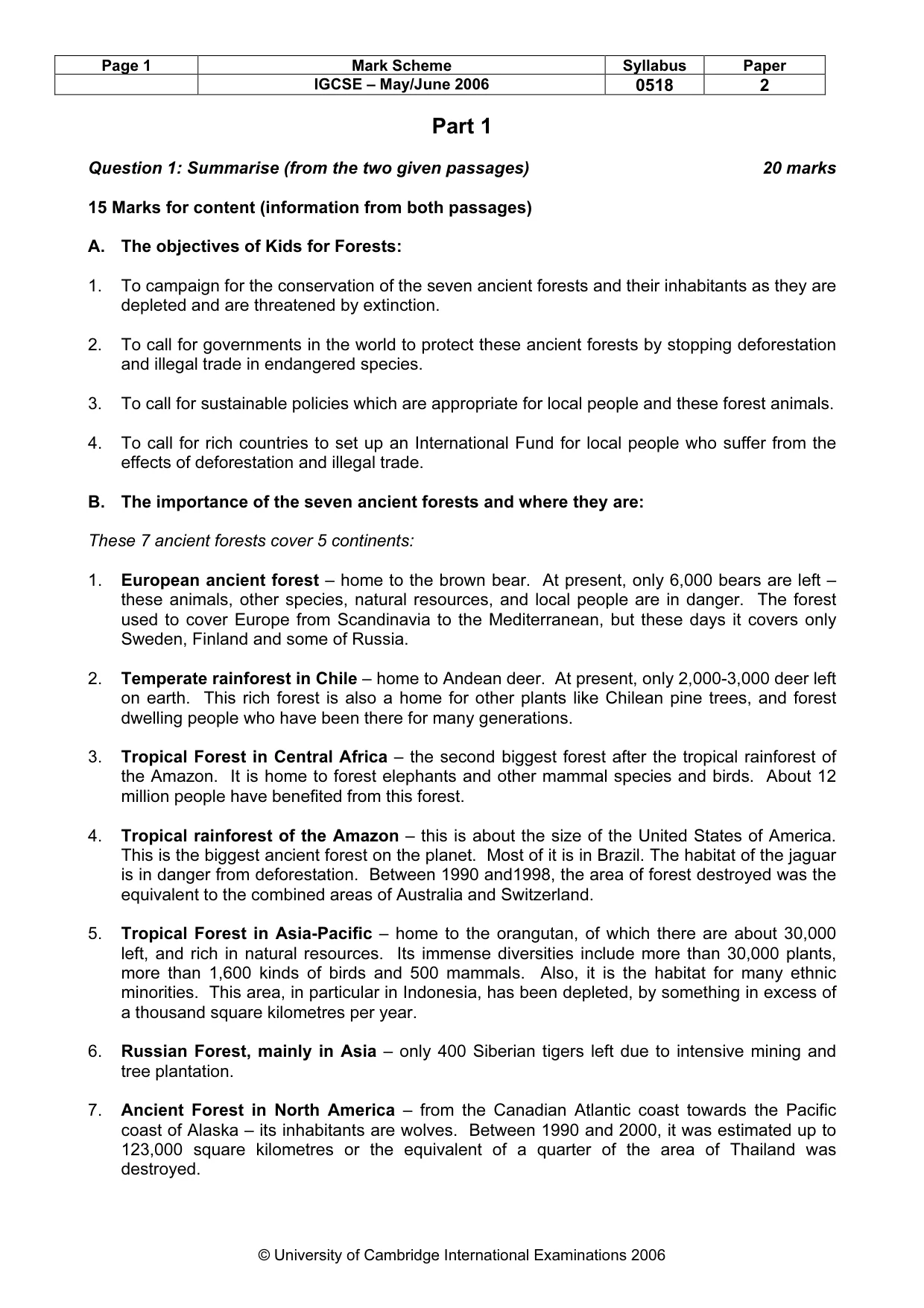
Page 1 Mark Scheme Syllabus Paper IGCSE – May/June 2006 0518 2 © University of Cambridge International Examinations 2006 Part 1 Question 1: Summarise (from the two given passages) 20 marks 15 Marks for content (information from both passages) A. The objectives of Kids for Forests: 1. To campaign for the conservation of the seven ancient forests and their inhabitants as they are depleted and are threatened by extinction. 2. To call for governments in the world to protect these ancient forests by stopping deforestation and illegal trade in endangered species. 3. To call for sustainable policies which are appropriate for local people and these forest animals. 4. To call for rich countries to set up an International Fund for local people who suffer from the effects of deforestation and illegal trade. B. The importance of the seven ancient forests and where they are: These 7 ancient forests cover 5 continents: 1. European ancient forest – home to the brown bear. At present, only 6,000 bears are left – these animals, other species, natural resources, and local people are in danger. The forest used to cover Europe from Scandinavia to the Mediterranean, but these days it covers only Sweden, Finland and some of Russia. 2. Temperate rainforest in Chile – home to Andean deer. At present, only 2,000-3,000 deer left on earth. This rich forest is also a home for other plants like Chilean pine trees, and forest dwelling people who have been there for many generations. 3. Tropical Forest in Central Africa – the second biggest forest after the tropical rainforest of the Amazon. It is home to forest elephants and other mammal species and birds. About 12 million people have benefited from this forest. 4. Tropical rainforest of the Amazon – this is about the size of the United States of America. This is the biggest ancient forest on the planet. Most of it is in Brazil. The habitat of the jaguar is in danger from deforestation. Between 1990 and1998, the area of forest destroyed was the equivalent to the combined areas of Australia and Switzerland. 5. Tropical Forest in Asia-Pacific – home to the orangutan, of which there are about 30,000 left, and rich in natural resources. Its immense diversities include more than 30,000 plants, more than 1,600 kinds of birds and 500 mammals. Also, it is the habitat for many ethnic minorities. This area, in particular in Indonesia, has been depleted, by something in excess of a thousand square kilometres per year. 6. Russian Forest, mainly in Asia – only 400 Siberian tigers left due to intensive mining and tree plantation. 7. Ancient Forest in North America – from the Canadian Atlantic coast towards the Pacific coast of Alaska – its inhabitants are wolves. Between 1990 and 2000, it was estimated up to 123,000 square kilometres or the equivalent of a quarter of the area of Thailand was destroyed.
Mark scheme, page 3
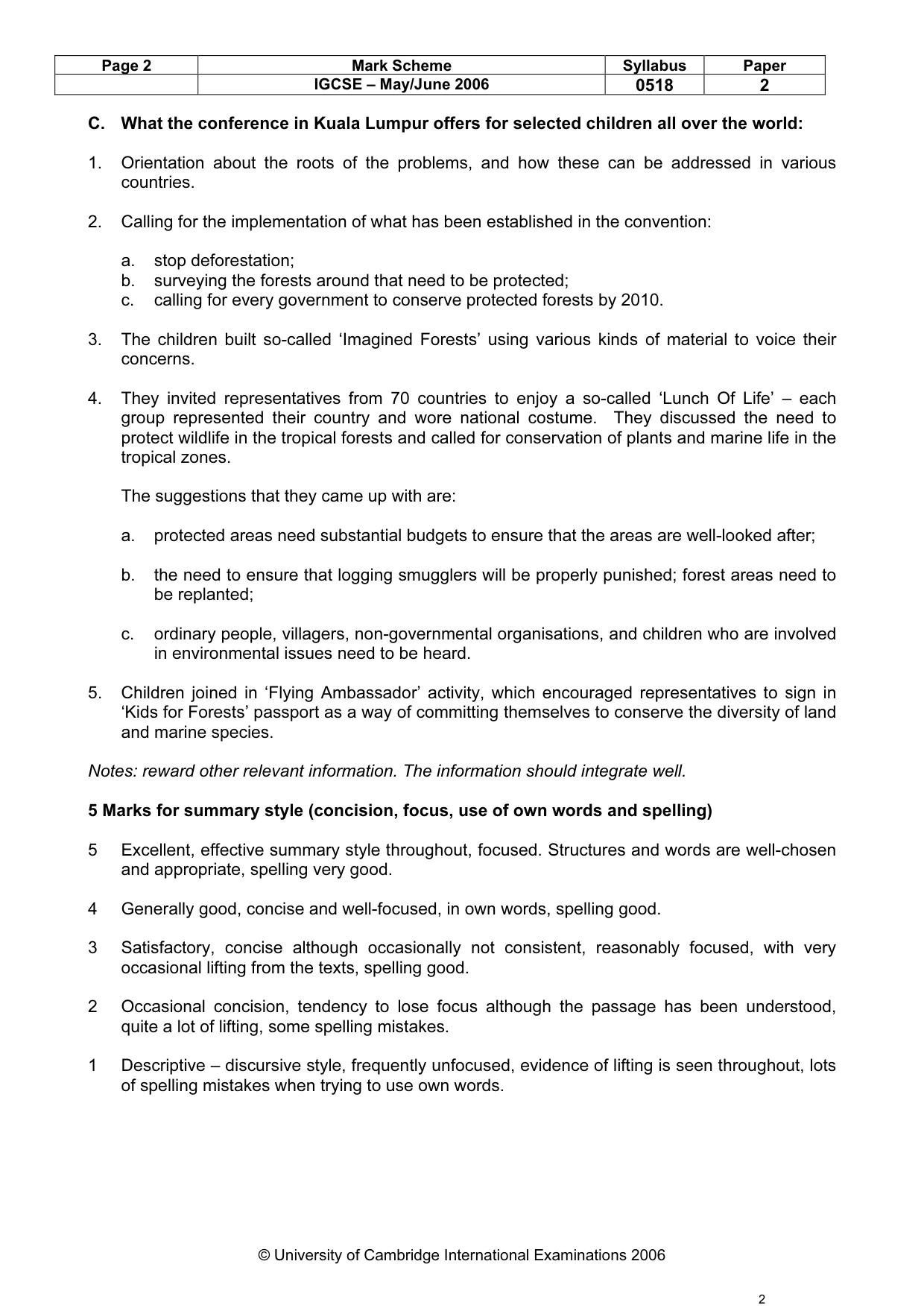
Page 2 Mark Scheme Syllabus Paper IGCSE – May/June 2006 0518 2 © University of Cambridge International Examinations 2006 C. What the conference in Kuala Lumpur offers for selected children all over the world: 1. Orientation about the roots of the problems, and how these can be addressed in various countries. 2. Calling for the implementation of what has been established in the convention: a. stop deforestation; b. surveying the forests around that need to be protected; c. calling for every government to conserve protected forests by 2010. 3. The children built so-called ‘Imagined Forests’ using various kinds of material to voice their concerns. 4. They invited representatives from 70 countries to enjoy a so-called ‘Lunch Of Life’ – each group represented their country and wore national costume. They discussed the need to protect wildlife in the tropical forests and called for conservation of plants and marine life in the tropical zones. The suggestions that they came up with are: a. protected areas need substantial budgets to ensure that the areas are well-looked after; b. the need to ensure that logging smugglers will be properly punished; forest areas need to be replanted; c. ordinary people, villagers, non-governmental organisations, and children who are involved in environmental issues need to be heard. 5. Children joined in ‘Flying Ambassador’ activity, which encouraged representatives to sign in ‘Kids for Forests’ passport as a way of committing themselves to conserve the diversity of land and marine species. Notes: reward other relevant information. The information should integrate well. 5 Marks for summary style (concision, focus, use of own words and spelling) 5 Excellent, effective summary style throughout, focused. Structures and words are well-chosen and appropriate, spelling very good. 4 Generally good, concise and well-focused, in own words, spelling good. 3 Satisfactory, concise although occasionally not consistent, reasonably focused, with very occasional lifting from the texts, spelling good. 2 Occasional concision, tendency to lose focus although the passage has been understood, quite a lot of lifting, some spelling mistakes. 1 Descriptive – discursive style, frequently unfocused, evidence of lifting is seen throughout, lots of spelling mistakes when trying to use own words. 2
Mark scheme, page 4
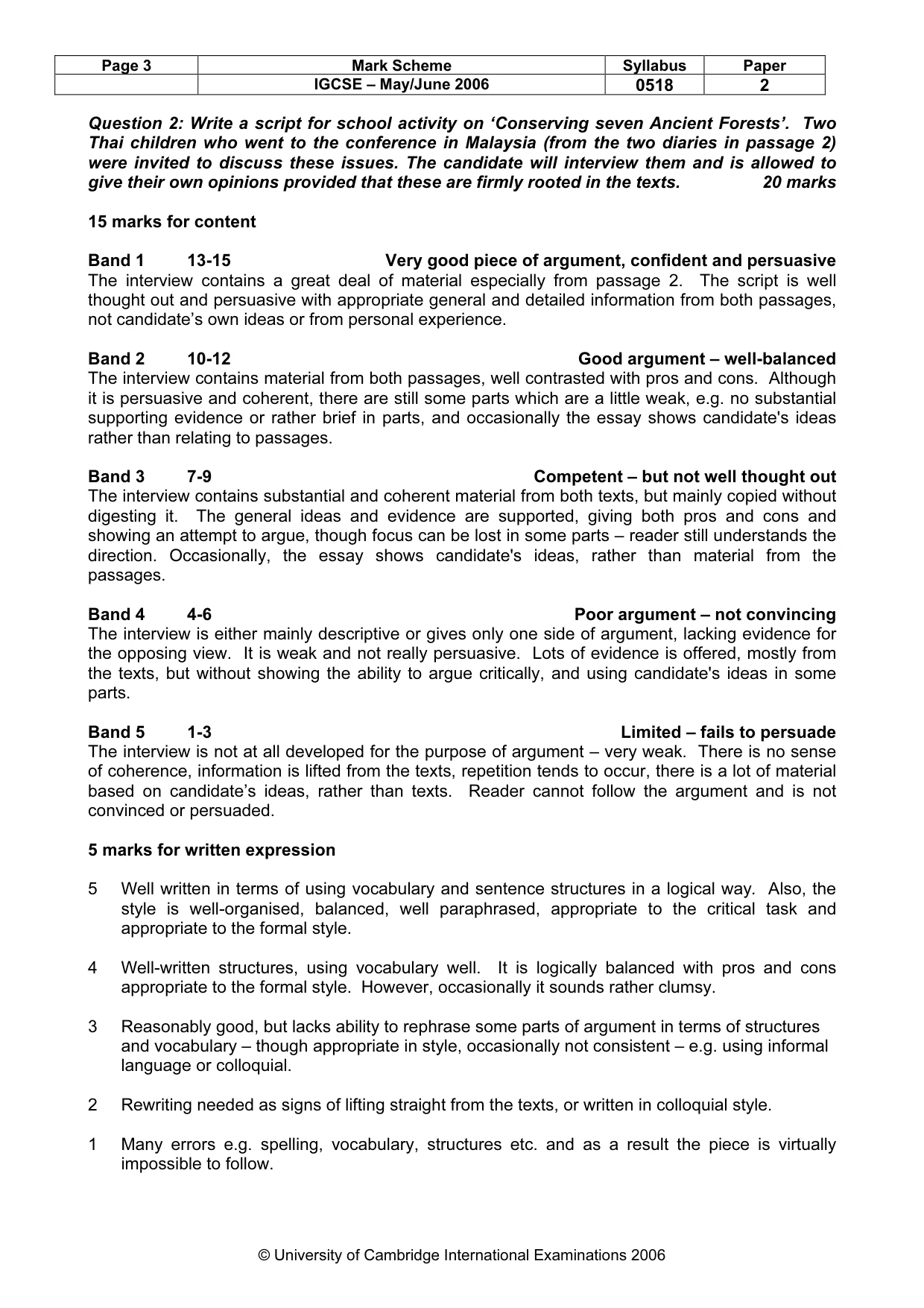
Page 3 Mark Scheme Syllabus Paper IGCSE – May/June 2006 0518 2 © University of Cambridge International Examinations 2006 Question 2: Write a script for school activity on ‘Conserving seven Ancient Forests’. Two Thai children who went to the conference in Malaysia (from the two diaries in passage 2) were invited to discuss these issues. The candidate will interview them and is allowed to give their own opinions provided that these are firmly rooted in the texts. 20 marks 15 marks for content Band 1 13-15 Very good piece of argument, confident and persuasive The interview contains a great deal of material especially from passage 2. The script is well thought out and persuasive with appropriate general and detailed information from both passages, not candidate’s own ideas or from personal experience. Band 2 10-12 Good argument – well-balanced The interview contains material from both passages, well contrasted with pros and cons. Although it is persuasive and coherent, there are still some parts which are a little weak, e.g. no substantial supporting evidence or rather brief in parts, and occasionally the essay shows candidate's ideas rather than relating to passages. Band 3 7-9 Competent – but not well thought out The interview contains substantial and coherent material from both texts, but mainly copied without digesting it. The general ideas and evidence are supported, giving both pros and cons and showing an attempt to argue, though focus can be lost in some parts – reader still understands the direction. Occasionally, the essay shows candidate's ideas, rather than material from the passages. Band 4 4-6 Poor argument – not convincing The interview is either mainly descriptive or gives only one side of argument, lacking evidence for the opposing view. It is weak and not really persuasive. Lots of evidence is offered, mostly from the texts, but without showing the ability to argue critically, and using candidate's ideas in some parts. Band 5 1-3 Limited – fails to persuade The interview is not at all developed for the purpose of argument – very weak. There is no sense of coherence, information is lifted from the texts, repetition tends to occur, there is a lot of material based on candidate’s ideas, rather than texts. Reader cannot follow the argument and is not convinced or persuaded. 5 marks for written expression 5 Well written in terms of using vocabulary and sentence structures in a logical way. Also, the style is well-organised, balanced, well paraphrased, appropriate to the critical task and appropriate to the formal style. 4 Well-written structures, using vocabulary well. It is logically balanced with pros and cons appropriate to the formal style. However, occasionally it sounds rather clumsy. 3 Reasonably good, but lacks ability to rephrase some parts of argument in terms of structures and vocabulary – though appropriate in style, occasionally not consistent – e.g. using informal language or colloquial. 2 Rewriting needed as signs of lifting straight from the texts, or written in colloquial style. 1 Many errors e.g. spelling, vocabulary, structures etc. and as a result the piece is virtually impossible to follow.
Mark scheme, page 5
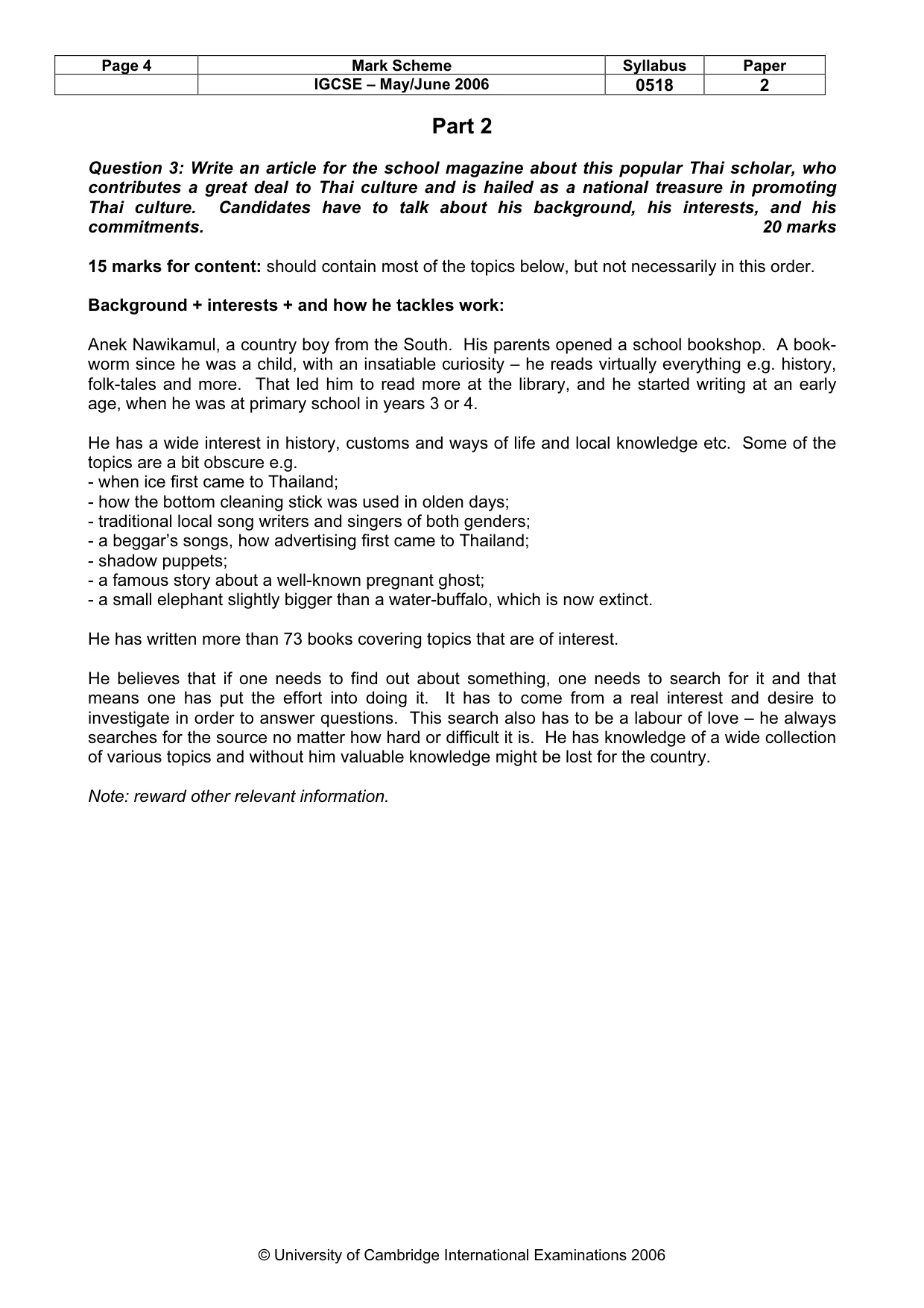
Page 4 Mark Scheme Syllabus Paper IGCSE – May/June 2006 0518 2 © University of Cambridge International Examinations 2006 Part 2 Question 3: Write an article for the school magazine about this popular Thai scholar, who contributes a great deal to Thai culture and is hailed as a national treasure in promoting Thai culture. Candidates have to talk about his background, his interests, and his commitments. 20 marks 15 marks for content: should contain most of the topics below, but not necessarily in this order. Background + interests + and how he tackles work: Anek Nawikamul, a country boy from the South. His parents opened a school bookshop. A book- worm since he was a child, with an insatiable curiosity – he reads virtually everything e.g. history, folk-tales and more. That led him to read more at the library, and he started writing at an early age, when he was at primary school in years 3 or 4. He has a wide interest in history, customs and ways of life and local knowledge etc. Some of the topics are a bit obscure e.g. - when ice first came to Thailand; - how the bottom cleaning stick was used in olden days; - traditional local song writers and singers of both genders; - a beggar’s songs, how advertising first came to Thailand; - shadow puppets; - a famous story about a well-known pregnant ghost; - a small elephant slightly bigger than a water-buffalo, which is now extinct. He has written more than 73 books covering topics that are of interest. He believes that if one needs to find out about something, one needs to search for it and that means one has put the effort into doing it. It has to come from a real interest and desire to investigate in order to answer questions. This search also has to be a labour of love – he always searches for the source no matter how hard or difficult it is. He has knowledge of a wide collection of various topics and without him valuable knowledge might be lost for the country. Note: reward other relevant information.
Mark scheme, page 6
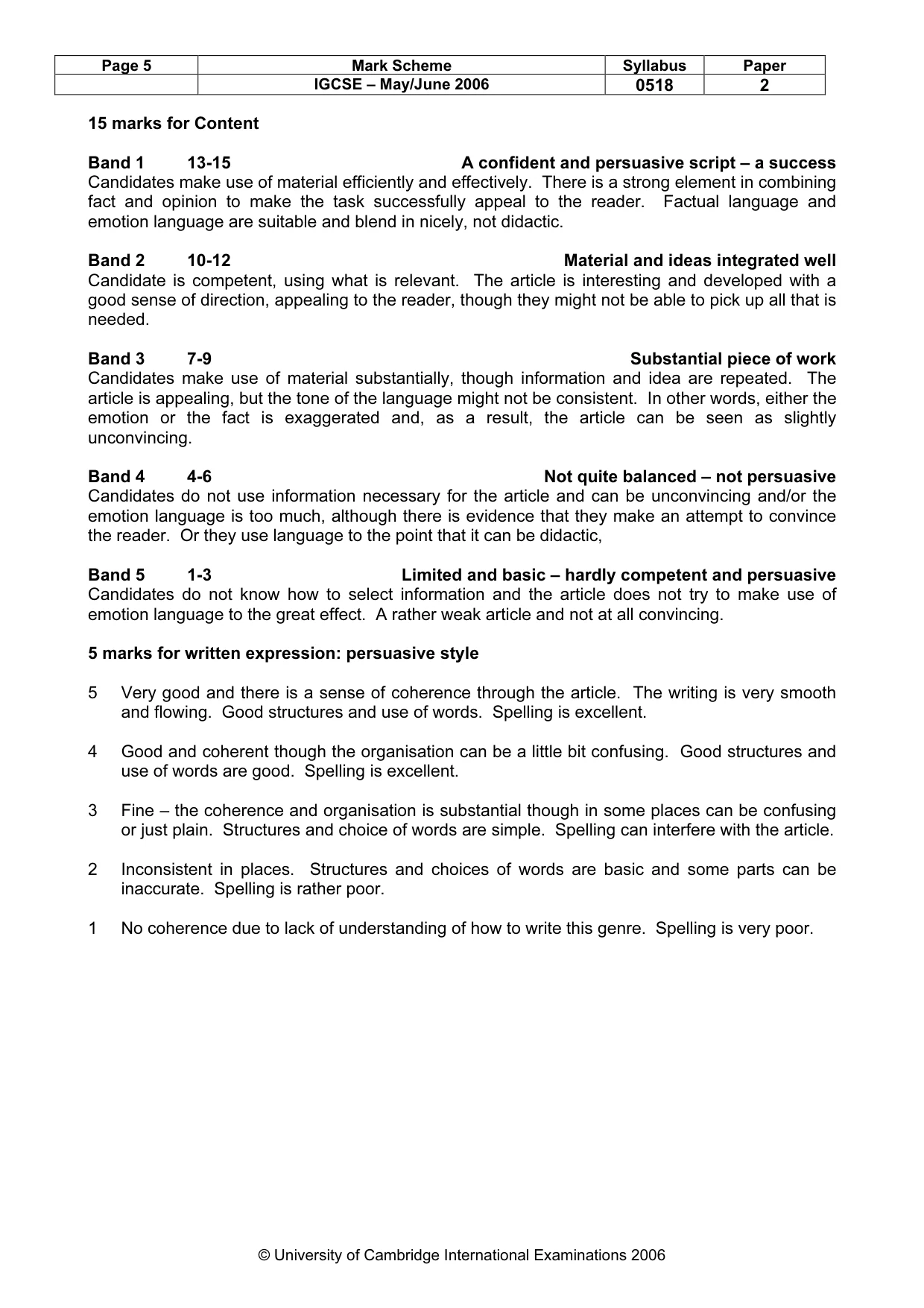
Page 5 Mark Scheme Syllabus Paper IGCSE – May/June 2006 0518 2 © University of Cambridge International Examinations 2006 15 marks for Content Band 1 13-15 A confident and persuasive script – a success Candidates make use of material efficiently and effectively. There is a strong element in combining fact and opinion to make the task successfully appeal to the reader. Factual language and emotion language are suitable and blend in nicely, not didactic. Band 2 10-12 Material and ideas integrated well Candidate is competent, using what is relevant. The article is interesting and developed with a good sense of direction, appealing to the reader, though they might not be able to pick up all that is needed. Band 3 7-9 Substantial piece of work Candidates make use of material substantially, though information and idea are repeated. The article is appealing, but the tone of the language might not be consistent. In other words, either the emotion or the fact is exaggerated and, as a result, the article can be seen as slightly unconvincing. Band 4 4-6 Not quite balanced – not persuasive Candidates do not use information necessary for the article and can be unconvincing and/or the emotion language is too much, although there is evidence that they make an attempt to convince the reader. Or they use language to the point that it can be didactic, Band 5 1-3 Limited and basic – hardly competent and persuasive Candidates do not know how to select information and the article does not try to make use of emotion language to the great effect. A rather weak article and not at all convincing. 5 marks for written expression: persuasive style 5 Very good and there is a sense of coherence through the article. The writing is very smooth and flowing. Good structures and use of words. Spelling is excellent. 4 Good and coherent though the organisation can be a little bit confusing. Good structures and use of words are good. Spelling is excellent. 3 Fine – the coherence and organisation is substantial though in some places can be confusing or just plain. Structures and choice of words are simple. Spelling can interfere with the article. 2 Inconsistent in places. Structures and choices of words are basic and some parts can be inaccurate. Spelling is rather poor. 1 No coherence due to lack of understanding of how to write this genre. Spelling is very poor.
What you needed in this session
Cambridge’s own grade thresholds for 2006 May/June, Paper 2 · Variant 1. A higher threshold means an easier paper — the bar moves with how the cohort did.