Cambridge IGCSE Spanish - Literature 0488 — 2017 Oct/Nov Paper 1 · Variant 1
0488/11/O/N/17 · 60 marks · ≈68 min
The question paper and its mark scheme, free to read here and free to download. This is Cambridge’s own paper, exactly as it was sat.
Question paper8 pages



Mark scheme25 pages
Answers below. Sit the paper first if you are practising.
Paper as text
Question paper, page 1
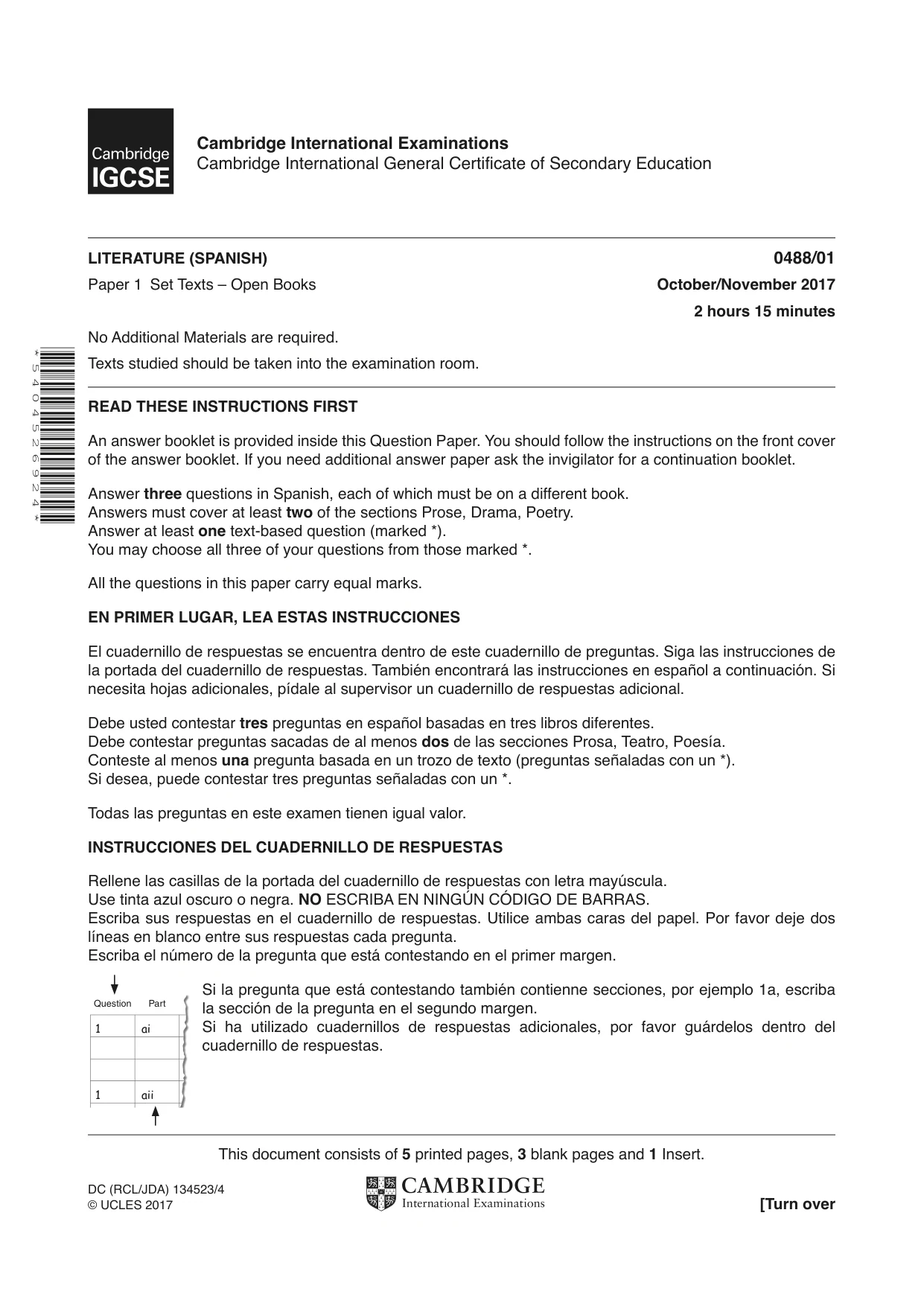
This document consists of 5 printed pages, 3 blank pages and 1 Insert. DC (RCL/JDA) 134523/4 © UCLES 2017 [Turn over Cambridge International Examinations Cambridge International General Certificate of Secondary Education * 5 4 0 4 5 2 6 9 2 4 * LITERATURE (SPANISH) 0488/01 Paper 1 Set Texts – Open Books October/November 2017 2 hours 15 minutes No Additional Materials are required. Texts studied should be taken into the examination room. READ THESE INSTRUCTIONS FIRST An answer booklet is provided inside this Question Paper. You should follow the instructions on the front cover of the answer booklet. If you need additional answer paper ask the invigilator for a continuation booklet. Answer three questions in Spanish, each of which must be on a different book. Answers must cover at least two of the sections Prose, Drama, Poetry. Answer at least one text-based question (marked *). You may choose all three of your questions from those marked *. All the questions in this paper carry equal marks. EN PRIMER LUGAR, LEA ESTAS INSTRUCCIONES El cuadernillo de respuestas se encuentra dentro de este cuadernillo de preguntas. Siga las instrucciones de la portada del cuadernillo de respuestas. También encontrará las instrucciones en español a continuación. Si necesita hojas adicionales, pídale al supervisor un cuadernillo de respuestas adicional. Debe usted contestar tres preguntas en español basadas en tres libros diferentes. Debe contestar preguntas sacadas de al menos dos de las secciones Prosa, Teatro, Poesía. Conteste al menos una pregunta basada en un trozo de texto (preguntas señaladas con un *). Si desea, puede contestar tres preguntas señaladas con un *. Todas las preguntas en este examen tienen igual valor. INSTRUCCIONES DEL CUADERNILLO DE RESPUESTAS Rellene las casillas de la portada del cuadernillo de respuestas con letra mayúscula. Use tinta azul oscuro o negra. NO ESCRIBA EN NINGÚN CÓDIGO DE BARRAS. Escriba sus respuestas en el cuadernillo de respuestas. Utilice ambas caras del papel. Por favor deje dos líneas en blanco entre sus respuestas cada pregunta. Escriba el número de la pregunta que está contestando en el primer margen. Question Part 1 1 ai aii Si la pregunta que está contestando también contienne secciones, por ejemplo 1a, escriba la sección de la pregunta en el segundo margen. Si ha utilizado cuadernillos de respuestas adicionales, por favor guárdelos dentro del cuadernillo de respuestas.
Question paper, page 2
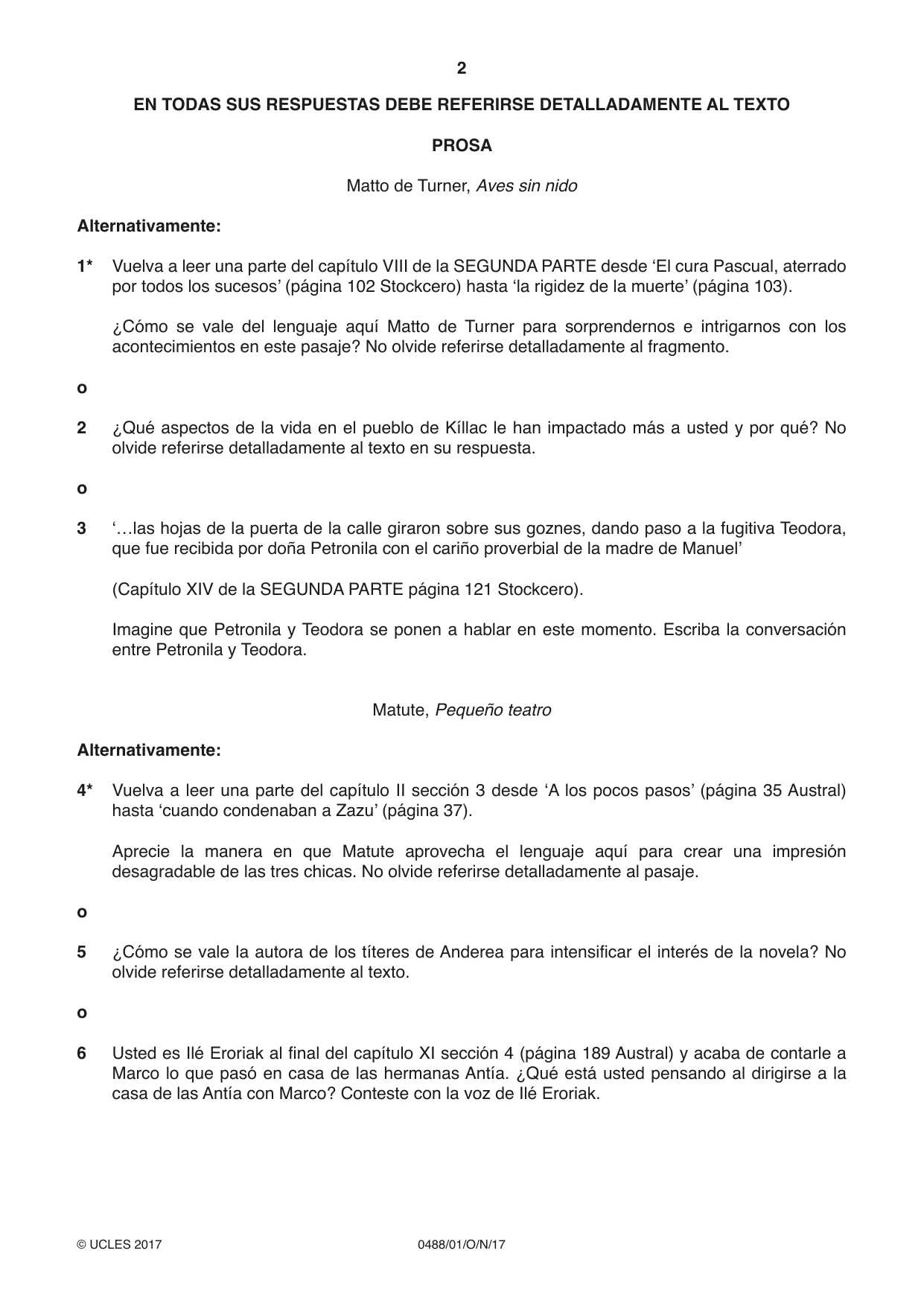
2 0488/01/O/N/17 © UCLES 2017 EN TODAS SUS RESPUESTAS DEBE REFERIRSE DETALLADAMENTE AL TEXTO PROSA Matto de Turner, Aves sin nido Alternativamente: 1* Vuelva a leer una parte del capítulo VIII de la SEGUNDA PARTE desde ‘El cura Pascual, aterrado por todos los sucesos’ (página 102 Stockcero) hasta ‘la rigidez de la muerte’ (página 103). ¿Cómo se vale del lenguaje aquí Matto de Turner para sorprendernos e intrigarnos con los acontecimientos en este pasaje? No olvide referirse detalladamente al fragmento. o 2 ¿Qué aspectos de la vida en el pueblo de Kíllac le han impactado más a usted y por qué? No olvide referirse detalladamente al texto en su respuesta. o 3 ‘…las hojas de la puerta de la calle giraron sobre sus goznes, dando paso a la fugitiva Teodora, que fue recibida por doña Petronila con el cariño proverbial de la madre de Manuel’ (Capítulo XIV de la SEGUNDA PARTE página 121 Stockcero). Imagine que Petronila y Teodora se ponen a hablar en este momento. Escriba la conversación entre Petronila y Teodora. Matute, Pequeño teatro Alternativamente: 4* Vuelva a leer una parte del capítulo II sección 3 desde ‘A los pocos pasos’ (página 35 Austral) hasta ‘cuando condenaban a Zazu’ (página 37). Aprecie la manera en que Matute aprovecha el lenguaje aquí para crear una impresión desagradable de las tres chicas. No olvide referirse detalladamente al pasaje. o 5 ¿Cómo se vale la autora de los títeres de Anderea para intensificar el interés de la novela? No olvide referirse detalladamente al texto. o 6 Usted es Ilé Eroriak al final del capítulo XI sección 4 (página 189 Austral) y acaba de contarle a Marco lo que pasó en casa de las hermanas Antía. ¿Qué está usted pensando al dirigirse a la casa de las Antía con Marco? Conteste con la voz de Ilé Eroriak.
Question paper, page 3
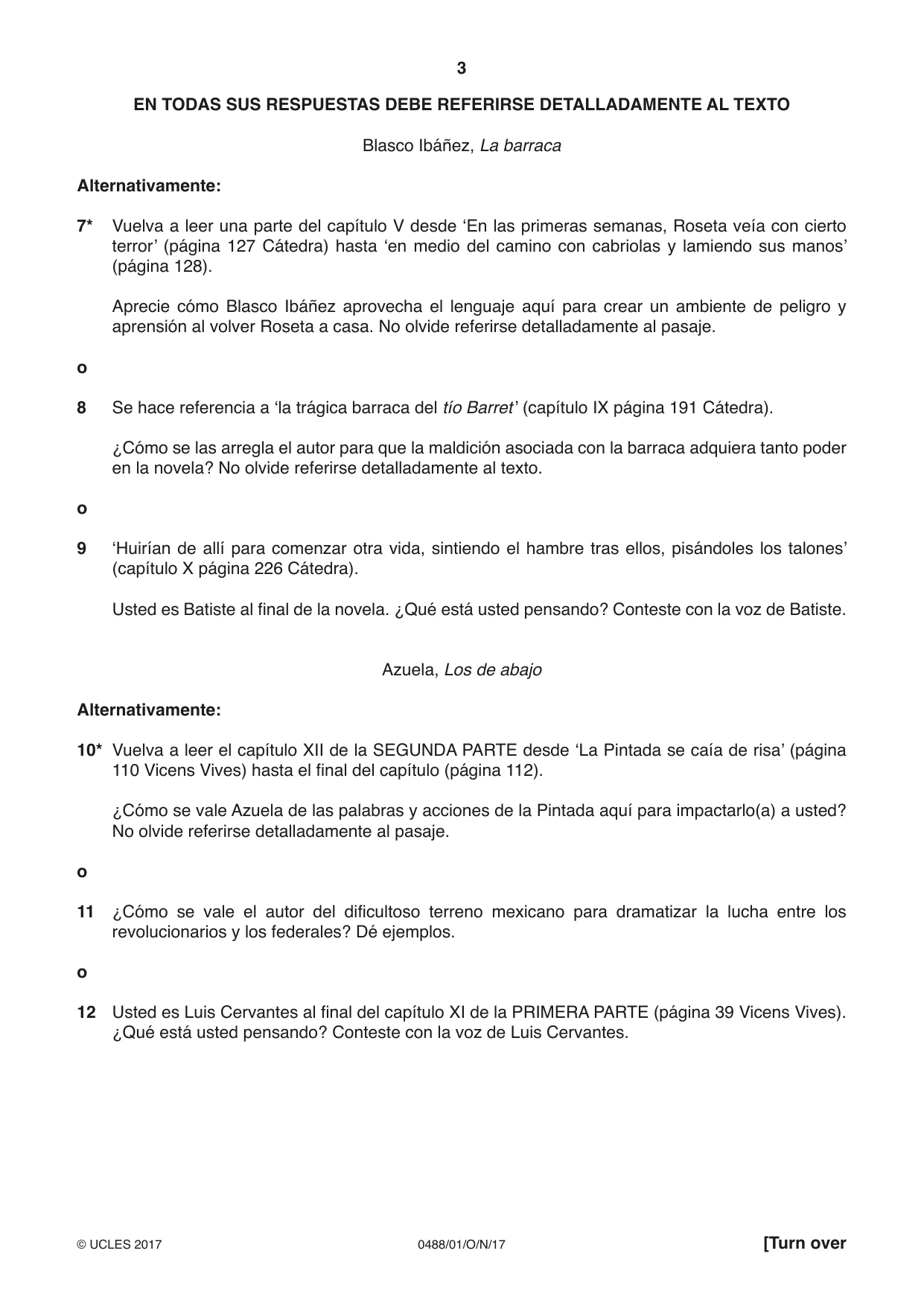
3 0488/01/O/N/17 © UCLES 2017 [Turn over EN TODAS SUS RESPUESTAS DEBE REFERIRSE DETALLADAMENTE AL TEXTO Blasco Ibáñez, La barraca Alternativamente: 7* Vuelva a leer una parte del capítulo V desde ‘En las primeras semanas, Roseta veía con cierto terror’ (página 127 Cátedra) hasta ‘en medio del camino con cabriolas y lamiendo sus manos’ (página 128). Aprecie cómo Blasco Ibáñez aprovecha el lenguaje aquí para crear un ambiente de peligro y aprensión al volver Roseta a casa. No olvide referirse detalladamente al pasaje. o 8 Se hace referencia a ‘la trágica barraca del tío Barret ’ (capítulo IX página 191 Cátedra). ¿Cómo se las arregla el autor para que la maldición asociada con la barraca adquiera tanto poder en la novela? No olvide referirse detalladamente al texto. o 9 ‘Huirían de allí para comenzar otra vida, sintiendo el hambre tras ellos, pisándoles los talones’ (capítulo X página 226 Cátedra). Usted es Batiste al final de la novela. ¿Qué está usted pensando? Conteste con la voz de Batiste. Azuela, Los de abajo Alternativamente: 10* Vuelva a leer el capítulo XII de la SEGUNDA PARTE desde ‘La Pintada se caía de risa’ (página 110 Vicens Vives) hasta el final del capítulo (página 112). ¿Cómo se vale Azuela de las palabras y acciones de la Pintada aquí para impactarlo(a) a usted? No olvide referirse detalladamente al pasaje. o 11 ¿Cómo se vale el autor del dificultoso terreno mexicano para dramatizar la lucha entre los revolucionarios y los federales? Dé ejemplos. o 12 Usted es Luis Cervantes al final del capítulo XI de la PRIMERA PARTE (página 39 Vicens Vives). ¿Qué está usted pensando? Conteste con la voz de Luis Cervantes.
Question paper, page 4
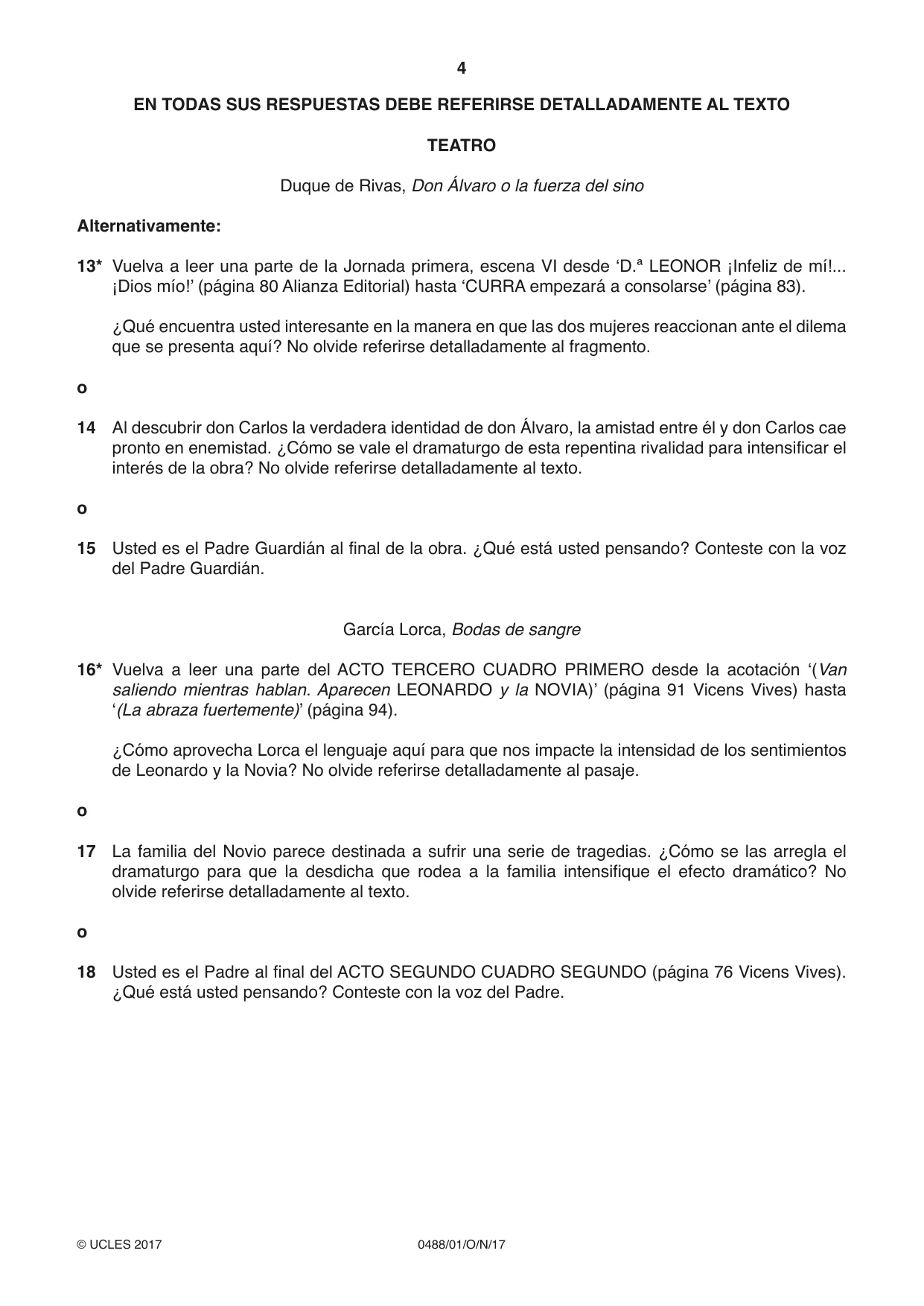
4 0488/01/O/N/17 © UCLES 2017 EN TODAS SUS RESPUESTAS DEBE REFERIRSE DETALLADAMENTE AL TEXTO TEATRO Duque de Rivas, Don Álvaro o la fuerza del sino Alternativamente: 13* Vuelva a leer una parte de la Jornada primera, escena VI desde ‘D.ª LEONOR ¡Infeliz de mí!... ¡Dios mío!’ (página 80 Alianza Editorial) hasta ‘CURRA empezará a consolarse’ (página 83). ¿Qué encuentra usted interesante en la manera en que las dos mujeres reaccionan ante el dilema que se presenta aquí? No olvide referirse detalladamente al fragmento. o 14 Al descubrir don Carlos la verdadera identidad de don Álvaro, la amistad entre él y don Carlos cae pronto en enemistad. ¿Cómo se vale el dramaturgo de esta repentina rivalidad para intensificar el interés de la obra? No olvide referirse detalladamente al texto. o 15 Usted es el Padre Guardián al final de la obra. ¿Qué está usted pensando? Conteste con la voz del Padre Guardián. García Lorca, Bodas de sangre 16* Vuelva a leer una parte del ACTO TERCERO CUADRO PRIMERO desde la acotación ‘(Van saliendo mientras hablan. Aparecen LEONARDO y la NOVIA)’ (página 91 Vicens Vives) hasta ‘(La abraza fuertemente)’ (página 94). ¿Cómo aprovecha Lorca el lenguaje aquí para que nos impacte la intensidad de los sentimientos de Leonardo y la Novia? No olvide referirse detalladamente al pasaje. o 17 La familia del Novio parece destinada a sufrir una serie de tragedias. ¿Cómo se las arregla el dramaturgo para que la desdicha que rodea a la familia intensifique el efecto dramático? No olvide referirse detalladamente al texto. o 18 Usted es el Padre al final del ACTO SEGUNDO CUADRO SEGUNDO (página 76 Vicens Vives). ¿Qué está usted pensando? Conteste con la voz del Padre.
Question paper, page 5
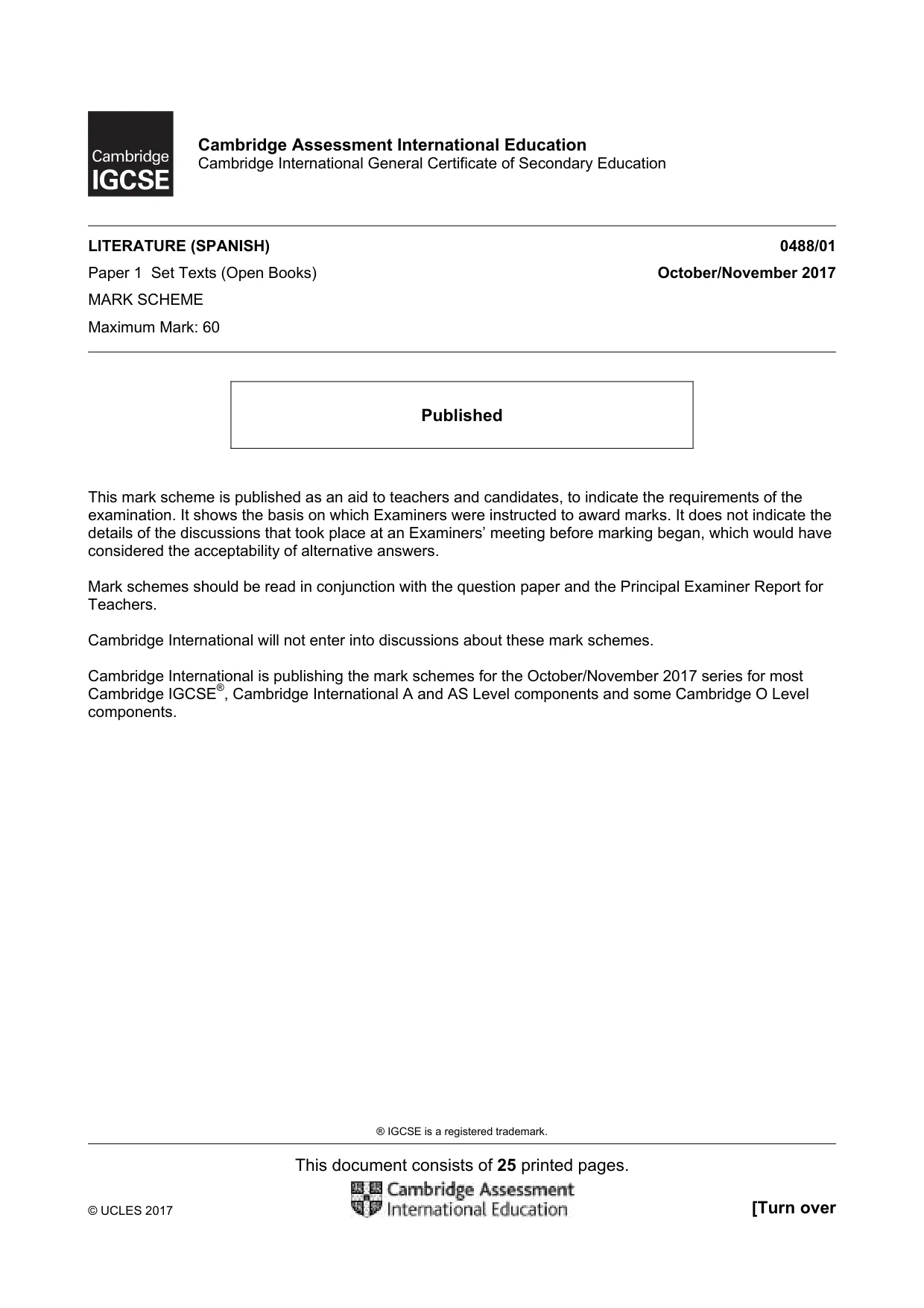
5 0488/01/O/N/17 © UCLES 2017 EN TODAS SUS RESPUESTAS DEBE REFERIRSE DETALLADAMENTE AL TEXTO POESÍA García Montero, Poesía Alternativamente: 19* Vuelva a leer el poema COMO CADA MAÑANA (páginas 72–73 Tusquets). Aprecie cómo García Montero aprovecha el lenguaje para que disfrutemos de acompañarle en este paseo nostálgico. o 20 Aprecie cómo el poeta aprovecha el lenguaje para dar una emotiva interpretación poética del paso del tiempo en UNO de estos poemas: 1966 (páginas 49–50). CANCIÓN ÍNTIMA (páginas 516–517 Tusquets). o 21 Aprecie cómo el poeta ha logrado entretenernos al relatar un cuento e intrigarnos con su desenlace en UNO de los siguientes poemas: PRIMER DÍA DE VACACIONES (páginas 309–310 Tusquets) CRIMEN EN LA NOCHE DE UN SÁBADO (páginas 394–395). Biagioni, Poesía completa Alternativamente: 22* Vuelva a leer ARPA (páginas 522–523 Adriana Hidalgo editora). ¿Cómo se vale Biagioni del lenguaje aquí para que las palabras del poema evoquen el arpa en la imaginación? o 23 Vuelva a leer UNO de los siguientes poemas: “CAMPO DE TRIGO BAJO CUERVOS’’ (páginas 508–512 Adriana Hidalgo editora) ALGUIEN SE BUSCA EN ALTAMIRA (páginas 542–543). ¿Cómo reacciona usted ante el impacto visual del paisaje que detalla aquí la poetisa? o 24 Vuelva a leer UNO de los siguientes poemas: LA CONDENA (página 277 Adriana Hidalgo editora) CONCÉNTRICOS (páginas 383–384). ¿Cómo aprovecha la poetisa el lenguaje aquí para crear un mal presentimiento a lo largo del poema?
Question paper, page 6
6 0488/01/O/N/17 © UCLES 2017 BLANK PAGE
Question paper, page 7
7 0488/01/O/N/17 © UCLES 2017 BLANK PAGE
Question paper, page 8
8 0488/01/O/N/17 © UCLES 2017 BLANK PAGE Permission to reproduce items where third-party owned material protected by copyright is included has been sought and cleared where possible. Every reasonable effort has been made by the publisher (UCLES) to trace copyright holders, but if any items requiring clearance have unwittingly been included, the publisher will be pleased to make amends at the earliest possible opportunity. To avoid the issue of disclosure of answer-related information to candidates, all copyright acknowledgements are reproduced online in the Cambridge International Examinations Copyright Acknowledgements Booklet. This is produced for each series of examinations and is freely available to download at www.cie.org.uk after the live examination series. Cambridge International Examinations is part of the Cambridge Assessment Group. Cambridge Assessment is the brand name of University of Cambridge Local Examinations Syndicate (UCLES), which is itself a department of the University of Cambridge.
Mark scheme, page 1
® IGCSE is a registered trademark. This document consists of 25 printed pages. © UCLES 2017 [Turn over Cambridge Assessment International Education Cambridge International General Certificate of Secondary Education LITERATURE (SPANISH) 0488/01 Paper 1 Set Texts (Open Books) October/November 2017 MARK SCHEME Maximum Mark: 60 Published This mark scheme is published as an aid to teachers and candidates, to indicate the requirements of the examination. It shows the basis on which Examiners were instructed to award marks. It does not indicate the details of the discussions that took place at an Examiners’ meeting before marking began, which would have considered the acceptability of alternative answers. Mark schemes should be read in conjunction with the question paper and the Principal Examiner Report for Teachers. Cambridge International will not enter into discussions about these mark schemes. Cambridge International is publishing the mark schemes for the October/November 2017 series for most Cambridge IGCSE®, Cambridge International A and AS Level components and some Cambridge O Level components.
Mark scheme, page 2
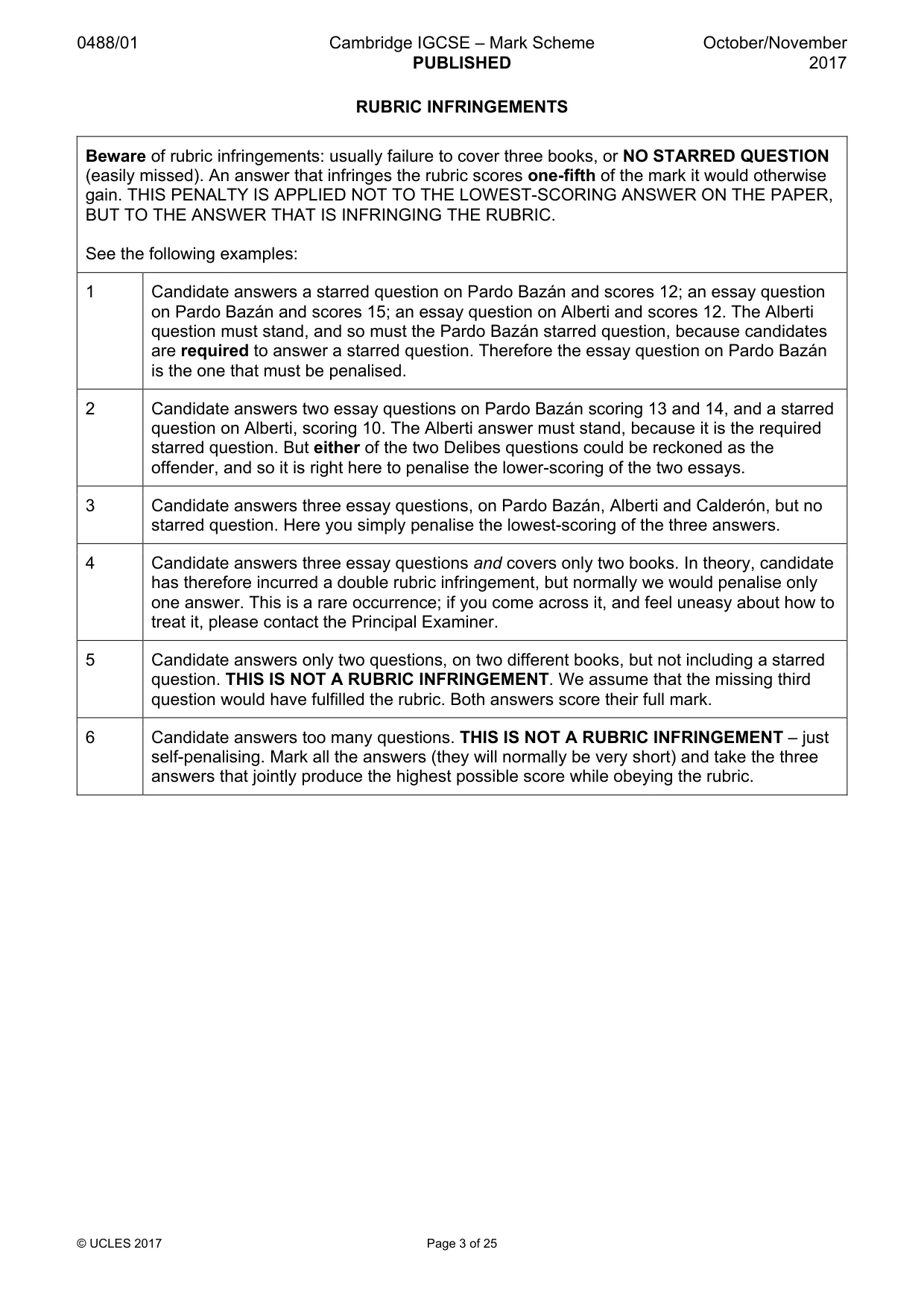
0488/01 Cambridge IGCSE – Mark Scheme PUBLISHED October/November 2017 © UCLES 2017 Page 2 of 25 GENERAL MARKING CRITERIA Answers will be marked according to the following general criteria. Please tick each page of the script marked. Comments can also be added in a text box. Don't forget to write your mark for each essay at the end of that essay. Band 8 20 19 18 Answers in this band have all the qualities of Band 7 work, with further insight, sensitivity, individuality or flair. They show complete and sustained engagement with both text and task. Band 7 17 16 15 A detailed, relevant and possibly perceptive personal response that engages both with text and task • shows a clear and at times critical understanding of the text and its deeper meanings • responds in detail to the way the writer achieves her/his effects (sustaining a fully appropriate voice in an empathic task) • integrates carefully selected and relevant reference to the text Band 6 14 13 12 A developed and relevant personal response that engages both with text and task • shows understanding of the text and some of its deeper implications • responds adequately to the way the writer achieves her/his effects (using suitable features of expression in an empathic task) • shows some thoroughness in selecting relevant references to the text Band 5 11 10 9 Begins to develop a relevant personal response that engages both with text and task • shows some understanding of meaning • makes a little reference to the language of the text (beginning to assume a voice in an empathic task) • uses some supporting textual detail Band 4 8 7 6 Attempts to communicate a basic personal response • makes some relevant comments • shows a basic understanding of surface meaning of the text (of character in an empathic task) • makes a little supporting reference to the text Band 3 5 4 3 Some evidence of a simple personal response • makes a few straightforward comments • shows a few signs of understanding the surface meaning of the text (of character in an empathic task) • makes a little reference to the text Band 2 2 1 Limited attempt to respond • shows some limited understanding of simple/literal meaning Band 1 0 no answer / insufficient answer to meet the criteria for Band 2
Mark scheme, page 3
0488/01 Cambridge IGCSE – Mark Scheme PUBLISHED October/November 2017 © UCLES 2017 Page 3 of 25 RUBRIC INFRINGEMENTS Beware of rubric infringements: usually failure to cover three books, or NO STARRED QUESTION (easily missed). An answer that infringes the rubric scores one-fifth of the mark it would otherwise gain. THIS PENALTY IS APPLIED NOT TO THE LOWEST-SCORING ANSWER ON THE PAPER, BUT TO THE ANSWER THAT IS INFRINGING THE RUBRIC. See the following examples: 1 Candidate answers a starred question on Pardo Bazán and scores 12; an essay question on Pardo Bazán and scores 15; an essay question on Alberti and scores 12. The Alberti question must stand, and so must the Pardo Bazán starred question, because candidates are required to answer a starred question. Therefore the essay question on Pardo Bazán is the one that must be penalised. 2 Candidate answers two essay questions on Pardo Bazán scoring 13 and 14, and a starred question on Alberti, scoring 10. The Alberti answer must stand, because it is the required starred question. But either of the two Delibes questions could be reckoned as the offender, and so it is right here to penalise the lower-scoring of the two essays. 3 Candidate answers three essay questions, on Pardo Bazán, Alberti and Calderón, but no starred question. Here you simply penalise the lowest-scoring of the three answers. 4 Candidate answers three essay questions and covers only two books. In theory, candidate has therefore incurred a double rubric infringement, but normally we would penalise only one answer. This is a rare occurrence; if you come across it, and feel uneasy about how to treat it, please contact the Principal Examiner. 5 Candidate answers only two questions, on two different books, but not including a starred question. THIS IS NOT A RUBRIC INFRINGEMENT. We assume that the missing third question would have fulfilled the rubric. Both answers score their full mark. 6 Candidate answers too many questions. THIS IS NOT A RUBRIC INFRINGEMENT – just self-penalising. Mark all the answers (they will normally be very short) and take the three answers that jointly produce the highest possible score while obeying the rubric.
Mark scheme, page 4
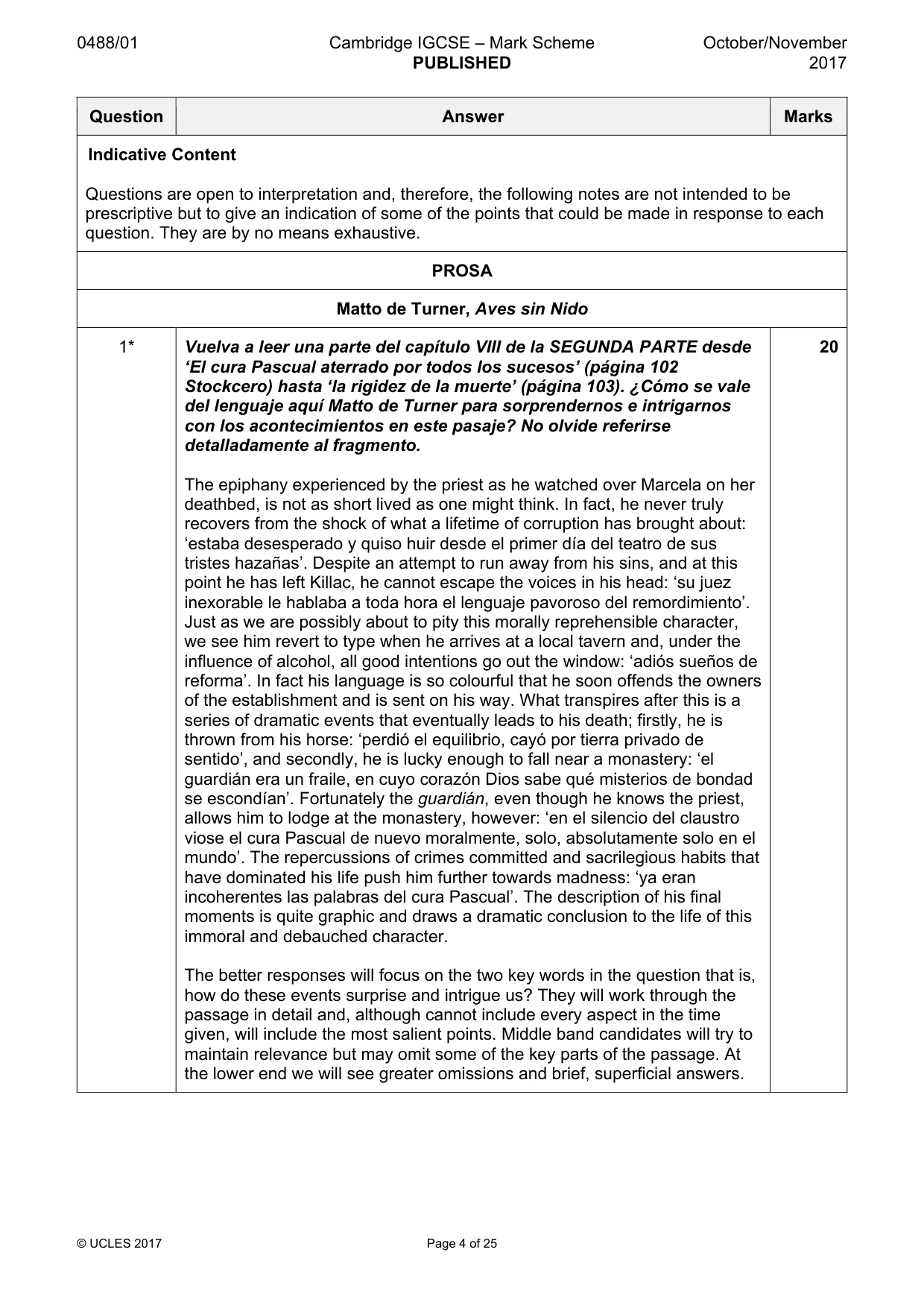
0488/01 Cambridge IGCSE – Mark Scheme PUBLISHED October/November 2017 © UCLES 2017 Page 4 of 25 Question Answer Marks Indicative Content Questions are open to interpretation and, therefore, the following notes are not intended to be prescriptive but to give an indication of some of the points that could be made in response to each question. They are by no means exhaustive. PROSA Matto de Turner, Aves sin Nido 1* Vuelva a leer una parte del capítulo VIII de la SEGUNDA PARTE desde ‘El cura Pascual aterrado por todos los sucesos’ (página 102 Stockcero) hasta ‘la rigidez de la muerte’ (página 103). ¿Cómo se vale del lenguaje aquí Matto de Turner para sorprendernos e intrigarnos con los acontecimientos en este pasaje? No olvide referirse detalladamente al fragmento. The epiphany experienced by the priest as he watched over Marcela on her deathbed, is not as short lived as one might think. In fact, he never truly recovers from the shock of what a lifetime of corruption has brought about: ‘estaba desesperado y quiso huir desde el primer día del teatro de sus tristes hazañas’. Despite an attempt to run away from his sins, and at this point he has left Killac, he cannot escape the voices in his head: ‘su juez inexorable le hablaba a toda hora el lenguaje pavoroso del remordimiento’. Just as we are possibly about to pity this morally reprehensible character, we see him revert to type when he arrives at a local tavern and, under the influence of alcohol, all good intentions go out the window: ‘adiós sueños de reforma’. In fact his language is so colourful that he soon offends the owners of the establishment and is sent on his way. What transpires after this is a series of dramatic events that eventually leads to his death; firstly, he is thrown from his horse: ‘perdió el equilibrio, cayó por tierra privado de sentido’, and secondly, he is lucky enough to fall near a monastery: ‘el guardián era un fraile, en cuyo corazón Dios sabe qué misterios de bondad se escondían’. Fortunately the guardián, even though he knows the priest, allows him to lodge at the monastery, however: ‘en el silencio del claustro viose el cura Pascual de nuevo moralmente, solo, absolutamente solo en el mundo’. The repercussions of crimes committed and sacrilegious habits that have dominated his life push him further towards madness: ‘ya eran incoherentes las palabras del cura Pascual’. The description of his final moments is quite graphic and draws a dramatic conclusion to the life of this immoral and debauched character. The better responses will focus on the two key words in the question that is, how do these events surprise and intrigue us? They will work through the passage in detail and, although cannot include every aspect in the time given, will include the most salient points. Middle band candidates will try to maintain relevance but may omit some of the key parts of the passage. At the lower end we will see greater omissions and brief, superficial answers. 20
Mark scheme, page 5
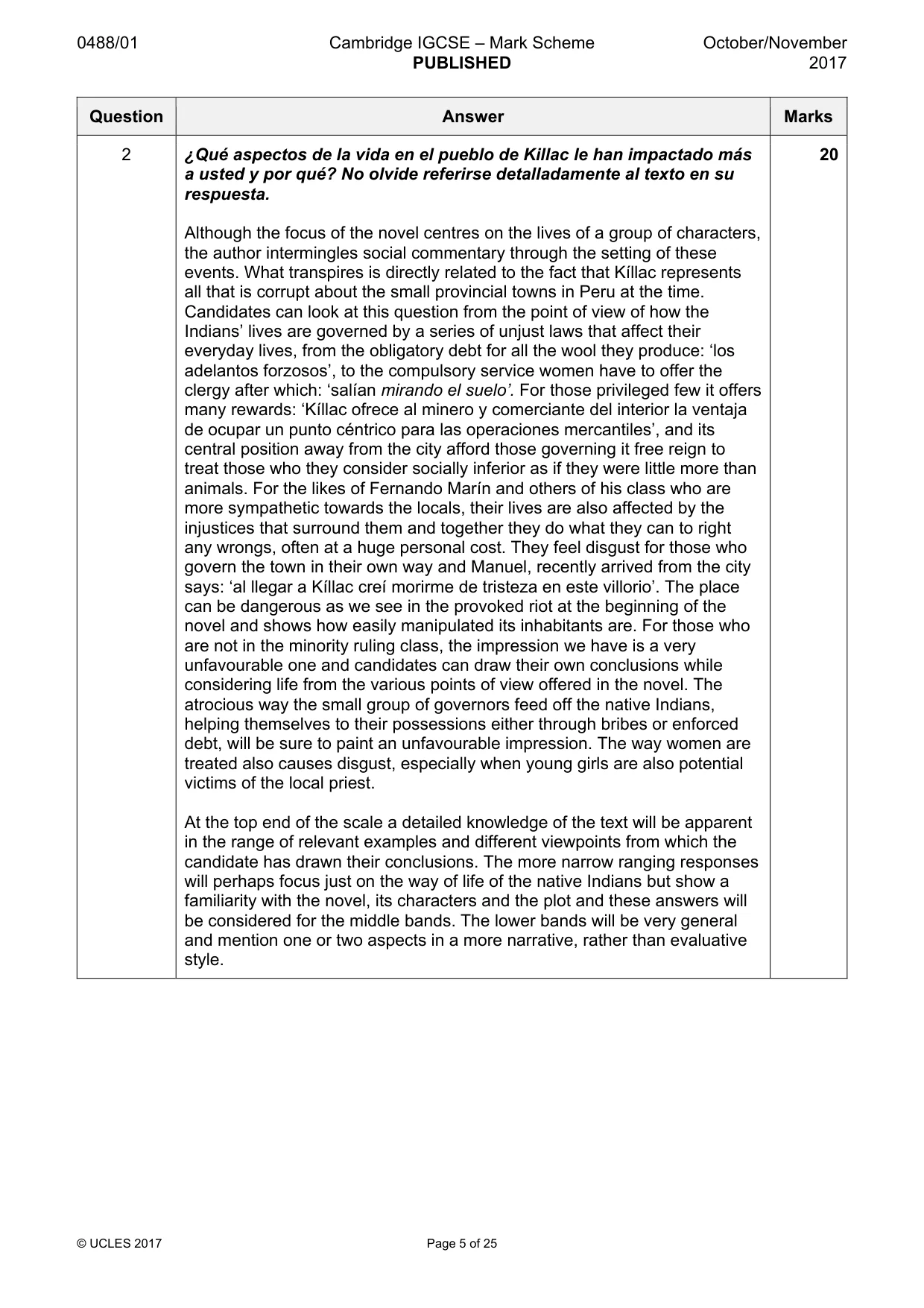
0488/01 Cambridge IGCSE – Mark Scheme PUBLISHED October/November 2017 © UCLES 2017 Page 5 of 25 Question Answer Marks 2 ¿Qué aspectos de la vida en el pueblo de Killac le han impactado más a usted y por qué? No olvide referirse detalladamente al texto en su respuesta. Although the focus of the novel centres on the lives of a group of characters, the author intermingles social commentary through the setting of these events. What transpires is directly related to the fact that Kíllac represents all that is corrupt about the small provincial towns in Peru at the time. Candidates can look at this question from the point of view of how the Indians’ lives are governed by a series of unjust laws that affect their everyday lives, from the obligatory debt for all the wool they produce: ‘los adelantos forzosos’, to the compulsory service women have to offer the clergy after which: ‘salían mirando el suelo’. For those privileged few it offers many rewards: ‘Kíllac ofrece al minero y comerciante del interior la ventaja de ocupar un punto céntrico para las operaciones mercantiles’, and its central position away from the city afford those governing it free reign to treat those who they consider socially inferior as if they were little more than animals. For the likes of Fernando Marín and others of his class who are more sympathetic towards the locals, their lives are also affected by the injustices that surround them and together they do what they can to right any wrongs, often at a huge personal cost. They feel disgust for those who govern the town in their own way and Manuel, recently arrived from the city says: ‘al llegar a Kíllac creí morirme de tristeza en este villorio’. The place can be dangerous as we see in the provoked riot at the beginning of the novel and shows how easily manipulated its inhabitants are. For those who are not in the minority ruling class, the impression we have is a very unfavourable one and candidates can draw their own conclusions while considering life from the various points of view offered in the novel. The atrocious way the small group of governors feed off the native Indians, helping themselves to their possessions either through bribes or enforced debt, will be sure to paint an unfavourable impression. The way women are treated also causes disgust, especially when young girls are also potential victims of the local priest. At the top end of the scale a detailed knowledge of the text will be apparent in the range of relevant examples and different viewpoints from which the candidate has drawn their conclusions. The more narrow ranging responses will perhaps focus just on the way of life of the native Indians but show a familiarity with the novel, its characters and the plot and these answers will be considered for the middle bands. The lower bands will be very general and mention one or two aspects in a more narrative, rather than evaluative style. 20
Mark scheme, page 6
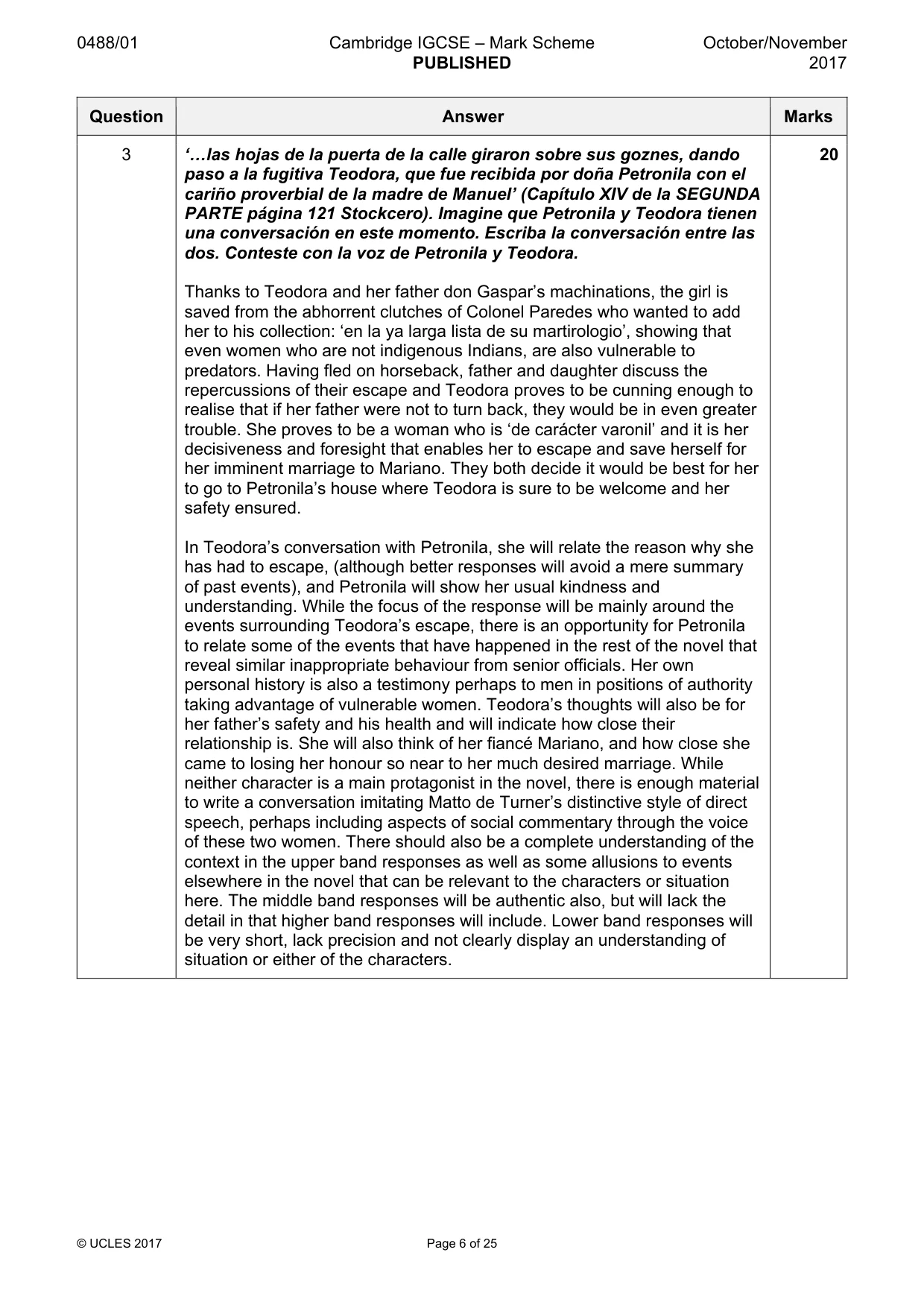
0488/01 Cambridge IGCSE – Mark Scheme PUBLISHED October/November 2017 © UCLES 2017 Page 6 of 25 Question Answer Marks 3 ‘«las hojas de la puerta de la calle giraron sobre sus goznes, dando paso a la fugitiva Teodora, que fue recibida por doña Petronila con el cariño proverbial de la madre de Manuel’ (Capítulo XIV de la SEGUNDA PARTE página 121 Stockcero). Imagine que Petronila y Teodora tienen una conversación en este momento. Escriba la conversación entre las dos. Conteste con la voz de Petronila y Teodora. Thanks to Teodora and her father don Gaspar’s machinations, the girl is saved from the abhorrent clutches of Colonel Paredes who wanted to add her to his collection: ‘en la ya larga lista de su martirologio’, showing that even women who are not indigenous Indians, are also vulnerable to predators. Having fled on horseback, father and daughter discuss the repercussions of their escape and Teodora proves to be cunning enough to realise that if her father were not to turn back, they would be in even greater trouble. She proves to be a woman who is ‘de carácter varonil’ and it is her decisiveness and foresight that enables her to escape and save herself for her imminent marriage to Mariano. They both decide it would be best for her to go to Petronila’s house where Teodora is sure to be welcome and her safety ensured. In Teodora’s conversation with Petronila, she will relate the reason why she has had to escape, (although better responses will avoid a mere summary of past events), and Petronila will show her usual kindness and understanding. While the focus of the response will be mainly around the events surrounding Teodora’s escape, there is an opportunity for Petronila to relate some of the events that have happened in the rest of the novel that reveal similar inappropriate behaviour from senior officials. Her own personal history is also a testimony perhaps to men in positions of authority taking advantage of vulnerable women. Teodora’s thoughts will also be for her father’s safety and his health and will indicate how close their relationship is. She will also think of her fiancé Mariano, and how close she came to losing her honour so near to her much desired marriage. While neither character is a main protagonist in the novel, there is enough material to write a conversation imitating Matto de Turner’s distinctive style of direct speech, perhaps including aspects of social commentary through the voice of these two women. There should also be a complete understanding of the context in the upper band responses as well as some allusions to events elsewhere in the novel that can be relevant to the characters or situation here. The middle band responses will be authentic also, but will lack the detail in that higher band responses will include. Lower band responses will be very short, lack precision and not clearly display an understanding of situation or either of the characters. 20
Mark scheme, page 7
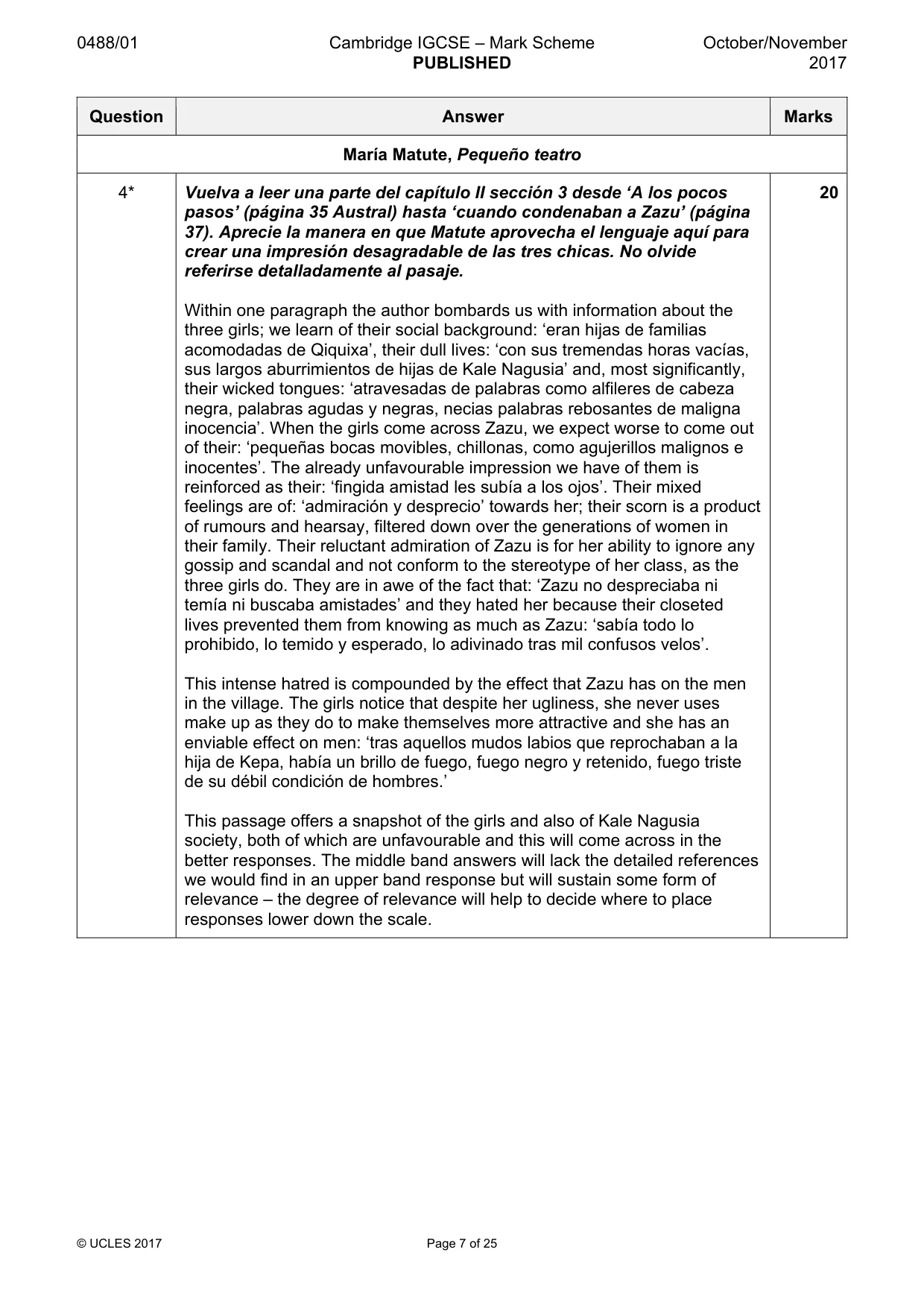
0488/01 Cambridge IGCSE – Mark Scheme PUBLISHED October/November 2017 © UCLES 2017 Page 7 of 25 Question Answer Marks María Matute, Pequeño teatro 4* Vuelva a leer una parte del capítulo II sección 3 desde ‘A los pocos pasos’ (página 35 Austral) hasta ‘cuando condenaban a Zazu’ (página 37). Aprecie la manera en que Matute aprovecha el lenguaje aquí para crear una impresión desagradable de las tres chicas. No olvide referirse detalladamente al pasaje. Within one paragraph the author bombards us with information about the three girls; we learn of their social background: ‘eran hijas de familias acomodadas de Qiquixa’, their dull lives: ‘con sus tremendas horas vacías, sus largos aburrimientos de hijas de Kale Nagusia’ and, most significantly, their wicked tongues: ‘atravesadas de palabras como alfileres de cabeza negra, palabras agudas y negras, necias palabras rebosantes de maligna inocencia’. When the girls come across Zazu, we expect worse to come out of their: ‘pequeñas bocas movibles, chillonas, como agujerillos malignos e inocentes’. The already unfavourable impression we have of them is reinforced as their: ‘fingida amistad les subía a los ojos’. Their mixed feelings are of: ‘admiración y desprecio’ towards her; their scorn is a product of rumours and hearsay, filtered down over the generations of women in their family. Their reluctant admiration of Zazu is for her ability to ignore any gossip and scandal and not conform to the stereotype of her class, as the three girls do. They are in awe of the fact that: ‘Zazu no despreciaba ni temía ni buscaba amistades’ and they hated her because their closeted lives prevented them from knowing as much as Zazu: ‘sabía todo lo prohibido, lo temido y esperado, lo adivinado tras mil confusos velos’. This intense hatred is compounded by the effect that Zazu has on the men in the village. The girls notice that despite her ugliness, she never uses make up as they do to make themselves more attractive and she has an enviable effect on men: ‘tras aquellos mudos labios que reprochaban a la hija de Kepa, había un brillo de fuego, fuego negro y retenido, fuego triste de su débil condición de hombres.’ This passage offers a snapshot of the girls and also of Kale Nagusia society, both of which are unfavourable and this will come across in the better responses. The middle band answers will lack the detailed references we would find in an upper band response but will sustain some form of relevance – the degree of relevance will help to decide where to place responses lower down the scale. 20
Mark scheme, page 8
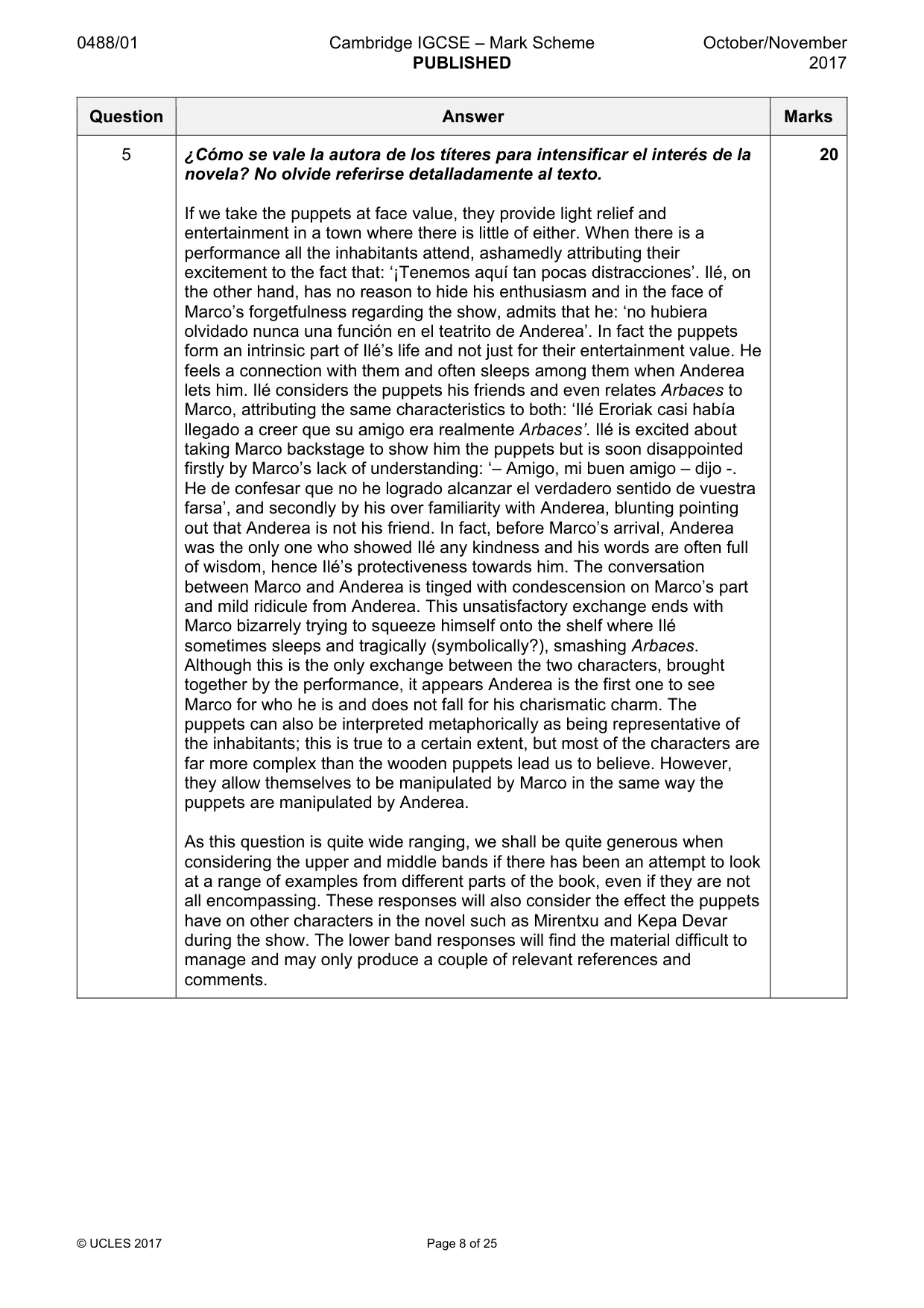
0488/01 Cambridge IGCSE – Mark Scheme PUBLISHED October/November 2017 © UCLES 2017 Page 8 of 25 Question Answer Marks 5 ¿Cómo se vale la autora de los títeres para intensificar el interés de la novela? No olvide referirse detalladamente al texto. If we take the puppets at face value, they provide light relief and entertainment in a town where there is little of either. When there is a performance all the inhabitants attend, ashamedly attributing their excitement to the fact that: ‘¡Tenemos aquí tan pocas distracciones’. Ilé, on the other hand, has no reason to hide his enthusiasm and in the face of Marco’s forgetfulness regarding the show, admits that he: ‘no hubiera olvidado nunca una función en el teatrito de Anderea’. In fact the puppets form an intrinsic part of Ilé’s life and not just for their entertainment value. He feels a connection with them and often sleeps among them when Anderea lets him. Ilé considers the puppets his friends and even relates Arbaces to Marco, attributing the same characteristics to both: ‘Ilé Eroriak casi había llegado a creer que su amigo era realmente Arbaces’. Ilé is excited about taking Marco backstage to show him the puppets but is soon disappointed firstly by Marco’s lack of understanding: ‘– Amigo, mi buen amigo – dijo -. He de confesar que no he logrado alcanzar el verdadero sentido de vuestra farsa’, and secondly by his over familiarity with Anderea, blunting pointing out that Anderea is not his friend. In fact, before Marco’s arrival, Anderea was the only one who showed Ilé any kindness and his words are often full of wisdom, hence Ilé’s protectiveness towards him. The conversation between Marco and Anderea is tinged with condescension on Marco’s part and mild ridicule from Anderea. This unsatisfactory exchange ends with Marco bizarrely trying to squeeze himself onto the shelf where Ilé sometimes sleeps and tragically (symbolically?), smashing Arbaces. Although this is the only exchange between the two characters, brought together by the performance, it appears Anderea is the first one to see Marco for who he is and does not fall for his charismatic charm. The puppets can also be interpreted metaphorically as being representative of the inhabitants; this is true to a certain extent, but most of the characters are far more complex than the wooden puppets lead us to believe. However, they allow themselves to be manipulated by Marco in the same way the puppets are manipulated by Anderea. As this question is quite wide ranging, we shall be quite generous when considering the upper and middle bands if there has been an attempt to look at a range of examples from different parts of the book, even if they are not all encompassing. These responses will also consider the effect the puppets have on other characters in the novel such as Mirentxu and Kepa Devar during the show. The lower band responses will find the material difficult to manage and may only produce a couple of relevant references and comments. 20
Mark scheme, page 9
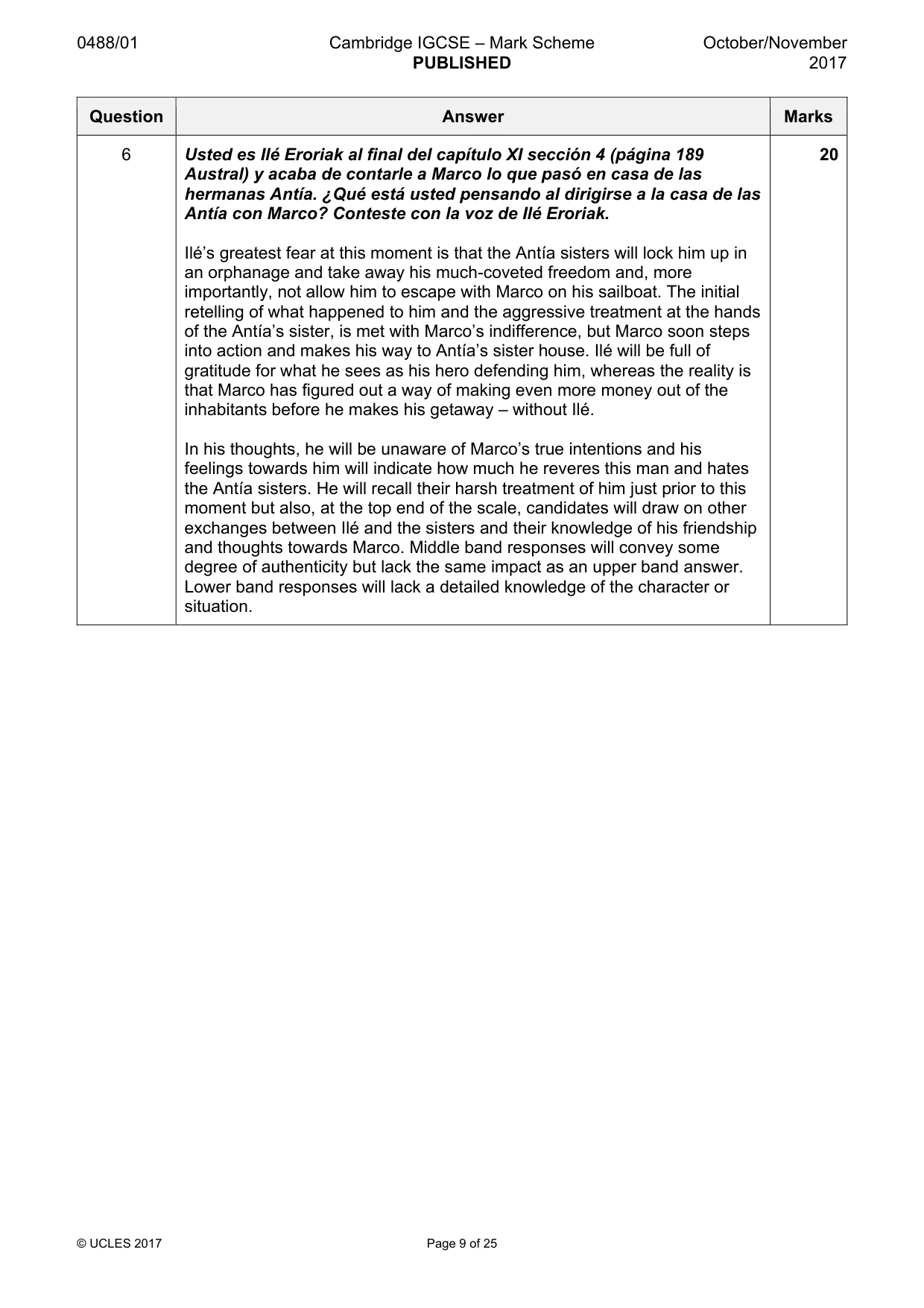
0488/01 Cambridge IGCSE – Mark Scheme PUBLISHED October/November 2017 © UCLES 2017 Page 9 of 25 Question Answer Marks 6 Usted es Ilé Eroriak al final del capítulo XI sección 4 (página 189 Austral) y acaba de contarle a Marco lo que pasó en casa de las hermanas Antía. ¿Qué está usted pensando al dirigirse a la casa de las Antía con Marco? Conteste con la voz de Ilé Eroriak. Ilé’s greatest fear at this moment is that the Antía sisters will lock him up in an orphanage and take away his much-coveted freedom and, more importantly, not allow him to escape with Marco on his sailboat. The initial retelling of what happened to him and the aggressive treatment at the hands of the Antía’s sister, is met with Marco’s indifference, but Marco soon steps into action and makes his way to Antía’s sister house. Ilé will be full of gratitude for what he sees as his hero defending him, whereas the reality is that Marco has figured out a way of making even more money out of the inhabitants before he makes his getaway – without Ilé. In his thoughts, he will be unaware of Marco’s true intentions and his feelings towards him will indicate how much he reveres this man and hates the Antía sisters. He will recall their harsh treatment of him just prior to this moment but also, at the top end of the scale, candidates will draw on other exchanges between Ilé and the sisters and their knowledge of his friendship and thoughts towards Marco. Middle band responses will convey some degree of authenticity but lack the same impact as an upper band answer. Lower band responses will lack a detailed knowledge of the character or situation. 20
Mark scheme, page 10
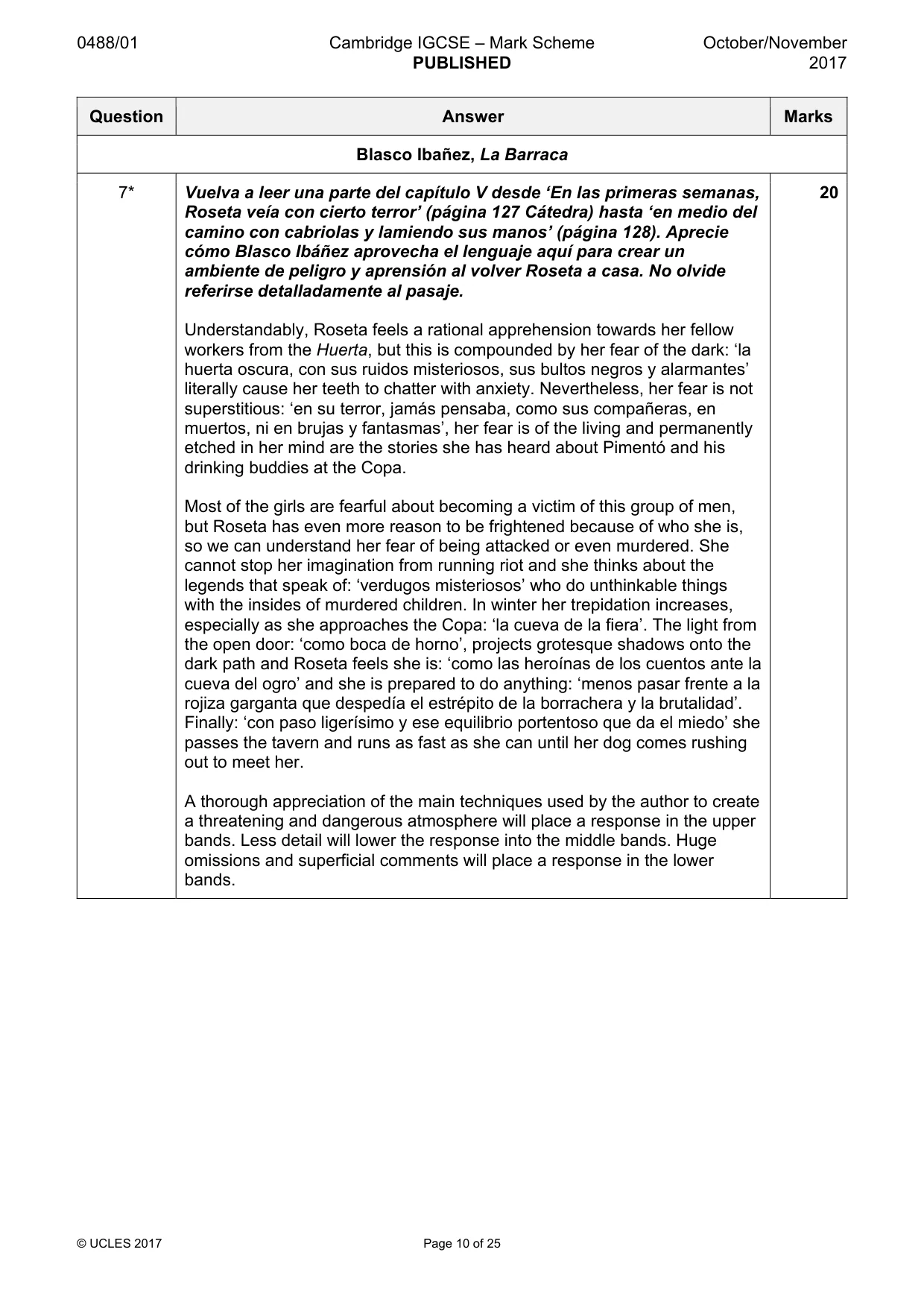
0488/01 Cambridge IGCSE – Mark Scheme PUBLISHED October/November 2017 © UCLES 2017 Page 10 of 25 Question Answer Marks Blasco Ibañez, La Barraca 7* Vuelva a leer una parte del capítulo V desde ‘En las primeras semanas, Roseta veía con cierto terror’ (página 127 Cátedra) hasta ‘en medio del camino con cabriolas y lamiendo sus manos’ (página 128). Aprecie cómo Blasco Ibáñez aprovecha el lenguaje aquí para crear un ambiente de peligro y aprensión al volver Roseta a casa. No olvide referirse detalladamente al pasaje. Understandably, Roseta feels a rational apprehension towards her fellow workers from the Huerta, but this is compounded by her fear of the dark: ‘la huerta oscura, con sus ruidos misteriosos, sus bultos negros y alarmantes’ literally cause her teeth to chatter with anxiety. Nevertheless, her fear is not superstitious: ‘en su terror, jamás pensaba, como sus compañeras, en muertos, ni en brujas y fantasmas’, her fear is of the living and permanently etched in her mind are the stories she has heard about Pimentó and his drinking buddies at the Copa. Most of the girls are fearful about becoming a victim of this group of men, but Roseta has even more reason to be frightened because of who she is, so we can understand her fear of being attacked or even murdered. She cannot stop her imagination from running riot and she thinks about the legends that speak of: ‘verdugos misteriosos’ who do unthinkable things with the insides of murdered children. In winter her trepidation increases, especially as she approaches the Copa: ‘la cueva de la fiera’. The light from the open door: ‘como boca de horno’, projects grotesque shadows onto the dark path and Roseta feels she is: ‘como las heroínas de los cuentos ante la cueva del ogro’ and she is prepared to do anything: ‘menos pasar frente a la rojiza garganta que despedía el estrépito de la borrachera y la brutalidad’. Finally: ‘con paso ligerísimo y ese equilibrio portentoso que da el miedo’ she passes the tavern and runs as fast as she can until her dog comes rushing out to meet her. A thorough appreciation of the main techniques used by the author to create a threatening and dangerous atmosphere will place a response in the upper bands. Less detail will lower the response into the middle bands. Huge omissions and superficial comments will place a response in the lower bands. 20
Mark scheme, page 11
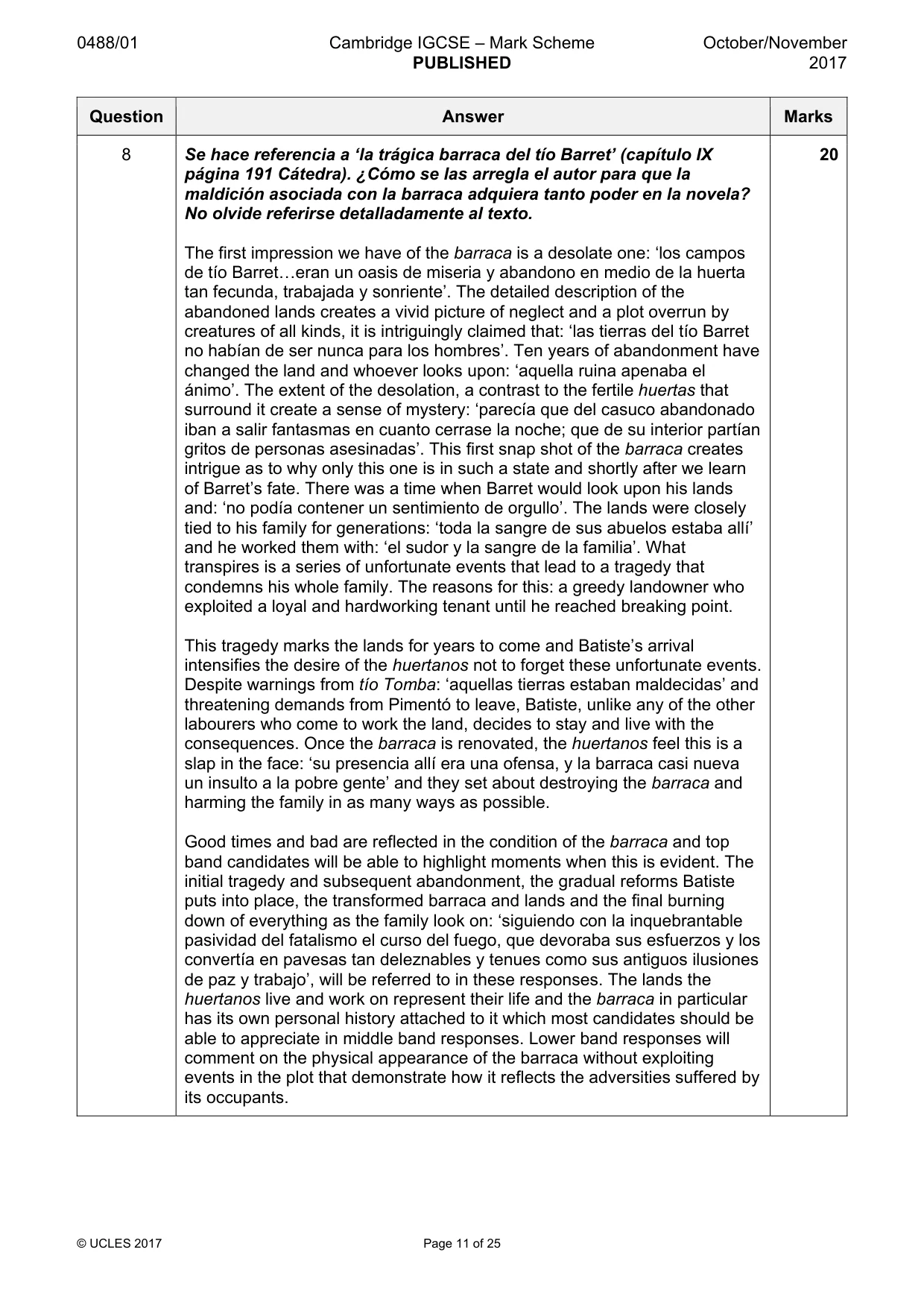
0488/01 Cambridge IGCSE – Mark Scheme PUBLISHED October/November 2017 © UCLES 2017 Page 11 of 25 Question Answer Marks 8 Se hace referencia a ‘la trágica barraca del tío Barret’ (capítulo IX página 191 Cátedra). ¿Cómo se las arregla el autor para que la maldición asociada con la barraca adquiera tanto poder en la novela? No olvide referirse detalladamente al texto. The first impression we have of the barraca is a desolate one: ‘los campos de tío Barret«eran un oasis de miseria y abandono en medio de la huerta tan fecunda, trabajada y sonriente’. The detailed description of the abandoned lands creates a vivid picture of neglect and a plot overrun by creatures of all kinds, it is intriguingly claimed that: ‘las tierras del tío Barret no habían de ser nunca para los hombres’. Ten years of abandonment have changed the land and whoever looks upon: ‘aquella ruina apenaba el ánimo’. The extent of the desolation, a contrast to the fertile huertas that surround it create a sense of mystery: ‘parecía que del casuco abandonado iban a salir fantasmas en cuanto cerrase la noche; que de su interior partían gritos de personas asesinadas’. This first snap shot of the barraca creates intrigue as to why only this one is in such a state and shortly after we learn of Barret’s fate. There was a time when Barret would look upon his lands and: ‘no podía contener un sentimiento de orgullo’. The lands were closely tied to his family for generations: ‘toda la sangre de sus abuelos estaba allí’ and he worked them with: ‘el sudor y la sangre de la familia’. What transpires is a series of unfortunate events that lead to a tragedy that condemns his whole family. The reasons for this: a greedy landowner who exploited a loyal and hardworking tenant until he reached breaking point. This tragedy marks the lands for years to come and Batiste’s arrival intensifies the desire of the huertanos not to forget these unfortunate events. Despite warnings from tío Tomba: ‘aquellas tierras estaban maldecidas’ and threatening demands from Pimentó to leave, Batiste, unlike any of the other labourers who come to work the land, decides to stay and live with the consequences. Once the barraca is renovated, the huertanos feel this is a slap in the face: ‘su presencia allí era una ofensa, y la barraca casi nueva un insulto a la pobre gente’ and they set about destroying the barraca and harming the family in as many ways as possible. Good times and bad are reflected in the condition of the barraca and top band candidates will be able to highlight moments when this is evident. The initial tragedy and subsequent abandonment, the gradual reforms Batiste puts into place, the transformed barraca and lands and the final burning down of everything as the family look on: ‘siguiendo con la inquebrantable pasividad del fatalismo el curso del fuego, que devoraba sus esfuerzos y los convertía en pavesas tan deleznables y tenues como sus antiguos ilusiones de paz y trabajo’, will be referred to in these responses. The lands the huertanos live and work on represent their life and the barraca in particular has its own personal history attached to it which most candidates should be able to appreciate in middle band responses. Lower band responses will comment on the physical appearance of the barraca without exploiting events in the plot that demonstrate how it reflects the adversities suffered by its occupants. 20
Mark scheme, page 12
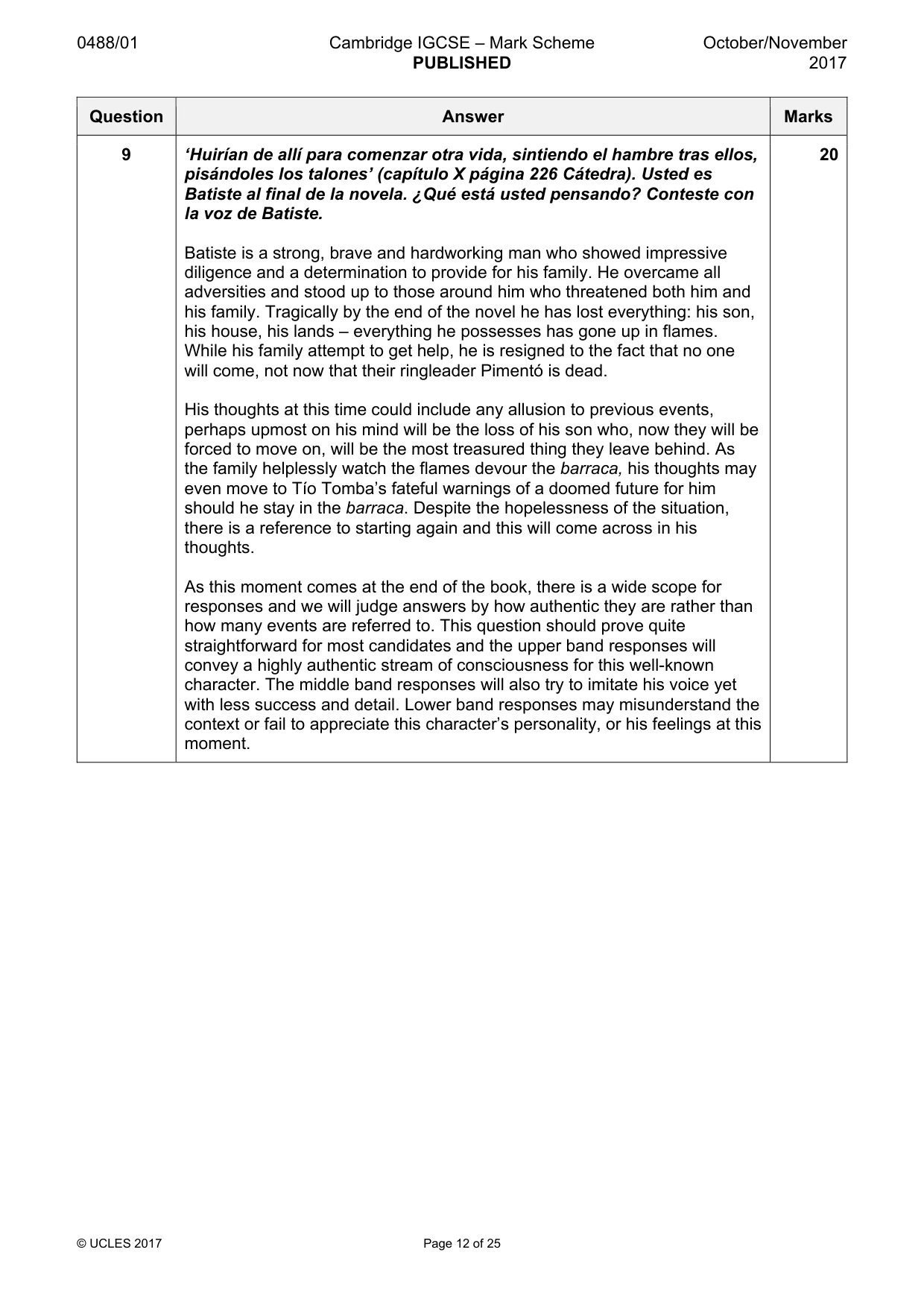
0488/01 Cambridge IGCSE – Mark Scheme PUBLISHED October/November 2017 © UCLES 2017 Page 12 of 25 Question Answer Marks 9 ‘Huirían de allí para comenzar otra vida, sintiendo el hambre tras ellos, pisándoles los talones’ (capítulo X página 226 Cátedra). Usted es Batiste al final de la novela. ¿Qué está usted pensando? Conteste con la voz de Batiste. Batiste is a strong, brave and hardworking man who showed impressive diligence and a determination to provide for his family. He overcame all adversities and stood up to those around him who threatened both him and his family. Tragically by the end of the novel he has lost everything: his son, his house, his lands – everything he possesses has gone up in flames. While his family attempt to get help, he is resigned to the fact that no one will come, not now that their ringleader Pimentó is dead. His thoughts at this time could include any allusion to previous events, perhaps upmost on his mind will be the loss of his son who, now they will be forced to move on, will be the most treasured thing they leave behind. As the family helplessly watch the flames devour the barraca, his thoughts may even move to Tío Tomba’s fateful warnings of a doomed future for him should he stay in the barraca. Despite the hopelessness of the situation, there is a reference to starting again and this will come across in his thoughts. As this moment comes at the end of the book, there is a wide scope for responses and we will judge answers by how authentic they are rather than how many events are referred to. This question should prove quite straightforward for most candidates and the upper band responses will convey a highly authentic stream of consciousness for this well-known character. The middle band responses will also try to imitate his voice yet with less success and detail. Lower band responses may misunderstand the context or fail to appreciate this character’s personality, or his feelings at this moment. 20
Mark scheme, page 13
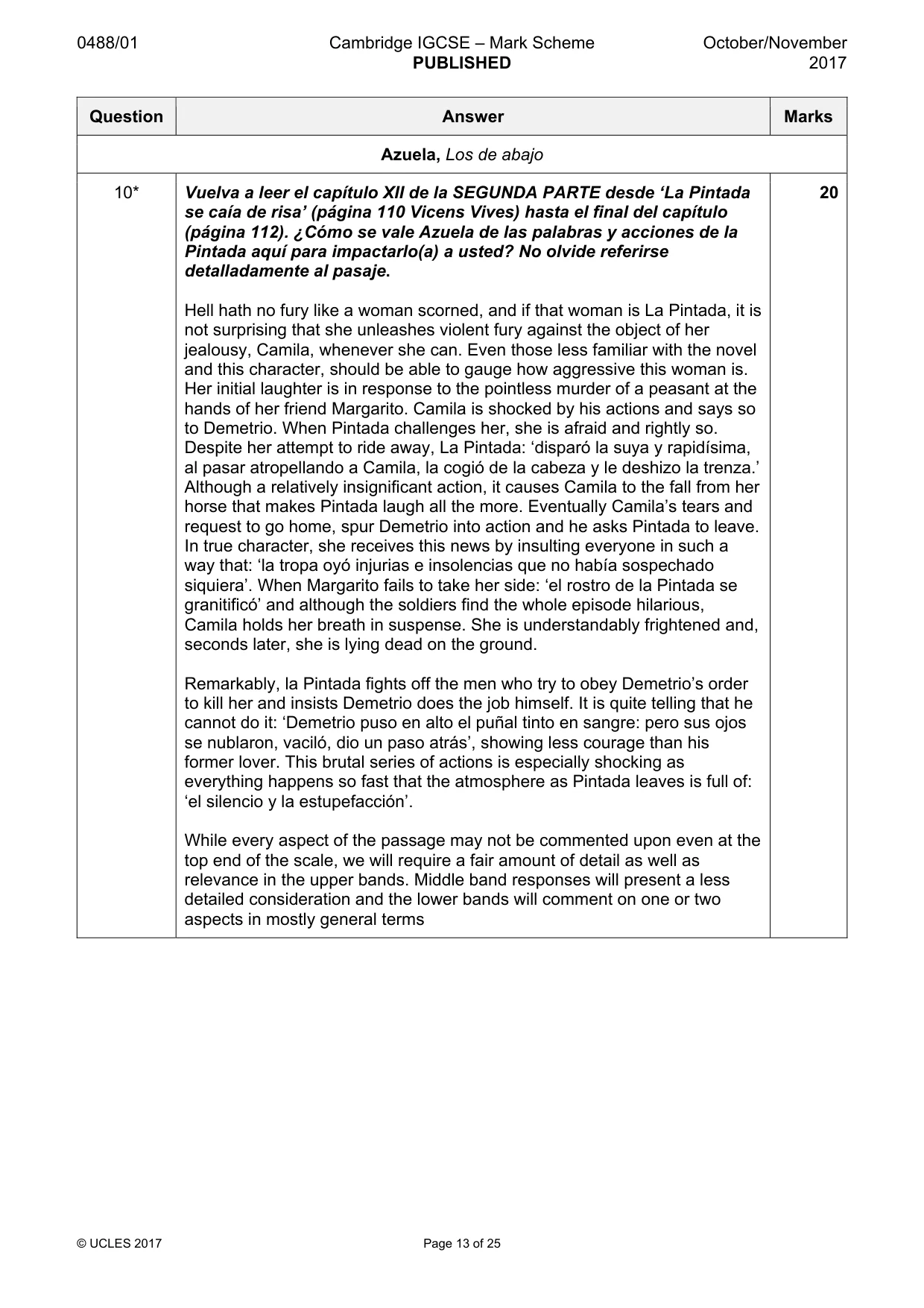
0488/01 Cambridge IGCSE – Mark Scheme PUBLISHED October/November 2017 © UCLES 2017 Page 13 of 25 Question Answer Marks Azuela, Los de abajo 10* Vuelva a leer el capítulo XII de la SEGUNDA PARTE desde ‘La Pintada se caía de risa’ (página 110 Vicens Vives) hasta el final del capítulo (página 112). ¿Cómo se vale Azuela de las palabras y acciones de la Pintada aquí para impactarlo(a) a usted? No olvide referirse detalladamente al pasaje. Hell hath no fury like a woman scorned, and if that woman is La Pintada, it is not surprising that she unleashes violent fury against the object of her jealousy, Camila, whenever she can. Even those less familiar with the novel and this character, should be able to gauge how aggressive this woman is. Her initial laughter is in response to the pointless murder of a peasant at the hands of her friend Margarito. Camila is shocked by his actions and says so to Demetrio. When Pintada challenges her, she is afraid and rightly so. Despite her attempt to ride away, La Pintada: ‘disparó la suya y rapidísima, al pasar atropellando a Camila, la cogió de la cabeza y le deshizo la trenza.’ Although a relatively insignificant action, it causes Camila to the fall from her horse that makes Pintada laugh all the more. Eventually Camila’s tears and request to go home, spur Demetrio into action and he asks Pintada to leave. In true character, she receives this news by insulting everyone in such a way that: ‘la tropa oyó injurias e insolencias que no había sospechado siquiera’. When Margarito fails to take her side: ‘el rostro de la Pintada se granitificó’ and although the soldiers find the whole episode hilarious, Camila holds her breath in suspense. She is understandably frightened and, seconds later, she is lying dead on the ground. Remarkably, la Pintada fights off the men who try to obey Demetrio’s order to kill her and insists Demetrio does the job himself. It is quite telling that he cannot do it: ‘Demetrio puso en alto el puñal tinto en sangre: pero sus ojos se nublaron, vaciló, dio un paso atrás’, showing less courage than his former lover. This brutal series of actions is especially shocking as everything happens so fast that the atmosphere as Pintada leaves is full of: ‘el silencio y la estupefacción’. While every aspect of the passage may not be commented upon even at the top end of the scale, we will require a fair amount of detail as well as relevance in the upper bands. Middle band responses will present a less detailed consideration and the lower bands will comment on one or two aspects in mostly general terms 20
Mark scheme, page 14
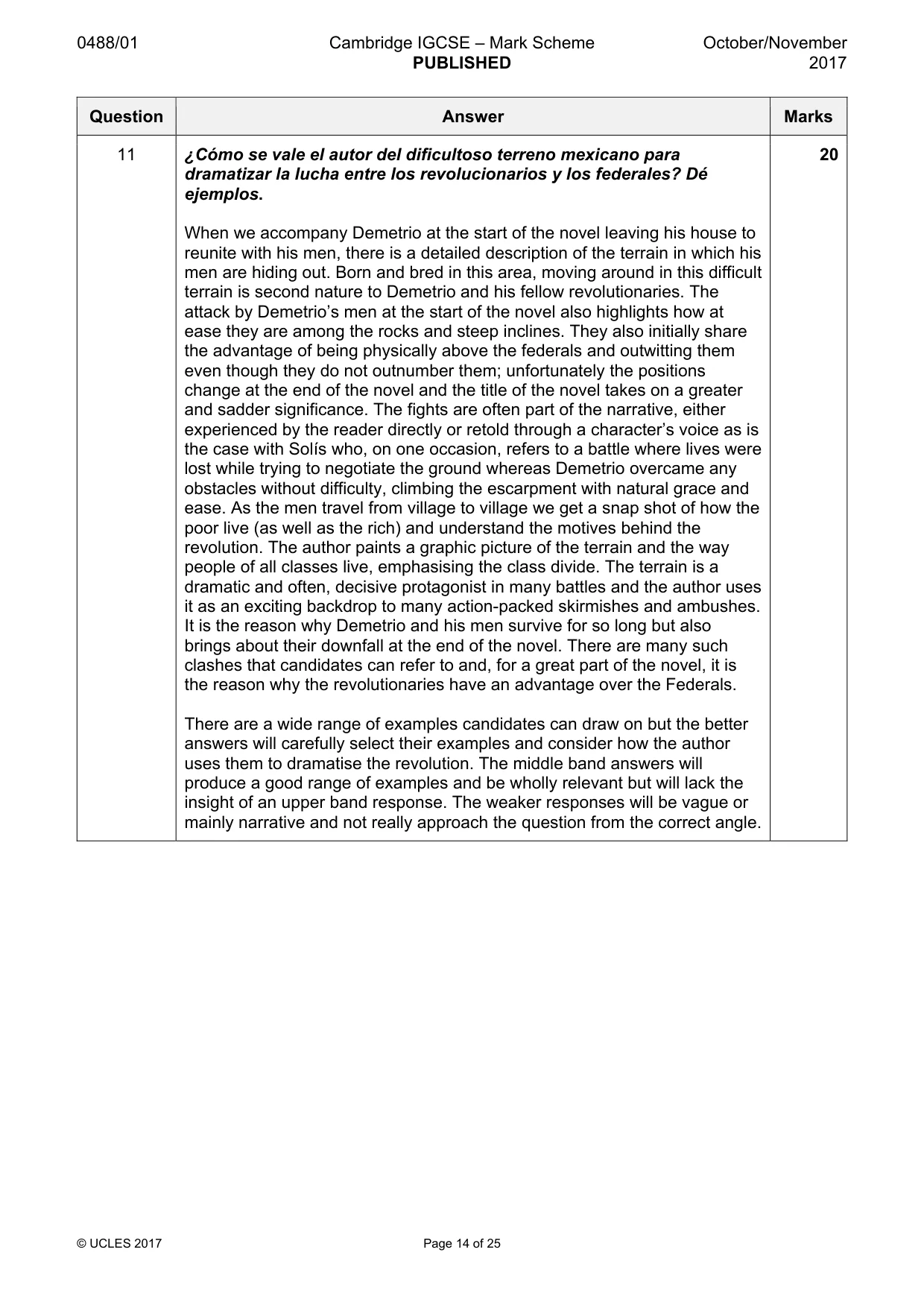
0488/01 Cambridge IGCSE – Mark Scheme PUBLISHED October/November 2017 © UCLES 2017 Page 14 of 25 Question Answer Marks 11 ¿Cómo se vale el autor del dificultoso terreno mexicano para dramatizar la lucha entre los revolucionarios y los federales? Dé ejemplos. When we accompany Demetrio at the start of the novel leaving his house to reunite with his men, there is a detailed description of the terrain in which his men are hiding out. Born and bred in this area, moving around in this difficult terrain is second nature to Demetrio and his fellow revolutionaries. The attack by Demetrio’s men at the start of the novel also highlights how at ease they are among the rocks and steep inclines. They also initially share the advantage of being physically above the federals and outwitting them even though they do not outnumber them; unfortunately the positions change at the end of the novel and the title of the novel takes on a greater and sadder significance. The fights are often part of the narrative, either experienced by the reader directly or retold through a character’s voice as is the case with Solís who, on one occasion, refers to a battle where lives were lost while trying to negotiate the ground whereas Demetrio overcame any obstacles without difficulty, climbing the escarpment with natural grace and ease. As the men travel from village to village we get a snap shot of how the poor live (as well as the rich) and understand the motives behind the revolution. The author paints a graphic picture of the terrain and the way people of all classes live, emphasising the class divide. The terrain is a dramatic and often, decisive protagonist in many battles and the author uses it as an exciting backdrop to many action-packed skirmishes and ambushes. It is the reason why Demetrio and his men survive for so long but also brings about their downfall at the end of the novel. There are many such clashes that candidates can refer to and, for a great part of the novel, it is the reason why the revolutionaries have an advantage over the Federals. There are a wide range of examples candidates can draw on but the better answers will carefully select their examples and consider how the author uses them to dramatise the revolution. The middle band answers will produce a good range of examples and be wholly relevant but will lack the insight of an upper band response. The weaker responses will be vague or mainly narrative and not really approach the question from the correct angle. 20
Mark scheme, page 15
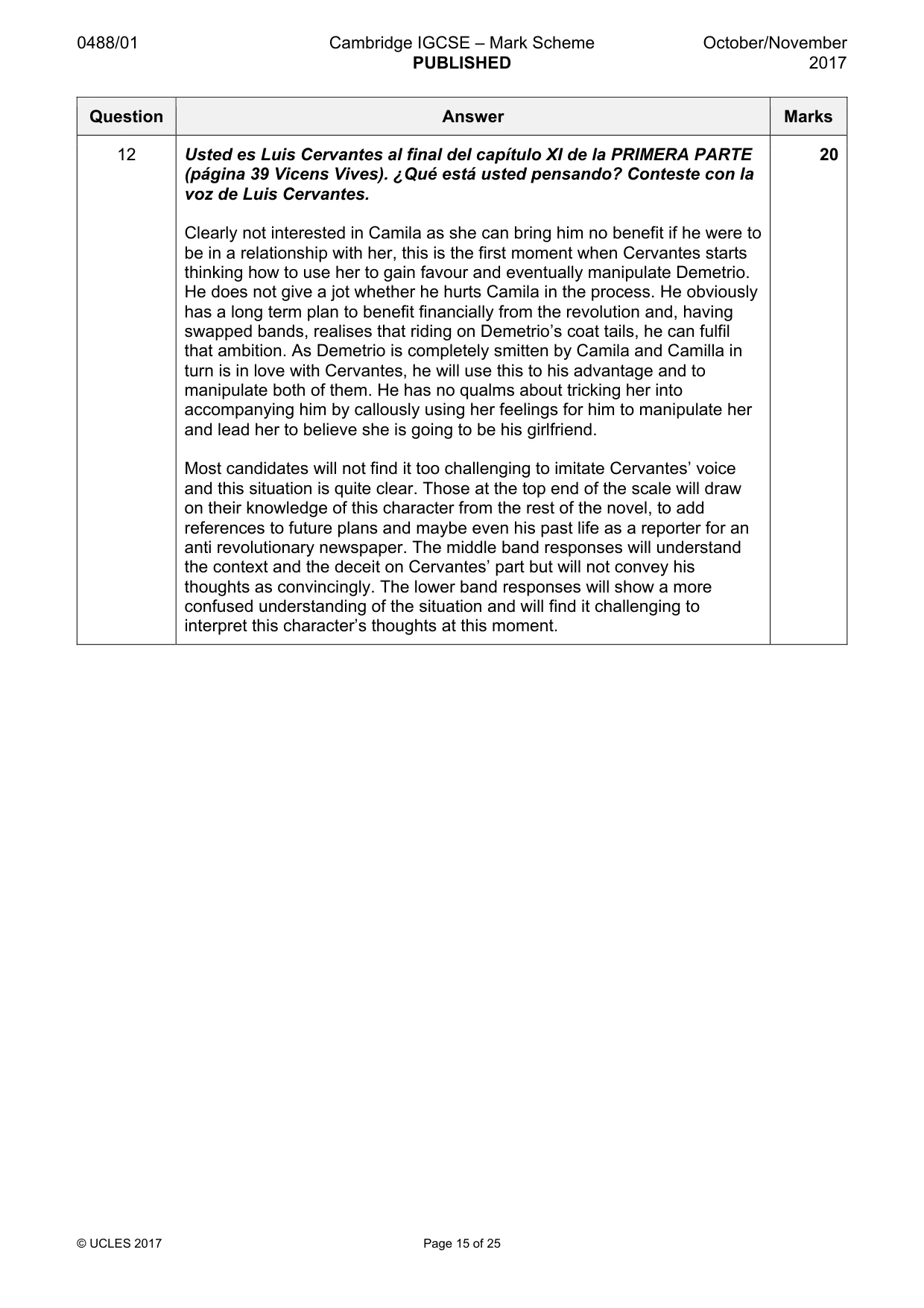
0488/01 Cambridge IGCSE – Mark Scheme PUBLISHED October/November 2017 © UCLES 2017 Page 15 of 25 Question Answer Marks 12 Usted es Luis Cervantes al final del capítulo XI de la PRIMERA PARTE (página 39 Vicens Vives). ¿Qué está usted pensando? Conteste con la voz de Luis Cervantes. Clearly not interested in Camila as she can bring him no benefit if he were to be in a relationship with her, this is the first moment when Cervantes starts thinking how to use her to gain favour and eventually manipulate Demetrio. He does not give a jot whether he hurts Camila in the process. He obviously has a long term plan to benefit financially from the revolution and, having swapped bands, realises that riding on Demetrio’s coat tails, he can fulfil that ambition. As Demetrio is completely smitten by Camila and Camilla in turn is in love with Cervantes, he will use this to his advantage and to manipulate both of them. He has no qualms about tricking her into accompanying him by callously using her feelings for him to manipulate her and lead her to believe she is going to be his girlfriend. Most candidates will not find it too challenging to imitate Cervantes’ voice and this situation is quite clear. Those at the top end of the scale will draw on their knowledge of this character from the rest of the novel, to add references to future plans and maybe even his past life as a reporter for an anti revolutionary newspaper. The middle band responses will understand the context and the deceit on Cervantes’ part but will not convey his thoughts as convincingly. The lower band responses will show a more confused understanding of the situation and will find it challenging to interpret this character’s thoughts at this moment. 20
Mark scheme, page 16
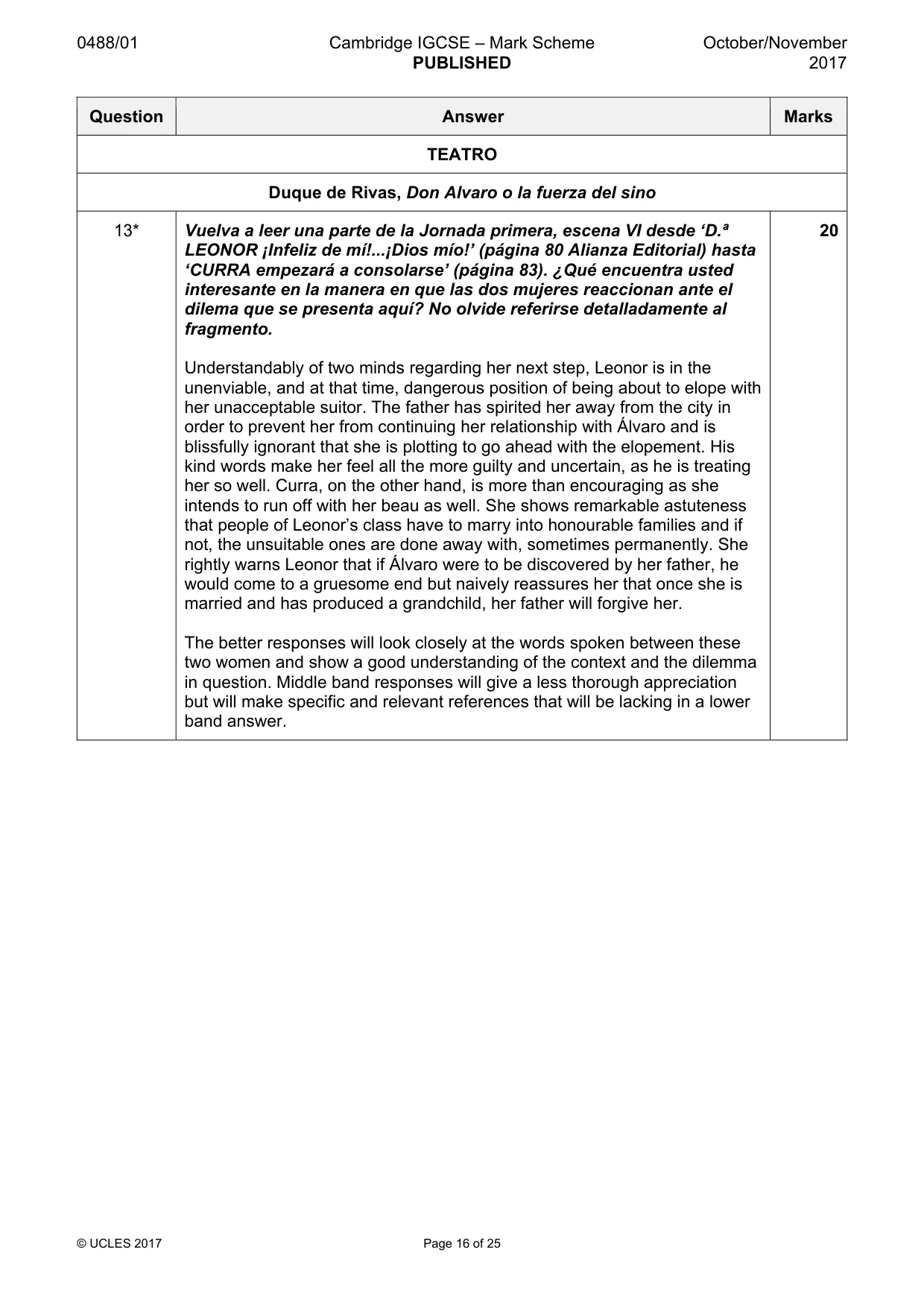
0488/01 Cambridge IGCSE – Mark Scheme PUBLISHED October/November 2017 © UCLES 2017 Page 16 of 25 Question Answer Marks TEATRO Duque de Rivas, Don Alvaro o la fuerza del sino 13* Vuelva a leer una parte de la Jornada primera, escena VI desde ‘D.ª LEONOR ¡Infeliz de mí!...¡Dios mío!’ (página 80 Alianza Editorial) hasta ‘CURRA empezará a consolarse’ (página 83). ¿Qué encuentra usted interesante en la manera en que las dos mujeres reaccionan ante el dilema que se presenta aquí? No olvide referirse detalladamente al fragmento. Understandably of two minds regarding her next step, Leonor is in the unenviable, and at that time, dangerous position of being about to elope with her unacceptable suitor. The father has spirited her away from the city in order to prevent her from continuing her relationship with Álvaro and is blissfully ignorant that she is plotting to go ahead with the elopement. His kind words make her feel all the more guilty and uncertain, as he is treating her so well. Curra, on the other hand, is more than encouraging as she intends to run off with her beau as well. She shows remarkable astuteness that people of Leonor’s class have to marry into honourable families and if not, the unsuitable ones are done away with, sometimes permanently. She rightly warns Leonor that if Álvaro were to be discovered by her father, he would come to a gruesome end but naively reassures her that once she is married and has produced a grandchild, her father will forgive her. The better responses will look closely at the words spoken between these two women and show a good understanding of the context and the dilemma in question. Middle band responses will give a less thorough appreciation but will make specific and relevant references that will be lacking in a lower band answer. 20
Mark scheme, page 17
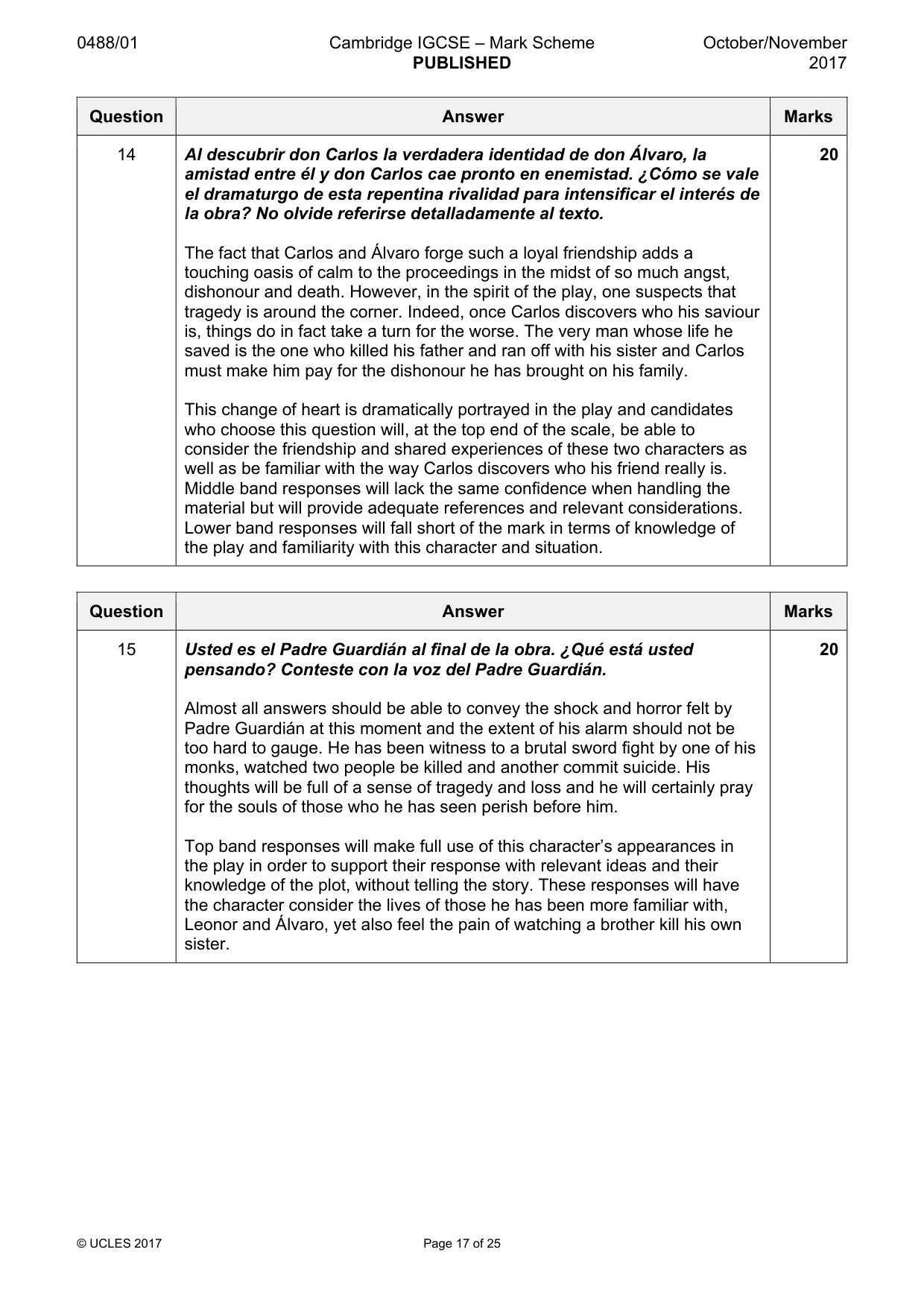
0488/01 Cambridge IGCSE – Mark Scheme PUBLISHED October/November 2017 © UCLES 2017 Page 17 of 25 Question Answer Marks 14 Al descubrir don Carlos la verdadera identidad de don Álvaro, la amistad entre él y don Carlos cae pronto en enemistad. ¿Cómo se vale el dramaturgo de esta repentina rivalidad para intensificar el interés de la obra? No olvide referirse detalladamente al texto. The fact that Carlos and Álvaro forge such a loyal friendship adds a touching oasis of calm to the proceedings in the midst of so much angst, dishonour and death. However, in the spirit of the play, one suspects that tragedy is around the corner. Indeed, once Carlos discovers who his saviour is, things do in fact take a turn for the worse. The very man whose life he saved is the one who killed his father and ran off with his sister and Carlos must make him pay for the dishonour he has brought on his family. This change of heart is dramatically portrayed in the play and candidates who choose this question will, at the top end of the scale, be able to consider the friendship and shared experiences of these two characters as well as be familiar with the way Carlos discovers who his friend really is. Middle band responses will lack the same confidence when handling the material but will provide adequate references and relevant considerations. Lower band responses will fall short of the mark in terms of knowledge of the play and familiarity with this character and situation. 20 Question Answer Marks 15 Usted es el Padre Guardián al final de la obra. ¿Qué está usted pensando? Conteste con la voz del Padre Guardián. Almost all answers should be able to convey the shock and horror felt by Padre Guardián at this moment and the extent of his alarm should not be too hard to gauge. He has been witness to a brutal sword fight by one of his monks, watched two people be killed and another commit suicide. His thoughts will be full of a sense of tragedy and loss and he will certainly pray for the souls of those who he has seen perish before him. Top band responses will make full use of this character’s appearances in the play in order to support their response with relevant ideas and their knowledge of the plot, without telling the story. These responses will have the character consider the lives of those he has been more familiar with, Leonor and Álvaro, yet also feel the pain of watching a brother kill his own sister. 20
Mark scheme, page 18
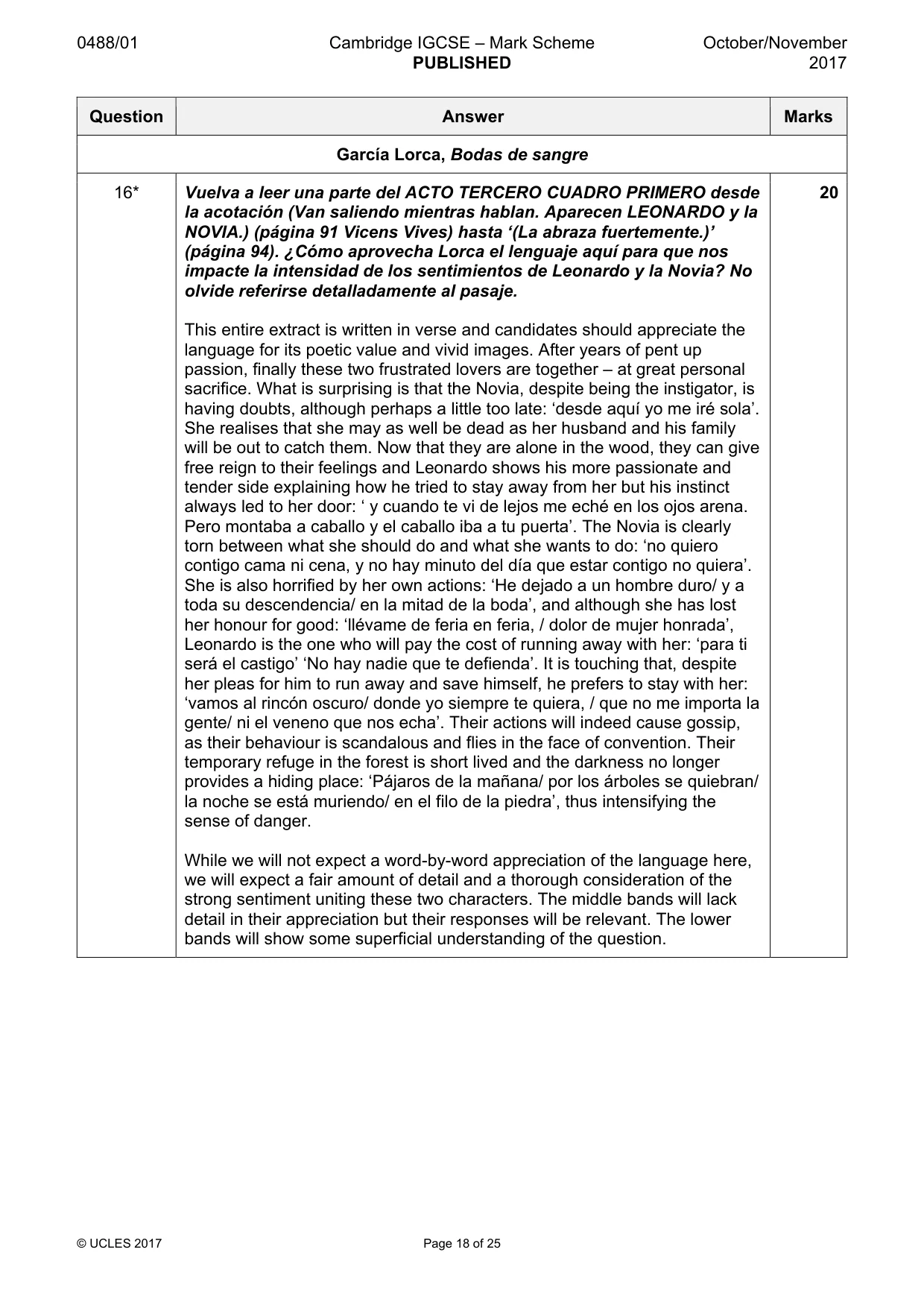
0488/01 Cambridge IGCSE – Mark Scheme PUBLISHED October/November 2017 © UCLES 2017 Page 18 of 25 Question Answer Marks García Lorca, Bodas de sangre 16* Vuelva a leer una parte del ACTO TERCERO CUADRO PRIMERO desde la acotación (Van saliendo mientras hablan. Aparecen LEONARDO y la NOVIA.) (página 91 Vicens Vives) hasta ‘(La abraza fuertemente.)’ (página 94). ¿Cómo aprovecha Lorca el lenguaje aquí para que nos impacte la intensidad de los sentimientos de Leonardo y la Novia? No olvide referirse detalladamente al pasaje. This entire extract is written in verse and candidates should appreciate the language for its poetic value and vivid images. After years of pent up passion, finally these two frustrated lovers are together – at great personal sacrifice. What is surprising is that the Novia, despite being the instigator, is having doubts, although perhaps a little too late: ‘desde aquí yo me iré sola’. She realises that she may as well be dead as her husband and his family will be out to catch them. Now that they are alone in the wood, they can give free reign to their feelings and Leonardo shows his more passionate and tender side explaining how he tried to stay away from her but his instinct always led to her door: ‘ y cuando te vi de lejos me eché en los ojos arena. Pero montaba a caballo y el caballo iba a tu puerta’. The Novia is clearly torn between what she should do and what she wants to do: ‘no quiero contigo cama ni cena, y no hay minuto del día que estar contigo no quiera’. She is also horrified by her own actions: ‘He dejado a un hombre duro/ y a toda su descendencia/ en la mitad de la boda’, and although she has lost her honour for good: ‘llévame de feria en feria, / dolor de mujer honrada’, Leonardo is the one who will pay the cost of running away with her: ‘para ti será el castigo’ ‘No hay nadie que te defienda’. It is touching that, despite her pleas for him to run away and save himself, he prefers to stay with her: ‘vamos al rincón oscuro/ donde yo siempre te quiera, / que no me importa la gente/ ni el veneno que nos echa’. Their actions will indeed cause gossip, as their behaviour is scandalous and flies in the face of convention. Their temporary refuge in the forest is short lived and the darkness no longer provides a hiding place: ‘Pájaros de la mañana/ por los árboles se quiebran/ la noche se está muriendo/ en el filo de la piedra’, thus intensifying the sense of danger. While we will not expect a word-by-word appreciation of the language here, we will expect a fair amount of detail and a thorough consideration of the strong sentiment uniting these two characters. The middle bands will lack detail in their appreciation but their responses will be relevant. The lower bands will show some superficial understanding of the question. 20
Mark scheme, page 19
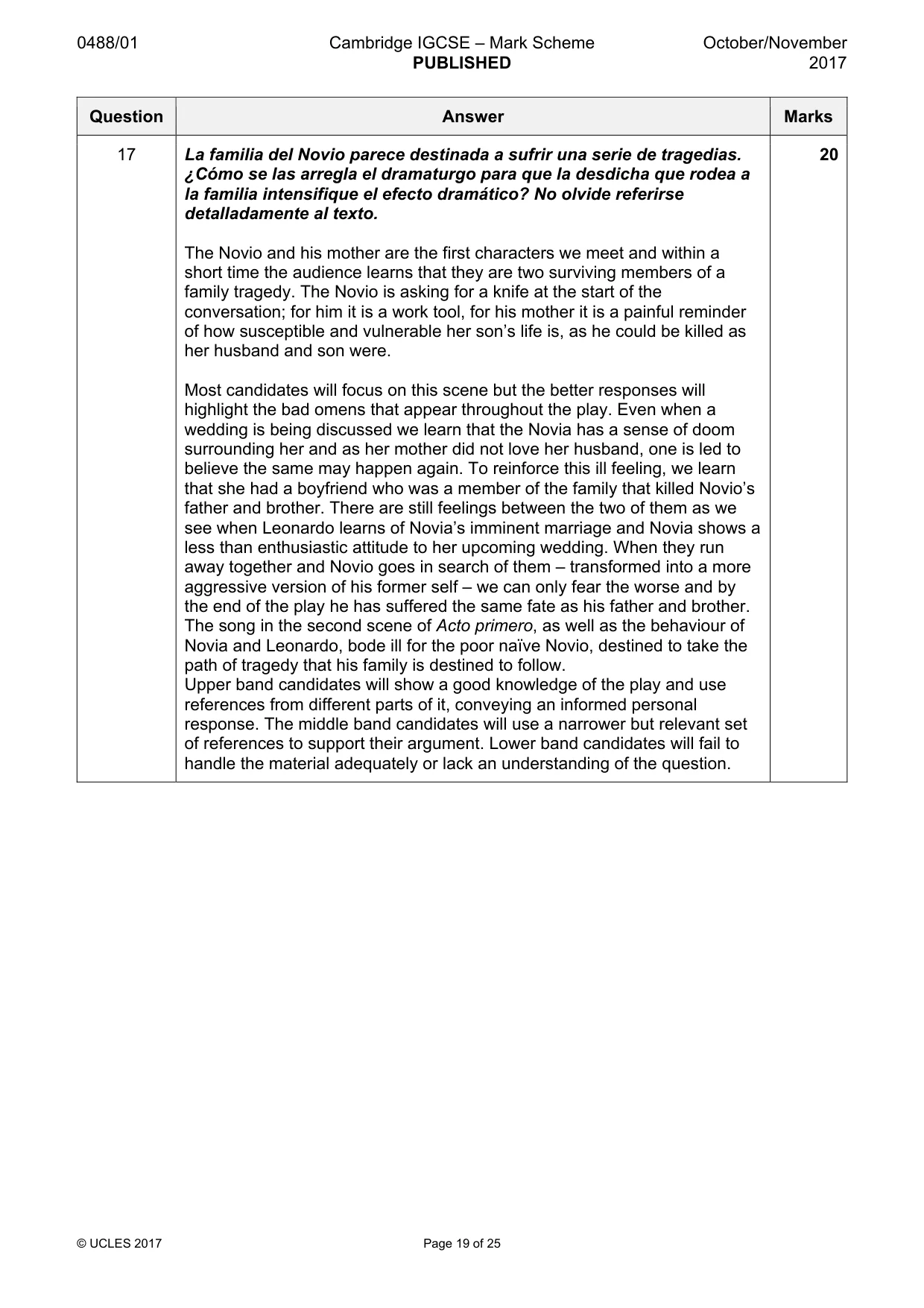
0488/01 Cambridge IGCSE – Mark Scheme PUBLISHED October/November 2017 © UCLES 2017 Page 19 of 25 Question Answer Marks 17 La familia del Novio parece destinada a sufrir una serie de tragedias. ¿Cómo se las arregla el dramaturgo para que la desdicha que rodea a la familia intensifique el efecto dramático? No olvide referirse detalladamente al texto. The Novio and his mother are the first characters we meet and within a short time the audience learns that they are two surviving members of a family tragedy. The Novio is asking for a knife at the start of the conversation; for him it is a work tool, for his mother it is a painful reminder of how susceptible and vulnerable her son’s life is, as he could be killed as her husband and son were. Most candidates will focus on this scene but the better responses will highlight the bad omens that appear throughout the play. Even when a wedding is being discussed we learn that the Novia has a sense of doom surrounding her and as her mother did not love her husband, one is led to believe the same may happen again. To reinforce this ill feeling, we learn that she had a boyfriend who was a member of the family that killed Novio’s father and brother. There are still feelings between the two of them as we see when Leonardo learns of Novia’s imminent marriage and Novia shows a less than enthusiastic attitude to her upcoming wedding. When they run away together and Novio goes in search of them – transformed into a more aggressive version of his former self – we can only fear the worse and by the end of the play he has suffered the same fate as his father and brother. The song in the second scene of Acto primero, as well as the behaviour of Novia and Leonardo, bode ill for the poor naïve Novio, destined to take the path of tragedy that his family is destined to follow. Upper band candidates will show a good knowledge of the play and use references from different parts of it, conveying an informed personal response. The middle band candidates will use a narrower but relevant set of references to support their argument. Lower band candidates will fail to handle the material adequately or lack an understanding of the question. 20
Mark scheme, page 20
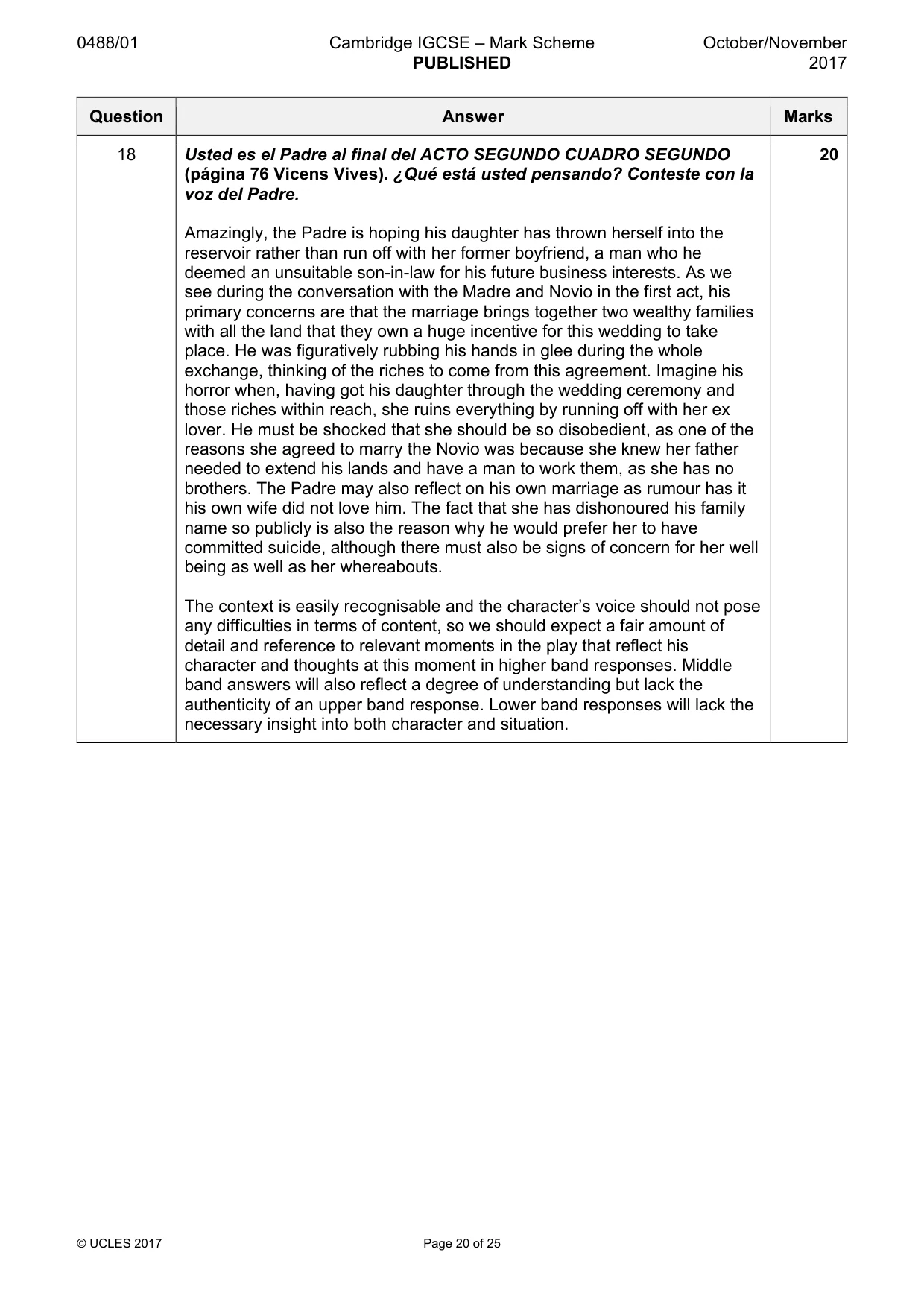
0488/01 Cambridge IGCSE – Mark Scheme PUBLISHED October/November 2017 © UCLES 2017 Page 20 of 25 Question Answer Marks 18 Usted es el Padre al final del ACTO SEGUNDO CUADRO SEGUNDO (página 76 Vicens Vives). ¿Qué está usted pensando? Conteste con la voz del Padre. Amazingly, the Padre is hoping his daughter has thrown herself into the reservoir rather than run off with her former boyfriend, a man who he deemed an unsuitable son-in-law for his future business interests. As we see during the conversation with the Madre and Novio in the first act, his primary concerns are that the marriage brings together two wealthy families with all the land that they own a huge incentive for this wedding to take place. He was figuratively rubbing his hands in glee during the whole exchange, thinking of the riches to come from this agreement. Imagine his horror when, having got his daughter through the wedding ceremony and those riches within reach, she ruins everything by running off with her ex lover. He must be shocked that she should be so disobedient, as one of the reasons she agreed to marry the Novio was because she knew her father needed to extend his lands and have a man to work them, as she has no brothers. The Padre may also reflect on his own marriage as rumour has it his own wife did not love him. The fact that she has dishonoured his family name so publicly is also the reason why he would prefer her to have committed suicide, although there must also be signs of concern for her well being as well as her whereabouts. The context is easily recognisable and the character’s voice should not pose any difficulties in terms of content, so we should expect a fair amount of detail and reference to relevant moments in the play that reflect his character and thoughts at this moment in higher band responses. Middle band answers will also reflect a degree of understanding but lack the authenticity of an upper band response. Lower band responses will lack the necessary insight into both character and situation. 20
Mark scheme, page 21
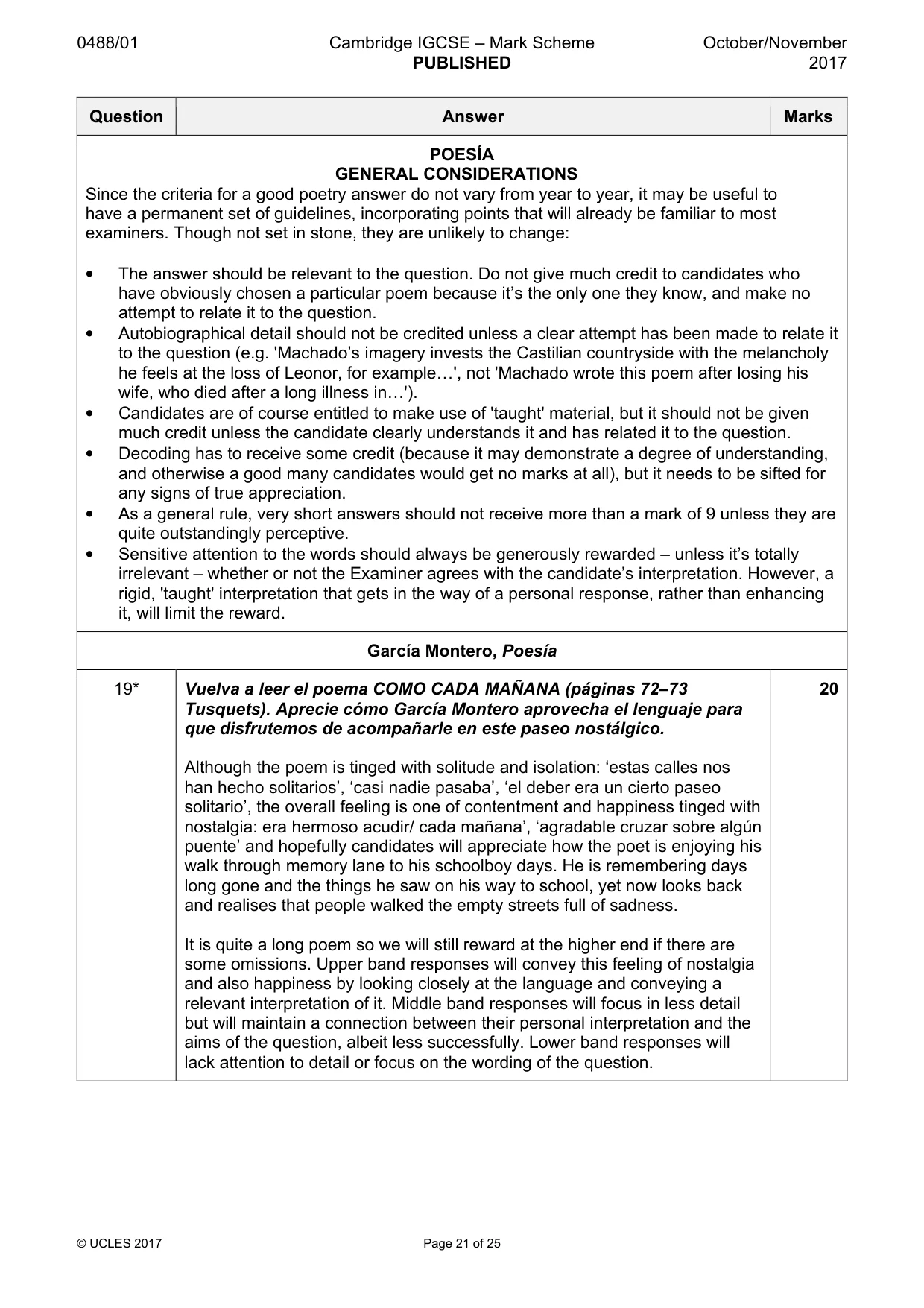
0488/01 Cambridge IGCSE – Mark Scheme PUBLISHED October/November 2017 © UCLES 2017 Page 21 of 25 Question Answer Marks POESĺA GENERAL CONSIDERATIONS Since the criteria for a good poetry answer do not vary from year to year, it may be useful to have a permanent set of guidelines, incorporating points that will already be familiar to most examiners. Though not set in stone, they are unlikely to change: • The answer should be relevant to the question. Do not give much credit to candidates who have obviously chosen a particular poem because it’s the only one they know, and make no attempt to relate it to the question. • Autobiographical detail should not be credited unless a clear attempt has been made to relate it to the question (e.g. 'Machado’s imagery invests the Castilian countryside with the melancholy he feels at the loss of Leonor, for example«', not 'Machado wrote this poem after losing his wife, who died after a long illness in«'). • Candidates are of course entitled to make use of 'taught' material, but it should not be given much credit unless the candidate clearly understands it and has related it to the question. • Decoding has to receive some credit (because it may demonstrate a degree of understanding, and otherwise a good many candidates would get no marks at all), but it needs to be sifted for any signs of true appreciation. • As a general rule, very short answers should not receive more than a mark of 9 unless they are quite outstandingly perceptive. • Sensitive attention to the words should always be generously rewarded – unless it’s totally irrelevant – whether or not the Examiner agrees with the candidate’s interpretation. However, a rigid, 'taught' interpretation that gets in the way of a personal response, rather than enhancing it, will limit the reward. García Montero, Poesía 19* Vuelva a leer el poema COMO CADA MAÑANA (páginas 72–73 Tusquets). Aprecie cómo García Montero aprovecha el lenguaje para que disfrutemos de acompañarle en este paseo nostálgico. Although the poem is tinged with solitude and isolation: ‘estas calles nos han hecho solitarios’, ‘casi nadie pasaba’, ‘el deber era un cierto paseo solitario’, the overall feeling is one of contentment and happiness tinged with nostalgia: era hermoso acudir/ cada mañana’, ‘agradable cruzar sobre algún puente’ and hopefully candidates will appreciate how the poet is enjoying his walk through memory lane to his schoolboy days. He is remembering days long gone and the things he saw on his way to school, yet now looks back and realises that people walked the empty streets full of sadness. It is quite a long poem so we will still reward at the higher end if there are some omissions. Upper band responses will convey this feeling of nostalgia and also happiness by looking closely at the language and conveying a relevant interpretation of it. Middle band responses will focus in less detail but will maintain a connection between their personal interpretation and the aims of the question, albeit less successfully. Lower band responses will lack attention to detail or focus on the wording of the question. 20
Mark scheme, page 22
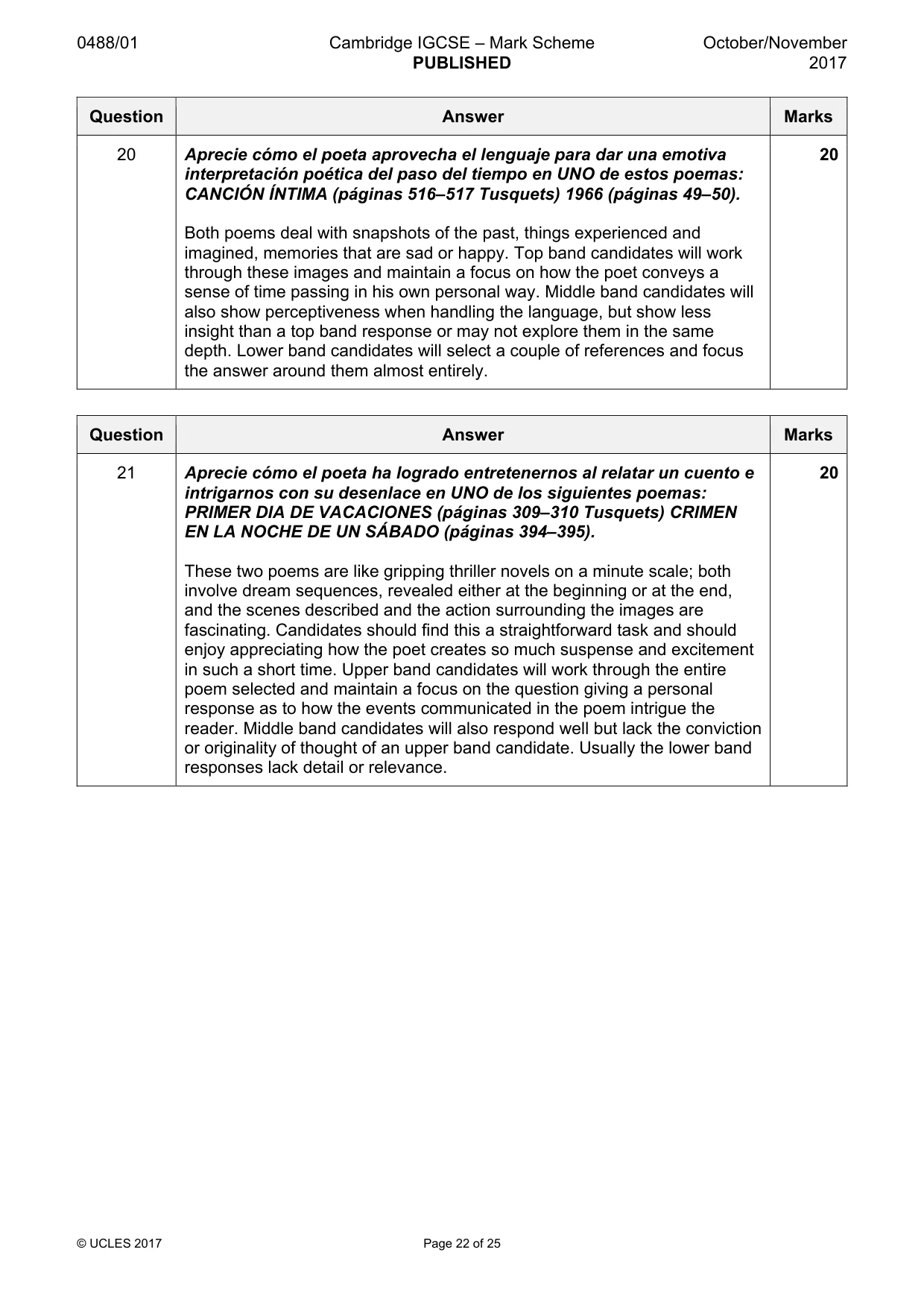
0488/01 Cambridge IGCSE – Mark Scheme PUBLISHED October/November 2017 © UCLES 2017 Page 22 of 25 Question Answer Marks 20 Aprecie cómo el poeta aprovecha el lenguaje para dar una emotiva interpretación poética del paso del tiempo en UNO de estos poemas: CANCIÓN ÍNTIMA (páginas 516–517 Tusquets) 1966 (páginas 49–50). Both poems deal with snapshots of the past, things experienced and imagined, memories that are sad or happy. Top band candidates will work through these images and maintain a focus on how the poet conveys a sense of time passing in his own personal way. Middle band candidates will also show perceptiveness when handling the language, but show less insight than a top band response or may not explore them in the same depth. Lower band candidates will select a couple of references and focus the answer around them almost entirely. 20 Question Answer Marks 21 Aprecie cómo el poeta ha logrado entretenernos al relatar un cuento e intrigarnos con su desenlace en UNO de los siguientes poemas: PRIMER DIA DE VACACIONES (páginas 309–310 Tusquets) CRIMEN EN LA NOCHE DE UN SÁBADO (páginas 394–395). These two poems are like gripping thriller novels on a minute scale; both involve dream sequences, revealed either at the beginning or at the end, and the scenes described and the action surrounding the images are fascinating. Candidates should find this a straightforward task and should enjoy appreciating how the poet creates so much suspense and excitement in such a short time. Upper band candidates will work through the entire poem selected and maintain a focus on the question giving a personal response as to how the events communicated in the poem intrigue the reader. Middle band candidates will also respond well but lack the conviction or originality of thought of an upper band candidate. Usually the lower band responses lack detail or relevance. 20
Mark scheme, page 23
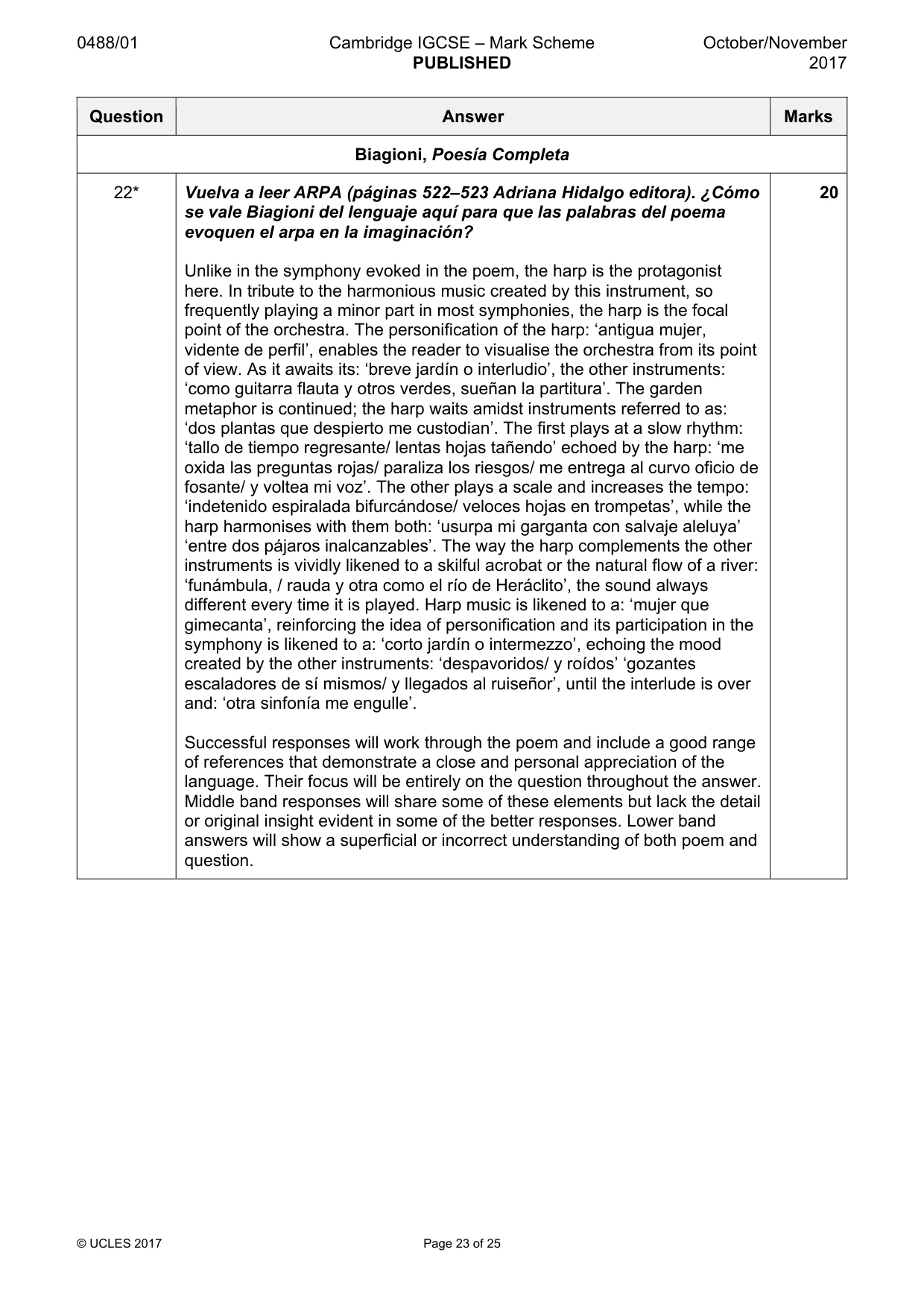
0488/01 Cambridge IGCSE – Mark Scheme PUBLISHED October/November 2017 © UCLES 2017 Page 23 of 25 Question Answer Marks Biagioni, Poesía Completa 22* Vuelva a leer ARPA (páginas 522–523 Adriana Hidalgo editora). ¿Cómo se vale Biagioni del lenguaje aquí para que las palabras del poema evoquen el arpa en la imaginación? Unlike in the symphony evoked in the poem, the harp is the protagonist here. In tribute to the harmonious music created by this instrument, so frequently playing a minor part in most symphonies, the harp is the focal point of the orchestra. The personification of the harp: ‘antigua mujer, vidente de perfil’, enables the reader to visualise the orchestra from its point of view. As it awaits its: ‘breve jardín o interludio’, the other instruments: ‘como guitarra flauta y otros verdes, sueñan la partitura’. The garden metaphor is continued; the harp waits amidst instruments referred to as: ‘dos plantas que despierto me custodian’. The first plays at a slow rhythm: ‘tallo de tiempo regresante/ lentas hojas tañendo’ echoed by the harp: ‘me oxida las preguntas rojas/ paraliza los riesgos/ me entrega al curvo oficio de fosante/ y voltea mi voz’. The other plays a scale and increases the tempo: ‘indetenido espiralada bifurcándose/ veloces hojas en trompetas’, while the harp harmonises with them both: ‘usurpa mi garganta con salvaje aleluya’ ‘entre dos pájaros inalcanzables’. The way the harp complements the other instruments is vividly likened to a skilful acrobat or the natural flow of a river: ‘funámbula, / rauda y otra como el río de Heráclito’, the sound always different every time it is played. Harp music is likened to a: ‘mujer que gimecanta’, reinforcing the idea of personification and its participation in the symphony is likened to a: ‘corto jardín o intermezzo’, echoing the mood created by the other instruments: ‘despavoridos/ y roídos’ ‘gozantes escaladores de sí mismos/ y llegados al ruiseñor’, until the interlude is over and: ‘otra sinfonía me engulle’. Successful responses will work through the poem and include a good range of references that demonstrate a close and personal appreciation of the language. Their focus will be entirely on the question throughout the answer. Middle band responses will share some of these elements but lack the detail or original insight evident in some of the better responses. Lower band answers will show a superficial or incorrect understanding of both poem and question. 20
Mark scheme, page 24
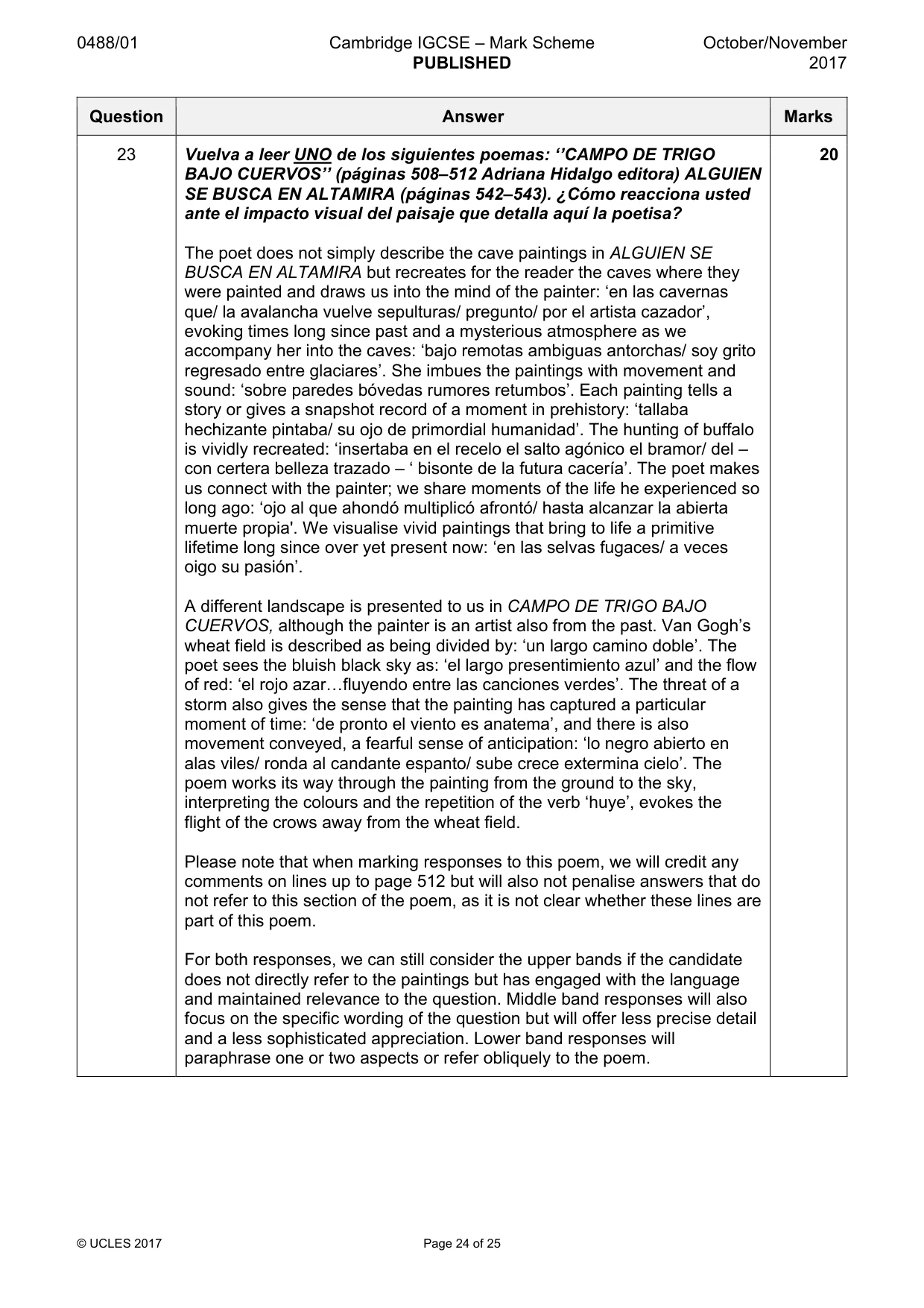
0488/01 Cambridge IGCSE – Mark Scheme PUBLISHED October/November 2017 © UCLES 2017 Page 24 of 25 Question Answer Marks 23 Vuelva a leer UNO de los siguientes poemas: ‘’CAMPO DE TRIGO BAJO CUERVOS’’ (páginas 508–512 Adriana Hidalgo editora) ALGUIEN SE BUSCA EN ALTAMIRA (páginas 542–543). ¿Cómo reacciona usted ante el impacto visual del paisaje que detalla aquí la poetisa? The poet does not simply describe the cave paintings in ALGUIEN SE BUSCA EN ALTAMIRA but recreates for the reader the caves where they were painted and draws us into the mind of the painter: ‘en las cavernas que/ la avalancha vuelve sepulturas/ pregunto/ por el artista cazador’, evoking times long since past and a mysterious atmosphere as we accompany her into the caves: ‘bajo remotas ambiguas antorchas/ soy grito regresado entre glaciares’. She imbues the paintings with movement and sound: ‘sobre paredes bóvedas rumores retumbos’. Each painting tells a story or gives a snapshot record of a moment in prehistory: ‘tallaba hechizante pintaba/ su ojo de primordial humanidad’. The hunting of buffalo is vividly recreated: ‘insertaba en el recelo el salto agónico el bramor/ del – con certera belleza trazado – ‘ bisonte de la futura cacería’. The poet makes us connect with the painter; we share moments of the life he experienced so long ago: ‘ojo al que ahondó multiplicó afrontó/ hasta alcanzar la abierta muerte propia'. We visualise vivid paintings that bring to life a primitive lifetime long since over yet present now: ‘en las selvas fugaces/ a veces oigo su pasión’. A different landscape is presented to us in CAMPO DE TRIGO BAJO CUERVOS, although the painter is an artist also from the past. Van Gogh’s wheat field is described as being divided by: ‘un largo camino doble’. The poet sees the bluish black sky as: ‘el largo presentimiento azul’ and the flow of red: ‘el rojo azar«fluyendo entre las canciones verdes’. The threat of a storm also gives the sense that the painting has captured a particular moment of time: ‘de pronto el viento es anatema’, and there is also movement conveyed, a fearful sense of anticipation: ‘lo negro abierto en alas viles/ ronda al candante espanto/ sube crece extermina cielo’. The poem works its way through the painting from the ground to the sky, interpreting the colours and the repetition of the verb ‘huye’, evokes the flight of the crows away from the wheat field. Please note that when marking responses to this poem, we will credit any comments on lines up to page 512 but will also not penalise answers that do not refer to this section of the poem, as it is not clear whether these lines are part of this poem. For both responses, we can still consider the upper bands if the candidate does not directly refer to the paintings but has engaged with the language and maintained relevance to the question. Middle band responses will also focus on the specific wording of the question but will offer less precise detail and a less sophisticated appreciation. Lower band responses will paraphrase one or two aspects or refer obliquely to the poem. 20
Mark scheme, page 25
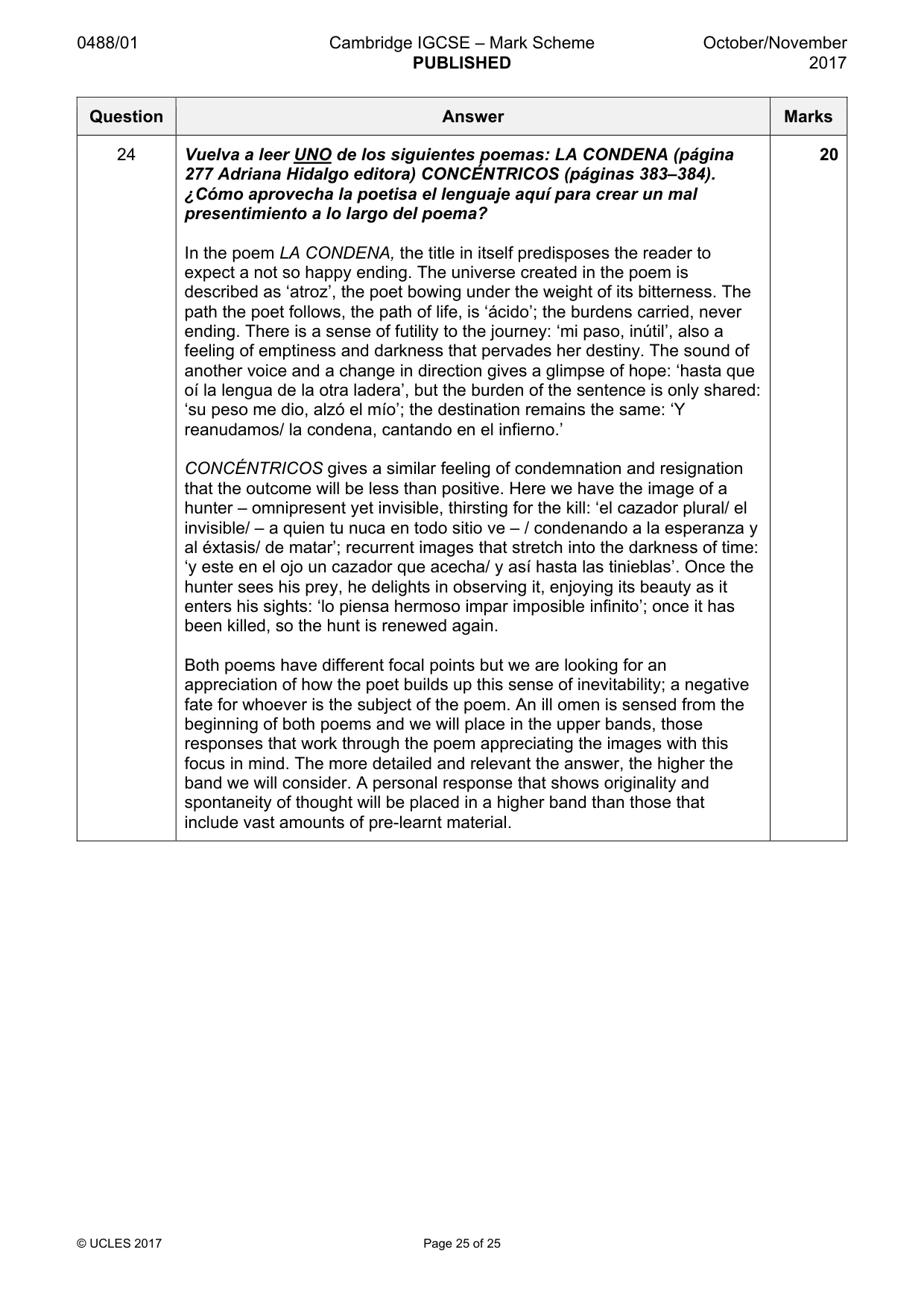
0488/01 Cambridge IGCSE – Mark Scheme PUBLISHED October/November 2017 © UCLES 2017 Page 25 of 25 Question Answer Marks 24 Vuelva a leer UNO de los siguientes poemas: LA CONDENA (página 277 Adriana Hidalgo editora) CONCÉNTRICOS (páginas 383–384). ¿Cómo aprovecha la poetisa el lenguaje aquí para crear un mal presentimiento a lo largo del poema? In the poem LA CONDENA, the title in itself predisposes the reader to expect a not so happy ending. The universe created in the poem is described as ‘atroz’, the poet bowing under the weight of its bitterness. The path the poet follows, the path of life, is ‘ácido’; the burdens carried, never ending. There is a sense of futility to the journey: ‘mi paso, inútil’, also a feeling of emptiness and darkness that pervades her destiny. The sound of another voice and a change in direction gives a glimpse of hope: ‘hasta que oí la lengua de la otra ladera’, but the burden of the sentence is only shared: ‘su peso me dio, alzó el mío’; the destination remains the same: ‘Y reanudamos/ la condena, cantando en el infierno.’ CONCÉNTRICOS gives a similar feeling of condemnation and resignation that the outcome will be less than positive. Here we have the image of a hunter – omnipresent yet invisible, thirsting for the kill: ‘el cazador plural/ el invisible/ – a quien tu nuca en todo sitio ve – / condenando a la esperanza y al éxtasis/ de matar’; recurrent images that stretch into the darkness of time: ‘y este en el ojo un cazador que acecha/ y así hasta las tinieblas’. Once the hunter sees his prey, he delights in observing it, enjoying its beauty as it enters his sights: ‘lo piensa hermoso impar imposible infinito’; once it has been killed, so the hunt is renewed again. Both poems have different focal points but we are looking for an appreciation of how the poet builds up this sense of inevitability; a negative fate for whoever is the subject of the poem. An ill omen is sensed from the beginning of both poems and we will place in the upper bands, those responses that work through the poem appreciating the images with this focus in mind. The more detailed and relevant the answer, the higher the band we will consider. A personal response that shows originality and spontaneity of thought will be placed in a higher band than those that include vast amounts of pre-learnt material. 20
What you needed in this session
Cambridge’s own grade thresholds for 2017 Oct/Nov, Paper 1 · Variant 1. A higher threshold means an easier paper — the bar moves with how the cohort did.