Cambridge IGCSE Spanish - Literature 0488 — 2016 Oct/Nov Paper 1 · Variant 1
0488/11/O/N/16 · 60 marks · ≈68 min
The question paper and its mark scheme, free to read here and free to download. This is Cambridge’s own paper, exactly as it was sat.
Question paper8 pages


Mark scheme19 pages
Answers below. Sit the paper first if you are practising.

Paper as text
Question paper, page 1
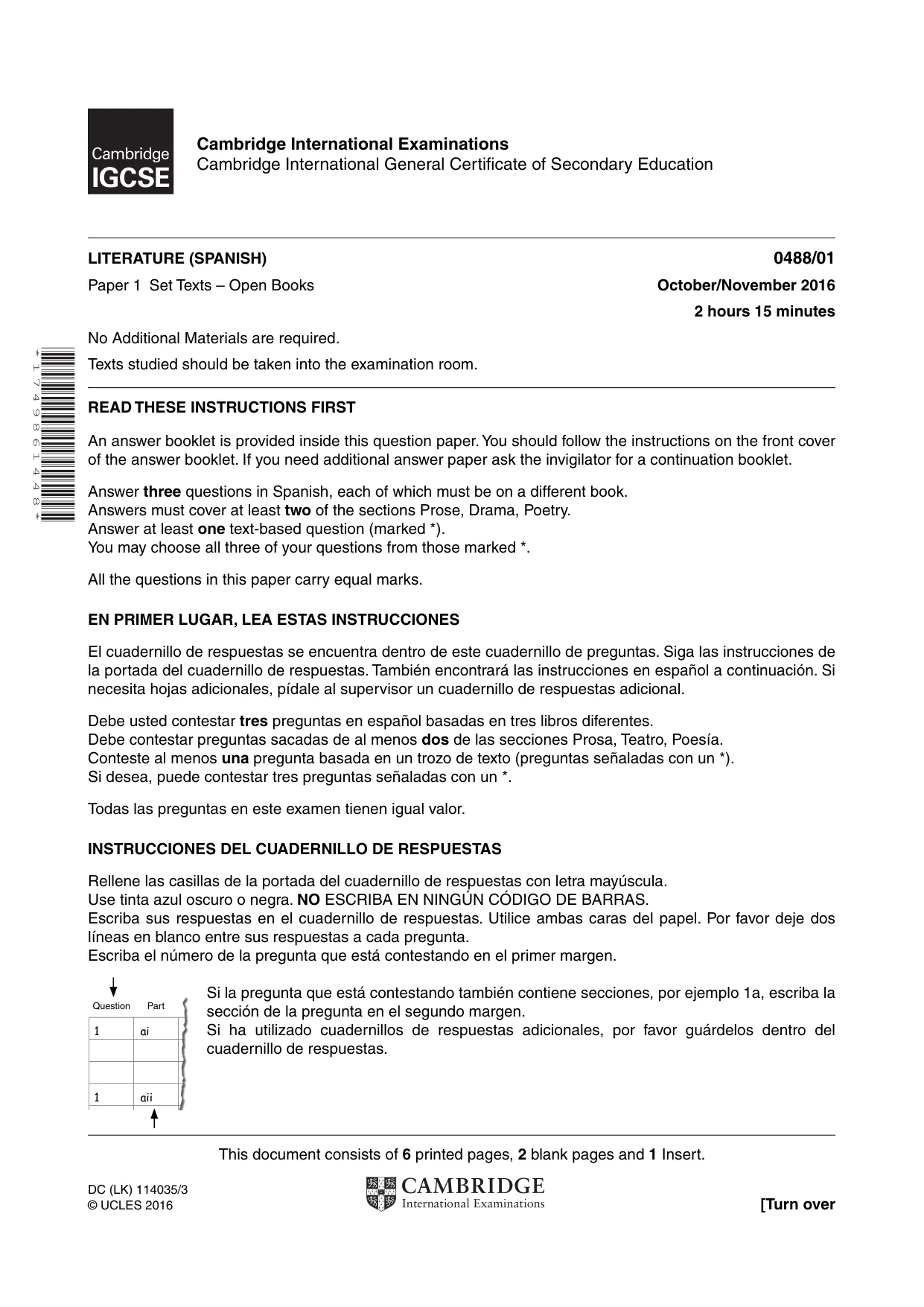
This document consists of 6 printed pages, 2 blank pages and 1 Insert. DC (LK) 114035/3 © UCLES 2016 [Turn over Cambridge International Examinations Cambridge International General Certificate of Secondary Education * 1 7 4 9 8 6 1 4 4 8 * LITERATURE (SPANISH) 0488/01 Paper 1 Set Texts – Open Books October/November 2016 2 hours 15 minutes No Additional Materials are required. Texts studied should be taken into the examination room. READ THESE INSTRUCTIONS FIRST An answer booklet is provided inside this question paper. You should follow the instructions on the front cover of the answer booklet. If you need additional answer paper ask the invigilator for a continuation booklet. Answer three questions in Spanish, each of which must be on a different book. Answers must cover at least two of the sections Prose, Drama, Poetry. Answer at least one text-based question (marked *). You may choose all three of your questions from those marked *. All the questions in this paper carry equal marks. EN PRIMER LUGAR, LEA ESTAS INSTRUCCIONES El cuadernillo de respuestas se encuentra dentro de este cuadernillo de preguntas. Siga las instrucciones de la portada del cuadernillo de respuestas. También encontrará las instrucciones en español a continuación. Si necesita hojas adicionales, pídale al supervisor un cuadernillo de respuestas adicional. Debe usted contestar tres preguntas en español basadas en tres libros diferentes. Debe contestar preguntas sacadas de al menos dos de las secciones Prosa, Teatro, Poesía. Conteste al menos una pregunta basada en un trozo de texto (preguntas señaladas con un *). Si desea, puede contestar tres preguntas señaladas con un *. Todas las preguntas en este examen tienen igual valor. INSTRUCCIONES DEL CUADERNILLO DE RESPUESTAS Rellene las casillas de la portada del cuadernillo de respuestas con letra mayúscula. Use tinta azul oscuro o negra. NO ESCRIBA EN NINGÚN CÓDIGO DE BARRAS. Escriba sus respuestas en el cuadernillo de respuestas. Utilice ambas caras del papel. Por favor deje dos líneas en blanco entre sus respuestas a cada pregunta. Escriba el número de la pregunta que está contestando en el primer margen. Si la pregunta que está contestando también contiene secciones, por ejemplo 1a, escriba la sección de la pregunta en el segundo margen. Si ha utilizado cuadernillos de respuestas adicionales, por favor guárdelos dentro del cuadernillo de respuestas. Question Part 1 1 ai aii
Question paper, page 2
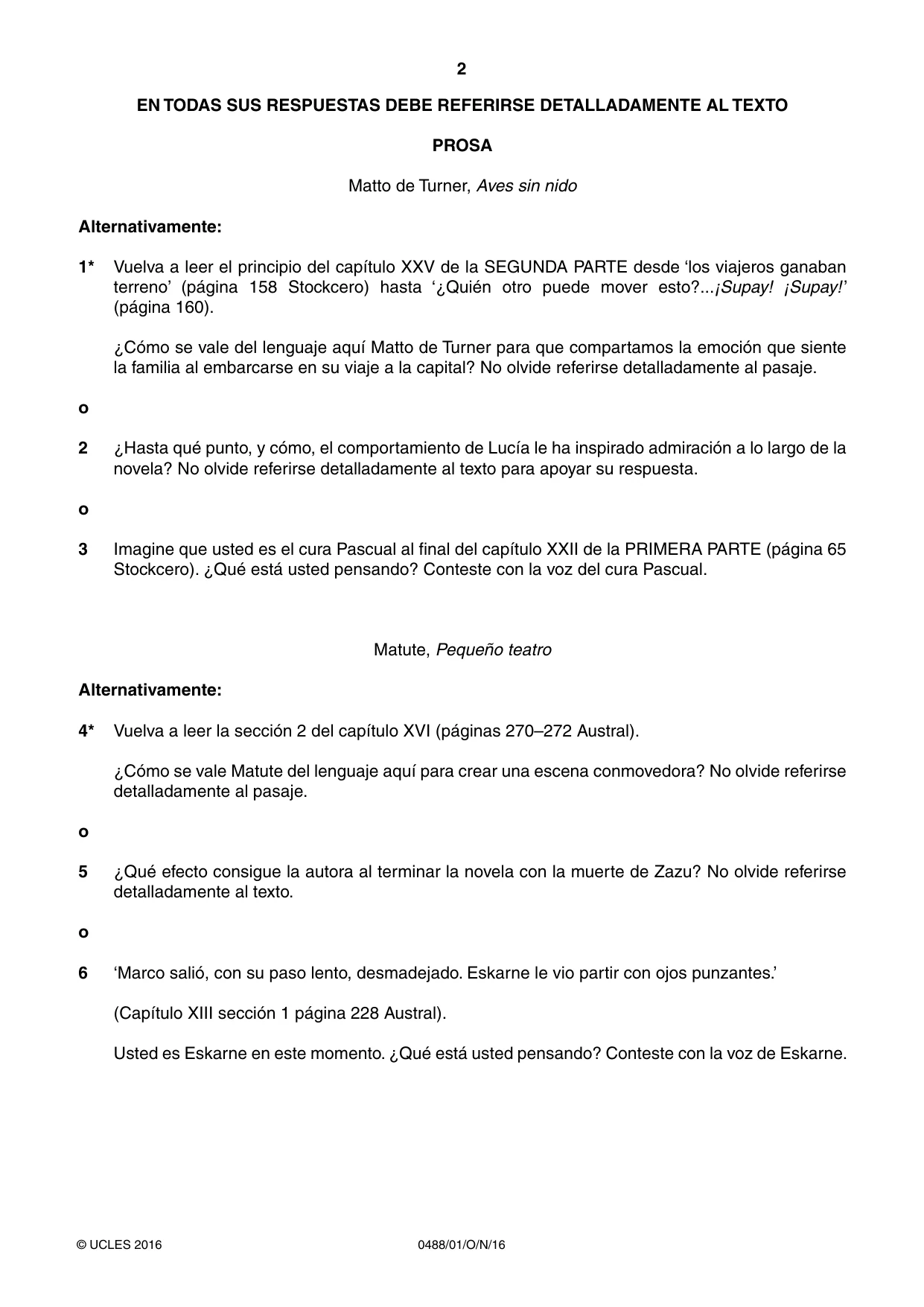
2 0488/01/O/N/16 © UCLES 2016 EN TODAS SUS RESPUESTAS DEBE REFERIRSE DETALLADAMENTE AL TEXTO PROSA Matto de Turner, Aves sin nido Alternativamente: 1* Vuelva a leer el principio del capítulo XXV de la SEGUNDA PARTE desde ‘los viajeros ganaban terreno’ (página 158 Stockcero) hasta ‘¿Quién otro puede mover esto?...¡Supay! ¡Supay! ’ (página 160). ¿Cómo se vale del lenguaje aquí Matto de Turner para que compartamos la emoción que siente la familia al embarcarse en su viaje a la capital? No olvide referirse detalladamente al pasaje. o 2 ¿Hasta qué punto, y cómo, el comportamiento de Lucía le ha inspirado admiración a lo largo de la novela? No olvide referirse detalladamente al texto para apoyar su respuesta. o 3 Imagine que usted es el cura Pascual al final del capítulo XXII de la PRIMERA PARTE (página 65 Stockcero). ¿Qué está usted pensando? Conteste con la voz del cura Pascual. Matute, Pequeño teatro Alternativamente: 4* Vuelva a leer la sección 2 del capítulo XVI (páginas 270–272 Austral). ¿Cómo se vale Matute del lenguaje aquí para crear una escena conmovedora? No olvide referirse detalladamente al pasaje. o 5 ¿Qué efecto consigue la autora al terminar la novela con la muerte de Zazu? No olvide referirse detalladamente al texto. o 6 ‘Marco salió, con su paso lento, desmadejado. Eskarne le vio partir con ojos punzantes.’ (Capítulo XIII sección 1 página 228 Austral). Usted es Eskarne en este momento. ¿Qué está usted pensando? Conteste con la voz de Eskarne.
Question paper, page 3
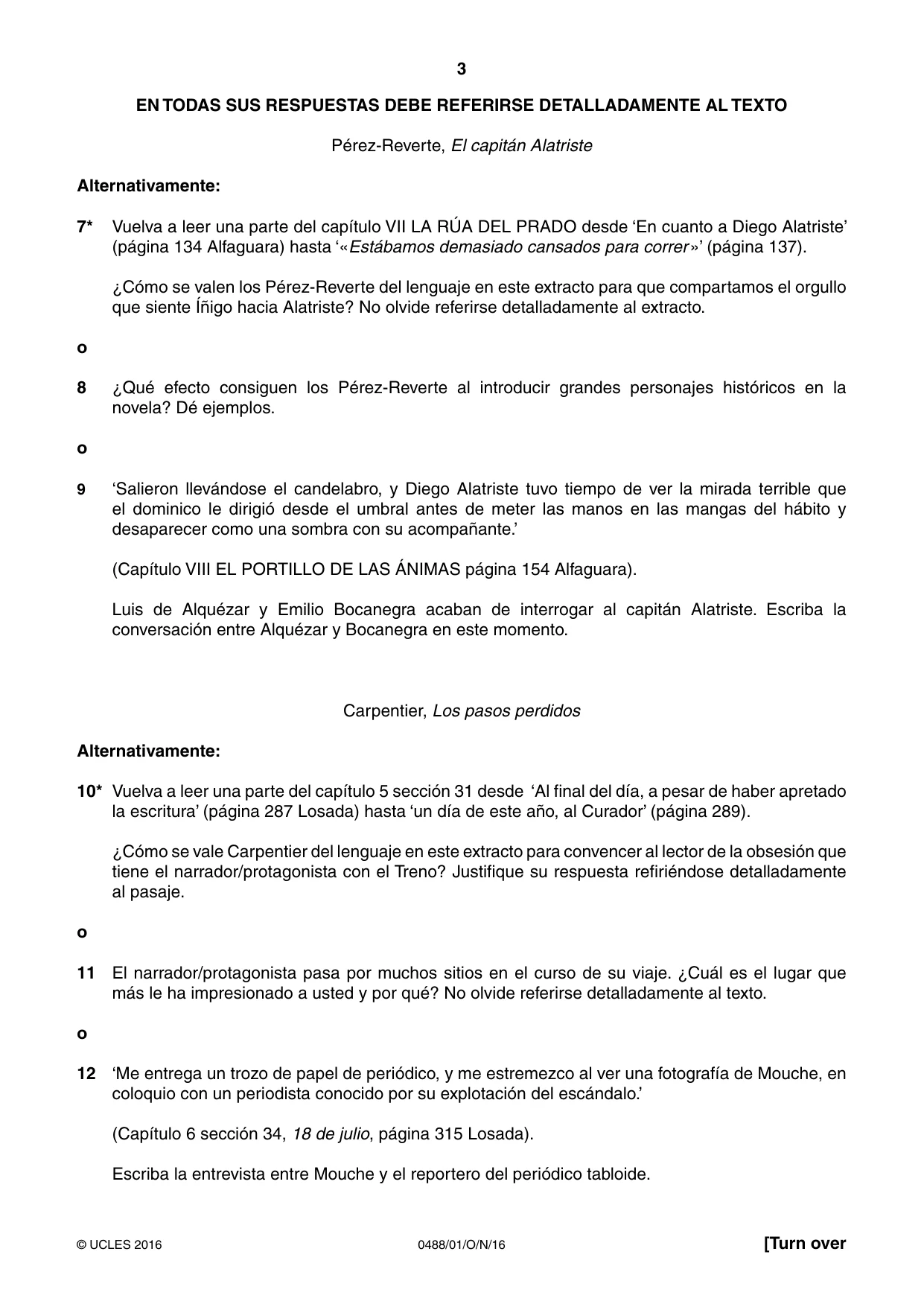
3 0488/01/O/N/16 © UCLES 2016 [Turn over EN TODAS SUS RESPUESTAS DEBE REFERIRSE DETALLADAMENTE AL TEXTO Pérez-Reverte, El capitán Alatriste Alternativamente: 7* Vuelva a leer una parte del capítulo VII LA RÚA DEL PRADO desde ‘En cuanto a Diego Alatriste’ (página 134 Alfaguara) hasta ‘«Estábamos demasiado cansados para correr »’ (página 137). ¿Cómo se valen los Pérez-Reverte del lenguaje en este extracto para que compartamos el orgullo que siente Íñigo hacia Alatriste? No olvide referirse detalladamente al extracto. o 8 ¿Qué efecto consiguen los Pérez-Reverte al introducir grandes personajes históricos en la novela? Dé ejemplos. o 9 ‘Salieron llevándose el candelabro, y Diego Alatriste tuvo tiempo de ver la mirada terrible que el dominico le dirigió desde el umbral antes de meter las manos en las mangas del hábito y desaparecer como una sombra con su acompañante.’ (Capítulo VIII EL PORTILLO DE LAS ÁNIMAS página 154 Alfaguara). Luis de Alquézar y Emilio Bocanegra acaban de interrogar al capitán Alatriste. Escriba la conversación entre Alquézar y Bocanegra en este momento. Carpentier, Los pasos perdidos Alternativamente: 10* Vuelva a leer una parte del capítulo 5 sección 31 desde ‘Al final del día, a pesar de haber apretado la escritura’ (página 287 Losada) hasta ‘un día de este año, al Curador’ (página 289). ¿Cómo se vale Carpentier del lenguaje en este extracto para convencer al lector de la obsesión que tiene el narrador/protagonista con el Treno? Justifique su respuesta refiriéndose detalladamente al pasaje. o 11 El narrador/protagonista pasa por muchos sitios en el curso de su viaje. ¿Cuál es el lugar que más le ha impresionado a usted y por qué? No olvide referirse detalladamente al texto. o 12 ‘Me entrega un trozo de papel de periódico, y me estremezco al ver una fotografía de Mouche, en coloquio con un periodista conocido por su explotación del escándalo.’ (Capítulo 6 sección 34, 18 de julio, página 315 Losada). Escriba la entrevista entre Mouche y el reportero del periódico tabloide.
Question paper, page 4
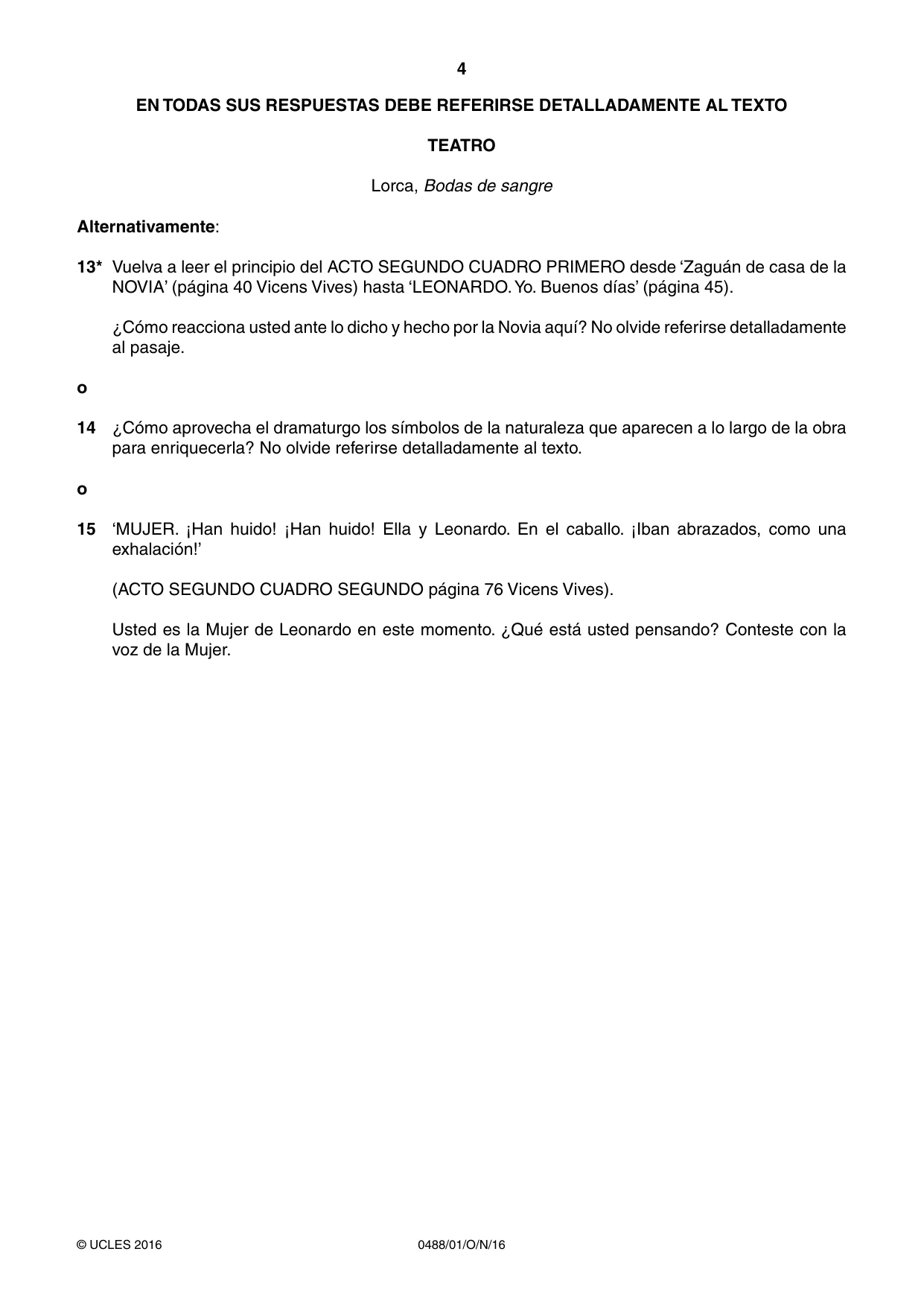
4 0488/01/O/N/16 © UCLES 2016 EN TODAS SUS RESPUESTAS DEBE REFERIRSE DETALLADAMENTE AL TEXTO TEATRO Lorca, Bodas de sangre Alternativamente: 13* Vuelva a leer el principio del ACTO SEGUNDO CUADRO PRIMERO desde ‘Zaguán de casa de la NOVIA’ (página 40 Vicens Vives) hasta ‘LEONARDO. Yo. Buenos días’ (página 45). ¿Cómo reacciona usted ante lo dicho y hecho por la Novia aquí? No olvide referirse detalladamente al pasaje. o 14 ¿Cómo aprovecha el dramaturgo los símbolos de la naturaleza que aparecen a lo largo de la obra para enriquecerla? No olvide referirse detalladamente al texto. o 15 ‘MUJER. ¡Han huido! ¡Han huido! Ella y Leonardo. En el caballo. ¡Iban abrazados, como una exhalación!’ (ACTO SEGUNDO CUADRO SEGUNDO página 76 Vicens Vives). Usted es la Mujer de Leonardo en este momento. ¿Qué está usted pensando? Conteste con la voz de la Mujer.
Question paper, page 5
5 0488/01/O/N/16 © UCLES 2016 [Turn over EN TODAS SUS RESPUESTAS DEBE REFERIRSE DETALLADAMENTE AL TEXTO Sánchez, Barranca abajo Alternativamente: 16* Vuelva a leer la escena XXI del Acto primero desde ‘JUAN LUIS. – Pues yo no he oído’ (página 100 Cátedra) hasta el final de la escena ‘TELÓN LENTO’ (página 102). Aprecie cómo la ira que siente Zoilo aumenta contínuamente la tensión dramática en este extracto. Justifique su respuesta refiriéndose detalladamente al pasaje. o 17 ¿Qué sentimientos le inspiran a usted la muerte de Robusta y el impacto que esta muerte tiene en don Zolio? No olvide referirse detalladamente al texto. o 18 ‘SARGENTO (paternal). – No ha de ser por nada. Cuestión de un rato. Venga no más. Si se resiste, va a ser pior. ÑA MARTINIANA. – Claro que sí. Bé de ir no más a las güenas. ¿Qué saca con resistir a la autoridad?’ (Acto segundo, escena XVI página 120 Cátedra). Usted es Ña Martiniana y don Zoilo está a punto de ser detenido. ¿Qué está usted pensando? Conteste con la voz de Ña Martiniana. Duque de Rivas, Don Álvaro o la fuerza del sino 19* Vuelva a leer las escenas VII y VIII al final de la Jornada primera desde la acotación ‘(D.ª LEONOR muy abatida se apoya en el hombro de D. ÁLVARO, con muestras de desmayarse.)’ (página 89 Alianza Editorial) hasta el final de la Jornada primera (página 93). ¿Cómo aprovecha el Duque de Rivas el diálogo y las acciones de los protagonistas en este extracto para que el final de la Jornada Primera sea tan emocionante? No olvide referirse detalladamente al pasaje. o 20 ¿Cómo aprovecha el dramaturgo las circunstancias desafortunadas del nacimiento de don Álvaro para intensificar el interés del público? No olvide referirse detalladamente al texto. o 21 Usted es el hermano Melitón al final de la escena VIII de la Jornada quinta (página 203 Alianza Editorial). ¿Qué está usted pensando después de haber cerrado la puerta tras don Álvaro y don Alfonso? Conteste con la voz del hermano Melitón.
Question paper, page 6
6 0488/01/O/N/16 © UCLES 2016 EN TODAS SUS RESPUESTAS DEBE REFERIRSE DETALLADAMENTE AL TEXTO POESÍA Montero, Poesía Alternativamente: 22* Vuelva a leer el poema HOJAS VERDES (páginas 508–509 Tusquets). Aprecie cómo García Montero aprovecha el lenguaje para compartir un recuerdo grato del pasado. o 23 Aprecie cómo el poeta se las arregla para comunicarnos su fascinación con las palabras en UNO de los siguientes poemas: HOMBRE SIN OPINIONES (páginas 487–488 Tusquets) EL AMOR (páginas 407–408). o 24 Aprecie cómo el poeta aprovecha el lenguaje para reflexionar sobre una relación de forma original en UNO de los siguientes poemas: NUEVO CANTO A TERESA (página 272 Tusquets) REESTRENO (páginas 78–79) RECUERDA que tú existes tan sólo en este libro (páginas 151–152). De la Cruz, Poesía lírica Alternativamente: 25* Vuelva a leer el poema Aunque es clara del cielo la luz pura (página 194 Cátedra). Dé su apreciación de cómo Sor Juana Inés de la Cruz aprovecha el lenguaje para celebrar las maravillas de la astronomía. o 26 Aprecie cómo la poetisa aprovecha el lenguaje para tratar con delicadeza el tema de la muerte en UNO de los siguientes poemas: De la beldad de Laura enamorados (página 145 Cátedra) ¡Oh famosa Lucrecia, gentil dama (páginas 262–263) Miró Celia una rosa que en el prado (página 255). o 27 ¿Cómo se vale la poetisa de una serie de imágenes dinámicas para comunicar su opinión de forma convincente en UNO de los siguientes poemas? Si los riesgos del mar considerara (página 256 Cátedra) Intenta de Tarquino el artificio (página 263).
Question paper, page 7
7 0488/01/O/N/16 © UCLES 2016 BLANK PAGE
Question paper, page 8
8 0488/01/O/N/16 © UCLES 2016 Permission to reproduce items where third-party owned material protected by copyright is included has been sought and cleared where possible. Every reasonable effort has been made by the publisher (UCLES) to trace copyright holders, but if any items requiring clearance have unwittingly been included, the publisher will be pleased to make amends at the earliest possible opportunity. To avoid the issue of disclosure of answer-related information to candidates, all copyright acknowledgements are reproduced online in the Cambridge International Examinations Copyright Acknowledgements Booklet. This is produced for each series of examinations and is freely available to download at www.cie.org.uk after the live examination series. Cambridge International Examinations is part of the Cambridge Assessment Group. Cambridge Assessment is the brand name of University of Cambridge Local Examinations Syndicate (UCLES), which is itself a department of the University of Cambridge. BLANK PAGE
Mark scheme, page 1
® IGCSE is the registered trademark of Cambridge International Examinations. This document consists of 19 printed pages. © UCLES 2016 [Turn over Cambridge International Examinations Cambridge International General Certificate of Secondary Education LITERATURE (SPANISH) 0488/01 Paper 1 Set Texts (Open Books) October/November 2016 MARK SCHEME Maximum Mark: 60 Published This mark scheme is published as an aid to teachers and candidates, to indicate the requirements of the examination. It shows the basis on which Examiners were instructed to award marks. It does not indicate the details of the discussions that took place at an Examiners’ meeting before marking began, which would have considered the acceptability of alternative answers. Mark schemes should be read in conjunction with the question paper and the Principal Examiner Report for Teachers. Cambridge will not enter into discussions about these mark schemes. Cambridge is publishing the mark schemes for the October/November 2016 series for most Cambridge IGCSE®, Cambridge International A and AS Level components and some Cambridge O Level components.
Mark scheme, page 2
Page 2 Mark Scheme Syllabus Paper Cambridge IGCSE – October/November 2016 0488 01 © UCLES 2016 Answers will be marked according to the following general criteria: Band 8 20 19 18 Answers in this band have all the qualities of Band 7 work, with further insight, sensitivity, individuality or flair. They show complete and sustained engagement with both text and task. Band 7 17 16 15 A detailed, relevant and possibly perceptive personal response that engages both with text and task • shows a clear and at times critical understanding of the text and its deeper meanings • responds in detail to the way the writer achieves her/his effects (sustaining a fully appropriate voice in an empathic task) • integrates carefully selected and relevant reference to the text Band 6 14 13 12 A developed and relevant personal response that engages both with text and task • shows understanding of the text and some of its deeper implications • responds adequately to the way the writer achieves her/his effects (using suitable features of expression in an empathic task) • shows some thoroughness in selecting relevant references to the text Band 5 11 10 9 Begins to develop a relevant personal response that engages both with text and task • shows some understanding of meaning • makes a little reference to the language of the text (beginning to assume a voice in an empathic task) • uses some supporting textual detail Band 4 8 7 6 Attempts to communicate a basic personal response • makes some relevant comments • shows a basic understanding of surface meaning of the text (of character in an empathic task) • makes a little supporting reference to the text
Mark scheme, page 3
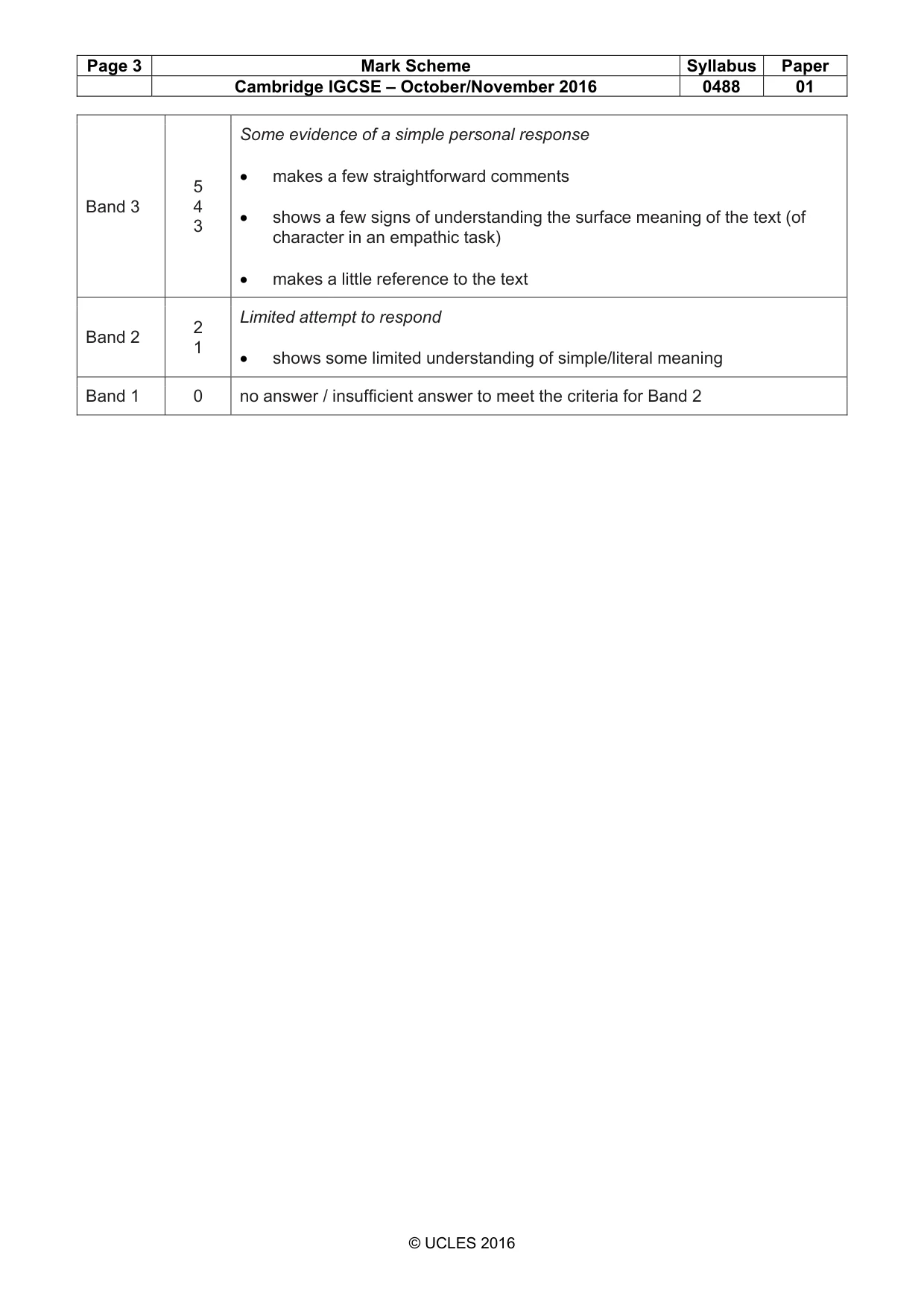
Page 3 Mark Scheme Syllabus Paper Cambridge IGCSE – October/November 2016 0488 01 © UCLES 2016 Band 3 5 4 3 Some evidence of a simple personal response • makes a few straightforward comments • shows a few signs of understanding the surface meaning of the text (of character in an empathic task) • makes a little reference to the text Band 2 2 1 Limited attempt to respond • shows some limited understanding of simple/literal meaning Band 1 0 no answer / insufficient answer to meet the criteria for Band 2
Mark scheme, page 4
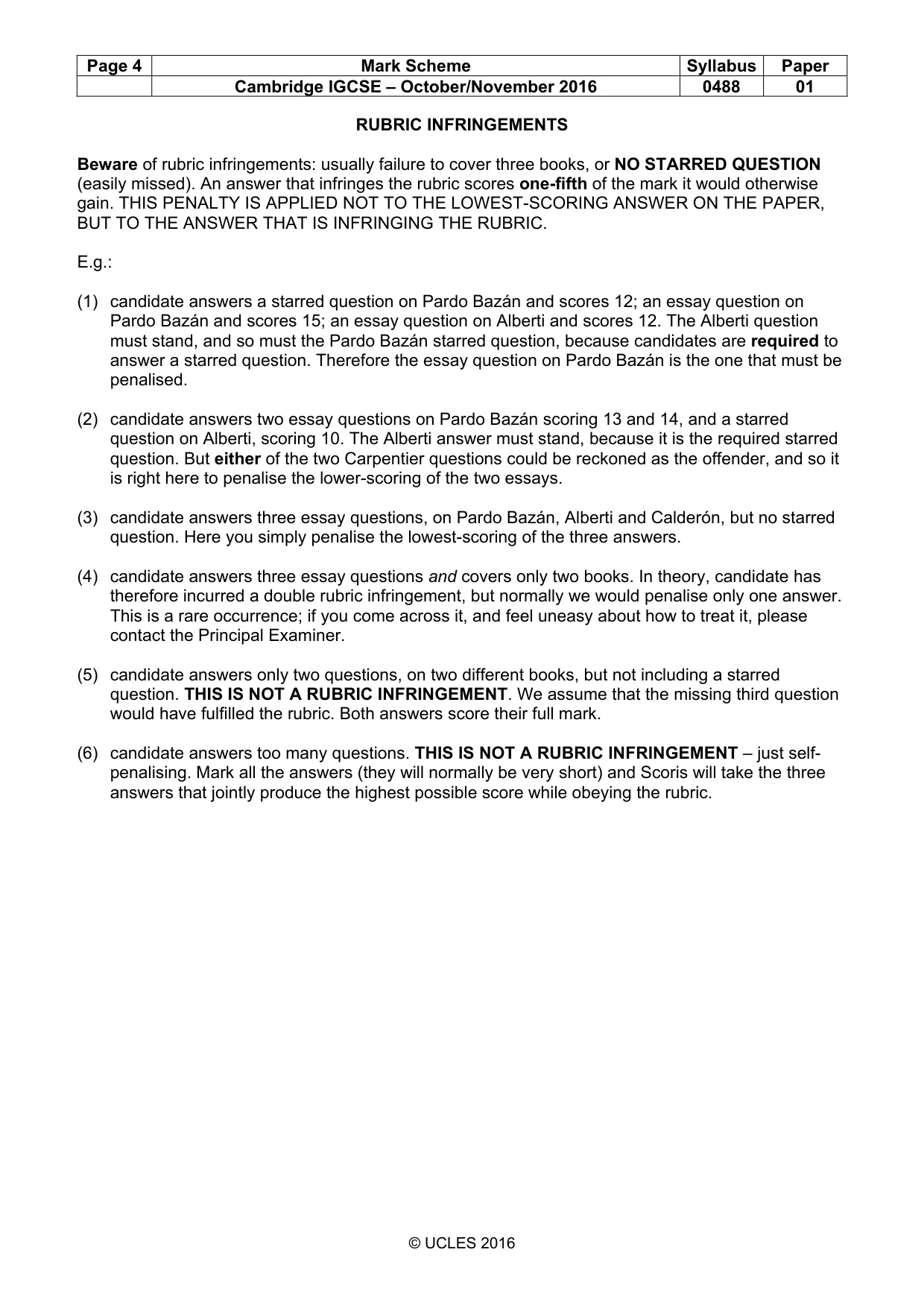
Page 4 Mark Scheme Syllabus Paper Cambridge IGCSE – October/November 2016 0488 01 © UCLES 2016 RUBRIC INFRINGEMENTS Beware of rubric infringements: usually failure to cover three books, or NO STARRED QUESTION (easily missed). An answer that infringes the rubric scores one-fifth of the mark it would otherwise gain. THIS PENALTY IS APPLIED NOT TO THE LOWEST-SCORING ANSWER ON THE PAPER, BUT TO THE ANSWER THAT IS INFRINGING THE RUBRIC. E.g.: (1) candidate answers a starred question on Pardo Bazán and scores 12; an essay question on Pardo Bazán and scores 15; an essay question on Alberti and scores 12. The Alberti question must stand, and so must the Pardo Bazán starred question, because candidates are required to answer a starred question. Therefore the essay question on Pardo Bazán is the one that must be penalised. (2) candidate answers two essay questions on Pardo Bazán scoring 13 and 14, and a starred question on Alberti, scoring 10. The Alberti answer must stand, because it is the required starred question. But either of the two Carpentier questions could be reckoned as the offender, and so it is right here to penalise the lower-scoring of the two essays. (3) candidate answers three essay questions, on Pardo Bazán, Alberti and Calderón, but no starred question. Here you simply penalise the lowest-scoring of the three answers. (4) candidate answers three essay questions and covers only two books. In theory, candidate has therefore incurred a double rubric infringement, but normally we would penalise only one answer. This is a rare occurrence; if you come across it, and feel uneasy about how to treat it, please contact the Principal Examiner. (5) candidate answers only two questions, on two different books, but not including a starred question. THIS IS NOT A RUBRIC INFRINGEMENT. We assume that the missing third question would have fulfilled the rubric. Both answers score their full mark. (6) candidate answers too many questions. THIS IS NOT A RUBRIC INFRINGEMENT – just self- penalising. Mark all the answers (they will normally be very short) and Scoris will take the three answers that jointly produce the highest possible score while obeying the rubric.
Mark scheme, page 5
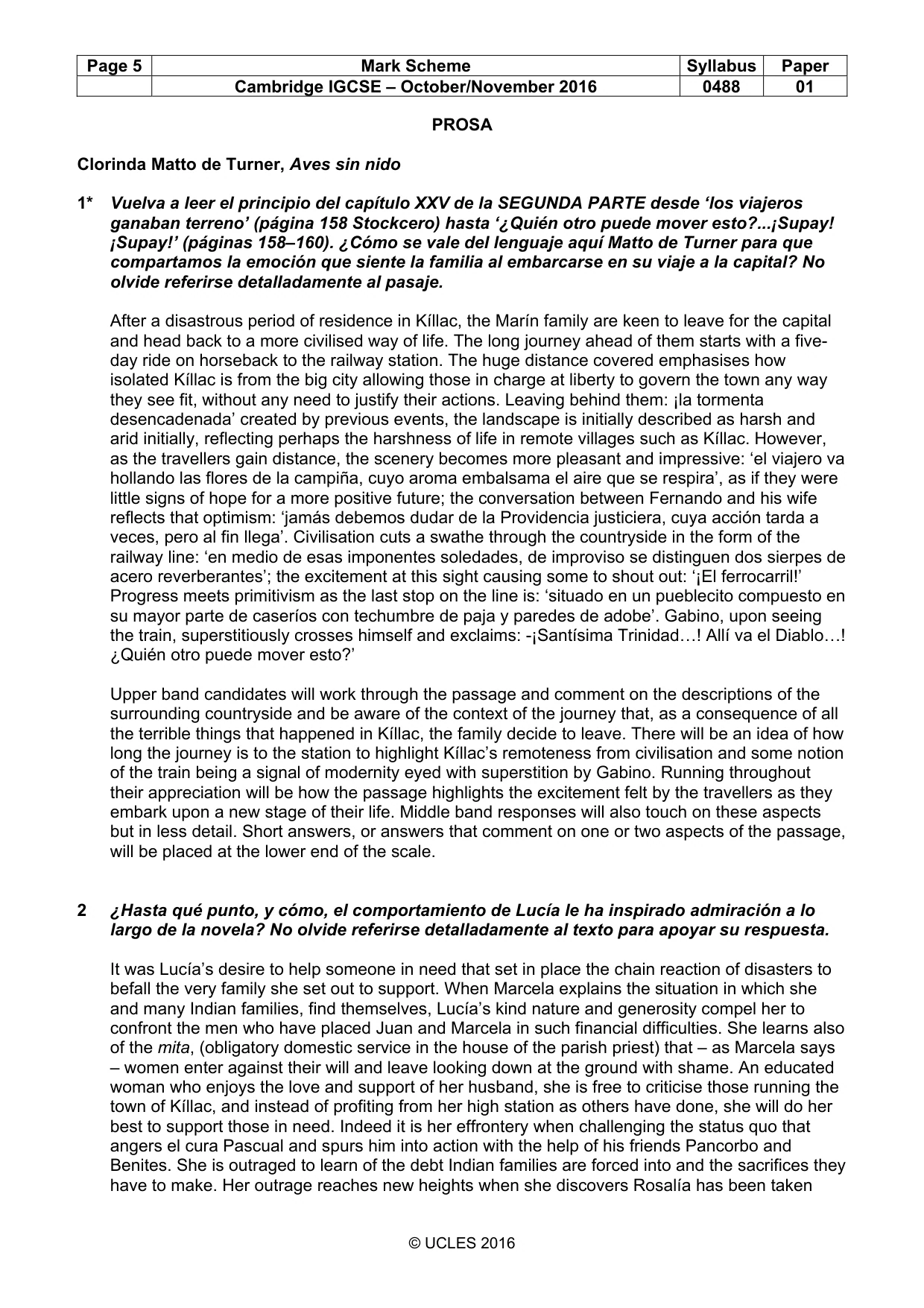
Page 5 Mark Scheme Syllabus Paper Cambridge IGCSE – October/November 2016 0488 01 © UCLES 2016 PROSA Clorinda Matto de Turner, Aves sin nido 1* Vuelva a leer el principio del capítulo XXV de la SEGUNDA PARTE desde ‘los viajeros ganaban terreno’ (página 158 Stockcero) hasta ‘¿Quién otro puede mover esto?...¡Supay! ¡Supay!’ (páginas 158–160). ¿Cómo se vale del lenguaje aquí Matto de Turner para que compartamos la emoción que siente la familia al embarcarse en su viaje a la capital? No olvide referirse detalladamente al pasaje. After a disastrous period of residence in Kíllac, the Marín family are keen to leave for the capital and head back to a more civilised way of life. The long journey ahead of them starts with a five- day ride on horseback to the railway station. The huge distance covered emphasises how isolated Kíllac is from the big city allowing those in charge at liberty to govern the town any way they see fit, without any need to justify their actions. Leaving behind them: ¡la tormenta desencadenada’ created by previous events, the landscape is initially described as harsh and arid initially, reflecting perhaps the harshness of life in remote villages such as Kíllac. However, as the travellers gain distance, the scenery becomes more pleasant and impressive: ‘el viajero va hollando las flores de la campiña, cuyo aroma embalsama el aire que se respira’, as if they were little signs of hope for a more positive future; the conversation between Fernando and his wife reflects that optimism: ‘jamás debemos dudar de la Providencia justiciera, cuya acción tarda a veces, pero al fin llega’. Civilisation cuts a swathe through the countryside in the form of the railway line: ‘en medio de esas imponentes soledades, de improviso se distinguen dos sierpes de acero reverberantes’; the excitement at this sight causing some to shout out: ‘¡El ferrocarril!’ Progress meets primitivism as the last stop on the line is: ‘situado en un pueblecito compuesto en su mayor parte de caseríos con techumbre de paja y paredes de adobe’. Gabino, upon seeing the train, superstitiously crosses himself and exclaims: -¡Santísima Trinidad…! Allí va el Diablo…! ¿Quién otro puede mover esto?’ Upper band candidates will work through the passage and comment on the descriptions of the surrounding countryside and be aware of the context of the journey that, as a consequence of all the terrible things that happened in Kíllac, the family decide to leave. There will be an idea of how long the journey is to the station to highlight Kíllac’s remoteness from civilisation and some notion of the train being a signal of modernity eyed with superstition by Gabino. Running throughout their appreciation will be how the passage highlights the excitement felt by the travellers as they embark upon a new stage of their life. Middle band responses will also touch on these aspects but in less detail. Short answers, or answers that comment on one or two aspects of the passage, will be placed at the lower end of the scale. 2 ¿Hasta qué punto, y cómo, el comportamiento de Lucía le ha inspirado admiración a lo largo de la novela? No olvide referirse detalladamente al texto para apoyar su respuesta. It was Lucía’s desire to help someone in need that set in place the chain reaction of disasters to befall the very family she set out to support. When Marcela explains the situation in which she and many Indian families, find themselves, Lucía’s kind nature and generosity compel her to confront the men who have placed Juan and Marcela in such financial difficulties. She learns also of the mita, (obligatory domestic service in the house of the parish priest) that – as Marcela says – women enter against their will and leave looking down at the ground with shame. An educated woman who enjoys the love and support of her husband, she is free to criticise those running the town of Kíllac, and instead of profiting from her high station as others have done, she will do her best to support those in need. Indeed it is her effrontery when challenging the status quo that angers el cura Pascual and spurs him into action with the help of his friends Pancorbo and Benites. She is outraged to learn of the debt Indian families are forced into and the sacrifices they have to make. Her outrage reaches new heights when she discovers Rosalía has been taken
Mark scheme, page 6
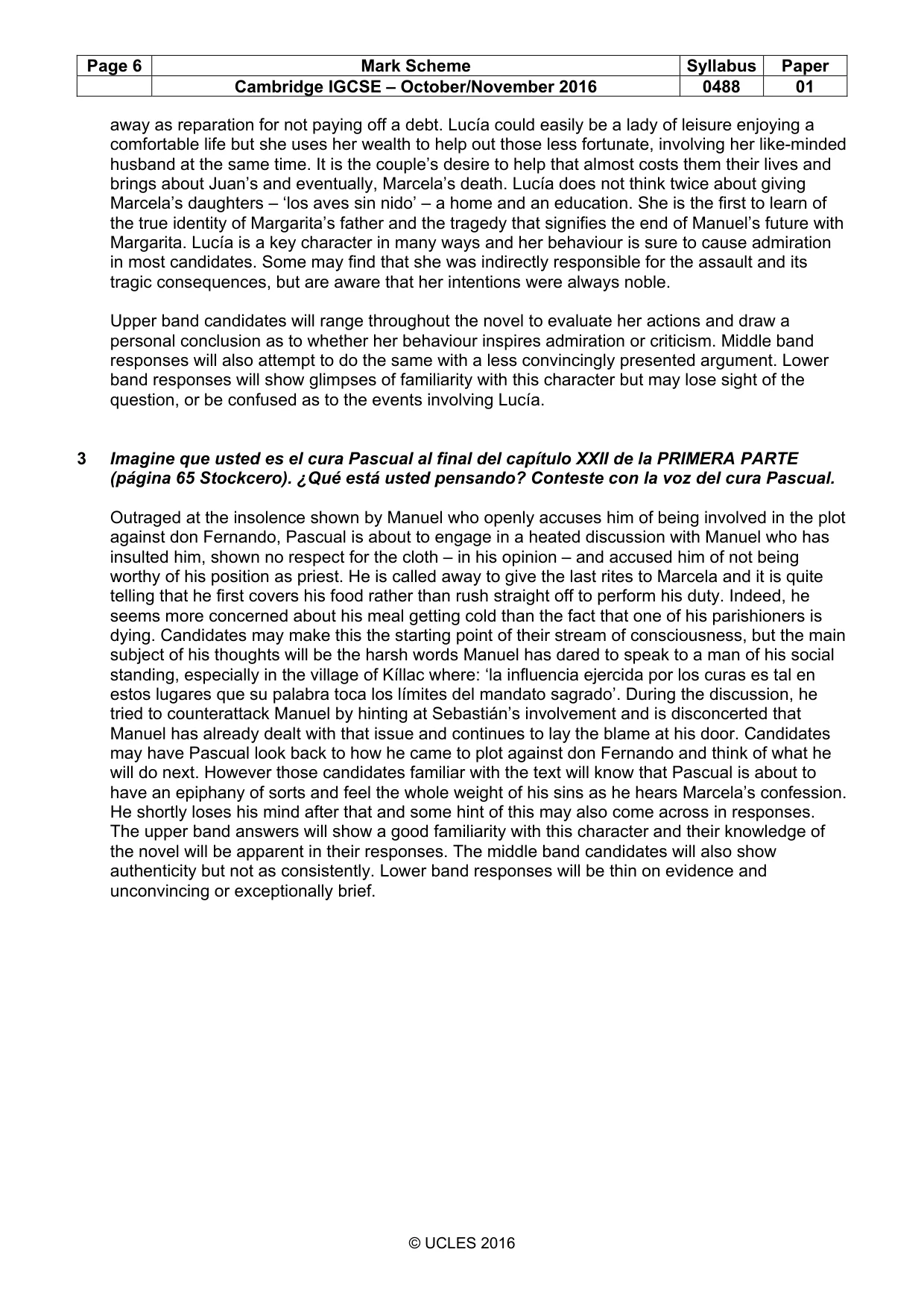
Page 6 Mark Scheme Syllabus Paper Cambridge IGCSE – October/November 2016 0488 01 © UCLES 2016 away as reparation for not paying off a debt. Lucía could easily be a lady of leisure enjoying a comfortable life but she uses her wealth to help out those less fortunate, involving her like-minded husband at the same time. It is the couple’s desire to help that almost costs them their lives and brings about Juan’s and eventually, Marcela’s death. Lucía does not think twice about giving Marcela’s daughters – ‘los aves sin nido’ – a home and an education. She is the first to learn of the true identity of Margarita’s father and the tragedy that signifies the end of Manuel’s future with Margarita. Lucía is a key character in many ways and her behaviour is sure to cause admiration in most candidates. Some may find that she was indirectly responsible for the assault and its tragic consequences, but are aware that her intentions were always noble. Upper band candidates will range throughout the novel to evaluate her actions and draw a personal conclusion as to whether her behaviour inspires admiration or criticism. Middle band responses will also attempt to do the same with a less convincingly presented argument. Lower band responses will show glimpses of familiarity with this character but may lose sight of the question, or be confused as to the events involving Lucía. 3 Imagine que usted es el cura Pascual al final del capítulo XXII de la PRIMERA PARTE (página 65 Stockcero). ¿Qué está usted pensando? Conteste con la voz del cura Pascual. Outraged at the insolence shown by Manuel who openly accuses him of being involved in the plot against don Fernando, Pascual is about to engage in a heated discussion with Manuel who has insulted him, shown no respect for the cloth – in his opinion – and accused him of not being worthy of his position as priest. He is called away to give the last rites to Marcela and it is quite telling that he first covers his food rather than rush straight off to perform his duty. Indeed, he seems more concerned about his meal getting cold than the fact that one of his parishioners is dying. Candidates may make this the starting point of their stream of consciousness, but the main subject of his thoughts will be the harsh words Manuel has dared to speak to a man of his social standing, especially in the village of Kíllac where: ‘la influencia ejercida por los curas es tal en estos lugares que su palabra toca los límites del mandato sagrado’. During the discussion, he tried to counterattack Manuel by hinting at Sebastián’s involvement and is disconcerted that Manuel has already dealt with that issue and continues to lay the blame at his door. Candidates may have Pascual look back to how he came to plot against don Fernando and think of what he will do next. However those candidates familiar with the text will know that Pascual is about to have an epiphany of sorts and feel the whole weight of his sins as he hears Marcela’s confession. He shortly loses his mind after that and some hint of this may also come across in responses. The upper band answers will show a good familiarity with this character and their knowledge of the novel will be apparent in their responses. The middle band candidates will also show authenticity but not as consistently. Lower band responses will be thin on evidence and unconvincing or exceptionally brief.
Mark scheme, page 7
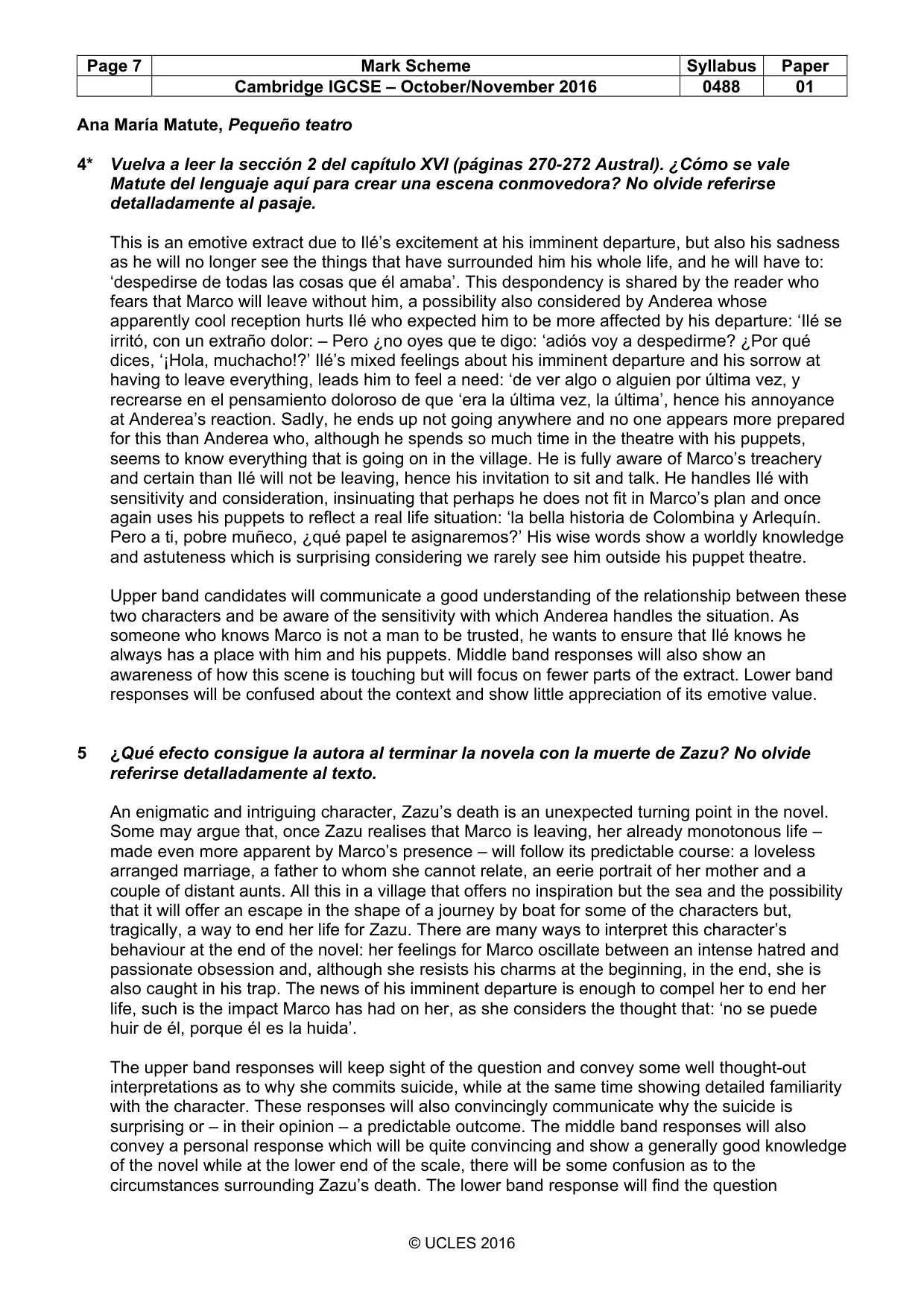
Page 7 Mark Scheme Syllabus Paper Cambridge IGCSE – October/November 2016 0488 01 © UCLES 2016 Ana María Matute, Pequeño teatro 4* Vuelva a leer la sección 2 del capítulo XVI (páginas 270-272 Austral). ¿Cómo se vale Matute del lenguaje aquí para crear una escena conmovedora? No olvide referirse detalladamente al pasaje. This is an emotive extract due to Ilé’s excitement at his imminent departure, but also his sadness as he will no longer see the things that have surrounded him his whole life, and he will have to: ‘despedirse de todas las cosas que él amaba’. This despondency is shared by the reader who fears that Marco will leave without him, a possibility also considered by Anderea whose apparently cool reception hurts Ilé who expected him to be more affected by his departure: ‘Ilé se irritó, con un extraño dolor: – Pero ¿no oyes que te digo: ‘adiós voy a despedirme? ¿Por qué dices, ‘¡Hola, muchacho!?’ Ilé’s mixed feelings about his imminent departure and his sorrow at having to leave everything, leads him to feel a need: ‘de ver algo o alguien por última vez, y recrearse en el pensamiento doloroso de que ‘era la última vez, la última’, hence his annoyance at Anderea’s reaction. Sadly, he ends up not going anywhere and no one appears more prepared for this than Anderea who, although he spends so much time in the theatre with his puppets, seems to know everything that is going on in the village. He is fully aware of Marco’s treachery and certain than Ilé will not be leaving, hence his invitation to sit and talk. He handles Ilé with sensitivity and consideration, insinuating that perhaps he does not fit in Marco’s plan and once again uses his puppets to reflect a real life situation: ‘la bella historia de Colombina y Arlequín. Pero a ti, pobre muñeco, ¿qué papel te asignaremos?’ His wise words show a worldly knowledge and astuteness which is surprising considering we rarely see him outside his puppet theatre. Upper band candidates will communicate a good understanding of the relationship between these two characters and be aware of the sensitivity with which Anderea handles the situation. As someone who knows Marco is not a man to be trusted, he wants to ensure that Ilé knows he always has a place with him and his puppets. Middle band responses will also show an awareness of how this scene is touching but will focus on fewer parts of the extract. Lower band responses will be confused about the context and show little appreciation of its emotive value. 5 ¿Qué efecto consigue la autora al terminar la novela con la muerte de Zazu? No olvide referirse detalladamente al texto. An enigmatic and intriguing character, Zazu’s death is an unexpected turning point in the novel. Some may argue that, once Zazu realises that Marco is leaving, her already monotonous life – made even more apparent by Marco’s presence – will follow its predictable course: a loveless arranged marriage, a father to whom she cannot relate, an eerie portrait of her mother and a couple of distant aunts. All this in a village that offers no inspiration but the sea and the possibility that it will offer an escape in the shape of a journey by boat for some of the characters but, tragically, a way to end her life for Zazu. There are many ways to interpret this character’s behaviour at the end of the novel: her feelings for Marco oscillate between an intense hatred and passionate obsession and, although she resists his charms at the beginning, in the end, she is also caught in his trap. The news of his imminent departure is enough to compel her to end her life, such is the impact Marco has had on her, as she considers the thought that: ‘no se puede huir de él, porque él es la huida’. The upper band responses will keep sight of the question and convey some well thought-out interpretations as to why she commits suicide, while at the same time showing detailed familiarity with the character. These responses will also convincingly communicate why the suicide is surprising or – in their opinion – a predictable outcome. The middle band responses will also convey a personal response which will be quite convincing and show a generally good knowledge of the novel while at the lower end of the scale, there will be some confusion as to the circumstances surrounding Zazu’s death. The lower band response will find the question
Mark scheme, page 8
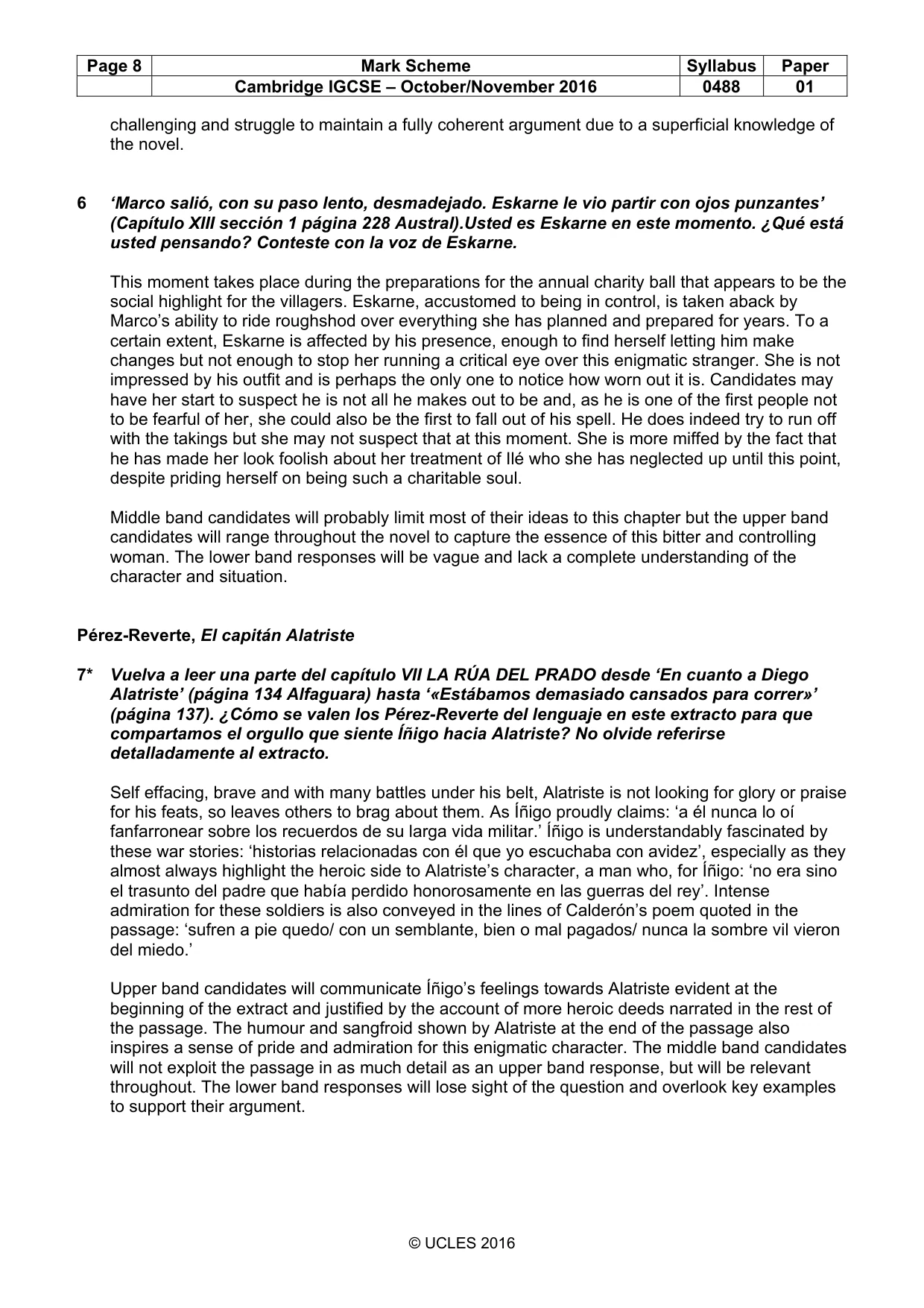
Page 8 Mark Scheme Syllabus Paper Cambridge IGCSE – October/November 2016 0488 01 © UCLES 2016 challenging and struggle to maintain a fully coherent argument due to a superficial knowledge of the novel. 6 ‘Marco salió, con su paso lento, desmadejado. Eskarne le vio partir con ojos punzantes’ (Capítulo XIII sección 1 página 228 Austral).Usted es Eskarne en este momento. ¿Qué está usted pensando? Conteste con la voz de Eskarne. This moment takes place during the preparations for the annual charity ball that appears to be the social highlight for the villagers. Eskarne, accustomed to being in control, is taken aback by Marco’s ability to ride roughshod over everything she has planned and prepared for years. To a certain extent, Eskarne is affected by his presence, enough to find herself letting him make changes but not enough to stop her running a critical eye over this enigmatic stranger. She is not impressed by his outfit and is perhaps the only one to notice how worn out it is. Candidates may have her start to suspect he is not all he makes out to be and, as he is one of the first people not to be fearful of her, she could also be the first to fall out of his spell. He does indeed try to run off with the takings but she may not suspect that at this moment. She is more miffed by the fact that he has made her look foolish about her treatment of Ilé who she has neglected up until this point, despite priding herself on being such a charitable soul. Middle band candidates will probably limit most of their ideas to this chapter but the upper band candidates will range throughout the novel to capture the essence of this bitter and controlling woman. The lower band responses will be vague and lack a complete understanding of the character and situation. Pérez-Reverte, El capitán Alatriste 7* Vuelva a leer una parte del capítulo VII LA RÚA DEL PRADO desde ‘En cuanto a Diego Alatriste’ (página 134 Alfaguara) hasta ‘«Estábamos demasiado cansados para correr»’ (página 137). ¿Cómo se valen los Pérez-Reverte del lenguaje en este extracto para que compartamos el orgullo que siente Íñigo hacia Alatriste? No olvide referirse detalladamente al extracto. Self effacing, brave and with many battles under his belt, Alatriste is not looking for glory or praise for his feats, so leaves others to brag about them. As Íñigo proudly claims: ‘a él nunca lo oí fanfarronear sobre los recuerdos de su larga vida militar.’ Íñigo is understandably fascinated by these war stories: ‘historias relacionadas con él que yo escuchaba con avidez’, especially as they almost always highlight the heroic side to Alatriste’s character, a man who, for Íñigo: ‘no era sino el trasunto del padre que había perdido honorosamente en las guerras del rey’. Intense admiration for these soldiers is also conveyed in the lines of Calderón’s poem quoted in the passage: ‘sufren a pie quedo/ con un semblante, bien o mal pagados/ nunca la sombre vil vieron del miedo.’ Upper band candidates will communicate Íñigo’s feelings towards Alatriste evident at the beginning of the extract and justified by the account of more heroic deeds narrated in the rest of the passage. The humour and sangfroid shown by Alatriste at the end of the passage also inspires a sense of pride and admiration for this enigmatic character. The middle band candidates will not exploit the passage in as much detail as an upper band response, but will be relevant throughout. The lower band responses will lose sight of the question and overlook key examples to support their argument.
Mark scheme, page 9
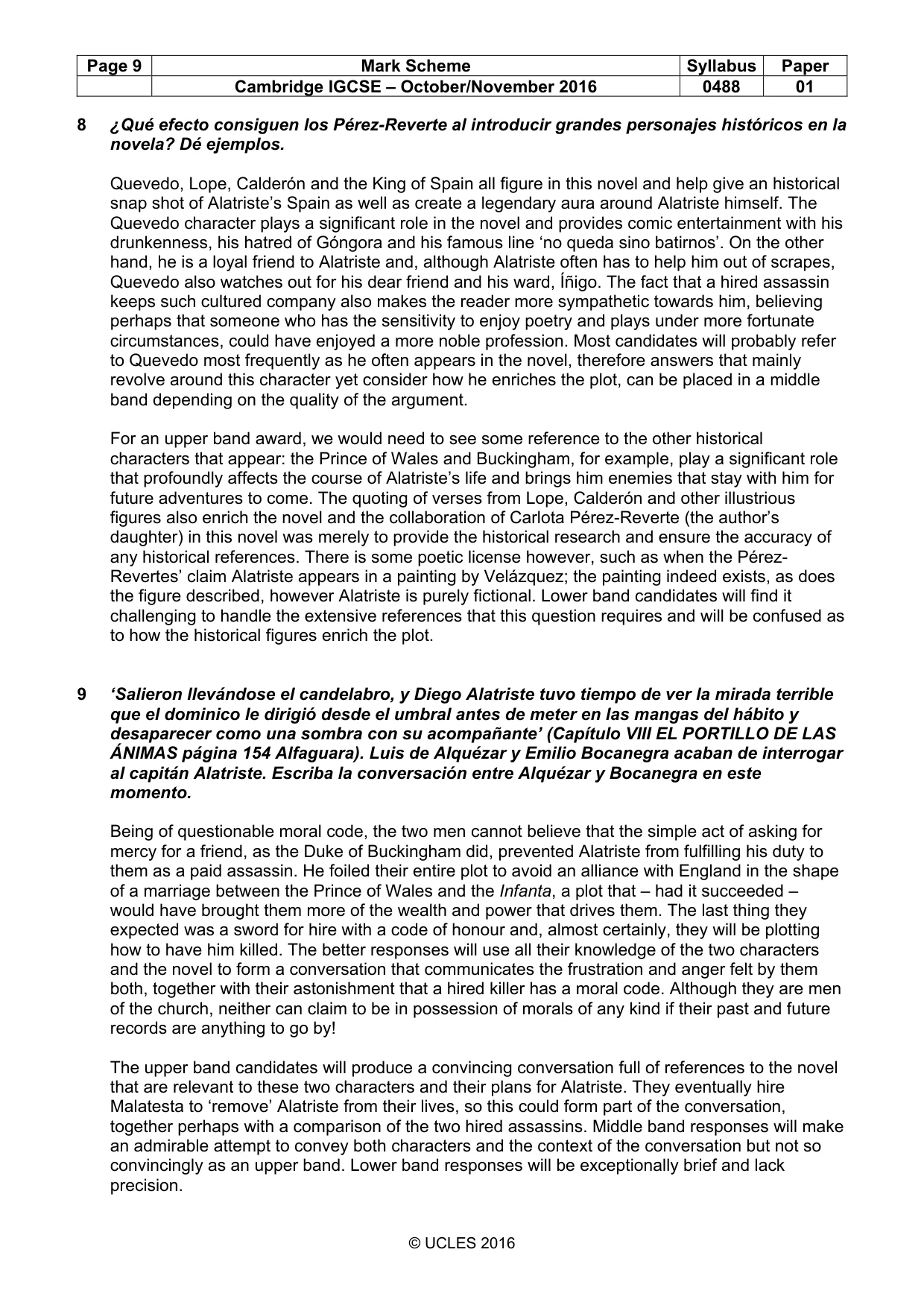
Page 9 Mark Scheme Syllabus Paper Cambridge IGCSE – October/November 2016 0488 01 © UCLES 2016 8 ¿Qué efecto consiguen los Pérez-Reverte al introducir grandes personajes históricos en la novela? Dé ejemplos. Quevedo, Lope, Calderón and the King of Spain all figure in this novel and help give an historical snap shot of Alatriste’s Spain as well as create a legendary aura around Alatriste himself. The Quevedo character plays a significant role in the novel and provides comic entertainment with his drunkenness, his hatred of Góngora and his famous line ‘no queda sino batirnos’. On the other hand, he is a loyal friend to Alatriste and, although Alatriste often has to help him out of scrapes, Quevedo also watches out for his dear friend and his ward, Íñigo. The fact that a hired assassin keeps such cultured company also makes the reader more sympathetic towards him, believing perhaps that someone who has the sensitivity to enjoy poetry and plays under more fortunate circumstances, could have enjoyed a more noble profession. Most candidates will probably refer to Quevedo most frequently as he often appears in the novel, therefore answers that mainly revolve around this character yet consider how he enriches the plot, can be placed in a middle band depending on the quality of the argument. For an upper band award, we would need to see some reference to the other historical characters that appear: the Prince of Wales and Buckingham, for example, play a significant role that profoundly affects the course of Alatriste’s life and brings him enemies that stay with him for future adventures to come. The quoting of verses from Lope, Calderón and other illustrious figures also enrich the novel and the collaboration of Carlota Pérez-Reverte (the author’s daughter) in this novel was merely to provide the historical research and ensure the accuracy of any historical references. There is some poetic license however, such as when the Pérez- Revertes’ claim Alatriste appears in a painting by Velázquez; the painting indeed exists, as does the figure described, however Alatriste is purely fictional. Lower band candidates will find it challenging to handle the extensive references that this question requires and will be confused as to how the historical figures enrich the plot. 9 ‘Salieron llevándose el candelabro, y Diego Alatriste tuvo tiempo de ver la mirada terrible que el dominico le dirigió desde el umbral antes de meter en las mangas del hábito y desaparecer como una sombra con su acompañante’ (Capítulo VIII EL PORTILLO DE LAS ÁNIMAS página 154 Alfaguara). Luis de Alquézar y Emilio Bocanegra acaban de interrogar al capitán Alatriste. Escriba la conversación entre Alquézar y Bocanegra en este momento. Being of questionable moral code, the two men cannot believe that the simple act of asking for mercy for a friend, as the Duke of Buckingham did, prevented Alatriste from fulfilling his duty to them as a paid assassin. He foiled their entire plot to avoid an alliance with England in the shape of a marriage between the Prince of Wales and the Infanta, a plot that – had it succeeded – would have brought them more of the wealth and power that drives them. The last thing they expected was a sword for hire with a code of honour and, almost certainly, they will be plotting how to have him killed. The better responses will use all their knowledge of the two characters and the novel to form a conversation that communicates the frustration and anger felt by them both, together with their astonishment that a hired killer has a moral code. Although they are men of the church, neither can claim to be in possession of morals of any kind if their past and future records are anything to go by! The upper band candidates will produce a convincing conversation full of references to the novel that are relevant to these two characters and their plans for Alatriste. They eventually hire Malatesta to ‘remove’ Alatriste from their lives, so this could form part of the conversation, together perhaps with a comparison of the two hired assassins. Middle band responses will make an admirable attempt to convey both characters and the context of the conversation but not so convincingly as an upper band. Lower band responses will be exceptionally brief and lack precision.
Mark scheme, page 10
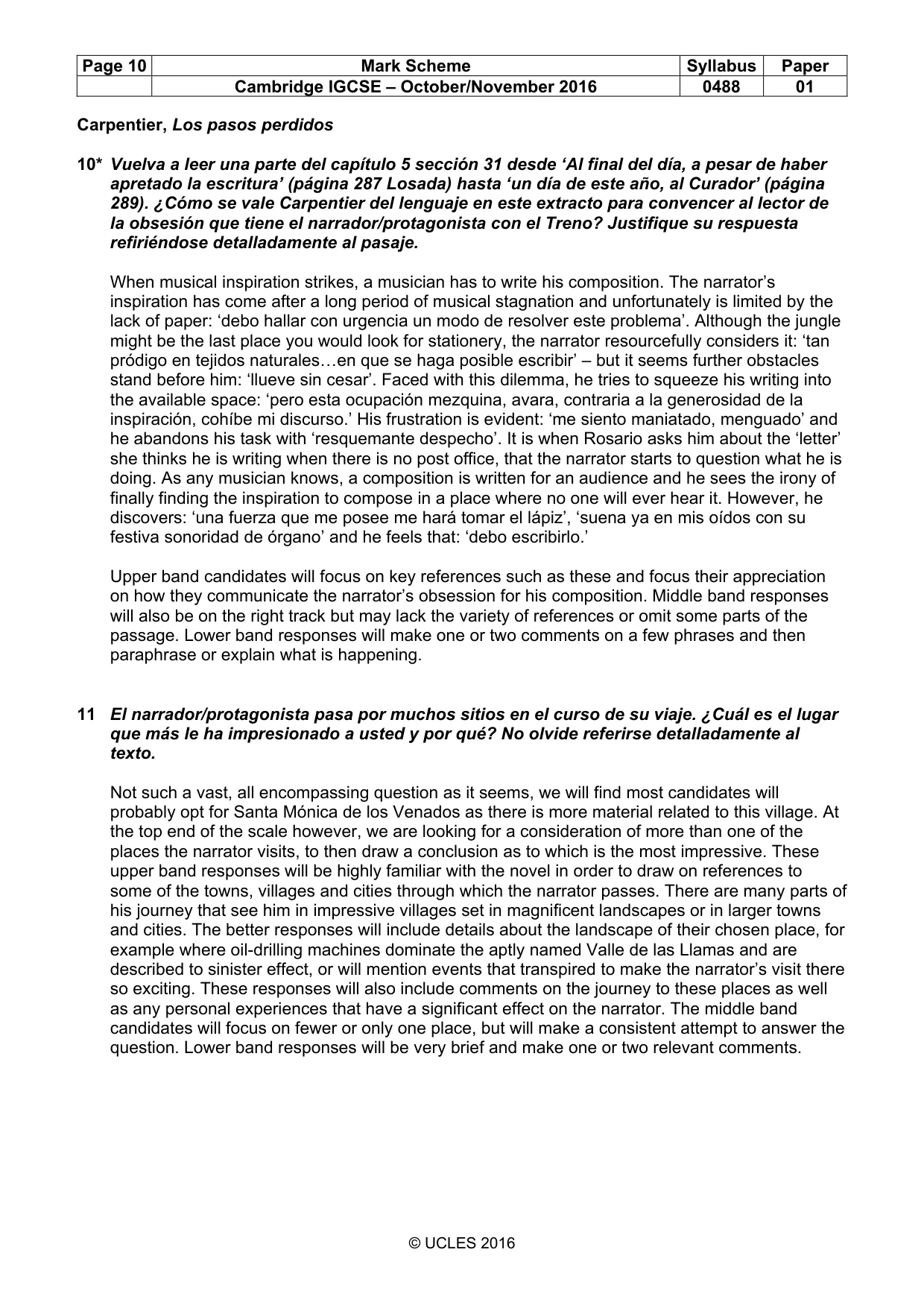
Page 10 Mark Scheme Syllabus Paper Cambridge IGCSE – October/November 2016 0488 01 © UCLES 2016 Carpentier, Los pasos perdidos 10* Vuelva a leer una parte del capítulo 5 sección 31 desde ‘Al final del día, a pesar de haber apretado la escritura’ (página 287 Losada) hasta ‘un día de este año, al Curador’ (página 289). ¿Cómo se vale Carpentier del lenguaje en este extracto para convencer al lector de la obsesión que tiene el narrador/protagonista con el Treno? Justifique su respuesta refiriéndose detalladamente al pasaje. When musical inspiration strikes, a musician has to write his composition. The narrator’s inspiration has come after a long period of musical stagnation and unfortunately is limited by the lack of paper: ‘debo hallar con urgencia un modo de resolver este problema’. Although the jungle might be the last place you would look for stationery, the narrator resourcefully considers it: ‘tan pródigo en tejidos naturales…en que se haga posible escribir’ – but it seems further obstacles stand before him: ‘llueve sin cesar’. Faced with this dilemma, he tries to squeeze his writing into the available space: ‘pero esta ocupación mezquina, avara, contraria a la generosidad de la inspiración, cohíbe mi discurso.’ His frustration is evident: ‘me siento maniatado, menguado’ and he abandons his task with ‘resquemante despecho’. It is when Rosario asks him about the ‘letter’ she thinks he is writing when there is no post office, that the narrator starts to question what he is doing. As any musician knows, a composition is written for an audience and he sees the irony of finally finding the inspiration to compose in a place where no one will ever hear it. However, he discovers: ‘una fuerza que me posee me hará tomar el lápiz’, ‘suena ya en mis oídos con su festiva sonoridad de órgano’ and he feels that: ‘debo escribirlo.’ Upper band candidates will focus on key references such as these and focus their appreciation on how they communicate the narrator’s obsession for his composition. Middle band responses will also be on the right track but may lack the variety of references or omit some parts of the passage. Lower band responses will make one or two comments on a few phrases and then paraphrase or explain what is happening. 11 El narrador/protagonista pasa por muchos sitios en el curso de su viaje. ¿Cuál es el lugar que más le ha impresionado a usted y por qué? No olvide referirse detalladamente al texto. Not such a vast, all encompassing question as it seems, we will find most candidates will probably opt for Santa Mónica de los Venados as there is more material related to this village. At the top end of the scale however, we are looking for a consideration of more than one of the places the narrator visits, to then draw a conclusion as to which is the most impressive. These upper band responses will be highly familiar with the novel in order to draw on references to some of the towns, villages and cities through which the narrator passes. There are many parts of his journey that see him in impressive villages set in magnificent landscapes or in larger towns and cities. The better responses will include details about the landscape of their chosen place, for example where oil-drilling machines dominate the aptly named Valle de las Llamas and are described to sinister effect, or will mention events that transpired to make the narrator’s visit there so exciting. These responses will also include comments on the journey to these places as well as any personal experiences that have a significant effect on the narrator. The middle band candidates will focus on fewer or only one place, but will make a consistent attempt to answer the question. Lower band responses will be very brief and make one or two relevant comments.
Mark scheme, page 11
Page 11 Mark Scheme Syllabus Paper Cambridge IGCSE – October/November 2016 0488 01 © UCLES 2016 12 ‘Me entrega un trozo de papel de periódico, y me estremezco al ver una fotografía de Mouche, en coloquio con un periodista conocido por su explotación del escándalo’ (Capítulo 6 sección 34, 18 de julio, página 315 Losada). Escriba la entrevista entre Mouche y el reportero del periódico tabloide. Upper band candidates will enjoy drawing on their detailed knowledge of the text to relive the part of the journey when Mouche accompanied the narrator on his quest to find primitive instruments. They will carefully consider the best type of questions the reporter will ask to get all the scandalous detail (he is writing for a tabloid after all). The more salacious details about their illicit affair the better, so the focus may be on the relationship with the narrator and Mouche. However some questions during the interview will also cover the places and people that the couple met during their journey. A flirtatious character, Mouche may even adopt a coquettish attitude towards the reporter and this would be an authentic representation of this character. The middle band responses will also draw on their knowledge of Mouche but may not have as much material upon which to base their interpretation of her character. The lower band responses will be superficial and /or brief and not reflect a sound knowledge of the plot and Mouche’s contribution to it.
Mark scheme, page 12
Page 12 Mark Scheme Syllabus Paper Cambridge IGCSE – October/November 2016 0488 01 © UCLES 2016 TEATRO Federico García Lorca, Bodas de sangre Alternativamente: 13* Vuelva a leer el principio del ACTO SEGUNDO CUADRO PRIMERO desde ‘Zaguán de casa de la NOVIA’ (página 40 Vicens Vives) hasta ‘LEONARDO. Yo. Buenos días’ (página 45). ¿Cómo reacciona usted ante lo dicho y hecho por la Novia aquí? No olvide referirse detalladamente al pasaje. It appears the Criada is happier on the day of the Novia’s wedding than the bride herself. We can understand the Novia’s sadness initially as she is talking about her dead mother who was ‘consumed’ by the lands they live in – the Criada ominously attributing her death to ‘el sino’. Lorca’s popular technique of using heat to highlight frustration or tension indicates the Novia’s unease: ‘echan fuego las paredes’. The Criada goes on to change the subject and sing the praises of wedded life, but when she touches upon the intimacy shared by a married couple, the Novia appears even more down hearted: ‘deja caer la cabeza, abatida’. The superstitious maid is shocked when the Novia throws down the wedding flowers and begins to suspect the Novia is having second thoughts, reassuring her that: ‘todavía te puedes arrepentir’. The Novia is aware of their obligations: ‘ya me he comprometido’ and hurries to finish the preparations just as the songs ring out in the distance. As the Criada opens the door to the guests, she is surprised to see Leonardo alone at the door and the public is left at this moment to draw their own conclusions. Careful consideration of each character’s words and actions, while maintaining relevance to the question, will place a response in the upper bands. The better responses will contrast Criada’s enthusiasm with Novia’s reluctance. Middle band responses will also keep sight of the question but omit some parts of the passage or be expressed in a less sophisticated way. Lower band responses will mention one or two references, but will lack any precision or be irrelevant. 14 ¿Cómo aprovecha el dramaturgo los símbolos de la naturaleza que aparecen a lo largo de la obra para enriquecerla? No olvide referirse detalladamente al texto. Although most will focus their response on the lullaby that appears in Act one scene II, however there are other songs that use nature symbols to communicate or predict plot details, or merely entertain the audience. In some dialogue there is also a use of nature images and the Madre and Padre are ideal characters to look at for examples. Leonard and the Novia, when together speak in telluric terms: ‘que yo no tengo la culpa, / que la culpa es de la tierra’ and the Moon’s speech is full of nature images. The Leñadores speak of: ‘un árbol de cuarenta ramos’ which they hope to cut down, symbolic of the end of the Novio’s predictable death that will signify the end of his family tree. When lamenting the death of someone comparisons are made with flowers and images of ice and snow – common Lorquian imagery. In upper band answers we will see a range of relevant examples and an appreciation of how these symbols are used to create atmosphere, predict possible tragedy or celebrate happy occasions. We will be open to the candidate’s choice of symbols and judge their responses by how well they handle the symbolism. Middle band responses will consider a range of examples but not as extensively as an upper band response. Lower band responses will mention one or two examples but will not explore the imagery or how they enrich the plot.
Mark scheme, page 13
Page 13 Mark Scheme Syllabus Paper Cambridge IGCSE – October/November 2016 0488 01 © UCLES 2016 15 ‘MUJER. ¡Han huido! ¡Han huido! Ella y Leonardo. En el caballo. ¡Iban abrazados, como una exhalación!’ (ACTO SEGUNDO CUADRO SEGUNDO página 76 Vicens Vives). Usted es la Mujer de Leonardo en este momento. ¿Qué está usted pensando? Conteste con la voz de la Mujer. ‘I knew it!’ may be her first thought as she sees her husband ride off into the distance with her cousin. The minute Leonardo learnt of the Novia’s forthcoming wedding, the Mujer looked straight into his eyes and saw the hurt and love her husband still felt for his previous girlfriend. However, as a typical wife of the time, she has no choice but to live with this knowledge and her aggressively angry husband who she suspected all along rides off to see her cousin at every opportunity. Her thoughts will turn to her own future; she will be aware that the scandal will taint her family forever but, more tragically, her husband could die at the hands of an offended Novio, who has every right to kill to defend his besmirched honour. She already has a child and is expecting another so her thoughts will reflect the dire position in which she finds herself. Always short of money when her husband was alive, she will wonder how to support her family. There may also be a tinge of resentment towards her cousin who she previously described as: ‘una buena muchacha’ (she probably has changed her opinion at this point), and perhaps some empathy for the Novio who is even more scandalised than her as he never had an inkling that his wife and her ex lover still had feelings for each other. The upper band responses will reflect a detailed knowledge of the character and an awareness of the situation in which the Mujer finds herself, not least having to face all the guests who have come to celebrate a wedding and not to witness her husband sweep the bride away! These responses will use their knowledge of what has happened to this character prior to, and perhaps after this event, to lend greater authenticity to their response. The middle band answers will also show a relatively good knowledge of the play and try to maintain an authentic voice. The lower band responses will be less convincing and quite brief. Sánchez, Barranca abajo 16* Vuelva a leer la escena XXI del Acto primero desde ‘JUAN LUIS.– Pues yo no he oído’ (página 100 Cátedra) hasta el final de la escena ‘TELÓN LENTO’ (página 102). Aprecie cómo la ira que siente Zoilo aumenta contínuamente la tensión dramática en este extracto. Justifique su respuesta refiriéndose detalladamente al pasaje. The audience suspects Zoilo is about to speak his mind as he has sent the women away in the previous scenes. His emotional state, indicated by the stage instructions: (alterado), creates a sense of foreboding and his loathing towards Juan Luis is evident as Zoilo moves his bench closer to him. Zoilo’s words make it clear there is animosity, bitterness and rage towards the person who has caused all his troubles and as he mentions everything that has happened to him, his emotions range from aggression: ‘(alzándose terrible) to (serenándose) – indeed in his apparent calm state he seems even more frightening! He loses control of his temper at the end: (amarrando el talero), but by this point the audience can sympathise with him as they have learnt how he lost everything he worked so hard for. His final gestures of hopelessness provoke similar reactions and upper band candidates will be sensitive to his plight as well as aware how the tension is built up in the extract. Middle band responses will also show an understanding of context and look carefully at the passage but with fewer precise references. Lower band responses will make a few sweeping generalisations without looking too closely at the text.
Mark scheme, page 14
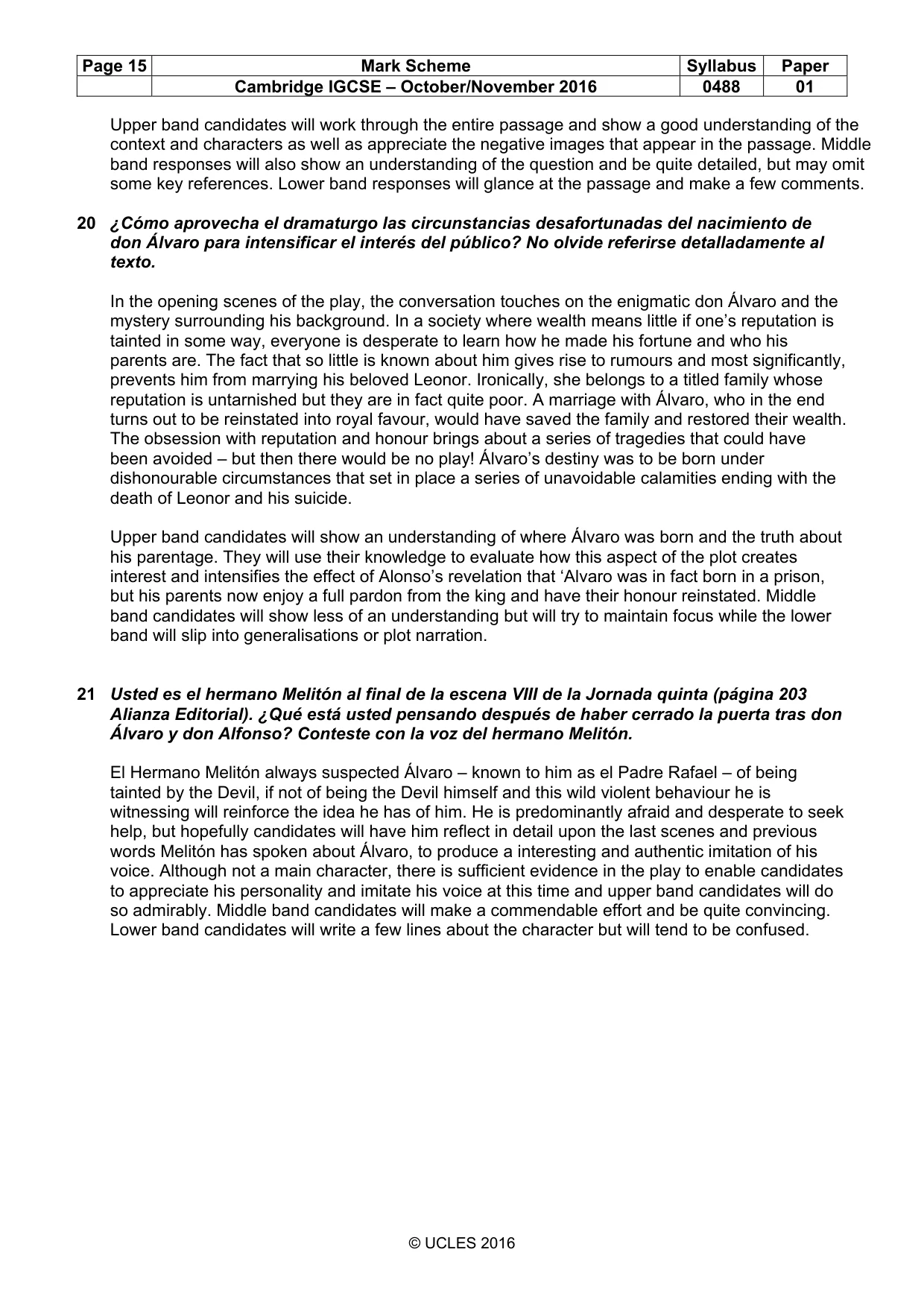
Page 14 Mark Scheme Syllabus Paper Cambridge IGCSE – October/November 2016 0488 01 © UCLES 2016 17 ¿Qué sentimientos le inspiran a usted la muerte de Robusta y el impacto que esta muerte tiene en don Zolio? No olvide referirse detalladamente al texto. The answer will focus mainly on the close relationship between Robusta and her father to create an understanding as to how her death had a great impact on him. At the top end of the scale, these responses will also contrast his dysfunctional relationship with the other women in the family to highlight how much he is affected by Robusta’s death and how alone he feels after she has gone. It is hoped these answers will also consider how he feels in the context of all the other events that have changed his life and forced him to lose everything, even the respect he commanded from others. This will demonstrate how much knowledge and how confident the candidate is in their handling of the play and help to decide in which band the response can be placed. The more convincingly presented the argument, the higher the band. The middle band will be considered for those responses that show knowledge of the play and are quite confident when handling the material but will not provide as much detail as the top band candidates. The lower band will struggle to handle the evidence and will lose sight of the question. 18 ‘SARGENTO (paternal.) – No ha de ser por nada. Cuestión de un rato. Venga no más. Si se resiste, va a ser pior. ÑA MARTINIANA. – Claro que sí. Bé de ir no más a las güenas. ¿Qué saca con resistir a la autoridad?’ (Acto segundo, escena XVI página 120 Cátedra). Usted es Ña Martiniana y don Zoilo está a punto de ser detenido. ¿Qué está usted pensando? Conteste con la voz de Ña Martiniana. Never a big fan of Zoilo’s, Martiniana has spent most of the play undermining him or trying to help the women escape from his overbearing presence. She will see this as an ideal opportunity to put her plan into place as the women will be more cooperative if the root of their fear and the cause of their frustated plans to flee, is removed. She may also gleefully think that Zoilo deserves to be arrested as she is exceptionally unsympathetic to his plight. Some candidates may imitate the colourful way she has of speaking and, although this is not necessarily a requirement, if done successfully, it will help decide between the upper and middle bands if the thoughts are authentic to the character. Lower band responses will be confused as to the situation and the character. She appears quite frequently in the play and has a distinctive voice, so we shall expect a reasonably authentic voice for the top bands. Duque de Rivas, Don Álvaro o la fuerza del sino 19* Vuelva a leer las escenas VII y VIII al final de la Jornada primera desde la acotación ‘(D.ª LEONOR muy abatida se apoya en el hombro de D. ÁLVARO, con muestras de desmayarse.)’ (página 89 Alianza Editorial) hasta el final de la Jornada primera (página 93). ¿Cómo aprovecha el Duque de Rivas el diálogo y las acciones de los protagonistas en este extracto para que el final de la Jornada Primera sea tan emocionante? No olvide referirse detalladamente al pasaje. Leonor’s cold hand: ‘la mano de una muerta’ and her appearance: ‘como la losa de un sepulcro helado’, bodes ill for the outcome of this attempted elopement. Álvaro questions her love but she swears: ‘resuelta estoy fijé mi suerte, / separarnos podrá solo la muerte’. Death pervades the scene creating a sense of danger and foreboding, heightened by the sounds of the barking dogs and galloping horses. Panic grips Álvaro as he grabs his gun while a terrified Leonor looks on. There follows a tragic series of events that mark the lives of the two lovers and set in place an inevitable tragedy that ends with everyone in Leonor’s family dead and Álvaro committing suicide.
Mark scheme, page 15
Page 15 Mark Scheme Syllabus Paper Cambridge IGCSE – October/November 2016 0488 01 © UCLES 2016 Upper band candidates will work through the entire passage and show a good understanding of the context and characters as well as appreciate the negative images that appear in the passage. Middle band responses will also show an understanding of the question and be quite detailed, but may omit some key references. Lower band responses will glance at the passage and make a few comments. 20 ¿Cómo aprovecha el dramaturgo las circunstancias desafortunadas del nacimiento de don Álvaro para intensificar el interés del público? No olvide referirse detalladamente al texto. In the opening scenes of the play, the conversation touches on the enigmatic don Álvaro and the mystery surrounding his background. In a society where wealth means little if one’s reputation is tainted in some way, everyone is desperate to learn how he made his fortune and who his parents are. The fact that so little is known about him gives rise to rumours and most significantly, prevents him from marrying his beloved Leonor. Ironically, she belongs to a titled family whose reputation is untarnished but they are in fact quite poor. A marriage with Álvaro, who in the end turns out to be reinstated into royal favour, would have saved the family and restored their wealth. The obsession with reputation and honour brings about a series of tragedies that could have been avoided – but then there would be no play! Álvaro’s destiny was to be born under dishonourable circumstances that set in place a series of unavoidable calamities ending with the death of Leonor and his suicide. Upper band candidates will show an understanding of where Álvaro was born and the truth about his parentage. They will use their knowledge to evaluate how this aspect of the plot creates interest and intensifies the effect of Alonso’s revelation that ‘Alvaro was in fact born in a prison, but his parents now enjoy a full pardon from the king and have their honour reinstated. Middle band candidates will show less of an understanding but will try to maintain focus while the lower band will slip into generalisations or plot narration. 21 Usted es el hermano Melitón al final de la escena VIII de la Jornada quinta (página 203 Alianza Editorial). ¿Qué está usted pensando después de haber cerrado la puerta tras don Álvaro y don Alfonso? Conteste con la voz del hermano Melitón. El Hermano Melitón always suspected Álvaro – known to him as el Padre Rafael – of being tainted by the Devil, if not of being the Devil himself and this wild violent behaviour he is witnessing will reinforce the idea he has of him. He is predominantly afraid and desperate to seek help, but hopefully candidates will have him reflect in detail upon the last scenes and previous words Melitón has spoken about Álvaro, to produce a interesting and authentic imitation of his voice. Although not a main character, there is sufficient evidence in the play to enable candidates to appreciate his personality and imitate his voice at this time and upper band candidates will do so admirably. Middle band candidates will make a commendable effort and be quite convincing. Lower band candidates will write a few lines about the character but will tend to be confused.
Mark scheme, page 16
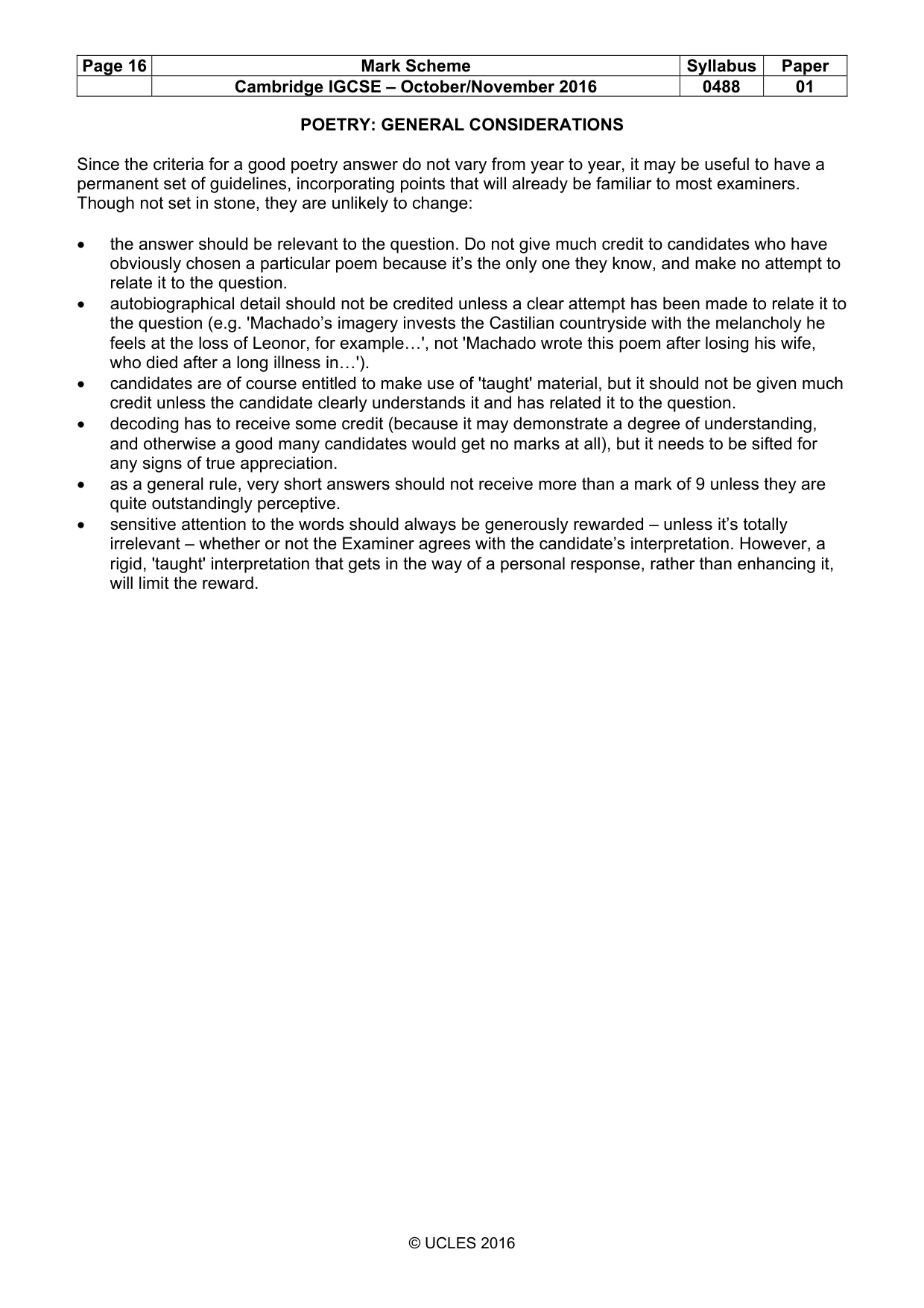
Page 16 Mark Scheme Syllabus Paper Cambridge IGCSE – October/November 2016 0488 01 © UCLES 2016 POETRY: GENERAL CONSIDERATIONS Since the criteria for a good poetry answer do not vary from year to year, it may be useful to have a permanent set of guidelines, incorporating points that will already be familiar to most examiners. Though not set in stone, they are unlikely to change: • the answer should be relevant to the question. Do not give much credit to candidates who have obviously chosen a particular poem because it’s the only one they know, and make no attempt to relate it to the question. • autobiographical detail should not be credited unless a clear attempt has been made to relate it to the question (e.g. 'Machado’s imagery invests the Castilian countryside with the melancholy he feels at the loss of Leonor, for example…', not 'Machado wrote this poem after losing his wife, who died after a long illness in…'). • candidates are of course entitled to make use of 'taught' material, but it should not be given much credit unless the candidate clearly understands it and has related it to the question. • decoding has to receive some credit (because it may demonstrate a degree of understanding, and otherwise a good many candidates would get no marks at all), but it needs to be sifted for any signs of true appreciation. • as a general rule, very short answers should not receive more than a mark of 9 unless they are quite outstandingly perceptive. • sensitive attention to the words should always be generously rewarded – unless it’s totally irrelevant – whether or not the Examiner agrees with the candidate’s interpretation. However, a rigid, 'taught' interpretation that gets in the way of a personal response, rather than enhancing it, will limit the reward.
Mark scheme, page 17
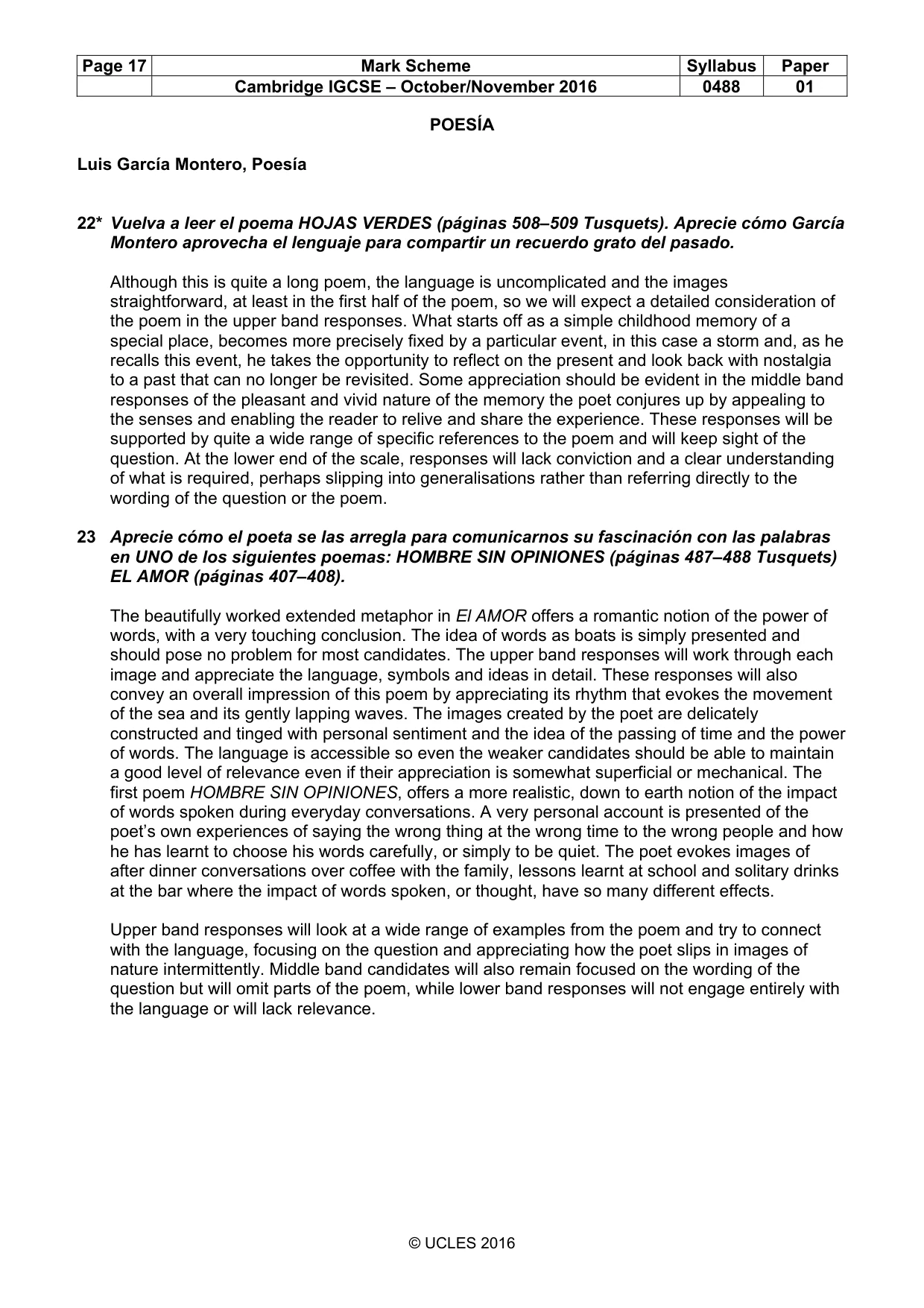
Page 17 Mark Scheme Syllabus Paper Cambridge IGCSE – October/November 2016 0488 01 © UCLES 2016 POESÍA Luis García Montero, Poesía 22* Vuelva a leer el poema HOJAS VERDES (páginas 508–509 Tusquets). Aprecie cómo García Montero aprovecha el lenguaje para compartir un recuerdo grato del pasado. Although this is quite a long poem, the language is uncomplicated and the images straightforward, at least in the first half of the poem, so we will expect a detailed consideration of the poem in the upper band responses. What starts off as a simple childhood memory of a special place, becomes more precisely fixed by a particular event, in this case a storm and, as he recalls this event, he takes the opportunity to reflect on the present and look back with nostalgia to a past that can no longer be revisited. Some appreciation should be evident in the middle band responses of the pleasant and vivid nature of the memory the poet conjures up by appealing to the senses and enabling the reader to relive and share the experience. These responses will be supported by quite a wide range of specific references to the poem and will keep sight of the question. At the lower end of the scale, responses will lack conviction and a clear understanding of what is required, perhaps slipping into generalisations rather than referring directly to the wording of the question or the poem. 23 Aprecie cómo el poeta se las arregla para comunicarnos su fascinación con las palabras en UNO de los siguientes poemas: HOMBRE SIN OPINIONES (páginas 487–488 Tusquets) EL AMOR (páginas 407–408). The beautifully worked extended metaphor in El AMOR offers a romantic notion of the power of words, with a very touching conclusion. The idea of words as boats is simply presented and should pose no problem for most candidates. The upper band responses will work through each image and appreciate the language, symbols and ideas in detail. These responses will also convey an overall impression of this poem by appreciating its rhythm that evokes the movement of the sea and its gently lapping waves. The images created by the poet are delicately constructed and tinged with personal sentiment and the idea of the passing of time and the power of words. The language is accessible so even the weaker candidates should be able to maintain a good level of relevance even if their appreciation is somewhat superficial or mechanical. The first poem HOMBRE SIN OPINIONES, offers a more realistic, down to earth notion of the impact of words spoken during everyday conversations. A very personal account is presented of the poet’s own experiences of saying the wrong thing at the wrong time to the wrong people and how he has learnt to choose his words carefully, or simply to be quiet. The poet evokes images of after dinner conversations over coffee with the family, lessons learnt at school and solitary drinks at the bar where the impact of words spoken, or thought, have so many different effects. Upper band responses will look at a wide range of examples from the poem and try to connect with the language, focusing on the question and appreciating how the poet slips in images of nature intermittently. Middle band candidates will also remain focused on the wording of the question but will omit parts of the poem, while lower band responses will not engage entirely with the language or will lack relevance.
Mark scheme, page 18
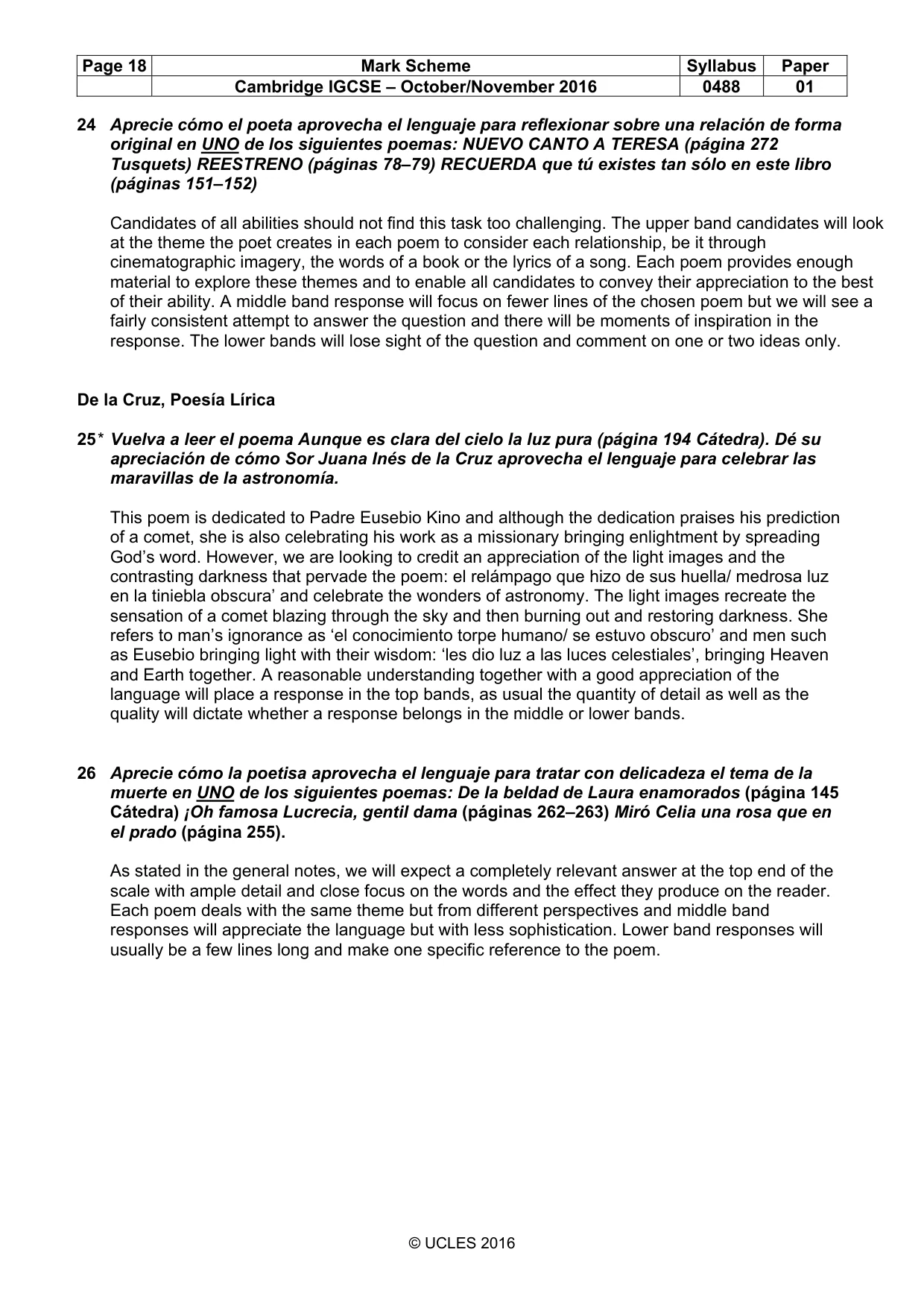
Page 18 Mark Scheme Syllabus Paper Cambridge IGCSE – October/November 2016 0488 01 © UCLES 2016 24 Aprecie cómo el poeta aprovecha el lenguaje para reflexionar sobre una relación de forma original en UNO de los siguientes poemas: NUEVO CANTO A TERESA (página 272 Tusquets) REESTRENO (páginas 78–79) RECUERDA que tú existes tan sólo en este libro (páginas 151–152) Candidates of all abilities should not find this task too challenging. The upper band candidates will look at the theme the poet creates in each poem to consider each relationship, be it through cinematographic imagery, the words of a book or the lyrics of a song. Each poem provides enough material to explore these themes and to enable all candidates to convey their appreciation to the best of their ability. A middle band response will focus on fewer lines of the chosen poem but we will see a fairly consistent attempt to answer the question and there will be moments of inspiration in the response. The lower bands will lose sight of the question and comment on one or two ideas only. De la Cruz, Poesía Lírica 25* Vuelva a leer el poema Aunque es clara del cielo la luz pura (página 194 Cátedra). Dé su apreciación de cómo Sor Juana Inés de la Cruz aprovecha el lenguaje para celebrar las maravillas de la astronomía. This poem is dedicated to Padre Eusebio Kino and although the dedication praises his prediction of a comet, she is also celebrating his work as a missionary bringing enlightment by spreading God’s word. However, we are looking to credit an appreciation of the light images and the contrasting darkness that pervade the poem: el relámpago que hizo de sus huella/ medrosa luz en la tiniebla obscura’ and celebrate the wonders of astronomy. The light images recreate the sensation of a comet blazing through the sky and then burning out and restoring darkness. She refers to man’s ignorance as ‘el conocimiento torpe humano/ se estuvo obscuro’ and men such as Eusebio bringing light with their wisdom: ‘les dio luz a las luces celestiales’, bringing Heaven and Earth together. A reasonable understanding together with a good appreciation of the language will place a response in the top bands, as usual the quantity of detail as well as the quality will dictate whether a response belongs in the middle or lower bands. 26 Aprecie cómo la poetisa aprovecha el lenguaje para tratar con delicadeza el tema de la muerte en UNO de los siguientes poemas: De la beldad de Laura enamorados (página 145 Cátedra) ¡Oh famosa Lucrecia, gentil dama (páginas 262–263) Miró Celia una rosa que en el prado (página 255). As stated in the general notes, we will expect a completely relevant answer at the top end of the scale with ample detail and close focus on the words and the effect they produce on the reader. Each poem deals with the same theme but from different perspectives and middle band responses will appreciate the language but with less sophistication. Lower band responses will usually be a few lines long and make one specific reference to the poem.
Mark scheme, page 19
Page 19 Mark Scheme Syllabus Paper Cambridge IGCSE – October/November 2016 0488 01 © UCLES 2016 27 ¿Cómo se vale de una serie de imágenes dinámicas para comunicar su opinión de forma convincente en UNO de los siguientes poemas? Si los riesgos del mar considerara (página 256 Cátedra) Intenta de Tarquino el artificio dama’ (página 263). Each poem offers a series of striking images and powerful language to convey a particular point of view and, as the poems are sonnets, there is a manageable amount of material in each one. We will expect significant detail and a close focus on the words of the poem at the top end of the scale and any technical analysis will need to be directly related to the question. The middle band responses will not work through the entire poem but will adhere to the question for the most part. Lower band responses will be confused and lack a general understanding of the language as well as lose sight of the question.
What you needed in this session
Cambridge’s own grade thresholds for 2016 Oct/Nov, Paper 1 · Variant 1. A higher threshold means an easier paper — the bar moves with how the cohort did.