Cambridge IGCSE Spanish - Literature 0488 — 2015 May/June Paper 1 · Variant 1
0488/11/M/J/15 · 60 marks · ≈68 min
The question paper and its mark scheme, free to read here and free to download. This is Cambridge’s own paper, exactly as it was sat.
Question paper8 pages

Mark scheme19 pages
Answers below. Sit the paper first if you are practising.
Paper as text
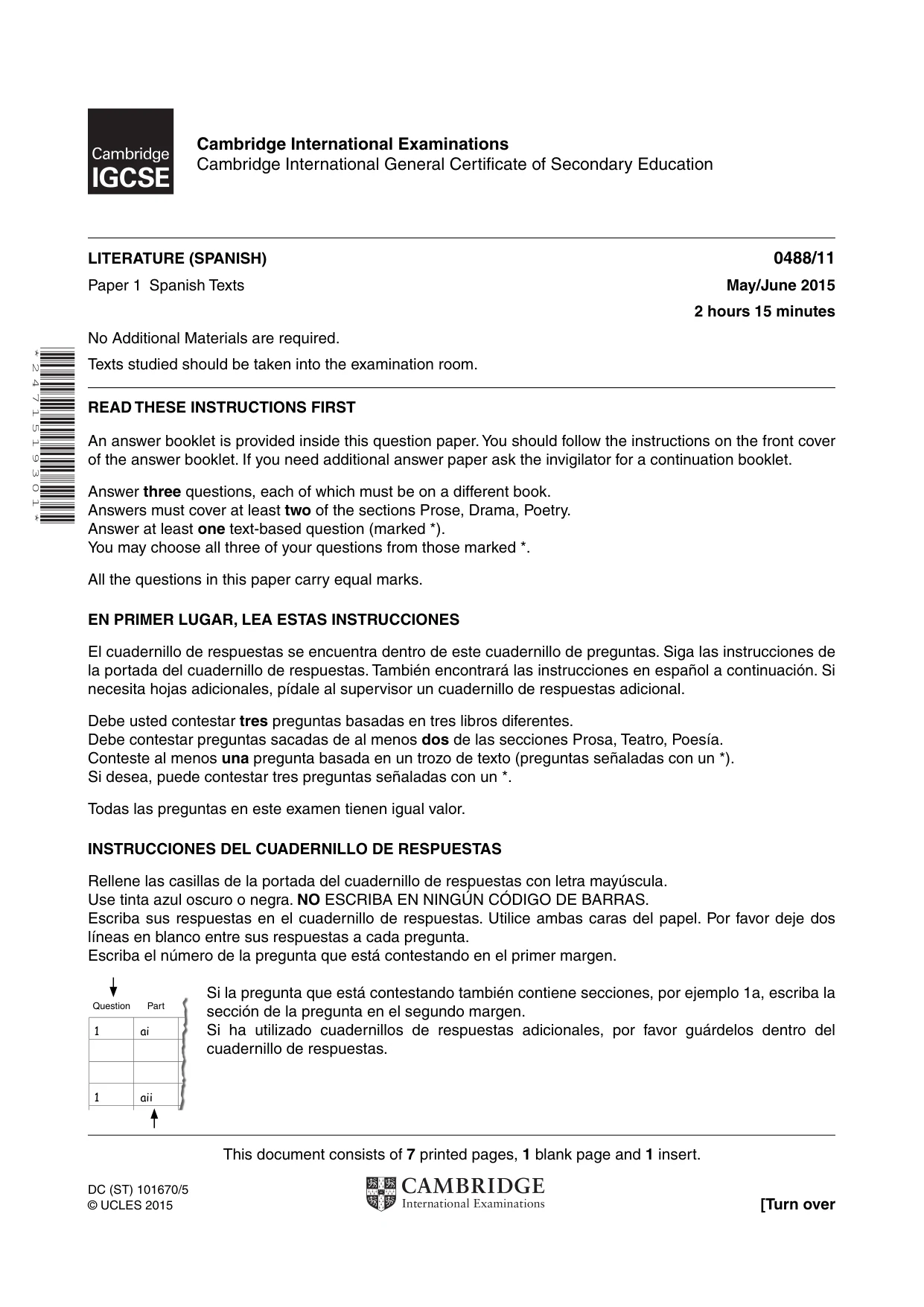
Question paper, page 1
This document consists of 7 printed pages, 1 blank page and 1 insert. DC (ST) 101670/5 © UCLES 2015 [Turn over Cambridge International Examinations Cambridge International General Certificate of Secondary Education * 2 4 7 1 5 1 9 3 0 1 * LITERATURE (SPANISH) 0488/11 Paper 1 Spanish Texts May/June 2015 2 hours 15 minutes No Additional Materials are required. Texts studied should be taken into the examination room. READ THESE INSTRUCTIONS FIRST An answer booklet is provided inside this question paper. You should follow the instructions on the front cover of the answer booklet. If you need additional answer paper ask the invigilator for a continuation booklet. Answer three questions, each of which must be on a different book. Answers must cover at least two of the sections Prose, Drama, Poetry. Answer at least one text-based question (marked *). You may choose all three of your questions from those marked *. All the questions in this paper carry equal marks. EN PRIMER LUGAR, LEA ESTAS INSTRUCCIONES El cuadernillo de respuestas se encuentra dentro de este cuadernillo de preguntas. Siga las instrucciones de la portada del cuadernillo de respuestas. También encontrará las instrucciones en español a continuación. Si necesita hojas adicionales, pídale al supervisor un cuadernillo de respuestas adicional. Debe usted contestar tres preguntas basadas en tres libros diferentes. Debe contestar preguntas sacadas de al menos dos de las secciones Prosa, Teatro, Poesía. Conteste al menos una pregunta basada en un trozo de texto (preguntas señaladas con un *). Si desea, puede contestar tres preguntas señaladas con un *. Todas las preguntas en este examen tienen igual valor. INSTRUCCIONES DEL CUADERNILLO DE RESPUESTAS Rellene las casillas de la portada del cuadernillo de respuestas con letra mayúscula. Use tinta azul oscuro o negra. NO ESCRIBA EN NINGÚN CÓDIGO DE BARRAS. Escriba sus respuestas en el cuadernillo de respuestas. Utilice ambas caras del papel. Por favor deje dos líneas en blanco entre sus respuestas a cada pregunta. Escriba el número de la pregunta que está contestando en el primer margen. Si la pregunta que está contestando también contiene secciones, por ejemplo 1a, escriba la sección de la pregunta en el segundo margen. Si ha utilizado cuadernillos de respuestas adicionales, por favor guárdelos dentro del cuadernillo de respuestas. Question Part 1 1 ai aii
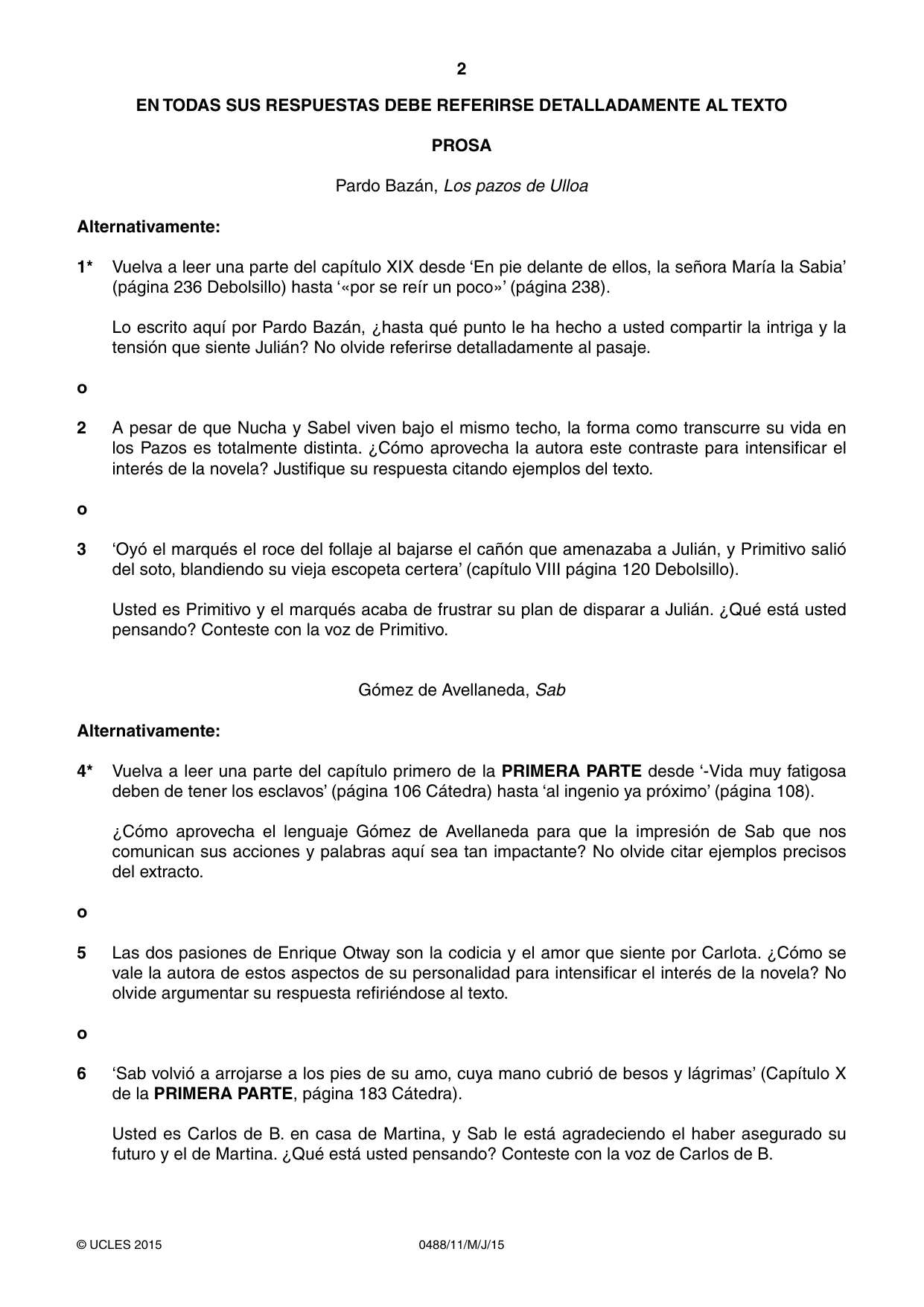
Question paper, page 2
2 0488/11/M/J/15 © UCLES 2015 EN TODAS SUS RESPUESTAS DEBE REFERIRSE DETALLADAMENTE AL TEXTO PROSA Pardo Bazán, Los pazos de Ulloa Alternativamente: 1* Vuelva a leer una parte del capítulo XIX desde ‘En pie delante de ellos, la señora María la Sabia’ (página 236 Debolsillo) hasta ‘«por se reír un poco»’ (página 238). Lo escrito aquí por Pardo Bazán, ¿hasta qué punto le ha hecho a usted compartir la intriga y la tensión que siente Julián? No olvide referirse detalladamente al pasaje. o 2 A pesar de que Nucha y Sabel viven bajo el mismo techo, la forma como transcurre su vida en los Pazos es totalmente distinta. ¿Cómo aprovecha la autora este contraste para intensificar el interés de la novela? Justifique su respuesta citando ejemplos del texto. o 3 ‘Oyó el marqués el roce del follaje al bajarse el cañón que amenazaba a Julián, y Primitivo salió del soto, blandiendo su vieja escopeta certera’ (capítulo VIII página 120 Debolsillo). Usted es Primitivo y el marqués acaba de frustrar su plan de disparar a Julián. ¿Qué está usted pensando? Conteste con la voz de Primitivo. Gómez de Avellaneda, Sab Alternativamente: 4* Vuelva a leer una parte del capítulo primero de la PRIMERA PARTE desde ‘-Vida muy fatigosa deben de tener los esclavos’ (página 106 Cátedra) hasta ‘al ingenio ya próximo’ (página 108). ¿Cómo aprovecha el lenguaje Gómez de Avellaneda para que la impresión de Sab que nos comunican sus acciones y palabras aquí sea tan impactante? No olvide citar ejemplos precisos del extracto. o 5 Las dos pasiones de Enrique Otway son la codicia y el amor que siente por Carlota. ¿Cómo se vale la autora de estos aspectos de su personalidad para intensificar el interés de la novela? No olvide argumentar su respuesta refiriéndose al texto. o 6 ‘Sab volvió a arrojarse a los pies de su amo, cuya mano cubrió de besos y lágrimas’ (Capítulo X de la PRIMERA PARTE, página 183 Cátedra). Usted es Carlos de B. en casa de Martina, y Sab le está agradeciendo el haber asegurado su futuro y el de Martina. ¿Qué está usted pensando? Conteste con la voz de Carlos de B.
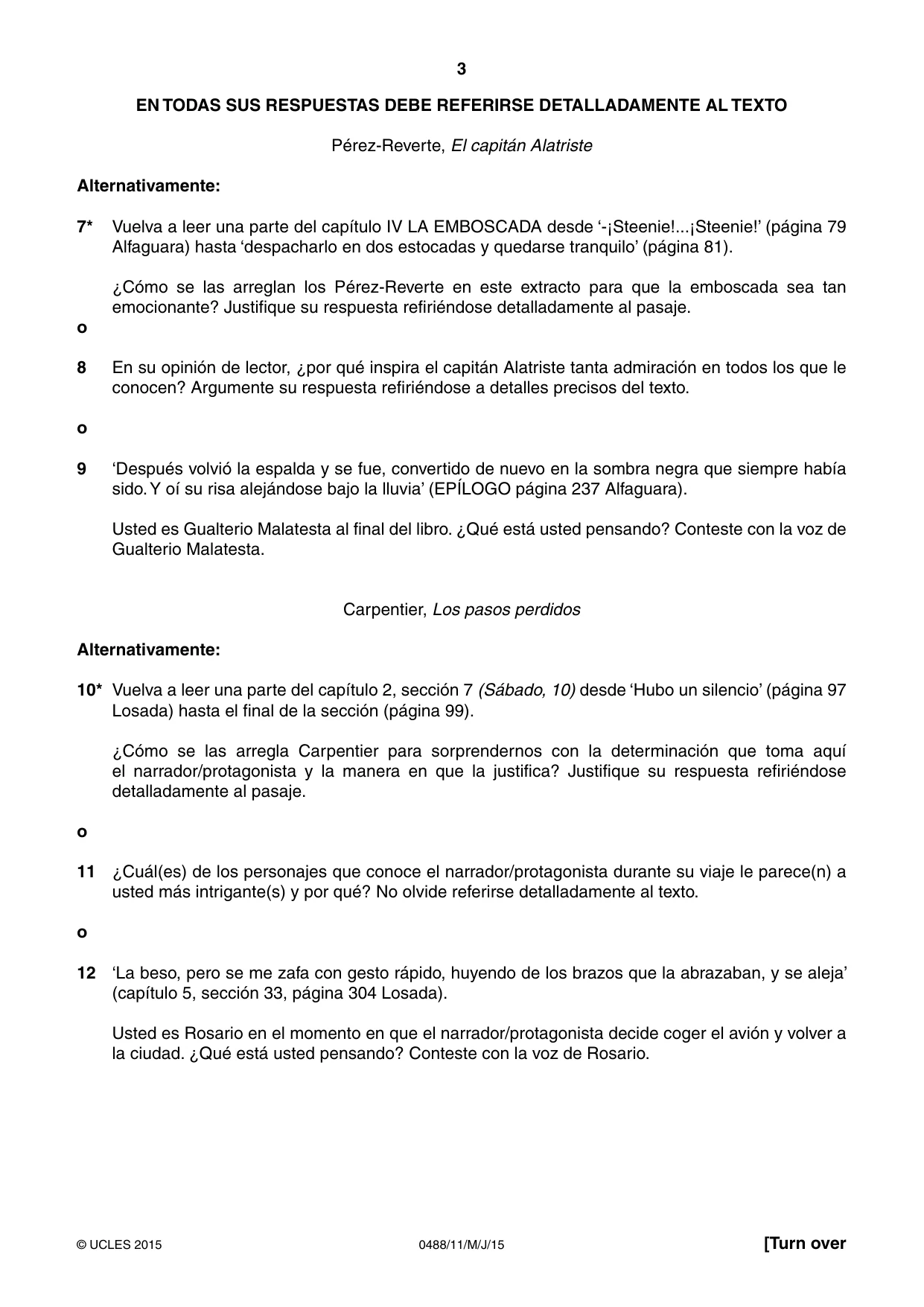
Question paper, page 3
3 0488/11/M/J/15 © UCLES 2015 [Turn over EN TODAS SUS RESPUESTAS DEBE REFERIRSE DETALLADAMENTE AL TEXTO Pérez-Reverte, El capitán Alatriste Alternativamente: 7* Vuelva a leer una parte del capítulo IV LA EMBOSCADA desde ‘-¡Steenie!...¡Steenie!’ (página 79 Alfaguara) hasta ‘despacharlo en dos estocadas y quedarse tranquilo’ (página 81). ¿Cómo se las arreglan los Pérez-Reverte en este extracto para que la emboscada sea tan emocionante? Justifique su respuesta refiriéndose detalladamente al pasaje. o 8 En su opinión de lector, ¿por qué inspira el capitán Alatriste tanta admiración en todos los que le conocen? Argumente su respuesta refiriéndose a detalles precisos del texto. o 9 ‘Después volvió la espalda y se fue, convertido de nuevo en la sombra negra que siempre había sido. Y oí su risa alejándose bajo la lluvia’ (EPÍLOGO página 237 Alfaguara). Usted es Gualterio Malatesta al final del libro. ¿Qué está usted pensando? Conteste con la voz de Gualterio Malatesta. Carpentier, Los pasos perdidos Alternativamente: 10* Vuelva a leer una parte del capítulo 2, sección 7 (Sábado, 10) desde ‘Hubo un silencio’ (página 97 Losada) hasta el final de la sección (página 99). ¿Cómo se las arregla Carpentier para sorprendernos con la determinación que toma aquí el narrador/protagonista y la manera en que la justifica? Justifique su respuesta refiriéndose detalladamente al pasaje. o 11 ¿Cuál(es) de los personajes que conoce el narrador/protagonista durante su viaje le parece(n) a usted más intrigante(s) y por qué? No olvide referirse detalladamente al texto. o 12 ‘La beso, pero se me zafa con gesto rápido, huyendo de los brazos que la abrazaban, y se aleja’ (capítulo 5, sección 33, página 304 Losada). Usted es Rosario en el momento en que el narrador/protagonista decide coger el avión y volver a la ciudad. ¿Qué está usted pensando? Conteste con la voz de Rosario.
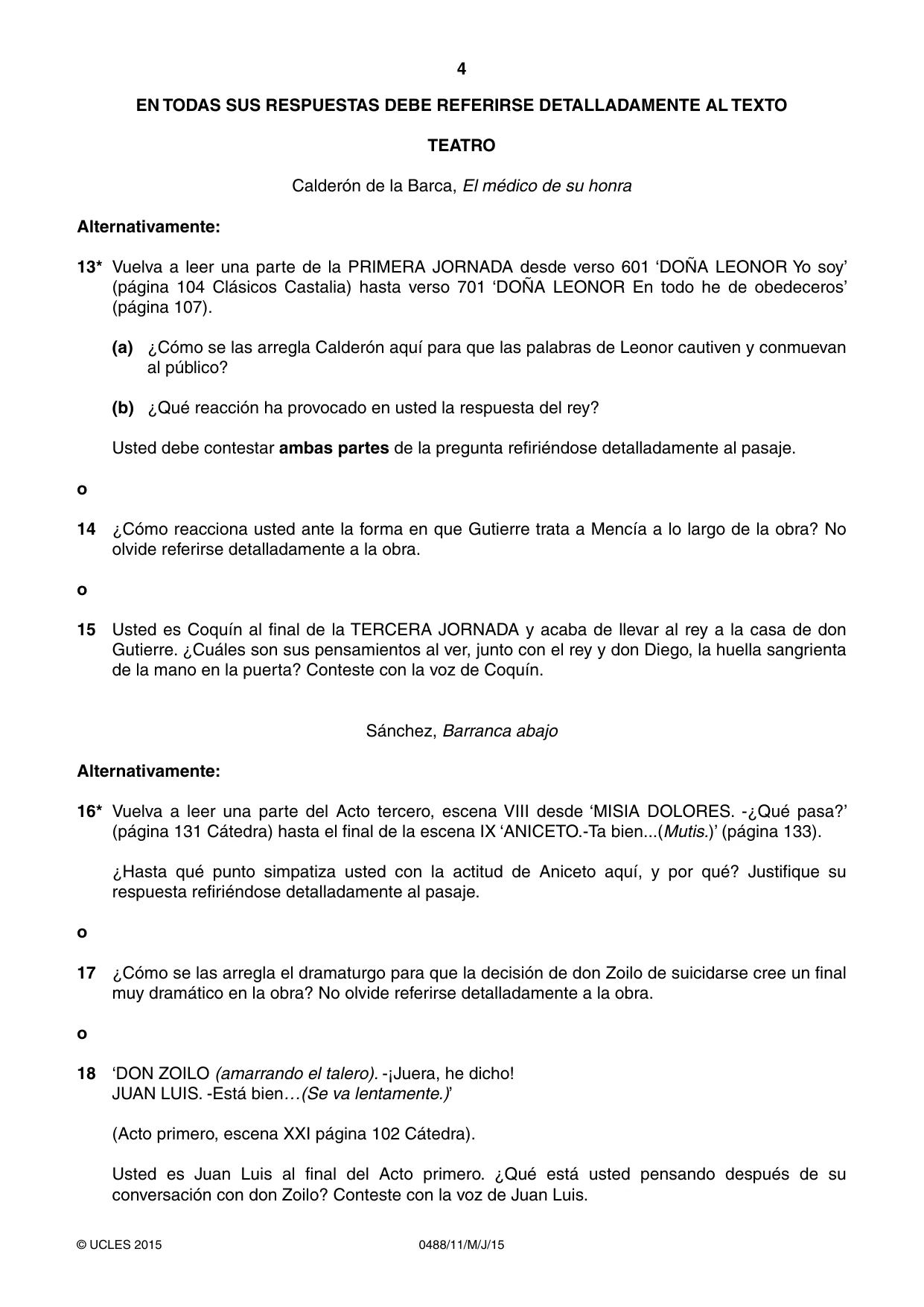
Question paper, page 4
4 0488/11/M/J/15 © UCLES 2015 EN TODAS SUS RESPUESTAS DEBE REFERIRSE DETALLADAMENTE AL TEXTO TEATRO Calderón de la Barca, El médico de su honra Alternativamente: 13* Vuelva a leer una parte de la PRIMERA JORNADA desde verso 601 ‘DOÑA LEONOR Yo soy’ (página 104 Clásicos Castalia) hasta verso 701 ‘DOÑA LEONOR En todo he de obedeceros’ (página 107). (a) ¿Cómo se las arregla Calderón aquí para que las palabras de Leonor cautiven y conmuevan al público? (b) ¿Qué reacción ha provocado en usted la respuesta del rey? Usted debe contestar ambas partes de la pregunta refiriéndose detalladamente al pasaje. o 14 ¿Cómo reacciona usted ante la forma en que Gutierre trata a Mencía a lo largo de la obra? No olvide referirse detalladamente a la obra. o 15 Usted es Coquín al final de la TERCERA JORNADA y acaba de llevar al rey a la casa de don Gutierre. ¿Cuáles son sus pensamientos al ver, junto con el rey y don Diego, la huella sangrienta de la mano en la puerta? Conteste con la voz de Coquín. Sánchez, Barranca abajo Alternativamente: 16* Vuelva a leer una parte del Acto tercero, escena VIII desde ‘MISIA DOLORES. -¿Qué pasa?’ (página 131 Cátedra) hasta el final de la escena IX ‘ANICETO.-Ta bien...(Mutis.)’ (página 133). ¿Hasta qué punto simpatiza usted con la actitud de Aniceto aquí, y por qué? Justifique su respuesta refiriéndose detalladamente al pasaje. o 17 ¿Cómo se las arregla el dramaturgo para que la decisión de don Zoilo de suicidarse cree un final muy dramático en la obra? No olvide referirse detalladamente a la obra. o 18 ‘DON ZOILO (amarrando el talero). -¡Juera, he dicho! JUAN LUIS. -Está bien…(Se va lentamente.)’ (Acto primero, escena XXI página 102 Cátedra). Usted es Juan Luis al final del Acto primero. ¿Qué está usted pensando después de su conversación con don Zoilo? Conteste con la voz de Juan Luis.
Question paper, page 5
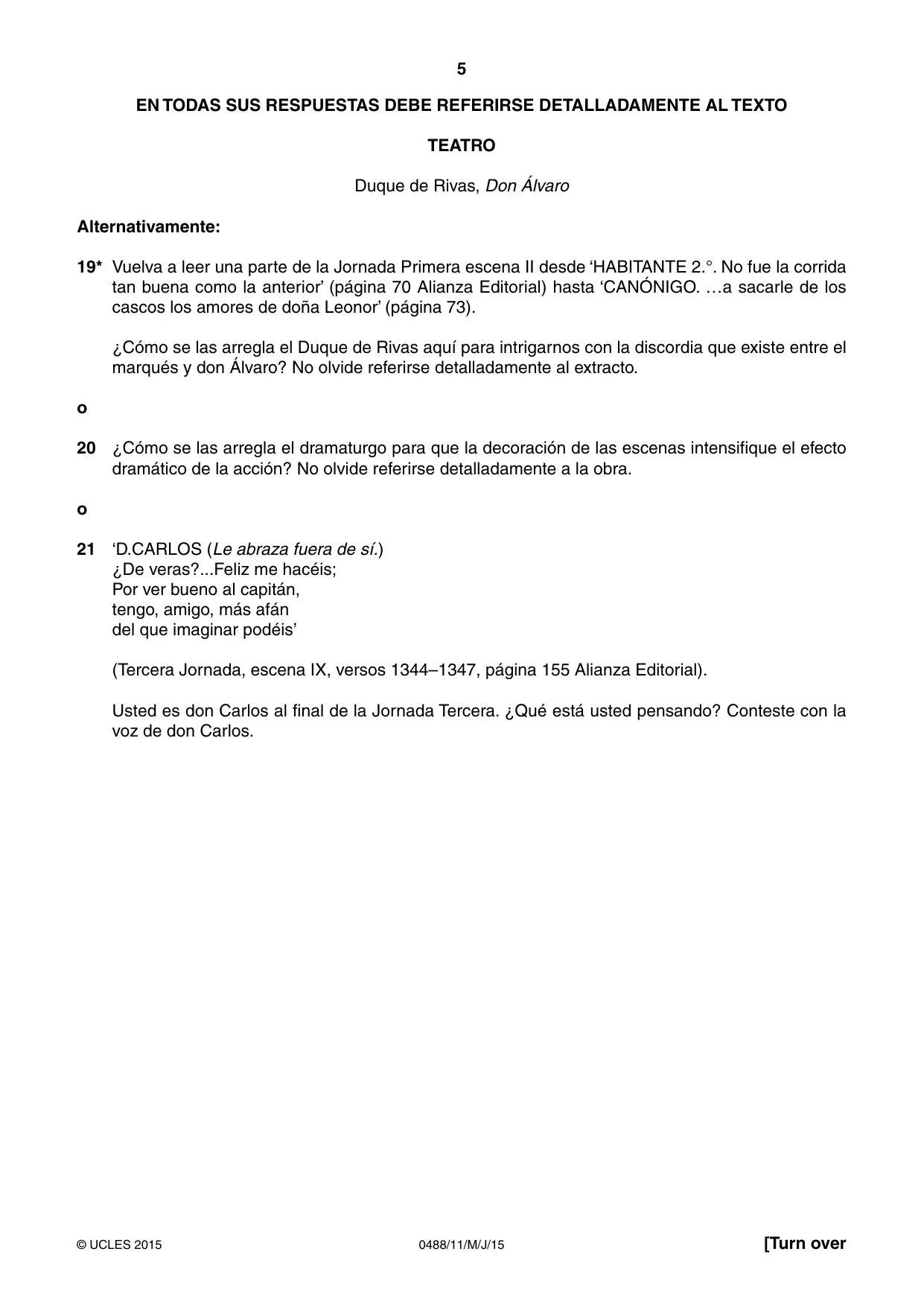
5 0488/11/M/J/15 © UCLES 2015 [Turn over EN TODAS SUS RESPUESTAS DEBE REFERIRSE DETALLADAMENTE AL TEXTO TEATRO Duque de Rivas, Don Álvaro Alternativamente: 19* Vuelva a leer una parte de la Jornada Primera escena II desde ‘HABITANTE 2.°. No fue la corrida tan buena como la anterior’ (página 70 Alianza Editorial) hasta ‘CANÓNIGO. …a sacarle de los cascos los amores de doña Leonor’ (página 73). ¿Cómo se las arregla el Duque de Rivas aquí para intrigarnos con la discordia que existe entre el marqués y don Álvaro? No olvide referirse detalladamente al extracto. o 20 ¿Cómo se las arregla el dramaturgo para que la decoración de las escenas intensifique el efecto dramático de la acción? No olvide referirse detalladamente a la obra. o 21 ‘D.CARLOS (Le abraza fuera de sí.) ¿De veras?...Feliz me hacéis; Por ver bueno al capitán, tengo, amigo, más afán del que imaginar podéis’ (Tercera Jornada, escena IX, versos 1344–1347, página 155 Alianza Editorial). Usted es don Carlos al final de la Jornada Tercera. ¿Qué está usted pensando? Conteste con la voz de don Carlos.
Question paper, page 6
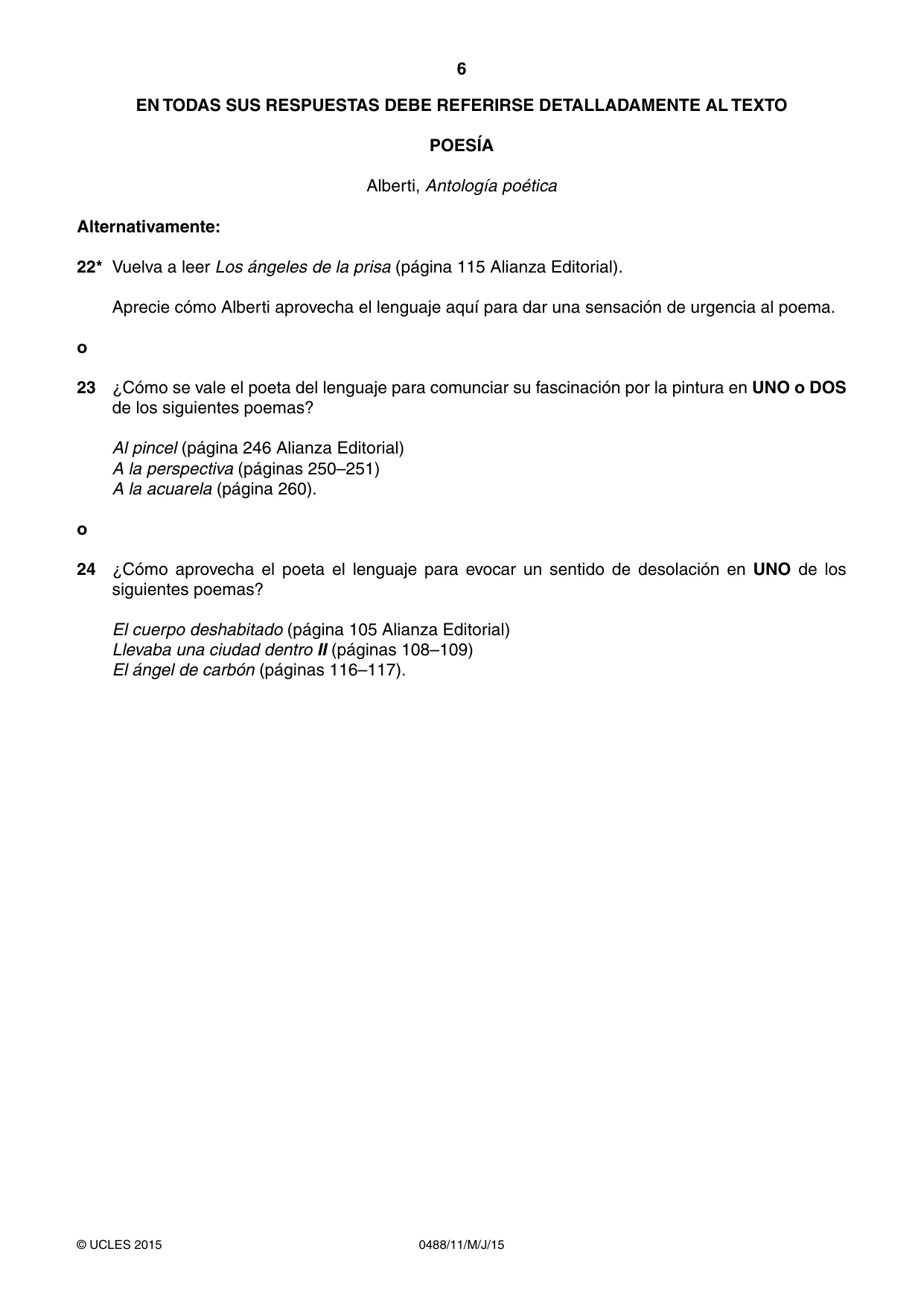
6 0488/11/M/J/15 © UCLES 2015 EN TODAS SUS RESPUESTAS DEBE REFERIRSE DETALLADAMENTE AL TEXTO POESÍA Alberti, Antología poética Alternativamente: 22* Vuelva a leer Los ángeles de la prisa (página 115 Alianza Editorial). Aprecie cómo Alberti aprovecha el lenguaje aquí para dar una sensación de urgencia al poema. o 23 ¿Cómo se vale el poeta del lenguaje para comunciar su fascinación por la pintura en UNO o DOS de los siguientes poemas? Al pincel (página 246 Alianza Editorial) A la perspectiva (páginas 250–251) A la acuarela (página 260). o 24 ¿Cómo aprovecha el poeta el lenguaje para evocar un sentido de desolación en UNO de los siguientes poemas? El cuerpo deshabitado (página 105 Alianza Editorial) Llevaba una ciudad dentro II (páginas 108–109) El ángel de carbón (páginas 116–117).
Question paper, page 7
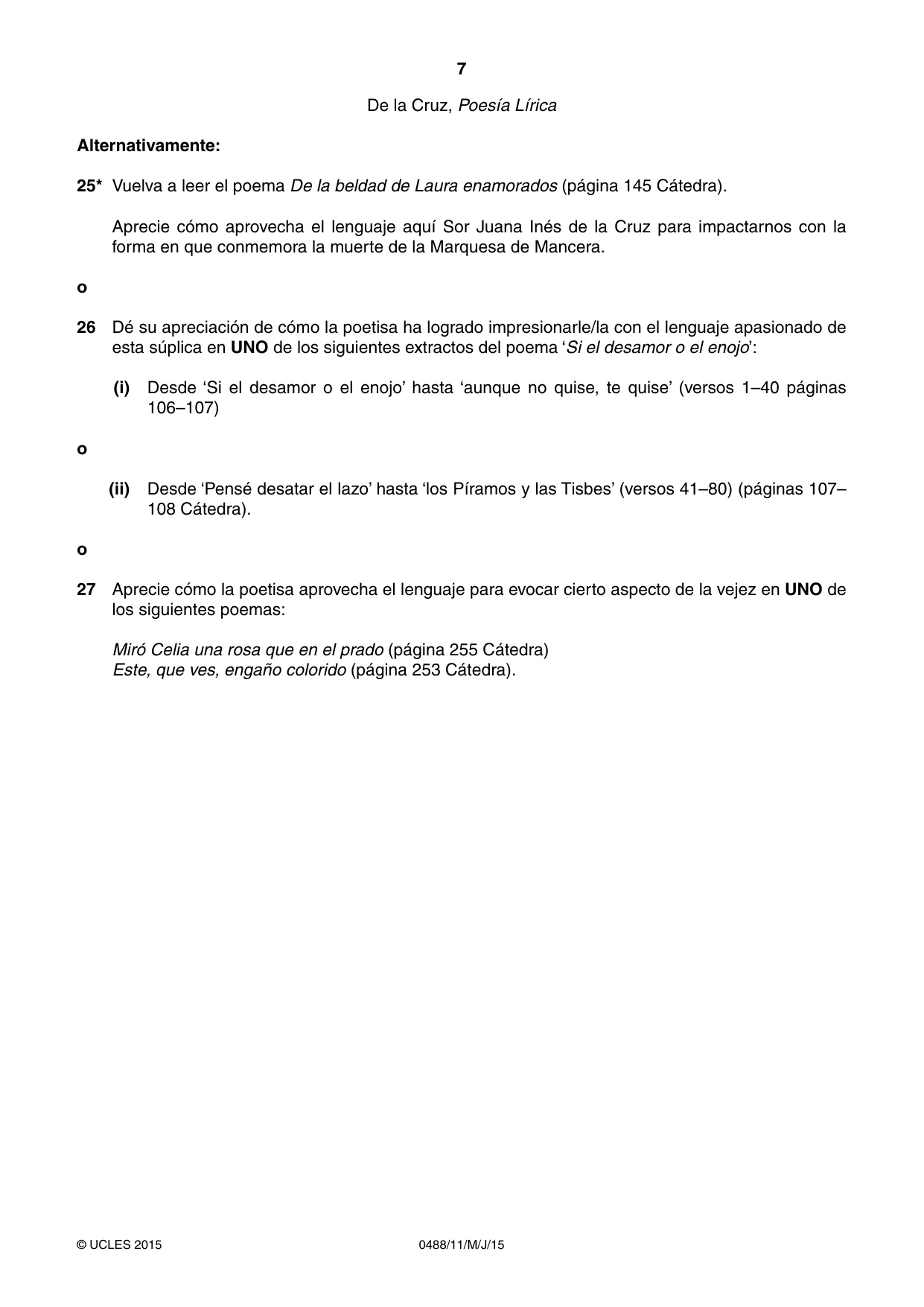
7 0488/11/M/J/15 © UCLES 2015 De la Cruz, Poesía Lírica Alternativamente: 25* Vuelva a leer el poema De la beldad de Laura enamorados (página 145 Cátedra). Aprecie cómo aprovecha el lenguaje aquí Sor Juana Inés de la Cruz para impactarnos con la forma en que conmemora la muerte de la Marquesa de Mancera. o 26 Dé su apreciación de cómo la poetisa ha logrado impresionarle/la con el lenguaje apasionado de esta súplica en UNO de los siguientes extractos del poema ‘Si el desamor o el enojo’: (i) Desde ‘Si el desamor o el enojo’ hasta ‘aunque no quise, te quise’ (versos 1–40 páginas 106–107) o (ii) Desde ‘Pensé desatar el lazo’ hasta ‘los Píramos y las Tisbes’ (versos 41–80) (páginas 107– 108 Cátedra). o 27 Aprecie cómo la poetisa aprovecha el lenguaje para evocar cierto aspecto de la vejez en UNO de los siguientes poemas: Miró Celia una rosa que en el prado (página 255 Cátedra) Este, que ves, engaño colorido (página 253 Cátedra).
Question paper, page 8
8 0488/11/M/J/15 © UCLES 2015 BLANK PAGE Permission to reproduce items where third-party owned material protected by copyright is included has been sought and cleared where possible. Every reasonable effort has been made by the publisher (UCLES) to trace copyright holders, but if any items requiring clearance have unwittingly been included, the publisher will be pleased to make amends at the earliest possible opportunity. To avoid the issue of disclosure of answer-related information to candidates, all copyright acknowledgements are reproduced online in the Cambridge International Examinations Copyright Acknowledgements Booklet. This is produced for each series of examinations and is freely available to download at www.cie.org.uk after the live examination series. Cambridge International Examinations is part of the Cambridge Assessment Group. Cambridge Assessment is the brand name of University of Cambridge Local Examinations Syndicate (UCLES), which is itself a department of the University of Cambridge.
Mark scheme, page 1
® IGCSE is the registered trademark of Cambridge International Examinations. CAMBRIDGE INTERNATIONAL EXAMINATIONS Cambridge International General Certificate of Secondary Education MARK SCHEME for the May/June 2015 series 0488 LITERATURE (SPANISH) 0488/11 Paper 1 (Set Texts – Open Books), maximum raw mark 60 This mark scheme is published as an aid to teachers and candidates, to indicate the requirements of the examination. It shows the basis on which Examiners were instructed to award marks. It does not indicate the details of the discussions that took place at an Examiners’ meeting before marking began, which would have considered the acceptability of alternative answers. Mark schemes should be read in conjunction with the question paper and the Principal Examiner Report for Teachers. Cambridge will not enter into discussions about these mark schemes. Cambridge is publishing the mark schemes for the May/June 2015 series for most Cambridge IGCSE®, Cambridge International A and AS Level components and some Cambridge O Level components.
Mark scheme, page 2
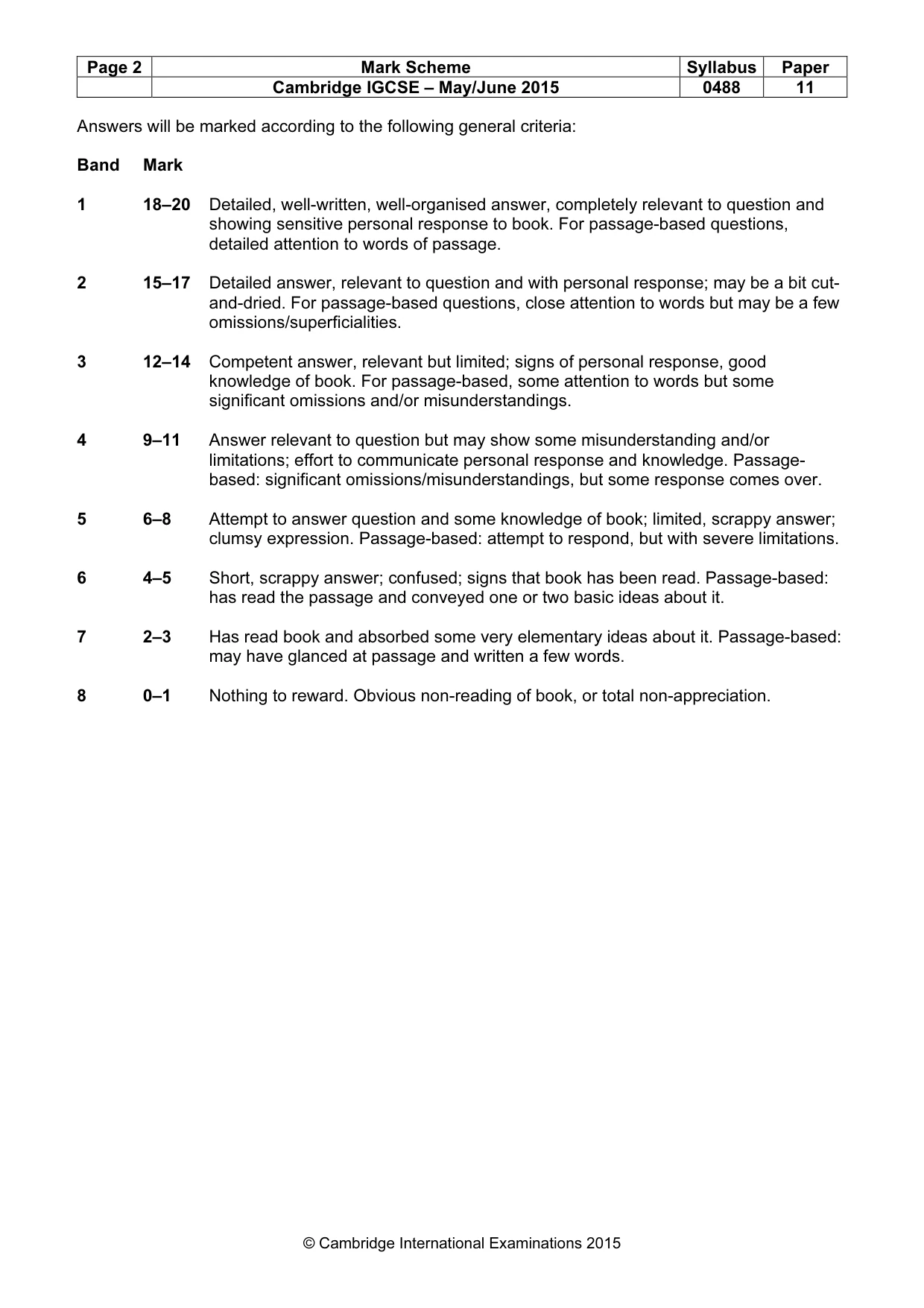
Page 2 Mark Scheme Syllabus Paper Cambridge IGCSE – May/June 2015 0488 11 © Cambridge International Examinations 2015 Answers will be marked according to the following general criteria: Band Mark 1 18–20 Detailed, well-written, well-organised answer, completely relevant to question and showing sensitive personal response to book. For passage-based questions, detailed attention to words of passage. 2 15–17 Detailed answer, relevant to question and with personal response; may be a bit cut- and-dried. For passage-based questions, close attention to words but may be a few omissions/superficialities. 3 12–14 Competent answer, relevant but limited; signs of personal response, good knowledge of book. For passage-based, some attention to words but some significant omissions and/or misunderstandings. 4 9–11 Answer relevant to question but may show some misunderstanding and/or limitations; effort to communicate personal response and knowledge. Passage- based: significant omissions/misunderstandings, but some response comes over. 5 6–8 Attempt to answer question and some knowledge of book; limited, scrappy answer; clumsy expression. Passage-based: attempt to respond, but with severe limitations. 6 4–5 Short, scrappy answer; confused; signs that book has been read. Passage-based: has read the passage and conveyed one or two basic ideas about it. 7 2–3 Has read book and absorbed some very elementary ideas about it. Passage-based: may have glanced at passage and written a few words. 8 0–1 Nothing to reward. Obvious non-reading of book, or total non-appreciation.
Mark scheme, page 3
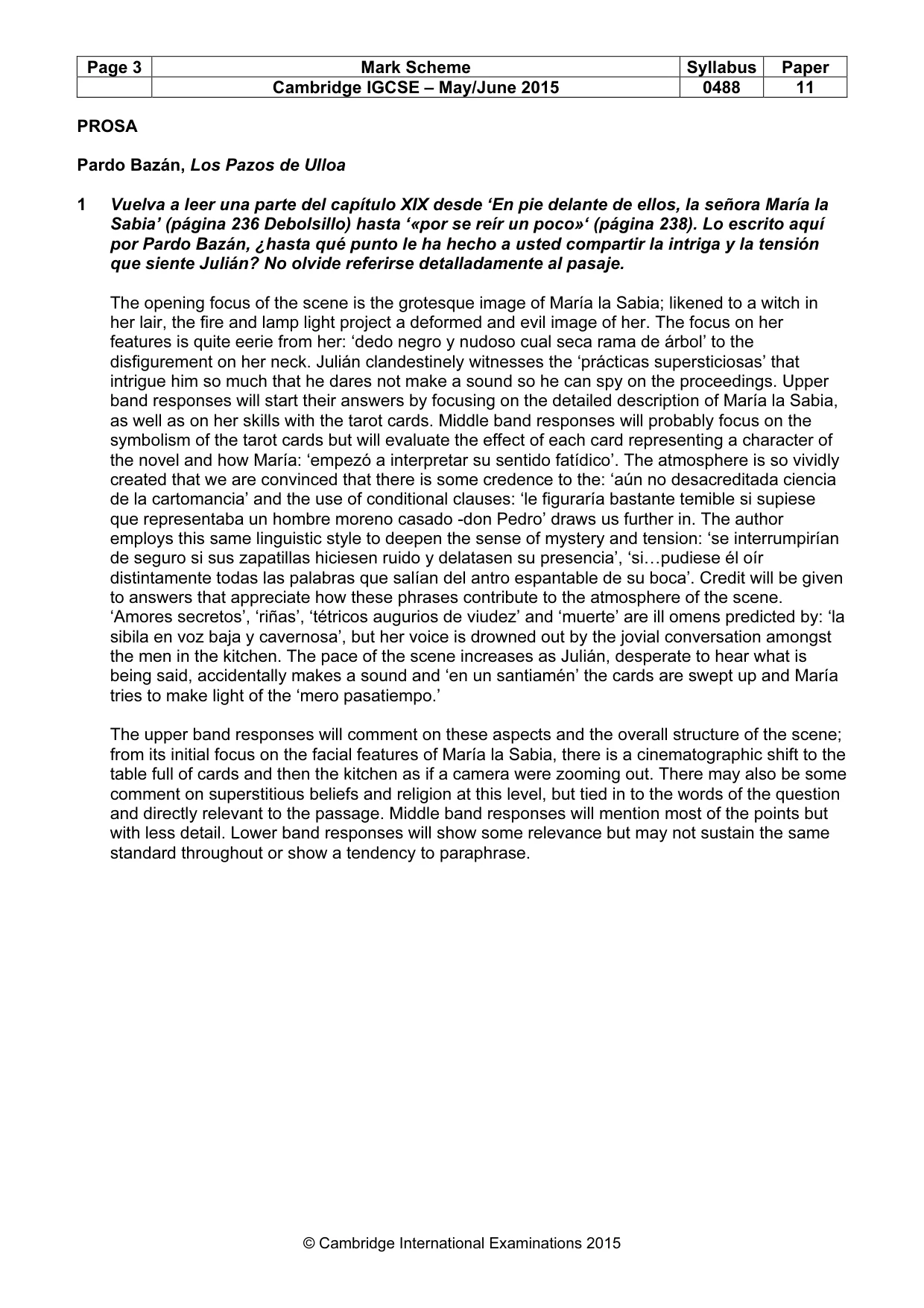
Page 3 Mark Scheme Syllabus Paper Cambridge IGCSE – May/June 2015 0488 11 © Cambridge International Examinations 2015 PROSA Pardo Bazán, Los Pazos de Ulloa 1 Vuelva a leer una parte del capítulo XIX desde ‘En pie delante de ellos, la señora María la Sabia’ (página 236 Debolsillo) hasta ‘«por se reír un poco»‘ (página 238). Lo escrito aquí por Pardo Bazán, ¿hasta qué punto le ha hecho a usted compartir la intriga y la tensión que siente Julián? No olvide referirse detalladamente al pasaje. The opening focus of the scene is the grotesque image of María la Sabia; likened to a witch in her lair, the fire and lamp light project a deformed and evil image of her. The focus on her features is quite eerie from her: ‘dedo negro y nudoso cual seca rama de árbol’ to the disfigurement on her neck. Julián clandestinely witnesses the ‘prácticas supersticiosas’ that intrigue him so much that he dares not make a sound so he can spy on the proceedings. Upper band responses will start their answers by focusing on the detailed description of María la Sabia, as well as on her skills with the tarot cards. Middle band responses will probably focus on the symbolism of the tarot cards but will evaluate the effect of each card representing a character of the novel and how María: ‘empezó a interpretar su sentido fatídico’. The atmosphere is so vividly created that we are convinced that there is some credence to the: ‘aún no desacreditada ciencia de la cartomancia’ and the use of conditional clauses: ‘le figuraría bastante temible si supiese que representaba un hombre moreno casado -don Pedro’ draws us further in. The author employs this same linguistic style to deepen the sense of mystery and tension: ‘se interrumpirían de seguro si sus zapatillas hiciesen ruido y delatasen su presencia’, ‘si…pudiese él oír distintamente todas las palabras que salían del antro espantable de su boca’. Credit will be given to answers that appreciate how these phrases contribute to the atmosphere of the scene. ‘Amores secretos’, ‘riñas’, ‘tétricos augurios de viudez’ and ‘muerte’ are ill omens predicted by: ‘la sibila en voz baja y cavernosa’, but her voice is drowned out by the jovial conversation amongst the men in the kitchen. The pace of the scene increases as Julián, desperate to hear what is being said, accidentally makes a sound and ‘en un santiamén’ the cards are swept up and María tries to make light of the ‘mero pasatiempo.’ The upper band responses will comment on these aspects and the overall structure of the scene; from its initial focus on the facial features of María la Sabia, there is a cinematographic shift to the table full of cards and then the kitchen as if a camera were zooming out. There may also be some comment on superstitious beliefs and religion at this level, but tied in to the words of the question and directly relevant to the passage. Middle band responses will mention most of the points but with less detail. Lower band responses will show some relevance but may not sustain the same standard throughout or show a tendency to paraphrase.
Mark scheme, page 4
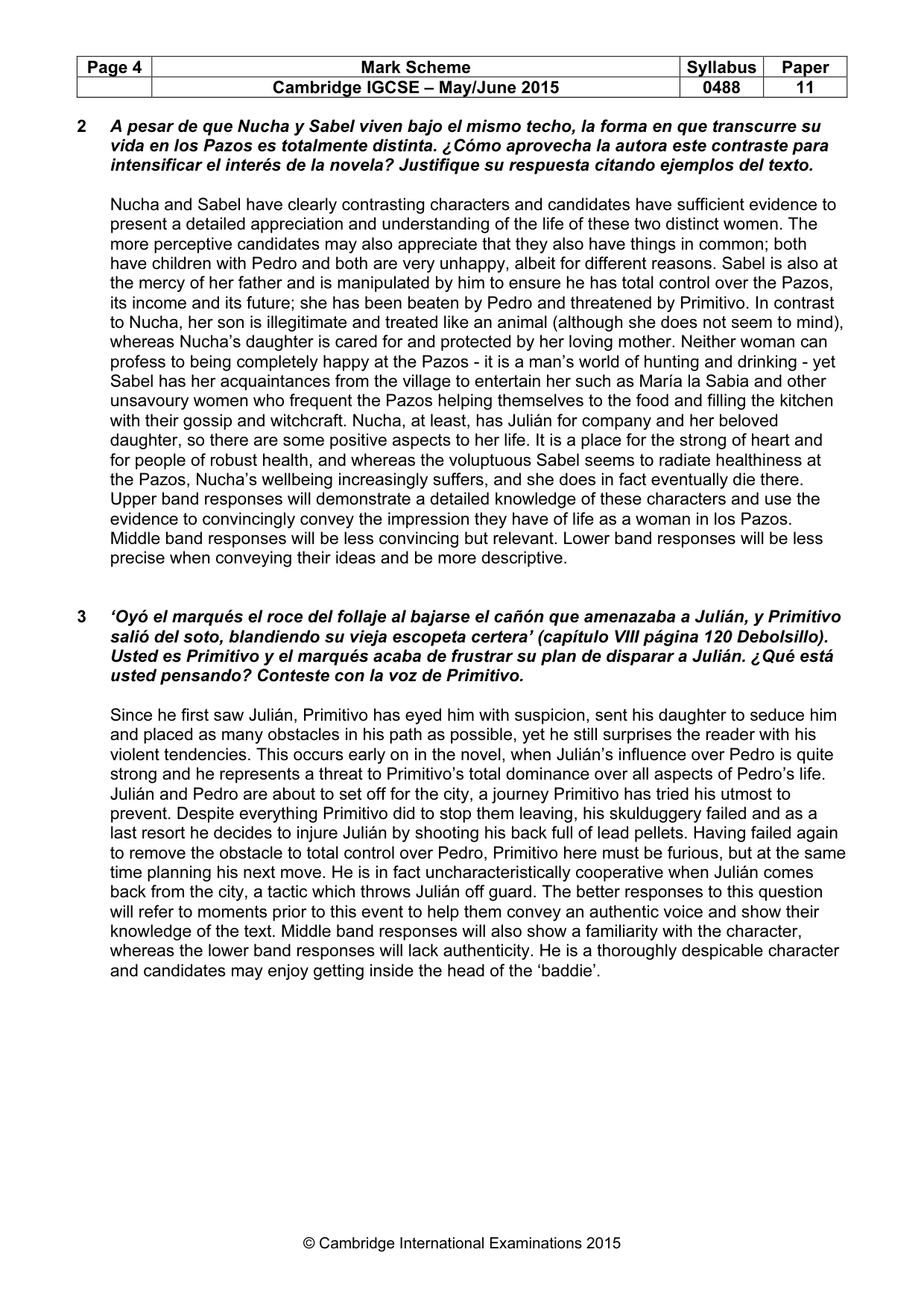
Page 4 Mark Scheme Syllabus Paper Cambridge IGCSE – May/June 2015 0488 11 © Cambridge International Examinations 2015 2 A pesar de que Nucha y Sabel viven bajo el mismo techo, la forma en que transcurre su vida en los Pazos es totalmente distinta. ¿Cómo aprovecha la autora este contraste para intensificar el interés de la novela? Justifique su respuesta citando ejemplos del texto. Nucha and Sabel have clearly contrasting characters and candidates have sufficient evidence to present a detailed appreciation and understanding of the life of these two distinct women. The more perceptive candidates may also appreciate that they also have things in common; both have children with Pedro and both are very unhappy, albeit for different reasons. Sabel is also at the mercy of her father and is manipulated by him to ensure he has total control over the Pazos, its income and its future; she has been beaten by Pedro and threatened by Primitivo. In contrast to Nucha, her son is illegitimate and treated like an animal (although she does not seem to mind), whereas Nucha’s daughter is cared for and protected by her loving mother. Neither woman can profess to being completely happy at the Pazos - it is a man’s world of hunting and drinking - yet Sabel has her acquaintances from the village to entertain her such as María la Sabia and other unsavoury women who frequent the Pazos helping themselves to the food and filling the kitchen with their gossip and witchcraft. Nucha, at least, has Julián for company and her beloved daughter, so there are some positive aspects to her life. It is a place for the strong of heart and for people of robust health, and whereas the voluptuous Sabel seems to radiate healthiness at the Pazos, Nucha’s wellbeing increasingly suffers, and she does in fact eventually die there. Upper band responses will demonstrate a detailed knowledge of these characters and use the evidence to convincingly convey the impression they have of life as a woman in los Pazos. Middle band responses will be less convincing but relevant. Lower band responses will be less precise when conveying their ideas and be more descriptive. 3 ‘Oyó el marqués el roce del follaje al bajarse el cañón que amenazaba a Julián, y Primitivo salió del soto, blandiendo su vieja escopeta certera’ (capítulo VIII página 120 Debolsillo). Usted es Primitivo y el marqués acaba de frustrar su plan de disparar a Julián. ¿Qué está usted pensando? Conteste con la voz de Primitivo. Since he first saw Julián, Primitivo has eyed him with suspicion, sent his daughter to seduce him and placed as many obstacles in his path as possible, yet he still surprises the reader with his violent tendencies. This occurs early on in the novel, when Julián’s influence over Pedro is quite strong and he represents a threat to Primitivo’s total dominance over all aspects of Pedro’s life. Julián and Pedro are about to set off for the city, a journey Primitivo has tried his utmost to prevent. Despite everything Primitivo did to stop them leaving, his skulduggery failed and as a last resort he decides to injure Julián by shooting his back full of lead pellets. Having failed again to remove the obstacle to total control over Pedro, Primitivo here must be furious, but at the same time planning his next move. He is in fact uncharacteristically cooperative when Julián comes back from the city, a tactic which throws Julián off guard. The better responses to this question will refer to moments prior to this event to help them convey an authentic voice and show their knowledge of the text. Middle band responses will also show a familiarity with the character, whereas the lower band responses will lack authenticity. He is a thoroughly despicable character and candidates may enjoy getting inside the head of the ‘baddie’.
Mark scheme, page 5
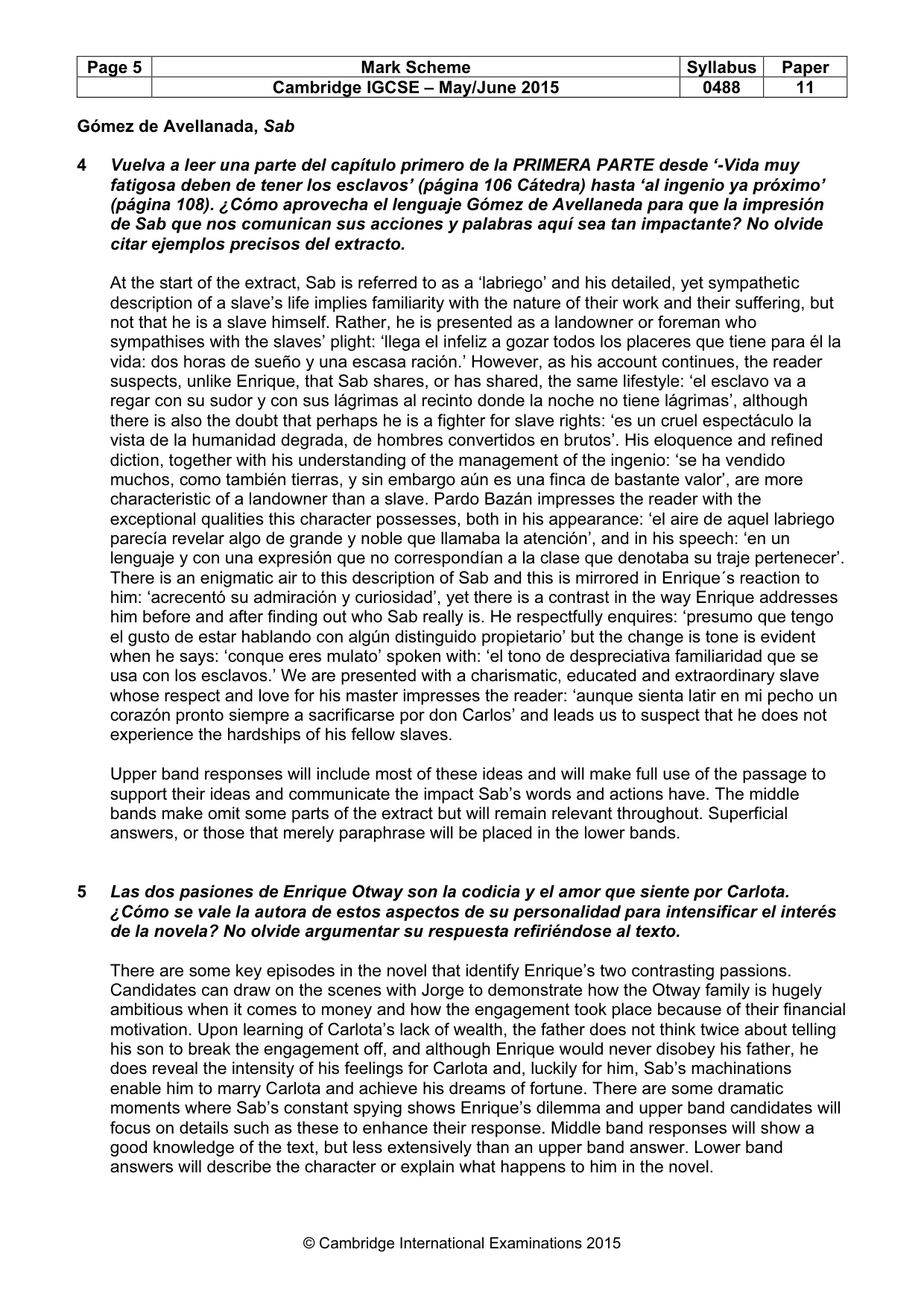
Page 5 Mark Scheme Syllabus Paper Cambridge IGCSE – May/June 2015 0488 11 © Cambridge International Examinations 2015 Gómez de Avellanada, Sab 4 Vuelva a leer una parte del capítulo primero de la PRIMERA PARTE desde ‘-Vida muy fatigosa deben de tener los esclavos’ (página 106 Cátedra) hasta ‘al ingenio ya próximo’ (página 108). ¿Cómo aprovecha el lenguaje Gómez de Avellaneda para que la impresión de Sab que nos comunican sus acciones y palabras aquí sea tan impactante? No olvide citar ejemplos precisos del extracto. At the start of the extract, Sab is referred to as a ‘labriego’ and his detailed, yet sympathetic description of a slave’s life implies familiarity with the nature of their work and their suffering, but not that he is a slave himself. Rather, he is presented as a landowner or foreman who sympathises with the slaves’ plight: ‘llega el infeliz a gozar todos los placeres que tiene para él la vida: dos horas de sueño y una escasa ración.’ However, as his account continues, the reader suspects, unlike Enrique, that Sab shares, or has shared, the same lifestyle: ‘el esclavo va a regar con su sudor y con sus lágrimas al recinto donde la noche no tiene lágrimas’, although there is also the doubt that perhaps he is a fighter for slave rights: ‘es un cruel espectáculo la vista de la humanidad degrada, de hombres convertidos en brutos’. His eloquence and refined diction, together with his understanding of the management of the ingenio: ‘se ha vendido muchos, como también tierras, y sin embargo aún es una finca de bastante valor’, are more characteristic of a landowner than a slave. Pardo Bazán impresses the reader with the exceptional qualities this character possesses, both in his appearance: ‘el aire de aquel labriego parecía revelar algo de grande y noble que llamaba la atención’, and in his speech: ‘en un lenguaje y con una expresión que no correspondían a la clase que denotaba su traje pertenecer’. There is an enigmatic air to this description of Sab and this is mirrored in Enrique´s reaction to him: ‘acrecentó su admiración y curiosidad’, yet there is a contrast in the way Enrique addresses him before and after finding out who Sab really is. He respectfully enquires: ‘presumo que tengo el gusto de estar hablando con algún distinguido propietario’ but the change is tone is evident when he says: ‘conque eres mulato’ spoken with: ‘el tono de despreciativa familiaridad que se usa con los esclavos.’ We are presented with a charismatic, educated and extraordinary slave whose respect and love for his master impresses the reader: ‘aunque sienta latir en mi pecho un corazón pronto siempre a sacrificarse por don Carlos’ and leads us to suspect that he does not experience the hardships of his fellow slaves. Upper band responses will include most of these ideas and will make full use of the passage to support their ideas and communicate the impact Sab’s words and actions have. The middle bands make omit some parts of the extract but will remain relevant throughout. Superficial answers, or those that merely paraphrase will be placed in the lower bands. 5 Las dos pasiones de Enrique Otway son la codicia y el amor que siente por Carlota. ¿Cómo se vale la autora de estos aspectos de su personalidad para intensificar el interés de la novela? No olvide argumentar su respuesta refiriéndose al texto. There are some key episodes in the novel that identify Enrique’s two contrasting passions. Candidates can draw on the scenes with Jorge to demonstrate how the Otway family is hugely ambitious when it comes to money and how the engagement took place because of their financial motivation. Upon learning of Carlota’s lack of wealth, the father does not think twice about telling his son to break the engagement off, and although Enrique would never disobey his father, he does reveal the intensity of his feelings for Carlota and, luckily for him, Sab’s machinations enable him to marry Carlota and achieve his dreams of fortune. There are some dramatic moments where Sab’s constant spying shows Enrique’s dilemma and upper band candidates will focus on details such as these to enhance their response. Middle band responses will show a good knowledge of the text, but less extensively than an upper band answer. Lower band answers will describe the character or explain what happens to him in the novel.
Mark scheme, page 6
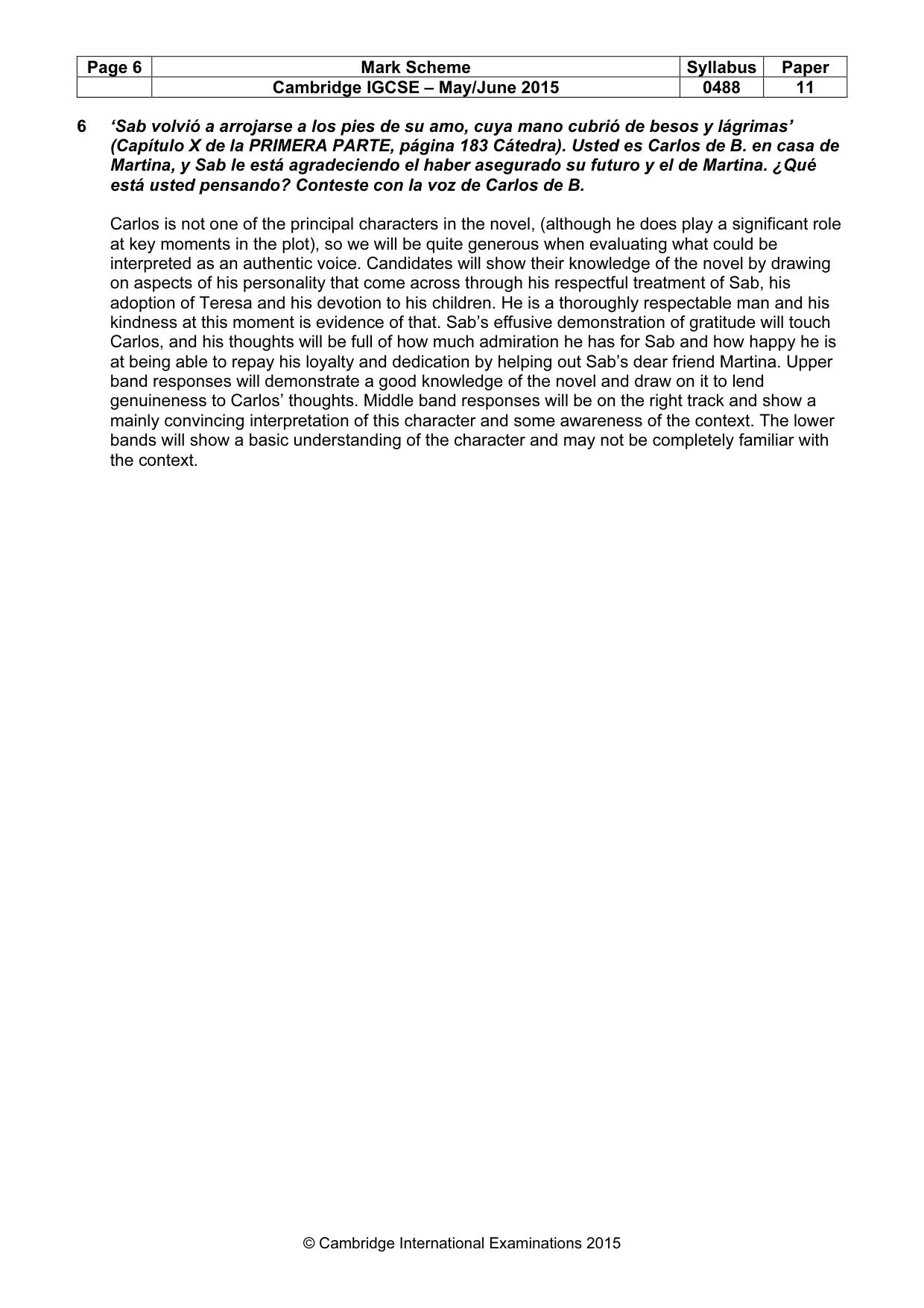
Page 6 Mark Scheme Syllabus Paper Cambridge IGCSE – May/June 2015 0488 11 © Cambridge International Examinations 2015 6 ‘Sab volvió a arrojarse a los pies de su amo, cuya mano cubrió de besos y lágrimas’ (Capítulo X de la PRIMERA PARTE, página 183 Cátedra). Usted es Carlos de B. en casa de Martina, y Sab le está agradeciendo el haber asegurado su futuro y el de Martina. ¿Qué está usted pensando? Conteste con la voz de Carlos de B. Carlos is not one of the principal characters in the novel, (although he does play a significant role at key moments in the plot), so we will be quite generous when evaluating what could be interpreted as an authentic voice. Candidates will show their knowledge of the novel by drawing on aspects of his personality that come across through his respectful treatment of Sab, his adoption of Teresa and his devotion to his children. He is a thoroughly respectable man and his kindness at this moment is evidence of that. Sab’s effusive demonstration of gratitude will touch Carlos, and his thoughts will be full of how much admiration he has for Sab and how happy he is at being able to repay his loyalty and dedication by helping out Sab’s dear friend Martina. Upper band responses will demonstrate a good knowledge of the novel and draw on it to lend genuineness to Carlos’ thoughts. Middle band responses will be on the right track and show a mainly convincing interpretation of this character and some awareness of the context. The lower bands will show a basic understanding of the character and may not be completely familiar with the context.
Mark scheme, page 7
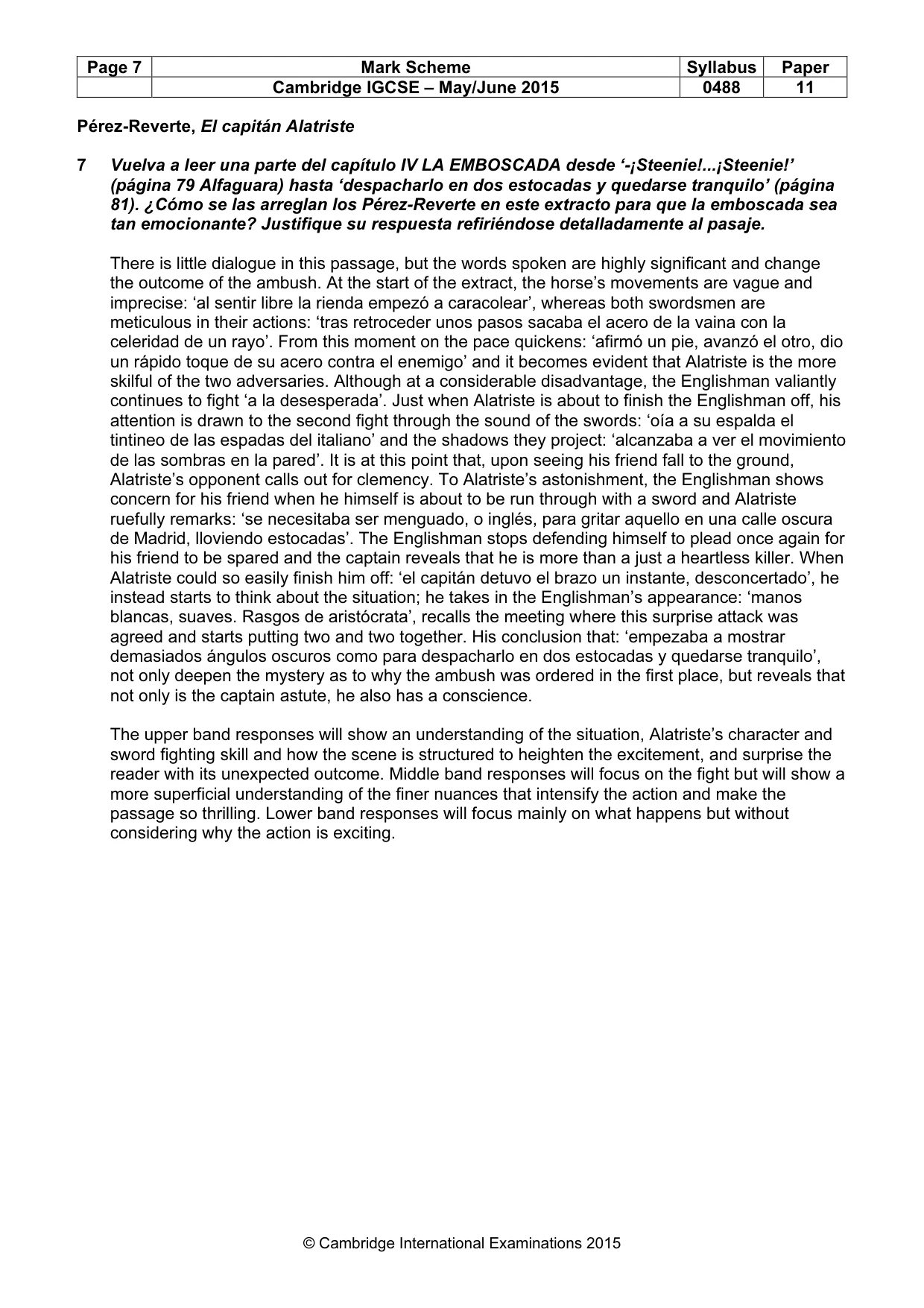
Page 7 Mark Scheme Syllabus Paper Cambridge IGCSE – May/June 2015 0488 11 © Cambridge International Examinations 2015 Pérez-Reverte, El capitán Alatriste 7 Vuelva a leer una parte del capítulo IV LA EMBOSCADA desde ‘-¡Steenie!...¡Steenie!’ (página 79 Alfaguara) hasta ‘despacharlo en dos estocadas y quedarse tranquilo’ (página 81). ¿Cómo se las arreglan los Pérez-Reverte en este extracto para que la emboscada sea tan emocionante? Justifique su respuesta refiriéndose detalladamente al pasaje. There is little dialogue in this passage, but the words spoken are highly significant and change the outcome of the ambush. At the start of the extract, the horse’s movements are vague and imprecise: ‘al sentir libre la rienda empezó a caracolear’, whereas both swordsmen are meticulous in their actions: ‘tras retroceder unos pasos sacaba el acero de la vaina con la celeridad de un rayo’. From this moment on the pace quickens: ‘afirmó un pie, avanzó el otro, dio un rápido toque de su acero contra el enemigo’ and it becomes evident that Alatriste is the more skilful of the two adversaries. Although at a considerable disadvantage, the Englishman valiantly continues to fight ‘a la desesperada’. Just when Alatriste is about to finish the Englishman off, his attention is drawn to the second fight through the sound of the swords: ‘oía a su espalda el tintineo de las espadas del italiano’ and the shadows they project: ‘alcanzaba a ver el movimiento de las sombras en la pared’. It is at this point that, upon seeing his friend fall to the ground, Alatriste’s opponent calls out for clemency. To Alatriste’s astonishment, the Englishman shows concern for his friend when he himself is about to be run through with a sword and Alatriste ruefully remarks: ‘se necesitaba ser menguado, o inglés, para gritar aquello en una calle oscura de Madrid, lloviendo estocadas’. The Englishman stops defending himself to plead once again for his friend to be spared and the captain reveals that he is more than a just a heartless killer. When Alatriste could so easily finish him off: ‘el capitán detuvo el brazo un instante, desconcertado’, he instead starts to think about the situation; he takes in the Englishman’s appearance: ‘manos blancas, suaves. Rasgos de aristócrata’, recalls the meeting where this surprise attack was agreed and starts putting two and two together. His conclusion that: ‘empezaba a mostrar demasiados ángulos oscuros como para despacharlo en dos estocadas y quedarse tranquilo’, not only deepen the mystery as to why the ambush was ordered in the first place, but reveals that not only is the captain astute, he also has a conscience. The upper band responses will show an understanding of the situation, Alatriste’s character and sword fighting skill and how the scene is structured to heighten the excitement, and surprise the reader with its unexpected outcome. Middle band responses will focus on the fight but will show a more superficial understanding of the finer nuances that intensify the action and make the passage so thrilling. Lower band responses will focus mainly on what happens but without considering why the action is exciting.
Mark scheme, page 8
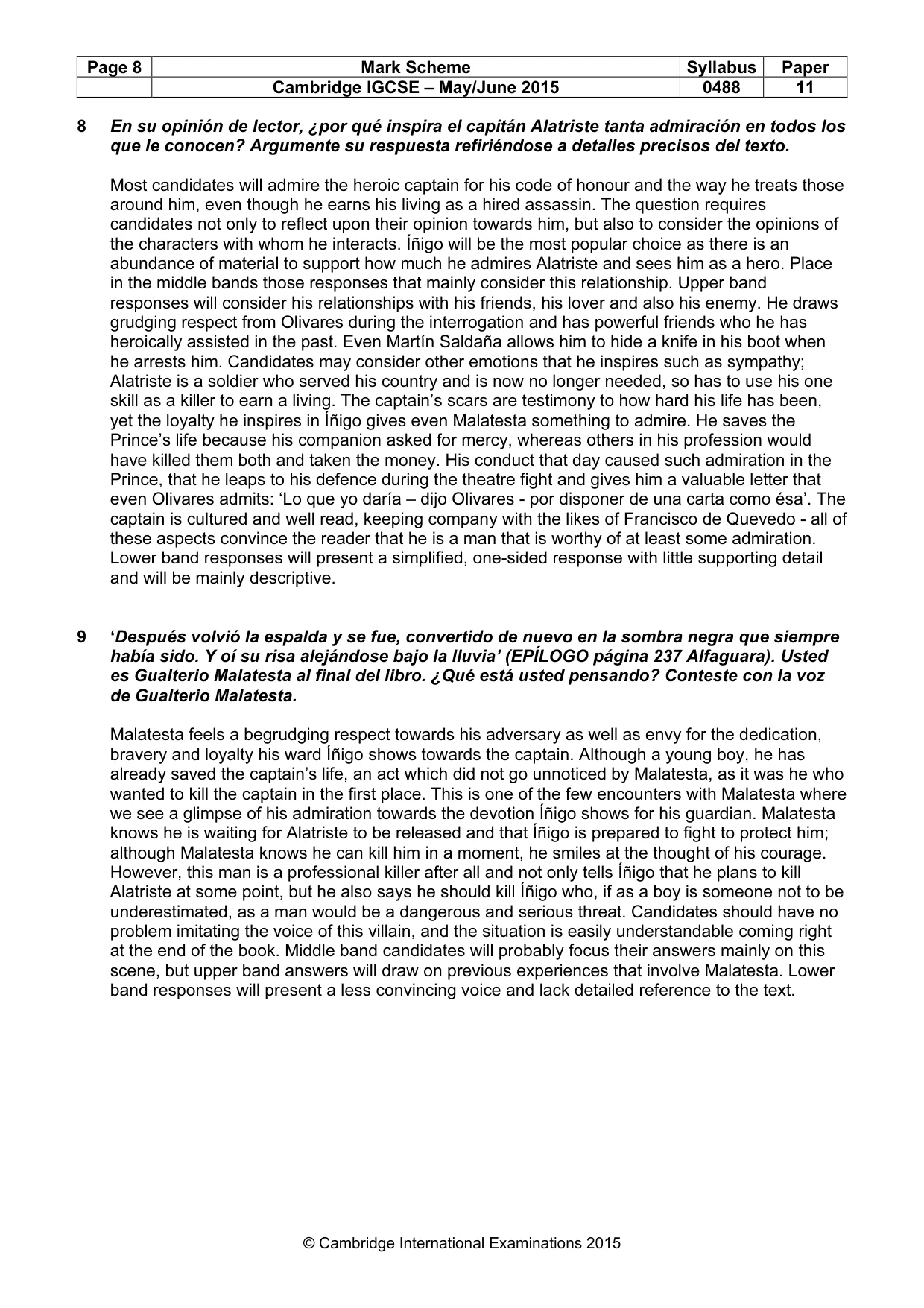
Page 8 Mark Scheme Syllabus Paper Cambridge IGCSE – May/June 2015 0488 11 © Cambridge International Examinations 2015 8 En su opinión de lector, ¿por qué inspira el capitán Alatriste tanta admiración en todos los que le conocen? Argumente su respuesta refiriéndose a detalles precisos del texto. Most candidates will admire the heroic captain for his code of honour and the way he treats those around him, even though he earns his living as a hired assassin. The question requires candidates not only to reflect upon their opinion towards him, but also to consider the opinions of the characters with whom he interacts. Íñigo will be the most popular choice as there is an abundance of material to support how much he admires Alatriste and sees him as a hero. Place in the middle bands those responses that mainly consider this relationship. Upper band responses will consider his relationships with his friends, his lover and also his enemy. He draws grudging respect from Olivares during the interrogation and has powerful friends who he has heroically assisted in the past. Even Martín Saldaña allows him to hide a knife in his boot when he arrests him. Candidates may consider other emotions that he inspires such as sympathy; Alatriste is a soldier who served his country and is now no longer needed, so has to use his one skill as a killer to earn a living. The captain’s scars are testimony to how hard his life has been, yet the loyalty he inspires in Íñigo gives even Malatesta something to admire. He saves the Prince’s life because his companion asked for mercy, whereas others in his profession would have killed them both and taken the money. His conduct that day caused such admiration in the Prince, that he leaps to his defence during the theatre fight and gives him a valuable letter that even Olivares admits: ‘Lo que yo daría – dijo Olivares - por disponer de una carta como ésa’. The captain is cultured and well read, keeping company with the likes of Francisco de Quevedo - all of these aspects convince the reader that he is a man that is worthy of at least some admiration. Lower band responses will present a simplified, one-sided response with little supporting detail and will be mainly descriptive. 9 ‘Después volvió la espalda y se fue, convertido de nuevo en la sombra negra que siempre había sido. Y oí su risa alejándose bajo la lluvia’ (EPÍLOGO página 237 Alfaguara). Usted es Gualterio Malatesta al final del libro. ¿Qué está usted pensando? Conteste con la voz de Gualterio Malatesta. Malatesta feels a begrudging respect towards his adversary as well as envy for the dedication, bravery and loyalty his ward Íñigo shows towards the captain. Although a young boy, he has already saved the captain’s life, an act which did not go unnoticed by Malatesta, as it was he who wanted to kill the captain in the first place. This is one of the few encounters with Malatesta where we see a glimpse of his admiration towards the devotion Íñigo shows for his guardian. Malatesta knows he is waiting for Alatriste to be released and that Íñigo is prepared to fight to protect him; although Malatesta knows he can kill him in a moment, he smiles at the thought of his courage. However, this man is a professional killer after all and not only tells Íñigo that he plans to kill Alatriste at some point, but he also says he should kill Íñigo who, if as a boy is someone not to be underestimated, as a man would be a dangerous and serious threat. Candidates should have no problem imitating the voice of this villain, and the situation is easily understandable coming right at the end of the book. Middle band candidates will probably focus their answers mainly on this scene, but upper band answers will draw on previous experiences that involve Malatesta. Lower band responses will present a less convincing voice and lack detailed reference to the text.
Mark scheme, page 9
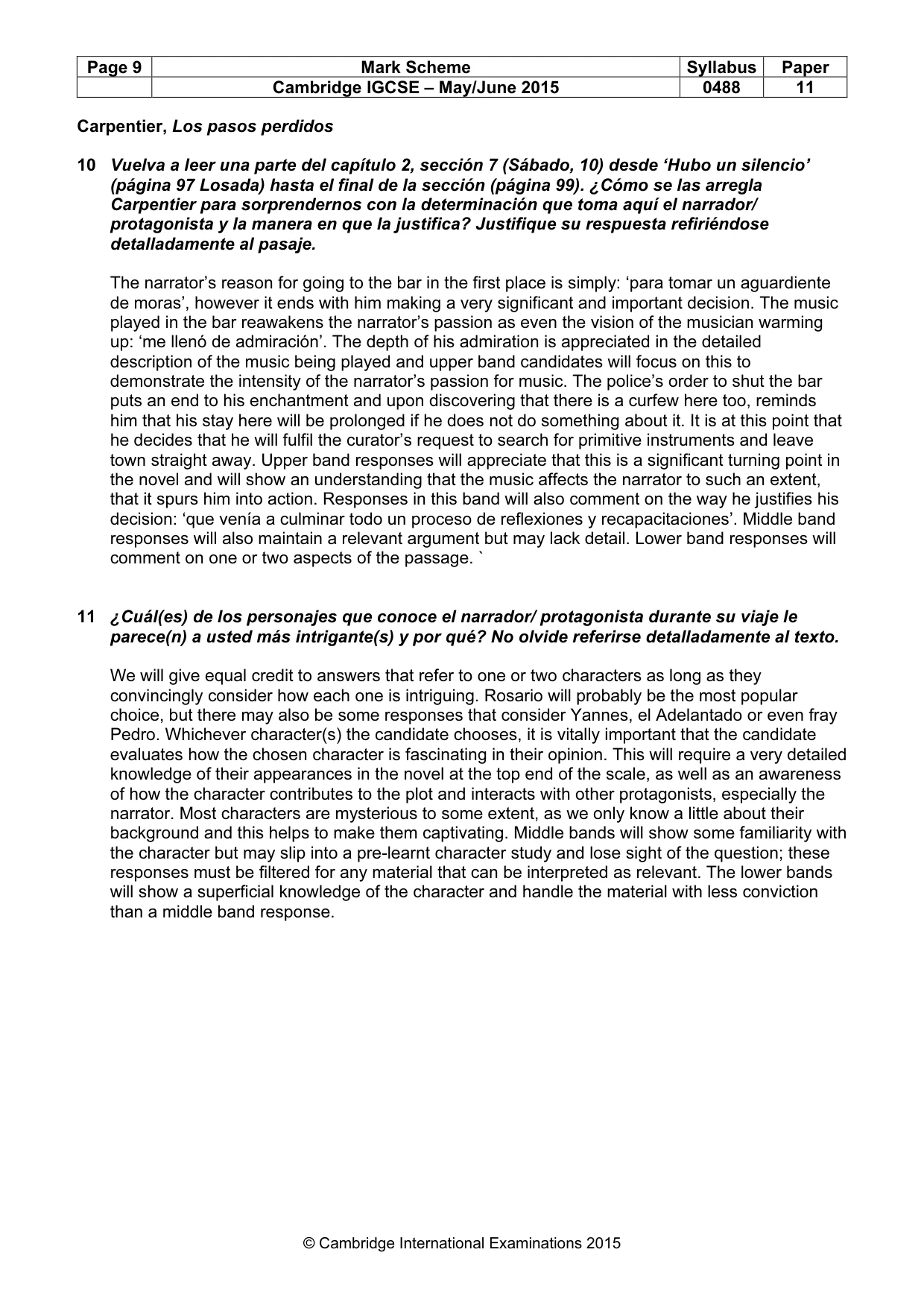
Page 9 Mark Scheme Syllabus Paper Cambridge IGCSE – May/June 2015 0488 11 © Cambridge International Examinations 2015 Carpentier, Los pasos perdidos 10 Vuelva a leer una parte del capítulo 2, sección 7 (Sábado, 10) desde ‘Hubo un silencio’ (página 97 Losada) hasta el final de la sección (página 99). ¿Cómo se las arregla Carpentier para sorprendernos con la determinación que toma aquí el narrador/ protagonista y la manera en que la justifica? Justifique su respuesta refiriéndose detalladamente al pasaje. The narrator’s reason for going to the bar in the first place is simply: ‘para tomar un aguardiente de moras’, however it ends with him making a very significant and important decision. The music played in the bar reawakens the narrator’s passion as even the vision of the musician warming up: ‘me llenó de admiración’. The depth of his admiration is appreciated in the detailed description of the music being played and upper band candidates will focus on this to demonstrate the intensity of the narrator’s passion for music. The police’s order to shut the bar puts an end to his enchantment and upon discovering that there is a curfew here too, reminds him that his stay here will be prolonged if he does not do something about it. It is at this point that he decides that he will fulfil the curator’s request to search for primitive instruments and leave town straight away. Upper band responses will appreciate that this is a significant turning point in the novel and will show an understanding that the music affects the narrator to such an extent, that it spurs him into action. Responses in this band will also comment on the way he justifies his decision: ‘que venía a culminar todo un proceso de reflexiones y recapacitaciones’. Middle band responses will also maintain a relevant argument but may lack detail. Lower band responses will comment on one or two aspects of the passage. ` 11 ¿Cuál(es) de los personajes que conoce el narrador/ protagonista durante su viaje le parece(n) a usted más intrigante(s) y por qué? No olvide referirse detalladamente al texto. We will give equal credit to answers that refer to one or two characters as long as they convincingly consider how each one is intriguing. Rosario will probably be the most popular choice, but there may also be some responses that consider Yannes, el Adelantado or even fray Pedro. Whichever character(s) the candidate chooses, it is vitally important that the candidate evaluates how the chosen character is fascinating in their opinion. This will require a very detailed knowledge of their appearances in the novel at the top end of the scale, as well as an awareness of how the character contributes to the plot and interacts with other protagonists, especially the narrator. Most characters are mysterious to some extent, as we only know a little about their background and this helps to make them captivating. Middle bands will show some familiarity with the character but may slip into a pre-learnt character study and lose sight of the question; these responses must be filtered for any material that can be interpreted as relevant. The lower bands will show a superficial knowledge of the character and handle the material with less conviction than a middle band response.
Mark scheme, page 10
Page 10 Mark Scheme Syllabus Paper Cambridge IGCSE – May/June 2015 0488 11 © Cambridge International Examinations 2015 12 ‘La beso, pero se zafa con gesto rápido, huyendo de los brazos que la abrazaban, y se aleja’ (capítulo 5, sección 33, página 304 Losada). Usted es Rosario en el momento en que el narrador/protagonista decide coger el avión y volver a la ciudad. ¿Qué está usted pensando? Conteste con la voz de Rosario. Rosario probably knows at this point that this is the last time she will see the narrator, and she turns out to be right. She will also feel a sense of abandonment and humiliation, especially as his departure took place in front of the entire village. It might be a nice touch to say she will confide in Marcos as she eventually starts a relationship and has a child with him. She may consider how she thought the narrator would always end up going back; her confusion over his desire to compose the treno while knowing that no one would be able to hear it, may lead her to conclude now that this return to civilisation is what he wanted all along. She has spent a great deal of time with the narrator and they have shared many experiences together, so her predominant feeling will be of sorrow and loss, as well as intense anger. Candidates are free to speculate as always in this style of question, but there must be evidence of factual knowledge from the novel and a familiarity and understanding of this character and context. Upper band responses will make good use of the episodes involving the two characters to add authenticity to her thoughts, middle band responses will do the same, but less convincingly. Lower band responses will show little understanding of the character and situation.
Mark scheme, page 11
Page 11 Mark Scheme Syllabus Paper Cambridge IGCSE – May/June 2015 0488 11 © Cambridge International Examinations 2015 TEATRO Calderón de la Barca, El médico de su honra 13 Vuelva a leer una parte de la PRIMERA JORNADA desde verso 601 ‘DOÑA LEONOR Yo soy’ (página 104 Clásicos Castalia) hasta verso 701 ‘DOÑA LEONOR En todo he de obedeceros’ (página 107). (a) ¿Cómo se las arregla Calderón aquí para que las palabras de Leonor cautiven y conmuevan al público? (b) ¿Qué reacción ha provocado en usted la respuesta del rey? Usted debe contestar ambas partes de la pregunta refiriéndose detalladamente al pasaje. The audience is captivated and intrigued by this beautiful woman’s request for justice. The king’s initial reaction appears quite abrupt: ‘sosegaos, señora, alzad del suelo’ especially when he then goes on to interrupt her: ‘No prosigáis de esa manera.’ Having seen how erratic he is when dealing with his subjects, the audience wonders how he will treat this woman and, once he has ordered everyone out, it becomes evident that he will do whatever he can to help her: ‘indigna cosa fuera/ que en público el honor sus quejas diera.’ The king cannot fail to remark on her beauty, ‘tan bella cara’ which obviously works in her favour, but in all fairness the king permits her to speak at length about her grievance. The speech that follows is quite long and detailed so we should not expect a line by line appreciation; however some of the more key aspects should be appreciated by the upper band candidates. Leonor certainly knows how to handle the king! She flatters him by pandering to his ego and fame as: ‘Pedro, a quien llama el mundo Justiciero’, and some appreciation of the hyperbole will enhance answers. The audience will find this character enchanting both for her beauty and her modesty: ‘yo soy Leonor, a quien Andalucía/ llama (lisonja fue), Leonor la Bella;/ no porque fuese la hermosura mía/ quien el nombre adquirió’ and will also sympathise with her as she tells her woeful story. She skilfully explains how she was won over by her suitor - who we later discover is Gutierre - ‘de obligada pasé a agradecida, luego de agradecida a apasionada’, as if to excuse her dishonourable behaviour: ‘diome palabra que sería mi esposo’, ‘con esta libertad entró en mi casa’. At this stage, the audience does not know she was foolish enough to let Arias in the house to court another woman and brought about her own dishonour, so they will be moved by her story. The king’s response is to find a way to save Leonor: ‘yo haré justicia como convenga’ and, as he cannot force Gutierre to marry her, the audience will be interested to see what he will do. The imminent arrival of Gutierre and the king’s decision to hear his side of the story also makes this extract captivating from beginning to end. There is quite a lot to do here, and the upper band responses will consider the king’s, and Leonor’s words and actions, focusing on both parts of the question. Middle band responses may not touch upon both aspects in great detail, but will be relevant and show some focus on key parts of the passage. Lower band responses will not address both aspects and may only comment on a small part of the passage.
Mark scheme, page 12
Page 12 Mark Scheme Syllabus Paper Cambridge IGCSE – May/June 2015 0488 11 © Cambridge International Examinations 2015 14 ¿Cómo reacciona usted ante la forma en que Gutierre trata a Mencía a lo largo de la obra? No olvide referirse detalladamente a la obra. There will be a need to distinguish between those answers that just explain what happens between these two characters in the play (middle to low bands), and those that evaluate the impact of Gutierre’s behaviour towards his wife in the play. The upper band responses will also consider the relationship using evidence from the entire play, using carefully selected references to support their answers. Some may just focus on the actual murder and if this is done with sufficient detail, the middle bands can be considered. Better responses will see how Gutierre’s suspicions grow to such an extent that he sets a trap for Mencía into which she unwittingly falls, feeding Gutierre’s paranoia to such an extent that he ends up arranging her murder. He does, of course, have the dagger as evidence, but what sort of a relationship does he have with his wife, if he does not even ask about the dagger and just assumes the worst? Even more scandalous is that, not only does he decide to bleed his wife to death and get someone else to do the dirty work for him, but also he is not even punished for it! There is plenty of evidence to suggest that the audience will be scandalised by his behaviour, and perhaps the candidates will share this reaction too, although a contemporary audience may have been more understanding of Gutierre’s obsessive compulsion to protect his honour. 15 Usted es Coquín al final de la TERCERA JORNADA y acaba de llevar al rey a la casa de don Gutierre. ¿Cuáles son sus pensamientos al ver, junto con el rey y don Diego, la huella sangrienta de la mano en la puerta? Conteste con la voz de Coquín. Coquín’s first thoughts will be that he is obviously too late. He stepped in before to protect Mencía from Gutierre’s wrath, and it was his decision to go to the king and explain the situation and warn him of Gutierre’s intentions. The dramatic effect of the bloody handprint will have an impact on him and this will be a moment when he will not be revealing the more humorous side of his character. Once this moment is exploited in his thoughts, candidates will need to understand the context in order to recreate Coquín’s feelings at this moment. They may look at the character’s interaction with Gutierre and Mencía in the rest of the play and draw on relevant evidence to add authenticity to the character’s voice. Responses that do so successfully will be placed in the upper bands. Coquín may also speculate as to the king’s next move as well as mourn the death of Mencía. Middle band responses will present a convincing range of thoughts but will not make use of such a wide scope of evidence as an upper band response. Lower band responses will be less relevant and may show a misunderstanding of the situation.
Mark scheme, page 13
Page 13 Mark Scheme Syllabus Paper Cambridge IGCSE – May/June 2015 0488 11 © Cambridge International Examinations 2015 Sánchez, Barranca Abajo 16 Vuelva a leer una parte del Acto tercero, escena VIII desde ‘MISIA DOLORES.- ¿Qué pasa?’ (página 131 Cátedra) hasta el final de la escena IX ‘ANICETO.-Ta bien..(Mutis)’ (página 133). ¿Hasta qué punto simpatiza usted con la actitud de Aniceto aquí, y por qué? Justifique su respuesta refiriéndose detalladamente al pasaje. Hurt and angry at the death of Robusta, the woman he loved and whom these women sorely mistreated, Aniceto unleashes a side of his character not seen before. His fury is provoked by the decision of the women to leave Zoilo, sneaking out without his knowledge and seen by Aniceto as the worse insult to Zoilo’s honour. Aniceto is the only person sensitive to Zolio’s plight, now that Robusta is gone. As his last remaining ally, he is also aware that Zoilo is teetering ever closer to taking a drastic action to put an end to his woes. Aniceto wants to protect him at all costs and thinks that preventing his family from abandoning him and running back to Zolio’s worst enemies, Butiérrez and Juan Luis, will be the final straw. Hence Ancieto’s uncharacteristically violent behaviour; his reaction will shock the audience who expect Zoilo to threaten the women with violence, but not Aniceto. The better responses will look at how he interacts with all the characters on the stage, not just the women. Aniceto only calms down when Zoilo tells him to, which demonstrates his respect for Zolio. The audience is impressed by his loyalty but also shocked that he is prepared to beat the women for what they have done. He soon despatches Martiniana and has no qualms in reminding Dolores of her position. Upper and middle band responses will work through most of the passage and maintain focus on the question, the upper bands will stand out for their attention to detail and complete understanding of Aniceto’s behaviour in this context. Lower bands will comment on one or two aspects of the passage. 17 ¿Cómo se las arregla el dramaturgo para que la decisión de don Zoilo de suicidarse cree un final muy dramático en la obra? No olvide referirse detalladamente a la obra. Zoilo increasingly inspires pity in the audience as the poor man suffers disgrace after disgrace. His angry, violent outbursts initially create a negative impression, but as more bad luck and dishonour befalls him, so the audience changes their opinion of him. His frustrating, yet understandable pride means that he allows no one to help him and will not accept charity. He increasingly isolates himself, especially after his beloved Robusta dies, and decides the only way out is for him to take his own life. A good differentiator will be whether candidates focus solely on the moment of the suicide (middle to lower bands), or include the moments leading up to the suicide as well as the cumulative effect of Zoilo’s slow demise (upper bands). Hopefully candidates will also consider the atmosphere on the stage at the end of the play and take into account Aniceto’s touching concern and instinct that Zoilo is going to do something reckless, as he takes the knife away. The audience’s realisation that he is going to kill himself is dramatic in itself, as is the final image of him hanging from the ceiling. In the edition quoted in the syllabus, Zoilo takes his own life. There is another edition that offers an alternative ending where Aniceto prevents Zolio from hanging himself. The decision to commit suicide is apparent in both versions however and so should not affect the answers. We will be aware of the two different outcomes when marking responses and give equal credit to both alternative endings.
Mark scheme, page 14
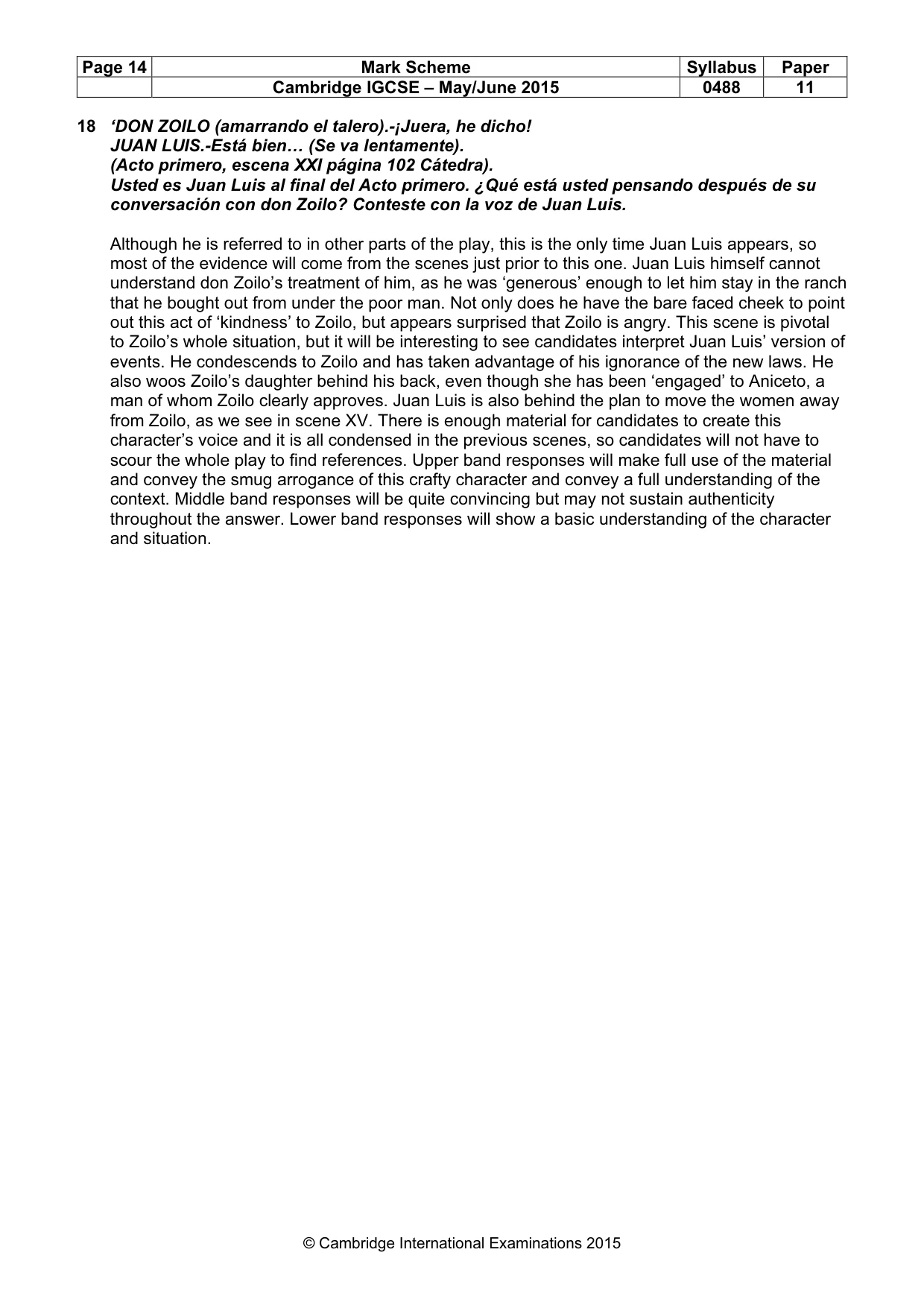
Page 14 Mark Scheme Syllabus Paper Cambridge IGCSE – May/June 2015 0488 11 © Cambridge International Examinations 2015 18 ‘DON ZOILO (amarrando el talero).-¡Juera, he dicho! JUAN LUIS.-Está bien… (Se va lentamente). (Acto primero, escena XXI página 102 Cátedra). Usted es Juan Luis al final del Acto primero. ¿Qué está usted pensando después de su conversación con don Zoilo? Conteste con la voz de Juan Luis. Although he is referred to in other parts of the play, this is the only time Juan Luis appears, so most of the evidence will come from the scenes just prior to this one. Juan Luis himself cannot understand don Zoilo’s treatment of him, as he was ‘generous’ enough to let him stay in the ranch that he bought out from under the poor man. Not only does he have the bare faced cheek to point out this act of ‘kindness’ to Zoilo, but appears surprised that Zoilo is angry. This scene is pivotal to Zoilo’s whole situation, but it will be interesting to see candidates interpret Juan Luis’ version of events. He condescends to Zoilo and has taken advantage of his ignorance of the new laws. He also woos Zoilo’s daughter behind his back, even though she has been ‘engaged’ to Aniceto, a man of whom Zoilo clearly approves. Juan Luis is also behind the plan to move the women away from Zoilo, as we see in scene XV. There is enough material for candidates to create this character’s voice and it is all condensed in the previous scenes, so candidates will not have to scour the whole play to find references. Upper band responses will make full use of the material and convey the smug arrogance of this crafty character and convey a full understanding of the context. Middle band responses will be quite convincing but may not sustain authenticity throughout the answer. Lower band responses will show a basic understanding of the character and situation.
Mark scheme, page 15
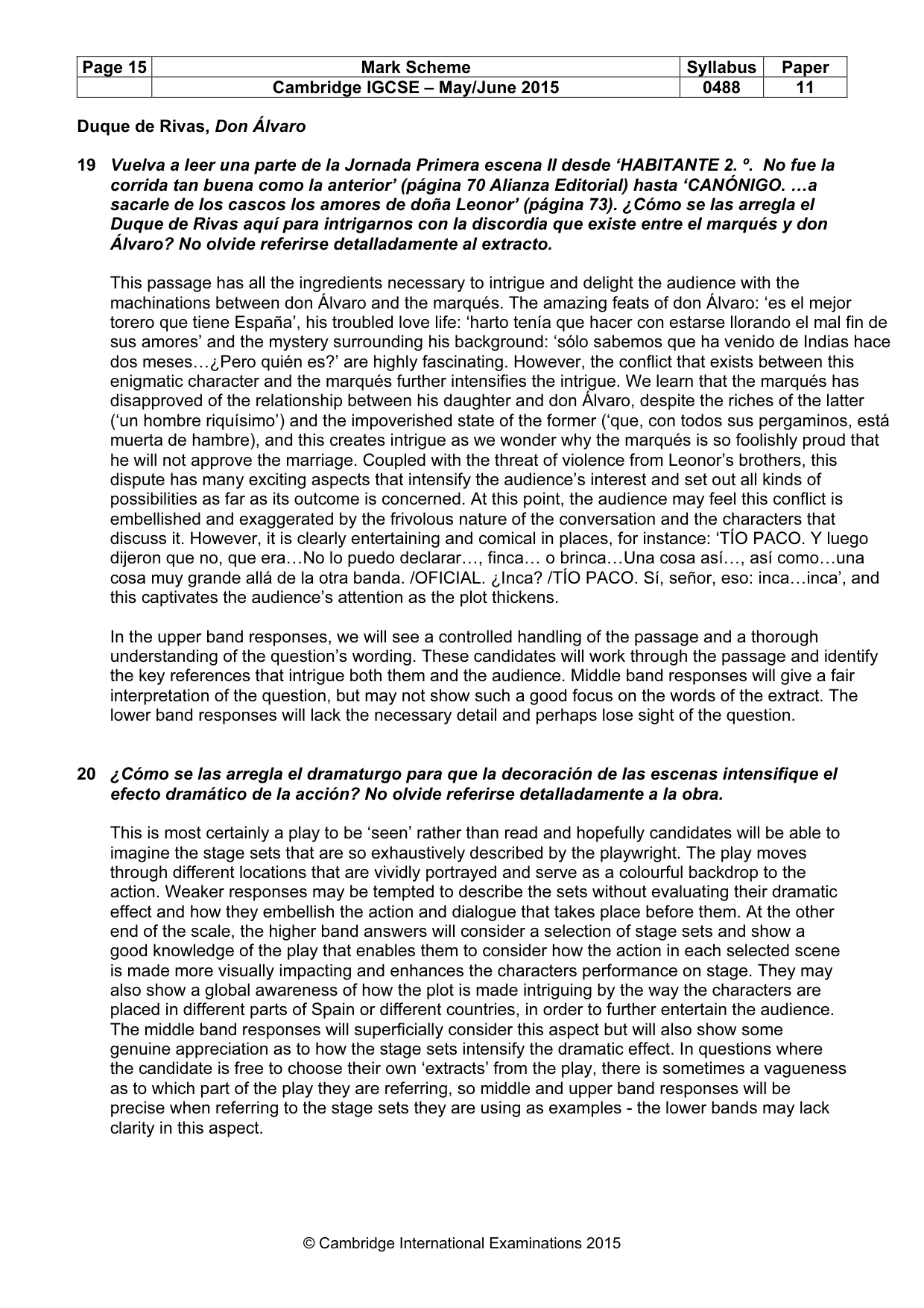
Page 15 Mark Scheme Syllabus Paper Cambridge IGCSE – May/June 2015 0488 11 © Cambridge International Examinations 2015 Duque de Rivas, Don Álvaro 19 Vuelva a leer una parte de la Jornada Primera escena II desde ‘HABITANTE 2. º. No fue la corrida tan buena como la anterior’ (página 70 Alianza Editorial) hasta ‘CANÓNIGO. …a sacarle de los cascos los amores de doña Leonor’ (página 73). ¿Cómo se las arregla el Duque de Rivas aquí para intrigarnos con la discordia que existe entre el marqués y don Álvaro? No olvide referirse detalladamente al extracto. This passage has all the ingredients necessary to intrigue and delight the audience with the machinations between don Álvaro and the marqués. The amazing feats of don Álvaro: ‘es el mejor torero que tiene España’, his troubled love life: ‘harto tenía que hacer con estarse llorando el mal fin de sus amores’ and the mystery surrounding his background: ‘sólo sabemos que ha venido de Indias hace dos meses…¿Pero quién es?’ are highly fascinating. However, the conflict that exists between this enigmatic character and the marqués further intensifies the intrigue. We learn that the marqués has disapproved of the relationship between his daughter and don Álvaro, despite the riches of the latter (‘un hombre riquísimo’) and the impoverished state of the former (‘que, con todos sus pergaminos, está muerta de hambre), and this creates intrigue as we wonder why the marqués is so foolishly proud that he will not approve the marriage. Coupled with the threat of violence from Leonor’s brothers, this dispute has many exciting aspects that intensify the audience’s interest and set out all kinds of possibilities as far as its outcome is concerned. At this point, the audience may feel this conflict is embellished and exaggerated by the frivolous nature of the conversation and the characters that discuss it. However, it is clearly entertaining and comical in places, for instance: ‘TÍO PACO. Y luego dijeron que no, que era…No lo puedo declarar…, finca… o brinca…Una cosa así…, así como…una cosa muy grande allá de la otra banda. /OFICIAL. ¿Inca? /TÍO PACO. Sí, señor, eso: inca…inca’, and this captivates the audience’s attention as the plot thickens. In the upper band responses, we will see a controlled handling of the passage and a thorough understanding of the question’s wording. These candidates will work through the passage and identify the key references that intrigue both them and the audience. Middle band responses will give a fair interpretation of the question, but may not show such a good focus on the words of the extract. The lower band responses will lack the necessary detail and perhaps lose sight of the question. 20 ¿Cómo se las arregla el dramaturgo para que la decoración de las escenas intensifique el efecto dramático de la acción? No olvide referirse detalladamente a la obra. This is most certainly a play to be ‘seen’ rather than read and hopefully candidates will be able to imagine the stage sets that are so exhaustively described by the playwright. The play moves through different locations that are vividly portrayed and serve as a colourful backdrop to the action. Weaker responses may be tempted to describe the sets without evaluating their dramatic effect and how they embellish the action and dialogue that takes place before them. At the other end of the scale, the higher band answers will consider a selection of stage sets and show a good knowledge of the play that enables them to consider how the action in each selected scene is made more visually impacting and enhances the characters performance on stage. They may also show a global awareness of how the plot is made intriguing by the way the characters are placed in different parts of Spain or different countries, in order to further entertain the audience. The middle band responses will superficially consider this aspect but will also show some genuine appreciation as to how the stage sets intensify the dramatic effect. In questions where the candidate is free to choose their own ‘extracts’ from the play, there is sometimes a vagueness as to which part of the play they are referring, so middle and upper band responses will be precise when referring to the stage sets they are using as examples - the lower bands may lack clarity in this aspect.
Mark scheme, page 16
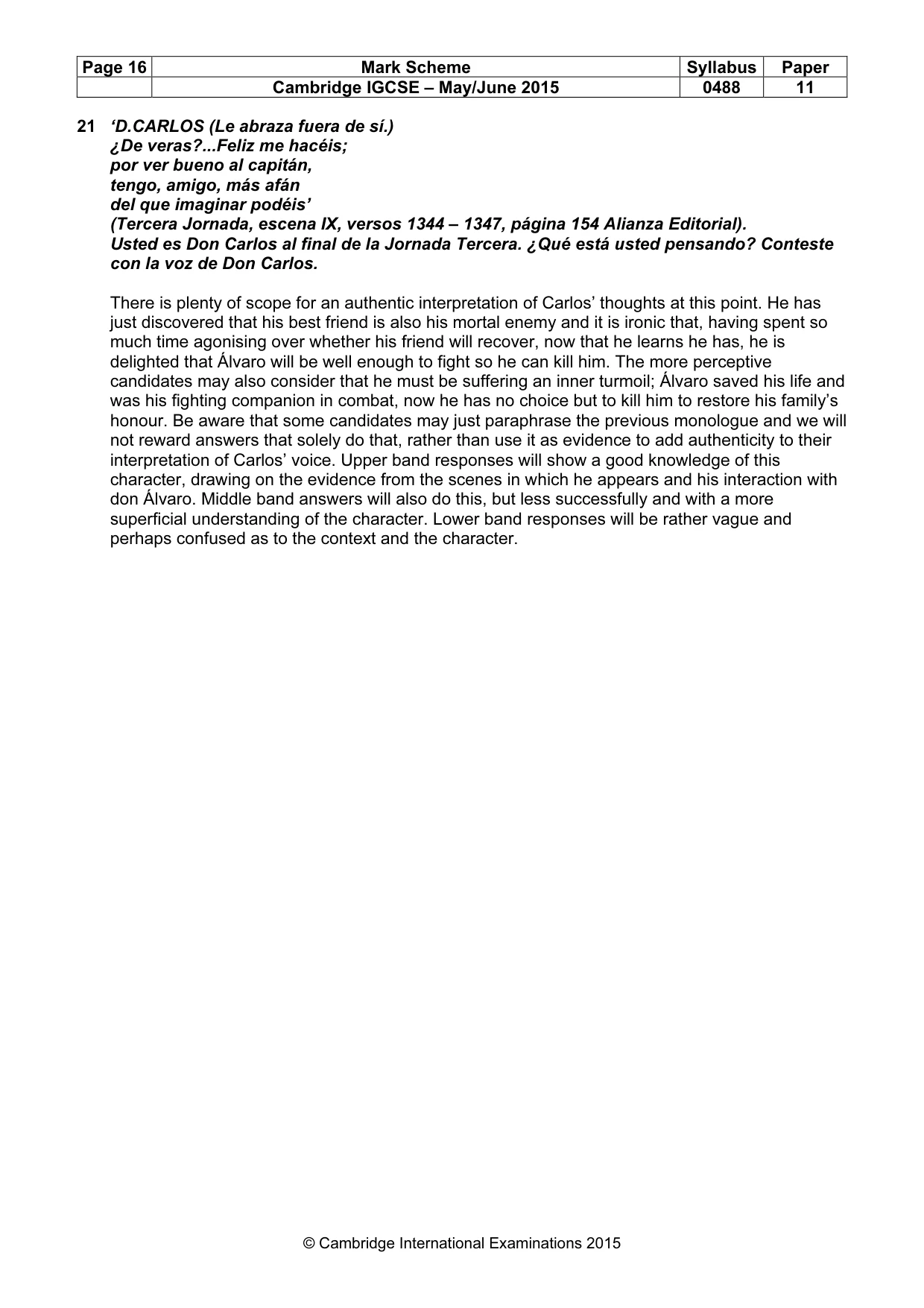
Page 16 Mark Scheme Syllabus Paper Cambridge IGCSE – May/June 2015 0488 11 © Cambridge International Examinations 2015 21 ‘D.CARLOS (Le abraza fuera de sí.) ¿De veras?...Feliz me hacéis; por ver bueno al capitán, tengo, amigo, más afán del que imaginar podéis’ (Tercera Jornada, escena IX, versos 1344 – 1347, página 154 Alianza Editorial). Usted es Don Carlos al final de la Jornada Tercera. ¿Qué está usted pensando? Conteste con la voz de Don Carlos. There is plenty of scope for an authentic interpretation of Carlos’ thoughts at this point. He has just discovered that his best friend is also his mortal enemy and it is ironic that, having spent so much time agonising over whether his friend will recover, now that he learns he has, he is delighted that Álvaro will be well enough to fight so he can kill him. The more perceptive candidates may also consider that he must be suffering an inner turmoil; Álvaro saved his life and was his fighting companion in combat, now he has no choice but to kill him to restore his family’s honour. Be aware that some candidates may just paraphrase the previous monologue and we will not reward answers that solely do that, rather than use it as evidence to add authenticity to their interpretation of Carlos’ voice. Upper band responses will show a good knowledge of this character, drawing on the evidence from the scenes in which he appears and his interaction with don Álvaro. Middle band answers will also do this, but less successfully and with a more superficial understanding of the character. Lower band responses will be rather vague and perhaps confused as to the context and the character.
Mark scheme, page 17
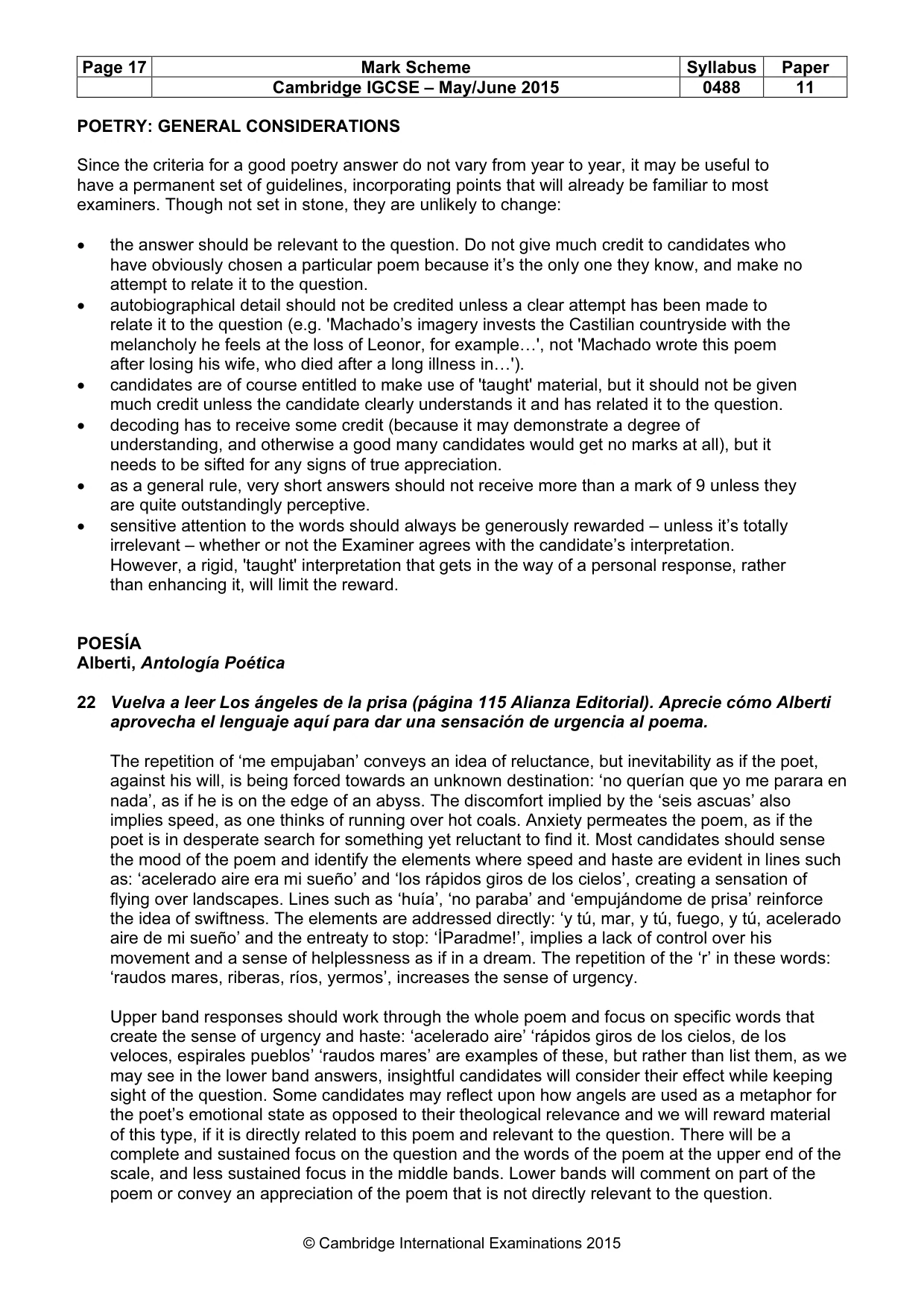
Page 17 Mark Scheme Syllabus Paper Cambridge IGCSE – May/June 2015 0488 11 © Cambridge International Examinations 2015 POETRY: GENERAL CONSIDERATIONS Since the criteria for a good poetry answer do not vary from year to year, it may be useful to have a permanent set of guidelines, incorporating points that will already be familiar to most examiners. Though not set in stone, they are unlikely to change: • the answer should be relevant to the question. Do not give much credit to candidates who have obviously chosen a particular poem because it’s the only one they know, and make no attempt to relate it to the question. • autobiographical detail should not be credited unless a clear attempt has been made to relate it to the question (e.g. 'Machado’s imagery invests the Castilian countryside with the melancholy he feels at the loss of Leonor, for example…', not 'Machado wrote this poem after losing his wife, who died after a long illness in…'). • candidates are of course entitled to make use of 'taught' material, but it should not be given much credit unless the candidate clearly understands it and has related it to the question. • decoding has to receive some credit (because it may demonstrate a degree of understanding, and otherwise a good many candidates would get no marks at all), but it needs to be sifted for any signs of true appreciation. • as a general rule, very short answers should not receive more than a mark of 9 unless they are quite outstandingly perceptive. • sensitive attention to the words should always be generously rewarded – unless it’s totally irrelevant – whether or not the Examiner agrees with the candidate’s interpretation. However, a rigid, 'taught' interpretation that gets in the way of a personal response, rather than enhancing it, will limit the reward. POESÍA Alberti, Antología Poética 22 Vuelva a leer Los ángeles de la prisa (página 115 Alianza Editorial). Aprecie cómo Alberti aprovecha el lenguaje aquí para dar una sensación de urgencia al poema. The repetition of ‘me empujaban’ conveys an idea of reluctance, but inevitability as if the poet, against his will, is being forced towards an unknown destination: ‘no querían que yo me parara en nada’, as if he is on the edge of an abyss. The discomfort implied by the ‘seis ascuas’ also implies speed, as one thinks of running over hot coals. Anxiety permeates the poem, as if the poet is in desperate search for something yet reluctant to find it. Most candidates should sense the mood of the poem and identify the elements where speed and haste are evident in lines such as: ‘acelerado aire era mi sueño’ and ‘los rápidos giros de los cielos’, creating a sensation of flying over landscapes. Lines such as ‘huía’, ‘no paraba’ and ‘empujándome de prisa’ reinforce the idea of swiftness. The elements are addressed directly: ‘y tú, mar, y tú, fuego, y tú, acelerado aire de mi sueño’ and the entreaty to stop: ‘İParadme!’, implies a lack of control over his movement and a sense of helplessness as if in a dream. The repetition of the ‘r’ in these words: ‘raudos mares, riberas, ríos, yermos’, increases the sense of urgency. Upper band responses should work through the whole poem and focus on specific words that create the sense of urgency and haste: ‘acelerado aire’ ‘rápidos giros de los cielos, de los veloces, espirales pueblos’ ‘raudos mares’ are examples of these, but rather than list them, as we may see in the lower band answers, insightful candidates will consider their effect while keeping sight of the question. Some candidates may reflect upon how angels are used as a metaphor for the poet’s emotional state as opposed to their theological relevance and we will reward material of this type, if it is directly related to this poem and relevant to the question. There will be a complete and sustained focus on the question and the words of the poem at the upper end of the scale, and less sustained focus in the middle bands. Lower bands will comment on part of the poem or convey an appreciation of the poem that is not directly relevant to the question.
Mark scheme, page 18
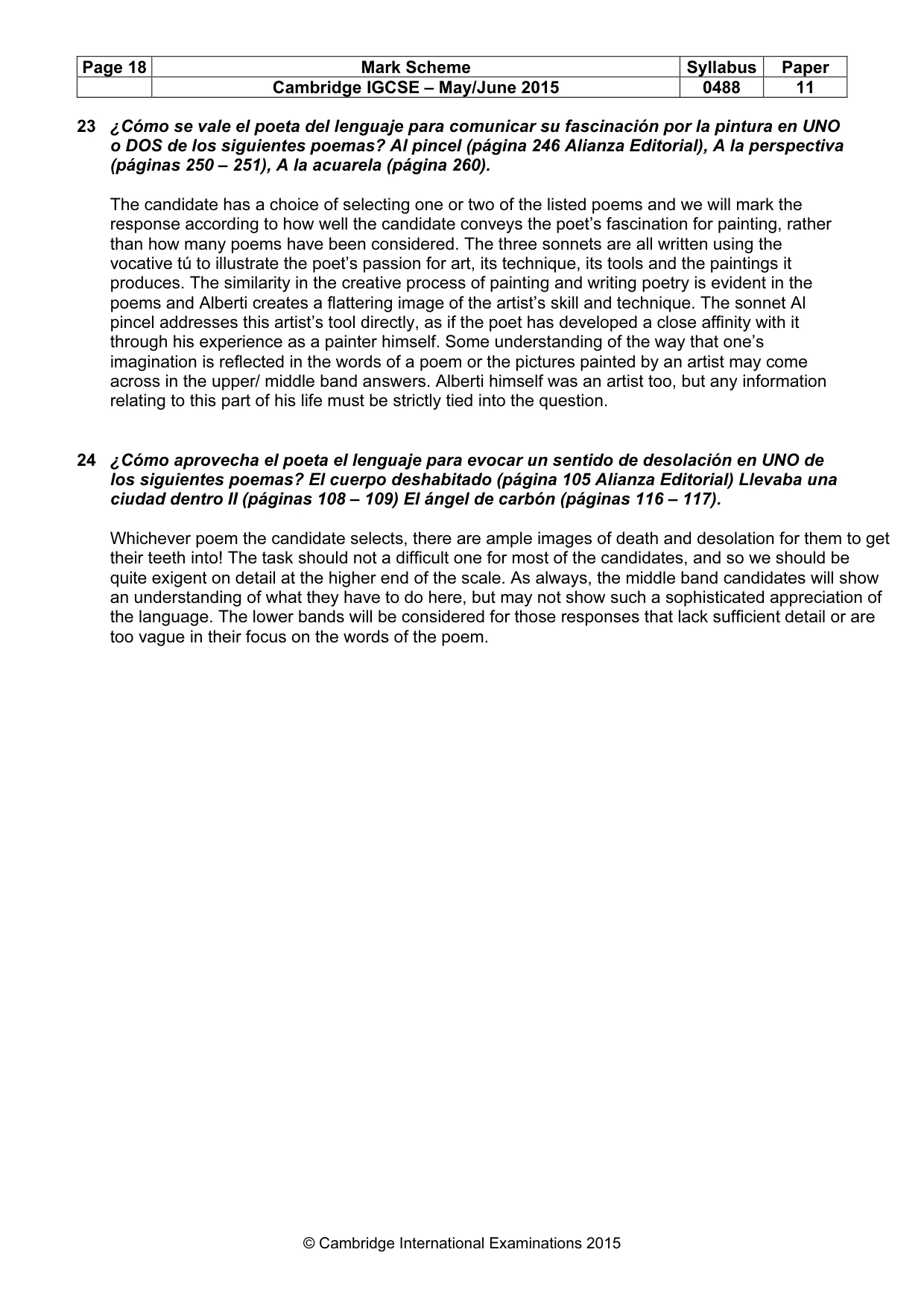
Page 18 Mark Scheme Syllabus Paper Cambridge IGCSE – May/June 2015 0488 11 © Cambridge International Examinations 2015 23 ¿Cómo se vale el poeta del lenguaje para comunicar su fascinación por la pintura en UNO o DOS de los siguientes poemas? Al pincel (página 246 Alianza Editorial), A la perspectiva (páginas 250 – 251), A la acuarela (página 260). The candidate has a choice of selecting one or two of the listed poems and we will mark the response according to how well the candidate conveys the poet’s fascination for painting, rather than how many poems have been considered. The three sonnets are all written using the vocative tú to illustrate the poet’s passion for art, its technique, its tools and the paintings it produces. The similarity in the creative process of painting and writing poetry is evident in the poems and Alberti creates a flattering image of the artist’s skill and technique. The sonnet Al pincel addresses this artist’s tool directly, as if the poet has developed a close affinity with it through his experience as a painter himself. Some understanding of the way that one’s imagination is reflected in the words of a poem or the pictures painted by an artist may come across in the upper/ middle band answers. Alberti himself was an artist too, but any information relating to this part of his life must be strictly tied into the question. 24 ¿Cómo aprovecha el poeta el lenguaje para evocar un sentido de desolación en UNO de los siguientes poemas? El cuerpo deshabitado (página 105 Alianza Editorial) Llevaba una ciudad dentro II (páginas 108 – 109) El ángel de carbón (páginas 116 – 117). Whichever poem the candidate selects, there are ample images of death and desolation for them to get their teeth into! The task should not a difficult one for most of the candidates, and so we should be quite exigent on detail at the higher end of the scale. As always, the middle band candidates will show an understanding of what they have to do here, but may not show such a sophisticated appreciation of the language. The lower bands will be considered for those responses that lack sufficient detail or are too vague in their focus on the words of the poem.
Mark scheme, page 19
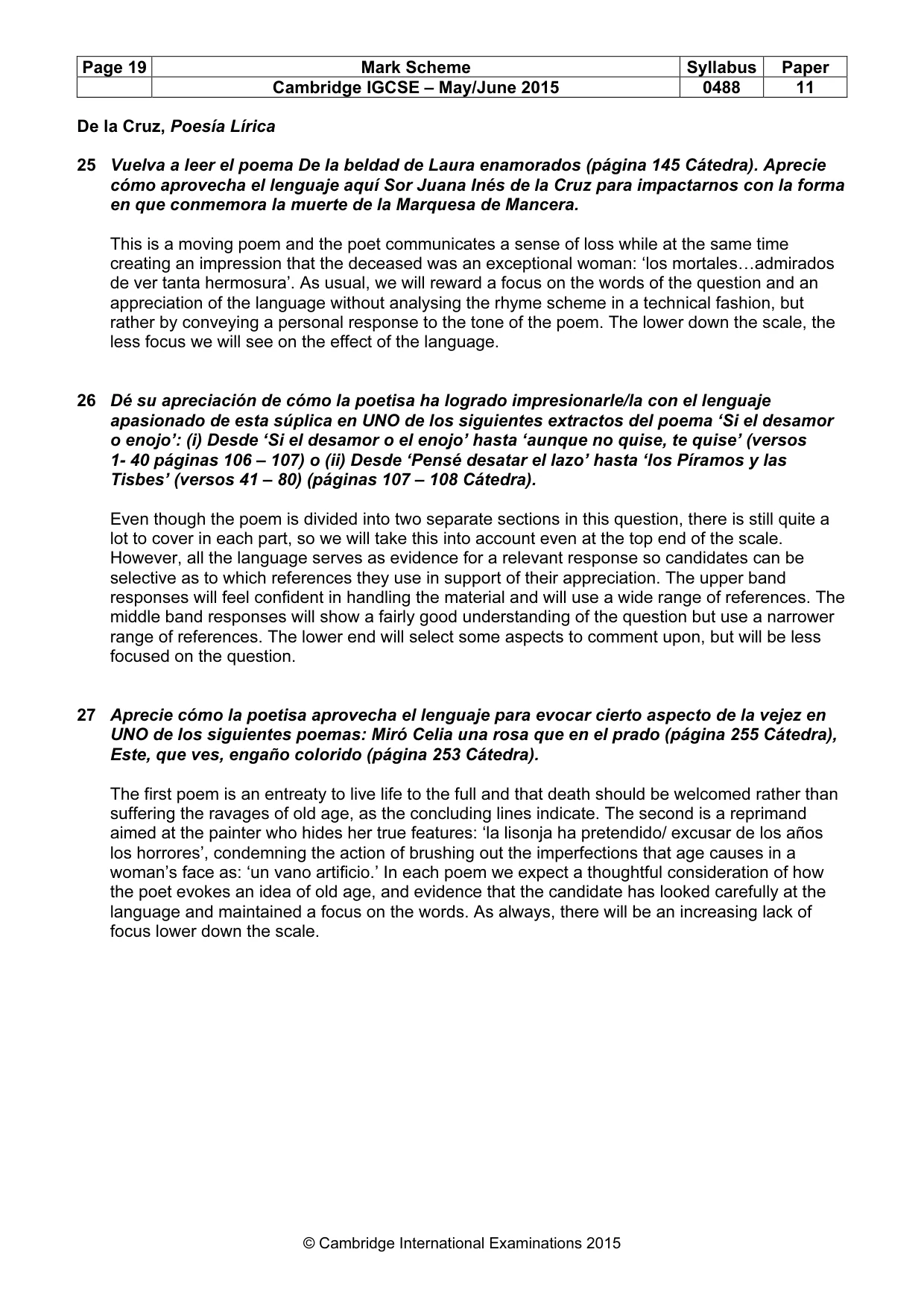
Page 19 Mark Scheme Syllabus Paper Cambridge IGCSE – May/June 2015 0488 11 © Cambridge International Examinations 2015 De la Cruz, Poesía Lírica 25 Vuelva a leer el poema De la beldad de Laura enamorados (página 145 Cátedra). Aprecie cómo aprovecha el lenguaje aquí Sor Juana Inés de la Cruz para impactarnos con la forma en que conmemora la muerte de la Marquesa de Mancera. This is a moving poem and the poet communicates a sense of loss while at the same time creating an impression that the deceased was an exceptional woman: ‘los mortales…admirados de ver tanta hermosura’. As usual, we will reward a focus on the words of the question and an appreciation of the language without analysing the rhyme scheme in a technical fashion, but rather by conveying a personal response to the tone of the poem. The lower down the scale, the less focus we will see on the effect of the language. 26 Dé su apreciación de cómo la poetisa ha logrado impresionarle/la con el lenguaje apasionado de esta súplica en UNO de los siguientes extractos del poema ‘Si el desamor o enojo’: (i) Desde ‘Si el desamor o el enojo’ hasta ‘aunque no quise, te quise’ (versos 1- 40 páginas 106 – 107) o (ii) Desde ‘Pensé desatar el lazo’ hasta ‘los Píramos y las Tisbes’ (versos 41 – 80) (páginas 107 – 108 Cátedra). Even though the poem is divided into two separate sections in this question, there is still quite a lot to cover in each part, so we will take this into account even at the top end of the scale. However, all the language serves as evidence for a relevant response so candidates can be selective as to which references they use in support of their appreciation. The upper band responses will feel confident in handling the material and will use a wide range of references. The middle band responses will show a fairly good understanding of the question but use a narrower range of references. The lower end will select some aspects to comment upon, but will be less focused on the question. 27 Aprecie cómo la poetisa aprovecha el lenguaje para evocar cierto aspecto de la vejez en UNO de los siguientes poemas: Miró Celia una rosa que en el prado (página 255 Cátedra), Este, que ves, engaño colorido (página 253 Cátedra). The first poem is an entreaty to live life to the full and that death should be welcomed rather than suffering the ravages of old age, as the concluding lines indicate. The second is a reprimand aimed at the painter who hides her true features: ‘la lisonja ha pretendido/ excusar de los años los horrores’, condemning the action of brushing out the imperfections that age causes in a woman’s face as: ‘un vano artificio.’ In each poem we expect a thoughtful consideration of how the poet evokes an idea of old age, and evidence that the candidate has looked carefully at the language and maintained a focus on the words. As always, there will be an increasing lack of focus lower down the scale.
What you needed in this session
Cambridge’s own grade thresholds for 2015 May/June, Paper 1 · Variant 1. A higher threshold means an easier paper — the bar moves with how the cohort did.