Cambridge IGCSE Spanish - Literature 0488 — 2014 Oct/Nov Paper 1 · Variant 1
0488/11/O/N/14 · 60 marks · ≈68 min
The question paper and its mark scheme, free to read here and free to download. This is Cambridge’s own paper, exactly as it was sat.
Question paper8 pages

Mark scheme17 pages
Answers below. Sit the paper first if you are practising.
Paper as text
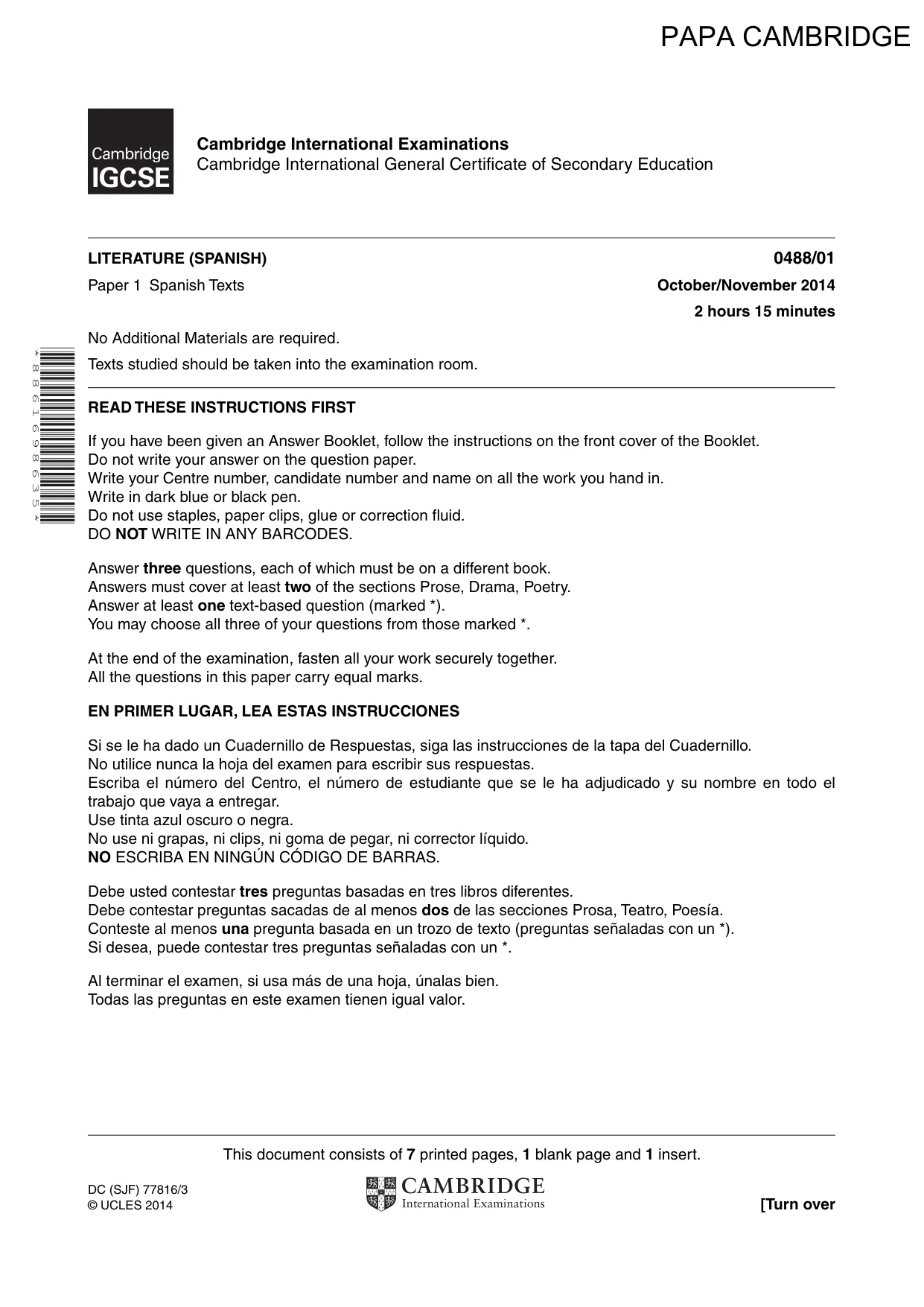
Question paper, page 1
This document consists of 7 printed pages, 1 blank page and 1 insert. DC (SJF) 77816/3 © UCLES 2014 [Turn over Cambridge International Examinations Cambridge International General Certificate of Secondary Education * 8 8 6 1 6 9 8 6 3 5 * LITERATURE (SPANISH) 0488/01 Paper 1 Spanish Texts October/November 2014 2 hours 15 minutes No Additional Materials are required. Texts studied should be taken into the examination room. READ THESE INSTRUCTIONS FIRST If you have been given an Answer Booklet, follow the instructions on the front cover of the Booklet. Do not write your answer on the question paper. Write your Centre number, candidate number and name on all the work you hand in. Write in dark blue or black pen. Do not use staples, paper clips, glue or correction fluid. DO NOT WRITE IN ANY BARCODES. Answer three questions, each of which must be on a different book. Answers must cover at least two of the sections Prose, Drama, Poetry. Answer at least one text-based question (marked *). You may choose all three of your questions from those marked *. At the end of the examination, fasten all your work securely together. All the questions in this paper carry equal marks. EN PRIMER LUGAR, LEA ESTAS INSTRUCCIONES Si se le ha dado un Cuadernillo de Respuestas, siga las instrucciones de la tapa del Cuadernillo. No utilice nunca la hoja del examen para escribir sus respuestas. Escriba el número del Centro, el número de estudiante que se le ha adjudicado y su nombre en todo el trabajo que vaya a entregar. Use tinta azul oscuro o negra. No use ni grapas, ni clips, ni goma de pegar, ni corrector líquido. NO ESCRIBA EN NINGÚN CÓDIGO DE BARRAS. Debe usted contestar tres preguntas basadas en tres libros diferentes. Debe contestar preguntas sacadas de al menos dos de las secciones Prosa, Teatro, Poesía. Conteste al menos una pregunta basada en un trozo de texto (preguntas señaladas con un *). Si desea, puede contestar tres preguntas señaladas con un *. Al terminar el examen, si usa más de una hoja, únalas bien. Todas las preguntas en este examen tienen igual valor. PAPA CAMBRIDGE
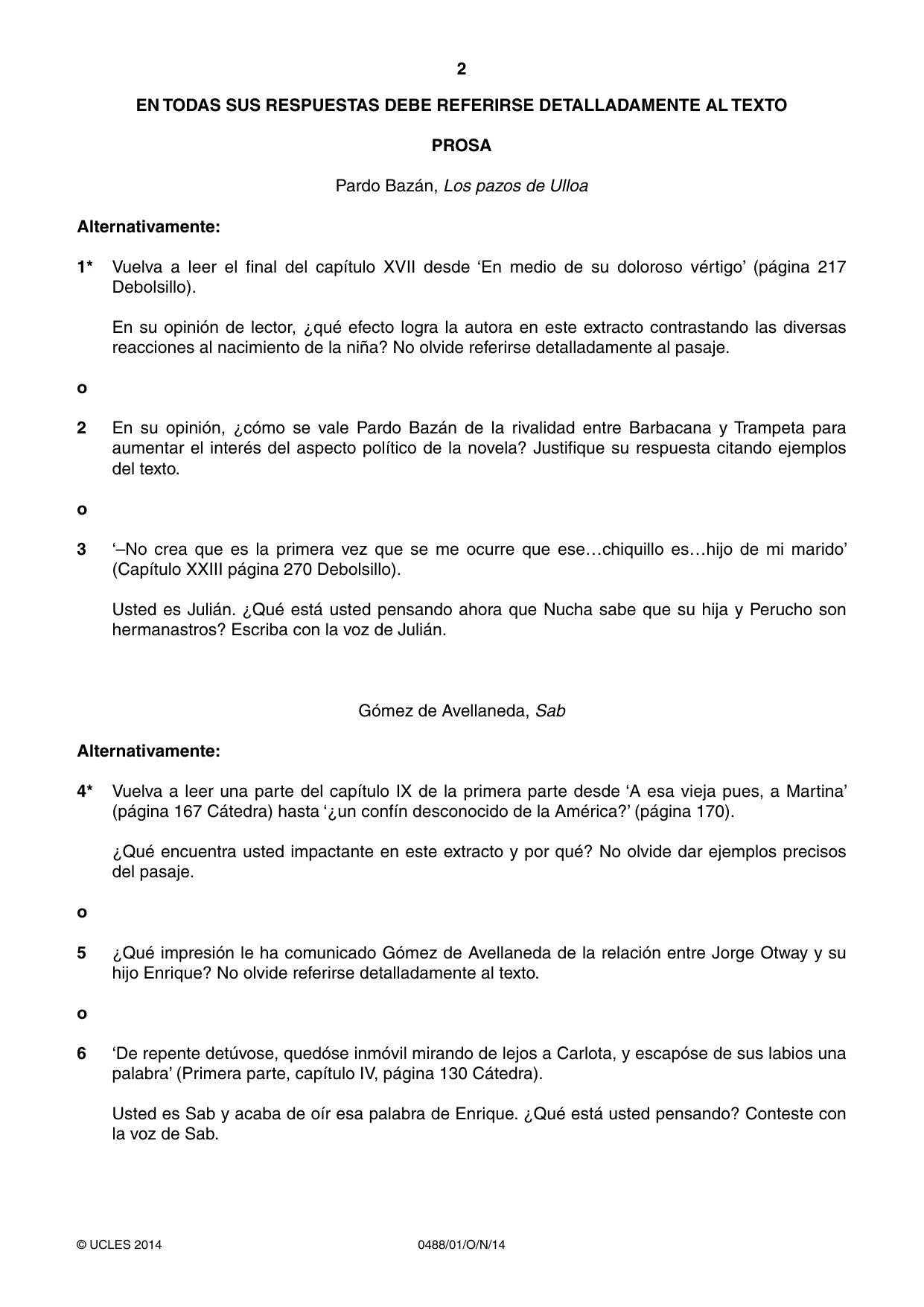
Question paper, page 2
2 0488/01/O/N/14 © UCLES 2014 EN TODAS SUS RESPUESTAS DEBE REFERIRSE DETALLADAMENTE AL TEXTO PROSA Pardo Bazán, Los pazos de Ulloa Alternativamente: 1* Vuelva a leer el final del capítulo XVII desde ‘En medio de su doloroso vértigo’ (página 217 Debolsillo). En su opinión de lector, ¿qué efecto logra la autora en este extracto contrastando las diversas reacciones al nacimiento de la niña? No olvide referirse detalladamente al pasaje. o 2 En su opinión, ¿cómo se vale Pardo Bazán de la rivalidad entre Barbacana y Trampeta para aumentar el interés del aspecto político de la novela? Justifique su respuesta citando ejemplos del texto. o 3 ‘–No crea que es la primera vez que se me ocurre que ese…chiquillo es…hijo de mi marido’ (Capítulo XXIII página 270 Debolsillo). Usted es Julián. ¿Qué está usted pensando ahora que Nucha sabe que su hija y Perucho son hermanastros? Escriba con la voz de Julián. Gómez de Avellaneda, Sab Alternativamente: 4* Vuelva a leer una parte del capítulo IX de la primera parte desde ‘A esa vieja pues, a Martina’ (página 167 Cátedra) hasta ‘¿un confín desconocido de la América?’ (página 170). ¿Qué encuentra usted impactante en este extracto y por qué? No olvide dar ejemplos precisos del pasaje. o 5 ¿Qué impresión le ha comunicado Gómez de Avellaneda de la relación entre Jorge Otway y su hijo Enrique? No olvide referirse detalladamente al texto. o 6 ‘De repente detúvose, quedóse inmóvil mirando de lejos a Carlota, y escapóse de sus labios una palabra’ (Primera parte, capítulo IV, página 130 Cátedra). Usted es Sab y acaba de oír esa palabra de Enrique. ¿Qué está usted pensando? Conteste con la voz de Sab.
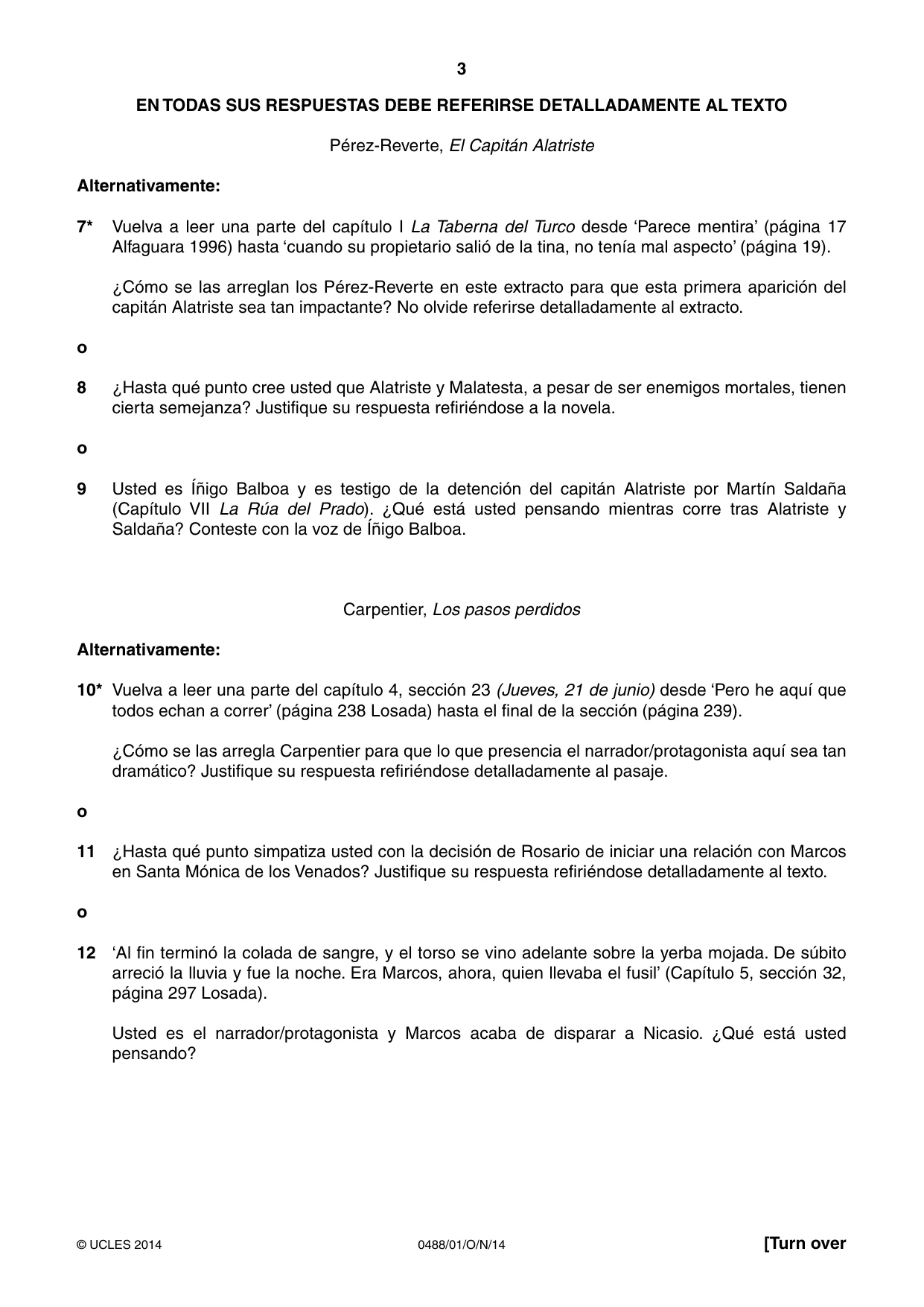
Question paper, page 3
3 0488/01/O/N/14 © UCLES 2014 [Turn over EN TODAS SUS RESPUESTAS DEBE REFERIRSE DETALLADAMENTE AL TEXTO Pérez-Reverte, El Capitán Alatriste Alternativamente: 7* Vuelva a leer una parte del capítulo I La Taberna del Turco desde ‘Parece mentira’ (página 17 Alfaguara 1996) hasta ‘cuando su propietario salió de la tina, no tenía mal aspecto’ (página 19). ¿Cómo se las arreglan los Pérez-Reverte en este extracto para que esta primera aparición del capitán Alatriste sea tan impactante? No olvide referirse detalladamente al extracto. o 8 ¿Hasta qué punto cree usted que Alatriste y Malatesta, a pesar de ser enemigos mortales, tienen cierta semejanza? Justifique su respuesta refiriéndose a la novela. o 9 Usted es Íñigo Balboa y es testigo de la detención del capitán Alatriste por Martín Saldaña (Capítulo VII La Rúa del Prado). ¿Qué está usted pensando mientras corre tras Alatriste y Saldaña? Conteste con la voz de Íñigo Balboa. Carpentier, Los pasos perdidos Alternativamente: 10* Vuelva a leer una parte del capítulo 4, sección 23 (Jueves, 21 de junio) desde ‘Pero he aquí que todos echan a correr’ (página 238 Losada) hasta el final de la sección (página 239). ¿Cómo se las arregla Carpentier para que lo que presencia el narrador/protagonista aquí sea tan dramático? Justifique su respuesta refiriéndose detalladamente al pasaje. o 11 ¿Hasta qué punto simpatiza usted con la decisión de Rosario de iniciar una relación con Marcos en Santa Mónica de los Venados? Justifique su respuesta refiriéndose detalladamente al texto. o 12 ‘Al fin terminó la colada de sangre, y el torso se vino adelante sobre la yerba mojada. De súbito arreció la lluvia y fue la noche. Era Marcos, ahora, quien llevaba el fusil’ (Capítulo 5, sección 32, página 297 Losada). Usted es el narrador/protagonista y Marcos acaba de disparar a Nicasio. ¿Qué está usted pensando?
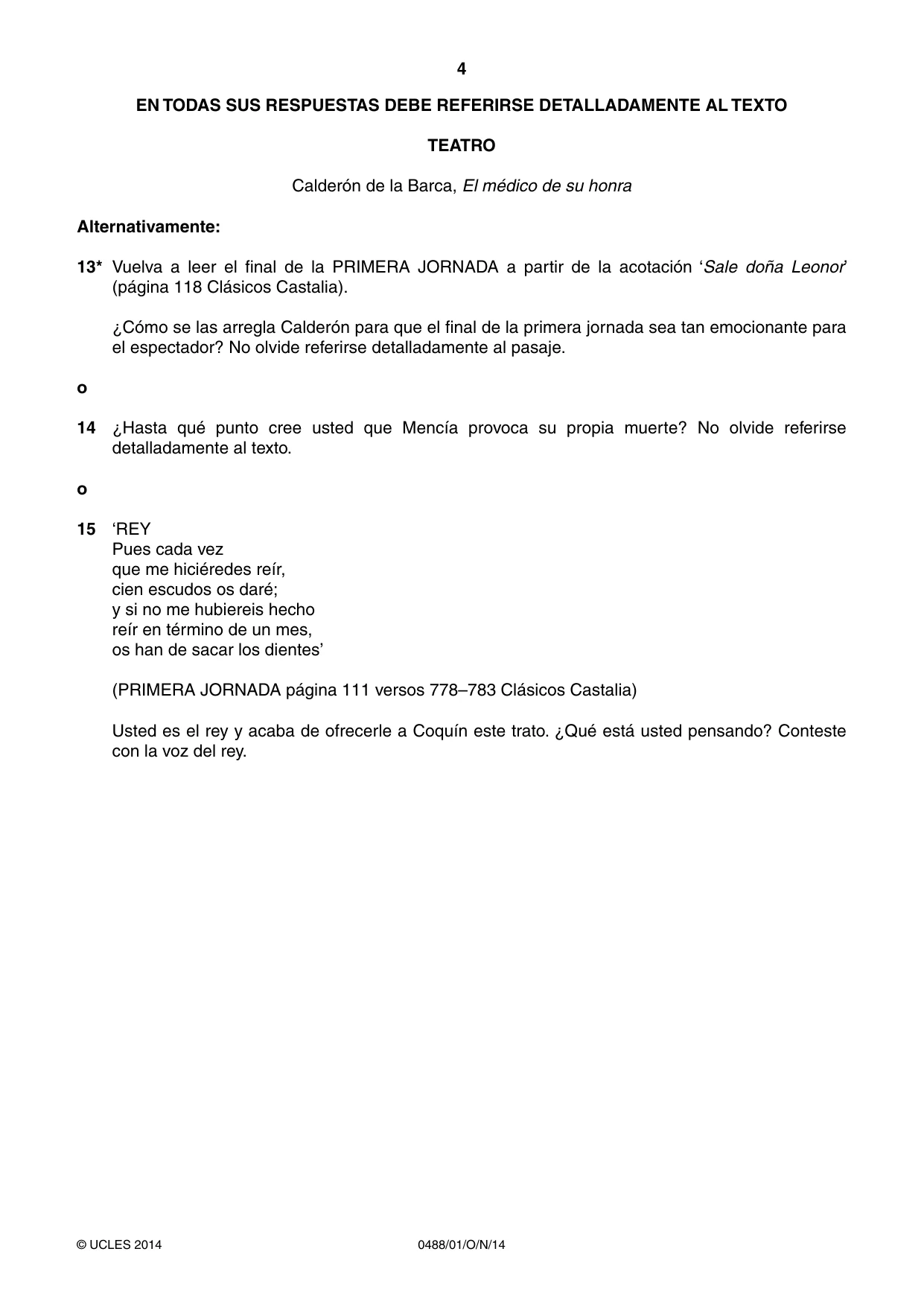
Question paper, page 4
4 0488/01/O/N/14 © UCLES 2014 EN TODAS SUS RESPUESTAS DEBE REFERIRSE DETALLADAMENTE AL TEXTO TEATRO Calderón de la Barca, El médico de su honra Alternativamente: 13* Vuelva a leer el final de la PRIMERA JORNADA a partir de la acotación ‘Sale doña Leonor’ (página 118 Clásicos Castalia). ¿Cómo se las arregla Calderón para que el final de la primera jornada sea tan emocionante para el espectador? No olvide referirse detalladamente al pasaje. o 14 ¿Hasta qué punto cree usted que Mencía provoca su propia muerte? No olvide referirse detalladamente al texto. o 15 ‘REY Pues cada vez que me hiciéredes reír, cien escudos os daré; y si no me hubiereis hecho reír en término de un mes, os han de sacar los dientes’ (PRIMERA JORNADA página 111 versos 778–783 Clásicos Castalia) Usted es el rey y acaba de ofrecerle a Coquín este trato. ¿Qué está usted pensando? Conteste con la voz del rey.
Question paper, page 5
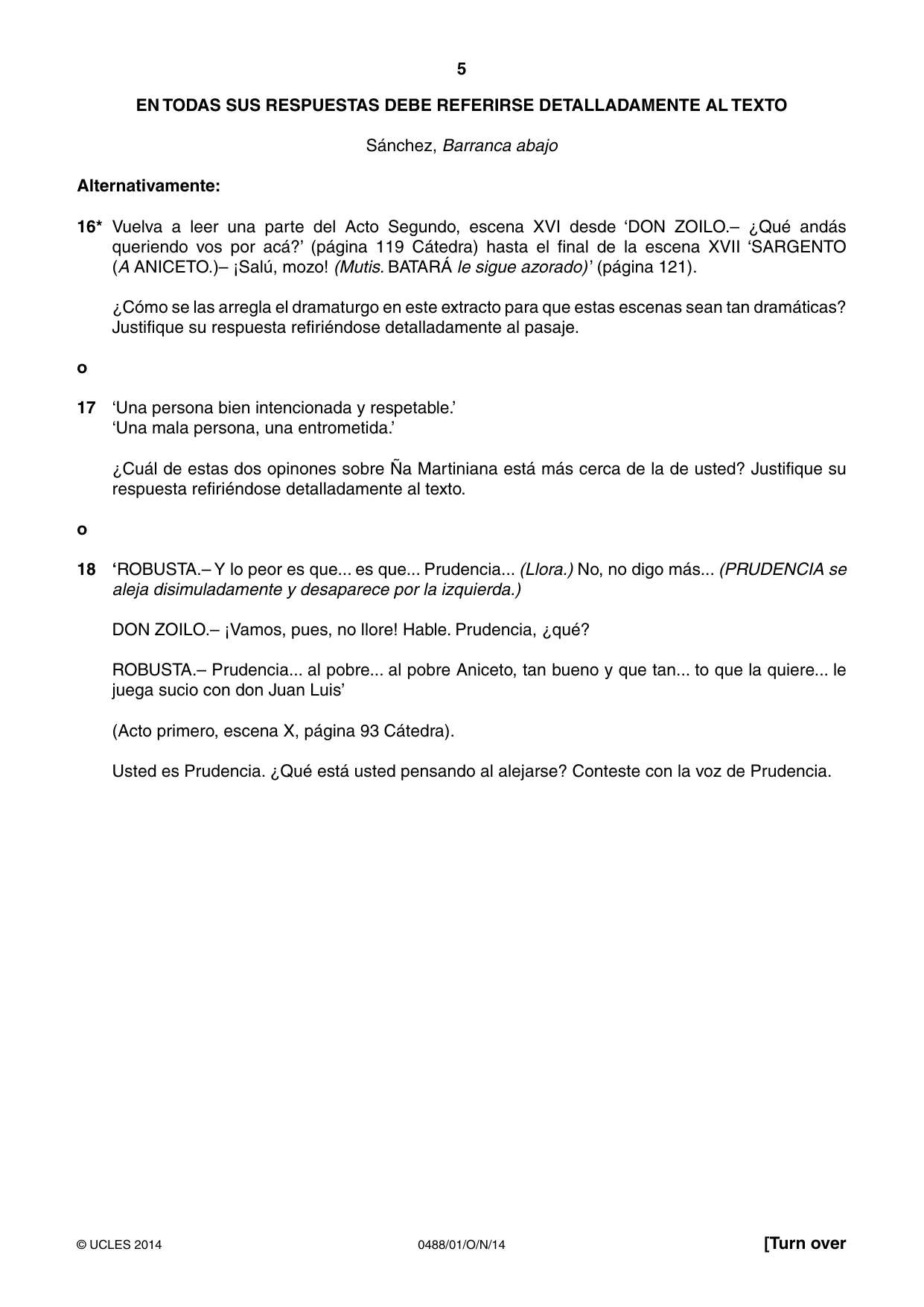
5 0488/01/O/N/14 © UCLES 2014 [Turn over EN TODAS SUS RESPUESTAS DEBE REFERIRSE DETALLADAMENTE AL TEXTO Sánchez, Barranca abajo Alternativamente: 16* Vuelva a leer una parte del Acto Segundo, escena XVI desde ‘DON ZOILO.– ¿Qué andás queriendo vos por acá?’ (página 119 Cátedra) hasta el final de la escena XVII ‘SARGENTO (A ANICETO.)– ¡Salú, mozo! (Mutis. BATARÁ le sigue azorado) ’ (página 121). ¿Cómo se las arregla el dramaturgo en este extracto para que estas escenas sean tan dramáticas? Justifique su respuesta refiriéndose detalladamente al pasaje. o 17 ‘Una persona bien intencionada y respetable.’ ‘Una mala persona, una entrometida.’ ¿Cuál de estas dos opinones sobre Ña Martiniana está más cerca de la de usted? Justifique su respuesta refiriéndose detalladamente al texto. o 18 ‘ROBUSTA.– Y lo peor es que... es que... Prudencia... (Llora.) No, no digo más... (PRUDENCIA se aleja disimuladamente y desaparece por la izquierda.) DON ZOILO.– ¡Vamos, pues, no llore! Hable. Prudencia, ¿qué? ROBUSTA.– Prudencia... al pobre... al pobre Aniceto, tan bueno y que tan... to que la quiere... le juega sucio con don Juan Luis’ (Acto primero, escena X, página 93 Cátedra). Usted es Prudencia. ¿Qué está usted pensando al alejarse? Conteste con la voz de Prudencia.
Question paper, page 6
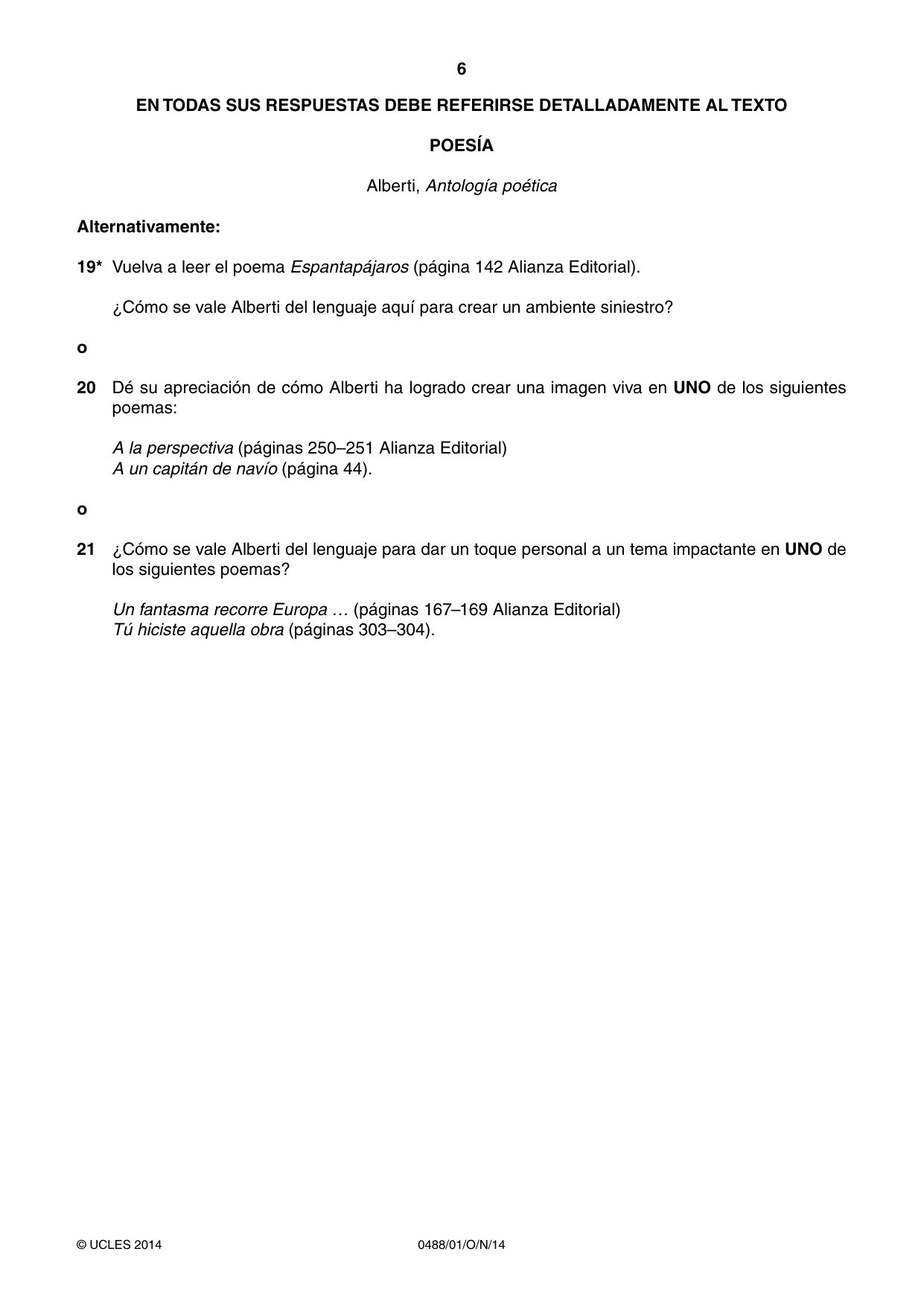
6 0488/01/O/N/14 © UCLES 2014 EN TODAS SUS RESPUESTAS DEBE REFERIRSE DETALLADAMENTE AL TEXTO POESÍA Alberti, Antología poética Alternativamente: 19* Vuelva a leer el poema Espantapájaros (página 142 Alianza Editorial). ¿Cómo se vale Alberti del lenguaje aquí para crear un ambiente siniestro? o 20 Dé su apreciación de cómo Alberti ha logrado crear una imagen viva en UNO de los siguientes poemas: A la perspectiva (páginas 250–251 Alianza Editorial) A un capitán de navío (página 44). o 21 ¿Cómo se vale Alberti del lenguaje para dar un toque personal a un tema impactante en UNO de los siguientes poemas? Un fantasma recorre Europa … (páginas 167–169 Alianza Editorial) Tú hiciste aquella obra (páginas 303–304).
Question paper, page 7
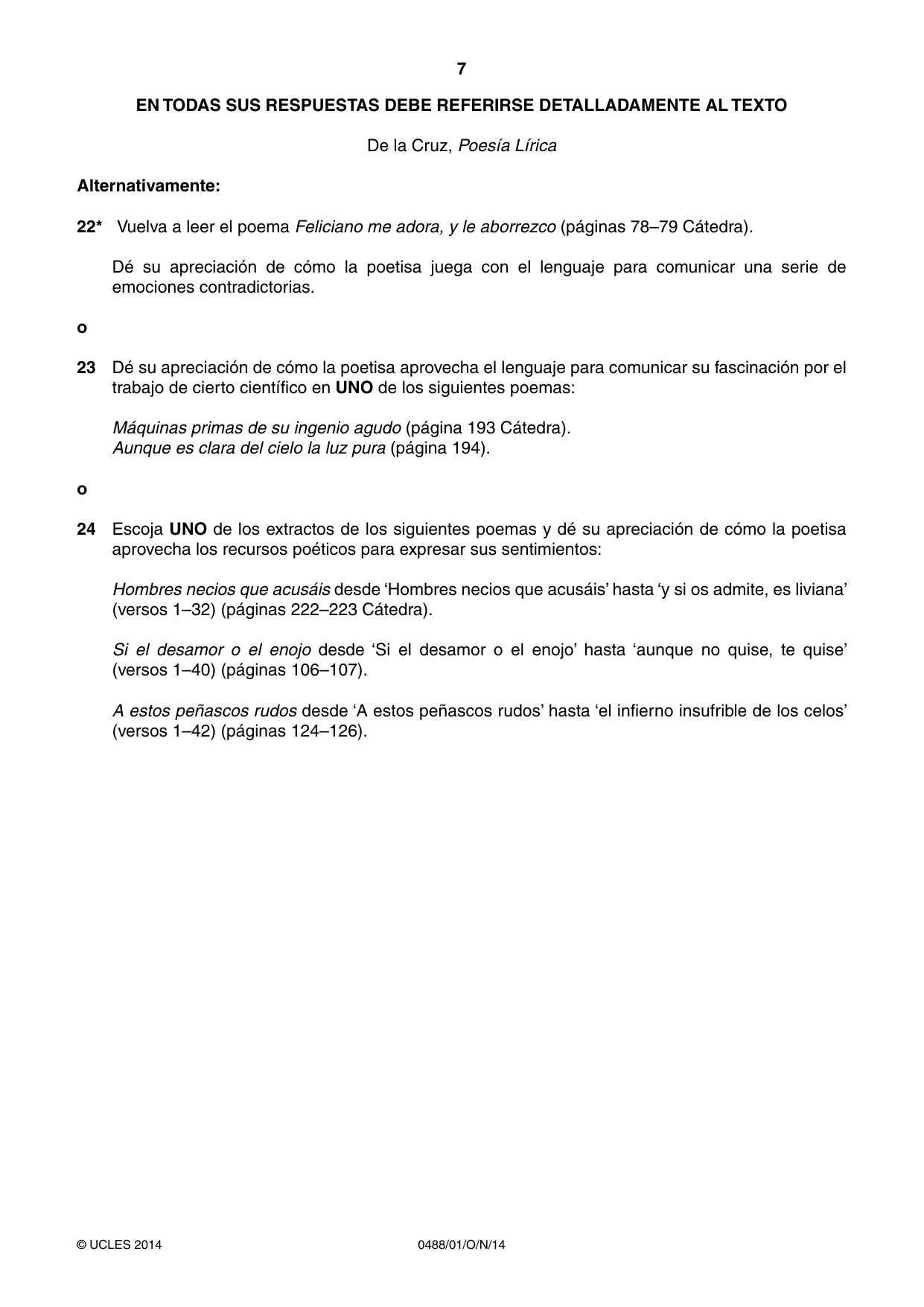
7 0488/01/O/N/14 © UCLES 2014 EN TODAS SUS RESPUESTAS DEBE REFERIRSE DETALLADAMENTE AL TEXTO De la Cruz, Poesía Lírica Alternativamente: 22* Vuelva a leer el poema Feliciano me adora, y le aborrezco (páginas 78–79 Cátedra). Dé su apreciación de cómo la poetisa juega con el lenguaje para comunicar una serie de emociones contradictorias. o 23 Dé su apreciación de cómo la poetisa aprovecha el lenguaje para comunicar su fascinación por el trabajo de cierto científico en UNO de los siguientes poemas: Máquinas primas de su ingenio agudo (página 193 Cátedra). Aunque es clara del cielo la luz pura (página 194). o 24 Escoja UNO de los extractos de los siguientes poemas y dé su apreciación de cómo la poetisa aprovecha los recursos poéticos para expresar sus sentimientos: Hombres necios que acusáis desde ‘Hombres necios que acusáis’ hasta ‘y si os admite, es liviana’ (versos 1–32) (páginas 222–223 Cátedra). Si el desamor o el enojo desde ‘Si el desamor o el enojo’ hasta ‘aunque no quise, te quise’ (versos 1–40) (páginas 106–107). A estos peñascos rudos desde ‘A estos peñascos rudos’ hasta ‘el infierno insufrible de los celos’ (versos 1–42) (páginas 124–126).
Question paper, page 8
8 0488/01/O/N/14 © UCLES 2014 Permission to reproduce items where third-party owned material protected by copyright is included has been sought and cleared where possible. Every reasonable effort has been made by the publisher (UCLES) to trace copyright holders, but if any items requiring clearance have unwittingly been included, the publisher will be pleased to make amends at the earliest possible opportunity. Cambridge International Examinations is part of the Cambridge Assessment Group. Cambridge Assessment is the brand name of University of Cambridge Local Examinations Syndicate (UCLES), which is itself a department of the University of Cambridge. BLANK PAGE
Mark scheme, page 1
® IGCSE is the registered trademark of Cambridge International Examinations. CAMBRIDGE INTERNATIONAL EXAMINATIONS Cambridge International General Certificate of Secondary Education MARK SCHEME for the October/November 2014 series 0488 LITERATURE (SPANISH) 0488/01 Paper 1 (Spanish Texts), maximum raw mark 60 This mark scheme is published as an aid to teachers and candidates, to indicate the requirements of the examination. It shows the basis on which Examiners were instructed to award marks. It does not indicate the details of the discussions that took place at an Examiners’ meeting before marking began, which would have considered the acceptability of alternative answers. Mark schemes should be read in conjunction with the question paper and the Principal Examiner Report for Teachers. Cambridge will not enter into discussions about these mark schemes. Cambridge is publishing the mark schemes for the October/November 2014 series for most Cambridge IGCSE®, Cambridge International A and AS Level components and some Cambridge O Level components. PAPA CAMBRIDGE
Mark scheme, page 2
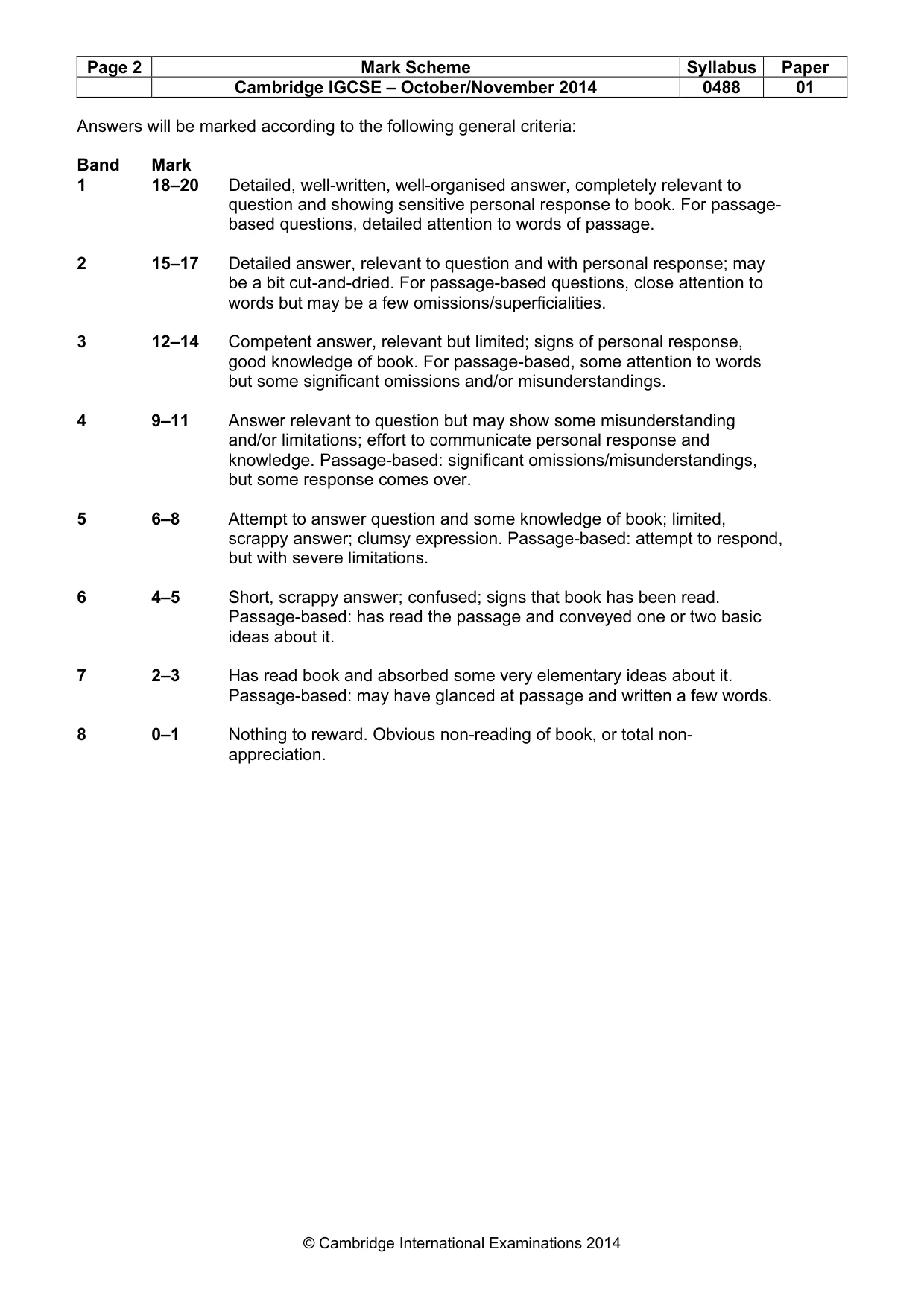
Page 2 Mark Scheme Syllabus Paper Cambridge IGCSE – October/November 2014 0488 01 © Cambridge International Examinations 2014 Answers will be marked according to the following general criteria: Band Mark 1 18–20 Detailed, well-written, well-organised answer, completely relevant to question and showing sensitive personal response to book. For passage- based questions, detailed attention to words of passage. 2 15–17 Detailed answer, relevant to question and with personal response; may be a bit cut-and-dried. For passage-based questions, close attention to words but may be a few omissions/superficialities. 3 12–14 Competent answer, relevant but limited; signs of personal response, good knowledge of book. For passage-based, some attention to words but some significant omissions and/or misunderstandings. 4 9–11 Answer relevant to question but may show some misunderstanding and/or limitations; effort to communicate personal response and knowledge. Passage-based: significant omissions/misunderstandings, but some response comes over. 5 6–8 Attempt to answer question and some knowledge of book; limited, scrappy answer; clumsy expression. Passage-based: attempt to respond, but with severe limitations. 6 4–5 Short, scrappy answer; confused; signs that book has been read. Passage-based: has read the passage and conveyed one or two basic ideas about it. 7 2–3 Has read book and absorbed some very elementary ideas about it. Passage-based: may have glanced at passage and written a few words. 8 0–1 Nothing to reward. Obvious non-reading of book, or total non- appreciation.
Mark scheme, page 3
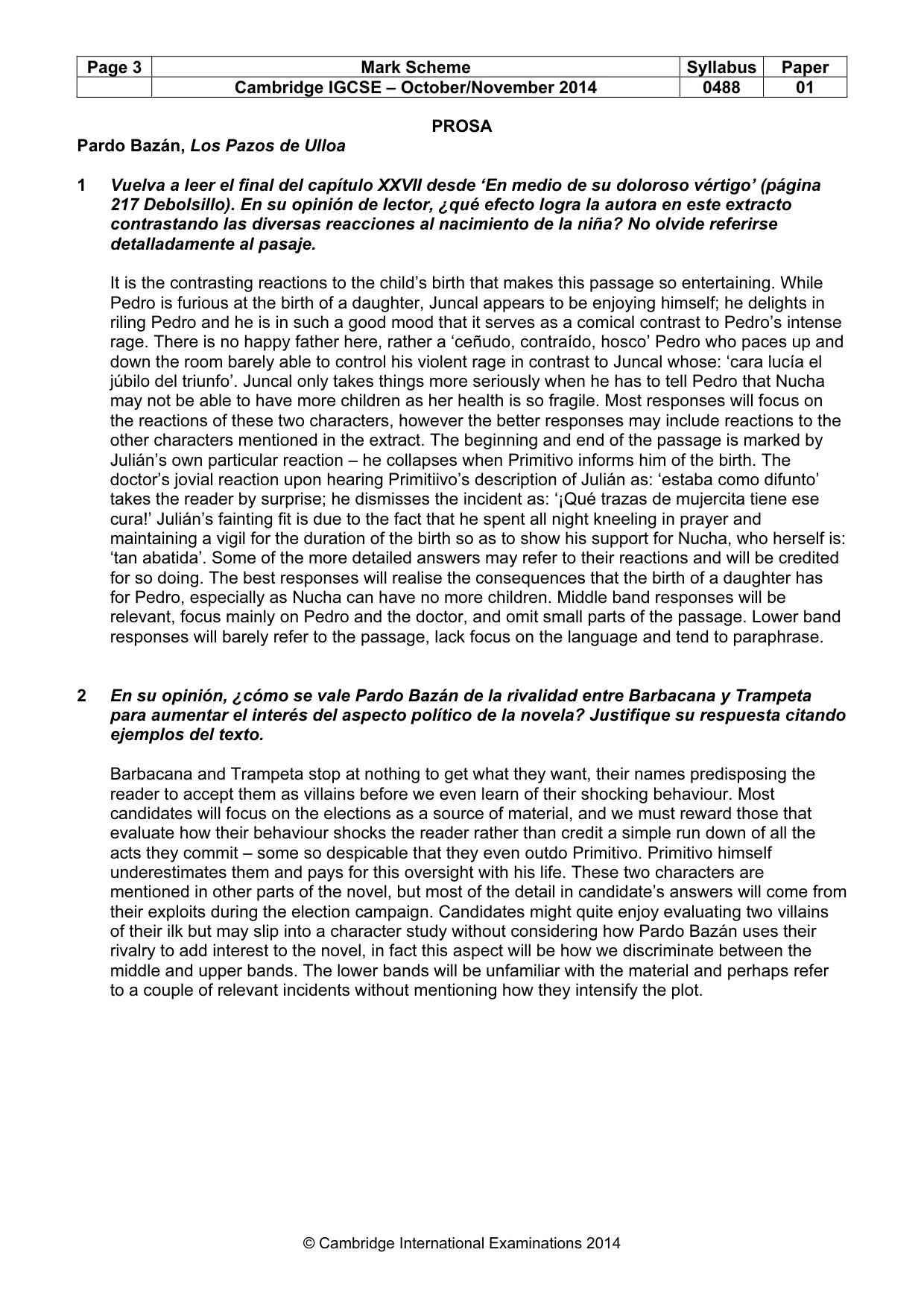
Page 3 Mark Scheme Syllabus Paper Cambridge IGCSE – October/November 2014 0488 01 © Cambridge International Examinations 2014 PROSA Pardo Bazán, Los Pazos de Ulloa 1 Vuelva a leer el final del capítulo XXVII desde ‘En medio de su doloroso vértigo’ (página 217 Debolsillo). En su opinión de lector, ¿qué efecto logra la autora en este extracto contrastando las diversas reacciones al nacimiento de la niña? No olvide referirse detalladamente al pasaje. It is the contrasting reactions to the child’s birth that makes this passage so entertaining. While Pedro is furious at the birth of a daughter, Juncal appears to be enjoying himself; he delights in riling Pedro and he is in such a good mood that it serves as a comical contrast to Pedro’s intense rage. There is no happy father here, rather a ‘ceñudo, contraído, hosco’ Pedro who paces up and down the room barely able to control his violent rage in contrast to Juncal whose: ‘cara lucía el júbilo del triunfo’. Juncal only takes things more seriously when he has to tell Pedro that Nucha may not be able to have more children as her health is so fragile. Most responses will focus on the reactions of these two characters, however the better responses may include reactions to the other characters mentioned in the extract. The beginning and end of the passage is marked by Julián’s own particular reaction – he collapses when Primitivo informs him of the birth. The doctor’s jovial reaction upon hearing Primitiivo’s description of Julián as: ‘estaba como difunto’ takes the reader by surprise; he dismisses the incident as: ‘¡Qué trazas de mujercita tiene ese cura!’ Julián’s fainting fit is due to the fact that he spent all night kneeling in prayer and maintaining a vigil for the duration of the birth so as to show his support for Nucha, who herself is: ‘tan abatida’. Some of the more detailed answers may refer to their reactions and will be credited for so doing. The best responses will realise the consequences that the birth of a daughter has for Pedro, especially as Nucha can have no more children. Middle band responses will be relevant, focus mainly on Pedro and the doctor, and omit small parts of the passage. Lower band responses will barely refer to the passage, lack focus on the language and tend to paraphrase. 2 En su opinión, ¿cómo se vale Pardo Bazán de la rivalidad entre Barbacana y Trampeta para aumentar el interés del aspecto político de la novela? Justifique su respuesta citando ejemplos del texto. Barbacana and Trampeta stop at nothing to get what they want, their names predisposing the reader to accept them as villains before we even learn of their shocking behaviour. Most candidates will focus on the elections as a source of material, and we must reward those that evaluate how their behaviour shocks the reader rather than credit a simple run down of all the acts they commit – some so despicable that they even outdo Primitivo. Primitivo himself underestimates them and pays for this oversight with his life. These two characters are mentioned in other parts of the novel, but most of the detail in candidate’s answers will come from their exploits during the election campaign. Candidates might quite enjoy evaluating two villains of their ilk but may slip into a character study without considering how Pardo Bazán uses their rivalry to add interest to the novel, in fact this aspect will be how we discriminate between the middle and upper bands. The lower bands will be unfamiliar with the material and perhaps refer to a couple of relevant incidents without mentioning how they intensify the plot.
Mark scheme, page 4
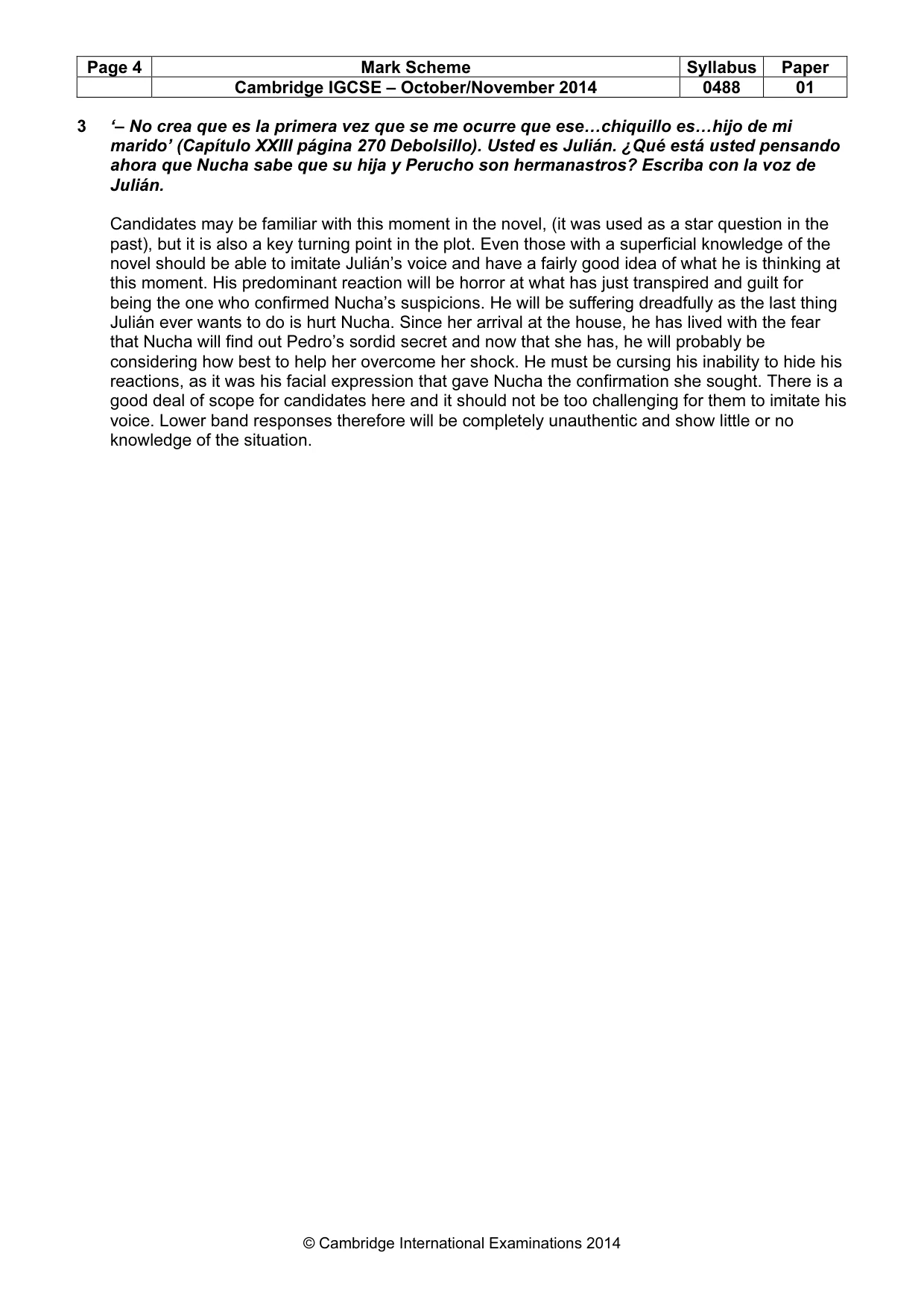
Page 4 Mark Scheme Syllabus Paper Cambridge IGCSE – October/November 2014 0488 01 © Cambridge International Examinations 2014 3 ‘– No crea que es la primera vez que se me ocurre que ese…chiquillo es…hijo de mi marido’ (Capítulo XXIII página 270 Debolsillo). Usted es Julián. ¿Qué está usted pensando ahora que Nucha sabe que su hija y Perucho son hermanastros? Escriba con la voz de Julián. Candidates may be familiar with this moment in the novel, (it was used as a star question in the past), but it is also a key turning point in the plot. Even those with a superficial knowledge of the novel should be able to imitate Julián’s voice and have a fairly good idea of what he is thinking at this moment. His predominant reaction will be horror at what has just transpired and guilt for being the one who confirmed Nucha’s suspicions. He will be suffering dreadfully as the last thing Julián ever wants to do is hurt Nucha. Since her arrival at the house, he has lived with the fear that Nucha will find out Pedro’s sordid secret and now that she has, he will probably be considering how best to help her overcome her shock. He must be cursing his inability to hide his reactions, as it was his facial expression that gave Nucha the confirmation she sought. There is a good deal of scope for candidates here and it should not be too challenging for them to imitate his voice. Lower band responses therefore will be completely unauthentic and show little or no knowledge of the situation.
Mark scheme, page 5
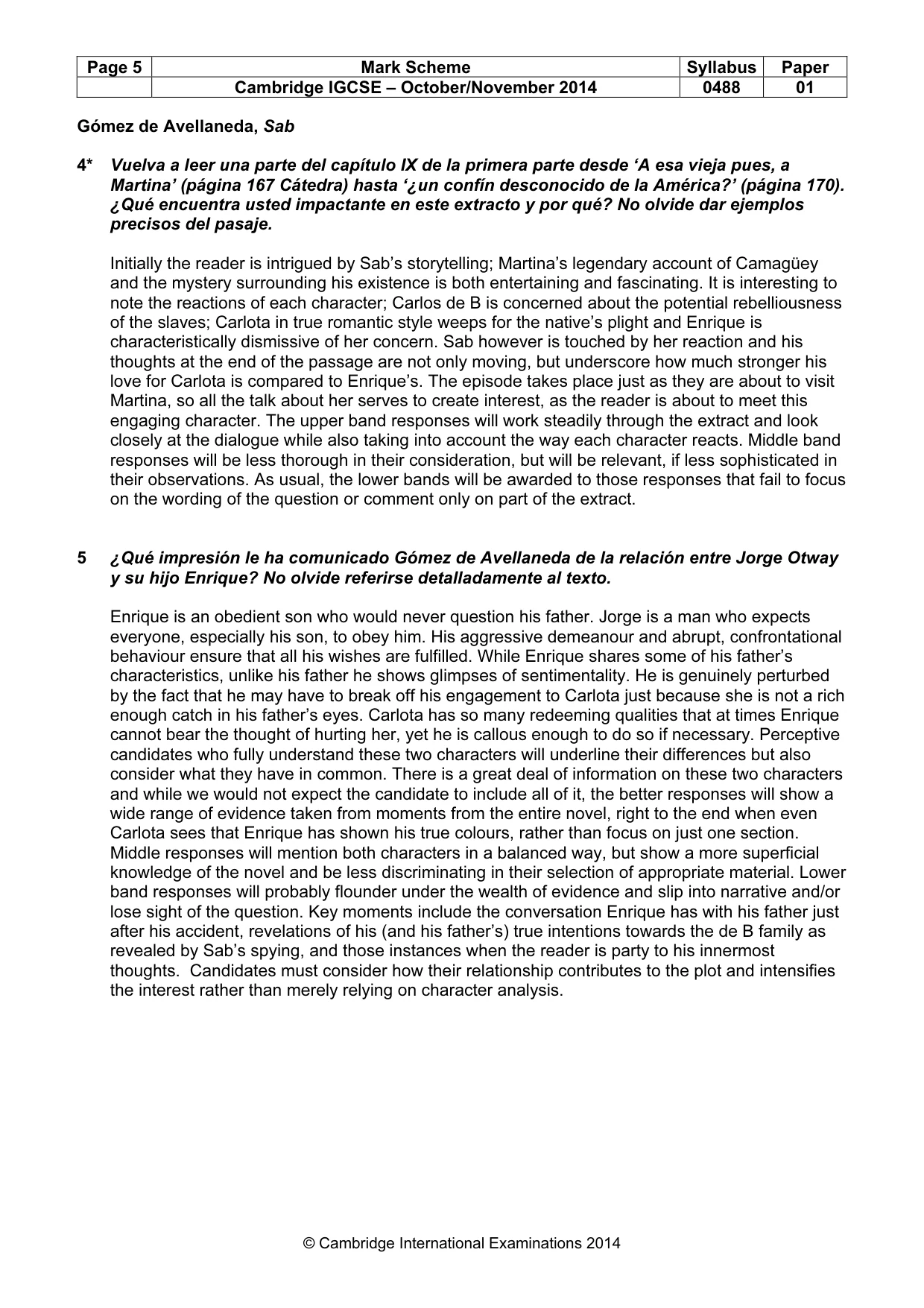
Page 5 Mark Scheme Syllabus Paper Cambridge IGCSE – October/November 2014 0488 01 © Cambridge International Examinations 2014 Gómez de Avellaneda, Sab 4* Vuelva a leer una parte del capítulo IX de la primera parte desde ‘A esa vieja pues, a Martina’ (página 167 Cátedra) hasta ‘¿un confín desconocido de la América?’ (página 170). ¿Qué encuentra usted impactante en este extracto y por qué? No olvide dar ejemplos precisos del pasaje. Initially the reader is intrigued by Sab’s storytelling; Martina’s legendary account of Camagüey and the mystery surrounding his existence is both entertaining and fascinating. It is interesting to note the reactions of each character; Carlos de B is concerned about the potential rebelliousness of the slaves; Carlota in true romantic style weeps for the native’s plight and Enrique is characteristically dismissive of her concern. Sab however is touched by her reaction and his thoughts at the end of the passage are not only moving, but underscore how much stronger his love for Carlota is compared to Enrique’s. The episode takes place just as they are about to visit Martina, so all the talk about her serves to create interest, as the reader is about to meet this engaging character. The upper band responses will work steadily through the extract and look closely at the dialogue while also taking into account the way each character reacts. Middle band responses will be less thorough in their consideration, but will be relevant, if less sophisticated in their observations. As usual, the lower bands will be awarded to those responses that fail to focus on the wording of the question or comment only on part of the extract. 5 ¿Qué impresión le ha comunicado Gómez de Avellaneda de la relación entre Jorge Otway y su hijo Enrique? No olvide referirse detalladamente al texto. Enrique is an obedient son who would never question his father. Jorge is a man who expects everyone, especially his son, to obey him. His aggressive demeanour and abrupt, confrontational behaviour ensure that all his wishes are fulfilled. While Enrique shares some of his father’s characteristics, unlike his father he shows glimpses of sentimentality. He is genuinely perturbed by the fact that he may have to break off his engagement to Carlota just because she is not a rich enough catch in his father’s eyes. Carlota has so many redeeming qualities that at times Enrique cannot bear the thought of hurting her, yet he is callous enough to do so if necessary. Perceptive candidates who fully understand these two characters will underline their differences but also consider what they have in common. There is a great deal of information on these two characters and while we would not expect the candidate to include all of it, the better responses will show a wide range of evidence taken from moments from the entire novel, right to the end when even Carlota sees that Enrique has shown his true colours, rather than focus on just one section. Middle responses will mention both characters in a balanced way, but show a more superficial knowledge of the novel and be less discriminating in their selection of appropriate material. Lower band responses will probably flounder under the wealth of evidence and slip into narrative and/or lose sight of the question. Key moments include the conversation Enrique has with his father just after his accident, revelations of his (and his father’s) true intentions towards the de B family as revealed by Sab’s spying, and those instances when the reader is party to his innermost thoughts. Candidates must consider how their relationship contributes to the plot and intensifies the interest rather than merely relying on character analysis.
Mark scheme, page 6
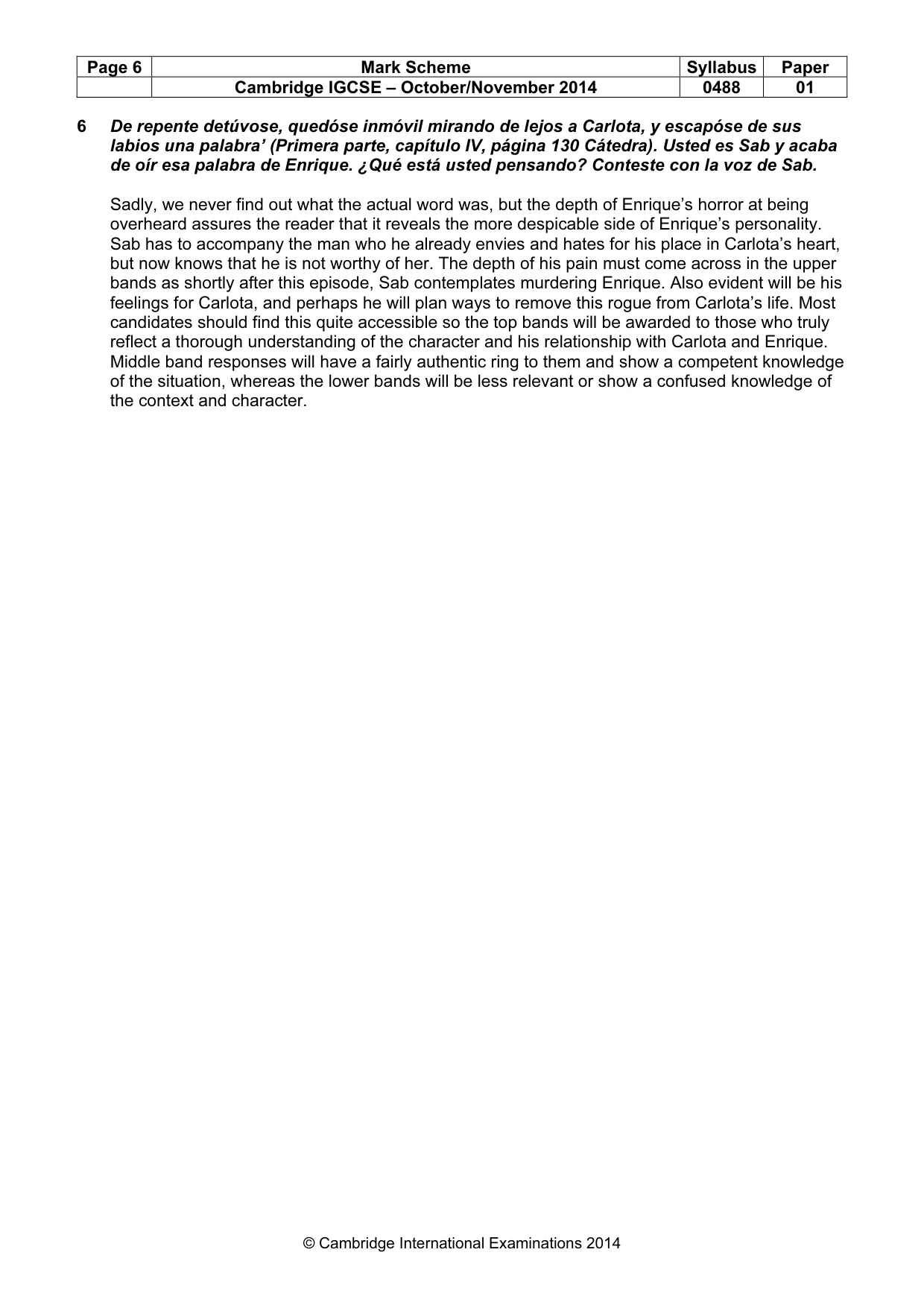
Page 6 Mark Scheme Syllabus Paper Cambridge IGCSE – October/November 2014 0488 01 © Cambridge International Examinations 2014 6 De repente detúvose, quedóse inmóvil mirando de lejos a Carlota, y escapóse de sus labios una palabra’ (Primera parte, capítulo IV, página 130 Cátedra). Usted es Sab y acaba de oír esa palabra de Enrique. ¿Qué está usted pensando? Conteste con la voz de Sab. Sadly, we never find out what the actual word was, but the depth of Enrique’s horror at being overheard assures the reader that it reveals the more despicable side of Enrique’s personality. Sab has to accompany the man who he already envies and hates for his place in Carlota’s heart, but now knows that he is not worthy of her. The depth of his pain must come across in the upper bands as shortly after this episode, Sab contemplates murdering Enrique. Also evident will be his feelings for Carlota, and perhaps he will plan ways to remove this rogue from Carlota’s life. Most candidates should find this quite accessible so the top bands will be awarded to those who truly reflect a thorough understanding of the character and his relationship with Carlota and Enrique. Middle band responses will have a fairly authentic ring to them and show a competent knowledge of the situation, whereas the lower bands will be less relevant or show a confused knowledge of the context and character.
Mark scheme, page 7
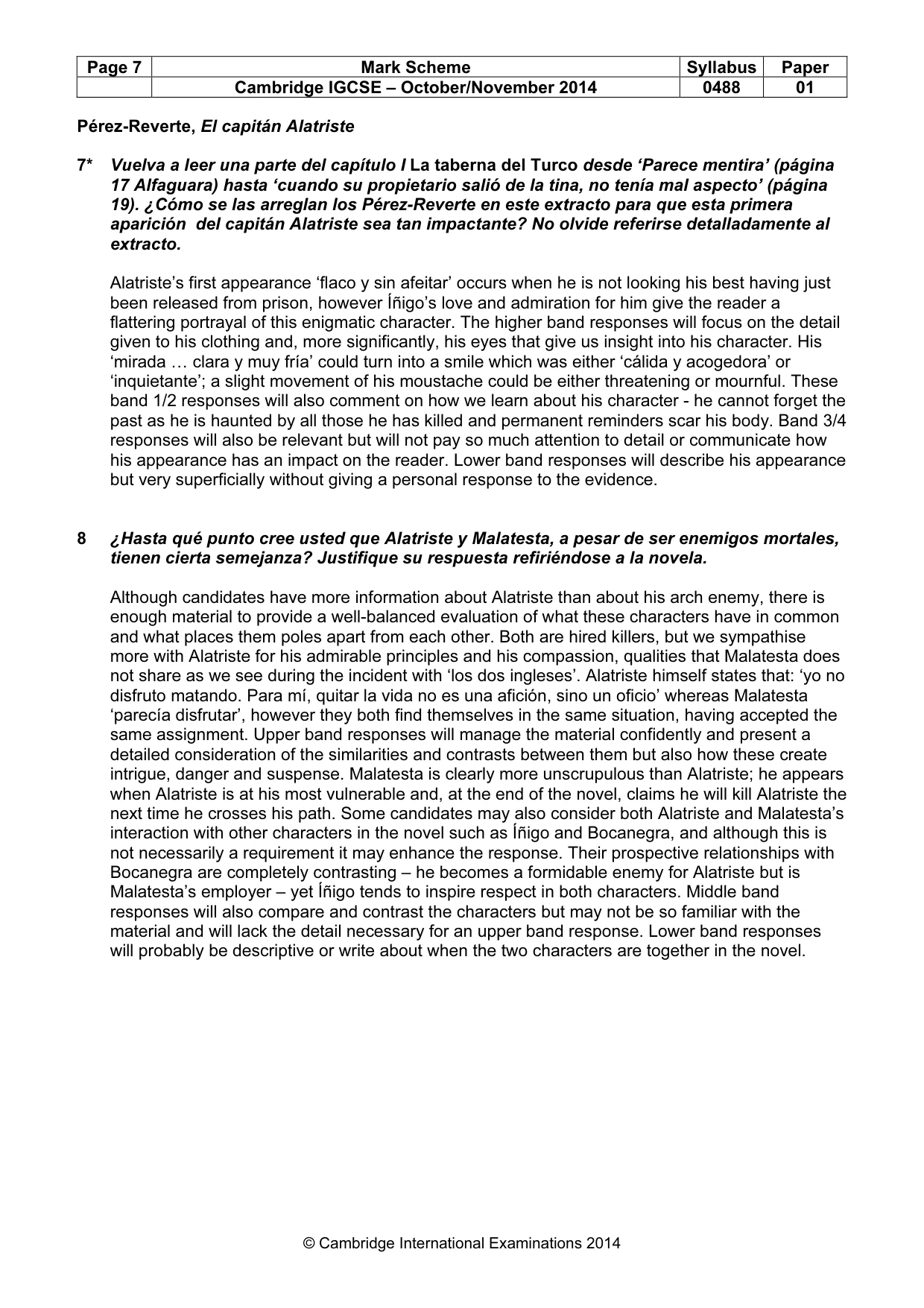
Page 7 Mark Scheme Syllabus Paper Cambridge IGCSE – October/November 2014 0488 01 © Cambridge International Examinations 2014 Pérez-Reverte, El capitán Alatriste 7* Vuelva a leer una parte del capítulo I La taberna del Turco desde ‘Parece mentira’ (página 17 Alfaguara) hasta ‘cuando su propietario salió de la tina, no tenía mal aspecto’ (página 19). ¿Cómo se las arreglan los Pérez-Reverte en este extracto para que esta primera aparición del capitán Alatriste sea tan impactante? No olvide referirse detalladamente al extracto. Alatriste’s first appearance ‘flaco y sin afeitar’ occurs when he is not looking his best having just been released from prison, however Íñigo’s love and admiration for him give the reader a flattering portrayal of this enigmatic character. The higher band responses will focus on the detail given to his clothing and, more significantly, his eyes that give us insight into his character. His ‘mirada … clara y muy fría’ could turn into a smile which was either ‘cálida y acogedora’ or ‘inquietante’; a slight movement of his moustache could be either threatening or mournful. These band 1/2 responses will also comment on how we learn about his character - he cannot forget the past as he is haunted by all those he has killed and permanent reminders scar his body. Band 3/4 responses will also be relevant but will not pay so much attention to detail or communicate how his appearance has an impact on the reader. Lower band responses will describe his appearance but very superficially without giving a personal response to the evidence. 8 ¿Hasta qué punto cree usted que Alatriste y Malatesta, a pesar de ser enemigos mortales, tienen cierta semejanza? Justifique su respuesta refiriéndose a la novela. Although candidates have more information about Alatriste than about his arch enemy, there is enough material to provide a well-balanced evaluation of what these characters have in common and what places them poles apart from each other. Both are hired killers, but we sympathise more with Alatriste for his admirable principles and his compassion, qualities that Malatesta does not share as we see during the incident with ‘los dos ingleses’. Alatriste himself states that: ‘yo no disfruto matando. Para mí, quitar la vida no es una afición, sino un oficio’ whereas Malatesta ‘parecía disfrutar’, however they both find themselves in the same situation, having accepted the same assignment. Upper band responses will manage the material confidently and present a detailed consideration of the similarities and contrasts between them but also how these create intrigue, danger and suspense. Malatesta is clearly more unscrupulous than Alatriste; he appears when Alatriste is at his most vulnerable and, at the end of the novel, claims he will kill Alatriste the next time he crosses his path. Some candidates may also consider both Alatriste and Malatesta’s interaction with other characters in the novel such as Íñigo and Bocanegra, and although this is not necessarily a requirement it may enhance the response. Their prospective relationships with Bocanegra are completely contrasting – he becomes a formidable enemy for Alatriste but is Malatesta’s employer – yet Íñigo tends to inspire respect in both characters. Middle band responses will also compare and contrast the characters but may not be so familiar with the material and will lack the detail necessary for an upper band response. Lower band responses will probably be descriptive or write about when the two characters are together in the novel.
Mark scheme, page 8
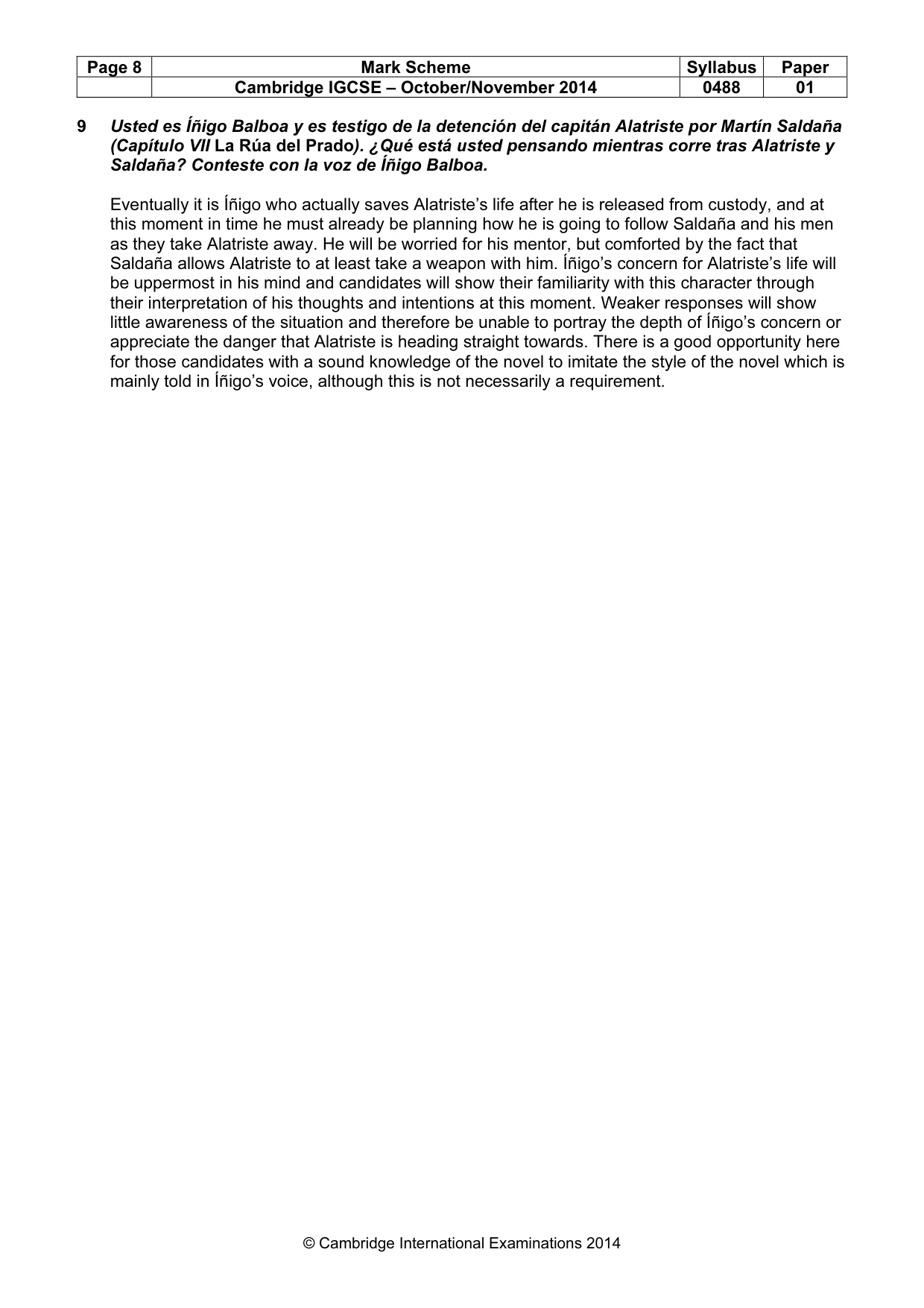
Page 8 Mark Scheme Syllabus Paper Cambridge IGCSE – October/November 2014 0488 01 © Cambridge International Examinations 2014 9 Usted es Íñigo Balboa y es testigo de la detención del capitán Alatriste por Martín Saldaña (Capítulo VII La Rúa del Prado). ¿Qué está usted pensando mientras corre tras Alatriste y Saldaña? Conteste con la voz de Íñigo Balboa. Eventually it is Íñigo who actually saves Alatriste’s life after he is released from custody, and at this moment in time he must already be planning how he is going to follow Saldaña and his men as they take Alatriste away. He will be worried for his mentor, but comforted by the fact that Saldaña allows Alatriste to at least take a weapon with him. Íñigo’s concern for Alatriste’s life will be uppermost in his mind and candidates will show their familiarity with this character through their interpretation of his thoughts and intentions at this moment. Weaker responses will show little awareness of the situation and therefore be unable to portray the depth of Íñigo’s concern or appreciate the danger that Alatriste is heading straight towards. There is a good opportunity here for those candidates with a sound knowledge of the novel to imitate the style of the novel which is mainly told in Íñigo’s voice, although this is not necessarily a requirement.
Mark scheme, page 9
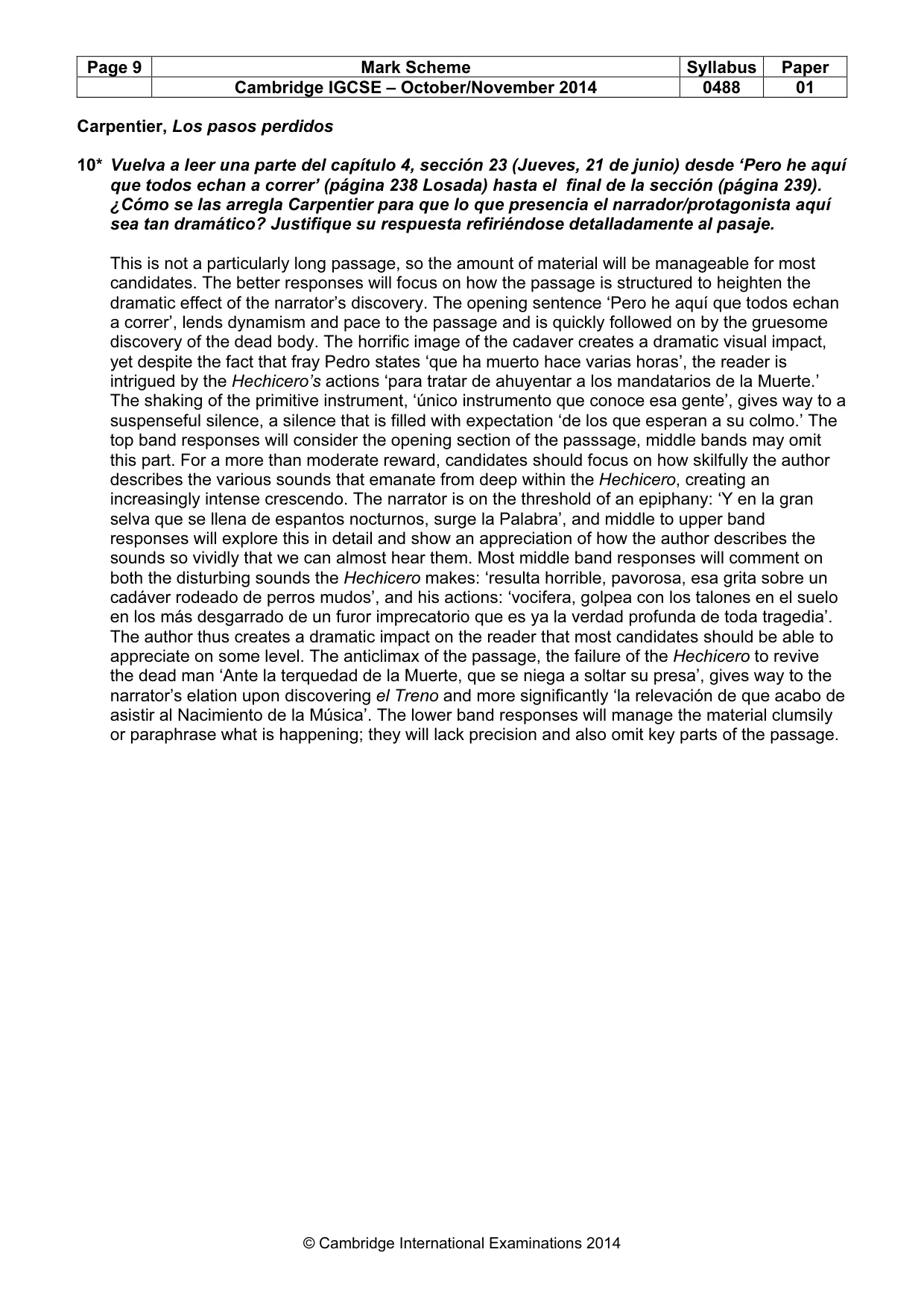
Page 9 Mark Scheme Syllabus Paper Cambridge IGCSE – October/November 2014 0488 01 © Cambridge International Examinations 2014 Carpentier, Los pasos perdidos 10* Vuelva a leer una parte del capítulo 4, sección 23 (Jueves, 21 de junio) desde ‘Pero he aquí que todos echan a correr’ (página 238 Losada) hasta el final de la sección (página 239). ¿Cómo se las arregla Carpentier para que lo que presencia el narrador/protagonista aquí sea tan dramático? Justifique su respuesta refiriéndose detalladamente al pasaje. This is not a particularly long passage, so the amount of material will be manageable for most candidates. The better responses will focus on how the passage is structured to heighten the dramatic effect of the narrator’s discovery. The opening sentence ‘Pero he aquí que todos echan a correr’, lends dynamism and pace to the passage and is quickly followed on by the gruesome discovery of the dead body. The horrific image of the cadaver creates a dramatic visual impact, yet despite the fact that fray Pedro states ‘que ha muerto hace varias horas’, the reader is intrigued by the Hechicero’s actions ‘para tratar de ahuyentar a los mandatarios de la Muerte.’ The shaking of the primitive instrument, ‘único instrumento que conoce esa gente’, gives way to a suspenseful silence, a silence that is filled with expectation ‘de los que esperan a su colmo.’ The top band responses will consider the opening section of the passsage, middle bands may omit this part. For a more than moderate reward, candidates should focus on how skilfully the author describes the various sounds that emanate from deep within the Hechicero, creating an increasingly intense crescendo. The narrator is on the threshold of an epiphany: ‘Y en la gran selva que se llena de espantos nocturnos, surge la Palabra’, and middle to upper band responses will explore this in detail and show an appreciation of how the author describes the sounds so vividly that we can almost hear them. Most middle band responses will comment on both the disturbing sounds the Hechicero makes: ‘resulta horrible, pavorosa, esa grita sobre un cadáver rodeado de perros mudos’, and his actions: ‘vocifera, golpea con los talones en el suelo en los más desgarrado de un furor imprecatorio que es ya la verdad profunda de toda tragedia’. The author thus creates a dramatic impact on the reader that most candidates should be able to appreciate on some level. The anticlimax of the passage, the failure of the Hechicero to revive the dead man ‘Ante la terquedad de la Muerte, que se niega a soltar su presa’, gives way to the narrator’s elation upon discovering el Treno and more significantly ‘la relevación de que acabo de asistir al Nacimiento de la Música’. The lower band responses will manage the material clumsily or paraphrase what is happening; they will lack precision and also omit key parts of the passage.
Mark scheme, page 10
Page 10 Mark Scheme Syllabus Paper Cambridge IGCSE – October/November 2014 0488 01 © Cambridge International Examinations 2014 11 ¿Hasta qué punto simpatiza usted con la decisión de Rosario de iniciar una relación con Marcos en Santa Mónica de los Venados? Justifique su respuesta refiriéndose detalladamente al texto. Rosario probably started the relationship with Marcos because she never expected the narrator to come back in the first place, and most responses will probably understand her decision and sympathise with her reasons for making it. Rosario was clearly hurt and humiliated by the narrator’s exit from her life in such a dramatic fashion, in front of the whole village. From Marcos’ point of view, he surely has seized an opportunity to form a family; as for Rosario, Marcos seems to represent everything the narrator is not. He is the one to shoot Nicasio when the narrator could not, and the narrator is the one to leave the jungle when there is a chance to return to civilisation whereas Marcos has dedicated his life to following his father’s dream of building a community in the middle of the jungle. Rosario was always perplexed at the narrator’s ‘civilised’ pastimes such as composing music when no one in the jungle is ever going to hear it, yet Marcos is the son of the village’s founder and it is highly unlikely he is going leave her. Although her relationship with the protagonist was serious, she has talked of past relationships and never wants to marry as this gives the man control over her life; perhaps candidates will draw the conclusion that she pretty much suits herself as to whom she has a relationship with, or could conclude that she becomes intimate with Marcos on the ‘rebound’ to make up for being abandoned. More significant is that she is expecting a child with Marcos and this is what obligates the narrator to accept that there is no point in trying to rekindle the relationship. Whichever reasons the candidate considers as the motive behind Rosario’s decision, the discriminator will lie in how convincingly the candidate conveys the extent to which he or she sympathises with Rosario’s decision. The answer must be expressed clearly and fully supported with evidence from the text for the upper bands to be considered. These answers will also be totally relevant. A middle band response will show a fairly good knowledge of the novel and familiarity with the characters but will not be as far ranging as a band 1/2 response. Weaker responses will probably struggle to argue coherently as they lack an in depth knowledge of the novel. 12 ‘Al fin terminó la colada de sangre, y el torso se vino adelante sobre la yerba mojada. De súbito arreció la lluvia y fue la noche. Era Marcos, ahora, quien llevaba el fusil.’ (Capítulo 5, sección 32, página 297 Losada). Usted es el narrador/protagonista y Marcos acaba de disparar a Nicasio. ¿Qué está usted pensando? This is one of the few moments when we are not a party to the narrator’s thoughts, so there is no danger of weaker candidates paraphrasing any part of the novel. The narrator was unable to shoot Nicasio and is probably horrified that he has witnessed a murder, yet relieved that Nicasio can no longer appear at the village and scare both him and Rosario. The better responses will also recall that Nicasio has been shot for raping a young girl, and although this is a barbaric act, the narrator may feel that justice has been served. The narrator may also feel admiration (or envy?) as he was unable to fire the weapon whereas Marcos did not hesitate. The top band responses will stand out as being those that sound genuinely like the narrator and understand the context of the question completely. The middle band responses may not be so convincing but they will have an element of authenticity. The lower band responses will be brief and mostly irrelevant showing little awareness of the situation, a lack of familiarity with the novel and few convincing thoughts.
Mark scheme, page 11
Page 11 Mark Scheme Syllabus Paper Cambridge IGCSE – October/November 2014 0488 01 © Cambridge International Examinations 2014 TEATRO Calderón, El médico de su honra 13* Vuelva a leer el final de la PRIMERA JORNADA a partir de la acotación ‘Sale doña Leonor’ (página 118 Clásicos Castalia). ¿Cómo se las arregla Calderón para que el final de la primera jornada sea tan emocionante para el espectador? No olvide referirse detalladamente al pasaje. The curtain comes down after a fast paced series of events at the end of the Primera Jornada. The audience learns how Leonor came to lose her honour and will be surprised to discover that Arias is the one responsible for besmirching her, albeit inadvertently. The audience is captivated as Arias tries to defend Leonor’s honour and explain his actions, but Gutierre’s anger is evident. The drawing of swords on stage will create a dramatic, visual impact intensified by the king’s reaction; he imprisons Arias and Gutierre for daring to draw swords in his presence. The plot intensifies as Enrique informs the audience that he will take advantage of Gutierre’s absence to visit Mencía – a most scandalous act for an honourable man - and the audience will have a sense that this will have serious repercussions for Mencía. The Jornada ends with Leonor – whose desire to reclaim her honour brought all this about in the first place – finding herself still in the same situation: ‘¡Ay de mí! mi honor perdí;/¡ay de mí! mi muerte hallé.’ Candidates who work through the whole passage and consider the impact the words and actions have on the audience will be heading for the top bands. It is essential that the scene be considered for how it works on the stage for the upper bands to be considered. Middle band responses will be relevant but may omit some parts of the extract, however they will show an awareness of the dramatic effect. Lower band responses will summarise what is happening or omit very large parts of the passage. 14 ¿Hasta qué punto cree usted que Mencía provoca su propia muerte? No olvide referirse detalladamente al texto. Most of the dramatic scenes in the play involve Gutierre and Mencía so most candidates should have enough knowledge of the play to convey at least a superficial opinion as to whether Mencía brings about her own death. The upper band answers will maintain this focus but the middle band candidates may just write about her death without always evaluating how she may, or may not, have been responsible for her fate. On the one hand, she does herself no favours when trying to protect her honour. Despite the fact that she is completely innocent and blameless for the fact that Enrique is in her house, she unwisely attempts to deceive her husband! Not only does she claim that there is a man in her house (Enrique) but later on in the play is even caught writing him a letter. However foolish she may have been, Gutierre’s response to her behaviour is to commit a premeditated, gruesome murder and she by no means deserves to lose her life for what she has done. Middle to low band responses will probably focus their answers on the moment of her death but the higher band responses will consider Mencía’s behaviour throughout the play. Gutierre is also responsible for her behaving in this often imprudent manner; he tricks and tests her constantly instead of being direct with her. A good response will show a detailed knowledge of the play and select relevant examples of how Gutierre’s treatment of his wife also contributes to her irresponsible behaviour. Lower band responses will tend to summarise or paraphrase events instead of evaluating how she brings it all upon herself. There will also be little evidence of how the play works on the stage at the lower end of the scale.
Mark scheme, page 12
Page 12 Mark Scheme Syllabus Paper Cambridge IGCSE – October/November 2014 0488 01 © Cambridge International Examinations 2014 15 ‘REY Pues cada vez que me hiciéredes reír, cien escudos os daré; y si no me hubiereis hecho reír en término de un mes, os han de sacar los dientes’ (PRIMERA JORNADA página 111 versos 778–783 Clásicos Castalia) Usted es el rey y acaba de ofrecerle a Coquín este trato. ¿Qué está usted pensando? Conteste con la voz del rey. We never learn if the king is serious about this threat as he never has the opportunity to carry it out, so it will be interesting to see how the candidates interpret his thoughts. The contrast between the generous reward and harsh punishment he is offering reflects the king’s unpredictable nature when dealing with his subjects as we also see when he has to pass judgement on the soldiers and the old man earlier on in the play. Candidates may take whichever line they like as long as they maintain a thread of authenticity throughout the answer. The better responses may attempt to respond in verse; we have had some excellent answers imitating the style of the author in past questions although this is not a requirement. Consider for the middle band those responses that are mostly convincing and show some knowledge of the context and character. The lower band responses will stand out for their brevity and lack of understanding of both the king and this moment of the play.
Mark scheme, page 13
Page 13 Mark Scheme Syllabus Paper Cambridge IGCSE – October/November 2014 0488 01 © Cambridge International Examinations 2014 Sánchez, Barranca abajo 16* Vuelva a leer una parte del Acto Segundo, escena XVI desde ‘DON ZOILO. – ¿Qué andás queriendo vos por acá?’ (página 119 Cátedra) hasta el final de la escena XVII ‘SARGENTO (A ANICETO.) – ¡Salú, mozo! (Mutis. BATARÁ le sigue azorado)’ (página 121). ¿Cómo se las arregla el dramaturgo en este extracto para que estas escenas sean tan dramáticas? Justifique su respuesta refiriéndose detalladamente al pasaje. The passage comprises two different scenes due to the entrance of Batará but should pose no problems for candidates. The better responses, band 1 or 2, will work through both scenes and consider how Zoilo’s arrest is dramatic in that it is yet another humilitating step towards his loss of honour, pride and social standing. Perceptive candidates will also note the Sargento’s difficult position; his reluctance to arrest him: ‘Este…vengo a citarlo’ as he is torn between his respect towards Zoilo and his duty as a policeman: ‘Vaya a saber uno…Lo mandan y va.’ Zoilo´s shock at realising he is about to be taken away is compounded by the fact that his arrest takes place in front of his family and acquaintances. Candidates who offer detailed responses will consider the reactions of the other characters on stage at this moment. The Sargento’s attempt to calm Zoilo down: ‘Cuestión de un rato. Venga no más’, does little to cool Zoilo’s indignation and his temper which is contrastingly (and deliberately?) provoked by Ña Martiniana’s encouragement: ‘Bé de ir no más a las güenas. ¿Qué saca con resistir a la autoridad?’. Zoilo’s last desperate attempts to command the respect he deserves: ‘¿Vos sabés quién soy yo? İDon Zoilo Carabajal…!’ are defeated with a simple: ‘Aura es el viejo Zoilo, como dicen todos.’ This marks a turning point for Zoilo and middle band responses may only focus on the lengthy speeches that Zoilo gives from this moment on. Better responses will consider the audience’s reaction to the events in both scenes but will also mention Zoilo’s touching concern for his daughter; as he is escorted off stage he turns to Aniceto, possibly the only person sorry to see him go, and says: ‘Si tardo, cuidame mucho a la gurisa…que la pobrecita no está nada bien’. Lower band responses will omit most of the scenes and have little detailed evaluation, whereas middle to upper band responses will consider most of the ideas set out above. 17 ‘Una persona bien intencionada y respetable.’ ‘Una mala persona, una entrometida.’ ¿Cuál de estas dos opinones sobre Ña Martiniana está más cerca de la de usted? Justifique su respuesta refiriéndose detalladamente al texto. Free to argue either interpretation of Ña Martiniana´s character, candidates will reach the top bands by looking at both aspects and presenting evidence before drawing a logical conclusion. They will also show a good knowledge of this character without reproducing a prelearnt character sketch, and the entire answer will be relevant. Band 1/2 responses will also be familiar with her appearances in the play and evaluate her contribution to the plot. They will be aware of how she orchestrates several attempts to get the women away from Zoilo and never speaks of him in a good light. She is an entertaining character in her manner and form of speaking, however her actions can be looked at from different points of view; she could be judged to be underhand,or a good friend to the women she helps. Middle band responses will keep sight of the question and show a less detailed knowledge of the text or use the material with less sophistication. Lower band responses will be rarely take into account the audience’s reaction to Martiniana and will be less focused on the specific words of the question.
Mark scheme, page 14
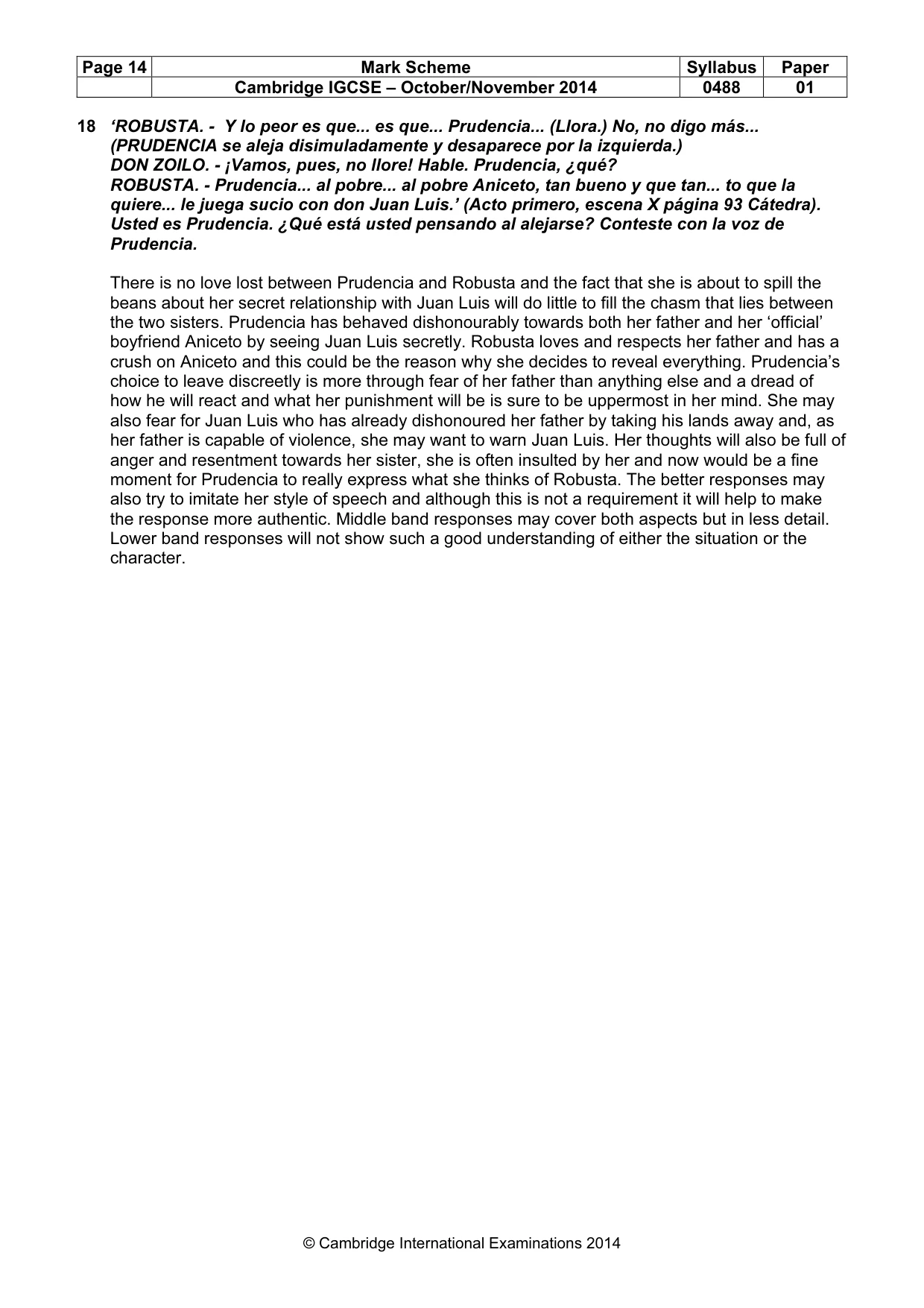
Page 14 Mark Scheme Syllabus Paper Cambridge IGCSE – October/November 2014 0488 01 © Cambridge International Examinations 2014 18 ‘ROBUSTA. - Y lo peor es que... es que... Prudencia... (Llora.) No, no digo más... (PRUDENCIA se aleja disimuladamente y desaparece por la izquierda.) DON ZOILO. - ¡Vamos, pues, no llore! Hable. Prudencia, ¿qué? ROBUSTA. - Prudencia... al pobre... al pobre Aniceto, tan bueno y que tan... to que la quiere... le juega sucio con don Juan Luis.’ (Acto primero, escena X página 93 Cátedra). Usted es Prudencia. ¿Qué está usted pensando al alejarse? Conteste con la voz de Prudencia. There is no love lost between Prudencia and Robusta and the fact that she is about to spill the beans about her secret relationship with Juan Luis will do little to fill the chasm that lies between the two sisters. Prudencia has behaved dishonourably towards both her father and her ‘official’ boyfriend Aniceto by seeing Juan Luis secretly. Robusta loves and respects her father and has a crush on Aniceto and this could be the reason why she decides to reveal everything. Prudencia’s choice to leave discreetly is more through fear of her father than anything else and a dread of how he will react and what her punishment will be is sure to be uppermost in her mind. She may also fear for Juan Luis who has already dishonoured her father by taking his lands away and, as her father is capable of violence, she may want to warn Juan Luis. Her thoughts will also be full of anger and resentment towards her sister, she is often insulted by her and now would be a fine moment for Prudencia to really express what she thinks of Robusta. The better responses may also try to imitate her style of speech and although this is not a requirement it will help to make the response more authentic. Middle band responses may cover both aspects but in less detail. Lower band responses will not show such a good understanding of either the situation or the character.
Mark scheme, page 15
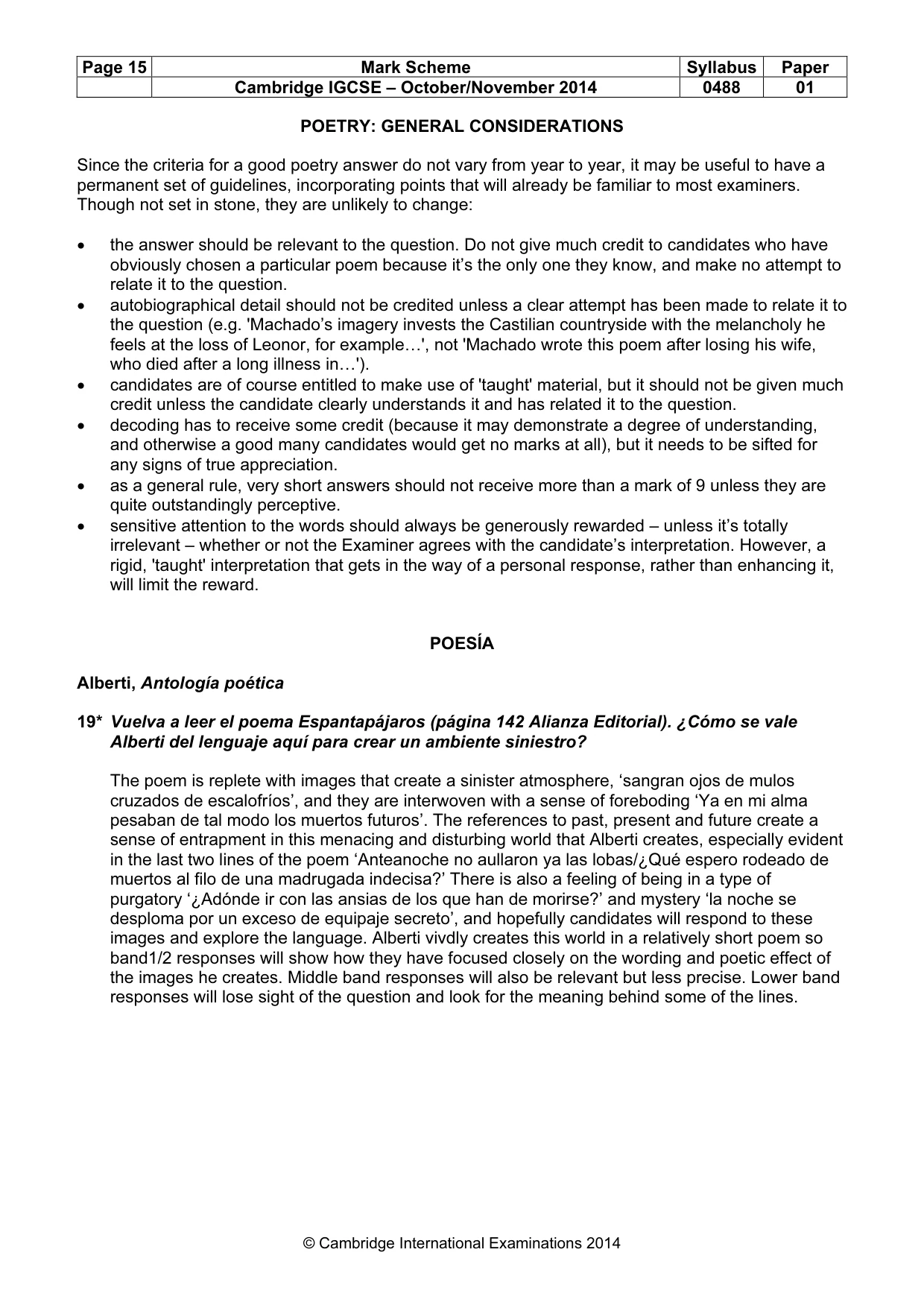
Page 15 Mark Scheme Syllabus Paper Cambridge IGCSE – October/November 2014 0488 01 © Cambridge International Examinations 2014 POETRY: GENERAL CONSIDERATIONS Since the criteria for a good poetry answer do not vary from year to year, it may be useful to have a permanent set of guidelines, incorporating points that will already be familiar to most examiners. Though not set in stone, they are unlikely to change: • the answer should be relevant to the question. Do not give much credit to candidates who have obviously chosen a particular poem because it’s the only one they know, and make no attempt to relate it to the question. • autobiographical detail should not be credited unless a clear attempt has been made to relate it to the question (e.g. 'Machado’s imagery invests the Castilian countryside with the melancholy he feels at the loss of Leonor, for example…', not 'Machado wrote this poem after losing his wife, who died after a long illness in…'). • candidates are of course entitled to make use of 'taught' material, but it should not be given much credit unless the candidate clearly understands it and has related it to the question. • decoding has to receive some credit (because it may demonstrate a degree of understanding, and otherwise a good many candidates would get no marks at all), but it needs to be sifted for any signs of true appreciation. • as a general rule, very short answers should not receive more than a mark of 9 unless they are quite outstandingly perceptive. • sensitive attention to the words should always be generously rewarded – unless it’s totally irrelevant – whether or not the Examiner agrees with the candidate’s interpretation. However, a rigid, 'taught' interpretation that gets in the way of a personal response, rather than enhancing it, will limit the reward. POESÍA Alberti, Antología poética 19* Vuelva a leer el poema Espantapájaros (página 142 Alianza Editorial). ¿Cómo se vale Alberti del lenguaje aquí para crear un ambiente siniestro? The poem is replete with images that create a sinister atmosphere, ‘sangran ojos de mulos cruzados de escalofríos’, and they are interwoven with a sense of foreboding ‘Ya en mi alma pesaban de tal modo los muertos futuros’. The references to past, present and future create a sense of entrapment in this menacing and disturbing world that Alberti creates, especially evident in the last two lines of the poem ‘Anteanoche no aullaron ya las lobas/¿Qué espero rodeado de muertos al filo de una madrugada indecisa?’ There is also a feeling of being in a type of purgatory ‘¿Adónde ir con las ansias de los que han de morirse?’ and mystery ‘la noche se desploma por un exceso de equipaje secreto’, and hopefully candidates will respond to these images and explore the language. Alberti vivdly creates this world in a relatively short poem so band1/2 responses will show how they have focused closely on the wording and poetic effect of the images he creates. Middle band responses will also be relevant but less precise. Lower band responses will lose sight of the question and look for the meaning behind some of the lines.
Mark scheme, page 16
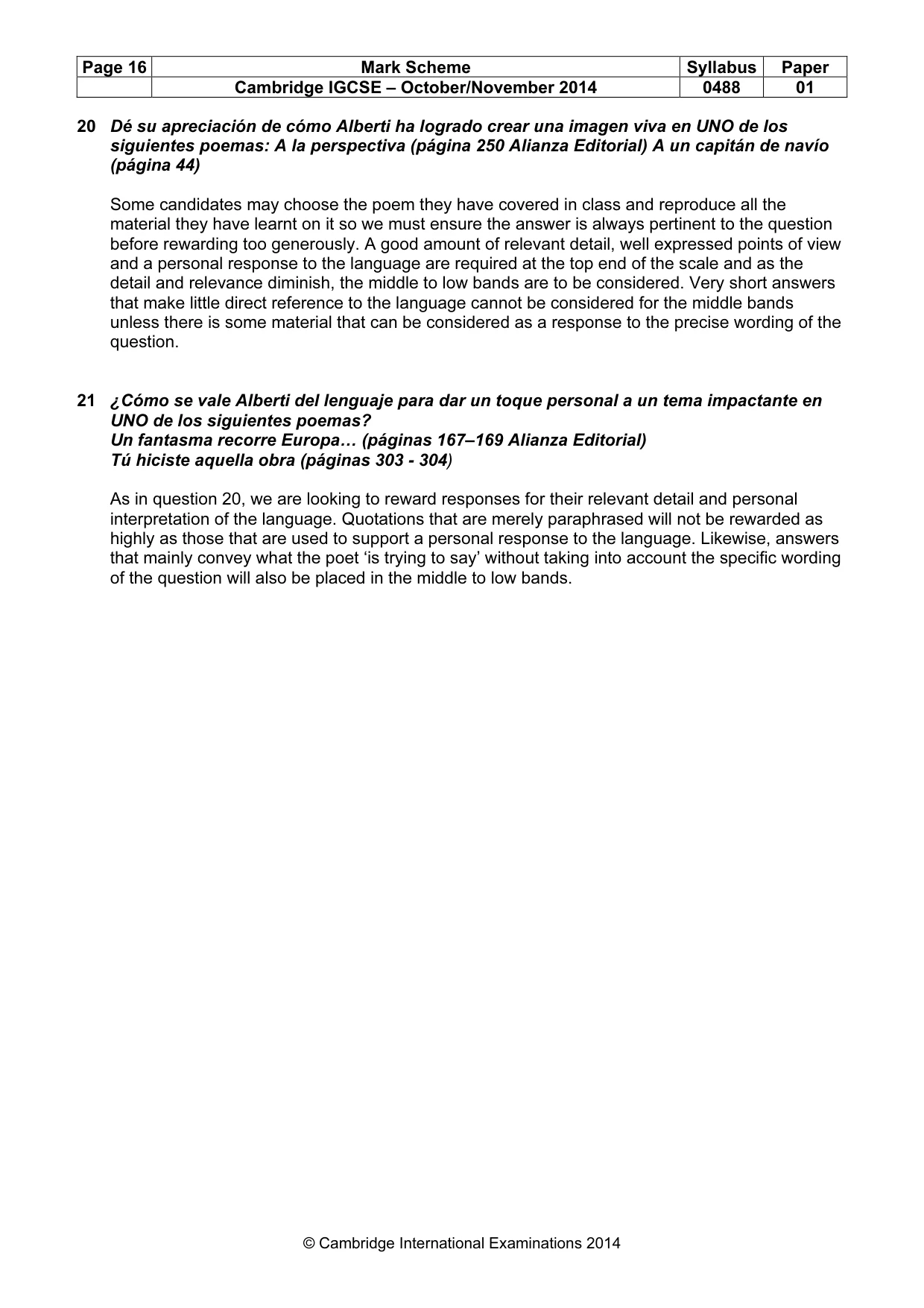
Page 16 Mark Scheme Syllabus Paper Cambridge IGCSE – October/November 2014 0488 01 © Cambridge International Examinations 2014 20 Dé su apreciación de cómo Alberti ha logrado crear una imagen viva en UNO de los siguientes poemas: A la perspectiva (página 250 Alianza Editorial) A un capitán de navío (página 44) Some candidates may choose the poem they have covered in class and reproduce all the material they have learnt on it so we must ensure the answer is always pertinent to the question before rewarding too generously. A good amount of relevant detail, well expressed points of view and a personal response to the language are required at the top end of the scale and as the detail and relevance diminish, the middle to low bands are to be considered. Very short answers that make little direct reference to the language cannot be considered for the middle bands unless there is some material that can be considered as a response to the precise wording of the question. 21 ¿Cómo se vale Alberti del lenguaje para dar un toque personal a un tema impactante en UNO de los siguientes poemas? Un fantasma recorre Europa… (páginas 167–169 Alianza Editorial) Tú hiciste aquella obra (páginas 303 - 304) As in question 20, we are looking to reward responses for their relevant detail and personal interpretation of the language. Quotations that are merely paraphrased will not be rewarded as highly as those that are used to support a personal response to the language. Likewise, answers that mainly convey what the poet ‘is trying to say’ without taking into account the specific wording of the question will also be placed in the middle to low bands.
Mark scheme, page 17
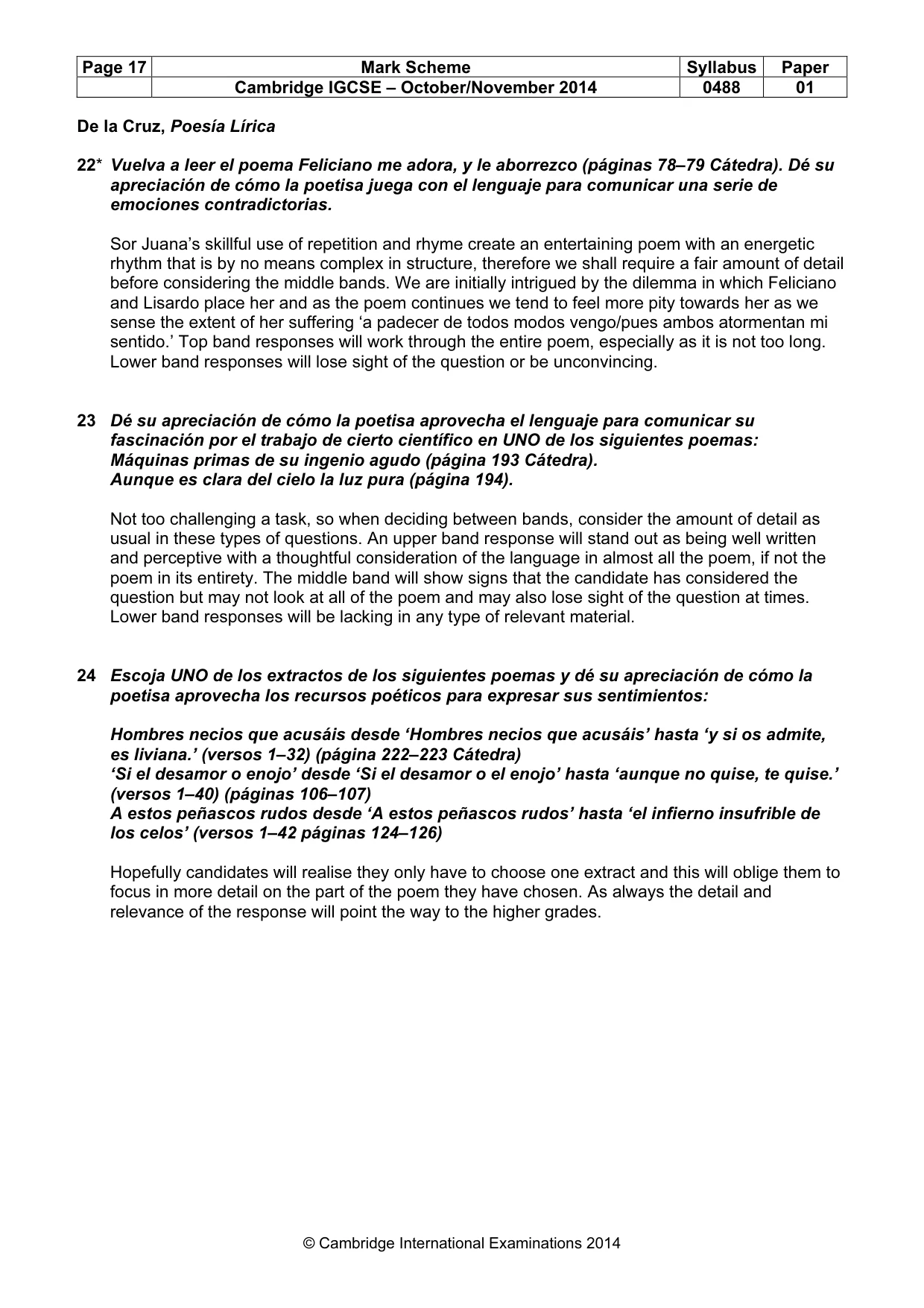
Page 17 Mark Scheme Syllabus Paper Cambridge IGCSE – October/November 2014 0488 01 © Cambridge International Examinations 2014 De la Cruz, Poesía Lírica 22* Vuelva a leer el poema Feliciano me adora, y le aborrezco (páginas 78–79 Cátedra). Dé su apreciación de cómo la poetisa juega con el lenguaje para comunicar una serie de emociones contradictorias. Sor Juana’s skillful use of repetition and rhyme create an entertaining poem with an energetic rhythm that is by no means complex in structure, therefore we shall require a fair amount of detail before considering the middle bands. We are initially intrigued by the dilemma in which Feliciano and Lisardo place her and as the poem continues we tend to feel more pity towards her as we sense the extent of her suffering ‘a padecer de todos modos vengo/pues ambos atormentan mi sentido.’ Top band responses will work through the entire poem, especially as it is not too long. Lower band responses will lose sight of the question or be unconvincing. 23 Dé su apreciación de cómo la poetisa aprovecha el lenguaje para comunicar su fascinación por el trabajo de cierto científico en UNO de los siguientes poemas: Máquinas primas de su ingenio agudo (página 193 Cátedra). Aunque es clara del cielo la luz pura (página 194). Not too challenging a task, so when deciding between bands, consider the amount of detail as usual in these types of questions. An upper band response will stand out as being well written and perceptive with a thoughtful consideration of the language in almost all the poem, if not the poem in its entirety. The middle band will show signs that the candidate has considered the question but may not look at all of the poem and may also lose sight of the question at times. Lower band responses will be lacking in any type of relevant material. 24 Escoja UNO de los extractos de los siguientes poemas y dé su apreciación de cómo la poetisa aprovecha los recursos poéticos para expresar sus sentimientos: Hombres necios que acusáis desde ‘Hombres necios que acusáis’ hasta ‘y si os admite, es liviana.’ (versos 1–32) (página 222–223 Cátedra) ‘Si el desamor o enojo’ desde ‘Si el desamor o el enojo’ hasta ‘aunque no quise, te quise.’ (versos 1–40) (páginas 106–107) A estos peñascos rudos desde ‘A estos peñascos rudos’ hasta ‘el infierno insufrible de los celos’ (versos 1–42 páginas 124–126) Hopefully candidates will realise they only have to choose one extract and this will oblige them to focus in more detail on the part of the poem they have chosen. As always the detail and relevance of the response will point the way to the higher grades.
What you needed in this session
Cambridge’s own grade thresholds for 2014 Oct/Nov, Paper 1 · Variant 1. A higher threshold means an easier paper — the bar moves with how the cohort did.