Cambridge IGCSE Sciences - Co-ordinated (Double) 0654 — 2015 Oct/Nov Paper 2 · Variant 1
0654/21/O/N/15 · 120 marks · ≈135 min
The question paper and its mark scheme, free to read here and free to download. This is Cambridge’s own paper, exactly as it was sat.
Question paper32 pages



Mark scheme8 pages
Answers below. Sit the paper first if you are practising.
Paper as text
Question paper, page 1
This document consists of 31 printed pages and 1 blank page. DC (AC/SG) 102988/4 © UCLES 2015 [Turn over * 8 9 7 6 0 3 5 0 8 9 * CO-ORDINATED SCIENCES 0654/21 Paper 2 (Core) October/November 2015 2 hours Candidates answer on the Question Paper. No Additional Materials are required. READ THESE INSTRUCTIONS FIRST Write your Centre number, candidate number and name on all the work you hand in. Write in dark blue or black pen. You may use an HB pencil for any diagrams, graphs, tables or rough working. Do not use staples, paper clips, glue or correction fluid. DO NOT WRITE IN ANY BARCODES. Answer all questions. Electronic calculators may be used. You may lose marks if you do not show your working or if you do not use appropriate units. A copy of the Periodic Table is printed on page 32. At the end of the examination, fasten all your work securely together. The number of marks is given in brackets [ ] at the end of each question or part question. Cambridge International Examinations Cambridge International General Certificate of Secondary Education
Question paper, page 2
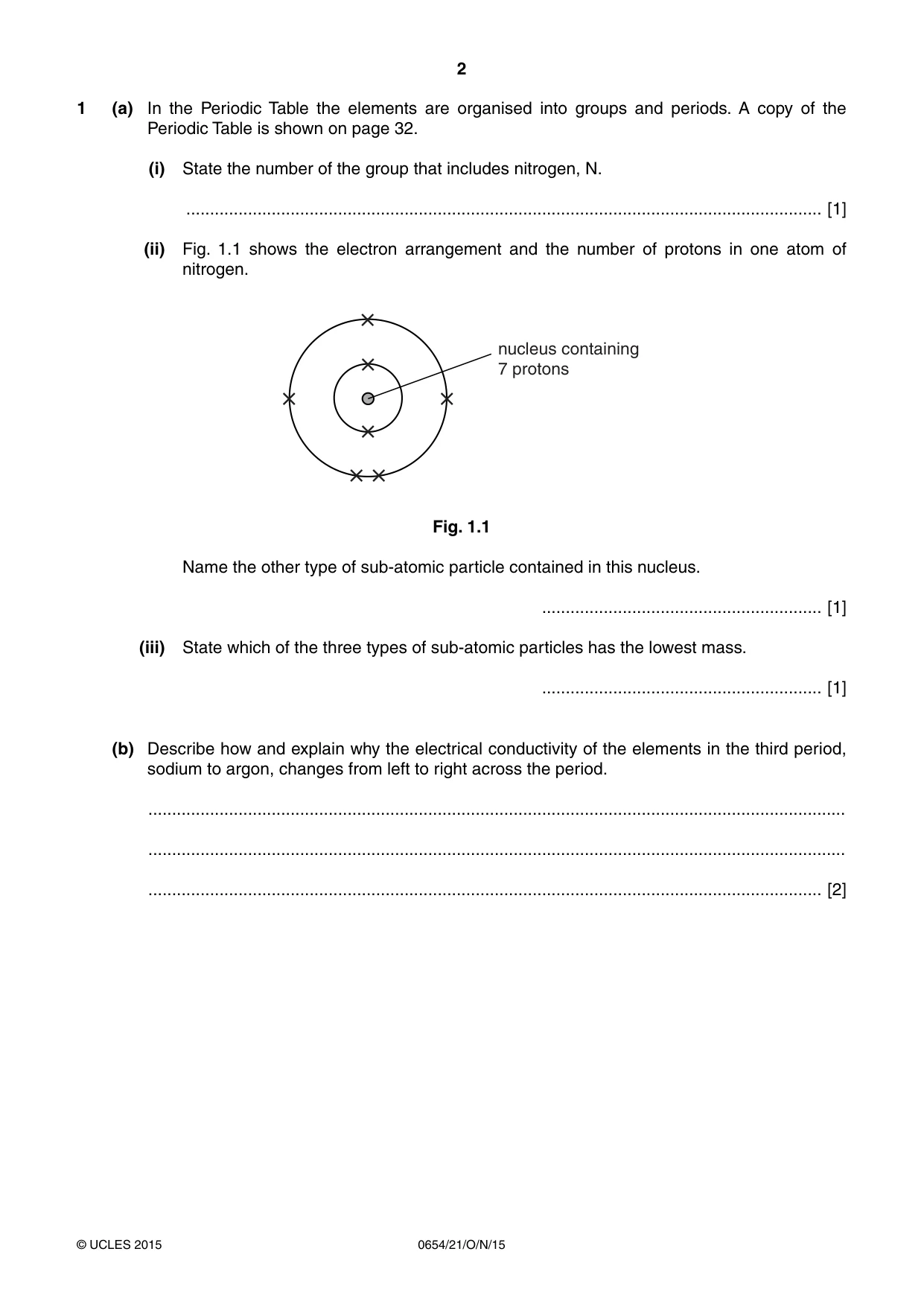
2 0654/21/O/N/15 © UCLES 2015 1 (a) In the Periodic Table the elements are organised into groups and periods. A copy of the Periodic Table is shown on page 32. (i) State the number of the group that includes nitrogen, N. … [1] (ii) Fig. 1.1 shows the electron arrangement and the number of protons in one atom of nitrogen. × × × × × × × nucleus containing 7 protons Fig. 1.1 Name the other type of sub-atomic particle contained in this nucleus. … [1] (iii) State which of the three types of sub-atomic particles has the lowest mass. … [1] (b) Describe how and explain why the electrical conductivity of the elements in the third period, sodium to argon, changes from left to right across the period. … … … [2]
Question paper, page 3
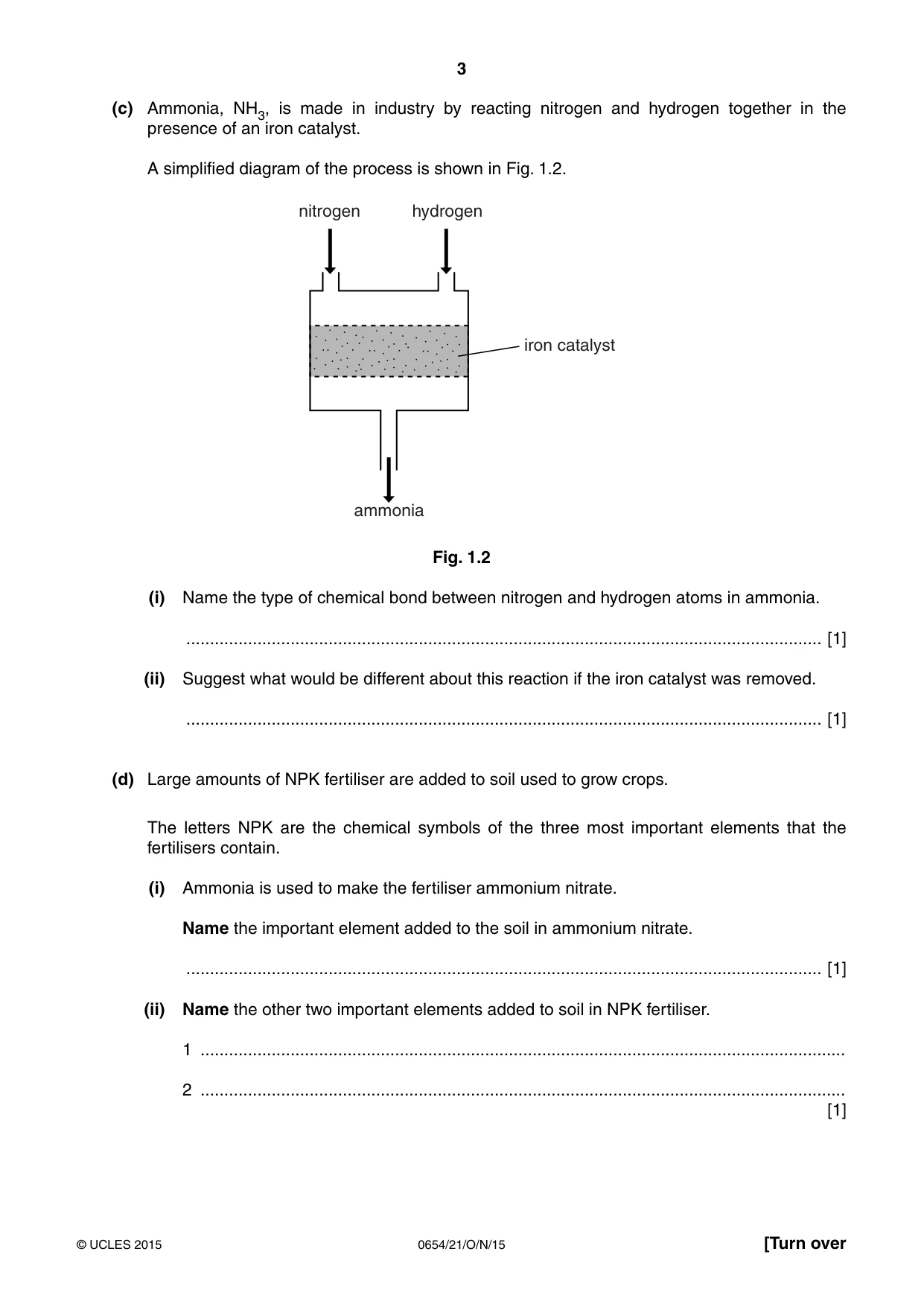
3 0654/21/O/N/15 © UCLES 2015 [Turn over (c) Ammonia, NH3, is made in industry by reacting nitrogen and hydrogen together in the presence of an iron catalyst. A simplified diagram of the process is shown in Fig. 1.2. nitrogen hydrogen iron catalyst ammonia Fig. 1.2 (i) Name the type of chemical bond between nitrogen and hydrogen atoms in ammonia. … [1] (ii) Suggest what would be different about this reaction if the iron catalyst was removed. … [1] (d) Large amounts of NPK fertiliser are added to soil used to grow crops. The letters NPK are the chemical symbols of the three most important elements that the fertilisers contain. (i) Ammonia is used to make the fertiliser ammonium nitrate. Name the important element added to the soil in ammonium nitrate. … [1] (ii) Name the other two important elements added to soil in NPK fertiliser. 1 … 2 … [1]
Question paper, page 4
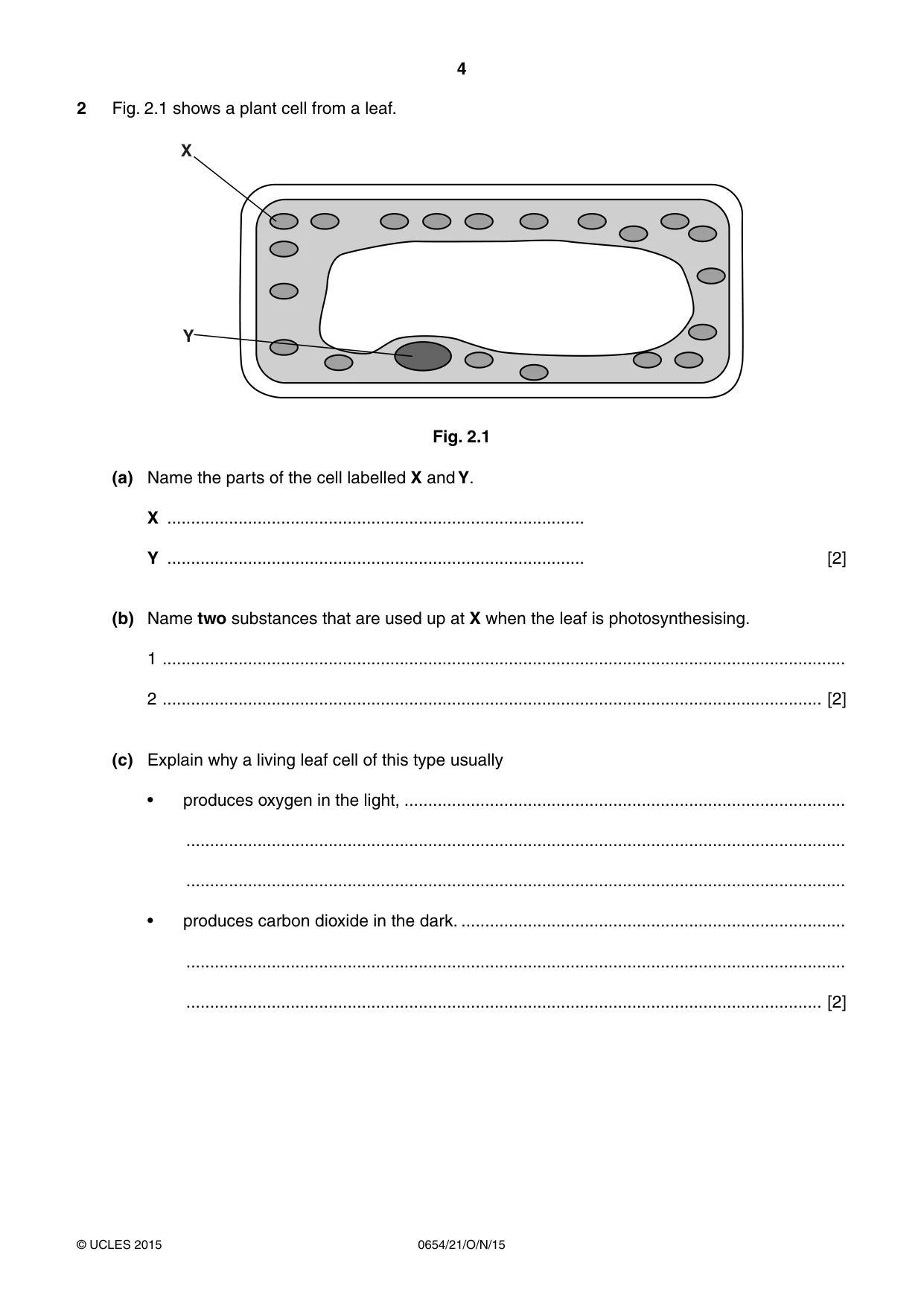
4 0654/21/O/N/15 © UCLES 2015 2 Fig. 2.1 shows a plant cell from a leaf. X Y Fig. 2.1 (a) Name the parts of the cell labelled X and Y. X … Y … [2] (b) Name two substances that are used up at X when the leaf is photosynthesising. 1 … 2 … [2] (c) Explain why a living leaf cell of this type usually • produces oxygen in the light, … … … • produces carbon dioxide in the dark. … … … [2]
Question paper, page 5
5 0654/21/O/N/15 © UCLES 2015 [Turn over (d) Leaves also contain xylem tissue. (i) State one function of xylem tissue. … [1] (ii) Explain why xylem tissue cannot photosynthesise. … … [1]
Question paper, page 6
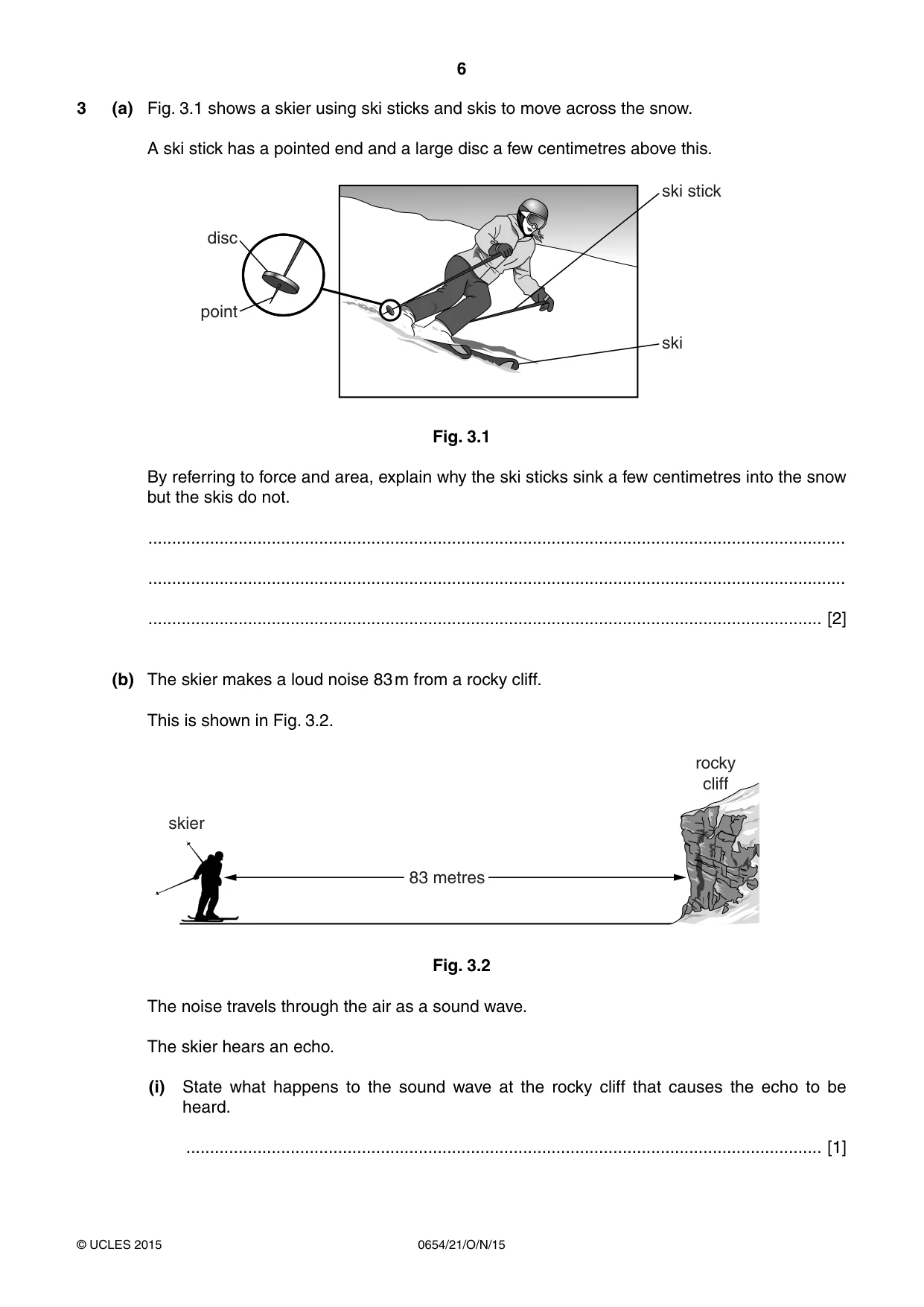
6 0654/21/O/N/15 © UCLES 2015 3 (a) Fig. 3.1 shows a skier using ski sticks and skis to move across the snow. A ski stick has a pointed end and a large disc a few centimetres above this. disc point ski stick ski Fig. 3.1 By referring to force and area, explain why the ski sticks sink a few centimetres into the snow but the skis do not. … … … [2] (b) The skier makes a loud noise 83 m from a rocky cliff. This is shown in Fig. 3.2. 83 metres rocky cliff skier Fig. 3.2 The noise travels through the air as a sound wave. The skier hears an echo. (i) State what happens to the sound wave at the rocky cliff that causes the echo to be heard. … [1]
Question paper, page 7
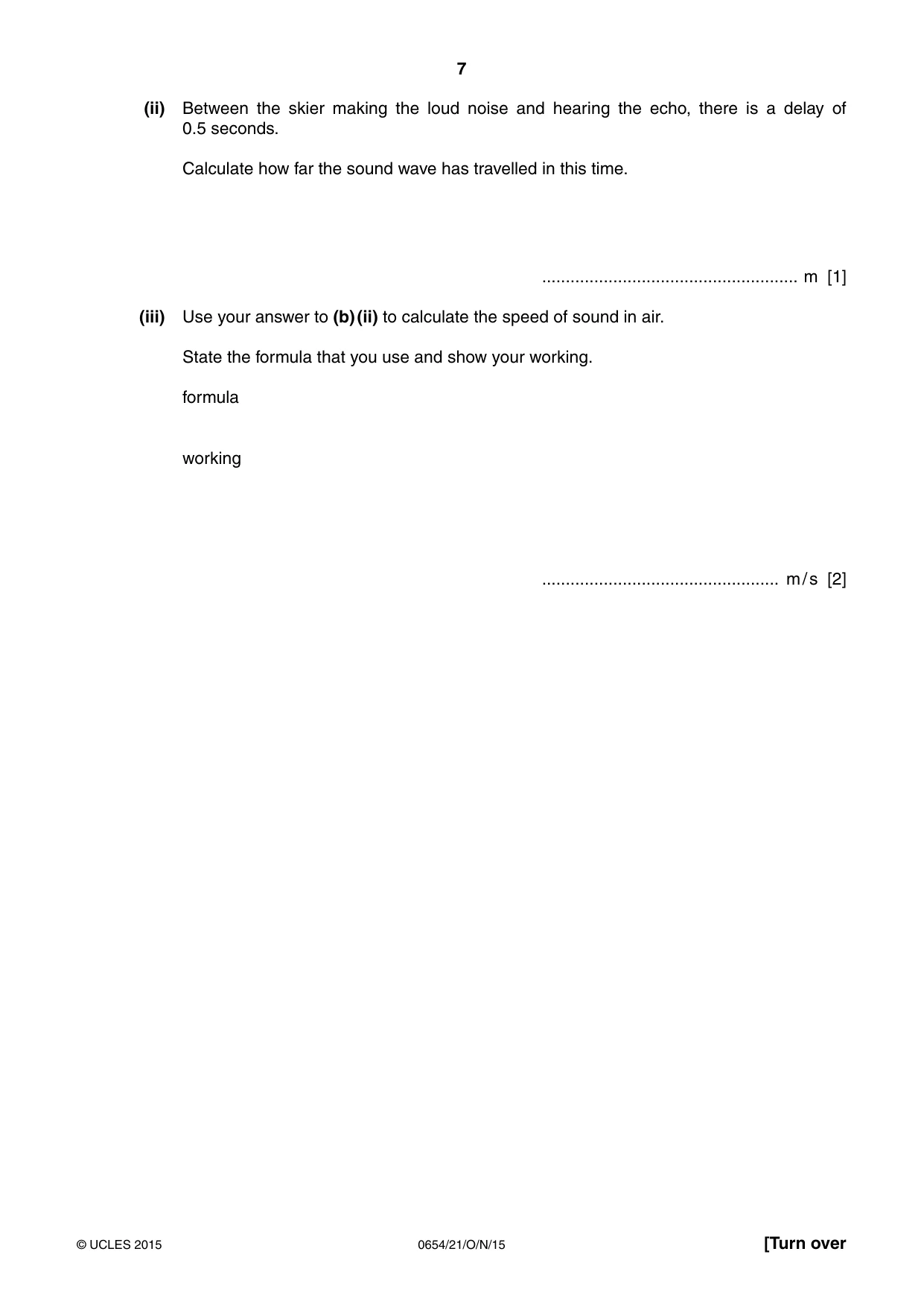
7 0654/21/O/N/15 © UCLES 2015 [Turn over (ii) Between the skier making the loud noise and hearing the echo, there is a delay of 0.5 seconds. Calculate how far the sound wave has travelled in this time. … m [1] (iii) Use your answer to (b) (ii) to calculate the speed of sound in air. State the formula that you use and show your working. formula working … m / s [2]
Question paper, page 8
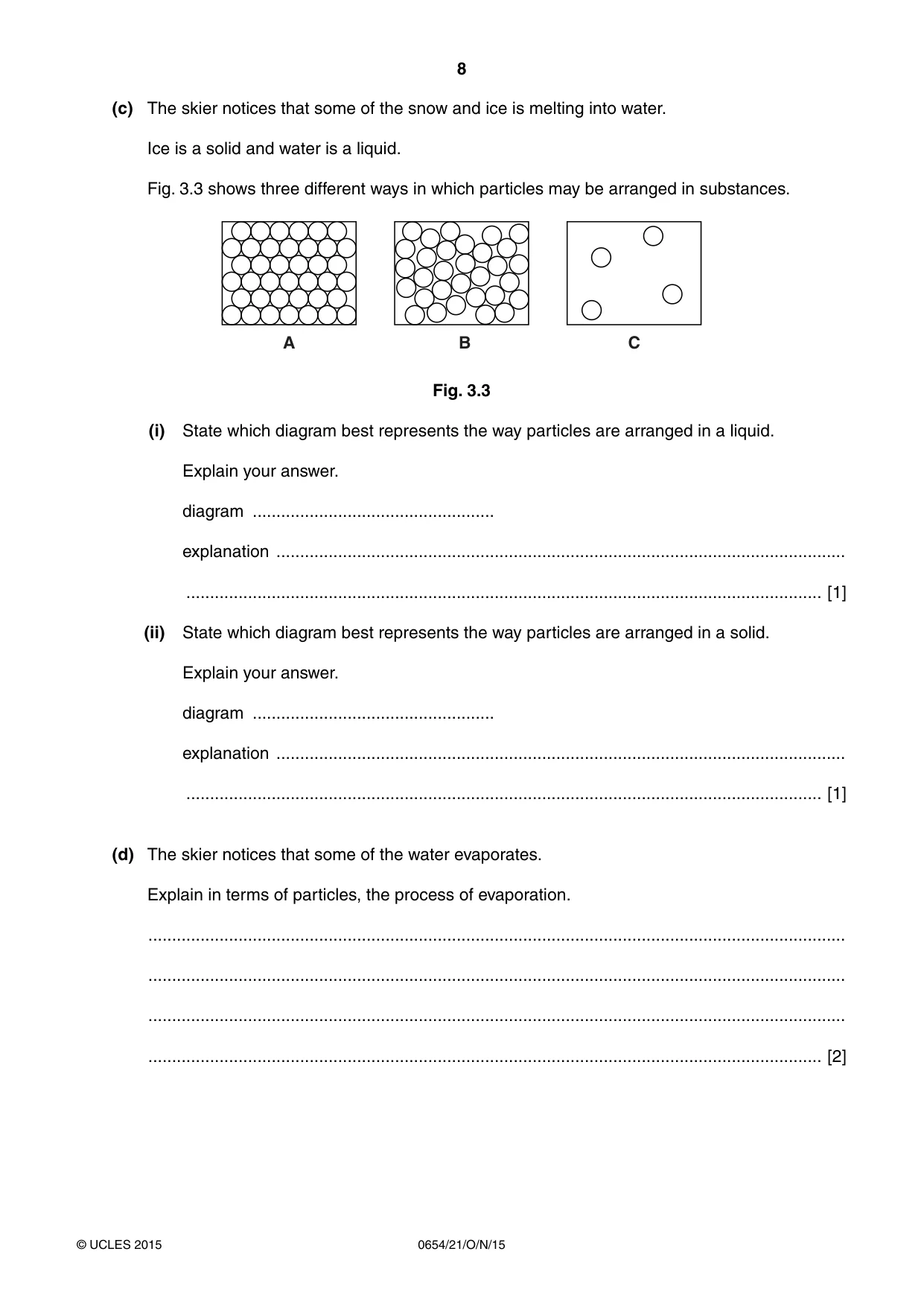
8 0654/21/O/N/15 © UCLES 2015 (c) The skier notices that some of the snow and ice is melting into water. Ice is a solid and water is a liquid. Fig. 3.3 shows three different ways in which particles may be arranged in substances. A B C Fig. 3.3 (i) State which diagram best represents the way particles are arranged in a liquid. Explain your answer. diagram … explanation … … [1] (ii) State which diagram best represents the way particles are arranged in a solid. Explain your answer. diagram … explanation … … [1] (d) The skier notices that some of the water evaporates. Explain in terms of particles, the process of evaporation. … … … … [2]
Question paper, page 9
9 0654/21/O/N/15 © UCLES 2015 [Turn over Please turn over for Question 4.
Question paper, page 10
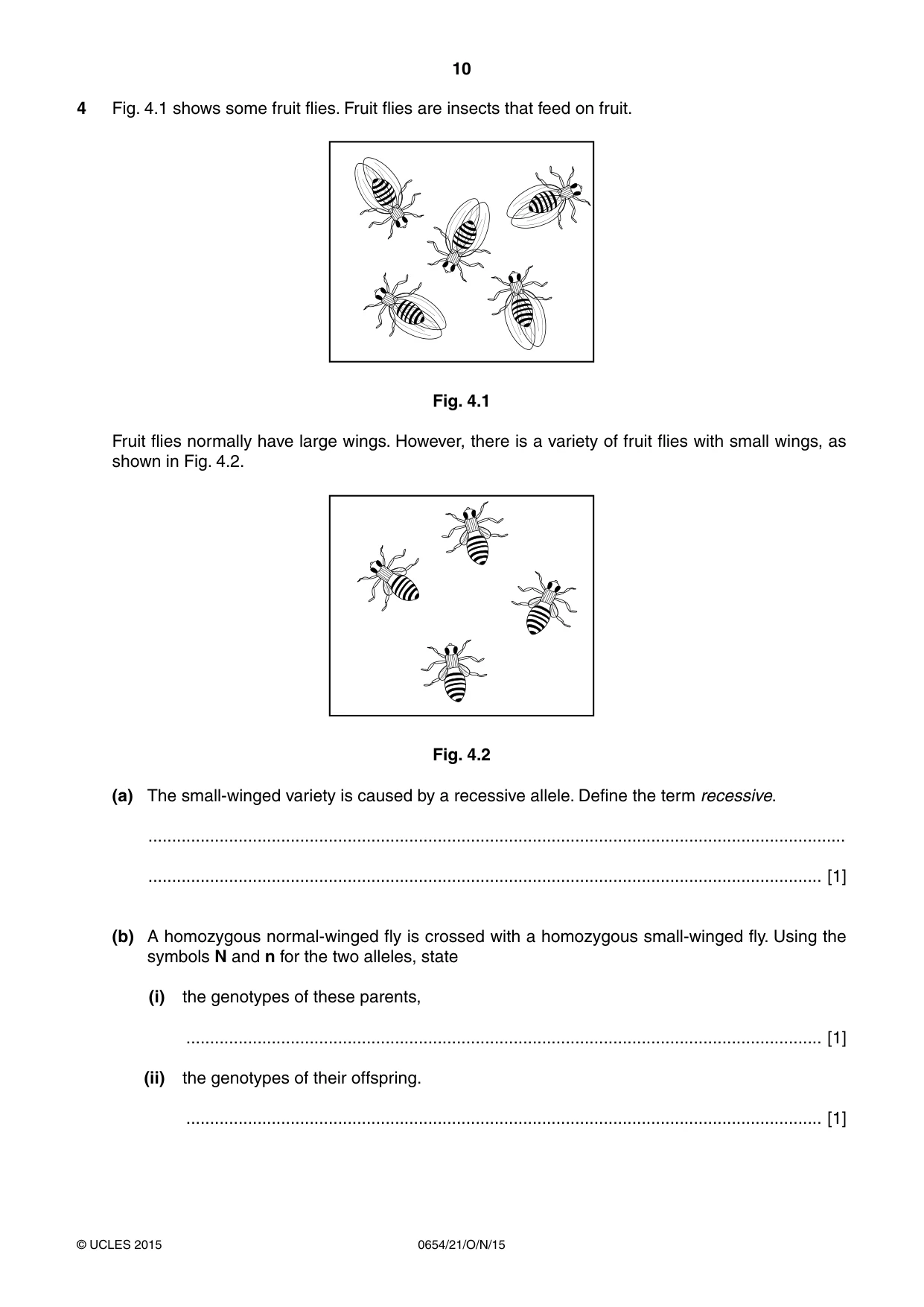
10 0654/21/O/N/15 © UCLES 2015 4 Fig. 4.1 shows some fruit flies. Fruit flies are insects that feed on fruit. Fig. 4.1 Fruit flies normally have large wings. However, there is a variety of fruit flies with small wings, as shown in Fig. 4.2. Fig. 4.2 (a) The small-winged variety is caused by a recessive allele. Define the term recessive. … … [1] (b) A homozygous normal-winged fly is crossed with a homozygous small-winged fly. Using the symbols N and n for the two alleles, state (i) the genotypes of these parents, … [1] (ii) the genotypes of their offspring. … [1]
Question paper, page 11
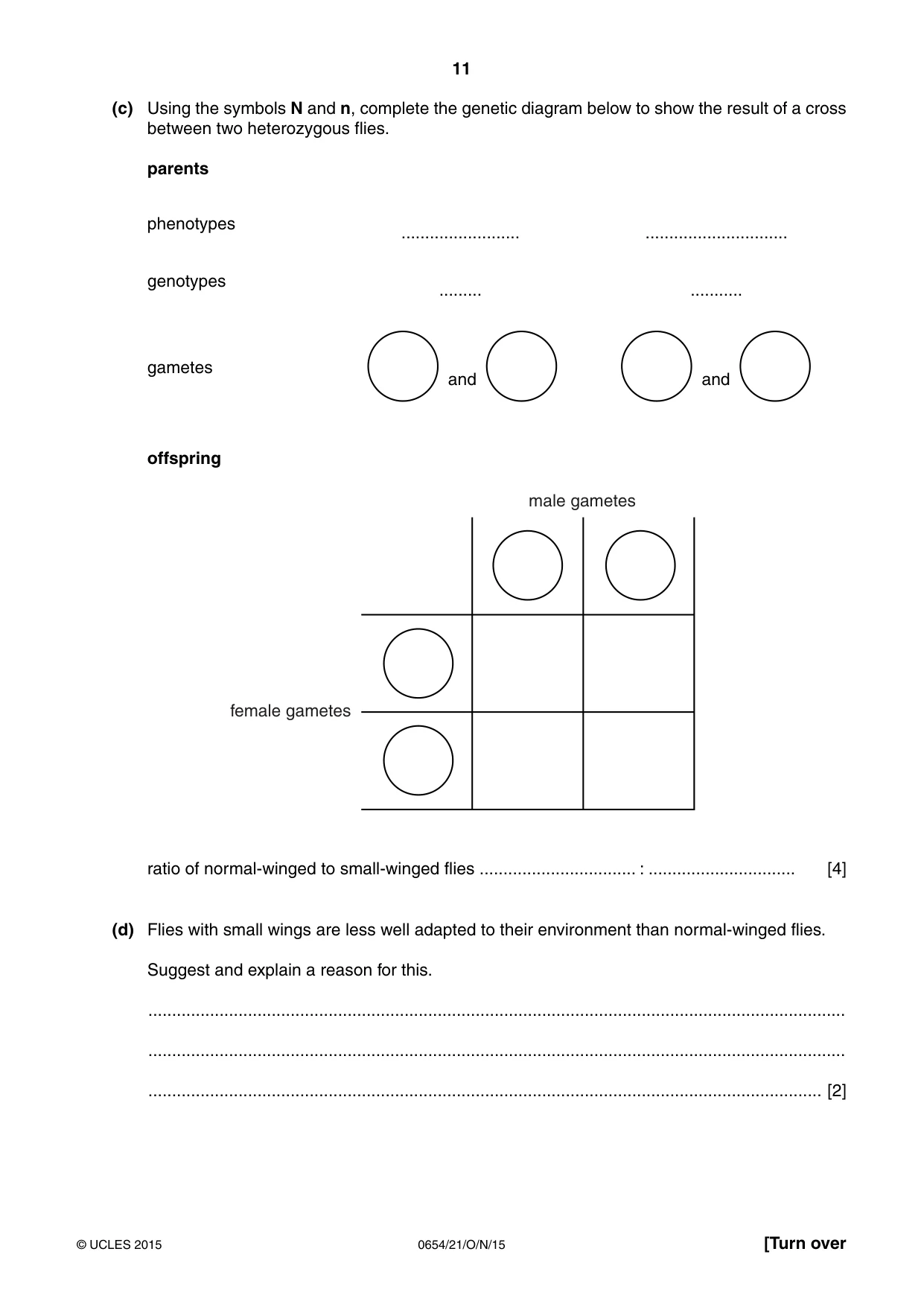
11 0654/21/O/N/15 © UCLES 2015 [Turn over (c) Using the symbols N and n, complete the genetic diagram below to show the result of a cross between two heterozygous flies. parents phenotypes … … genotypes … … gametes and and offspring male gametes female gametes ratio of normal-winged to small-winged flies … : … [4] (d) Flies with small wings are less well adapted to their environment than normal-winged flies. Suggest and explain a reason for this. … … … [2]
Question paper, page 12
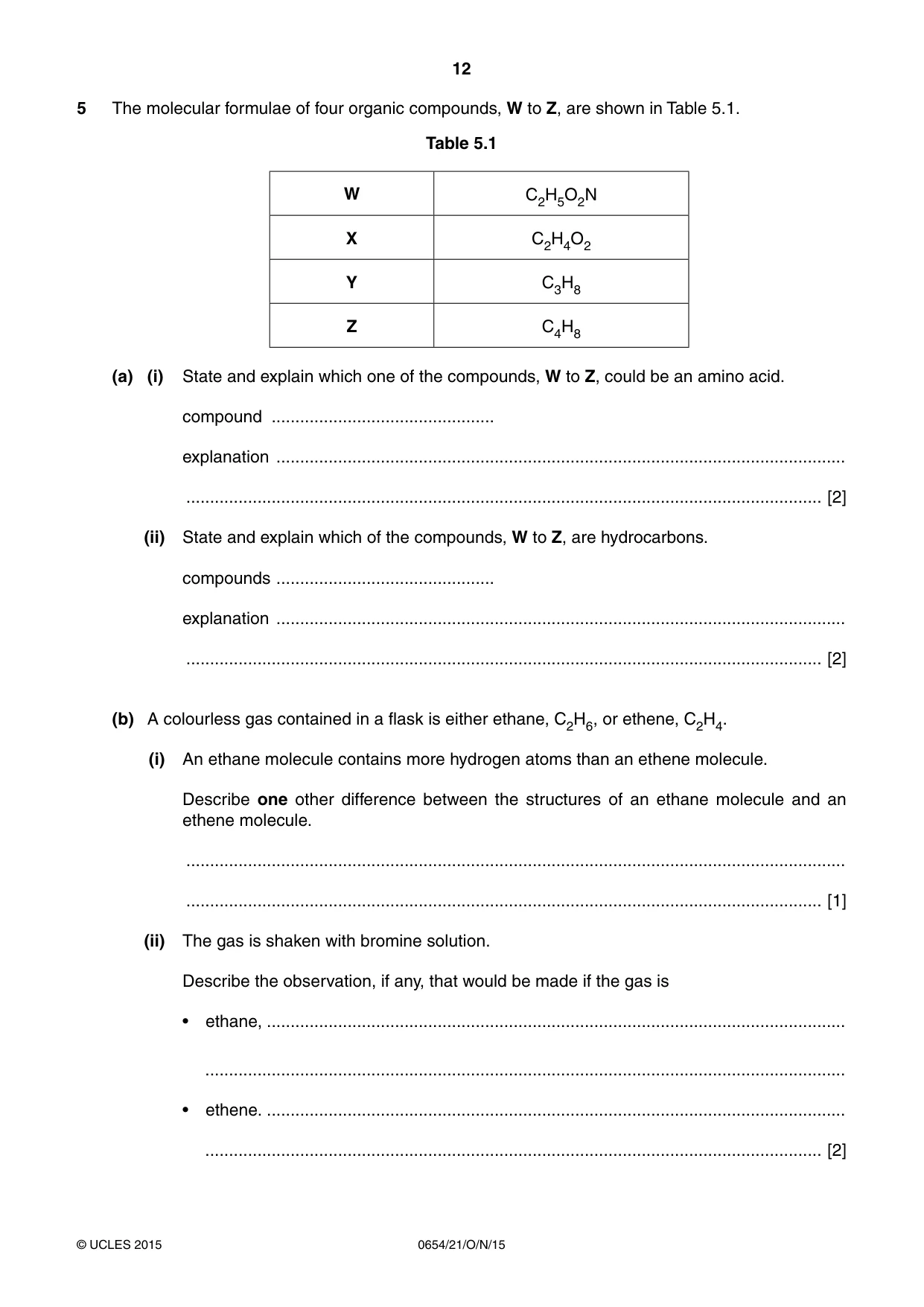
12 0654/21/O/N/15 © UCLES 2015 5 The molecular formulae of four organic compounds, W to Z, are shown in Table 5.1. Table 5.1 W C2H5O2N X C2H4O2 Y C3H8 Z C4H8 (a) (i) State and explain which one of the compounds, W to Z, could be an amino acid. compound … explanation … … [2] (ii) State and explain which of the compounds, W to Z, are hydrocarbons. compounds … explanation … … [2] (b) A colourless gas contained in a flask is either ethane, C2H6, or ethene, C2H4. (i) An ethane molecule contains more hydrogen atoms than an ethene molecule. Describe one other difference between the structures of an ethane molecule and an ethene molecule. … … [1] (ii) The gas is shaken with bromine solution. Describe the observation, if any, that would be made if the gas is • ethane, … … • ethene. … … [2]
Question paper, page 13
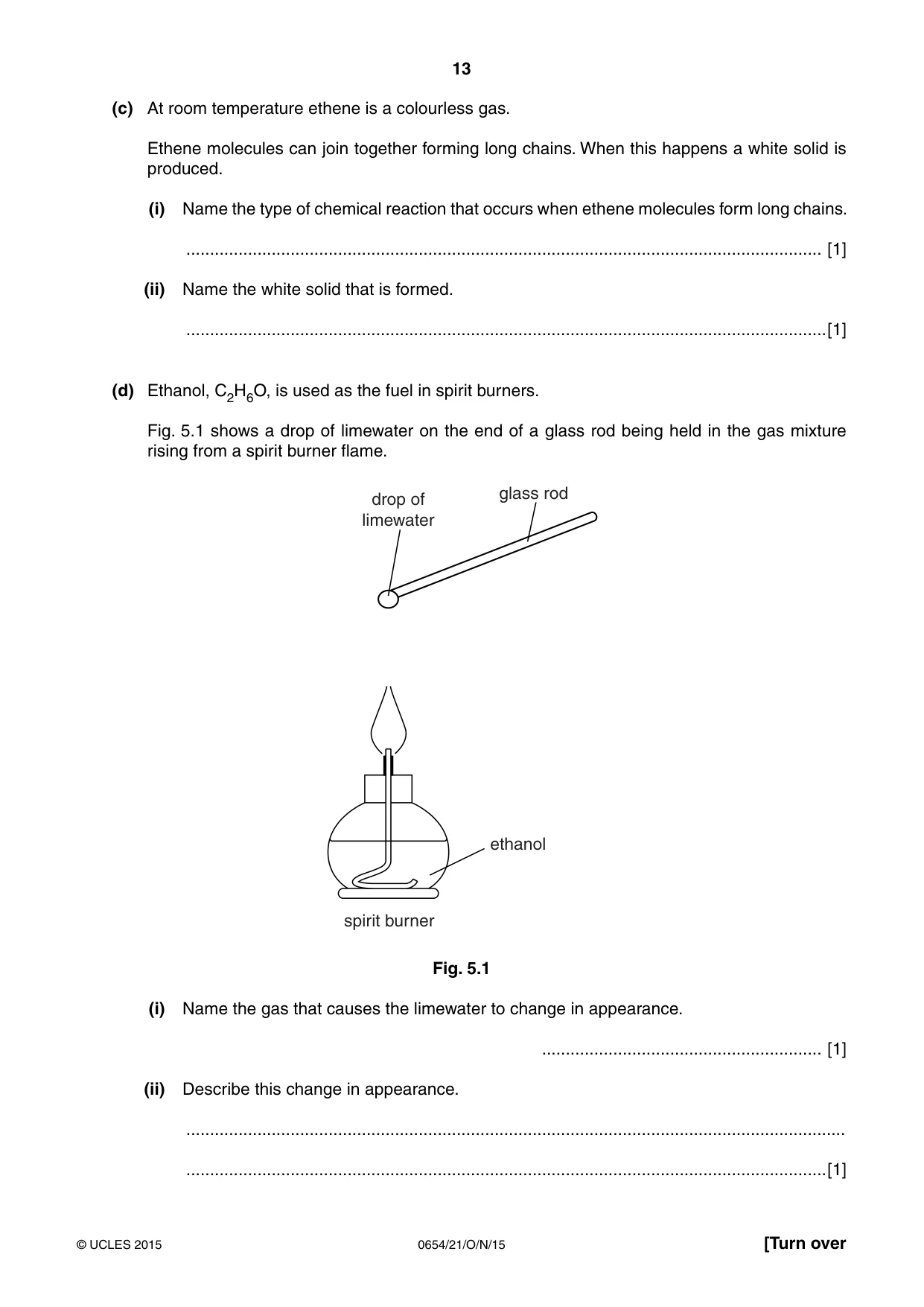
13 0654/21/O/N/15 © UCLES 2015 [Turn over (c) At room temperature ethene is a colourless gas. Ethene molecules can join together forming long chains. When this happens a white solid is produced. (i) Name the type of chemical reaction that occurs when ethene molecules form long chains. … [1] (ii) Name the white solid that is formed. …[1] (d) Ethanol, C2H6O, is used as the fuel in spirit burners. Fig. 5.1 shows a drop of limewater on the end of a glass rod being held in the gas mixture rising from a spirit burner flame. drop of limewater glass rod ethanol spirit burner Fig. 5.1 (i) Name the gas that causes the limewater to change in appearance. … [1] (ii) Describe this change in appearance. … …[1]
Question paper, page 14
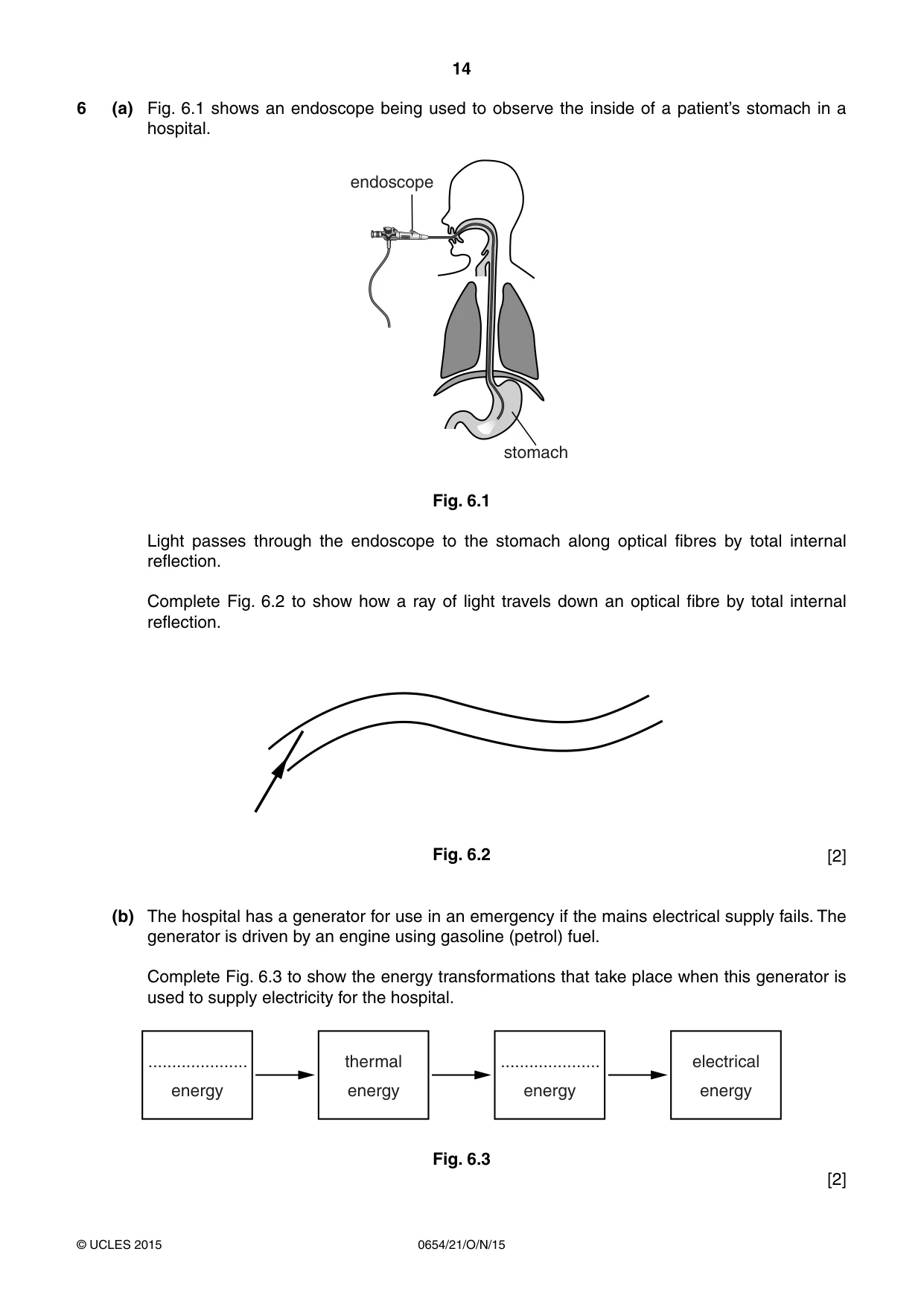
14 0654/21/O/N/15 © UCLES 2015 6 (a) Fig. 6.1 shows an endoscope being used to observe the inside of a patient’s stomach in a hospital. endoscope stomach Fig. 6.1 Light passes through the endoscope to the stomach along optical fibres by total internal reflection. Complete Fig. 6.2 to show how a ray of light travels down an optical fibre by total internal reflection. Fig. 6.2 [2] (b) The hospital has a generator for use in an emergency if the mains electrical supply fails. The generator is driven by an engine using gasoline (petrol) fuel. Complete Fig. 6.3 to show the energy transformations that take place when this generator is used to supply electricity for the hospital. … energy thermal energy … energy electrical energy Fig. 6.3 [2]
Question paper, page 15
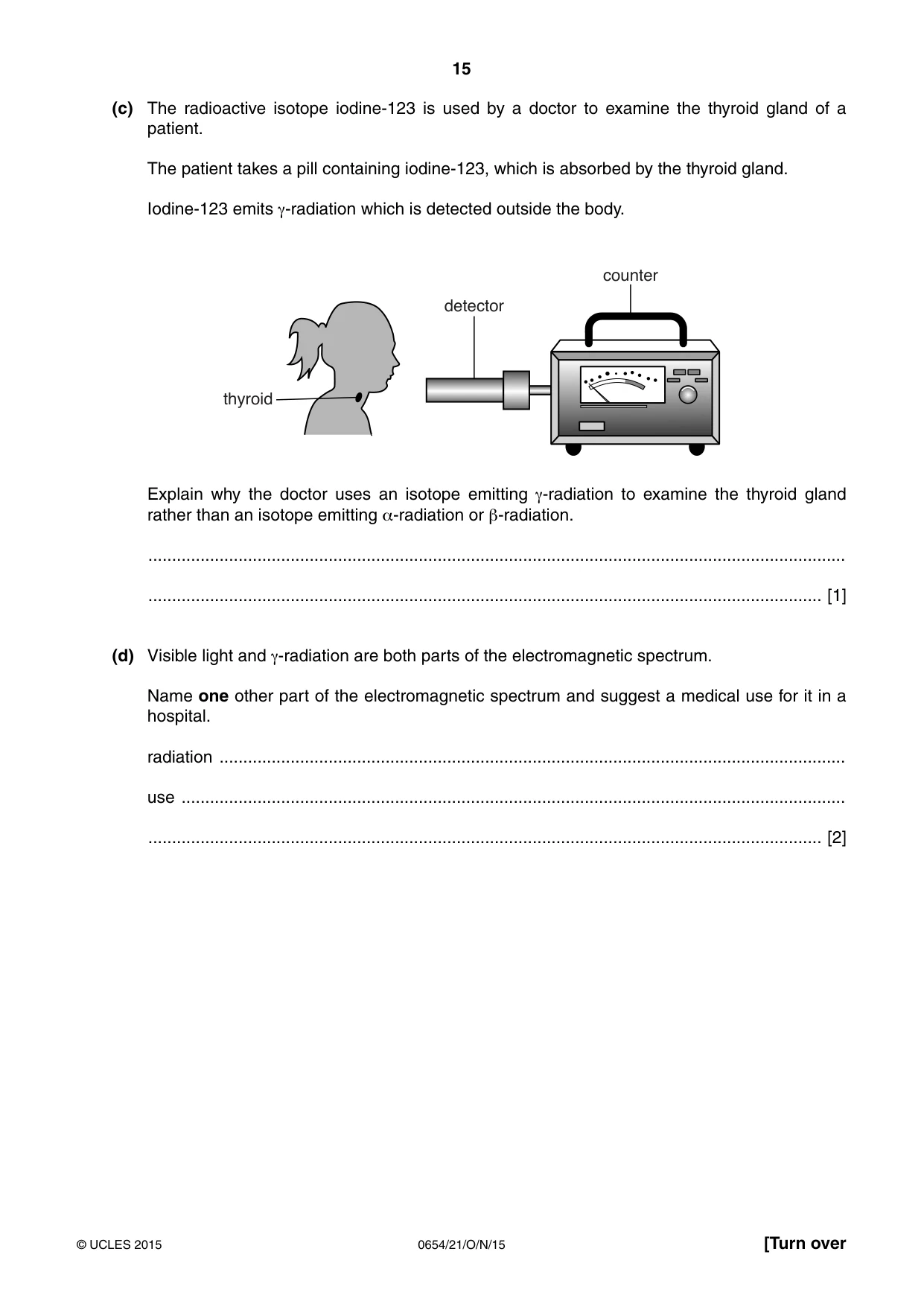
15 0654/21/O/N/15 © UCLES 2015 [Turn over (c) The radioactive isotope iodine-123 is used by a doctor to examine the thyroid gland of a patient. The patient takes a pill containing iodine-123, which is absorbed by the thyroid gland. Iodine-123 emits γ-radiation which is detected outside the body. detector counter thyroid Explain why the doctor uses an isotope emitting γ-radiation to examine the thyroid gland rather than an isotope emitting α-radiation or β-radiation. … … [1] (d) Visible light and γ-radiation are both parts of the electromagnetic spectrum. Name one other part of the electromagnetic spectrum and suggest a medical use for it in a hospital. radiation … use … … [2]
Question paper, page 16
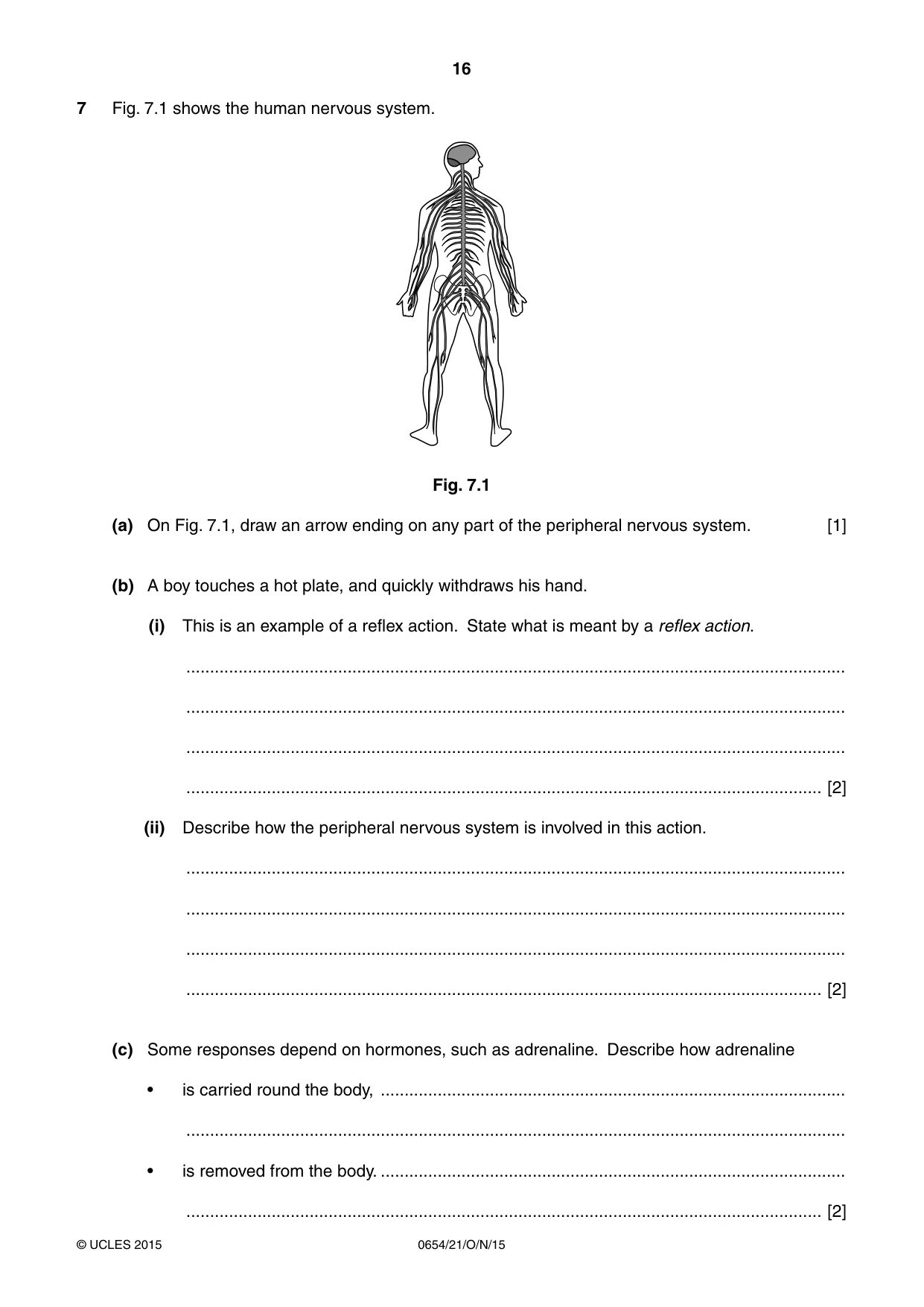
16 0654/21/O/N/15 © UCLES 2015 7 Fig. 7.1 shows the human nervous system. Fig. 7.1 (a) On Fig. 7.1, draw an arrow ending on any part of the peripheral nervous system. [1] (b) A boy touches a hot plate, and quickly withdraws his hand. (i) This is an example of a reflex action. State what is meant by a reflex action. … … … … [2] (ii) Describe how the peripheral nervous system is involved in this action. … … … … [2] (c) Some responses depend on hormones, such as adrenaline. Describe how adrenaline • is carried round the body, … … • is removed from the body. … … [2]
Question paper, page 17
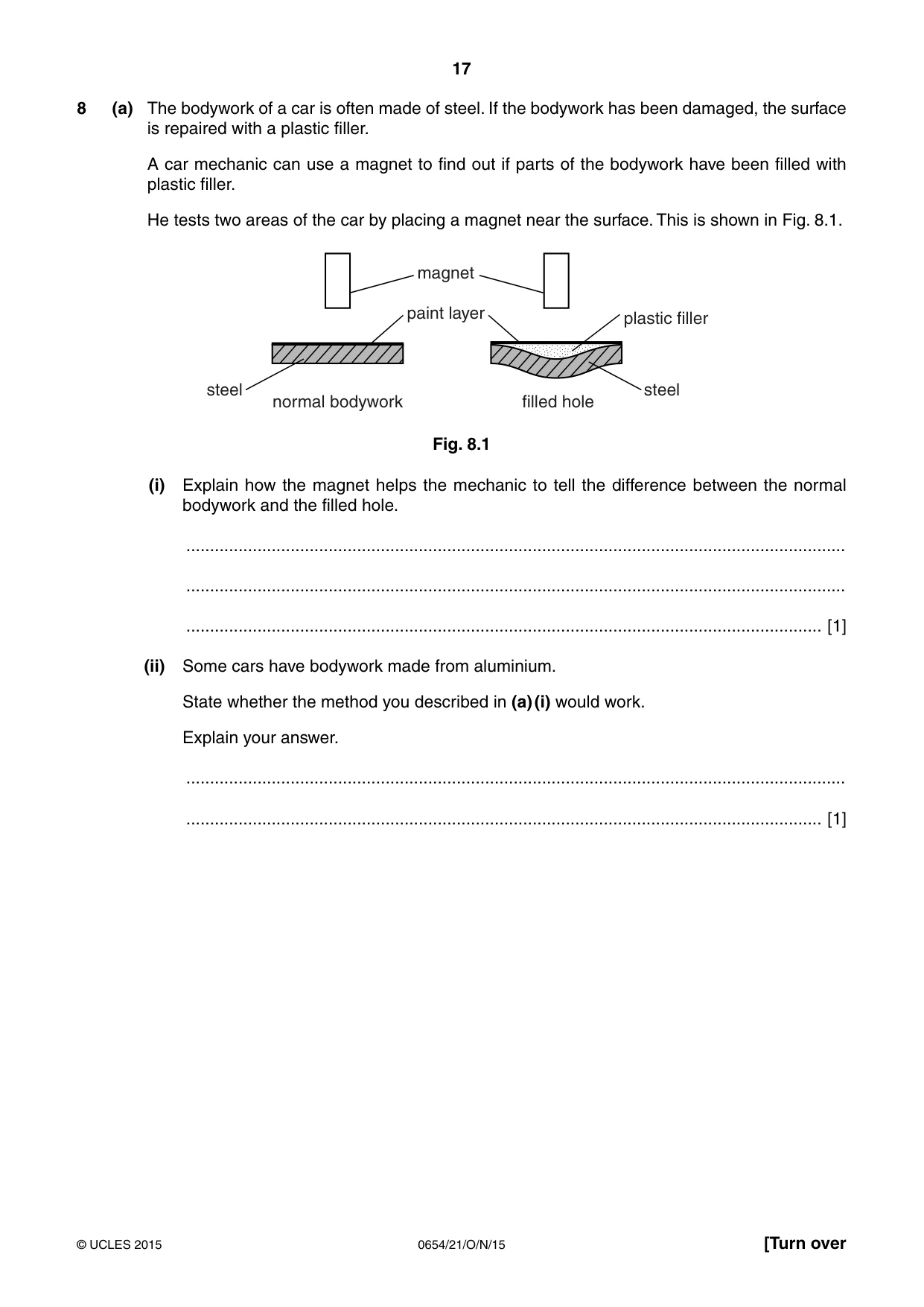
17 0654/21/O/N/15 © UCLES 2015 [Turn over 8 (a) The bodywork of a car is often made of steel. If the bodywork has been damaged, the surface is repaired with a plastic filler. A car mechanic can use a magnet to find out if parts of the bodywork have been filled with plastic filler. He tests two areas of the car by placing a magnet near the surface. This is shown in Fig. 8.1. magnet paint layer steel steel plastic filler normal bodywork filled hole Fig. 8.1 (i) Explain how the magnet helps the mechanic to tell the difference between the normal bodywork and the filled hole. … … … [1] (ii) Some cars have bodywork made from aluminium. State whether the method you described in (a) (i) would work. Explain your answer. … … [1]
Question paper, page 18
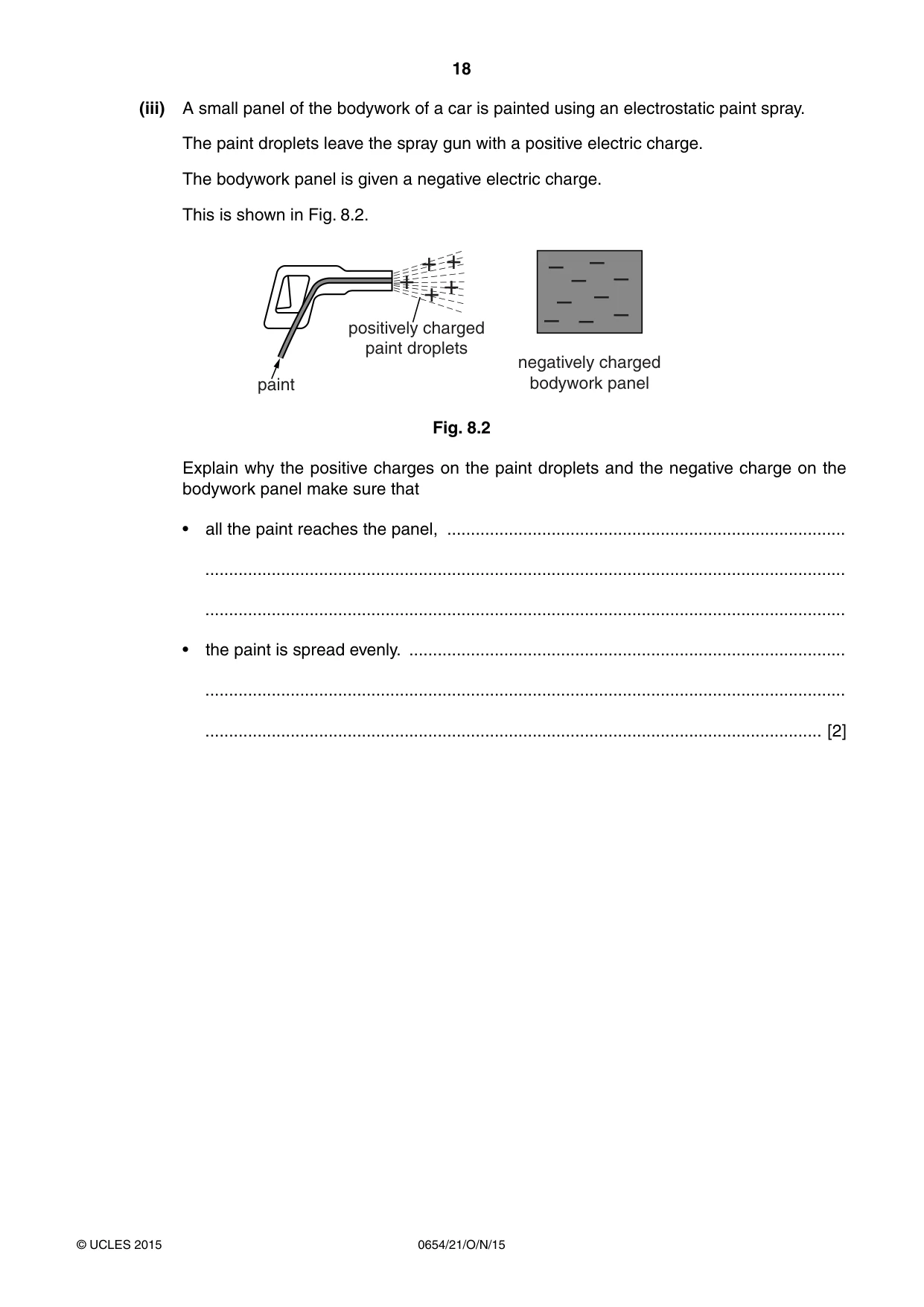
18 0654/21/O/N/15 © UCLES 2015 (iii) A small panel of the bodywork of a car is painted using an electrostatic paint spray. The paint droplets leave the spray gun with a positive electric charge. The bodywork panel is given a negative electric charge. This is shown in Fig. 8.2. + + + + – –– – – – – – – + positively charged paint droplets negatively charged bodywork panel paint Fig. 8.2 Explain why the positive charges on the paint droplets and the negative charge on the bodywork panel make sure that • all the paint reaches the panel, … … … • the paint is spread evenly. … … … [2]
Question paper, page 19
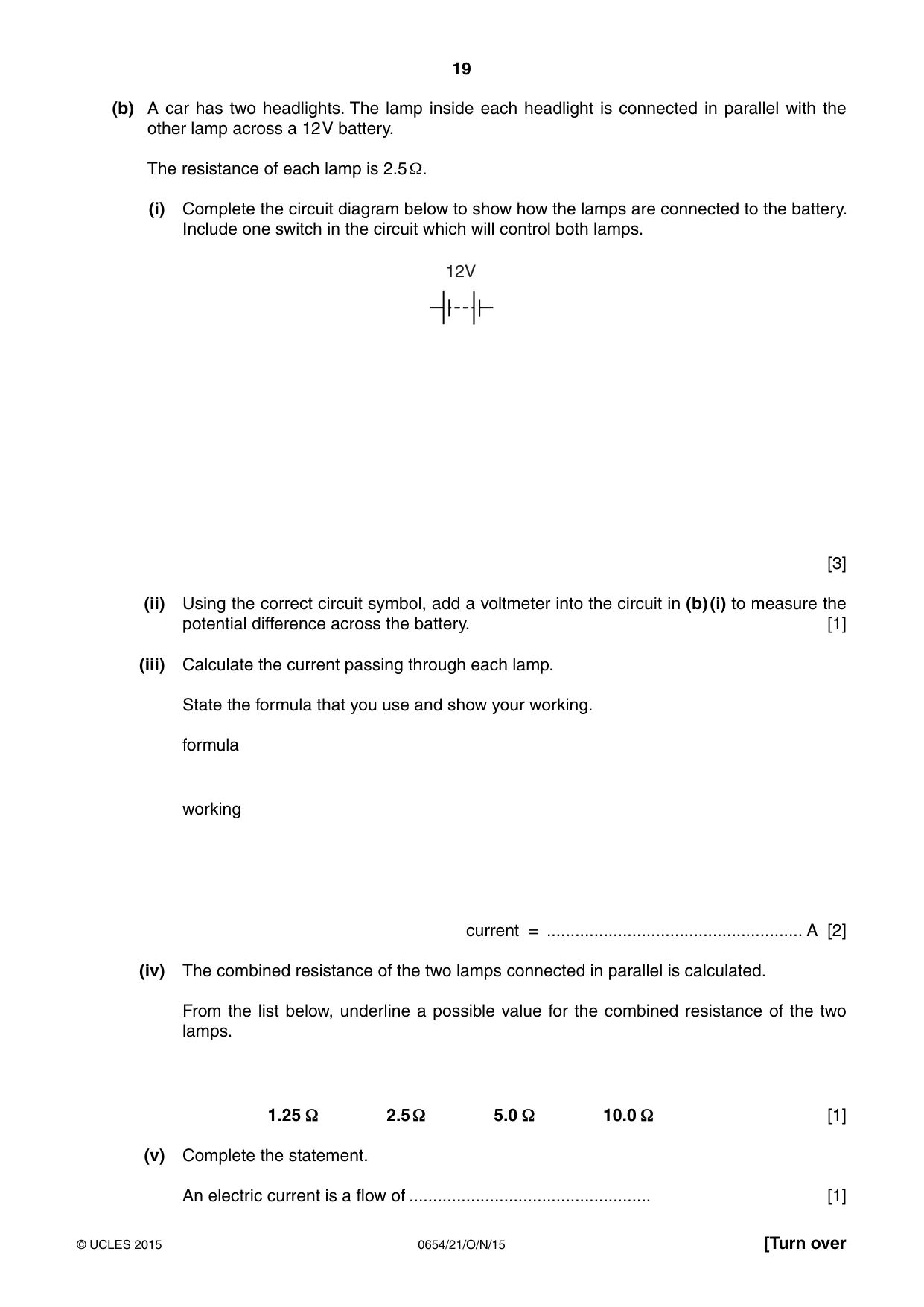
19 0654/21/O/N/15 © UCLES 2015 [Turn over (b) A car has two headlights. The lamp inside each headlight is connected in parallel with the other lamp across a 12 V battery. The resistance of each lamp is 2.5 Ω. (i) Complete the circuit diagram below to show how the lamps are connected to the battery. Include one switch in the circuit which will control both lamps. 12V [3] (ii) Using the correct circuit symbol, add a voltmeter into the circuit in (b) (i) to measure the potential difference across the battery. [1] (iii) Calculate the current passing through each lamp. State the formula that you use and show your working. formula working current = … A [2] (iv) The combined resistance of the two lamps connected in parallel is calculated. From the list below, underline a possible value for the combined resistance of the two lamps. 1.25 Ω Ω 2.5 Ω Ω 5.0 Ω Ω 10.0 Ω Ω [1] (v) Complete the statement. An electric current is a flow of … [1]
Question paper, page 20
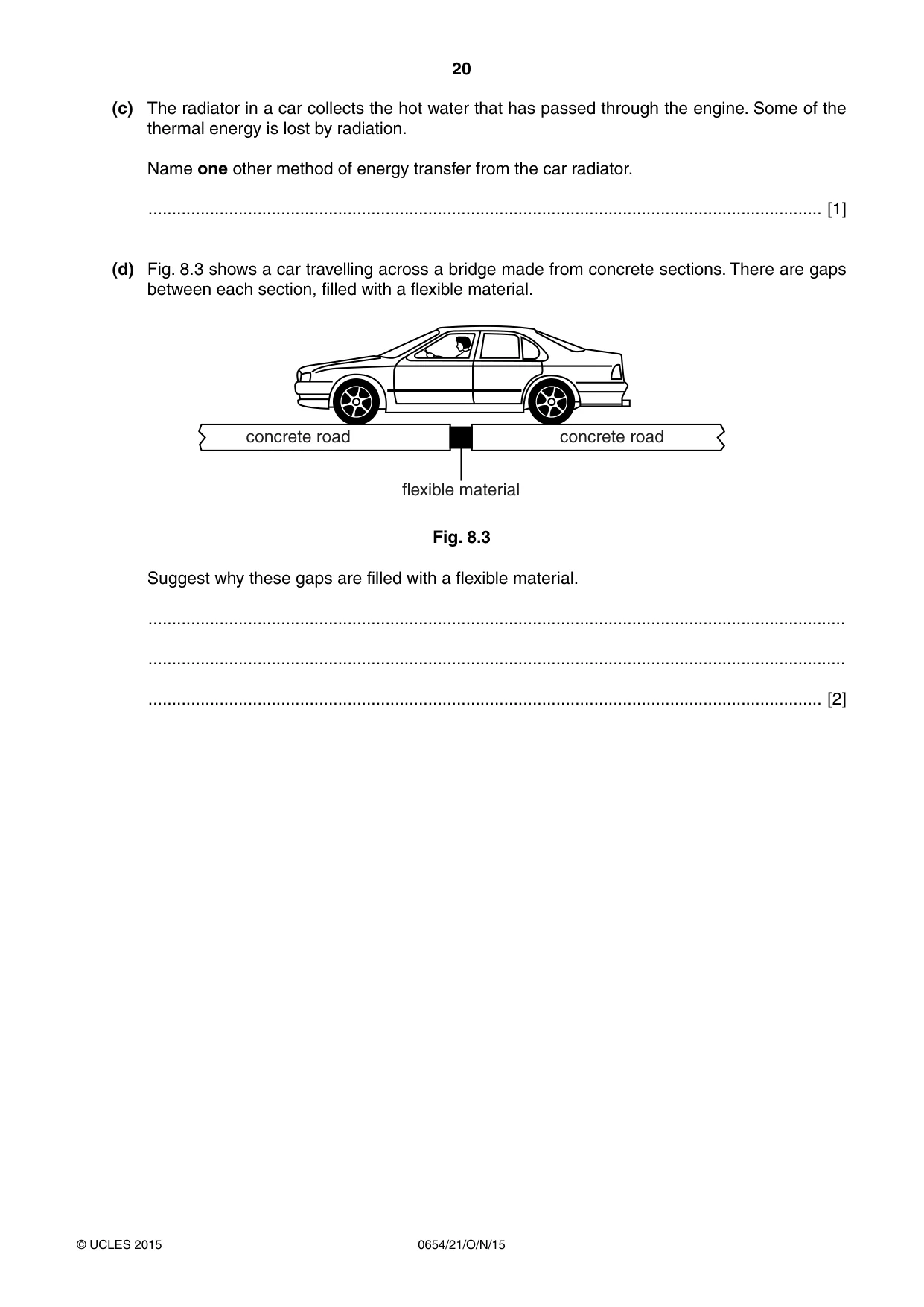
20 0654/21/O/N/15 © UCLES 2015 (c) The radiator in a car collects the hot water that has passed through the engine. Some of the thermal energy is lost by radiation. Name one other method of energy transfer from the car radiator. … [1] (d) Fig. 8.3 shows a car travelling across a bridge made from concrete sections. There are gaps between each section, filled with a flexible material. concrete road concrete road flexible material Fig. 8.3 Suggest why these gaps are filled with a flexible material. … … … [2]
Question paper, page 21
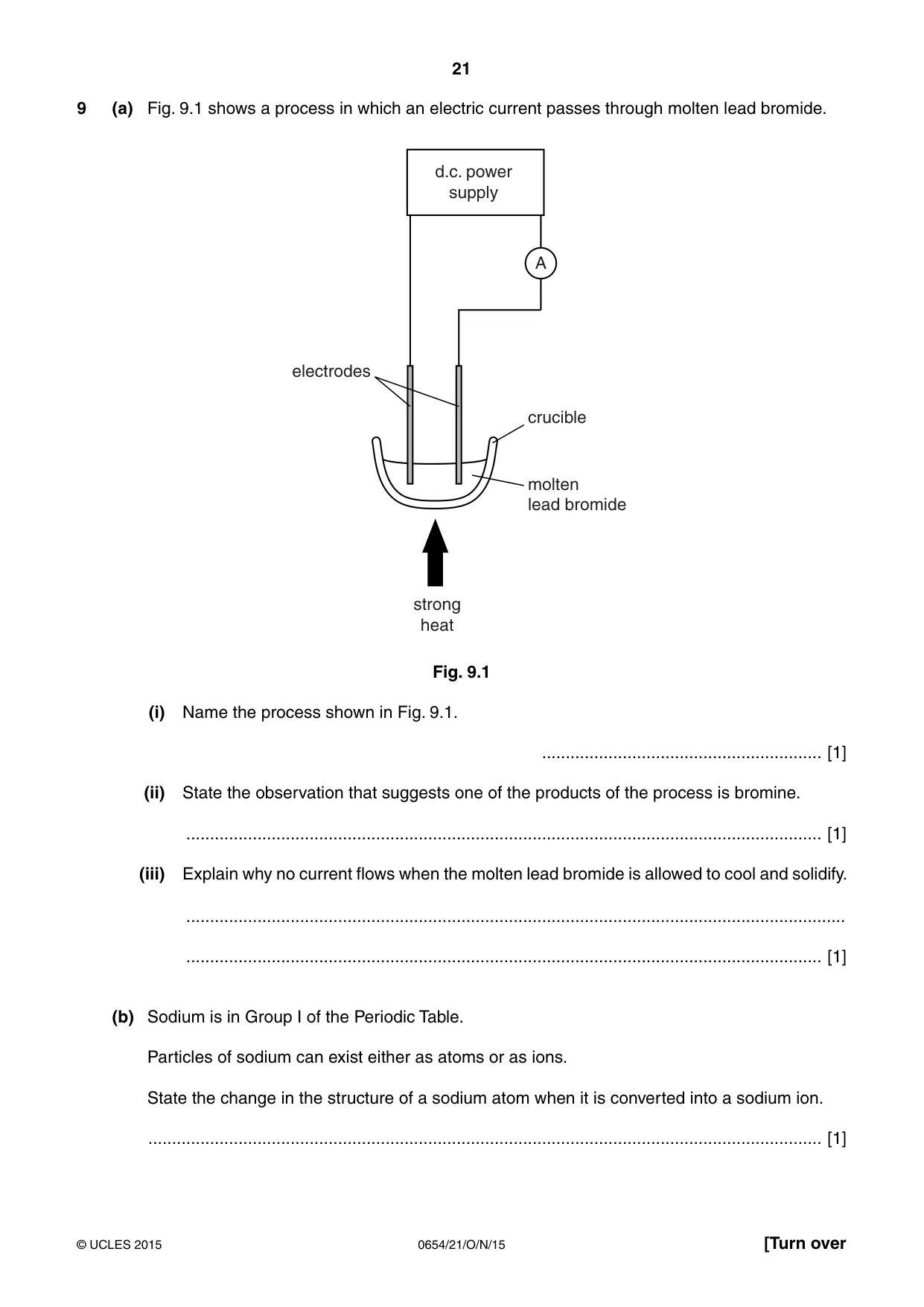
21 0654/21/O/N/15 © UCLES 2015 [Turn over 9 (a) Fig. 9.1 shows a process in which an electric current passes through molten lead bromide. A d.c. power supply strong heat crucible molten lead bromide electrodes Fig. 9.1 (i) Name the process shown in Fig. 9.1. … [1] (ii) State the observation that suggests one of the products of the process is bromine. … [1] (iii) Explain why no current flows when the molten lead bromide is allowed to cool and solidify. … … [1] (b) Sodium is in Group I of the Periodic Table. Particles of sodium can exist either as atoms or as ions. State the change in the structure of a sodium atom when it is converted into a sodium ion. … [1]
Question paper, page 22
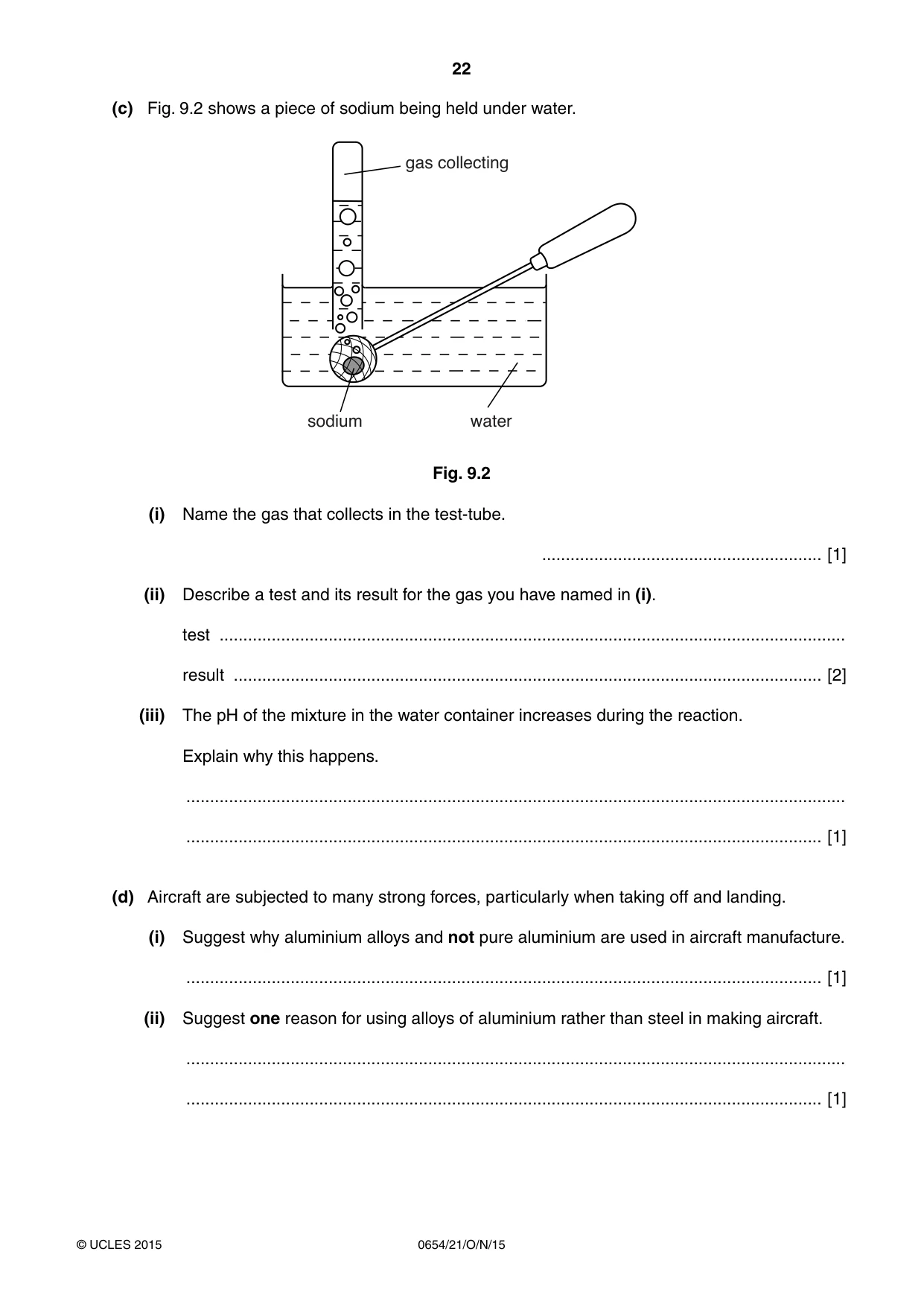
22 0654/21/O/N/15 © UCLES 2015 (c) Fig. 9.2 shows a piece of sodium being held under water. gas collecting sodium water Fig. 9.2 (i) Name the gas that collects in the test-tube. … [1] (ii) Describe a test and its result for the gas you have named in (i). test … result … [2] (iii) The pH of the mixture in the water container increases during the reaction. Explain why this happens. … … [1] (d) Aircraft are subjected to many strong forces, particularly when taking off and landing. (i) Suggest why aluminium alloys and not pure aluminium are used in aircraft manufacture. … [1] (ii) Suggest one reason for using alloys of aluminium rather than steel in making aircraft. … … [1]
Question paper, page 23
23 0654/21/O/N/15 © UCLES 2015 [Turn over Please turn over for Question 10.
Question paper, page 24
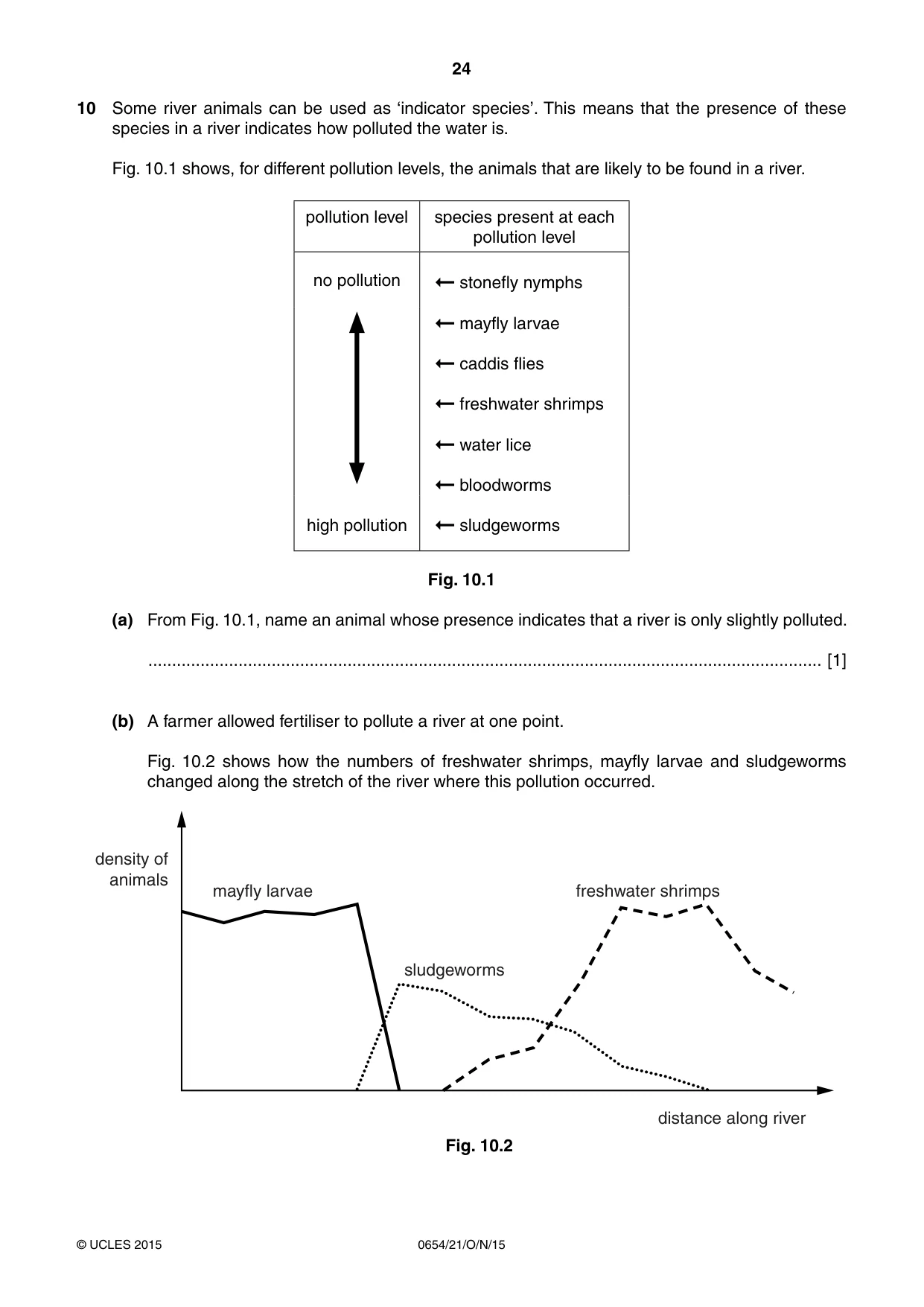
24 0654/21/O/N/15 © UCLES 2015 10 Some river animals can be used as ‘indicator species’. This means that the presence of these species in a river indicates how polluted the water is. Fig. 10.1 shows, for different pollution levels, the animals that are likely to be found in a river. pollution level species present at each pollution level no pollution ➞ stonefly nymphs ➞ mayfly larvae ➞ caddis flies ➞ freshwater shrimps ➞ water lice ➞ bloodworms ➞ sludgeworms high pollution Fig. 10.1 (a) From Fig. 10.1, name an animal whose presence indicates that a river is only slightly polluted. … [1] (b) A farmer allowed fertiliser to pollute a river at one point. Fig. 10.2 shows how the numbers of freshwater shrimps, mayfly larvae and sludgeworms changed along the stretch of the river where this pollution occurred. mayfly larvae sludgeworms freshwater shrimps distance along river density of animals Fig. 10.2
Question paper, page 25
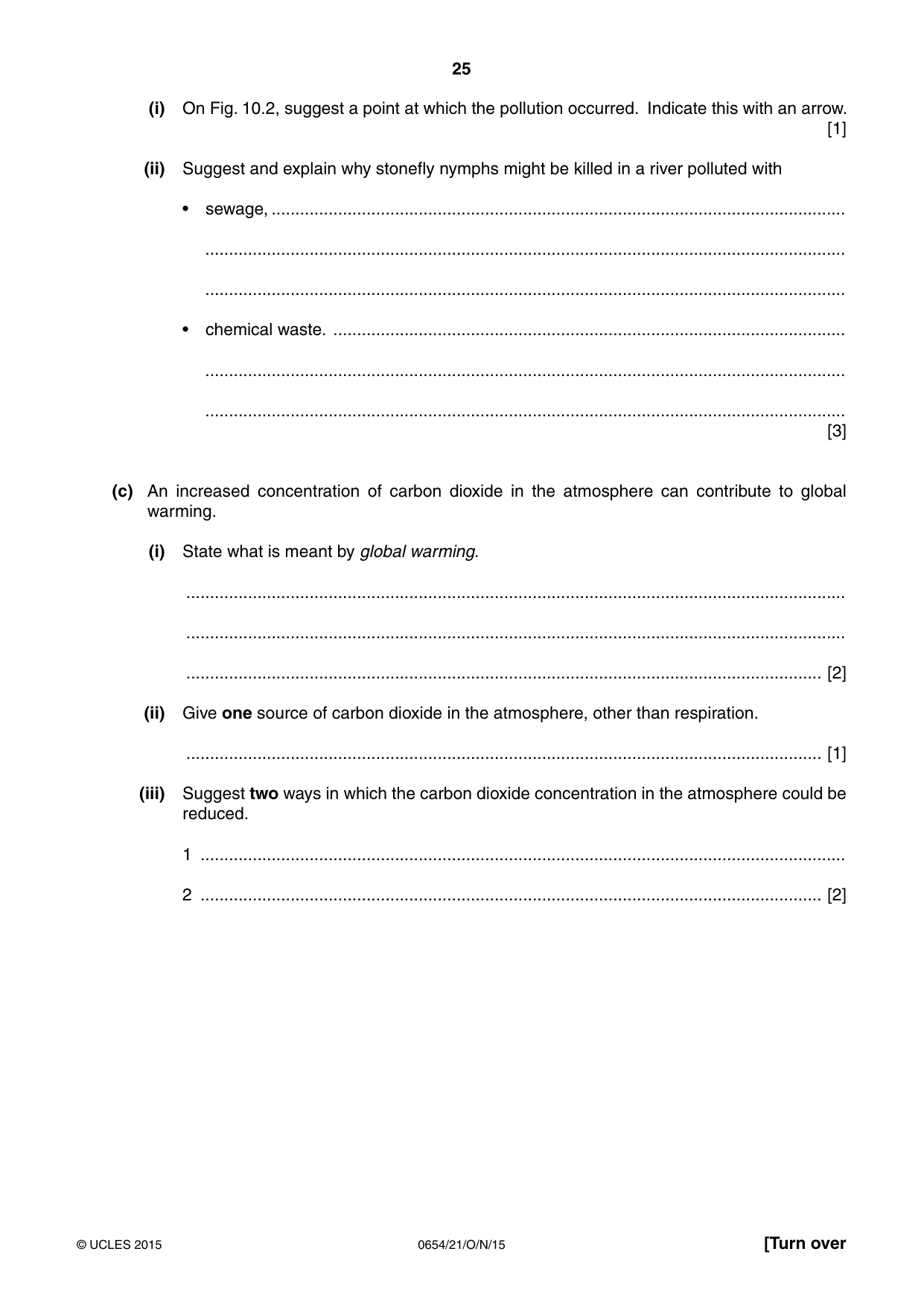
25 0654/21/O/N/15 © UCLES 2015 [Turn over (i) On Fig. 10.2, suggest a point at which the pollution occurred. Indicate this with an arrow. [1] (ii) Suggest and explain why stonefly nymphs might be killed in a river polluted with • sewage, … … … • chemical waste. … … … [3] (c) An increased concentration of carbon dioxide in the atmosphere can contribute to global warming. (i) State what is meant by global warming. … … … [2] (ii) Give one source of carbon dioxide in the atmosphere, other than respiration. … [1] (iii) Suggest two ways in which the carbon dioxide concentration in the atmosphere could be reduced. 1 … 2 … [2]
Question paper, page 26
26 0654/21/O/N/15 © UCLES 2015 11 (a) An elephant lifts a tree trunk. State the two quantities which would need to be known to calculate the work done by the elephant. … and … [2] (b) The mass of the elephant is 4000 kg. The volume of the elephant is 3.9 m3. Calculate the density of the elephant. State the formula that you use and show your working. formula working density = …kg / m3 [2] (c) An elephant can communicate with other elephants using infrasound. This is a very low frequency vibration, which is usually impossible for a human to hear. (i) Suggest a possible frequency for the infrasound used by elephants. Explain why you chose your answer. frequency = … Hz explanation … … [1] (ii) State the meaning of the term frequency. … … [1]
Question paper, page 27
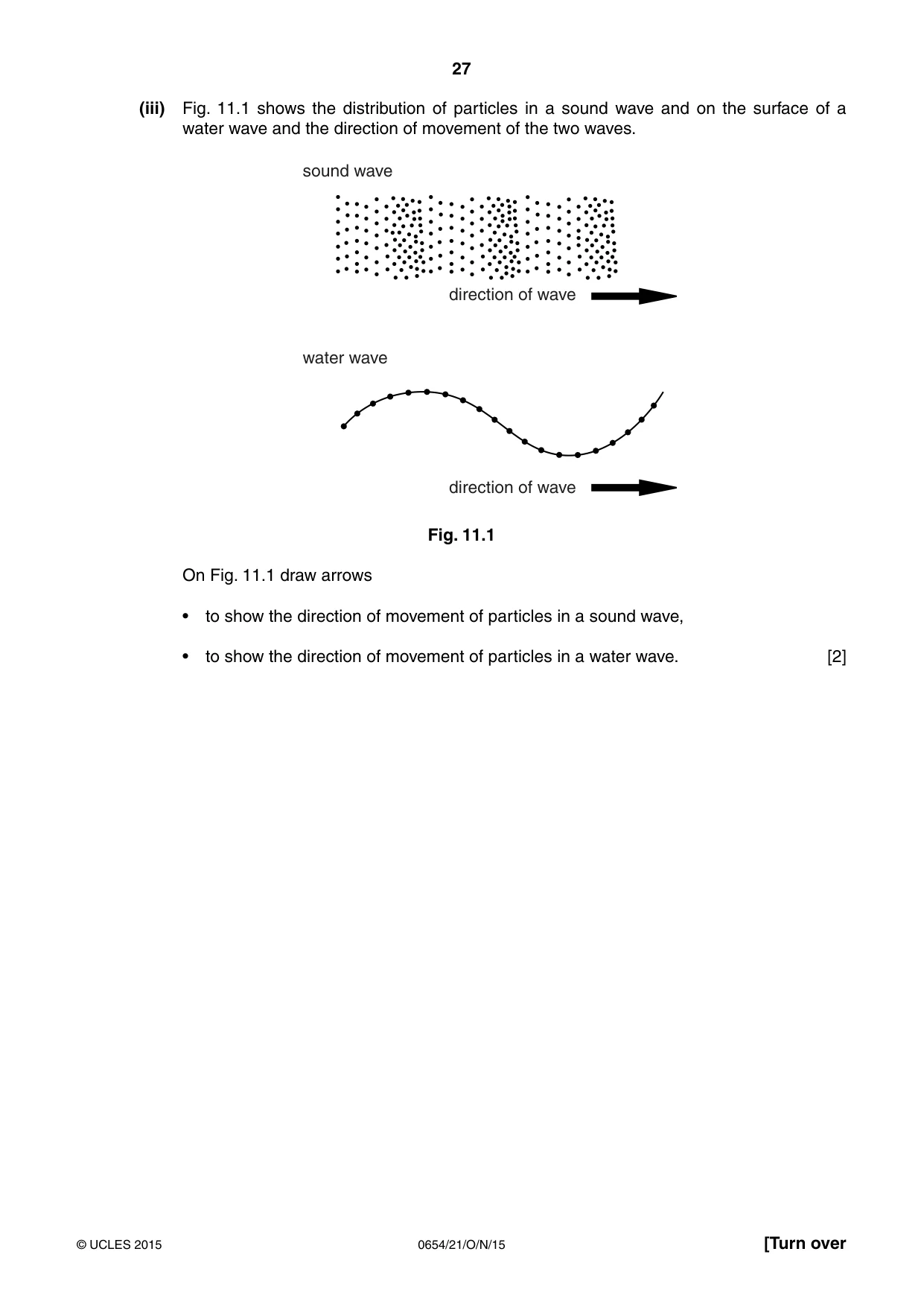
27 0654/21/O/N/15 © UCLES 2015 [Turn over (iii) Fig. 11.1 shows the distribution of particles in a sound wave and on the surface of a water wave and the direction of movement of the two waves. sound wave water wave direction of wave direction of wave Fig. 11.1 On Fig. 11.1 draw arrows • to show the direction of movement of particles in a sound wave, • to show the direction of movement of particles in a water wave. [2]
Question paper, page 28
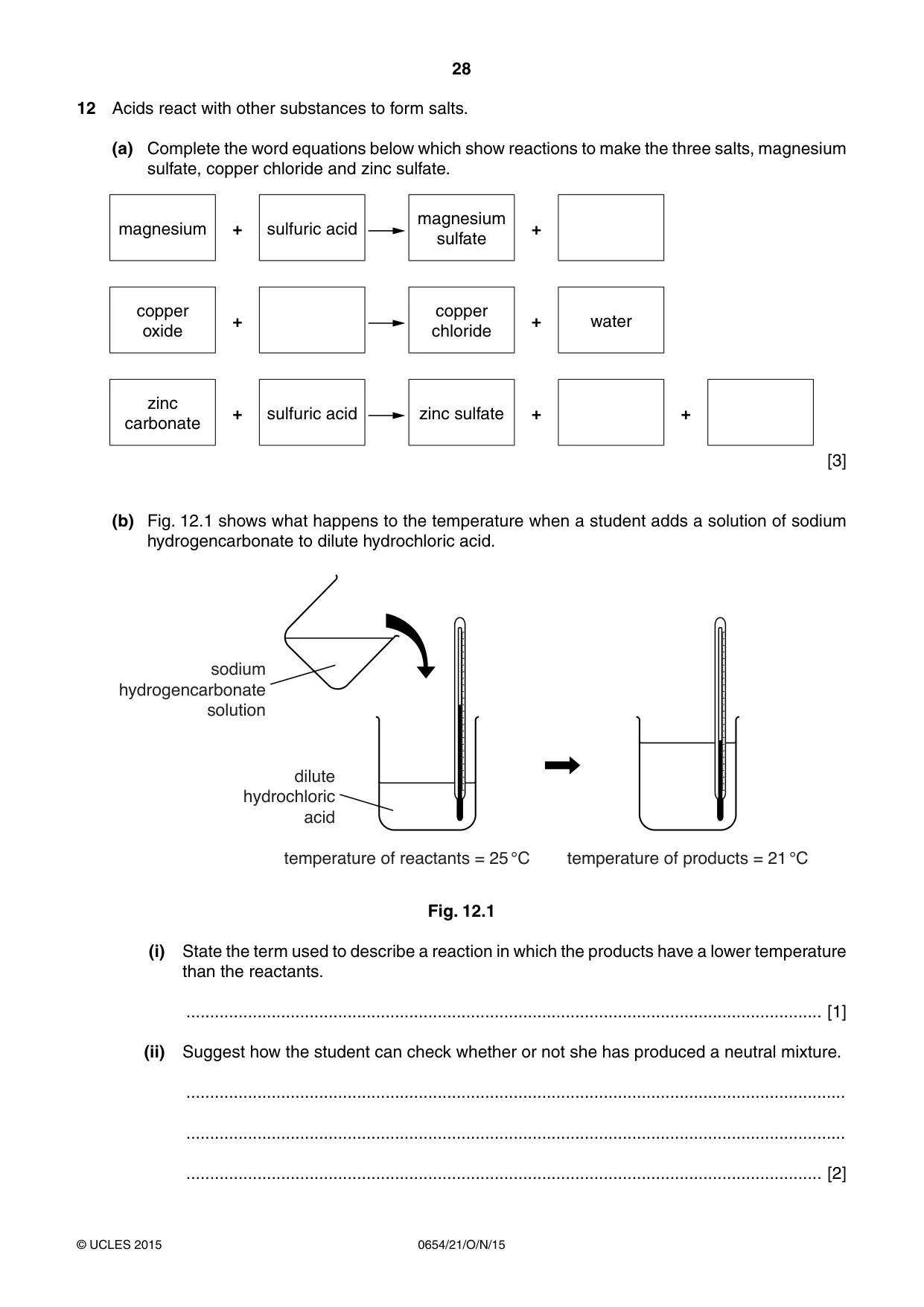
28 0654/21/O/N/15 © UCLES 2015 12 Acids react with other substances to form salts. (a) Complete the word equations below which show reactions to make the three salts, magnesium sulfate, copper chloride and zinc sulfate. magnesium + sulfuric acid magnesium sulfate + copper oxide + copper chloride + water zinc carbonate + sulfuric acid zinc sulfate + + [3] (b) Fig. 12.1 shows what happens to the temperature when a student adds a solution of sodium hydrogencarbonate to dilute hydrochloric acid. sodium hydrogencarbonate solution dilute hydrochloric acid temperature of reactants = 25 °C temperature of products = 21 °C Fig. 12.1 (i) State the term used to describe a reaction in which the products have a lower temperature than the reactants. … [1] (ii) Suggest how the student can check whether or not she has produced a neutral mixture. … … … [2]
Question paper, page 29
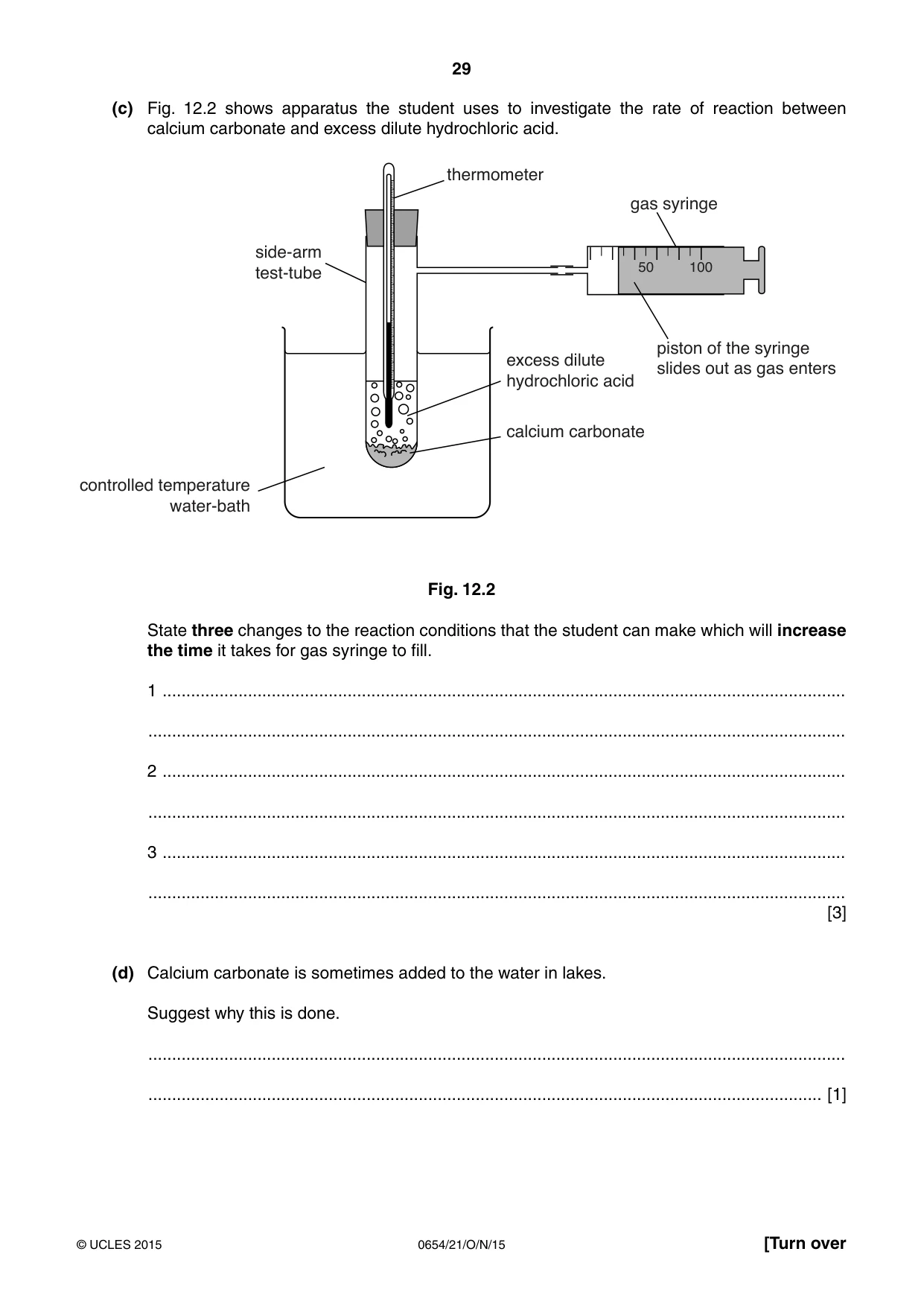
29 0654/21/O/N/15 © UCLES 2015 [Turn over (c) Fig. 12.2 shows apparatus the student uses to investigate the rate of reaction between calcium carbonate and excess dilute hydrochloric acid. 50 100 gas syringe piston of the syringe slides out as gas enters excess dilute hydrochloric acid calcium carbonate thermometer side-arm test-tube controlled temperature water-bath Fig. 12.2 State three changes to the reaction conditions that the student can make which will increase the time it takes for gas syringe to fill. 1 … … 2 … … 3 … … [3] (d) Calcium carbonate is sometimes added to the water in lakes. Suggest why this is done. … … [1]
Question paper, page 30
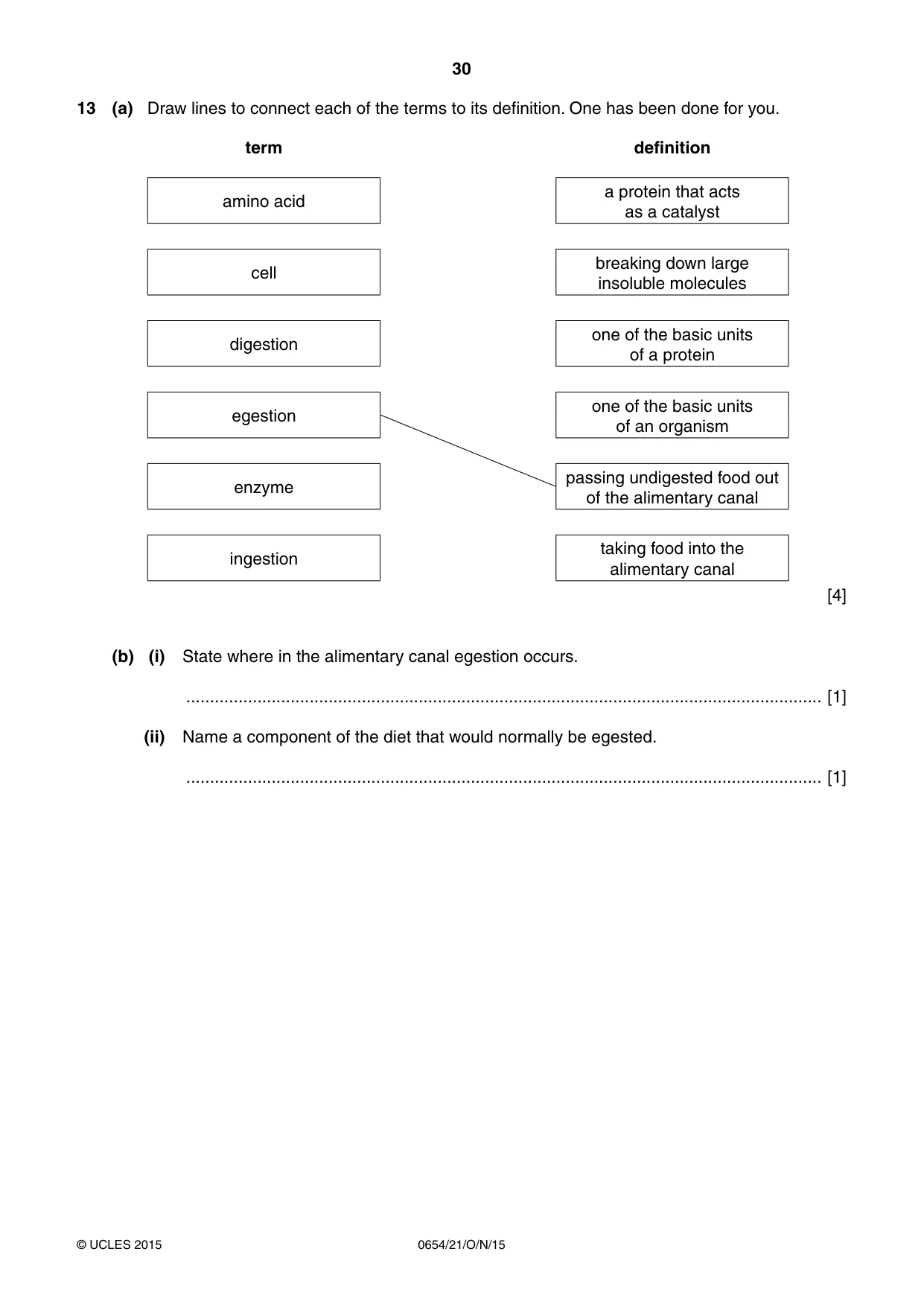
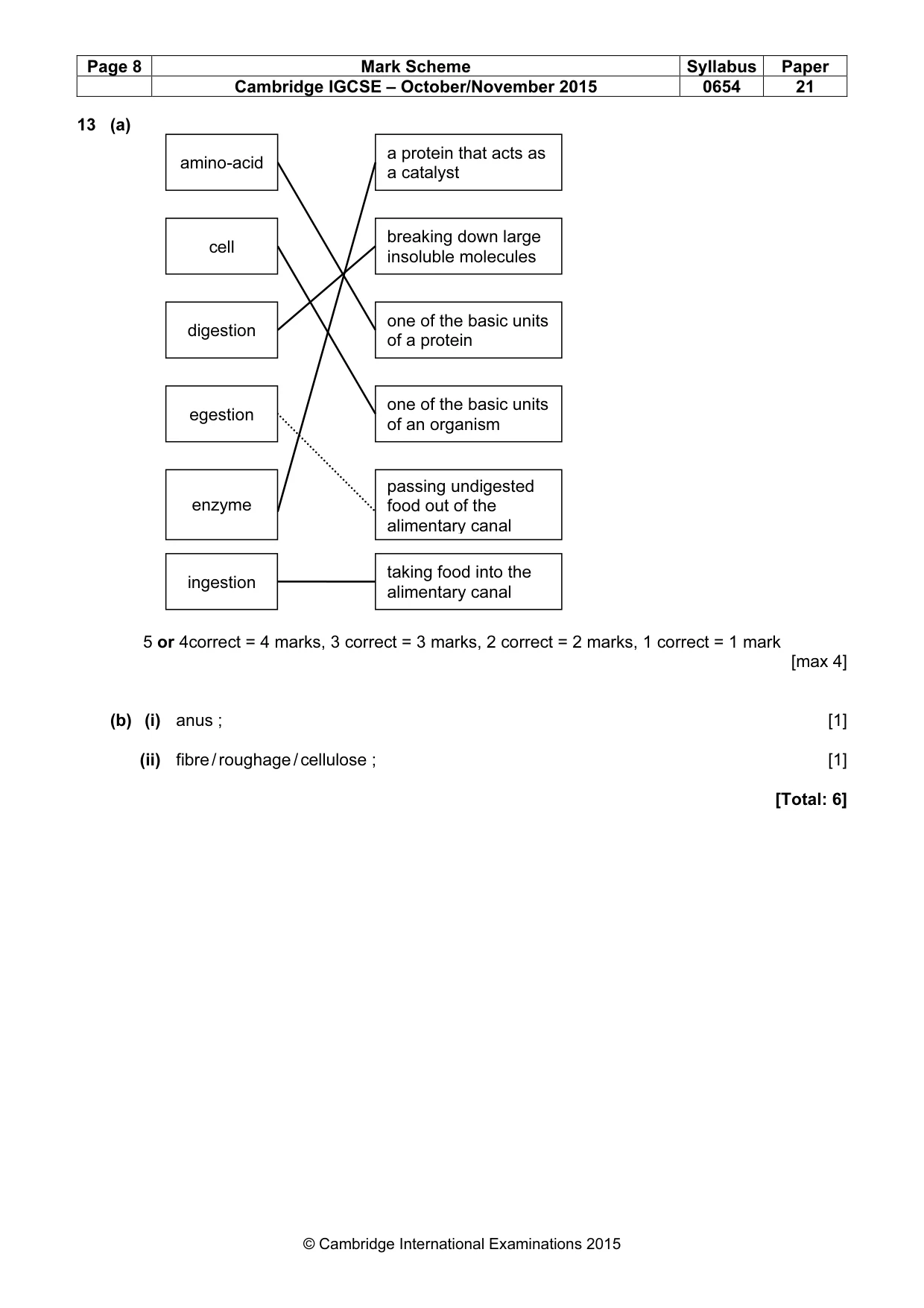
30 0654/21/O/N/15 © UCLES 2015 13 (a) Draw lines to connect each of the terms to its definition. One has been done for you. term definition amino acid a protein that acts as a catalyst cell breaking down large insoluble molecules digestion one of the basic units of a protein egestion one of the basic units of an organism enzyme passing undigested food out of the alimentary canal ingestion taking food into the alimentary canal [4] (b) (i) State where in the alimentary canal egestion occurs. … [1] (ii) Name a component of the diet that would normally be egested. … [1]
Question paper, page 31
31 0654/21/O/N/15 © UCLES 2015 BLANK PAGE
Question paper, page 32
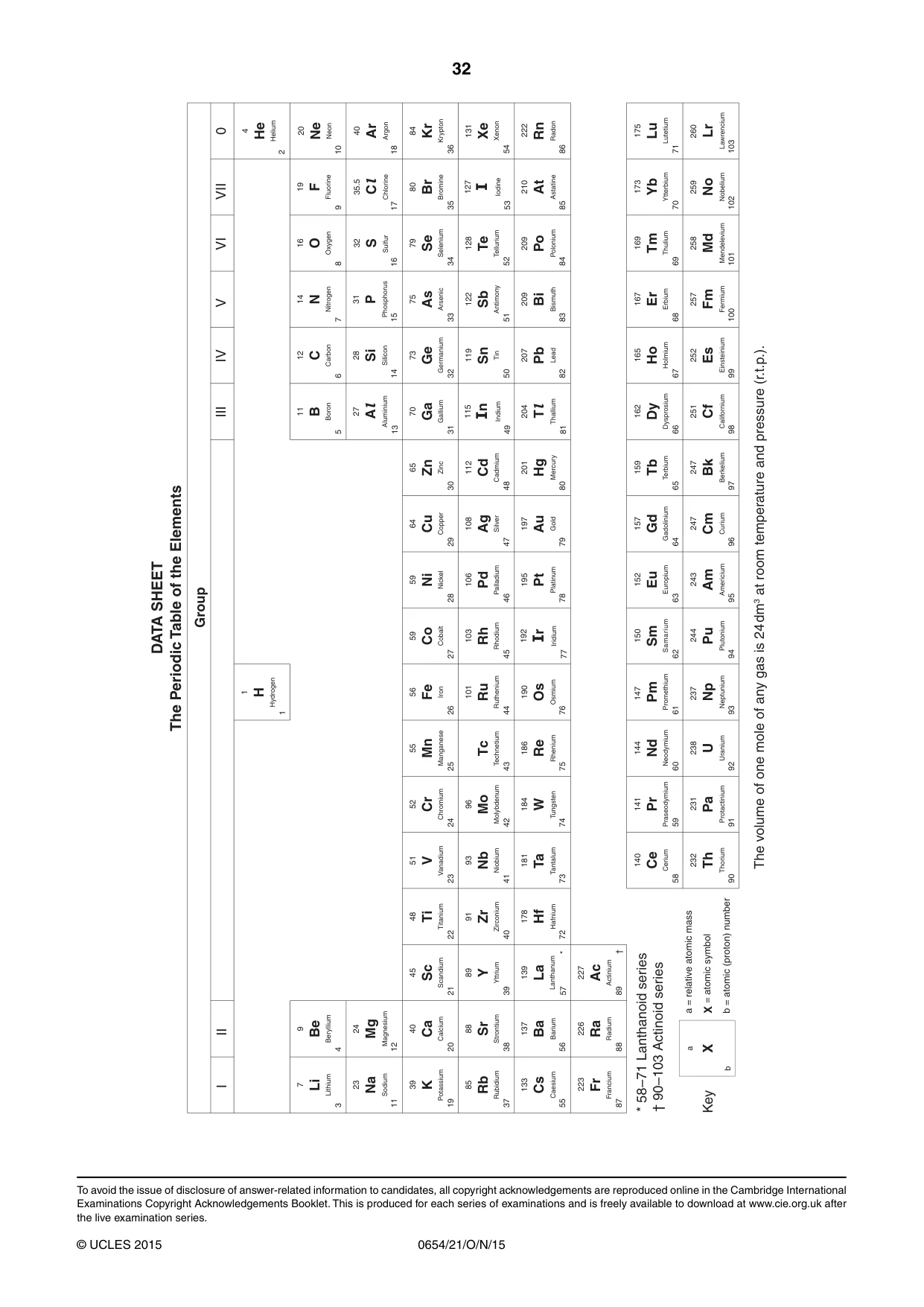
32 0654/21/O/N/15 © UCLES 2015 To avoid the issue of disclosure of answer-related information to candidates, all copyright acknowledgements are reproduced online in the Cambridge International Examinations Copyright Acknowledgements Booklet. This is produced for each series of examinations and is freely available to download at www.cie.org.uk after the live examination series. Group The Periodic Table of the Elements 140 Ce Cerium 58 141 Pr Praseodymium 59 144 Nd Neodymium 60 Pm Promethium 61 150 Sm Samarium 62 152 Eu Europium 63 157 Gd Gadolinium 64 159 Tb Terbium 65 162 Dy Dysprosium 66 165 Ho Holmium 67 167 Er Erbium 68 169 Tm Thulium 69 173 Yb Ytterbium 70 175 Lu Lutetium 71 232 Th Thorium 90 Pa Protactinium 91 238 231 147 237 244 243 247 247 251 252 257 258 259 260 U Uranium 92 Np Neptunium 93 Pu Plutonium 94 Am Americium 95 Cm Curium 96 Bk Berkelium 97 Cf Californium 98 Es Einsteinium 99 Fm Fermium 100 Md Mendelevium 101 No Nobelium 102 Lr Lawrencium 103 1 H Hydrogen 1 7 Li Lithium 3 23 Na Sodium 11 24 Mg Magnesium 12 40 Ca Calcium 20 45 Sc Scandium 21 48 Ti Titanium 22 51 V Vanadium 23 52 Cr Chromium 24 55 Mn Manganese 25 56 Fe Iron 26 59 Co Cobalt 27 59 Ni Nickel 28 64 Cu Copper 29 65 Zn Zinc 30 70 Ga Gallium 31 27 Al Aluminium 13 11 B Boron 5 12 C Carbon 6 14 N Nitrogen 7 16 O Oxygen 8 19 F Fluorine 9 28 Si Silicon 14 31 P Phosphorus 15 32 S Sulfur 16 35.5 Cl Chlorine 17 40 Ar Argon 18 20 Ne Neon 10 4 He Helium 2 73 Ge Germanium 32 75 As Arsenic 33 79 Se Selenium 34 80 Br Bromine 35 84 Kr Krypton 36 39 K Potassium 19 88 Sr Strontium 38 89 Y Yttrium 39 91 Zr Zirconium 40 93 Nb Niobium 41 96 Mo Molybdenum 42 Tc Technetium 43 101 Ru Ruthenium 44 103 Rh Rhodium 45 106 Pd Palladium 46 108 Ag Silver 47 112 Cd Cadmium 48 115 In Indium 49 119 Sn Tin 50 122 Sb Antimony 51 128 Te Tellurium 52 127 I Iodine 53 131 Xe Xenon 54 137 Ba Barium 56 139 La Lanthanum 57 * 178 Hf Hafnium 72 181 Ta Tantalum 73 184 W Tungsten 74 186 Re Rhenium 75 190 Os Osmium 76 192 Ir Iridium 77 195 Pt Platinum 78 197 Au Gold 79 201 Hg Mercury 80 204 Tl Thallium 81 207 Pb Lead 82 209 209 210 222 Bi Bismuth 83 Po Polonium 84 At Astatine 85 Rn Radon 86 Fr Francium 87 227 Ac Actinium 89 † 9 Be Beryllium 4 I II III IV V VI VII 0 85 Rb Rubidium 37 133 Cs Caesium 55 226 223 Ra Radium 88 a X b a = relative atomic mass X = atomic symbol b = atomic (proton) number Key DATA SHEET * 58–71 Lanthanoid series † 90–103 Actinoid series The volume of one mole of any gas is 24dm3 at room temperature and pressure (r.t.p.).
Mark scheme, page 1
® IGCSE is the registered trademark of Cambridge International Examinations. CAMBRIDGE INTERNATIONAL EXAMINATIONS Cambridge International General Certificate of Secondary Education MARK SCHEME for the October/November 2015 series 0654 CO-ORDINATED SCIENCES 0654/21 Paper 2 (Core Theory), maximum raw mark 120 This mark scheme is published as an aid to teachers and candidates, to indicate the requirements of the examination. It shows the basis on which Examiners were instructed to award marks. It does not indicate the details of the discussions that took place at an Examiners’ meeting before marking began, which would have considered the acceptability of alternative answers. Mark schemes should be read in conjunction with the question paper and the Principal Examiner Report for Teachers. Cambridge will not enter into discussions about these mark schemes. Cambridge is publishing the mark schemes for the October/November 2015 series for most Cambridge IGCSE®, Cambridge International A and AS Level components and some Cambridge O Level components.
Mark scheme, page 2
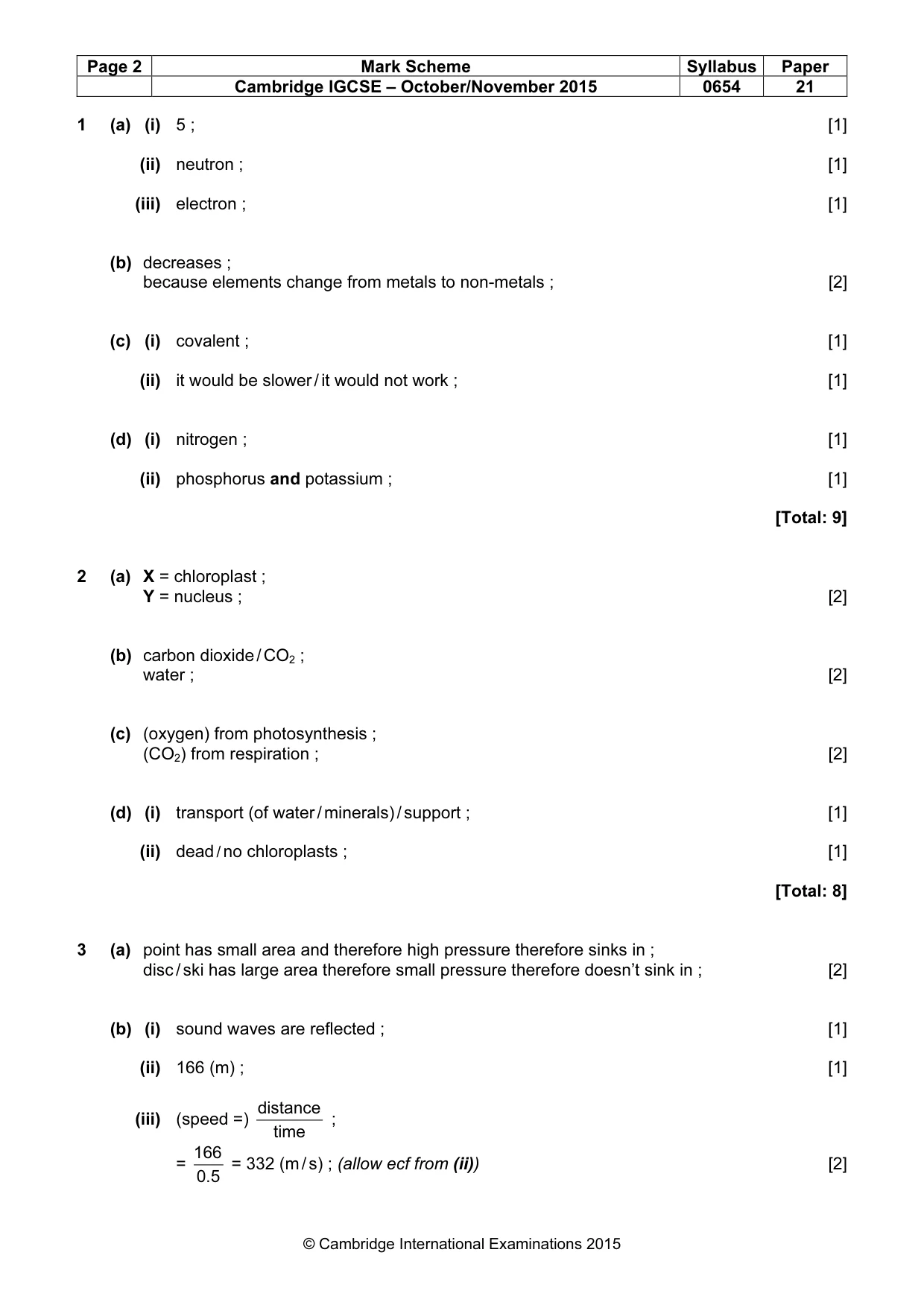
Page 2 Mark Scheme Syllabus Paper Cambridge IGCSE – October/November 2015 0654 21 © Cambridge International Examinations 2015 1 (a) (i) 5 ; [1] (ii) neutron ; [1] (iii) electron ; [1] (b) decreases ; because elements change from metals to non-metals ; [2] (c) (i) covalent ; [1] (ii) it would be slower / it would not work ; [1] (d) (i) nitrogen ; [1] (ii) phosphorus and potassium ; [1] [Total: 9] 2 (a) X = chloroplast ; Y = nucleus ; [2] (b) carbon dioxide / CO2 ; water ; [2] (c) (oxygen) from photosynthesis ; (CO2) from respiration ; [2] (d) (i) transport (of water / minerals) / support ; [1] (ii) dead / no chloroplasts ; [1] [Total: 8] 3 (a) point has small area and therefore high pressure therefore sinks in ; disc / ski has large area therefore small pressure therefore doesn’t sink in ; [2] (b) (i) sound waves are reflected ; [1] (ii) 166 (m) ; [1] (iii) (speed =) time distance ; = 0.5 166 = 332 (m / s) ; (allow ecf from (ii)) [2]
Mark scheme, page 3
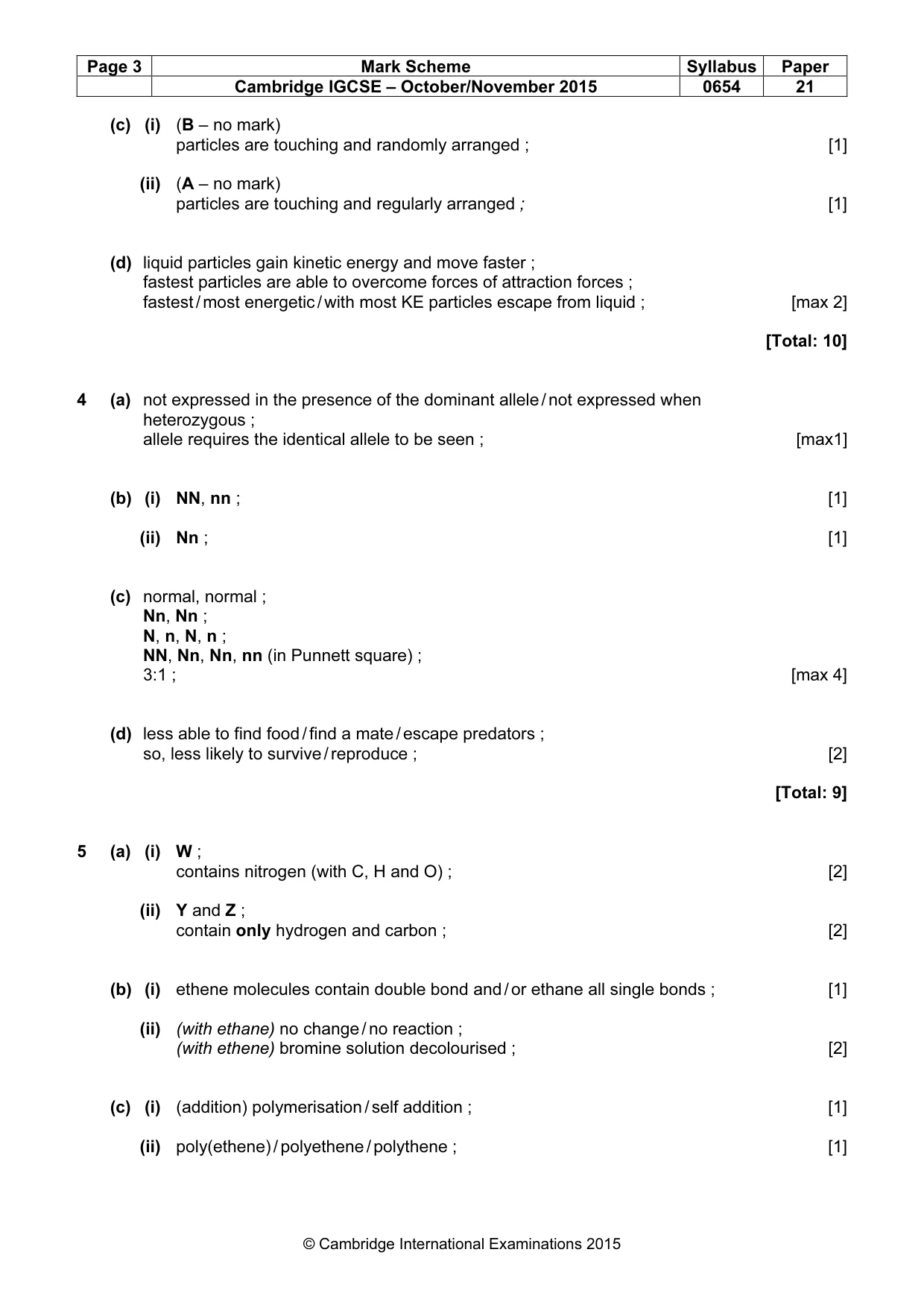
Page 3 Mark Scheme Syllabus Paper Cambridge IGCSE – October/November 2015 0654 21 © Cambridge International Examinations 2015 (c) (i) (B – no mark) particles are touching and randomly arranged ; [1] (ii) (A – no mark) particles are touching and regularly arranged ; [1] (d) liquid particles gain kinetic energy and move faster ; fastest particles are able to overcome forces of attraction forces ; fastest / most energetic / with most KE particles escape from liquid ; [max 2] [Total: 10] 4 (a) not expressed in the presence of the dominant allele / not expressed when heterozygous ; allele requires the identical allele to be seen ; [max1] (b) (i) NN, nn ; [1] (ii) Nn ; [1] (c) normal, normal ; Nn, Nn ; N, n, N, n ; NN, Nn, Nn, nn (in Punnett square) ; 3:1 ; [max 4] (d) less able to find food / find a mate / escape predators ; so, less likely to survive / reproduce ; [2] [Total: 9] 5 (a) (i) W ; contains nitrogen (with C, H and O) ; [2] (ii) Y and Z ; contain only hydrogen and carbon ; [2] (b) (i) ethene molecules contain double bond and / or ethane all single bonds ; [1] (ii) (with ethane) no change / no reaction ; (with ethene) bromine solution decolourised ; [2] (c) (i) (addition) polymerisation / self addition ; [1] (ii) poly(ethene) / polyethene / polythene ; [1]
Mark scheme, page 4
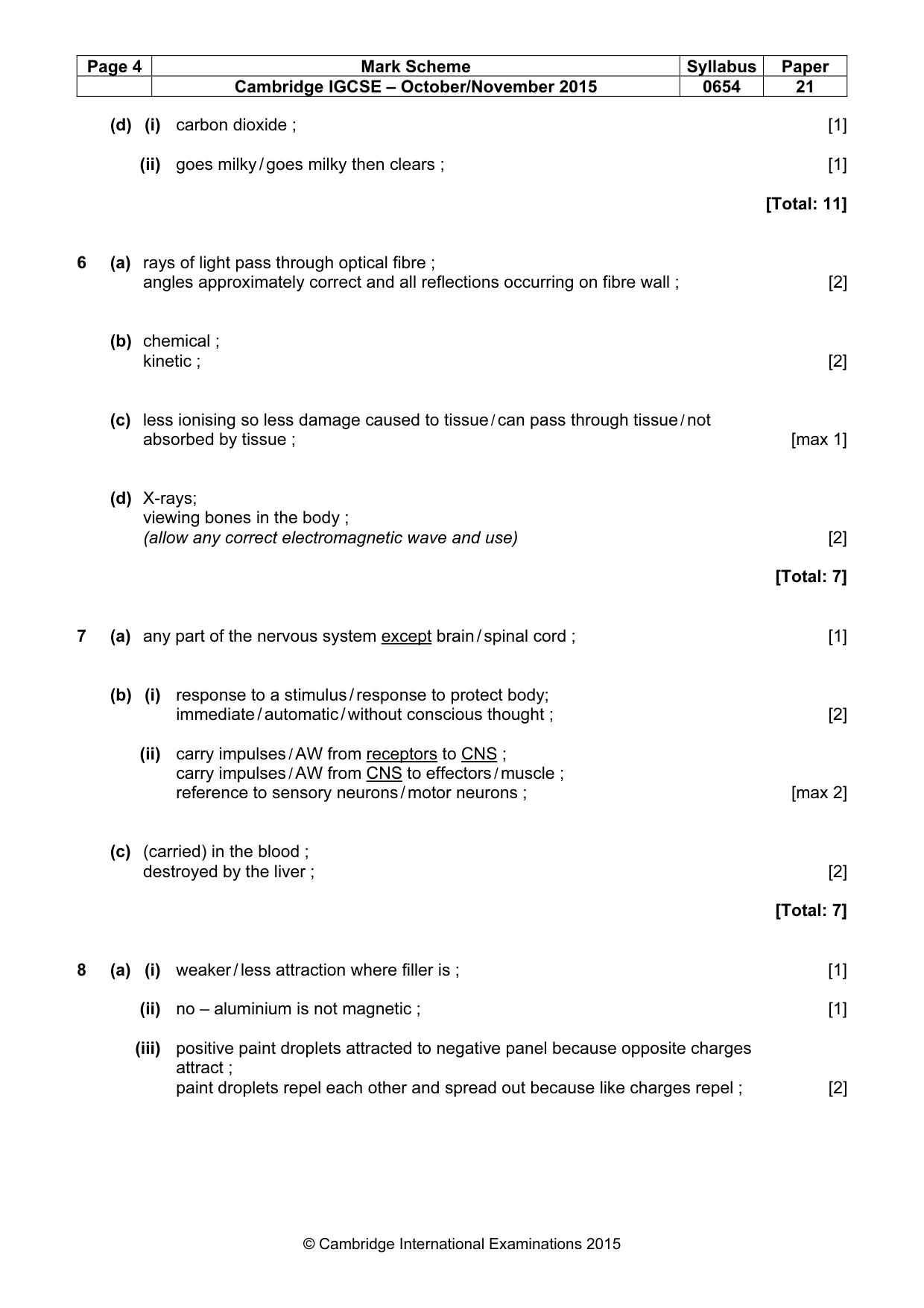
Page 4 Mark Scheme Syllabus Paper Cambridge IGCSE – October/November 2015 0654 21 © Cambridge International Examinations 2015 (d) (i) carbon dioxide ; [1] (ii) goes milky / goes milky then clears ; [1] [Total: 11] 6 (a) rays of light pass through optical fibre ; angles approximately correct and all reflections occurring on fibre wall ; [2] (b) chemical ; kinetic ; [2] (c) less ionising so less damage caused to tissue / can pass through tissue / not absorbed by tissue ; [max 1] (d) X-rays; viewing bones in the body ; (allow any correct electromagnetic wave and use) [2] [Total: 7] 7 (a) any part of the nervous system except brain / spinal cord ; [1] (b) (i) response to a stimulus / response to protect body; immediate / automatic / without conscious thought ; [2] (ii) carry impulses / AW from receptors to CNS ; carry impulses / AW from CNS to effectors / muscle ; reference to sensory neurons / motor neurons ; [max 2] (c) (carried) in the blood ; destroyed by the liver ; [2] [Total: 7] 8 (a) (i) weaker / less attraction where filler is ; [1] (ii) no – aluminium is not magnetic ; [1] (iii) positive paint droplets attracted to negative panel because opposite charges attract ; paint droplets repel each other and spread out because like charges repel ; [2]
Mark scheme, page 5
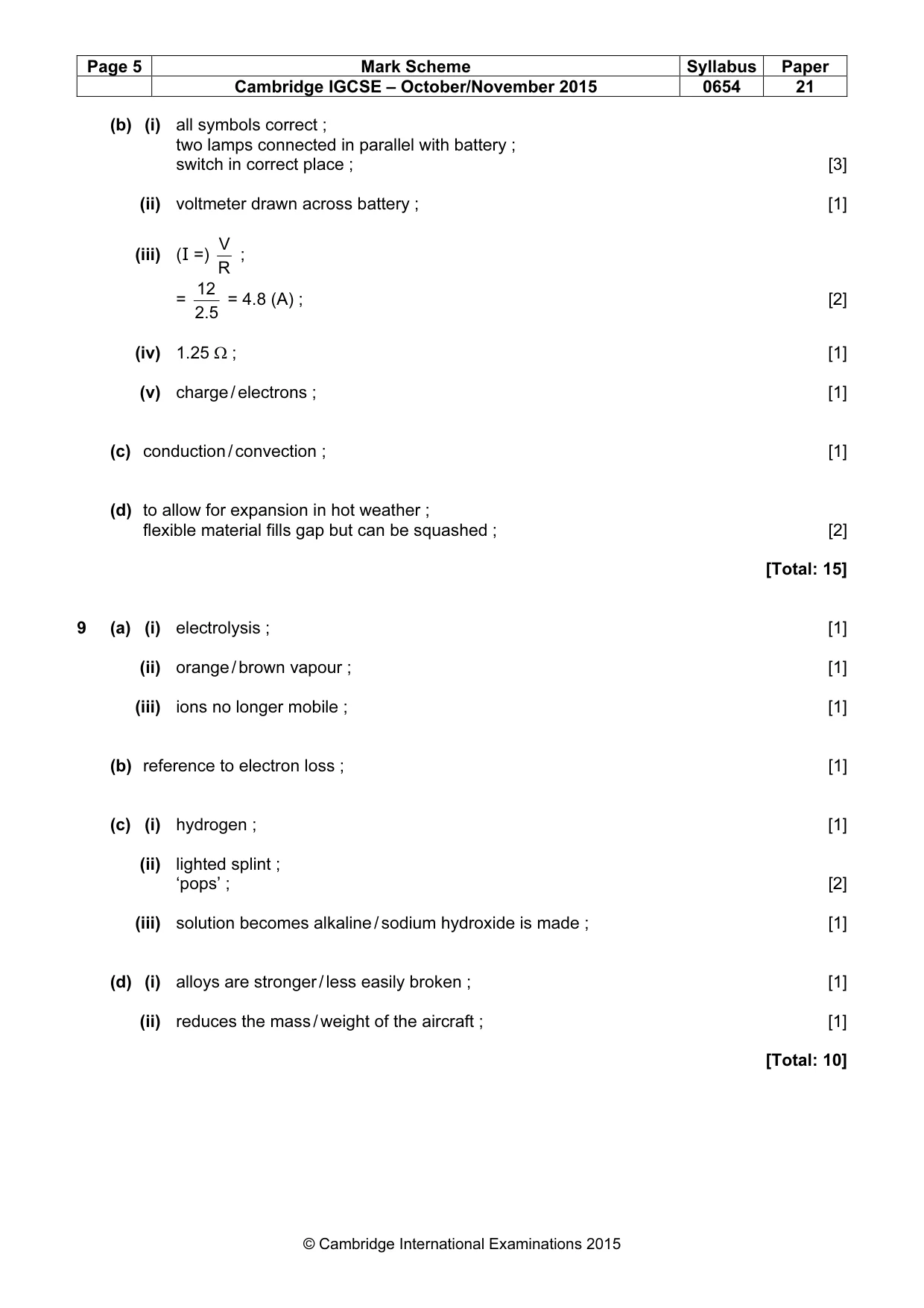
Page 5 Mark Scheme Syllabus Paper Cambridge IGCSE – October/November 2015 0654 21 © Cambridge International Examinations 2015 (b) (i) all symbols correct ; two lamps connected in parallel with battery ; switch in correct place ; [3] (ii) voltmeter drawn across battery ; [1] (iii) (I =) R V ; = 2.5 12 = 4.8 (A) ; [2] (iv) 1.25 Ω ; [1] (v) charge / electrons ; [1] (c) conduction / convection ; [1] (d) to allow for expansion in hot weather ; flexible material fills gap but can be squashed ; [2] [Total: 15] 9 (a) (i) electrolysis ; [1] (ii) orange / brown vapour ; [1] (iii) ions no longer mobile ; [1] (b) reference to electron loss ; [1] (c) (i) hydrogen ; [1] (ii) lighted splint ; ‘pops’ ; [2] (iii) solution becomes alkaline / sodium hydroxide is made ; [1] (d) (i) alloys are stronger / less easily broken ; [1] (ii) reduces the mass / weight of the aircraft ; [1] [Total: 10]
Mark scheme, page 6
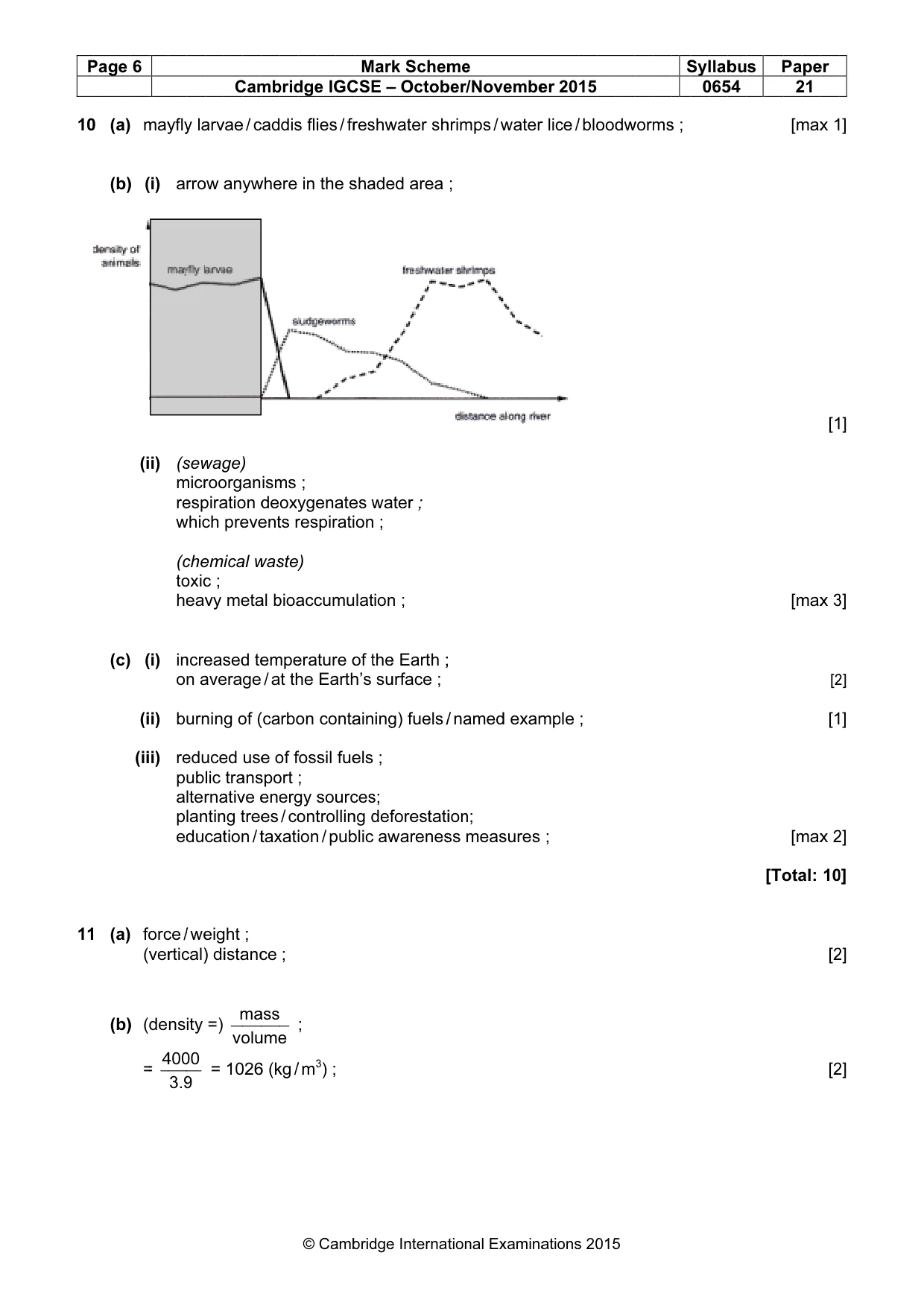
P 10 11 Pag 0 ( ( ( ( ( ge (a) (b) (c) (a) (b) 6 m ) ( (i ( (i (ii fo (v ) ( = may (i) i) (i) i) i) orc ver de = 4 yfly a (s m re w (c to he in o b re p a p ed ce / rtic ns 3.9 400 y la rro sew micr esp whic che oxic eav ncre n a urn edu ub lter lan duc / we cal) ity 9 00 arv ow wag roo pira ch em c ; vy eas ave nin uce lic rna ntin cat eig ) di =) = C vae an ge) org atio pre ica me sed era g o ed tra ativ ng t tion ght ista vo m 10 Cam e / c yw ) an on d eve al w eta d te ge of ( use ans ve e tree n / t ; anc olu ma 026 mb cad whe ism de ent was al b em / a (ca e o spo ene es tax ce ume ass 6 (k brid dis ere ms oxy ts r ste) bioa mpe t th rbo of f ort erg / co xati ; e kg / dge © s fli in ; yge res ) acc era he on foss ; gy s ont ion ; / m3 e IG Ca ies the ena spir cum tur Ea co sil sou tro n / p 3) ; GC amb s / fr e s ate rati mu re o arth onta fue urc llin pub M CSE brid res sha es w on lat of t h’s ain els ces ng d blic Mar E – dge shw ade wa ; tion the su ing ; s; def c aw k S – O e In wat ed a ater n ; e E urfa g) f fore wa Sch Oct nter ter are r ; art ace fue est ren hem ob rnat sh ea th ; e ; els / tati nes me ber/ tion hrim ; ; / na ion ss e /No nal mps am n; me ove Ex s / w med eas em xam wa d ex sur mbe mina ter xam res er 2 atio r lic mp ; 20 ons ce / ple 15 s 20 / blo ; 015 ood 5 dworms S s ; Syl 0 llab 065 bu 54 s P [To Pa 2 [m [m [m ota pe 21 max max max al: er x 1 [1 x 3 [2 [1 x 2 10 [2 [2 ] ] 3] 2] ] 2] 0] 2] 2]
Mark scheme, page 7
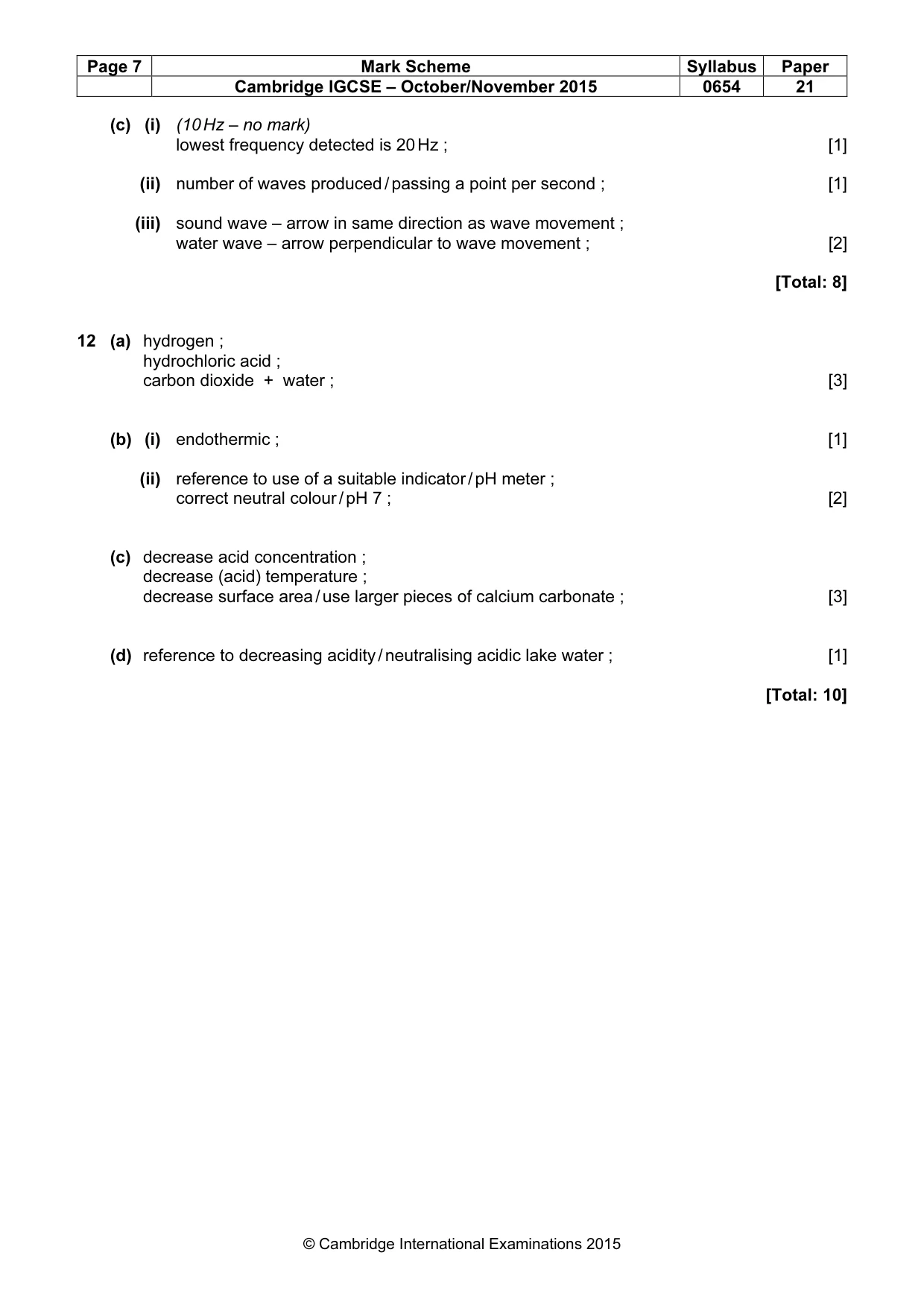
Page 7 Mark Scheme Syllabus Paper Cambridge IGCSE – October/November 2015 0654 21 © Cambridge International Examinations 2015 (c) (i) (10 Hz – no mark) lowest frequency detected is 20 Hz ; [1] (ii) number of waves produced / passing a point per second ; [1] (iii) sound wave – arrow in same direction as wave movement ; water wave – arrow perpendicular to wave movement ; [2] [Total: 8] 12 (a) hydrogen ; hydrochloric acid ; carbon dioxide + water ; [3] (b) (i) endothermic ; [1] (ii) reference to use of a suitable indicator / pH meter ; correct neutral colour / pH 7 ; [2] (c) decrease acid concentration ; decrease (acid) temperature ; decrease surface area / use larger pieces of calcium carbonate ; [3] (d) reference to decreasing acidity / neutralising acidic lake water ; [1] [Total: 10]
Mark scheme, page 8
Page 8 Mark Scheme Syllabus Paper Cambridge IGCSE – October/November 2015 0654 21 © Cambridge International Examinations 2015 13 (a) 5 or 4correct = 4 marks, 3 correct = 3 marks, 2 correct = 2 marks, 1 correct = 1 mark [max 4] (b) (i) anus ; [1] (ii) fibre / roughage / cellulose ; [1] [Total: 6] ingestion taking food into the alimentary canal passing undigested food out of the alimentary canal one of the basic units of an organism one of the basic units of a protein a protein that acts as a catalyst breaking down large insoluble molecules egestion cell amino-acid digestion enzyme
What you needed in this session
Cambridge’s own grade thresholds for 2015 Oct/Nov, Paper 2 · Variant 1. A higher threshold means an easier paper — the bar moves with how the cohort did.