Cambridge IGCSE Sciences - Co-ordinated (Double) 0654 — 2015 May/June Paper 2 · Variant 1
0654/21/M/J/15 · 120 marks · ≈135 min
The question paper and its mark scheme, free to read here and free to download. This is Cambridge’s own paper, exactly as it was sat.
Question paper32 pages



Mark scheme9 pages
Answers below. Sit the paper first if you are practising.
Paper as text
Question paper, page 1
This document consists of 29 printed pages and 3 blank pages. DC (AC/JG) 97583/4 © UCLES 2015 [Turn over Cambridge International Examinations Cambridge International General Certificate of Secondary Education * 9 4 4 8 8 3 2 2 8 2 * CO-ORDINATED SCIENCES 0654/21 Paper 2 (Core) May/June 2015 2 hours Candidates answer on the Question Paper. No Additional Materials are required. READ THESE INSTRUCTIONS FIRST Write your Centre number, candidate number and name on all the work you hand in. Write in dark blue or black pen. You may use an HB pencil for any diagrams, graphs, tables or rough working. Do not use staples, paper clips, glue or correction fluid. DO NOT WRITE IN ANY BARCODES. Answer all questions. Electronic calculators may be used. You may lose marks if you do not show your working or if you do not use appropriate units. A copy of the Periodic Table is printed on page 32. At the end of the examination, fasten all your work securely together. The number of marks is given in brackets [ ] at the end of each question or part question.
Question paper, page 2
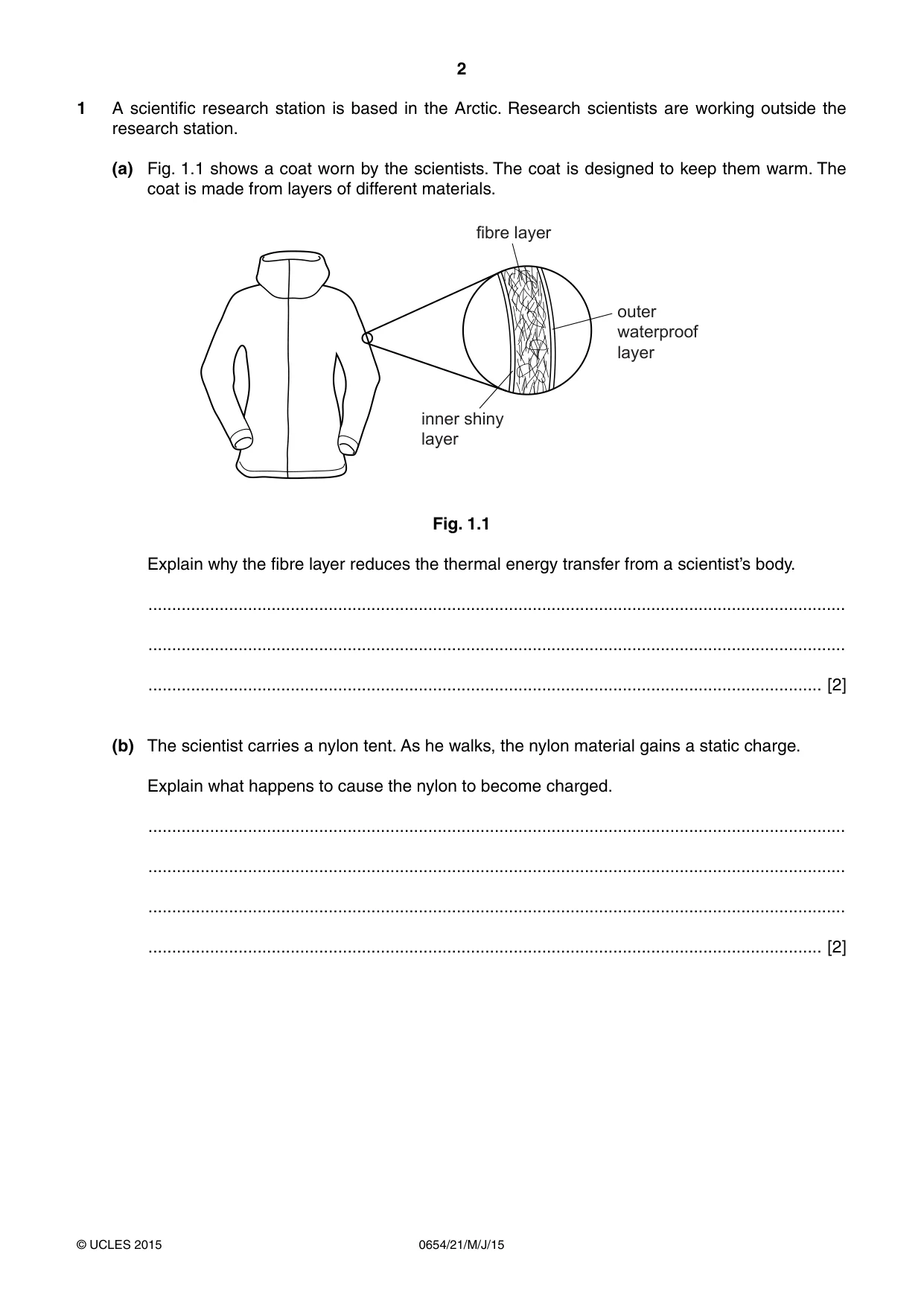
2 0654/21/M/J/15 © UCLES 2015 1 A scientific research station is based in the Arctic. Research scientists are working outside the research station. (a) Fig. 1.1 shows a coat worn by the scientists. The coat is designed to keep them warm. The coat is made from layers of different materials. inner shiny layer outer waterproof layer fibre layer Fig. 1.1 Explain why the fibre layer reduces the thermal energy transfer from a scientist’s body. … … … [2] (b) The scientist carries a nylon tent. As he walks, the nylon material gains a static charge. Explain what happens to cause the nylon to become charged. … … … … [2]
Question paper, page 3
3 0654/21/M/J/15 © UCLES 2015 [Turn over (c) In the Arctic, harmful ultraviolet radiation is able to reach the surface of the Earth. The scientists at the research station are exposed to this ultraviolet radiation. Ultraviolet radiation is ionising radiation. (i) State one danger to human beings of being exposed to large quantities of ultraviolet radiation. … [1] (ii) Ultraviolet radiation is part of the electromagnetic spectrum. Name one other radiation which is part of the electromagnetic spectrum. State a use for this radiation. radiation … use … [1]
Question paper, page 4
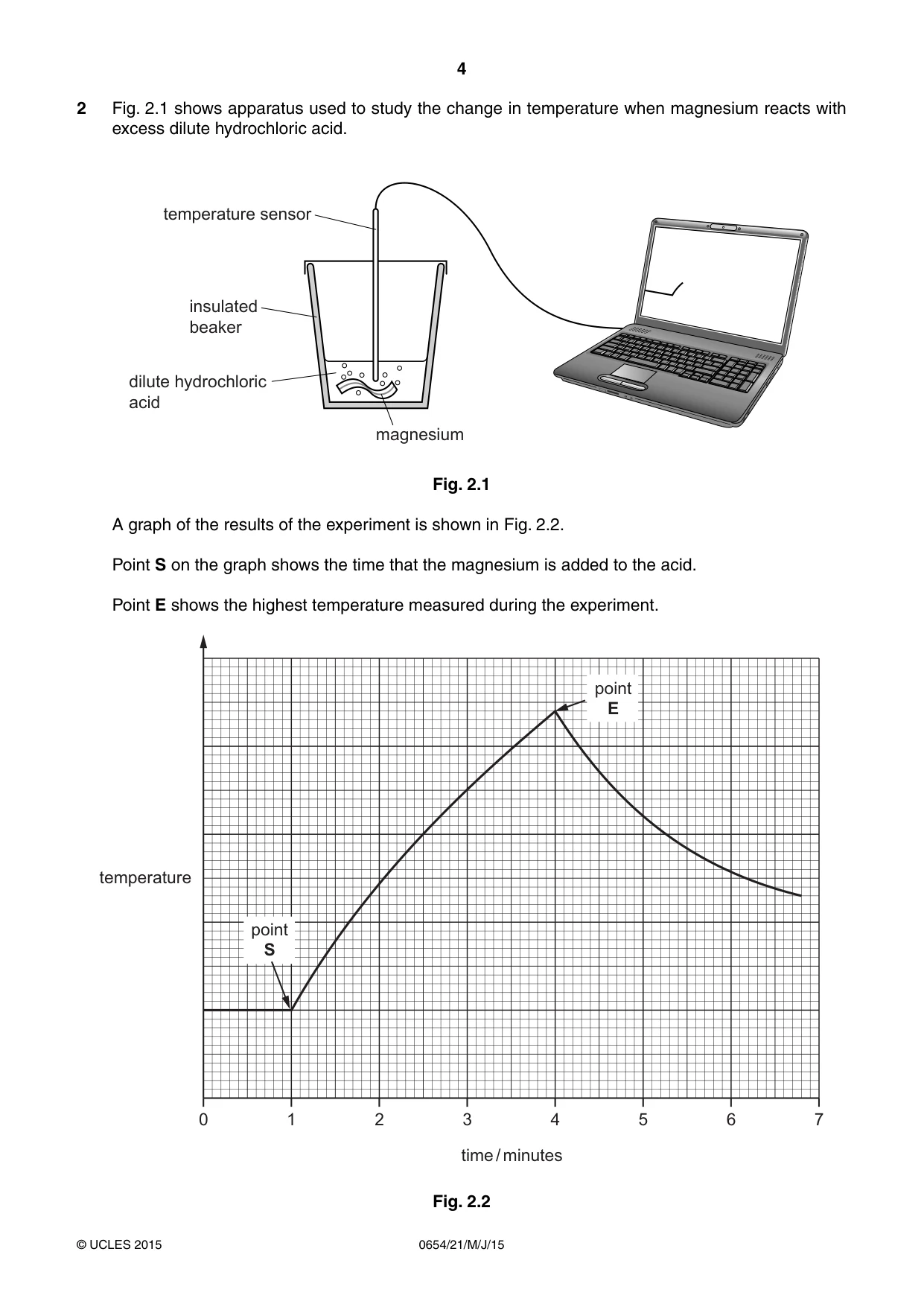
4 0654/21/M/J/15 © UCLES 2015 2 Fig. 2.1 shows apparatus used to study the change in temperature when magnesium reacts with excess dilute hydrochloric acid. insulated beaker dilute hydrochloric acid magnesium temperature sensor Fig. 2.1 A graph of the results of the experiment is shown in Fig. 2.2. Point S on the graph shows the time that the magnesium is added to the acid. Point E shows the highest temperature measured during the experiment. 0 1 2 3 4 5 6 7 time / minutes temperature point S point E Fig. 2.2
Question paper, page 5
5 0654/21/M/J/15 © UCLES 2015 [Turn over (a) (i) State the word that is used to describe a chemical reaction that causes an increase in temperature. … [1] (ii) Suggest why point E shows the time at which the reaction between magnesium and the acid has finished. … … [1] (iii) Use the graph to find the time from the start to the end of the reaction. Show your working. … minutes [1] (iv) The experiment shown in Fig. 2.1 is repeated using the same-sized piece of magnesium but with a more concentrated solution of hydrochloric acid. State how and explain why the time taken for the reaction would be different from your answer to (iii). … … … [2] (v) Describe the effect that a change in the temperature of dilute hydrochloric acid has on the rate of the reaction with magnesium. … … [1]
Question paper, page 6
6 0654/21/M/J/15 © UCLES 2015 (b) During the reaction between magnesium and dilute hydrochloric acid a gas is given off. Name this gas, and describe a test for it. name … test … … [2] (c) The experiment in Fig. 2.1 is repeated by adding copper instead of magnesium to dilute hydrochloric acid. State and explain the temperature change, if any, which is observed. … … … [2]
Question paper, page 7
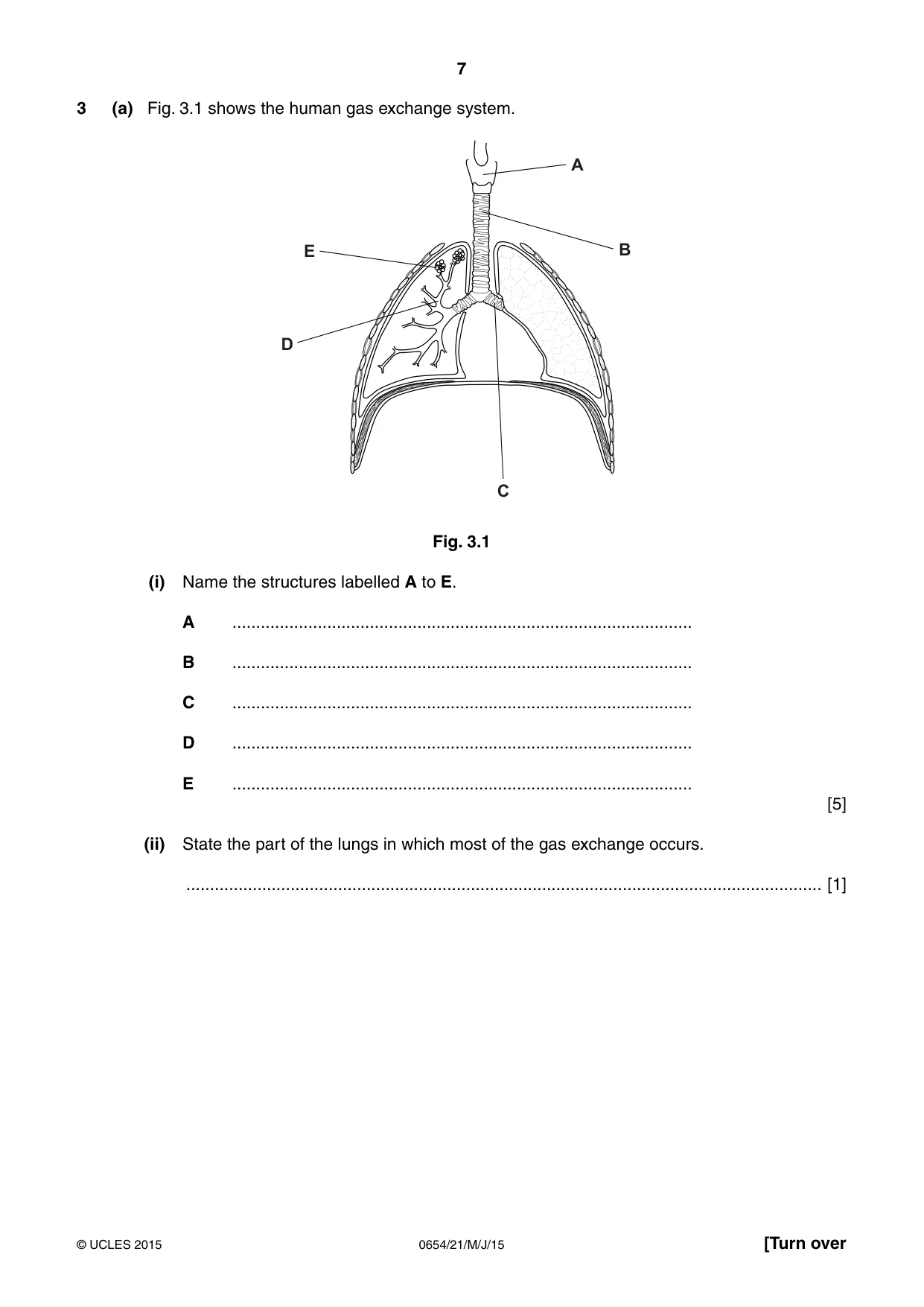
7 0654/21/M/J/15 © UCLES 2015 [Turn over 3 (a) Fig. 3.1 shows the human gas exchange system. A B C D E Fig. 3.1 (i) Name the structures labelled A to E. A … B … C … D … E … [5] (ii) State the part of the lungs in which most of the gas exchange occurs. … [1]
Question paper, page 8
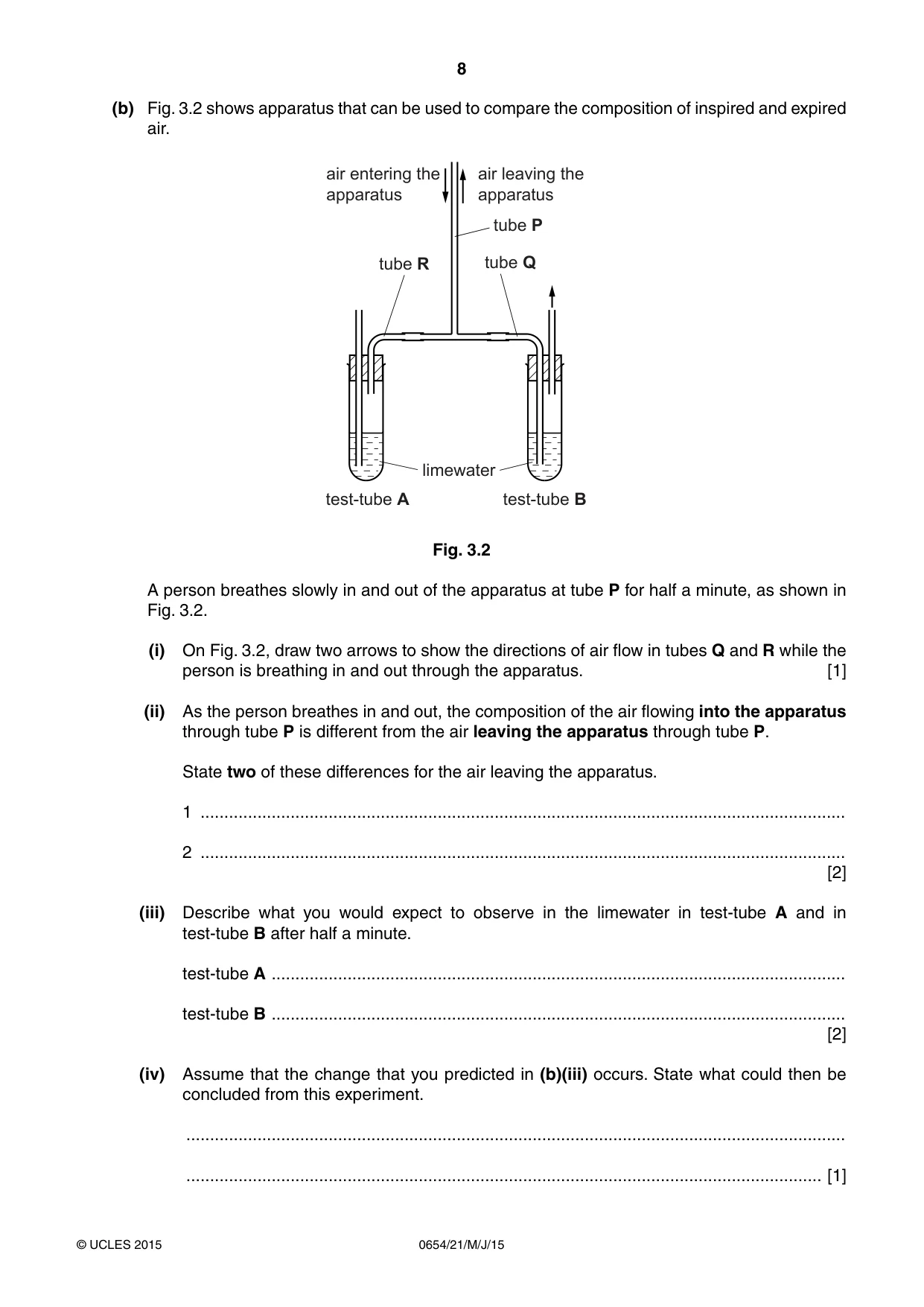
8 0654/21/M/J/15 © UCLES 2015 (b) Fig. 3.2 shows apparatus that can be used to compare the composition of inspired and expired air. limewater test-tube A test-tube B air entering the apparatus air leaving the apparatus tube Q tube R tube P Fig. 3.2 A person breathes slowly in and out of the apparatus at tube P for half a minute, as shown in Fig. 3.2. (i) On Fig. 3.2, draw two arrows to show the directions of air flow in tubes Q and R while the person is breathing in and out through the apparatus. [1] (ii) As the person breathes in and out, the composition of the air flowing into the apparatus through tube P is different from the air leaving the apparatus through tube P. State two of these differences for the air leaving the apparatus. 1 … 2 … [2] (iii) Describe what you would expect to observe in the limewater in test-tube A and in test-tube B after half a minute. test-tube A … test-tube B … [2] (iv) Assume that the change that you predicted in (b)(iii) occurs. State what could then be concluded from this experiment. … … [1]
Question paper, page 9
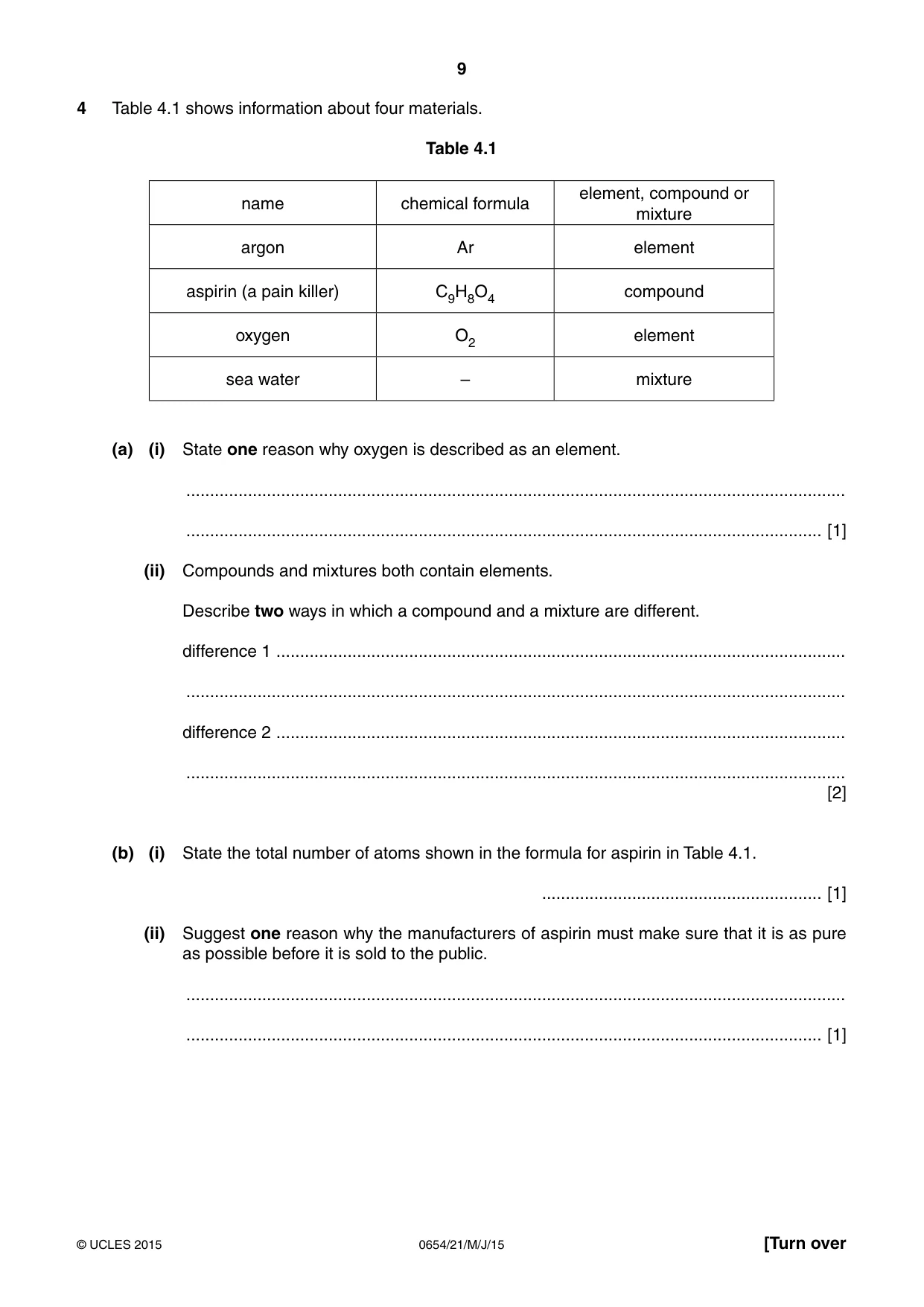
9 0654/21/M/J/15 © UCLES 2015 [Turn over 4 Table 4.1 shows information about four materials. Table 4.1 name chemical formula element, compound or mixture argon Ar element aspirin (a pain killer) C9H8O4 compound oxygen O2 element sea water – mixture (a) (i) State one reason why oxygen is described as an element. … … [1] (ii) Compounds and mixtures both contain elements. Describe two ways in which a compound and a mixture are different. difference 1 … … difference 2 … … [2] (b) (i) State the total number of atoms shown in the formula for aspirin in Table 4.1. … [1] (ii) Suggest one reason why the manufacturers of aspirin must make sure that it is as pure as possible before it is sold to the public. … … [1]
Question paper, page 10
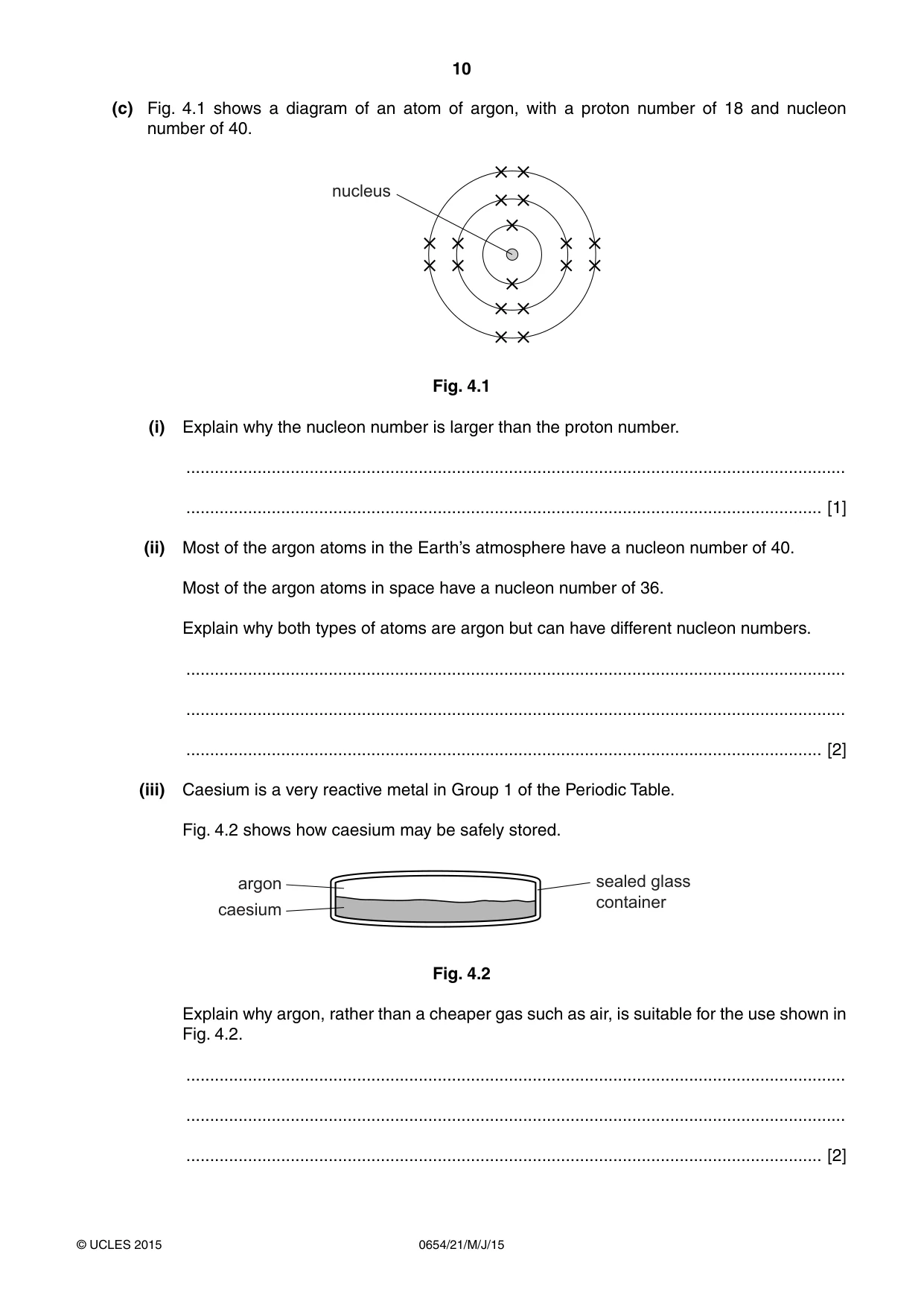
10 0654/21/M/J/15 © UCLES 2015 (c) Fig. 4.1 shows a diagram of an atom of argon, with a proton number of 18 and nucleon number of 40. nucleus Fig. 4.1 (i) Explain why the nucleon number is larger than the proton number. … … [1] (ii) Most of the argon atoms in the Earth’s atmosphere have a nucleon number of 40. Most of the argon atoms in space have a nucleon number of 36. Explain why both types of atoms are argon but can have different nucleon numbers. … … … [2] (iii) Caesium is a very reactive metal in Group 1 of the Periodic Table. Fig. 4.2 shows how caesium may be safely stored. argon caesium sealed glass container Fig. 4.2 Explain why argon, rather than a cheaper gas such as air, is suitable for the use shown in Fig. 4.2. … … … [2]
Question paper, page 11
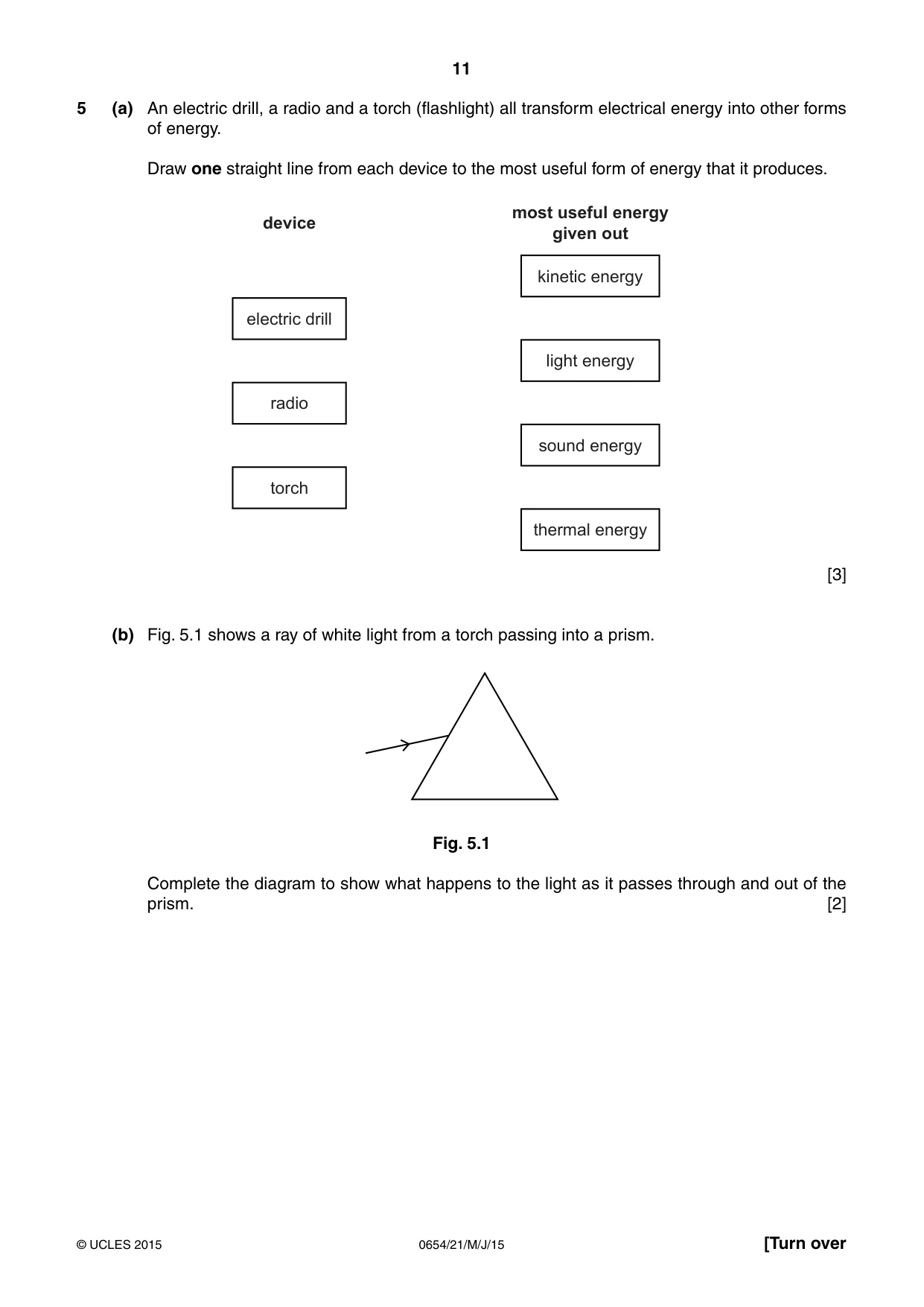
11 0654/21/M/J/15 © UCLES 2015 [Turn over 5 (a) An electric drill, a radio and a torch (flashlight) all transform electrical energy into other forms of energy. Draw one straight line from each device to the most useful form of energy that it produces. kinetic energy light energy sound energy electric drill most useful energy given out device radio torch thermal energy [3] (b) Fig. 5.1 shows a ray of white light from a torch passing into a prism. Fig. 5.1 Complete the diagram to show what happens to the light as it passes through and out of the prism. [2]
Question paper, page 12
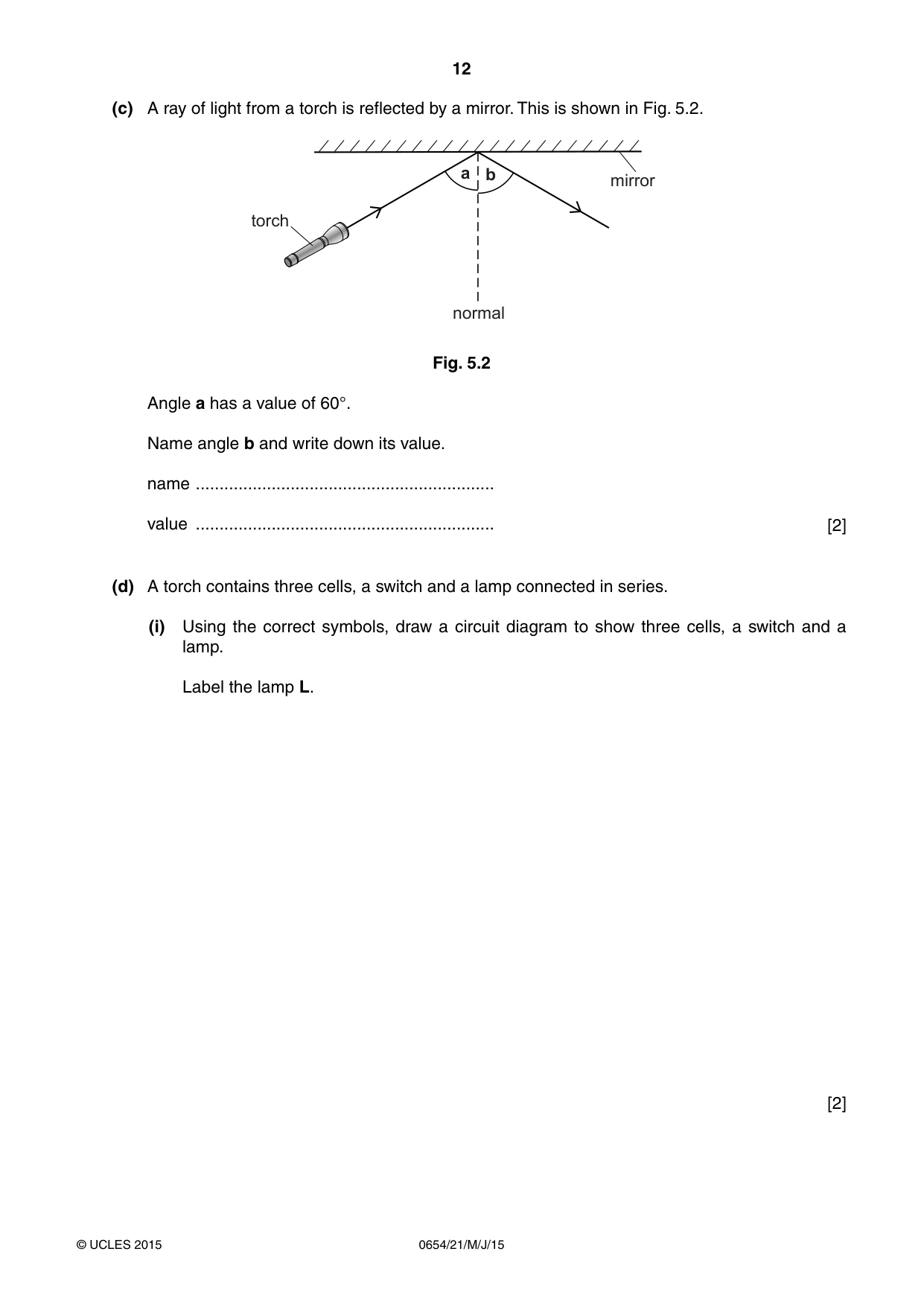
12 0654/21/M/J/15 © UCLES 2015 (c) A ray of light from a torch is reflected by a mirror. This is shown in Fig. 5.2. normal torch a b mirror Fig. 5.2 Angle a has a value of 60°. Name angle b and write down its value. name … value … [2] (d) A torch contains three cells, a switch and a lamp connected in series. (i) Using the correct symbols, draw a circuit diagram to show three cells, a switch and a lamp. Label the lamp L. [2]
Question paper, page 13
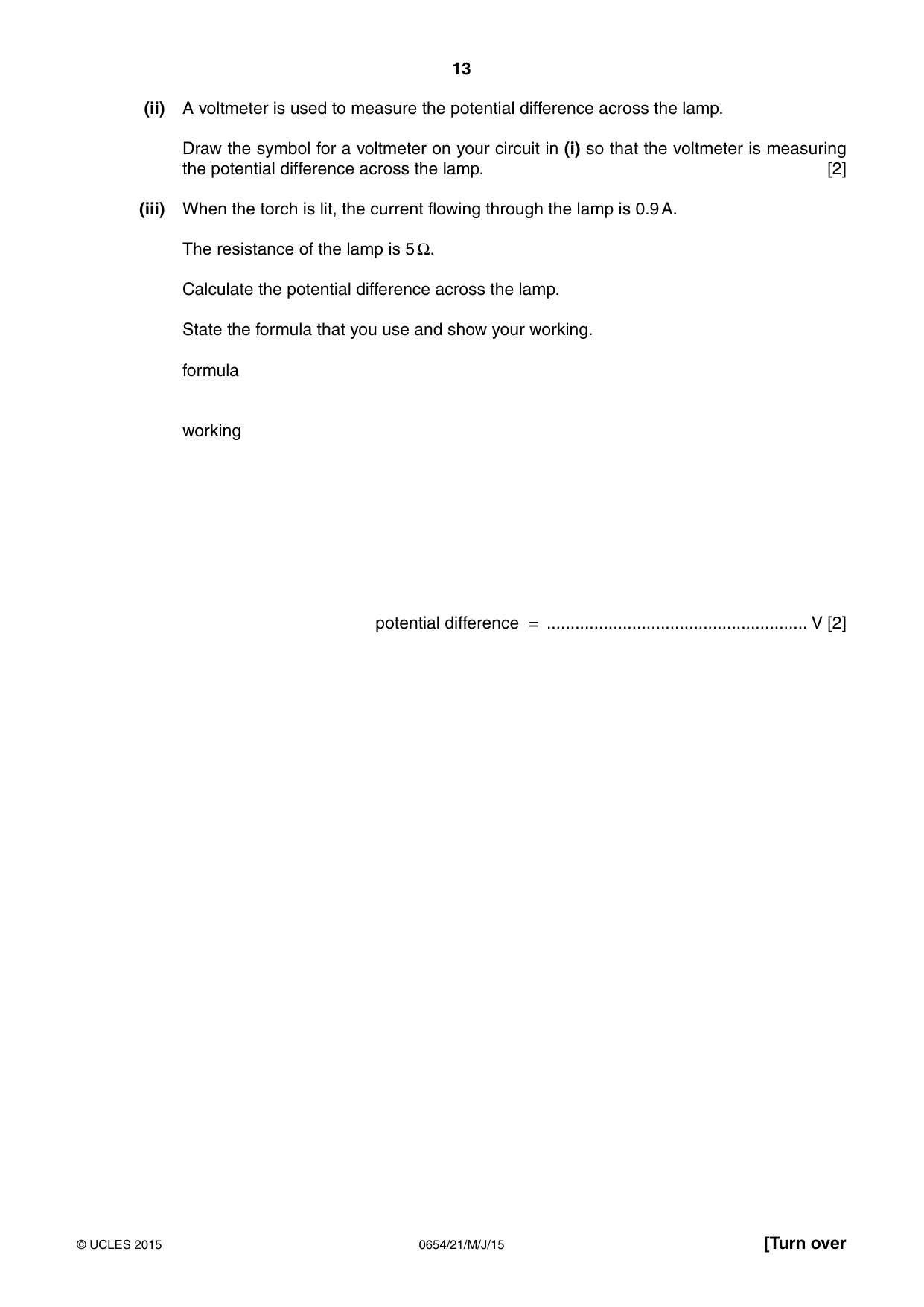
13 0654/21/M/J/15 © UCLES 2015 [Turn over (ii) A voltmeter is used to measure the potential difference across the lamp. Draw the symbol for a voltmeter on your circuit in (i) so that the voltmeter is measuring the potential difference across the lamp. [2] (iii) When the torch is lit, the current flowing through the lamp is 0.9 A. The resistance of the lamp is 5 Ω. Calculate the potential difference across the lamp. State the formula that you use and show your working. formula working potential difference = … V [2]
Question paper, page 14
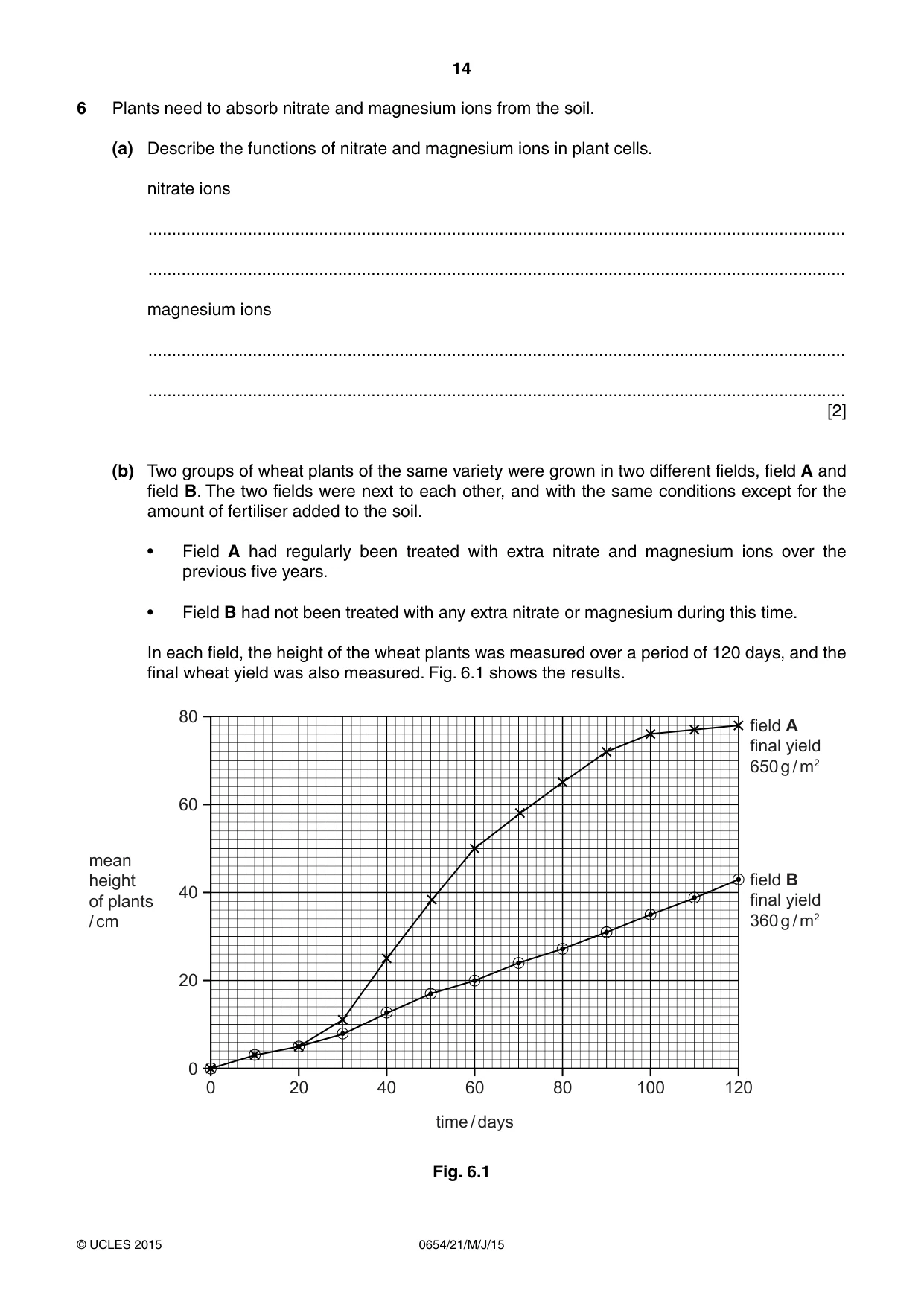
14 0654/21/M/J/15 © UCLES 2015 6 Plants need to absorb nitrate and magnesium ions from the soil. (a) Describe the functions of nitrate and magnesium ions in plant cells. nitrate ions … … magnesium ions … … [2] (b) Two groups of wheat plants of the same variety were grown in two different fields, field A and field B. The two fields were next to each other, and with the same conditions except for the amount of fertiliser added to the soil. • Field A had regularly been treated with extra nitrate and magnesium ions over the previous five years. • Field B had not been treated with any extra nitrate or magnesium during this time. In each field, the height of the wheat plants was measured over a period of 120 days, and the final wheat yield was also measured. Fig. 6.1 shows the results. 0 20 40 60 time / days 80 100 120 80 60 40 20 0 mean height of plants / cm field A final yield 650 g / m2 field B final yield 360 g / m2 Fig. 6.1
Question paper, page 15
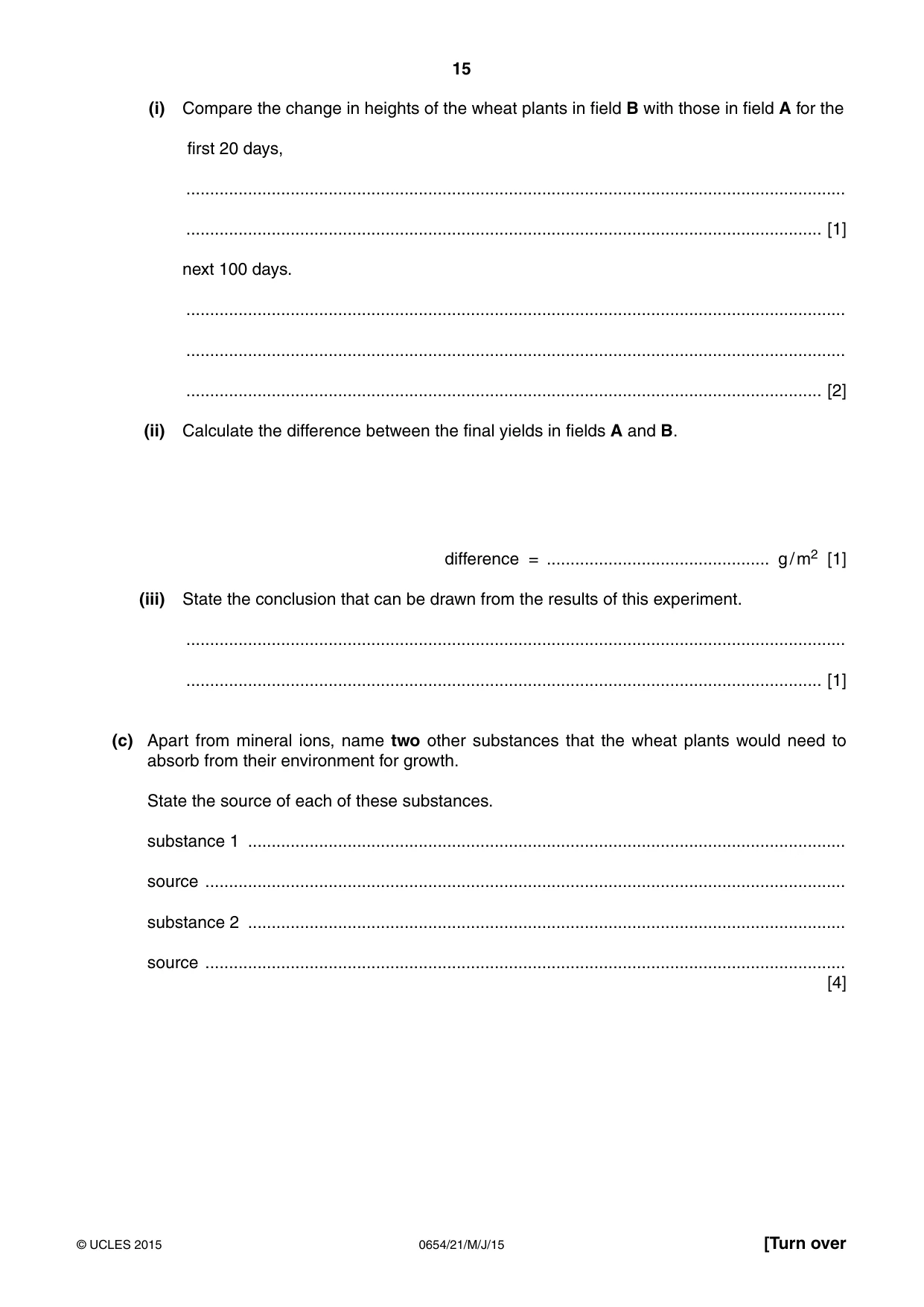
15 0654/21/M/J/15 © UCLES 2015 [Turn over (i) Compare the change in heights of the wheat plants in field B with those in field A for the first 20 days, … … [1] next 100 days. … … … [2] (ii) Calculate the difference between the final yields in fields A and B. difference = … g / m2 [1] (iii) State the conclusion that can be drawn from the results of this experiment. … … [1] (c) Apart from mineral ions, name two other substances that the wheat plants would need to absorb from their environment for growth. State the source of each of these substances. substance 1 … source … substance 2 … source … [4]
Question paper, page 16
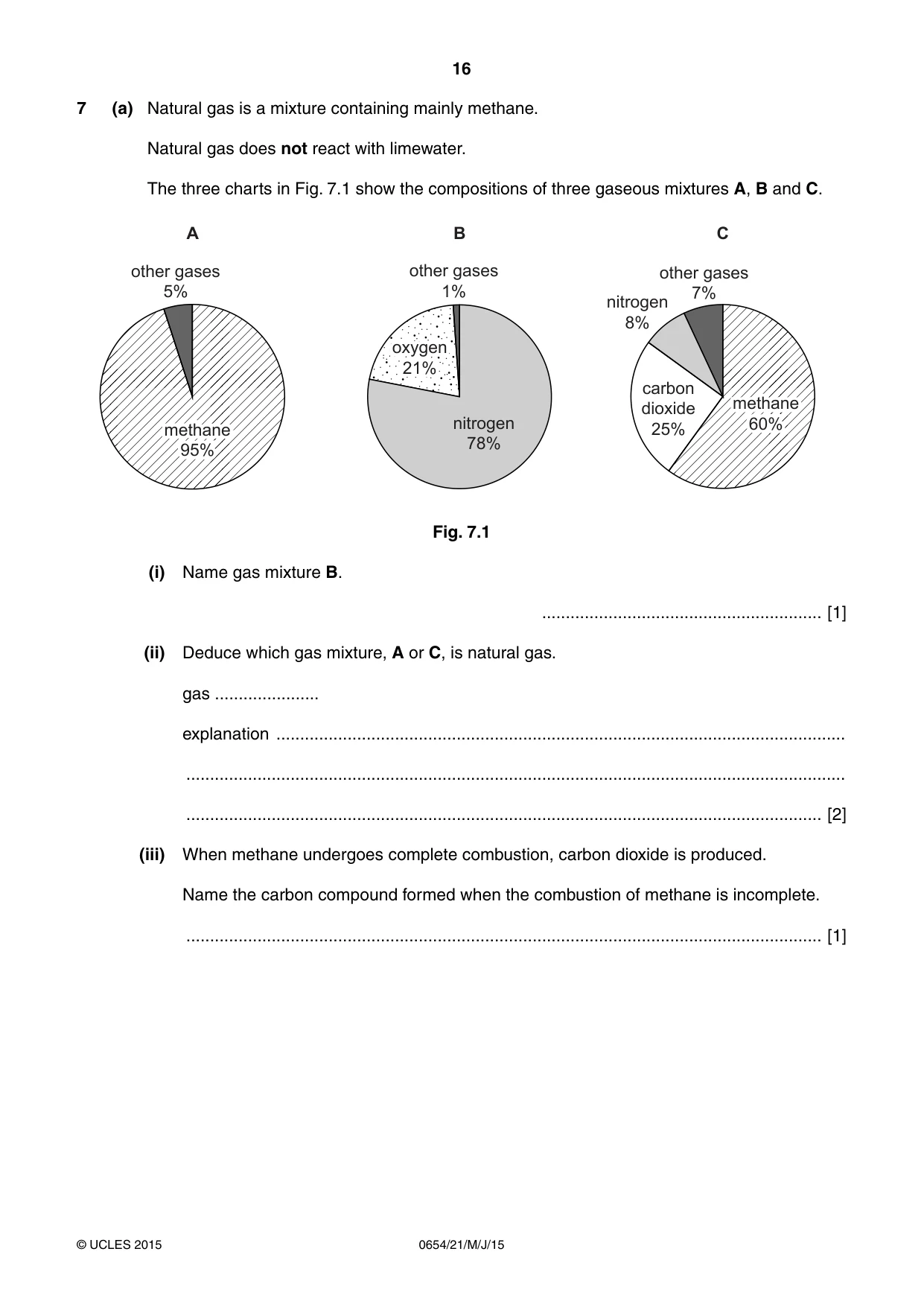
16 0654/21/M/J/15 © UCLES 2015 7 (a) Natural gas is a mixture containing mainly methane. Natural gas does not react with limewater. The three charts in Fig. 7.1 show the compositions of three gaseous mixtures A, B and C. methane 95% methane 95% methane 95% nitrogen 78% oxygen 21% nitrogen 8% methane 60% oxygen 21% carbon dioxide 25% other gases 5% other gases 1% other gases 7% A B C Fig. 7.1 (i) Name gas mixture B. … [1] (ii) Deduce which gas mixture, A or C, is natural gas. gas … explanation … … … [2] (iii) When methane undergoes complete combustion, carbon dioxide is produced. Name the carbon compound formed when the combustion of methane is incomplete. … [1]
Question paper, page 17
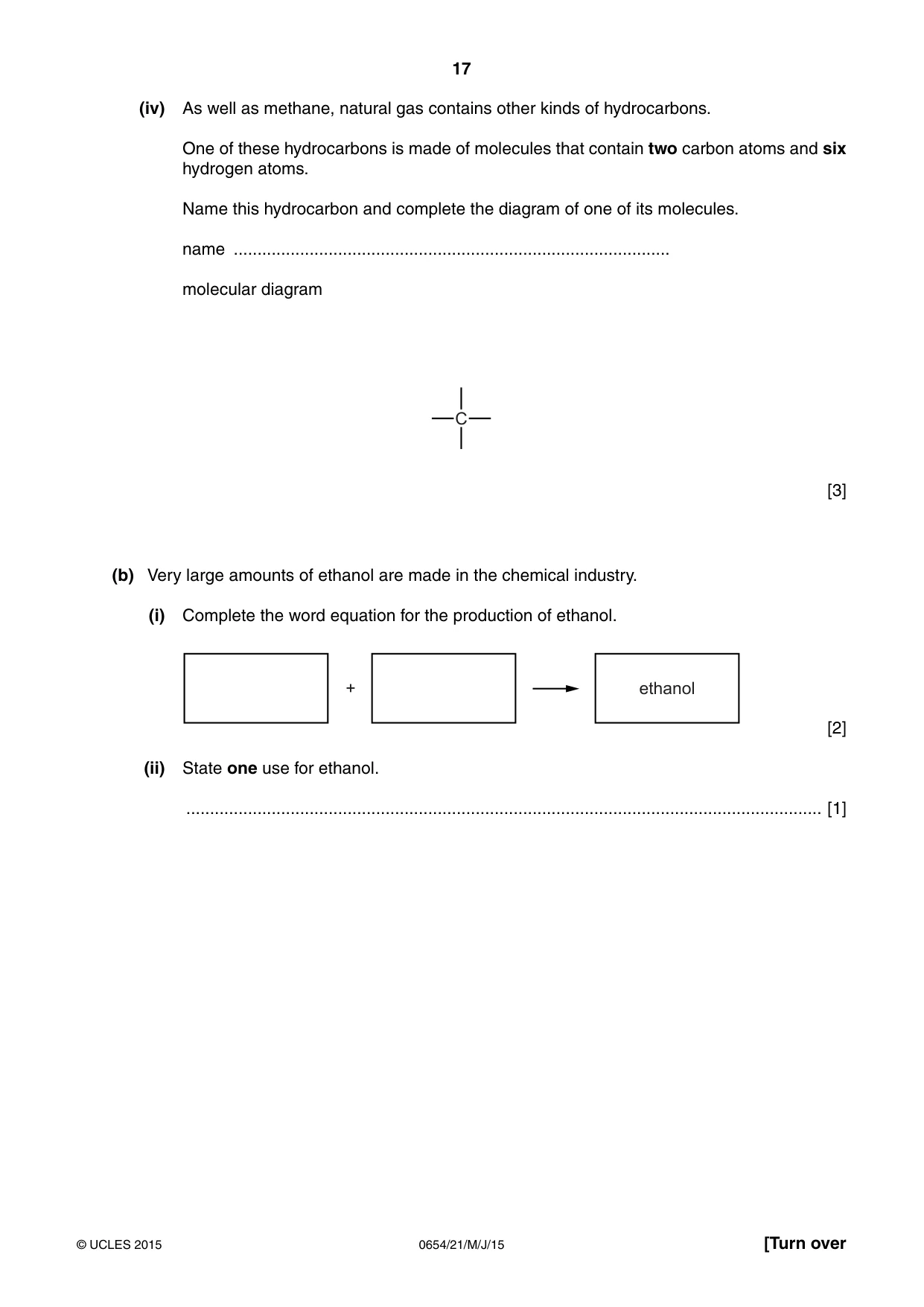
17 0654/21/M/J/15 © UCLES 2015 [Turn over (iv) As well as methane, natural gas contains other kinds of hydrocarbons. One of these hydrocarbons is made of molecules that contain two carbon atoms and six hydrogen atoms. Name this hydrocarbon and complete the diagram of one of its molecules. name … molecular diagram C [3] (b) Very large amounts of ethanol are made in the chemical industry. (i) Complete the word equation for the production of ethanol. ethanol + [2] (ii) State one use for ethanol. … [1]
Question paper, page 18
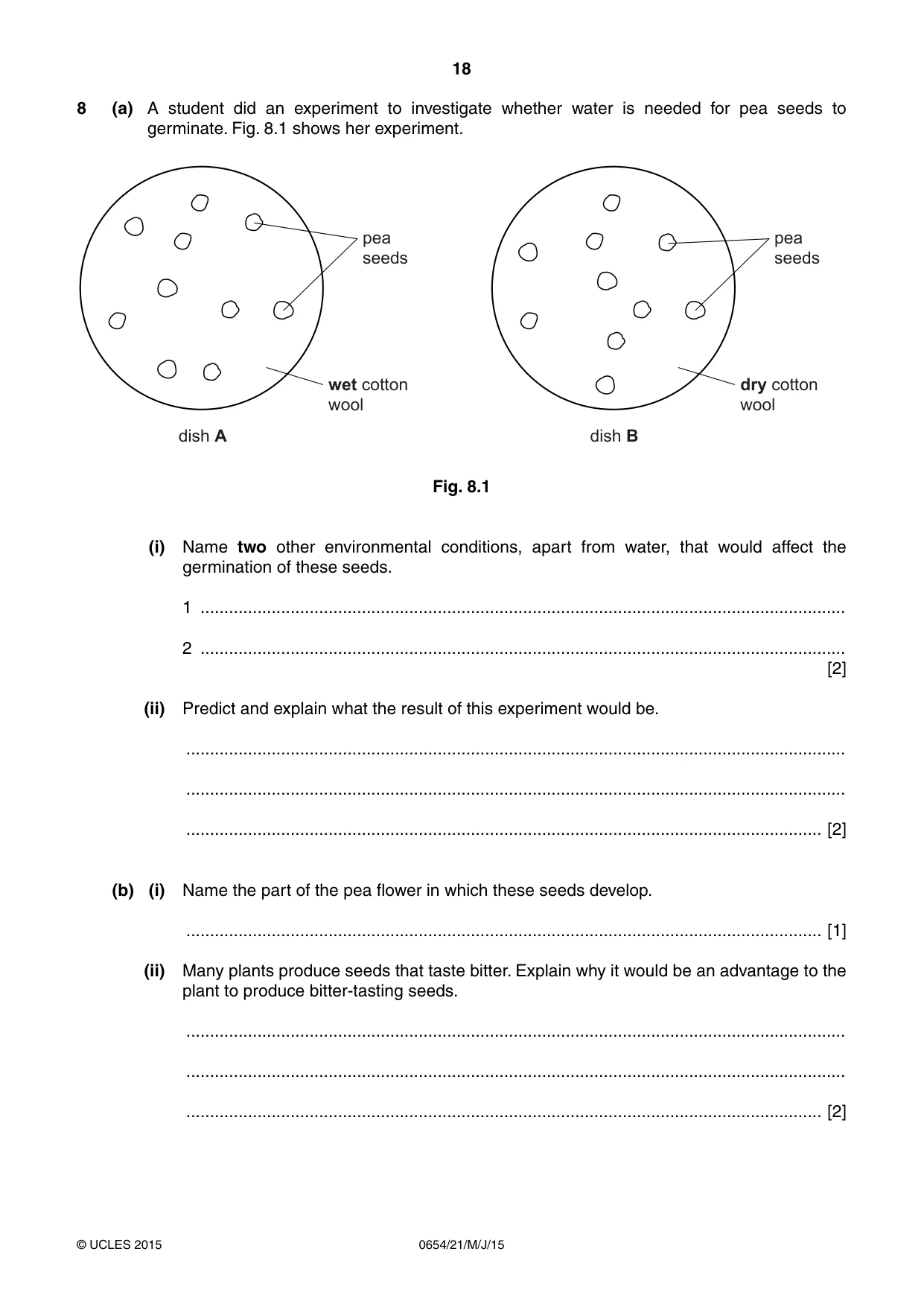
18 0654/21/M/J/15 © UCLES 2015 8 (a) A student did an experiment to investigate whether water is needed for pea seeds to germinate. Fig. 8.1 shows her experiment. dish A pea seeds wet cotton wool dish B pea seeds dry cotton wool Fig. 8.1 (i) Name two other environmental conditions, apart from water, that would affect the germination of these seeds. 1 … 2 … [2] (ii) Predict and explain what the result of this experiment would be. … … … [2] (b) (i) Name the part of the pea flower in which these seeds develop. … [1] (ii) Many plants produce seeds that taste bitter. Explain why it would be an advantage to the plant to produce bitter-tasting seeds. … … … [2]
Question paper, page 19
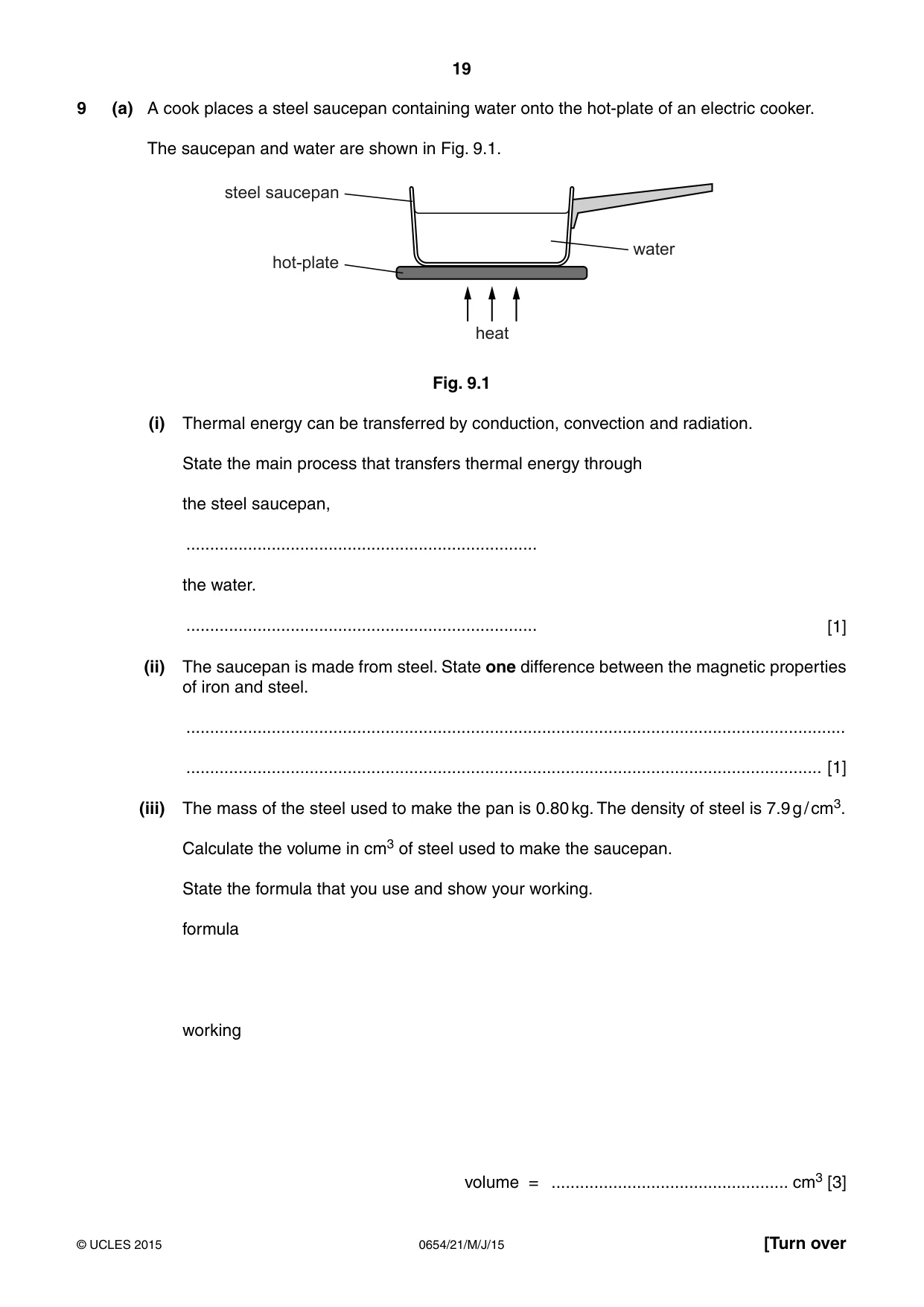
19 0654/21/M/J/15 © UCLES 2015 [Turn over 9 (a) A cook places a steel saucepan containing water onto the hot-plate of an electric cooker. The saucepan and water are shown in Fig. 9.1. heat water steel saucepan hot-plate Fig. 9.1 (i) Thermal energy can be transferred by conduction, convection and radiation. State the main process that transfers thermal energy through the steel saucepan, … the water. … [1] (ii) The saucepan is made from steel. State one difference between the magnetic properties of iron and steel. … … [1] (iii) The mass of the steel used to make the pan is 0.80 kg. The density of steel is 7.9 g / cm3. Calculate the volume in cm3 of steel used to make the saucepan. State the formula that you use and show your working. formula working volume = … cm3 [3]
Question paper, page 20
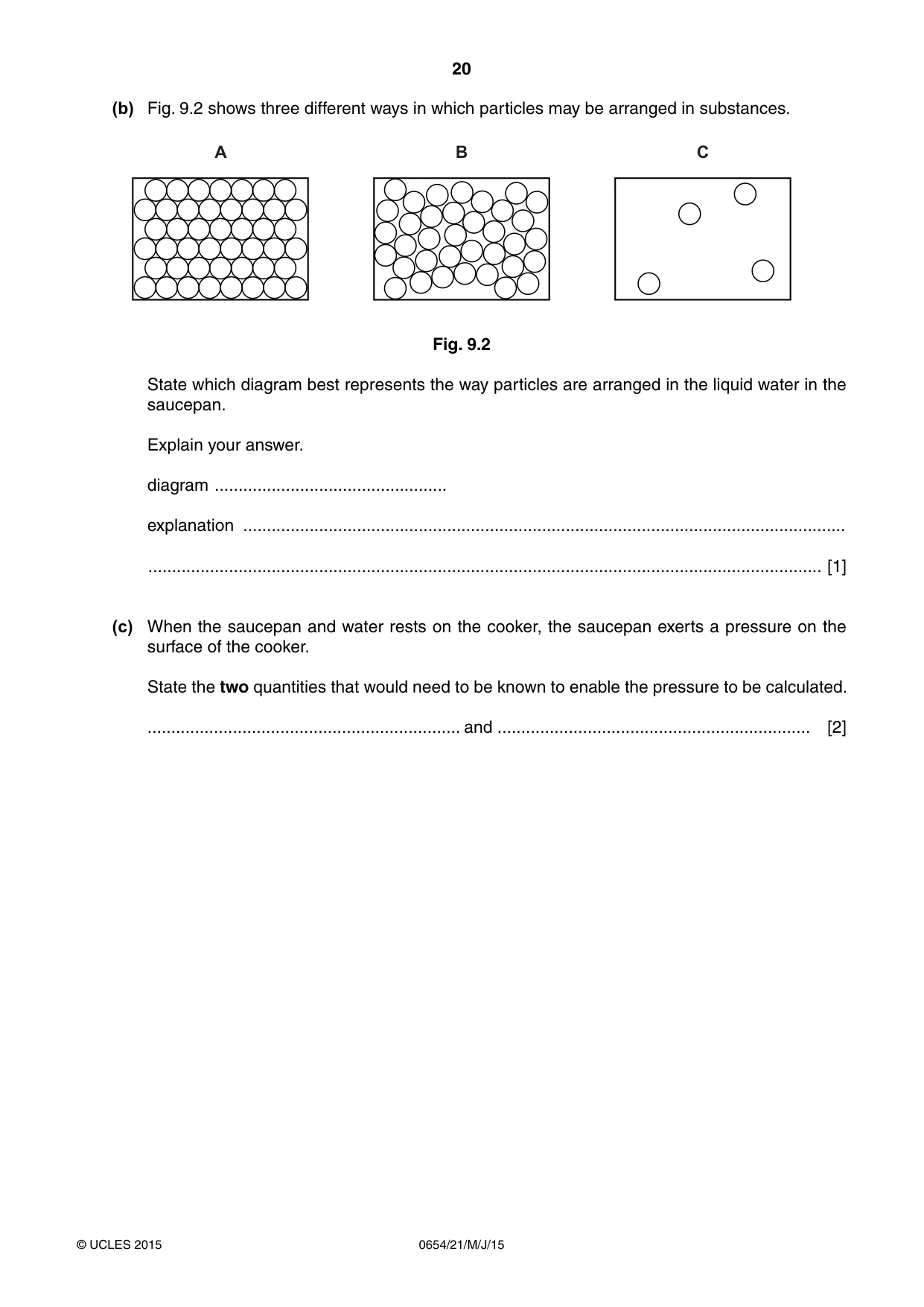
20 0654/21/M/J/15 © UCLES 2015 (b) Fig. 9.2 shows three different ways in which particles may be arranged in substances. A B C Fig. 9.2 State which diagram best represents the way particles are arranged in the liquid water in the saucepan. Explain your answer. diagram … explanation … … [1] (c) When the saucepan and water rests on the cooker, the saucepan exerts a pressure on the surface of the cooker. State the two quantities that would need to be known to enable the pressure to be calculated. … and … [2]
Question paper, page 21
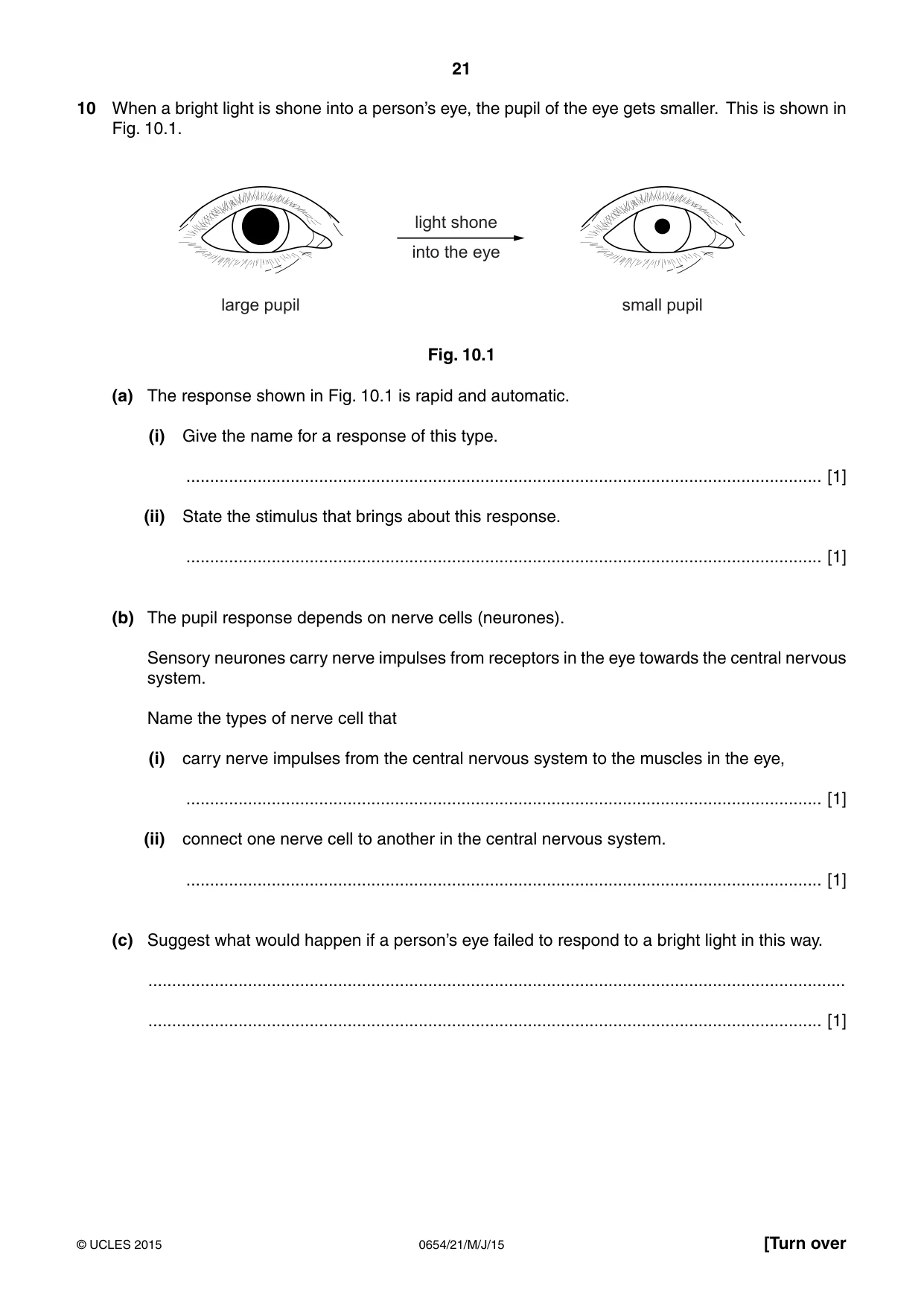
21 0654/21/M/J/15 © UCLES 2015 [Turn over 10 When a bright light is shone into a person’s eye, the pupil of the eye gets smaller. This is shown in Fig. 10.1. light shone into the eye large pupil small pupil Fig. 10.1 (a) The response shown in Fig. 10.1 is rapid and automatic. (i) Give the name for a response of this type. … [1] (ii) State the stimulus that brings about this response. … [1] (b) The pupil response depends on nerve cells (neurones). Sensory neurones carry nerve impulses from receptors in the eye towards the central nervous system. Name the types of nerve cell that (i) carry nerve impulses from the central nervous system to the muscles in the eye, … [1] (ii) connect one nerve cell to another in the central nervous system. … [1] (c) Suggest what would happen if a person’s eye failed to respond to a bright light in this way. … … [1]
Question paper, page 22
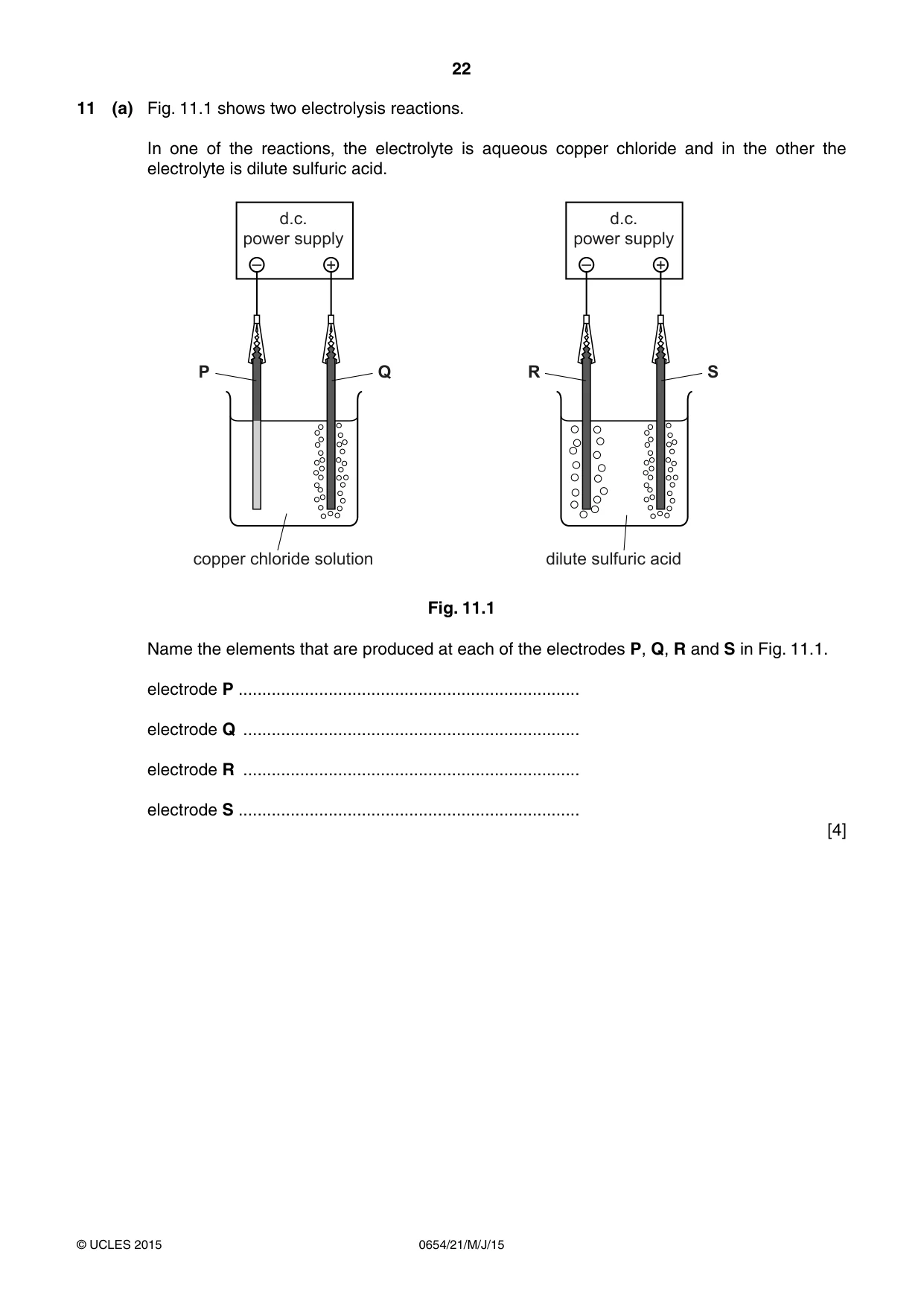
22 0654/21/M/J/15 © UCLES 2015 11 (a) Fig. 11.1 shows two electrolysis reactions. In one of the reactions, the electrolyte is aqueous copper chloride and in the other the electrolyte is dilute sulfuric acid. dilute sulfuric acid copper chloride solution d.c. power supply d.c. power supply + – + – R S P Q Fig. 11.1 Name the elements that are produced at each of the electrodes P, Q, R and S in Fig. 11.1. electrode P … electrode Q … electrode R … electrode S … [4]
Question paper, page 23
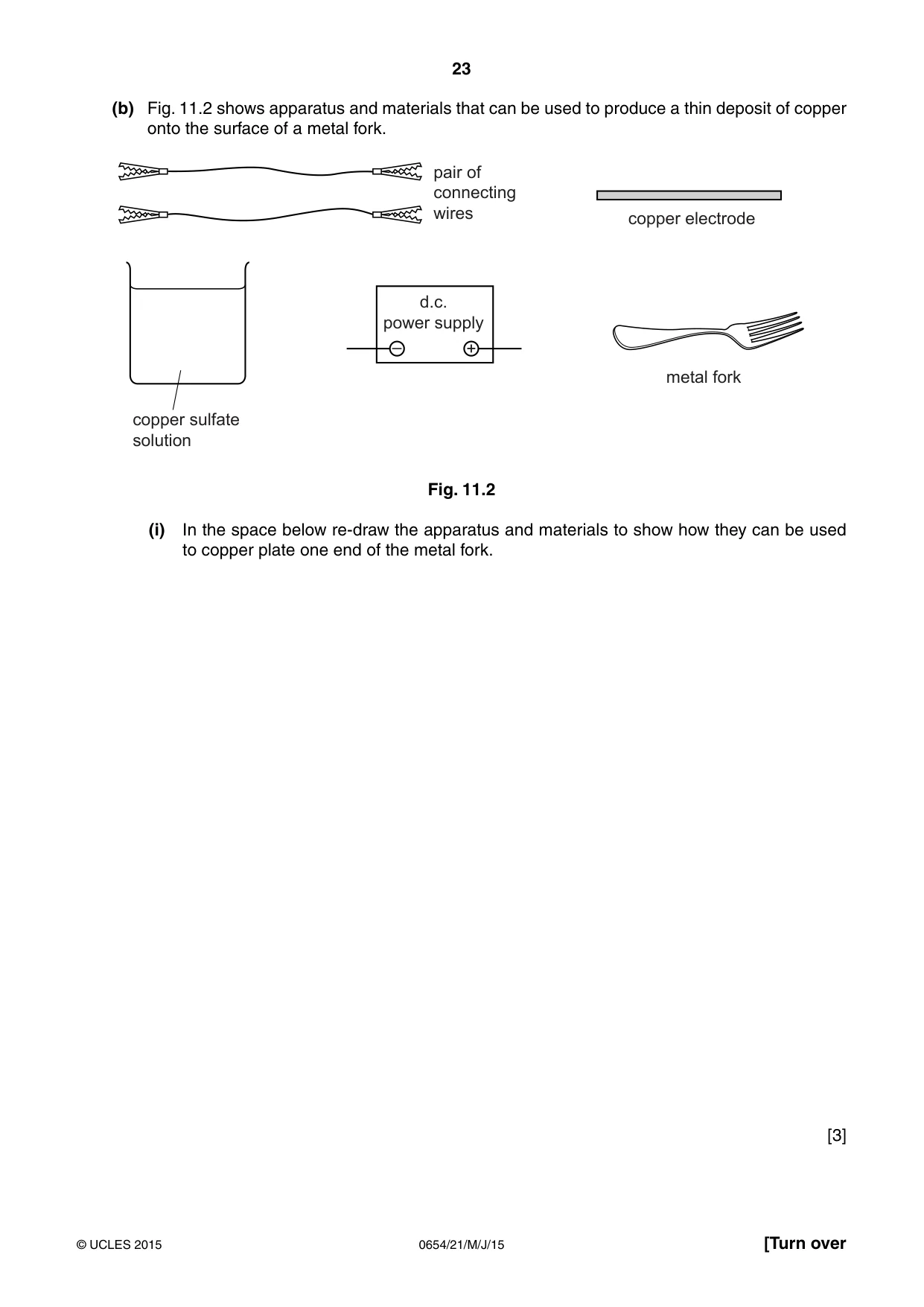
23 0654/21/M/J/15 © UCLES 2015 [Turn over (b) Fig. 11.2 shows apparatus and materials that can be used to produce a thin deposit of copper onto the surface of a metal fork. d.c. power supply + – copper sulfate solution metal fork pair of connecting wires copper electrode Fig. 11.2 (i) In the space below re-draw the apparatus and materials to show how they can be used to copper plate one end of the metal fork. [3]
Question paper, page 24
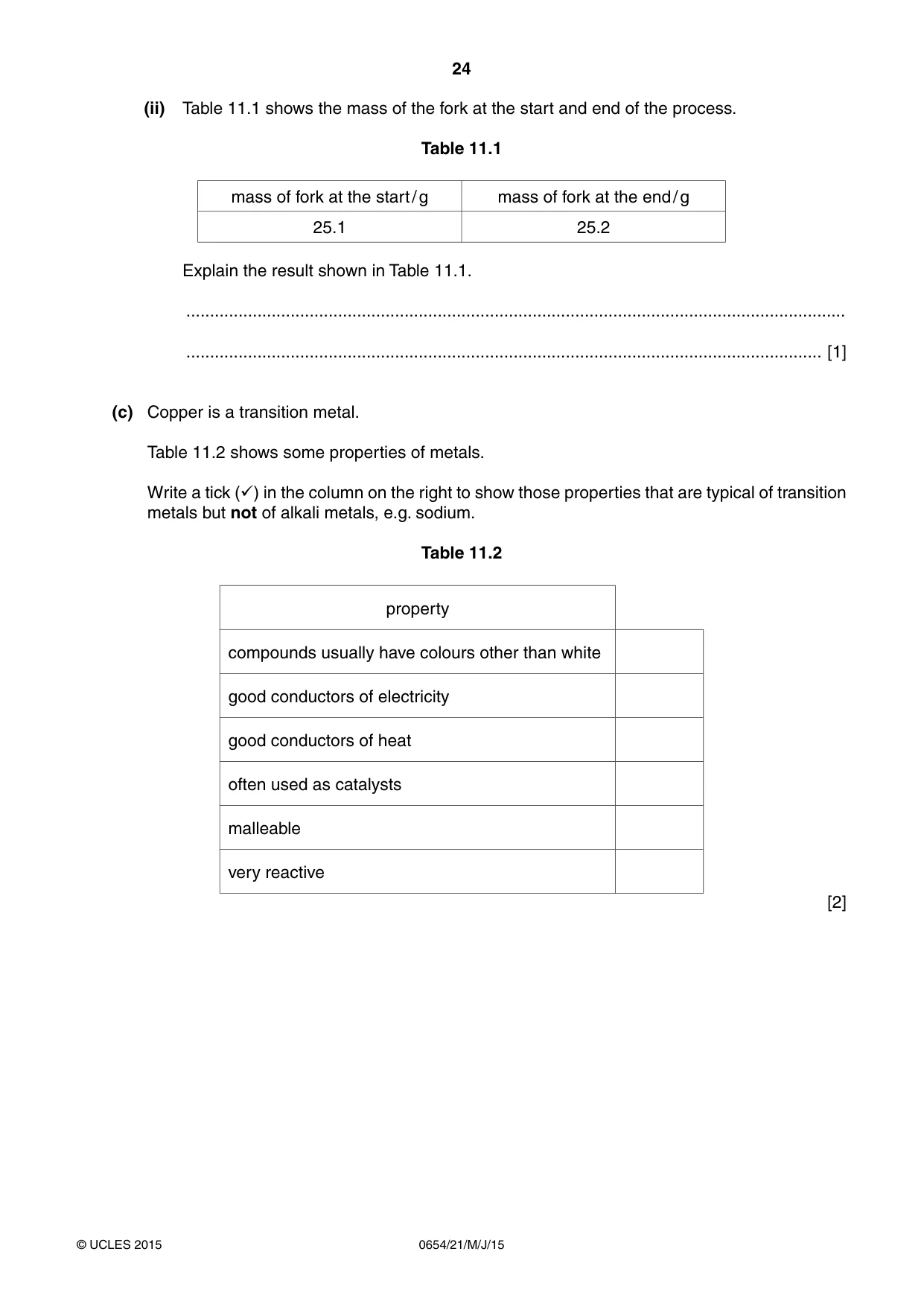
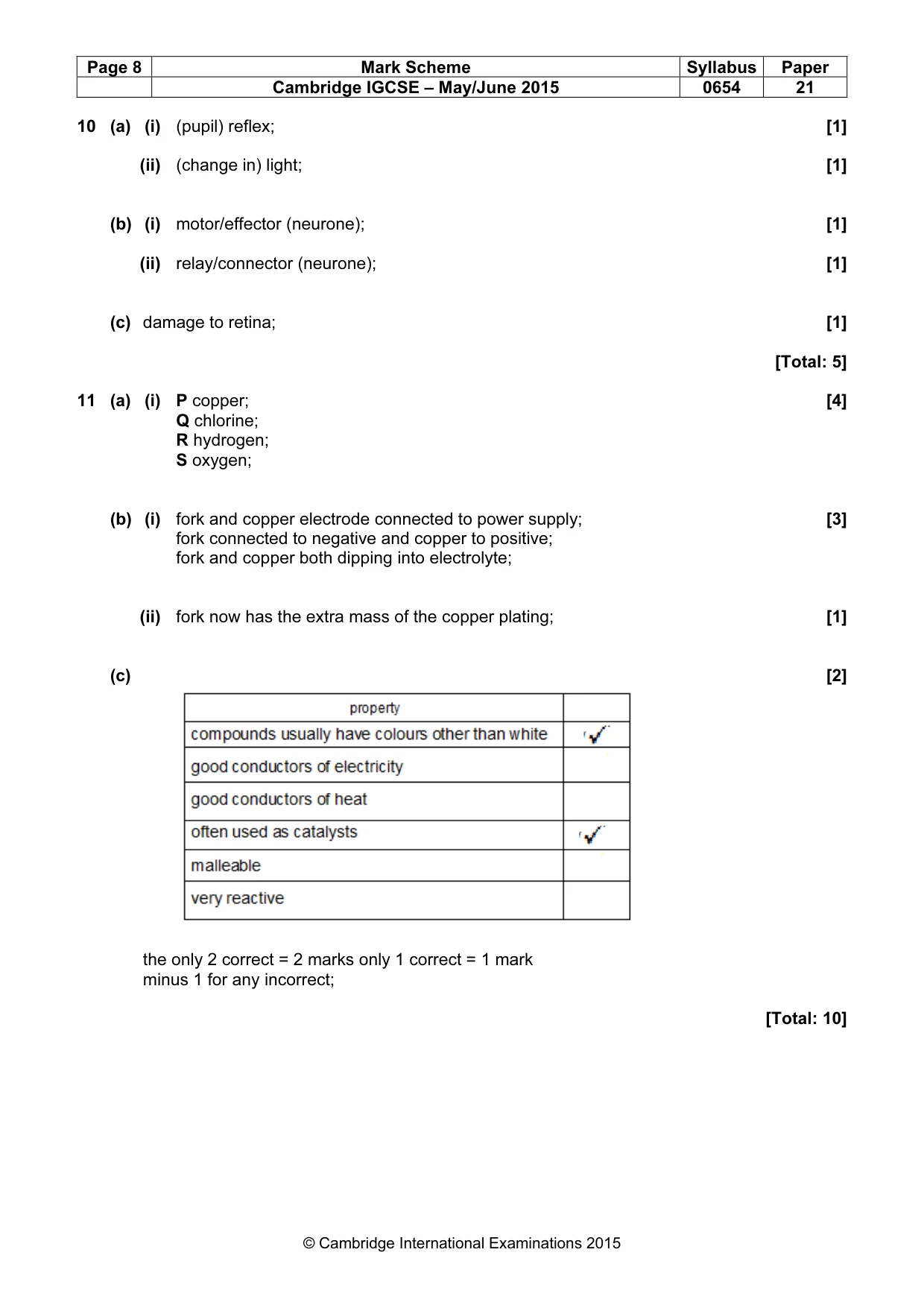
24 0654/21/M/J/15 © UCLES 2015 (ii) Table 11.1 shows the mass of the fork at the start and end of the process. Table 11.1 mass of fork at the start / g mass of fork at the end / g 25.1 25.2 Explain the result shown in Table 11.1. … … [1] (c) Copper is a transition metal. Table 11.2 shows some properties of metals. Write a tick () in the column on the right to show those properties that are typical of transition metals but not of alkali metals, e.g. sodium. Table 11.2 property compounds usually have colours other than white good conductors of electricity good conductors of heat often used as catalysts malleable very reactive [2]
Question paper, page 25
25 0654/21/M/J/15 © UCLES 2015 [Turn over 12 (a) Give two examples of fossil fuels. 1 … 2 … [2] (b) Fossil fuels are non-renewable. Explain what is meant by non-renewable. … … [1] (c) Many governments are making efforts to reduce the use of fossil fuels. Suggest two ways in which the use of fossil fuels can be reduced. 1 … 2 … [2]
Question paper, page 26
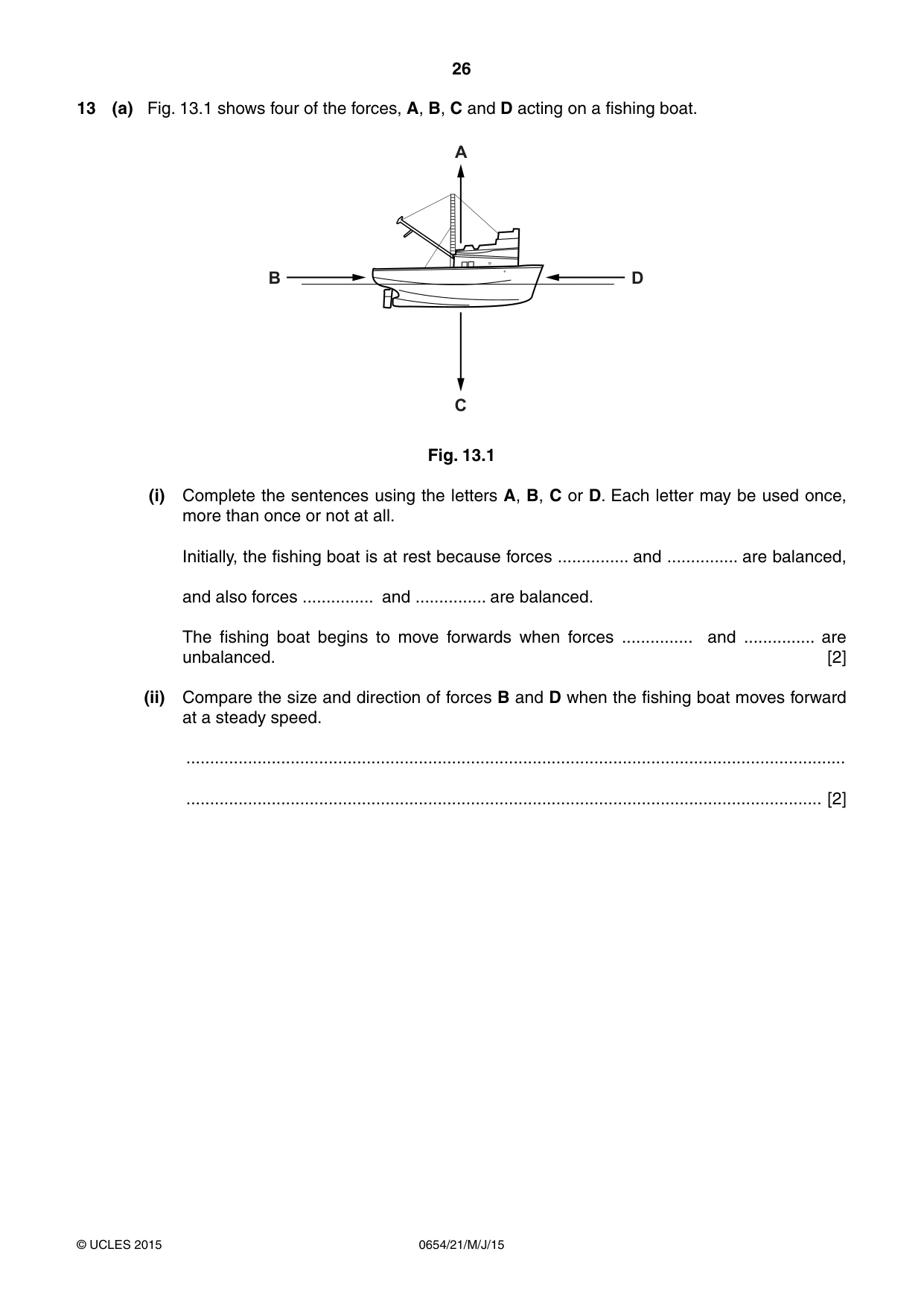
26 0654/21/M/J/15 © UCLES 2015 13 (a) Fig. 13.1 shows four of the forces, A, B, C and D acting on a fishing boat. A C B D Fig. 13.1 (i) Complete the sentences using the letters A, B, C or D. Each letter may be used once, more than once or not at all. Initially, the fishing boat is at rest because forces … and … are balanced, and also forces … and … are balanced. The fishing boat begins to move forwards when forces … and … are unbalanced. [2] (ii) Compare the size and direction of forces B and D when the fishing boat moves forward at a steady speed. … … [2]
Question paper, page 27
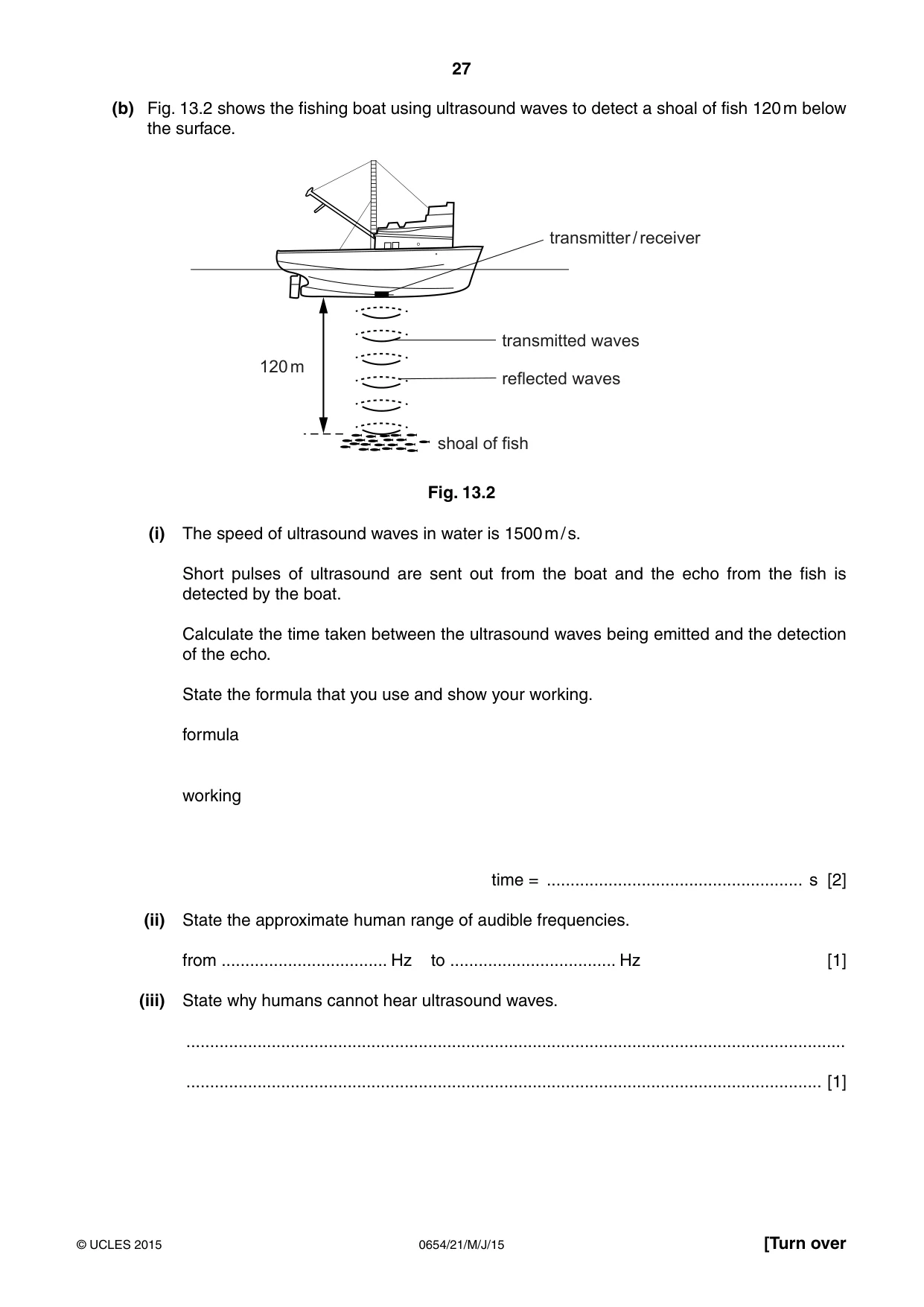
27 0654/21/M/J/15 © UCLES 2015 [Turn over (b) Fig. 13.2 shows the fishing boat using ultrasound waves to detect a shoal of fish 120 m below the surface. shoal of fish 120 m transmitted waves reflected waves transmitter / receiver Fig. 13.2 (i) The speed of ultrasound waves in water is 1500 m / s. Short pulses of ultrasound are sent out from the boat and the echo from the fish is detected by the boat. Calculate the time taken between the ultrasound waves being emitted and the detection of the echo. State the formula that you use and show your working. formula working time = … s [2] (ii) State the approximate human range of audible frequencies. from … Hz to … Hz [1] (iii) State why humans cannot hear ultrasound waves. … … [1]
Question paper, page 28
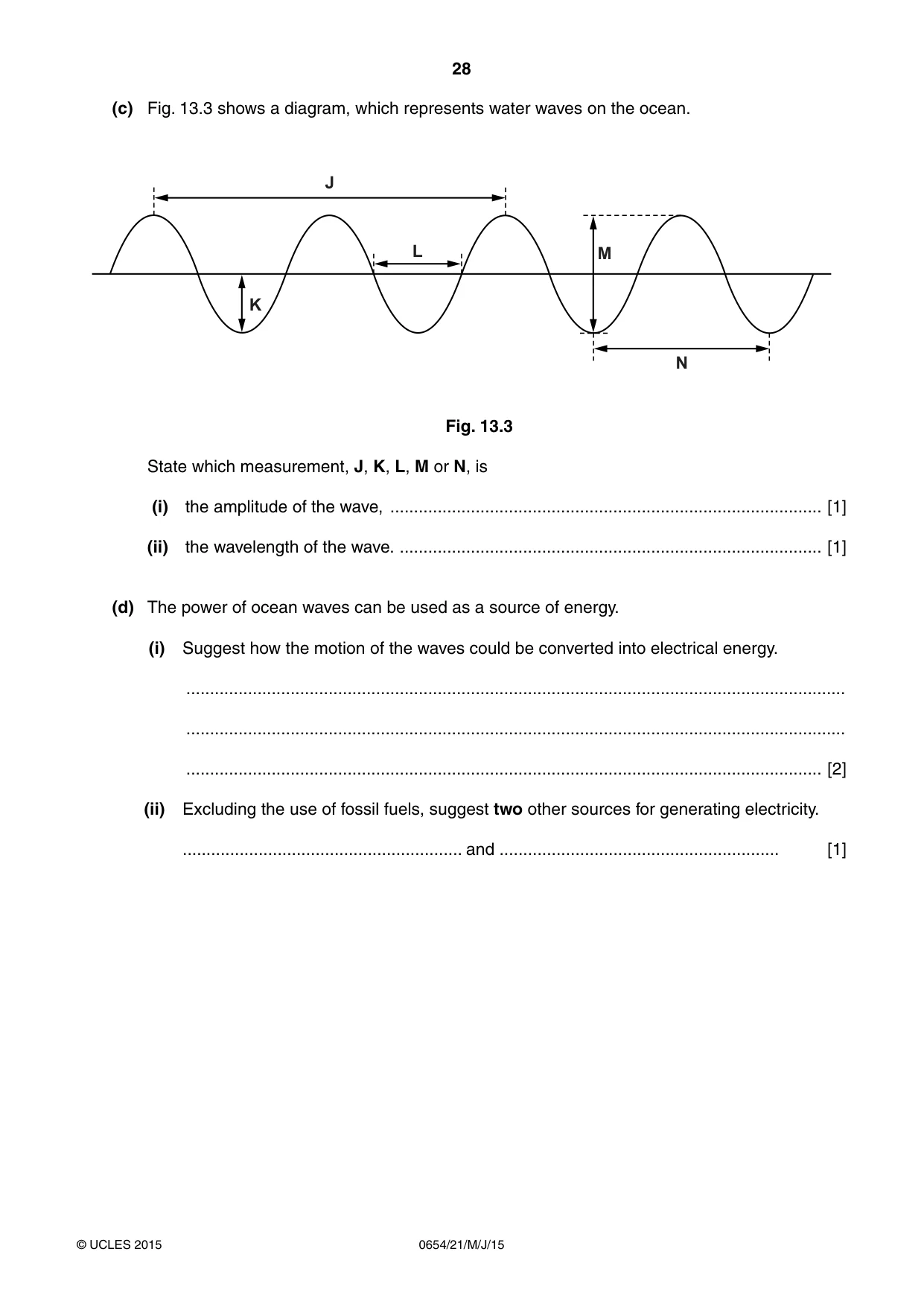
28 0654/21/M/J/15 © UCLES 2015 (c) Fig. 13.3 shows a diagram, which represents water waves on the ocean. N M L J K Fig. 13.3 State which measurement, J, K, L, M or N, is (i) the amplitude of the wave, … [1] (ii) the wavelength of the wave. … [1] (d) The power of ocean waves can be used as a source of energy. (i) Suggest how the motion of the waves could be converted into electrical energy. … … … [2] (ii) Excluding the use of fossil fuels, suggest two other sources for generating electricity. … and … [1]
Question paper, page 29
29 0654/21/M/J/15 © UCLES 2015 BLANK PAGE
Question paper, page 30
30 0654/21/M/J/15 © UCLES 2015 BLANK PAGE
Question paper, page 31
31 0654/21/M/J/15 © UCLES 2015 BLANK PAGE
Question paper, page 32
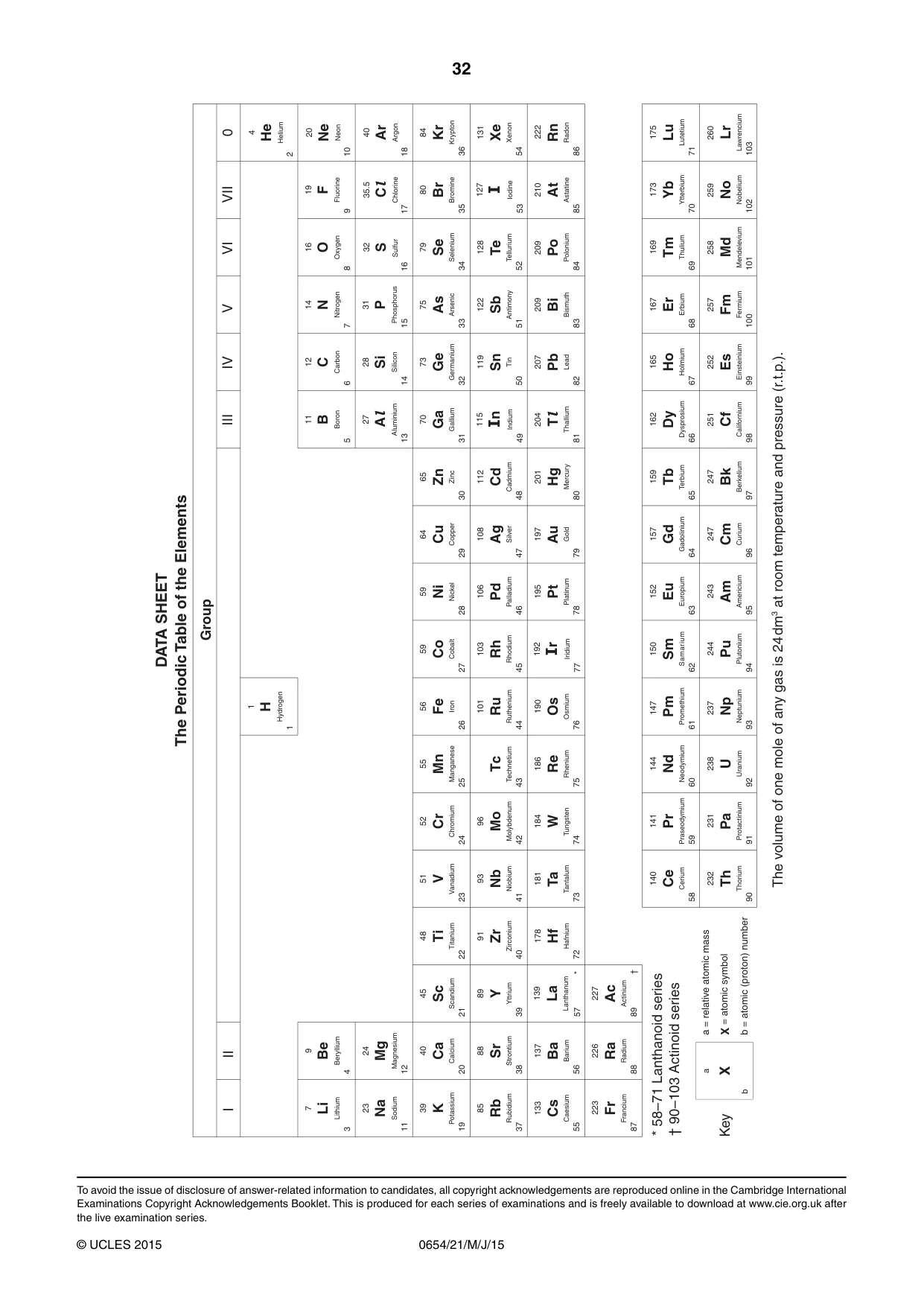
32 0654/21/M/J/15 © UCLES 2015 Group The Periodic Table of the Elements 140 Ce Cerium 58 141 Pr Praseodymium 59 144 Nd Neodymium 60 Pm Promethium 61 150 Sm Samarium 62 152 Eu Europium 63 157 Gd Gadolinium 64 159 Tb Terbium 65 162 Dy Dysprosium 66 165 Ho Holmium 67 167 Er Erbium 68 169 Tm Thulium 69 173 Yb Ytterbium 70 175 Lu Lutetium 71 232 Th Thorium 90 Pa Protactinium 91 238 231 147 237 244 243 247 247 251 252 257 258 259 260 U Uranium 92 Np Neptunium 93 Pu Plutonium 94 Am Americium 95 Cm Curium 96 Bk Berkelium 97 Cf Californium 98 Es Einsteinium 99 Fm Fermium 100 Md Mendelevium 101 No Nobelium 102 Lr Lawrencium 103 1 H Hydrogen 1 7 Li Lithium 3 23 Na Sodium 11 24 Mg Magnesium 12 40 Ca Calcium 20 45 Sc Scandium 21 48 Ti Titanium 22 51 V Vanadium 23 52 Cr Chromium 24 55 Mn Manganese 25 56 Fe Iron 26 59 Co Cobalt 27 59 Ni Nickel 28 64 Cu Copper 29 65 Zn Zinc 30 70 Ga Gallium 31 27 Al Aluminium 13 11 B Boron 5 12 C Carbon 6 14 N Nitrogen 7 16 O Oxygen 8 19 F Fluorine 9 28 Si Silicon 14 31 P Phosphorus 15 32 S Sulfur 16 35.5 Cl Chlorine 17 40 Ar Argon 18 20 Ne Neon 10 4 He Helium 2 73 Ge Germanium 32 75 As Arsenic 33 79 Se Selenium 34 80 Br Bromine 35 84 Kr Krypton 36 39 K Potassium 19 88 Sr Strontium 38 89 Y Yttrium 39 91 Zr Zirconium 40 93 Nb Niobium 41 96 Mo Molybdenum 42 Tc Technetium 43 101 Ru Ruthenium 44 103 Rh Rhodium 45 106 Pd Palladium 46 108 Ag Silver 47 112 Cd Cadmium 48 115 In Indium 49 119 Sn Tin 50 122 Sb Antimony 51 128 Te Tellurium 52 127 I Iodine 53 131 Xe Xenon 54 137 Ba Barium 56 139 La Lanthanum 57 * 178 Hf Hafnium 72 181 Ta Tantalum 73 184 W Tungsten 74 186 Re Rhenium 75 190 Os Osmium 76 192 Ir Iridium 77 195 Pt Platinum 78 197 Au Gold 79 201 Hg Mercury 80 204 Tl Thallium 81 207 Pb Lead 82 209 209 210 222 Bi Bismuth 83 Po Polonium 84 At Astatine 85 Rn Radon 86 Fr Francium 87 227 Ac Actinium 89 † 9 Be Beryllium 4 I II III IV V VI VII 0 85 Rb Rubidium 37 133 Cs Caesium 55 226 223 Ra Radium 88 a X b a = relative atomic mass X = atomic symbol b = atomic (proton) number Key DATA SHEET * 58–71 Lanthanoid series † 90–103 Actinoid series The volume of one mole of any gas is 24dm3 at room temperature and pressure (r.t.p.). To avoid the issue of disclosure of answer-related information to candidates, all copyright acknowledgements are reproduced online in the Cambridge International Examinations Copyright Acknowledgements Booklet. This is produced for each series of examinations and is freely available to download at www.cie.org.uk after the live examination series.
Mark scheme, page 1
® IGCSE is the registered trademark of Cambridge International Examinations. CAMBRIDGE INTERNATIONAL EXAMINATIONS Cambridge International General Certificate of Secondary Education MARK SCHEME for the May/June 2015 series 0654 CO-ORDINATED SCIENCES 0654/21 Paper 2 (Core Theory), maximum raw mark 120 This mark scheme is published as an aid to teachers and candidates, to indicate the requirements of the examination. It shows the basis on which Examiners were instructed to award marks. It does not indicate the details of the discussions that took place at an Examiners’ meeting before marking began, which would have considered the acceptability of alternative answers. Mark schemes should be read in conjunction with the question paper and the Principal Examiner Report for Teachers. Cambridge will not enter into discussions about these mark schemes. Cambridge is publishing the mark schemes for the May/June 2015 series for most Cambridge IGCSE®, Cambridge International A and AS Level components and some Cambridge O Level components.
Mark scheme, page 2
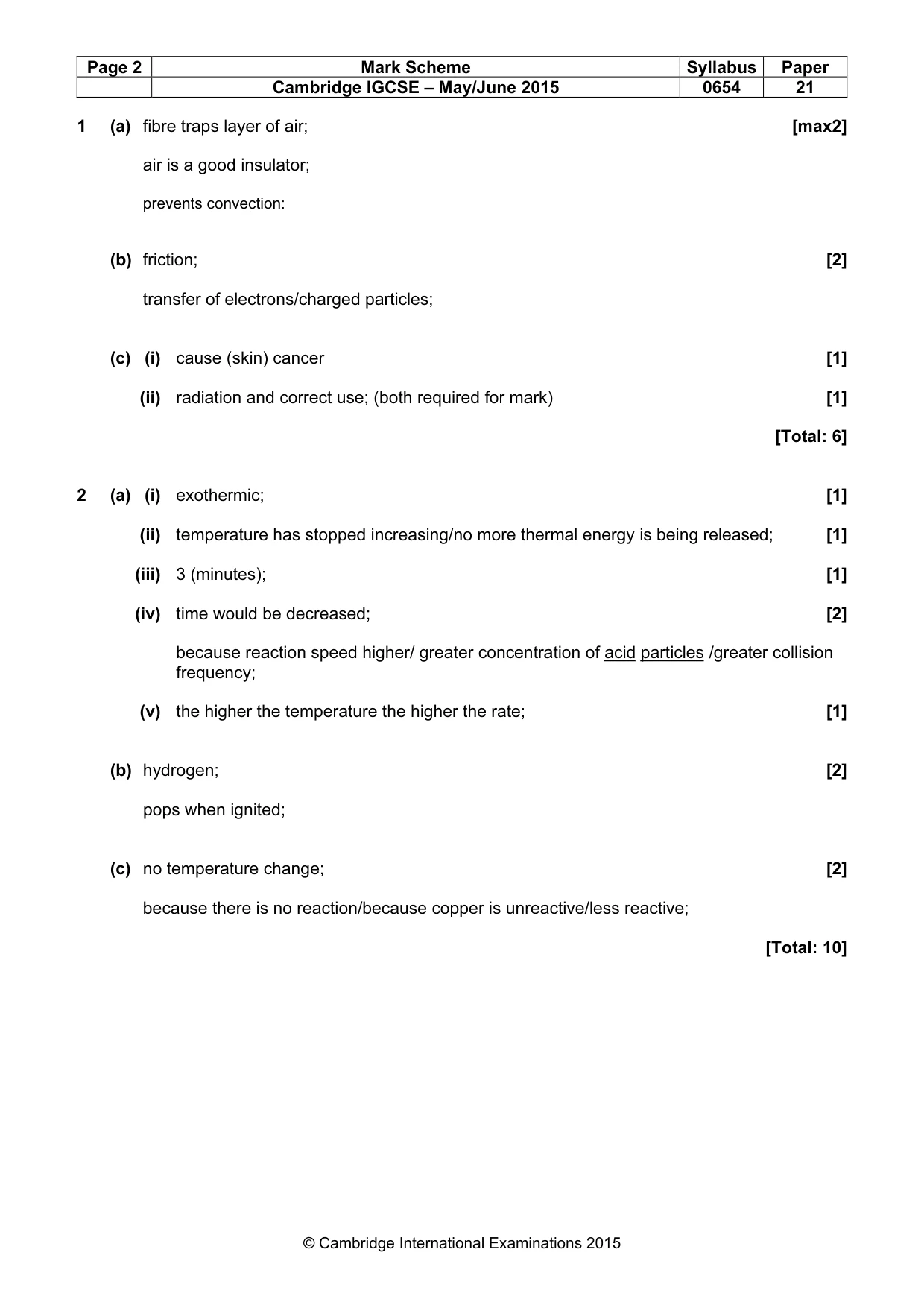
Page 2 Mark Scheme Syllabus Paper Cambridge IGCSE – May/June 2015 0654 21 © Cambridge International Examinations 2015 1 (a) fibre traps layer of air; [max2] air is a good insulator; prevents convection: (b) friction; [2] transfer of electrons/charged particles; (c) (i) cause (skin) cancer [1] (ii) radiation and correct use; (both required for mark) [1] [Total: 6] 2 (a) (i) exothermic; [1] (ii) temperature has stopped increasing/no more thermal energy is being released; [1] (iii) 3 (minutes); [1] (iv) time would be decreased; [2] because reaction speed higher/ greater concentration of acid particles /greater collision frequency; (v) the higher the temperature the higher the rate; [1] (b) hydrogen; [2] pops when ignited; (c) no temperature change; [2] because there is no reaction/because copper is unreactive/less reactive; [Total: 10]
Mark scheme, page 3
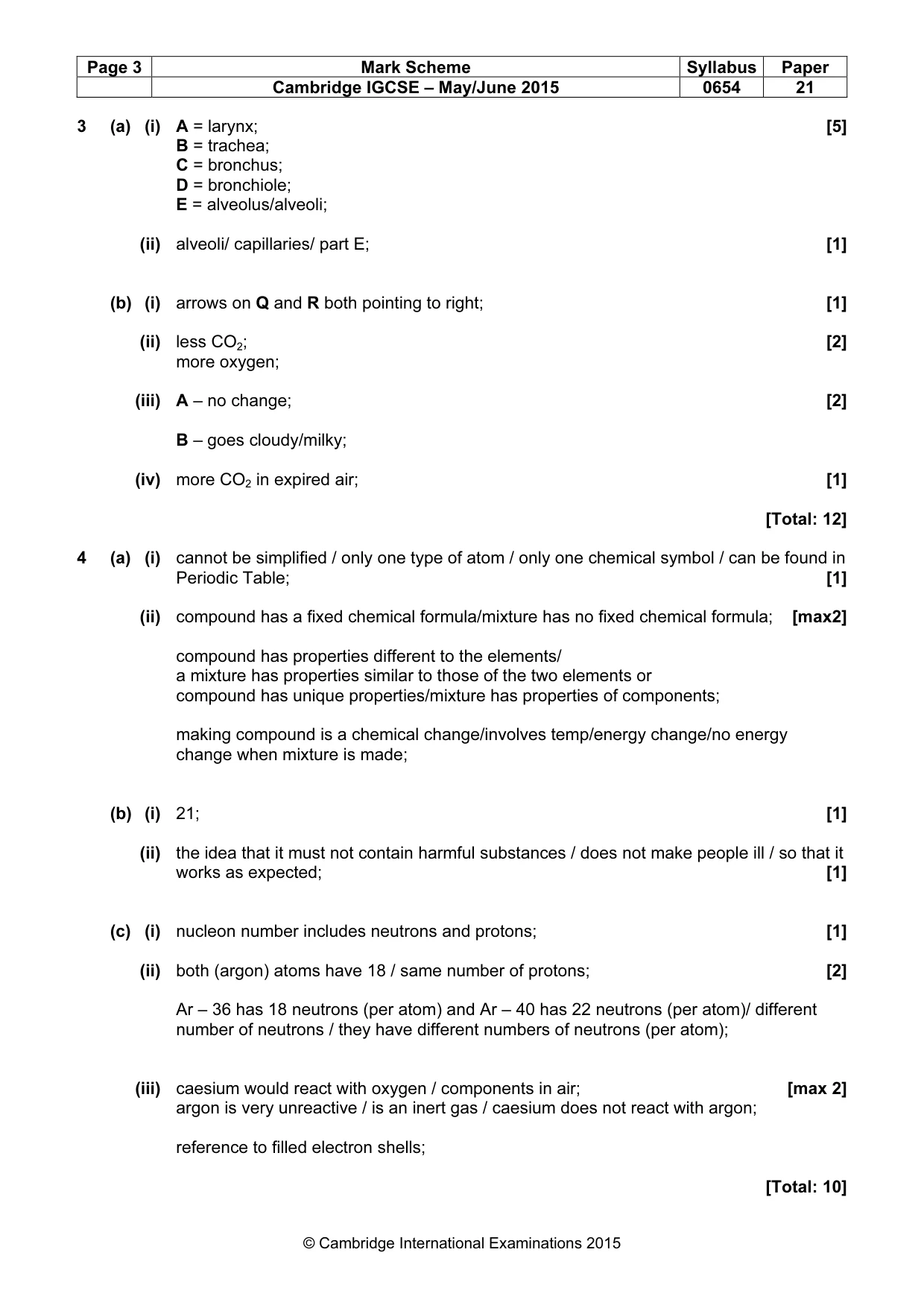
Page 3 Mark Scheme Syllabus Paper Cambridge IGCSE – May/June 2015 0654 21 © Cambridge International Examinations 2015 3 (a) (i) A = larynx; [5] B = trachea; C = bronchus; D = bronchiole; E = alveolus/alveoli; (ii) alveoli/ capillaries/ part E; [1] (b) (i) arrows on Q and R both pointing to right; [1] (ii) less CO2; [2] more oxygen; (iii) A – no change; [2] B – goes cloudy/milky; (iv) more CO2 in expired air; [1] [Total: 12] 4 (a) (i) cannot be simplified / only one type of atom / only one chemical symbol / can be found in Periodic Table; [1] (ii) compound has a fixed chemical formula/mixture has no fixed chemical formula; [max2] compound has properties different to the elements/ a mixture has properties similar to those of the two elements or compound has unique properties/mixture has properties of components; making compound is a chemical change/involves temp/energy change/no energy change when mixture is made; (b) (i) 21; [1] (ii) the idea that it must not contain harmful substances / does not make people ill / so that it works as expected; [1] (c) (i) nucleon number includes neutrons and protons; [1] (ii) both (argon) atoms have 18 / same number of protons; [2] Ar – 36 has 18 neutrons (per atom) and Ar – 40 has 22 neutrons (per atom)/ different number of neutrons / they have different numbers of neutrons (per atom); (iii) caesium would react with oxygen / components in air; [max 2] argon is very unreactive / is an inert gas / caesium does not react with argon; reference to filled electron shells; [Total: 10]
Mark scheme, page 4
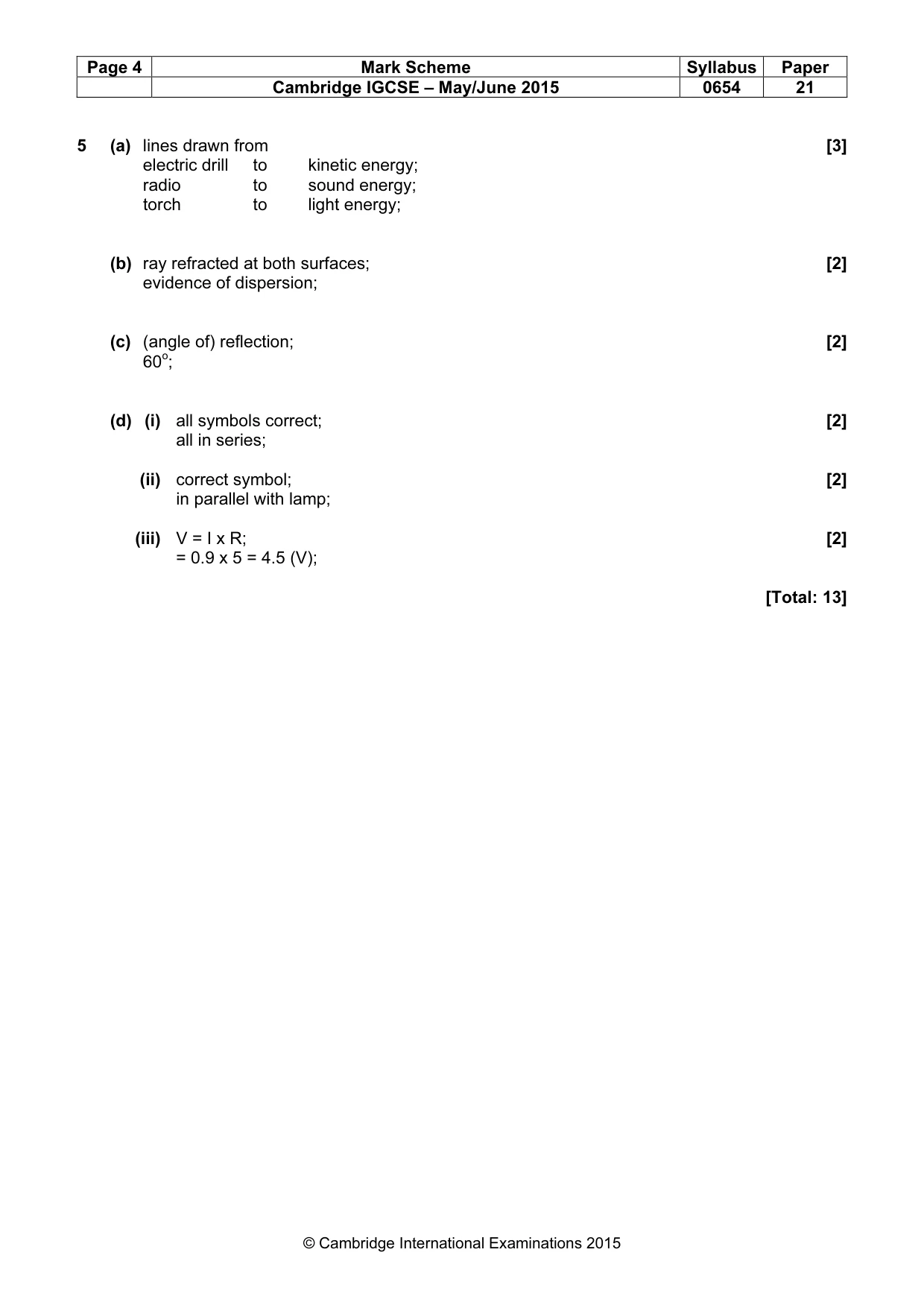
Page 4 Mark Scheme Syllabus Paper Cambridge IGCSE – May/June 2015 0654 21 © Cambridge International Examinations 2015 5 (a) lines drawn from [3] electric drill to kinetic energy; radio to sound energy; torch to light energy; (b) ray refracted at both surfaces; [2] evidence of dispersion; (c) (angle of) reflection; [2] 60o; (d) (i) all symbols correct; [2] all in series; (ii) correct symbol; [2] in parallel with lamp; (iii) V = I x R; [2] = 0.9 x 5 = 4.5 (V); [Total: 13]
Mark scheme, page 5
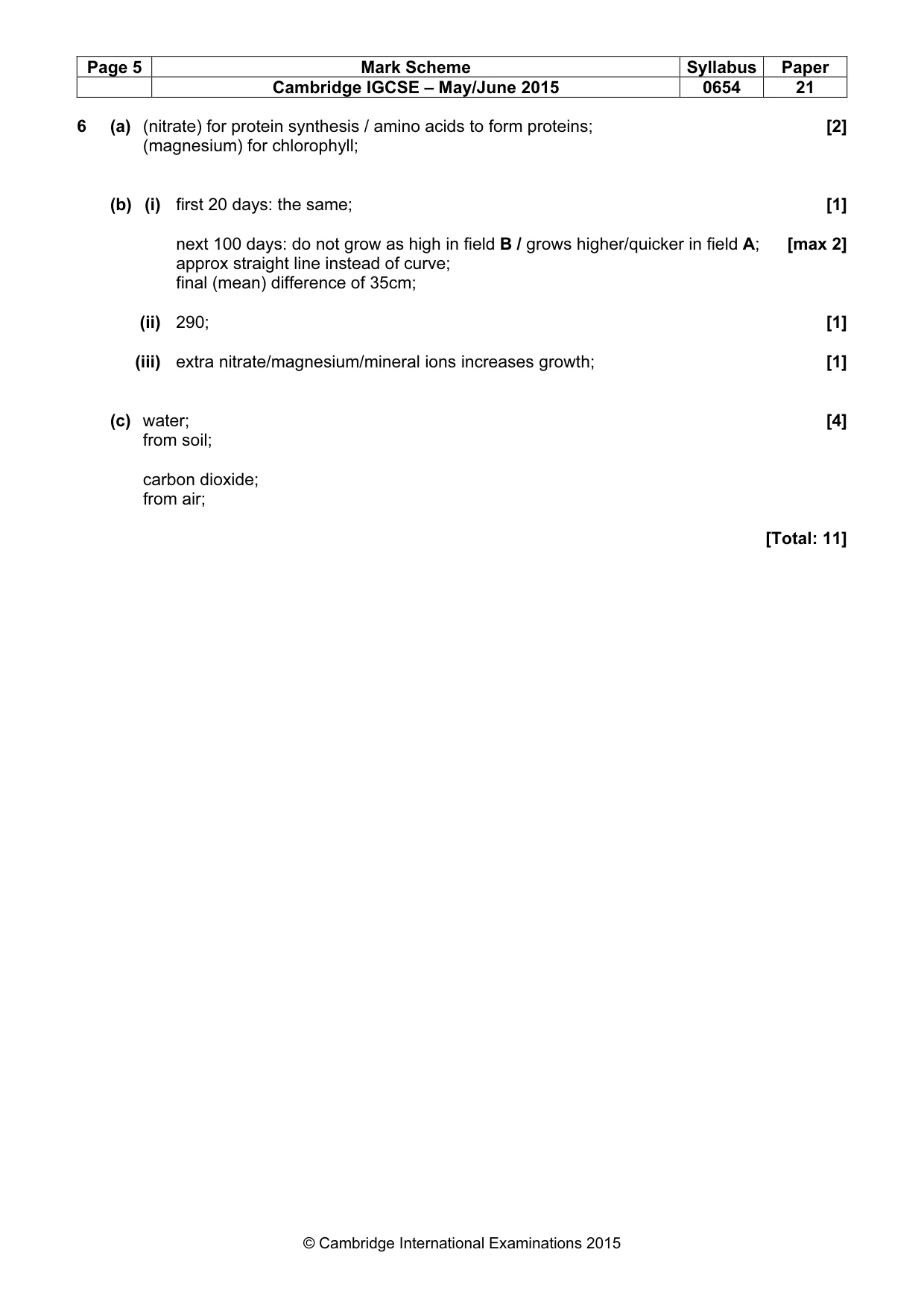
Page 5 Mark Scheme Syllabus Paper Cambridge IGCSE – May/June 2015 0654 21 © Cambridge International Examinations 2015 6 (a) (nitrate) for protein synthesis / amino acids to form proteins; [2] (magnesium) for chlorophyll; (b) (i) first 20 days: the same; [1] next 100 days: do not grow as high in field B / grows higher/quicker in field A; [max 2] approx straight line instead of curve; final (mean) difference of 35cm; (ii) 290; [1] (iii) extra nitrate/magnesium/mineral ions increases growth; [1] (c) water; [4] from soil; carbon dioxide; from air; [Total: 11]
Mark scheme, page 6
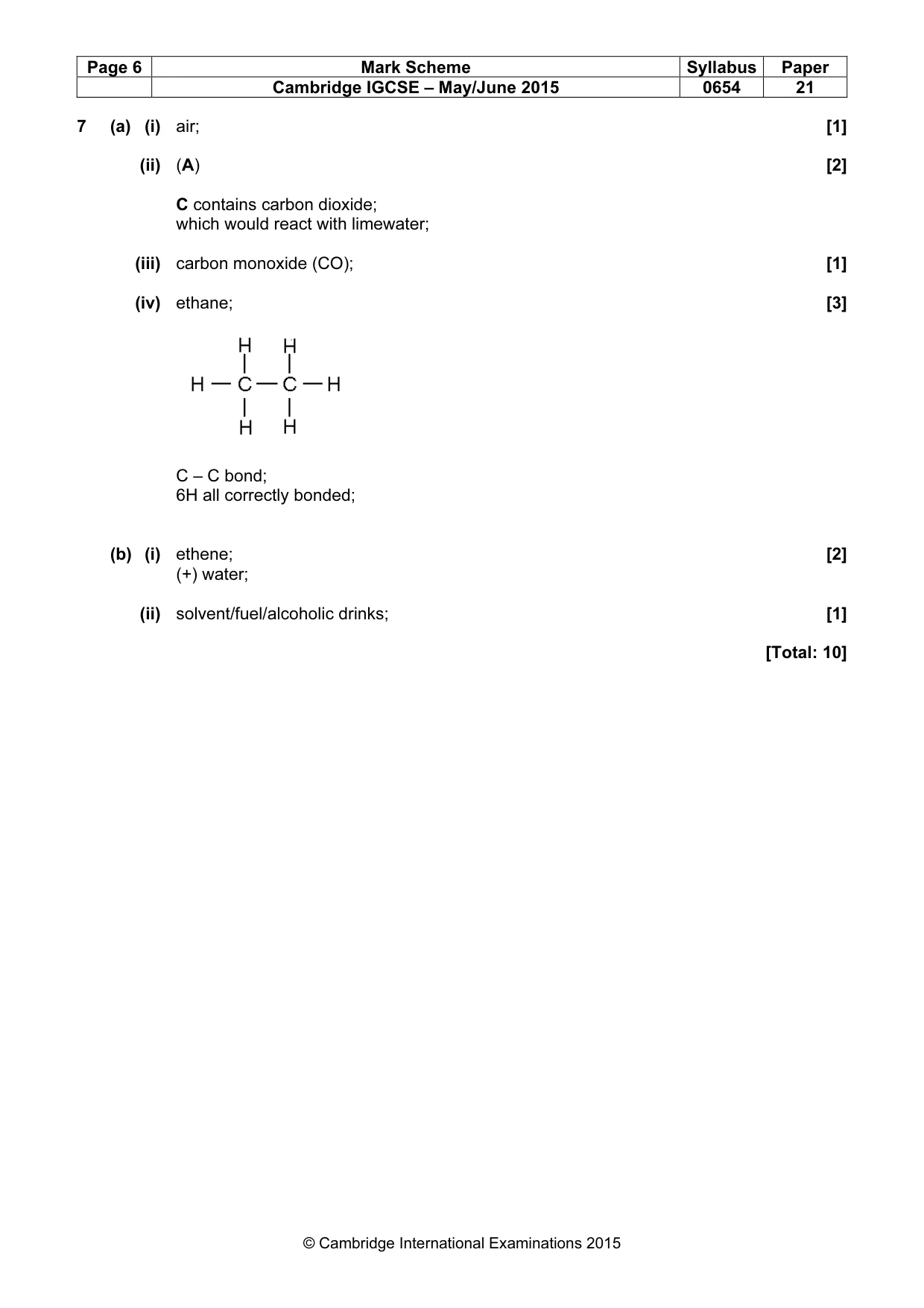
Page 6 Mark Scheme Syllabus Paper Cambridge IGCSE – May/June 2015 0654 21 © Cambridge International Examinations 2015 7 (a) (i) air; [1] (ii) (A) [2] C contains carbon dioxide; which would react with limewater; (iii) carbon monoxide (CO); [1] (iv) ethane; [3] C – C bond; 6H all correctly bonded; (b) (i) ethene; [2] (+) water; (ii) solvent/fuel/alcoholic drinks; [1] [Total: 10]
Mark scheme, page 7
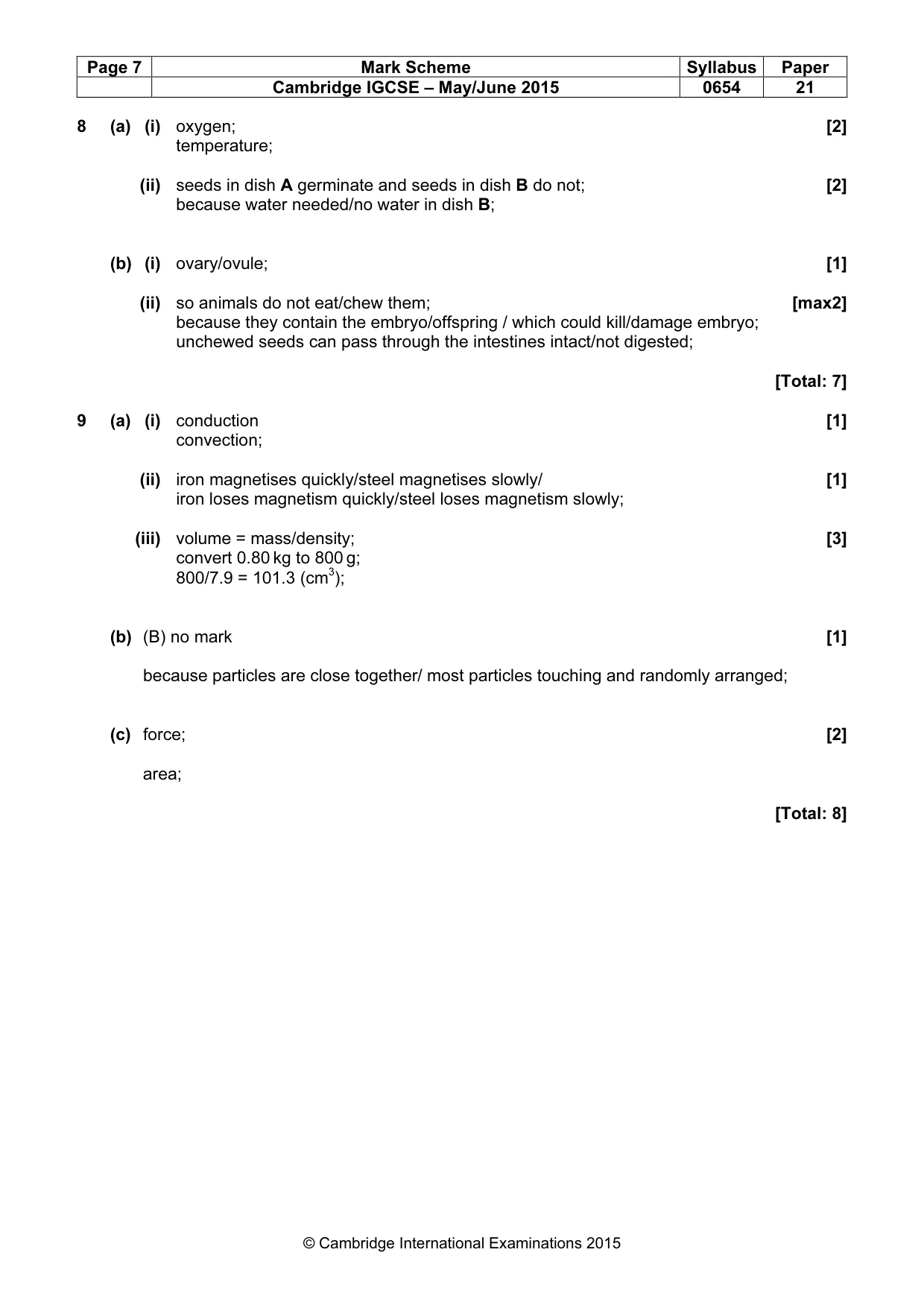
Page 7 Mark Scheme Syllabus Paper Cambridge IGCSE – May/June 2015 0654 21 © Cambridge International Examinations 2015 8 (a) (i) oxygen; [2] temperature; (ii) seeds in dish A germinate and seeds in dish B do not; [2] because water needed/no water in dish B; (b) (i) ovary/ovule; [1] (ii) so animals do not eat/chew them; [max2] because they contain the embryo/offspring / which could kill/damage embryo; unchewed seeds can pass through the intestines intact/not digested; [Total: 7] 9 (a) (i) conduction [1] convection; (ii) iron magnetises quickly/steel magnetises slowly/ [1] iron loses magnetism quickly/steel loses magnetism slowly; (iii) volume = mass/density; [3] convert 0.80 kg to 800 g; 800/7.9 = 101.3 (cm3); (b) (B) no mark [1] because particles are close together/ most particles touching and randomly arranged; (c) force; [2] area; [Total: 8]
Mark scheme, page 8
Page 8 Mark Scheme Syllabus Paper Cambridge IGCSE – May/June 2015 0654 21 © Cambridge International Examinations 2015 10 (a) (i) (pupil) reflex; [1] (ii) (change in) light; [1] (b) (i) motor/effector (neurone); [1] (ii) relay/connector (neurone); [1] (c) damage to retina; [1] [Total: 5] 11 (a) (i) P copper; [4] Q chlorine; R hydrogen; S oxygen; (b) (i) fork and copper electrode connected to power supply; [3] fork connected to negative and copper to positive; fork and copper both dipping into electrolyte; (ii) fork now has the extra mass of the copper plating; [1] (c) [2] the only 2 correct = 2 marks only 1 correct = 1 mark minus 1 for any incorrect; [Total: 10]
Mark scheme, page 9
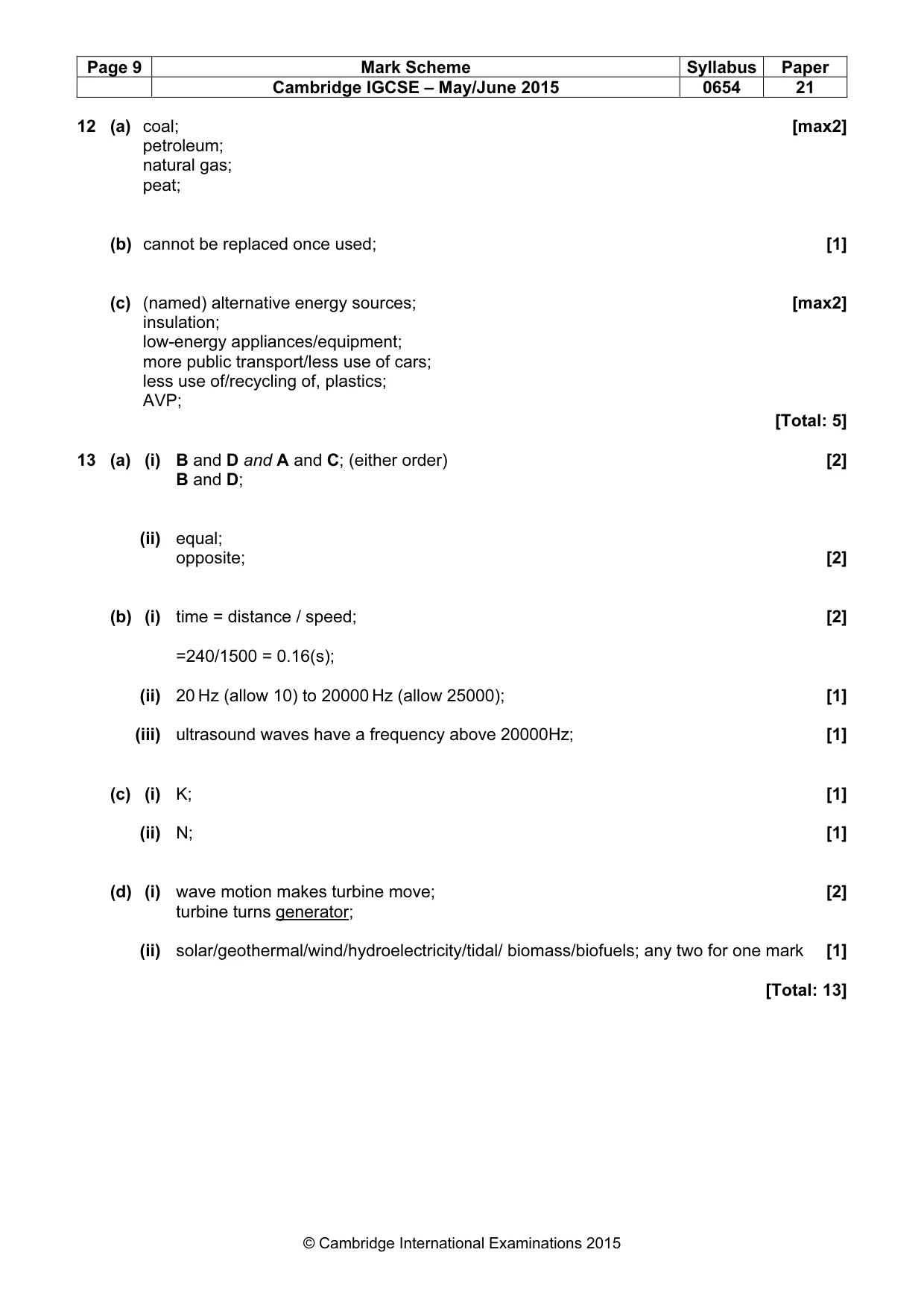
Page 9 Mark Scheme Syllabus Paper Cambridge IGCSE – May/June 2015 0654 21 © Cambridge International Examinations 2015 12 (a) coal; [max2] petroleum; natural gas; peat; (b) cannot be replaced once used; [1] (c) (named) alternative energy sources; [max2] insulation; low-energy appliances/equipment; more public transport/less use of cars; less use of/recycling of, plastics; AVP; [Total: 5] 13 (a) (i) B and D and A and C; (either order) [2] B and D; (ii) equal; opposite; [2] (b) (i) time = distance / speed; [2] =240/1500 = 0.16(s); (ii) 20 Hz (allow 10) to 20000 Hz (allow 25000); [1] (iii) ultrasound waves have a frequency above 20000Hz; [1] (c) (i) K; [1] (ii) N; [1] (d) (i) wave motion makes turbine move; [2] turbine turns generator; (ii) solar/geothermal/wind/hydroelectricity/tidal/ biomass/biofuels; any two for one mark [1] [Total: 13]
What you needed in this session
Cambridge’s own grade thresholds for 2015 May/June, Paper 2 · Variant 1. A higher threshold means an easier paper — the bar moves with how the cohort did.