Cambridge IGCSE Sciences - Co-ordinated (Double) 0654 — 2014 Oct/Nov Paper 3 · Variant 2
0654/32/O/N/14 · 120 marks · ≈135 min
The question paper and its mark scheme, free to read here and free to download. This is Cambridge’s own paper, exactly as it was sat.
Question paper32 pages



Mark scheme7 pages
Answers below. Sit the paper first if you are practising.
Paper as text
Question paper, page 1
This document consists of 29 printed pages and 3 blank pages. DC (LEG/SW) 89051/4 © UCLES 2014 [Turn over Cambridge International Examinations Cambridge International General Certificate of Secondary Education * 5 1 6 1 7 7 2 7 1 9 * CO-ORDINATED SCIENCES 0654/32 Paper 3 (Extended) October/November 2014 2 hours Candidates answer on the Question Paper. No Additional Materials are required. READ THESE INSTRUCTIONS FIRST Write your Centre number, candidate number and name on all the work you hand in. Write in dark blue or black pen. You may use an HB soft pencil for any diagrams, graphs, tables or rough working. Do not use staples, paper clips, glue or correction fluid. DO NOT WRITE IN ANY BARCODES. Answer all questions. Electronic calculators may be used. You may lose marks if you do not show your working or if you do not use appropriate units. A copy of the Periodic Table is printed on page 32. At the end of the examination, fasten all your work securely together. The number of marks is given in brackets [ ] at the end of each question or part question.
Question paper, page 2
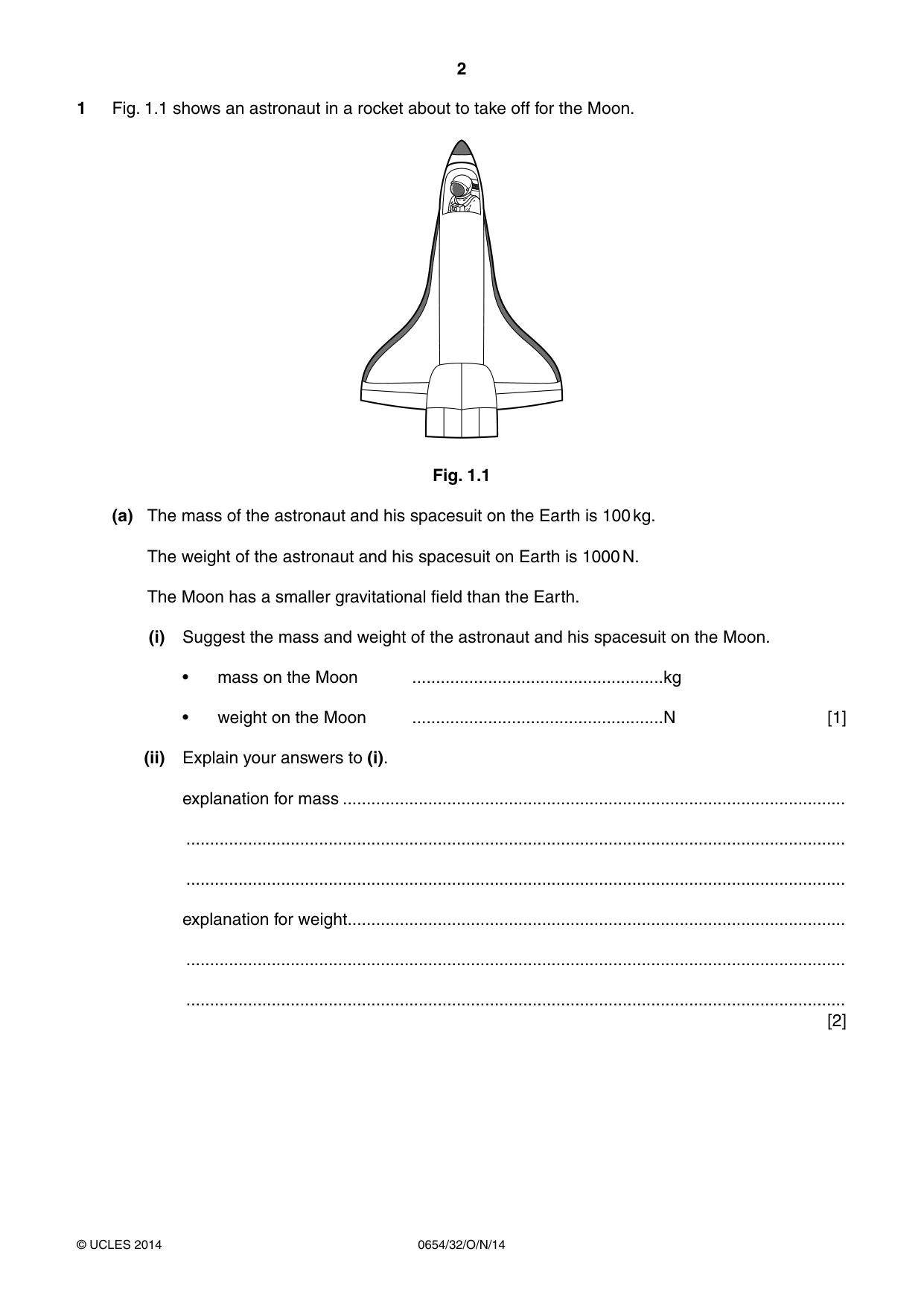
2 0654/32/O/N/14 © UCLES 2014 1 Fig. 1.1 shows an astronaut in a rocket about to take off for the Moon. Fig. 1.1 (a) The mass of the astronaut and his spacesuit on the Earth is 100 kg. The weight of the astronaut and his spacesuit on Earth is 1000 N. The Moon has a smaller gravitational field than the Earth. (i) Suggest the mass and weight of the astronaut and his spacesuit on the Moon. • mass on the Moon …kg • weight on the Moon …N [1] (ii) Explain your answers to (i). explanation for mass … … … explanation for weight … … … [2]
Question paper, page 3
3 0654/32/O/N/14 © UCLES 2014 [Turn over (b) The weight of the rocket on take-off is 20 000 000 N. When the rocket blasts off from the Earth’s surface, it experiences a thrust force of 25 000 000 N. Explain why the thrust force must be greater than the weight of the rocket. … …[1] (c) At one stage on the journey the rocket is travelling at 36 000 km / hr which is equivalent to 10 000 m / s. At this stage the total mass of the rocket is 1 500 000 kg. Calculate the kinetic energy of the rocket in kJ. State the formula that you use and show your working. formula used working kinetic energy = … kJ [4] (d) During the journey from the Earth to the Moon, the astronaut communicates with Earth using radiowaves. Explain why it is not possible to use sound waves for communication. … …[1] (e) Once the rocket has left the Earth’s atmosphere, the astronaut is exposed to increasing amounts of ionising radiation. Explain the meaning of the term ionising radiation. … …[2]
Question paper, page 4
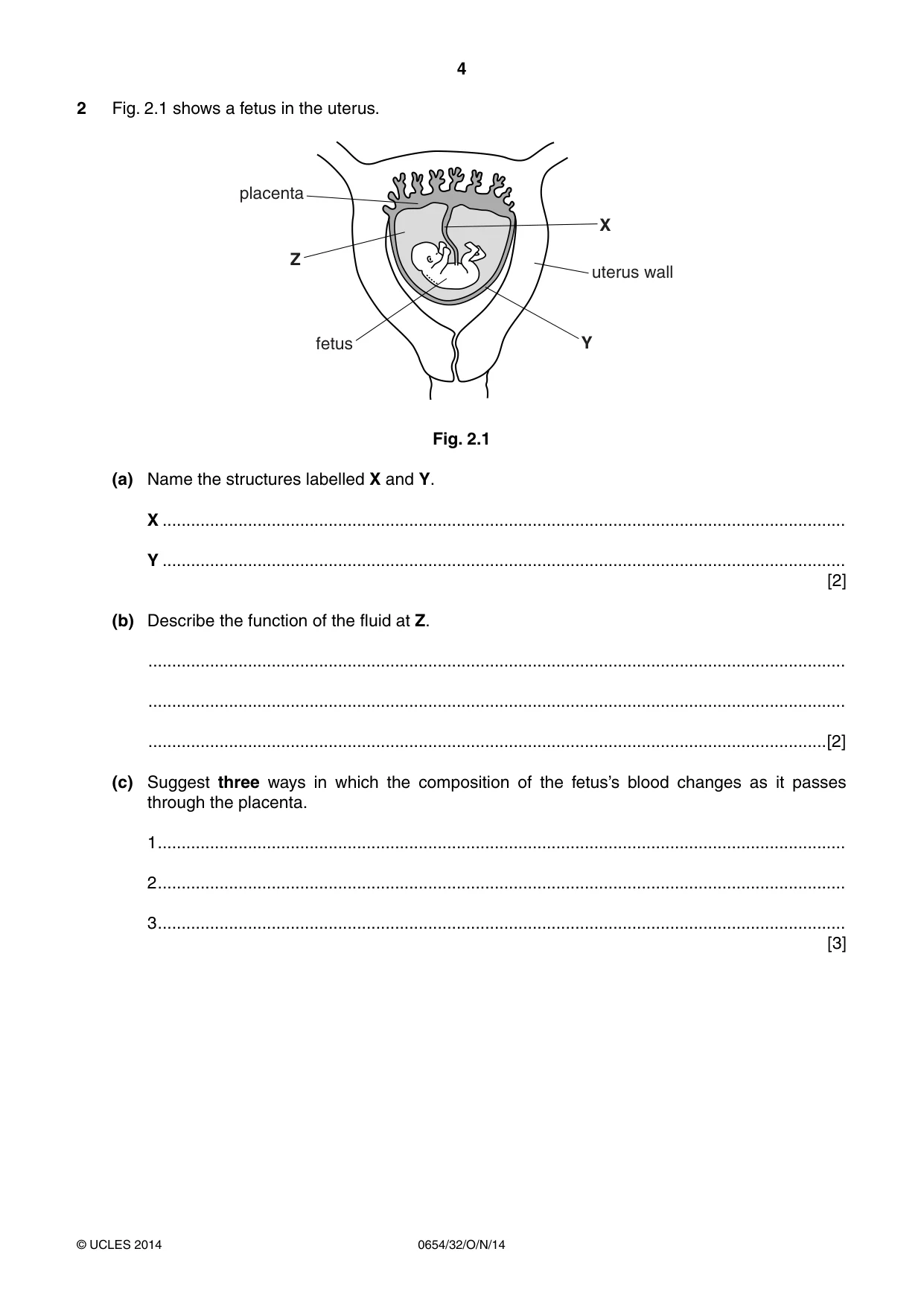
4 0654/32/O/N/14 © UCLES 2014 2 Fig. 2.1 shows a fetus in the uterus. Y Z X placenta fetus uterus wall Fig. 2.1 (a) Name the structures labelled X and Y. X … Y … [2] (b) Describe the function of the fluid at Z. … … …[2] (c) Suggest three ways in which the composition of the fetus’s blood changes as it passes through the placenta. 1 … 2 … 3 … [3]
Question paper, page 5
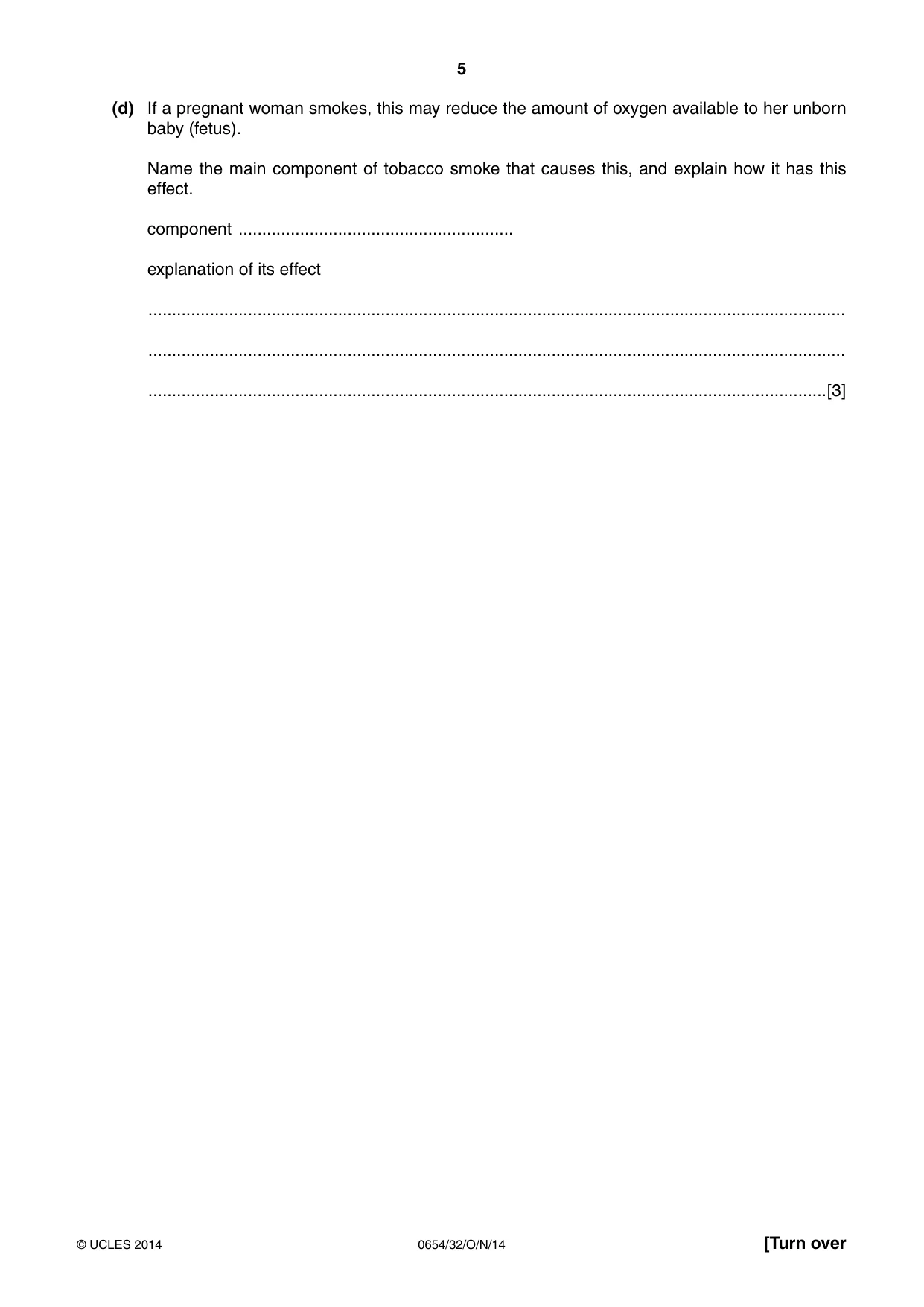
5 0654/32/O/N/14 © UCLES 2014 [Turn over (d) If a pregnant woman smokes, this may reduce the amount of oxygen available to her unborn baby (fetus). Name the main component of tobacco smoke that causes this, and explain how it has this effect. component … explanation of its effect … … …[3]
Question paper, page 6
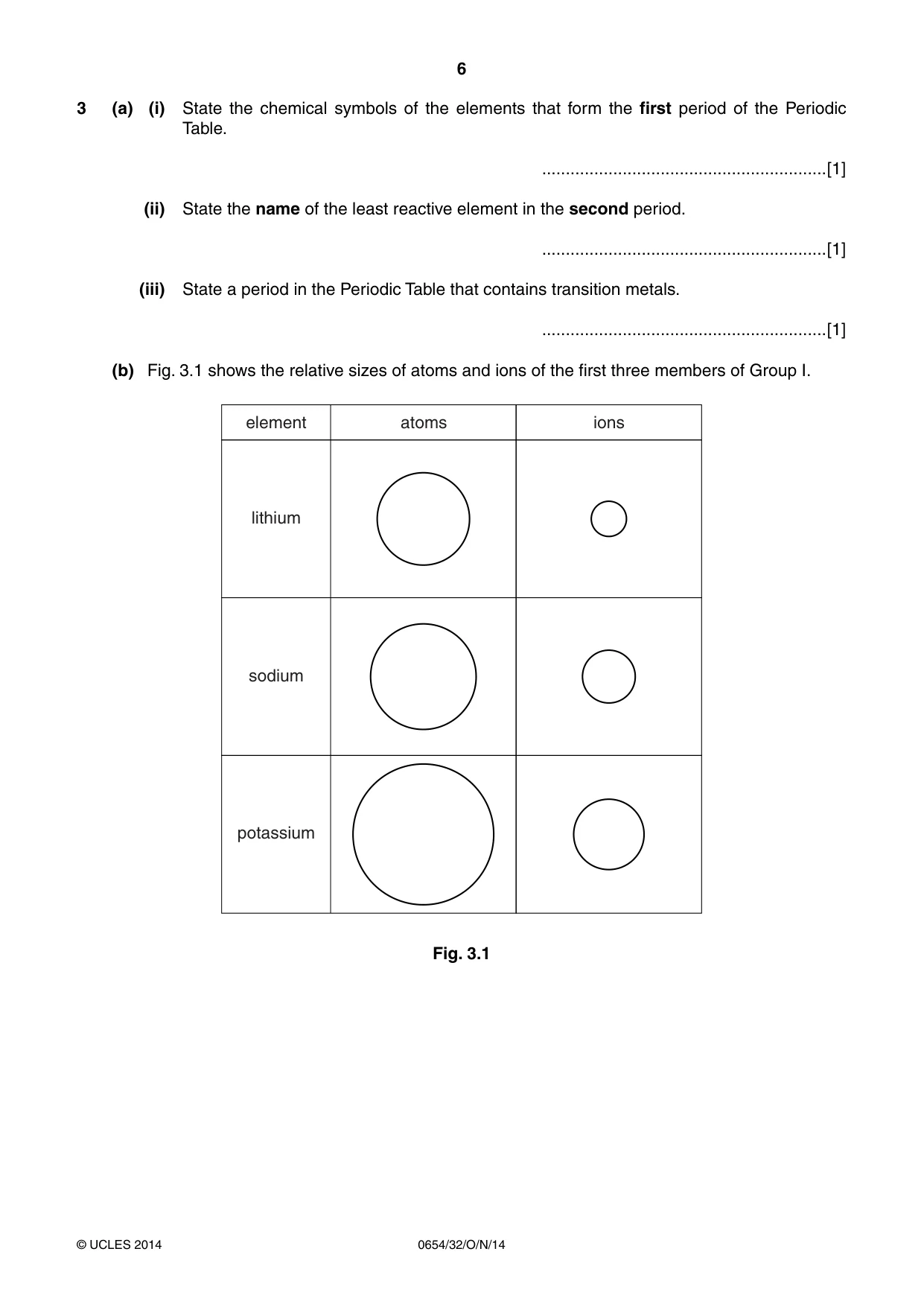
6 0654/32/O/N/14 © UCLES 2014 3 (a) (i) State the chemical symbols of the elements that form the first period of the Periodic Table. …[1] (ii) State the name of the least reactive element in the second period. …[1] (iii) State a period in the Periodic Table that contains transition metals. …[1] (b) Fig. 3.1 shows the relative sizes of atoms and ions of the first three members of Group I. potassium sodium lithium element atoms ions Fig. 3.1
Question paper, page 7
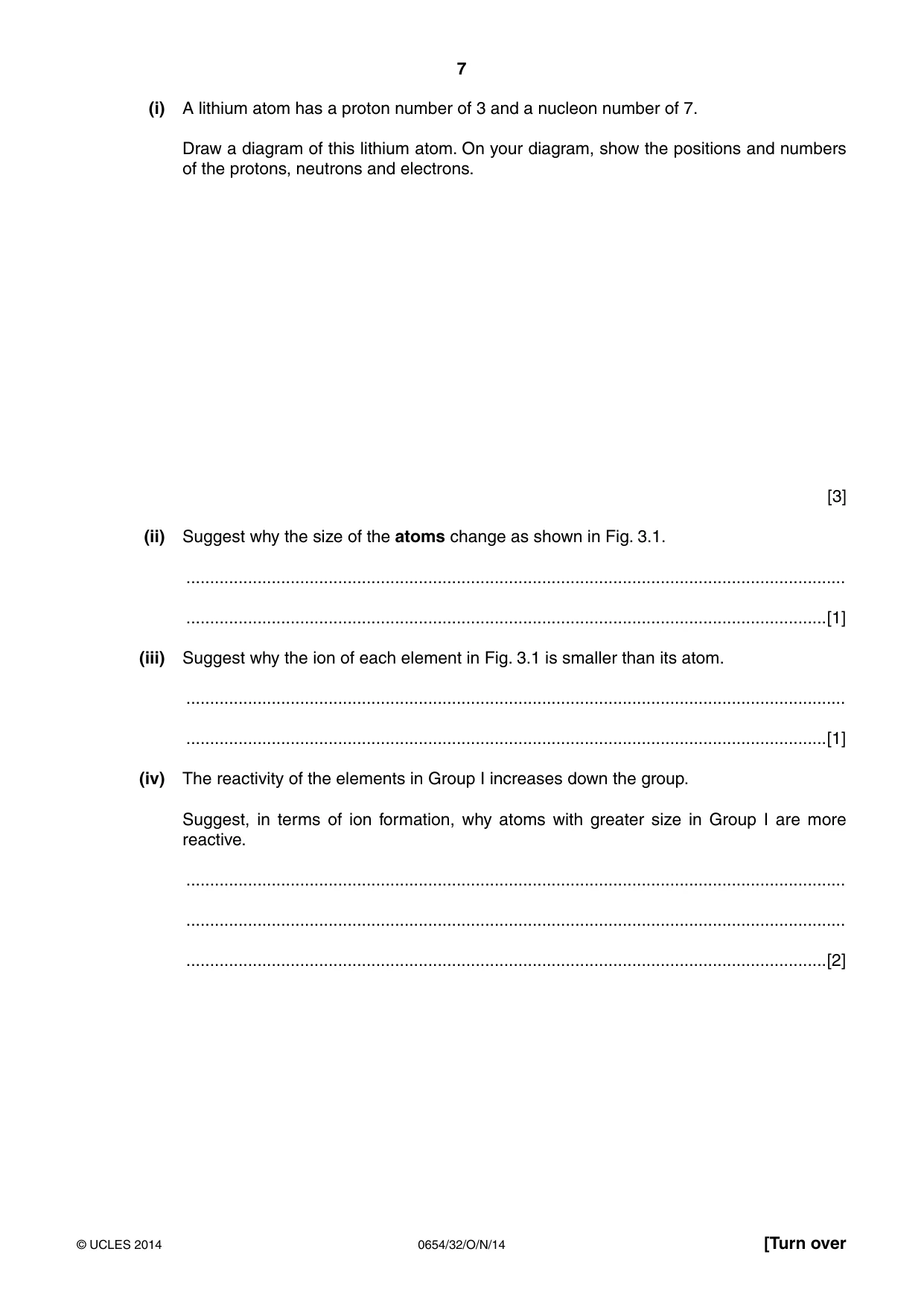
7 0654/32/O/N/14 © UCLES 2014 [Turn over (i) A lithium atom has a proton number of 3 and a nucleon number of 7. Draw a diagram of this lithium atom. On your diagram, show the positions and numbers of the protons, neutrons and electrons. [3] (ii) Suggest why the size of the atoms change as shown in Fig. 3.1. … …[1] (iii) Suggest why the ion of each element in Fig. 3.1 is smaller than its atom. … …[1] (iv) The reactivity of the elements in Group I increases down the group. Suggest, in terms of ion formation, why atoms with greater size in Group I are more reactive. … … …[2]
Question paper, page 8
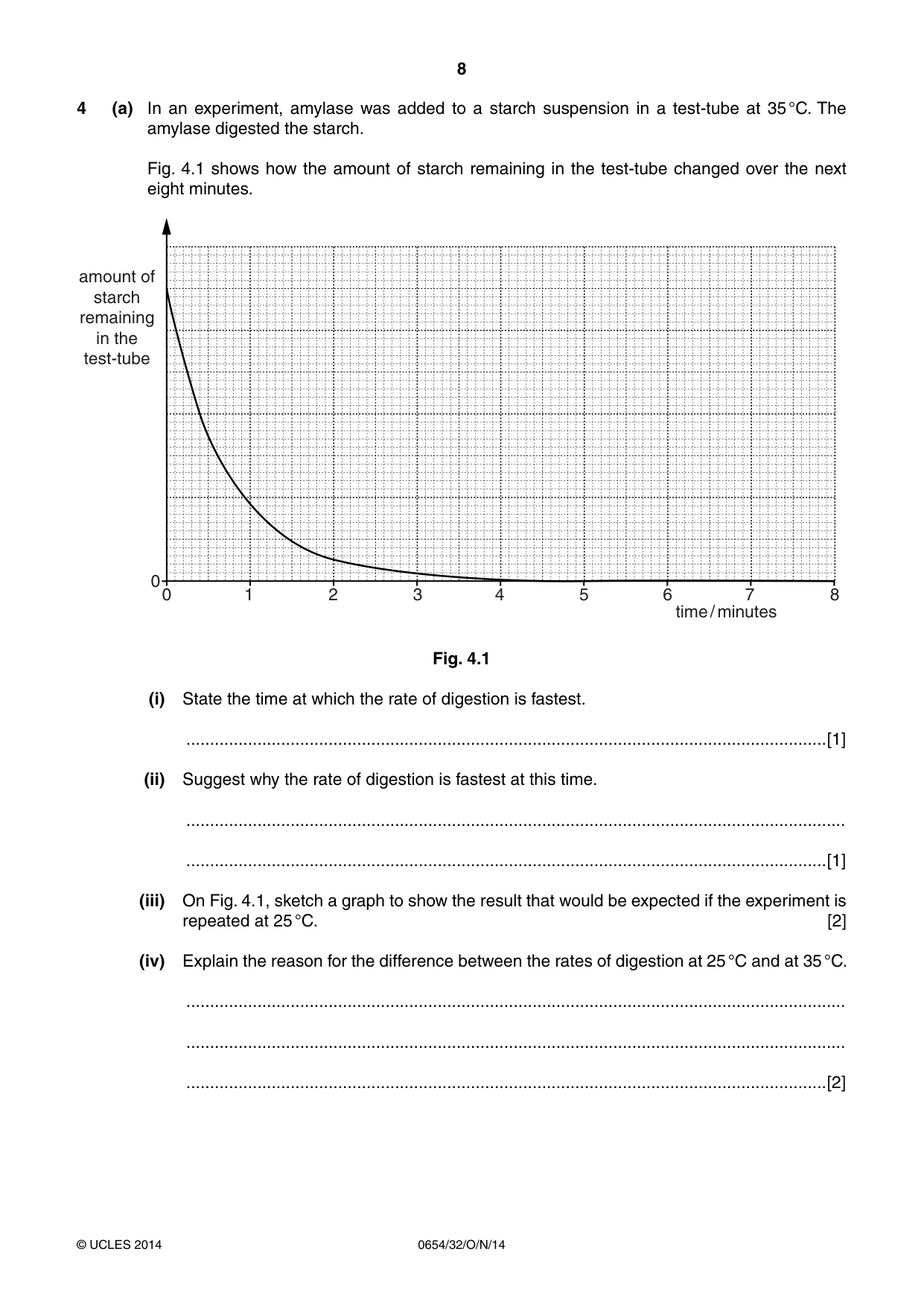
8 0654/32/O/N/14 © UCLES 2014 4 (a) In an experiment, amylase was added to a starch suspension in a test-tube at 35 °C. The amylase digested the starch. Fig. 4.1 shows how the amount of starch remaining in the test-tube changed over the next eight minutes. 0 0 1 2 3 4 5 6 7 time / minutes amount of starch remaining in the test-tube 8 Fig. 4.1 (i) State the time at which the rate of digestion is fastest. …[1] (ii) Suggest why the rate of digestion is fastest at this time. … …[1] (iii) On Fig. 4.1, sketch a graph to show the result that would be expected if the experiment is repeated at 25 °C. [2] (iv) Explain the reason for the difference between the rates of digestion at 25 °C and at 35 °C. … … …[2]
Question paper, page 9
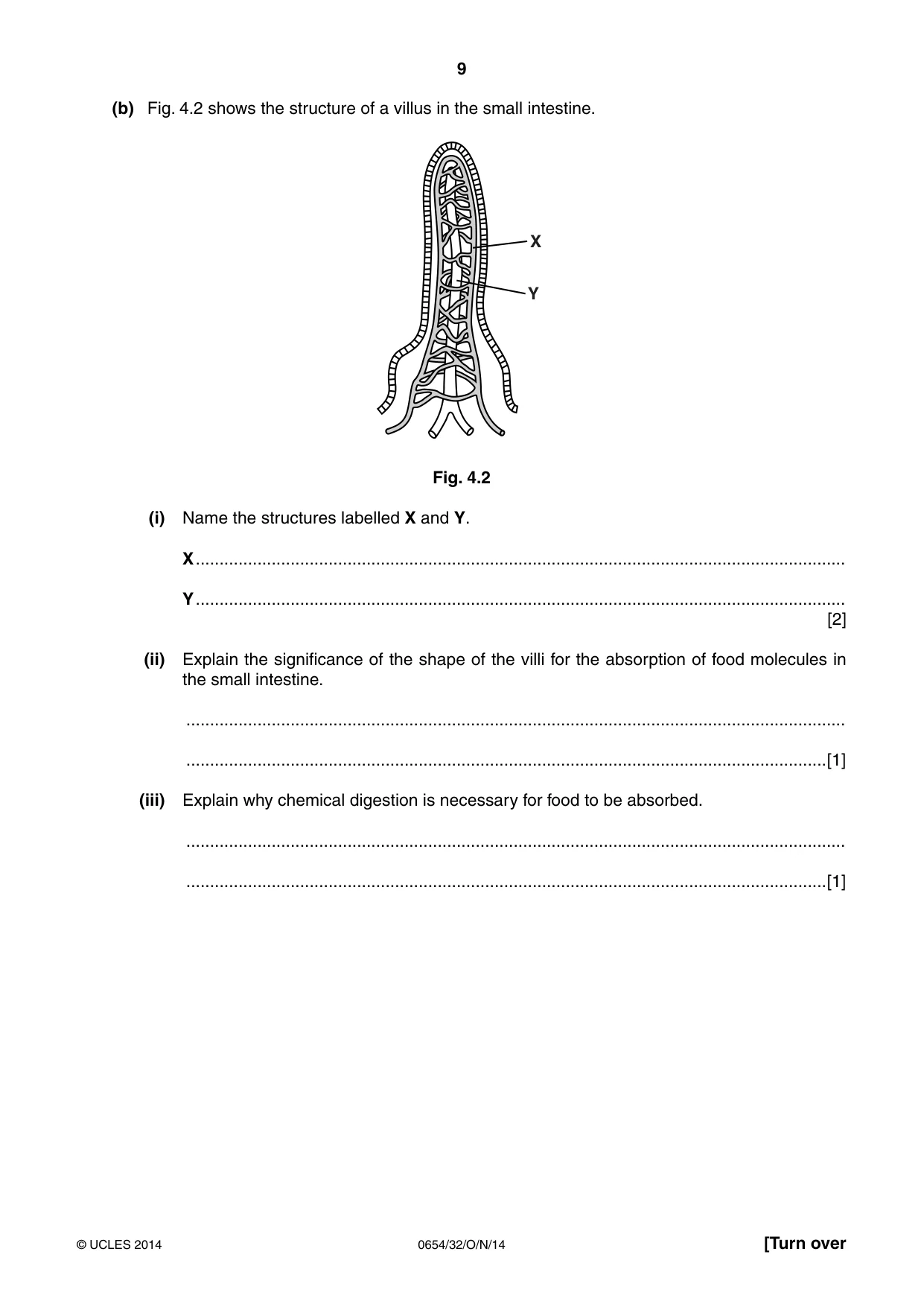
9 0654/32/O/N/14 © UCLES 2014 [Turn over (b) Fig. 4.2 shows the structure of a villus in the small intestine. X Y Fig. 4.2 (i) Name the structures labelled X and Y. X … Y … [2] (ii) Explain the significance of the shape of the villi for the absorption of food molecules in the small intestine. … …[1] (iii) Explain why chemical digestion is necessary for food to be absorbed. … …[1]
Question paper, page 10
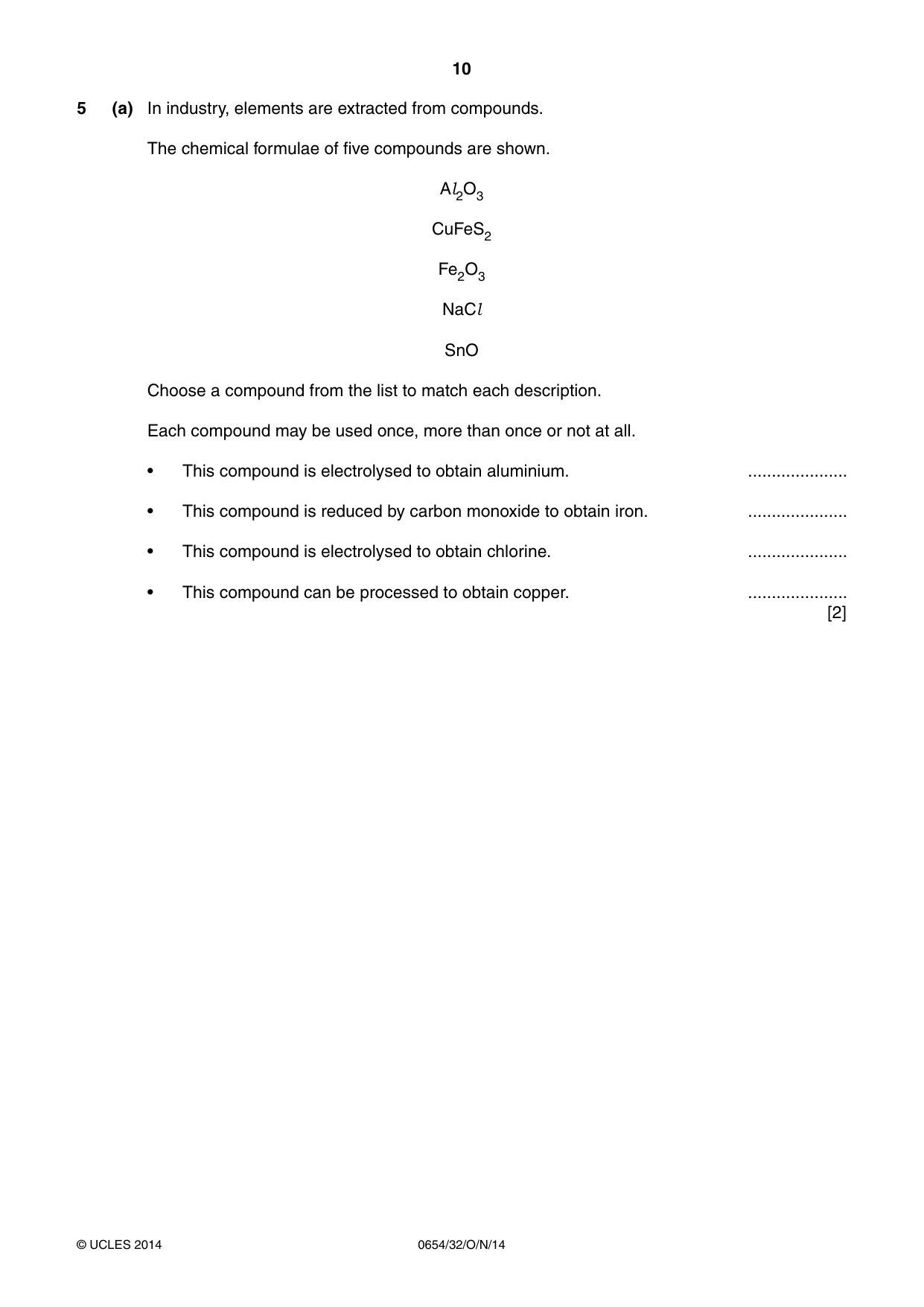
10 0654/32/O/N/14 © UCLES 2014 5 (a) In industry, elements are extracted from compounds. The chemical formulae of five compounds are shown. Al2O3 CuFeS2 Fe2O3 NaCl SnO Choose a compound from the list to match each description. Each compound may be used once, more than once or not at all. • This compound is electrolysed to obtain aluminium. … • This compound is reduced by carbon monoxide to obtain iron. … • This compound is electrolysed to obtain chlorine. … • This compound can be processed to obtain copper. … [2]
Question paper, page 11
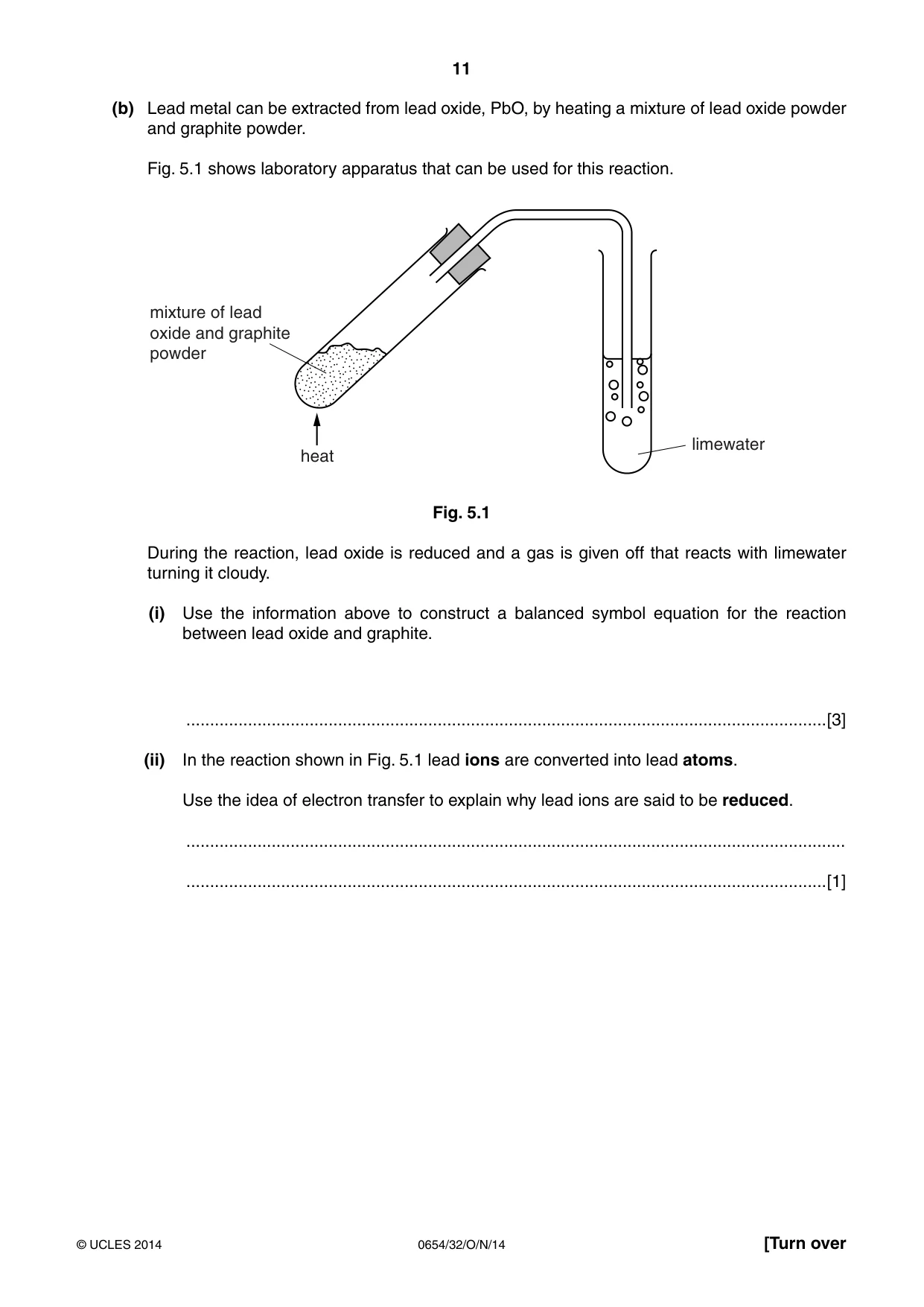
11 0654/32/O/N/14 © UCLES 2014 [Turn over (b) Lead metal can be extracted from lead oxide, PbO, by heating a mixture of lead oxide powder and graphite powder. Fig. 5.1 shows laboratory apparatus that can be used for this reaction. limewater heat mixture of lead oxide and graphite powder Fig. 5.1 During the reaction, lead oxide is reduced and a gas is given off that reacts with limewater turning it cloudy. (i) Use the information above to construct a balanced symbol equation for the reaction between lead oxide and graphite. …[3] (ii) In the reaction shown in Fig. 5.1 lead ions are converted into lead atoms. Use the idea of electron transfer to explain why lead ions are said to be reduced. … …[1]
Question paper, page 12
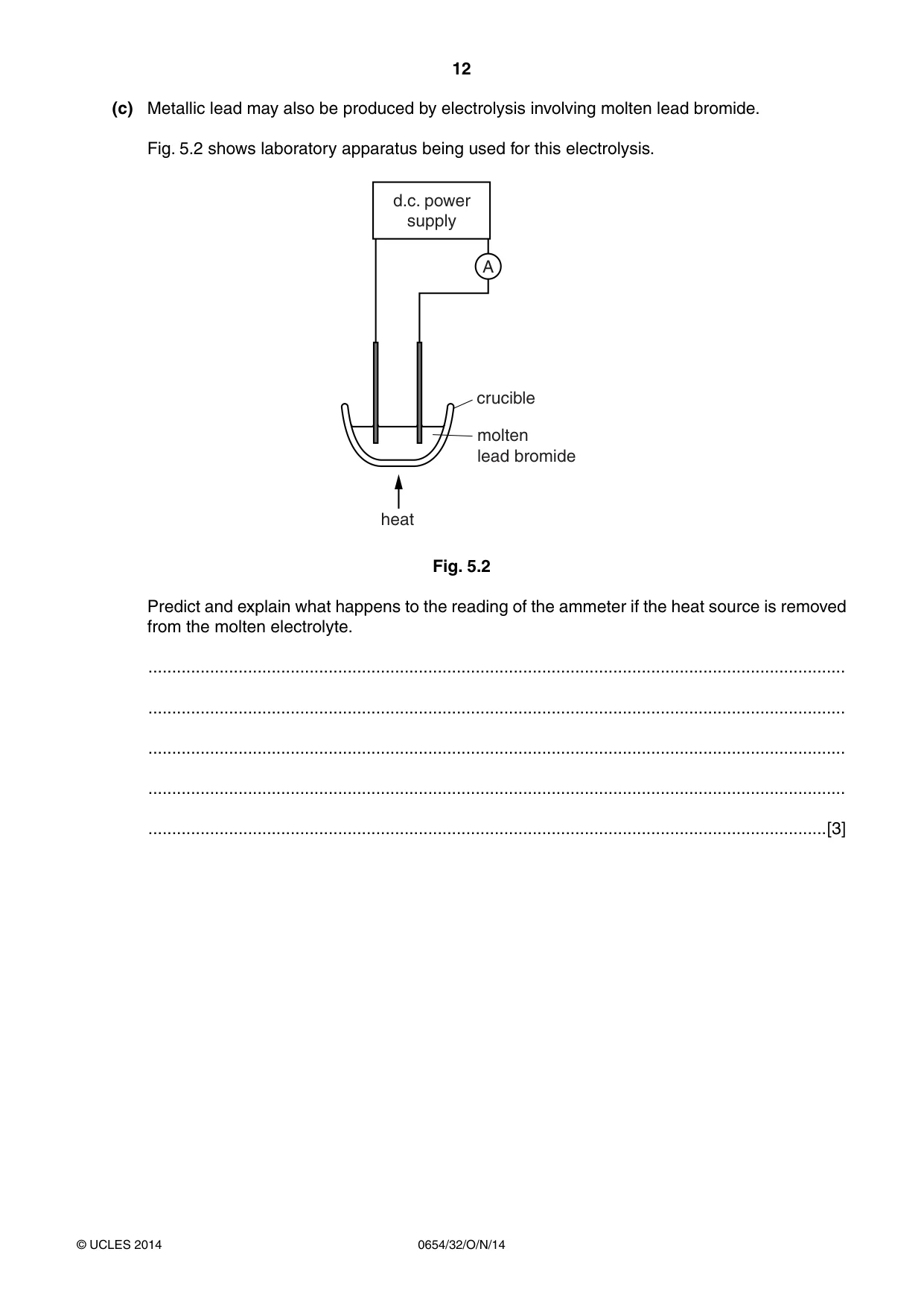
12 0654/32/O/N/14 © UCLES 2014 (c) Metallic lead may also be produced by electrolysis involving molten lead bromide. Fig. 5.2 shows laboratory apparatus being used for this electrolysis. d.c. power supply crucible molten lead bromide heat A Fig. 5.2 Predict and explain what happens to the reading of the ammeter if the heat source is removed from the molten electrolyte. … … … … …[3]
Question paper, page 13
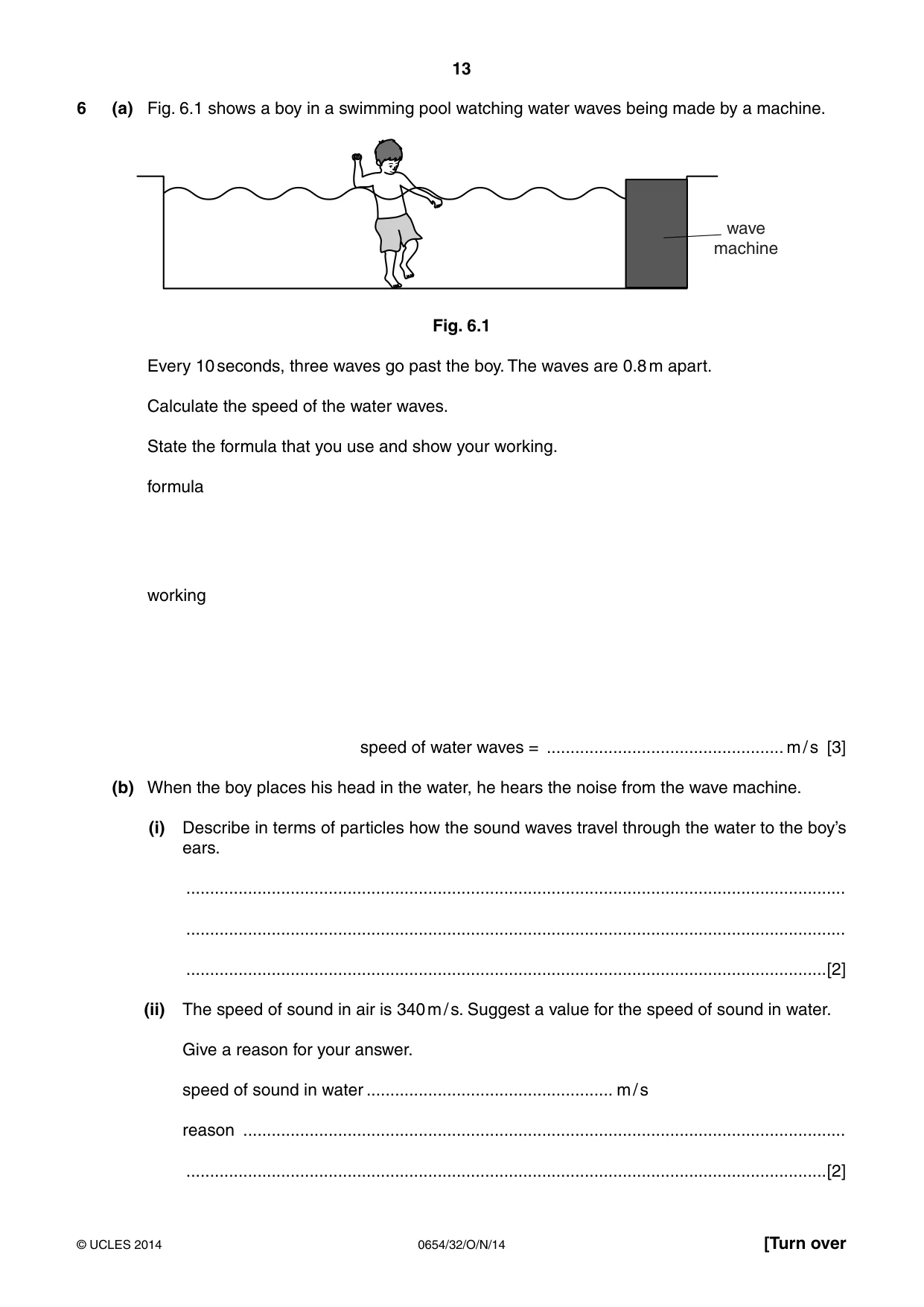
13 0654/32/O/N/14 © UCLES 2014 [Turn over 6 (a) Fig. 6.1 shows a boy in a swimming pool watching water waves being made by a machine. wave machine Fig. 6.1 Every 10 seconds, three waves go past the boy. The waves are 0.8 m apart. Calculate the speed of the water waves. State the formula that you use and show your working. formula working speed of water waves = … m / s [3] (b) When the boy places his head in the water, he hears the noise from the wave machine. (i) Describe in terms of particles how the sound waves travel through the water to the boy’s ears. … … …[2] (ii) The speed of sound in air is 340 m / s. Suggest a value for the speed of sound in water. Give a reason for your answer. speed of sound in water … m / s reason … …[2]
Question paper, page 14
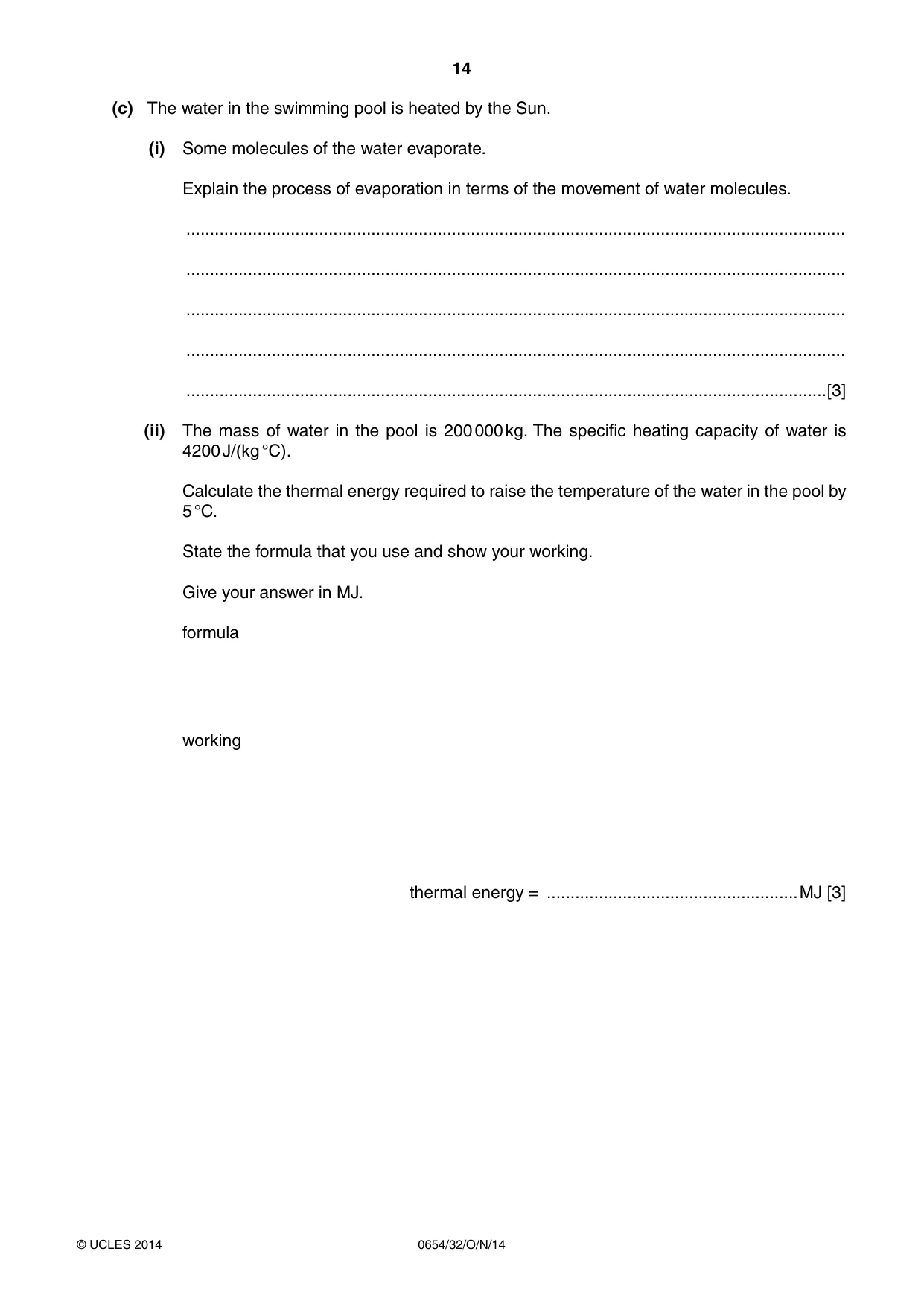
14 0654/32/O/N/14 © UCLES 2014 (c) The water in the swimming pool is heated by the Sun. (i) Some molecules of the water evaporate. Explain the process of evaporation in terms of the movement of water molecules. … … … … …[3] (ii) The mass of water in the pool is 200 000 kg. The specific heating capacity of water is 4200 J/(kg °C). Calculate the thermal energy required to raise the temperature of the water in the pool by 5 °C. State the formula that you use and show your working. Give your answer in MJ. formula working thermal energy = …MJ [3]
Question paper, page 15
15 0654/32/O/N/14 © UCLES 2014 [Turn over Please turn over for Question 7.
Question paper, page 16
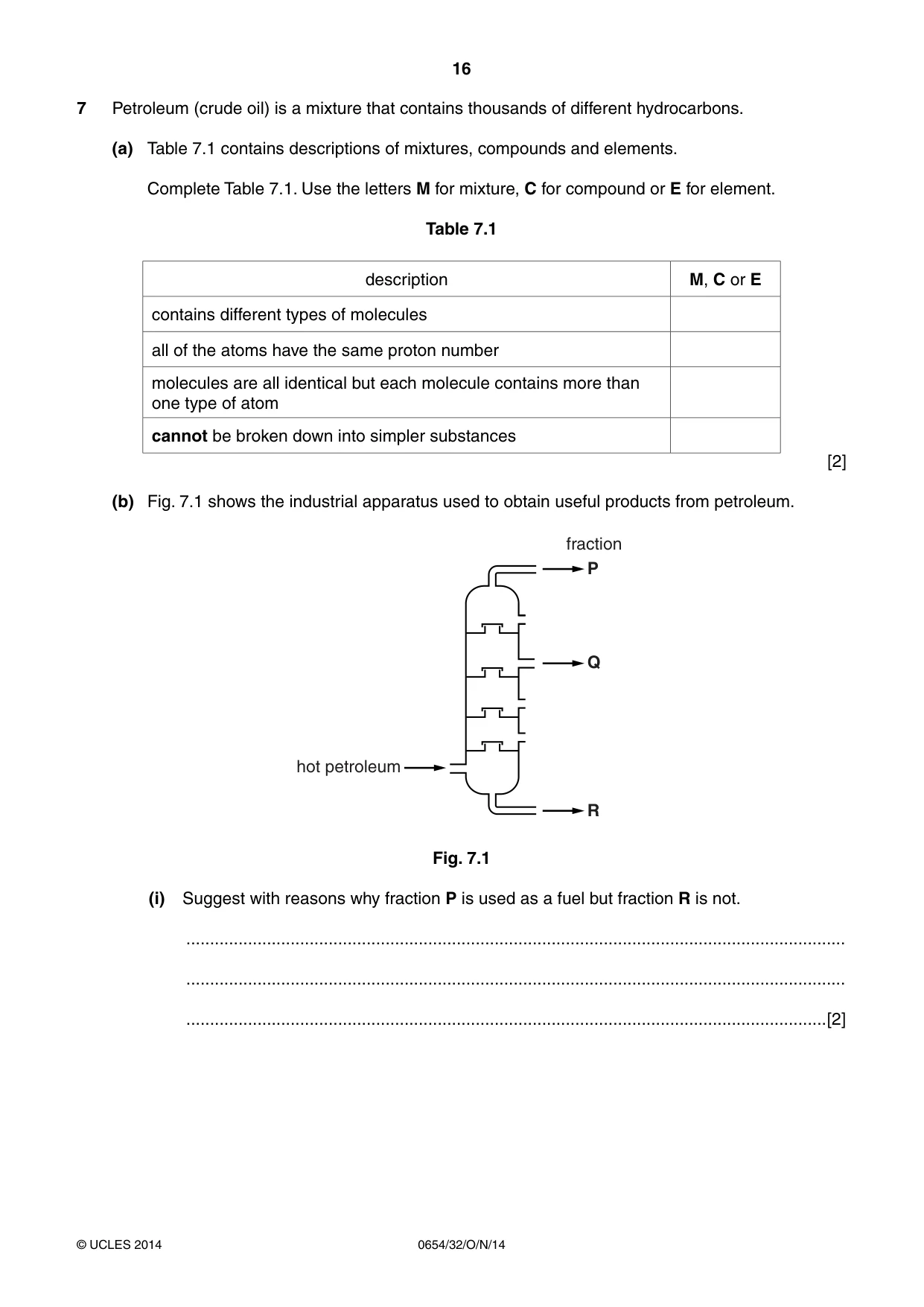
16 0654/32/O/N/14 © UCLES 2014 7 Petroleum (crude oil) is a mixture that contains thousands of different hydrocarbons. (a) Table 7.1 contains descriptions of mixtures, compounds and elements. Complete Table 7.1. Use the letters M for mixture, C for compound or E for element. Table 7.1 description M, C or E contains different types of molecules all of the atoms have the same proton number molecules are all identical but each molecule contains more than one type of atom cannot be broken down into simpler substances [2] (b) Fig. 7.1 shows the industrial apparatus used to obtain useful products from petroleum. hot petroleum R Q P fraction Fig. 7.1 (i) Suggest with reasons why fraction P is used as a fuel but fraction R is not. … … …[2]
Question paper, page 17
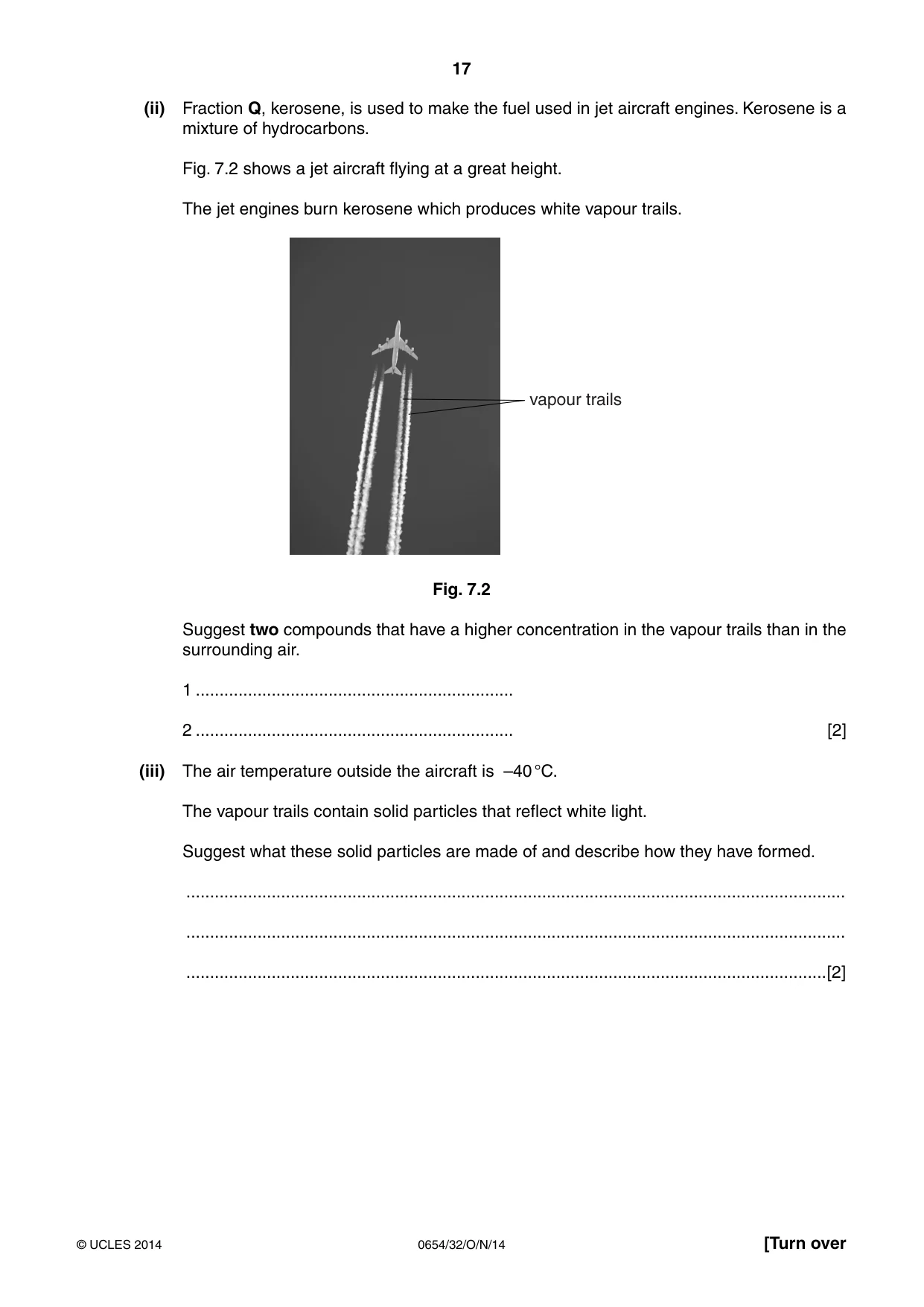
17 0654/32/O/N/14 © UCLES 2014 [Turn over (ii) Fraction Q, kerosene, is used to make the fuel used in jet aircraft engines. Kerosene is a mixture of hydrocarbons. Fig. 7.2 shows a jet aircraft flying at a great height. The jet engines burn kerosene which produces white vapour trails. vapour trails Fig. 7.2 Suggest two compounds that have a higher concentration in the vapour trails than in the surrounding air. 1 … 2 … [2] (iii) The air temperature outside the aircraft is –40 °C. The vapour trails contain solid particles that reflect white light. Suggest what these solid particles are made of and describe how they have formed. … … …[2]
Question paper, page 18
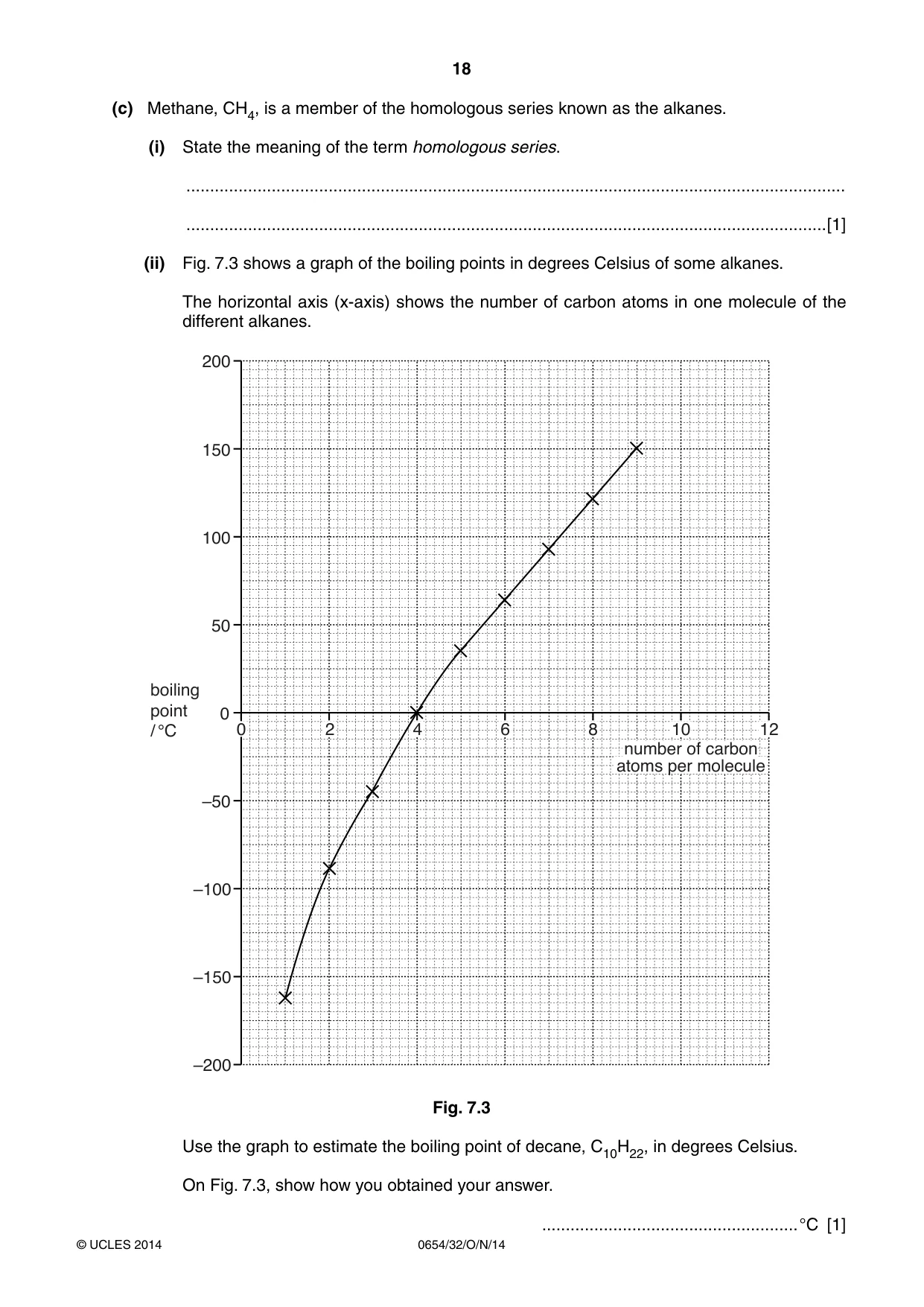
18 0654/32/O/N/14 © UCLES 2014 (c) Methane, CH4, is a member of the homologous series known as the alkanes. (i) State the meaning of the term homologous series. … …[1] (ii) Fig. 7.3 shows a graph of the boiling points in degrees Celsius of some alkanes. The horizontal axis (x-axis) shows the number of carbon atoms in one molecule of the different alkanes. 150 200 100 50 0 –50 –100 –150 –200 boiling point / °C 0 2 4 6 8 10 12 number of carbon atoms per molecule Fig. 7.3 Use the graph to estimate the boiling point of decane, C10H22, in degrees Celsius. On Fig. 7.3, show how you obtained your answer. …°C [1]
Question paper, page 19
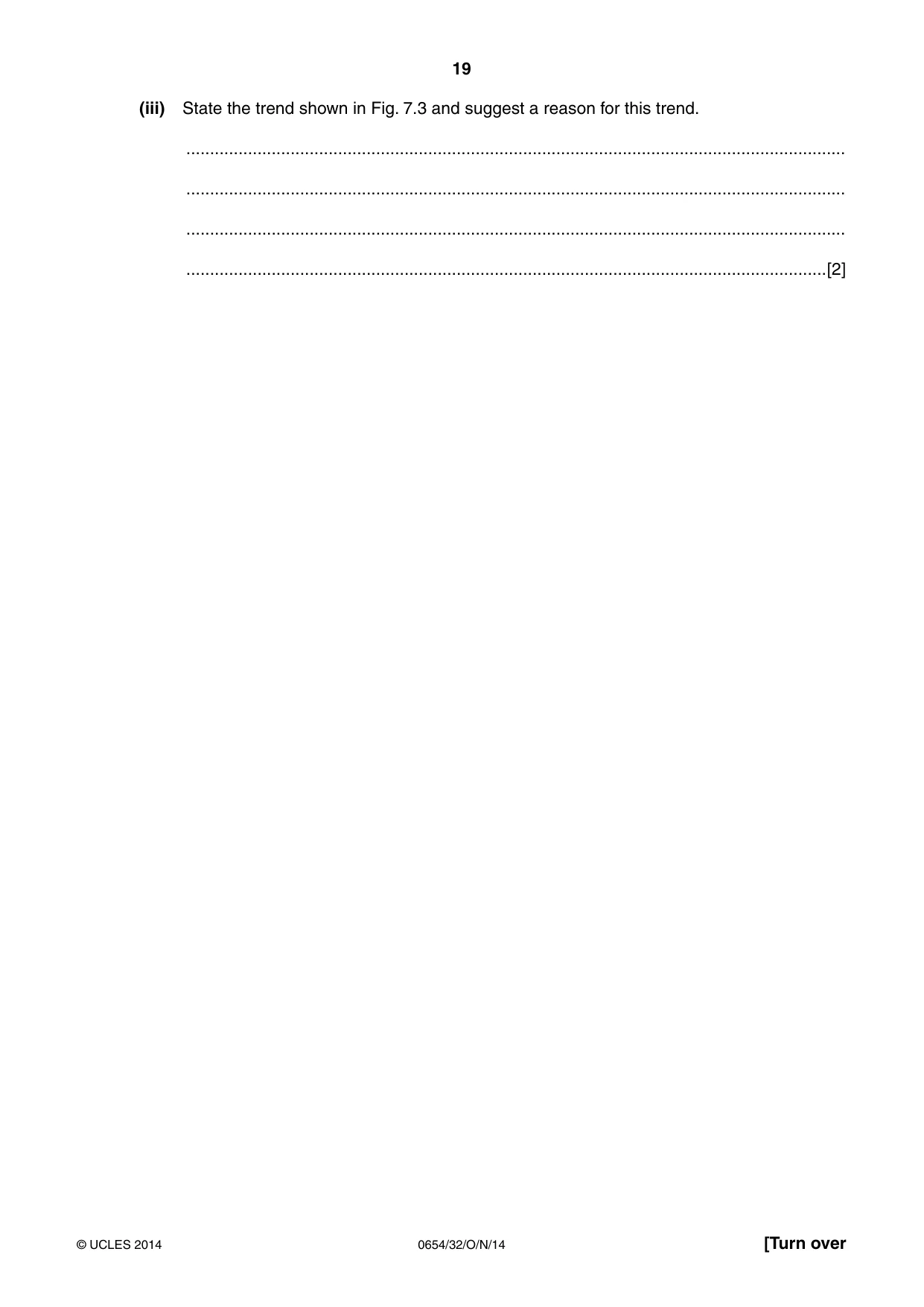
19 0654/32/O/N/14 © UCLES 2014 [Turn over (iii) State the trend shown in Fig. 7.3 and suggest a reason for this trend. … … … …[2]
Question paper, page 20
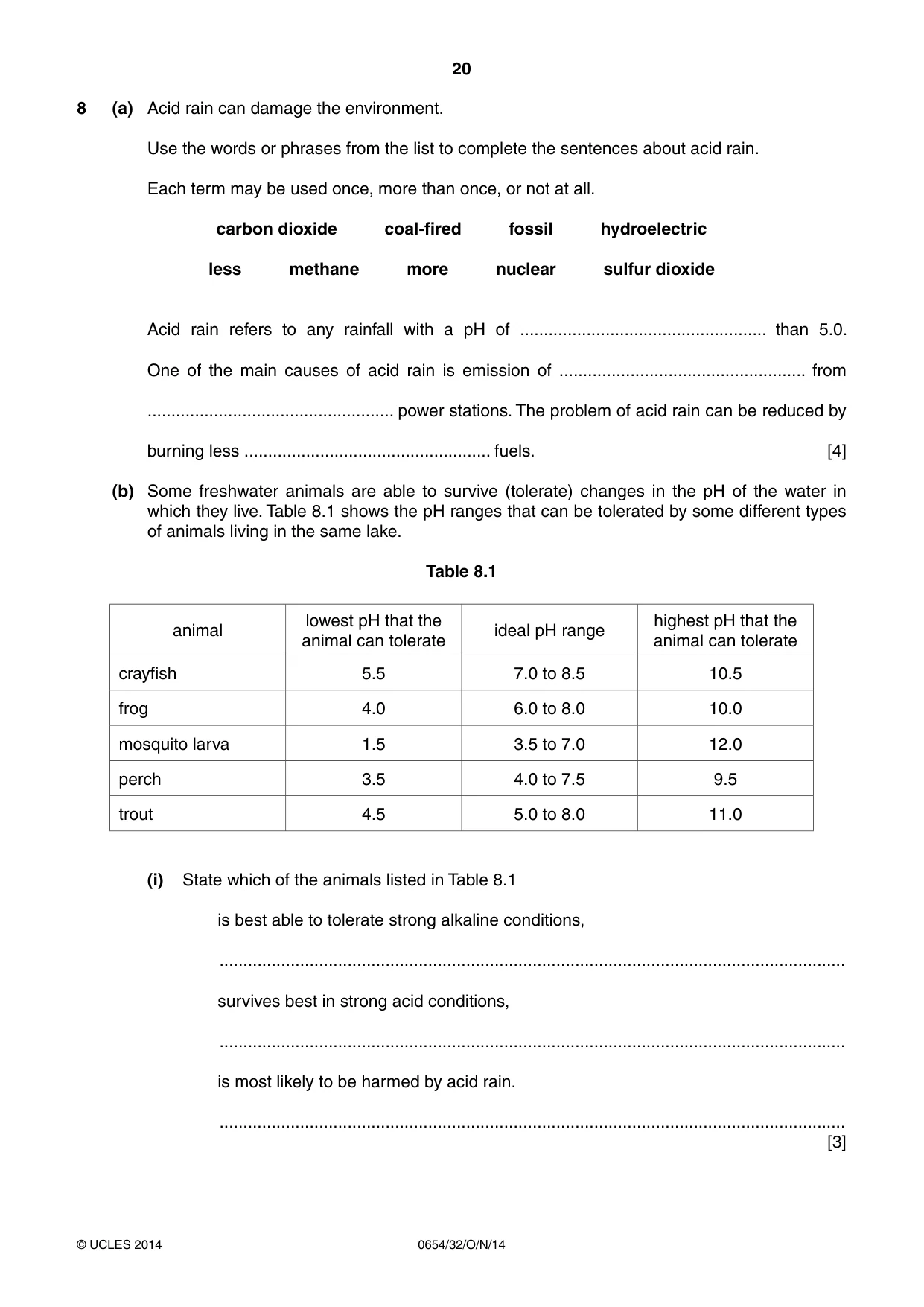
20 0654/32/O/N/14 © UCLES 2014 8 (a) Acid rain can damage the environment. Use the words or phrases from the list to complete the sentences about acid rain. Each term may be used once, more than once, or not at all. carbon dioxide coal-fired fossil hydroelectric less methane more nuclear sulfur dioxide Acid rain refers to any rainfall with a pH of … than 5.0. One of the main causes of acid rain is emission of … from … power stations. The problem of acid rain can be reduced by burning less … fuels. [4] (b) Some freshwater animals are able to survive (tolerate) changes in the pH of the water in which they live. Table 8.1 shows the pH ranges that can be tolerated by some different types of animals living in the same lake. Table 8.1 animal lowest pH that the animal can tolerate ideal pH range highest pH that the animal can tolerate crayfish 5.5 7.0 to 8.5 10.5 frog 4.0 6.0 to 8.0 10.0 mosquito larva 1.5 3.5 to 7.0 12.0 perch 3.5 4.0 to 7.5 9.5 trout 4.5 5.0 to 8.0 11.0 (i) State which of the animals listed in Table 8.1 is best able to tolerate strong alkaline conditions, … survives best in strong acid conditions, … is most likely to be harmed by acid rain. … [3]
Question paper, page 21
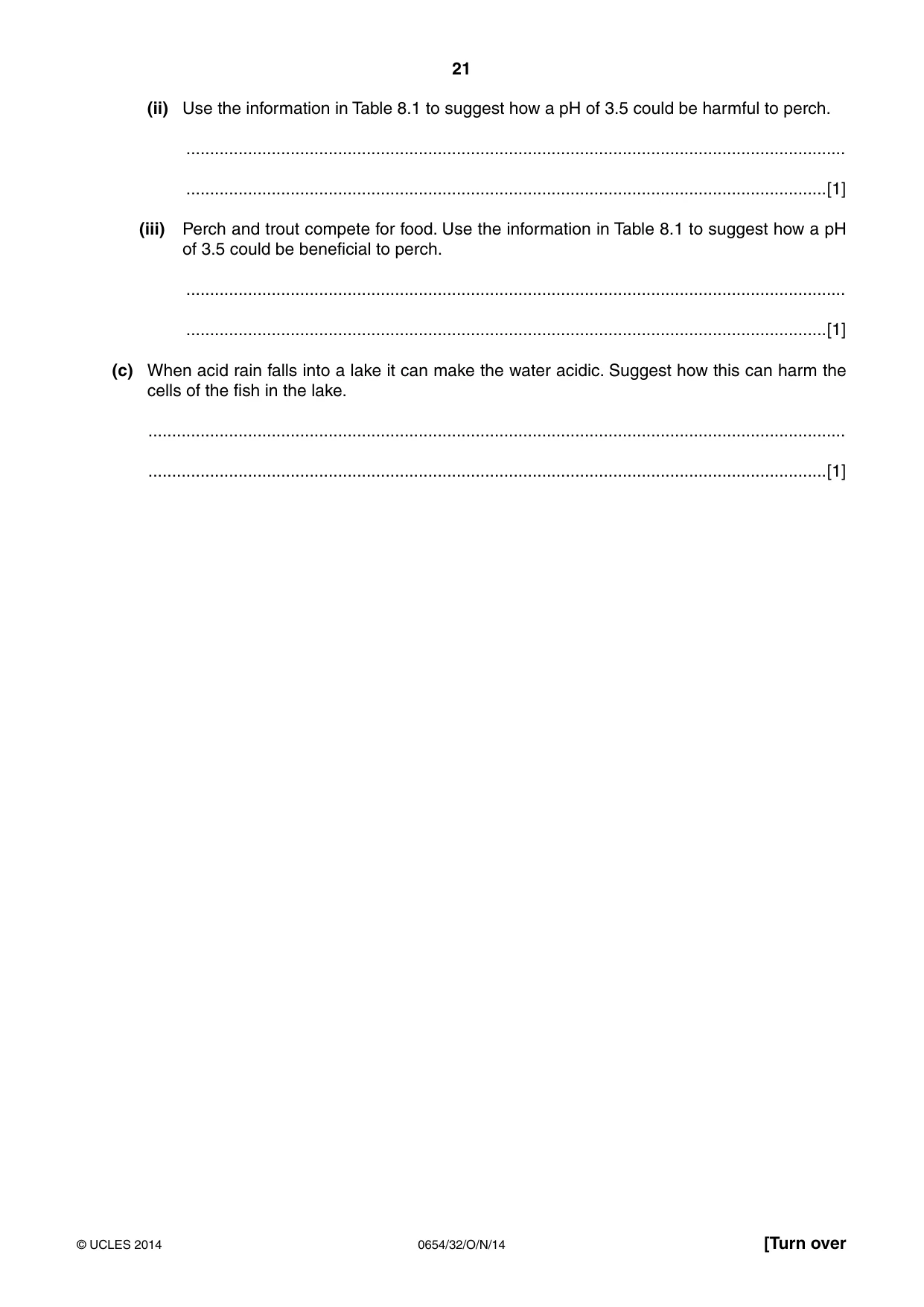
21 0654/32/O/N/14 © UCLES 2014 [Turn over (ii) Use the information in Table 8.1 to suggest how a pH of 3.5 could be harmful to perch. … …[1] (iii) Perch and trout compete for food. Use the information in Table 8.1 to suggest how a pH of 3.5 could be beneficial to perch. … …[1] (c) When acid rain falls into a lake it can make the water acidic. Suggest how this can harm the cells of the fish in the lake. … …[1]
Question paper, page 22
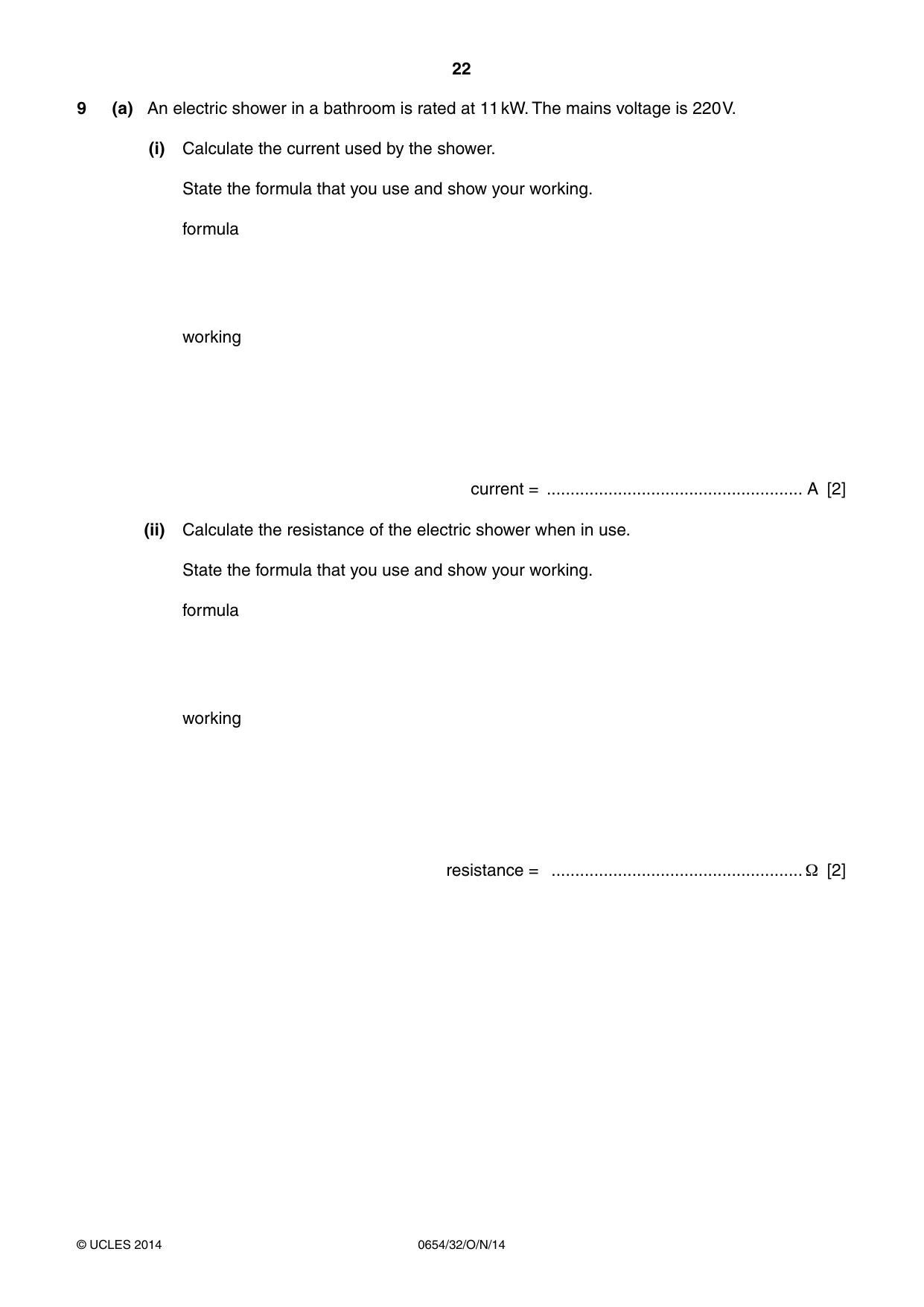
22 0654/32/O/N/14 © UCLES 2014 9 (a) An electric shower in a bathroom is rated at 11 kW. The mains voltage is 220 V. (i) Calculate the current used by the shower. State the formula that you use and show your working. formula working current = … A [2] (ii) Calculate the resistance of the electric shower when in use. State the formula that you use and show your working. formula working resistance = … Ω [2]
Question paper, page 23
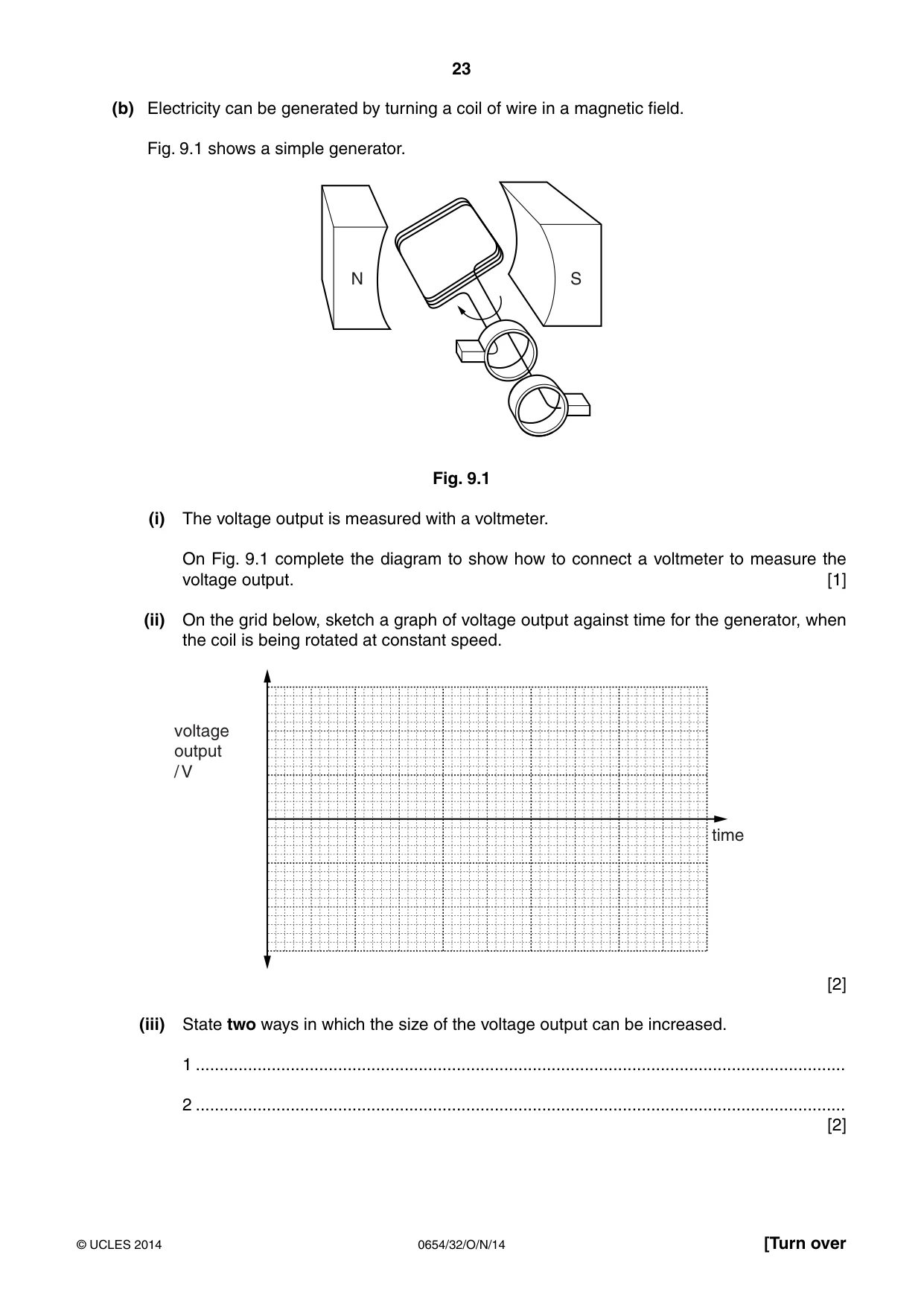
23 0654/32/O/N/14 © UCLES 2014 [Turn over (b) Electricity can be generated by turning a coil of wire in a magnetic field. Fig. 9.1 shows a simple generator. N S Fig. 9.1 (i) The voltage output is measured with a voltmeter. On Fig. 9.1 complete the diagram to show how to connect a voltmeter to measure the voltage output. [1] (ii) On the grid below, sketch a graph of voltage output against time for the generator, when the coil is being rotated at constant speed. voltage output / V time [2] (iii) State two ways in which the size of the voltage output can be increased. 1 … 2 … [2]
Question paper, page 24
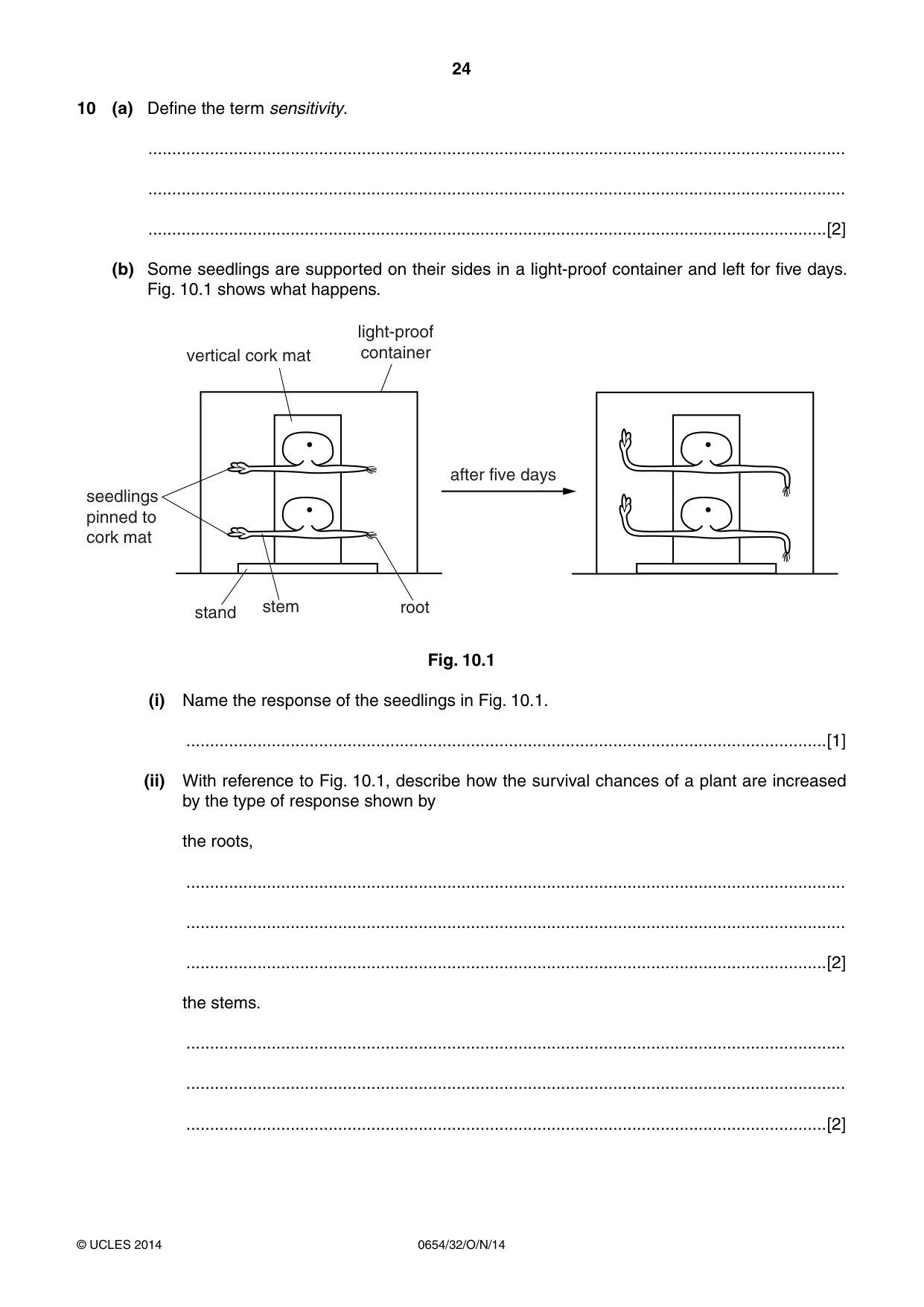
24 0654/32/O/N/14 © UCLES 2014 10 (a) Define the term sensitivity. … … …[2] (b) Some seedlings are supported on their sides in a light-proof container and left for five days. Fig. 10.1 shows what happens. vertical cork mat light-proof container root stem stand seedlings pinned to cork mat after five days Fig. 10.1 (i) Name the response of the seedlings in Fig. 10.1. …[1] (ii) With reference to Fig. 10.1, describe how the survival chances of a plant are increased by the type of response shown by the roots, … … …[2] the stems. … … …[2]
Question paper, page 25
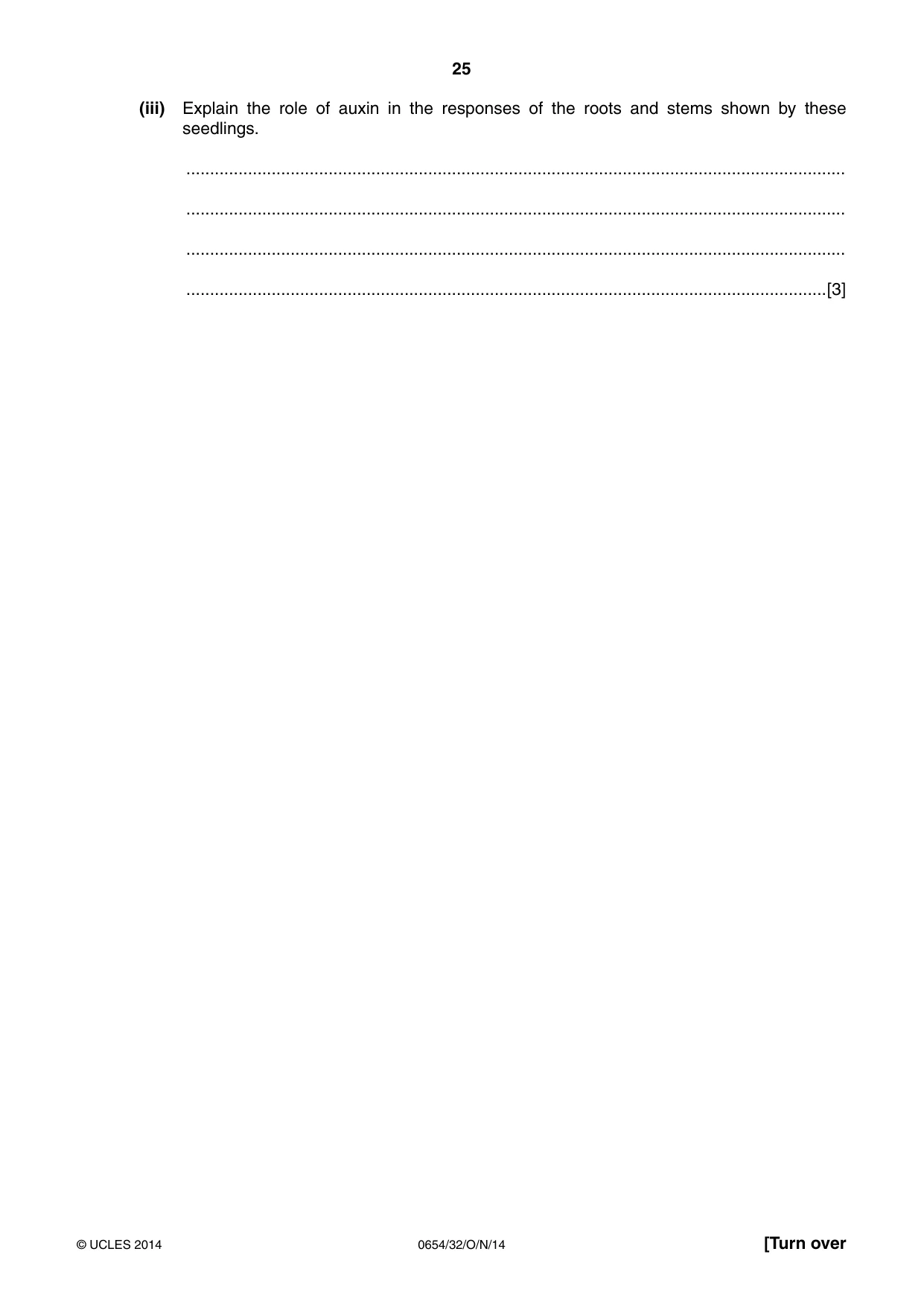
25 0654/32/O/N/14 © UCLES 2014 [Turn over (iii) Explain the role of auxin in the responses of the roots and stems shown by these seedlings. … … … …[3]
Question paper, page 26
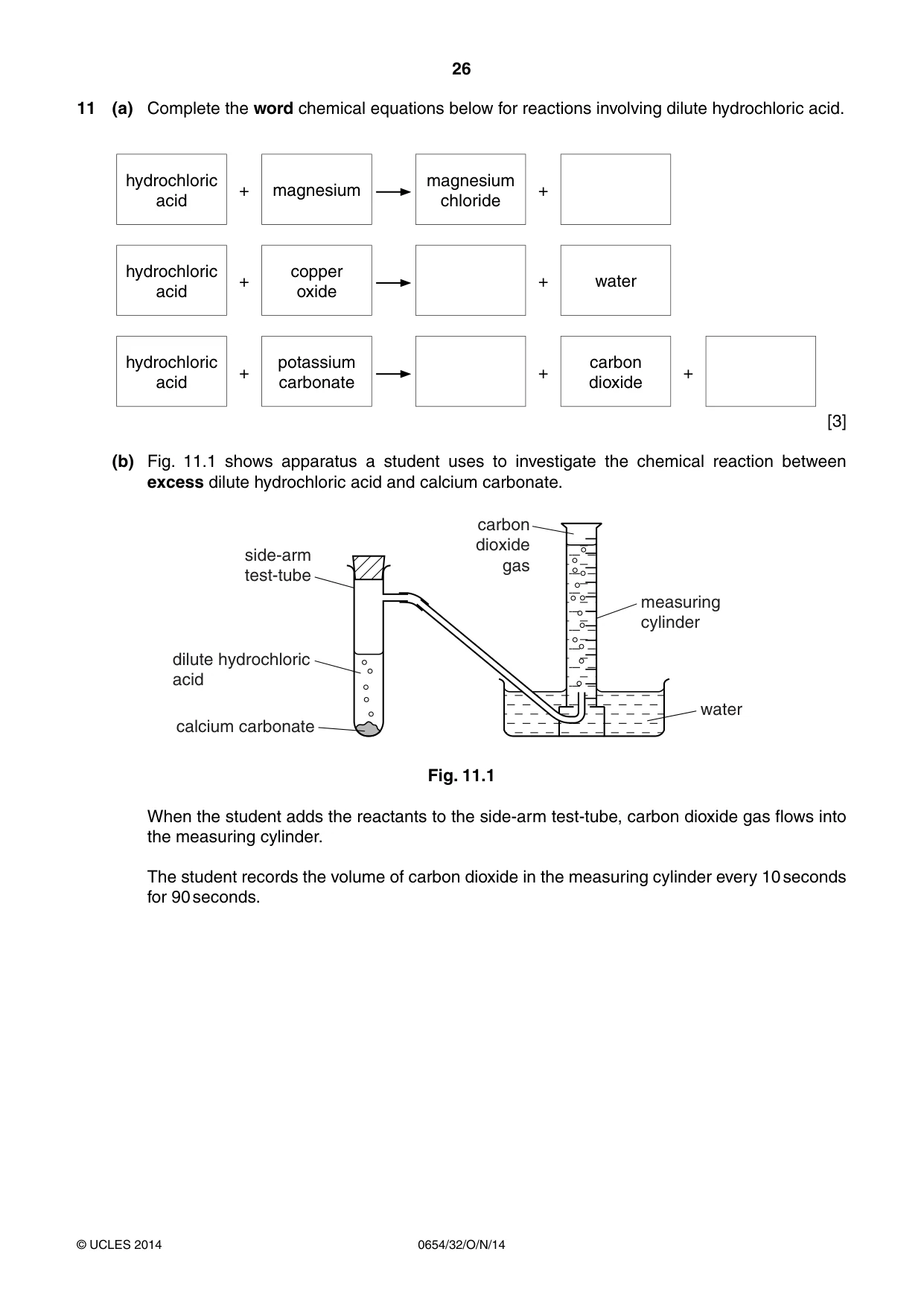
26 0654/32/O/N/14 © UCLES 2014 11 (a) Complete the word chemical equations below for reactions involving dilute hydrochloric acid. hydrochloric acid + magnesium magnesium chloride + hydrochloric acid + copper oxide + water hydrochloric acid + potassium carbonate + carbon dioxide + [3] (b) Fig. 11.1 shows apparatus a student uses to investigate the chemical reaction between excess dilute hydrochloric acid and calcium carbonate. water carbon dioxide gas measuring cylinder side-arm test-tube dilute hydrochloric acid calcium carbonate Fig. 11.1 When the student adds the reactants to the side-arm test-tube, carbon dioxide gas flows into the measuring cylinder. The student records the volume of carbon dioxide in the measuring cylinder every 10 seconds for 90 seconds.
Question paper, page 27
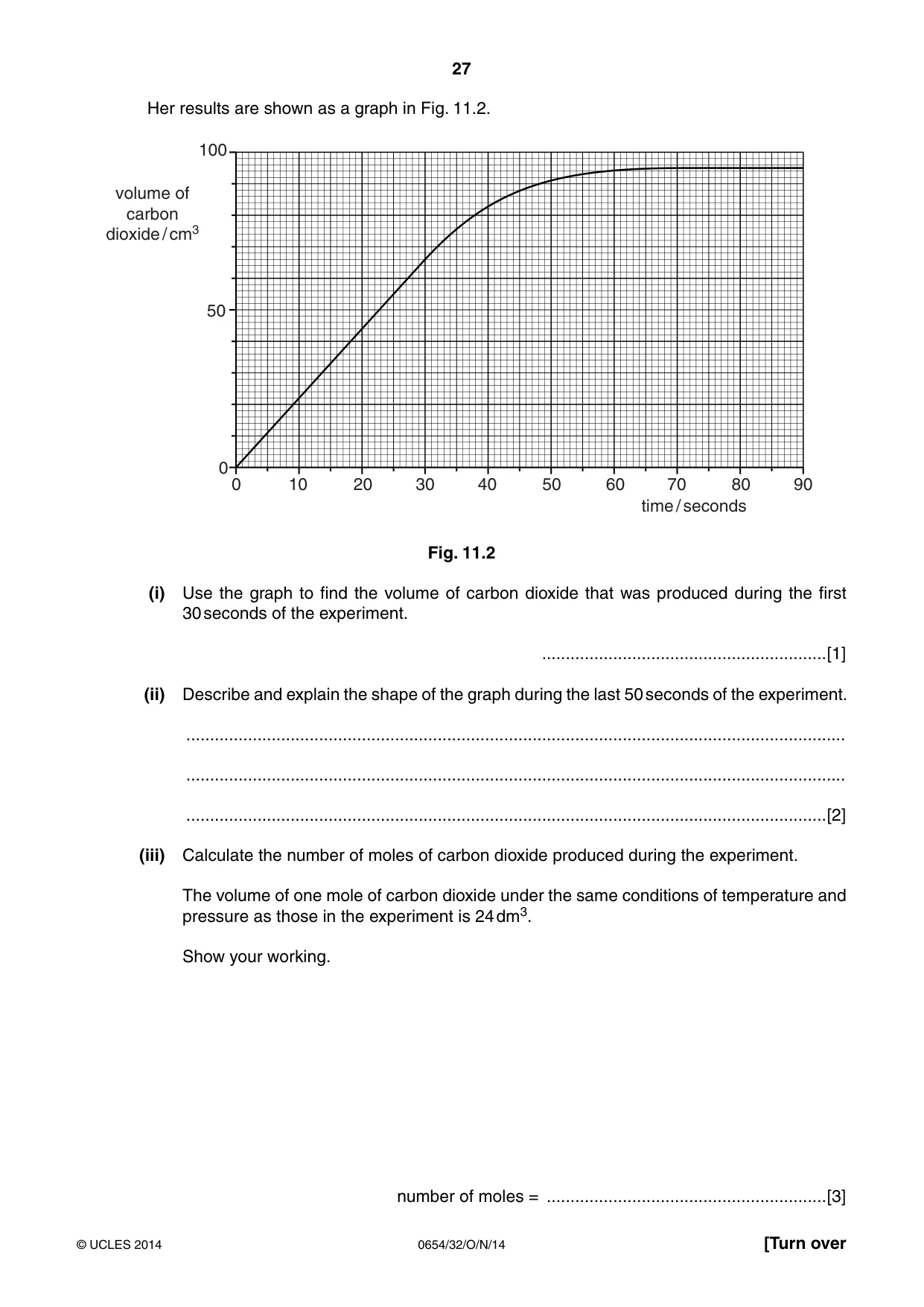
27 0654/32/O/N/14 © UCLES 2014 [Turn over Her results are shown as a graph in Fig. 11.2. 0 10 20 30 40 50 60 70 80 90 100 50 0 volume of carbon dioxide / cm3 time / seconds Fig. 11.2 (i) Use the graph to find the volume of carbon dioxide that was produced during the first 30 seconds of the experiment. …[1] (ii) Describe and explain the shape of the graph during the last 50 seconds of the experiment. … … …[2] (iii) Calculate the number of moles of carbon dioxide produced during the experiment. The volume of one mole of carbon dioxide under the same conditions of temperature and pressure as those in the experiment is 24 dm3. Show your working. number of moles = …[3]
Question paper, page 28
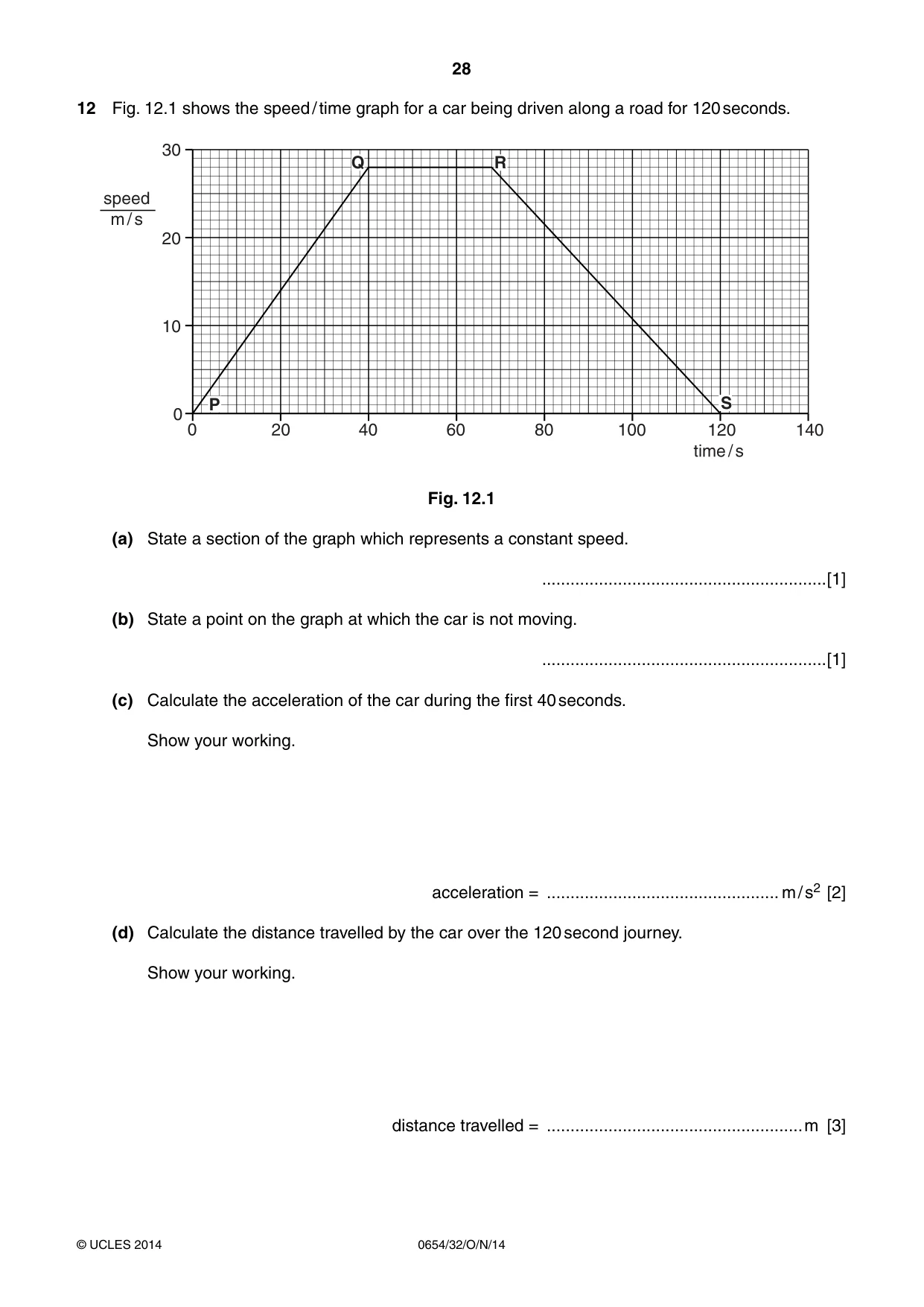
28 0654/32/O/N/14 © UCLES 2014 12 Fig. 12.1 shows the speed / time graph for a car being driven along a road for 120 seconds. 30 20 10 0 0 20 40 60 80 100 120 140 time / s speed m / s P Q R S Fig. 12.1 (a) State a section of the graph which represents a constant speed. …[1] (b) State a point on the graph at which the car is not moving. …[1] (c) Calculate the acceleration of the car during the first 40 seconds. Show your working. acceleration = … m / s2 [2] (d) Calculate the distance travelled by the car over the 120 second journey. Show your working. distance travelled = …m [3]
Question paper, page 29
29 0654/32/O/N/14 © UCLES 2014 BLANK PAGE
Question paper, page 30
30 0654/32/O/N/14 © UCLES 2014 BLANK PAGE
Question paper, page 31
31 0654/32/O/N/14 © UCLES 2014 BLANK PAGE Copyright Acknowledgements: Question 7 © Imagebroker/Alamy; www.alamy.com. Permission to reproduce items where third-party owned material protected by copyright is included has been sought and cleared where possible. Every reasonable effort has been made by the publisher (UCLES) to trace copyright holders, but if any items requiring clearance have unwittingly been included, the publisher will be pleased to make amends at the earliest possible opportunity. Cambridge International Examinations is part of the Cambridge Assessment Group. Cambridge Assessment is the brand name of University of Cambridge Local Examinations Syndicate (UCLES), which is itself a department of the University of Cambridge.
Question paper, page 32
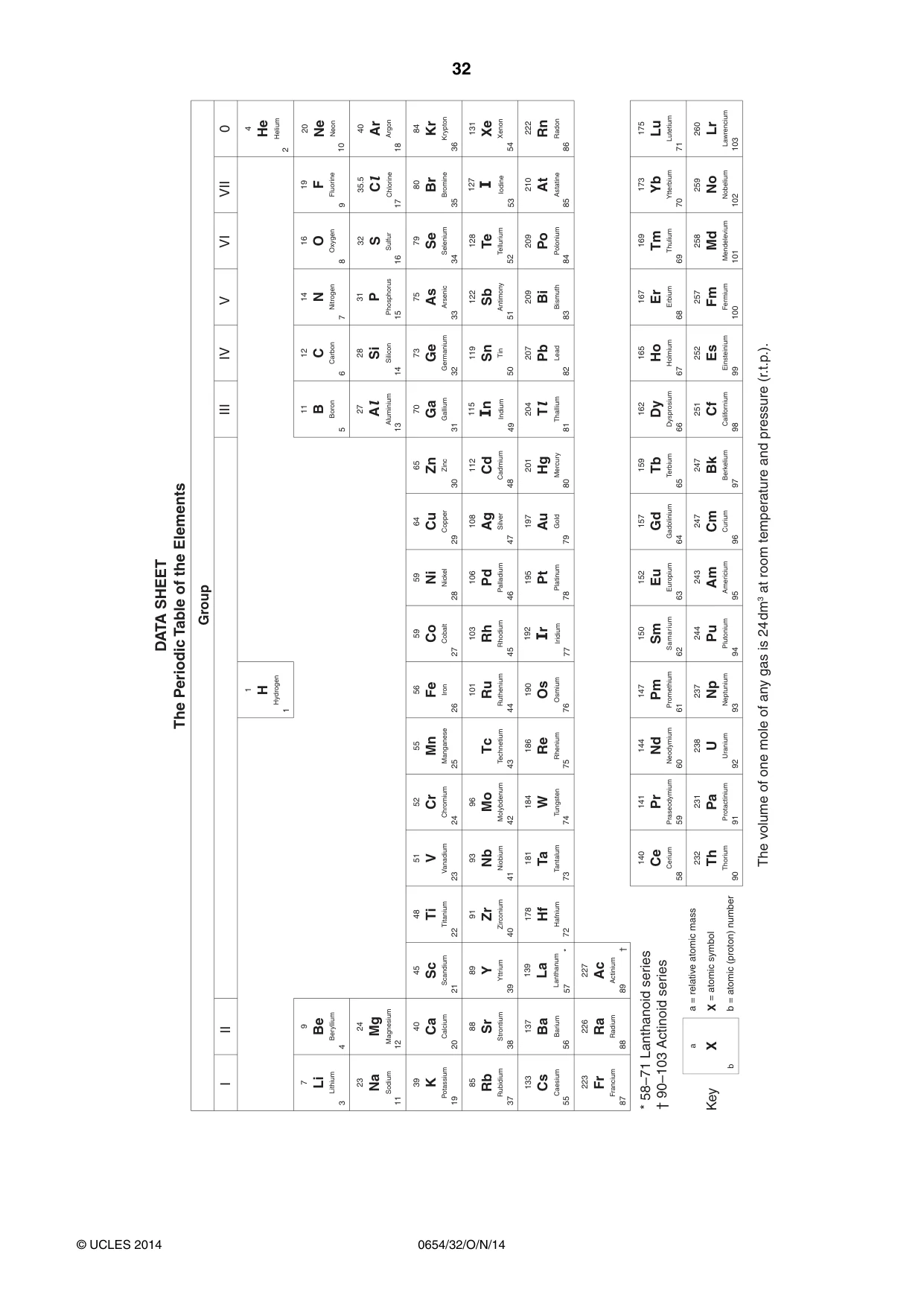
32 0654/32/O/N/14 © UCLES 2014 Group The Periodic Table of the Elements 140 Ce Cerium 58 141 Pr Praseodymium 59 144 Nd Neodymium 60 Pm Promethium 61 150 Sm Samarium 62 152 Eu Europium 63 157 Gd Gadolinium 64 159 Tb Terbium 65 162 Dy Dysprosium 66 165 Ho Holmium 67 167 Er Erbium 68 169 Tm Thulium 69 173 Yb Ytterbium 70 175 Lu Lutetium 71 232 Th Thorium 90 Pa Protactinium 91 238 231 147 237 244 243 247 247 251 252 257 258 259 260 U Uranium 92 Np Neptunium 93 Pu Plutonium 94 Am Americium 95 Cm Curium 96 Bk Berkelium 97 Cf Californium 98 Es Einsteinium 99 Fm Fermium 100 Md Mendelevium 101 No Nobelium 102 Lr Lawrencium 103 1 H Hydrogen 1 7 Li Lithium 3 23 Na Sodium 11 24 Mg Magnesium 12 40 Ca Calcium 20 45 Sc Scandium 21 48 Ti Titanium 22 51 V Vanadium 23 52 Cr Chromium 24 55 Mn Manganese 25 56 Fe Iron 26 59 Co Cobalt 27 59 Ni Nickel 28 64 Cu Copper 29 65 Zn Zinc 30 70 Ga Gallium 31 27 Al Aluminium 13 11 B Boron 5 12 C Carbon 6 14 N Nitrogen 7 16 O Oxygen 8 19 F Fluorine 9 28 Si Silicon 14 31 P Phosphorus 15 32 S Sulfur 16 35.5 Cl Chlorine 17 40 Ar Argon 18 20 Ne Neon 10 4 He Helium 2 73 Ge Germanium 32 75 As Arsenic 33 79 Se Selenium 34 80 Br Bromine 35 84 Kr Krypton 36 39 K Potassium 19 88 Sr Strontium 38 89 Y Yttrium 39 91 Zr Zirconium 40 93 Nb Niobium 41 96 Mo Molybdenum 42 Tc Technetium 43 101 Ru Ruthenium 44 103 Rh Rhodium 45 106 Pd Palladium 46 108 Ag Silver 47 112 Cd Cadmium 48 115 In Indium 49 119 Sn Tin 50 122 Sb Antimony 51 128 Te Tellurium 52 127 I Iodine 53 131 Xe Xenon 54 137 Ba Barium 56 139 La Lanthanum 57 * 178 Hf Hafnium 72 181 Ta Tantalum 73 184 W Tungsten 74 186 Re Rhenium 75 190 Os Osmium 76 192 Ir Iridium 77 195 Pt Platinum 78 197 Au Gold 79 201 Hg Mercury 80 204 Tl Thallium 81 207 Pb Lead 82 209 209 210 222 Bi Bismuth 83 Po Polonium 84 At Astatine 85 Rn Radon 86 Fr Francium 87 227 Ac Actinium 89 † 9 Be Beryllium 4 I II III IV V VI VII 0 85 Rb Rubidium 37 133 Cs Caesium 55 226 223 Ra Radium 88 a X b a = relative atomic mass X = atomic symbol b = atomic (proton) number Key DATA SHEET * 58–71 Lanthanoid series † 90–103 Actinoid series The volume of one mole of any gas is 24dm3 at room temperature and pressure (r.t.p.).
Mark scheme, page 1
® IGCSE is the registered trademark of Cambridge International Examinations. CAMBRIDGE INTERNATIONAL EXAMINATIONS Cambridge International General Certificate of Secondary Education MARK SCHEME for the October/November 2014 series 0654 CO-ORDINATED SCIENCES 0654/32 Paper 3 (Extended Theory), maximum raw mark 120 This mark scheme is published as an aid to teachers and candidates, to indicate the requirements of the examination. It shows the basis on which Examiners were instructed to award marks. It does not indicate the details of the discussions that took place at an Examiners’ meeting before marking began, which would have considered the acceptability of alternative answers. Mark schemes should be read in conjunction with the question paper and the Principal Examiner Report for Teachers. Cambridge will not enter into discussions about these mark schemes. Cambridge is publishing the mark schemes for the October/November 2014 series for most Cambridge IGCSE®, Cambridge International A and AS Level components and some Cambridge O Level components.
Mark scheme, page 2
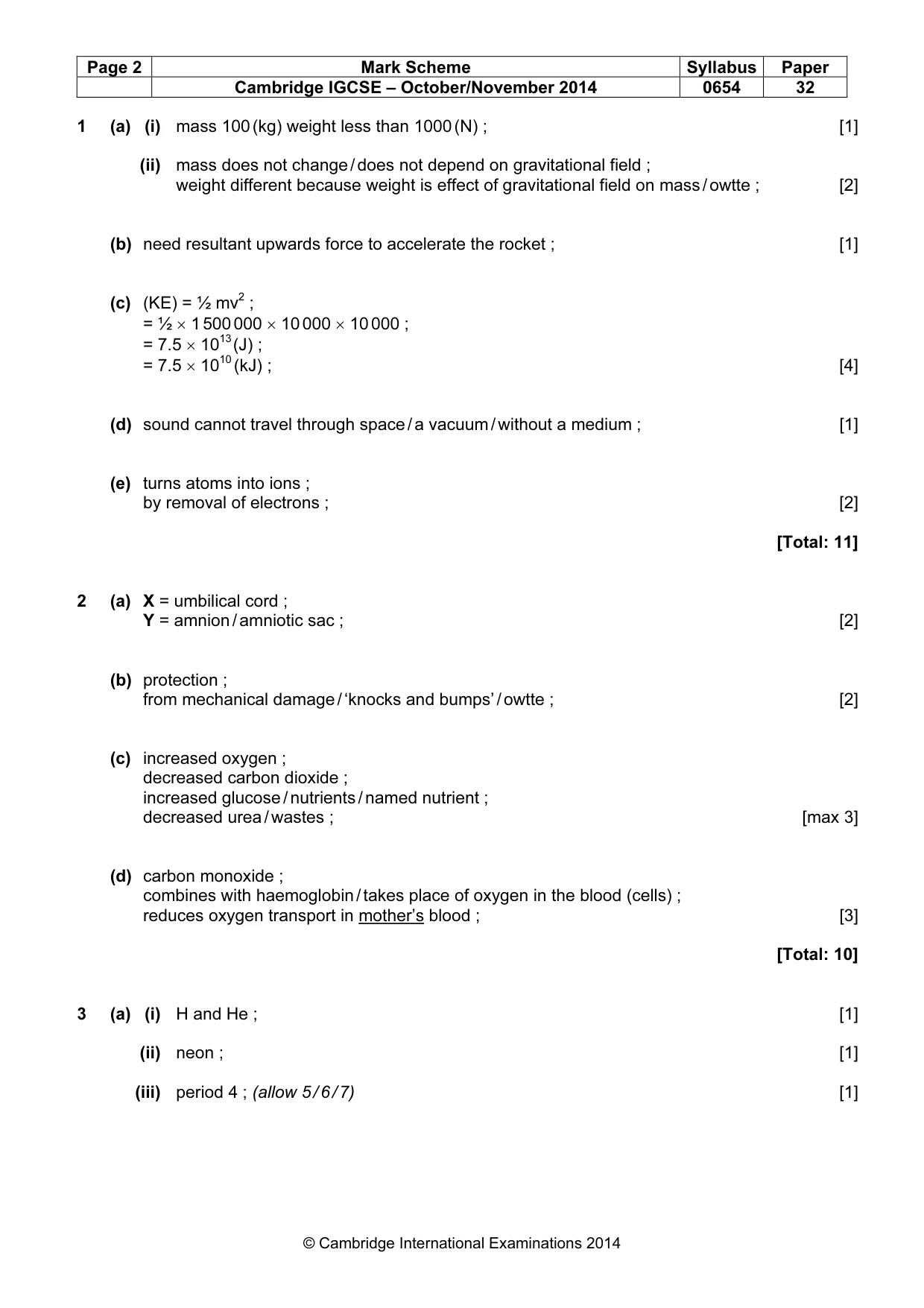
Page 2 Mark Scheme Syllabus Paper Cambridge IGCSE – October/November 2014 0654 32 © Cambridge International Examinations 2014 1 (a) (i) mass 100 (kg) weight less than 1000 (N) ; [1] (ii) mass does not change / does not depend on gravitational field ; weight different because weight is effect of gravitational field on mass / owtte ; [2] (b) need resultant upwards force to accelerate the rocket ; [1] (c) (KE) = ½ mv2 ; = ½ × 1 500 000 × 10 000 × 10 000 ; = 7.5 × 10¹³ (J) ; = 7.5 × 10¹⁰ (kJ) ; [4] (d) sound cannot travel through space / a vacuum / without a medium ; [1] (e) turns atoms into ions ; by removal of electrons ; [2] [Total: 11] 2 (a) X = umbilical cord ; Y = amnion / amniotic sac ; [2] (b) protection ; from mechanical damage / ‘knocks and bumps’ / owtte ; [2] (c) increased oxygen ; decreased carbon dioxide ; increased glucose / nutrients / named nutrient ; decreased urea / wastes ; [max 3] (d) carbon monoxide ; combines with haemoglobin / takes place of oxygen in the blood (cells) ; reduces oxygen transport in mother’s blood ; [3] [Total: 10] 3 (a) (i) H and He ; [1] (ii) neon ; [1] (iii) period 4 ; (allow 5 / 6 / 7) [1]
Mark scheme, page 3
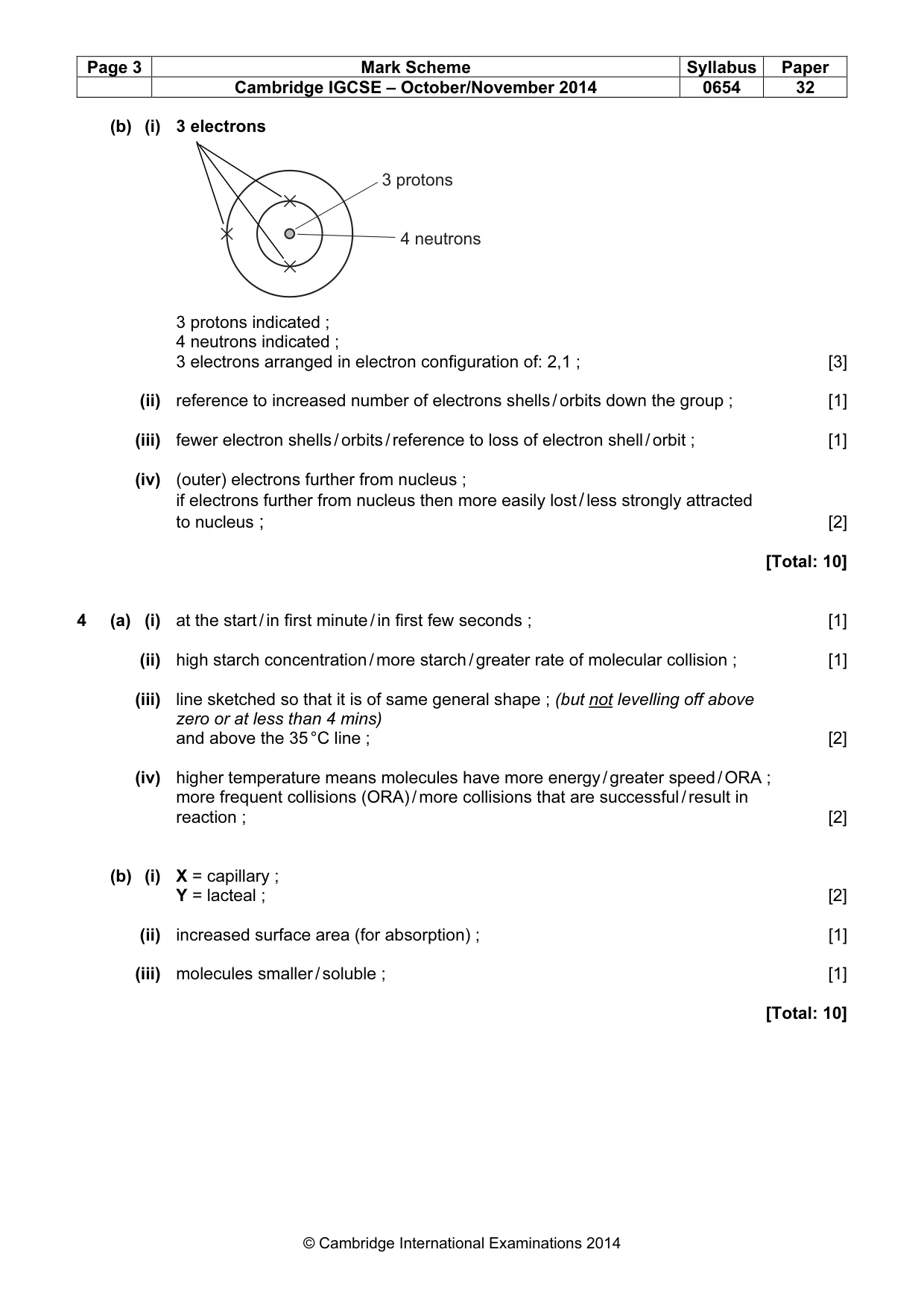
Page 3 Mark Scheme Syllabus Paper Cambridge IGCSE – October/November 2014 0654 32 © Cambridge International Examinations 2014 (b) (i) 3 electrons 3 protons indicated ; 4 neutrons indicated ; 3 electrons arranged in electron configuration of: 2,1 ; [3] (ii) reference to increased number of electrons shells / orbits down the group ; [1] (iii) fewer electron shells / orbits / reference to loss of electron shell / orbit ; [1] (iv) (outer) electrons further from nucleus ; if electrons further from nucleus then more easily lost / less strongly attracted to nucleus ; [2] [Total: 10] 4 (a) (i) at the start / in first minute / in first few seconds ; [1] (ii) high starch concentration / more starch / greater rate of molecular collision ; [1] (iii) line sketched so that it is of same general shape ; (but not levelling off above zero or at less than 4 mins) and above the 35 °C line ; [2] (iv) higher temperature means molecules have more energy / greater speed / ORA ; more frequent collisions (ORA) / more collisions that are successful / result in reaction ; [2] (b) (i) X = capillary ; Y = lacteal ; [2] (ii) increased surface area (for absorption) ; [1] (iii) molecules smaller / soluble ; [1] [Total: 10] 3 protons 4 neutrons
Mark scheme, page 4
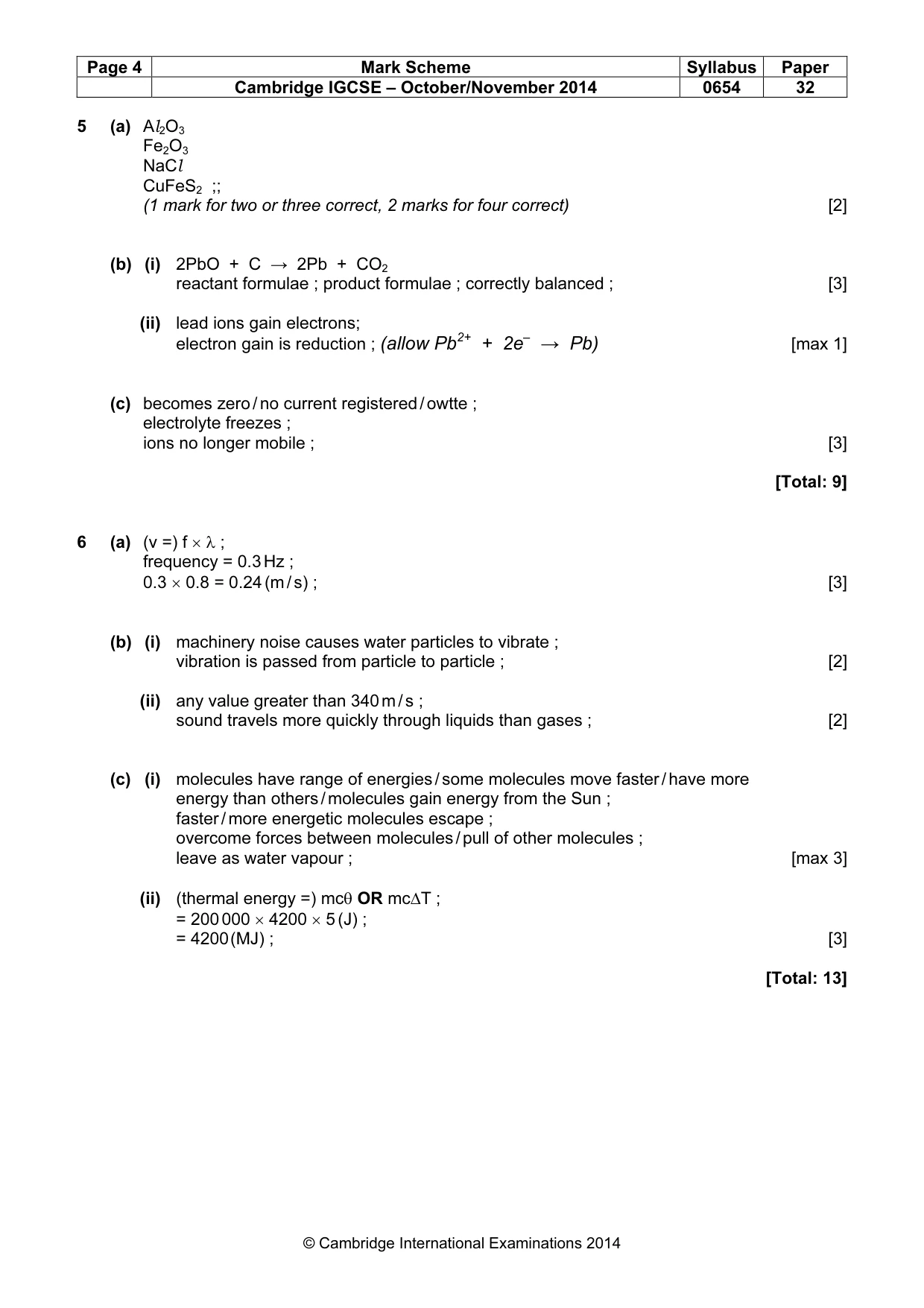
Page 4 Mark Scheme Syllabus Paper Cambridge IGCSE – October/November 2014 0654 32 © Cambridge International Examinations 2014 5 (a) Al2O3 Fe2O3 NaCl CuFeS2 ;; (1 mark for two or three correct, 2 marks for four correct) [2] (b) (i) 2PbO + C → 2Pb + CO2 reactant formulae ; product formulae ; correctly balanced ; [3] (ii) lead ions gain electrons; electron gain is reduction ; (allow Pb2+ + 2e– → Pb) [max 1] (c) becomes zero / no current registered / owtte ; electrolyte freezes ; ions no longer mobile ; [3] [Total: 9] 6 (a) (v =) f × λ ; frequency = 0.3 Hz ; 0.3 × 0.8 = 0.24 (m / s) ; [3] (b) (i) machinery noise causes water particles to vibrate ; vibration is passed from particle to particle ; [2] (ii) any value greater than 340 m / s ; sound travels more quickly through liquids than gases ; [2] (c) (i) molecules have range of energies / some molecules move faster / have more energy than others / molecules gain energy from the Sun ; faster / more energetic molecules escape ; overcome forces between molecules / pull of other molecules ; leave as water vapour ; [max 3] (ii) (thermal energy =) mcθ OR mc∆T ; = 200 000 × 4200 × 5 (J) ; = 4200 (MJ) ; [3] [Total: 13]
Mark scheme, page 5
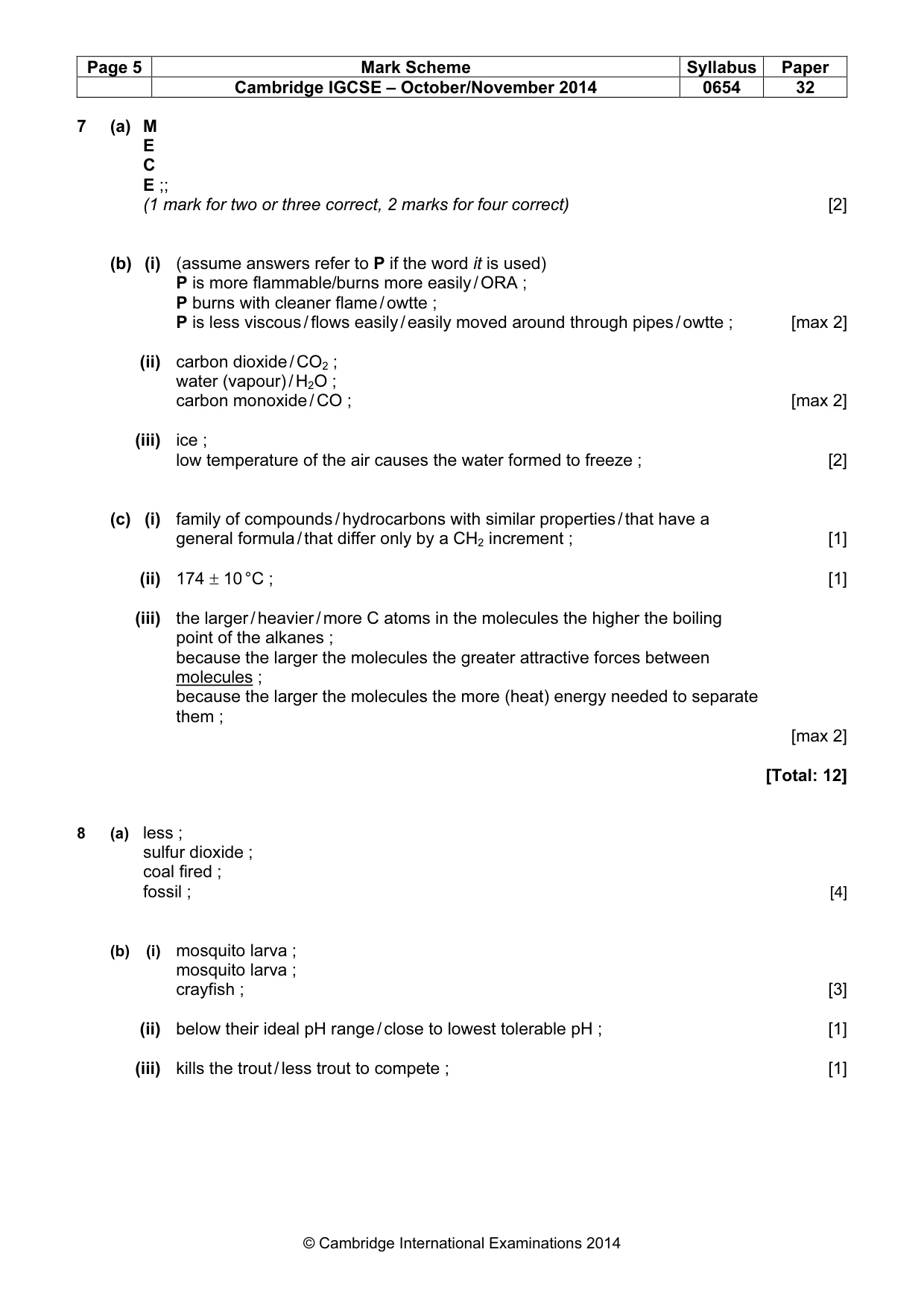
Page 5 Mark Scheme Syllabus Paper Cambridge IGCSE – October/November 2014 0654 32 © Cambridge International Examinations 2014 7 (a) M E C E ;; (1 mark for two or three correct, 2 marks for four correct) [2] (b) (i) (assume answers refer to P if the word it is used) P is more flammable/burns more easily / ORA ; P burns with cleaner flame / owtte ; P is less viscous / flows easily / easily moved around through pipes / owtte ; [max 2] (ii) carbon dioxide / CO2 ; water (vapour) / H2O ; carbon monoxide / CO ; [max 2] (iii) ice ; low temperature of the air causes the water formed to freeze ; [2] (c) (i) family of compounds / hydrocarbons with similar properties / that have a general formula / that differ only by a CH2 increment ; [1] (ii) 174 ± 10 °C ; [1] (iii) the larger / heavier / more C atoms in the molecules the higher the boiling point of the alkanes ; because the larger the molecules the greater attractive forces between molecules ; because the larger the molecules the more (heat) energy needed to separate them ; [max 2] [Total: 12] 8 (a) less ; sulfur dioxide ; coal fired ; fossil ; [4] (b) (i) mosquito larva ; mosquito larva ; crayfish ; [3] (ii) below their ideal pH range / close to lowest tolerable pH ; [1] (iii) kills the trout / less trout to compete ; [1]
Mark scheme, page 6
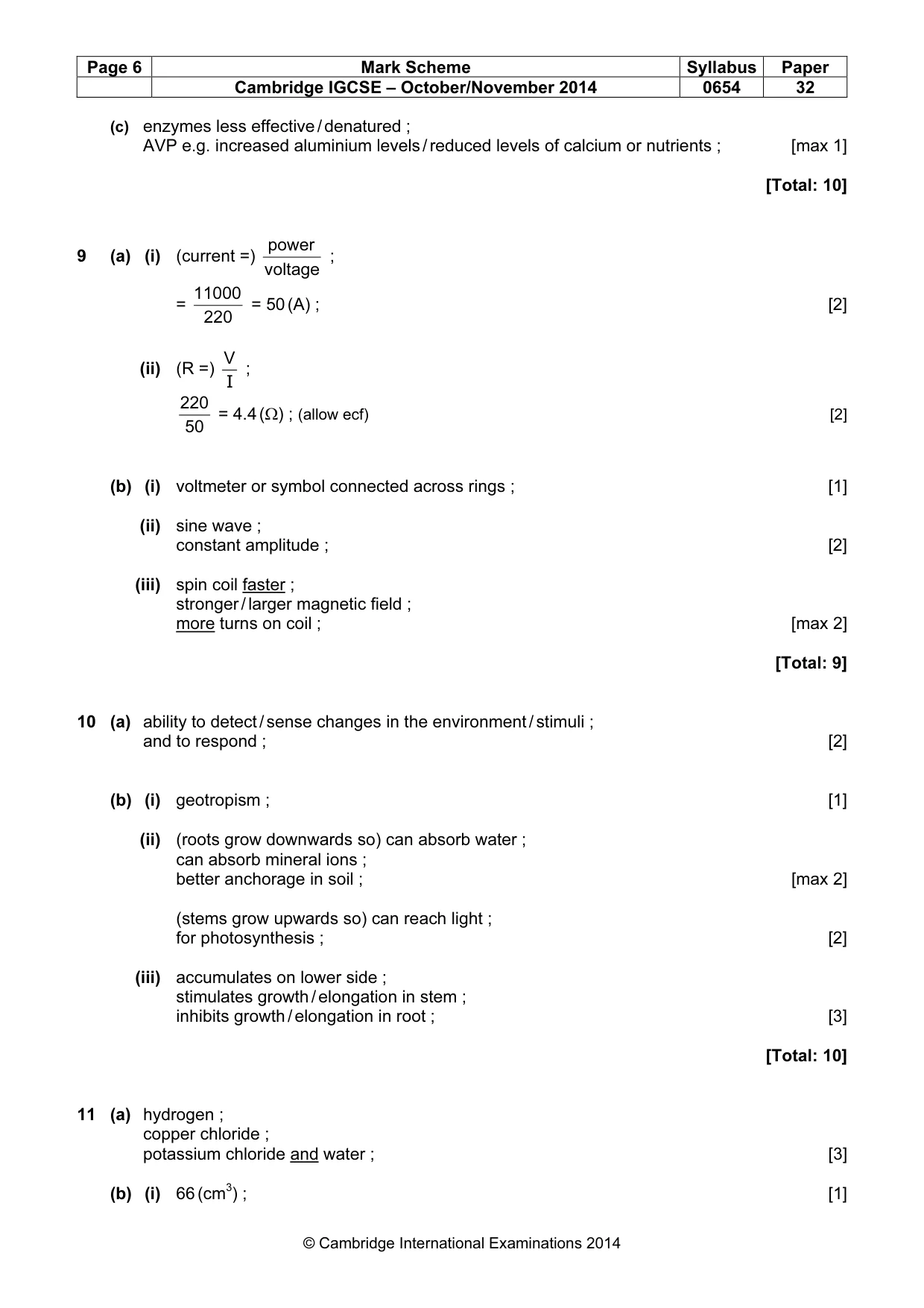
Page 6 Mark Scheme Syllabus Paper Cambridge IGCSE – October/November 2014 0654 32 © Cambridge International Examinations 2014 (c) enzymes less effective / denatured ; AVP e.g. increased aluminium levels / reduced levels of calcium or nutrients ; [max 1] [Total: 10] 9 (a) (i) (current =) voltage power ; = 220 11000 = 50 (A) ; [2] (ii) (R =) I V ; 50 220 = 4.4 (Ω) ; (allow ecf) [2] (b) (i) voltmeter or symbol connected across rings ; [1] (ii) sine wave ; constant amplitude ; [2] (iii) spin coil faster ; stronger / larger magnetic field ; more turns on coil ; [max 2] [Total: 9] 10 (a) ability to detect / sense changes in the environment / stimuli ; and to respond ; [2] (b) (i) geotropism ; [1] (ii) (roots grow downwards so) can absorb water ; can absorb mineral ions ; better anchorage in soil ; [max 2] (stems grow upwards so) can reach light ; for photosynthesis ; [2] (iii) accumulates on lower side ; stimulates growth / elongation in stem ; inhibits growth / elongation in root ; [3] [Total: 10] 11 (a) hydrogen ; copper chloride ; potassium chloride and water ; [3] (b) (i) 66 (cm3) ; [1]
Mark scheme, page 7
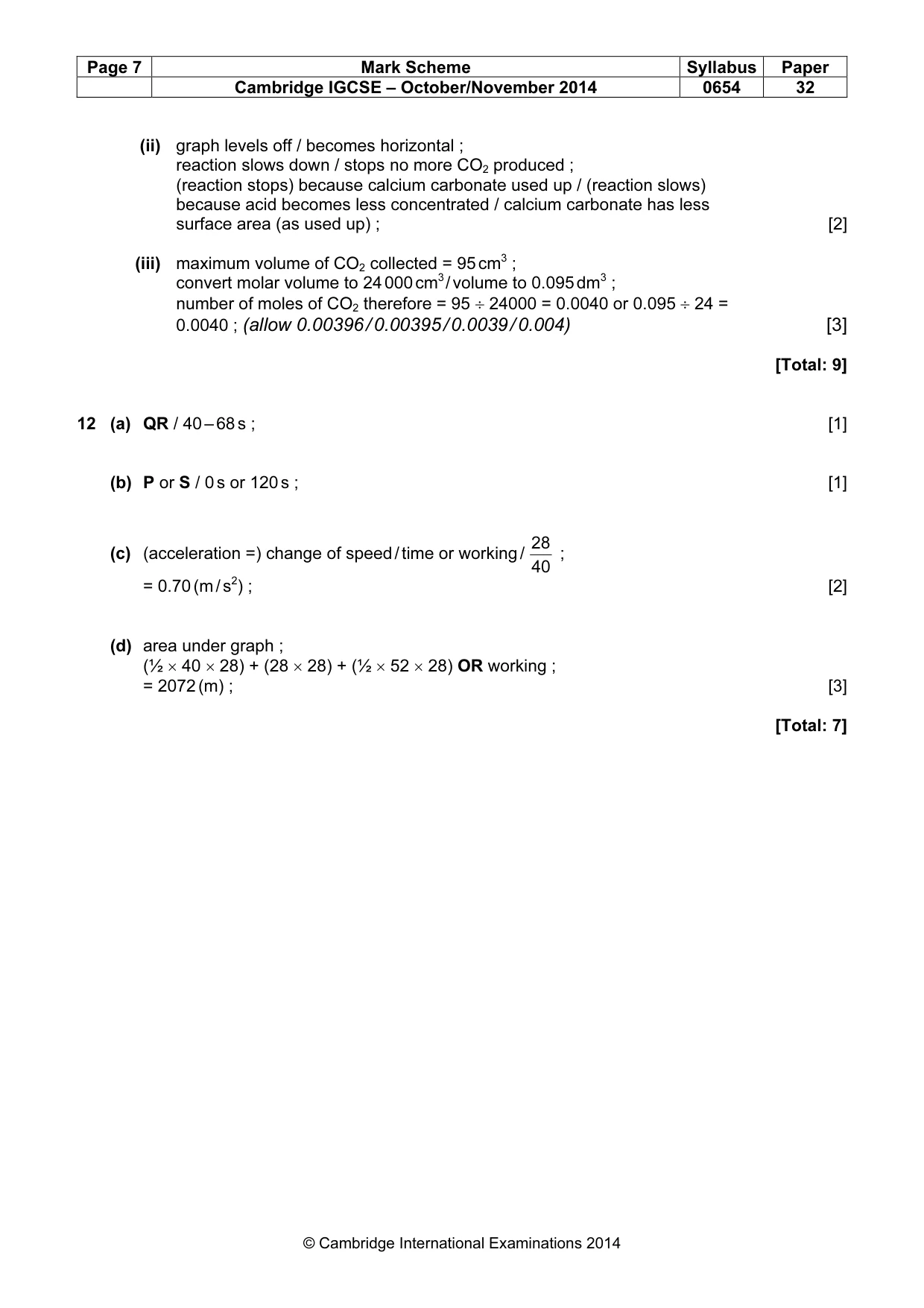
Page 7 Mark Scheme Syllabus Paper Cambridge IGCSE – October/November 2014 0654 32 © Cambridge International Examinations 2014 (ii) graph levels off / becomes horizontal ; reaction slows down / stops no more CO2 produced ; (reaction stops) because calcium carbonate used up / (reaction slows) because acid becomes less concentrated / calcium carbonate has less surface area (as used up) ; [2] (iii) maximum volume of CO2 collected = 95 cm3 ; convert molar volume to 24 000 cm3 / volume to 0.095 dm3 ; number of moles of CO2 therefore = 95 ÷ 24000 = 0.0040 or 0.095 ÷ 24 = 0.0040 ; (allow 0.00396 / 0.00395 / 0.0039 / 0.004) [3] [Total: 9] 12 (a) QR / 40 – 68 s ; [1] (b) P or S / 0 s or 120 s ; [1] (c) (acceleration =) change of speed / time or working / 40 28 ; = 0.70 (m / s2) ; [2] (d) area under graph ; (½ × 40 × 28) + (28 × 28) + (½ × 52 × 28) OR working ; = 2072 (m) ; [3] [Total: 7]
What you needed in this session
Cambridge’s own grade thresholds for 2014 Oct/Nov, Paper 3 · Variant 2. A higher threshold means an easier paper — the bar moves with how the cohort did.