Cambridge IGCSE Sciences - Co-ordinated (Double) 0654 — 2008 Oct/Nov Paper 2 · Variant 1
0654/21/O/N/08 · 100 marks · ≈113 min
The question paper and its mark scheme, free to read here and free to download. This is Cambridge’s own paper, exactly as it was sat.
Question paper28 pages



Mark scheme7 pages
Answers below. Sit the paper first if you are practising.
Paper as text
Question paper, page 1
This document consists of 25 printed pages and 3 blank pages. IB08 11_0654_02/2RP © UCLES 2008 [Turn over *9203180518* For Examiner's Use 1 2 3 4 5 6 7 8 9 10 11 Total UNIVERSITY OF CAMBRIDGE INTERNATIONAL EXAMINATIONS International General Certificate of Secondary Education CO-ORDINATED SCIENCES 0654/02 Paper 2 (Core) October/November 2008 2 hours Candidates answer on the Question Paper. No Additional Materials are required. READ THESE INSTRUCTIONS FIRST Write your Centre number, candidate number and name on all the work you hand in. Write in dark blue or black pen. You may use a soft pencil for any diagrams, graphs, tables or rough working. Do not use staples, paper clips, highlighters, glue or correction fluid. DO NOT WRITE IN ANY BARCODES Answer all questions. A copy of the Periodic Table is printed on page 28. At the end of the examination, fasten all your work securely together. The number of marks is given in brackets [ ] at the end of each question or part question. www.XtremePapers.com
Question paper, page 2
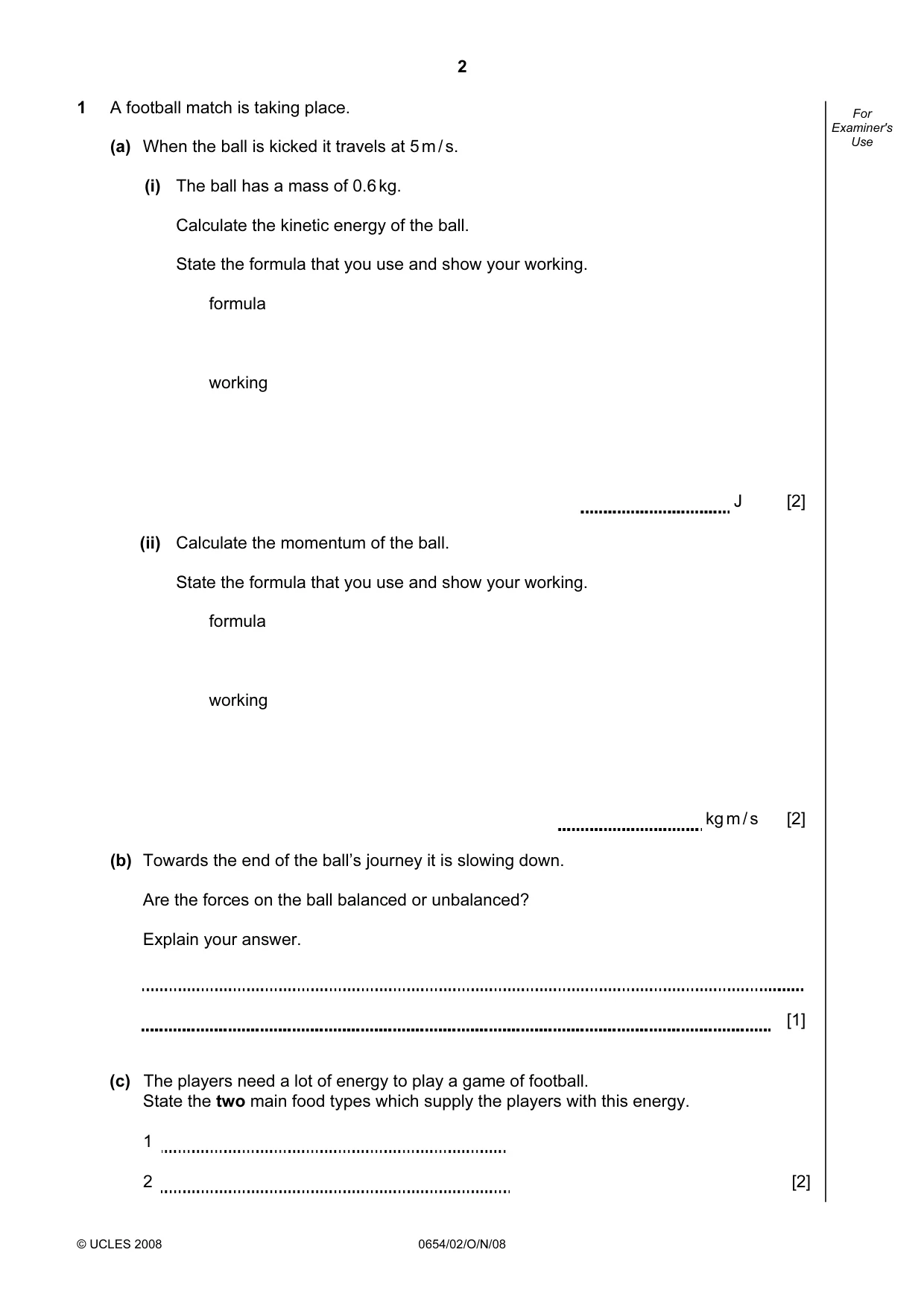
2 © UCLES 2008 0654/02/O/N/08 For Examiner's Use 1 A football match is taking place. (a) When the ball is kicked it travels at 5 m / s. (i) The ball has a mass of 0.6 kg. Calculate the kinetic energy of the ball. State the formula that you use and show your working. formula working J [2] (ii) Calculate the momentum of the ball. State the formula that you use and show your working. formula working kg m / s [2] (b) Towards the end of the ball’s journey it is slowing down. Are the forces on the ball balanced or unbalanced? Explain your answer. [1] (c) The players need a lot of energy to play a game of football. State the two main food types which supply the players with this energy. 1 2 [2]
Question paper, page 3
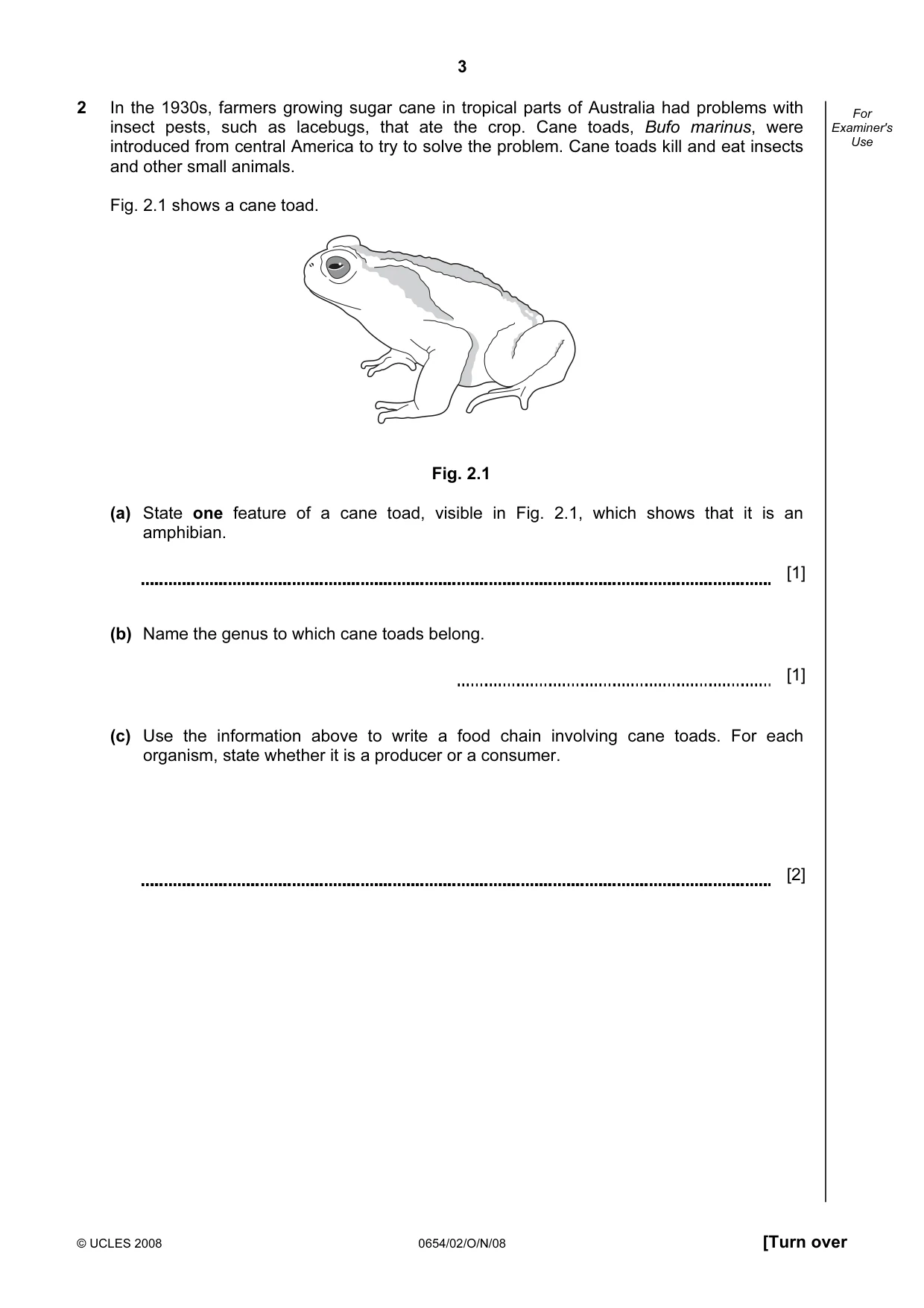
3 © UCLES 2008 0654/02/O/N/08 [Turn over For Examiner's Use 2 In the 1930s, farmers growing sugar cane in tropical parts of Australia had problems with insect pests, such as lacebugs, that ate the crop. Cane toads, Bufo marinus, were introduced from central America to try to solve the problem. Cane toads kill and eat insects and other small animals. Fig. 2.1 shows a cane toad. Fig. 2.1 (a) State one feature of a cane toad, visible in Fig. 2.1, which shows that it is an amphibian. [1] (b) Name the genus to which cane toads belong. [1] (c) Use the information above to write a food chain involving cane toads. For each organism, state whether it is a producer or a consumer. [2]
Question paper, page 4
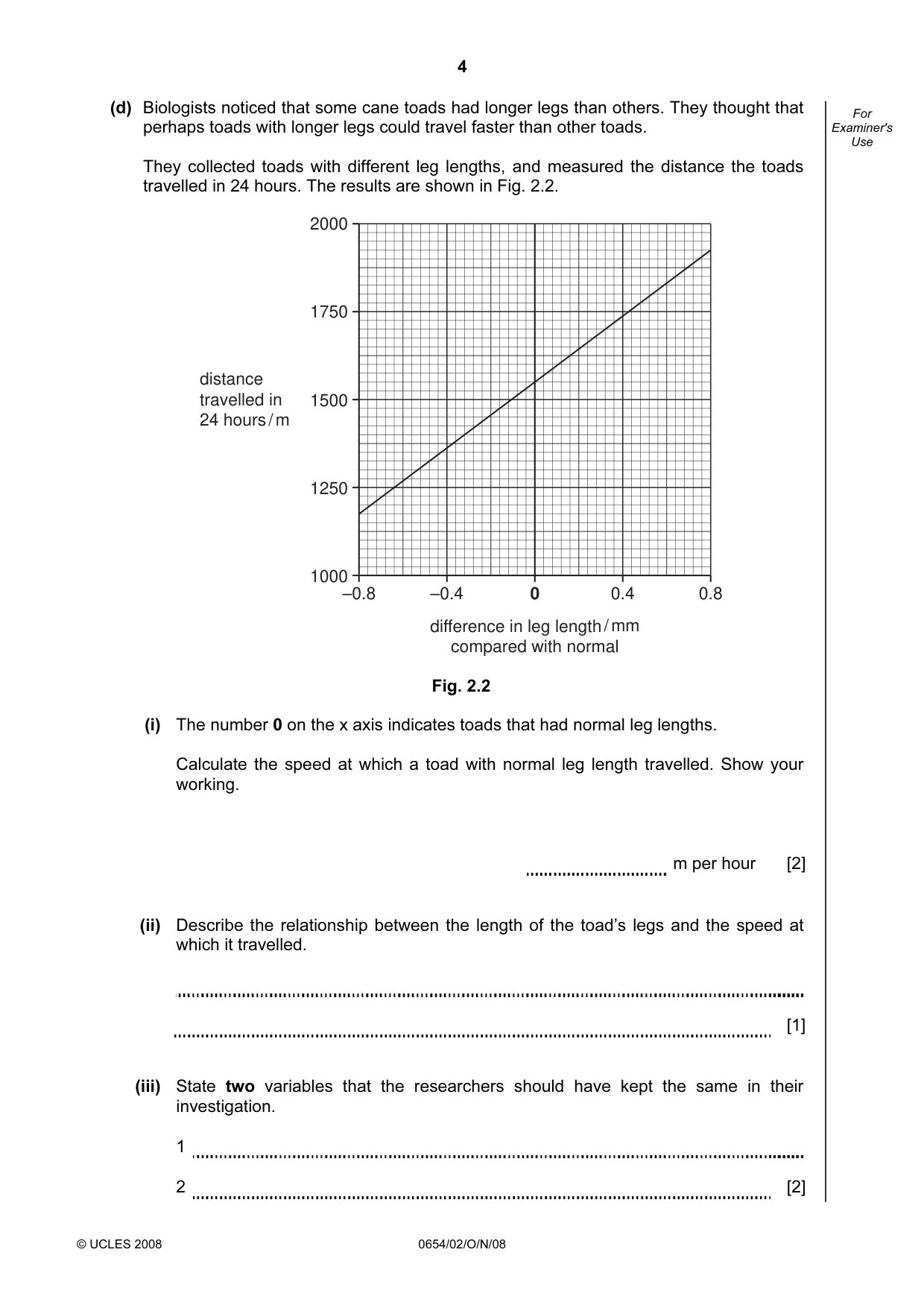
4 © UCLES 2008 0654/02/O/N/08 For Examiner's Use (d) Biologists noticed that some cane toads had longer legs than others. They thought that perhaps toads with longer legs could travel faster than other toads. They collected toads with different leg lengths, and measured the distance the toads travelled in 24 hours. The results are shown in Fig. 2.2. –0.8 –0.4 0 0.4 0.8 2000 1750 1500 1250 1000 distance travelled in 24 hours / m difference in leg length / mm compared with normal Fig. 2.2 (i) The number 0 on the x axis indicates toads that had normal leg lengths. Calculate the speed at which a toad with normal leg length travelled. Show your working. m per hour [2] (ii) Describe the relationship between the length of the toad’s legs and the speed at which it travelled. [1] (iii) State two variables that the researchers should have kept the same in their investigation. 1 2 [2]
Question paper, page 5
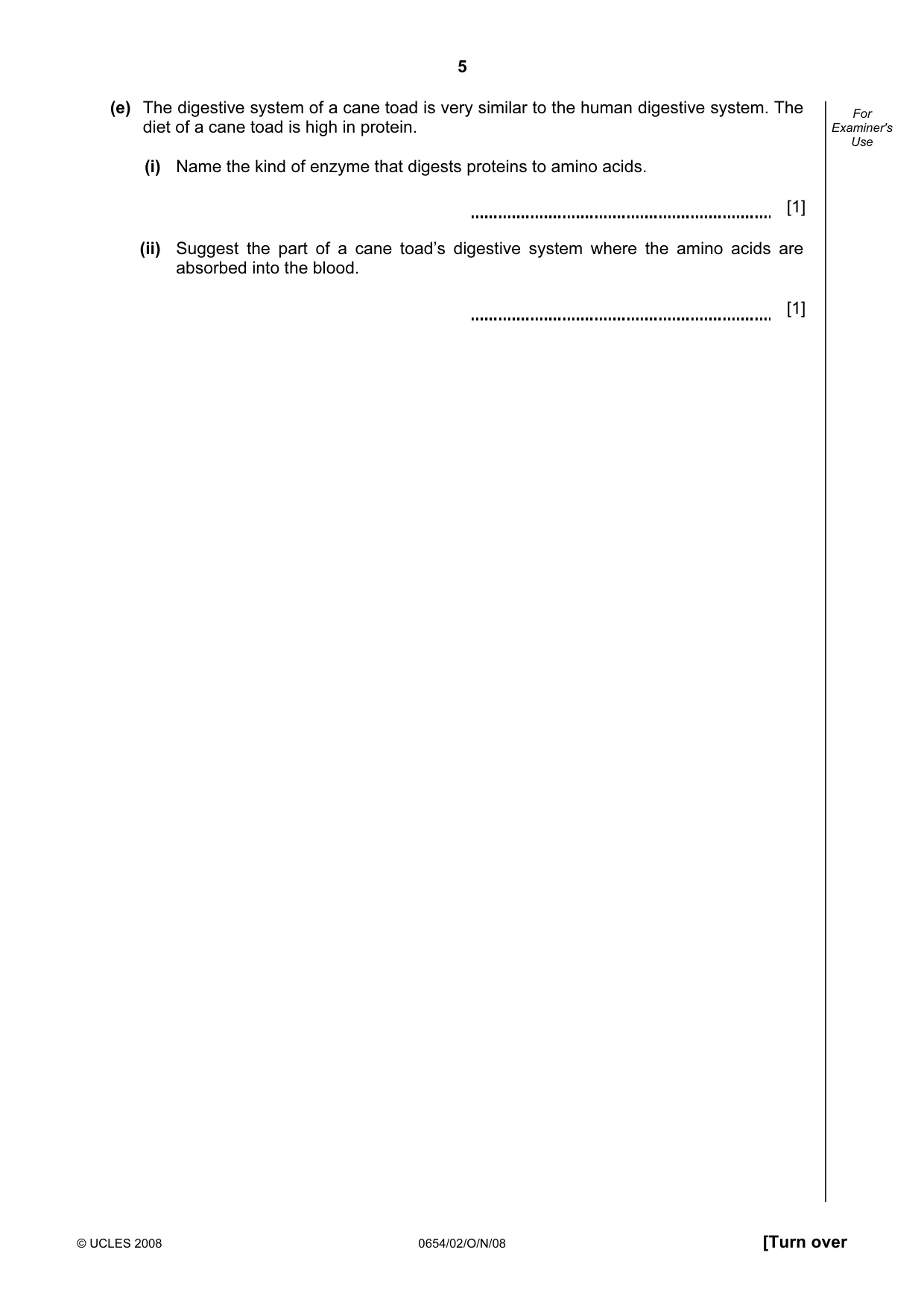
5 © UCLES 2008 0654/02/O/N/08 [Turn over For Examiner's Use (e) The digestive system of a cane toad is very similar to the human digestive system. The diet of a cane toad is high in protein. (i) Name the kind of enzyme that digests proteins to amino acids. [1] (ii) Suggest the part of a cane toad’s digestive system where the amino acids are absorbed into the blood. [1]
Question paper, page 6
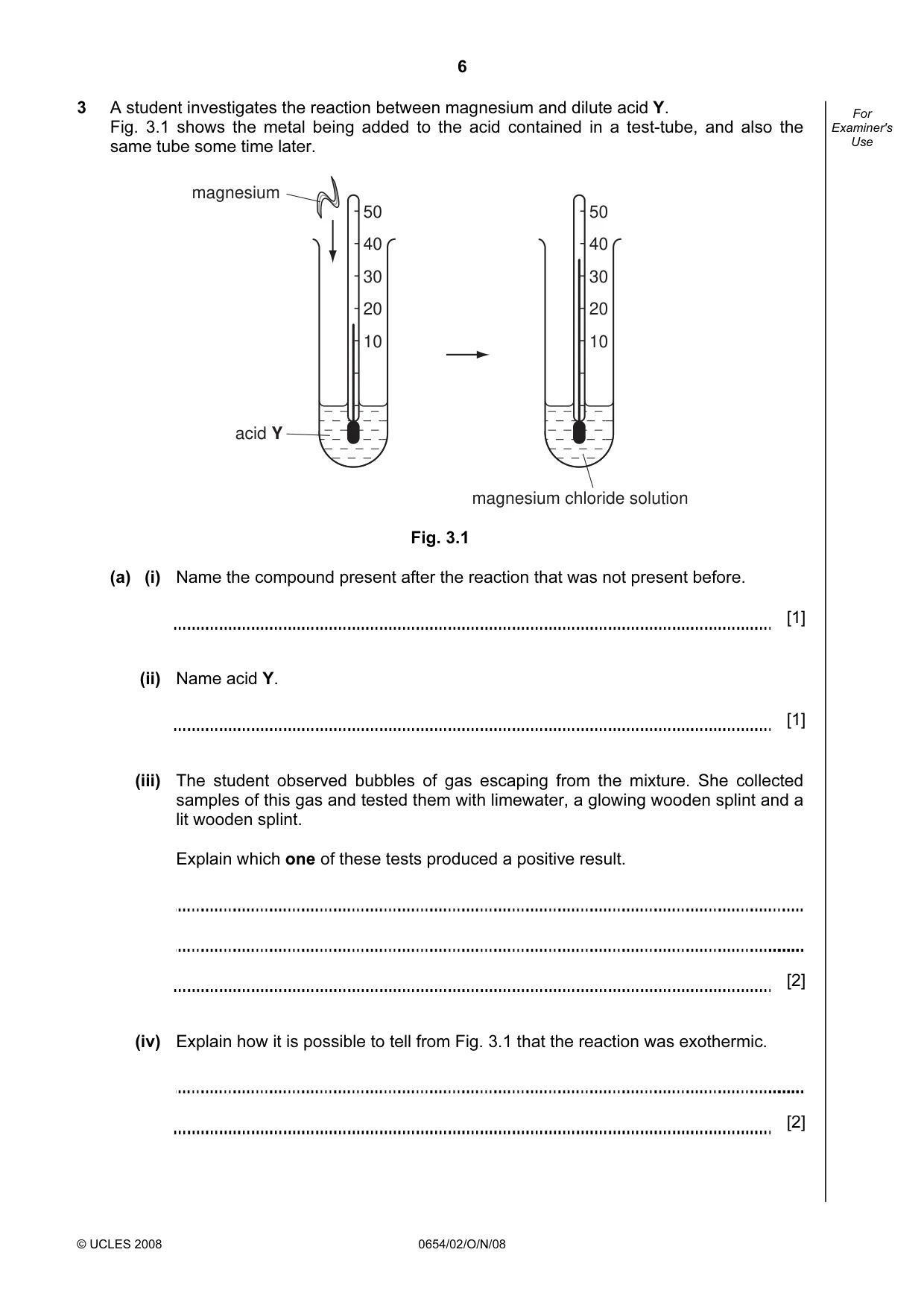
6 © UCLES 2008 0654/02/O/N/08 For Examiner's Use 3 A student investigates the reaction between magnesium and dilute acid Y. Fig. 3.1 shows the metal being added to the acid contained in a test-tube, and also the same tube some time later. 50 40 30 20 10 50 40 30 20 10 acid Y magnesium magnesium chloride solution Fig. 3.1 (a) (i) Name the compound present after the reaction that was not present before. [1] (ii) Name acid Y. [1] (iii) The student observed bubbles of gas escaping from the mixture. She collected samples of this gas and tested them with limewater, a glowing wooden splint and a lit wooden splint. Explain which one of these tests produced a positive result. [2] (iv) Explain how it is possible to tell from Fig. 3.1 that the reaction was exothermic. [2]
Question paper, page 7
7 © UCLES 2008 0654/02/O/N/08 [Turn over For Examiner's Use (b) Magnesium alloys are widely used in making parts for aircraft and racing car engines. (i) One type of magnesium alloy contains the elements zinc and zirconium. Suggest how this magnesium alloy is made. [1] (ii) Suggest and explain why a magnesium alloy, rather than a transition metal such as iron, is used to make parts for aircraft and racing cars. [2]
Question paper, page 8
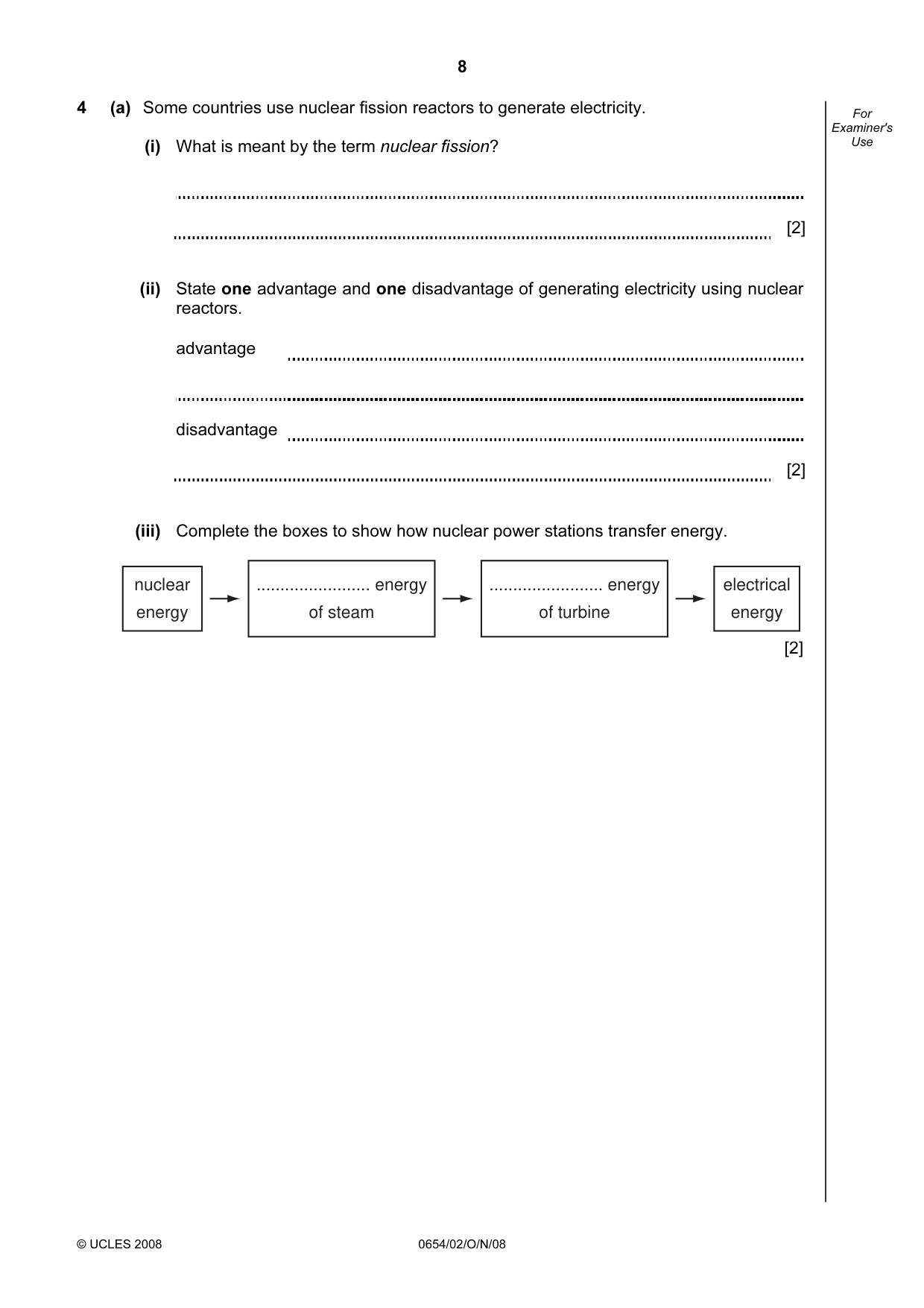
8 © UCLES 2008 0654/02/O/N/08 For Examiner's Use 4 (a) Some countries use nuclear fission reactors to generate electricity. (i) What is meant by the term nuclear fission? [2] (ii) State one advantage and one disadvantage of generating electricity using nuclear reactors. advantage disadvantage [2] (iii) Complete the boxes to show how nuclear power stations transfer energy. nuclear energy electrical energy … energy of steam … energy of turbine [2]
Question paper, page 9
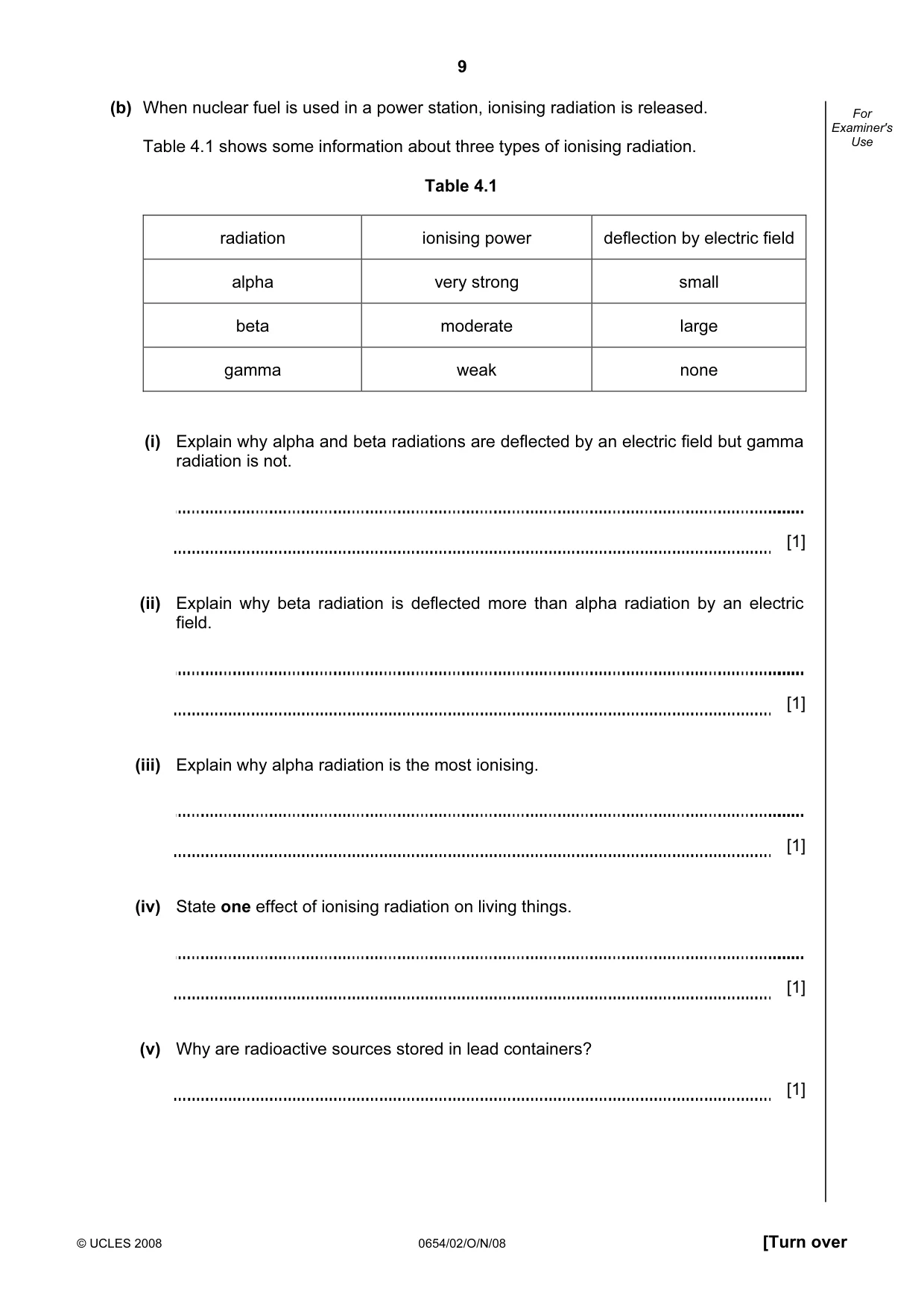
9 © UCLES 2008 0654/02/O/N/08 [Turn over For Examiner's Use (b) When nuclear fuel is used in a power station, ionising radiation is released. Table 4.1 shows some information about three types of ionising radiation. Table 4.1 radiation ionising power deflection by electric field alpha very strong small beta moderate large gamma weak none (i) Explain why alpha and beta radiations are deflected by an electric field but gamma radiation is not. [1] (ii) Explain why beta radiation is deflected more than alpha radiation by an electric field. [1] (iii) Explain why alpha radiation is the most ionising. [1] (iv) State one effect of ionising radiation on living things. [1] (v) Why are radioactive sources stored in lead containers? [1]
Question paper, page 10
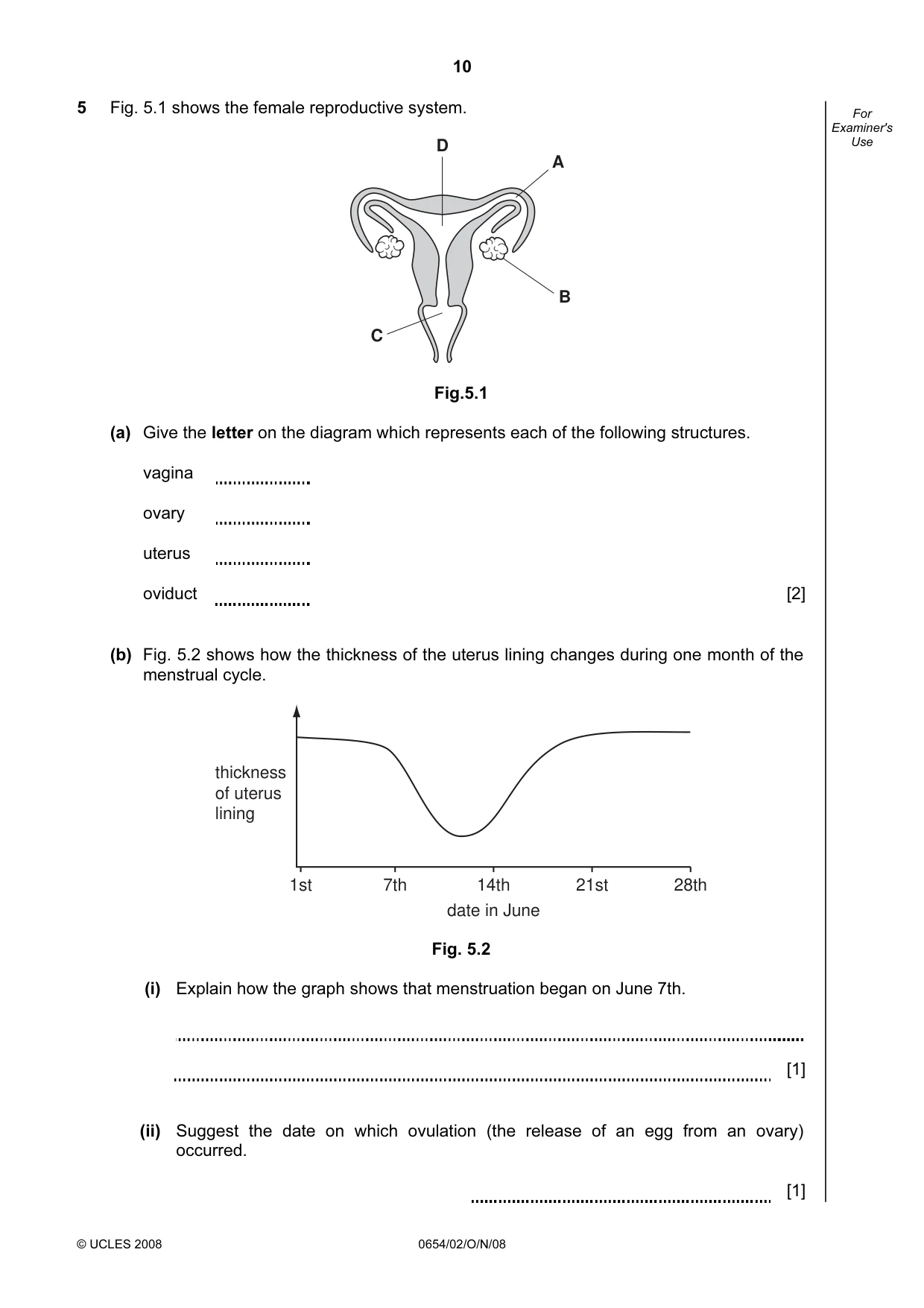
10 © UCLES 2008 0654/02/O/N/08 For Examiner's Use 5 Fig. 5.1 shows the female reproductive system. A B C D Fig.5.1 (a) Give the letter on the diagram which represents each of the following structures. vagina ovary uterus oviduct [2] (b) Fig. 5.2 shows how the thickness of the uterus lining changes during one month of the menstrual cycle. 1st 7th 14th date in June 21st 28th thickness of uterus lining Fig. 5.2 (i) Explain how the graph shows that menstruation began on June 7th. [1] (ii) Suggest the date on which ovulation (the release of an egg from an ovary) occurred. [1]
Question paper, page 11
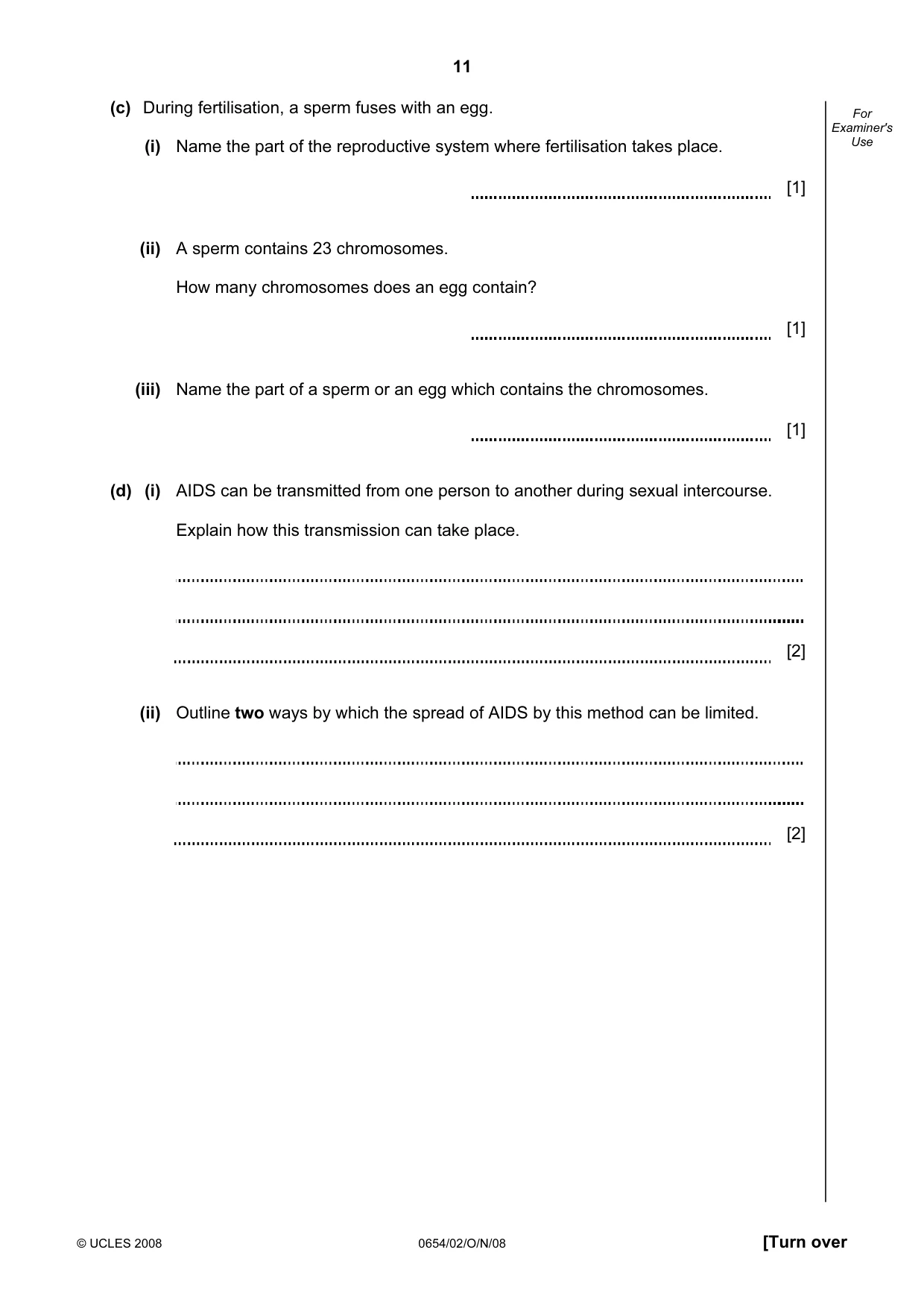
11 © UCLES 2008 0654/02/O/N/08 [Turn over For Examiner's Use (c) During fertilisation, a sperm fuses with an egg. (i) Name the part of the reproductive system where fertilisation takes place. [1] (ii) A sperm contains 23 chromosomes. How many chromosomes does an egg contain? [1] (iii) Name the part of a sperm or an egg which contains the chromosomes. [1] (d) (i) AIDS can be transmitted from one person to another during sexual intercourse. Explain how this transmission can take place. [2] (ii) Outline two ways by which the spread of AIDS by this method can be limited. [2]
Question paper, page 12
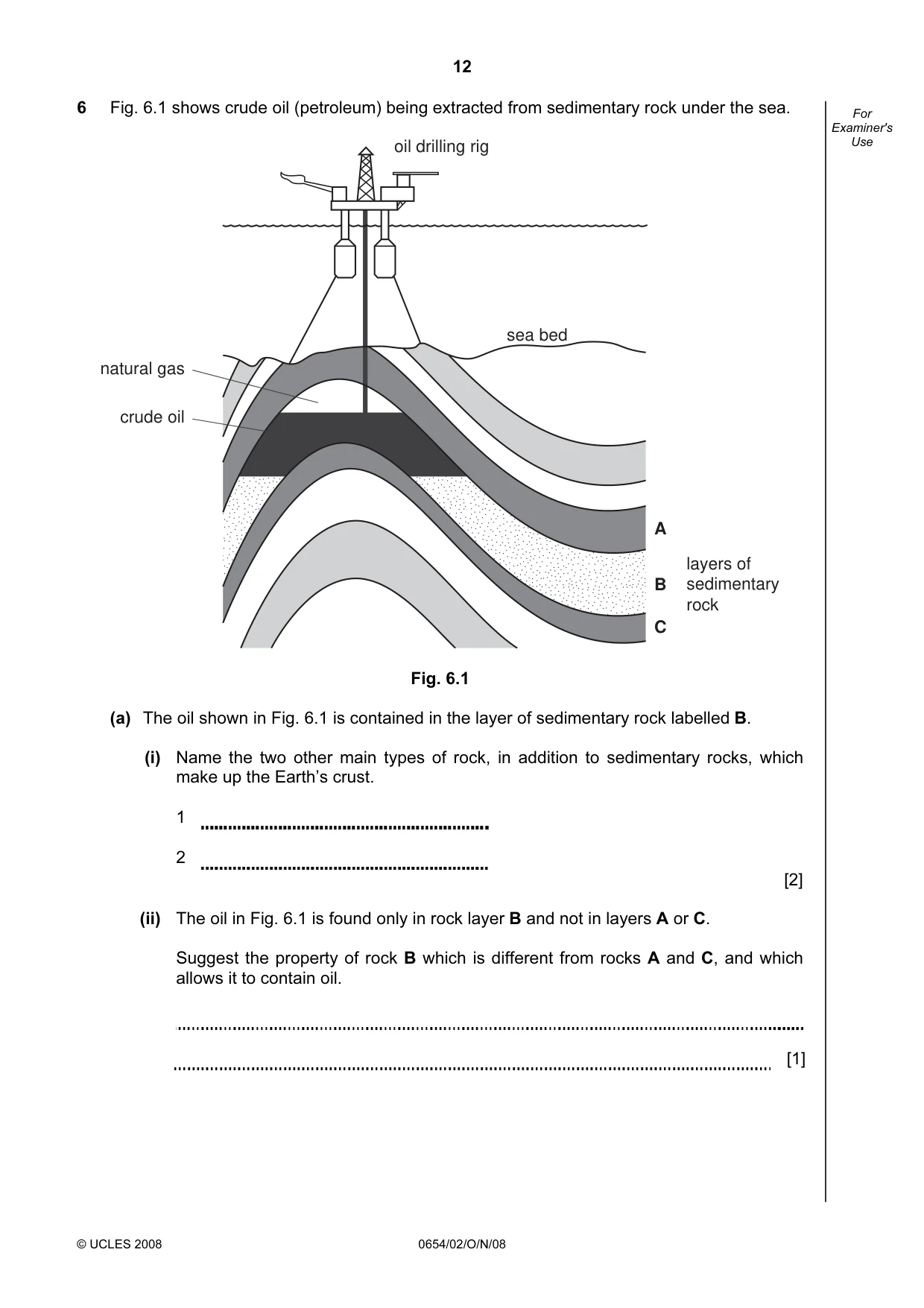
12 © UCLES 2008 0654/02/O/N/08 For Examiner's Use 6 Fig. 6.1 shows crude oil (petroleum) being extracted from sedimentary rock under the sea. sea bed natural gas crude oil A B C layers of sedimentary rock oil drilling rig Fig. 6.1 (a) The oil shown in Fig. 6.1 is contained in the layer of sedimentary rock labelled B. (i) Name the two other main types of rock, in addition to sedimentary rocks, which make up the Earth’s crust. 1 2 [2] (ii) The oil in Fig. 6.1 is found only in rock layer B and not in layers A or C. Suggest the property of rock B which is different from rocks A and C, and which allows it to contain oil. [1]
Question paper, page 13
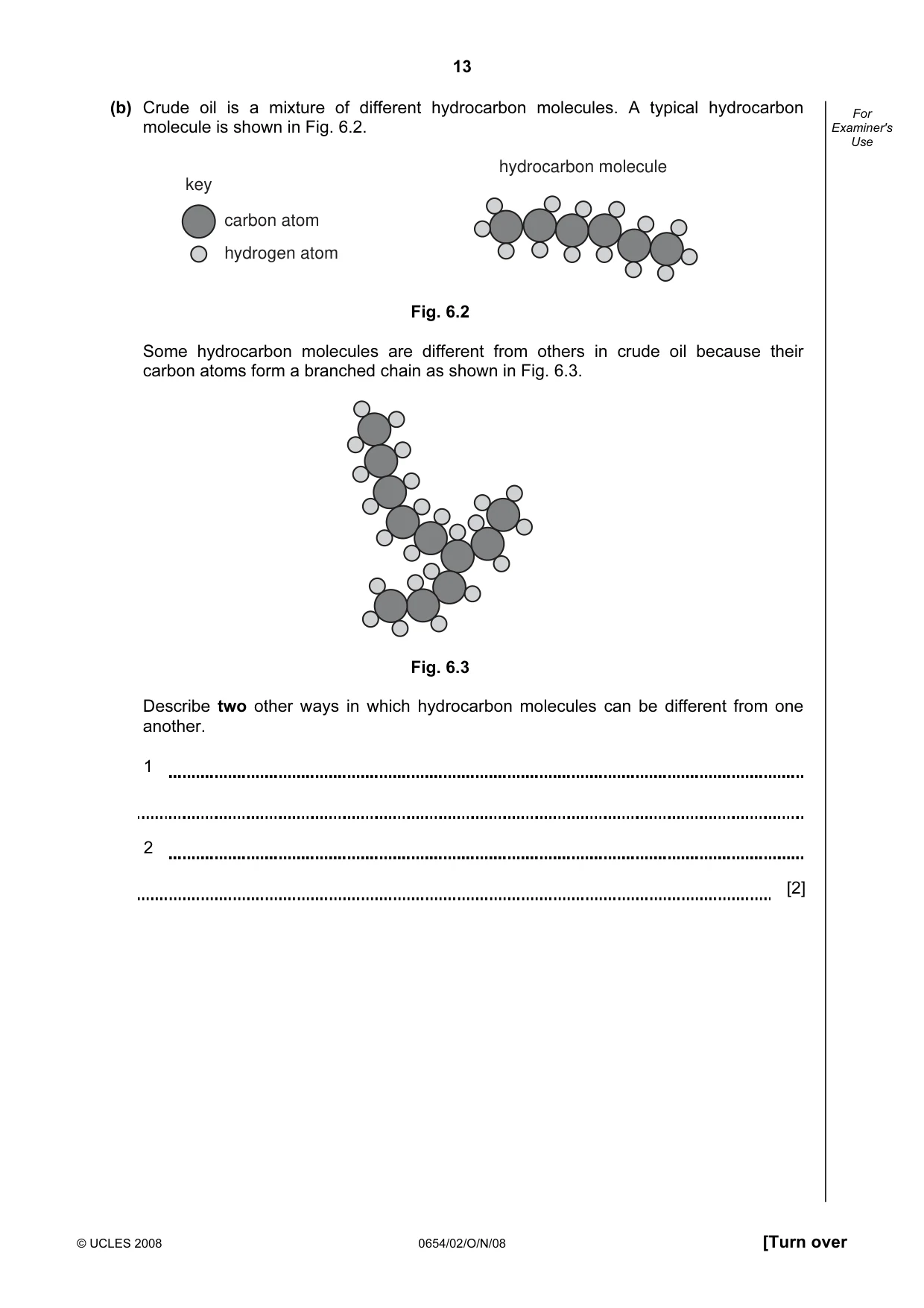
13 © UCLES 2008 0654/02/O/N/08 [Turn over For Examiner's Use (b) Crude oil is a mixture of different hydrocarbon molecules. A typical hydrocarbon molecule is shown in Fig. 6.2. carbon atom hydrogen atom hydrocarbon molecule key Fig. 6.2 Some hydrocarbon molecules are different from others in crude oil because their carbon atoms form a branched chain as shown in Fig. 6.3. Fig. 6.3 Describe two other ways in which hydrocarbon molecules can be different from one another. 1 2 [2]
Question paper, page 14
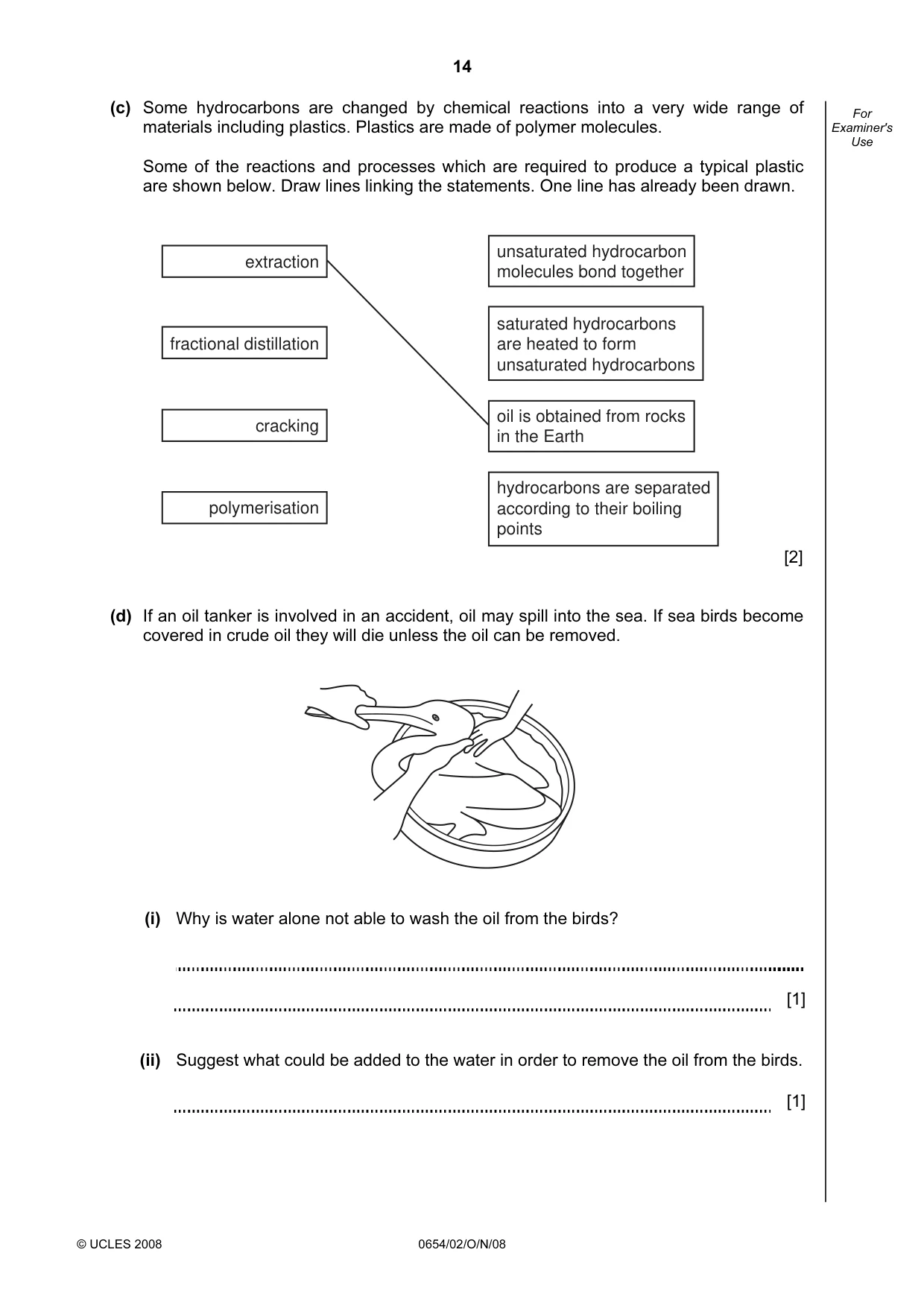
14 © UCLES 2008 0654/02/O/N/08 For Examiner's Use (c) Some hydrocarbons are changed by chemical reactions into a very wide range of materials including plastics. Plastics are made of polymer molecules. Some of the reactions and processes which are required to produce a typical plastic are shown below. Draw lines linking the statements. One line has already been drawn. extraction fractional distillation cracking polymerisation unsaturated hydrocarbon molecules bond together saturated hydrocarbons are heated to form unsaturated hydrocarbons oil is obtained from rocks in the Earth hydrocarbons are separated according to their boiling points [2] (d) If an oil tanker is involved in an accident, oil may spill into the sea. If sea birds become covered in crude oil they will die unless the oil can be removed. (i) Why is water alone not able to wash the oil from the birds? [1] (ii) Suggest what could be added to the water in order to remove the oil from the birds. [1]
Question paper, page 15
15 © UCLES 2008 0654/02/O/N/08 [Turn over BLANK PAGE Please turn over for Question 7
Question paper, page 16
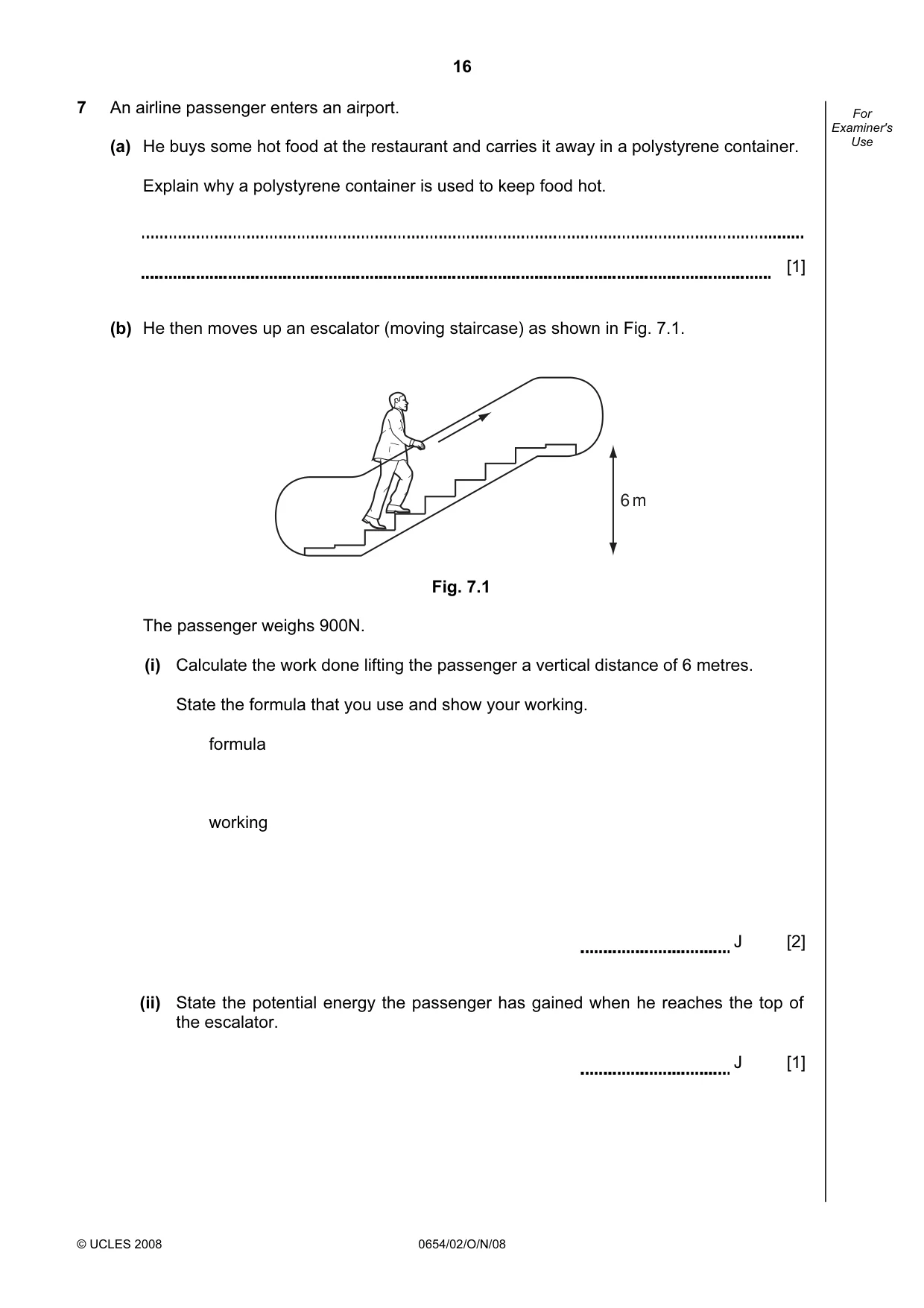
16 © UCLES 2008 0654/02/O/N/08 For Examiner's Use 7 An airline passenger enters an airport. (a) He buys some hot food at the restaurant and carries it away in a polystyrene container. Explain why a polystyrene container is used to keep food hot. [1] (b) He then moves up an escalator (moving staircase) as shown in Fig. 7.1. 6 m Fig. 7.1 The passenger weighs 900N. (i) Calculate the work done lifting the passenger a vertical distance of 6 metres. State the formula that you use and show your working. formula working J [2] (ii) State the potential energy the passenger has gained when he reaches the top of the escalator. J [1]
Question paper, page 17
17 © UCLES 2008 0654/02/O/N/08 [Turn over For Examiner's Use (c) The aeroplane that the passenger travels on is able to navigate using radar. This involves the use of microwaves. These are part of the electromagnetic spectrum. (i) Name one other wave which is part of the electromagnetic spectrum. [1] (ii) State the speed at which these waves travel in a vacuum. m / s [1]
Question paper, page 18
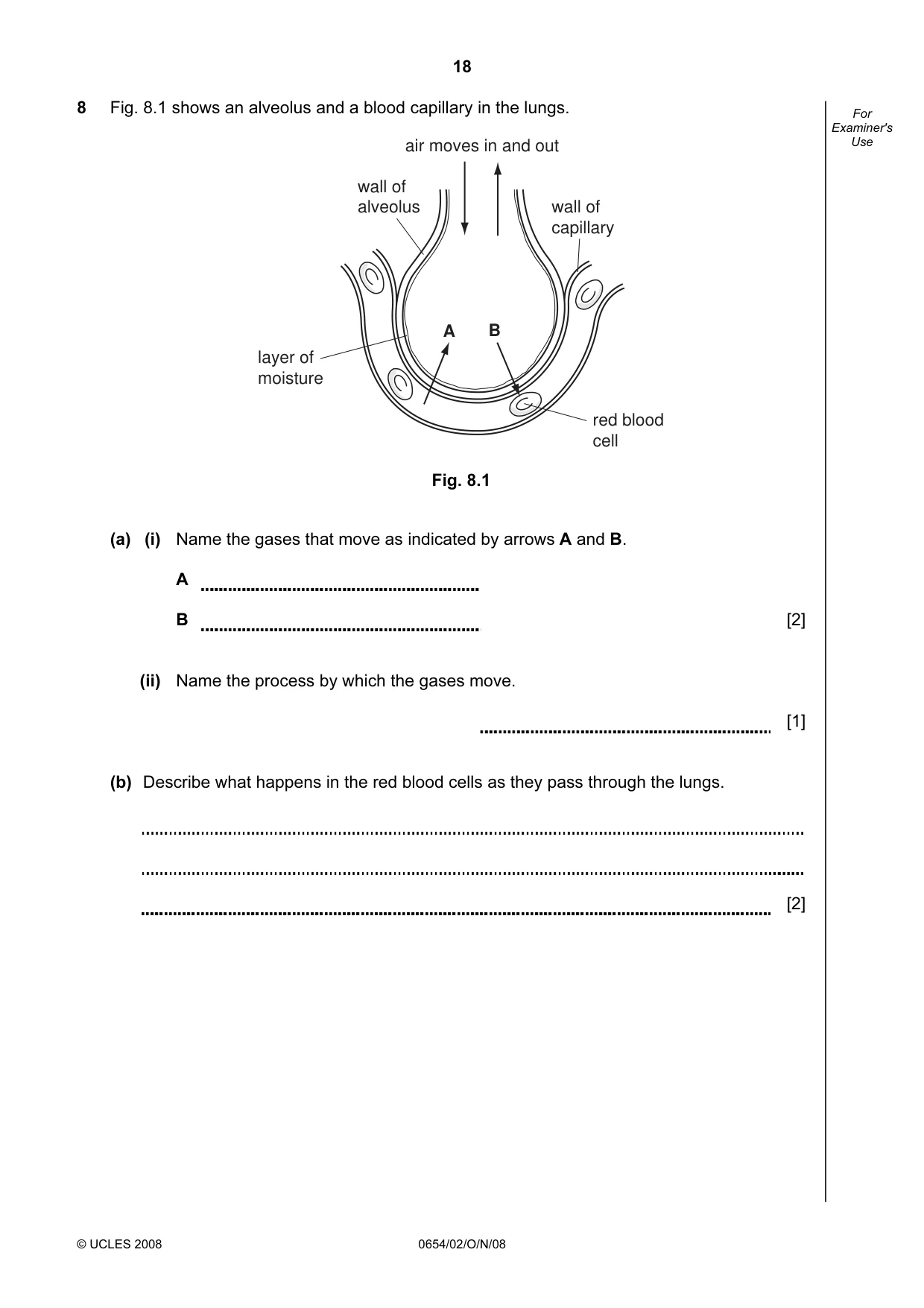
18 © UCLES 2008 0654/02/O/N/08 For Examiner's Use 8 Fig. 8.1 shows an alveolus and a blood capillary in the lungs. wall of alveolus wall of capillary layer of moisture red blood cell air moves in and out A B Fig. 8.1 (a) (i) Name the gases that move as indicated by arrows A and B. A B [2] (ii) Name the process by which the gases move. [1] (b) Describe what happens in the red blood cells as they pass through the lungs. [2]
Question paper, page 19
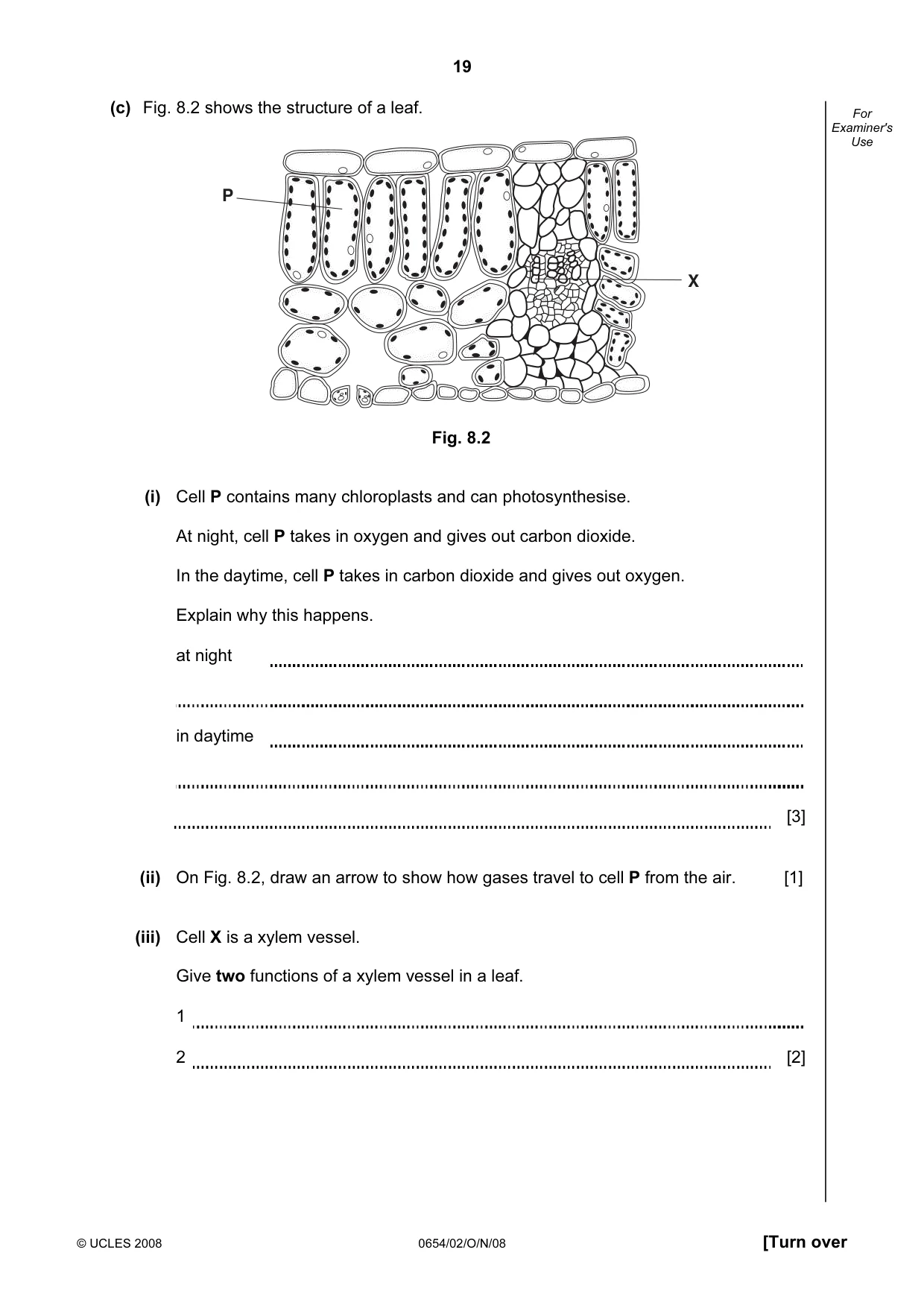
19 © UCLES 2008 0654/02/O/N/08 [Turn over For Examiner's Use (c) Fig. 8.2 shows the structure of a leaf. P X Fig. 8.2 (i) Cell P contains many chloroplasts and can photosynthesise. At night, cell P takes in oxygen and gives out carbon dioxide. In the daytime, cell P takes in carbon dioxide and gives out oxygen. Explain why this happens. at night in daytime [3] (ii) On Fig. 8.2, draw an arrow to show how gases travel to cell P from the air. [1] (iii) Cell X is a xylem vessel. Give two functions of a xylem vessel in a leaf. 1 2 [2]
Question paper, page 20
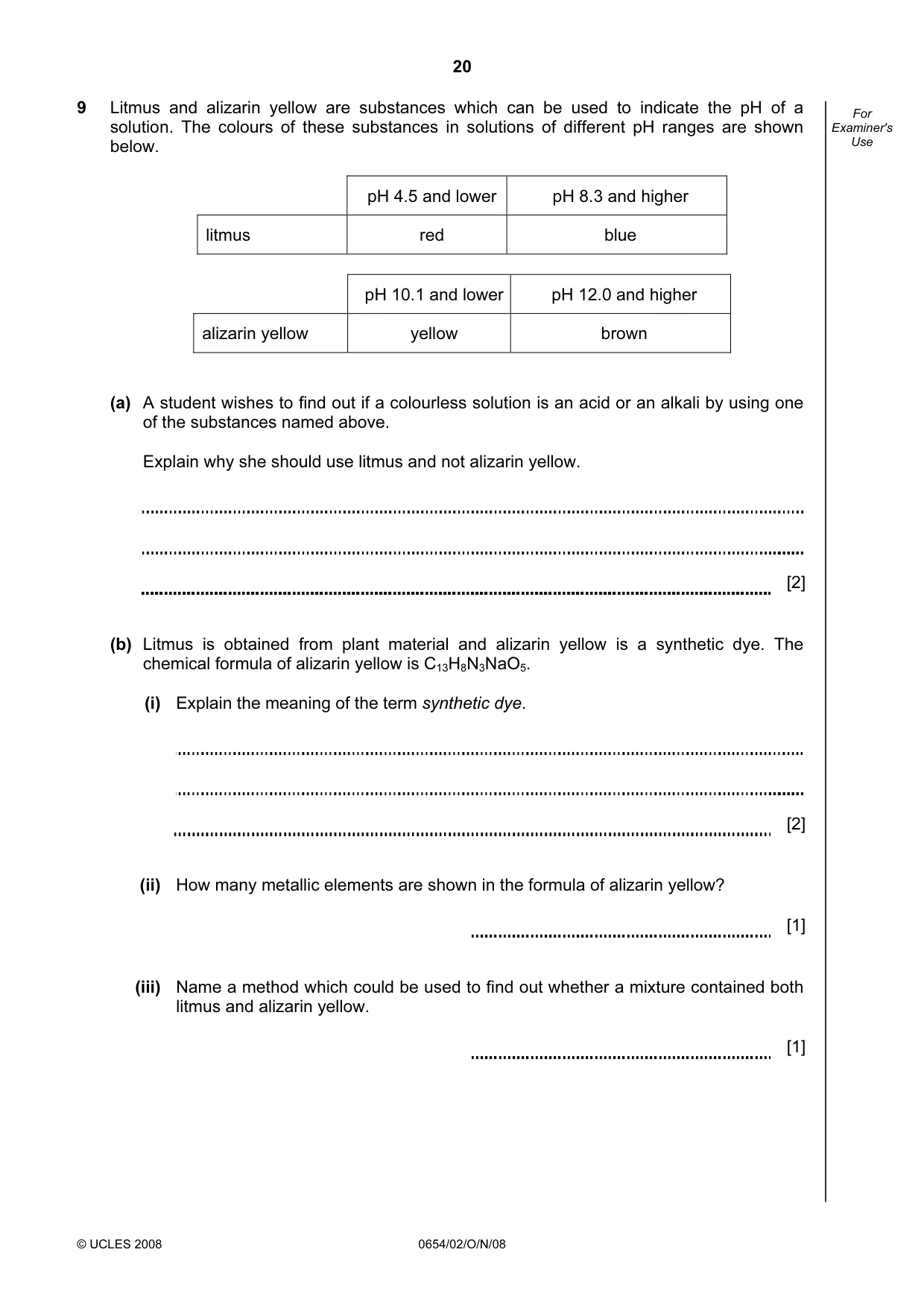
20 © UCLES 2008 0654/02/O/N/08 For Examiner's Use 9 Litmus and alizarin yellow are substances which can be used to indicate the pH of a solution. The colours of these substances in solutions of different pH ranges are shown below. pH 4.5 and lower pH 8.3 and higher litmus red blue pH 10.1 and lower pH 12.0 and higher alizarin yellow yellow brown (a) A student wishes to find out if a colourless solution is an acid or an alkali by using one of the substances named above. Explain why she should use litmus and not alizarin yellow. [2] (b) Litmus is obtained from plant material and alizarin yellow is a synthetic dye. The chemical formula of alizarin yellow is C13H8N3NaO5. (i) Explain the meaning of the term synthetic dye. [2] (ii) How many metallic elements are shown in the formula of alizarin yellow? [1] (iii) Name a method which could be used to find out whether a mixture contained both litmus and alizarin yellow. [1]
Question paper, page 21
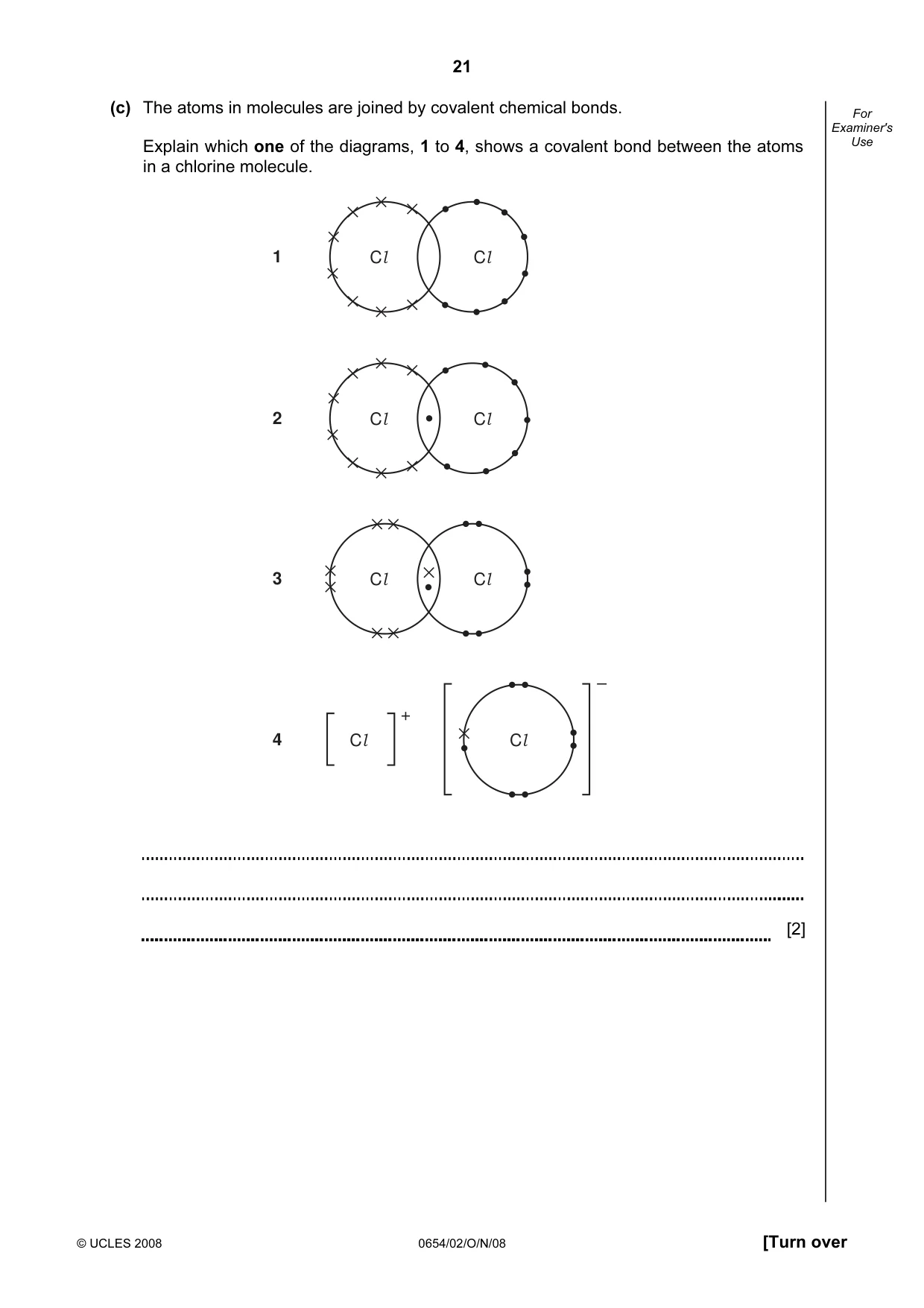
21 © UCLES 2008 0654/02/O/N/08 [Turn over For Examiner's Use (c) The atoms in molecules are joined by covalent chemical bonds. Explain which one of the diagrams, 1 to 4, shows a covalent bond between the atoms in a chlorine molecule. Cl Cl Cl Cl Cl Cl Cl Cl 1 2 3 4 – + [2]
Question paper, page 22
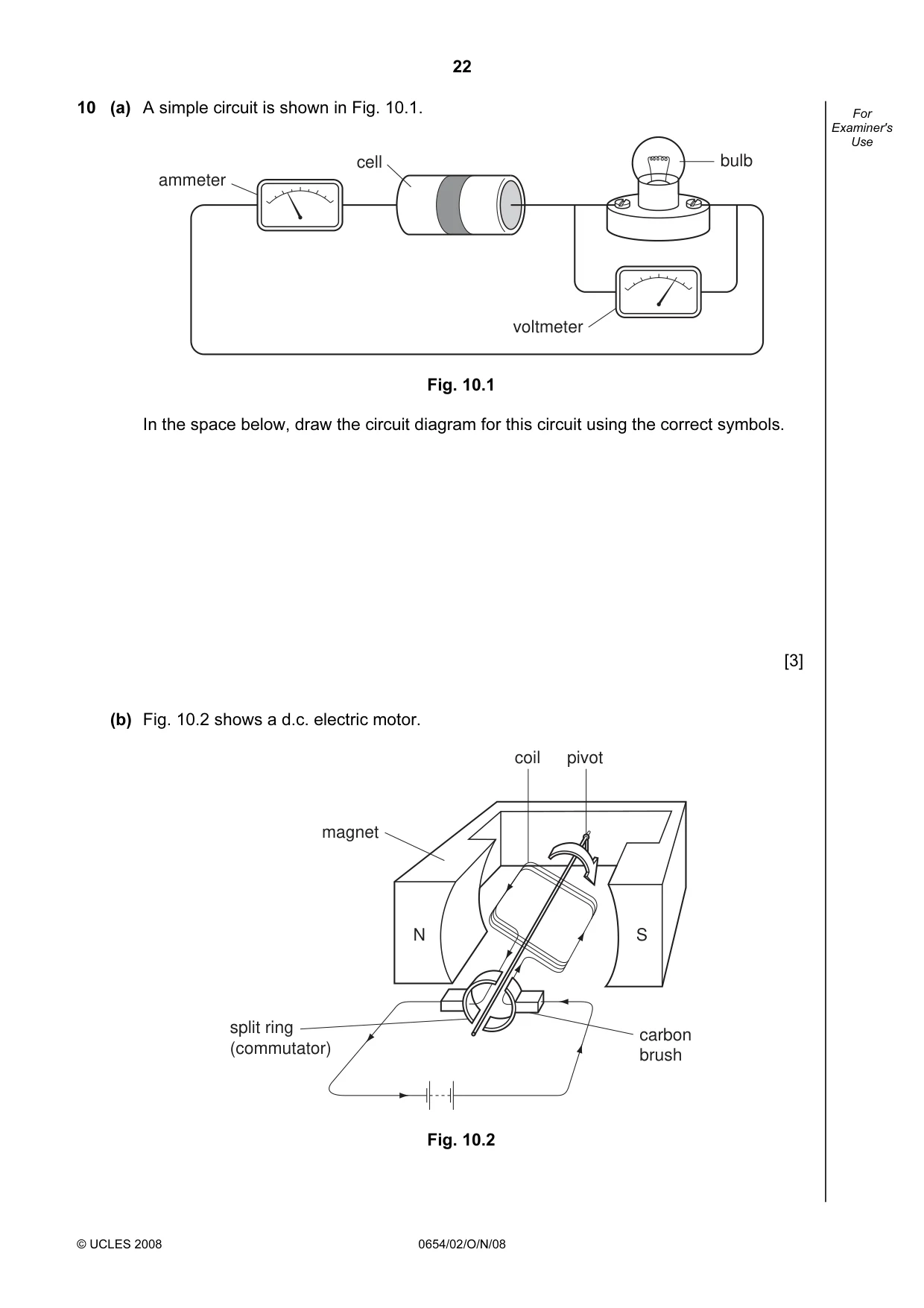
22 © UCLES 2008 0654/02/O/N/08 For Examiner's Use 10 (a) A simple circuit is shown in Fig. 10.1. bulb cell ammeter voltmeter Fig. 10.1 In the space below, draw the circuit diagram for this circuit using the correct symbols. [3] (b) Fig. 10.2 shows a d.c. electric motor. N S magnet coil pivot split ring (commutator) carbon brush Fig. 10.2
Question paper, page 23
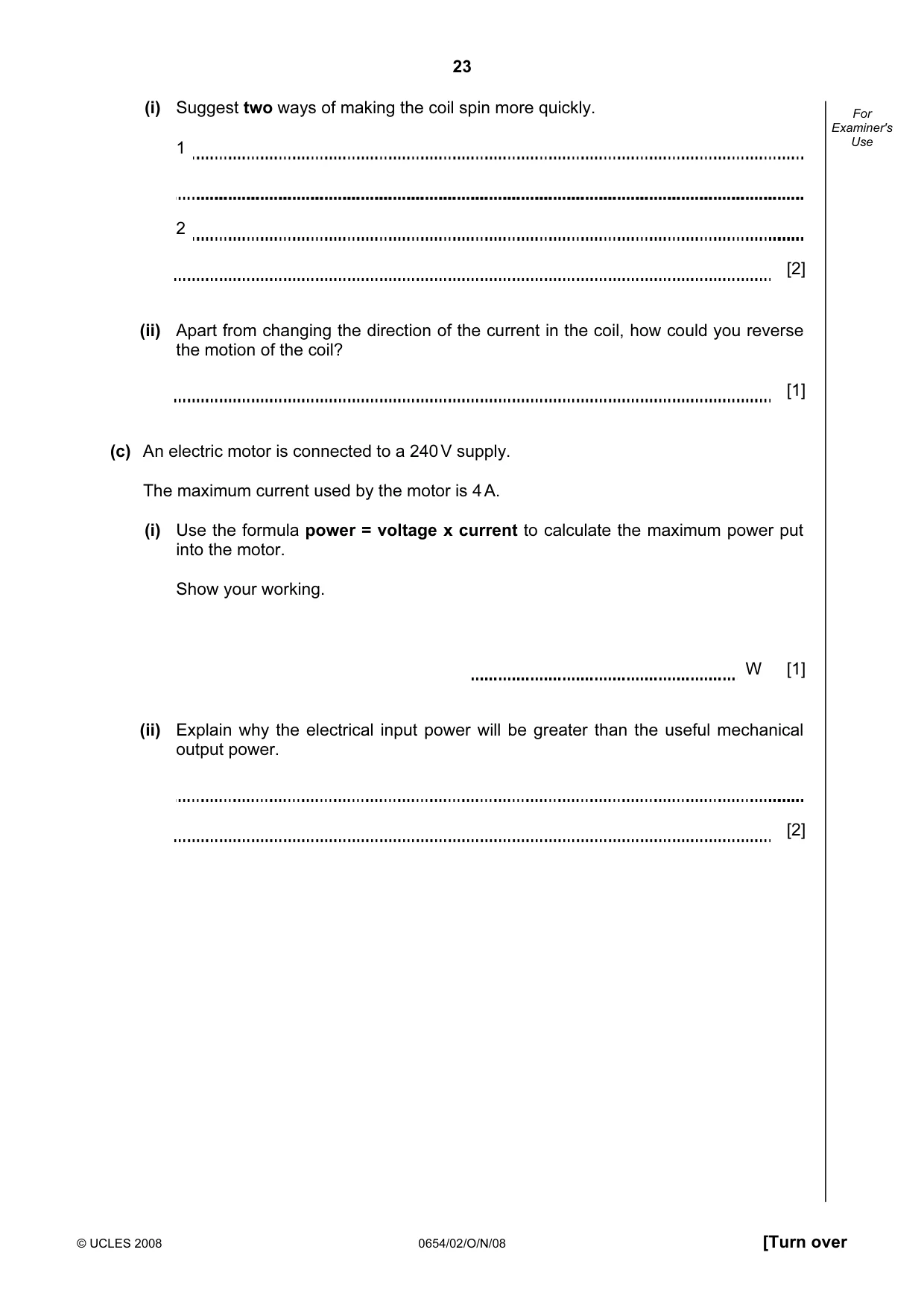
23 © UCLES 2008 0654/02/O/N/08 [Turn over For Examiner's Use (i) Suggest two ways of making the coil spin more quickly. 1 2 [2] (ii) Apart from changing the direction of the current in the coil, how could you reverse the motion of the coil? [1] (c) An electric motor is connected to a 240 V supply. The maximum current used by the motor is 4 A. (i) Use the formula power = voltage x current to calculate the maximum power put into the motor. Show your working. W [1] (ii) Explain why the electrical input power will be greater than the useful mechanical output power. [2]
Question paper, page 24
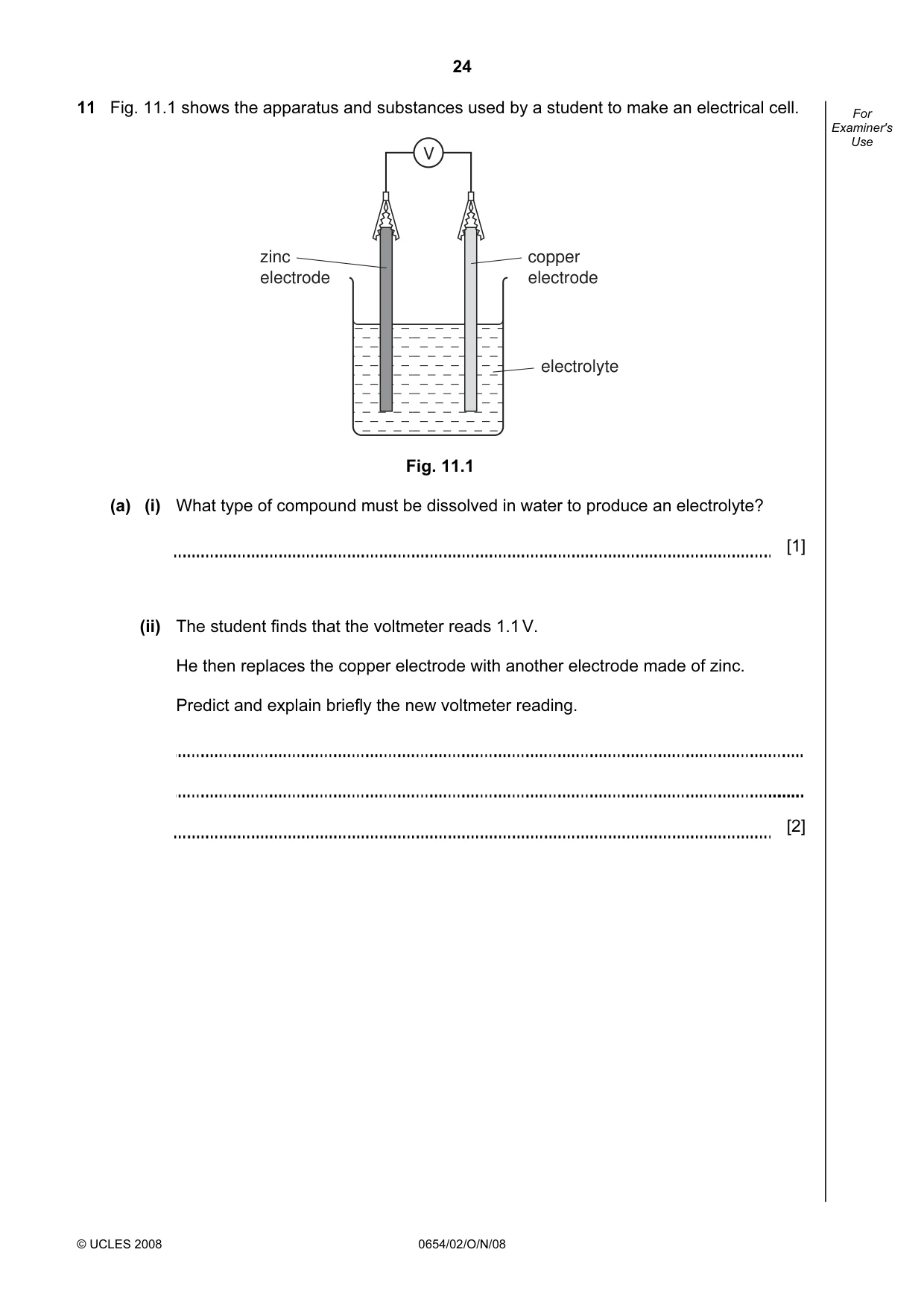
24 © UCLES 2008 0654/02/O/N/08 For Examiner's Use 11 Fig. 11.1 shows the apparatus and substances used by a student to make an electrical cell. V zinc electrode copper electrode electrolyte Fig. 11.1 (a) (i) What type of compound must be dissolved in water to produce an electrolyte? [1] (ii) The student finds that the voltmeter reads 1.1 V. He then replaces the copper electrode with another electrode made of zinc. Predict and explain briefly the new voltmeter reading. [2]
Question paper, page 25
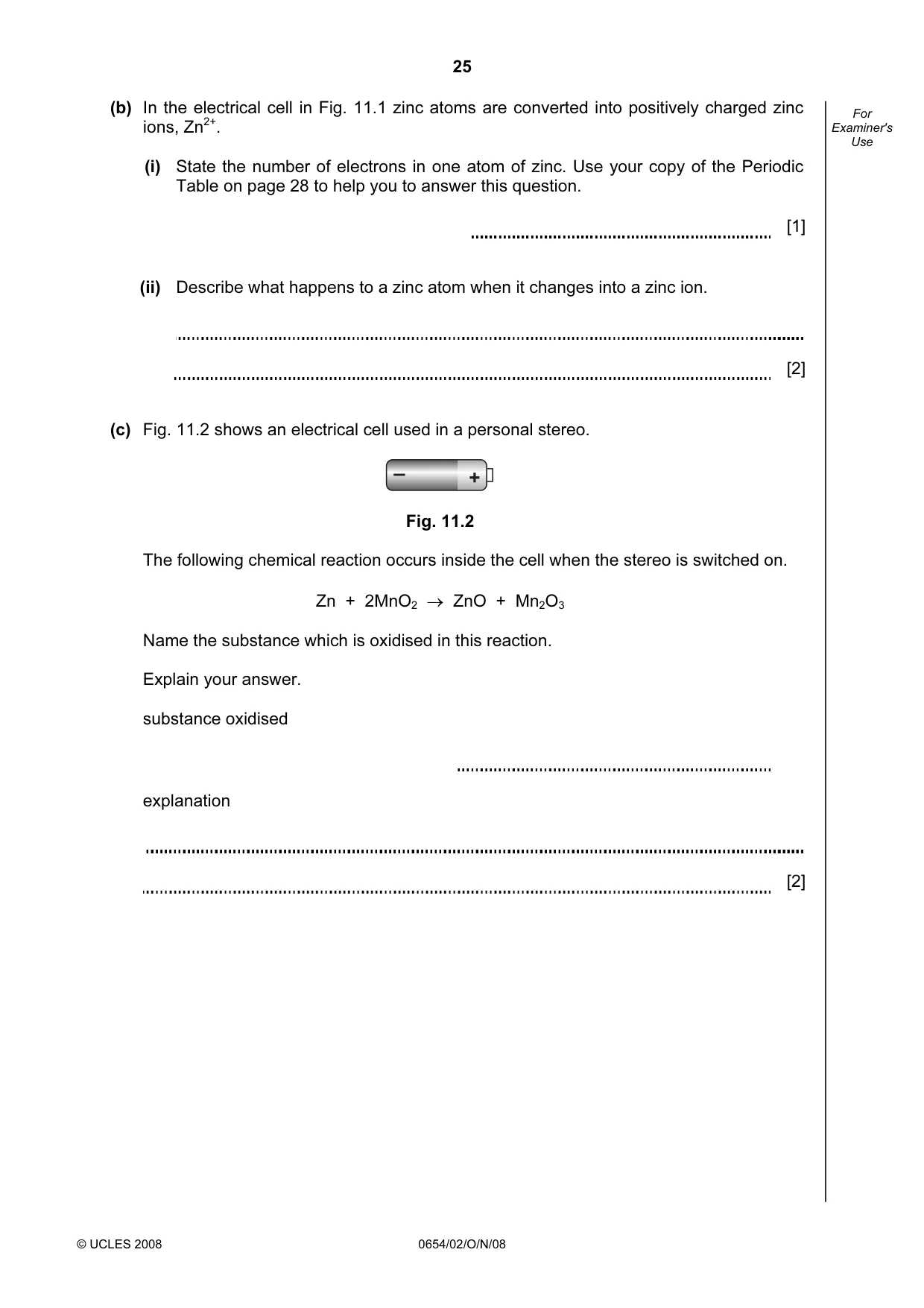
25 © UCLES 2008 0654/02/O/N/08 For Examiner's Use (b) In the electrical cell in Fig. 11.1 zinc atoms are converted into positively charged zinc ions, Zn2+. (i) State the number of electrons in one atom of zinc. Use your copy of the Periodic Table on page 28 to help you to answer this question. [1] (ii) Describe what happens to a zinc atom when it changes into a zinc ion. [2] (c) Fig. 11.2 shows an electrical cell used in a personal stereo. + – Fig. 11.2 The following chemical reaction occurs inside the cell when the stereo is switched on. Zn + 2MnO2 → ZnO + Mn2O3 Name the substance which is oxidised in this reaction. Explain your answer. substance oxidised explanation [2]
Question paper, page 28
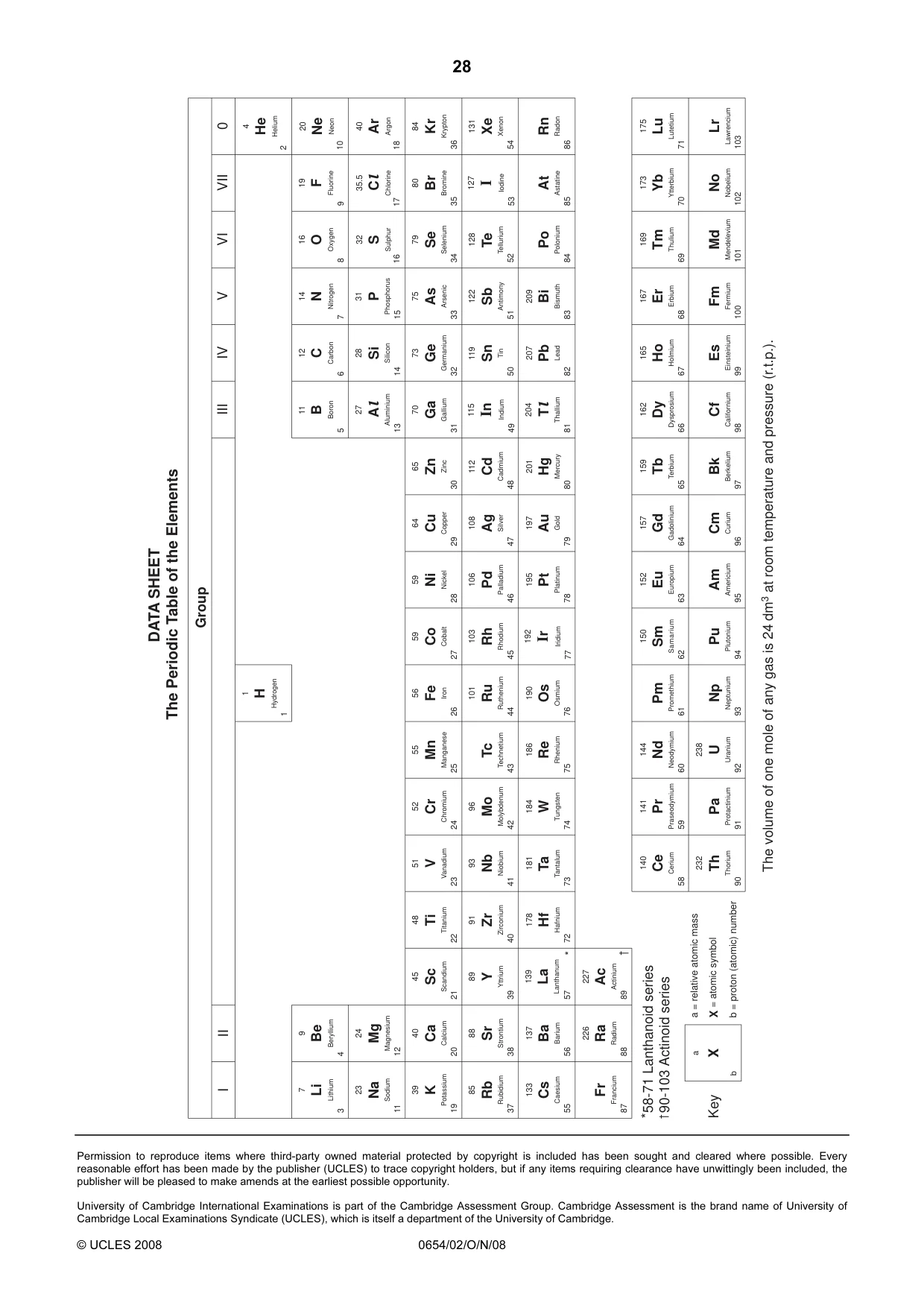
28 Permission to reproduce items where third-party owned material protected by copyright is included has been sought and cleared where possible. Every reasonable effort has been made by the publisher (UCLES) to trace copyright holders, but if any items requiring clearance have unwittingly been included, the publisher will be pleased to make amends at the earliest possible opportunity. University of Cambridge International Examinations is part of the Cambridge Assessment Group. Cambridge Assessment is the brand name of University of Cambridge Local Examinations Syndicate (UCLES), which is itself a department of the University of Cambridge. © UCLES 2008 0654/02/O/N/08 Group 140 Ce Cerium 58 141 Pr Praseodymium 59 144 Nd Neodymium 60 Pm Promethium 61 150 Sm Samarium 62 152 Eu Europium 63 157 Gd Gadolinium 64 159 Tb Terbium 65 162 Dy Dysprosium 66 165 Ho Holmium 67 167 Er Erbium 68 169 Tm Thulium 69 173 Yb Ytterbium 70 175 Lu Lutetium 71 232 Th Thorium 90 Pa Protactinium 91 238 U Uranium 92 Np Neptunium 93 Pu Plutonium 94 Am Americium 95 Cm Curium 96 Bk Berkelium 97 Cf Californium 98 Es Einsteinium 99 Fm Fermium 100 Md Mendelevium 101 No Nobelium 102 Lr Lawrencium 103 1 H Hydrogen 1 7 Li Lithium 3 23 Na Sodium 11 24 Mg Magnesium 12 40 Ca Calcium 20 45 Sc Scandium 21 48 Ti Titanium 22 51 V Vanadium 23 52 Cr Chromium 24 55 Mn Manganese 25 56 Fe Iron 26 59 Co Cobalt 27 59 Ni Nickel 28 64 Cu Copper 29 65 Zn Zinc 30 70 Ga Gallium 31 27 Al Aluminium 13 11 B Boron 5 12 C Carbon 6 14 N Nitrogen 7 16 O Oxygen 8 19 F Fluorine 9 28 Si Silicon 14 31 P Phosphorus 15 32 S Sulphur 16 35.5 Cl Chlorine 17 40 Ar Argon 18 20 Ne Neon 10 4 He Helium 2 73 Ge Germanium 32 75 As Arsenic 33 79 Se Selenium 34 80 Br Bromine 35 84 Kr Krypton 36 39 K Potassium 19 88 Sr Strontium 38 89 Y Yttrium 39 91 Zr Zirconium 40 93 Nb Niobium 41 96 Mo Molybdenum 42 Tc Technetium 43 101 Ru Ruthenium 44 103 Rh Rhodium 45 106 Pd Palladium 46 108 Ag Silver 47 112 Cd Cadmium 48 115 In Indium 49 119 Sn Tin 50 122 Sb Antimony 51 128 Te Tellurium 52 127 I Iodine 53 131 Xe Xenon 54 137 Ba Barium 56 139 La Lanthanum 57 * 178 Hf Hafnium 72 181 Ta Tantalum 73 184 W Tungsten 74 186 Re Rhenium 75 190 Os Osmium 76 192 Ir Iridium 77 195 Pt Platinum 78 197 Au Gold 79 201 Hg Mercury 80 204 Tl Thallium 81 207 Pb Lead 82 209 Bi Bismuth 83 Po Polonium 84 At Astatine 85 Rn Radon 86 Fr Francium 87 227 Ac Actinium 89 9 Be Beryllium 4 I II III IV V VI VII 0 85 Rb Rubidium 37 133 Cs Caesium 55 226 Ra Radium 88 The volume of one mole of any gas is 24 dm3 at room temperature and pressure (r.t.p.). a X b a = relative atomic mass X = atomic symbol b = proton (atomic) number Key *58-71 Lanthanoid series 90-103 Actinoid series DATA SHEET The Periodic Table of the Elements
Mark scheme, page 1
UNIVERSITY OF CAMBRIDGE INTERNATIONAL EXAMINATIONS International General Certificate of Secondary Education MARK SCHEME for the October/November 2008 question paper 0654 CO-ORDINATED SCIENCES 0654/02 Paper 2 (Core Theory), maximum raw mark 100 This mark scheme is published as an aid to teachers and candidates, to indicate the requirements of the examination. It shows the basis on which Examiners were instructed to award marks. It does not indicate the details of the discussions that took place at an Examiners’ meeting before marking began. All Examiners are instructed that alternative correct answers and unexpected approaches in candidates’ scripts must be given marks that fairly reflect the relevant knowledge and skills demonstrated. Mark schemes must be read in conjunction with the question papers and the report on the examination. • CIE will not enter into discussions or correspondence in connection with these mark schemes. CIE is publishing the mark schemes for the October/November 2008 question papers for most IGCSE, GCE Advanced Level and Advanced Subsidiary Level syllabuses and some Ordinary Level syllabuses. www.XtremePapers.com
Mark scheme, page 2
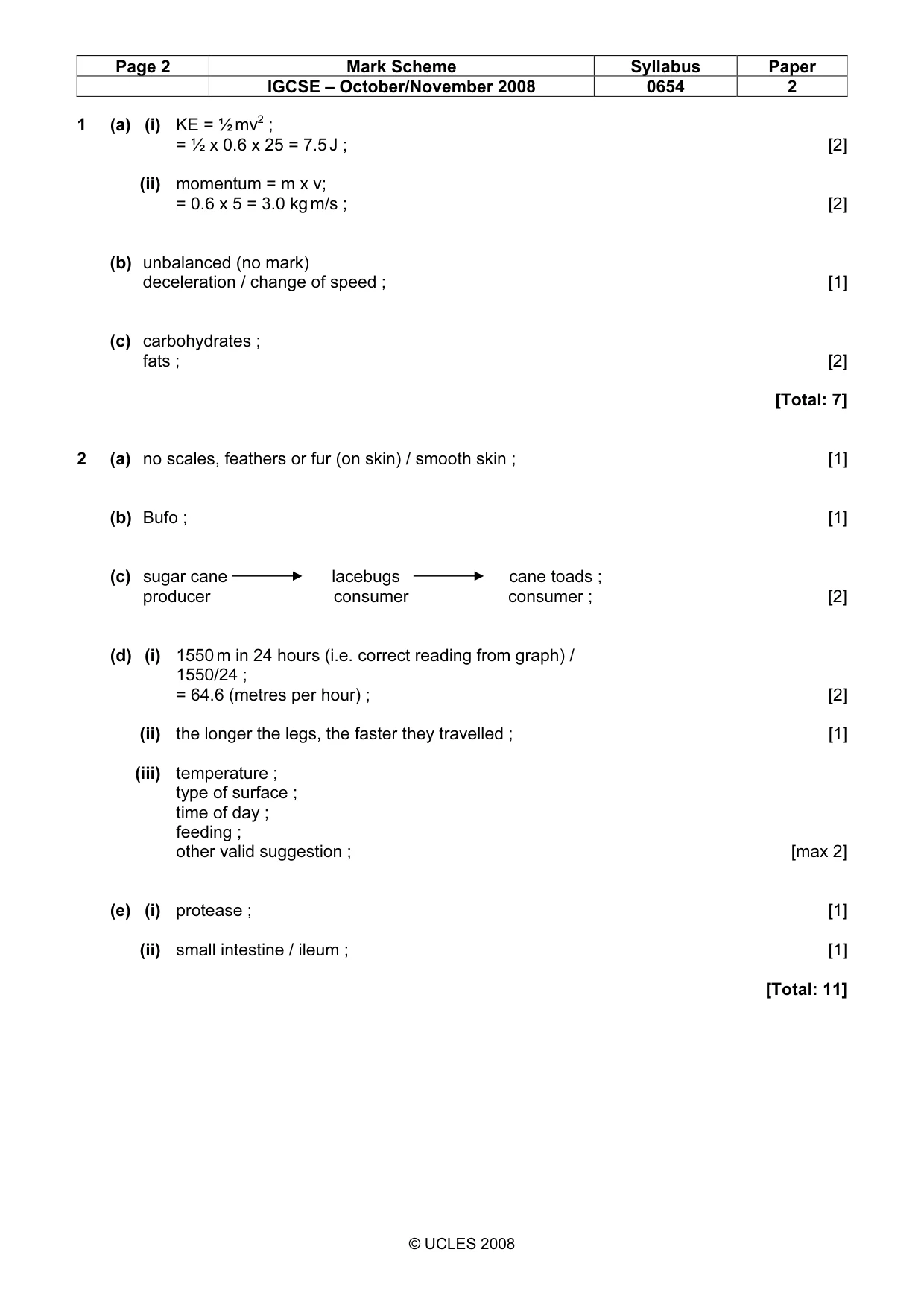
Page 2 Mark Scheme Syllabus Paper IGCSE – October/November 2008 0654 2 © UCLES 2008 1 (a) (i) KE = ½ mv2 ; = ½ x 0.6 x 25 = 7.5 J ; [2] (ii) momentum = m x v; = 0.6 x 5 = 3.0 kg m/s ; [2] (b) unbalanced (no mark) deceleration / change of speed ; [1] (c) carbohydrates ; fats ; [2] [Total: 7] 2 (a) no scales, feathers or fur (on skin) / smooth skin ; [1] (b) Bufo ; [1] (c) sugar cane lacebugs cane toads ; producer consumer consumer ; [2] (d) (i) 1550 m in 24 hours (i.e. correct reading from graph) / 1550/24 ; = 64.6 (metres per hour) ; [2] (ii) the longer the legs, the faster they travelled ; [1] (iii) temperature ; type of surface ; time of day ; feeding ; other valid suggestion ; [max 2] (e) (i) protease ; [1] (ii) small intestine / ileum ; [1] [Total: 11]
Mark scheme, page 3
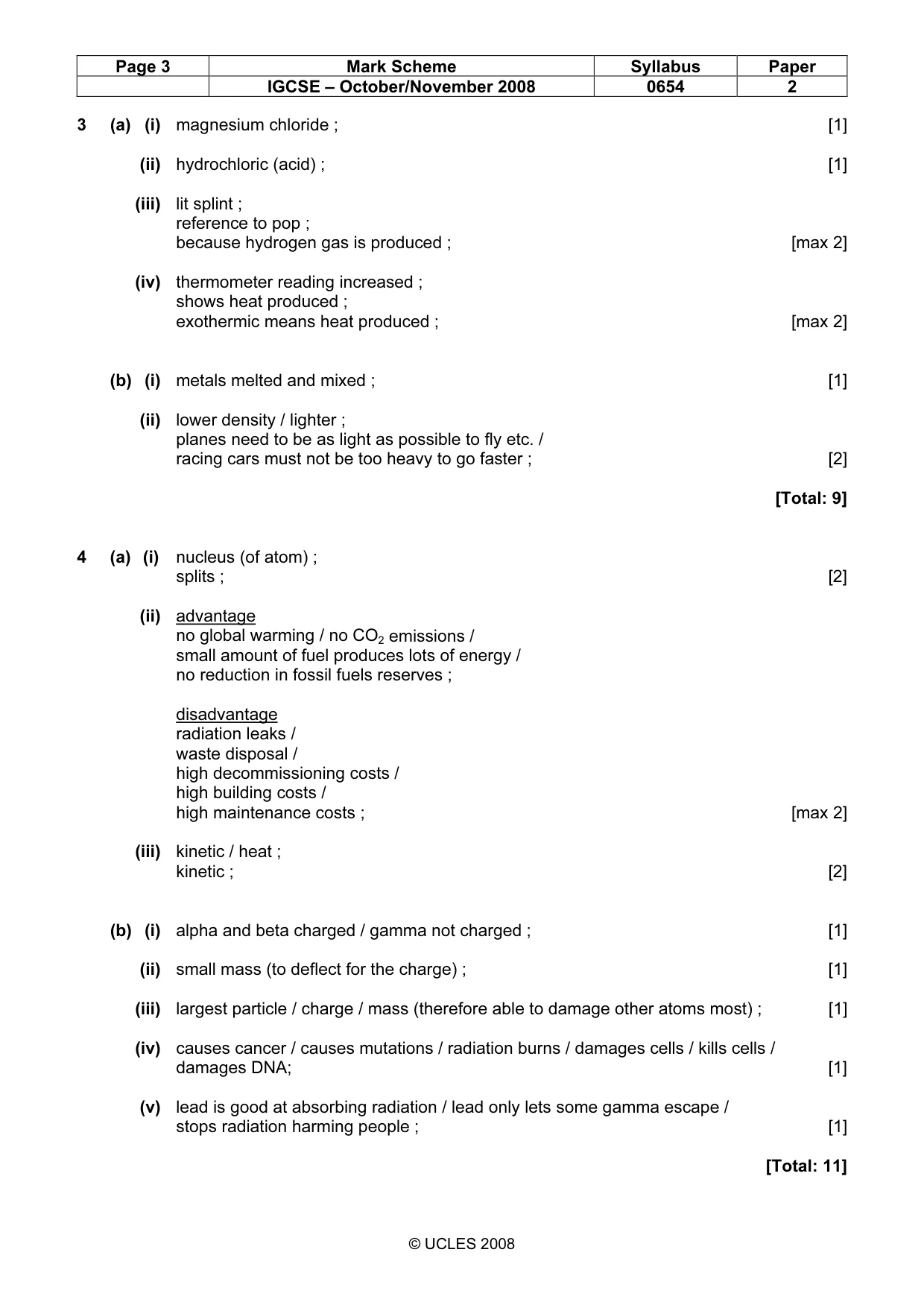
Page 3 Mark Scheme Syllabus Paper IGCSE – October/November 2008 0654 2 © UCLES 2008 3 (a) (i) magnesium chloride ; [1] (ii) hydrochloric (acid) ; [1] (iii) lit splint ; reference to pop ; because hydrogen gas is produced ; [max 2] (iv) thermometer reading increased ; shows heat produced ; exothermic means heat produced ; [max 2] (b) (i) metals melted and mixed ; [1] (ii) lower density / lighter ; planes need to be as light as possible to fly etc. / racing cars must not be too heavy to go faster ; [2] [Total: 9] 4 (a) (i) nucleus (of atom) ; splits ; [2] (ii) advantage no global warming / no CO2 emissions / small amount of fuel produces lots of energy / no reduction in fossil fuels reserves ; disadvantage radiation leaks / waste disposal / high decommissioning costs / high building costs / high maintenance costs ; [max 2] (iii) kinetic / heat ; kinetic ; [2] (b) (i) alpha and beta charged / gamma not charged ; [1] (ii) small mass (to deflect for the charge) ; [1] (iii) largest particle / charge / mass (therefore able to damage other atoms most) ; [1] (iv) causes cancer / causes mutations / radiation burns / damages cells / kills cells / damages DNA; [1] (v) lead is good at absorbing radiation / lead only lets some gamma escape / stops radiation harming people ; [1] [Total: 11]
Mark scheme, page 4
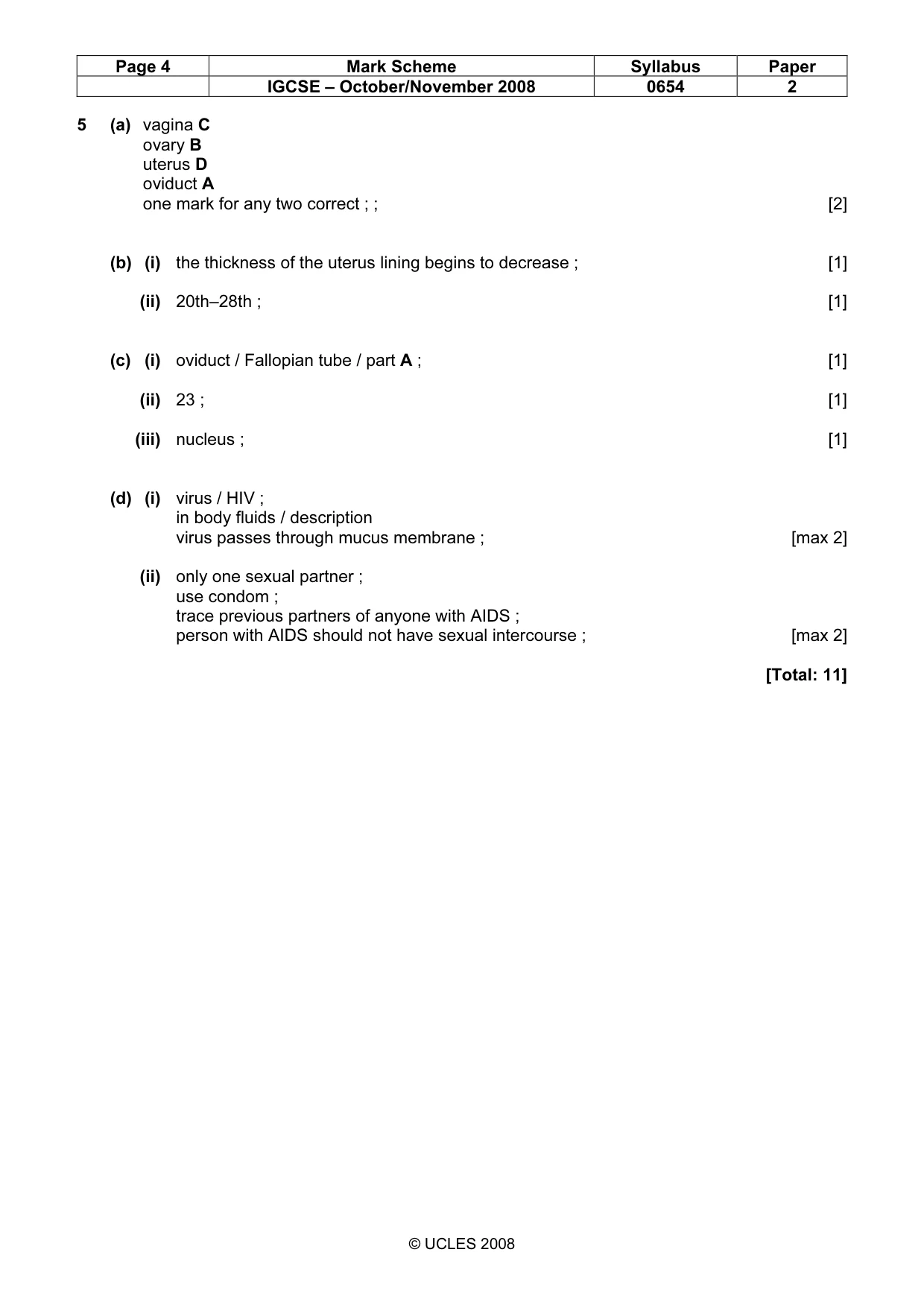
Page 4 Mark Scheme Syllabus Paper IGCSE – October/November 2008 0654 2 © UCLES 2008 5 (a) vagina C ovary B uterus D oviduct A one mark for any two correct ; ; [2] (b) (i) the thickness of the uterus lining begins to decrease ; [1] (ii) 20th–28th ; [1] (c) (i) oviduct / Fallopian tube / part A ; [1] (ii) 23 ; [1] (iii) nucleus ; [1] (d) (i) virus / HIV ; in body fluids / description virus passes through mucus membrane ; [max 2] (ii) only one sexual partner ; use condom ; trace previous partners of anyone with AIDS ; person with AIDS should not have sexual intercourse ; [max 2] [Total: 11]
Mark scheme, page 5
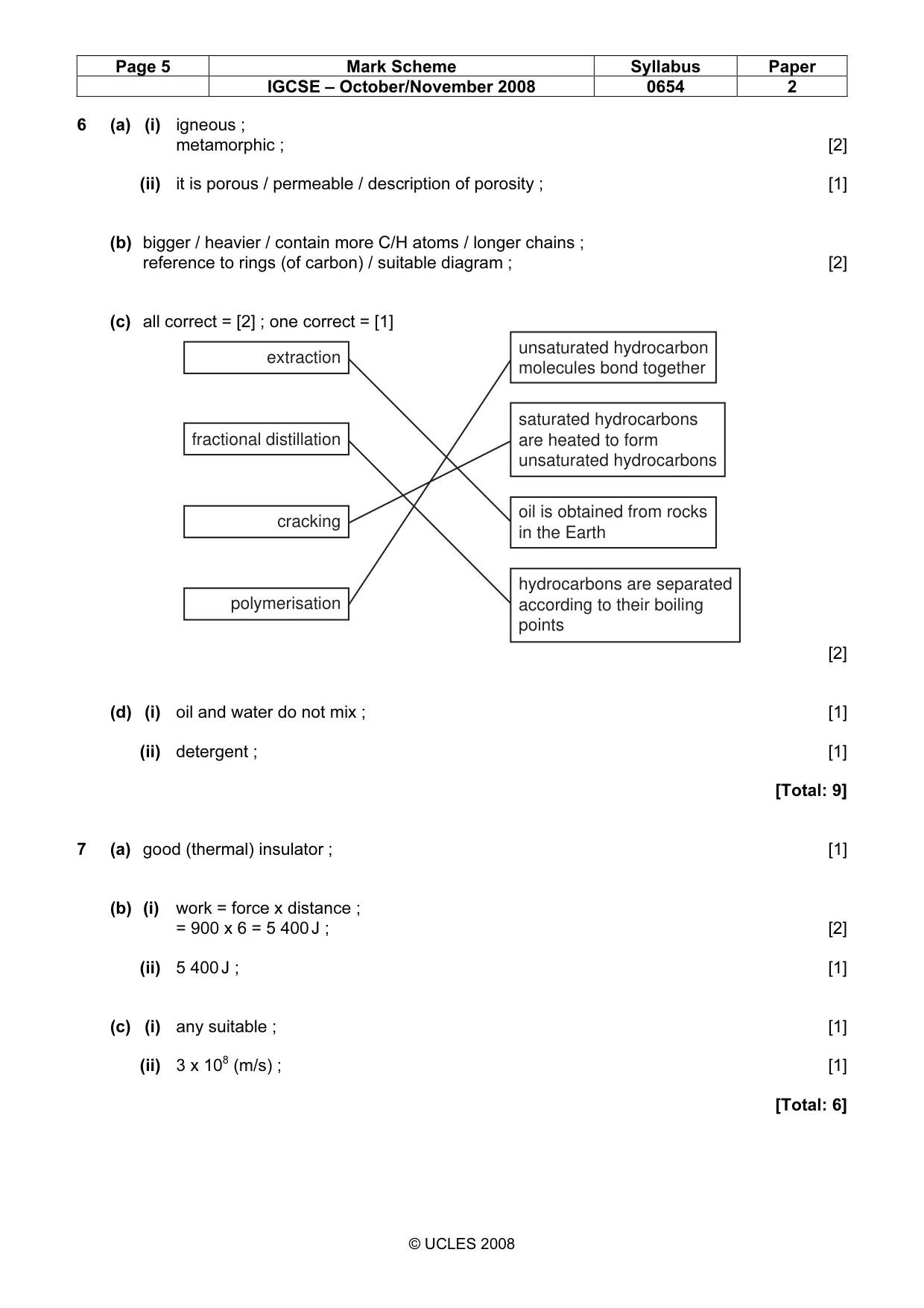
Page 5 Mark Scheme Syllabus Paper IGCSE – October/November 2008 0654 2 © UCLES 2008 6 (a) (i) igneous ; metamorphic ; [2] (ii) it is porous / permeable / description of porosity ; [1] (b) bigger / heavier / contain more C/H atoms / longer chains ; reference to rings (of carbon) / suitable diagram ; [2] (c) all correct = [2] ; one correct = [1] extraction fractional distillation cracking polymerisation unsaturated hydrocarbon molecules bond together saturated hydrocarbons are heated to form unsaturated hydrocarbons oil is obtained from rocks in the Earth hydrocarbons are separated according to their boiling points [2] (d) (i) oil and water do not mix ; [1] (ii) detergent ; [1] [Total: 9] 7 (a) good (thermal) insulator ; [1] (b) (i) work = force x distance ; = 900 x 6 = 5 400 J ; [2] (ii) 5 400 J ; [1] (c) (i) any suitable ; [1] (ii) 3 x 10⁸ (m/s) ; [1] [Total: 6]
Mark scheme, page 6
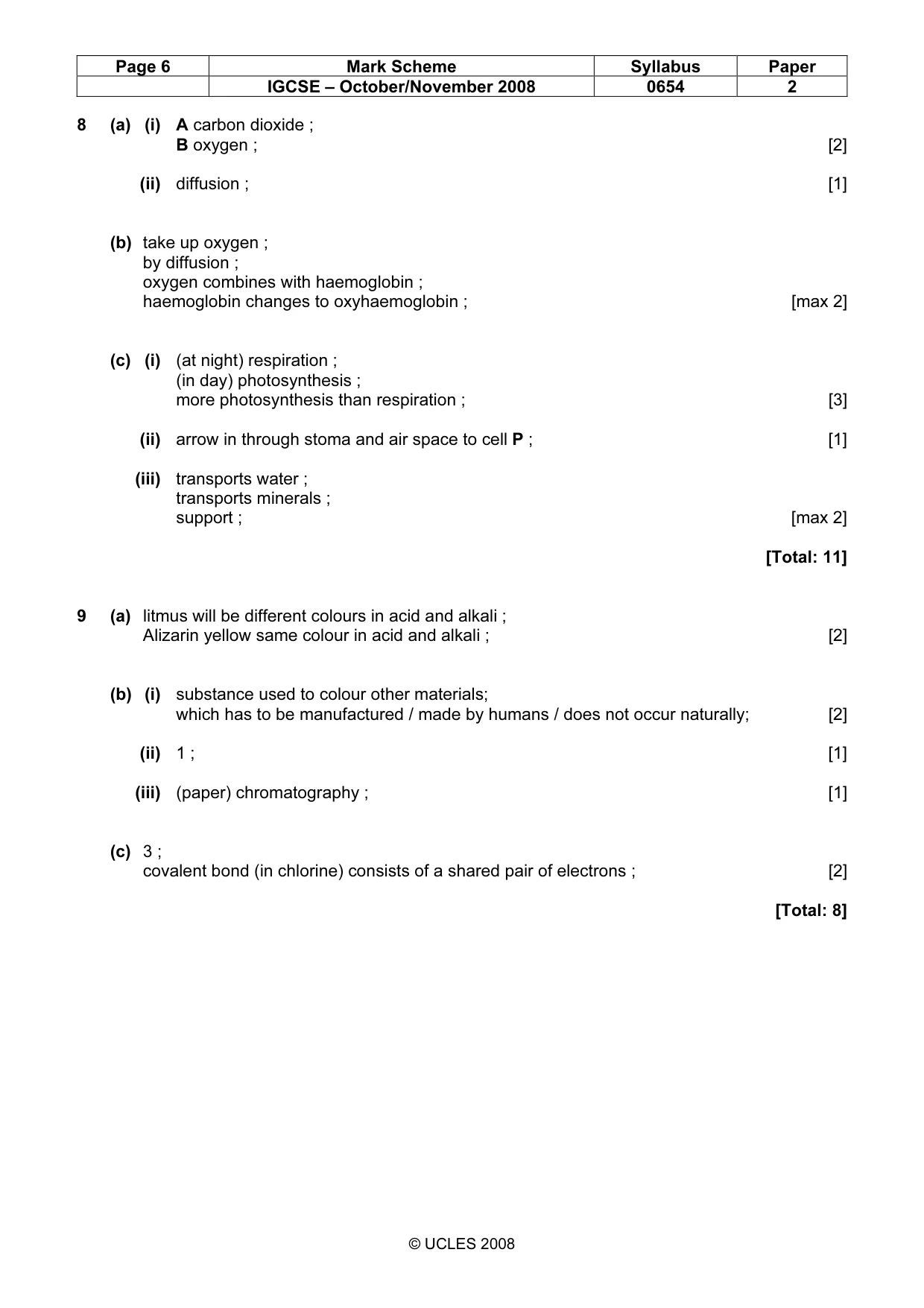
Page 6 Mark Scheme Syllabus Paper IGCSE – October/November 2008 0654 2 © UCLES 2008 8 (a) (i) A carbon dioxide ; B oxygen ; [2] (ii) diffusion ; [1] (b) take up oxygen ; by diffusion ; oxygen combines with haemoglobin ; haemoglobin changes to oxyhaemoglobin ; [max 2] (c) (i) (at night) respiration ; (in day) photosynthesis ; more photosynthesis than respiration ; [3] (ii) arrow in through stoma and air space to cell P ; [1] (iii) transports water ; transports minerals ; support ; [max 2] [Total: 11] 9 (a) litmus will be different colours in acid and alkali ; Alizarin yellow same colour in acid and alkali ; [2] (b) (i) substance used to colour other materials; which has to be manufactured / made by humans / does not occur naturally; [2] (ii) 1 ; [1] (iii) (paper) chromatography ; [1] (c) 3 ; covalent bond (in chlorine) consists of a shared pair of electrons ; [2] [Total: 8]
Mark scheme, page 7
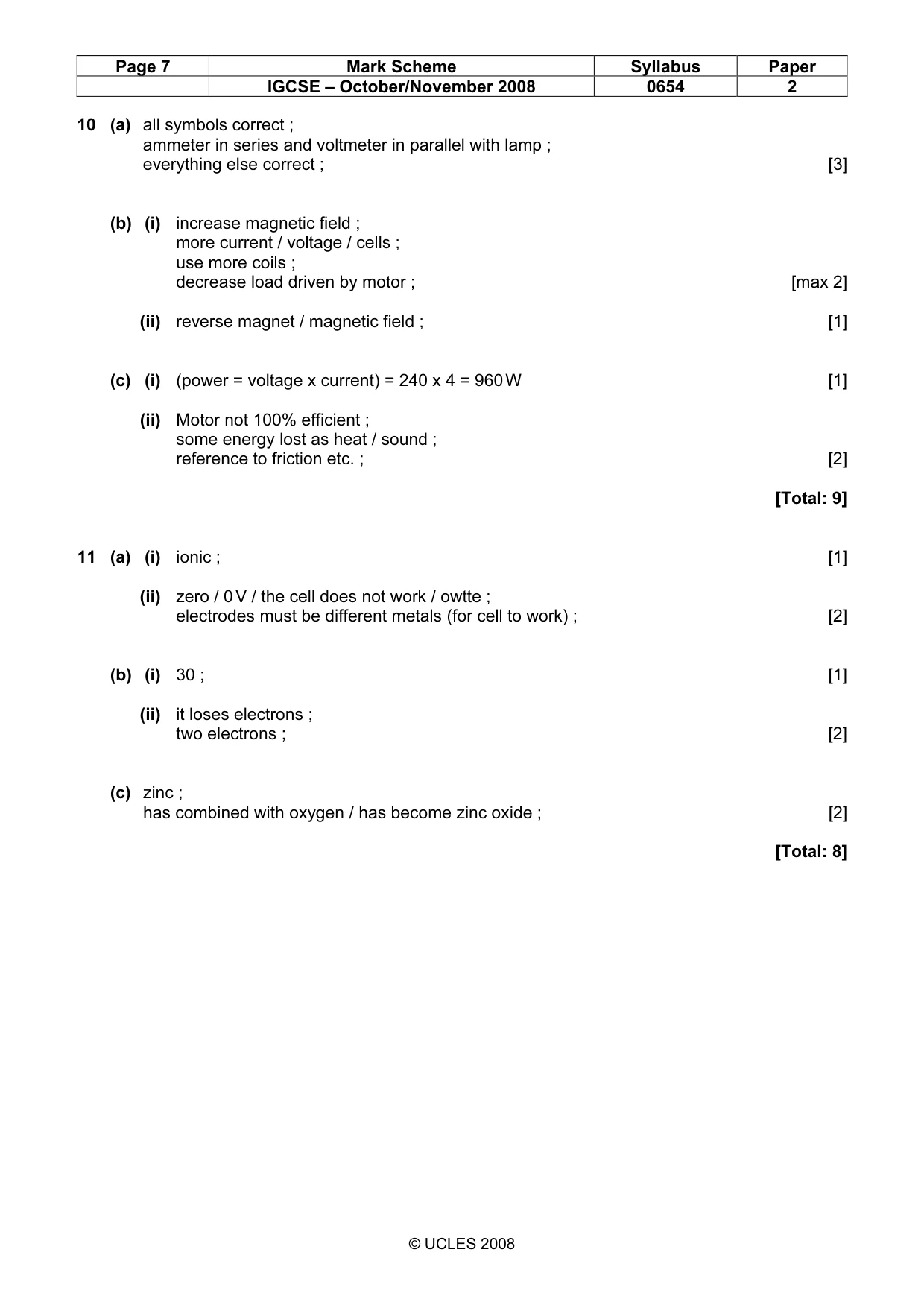
Page 7 Mark Scheme Syllabus Paper IGCSE – October/November 2008 0654 2 © UCLES 2008 10 (a) all symbols correct ; ammeter in series and voltmeter in parallel with lamp ; everything else correct ; [3] (b) (i) increase magnetic field ; more current / voltage / cells ; use more coils ; decrease load driven by motor ; [max 2] (ii) reverse magnet / magnetic field ; [1] (c) (i) (power = voltage x current) = 240 x 4 = 960 W [1] (ii) Motor not 100% efficient ; some energy lost as heat / sound ; reference to friction etc. ; [2] [Total: 9] 11 (a) (i) ionic ; [1] (ii) zero / 0 V / the cell does not work / owtte ; electrodes must be different metals (for cell to work) ; [2] (b) (i) 30 ; [1] (ii) it loses electrons ; two electrons ; [2] (c) zinc ; has combined with oxygen / has become zinc oxide ; [2] [Total: 8]
What you needed in this session
Cambridge’s own grade thresholds for 2008 Oct/Nov, Paper 2 · Variant 1. A higher threshold means an easier paper — the bar moves with how the cohort did.